
“And let them pardon and overlook. Would you not like that Allah should forgive you? And Allah is Forgiving and Merciful.” (Quran 24:22)
“Who spend In the cause of Allah during ease and hardship and who restrain anger and who pardon the people – and Allah loves the doers of good.” (Qur’an 3:134)
“And We have not created the heavens and earth and that between them except in truth. And indeed, the Hour is coming; so forgive with gracious forgiveness.” (Qur’an 15:85)
“O you who have believed, indeed, among your wives and your children are enemies to you, so beware of them. But if you pardon and overlook and forgive – then indeed, Allah is Forgiving and Merciful.” (Qur’an 64:14)
﷽
First let us address a misunderstanding that people have in general with the Muslim view in regard to Allah forgiving sins.
“Those who, upon committing an evil deed or wronging themselves, remember Allah and seek forgiveness for their sins—and who forgives sins except Allah?—and they do not knowingly persist in wrongdoing?” (Qur’an 3:125)
All sins are sins, ultimately sins against Allah. Rather, they are major or minor. One needs to beseech Allah for forgiveness. That being said, there are three types of relational sins.
- Sins against yourself. You did injustice to your own self.
And whoever does evil or acts unjustly to his soul, then asks forgiveness of Allah, will find Allah Forgiving, Merciful.” (Qur’an 4:110)
Coupled with this is the psychological torture a sinner puts on themselves thinking that their sins are greater than Allah’s mercy. That Allah (swt) will not forgive them. This is what is meant by forgiving yourself. Allah (swt) says:
“He said, “And who despairs of the mercy of his Lord except for those astray?” (Qur’an 15:56)
“”O my sons! go and enquire about Joseph and his brother, and never give up hope of Allah’s Soothing Mercy: truly no one despairs of Allah’s Soothing Mercy, except those who ungrateful disbelievers.” (Qur’an 12:87)
“Say, “O My servants who have exceeded the limits against their souls! Do not lose hope in Allah’s mercy, for Allah certainly forgives all sins. He is indeed the All-Forgiving, Most Merciful.” (Qur’an 39:53)
2. Sins against another party.
“And We ordained for them therein a life for a life, an eye for an eye, a nose for a nose, an ear for an ear, a tooth for a tooth, and for wounds is legal retribution. But whoever gives up his right as charity, it is an expiation for him. And whoever does not judge by what Allah has revealed – then it is those who are the wrongdoers.” (Qur’an 5:45)
So, depending upon the nature of the offense, one can simply forgive the offending party. However, the offender still needs to seek forgiveness from Allah. Another example could be that someone stole an apple from our orchard and we caught the thief. We can settle it with the thief. That they return the apple, that they agree to pay for it. That they exchange for another item. That they work to pay for it. Yet that offender still needs to ask Allah (swt) for forgiveness. For other offenses, different measures may be taken. This is to ensure a stable, just and cohesive society that is not overwhelmed by crimes and injustice.
3. Sins against Allah.
This is self-explanatory. Yet, in all these above cases. Sinning against myself, another party (person or group), in all cases one still needs to seek forgiveness from Allah (swt).
Jesus forgiving sins makes him God?
It would be appropriate for a Christian to prove to us that Allah (swt) alone pardons, and overlooks sins.
“Who is this which speaks blasphemies? Who can forgive sins, but God alone?”
Christians tell us that Jesus must be God because he ‘forgave sins’ and that ‘only God’ can forgive sins.
The text that immediately comes to mind is the following:
“But there were certain of the scribes sitting there, and reasoning in their hearts, “Why does this man speak blasphemies? Who can forgive sins but God only?”(Mark 2:7)
“And the scribes and the Pharisees began to reason, saying, “Who is this which speaks blasphemies? Who can forgive sins, but God alone?” (Luke 5:21)
We find it very peculiar that Christians would take the statement of the people who accused Jesus of wrongdoing and then agree with them!
Basically, the Christian logic is that these people were right. However, Jesus was entitled to do such since he is God.
Prima Qur’an comments:
Now here is some food for thought. Notice that the scribes and the Pharisees began to reason with themselves. Notice that there was absolutely no appeal to proofs and evidence.
Christians argue that the scribes and Pharisees are right based upon their reasoning.
Muslims argue that the scribes and Pharisees are wrong based upon their reason.
So then this would raise an obvious question:
Are there any scriptures that the scribes or Pharisees might appeal to that say that God alone forgives sins or do they simply use their own reason?
We have noted that when Christians try to prove that Jesus is God based upon his ability to forgive sins, they always appeal to Mark 2:7 and Luke 5:21
We have also found it very interesting that they tend to stay away from Matthew chapter 9.
Why don’t they use Matthew chapter 9 verse 8 to prove Jesus forgiving sins makes him divine?
Well, because Matthew chapter 9 verse 8 does not help their case.
In fact, it’s’ a proof text that can be argued effectively against that claim!
“And, behold, they brought to him a man sick of the palsy, lying on a bed: and Jesus seeing their faith said unto the sick of the palsy; “Son, be of good cheer; thy sins be forgiven you.”
And, behold, certain of the scribes said within themselves, “This man blasphemes.”
And Jesus knowing how they were reasoning said, “Why do you think evil in your hearts? What is easier, to say, ‘Your sins are forgiven you;’ or to say, ‘Arise, and walk?’ But that you may know that the Son of Man has power on earth to forgive sins, (then said he to the sick of the palsy,) ‘Arise, take up your bed, and go into your house’.”
And he arose and departed to his house. But when the multitudes saw it, they marveled, and glorified God, which had given such power unto MEN.” (Matthew 9:2-8)
*Note* Men plural. Not just a man.
Protestants have suspected that earlier Christians had tampered with the text. So they too have begun to tamper with the text. Notice the various translations of this text into English. Only the New International Version is being blatantly deceptive.
https://biblehub.com/matthew/9-8.htm
But there is something else of importance. You see, all believers do believe that Allah can cause us to be stricken with various ailments and illnesses. This can cause us to be humble, to turn us to the Creator, among other things.
However, apparently there was an understanding among certain of the Jews (if this text were to be believed) that if a person was born with an ailment, handicap or illness that either they or their parents did some sin that warranted this.
“As he went along, he saw a man blind from birth. His disciples asked him, “Rabbi, who sinned, this man or his parents, that he was born blind?” “Neither this man nor his parents sinned,” said Jesus, “but this happened so that the works of God might be displayed in him.” (John 9:1-3)
Now let us go back and compare/contrast these three accounts.
“But there was certain of the scribes sitting there, and reasoning in their hearts, ”Why does this man speak blasphemies? Who can forgive sins but God only?” (Mark 2:6-7)
“And the scribes and the Pharisees began to reason, saying, Who is this which speaks blasphemies? Who can forgive sins, but God alone?” (Luke 5:21)
“When the crowd saw this, they were filled with awe; and they praised God, who had given such authority to men.” (Matthew 9:8)
Prima Qur’an comments:
Mark has it that the Scribes were reasoning that only God can forgive sins.
Luke has it that the Scribes and Pharisees were reasoning that only God can forgive sins.
Matthew does not tell us what the scribes or Pharisees were reasoning at all. Rather, Matthew records the reaction of the crowd who praised God for giving such authority to men (plural).
Is there a contradiction? Not necessarily. Two transmitters record the reaction of Jesus’ opponents. One transmitter records the reaction of the crowd (which could or could not contain Scribes/Pharisees).
For Protestant Christians will ignorantly quote the citations of Mark and Luke as proof of the divinity of Christ Jesus.
Latin Roman Catholics, Oriental Orthodox, and Eastern Orthodox should know better. In this situation, the citation of Matthew 9:8 helps to establish authority for men to forgive sins.
We would like to bring the following text to your attention:
“Whosoever sins you remit, they are remitted unto them; and whosoever sins you retain, they are retained.” (John 20:23)
No one is making an argument that these men are divine because they have the ability to forgive and retain sins. The above text, which supports Sacerdotalism, has to be one of the most disliked texts in the entire New Testament by Protestant Christians.
The Most Famous Prayer in Christianity.
“This, then, is how you should pray: ” ‘Our Father in heaven, hallowed be your name, your kingdom come, let your will be done, on earth as it is in heaven. Give us today our daily bread. And forgive us our debts as we also have forgiven our debtors. And lead us not into temptation, but deliver us from the evil one.” (Matthew 6:9-13)
“He said to them, “When you pray, say: ” ‘Father, hallowed be your name, your kingdom come. Give us each day our daily bread. Forgive us our sins, as we also forgive everyone who sins against us. And lead us not into temptation.’ ” (Luke 11:2-4)
1) Forgive us our debts as we also have forgiven our debtors.
The Greek word there for ‘as‘ is ‘hosper‘ which means: ‘just as‘ and ‘exactly like‘.
2) Forgive us our sins as we forgive those who sinned against us.
Source: https://biblehub.com/greek/5618.htm
Prima Qur’an omments:
Jesus himself taught his followers to ask God to pardon their debts to him exactly like they pardon the debts of others to them. No one is asked to sacrifice their children or animals. Simply to pardon people for their offenses.
So the only way any of us, including Jesus, are ‘divine‘ in that sense would be like the saying,
“To err is human, to forgive, divine.” ― Alexander Pople, An Essay on Criticism
“How God anointed Jesus of Nazareth with the Holy Spirit and power, and how he went around doing good and healing all who were under the power of the devil because God was with him.” (Acts 10:38)
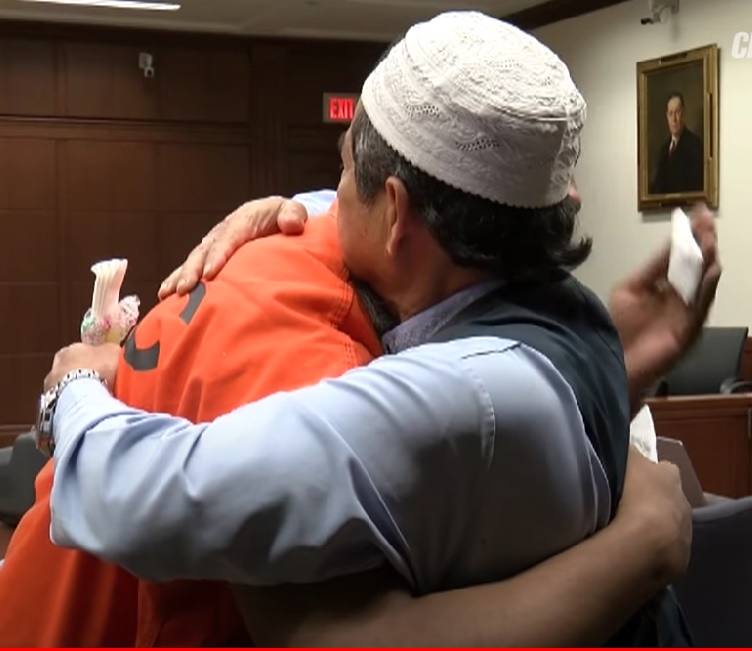
A very powerful example of forgiveness. Forgiveness can be a powerful transformative act for the human soul.
A Muslim man forgives the man who killed his son in a brutal murder. May Allah (swt) grant him paradise and may Allah (swt) open the heart of the other man to the message of Islam.
Muslim woman forgives the man who killed her son in a brutal murder. May Allah (swt) grant her paradise and may Allah (swt) open the heart of the other man to the message of Islam.
It is these conservative Muslim Americans that are transforming their neighborhoods, communities and societies for the better.
“When they hear what has been revealed to the Messenger, you see their eyes overflowing with tears because of what they have recognized of the truth. They say, “Our Lord, we have believed, so register us among the witnesses.”(Qur’an 5:83)
You may Allah be interested in reading:
May Allah guide the sincere among the Christians so that they do not enter the hellfire.
May Allah Guide the Ummah.
May Allah Forgive the Ummah.


