
“For them are good tidings in the worldly life and in the Hereafter. No change is there in the Words of Allah. That is what is the great attainment. “ (Qur’an 10:64)
“Messengers indeed have been denied before thee, and they were patient under the denial and the persecution till Our succor reached them. And no change is there in the Words of Allah. And there has certainly come to you some information about the messengers.” (Qur’an 6:34)
﷽
Does Allah Preserve His Words?
The short answer to this question from a theological perspective is yes. The answer is yes, because all the amr’—meaning commands, edicts, prohibitions, injunctions are from the knowledge of Allah.
Allah does not increase or decrease in knowledge.
The question of Allah preserving his words is usually asked of Muslims by Christian polemicists, and we will address them in this article as well.
You will often find them quoting either of these two verses:
“Your Lord’s word has been fulfilled in truth and justice. No change is there in His Words. He is the All-Hearing, the All-Knowing.” (Qur’an 6:115)
“Recite what has been revealed to you from the Book of your Lord. No change is there in His Words, nor can you find any refuge besides Him.” (Qur’an 18:27)
You will not really find them wanting to quote the following verses:
“For them are good tidings in the worldly life and in the Hereafter. No change is there in the Words of Allah. That is what is the great attainment. “ (Qur’an 10:64)
“Messengers indeed have been denied before thee, and they were patient under the denial and the persecution till Our succor reached them. And no change is there in the Words of Allah. And there has certainly come to you some information about the messengers.” (Qur’an 6:34)
This is because the above verses are clear that what is meant are the decrees of Allah (swt). When he decrees it will be like this or that it will be so.
“And they were patient under the denial and the persecution till Our succor reached them.” (Q 6:34)
“For them are good tidings in the worldly life and in the Hereafter.” (Q 10:64)
Even the above verse indicates this as well:
“Your Lord’s word has been fulfilled in truth and justice.” (Q 6:115)
What is meant by ‘no change is there in his Words’ means basically the decree of Allah. Whatever Allah decrees concerning his Creation. What he promises will occur.
An example being:
“When Allah promised you one of the two groups – that it would be yours – and you wished that the unarmed one would be yours. But Allah intended to establish the truth by His words and to eliminate the disbelievers.” (Qur’an 8:7)
“No calamity befalls on the earth nor from among your selves, without being in a record before We make it (nabr-aha) manifest. This is certainly easy for Allah.S o that you may not grieve for what has escaped you, nor be exultant at what He has given you; and Allah does not love any arrogant boaster (Qur’an 57:22-23)
This word nabr-aha is often difficult to translate into English. You can see a list of disparate translations here:
https://www.islamawakened.com/quran/57/22/
We went with Maududi’s rendering of the text: to make it manifest as it is the most sensible rendering. Others have it as ‘brought into being’ or ‘brought into existence’.
“And certainly We sent messengers (to mankind) before you, and We appointed for them wives and offspring, and it was not (given) to any messenger that he should bring a portent save by Allah’s leave. For everything there is a time prescribed. Allah effaces what He will, and establishes (what He will), and with Him is the source of ordinance (ummu l-kitabi)” (Qur’an 13:38-39)
Look at what Allah (swt) says here. He will efface what he will, and he will establish what he will. This, for Muslims, is the record that the angels give to mankind. That record is fluid because the human being and their relationship with the Creator can be fluid.
We talked more about that when we refuted this foreign concept that has crept in among Muslims about us being weighed on some scale on the day of judgment.
“As for those who repent, believe, and do good deeds, they are the ones whose evil deeds Allah will change into good deeds. For Allah is All-Forgiving, Most Merciful.” (Qur’an 25:70)
“That is because they followed what angered Allah and disliked [what earns] His pleasure, so He rendered worthless their deeds.” (Qur’an 47:28)
You can read about this here: https://primaquran.com/2024/08/02/are-muslims-weighed-on-scales-on-the-judgement-day/
However, let us say that this means the revelation of Allah, which would include the Qur’an, the Torah, the Injeel, the Zabur and the Suhuf of Ibrahim.
First, we know that the Qur’an is preserved in the lawhin mahfuz (preserved tablet). We can assume (though not specifically stated) that this is the case for other revealed revelations..
“In fact, this is a glorious Qur’an, in a Preserved Tablet.” (lawhin mahfuzin) (Qur’an 85:21-22)
What about the revelation when it descends from heaven to the Earthly realm?
At this point, one of two things can happen.
1) Allah (swt) can choose himself to preserve this revelation that is on this Earth.
“It is certainly We Who have revealed the Reminder, and it is certainly We Who will (lahafizuna) guard it.” (Qur’an 15:9)
2) Allah can entrust the revelation to someone other than himself.
“It was We who revealed the law (to Moses): therein guidance and light. By its standard have been judged the Jews, by the prophets who bowed to Allah’s will, by the rabbis and the learned: for to them was (us’tuh’fizua )entrusted the protection of Allah’s book, and they were witnesses thereto: therefore fear not men, but fear me, and sell not my signs for a miserable price. If any do fail to judge by (the light of) what Allah hath revealed, they are (no better than) Unbelievers.” (Qur’an 5:44)
You can see that the word lahafizuna & the word us’tuh’fizua are etymologically from the same root in Arabic.
The problems for the Christian Polemicist are manifold.
1) How do they even determine what scripture is to begin with?
Now, in regard to the Christian polemic, before we even talk about preserving the words of Allah, they have yet to make clear to the world the process by which they even decide what words are Allah’s words and what words are not.
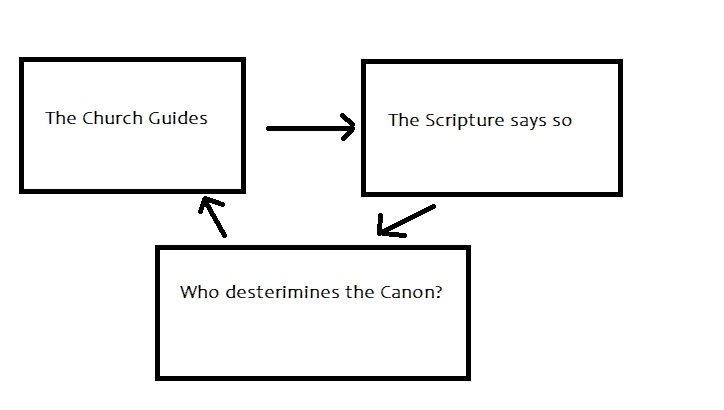
For example, when it comes to the Orthodox (Eastern/Oriental) and the Latin Roman Catholics, we get a very odd circular reasoning. The Protestants do not fair much better.
So this is a conundrum for Christians as a whole. The Latin Roman Catholics, Orthodox (Oriental/Eastern) point out to the Protestants that it was the Church that decided which books were to be considered canon of the New Testament.
However, if you were to ask where did the Church (tradition) get its authority from? It had to take its authority from somewhere?
For example, until this very day, Christians dispute the Canon of the Bible.
Not to mention the dispute among them concerning what they call the Old Testament, just to focus on the New Testament, we have the following proposed canons. A New Testament with 22 books (endorsed by the Assyrian Church of the East—Trichur India). They exclude: II Peter, II John, III John, Jude, Revelation of John. A New Testament with 27 books (which we assume most of the readers would be familiar with). A New Testament with 35 books (endorsed by the Ethiopian Orthodox Tawhedo Church). They include Sera’ata Seyon, Te’ezas, Gessewe, Abtelis, Mashafa Kidan, Mashafa Kidan II, Qalmentos, Dideqelya. Church.
For example: In an exchange between Dr. Bart Ehrman and Reformed Baptist Pastor Dr. James White, there were some thought-provoking questions.
Source: (https://www.apologetics315.com/media/white-ehrman-transcript.pdf)
Dr. Ehrman: ” So let me just say—the point is the earlier you go, the more different they are. So you just extrapolate that the earliest were probably the most different. Let me ask about
P72 where you resonate with this particular text, you said, that has 2 Peter and Jude in
it. What other documents are found in P72?”
Dr. White: “There’s some non-canonical documents in P72 My recollection was that 1,2 Peter and Jude were the only canonical documents in it.”
Dr. Ehrman: “Right, so I’m just wondering about you resonating with this document. Do you think this scribe thought that what he was copying was scripture?“
Dr. White: “Well, I don’t think that you can simply jump to the conclusion that because
scribes included books in a single codex that meant that they believed that everything in
that codex was necessarily Scripture. There are all sorts of works that were considered
to be very beneficial for the reading of people that were included in codices that were
not necessarily canonical.”
Dr. Ehrman: “Yeah, I just thought that it was odd that that particular manuscript was one that you resonate with because it’s the earliest attestation we have of the Protoevangelion
Jacobi.”
Prima Qur’an comments: So these are the type of questions that need to be asked. What if the transmitter was under the impression that Protoevangelion Jacobi had the same authoritative weight as the other documents he was transmitting?
You can say what you want about the Church Tradition and the disputes had about the canon (that exist until today), but you cannot presume to speak on behalf of the transmitter themselves.
“But as for you, continue in what you have learned and have become convinced of, because you know those from whom you learned it, and how from childhood you have known the holy Scriptures, which are able to make you wise for salvation through faith in Christ Jesus.” (2 Timothy 3:14-15)
The conundrum, or the pickle here for the Christian, is that the only scriptures that were around when he was a boy were what Christians call ‘the Old Testament’ and even more problematic is the fact that the version he would have had is Septuagint 2.0. (A Greek translation from the Hebrew).
- How are Gods words preserved according to Christians?
This is why, in recent years, Christians have developed an apologetic that the Qur’an asserts (one of their many competing New Testament canons) — why the Qur’an would weigh in on competing Christian claims we are never really told.
However, this claim has given much needed oxygen to the Christians involved in debates with Muslims. It deflects from the one thing they do not want to discuss — the Bible itself.
First, it is fascinating that Christians would bring up these verses of the Qur’an to establish (whichever canon they believe) is the preserved word of God.
It is interesting because Christians themselves do admit that we do not have the original writings. The original writings were not preserved. Why is that?
Listen to what Daniel B Wallace has to say on the matter.
“We don’t have the original manuscripts of the New Testament. They were they all disappeared within a century. I’m pretty convinced by copying and copying and copying copying frequent handling the early church was far more concerned to get the gospel out than they were to do exact copying of the New Testament. And that actually is a blessing. Because they didn’t have those kind of controls and consequently you get copies that are not through just one stream but tons of people all over the place are making these copies so here’s here’s a man who lives in Corinth he’s gonna be visiting Rome and he says hey I I heard Paul Paul wrote a letter to you guys too. I want to write that out. Do you mind if I copy it when I get there? Sure that’s no problem. This happened I’m sure dozens and dozens of times over. And those manuscripts would have lasted as much as 80-90 years but would fall apart from all these copies being made. So we don’t have the originals they disappeared. And all the copies that we have disagree with each other at some point. Sometimes it’s quite a few disagreements. But we have hundreds of thousands of textual variants among our manuscripts. So, a question to ask here is how badly did the scribes corrupt the New Testament? It’s absolutely proven that they did. No two manuscripts are alike, so unless
one of them is pristine every single scribe made mistakes. So because the original manuscripts disappeared and because no two copies agree with each other completely we have to do textual criticism we can’t just rely on one it’s imperfect. So scholars have to reconstruct it on that basis. But when you look at the number of textual variants and there are hundreds of thousands of them as Bart Ehrman likes to say there are more textual variants than our words in the original New Testament. That’s actually an understatement. But you have to not just look at the number of variants you have to look at the nature of these variants. And the best estimates are that at least at least 99.8% of them affect nothing. Most are spelling differences, there’s different ways to spell John. There’s different ways to spell Mary. They’re not going to affect anything. But the 1/5th of 1% that do affect things are the one’s that scholars talk about and disagree over on a number of these issues. But the bottom line is it does not matter in some respects which New Testament you use because no essential doctrine is jeopardized by any of these textual variants. Even Bart Erhman who wrote: “Misquoting Jesus” can say the same thing. So that’s true on that end but at the same time we want to know what the original text said in all the details. And so the great majority of scholars have very few disagreements over these passages. For example most scholars would say the long ending of Mark’s Gospel: Mark 16:9-20 is almost surely not authentic. And they still put in their Bibles typically smaller print. Or in brackets or footnote the oldest authorities don’t have this. So there’s a wide consensus on the vast majority of textual variants. And again there’s no essential doctrine that’s jeopardized by any of these textual variants that is extremely comforting. It’s very important to know that.”
Christians, even like Daniel B. Wallace, are deliberately deceitful. We have yet to interact with a Christian that was sincere.
For example: Daniel B. Wallace quotes Erhman as saying:
“But when you look at the number of textual variants and there are hundreds of thousands of them as Bart Ehrman likes to say there are more textual variants than our words
in the original New Testament.”
This is a flat lie!
In the debate with Bart Erhman here: https://www.youtube.com/watch?v=MsVWFS9r9DY
@25:19 “One thing we can say for certain is that there are more differences in our manuscripts than there are words in the New Testament.”
NOTE: Bart does not say the original New Testament.
In fact, during that very debate, Bart Ehrman took Daniel B Wallace to ask for his crazy assertions that biblical scholarship even speaks of getting back to the original. Something, Erhman mentions scholarship has given up on.
There are some other points that Christians play sleight of hand with their audience when it comes to the manuscript tradition. They don’t like to mention the dates of these manuscripts. So, when they become manic and start going on about thousands and thousands of manuscripts, we interject. “Slow down, take a deep breath. Let’s pause for a moment. Tell me about these manuscripts and their dates. For example, a fragment the size of a credit card dated 100 years after Jesus. What does it tell me about the rest of the contents dated 300 or 400 years later?
About 71% of the Greek New Testament manuscripts date after the 11th century. 84% after the 10th century and around 90% after the 9th century and 94% around the 8th century. So can you imagine that many of the manuscripts date from the Middle Ages, sometimes over 1000 years after what are thought to be the originals?
So Christians console themselves by saying. Alas! Even with us not having the original manuscripts, the manuscripts we do have show marginal differences that affect our core doctrines in insignificant ways. Will see this is not the hot cup of cocoa that Christians think that it is.
As regards what the original manuscripts said. Christians have no way of knowing.
For example, can Christians demonstrate to us that when a person is making a copy that the copy was read back to check it against the master document? How do we know that the manuscripts or copies before this are not changed?
This is what happens in the memorization of the Qur’an. Keep in mind that Muslims pray five times a day. In all five of those prayers, Surah Al Fatiha is read and transmitted from parents/teacher to children/students. In 3 of those five daily prayers, Surah Al Fatiha and any other portion of the Qur’an is read. In the month of Ramadan, the entire Qur’an is read by the Imam.
In Hadith transmission (though not all-inclusive) I will list three primary methods of transmission/reception.
Method of reception (al-Akhdh wa’l-Tahammul)
a) Direct hearing (al-Sama’) — A person hears directly from the Shaykh/Teacher.
b) Recitation or Rehearsal (Al-Qira’a ‘ala’l-Shaykh) — The person hears directly from the Shaykh/Teacher understands what is transmitted to them and repeats it back to the Shaykh/Teacher.
c) Permission (al-Ijaza) -Simply the Shaykh/Teacher trust the student without testing her/him.
By the way, to the Muslims reading this, be careful about your friends that boast about receiving many ijaza. Unless they reveal to you the specifics about what they learned and the level of mastery, Ijaza’s, in many cases today, amount to a ‘pat on the head’. Similar to saying: “Good job Tony!”
In fact, (imo) the most rigorous method of hadith transmission is one in which the student repeats back to the teacher what was said. Which would be transmission by Al-Qira’a ‘ala’l-Shaykh
We could bring a Christian scholar. It could be Oriental Orthodox, Eastern Orthodox, Latin, Roman Catholic, and we could ask them to recite from memory books of the New Testament, and we could check this method against our children.
Can you imagine the modern age when they had (what early Christians did not have) access to. What they imagine is a complete canon, and they still could not compete with our noble sister, Rafia Al Miskry (May Allah cover her with mercy).
Islam can give you demonstrable evidence of a well guarded, well-preserved transmission process. Can Christians do the same?
No major doctrines are affected by the differences in manuscripts?
What about the lynch pin doctrine of the Trinity? 1 John 5:7
For those people who think this is old hat and not important. Well, it is a major issue that divides Eastern Orthodox Christians when weighed against the majority of Protestant Christians.
If a Protestant Christian was weighing the issue of whether to join an Eastern Orthodox Church, they would have to wonder whether the Holy Spirit guided the Eastern Orthodox Church to hang on to 1 John 5:7. Are they truly guided in that decision?

Mark 16:9-20 Are the Churches that Include This Text in the Canon Upon Guidance?
Again, the Eastern Orthodox keep it as part of the canon.

What do the Vatican and the Latin Roman Catholic Church have to say about the text?
[9-20] This passage, termed the Longer Ending to the Marcan gospel by comparison with a much briefer conclusion found in some less important manuscripts, has traditionally been accepted as a canonical part of the gospel and was defined as such by the Council of Trent. Early citations of it by the Fathers indicate that it was composed by the second century, although vocabulary and style indicate that it was written by someone other than Mark. It is a general resume of the material concerning the appearances of the risen Jesus, reflecting, in particular, traditions found in Luke 24 and John 20. The Shorter Ending: Found after ⇒ Mark 16:8 before the Longer Ending in four seventh-to-ninth-century Greek manuscripts as well as in one Old Latin version, where it appears alone without the Longer Ending. The Freer Logion: Found after v 14 in a fourth-fifth century manuscript preserved in the Freer Gallery of Art, Washington, DC, this ending was known to Jerome in the fourth century. It reads: “And they excused themselves, saying, “This age of lawlessness and unbelief is under Satan, who does not allow the truth and power of God to prevail over the unclean things dominated by the spirits [or, does not allow the unclean things dominated by the spirits to grasp the truth and power of God]. Therefore reveal your righteousness now.’ They spoke to Christ. And Christ responded to them, “The limit of the years of Satan’s power is completed, but other terrible things draw near. And for those who sinned I was handed over to death, that they might return to the truth and no longer sin, in order that they might inherit the spiritual and incorruptible heavenly glory of righteousness. But . . . .’ “
Source: (https://www.vatican.va/archive/ENG0839/__PWI.HTM#$3H5)
Which brings us back to Daniel B. Wallace and his statement above:
“For example most scholars would say the long ending of Mark’s Gospel: Mark 16:9-20 is almost surely not authentic. And they still put in their Bibles typically smaller print. Or in brackets or footnote the oldest authorities don’t have this..”
Which Christian is guided by the Holy Spirit in this matter?
In the Red Letter New Testament, where the words are reported to have come from Jesus are in red, we would have: And then he told them, “Go into all the world and preach the Good News to everyone. Anyone who believes and is baptized will be saved. But anyone who refuses to believe will be condemned. These miraculous signs will accompany those who believe: They will cast out demons in my name, and they will speak in new languages. They will be able to handle snakes with safety, and if they drink anything poisonous, it won’t hurt them. They will be able to place their hands on the sick, and they will be healed.”
That is a huge chunk of words being attributed to Christ Jesus.
John 7:53-John 8:11 Are the Churches that Include This Text in the Canon Upon Guidance?
The Vatican, the authority for the Latin Roman Catholic Church states:
[7:53-⇒8:11] The story of the woman caught in adultery is a later insertion here, missing from all early Greek manuscripts. A Western text-type insertion, attested mainly in Old Latin translations, it is found in different places in different manuscripts: here, or after ⇒
John 7:36 or at the end of this gospel, or after ⇒ Luke 21:38, or at the end of that gospel. There are many non-Johannine features in the language, and there are also many doubtful readings within the passage. The style and motifs are similar to those of Luke, and it fits better with the general situation at the end of Luke 21:but it was probably inserted here because of the allusion to ⇒ Jeremiah 17:13 (cf the note on John ⇒ John 8:6) and the statement, “I do not judge anyone,” in ⇒ John 8:15. The Catholic Church accepts this passage as canonical scripture.
Source: (https://www.vatican.va/archive/ENG0839/__PXF.HTM)
So, here you have the Latin Roman Catholic Church telling you that this is dubious in nature, and yet if the Church accepts this as canonical, you are bound to accept it as such too!
In a Red Letter New Testament where the words reported to have come from Jesus are in read we would have:
“Let him who is without sin among you be the first to throw a stone at her.” “Woman, where are they? Has no one condemned you?”
“Neither do I condemn you; go, and from now go and sin no more.”
More words attributed to Jesus and put in his mouth of which he may have not said at all.
The Eastern Orthodox are on board with John 8:1-11 as well.
So, depending upon the type of Christian, these issues should be of major concern to them.
- If you are a Christian that believes in the inerrancy of scripture, you have conservative Christian scholars asserting that there are errors. Thus, inerrancy is a major doctrine.
“Heaven and earth will pass away, but my words will never pass away.” (Matthew 24:35)
2. If you are a Christian that believes that the Church guides you into the truth and here (at least the Latin Roman Catholic Church) in front of God and everyone is telling you about the dubious nature of these passages, should that not make you want to reflect further?
What is the correct reading of John 1:18 The unique son or unique God?
.”No man has ever seen God; but now his only-begotten Son, who abides in the bosom of the Father, has himself become our interpreter.”
Some of the best manuscripts here read ‘God, the only-begotten’ instead of ‘the only-begotten Son’
Source: (https://www.newadvent.org/bible/joh001.htm)
“No one has ever seen God. The only Son, God, who is at the Father’s side, has revealed him.”
The only Son, God: while the vast majority of later textual witnesses have another reading, “the Son, the only one” or “the only Son,” the translation above follows the best and earliest manuscripts, monogenes theos, but takes the first term to mean not just “Only One” but to include a filial relationship with the Father, as at⇒ Luke 9:38 (“only child”) or ⇒ Hebrews 11:17 (“only son”) and as translated at ⇒ John 1:14. The Logos is thus “only Son” and God but not Father/God.
Source: (https://www.vatican.va/archive/ENG0839/__PX9.HTM#$3QA)
Luke 23:34 Did Jesus really say: Jesus said, “Father, forgive them, for they do not know what they are doing.”
“[Then Jesus said, “Father, forgive them, they know not what they do.”]: this portion of ⇒Luke 23:34 does not occur in the oldest papyrus manuscript of Luke and in other early Greek manuscripts and ancient versions of wide geographical distribution.”
Source: (https://www.vatican.va/archive/ENG0839/__PX6.HTM#$3PH)
Titus 2:13 Is the Great God, Jesus or are Jesus and the Great God two separate things?
Is it that the “Great God” and “Jesus Christ” are separate beings?
Or
Is that the “Great God” is also “our Saviour Jesus Christ?”
“We were to look forward, blessed in our hope, to the day when there will be a new dawn of glory, the glory of the great God, the glory of our Saviour Jesus Christ; “ (Titus 2:13)
We may, with the Greek Fathers, understand St Paul to have written here ‘the glory of our great God and Saviour Jesus Christ’; or we may, by a slightly less natural interpretation of the Greek, render ‘the glory of the great God, and of our Saviour Jesus Christ’.
Source: (https://www.newadvent.org/bible/tit002.htm)
“as we await the blessed hope, the appearance of the glory of the great God and of our savior Jesus Christ,” (Titus 2:13)
“The blessed hope, the appearance: literally, “the blessed hope and appearance,” but the use of a single article in Greek strongly suggests an epexegetically, i.e., explanatory sense. Of the great God and of our savior Jesus Christ: another possible translation is “of our great God and savior Jesus Christ.”
Source: (https://www.vatican.va/archive/ENG0839/__P11C.HTM#$4S9)
Which Latin Roman Catholic Source is Inspired By the Holy Spirit to give us the correct reading of Romans 9:5?
“The patriarchs belong to them, and theirs is the human stock from which Christ came; Christ, who rules as God over all things, blessed for ever, Amen.” (Romans 9:5)
‘Christ, who rules as God’; some commentators would translate, ‘Blessed be God who is above all things, for ever’, making this a distinct sentence; but they have not been able to suggest any plausible grounds for the intrusion of this irrelevant apostrophe, and the order of words in the Greek makes it almost impossible.
Source: (https://www.newadvent.org/bible/rom009.htm)
“Theirs the patriarchs, and from them, according to the flesh, is the Messiah. God who is over all be blessed forever. Amen.” (Romans 9:5)
Some editors punctuate this verse differently and prefer the translation, “Of whom is Christ according to the flesh, who is God over all.” However, Paul’s point is that God who is over all aimed to use Israel, which has been entrusted with every privilege, in outreach to the entire world through the Messiah.
Source: (https://www.vatican.va/archive/ENG0839/__PYX.HTM#$47V)
Notice the disharmony between the two Latin Roman Catholic sources?
Does the Gospel of Luke contain a doctrine of vicarious atonement? Luke 22:19-20
Then he took the bread, said the blessing, broke it, and gave it to them, saying, “This is my body, which will be given for you; do this in memory of me.” And likewise the cup after they had eaten, saying, “This cup is the new covenant in my blood, which will be shed for you.” (Luke 22:19-20)
Which will be given . . . do this in memory of me: these words are omitted in some important Western text manuscripts and a few Syriac manuscripts. Other ancient text types, including the oldest papyrus manuscript of Luke dating from the late second or early third century, contain the longer reading presented here. The Lucan account of the words of institution of the Eucharist bears a close resemblance to the words of institution in the Pauline tradition (see ⇒ 1 Cor 11:23-26). See also the notes on ⇒ Matthew 26:26-29; ⇒ 26:27-28; and ⇒ Mark 14:22-24.
Source: (https://www.vatican.va/archive/ENG0839/__PX5.HTM#$3P1)
CHRISTIAN DECEIT IN REGARD TO THE SEPTUAGINT
The first and original Septuagint was only of the Torah, and it was translated from Hebrew into Greek to facilitate the needs of the Jewish Community.
Those who follow Judaism never translated the TNCH into Greek for their needs. Let us be clear about this. Among those Children of Israel, you have three types in terms of relationship to what the Christians call “The Old Testament.”
- You have the Samaritans. They call themselves: Bene Yisrael (“Children of Israel) or Shamerim (“Observant Ones”). They only accept the Torah.
- You Karaite Judaism. They follow the whole of the TNCH, but they do not follow the Oral Torah.
- You have what may be termed Orthodox Judaism. They follow the TNCH and the Oral Torah.
Let us be clear. None of those groups accept 1 and 2 Maccabees, Judith, Tobit, Sirach, Baruch and Wisdom as authoritative scripture. Not at all!
The other peculiar feature of the Christian Septuagint 2.0 is that it is written in Koine Greek, and other parts use Classical Greek.
The Christian Septuagint 2.0, which includes the whole of the TNCH and includes 1 and 2 Maccabees, Judith, Tobit, Sirach, Baruch and Wisdom, is deemed authoritative by the Latin Roman Catholics, the Oriental Orthodox Church and the Eastern Orthodox Church.
It is this Septuagint 2.0 that is the basis for the Christian New Testament. It is this Septuagint 2.0 that is referenced above: and how, from childhood, you have known the holy Scriptures, which are able to make you wise for salvation through faith in Christ Jesus.” (2 Timothy 3:14-15)
It is this Septuagint 2.0 that Christians believe the Holy Spirit (The Third of Three) inspired the authors of various New Testament texts to quote from. This is folly, as we will see.
The popular Christian version of Isaiah 9:6 is not even in Septuagint 2.0!
“For a child is born to us, a son is given to us. The government will rest on his shoulders. And he will be called: Wonderful Counselor, Mighty God, Everlasting Father, Prince of Peace.” (Isaiah 9:6)
Source: (https://biblehub.com/isaiah/9-6.htm)
This is what you are used to seeing, correct? Wonderful Counselor, Mighty God, Everlasting Father, Prince of Peace.
https://biblehub.com/sep/isaiah/9.htm
“For a child is born to us, and a son is given to us, whose government is upon his shoulder: and his name is called the Messenger of great counsel: for I will bring peace upon the princes, and health to him.”(Isaiah 9:6 -The Septuagint 2.0 The Holy Spirit’s Fav Version)
Where are all these other names?
So who is upon the truth? Are Latin Roman Catholics, Oriental Orthodox and Eastern Orthodox upon guidance for trusting a text that does not make Christological claims about Jesus, such as calling him (Jesus) ‘The Everlasting Father’? Claims that contradict the idea that Jesus is not the Father?
Or are those Protestants who trust in the Masoretic text (although they still give it a Christological bent). Are they upon the truth?
Only one person in the Jewish scriptures is referred to as “mighty god” and his name is Hizkiyyahu or, Hezekiah (mighty god). Jewish names, like many Muslims’ names, are what one may call a theophoric name. The 1st century Christians did not use Isaiah 9:6 for Christological purposes. Latter ones did though. Changing the Hebrew perfect tense to future tense.
The New Testament, frequently, with malevolent intent, deliberately corrupts the Hebrew Bible to advance Christological claims.
Examples:
“He went to Nazareth, where he had been brought up, and on the Sabbath day he went into the synagogue, as was his custom. He stood up to read, and the scroll of the prophet Isaiah was handed to him. Unrolling it, he found the place where it is written: “The Spirit of the Lord is on me, because he has anointed me to proclaim good news to the poor. He has sent me to proclaim freedom for the prisoners and recovery of sight for the blind, to set the oppressed free, to proclaim the year of the Lord’s favor.” (Luke 4:16-19)
“and the scroll of the prophet Isaiah was handed to him.”
“The Spirit of the Lord is on me, because he has anointed me to proclaim good news to the poor. He has sent me to proclaim freedom for the prisoners and recovery of sight for the blind, to set the oppressed free, to proclaim the year of the Lord’s favor.”
So when we go to this Latin Roman Catholic website here:
https://www.newadvent.org/bible/luk004.htm
The footnote says: [6] Is. 61.1, 2. So, this means this text from Isaiah that Jesus is allegedly reading is Isaiah 61:1-2 right?
So when we check this against the Septuagint 2.0 (The Holy Spirit’s Fav Version)
We find the following:
“The Spirit of the Lord is upon me, because he has anointed me; he has sent me to preach glad tidings to the poor, to heal the broken in heart, to proclaim liberty to the captives, and recovery of sight to the blind; to declare the acceptable year of the Lord, and the day of recompense; to comfort all that mourn (Isaiah 61:1-2 Septuagint 2.0)
Source: (https://biblehub.com/sep/isaiah/61.htm)
But wait a minute! Hold up! It says: ” He stood up to read, and the scroll of the prophet Isaiah was handed to him. Unrolling it, he found the place where it is written…”
Here is the rub: Jesus did not read from Septuagint 2.0. It says he was reading from the scroll! What would the Hebrew Isaiah 61 look like?
The spirit of the Lord God was upon me, since the Lord anointed me to bring tidings to the humble, He sent me to bind up the broken-hearted, to declare freedom for the captives, and for the prisoners to free from captivity. To declare a year of acceptance for the Lord and a day of vengeance for our God, to console all mourners. (Isaiah 61:1-2)
Source: (https://www.chabad.org/library/bible_cdo/aid/15992)
“The spirit of my Sovereign GOD is upon me, Because God has anointed me. I have been sent as a herald of joy to the humble, To bind up the wounded of heart, To proclaim release to the captives, Liberation to the imprisoned; To proclaim a year of GOD’s favor And a day of vindication by our God; To comfort all who mourn.” (Isaiah 61:1-2)
Source: (https://www.sefaria.org/Isaiah.61.2?lang=bi&with=all&lang2=en)
“To give sight to the blind” That is no where there!
So are the Eastern Orthodox, Oriental Orthodox, Latin Roman Catholics and Protestants justified to maliciously tamper with the text like this? Do they have the right to alter God’s words?
The Malicious tampering of Habakkuk 2:4 by the Christians.
“Behold, it is puffed up-his soul is not upright within him, but the righteous shall live by his faith.” (Habakkuk 2:4)
Another Satanic manipulation by Paul.
“Clearly no one who relies on the law is justified before God, because “the righteous will live by faith.” (Galatians 3:11)
“For in the gospel the righteousness of God is revealed—a righteousness that is by faith from first to last, just as it is written: “The righteous will live by faith.” (Romans 1:17)
Christians are fine with this! Because they are a people who are not sincere and do not mind if God’s scriptures are contorted and manipulated.
An Anonymous New Testament Book Alters the Words of Jeremiah!
The Book of Hebrews—according to church tradition—is ascribed to Paul. However, today, modern Christian scholarship has walked away from this claim.
Nonetheless, why would Christians trust a book by an anonymous author that deliberately and maliciously misquotes the Jewish Scriptures?
“It will not be like the covenant which I made with their fathers, on the day when I took them by the hand, to rescue them from Egypt; that they should break my covenant, and I (says the Lord) should abandon them.” (Hebrews 8:9)
Footnote states: [4] vv. 8 and following: Jer. 31.31.
Source: (https://www.newadvent.org/bible/heb008.htm)
“It will not be like the covenant which I made with their fathers, on the day when I took them by the hand, to rescue them from Egypt; that they should break my covenant, and I, all the while, their master, the Lord says.” (Jeremiah 31:32)
Source: (https://www.newadvent.org/bible/jer031.htm)
Jeremiah 31:31 in the Hebrew TNCH (Jeremiah 31:32 in a Christian Bible)
“Not like the covenant that I formed with their forefathers on the day I took them by the hand to take them out of the land of Egypt, that they broke My covenant, although I was a lord over them, says the Lord.” (Jeremiah 31:31)
Source: (https://www.chabad.org/library/bible_cdo/aid/16028)
“It will not be like the covenant I made with their ancestors, when I took them by the hand to lead them out of the land of Egypt, a covenant that they broke, though I espoused them—declares GOD.” (Jeremiah 31:31)
Source: (https://www.sefaria.org/Jeremiah.31.32?lang=bi)
The deliberate and malicious changes to the text are obvious to all those who do not have a veil over their eyes.
A huge difference between saying God abandoned his people or simply disregarded them and saying that God was like a husband or espoused or a watchful master/lord over them.
Another example of this anonymous author maliciously and deliberately altering the text of the Hebrew TNCH is the following:
“As Christ comes into the world, he says, No sacrifice, no offering was your demand; you have endowed me, instead, with a body. You have not found any pleasure in burnt-sacrifices, in sacrifices for sin.” (Hebrews 10:5-6)
Source: (https://www.newadvent.org/bible/heb010.htm)
“You have done great things, You, O Lord my God. Your wonders and Your thoughts are for us. There is none to equal You; were I to tell and speak, they would be too many to tell. You desired neither sacrifice nor meal offering; You dug ears for me; a burnt offering or a sin offering You did not request.” (Psalms 40:6-7)
Source: (https://www.chabad.org/library/bible_cdo/aid/16261)
“You, O LORD my God, have done many things; the wonders You have devised for us cannot be set out before You; I would rehearse the tale of them, but they are more than can be told You gave me to understand that You do not desire sacrifice and meal offering; You do not ask for burnt offering and sin offering.” (Psalms 40:6-7)
Source: (https://www.sefaria.org/Psalms.40.6?lang=bi)
A huge difference between saying God prepared a body (meaning Christ) and saying that God opened up my mind to understanding. Yet, this is a shameful and deliberate misquotation and alteration of the text!
Paul once again deliberately and maliciously alters the understanding of the Hebrew TNCH to make it fit into his Christology.
“Christ has redeemed us from the curse of the law, having become a curse for us for it is written, “Cursed is everyone who hangs on a tree”), that the blessing of Abraham might come upon the Gentiles in Christ Jesus, that we might receive the promise of the Spirit through faith.” (Galatians 3:13-14)
“If any party is guilty of a capital offense and is put to death, and you impale the body on a stake, you must not let the corpse remain on the stake overnight, but must bury it the same day. For an impaled body is an affront to God: you shall not defile the land that your God יהוה is giving you to possess.” (Deuteronomy 21:22-23)
Source:(https://www.sefaria.org/Deuteronomy.21.23?lang=bi&with=all&lang2=en)
“And all the men of his city shall pelt him to death with stones, and he shall die. So shall you clear out the evil from among you, and all Israel will listen and fear.If a man commits a sin for which he is sentenced to death, and he is put to death, you shall [then] hang him on a pole.” (Deuteronomy 21:22-23)
Source: (https://www.chabad.org/library/bible_cdo/aid/9985)
Notice that Paul is using Deuteronomy 21:-22-23 as an ante-mortem suspension. However, it is very clear that Deuteronomy 21:-22-23 is speaking about a post-mortem suspension.
This is why we, in our school, know that the interpretations held by the Qadiani/Sunni/Nizari Ismail concerning Qur’an 4:157 are wrong. As Qur’an 4:157 does not speak about a cross or patibulum at all. If we believed even for a moment that the Sunni/Qadiani/Nizari Ismaili misunderstanding of Qur’an 4:157 was correct, we would have grounds to doubt the Qur’an. May Allah protect us! That is because Jews do not crucify anyone or put anyone on crosses. The Sunni/Qadiani/Nizari Ismaili misunderstanding makes our Creator ignorant of Jewish law. May Allah protect us!
The Torah explicitly mentions post-mortem suspension by impailment (Qur’an 4:157 “They did not kill him nor did they impail him) wa-ma qataluhu wa ma salabuhu.
If you want to read more on this, we would encourage you to read our article here:
The New Testament belittles the Torah and makes the fallacious claim that Moses received the Torah from the medium of angels rather than directly from God himself!
Where is the proof in the Torah that Moses was given the law by angels or by God while being accompanied by angels? It says God gave the law to Moses. There is no mention of angels being involved at all!
“For if the word spoken by angels was steadfast, and every transgression and disobedience received a just recompense of reward.” (Hebrews 2:2)
“This is he (Moses), that was in the church in the wilderness with the angel which spoke to him in the mount Sinai, and with our fathers: who received the lively oracles to give unto us.”(Acts 7:38)
“Who have received the law by the disposition of angels, and have not kept it.” (Acts 7:53)
“Wherefore then served the law? It was added because of transgressions, till the seed should come to whom the promise was made; and it was ordained by angels in the hand of a mediator.” (Galatians 3:19)
If you enjoyed this article you may find the following beneficial:
https://primaquran.com/2024/07/15/the-quran-charges-oral-corruption-of-the-previous-revelations/
https://primaquran.com/2024/08/11/why-is-the-injeel-from-greek/
https://primaquran.com/2024/04/15/does-the-quran-teach-that-the-bible-was-corrupted/
https://primaquran.com/2024/04/16/is-the-bible-the-unadulterated-word-of-god/
May Allah Guide them to the truth so that they do not burn in hellfire.


 Prima Quran