
“Allah said, O Jesus, I shall cause you to die and will raise you up to Me and shall purify you of the ungrateful disbelieving people, and shall place those who follow you above those who deny the truth, until the Day of Judgement; then to Me shall all return and I will judge between you regarding your disputes.” (Qur’an 3:55)
﷽
Before we begin for those who do not know that Dr. Louay Fatoohi is a caliph (or representative) of Shaykh Muhammed al Muhammed alal-Kasnazan al-Husayni-https://www.amazon.in/Shaikh-Muhammad-al-Muhammad-al-Kasnazan-al-Husayni/dp/1906342253

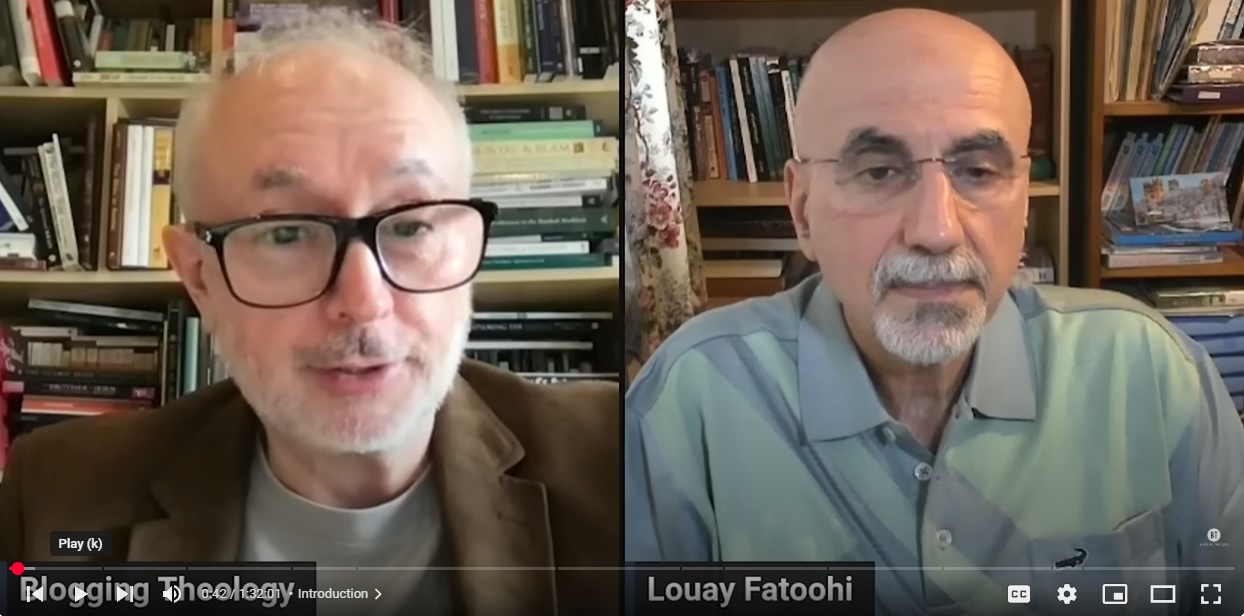
He has been a guest at the behest of Paul Williams of Blogging Theology numerous times to discuss topics of interest in regard to Islam and Christianity.
That aside, what has intrigued us about Dr. Louay Fatoohi is that he believes that Jesus (as) has died and that he will not return. This brings him in line with the Ibadi school of Islam, as virtually no other school of Muslims shares this view.
Here is the PDF: The end of Jesus’ Life on Earth in the Qur’an. The title is interesting because it is a bit of bait. Because English can convey a meaning that seems in line with the majority position of Ahl Sunnah. As the majority of Sunni Muslims believe that Jesus (as) Earthly life came to an end (just not that his life itself) came to an end.
The readers are encouraged to show their gratitude for his academic work by subscribing to Dr. Louay’s YouTube channel, visiting his website and purchasing his many, many insightful books!
Now we are going to be very forward in saying we don’t think this particular article is one of Dr. Louay Fatoohi’s best. There is a great deal to be desired.
In some ways, if you are a traditional Sunni who holds the majority traditional views of Jesus (as) being taken up into heaven and returning again towards the end of time, you will enjoy this read….up to a point.
We say, “Up to a point,” because you are in the Jaguar with Dr. Fatoohi doing 160km on the freeway when suddenly he hits the breaks, giving you the biggest whiplash you ever had.
You read this article, and you see the footnotes, you see the scholarly quotations, you see the references from the Qur’an and the arguments that he builds. Then suddenly we get the following bold assertion from the good Doctor:
“In this paper, I have argued in favour of a combination of the majority opinion that Jesus was raised alive in heaven and the minority view that he died naturally. That Jesus died after, not before, he was raised means he died in the abode in heaven to which he was taken.”
“and the minority view that he died naturally.” No, no you didn’t, Dr. Fatoohi. Because you did not quote anyone who says: means he died in the abode in heaven to which he was taken.
No one who argues that Jesus (as) died naturally states he was whisked up to heaven alive in a body and then died in heaven. That is a far cry from any natural death. That is a bit of sleight of hand there. We must call it out for what it is.
Not only that, but indeed you did not give us a single quote from the Qur’an or the Sunnah to substantiate that Jesus died in heaven! Heaven being a place of death is news for us. We have to be quite honest in saying this.
Then there is this bit here:
“This phenomenological perspective seems to lend support to the minority view of al-Suddī (d. 127), which is favoured by al-Ṭabarī, 80 that the dialogue in 5:117 between God and Jesus happened after he was raised to heaven, rather than it will happen on the Day of Judgement.”
That makes little sense as Allah (swt) is already aware of this. It makes the knowledge of Allah (swt) redundant, and we seek refuge in Allah from this.
Yet, to make this happen on the day of judgement where it can be witnessed is more sensible. It is not for Allah (swt) to know redundant information but for those who party to the questioning.
Then we need to come back to the following verse of the Qur’an:
“Peace be upon me the day I was born, the day I die, and the day I will be raised back to life!” (Qur’an 19:33)
What is the point of being raised back to life if you have already been made to die (in heaven) and are presumably there now?
Unless the claim is that Jesus is dead in heaven and will be brought back to life (at a point in the future), what is the purpose of this?
Again, heaven being an abode of death, rather than life, is truly news to us as Muslims. It must also be news to Christians and Jews as well.
There are just too many loose ends that Dr. Fatoohi has in the article.
Dr. Fatoohi offers really no engagement at all with the hadith tradition. That now becomes someone else’s task.
“The support for the traditional view comes mainly from aḥadīth. Such narratives are found in all major ḥadīth sources, including al-Bukhārī and Muslim. This has led to the treatment of Jesus’ return as a fundamental Muslim belief and even conflating it with Islam’s articles of faith,82 accusing those who deny it of kufr. 83 The conclusion of this article implies that those aḥadīth are inauthentic. Indeed, scholars who argue that Jesus died naturally on earth claim the aḥadīth on Jesus’ return are aḥād, rather than mutawātir, so their credal status is at best doubtful.84 Consequently, Jesus’ return is not a tenet of Islam. Books of creeds also distinguish it and other beliefs from the six articles of faith.”
“The conclusion of this article implies that those aḥadīth are inauthentic.”
A conclusion that we must admit, with all candor, is based upon the filmiest ground possible i.e. he (Jesus) died in heaven!
“scholars who argue that Jesus died naturally on earth claim the aḥadīth on Jesus’ return are aḥād, rather than mutawātir.”
Those scholars which have laid charge to the ahadith, none of which have argued that Jesus (as) was brought alive bodily to heaven and then died in heaven.
This became all the more curious in light of Dr. Fatoohi’s recent article:
In that article he states:
“Among the Prophet’s (PBUH) sayings regarding Imām ʿAlī is his address to the Muslims at Ghadir Khumm, when he asked, “Do you not know that I have more authority over every believer than they have over themselves?” They replied, “Yes, we bear witness that you have more authority over every believer than they have over themselves.” He then declared, “Then for whomever I am a guardian, this is his guardian,” and he took ʿAlī’s hand.”
“This ḥadīth has been recorded by many scholars, including Aḥmad ibn Ḥanbal,[29] al-Bazzār (d. 292),[30] al-Nasāʾī (d. 303),[31] Abū Yaʿlā (d. 307),[32] and al-Ṭabarānī (d. 360).[33] Ibn Abī ʿĀṣim (d. 287) reported it via eleven companions, and he also documented a ḥadīth in which thirteen unnamed collectively testified to having heard the Prophet (PBUH) utter those specific words regarding ʿAlī.[34] In other words, this ḥadīth is mutawātir.”
So we asked Dr. Fatoohi in his X post the following:
“Another question I have. Would you regard it as Mutawātir Lafẓī or Mutawātir Maʿnawī? Given that we have thirteen unnamed individuals that are claimed to have heard this particular wording?”
Why is this important? It is important because in our article here:
Dr. Fatoohi appeals to the consensus.
“These scholars suggest that the majority consensus is based on a misunderstanding of the Qur’an, which Muslims have failed to correct for fourteen centuries.” -Louay Fatoohi.
The consensus is that Jesus (as) is coming back. Dr. Fatoohi goes against this consensus.
But as regards the distinction between Mutawātir Lafẓī or Mutawātir Maʿnawī, this is important for the following reasons.
The Sunni consensus is that the hadith on the return of Jesus are Mutawātir Maʿnawī. There are many hadith from many Companions. Some say Jesus will “descend,” others say he will “come,” others focus on him “praying behind the Mahdi.” The exact words differ, but the core meaning (Jesus will physically return at the end of time) is from the Sunni persepective, mass-transmitted and undeniable.
The Sunni consensus is that over 100 Companions narrated the event of Ghadir Khum. Few report the phrase “Whoever’s master I am, Ali is his master.” Others report different wordings or focus on different parts of the sermon. However, the core meaning (the Prophet stopped the caravan at Ghadir Khum and declared Ali had the right to the spoils) is transmitted by so many chains that it is historically certain. It is not considered Lafẓī because the wordings vary, and major collections like Bukhari and Muslim did not include it in its most famous verbatim form.
Concerning Ghadir Khum Shi’i will often try to catch people unaware of this very important point.
However, back to Dr. Fatoohi’s article and his views.
“Ibn ʿĀshūr also accepts that Jesus is dead but he argues he will still return, as stated in ḥadīth. He mentions the possibility that Jesus will have a special early resurrection, rather than the later universal resurrection of all other people and will descend to earth”
Source: (Ibn ʿĀshūr, Al-Taḥrīr wal-tanwīr, vol. 3, 258-259)
He is a well-known Sunni Muslim of the Maliki school of jurisprudence and Ash’ari school of theology.
“Being faithful to aḥadīth about Jesus’ return to earth is also given as a reason for the Muslim misunderstanding of wfy contrary to its more frequently used meaning.”
“I have critiqued these claims in detail elsewhere.”
“It concludes that Jesus was raised to heaven where he continued to live, which is the majority view, but he later died naturally there and will not return to earth, in agreement with the minority view.”
Again we are not sure which scholars hold the view that Jesus (as) ascended to heaven alive and died in heaven. That cannot be described as a natural death at all.
Dr. Fatoohi suggests: “When analysing Qur’ānic terminology, the hermeneutical principle that the Qur’ān interprets itself remains the best option when the Qur’ān provides enough relevant information.”
Prima Qur’an comments: Yet Dr. Fatoohi also states: “Twenty-one occurrences of the verbal root wfy in the Qur’ān are unambiguously associated with death, but the term is also used twice in connection with sleep. This fact suggests the term has a broader meaning than just the end of a person’s life.”
So why Dr. Fatoohi wants to interpret the word in light of it’s less common usage instead of the broader usage merits pensive reflection. He is correct, and it establishes that it has a broader meaning. However, the admission is that the overwhelming majority of the time it is used, it unambiguously means death.
“In the two remaining instances, the Qur’ān uses wfy in the context of describing God’s intervention to protect Jesus from the attempt on his life, so most Muslim scholars have taken this word to mean something other than death in the case of Jesus.”
Prima Qur’an comments: What Dr. Fatoohi does not mention is that this too is influenced by the hadith and the idea that Jesus (as) is coming back. If no such aprior belief was held, then it is more than reasonable for the text to translate as death. Since Dr. Fatoohi is not holding to those traditions, it puzzles one anymore why he takes the position that he does. For the sake of having a novel view? Only Allah (swt) knows what is in one’s heart.
Dr. Fatoohi informs us: “This conclusion is informed by other arguments as well, such as the denial of the crucifixion in 4:157 and the belief in Jesus’ return.”
Dr. Fatoohi states: “The fact that most appearances of wfy are in connection with death or separation of the soul from the body is usually used to conclude there is no justification for claiming the two instances of this verb in Jesus’ story have a different meaning.51 This claim ignores the fact that wfy is also used to mean something other than death.”
Prima Qur’an comments: This is a non-argument. None of the people he quoted are ignoring anything. They are astutely aware of the range of meanings.
Dr. Louay Fatoohi is trying to build an argument off of an objection that no one raised. What he did do correctly was to identify the reasons they felt it was translated as such.
He tries to make it look as if he has an argument based upon the trilateral verb of wfy, stating that almost 2/3 of its appearances in the Qur’an are not related to death. Only to follow that with the very revealing “The only form that is connected with death is the V of the verb, which appears 24 times as tawaffa, including once with reference to Jesus, as mutawaffi, which is the second time it is used in relation to him.”
https://www.islamawakened.com/quran/4/15/translations/
Dr. Fatoohi says: “Allah yatawaffā the anfus (souls) at the time of their mawt and those that do not die during their sleep. Then He keeps those for which He has decreed mawt and releases the others
for a specified term. (39:42) Unlike in death, where wfy donates the permanent taking of the nafs (soul), in the case of sleep, it identifies the temporary taking of the soul. In death, the soul is taken for good, whereas in sleep, the soul is sent back, with wfy used in both cases. This is why Muslim exegetes have
identified and distinguished between these two different types of wafat, one of death and the other of sleep.”
Dr. Fatoohi says: “In summary, tawaffī appears in the Qur’ān in the sense of claiming the soul permanently, which denotes death, or claiming it temporarily, which refers to sleep.”
Prima Qur’an comments: But what is very curious is he does not follow through on the conclusion.
If a person’s soul is claimed during sleep and returned, where does the body go? It does not go anywhere. If a person’s soul is claimed during sleep and is not returned to the body, where does the body go? It does not go anywhere.
Keep this very important point in mind when moving forward.
Qur’an 39:42 -manāmihā we have the word for their sleep.
Note Dr. Fatoohi’s translation of Qur’an 6:61 above.
” He sends over you guardians until when mawt comes to one of you, Our messengers
tawaffathu, and they do not fail [in their duties].”
The question has to be asked. If they (the messengers, presumably angels) take the soul, what happens to the body? Does it go some place?
On what basis does Dr. Fatoohi make the following claim:
“These multiple Qur’ānic assertations are mainly behind the view of most Muslim scholars that wfy does not mean “cause to die” in the case of Jesus, although aḥadīth about his return are also cited.”
Prima Qur’an comments: How does he know that is the reason why most Muslim scholars believe that wfy does not mean to die? Did we get a list or a chart or even a citation? We did not see any.
The sleepers of the cave.
In the Qur’an 18:9-26 we have the revelation concerning the sleepers of the cave. There is nothing there that indicates that the bodies went any place.
Uzair and the doneky.
Or the one who passed by a city which was in ruins. He wondered, “How could Allah bring this back to life after its destruction?” So Allah caused him to die for a hundred years then brought him back to life. Allah asked, “How long have you remained?” He replied, “Perhaps a day or part of a day.” Allah said, “No! You have remained here for a hundred years! Just look at your food and drink—they have not spoiled. look at your donkey! And ˹so˺ We have made you into a sign for humanity. And look at the bones, how We bring them together then clothe them with flesh!”1 When this was made clear to him, he declared, I know that Allah is Most Capable of everything.” (Qur’an 2:259)
This can not be understood as an ascension. The bodies decomposed and were resurrected.
Dr. Louay Fatoohi then turns his attention to the ascension of Christ Jesus.
“First, all seven verses that use rfʿ in the sense of raising a person in status, not spatially, include a word that makes this meaning abundantly clear. Six (2:253, 6:83, 6:165, 12:76, 43:32 and 58:11) of these verses use the plural word darajāt (ranks). The other verse (7:176) uses āyāt (signs) as the way God would have raised someone in status.”
Prima Qur’an comments: So Dr. Fatoohi informs us that Jesus is a special case and that raising is only used of a person in terms of rank, darajāt (degrees) or the other word that is used is āyāt (signs).
However, this assertion falls apart rather quickly upon further investigation.
“and elevated (wa rafaʿnā)your renown for you?” (Qur’an 94:4) There is no mention of either āyāt or darajāt.
Secondly, the most glaring example is the case of Idris (as) Dr. Fatoohi was too dismissive of the case of Idris.
“And mention in the Book, Idris. Indeed, he was a man of truth and a prophet. And We (warafa’nahu) raised him to a high station. ” (Qur’an 19:56-57)
makānan ‘aliyyan (a high station/place). Not even Jesus (as) has been given this honour. It is the only place in the Qura’n where this is mentioned.
Dr.Fatoohi states: “Also, the makān (place) to which Idrīs was taken is described as ʿaliyyā (high). Each of the three other occurrences of the word makān in the same Qur’ānic chapter of the Idrīs verse also
denotes a physical location.”
While that may be true, this is the one place in the Qur’an where makanan ‘aliyyan is used.
Dr. Fatoohi bodly states:
“Expectedly, no attempt has been made by proponents of the metaphorical interpretation to explain what that supposed exaltation of Jesus by God means, as there is no mention of it in the Qur’ān.”
Well, actually there is. In the very first example that he gave to prove his analysis actually goes against him.
Dr. Fatoohi says:
“First, all seven verses that use rfʿ in the sense of raising a person in status, not spatially,
include a word that makes this meaning abundantly clear. Six (2:253….)
So what does 2:253 state?
“Those messengers – some of them We caused to exceed others. Among them were those to whom Allah spoke, and He raised some of them in degree. And We gave Jesus, the Son of Mary, clear proofs, and We supported him with the Pure Spirit. If Allah had willed, those [generations] succeeding them would not have fought each other after the clear proofs had come to them. But they differed, and some of them believed and some of them disbelieved. And if Allah had willed, they would not have fought each other, but Allah does what He intends.” (Qur’an 2:253)
So in the very text that Dr. Fatoohi uses to prove that rf’ does not mean spatially but in status none other than Jesus (as) is the first prophet mentioned by name that follows the text!
Recall Dr. Fatoohi’s own words: “When analysing Qur’ānic terminology, the hermeneutical principle that the Qur’ān interprets itself remains the best option when the Qur’ān provides enough relevant information.”
Thus,
Qur’an 4:159 makes perfect sense of raising Jesus (as) in honour, given that an impailed person is, in the eyes of Rabbinical law, cursed.
Also, Allah has already declared that Jesus (as) would be an ayat unto men.
“He said, “Thus [it will be]; your Lord says, ‘It is easy for Me, and We will make him a sign āyāt to the people and a mercy from Us. And it is a matter [already] decreed.’ “
Dr. Fatoohi’s conclusion was thus:
“The traditional, majority view is that Jesus was raised to heaven alive, continues to live there
and will descend to earth close to the end-time. A minority view that developed in the last one
and a half centuries argues that Jesus died naturally on earth, so he was not raised alive to
heaven and will not come back. In this paper, I have argued in favour of a combination of the
majority opinion that Jesus was raised alive to heaven and the minority view that he died
naturally.”
Now we admire Dr. Fatoohi. We take him to be a serious researcher. However, we were not amused with the line:
“I have argued in favour of a combination of the majority opinion that Jesus was raised alive to heaven and the minority view that he died naturally.”
First. There is no natural scenario where a person is put to sleep, raised bodily to heaven and then dies. Not one! That is supranatural and not natural.
Second. There is no minority view that states that Jesus (as) was put to sleep ,raised bodily to heaven and then died.
Dr. Fatoohi states:
“The traditional, majority view is that Jesus was raised to heaven alive, continues to live there
and will descend to earth close to the end-time.”
Prima Qur’an what is the traditional view?
- Jesus was raised alive in heaven.
- Continues to live there.
- Will descend at the end of times.
Dr. Fatoohi believes in which of these three? He believes in point 1.
What else can Dr. Fatoohi tell us about points 1–3 above?
“The support for the traditional view comes mainly from aḥadīth.”
Conclusion and Summary.
Fatoohi does not cite any scholar—classical or modern—who explicitly argues that Jesus died in heaven after being raised alive. The minority view he references (e.g., Sayyid Ahmad Khan, Muhammed Abduh, Rashid Rida) holds that Jesus died a natural death on earth, not in heaven. By combining the majority’s “raised alive to heaven” with the minority’s “died naturally,” Dr. Fatoohi creates a hybrid position that lacks clear precedent. This does not make it wrong, but it does mean he is not simply synthesizing existing views—he is proposing something new. His failure to acknowledge this novelty weakens his claim.
Heaven is not described in the Qur’an or Sunnah as a place where death occurs. If Jesus died in heaven, that would imply death exists in the afterlife realm, which contradicts the understanding of Jannah as dār al-ḥayawān (abode of life). Dr.Fatoohi does not address this tension. His reliance on Qur’an 39:42 (sleep vs. death) does not resolve it, because that verse concerns earth, not heaven.
The Hermeneutical Principle – Qur’ān Interprets Itself. Dr. Fatoohi appeals to the principle that the Qur’ān interprets itself. We counter that he then prioritizes the less common meaning of tawaffā (sleep/temporary taking) over the overwhelmingly common meaning (death).
Dr. Fatoohi admits that 20 of 23 occurrences of tawaffā in form V refer to death. Only two refer to sleep, and one refers to Jesus. To then argue that Jesus’ case follows the rare meaning requires external justification (e.g., the denial of crucifixion, the belief in his return). But Dr. Fatoohi claims to be setting aside ḥadīth. Without ḥadīth, why prefer the rare meaning? His argument becomes circular: he assumes Jesus was raised alive (from 4:158) and then reads tawaffā accordingly. That is not the Qur’ān interpreting itself; it is interpretation driven by a prior conclusion.
The Case of Idrīs and Qur’an 94:4. We point out that Dr. Fatoohi’s claim about raf‘ always requiring darajāt or āyāt for non-spatial raising is false, citing Qur’an 94:4 (“We raised your renown”) and the case of Idrīs.
Qur’an 94:4 uses rafa‘nā without any qualifier, and it clearly means elevation in status, not physical ascent. Dr. Fatoohi overstates his case when he says “no attempt has been made by proponents of is claimed to be the ‘metaphorical‘ interpretation” – we have now made that attempt, citing Qur’an 2:253 and Qur’an 94:4.
Qur’an 19:33 – “The day I will be raised back to life” We ask: If Jesus died in heaven, what is the point of a future resurrection? This is a serious problem for Dr. Fatoohi’s view. Qur’an 19:33 lists three events: birth, death, and resurrection. If Jesus already died and is in heaven, then his “death” refers to that heavenly death. But then “raised back to life” would refer to a second resurrection after that death. That would mean Jesus dies twice (once on earth? no – he didn’t die on earth in Dr. Fatoohi’s view; once in heaven) and is resurrected twice. The Qur’ān nowhere suggests such a sequence. The natural reading of Qur’an 19:33 is that death occurs on earth, followed by resurrection on Judgement Day. Dr.Fatoohi does not address this.
Nonetheless we are happy that another independent researcher, and a representative of the ʿAliyya Qādiriyya Kasnazāniyya tariqa no less, has confirmed that Jesus (as) is dead and he will not return to Earth.
May Allah Guide the Ummah.
May Allah Forgive the Ummah.


 Prima Quran