“O mankind, indeed We have created you from male and female and made you peoples and tribes so that you may know one another. Indeed, the most noble of you in the sight of Allah is the most righteous of you. Indeed, Allah is Knowing and Acquainted.” (Qur’an 49:13)
“Moreover, of His signs is the creation of the heavens and the earth and the diversity of your languages and your colors. Indeed in that are signs for those of knowledge.” (Qur’an 30:22)
﷽
There is nothing in the Qur’an that even remotely suggests that human diversity is in any way shape or form connected to some type of punishment, sin or curse. However, the Shi’i have come along with some very bizarre assertions.
There is for all to see in broad daylight. This is related by way of their 10th Imam Ali Ibn Muhammed Al-Hadi (Al Naqi)
By authentic traditions, it is related from ‘Abd al-‘Azim that Imam ‘Ali al-Naqi said that Nuh lived for two thousand five hundred years. One day while he was sleeping on the Ark, a strong wind blew and uncovered him. Ham and Yafith saw this and started laughing. Sam scolded them and covered Nuh. Nuh woke up and saw the two of them laughing and inquired the reason for that. Sam narrated what had happened. Nuh raised his hands towards the heavens and said, “O God, change the seed of Ham and al-Yasa‘ so that they beget dark-skinned children.” Nuh told them: “God has made your children the slaves of the children of Sam because he did good to me. You both are disinherited and your disinheritance will manifest itself in your children and the signs of notoriety will remain distinguishable in the progeny of Sam until the time the world will last. Therefore, all dark-skinned people are children of Ham and all the Turks, Saqaleyeh, Gog and Magog are the descendants of Yafith.
“Apart from this, those who are reddish and fair, are the children of Sam.”
So you can imagine with the Shi’i making a fuss about the Hadith of the Ark and supposedly all the vile people were wiped out in a flood and only the pure and the righteous were taken on the Ark of Noah (as), that eventually some people began to inquire about the variations in phenotypes, colours and complexions of human beings.
Of course, there are obvious theological questions that come from this.
All the Ahl Bayt of Noah (as) on the ark would have to be righteous and pure. This makes logical sense. If Allah (swt) was going to wipe out the whole of humanity for their evil and sins, you certainly wouldn’t want any evil people hitching a ride on the Ark.
For example:
“So it sailed with them through waves like mountains, and NOAH CALLED TO HIS SON who was apart , “O MY SON, come aboard with us and be not with the disbelievers. But he said, “I will take refuge on a mountain to protect me from the water.” Noah said, “There is no protector today from the decree of Allah, except for whom Allah gives mercy.” And the waves came between them, and he was among the drowned.” (Qur’an 11:42-43)
So it is not going to make any sense to say that those who went on Ahl Bayt of Noah (as) on the ark are those who are not pure, those with treachery in their hearts. However, the Shi’i go and make a big mess of things concerning this Hadith of the Ark.
So, naturally, there might be curious people who would inquire about the variations of phenotypes, pigmentation, and colours of human beings.
So this ‘infallible’ Imam Ali Ibn Mohammed Al-Hadi (Al Naqi) went into the kitchen and started to cook up something for the curious. He added carrots, cumin and ginger, and he added the black and the brown, and he threw everything in there except for the “reddish, fair-skinned”. Of course, because he was from among them!
So let’s look at this. Noah (as) apparently has a part of his body uncovered by the wind.
Who handles the wind blowing? Is it not Allah (swt)?
“Nuh raised his hands towards the heavens and said, “O God, change the seed of Ham and al-Yasa‘ so that they beget dark-skinned children.”
So what are dark-skinned people supposed to think of their complexion? That it is the result of the majesty and glory of Allah (swt) or that it is the result of sin?
What makes this even more riveting is that when you take into account that Noah (as) is considered the third prophet after Adam (as). This means that the original humans were ‘the fair-skinned’. Normally, that would be an absolute laugh riot if it were not for the fact that it is so incredibly sad.
This beautiful little girl is the creation of Allah (swt). She is beautiful. Black is beautiful, and it is only the hearts that are corrupt and ugly!
“God has made your children the slaves of the children of Sam because he did good to me.”
You have to ask yourself what the children did?
Is this the concept of justice the Shi’i uphold?
Is this what we can expect from Imam Mahdi?
We know where the Shi’i imams got this nonsense from.
They got it from:
“Also, Ham, the father of Canaan, saw the nakedness of his father, and told his brothers outside. But Shem and Japeth took a garment, and laid it on both their shoulders, and went backward and covered the nakedness of their father. Their faces were turned away, and they did not see their father’s nakedness.” (Genesis 9:22-23).
However, even then there is nothing about anyone’s phenotype or skin pigmentation being changed. This was used with devestating effect by Christian Protestant Churches in South Africa. You may read about that here: https://ojs.reformedjournals.co.za/index.php/stj/article/view/1330
The Shi’i imams give their own twist to this.
The problem, of course, is that the Shi’i tell us that Abu Ja’far Muhammad ibn ‘Ali ibn Babawayh al-Qummi or Shaykh As Saduq quote this as evidence to explain why blacks are black.
Al-Majlisi authenticated it!’
OPEN CHALLENGE TO ANY 12ER SHI’i UNDER THE SUN.
Here is an open challenge to any 12er Shi’i reading this.
Bring for us one piece of evidence from any of the Hadith Masters who critiqued this narration based upon the Matn alone!
Never mind the chain of narrators. Why wouldn’t the text alone be enough to call into account its veracity? Especially in light of the Qur’an.
“O mankind, indeed We have created you from male and female and made you peoples and tribes so that you may know one another. Indeed, the most noble of you in the sight of Allah is the most righteous of you. Indeed, Allah is Knowing and Acquainted.” (Qur’an 49:13)
Prima Qur’an Conclusion:
We are regarded in the sight of Allah (swt) based upon our righteousness and nothing else. If Allah (swt) bestows favours upon any of us more than others, it is simply a mercy and a blessing from Allah (swt). It is also a trial if we are not grateful.
Allah (swt) loves all of His creation. In fact, when describing the process of creating humanity, Allah (swt) chose to tell us that it from altered ‘black mud’.
˹Remember, O Prophet˺, when your Lord said to the angels, “I am going to create a human being from sounding clay molded from black mud .”(Qur’an 15:28)
We also know that it is the characteristic of the most vile of creations, Iblis, that insists that he would not regard a creation made from altered black mud.
He said, “Never would I prostrate to a human whom You created out of clay from an altered black mud.” (Qur’an 15:33)
Narrated Anas bin Malik:
Allah’s Messenger (saw) said, “You should listen to and obey, your ruler even if he was an Ethiopian (black) slave whose head looks like a raisin.”
And when such a leader comes forth, may our oath of allegiance be to him. May his allegiance be to the Book of Allah and the Sunnah, so that his authority be on our necks; and may Allah support him with the truth!
This is not the only time an Imam of the Shi’i has had something heinous to say.
You can where Imams al-Bāqir and Al Sadiq attack the mother of the believers Aisha (ra) who is actually in Wilāyat al-Ḥaqīqah! They use the death of the Blessed Prophet’s son as a plot to device to attack Aisha (ra)!
“Oh Mankind! Behold, We have created you all out of a male and a female, and have made you into nations and tribes so that you might come to know one another. Truly, the noblest of you in the sight of Allah is the one who is most deeply conscious of Him. Behold, Allah is all-knowing, All-Aware.” (Qur’an 49:13)
﷽
There are many across the Islamic spectrum who claim superiority based upon lineage, family affiliation via blood ties, tribe or ethnicity.
This includes and is not limited to all Alids, Imami Shi’i, Zaydis, and the Sunni scholars this article will address in particular. Prepare to deal with the overwhelming force of the Qur’an, Sunnah, and basic 101 common sense logic.
By the way, the above-mentioned groups are glib when it comes to this issue anyway. You would think that if you claim superior merit based upon lineage, family affiliation via blood ties, tribe or ethnicity, that this would be the case for the whole of said lineage, family, tribe or ethnicity.
Yet, you have Hussein bin Talal, former Viceroy of Jordan who was married once to Toni Avril Gardiner & Lisa Halaby.
These names didn’t sound very Islamic, nor did they cater to the sensitivities of Arab superiority, to say, King Hussein and “Queen Toni” so she became: “Muna Al Hussein.”
Likewise, it didn’t sound very Islamic, nor cater to the sensitivities of those who believed in Arab superiority to say, King Hussein and “Queen Lisa,” so she became: Noor Al Hussein.”
Guess what happens to all these alid women, rather they are from the lineage of Hassan or Hussein? Well, very often they are confined to a life of bitter spinsterhood.
While the men get their pick of the entire planet (and often do pass up the supposed superior brand), the superior brand often get consigned to a life of Netflix, cats and spinsterhood.
What is the point of mentioning these things? Is it to shame these women? Did Toni Avril Gardiner & Lisa Halaby do something wrong by getting wooed and marrying a wealthy man? No, we pity these women (in the case of the Alid spinsters). They are simply victims of an unjust system and a flawed representation of Islam.
Remember how we are told that the Aga Khan is a descendant of the Blessed Prophet (saw) via Fatima(ra)? What does that even matter?
Andrew Ali Aga Khan Embiricos
A descendant of the Aga Khan, Andrew Embiricos made headlines in 2007 when his secret life as an amateur porn star was exposed. He was found to be posting a series of raunchy videos starring himself. It was said he contracted HIV and battled drug addiction.
The claim being refuted: That descent from the Prophet (saw) confers some inherent spiritual status, nobility, or moral excellence.
The evidence: Andrew Embiricos—a descendant of the Aga Khan, and thus tracing lineage to the Prophet through Fatima (ra)—lived a life dramatically contrary to Islamic teachings (pornography, drug addiction).
The rhetorical question: “What does that even matter?” — i.e., if this person has the lineage but not the righteousness, what value did the lineage actually provide?
Once again, you have acclaimed descendants of the Blessed Prophet (saw) passing over the women of the household for western women.
This entry is to soundly refute the unfounded and baseless assertions made by scholars from the Ahl Sunnah, in particular, Abū ʿAbdullāh Muhammed ibn Idrīs al-Shāfīʿī and Abu Zakaria Muhiy ad-Din Yahya Ibn Sharaf al-Nawawi. As well as Aḥmad ibn ʿAbd al-Ḥalīm ibn ʿAbd as-Salām Ibn Taymiyya al-Ḥarrānī whom we reference as Ibn Taymiyya.
You know it is rather tongue in cheek when many of these so-called ‘traditionalists’ lament about ‘the good ‘ole days’. Especially in the imaginary chess game of ‘Islam vs the West’. What a rather clever and sinister thing to do; rally the masses to throw off one oppressor only to clothe themselves in another tyranny.
So before we begin our refutationn let us take a look at what some from Ahl Sunnah have to say shall we?
Note: We are not quite sure if this is a troll site because there are numerous other articles here that are simply bizarre. However, there have been people within our tradition who have held some of the views that he posts. As regards this particular article, everything he says here checks out. It checks out, meaning he did not misquote any of the sources.
We are going to produce the totality of what is said here:
Recently I’ve noticed a trend among Arab Muslim families, especially those living in the West, where they allow their daughters to get married to non-Arab men.
Yes, it is true,I am not making this up.
How disgusting!
Yes, I know that it is not haraam to do so, but neither is rubbing feces on your face! Would you do that as well?
Brothers and Sisters, our deen is clear. It is recommended for people to marry someone who is their kafa’a (religiously suitable match), and non-Arab men are NOT a suitable match for Arab women.
This is well-established in our faith. Read, for example, my previous post about how Arabs are the most superior of all races. But if that isn’t enough, read what our worthy scholars have told us about this matter. We see the following regarding the kafa’a for marriage in the classic Shafi’i manual of Islamic law titled ‘Umdat as-Salik wa ‘Uddat an-Nasik (Reliance of the Traveller and Tools of the Worshipper):
والكفاءةُ في: النسَبِ والدِّينِ والحريةِ والصَّنعةِ وسلامة العيوبِ المُثْبِتَةِ للخِيار، فلا يُكافئ العجميُّ عربيةً، ولا غيرُ قُرَشيٍّ قُرشيَّةً، ولا غيرُ هاشميٍّ أو مُطَّلبيٍّ هاشميةً أو مطَّلبيةً، ولا فاسقٌ عفيفةً، ولا عبدٌ حرةً، ولا العتيقُ أو من مسَّ آباءَهُ رِقٌّ حرةَ الأصلِ، ولا ذو حِرفَةٍ دنيئةٍ بنتَ ذي حِرفةٍ أرفعَ، كخياطٍ بنتَ تاجرٍ، ولا معيبٌ بعيبٍ يُثْبِتُ الخِيارَ سليمةً منهُ، ولا اعتبارَ باليسارِ والشيخوخةِ، فمتى زوَّجها بغَيْرِ كُفءٍ بغَيرِ رضاها ورِضا الأولياءِ الذينَ هم في درَجتهِ فالنِّكاحُ باطلٌ، وإن رَضُوا أو رضيَتْ فليسَ للأبعدِ اعتراضٌ.
(Taken from the section of Kafa’a in the chapter of Nikaah in the text)
Translation: Kafa’a (Suitability in marriage for a female) is in the lineage (ancestry of the man), and in religiousness, and his being a free man (not a slave), and in his profession, and his being free of defects that can cause the annulment of the marriage. And the ajami (non-Arab) is NOT suitable for an Arab woman, and a non-Qurayshi is NOT suitable for a Qurayshi woman (Quraysh was the tribe of the Holy Prophet (S)), nor is a non-Hashimi or non-Muttalabi suitable for a Hashimi or Muttalabi woman (Hashimites are the members of the clan to which the Holy Prophet (S) belonged to, and Muttalabites are the descendants of the grandfather of the Holy Prophet(S)). Nor is an immoral man suitable for a virtuous woman, nor is a slave suitable for a free woman, nor is a freed slave or one whose ancestors were touched by slavery suitable for a (free) woman whose ancestors were free. Nor is a man of a lowly profession suitable for the daughter of someone with a noble profession, such as a tailor wanting to marry a tradesman’s daughter.
So we see that the following are NOT kafa’a (suitable for marriage) for women:
Non-Arab men for Arab women
Non-Qurayshi man for a Qurayshi woman
Non-Hashimi or non-Muttalabi for a Hashimi or Muttalabi woman
Sinful man for virtuous a woman
A slave or a freed slave for a free woman
A free man but one whose ancestors might have been slaves for a free woman whose ancestors were not slaves
A man with a lowly profession for a woman whose father has a noble profession
Brothers and Sisters, your deen is not a game. Do not ignore the instructions of our scholars who labored long and hard for our benefit and left us with such treasures. As for this book, you might be pleased to know that there exists a partial translation of this work in English as well, which you can read more about here and here. The translator included the Arabic text I’ve quoted above in the book (pages 523-524), but did not translate it into English. It seems that he is also one of these “modern Muslims” who stoops low to ingratiate the Western kuffaar by ignoring the teachings of our Muslim scholars.
So I warn you again, do not ignore your deen for the sake of worldly desires or to please the kuffaar Westerners, and keep your daughters and sisters away from non-Arab men, descendants of slaves, and those in lowly professions.
But that is only if you are Arab. If you do not belong to this superior race, then these conditions do not apply to you, so do with your women as you please.”
Prima Qur’an comments: We will respond to the above. They continue with:
“SubhanAllaah! What has the ummah come to when Muslims ban you for quoting Imam Nawawi! You’re right, Imam Nawawi has been very clear about this issue in his Minhaj. He says:
The characteristics of suitability (kafa’a) are the following: Absence of permanent (bodily) defects And freedom: The male slave is not suitable for a free woman. And the freed slave is not suitable for a woman who is free since birth (hurratun asliyyah).
And genealogy: The non-Arab male (A’jamiy) is not suitable for an Arab woman, nor is a non-Qurayshi male (suitable) for a Qurayshi woman, nor a non-Hashimi or non-Muttalibi male for a Hashimi or Muttalibi female. Rather the consideration of genealogy among non-Arabs is to be taken into account just as it is with Arabs. And virtuousness: An evil-doer man is not suitable for a virtuous/chaste woman.
And occupation (job/profession): A male with a lowly occupation is not suitable for a woman whose rank (in society) is higher than his. A sweeper, a cupper (or barber), a doorkeeper (or guard), a shepherd, a person who works at a bathhouse (hummaam) are not suitable for the daughter of a tailor. And a tailor is not suitable for the daughter of a merchant or clothier. And neither of those are suitable for the daughter of a scholar or judge.
Differences in ease of circumstances (wealth) are not considered (in suitability for marriage).
Defects in certain characteristics (of suitability) are not compensated by (excellence in) other characteristics. (As for men) A man cannot marry his minor (sagheer), son, to a slave woman, for this is dishonorable for the religion (madhab), but it is allowed for him to marry his son to a woman even if the remaining suitability conditions (mentioned above) do not match his.
From the beginning of Creation, humans of every race have been wondering which race is the most superior. Alhamdulillah, with the arrival of our Blessed Prophet (S), this question has been thoroughly answered to the satisfaction of all. For our Blessed Prophet (S) has said in this authentic narration:
Narrated Wathilah bin Al-Asqa’: that the Messenger of Allah (S) said: “Indeed Allah has granted eminence (istafa) to Isma’il [the ancestor of the Arabs] from the children of Ibrahim, and He granted eminence to Banu Kinanah from the children of Isma’il, and He granted eminence to the Quraish [the tribe of the Prophet(s)] from Banu Kinanah, and He granted eminence to the Banu Hashim [the clan of the Prophet(S)] from the Quraish, and He granted eminence to me from Banu Hashim.” http://sunnah.com/urn/634660
As well as in this authentic narration from Imam Muslim’s Saheeh:
Wathila b. al-Asqa’ reported: I heard Allah’s Messenger (S) as saying: Verily Allah granted eminence to Kinana from amongst the descendants of Isma’il [the ancestor of the Arabs] and he granted eminence to the Quraish amongst Kinana, and he granted eminence to the Banu Hashim amongst the Quraish, and he granted me eminence from the tribe of Banu Hashim. http://sunnah.com/muslim/43/1
And in a similar authentic narration from our Blessed Prophet (S), he said:
أنا محمدُ بنُ عبدِ اللهِ بنِ عبدِ المطلبِ ، إنَّ اللهَ تعالى خلق الخلْقَ فجعلني في خيرِهم ، ثم جعلهم فرقتَين ، فجعلَني في خيرِهم فرقةً ، ثم جعلهم قبائلَ ، فجعلني في خيرِهم قبيلةً ، ثم جعلهم بيوتًا ، فجعلني في خيرهم بيتًا ، فأنا خيركُم بيتًا ، وأنا خيرُكم نفسًا
(The Prophet(S) said): ‘I am Muhammad bin ‘Abdullah bin ‘Abdul-Muttalib. Indeed, Allah created the creation and made me from the best of them, and He then made them two groups (Arabs and non-Arabs) and made me from the best of them (the Arabs), then He made the tribes and made me from the best tribe, then He made the houses and made me from the best house. So I am the best house among them, and I am the best person among them.’”
This narration has been recorded and authenticated by Shaykh Albani in his Saheeh Jami` al-Sagheer, hadith number 1472 (the book (in Arabic) can be read here: http://www.alalbany.net/4314)
The following is the text from the scanned PDF of this text:
This narration has also been authenticated in the following texts:
Shaykh Albani also authenticated it (as narrated by Abbas bin Abd al-Muttalib) in his Takhreej Mishkat al-Masabeeh, hadith number 5689
Imam Ahmad bin Muhammad Shakir authenticated it in his Umdah at-Tafseer, volume 1, page 819
Imam Ibn Hajar al-Asqalaani said it is sound (Hasan) in his Al-Amaali al-Mutlaqah, page 70
Imam Ibn Hajar al-Haythami authenticated it in his Mujma` al-Zawa’id, vol 8, pg 218
Imam Ibn Katheer said it has a good (jayyid) chain in his Jami` al-Masaneed wal-Sunan, hadith #5933
Shaykh Amjad Rasheed of SunniPath.com has also clarified this matter for us:
It is obligatory on a Muslim to believe that Arabs are preferred over other nations because there is a proof for it. However, this is not one of the pillars of our religion such that if someone rejected this, they would be considered outside of Islam. But if one does reject this, one has sinned for not believing in it because it is an affirmed matter according to a clear rigorously authenticated hadith.
So, dear brothers and sisters, do not be deceived by the propaganda of the Westerners, who wish to debase the deen of Allaah because of their own racial inferiority. But what Allaah has elevated, no one can debase!
To close, I will leave you with this statement from Shaykh al-Islaam Ibn Taymiyyah in his IqtiDaa’ Siraat al-Mustaqeem, volume 1, page 419:
فإن الذي عليه أهل السنة والجماعة اعتقاد أن جنس العرب أفضل من جنس العجم عبرانيهم وسريانيهم رومهم وفرسهم وغيرهم وأن قريشا أفضل العرب وأن بني هاشم أفضل قريش وأن رسول الله صلى الله عليه وسلم أفضل بني هاشم فهو أفضل الخلق نفسا وافضلهم نسبا
Indeed it is the belief of the Ahlus-Sunnah wal Jama’ah that the race of Arabs is superior to the race of non-Arabs, the Hebrews (Jews), the Syrians (Arameans), the Romans (Europeans), the Persians, and others. And indeed the Quraysh [tribe of the Prophet (S)] is the most superior among the Arabs. And indeed the Banu Hashim [the clan of the Prophet (S)] is the most superior among the Quraysh. And indeed the Prophet, may the Blessings and Peace of Allaah be upon him, is the most superior of the Banu Hashim, for he is the most superior of all creation by his own self, and also the most superior among them because of his lineage (ancestry) PDF Scan of the above:
The Ibadi school refutes the claims of Arab superiority.
How the Ibadi school uses the Qur’ān, Sunnah, and manṭiq(logic).
Let’s get into it.
As far as preference and superiority are concerned. Allah (swt) has himself informed us that he has given preference to some people over others in various situations.
“Behold! The angels said: “O Mary! Allah has chosen you and purified you- chosen you above the women of all nations.” (Qur’an 3:42)
“O Children of Israel, remember My favor which I have bestowed upon you and that I preferred you over the worlds.” (Qur’an 2:122)
It is likely and even factual that there are people who are ‘superior’ to us in terms of mathematical knowledge, basketball skills, archery skills, typing speed, etc.
In fact, we know this to be the case. The opposite is also true. However, this has absolutely nothing to do with one’s ethnicity, family affiliation or tribal identity.
In fact, often when Allah (swt) does favour one group of people or an individual over the other with his blessings, they ‘repay’ Allah (swt) with blatant rebellion, defiance of his command or outright negligence.
An example would be the following verse:
“And on some of you Allah has bestowed more abundant means of sustenance than on others: and yet, they who are more abundantly favoured are [often] unwilling to share their sustenance with those whom their right hands possess, so that they [all] might be equal in this respect. Will they, then, Allah’s blessings [thus] deny?” (Qur’an 16:71)
How about the fact that Allah (swt) conditions his statements of praise? for example:
“You are the best of people, evolved for mankind, enjoining what is right, forbidding what is wrong, and believing in Allah. If only the People of the Book had faith, it would be best for them: among them are some who have faith, but most of them are perverted transgressors.” (Qur’an 3:110)
Why are they the best of people? They enjoin what is right and forbid what is wrong. Yet some of those people from the above-mentioned groups believe that those who are the ‘best of people’ betrayed the trust of the blessed Prophet (saw).
The station of people can change before Allah (swt). This should go without saying, as one can go from a sinner to one who is repentant. One who is far from Allah (swt) to one who is close to Allah (swt).
“Say: “O Allah! Lord of Sovereignty! You give power to whom You please, and You strip off power from whom You please: You endow with honour whom You please, and You bring low whom You please: In Your hand is all good. Verily, over all things You have power.” Qur’an 3:26)
“Lo! you are those who are called to spend in the way of Allah, yet among you, there are some who hoard. And as for him who hoards, he hoards only from his soul. And Allah is the Rich, and you are the poor. And if you turn away He will exchange you for some other folk, and they will not be the likes of you.” (Qur’an 47:38)
Allah (swt) not once gives anyone in the Qur’an some protected status based solely upon their lineage, family blood ties, tribe or ethnicity.
Let the Alids, Imami Shi’i, Zaydis, and the Sunni scholars bring their proofs and evidence.
On the contrary, this is what we find:
“So they say, “Never will the Fire touch us, except for a few days.” Say, “Have you taken a covenant with Allah? Allah will never break His covenant. Or do you say about Allah that which you do not know?” (Qur’an 2:80)
“But the Jews and the Christians say, “We are the children of Allah and His beloved (hibbaohu).” Say, “Then why does He punish you for your sins?” Rather, you are human beings from among those He has created. He forgives whom He wills, and He punishes whom He wills. And to Allah belongs the dominion of the heavens and the earth and whatever is between them, and to Him is the [final] destination.” (Qur’an 5:18)
“So when the Horn is blown, no relationship will there be among them that Day, nor will they ask about one another.” (Qur’an 23:10)
“O humanity! Be mindful of your Lord, and beware of a Day when no parent will be of any benefit to their child, nor will a child be of any benefit to their parent. Surely Allah’s promise is true. So do not let the life of this world deceive you, nor let the Chief Deceiver deceive you about Allah.” (Qur’an 31:33)
The English say: Blood is thicker than water. In Islam, we say: Faith is thicker than blood.
Believers, do not take your fathers and brothers for allies if unbelief is dearer to them than faith; those of you who do so are unjust. (Qur’an 9:23)
You will not find a people who believe in Allah and the Last Day having affection for those who oppose Allah and His Messenger, even if they were their fathers or their sons or their brothers or their kindred. Those – He has decreed within their hearts faith and supported them with spirit from Him. And We will admit them to gardens beneath which rivers flow, wherein they abide eternally. Allah is pleased with them, and they are pleased with Him – those are the party of Allah . Unquestionably, the party of Allah – they are the successful. (Qur’an 58:22)
“The Day when neither wealth nor children will be of any benefit. Only those who come before Allah with a pure heart.” (Qur’an 26:88-89)
So, basically, the ‘adab’ or the hierarchy when it comes to phenotypes, according to Ibn Taymiyya, Imam Al Shafi’i, The Imami Shi’i, Zaydis and Alids, are as follows:
So let us see if this pyramid that is championed by Ibn Taymiyya (Imami Shi’i, Shafi’i, Zaydi, Alids) stands up to scrutiny.
Allah (swt) not once gives anyone in the Qur’an some protected status based solely upon their lineage, family blood ties, tribe or ethnicity.
The best that any of them are going to bring forward is as follows:
“O wives of the Prophet, whoever of you should commit a clear immorality – for her, the punishment would be doubled two fold, and ever is that, for Allah, easy. And whoever of you devoutly obeys Allah and His Messenger and does righteousness – We will give her reward twice; and We have prepared for her a noble provision. O wives of the Prophet, you are not like anyone among women. If you fear Allah, then do not be soft in speech [to men], lest he in whose heart is disease should covet, but speak with appropriate speech. And abide in your houses and do not display yourselves as [was] the display of the former times of ignorance. And establish prayer and give zakah and obey Allah and His Messenger. Allah intends only to remove from you the impurity of sin, O people of the Prophet’s household, and to purify you with extensive purification. And remember what is recited in your houses of the verses of Allah and wisdom. Indeed, Allah is ever Subtle and Acquainted with all things.” (Qur’an 33:30-34)
Wives, women, her. The wives of the Prophet (saw) are all pure and purified. These verses, in their context, have absolutely nothing to do with any male relations of the Prophet (saw).
Allah (swt) gives instructions for how the wives of the Blessed Prophet (saw) are to become purified.
There is no ‘ismah or infallibility being imputed here and this is clear from the admonishment that Allah (swt) gives: “O wives of the Prophet, whoever of you should commit a clear immorality – for her, the punishment would be doubled twofold, and even is that, for Allah, easy.”
The purification is due to their being wives and proximity to the Blessed Prophet (saw) and not because of blood ties. Safiyya bint Huyayy (ra) is proof of this.
Whatever blessing is being conferred upon the wives of the Blessed Prophet (saw) the verses are absolutely silent about their descendants.
Similar to Allah (swt) doing this for the Blessed Virgin Mary (as)
“Behold! the angels said: “O Mary! Allah has chosen you and purified you- chosen you above the women of all nations.” (Qur’an 3:42)
Look again at point 4.
“Whatever blessing is being conferred upon the wives of the Blessed Prophet (saw) the verses are absolutely silent about their descendants.”
“Moreover, remember that Abraham was tried by his Lord with certain commands, which he fulfilled: He said: “I will make you an Imam to the Nations.” He pleaded: “And also (Imams) from my offspring!” He answered: “But My Promise is not within the reach of evildoers.” (Qur’an 2:124)
The Shi’i (Zaydi, Imami) would counter as follows: “My covenant does not include the wrongdoers.” This is a cornerstone of their argument. They use it to prove that an Imam must be free from wrongdoing (infallible). They would argue that Abraham, after passing his tests, was made an Imam, and then asked about his progeny. Allah’s response clarified that the Imamate would continue in his progeny, but only among those who are not wrongdoers. Therefore, they would say, the Imamate is a divinely bestowed position that runs in the purified lineage of Abraham, through Ismail, and ultimately to the Prophet Muhammed (saw) and his purified Ahl al-Bayt (Ali, Fatima, and their righteous descendants). The sinful descendants we mention are precisely the ones who are excluded from this covenant because they are wrongdoers.
This counter argument is also deeply flawed. It puts the carriage before the horse. We will not know which of the descendants are just. We can only know by observing their behavior through their lifetime.
This brings a crucial distinction between ontological reality (what something is) and epistemological access (how we know what it is).
If you notice Allah (swt) didn’t write a blank check for the descendants of Abraham. If you were made virtuous by being a descendant of a prophet, then Allah(swt) would have simply granted Abraham’s du’a; however, he did not. He made a caveat, “My promise is not within reach of the evildoers.”
Is this not interesting? Make Imams of me and my offspring!
In other words, I will grant your du’a to those who hold on to my commands and strive their utmost to be righteous servants.
What did these descendants of Prophet Ibrahim (as) get up to?
They cried, “Our father! We went racing and left Joseph with our belongings, and a wolf devoured him! But you will not believe us, no matter how truthful we are.” (Qur’an 12:17)
These Muwahid, The Ahl Bayt of Jacob (as), Sons of a Prophet lied to their father! Imagine telling your own father that his son (your own brother) was eaten by a wolf! Can you imagine the grief it would bring him?!
Allah (swt) tells us in very vivid language how severe was the grief and trauma of Jacob (as). The trauma that Prophet Jacob (as) went through on account of his progeny, the progeny of the Household.
“He turned away from them, lamenting, “Alas, poor Joseph!” And his eyes turned white out of the grief he suppressed.” (Qur’an 12:84)
A more recent example.
As mentioned above, Andrew Ali Aga Khan Embiricos is a more recent and widely known example, that if this person has the lineage but not the righteousness, what value does the lineage actually provide?
Allah (swt) has given us multiple examlpes of lineage not equating to piety or righteousness.
Cain killed his brother Abel. Both were descendants of the Prophet Adam (upon whom be peace). Yet, one was righteous and the other became the ‘first’ murderer. Such that Allah (swt) made an example of this particular incident throughout time.
“So his soul permitted to him the murder of his brother, so he killed him and became among the losers.” (Qur’an 5:30)
In reality, if you want to be technical, from the perspective that we all came from Adam, or are ‘Bani Adam‘—the children of Adam, we are in reality all descendants of the Prophets.
However, there has not been revealed in the Qur’an (the primary source for all Muslims) any indication that righteousness, piety, awareness of Allah, humility, humbleness, charity, chivalry etc. are traits that one acquires via genetics.
So let us take this group’s ideas that tend to be shared among the cabal that preaches supremacy on the basis of tribal affiliation.
“And the ajami (non-Arab) is NOT suitable for an Arab woman, and a non-Qurayshi is NOT suitable for a Qurayshi woman (Quraysh was the tribe of the Holy Prophet (saw), nor is a non-Hashimi or non-Muttalabi suitable for a Hashimi or Muttalabi woman (Hashimites are the members of the clan to which the Holy Prophet (saw) belonged to, and Muttalabites are the descendants of the grandfather of the Holy Prophet (Saw). Nor is an immoral man suitable for a virtuous woman, nor is a slave suitable for a free woman, nor is a freed slave or one whose ancestors were touched by slavery suitable for a (free) woman whose ancestors were free.”
Their first argument: and a non-Qurayshi is NOT suitable for a Qurayshi woman
Ibadi response: You can go and tell that to the Blessed Prophet (saw) whom married Zayd ibn Haritha al-Kalbi (ra) of a non-Qurayshi to Zaynab bint Jahsh (ra) a Qurayshi.
When there was some consternation from the family of Zaynab (ra) on the very point of tribal concerns the following verses were revealed:
“It is not fitting for a Believer, man or woman when a matter has been decided by Allah and His Messenger to have any option about their decision: if anyone disobeys Allah and His Messenger, he is indeed on a clearly wrong Path.” (Qur’an 33: 36)
So it does not matter what people think.
What matters is what Allah (swt) and his Messenger (saw) has given us.
No Qurayshi individual is praised by name in the Qur’an. This is a valid observation.
In fact, the only companion that is mentioned by name in the Qur’an just so happens to be a Non-Qurashi.
“And [remember, O Muhammed], when you said to the one on whom Allah bestowed favor and you bestowed favor, “Keep your wife and fear Allah ,” while you concealed within yourself that which Allah is to disclose. And you feared the people, while Allah has more right that you fear Him. So when Zayd had no longer any need for her, We married her to you in order that there not be upon the believers any discomfort concerning the wives of their adopted sons when they no longer have need of them. And ever is the command of Allah accomplished.” (Qur’an 33:37)
Where as the one Qurashi mentioned by name is done so in damnation and dishonour!
“May the hands of Abu Lahab perish, and he ˹himself˺ perish!” (Qur’an 111:1)
Their second argument: And the ajami (non-Arab) is NOT suitable for an Arab woman
Ibadi response: Yet here we have Bilal Ibn Rabah (ra) whom married Arab women. He married Halah bint Auf (Halal bint Awf) the sister of Abd al-Rahman ibn Awf. He married Hind Khaulaniyah (Hind bint Awf Al-Khazraji).
Their third argument: nor is a slave suitable for a free woman, nor is a freed slave or one whose ancestors were touched by slavery suitable for a (free) woman whose ancestors were free
Pay close attention to the status of the on in this verse before society and before Allah.
“And do not marry mushrik women until they believe. And a believing slave woman is better than a mushrik, even though she might please you. And do not marry mushrik men until they believe. And a believing slave is better than a mushrik, even though he might please you. Those invite to the Fire, but Allāh invites to Paradise and to forgiveness, by His permission. And He makes clear His verses to the people that perhaps they may remember.” (Qur’an 2:221)
In the scenario above the slave has a low status before the people. The free person has the high status before the people.
In both situations when a believer is to access who to give their son or daughter to for the continuation of their lineagethe believer is always superior to the unbelieverin every scenario.
They may even agree and say yes, yes, but the slave is not suitable for a believer that is free. Well, Allah (swt) didn’t qualify that at all. Allah (swt) shows us in the text above that, in a consideration of marriage, that a believing slave is better than a mushrik. Which does not disbar the free from marrying them, as the text itself would not make any sense.
Not withstanding the previous examples given. Coupled with the fact that none of these people who are obsessed with lineage give us clear text from the Qur’an or Sunnah to counter our evidence.
THE QUR’AN NEVER ONCES REFERENCES THE ARABS AS A QAWM (PEOPLE or NATION)
The Qur’an’s silence on “Arabs” as a distinct people (qawm) is striking precisely because the term existed and was used in pre-Islamic poetry and contemporary sources. The Qur’an could have addressed them as a qawm—but it doesn’t. This isn’t accidental.
When the Qur’an wants to address a people by their collective identity, it does so repeatedly:
“Children of Israel” (Bani Isra’il) — over 40 times
“People of Pharaoh” (Āli Fir’awn)
“People of Noah” (qawmi Nūh)
“People of ‘Ād” (qawmu ‘Ād)
“People of Thamūd” (qawmu Thamūd)
“People of Abraham” (qawmi Ibrāhīm)
“People of Lot” (qawmi Lūt)
“People of Shu’ayb” (qawmi Shu’ayb)
The contrast with “Children of Israel” is telling
Allah repeatedly addresses the Children of Israel, reminding them of their favored status and holding them accountable. The Qur’an could have similarly addressed “Arabs” or “Children of Ishmael”—but it doesn’t. Instead, the only ethnic/national group addressed as a collective with a shared genealogy is the Israelites.
This suggests the Qur’an is deliberately decenteringgenealogy-based collective identity for the new community, except as a point of reference to past nations.
“Arab” in the Qur’an is adjectival, not nominal
“arabiyyun” appears 11 times—always describing:
The Qur’an itself (lisanun ‘arabiyyun mubin)
Clear Arabic speech
Arabic judgment
The term describes a linguistic medium of revelation, not an ethnic identity that confers privilege. This shifts the frame: what matters is that the message was revealed in a particular language for accessibility, not that the people who spoke it are inherently superior.
You will not find the expression: “lisan al qawm al Arabi” in the Qur’an. Rather, the Qur’an uses the adjective arabiyy-un to describe the Qur’an and as a language. It does this 11 times.
“Had We made it a Quran not in Arabic, surely they would have said, “These verses should have been understandable! A non-Arabic (Quran) to one Arabic speaking? ” (wa’arabiyyun) Say, “It is guidance and healing (enabling healthy thought) for the believers!” As for those who do not believe, there is heaviness in their ears; it is an unperceivable object for them! (Thus it is as though) they are being called from a distant place.” (Qur’an 41:44)
“Indeed, We have sent it down as an (‘arabiyyan) Arabic Qur’an that you might understand.” (Qur’an 12:2)
What does this mean?
First, it is important to know that the Blessed Prophet (saw) himself is a descendant of Ishmael (Ismail). Ismail (as) is said to have had 12 sons. One of those are Kedar.
“These are the names of the sons of Ishmael, listed in the order of their birth: Nebaioth the firstborn of Ishmael, Kedar, Adbeel, Mibsam.” (Genesis 25:13)
Those who claim descent from Qahţān were called al-‘Arab al-Āribah (The Arabizing Arabs) while the descendants of Ismā’īl were called Al-‘Arab al-Musta’ribah (The Arabized Arabs). The Quraysh, the tribe of the Blessed Prophet Muhammed (saw) belonged to the class of Arabized Arabs and they were the Northern Arabs.
The Blessed Prophet (saw) comes from Ismail (as) whom is the progenitor of the musta’rab. This means they became Arab via adoption of the language and customs.
An eye opening and powerful reminder of those who put stock in one’s lineage. Interestingly, this also gives the meaning of what it is to be an Arab a broader range relating to adaptation and adoption and language culture and customs.
Think about the case of adoption. People in the former United States who adopt children from Cambodia or other places raise those children as their own. Those children will be raised learning to speak the English language and not Khmer. Culturally that child would be part of what ever cultural milieu is part and parcel of the family that adopted him/her; as well as the dominant society that surrounds them.
This totally undermines the kafa’a framework structurally
In discussions of marriage, كفاءة (kafāʾa) refers to compatibility or suitability between spouses (for example in religion, social standing, character, etc.).
If the Qur’an consistently avoids treating “Arab” as a qawm with inherent spiritual status, then building a marriage suitability system on that very category (al-‘arabiyyah vs. al-‘ajamiyyah) imports a framework the Qur’an itself doesn’t authorize. The kafa’a rules require “Arab” to be a meaningful religious-legal category. The Qur’an’s linguistic usage suggests otherwise.
So why does this matter?
We are pointing out that the classical jurists’ entire edifice of racial/ethnic hierarchy in marriage relies on treating “Arab” as a qawm with inherent spiritual weight. But the Qur’an—the primary source—doesn’t do that. It uses “Arab” adjectivally, for language. It uses “qawm” for peoples who receive prophets and face judgment.
This is textual evidence for a deliberate divine framing: your value isn’t in your ethnic identity but in your response to the message delivered in your tongue. We are defending what the Qur’an itself authorizes versus what categories later jurists imported.
Let’s take this statement of Ibn Taymiyyah:
“That the race of Arabs is superior to the race of non-Arabs, the Hebrews (Jews)…”
We can drop a precision guided nuke right on top of that statement with the following:
“Behold! The angels said: “O Mary! Allah has chosen you and purified you — chosen you above the women of all nations.” (Qur’an 3:42)
It is impossible for the Arabs to be above all people as this would include their women too. The Qur’an flat contradicts this assertion by asserting that the Blessed Mother Mary was above women of all nations.
This would mean that Arabs could not be de facto superior to Jews, because a Jewish woman is above all their women. Preferred by none other than Allah (swt)!
Not only this, but it is also not possible for the Quraysh or the Arabs to ever be superior to any other tribes of people who received Prophets and Messengers from Allah (swt) while they (the Quraysh and the Arabs — in general) were in a state of Jahiliyyah.
How anyone in their right frame of mind could argue this to be the case is truly beyond us!
Allah (swt) has reminded humanity of their lowly origins in the following verse:
“Surely We created man from a sperm-drop, a mingling, trying him; so We made him constantly hearing, constantly beholding.” (Qur’an 76:2)
The Blessed Messenger (saw) was brought into this world through conjugal relations.
Contrast that with the following:
“Behold! The angels said: “O Mary! Allah has chosen you and purified you — chosen you above the women of all nations.” (Qur’an 3:42)
Christ Jesus’ miraculous birth did not evolve the use of conjugal relations.
However, do we hold Christ Jesus (as) to be superior to the Blessed Prophet (saw)?
We do not.
Allah (swt) didn’t give the Blessed Messenger (saw) any sons. He gave other prophets many sons. However, Allah (swt) gave the Blessed Prophet (saw) Al Kawthar, the river of abundance. Which shows that this blessing supersedes the blessing of having children.
As mentioned above: Notice that Allah (swt) also admonished that those who given material wealth often squandered it over others.
“And on some of you Allah has bestowed more abundant means of sustenance than on others: and yet, they who are more abundantly favoured are [often] unwilling to share their sustenance with those whom their right hands possess, so that they [all] might be equal in this respect. Will they, then, Allah’s blessings [thus] deny?” (Qur’an 16:71)
Notice what Allah (swt) says to the children of Jacob
“O Children of Israel, remember My favor which I have bestowed upon you and that I preferred you over the worlds.” (Quran 2:122)
Yet, in the Bible we find:
” Thus says the LORD, which gives the sun for a light by day, and the ordinances of the moon and of the stars for a light by night, which divides the sea when the waves roar; The LORD of hosts is his name: if those ordinances depart from before me, says the LORD, then the seed of Israel also shall cease from being a nation before me forever. Thus says the LORD; If…the foundations of the earth [can be] searched out beneath, I will also cast off all the seed of Israel for all that they have done, saith the LORD.” Source: (Jeremiah 31:35-36)
Thus, being in favour with Allah (swt) is contingent.
“You are the best of people, evolved for mankind, enjoining what is right, forbidding what is wrong, and believing in Allah. If only the People of the Book had faith, it would be best for them: among them are some who have faith, but most of them are perverted transgressors.” (Qur’an 3:110)
This verse shows that being the ‘best of people’ is contingent upon: A enjoining what is right. B forbidding what is wrong
This verse cannot refer to Arabs (only) because there were and are many Arabs who are not-yet-Muslims. Many of them (Arabs) even killed those near and dear to the Blessed Messenger (saw).
“Lo! you are those who are called to spend in the way of Allah, yet among you, there are some who hoard. And as for him who hoards, he hoards only from his soul. And Allah is the Rich, and you are the poor. And if you turn away He will exchange you for some other folk, and they will not be the likes of you.” (Qur’an 47:38)
We also know, as the verse above and others like it show us that Allah (swt) only replaces with that which is better.
Again, Allah (swt) would not threaten the people of that time by being replaced by other folk if their status was not contingent upon obeying Him, following His commands and leaving that which He prohibited.
“Even if the one appointed over you is a mutilated Ethiopian slave whose nose and ears have been cut off, listen to him and obey, so long as he leads you according to the Book of Allah.”
Be prepared to be ruled over by people you used to own.
Be prepared to be ruled over by someone who you may even personally find uncomely or unsightly.
“The Messenger of Allah (saw), said: Be upright to the Quraysh as they are upright to you. If they do not do so, put your swords on your shoulders and annihilate their green crops. If you do not do so, then be wretched farmers and eat from the toil of your hands.”
Prima Qur’an Commentary on the above hadith: What does it mean to take the sword on the shoulders and to “annihilate their green crops” ? It means to “take their ni’ama” (take their blessings from them). Another meaning is to “waste their face,” i.e. annihilate them. To fight them because they are rejecting the orders of Islam. They become unjust. Just like the Prophet (saw) fought them when they rejected the truth.
As the Alids and the Ahl Bayt are from the Quraysh, the statement of the Blessed Prophet (saw) equally applies to them. If they are just to us, we are just to them. If they are not, we annihilate their green crops.
They are no better than anyone else.
So these (Alids, Imami Shi’a, Zaydis and those among the Sunnis) who claim superiority of this family or that tribe or this ethnic group is the same tired tune that was played by the Children of Israel before them.
The Quraysh tribe have something over the vast majority of the other tribes of the Earth. They put an embargo on the Blessed Prophet (saw). They killed many of his companions and loved ones. They treated him ill and more.
We can clearly see that Jews started to develop such doctrines themselves. In fact, the Talmud is filled with disdain for non-Jews.
It can be easy to be a member of the 12 tribes of Israel or, as Jews are the descendants of Judah and think that since they are ‘chosen’, they are somehow superior.
“But the Jews and the Christians say, “We are the children of Allah and His beloved (hibbaohu).” Say, “Then why does He punish you for your sins?” Rather, you are human beings from among those He has created. He forgives whom He wills, and He punishes whom He wills. And to Allah belongs the dominion of the heavens and the earth and whatever is between them, and to Him is the [final] destination.” (Qur’an 5:18)
Narrated by Abdullah ibn Umar:
When we were sitting with the Messenger of Allah (saw), he talked about periods of trial (fitnahs), mentioning many of them.
When he mentioned the one when people should stay in their houses, some asked him: Messenger of Allah, what is the trial (fitnah) of staying at home?
He replied: It will be flight and plunder. Then there will come a test which is pleasant. Its murkiness is due to the fact that it is produced by a man from the people of my house, who will assert that he belongs to me, whereas he does not, for my friends are only the God-fearing. (رَجُلٍ مِنْ أَهْلِ بَيْتِي يَزْعُمُ أَنَّهُ مِنِّي وَلَيْسَ مِنِّي وَإِنَّمَا أَوْلِيَائِيَ الْمُتَّقُونَ) Then the people will unite under a man who will be like a hip-bone on a rib. Then there will be the little black trial which will leave none of this community without giving him a slap, and when people say that it is finished, it will be extended. During it a man will be a believer in the morning and an infidel in the evening, so that the people will be in two camps: the camp of faith which will contain no hypocrisy, and the camp of hypocrisy which will contain no faith. When that happens, expect the Antichrist (Dajjal) that day or the next.
“Say: “O Allah! Lord of Sovereignty! You give power to whom You please, and You strip off power from whom You please: You endow with honour whom You please, and You bring low whom You please: In Your hand is all good. Verily, over all things You have power.” (Qur’an 3:26)
The following is such a powerful verse!
Oh Mankind! Behold, We have created you all out of a male and a female, and have made you into nations and tribes so that you might come to know one another. Truly, the (akramakum) noblest of you in the sight of Allah is the one who is (atqākum)most deeply conscious of Him. Behold, Allah is all-knowing, All-Aware.” (Qur’an 49:13)
Akram — embodies the high qualities of nobility, honour and dignity.
Atqa — The one most fearful of Allah. Most conscious of one’s duty to Allah (swt).
Allah is addressing all mankind with a common point of origin and a common denominator. All of mankind is addressed in the above verse. Allah (swt) did not automatically give the qualities of atqa to blood ties, tribe, or ethnic group. Never!
“Those who avoid the major sins and immoralities, save small faults. Indeed, your Lord is vast in forgiveness. He was most knowing of you when He produced you from the earth and when you were fetuses in the wombs of your mothers. So do not claim yourselves to be (tuzzaku) pure; He is most knowing of who fears (ittaqa) Him.” (Qur’an 53:32)
Do not ascribe purity to yourselves.
Allah is most knowing of who truly fears him.
Prima Qur’an Conclusion:
Dear reader, any impartial and fair-minded individual will recognize from the preceding discussion, along with the many Qur’anic verses cited, that the Ibadi arguments—supported by evidence from the Qur’an, the Sunnah, and historical precedent—provide a compelling refutation of the opposing view on this issue.
It is already challenging enough that many Muslim men and women are being denied an opportunity to marry another believer because they are from another tribe or have a particular social status.
The last thing we need is people trying to Judaize Islam with some false notion of superior lineage, clans and families.
Simple basic logic shows the self-refutation nature of such a stance. It’s not made wajib for men to marry the best of women, but the best of women can only marry the best of the men?
“Know than that the life of this world is but amusement, pomp, and mutual boasting among you and rivalry in respect of wealth and children; Here is a similitude: It is like the growth of vegetation after the rain, which delights the planter, but which then withers away, turns yellow and becomes worthless stubble. In the life to come there will be a terrible punishment, or God’s forgiveness and approval: the life of this world is nothing but means of deception.” (Qur’an 57:20)
“Oh Mankind! Behold, We have created you all out of a male and a female, and have made you into nations and tribes so that you might come to know one another. Truly, the noblest of you in the sight of Allah is the one who is most deeply conscious of Him. Behold, God is all-knowing, All-Aware.” (Qur’an 49:13)
﷽
We titled this article as: “The so-called descendants of the Prophet (saw” because the Prophet (saw) has no direct lineage. The Messenger of Allah (saw), has no continuous lineage because his male children (Qasim, `Abdullah, Ibrahim-Allah cover them in mercy) all died in infancy, his direct paternal line (nasab) ended.
In Islamic tradition, lineage (nasab) is primarily traced through the father.
Lineage is Through Males: In Islamic tradition, lineage (nasab) is traced through the father. Since all of the Prophet’s (saw) male children died young, his direct biological lineage ended.
Descendants are Through Daughters: The children of his daughters, like Hasan and Hussein, are correctly attributed to their father (Ali ibn Abi Talib). They are from the Prophet’s (saw) family (Ahl al-Bayt) but not his direct nasab.
Maternal lineage for determining Jewish identity (in rabbinic law). It is the sunnah of Rabbinic Judaism, where the lineage is traced through the mother.
Contrast with Islamic Law
In Islam:
Lineage (nasab) is traced through the father.
The identity of the mother is always known, but the legal lineage is attached to the father.
Summary of the Difference
Lineage (Nasab) is the direct paternal bloodline or ancestry. It is the formal, legal line of descent traced through fathers.
A Descendant is a person who is descended from a specific ancestor. This can be through either paternal or maternal lines. So when we say “so-called descendant” one would do well to keep this in view.
The critical distinction, is that in classical Islamic law, while someone can be a descendant of the Prophet (saw) through his daughters (like Hasan and Hussein), they are not considered part of his direct lineage (nasab) , because lineage is traced through the father. They are instead attributed to the lineage of their own father (Ali ibn Abi Talib).
Preservation of Lineage (Nasab)
In Islamic law, clear lineage (nasab) is considered one of the essential objectives of the law (from the maqāṣid al-sharīʿah). The Qur’an places strong emphasis on identifying people through their fathers:
It is a key argument on why Muslim men can have multiple wives but Muslim women cannot have multiple husbands.
“Call them by their fathers; that is more just in the sight of Allah.” (Qur’an 33:5)
In the framework of Qur’an 33:5, a person is called the “son of their father.” The Prophet(saw) has no biological sons, so he has no one who can be called “son of Muhammed” in that specific, legal sense
Allah granted our beloved Prophet (saw) Al Kawthar.
“Indeed, We have granted you abundant goodness. So pray and sacrifice to your Lord . Only the one who hates you is truly cut off.” (Qur’an 108:1-3)
Proof from the Qur’an: The article uses Surah Al-Kawthar (108:1-3) and its classical exegesis (Tafsir Ibn Kathir) to show that the Prophet’s (saw)contemporaries mocked him as “cut off” (abtar) due to having no surviving male heirs. Allah’s response was that it is the hater who is truly cut off. Allah’s response was not to say they were wrong in the assertion that the Blessed Prophet (saw) had no heirs.
From Tafsir Ibn Al Kathirasbāb al-nuzūl (أسباب النزول) The occasion for the revelation of Qur’an 108:1-3
The Enemy of the Prophet is cut off. Allah says, إِنَّ شَانِئَكَ هُوَ الاٌّبْتَرُ(For he who hates you, he will be cut off.) meaning, `indeed he who hates you, O Muhammed, and he hates what you have come with of guidance, truth, clear proof and manifest light, he is the most cut off, meanest, lowliest person who will not be remembered.
Ibn `Abbas, Mujahid, Sa`id bin Jubayr and Qatadah all said, “This Ayah was revealed about Al-`As bin Wa’il. Whenever the Messenger of Allah was mentioned (in his presence),he would say, `Leave him, for indeed he is a man who is cut off having no descendants. So when he dies he will not be remembered.’ Therefore, Allah revealed this Surah.”
Shamir bin `Atiyah said, “This Surah was revealed concerning `Uqbah bin Abi Mu`ayt.” Ibn `Abbas and `Ikrimah have both said, “This Surah was revealed about Ka`b bin Al-Ashraf and a group of the disbelievers of the Quraysh.” Al-Bazzar recorded that Ibn `Abbas said, “Ka`b bin Al-Ashraf came to Makkah and the Quraysh said to him, `You are the leader of them (the people). What do you think about this worthless man who is cut off from his people? He claims that he is better than us while we are the people of the place of pilgrimage, the people of custodianship (of the Ka`bah), and the people who supply water to the pilgrims.’ He replied, `You all are better than him.’ So Allah revealed,إِنَّ شَانِئَكَ هُوَ الاٌّبْتَرُ(For he who hates you, he will be cut off.)” This is how Al-Bazzar recorded this incident and its chain of narration is authentic.
It has been reported that `Ata’ said, “This Surah was revealed about Abu Lahab when a son of the Messenger of Allah died. Abu Lahab went to the idolators and said, `Muhammed has been cut off (i.e., from progeny) tonight.’ So concerning this Allah revealed,إِنَّ شَانِئَكَ هُوَ الاٌّبْتَرُ(For he who hates you, he will be cut off.)”
As-Suddi said, “When the male sons of a man died, the people used to say, `He has been cut off.‘ So, when the sons of the Messenger of Allah died they said, `Muhammed has been cut off.’ Thus, Allah revealed,إِنَّ شَانِئَكَ هُوَ الاٌّبْتَرُ(For he who hates you, he will be cut off.)” So they thought in their ignorance that if his sons died, his remembrance would be cut off. Allah forbid! To the contrary, Allah preserved his remembrance for all the world to see, and He obligated all the servants to follow his Law. This will continue for all time until the Day of Gathering and the coming of the Hereafter. May the blessings of Allah and His peace be upon him forever until the Day of Assembling. This is the end of the Tafsir of Surat Al-Kawthar, and all praise and blessings are due to Allah.
Notice that these people were well aware that the Blessed Prophet (saw) had daughters. “Leave him, for indeed he is a man who is cut off having no descendants.”
Claiming someone as your father who is not is an act of kufr.
It is reported on the authority of Abu Dharr that he heard the Messenger of Allah (saw) saying:
No person who claimed knowingly anyone else as his father besides (his own) committed nothing but infidelity, and he who made a claim of anything, which (in fact) did not belong to him, is not amongst us; he should make his abode in Fire, and he who labeled anyone with unbelief or called him the enemy of Allah, and he was in fact not so, it rebounded on him.
I heard the Prophet (saw) saying, “Whoever claims to be the son of a person other than his father, and he knows that person is not his father, then Paradise will be forbidden for him.” I mentioned that to Abu Bakra, and he said, “My ears heard that, and my heart memorized it from Allah’s Messenger (saw).
We do not hate man because of his lineage. Nor do we praise a man simply on the basis of his lineage.
This is very powerful. Because the legacy of the Blessed Prophet (saw) is not due to him having a great many descendants, because Allah (swt) took that from him. His legacy is a spiritual legacy. Whoever comes to Islam will find their thirst quenched. Whoever accepts the Blessed Prophet (saw) is not cut off but rather grafted in.
The people of Islam are not to be manipulated by someone who claims descent from such and such and so-and-so. Rather, the people of Islam are to be led by the most righteous, the most altruistic, the most just.
Narrated Abu Hurayrah:
“The Prophet (saw) said: Allah, Most High, has removed from you the pride of the pre-Islamic period and its boasting in ancestors. One is only a pious believer or a miserable sinner. You are sons of Adam, and Adam came from dust. Let the people cease to boast about their ancestors. They are merely fuel in Jahannam; or they will certainly be of less account with Allah than the beetle which rolls dung with its nose.”
Many in the Muslim ummah are aware of the weakening of the largest and most powerful Sunni Caliphate in Islamic history due to the Jewish infiltration of the Young Turks. However, one of the big lies circulating usually by those who are opponents of Salafiyyah and those whom they call the “Wahhabi” is that Muhammed Ibn Abdul Wahhab rebelled against the Ottoman Empire.
This is not true. He was never under the Ottoman Empire. The Najd area of the Arabian Peninsula was ruled by many different Arab tribes. It was not under Ottoman jurisdiction.
The real shocker is that the truth is as follows: the nail in the coffin of the Ottoman Empire, the final blow was dealt to it by a team up of the non-believing British Empire and self-proclaimed descendant of the Prophet Muhammed (saw), that man was Hussein bin Ali.
Those who actually did khuruj against their leaders were Ashari’i/Shafi’i/ and self-proclaimed descendants of the Blessed Messenger (saw) who had the whispering of Shaytan planted in their ears and hearts so that they would rebel against the Maturidi /Hanafi Ottomans.
This super-villain team up would consist of “Sharif” Hussein Bin Ali and Mr. Lawrence of Arabia.
Hussein Bin Ali fell for the ruse of the British. Which ended up being a catalyst for the chaos we see in many Muslim nations.
Likely, the British made certain promises to Hussein Bin Ali about replacing a Turkish Caliphate with an Arab one. A promise the British had no intention of keeping.
They are guardians/protectors/allies of each other.
Secret negotiations between the British and the French that culminated in the 1916 Sykes-Picot Agreement, which effectively re-portioned between them the entirety of the Ottoman Empire, and later by the Balfour Declaration , which assured British support for the establishment in Palestine of a national home for the Jewish people. Basically, the creation of Occupied Palestine is also known in some circles as ‘Israel’.
Hussein, however, apparently sufficiently convinced of British support, announced the launch of the Arab Revolt against the Ottomans in June 1916. With the British forces backing the Arab forces, they succeeded in dominating the Hejaz region of the Arabian Peninsula, Aqabah and Damascus.
In late 1918, Hussein’s son Faisal entered Damascus and began to set up an administration there in accordance with what he believed was his father’s understanding with the British. In March 1920, Greater Syria (Syria, Transjordan, Palestine and Lebanon) was proclaimed independent of rule by foreign powers and was declared a constitutional monarchy with Faisal as king, a move that directly challenged French interests there. At the Conference of San Remo in April 1920, it was France’s claims to Syria that were formalized, and Syria was placed under the French mandate. The decision (and Faisal’s capitulation to the terms of the agreement) sparked violent unrest that was met in July by French forces, which imposed an easy defeat and forced Faisal into exile.
For more information you can read about the Hussein-McMahon correspondence, the Conference of San Remo, and the Balfour Declaration. You get to read all about how the Muslims get dictated to by the non-Muslims on what land belongs to whom..
Three so-called great-great-grandsons of the Blessed Prophet (saw). One of them became a proxy of the British.
British Proxy Abd Allāh al-Awwal bin al-HusaynALI BIN HUSSEIN Fayṣal al-Awwal bin al-Ḥusayn bin ‘Alī al-Hāshimī
Two of these so-called descendants of Prophet Muhammed (saw), Faisal bin Al-Hussein bin Ali Al-Hashemi, and Ali bin Hussein had advised caution in cooperating with the British.
Another so-called descendant of the Prophet Muhammed (saw), Abdullah al-Awwal bin al-Hussein. Instead of helping his brother Faisal — a so-called fellow descendant of the Prophet (saw), against the French, he accepted an invitation from Winston Churchill for a “tea party.” He convinced Abdullah not to help his brother against the kuffar.
He advised cooperation with the British at the expense of fellow Muslims. He was richly rewarded with the help of the British and assisted by Lieutenant Colonel Frederick Peake and John Bagot Glubb.
They, of course, created the ‘Arab Legion’. For his loyalty to the non-Muslims and staying his hand, he was given what appeared to be “independence” in 1946 and proclaimed “King” Abdullah.
King Abdullah also supported the “Peel Commission”, which proposed that Palestine be split up into smaller Jewish states. In 1947, when Palestine was split in half, the British proxy “King” Abdullah was the only one in favour of it.
King Talal ibn ‘Abd Allah who was treated for “mental disorders” courtesy of the British in a hospital in Geneva.
The British proxy, “King” Abdullah, was assassinated and his son, Ṭalāl ibn ʻAbd Allāh was now the new ruler of the British proxy state of Jordan. That is, he was ruler for 13 months until he was forced to resign due to schizophrenia.
The good ‘ol trusty British diplomats assisted in hustling him out of the country for psychiatric treatment, and he was in a mental hospital in Geneva when he became king.
Allah (swt) knows best what they might have done to him in that hospital. Allah (swt) knows best what that poor soul went through growing up. The darkness that grips the enemies of Islam knows no boundaries.
Contrary to his wish to live in Saudi-ruled Hejaz after his abdication, Talal was sent to live the latter part of his life at a sanatorium in Istanbul and died there on 7 July 1972.
Al-Hussein ibn Talal “King” Hussein of the British Protectorate of Jordan.
Hussein was married four separate times and fathered eleven children, including King Abdullah II of Jordan and Princess Haya, WHO MARRIED THE RULER OF DUBAI.
1967 Six-Day War, which ended in Jordan’s loss of the West Bank. Some speculate that the war was staged so that Jordan could cede territory to occupied Palestine, known in some circles as “Israel.”
In 1970, Hussein expelled Palestinian fighters (fedayeen) from Jordan after they had threatened the country’s security in what became known as Black September.
The “King” renounced Jordan’s ties to the West Bank in 1988 after the Palestine Liberation Organization was recognized internationally as the sole representative of the Palestinians. Effectively leaving the Palestinians on their own.
“King” Hussein’s Marriage to Lisa Halaby.
It really is a surprise that those who believe that those who are descendants of the Blessed Messenger (saw) that somehow their lineage is superior to all other lineages, that out of all those so-called Sharifeen women that Al Hussein ibn Talal could marry, he set his sights on Toni Avril Gardiner. No one knows for sure how they met or who began the introductions. She went from London officer worker to “Queen” of Jordan.
You will find this anomaly time and time again. The anomaly of a “superior stock” of so-called Sharifeen men setting their sights on non-Muslim women. In South East Asia, it often frustrates these so-called Sharifeen women who are not even given a choice to marry non-Sharifeen Muslim men. Offering them instead to pursue a life of academics or live a life of spinsters.
Toni with Hussein gave birth to ʿAbd Allāh aṯ-ṯānī ibn al-Ḥusayn, also known as “King” Abdullah the second. They ended up getting a divorce in 1971.
Abd Allāh aṯ-ṯānī ibn al-Ḥusayn also known as “King” Abdullah the second.
Moving forward, “King” Abdullah II had married a third time and that wife died in 1977. Very soon after her death, he married an American, Lisa Halaby in 1978. No one knows for sure how they met or who began the introductions. She went from regular American girl to “Queen” of Jordan.
The Argument: Inconsistency, Not Bigotry
This is not an ad hominem attack.
We are not stating that “marrying a non-Muslim woman is always wrong and proves degeneracy.” Instead, we are using these marriages to expose a hypocrisy within the logic of lineage-based superiority.
Here is the structure of the argument.
The Claim: The Hashemites and their supporters base their social and political authority on the idea that they are part of a superior, blessed lineage—direct descendants of the Prophet Muhammed through his daughter Fatima and her husband Ali.
The Implication of the Claim: If this lineage is truly the source of their unique value and nobility, then it stands to reason that preserving and honoring this lineage would be of paramount importance. Marrying within this “blessed stock” would be the logical way to maintain its purity and centrality.
The Observed Action: We point to the repeated marriages of Hashemite kings (Hussein bin Ali’s sons, King Hussein, King Abdullah II) to women who are not only non-Hashemite but are, in fact, Western and non-Muslim (Toni Gardiner, Lisa Halaby) or from completely unrelated backgrounds.
The Charge of Inconsistency: The question is not “How dare a Muslim man marry a Christian?” It is, “If your very identity and claim to power is based on being a special, select group, why do your actions show such disregard for that group’s boundaries?” We simply say they are not believing in their own propaganda. They treat their lineage as a political tool to gain power over other Muslims, but they do not treat it as a sacred trust that requires them to marry within it to preserve it.
One of the major achievements of this fourth “Queen” of “King” Abdullah was her eschewing of the Khimar. Or the garment of piety and righteousness that is common among observant Muslim women. Lisa Halby, who now goes under the name of “Queen Noor”, was successful in showing young Muslim women all over the world that if she doesn’t think they need to wear the garment of piety and righteousness, then neither do you!
This is a tradition that has carried on with the new “King” of Jordan’s wife “Queen” Rania. The trend of looking sporty and fashionable in anything but the garment of piety and righteousness.
It was certainly the impact it had on many impressionable Muslim youths: “Wow! You mean Muslim women don’t have to wear a scarf!?”
So there you have it. The nail in the coffin of the Ottoman Empire was given by the so-called descendants of the Prophet Muhammed (saw). Those descendants, in turn, helped to parcel out the Muslim lands and territories, including occupied Palestine, known in some corners as “Israel”.
We also know that Princess Haya is married to the current ruler of Dubai (who has seemed indifferent towards occupied Palestine).
The so-called direct descendants of the Blessed Prophet (saw) are in reality normal people just like everyone else. They can attain to great heights of felicity and righteousness. Their acts of piety and goodness can be beyond awe-inspiring. They can also succumb to human frailties, their passions, lust, desires and ambitions like anyone else.
Some of them are righteous, worthy of al-walāya, and others are beastly, worthy of al-barā’a.
We will interact with and deal with the descendants of Ali based upon the apparent. We will not defer to them simply based on lineage. You can count us, and every thinking Muslim who takes the Qur’an and Sunnah as their source of guidance!”
We will share with you, dear researcher, dear truth seekers, one of the most dangerous books that you can ever read.
The (Hashemites) killed Muslims in the name of (Ahl al-Bayt) in a number greater than can be counted and Allah knows best.
(The Book of the Hashemite Tribe: A Thousand Years of Blood)
Say: “O Allah, Lord of all dominion! You give dominion to whom You will, and take away dominion from whom You will, and You exalt whom You will, and abase whom You will. In Your Hand is all good. Surely You are All-Powerful.” (Qur’an 3:26)
You may also be interested in reading the following:
“He who was dead and whom We raised to life, and We set a light for him to walk among men – is he like the one steeped in darkness out of which he does not come out? Thus have their own doings been made to seem fair to the unbelievers.” (Qur’an 6:122)
“And obey Allah and obey the Messenger. But if you turn away, then Our Messenger is responsible only for conveying the message (l-balaghu) clearly(l-mubina). (Quran 64:12)
“But if you they turn away [Prophet], remember that your only conveying this message clearly.” (Qur’an 16:82)
﷽
“The Day when no relation (mawlan) will avail a relation (mawlan) at all, nor will they be helped .” (Qur’an 44:41)
“You see, then the Imamate goes from the Imam to his first cousin, and when the first cousin dies, then the Imamate goes to his first cousin and so on. Because that is the Sunnah of the Prophet (saw).” Huh?🤨🧐
First and foremost, let us be clear.
The Blessed Prophet (saw) did not organize some event known as Ghadir Khum. The way that Shi’i and Pro-Alids portray the event, they make it sound as if the Blessed Prophet (saw) organized some event and gathered everyone together.
Those who say this are either ignorant or extremely deceptive. The Blessed Prophet (saw) isresponding to an incident that we later know to be the incident at Ghadir Khum. This, in of itself, is a major cause for reflection.
Why a cause for major reflection? Because if there was no complaint about Ali, then there would be no occasion for the Blessed Prophet (saw) to say and do what he (saw) did.
To make a major declaration is a proactive measure, not a response to an incident. If the Blessed Prophet (saw) had intended to appoint a successor, he would have done so proactively and publicly, not as a reaction to grumblings.
Second major point.
There is no such thing as ‘The’ hadith of Ghadir Khum. We had to correct a Zaydi Shi’i at this point. We informed him there was no such hadith. As if it is an ahad narration with only one type of matn (textual tradition). That is simply not true. What is true, however, is that there is ‘The’ incident of Ghadir Khum, and then we have many narrations of that incident with many textual variations.
Thus, the first point of difference is upon which of these chains are established and which of them contain weaknesses. The process of separating the wheat from the chaff.
Which brings us to the second point. These hadith are not Tawātur.
The third point of differenceis sorting out the textual variants. What actually was said? Why would certain sects in Islam prefer textual variants over others?
For example. Does it sauce up what the Blessed Prophet (saw) is alleged to have said?
Let us give an example of this.
“Oh Allah! Love those who love him (‘Ali) and antagonize those who antagonize him; and help those who help him and forsake those who forsake him” has been one of those additions meant to sauce up the original statement of the Blessed Messenger (saw).
Source: (Among those who have said so, is Al-Imam Ahmad bin Hanbal as quoted by Ibn Kathir in his Al-Bidaya Wa Al-Nihaya 7, p. 348. Ibn Taymiyya in his Minhaju Al-Sunnah Vol. 4, p. 86, this is so in accordance with the quotation of him by Al-Sayyid Al-Saqqaf in his Al-Salafiyya Al-Wahabiyya p. 65. Also, Ibn Hazm, as quoted by Al-Sayyid Al-Saqqaf op. ct., has classified the tradition as an inauthentic one.)
“The first addition commonly cited, “Allahummu wali man walahu wa ‘adi man ‘adahu (O Allah, befriend whosoever befriends him and be the enemy of whosoever is hostile to him).”
“This additional wording of the hadith, “O Allah, befriend whosoever befriends him and be the enemy of whosoever is hostile to him,” is an uncorroborated addition by the narrator, Sharik ibn ‘Abdullah al Qadi, who is weak of memory.[15] As such it will be treated as an irregular addition which means that these additional words are not considered to be the Prophet’ssalla Llahu ‘alayhi wa sallam words. However, some scholars have accepted only this addition to be part of the Hadith.”
What is the motivation? The motivation is obvious. It is to try and prove that Ali was in Wilāyat al-Ḥaqīqah (real guardianship of Allah), whereas he (Ali) only has the Wilāyatal-Dhahir.
However, let us assume that the statement is correct. What would this mean in the wider scope of the Sharī’ah?
The one that hates ‘Ali without any lawful reason for which it is incumbent upon a Muslim to hate another, has, by so-doing, committed a sin.
This point of view is basically founded on the fact that Islam has one general and equal outlook on all Muslims, which means that Allah antagonizes anyone that hates a Muslim without having a valid, sound reason based upon Islam is in error.
It is for this reason that Allah, in one of the Ahadith Qudsiyya (Divine hadiths), says: “Whosoever shows enmity to someone devoted to Me, I shall be at war with him.”
Allah’s Messenger (saw) said, “Allah said, ‘I will declare war against him who shows hostility to a pious worshipper of Mine. And the most beloved things with which My slave comes nearer to Me, is what I have enjoined upon him; and My slave keeps on coming closer to Me through performing Nawafil (praying or doing extra deeds besides what is obligatory) till I love him, so I become his sense of hearing with which he hears, and his sense of sight with which he sees, and his hand with which he grips, and his leg with which he walks; and if he asks Me, I will give him, and if he asks My protection (Refuge), I will protect him; (i.e. give him My Refuge) and I do not hesitate to do anything as I hesitate to take the soul of the believer, for he hates death, and I hate to disappoint him.”
The irony of the above text is that Ali antagonizes Aisha (ra), who is in Wilāyat al-Ḥaqīqah (real guardianship of Allah), whereas he (Ali) only has the Wilāyatal-Dhahir (apparent guardianship) If the hadith reports are to be believed where Ali antagononizes Aisha (ra) in the story of ‘ifk.
The verses that Allah (swt) mentions below is the is are in regard to different types of Wilāyat.
Example: (Wilāyatal-Dhahir apparent guardianship), which all believers based upon their dhahir (apparent) share with each other.
“The believing men and believing women are friends (awliyau) of one another. They enjoin what is right and forbid what is wrong and establish prayer and give zakah and obey Allah and his Messenger. Those-Allah will have mercy upon them. Indeed, Allah is Exalted in Might and Wise.” (Qur’an 9:71)
Example: (Wilāyat al-Ḥaqīqah real guardianship of Allah)
“Lo, verily, the friends (awliyaa) of Allah are those on whom fear comes not, nor do they grieve. Those who believe and keep their duty to Allah.” (Qur’an 10:62-63)
“Then those who We chose of Our servants inherited the Book. But of them are some who wrong themselves and of them are some who are intermediate, and of them are some who outstrip others through their good deeds, by Allah’s leave.” (Qur’an 35:32)
So all those who believe and keep their duty they are in wilayat with Allah (swt). He knows best who they are. Thus, to hate a believer without a valid reasonconstitutes a sin.
The strongest tie of Islam is to love and hate for the sake of Allah.
Narrated Abu Umamah: The Prophet (saw) said: “If anyone loves for Allah’s sake, hates for Allah’s sake, gives for Allah’s sake and withholds for Allah’s sake, he will have perfect faith.”
This is regardless of one’s familiar ties, clan ties, or social economic status. After all, was this not true from the time of the early companions? They fought those who were their family, their tribe, clan or even of the same social or economic status. This is because we love and hate for Allah’s sake!
The one that hates Ali without any lawful reason for which it is incumbent upon a Muslim to hate another, has, by so-doing, committed a sin.
Whereas the one who hates Ali for a lawful reason and dissociates from him for a sin he may have committed is a dutiful servant of Allah.
So those Shi’i or Pro-Alids who are telling you there is such a hadith known as ‘Ghadir Khum’ are either ignorant or being extremely deceptive. As we mentioned, there are variations of the incident.
The third point of difference and perhaps the real point of contention is what the incident really means and what it entails.
To us, this incident concerning Ghadir Khum is really quite simple to address.
The concept of Muslims being ruled by Imams in the lineage of the Blessed Prophet (saw) is not a clear teaching in the Qur’an, and it is a huge reason why Shi’i (Imami & Zaydi) are quick to deflect any conversation about it from the Qur’an and quickly rush to the secondary sources of Islam. Fair enough.
One of the most important aspects of Islam is the five daily prayers. Every Muslim knows how to perform the five daily prayers one would need to turn to the Sunnah of the Blessed Messenger (saw). However, the actions mentioned in the Qur’an: Prayer, Zakat, etc. are doings which are explained via the Sunnah.
Whereas the belief in Imams is a belief and does not relate to actions and doings, thus, it remains a huge point of constant embarrassment for the Shi’i. Why isn’t such a major belief not simply spelled out in the Qur’an? Thus, the hadith is the hill they must live or die upon.
So a few questions are in order.
Why wasn’t this occasion a proactive measure and public proclamation rather than a response to a complaint? Strongly suggesting that without the complaint no statement would have been made.
Why didn’t the blessed Messenger (saw) reveal such a belief while in Mecca when more people would have heard this?
If this hadith is the time in which the Blessed Prophet (saw) is expounding upon the truth of Ali and his future role, is that a tacit admission that the Qur’an is silent about following Imams?
If the answer is Yes to question 2, then let that stand on the record.
If the answer is no, which ayat of the Qur’an is this hadith elaborating upon?
The incident of Ghadir Khum as narrated by Imam Al-Bukhari in his Sahih, and the commentary of Fath Al-Bari.
Explanation of Sahih Al Bukari by Ahmad ibn Ali ibn Hajar al-Asqalani.
This is the summary:
Khalid bin Al-Walid and Buraidah Al-Aslami were in Yemen to fight in the way of Allah and to call people to Islam, so the Messenger of Allah (saw), sent Ali to them to “seize the spoils.” Ali came and took the spoils, and his eyes fell on a Yemeni girl whom he liked, so he took her into the tent, after he fufilled what he did with her, and went out to the companions, his head dripping with water.
Khalid bin Al-Walid said to Buraidah: Don’t you see what this man is doing??? Buraydah became angry and decided to file a complaint against him to the Blessed Messenger (saw).
It maybe that he filed a complaint for the following reasons:
The first possible reason. Having intercourse with female slaves is subject to conditions and laws.
The most important of which is: Waiting for the woman to be purified. She may already be married, so in order for lineages not to be mixed, the waiting period or waiting period must end. Some scholars patched up Ali’s case and said: The Yemeni woman might be a child who does not menstruate!! That is why Ali saw it permissible to have intercourse with her without waiting for her period to be completed!
Then we respond with the question: Is it permissible to have intercourse with young girls who have not even menstruated? Based upon what?
Then think about these people who think they are defending Ali. That out of all the war booty he only found this young girl? How is that a defense?
The second possible reason. How could Ali divide and choose for himself?
The blessed Prophet (saw) sent him “to collect the fifth only,” and Buraidah saw that the division should be divided only by the Imam, who is the Prophet, (saw) When the Blessed Prophet (saw) had seen the anger in Buraidah, he said to him: “O Buraidah, do you hate Ali?” Buraidah said: (Yes).
Here the Blessed Prophet (saw), wanted not to increase the gap of hostility and to mend the rift and reconcile and bring the Companions together. So the Blessed Messenger of Allah (saw) said: “Do not hate him, for he has more than that in the fifth.” Meaning: Ali originally had a right to the spoils, so do not hate him for this.
The story ends at this point, and the details of what happened after that have not reached us.
The Prophet (saw) sent `Ali to Khalid to bring the Khumus (of the booty) and I hated `Ali, and `Ali had taken a bath (after a sexual act with a slave-girl from the Khumus). I said to Khalid, “Don’t you see this (i.e. `Ali)?” When we reached the Prophet (saw), I mentioned that to him. He said, “O Buraida! Do you hate `Ali?” I said, “Yes.” He said, Do you hate him? Because he deserves more than that from the Khumlus.”
“O Buraidah, do you hate Ali? Buraidah said: “Yes.”
Note: The Blessed Messenger (saw) did not say: “You have left Islam, O Buraydah, O Nasibi! Do you not know that hating Ali is disbelief and hypocrisy?” “You must repent, O Buraydah, from your disbelief and enter Islam once again.” None of this happened!
All that the Blessed Prophet (saw) said: Ali has a right to the spoils, so do not hate him because of this matter.
So we ask the Sunni Muslims (not the Shi’i) if the “hatred of Ali bin Abi Talib” is hypocrisy and unbelief then did the companion Buraidah Al-Aslami fall into hypocrisy and apostasy?
You have two bitter options:
If you say no, he did not commit hypocrisy nor unbelief, because hating Ali is not one of the things that leads to hypocrisy nor disbelief. Especially if love and hate is done for the sake of Allah (swt). Then let that stand on the record.
If you say yes, then he (Buraidah), a companion of the Blessed Prophet (saw) by your admission, has committed hypocrisy and worse yet, disbelief!
After hearing that Buraidah hated Ali, the response of the Blessed Prophet (saw) was very mild. He simply told him that the hate was misplaced.
Shi’i are often involved in some major gas lighting when it comes to Ghadir Khum.
They gaslight by saying: “Did the Prophet really bring all these people together simply to say Ali is my buddy?”
This is just gas lighting by them, and they should know better. Everyone knows that the event was not orchestrated by the Blessed Prophet (saw). That is just beyond absurd. Rather, the Blessed Prophet (saw) is reacting to an event that happened. Nothing he orchestrated, so the gas lighting done by the Shi’i is exactly that: gas lighting.
Shi’i scholar Syed Husain Mohammad Jafri lays out some highlights for us:
“The bone of contention between the Sunnis and the Shi’a is not, however, and never has been, the authenticity of the event of Ghadir Khum, nor the declaration of the Prophet in favour of ‘Ali, as quoted above: the real disagreement is in the meaning of the word ‘mawla’ used by the Prophet. The Shi’a unequivocally takes the word in the meaning of leader, master, and patron, and therefore the explicitly nominated successor of the Prophet. The Sunnis, on the other hand, interpret the word mawla in the meaning of a friend, or the nearest kin and confidant.” –Sayyid Husayn Muhammed
“No doubt the richness of the meaning of many an Arab word and the resulting ambiguity does render both the interpretations equally valid. The Sunnis, while accepting the tradition, assert that in that sentence the Prophet simply meant to exhort his followers to hold his cousin and the husband of his only surviving daughter in high esteem and affection.”-Sayyid Husayn Muhammed
“Further, the Sunnis explain the circumstance which necessitated the Prophet’s exhortation in that some people were murmuring against ‘Ali due to his harsh and indifferent treatment in the distribution of the spoils of the expedition of Al-Yaman, which had just taken place under ‘Ali’s leadership, and from where he, along with those who participated in the expedition, directly came to Mecca to join the Prophet at the Hajj.”-Sayyid Husayn Muhammed
“To dispel these ill feelings against his son-in-law, the Prophet spoke in this manner. Accept this explanation as such, the fact still remains that this declaration of the Prophet in such an extraordinary manner, equating ‘Ali as an authority and person with himself, does provide a strong basis for the Shi’i claims.”-Sayyid Husayn Muhammed
“Taking for granted the controversial character in interpreting of the Ghadir tradition, the events mentioned above could have been understood by some of the Prophet’s Companions as indicative of his inclination towards ‘Ali, though he did not or could not nominate him explicitly, perhaps because of the old North Arabian custom of leaving the selection of a leader to the people. A commonly suggested obstacle in the way of ‘Ali is said to have been his comparatively young age at the time of Muhammed’s death.” –Sayyid Husayn Muhammed
“Some try to explain the circumstances which led the Prophet to his pronouncement. In their view, the problem was that a number of people were grumbling about ‘Ali because of the way he dealt with the distribution of the spoils in the al-Yaman expedition. This expedition had just been successfully executed under ‘Ali’s leadership and he and others who had taken part in it had gone directly to Mecca to join the Prophet in the pilgrimage. The Prophet was, they argue, merely trying to dispel these ill-feelings against ‘Ali.” -Arzina R. Lalani
Source: (Early Shi’i Thought: The Teachings of Imam Muhammed al-Baqir by Arzina R. Lalani page 72)
Ghadir Khum is possibly one of the more weaker arguments advanced.
To us, this has to be the weakest evidence used by the Shi’i for their claim. This also shows weakness in Ali -if we are to believe the Shi’i narrative.
We are not saying that we believe Ali to be weak. However, if we are to believe the narrative of the Shi’i, it certainly shows weakness in Ali.
In fact, we believe it shows weakness on behalf of Ali. We are not saying that we believe that Ali was weak. We are saying the events as they are related to us show weakness.
They also show that those people who complained about Ali and his treatment of the spoils of battle certainly were not aware of any concept of some infallible imam. Or some Imam who is beyond reproach.
So it was after this event that the Blessed Prophet (saw) is reported to have said:
“The Prophet is a friend (awla) to the believers more than they are to their own selves, and his wives are their mothers. Blood relations have more rights to one another, according to the Book of Allah, than do the believers and Muhajirun. Nevertheless, you may act kindly toward your (awla) friends. All this is inscribed in the Book.” (Qur’an 33:6)
The Prophet (saw) is a friend to the believers. He is or should be dearer to us than we are to ourselves.
Say, “If your fathers, your sons, your brothers, your wives, your relatives, wealth which you have obtained, commerce wherein you fear decline, and dwellings with which you are pleased are more beloved to you than Allah and His Messenger and jihad in His cause, then wait until Allah executes His command. And Allah does not guide the defiantly disobedient people.” (Qur’an 9:24)
2) Keeping the blood ties/familiar ties.
“O men! Fear your Lord Who created you from a single being and out of it created its mate; and out of the two spread many men and women. Fear Allah in Whose name you plead for rights, and heed the ties of kinship. Surely, Allah is ever watchful over you.” (Qur’an 4:1)
3) There is nothing new or novel in the idea that either the Blessed Prophet (saw) or Ali being a mawla.
“The believing men and believing women are friends (awliyau) of one another. They enjoin what is right and forbid what is wrong and establish prayer and give zakah and obey Allah and his Messenger. Those-Allah will have mercy upon them. Indeed, Allah is Exalted in Might and Wise.” (Qur’an 9:71)
4) His wives are their mothers. Ask your Shi’i friend, “Is Ayesha (ra) your mother?”
5) Nevertheless, you may act kindly toward your (awla) friends
The Blessed Prophet (saw) always had a beautiful and gentle way about him. So in saying, ‘Whoever I am his Mawla, then Ali is his Mawla‘ is a gentle reminder to those who took issue with Ali during the expedition. And if it is true that a verse of the Qur’an is quoted, the context itself tells us that we can act kindly towards our ‘awla’ and certainly one could believe that Ali was an awla of the believers during that time.
He (Ali)had the (Wilāyatal-Dhahir apparent guardianship), which all believers based upon their dhahir (apparent) share with each other.
Al-walāya (allegiance) and al-barā’a (disavowal), are big teachings in Islam that, unfortunately, are not taught to the majority of Muslims.
We give an overview of the Ibadi school position here:
“Taking for granted the controversial character in interpreting of the Ghadir tradition, the events mentioned above could have been understood by some of the Prophet’s Companions as indicative of his inclination towards ‘Ali, though he did not or could not nominate him explicitly, perhaps because of the old North Arabian custom of leaving the selection of a leader to the people. A commonly suggested obstacle in the way of ‘Ali is said to have been his comparatively young age at the time of Muhammed’s death.” —Sayyid Husayn Muhammed
So then the author goes on to mention other young people who were on a council. So there is a tacit admission here that people decide things by council. Which happens to be a verse in the Qur’an. Unlike the Shi’i concepts which are nowhere in the Qur’an.
“So those who have responded to their lord and established prayer and whose affair is determined by consultation among themselves, and from what We have provided for them, they spend.” (Qur’an 42:38)
This one verse blows the whole idea of infallible imams right out of the water.
So an excellent question to ask about this Ghadir Khum would be to ask:
How did Ali Ibn Abi Talib himself understand it? Well, we get our answer right here!
Narrated `Abdullah bin `Abbas:
`Ali bin Abu Talib came out of the house of Allah’s Messenger (saw) during his fatal illness. The people asked, “O Abu Hasan (i.e. `Ali)! How is the health of Allah’s Messenger (saw) this morning?” `Ali replied, “He has recovered with the Grace of Allah.” `Abbas bin `Abdul Muttalib held him by the hand and said to him, “In three days you, by Allah, will be ruled (by somebody else ), And by Allah, I feel that Allah’s Apostle will die from this ailment of his, for I know how the faces of the offspring of `Abdul Muttalib look at the time of their death. So let us go to Allah’s Messenger (saw) and ask him who will take over the Caliphate. If it is given to us we will know as to it, and if it is given to somebody else, we will inform him so that he may tell the new ruler to take care of us.” `Ali said, “By Allah, if we asked Allah’s Apostle for it (i.e. the Caliphate) and he denied it us, the people will never give it to us after that. And by Allah, I will not ask Allah’s Messenger (saw) for it.”
Clear as day that the Ghadir Khum did not delegate Ali as the Amir of the Muslims!
Clear as day that Ali did not see himself as the default Amir of the Muslims!
Clear as day that Ali could see the Blessed Messenger (saw) as possibly denying the Caliphate to him!
In fact, what Ali seemed to be most distressed about was the $$$. That is a very practical concern.
Now the Shi’i will actually say that Ali was practicing Taqiya or dissimulation. Our response to that could be as follows: “Yes! This whole idea of Ali and Fatima (ra) being upset with Abu Bakr (ra) was possibly the taqiya! It was done between them so they could find and root out the real enemies of Abu Bakr(ra).”
We know that it is quite plausible that Ali, in his heart of hearts, loved Abu Bakr (ra) and one of the huge proofs of that is that out of all the names he could have possibly chosen for his children, he named one Abu Bakr(ra)!
Shi’i, outraged over this, will retort: “It was a common name!” Yeah, well, so is Larry, Lester and Kyle and yet not every Englishman names his child one of these names.
The Jews do not name their heir children Yeshu (Joshua), the Hebrew form of Jesus. That is done because of the extreme disdain they have for Jesus (as). However, Ali did not have that disdain towards Abu Bakr (ra).
Some of the Shi’i seem to imply that Ali went against this verse of the Qur’an.
“O you who have believed, obey Allah and obey the Messenger and those in authority among you. And if you disagree over anything, refer it to Allah and the Messenger, if you should believe in Allah and the Last Day. That is the best [way] and best in the result.” (Qur’an 4:59)
Narrated `Aisha:
Fatima the daughter of the Prophet (saw) sent someone to Abu Bakr (when he was a caliph), asking for her inheritance of what Allah’s Messenger (saw) had left of the property bestowed on him by Allah from the Fai (i.e. booty gained without fighting) in Medina, and Fadak, and what remained of the Khumus of the Khaibar booty. On that, Abu Bakr said, “Allah’s Messenger (saw) said, “Our property is not inherited. Whatever we leave, is Sadaqa, but the family of (the Prophet) Muhammad can eat of this property.’ By Allah, I will not make any change in the state of the Sadaqa of Allah’s Messenger (saw) and will leave it as it was during the lifetime of Allah’s Messenger (saw), and will dispose of it as Allah’s Messenger (saw) used to do.” So Abu Bakr refused to give anything of that to Fatima. So she became angry with Abu Bakr and kept away from him, and did not task to him till she died. She remained alive for six months after the death of the Prophet. When she died, her husband `Ali, buried her at night without informing Abu Bakr and he said the funeral prayer by himself. When Fatima was alive, the people used to respect `Ali much, but after her death, `Ali noticed a change in the people’s attitude towards him. So `Ali sought reconciliation with Abu Bakr and gave him an oath of allegiance. `Ali had not given the oath of allegiance during those months (i.e. the period between the Prophet’s death and Fatima’s death). `Ali sent someone to Abu Bakr saying, “Come to us, but let nobody come with you,” as he disliked that `Umar should come, `Umar said (to Abu Bakr), “No, by Allah, you shall not enter upon them alone ” Abu Bakr said, “What do you think they will do to me? By Allah, I will go to them’ So Abu Bakr entered upon them, and then `Ali uttered Tashah-hud and said (to Abu Bakr), “We know well your superiority and what Allah has given you, and we are not jealous of the good what Allah has bestowed upon you, but you did not consult us in the question of the rule and we thought that we have got a right in it because of our near relationship to Allah’s Messenger (saw).” Immediately Abu Bakr’s eyes flowed with tears. And when Abu Bakr spoke, he said, “By Him in Whose Hand my soul is to keep good relations with the relatives of Allah’s Messenger (saw) is dearer to me than to keep good relations with my own relatives. But as for the trouble which arose between me and you about his property, I will do my best to spend it according to what is good, and will not leave any rule or regulation which I saw Allah’s Messenger (saw) following, in disposing of it, but I will follow.” On that `Ali said to Abu Bakr, “I promise to give you the oath of allegiance in this afternoon.” So when Abu Bakr had offered the Zuhr prayer, he ascended the pulpit and uttered the Tashah-hud and then mentioned the story of `Ali and his failure to give the oath of allegiance, and excused him, accepting what excuses he had offered; Then `Ali (got up) and praying (to Allah) for forgiveness, he uttered Tashah-hud, praised Abu Bakr’s right, and said, that he had not done what he had done because of jealousy of Abu Bakr or as a protest of that Allah had favored him with. `Ali added, “But we used to consider that we too had some right in this affair (of rulership) and that he (i.e. Abu Bakr) did not consult us in this matter, and therefore caused us to feel sorry.” On that, all the Muslims became happy and said, “You have done the right thing.” The Muslims then became friendly with `Ali as he returned to what the people had done (i.e. giving the oath of allegiance to Abu Bakr).”
Also note that this section: “So she became angry with Abu Bakr and kept away from him, and did not task to him till she died.” is not authentically attributed to Aisha. It known as idraj (interpolation) which has been added by Al Zuhri.
“O you who have believed, whoever of you should revert from his religion – Allah will bring forth in place of them a people He will love and who will love Him, Who are humble toward the believers, powerful against the ungrateful disbelievers; they strive in the cause of Allah and do not fear the blame of a critic. That is the favor of Allah; He bestows it upon whom He wills. And Allah is All-Encompassing and Knowing. Your ally (waliyykumu) is none but Allah and His Messenger and those who have believed – those who establish prayer and give zakah, and they bow in worship. And whoever is an ally of Allah and His Messenger and those who have believed – indeed, the party of Allah – they will be predominant.” (Qur’an 5:54-56)
To us, this has to be the weakest evidence used by the Shi’i for their claim. This also shows weakness in Ali. We are not saying that we believe Ali to be weak, but if we are to believe the narrative of the Shi’i, it certainly shows weakness in Ali.
Consider what Allah (swt) said to the Blessed Messenger (saw)
“O Messenger, announce that which has been revealed to you from your Lord, and if you do not, then you have not conveyed His message. And Allah will protect you from the people. Indeed, Allah does not guide the disbelieving people.” (Qur’an 5:67)
If this was true for the Blessed Prophet (saw), what did Ali have to fear if none other than Allah (swt)?
“And [remember, O Muhammed], when you said to the one on whom Allah bestowed favor and you bestowed favor, “Keep your wife and fear Allah ,” while you concealed within yourself that which Allah is to disclose. And you feared the people, while Allah has more right that you fear Him.” (Qur’an 33:37)
If Allah (swt) chided the Prophet (saw) for being concerned with what people thought, doesn’t Ali deserve to be reprimanded for fearing the people?
“By Allah, I had no liking for the caliphate nor any interest in government, but you yourselves invited me to it and prepared me for it. When the caliphate came to me, I kept the Book of Allah in my view and all that Allah had put therein for us, and all that according to which He has commanded us to take decisions; and I followed it, and also acted on whatever the Prophet – may Allah bless him and his descendants – had laid down as his sunnah. In this matter I did not need your advice or the advice of anyone else, nor has there been any order of which I was ignorant so that I ought to have consulted you or my Muslim brethren. If it were so I would not have turned away from you or from others.”
This sermon is said to have happened long after the Blessed Prophet Muhammed (saw) died. This sermon itself proves that Ali never considered that he was already the appointed Khilafa of the Muslims.
He said, “When the Caliphate came to me,” This means he was not the Caliph at the time; he recognized it as such and nor did he want it. Someone who is divinely appointed by Allah (swt) to the Khilafa of the Muslims takes pride in it, claims it and upholds that as a great trust.
Someone who recognizes they are not divinely appointed but that people have chosen who will lead them and then gets forced into a position of leadership makes the kind of statements that Ali made above.
Shi’i claims about Ghadir Khum are so aggrandizing, sensational and melodramatic because their belief system (being ruled by Imams from Ahl Bayt) is not foundational to the Qur’an!
Shi’i impute failure to the Blessed Prophet (saw) if we are to believe their sensational claims.
Remember, that Allah (swt) instructed the Blessed Prophet (saw) the following:
“O Messenger, announce that which has been revealed to you from your Lord, and if you do not, then you have not conveyed His message. And Allah will protect you from the people. Indeed, Allah does not guide the disbelieving people.” (Qur’an 5:67)
“And obey Allah and obey the Messenger. But if you turn away, then Our Messenger is responsible only for conveying the message (l-balaghu) clearly(l-mubina). (Quran 64:12)
“But if you they turn away [Prophet], remember that your only conveying this message clearly.” (Qur’an 16:82)
What the Shi’i do with Ghadir Khum is akin to what many Christians try to do with passages of the TNCH. No one reading the passages will see Jesus (as) in the text unless they already come with the predisposition to want to see Jesus (as) in the text!
“And was there until the death of Herod: that it might be fulfilled which was spoken of the Lord by the prophet, saying, Out of Egypt have I called my son.” (Matthew 2:15)
“When Israel was a child, I loved him, and out of Egypt I called my son. But the more they were called, the more they went away from me. They sacrificed to the Baals and they burned incense to images.” (Hosea 11:1-2)
None in their right mind does not see Jesus (as) in the text of Hosea 11:1-2. But when you are desperate to justify a belief, one will see what one needs to see.
Take, for example, this debacle in the ongoing debate between Christians and Jews concerning whether Jesus (as) was born of a virgin.
As Sheikh Ahmed Deedat has mentioned in his Pamphlet “Is the Bible God’s Word?” page 11:
“We do not have the time and space to go into the tens of thousands of — grave or minor —defects that the authors of the Revised Standard Version (RSV) have attempted to revise. We leave that privilege to the Christian scholars of the Bible. Here I will endeavor to cast just a cursory glance at a “half-a-dozen” or so of those “minor” changes.”
1. “Therefore the Lord himself shall give you a sign: Behold, a VIRGIN shall conceive, and bear a son, and shall call his name Immanuel.” (Isaiah 7:14 – AV) The indispensable “VIRGIN” in the above verse has now been replaced in the RSV with the phrase “a young woman,” which is the correct translation of the Hebrew word almah. Almah is the word that has occurred all along in the Hebrew text and NOT bethulah which means VIRGIN. This correction is only to be found in the English language translation, as the RSV is only published in this tongue. For the African and the Afrikaner, the Arab and the Zulu, in fact, in the 1 500 other languages of the world, Christians are made to continue to swallow the misnomer “VIRGIN.”
Let us go back to the Qur’an.
“O Messenger, announce that which has been revealed to you from your Lord, and if you do not, then you have not conveyed His message. And Allah will protect you from the people. Indeed, Allah does not guide the disbelieving people.” (Qur’an 5:67)
“And obey Allah and obey the Messenger. But if you turn away, then Our Messenger is responsible only for conveying the message (l-balaghu) clearly(l-mubina). (Quran 64:12)
You know what would have been fantastic? You know what would have been great?
For the Prophet (saw) to gather as many people as he could: (Not responding to an incident) but taking the impetus to gather the greatest possible number of people together and say in his blessed and eloquent tongue:
“When I die you should be led by Ali. For he will judge all matters for you from the book of Allah and my Sunnah. When he dies, the eldest of his sons will then lead you. And the like for his sons. If two sons are born simultaneously, the first son out the womb will lead you.”
Voilà! Why is that so difficult? Why is it so difficult for the one who is the most noble in speech and has the sweetest of tongues? The answer is it is not difficult. It is simply that no such proclamation took place.
Dear brothers and sisters and truth seekers. We are not to be ruled by a particular tribe of people, be it the Qurash or the Children of Israel. It is not human destiny to be ruled by the Jews or the Arabs. We are not to be ruled over by a particular family. The Shi’i themselves are in disarray over that matter.
We are to be ruled by any righteous Muslim (regardless of family, tribe, ethnicity) that meets and fulfils the conditions to be the Imam.
May Allah (swt) guide us to what is beloved to Allah (swt).
Let us be honest. The Caliphate of Ali was a short 5 years in which most of the time his sword was wet with the blood of the believers. Have you ever noticed that there is really a dearth of literature concerning the Muslim accomplishments during the time of Ali? We ask you what barakah really came from his leadership, if we are, to be honest? His caliphate was a tragedy that is only remembered for tragedies.
The Ahl Bayt are above reproach.
It was narrated from Jabir that:
“A woman from Banu Makhzum stole (something), and she was brought to the Prophet. She sought the protection of Umm Salamah, but the Prophet said: “If Fatimah bint Muhammad were to steal, I would cut off her hand.” And he ordered that her hand be cut off.”
Now if one did have to cut off the hand of Fatimah (ra) for theft does that mean one would need to hate her? This does not make sense. Likewise if Ali had to punish someone for violation of the law does that mean Ali would have to hate that person? That does not make sense.
There is but only one beautiful soul that each Muslim strives to emulate with every fiber of his or her being.
It is not Abu Bakr(ra) . It is not Umar Ibn Al Khattab (ra). It is not Uthman Ibn Affan. It is not Ali ibn Abi Talib.
IT IS
“We have not sent you, save as a mercy unto all beings. (Qur’an 21:107)
May Allah (swt) Forgive the Ummah.
May Allah (swt) Guide the Ummah.
If you enjoyed this article you may wish to read the following:
“We sent a messenger to every community, saying, ‘Worship Allah and shun false gods.’ Among them were some Allah guided; misguidance took hold of others. So travel through the earth and see what was the fate of those who denied the truth.” (Qur’an 16:36)
“We have sent other messengers before you- some We have mentioned to you and some We have not- and no messenger could bring about a sign except with Allah’s permission.” (Qur’an 40:78)
“And remember, Jesus, the son of Mary, said: “O Children of Israel! I am the messenger of Allah (sent) to you, confirming the Law (which came) before me, and giving Glad Tidings of a Messenger to come after me, whose name shall be Ahmad.” But when he came to them with Clear Signs, they said, “this is evident sorcery!” (Qur’an 61:6)
﷽
Narrated Abu Huraira:
I heard Allah’s Messenger (saw) saying, “I am the nearest of all the people to the son of Mary, and all the prophets are paternal brothers, and there has been no prophet between me and him (i.e. Jesus).”
Whoever dies without knowing the imam of his time dies the death of unbelief.
Whoever dies without knowing the Imam of his time dies the death of a jāhiliyyah
Many of us have heard something narrated to us along these lines.
Now we are going to link to two sites that interact with that material. One will be a Sunni website and the other will be a 12er Shi’i website.
Now, obviously the idea of humanity being without an Imam/Prophet/Guide for 700 years is a real conundrum for Imami Shi’i.
However, there maybe a way around this. We do our level best to help the Imami Shi’i get out of this conundrum. So, the following justifications occurred to us.
Imami Shi’i (Jafari, Ismaili) could put forward the following argument. Though this would not be supported by historians or Orientalists, as it is in the domain of faith and belief.
That argument could be based upon the following verse with a particular understanding:
“We have sent other messengers before you- some We have mentioned to you and some We have not- and no messenger could bring about a sign except with Allah’s permission.” (Qur’an 40:78)
That is, they would reject the hadith that states there is no prophet between Jesus (as) and the blessed Messenger, Muhammed (saw).
They could say that there is a prophet/imam sent between them, it’s just he is not known to us.
So then this begs the question. Seeing as how some Imami Shi’i interpret the hadith about dying without knowing the Imam of the time is tantamount to dying the death of kufr, what are we to do about this imam/prophet not being known for those 700 years?
The answer to this could be one of scope. Meaning that as long as some people know who he is, then it fulfills the requirement of him being known (at least to that small group).
Again, we do not have any historical evidence for this. At least someone who would fit the mold as per the Islamic model. Then again, it becomes a matter of belief.
Here is one particular Sunni understanding of the various hadiths about dying without knowing the Imam.
Yet, the issue of justice remains. If everyone did not have access to the Imam, and they died a death of kufr, how is this tallied against the Mercy and Justice of Allah (swt)?
Other schools of Muslim theology have a way of dealing with the question of the people of fatara (creation).
So where are the imams in this 700 year gap?
The Problem of the Missing List
This is the most empirically damning point. If the doctrine of continuous divine guidance through specific, identifiable individuals is true, then there should be a record. The Imami Shi’i tradition is meticulous in its documentation of the fourteen infallibles (the Prophet (saw), Fatima (ra), and the twelve Imams). They can provide birth dates, death dates, places of residence, titles, and specific sayings for each.
Yet, for the 600-year gap between Jesus(as)and Muhammed (saw), there is complete silence.
No names are given. Who were these “Wasī” (executors of will)? What were their names? Where did they live? Who did they teach?
No teachings are preserved. What did these guardians of the true religion teach? Do any of their sayings exist?
No chain of succession is documented. How was the “executorship” passed from one person to the next?
The contrast is stark. The Shi’i tradition can name the eleven Imams after the Prophet (saw), and the twelve Imams from Ali to al-Mahdi. But for the six centuries before the Prophet (saw), there is a vacuum. This silence is itself an argument. It suggests that this chain is not a matter of transmitted knowledge but a theological construct invented to solve the “gap” problem.
If this were a real doctrine taught by the Imams, they would have provided names. They did not.
The Verdict of History
Independent history, as we have noted, verifies nothing of this sort. The historical record for that period—from the 1st to the 6th century CE—is not empty. We have:
Roman and Byzantine histories documenting the rise of Christianity, the development of Church doctrine, and the various councils (Nicaea, Constantinople, Ephesus, Chalcedon).
Jewish histories (like the Talmud and the writings of Josephus) documenting the development of Rabbinic Judaism.
Arabian sources (inscriptions, poetry, and later genealogical works) documenting the polytheistic and Hanif traditions of the peninsula.
In none of these records do we find evidence of a continuous line of divinely appointed “Wasī” preserving a pristine monotheistic message. What we find instead is a world of religious diversity, controversy, and what Muslims would call corruption of earlier revelations.
If these guides existed and were known to “some people” (as per our earlier scope argument), then those “some people” left no trace. The claim becomes unfalsifiable and, therefore, theologically weak.
The Redundancy of Prophethood
This is the most profound theological point. If the true message was preserved through an unbroken chain of Wasī and disciples, then why send Muhammed (saw) at all?
The Qur’an itself answers this question repeatedly. It describes the mission of the Prophet in terms that assume a break in guidance:
“O People of the Scripture! There has come to you Our Messenger making clear to you much of what you used to conceal of the Scripture and overlooking much. There has come to you from Allah a light and a clear Book.” (Qur’an 5:15)
This verse implies concealment and loss. The Messenger comes to clarify what was hidden, not to repeat what was already known.
“That you not say on the Day of Resurrection, ‘Indeed, we were of this unaware.'” (Qur’an 7:172)
The very logic of sending prophets, as the Qur’an articulates it, is to remove excuses. If humanity always had access to a guide, the excuse would already be removed. The coming of Muhammed would be redundant.
Consider also:
“Mankind was one community; then Allah sent the prophets as bringers of good tidings and warners and sent down with them the Scripture in truth to judge between the people concerning that in which they differed.” (Qur’an 2:213)
The purpose of prophets is to resolve difference and restore unity. If the Wasī had been present, there would have been no fundamental difference to resolve. The very existence of religious diversity in the pre-Islamic world is evidence, from an Islamic perspective, that divine guidance had been lost or corrupted.
The word ‘without knowing the Imam of his time’ is not mentioned in the hadith books.
As for the following hadith, which is, ‘Whoever dies without an Imam, dies a pre-ignorant-era death’ is mentioned in Muslim, Tabrani, Jam’u’l-Fawa’id, Musnad al-Tayalisi, Ilal al-Dar al-Qutni. Also, the following words are in the hadith book, ‘whoever dies and does not have the noose of allegiance on his neck has died a pre-ignorant-era death.’ [Muslim]
Nafi (may Allah have mercy on him) reports, (When they deposed Yazid and gathered on Abdullah Ibn Muti’) Ibn’ Umar (may Allah be pleased with him) came to Abdullah ibn Muti’. He said, Put up a pillow for Abu’ Abd al-Rahman (Abdullah ibn Umar). He replied, I did not come to sit down; I came to you to speak to you; I heard the Messenger of Allah (peace and blessings of Allah be upon him) say: “Whoever takes off a hand of obedience to Allah, on the Day of Judgment he has no argument, and whoever dies and does not have the noose of allegiance on his neck, has passed a pre-ignorant death.” [Muslim]
Explanation
The meaning of both the hadith is that if there is a Caliph/Supreme Leader (Imam), one should not break allegiance, and it is not permissible to go against him unless one sees clear disbelief. The companions put ahead the matter of appointing a Caliph before the burial of the Prophet (Allah bless him and give him peace), as it is necessary to appoint a Caliph who can fulfill and take care of its interests and rights, organize its army and collect its obligatory alms. Supreme leadership (Imamah) may be legally affected through the selection of those with discretionary power to enact or dissolve a pact (Ahl al-hall wa-l’-aqd) like the appointment of Abu Bakr (Allah be pleased with him), or through the caliph appointing a successor, for Abu Bakr appointed ‘Umar as his successor. [Nahlawi, Al-Durar al-Mubaha]
Now how to 12er Imami Shi’i understand these collection of hadith?
Whoever dies without knowing his Imam, he dies the death of jāhiliyyah.”
Jāhiliyyah is term used for pre-Islamic era and non-Islamic values. “Death of Jāhiliyyah” means that that person’s death is death of kufr, infidelity.
Then the Imam applies this ḥadīth to the Prophet Muḥammad (s) and the Imams of Ahlul Bayt (a). He said: “There was the Messenger of Allah (s) and after Rasul is ‘Ali (a). Some say Mu’āwiyah. Then Ḥasan (a), then Ḥusayn (a). And yet others says Yazid bin Mu‘āwiyah. Yazid and Husayn bin ‘Ali (a) are not same nor can you compare [Mu‘āwiyah with ‘Ali (a)]!”
The Imam was then silent for a moment until someone from the audience asked him to elaborate more. Then Imam said, “Then you have ‘Ali ibn al-Husayn (a) then Muhammad ibn ‘Ali, Abu Ja’far (a)…” (Then he describes the role of the Fifth Imam in educating the Shi’a about their faith and rituals).
Then the Imam says: “This is how the reality will be, and the earth does not remain without an Imam ever —
So this is quite clear: No one should sugar coat anything. No need to be ecumenical. Imagine saying those that do not recognize the Imam of their time die the death of a kafir.
So this would mean the whole of Ahl Sunnah, the entire rest of humanity, the Ibadi, as well as other Shi’i sects that do not recognize the “real” and “true” Imam.
So, according to this line of thinking, Ismaili Shi’i and Zaydi Shi’i also died upon kufr. According to this line of thinking, 12er Shi’i and Zaydi Shi’i die upon kufr. According to this line of thinking, if Ahmad al-Mustalin is the rightful Imam, this would make the Nizari Ismailis Kafir. In contrast, if Nizar ibn Mustansir was the rightful Imam, this would make the Mustali -Tayyibi Ismailis Kafir.
So that is the information that is available and something for you all to think about.
Some additional thoughts.
We believe that the Sunni understanding of the hadiths (taken as a whole) is more sensible than the Shi’i view. However, we are very empathetic of the Imami Shi’i view with regard to humanity not being without a guide, Imam or Prophet.
Why?
Imagine an Atheist, Agnostic or Skeptic asks us as a Muslim: “Is the guidance of Allah good sometimes or all the time?” Quite naturally we as Muslims will say ‘The Guidance of Allah is good all the time!”
Which Muslim would pray, “Oh Allah guide me on Tuesday but not on Thursday?” Or “Oh Allah guide me in the month of June but not in the month of July?” It sounds ridiculous, right?
So, likewise, why would the creator not have a prophet/imam in those 700 years?
However, here is where the Shi’i /Imami view loses its traction with us at this point. This is where the rubber meets the road, so to speak.
They speak of ‘The Imam’ or ‘The Guide’, whereas it is more sensible for us to speak of Guides and Imams and Prophets (plural). How sensible is it to expect people living in South America to be able to not only understand the purpose of their Creation but to also now seek out this particular Imam or this particular prophet or this particular guide on a continent far, far away?
May Allah (swt) be our guide and may Allah (swt) suffice us.
If you are keen to read more articles about Shi’a perhaps you would be interested to read the following:
“And hold not to the ties of marriage of unbelieving women.”(Qur’an 60:10)
﷽ .
Muslims believe that the Blessed Prophet Muhammed (saw) was guided in every way. This should also include his choice of wife. If the Blessed Messenger (saw) chose Aisha (ra) as his wife, then this choice had to be a blessed and correct decision. Or even more so if Allah (swt) chose her as his wife.
“Concerning verse Qur’an 24:26 (Vile women are for vile men and vile men are for vile women. Good women are for good men and good men are for good women… Majmaʿ al-bayān says: There are a few interpretations proposed for this verse… The third meaning is: “The vile among women belongs to the vile among men, and the vile among men belongs to the vile among women.” This is narrated from Abū Muslim and al-Jubbāʾī. It is also narrated by Imams al-Bāqir and al-Ṣādiq…”
Dealing with a report accepted in the Sunni tradition.
Before we move on to the Shi’i narrations concerning the event, we have to deal with a report accepted in the Sunni tradition. The Blessed Messenger (saw), calls `Ali bin Abi Talib and Usama bin Zaid to consult with them. In this narration, Usama bin Zaid (ra) was quick to still the heart of the Blessed Prophet (saw). Whereas the narrators have `Ali bin Abi Talib being a source of waswas.
For those of our readers unfamilar with waswas.
Waswas (Arabic: وَسْوَاس) in Islam refers to whispering doubts, intrusive thoughts, or temptations placed in a person’s mind—especially by Shaytan—to cause confusion, doubt, sin, or anxiety.
“When the Divine Inspiration was delayed. Allah’s Messenger (saw) called `Ali bin Abi Talib and Usama bin Zaid to ask and consult them about divorcing me. Usama bin Zaid said what he knew of my innocence, and the respect he preserved in himself for me. Usama said, ‘(O Allah’s Messenger (saw)!) She is your wife, and we do not know anything except good about her.’ `Ali bin Abi Talib said, ‘O Allah’s Messenger (saw)! Allah does not put you in difficulty and there are plenty of women other than she, yet, ask the maid-servant who will tell you the truth.’ On that Allah’s Messenger (saw) called Barira (i.e. the maid-servant) and said, ‘O Barira! Did you ever see anything which aroused your suspicion?” Barira said to him, ‘By Him Who has sent you with the Truth. I have never seen anything in her (i.e. Aisha) which I would conceal, except that she is a young girl who sleeps leaving the dough of her family exposed so that the domestic goats come and eat it.’
Dealing with reports accepted in the Shi’i tradition.
Some Shi’i, in their frustration that Allah (swt) had cleared Aisha (ra) of false accusations and honored her, decided that they would fabricate their own vicious story. In doing so, they became people who hold lightly that they will indeed meet Allah (swt) and that Allah (swt) is severe in taking into account.
In their fabrication of Hadith, rather than Aisha (ra) becoming the victim of a vicious rumor, she becomes someone who spreads a vicious rumor.
Yet, these fabricators are not very clever at all. By creating this story, what they are in effect doing is saying that any rumors regarding the chastity of Aisha (ra) are false. There is no basis for them. If so, on what grounds?
“According to Shi’i narrations, this was revealed about Māriyah al-Qibṭiyyah, who was accused [of indecency] by Aisha. Then it narrates from Zurārah: I heard Imam al-Bāqir say: The Messenger of Allah was extremely bereaved upon the death of his son Ibrāhim [from Māriyah]. Aisha told him, “Why are you so upset with him? He was the son of Jarīḥ.” Thus, the Messenger of Allah charged Ali to go after him [Jarīḥ] and kill him. Ali took his sword and went after him. At the time, Jarīḥ al-Qibṭī (the Coptic) was in a garden. Alī knocked on the garden’s door. Jarīḥ went to open the door, but when he saw Alī [from behind the door] he recognized anger in his face. Thus, he went back and did not open the door. Alī jumped over the wall into the garden and followed him. Jarīḥ started running for his life, and when he felt that Alī is about to catch him, he climbed up a palm tree. Alī climbed behind him, and when he got very close to him, Jarīḥ threw himself down from the tree. As he fell down, his private part was revealed, and Alī saw that he had neither the male nor the female organ. Alī returned to the Prophet and told him, “O Messenger of Allah! When you charge me with a task, should I be like a hot iron spike rubbed against fur, or should I verify the matter?” He replied, “Rather, you should verify.” He said, “By the One Who has sent you with truth, he is devoid of what men have, and he is devoid of what women have.” Thus, the Prophet said, “Praise be to Allah Who diverted evil from us Ahl al-Bayt.”
Now, dear readers, we want you to reflect on the story that you just read. Instead of making Aisha look (ra) bad, these people from among the Shi’i have insulted the Blessed Prophet Muhammed (saw) as well as Ali.
Now let’s think about the rationality of someone like Aisha (ra) who knows that the Blessed Prophet (saw) is aware of the unseen, and receives revelation about the unseen concocting a story like this, to begin with.
Was she not aware that Allah reveals the unseen to the Blessed Prophet (saw) or not?
Are we really to believe the Prophet Muhammed (saw) didn’t know that Aisha (ra) was allegedly lying?
Are we really to believe that Ali would go chase down a non-Muslim without a chance for the man to be charged, tried, and found guilty?
There were people not comfortable with the idea of the justice of Islam being portrayed as some ill-tempered man charging at a non-Muslim with a sword in hand without even taking the time to explain the charges to him or give him a chance to prove his innocence.
That the poor soul Ibn Jarih wasn’t compensated for his ordeal?
Why would Aisha (ra) choose Mariyah (ra) over any other wife?
These people who fabricated this hadith have insulted the intelligence of the Blessed Messenger (saw).
Aisha(ra) obviously knew IF she concocted such a story that it would have to be something believable. This means there would have had to be an occasion for Mariyah and Ibn Jarih to be together.
This would mean that the Blessed Prophet Muhammed (saw) was negligent of his wife, and was unaware of the condition of Ibn Jarih. The one who narrates this story is one who believes that it is possible for the Blessed Messenger (saw) to be duped by such simple lies.
Certainly, after creating this fabrication, what is very revealing is that all of them seemed to be comfortable with the idea of Ali studiously fixated on a man’s crotch as he fell from a tree. Obviously, if a man’s private area is exposed, the pure of heart averts their gaze right away, whereas the diseased heart would have tarried there for a moment.
Are we really to believe that Ali, instead of averting his gaze, took it upon himself to gawk at another man’s privates?
“Tell the believing men to lower their gaze and guard their chastity. That is purer for them. Surely Allah is All-Aware of what they do.” (Qur’an 24:30)
Are we really to believe that Ali had very harsh words towards the Prophet Muhammed (saw)?
There were certainly more honorable and noble people among the Shi’a who were uncomfortable with Ali having the following terse words for the Messenger of Allah (saw).
“O Messenger of Allah! When you charge me with a task, should I be like a hot iron spike rubbed against fur, or should I verify the matter?”
What we end up finding out from the commentators is that the story is a fabrication all along.
Now, obviously, there are among the Shi’a thinking people who are looking at this story and realizing things are not adding up.
Just look at how the commentators have to try and salvage this story:
“Abd-Allāh b. Bukayr said: I asked Imam al-Sadiq, “May I be your ransom! When the Messenger of Allah ordered the killing of the Coptic man, did he know that he had been lied to or not? Because it was only through Alī’s verification that Allah spared the Coptic man.” He answered, “No! By Allah, he knew [that he had been lied to]. If that was the real intention of the Messenger of Allah[that the Coptic man should be killed], then Alī would not have returned before killing the man. However, the Messenger of Allah only said this apparently so that she Aisha may drop her sin [of false allegation], but she did not drop it and did not mind the killing of a Muslim man [innocently].”
So what we learn is that the commentators come along and try and salvage this half-baked story.
The student who questions Imam Al Sadiq is either literary fiction invented by Al Sadiq to seemingly give answers to some very obvious holes in the narration. One’s that Al Sadiq saw himself. Or it is an honest objection and line of inquiry that Al Sadiq does his best to answer.
However, it gets even worse!
“Tafsīr al-Qummī, on the authority of Muḥammed b. Jaʿfar, on the authority of Muḥammed b. Īsā, on the authority of al-Ḥasan b. Alī b. Faḍḍāl, on the authority of ʿAbd-Allāh b. Bukayr means that the Prophet pretended to be serious in his command, but between himself and Alī they knew that he does not really mean it.” (Trans.)”
Obviously it now raises questions about Ali’s knowledge of the unseen. Because the student (if they are real and not a literary device) when asking Al Sadiq didn’t stop to think about Ali’s knowledge of the unseen. So the commentators have: means that the Prophet pretended to be serious in his command, but between himself and Alī they knew that he does not really mean it.
But that is not what the narration reflects at all! We have Ali asking: “O Messenger of Allah! When you charge me with a task, should I be like a hot iron spike rubbed against fur, or should I verify the matter?”
So we are supposed to believe that the man behind nahjul balagha just speaks redundantly?
What makes this very devestating is that it makes both Imams al-Bāqir and Al Sadiq as people who attributes false reasoning and false shenanigans to the Blessed Prophet (saw)!
Look what the narration states! Go back and read it and see the lies oh Muslim readers!
“the Messenger of Allah only said this apparently so that she Aisha may drop her sin [of false allegation], but she did not drop it and did not mind the killing of a Muslim man [innocently].”
So if Aisha (ra) is allegedly that wicked that she would lie about a wife of the Prophet (saw) and she didn’t mind the killing of a Muslim man [innocently] then surely the Prophet (saw) knew this?! Which in case makes the whole excercise of sending Ali after Jarīḥ (ra)!
If these things can be authentically attributed to Imams al-Bāqir and Al Sadiq then we can only hope they repented before they died and that Allah (swt) saved them from the hellfire.
If these things are not true, then may Allah deal with those Shi’i who unjustly attributed such things to their Imams.
In the end, none of these stories are true or really happened. Ultimately, we know it’s not true because nothing came of the whole story.
The Prophet Muhammed (saw) did nothing to Aisha (ra).
He didn’t divorce her.
You would think that the dignity and the honour and the justice of the Blessed Messenger (saw), who had his son Ibrahim (May Allah cover him in mercy),honour disparaged, and an innocent man’s life put at risk, that the Blessed Messenger (saw) would have done something in regard to Aisha (ra).
He didn’t!
“Moreover, one of His signs is that He created mates for you from yourselves that you may find tranquility in them, and He ordained between you love and compassion.” (Qur’an 30:21)
“And hold not to the ties of marriage of unbelieving women.”(Qur’an 60:10)
If what is narrated is authentically attributed to Imams al-Bāqir and Al Sadiq then what we see is that some of these Shi’I scholars and their wicked hearts became a playground for Iblis. They were so vile as to use the Blessed Prophet (saw) ‘s own son, Ibrahim (May Allah cover him in mercy,) as a plot device to disparage Aisha (ra).
How twisted and dark can one’s heart become?
So the sober-minded among the Shi’a commentators also point out other problems with this fabrication here:
“There are also certain problems with these narrations: First, the story suggested by these narrations does not match the verses, especially verses like: “Surely they who concocted the slander”…(24:11),” Why did not the believing men and the believing women, when you heard it, think well of their own people.”(24:12), and “When you received it with your tongues and spoke with your mouths what you had no knowledge of.” (24:15). These verses indicate that: This was a collaborative plot by a connected network of individuals, who spread the story in order to disrepute the Prophet. That the people were passing the news by their tongues, to the point that it widely diffused among them, and this continued for some time. That they did not respect the Prophet’s divine honor and sanctity in doing so. The story depicted by these narrations is far from these points. The only possible explanation is to say that these narrations have been abridged in their portrayal of the story. Second, the story would necessitate that the legal penalty [of eighty lashes]should be applied to the accuser, but that did not happen. The only possible response to this objection is to say that the verse outlining the penalty for the accusation of adultery [24:4] was revealed quite a while after this story. Not applying the legal penalty for accusation right away poses a problem for both accounts. To dodge this problem, we should conclude that the verses about the story of slander were revealed before the verse about the accusation of adultery (qaḍf).
This means that the only laws that were revealed in the story of slander were the following:
(1) the accused person is innocent as long as no evidence is shown for the accusation; and
(2) accusation of adultery [without evidence] is forbidden [but no legal penalty was decreed for it]. Had the legal penalty for unwarranted accusation been legislated before the story of slander, there would have been no room [for the Prophet] to delay the penalty for such a considerable time or to wait for revelation about it. Also, no accuser would have been spared the penalty in that case. Similarly, if all of the above verses [including both the legal penalty and the story of slander] were revealed together, then there would have been some reference made to their penalty in the verses about the story, at least by having the story come right after the verse about accusation [24:4]. Those who know about the theme and flow of speech would not doubt that verses 24:11—26, “Surely they who concocted the slander…”—are disconnected from their previous verses. In addition, if the legal penalty of those who accuse the Prophet’s wives with adultery were twice, then it would have been mentioned in the verses about the slander. That would have perfectly fit in the verses given their harsh treatment of the accusers with curse and threat of punishment. One may answer the above by saying that perhaps the verses of slander[24:11ff] and accusation [24:4] were revealed together. However, this will only add a further problem to the last one, because it entails that there was a need for two laws but only one was revealed.”
“The only possible explanation is to say that these narrations have been abridged in their portrayal of the story.”
Notice they don’t bring all these narrations together? Because you, the reader, will find even more holes in these fabrications.
“The only possible response to this objection is to say that the verse outlining the penalty for the accusation of adultery [24:4] was revealed quite a while after this story.
So do tell us what the occasion was of 24:4 then? To say that this ayat has been chopped up into two occasions is a real stretch.
Also, tell us who the male architect is here?
“Indeed, those who came with falsehood are a group among you. Do not think it is bad for you; rather it is good for you. For every person among them is what [punishment] he has earned from the sin, and he who took upon himself the greater portion thereof – for him is a great punishment.”(Qur’an 24:11)
In the end, such people are described by Allah (swt).“There is a sickness in their hearts, and Allah only lets their sickness increase. They will suffer a painful punishment for their lies.” (Qur’an 2:10)
May Allah (swt) bless our mother Aisha (ra). May Allah (swt) instill in our hearts love for her. May Allah (swt) bless those sincere and righteous Shi’a who defend her honour against the diseased among them.
For those interested, you may also wish to read the following articles:
“And hold not to the ties of marriage of unbelieving women.” (Qur’an 60:10)
“The Prophet has a stronger affinity to the believers than they do themselves. And his wives are their mothers. As ordained by Allah, blood relatives are more entitled than believers and immigrants, unless you show kindness to your associates. This is decreed in the Record.” (Qur’an 33:6)
﷽
If the Shi’i believe that the Blessed Prophet Muhammed (saw) was infallible in every way, this should also include his choice of wives. Rather or not, the Blessed Messenger (saw) chose Aisha (ra) as his wife or Allah (swt) chose her as his wife.
“Indeed, those who falsely accuse chaste, unaware and believing women are cursed in this world and the Hereafter; and they will have a great punishment.” (Qur’an 24:23)
These verses above were revealed on an occasion in which some of the companions made insinuations about the noble wife Aisha(ra). Allah (swt) cleared Aisha(ra) of the insinuations and has clearly questioned the faith of those who would repeat such allegations.
However, if some want to assume that this verse exonerates Maria Al-Qibtiyya (ra) and not Aisha (ra) you would have to wonder why the Blessed Messenger (saw) remained married to Aisha(ra).
Even the Shi’i admit that the Blessed Messenger (saw) never divorced Aisha (ra).
“Moreover, one of His signs is that He created mates for you from yourselves that you may find tranquility in them, and He ordained between you love and compassion.” (Qura’n 30:21
“And hold not to the ties of marriage of unbelieving women.” (Qur’an 60:10)
Now, if the Shi’i want to say the Blessed Messenger (saw) didn’t know, we should ask on what basis they know then? On what basis are they better informed about the wife of the Blessed Messenger (saw) than the Blessed Messenger (saw) is himself!
Even still, the Shi’i will often bring up the following verse and ask if the wives of Lot and Noah (May Allah’s peace be upon his prophets), were either made pure simply by their marriage to these noble prophets or were the best choice for them.
What is interesting about them doing this is that there is not a denial that Aisha(ra) was indeed the wife of the Blessed Messenger (saw).
“Allah sets forth an example to those who disbelieve: the wife of Noah and the wife of Lot. They were both two of our righteous servants, but they acted treacherously towards them, so they availed nothing against Allah, and it was said: Enter the fire with those who enter.” (Quran 66:10)
Let us see how a member of the Ahl Bayt has explained this verse.
“Allah warned ‘A’ishah and Hafsah because they hurt the Prophet (saw). By mentioning the example of the wives of Noah and Lot, saying: Allah explains (an example) a trait (for those who disbelieve) by mentioning the two disbelieving women: (the wife of Noah) Wahilah (and the wife of Lot) Wa’ilah, (who were under two of our righteous slaves) messengers (yet betrayed them) yet opposed them in religion, displaying belief outwardly while hiding their disbelief inwardly, such that they kept their hypocrisy in their hearts; but they did not betray their husbands in the sense that they committed adultery, for no wife of a prophet had ever done this, (so that they the husbands availed them naught) benefited them naught (against Allah) against the chastisement of Allah; i.e. the righteousness of their husbands did not benefit them while they were disbelievers (and it was said (unto them): Enter the Fire) in the Hereafter (along with those who enter) the Fire.”
Unless someone wants to say that Ibn Abbas (ra) made a flaw in his commentary of the verse, this is what the great scholar has had to say.
If someone says that they do not accept the Tafsir of Ibn Abbas (ra), then this should be noted.
However, the person should be reminded that the verse in the Qur’an does not specify what the betrayal of the wives was.
The other point is this. In the case of Lot (as) and Noah (as), we do not know if their wives were apart of some arranged marriage.
Whereas we know that the Blessed Messenger (saw) chose Aisha (ra) as his wife.
Narrated by ‘Aisha:
Allah’s Messenger (saw) said (to me), “You were shown to me in a dream. An angel brought you to me, wrapped in a piece of silken cloth, and said to me, ‘This is your wife.’ I removed the piece of cloth from your face, and there you were. I said to myself. ‘If it is from Allah, then it will surely be.’ “
So the point still stands against those of the Shi’i who hold bad things in their heart towards Aisha (ra).
Was the Blessed Messenger (saw) exercising sound decision-making when choosing Aisha (ra) as a wife?
“O you who believe! Truly, your wives and your children are enemies to yourselves: so beware of them! But if you forgive and overlook, and cover up their faults, truly Allah is Oft-Forgiving, Most Merciful.” (Quran 64:14)
Let us see how a member of the Ahl Bayt has explained this verse.
“O you who believe! Indeed, among your wives and children there are enemies for you, so beware of them of obeying them in neglecting the performance of good deeds such as struggling or emigrating — because the reason why this verse was revealed was precisely their obedience of them in such matters. And if you pardon them for their impeding you from such good deeds, justifying it on account of the distress that parting with you causes them, and overlook such enmity and forgive them, then assuredly, Allah is Forgiving Merciful.
This statement, explained by Ibn Abbas(ra), is made specifically (khāṣṣ) to the people that migrated from Mecca to Medina. However, if someone wants to make this verse (ʿāmm) or general, it now applies to anyone who has a wife or children.
By that it COULD mean that Fatima (ra) is an adversary of Ali.
By that, it COULD mean that the children of Ali are an adversary to him. If you are going to take a general meaning of it.
Not only this but the verse COULD imply something that is not as grave as it sounds. Especially as it encourages forgiveness, covering up and overlooking faults.
The Children of Fatima (ra) and Ali are described as a fitna by the Blessed Prophet (saw).
“Beautified for men is the love of things they covet; women children, Qanatir Al-Muqantarah of gold and silver, branded beautiful horses, cattle and well-tilled land. This is the pleasure of the present world’s life, but Allah has the excellent return with him.)” (Qur’an 3:14) and the Ayah after it. Imam Ahmad recorded that Buraydah said, “The Messenger of Allah was giving a speech and Al-Hasan and Husayn came in wearing red shirts, walking and tripping. The Messenger descended from the Minbar, held them and placed them in front of them and said,
«صَدَقَ اللهُ وَرَسُولُهُ إِنَّمَا أَمْوَالُكُمْ وَأَوْلَادُكُمْ فِتْنَةٌ، نَظَرْتُ إِلَى هَذَيْنِ الصَّبِيَّيْنِ يَمْشِيَانِ وَيَعْثُرَانِ، فَلَمْ أَصْبِرْ حَتْى قَطَعْتُ حَدِيثِي وَرَفَعْتُهُمَا (Allah and His Messenger said the truth,` Truly, your wealth and your children are a Fitnah.’ I saw these two boys walking and tripping and could not be patient until I stopped my speech and picked them up.)” This was recorded by the Sunan compilers, and At-Tirmidhi said, “Hasan Gharib.”
Narrated by Buraydah ibn al-Hasib:
The Messenger of Allah (saw) delivered a speech to us; meanwhile, al-Hasan and al-Husayn came upon there stumbling, wearing red shirts. He came down from the pulpit, took them and ascended it with them. He then said: Allah truly said: “Your property and your children are only (fitnat) trial” (Ixiv.15). I saw both of them, and I could not wait. Afterwards, he resumed the speech.
So what are we to make of the Blessed Messenger (saw) calling the children of Ali and Fatima (ra) a fitna?
Fitna never has pleasant connotations in the Qur’an.
So this COULD be understood as something not so severe as in the usual sense of understanding the word fitna.
In the end, we can say that the Blessed Prophet Muhammed (saw) was Masoom in the choice of his wives, including chief among them the Mother of the Believers, Aisha(ra). She is included among the ‘Ahl Bayt’ and those purified by Allah (swt). The Creator of the universe came to her defense in a revelation of the Qur’an.
As our Creator, who is both merciful and severe in punishment, has reminded us:
“Indeed, those who falsely accuse chaste, unaware and believing women are cursed in this world and the Hereafter; and they will have a great punishment.” (Qur’an 24:23)
You might be interested in reading the following articles:
Surely those who say, “Our Lord is Allah,” and then remain steadfast, the angels descend upon them, “Do not fear, nor grieve. Rather, rejoice in the good news of Paradise, which you have been promised.” (Qur’an 41:30)
﷽
The Prophet (saw) said to Ali: Lā yadkhulu al-jannah illā nafs muʾminah” (لَا يَدْخُلُ الْجَنَّةَ إِلَّا نَفْسٌ مُؤْمِنَةٌ)
Zaid bin Yathi’ said: We asked Sayyiduna Ali: With what message did the Messenger of Allah (saw) send you? He replied: I was sent with four things. First, that only a believing soul will enter Paradise.
Belief in Islam is composed of three major elements.
To proclaim with the tongue there is no God except Allah and Muhammed (saw) is his Messenger.
Sincerity with Allah.
Actions. To do righteous deeds and to avoid evil deeds.
Surely those who say, “Our Lord is Allah,” and then remain steadfast, the angels descend upon them, “Do not fear, nor grieve. Rather, rejoice in the good news of Paradise, which you have been promised.” (Qur’an 41:30)
Does anyone understand from the above verse that a person can enter paradise simply by believing in Allah and Muhammed is his Messenger without the need to perform any actions?
Have you ever pondered on the message delivered in one of the shortest chapters in the Qur’an?
Surah Al-‘Asr.
By the time! Surely humanity is in loss, except those who have faith, do good, and enjoin on each other the truth, and enjoin on each other patience. (Qur’an 103:1-3)
Can you imagine, based upon your own understanding of this previously quoted chapter, that people are entitled to receive that great reward of paradise, of Al Jannah, without doing good deeds?
This chapter of the Qur’an delivers a clear message. The salvation of mankind is linked to both faith and actions. Good deeds are inseparable from true faith. True faith is necessarily linked to good deeds. The two are interlocked.
If we want to know the correct Islamic creed, the correct Islamic aqidah as taught by the Blessed Prophet (saw), make sure first and foremost you base your creed on the verses of the Qur’an that are clear with clear meanings. If you do so, you will be able to differentiate between the authentic traditons of the Blessed Prophet (saw) from the fabricated ones.
Muslims the world over, in all their denominations, believe that on the day of judgement no one will enter paradise without the intercession of the Blessed Prophet (saw).
The debate comes down to the following:
Is this intercession for all those who testify that there is no god except Allah and Muhammed (saw) is his Messenger ?
A special honour and privilege for the Muslims who fear Allah.
“He knows what is before them, and what is behind them, and they cannot intercede except for him, with whom He is pleased. And they stand in awe for fear of Him.” (Qur’an 21:28)
Imagine an individual who, their whole life they miss the prayers, they commit fornication and adultery, and they die unrepentant.
Is Allah content or pleased with this person? The answer is no!
The above verse provides clear-cut evidence that whatever Shafa’at that there will be, it will be for those with whom Allah (swt) is pleased.
In Christianity, they have a theological position that Christ Jesus is their intercessor on the day of judgement.
“My dear children, I write this to you so that you will not sin. But if anybody does sin, we have an advocate with the Father—Jesus Christ, the Righteous One.” (1 John 2:1)
“Who then is the one who condemns? No one. Christ Jesus who died—more than that, who was raised to life—is at the right hand of God and is also interceding for us.” (Romans 8:34)
“For, There is one God and one Mediator who can reconcile God and humanity—the man Christ Jesus.” (1 Timothy 2:5)
In Christianity, Faith in Jesus is enough. It is sufficient to enter into paradise.
In Islam, true faith is accompanied by righteous living, righteous action, and righteous deeds.
“He knows what is before them, and what is behind them, and they cannot intercede except for him, with whom He is pleased. And they stand in awe for fear of Him.” (Qur’an 21:28)
“Those who carry the Throne and those around it glorify the praises of their Lord, have faith in Him, and seek forgiveness for the believers, Our Lord! You encompass everything in mercy and knowledge. So forgive those who repent and follow Your Way, and protect them from the torment of Hellfire.” (Qur’an 40:7)
From this verse we can understand that there are three major pre-conditions for Allah (swt) to forgive your sins.
To believe in Islam.
TTo actually want to be forgiven—via repentance.
Follow the way Allah (swt) has set out for us.
One of the most important methods of interpreting the Qur’an is to apply to it the rules and the principles of the Arabic language. As the Qur’an itself was sent down in Arabic.
Consider, for example, the following verse:
“And warn them, [O Muhammed], of the Approaching Day, when hearts are at the throats, filled [with distress]. For the wrongdoers there will be no devoted friend and no intercessor [who is] obeyed.” (Qur’an 40:18)
When you look at this verse you will see the مَا (mā) which is used in the Arabic language to negate. And then come two nouns. The first is ḥamīmin and the other is shafīʿin. Both are indefinite nouns. This means that this verse implies a general sense. Meaning that all intercessors and all friends will not be acceptable on the day of judgement to intercede for the wrong doers.
So there is a principle in the Arabic language and fundamentals of Islamic jurisprudence known as uṣūl al-fiqh saying that if an indefinite noun is found in a negative context or prohibitive context or conditional context, it will produce a general sense.
So what we get from this is that no one will intercede for a person who did not repent in this temporal world.
We have seen that one of the most damnable articles of faith held by some Muslims is the belief that the sinners who died unrepentant will be admitted into paradise on the day of judgement.
Now contrast this belief with the following authentic tradition of the Blessed Prophet (saw).
Narrated Abu Huraira:
When Allah revealed the verse: “Warn your nearest kinsmen,” Allah’s Messenger (saw) got up and said, “O people of Quraish (or said similar words)! Buy (i.e. save) yourselves (from the Hellfire) as I cannot save you from Allah’s Punishment; O Bani `Abd Manaf! I cannot save you from Allah’s Punishment, O Safiya, the Aunt of Allah’s Messenger (saw)! I cannot save you from Allah’s Punishment; O Fatima bint Muhammed! Ask me anything from my wealth, but I cannot save you from Allah’s Punishment.”
Now what do we understand from this tradition? Will there be intercession for the unrepentant sinners? Will there be intercession for the wrongdoers and wicked who died unrepentant?
“It is He who has sent His Messenger with guidance and the world view that is based on the truth to manifest it over all other world views, although the mushrik make dislike it.” (Qur’an 9:33)
﷽
Bio: Early Life and Education
Shaykh ʿAbdallāh b. Zayd Āl Maḥmūd was born in Najd and studied under prominent scholars of the Saudi reformist-Salafi tradition. He was influenced by the intellectual legacy associated with the Hanbali revival of central Arabia, which traced its theological orientation back to Ibn Taymiyyah and Muhammed ibn Abd al-Wahhab.
He studied Qur’an, hadith, fiqh (primarily Hanbali), and Arabic sciences in Najd before being invited to Qatar.
Move to Qatar and Judicial Career
In the 1930s, he moved to Qatar at the invitation of the ruling family, the Āl Thānī. He eventually became:
Chief Judge of Qatar
A key religious authority shaping Qatar’s legal and educational institutions
An advisor to the rulers during the formative pre-oil and early oil period
He played a central role in institutionalizing Sharīʿah courts and religious education in Qatar before the development of a modern state judiciary.
Intellectual Orientation
Shaykh Āl Maḥmūd was known for:
Strong adherence to Atharī creed
Emphasis on scriptural literalism in theology
Conservative positions on social and moral issues
Opposition to theological speculation (kalām)
He wrote against practices he regarded as bidʿah (religious innovations) and was critical of certain Sufi and Ashʿarī trends.
The ‘Abdulla bin Zaid Al Mahmoud Islamic Cultural Center’ in Qatar is named after him.
He wrote a book: “لا مهدي يُنتظر بعد الرسول محمد ﷺ خير البشر “No Mahdi is awaited after the Prophet Muhammed ﷺ, the best of mankind.”
His book is a masterpiece, and it gives no scope for his opponents to maneuver. The fairness and justice with which he writes about the subject is refreshing. This book alone would make one interested to read his other writings.
This Shaykh, who says he is Hasani in lineage, has urged Muslim scholars that if anyone comes claiming to be Mahdi, that the claimant should be killed. He argues as such based upon every other claim that has brought nothing but division and strife to the Muslim Ummah.
From his book:
The Epistle Sermon
Praise be to Allah, and there is no power or strength except with Allah.
Now then : This message, entitled “There is no Mahdi awaited after the Messenger Muhammed ﷺ, the best of mankind,” I chose this name for it so that it would be a good belief, which the tongues of every Muslim man and woman would pronounce, because I believe it to be an established fact.
I began by calling on scholars and students to unite in their sound belief that there is no Mahdi to be awaited after the Prophet, the best of mankind. This is because, although I believe that I have achieved fairness and justice in the message, and have not deviated in it to what is negated by Islamic law or rejected by reason, I am but a human being, prone to error and forgetfulness. In the message, I presented the Muslim’s belief regarding the Mahdi, including:
All people, scholars and commoners, in every time and place, fight against anyone who claims to be the Imam Mahdi, because they believe that he is a lying imposter who wants to corrupt the religion, divide the Muslim community, and fill what he has seized with injustice and immorality, as happened to many of those who claimed to be the Mahdi. They will continue to fight against anyone who claims to be the Mahdi until the Hour comes. So where is the Mahdi in this situation?
The idea of the Mahdi is not originally from the beliefs of the early Sunnis. It was not mentioned among the Companions in the first century, nor among the Successors. The origin of those who adopted this idea and belief is the Shiites, whose beliefs include belief in the awaited absent Imam, who will fill the earth with justice as it was filled with injustice. He is the twelfth Imam: Muhammed ibn al-Hasan al-Askari. This idea and belief was transmitted, through sitting, socializing, and mixing with the Sunnis, and it entered into their belief, even though it is not originally from their belief.
Then it was generally transferred to the Islamic community when it was proclaimed to the people by Abdullah bin Saba, who is known for his explicit atheism and hostility towards Islam and Muslims. He and his followers began to work on formulating hadiths and placing them on the tongue of the Messenger of Allah with organized chains of transmission from the people of the graves, and they began to spread them in the community of people, so that they would not lose the hope that they hoped for, in their claim, to return the rule to the people of the house, to remove from them the injustice and persecution that was happening to them at the hands of their opponents, the Umayyads. It is a political terrorist call.
When the Umayyads heard these hadiths directed at them from Iraq, which made them tremble and threatened to overthrow them, they became aware of this, so they placed Al-Sufyani in the position of the Mahdi, and their supporters did their work in fabricating hadiths about the Messenger of Allah concerning Al-Sufyani. Among these is what Al-Hakim narrated in his Sahih on the authority of Abu Hurayrah, who said: The Messenger of Allah , may Allah bless him and grant him peace, said: “A man called Al-Sufyani will emerge from Damascus, and most of those who follow him will be from Kalb. He will kill until he rips open the bellies of women and kills children.” He mentioned the rest of the hadith, then Al-Hakim said: This is a sound hadith according to the conditions of the two Shaykhs, but they did not include it. Then he presented a second hadith about Al-Sufyani with the wording and meaning of the first hadith.
Al-Hakim’s correction of the hadiths of Al-Sufyani is like his and Al-Tirmidhi’s correction of the hadiths of Al-Mahdi alike. In reality, they are all incorrect and not widely transmitted. If it is said: How did you know that these many hadiths with chains of transmission and a chain of narrators from a number of companions are fabricated, when they are in the Sunan of Abu Dawud, Al-Tirmidhi, Ibn Majah, Musnad of Imam Ahmad, Al-Hakim , and other books?
The answer is : These numerous hadiths, which amount to fifty hadiths about the Mahdi according to the Sunnis, some of which they claim are authentic, some of which are good, and some of which are weak. They amount to one thousand two hundred hadiths according to the Shiites. The Mahdi is one and not two, and the ideas of the Shiites and the ideas of the Sunnis have conflicted about him.
These hadiths are what captivated the hearts of most Sunni scholars, as has been said, and the majority holds sway, although quantity is of no consequence compared to quality. Most people are imitators, following one another, and few are the true scholars. The true scholars, both past and present, have subjected these hadiths to rigorous verification, scrutiny, and criticism, and have identified flaws in them that necessitate their rejection and non-acceptance, for several reasons:
Among them : The Prophet ﷺ was sent with a complete religion and a comprehensive law, based on bringing about benefits and increasing them, and repelling harms and reducing them. It is known that believing in the Mahdi and saying that his emergence is valid entails great harms and corruptions, and stirring up strife and shedding the blood of innocent people, the magnitude of which is witnessed by studied history and tangible reality, all of which the Prophet ﷺ is innocent of bringing about, since the religion is complete without it.
Among these claims is that the Mahdi, whose coming they assert is true, is named Muhammed ibn Abdullah and is described as having a broad forehead and a prominent nose. This description, along with these characteristics, is common among groups claiming descent from Hasan and Husayn, and therefore does not provide certainty in his identity. If someone possessing these attributes were to claim to be the Mahdi, the danger would arise of inciting discord between believers and disbelievers, and between those who love him and those who oppose him. Such a belief would become a source of misery for people throughout their lives, due to the constant confusion surrounding him. This contradicts the religion that Allah made a mercy for all of creation, as He, the Exalted, said: { And We have not sent you, [O Muhammed], except as a mercy to the worlds . } [Al-Anbiya: 107] Among them: It is impossible for the Prophet ﷺ to obligate his nation to believe in a man from the children of Adam, unknown in the unseen world, who is neither a close angel nor a sent prophet, nor does he bring a new religion from his Lord that must be believed in and acted upon, and then leave his nation to fight over believing in him and disbelieving in him, for this is contrary to his Sunnah and the wisdom of his message, ﴿ He is grieved by what you suffer ; [ He is] concerned over you and to the believers is kind and merciful. 128﴾ [At-Tawbah: 128].
Among them : We are not the first to reject these hadiths, as some scholars before us have rejected them. Shaykh al-Islam Ibn Taymiyyah, may Allah have mercy on him, said in al-Minhaj [147] after mentioning the hadiths about the Mahdi:
These hadiths about the Mahdi have been erred by groups of scholars. Some groups have denied them, which indicates that they have been a point of contention among scholars since ancient times, as is the case with the disagreement among scholars in this era.
Among them : that these hadiths were not taken by Al-Bukhari and Muslim, and they did not include them in their books, despite their popularity in their time, and that is only because they were not proven to them, as well as the fact that there is no mention of the Mahdi in the Qur’an, which reduces the celebration of him.
Among them : the contradiction and conflict of these hadiths on their subject, for there is a Mahdi whose name is the name of the Messenger, and his father’s name is the name of his father, and a Mahdi whose name is Abu Abdullah, and a Mahdi who resembles the Messenger in appearance, but does not resemble him in character, and a Mahdi whom Allah will reform in one night, and a man who will flee from Medina to Mecca, and pledge allegiance to him between the Corner and the Station, and a man whose name is Al-Harith bin Harran, who will pave the way or enable the family of Muhammed, and a man who will emerge from beyond the river, and a man who will pledge allegiance to him after a tribulation occurs at the death of a caliph, and a man whose maternal uncles are Kalb, and the black banners will come to him from the direction of Iraq, and the righteous of Syria, and a Mahdi behind whom Jesus, son of Mary, will pray, and a Mahdi who will be told in the presence of the Prophet of Allah, Jesus: “Pray, O Prince,” and he will say: “Every person is the prince of himself,” as an honor from Allah to this nation.
This and more than this has made the investigating scholars certain that it was fabricated and attributed to the Messenger of Allah, may Allah bless him and grant him peace, and that it did not originate from the source of his prophethood, and is not from his words, so it is not permissible to look at it, let alone believe it.
These hadiths, narrated by Abu Dawud, al-Tirmidhi, and Ibn Majah, led some Sunni scholars, due to their sheer number, to accept them as established principles and respected doctrines, obeying them without reflection or contemplation. This included figures like Shaykh Siddiq, al-Shawkani, al-Safarini, Shaykh Mar’i, al-‘Abbadi, and other later scholars. However, had these scholars examined the hadiths about the Mahdi narrated by Abu Dawud, Ibn Majah, and al-Tirmidhi more thoroughly and compared them, they would have recognized the inherent contradictions and discrepancies. They would have found evidence compelling them to reconsider their acceptance of these hadiths, realizing that most of them describe events that occurred with specific individuals, with no mention of the Mahdi.
Every hadith that mentions the Mahdi is weak, such as the hadith attributed to Ali, may Allah be pleased with him, in which he said: “Even if only one day remained of this world, Allah would send a man from among us who would fill it with justice as it was filled with injustice .” Similarly, there is a hadith attributed to Ali, may Allah be pleased with him, in which he said: “The Mahdi is from us, the People of the House .” Likewise, there is a hadith attributed to Ali, may Allah be pleased with him, in which he looked at his son Al-Hasan and said: “This son of mine is a leader, as the Messenger of Allah named him, and from his loins will come a man who will be named after your Prophet, resembling him in character but not in physical appearance.” Similarly, there is the hadith attributed to Umm Salamah, in which he said: “The Mahdi is from my family, and from the descendants of Fatimah.” All of these were narrated by Abu Dawud in his Sunan and others.
Most modern scholars have refrained from including many hadiths about the Ahl al-Bayt in their books, due to the extremists’ tendency to introduce a great deal of falsehood into their virtues. Al-Bukhari, Muslim, Al-Nasa’i, Al-Daraqutni, and Al-Darimi also avoided them, and did not mention them in their reliable books. This was only because they knew of their weakness, knowing that Al-Darimi was the teacher of Abu Dawud and Al-Tirmidhi, and he kept his Musnad free from hadiths about the Mahdi, so there is no mention of them in it.
Furthermore, it is the custom of modern scholars and early jurists to transmit hadiths and sayings from one another, even with their flaws, following the example of their predecessors. It is reported that Imam Ahmad used to borrow the compilation from Ibn Sa’d’s Tabaqat , copy it, and then return it to him. This is mentioned in the biography of Ibn Sa’d. Al-Shafi’i used to say to Imam Ahmad, “If you have a confirmed hadith, send it to me so that I may include it in my book.” Similarly, scholars of every era transmit from one another. Therefore, given this practice, it is no wonder that hadiths about the Mahdi spread throughout the books of Abu Dawud’s contemporaries, such as al-Tirmidhi and Ibn Majah. This is because a hadith spread from one book to a hundred, and errors were transmitted from one scholar to a hundred, since people tend to follow others, and few are truly diligent scholars. A follower is not considered a scholar.
In the treatise, I dedicated a chapter entitled ” The Reliable Investigation into the Hadiths of the Awaited Mahdi,” in which I explained all the hadiths narrated by Abu Dawud, al-Tirmidhi, Ibn Majah, Imam Ahmad, and al-Hakim, providing a comprehensive explanation. The treatise should be consulted. I clarified that the hadiths concerning the Mahdi are neither authentic, nor explicit, nor transmitted through multiple independent chains of narration (mutawatir) in meaning. We have already cited the words of Shaykh Ibn Taymiyyah (may Allah have mercy on him) regarding them, and that a group of scholars completely rejected them. Similarly, the scholar Ibn al-Qayyim (may Allah have mercy on him) stated in his book, ” Al-Manar al-Munif fi al-Sahih wa al-Da’if” (The Shining Beacon on Authentic and Weak Hadiths ): “People differed regarding the Mahdi, holding four opinions.”
One of them is : that he is the Messiah, son of Mary, and he is the Mahdi in reality.
The second : He is Al-Mahdi bin Al-Mansur, who was appointed by the Abbasids, and his time has ended.
Third : He is a man from the family of the Prophet (peace and blessings be upon him), from the descendants of Al-Hasan ibn Ali, who will appear at the end of time. Most of the hadiths support this.
Fourth : The Imamiyyah say that he is Muhammed ibn al-Hasan al-Askari.
These statements, despite their differences, indicate that the issue is a matter of dispute and disagreement, both in ancient and modern times, and is not a matter of agreement.
And it follows from his statement that what they claim about the emergence of the unknown Mahdi in the unseen world has no reality, but the fanatics for his emergence, since the time has been long for them, and fourteen centuries have passed – and I do not feel that more time will come than has passed without them seeing him until the Hour comes – for this reason they have begun to extend the time in order to prove the correctness of their statement about the fall, so they began to spread among the people that he will not emerge except in the time of Jesus, son of Mary, knowing that the hadiths that are in their hands, which they claim are authentic and continuous and which were narrated by Imam Ahmad, Abu Dawud, Al-Tirmidhi and Ibn Majah, were mentioned in general terms and were not restricted to the time of Jesus, peace be upon him, except for the hadith of Jesus praying behind the Mahdi, which Al-Dhahabi and Ali Al-Qari said: It is fabricated, that is, it is a lie, so it is not used as evidence.
The words of later scholars are numerous, and the most accurate one I have seen who hit the mark on the issue of the Mahdi is Abu al-A’la al-Mawdudi, as he said in a treatise called Al-Bayanat about the Mahdi:
The hadiths on this matter fall into two categories: those that explicitly mention the Mahdi, and those that speak only of a caliph to be born at the end of time who will elevate the word of Islam. Neither of these categories possesses the strength of a chain of transmission that would stand up to Imam al-Bukhari’s rigorous standards for hadith criticism. He did not include any of these hadiths in his Sahih , and Imam Muslim included only one in his Sahih, but even that one does not explicitly mention the Mahdi.
He said : It is impossible, through an unlikely interpretation, to say that in Islam there is a religious position known as Mahdism that every Muslim must believe in, and that not believing in it entails a range of doctrinal and social consequences in this world and the hereafter.
He said : It is appropriate to mention in this regard that there is no belief in the Mahdi among the beliefs of Islam, and no book of the Sunnis on beliefs mentions it. End quote.
The conclusion we believe, and profess to Allah, is that there is no Mahdi awaited after the Prophet Muhammed, the best of mankind, and that he does not condemn those who deny him, since his denial does not diminish faith. Rather, condemnation is directed at those who argue about his existence and the validity of his emergence. And Allah knows best.
* * *
[147] See Minhaj al-Sunnah al-Nabawiyyah: 4/211.
Calling upon scholars and wise people to unite on sound belief
All praise is due to Allah, Lord of the Worlds, and may Allah’s peace and blessings be upon our Prophet Muhammed, the Seal of the Prophets, and upon his family and all his companions. Now then: O esteemed scholars, and O wise people who listen to the word and follow the best of it.
Let us sit down and examine the hadiths about the Mahdi that have been the subject of much debate and gossip, so that we may look at their validity and authenticity, what must be believed in them, and what Muslims must believe and reject.
Research yields benefit, and encountering the experiences of men enriches their minds, and knowledge has many facets, some of which call for others.
When we say thatwe are Salafi Muslims and that our creed is the creed of Ahlus Sunnah wal Jama’ah, this belief obligates us to unite on the word of truth and speak the truth, so that we agree and do not separate. Allah Almighty says: { And hold fast to the rope of Allah, all of you } [Al Imran: 103]. It is known with certainty that Allah Almighty created people with varying levels of knowledge and understanding, just as they vary in intellect and physical strength, { And they will continue to differ, except those on whom your Lord has bestowed His mercy } [Hud: 118-119].
This includes the hadiths about the Mahdi and what is said about their authenticity and validity, and what must be believed about them. By investigating them and studying their narrations, it becomes clear with certainty that they contain contradictions, discrepancies, inconsistencies, and problems, and that it is impossible to reconcile the narrations. This confirms their lack of authenticity and leads the later and some earlier scholars to judge them as fabricated and falsely attributed to the Messenger of Allah, may Allah bless him and grant him peace, and not as his words. They exonerate the Messenger of Allah and his Sunnah from bringing such things, since the doubt in them is certain, and the falsehood in them is clear and evident. Far be it from the Messenger of Allah to impose on his nation belief in a man from the children of Adam unknown in the unseen world, whose time and place are unknown, and who is neither a close angel nor a sent prophet, and who will not bring a new religion from his Lord that necessitates belief in him, and then leave his nation to fight over his realization and belief, and then one of them comes forward and places himself in the position of this unknown Mahdi, and this results in tribulation on earth and great corruption. All the hadiths that they cite to prove his emergence are contradictory and conflicting. They are different and inconsistent. What they claim to be true is not true in indicating what they mentioned, and what they claim to be explicit and mentioning the Mahdi is not true. In short, none of them are true, explicit, or widely transmitted.
But it may be presented to prove what we said by the statement of some of them that Shaykh Al-Islam Ibn Taymiyyah, may Allah have mercy on him, said that the emergence of the Mahdi is valid, and he is the verified scholar who is known for the correctness of the narration and the clarity of the knowledge.
I say : Yes, and I have seen a statement by Ibn Taymiyyah in which he affirms that seven hadiths about the Mahdi were narrated by Abu Dawud. In my early years, I held the same belief as Ibn Taymiyyah, influenced by his words, until I reached the age of forty. After expanding my knowledge of various sciences and arts, and understanding the hadiths about the Mahdi, their defects, contradictions, and discrepancies, my misguided belief was dispelled, praise be to Allah. I came to know with complete certainty that there is no Mahdi after the Messenger of Allah and after the Book of Allah. Ibn Taymiyyah, may Allah have mercy on him, is our beloved, but he is neither our Lord nor our Prophet.
It has been said : How much error and shortcoming might be attributed to even the most learned scholar [148], for he, like all human scholars, cannot encompass all knowledge. He may remember some things and forget others, since perfection belongs to Allah alone, whose decree cannot be overturned nor His words questioned. They have likened the slip of a scholar to the sinking of a ship, with which many perish. How many scholars and laypeople were misled by this statement of Ibn Taymiyyah when they believed in the truth of the Mahdi’s advent! Indeed, every scholar and layperson I encountered would cite the words of Ibn Taymiyyah, may Allah have mercy on him, as proof.
Perhaps this statement came from him at the beginning of his life before he expanded his knowledge of sciences and arts, and he was striving and rewarded for his striving, since if a learned scholar says a weak and undesirable statement, then the one who imitates his statement and defends his opinion is not in the same position as him in obtaining the reward and removing the burden of sin, rather his obligation is to strive and consider, so how many scholars used to say statements at the beginning of their lives, then it became clear to him that they were weak, so he said the opposite.
This Imam Al-Shafi’i had statements that he made in Iraq, and they are called his old statements. Then he had new statements that he made in Egypt, and the work was based on his newer, later statements. The same is true of Imam Ahmad, for he has several narrations on a single issue, because in their custom, ijtihad is renewed.
This Al-Daraqutni responded to Al-Bukhari in eighty-odd places in his Sahih, and there is no fault in Al-Bukhari or Al-Daraqutni. It is enough for you to know that the schools of thought are divided into four, and each one sees evidence that his companion does not have, and they are pleased with each other.
In Al-Bukhari : When Moses met Al-Khidr at the confluence of the two seas, he was horrified by what he saw of his actions: his killing of the boy, his building of the wall that was about to collapse, and his damaging of the ship of the poor people who worked on it to earn a living at sea. Moses became distressed by his actions and his patience ran out, so he wanted to leave him. Al-Khidr said to him: O Moses, I have knowledge from Allah’s knowledge that He taught me that you do not know, and you have knowledge that I do not know. He also said to him: O Moses, my knowledge and your knowledge are no less than the knowledge of Allah, like the peck of this bird in the sea [149] .
Thus, the scholars differ in what they know, and the differences in what they understand, as it has been said: The scholars differ in their understanding of knowledge more than the bodies differ, O assembly of scholars, learners, and all people:
Our teaching and belief must be based on the fact that there is no Mahdi after the Messenger of Allah(peace and blessings be upon him), just as there is no prophet after him. May Allahreward Muhammed with all good on our behalf, for he was a Mahdi and a guide. We also believe that the Messenger of Allah(peace and blessings be upon him) did not leave behind any knowledge or religion that could be attained or delivered by a Mahdi after him, because Allah Almighty has perfected the religion for us and completed His favor upon the Muslims by sending this noble Prophet : { He is grieved by your suffering; he is concerned over you and to the believers is kind and merciful. } [At-Tawbah: 128]
And Allah revealed in His clear Book : “ This day I have perfected for you your religion and completed My favor upon you and have approved for you Islam .” [Al-Ma’idah: 3] So after perfection there is only deficiency, and after Islam there is only disbelief.
We are already well provided for by the Book of our Lord and the Sunnah of our Prophet, and we have no need for a religion brought to us by the awaited Mahdi.
For the Mahdi is neither a close king nor a sent prophet, and our religion, which was brought by the Book of our Lord and the Sunnah of our Prophet, is not incomplete so that the Mahdi completes it. “ And the word of your Lord has been fulfilled in truth and in justice. None can change His words, and He is the All-Hearing, the All-Knowing. ” (Al-An’am: 115)
The Messenger of Allah, may Allah bless him and grant him peace, said in the position of Arafat when he delivered that long sermon to them, in which he said: “Perhaps you will not meet me after this year of mine” [150] , “and I have left among you that which, if you hold fast to it, you will never go astray: the Book of Allah” [151] , and in another narration: “and my Sunnah” [152]. He did not say: “and I have left after me the Mahdi,” since it has not been proven that the Messenger of Allah, may Allah bless him and grant him peace, mentioned the Mahdi by name in a clear and authentic hadith.
There is knowledge that is best kept secret, and revealing it to some people may be harmful. The Prophet (peace and blessings be upon him) would sometimes share certain knowledge with specific individuals, instructing them to keep it secret lest it lead people astray. For example, he told Mu’adh, “Whoever dies without associating anything with Allah will enter Paradise .” Mu’adh asked, “Even if he committed adultery and theft?” The Prophet replied, “Even if he committed adultery and theft .” Mu’adh then asked, “Should I not give this good news to the people?” The Prophet replied, “Do not give them this good news, lest they become complacent.” (Agreed upon). The Messenger of Allah (peace and blessings be upon him) instructed Mu’adh to keep this good news secret, fearing that people might become lax in committing sins and wrongdoings, relying on what they had heard, and thus be led astray. Mu’adh did not tell anyone this hadith until his death.
Similarly, he informed Hudhayfah of the names of thirty hypocrites and ordered him to keep them secret. So the Companions would only pray for those whom Hudhayfah had prayed for, and they called him the keeper of the hidden secret.
Al-Bukhari included it in his Sahih, saying: (Chapter on those who were given knowledge to some people and not others, for fear that they would not understand). He quoted Ali as saying: Speak to people according to their understanding. Do you want Allah and His Messenger to be lied about ? They said: You will not speak to people with a hadith that their minds cannot comprehend, except that it will be a trial for them.
When the matter is of this nature, the legitimate policy requires the scholar to remind them of what benefits them and increases their faith and piety, and to avoid reminding them of what tempts them and shakes their faith, and causes anxiety and unrest in their society, because averting harm takes precedence over bringing benefits, and it has been said: Beware of what is first rejected by the hearts, even if you have an excuse for it.
This includes reminding people that the Mahdi is real, that he will inevitably come out to the people and that he will fill the earth with justice. This does not increase faith, nor good deeds, and it causes people to be confused between believers and disbelievers.
Knowing that the hadiths about the Mahdi are not authentic, nor explicit, nor continuous, but rather they are all flawed and weak, and flawing takes precedence over authentication, and most of the later scholars from the elite of the cities have preferred that they are all lies against the Messenger of Allah, so they are a hadith of a political terrorist myth that was formulated and fabricated on the tongue of the Messenger of Allah, may Allah bless him and grant him peace, and it was fabricated by the extremist heretics when the rule was taken away from the family of the Prophet, so they began to frighten the Umayyads with it and promise them that the Mahdi would come out, and his coming was imminent, so he would take the rule from the Umayyads and then return it to the family of the Messenger of Allah, as they are more deserving of it and his family.
Abdullah ibn Saba’ played a key role in fabricating hadiths and manipulating people’s minds. He claimed that the Mahdi was Muhammed ibn al-Hanafiyya ibn Ali ibn Abi Talib, that he was sent after Ali’s death and resided on Mount Radwa in the Hijaz, between Mecca and Medina, and that he possessed a spring of honey and a spring of water. He would lead the armies to fight the Umayyads. They were called the Saba’iyya, and Kathir ‘Azza, a Saba’i himself, wrote about him: “ A descendant who will not taste death until he leads the army, preceded by the banner. He disappears, unseen among them for a time, on Radwa, where he has honey and water. ” In any case, whenever belief is corrupt, actions are corrupt, and the outcome is corrupt.
The Rightly Guided Caliphs, the Companions, and the Followers lived, and after them lived the scholars and righteous predecessors who were in the three preferred centuries, and after them lived all the scholars and rulers, including: Imad al-Din Zengi, Nur al-Din Mahmud the Martyr, and Salah al-Din al-Ayyubi, and all the people after them, and at their forefront lived Shaykh al-Islam Ibn Taymiyyah and the scholar Ibn al-Qayyim. Their faith and piety were not diminished by the absence of the Mahdi among them, because they knew and believed that the religion was complete without him, so they had no need for him, whether he appeared or not.
We are now in the year that completes the fourteenth century, and I feel that more time will come than has passed until the Hour comes without the Mahdi appearing, and Allah knows best.
* * *
[148] Al-Nahrir: The skilled and adept one.[149] Narrated by Imam Ahmad on the authority of Ibn Abbas.[150] Narrated by Abu Ya’la from the hadith of Jā’ir.[151] Narrated by Muslim from the hadith of Jabir.[152] Narrated by Al-Bayhaqi from the hadith of Zayd ibn Arqam.
The Muslim belief regarding the Mahdi
The belief of the general public and some scholars has become attached to the beliefs and minds of the masses, and to the existence of a Mahdi in the unseen world, whose place and time they do not know.
Some believe in him, affirm his advent, and condemn those who deny him. Others deny the existence of the Mahdi altogether, questioning the authenticity of the hadiths concerning him and claiming they are fabricated and falsely attributed to the Prophet.
The debate and argument between the two sides has continued, and for this reason, there are still those who claim to be the Mahdi in every era and in some countries, and as a result of this claim, strife arises and blood is shed.
The truth we believe in, and which we call people to know and act upon, is that there is no Mahdi after the Messenger of Allah, just as there is no prophet after him. May Allah reward Muhammed with all good on our behalf, for he was a Mahdi and a guide. The Mahdi, if we accept the hadiths concerning him, is neither an infallible angel nor a divinely sent prophet. He is merely an ordinary man, like any other person, except that he is just and will fill the earth with justice as it was filled with injustice. All the hadiths concerning him are weak, and it is more likely that they were fabricated and falsely attributed to the Messenger of Allah, peace and blessings be upon him, and that he did not narrate them.
The Muslim’s position in relation to the Mahdi and the Mahdi’s position in relation to him
First : It is not necessary to firmly believe in his departure due to the strength of the disagreement in the hadiths. Therefore, one should not criticize those who deny it, but rather criticize those who say that his departure is valid.
Secondly : Belief in the Mahdi is not part of the creed of Islam and Muslims, unlike belief in the existence of Allah, belief in angels, belief in resurrection after death, and belief in Paradise and Hell. These are matters of the Hereafter that must be believed in and whose occurrence is clearly evident in the Hereafter. They are established by the Quran and authentic Sunnah. Belief in the Mahdi is not among them. As-Safarini erred when he included belief in him in his creed, saying: “ Among them is the final, eloquent Imam, Muhammed al-Mahdi, and the Messiah.” He was mistaken in making the Mahdi the final one. If we interpret him as making him the final of the twelve Imams, the successors through whom the affairs of religion are set right, then this is the same creed of the Shi’a, who made the eleventh Imam al-Hasan al-‘Askari. After his death, the Imamate passed to his son, Muhammed ibn al-Hasan al-‘Askari, who entered the cellar of Samarra. The claim of the Mahdi originated with the Shi’a, who believed in it and affirmed it, and frequently mentioned this awaited Mahdi. Some Sunnis adopted this belief and then followed its path and teachings until this idea became widespread among later generations, to the point that it became a method and a creed. Whenever it is changed, it is said: The Sunnah has changed! And this is the case with innovation. Because of their proximity to the Shiites and their mixing with them, they adopted it from them. Otherwise, it is not from the creed of the Sunnis. This is why Shaykh al-Islam Ibn Taymiyyah did not mention it in his creeds, neither in al-Wasitiyyah nor in al-Asfahaniyyah nor al-Sab’iniyyah nor al-Tis’iniyyah nor al-‘Arshiyyah. It was also not mentioned in the creed of al-Tahawiyyah nor in its explanation, nor in the creed of Ibn Qudamah, nor in the creed of Ibn Zaydun al-Maliki.
Their failure to mention it indicates that it is not one of the beliefs of Islam and Muslims. The Mahdi, at the beginning of his call, is one and not two. No one said that there are two Mahdis. Rather, there is one Mahdi, who is contested by the ideas of the Shiites and the ideas of some Sunnis. Every blame or condemnation directed at the Shiites for their belief in their Imam Muhammed bin Al-Hassan, who is in a cellar, applies by way of correspondence and agreement to the Sunnis who believe in the unknown Mahdi in the unseen world. They are the same in the corruption of belief in him.
The verse by Al-Safarini is incorrect and untrue in both cases, and Al-Safarini, may Allah have mercy on him, is the strongest one who established the foundations of the Mahdi belief in the hearts of Muslims.
Third : The Mahdi is not mentioned in the Qur’an, nor in Sahih al-Bukhari and Muslim. They have kept their books free from mentioning him and from talking about him, despite the widespread news about him in their time. We see this only because of the weakness of his hadiths in their view.
Fourth : The Messenger of Allah, may Allah bless him and grant him peace, was sent with concise and comprehensive speech. He would summarize many wise sayings in a few words. Aisha said: “ The Messenger of Allah spoke words that, if someone were to count them, he could easily do so.” [153] The hadiths about the Mahdi are like the tales of One Thousand and One Nights. Al-Shawkani counted them in more than fifty hadiths, all of which are contradictory and inconsistent, with some contradicting others. Some indicate that the Mahdi is Ali ibn Abi Talib, some indicate that he is Al-Hasan or his sons after him, some indicate that he is Muhammed ibn al-Hanafiyyah, and that he is alive on Mount Radwa between Mecca and Medina, and that he has two springs of honey and water. Some indicate that he is a man named Al-Harith, and that people are commanded to hasten to him to pledge allegiance to him, even if they have to crawl on their knees or on snow. There are other hadiths like these, which every rational person knows the Messenger of Allah is above.
Fifth : It was not from the guidance of the Messenger of Allah, nor from his law, to refer his nation to believe in a man in the unseen world who is from the people of this world, and from the children of Adam, and to inform about him that he does such and such, which causes disagreement and turmoil among the nation.
Sixth : Since the Mahdi has the characteristics they claim, and his name is like the name of the Prophet Muhammed bin Abdullah, and he has a broad forehead, a prominent nose, and is from the Quraysh tribe, this characteristic is found in abundance in many noble people.
Since I am one of these noble people, from the descendants of Al-Hasan bin Ali, if a man from the noble people named Muhammed bin Abdullah, who has a prominent forehead and a prominent nose, were to come out and claim to be the Mahdi, I would be the first to fight him because I believe that he is a liar who wants to corrupt the religion and divide the Muslims, and the Prophet, may Allah bless him and grant him peace, said: “Whoever comes to you while you are united and wants to divide your community, then kill him.” [ 154]
Seventh : Among the characteristics of the Mahdi, whose coming they claim, is that his stay in this world is seven or nine years, according to another hadith. Will he be supported by miracles and wonders, or by dreams and visions? Will angels descend with him to fight alongside him, or will jinn be subservient to him as they were subservient to Solomon? Is he more honorable to Allah than Muhammed, the Messenger of Allah, who remained for twenty-three years, all of which he struggled, argued, and endured hardship and distress, following the universal laws of the paths leading to his success, with the Qur’an supporting him and the angels assisting him, and his head was wounded, his incisor tooth was broken, and they lowered him into a pit, thinking him dead, during the Battle of Uhud.
Despite all this, he was only able to spread justice in the Arabian Peninsula, which is a small point in relation to the vastness of the world.
Is the awaited Mahdi more beloved to Allah than Muhammed, the Messenger of Allah?!
Eighth : All Muslims in the east and west of the earth, their scholars and their common people, agree on fighting whoever claims to be the Mahdi, as they have done in every time and place, despite the large number of people who claim to be the Mahdi, because they believe that it is a false claim that has no basis in truth.
They will continue to fight those who claim to be the Mahdi until the Hour comes. So where is the Mahdi in this situation? The Mahdi has become like someone who exists only in minds, not in reality.
Ninth : The scholars agreed that all the Companions were just, so nothing of deliberate lying was attributed to them. However, in the first and then the second century, people were involved in tribulations such as the tribulation of the Camel and Siffin, then the tribulation of Nahrawan in Ali’s fight against the Kharijites, then the tribulation of Ibn al-Zubayr with Abd al-Malik Ibn Marwan and al-Hajjaj, then the tribulation of the killing of Musab Ibn al-Zubayr with Abd al-Malik Ibn Marwan in Iraq, then the tribulation of al-Mukhtar Ibn Abi Ubayd and his killing of Ubayd Allah Ibn Ziyad.
As a result of these conflicts, passions spread among the people to the point that they were exchanging insults and curses on the pulpits. The companions of Ali, may Allah be pleased with him, and his supporters were cursing Muawiyah and the Umayyads, and the Umayyads and their supporters were responding in kind until the beginning of the reign of the Rightly Guided Caliph Umar ibn Abd al-Aziz, who abolished this cursing and replaced it with: “ Our Lord, forgive us and our brothers who preceded us in faith and do not place in our hearts any resentment toward those who have believed. Our Lord, indeed You are Kind and Merciful. ” (Al-Hashr: 10)
Tenth: The religion is complete with the presence of the Messenger of Allah and the revelation of the Book of Allah. The Messenger of Allah did not leave anything of it behind, neither in heaven nor on earth. Allah Almighty says: “ This day I have perfected for you your religion and completed My favor upon you and have approved for you Islam as religion .” [Al-Ma’idah: 3].
The Prophet, may Allah bless him and grant him peace, said: “I have left among you that which, if you hold fast to it, you will never go astray: the Book of Allah and my Sunnah . ” [155]
Therefore, we are now free and have no need for a religion and justice brought by the Mahdi, for there is no Mahdi after the Messenger of Allah, peace and blessings be upon him, just as there is no prophet after him.
Eleventh : Scholars such as Abu Dawud in his Sunan , Ibn Kathir in his Nihayah , al-Safarini in his Lawami’ al-Anwar, and others, included hadiths about the Mahdi among the signs of the Hour, along with hadiths about the Antichrist, the Beast, Gog and Magog, and hadiths about tribulations. These hadiths were not subjected to authentication or scrutiny by hadith critics, who knew they were based on leniency and contained falsehoods, additions, insertions, and distortions. They were not relevant to their time, nor did they pertain to their rulings or matters of what was permissible and forbidden.
In the ninth century, when the claimants to the Mahdi increased, and strife arose because of him, as Al-Mas’udi mentioned in his history , some of the scholars were compelled to critique the hadiths about the Mahdi in order to distinguish the strong from the weak, and the authentic from the unsound, because events in life are the mother of inventions. Ibn Khaldun, in his introduction , undertook the task of scrutinizing them, sifting through them and then dispersing them hadith by hadith, and explaining all their defects, and that among their narrators were liars, and among them were those accused of Shi’ism and extremism, and among them were those who attributed the hadith to the Messenger without the Messenger having spoken it, and among them were those who could not be used as evidence.
In summary, he judged the hadiths about the Mahdi to be weak.
However, we have seen some scholars in our time object to Ibn Khaldun’s corrections, saying: He is a historian, not a hadith scholar. This objection is unfounded, for Ibn Khaldun is a distinguished scholar, and no one speaks ill of him. His being a historian does not preclude him from being an expert on ten or more hadiths, as such verification is easy for someone like him when the necessary tools and books on the characteristics of narrators are available. Studying individuals, their integrity, and criticizing them are matters of history, just as they are matters of hadith science. Ibn Khaldun had debates and discussions in response to Ibn Hajar, the author of Fath al-Bari.
We have seen that Ibn Khaldun’s statement was supported by some of the earlier scholars, who were advanced in knowledge and learning, and who adhered to the Book and the Sunnah. Among them was the scholar Ibn al-Qayyim, who mentioned in his book Al-Manar al-Munif the hadiths about the Mahdi and their weakness, as we will quote his words in full in the reliable investigation into the hadiths about the awaited Mahdi from this book of ours, so refer to it.
Among them is Imam Al-Shatibi in his book Al-I’tisam [156] , who made the Mahdis and the Imamis among the people of innovation. By the Mahdis he means those who believe in the coming of the Mahdi. Here is his wording to establish the proof and excuse, and to remove the doubt and blame. He said after a previous statement of his about those who follow the people of desires and innovations: Likewise, whoever follows the Moroccan Mahdi to whom many of the innovations of the Maghreb are attributed is in sin and name with those he follows if he stands up as a supporter of them and an argument for them.
He said: “And indeed, due to turning away from evidence and relying on men, some people have gone astray from the path of the Companions and the Followers, and have followed their desires without knowledge, and have thus gone astray from the right path.”
He said: The doctrine of the Mahdist sect, which made the actions of their Mahdi an argument, whether they agreed with the ruling of the Sharia or contradicted it, rather they made most of that a part of their faith, whoever contradicted it they declared an infidel and made his ruling the ruling of the original infidel [157] .
Thus, the argument of those who claimed that no scholar preceded Imam Ibn Khaldun in weakening the hadiths of the Mahdi is cut off. There was almost a consensus among the later scholars of the various regions in weakening the hadiths of the Mahdi, and that they were fabricated and attributed to the Messenger of Allah, may Allah bless him and grant him peace, as evidenced by the contradiction, inconsistency, discrepancies and problems, which makes the matter clear to the eye, and is not hidden except by those with weak understanding. And Allah guides to the truth and to a straight path.
Twelfth : The Prophet, may Allah bless him and grant him peace, came to bring about benefits and increase them, and to ward off evils and harms and reduce them, and believing in the Mahdi and calling to believe in him entails various kinds of great harms and evils, and continuous trials, the latter of which is worse than the former, which is something that the Messenger is above bringing about, as it is from the trials of life from which the Messenger of Allah, may A,llah bless him and grant him peace, used to seek refuge after the prayers, and people have been constantly afraid and apprehensive of being tested by the trial of the one who claims to be the Mahdi and his followers and his helpers from among the reckless youth who are the rabble and the naive rabble who follow every caller and incline with every shouter, and the rabble are the helper of the oppressor and the hand of the tyrant in every time and place, so believing in him entails a trial on earth and great corruption, and what occurs in people’s hearts from believing in him is greater and more reprehensible, for the trial is worse than killing, so he is not blamed or sinful for denying him, since the basis is his invalidity.
Allah Almighty, in His Book and through the words of His Prophet, does not require belief in an unknown man in the unseen world, who is from the children of Adam, who is neither a close angel nor a sent prophet, nor does he bring a new religion from his Lord that must be believed in, and then leave people to fight over belief and disbelief in him. This is contrary to His law, which Allah made a mercy for His servants. { He is grieved by what you suffer; [He is] concerned over you and to the believers is kind and merciful. } [At-Tawbah: 128].
The existence of this is more harmful to people than its absence, even though it is impossible for it to be as they described it.
But believing in its falsehood and not believing in it gives hearts comfort, joy, security, tranquility, and safety from turmoil and temptation. { And whoever Allah wills to put to trial – you will not be able to do anything for him against Allah. Those are the ones whose hearts Allah did not intend to purify. For them in this world is disgrace, and for them in the Hereafter is a great punishment . } [Al-Ma’idah: 41]
The idea of the Mahdi has political, social, and religious reasons, all of which stemmed from the beliefs of the Shiites, who were the first to invent it, after the caliphate left the House of the Prophet.
The Shiites exploited the naive ideas of the public and their enthusiasm for religion and the Islamic call, so they approached them from this good and pure side, and they fabricated hadiths that they narrated on the authority of the Messenger of Allah, may Allah bless him and grant him peace, in that regard, and they strengthened their chains of transmission, and they spread them through different methods, so the good public believed them because of their simplicity, and the Shiite men remained silent because it was in their interest.
This was a heinous conspiracy that corrupted people’s minds, and filled them with hadiths that were narrated and stories that were told, some of which were attributed to the Prophet ﷺ, some to the Imams of the Ahl al-Bayt, and some to Ka’b al-Ahbar.
All of this had a bad effect on misleading people’s minds and subjecting them to illusions. It also had an effect on the successive revolutions and movements in the history of Muslims. In every era, a preacher or preachers emerges claiming to be the awaited Mahdi, and a group of people gathers around him, causing a lot of strife. All of this is due to a mythical theory, which is the theory of the Mahdi, a theory that does not agree with Allah’s law in His creation and does not agree with sound and healthy reason.
* * *
[153] Agreed upon.[154] Narrated by Muslim from the hadith of Arfajah ibn Darih.[155] Narrated by Muslim from the hadith of Jabir.[156] See page 129 and beyond.[157] See the book Al-I’tisam: 301 and onwards
The rest of his book is a systematic dismantling of the hadith quoted by the lesser authorities.
“And what is there after the truth but error.” (Qur’an 10:32)
﷽
It has been our observation that many in the Muslim Ummah take the wrong approach when dealing with the Shi’a or Pro-Alids in general. They revisit historical disputes and the same ol tired back and forth between those who think that Ali was robbed and those who say he was never intended to be the leader of the Muslims after the death of the Prophet (saw).
However, you see, at Primaquran.com we like to think ahead.
WE TOOK A RIDE ON THE SHI’A BUS AND WE HIGHLY RECOMMEND THAT YOU DO AS WELL!
That’s right! Pack your backs as we are going on an adventure folk!
So imagine if you will that you no longer differ with anything the Shi’i said in regard to who should have led the Muslims after the Prophet (saw). In this scenario, you just simply agree. Ali was robbed. Ali should have been the one and he was dealt a mighty injustice!
So let us say we agree with all of that. Where does this lead us? Where does the Ummah end up?
But here is the thing that is only the first leg of our journey. Ali is the first city on this tour. He is by no means the last. So, after Ali then who? Hassan or Hussein? Then after them, then who?
So we are currently on the Imam Ali bus, and we made an exchange and now are on the Imam Hassan bus (though later you will see some will not acknowledge this bus at all).
After the Imam Hassan Bus, we took the Imam Hussein bus. From here we get on board the Imam Ali ibn Hussein bus. This bus is also known as the Imam Zayn al-Abidin bus.
Before we can get on to the next bus, we have a major dispute among the planners of our journey. There is a huge tumult among the followers of the Imam Ali ibn Hussein bus.
ZAYDI Zayd Ibn Ali /Muhammed ibn Ali al-Baqir conflict on which bus to take
We have a huge layover, and it looks like for the rest of our journey the passengers will now be split. We will have to make a choice between taking the Imam Zayd Ibn Ali bus or the Muhammed Ibn Ali al-Baqir bus.
So the passengers get on different buses at this point. Those passengers that take the Muhammed ibn Ali Al-Baqir bus then get on board the Ja’far al Sadiq bus and, not long after the travel on this bus, we unfortunately face another major dispute among the planners of the journey. There is another huge tumult among the followers of the Ja’far al Sadiq bus.
ISMAI’LI/JA’FARI Isma’il ibn Ja’far/Musa ibn Ja’far al-Kazim conflict on which bus to take.
We have another huge layover, and it looks like for the rest of our journey the passengers will now again be split. We will have to make a choice between taking the Isma’il ibn Ja’far bus or the Musa ibn Ja’far al-Kazim bus.
So the passengers get on different buses at this point. Those passengers who get on the Musa Ibn Ja’far al-Kazim bus continue to take a series of buses until they board the last bus, known as the Muḥammed ibn al-Ḥasan al-Mahdi bus, which concludes the journey…thus far.
Those who get on board the Isma’il ibn Jafar bus continue to take a long series and succession of buses without further ado until they get on board the Abu Tamim Maʿad al-Mustanṣir biʾllah bus and not long after the travel on this, but we unfortunately face another major dispute among the planners of this journey. There is a huge tumult among the followers of the Abu Tamim Ma’ad al-Mustansir bi’llah bus.
NIZARI/MUSTA’LI Abu al-Qasim Aḥmad ibn al-Mustanṣir/Abu Mansur Nizar ibn al-Mustansir conflict on which bus to take.
Those who get on board the Abu Mansur Nizar ibn al-Mustansir bus take a series of buses until they get on board the current bus, the Rahim Al-Hussain bus.
Those who get on board the Abu al-Qasim Aḥmad ibn al-Mustanṣir bus continue to take a series of buses and a succession of buses without further ado until they get on board the Abuʾl-Qasim al-Ṭayyib ibn al-Amir bus and not very long after the travel on this bus, that we unfortunately face another major dispute among the planners of this journey. There is a huge tumult among the followers of the Abuʾl-Qasim al-Ṭayyib ibn al-Amir bus.
HAFIZI/TAYYIBI Abuʾl-Maymun ʿAbd al-Majid ibn Muḥammed ibn al-Mustanṣir/Abuʾl-Qasim al-Ṭayyib ibn al-Amir conflict on which bus to take.
For the first time in the Fatimid dynasty, power was not passed from father to son. This had to be justified. Thus, an appeal was made for the supposed appointment of the Blessed Prophet (saw) to Imam Ali.
Those who take the Abuʾl-Maymun ʿAbd al-Majid ibn Muḥammed ibn al-Mustanṣir bus continue taking the bus until the 15th century, when it takes an abrupt turn off a cliff and the captain of the bus and those on board come to a tragic end. Those that remained on the Abuʾl-Qasim al-Ṭayyib ibn al-Amir bus believed that although al-Tayyib was gone, he and the subsequent Tayyibi imams all remain hidden. Thus, instead of one hidden Imam, we have a whole line of hidden imams. The Tayyibi community was instead led by a sequence of ‘absolute missionaries’, also known as the da’i al-mutlaq.
At this point, there is even more commotion as to which bus is being driven by the da’a that correctly speaks on behalf of the hidden imams.
DAWOODI/SULAYMINI/ Dawood Bin Qutubshah/Sulayman Bin Hassan conflict over which is the correct bus to take.
It is worth taking note that a huge contingent of these Ismai’li Mustaali converted to Sunni Islam. In particular, the Hanafi School. They were known as Sunni Bohra. Among some noteworthy descendants are: Shaykh Mufti Menk, Shaykh Ahmed Deedat, Hafiz Muhammed Patel-known for establishing the Tabligh Jamaat in the U.K., Ghulam Muhammed Vastanvi, the former vice chancellor of Darul Uloom Deoband. Yusuf Ali, the world-renowned translator of the Qur’an into English.
The historical conversion of groups like the Sunni Bohras to Sunni Islam often stemmed from a desire to exit this complex and fractious system of succession and return to what they saw as the simpler, more stable foundations of the Quran and Sunnah as understood by the majority scholarly tradition they immediately had as alternative.
Shi’i Bus Tour Division
REFLECTIONS ON WHERE THE SHI’A BUSLEADS.
So, at the end of the day, many Muslims spend time arguing with Shi’a over the succession of the Blessed Prophet (saw). However, as we suggested, we would rather a person take a peak into the future and see where it leads. As we said, if one were to grant that the Shi’a (as much as Ali should have been the one to lead the Muslims) are right, what does it say about further successions? As we said, the story begins with Ali. It certainly does not end there. So one would have to investigate further claims.
Are the Zaydis correct in their claim? Or are the Imami (Ja’fari/Dawoodi-Taybi-Musta’li-Ismai’li/Sulaymani-Taybi-Must’ali-Ismai’li/Nizari-Ismai’li)
If we lean on the Imami side, then who is correct in the following schism?
The Ja’fari or the Ismai’li?
If one were to lean on the Ismai’li side, then who is correct in the following schism?
The Nizari or the Must’ali?
If one were to lean on the Musta’ali side, then who is correct in the following schism?
Dawoodi or Sulaymani?
By “taking the Shia bus,” one is not just accepting the status of Ali as the one who should have been the Imam. One is implicitly accepting the entire theological system of Imamah—the belief in a divinely appointed, and necessary guide in every age.
The subsequent splits we have mapped reveal the inherent instability of this system of succession outside of a clear, unambiguous, and divinely protected text (like the Qur’an). Each schism is proof that the question “Who is the Imam now?” has rarely had a single, universally accepted answer within the Shia paradigm. This is the primary theological objection that Allah would not leave guidance for His Ummah to a system that results in such perpetual uncertainty and division.
Our bus tour is a simple heuristic device. It demonstrates that:
The doctrine of Imamah is the engine of the Shia bus, and every major dispute is a breakdown in that engine’s transmission.
The journey doesn’t end with acknowledging Ali; it requires navigating a labyrinth of subsequent successions, each with its own claims and counter-claims.
The question isn’t just “Was Ali right?” but also “If he was, what was the system supposed to be, and does any group actually have it functioning today?”
It presents some difficult challenges.
Example: Two brothers both claim to be Imam. Both of these brothers are descendants of the Blessed Prophet (saw), they are Ahl Bayt.
If the masses support Brother A and fight Brother B, does this mean they hate the ahl bayt?
If the masses support Brother B and fight Brother A, does this mean they hate the ahl bayt?
Will the masses make an infallible decision to choose an infallible guide?
So let us look at where each of these would bring us today.
The Zaydis have been without an Imam from the line of Fatima (ra) since the passing of Imam Muhammed al Badir in 1996. 30 years without an Amir Ul Mumineen and the community seems to be doing just fine without one.
The Ja’fari have been without a living accessible Imam available to all since 874. Instead, the faithful have to put their trust in the Wilayat al-Faqih , which they hope is able to discern the will of the Mahdi. They have to settle for the Imam to return in some future dramatic eschatological event.
The Nizari Ismai’li are the only ones who can, at the very least, claim they have a living accessible Imam in the Aga Khan. They are basically a philanthropic organization for those satisfied with secularism. If their Imam walks into a 7-11 and buys a Snickers candy bar, he has to pay taxes like everyone else.
Dawoodi-Taybi-Musta’li-Ismai’li & The Sulaymani-Taybi-Must’ali-Ismai’li are in the same condition as the Ja’fari in that their living Imam is not accessible to the masses but only available via the da’i al-mutlaq.
CONCLUSION AFTER TAKING A RIDE ON THE SHI’A BUS.
Zaydis have not put themselves in a corner by describing their imams as being infallible or by having nass imamate. So they can have an interlude (like they have currently).
When we think of the last Zaydi Imam, Muhammed ibn al-Hasan, again, some may have a hard time registering in their minds that the commander of the faithful would leave a war-torn region to go live in the United Kingdom and pay taxes to their government. It is just not something that one pictures Ali doing. Especially considering the English government recognized the Yemeni government in the same way that the Saudis did.
Zaydis have two perspectives when it comes to dealing with what are believed to be the rights of Ali.
Al-Jarudiyyah (Jarudiyyah) Named after its founder, Abu’l-Jarud Ziyad ibn Abi Ziyad.
Key Belief: This is the most hardline Zaydi position regarding the early Caliphs.
They hold that the Blessed Prophet Muhammed (saw) explicitly designated Ali ibn Abi Talib as his successor through numerous clear texts (nass jali).
Therefore, anyone who opposed Ali’s right to leadership was effectively an unbeliever or a major sinner who had strayed from the truth. This view is very close to that of Twelver (Ithna’ashari) Shi’a.
This position is perhaps the most dominant among the Yemeni Zaydis today.
Al-Batriyyah (Batriyyah) A more moderate wing of early Zaydism. The name “Batri” is said to come from the word batr, meaning “to curtail” or “cut off,” implying they “curtailed” their allegiance to Ali or his rights.
Key Belief: They took a much softer stance on the early Caliphs.
They believed that while Ali was the most qualified and deserved to be the Imam, the community’s election of Abu Bakr and Umar was valid because they were righteous rulers who judged according to the Qur’an and Sunnah. They practiced “postponement” (irja), withholding judgment on the matter.
Here is Hussain Badreddin al-Huti, a Yemeni scholar and Zaydi politician who says that Umar Ibn Al Khattab (ra) is the beginning of all the problems.
“Every calamity the ummah has faced, Umar was the main cause of that evil”
The Ja’fari. One would think if we are going to say that we need an infallible guide and interpreter to correctly understand the Qur’an and the Sunnah, and then we are going to say that a fallible human being (wilayat al-faqih) now interprets infallible information (from the hidden Imam) this view is wanting.
That being said, the more traditional and sober among them (The Ja’fari) will have to reign in some of these more extreme practices and statements that would put those who state them outside the fold of Islam, without doubt. Granted, this video is polemical in nature and directed towards some online Ja’fari personalities. Albeit the concern of the rest of the Ummah is that the more sober-minded among the Ja’fari will reign in these practices and statements. In a gathering that is more akin to a rave, you can hear the main correcting people who say that Ali is Allah. He corrects them by asserting that Ali can create 1000s of Allahs! May Allah forgive us and guide us!
The video below is an example of some of these extreme beliefs. We also want to inform the readers that we do endorse the personal attacks at the beginning of the video.
“O believers! Do not let some ridicule others, they may be better than them, nor letwomen ridicule other women, they may be better than them. Do not defame one another, nor call each other by offensive nicknames. How evil it is to act rebelliously after having faith! And whoever does not repent, it is they who are the wrongdoers.” (Qur’an 49:11)
Ali created Allah? Ali can create 1000s of Allahs?
Unfortunately, there is much to be done by the Ja’fari Shi’a scholarship to reign in these beliefs and practices.
The current biggest challenge of the Ja’fari Shi’a?
. The Paradox of the Fallible Interpreting the Infallible
The point is devastatingly logical from first principles:
Premise 1: Humanity requires an infallible (ma’sum), divinely-appointed guide to correctly understand and implement the Quran and Sunnah. Without him, error is inevitable.
Premise 2: This guide, the 12th Imam, is in occultation and inaccessible.
Solution: A class of fallible scholars (fuqaha) study his teachings and deduce his will.
Contradiction: The entire system was created because fallible humans (the community without an Imam) are deemed incapable of correctly understanding revelation on their own. Yet, the solution is to have… fallible humans interpret the will of the infallible guide.
Nizari Ismai’li
Maintain a living, present Imam. Result: The Imam’s role adapts (some would say dilutes) to fit a modern, secular world.
This may surprise the readers, but of all Shi’a groups that believe we should be led by an Imam from the line of Fatima (ra) the Nizari Ismaili would be the sensible choice. Muhammed (saw) was the Imam of the Muslims, and he was accessible to all. He was not hidden by some “pay wall”. The Nizari Ismai’li never needed the doctrine of wilayat al-faqih or needed some da’i al-mutlaq (fallible human-contrived methods) to ascertain the infallible perfect guide.
Alas, the current Aga Khan does not declare it wajib for Muslims to pray five times a day or fast in the month of Ramadan.
The Aga Khan’s role is indeed heavily focused on global philanthropy, development, and cosmopolitanism. Critics argue this comes at the expense of traditional Islamic law and ritual, making the faith more of a cultural-ethical identity. Our “7-11 and Snickers” analogy humorously drives home the point: the Imam exists within the modern secular system; he doesn’t stand entirely outside it as a purely spiritual sovereign.
Dawoodi-Taybi-Musta’li-Ismai’li & The Sulaymani-Taybi-Must’ali-Ismai’li
They may need to challenge the Nizari view who has the correct Nass of the Imam.
Something that one cannot help to notice is all those 7 year old children among the Sulaymani and Dawoodi that have better recitation of the Qur’an than a proclaimed Imam of the Muslims! The Nizari Imam-The Aga Khan. We have never seen a public demonstration of his ability to properly recite the Qur’an.
However; the Musta’li Ismai’li have the same problem that the Ja’fari do. The doctrine of wilayat al-faqih or some da’i al-mutlaq (fallible human contrived methods) to ascertain the infallible perfect guide. Both will have continuing to look to the horizons.
So this brings us to the end of the Shi’a bus tour. This is where we are in 2025. The journey begins with Ali, but it does not end there.
So your choices are…
Zaydi-no current Imam.
Ja’fari-Imam in hiding relates matters to Wilayat Al Faqih
Ismai’li Nizari-Aga Khan
Ismai’li Mustali Sulaymani-Imam in hiding relates matters to Da’i al-Mutlaq.
Ismai’li Mustali Dawoodi-Imam in hiding relates matters to Da’i al-Mutlaq.
When we step back and look at the landscape we’ve so thoroughly mapped—the complex schisms, the theological paradoxes, the modern-day compromises—the question “what’s the big deal?” isn’t a dismissal of history; it’s a profound critique of present-day priorities.
Our encouragement to “ride the Shi’a bus and see where it takes you” is the ultimate reality check. That journey, as we’ve shown, doesn’t lead to a single, unified, triumphant destination of perfect justice and guidance. Instead, it leads to:
A 30-year vacancy for the Zaydis.
A 1,150-year (and counting) absence for the Twelvers, managed by fallible scholars.
A living but secular-adjacent Imam for the Nizaris, focused on philanthropy within the modern nation-state system.
A hidden Imam represented by a single “Absolute Missionary” for the Bohras.
This isn’t a critique of the sincerity of their faith. It is, however, a stark demonstration that no branch of Shiism has successfully actualized the ideal of a divinely-guided, infallible political and spiritual leader in the modern era. Every group has had to adapt, compromise, or accept a state of perpetual waiting.
Therefore, the intense focus on who was right about 7th-century succession begins to look like a monumental distraction from the pressing issues facing the entire Ummah today: oppression, poverty, intellectual stagnation, and internal strife.
Further implications.
Shi’i often talk about Shi’i -Sunni unity. To the credit of Sunni Muslims, they do often have
Intra-Sunni unity conferences where they come together. Sunni-Sunni unity.
When can we expect the same from the Shi’i? Shi’i-Shi’i Unity?
When can we see an intra-Shi’i unity conference? A conference that would include a Jafari, Taybi, Zaydi, Nizari Shi’a altogether?

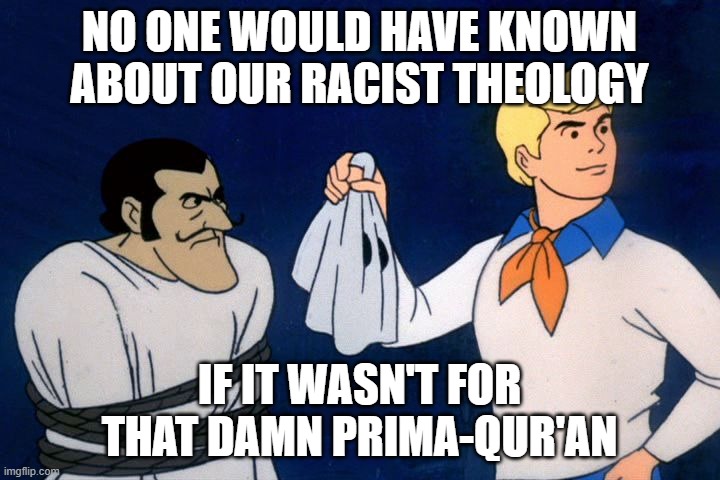
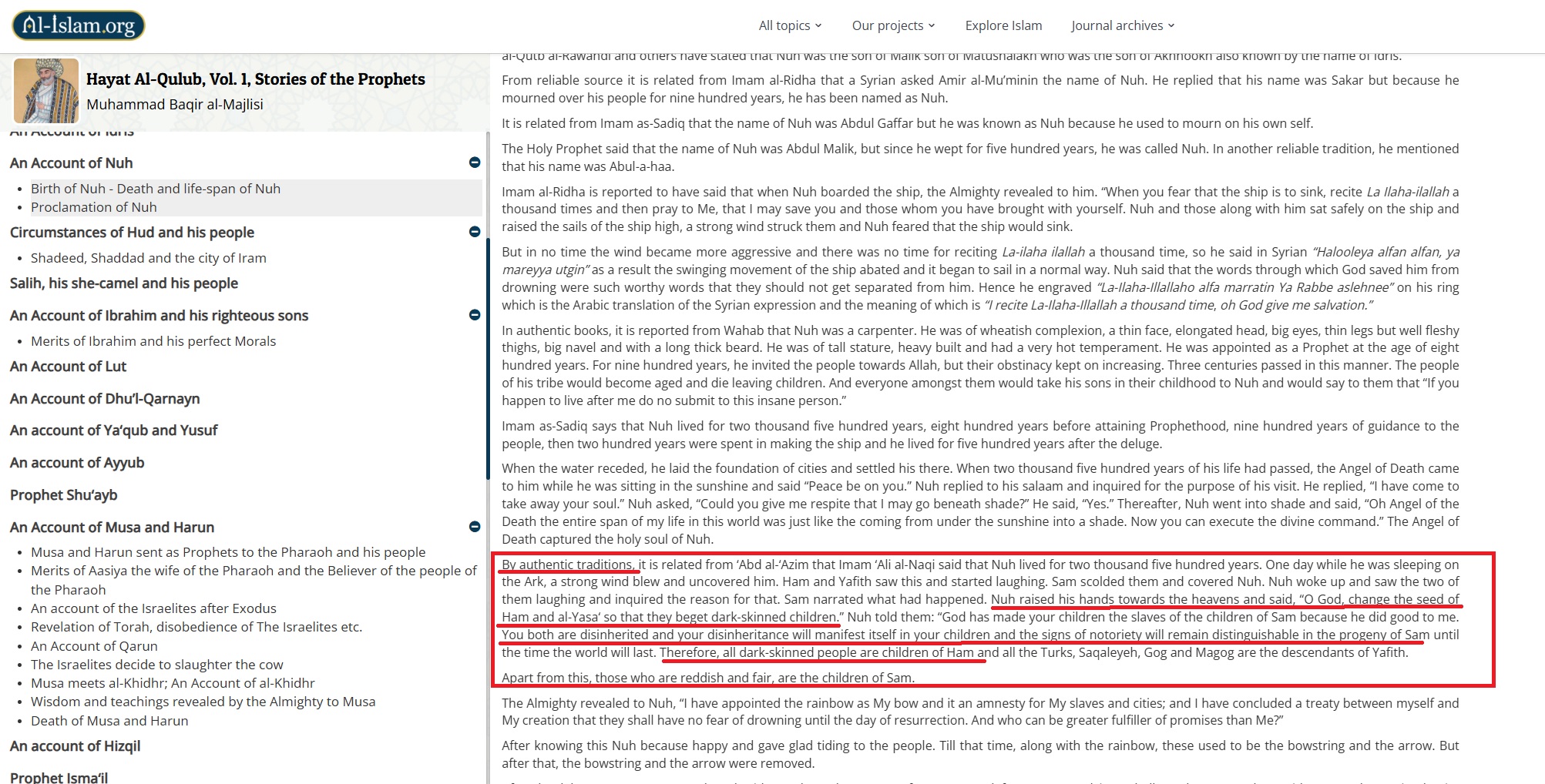
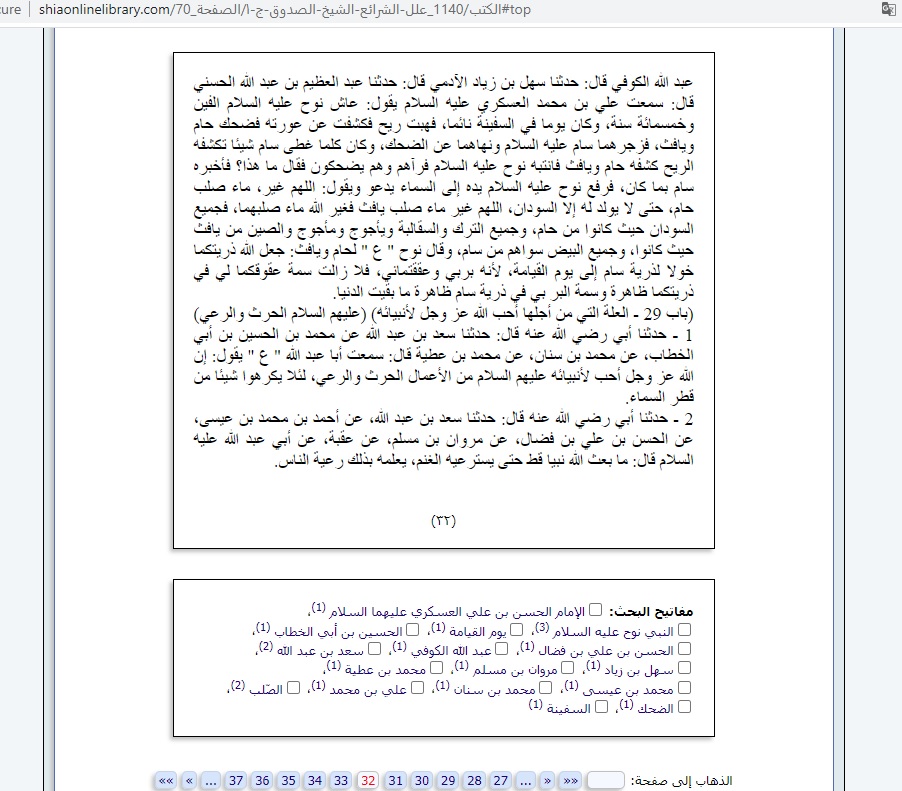


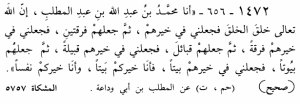
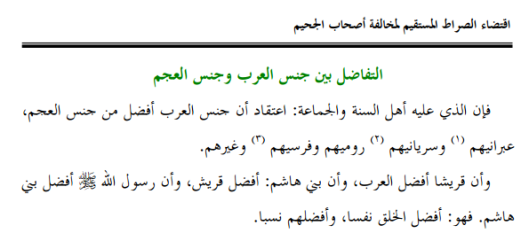
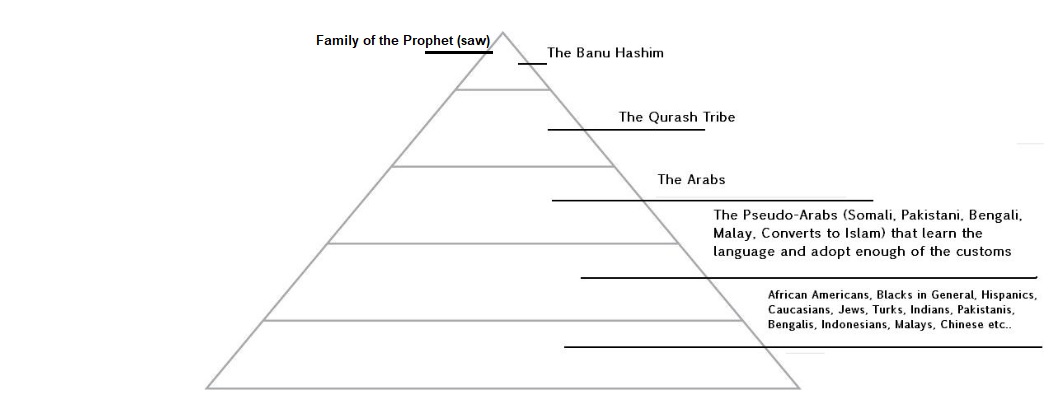
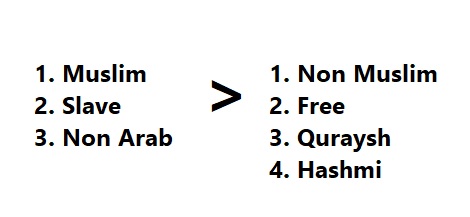

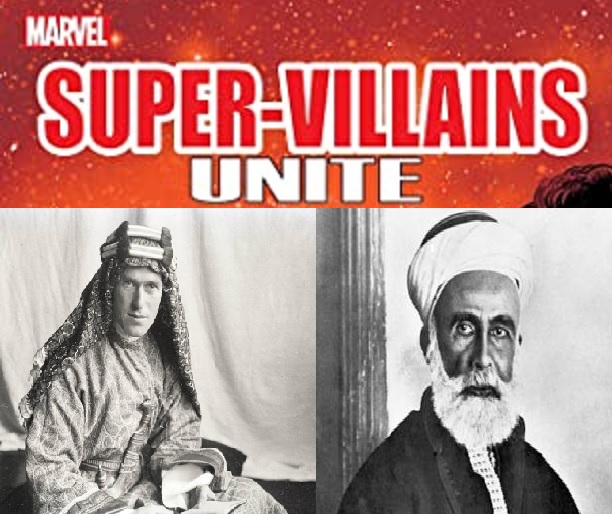
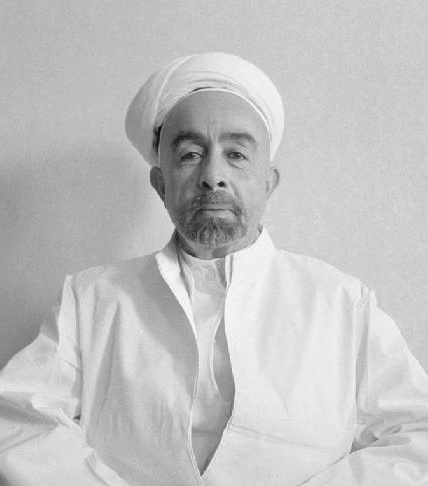
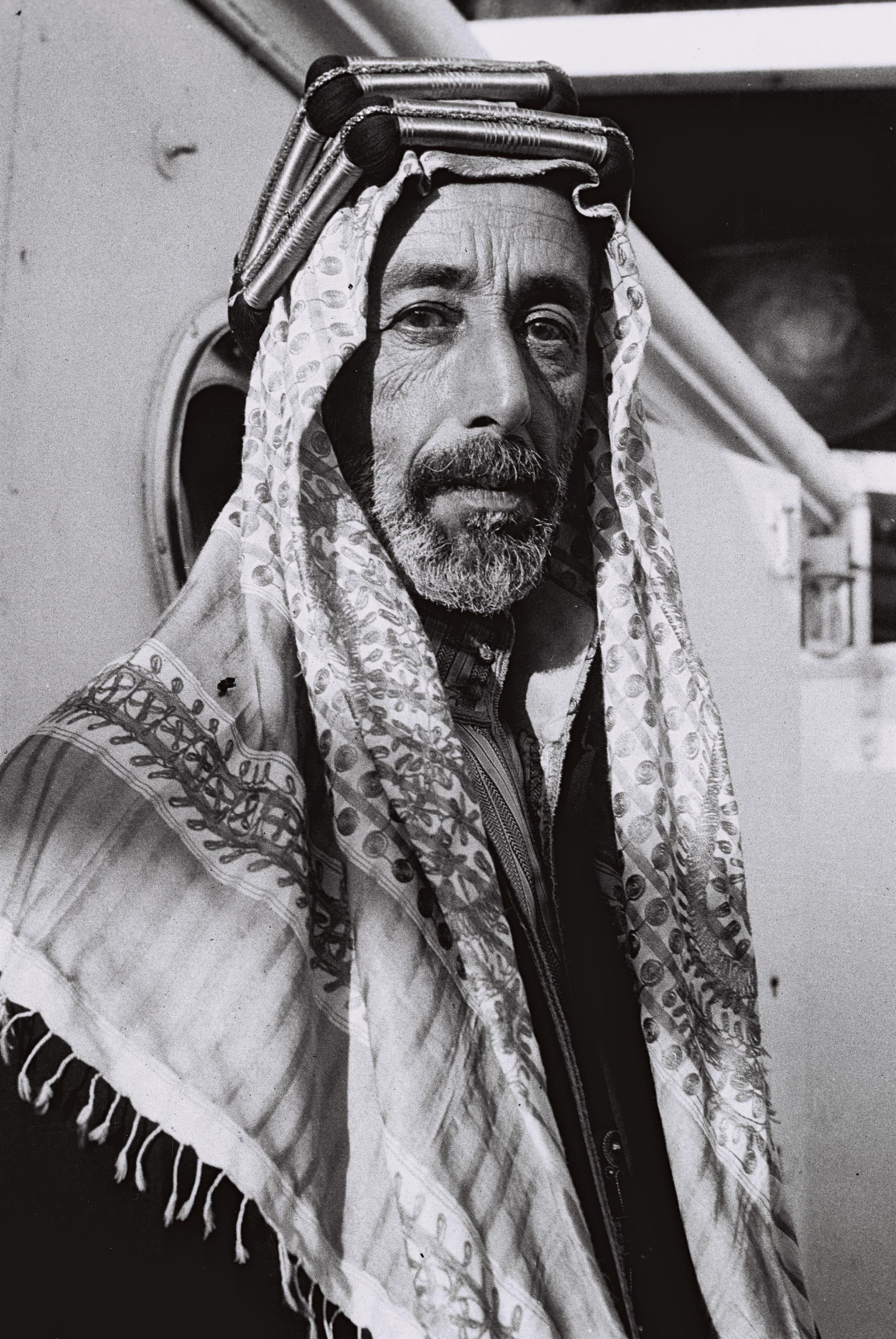
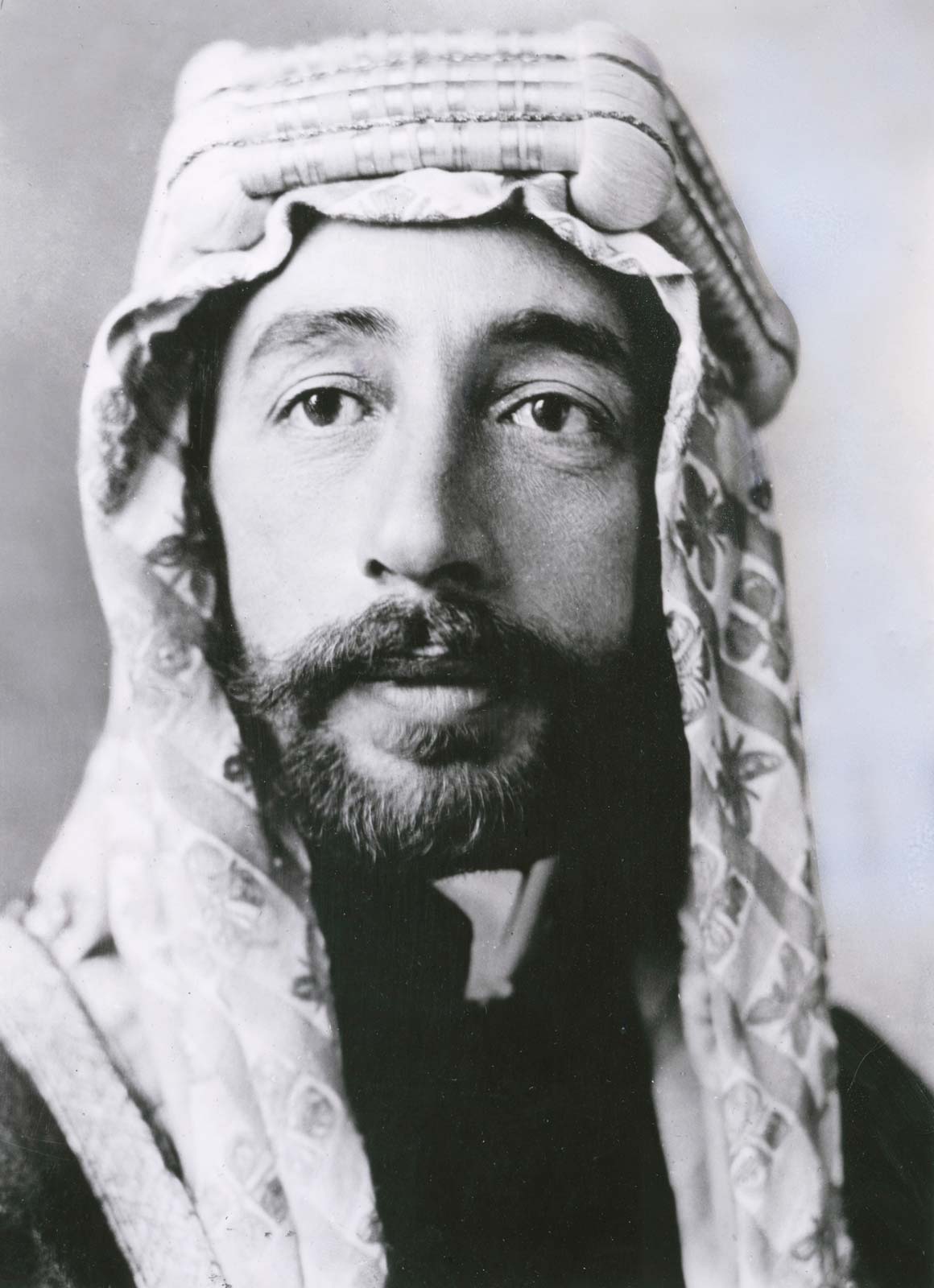
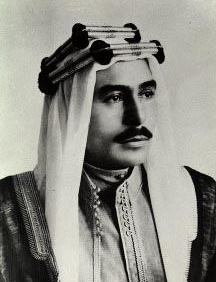
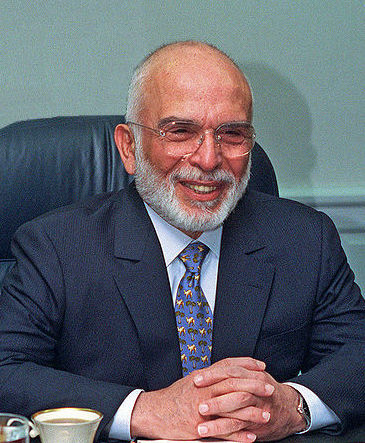
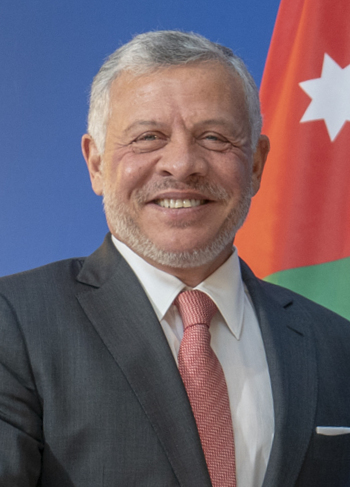
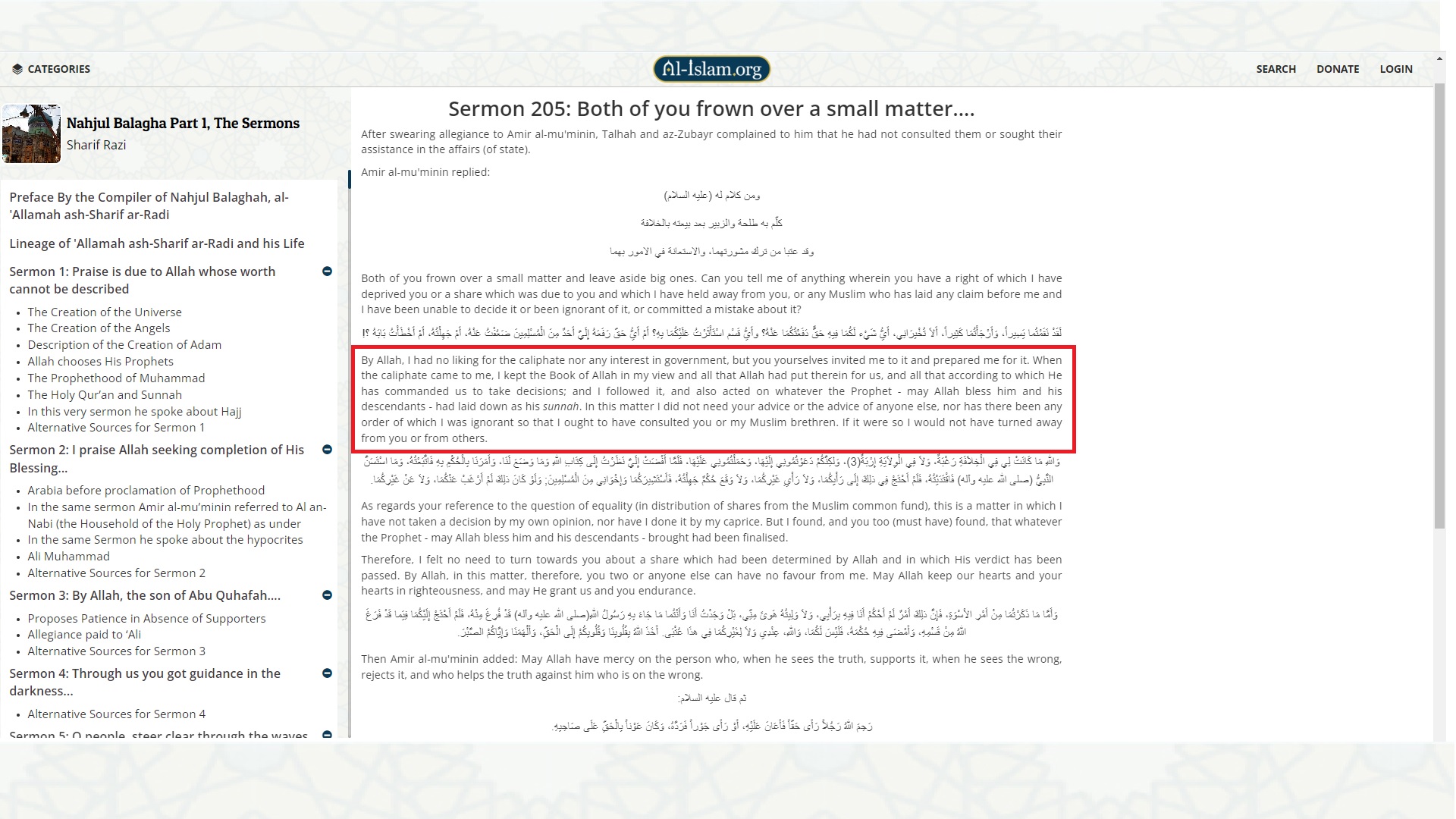


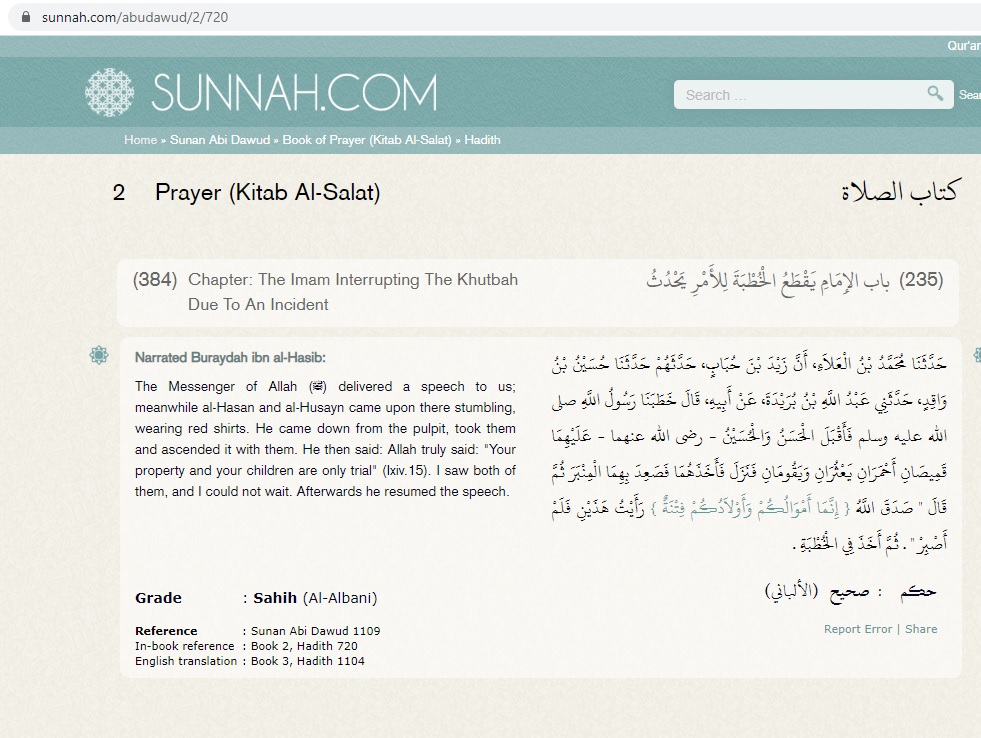

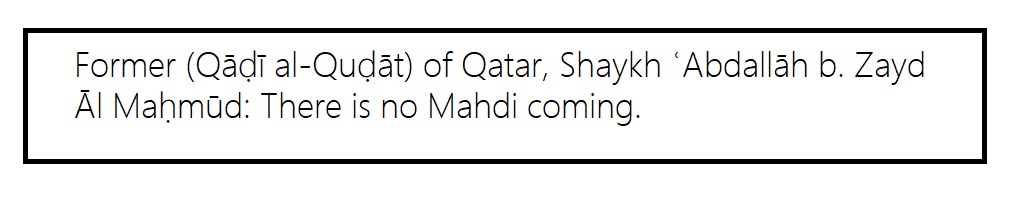

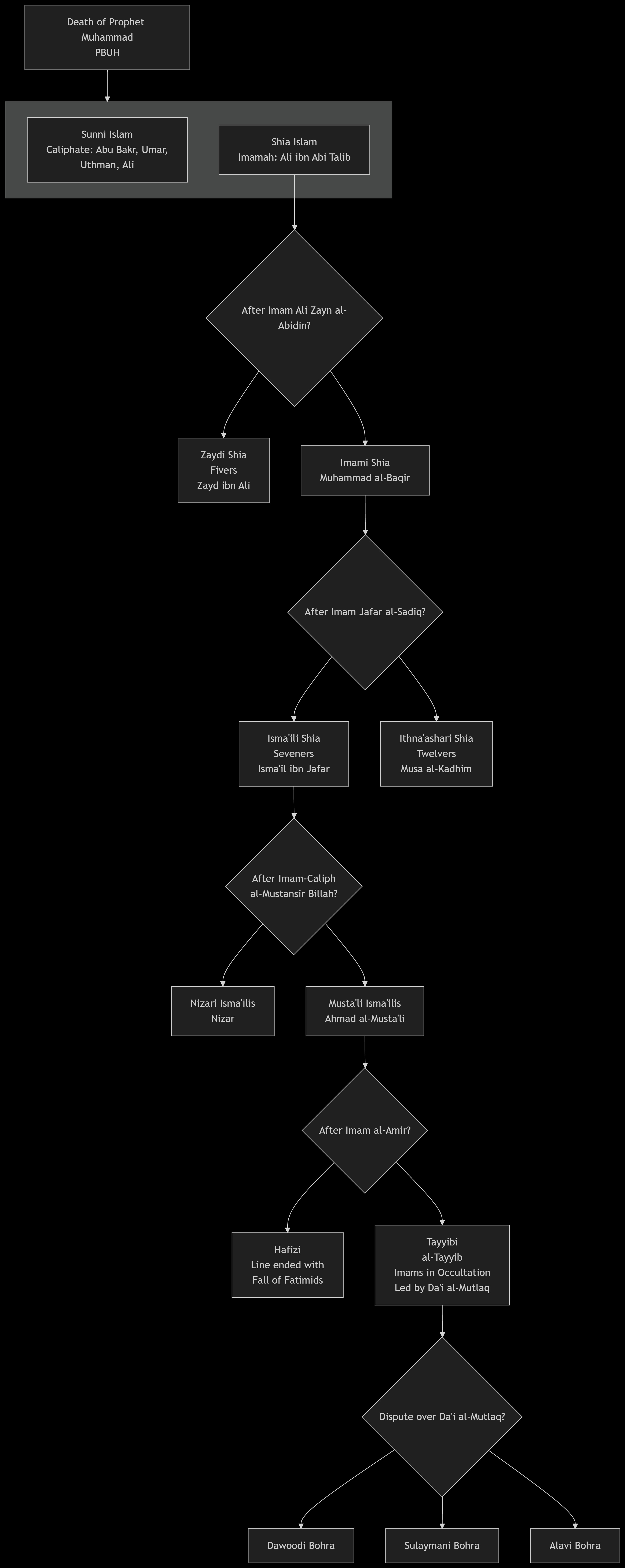


 Prima Quran