“Turn you back in repentance to Him, and fear Him: establish regular prayers, and be not among those who join gods with Allah,- Those who split up their Religion, and become (mere) Sects,- each party rejoicing in that which is with itself!” (Qur’an 30:31-32)
“O mankind! there hath come to you a direction from your Lord and a healing for the (diseases) in your hearts,- and for those who believe, a guidance and a Mercy.” (Qur’an 10:57)
﷽
When looking at the issue of forgeries of hadith one does not have to look further than the pro-Sufi and anti-Sufi forces within the ‘Ahl Sunnah‘.
Abd Allah ibn al-Mubarak said, “The isnad is from the religion; were it not for the isnad anyone could say anything they wanted.”
Source: (Reported by Muslim in the introduction to his Sahih, vol. 1, pg. 9, Dar Taibah.)
The isnad -is the chain of narration.
The word hadith in the title of the article is used in the Arabic sense of a report. Thus, for the purposes of this article it is not necessarily a statement attributed to the Blessed Prophet (saw).
Anyone who has been among people who claim to practice ‘Sufism‘ and/ or have inclinations towards a branch of study in Islam called ‘tassawuf‘ has most likely heard innumerable times the following statement attributed to Imam Malik.
“He who practices tassawuf without learning Sacred Law corrupts his faith (tazandaq) , while he who learns Sacred Law without practicing Tasawwuf corrupts himself (tafassaqa).”
Now when I studied at Zaytuna I was told time and again the importance of being connected in an ‘unbroken‘ chain of sacred knowledge that goes all the way back to the Blessed Messenger (saw) himself.
Of course, what I’m about to say may seem cynical to you the reader, but it is the atmosphere that was created around Zaytuna when I was there.
The atmosphere seemed to say to me, “Don’t you dare question anything that is presented to you, because after all who are you to question? You don’t have the requisite tools; and you didn’t study under a Shaykh who toes the line that we tell you to tow. Therefore, all of your sincere lines of inquiry are invalid.”
So let us say that someone has reservations about giving their complete allegiance (the custody of their soul) to a Shaykh. However, this person agrees to or understands the necessity of following someone learned in jurisprudence.
Thus, the concept of the following someone learned in jurisprudence is used as a jump-off point for handing over complete sovereignty of your soul to a Spiritual guide or Shaykh. Many who call themselves ‘Sufi’ today use the following modus operandi:
Start by getting the spiritual aspirant the necessity of following someone learned in jurisprudence. Use the idea of following Imams in jurisprudence to advance their position. Thus, if Imams like Shaf’i and Malik are seen to be in favor of Sufism or ‘Tassawuf‘ then whom are we to question it!
So even until today, you have world-renown people like Shaykh Hamza Yusuf attributing such statements to Imam Malik.
You can see the following video where he attributes the above-mentioned statement to Imam Malik. http://www.youtube.com/watch?v=2_5d9c2UdiU @ 1:14 in the video you can hear Shaykh Hamza attribute this statement to Imam Malik
Interestingly the term Sufi was applied to those given the appellation “Mutazalites” long before it was applied to Junayd.
“The term Sufi was applied to Mu’tazili ascetics before it was to Junayd and his circle. Early Mu’tazili ascetics and the later Karramiyya, who more or less absorbed Mu’tazili asceticism, sometimes exalted complete renunciation of normal gain, counting it best to live off alms.”
Origins of the term ‘Ahl al sunnah’
Christopher Melchert also gives some very keen insights into the term ‘Ahl al sunnah’ and the fact that a great many factions were called themselves by this appellation.
He says,
“The 9th-century hadith folk’s own preferred term for themselves was“Ahl al-sunna.” It is not convenient for us to call the hadith folk “Sunnis” because that term now calls to mind the great tripartite division of Sunnis, Shi’is, and Kharijis. At least for the 9th century and earlier, a mere tripartite division is simplistic and practically impossible to document. To begin with, 9th-century definitions of Shi’ism were considerably different from those of later times; for example, traditionalist rijal critics regularly distinguished between ‘tashayyu’, special regard for ‘Ali and his house that the hadith folk was willing to overlook, and rafid, the rejection of Abu Bakr and ‘Umar that they thought put one outside the Muslim community. With equal emphasis, the 9th-century hadith folk distinguished themselves from Qadariyya, Murji’a, Mu’tazila, and other theological parties not accounted for by a simple, anachronistic dichotomy between Sunnis and Shi’is. The polarity of Sunni and Shi’i was not strong until the mid-10th century, and full Sunni mutual recognition and self-awareness appeared only in the mid 10th century. Finally, modern scholars should avoid endorsing the hadith folk’s own estimate that they were the overwhelming majority, as calling them “Sunnis” might do.”
” The significance of their calling themselves ‘Ahl al-sunna’ is not that their views were identical to those of the later, great Sunni community, which they were not, but that the later community deliberately identified them as its forebears. We need to understand their piety. Their adversaries preferred not to call them ‘Ahl al-sunna’ and proposed various other terms.’ Al-Jahiz disparaged the nabita, those who sprouted up like weeds to extol the enemies of ‘Ali and to promulgate such crass ideas as assigning God an imaginable body (tajsim, taswfr). Other writers attributed similar errors to the hash- wiyya (vulgar). The hadith folk complained that the Murji’a called them shukkak (doubters) for saying, “I am a believer, God willing,” while the Qadariyya called them mujbira or jabriyya for upholding divine predestination. To use any of these terms for the hadith folk would mean taking sides as much as it would mean calling them ‘Ahl al-sunna’, which is needless for modern scholars.”
“The hadith folk emerged as a distinct group at about the end of the 8th century. They lost importance in the 10th century. Chroniclers usually refer to their 10th-century successors in Baghdad as the Hanabila or simply al-‘amma (the general), periodically rioting against the Shias. Meanwhile, their own name for themselves, ‘Ahl al-sunna’, was claimed by virtually all parties except the Shi’is.Even Mu’tazila called themselves Ahl al-sunna wa-al-jama’a, on the plea that if they were not actually the great majority, they ought to have been. (I have not compared the piety of the hadith folk with that of 9th-century Shi’is, rewarding though such a comparison would be. At least a wing of the Shi’ movement probably had something very close, which ought to show up in Shi’i hadith.)”
So again we can see there was a lot of conflict and turmoil in the very early history of Islam. Conflict and turmoil that is with us until this very day. So less I digress let me go back to the opening quotation attributed to Imam Malik:
“He who practices tassawuf without learning Sacred Law corrupts his faith (tazandaq) , while he who learns Sacred Law without practicing Tasawwuf corrupts himself (tafassaqa).”
Gibril Fouad Haddad who is a follower of the Sufi group ‘The Naqshabandi Haqqani‘ * has provided some very insightful information to this claim above.
* note: This Sufi group is to be distinguished from their rivals the ‘Naqshabandi Mujaddidi‘ as well as other rival Sufi groups.
He has the following to say about the above quotation attributed to Imam Malik :
“Cited without the chain of transmission by Al-Qari in Sharh ‘Ayn al-Ilm and Mirqat al-Mafatih, Ahmad Zarruq in the Forth of his Qawa’id al-Tassawuf in his commentary on Ibn Abi Zayd’s Risal a (Beirut: Dar Ihya al-Kutub al Arabiyyah, Ibn Ajiba in Iaqaz, Al Himan fi Sharh al-Hikam and Al-Tata’i in his commentary on Ibn Rushd’s Muaqaddima.”
Source: (The Four Imams and their Schools page 180)
Ponder that for a moment, respected readers. A statement seemingly in support of ‘Tassawuf‘ put into the mouth of Imam Malik and then repeated by men like Al Qari, Ahmad Zarruq, Ibn Abi Zayd, Ibn Ajiba, and At Tata’i. Yet, no chain of narration!
In my previous conversations with Dr. Abdullah bin Hamid Ali and Ustadh AbdasSamad Clarke, both have confirmed to me that it is not authentically ascribed to Malik.
Anti-Sufi reports attributed to Imam Malik
Incident no. 1 )
“Al -Tinnisi said: We were sitting with Malik with his companions around him. A man from the people of Nasibin said, ‘We have some people who go by the name of Sufis. They eat a lot then they start (chanting) poems (qasa’id), after which they stand and start (chanting) dancing.” Malik asked, “Are they boys (sibyan)?” He said no. Malik asked, “Are they insane?” He said, No, they are old men (mashaykh) and other than that, and they are mature and sane (‘uqala.” Malik said, “I never heard that any of the people of Islam do this.” The man said to him, “Indeed, they do! They eat, then they stand up and start dancing intensively (dawa’ib), and some of them slap their heads, and some of their faces.” Malik started laughing then went into his house. His companions said to the man. “You were, O man, ill luck (mash’um) for our friend [Malik]. We have been sitting with him thirty-odd years and never saws him laugh except today.” “Narrated without a chain by Al-Qadi ‘Iyad in Tartib Al-Madarak.”
Source: (The Four Imams and their Schools by Gibril Fouad Haddad page 180)
Incident no.2 )
“Abd al-Malik ibn Ziyad al-Nasibi said: “We were with Malik when I mentioned to him Sufis in our city. I said to him that they wear fancy Yemenite clothes, and do such and such. He replied, ‘Woe to you! Are they Muslims?’. He then laughed until he lay on his back. Some of his companions said to me, ‘What is this?’ We have not seen more trouble (fitna) caused to the Shaykh than you, for we never saw him laugh!” “Narrated by al-Khallal in al-Hathth ‘ala al-Tijara wal-Sina’a wal-Amal (Abu Ghudda) with a weak chain because of ‘Abd al-Malik ibn Ziyad al-Nasibi who is “disclaimed in his narrations and untrustworthy” (munkar al hadith, gahyr thiqa) according to al-Aazdi as per Ibn al-Jawzi in al-Du’afa wal-Matrukin (1:149) while Ibn Hibban in his Thiaqat (8:390) said he reports oddities from Malik.”
Source: (The Four Imams and their Schools by Gibril Fouad Haddad page 181)
So you can imagine the incongruity of all of this. Notice the similarities between the two seemingly Anti-Sufi reports attributed to Imam Malik.
1) His strong reaction: ‘I never heard that any of the people of Islam do this. &Woe to you! Are they Muslims?’
2) His hearty laugh after hearing of their doings. ‘Malik started laughing then went into his house. &He then laughed until he lay on his back’.
3) The shock of the people present at Maliks’ reaction. ‘You were O man, ill-luck (mash’um) for our friend [Malik]. We have been sitting with him thirty-odd years and never saws him laugh except today. & What is this?’ We have not seen more trouble (fitna) caused to the Shaykh than you, for we never saw him laugh’!
You can scroll down to the section: “Imam Malik and the Sufis” Gibril Fouad Haddad has the following to say about the two incidents, reported above:
Concerning the first incident, he says, “This is narrated without chain by al-Qadi `Iyad. in Tartib al-Madarik (2:53-54).” That is all he has to say. There is no chain of transmitters. Case closed.
Concerning the second incident, he simply gives the reason one of the transmitters is dismissed. Then he concludes by saying:
“Content-wise, neither of the above reports shows unambiguous condemnation of group dhikr but only that some people who passed for Sufis in the Imam’s time reportedly committed certain childish excesses or irrational breaches of decorum. The reports only show that Imam Malik found the story amusing. The delator seems obsessed with the ‘eating and dancing’ which he mentions twice as if afraid Malik didn’t hear it the first time. There is also on the part of Malik’s circle clear disapproval of the delator who is apparently perceived as an interloper. And Allah knows best.”
Actually what the reports show assuming they are true at all is the following:
The reports show that Imam Malik does not even seem to be even vaguely familiar with such groups. The asking ‘if the people are Muslim‘, and making statements such as ‘the people of Islam are not heard of doing this‘ would be very difficult for Muslims having a pro-Sufi bias to fathom. Especially, in the first report since, we don’t have Imam Malik laughing until after hearing about people slapping their faces.
“Invite to the way of your Lord with wisdom and good instruction, and argue with them in a way that is best. Indeed, your Lord is most knowing of who has strayed from His way, and He is most knowing of who is rightly guided.” (Qur’an 16:125)
﷽
The background of the debate that never happened.
Shaykh Bin Baz invited Shaykh Ahmed Khalili to his office and Shaykh Khalili accepted the invitation. Shaykh Ahmed Khalili and a small delegation went into what was described as a small room. There was no courtesy and no decorum shown on behalf of Shaykh Bin Baz. As soon Shaykh Bin Baz got everyone in the room, he started shouting, “You Ibadi are Kafirs! You don’t believe in seeing Allah in the afterlife”. “You believe in the creation of the Qur’an and you must make tawba!” “You must testify that you are mistaken!”
Shaykh Ahmed Khalili remained very calm. He replied, “These issues are very old issues and many of the ulemah have been talking about it.” “Our expectation was to come and discuss how to unite the Ummah, and keep the differences aside, and we should agree on certain terms.”
However, Shaykh Bin Baz insisted, “No, you must confess, and you must repent.”
To which Shaykh Ahmed Khalili said, “You have your justification and we have our justification. So let us call for a general symposium in Mecca and allow all the media, rather it is newspapers, or radio or television, to broadcast this debate.”
“If you think you are right, and you want to tell the whole ummah of your righteous opinion, this will show who is wrong and who is right.” “Even if we are wrong we agree to debate publicly so that everyone will know that we are wrong, and you are right.”
“Allow the Ummah to judge according to the debate and the justifications everybody brings forward.” However, Shaykh Bin Baz did not want to discuss nor debate.
So this prompted Shaykh Ahmed Khalili in the video you are about to see. In the beginning, Shaykh Ahmed Khalili mentioned:
“That these are old disputes that split the Ummah. He asked whose interest it was in bringing up these issues that split the Ummah? However, since Bin Baz started I have to clarify these points. The people of Bin Baz are doing their best to spread their beliefs and, in the process, to make us look like kafirs.”
Thus, Shaykh Ahmed Khalili (May Allah continue to benefit this Ummah by him) found it necessary to clarify the issues. Ultimately, Shaykh Bin Baz backed down.
In the following video you can see that a student of Bin Baz asking Bin Baz that he had the chance to refute Al Khalili(h) and show that he was upon batil (falsehood) so why did he not take it? Bin Baz replied but what if Khalili (h) has strong evidence then what?
The way the following video is framed it paints a picture as if Bin Baz was the wise one in the situation. As if he was saying: “If I debate him he might have a stronger argument and this will cause the misguidance of many people.”
From our perspective this whole debacle looks like this.
Bin Baz: “Come to the Haqq.”
Shaykh Ahmed: “Ok. Let’s have a debate and see who is upon the haqq.”
Bin Baz: ghost…
الشيخ عبد العزيز بن باز رحمه الله هذا الامام العجيب ارسل احد كبار المفتين في دوله عربيه وهو على مذهب الخوارج على مذهب الخوارج وهو مفتي تلك البلاد وهم ينكرون رؤيه الله جل وعلا كما تعلمون في الاخره ينكرون رؤيه الله كالمعتزلة [موسيقى] ولا نعلم في زمنه اعلم منه فقال لا لا ما ناقش قيل له لماذا يا شيخ قال طيب لما اناقشه قد يكون الحم بحجته مني فاكون سببا لضلال بعض الناس قد يكون الحم مني بالحجه والنقاش فيكون سبب يكون سبب لاظ بعض الناس فرفض الشيخ ناقش فان صاحب الحق لا يكون هيابا ولا جبانه بل صاحب الحق يجر على اظهار الحق الذي يعتقد
“If all the trees on earth were pens and the ocean were ink, refilled by seven other oceans, the Words of Allah would not be exhausted.” (Qur’an 31:27)
﷽
Once, our colleague had an encounter with a Christian missionary. This is the encounter that took place.
Once, while in the Sultan Mosque in Singapore, a Christian missionary paid us a visit. The man came up to me and, after introducing himself, he asked, ‘What has your God done for you?’
To which my immediate reply to him was, “You see, my brother, that is the wrong question. The question is not ‘What has God done for me’, the question is ‘What has God not done for me?’
My life, my faith, the air we breathe, the ability to see and behold objects of great beauty, to hear the most softness and soothing of sounds, to taste the most delicious of foods, to be healthy, to have been in love, to have been the object of someone’s love. To have parents that loved me and raised me. This beautiful world that we live in. The fact that if we were so much closer to the sun that we would all burn alive and if we were that much further away, this earth would freeze over. This beautiful day, gravity, the opportunity to meet you and share with you some of what God has done for us.”
I then quoted to him the following verse from the Qur’an.
“And if whatever trees in the earth were pens, and the sea and seven more seas even after it were to replenish it, yet in no way would the Words of Allah be depleted. Surely Allah is Ever-Mighty, Ever-Wise” (Qur’an 31:27)
If I was to spend my entire life writing words of thanks and praise to Allah (swt) for everything he has done for us, I would need seven more lifetimes, and even then I would fall short of writing words of praise and gratitude.
Say, “My Lord has only forbidden immoralities – what is apparent of them and what is concealed – and sin, and oppression without right, and that you associate with Allah that for which He has not sent down authority, and that you say about Allah that which you do not know.” (Qur’an 7:33)
﷽
Once I was approached by a Salafi Muslim in a Masjid who asked me, “Brother where is Allah?” I thought this was an extraordinary question to ask but I asked him “What time it was“. He seemed puzzled but told me the current time. I thereby responded, “Allah is in London, England!”
He rapidly started to stroke his beard rapidly repeating “istaghfirullah!'” “‘istaghfirullah!” “Allah forgive you!” “Allah forgive you!”
This seemed like very neurotic behavior so I offered the following mutawatir hadith.
Abu Huraira reported Allah’s Messenger (saw) as saying:
“Allah descends every night to the lowest heaven when one-third of the first part of the night is over and says: I am the Lord; I am the Lord: who is there to supplicate Me so that I answer him? Who is there to beg of Me so that I grant him? Who is there to beg forgiveness from Me so that I forgive him? He continues like this till the day breaks.”
I don’t see what was so wrong with saying that Allah was in London, England considering that it was around 4:45 a.m London time (which would be the last third of the night).
I guess that was not the answer he was expecting. He was visibly upset as he said, “But brother Allah is in the highest heaven.” “What?!” I responded. I thought this was very strange for how could Allah be in London England and in heaven at the same time! Surely this man does not believe that Allah is multi-present? Could it be that he believed that Allah (swt) was in many places simultaneously?
“Who said Allah is in heaven?” I asked.
“Firaun (Pharoah) said Allah is in heaven.” the brother offered.
“Where does he say this?” I demanded!
The brother quoted the following,
“And Fir’aun (Pharaoh) said: “O Hâmân! Build me a tower that I may arrive at the ways, The ways of the heavens, and I may look upon the Ilâh (God) of Mûsa (Moses) but verily, I think him to be a liar.”(Qur’an 40:37)
I was simply shocked by this! “Brother,” I said, “I do not think we need to be taking our Aqidah (belief) from Fir’aun (Pharaoh)! We do not need to build a tower of babel to reach heaven.“
This was a real conversation that happened between me and a Malay Salafi brother in a Masjid in Singapore. Needless to say, I feigned ignorance of the subject and admittedly baited the brother because I am all too familiar with these topics.
However, keep in mind he did approach me first.
However, I did advise him that in the future he may wish to use the hadith of the blind woman pointing upwards into heaven or when asked, ‘Who said Allah is in heaven‘ perhaps he could say, ‘Allah himself says this.’ It is also advisable to simply use the verse of the Qur’an “The Beneficent One, Who is established on the Throne.” (Qur’an 20:5)
I am quite sure that our Salafi brothers continue to improve their techniques.
Yet the problem remains. The issue of Allah (swt) presumably being over the throne and descending down into the lowest part of the earth every night of course (in a way that befits his majesty) …..of course.
Now the Ashari and Maturidi among our Sunni brothers are quite sensible on this issue. However, those Sunni Muslims from the Salafi, Hanbali, Athari can get quite agitated over this very sensitive issue.
So sensitive that they tell you to just shut up and accept it! Blind faith!
You can’t make taqlid to a legal school but you damn well better make taqlid to their belief system!
Don’t worry yours truly has screenshots of the entire Q & A as many people make web sites, articles, and entries that disappear in a flash!
So here we go… I’ll highlight the text of interest.
Question
When asked, “Where is Allah ?” I reply “Above the seven Heavens and the Arsh” But taking the Hadith regarding that Allah descends to the lowest heaven in the latter part of the night. If someone asks where is Allah (swt) and they state He is the latter 3rd of the night now. What reply should you give?
Another point is that some people say it is the latter part of the night all the time (somewhere on the earth at a particular point in time) From this they conclude that Allah is not above His Arsh.
Answer
Praise be to Allah.
Firstly, we have to know the ‘aqeedah (belief) of Ahl al-Sunnah wa’l-Jamaa’ah concerning the names and attributes of Allah. The belief of Ahl al-Sunnah wa’l-Jamaa’ah is to affirm the names and attributes which Allah has affirmed for Himself, without distorting or denying them, discussing how they are or likening them to anything else. They believe that which Allah has commanded them to believe, for Allah says (interpretation of the meaning):
“There is nothing like Him, and He is the All-Hearer, the All-Seer”
[Qur’an 42:11]
Allah has told us about Himself. He says (interpretation of the meaning):
“Indeed, your Lord is Allah, Who created the heavens and the earth in Six Days, and then He rose over (Istawaa) the Throne (really in a manner that suits His Majesty).
Prima Qur’an comments: “The Throne (really in a manner that suits His Majesty)…” So now they are going to say no one knows how but then use the word ‘really’. Interesting.
[Qur’an 7:54]
“The Most Gracious (Allah) rose over (Istawaa) the (Mighty) Throne (in a manner that suits His Majesty).
[Qur’an 20:5]
and there are other ayats which mention that Allah rose over His Throne.
The rising of Allah over His Throne, which means that He Himself is High and above the Throne, is of a special nature which befits His Majesty and Might. No one knows how it is except Him.
This was proven in the saheeh Sunnah, where it is narrated from the Prophet (peace and blessings of Allaah be upon him) that Allaah descends during the last third of the night. It was narrated from Abu Hurayrah that the Messenger (peace and blessings of Allaah be upon him) said: “Our Lord descends every night to the lowest heaven when the last third of the night remains, and He says, ‘Who will call Me that I might answer him, who will ask of Me that I might give him, who will ask My forgiveness, that I might forgive him?’” (narrated by al-Bukhaari, Kitaab al-Tawheed, 6940; Muslim, Salaat al-Musaafireen, 1262)
According to Ahl al-Sunnah, the meaning of this descent is that Allaah Himself comes down to the lowest heaven in a real sense, as befits His Majesty, and no one knows how that is except Him.
Prima-Qur’ancomments: I thought that the doctrine of Ahl al-Sunnah according to the Hanbali, Salafi, and Athari is that no one knows how? So how are they saying tongue in cheek, “comes down to the lowest heaven in a real sense, as befits His Majesty.”
They continue:
“But does the fact that Allaah comes down means that He vacates the Throne or not? Shaykh Ibn ‘Uthaymeen said concerning a similar question: we say that this question is based on unnecessary and excessive questioning and that the one who asked this is not to be thanked for his question. We ask, are you keener than the Sahaabah to understand the attributes of Allah? If he says yes, we tell him, you are lying. And if he says no, we tell him, then be content with what they were content with. They did not ask the Messenger of Allah (peace and blessings of Allah be upon him), ‘O Messenger of Allah, when He comes down, does He vacate the Throne?’ Why do you need to ask this question? Just say, He comes down. Whether or not the Throne is vacated is not your business. You are commanded to believe the reports, especially concerning the essence of Allah and His attributes, for this matter is above rational thought.”
Prima-Qur’an comments: I have read many of Shaykh ‘Uthaymeen’s legal verdicts and this is as close to ‘Shut the hell up‘ as I have ever seen the Shaykh get. The whole of his response is about intimidation and shutting down the inquiry of the questioner.
They continue:
Majmoo’ Fataawa Shaykh Muhammad al-‘Uthaymeen, 1/204-205
Shaykh al-Islam Ibn Taymiyah (may Allaah have mercy on him) said concerning this matter:
“The correct view is that He descends and that He does not vacate the Throne. A person’s soul remains attached to his body night and day until he dies, but when he is asleep it ascends… It was said, night varies, and the last third of the night comes sooner in the east than in the west, so the descent of Allaah to the lowest heaven, of which His Messenger spoke, happens in the east first and then in the west…”
Prima-Qur’an comments: Whoa there Shaykh Ibn Taymiyah! Hold your horses! Are you now likening the descent/ascent of Allah (swt) to a human soul leaving the body? Furthermore are you saying that Allah (swt) has division with him self? A part of him that travels and a part of him that remains? By saying that Allah (swt) does not ‘vacate‘ the throne you are in fact establishing a ‘how’ for Allah swt! Authubillah min dhalik! Or if the Shaykh is suggesting that by his comparison to human beings that Allah (swt) can be in two places at the same time than my initial response to the brother that questioned me is not wrong at all!
They continue:
See Majmoo’ Fataawa Ibn Taymiyah, 5/132
Rising over (istiwaa’) and descending are two of the practical attributes which have to do with the will of Allaah. Ahl al-Sunnah wa’l-Jamaa’ah believe in that, but in this belief they avoid likening Allaah to any of His creation or discussing how He is. It cannot occur to them that Allaah’s descending is like the descending of any of His creatures or that His rising over the Throne is like the rising over of any of His creatures, because they believe that there is nothing like unto Allaah and He is the All-Hearer, All-Seer. They know on rational grounds that there is a great difference between the Creator and His creatures, in their essence, attributes and actions. It cannot occur to them to ask how He descends, or how He rose over His Throne. The point is that they do not ask how His attributes are; they believe that there is a ‘how’, but it is unknown, so we can never imagine how it is.
Prima Qur’an comments: Respected Shaykh Taymiyah you said, ‘we can never imagine how it is’ and yet you also say in the paragraph above, A person’s soul remains attached to his body night and day until he dies, but when he is asleep it ascends.
“We know for certain that what is narrated in the Book of Allaah or the Sunnah of His Prophet (peace and blessings of Allaah be upon him) is true and is not self-contradictory, because Allaah says (interpretation of the meaning):
“Do they not then consider the Qur’aan carefully? Had it been from other than Allaah, they would surely, have found therein many a contradiction”
[Qur’an 4:82]
Prima Qur’an comments: Well, you see 4:82 actually is a reference to the Qur’an. It is not a reference to hadith, sunnah, fiqh, ijtihad of imams, or anything else. How you lump the sunnah in with the Qur’an is anyone’s guess.
He continues:
“Because contradictions in the reports would mean that some of them were showing others to be false, and this is impossible in the case of that which Allaah and His Messenger tell us.
Whoever imagines that there are any contradictions in the Book of Allaah or the Sunnah of His Messenger (peace and blessings of Allaah be upon him), or between the two, it is either because of his lack of knowledge or because he has failed to understand properly or to ponder the matter correctly, so let him seek further knowledge and strive to think harder until the truth becomes clear to him. Then if the matter is still not clear to him, let him leave it to the One Who is All-Knowing and let him put a stop to his illusions and say, as those who are firmly grounded in knowledge say, “We believe in it; the whole of it (clear and unclear Verses) are from our Lord” [Aal ‘Imraan 3:7 – interpretation of the meaning]. Let him know that there is no contradiction in the Qur’aan and Sunnah and no conflict between them. And Allaah knows best.”
Prima Qur’an comments: Well, you see 3:7 actually is a reference to the Qur’an. It is not a reference to hadith, sunnah, fiqh, ijtihad of imams, or anything else. How you lump the sunnah in with the Qur’an is anyone’s guess.
He continues:
“See Fataawa Ibn ‘Uthaymeen, 3/237-238
Imagining that there is a conflict between Allaah’s descending to the lowest heaven and His having risen over the Throne and His being high above the heavens stems from making a comparison between the Creator and the created being. For man cannot imagine the unseen things of His creation, such as the delights of Paradise, so how can he imagine the Creator, may He be glorified and exalted, the Knower of the Unseen. So we believe in what has been narrated of His rising over (the Throne), His descending and His being High and Exalted. We affirm that (and state that it is) in a manner that befits His Majesty and Might.”
Prima-Qur’an comments: So there you have it. ‘Uthaymeen telling a person to shut up. Ibn Taymiyah basically resorted to blatant Tashbih and Tamthil. (Making resemblance and drawling parallels to) the creation.
Being accurate and circumspect in our beliefs. So the next time someone asks you, “Where is Allah?”’ in order to answer the question accurately one would need to ask the person back. “Do you believe Allah is the creator of all things?” “Do you believe Allah is the creator of space and time?”
Because apparently Allah (swt) is separate and distinct from his creation. Who said that? This website affirms that Imam Ahmad (r) said that.
“So Yoosuf bin Moosaa al-Qattaan, the Shaykh of Abu Bakr al-Khallaal, said: It was said to Abu Abdullah (Ahmad bin Hanbal): “Allaah is above the seventh heaven, over His Throne, separate and distinct (baa’in) from His creation, and His power and knowledge are in every place?” He said:
Yes, He is over His Throne, and nothing escapes His knowledge.”
If the answer is yes, you have to wonder if the throne is a creation or not. If the throne, space, and time are all creations you have to wonder at the question: “Where is Allah?” before the creation of the throne.
We also have this interesting verse. This has to be taken into consideration since some of our brothers from Ahl Sunnah say that Allah (swt) will “come in ranks with the angels.”
“So your Lord comes and also the angels in ranks..” (Qur’an 89:22)
“Lo! those who swear allegiance unto you (Muhammed), swear allegiance only unto Allah. The Hand of Allah is above their hands. So whoever breaks his oath, breaks it only to his soul’s hurt; while whoever keeps his covenant with Allah, on him will He bestow immense reward.” (Qur’an 48:10)
We also have to take into account this hadith:
Narrated Anas:
The Prophet (saw) said, “The people will be thrown into the (Hell) Fire and it will say: “Are there any more (to come)?’ (50.30) till Allah puts His Foot over it and it will say, ‘Qati! Qati! (Enough Enough!)'”
THE DIFFERENCE BETWEEN WHERE IS ALLAH AND WHEN IS ALLAH?
So what does all this mean? Especially if it is admitted that Allah (swt) is separate and distinct from his creation?
It means that the true answer of an Athari, someone who takes the apparent meaning of a text, that the true answer to the question “Where is Allah?” is to respond by saying:
Allah is as he is before space/time. While also being over the throne, while also coming down in the third part of the night (depending upon the time) and coming with rows of his angels. Allah’s foot is on the hellfire. His hand is over their hands. All of that in a way that befits his majesty.
Because here is the point. I challenge anyone to show me where the Blessed Messenger (saw) or any of the companions disputed any of those points above?
Why is Allah (swt) being over the throne: The Default Answer to the Question-Where is Allah?
Why is ‘Allah being over the throne’ THE DEFAULT POSITION?
Again I challenge anyone to show me where the Blessed Messenger (saw) or the companions made ‘above the throne’ as the default position to the exclusion of the other text/positions? Thus, making everything else like ‘coming down’ or ‘existing as he was before creation’ or ‘coming in rows’ relational to that?
Because keep in mind the person is asking you, “Where is Allah?” They are not asking you, “When is Allah?” They are not asking you ‘Where is Allah now?” Because ‘now‘ does not apply to Allah (swt).
Who gave them the authority to make ‘the throne’ the default position? So yes, when someone asks, “Where is Allah?” You could reply, “London England” depending upon what time of day/night it is where you are.
Those who say that Allah (swt) is over the throne bi dhati (in essence) have made a reprehensible innovation because we have nothing reliably transmitted to us on this account.
This is the state of these people who want to police the beliefs of the Muslims and do actually approach people in the Masjid and ask random people, “Where is Allah?” With beliefs like this no wonder, they go around asking such a question, because it certainly seems they have lost their Lord. If only Allah (swt) was always in the dhirk of their minds and and in their hearts they would not need to ask this. They are searching for Allah (swt).
“So do not assert similarities to Allah. Indeed, Allah knows and you do not know.” (Qur’an 16:74)
“There is nothing like unto Him.” (Qur’an 42:11)
﷽
In his commentary of the following verse in the Qur’an:
“He is with you wherever you are” Ibn Taymiyya compares Allah (swt) to the moon!
“The phrase “and He is with you” Does not mean that He blends into creation. Nay the moon one of the smallest of Allah’s creations is both placed in the heaven (mawdu’un fi al-samaa’) and present with the traveler and the non-traveler wherever they may be. And the Exalted is above (fawq) the Throne, as a watchful guardian of His creatures and their protector Who is cognizant of them.”
Source: (Ibn Taymiyya, al’-Aqida al-wasitiyya Salafiyya ed. 1346/1927 p. 20)
“They (Ahlus-Sunnah) do not make the resemblance between His Attributes and the attributes of the creation, because, for Him, Glorified is He, there is no comparison, nor equal, nor partner, and there is no analogy for Him with His creation.”
Source: (al-Aqeedah al-Waasitiyyah 1/p.127 with the commentary of ibn al-Uthaymeen)
No one from among the early generations of Muslims compared Allah (swt) to the moon or Allah’s knowledge to the moon’s rays!
Not only this but the moon occupies an orbit as well as it is dependent upon the orbit! The moon’s rays cannot penetrate the ocean depths. Whereas Allah is aware of us even in the ocean depths!
So all that I have seen from the sect that calls itself ‘Salafiyyah’ is that if you read carefully their responses they do not deny that Ibn Taymiyya made this comparison of Allah (swt) to his creation.
I could say in this entry blue and blue. Then I will say green. The fact that I have said blue does not negate the fact that I also said green in this entry.
Followers of Ibn Taymiyya reply: “Oh, he was using it to teach people.” It doesn’t make it correct.
In fact, the smart thing to do at this point for those people who do love Ibn Taymiyya is to simply say he made an error in this regard.
“What! he who is obedient during hours of the night, prostrating himself and standing, takes care of the hereafter and hopes for the mercy of his Lord! Say: Are those who know and those who do not know alike? Only the men of understanding are mindful.” (Qur’an 39:9)
﷽
The Life and Works of Imam Jabir Bin Zayd
Abu al-Sha’tha’ Jabir b. Zaid al-‘Azdi al-Jawfi al-Basri of Banu ‘Amr b. al-Yahmad, a branch of al-‘Azd tribe. He comes from Farq, a village between Manah and Nazwa in Oman where he was probably born and where he moved with his family to settle in Darb al Jawf in Basrah, a place which took its name from the area in which the tribe of Jabir was living in Oman.
HIS BACKGROUND
Al-Salimi suggests that Jabir was born in Farq in Oman and traveled to Basrah to acquire learning. Basrah was one of the Iraqi centres of scholarship at the time. Jabir spent his life in Basrah – as did most of his eminent fellow Successors– disseminating knowledge in mosques and religious centres, instilling good morals in people, enjoining strong adherence to the noble religion and the preservation of its principles and methods, and pronouncing fatwas on problems encountered by the people, to such an extent that Iyas b. Mu’awiyah once said: ‘I have been all over Basrah and there is nomufti in it besides Jabir b. Zaid.’
The following dates are given for Jabir’s birth; 18 A.H. (639 A.D.) and 21 A.H. (639 A.D.). Some sources aver that Jabir was present in Medina on the day on which the first Caliph Abu Bakr was elected. There is no information about Jabir’s childhood or early life; and nothing is known about his parents.
HIS TEACHERS
Jabir was fortunate enough to be a contemporary of a large number of veteran Companions. He met seventy of the Companions who were present at the greater battle of Badr and learned from them all the history (akhbar) and Traditions they knew. Jabir once said: ‘I met 70 of those that fought at Badr and I took on all their knowledge, except for the Bahr (‘vast sea’ in terms of knowledge)’, referring to Abd Allah b. Abbas, may God be satisfied with both of them. his principal teacher was ‘Abdullah b. ‘Abbas, the most learned man among the younger Companions and known as Habr al-‘Ummah (the learned man of the Muslim community and as al-Bahr (the sea) because of his vast knowledge both of the Qur’an, its interpretation, and of the Sunnah. Jabir was a close friend of Ibn ‘Abbas and his favourite pupil.
He also met A’ishah, mother of the believers, and asked her about the private life of the Prophet, and discussed with her the political problems of the Muslim community in which she played a major part.
He also received knowledge from Abdullah b. ‘Umar, Abdullah b. Mas’ud, Anas b. Malik, and Jabir b. Abdullah, may God be satisfied with them.
HIS STUDENTS
The knowledge of Jabir was transmitted to later generations through two channels; the main one based upon what was recorded by his Ibadhi students such as Dhuman b. al-Sa’ib, Abu ‘Ubaidah Muslim b. Abi Karimah, Abu Nuh Salih al- Dahhan, Hayyan al-‘A’raj, and others. The second is based upon what was recorded by his non-Ibadhi students, among whom were ‘Amr b. Harim, Qatadah b. Di’amah al-Sadusi, and Aiyub al Sikhtiyani. Other individuals who took knowledge from Jabir were Abdullah b. Abadh, and Amr b. Dinar.
HIS KNOWLEDGE
Jabir acquired a wide knowledge of the Qur’an, Traditions, and Futya. His teacher Ibn ‘Abbas was completely satisfied with him. It is reported that Ibn ‘Abbas said, “If the people of Basrah turned to the knowledge of Abu al- Sha’tha’, he would enrich them with the knowledge of the Book of God.” He also described Jabir as one of the learned men and believed that Jabir had attained such a high standard of knowledge that no-one, even Ibn ‘Abbas himself, need be resorted to in order to formulate legal decisions if Jabir had already expressed his opinion. When al-Rabi, a man from Basrah, asked Ibn ‘Abbas for his legal decision concerning certain problems, Ibn; Abbas said, “How can you ask us when you have Jabir b. Zaid among you?” Other Companions, viz., ‘Abdullah b ‘Umar, Jabir b. ‘Abdullah al-‘Ansari, hold the same opinion of Jabir as Ibn ‘Abbas; al-Bukhari reported from Jabir b. Zaid that he said, Ibn ‘Umar came across me while I was performing the tawaf (circumambulation of Ka’bah) and said to me, ‘Jabir, you are one of the learned men of Basrah, people will come to you asking for fatwas, so do not give any legal decision unless it is clearly stated in the Qur’an or a genuine Sunnah, otherwise you will go astray and lead the people astray.” It is also reported that Zaid b. Jubair consulted the Companion Jabir b. ‘Abdullah al-‘Ansari about a certain case. After he had given his opinion, he said, “Why do you ask me when Abu al- Sha’tha’ is among you?” So then Jabir was one of the outstanding learned men of Basrah – according to Muhammad b. Mahbub, Jabir had more knowledge than al-Hasan al-Basri. Jabir became the Mufti of Basrah and spent his life delivering legal opinions, teaching the Traditions of the Prophet, and transmitting his vast knowledge of Islam to his students.
When Jabir died, Anas b. Malik, said: ‘The most knowledgeable person on the face of the earth has now died’. Thabit al-Bunani visited Jabir b. Zaid when he was near death and asked him: ‘Do you desire anything?’ He said: ‘I desire to see al-Hasan al-Basri’. Al-Hasan was in hiding out of fear of the tyranny of the Umayyads and their agents. Thabit, knowing his whereabouts, went to al-Hasan and brought him to his dear friend, now on the edge of death the great Muslim Successor spoke to the great Muslim scholar and they exchanged mutual advice in preparation for a long separation in this world and in hope of a happy encounter in the next. Al-Hasan said of his colleague, companion and friend who had departed from this world and met with the next: ‘By God, this man was a learned faqih.
TAWTHEEQ (RELIABILITY)
Jabir’s wide knowledge of the interpretation of the Qur’an and the Sunnah made him an outstanding figure in this field of knowledge, and he is described by the Traditionalists as reliable (thiqah). The only exception to this was al-‘Asili, who regarded him as weak (dha’if) Traditionalist, but his view was rejected by Ibn Hajar al-‘Asqalani. Apart from his regular students who studied Traditions and Futya with him, people used to come to him seeking his legal opinions on religious matters. Some of these opinions were written in the form of questions sent to him by friends outside Basrah. He is described as the most learned man in the field of Fatawa. Many of his students used to put down his legal opinions in writing, but Jabir was not in favour of recording his opinions in this way; On hearing of his students writing them down, Jabir commented, “To God, we belong (Inna lilah). They are writing down the opinions which I may change tomorrow! Yet not-withstanding, most of his opinions and narrations (riwayat) were recorded by his students.
Based on the reliability which Imam Jabir obtained from the Companions of the Messenger of God (PBUH), as well as the Successors, he was considered by the Scholars of Al-Jarh wa Al-Taadeel (invalidation and validation) as one of the most eminent jurists of the 1st Century AH. Al-Ajli declared him thiqah (reliable) and Ibn Hibban said: ‘He was one of the Successor Scholars, knowledgeable of the Qur’an and one of the religious jurists of people of Basrah. And no one has disparaged his Adaalah (integrity).
The position of Jabir in Ijma (scholarly consensus) is prestigious. Imam Ibn Hazm mentioned in his book al-Muhalla that he deplores every Ijma that is opposed by Ali bin Abi Talib, Abdullah bin Masoud, Anas bin Malik, Ibn Abbas, and the Companion in Sham, and then the Successor in Sham, Ibn Sirin, and Jabir bin Zaid.
PIETY
With regard to his way of life, Jabir led a pious and ascetic existence. He once said, “I asked of my God three things which He granted me; a good wife, a good riding camel and my daily bread upon which to live from day to day.” Speaking about his wealth, Jabir told his companions, “I am the richest of all of you; I possess no dirham, nor do I owe anyone a dirham.” al-Hajjaj b. ‘Uyaynah said, “Jabir b. Zaid used to visit us in our mosque; one day he came wearing an old pair of shoes and said, “Sixty years of my life have passed; these shoes of mine I like more than any other thing which is past unless it be good work I have done.” Muhammad b. Sirin said, “Abu al-Sha’tha’ was pious. Simplicity and piety are the main attributes of Jabir’s life.
Jabir was well-known for never bargaining in three things: the cost of traveling to Makkah, the price of a slave that he bought in order to set free, and a sheep bought for sacrificial slaughter. He used to say: ‘One does not bargain over something through which he seeks closeness to God Almighty. Whenever a stuq came into his possession, he would break it and throw it away, so that no Muslim would be tempted to use it: a stuq is a counterfeit dirham.
His heart was filled with faith in God, sincere calls to God’s religion were always on his lips and his limbs constantly performed the good deeds that please God. Hind bt. al-Muhallab said, ‘Jabir b. Zayd more than anyone used to give much of his time to myself and my mother. Anything that he knew would bring me closer to God, may He be exalted and glorified, he would command me to do, and anything” which he knew would make me distant from God, he would forbid me to do; he also used to tell me where to wear the veil’. She used to place her hand on her forehead, indicating the place for the veil on a Muslim woman’s face.
He was more intelligent than to be deceived by the temptations of bid’ah (heresy), whether manifest or hidden. He was more fearful of God than to keep quiet about an evil act when he saw it. He was more courageous than to comply with the actions of oppressors or be satisfied with the conduct of tyrants. He was more concerned with fulfilling Islam’s message than to weary of the duties of teaching in every place
He once noticed one of the chamberlains performing prayers on top of the Ka’bah. So he shouted out to him: ‘You, praying on top of the Ka’bah! You are not facing any qiblah!’ ibn Abbas heard him from another part of the mosque and said: ‘Jabir b. Zaid is somewhere in town. That is him speaking.’ This gifted teacher knew which of his students had a sound mind, a spark of talent, and a keen eye, as well as being concerned for the affairs of Muslims and working to better guide them and direct them to the nobler path.
POLICY
Living in Basrah, one of the major centres of political activities, and being contemporary with the events of the lively period (28-93 A.H.), Jabir was able to form a clear understanding of the complicated course of the political and religious affairs of the growing Muslim community. As a result, he chose the most effective way to attain his aims. He kept himself apart from all Political activities and followed a very careful course in his relations with the ‘Umayyad rulers. On the other hand, he devoted his time to teaching people Islam and formulating legal opinions on religious problems.
Al-Hajjaj had a secretary called Yazid b. Muslim, who loved Jabir very much and admired him greatly. One day, the circumstances of everyday life led to Jabir going to visit this admiring secretary. It seems the secretary wanted to please both his master and his friend, and so he set up a meeting without them being aware of it. Al-Hajjaj listened to the great imam and, admiring his knowledge and his manners offered him the position of judge. He said to him: ‘You need not seek the pleasure of anyone, we shall appoint you as judge for the Muslims.’ This had been the intention of his secretary friend, but Jabir was not one who sought the things of this world. So he said to him: ‘I am not up to the task.’ Al-Hajjaj then asked him: ‘What makes you incapable?’ He said: ‘An evil [a dispute] is occurring between a woman and her servant, but I cannot make peace between them.’ Al-Hajjaj said: ‘That is certainly a weakness’.
In this way, the great imam was able to extricate himself from this prestigious offer, which someone else would have been overjoyed with. It seems, however, that his secretary friend had not understood the imam’s purpose in extricating himself (from the offer), desiring to exploit, the occasion to the benefit of the imam, and to do him a long-term favour. Thus he said to al-Hajjaj: ‘Here is an idea – it is of no burden for the shaykh and of assistance to Muslims: employ him as an assistant to the Treasurer in Basrah’. Al-Hajjaj agreed to the suggestion, but the devout scholar did not accept it. He said Yazid: ‘You have accomplished nothing: do you see me as an assistant to the Treasurer?’
The imam did not accept the second offer which this loving and admiring person had brought to him. He avoided employment in an oppressive government: how could it be right for Jabir to assist such oppressors, when he criticized their actions on a daily basis and called for them to grant what is due to those who deserve it, to release payment and stipend to those who had a right thereto, and to give such jobs to trustworthy and careful people who fear God and dread His reckoning?
When it was time for him to return home after the visit and prepared for the journey, Yazid ordered his slaves to saddle a horse. But the imam was too ashamed before his Lord to ride a mount picked out for him by luxury-loving tyrants and bestowed upon him by opulent despots. He accordingly excused himself from his friend. A male was then brought for him. He accepted it and rode off on it, knowing full well that riding on a male was rougher and less comfortable, as well as being the opposite of prestigious, but it was closer to the Sunnah of God’s Messenger, may God bless him and grant him peace: the best of creation used to ride on a grey mule called Duldula. Yazid went to excess in his generosity towards the imam, as the rich and wasteful rulers in an oppressive state are wont to do. He ordered his servants to perfume Jabir’s head and beard with musk and ambergris. The great imam made his way to the Tigris and washed his head and beard, scrubbing them hard and saying: ‘O God do not make it my fate that I be amid these people.’
It was Jabir’s custom to do the pilgrimage each year. In one year, the governor of Basrah sent him a message asking him not leave town that year because people were in need of him for teaching and fatwas. Jabir, however, insisted on his custom and informed the governor that he would not abandon a deed for God’s cause on account of a command issued by a human being, even if that human being was a governor of the Umayyad state. The governor arrested him and put him in jail.
When the crescent moon began to appear in Dhul-Hijjah, people went to see the governor and pleaded with him: ‘May God make the emir good! the new moon of Dhul-Hijjah is upon us and there is almost no time left to make the journey from Basrah to Makkah’. The emir released him. When Jabir got to his house, he began to saddle up a she-camel of his- he would race her to the pilgrimage. He said: Whatsoever mercy God opens to men, none can withhold [Fatir, 2]. Then he asked Aminah, ‘Do you have anything (I can take)?’ She said that she did, and presented some provisions in a pair of knapsacks. He asked her not to tell anyone that he was leaving that day. When he arrived at Arafat where the people were standing (in the rite of pilgrimage), his she-camel struck the ground with the front part of her neck and began to tremble. People shouted: ‘Slaughter her! slaughter her!’ He then said: ‘It is not fitting for a she-camel that has seen the new moon of Dhul-Hijjah in Basrah and reached people in (pilgrimage) sanctity that this be done to her.’ The she-camel was unharmed. He traveled on her 24 times to do hajj and umrah.
Among the powerful families with whom Jabir established good relations was the Muhallabid family, his kinsmen; but, what was more important than kinship, Jabir was the religious teacher of this family. He used to visit them and teach them Islam and “command them to do good.”
HIS DEATH
The biographers who wrote Jabir’s biography gave five different dates for his death. According to those who report that Jabir died on the same week as Anas b. Malik the Companion, there are two dates; the first is 91/709,as reported by Ibn Hibban,98 the second is 93/711. This date is given by al-Rabi’ b. Habib, Bukhari, Ahmad b. Hanbal, al-Fallas, al-Najjar, Abu Nu’aim, al- Salimi, and Ibn Hiyyan. All these are Traditionalists, who must be more accurate in giving nearly the exact date of the death of the Muhaddith (Traditionalist), for it is of great value to them, regarding the correctness of the isnad (Chain of authorities reporting a Tradition).
The Historians such as Ibn Sallam, Ibn Sa’d, Waqidi, al-Mas’udi, al-‘Asma’i and Ibn Midad gave the date 103/721,100 while Shammakhi alone gave the date 96/714; Ibn Hajar quoted from Ibn ‘Adiy that Jabir died in the year 104/722.
The following facts must be considered in order to try to establish the exact date of Jabir’s death:
a) Most of the sources reported that on the night of his death, Jabir wised to see al Hasan al-Basri, who was at that time in hiding from al-Hajjaj. According to this information, Jabir’s death must have occurred before the death of al-Hajjaj in 95/713.
b) Most of the sources reported that Jabir died before the death of the Companion Anas b. Malik who said, on hearing of Jabir’s death, “Today died the most learned man of the people of the earth” Dates given for the death of Anas are 91 and 93. Although the precise date cannot be arrived at in a case such as this, the year 93, given by the Traditionalists and confirmed by the Ibadhi authorities, is to be considered fairly close to the truth.
HIS WRITINGS
Jabir is considered one of the earliest, if not the earliest, authors of Islam. Among the extant works in which legal opinions (Fatawa) and narrations (Riwayat) from Jabir are recorded are: –
1) Riwayat Dumam; narrated by Abu Sufrah ‘Abd al-Malik b. Sufrah, from al-Rabi’ b. Habib, from Dumam from Jabir b. Zaid.
2) Musnad al-Rabi b. Habib al-Farahidi, from Abu ‘Ubaidah, and Duman from Jabir b. Zaid.
3) Jabir’s correspondence (Jawabat) which contains some of his legal opinions sent in letters to some of his friends and followers.
All these were recorded by Ibadhis. There are also the following works:-
1) Kitab al-Nikah, which contains legal opinions on marriage, reported from Jabir. It is still not known by whom this book was narrated.
2) K. al-Salat, this book is narrated by Habib b. Abu Habib al-Harmi, from ‘Amr b. Harim from Jabir b. Zaid.
3) The narrations from ‘Amr b. Dinar, and ‘Amr b. Harim, included in parts V and VI of K. Aqwal Qatadah, contain Traditions and legal opinions mainly on the subject of marriage, zakat, and prayers, besides his other legal opinions and Traditions reported from him by Qatadah.
It is reported that the books of Jabir were in the possession of Abu ‘Ubaidah Muslim b. Abu Karimah, then they came to al-Rabi’ b. Habib, then Abu Sufyan Mahbub b. al Rahil, then his son Mohammad b. Mahbub, from whom they were transcribed in Mecca.
Some Ibadhi historians reported that Jabir himself wrote a large book of Traditions and legal opinions (Futya) known as Diwan Jabir b. Zaid, and that a copy of the Diwan was extant in the library of the ‘Abbasid Caliph Harun al- Rashid (786-809 A.D.) It is also reported that the Ibadhi scholar of Jabal Nufusah, Naffath (Faraj) b. Nasr, managed to transcribe the Diwan and brought it to Jabal Nufusah, but being in opposition to the ruler of the Jabal and Rustumid Imamate, Naffath destroyed the copy of the Diwan so that his opponents would not get access to it. The Diwan was of great value on account of the knowledge and guidance it contained, its proximity to the age of Prophethood, and its author’s direct transmission from Companions, may God be satisfied with them. Its other valuable feature was as a historical relic, in that it was the first large work composed in Islam. However, Ibadhi Jurisprudence was established mainly on the basis of the Traditions, and legal opinions handed down by Jabir to his Ibadhi students. Abu ‘Ubaidah Muslim b. Abi Karimah said: “Every man of Tradition who has not an Imam in jurisprudence is fallen into error. If God Almighty had not favoured us with Jabir b. Zaid we too would have fallen into error.”
References:
Ibadhism in History: The emergency of the Ibadi school; by Ali Yahya Muammar.
Studies in Ibadhism; by Amr Ennami. T
he Doctrines of the Ibadhi Creed Till the End of the Second AH Century; by Musallam Salim Al-Wahibi
“Everyone upon the earth will perish but The face of your Lord will remain, possessor of majesty and honor.”(Qur’an 55:27)
﷽
“Everything will perish except His face.” (Qur’an 28:88)
Ibn Taymiyya related that Ja’far al-Sadiq’s interpretation of Allah’s “face” as meaning the Religion of Islam, and al-Dahhak’s interpretation of the face in the same verse as meaning: “Allah’s essence, Paradise, the Fire, and the Throne.”
You can imagine the kind of struggle those who say we do not apply ta’wil had when coming to the verses above. If taken at their apparent meaning it indicates that the face is the only attribute of Allah (swt) that would remain while the other attributes would perish.
You cannot have a divine being that is both annihilated and existing forever at the same time. So what does Ibn Taymiyya do in this situation? What any other rational human being would do. Using the rules of grammar he applied ta’wil!
As for Ibn Taymiyya himself, he interprets ‘his face’ as meaning direction (jiha), so that the meaning would be for him: “Everything will perish save that by which Allah’s direction is sought.” He then adds, “This is what the vast majority of the Salaf have said.”
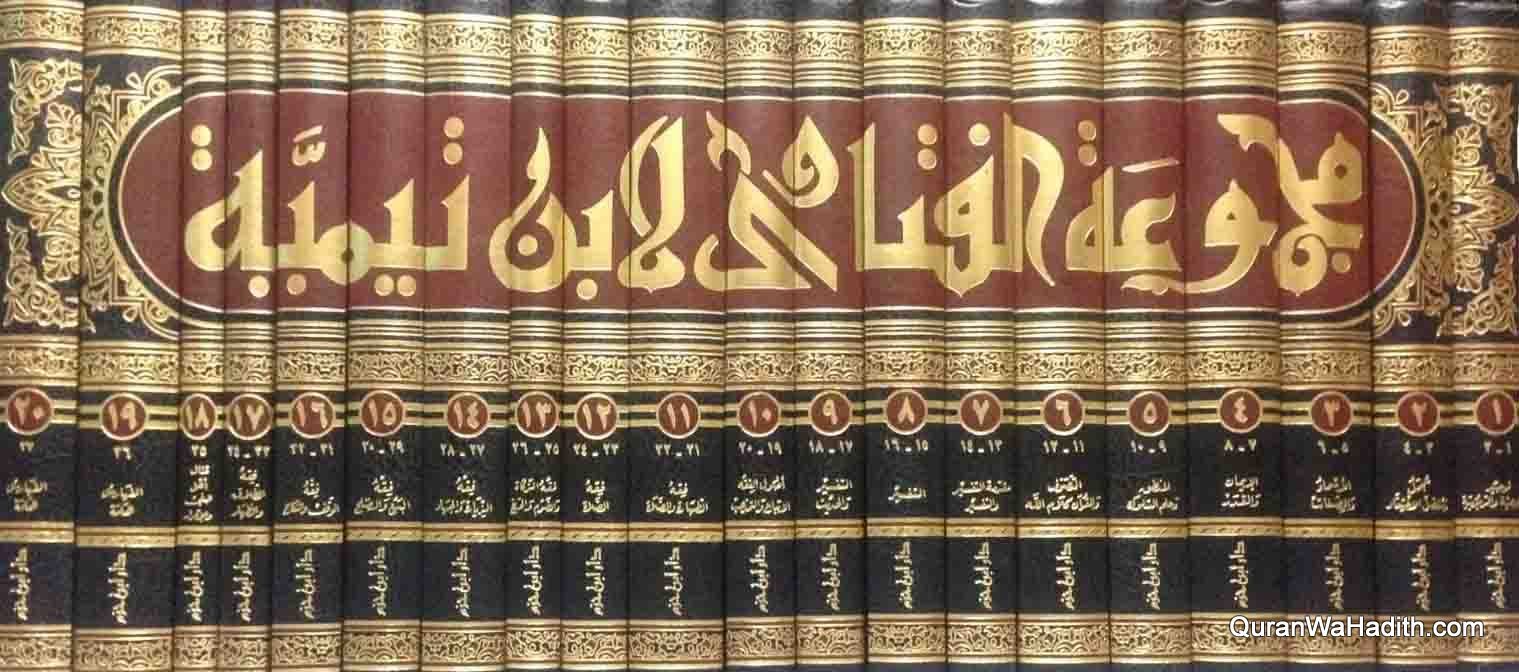
Source: (Ibn Taymiyya, Majmu’at al-fatawa 2:428)
“This is what the vast majority of the Salaf have said.” -which if we are to believe Ibn Taymiyya it means the vast majority of the salaaf applied ta’wil.
Now only one of two scenarios are possible according to Ibn Taymiyya’s statement.
The vast majority of the salaaf applied ta’wil.
The salaaf didn’t apply ta’wil because they knew the Arabic language better than we do and understood that ‘wajh’ meant essence or direction.
Now proponents of inconsistency will exclaim “This is no ta’wil at all!” “The face is not necessarily an attribute.”
Yet Ibn Taymiyya in Al-Aqidah al-Wasitiyyah has clearly stated that the face is an attribute of Allah (swt).
However, the response is that whatever made the “wajh” not necessarily refer to one of the attributes is precisely the type of ta’wil that Ibn Taymiyya has allowed for others to open the door!
“Then if you were to dispute among yourselves about anything refer it to Allah and the Messenger if you indeed believe in Allah and the Last Day; that is better and more commendable in the end.”(Qur’an 4:59)
﷽
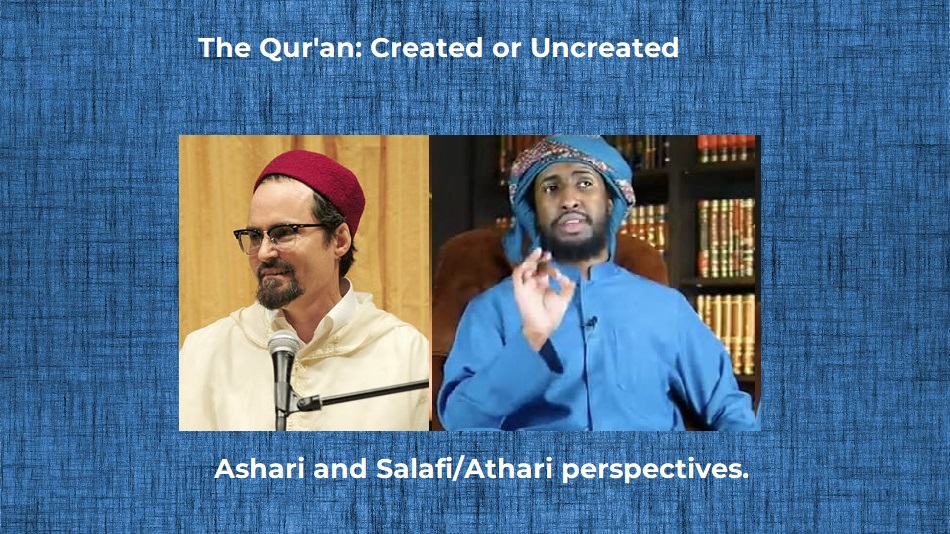
Insh’Allah today we will be looking at the claims of Ustadh Abdurrahman Hassan, and Shaykh Hamza Yusuf. Both of them claim to follow the Sunni denomination of Islam. They both claim that the Qur’an is uncreated and yet both of them have very different understandings of what this actually means.
Let us start with what Shaykh Hamza Yusuf (An Ashar’iin creed) said here:
Shaykh Hamza Yusuf is gracious in saying that among the Sunni denomination there is a division on this issue. They are not in unison as to this theological position.
This is something that Ustadh Abdurrahman Hassan is not in agreement upon. Ustadh Abdurrahman’s view is that there is one and only one view only among the Sunni denomination.
@ 1:32 Listen carefully people. Shaykh Hamza Yusus if a public orator and a supremely articulate man. Listen very carefully to the doctrine you are being asked to subscribe to.
“But the Mushaf itself and the ‘ulemah say you can only say this in a teaching just out of adaab to the Qur’an we don’t say it. But the Mushaf itself is, came into the world. The paper, the ink, the right? and then the letters and when we and if I say, “bismillah ir rahman ir raheem, al hamdulillahi rabil ‘alamin, ir rahman ir raheem.” Those are sounds. And we know that you know that they have vibrations and so…that aspect of the Qur’an and this is the distinction they say is all of those elements are created and like….”
@ 3:00 “It definitely doesn’t mean though the mushaf you have in your house. Because that would then…I mean some of the Christians argue that well the Qur’an is imbibliation. Like we believe in incarnation of the logos the Muslims believe in imbibliation of the logos. That God became book and so we don’t we don’t see that as valid. That view of it so.”
Did you notice in the first paragraph above how Shaykh Hamza said that the mushaf of the Qur’an is created. However, he said it very very softly and quickly moved on from that word ‘created’. I am sure that you the discerning truth seeker have realized this.
Every Qur’an that every Muslim uses today has a publisher. For example the ‘Sahih International’ is published by the Publishing House (dar), dar Abul Qasim, Saudi Arabia.
If the book, ink, text has a publisher it is clear as day light that the text, or mushaf is created. Now, I am going to advise you, the Christian, the Jew, the Hindu, the Buddhist, the Taoist, the Sikh, the Jain, the Wiccan, the Agnostic, the Atheist, ask any Muslim preacher who is calling you to Islam the following:
“Is that book, the text, the Mushaf, the ink pages is it created?” The simple , correct, direct answer is ‘Yes!’.
If that Muslim preacher begins to waffle, doge, sidestep or respond with anything other than ‘Yes!; My advise to you is to ask yourself some questions.
What are they really calling you to believe in? The belief in the oneness of Allah, that he is eternal and is unlike his creation? Yet they cannot say that an obvious creation (a book, a text with ink and pages) is created?
So now let us come to the video by Ustadh Abdurrahman Hassan (An Athari in creed)
Now Ustadh Abdurrahman Hassan who also claims to be of the Sunni denomination has a vastly different understanding of what it means to say that the Qur’an is uncreated than does Shaykh Hamza Yusuf.
First Ustadh Abdurrahman Hassan first appeals to emotion by discussing the persecution that those who claimed the Qur’an was uncreated went through. Though he doesn’t’ mention that his side did the exact same thing.
@ 2:50 Ustadh Abdurrahman Hassan says that the Ashar’i affirm the speech that is present in Allah (swt). They affirm that speech is an attribute of Allah (swt).
Now listen very carefully to what Ustadh Abdurrahman Hassan declares. His major point of contention.
“The Qur’an that we have today that is that we are reading, making our children memorize, who we read in weddings, if we want to make a person make an oath we make them use this Qur’an, swear by this Qur’an they believe it’s makhluq!“
His very intelligent friend ask him, “Are they talking about the papers the mushaf?”
To which Ustadh Abdurrahman replies: “Shahid the Qur’an that we are reading, whole entire Qur’an is makhluq to the Ashar’i“
There you have it people! Ustadh Abdurrahman is upset that people believe that a book, the Qur’an with ink, pages proclaim that it is created. So he wants that book, those pages, that ink, an obviously created thing to share a quality belongs ONLY to Allah (swt).
ONLY Allah (swt) is uncreated and everything else is uncreated. This is obvious as obvious can be.
@5:42 “The Ahshar’i don’t consider this (pointing to a Mushaf) to be the kalam of Allah.“
Ustadh Abdurrahman’s daleel backfires!
Listen carefully to this next section. The brother who sits across from Ustadh Abdurrahman has been given a keen intellect and mash’Allah he picked up on the problem straight away! To the point that Ustadh Abdurrahman realized it was a strong point against him so he quickly pivots to ‘all the other evidences’.
He said: “O my Lord, set for me a sign.” Said He: “Your sign is that you shall not be able to speak to people for three days except through gestures. Remember your Lord much; and proclaim His purity in the evening and the morning.” (Qur’an 3: 41)
@12:35 “But your saying pointing is not speech.” -to which Ustadh Abdurrahman says, “It’s not.” the brother responds, “Allah says, illa ramzan put it with speech.” “illa?” replies Ustaz.
The brother states: “Ramzan in the ayat that you recited he’s put it with speech. You will not speak except with ramzan, with pointing.”
To which Ustaz replied: “Allah is saying you Zakariah will not be able to speak except Allah will allow you to give sharah.” To which the brother replies again: ” That means that’ is the speech that you’re allowed to . You’re not allowed to speak. It’s like if I say for example. Everyone leave the room except…”
Mash’Allah.
“And the people of Moses, after his departure from their ornaments a calf-an image having a lowing sound. Did they not see that it could not speak to them nor guide them to a way? That they took it for worship, and they were the wrongdoers. (Qur’an 7:148)
“And he extracted for them the statue of a calf which had a lowing sound, and they said, “This is your god and the god of Moses, but he forgot.” (Qur’an 20:88)
Just because something produces a sound does not mean it can speak.
May Allah (swt) guide them all to the truth of the matter.
For those who want to read more on the issue of rather or not the Qur’an is created:
“Invite to the way of your Lord with wisdom and good instruction, and argue with them in a way that is best. Indeed, your Lord is most knowing of who has strayed from His way, and He is most knowing of who is [rightly] guided.” (Qur’an 16:125)
﷽
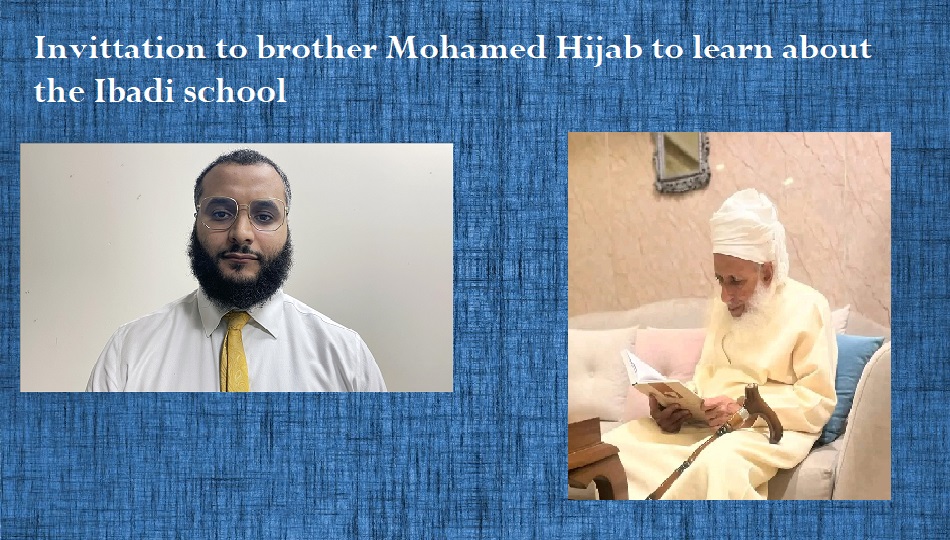
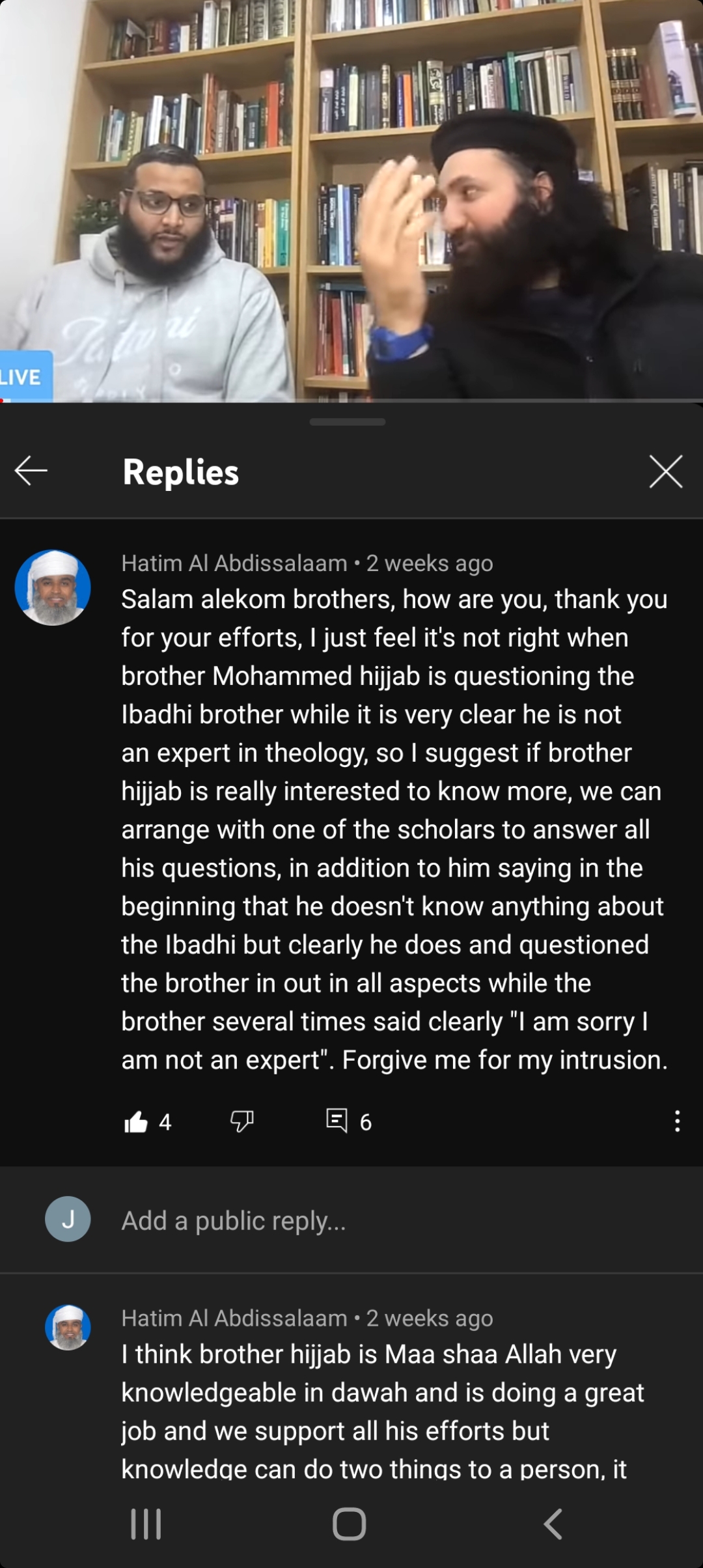
Recently our brother Mohamed Hijab had a gentleman on his show from Algeria. This brother had identified as following the Ibadi school. The brother from Algeria mentioned many times that he was not a scholar or someone very learned concerning the school.
Brother, Mohamed Hijab professed not to know much about the Ibadi school yet, subsequent dialogue followed that he (Mohamed Hijab) had some cursory knowledge about some of the school’s theological perspectives.
The brother from Algeria mentioned time and again that his knowledge was so simple, yet, Mohamed Hijab proceeded to to delve into difficult questions.
1:03:12 -A conversation with an Ibadi Muslim.
Al hamdulillah. At least they are not tafkiri and recognized their brother as a Muslim.
Thus, Shaykh Hatim Abdissalam extended a gracious offer for him to learn more about the school from our learned scholars if he was interested. It would go a long way in building bridges among Muslims.
By the way, many of our brothers from the Sunni denomination have been invited to Oman and given a platform by people who are predominately of the Ibadi denomination. The exchange was always respectful and most courteous.
In fact respected Shaykh Mufti Menk spent some time with us in Oman. The very same Shaykh Hatim Abdissalam who extended the offer to Mohamed Hijab is seen in this beautiful and harmonious meeting with Shaykh Mufti Menk.
In fact many Muslims from diverse views among our brothers in the Sunni denomination have been invited to speak in Oman from, Shaykh Mufti Menk, to Shaykh Yusuf Estes, to Shaykh Hamza Yusuf, to Imam Khalid Yasin to Adnan Ibrahim.
Another point is that a very close friend, brother and associate of Mohamed Hijab, our brother Hamza Tzortzis came and spoke in Oman. Maybe he picked up some books for Mohamed Hijab? Mohamed Hijab is an excellent orator and insh’Allah if he would like to come and speak with his brothers in Oman ahlan!
Certainly he believes in the hadith of the Blessed Messenger (saw):
Abu Barza reported that Allah’s Messenger (saw) sent a person to a tribe amongst the tribes of Arabia. They reviled him and beat him. He came to Allah’s Messenger (saw) and narrated to him (the story of atrocities perpetrated upon him by the people of the tribe). Thereupon he (the Holy Prophet) said:
“If you were to come to the people of ‘Uman, they would have neither reviled you nor beaten you.”
Muslims from the Ibadi school have been very active in building schools and watering wells for our brothers and sisters all over East Africa and no one gives them literature saying, “You must be an Ibadi or you are astray.” No!
The Ibadi community in Ghana west Africa is quite large and they get on well there with our brothers from both the Sunni and Shi’a schools.
We should not try to intentionally misrepresent anyone else’s belief, be they Muslim or not Muslim because dishonesty is not honorable. Insh’Allah may Allah (swt) put more mercy, love, peace, respect and understanding between us all. Amin!
“And be not as those who divided and differed among themselves after the clear proofs had come to them” (Qur’an 3:105)
“Indeed, your Lord is most knowing of who has strayed from His way, and He is most knowing of who is guided” (Qur’an 16:125)
“And hold firmly to the rope of Allah all together and do not become divided. And remember the favor of Allah upon you – when you were enemies and He brought your hearts together and you became, by His favor, brothers. And you were on the edge of a pit of the Fire, and He saved you from it. Thus does Allah make clear to you His verses that you may be guided.” (Qur’an 3:103)
If you want to see more articles that feature brother Mohamed Hijab you maybe interested in the following:
“And (think of) the day We shall send to every people a witness from among them (to testify) against them, and We shall bring you (O prophet) as witness against these. And We have revealed to you the Book, an exposition of everything, and guidance, and mercy, and glad tidings for the Muslims.” (Qur’an 16:89)
Essay submitted for the M.St. in Oriental Studies, June 2000
By Kahlan Al-Kharusi
… during the last few years, research workers have made some progress in investigating and representing some of the Ibadhis works in tafsir, but because of the constant tendency to treat the Ibadhiya simply as a facet of Khariji thought, the Ibadhis role has not been considered in a proper manner or even been looked at with reasoned thought…
Introduction
Our knowledge about the Ibadhis[1]contribution to the field of tafsir is seriously defective. It is true to a considerable extent that there are objective reasons for this dereliction, as well as subjective reasons. From the first group comes the irresponsibility of Ibadhis, despite their positive and productive role for the service of the Quran and its sciences, to introduce their works to those who are eager for such material to be available. However, during the last few years, research workers have made some progress in investigating and representing some of the Ibadhis works in tafsir, but because of the constant tendency to treat the Ibadhiya simply as a facet of Khariji thought, the Ibadhis role has not been considered in a proper manner or even been looked at with reasoned thought. Dr Mohammad Hussayn al-Dhahabi[2], for example, did a huge study about tafsir and Mufassireen, but when he comes to Ibadhiyya he deals with them on that basis, thus he gives nothing but a distorted picture. I am not going to debate with his views here, as I am only illustrating an example of how such respected doctors, intentionally or inattentively, have failed to grasp the Ibadhis contribution in such a field. To try to remedy this, this paper will try, as much as possible, to take a step forward in introducing and addressing Ibadhis works right from the constructive period of the Ibadhis school of thought until the late thirteenth/ nineteenth century.
In these circumstances, it seemed useful to set out the basic information about Ibadhis tafsir according to the latest information available. There are still gaps, as some libraries are still failing to provide information about the manuscripts they contain and to give access to them. However, this essay is, I believe, a positive step forward in providing information that all those studying Ibadhiya need.
It would appear that the following texts form the primary list of Ibadi works in the field of Tafsir The list is in historical order, and detailed consideration will follow:
The Diwan of Jabir b. Zayd al-Azdi (d.93/711)
The Tafsir of ‘Abd al-Rahman b. Rustam (d.171/787)
The Tafsir of ‘Abdu l-Wahhab b. ‘Abd al-Rahman b. Rustam (d.208/823)
The Tafsir of Abu l-Munib Muhammad b. Yanis al-Nafusi ( d. in the first half of the third/ninth century )
The Tafsir of Houd b. Muhakkam al-Hawwari (d. in the second half of the third/ninth century )
Tafsir al-Khams-mi’at Aya by Abu l-™awari Muhammad b. al-™awari ( d. in the fourth/tenth century )
al-Tfsir al-Kabir of Abu Ya’qub Yusuf b. Ibrahim al-Warjlani ( d.570/1175)
A commentary on the tafsir of Houd b. Muhakkam al-Hawwari , by Muhammad b. ‘Umar b. Abi Sitta (d. 1087 or1088/1676 or 1677)
Annotation of the Tafsir al-Jalalayn by Yusuf b. Muhammad al-Mus’abi al-Maliki (d.1187/1773)
al-tafsir al-Muyassar by Sa’id b. Ahmad al-Kindi (d. at the beginning of the thirteenth /nineteenth century)
Partial Tafsir ( Suras 103-114 ) by Ibrahim b. Bahman ( d.1232/ 1817 )
The Tafsir of Yusuf b. ™addun ( 1236/1821)
(a) Maqalid al-Tanzil
(b) Tafsir Ayat Mutashabiha mina l-Quran both by Ja’id b. Khamis al-Kharusi (d.1237/1822)
14. al-Yumn wal-Baraka fi Tafsir al-Huda wa-l-Rahma by Muhammad b. Sulayman Adrisu .
15. (a) Himyan al-Zad ila Dar -al-Ma’ad
(b) Taysir al-tafsir
(c) Da’i l-’amal ila yawm al-ajal
All three are by Mohammad b. Yusuf Atfayish (d.1332/1914)
I shall now examine this list and try to reveal these ascribed works in details as possible.
Abu l-Sha’tha’ Jabir b. Zayd al-Azdi[3]was born in the small village of Farq near Nizwa in the interior of Oman. After receiving his early education in Oman he moved with his family to Basra and settled there. He studied in Basra and in the Hijaz and is thought to have studied with such leading companions of the Prophet as Ibn ‘Abbas, Abu Hurayra, Anas b. Malik , ‘Aisha bint Abi Bakr.. etc
Jabir is generally reckoned to be one of the greatest of the early Ibadhis. Due to his tact and organising ability, he effectively became the real founder of the Ibadhiya sect. He was particularly well-known for his learning and piety, winning the regard of such a notable as Anas b. Malik[4].
Jabir was probably the author of one of the earliest collection of hadith, tafsir, correspondence and legal opinions (Futya), known as the Diwan[5]. It is not clear whether this work was originally committed to writing or not – there are arguments on both sides – though it should be noted that Jabir flourished at a time when there was a great surge in the use of written Arabic during the Caliphate of ‘Abd al-Malik (with whom Jabir was on good terms, externally at least). But even if Jabir transmitted his knowledge verbally, his work was recognised as a discrete entity, and sooner or later it was committed to writing.
There appear to have been several copies, with one perhaps having gone to the Ibadhis in North Africa. However, by the third/ninth century the sole known copy was in the libraries of the ‘Abbasids in Baghdad, when al-Ma’mun is said to have set great store by the work. Some time later it was lost. The importance of the oral transmission of Jabir’s Diwan must be stressed. It should be remembered that his successor as imam, Abu ‘Ubaida Muslim b. Abi Karima al-Tamimi was his student, and students, especially at that time, learned aurally and not from books.
Unfortunately, it does not seem that any part of this work still exists, unless what Ennami[6] found in North Africa of Kitab al-Nikah and K. al-Salah by Jabir b. Zayd might be parts of his Diwan. This is just an assumption, and I cannot prove it yet. Beyond that we can look to the work of Pakoosh[7], who brought together more than forty examples of Jabir’s tafsir [Tafsir is of course subsumed in any major collection of ™adith]. The examples show him to be a disciple of Ibn ‘Abbas, but his crucial scholarly importance is in the transmission of this learning to the Ibadhis community.
2-’Abd al-Rahman b. Rustam and His Tafsir
‘Abd al-Raahman b. Rustam (date of birth is unknown) came from a Persian family that was stranded in Mecca when his father died on the Pilgrimage. Later his mother married a man from Qayrawan, and the family moved there. As a young man he traveled to Basra to study with Abu ‘Ubayda, the second Ibadhis imam.
‘Abd al-Rahman was elected Imam in Tiaret in 160/777. He died in 171/787[8], having composed numerous works on tafsir, Hadith and other Islamic sciences.
Most Ibadhi sources[9]agree that ‘Abd al-Rahman did write tafsir a, but there is disagreement about the time of its loss and the reason for it. One view is that it was lost when the ‘Umayyads sacked Tiaret in 296/909 and burnt the Ma’sooma Library there. A second view is that it survived but was sold on to someone who would not grant access to it. There is slightly more support for this view[10]. The end result, however, was the same: the work was lost.
As far as I can see from my reading, no trace of the work survived. It has been suggested that Shaykh Houd b. Muhakkam may have drawn on the tafsirs of both ‘Abd al-Rahman and his son ‘Abd al-Wahhab and that this may be indicated by the phrase “in the tafsirs of our sect …” This is an ingenious suggestion, but it is devoid of proof, and we most regretfully assume that this first complete tafsir by a renowned Ibadhis scholar, has been lost without trace. The loss is a particularly sad one, as we can tell from his correspondence[11]that he was an excellent scholar.
3- ‘Abd al-Wahhab b. ‘Abd al-Rahman b. Rustam
The son of ‘Abd al-Rahman (the end of the second century and the beginning of the third century) is said to have written a book of tafsir. The only possible indication of this comes from the redactor[12]of the tafsir of Houd b. Muhakkam al-Hawary but he provides insufficient evidence to show that the book existed. It must remain a claim only.
4- Shaikh Houd b. Muhakkam al-Hawary and his tafsir
Houd b. Muhakkam was a Berber tribesman from what is now Algeria. He is a third century figure, who probably died at some time between 280-290/893-903.[13]
There is no doubt that he put together a book known as Tafsir Kitab Allah al-’Aziz, as it has survived and has been printed[14]. However, there has been dispute about the extent of Shaykh Houd’s role in the book. It is clearly based in part on the tafsir of Yahya b. Sallam al-Basri (d. after 273/887). Close examination of the work shows that Shaykh Houd is far more than a summarizer. Crucially he adds Ibadhis views whenever they are needed and he recasts and explains difficult passages, and produces a tafsir that may be probably considered Ibadhis. It is, thus, the earliest extant Ibadhis tafsir and as such is extremely important.
The published edition relies on one manuscript only, in which the first few pages are lost. As a result we are lacking Shaykh Houd’s Introduction and thus any remarks he might have made about his aims and methods. Nor is there any clarification in the marginal commentary by Shaykh Abu Sitta[15]. It seems to me to be important to search for other copies of the manuscript, which may well exist in private libraries.
5- Tafsir al-Khams-mi’at Aya
There is a difficult problem about the authorship. The work has been published three times, first in facsimile by Salim b. Hamad al-Harthi in 1974, then by Muhammad Zanati in 1991, and then by Dr. Walid ‘Awjan of the University of Mu’ta in 1994. All three editions give the name of the book as al-Diraya wa Kanz –ul-Ghinaya wa Muntaha al-Diraya fi Tafsir al-Khams-mi’at Aya and say that the author was the third century Omani scholar Abu l-Hawari Muhammad b. al- Hawari b. ‘Uthman, who studied at Nizwa under Muhammad b. Mahbub (d.250/864) and whose principal teacher was al-Salt b. Khamis al-Kharusi (d.278/891). He was certainly the author of numerous works.
However, the ascription to Abu l-Hawari is based on one sentence that occurs frequently throughout the work ‘Abu l-Hawari said’. What the sentence really indicates is that the opinions of Abu l-Hawari are frequently quoted. Sometimes authors do refer to themselves in this way, but it does not appear likely that this was so in this case[16]. Another suggestion is that the author was al-Salt b. Khamis al-Kharusi. This seems anachronistic and even less likely[17].
Finally[18]there is a suggestion that this is simply the work of Muqatil b. Sulayman al-Azdi (d. 150/767) because he has a work in tafsir with exactly the same name ‘Tafsir al-Khams-mi’at Aya’. So in order to judge this opinion I compared precisely the texts of the two works. From the first few pages, I discovered the similarity between the two, or more accurately how much similar the tafsir ascribed to Abu al-Hawari was to that of Muqatil b. Sulayman. The only main difference was the additional Ibadhis juristic opinions in Abu al-Hawari’s work and, alternatively, the expurgation of the non-Ibadhis. This makes me confident that the basic author of this work is not the Omani scholar Abu al-Hawari but Muqatil b. Sulayman and the role of Abu al-Hawari is no more than a juristic refutation.
6- Abu Ya’qub Yusuf b. Ibrahim al-Warjlani
This Ibadhis scholar was born in the Algerian town of Warjalan at the beginning of the sixth century. After initial education in his home town, he studied for several years in al-Andalus. He died in 570/ 1175 after composing many significant works for the Ibadhis School. One of these was a tafsir, al-Tafsir al-Kabir as al-Salimi calls it[19]. Both al-Barredi[20] and al-Shammakhii[21]saw this work, but despite many diligent searches, no manuscript has been found.
Some idea of al-Warjlani’s method may be gleaned from al-Barradi’s description[22]and from passages found in other works by him, such as al-Dalil wa-l-Burhan and al-’Adl wal-Insaf. However, the information is fragmentary, and any views about it must remain tentative.
7- Abu ‘Abd Allah Muhammad b. ‘Umar b. Abi Sitta
This eleventh century Ibadhis writer (d.1087 or 1088/1676 or1677) earned the name al-Muhashshi for the large amount of marginal annotations that he wrote on important Ibadhis works. The most important of these was on the tafsir of Houd b. Muhakkam al-Hawari. It stops part way through Surat al-Baqara, and was probably interrupted by the author’s death.
Several copies of this work survive in a number of libraries in North Africa but there has been no access to any of them so far. Obtaining a copy of the manuscript is important, as it would throw light on the lost first few pages of the original work of Houd b. Muhakkam.
8- Abu Ya’qub Yusuf b. Muhammad al-Mus’abi al-Maliki (d.1187/1773)
This twelfth century Tunisian scholar is known as al-Muhashshi l-thani, because, like Abu Sitta, he wrote marginal annotations on various books. One of these, in two volumes, was on the Tafsir al-Jalalayn, a copy of which is extant in al-Baruniya Library in Libya[23].
9- Sa’id b. Ahmad al-Kindi
Al-Kindi is a member of a family of a famous scholars in Oman. Amongst his ancestors was Muhammad b. Ibrahim al-Kindi (d.507/1113), author of the Bayan al-Shar’ in 73 volumes, and Ahmad b. ‘Abdullah al-Kindi (d. 557/1162), who wrote a Kitab al-Musanaf in 42 volumes.
Sa’id b. Ahmad appears to have been born between 1130/ 1718 and 1139/1727 at Nizwa. He was a pupil of the outstanding scholar of the twelfth century in Oman, Sa’id b. Bashir al-Subhi (d.1150/1737). He wrote various works including a refutation of al-Ghazali’s Ihya’ ‘Ulum al-Din and a tafsir entitled al-Tafsir al-Muyassar lil-Quran al-Karim. The manuscript states that the work was completed on the second of Dhul-Hijja, 1181/ 1757[24]. It was published in Oman, in three volumes, as recently as 1998. It is fortunate that the manuscript has survived, as the work is not referred to either by his contemporaries or by later scholars.
Sa’id b. Ahmad sets out clearly in the introduction to his tafsir the main sources that he uses – and reading of the work corroborates this. They were:
1. Ma’alim al-Tanzil by al- Baydhawi (d.526/1132)
2. Anwar al-Tanzil by al-Baydhawi (d.682/1283), particularly important in vol.3.
3.Madarik al-Tanzil by al-Nasafi (d.707/1307).
4. Jawami’ al-Jami’ by al-Tabarsi al-Imami (548/1153)
5. al-Kashshaf by al-Zamakhshari al-Mu’tazili (d.538/1144 ), also important in vol.2 and 3.
In addition to these non-Ibadhis sources, he drew on most of the earlier Ibadhis sources, including Abu Sa’id al-Kudami (the fourth/tenth century) and Muhammad b. Mahbub b. al-Ruhayli (d.260/874) and Ibn Baraka (the fourth /tenth century). For lexicographical problems he drew on the Qamus of al-Fayruzabadi.
Sa’id b. Ahmad shows broad, eclectic views in his tafsir in drawing on the non-Ibadhis authorities quoted above and other as well as Ibadhis sources.
The work is not particularly systematic. Sometimes the writer refers to many authorities and summarizes them. Elsewhere he quotes a single text in extenso and without any change. Nor does he show clearly when he is paraphrasing and when he is quoting exactly. Nevertheless, Sa’id b. Ahmad produces a valuable work, which may properly be considered to be the first Mashriqi Ibadhis tafsir that we have.
10- Ja’id b. Khamis al-Kharusi
This author was an outstanding Omani scholar at the end of the twelfth and beginning of the thirteenth century (b.1147/1734, d.1237/1821). His scholarly abilities were noted at an early age and soon attained a position of respect among his contemporaries. He wrote widely on many different subjects, but most of the surviving works have not yet seen the light of day[25].
His son Nasir b. Ja’id reports that his father was always criticizing Omanis for their neglect in not writing a comprehensive Ibadhis tafsir and a complete reference work on Hadith[26].
Ja’id himself did not fill this gap, though he might have intended to do so. Two works on tafsir survive. The first is called Maqalid al-Tanzil, of which I possess the autograph manuscript. (There are many other copies in Omani libraries). As it stands, the work covers only the interpretation of surat al-Fatiha consisting of 17 pages with 18-30 lines of writing. Nevertheless, Ja’id states in his Introduction that it was his aim to write a complete Ibadhis tafsir[27]. As of now we can only assume that the most of the work is lost or that he died before he could move to the bulk of the work.
Study of the text shows that Ja’id was not content to produce the work of his predecessors, but brought a sharp critical and analytical mind to the subject. It would appear that among his sources, he referred to the Jami’ al-Bayan of al-Tabari and the Kashshaf of al-Zamakhshari.
There is a certain Sufi coloration to Ja’id’s language, most probably derived from the study of al-Ghazali’s Ihya’ ‘Ulum al-Din. This puts him just slightly outside normal Ibadhis tradition, though he is strongly critical of Sufi analyses and of non-Ibadhis works on tafsir. Even this fragment is an important work.
Ja’id’s other work on tafsir is a collection of about forty verses from al-Mutashabihat (where there is uncertainty on the meaning established by the verses) with a fully explanation[28]. He shows briefly the Ibadhis views on these verses and more importantly how they are to be linked with the Muhkams (clear or perfect) verses to reveal their dogmatic dimension. This collection is still in manuscript form, and, unlike the Maqalid al-Tanzil, it has not yet been seriously studied, though there are various manuscripts in Oman. A good part of it also appears in the printed Qamus al-Shari’a by Jumail b. Khamis al-Sa’di (fourteenth/twentieth century).
11- Ibrahim b. Bihman al-Thamini
Not many are familiar with this scholar, as most of the sources that introduce him are unpublished yet. What I know about him is that he is an Algerian scholar from Mzab born in the second half of the twelfth century and studied with the famous Ibadi scholar, his uncle, Dhia’ al-Din Add al-’Aziz al-Thamini (1223/1808). After a scholarly life, he died in 1232/1817 leaving many works and a great library in Bani Yasjin in Mzab. One of his works on tafsir is al-Ma’an al-Masun ‘ala Surat al-Kanz al-Madfun which is all a tafsir of surat al-Fatiha.
He also wrote Asdaf al-Durar wa Akmam al-Zahr al-Mawdhu’a ‘ala Surat al-’Asr which is again a tafsir of one sura (al-’Asr). The third work is a marginal annotation on the tafsir of al-Baidhawi ‘ Anwar al-Tanzil ’. A copy of the manuscript of this work is kept in al-Istiqama Library in Mzab. Finally he has Tafsir Ayat al-Nnur min Surat al-Nnur which is a correspondence he wrote in 1225/1810[29].
12- Muhammad b. Yusuf Atfayyish.
Muhammad b. Yusuf b. ‘Isa b. Salih Atfayyish, from the Mzab in Algeria, was born in 1237/1821 and died in 1332/1914 at the age of 96[30]. He is considered, with justification, to be one of the greatest and most productive of all Ibadhis scholars. He appears to have started teaching and writing at the age of sixteen and by the end of his long life he had written about three hundred works on a wide range of subjects: language, philosophy, dogma, jurisprudence, tafsir, hadith, etc.
Also known as al-Qutb, Atfayyish wrote three works on tafsir. Two of them are complete, but one is not. The incomplete work, entitled Da’I l-’Amal li-Yawm al-Ajal, was his first attempt at tafsir. He intended to write it in thirty three volumes. However, he changed his mind and started a second tafsir, Himyan al-Zad ila Dar -al-Ma’ad; only four volumes of the Da’I l-’Amal were completed. They start with Surat al-Rahman, go on to the end of the Quran and then back to Surat Sad, with which the work stops.
His second tafsir, Himyan al-Zad was also written when he was quite young. The book shows his immaturity in various respects. In particular, he was not aware of some sources and reference works. Also he was including weak traditions and Isra’ilyat[31]. Nevertheless, the work has been published twice, first in Zanzibar, and then in Oman in 1986.
Towards the very end of his life, al-Qutb wrote his last tafsir, entitled Taysir al-tafsir. This is a great refinement of his earlier work, and deals with a much wider range of issues, problems and ideas. It is thus a good example of Ibadhis tafsir.
The Taysir al-tafsir has been published twice already, but without any redactory study. A critical edition is now being made in Algeria, and the first volumes have been published. In addition, there are various studies of al-Qutb and his works[32].
Al-Qutb’s works enrich the Ibadhiyya intellectually, and they have had a strong influence. Many of his pupils[33]have turned their hands to tafsir and similar works, but they do not stand out as anything but continuers of the Qutb school.
Doubtful Works
During my investigation for Ibadhis works on tafsir, I have encountered some doubtful works; or more precisely I could not find sufficient details to make accurate judgments about them. Though some of them seem to be Ibadhis works and others are claimed to be so, I found it hard to accept them as such. These works can be presented by dividing them, according to availability of information, into three categories, even if each category consists of no more than one work.
The first category includes works that have been mentioned, in Ibadhis sources, merely by their names and no more than the names. The only work I found under this category has been referred to by Jumayyil b. Khamis al-Sa’di (the thirteenth/ nineteenth century) twice[34] in his book Qamus al-Shari’a. He gives the book the title of al-Jawhar al-Shaffaf al-Muntaza’ min Maghasat al-Kashshaf. From the way al-Sa’di presents his quotation from this book, as well as the contents of the quotations indicate, it seems reasonable to say that this work is an Ibadhis Tafsir. From the title of the book and by comparing it with other works of tafsir, one can deduce that it is an annotation on the Kashshaf of al-Zamakhshari. But all these remain uncertain possibilities as the work is not referred to except by Qamus al-Shari’a , here the information given is insufficient to draw a clear picture about the work and its author.
The second category consists of works indicated by their author’s names. The example I found to this category is Tafsir ‘Amr b. Qa’id, which is quoted by Ibn Ja’far (end of the third/ ninth century) in his Jami’ [35]. Although not so much can be read from what has been quoted there to reveal whether this ‘Amr b. Qa’id is an Ibadhi or not, there appear distinguishable similarities in his opinions and the views of Ibn Ja’far. But I discovered later in a recently published volume of the same source that Ibn Ja’far referred to him as a non Ibadhi author[36]. I then found al-Jahidh refers to him but with the name of Abu ‘Ali ‘Amr b. Fa’id al-Aswari[37], there is also a short biography of him in Ibn Hajar in which he quoted many authorities describing him as Mu’tazili and Qadarite lived in al-Basrah and died shortly after the year 200/ 815[38]. This obviously unveils the doubts and makes it clear that he is non-Ibadhis although quoted in Ibadhis sources and his name is ‘Amr b. Fa’id and not Qa’id.
On the other hand, some researchers[39]claim that Abu ‘Ubayda Ma’mar b. al-Muthanna al-Taymi (d.210/827) who wrote a tafsir called Majaz al-Quran, is an Ibadhis scholar. But there is no substantial evidence for such a claim and non of the Ibadiyya says this, nor does his work indicate that he adopts any very Ibadhis view. Similarly, Dr. Walid ‘Awjan claimed[40] that Muqatil b. Sulayman is an Ibadhi scholar or that Ibadiyya consider him to be so. But none of the Ibadiyya, as far as I know has agreed with him, even when I referred to the source[41] to which he drew on, I did not find any mention of Muqatil there.
Analysis and Comments
Before ending this paper, I think it is essential to remember that although there are some more important points in the field of Ibadhis tafsir that need to be dealt with in details, it is very difficult, if not impossible, to do so without having an overview on the whole topic, which is precisely what I tried to give. However, from this basic, but fundamental, outline, some analytic views take one’s attention. Not least of all the richness in the Ibadhis Maghribi works compared to the Mashriqi (from our list, twelve works are Maghribi while five Mashriqi). This phenomenon requires some explanation. It appears that at least one of the Omani scholars[42] realized this fact and tried to fill the gap but with no avail, and even if he would have succeeded it was too late (the thirteenth century only). Some writers try to give answers such as the fear of entering this field, or the political events that lead to many attacks on the Ibadhis literature[43]. Personally, I am not convinced of these reasons and if I am to give a superficial answer I think it is the oral method followed more extensively by Mashriqis to transmit knowledge from one generation to another that lead to this phenomenon.
Another interesting observation is that a separation line could be drawn after the sixth/twelfth century down until the thirteenth/ nineteenth century on the quality of the works. One can see that the works before the seventh/ thirteenth century were creative works, while those after that are mostly in the form of marginal annotations or fragmentary works until the appearance of Ja’id b. Khamis in Oman and Ibrahim b. Bihman al-Thamini in Algeria.
Also related, in one way or another, to this issue, the influence of al-Zamakhshari on the Ibadhis works on tafsir. Due to the similarity in many dogmatic questions between Ibadiya and Mu’tazila and because of the intellectual aspects as well as his linguistic skillfulness, his influence is obvious but needs detailed study. This, subsequently, may lead to another important point, that is the general features of the Ibadhis tafsir compare to Sunni works bearing in mind that some Ibadhis works are based on Sunni’s – as shown earlier-. One can fairly say that the Ibadi Tafsir falls at the middle of the two extremes of Mu’tazila who over-used al-’aql (rationality, reasoning) in interpreting the Quran, a method which has been widely rejected or at least criticised by Sunnis and is thought to have led Mu’atazila to contradict many explicit texts of the Quran, and of many Sunnis who rely most on al-Naql (tradition or irrationality) which on the other hand leads to deactivating the intellect and limiting the text to certain superficial interpretations. This makes Ibadi tafsir distinctive when looking at the whole field of tafsir.
Those are really complex issues that I am not competent to deal with at this stage, but they open the door for more detailed studies to be carried on later.
[1]I tried my ut-most best in the transliteration of Arabic, but I could not get all for a good transliteration of the letters because of the system I am using. I am working to put this right, and I trust that the problem will be solved in my later written work.
2 Al-Dhahabi, M. ™. Al-Tafsir wa-l-Mufasirun, (1985) vol.2 pp.291-323
[3]See al-Shamm~khi, A. Kitab al-Siyar vol.1 pp.67-72, al-’Asqalani, Ibn Hajar Tahdhib al-Tahdhib vol.2 p.34
[4]al-Bukhari, al-T~rikh al-Kabir vol.1 part 2 p.204
[5]The Diwan has been ascribed to J~bir b. Zayd by many writers like: Abu Zakaryia Yahy~ b. Abu l-Khayr (d. shortly after 474/1082) in Siyar al-’a’imma wa Akhb~ruhum pp.33-5, al-Darjini, A. œabaq~t al-mash~ykh. Vol.2/p.205, and as non Ibadi, ™~ji Khalifa also mentioned it, probably from nonIbadhis sources, in his book Kashf al-Ÿunun, vol.1 p.781.
[9]al-Darjini , œabaq~t al-Mash~ikh.vol.1p23, al-Barr~di,Ris~la fi Kutub al-Ib~diyya p.66, Abu Zakariy~, Siyar p.37. There is also a mention of this work in some non-Ibadhissources like al-Zarkali, al-’A’l~m vol.3 p.306
[10]The first view is adopted by contemporaries like Dabbuz,.Bu Tardin,Y. al-shaykh Atfaiyysh wa Madhabuhu fi al-tafsir (unpublished thesis) p.132 but he did not state his sources while the other view is adopted by early sources like al-Barr~di and al-Darjini.
[11]See his book al-Dalil wa-l-Burhan , Oman (1997) 2nd edition.
[12]Sharifi, B. in al-Hawwari, H. M. Tafsir Kitab Allah al-’Aziz. Vol.1 pp.15-25
14in 1410/1990 in 4 volumes redacted and studied by Sharifi, B.S. ( D~r al-Gharb al-Islami)
15 See p.7,8 of this paper.
[16]The first page of the ms. says ’this is the refutation of the outstanding scholar Abu l-™aw~ri..’ and if the author were Abu l-™aw~ri, he would not have described himself like this, see also the way he has been quoted in pp.144-47. Tafsiral-Khams-mi’at >ya(1994) ed. Dr. ‘Awj~n. W.
[17]This view is adopted by al-Barr~di , in his brief epistle about the Ibadhis works at the end of al-Qalh~ti, al-Jaw~hir al-Muntaq~t, but unlike other places, without mentioning that he saw the book or even it has been described for him. However, he did not mention it, at all, in his latest epistle Rissla fi Kutub al-’bidiyya . Also al-^alt b. Khamis is Abu l-™aw~ri’s teacher and it is unusual for the teacher to quote his student as would be the case here.
18 There is indeed another opinion by Ennami, A (1971) that the author is al-^alt b. M~lik al-Kharusi. But it seems to me a false impression occurred to Ennami due to the similarity between the two names, otherwise his source here was al-Barr~di who ascribed it to al-^alt b. Khamis not Malik.
[22]He saw the first volume of the book and described it as a comprehensive commentary that he has never seen such a detailed tafsir before.
[23]Ibrahim, Abu al-YaqŒan (1393/1973) Fath Nawafidh al-Quran p68
[24]I did not see the ms. itself, but the last page of it is photocopied in the printed work p.21
[25]More details about the author and his works can be found in my graduating paper aboutMaq~lid al-Tanzil , submitted to the Institute of Jurisprudence, Oratory and Guidance (Oman) in 1996.
[26]al-Kharusi, N. J. al-™aq al-Mubin (ms)vol.3 p.3
[28]I possess a photocopy of this collection, and is in 19 folios each of 17 lines in a clear naskh hand writing.
[29]Bakalli, A. U in his introduction to Tafsir Surat al-Nnurby Bayyu‡ p.14
[30]Bu Tardin, Y. ^. al-shaykh Atfayyish wa Madhabuhu fi al-tafsir in published thesis)p.103
[31]The author realized this himself as he stated in theTaysir al-tafsirvol.1 p.7
[32]The most advanced study is of Bu Tardin, Yahy~ b. ^~lih. al-Shaykh Atfayyish wa Madhabuhu fi al-tafsir , which is a Master’s theses submitted to the University of ‘Ayn Shams in Egypt in 1989.
[33]Like ^~lih b. ‘Umar la’li (d.1347/1928) who wrote al-Qawl al-Wajiz fi Tafsir Kal~m Allahi –l-’Aziz (ms.), Ibr~him, Abu l-YaqŒ~n (1393/1973) who has many works on tafsir:Fath Naw~fidh alQur~n, Ashi’at al-Nnur min Al-Nnur and others.
[34]al-Sa’di, J. K. Q~mus al-Shari’a. vol.1 p.26, vol.4 p.50