“So do not assert similarities to Allah. Indeed, Allah knows and you do not know.” (Qur’an 16:74)
“There is nothing like unto Him.” (Qur’an 42:11)
﷽
In his commentary of the following verse in the Qur’an:
“He is with you wherever you are” Ibn Taymiyya compares Allah (swt) to the moon!
“The phrase “and He is with you” Does not mean that He blends into creation. Nay the moon one of the smallest of Allah’s creations is both placed in the heaven (mawdu’un fi al-samaa’) and present with the traveler and the non-traveler wherever they may be. And the Exalted is above (fawq) the Throne, as a watchful guardian of His creatures and their protector Who is cognizant of them.”
Source: (Ibn Taymiyya, al’-Aqida al-wasitiyya Salafiyya ed. 1346/1927 p. 20)
“They (Ahlus-Sunnah) do not make the resemblance between His Attributes and the attributes of the creation, because, for Him, Glorified is He, there is no comparison, nor equal, nor partner, and there is no analogy for Him with His creation.”
Source: (al-Aqeedah al-Waasitiyyah 1/p.127 with the commentary of ibn al-Uthaymeen)
No one from among the early generations of Muslims compared Allah (swt) to the moon or Allah’s knowledge to the moon’s rays!
Not only this but the moon occupies an orbit as well as it is dependent upon the orbit! The moon’s rays cannot penetrate the ocean depths. Whereas Allah is aware of us even in the ocean depths!
So all that I have seen from the sect that calls itself ‘Salafiyyah’ is that if you read carefully their responses they do not deny that Ibn Taymiyya made this comparison of Allah (swt) to his creation.
I could say in this entry blue and blue. Then I will say green. The fact that I have said blue does not negate the fact that I also said green in this entry.
Followers of Ibn Taymiyya reply: “Oh, he was using it to teach people.” It doesn’t make it correct.
In fact, the smart thing to do at this point for those people who do love Ibn Taymiyya is to simply say he made an error in this regard.
“What! he who is obedient during hours of the night, prostrating himself and standing, takes care of the hereafter and hopes for the mercy of his Lord! Say: Are those who know and those who do not know alike? Only the men of understanding are mindful.” (Qur’an 39:9)
﷽
The Life and Works of Imam Jabir Bin Zayd
Abu al-Sha’tha’ Jabir b. Zaid al-‘Azdi al-Jawfi al-Basri of Banu ‘Amr b. al-Yahmad, a branch of al-‘Azd tribe. He comes from Farq, a village between Manah and Nazwa in Oman where he was probably born and where he moved with his family to settle in Darb al Jawf in Basrah, a place which took its name from the area in which the tribe of Jabir was living in Oman.
HIS BACKGROUND
Al-Salimi suggests that Jabir was born in Farq in Oman and traveled to Basrah to acquire learning. Basrah was one of the Iraqi centres of scholarship at the time. Jabir spent his life in Basrah – as did most of his eminent fellow Successors– disseminating knowledge in mosques and religious centres, instilling good morals in people, enjoining strong adherence to the noble religion and the preservation of its principles and methods, and pronouncing fatwas on problems encountered by the people, to such an extent that Iyas b. Mu’awiyah once said: ‘I have been all over Basrah and there is nomufti in it besides Jabir b. Zaid.’
The following dates are given for Jabir’s birth; 18 A.H. (639 A.D.) and 21 A.H. (639 A.D.). Some sources aver that Jabir was present in Medina on the day on which the first Caliph Abu Bakr was elected. There is no information about Jabir’s childhood or early life; and nothing is known about his parents.
HIS TEACHERS
Jabir was fortunate enough to be a contemporary of a large number of veteran Companions. He met seventy of the Companions who were present at the greater battle of Badr and learned from them all the history (akhbar) and Traditions they knew. Jabir once said: ‘I met 70 of those that fought at Badr and I took on all their knowledge, except for the Bahr (‘vast sea’ in terms of knowledge)’, referring to Abd Allah b. Abbas, may God be satisfied with both of them. his principal teacher was ‘Abdullah b. ‘Abbas, the most learned man among the younger Companions and known as Habr al-‘Ummah (the learned man of the Muslim community and as al-Bahr (the sea) because of his vast knowledge both of the Qur’an, its interpretation, and of the Sunnah. Jabir was a close friend of Ibn ‘Abbas and his favourite pupil.
He also met A’ishah, mother of the believers, and asked her about the private life of the Prophet, and discussed with her the political problems of the Muslim community in which she played a major part.
He also received knowledge from Abdullah b. ‘Umar, Abdullah b. Mas’ud, Anas b. Malik, and Jabir b. Abdullah, may God be satisfied with them.
HIS STUDENTS
The knowledge of Jabir was transmitted to later generations through two channels; the main one based upon what was recorded by his Ibadhi students such as Dhuman b. al-Sa’ib, Abu ‘Ubaidah Muslim b. Abi Karimah, Abu Nuh Salih al- Dahhan, Hayyan al-‘A’raj, and others. The second is based upon what was recorded by his non-Ibadhi students, among whom were ‘Amr b. Harim, Qatadah b. Di’amah al-Sadusi, and Aiyub al Sikhtiyani. Other individuals who took knowledge from Jabir were Abdullah b. Abadh, and Amr b. Dinar.
HIS KNOWLEDGE
Jabir acquired a wide knowledge of the Qur’an, Traditions, and Futya. His teacher Ibn ‘Abbas was completely satisfied with him. It is reported that Ibn ‘Abbas said, “If the people of Basrah turned to the knowledge of Abu al- Sha’tha’, he would enrich them with the knowledge of the Book of God.” He also described Jabir as one of the learned men and believed that Jabir had attained such a high standard of knowledge that no-one, even Ibn ‘Abbas himself, need be resorted to in order to formulate legal decisions if Jabir had already expressed his opinion. When al-Rabi, a man from Basrah, asked Ibn ‘Abbas for his legal decision concerning certain problems, Ibn; Abbas said, “How can you ask us when you have Jabir b. Zaid among you?” Other Companions, viz., ‘Abdullah b ‘Umar, Jabir b. ‘Abdullah al-‘Ansari, hold the same opinion of Jabir as Ibn ‘Abbas; al-Bukhari reported from Jabir b. Zaid that he said, Ibn ‘Umar came across me while I was performing the tawaf (circumambulation of Ka’bah) and said to me, ‘Jabir, you are one of the learned men of Basrah, people will come to you asking for fatwas, so do not give any legal decision unless it is clearly stated in the Qur’an or a genuine Sunnah, otherwise you will go astray and lead the people astray.” It is also reported that Zaid b. Jubair consulted the Companion Jabir b. ‘Abdullah al-‘Ansari about a certain case. After he had given his opinion, he said, “Why do you ask me when Abu al- Sha’tha’ is among you?” So then Jabir was one of the outstanding learned men of Basrah – according to Muhammad b. Mahbub, Jabir had more knowledge than al-Hasan al-Basri. Jabir became the Mufti of Basrah and spent his life delivering legal opinions, teaching the Traditions of the Prophet, and transmitting his vast knowledge of Islam to his students.
When Jabir died, Anas b. Malik, said: ‘The most knowledgeable person on the face of the earth has now died’. Thabit al-Bunani visited Jabir b. Zaid when he was near death and asked him: ‘Do you desire anything?’ He said: ‘I desire to see al-Hasan al-Basri’. Al-Hasan was in hiding out of fear of the tyranny of the Umayyads and their agents. Thabit, knowing his whereabouts, went to al-Hasan and brought him to his dear friend, now on the edge of death the great Muslim Successor spoke to the great Muslim scholar and they exchanged mutual advice in preparation for a long separation in this world and in hope of a happy encounter in the next. Al-Hasan said of his colleague, companion and friend who had departed from this world and met with the next: ‘By God, this man was a learned faqih.
TAWTHEEQ (RELIABILITY)
Jabir’s wide knowledge of the interpretation of the Qur’an and the Sunnah made him an outstanding figure in this field of knowledge, and he is described by the Traditionalists as reliable (thiqah). The only exception to this was al-‘Asili, who regarded him as weak (dha’if) Traditionalist, but his view was rejected by Ibn Hajar al-‘Asqalani. Apart from his regular students who studied Traditions and Futya with him, people used to come to him seeking his legal opinions on religious matters. Some of these opinions were written in the form of questions sent to him by friends outside Basrah. He is described as the most learned man in the field of Fatawa. Many of his students used to put down his legal opinions in writing, but Jabir was not in favour of recording his opinions in this way; On hearing of his students writing them down, Jabir commented, “To God, we belong (Inna lilah). They are writing down the opinions which I may change tomorrow! Yet not-withstanding, most of his opinions and narrations (riwayat) were recorded by his students.
Based on the reliability which Imam Jabir obtained from the Companions of the Messenger of God (PBUH), as well as the Successors, he was considered by the Scholars of Al-Jarh wa Al-Taadeel (invalidation and validation) as one of the most eminent jurists of the 1st Century AH. Al-Ajli declared him thiqah (reliable) and Ibn Hibban said: ‘He was one of the Successor Scholars, knowledgeable of the Qur’an and one of the religious jurists of people of Basrah. And no one has disparaged his Adaalah (integrity).
The position of Jabir in Ijma (scholarly consensus) is prestigious. Imam Ibn Hazm mentioned in his book al-Muhalla that he deplores every Ijma that is opposed by Ali bin Abi Talib, Abdullah bin Masoud, Anas bin Malik, Ibn Abbas, and the Companion in Sham, and then the Successor in Sham, Ibn Sirin, and Jabir bin Zaid.
PIETY
With regard to his way of life, Jabir led a pious and ascetic existence. He once said, “I asked of my God three things which He granted me; a good wife, a good riding camel and my daily bread upon which to live from day to day.” Speaking about his wealth, Jabir told his companions, “I am the richest of all of you; I possess no dirham, nor do I owe anyone a dirham.” al-Hajjaj b. ‘Uyaynah said, “Jabir b. Zaid used to visit us in our mosque; one day he came wearing an old pair of shoes and said, “Sixty years of my life have passed; these shoes of mine I like more than any other thing which is past unless it be good work I have done.” Muhammad b. Sirin said, “Abu al-Sha’tha’ was pious. Simplicity and piety are the main attributes of Jabir’s life.
Jabir was well-known for never bargaining in three things: the cost of traveling to Makkah, the price of a slave that he bought in order to set free, and a sheep bought for sacrificial slaughter. He used to say: ‘One does not bargain over something through which he seeks closeness to God Almighty. Whenever a stuq came into his possession, he would break it and throw it away, so that no Muslim would be tempted to use it: a stuq is a counterfeit dirham.
His heart was filled with faith in God, sincere calls to God’s religion were always on his lips and his limbs constantly performed the good deeds that please God. Hind bt. al-Muhallab said, ‘Jabir b. Zayd more than anyone used to give much of his time to myself and my mother. Anything that he knew would bring me closer to God, may He be exalted and glorified, he would command me to do, and anything” which he knew would make me distant from God, he would forbid me to do; he also used to tell me where to wear the veil’. She used to place her hand on her forehead, indicating the place for the veil on a Muslim woman’s face.
He was more intelligent than to be deceived by the temptations of bid’ah (heresy), whether manifest or hidden. He was more fearful of God than to keep quiet about an evil act when he saw it. He was more courageous than to comply with the actions of oppressors or be satisfied with the conduct of tyrants. He was more concerned with fulfilling Islam’s message than to weary of the duties of teaching in every place
He once noticed one of the chamberlains performing prayers on top of the Ka’bah. So he shouted out to him: ‘You, praying on top of the Ka’bah! You are not facing any qiblah!’ ibn Abbas heard him from another part of the mosque and said: ‘Jabir b. Zaid is somewhere in town. That is him speaking.’ This gifted teacher knew which of his students had a sound mind, a spark of talent, and a keen eye, as well as being concerned for the affairs of Muslims and working to better guide them and direct them to the nobler path.
POLICY
Living in Basrah, one of the major centres of political activities, and being contemporary with the events of the lively period (28-93 A.H.), Jabir was able to form a clear understanding of the complicated course of the political and religious affairs of the growing Muslim community. As a result, he chose the most effective way to attain his aims. He kept himself apart from all Political activities and followed a very careful course in his relations with the ‘Umayyad rulers. On the other hand, he devoted his time to teaching people Islam and formulating legal opinions on religious problems.
Al-Hajjaj had a secretary called Yazid b. Muslim, who loved Jabir very much and admired him greatly. One day, the circumstances of everyday life led to Jabir going to visit this admiring secretary. It seems the secretary wanted to please both his master and his friend, and so he set up a meeting without them being aware of it. Al-Hajjaj listened to the great imam and, admiring his knowledge and his manners offered him the position of judge. He said to him: ‘You need not seek the pleasure of anyone, we shall appoint you as judge for the Muslims.’ This had been the intention of his secretary friend, but Jabir was not one who sought the things of this world. So he said to him: ‘I am not up to the task.’ Al-Hajjaj then asked him: ‘What makes you incapable?’ He said: ‘An evil [a dispute] is occurring between a woman and her servant, but I cannot make peace between them.’ Al-Hajjaj said: ‘That is certainly a weakness’.
In this way, the great imam was able to extricate himself from this prestigious offer, which someone else would have been overjoyed with. It seems, however, that his secretary friend had not understood the imam’s purpose in extricating himself (from the offer), desiring to exploit, the occasion to the benefit of the imam, and to do him a long-term favour. Thus he said to al-Hajjaj: ‘Here is an idea – it is of no burden for the shaykh and of assistance to Muslims: employ him as an assistant to the Treasurer in Basrah’. Al-Hajjaj agreed to the suggestion, but the devout scholar did not accept it. He said Yazid: ‘You have accomplished nothing: do you see me as an assistant to the Treasurer?’
The imam did not accept the second offer which this loving and admiring person had brought to him. He avoided employment in an oppressive government: how could it be right for Jabir to assist such oppressors, when he criticized their actions on a daily basis and called for them to grant what is due to those who deserve it, to release payment and stipend to those who had a right thereto, and to give such jobs to trustworthy and careful people who fear God and dread His reckoning?
When it was time for him to return home after the visit and prepared for the journey, Yazid ordered his slaves to saddle a horse. But the imam was too ashamed before his Lord to ride a mount picked out for him by luxury-loving tyrants and bestowed upon him by opulent despots. He accordingly excused himself from his friend. A male was then brought for him. He accepted it and rode off on it, knowing full well that riding on a male was rougher and less comfortable, as well as being the opposite of prestigious, but it was closer to the Sunnah of God’s Messenger, may God bless him and grant him peace: the best of creation used to ride on a grey mule called Duldula. Yazid went to excess in his generosity towards the imam, as the rich and wasteful rulers in an oppressive state are wont to do. He ordered his servants to perfume Jabir’s head and beard with musk and ambergris. The great imam made his way to the Tigris and washed his head and beard, scrubbing them hard and saying: ‘O God do not make it my fate that I be amid these people.’
It was Jabir’s custom to do the pilgrimage each year. In one year, the governor of Basrah sent him a message asking him not leave town that year because people were in need of him for teaching and fatwas. Jabir, however, insisted on his custom and informed the governor that he would not abandon a deed for God’s cause on account of a command issued by a human being, even if that human being was a governor of the Umayyad state. The governor arrested him and put him in jail.
When the crescent moon began to appear in Dhul-Hijjah, people went to see the governor and pleaded with him: ‘May God make the emir good! the new moon of Dhul-Hijjah is upon us and there is almost no time left to make the journey from Basrah to Makkah’. The emir released him. When Jabir got to his house, he began to saddle up a she-camel of his- he would race her to the pilgrimage. He said: Whatsoever mercy God opens to men, none can withhold [Fatir, 2]. Then he asked Aminah, ‘Do you have anything (I can take)?’ She said that she did, and presented some provisions in a pair of knapsacks. He asked her not to tell anyone that he was leaving that day. When he arrived at Arafat where the people were standing (in the rite of pilgrimage), his she-camel struck the ground with the front part of her neck and began to tremble. People shouted: ‘Slaughter her! slaughter her!’ He then said: ‘It is not fitting for a she-camel that has seen the new moon of Dhul-Hijjah in Basrah and reached people in (pilgrimage) sanctity that this be done to her.’ The she-camel was unharmed. He traveled on her 24 times to do hajj and umrah.
Among the powerful families with whom Jabir established good relations was the Muhallabid family, his kinsmen; but, what was more important than kinship, Jabir was the religious teacher of this family. He used to visit them and teach them Islam and “command them to do good.”
HIS DEATH
The biographers who wrote Jabir’s biography gave five different dates for his death. According to those who report that Jabir died on the same week as Anas b. Malik the Companion, there are two dates; the first is 91/709,as reported by Ibn Hibban,98 the second is 93/711. This date is given by al-Rabi’ b. Habib, Bukhari, Ahmad b. Hanbal, al-Fallas, al-Najjar, Abu Nu’aim, al- Salimi, and Ibn Hiyyan. All these are Traditionalists, who must be more accurate in giving nearly the exact date of the death of the Muhaddith (Traditionalist), for it is of great value to them, regarding the correctness of the isnad (Chain of authorities reporting a Tradition).
The Historians such as Ibn Sallam, Ibn Sa’d, Waqidi, al-Mas’udi, al-‘Asma’i and Ibn Midad gave the date 103/721,100 while Shammakhi alone gave the date 96/714; Ibn Hajar quoted from Ibn ‘Adiy that Jabir died in the year 104/722.
The following facts must be considered in order to try to establish the exact date of Jabir’s death:
a) Most of the sources reported that on the night of his death, Jabir wised to see al Hasan al-Basri, who was at that time in hiding from al-Hajjaj. According to this information, Jabir’s death must have occurred before the death of al-Hajjaj in 95/713.
b) Most of the sources reported that Jabir died before the death of the Companion Anas b. Malik who said, on hearing of Jabir’s death, “Today died the most learned man of the people of the earth” Dates given for the death of Anas are 91 and 93. Although the precise date cannot be arrived at in a case such as this, the year 93, given by the Traditionalists and confirmed by the Ibadhi authorities, is to be considered fairly close to the truth.
HIS WRITINGS
Jabir is considered one of the earliest, if not the earliest, authors of Islam. Among the extant works in which legal opinions (Fatawa) and narrations (Riwayat) from Jabir are recorded are: –
1) Riwayat Dumam; narrated by Abu Sufrah ‘Abd al-Malik b. Sufrah, from al-Rabi’ b. Habib, from Dumam from Jabir b. Zaid.
2) Musnad al-Rabi b. Habib al-Farahidi, from Abu ‘Ubaidah, and Duman from Jabir b. Zaid.
3) Jabir’s correspondence (Jawabat) which contains some of his legal opinions sent in letters to some of his friends and followers.
All these were recorded by Ibadhis. There are also the following works:-
1) Kitab al-Nikah, which contains legal opinions on marriage, reported from Jabir. It is still not known by whom this book was narrated.
2) K. al-Salat, this book is narrated by Habib b. Abu Habib al-Harmi, from ‘Amr b. Harim from Jabir b. Zaid.
3) The narrations from ‘Amr b. Dinar, and ‘Amr b. Harim, included in parts V and VI of K. Aqwal Qatadah, contain Traditions and legal opinions mainly on the subject of marriage, zakat, and prayers, besides his other legal opinions and Traditions reported from him by Qatadah.
It is reported that the books of Jabir were in the possession of Abu ‘Ubaidah Muslim b. Abu Karimah, then they came to al-Rabi’ b. Habib, then Abu Sufyan Mahbub b. al Rahil, then his son Mohammad b. Mahbub, from whom they were transcribed in Mecca.
Some Ibadhi historians reported that Jabir himself wrote a large book of Traditions and legal opinions (Futya) known as Diwan Jabir b. Zaid, and that a copy of the Diwan was extant in the library of the ‘Abbasid Caliph Harun al- Rashid (786-809 A.D.) It is also reported that the Ibadhi scholar of Jabal Nufusah, Naffath (Faraj) b. Nasr, managed to transcribe the Diwan and brought it to Jabal Nufusah, but being in opposition to the ruler of the Jabal and Rustumid Imamate, Naffath destroyed the copy of the Diwan so that his opponents would not get access to it. The Diwan was of great value on account of the knowledge and guidance it contained, its proximity to the age of Prophethood, and its author’s direct transmission from Companions, may God be satisfied with them. Its other valuable feature was as a historical relic, in that it was the first large work composed in Islam. However, Ibadhi Jurisprudence was established mainly on the basis of the Traditions, and legal opinions handed down by Jabir to his Ibadhi students. Abu ‘Ubaidah Muslim b. Abi Karimah said: “Every man of Tradition who has not an Imam in jurisprudence is fallen into error. If God Almighty had not favoured us with Jabir b. Zaid we too would have fallen into error.”
References:
Ibadhism in History: The emergency of the Ibadi school; by Ali Yahya Muammar.
Studies in Ibadhism; by Amr Ennami. T
he Doctrines of the Ibadhi Creed Till the End of the Second AH Century; by Musallam Salim Al-Wahibi
“Everyone upon the earth will perish but The face of your Lord will remain, possessor of majesty and honor.”(Qur’an 55:27)
﷽
“Everything will perish except His face.” (Qur’an 28:88)
Ibn Taymiyya related that Ja’far al-Sadiq’s interpretation of Allah’s “face” as meaning the Religion of Islam, and al-Dahhak’s interpretation of the face in the same verse as meaning: “Allah’s essence, Paradise, the Fire, and the Throne.”
You can imagine the kind of struggle those who say we do not apply ta’wil had when coming to the verses above. If taken at their apparent meaning it indicates that the face is the only attribute of Allah (swt) that would remain while the other attributes would perish.
You cannot have a divine being that is both annihilated and existing forever at the same time. So what does Ibn Taymiyya do in this situation? What any other rational human being would do. Using the rules of grammar he applied ta’wil!
As for Ibn Taymiyya himself, he interprets ‘his face’ as meaning direction (jiha), so that the meaning would be for him: “Everything will perish save that by which Allah’s direction is sought.” He then adds, “This is what the vast majority of the Salaf have said.”
Source: (Ibn Taymiyya, Majmu’at al-fatawa 2:428)
“This is what the vast majority of the Salaf have said.” -which if we are to believe Ibn Taymiyya it means the vast majority of the salaaf applied ta’wil.
Now only one of two scenarios are possible according to Ibn Taymiyya’s statement.
The vast majority of the salaaf applied ta’wil.
The salaaf didn’t apply ta’wil because they knew the Arabic language better than we do and understood that ‘wajh’ meant essence or direction.
Now proponents of inconsistency will exclaim “This is no ta’wil at all!” “The face is not necessarily an attribute.”
Yet Ibn Taymiyya in Al-Aqidah al-Wasitiyyah has clearly stated that the face is an attribute of Allah (swt).
However, the response is that whatever made the “wajh” not necessarily refer to one of the attributes is precisely the type of ta’wil that Ibn Taymiyya has allowed for others to open the door!
“Then if you were to dispute among yourselves about anything refer it to Allah and the Messenger if you indeed believe in Allah and the Last Day; that is better and more commendable in the end.”(Qur’an 4:59)
﷽
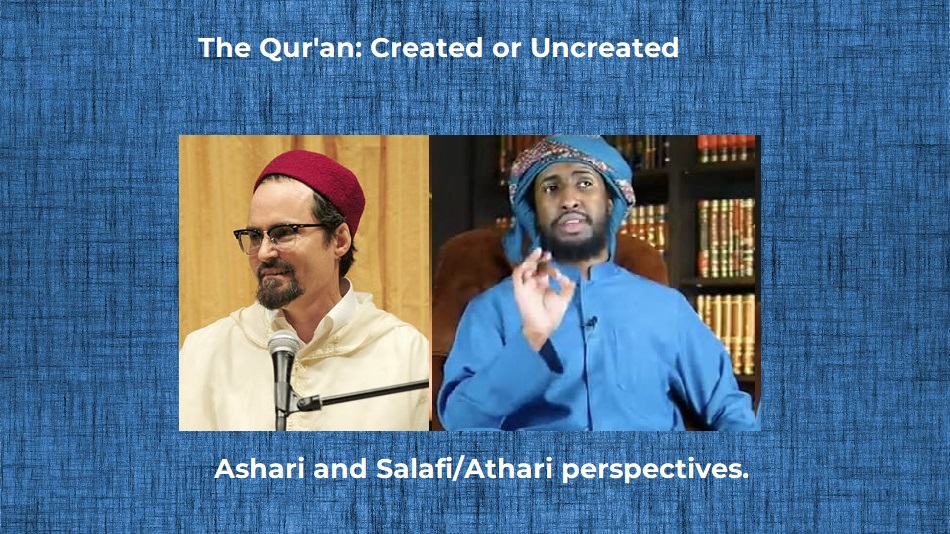
Insh’Allah today we will be looking at the claims of Ustadh Abdurrahman Hassan, and Shaykh Hamza Yusuf. Both of them claim to follow the Sunni denomination of Islam. They both claim that the Qur’an is uncreated and yet both of them have very different understandings of what this actually means.
Let us start with what Shaykh Hamza Yusuf (An Ashar’iin creed) said here:
Shaykh Hamza Yusuf is gracious in saying that among the Sunni denomination there is a division on this issue. They are not in unison as to this theological position.
This is something that Ustadh Abdurrahman Hassan is not in agreement upon. Ustadh Abdurrahman’s view is that there is one and only one view only among the Sunni denomination.
@ 1:32 Listen carefully people. Shaykh Hamza Yusus if a public orator and a supremely articulate man. Listen very carefully to the doctrine you are being asked to subscribe to.
“But the Mushaf itself and the ‘ulemah say you can only say this in a teaching just out of adaab to the Qur’an we don’t say it. But the Mushaf itself is, came into the world. The paper, the ink, the right? and then the letters and when we and if I say, “bismillah ir rahman ir raheem, al hamdulillahi rabil ‘alamin, ir rahman ir raheem.” Those are sounds. And we know that you know that they have vibrations and so…that aspect of the Qur’an and this is the distinction they say is all of those elements are created and like….”
@ 3:00 “It definitely doesn’t mean though the mushaf you have in your house. Because that would then…I mean some of the Christians argue that well the Qur’an is imbibliation. Like we believe in incarnation of the logos the Muslims believe in imbibliation of the logos. That God became book and so we don’t we don’t see that as valid. That view of it so.”
Did you notice in the first paragraph above how Shaykh Hamza said that the mushaf of the Qur’an is created. However, he said it very very softly and quickly moved on from that word ‘created’. I am sure that you the discerning truth seeker have realized this.
Every Qur’an that every Muslim uses today has a publisher. For example the ‘Sahih International’ is published by the Publishing House (dar), dar Abul Qasim, Saudi Arabia.
If the book, ink, text has a publisher it is clear as day light that the text, or mushaf is created. Now, I am going to advise you, the Christian, the Jew, the Hindu, the Buddhist, the Taoist, the Sikh, the Jain, the Wiccan, the Agnostic, the Atheist, ask any Muslim preacher who is calling you to Islam the following:
“Is that book, the text, the Mushaf, the ink pages is it created?” The simple , correct, direct answer is ‘Yes!’.
If that Muslim preacher begins to waffle, doge, sidestep or respond with anything other than ‘Yes!; My advise to you is to ask yourself some questions.
What are they really calling you to believe in? The belief in the oneness of Allah, that he is eternal and is unlike his creation? Yet they cannot say that an obvious creation (a book, a text with ink and pages) is created?
So now let us come to the video by Ustadh Abdurrahman Hassan (An Athari in creed)
Now Ustadh Abdurrahman Hassan who also claims to be of the Sunni denomination has a vastly different understanding of what it means to say that the Qur’an is uncreated than does Shaykh Hamza Yusuf.
First Ustadh Abdurrahman Hassan first appeals to emotion by discussing the persecution that those who claimed the Qur’an was uncreated went through. Though he doesn’t’ mention that his side did the exact same thing.
@ 2:50 Ustadh Abdurrahman Hassan says that the Ashar’i affirm the speech that is present in Allah (swt). They affirm that speech is an attribute of Allah (swt).
Now listen very carefully to what Ustadh Abdurrahman Hassan declares. His major point of contention.
“The Qur’an that we have today that is that we are reading, making our children memorize, who we read in weddings, if we want to make a person make an oath we make them use this Qur’an, swear by this Qur’an they believe it’s makhluq!“
His very intelligent friend ask him, “Are they talking about the papers the mushaf?”
To which Ustadh Abdurrahman replies: “Shahid the Qur’an that we are reading, whole entire Qur’an is makhluq to the Ashar’i“
There you have it people! Ustadh Abdurrahman is upset that people believe that a book, the Qur’an with ink, pages proclaim that it is created. So he wants that book, those pages, that ink, an obviously created thing to share a quality belongs ONLY to Allah (swt).
ONLY Allah (swt) is uncreated and everything else is uncreated. This is obvious as obvious can be.
@5:42 “The Ahshar’i don’t consider this (pointing to a Mushaf) to be the kalam of Allah.“
Ustadh Abdurrahman’s daleel backfires!
Listen carefully to this next section. The brother who sits across from Ustadh Abdurrahman has been given a keen intellect and mash’Allah he picked up on the problem straight away! To the point that Ustadh Abdurrahman realized it was a strong point against him so he quickly pivots to ‘all the other evidences’.
He said: “O my Lord, set for me a sign.” Said He: “Your sign is that you shall not be able to speak to people for three days except through gestures. Remember your Lord much; and proclaim His purity in the evening and the morning.” (Qur’an 3: 41)
@12:35 “But your saying pointing is not speech.” -to which Ustadh Abdurrahman says, “It’s not.” the brother responds, “Allah says, illa ramzan put it with speech.” “illa?” replies Ustaz.
The brother states: “Ramzan in the ayat that you recited he’s put it with speech. You will not speak except with ramzan, with pointing.”
To which Ustaz replied: “Allah is saying you Zakariah will not be able to speak except Allah will allow you to give sharah.” To which the brother replies again: ” That means that’ is the speech that you’re allowed to . You’re not allowed to speak. It’s like if I say for example. Everyone leave the room except…”
Mash’Allah.
“And the people of Moses, after his departure from their ornaments a calf-an image having a lowing sound. Did they not see that it could not speak to them nor guide them to a way? That they took it for worship, and they were the wrongdoers. (Qur’an 7:148)
“And he extracted for them the statue of a calf which had a lowing sound, and they said, “This is your god and the god of Moses, but he forgot.” (Qur’an 20:88)
Just because something produces a sound does not mean it can speak.
May Allah (swt) guide them all to the truth of the matter.
For those who want to read more on the issue of rather or not the Qur’an is created:
“Invite to the way of your Lord with wisdom and good instruction, and argue with them in a way that is best. Indeed, your Lord is most knowing of who has strayed from His way, and He is most knowing of who is [rightly] guided.” (Qur’an 16:125)
﷽
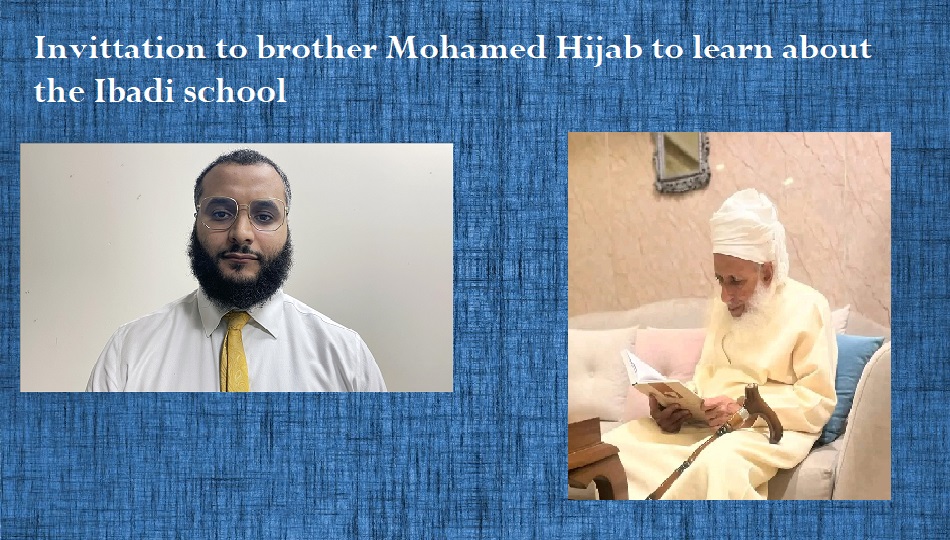
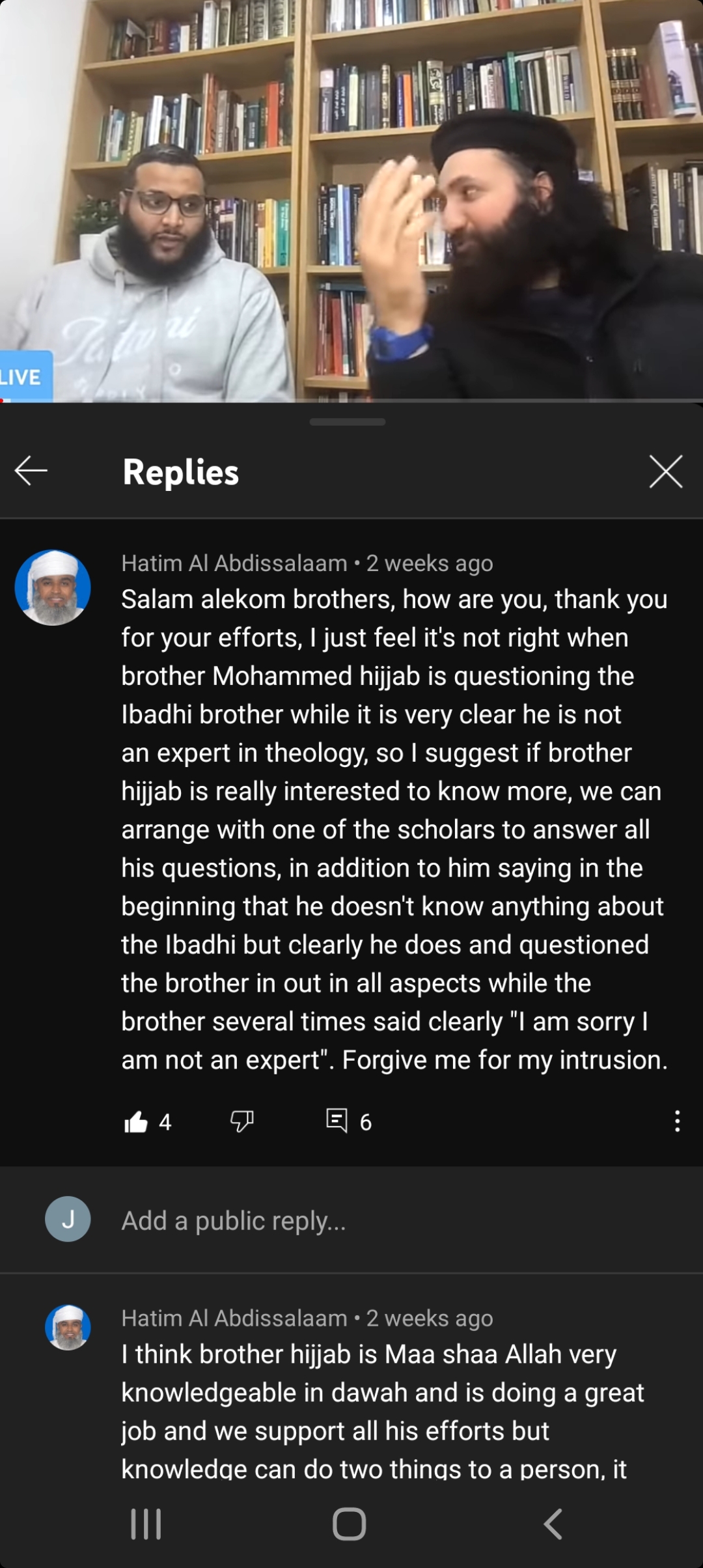
Recently our brother Mohamed Hijab had a gentleman on his show from Algeria. This brother had identified as following the Ibadi school. The brother from Algeria mentioned many times that he was not a scholar or someone very learned concerning the school.
Brother, Mohamed Hijab professed not to know much about the Ibadi school yet, subsequent dialogue followed that he (Mohamed Hijab) had some cursory knowledge about some of the school’s theological perspectives.
The brother from Algeria mentioned time and again that his knowledge was so simple, yet, Mohamed Hijab proceeded to to delve into difficult questions.
1:03:12 -A conversation with an Ibadi Muslim.
Al hamdulillah. At least they are not tafkiri and recognized their brother as a Muslim.
Thus, Shaykh Hatim Abdissalam extended a gracious offer for him to learn more about the school from our learned scholars if he was interested. It would go a long way in building bridges among Muslims.
By the way, many of our brothers from the Sunni denomination have been invited to Oman and given a platform by people who are predominately of the Ibadi denomination. The exchange was always respectful and most courteous.
In fact respected Shaykh Mufti Menk spent some time with us in Oman. The very same Shaykh Hatim Abdissalam who extended the offer to Mohamed Hijab is seen in this beautiful and harmonious meeting with Shaykh Mufti Menk.
In fact many Muslims from diverse views among our brothers in the Sunni denomination have been invited to speak in Oman from, Shaykh Mufti Menk, to Shaykh Yusuf Estes, to Shaykh Hamza Yusuf, to Imam Khalid Yasin to Adnan Ibrahim.
Another point is that a very close friend, brother and associate of Mohamed Hijab, our brother Hamza Tzortzis came and spoke in Oman. Maybe he picked up some books for Mohamed Hijab? Mohamed Hijab is an excellent orator and insh’Allah if he would like to come and speak with his brothers in Oman ahlan!
Certainly he believes in the hadith of the Blessed Messenger (saw):
Abu Barza reported that Allah’s Messenger (saw) sent a person to a tribe amongst the tribes of Arabia. They reviled him and beat him. He came to Allah’s Messenger (saw) and narrated to him (the story of atrocities perpetrated upon him by the people of the tribe). Thereupon he (the Holy Prophet) said:
“If you were to come to the people of ‘Uman, they would have neither reviled you nor beaten you.”
Muslims from the Ibadi school have been very active in building schools and watering wells for our brothers and sisters all over East Africa and no one gives them literature saying, “You must be an Ibadi or you are astray.” No!
The Ibadi community in Ghana west Africa is quite large and they get on well there with our brothers from both the Sunni and Shi’a schools.
We should not try to intentionally misrepresent anyone else’s belief, be they Muslim or not Muslim because dishonesty is not honorable. Insh’Allah may Allah (swt) put more mercy, love, peace, respect and understanding between us all. Amin!
“And be not as those who divided and differed among themselves after the clear proofs had come to them” (Qur’an 3:105)
“Indeed, your Lord is most knowing of who has strayed from His way, and He is most knowing of who is guided” (Qur’an 16:125)
“And hold firmly to the rope of Allah all together and do not become divided. And remember the favor of Allah upon you – when you were enemies and He brought your hearts together and you became, by His favor, brothers. And you were on the edge of a pit of the Fire, and He saved you from it. Thus does Allah make clear to you His verses that you may be guided.” (Qur’an 3:103)
If you want to see more articles that feature brother Mohamed Hijab you maybe interested in the following:
“Oh my Lord, increase me in knowledge.” (Qur’an 20:114)
﷽
RECLAIMING THE HISTORICAL NARRATIVE FROM THE ORIENTALIST AND FROM THE DETRACTORS OF TRUTH.
One thing that you will often hear from Orientalist as well as from our fellow Muslim brothers are two mistaken ideas.
#1) That Ibadi are Khawarij.
#2) That Ibadi grew out of the Khawarij.
Let’s address the first point.
The definition of Khawarij
Khawarij = “The ones that have gone out or have come out.”
In the Arabic language, it has no negative connotation in and of itself.
One of the largest Muslim daw’ah groups in the world our brothers” The Tablighi Jamaat” go out on Khuruj -going out in the path of Allah for 40 days.
“So from wherever you go out (kharajta)turn your face toward al- Masjid al-haram, and indeed, it is the truth from your Lord. And Allah is not unaware of what you do.” (Quran 2:149)
The Day they will hear the blast in truth. That is the(yawmu-khuruji) Day of Emergence.” (Qur’an 50:42)
The other point is that this term has is a polemical term used to disparage certain groups of Muslims. If we examine the polemical usage of the word than all the qualities that are used to say this particular sect is khawarij are equally applicable to all other factions and sects.
Unless, suddenly, we are going to pretend that we don’t have people saying that if you claim the Qur’an is created you should be killed.
In fact, for those who are genuinely interested in this subject, I highly recommend you read this 47 page PDF file. That has a nice big font and easy to read. Straight to the point. Al-Khawarij
The points that are made in the above article are sound.
#1 Ask your people to define the term Khawarij.
What is the Arabic etymological root of the word and what does it mean in the Arabic language. Once this is done please proceed to point 2.
#2 Now with that definition in mind ask on what consistent basis is this not applied to Talha and Zubhair?
Why are Talha and Zubhair not called Khawarij for opposing Ali?
Ali Ibn Abu Talib was the rightful amir of Muslims at that time was he not?
#3 Now with that definition in mind ask on what consistent basis is this not applied to Mu’awiya or Amr ibn Al ‘As?
Why is not Mu’awiya and Amr ibn al as not called a Khawarij for opposing Ali?
Ali Ibn Abu Talib was the rightful amir of the Muslims at that time was he not?
This in and of itself shows the supreme bias and inconsistency when the narrative is being told by certain historical narratives.
In fact did you know in Al Tabari Ali calls Mu’awiya as khawarij?
Ali identifies Mu’awiya as the Khawarij!
‘Ali told one of his followers named Al-Ashtar: “I told you that I assigned to Muhammed bin Abi Bakr the governorship (of Egypt); (but) these Khawarij have revolted against him.” Thus, according to ‘Ali, Mu’awiya and his followers were the Khawarij.
Sources: (Al-Tabari Al-Taarikh Vol. 6, p. 31.)
Abu Sa’id Al-Khudri’s hadith about Khawarij point to Mu’awiya and his Syrian forces.
Al-Hakim in his Al-Mustadrak narrates on the authority of Abu Sa’id Al-Khudri that when asked about the Khawarij, Abu Said’s answer pointed to Mu’awiya and his Syrian followers as being the Khawarij. That was why, in his answer, he quoted the Blessed Prophet (saw) as saying: “Ammaar (bin Yasir) would be killed by a rebellious group” and he was, as a matter of fact, killed by the Syrian forces who were under the leadership of Mu’awiya. This can be taken to show that the Khawarij, in the view of Abu Sa’id, were Mu’awiya and his followers otherwise he would need not to have mentioned them as his answer to the question of “Who were the Khawarij
Sources: (Refer to Al-Hakim Al-Mustadrak Vol. 2, p. 162-163. tradition no. 2653. Ibn Abdi Rabih Al-Iqdu Al-Farid Vol)
*Note* some publications have began to remove the reference in Al-Hakim!
The group that orientalist and the Shi’i and Ahl Sunnah as “Khawarij” believed that the blood of other Muslims who simply differ with them is permissible to take. They often make takfir of other Muslims -whereas we Ibadi Muslims do not do this.
Those other groups do not recognize Uthman and Ali as rightful Amir’s of the Muslims whereas we Ibadi Muslims recognize them. We simply admit that the latter part of Uthman’s reign suffered from nepotism and other issues. With Ali’s reign, It was his decision to abandon the Qurra as well as the clear guidance that Allah (swt) gave in the Qur’an. His killing of the companions at Nahrawan was not just.
Now while we are on the subject of taking the life of a fellow Muslim being a small matter let us take a look at something interesting.
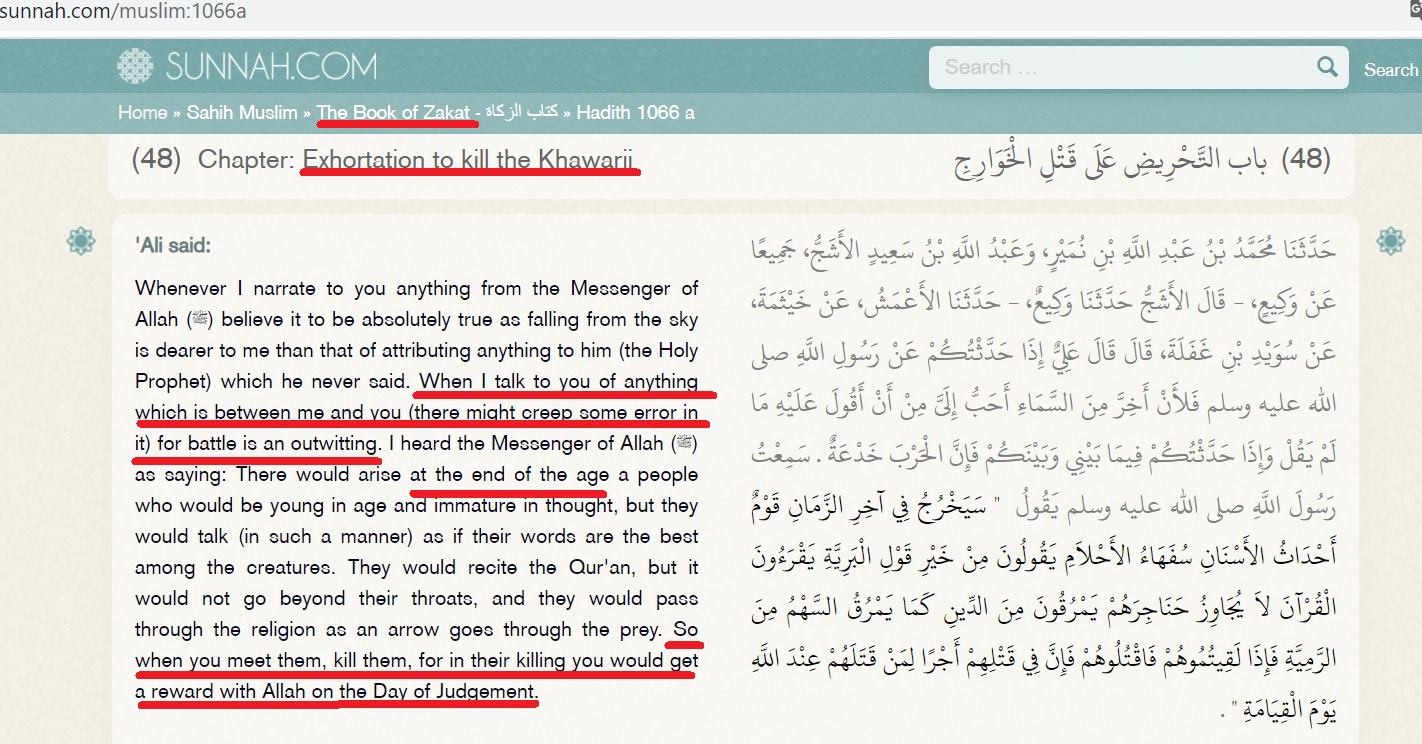
Ali said:
“Whenever I narrate to you anything from the Messenger of Allah (ﷺ) believe it to be absolutely true as falling from the sky is dearer to me than that of attributing anything to him (the Holy Prophet) which he never said. When I talk to you of anything which is between me and you (there might creep some error in it) for the battle is an outwitting. I heard the Messenger of Allah (saw) as saying: There would arise at the end of the age a people who would be young in age and immature in thought, but they would talk (in such a manner) as if their words are the best among the creatures. They would recite the Qur’an, but it would not go beyond their throats, and they would pass through the religion as an arrow goes through the prey. So when you meet them, kill them, for in their killing you would get a reward with Allah on the Day of Judgement.”
Now my dear fellow Muslims, and researchers of truth. The very wording of this hadith is bizarre. First, the way that Ali Ibn Abu Talib words the hadith as if he is saying, “By the way, I know you people may have some doubts in me but trust me I won’t lie about the Prophet.”
The way that Ali prefaced the hadith merits some sober reflection.
So what does this particular hadith suggest that you do with these extremists? Does it suggest you try and reason with them? Does it suggest that you capture them? No. It tells you that you should kill them and that in fact, Allah will give you a reward for it. That sounds quite extreme indeed.
Let us now address the second point:
Ibadi did not come from the so-called “Khawarij” nor are we a branch of them. It is more appropriate and truthful to say that this polemical term has been used about us Ibadi’s as well as those from the Azraqi, Najdi, and Surfriya. The major point that we, the Ibadi, hold in common with them is that all three of these groups are in AGREEMENT on ONE FINE POINT history.
In the sense that all these groups are in agreement that Ali was in error in his decision to make arbitration with Muaviya.
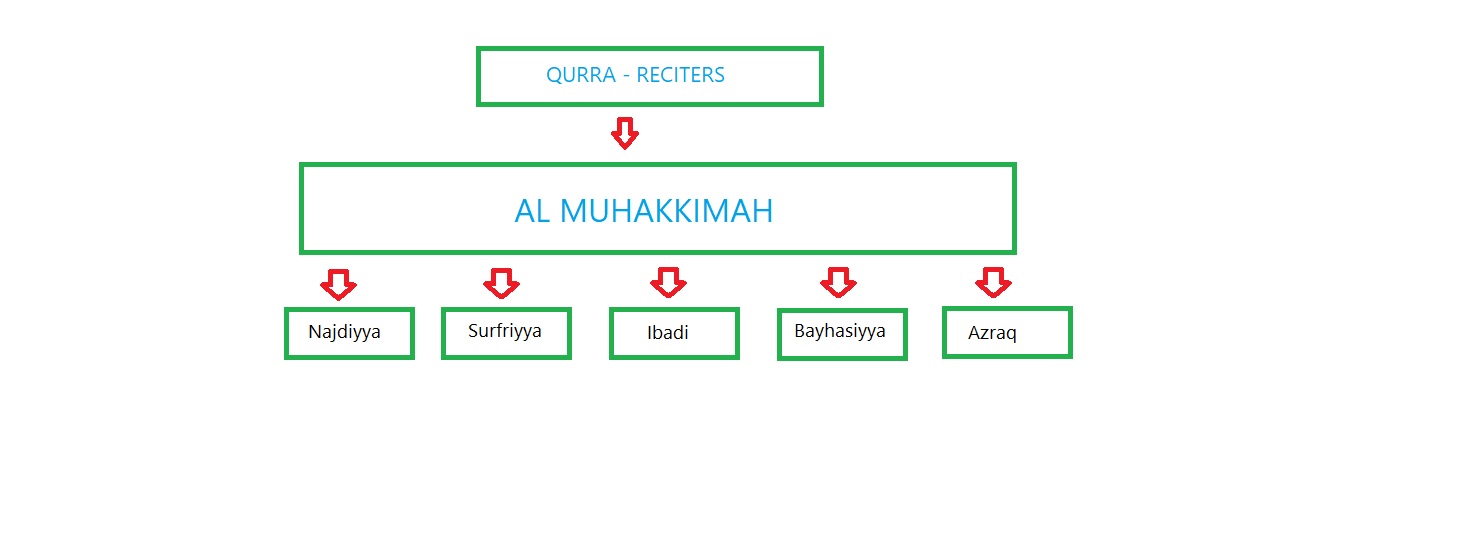
Thus, in that sense, we are all known previously as (Al Muhakkimah), or those who adopt Quranic verses for resolving any issue or quarrel, it is just what Allah (swt) told us we should do. Please refer to the Qur’an (5:50 & 4:65, in the least)
The above graph has been taken and modified by some youtubers.
With the coming of Abdullah ibn Ibadh al-Murri al-Tamimi (r) this is when the Al Muhakkimah already became subgroups.
All that can be said about the above groups is that are in agreement that Ali should not have made arbitration with Muaviya. Just like all Muslims are in agreement that Allah (swt) is one. Logically this does not mean that all Muslims have the same ideas about everything else.
The Nukkaris broke away from the Ibadi’s briefly than came back to the Ibadi. The Surfriyya eventually became absorbed into the Ibadi school in North Africa. The Najdiyya, Azraqi, Bayhasiyya, and whomever else did not survive until today.
Some groups are known as the Azraqi, Najdi, and others, these are the people whom the Shi’i, Sunni, and Orientalists refer to as “Khawarij”. It is these groups that became quite extreme in their views. For anyone who has studied history knows that Ibadi’s directed polemical writings towards these other groups, especially the Azraqi and the Surfriyya.
For those of you who understand and speak Arabic, we would highly recommend this lecture.
Insh’Allah may your eyes be opened wide!
For those who do not speak or understand Arabic see the excellent write up by sister Bint Ibadh here:
The Ibadi after Abdullah ibn Ibadh (raheemullah). -They believe in peaceful existence and dialogue with other Muslims. They marry other Muslims and perform the funeral prayers for them as well. One brother from Saudi Arabia recently said to a friend of ours, “You Ibadi are Khawarij, Shi’a, you support Iran!”
To which my friend replied, “We don’t support Iran, or Saudi Arabia or anyone. We support the Muslims. Who is doing to killing in Yemen? It is Sunni and Shi’a. Who is doing the fighting in Iraq? It is Sunni and Shi’a. Who is doing the killing in Syria? It is Sunni and Shi’a not us. You will not find a single Ibadi scholar anywhere giving a fatwa in support of any side of these conflicts.”
In fact, the only struggle that we know of that we areaware of that Ibadi scholar support is the struggle of the Palestinians (Muslims) against the (Zionist). It seems that these other sectarian wars are a diversion to distract from this!
We would like to imagine that if we Ibadi had a powerful state today that we would come to the aid of Muslims anywhere, no matter if they are Sunni, Shi’i, Salafi, or Sufi, as they are all the ummah of Muhammed (saw)!!
In fact, the proof is in the example of the Ibadi community in Oman. We marry both Sunni and Shi’i and we have a beautiful and fruitful relationship with them. In fact, out of all the Arab nations, there is not a single representative in ISIS from Oman! Al hamdulillah!
We would also like to add that in this world of chaos and turmoil it is more important than ever not to intentionally misrepresent one another. It is very important that we cooperate and work together as much as possible.
For example, Our brothers among the Sunni have actually mocked their own intellectual giants, Imam Ahmed and Imam Abu Hanifa while in the process of mocking others. The following article is demonstrative of that. By mocking the beliefs of others it shows that these two giants among our brothers from Ahl Sunnah are people who are ignorant of the views of their interlocutors.
This certainly is embarrassing and not the way forward dear Muslims and fellow truth seekers.
The most glaring example used by our brothers from Ahl Sunnah as well as uniformed orientalist is that we Ibadi’s do not believe in arbitration.
Please see the following article to understand what we are talking about.
“And do not mix the truth with falsehood or conceal the truth while you know it.” (Qur’an 2:42)
﷽
In Islam, one of our most cherished principles is to cover up the faults of others. To be tactful in how we correct each other. Yet, this needs to be balanced with those who are recalcitrant and unwilling to admit to their errors. When their publications and social media become widely viewed, the layperson takes at face value what is said than something must be done.
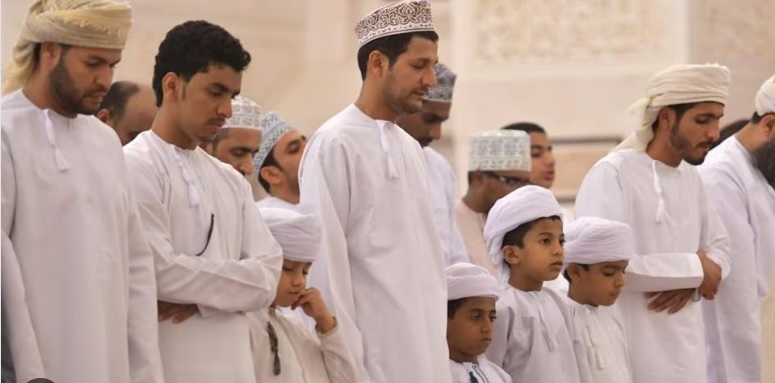
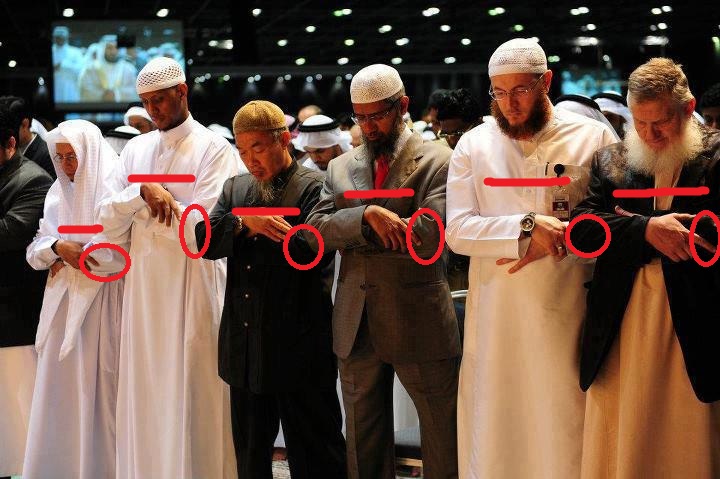
One of the more unfortunate things is that those who are claimants of a movement called ‘Salafiyah’ are being woefully uninformed about the prayer of the Blessed Messenger (saw). Namely, by saying that praying with arms to the side is some sort of innovative practice. When in reality that IS the default way the Blessed Messenger (saw) prayed!
One of those who have circulated this misunderstanding is the Salafi preacher Abu Ameenah Bilal Philips. Bilal Philips has otherwise benefited the English-speaking Muslim community through his media lectures and audio series.
We as human beings make mistakes. We hope that one day Allah (swt) will encourage him to correct this error.
In his book he says:
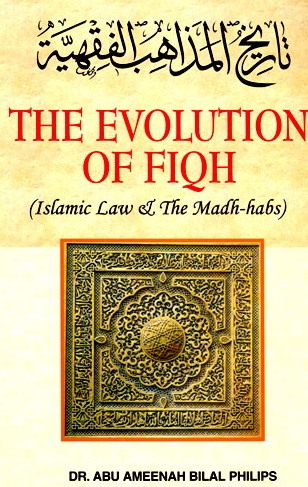
“He was severely beaten in the year 764 CE by the order of the Ameer of Madeenah, because he made a legal ruling that forced divorce was invalid. This ruling opposed the ‘Abbaasid rulers’ practice of adding in the oath of allegiance given to them by the masses the clause that whoever broke the oath was automatically divorced. Malik was tied and beaten until his arms became severely damaged to such a degree that he became unable to clasp them on his chest in Salaah and thus he began the practice of praying with his hands at his sides according to some reports.”
Source: (pg. 78. The Evolution of Fiqh Islamic Law & The Madh-habs By Abu Ameenah Bilal Philips International Islamic Publishing House.)
“Some reports” such as? Doesn’t Abu Ammenah Bilal Philips have to give his evidence or are we just supposed to accept what he said? No asterisk *, no footnote with a source or reference. Unforutnately, Bilal Philips gives us nothing.
Can such a claim be verified by and in any of the traditionally relied upon books of Islamic history? No! One will be hard-pressed to find any evidence substantiating this argument.
Remember what Allah said:
“Verily, those who conceal the clear proofs, evidence, and the guidance, which We have sent down after We have made it clear for the people in the Book, they are the ones cursed by Allah and cursed by those who curse.” (Qur’an: 2:159)
So where is the proof?
Secondly, how could Imam Malik not have enough strength to clasp his hands on his chest but still be able to do the tabkir—, go into ruku, and go into sajdah and to push his hands up from sujuud, since Imam Malik’s view is that the knees go up than the hands after sajdah?
What about all the other Tabieen who prayed the way Imam Malik did? Did each one of them have their arms broken as well?
Also, don’t you think Imam Malik would have said as plain as day, “Hey everyone, as you know, I’m only praying this way because my arm was pulled out of my socket, don’t follow me, follow the Blessed Messenger!”
Next are the flat untruths coming from Assim al Hakeem.
“Some scholars say that the followers of Imam Malik started doing this when he started praying like that. Why would Imam Malik, Imam Dar Al Hijra, pray like that way? He knows that the Sunnah of the Prophet (as) as in the hadith of Wail Ibn Hujr (May Allah be pleased with him) was to put the right over the left on the chest and this is the sunnah of all the prophets. Why would Imam Malik do this? The reason was that at some time or period of history there was a disagreement between the Muslim ruler and Imam Malik; which happens throughout history with all scholars. This happened with Imam Ahmad. This happened with Imam Abu Hanifa. This happened with uh Imam Ibn Taymiyah, who died in prison. All great scholars are tested; and usually if they don’t kiss the backside or they don’t polish shoes, they will be thrown in jail. This is the norm. So there was this disagreement which Imam Malik refused to compromise the religion, which led then to a Muslim ruler to flog him and beat him in prison. That led to an injury to his arm which prevented him from being able to lift it so he began to pray with his arms to his side. Some of his disciples and students (apparently who were not very smart followed that way of prayer instead of going back to his books, to his hadiths that he used to teach to learn how the prophet used to pray. And they mimicked that and made it part of their religion, or part of their school of thought. Which is totally bogus. Which is totally not true. And Ali my friend as a Muslim we have to go back to the references, Qur’an and Sunnah. Not to what Tom, Dick and Harry did (with all due respect to THEM), but Allah ordered us to follow the Qur’an and the Sunnah. And people differ. People have their different preferences, and understanding of things. So we are not to get closer to Allah by THEIR understanding rather by the Qur’an and the Sunnah whereby the understanding of the three favourite generations, the companions, tabi’een and tab’tabi’een.”
Let us analyze what Shaykh Assim al Hakeem says.
“Some scholars say.” Who are these scholars? What do they base their statements on?
“Some of his disciples and students (apparently who were not very smart) followed that way of prayer instead of going back to his books, to his hadiths that he used to teach to learn how the prophet used to pray. And they mimicked that and made it part of their religion.”
Let us do a little thought experiment. Let us assume the arms were broken, so he prayed like that story checks out. So this means….
Group A
Imam Malik was negligent.
Direct students of Imam Malik started doing that. Imam Malik was derelict in his duties and said nothing while his students did innovation in their prayer. This is a huge evil to attribute to Imam Malik.
Which of these students, who were “apparently who were not very smart” started this innovative practice? Was it:
Asad ibn al Furat ?
Ibn al-Qasim ?
Sahnun ?
Ashhab ibn ‘Abd al-Aziz ?
Group B.
The students of Imam Malik’s students innovated this practice.
All of Imam Malik’s students were faithful and diligent in following the Sunnah. However, the students of these teachers decided to start practicing sadl in honour of Imam Malik being tortured. So then, when they started to do this, why didn’t their teachers (the students of Imam Malik) stop them? Why would they do what their teachers were not even doing?
ABU HANIFA, IMAM MALIK, IMAM SHAFI’I, IMAM AHMAD = (TOM, DICK, AND HARRY) ?
“Not to what Tom, Dick and Harry did (with all due respect to THEM), but Allah ordered us to follow the Qur’an and the Sunnah. And people differ. People have their different preferences, and understanding of things. So we are not to get closer to Allah by THEIR understanding.”
The shocking and dismissive statements directed at some of his own great scholars are most unfortunate. This is nothing new for the Salafi preachers. In one breath he speaks of Imam Malik as ‘Imam Dar Al Hijra‘, and in the next breath he is just a ‘Tom, Dick or Harry‘.
I guess we as Muslims, those that follow the Ibadi school, shouldn’t be shocked when some of the more uneducated among the ‘Salafiyah’ call us dogs, and kafir. After all, these men will refer to their own Imams as ‘Tom, dick or harry’. This makes for an unfortunate discourse.
May Allah (swt) guide them and us to a way and course that is just.
Shaykh Assim Al-Hakeem has yet to correct his lie concerning Imam Malik. However, he has stated in public it is no problem if you leave your arms to the side.
“Certainly you have in the Messenger of Allah an excellent example for him who hopes in Allah and the last day and remembers Allah much.” (Qur’an 33:21)
﷽
Malik ibn al-Huwayrith reported: The Prophet, (saw), said, “Pray as you have seen me praying. When the time of prayer arrives, let one of you announce the call to prayer for you and then let the older of you leader the prayer.” Source: (https://sunnah.com/bukhari:631)
Salafi Shaykh Assim Al-Hakeem repeated a whopper of a lie about Imam Malik (and the way he performed prayer). He has yet to publically correct his position. He has also yet to provide us any evidence of his claims.
This is the article with his previous (incorrect) position parroting the mistake of Salafi preacher, Bilal Philips.
Shaykh Assim al-Hakeem metions about praying with the arms to the side.
Shaykh Assim Al-Hakeem says: “The, the famous dispute among Muslims rather to put my hand over the belly, on the chest or under the belly. Akhi if you pray, Al hamdulillah! Five times a day on time in the masjid it’s o.k where you want to put your hand. There are a hadith that stated, hadith Wail Ibn Hujr (May Allah be pleased with him) that the prophet used to put the right over the left on the chest. Now there are other hadiths that state that he used to put it, them under the navel or on his stomach. Wherever you feel good about do it! It is a Sunnah, SO EVEN IF YOU DON’T PUT YOUR HANDS ALTOGETHER, IF YOU JUST PUT THEM ON YOUR SIDE YOUR PRAYER IS VALID. YOUR PRAYER IS CORRECT. But, you should try your level best to follow the most authentic hadith and I, uh, uh, uh believe that the most authentic hadith which Al Albani (May Allah have mercy on him) also authenticated states that you put them on the chest.”
DEFINITELY NOT ON THE CHEST!
If you are keen to learn the prayer of Blessed Prophet (saw) may the following be helpful for you!
“So High above all is Allah, the King, the True. And do not hasten with (reciting) the Qur’an before its revelation to you is concluded, and say, “My Lord, improve me in knowledge.” (Qur’an 20:114)
﷽
This entry was written as a response to a well-known Salafi Preacher by the name of Assim Al-Hakeem.
He has unfortunately uploaded a video in which he attacks Ahl al-Haqq wa-l istiqama (The People of Truth and Straightness). This is possibly due to one of three reasons.
Reason 1 is due to his lack of understanding.
Reason 2: maybe he made these statements about the Ibadi school while under the influence of alcohol. That is because Assim Al-Hakeem told young people all over the world that he “drinks beer” and that he is “proud of that.” So it is possible he made his comments while under the influence of intoxicants.
Reason 3 is this: Assim lied about his own Sunni Imam (Imam Malik) and it is not above him to willfully lie about the Ibadi or tell half-truths. May Allah (swt) guide him to a more just course.
Reason 1. His lack of understanding. No proper knowledge.
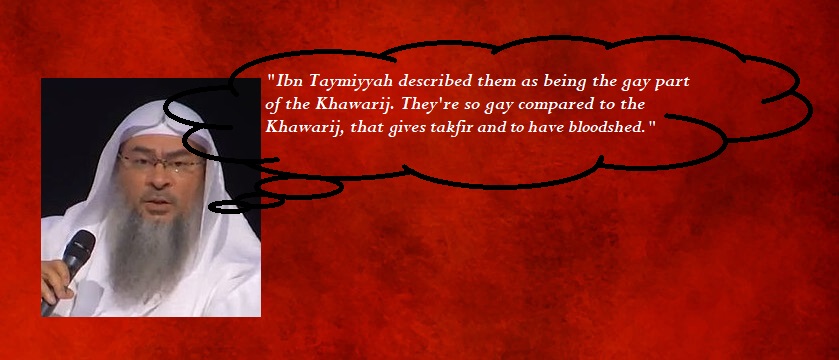
“Mabrouk says, who are the Ibaadiyyah? The Ibaadiyyah is a faction of Al Khawarij. It is one of the 72 sects that the Prophet (a.s) warned us from, dividing into. They follow the Khawarij; but they are a softer copy of the hard core Khwarij. And this what called Imam Ibn Taymiyyah (May Allah have mercy on his soul) to describe them as being the gay part of the Khawarij. They’re so gay compared to the Khawarij, that gives takfir and to have bloodshed. They are close in the attributes of Allah (Azawajal) to the Mutazila. So they deny allot of Allah’s attributes. They have their own misinterpretation when it comes to the scale and to the siraat. And to the things related to yom al qiyyamah (the day of judgement). They also believe that those who commit major sins are kafir, like the Khawarij. But they, it is is permissible to marry them. So they believe that those who are not from the Ibaadiyyah like us, they can marry from us and they can inherit from us. But we are, we will be in hellfire forever. And they have so many weird things. They believe the Qur’an is created and it is not one of Allah’s attributes. They believe that it is impossible to see Allah in paradise. So it’s a deviant cult. And allot of the scholars say that you must not pray behind them as the prayer would not be accepted and Allah knows best.”
The response to the Salafi Preacher Assim Al-Hakeem.
First point.
Assim says about us, “They’re so gay compared to the Khawarij, that gives takfir and to have bloodshed.”
Yet, he is the one who says, “And allot of the scholars say that you must not pray behind them as the prayer would not be accepted and Allah knows best.” Talk about takfir!
Second point.
Assim says about us,
“They have their own misinterpretation when it comes to the scale and to the siraat. And to the things related to yom al qiyyamah (the day of judgement).” He did not elaborate on what those things were. So it is challenging to comment upon what he did not elaborate upon.
Third point.
Assim says about us,
“So they deny allot of Allah’s attributes.” What attributes do they think we are denying? It is actually Assim Al-Hakeem’s group who make up attributes about Allah (swt).
Ibn ‘Uthaymeen stated:
“We believe that Allah, The Most High, has two real eyes. And this is the saying of Ahlus-Sunnah wal-Jamā’ah. Abul-Hasan Al-Ash’aree said: The saying of Ahlus-Sunnah and the As-hāb Al-Hadeeth is that Allah has two eyes, without saying ‘how’ just as Allah has said, “[It was] sailing under Our Eyes.” (54:14).”
Source: (See Izālatus-Sitār ‘an Al-Jawāb Al-Mukhtār li-Hidāyatil-Muhtār of Ibn ‘Uthaymeen, p. 22; also Al-Maqālāt Al-Islāmiyyeen 1/345)
There is nowhere in the Qur’an or the Sunnah that says Allah “has two real eyes.”
The following video is for your educational purpose.
A typical conversation between us Ibadi and those who claim we deny the attributes of Allah (swt) usually goes like this.
Fourth Point.
Assim says about us,
“They also believe that those who commit major sins are kafir, like the Khawarij.”
If you want to read our understanding of this, based upon the Qur’an and Sunnah you may see the following:
This is quite a statement considering Preacher Assim believes in the hadith of the 73 sects. So we could ask Preacher Assim. “Are the Ibadi part of the saved group or not?” We don’t say simply because someone is not Ibadi, they will be in hellfire forever! That is false. Please see what our noble Shaykh says here:
“They believe the Qur’an is created, and it is not one of Allah’s attributes.”
That part is true. The Qur’an is created. It is not an attribute of Allah (swt). Although Allah (swt) does have the attribute of Speech. You may see our position here:
Reason 2. Assim Al-Hakeem was under the influence of alcohol. He was intoxicated when he made such statements.
“I drink beer, and I’m proud of that. But the beer I drink before you quote me for that is from Saudi Arabia, and it has 2% maybe 3% alcohol, and it’s legal, and it’s halal. One says, “Oh, it has alcohol!” Akhi, If I drink half a pack, nothing happens.”
Now the individual who made the video above chooses to use the pejorative ‘Wahabi’. However, I prefer to use the term ‘Salafi’.
Now, obviously, images of Muslim youths breaking their Ramadan fast with a bottle of 3% Hoegaarden beer and dates do not sit well with many more sensible Muslims.
There was lots of backlash and so Assim issued a retraction, clarification, kind of, sort of, not really…. The Preacher Assim continues…. “The presence of alcohol, if you consume a large amount of it, and you are not intoxicated, this means that it is permissible to consume.” Because why is wine haram? Because if you drink a lot of it you become intoxicated. If I have a barrel of whatever substance, and I’m not wasted, I’m not intoxicated, then drinking a little bit is o.k. But, if I have a bottle of a liquid of a drink and if I drink the whole bottle, I become wasted, I become drunk, then a single drop of it is haram.
Preacher Assim is following the view of the famous Salafi Shaykh, Saleh Al-Uthaymeen. The same one above who says that Allah (swt) has “two very real eyes.”
May Allah guide us!
Shaykh Saleh Al-Uthaymeen gave a controversial beer drinking fatwa.
Please do not listen to people like Shaykh Saleh Al-Uthaymeen or Preacher Assim Al-Hakeem! Please listen to someone sensible like Shaykh Mufti Menk on this matter!
Reason 3. Preacher Assim Al-Hakeem lied about a Sunni Imam (Imam Malik); and it is not above him to willfully lie about the Ibadi or tell half-truths.
Preacher Assim Al-Hakeem otherwise makes himself available to people via social media. It is not sure what his methodology is or the school that he follows. However, he is to be warned against because he gravitates towards a flippant and non-sober approach to many issues that demand sobriety.
May Allah (swt) guide him and us!
“Invite to the way of your Lord with wisdom and good instruction, and argue with them in a way that is best. Indeed, your Lord is most knowing of who has strayed from His way, and He is most knowing of who is guided.” (Qur’an 16:125)
“Certainly you have in the Messenger of Allah an excellent exemple for him who hopes in Allah and the latter day and remembers Allah much.” (Qur’an 33:21)
﷽
Malik ibn Al-Huwayrith reported:
We came to the Prophet (saw) while we were young men, and we stayed with him twenty nights. Then the Prophet considered that we were anxious to see our families, so he asked us who we had left behind to take care of them, and we told him. The Prophet was kindhearted and merciful, and he said, “Return to your families, teach them, and enjoin good upon them.” Pray as you have seen me praying. When the time of prayer arrives, then one of you should announce the call to prayer and the eldest of you should lead the prayer.
One of the most contentious issues among Muslims, more often than not, has to do with the way the Blessed Messenger (saw) did his prayers. This video below is well worth the listen. It is done by someone who follows the Hanafi school of jurisprudence, the Sunni denomination of Islam.
What he is explaining is that it is impossible to find a ‘Sahih’ hadith for every single act that is done in the prayer. He then argues that this is why for some Muslims in the Sunni denomination they decide to follow a school of jurisprudence.
The truth of the matter is that the prayer was established by the Blessed Messenger (saw). It is a mass transmitted sunnah. The hadith are written records for those who need to furnish proofs for things that were found to be objectionable. Things that stood out as different needed to have proof or evidence, more so than something people picked up as mass practice from those who preceded them and from those who preceded them.
The hadith in book form is a documented sunnah. Sometimes the documented sunnah captures the living sunnah and other times it does not. A proof of this is that the schools of jurisprudence believe that certain acts of the Blessed Prophet (saw) were either abrogated or abandoned altogether.
Kindly see our article here where we expand upon how the sunnah is received.







 Prima Quran