For that cause We decreed for the Children of Israel that whosoever kills a human being for other than manslaughter or corruption in the earth, it shall be as if he had killed all mankind, and whoever saves the life of one, it shall be as if he had saved the life of all mankind.” (Qur’an 5:32)
﷽
Our colleague recalls this when they were at Zaytuna, California. So, one of the views of the Sunni school of Islam is that as long as someone hides their kufr/nifaq among the believers, they are safe.
However, in the Shafi’i school of jurisprudence, if a Muslim is knowingly negligent in prayer, he is killed and buried with the Muslims. It is recommended he repent, but not a must.
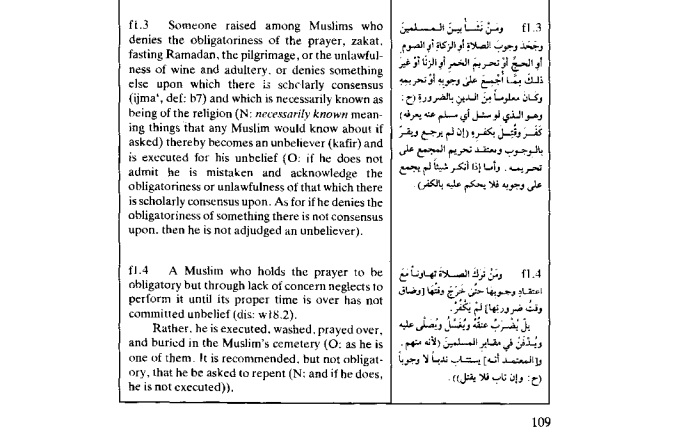
f1.3 Someone raised among Muslims who denies the obligatoriness of the prayer, zakat, fasting Ramadan, the pilgrimage, or the unlawfulness of wine and adultery, or denies something else upon which there is scholarly consensus (ijma`, def:b7) and which is necessarily known as being of the religion (N: necessarily known meaning things that any Muslim would know about if asked) thereby becomes an unbeliever (kafir and is executed for his unbelief (O: if he does not admit he is mistaken and acknowledge the Obligatoriness or unlawfulness of that which there is scholarly consensus upon. As for if he denies the obligatoriness of something there is not consensus upon, then he is not adjudged an unbeliever).
f1.4 A Muslim who holds the prayer to be obligatory but through lack of concern neglects to perform it until its proper time is over has not committed unbelief (dis: w18.2). Rather, he is executed, washed, prayed over, and buried in the Muslim’s cemetery as he is one of them. It is recommended, but not obligatory, that he be asked to repent (and if he does, he is not executed)).
Source: (‘Umdat al-Salik (Reliance of the Traveller) by Ahmad Ibn Naqib Al-Misri
Translated by Shaykh Nuh Ha Mim Keller)
Source: (https://seekerofthesacred.wordpress.com/wp-content/uploads/2009/08/reliance_of_the_traveller.pdf)
Prima Qur’an comment: “It is recommended, but not obligatory, that he be asked to repent (and if he does, he is not executed)).”
This is a position that would never be accepted in the Ibadi school. This is because it is the right of every Muslim who falters to be called to repentance. What to do with a Muslim who is willfully negligent in his prayers will be decided by the ruling Imam, Hakam etc.
Taking a life is a huge matter in Islam and one of the things that reached us on taking a life of the believer from the sunnah are:
1. Adultery
2. Apostasy coupled with fighting the Muslims.
3. A person who killed somebody unjustly, was killed (in Qisas)
So someone who is negligent in the prayer (as in just doesn’t even care) is executed?
Would this fall under the category of:
Adultery?
Apostasy?
Manslaughter?
Spreading corruption in the earth?
If the Shafi’i are honest with themselves and with you, it must be reasoned that, according to their principles of interpretation of all that which is based on their understanding of the Qur’an and Sunnah, the clearest category would be that of apostasy.
f1.4 A Muslim who holds the prayer to be obligatory but through lack of concern neglects to perform it until its proper time is over has not committed unbelief (dis: w18.2). Rather, he is executed, washed, prayed over, and buried in the Muslim’s cemetery as he is one of them. It is recommended, but not obligatory, that he be asked to repent (and if he does, he is not executed)).
This view would have many Muslims today executed. As there are a great many Muslims who are negligent in performing the prayer.
‘Abdullah bin Buraidah narrated that his father said:
“The Messenger of Allah (saw) said: ‘The covenant that distinguishes between us and them is prayer; so whoever leaves it, he has committed Kufr.’”
Source: (https://sunnah.com/ibnmajah:1079)
It is narrated on the authority of Abu Zubair that he heard Jabir b. ‘Abdullah saying. I heard the Messenger of Allah (may peace and blessings be upon him) observing this:
“Between man and polytheism and unbelief is the abandonment of salat.”
Source: (https://sunnah.com/muslim:82b)
So this Murjiʾah belief that defines Sunnism has put them in a conundrum as regards their ijtihad on this matter.
It was narrated from ‘Abdullah bin Buraidah that his father said:
“The Messenger of Allah (saw) said: ‘The covenant that stands between us and them is the Salah; whoever abandons it, he has committed disbelief.'”
Source: (https://sunnah.com/nasai/5/16-17)
It was narrated that Jabir said:
“The Messenger of Allah (saw) said: ‘There is nothing between a person and disbelief except abandoning Salah.'”
Source: (https://sunnah.com/nasai/5/16-17)
Buraidah (May Allah be pleased with him) reported:
Messenger of Allah (saw) said, “That which differentiates us from the disbelievers and hypocrites is our performance of Salat. He who abandons it, becomes a disbeliever.”
Source: (https://sunnah.com/riyadussalihin:1079)
We have seen from the text above that their belief is as follows:
- A person can neglect every aspect of Islam — prayer, fasting, zakat, enjoining good and forbidding evil, as long as they acknowledge through some lip service that what they are doing is wrong.
- Only if a person states that the above aspects are not obligatory do they become a kafir (apostate, as Sunnis define it).
“Do you enjoin right conduct on the people, and forget to practice it yourselves, and yet you study the book? Will you not understand?” (Qur’an 2:44)
Dear Muslim brothers and sisters, this Murji’ah doctrine of Sunni Islam is plain error.
May Allah suffice us!
Do you not want certainty in your life? Do you not want certainty in your heart?
Do you not want to know if you are truly a believer or not?
“Say: “If you do love Allah, Follow me: Allah will love you and forgive you your sins: For Allah is Oft-Forgiving, Most Merciful.” (Qur’an 3:31)
- Do you love Allah?
- Than follow the Prophet Muhammed (saw) by doing such.
- Allah will love you AND forgive your sins!
One of the signs that Allah loves us is that we actually obey Allah by following his commands and prohibitions. One of the signs that we are under the wrath of Allah is that we do not follow his commands and prohibitions.
Qur’an (23:1-9) The self-measurement test.
Read for yourself and see that prayer is an essential ingredient to being a believer!
“And they who carefully maintain their prayers.”
Ask yourself: “Am I in a state of ingratitude towards Allah? After everything our creator has given us, that which is beyond counting will I not be a Muslim? Will I not submit? Will I not surrender?”
There is no verse anywhere in the Qur’an where Islam means 51% submission. There is no verse where Islam means even 90% submission.
Read the following and may Allah flood your heart with light!
You may be interested in reading the following:
May Allah forgive the Ummah!
May Allah guide the Ummah!


Just asking for clarification:
Salamun Alaikum
walakum salaam wr wb,
1.”Are you concluding/supporting that killing someone negligent in prayer under the apostasy-law is valid?”
Response: I am asking the followers of the Shafi’i school on what legal basis from the Qur’an and the Sunnah do they execute someone.
Than I gave examples of what is known. Of those that are known what do they base their action upon. This is done in the context of the larger critique of the Murjiʾah doctrine.
2. Are you criticizing that the person’s life should not be spared if he repents (lip service as you put it) and the execution should happen?
“A person can neglect every aspect of Islam -prayer, fasting, zakat, enjoining good and forbidding the evil and as long as they acknowledge through some lip service that what they are doing is wrong.”
Kindly read this again carefully. It is certainly lip service to claim to believe and not act upon one’s belief.
“Are you criticizing that the person’s life should not be spared if he repents”
There was no critique offered of this if there was you would not need to ask for clarification. Thus, no, no critique of them accepting repentance was given.
You will note however, that in the full quoted text:
“as he is one of them. It is recommended, but not obligatory, that he be asked to repent (and if he does, he is not executed)).”
For them it is merely recommended (but not obligatory) that the person is asked to repent.
The reason why they maybe flippant in this regards is that when one is faced with execution they suddenly see the light and that may not seem like sincerity (to them-the Shafi’i).
Allah knows best.
Hope this was helpful.
Thank you for the clarification. JazakAllah Khair.
Wa iyyakum. May Allah guide us to what is beloved to Allah.