Tag Archives: allah

Salafi Shaykh Saleh Al Uthaymeen Controversial Beer Drinking Fatwa:

“By which Allah guides those who pursue His pleasure to the ways of peace and brings them out from darkness into the light, by His permission, and guides them to a straight path.”(Qur’an 5:16)

﷽ 
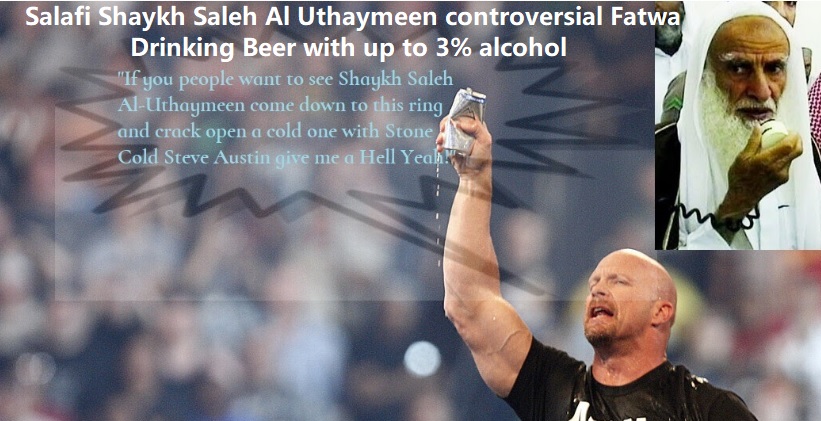
F1 Racing, Tourism, WWE Wrestling… the Middle East had a new Sheriff in town.

Abu Dhabi opens its first ever brewery. Where U.A.E goes Saudi usually follows.

https://www.middleeasteye.net/news/uae-abu-dhabi-first-brewery

“Never did We send a Messenger or a Prophet before you but that when he recited Satan would make insinuations about the revelations But Allah abrogates whatever insinuations Satan may make, and then He confirms and establishes His Revelations. Allah is All-Knowing, All-Wise.” (Qur’an 22:52)

“They will ask you about intoxicants (khamri) and games of chance. Say: “In both, there is great evil as well as some benefit for man; but the evil which they cause is greater than the benefit which they bring.” And they will ask you as to what they should spend Say: “Whatever you can spare.” In this way, Allah makes clear unto you His messages, so that you might reflect.” (Qur’an 2:219)

“Oh, you who have attained to faith! Intoxicants (khamru), and games of chance, and idolatrous practices, and the divining of the future are but a loathsome evil of Satan’s doing:’ shun it, (fa-ij’tanibuhu) then so that you might attain to a happy state!(Qur’an 5:90)

What does Allah (swt) tell us about Satan?

“Eat what Allah has provided for you and do not follow the footsteps of Satan. Indeed, he is to you a clear enemy.” (Qur’an 6:142)

Would you even sip from a cup from someone who was unto you a clear and open enemy? Think about it.

“By means of intoxicants (khamri) and games of chance, Satan seeks only to sow enmity and hatred among you, and to turn you away from the remembrance of God and from prayer. Will you not, then, desist?’ “(Qur’an 5:91)

The terms khamri, khamru also find another form here:

“And tell the believing women to reduce [some] of their vision and guard their private parts and not expose their adornment except that which [necessarily] appears thereof and to wrap [a portion of] their head-covers (bikhumurihinna) over their chests and not expose their adornment.” (Qur’an 24:31)

From the trilateral root khā mīm rā the word khamar means to cloud, obfuscate, conceal or cover.

Allah (swt) tells us about Khamar in verse 5:90 above to shun it (fa-ij-tanibuhu)

Let’s TAKE A LOOK AT THE TERM ‘IJTANIBU’

“And We certainly sent into every nation a messenger, saying, “Worship Allah and avoid (wa-ij’tanibu) Taghut.” And among them were those whom Allah guided, and among them were those upon whom error was deservedly]decreed. So proceed through the earth and observe how was the end of the deniers.” (Qur’an 16:36)

Comment: Now would anyone say that oppression in small quantities is good? Can I oppress my neighbor, fellow believer, fellow human being, wife, husband, parents, children just as long as it’s a little oppression and I don’t full-on oppress?

“That has been commanded, and whoever honors the sacred ordinances of Allah – it is best for him in the sight of his Lord. And permitted to you are the grazing livestock, except what is recited to you. So avoid (fa-ij’tanibu) the uncleanliness of idols and avoid (wa-ij’tanibu) a false statement.” (Qur’an 22:30)

Comment: Now is anyone going to say that it is ok to dabble with the uncleanliness of idols just a bit? Is anyone really going to say that it’s o.k to partake in false statements here and there just don’t make it a habit?

“And mention, when Ibrahim said, “My Lord, make this city secure and keep me and my sons away from (wa-uj-nub’ni) worshiping idols.” (Qur’an 14:35)

Comment: Now is anyone going to say that worshiping idols in small quantities or a bit is fine? It means to be careful when indulging in such things? Of course not!

Just as strong as the term ‘Haram’ the term ‘Ijtanibu’ is to avoid, shun, decline, reject, repudiate.

The other ayat that people will often use to say that alcohol was prohibited gradually or that you can drink as long as you don’t come to pray drunk  is the following verse:”O you who believe, do not approach prayer with a confused mind (Sakara) until you can understand all that you say. Nor in a state of ceremonial impurity, until after washing your entire body. If you are ill, or on a journey, or one of you comes from offices of nature, or you have been intimate with your woman, and you find no water, then take for yourselves earth, and rub your faces and hands with it, for Allah removes sins and forgives again and again.” (Qur’an 4:43)

*Note* This is taken from: (A.L Bilal Muhammed et al 2018) translation of the Qur’an in English which is the most sensible translation of the entire list here: https://www.islamawakened.com/quran/4/43/default.htm

Honestly, these other translations when it comes to this verse are horrible. Don’t approach the prayer drunk or intoxicated so the unassuming English reader will think this relates to alcohol and it doesn’t!

The word ‘Khamar’ is not where in the Arabic text. The term used in the Arabic text is Sakara, which can mean intoxicating drinks like in the following text.

“And from the fruit of the date-palm and the grape-vine, you derive both intoxicants (sakaran) and wholesome provision. There is certainly a Sign in that for people who use their intellect.”(Quran 16:67)

However, the term Sakara refers to a confused and befuddled mind, be that from alcohol or not. Notice the text continues ‘until you can understand what you say‘.

So the text in 4:43 in no way is a proof text to advocate minimal drinking of alcohol or drinking in between prayers. It does not even address the issue of alcohol as it addresses being in a conscious and aware and sober state when approaching the prayers regardless if the cause is alcohol or not.

Finally for those who say well Allah (swt) is going to allow us to drink wine in heaven so how can Satan’s handiwork get into heaven?

“A cup shall be made to go round them from water running out of springs, White, delicious to the drinkers, Neither will these (drinks) cause any ruinous effect, nor they be deprived of intellectual faculties thereby.” (Qur’an 37:45-47)

Allah (swt) has told us that this drink will be pure not causing fatigue, or deprivation of mental faculties and thus it will not be like the drinks we find on Earth.

Mantiq-Logic. It is amazing that Muslims think that they are able to go from ritual impurity to ritual impurity and yet do not believe that Allah (swt) can make something that is impure into something that is pure.

So now we come to the fatwa of the Shaykh of the Salafiyah, Shaykh Saleh Al Uthaymeen.

So here is the link where the Shaykh said it is O.K. to drink beer with ‘ minuscule’ amounts of alcohol in it. You can find the original fatwa here: https://islamqa.info/en/answers/33763/ruling-on-drinking-beer

Insh’Allah I am reproducing the text here:

Question

What is the ruling on drinking beer, noting that there are two kinds of beer – one with an alcoholic content and one with no alcoholic content? Is that regarded as an intoxicant?.

Answer:

“Praise be to Allah. It is essential to differentiate between the two kinds of beer” -Shaykh Saleh Al Uthaymeen

“The first is the intoxicating beer that is sold in some countries. This beer is khamr (an intoxicant) and it is haram to sell it, buy it and drink it. The Prophet (peace and blessings of Allah be upon him) said: “Every intoxicant is khamr and every intoxicant is haram.” Narrated by Muslim, 2003.”-Shaykh Saleh Al Uthaymeen

“It is haram to drink a lot or a little of it, even a single drop, because the Prophet (peace and blessings of Allah be upon him) said: “Whatever intoxicates in large quantities, a little of it is haram.” Narrated by al-Tirmidhi, 1865; classed as sahih by al-Albaani in Sahih al-Tirmidhi.”-Shaykh Saleh Al Uthaymeen

“The second type is the beer that is not intoxicating, either because it is completely free of alcohol, or because it contains a minuscule amount of alcohol that does reach the level of causing intoxication no matter how much a person drinks of it. The scholars have ruled that this is permissible.”-Shaykh Saleh Al Uthaymeen

Shaykh Ibn ‘Uthaymeen said:

“The beer that is on sale in our marketplaces [in Saudi Arabia] is all halal, because it has been inspected by the officials and is completely free of alcohol. The basic principle concerning all kinds of food, drink and clothing is that they are permissible until and unless proof is established that they are haram. Allah says (interpretation of the meaning):

“It is He Who created for you all that is on the earth.”

(Qur’an 2:29)

So if anyone says, this drink is haram, or this food is haram, or this garment is haram, say to him, Bring your proof. If he brings proof then we should do whatever is indicated by the proof. If he does not bring proof, then his words are to be rejected because Allah says (interpretation of the meaning):

“It is He Who created for you all that is on the earth.”

(Qur’an 2:29)

Everything in this world Allah has created for us. This general meaning is confirmed by the word jamee’an (translated here as “all”). And Allah says (interpretation of the meaning):

“while He has explained to you in detail what is forbidden to you.”

(Qura’n 6:119)

“So if something is haram, there should be a clear and detailed indication that it is haram. If there is no such proof then it is not haram. The beer that is to be found in our markets here in the Land of the Two Holy Sanctuaries (Saudi Arabia) is all halal and there is no doubt concerning that in shaAllaah.”-Shaykh Saleh Al Uthaymeen

“We do not think that any alcoholic content in a thing makes it haram, rather if something contains a percentage of alcohol which will make a person intoxicated if he drinks it, then it is haram. But if the amount is minuscule and does not have any effect, then it is halal.”-Shaykh Saleh Al Uthaymeen

“Some people think that the words of the Prophet (peace and blessings of Allah be upon him), “Whatever intoxicates in large quantities, a little of it is haram”, meaning that if a small percentage of an intoxicant is mixed with a large amount of a substance that is not intoxicating, then it is haram. This is a misunderstanding of the hadith. “Whatever intoxicates in large quantities, a little of it is haram” means that if a lot of something will cause intoxication, and a little of it will not cause intoxication, then a lot or a little are both haram, because you may drink a little that does not cause intoxication, then you may be tempted to drink more and become intoxicated. But if something is mixed with alcohol but the alcohol is a small amount and does not have any effect, then it is halal and does not come under the ruling of this hadith.” -Shaykh Saleh Al Uthaymeen

Al-Baab al-Maftooh, 3/381-382.

COMMENTS

Where to begin?

Let us take a first look at the absolute abuse of the following verse:

“It is He Who created for you all that is on earth.” (Qur’an 2:29)

It is true that Allah (swt) is the creator of everything on this Earth. No one disputes this. However, the assumption that everything on the Earth is permissible is certainly mistaken.

“So consume of the lawful and good food which Allah has provided for you, and thank the bounty of your Lord if it is Him you serve.” (Qur’an 16:67)

Allah (swt) has made plutonium and uranium and yet I do not think the desire of Allah (swt) is for us to make weapons-grade materials and kill each other with them!

The reasoning of Shaykh Uthaymeen and those like him is evidently flawed.

Shaykh Uthaymeen says,

“So if anyone says, this drink is haram, or this food is haram, or this garment is haram, say to him, Bring your proof. If he brings proof, then we should do whatever is indicated by the proof. If he does not bring proof, then his words are to be rejected,……”

Well, we have done exactly that. This whole article was about giving the proofs of why it is forbidden to be shunned, a handiwork of Satan, and any sane person would not receive a drink from one who is an open enemy to them.

Now let us juxtapose three texts together that Shaykh Uthaymeen uses and see if it makes any sense.

The Prophet (peace and blessings of Allah be upon him) said: “Every intoxicant is khamr and every intoxicant is haram.” Narrated by Muslim, 2003.

Shaykh Uthameen says,

Some people think that the words of the Prophet (peace and blessings of Allah be upon him), “Whatever intoxicates in large quantities, a little of it is haram”, meaning that if a small percentage of an intoxicant is mixed with a large amount of a substance that is not intoxicating, then it is haraam. This is a misunderstanding of the hadith.

Yet didn’t Shaykh Uthaymeen just quote a hadith that said every intoxicant is kharm and every intoxicant is haram? Yet here we have Shaykh Uthaymeen saying, a small percentage of an intoxicant is fine??

That is a flat contradiction!

Not only that but Shaykh Uthaymeen says,

“Whatever intoxicates in large quantities, a little of it is haram” means that if a lot of something will cause intoxication, and a little of it will not cause intoxication, then a lot or a little are both haram, because you may drink a little that does not cause intoxication, then you may be tempted to drink more and become intoxicated.”

So here Shaykh Uthaymeen seems to have his wits about him. Here he is acknowledging the problem of saying it only contains a bit of intoxication because the person will end up drinking more and becoming intoxicated. This looks like the light is on upstairs. He has finally come to his senses!

Yet he finishes with saying,

” But if something is mixed with alcohol but the alcohol is a small amount and does not have any effect, then it is halal and does not come under the ruling of this hadith. “

What on Earth is going on! How does that not lead to the problem he mentioned in the paragraph just above the sentence? How does this not lead to someone drinking a small amount of another small amount and another small amount and another small amount?

Who or what determines what this ‘small amount‘ is? Who or determines the effects it will have on various weight classes, men, women, children?

Yet low and behold this so-called ‘non-alcohol‘ and so-called ‘low-level alcohol‘ is gaining ground in Saudi Arabia. Yes, that is correct, Saudi Arabia!

https://www.euromonitor.com/beer-in-saudi-arabia/report

Arab nations ranked by alcohol consumption:

https://stepfeed.com/arab-countries-ranked-by-alcohol-consumption-from-lowest-to-highest-5822

and this article: https://www.reuters.com/article/uk-gulf-muslim-alcohol/alcoholic-drinks-market-booming-in-muslim-gulf-idUSLNE72904E20110310

The truth of the matter is that psychologically this need or desire to drink alcohol or even ‘halal beer’ comes from an inferiority complex.  The need to fit in and the desire to be accepted by western businessmen, the socially upward, etc…

Allah (swt) knows best!

We even have a video of Shaykh Saleh al Uthaymeen mentioning the drinking of alcoholic beverages with 1,2, and even 3% alcohol!!


Saleh al Uthaymeen was asked about beers. He said all the beers are halal in Saudi Arabia, then he continues to discuss the beers with alcohol content. He says even though if a beer has an alcohol content of about 1,2 or 3% it is still Halal.

Some people have misunderstood the hadith “Whatever intoxicates in larger quantities is also haram in smaller quantities”.

That if a smaller amount is mixed then it is haram as well, this is a wrong understanding.

Rather the correct understanding is if a larger quantity intoxicates and the smaller quantity doesn’t intoxicate then both quantities are haram, Why?

Because if a person takes a smaller quantity then his conscience asks for more and then he consumes a larger quantity thus becomes intoxicated.

However, if the amount of alcohol is smaller, then it is fine to drink it, as it is Halal.

Heineken has 3.2% alcohol content!!!

I have seen with my own eyes in Singapore in a place called Little India that our brothers from Bangladesh have begun picking up drinking.

They can get unruly and get into fights. In Algeria, alcohol consumption has picked up, which has led to domestic abuse and an increase in divorce cases.

Alcohol was the weapon of the colonizer against the Aboriginal people of Australia and against the Native people of North America.

These tailor-made fatwas are there for the benefit of the ruling elite and excuses for those who wish to satisfy their nafs! Can you imagine giving dawah at Hide Park while holding a can of 3% Heineken? Imagine going to a lecture on Islam and you have your beverage of choice, your 3% alcohol just sipping away on it during the conference!

Imagine breaking your fast with Heineken!

The unfortunate thing is, that it is actually Western nations and people that are slowing down their alcohol consumption whereas apparently Muslims and Muslim countries are slowly and steadily increasing their alcohol consumption!

May Allah (swt) protect the Ummah of the Blessed Messenger (saw). May Allah (swt) forgive the Ummah. It is my hope that the Muslim ummah will drop the scholars that call to fitna darkness and haram and follow those scholars that call them to peace, light and the permissible.

The following article has some excellent advice for Shaykh Saleh Al Uthaymeen.

https://www.canstar.com.au/health-insurance/what-does-alcohol-do-to-your-body/

The article says,

Alcohol affects everyone differently based on: 

  • Size, weight, and health
  • Whether the person is used to drinking it
  • Whether other drugs are taken around the same time
  • The amount consumed
  • The strength of the drink

Is there a safe alcohol limit?

Alcohol is a drug and, at the risk of being labeled a wowser, there is no safe level of drug use. The use of any drug, legal or illegal, always carries some risk. Due to the radically different ways that alcohol can affect people, there can be no one-size-fits-all safety rule for everyone. While there will always be some risk to general health and social well-being from consuming alcohol, there are ways to minimize the risks of alcohol-related harm.

So when Shaykh Saleh Al Uthayeem made such a fatwa did he consider.

size, weight, health, prescription drugs, amount consumed?No, he wrote a blank check by playing with what he felt were ambiguities in the sacred law!

Yet, when you look at the Qur’an carefully there are no ambiguities about this!

Dear brothers and sisters, the colonial powers introduced alcohol to the proud and noble Aborigines and Native American people before they worked their evil on them.

I leave you with the words of Allah (swt).

“Oh, you who have attained to faith! Intoxicants (khamru), and games of chance, and idolatrous practices, and the divining of the future are but a loathsome evil of Satan’s doing:’ shun it, (fa-ij’tanibuhu) then so that you might attain to a happy state!” (Qur’an 5:90)

May Allah Guide the Ummah

May Allah Forgive the Ummah.

10 Comments

Filed under Uncategorized

My own experience with Shi’a.

“Travel through the land and observe how He began creation. Then Allah will produce the final creation. Indeed Allah, over all things, is competent.” (Qur’an 29:20)

﷽ 

Our colleague recounts their encounter with Shi’i 

Now when I say, “My experience with the Shi’i”, I should clarify that by that I mean the 12er Shi’i. The bulk of my experience has been with them.

When I was studying at Zaytuna before it became Zaytuna college, a fellow student and I named Wasif and I went for an afternoon stroll. I recall how he was telling me, “C’mon brother, just one more burger before we walk the straight and narrow.” He had a love for American burgers and was bound and determined to have just one more before going completely halal.

The time for Maghrib came upon us and there was a mosque on the side of a street. We walked in, and it was certainly a 12er Shi’a Mosque. You can see pictures of various Imams on the wall. We did not hesitate to join the congregation for the Maghrib prayer. I only noted to myself afterward that it was interesting that the whole prayer was out loud. Of course, when we went back to Zaytuna, the brothers were sharing their day-to-day things, and the subject came up. One brother approached Wasif and I said, “You prayed behind the Shi’i. Your prayer may not be valid. You better go and talk to Shaykh Mohamed Yaqubi.”

Well, low and behold, we were advised to do our prayer over again. I cannot speak for Wasif, but I didn’t take the advice. I saw no valid reason to. They prayed and I prayed. My prayer is not for them or their school. It is for Allah (swt).

Then there was the time I went for the ATMT (Awareness Through Mosque Tour) training course in Manama, Bahrain. Very beautiful team, great host, and amazing instructors! Unfortunately, during my first Friday prayer there, after everyone does there two nawafil many gather in small groups to simply chit-chat. So, one of the people with us nearby was talking about how “The Shi’i are spreading like cock roaches”. I was really disgusted by the fact that he would like this about other Muslims, and in the mosque no less! So I told him, “We should not talk about other Muslims like this.”

On another occasion, we (the trainees) were going on a guided tour of museums. A Mualif (convert) sister, who came from either the Czech Republic or Hungary was talking to a very stout Arab man. As we were walking they were discussing the current(then) volatile situation in Iraq. I made the comment that, “Sunni and Shi’i Muslims should unite.” To which he quipped: “Who said they are Muslims?” I responded, “What do you mean?” He replied, “The Shi’i who said they are Muslims?” I responded, “Our scholars (Sunni) say they are deviant, but Muslims nonetheless.” At that time I was still following the Maliki School.

The adhaan had sounded. Frustrated with what I had just heard, I stormed off from the group and happened upon a local mosque just a few blocks away. I sat in the front row waiting for the Imam to come forward. The congregants of the Mosque seemed primarily Indo-Pakistani from what I could tell. One brother said the Iqama and an elderly man was pushing me to lead the salaah! I looked around and was wondering if the actual Imam would come forward, and they kept pushing me to lead the prayer. Well, I did just that. Let me tell you it is a huge thing to lead the prayer. It was like a huge weight to lead the congregational prayer. My respect to every Imam of every Masjid on the planet. You can really feel the weight of doing something that one would think is a simple task. After the salaah, I made du’a, did more rakats and left.

Later, that robust Arab brother came up to me during dinner and apologized to me. That took me by surprise because, to be honest, he did not strike me as the type of person who would do that. I later found out from some organizers of ATMT that this brother’s family was killed by a Shi’i death squad in Iraq. May Allah (swt) soften his heart and grant him ease.

Let me tell you, you need to choose your words very carefully when traversing this Earth. Once, in what I thought was a casual conversation, when talking about the region (I being from the States), I called the waters around Bahrain, the “Persian Gulf”. Boy! That’s a blunder! “It is the Arabian Sea!” One man interrupted. I responded with, “Why not call it the sea of Islam, or the Gulf of Allah?”

I remember not far from the hotel we were staying I went out one evening to do dhikr by the “Gulf of Allah” all the while staring off into the direction of Iraq. The cool breeze of the water filled the surrounding air. It was surreal because just a few hundred kilometers was the closest I ever was physically to a war zone. I reflected on the events of the day and made du’a that Allah (swt) would fill the region with peace.

Another encounter was with when I was in Singapore. A brother I met at the Sultan Masjid. Brother Ali Al Ausi, a very kind and jovial brother. I do not want to take from his good deeds by publicly stating the many good things he has done, but Al hamdulillah I saw first hand how he was there to help those in need (fisabilillah). We were roommates for a while, and sometimes I would lead the salaah and other times he would. l was sometimes amused by his method of salah because he would wear jeans that have loops (where the belt goes through) and he would put his thumbs there and hang them during the prayer. Quite cavalier I thought to myself! Haha.

He told about his family leaving Najaf and going to Russia and from there eventually settling in the United Kingdom. His father worked in pizza shops until he became a manager and worked very hard to put his family on a proper footing.

He also told me about his doubts concerning Shi’sm and that he agreed Muslims should be Qur’an centric. He told me about how Shi’i get worked up in the Mosque during sermons on Karbala and that they would want to go out and beat up the first Sunni they saw. By Allah, these are his words, not mine.

Interestingly enough, for those of you who remember the man in Iraq who took off his shoe and threw it at president George Bush Jr, well, that man (the man who threw the shoe) was going to marry his daughter to my friend Ali. They met in Damascus, Syria, and once Ali confided in her that he didn’t believe in some of the stuff about Shi’ism, she stormed off saying, “I would rather marry a Sunni than you!”

He also divulged to me about some rather wealthy Shi’a Arabs that would practice Muta with some of the poorer Arab women in Egypt, and he was rather disgusted by it all. I recall how he remarked, “If everyone is doing Muta, then who will get married?”

I just wanted to say that this book was given to me by my good friend Dr. Ali Al-Ausi, upon my request. He informed his mother that he had a friend wanting to know more about the 12er jurisprudence. The book is still in my collection. Brother Ali is one of the kindest, honest, generous, and most truthful Muslims I have ever met.

My meeting with the respected, Ali Larijani (The Former Speaker of the Parliament of Iran). This was an occasion at the Sultan Mosque in Singapore when his delegation came to Singapore. I was actually scheduled to give a talk to him and his delegation and there was a change of plans. I prepared before he came by trying to find out about his background. I saw that he studied Philosophy and particularly liked the philosopher Immanuel Kant.

His entourage created quite a shock at the Mosque because the ladies who were with them prayed in the main prayer hall (where the men usually pray). I was amused by it all. Nonetheless, after the prayer, I approached Ali Larijani, who had two bodyguards and one cleric with him. I greeted him, “Assalamu alaikum warahmutallahi wabaraktuh.” He replied the same. I then told him, “I am from America and I wish for peace between us and Iran.” He replied, “That they too wish for peace.” I then asked him what his favourite quote from Kant was. I could tell by his reaction. He was surprised. He responded with Kant quoting the golden rule: “Do not do that to others that you would not like them to do to you.”

Now that is the sum total of my personal experience and interaction with Shi’i or anything in relation to them in my lifetime. If you think, based upon what I shared above, that I hate Shi’i, that is really up to you.

That being said, when it comes to what I encounter online, via various social media platforms and what have you, I have found Shi’a (12er,especially) to be very dishonest, disingenuous and not very forward.

The one thing I do admire about Salafis, Sunnis of all stripes, even those who follow the Hafs Qur’an only religion. Ahmadiyyah etc. is there willingness to be forthright.

Their willingness to say, “I am such and such and this is where I stand.” With the Shi’i, I don’t get this. What I find is they often join groups posing that they are part of this or that and keeping quiet about being Shi’a.

Look! If we were in Syria, Iraq, Lebanon or other places where sectarianism is highly charged and a person’s life is in danger, I would get it. However, this skulking around various platforms pretending to be Hanafi, or Quranist. Anything else is simply just cowardly. It truly is.

All these people saying Ya Ali, Ya Ali Madad. How they would have loved to be at Karbala, or have lifted their sword for Ali. Look, mate, you cannot even be honest enough with yourself to say what you are openly.

And honestly, what I do see on YouTube, of the interactions of 12ers and Zaydi’s with Sunnis, is that the Shi’a end up getting intellectually owned, time and again.

You may also wish to read the following:

May Allah (swt) Forgive the Ummah.

May Allah (swt) Guide the Ummah.

12 Comments

Filed under Uncategorized

Ahl al-Haqq Wa-l istiqama Resource Page

“So remain on the right course as you have been commanded, you and those who have turned back with you to Allah, and do not transgress. Indeed, He is Seeing of what you do.” (Qur’an 11:112)

﷽ 

This will be a resource page that will be updated from time to time. It is hope that this gives you various resources to know more about the school of Ahl al-Haqq wa-l istiqama (The People of Truth and Straightness)  Otherwise, this school is commonly known as the ‘Ibadi’ school.  For those Muslims who are curious about the Ibadi school and/or the Not-Yet Muslims who when coming to Islam want to choose the Ibadi school.

It is hoped that this will continue to be a wellspring of beneficial resources for your continued guidance and wellbeing. You will find contained blogs, websites, YouTube channels and pdf files in Arabic, English, Swahili, French, & Russian

General Information on the Ibadi school:

The Following are websites in English with general information on the Ibadi school:

http://bintibadh.blogspot.com/

I will say that this sister is the FIRST presence of Istiqama daw’ah on the internet. She is due immense credit. May Allah (swt) bless her in this life and the hereafter

A link to our brothers in the United Kingdom. If you are in the U.K why not pay a visit to the brothers here:

https://www.ahlulistiqamah.co.uk/index.php/en/

A great channel by our brother Assad Al Muharami who translates important issues from Arabic into English.

An amazing channel that clarifies doubts and accusations that are hurled at our school. Perhaps the first channel in the English language in the history of the school, to do so!

https://www.youtube.com/channel/UCiYKj6BG1S3B4_N-OHj4ntw

A great channel by our brother the Ibadi theologian who translates important issues from Arabic into English

For those of you always keen to learn more about the Ibadi school and want more resources in the English language I can only give a huge endorsement to this YouTube Channel.

https://www.youtube.com/@Ibaditheologian

I know the person behind the channel to be passionate about sharing the truth, humble, kind and always ready to rectify his errors or shortcomings before his Lord-as should be the case for all of us. You will find a great deal of very useful information.

The YouTube channel of the Noble Shaykh Al-Muatasim al- Maawali. (May Allah continue to benefit us by him)

https://www.youtube.com/channel/UCAAArancZv-LGQpw005WFAQ

Those two PDF files are titled: Ibadhism a moderate sect of Islam & Ibadism in the studies of Ali Yahya Mu’ammar and they are available for download here:

Click on the following link to read my brief entry sharing my thoughts about these next two PDF books.

https://primaquran.com/2024/05/09/ibadhism-a-moderate-sect-of-islam-ibadism-in-the-studies-of-ali-yahya-muammar/

Studies in Ibadism by Dr. Amr K. al-Nami (May Allah continue to benefit us by him)

studies_in_ibadhismDownload

Resources on how to perform prayer in the Ibadi school

The Prayer of the Blessed Prophet (saw) as though you saw it with your own eyes. (According to the People of Truth and Steadfastness)

Salaat Simplified – z-card

Premier Basic Ibadi Fiqh book in the English language on the performance of the Prayer.

al-Muatamad English Part no.1, Version no.1Download

This is truly a monumental work and achievement by Shaykh Al-Muatasim Al-Mawali (Religious Studies Supervisor at Sultan Qaboos University). This book, Al-Muatamad (The Reliable Jurisprudence on Prayer) was going for a fee. However, Shaykh Muatasim has given me permission to share the pdf file to this website. Many times people will come and take and not appreciate the efforts that others have done. So I am humbly asking you that if you follow this method in your prayers to ask Allah (swt) to reward Shaykh Muatasim for delivering to us in the English speaking world the method of prayer as instructed by the Blessed Messenger (saw).

Prayer in Sketches and Color Prints by Dr. Ali Bin Hilal Al-Abri.

Another great resource on performing the prayer.

10 reasons that prohibits raising the Hands and folding them in prayer by Shaykh Naser Bin Sulaiman As-Sabe’i

(May Allah preserve him and continue to benefit the ummah by means of him).

Information on Ibadi Theology.

The Overwhelming Truth” By the honorable Shaykh Ahmed Al Khalili (May Allah continue to benefit us by him). 

The Overwhelming Truth

Ghayat Al Murad (A poem on theology) by Shaykh Imam Noor Al Deen Al Salimi (r)

Information on Ibadi Hadith methodology.

Towards Understanding Hadith-Ibadi approach (Our Noble Teacher, the respected Shaykh Juma Al Mazrui (hafidhullah)

May Allah (swt) bless him his family and his descendants. May Allah (swt) grant him felicity in this life and in the life to come. He has certainly benefited many. Those who would like to hear more from Shaykh Mazrui you may find many of his talks on YouTube: https://youtu.be/O0rHyn9N_m8

Please download the following pdf in English.

The Critique of hadith in Early Ibadi literature by Abdulrahman al-Salimi (May Allah continue to benefit us by him)

the_critique_of_hadith_in_early_ibadi_liDownload

Jami Sahih-the Musnad Al Rabi bin Habib (English from a French translation) by Al Rabi Bin Habib Al-Farahdidi (May Allah have abundant mercy on him)

jami_sahih_the_musnad_al-rabi_bin_habib_english_from_french_translation_by_al-rabi_bin_habib_al-farahidi_z-lib.org_1Download

Information about Ibadi History, Battles of Siffin & Nahrawan etc.

Al-Khawarij Reality or Legend series: The is a set of books from the honorable Shaykh Juma Muhammad Rashid Al-Mazrui (May Allah continue to benefit us by him).

Al-Khawarij Reality Or Legend 1

Alkhawarij Reality Or Legend 2

AL-KHAWARIJ REALITY OR LEGEND 3

Ibadhism: The Cinderella Story of Islam.  This is an excellent book by the noble  Sheikh Soud H. Al-Ma’awaly (May Allah continue to benefit us by him)

IBADHISM The Cinderella of islam

Ibadism East of Mesopotamia (Early Islamic Iran, Central Asia and India) by Abdulrahman Al-Salimi. (May Allah continue to benefit us by him).

Abdulrahman al-Salimi, is working in early Islamic sources. He is currently editing and studying Ibadi texts of the 8th and 9th centuries, in regard to their authenticity, and contents, in an effort to further the understanding of early Islamic political and theological thought.

Ibadism-east-of-mesopotamiaDownload

Ibadi Texts from the 2nd 8th Century by Abdulrahman al-Salimi (May Allah continue to benefit us by him)

ibae1b88di-texts-from-the-2nd8th-century-by-abdulrahman-al-salimi-wilferd-madelung-z-lib.org-1Download

Major sins in Islam and their Repentence

Major Sins & Their Repentance. An excellent book by the noble Sheikh Abdullah Amor Al-Marhuby (May Allah continue to benefit us by him)

Major Sins & Sincere Repentance

Basic Ibadi Moral and Ethical Guide for Children: Instructing Children on what is required of the Human Being.

русский

Блог для растущего сообщества в России и Центральной Азии.

https://ibadhis.blogspot.com/

Телеграмм-группа для растущего сообщества в России и Центральной Азии.

https://t.me/ibadi_ru

kiswahili


Tovuti ya Ibadhi kwa Kiswahili kwa walio Afrika Mashariki

https://ibadhi.com/sw/

مکتبہ اباضیہ کے بارے میں مزید معلومات کے لیئے

Situs web dalam bahasa Indonesia

https://ahlulhaqqid.github.io

Siapaka Ibadhiyyin Itu?

Informations en français

 Istiqama Daw’ah en Algeria.  Une Super chaine YouTube avec anglais/arabe/francais.

https://www.youtube.com/channel/UCECdAXyvcyPc-QLqNGEJeUw

Türkçe bilgiler

عربي

ﻣﺻدر راﺋﻊ ﺑﺎﻟﻠﻐﺔ اﻟﻌرﺑﯾﺔ. ﺗﺳﻌﻰ اﻟﻘﻧﺎة إﻟﻰ ﺗﺣﻘﯾق اﻟﺳﻼم واﻟﻣﺣﺑﺔ واﻟوﺋﺎم واﻟﺗﺳﺎﻣﺢ ﻓﻲ اﻟﻣﺟﺗﻣﻌﺎت اﻟﻌرﺑﯾﺔ واﻹﺳﻼﻣﯾﺔ، ﻣن ﺧﻼل ﺑراﻣﺞ ھﺎدﻓﺔ ﺗﻐطﻲ ﻣﺧﺗﻠف ﺟواﻧب اﻟﺣﯾﺎة.

http://www.istiqama.tv/ & https://www.youtube.com/@MidadALQalim

ﻣوﻗﻊ راﺋﻊ ﯾﺣﺗوي ﻣراﺟﻊ إﺑﺎﺿﯾﺔ ﺑﺎﻟﻌرﺑﯾﺔ.

https://alsaidia.com/

ﻣوﻗﻊ آﺧر راﺋﻊ ﯾﺣﺗوي ﻣراﺟﻊ إﺑﺎﺿﯾﺔ ﺑﺎﻟﻌرﺑﯾﺔ.

http://noor-alestiqamah.com/

اﻟﺣق اﻟداﻣﻎ

اﻟﻧﺳﺧﺔ اﻟﻌرﺑﯾﺔ:

https://primaquran.com/wp-content/uploads/2020/06/d8a7d984d8add982-d 8a7d984d8afd8a7d985d8ba.pdf

إذا ﻛﻧت ﺗﺳﺗطﯾﻊ ﻗراءة اﻟﻌرﺑﯾﺔ، ﻓﮭذا ﻓﻌﻼً ﯾﺟب ﻗراءﺗﮫ!

اﻟﺧوارج واﻟﺣﻘﯾﻘﺔ اﻟﻐﺎﺋﺑﺔ – اﻟﺷﯾﺦ ﻧﺎﺻر ﺑن ﺳﻠﯾﻣﺎن ﺑن ﺳﻌﯾد اﻟﺳﺎﺑﻌﻲ

noor-book.com-d8a7d984d8aed988d8a7d8b1d8ac-d988d8a7d984d8add98 2d98ad982d8a9-d8a7d984d8bad8a7d8a6d8a8d8a9-d986d8a7d8b5d8b1-d 8a8d986-d8b3d984d98ad985d8a7d986-d8a8d986-d8b3d8b9d98ad8af-d8a 7

Al-Jami’i Al-Sahih (Musnad Al- Imam Al-Rabii) In the Arabic language.

10 reasons not to raise the hands in prayer.

Al-Jawahir AlMuntaqah الجواهر المنتقاه The selected gems By Abul-Qasem Bin Ibrahim Al-Barradi -May Allah have mercy on him -available for download here:

This is prepared by the noble and respected, Shaykh Abu Tayyib Khalfan ALtywani. May Allah (swt) bless him for this enlightening work!

42 Comments

Filed under Uncategorized

Refutation: Those who claim Heaven is not only for Muslims.

“Indeed, the religion in the sight of Allah is Islam. And those who were given the Scripture did not differ except after knowledge had come to them – out of jealous animosity between themselves. And whoever disbelieves in the verses of Allah , then indeed, Allah is swift in account.” (Qur’an 3:19)

May Allah (swt) reward our brother who has done an excellent service in provided a translation to those seeking the truth in the English language. May Allah (swt) continue to bless and reward our noble Shaykh, and illustrious scholar, Abdullah bin Saeed Al Ma’mari (May Allah benefit us from him.)

“And whoever desires other than Islam as religion – never will it be accepted from him, and he, in the Hereafter, will be among the losers.” (Qur’an 3:85)

 “And whoever denies the faith – his work has become worthless, and he, in the Hereafter, will be among the losers.” (Qur’an 5:5)

 “But for those who deny the Truth, their deeds are like a mirage in the desert, which the thirsty supposes to be water until he comes to it only to find that it was nothing; he found instead that Allah was with Him and He paid his account in full. Allah is swift in settling the account. Or its similitude is that of depths of darkness upon an abysmal sea, covered by a billow, above which is a billow, above which is cloud, creating darkness piled one upon another; when he puts forth his hand, he would scarcely see it. He to whom Allah assigns no light, he will have no light. (Qur’an 29:39-40)

“And We will regard what they have done of deeds and make them as dust dispersed. (Qur’an 25:23)

“And it was already revealed to you and to those before you that if you should associate anything with Allah , your work would surely become worthless, and you would surely be among the losers.” (Qur’an 39:65)

As for the evidences that those rely upon, the followers of Perennialism, the religion of Humanism and the like:

“Indeed, those who believed and those who were Jews or Christians or Sabeans [before Prophet Muhammed] – those [among them] who believed in Allah and the Last Day and did righteousness – will have their reward with their Lord, and no fear will there be concerning them, nor will they grieve.” (Qur’an 2:62)

“Indeed, those who have believed [in Prophet Muhammed] and those [before Him] who were Jews or Sabeans or Christians – those [among them] who believed in Allah and the Last Day and did righteousness – no fear will there be concerning them, nor will they grieve.” (Qur’an 5:69)

It is important to understand that Islam has manifested through the previous Prophets/Messengers.

So this is why it is important to understand the word ‘Muslim’ as-a state of being.

So the verses above are in reference to those Christians, Sabeans and Jews who believed and died as Muslims will have no fear nor shall they grieve.

“And the same did Ibrahim enjoin on his sons and (so did) Yaqoub. O, my sons! surely Allah has chosen for you (this) faith, therefore die not unless you are Muslims (muslimuna). (Qur’an 2:132)

O you who believe! be careful of (your duty to) Allah with the care which is due to Him, and do not die unless you are Muslims.” (Qur’an 3:102)

“And if only the People of the Scripture had believed and feared Allah, We would have removed from them their misdeeds and admitted them to Gardens of Pleasure. “ (Qur’an 5:65)

“Indeed, they who disbelieved among the People of the Scripture and the polytheists will be in the fire of Hell, abiding eternally therein. Those are the worst of creatures.” (Qur’an 98:6)

It is narrated on the authority of Abu Huraira that the Blessed Messenger of Allah (saw) said:

By Him in Whose hand is the life of Muhammed, he who amongst the community of Jews or Christians hears about me, but does not affirm his belief in that with which I have been sent and dies in this state (of disbelief), he shall be but one of the denizens of Hell-Fire.

You may wish to see our article here:

Repent! Accept the Truth! May Allah (swt) guide you!

May Allah Guide the Ummah.

May Allah Forgive the Ummah.

Leave a comment

Filed under Uncategorized

Allah has two hands and both his hands are right hands? (and he has a left hand)

“There is nothing like Him: He is the All Hearing, the All Seeing.” (Qur’an 42:11)

“Do you say things regarding Allah that you do not know?” (Qur’an 7:28)

﷽ 

There are those who make it a point of aqidah/imam a creedal position to assert that Allah (swt) has two hands, and both of these hands are right hands and one of these right hands is a left hand.

We must accept this “without asking how“. Then they also turn around and say, “but the meaning is known.

Interestingly this issue is not about denying/affirming any attribute of Allah (swt). Nor is about the way of the Salaaf. It is a simply a matter of does the Arabic language have idioms and expressions?

Apparently some people in the Muslim community simply do not get this! Kindly read the four articles linked at the end.

Thus, they will go on an inquisition and label as deviants anyone who does not hold to the idea that Allah (swt) has two hands, both of those hands are right hands and one of those right hands is a left hand.

The Salafi Aqidah Check List:

1. Two hands

2. Both his hands are right hands.

3. One of those right hands is a left hand.

4. He has two additional hands (we do not talk about). Which makes four but we affirm two.

That is correct you heard them. Allah (swt) has “two right hands

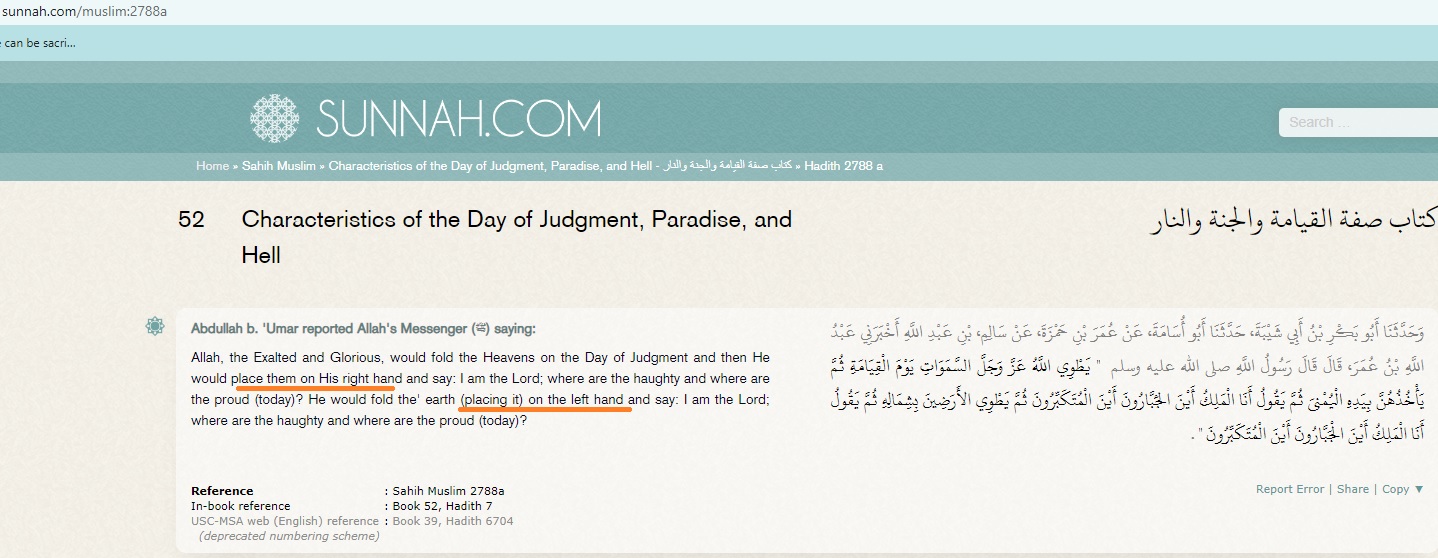
I came across a Hadith of Sahih Muslim which states:


“Abdullah b. ‘Umar reported Allah’s Messenger (may peace be upon him) saying: Allah, the Exalted and Glorious, would fold the Heavens on the Day of Judgment and then He would place them on His right hand and say: I am the Lord; where are the haughty and where are the proud (today)? He would fold the’ earth (placing it) on the left hand and say: I am the Lord; where are the haughty and where are the proud (today)?

The God of the Bible has hands (plural).

“The sea is his, for he made it, and his hands formed the dry land.” (Psalm 95:5)

“So I reflected on all this and concluded that the righteous and the wise and what they do are in God’s hands, but no one knows whether love or hate awaits them.” (Ecclesiastes 9:1 )

The God of the Bible has a right hand and Jesus is sitting next to it.

“He sat down at the right hand of the Majesty in heaven.” (Hebrews 1:3)

The God of the Bible has a right hand and Jesus is standing next to it.

“But Stephen, full of the Holy Spirit, looked up to heaven and saw the glory of God, and Jesus standing at the right hand of God “Look,” he said, “I see heaven open and the Son of Man standing at the right hand of God.” (Acts 7:55-56)

*NOTE* NO WHERE DOES THE BIBLE SAY GOD HAS A LEFT HAND!

Thus it can be deduced that the God of the Bible has two right hands (if not more right hands).

We explore this more in our article here:

https://primaquran.com/2024/08/20/the-anthropomorphic-god-of-the-bible/

BOTH OF ALLAH’S “HANDS” ARE RIGHT HANDS?

Now you can clearly see from the above text that many Salafi preachers have asserted that Allah (swt) has two hands and that “both his hands are right hands.” They get that from the above hadith!

Source: https://sunnah.com/nasai:5379

Yet, this hadith is Mudraj:

Mudraj – interpolated: an addition by a reporter to the text of the hadith being narrated. It even tells you in the hadith itself! Muhammad (one of the narrators said in his Hadith: “And both of His hands are right hands.”

How does one not see that?!

This cannot be said to be attributed to the Blessed Messenger (saw). This is the statement of the sub-narrator.

These people in their guilty conscious did not want people to think Allah (swt) has a left hand. Which also shows they are involved in dhan (speculation) about Allah (swt). They did not just let the words pass they had to make bold assertions without proof!

Some of the claimants to the Salaaf who hold these positions will expose themselves by blatantly comparing Allah (swt) to the creation by saying something along the following:

“You see akhi All of Allah’s attributes (hands, shin, face ect) can be described as right. Right here means blessed  (تَيَمُّن). As Muslims we know the right is preferred and more virtuous than the left. For example the verse in the Qur’an that says:

“So those on the Right Hand (i.e. those who will be given their Records in their right hands) – how (fortunate) will be those on the Right Hand! (As a respect for them, because they will enter Paradise).” (Qur’an 56:8)

Or for example:

“And those on the Left Hand (i.e. those who will be given their Record in their left hands) – how (unfortunate) will be those on the Left Hand! (As a disgrace for them, because they will enter Hell).”(Qur’an 56:9)

This is Tamthil clear as day. Let us say for the sake of discussion that Allah (swt) does indeed have a left hand as the hadith Sahih Muslim clearly says he does above. Why would any attribute of Allah (swt) not be blessed? That is a bizarre thought.

Then, the person commits a clear act of Tamthil (likening Allah (swt) to the creation) by negating a left hand for Allah (swt)!! They do this by comparing/contrasting the unfortunate news of people receiving their records in their left hands and right hands on the day of judgement. But these are actual hands of people!

This claimant to Salafiyah has committed a clear act of Tamthil.

  1. Is negating what clearly says he has: “a left hand” according to the sahih hadith.
  2. Making claims that an attribute of Allah (swt) would not be blessed?!

ALLAH (SWT) ACTUALLY HAS FOUR HANDS, TWO HANDS, BOTH OF WHICH ARE RIGHT HANDS EXCEPT ONE OF THOSE RIGHT HANDS IS A LEFT HAND!

“And He (is) the One Who sends the winds (of glad news between the two hands of his Mercy, until, when they have carried clouds ”(Qur’an 7:57)

Allah sends winds like herald of glad news, between the two hands of his Mercy.

Now his Mercy has two hands?

So those who believe in literal translations tell us that Allah (swt) has two right hands, and he has an attribute of Mercy and this attribute has two hands. Are they also right hands? Does Allah (swt) now have a total of four hands?

Please see for yourself at Islam Awakened the literal translation that the Salafi do not use.

https://www.islamawakened.com/quran/7/57/

Thank you gentleman for some honest translations. So now not only does Allah (swt) have two hands, and both of his hands are right hands and one of those right hands is a left hand, but his attribute of mercy also has two hands.

One of their scholars likened Allah (swt) to the moon!

Let us get something out of the way from the very beginning. There is not a single narration from the Blessed Messenger (saw) where when he speaks of Allah’s “hands” where the Blessed Messenger (saw), says, “In a way that befits his majesty” or “unlike his creation.”

That is an open challenge. For the person who can bring that I will shutdown this website!

I challenge any of those people who make such a disclaimer statement after mentioning “hands”, “foot”, “eyes”, “shin” “leg” “foot” or “side” to show this!

The fact that such people have to put a disclaimer after such a statement is an innovation!

“They have not appraised Allah with true appraisal, while the earth entirely will be within His grip on the Day of Resurrection, and the heavens will be folded in His right hand. Exalted is He and high above what they associate with Him.”(Qur’an 39:67)

“Allah said, “O Iblis, what prevented you from prostrating to that which I created with My hands? Were you arrogant then, or were you already among the haughty?” (Qur’an 38:75)

Some of these people have tried to argue that this word translated as “hands” must be understood as “hands” as something special concerning the creation of Adam. However, this is refuted by the following text of the Qur’an:

“Do they not see that We have created for them from what Our hands have made, grazing livestock, and then they are their owners?”(Qur’an 36:71)

Are we to say that cattle have an advantage or distinction over other animals because they were created by the “hands” of Allah (swt)?

“And the sky we built it with hands.” (Qur’an 51:47)

Look at the following three Saudi English translations of the Qur’an translate the above text!!

“And the heaven We constructed with strength, and indeed, We are its expander.”(Qur’an 51:47 Sahih International)

“With power did we Construct heaven. Truly, We can extend the vastness of space thereof.” (Qur’an 51:47 Muhsin Khan & Muhammed Al Hilali)

“With power and skill did We construct the Firmament: for it is We Who create the vastness of pace.” (Qur’an 51:47 Yusuf Ali Saudi 1985)

The hands of Allah (swt) tied up?

“And the Jews say, ‘The hand of Allah is tied up.’ Chained are their hands, and cursed are they for what they say. Rather, both His Hands are extended, HE spends however He Wills.” (Qur’an 5:64)

It is obvious, to begin with, that this very verse is allegorical. The Jews are not literally saying that Allah’s hand is “tied up”. Rather they are claiming that Allah (swt) is not bestowing upon them what they feel he should bestow. What this verse means is that both the power and generosity of Allah (swt) is on full display.

“He wrote the Tawrāt for you with His Own Hand.”

Source: (Bukhāri, no. 6614, Muslim, no. 80)

Other uses of the word hand in the Qur’an.

“Indeed, those who pledge allegiance to you, they are actually pledging allegiance to Allah. The hand (yadu) of Allah is over their hands (aydihim). So he who breaks his word only breaks it to the detriment of himself. And he who fulfills that which he has promised Allah – He will give him a great reward.” (Qur’an 48:10)

This is a metaphorical usage of the word hand that is allowed within the context of the Qur’an itself. Will it be said that people who have no hands or people who are amputees could never make such a pledge?

The word that is used for hand (yadu) the singular noun is also used for the plural noun (aydihim) above. The apparent understanding of the text, is that Allah (swt) has a hand and people have hands. Yet the following verse should make the matter more clear.

“Oh Prophet, say to whoever is in your hands (aydikum) of the captives, “If Allah knows any good in your hearts, He will give you something better than what was taken from you, and He will forgive you, and Allah is Forgiving and Merciful.” (Qur’an 8:70)

Are we supposed to imagine that the Blessed Prophet (saw) was a giant with little tiny people in his hands!?!

“Moreover, whatever strikes you of disaster – it is for what your hands have earned, but He pardons much.” (Qur’an 42:30)

Are we to understand from the above verse that as long as we do evil with our tongues, eyes, feet that disaster will not befall us? As far as those who do not have physical hands does this verse still apply to them?

“And remember Our servants Ibrahim and Ishaq and Yaqoub, men who possessed hands (l-aydi) and vision.” (Qur’an 38:45)

l-aydi is a plural noun literally it would be hands.

Here the word hands literally does mean power. Look how virtually everyone under the sun translates this!

https://www.islamawakened.com/quran/38/45/default.htm

“Or he in whose hand(biyadihi) is the knot of marriage remits.” (Qur’an 2:237)

If you have enjoyed this entry you may also find the following articles/entries of value:

What every Christian should ask every Muslim.

We explore the Anthropomorphic God of the Bible which also is claimed to have all right hands!

The correct way the attributes are understood.

https://primaquran.com/2022/10/04/ahmed-deedat-roasting-athari-aqeedah/

May Allah Guide the Ummah!

May Allah Forgive the Ummah!

3 Comments

Filed under Uncategorized

مفتی طارق مسعود عبادی مکتب کے بارے میں بتا رہے ہیں۔

“That Allah may repay the truthful for their truthfulness.” (Qur’an 33:24)

﷽ 

مہمان: ہم نے آپ کے پیچھے نماز پڑھی اور آپ نے ہمارے پیچھے نماز پڑھی۔
شیخ احمد: "ملت اسلامیہ ایک امت ہے" 
یہ ہمارا نقطہ نظر ہے اور ہم اس کی پیروی کرتے ہیں یہ ہمارے نبی، برگزیدہ، ان پر رحمتیں نازل فرمائے اور جس پر صحابہ کرام اور تابعین نے الحمد للہ رب العالمین کی پیروی کی۔ , #عمان کی برکت کے لیے خدا اپنے محترم شیخ، عالم کی حفاظت فرمائے۔ 
@AhmedHalKhalili

Mufti Tariq Masood gives a talk about the Ibadi school in Oman. Especially interesting is the comment section of other Muslims/Non Muslims who have lived in Oman and have been among the Ahl Haqq Wal Istiqamah.

There is great affinity of the Deobandi for the ‘Ulemah of Ahl Haqq Wal Istiqamah.

Since I have traveled with the tablighi jamaat, and have gone out on khuruj (with has the same etymological root as Kharijite), I guess that makes me and my brothers from the Tabligh, Khariji in that sense! HAHAHA!

Some little light humor is in order from time to time.

Any ways may Allah (swt) bless and guide Mufti Tariq Masood.

Our noble Shaykh, Ahmad bin Hamad al-Khalili, the grand mufti of Oman congratulated the Taliban on their takeover of Afghanistan.

https://www.middleeasteye.net/news/afghanistan-taliban-oman-grand-mufti-congratulates-clear-victory

May Allah (swt) Guide the Ummah.

May Allah (swt) Forgive the Ummah.

Leave a comment

Filed under Uncategorized

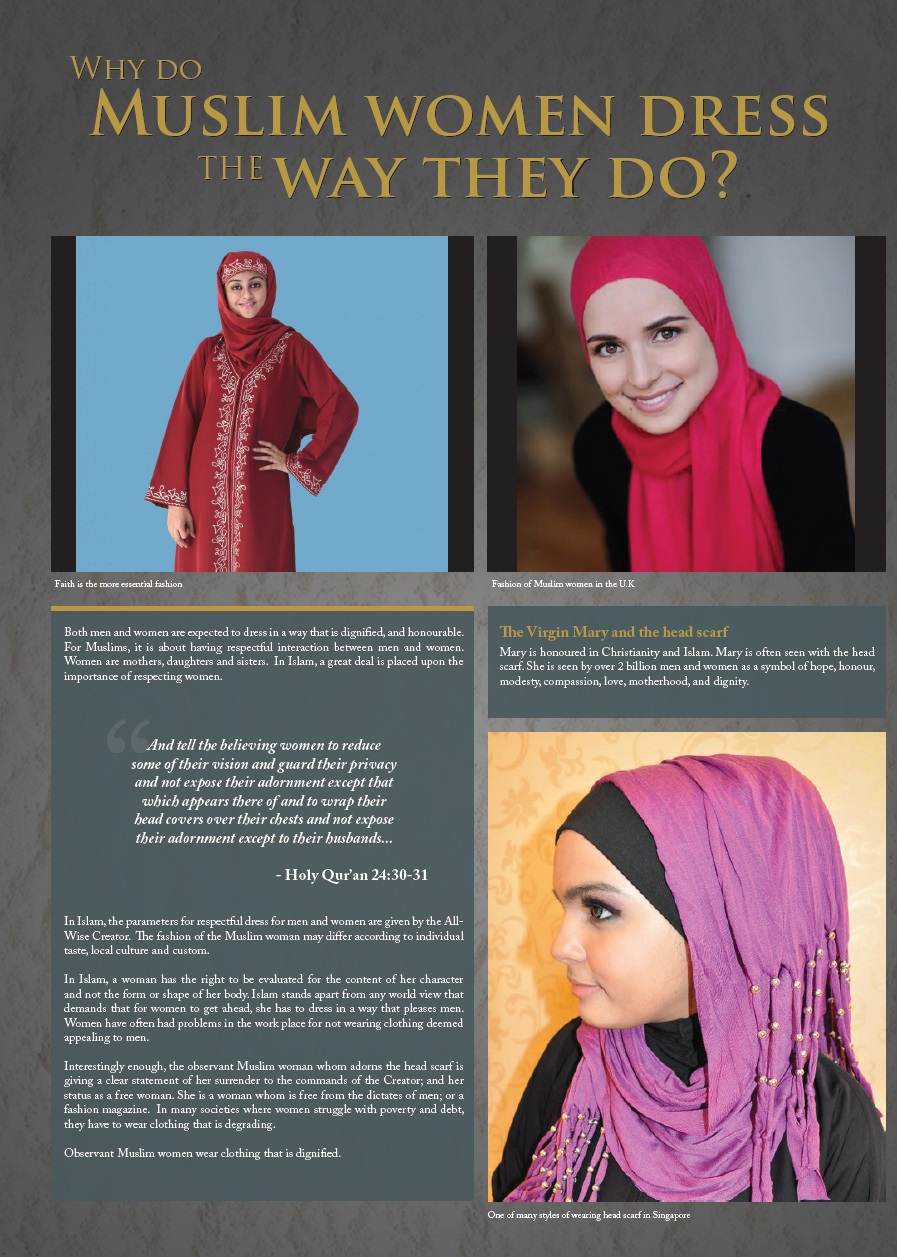
Khimar (Head Covering) is an injunction with in the Qur’an.

“And say to the believing women that they are lower their gaze and guard their sexual organs; and that they are not to display their ornaments except for what appears thereof. And let them draw their head coverings (bikhumurihinna) over their bosoms.” (Qur’an 24:31)

O Prophet! Say to your wives, your daughters, and the women of the believers that they are to cast their over-garments (jalābībihinna) over them. That is more convenient, that they be recognized, so that they won’t be molested.” (Qur’an 33:59)

﷽ 

“And say to the believing women that they are lower their gaze and guard their sexual organs; and that they are not to display their ornaments except for what appears thereof. And let them draw their head coverings (bikhumurihinna) over their bosoms.” (Qur’an 24:31)

Quite often some would point to the fact that the word ḥijāb (حجاب) is not used in Qur’an 24:31 in connection to the head scarf. Thus this lead them to the mistaken notion that woman are not commanded to cover thier hair.

The Qur’ān itself uses the word khimār (خمار) in Sūrah an-Nūr 24:31, where women are instructed to draw their khimār over their bosoms. In classical Arabic, khimār means a cloth or covering that drapes from the head, often covering the hair and neck.

The word ḥijāb (حجاب), on the other hand, literally means a barrier, partition, or veil. In the Qur’ān, it is used in this more general sense (e.g., 33:53, 42:51), not specifically for a head covering. Over time, however, Muslim societies began to use hijab as a broader term for modest dress, especially the headscarf.

“Verily, such (behaviour) annoys the Prophet, and he is shy of (asking) you (to go), but Allah is not shy of (telling you) the truth. And when you ask (his wives) for anything you want, ask them from behind a screen (ḥijābin), that is purer for your hearts and for their hearts.”

“It is not fitting for a man that Allah should speak to him except by inspiration, or from behind a veil(ḥijābin), or by the sending of a messenger to reveal, with Allah’s permission, what Allah wills: for He is Most High, Most Wise.” (Qu’ran 42:51)

There is a hijab between Allah and the creation. The black cloth that is put over the Kaaba in Mecca is a hijab. Men wear a hijab.

Most countries today have a hijab that is enforceable by law.

In most countries, public nudity is an offense that can garner either a fine or jail time.  Hudud means: boundaries, limits or restrictions. What those boundaries and limits are can differ from country to country.

There are only a few remote places in the world where there are tribes in which full nudity takes place. 

Even countries that allow full nudity at what are known as nudist colonies or nudist resorts these are select places. If you go outside those areas nude, you can and will be either fined or jailed.

That which the Muslim covers herself with is the Khimār.

So, technically:

  • Khimār = the headscarf covering the hair, neck, and often the shoulders.
  • Hijab = the general concept of modesty and barrier; in modern usage, often synonymous with headscarf.

Another mistake today is that people believe that wearing a khimar is enough. In the context of the verse, women are, by default, wearing khimar. They are being instructed to pull it down over their bosoms. Both men and women are expected to dress modestly.  It is quite possible to find a woman who is not wearing a headscarf dressing more modestly than a woman who, for example, wears a headscarf and tight fitted jeans. 

We believe that the Blessed Messenger (saw) explained the Qur’an to his people.

“And obey Allah and obey the Messenger. But if you turn away, then Our Messenger is responsible only for conveying the message clearly. (Qur’an 64:12)

The Muslim woman wearing the Khimār may vary according to custom and culture. Yet this is a transmitted practices that has reached us from the Blessed Prophet (saw).

It has reached us as Muslims across the sectarian divide that a Muslim woman covers all but the hands and face.

That is to say, the Shi’a, the Sunni, and Ibadi have all concurred on this. In fact, the only debate within the community is whether she should cover more than this, meaning — the face veil.

Islam does not oblige a person to wear specific type of clothing as long as it fulfils the purpose of modesty. Rather, this depends on the customs of society, so long as those customs do not contradict the guidelines of Islam.

In a world of nihilism and postmodernism, there can be a lot of pressure upon any faith tradition to amalgamate and transform their faith into something ‘more acceptable’ to an increasingly secularized world.

We feel the issue of women’s Khimār is one such issue. It seems to us that many struggle with this. 

Where we feel Muslims do not ponder deeply enough is on the ‘default dress’. When this verse above was being revealed, what was the ‘default dress’ of the people of that time? What was the basic ‘skeleton’ if you will?

This is what has led many who are ignorant of the Arabic language as well as the context of the revelation will leave open the possibility of wearing tight and revealing clothing, or even skirts. It really seems that we could offer a better response than to simply cave in completely to postmodernism. It may be cliché, but a saying comes to mind, ‘If you do not stand for something you will fall for anything.’

There is a real disdain for Muslim women who choose to continue to observe the Khimār as explained by the Blessed Messenger (saw) and preserved in the mass transmitted Sunnah.

Examples where the dress code can be relaxed.

Such elderly women are past the prospect of marriage, there is no blame on them if they lay aside their (outer) garments(thiyābahunna), provided they do not display their beauty/adornment. But it is best for them to modestly refrain: “And God is One Who sees and knows all things” (Qur’an 24:60)

It can be a normal garment and an outer garment. (11:5; 24:58).

In verse Q 24:60, we clearly note that an older woman is permitted to remove this ‘thobe’ without wanton display of her beauty. This cannot refer to her normal garments, as if these were to be removed she would be left exposed.

“The women may relax (their dress code) around their fathers, their sons, their brothers, the sons of their brothers, the sons of their sisters, the other women, and their (female) servants. They shall reverence Allah. Allah witnesses all things.” (Qur’an 33:55)

Remember the five essential objectives of the Sharīʿah (maqāṣid al-sharīʿah). These objectives are:

  1. Protection of religion (ḥifẓ al-dīn)
  2. Protection of life (ḥifẓ al-nafs)
  3. Protection of intellect (ḥifẓ al-ʿaql)
  4. Protection of lineage/progeny (ḥifẓ al-nasl)
  5. Protection of wealth (ḥifẓ al-māl)

O Prophet! Say to your wives, your daughters, and the women of the believers that they are to cast their over-garments over them. That is more convenient, that they be recognized so that they won’t be molested.” (Qur’an 33:59)

In this case if you stand out in a way that directly identifies you as a Muslim the purpose of this guidance is defeated. You will be recognized and you will be molested. You might even be killed.

There is a principle in Shari’a law

لا ضرر ولا ضرار

“Lā ḍarar wa lā ḍirār”
= No harm and no reciprocating harm.

Abu Sa‘īd al-Khudri reported: The Messenger of Allah (saw) said:
“There should be no harm or reciprocal harm. Whoever causes harm, Allah harms him, and whoever makes things difficult, Allah makes things difficult for him.

Source: (https://hadeethenc.com/en/browse/hadith/4711)

So there are two examples.

a) A woman who chooses Islam as her faith.  If she outwardly dresses or identifies as a Muslim, she could be assaulted or attacked. She does not wear the Khimār. She can dress modestly and, as Allah (swt) cautions us: Do not transgress the limits. A relaxing of outward garb is not an invitation to abandon modesty altogether.  That woman lives as such until she can travel to a place where Muslims are numerous, and she can fulfill the commands. 

b) A woman who was born and raised a Muslim. Suddenly there is news that Muslims are getting attacked and killed wherever they are found. This woman also does not need to outwardly identify nor dress as a Muslim until she can reach a place where Muslims are numerous, and she can fulfill the commands.

You can read more about this here:

This was a panel that Allah (swt) graced our brother to do for the Sultan Masjid ‘mini-gallery’ in Singapore. It is the first ‘mini-gallery’ in any masjid anywhere. Al hamdulilah.

We would encourage readers to read this very excellent and brief over view of the topic here:

http://www.lamppostproductions.com/the-matter-of-hijab-the-headscarf-abdullah-bin-hamid-ali/

We would also encourage sisters and brothers to check out the excellent work the sisters are doing over here:

http://worldhijabday.com/

May Allah (swt) guide the Ummah.

May Allah (swt) forgive the Ummah.

9 Comments

Filed under Uncategorized

Are we to follow Infallible Imams according to the Qur’an?

﷽ 

O you who have believed, obey Allah and obey the Messenger and those in authority among you. And if you disagree over anything, refer it to Allah and the Messenger, if you should believe in Allah and the Last Day. That is the best [way] and best in the result. (Qur’an 4:59)

1) In this clear verse, we find that in matters of disagreement between those in authority and those under authority, we need to refer back to Allah and the Messenger.

Had it been that those in authority were infallible or divinely appointed then, Allah wouldn’t have given any scope to disagree with them.

The fact that there is disagreement proves that “those in authority, aka the Ulil Amr”, are neither an absolute nor an infallible authority.

It means that Ali Ibn Abu Talib and Ibn Abbas can disagree with one another. Yet, if they have a disagreement, they would refer the matter back to Allah (swt) and his Blessed Messenger.

2) If their authority was infallible, Allah(swt) wouldn’t have put authority above them. (.i.e) Allah and His Prophet.

3) If “those in authority, aka the Ulil Amr” were divinely appointed, then Allah would have asked the believers to refer them along with Allah and the Prophet in matters of disagreement.

But Allah(swt), giving the possibility of disagreement with those in authority, asked us to refer back to Allah (swt) and the Blessed Messenger; which is clear evidence that “those in authority aka the Ulil Amr” were not divinely appointed.


The huge advantage that the Sunni have over the Imami Shi’i’ is as follows:

Since in Sunni Islam they do not believe that their Imams are infallible or above reproach, a mistake in jurisprudence, reasoning, deduction or logic does not entail disaster for Sunni Islam. However, just one mistake in jurisprudence, reasoning, deduction or logic would be absolutely disastrous for the Imami Shi’i’.


“You see, then the Imamate goes from the Imam to his first cousin, and when the first cousin dies, then the Imamate goes to his first cousin and so on. Because that is the Sunnah of the Prophet (saw).”

Huh?

The battle of Siffin and practical implications of the above verse.

O you who have believed, obey Allah and obey the Messenger and those in authority among you. And if you disagree over anything, refer it to Allah and the Messenger, if you should believe in Allah and the Last Day. That is the best [way] and best in the result. (Qur’an 4:59)

The battle of Siffin gives us a demonstration of how some of the companions understood the above verse. If we are to believe the historical narrative as told by Shi’i and Sunni sources.

If we are to believe the Shi’i narrative.

 Ali agreed to arbitration with Muaviya on the basis that they would judge by the Qur’an. If Ali understood that he was of the same authority as the Qur’an and the Messenger (saw) he would not have submitted to arbitration. He would have been on the same page as those in his army who wanted to continue the fight.  However, if he did think he was of the same authority as the Qur’an and the Messenger (saw), then he would be a hypocrite for going against what he himself believed. Or he was not sincere in submitting to the authority of the Qur’an. 

If we are to believe the Sunni narrative. 

If those in Muaviya’s camp believed that the Shi’i held any of the views about Ali that Imami Shi’i held, namely that he (Ali) was maʿṣūm (معصوم) and he (Ali) held ʿiṣmah (عصمة) they themselves would have never asked for arbitration as it too would have simply been a ruse. This becomes very clear that these concepts were not among the followers of Ali because Muaviya’s camp would have known this and would have never cooked up the idea of raising the Mushafs as it would have easily backfired

May Allah (swt) guide us all to what is beloved to Allah (swt).

May Allah Forgive the Ummah.
May Allah Guide the Ummah.

4 Comments

Filed under Uncategorized

Tribalism and Islam


Allah asked, “What prevented you from prostrating when I commanded you?” He replied, “I am better than he is: You created me from fire and him from mud.” (Qur’an 7:12)

﷽ 

THE VERY FIRST SIN ACCORDING TO ISLAM IS THE BOASTFUL PRIDE OF ONE’S ORIGIN…. (TRIBALISM)

If there is one sad and shameful takeaway (from the recent New Zealand Christchurch massacre) that is directed towards our own community (as Muslims) is that SOME in the Muslim community will take this opportunity to deflect the ugly and heinous way that MANY of them treat Muslims who are Black, African, Sub-Sahara African, West African, South Indian etc.….

So, instead of using this as an opportunity to teach, to learn, to grow and to heal…..they deflect their collective guilt upon another group, ‘The Whites’.


Let it be a reminder that, according to Allah Most High that the first sin ever was the PRIDE OF ONES ORIGIN.


When Allah had ordered all the dominions to bow down before the creation of humanity, only one creation stood in rebellion to this command.


Allah asked, “What prevented you from prostrating when I commanded you?” He replied, “I am better than he is: You created me from fire and him from dark mud.”


Iblis felt that it was unbecoming to subservient to one he deemed being of an inferior origin.
This is the attitude that SOME White people exhibit towards non White people.
This is the attitude that SOME Jews exhibit towards Arabs.
This is the attitude that SOME Chinese exhibit towards Non Chinese.
This is the attitude that SOME Pathans exhibit towards Punjabis.
This is the attitude that SOME Arabs exhibit towards Non Arabs.
This is the attitude that SOME fair skinned Mexicans exhibit towards non fair skinned Mexicans.
This is the attitude that SOME Japanese exhibit towards non Japanese.
This is the attitude that SOME North Indians exhibit towards South Indians.
This is the attitude that SOME Hutu exhibit towards Tutsi.
This is the attitude that SOME Tutsi exhibit towards Hutu.
 
Humans are a very interesting and curious species.  We often decorate our walls with accolades and awards and many of us like to boast about our lineage and ancestry.

decorate-a-wall1

We believe self-esteem is a good thing, and it is especially important to instill this in our children. Yet, we should be cautious as not to make our degrees, accomplishments, accolades or lineage as an opening for whispers to the heart that can cause us to be vainglorious.

Being proud of one’s achievements is a good thing. It can help you in landing a job or to show others that you are competent in a particular field. Yet for those in our community who are constantly boasting about ethnicity, tribal heritage or lineage, it is tantamount to taking a picture of your parents’ privates and proudly displaying that on a wall!

We have seen even some of the most pious and erudite in the Muslim communities do just that.

When Allah (swt) PUTS ALL OF US IN OUR PLACE when He (swt) says the following:

“He (Allah) has created man from a sperm-drop; and behold, this same (man) becomes an open disputer!” (Qur’an 16:4)

“His companion said to him, in the course of the argument with him: “Do you deny Him Who created you out of dust, then out of a sperm-drop, then fashioned you into a man?” (Qur’an 18:37) 


Now, except Adam, Eve and Jesus (upon them all be peace), every other single human being created had been created from nutfah or spermatos -semen. 

Now there maybe some people who will boast that Adam and Eve were from their tribe, their lineage and their ancestors. The first man and woman on the Earth were not created from sperm, so that tribe or lineage must somehow be better than other humans, correct?

Well, consider that Adam (alayi salam), his son Cain, was the first reordered murderer on Earth. What is there to be boastful about in that?


Especially since in Qur’an 16:4, Allah (swt) has used this to show the very, very low state of human beings who then rise up to become haughty, arrogant, boastful and vainglorious.

SO WHAT IS THE SOLUTION?

“O mankind, indeed We have created you from male and female and made you peoples and tribes that you may know one another. Indeed, the most noble of you in the sight of Allah is the most righteous of you. Indeed, Allah is Knowing and Acquainted.” (Qur’an 49:13)

Allah (swt) did not count nobility, ethnicity, tribal affiliation, family lineage or anything of the kind.

Allah (swt) has recognized us based upon what emanates from our hearts and souls. Our nobility is in how we treat each other, tread upon this earth, fear and love Allah (swt).

Allah (swt) made us with variance so that we may know each other. So that we may learn to live with variance.

What is interesting about this?   The interesting thing about this is we will truly know who outranks who in the sight of Allah only on the day of judgement.

There is no annual award or ceremony (most righteous Muslim of the year goes to …..)

You may also be interested in reading the following:

https://primaquran.com/2025/01/22/are-arabs-superior-to-malays-and-everyone-else-imam-shafii-and-ibn-taymiyya-think-so/

https://primaquran.com/2025/01/23/aftab-malik-the-broken-chain-preparation-for-arab-racial-superiority-in-islam/

May Allah (swt) take the rancor of hate from our hearts.

May Allah (swt) cause us to love and appreciate the beauty in the diversity of humanity.

May Allah Guide the Ummah.

May Allah Forgive the Ummah.
Leave a comment

Filed under Uncategorized

Ibn Taymiyya: The Sufi Shaykh Part 2

Do not mix truth with falsehood and do not deliberately hide the truth.” (Qur’an 2:42) 

﷽ 

Those who have not read part 1 may be interested to read that here:

Before I begin this part 2 I would like to begin with the conclusion from part 1.

There are a number of reasons why many different groups (especially those who want division and discord) among Muslims would keep this information hidden.

#1) Sunni Muslims who belong to Sufi groups and associated with the Ashari theological school don’t want people to know Ibn Taymiyya who was Athari in his school was a Sufi.  This gives the impression that Sufism is a monopoly of those who follow the Maturdidi or Ashari theological positions.

#2) Those Sunni Muslims who belong to the theological schools of the Maturdidi and Ashari and also follow Sufi tariqat have high esteem for Shaykh Abdul Qadir Al Jilani (who was Athari in creed) don’t want people to connect the dots.  The reason being is it takes the wind out of the sails of those who make takfir upon the Atharis. They dare not do this with Sheikh Abdul Qadir Al Jilani!

#3) Those who say they follow the ‘Salafi Manhaj‘ -they rely heavily upon Ibn Taimiyya and they are harsh in their critique of Sufism and Tassawuf in general. They would not want any of their followers to even get the slightest whiff that Ibn Taimiyya belonged to a Sufi order.

#4) It is a useful tool in the heads of those who have machinations upon Muslim lands and have a vested interest in keeping the divide going among Muslims; especially Sunni Muslims (the largest group).

IBN TAYMIYYA’S DISCUSSION OF TASAWWUF IN HIS MAJMU’A FATAWA

What Ibn Taymiyya Says About the Term ‘Tasawwuf’? 

Here we will mention what Imam Ibn Taymiya, mentioned about the definition of Tasawwuf, from Volume 11, “At-Taswassuf” of “Majmu’a Fatawa Ibn Taymiyya al-Kubra, ” Dar Ar-Rahmah, Cairo:

“Alhamdulillah, the pronunciation of the word Tasawwuf has been thoroughly discussed. From those who spoke about Tasawwuf were not just the Imams and Shaikhs, but also included were Ahmad bin Hanbal, Abi Sulayman ad-Daarani, As-Sirr as-Saqati, al-Junayd al-Bahgdadi, Hasan al-Basri, Ma’auruf al-Karkhi, Abdul Qadir Jilani, Bayazid al-Bistami [one of the grand Shaykhs of the Naqshbandi Tariqat] and many others. This is a term that was given to those who were dealing with that kind of science [tazkiyyat an-nafs and Ihsan].”

Imam Ibn Taymiyya says:

“Tassawuf has realities and states of experience which they talk about in their science. Some of it is that the Sufi is that one who purifies himself from anything which distracts him from the remembrance of Allah and who will be so filled up with the knowledge of the heart and knowledge of the mind to the point that the value of gold and stones will be the same to him. And Tasawwuf is safeguarding the precious meanings and leaving behind the call to fame and vanity in order to reach the state of Truthfulness, because the best of humans after the prophets are the Siddiqeen, as Allah mentioned them in the verse:

“(And all who obey Allah and the Apostle) are in the company of those whom is the grace of Allah: of the prophets, the sincere lovers of truth, the martyrs and the righteous; Ah! What a beautiful fellowship.” (an-Nisa’, 69,70)

Ibn Taymiyya continues: “as-Sufi hua fil-haqiqa naw’un min as-siddiqeen. Fahua as-siddiq alladhee iktassa bil-zuhadiwal-‘ibadada.” which translates:

“And the Sufi is, in reality, a kind of Siddiq (Truthful One), that  Siddiq who specialized in zuhd and worship.”

He continues about the Sufis,

“Some people criticized the Sufiyya and Tasawwuf and they said they were innovators, out of the Sunnah, but the truth is they are striving in Allah’s obedience [mujtahidin fi ta’at-illahi], as others of Allah’s People strove in Allah’s obedience. So from them, you will find the Foremost in Nearness in virtue of his striving [as-saabiq ul-muqarrab bi hasab ijtihadhi]. And some of them are from the People of the Right hand [ Ahl al-Yameen mentioned in Qur’an in Surah Waqiah], but slower in their progress. For both kinds, they might make ijtihad and in that case, they might be correct and they might be wrong. And from both types, some of them might make sin and repent. And this is the origin of Tasawwuf. And after that origin, it ha been spread and (tasha’aabat wa tanawa’at) has its mainline and its branches. And it has become three kinds:

1.) Sufiyyat il-Haqa’iq-the True Sufis

2.) Sufiyyat il-Arzaaq -the Professional Sufis (Those who use Sufism for personal gain)

3.) Sufiyyat il-Rasm -The Caricature Sufis. (Sufi by appearance only).”

IMAM IBN TAYMIYYA ABOUT SAINTS AND SAINTHOOD

Imam Ibn Taymiyya mentions in volume 11, page 190 of Majmu’a Fatawi Shaikh ul-Islam Ibn Taymiyya , edition published in Egypt by Dar ar-Rahma:

“A servant of Allah ‘azza wa-Jal’, cannot be considered a saint unless he is a true believer. Allah mentions in the Qur’an:

“Now surely the friends of Allah-they shall have no fear nor shall they grieve. Those who believe and guarded (against evil):” (Yunus, 61,62)

He then quotes from the famous hadith from Bukhari:

“My servant draws not near to Me with anything more loved by Me than the religious duties I have enjoined upon him, and My servant continues to draw near to Me with supererogatory works so that I shall love him. When I love him I am his hearing with which he hears, his seeing with which he sees, his hand with which he strikes and his foot with which he walks. Were he to ask [something] of Me, I would surely give it to him and were he to ask Me for refuge, I would surely grant him it. I do not hesitate about anything as much as I hesitate about [seizing] the soul of My faithful servant: he hates death and I hate hurting him.”

Imam Ibn Taymiyya About Miracles Of Saints

In his book al-Mukhtasar al-Fatawa al-Masriyya, published by al-Madani Publishing House,1980, page 603:

“The miracles of saints are absolutely true and correct, by the acceptance of all Muslim scholars. And the Qur’an has pointed to it in different places, and the Hadith of the Prophet (s) have mentioned it, and whoever denies the miraculous power of saints are only people who are innovators and their followers.”

He continues in Majmu’a Fatawai Ibn Taymiyya:

“What is considered as a miracle for a saint is that sometimes the saint might hear something that others do not hear and they see something that others do not see, while not in a sleeping state, but in a woken state of vision. And he can know something others cannot know, through revelation or inspiration.”

All that Imam Ibn Taymiyya says about the subject of Tasawwuf is found in a large book (volume 11) consisting of 704 pages only about Tasawwuf. And we would like to mention briefly what he said on page 314, about the hadith Qudsi [i.e. related form Allah Himself]:

Verily Allah ta’ala has said: ‘Whosoever shows enmity to a wali (friend) of Mine, then I have declared war against him.”

Source: (https://sunnah.com/nawawi40:38)

Imam Ibn Taymiyya says:

Which means that Allah is expressing: I will seek revenge against anyone who comes against My saints like an aggressive lion.'”

He continues on p. 314 quoting Prophet’s saying about the saints: “You are the martyrs of Allah on Earth.”

Imam Ibn Taymiyya About The Unveiling Of Appearances

He said: “Allah Almighty will unveil to his saint’s states that have never been given before and give them support without measure…If that saint will begin to speak form the things of the unseen, past, or present or future it is considered from “Bab al’ilm al-khaariq” the miraculous unseen knowledge…..Anything that a saint does which is form unveiling to people or to listeners or curing or healing or teaching knowledge, it is accepted….and we have to thank Allah for it.”

Imam Ibn Taymiyya Mentions Some Great Shaikhs of Sufism

And we wish to mention some of the shaikhs, who Imam Ibn Taymiyya accepted from the well-known Sufi shaikhs. This is found in his volume entitled ‘Ilm as-Sulook [The Science of Travelling the Way to Allah], which consist of the whole volume 10 of Majmu’a Fatawa Ibn Taymiyya which is 775 pages in length, all of which is about the knowledge of the ways of true Sufism, the Science of Traveling to Allah, [‘ilm us-sulook].

On page 516, the third paragraph he says:

“The great Sufi shaikhs are the best shaykhs to be known and accepted, such as Bayazid al-Bistami [a grand shaikh of the Golden Chain of the Naqshabandi Tariqat], Shaikh Abdul Qadir Jilani, Junayd bin Muhammad [the most well-known Sufi]. Hasan-al-Basri, al-Fudayl ibn al-Ayyad, Ibrahim bin al-Adham [very famous Sufi, known as Sultan of the Ascetics], Abi Sulayman ad-Daarani,

Ma’ruf’al-Karkhi[a well-known Sufi], Siri-as-Saqati, Shaikh Hammad, Shaikh Abdul Bayyan.”

And Ibn Taymiyya continues:

“Those great Sufi people were the leaders of humanity and they were calling to what is right and forbidding what is wrong.”

In Majmu’a Fatawa Ibn Taymiyya , published by Dar ar-Rahmat, Cairo, Vol, 11, page 497. Book of Tassuwuf), Ibn Taymiyya says:

“You have to know that the rightly -guided shaikhs must be taken as guides and examples in the Din, as they are following in the footsteps of the Prophets and Messengers. And the Way (tariqat) of those shaikhs is to call people to Allah’s Divine Presence and obedience to the Prophet.”

Here we find Ibn Taymiyya calling for people to take a guide and mentioning that each guide has his own method (tariqat) in calling people to the Prophet’s ways.

Ibn Taymiyya says on page 499 of the same volume:

“And the shaikhs whom we need to take as guides are our examples that we have to follow, as when on the Hajj, (the pilgrimage) one needs a guide [daleel] to reach the Ka’aba, these shaikhs our guide [daleel] to Allah and our Prophet (s).”

Ibn Taymiyya quotes from Bayazid al-Bistami, who said, on page 510, Volume 10:

“….the great Sufi shaikh Bayazid al-Bistami and the famous story about him when he saw Allah in a vision (kashf) and said to Him: ‘ O Allah what is the way to You?’ and Allah responded ‘Leave yourself and come to Me.'”

Ibn Taymiyya continues quoting Bayazid al-Bistami, “I shed my self as a snake sheds its skin.”  This quotation is an indication of the need for zuhd (self-denial or abstention from the worldly life), as that was the path followed by Bayazid al-Bistami.

So we see from the above quotes, that Ibn Taymiyya was accepting many shaikhs by quoting them and urging people to follow guides to show the way to obey Allah and to obey the Prophet (s).

Imam Ibn Taymiyya Explains Those Who Are Speaking About Fana’ 

In Book 2, volume 2, pages 396-397 of Majumu’a Fatawi Ibn Taymiyya, published by Dar ar-Rahmat, Cairo, Ibn Taymiyya speaks about the subject of fana’ also known is Sufism as annihilation, He said,

“This state of love is the state of many people that are from the people of Love of Allah ‘azza wa jall, they are the people of the love of Allah and the People of the Will (al-Irada) of Allah (it is typical of many of the people who love Allah and seek Him.) Because that person has vanished in his lover, in Allah ‘azza wa jall-through the intensity of the love, because He vanished in Allah’s love, not his own ego’s love. And he will recall Allah, not recalling himself, he would remember Allah not remembering himself, visualizing Allah [yastashhid], not visualization himself, existing in Allah, not in the existence of himself. When he reaches that stage, he no longer feels his own existence. And that is why he says in this state, ‘Ana al-Haqq” ( I am the Truth), or “Subhanee. (Glory to Me!)” And he will say “maa fil jubba ill-Allah” (there is nothing in this cloak except Allah) because he is drunk in the love of Allah and this is a pleasure and happiness that he cannot control.”

Further on Ibn Taymiyya says:

“This [matter] has in it Haqq and there is in it Batil. But when someone will enter a state with his fervor intense love (‘ishq) to Allah, he will enter a state of absentmindedness, and when he enters the state of absentmindedness, he will find himself as if he is accepting the [concept] ittihad. I do not consider this a sin. Because that person is excused and no one may punish him as he is not aware of what he is doing. Because the pen doe snot condemns the crazy except when he is restored to sanity. And when that person is in that state and he was wrong in what he did, he will be under Allah’s address:

“Rabbana laa tuakhidhna iin-nasseena aw ak-htaana” “O  Our Lord, do not take us to task if we forget or make mistakes.” (Baqara, 286)

“And Allah says in other verse, “wa laa junaaha ‘alwaykum fimma akhtaatum bihi” “there is no blame on you if you unintentionally do a mistake.”

On page 339, in Volume 10, he says:

“There is a story of two men who were so respectful and loved each other very much. One of them fell in the water [of the sea] and immediately the other threw himself behind him. Then the first, one who was sinking asked, “what made you throw yourself here?” He said, “I vanished in you. And when I vanished in you I thought you were me and I was you.”

And further on he continues:

“As long as he is not drunk through something that is prohibited, it is accepted, but if it were prohibited, (the intention was bad) then he is not excused.”

And he continues (vol 2,, page 397):

“And because of that  [situation] many of the saints, like ‘Abdul Qadir Jilani, have an excuse, because they are in a state of love (‘ishq).”

That subject is also mentioned in a whole chapter in detail from page 337 page 343, entitled:   al-Fana’ alladhee yujad fi kalam as-sufiyya yuffassar bi-thalathat umur.

This title means: “the Word of Annihilation found in Sufism explained in Three Ways.” This chapter describes in detail the concept of fana’.

This is the conclusion of the 2 part series. It is now up to you the reader to do your own research and reflection on this matter.

All praise be to Allah! 

May Allah Guide the Ummah.

May Allah Forgive the Ummah.
4 Comments

Filed under Uncategorized