“The servants of the RaHmān (the All-Merciful, Allah) are those who walk on the earth humbly, and when the ignorant people speak to them, they reply peacefully.” (Qur’an 25:63)
﷽
So it was just after Farj on Jumaa morning here in Singapore when I checked my WhatsApp and there from that gentle and noble soul, brother Nazzam were the latest links of interest. Bless him! I would get updates from time to time on articles, blog posts and vlogs and debates that have taken place. So this particular morning was a debate between two people I had not really known before.
So I head over to twitter and what do I see, already that one side has censored comments. So, I go and click on the link to the debate posted on YouTube. The comment section was clearly pro Dr. Khalil. I saw many people in vigorous exchanges with followers of the Athari creed; and they were getting pressed. I then recalled that the first time I heard of this Jake guy. I believe he was introduced by Mufti Abu Layth (Naheim Ajmal) in one of his episodes. I believe it was pointed out that he used arguments he pinched from Professor Emad Hamdeh’s against the Quraniyoon, to use as reasons why (he), Jake, was no longer intrigued with that movement. From there on this Jake threw in his lot with the Athari/Salafist crowd. In this day and age if you want to gain followers and notoriety quickly through social media that is the most strategic decision one could make.
Not knowing of Dr. Khalil Andani, however, was clearly a loss for me. It is clear to me that Professor Andani is quite formidable. There is no doubt in mind that anyone who ever had the blessing of attending his class got their hard-earned money’s worth. Beyond that, they learned at the hands of an adept.
As for those people who are sitting comfortably in their homes drinking high grade coffee shrugging their shoulders and saying ‘who cares’ about such a debate. Welcome to the world of privilege and security! Professor Andani is doing you and everyone else a huge service! He is debating a person who is representative of a certain strain of thought that on the regular participates in the anathematization of other Muslims.
It is no stretch of the imagination to say that by putting a dent in such creedal positions he could be saving lives! Imagine an impressionable young Muslim who believes that Professor Andani and all like him hold such abhorrent aberrant and dangerous views that they must be dealt with. Imagine a gathering of high profile Muslim philosophers conducting a symposium, Professor Andani is in attendance, suddenly an attacker unleashes a few rounds killing many people in the process.
Imagine that same impressionable young Muslim saw the disasters performance on behalf of Jake, and although he may not be inclined to agree with everything Professor Andani says, he witnessed enough to make him question the absolute certainty that he once placed in the Athari creedal position. Instead of wanting to pop off a few rounds into a crowd of people who have been anathematized; this youth leaves Salafism altogether, or he becomes convinced of his own position, while holding space for other views.
I will be fair to say that Al Qaeda, Al Nusrat, ISIS and others do not necessary represent Salafism per say. However, it is not even a point of debate to say that Al Qaeda, Al Nusrat, ISIS have more in common with Salafi/Athari thought than they do Ashari/Maturidi/Mutazali theological positions.
Make no mistake about it, this debate is a watershed moment. The Athari creed has never been laid bare, deconstructed and destroyed in such a public formatted debate as it was in this debate.
Jake went in so cocksure of himself thinking Dr. Andani would be easy prey.
It was like watching a Discovery Channel documentary where you see the Mongoose carefree through the forest, and you spot a cobra skulking and slithering its way through the foliage, poised to strike.
Yet, this Mongoose will be no prey! On the contrary, once the Mongoose caught on to the scent, and pressed the attack, the poor cobra takes such a thrashing that you almost feel sorry for the elapid.
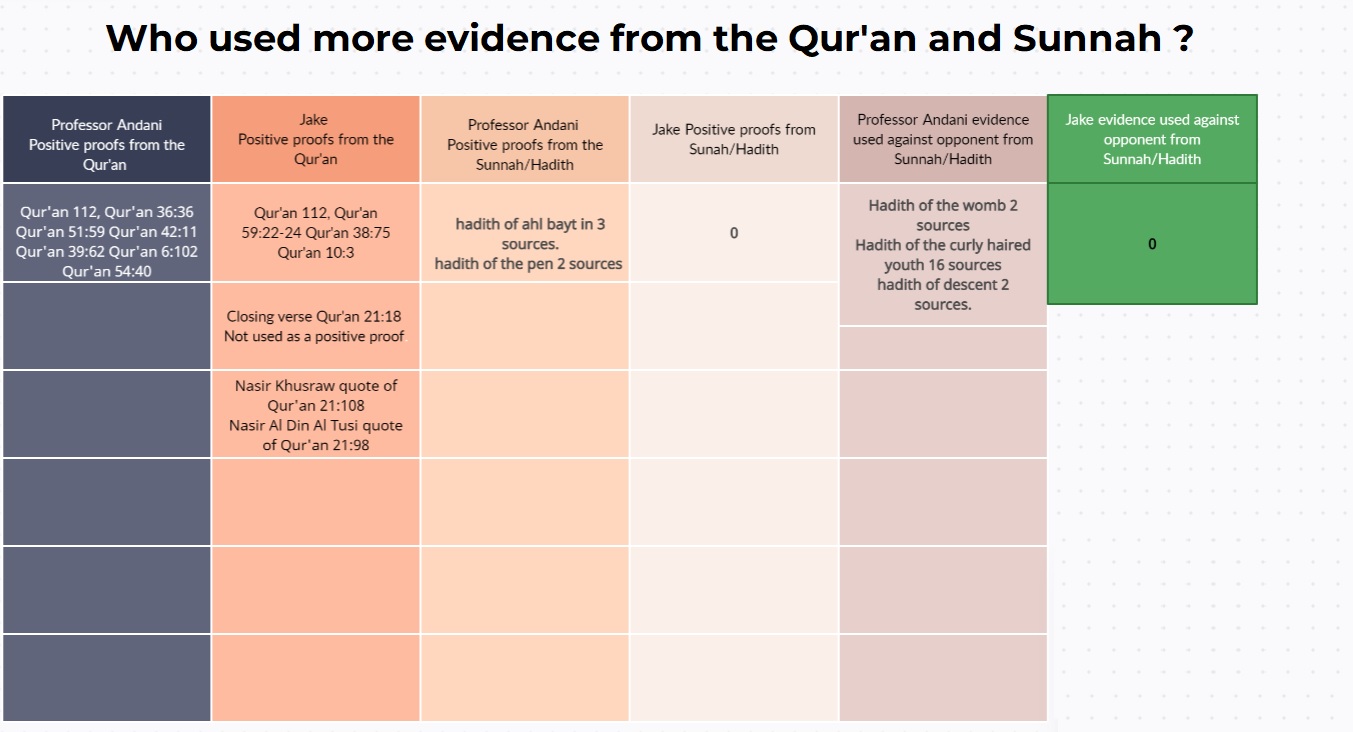
Let us look at the opening statements of each of the debaters. The big surprise for me not really knowing anything about these two debaters is who actually used more naql or text? My presumption would be that Professor Andani would come in using more philosophy, and logic and less textual proofs. My presumption is that the Athari would come to a debate loaded with textual proofs and evidence.
This was simply a no contest!
Professor Andani used 7 positive arguments from the Qur’an. Jake used 4. Andani gave us some commentary on how these text support his position. Jake simply quoted them without explaining how they support the Athari school. Jake used two other text from the Qur’an from Khusraw and Al Tusi in a polemical fashion against Andani. When it came to the Sunnah or ahadith, Professor Andani gave 5 a hadith. Firstly to show us that the guardians of proper understanding of the primary and secondary sources come from the Ahl Bayt. Secondly he gave two ahadith for his argument concerning the pen. Professor Andani quoted no less than 20 different source showing questionable ahadith that are an affront to the idea of a transcendent divine being. When it came to giving positive ahadith for the Athari position Jake gave us nothing. When it came to ahadith bringing into question Islamic philosophy Jake gave us nothing. Since Jake lacks the trade mark beard of the bulk of Salafi/Athari Muslims one could easily mistake Andani for being the Athari in the debate.
Since Athar means remnant or report, clearly not only is Professor Andani an adept in Islamic science, he is actually the true Athari between the two! Jake on the other hand, a nothing burger.
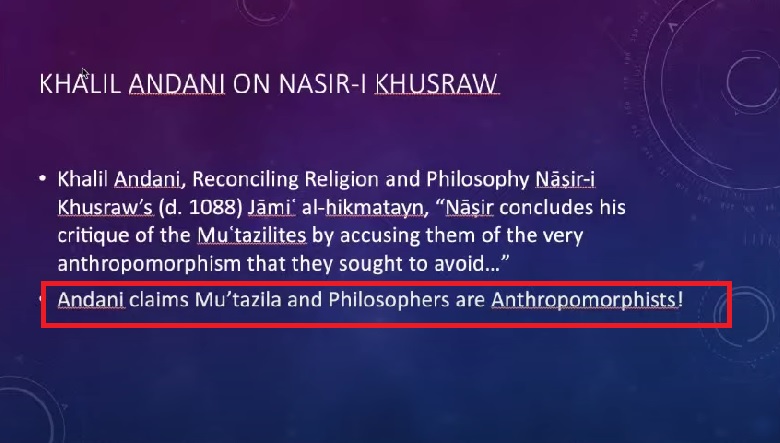
Not necessarily an argument against either Ismaili doctrine or Islamic Philosophy in general Jake repeated several times the Professor Andani asserts that anyone who claims that who ever states that Allah (swt) has names and attributes is tantamount to shirk and anthropomorphism. Please see @22:06 minute mark:
“Khalil does not believe that Allah is the direct creator of the heavens and the earth. He does not believe
that Allah is All Knowing, All Powerful and Perfect, in fact HIS BOOK states: that to ascribe such names and attributes to God is shirk and anthropomorphism.”
A similar claim is made at the 23:37 minute mark.
Why didn’t Jake show us the extract from Professor Andani’s book?
He claims that these are the beliefs of Professor Andani yet he doesn’t give us the quotes for this.
This would certainly help Jake, as Jake has made takfir of Andani, he can now turn around and claim that Andani did the same thing.
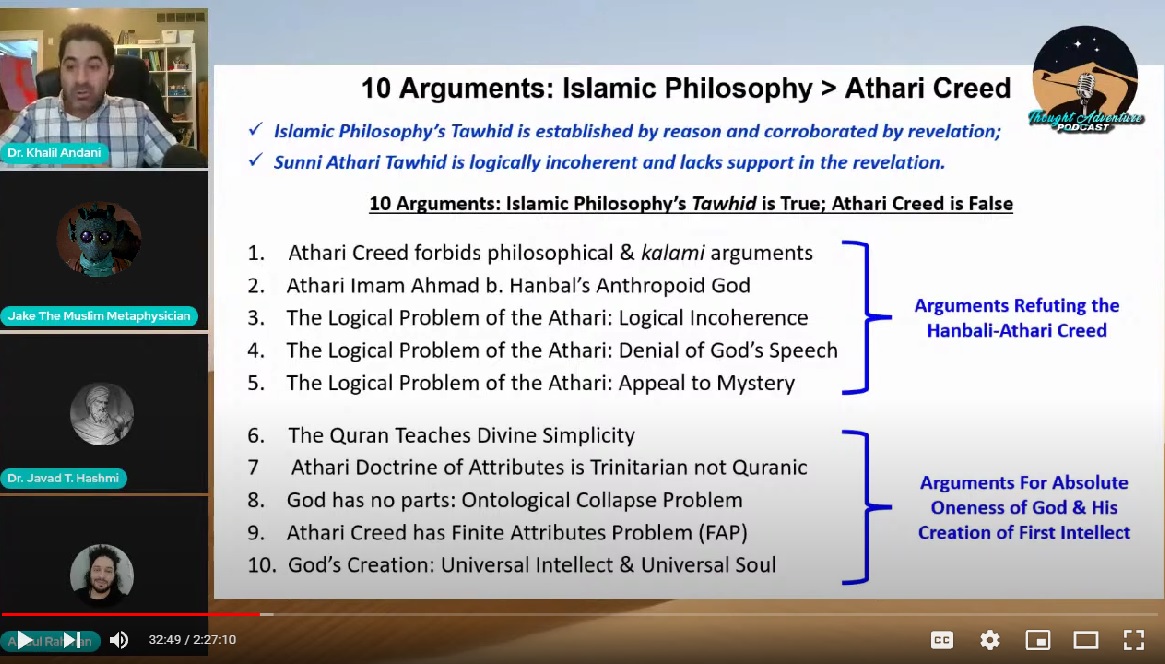
Professor Khalil gives 5 arguments for refuting the Hanbali creed. He gives 5 arguments for the Absolute Oneness of Allah & His Creation of First Intellect. Although, I feel Professor Khalil more than proved his case in regards to the Absolute Oneness of Allah (swt), he possibly needed more time to flesh out his argument of the creation of the First Intellect.

Professor Khalil showed quite forcefully the issue with Tafwid.
Affirming the apparent meaning, or do ta’wil for metaphorical meaning. Jake must affirm the apparent meaning and reject ta’wil. This leads us to Tafwid al-Ma’na where you deny the apparent meaning and deny the opposite of the apparent meaning. This position is logically incoherent.
If you say you do not know the meaning, then there is no meaning that is accessible to humans. This is a devastating argument because it shows that Athari are actually the one with some esoteric belief in the divine. The Qur’an and Sunnah conveys that which is not intelligible to humanity. Another devastating point given by Professor Khalil @39:27 minute mark that if you want to argue for Tafwid al-Ma’na and Tafwid al-Kayf and say ‘Bi Li Kayf’ than you should stop debating with Christians. The argument here is that Athari are in reality believers of Mysterianism.
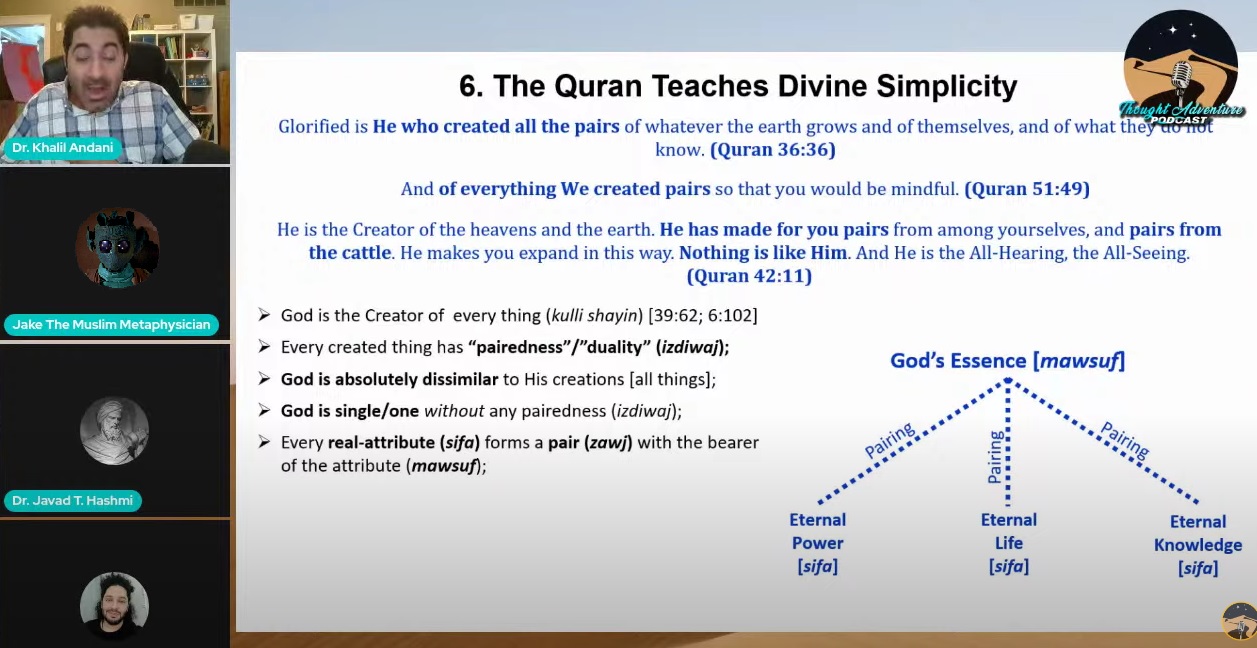
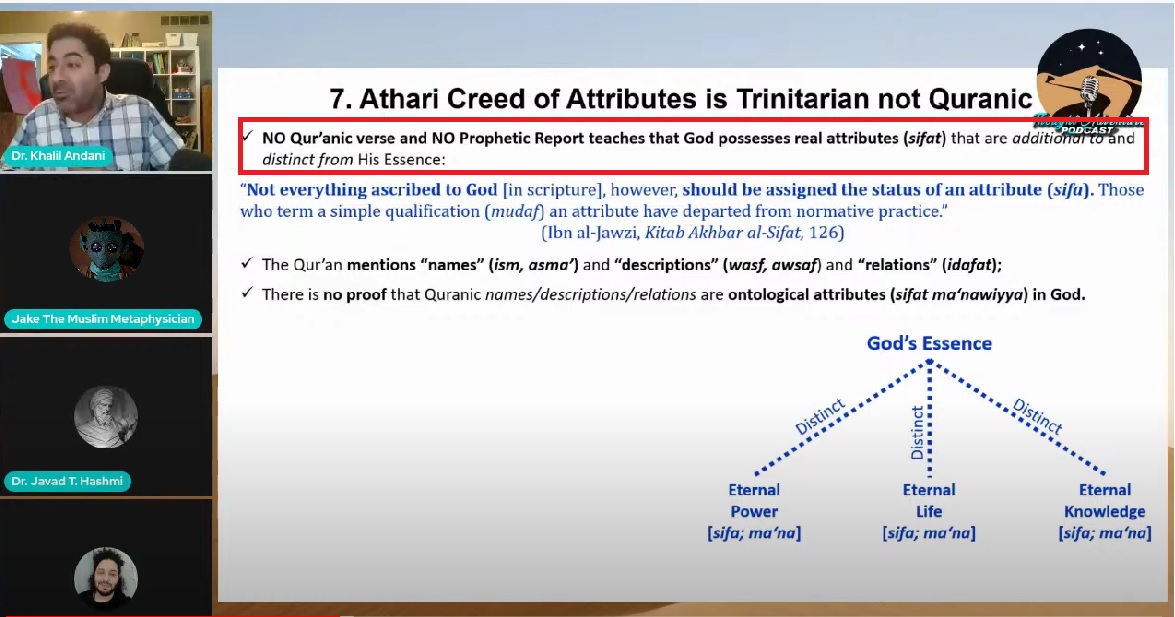

All of the points given in Professor Andani’s slides are effectively devastating for the Athari position.
“No Qur’anic verse and NO Prophetic Report teaches that God possesses real attributes (sifat) that are additional to and distinct from His Essence.”
Where did they get the idea from? They got it from speculative theology.
During his first 10 minute rebuttal.
Surprisingly for someone who has done many debates Jake seemed to forget how the rebuttal part of a debate goes. Instead of showing why Dr. Andani’s five points against Athari creed were wrong, Jake continued his opening presentation of attacking Andani’s views. The only thing he really interacted with was that which was easy pickings. He scanned the list of the slide Professor Andani put up and picked out Shaykh Abdul Qadir Al Jilani. (An Athari). Even, I am not sure why Professor Khalil had him on that list.
When quoting Shaykh Abdul Qadir Al Jilani
“We believe that Allah CONSTRICTS, EXPANDS, rejoices, loves, dislikes, becomes pleased, becomes angry, and abhors, he has two hands and both of his hands are right.
The hearts of his servants are between two of his fingers and he is in the direction of uluh…..” Jakes says @ 50:35 “This sounds like Athari creed to me.”
What did Jake mean when he says Allah (swt) constricts and expands? Does he mean that it is an action that Allah (swt) does to the creation? As in constricting the breast or expanding the breast? Or does he mean that Shaykh Abdul Qadir Al Jilani is asserting that Allah (swt) himself, his essence, expands/constricts? This sort of irresponsible reading of the text in English without proper explanation is no Bueno. Jake did not deal with the issues of divine simplicity or the problem of the ontological collapse of his position.
Professor Andani’s first 10 minute rebuttal.
@1:03:27 They were not putting up Professor Adnani slides. It is hard to know if that was intentional or not.
@1:11:36 Professor Adnani claims that Jake was intellectually dishonest by admitting a fact from Nasir al-Din Tusi’s work by not admitting the fact of what he had actually written.
@1:12:07 Professor Adnani bemoans the fact that Jake cannot read Arabic and therefore cannot go to the primary sources. He is overly reliant upon Orientalism and Orientalist.
Jake’s second 5 minute rebuttal.
@1:18:34 Jake puts up the claim that he has a document ‘with all these references if anyone is interested I’ll make them publicly available and you can read them yourself.”
This statement is followed up with a dig @ Professor Khalil doing Taqiyyah, practicing obfuscation or lying.
@1:19:44 “No it does not mean there are multiple necessary beings, we don’t say there are multiple humans, that Jake is multiple humans just because I have multiplicity within me.
I’m still one being. We don’t say that there are multiple uh beings within Jake. This is not the language that we use”
Did he just use himself to compare with Allah (swt)? This is very problematic. It is a violation of “There is nothing like unto Him, and He is the Hearing, the Seeing.” (Qur’an 42:11)
@1:20:07 “My argument is quite simple, just read the Qur’an, for the most part.” WHAT??
@1:21:23 Jake says that he trusts someone else over going directly to the text himself! Especially doesn’t trust Professor Andani. “You keep talking about Arabic but you cannot even pronounce basic words, which I find to be quite shocking.” You can tell that Jake felt the sting of Professor Andani’s comment about Jake not being able to go to the primary sources because Jake lacks the requisite command of Arabic to do so.
Professor Khalil second 5 minute rebuttal.
@ 1:24:06 Professor Adnani wanted to know whom Jake will rely upon for creedal positions.
Prior to the debate Jake gave Professor Andani the creed of Ibn Qudama. Ibn Qudama says: “We do not go beyond the traditions from the Prophet and his companions;
nor do we know the how these, save by the acknowledgement of the Messenger and the confirmation of the Qur’an.”-Ibn Qudama (Tahrim)
“Debate is for people who can use logic and reason which you are not allowed to do!”
Ouch! That was yet another stinging point from Professor Andani.
@1:26:00 Professor Adnani makes another great point. Jake did not specify what he meant by necessary attributes.
1:26:34 I almost fell out of my chair, Captain Planet? It is good to see that Dr. Khalil is forceful in his presentation and can keep a serious topic light-hearted.
@1:26:45 Professor Adnani bemoans the fact that Jake is severely handicapped in this debate by not being able to read the primary sources.
@1:26:58 Professor Adnani puts forth a very blunt question to Jake. “How do you define wujud, existence?
15 minute cross examinations. Jake cross-examines Professor Andani
During his 15 minute cross-examination, Jake spent less time asking questions and more time giving a sermon. As regards demeanor, Jake was like this angry child, who ran away from home only to find a wise and comforting father in Dr. Khalil Andani. Khalil was warm and had presence, Jake was bitter and needed consoled.
@ 1:30:19 Jake ask Professor Andani about true knowledge of Allah (swt) only coming through the Imams. Through the intellect or the imams (qualified scholarship). Jake himself admits its from qualified scholarship when he even queerly offered, “just read the Qur’an, for the most part.”
1:30:57 Jake could frame his question another way. ‘During the time of the Blessed Messenger (saw) was true Tawhid known only through the Prophet (saw), whom would be the ‘rightly guided Imam’ or through other means? If we can understand this, it will help us to understand the position of not only Ismaili Shi’a but our Shi’a brothers in general. Even if we disagree with them.
When Professor Adnani gives his reply that there are two types of ‘ilm and one is supra discursive, also known as marifa. This is something that adherents of Sufi paths would appreciate. Where as those who have no familiarity with the Seeker-Shaykh relationship would have no appreciation of this.
@1:33:41, Jake moves on to the next point because he saw no way in. Usually if you strongly argue, you will overwhelm your opponent and press the attack until you get them to capitulate through the sheer strength of your argument.@1:34:12 Jake started to bite his fingernails which is usually a sign of stress or anxiety. I don’t know if it is me but it looks like he proceeds to chew for a moment on a piece of fingernail.

@1:37:40 Professor Andani makes the point that there is no way Kirmani is refuting Ibn Sina because Ibn Sina has not even written his works yet!!! “Remember Ibn Sina died in 1037 and Kirmani died in 1020. There is no way Kirmani is refuting Ibn Sina because Ibn Sina hasn’t even written his major works when Kirmani is writing. Kirmani is likely referring to a pre Ibn Sina falsifa tradition.”
@1:38:40 Professor Andani enlightens Jake who confuses the Ashari position of the divine will that is entirely self determined, with that of the Ismail’i position.
1@:40:00 Jake when pressed on whether he knows what type of shirk Al Sharistani is referencing,
Jake replies, ‘You can’t respond with a question.” Professor Khalil is not familiar with debates or debate territory. So, he could have used the most common trick there is in this situation, which would be to ask a statement of clarity, ‘I’m not sure the type of shirk you are referring to?’ Interestingly, as a point of order Jake ignored the ‘you are not supposed to respond with a question’ when he was being questioned. He (Jake) did this multiple times.
Anyway, Jake gets educated on the two different types of shirk, shirk kafi and shirk jalil. This itself shows further lack of preparation on his behalf.
@1:40:40 You really have to love Professor Andani at this point, he is totally, relaxed and having a great time.
That slight smile on the face is transporting him straight to the class room where he is tenured Professor
teaching a subject he has full grasp of to a first year student, thirsty for knowledge and information.
More Than an interlocutor or debate opponent, Professor Andani at this point takes on the role of a willing teacher, trying to help Jake in writing a thesis paper.
It’s delightful to watch the good Professor work and it has made me keen to read his published works and follow up with more of his material.
@1:42:11 Jake asks Professor Andani the question: “If creation did not exist would God exist? Khalil asks a question, but Jake doesn’t’ pause him. At this point Jake is clearly forsaken any crusade he may have thought he was upon. Jake actually looks tired.
@1:42:31 Jake asserts about Professor Andani “You said he couldn’t exist without creation” -Always not a good sign in a debate when the opponent wants to put words in the other’s mouth.
@1:43:54 Professor Andani again asserts that Jake is unfortunately relying upon secondary sources. Jake responds that’s not true. “Well it is!” Quick to the rejoinder Professor Andani is!
15 minute cross examinations. Professor Andani cross-examines Jake.
@1:45:24 “Do the attributes depend on God’s essence or are they ā sē necessary in themselves?
@1:45:27 Jake ask a question: “What do you mean by depend?” As you can see as a point of order Jake violates the stipulations of the debate.
Professor Andani presses the question again: “Does the existence of an attribute of Allah depend on the essence?”
Jake responds: @1:45:34 “In the SAME WAY that for you the existence of creation or God’s existence depends on the existence of creation.”
This is what happens when you are in attack mode and you do not think your arguments through.
Here Jake is involved in pure speculative theology upon which he has provided no clear proof text from the Qur’an or the Sunnah. He is comparing the creation of Allah (swt) with his attributes.
He is also arguing against Athari creed; because, if he is saying he believes THE SAME WAY (that he assumes Adnani believes) this is a problem.
Again Professor Andani presses: “Do the attributes depend on God’s essence, either they do or they don’t?”
@1:45:44 Jake responds: “Yes, in the SAME WAY you would say that God’s existence depends upon creation.”
Trust me people there are Muslims who are Athari/Salafi in Aqidah listening to these statements of Jake and their jaws are gaping open and they are stroking beards repeated ‘astaghfirullah’ over and over upon hearing these things.
@1:46:15 Professor Andani ask: “Are the attributes of Allah are they ā sē or not ā sē?
1:46:22 Jake breaks the rules again and asks a question: “Why are you changing the question?”
The reason he is changing the question is you are so elusive and Professor Andani is trying to get you to clarify your position. @1:46:30 Professor Andani has to bring in the moderator because Jake is evading the questions.
@1:47:24 Professor Andani is having none of it. He presses Jake ‘You define dependence and tell us whether the attributes depend upon the essence or not.”
@1:47:42 Professor Khalil “Let’s make some breakthrough here. Creation depends on God I said that? Are you saying the attributes depend on the essence the same way creation depends on God?”
@1:47:50 Jake responds: “I am saying there is a counterfactual dependence.”
May Allah (swt) guide us and protect us from being among the lost! At this point I began to wonder if Jake really is a Muslim. Because, if he is now stating there is a counterfactual dependence, which is to state that the attributes and the essence are mutually dependent or inter-dependent. Not necessarily problematic in and of itself; However, either one in Islam is major shirk, especially if you juxtapose that statement to Jake’s earlier admission:
Thus, Allah (swt) and his creation are counterfactual? They are mutually dependant or inter-dependant? That is not the belief of the Muslims, and for us, Jakes’ statements take him out of Islam. That is unless Jake claims he misspoke or he was confused during the debate. Hopefully he will clarify in the future. Those statements juxtaposed together take one out of Islam.
Listen @1:48:48 “In a sense, one cannot exist without the other. We don’t say it’s a casual dependence.” @1:49:12 Professor Andani says, “The attributes depend upon the essence.”
Moreover, Jake responds: “Only in the sense that they cannot exist without each other.”
I was surprised by Professor Andani’s continued line of questioning considering Jake’s admission that he believes the essence and attributes are counterfactual and that the attributes depend on the essence in the same way that God depends on the existence of creation.
Nonetheless @1:49:45 “If something is not ā sē (aseity) can it be God?”
Jake responds: “Sorry” I do not believe that Jake is familiar with the Latin terminology for aseity.
Professor Andani continues: “If something is not ā sē is it contingent?”
Jake is uncertain about what he is being asked. He is not supposed to ask questions but answer them. Nonetheless: “Anything that is not God is a contingent is that the question?”
Jake responds: “Yeah sure.”
@1:51:00 Jake is buckling under the pressure, disengaging the rules of the debate, speaking out of turn. Jake established that he believes that God is the essence and the attributes.
@1:52:08 Professor Andani “So God contains and essence and real distinct attributes?”
1:52:22 Professor Andani presses the point: “The attributes are not identical to the essence and not identical to one another.”
“Jake responds: “Correct.”
@1:52:25 Professor Andani states: “O.K Therefore your God is a conglomerate of different entities. Thank you for confirming that. Next, I’m gonna move on now.”
@1:52:47 A very classic moment in this debate. Professor Andani set this up nicely. “My view is this, O.K.? The will of God is necessary. Every decision, choice that God has made could not have been any other way O.K.? Its the best possible choice. And any choice God has made it is impossible to conceive it could have been other way. This is my position.” “Is that position compatible with Islam according to you or not?
@1:53:24 Professor Andani “Does it go against Tawhid?” To which Jake responds: Yes it does!”
“It goes against Tawhid in the sense that your saying God does not have free will, that creation is just a necessitated by his essence. Yes that goes against Islam because the Qur’an and the authentic Sunnah say otherwise.”
An odd statement from Jake considering he just stated earlier:
Jake responds: @1:45:34 “In the SAME WAY that for you the existence of creation or God’s existence depends on the existence of creation.”
This Jake does not have a sound aqeedah position. Nonetheless, go back and read Professor Andani’s statement above @1:52:47 you will see that he is reading from either a piece of paper or screen. He is reading verbatim a statement from Mohamed Hijab!

That was very cunning of Professor Khalil. Remind me never to debate that guy!
If Professor Andani made any “bad” move during the debate it was @1:54:26. It is not an error per say.
It’s just that he should have saved that explosive bit of information for his closing remarks!
Because, the way that Professor Andani puts the bait on the hook, Jake caught on real fast, and knew what was up.
@1:55:05 Jake is sensible enough to know the trap that Dr. Khalil is laying out before him.
However, he is reluctant to make that commitment. This shows the shifting nature of his own doctrinal position. Haqq is Haqq. How can you be firm on a position literally just 3 minutes ago and now you are hesitant!
@1:55:43 Professor Andani drops the bomb on Jakes “I read to you the words of Mohamed Hijab during his Londoniyyah video published 6 months ago! You can go see it! He literally says, what I just said!”
Professor Andani doesn’t stop there: “
“So Mohamed Hijab is teaching a view of Tawhid that you think is not Tawhid yet you go and work for the Sapiens Institute!” If there was a debate equivalent of Khabib Nurmagomedov making Conor McGregor submit during their UFC bout that was it! @1:55:57 “Can you read it?”

Jake at this point is desperate to find any contentious point to avoid the devastating blow just dealt to him. “Your claiming he is my Ustadh.” “How is he my Ustadh?”
Asking Professor Andani to read a text is a strategic move. It also gives Jake a breather, so that Professor Andani will just stop asking more devastating questions and the timer can run out.
You wanna know something telling. Is the heavy weights in the Athari/Salafi community.
Those most visible out there in the Daw’ah. If anyone thinks for an iota of a second that Jake won this debate
surely the silence of the Athari/Salafi dai’ee is deafening.@ 2:00:42 Professor Andani asks: “Where is Allah? Can you point with your finger?”

Jake pointing towards the direction of Allah (swt). The Earth spins on its axis on a 24 hour rotation. Now imagine if we placed someone on the polar opposite side of the Earth and asked the same question at the same time. Allah’s throne would have to be somewhere in the middle of the Earth. Then next we put Jake in a space suit in zero gravity and ask him the same question.
@2:00:50 Professor Andani asks: “Is the Throne below Allah?”
Jake responds: “Yes”
Professor Andani ask: “Is the lowest heaven below the throne?”
Jake responds: “Yes”
@2:01:26 Professor Andani ask: “Do you affirm Allah as per the hadith descends every night to the lowest heaven?”
Jake responds: “Yes I affirm Nuzul.”
@2:01:41 Professor Andani ask: “Do you affirm that Allah descends from above the throne to below the throne?”
Jake responds: “He never leaves the throne.”
22:01:51 Professor Andani asks: “What is the meaning of a descent here? Because descent means to go from above to below. So what does Nuzul mean?”
Jake responds: “Yes we understand it in the plain meaning which is mentioned in a hadith….it’s very clear I think everybody knows what descent means.”
2:2:02:11 Professor Andani asks: “So you affirm that Allah descends from above the throne to the lowest heaven below the throne.”
Jake: “Without entering his creation. Yes”
Jake just posited pure speculative theology. Where is there a text from the Qur’an or Sunnah that says that Allah (swt) does not enter his creation? Where did he get that idea from?!
2:02:08 Jake claims: “It’s very clear I think everyone knows what descent means.”
@2:02:25 Professor Andani asks: “What is the meaning of descent that everybody knows?
Jake responds: “I just explained it to you.”
As one person on Twitter described this segment: “Descending means descending but not descending as descending can be descending when we say descending but you know and I know you know what descending is.”
Another point of contention. From what text of the Qur’an and Sunnah do the Athari get the idea that Allah (swt) is above the throne as some ‘default position‘?
Jakes closing remarks:
@2:06:36 Jake claims he will have a talk with Mohamed Hijab. So it will be interesting in the future, if Jake retracts his claim or claims Mohamed Hijab’s views on Tawhid are mistaken.
@2:08:30 Jake is clearly upset that he couldn’t turn this into an Athari Sunni vs a Shi’a Ismaili debate.
This is also why either he or his team changed the name of the YouTube Video.The misleading and dishonest title vs the agreed upon debate topic and correct title.


@2:08:50 An admission from Jake that he did not address many of Khalil’s points.
Professor Adnani closing remarks:
In his closing remarks Dr. Khalil Andani had made comments about
Jake that was not insulting. He said that Jake is certainly a smart individual; however, Jake needs practice in defending his creed (which he does).
In my humble opinion, Professor Andani messed up with giving good will points. Professor Andani means well but unfortunately in Jake’s mind saying that he (Jake) is intelligent but utterly demolishing
his (Jakes) ability to defend the Athari creed was worse than if Andani had not said anything in good will at all.
@2:18:25 Professor Andani brings up a point that should have been brought up during his rebuttal period. I am not a fan of either party introducing pertinent points of a debate during closing statements.
However, it would be interesting to see if Jake has any rejoinders to that statement in the future concerning Kashf Al Asrar-‘Abd al-Qadir al-Jilani
@2:19:35 Professor Andani comments on how Jake calls his presentation a machine gun approach, because he (Jake) was utterly unprepared. Which is true.
@2:21: Professor Andani likened Athari creed to mysterianism which was a very tight intellectual slap.
It certainly hurts the Daw’ah and prepared Christians WILL use these counter arguments, as well they should.
Conclusion: Final Thoughts.
Professor Andani put on a clinic in that debate! If someone mentions his name to me I will reply, ‘Oh you mean the excellence of execution?’ Because Jake was excellently executed by the excellence of execution, Professor Andani. The man is not even a seasoned debater, but he was methodical, lucid and on point!
In fact as stated before, this is a watershed moment. Never that I can think of has Athari creed been laid bare in public in such a way. Professor Andani reached deep and took a piece of Jake’s soul. Not that this was the good Professor’s intention; however, you can tell by Jake’s Kamkazi approach after the debate that he realized he got destroyed.
Observe: Jake: The Kamkazi: I got destroyed in this debate but I am going to do my best in my little Mitsubishi A5M to take you down with me!

Who won this debate?
When I was first told about the debate in the early morning hours of 17/6/2002 I went to see the video and I observed in the comment section the Athari’s were getting pressed. The majority of comments were in favour of the Professor. So they deleted comments in favour of the Professor. They deleted comments of exchanges where athari were not doing too well. They changed the title of the debate. Finally, they stopped comments altogether.
You want to know something telling? It is this. The heavy weights in the Athari/Salafi community, those most visible out there in the Daw’ah, if they think one of their people did well in a debate it will be broadcasted all over social media. It will go viral. The after math of this debate is radio silence. If anyone thinks for an iota of a second that Jake won this debate surely the silence of the Athari/Salafi community is deafening. May Jake repent of the blasphemy he uttered during the debate and renew his Shahadah. May Allah (swt) bless Professor Andani, illuminate the way for him, forgive him and us, guide him and us.
Oh I see we are already playing games of censorship and control my Salafi friends?

Good thing I came prepared. For those of you who do not want to watch the debate (on a channel that blocks comments) I have uploaded the debate here:
May Allah (swt) Guide the Ummah.
May Allah (swt) Forgive the Ummah.