“And do not pursue that of which you have no knowledge. Indeed, the hearing, the sight and the heart – about all those [one] will be questioned.” (Qur’an 17:36)
It was recently brought to our attention that a youtuber who goes by the name of “Mufti Muhammed Ibn Muneer” made a video in an attempt to address his students, those in attendance, about praying with their arms to the side.
If we had to retitle this entry it would be: ‘Trick ’em with Hadith. Ignore the Athar.’
We listened to the video and informed the brother that the video has an innocence to it for the most part. The speaker is simple. The statements he puts forward are simple. This is to be expected because those who claim they are upon the way of the early companion are often not well researched on matters.
However, there are other rather alarming statements put forward by the speaker that border on tafkir (excommunication) of other Muslims, which is most unfortunate.
The very simple approach used by Mufti Ibn Muneer had no depth or nuance to it. We do not blame him because it is clear from the matter in which he approached the subject with a naivety and innocence and that he has not really looked into the matter. Let us take a look at the video and comment on some of the comments Mufti Muhammad Ibn Muneer says.
@1:58 “I’ve heard people say this before, Maliki scholars. Uuhh, and that’s a whole long issue of madhabs, is it permissible in maliki etc. That’s a long issue in itself. The concept of their argument, many of their arguments not all of them they say there is nothing wrong with making sadl in the salah. And there is no specific text stating that you have to do it. Put your hand on top of the other hand. And some of the ulemah of the past said it was o.k and the mujtahideen said it was o.k and perhaps Imam Malik did it and Amal al Madinah etc. etc. etc… and most people unfortunately they argue and they fight over these points. We don’t have to argue over those points and fight over those points. Where did the Nabi Kareem (saw) pray like this? Mandatory or not. Where did he pray like this? What narration states that the Prophet had his hands to the side from the takbir to the taslim? If you can bring a hadith sahih or daif. Bring it, bring it to the table and we can see what’s the proper understanding what’s the strongest view. But if you can’t even bring that and you are basing it off of what’s permissible and what an Imam allowed raksafi, fulan fulan and this one and that one debated but the Nabi Kareem, your example, your uswa, the one you are to emanate, emulate, imitate and be like did he do it yes or no? If he did it than we can look at the other hadith what’s the correct whatchyou do all of the time. If he didn’t do it and your basing the second pillar of Islam the most important physical act of worship off of something that an Imam allowed and differed over you have serious problems with your Islam. Serious problems with your Islam. If the most important physical act of worship a big part of it is based off of the view and the fatwa of a later scholar that’s a problem. And I don’t think any intellectual Muslim is gonna differ on this point. I don’t think any intellectual Muslim is gonna differ on this point. Were not gonna get into it being haram or not. Everybody understand this? The concept did the Nabi Kareem do it? How did he pray? Everybody understand this? Regardless of where he put his hands but did he have his hands to the side? If you can’t prove that then you need to look at the statement ash hadu an la ilaha illallah wa ashhadu anna muhammed rasulullah what does that mean? For you to continue to do something in the salaah the second pillar of Islam that the prophet never did and that an Imam allowed, and that an Imam did. That’s a mushkila. Thats’ a big, huge, mushkila. That’s in brief. The argument o.k on this point you can find in the books of shurul hadith, the books of fiqh, classical four schools. The other non orthodox four schools. They dealt with this issue in detail; of is it permissible to put your hands at the side. When you do fold your hands where do they go, chest, navel, belly etc… Our Muhim is that the Nabi Kareem (saw) he said in Sahih Bukhari (after reciting the text in Arabic) He said, ‘we the prophets, the assembly of the prophets we have been commanded and ordered to place our right hands over our left hands in the salaah’. We have been commanded and ordered to put our right over our left in the salaah. There’s another narration that the people were commanded to place their hands the right hand on the left hand in the salaah. And many other narrations which the prophet put his hand on his left hand in the salaah, regardless of where. That is a whole different issue. Here, here, here, like this, like that. Those are secondary issues. What is important is that the Nabi Kareem (saw) he didn’t pray like that. His companions didn’t pray like that. And if there is a narration here or there they do not stand up to the light of the numerous narrations. So this has nothing to do with Maliki or Hanafi or Shafi’i. First and foremost you have to be Muhamadi. Muhamadi. How did Imam Malik understand, How did Imam Abu Hanifa understand, How did Imam Shafi’i understand and the do’s and the extract. That’s fine and that’s peachy. But when the daleel comes to you clear and pristine what Muhammed (saw) did or didn’t do. That is your stance as a Muslim, as a Muhamadi. The madhab of Muhammed ibn Abdullah. Something that is unclear something that is detailed something that you don’t understand that’s a different story. You blindly follow a scholar that you trust. You study this traditional school; but when the daleel is in front of your face your nothing more than Muhamadi Dhahiri. You take the apparent text. Every Muslim initially is dhahiri. Has to take that which is apparent from the text. Everybody understand this? Initially. Therefore it depends upon the person’s level of knowledge. If you can study and research you have to follow what you study and what you research. If you are a blind follower then take what I just said. Put your right hand on your left hand. That’s what the Prophet (saw) did. That’s my advise. No Muslim should make sadl. Allah knows best. Next question says: Many say that those who pray sadl are not upon the sunnah. We’ve explained this many times. If it’s an issue of ijtihad that’s one thing. Is it correct to say someone is not on the sunnah over one issue that they do? Or, because the sadl is so apparent and so outward and a major part of the salah perhaps it does take you away from quote unquote “being on the sunnah.” It’s not a hidden thing. You’re doing it five times a day at least. Not doing what the Nabi Kareem did over and over and over again. But in general, in general ‘Ahl Sunnah Wal Jammah’ hadith, we do not love and hate, we do not show wala and bara based off of maseel ijtihadi faqiya. That’s not from our way. This is what’s correct, what we believe, what we teach, what we understand. We don’t base our love and our hate off of these maeel ijtihad. Everybody understand this? Which there is room for more than one view. Even if the second view is incorrect.”
Our response:
Where to begin? That was quite a mouthful!
We believe the first question to address would be the question of methodology. What is the methodology of Mufti Ibn Muhammad Muneer? What tools does he limit himself to in order to ascertain truth? What is admissible as evidence?
If he identifies himself as a follower of the ‘Ahl Sunnah Wal Jammah’, then does he understand that that evidence is not restricted to the Qur’an and Sunnah? For ‘Ahl Sunnah Wal Jammah’, the consensus (‘Ijma’) is legal proof. Analogy (Qiyas) is legal proof. The amal of Madinah (mass practiced Sunnah) of the people of Madinah is a proof of the Maliki school.
The second question is:
Are we to be “Muhmadi” as he claimed or “Muhamadi Dhahiri”? Because, on the one hand, he seems to indicate that it is wrong to follow the juristic conclusions of great scholars of Islam, while on the other hand, he flatly contradicts himself by being an advocate for the Dhahiri Madhab.
If every Muslim was to be ‘Dhahiri’, how would he answer the question: Can we eat pig fat/lard?
Say, “I do not find within that which was revealed to me anything forbidden to one who would eat it unless it be a dead animal or blood spilled out or the flesh of swine – for indeed, it is impure – or it be that slaughtered in disobedience, dedicated to other than Allah . But whoever is forced by necessity, neither desiring it nor transgressing the limit, then indeed, your Lord is Forgiving and Merciful.” (Qur’an 6:145)
What do the Qur’an and the Sunnah say? The verse is clear that only the flesh of swine is prohibited.
Third question: By saying every Muslim should be Muhamadi, is he suggesting that Malik, Abu Hanifa and Shafi’i were not ‘Muhamadi’?
Fourth question: If it can be established that Sa’id b. Al-Musayyib, Sa’id b. Jubayr, Al-Hasan Al-Basari, Ibrahim Al-Nakha’i, Muhammed b. Sirin, and the Companion, ‘Abd Allah ibn Al-Zubayr as well as Imam Layth b. S’ad all prayed sadl (arms to the side). Would he say that they ‘have serious problems with their Islam’?’
Where the above individuals from the Salaaf practicing bidʿah?
Fifth question: When you say, “If you are a blind follower, then take what I just said.” Wouldn’t that make a person ‘Muhamedi Muneeri’? Thus, again another contradiction in your statements?
Sixth question: Would he even accept the evidence? “His companions didn’t pray like that (Oops, he catches himself) AND IF THERE IS A NARRATION HERE OR THERE, they do not stand up to the light of the numerous narrations.”
Looks as if, even when presented with evidence, he would reject it. Hopefully, he, as well as the readers, can understand that when he speaks of ‘one or two narrations up against numerous’ that one brick is stronger than 10 pieces of straw even when combined.
Final comments/thoughts. The rest of Mufti Muhammed Ibn Muneer’s comments were sensible in the sense that he says that all of us are negligent of the Sunnah in one way or another. Notice that Mufti Muhammrd Ibn Muneer said the following: “regardless of where.” That is a whole different issue. Here, here, here, like this, like that. Those are secondary issues. In other words, they do not know where the hands are supposed to go. They just know that they should be in opposition to those who place them on the side! May Allah (swt) increase our ability to follow the example of the Blessed Messenger (saw).
“Which there is room for more than one view. Even if the second view is incorrect.”
Ditto!
All Muslims are reliant upon narrations from the early period of Muslims. People like Mufti Muhammed Ibn Muneer are reliant upon the hadith. So, for those like him, they want a statement of the hadith. They know full well that bringing a hadith does not end the discussion. Hadiths have gradings, they have chains of narrators. In this case, they would not be able to bring a single authentic hadith that states that the Blessed Prophet (saw) prayed with one hand over the other hand in the prayer.
The only thing they can bring is
Narrated Sahl bin Sa`d:
The people were ordered to place the right hand on the left forearm in the prayer. Abu Hazim said, “I knew that the order was from the Prophet (saw) .”
Abdullah ibn Maslamah narrated to us, from Malik, from Abu Hazim, from Sahl ibn Sa’d, who said: “People were commanded that a man should place his right hand on his left forearm during prayer.” Abu Hazim said: “I know of it only as being attributed to the Prophet (peace be upon him).” Isma’il (a narrator in the chain) said: “It is attributed” — and he did not say “he attributes it.”
Effectively, the hadith they think is a trump card actually is an athar. It doesn’t describe something that the Blessed Prophet (saw) did. It describes actions that people did that were attributed to the Prophet (saw).
We go into the deep water where the Salafis do not like to go. That is to the Athar. The reports of the actions of the companions, the information and data points overwhelm the opposition. Unless they want to say the Salaaf were practicing bidʿah.
Ha-Mim By the Book that makes things clear,-We have made it a Qur’an in Arabic, that you may be able to understand and learn wisdom. And verily, it is in the Mother of the Book, in Our Presence, high in dignity, full of wisdom. Shall We then take away the Message from you and repel (you), for that you are a people transgressing beyond bounds? (Qur’an 43:15)
“Nay! it is a Glorious Qur’an, In a guarded tablet” (Qur’an 85:21-22)
﷽
This is an entry that discusses the problematic theological position held by those who call themselves ‘Salafi’ or ‘Athari. That is the belief that the Qur’an is the eternal uncreated word of Allah.
Now this is a belief of those who ascribe to Ahl Sunnah in general. However, there is an aberrant and bizarre perspective held by those who call themselves as ‘Salafi’ or ‘Athari’.
That is what this article will focus on.
I want to say from the outset that the Ibadi school does not make takfir of any Muslim who believes the Qur’an is created. This issue was not addressed by the Blessed Prophet (saw) nor by his companions. Takfir of other Muslims is not something that our school is known for.
This is a matter of dispute between the scholars. Each side will bring thier proofs and justifications for the position that they hold.
It is truly unfortunate that some of the Muslim intelligentsia and academics would feel so threatened by any discussion on this subject that it would incur a death penalty.
For example in one of the great works that are praised by the Sufi Muslims, Qadi Iyad we find
He said about someone who said that the Qur’an is created, “He is an unbeliever, so kill him.” He said in the version of Ibn Nafi’, “He should be flogged and painfully beaten and imprisoned until he repents.” In the version of Bishr ibn Bakr at-Tinnisi we find, “He is killed and his repentance is not accepted.”
Source: (Qadi ‘Iyad Musa al-Yahsubi, Muhammed Messenger of Allah (Ash-Shifa of Qadi ‘Iyad), translated by Aisha Abdarrahman Bewley [Madinah Press, Inverness, Scotland, U.K. 1991; third reprint, paperback], p. 419)
In fact, Muhammed ibn Isma’il Al-Bukhari (of Sahih Bukhari oral collection fame) was persecuted by a group of those from the Hanbali school of jurisprudence for a remark he made.
“Al-Dhuhli was fierce (shadîd) in his adhesion to the Sunna. He confronted Muhammed ibn Isma‘il [al-Bukhari] because the latter had alluded, in his Khalq Af‘al al-‘Ibad, to the fact that the reader’s utterance of the Qur’an was created. Bukhari made it understood without explicitly saying it, but he certainly made it clear. On the other hand, Ahmad ibn Hanbal flatly refused to explore the question, as well as Abu Zur‘a and al-Dhuhli, or indulge in the terminology of dialectic theologians (al-mutakallimûn), and they did well – may Allah reward them excellently. Ibn Isma‘il had to travel from Naysabur undercover, and he was pained by what Muhammed ibn Yahya [al-Dhuhli] had done to him.”
Source: (Al-Dhahabi, Siyar (10:207)
Also:
Al-Hakim [narrated with his chains]: Muhammed ibn Yahya [al-Dhuhli] said: “This Bukhari has openly subscribed to the doctrine of ‘pronunciationists’ (al-lafziyya), and for me those are worse than the Jahmiyya.” . . . Ahmad ibn Salama visited Bukhari and told him: “O Abu ‘Abd Allah, this is a respected man [i.e. al-Dhuhli] in Khurasan, especially in this town [Naysabur], and he has thundered with this speech until none of us can say anything to him about it, so what do you think we should do?” Bukhari grasped his beard then he said: (I confide my cause unto Allah. Lo! Allah is Seer of His slaves.) (40:44) He continued: “O Allah! You know that I did not want for one moment to settle in Naysabur out of arrogance, nor in quest of leadership, but only because my soul would not let me return to my own country [Bukhara] because of my opponents; and now this man intends harm for me out of jealousy, only because of what Allah gave me and for no other reason.” Then he said to me: “O Ahmad, tomorrow I shall leave and you will be rid of his talk which I caused.” . . . Muhammed ibn Ya‘qub the hadith master said: “When al-Bukhari settled in Naysabur Muslim ibn al-Hajjaj took to visiting him frequently. When the affair of the pronunciation of Qur’an took place between al-Bukhari and [al-Dhuhli] and the latter roused people against him and forbade them to visit him, most people stopped visiting him, but not Muslim. Then al-Dhuhli said: ‘Anyone that subscribes to the pronunciation [being created], it is not permitted for them to attend our gathering.’ Whereupon Muslim placed a cloak on top of his turban, stood up in front of everyone, and sent back to al-Dhuhli what he had written from him carried by a camel-driver, for Muslim openly subscribed to the pronunciation and made no attempt to conceal it.” . . . Ahmad ibn Mansur al-Shirazi also narrated it from Muhammed ibn Ya‘qub, adding: “And Ahmad ibn Salama stood up and followed him.” (See Al-Dhahabi, Siyar (10:314-315). Cf. Bayhaqi’s al-Asma’ wa al-Sifat (al-Hashidi ed. 2:20-21 #591).
As Hamza Yusuf correctly remarked. if you follow this line of reasoning you eventually end up with
@ 1:32 Listen carefully people. Shaykh Hamza Yusus if a public orator and a supremely articulate man. Listen very carefully to the doctrine you are being asked to subscribe to.
@ 3:00 “It definitely doesn’t mean though the mushaf you have in your house. Because that would then…I mean some of the Christians argue that well the Qur’an is imbibliation. Like we believe in incarnation of the logos the Muslims believe in imbibliation of the logos. That God became book and so we don’t we don’t see that as valid. That view of it so.” -Hamza Yusuf.
Salafi Da’wah hooks you with the transcendence of Allah (swt). Most people who are introduced to Islam through the street preachers who hold Salafi doctrine are intrigued by concepts such as: Allah being one. What seems to look like a simplistic creed. That Allah has no parents or no children or no partners. Allah is neither black nor white. Allah is not male or female.
However, once you have taken your Shahadah or delcaration of faith how much longer until you are taught ‘Kitab Al Tawhid’ and here come the bizarre concepts. Allah has two right hands, and one of those right hands is a left hand, Allah occupies space, has a shin, a foot, chuckles at people’s despair, comes down the third part of the night, appears to the disbelievers in forms and shapes that they knew and then appears to the disbelievers in forms and shapes they do not know.
SaidNO ONE EVER!
Yasir Qadhi, Salafis and Atheist.
Unfortunately Yasir Qadhi has come under fire from people who seemingly do not understand what he has been saying as of late.
Atheist and Agnostics have a different epistemology and world view when evaluating history then do believers. This also should not come as a shock or a surprise to anyone.
Agnostic/Skeptic: “We have not found any evidence of X.”
Believer: “They have yetto find any evidence of X.” The believer takes note that the Agnostic/Skeptic did not claim “We will neverfind.”
However, in one of his books he has given a very powerful argument to the atheist and agnostics to dismantle Salafi theology.
In reality I should not fault Yasir Qadhi for this as if it was some novel idea that he came up with. Rather, he is parroting the learned polemic that he would have picked up from his teachers.
Yasir Qadhi says:
“These Attributes are understood literally (in the case of the Attributes of kalam, that Allah, Speaks, whenever He wishes, with a sound, in different languages, and this Speech is composed of words and letters and is not created), but the actuality and ‘how-ness’ of these Attributes are not delved into, and any negative similarity be-tween these Attributes and the attributes of the creation are negated (in the case of this Attribute, that the speech of the creation is created, but the Speech of Allah is not.) Understanding these Attributes ‘literally’ does not mean understanding them in the manner that they are found in the creation, or comparing them with the attributes of the creation; rather, it means affirming the linguistic meaning of that Attribute in a manner that befits the Creator, and will never completely be understood by mankind.”
Source: (An Introduction to the Sciences of the Qur’an pg 52)
We are told that the ‘how-ness‘ is not delved into and yet this whole paragraph does exactly that! When you negate comparison you are comparing and contrasting ‘how‘ something is unlike something else.
When speaking of prophet Ibrahim (a.s) and the story of the idols Shaykh Yasir Qadhi says:
“In these verses, Ibrahim showed his people that their idols were not worthy of worship, primarily because they could not speak. After they themselves acknowledged this, Ibrahim rebuked them, and asked them, “Have you no sense?!” meaning, “How can an object that cannot even speak be worthy of worship?” Notice that Ibrahim was referring to a speech that could be heard, for Ibrahim’s people did not answer Ibrahim with the belief of the Ash’arees, “Our god speaks, but a speech that is not heard-an internal speech of the mind!” for they understood what Ibrahim meant!! This is why they turned to themselves, and realized the foolishness of their actions, and could only reply with the feeble response that everyone knew that their idols could not speak!”
Source: (An Introduction to the Sciences of the Qur’an pg 46)
Yasir Qadhi thinks that he has the goods on the Ash’ari Sunnis latter making a quote that in effect turns the Ash’ari Sunnis into idol worshipers.
Yet, look at the quotation above where he says:
“‘literally’ does not mean understanding them in the manner that they are found in the creation.”
Rather than help Islam, Yasir Qadhi and his Salafist-Athari creed and those who think like him have handed over to skeptics of their position a devastating argument.
So like Ibrahim (as) demands above the atheist has the right to demand from him speech from his Creator.
They have the right to demand “a speech that could be heard”
A typical discussion between an Atheist-Agnostic/Skeptic and one who follows Salafist theology could go something like this:
Atheist/Agnostic/Skeptic: “Does your god, Allah speak? Let’s hear it then!”
Salafi: “Of course and here is the proof!” (pulls out Qur’an).
Atheist/Agnostic/Skeptic: “Ibrahim didn’t ask the idols for a book; he asked if they can speak!”
Salafi:
Yet Yasir Qadhi is not done with the Ash’ari.
Yasir Qadhi thinks he has the goods on the Ash’ari when he says,
“1) If the kalam of Allah is without sound, then what did Musa hear when Allah spoke to Him? If they respond that Allah created a sound, and caused Musa to hear that created sound, then this means that this created object stated, “O Musa, verily, I am your Lord…Verily, I am Allah, there is no God save Me, so worship Me… [ Qur’an 20:12-14]
Therefore, if they state this, it implies that this created object claimed to be Allah, and asked Musa to worship it! However, if they stated that it was the actual kalam of Allah, then it must be asked, “How then did Musa hear it if you claim that Allah’s kalam is without sound? ” The scholars of the Ash’arees have not been able to provide a satisfactory response for this.”
Source: (An introduction to the Sciences of the Qur’an pg 44)
Prima Qur’an Comments:
So Yasir Qadhi thinks that it was the object cried out ‘I am Allah, there is no God save Me, so worship Me’. Yet, obviously, we know that Moses (as) did not perform any act of worship towards the direction of the voice. Or at least no act of worship is recorded.
Yasir Qadhi and those who agree with his position have to wonder the following:
What did Rasul Allah (saw) think when Angel Gabriel (as) said. ” Indeed this, your religion, is one religion, and I am your Lord, so worship Me.” (Qur’an 21:92)
Did the Blessed Messenger (saw) fall down and worship Gabriel? Obviously not!
Gabriel(as) was used as a medium in the same way the burning bush was.
As regards if Musa (as) heard audible sounds from the burning bush you ask yourself, did the companions hear audible sounds as the Qur’an was being revealed to the Blessed Messenger (saw)?
“And [We sent] messengers about whom We have related [their stories] to you before and messengers about whom We have not related to you. And Allah spoke to Moses with [direct] speech.” (Qur’an 4:164)
“When he saw a fire and said to his family, “Stay here; indeed, I have perceived a fire; perhaps I can bring you a torch or find at the fire some guidance.” And when he came to it, he was called, “O Moses, Indeed, I am your Lord, so remove your sandals. Indeed, you are in the sacred valley of Tuwa. And I have chosen you, so listen to what is revealed [to you] Indeed, I am Allah. There is no deity except Me, so worship Me and establish prayer for My remembrance.” (Quran 20:10-14)
“And when Moses had completed the term and was traveling with his family, he perceived from the direction of the mount a fire. He said to his family, “Stay here; indeed, I have perceived a fire. Perhaps I will bring you from there [some] information or burning wood from the fire that you may warm yourselves.” But when he came to it, he was called from the right side of the valley in a blessed spot – from the tree, “O Moses, indeed I am Allah, Lord of the worlds.” (Qur’an 28:29-30)
“Has there reached you the story of Moses? When his Lord called to him in the sacred valley of Tuwa” (Qur’an 79:15-16)
Likewise, since the Qur’an acts as a guardian of the previous scriptures let us see what is claimed to be the Torah has to say as well.
“There the angel of the LORD appeared to him in flames of fire from within a bush. Moses saw that though the bush was on fire it did not burn up. So Moses thought, “I will go over and see this strange sight–why the bush does not burn up.”When the LORD saw that he had gone over to look, God called to him from within the bush, “Moses! Moses!” And Moses said, “Here I am.””Do not come any closer,” God said. “Take off your sandals, for the place where you are standing is holy ground.” (Exodus 3:2-5)
Allah (swt) created a sound and caused Moses (as) to hear that created sound. In fact, if you go on further the whole context shows how Allah (swt) is the creator of perception. Moses (as) was made to perceive a burning fire, it did not indicate if anyone saw it or not. He (as) was made to perceive his hand becoming white. He (as) was made to perceive a voice from a tree. He (as) was made to perceive his staff move like a snake.
“And it is not for any human being that Allah should speak to him except by revelation or from behind a partition or that He sends a messenger to reveal, by His permission, what He wills. Indeed, He is Most High and Wise.” (Qur’an 42:51)
Unless our respected Yasir Qadhi wants to say that the Qur’an contains a flat contradiction he will need to understand ‘Allah spoke to Moses with direct speech‘ in light of the above verses.
Coming back to Ibrahim:
First of all notice that there are different approaches that the Prophets of Allah take when dealing with different groups.
“Say: “Do you see what it is you invoke besides Allah? Show me what it is they have created on earth, or have they a share in the heavens bring me a book (bikitabin) before this, or any remnant (atharatin) of knowledge (you may have), if you are telling the truth!” (Qur’an 46:4)
Why do people worship at all?
What is the motivation for worship?
A) Either derive from benefit. These deities bring fortune, or blessings.
B) Either to avoid some harm. These deities will bring misfotune, or wrath.
Now comes the question: What is the authority for this worship!
Notice that in the Qur’an 46:4 The Blessed Prophet (saw) is asking if these people have some authority for doing what they do. Do they have a revelation or an athar (report, hadith from a previous athority).
Ibrahim (as) and his approach is very logical and methodical.
There is no prophet or oracle from these people he needs to consult or contend with.
There is no claim of sacred revelation that he needs to consult or contend with.
It is obvious that Ibrahim (as) is trying to trigger these people. He is getting them to reflect on the basis for dong what they do.
They said, “Have you done this to our gods, O Ibrahim?” He said, “Rather, this – the largest of them – did it, so ask them, if they should speak.” (Qur’an 21:62-63)
“Ibrahim asked, “Can they hear you when you call upon them? Or can they benefit or harm you?” (Qur’an 26:72-73)
There is nothing in these text that even remotely suggest that it is the personal belief of Ibrahim (as) that in order for Allah to exist and be real, then He must communicate via audible sounds that can be perceived by the ear.
It would be great if we had the response of these idol worshippers.
Wait..we do!
In reply to Qur’an 26:72-73 we have:
“They replied, “No! But we found our forefathers doing the same.” Ibrahim responded, “Have you considered what you have been worshipping, you and your ancestors?” (Qur’an 26:74-76)
Now we get to the justification. They are simply following what the people who came before them did. At least here they are forthcoming.
In reply to (Qur’an 26:72-73) we have:
“So they came back to their senses, saying, “You yourselves are truly the wrongdoers. Then they regressed to their mind -set. “You already know that they cannot speak.” He said “Do you then worship besides Allah, what can neither benefit nor harm you? (Qur’an 21:64-66)
What can neither benefit nor harm you. This is proven by the previous episode of the idols being smashed to pieces. If they cannot benefit or protect themselves then what guarantee do you have that they can benefit or protect you.
People should really think carefully before they set up a whole generation of young people to be demolished in an age of Atheist, Agnostics and Skeptics.
“Behold, you received it on your tongues, and said out of your mouths things of which you had no knowledge; and you thought it to be a light matter, while it was most serious in the sight of Allah.” (Qur’an 24:15)
For those interested the book: “An Introduction to the Sciences of the Qur’an” by Yasir Qadhi is still the best book in the English language on the topic. Nothing else comes close.
“O you who believe! If a wicked person comes to you with any news, verify it, lest you harm people in ignorance and afterwards regret what you have done.” (Qur’an 49:6)
﷽
A recently started YouTube Channel called: Make Hijrah (which otherwise seemingly had good objectives) looks to promote sectarian strife in Muslim countries.
Now, in fairness and because Allah (swt) calls us to be just and to do justice there was an excellent interview here:
Also, to all Omani brothers reading this please note that the brother above, (brother Mustafa) has absolutely nothing to do with the sectarianism that the Make Hijrah channel promotes.
Also, I do want to bring attention to a Sunni Muslim brother that has an excellent website about moving to Muscat.
He is absolutely worth it to follow on X (Elon’s echo-chamber)
His X account is: https://x.com/movetomuscat and he has a website here: https://movetomuscat.com/ His name is Anwar. He has shown nothing but respect and love to Oman and the Omani people and I have only ever seen him speak respectfully about Shaykh Ahmed Al Khalili (h).
Please follow the brother below. Anwar@Move to Muscat. He is a respectful person and respects Oman’s diversity.
Dear readers by Allah (swt) in whose power is my life, there was an Omani brother that was going to do an interview with Make Hijrah YouTube channel about coming to Oman and living in Oman. However, this Make Hijrah channel flat out asked the brother, ‘Are you Ibadi’ to which he replied ‘yes’ and that was an issue for them!
What does being an Ibadi have to do with an interview about people coming to live in Oman?
So, instead the Make Hijra channel decided to make this blunder of a video:
So the title has: “Is There a DARK SIDE to Moving to Oman.” And most likely Jr. (the one on the left) chose the thumbnail of someone in prayer standing with their arms at the side. Once again the Salafis showcase their deficiency in fiqh and over all ignorance of the Sunnah of the Blessed Messenger (saw).
These are not the 90s. These must be the only Salafis I have encountered that didn’t the memo that they were so thoroughly refuted on the issue of hand placement in prayer that one must have been living in an isolated village in Papua New Guinea that didn’t get the memo.
Listen to Shaykh Assim Al Hakeem explain here:
@ 1:51 “These are fiqhi differences, whether you put your hand here (on the chest) you put your hand here (below the navel)you don’t put your hands at all in salat.“
You would expect with a title like: “Is There a DARK SIDE to Moving to Oman.” that these individuals might speak about hidden cost of living, or maybe there is bribery in the country, or perhaps there is a red light district that people do not know about. Maybe there is human trafficking going on.
Or maybe they had something controversial like Avicii’s death in Oman was not truly a suicide. They could have brought anything, but noooo, they had to focus on sectarianism.
Here it is:
“Is There a DARK SIDE to Moving to Oman.”
Jr speaks @3:15 “It then spread in Oman following the remnants of the Khawarijduring the Umayyad period.”
Senior speaks @3:20 “If you really want to know if the Ibadi are from the Khawarijor not it would require examining their statements from their original sources approved books and the words of their contemporary scholars. This is not for the average person. For common people and beginner students it’d be better to consult a person of knowledge you trust on this issue.”
Senior @4:24 “If you decided you want to move to Oman you can completely avoid that issueby just going to the south of the country and living among the Sunnis and in the Sunni cities.”
Jr speaks up @14:02 “Not one dude on the corner of the road praying like with his (out/down?)” This solicits laughter from Senior.
Jr. chimes in again @14:11 “It just wasn’t there like regular joint.”
So really the question for Jr. and Senior is as follows:
What is the issue in praying with the Ibadi or even behind an Ibadi Imam?
Let us say for the sake of argument that Ibadi are Khawarij or their descendants. Are Jr. and Senior more knowledgeable then the companions of the Blessed Prophet (saw)?
They can feel free to consult the sources:
However, from the video it does not seem that Jr. and Senior are fluent in reading and writing Arabic. This means they make Taqlid to the Salafi school and make Taqlid to it’s scholars as they have neither the tools or the means to go to the sources directly.
The translation of the above Arabic text states:
“And what indicates that the Companions did not consider the Khawarij to be disbelievers is that they used to pray behind them. Abdullah ibn Umar -RA- and others[companions] used to pray behind Najda al-Haruri. They also used to engage in debates with them, as the Muslim would debate with a Muslim, as Abdullah ibn Abbas debated with Najda al-Haruri when he was sent to him to ask about certain issues, and his hadith is in Al-Bukhari. Likewise, Nafi’ ibn Al-Azraq debated on famous issues. Nafi’ used to debate on matters in the Quran, as any two Muslims would debate among themselves”
Source: (The Path of the Prophetic Sunnah-In Refutation of the Shiite Qadariyyah Doctrine By Ibn Taymiyya Abu Al Abbas Taqi al Din Ahmad ibn Abd al-Halim.-Edited by Dr. Muhammed Rashad Salim Volume 5)
2. They (Jr & Senior mentioned that after eating camel meat the topic switched to jurisprudence (fiqh). So that is fiqh what about aqidah which to Salafis is the number one issue.
So my question for Jr & Senior is on what consistent basis can one pray behind an Ash’ari Shafi’i (whom they believe are deviant in aqidah but not pray behind an Ibadi) ???
Unless of course when they (Jr & Senior) say Sunni what they really mean is: “Their Salafi sect.”
So this should certainly alarm the Sunni Muslims in Oman (and indeed it has from the comments) because that means that ultimately these people would not just separate from the Ibadi but from the dominant Sunni Muslims as well!
Unfortunately all the Make Hijrah did was get the attention of the Omani government and immigration to look closer at their channel and scrutinized their intentions.
I would encourage the readers to listen to the interview between two Omanis, Sunni & Ibadi who speak about the video. Oman FM is listened all across Oman.
Listen to Religious Tolerance & Islamic Values – Shaykh Hatim Al Abdissalaam by Oman FM (English) on #SoundCloud
The only part where I would personally disagree with brother Shaykh Hatim on is where he said that in Oman they do not speak of these things or discuss them. Everyone’s upbringing is different in Oman. What Shaykh Hatim experiences is not the experience of another Omani.
What Shaykh Hatim may be speaking to is his own experience growing up and/or his own household and their particular priorities, and outlook.
There are Omani youth, 14 years of age that are very well acquainted with the conflicts that arose among the companions, and the history of the Ibadi school. This is widely discussed -because it is a right of a people to not be ignorant nor blur about their history.
That being said, they are also taught by the Mufti, May Allah (swt) continue to bless us by him, that we as Muslims need to live together in tolerance and respect for each other. This is certainly instilled in them as well.
In Oman all Muslims live together and they do not want the ghettoization of their country! So for those who want to come and live in Oman, you have something to contribute and you can live there in peace and coexistence Oman will welcome you with open arms.
However, anyone who wants to go to Oman and spread fitna or sectarianism and has that mindset, Oman does not want you, Oman certainly does not need you and the people of Oman are free from you nor are you welcomed!
“The Messiah, son of Mary, was not but a messenger; [other] messengers have passed on before him. And his mother was a supporter of truth. They both used to eat food. Look how We make clear to them the signs; then look how they are deluded.” (Qur’an 5:75)
“There is nothing like unto Him, and He is the Hearing, the Seeing.” (Qur’an 42:11)
“There is no comparison to His absoluteness.” (Qur’an 112:4)
﷽
I used to think that the Salafi/Athari were people who had subtlety in their doctrine. And people who at least claimed to take the apparent meaning of a text. They would claim that Allah (swt) is not like his creation and that they do not liken Allah (swt) to the creation.
I couldn’t have been more wrong!
I am now of the view that the God of the Salafis is one that has a form or a shape. This is from THEIR understanding of certain text.
It was narrated that Abu Umamah Al-Bahili said:
“The Messenger of Allah (saw) addressed us, and most of his speech had to do with telling us about Dajjal. He warned about him, and among the things he said was: ‘There will not be any tribulation on earth, since the time Allah created the offspring of Adam, that will be greater than the tribulation of Dajjal. Allah has not sent any Prophet but he warned his nation about Dajjal. I am the last of the Prophets, and you are the last of the nations. He will undoubtedly appear among you. If he appears while I am among you, I will contend with him on behalf of every Muslim, and if he appears while I am not among you, then each man must fend for himself and Allah will take care of every Muslim on my behalf. He will emerge from Al-Khallah, between Sham and Iraq, and will wreak havoc right and left. O slaves of Allah, remain steadfast. I will describe him to you in a manner in which none of the Prophets has described him before me. He will start by saying “I am a Prophet,” and there is no Prophet after me. Then a second time he will say: “I am your Lord.” But you will not see your Lord until you die. He is one-eyed, and your Lord is not one-eyed, and written between his eyes is Kafir. Every believer will read it, whether he is literate or illiterate.”
Notice that the text that is attributed to the Blessed Prophet (saw) does not even remotely begin to refute the idea that Allah could be in the form of a human being.
The text only gives the following assurances.
Your Lord is not One-Eyed.
You will not see your Lord until you die.
In other words it is not at the core of one’s innate fitra or it is not innate to the mind that Allah (swt) is not something that takes on forms and shapes!
To have such an assurance tied to this particular hadith, of which the multitude have not even heard of!?
The proof is irrefutable.
The Prophet (saw) said, “Allah did not send any prophet but that he warned his nation of the one-eyed liar (Ad-Dajjal). He is one-eyed while your Lord is not one-eyed, The word ‘Kafir’ (unbeliever) is written between his two eyes.”
Now those who follow the Neo-Salafi Athari school will use the above text to claim that Allah (swt) has two eyes. Although that is pure speculation. Saying that the Dajjal has eye one does not necessitate that Allah (swt) has two eyes. Or saying that Allah (swt) isn’t defective in one eye does not entail Allah (swt) has more than one eye. You could say that a spider has 8 eyes and that it does not have a defective eye and both statements could be true.
However, when Allah (swt) opened my eyes to something deeper and more sinister. That the Neo-Salafi believe that the above text is trying to teach a theological point!
So what they are saying and think about this…what they are saying is that the way to DISTINGUISH Allah (swt) from the dajjal, is that the dajjal has ONE EYE and ALLAH DOES NOT HAVE ONE EYE.
What about the fact that the very hadith says, “THE WORD KAFIR IS WRITTEN BETWEEN HIS TWO EYES.”? Wouldn’t that be a big tale tell sign that THIS IS NOT Allah (swt)?
But even more bone chilling and down right frightening is that this flawed analogy leads one to think what seems to be THE ONLY thing that distinguishes Allah (swt) from the dajjal? Wouldn’t it be OBVIOUS that if a PERSON, ANY PERSON were to claim to Allah (swt) that we as Muslims would KNOW that this person is a charlatan, simply on the basis of:
Allah (swt) cannot be and is not a man/human being.
Allah (swt) cannot and does not assume form/shape.
Allah (swt) cannot be and is not a person.
However, if one is to take the Neo-Salafi perspective apparently not! Think about this good people.
What if you were to find a person that does amazing feats of magic, or breaks the laws of physics or does the unexplained. Would YOUR criteria as a Muslim be, well the person has two eyes, 20/20 vision, so maybe, possibly it COULD be Allah?
REALLY?
If the Neo-Salafi do not understand this hadith as the Blessed Messenger (saw) simply informing that Allah (swt) is not unaware and has full grasp, and has no defects than brothers and sisters, dear readers…
WE HAVE A BIG PROBLEM!
We have a big problem because nothing else is obvious; like the fact that the dajjal is:
human
has eyes.
has hands.
has feet.
has curly hair.
has a mouth.
most likely eats food (Qur’an 5:75) thus answers the call of nature.
has mass.
occupies space.
needs to have an army to effect change. Where as Allah (swt) gives the command ‘Kun faya kun’ (be and it is) ?wouldn’t ALL THESE BE A DEAD GIVE AWAY THAT THIS IS NOT ALLAH? According to the Neo-Salafi, NOPE!
But one way to POSSIBLY TELL THAT IT IS NOT ALLAH IS THIS: Is the person blind in one eye?
Imagine being brought up with this belief and you are out on police patrol one night in Saudi Arabia and you spot someone with one eye. “Hello, headquarters this is dispatch. Suspect has one defective eye. Possibly Dajjal, Definitely not Allah.”
So according to the Neo-Salafi the above hadith has come to teach us a theological point concerning Allah (swt). That being don’t be fooled because dajjal has one eye (one eye is defective) and your Lord does not have a defective eye.
This is what lead me to believe beyond a shadow of a doubt that these people believe that Allah (swt) has a form, and can even come in the form of a human being!
Saying that the Lord is not one eyed is not an affirmation that he has two eyes!
“The Originator of the heavens and earth. How could He have children when He has no mate? He created all things and has knowledge of everything.” (Qur’an 6:101)
This is a negation that Allah (swt) could not have children as he has no companion. So does this entail the opposite? If Allah (swt) had a companion he could have children? How bizarre is this type of thinking! That Allah (swt) would need anything in order to accomplish what he wants is not the belief of the Muslims.
Subhan’Allah!
May Allah (swt) rescue the Muslims and save the Muslims from perversion in their faith!
“And he is with you wherever you are.” (Qur’an 57:4)
﷽
First and foremost let us be clear.
There is no such hadith of the Slave Girl.
As if it is an ahad narration with only one type of matn (textual tradition).
What is true however, is that there is the incident of the slave girl and then we have many narrations of that incident with many textual variations.
We can see that those who call themselves the Sunni Muslims will dispute over the question: Where is Allah?
They get into conflict among themselves in regard to the following ahadith:
Narrated Mu’awiyah b. al-Hakam al-Sulami:
I said: Messenger of Allah, I have a slave girl whom I slapped. This grieved the Messenger of Allah (saw). I said to him: Should I not emancipate her? He said: Bring her to me. He said: Then I brought her. He asked: Where is Allah ? She replied: In the heaven. He said: Who am I ? She replied: You are the Messenger of Allah. He said: Emancipate her, she is a believer.
A man brought the Prophet (saw) a black slave girl. He said: Messenger of Allah, emancipation of believing slave is due to me. He asked her: Where is Allah ? She pointed to the heaven with her finger. He then asked her: Who am I ? She pointed to the Prophet (saw) and to the heaven, that is to say: You are the Messenger of Allah. He then said: Set her free, she is a believer.
So what happens is that the Sunni Muslims that are Ash’ari or Maturidi will usually quote the hadith about the woman using an action by “pointing to heaven“.
This gives opportunity for a quick counter rebuttal (to those who believe Allah is in a defalt location) because we know that Earth is spinning on its axis. Thus, if the Blessed Prophet (saw) were to ask the woman the same question a few hours from that point or eleven hours later the same response would hold true.
The Sunni Muslims that are Athari/Salafi/Wahabbi they tend to prefer the first hadith where the woman is reported to have verbally replied: “In the heaven”.
Not withstanding that some of their scholars have graded the hadith on pointing with the finger as being weak.
I have always found their appeal to this particular narration about the woman replying: “In the heaven” to be quite fascinating and perplexing. Why I find it as such is because I was always of the impression that Athari/Salafi/Wahhabi have always found the concept of Hulul (divine indwelling) in the creation to be blasphemous.
Yet, not so fast….Prima Qur’an!
Do the Athari/Salafi/Wahabbi REALLY BELIEVE ALLAH IS IN THE HEAVEN as the woman affirmed?
No, no they don’t.
“The text which describe Allah as being in heaven mean that He is high above his creation: they do not mean that the heavens surrounds and encompasses Him. That is because heaven [sama’] here means high, and it is not referring to the created heaven. Or it may be said that the proportion in [fi] in this case means above [‘ala], i.e, above the heaven.”
In other words these people practice Ta’wil figurative interpretation of text that state that Allah (swt) is IN and replace it with ABOVE. Even thought the text have an explicit meaning.
Narrated `Abdullah:
A (Jewish) Rabbi came to Allah’s Messenger (saw) and he said, “O Muhammed! We learn that Allah will put all the heavens on one finger, and the earths on one finger, and the trees on one finger, and the water and the dust on one finger, and all the other created beings on one finger. Then He will say, ‘I am the King.’ Thereupon the Prophet (saw) smiled so that his pre-molar teeth became visible, and that was the confirmation of the Rabbi. Then Allah’s Messenger (saw) recited: ‘They made not a just estimate of Allah such as is due to Him. And on the Day of Resurrection the whole of the earth will be grasped by His Hand and the heavens will be rolled up in His Right Hand.Glorified is He, and High is He above all that they associate as partners with Him.‘ (39.67)
“They did not recognise the true worth of Allah.(Such is Allah’s power that) on the Day of Resurrection the whole earth will be in His grasp, and the heavens (wal-samāwātu) shall be folded up in His Right Hand. Glory be to Him! Exalted be He from all that they associate with Him.” (Qur’an 39:67)
“Have you taken security from Him Who is in the heaven(fi samwati) that He will not cause the earth to swallow you when lo! it is convulsed?” (Qur’an 67:16)
So this is how we know that there is majaz figurative language in the Qur’an and the Sunnah. There is a section of Muslims who endanger the creed of themselves and the Ummah because they take the apparent meaning of text (well they do when they can’t except for when they are trapped like we demonstrated above).
The above verse of the (Qur’an 39:67) states that the heavens will be rolled up.
Narrated Imran bin Husain:
I went to the Prophet (saw) and tied my she-camel at the gate. The people of Bani Tamim came to the Prophet (saw) who said “O Bani Tamim! Accept the good tidings.” They said twice, ‘You have given us the good tidings, now give us something” Then some Yemenites came to him and he said, “Accept the good tidings, O people of Yemem, for Bani Tamim refused them.” They said, “We accept it, O Allah’s Messenger (saw)! We have come to ask you about this matter (i.e. the start of creations).” He said, “First of all, there was nothing but Allah, and (then He created His Throne). His throne was over the water, and He wrote everything in the Book (in the Heaven) and created the Heavens and the Earth.” Then a man shouted, “O Ibn Husain! Your she-camel has gone away!” So, I went away and could not see the she-camel because of the mirage. By Allah, I wished I had left that she-camel (but not that gathering).
Is is quite obvious from even the apparent reading of the above text that Allah (swt) is not above the heavens and the earth at the point of which they are not even have been created.
Waki’ bin Hudus narrated that his paternal uncle Abu Razin said:
“I said: ‘O Messenger of Allah (saw), where was our Lord before He created His creation?’ He said: He was above the clouds, below which was air, and above which was air and water. Then He created His Throne above the water.'”
This hadith has a grading of Hassan (it is fair) and before the establishment of various categories of hadith it would have received the grading of sahih (sound). Yet, the problem with it is very clear from the matn (text) itself.
Clouds, air, water are all creations. The wording of the text indicates that these things existed along with Allah (swt) and that his relation with them is simply in being above them but not being the creator of them. This can be solved by harmonizing it with other text that Allah (swt) clearly mention Allah (swt) is the creator of all things and by that it would mean the clouds, air and water.
There are other obvious problems with just taking the hadith of the slave girl at face value: Even if she replied that Allah is in the heaven how would that be taken to mean that she is a believer?
The belief that “Allah is in the heaven” neither establishes monotheism nor negates polytheism — because some polytheists acknowledged the existence of Allah, as do Christians, yet they associate others with Him in divinity.
The Christians believe that as well:
“He sat down at the right hand of the Majesty in heaven.” (Hebrews 1:3)
“But Stephen, full of the Holy Spirit, looked up to heaven and saw the glory of God, and Jesus standing at the right hand of God. “Look,” he said, “I see heaven open and the Son of Man standing at the right hand of God.” (Acts 7:55-56)
The very fact of something being in heaven does not indicate that it is God.
The very concept or idea of God being in heaven does not indicate that someone believes that this God is one being that is not comprised of persons.
Recall what the Ahl Khilaf (people of the opposition) of the truth: Salafi/Athari/Wahhabis have said above:
“The texts which describe Allah as being in heaven mean that He is high above His creation: they do not mean that the heaven surrounds and encompasses Him. That is because heaven [sama’] here means high, and it is not referring to the created heaven. Or it may be said that the proposition in [fi] in this case means above [‘ala], i.e., above the heaven.”
DOES THE IBADI HADITH COLLECTION HAVE ANYTHING INTERESTING TO SAY ON THIS MATTER?
We find in the Al Jami al Sahih, musnad al rabi’
47) – “Freeing of a Slave”
681- ‘Abū Ubayda narrated from Jābir ‘Ibn Zayd that a man went to the Prophet (saw), and said to him: “O Prophet, I have a slave girl who tends my flock of sheeps. But, I just found out that I lost a sheep. When I questioned her about this, she replied that the wolf had devoured her. I became irritated so much that I slapped her. Now, I have to free a slave. Should I free her?” The Prophet (saw) said: “If she can come, bring her to me!”. The man went to get her and brought her with him. The Prophet, (saw) said to her: “Who is your lord?“. She said: “Allah is my lord”. The Prophet, (saw) said: “Who then is your Prophet?”. She replied: “You are Muḥammad, the Prophet of Allah”. So, the Prophet, (saw) said at that time: “free her because she is a believer”.
Source:al-Imām al-Rabī‘ — His Status and His Musnad, by Shaykh Sa‘īd al-Qanūbī.
(“Who is your lord”) Source: https://sunnah.com/nasai:3653 this matches with the hadith in the ibadi hadith collection.
There are many other issues with the particular version of the hadith
First: It contradicts what has been mutawātir (mass-transmitted) from the Prophet (saw) — that when someone came to him wanting to accept Islam, he would command them to utter the two testimonies (shahādah), without asking them this question or anything similar.
Second: It contradicts what has been authentically established from the Prophet (saw)— that when he sent some of his Companions to call people to Islam, he instructed them to order the people to testify “that there is no god but Allah and that Muhammad is the Messenger of Allah”, without commanding them to explain or ask about this alleged belief.
Third: The Prophet (saw) explained the pillars of Islam and faith in the Hadith of Jibrīl (Gabriel) — peace be upon him — and did not mention the belief that “Allah is in the heaven”, which is the belief of the anthropomorphist (mujassimah). Exalted is Allah far above that.
Fourth: It contradicts the Hadith: “I have been commanded to fight the people until they testify that there is no god but Allah and that Muhammed is the Messenger of Allah. If they do so, they have protected from me their blood and their wealth, except by the right of Islam, and their reckoning is with Allah.” Many have stated that this Hadith is mutawātir.
Fifth: It contradicts the consensus of the ummah — that whoever utters the two testimonies and believes in what the Messenger (saw) brought has entered Islam.
Sixth: As mentioned from the beginning there is no such thing as ‘the hadith of the slave girl’. Rather we have many narrations of that incident with many textual variations
Among them: it has also been reported as: “Do you testify that there is no god but Allah?” She replied: “Yes…” etc. Reported by Mālik, Ahmad (vol. 3 p. 452), ‘Abd al-Razzāq in al-Muṣannaf (vol. 9 p. 175), ‘Abd ibn Ḥumayd, al-Bazzār, al-Dārimī (vol. 2 p. 187), al-Ṭabarānī (vol. 12 p. 27), Ibn Abī Shaybah, Ibn al-Jārūd (no. 931), and al-Bayhaqī (vol. 10 p. 57). Al-Haythamī said in Majma‘ al-Zawā’id (vol. 4 p. 244): “The men of Ahmad’s chain are those of the authentic collections”, and similarly in vol. 1 p. 23. Ibn Kathīr said in his Tafsīr (1/547): “Its chain is authentic, and the anonymity of the Companion does not harm it.” It was also authenticated by Ibn ‘Abd al-Barr in al-Tamhīd (vol. 9 p. 114)
The second wording is correct, as it conforms to the mutawātir practice of the Prophet (saw), as explained above.
If it is said: The first wording is correct because Imām Muslim narrated it — we reply: Preferring the narration of the two Shaykhs (al-Bukhārī and Muslim) or one of them over others merely for that reason is very weak, rather baseless, for there is no evidence for it. In fact, the evidences — by Allah’s grace — are abundant against it. This is the view of the majority of the ummah.
Among those who adopted this view from later scholars are: the great scholar Qāsim, al-Kamāl ibn al-Humām in Fatḥ al-Qadīr and al-Taḥrīr, his commentators Ibn Amīr al-Ḥajj Muḥammad al-Amīn (known as Amīr Bād Shāh), Ibn Kathīr, al-Qasṭallānī, ‘Alī al-Qārī, al-Ṣan‘ānī, Akram al-Sindī, Aḥmad Shākir, al-Kawtharī, and others — and it is the truth
Seventh: Even if we hypothetically accepted that Muslim’s wording is equal to the other two, it would still not be permissible to use it as proof, because in that case the Hadith would be open to multiple interpretations. And when there is such uncertainty, the proof is invalidated, as is established among the people of knowledge and virtue.
Eighth: Yaḥyā ibn Abī Kathīr — one of the narrators of this Hadith — was a mudallis (one who conceals the source of his narration). Although he did explicitly state hearing in some reports, some scholars still do not accept the narration of a mudallis even if he states hearing. There is no doubt that what is agreed upon takes precedence over what is disputed.
Ninth: This Hadith contradicts definitive rational and textual proofs indicating that the Exalted Lord is not confined to the direction above. A solitary (āḥād) Hadith is not used as proof in matters of creed — as we have clarified in the treatise Akhbār al-Āḥād — especially when it contradicts definitive proofs.
Be careful of those who are not sound in their theology.
“Indeed, your Lord is most knowing of who has strayed from His way, and He is most knowing of who is guided” (Qur’an 16:125)
﷽
There are so many people on social media these days saying this person refuted so and so. This Shaykh said this. However, upon a closer look you see that nothing of the kind too place.
Let me say this the books of Ahl al-Haqq wa-l istiqama (The People of Truth and Straightness) they are banned in Saudi Arabia. While there are Shaykhs giving fatwa about drinking beer, and more and more concerts are planned. Keeping quite about what is happening to our brothers and sisters in Palestine. Ever ready to draw their tongue and sword against the Muslims. Let this Ummah realize who the real khawarij are!
The truth is many Muslims think that these people are their dawah is dominant. You see them all over social media. They are on YouTube, Twitter, Instagram, you name it. So for an English speaking audience it looks quite impressive. Rarely does anyone counter them. However, if they only had access to the Arabic language and you see these people try and attack our school they get absolutely pummeled. Dare we say you would even pity them!
Some Muslims have a deep resentment towards Saudi Arabia. We, however, do not. They have kept the sacred trust of Mecca and ensuring the safety of the pilgrims as well as maintaining the city of Madinah. Saudi Arabia is also one of the safest countries in the world. We hope for them peace and prosperity; We just hope that it does not come at the expense of the moral compass of the society. May Allah (swt) guide their leadership to do what is right by the Qur’an and Sunnah.
Shaykh Salih al-Fawzan didn’t refute the Ibadi! He didn’t refute anything!!
Jahmi say that heaven and hell will disappear soon or later. They say Allah (swt ) is every where, and we do not say this.
“The knowledgeable ones in Oman are predominantly Ibadi’s. And the Ibadiyyah are a sect from the Khawarij. And Ahmed Ibn Hamad al-Khalili (Grand Mufti of Oman) is their Imam. And his writings entail the Madhab of the Khawarij and the Madhab of the Jahmiyyah. He has very evil writings! Do not take knowledge from him! Rather take knowledge from Ahlus Sunnah wal Jama’ah. Yes.” -Shaykh Salih al-Fawzan
Prima Qur’an response:
What can we say? Ahmed Ibn Hamad al-Khalili (hafidhullah) has written numerous works and none of that is a secret. So which books or writings of books of Shaykh al-Khalili (hafidhullah) did Shaykh Salih al Fawzan refute? None! Which shows that these people who made this video are even willing to lie about their own Shaykh! They even made a lie upon Shaykh Salih al-Fawzan because he didn’t refute absolute jack!
@0:56 Then the producers claim that Shaykh Salih al-Fawzan “refutes the creed of the Ibadiyyah!”
Questioner: “Esteemed Shaykh, who are the Ibadiyyah sect? And is it obligatory to warn against them?”
“The Ibadiyyah are a subsect from the Khawarij (renegades) and are followers of a man named Abdullah Ibn Ibad. They are a sect from the Khawarij. Yes.” -Shaykh Salih al-Fawzan
Prima Qur’an response:
The students of Shaykh Salih al-Fawzan should ask him what books and writings of ‘Abdullah Ibn Ibad‘ (rahemullah) is he familiar with? In what way do we follow him? What are the proofs and evidences?
Questioner: “Esteemed Shaykh, are the Ibadiyyah sect from the followers of Sufism?”
“The Ibadiyyah are from the Khawarij (renegades) & they have extremism upon the Madhab of the Khawarij, The Ibadiyyah make Takfeer upon those who commit major sins other than Shirk, and they believe that the sinful (Muslims) will reside in the hellfire forever. This is from the beliefs of the Khawarij. They are followers of a man named Abdullah Ibn Ibad. They are a sect from the Khawarij.” -Shaykh Salih al-Fawzan
“And they (the Ibadiyyah) say that the Qur’an is created, upon the Madhab of the Jahmiyyah. They combine between the beliefs of the Jahmiyyah and the Khawarij. Yes.” -Shaykh Salih al-Fawzan
Prima Qur’an response:
“And they believe that the sinful (Muslims) will reside in the hellfire forever.”
Actually, we do not believe that the believers go to hell at all! Does Shaykh Salih al-Fawzan have a single verse from the Qur’an that says the believers got to hell or leave the hell?
“Theysay that the Qur’an is created.” That is because the Qur’an is created!
In fact, on this subject a golden opportunity was presented to Shaykh Abd al-Aziz ibn Baz to expose Shaykh Ahmed ibn Hamad Al Khalili (hafidullah) and by extension the belief that the Qur’an is created as false. However, ibn Baz backed down!
It is attributed to the Blessed Messenger (saw) “Whoever guides someone to goodness will have a reward like the one who did it.”
Questioner: “Does the creed of the Ibadiyyah entail disbelief? And if someone prays Salah behind the Ibadi’s, should he repeat his Salah?”
“It is well known that the Ibadiyyah say that the Qur’an is created. They utter the speech the Jahmiyyah. The Salah is not valid behind anyone who says that the Qur’an is created. Yes.” -Shaykh Salih al-Fawzan
Prima Qur’an response:
Does having similar beliefs to a particular group of Muslims make one from among them? What kind of logic is that?! This must mean that Shaykh Salih al-Fawzan utters the speech of the Jahmiyyah because they believe that the Blessed Messenger (saw) is a Prophet of Allah (swt). Shaykh Salih al-Fawzan also believes this. So does this mean that Shaykh Salih al-Fawzan =a Jahmi?
The Jahmi believe that heaven and hell will disappear sooner or later. This is not our belief. The Jahmi believe that Allah (swt) is omnipresent and this is also not our belief. There are many more examples.
Shaykh Salih al-Fawzan is known to speak falsehood and attribute speculation about Allah (swt) and since his aqeedah errors are published and well known he should publicly repent!
For example: Shaykh Salih al-Fawzan when speaking about the Qur’an 4:157 says, “Allah made this man resemble the Messiah.”
Meaning that Allah (swt) made some random person to look like Jesus. However, Shaykh Salih al-Fawzan, nor his students can produce any proof for this speculative assumption from the Qur’an or the Sunnah!
In summary Shaykh Salih al-Fawzan only warned his denomination about Ahl al-Haqq wa-l istiqama (The People of Truth and Straightness) . He gave absolutely no refutations. Do not get it twisted!
Let us demonstrate how a refutation is done,
We will do this by refuting Shaykh Salih al-Fawzan’s speculation concerning Allah (swt) having two eyes.
Step 1)
Make your intention for the sake of Allah (swt) the purpose is not to glorify your ego but to establish the truth so that the people maybe guided.
Step 2)
You give the position of the other side. You do not edit, cut out or censor them. Lay out their evidence from their own sources. This is done like this…observe….
Shaykh Salih al-Fawzan’s speculation concerning Allah (swt) having two eyes is based upon the following pieces of evidence:
Questioner ask: “Sheikh may Allah grant you success. In the hadith of the Prophet (saw) “And indeed your Lord is not one eyed.” Is this evidence for the attribute of the two eyes of Allah?”
Shaykh Salih al-Fawzan replies “Yes, Ahlus-Sunnah-Wa-Al-Jamaa’ah derive from it the affirmation of the two eyes of Allah. If God is not one-eyed, so then the meaning of it is that He has two eyes, yes.”
Questioner ask: “And is there another evidence (that is) more sufficient than this?”
Shaykh Salih al-Fawzan replies: “In the Qur’an “Which sailed on before Our eyes, as a reward for someone who has been rejected.” [Qur’an 54:14]
“Cast him into the chest, and toss it into the river. The current will throw him up on the shore where an enemy of Mine as well as an enemy of him will pick him up. I have lavished love of My own on you so that you are brought up under my two eyes.” [Qur’an 20:39]
Step 3)
Refutation. Show how the opposing sides conclusions are flawed. We will do this now.
“And they have thereof no knowledge. They follow not except assumption, and indeed, assumption avails not against the truth at all.” (Qur’an 53:28)
For the first evidence:
What they do is rely upon the following hadith:
The Prophet (saw) said, “Allah did not send any prophet but that he warned his nation of the one-eyed liar (Ad-Dajjal). He is one-eyed while your Lord is not one-eyed, The word ‘Kafir’ (unbeliever) is written between his two eyes.”
From they deduce that Allah (swt) must have two eyes. In the above hadith, they rely upon reason and speculation!! The very thing they accuse others of doing. No where does that hadith say that Allah (swt) has two eyes.
The second evidence:
“In the Qur’an “Which sailed on before Our eyes, as a reward for someone who has been rejected.” [Qur’an 20:39]
Prima Qur’an response:
From they deduce that Allah (swt) must have two eyes. In the above passage of the Qur’an they rely upon reason and speculation!! The very thing they accuse others of doing. No where does that text of the Qur’an does it say that Allah (swt) has two eyes. Even if they don’t want to allow for the fact that the Arabs in the time of the Blessed Messenger (saw) were masters of their language and understood fully idiom and expression and even if you want to take the literal meaning “Our eyes” is an unspecified number!
The third evidence used:
“Cast him into the chest, and toss it into the river. The current will throw him up on the shore where an enemy of Mine as well as an enemy of him will pick him up. I have lavished love of My own on you so that you are brought up under my two eyes.” [Qur’an 20:39]
Prima Qur’an response:
First of all these people lie upon their own Shaykh! Shaykh Salih al-Fawzan did not say ‘two‘ eyes. Even if he did in another speech or book then he has attributed to Allah (swt) speculative theology. Look at the two Saudi backed translations of the Qur’an into English.
Even if they don’t want to allow for the fact that the Arabs in the time of the Blessed Messenger (saw) were masters of their language and understood fully idiom and expression and even if you want to take the literal meaning the translation “Two eyes” is a flat lie! There is no word ‘two‘ in the Arabic text. Not only that but they are in a real pickle now! Because the text says, ‘eye‘ and other text says ‘our eyes‘. This is what happens when you do not understand language, idiom and expression.
You see this is a very different situation then the following text of the Qur’an:
“And the Jews say, ‘The hand of Allah is tied up.’ Chained are their hands, and cursed are they for what they say. Rather, both His Hands are extended, He spends however He wills…” (Qur’an 5:64)
Even if they don’t want to allow for the fact that the Arabs in the time of the Blessed Messenger (saw) were masters of their language and understood fully idiom and expression and even if you want to take the literal meaning the translation as ‘both‘ they have scope to say that Allah (swt) has two hands. Yet they have absolutely no proof that Allah (swt) has ‘two‘ eyes. Their position would have been more consistent if they simply stated: “We believe that Allah has eyes.” They could have done that without specifying a number.
That my friends is how a refutation is done.
We have done our level best to defend the honour of Shaykh Ahmed ibn Hamad Al Khalili (hafidullah). In reality he does not need my defense. His defense is the Qur’an and the Sunnah! We have also done our level best in defending again the slander against our brothers, the Ahl al-Haqq wa-l istiqama (The People of Truth and Straightness)
“Creator of the heavens and the earth. He has made for you from yourselves, mates, and among the cattle, mates; He multiplies you thereby. There is nothing like unto Him, and He is the Hearing, the Seeing.” (Qur’an 42:11)
﷽
May Allah (swt) guide this Ummah! May Allah (swt) forgive this Ummah! The people of innovation and desires will not stop in their likening of Allah (swt) to his creation.
They will not stop in making claims about Allah (swt) and in the very next breath disavowing those claims with their bid’a and innovated disclaimers: “In a way that befits his majesty.”
They spread statements from the scholars of their sect without thinking through the ramifications.
Such that Allah (swt) is 60 cubits tall -“In a way that befits his majesty.”
Allah (swt) rides on a whale (made out of light) -“In a way that befits his majesty.”
The following video will lay bare why these people struggle in the fundamentals of our religion and are confused about matters where in there should be clarity. I honestly do not fault our brother Faris; as the majority of them simply do taqlid (blindly follow) as you will see he defers to a scholar whom he trust and relies upon to give the information. That scholar himself makes a major blunder.
“The brothers asking about Sahih Muslim. The hadith in Sahih Muslim 2841 and this hadith SubhanAllah there’s statement that it can be problematic to the people who do not have enough knowledge in the attributes of Allah azzawajal and how do we understand the attributes of our Lord azzawajal yeah? And that’s why I always say this and I stress this point that you have to refer back to the authentic scholars to understand the hadith correctly or else you’re going to fall into doubts yeah?
It can be some statements can be mutashabih (allegorical). It can you know mean different things. Taib? Anyway, let me read the hadith first. Allah azza…(corrects himself)… The Prophet (saw) said: Allah The Exalted and Glorious created Adam in his image, Yani in Allah’s image. and his length Adam’s length is 60 cubits. And as he created him he told him I’ll say it briefly here. He told him to go to a group of angels in heaven. He told him to go to a group of angels and greet them. Yeah? Greet them and Allah told Adam listen to their response. Yani Allah is teaching Adam somethings. So he went to greet them and he said: “As salamu ‘alikum” -peace be upon you. So the angels replied back to Adam. “walakum salaam warahmatullah” -peace and uh peace be upon you and the mercy of Allah. and so they added ‘the mercy of Allah’ Then the Prophet (saw) So He anybody who would get into paradise would get into the form of Adam.
When we go to paradise Insh’Allah we become from Ahl Jannah (People of Paradise) in length we are 60 cubits yeah? We are 60 cubits and we are very tall, just like our father Adam (as). Then, the people who followed him continue to diminish in size up to this day. Yani, the people in this world in this life are diminishing in size uh until this day. And this is Yani, evident and we see this. Humans Yani, are slowly becoming weaker , smaller and all that. You know I think the hadith is clear.
But perhaps maybe the first statement where Allah azza(corrects himself) Where the Prophet sallahu alayi wa salam said khalaq alllah azz wajall adam ealaa suratih -Allah created Adam uhhh in his image. Some people what do they think they think in Adams image and this is wrong. This is wrong Uh it’s meant clear linguistically its meant that Allah created Adam in Allah’s image. In Allah’s image.
But what does that mean? Here is allamah Ibnul Baz and this is the correct understanding and interpretation of the hadith according to Ahl Sunnah Wal Jammah. The scholars of Ahl Sunnah Wal Jammah. He (Ibnul Baz) said:
Yani it is not meant that Adam is similar to Allah No! And so Shaykh Allama Ibnul Baz what is he saying? He’s saying He created him in his image meaning that Adam has a face and Allah has a face. Adam speaks and Allah speaks. Adam has a hand and Allah has a hand. But than he said not his hands is similar to Allah’s hands. Because this is a creation and he is the Creator Azzwajal! So yes he has a hand but its different than our hand.
And As Allah said: laysa kamith’lihi shay -nothing is like Allah l-sami’u l-basir Taib! Allah hears and There’s nothing like Allah and he is all hearing and all..all seeing. We also see also hear is our hearing and our seeing same as Allah?
La! Refer to the beginning of the ayat laysa kamith’lihi shay-nothing is like Allah so this is the correct interpretation of this hadith -Allah knows best
Prima-Qur’an comments: This is full of errors. First they will quote the following verse from the Qur’an as if it some how makes them innocent of contradicting the very verse they quote!
“Creator of the heavens and the earth. He has made for you from yourselves, mates, and among the cattle, mates; He multiplies you thereby. There is nothing like unto Him, and He is the Hearing, the Seeing.” (Qur’an 42:11)
You cannot expect people to take you seriously when the claim is you are not doing tashbi and than turn around and do exactly that!
“It’s meant clear linguistically its meant that Allah created Adam in Allah’s image.”
“But what does that mean?”
“He’s saying: He created him in his image meaning that Adam has a face and Allah has a face. Adam speaks and Allah speaks. Adam has a hand and Allahhas a hand.”
In this example of mirroring Adam (as) is used as the focal point to tell us about whom Allah (swt) is. This is clear tashbi.
Look again at the hadith in question:
Abu Huraira reported Allah’s Messenger (saw) as saying:
Allah, the Exalted and Glorious, created Adam in His image with His length of sixty cubits, and as He created him He told him to greet that group, and that was a party of angels sitting there, and listen to the response that they give him, for it would form his greeting and that of his offspring. He then went away and said: Peace be upon you! They (the angels) said: May there be peace upon you and the Mercy of Allah, and they made an addition of” Mercy of Allah”. So he who would get into Paradise would get in the form of Adam, his length being sixty cubits, then the people who followed him continued to diminish in size up to this day.
If you take the type of interpretation that their scholar gives you than than it means as Adam (as) is 60 cubits in height than Allah (swt) is 60 cubits in height. What ever Adam (as) has Allah (swt) also has -with the innovated and disclaimer statement: “In a way that befits his majesty.” This leads one to believe that Allah (swt) also has a nose, ears etc….
Furthermore, Ibn Jawzi relates:
“Al-Qadi Abu Bakr ibn al-Arabi says: “One of my shaykhs whom I consider trustworthy has related to me that Abu Ya’la used to say in relation to the meanings of Allah’s attributes: “No matter what justifications you give to me, I consider it necessary for Him to possess everything in the way of attributes, except a beard and genitals.”
Source: (Abu Bakr Ibn al-Arabi al-Awasim 2:283)
It may not be known through this type of misunderstanding that they have if Allah (swt) has a beard as it is not known that Adam (as) had a beard. However, since we know that Adam (as) had that which distinguishes him from the female but given Ibnul Baz interpretation Abu Ya’la is vindicated even excepting genitals (in a way that befits his majesty).
May Allah (swt) forgive us! May Allah (swt) guide us!
The other point is when you discuss statements attributed to the Blessed Messenger (saw) you need to bring all the relevant hadith on that subject which our brother Faris did not.
For example:
Narrated Abu Huraira:
The Prophet (saw) said, “Allah created Adam, making him 60 cubits tall. When He created him, He said to him, “Go and greet that group of angels, and listen to their reply, for it will be your greeting (salutation) and the greeting (salutations of your offspring.” So, Adam said (to the angels), As-Salamu Alaikum (i.e. Peace be upon you). The angels said, “As-salamu Alaika wa Rahmatu-l-lahi” (i.e. Peace and Allah’s Mercy be upon you). Thus the angels added to Adam’s salutation the expression, ‘Wa Rahmatu-l-lahi,’ Any person who will enter Paradise will resemble Adam (in appearance and figure). People have been decreasing in stature since Adam’s creation.
Notice there is no mention of Adam (as) being created in the image/form/shape of Allah (swt)
This could be either a slip up on behalf of Abu Huraira or those who transmit from him.
Alas, Al Dhahabi warned people in his biography about companions (‘Siyar A’lam al-Nubala) that people would mix up narrations that Abu Huraira narrated from the Prophet (saw) with narrations that Abu Huraira would narrate from Ka’b (ra). So it is highly probable this hadith contains defect (‘illa) that only the very astute of hadith masters pick up on.
Ibn Hajar Al Asqlani also questioned the hadith because he did not conclude as Faris did that people are progressively getting smaller.
Some among these people who claim they are bringing us authentic Islam, believe that this 60 cubit tall Prophet Muhammed (saw) will either be sitting on the throne with 60 cubit tall Allah (swt) or will be sitting next to the throne of Allah (swt).
Also Faris states: “according to Ahl Sunnah Wal Jammah. The scholars of Ahl Sunnah Wal Jammah.”
This is simply not true. What he means is in accordance with the scholars of his sect -which is part of a larger federation known as: ‘Ahl Sunnah Wal Jammah’. They are certainly not in one accord on this matter.
Ibadi MuslimsDialogue with the Anthropomorphist.
*NOTICE* the above video is a illustration of an imaginary scenario that showcases the typical understanding of the Anthropomorphist and their Arguments, the original of this video is from the Imam Ahmad ibn Hanbal series, where Imam al-Shafii debates some of the Mu’tazilites.
You may also be interested in reading the following:
“And DO NOT OBEY the order of the transgressors, Who cause corruption in the land and do not amend their ways” (Qur’an 26:151-152)
﷽
“They will kill the Muslims but will not disturb the idolaters. If I should live up to their time’ I will kill them as the people of ‘Ad were killed (i.e. I will kill all of them)”
As mentioned before in a previous article. Having a stable government and a country or nation that you live in where your basic needs and necessities are being met is a huge provision and blessing of Allah (swt). Political stability is a huge blessing and provision from Allah (swt).
Yet, political stability cannot come as an enjoyment to one group of people and one class of people and a hardship for others.
Allah (swt) has commanded that we stand firm for justice and that this justice cannot be selective justice or a justice that is subservient to our whims and desires.
“O you who have believed, be persistently standing firm in justice, witnesses for Allah, even if it be against yourselves or parents and relatives. Whether one is rich or poor, Allah is more worthy of both.” (Qur’an 4:135)
From Palestine to Yemen from Libya to Sudan. We have Muslim brothers who do not speak out against the leaders not because they are afraid of Abdel Fattah El-Sisi or Mohammed bin Salman Al Saud. They do not speak up because they fear that if they do they are going against Allah (swt) and his Blessed Messenger (saw). This has been implanted in their minds so that powerful rulers can stay in place and justify what ever decision or policy they wish and the masses have nothing to do but to keep quite on the matter.
Hudhayfah ibn al-Yaman reported: I asked, “O Messenger of Allah, we were living in an evil time and Allah brought us good in which we live now. Will there be evil after this good?” The Messenger of Allah, peace and blessings be upon him, said, “Yes.” I said, “And any good after this evil?” The Prophet said, “Yes.” I said, “And any evil after this good?” The Prophet said, “Yes.” I said, “How will it be?” The Prophet said, “Leaders after me will come who do not follow my guidance and my Sunnah. Some of their men will have the hearts of devils in a human body.” I said, “O Messenger of Allah, what should I do if I live to see that time?” The Prophet said, “You should listen and obey the ruler, even if he strikes your back and takes your wealth, even still listen and obey.”
This is the hadith that is used by the Madhkali Salafiyyah as a proof text to justify their position.
We say that this hadith if taken the way the Madhkali want you to take it will cause confusion and clashes with other equally authentic reports that report contrary statements from the Blessed Messenger (saw).
The first point is to acknowledge that the in this hadith the Blessed Messenger (saw) is clearly stating they these leaders are not upon the guidance that the Prophet (saw) is upon. It is also clearly stating that they do not follow his way.
The second point where it is attributed to the Prophet (saw) the following:
“The Prophet said, “You should listen and obey the ruler, even if he strikes your back and takes your wealth, even still listen and obey.”
This means with right. That taw’il or interpretation of this is if the leader strikes your back or takes your wealth (with right).
Examples could be: The punishment for flogging. For fornication for drinking etc. There are examples of sahabah being whipped for drinking etc.
Taking your money could mean zakaat that is not paid. Abu Bakr (ra) fought what was known as the rida wars for those who did not pay the zakaat.
However….
It cannot mean that obey the leader even if he takes your wealth or strikes your back (without right).
So now let us look at what is the truth on this matter and openings are only with Allah (swt). May Allah (swt) guide is to the truth of these matters.
Three inconvenient points that Madhkali Salafi leave out when talking about obeying the ruler.
1. That ruler is singular.
2. That when the Blessed messenger (saw) says rulers (plural) it is always in succession and never concurrent. Meaning Muslims are not divided in their leadership.
3. The audience that is being addressed is a united Muslim body under united leadership.
Notice a very relatable argument that Prophet Joseph (as) uses:
Prophet Joseph (as) uses a relatable argument to his fellow prisoners. Something to think about.
“Oh my fellow companions of this prison, are masters with separate agendas better or Allah, The One, The Subjugator?” (Qur’an 12:39)
O you who have believed, obey Allah and obey the Messenger and those in authority among you. And if you disagree over anything, refer it to Allah and the Messenger, if you should believe in Allah and the Last Day. That is the best [way] and best in the result. (Qur’an 4:59).
Understanding the proof.
In this clear verse, we find that in matters of disagreement between those in authority and those under authority, we need to refer back to Allah and the Messenger. Had it been that, those in authority were infallible or divinely appointed, or to be given absolute obedience then, Allah (swt) wouldn’t have given any scope to disagree with them.
The fact that there is disagreement proves that “those in authority aka the Uli-l-amri”, are neither an absolute nor an infallible authority, nor are Muslims to submit to their seat of power in all things.
These two verses together (Qur’an 4:59 & Qur’an 49:9) absolutely debunk the idea that Muslims cannot rebel against a leader. It is not reasonable to think that if two groups of believers were fighting each other (with intent to kill) that the leader would not be among one of the two warring factions himself! Thus, he would be opposed.
The leader would either be in group A or in group B.
Notice that it uses the word ‘believers’ when discussing those who would be fighting (with intent to kill). Also says until it complies with Allah’s command (amri-l-lahi). Notice it does not say until it complies with the uli-l-amri (those that are given authority over you).
Let it be known that the Qur’an is qati (it is decisive in proof and evidences).
Looking at hadith from the sunnah of the Blessed Messenger (saw).
“Verily, tyrannical rulers will come after me and whoever affirms their lies and supports their oppression has nothing to do with me and I have nothing to do with him, and he will not drink with me at the fountain in Paradise. Whoever does not affirm their lies and does not support their oppression is part of me and I am part of him, and he will drink with me at the fountain in Paradise.”
“If an Ethiopian slave with a cut off nose and ear were appointed as your ruler, you would have to listen to and obey his orders as long as he rules in accordance with the Book of Allah.
The Prophet said, “A Muslim has to listen to and obey (the order of his ruler) whether he likes it or not, as long as his orders involve not one in disobedience (to Allah), but if an act of disobedience (to Allah) is imposed one should not listen to it or obey it.
Look carefully at the two hadith. The Blessed Messenger (saw) is acknowledging that we as Muslims may outright have hypocrites as leaders. “Will have the hearts of devils in a human body.” This is the batin (the hidden). In Islam we do not judge by the batin (hidden). The man could be rotten to the core. This could be true of any of us for that matter. Allah (swt) sees and knows all.
If we were to put the two hadith together we have the following hadith of the Blessed Messenger (saw):
“A Muslim has to listen to and obey the ruler, even if he strikes your back and takes your wealth, even still listen and obey. As long as his orders do not involve one in disobedience, but if an act of disobedience is imposed one should not listen to it or obey it.“
Now it makes total sense. Now the apparent contradiction is resolved.
Now we know what was meant by the righteous Amir of the Muslims. Umar Ibn Al Khattab (ra).
Abdullah ibn ‘Utbah reported: Umar ibn al-Khattab (ra) said,
“Verily, people were judged by revelation in the time of the Messenger of Allah, peace and blessings be upon him, and the revelation has ceased. We only judge now what is manifested outwardly of your deeds. Whoever shows us good, we will trust him and bring him close. It is not for us to judge anything of his inner secrets. Allah will hold him accountable for his inner secrets. Whoever shows us evil, we will never trust him or believe him even if it is said his intentions are good.
‘”A man asked the Prophet, when he had put his leg in the stirrup: “Which kind of Jihad is best?'” He said: ” A word of truth spoken before an unjust rulers.”
Now some people may also want to interpret this hadith to mean something pacifist. It is the right of every Muslim to receive good counsel, even the corrupt rulers. Yet, why is this the highest form of Jihad? Because more often than not it leads to martyrdom.
“[Pharaoh] said, “You believed him before I gave you permission. Indeed, he is your leader who has taught you magic. So I will surely cut off your hands and your feet on opposite sides, and I will impale you on/in the trunks of palm trees, and you will surely know which of us is more severe in [giving] punishment and more enduring.” (Qur’an 20:71)
Did these magicians incite rebellion? Well, that depends. They are not recorded to have incited rebellion against Pharaoh. They did not take up weapons against him. However, some times simply by speaking the truth and uncovering that which is false can undermine a ruler, a false idea or a false ideology. Hence censorship and telling the people to keep quite.
Thus,
“Which kind of Jihad is best?” The Blessed Messenger (saw) replies:
“A word of truth spoken before an unjust rulers.”
Shaykh Abdur Rahman Sudays is basically saying that the killings are “fitna”. That we should not get involved and that we refer the matter back to the ruler and the scholars.
Meanwhile the military police stand close watch. Some how does not seem very convincing.
We should not be so quick as to condemn Shaykh Abdur Rahman Sudays or any of the other scholars. However, when geopolitical allegiances and alliances are involved we should be careful of who is saying what and what is the affiliation of their government.
On the authority of Abu Sa`eed al-Khudree (ra) who said:
I heard the Messenger of Allah (swt) say, “Whosoever of you sees an evil, let him change it with his hand; and if he is not able to do so, then [let him change it] with his tongue; and if he is not able to do so, then with his heart — and that is the weakest of faith.”
So be very careful dear brothers and sisters on racing to condemn each other. The Blessed Messenger (saw) has left some scope based upon the abilities of each individual.
He (saw) started by saying we should change the munkar (evil) with our hands.
However, if you cannot do so with your hands than through your speech.
If you are unable to do so via speech than at the very least hate it in your heart.
Not everyone is ready or prepared for martyrdom and even those of us who are may not be prepared to have our families threatened, or killed or horrific ways.
So condemning these nation state “rulers” you will end up with labels, “Khawarij” you may end u imprisoned and/or face horrific torture.
Make du’a for every single scholar of Islam from all the various Islamic schools of thought that Allah (swt) protect them guide them and give them strength.
“One does not deviate from obedience to the ruler, even if he commits adultery and drinks alcohol on live television!” ?
The improper understanding of the Qur’an and the Sunnah is what leads people like Dr. Abdulaziz Al-Rays to say the following:
This actually depends.
“If an Ethiopian slave with a cut off nose and ear were appointed as your ruler, you would have to listen to and obey his orders as long as he rules in accordance with the Book of Allah.”
So in the case of adultery on live television he would have enough witnesses to bring the punishment of adultery upon him and thus would be the leader no more as he would be executed.
In the case of drinking alcohol he would be whipped.
If he submits to the book of Allah (swt) one has scope to argue that he is to be obeyed. If he does not submit to the book of Allah (swt) than he is a hypocrite and what has Allah (swt) told us about the hypocrites?
“O Prophet! Fear Allah and do not obey the unbelievers and the hypocrites: certainly Allah is aware and wise.” (Qur’an 33:1)
There are a few scenarios when it comes to the rulers.
Example 1 Outwardly pious but inwardly evil. This was already discussed.
Example 2 Outwardly impious and ask us to go against the Qur’an and the Sunnah. Than he is definitely not to be obeyed.
Example 3 Outwardly impious does not ask us to go against the Qur’an and the Sunnah. However, he himself goes against the Qur’an and the Sunnah. This will depend upon the nature of his rebellion against the the Qur’an and the Sunnah.
Be very careful with point number 3. That is where things can get slippery. For example look at the following hadith:
Narrated ‘Ali:
“The Prophet sent an army unit (for some campaign) and appointed a man from the Ansar as its commander and ordered them (the soldiers) to obey him. (During the campaign) he became angry with them and said, “Didn’t the Prophet order you to obey me?” They said, “Yes.” He said, “I order you to collect wood and make a fire and then throw yourselves into it.” So they collected wood and made a fire, but when they were about to throw themselves into it, they started looking at each other, and some of them said, “We followed the Prophet to escape from the fire. How should we enter it now?” So while they were in that state, the fire extinguished and their commander’s anger abated. The event was mentioned to the Prophet and he said, “If they had entered it (the fire) they would never have come out of it, for obedience is required only in what is good.”
Ali said, “The Messenger of Allah(saw) sent an army and appointed a man as a commander for them and he commanded them to listen to him and obey. He kindled fire and ordered them to jump into it. A group refused to enter into it and said “We escaped from the fire; a group intended to enter into it. When the Prophet (saw) was informed about it, he said “Had they entered into it, they would have remained into it. There is no obedience in matters involving disobedience to Allah. Obedience is in matters which are good and universally recognized.
So all of those three hadith are not saying that you do not obey the leader if he slips up or makes mistakes or sins. Those hadith are saying that we, the people do not have to obey the leaders if they order us to do something against the Qur’an and the Sunnah.
This is a very important point to keep in mind.
It has been narrated on the authority of Abu Huraira (ra) that the Messenger of Allah (saw) said:
“It is obligatory for you to listen to the ruler and obey him in adversity and prosperity, in pleasure and displeasure, and even when another person is given (rather undue) preference over you.”
“It is obligatory for one to listen to and obey (the ruler’s orders) unless these orders involve one disobedience (to Allah); but if an act of disobedience (to Allah) is imposed, he should not listen to or obey it.”
Now when the two hadith are combined the apparent contradiction is removed. We are to obey the ruler as long as the ruler does not ask one to disobey Allah (swt) or his Messenger (saw).
The hadith on not over throwing the ruler as long as he does his prayer among you.
More contradictory hadith?
It has been narrated on the authority of ‘Auf b. Malik that the Messenger of Allah (saw) said:
“The best of your rulers are those whom you love and who love you, who invoke Allah’s blessings upon you and you invoke His blessings upon them. And the worst of your rulers are those whom you hate and who hate you and whom you curse and who curse you. It was asked (by those present): Shouldn’t we overthrow them with the help of the sword? He said: No, as long as they establish prayer among you. If you then find anything detestable in them. You should hate their administration, but do not withdraw yourselves from their obedience.”
In other words if they do not establish prayer among us and if they stop ruling according to the book of Allah than obedience is forfeit.
How do we know that our understanding of the Qur’an and Sunnah is the correct one?
Because this is how the companions of the Blessed Messenger (saw) understood it.
“O people, whoever among you sees any crookedness in me in my character, my deals, my action, then let him straighten out that crookedness.” A man from the audience called out, “By Allah, were we to see any crookedness in you, we would have straightened it out with our swords.’ Umar then said, “All praise is for Allah, who has placed in this nation someone who will straighten the crookedness of Umar with his sword.’”
Source: (Akhbar Umar (pg. 231,232) and Ar-Riyadh an Nadirah)
Subhan’Allah is there a Muslim leader alive today who claims to be greater than Umar (ra)?
Secondly after Caliph Uthman was admonished again and again by the Muslims he was overthrown. By the Khawarij they will tell you. Well….about that.
So now you are in a pickle. If Amr b. al-Hamiq al-Khuza’i is to be damned (there goes the doctrine of the companions being all adala). Amr b. al-Hamiq al-Khuza’i is a khariji who dies the death of jahiliyah (according to them) or sacrifice this concept that there comes a point in which the believers may find it necessary to forcibly remove the Amir.
What has happened is that some of them so bewildered by these undeniable facts of history than go on to say that the sahabah did not know the books of aqidah (written with a sectarian milieu in mind long after the fact. Or even better yet, that these sahabah did familiar with the Qur’an and hadith on these matters!
All that has been written has shown this is not the case at all.
“If only Muslims were upon the proper manhaj, had proper aqidah and proper knowledge of tawheed none of this would be happening!“
Where have we heard this before?
“Everything will be alright once we get to Tir Asleen.”
Likewise some Muslims will say well, we just need to focus on obedience to Allah (swt) and Tawheed and the proper aqidah.
Look! The very essence of Islam is submission to the will of Allah (swt). Yet, the very fact that the companions who had proper aqidah and proper tawheed and yet had massive fitna is a prove that one can have can be hyper fixated on these things and still not save one from strife. Just like the idea of the Muslims having a Caliph did not stop the expulsion of Muslims from Andalusia.
This does not mean we do not strive to establish rule by the Qur’an and the Sunnah. It does not mean that we do not strive to worship Allah (swt) properly and be upon the proper aqidah. It simply means that human ego and the frailty of men will last until the day of judgement.
The hypocrisy of the Madhkali Salafiyah.
This whole mantra of obey the leader seems very specific to a particular group of leaders they feel approximate their idea of the correct aqidah and or manhaj. It doesn’t seem to apply to Ergodan or Mubarak, or the Muslim brotherhood, or Qatar, or Assad (who certainly deserved rebellion) and a litany of others.
One big elephant in the room. What is actually meant by ‘The Leader’ or ‘The Ruler’
Last I checked the agreed upon leaders of the Muslim Ummah (according to the Sunni and the Ibadi) were Abu Bakr, Umar, Uthman and Ali. Than after Ali, the Ibadi and Sunni have different narratives. The Shi’a have a totally different narrative altogether, The Blessed Messenger (saw) and his family.
I mean I don’t remember the Muslim ummah holding shura for pretty much any of these guys. Who said they get the wealth of the land? Who said they get to buy football teams and sports cars with the money from the land? Is this from the Qur’an and the Sunnah?
Realistic expectations of Muslim rulers and governments and signs of the hypocrites.
Now I want to say I have seen allot of disdain for Arabs online over the issue of Palestine. First of all, I think love of the Arabs is a good thing because the Blessed Messenger (saw) was from among them. Secondly, you cannot blame Arabs as a whole. Blame their leaders! Lastly, many of you simply know better. Many of you know Arabs as your brothers and sisters who are generous and kind. They have shown you some of the best hospitality and certainly Saudi Arabia is to be commended for the logistics feat of hosting 3 million people for Hajj annually.
However, when it comes to the majority Muslim countries, it has to be said. If it quacks like a duck and moves like a duck it’s a duck! The geopolitical rivalries and alliances do not necessarily benefit the Ummah of Muhammed (saw).
“And Allah will surely make evident those who believe, and He will surely make evident the hypocrites.” (Qur’an 29:11)
“O Prophet, strive against the disbelievers and the hypocrites and be harsh upon them. And their refuge is Hell, and wretched is the destination.” (Qur’an 66:9)
“They will kill the Muslims but will not disturb the idolaters. If I should live up to their time’ I will kill them as the people of ‘Ad were killed (i.e. I will kill all of them)”
Let me list countries with a Muslim majority (if I have missed any or you feel there are those who should be included and are left out please do let me know).
When we look at this list we need to ask ourselves some questions: What are their capabilities (militarily speaking) (economically speaking) and/or other. What are the current challenges that they are facing?
Malaysia Brunei Indonesia Bangladesh Comoros Islands Maldives Islands Kazakhstan Kyrgyzstan Uzbekistan Turkmenistan Tajikistan Azerbaijan- currently in conflict with Armenia/ backed by Iran Afghanistan-Taliban trying to rebuild the country after nearly 4 decades of war with foreign powers. Pakistan-currently in political turmoil Iran-currently backing Armenia against Turkey/Azerbaijan/Israel Iraq-still reeling from the U.S Invasions. Turkey-currently a part of NATO, backing Azerbaijan against Armenia/Iran. Albania Bosnia Herzegovina Syria-still reeling after a civil war. Lebanon-dealing with 1. 5 million refugees from Syria. Jordan Kuwait U.A.E Saudi Arabia Oman Yemen -still reeling after civil war. Egypt Somalia-civil war. Djibouti Sudan-currently in a civil war. Libya-currently in a civil war. Tunisia Chad -dealing with close to 500,000 refugees that came in from Sudan. Niger-forming new government after kicking out French colonialist. Mali -civil unrest. Burkina Faso-forming new government after kicking out French colonialist. Algeria-tensions with Morocco over Western Sahara. Morocco-tensions with Algeria over Western Sahara. Senegal Mauritania Guinea Sierra Leone Nigeria
Dagestan, Ingushetia/Chechnya (as part of the Russian Federation) are bogged down in conflict in Ukraine
So we need to be realistic about who can help and how they can help. This is why these protest, and boycotts are very very effective and something that I hope leads to greater things among the wider Muslim community namely economic cooperation and buying Muslim owned products. Insh’Allah. In my next article I will cover this.
I will leave the readers with this. I feel that this doctrine that Madhkali Salafiyyah is problematic and it is a manipulation of the text of the Qur’an and the Sunnah and a re-reading into the history of the early Muslims. It makes a great ideology for despots and tyrants. If anyone has an issue with it. We have our scholars who can debate your scholars on this matter. Insh’Allah it will be of benefit and we will certainly be waiting.
Think about how you as a Muslim. As a Sunni/Shi’i/Ibadi as Salafi/Sufi would feel if you woke up one day and saw the Kab’a absolutely destroyed? Mecca was in ruins? How would you feel knowing it was not from a flood or natural disaster but the enemies of the Muslims destroyed it. Now hold that feeling and read the following:
It was narrated that ‘Abdullah bin ‘Amr said:
“I saw the Messenger of Allah (saw) circumambulating the Ka’bah and saying: ‘How good you are and how good your fragrance; how great you are and how great your sanctity. By the One in Whose Hand is the soul of Muhammed, the sanctity of the believer is greater before Allah than your sanctity, his blood and his wealth, and to think anything but good of him.’”
It is said that this hadith is Sahih li ghayrihi (authentic due to external evidence) according to Al-Albani
May Allah (swt) grant victory to our brothers and sisters in Palestine! May Allah (swt) grant this ummah good leaders, bridge builders, those who fear Allah (swt), and love his Messenger (saw) and love the ummah of Islam. Those who are wise and have bold vision. Those who stand firm upon the truth. Amin!
If you would like to learn more about the Madhkali I would suggest the following articles:
“This is the book of Shayk of Hanabila of his time, Al-Qadi Abi Ya’la, who was very opposed to Jahmiyya and Ashar’i. This book is intended as a rebuttal of the wrong interpretation and distorings about the names and attributes of Allah. However, the author has several weak or invented hadith, making it a controversial book from the people of knowledge.”
“But, Alhamdulillah we present this heritage of one of the Imams of the Salaf in a checked version, authenticated, and annotated. This allows the reader to distinguish the authenticate & the weak in the hadiths cited. And also to have the authentic position (words of imams of the Sunnah in support) on the weak chapters contained in this book.”
This narration attempts to answer the following question:
“Where is Allah is before creating sky and earth? It is answered by stating that He (Allah Most High) was riding on a whale that was made out of light... and the hadith continues and he says about it: “Even this is a strange hadith it finds support with other hadith!”
Christians must feel some form of poetic justice or vindication. All those years where Shaykh Ahmed Deedat was turned loose upon Christendom and jeering at anthropomorphic descriptions of God in the Bible and now the chickens have come home to roost.
May Allah (swt) forgive us. May Allah (swt) guide us.
“And he is with you wherever you are.” (Qur’an 57:4)
﷽
*There is no place for him* Just as there is *No when for him*
Be careful of the tricky questions the slicksters use. These people are the real Ahl Kalam, though they deny it for themselves. When the text clear text no longer support them they run to their kalam arguments.
The choice between two false proposition. They may ask you:
“Is Allah inside the creation or outside the creation?”
In reality the one who is asking this question believes that Allah (swt) is inside his creation. Because he believes that Allah (swt) occupies place.
This is a graphical representation of the thought process behind this trap.
And we know that there is nothing like unto Allah (swt).
They want you to say “Outside of the Creation” so that you posit for Allah (swt) a place.
Inside/Outside/Up/Down/Left/Right all relate to spatial location.
The response to that question is: Allah exist without a place.
Realizing you didn’t take the bait they will try and follow up with a second tricky question they will ask you is as follows:
When Allah (swt) created the creation did he create the creation inside himself or outside of himself?
Answer them by saying: “Mash’Allah! What an excellent question! When Allah (swt) created space and location where/when was Allah (swt)?”
That will give them their answer.
At this point your objective is to bring the Salafi/Athari away from their kalam and back to the revelation.
“Allah is Creator of all things, and He is Guardian over all things.” (Qur’an 39:62)
Like if you ask me can I comprehend the idea of my Creator w/o spatiality?
I can
Do I have a visual or a model?
I do not.
What I DO KNOW is that to say Allah co exist with something that he did not create is problematic.
Ibn Abbas reported: The Messenger of Allah (saw) said, “Reflect deeply upon the creation, but do not reflect upon the essence of the Creator. Verily, His essence cannot be known other than to believe in it.”
Source: (Musnad al-Rabī’ 742 عَنِ ابْنِ عَبَّاسٍ قَالَ قَالَ رَسُولُ اللَّهِ صَلَّى اللَّهُ عَلَيْهِ وَسَلَّمَ تَفَكَّرُوا فِي الْخَلْقِ وَلا تَتَفَكَّرُوا فِي الْخَالِقِ فَإِنَّهُ لا يُدْرَكُ إِلا بِتَصْدِيقِهِ 742 مسند الربيع بن حبيب 2976 المحدث الألباني خلاصة حكم المحدث حسن في صحيح الجامع)
* *وجود الله لا افتتاح له* *كما أن بقاءه لا انتهاء له* *كما أن وجوده لا مكان له* *فكما أنه سبحانه كان ولا إبتداء له وهو باقٍ ولا إنتهاء له كذلك هو موجود ولا مكان له* *فمن جادلك وحاجك في المكان، وقال لك : كيف لي أن أتصور موجودا لا مكان له، وكيف لي أصدق بموجود لا مكان له* *قل له : كما صدقت بموجود لا ابتداء له* *كيف تعقلت وتصورت وصدقت بموجود لا افتتاح لوجوده، بأي عقل صدقت، موجود ليس لوجوده نقطة بداية* *صدقت بذلك لأنه المقام اللائق بهذا الرب الذي ليس كمثله شيء* *فقط، هذا الذي دعاك للتسليم بأنه موجود بلا إبتداء ، لا عادتك التي اعتدتها ، أنت لم تعتد لوجود لا إفتتاح له* *لكن لما كان الكلام متعلقا برب ليس كمثله شيء، صدقت وأذعنت وسلمت وأمنت أن هذا الرب لا افتتاح لوجوده، ولا نهاية لبقائه* *فكذلك قل في مكانه لا مكان له؛ لأنه الرب الذي تعالى عن ظروف الازمنة وكذلك يتعالى عن ظروف الامكنة* *المتعالي عن ظروف الازمنة متعالي عن ظروف الأمكنة*
Some may also believe that Allah (swt) is omni present. Meaning that Allah (swt) is located every where (omni) all present. This is also an error.
May Allah (swt) guide us to what is beloved to Allah (swt). May Allah (swt) protect this Ummah from those who believe that Allah (swt) is inside of his creation and than provide the caveat: “In a way that befits him.”






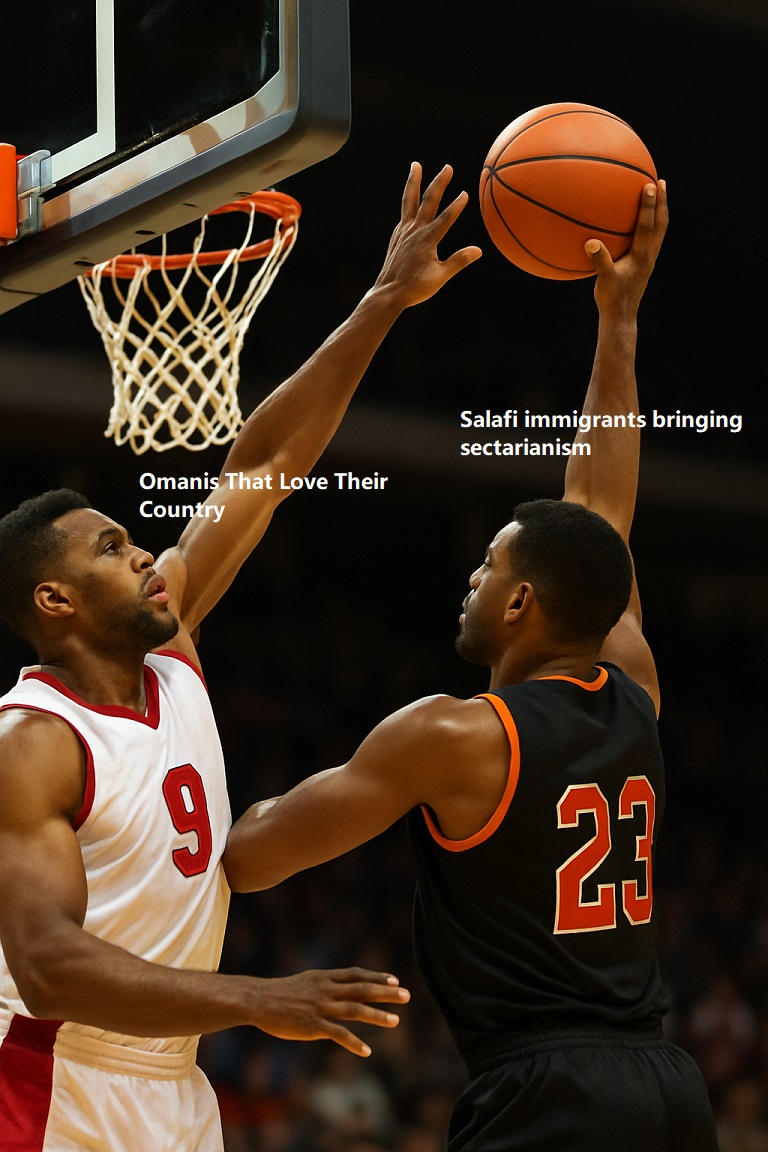

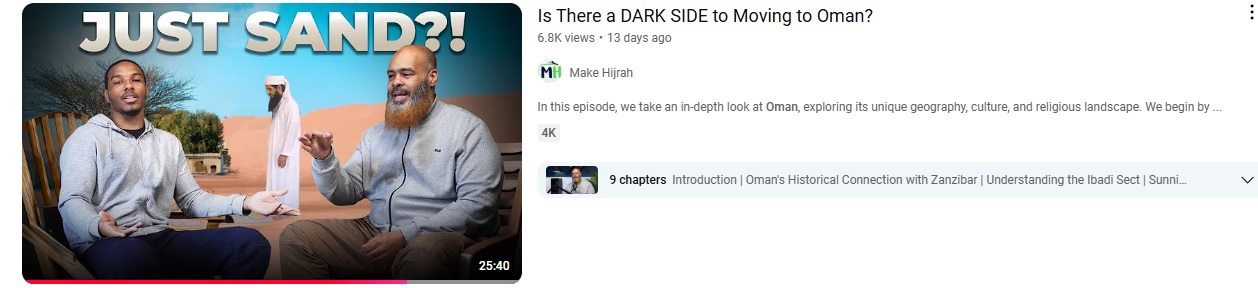
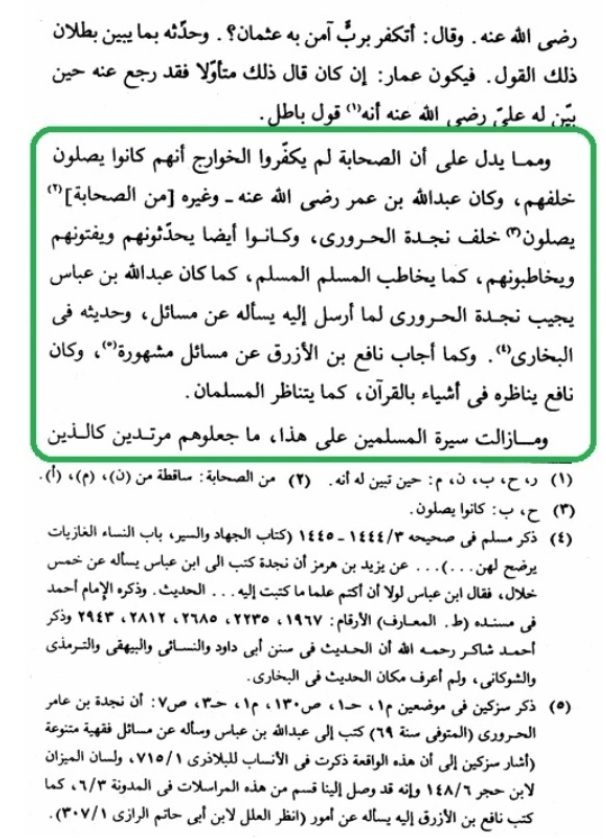


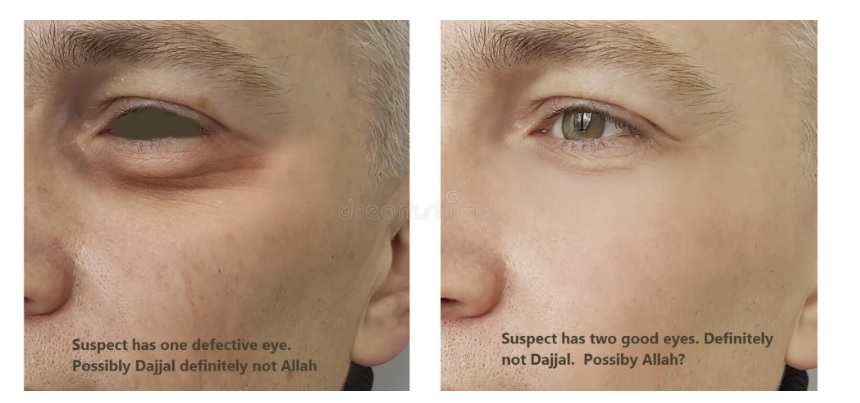
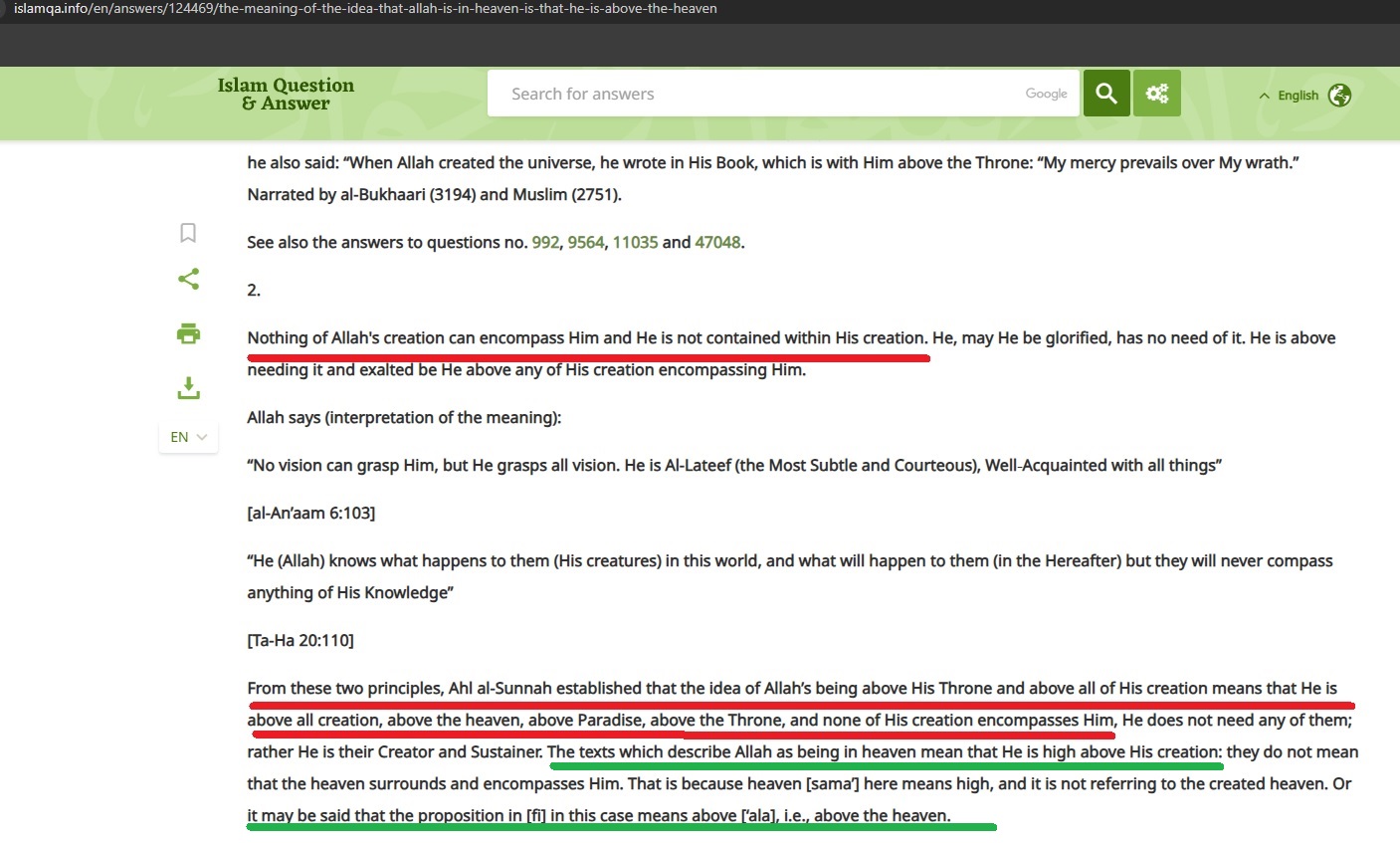
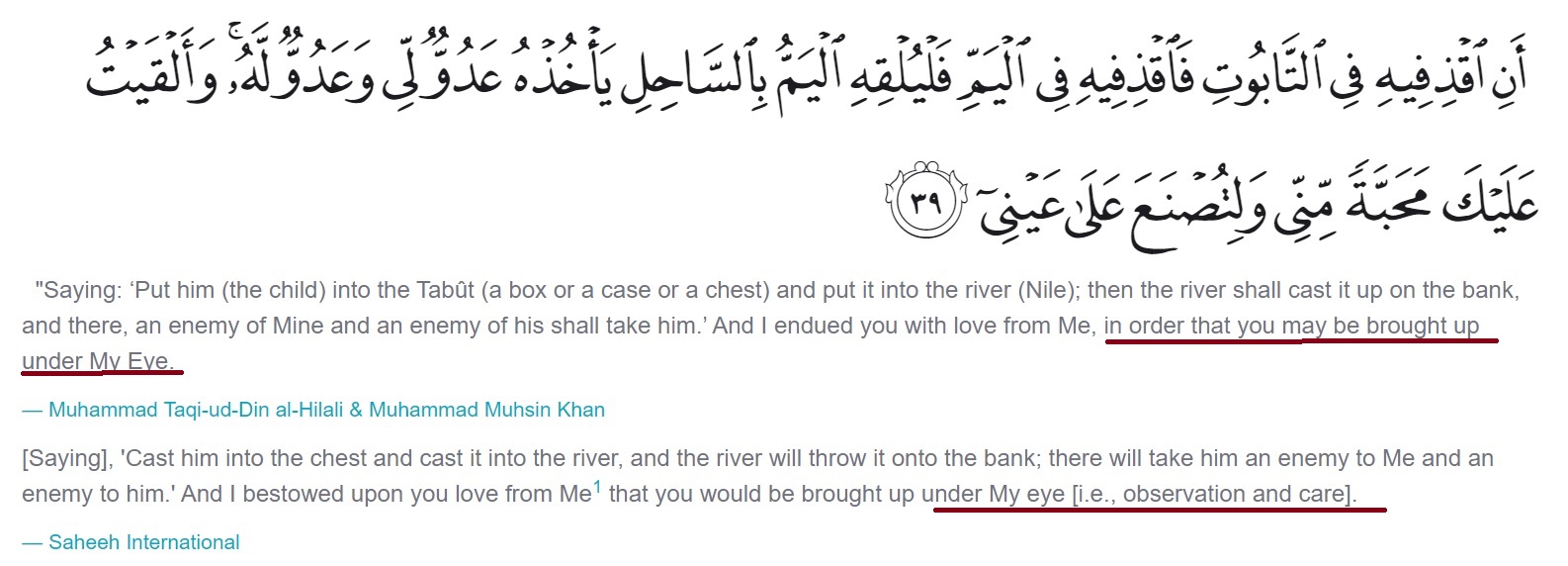


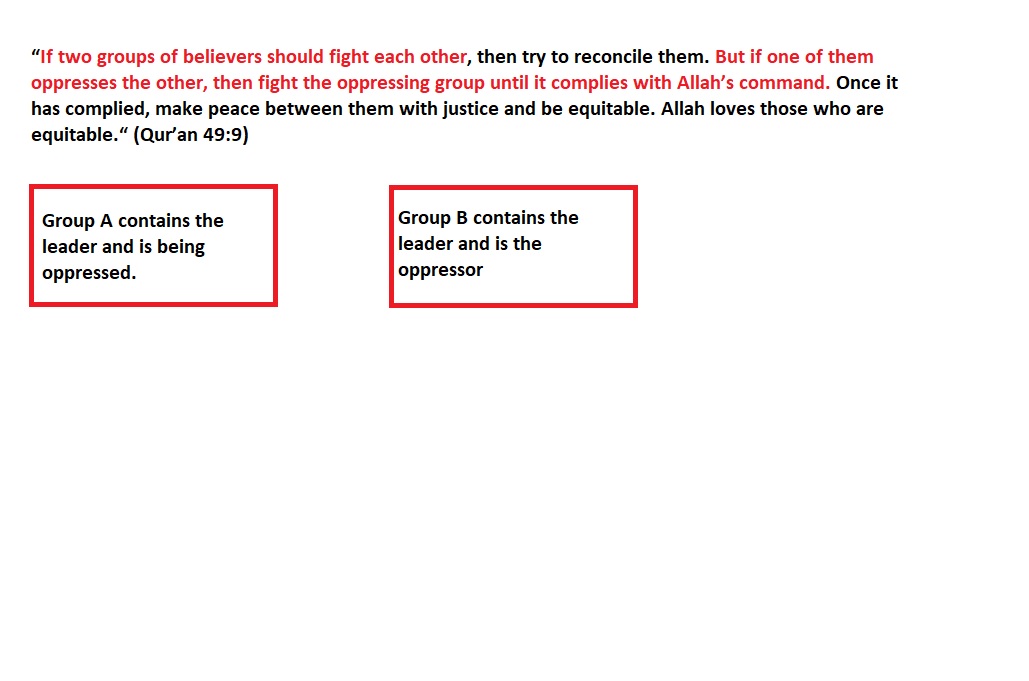
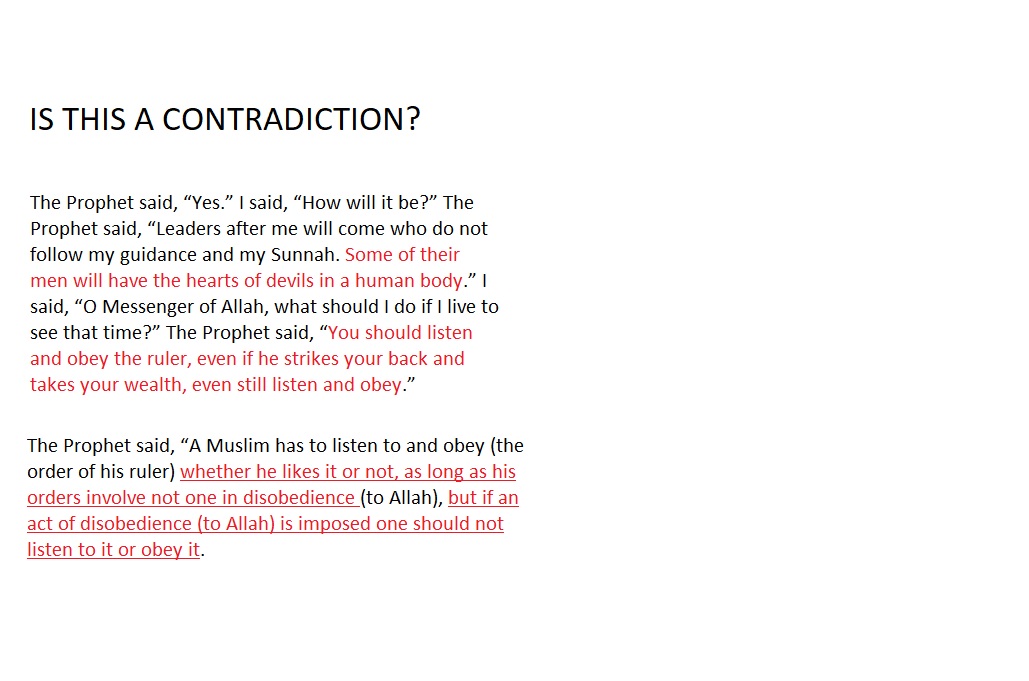





 Prima Quran