
“How will you comprehend what the steep ascent is? It is freeing a slave (raqabatin -a neck) or giving of food at the time of famine to an orphan or near of kin or some needy person in distress.” (Qur’an 90:12-16)
“It is not righteousness that you turn your faces Towards east or West; but it is righteousness- to believe in Allah and the Last Day, and the Angels, and the Book, and the Messengers; to spend of your substance, out of love for Him, for your kin, for orphans, for the needy, for the wayfarer, for those who ask, and for the ransom of slaves (l-riqābi) freeing the necks -slaves); to be steadfast in prayer, and practice regular charity; to fulfil the contracts which ye have made; and to be firm and patient, in pain (or suffering) and adversity, and throughout all periods of panic. Such are the people of truth, the Allah-fearing.” (Qur’an 2:177)
“When it is said to them, “Follow what Allah has revealed,” they reply, “No! We follow what we found our forefathers practicing.” (Qur’an 2:170)
﷽
This topic is not a difficult one to address. Especially when we realize some very basic things about human beings and human nature.
Humans have engaged in wars, slavery, marriage, divorce, and trade before the coming of the final revelation, the Qur’an.
The Qur’an comes to address the reality of what was happening in society. It addresses the situation on the ground. The Qur’an did not come to bring slavery but rather to address it. When Allah addresses slavery, He is giving rules to manage an existing situation, not expressing His endorsement of it.
The issue of Raqab (Slave) & Milk Al Yamin (Those whom your right hand possess) is through one means and one means only. That is via the context of war.
Outside the context of war, there is not a single verse in the Qur’an that calls for holding anyone as captive.
The other point that one will not fail to notice is that Raqab (slave) in the Qur’an is never in the context of the Muslims having them. Rather, it is in the context of the disbelievers having them and Muslims are encouraged to free them from the disbelievers.
Raqaba (Those whose necks are bound =under non Muslims) We should clarify that this also does mean Muslims who had slaves prior to embracing Islam.
Ma-Malakat Aymanukum (Those whom your right-hand posses /those whom you are your oath of protection/You are a custodian over them)
The decision on what to do after victory over one’s opponent.
This decision affects men, women and children. This decision would be delegated to the commander who is able to best access the situation.
The commander can to decide to:
- Kill them all (except women and children), as in the case of Bani Qurayzah, because the Blessed Prophet (saw) explicitly forbade the killing of women and children.*
- They could ransom them, as in the case of the battle of Badr, or exchange them for Muslim prisoners.
- Or they can take them as Ma-Malakat Aymanukum.
It really depends on the context and the assessment of the commander.
*It is narrated by Ibn ‘Umar that a woman was found killed in one of these battles; so the Messenger of Allah (saw) forbade the killing of women and children.
Source: (https://sunnah.com/muslim:1744b)
The first call is not to bring these people in as Ma-Malakat Aymanukum. The following verse demonstrates this:
“So, when you encounter those who disbelieve, then (aim at) smiting the necks, until when you have broken their strength thoroughly, then establish the covenant (or terms). Then choose (to release them) either (as) a favour (shown to them,), or (after receiving) ransom, until the war is over. That (is Our command.) If Allah willed, He would have (Himself) subjected them to retribution, but (Allah ordered you to fight,) so that He may test some of you through some others. And those who are killed in Allah’s way, He will never let their deeds go to waste.” (Qur’an 47:4)
The Muslim commander assesses the situation. If the enemy forces are decimated thoroughly, it is most likely in such a situation that bringing the people in like Ma-Malakat Aymanukum is at that point a mercy to them.
Rather than leave women and children to wonder and roam hoping others would take them in.
“It is not fit for a Prophet that he should take prisoners of war until he has thoroughly subdued the land. You settled with the fleeting gains of this world, while Allah’s aim is the Hereafter. Allah is Almighty, All-Wise.” (Qur’an 8:67)
This verse was sent down as a rebuke to the companions of the Blessed Messenger (saw). The reason is given in the verse itself: “until he has thoroughly subdued the land,” and “You settled with the fleeting gains of this world.” During the battle of Badr, when the enemy was fleeing, many of the companions started to immediately turn their attention to the war booty. However, they should have subdued their enemy completely. Enemies that you let get away are people who regroup, and you have to face another field of battle.
Not everyone would necessarily want to have extra mouths to feed.
Ma’rur b. Suwaid reported:
I saw Abu Dharr wearing clothes, and the slave wearing similar ones. I asked him about it, and he narrated that he had abused a person during the lifetime of Allah’s Messenger (saw) and he reproached him for his mother. That person came to Allah’s Messenger (saw) and made mention of that to him. Thereupon Allah’s Messenger (saw) said: You are a person who has (remnants of) ignorance in him. Your slaves are brothers of yours. Allah has placed them in your hand, and he who has his brother under him, he should feed him with what he eats, and dress him with what he dresses himself, and do not burden them beyond their capacities, and if you burden them, (beyond their capacities), then help them.
Source: (https://sunnah.com/muslim:1661c)
Let us think of today’s example of a domestic helper. Not everyone can afford to have a domestic helper even if they want one. Also think of accommodation. We are surprised at all the discussion on this topic. It is not approached from a practical and pragmatic aspect of whether everyone would put their hands up to volunteer to have a slave. Keep in mind, the vast majority of the companions were people who were already under a great deal of duress and many of them were not people of means. It is likely those who took such people were those who handed livestock or fields to tend to. In other words, they saw a practical and pragmatic benefit in taking in and taking care of such people.
The objective of the Muslim man in war.
We also need to bear in mind that the objective of the Muslim man in war is to seek shahada. Why would any Muslim man in their right mind and right state of emaan settle for the paltry gains of this worldly life when the hereafter and all its blessings awaits!
“O believers! Do not be like the unfaithful who say about their brothers who travel throughout the land or engage in battle, “If they had stayed with us, they would not have died or been killed.” Allah makes such thinking a cause of agony in their hearts. It is Allah who gives life and causes death. And Allah is All-Seeing of what you do. Should you be martyred or die in the cause of Allah, then His forgiveness and mercy are far better than whatever ˹wealth˺ those ˹who stay behind˺ accumulate. Whether you die or are martyred—all of you will be gathered before Allah.” (Qur’an 3:156-158)
“Never think of those martyred in the cause of Allah as dead. In fact, they are alive with their Lord, well provided for rejoicing in Allah’s bounties and being delighted for those yet to join them. There will be no fear for them, nor will they grieve.” (Qur’an 3:169-170)
What is ultimately the objective in Islam of having Ma-Malakat Aymanukum from wars?
Firstly, Islam and the Muslims would prefer not to have wars to begin with. Let’s establish this.
Secondly, the ultimate objective is the re-integration of such people into society. That is what we need to keep in mind when going forward. Does the Qur’an encourage, allow, or find avenues for this? Does Islam really set about to do this or does it just talk? Let us see.
The Qur’an and the New Testament & TNCH
There is not a single verse in the New Testament encouraging anyone ever to free a slave. Not one.
Jesus, as recorded in the New Testament, had two interactions with slaves. Both of whom he healed. But not once was there a command to set the slave free — which shows, morally speaking, he was quite fine with it as a reality of society.
In fact, Christians have had to turn this Messianic Prophecy into some Christological view about Christ Jesus (as) saving people from sins!
“The spirit of the Lord God was upon me, since the Lord anointed me to bring tidings to the humble, He sent me to bind up the broken-hearted, to declare freedom for the captives, and for the prisoners to free from captivity.” (Isaiah 61:1)
Jesus (as) during his ministry (according to the NT) did nothing of the kind. So the captives here must be interpreted as captives to sins.
Christians will often quote the following verse to claim this abolishes slavery.
“There is neither Jew nor Gentile, neither slave nor free, nor is there male and female, for you are all one in Christ Jesus.” (Galatians 3:28)
This verse says nothing about abolishing slavery. It simply speaks of all being equal in Christ. The proof of that is that this verse has been read down through the ages and Christians had no issues with keeping slaves.
“Slaves, in reverent fear of God, submit yourselves to your masters, not only to those who are good and considerate, but also to those who are harsh.” (1 Peter 2:18)
In fact, in the entire TNCH of Judaism (what Christians call the Old Testament) there were no examples of encouraging the freeing of slaves! What you will find is that if your slave is a Hebrew, he cannot be a slave beyond 6 years, and you must set him free. There is no such law for non-Hebrew people!
“Now these are the rules that you shall set before them. When you buy a Hebrew slave, he shall serve six years, and in the seventh he shall go out free, for nothing. If he comes in single, he shall go out single; if he comes in married, then his wife shall go out with him. If his master gives him a wife and she bears him sons or daughters, the wife and her children shall be her master’s, and he shall go out alone. But if the slave plainly says, ‘I love my master, my wife, and my children; I will not go out free.” (Exodus 21:1-6)
Freeing of slaves was only in relation to their own people.
Then the Holy Trinity (Father, Jesus and The Holy Spirit) commanded:
“When you march up to attack a city, make its people an offer of peace. If they accept and open their gates, all the people in it shall be subject to forced labor and shall work for you. If they refuse to make peace and they engage you in battle, lay siege to that city. When the Lord your God delivers it into your hand, put to the sword all the men in it. As for the women, the children, the livestock and everything else in the city, you may take these as plunder for yourselves. And you may use the plunder the Lord your God gives you from your enemies. This is how you are to treat all the cities that are at a distance from you and do not belong to the nations nearby. However, in the cities of the nations the Lord your God is giving you as an inheritance, do not leave alive anything that breathes. Completely destroy them—the Hittites, Amorites, Canaanites, Perizzites, Hivites and Jebusites—as the Lord your God has commanded you. Otherwise, they will teach you to follow all the detestable things they do in worshiping their gods, and you will sin against the Lord your God.” (Deuteronomy 20:10-18)
The Holy Trinity (Father Jesus and The Holy Spirit) did not chide or stop Moses when he stated:
“And Moses said to them, Have you saved all the women alive? Behold, these caused the children of Israel, through the counsel of Balaam, to commit trespass against the Lord in the matter of Peor, and there was a plague among the congregation of the Lord. Now therefore kill every male among the little ones, and kill every woman that have known man by lying with him. But all the women children, that have not known a man by lying with him, keep alive for yourselves.” (Numbers 31:15-18)
Then the Holy Trinity (Father, Jesus and The Holy Spirit) commanded:
“When you go out to war against your enemies, and the Lord your God gives them into your hand and you take them captive, and you see among the captives a beautiful woman, and you desire to take her to be your wife, and you bring her home to your house, she shall shave her head and pare her nails. And she shall take off the clothes in which she was captured and shall remain in your house and lament her father and her mother a full month. After that you may go in to her and be her husband, and she shall be your wife. But if you no longer delight in her, you shall let her go where she wants. But you shall not sell her for money, nor shall you treat her as a slave, since you have humiliated her.” (Deuteronomy 21:10-14)
Then the Holy Trinity (Father, Jesus and The Holy Spirit) commanded:
“Your male and female slaves are to come from the nations around you; from them you may buy slaves. You may also buy some of the temporary residents living among you and members of their clans born in your country, and they will become your property. You can bequeath them to your children as inherited property and can make them slaves for life, but you must not rule over your fellow Israelites ruthlessly.” (Leviticus 25: 44-46)
Then the Holy Trinity (Father, Jesus and The Holy Spirit) commanded:
If a man happens to meet a virgin who is not pledged to be married and rapes her and they are discovered, he shall pay her father fifty shekels of silver. He must marry the young woman, for he has violated her. He can never divorce her as long as he lives.” (Deuteronomy 22:28-29)
Partus sequitur ventrem or descent-based slavery in Islam, Judaism and Christianity.
What does this mean? In other world views, if a person is born to a slave woman, they too would be born into slavery. This is not the case in Islam. The person born to a slave is a free person. We do not have baby slaves. The first documented recorded example in the history of getting rid of descent-based slavery is in Islam!
Now, what does the Bible (New Testament/TNCH) say in regard to this? Nothing.
ATONE FOR SINS BY FREEING A (RAQAB/NECK) SLAVE.
The first point is what we have already covered in regard to (Qur’an 47:4) above. That is immediate emancipation. Either by a good will gesture, ransom or via prisoner exchange.
Now what we are going to share with you, dear readers, leaves no good options for the haters of Islam.
- They will have to admit the (raqab) were not something in abundance among Muslims. Or.
- That the Qur’an is a divine revelation as it’s author (Allah), being the All-Knowing, laid out a plan for Muslims to get atonement when no (raqab) would be available: -for example, in the future.
Thie following verses demonstrate that the institution of slavery need not endure.
“Allah will not impose blame upon you for what is meaningless in your oaths, but He will impose blame upon you for [breaking] what you intended of oaths. So its expiation is the feeding of ten poor people from the average of that which you feed your families or clothing them or the liberation of (raqabatin) a slave.” “But if none of this is affordable, then you must fast three days. This is the penalty for breaking your oaths. So be mindful of your oaths. This is how Allah makes things clear to you, so perhaps you will be grateful.”(Qur’an 5:89)
“It is not lawful for a believer to kill another except by mistake. And whoever kills a believer unintentionally must free a believing slave and pay blood-money to the victim’s family—unless they waive it charitably. But if the victim is a believer from a hostile people, then a believing (raqabatin) slave must be freed. And if the victim is from a people bound with you in a treaty, then blood-money must be paid to the family along with freeing a believing slave (raqabatin). Those who are unable, let them fast two consecutive months—as a means of repentance to Allah. And Allah is All-Knowing, All-Wise.” (Qur’an 4:92)
“And those who pronounce thihar from their wives and then [wish to] go back on what they said – then [there must be] the freeing of a slave (raqabatin) before they touch one another. That is what you are admonished thereby; and Allah is Acquainted with what you do.” “But if the husband cannot afford this, let him then fast two consecutive months before the couple touch each other. But if he is unable, then let him feed sixty poor people. This is to re-affirm your faith in Allah and His Messenger. These are the limits set by Allah. And the disbelievers will suffer a painful punishment.” (Qur’an 58:3-4)
Prima Qur’an comments: If you look at the expiation for sin, it is clear from this that Allah (swt) offers several solutions if one is unable to free the neck (of a slave).
- Freeing slaves
- Freeing slaves along with blood money.
- Feeding 60 poor people.
- Fasting, depending on the nature of the sin; 3 days or up to 120 days consecutively.
Fasting can only be an option if the person does not have the means to free a neck (slave) or there are simply no slaves (necks) to be freed!
That is to say that freeing a neck (slave) is given priority in terms of expiation of sins!
Zakat — one of the five pillars of Islam and forced tax collection on the Muslim faithful by the Amir is used to set slaves free!
“Zakah expenditures are only for the poor and for the needy and for those employed to collect [zakah] and for bringing hearts together [for Islam] and for freeing captives (l-riqabi) and for those in debt and for the cause of Allah and for the [stranded] traveler – an obligation [imposed] by Allah. And Allah is Knowing and Wise.” (Qur’an 9:60)
Zakah, which comes from an Arabic root word meaning to purify, is one of the five pillars of Islam. In the context of Zakah distribution, it is the purification of one’s wealth. This means that the money that is generated by this forced tax collection is used to free slaves!
There are 8 ahsnaf (beneficiaries of Zakah).
- Fakir -One who has no means of livelihood or material possession.
- Miskin -One who has insufficient means to sustain their livelihood.
- Amil -The person who collects the Zakah, to reward the dutiful.
- Muallaf-Assistance for those who recently embraced Islam.
- Riqab-Freeing of slaves.
- Gharimin-One who is in debt needs assistance to pay off a debt.
- Fisabillah-Those who fights in the cause of Allah-or to sustain those
who lost bread winners in the war. - Ibnussabil-Those who are travelers or on a journey
At this point, a Muslim should lift his/her head up with pride and say: “Al hamdulillah, I am a Muslim! What other system is there like this in any other faith tradition?”
Islam encourages the freeing of slaves and especially tells us that it is a quick path to righteousness & spiritual elevation.
How will you comprehend what the steep ascent is? It is freeing a slave (raqabatin -a neck) or giving of food at the time of famine to an orphan or near of kin or some needy person in distress.” (Qur’an 90:12-16)
“It is not righteousness that you turn your faces Towards east or West; but it is righteousness- to believe in Allah and the Last Day, and the Angels, and the Book, and the Messengers; to spend of your substance, out of love for Him, for your kin, for orphans, for the needy, for the wayfarer, for those who ask, and for the ransom of slaves (l-riqābi) freeing the necks -slaves); to be steadfast in prayer, and practice regular charity; to fulfil the contracts which you have made; and to be firm and patient, in pain (or suffering) and adversity, and throughout all periods of panic. Such are the people of truth, the Allah-fearing.” (Qur’an 2:177)
The Qur’an informs us that when it comes to choosing a life partner and whom to continue our lineage with that a believing slave is better than a disbelieving free person.
“And do not marry mushrik women until they believe. And a believing wala-amatun (bondwoman) is better than a mushrik, even though she might please you. And do not marry mushrik men until they believe. And a believing wala-abdun (bondman) is better than a mushrik, even though he might please you. Those invite to the Fire, but Allah invites to Paradise and to forgiveness, by His permission. And He makes clear His verses to the people that perhaps they may remember.” (Qur’an 2:221)
In the scenario above, the slave has a low status before the people.
The free person has a high status before the people.
In both situations, when a believer is to access who to give their son or daughter to for the continuation of their lineage, the believer is always superior to the unbeliever in every scenario. The believing slave is leagues above the unbelieving free person.
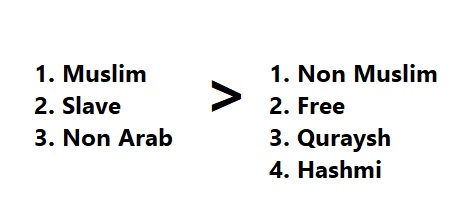
The above verse is used by our school, the Ibadi school, as a proof against anyone who states that someone who is Quraysh is, by default, superior to a non-Qurashi. Or, that an Arab is superior to a non-Arab. This verse is definite proof against that position.
Various hadith about slaves
Narrated Al-Miswar bin Makhrama and Marwan:
When the delegates of the tribe of Hawazin came to the Prophet (saw) he stood up amongst the people, Glorified and Praised Allah as He deserved, and said, “Then after: Your brethren have come to you with repentance and I see it logical to return to them their captives; so whoever amongst you likes to do that as a favor, then he can do it, and whoever of you like to stick to his share till we give him his right from the very first Fai (war booty) (1) which Allah will bestow on us, then (he can do so).” The people replied, “We do that (to return the captives) willingly as a favor for your sake.”
Source: (https://sunnah.com/bukhari:2583)
Narrated Abu Musa:
Allah’s Messenger (saw) said, “He who has a slave-girl and educates and treats her nicely and then manumits and marries her, will get a double reward.”
https://sunnah.com/bukhari:2544
Zadhan said:
I came to Ibn ‘Umar when he set his slave free. He took a stick or something else from the earth and said; for me there is no reward even equivalent to this. I heard the Messenger of Allah (saw) say: If anyone slaps or beats his slave the atonement due from him is to set him free.
Source: (https://sunnah.com/abudawud:5168)
Narrated Abu Huraira:
The Prophet (saw) said, “Allah says, ‘I will be against three persons on the Day of Resurrection: -1. One who makes a covenant in My Name, but he proves treacherous. -2. One who sells a free person (as a slave) and eats the price, -3. And one who employs a laborer and gets the full work done by him but does not pay him his wages.’ “
Source: (https://sunnah.com/bukhari:2227)
Abu Huraira reported Allah’s Messenger (saw) as saying:
None of you should say: My bondman, for all of you are the bondmen of Allah, but say: My young man, and the servant should not say: My Lord, but should say: My chief.
Source: (https://sunnah.com/muslim:2249b)
Narrated Anas bin Malik:
Allah’s Messenger (saw) said, “You should listen to and obey, your ruler even if he was an Ethiopian (black) slave whose head looks like a raisin.”
Source: (https://sunnah.com/bukhari:7142)
It is also clear from the above hadith that someone who had the status of slave can rise to the ranks of being the commander of the faithful. That is the Amir al-Mu’minin (Commander of the Faithful) of the entirety of all Muslims!
In fact, the above hadith is used by our school; The Ibadi school against the Shi’i and Sunni schools, which state the ruler of the Muslims must only be from the Quraysh (Sunni from any member of Quraysh) and (Shi”i from the Prophet’s lineage which is Quraysh).
Addressing the issue of Ma-Malakat Aymanukum
First, who are the Ma-Malakat Aymanukum?
Recall the definition.
Ma-Malakat Aymanukum (Those whom your right-hand posses /those who you are your oath of protection/You are a custodian over them)
The expression: right-hand posses is an idiom or expression which means those under your authority, custody, care, provision. The right hand is always used as an expression of something noble and good.
“So as for he who is given his record in his right hand, he will say, “Here, read my record!” (Qur’an 69:19)
The Ma-Malakat Aymanukum are never titled as those whom your left-hand posses. As if they were something disposable and ignoble.
They are those who have been taken under the protection of Muslim households (who have the means and capacity to care for them). Not all Muslim households would volunteer for this. So this offered Muslims from different social economic backgrounds an opportunity to receive reward in different ways.
- To simply let such people go.
- To earn rewards by bringing in these people under the care and provision of a Muslim household.
Also, bear in mind that option 2 was most likely, in many cases, the preferred choice even from the vantage point of those captured. Once your men, husbands, protectors, army have been decimated, where will you go? To whom will you turn to? Also, do keep in mind that Ma-Malakat Aymanukum is not simply women and children as it also includes men.
So let us tackle the first supposed topic of controversy head on.
Can Muslim women /Muslim men rape, molest or sexually exploit their Ma-Malakat Aymanukum against their will?
“Why should you not fight in the cause of Allah when weak men, women, and children are imploring: “Our Lord, deliver us from this community whose people are oppressive, and be You our Lord and Master.” (Qur’an 4:75)
How would this du’a to Allah to send people who deliver them from oppression make sense if Muslims turned around and did the same thing?
“And of His signs is that He created for you from yourselves mates that you may find tranquility in them; and He placed between you affection and mercy. Indeed in that are signs for a people who give though.” (Qur’an 30:21)
One of the means by which a Muslim woman may find her future husband or by which a Muslim man may find his future wife is by means of milk al yamin. Is it really to be believed that this Muslim woman or man can now rape or molest his/her milk al yamin without his/her consent and he/she (the victim) will be among those who are filled with affection and mercy for his wife or her husband?
Remember that Allah (swt) has mentioned that this category of people, as believers, are better for our sons and daughters as future partners than disbelievers, who are free people.
“And do not marry mushrik women until they believe. And a believing wala-amatun (bondwoman) is better than a mushrik, even though she might please you. And do not marry mushrik men until they believe. And a believing wala-abdun (bondman) is better than a mushrik, even though he might please you. Those invite to the Fire, but Allāh invites to Paradise and to forgiveness, by His permission. And He makes clear His verses to the people that perhaps they may remember.” (Qur’an 2:221)
What kind of healthy or wholesome relationship does one think will come out of those who suffered abuse?
Even this day, those of us who have married men and women who have been raped or molested by their mothers, fathers, aunts, uncles, guardians know the trauma and immense challenge it takes building trust with our partners.
Next point:
Zadhan said:
I came to Ibn ‘Umar when he set his slave free. He took a stick or something else from the earth and said; for me there is no reward even equivalent to this. I heard the Messenger of Allah (saw) say: If anyone slaps or beats his slave (mamluka) the atonement due from him is to set him free.
Source: (https://sunnah.com/abudawud:5168)
If you are not to slap or beat your slave, how is that you can force them against their will?
The Qur’an commands Chastity.
“You shall maintain chastity, not committing adultery, nor taking secret lovers.”
(Qur’an 5:5)
“Tell the believing men to lower their gaze and guard their chastity. That is purer for them. Surely Allah is All-Aware of what they do.” (Qur’an 24:30)
“As for the one who reverenced the majesty of his Lord, and enjoined the self from sinful lusts. Paradise will be the abode.” (Qur’an 79:40-41)
“Worship Allah and associate nothing with Him, and to parents do good, and to relatives, orphans, the needy, the near neighbor, the neighbor farther away, the companion at your side, the traveler, and those whom (malakat aymanukum) your right hands possess. Indeed, Allah does not like those who are stingy and boastful.” (Qur’an 4:36)
Allah (swt) has put the malakat aymankum on the same level, and they should be treated with good as their parents, relatives, orphans, needy, neighbor, traveler, companion and even neighbor not adjacent to you.
Can it be said that if these people are molested against their consent, that they are being treated with good?
“Marry off the singles among you, as well as the righteous of your bondmen and bondwomen(Ibadikum wa-imaikum). If they are poor, Allah will enrich them out of His bounty. For Allah is All-Bountiful, All-Knowing. And let those who do not have the means to marry should (walyyasta’fifi)-show restraint and/or keep themselves chaste until Allah enriches them out of His bounty. And if any of those who your right hand posses (malakat aymanukum) desires a contract, make it possible for them, if you find goodness in them. And give them some of Allah’s wealth which He has granted you. Do not force your girls into prostitution (l-bighai)for your own worldly gains while they wish to remain chaste. And if someone coerces them, then after such a coercion Allah is certainly All-Forgiving, Most Merciful . Indeed, We have sent down to you clear revelations, along with examples of those who had gone before you, and a lesson to the Allah-fearing. (Qur’an 24:32-34)
Prima Qur’an comments:
1) Allah tells us to marry those who are single among us. As well as marry the bondmen and bondwomen.
2) Those who do not have the means to marry should remain chaste/show restraint. — Not that a Muslim woman can go and rape or molest a man, or that a Muslim man can go and rape and molest a woman. In fact, if they were allowed to do so, there would be no injunction for them to show restraint.
3)If any malakat aymanukum wants to get into a contract to buy their freedom, make it possible for them, in fact give them some of the wealth Allah gave you! (Allah swt is reminding us that, after all, he is the source of all wealth).
4) Do not force your girls into prostitution. If this is done, then Allah forgives this coercion (of the girl), not the one who forces them as some twisted Anti Muslims claim. In fact, if it was fine for them to force them into prostitution, the warning to tell them not to do so when be redundant to begin with.
5) (l-bighai) means more than prostitution it means any type of lewdness. Certainly, having inappropriate relations with someone to whom you are not married constitutes exactly this.
6) You will also see this is why no punishment is meted out to unmarried women from Malakat Aymanukum when we discuss Qur’an 4:25. Because of her social and economic condition, it could be quite challenging to tell if she is being forced to do something because she is doing it of her own volition. This ambiguity in the law is also proof enough that they cannot be coerced into intimacy. As stated, if they were forced the fault is with the one who coerces and not the coerced.
“And whoever among you cannot [find] the means to marry free, believing women, then from those (malakat aymanukum min fatayatikumu l-mu’minati) what your right hands possess that are believers. And Allah is most knowing about your faith. You [believers] are of one another. So marry them with the permission of their people ahlihinna (of their people/family)and give them their due compensation according to what is acceptable. They should be (muh’sanatin ghayra musafihatin) chaste not those who commit immorality) nor those who take [secret] lovers (akhdanin). But once they are in the sacred bond of marriage, if they should commit adultery, then for them is half the punishment for free [unmarried] women. This [allowance] is for him among you who fears sin, but to be patient is better for you. And Allah is Forgiving and Merciful.” (Qur’an 4:25)
Prima Qur’an comments:
1) If you cannot afford to marry free believing women, then you marry those whom your right hand possesses. Due to the social and economic status of free women, it is possible that they may demand a higher dowry, among other things.
2) If they have family or tribe that you, or they know of, then you seek permission from their family or tribe.
3) They should be chaste. One cannot be chaste if it is allowable to be unchaste.
4) They should not have secret lovers.
It should be very clear that these women are not being fondled, molested or raped. Also, the inverse is true; that it should be clear that when Muslim women marry such men that they are not being fondled, molested or raped. Because then they would not be from the category of the chaste; nor are they from those who do not have secret lovers.
By the way, in many cases, in the above scenario, the mahr (the bridal dowry) was to grant her freedom. In other cases, this was not so.
5) But once they are sheltered in marriage, if they should commit adultery, then for them there is half the punishment for free [unmarried] women. This point is something that is quite phenomenal that many people do not ponder over. Usually, in a society, a person of lower socioeconomic status would be treated as a lesser person than those with higher social economic status. Quran 4:25 goes against that norm.
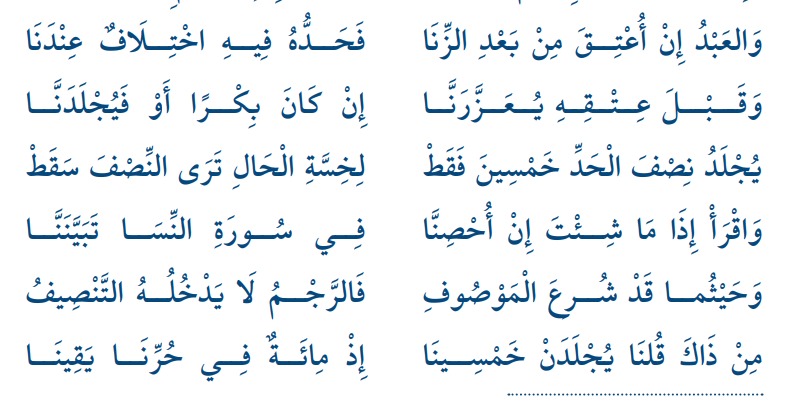
That is why, in our school, the punishments for adultery and pre-marital sex are meted out like so:
- Free Woman/Man that are married =Rajm.
- Free Woman/Man that are unmarried =100 lashes.
- Slave Woman/Man that are married =50 lashes.
- Slave Woman/Man that is unmarried = Taazir.
A tazir punishment is when there is nothing explicit from the Qur’an or Sunnah. It is discretionary. It could be corporeal in nature, it could be harsh words of admonishment.
“Do not force your girls into prostitution (l-bighai)for your own worldly gains while they wish to remain chaste.”
Due to the social and economic condition of this person, it would be very difficult to pin anything on them. Especially in light of the fact that they very well could be forced.
We have not found any cases in the Ibadi school of said individuals (category 4) being punished.
“And if you fear that you will not deal justly with the orphan girls, then marry those that please you of [other] women, two or three or four. But if you fear that you will not be just, then one or those your right hand possesses (malakat aymanukum). That is more suitable that you may not incline (ta’ulu)-injustice, oppression. And give the women [upon marriage] their [bridal] gifts graciously. But if they give up willingly to you anything of it, then take it in satisfaction and ease.” (Qur’an 4:3-4)
Prima Qur’an comments:
1) If you fear that you will not do justice when marrying many orphan women, then marry one from among them (malakat aymanukum). In other words, these women from the malakat aymanukum are there for your consideration.
2) Orphan girls here are still free women. They are simply free women that do not have any known family or guardians.
3) Give them (malakat aymanukum)their bridal gift.
And [also prohibited to you are all] married women except those your right hands possess. (malakat aymanukum)[This is] the decree of Allah upon you. And lawful to you are [all others] beyond these, [provided] that you seek them [in marriage] with [gifts from] your property, desiring chastity, not unlawful sexual intercourse (muh’sinina ghayra musafihina So for whatever you enjoy [of marriage] from them, give them their due compensation as an obligation. And there is no blame upon you for what you mutually agree to beyond the obligation. Indeed, Allah is ever Knowing and Wise. (Qur’an 4:24)
- If we Muslims were such immoral people, why would we need to be consoled that it is fine to marry women from those whom our right-hand posses that were already married?
- In other words, this verse says that those women who are already married to those whom Islam would not recognize the validity of their marriage contract, you can marry them.
- Notice that, again, the malakat aymanukum are spoken of in the context of marriage. That beyond them are other women who are lawful to you provided you desire chastity and not unlawful intercourse.
Let us put it like this. We will use the example of the law of the former United States. The former United States has a law that says if a person is married, and then they seek to get married to another individual, this is called bigamy.
So here is the scenario. A married woman in the former United States converts to Islam and seeks a divorce from her husband. The divorce proceedings are taking a long time. In the meantime, this woman does not live with her husband, nor does she receive sustenance or care from him. Over the course of time, she has been made known of an interest in her by a Muslim man. After meeting up with the suitor in the appropriate settings, they decide to marry. The Imam of the Masjid performs the nikah. Technically, this woman is married to her husband (by U.S. law). However, in Islam, the moment she became a Muslim and her husband did not follow suit, that marriage dissolved. They are married in the sight of Allah (swt) and that is what matters. As long as they do not go and try and register their marriage, the wife would be free from the charge of bigamy in U.S. law.*
*Note as Muslims we have to respect the laws of the nations that we reside in.
If we were an Imam in the former United States, we would officiate such a nikah.
“O you who have believed, when the believing women come to you as emigrants, examine them. Allah is most knowing as to their faith. And if you know them to be believers, then do not return them to the disbelievers; they are not lawful [wives] for them, nor are they lawful [husbands] for them. But give the disbelievers what they have spent. And there is no blame upon you if you marry them when you have given them their due compensation. And hold not to marriage bonds with disbelieving women, but ask for what you have spent and let them ask for what they have spent. That is the judgement of Allah ; He judges between you. And Allah is Knowing and Wise.” (Qur’an 60:10)
So it can be asked is it not inherently morally wrong to marry a woman who is already “lawfully” married to another man according to their custom, beliefs or creed?
Notice we said “lawfully” in quotes. That is because who determines what is or is not lawful marriage? Thus, in the above text, a believing woman is indeed married to a disbelieving man according to the laws, customs and beliefs of his society and his people. Thus, she is in adultery in accordance with them. However, Allah (swt) has made that marriage null and void!
In fact, Allah (swt) is being rather magnanimous by ordering: But give the disbelievers what they have spent. When Allah (swt) could have ordered that they receive nothing!
Now we could turn around and ask the Jews and Christians the following: What do you say on these matters? It is easy to talk the talk, but do you walk the walk? So let us give them a scenario.
Let us say a Muslim woman has now converted to Christianity. She wanted to leave a horrible marriage she was in. Her husband would in no way divorce her. This woman left Islam and became a Christian. She flees to the former United States. What is the position of Judaism and Christianity on her matter?
Does she remain single for the rest of her life or does not the law of the land have the power to nullify or make null her marriage? Technically, she is still married to that man and will be until he divorces her (according to the laws of his land).
“O Prophet, indeed We have made lawful to you your wives to whom you have given their due compensation and those (malakat yaminuka) whom your right hand possesses from what Allah has returned to you [of captives] and the daughters of your paternal uncles and the daughters of your paternal aunts and the daughters of your maternal uncles and the daughters of your maternal aunts who emigrated with you and a believing woman if she gives herself to the Prophet [and] if the Prophet wishes to marry her, [this is] only for you, excluding the [other] believers. We certainly know what We have made obligatory upon them concerning their wives and those their right hands possess,(malakat aymanuhum) in order that there will be upon you no discomfort. And ever is Allah Forgiving and Merciful.” (Qur’an 33:50)
- Daughters of paternal uncles.
- Daughters of paternal aunts.
- Daughters of maternal uncles
- Daughters of maternal aunts.
- Any believing woman who gives herself to you. If the Prophet wishes to marry her.
Does anyone believe for a moment that the above verse is saying that if the Blessed Prophet (saw) so wished that he could be intimate with his cousins without being married to them?
In fact, category 5 (any believing woman) is explicitly followed up by the desire to marry her.
Thus, those whom your right hand possesses (malakat yaminuka) are also under these categories. That they are among the women the Blessed Prophet (saw) can marry if he so chooses. As he did so with Safiyah (ra).
“You, [O Muḥammed], may put aside whom you will of them or take to yourself whom you will. And any that you desire of those [wives] from whom you had [temporarily] separated – there is no blame upon you [in returning her]. That is more suitable that they should be content and not grieve and that they should be satisfied with what you have given them – all of them. And Allah knows what is in your hearts. And ever is Allah Knowing and Forbearing.” (Qur’an 33:51)
THE MALAKAT YAMIN BECAME THE ONLY OPTION FOR THE BLESSED PROPHET (SAW).
“Not lawful to you, [O Muḥammed], are [any additional] women after [this], nor [is it] for you to exchange them for [other] wives, even if their beauty were to please you, except what your right hand possesses (malakat yaminuka). And ever is Allah, over all things, an Observer.” (Qur’an 33:52)
“Not lawful to you, [O Muḥammed], are [any additional] women after [this], nor [is it] for you to exchange them for [other] wives, even if their beauty were to please you.”
This directly refutes two major accusations that have been leveled against the Blessed Prophet (saw).
- The accusation that he made up the revelation to suit himself.
- Him having unrestrained and unchecked desires.
Allah (swt) prohibits the Prophet to:
a) Marry more free women. Even if he feels a magnetic pull towards them.
b) Divorce any of his current wives.
By means of this verse, they were secured from divorce. Allah (swt) decreed that they would be his wives in this world and in the world to come. The very definition of soul mates!
The only exception or clause is: “(malakat yaminuka).” Those captives seized in war. They are permissible for you to marry.
Verses concerning relaxed dress code around malakat aymanukum
“And say to the believing women that they should lower their gaze and guard (wayaḥfaẓna) their modesty (furūjahunna); that they should not display their beauty and ornaments except what must ordinarily appear thereof; that they should draw their veils over their bosoms and not display their beauty except to their husbands, their fathers, their husband’s fathers, their sons, their husbands’ sons, their brothers or their brothers’ sons, or their sisters’ sons, or their women, or (malakat aymanuhuna (their right hands possess), or male servants free of physical needs, or small children who have no sense of the shame; and that they should not strike their feet in order to draw attention to their hidden ornaments. And O you Believers! turn you all together towards Allah, that you may attain Bliss.” (Qur’an 24:31)
Except for: their husbands. Their fathers. Their Father-In-Law. Their Sons. Their husbands sons (other marriages). Their brothers, their brother’s sons. Their Sister’s Sons. Other women. Malakat Aymanukum. The male attendants who have no desire: examples: eunuchs or the very old. Children who are unaware or naive.
Prima Qur’an comments: It should be clear that the malakat aymanukum are treated in a sense as family. They are not locked outside the home in some cold barn. They are part and parcel of the family unit, hence why a relaxation in the dress code. It is almost unavoidable at times.
“O you who have believed, let those whom your right hands possess (malakat aymanukum) and those who have not [yet] reached puberty among (yablughu l-huluma (reached puberty) you ask permission of you [before entering] at three times: before the dawn prayer and when you put aside your clothing [for rest] at noon and after the night prayer. [These are] three times of privacy for you. There is no blame upon you nor upon them beyond these [periods], for they continually circulate among you – some of you, among others. Thus does Allah make clear to you the verses; and Allah is Knowing and Wise.” (Qur’an 24:58)
“No blame will be attached to the blind, the lame, the sick. Whether you eat in your own houses, or those of your fathers, your mothers, your brothers, your sisters, your paternal uncles, your paternal aunts, your maternal uncles, your maternal aunts, houses malakat mafatihahu (those of whom you been granted victory), or any of your friends’ houses, you will not be blamed: you will not be blamed whether you eat in company or separately. When you enter any house, greet one another with a greeting of blessing and goodness as enjoined by Allah. This is how Allah makes His messages clear to you so that you may understand.” (Qur’an 24:61)
“Whether you reveal anything, or whether you conceal it, surely Allah has knowledge of everything. There is no blame on the Prophet’s wives if they should appear before their fathers, their sons, their brothers, their brothers’ sons, their sisters’ sons, their fellow women, and those (malakat aymanuhunna) whom their right hands posses. And be mindful of Allah ˹O wives of the Prophet!˺ Surely Allah is a Witness over all things.” (Qur’an 33:54-55)
“And when the inviolable months have passed, then kill the polytheists wherever you find them and capture them and besiege them and sit in wait for them at every place of ambush. But if they should repent, establish prayer, and give zakah, let them [go] on their way. Indeed, Allah is Forgiving and Merciful.” (Qur’an 9:5)
The hands in the cookie jar verses?

These are the two verses which are often misquoted and misunderstood as allowing violation of the malakat aymanukum.
“And those who guard (hafizuna)) their modesty (lifurujihim) except with their wives or those (malakat aymanuhum (they possess rightfully) for then they are free from blame, but whoever seeks beyond that are the transgressors.” (Qur’an 70:29-31)
“And who guard (hafizuna) their modesty (lifurujihim) – Save from their wives or those their right hands possess (malakat aymanuhum), for then they are not blameworthy.”
(Qur’an 23:5-6)
Recall the verse:
“And say to the believing women that they should lower their gaze and guard (wayaḥfaẓna) their modesty (furūjahunna).” (Qur’an 24:31)
hafizuna/wayahfazna & lifurujihim/furjuahunna
These two verses, Qur’an 70:29-31 & Qur’an 23:5-6 likewise speak in the same manner. These verses are not about sex.
They are about guarding modesty. The phrase “except with their wives or those their right hands possess” simply defines the boundaries of what is modest — not permission for sexual activity outside of marriage.
In other words, those verses tell a man what is permissible to look at or be uncovered around, not what he may do sexually. To read them as blanket permission for intercourse without marriage is to confuse the category of modesty with the category of sexual relations.
This becomes reinforced with the following verse:
“Tell the believing men to reduce [some] of their vision and guard (wayaḥfaẓū) their private parts (furūjahum). That is purer for them. Indeed, Allah is Acquainted with what they do.” (Qur’an 24:30)
Now have you ever heard anyone argue that in Qur’an 24:31 that women can molest and rape their male servants?
Read again the above verse:
“And say to the believing women that they should lower their gaze and guard (wayaḥfaẓna) their modesty (furūjahunna); that they should not display their beauty and ornaments except what must ordinarily appear thereof; that they should draw their veils over their bosoms and not display their beauty except to their husbands, their fathers, their husband’s fathers, their sons, their husbands’ sons, their brothers or their brothers’ sons, or their sisters’ sons, or their women, or (malakat aymanuhuna (their right hands possess), or male servants free of physical needs, or small children who have no sense of the shame; and that they should not strike their feet in order to draw attention to their hidden ornaments. And O you Believers! turn you all together towards Allah, that you may attain Bliss.” (Qur’an 24:31)
However, if one wants to have sexual access to their malakat aymanukum, the following verses tell us how this is done:
We get here through marriage to the (malakat aymanuhum)
And whoever among you cannot [find] the means to marry free, believing women, then from those (malakat aymanukum min fatayatikumu l-mu’minati) what your right hands possess that are believers. And Allah is most knowing about your faith. You [believers] are of one another. So marry them with the permission of their people ahlihinna (of their people/family)and give them their due compensation according to what is acceptable. They should be (muh’sanatin ghayra musafihatin) chaste not those who commit immorality) nor those who take [secret] lovers (akhdanin).” (Qur’an 4:25)
“But if you fear that you will not be just, then one or those your right hand possesses (malakat aymanukum). That is more suitable that you may not incline (ta’ulu)-injustice, oppression. And give the women [upon marriage] their [bridal] gifts graciously.” (Qur’an 4:3-4)
We think most people have no idea how simple a nikah really truly is in Islam. Why would any Muslim, much less the Blessed Prophet (saw) rush to the questionable when the established and good is so easy to do and accessible?
What is the status of humanity before Allah?
“O humanity! Indeed, We created you from a male and a female, and made you into peoples and tribes so that you may know one another. Surely the most noble of you in the sight of Allah is the most righteous among you. Allah is truly All-Knowing, All-Aware.” (Qur’an 49:13)
Narrated AbuHurayrah:
“The Prophet (saw) said: Allah, Most High, has removed from you the pride of the pre-Islamic period and its boasting in ancestors. One is only a pious believer or a miserable sinner. You are sons of Adam, and Adam came from dust. Let the people cease to boast about their ancestors. They are merely fuel in Jahannam; or they will certainly be of less account with Allah than the beetle which rolls dung with its nose.”
Source: (https://sunnah.com/abudawud:5116)
There were three classes of people when Islam was seeking to be established:
In regard to freedom of movement, there were three social classes of people when Islam was seeking to be established.
Free Person
Milk Al Yamin -from wars.
Raqib (slave) -from the non Muslims. We should clarify that this also does mean Muslims who had slaves prior to embracing Islam.
In regard to freedom of movement, there were two classes of people when Islam was established.
Free Person
Milk Al Yamin-from wars against Muslims. (If no wars =no Milk Al Yamin)
Muslims can marry the following:
1) Can marry a free Muslim- (open to men and women)
2) Can marry a Jew or a Christian (under Islamic governance) — open only to men.
3) Can marry the believer from the milk-al-yamin -open to men and women.
Will this system ever come back?
Some people think certain injunctions and guidelines in the Islamic legal code are outdated. We say there is absolutely nothing in the Islamic legal code that is outdated or redundant. It is there when needed.
Some people have this idea that Earth will become a utopia in the near future. We have eliminated racism, tribalism, bigotry, hate, poverty, illiteracy, disease. We colonize Mars, Ceres and one day meet a galaxy spanning alien civilization. MAYBE.
Maybe not.
If you look at what holds a society together, it is basically these five things: access to food, access to drinking water, access to medical treatment, a stable government, A military/police force to enforce laws.
Now if you just take away two of these five things — you can pick any two, and you will see the most so-called civilized country become Mad Max in very little time. People take stable, cohesive government for granted. The reality is what we call ‘civilization’ hangs on a very delicate thread.
We have already shown in Qur’an 5:89 and Qur’an 4:92 and Qur’an 58:3-4 where Allah (swt) anticipates a society or periods of time in human civilization in which there will be no slavery.
However, in case the current order breaks down we would rather have laws on the books that can be utilized when needed than not have that guidance at all.
Five times a day throughout the world there is a beautiful call that goes out. Hayya Al Salah -Come To the Prayer. Hayya Al Falah -Come to Success. This beautiful call was first delivered by a freed slave of Ethiopia. He is one of the most blessed and treasured companions of the Blessed Prophet (saw). His name was Bilal ibn Rabah (ra). The first muezzin.
May Allah Guide the Ummah.
May Allah Forgive the Ummah.


