But as for those who defiantly disobeyed, their refuge is the Fire. Every time they wish to emerge from it, they will be returned to it while it is said to them, “Taste the punishment of the Fire which you used to deny.” (Qur’an 32:20)
“Indeed, the righteous will be in pleasure, And indeed, the wicked will be in Hellfire. They will [enter to] burn therein on the Day of Recompense, And will not be removed from it.” (Qur’an 82:13-16)
﷽
There seems to be some bizarre hadith that are accepted among Sunni Muslims that indicate that Muslims who are destined for hellfire would be ransomed by the hellfire by a Christian or a Jew. Thus, the Christian or the Jew would go to hellfire in place of the Muslims!
We will give the hadith that the Sunni Muslims rely upon for this as well as some of the justifications put forward by their scholars. Then we will give the Ibadi critique of these hadith and why they do not meet our standards.
The hadith that are brought forward to support this are as follows:
Abu Musa’ reported that Allah’s Messenger (saw) said:
When it will be the Day of Resurrection Allah would deliver to every Muslim a Jew or a Christian and say: That is your rescue from Hell-Fire.
Abu Burda reported on the authority of his father that Allah’s Messenger (saw) said:
No Muslim would die but Allah would admit in his stead a Jew or a Christian in Hell-Fire. ‘Umar b. Abd al-‘Aziz took an oath: By One besides Whom there is no god but He, thrice that his father had narrated that to him from Allah’s Messenger (saw).
Abu Burda reported Allah’s Messenger (saw) as saying:
There would come people amongst the Muslims on the Day of Resurrection with as heavy sins as a mountain, and Allah would forgive them and He would place in their stead the Jews and the Christians. (As far as I think), Abu Raub said: I do not know as to who is in doubt. Abu Burda said: I narrated it to ‘Umar b. ‘Abd al-‘Aziz, whereupon he said: Was it your father who narrated it to you from Allah’s Apostle (saw)? I said: Yes.
It seems that there is also a belief held among Sunni Muslims that every person has a place for them in hell and in heaven. This is coupled with the belief that there is a pre-destined and pre-scribed number of people destined for both hell and heaven.
Allah (swt) has never described the hellfire as a place in which it becomes full.
“The Day We will ask Hell, “Are you full?” And it will respond, “Are there any more?” (Qur’an 50:30)
Prima Qur’an comments: In trying to answer why the Jews and Christians in particular are singled out , the Ash’ari, Maliki, Sufi, Al-Qadi ‘Iyad said:
“Because every accountable person has a place in Paradise and a place in Hell, whoever believes truly, his place in Hell will be replaced with a place in Paradise, but for the one who does not believe it will be the opposite, and it will be as if the disbelievers took the places of the believers in Hell. Moreover, because Allah has sworn to fill Hell, it will be filled with the disbelievers so as to save the believers from the Fire. So in that regard they are like a ransom for the believers. Perhaps the reason why the Jews and Christians are singled out for mention is because they are well known for their opposition to the Muslims and for being their opposites with regard to believing in the Messenger, which dictates that they should be saved.” End quote from Mirqaat al-Mafaateeh (8/3525).
Prima Qur’an comments: For us we do not accept the reasoning of Qadi ‘Iyad.
Furthermore the site says:
“On the Day of Resurrection there will be a Jew or a Christian for every Muslim, who will be his ransom from the Fire. That does not contradict the fact that some Muslims sinners will enter the Fire for their sins, so that Allah may purify them thereof, because they will enter it, then they will be brought out of it by Allah’s mercy, then they will enter Paradise, where they will inherit what would have been the disbelievers’ places in it, because Allah has forbidden it to the disbelievers.”
Prima Qur’an comments: The above comment is to be dismissed for the following reasons:
There is absolutely not a single statement or example anywhere in the Qur’an of the believer entering the hellfire. Not one.
There is absolutely not a single statement or example anywhere in the Qur’an of the disbelievers leaving the hellfire. Not one.
On the basis of Aqidah (Creed) the above statement makes no sense. Because if there is a place reserved in hell and heaven for every person created are we truly to believe that the Blessed Prophet (saw), The Prophets in general, small children and so forth have an abode in hellfire? May Allah forgive us and guide us to the truth.
On the basis of Mantiq (Logic) the above statement makes no sense. It’s as if the belief is there is an abode in heaven and hell for all creation but one takes the place of the other, which means there would be empty or reserved spots in both heaven and hell if this was a one to one to every person who has ever lived.
“The words of the Prophet (blessings and peace of Allah be upon him), “Allah (swt) will give every Muslim a Jew or a Christian, and He will say: This is your ransom from the Fire.” Indicate that this bounty will include all the Muslims, with no exceptions, because ransom is salvation, as mentioned above, and salvation will be for every Muslim. That is not contradicted by the fact that he may enter the Fire, because his entering it will be for the purpose of purification.”
Prima Qur’an comments: The above comment is dismissed for the following reasons:
“Allah (swt) will give every Muslim” is contradicted by text that state: “There would come people amongst the Muslims.” So which did the Blessed Prophet (saw) say?
On the basis of Aqidah (Creed) the above statement makes no sense. Because if there is a place reserved in hell and heaven for every person created are we truly to believe that the Blessed Prophet (saw), The Prophets in general, small children and so forth have an abode in hellfire? We seek refuge in Allah from such beliefs!
There is absolutely not a single statement or example anywhere in the Qur’an of the believer entering the hellfire. Not one.
There is absolutely not a single statement or example anywhere in the Qur’an of the disbelievers leaving the hellfire. Not one.
The Ibadi objection.
Our core argument is that these ahadith contradict the clear, unambiguous muhkamat of the Qur’an.
The wicked will not be removed from Hell (82:13-16). This directly contradicts the idea that anyone leaves Hellfire after entering.
Disbelievers will be told “Taste the punishment… you used to deny” (32:20). There is no escape clause.
Therefore, any hadith that suggests:
A Jew or Christian can be a “ransom” for a Muslim, or
Any believer will enter Hellfire (even temporarily), or
Any disbeliever will leave Hellfire
must be shadh (anomalous) or munkar (rejected), regardless of its chain. A sahih chain does not override a sahih text (the Qur’an).
For the Ibadi, this is sufficient to reject these hadith.
The Ibadi Mustalah al-Hadith. We focus on illah (pl. ‘ilal) which refers to a subtle, hidden defect that undermines the authenticity of a hadith, despite its chain of narrators appearing perfectly sound on the surface.
First thing we can notice is that in the matn (the actual text) of the hadith there are some quite notably strange peculiarities.
Defect #1
“Umar b. Abd al-‘Aziz took an oath: By One besides Whom there is no god but He, thrice that his father had narrated that to him from Allah’s Messenger.”
This shows that Umar b. Abd al-‘Aziz took issue with the transmission and demanded that the narrator swear an oath regarding it.
Defect #2
If he was satisfied with the oath he would not need to have included that in the transmission. However, the one who transmits includes the doubt and includes the oath.
The defects as discussed above indicates the narration was mawquf (stopping at a Companion) or mudtarib (shaky). Swearing an oath is not a method of authentication in hadith sciences—it reveals doubt.
Defect #3.
Why the mention of Jews and Christians being a ransom and not mention the Sabians or Zoroastrians or others? What makes the Jews and Christians particularly targeted?
This suggests takhsis (specification) without a Qur’anic basis. If Hell must be filled, any disbeliever would suffice. Mentioning Jews/Christians alone hints at polemical or historical insertion (e.g., early Muslim-Jewish-Christian disputes).
Defect #4. Some what related to defect #3 is that Seeing that the Jews and Christians are Mushrik, why not just simply say that the Mushrik are a ransom?
Defect #5. The conflicting nature of the text:
a) There would come people amongst the Muslims
b) No Muslim would die but Allah would admit
c) Allah would deliver to every Muslim
So is it every Muslim or a group from among the Muslims? That is a huge difference.
A clear idtarab (confusion) in the matn. A prophetic statement would not vacillate between universal and partial inclusion.
Defect #6. Abu Raub said: I do not know as to who is in doubt. Meaning he has doubts about who has doubts about this transmission: Did Umar b. Abd al-‘Aziz express doubt about the transmission, or was doubt expressed about Umar b. Abd al-‘Aziz’s transmission?
This is a sanad collapse. When transmitters themselves cannot identify the source of doubt, the hadith becomes majhul (unknown) and is discarded.
The Ibadi school, Ahl al-Haqq wa-l istiqama (The People of Truth and Straightness) have more than sufficient reasons to dismiss the above hadith. The attempts to explain them by Sunni scholars are not convincing.
We also want to share with you (the respected readers) an easy identifier to show that a hadith which has been classified as ‘sahih’ (sound) itself has doubtful things within it.
Many of you have possibly read our article in which we ripped apart a hadith classified as ‘sahih’ that was attributed to the Blessed Prophet (saw).
“Abu Umamah saw heads (of the Khawarij) hanging on the streets of Damascus. He said: ‘The dogs of the Fire and the worst dead people under the canopy of the heavens. The best dead men are those whom these have killed.’ He then recited: On the Day when some faces will become white and some faces will become black… (3:106) until the end of the Ayah. I said to Abu Umamah: ‘Did you hear IT from the Messenger of Allah (saw)?’ He said: ‘If I had not heard IT but one time, or two times, or three times, or four times – until he reached seven – I would not have narrated it to you.”
Now, we also want to share with you two more hadith and then we want to discuss something about the matn or text. It is absolutely relevant to this blog entry.
Narrated Abu Huraira:
The Prophet (saw) said, “A group of Israelites were lost. Nobody knows what they did. But I do not see them except that they were cursed and changed into rats, for if you put the milk of a she-camel in front of a rat, it will not drink it, but if the milk of a sheep is put in front of it, it will drink it.” I told this to Ka`b who asked me, “Did you hear it from the Prophet (saw) ?” I said, “Yes.” Ka`b asked me the same question several times. I said to Ka`b. “Do I read the Torah? (i.e. I tell you this from the Prophet.)“
Now what is very eye opening is that in the hadith above about a group of the Children of Israel turned into rats, or the hadith about the khawarij being the dogs of hellfire, or about Jews and Christians being ransom for Muslims from hellfire.
There are three things that the keen eye will notice about all of these hadith transmissions.
There is doubt expressed in the transmission.
One of the transmitters is having big doubts about what is being transmitted to him.
The inclusion of the doubt is included in the transmission rather than omitting it altogether.
We have extremely rigid methods for accepting narrations attributed to the Blessed Messenger (saw).
There are theological views among the Sunni Muslims that teach things that have no basis in the Qur’an.
Among them are:
That a believer can enter into hellfire.
That a person may exit the hellfire.
Because the reality of these beliefs is established among the theological schools of Sunni Muslims, it has led them to have some subpar standards for grading and accepting narrationsattributed to the Blessed Messenger (saw).
If you have found the above entry beneficial we invite you to read the following:
“And they say, “Never will the Fire touch us, except for a few days.” Say, “Have you taken a covenant with Allah? For Allah will never break His covenant. Or do you say about Allah that which you do not know?” Yes, whoever earns evil and his sin has encompassed him – those are the companions of the Fire; they will abide therein eternally.” (Qur’an 2:80-81)
“Allah effaces whatever He wills and retains whatever He wills. With Him is the Mother of the Book.” (Qur’an 13:39)
﷽
Some questions/objections that are raised by some on this particular subject.
For us the matter is clear, crystal clear.
The hellfire is eternal for who ever enters it.
Our creed is taken from clear verses and not verses subject to multiple interpretations.
Objections are based upon interpretations or emotive in nature.
There is not a single verse anywhere in the Qur’an that believers (mumin) enter the hellfire.
There is not a single verse anywhere in the Qur’an that the ungrateful (kafir) enter heaven.
The Qur’an has to be in harmony with all its verses.
Allah has prescribed mercy for himself.
You often see this quoted in discussions about the eternal suffering of the kafir. However, you usually do not see the verse quoted in its fullness.
“When the believers in Our revelations come to you, say, “Peace be upon you! Your Lord has taken upon Himself to be Merciful. Whoever among you commits evil ignorantly then repents afterwards and mends their ways, then Allah is truly All-Forgiving, Most Merciful.” (Qur’an 6:54)
“Say, “Unto whom belongs whatsoever is in the heavens and on the earth?” Say, “Unto Allah. He has prescribed Mercy for Himself. He will surely gather you on the Day of Resurrection, in which there is no doubt. Those who have lost their souls, they do not believe.” (Qur’an 6:12)
They will also quote the following hadith:
“Narrated Abu Huraira:
The Prophet (ﷺ) said, “When Allah had finished His creation, He wrote over his Throne: ‘My Mercy preceded سَبَقَتْ (sabaqat) = preceded My Anger.’
When Allah created the creation as He was upon the Throne, He put down in His Book: Verily, My mercy predominates تَغْلِبُ (taghlibu) = prevails over / overcomesMy wrath.
First, it should be noted that none of those texts promise an eventual exit or release from hell at all. Neither do any of those texts promise anything about the punishment of hellfire being diminished.
This is completely subjective. There is no measurable scale. One could just as easily argue that Allah sparing no one from eternal hell is still an act of mercy relative to what sinners deserve.
You can see a distinction in the two hadith that are usually quoted.
تَغْلِبُ (taghlibu) = prevails over / overcomes
سَبَقَتْ (sabaqat) = preceded / has gone before
This is exactly why the lone narrator’s reports are not used to produce certainty in matters of creed. However, if we were to offer an interpretation and one interpretation is as good as any other, it would be this. That mercy preceded wrath in the form of sending prophets, scriptures, and warnings. Whoever rejects that mercy after it has come deserves the wrath.
“If Allah were to punish people for their wrongdoing, He would not have left a single living being on earth. But He delays them for an appointed term. And when their time arrives, they cannot delay it for a moment, nor could they advance it.” (Qur’an 16:61)
In a single act of defiance of our Sovereign Majestic Lord deserves utter destruction right then and there. Allah’s forbearance is mercy. His restraint is mercy.
Much of what is addressed here are old discussions that were discussed back and forth at a forum here:
“And they say, “Never will the Fire touch us, except for a few days.” Say, “Have you taken a covenant with Allah? For Allah will never break His covenant. Or do you say about Allah that which you do not know?” Yes, whoever earns evil and his sin has encompassed him – those are the companions of the Fire; they will abide therein eternally.” (Qur’an 2:80-81)
And this alone should be sufficient.
Why would this be true only for Jews and not for every believer? On what consistent basis is this claim made?
“While the wicked will be in Hell. They will roast on the Day of Judgment. And they will never be absent from it.” (Qur’an 82: 14-16)
This verse above is also clear. It says that theywill never be absent from it. Not that they will be there forever and one day maybe not. Never. It is as clear as it may get.
“And when the appointed Day comes, no one shall even dare to speak except by the leave of Allah. Then some will be declared wretched, others blessed. As for the wretched, they shall be in the Fire, and in it they shall sigh and groan. They shall abide in it as long as the heavens and the earth endure, unless your Lord may will otherwise. Surely your Lord does whatsoever He wills. And as for those who are blessed, they shall abide in the Garden as long as the heavens and the earth endure, unless your Lord may will otherwise. They shall enjoy an unceasing gift.” (Qur’an 11:105-109)
So the main point of one of the commenters is as follows:
Notice God says “…your Lord carries out whatever He wills…” after the description of potential release from Hell, as if to support this possibility. Yet, after the same statement made in reference to Heaven, God says “…an unceasing gift”. He doesn’t say “…whatever He wills”, which would support the statement that Heaven will end, but rather “unceasing gift” supports the continuation of Heaven.
Point 1.
Nothing happens except by the will of Allah who has full and total control over all things.
“As for the Righteous, they will be in bliss; And the Wicked – they will be in the Fire, Which they will enter on the Day of Judgment, And they will not be able to keep away therefrom. And what will explain to you what the Day of Judgment is? Again, what will explain to you what the Day of Judgment is? (It will be) the Day when no soul shall have power (to do) aught for another: For the command, that Day, will be (wholly) with Allah.” (Qur’an 82:13-19)
They shall abide in (hellfire) it as long as the heavens and the earth endure, unless your Lord may will otherwise.
they shall abide in the Garden as long as the heavens and the earth endure, unless your Lord may will otherwise.
These people are clearly overlooking the eternality of the garden and hell based upon the eternality of the new heaven and earth itself.
“On the day when the earth is changed into another earth, as well as the heavens, and they emerged before Allah, the One, the Subduer.” (Qur’an 14:48)
Now let us do a thought experiment. What would be the reason or purpose for someone to leave paradise? Is there any text suggesting that a person would be expelled from or leave paradise after entering it?
“Then We said, “O Adam, you and your wife, both dwell in the Garden and eat to your hearts’ content where from you will, but do not go near this tree otherwise you shall become transgressors” After a time Satan tempted them with that tree to disobey Our Command and brought them out of the state they were in, and We decreed, “Now, go down all of you from here; you are enemies of one another. Henceforth you shall dwell and provide for yourselves on the Earth for a specified period.” At that time Adam learnt appropriate words from his Lord and repented, and his Lord accepted his repentance, for He is very Relenting and very Merciful.” (Quran 2:35-37)
Point 3.
The proponents of the idea that people will leave hell seem fixated on the the following endings:
After mentioning hellfire : Surely your Lord does whatsoever He wills.
After mentioning paradise, they shall enjoy an unceasing gift.
Yet, they seem to forget that both statements are preceded by: unless your Lord May will otherwise.
They wish to only focus on ‘They shall enjoy an unceasing gift’ and ignore that the text is preceded by ‘unless your Lord May will otherwise’ as well as ‘as long as the heavens and earth pass’.
For example, in the English language one may say:
Except as I will, you children may have all the chocolates on the table.
Or
You children may have all the chocolates on the table, except as I will.
Both sentence structures indicate that the children may enjoy as long as I will.
Point 4.
Inconsistent methodology.
So, using their logic, and if one was to be consistent, we would need to understand under what circumstances would those believers who go to heaven not enjoy heaven any longer? In the same vein, those who are sent to hellfire under what circumstances would they leave?
Allah (swt) could have removed the “unless your Lord may will otherwise” statement. That would have given the proponents the same weight as that verse. Yet, they would still need to contend with the numerous verses in the Qur’an in which Allah (swt) clearly indicated his will regarding those in hellfire.
“While the wicked will be in Hell. They will roast on the Day of Judgment. And they will never be absent from it.” (Qur’an 82: 14-16)
Point 5.
Lastly, on that text above. It would not indicate who would leave the hell fire.
Remember, there is a belief among Sunni Muslims that believers can enter the hellfire and then be taken out.
They cannot bring a single verse of the Qur’an to substantiate this. So if we are to use the logic of those who believe that hellfire is not eternal for its inhabitants (contrary to what Allah clearly says), it would mean that the polytheist, mushrik, anyone will eventually leave hell.
For us the matter is clear, crystal clear.
The hellfire is eternal for who ever enters it.
Our creed is taken from clear verses and not verses subject to multiple interpretations.
Objections are based upon interpretations or emotive in nature.
There is not a single verse anywhere in the Qur’an that believers (mumin) enter the hellfire.
There is not a single verse anywhere in the Qur’an that the ungrateful (kafir) enter heaven.
The Qur’an has to be in harmony with all its verses.
The next text that was discussed in that forum actually works against them.
“To those who reject Our Signs and treat them with arrogance, no opening will there be of the gates of Heaven, nor will they enter the Garden, until the camel can pass through the eye of the needle: such is Our reward for those in sin.” (Qur’an 7:40)
In the Tafsir attributed to Ibn Abbas (ra) Tanwîr al-Miqbâs min Tafsîr Ibn ‘Abbâs it says:
(Lo! they who deny Our revelations) Muhammed (pbuh) and the Qur’an (and scorn them) scorn believing in them, (for them the gates of Heaven will not be opened) to receive their works or souls (nor will they enter the Garden until the camel goes through the needle’s eye) they will not enter Paradise just as a camel cannot pass through the eye of a needle; it is also said that this means: they will not enter Paradise until a rope goes through a needle’s eye. (Thus do We requite the guilty) the idolaters.”
Even our teacher, Shaykh Hilal Al Wardi (hafidulah), favours the understanding of rope instead of camel.
Even then, as the Shaykh says, it means a big rope and not the thin thread that easily passes through the eye of the needle. The big rope is impossible.
Let us follow through logically.
ALL SUNNI Muslims believe that, at the very least, the unbelievers will go to hellfire. So, if the above verse is to be understood as something possible, a rope that can go through the eye of a needle, then no one will go to hellfire at all!
Now we know that this verse is clear. Allah (swt) has made it clear when he states: “Surely your Lord does whatsoever He wills.” That Allah (swt) has not willed for these people anything other than for them to remain in hellfire.
We know that Allah’s (swt) promise and statements are true.
“But the ones who believe and do righteous deeds – We will admit them to gardens beneath which rivers flow, wherein they will abide forever. It is the promise of Allah , which is truth, and who is more truthful than Allah in statement.” (Qur’an 4:122)
The only other possible straw for these people to clutch is the evil and heinous position that Allah (swt) can lie. So then when Allah (swt) says:
“While the wicked will be in Hell. They will roast on the Day of Judgment. And they will never be absent from it.” (Qur’an 82:14-16)
or
“To those who reject Our Signs and treat them with arrogance, no opening will there be of the gates of Heaven, nor will they enter the Garden, until the camel can pass through the eye of the needle: such is Our reward for those in sin.” (Qur’an 7:40)
We have refuted that vile and godless position here:
“And they say, “Never will the Fire touch us, except for a few days.” Say, “Have you taken a covenant with Allah? For Allah will never break His covenant. Or do you say about Allah that which you do not know?” Yes, whoever earns evil and his sin has encompassed him – those are the companions of the Fire; they will abide therein eternally.” (Qur’an 2:80-81)
﷽
Every now and again there is someone who stops by this blog/website and leaves an amazing comment. Something that is so eye-opening and poignant that it deserves not to be tucked away in the comment section but broadcast as far as Allah (swt) allows the knowledge to transmit.
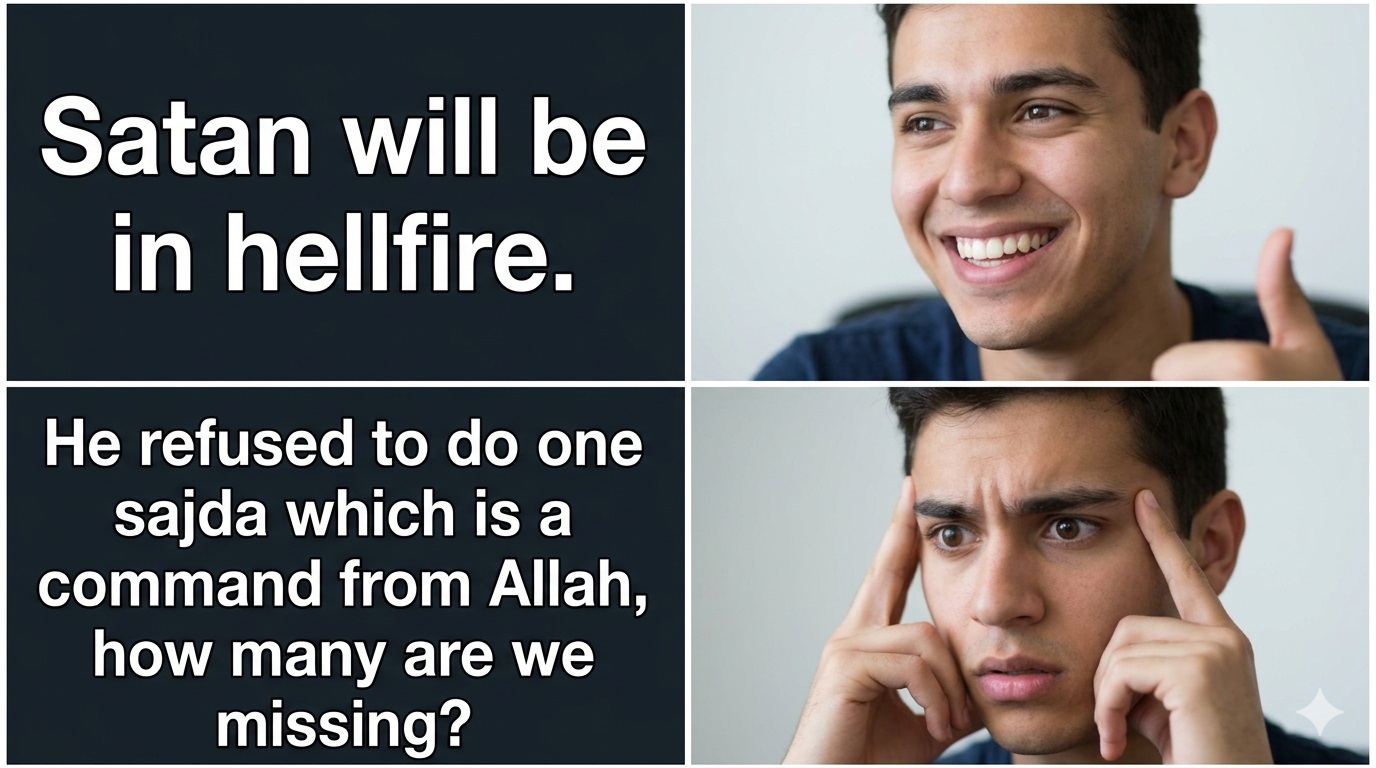
“By the logic of those who argue that sinful believers who earned Jahannam will eventually go to paradise, Iblis himself would eventually enter Jannah because of his “righteous deeds” before he disobeyed Allah. We know, according to the Quran, he had the rank of the angels.”
“But the undeniable fact that Allah cursed Iblis to Jahannam over ONE sin, not prostrating to a creation. Allah commanded you to prostrate too. That is more than enough evidence that just because you believe doesn’t mean you will enter Jannah.”
“Iblis NEVER denied that Allah was his lord. Rather, he became arrogant and disobeyed the command of Allah. It seems this sin in and of itself is far more damning than a disbeliever not believing. It’s because Iblis KNEW about Allah’s power, yet he still disobeyed.”
“Even in Iblis’s khutbah to the companions of the fire, Iblis denies the association of him as a partner to Allah, and he affirms that Allah promised them the truth, and he promised them but betrayed them.”
“Anyone who accepts the notion that Jahannam is temporary for ANYONE without explicit proof is only responding to shaytan. Allah promises eternal bliss or eternal torment. Shaytan promises delusion.”
“I pray more Muslims see and understand the severity of this topic.”
What more can be said except Amin! Very well said, Zheyn!
Fore more on this topic you may wish to read the following:
“Indeed, Allah only accepts from the righteous [who fear Him].” (Quran 5:27)
﷽
His Eminence, Shaykh Masoud Al Miqbali (h) informs us about a most dangerous matter. It is a false understanding that it is widespread and pervasive among the Muslims today!
We have translated his warning to us below.
“Among the misconceptions that have come to us is that someone tells you, “Do good deeds and bad deeds, and Allah will hold you accountable for this and for that.” But what is more common is the idea that “Allah willing, if your good deeds are many, the bad deeds will not harm you.” This concept is completely incorrect, absolutely false.”
“Take, for example, the narration in Sahih al-Bukhari about one of the Companions, nicknamed the “drunken donkey,” who used to drink wine. They flogged him once, twice, and three times. One of the Companions became very angry with him and said something bad about him. The Prophet (peace be upon him) replied to that person, saying: “Do not say that. For indeed, this drunkard, this addict to wine, loves Allah and His Messenger.”
“If an alcoholic hears this hadith, what would he say? Once, an alcoholic heard people speaking on a ‘Mawlid’ occasion—they were using symbolisms, like Sufi poets. He said: “Only a hero drinks wine.” And this is a person who is immersed in wine 24 hours a day, getting drunk. He said into the microphone: “Only a hero drinks wine.”
“He hears the religious preacher say, “Wine is forbidden, wine is forbidden.” Then he hears what the ‘Mawlid’ speaker says: “Only a hero drinks wine.” They might mean spiritual wine—the wine of remembrance and love of Allah. But he… they raise their banners, and I raise the banner of Najd. Every eye weeps over what grieves it.”
“This is the essence of “La ilaha illa Allah” (There is no god but Allah). It does not permit any person, no matter how high-ranking, even if he were Adam (peace be upon him), to deviate from its requirements. The presence of a sin that a person persists in blocks the acceptance of all his good deeds, even if he says “La ilaha illa Allah.“
“Take the son of Adam (Cain and Abel). The one whose offering was not accepted from him was not a disbeliever, nor was he a monotheist? He was a monotheist, not a disbeliever. Evidence for this is that he offered a sacrifice to Allah. If he had been a polytheist, he would not have drawn near to Allah. If he had been an atheist, he would not have drawn near to Allah. His drawing near to Allah indicates that he believed and affirmed Allah’s existence. So, an offering was presented. One was accepted from one and not accepted from the other. So, the one from whom it was not accepted—he has a problem. Monotheism alone is not sufficient for his deeds to be accepted. It is not enough. He affirms “La ilaha illa Allah.” Where is the flaw? What is the problem? What prevented and barred the acceptance of his deed?
Allah says: “Indeed, Allah only accepts from the righteous [who fear Him].”(Quran 5:27)
“Acceptance is for those who remain within the framework of “La ilaha illa Allah” and do not step outside it. It is for those who make “La ilaha illa Allah” a way of life, not just a phrase muttered on the lips or believed in the heart, then sometimes they act according to its requirements and sometimes they step outside it. “La ilaha illa Allah” entails commitment, belief, application, adherence, and steadfastness upon it.”
“Allah says to His Prophet (peace be upon him): “So be steadfast as you are commanded.” (Quran 11:112)
He says: “So be steadfast towards Him and seek His forgiveness…
“Say, ‘I am just a human being like you. It has been revealed to me that your Allah is the One God. So be steadfast toward Him and plead to Him for forgiveness.’ And woe to the polytheist.” (Qur’an 41:6)
“Indeed, those who have said, ‘Our Lord is Allah,’ and then remained steadfast – no fear will be upon them, nor will they grieve.” (Quran 46:13)
“One cannot take part of the religion and leave part of it.”
“So do you believe in part of the Scripture and disbelieve in part? Then what is the recompense for those who do that among you except disgrace in worldly life; and on the Day of Resurrection they will be sent back to the severest of punishment.” (Quran 2:85)
Allah did not say, “We will reward you for your faith in what you believed in and punish you for your disbelief in what you disbelieved in.” He made that faith as if it were nothing.”
“So, a person must not dare to transgress any of Allah’s boundaries under the pretext that “the statement ‘La ilaha illa Allah’ will intercede for me.”
Do you know about whom the following verse was revealed?
The verse: “O you who have believed, do not raise your voices above the voice of the Prophet or be loud to him in speech like the loudness of some of you to others, lest your deeds become worthless while you perceive not.” (Quran 49:2)
About whom was this verse revealed? It was revealed about Abu Bakr and Umar, as narrated by Al-Bukhari.”
Narrated Ibn Abi Mulaika:
The two righteous persons were about to be ruined. They were Abu Bakr and `Umar who raised their voices in the presence of the Prophet (ﷺ) when a mission from Bani Tamim came to him. One of the two recommended Al-Aqra’ bin Habeas, the brother of Bani Mujashi (to be their governor) while the other recommended somebody else. (Nafi`, the sub-narrator said, I do not remember his name). Abu Bakr said to `Umar, “You wanted nothing but to oppose me!” `Umar said, “I did not intend to oppose you.” Their voices grew loud in that argument, so Allah revealed: ‘O you who believe! Raise not your voices above the voice of the Prophet.’ (49.2) Ibn Az-Zubair said, “Since the revelation of this Verse, `Umar used to speak in such a low tone that the Prophet (ﷺ) had to ask him to repeat his statements.” But Ibn Az-Zubair did not mention the same about his (maternal) grandfather (i.e. Abu Bakr).
(O you who believe! Raise not your voices above the voice of the Prophet,) This contains another kind of favorable behavior. Allah the Exalted is teaching the believers that they should not raise their voices above the voice of the Prophet. It was stated that this Ayah was revealed about Abu Bakr and `Umar. Al-Bukhari recorded that Ibn Abi Mulaykah said, “The two righteous ones, Abu Bakr and `Umar, almost earned destruction when they raised their voices before the Prophet who was receiving the delegation of Bani Tamim. One of them recommended Al-Aqra` bin Habis the member of the Banu Mujashi` while the other recommended another man. Nafi` (a subnarrator) said: “I don’t remember his name.” Abu Bakr said to `Umar, `You only wanted to contradict me,’ while `Umar said, `I did not intend to contradict you.’ Their voices then became loud, thereupon Allah the Exalted sent down this Ayah,يأَيُّهَا الَّذِينَ ءَامَنُواْ لاَ تَرْفَعُواْ أَصْوَتَكُمْ فَوْقَ صَوْتِ النَّبِىِّ وَلاَ تَجْهَرُواْ لَهُ بِالْقَوْلِ كَجَهْرِ بَعْضِكُمْ لِبَعْضٍ أَن تَحْبَطَ أَعْمَـلُكُمْ وَأَنتُمْ لاَ تَشْعُرُونَ(O you who believe! Raise not your voices above the voice of the Prophet, nor speak aloud to him in talk as you speak aloud to one another, lest your deeds should be thwarted while you perceive not.)’‘ `Abdullah bin Az-Zubayr said, “After that, `Umar’s voice was so low that the Messenger of Allah had to ask him to repeat what he said so that he could understand what he was saying to him.” `Abdullah bin Az-Zubayr did not mention the same regarding his father, Abu Bakr, may Allah be pleased with him. Muslim did not collect this Hadith. In another narration collected by Al-Bukhari, he said that a delegation from the tribe of Banu Tamim came to the Prophet and that Abu Bakr recommended Al-Qa`qa` bin Ma`bad to be appointed as their leader, while `Umar recommended Al-Aqra` bin Habis. Muslim did not collect this narration.
“And they say, “Never will the Fire touch us, except for a few days.” Say, “Have you taken a covenant with Allah? For Allah will never break His covenant. Or do you say about Allah that which you do not know?” Yes, whoever earns evil and his sin has encompassed him – those are the companions of the Fire; they will abide therein eternally.” (Qur’an 2:80-81)
“But whoever disobeys Allah and His Messenger and exceeds their limits will be cast into Hell, to stay there forever. And they will suffer a humiliating punishment.” (Qur’an 4:14)
Do you not consider, [O Muhammed], those who were given a portion of the Scripture? They are invited to the Scripture of Allah that it should arbitrate between them; then a party of them turns away, and they are refusing. “This because they say: “The Fire shall not touch us but for a few numbered days.” What will happen to their belief when We bring them together on the Inevitable Day when every soul will be justly recompensed for its deeds?” For their forgeries deceive them as to their own religion.” (Qur’an 3:23-24)
“Indeed, your Lord’s torment is fearsome.” (Qur’an 17:57)
﷽
As mentioned in a previous post, we would like to clarify that, for those of us who follow the Ibadi school of Islam, for us, it is not important if our school is right or wrong on the matter.
What is important for us is that we are following the clear evidence as given by the Qur’an and the agreed-upon traditions of the Blessed Messenger (saw) Al Sunnah.
What is also important to note is that on this very important issue it is absolutely impossible for us to lose on this issue. As we mentioned to a brother before. We believe that the Ash`aris & Maturidis & Athari are upon batil (falsehood) and we are upon haqq (truth) in this matter.
So why is it impossible for us to lose? Because if the Ashari and Maturidi and Athari are correct, then we will all eventually be in paradise. However, if we are correct, and they are mistaken, your eternal salvation is the price of being upon misguidance.
The first point of clarification. Difference between infinite and everlasting (going backward and forward in time).
The difference between infinite and everlasting. Infinite is something beyond counting, beyond a real measurement. In this regard, only Allah (swt) is truly eternal. The knowledge of the created things is eternal.
Knowledge of the eternal does not equate to the eternality of the thing known.
Whereas everlasting is enduring forever; existing or continuing without end.
“That is Allah, your Lord; there is no deity except Him, the Creator of all things, so worship Him. And He is Disposer of all things.” (Qur’an 6:102)
Only Allah (swt) has no beginning.
Prevalent Muslim attitudes towards the afterlife have precipitated a moral and ethical decline.
Some may wonder if such an article is necessary? What benefit does this have for the Muslim community? Such an article is necessary, and it has an immense benefit for those who are willing to take heed. Every one of us has come short of the Glory of Allah (swt). Every one of us has fallen short in some aspect of our relationship with Allah (swt). Some of us more than others.
Do you ever wonder about moral erosion even in the Muslim communities? Do you think that this possibly has some root in the theology that Muslims have concerning the afterlife?
Do you not think that an attitude that says:
I’ll only be in the hellfire for a little while.
The Blessed Messenger (saw) will make intercession for me, so I have nothing to worry about.
Do you not think that such attitudes are flippant? To already treat hellfire as such a light matter has certainly led many of us not to fear Allah (swt).
An over-emphasis on the Love of Allah (swt). Of course, Allah (swt) is known as Al-Wadud (The Loving) twice in the Qur’an. After that, people have to read Rumi and other forms of poetry and books of saints to get their fix.
However, the Al-Nar (The Fire) is mentioned some 120+ times.
Jahnnam (The Abode of Hell) is mentioned some 70+ times.
Jaheem (Blazing Flames) is mentioned 20+ times.
It is a theme that is threaded all throughout the Qur’an.
We have often wondered at the success of Christian evangelism throughout certain parts of the world. Certainly, they bring food, build wells, hospitals, and schools. All of this is good and Muslims are doing this and should increase our efforts in doing this. Yet, for the Evangelicals, there is one central message that comes packaged with this help. That message is one that says, ‘I care about your eternal hereafter‘. It is a frightening warning, that without faith in Christ Jesus we will burn for all eternity. Unless one is in the habit of scoffing outright at such a proclamation, it is certainly something many take very seriously.
“And thus We have revealed to you an Arabic Qur’an that you may warn the Mother of Cities [Makkah] and those around it and warn of the Day of Assembly, about which there is no doubt. A party will be in Paradise and a party in the Blaze.” (Qur’an 42:7)
Allah (swt) revealed the Qur’an in Arabic. He wanted the Blessed Messenger (saw), to convey the message about the day of resurrection, that people would be in paradise and that people would be in hellfire.
Now, with calling people to Allah (swt), there should be a methodology and wisdom in how we call people. Yet, it cannot be denied that the Blessed Messenger (saw) was sent to warn people against the hellfire.
Keep in mind as well, those very few but loud voices that say that hellfire is an allegory, are now saying the same thing about paradise and the resurrection. They came as a packaged message.
“This is the fire which you used to deny. Is this an illusion (afasih’run) or is it you who are still unable to see?” (Qur’an 52:14-15)
We would like to begin as well with a quotation that is a very heartfelt response taken by the majority of our brothers from Ahl Sunnah today. That those who commit the major sins will still enter paradise. As well as the view as taken by the majority of Sunni Muslims that sinful Muslims will eventually enter paradise.
“This objection is rejected in that, on the basis of this opinion of theirs, they must then say that the committers of fornication, those who do the deed of the people of Lut, the consumers of usury, the killers of souls without right, those who prevent the payment of zakah, and the rest of the people who commit major sins other than shirk, will be counted among the righteous who have been promised Bliss, and greater contentment from Allah. By Allah, there is no more effective means to demolish the foundations of the religion, to abase the rituals, to diffuse evil, than this opinion. It demolishes all the commands and prohibitions of Allah and blows up everything that has come in His Book and the Sunnah of His Messenger, of the warning for people who commit major sins. It is sufficient that fornication, homosexuality, drinking wine, indifference to being cuckolded, and all the prohibited things will be among acts of righteousness because those who commit them are in the ranks of the righteous.” — Shaykh Ahmad b. Hamad al-Khalili (Grand Mufti of the Sultanate of Oman)
“The belief of us Ibadis is that whoever enters the Fire from among the muwahhid disobedient and the associators (mushriks) will remain there permanently, not for a finite period.”-Shaykh Ahmed b. Hamad al-Khalili
“The difference between us and the Kharijis is that they oppose us only in that they judge every punishable act of shirk entailing expulsion from the millah.”-Shaykh Ahmed b. Hamad al-Khalili.
What is the methodology that is used to establish the truth in this matter?
The established rule is that any major belief of the Muslims should come from the agreed- upon text. We see, for example, that those who believe in the second coming of Christ Jesus (as) will try and appeal to various texts of the Qur’an, among them are the following: Qur’an 4:159 Qur’an 43:61 Qur’an 3:46
Yet, when it comes to the belief that a believer will enter hellfire, we do not see that our opponents can establish any evidence from the Qur’an at all for this.
We can turn to the hadith, and we can find hadith promising because of this or that such and such a person will enter paradise. We can also find hadith promising that such and such a person for doing this or that will enter the hellfire. That they will never see paradise or even smell the slightest scent of paradise.
Thus, we turn to the Qur’an.
Methodological principles.
When we analyze the text of the Qur’an. We take the verses that are firm and decisive in their meaning, whereas the Ahl Khilaf (the People of Opposition) base their evidence upon verses that are subject to various interpretations.
“It is He who caused the Book to descend to you. In it are verses, that are (muḥkamāt) definitive. They are the essence of the Book and others, ones that are (mutashābihāt) unspecific. Then, those whose hearts are swerving, they follow what was unspecific in it, looking for dissent and looking for an interpretation.” (Qur’an 3:7)
That is to say we build our belief upon clear-cut evidence from the Qur’an. Ahl Khilaf (the People of Opposition) take an isolated verse that is subject to more than one interpretation and make the clear-cut verses bend to an interpretation.
Looking at the evidence from theQur’an.
“And they say, “Never will the Fire touch us, except for a few days.” Say, “Have you taken a covenant with Allah? Allah will never break His covenant. Or do you say about Allah that which you do not know?” Yes, whoever earns evil and his sin has encompassed him – those are the companions of the Fire; they will abide therein eternally(khaliduna).”(Qur’an 2:80-81)
Among the people who believe that hellfire is not permanent are the Jews. This assertion of theirs is rebuked and made public to emphasize how very wrong they were in their assertion.
Verily, what has reached us from the Qur’an is that Allah (swt) not once informed us about this doctrine of exit from the hellfire, neither from the Jews nor from others. Rather, what Allah (swt) has informed us is the doctrine of uninterrupted torment, and it includes the invalidation of the doctrine of the exit from hellfire. It also nullifies the doctrine of cessation of torment and its absolute end.
The idea of being in the hellfire ‘except for a few days‘ or ‘awhile’ is juxtaposed next to the phrase ‘companions of the Fire; they will abide therein eternally‘.
There are those who will object to the word khaliduna. Two things must be kept in mind:
The term khaliduna is being contrasted with the bold lie of being in hell for a little while.
” And We granted not to any human being immortality before you (O Muhammed), then if you die, would they live forever (khaliduna)?” (Qur’an 21:34) -This verse contrasts living a long time with living forever.
Whom Allah (swt) addresses in verses: 81–82.It is very clear that this distinguishes a few days, a little while, from non-permanence with everlasting permanence.
This is another text that should make this very clear.
“But I have for you only notification from Allah and His messages.” And whoever disobeys Allah and His Messenger – then indeed, for him is the fire of Hell; they will abide therein(khalidina) forever(abadan).” (Qur’an 72:23)
Those who do not understand the obvious text and wording of khalidina to be forever will also have to come to terms with the idea that heaven is not abiding forever, the paradise will not abide forever, neither will the Blessed messenger (saw) or his family.
They will one day come out of paradise. Do you believe it?
The idea of hellfire being some temporary stay is certainly Jewish penetration into Islamic thought.
Do you not consider, [O Muhammed], those who were given a portion of the Scripture? They are invited to the Scripture of Allah that it should arbitrate between them; then a party of them turns away, and they are refusing. “This is because they say: “The Fire shall not touch us but for a few numbered days.” What will happen to their belief when We bring them together on the Inevitable Day when every soul will be justly recompensed for its deeds?” For their forgeries deceive them as to their own religion.” (Qur’an 3:23-24)
There are a few things to take note of for those who fear Allah (swt) in the above verse:
This text would in no way be sensible to those it addressed if the Qur’an itself contained such a doctrine! (limited time in the hellfire)
These people will say hell is only a number of days, they are going to be in for a really terrible surprise when they approach the inevitable day. ‘What will happen to their belief?‘
These lies have deceived them about their own religion—that there could be laxity in obeying the commands of Allah (swt).
“But whoever kills a believer intentionally – his recompense is Hell, wherein he will abide eternally, and Allah has become angry with him and has cursed him and has prepared for him a great punishment.” (Qur’an 4:93)
Killing is a major sin (less than shirk) but still deserving of everlasting hellfire.
“Those who consume interest cannot stand on the Day of Resurrection except as one stand who is being beaten by Satan into insanity. That is because they say, “Trade is just like interest.” But Allah has permitted trade and has forbidden interest. So whoever has received an admonition from his Lord and desists may have what is past, and his affair rests with Allah. But whoever returns to dealing in interest or usury- those are the companions of the Fire; they will abide eternally therein.” (Qur’an 2:275)
“For them who have done good is the best reward and extra. No darkness will cover their faces, nor humiliation. Those are companions of Paradise; they will abide therein eternally. But they who have earned blame for evil doings – the recompense of an evil deed is its equivalent, and humiliation will cover them. They will have from Allah no protector. It will be as if their faces are covered with pieces of the night – so dark, are they! Those are the companions of the Fire; they will abide therein eternally.” (Qur’an 10:26-27)
Prima Qur’an Comments:
People who were in hell for a while and then admitted to heaven can hardly be described as having, “no darkness covering their faces nor humiliation.”
Those who do not understand the obvious text and wording of khalidina to be forever will also have to come to terms with the idea that heaven is not abiding forever, the paradise will not abide forever, neither will the Blessed messenger (saw) or his family.
They will one day come out of paradise. Do you believe it?
“And those who say, “Our Lord, avert from us the punishment of Hell. Indeed, its punishment is (gharanama) everlasting debt…” (Qur’an 25:65)
“Our Lord! bring us out of this: if ever we return to Evil, then shall we be wrong-doers indeed!” He will say: “Be driven into it with ignominy! And do not speak to Me!” (Qur’an 107- 108)
“But as for those who defiantly disobeyed, their refuge is the Fire. Every time they wish to emerge from it, they will be returned to it while it is said to them, “Taste the punishment of the Fire which you used to deny.” (Qur’an 32:20)
“And for those who disbelieve will be the fire of Hell. Death is not decreed for them so they may die, nor will its torment be lightened for them. Thus do we recompense every ungrateful one. And they will cry out therein, “Our Lord, remove us; we will do righteousness – other than what we were doing!” But did We not grant you life enough for whoever would remember therein to remember, and the warner had come to you? So taste the punishment, for there is not for the wrongdoers any helper.” (Qur’an 35:36-37)
“And those who do not invoke with Allah another deity or kill the soul which Allah has forbidden to be killed, except by right, and do not commit unlawful sexual intercourse. And whoever should do that will meet a penalty. Their punishment will be multiplied on the Day of Judgment, and they will remain in it forever (wayakhlud), in disgrace .” (Qur’an 25:68-69)
“So taste the penalty, and never will We increase you except in torment.” (Qur’an 78:30)
“Indeed, the righteous will be in pleasure, And indeed, the wicked will be in Hellfire. They will [enter to] burn therein on the Day of Recompense, And will not be removed from it.” (Qur’an 82:13-16)
“Indeed, Allah has cursed the ungrateful and prepared for them a Blaze Abiding therein forever (khalidina fiha abadan), they will not find a protector or a helper., they will not find a protector or a helper.” (Qur’an 33:64-65)
Prima Qur’an Comments:
These people are not going to be let out during Ramadan (no helper, no protector).
Allah (swt) is not going to release them after a period of time. (no helper, no protector).
They find no reprieve in the annihilation of hellfire and/or their own existence (no helper, no protector).
“Indeed, those who disbelieve and commit wrong or injustice – never will Allah forgive them, nor will He guide them to a path. Except for the (tariqah)path of Hell; they will abide therein forever(khalidina fiha abadan). And that, for Allah, is always easy.” (Qur’an 4:168-169)
“But the ones who disbelieved and denied Our verses – those are the companions of the Fire, abiding eternally (khalidina) therein; and wretched is the destination.” (Qur’an 64:10)
“Indeed, the criminals will be in the punishment of Hell, abiding eternally (khaliduna). It will not be allowed to subside for them, and they, therein, are in despair. And We did not wrong them, but it was they who were the wrongdoers. And they will call, “O Malik, let your Lord put an end to us!” He will say, “Indeed, you will remain.” (Qur’an 43:74-77)
Prima Qur’an Comments:
Once again, if anyone has any doubts about khaliduna being eternal, forever, everlasting, the guardian of Hellfire himself, the noble angel Malik, told the inhabitants that they will remain there.
The proof of the enduring, eternal, everlasting nature of the punishment of hellfire is overwhelming. In fact, based upon the evidence that has been given every place in the Qur’an that talks about hellfire (is talking about eternal agony)
This is absolutely terrifying. In fact, We would encourage anyone reading this to go and listen to their favorite Qur’an reciter, reciting the verses of Hellfire and you will feel as if a hand has reached deep within your soul and shook you to the core of your being! Except possibly those whose hearts are dead or bereft of faith. May Allah (swt) protect us from that!
POSSIBLE OBJECTIONS TO THIS FIRMLY ESTABLISHED BELIEF.
First, it is important to understand that there are two groups here:
There is Jahm bin Safwan and Ibn Al Qayyim. Keep in mind that most of what is known about Jahm is through polemical works directed at him, so how fair the assessment is can be debated. Their understanding is that there is an end to punishment for both the associators and the disobedient muwahhid .
The Ash’ari holds permanence is for both places. However, they hold that the non-muwahhid will abide in hell forever, whereas the muwahhid disobedient will be in hell for a short while (undefined).
As regards the term ‘khalidina‘, both groups try to dismiss this by interpreting it metaphorically. We have already shown above the problem with doing this, especially when we look at the context.
The argument of the first and the last.
As regards evidence that Jahm bin Safwan advanced to show that heaven and hell are not eternal is the following:
“He is the First and the Last, the Ascendant and the Intimate, and He is, of all things, Knowing.” (Qur’an 57:3)
The argument is that, if we understand this, is that, as Allah (swt) is The Last, it means heaven and hell cannot be enduring.
We understand ‘The First and The Last‘ as the first meaning taking precedence and The Last as remaining after every existent. Nothing brought into being can cancel out anything about him. Presidency over -remaining after every existent. Nothing is before Him and nothing is after Him.
We also understand that Allah (swt) is one. However, we do not understand this as numerically ‘one‘ as zero precedes one.
The argument that ages comes to an end.
Another proof that is used is:
“They will abide therein for ages.” (Qur’an 78:23)
The argument is that ages come to an end.
It is simply an expression of time. One age passes, another follows. Note it does not say ‘until the ages come to an end’.
Even one has to agree that the evidence here is implicit. Whereas the explicit is what is mentioned here:
“They would desire to go forth from the fire, and they shall not go forth from it, and they shall have a lasting punishment.” (Qur’an 5:37)
“Everything(kullu)will perish save His Face.” (Qur’an 28:88)
Texts taken at their apparent meaning in and of themselves are foundational.
If this text is understood without understanding Arabic grammar, it can present a challenge.
This text is a challenge that takes the attributes of Allah (swt) based upon their apparent meaning.
We take into account other places where this is mentioned:
“Everyone upon the earth will perish. And there will remain the Face of your Lord, Owner of Majesty and Honor.” (Qur’an 55:26-27)
We understand this to be that every single being will perish, and their lives will be short. Whereas Allah (swt) is Ever-Living.
This text cited above brings us to the next point.
This above text (Qur’an 28:88) is also used by believers who ascribe to Neoplantonism, and those among the Muslims who believe in the eternality of the universe.
They will argue everything comes to an end (hell, heaven, all of it). That is a huge logical fallacy.
There is a huge logical flaw in this. You cannot have an infinitude that goes one way and not the other. That is why you will see them often come up with other arguments that are nothing more than the machinations of their own imaginations.
In the next section, we will bring forth proof text that can be used by Jahm bin Safwan and Ibn Al Qayyim as well as the Ash’ari/Maturidi
The proof texts
The following will always be the ‘go to’ verse for those who wish to go against the clear verses. They will take a verse that is not definite in meaning and use it to bend the verses which are definitive in meaning.
“As for those who were destined to be wretched, they will be in the Fire. For them therein is violent exhaling and inhaling. They will be abiding therein as long as the heavens and the earth endure, except what your Lord should will. Indeed, your Lord is an effecter of what He intends. And as for those who were destined to be prosperous, they will be in Paradise, abiding therein as long as the heavens and the earth endure, except what your Lord should will – a bestowal uninterrupted.” (Qur’an 11:106-108)
A look at the two clauses.
The first clause: “Except what Allah wills.”
This will deal primarily with the Ash’ari/Maturidi objection.
Those who also cite the above text (Qu’ran 11:106-108) in conjunction with the following verse:
“And the Day when He will gather them together and say, “O company of jinn, you have misled many of mankind.” And their allies among mankind will say, “Our Lord, some of us made use of others, and we have now reached our term, which you appointed for us.” He will say, “The Fire is your residence, wherein you will abide eternally, except for what Allah wills. Indeed, your Lord is Wise and Knowing.” (Qur’an 6:128)
So at 11:108 above and at 6:128, they focus on the phrase: “Except for what Allah wills.“
First, it is important to understand that Allah’s will is not like a human will. If a human being wills something today, that person may change their mind tomorrow, and when tomorrow comes they may again adopt a completely different idea.
“There is no changing in the decree of Allah.” (Qur’an 10:64)
“We would have invented against Allah a lie if we returned to your religion after Allah had saved us from it. And it is not for us to return to it except what Allah wills. Our Lord has encompassed all things in knowledge. Upon Allah, we have relied. Our Lord, decide between us and our people in truth, and You are the best of those who give a decision.” (Qur’an 7:89)
We can see the phrase: ‘Except what Allah wills’ above.
Does anyone think for a moment that the will of Allah (swt) is that people leave Islam for their previous religion? Does anyone think, ‘Well you know there may be exceptions where Allah wants people to leave Islam and practice Shirk again!’. It is an absolutely ridiculous idea.
“The response to this is that exception does not denote the ending (of the punishment). Because exception by the Will of Allah comes in the Word of Allah to emphasize that what is reported happens by His Will (not otherwise). If he wills the opposite of that, it will be so. When Allah (swt) says that something happens if He wills it, it is intended to show His power and majesty because He has control over all things.
That is like in His saying, Exalted is He:
“By degrees shall We teach you, so you will not forget, except what Allah wills” (Qur’an 87:6-7)
With the assurance that the Prophet does not forget anything of what Allah (swt) revealed or taught him.”-Shaykh Ahmed Al Khalili
“By degrees shall We teach you, so you shall not forget except as Allah wills” (Quran 87:6-7)
The meaning is that the exception here is to emphasize the negation.
If Allah (swt) wants the Prophet (saw) to recite the Qur’an without forgetting it, the exceptional clause cannot be construed to mean that, if He wishes, He will make him forget it. That would be a contradiction and defeat the whole purpose of the passage.
If one was to interpret the above passage that Muhammed (saw) did indeed forget some of what Allah (swt) taught him then we have no objective basis to determine that the Muhammed (saw) preserved and passed on what was taught.
Another example:
Certainly, has Allah showed to His Messenger the vision in truth. You will certainly enter al-Masjid al-Haram, if Allah wills, in safety, with your heads shaved and hair shortened, not fearing anyone. He knew what you did not know and has arranged before that a conquest near at hand.” (Qur’an 48:27)
This verse cannot be construed so that Allah (swt) will ‘change his mind‘ as Allah (swt) has already given his decision on this matter: “You will CERTAINLY enter.”
So, as we have seen,’Except what Allah wills‘ can be seen as a rhetorical device.
“In any case, they have not argued from any text which means what they claim. They have only presented some interpretations which can be opposed by what invalidates them. And matters of the faith as I said above-must rely upon the firm text.” -Shaykh Ahmed Al Khalili.
If anyone was ever to be taken out ofthe hellfire it would be a clear contradiction of the following verses:
“And those who followed shall say: Had there been for us a return, then we would renounce them as they have renounced us. Thus will Allah show them their deeds to be intense regret to them, and they shall not come forth from the fire.” (Qur’an 2:167)
“And as for those who disbelieve, for them is the fire of hell; it shall not be finished with them entirely so that they should die, nor shall the chastisement thereof be lightened to them: even thus do We retribute every ungrateful one.” (Qur’an 35:36)
“And as for those who transgress, their abode is the fire; whenever they desire to go forth from it they shall be brought back into it, and it will be said to them: Taste the chastisement of the fire which you called a lie.” (Qur’an 32:20)
“They would desire to go forth from the fire, and they shall not go forth from it, and they shall have a lasting punishment.” (Qur’an 5:37)
“Surely as for those who reject Our communications and turn away from them haughtily, the doors of heaven shall not be opened for them, nor shall they enter the garden until the camel pass through the eye of the needle; and thus do We reward the guilty.” (Qur’an 7:40)
These texts are sufficient to prove that ‘Except As Allah wills‘ -that Allah (swt) has not willed for them anything except enduring punishment.
The ‘will of Allah’ in the verses above is undefined and not defined.
The verses that declare the permanence of punishment are clear, there is no uncertainty as to what they denote.
Matters of Aqidah have to be derived from the explicit text and not ambiguous evidence.
As for the Ash’ari, we say to them there is nothing in those verses that indicates differentiation between the muwahhid disobedient and the others. Rather, those verses are about the warning of ALL the people of the fire.
The second clause: “They will be abiding therein as long as the heavens and the earth endure.”
“As for those who were destined to be wretched, they will be in the Fire. For them therein is violent exhaling and inhaling. They will be abiding therein as long as the heavens and the earth endure, except what your Lord should will. Indeed, your Lord is an effecter of what He intends. And as for those who were destined to be prosperous, they will be in Paradise, abiding therein as long as the heavens and the earth endure, except what your Lord should will – a bestowal uninterrupted.” (Qur’an 11:106-108)
For Jahm bin Safwan and Ibn Al Qayyim. They are focused on the part that says, “They will be abiding therein as long as the heavens and the earth endure.” This means the enjoyment of heaven and the punishment of hellfire are conditional upon the existence of heaven and earth.
However, that very verse can be used to demolish their view. It says, “a bestowal uninterrupted.” Certainly, it would be interrupted if it was contingent upon the endurance of heaven and earth. Unless we are not talking about heaven and the earth that you and I know!
“On the Day when the earth shall be changed into another earth, as shall be the heavens, they will all appear before God, the One, the Most Supreme.” (Qur’an 14:48)
This is an important point. It is important because it is proof that demolishes any claims against the abiding punishment of hellfire. So the clause ‘except as your Lord wills‘ is also understood by the clause ‘abiding therein as long as the heavens and the earth endure‘. This in turn is ‘a bestowal without interruption‘.
Summary:
The bestowal will be uninterrupted
This means the new heavens and the new earth will have no end.
This in turn means no end to paradise and no end to the suffering of hellfire.
So this deals a crushing blow to Jahm bin Safwan and Ibn Al Qayyim.
The Ash’ari will also use the following as an argument:
“Perhaps will wish those who disbelieved, if they had been those-who-submit/Muslims.” (Qur’an 15:2)
Their argument is that those people will so wish to be Muslims when they see the disobedient Muslims getting out of the fire, whereas they still remain in it. That is an interpretation not supported by the wording of the verse, and there is no evidence for it from anywhere else.
There is no scope to argue from what is unclear.
“Indeed, Hell has been lying in wait For the transgressors, a place of return, In which they will remain for ages. They will not taste therein any coolness or drink. Except for scalding water and foul purulence -An appropriate recompense. Indeed, they were not expecting an account. And denied Our verses with emphatic denial. But all the things We have enumerated in writing. “So taste [the penalty], and never will We increase you except in torment.” (Qur’an 78:21-30)
Prima Qur’an Comment:
Also, if the Ash’ari were to apply consistent hermeneutic principles, their understanding invalidates the understanding of surah 78 because it necessarily entails saying the same about the mushrikin, that they will come out of hell, and saying that there is a term (an end) to the blessings of Paradise.
That is in regard to the Qur’an. If the Qur’an is not sufficient for anyone to draw their theological conclusions from, then let that be known.
Arguments from the Sunnah.
They (the Ash’ari)rely on narrations that speak of release from the fire, yet there are narrations that speak of dwelling permanently in the fire. We can give those upon request. We take the text of that which conforms to the strongest evidence, the Qur’an,and not what opposes it.
“Abrogation is never permitted in the reports of the Law-Maker because His Knowledge is not refreshed and He is not ignorant of anything that happens, and He does not reveal but the truth.”-Shaykh Ahmed Al Khalili
Ash’ari rational arguments:
As for their rational argument: that is that, if the muwahhid disobedient are equal to the muhsrikin in dwelling permanently, then there will be no effect of the word of tawhid, and no advantage from pious actions.
The answer to this is that they, though equal in permanence, are not equal in punishment in the same way as the righteous will not be equal in reward. Rather, they will differ in their actions. The fire has stages as the garden has grades.
Philosophical objections:
Allah’s actions are not bound by systems and world views decided by human reason, nor are they to be related to norms derived from human imagination.
“He cannot be questioned concerning what He does and they shall be questioned.” (Qu’ran 21:23)
We must believe that our limited intellects are too disabled, wearied, feeble, and powerless to encompass His wise purpose in His actions, or to penetrate His secrets in His creation:
“You are not given of the knowledge but little.” (Quran 17:85)
Our duty is only to surrender to what Allah (swt) informs us about. Our certainty that Allah, Exalted is He, does not speak but the truth, just as He does not command but to the truth:
“Who is truer in speaking than Allah?” (Quran 4:122)
As the Sufi poet Rabia Basri is recorded to have said: “O my Lord, if I worship you from fear of hell, burn me in hell. If I worship you for the hope of Paradise, bar me from its gates. But if I worship you for yourself alone, grant me then the beauty of your Face.”
Source: (Women in Praise of the Sacred (HarperCollins Publishers Inc, 1994)
One can admire such longing and desire, but it must be realized that such a statement was uttered by a person who never tasted the flames of hellfire. As is the case, paradise should be sufficient for her, you and me.
May Allah (swt) grant you the reader, all Muslims who truly repent and all truth seekers everlasting paradise. Amin!
“This because they say: “The Fire shall not touch us but for a few numbered days.” What will happen to their belief when We bring them together on the Inevitable Day when every soul will be justly recompensed for its deeds?” For their forgeries deceive them as to their own religion.” (Qur’an 3:24)
“When the Hellfire sees them from a distant place, they will hear its fury and roaring.” (Qur’an 25:12)
“Surely those for whom the decree of ultimate good has already gone forth from Us. These will be kept far away from not even hearing the slightest sound (of hell). While they abide eternally in whatever their souls desire.” (Qur’an 21:101-102)
“Every human being is bound to taste death: and you shall receive your rewards in full on the Day of Resurrection. He who is kept away from the Fire and is admitted to Paradise, will surely triumph; for the life of this world is nothing but an illusory enjoyment.” (Qur’an 3:185)
﷽
First let us be clear about one thing. There is not a single verse any where in the Qur’an that states that a believer or a Muslim will enter into the hellfire. None.
No evidence at all that people are coming to As Siraat (The Bridge) over hellfire None!
Those who do not have proper understanding of the Qur’an and are upon error will in their misguidance quote the following:
Yet ˹some˺ people ask ˹mockingly˺, “After I die, will I really be raised to life again?” Do ˹such˺ people not remember that We created them before, when they were nothing? By your Lord ˹O Prophet˺! We will surely gather them along with the devils, and then set them around Hell on their knees. Then We will certainly begin by drawling out of every group the ones most defiant to the Most Compassionate. And We truly know best who is most deserving of burning in it. There is none among you, (Those condemned to Hell), but he shall reach there (- the Hell). This is (a promise) binding on your Lord, an absolute decree. Moreover, saved are those who were righteous. Forsaken are the criminals therein on their knees.” (Qur’an 19:66-72)
This verse is speaking about those who mocked the resurrection (verse 66)
wa-in minukum (among you) in verse 71 who are they? They are the ones that are referenced in verse 66.
These verses are not addressing the Muslim at all. Why?
The Muslim is one who believes in the hereafter not denying it.
The Muslim is one who believes in the hellfire not denying it.
It makes no sense to say that Prophet Muhammed (saw), Prophet Jesus (as), all of the prophets, pious people would be put into hell.
There is absolutely no reference toa bridge over hell in these verses.
In fact, to fortify point number 7 look at how all these translations render the Arabic text.
Also rushed into oblivion are the machinations of Christian missionaries who in their ignorance used such verses against the Muslims.
There is No Falling Of A Bridge! – His Eminence Shayh Dr Khalid Al-Abdali (h)
They say that, no these people will pass over a bridge. A bridge named as-Siraat. And (as they pass) begin to fall down from this bridge.
Some will pass by quickly like the speed of lightning. Whilst some will crawl over it…and some will fall over (The Bridge).
Where are they falling to? Huh? “To Hell” (Says the Audience)
Allah the Exalted says: “It has seven gates; and each gate is assigned for a certain group of them.” (Qur’an 15:44)
This (Idea of a Bridge) -Is one of those propagated fables you will find no evidence for in the book of Allah. That-People will fall down.
This is because Allah -the Exalted has affirmed for us in the clearest of wordings that there are gates (to hell).
I believe that there are gates. Who believes otherwise? That there are no gates?
That, no no this is not correct. They will fall down into hell without passing a gate.
Tell me. If there is anyone here who dares to say that there are no gates (to hell).
Rather they fall into it instead! Focus! Some are misguiding people on this! Whilst considering themselves people of paradise and favour.
Wake up to reality! And stop deceiving yourself!
Pay attention! “Until, when They reach it(hell) And It’s gates are made opened.” (Qur’an 39:71)
It’s gates, Right? “And It’s guardians Say to them.” (Qur’an 39:71)
Are there gates found or not? I believe and I’m certain and convinced that there are gates there. Without a doubt! As for this issue of tukh(falling down) Then no!