
“Also mention in the Book (the story of) Isma’il: He was (strictly) true to what he promised ( l-waʿdi), and he was a messenger (and) a prophet.” (Qur’an 19:54)
“Then do they not reflect (yatadabbarūna) upon the Qur’an, or are there locks upon [their] hearts?” (Qur’an 47:24)

﷽
Allah describes Isma’il as one who was true to what he promised.
We want to give credit first and foremost to Muhammed b. Yusuf b. ‘Isa b. Salih Atfayyish, the luminary of Islam and Shaykh in the Ibadi school. May Allah have mercy on him.
The following is taken from Taysir al-tafsir volume 12, pages 131 to 142 and volume 6 pages 447 to 449.
Every time the Qur’an mentions prophets in a sequence and Ishaq (Isaac) and Isma’il (Ishmael)are mentioned, Isma’il always comes before ishaq.
” Or were you witnesses when death approached Jacob, when he said to his sons, “What will you worship after me?” They said, “We will worship your God and the God of your fathers, Abraham and Ishmael and Isaac one God. And we are Muslims to Him.” (Qur’an 2:133)
“Say, “We have believed in Allah and what has been revealed to us and what has been revealed to Abraham and Ishmael and Isaac and Jacob and the Descendants and what was given to Moses and Jesus and what was given to the prophets from their Lord. We make no distinction between any of them, and we are Muslims to Him.” (Qur’an 2:136)
“Or do you say that Abraham and Ishmael and Isaac and Jacob and the Descendants were Jews or Christians? Say, “Are you more knowing or is Allah ?” And who is more unjust than one who conceals a testimony he has from Allah ? And Allah is not unaware of what you do.” (Qur’an 2:140)
“Say, “We have believed in Allah and in what was revealed to us and what was revealed to Abraham, Ishmael, Isaac, Jacob, and the Descendants, and in what was given to Moses and Jesus and to the prophets from their Lord. We make no distinction between any of them, and we are Muslims to Him.” (Qur’an 3:84)
“Indeed, We have revealed to you, as We revealed to Noah and the prophets after him. And we revealed to Abraham, Ishmael, Isaac, Jacob, the Descendants, Jesus, Job, Jonah, Aaron, and Solomon, and to David We gave the Zabur.” (Qur’an 4:163)
“Praise to Allah, who has granted to me in old age Ishmael and Isaac. Indeed, my Lord is the Hearer of supplication.” (Qur’an 14:39)
“So We gave him good news of a forbearing son. And when he reached the age to work with him, he said, ‘O my dear son, I have seen in a dream that I must sacrifice you. So tell me what you think.’ He said, ‘O my father, do as you are commanded. You will find me, if Allah wills, among the patient.’ So when they had both submitted themselves, and he laid him on his forehead, We called out to him, ‘O Abraham, you have already fulfilled the vision.’ Indeed, this is how We reward the good-doers. That was truly a revealing test. And We ransomed him with a great sacrifice. And We left for him among later generations [the salutation], ‘Peace be upon Abraham.’ This is how We reward the good-doers. He was truly one of Our faithful servants. We gave him good news of Isaac—a prophet, and one of the righteous.” (Qur’an 37:101-112)
“And surely Our messenger-angels came to Abraham with good news. They greeted him with ‘Peace!’ And he replied, ‘Peace be upon you!’ Then it was not long before he brought them a roasted calf. But when he saw their hands not reaching for it, he found them strange and felt fear of them. They said, ‘Fear not. We have been sent to the people of Lot.’ And his wife was standing by, and she laughed. Then We gave her good news of Isaac, and after Isaac, Jacob. She said, ‘Woe to me! Shall I give birth while I am an old woman and this, my husband, is an old man? Indeed, this is an astonishing thing!’ They said, ‘Are you astonished at the command of Allah? May the mercy of Allah and His blessings be upon you, people of the house. Indeed, He is Praiseworthy, Glorious.'” (Qur’an 11:69-73)
“And [mention] when Abraham said, ‘My Lord, make this city [Mecca] secure and keep me and my sons away from worshipping idols. My Lord, indeed they have led astray many among the people. So whoever follows me, then he is of me; and whoever disobeys me – indeed, You are Forgiving and Merciful. Our Lord, I have settled some of my descendants in an uncultivated valley near Your sacred House, our Lord, that they may establish prayer. So make hearts among the people incline toward them and provide for them from the fruits that they might be grateful.'” (Qur’an 14:35-37)
“And [mention] when We made the House a place of return for the people and a place of security. And take, [O believers], from the standing place of Abraham a place of prayer. And We charged Abraham and Ishmael, [saying], ‘Purify My House for those who perform Tawaf and those who are staying [there] for worship and those who bow and prostrate [in prayer].’ And [mention] when Abraham said, ‘My Lord, make this a secure city and provide its people with fruits – whoever among them believes in Allah and the Last Day.’ [Allah] said, ‘And whoever disbelieves – I will grant him enjoyment for a little then I will force him to the punishment of the Fire, and wretched is the destination.’ And [mention] when Abraham was raising the foundations of the House and [with him] Ishmael, [saying], ‘Our Lord, accept [this] from us. Indeed You are the All-Hearing, the All-Knowing. Our Lord! Make us both submissive to You and [raise] from our descendants a nation submissive to You. Teach us our ways of worship and turn to us mercifully. Indeed, You are the Most-Relenting, the All-Merciful.'” (Qur’an 2:125-128)
“Has the story reached you of the honored guests of Abraham? When they entered upon him and said, ‘Peace.’ He answered, ‘Peace, [you are] a people unknown.’ Then he turned to his family and came with a fat [roasted] calf. And he placed it near them; he said, ‘Will you not eat?’ Then he felt from them a sense of fear. They said, ‘Fear not,’ and gave him good news of a knowledgeable boy. Then his wife approached with a loud cry, and she struck her face and said, ‘A barren old woman!’ They said, ‘Thus has said your Lord. Indeed, He is the Wise, the Knowing.'” (Qur’an 51:24-30)
Prima Qur’an comments: Based upon the above data, the following points can be made.
The narrative of the Qur’an.
- The son is a child, but old enough to walk, talk, and reason with his father (“O my dear son, I have seen in a dream that I must sacrifice you. So tell me what you think.’ He said, ‘O my father, do as you are commanded. You will find me, if Allah wills, among the patient).
- Isaac’s birth announcement (Qur’an 11:69-73) comes after the sacrifice narrative in the textual order, implying the sacrifice occurred before Isaac was even conceived or was born.
- Every time the Qur’an mentions prophets in a sequence and Isaac and Isma’il are mentioned Isma’il always comes before Isaac.
- The Messengers who came to Abraham did not eat the food offered to them.
- Sarah laughs in astonishment that the messengers will not eat the food offered to them.
- There are no contradictory accounts about who laughs.
- There are no conflicting narratives about Ishmael being a teenager or a toddler.
- Abraham settles some of his descendants in Mecca. He accompanies those descendants. There is no story of Abraham abandoning his wife and son to the desert due to rivalry and jealousy.
There is a maze of contradictions in the biblical narrative.
The Eviction of Ishmael: A Teenager or a Baby?
The most prominent contradiction occurs in Genesis 21, when Sarah demands that Abraham evict Hagar and Ishmael. If we follow the ages explicitly stated in the text up to this point, the math creates a bizarre visual picture.
The Explicit Timeline Math
- Genesis 16:16 – Abraham is 86 years old when Ishmael is born.
- Genesis 21:5 – Abraham is 100 years old when Isaac is born. (Ishmael is now 14 years old).
- Genesis 21:8 – Isaac grows and is weaned. In the ancient Near East, infants were typically weaned between the ages of 2 and 4.
Therefore, by the explicit chronology of the text, Ishmael must be between 16 and 18 years old when he and his mother are cast out into the wilderness of Beersheba.
The Narrative Contradiction
Despite Ishmael mathematically being a grown teenager, the vocabulary and imagery used by the author in Genesis 21 paint him as a tiny, helpless infant or toddler:
- Genesis 21:14: Abraham takes bread and a skin of water, gives them to Hagar, “putting them on her shoulder, along with the child” (yeled in Hebrew).” A mother does not carry a 17-year-old young man on her shoulder alongside supplies.
- Genesis 21:15: When the water runs out, Hagar “cast the child under one of the bushes.” The Hebrew verb tashlekh implies throwing, dropping, or gently placing down a helpless child, not a teenager who is physically larger than his mother.
- Genesis 21:16: She walks away because she cannot bear to watch the child die.
- Genesis 21:19-20: God opens her eyes to a well, and she goes to “fill the skin with water and give the boy a drink.” God then promises to protect the lad, and he “grew up.”
The Discrepancy: The theological timeline demands Ishmael be an adult/teenager so Isaac can be the younger miraculous child. But the narrative imagery in Genesis 21 completely breaks down unless Ishmael is a small child or infant. Scholars argue that Genesis 21 originally belonged to a source where Ishmael was born much later, or where Isaac’s birth happened much sooner.
Who is the “Only Son”?
Another major narrative contradiction appears during the binding of Isaac (the Akedah) in Genesis 22.
God commands Abraham:
“Take your son, your only son Isaac, whom you love, and go to the land of Moriah…” (Genesis 22:2)
Later in the New Testament we have:
“By faith Abraham, when he was tested, offered up Isaac, and he who had received the promises was in the act of offering up his only son, of whom it was said, ‘Through Isaac shall your offspring be named.'” (Hebrews 11:17-18)
Critical scholars do not believe that Paul wrote Hebrews.
“For it is written that Abraham had two sons, one by the slave woman and the other by the free woman.” (Galatians 4:22)
The Contradiction
- By this point in the text, Ishmael is alive and well. Even though he was sent away into the desert, he is still Abraham’s biological firstborn son.
- Later in Genesis 25:9, Ishmael returns to join Isaac in burying their father Abraham, proving they remained in contact and Ishmael was recognized as a son.
“His sons Isaac and Ishmael buried him in the cave of Machpelah near Mamre, in the field of Ephron son of Zohar the Hittite,” (Genesis 25:9)
The “Laughing” accounts
This is a thematic contradiction regarding who laughs at the promise of Isaac’s birth, which alters the character dynamics. The name Isaac (Yitzhak) literally means “he laughs” or “laughter.”
- Genesis 17:17 (Abraham Laughs): When God tells Abraham that 90-year-old Sarah will bear a son, Abraham falls on his face and laughs to himself in disbelief. God tells him, “No, Sarah your wife shall bear you a son, and you shall call his name Isaac.”
- Genesis 18:12 (Sarah Laughs): Soon after, three visitors reiterate the promise. This time, Sarah laughs to herself in disbelief. God asks, “Why did Sarah laugh?” Sarah denies it out of fear. But God says, “Yes you did laugh!”
- Genesis 21:6 (Joyful Laughter): After Isaac is born, Sarah shifts the meaning of the laugh entirely: “God has brought me laughter, and everyone who hears about this will laugh with me.”
God also said to Abraham, “As for Sarai your wife, you are no longer to call her Sarai; her name will be Sarah. I will bless her and will surely give you a son by her. I will bless her so that she will be the mother of nations; kings of peoples will come from her.”Abraham fell facedown; he laughed and said to himself, “Will a son be born to a man a hundred years old? Will Sarah bear a child at the age of ninety?” (Genesis 17:15-17)
“Then one of them said, “I will surely return to you about this time next year, and Sarah your wife will have a son.” Now Sarah was listening at the entrance to the tent, which was behind him. Abraham and Sarah were already very old, and Sarah was past the age of childbearing. So Sarah laughed to herself as she thought, “After I am worn out and my lord is old, will I now have this pleasure?” Then the Lord said to Abraham, “Why did Sarah laugh and say, ‘Will I really have a child, now that I am old?’ Is anything too hard for the Lord? I will return to you at the appointed time next year, and Sarah will have a son.” Sarah was afraid, so she lied and said, “I did not laugh.” But he( God) said, “Yes, you did laugh.” (Genesis 18: 10-15)
“Sarah said, “God has brought me laughter, and everyone who hears about this will laugh with me.” And she added, “Who would have said to Abraham that Sarah would nurse children? Yet I have borne him a son in his old age.” (Genesis 21:6-7)
Proving from the Qur’an that Ishmael was to be sacrificed and not Isaac.
It all comes down to the placement of (Qur’an 11:69-73).
We will place (Qur’an 11:69-73) before narrative of the sacrifice. Then we will place (Qur’an 11:69-73) after the narrative of the sacrifice.
In the standard arrangement of the Qur’anic surahs (not chronological revelation but canonical order), Surah 37 (the sacrifice narrative) appears before Surah 11 (the announcement of Isaac). However, even in the chronological order of revelation, the narrative logic demands that the sacrifice comes first.
So let us place (Qur’an 11:69-73) before sacrifice narrative.
We have a couple of choices.
There was ishmael and isaac. This is the Jewish, and Christian narrative.
There was only ishmael. This is the Islamic narrative.
There was only isaac. No one holds this position.
The Premise (granted for argument)
Isaac is the only son. There is no Ishmael.
The Problem
In Surah 11:69–73, the angels announce to Abraham:
- You will have a son named Isaac.
- After Isaac, you will have Jacob (Isaac’s descendant).
The Test in Surah 37
God commands Abraham to sacrifice his son.
The Logical Consequence
| If the announcement of Isaac and Jacob comes before the sacrifice. | Then this entails. |
|---|---|
| Abraham knows that Isaac will have a son named Jacob. | Abraham also knows that if he sacrifices Isaac now, Isaac will die childless. |
| Therefore, Jacob will never be born. | The promise of Jacob becomes impossible if Isaac dies before fathering him. |
| The two promises contradict each other: | (a) “You will have Isaac and his descendant Jacob” vs. (b) “Sacrifice Isaac” |
The Only Resolution
The announcement of Isaac and Jacob in Surah 11:69–73 MUST come AFTER the sacrifice event in Surah 37.
Because:
- If the announcement comes after, then Abraham passed the test without knowing that his lineage would continue.
- The test was maximal: he was willing to lose his only son and with him, any future lineage.
- After the test is passed, God then announces Isaac and Jacob as a reward and confirmation of the promise.
Therefore
The son sacrificed in Surah 37 cannot be Isaac, because Isaac is not yet announced at the time of the sacrifice. If the son were Isaac, the announcement of Isaac and Jacob would have to come before the sacrifice—which creates a logical contradiction (a son cannot both be promised to have a descendant and be commanded to be sacrificed before that descendant can be born).
The sacrificed son is Ishmael.
“Then do they not reflect (yatadabbarūna) upon the Qur’an, or are there locks upon [their] hearts?” (Qur’an 47:24)
The second major proof.
“We gave him good news of Isaac—a prophet, and one of the righteous.” (Qur’an 37:112)
This clearly indicates that Isaac is not the mentioned son intended to be sacrificed (Al-Dhabih). Rather, it is Ishmael. For if Isaac were [the intended one], or if the intention was a general, non-specific statement, He would have said: “And We gave him the glad tidings that he would be a prophet from among the righteous.” But since He explicitly distinguished Isaac by his name, it is fitting that he is a different son than the one previously mentioned [the one to be sacrificed].
The words “a prophet” and “from among the righteous” function as circumstantial qualifiers (Hāl) that are predetermined/destined (Muqaddarah) regarding Isaac. This means that he would exist externally as a prophet firmly rooted in righteousness, though that state was not yet present at the exact moment the glad tidings were given.
Muslims are not dependent upon the Bible for anything at all!
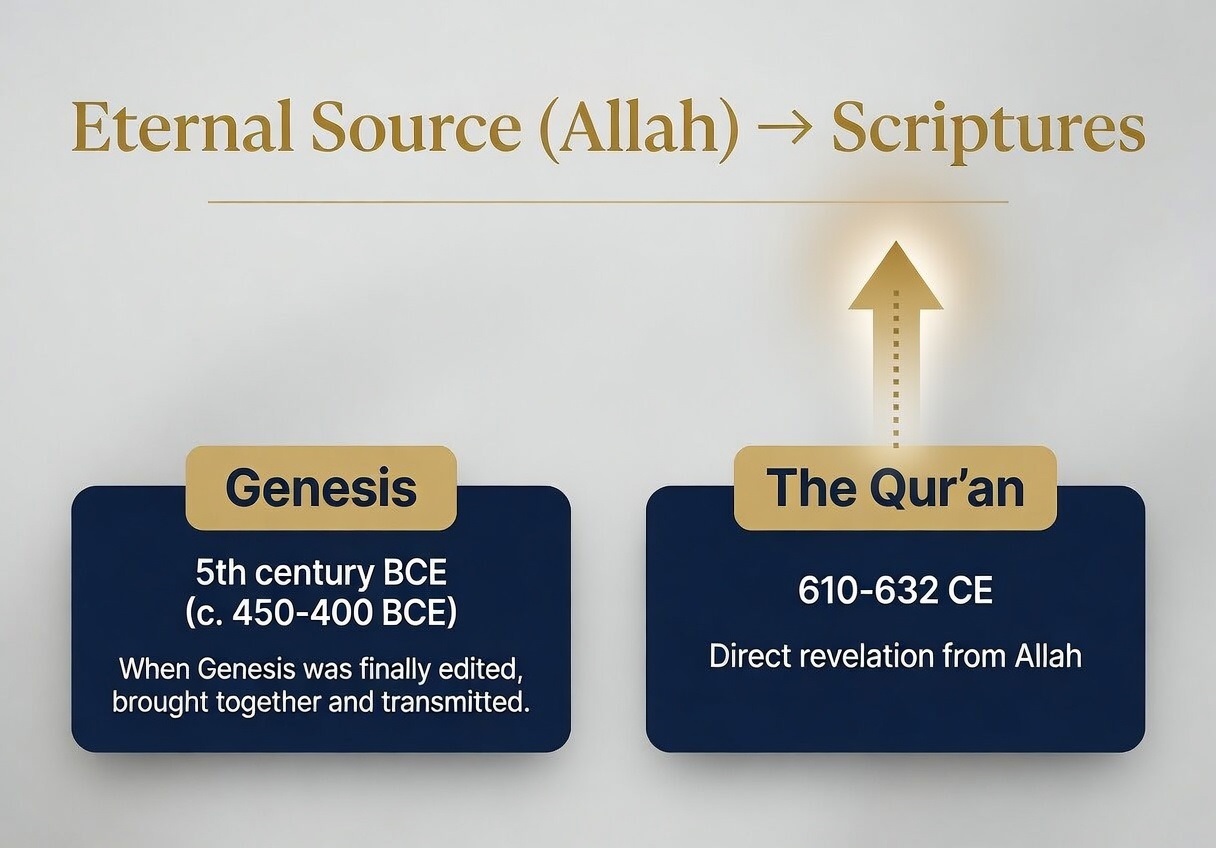
The Qur’an’s source is Almighty Allah
We simply point out the errors and the conflict contained in that upon which the Jews and Christians rely upon.
From the theological perspective of the Muslim, the Qur’an is not changing or altering anything. The Qur’an, as a revelation of Almighty God, comes to restore not alter the narrative.
Some important points for Jews and Christians to reflect upon.
God’s continued interest in Ishmael even after he was removed from Sarah’s camp.
“God was with the boy as he grew up. He lived in the desert and became an archer. While he was living in the Desert of Paran, his mother got a wife for him from Egypt.” (Genesis 21:20-21)
That which is claimed as the ‘Torah’ among the Jews and Christians never portrays Ishmael as a polytheist. In fact, after he and his mother were asked to leave God was still involved in the life of Ishmael. It stands to reason that Ishmael taught his people what he (Ishmael) was taught by his father (Abraham) about God.
Christians and Jews never really bothered to explore when and if that relationship became severed. Nor have they explored if or when God was no longer interested with the descendants and affairs of Ishmael.
The Christian claim that Muhammed (saw) is not a descendant of Isma’il.
Wathila b. al-Asqa’ reported:
I heard Allah’s Messenger (ﷺ) as saying: Verily Allah granted eminence to Kinana from amongst the descendants of Isma’il, and he granted eminence to the Quraish amongst Kinana, and he granted eminence to Banu Hashim amonsgst the Quraish, and he granted me eminence from the tribe of Banu Hashim.
Source: (https://sunnah.com/muslim:2276)
Those who claim descent from Qahţān were called al-‘Arab al-Āribah (The Arabizing Arabs) while the descendants of Ismā’īl were called Al-‘Arab al-Musta’ribah (The Arabized Arabs). The Quraysh, the tribe of the Blessed Prophet Muhammed (saw) belonged to the class of Arabized Arabs and they were the Northern Arabs.
The Blessed Prophet (saw) comes from Ismail (as) whom is the progenitor of the musta’rab. This means they became Arab via adoption of the language and customs.
One thing that Christians cannot do is to say with 100% certainty that Muhammed (saw) is not a descendant of Isma’il.
What is certain is that Isma’il is of the seed of Abraham. This is something that Jews nor Christians deny. We are not dependent upon their genealogical records. In the case of Christianity this is especially so because until today they cannot get right the genealogical records of Christ Jesus.
Mecca seems so far for Abraham to have traveled to?
Based on the biblical itinerary, the total journey from Ur to Canaan by way of Haran would have been approximately 1,050 miles (1,690 km). So why is it that Abraham can travel this far but not to Mecca?
Keep in mind the Muslim tradition about Abraham, Ismā’īl and the Kabba is not dependent upon the Jewish or Christian tradition.
The Pentateuch tself is not relied upon by historians as an accurate telling of events.
The Pentateuch (first five books of the Bible) itself does not explicitly claim that Moses wrote the entire five-book collection. These are claims made by tradition. So if Moses did not write it who did? It would also have to be aware of the debates surrounding whether or not the Pentateuch is considered a verbal or written inspiration.
1. Centuries removed from the source.
2. Compiled by multiple sources.
3. Lack of external corroboration. For example, the scale of the exodus has no external corroboration. Nothing from Egyptian, Canaanite, or Mesopotamian historical archeological records.
4. Post Mosaic additions. Passages such as the account of Moses’ death.
Based upon the Bible who has the superior genetic line? Abraham’s child with Hagar or Abraham’s child with Sarah?
“So after Abram had been living in Canaan ten years, Sarai his wife took her Egyptian slave Hagar and gave her to her husband to be his wife.” (Genesis 16:3)
Abraham is said to reveal that his wife Sarah is his sister. They share the same father but not the same mother.
Abraham says:
“Besides, she really is my sister, the daughter of my father though not of my mother; and she became my wife.” (Genesis 20:12)
Accordingly the god of the Bible found no other partner suitable for Abraham. Even though later this god revealed the following:
“‘If a man marries his sister, the daughter of either his father or his mother, and they have sexual relations, it is a disgrace. They are to be publicly removed from their people. He has dishonored his sister and will be held responsible.” (Leviticus 20:17)
“Cursed is anyone who sleeps with his sister, whether the daughter of his father or the daughter of his mother.” (Deuteronomy 27:22)
“I will bless those who bless you, and whoever curses you I will curse; and all peoples on earth will be blessed through you.” (Genesis 12:3)
So now will this god curse himself? Will the god of the Bible curse himself since he says cursed is anyone who sleeps with his sister and the Bible claims Sarah is Abrahams sister?
All this talk about nothing.
Here we go. Here is the secret sauce that Christians scholars would prefer their people not to think about.
The prophecy of being blessed through Abraham’s offspring has not yet been fulfilled during Christ time on Earth!
“Repent, then, and turn to God, so that your sins may be wiped out, that times of refreshing may come from the Lord, and that he may send the Messiah, who has been appointed for you—even Jesus. Heaven must receive him until the time comes for God to restore everything, as he promised long ago through his holy prophets. For Moses said, ‘The Lord your God will raise up for you a prophet like me from among your own people; you must listen to everything he tells you. Anyone who does not listen to him will be completely cut off from their people.’ Indeed, beginning with Samuel, all the prophets who have spoken have foretold these days. And you are heirs of the prophets and of the covenant God made with your fathers. He said to Abraham, ‘Through your offspring all peoples on earth will be blessed.’” (Acts 3:19-25)
We would encourage you to see how the various Christian sects interpret the above text. Especially the phrase: ‘times of refreshing‘. What you will find out is that accordingly, the prophecy was partially fulfiled in Jesus and is only completely fulfilled when he returns and starts to kill everyone who does not believe in him!
Also, notice the word ‘offspring’ and not specifically the line of Issac.
“But those enemies of mine who did not want me to be king over them—bring them here and kill them in front of me.’ (Luke 19:27)
How are all the people of the earth to be blessed when Jesus comes back and starts slaughtering a good number of those who will not accept him as king?
Textual corruption of Genesis 16:12. Defaming of Ishmael.
The Hebrew Text Compared
| Version | Genesis 16:12 Hebrew Text | Literal Word-for-Word Translation |
| Masoretic (MT) | וְהוּא יִהְיֶה פֶּרֶא אָדָם יָדוֹ בַכֹּל וְיַד כֹּל בּוֹ | “And he will be a wild-ass of a man, his hand in all, and the hand of all in him“ |
| Samaritan (SP) | וְהוּא יִהְיֶה פָּרָה אָדָם יָדוֹ בַכֹּל וְיַד כֹּל בּוֹ | “And he will be a fruitful man, his hand in all, and the hand of all in him“ |
The Preposition Pivot: “Against” vs. “With”
Notice that for the second half of the phrase (yado vakol veyad kol bo), the Hebrew words are identical in both texts.
The entire difference in English translations comes down to the Hebrew preposition בּ (Bēth / “ba-” or “bo”). This preposition is highly fluid and can mean “in,” “with,” “against,” or “by” depending on the context:
- The “Against” Interpretation: When a text pairs a “hand” coming into or upon someone (yado ba…), it is standard Hebrew idiom for opposition or striking (similar to the English phrase “to lay a hand on someone”). Because the Masoretic text starts with “wild ass” (a creature of conflict), translators render the preposition as “against.”
- The “With” Interpretation: If you read the Samaritan variant where the verse starts with “fruitful man,” rendering the preposition as “against” creates a jarring contradiction. A “fruitful, blessed man” wouldn’t logically be in constant warfare. Therefore, translators smoothing out the Samaritan text interpret the exact same preposition as “with” or “engaged with” to maintain internal consistency.
However, look how the Christians have tampered with the text in their translations here:
https://biblehub.com/genesis/16-12.htm
“He will be a wild donkey of a man; his hand will be against everyone and everyone’s hand against him, and he will live in hostility toward all his brothers.” (New International Version).
However, even in the above link there is an admission of a textual variant that changes the meaning.
“And he will be a wild man; his hand will be against every man, and every man’s hand against him; and he shall dwell in the presence of all his brethren.” (KIng James Bible and New King James Version)
““He will be a wild donkey of a man, His hand will be against everyone, And everyone’s hand will be against him; And he will live to the east of all his brothers.” (NASB 1995 NASB 1997. )
The New International version quoted above also has: Or live to the east / of
“He will be fertile of man. His hand will be with everyone. And everyone’s hand will be with him. And he will live among all his brothers.” (Genesis 16:12)
Source: (The Israelite Samaritan Version of the Torah: First English Translation Compared with the Masoretic Version (Edited and Translated by Benyamim Tsedaka and Sharon Sullivan, Eerdmans Publishing, 2013) page 34)
You may also be interested in reading the following:
May Allah Guide the Ummah.
May Allah Forgive the Ummah.


