“My Lord! Increase me in knowledge.” (Qur’an 20:114)
﷽
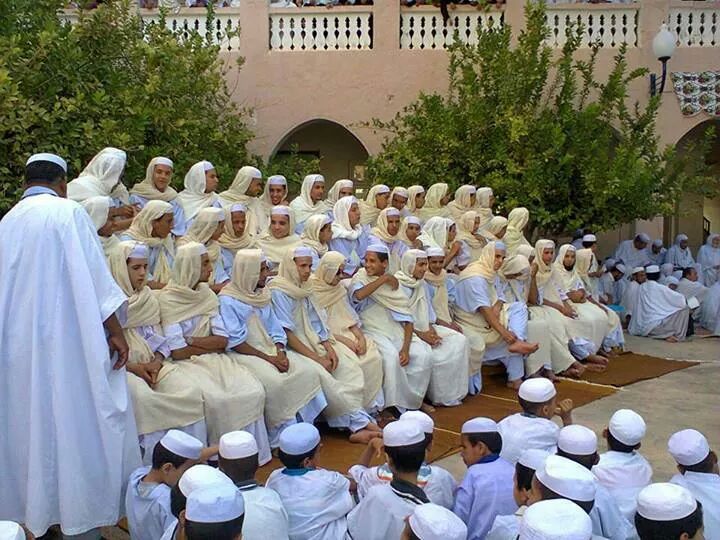
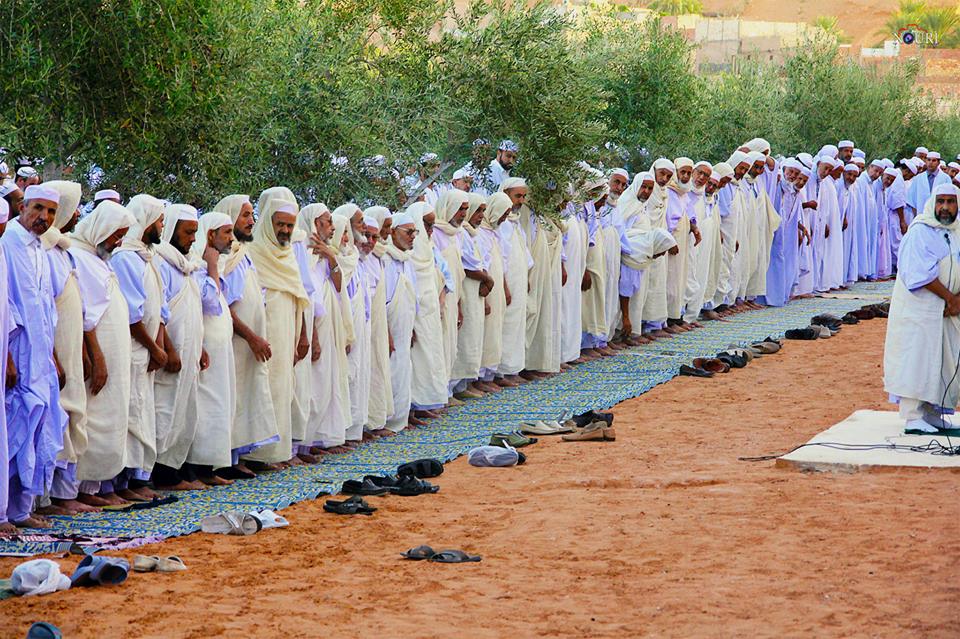
This was a short interview between the writer Anthony T. Fiscella and a friend from our brothers in the Mzab community of Algeria. (May Allah keep them steadfast and support them). Most notable was the semi-autonomy granted to the community and their self governing principles. Located in the Wilaya of Ghardaïa
Most of the brothers here are of Amazigh or Free-Men origins.
Although most of the brothers in the region read and write Arabic, they speak the Zenata dialect of the Berber language, for which there is no written form.
Despite political changes in Algeria over the years, the community continues to peacefully resist interference in the affairs of their community and strive to preserve their unique religious and cultural identity.
They have a reputation of being honest and astute businessmen. They also continue to be productive farmers in the M’zab Valley, supplying the fresh produce needs for their own communities and for marketing elsewhere.
The beautiful M’zab Valley of Algeria was given UNESCO World Heritage Site status in 1982, as a superb example of a traditional human habitat that has been adapted to the environment. This is confirmation that although values in the rest.
In Ghardaïa, is said that there are no beggars and that no thieves exist. The people of this society is very tightly knit with such activities from business to studies and marriage all done through the community. They cling to the unique clothing, language, architecture, and lifestyle.
Wherever they are, They always have one foot in Ghardaïa. Whatever their social situation, they never sever their roots and actively contribute to the life of the community.
Ghardaïa was founded over 1,000 years ago to provide shelter for their community after the fall of the the Ibadi Rustamid state. The village, 500 kilometres south of Algiers, was founded in the middle of a rocky desert. Other towns from the era existing to this day include El Atteuf, Melika, Bounoura, and Beni Izguène.
It is said that their insular nature has preserved the area, and the Ibāḍī Σezzaba continue to dominate the social life of the area. A federal council, Majlis Ammi Said, unites representatives of the seven settlements as well as Ouargla, an ancient town located 200 km South-East of the Mzab valley. This council forms a federative body for religious, social and, increasingly, cultural matters. This religious federal council represents an “Islamic type of government” unique today.
Numerous details of Ibāḍiyya social life are ruled by this Islamic government, such as the weight of gold given as a dowry to a woman (maximum 60 grams) to the length of wedding celebrations (three days). The council makes decisions on details such as dowries, celebrations, dress. It used to impose punishments including exile, and a form of tabriyya “quarantine”, where the offender may not interact with his fellow citizens. I would imagine this is a time of dissociation or bara’ until the offender has repented and amended his/her ways.
May Allah (swt) continue to bless them. May Allah (swt) preserve them! May Allah (swt) bring stability and peace to Algeria. May they continue to be the light in the region for the good people of Algeria. Amin!
This remains true as the people M’zab valley Algeria, Nafusa Mountains in Libya, Djerba Tunisia, have remained steadfast upon the Haqq. As well as the revival of the Qur’an and Sunnah via the Ibadi school among the Hausa, Tuareg, and Fulani peoples. Al hamdulillah!
It is hard to imagine how this paper granted Jason Van Riel a Master’s thesis. I have said it before and I will say it again. Universities are basically just handing credentials to people.
I can’t imagine writing about another people’s history, culture and religion and writing with the type of smug dismissiveness and pretention that Orientalist and others often write with.
It is simply gross.
1st Jason van Riel rides on the tired coattails of the Ibadis being Khawarij and worse yet, a sect from among the Khawarij; and even bigger blunder rest assured.
We can see this in his thesis where he states:
He asserts: “Ibāḍī Islam has its origins in the Khārijite sect that came into existence during the first fitna (37/657), the civil war…”
“although the Ibāḍīs were not Azraki they were still a Khārijite sub sect.”
“To ensure that Ibāḍī traders were not restricted in and around Sijilmasa, to the commercial and financial advantage of both the Rustamids and Midrārirds, the two ruling houses frequently intermarried with each other, even though they were of rival Khārijite sects.”
Calling groups of Muslims by the pejorative labels used by their opponents is anything but academic.
To support my position on why I believe universities almost feel obligated to confer credentials upon people because they paid their course fees will be readily seen. How on Earth does one read a paper like Jason Van Riel and not wonder what basis are his smug and dismissive comments made?
Here just some samples:
“Although it must be noted that only the Ibāḍī doctrine of “all-Muslim equality regardless of social or ethnic origin” was what the Berbers cared for, they had very little interest in any of the other aspects of Ibāḍīsm and Khārijism.”
For example if I am reading his paper I would press him. Van Riel on what basis did you draw this conclusion?
“The control and maintenance of these trade routes was an important source of income for these Berber tribes, either through the levying of tolls or through the blackmail of merchants travelling the roads under their control.”
Again you have to wonder where Van Riel has basis for this. Why would you need to blackmail travelers via trade routes that are mutually beneficial for all involved?
Does it not occur that if trade routes are the subject of blackmail they become troublesome?
“And even though the Arab chroniclers would want to have the their readers believe that the local rulers of Bilād al-Sūdān were Muslim (and converted in a most spectacular fashion) they were in most cases Muslim in name only.”
This is the type of comment that a non serious person would make. This is where if I were grading Van Riel’s paper I would ask him why does he need to muse on the intentions and sincerity of people’s conversion to Islam? If he said it was perhaps possible that some were not sincere that maybe possible.
However, to assert : “They were in most cases Muslim in name only.” It is really hard to see this as unacademic disdain.
However it is perfectly fine for orientalist and so called historians to “fill in the blanks” so to speak.
We read:
“One of the main concerns that this thesis faces is a lack of available sources, and this will be explained – along with an elaboration of the available sources – in the next section. In my opinion it is important for scholars to be creative when they face a lack of sources, as this does not entail that historical events did not occur. In combination with this I also strongly believe in Karl Popper’s criterion of falsifiability whereby “only if I can say how my theory might be refuted, or falsified, can I claim that my theory has the character of an empirical theory.”
This is very cringe.
Then Van Riel also states:
“Even if these sources can be located, the families owning them are wary of outsiders digging through their, sometimes centuries old, papers for fear of “secrets” being divulged.“
He doesn’t care to elaborate what these “secrets” might be. Just another off the cuff comment that strikes one as truly bizarre. In fact, this would have been a perfect opportunity for Van Riel to make another smug remark about other cultures by saying something along the lines of:
“Given the poverty that many people face in these countries, historians should seize the opportunity as locals would only be too willing to hand over parchments for a paltry sum!”
Surprised he didn’t!
Van Riel states:
The main problem with Lewicki’s work is that his articles tend to focus on a single category and, more importantly, Lewicki is considered to have approached Ibāḍī documents uncritically. Or as E. Savage puts it: “Curiously, Lewicki never takes up the theme of the historiographic context of his Ibāḍī sources but appears to have accepted them a priori as historical.”
Huh?! The treachery of it all! Imagine! Allowing a people to present their own history and narrative!
The orientalist must always approach and other the ‘other’ as being dishonest, having a motive and or an agenda. Did it not occur to Van Riel that even Ibadi opponents acknowledge our honesty and transparency.
Kitman is one thing when needed. Yet, lying is a major sin. We do not play with fire!
So that is my critique. I did find the thesis informative over all.
These are some notable bits of information.
“Even though Ibāḍī merchants were not the first Muslims to reach Bilād al-Sūdān, they did end up staying to ensure that the trans-Saharan trade became a constant source of gold and slaves for the north and salt and other general trade goods for the south.”
“It is generally believed that in pre-Almoravid times the majority of Muslim merchants in Bilād al-Sūdān, those who originated from the Maghreb, were Ibāḍī.”
According to Professor T. Lewicki’s research the Ibāḍī merchant-shayks where very active missionaries who tried to convert the pagan populace in Bilād al-Sūdān to Ibāḍīsm. And Lewicki continues by stating that these Ibāḍī merchant-shayks represented “the only form of Islam in West Africa, until the Almoravids brought their Sunni-Islam.”
“The reason why it is generally accepted that the kings of Ghana were converted to Ibāḍī Islam was because of the combination of Ibāḍī architecture used for the Grand Mosque of Gao, the capital of Ghana, and because of the historically close ties between Gao and Tahert, since the 2nd/8th century, that still existed when the kings of Ghana converted to Islam.”
“After the rulers of Ghana were defeated by the Almoravids and forced to convert to Sunni Islam (Malikite Islam), halfway through the 5th/11th century, Tādmekka became one of the many towns in the western part of Bilād al-Sūdān that was cleansed of all Ibāḍī influences
“Because many prominent Ibāḍī ‘ulamā’ had left Basra for either Oman or the Maghreb, its Ibāḍī community went through a period of intellectual decline which ultimately meant that it lost its position as the most important center of theology and jurisprudence in the Ibāḍī world.”
“It was not long before Ibāḍī merchants could be found all the way from the Maghreb to India, and it is even alleged that Ibāḍī merchants were amongst the first to set up business ventures in China.”
“My Lord! Increase me in knowledge.” (Qur’an 20:14)
﷽
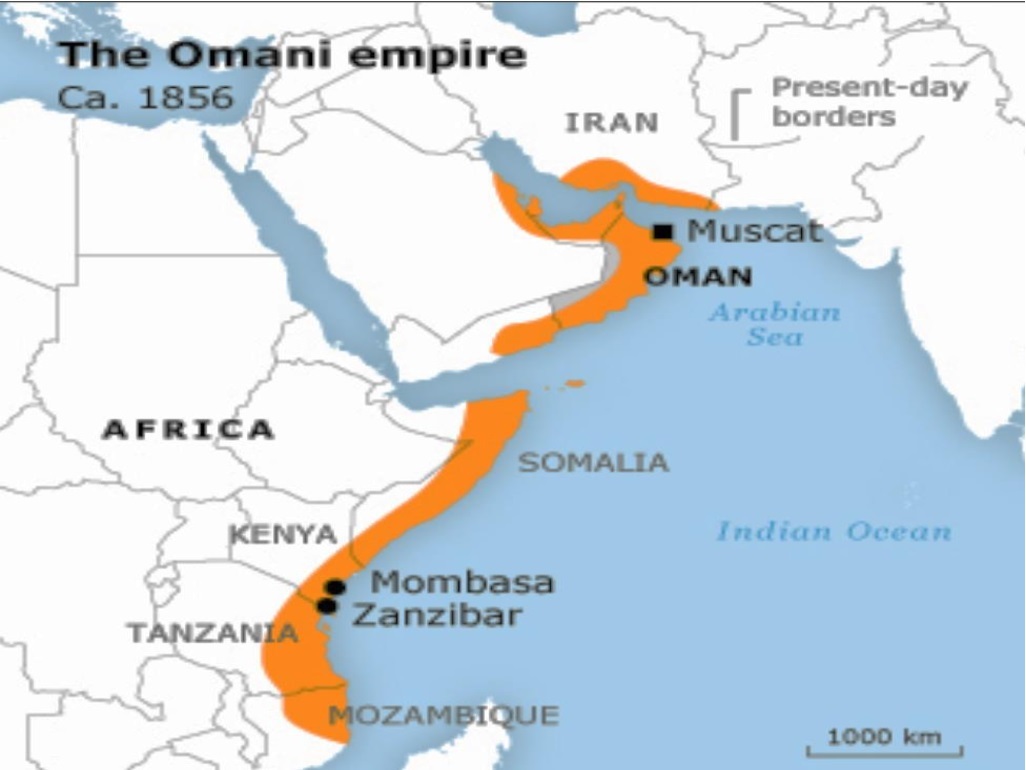
This entry is to share a brief over view about the territory that was once under the Omani Empire and which countries they would be considered part of today.
Also is an interesting bit of information about the the three longest lasting Muslim empires/dynasties.
The Omani Empire extended over part of what is today Iran-Bandar Abbas, U.A.E, Pakistan -Balochistan, Yemen, Comoros , Saudi Arabia-pecifically the region of Al-Hasa (or Al-Ahsa Oasis, Somalia, Kenya, Tanzania, Mozambique. Madagascar, Djibouti,
Which are the top 3 longest lasting Muslim empires/dynasties in terms of longevity & stability?
1. 1299-1922 Ottoman/Sunni/Hanafi = 623 years
2. 750-1258 Abbasid/Sunni/Hanafi = 508 years
3. 1154-1624 Nabhani/Ibadi = 470 years
We would like to add here a brief yet very insightful and helpful message. This additional information is accredited to ‘The servant of Allah’ and surely his reward is with his Lord. May Allah (swt) bless him!
A small comment about Omani history
1- The map of the Omani empire that you see here which is supposedly at the time of the Sultan Saeed Bin Sultan…but how accurate is it? Because we know that The Sultan ruled parts of the East African coast as he even lived there. However, did he rule all the colored land? The answer is definitely no. He had different degrees of influence in different areas, but in east Africa, he mostly ruled Zanzibar and its surroundings, like Mumbasa, Dar Al-Salam and Pempa. As for Iran, Oman actually didn’t rule the south coast, rather there was an agreement that Oman basically rented the port of Bandar Abbas, (which is still impressive) However, not as impressive as the map shows it to be.We also don’t think there was Omani sovereignty in Madagascar, Nor in Somalia just influence in trade. Yet, there was some control of trade routes to the African interior.
We should say that after the Imam Ahmed Bin Saeed, Oman was ruled by a monarchy all the way to this present day. Even though yes the rulers where Ibadi, they didn’t rule in the Ibadi way. This is especially true after the British colonized Oman, as they fought against the idea of an Islamic Ibadi state in the interior. Similarly for the Nabhani state, they were just a monarchy. Oman wasn’t even stable or flourishing, it was in chaos and it wasn’t really Islamic at all. They were in constant rivalry with Imams, like Imam Mohammed Bin Isma’il Al-Haderi, which was able to establish an Imamate that ended the first Nabhani era in the year 1500 AD / 906 AH then after his death the second Nabhani era began(1556 AD/964 AH), which then lasted for less than 100 years until the Portuguese invasion.
So what’s our point here?
1- Omani doesn’t equal Ibadi
2- History is not as simple as it looks
3- Ibadis could have done more in the past
4- If we want to be proud, we should look at the Omani Imams like:(Al-Julanda Bin Mas’ood, Al-Salt Bin Malik, Naser Bin Murshid, Mohammed Bin Abdullah Al-Khalil and All the others Imams that carried the Banner of Islam and Ibadism in the proper way).
And of no effect is the repentance of those who continue to do evil deeds until death faces one of them and he says: ‘Now I repent;’ NOR of those who die while they are ungrateful disbelievers. For them We have prepared a painful torment” (Qur’an 4:17-18)
﷽
What about all those hadiths that say if you do this or that you will be GUARANTEED PARADISE?
So for example there are a great many hadith that say that if a person does this act or says this statement they will be guaranteed paradise.
Examples:
It is narrated on the authority of ‘Uthman that the Messenger of Allah (saw) said. He who died knowing (fully well) that there is no god but Allah entered Paradise.
The Prophet, (saw) said, “Whoever recites ten times, ‘Say: He is Allah, the One,’ a palace will be built for him in Paradise. Whoever recites it twenty times, two palaces will be built for him. Whoever recites it three times, three palaces will be built for him.”
Abu Umamah reported: The Messenger of Allah, peace and blessings be upon him, said, “Whoever recites the ‘verse of the Throne’ after every prescribed prayer, there will be nothing standing between him and entry into Paradise but his death.”
The first response to the above hadith is that they have to be all taken into account with many other hadith. Because the singular narrations (ahad) put a few strokes on the canvas they do not paint the whole picture.
Hadith that do not guarantee Muslims paradise.
Narrated Abu Huraira:
Allah’s Messenger (saw) said, “All my followers will enter Paradise except those who refuse.” They said, “O Allah’s Messenger (saw)! Who will refuse?” He said, “Whoever obeys me will enter Paradise, and whoever disobeys me is the one who refuses (to enter it).”
How to reconcile these contradictory hadith? A simple solution and one that even Sunni schools of theology are forced to acknowledge.
All of those ahadith that guarantee paradise for a Muslim based upon this action or this statement have to be taken into context with all those hadith that says if a Muslim does this or that they will not enter paradise. Those hadith about the guarantee for paradise is for a Muslim who stays the course, who practices their Islam who is diligent in all matters of their faith.
Otherwise we run into the following logical problems. Examples:
Question: What happens if that person was to miss the verse of the throne recitation even after just one prayer?
Would they now not be guaranteed paradise?
The Prophet, (saw) said, “Whoever recites ten times, ‘Say: He is Allah, the One,’ a palace will be built for him in Paradise. Whoever recites it twenty times, two palaces will be built for him. Whoever recites it three times, three palaces will be built for him.
Question: What happens if I recite surah ikhlas ten times today 7/7/2024 but decide to stop praying, fasting paying zakat?
Am I guaranteed paradise then?
Also what happens if I recite surah ikhlas ten times and then I become a backbiter and I break the ties of kinship?
So it is not logical that one statement or one action is going to get a person into paradise. Especially when all the ahadith are taken as a whole.
What happens to the one leaves Islam completely?
Do their deeds, and statements of creed effect their salvation?
Do the murtad become the people of paradise?
There is no verse in the Qur’an that says Kafir will enter paradise! None!
There is no verse in the Qur’an that states you can sin and continue sinning without repentance without restitution and you will enter paradise! None.
“Allah accepts only the repentance of those who do evil in ignorance and foolishness and repent SOON afterwards; it is THEY WHOM Allah will forgive and Allah is Ever All-Knower, All-Wise.
And of no effect is the repentance of those who continue to do evil deeds until death faces one of them and he says: ‘Now I repent;’ NOR of those who die while they are disbelievers. For them We have prepared a painful torment” (Qur’an 4:17-18)
Truly, Allah loves THOSE who turn unto Him in repentance and loves those who purify themselves” (Qur’an 2:222)
“But whosoever repents AFTER his crime and does righteous good deeds (by obeying Allah), then verily, Allah will pardon him (accept his repentance). Verily, Allah is Oft Forgiving, Most Merciful.” (Qur’an 5:39)
“O you who believe! Turn to Allah with sincere repentance! It may be that your Lord will expiate from you your sins, and admit you into Gardens under which rivers flow (Paradise)” (Qur’an 66:8)
“Say to those who have disbelieved, if they cease (from disbelief), their past will be forgiven” (Qur’an 8:38)
“Your Lord has written (prescribed) Mercy for Himself, so that if any of you does evil in ignorance, and thereafter repents and does righteous good deeds (by obeying Allah), then surely, He is Oft-Forgiving, Most Merciful” (Qur’an 6:54)
“Allah wishes to accept your repentance, but those who follow their lusts, wish that you (believers) should deviate tremendously away (from the Right Path).” (Qur’an 4:27)
“Say: Oh my slaves who have transgressed against themselves (by committing evil deeds and sins)! Despair not of the Mercy of Allah, verily, Allah forgives all sins. Truly, He is Oft-Forgiving, Most Merciful” (Qur’an 39:53)
“And whoever does evil or wrongs himself but afterwards seeks Allah’s forgiveness, he will find Allah Oft Forgiving, Most Merciful” (Qur’an 4:110)
Islam is salvation through repentance. Islam is NOT salvation simply because I am Muslim.
All of those verses explicitly tell us as Muslims that we have an incredibly Merciful, Compassionate, Loving and Forgiving Creator. The verse even says that Allah wishes to accept your repentance. It doesn’t get more clear than this!
Yet, if we do not care about our own selves, and our own salvation, if we do not even have a modicum of decency and awareness to turn towards Allah (swt) and repent for our sins. Make restitution, reform our conduct, than we have absolutely no one to blame if we end up in hellfire forever.
The point we can make is that even if all such hadith are 100% correct, chains hold up etc. It shows the extent of Allah’s mercy. His readiness to accept us into paradise.
Yet as mentioned they need to be interpreted in light of all such hadith that say the polar opposite.
A logical problem if one takes those hadith in isolation.
Also, logic as mentioned I say Shahahada with sincerity guarantees me paradise but then I decide not to practice the deen?
Surely they see it as problematic.
If one takes those hadith that promise a person paradise in isolation without considering all the other hadith evidence that clearly state if one does such and such as well as the clear text of the Qur’an we will end up with serous logical contradictions.
Likewise, this is an issue of morals and ethics.
Has Islam really come to teach that a person can take the declaration of fast and afterwards not pray, not fast, not purify our wealth, and that one can lie, cheat, steal, commit fornication and adultery and will be among the people of paradise?
We are to do our level best to control our based desires, restrain our tongues and hands from harm. We are NOT to be the very devils Allah tells us to seek refuge from.
So it is very clear that Sunni Muslims have to agree with us on these points. They are crystal clear. That the kafir does not enter paradise.
We are upon the model of Adam (alayi salam) One who sinned and repented and was forgiven.
To sin and to never seek forgiveness. What is that except the model of Iblis.
Choose wisely dear truth seekers.
The only difference that now remains between us is as follows:
Our school states that no disbeliever enters into the paradise and no believer enters into the hellfire. Such a belief about the believer entering into hellfire has no basis in the primary source of Islam, the Qur’an.
So the differences are:
Do some believers go to hell for a while (as Sunni schools claim).
Or.
Do believers all go to paradise without any sojourn in hell (as the Ibadi school claims).
Does Allah replace some Jews and Christians (destined to paradise) and swap them for (Muslims destined to hell) as some Sunni claim?
Does Allah grant polytheist salvation (as the case of Ibrahim’s father) and place in his stead a goat or sheep?
“He commands them to do good and forbids them from evil, permits for them what is lawful and forbids to them what is impure, and relieves them from their burdens and the shackles that bound them. ˹Only˺ those who believe in him, honour and support him, and follow the light sent down to him will be successful.” (Qur’an 7:157)
﷽
This blessed school was foremost among the Muslims to take firm action on this poison. When the Islamic nation was gripped by its evil and many people around the world are still gripped by this evil our scholars by Allah’s grace and due to their penetrating insights were swift to condemn it.
There are even those who call themselves Muslims (Allah knows best their reality) that will even sell this poison in their hotels. With out a thought or a care about how it will negatively impact others.
You may be surprised to find among your colleagues those who consider themselves people of reason and intellectual rigour and suddenly overcome by their nafs.
The same people you may find them well kempt and well dressed. They like to project an image. Image is important they say. Fair enough, yet you walk around with a cancer stick in your mouth!
“but Satan made their deeds attractive to them.” (Qur’an 16:63)
If anyone enquires about why you do not smoke cigarettes ask them if the CEO of the cigarette company smokes? If not then why not.
His Eminence, Shaykh Masoud Al Miqbali laying out evidence after evidence from the Qur’an.
“He commands them to do good and forbids them from evil, permits for them what is lawful and forbids to them what is impure, and relieves them from their burdens and the shackles that bound them. ˹Only˺ those who believe in him, honour and support him, and follow the light sent down to him will be successful.” (Qur’an 7:157)
“Give to close relatives their due, as well as the poor and ˹needy˺ travellers. And do not spend wastefully. Surely the wasteful are ˹like˺ brothers to the devils. And the Devil is ever ungrateful to his Lord.” (Qur’an 17: 26-27)
“And those who unjustifiably harm believing men and women will bear the guilt of slander and clear wrongdoing.” (Qur’an 33:58)
Can it said that cigarette smoking, is justifiable when the second hand smoke is extremely harmful to children and others around them?
“Did you not see those who have exchanged Allah’s favour with ingratitude to Him, causing their people to be cast in the abode of utter perdition.” (Qur’an 14:28)
Allah (swt) has granted you good health and good condition and you wish to exchange that for what will bring you great harm.
“And do not kill yourselves. Indeed, Allah is to you ever Merciful.” (Qur’an 4:29)
“Spend in the Way of Allah and do not cast yourselves into destruction with your own hands.” (Qur’an 2:195)
Be ever mindful of our enemy, Satan! There are those who will continue to smoke shisha or smoke cigarettes…” it is the same whether you warn them or not—they will never believe.” (Qur’an 2:6)
“but Satan made their deeds attractive to them.” (Qur’an 16:63)
BE WARNED THE FOLLOWING VIDEO IS GRAPHIC.
Brothers and sisters please do give up this habit. It is filthy and vile. Do save money and save your life.
Oh youth of the world. They fool us with a concept called: “Cool”. That is the image they present.
But the reality of high blood pressure, chemotherapy, cancer. The personal cost to you and your family.
Please encouraged your friends, family and dear ones to give this up!
“While if any saves a life it is as if he saves the lives of all mankind.” (Qur’an 5:32)
“Those who believe and whose hearts find comfort in the remembrance of Allah. Surely in the remembrance of Allah do hearts find comfort.” (Qur’an 13:28)
﷽
Ramadan Day 23:There is nothing better than the remembrance of Allah.
23rd day of Ramadan ——————————– *Heart Illness: The Ego* Arrogance is from the characteristics that kills the heart, Allah had vilified it in many verses such as: “I will turn away from My signs those who act unjustly with arrogance in the land.” (Qur’an 7:46).
The Blessed Prophet (saw) said:
“A person doesn’t enter the paradise if he has arrogance the weight of an atom.”
The types of arrogance: 1- Arrogance against Allah: And it is by rejecting to believe in him and to obey him, just like the Pharaoh who claimed to be a god, and Iblis who rejected the command of Allah to prostrate to Adam
2- Arrogance against prophets: By rejecting to believe in them and follow them, just like the people of Quraish who said that “Muhammed is an orphan, how can Allah send him to us?”
3- Arrogance against people: This can be caused by many things: Your knowledge/academic level. The amount of worship you engage in. Your lineage. Your beauty. Your wealth Your social status
Each one of these has a solution, but a good comprehensive solution to All these things is as
Ahnaf ibn Qays would often sit with Mus’ab ibn Zubayr. On one occasion, when he arrived, Mus’ab had extended his legs and didn’t make room. Ahnaf took his seat, feeling somewhat cramped. In response, he remarked, “It’s truly remarkable how a person can be proud and arrogant, considering that he has passed through the urinal passage twice.” [i.e., At the time of conception and birth]
Source: (At-Tawāḍuʿ wal-Khumūl (Humility and Modesty) – p. 201)
*The Sorting of People in the Religion* People are sorted to three: 1. A believer: we spoke about the attributes of a believer before.
2. A hypocrite: Is someone who shows outside the opposite of what is in his inside, and it’s of two types:
Doctrinal hypocrisy: It’s when someone shows belief in Islam and hides his Shirk as a way to protect them from being treated as such, and this type was described a lot in the Qur’an like: “When the hypocrites come to you ˹O Prophet˺, they say, “We bear witness that you are certainly the Messenger of Allah”—and surely Allah knows that you are His Messenger—but Allah bears witness that the hypocrites are truly liars.” (Qur’an 63:1)
Practical hypocrisy: It’s better than the previous type but it’s still a grave matter, and it’s when someone claims to be a Muslim but does not commit to the obligations of Islam by doing commands nor leaving prohibitions, and there are many evidences for this type. The Blessed Prophet (saw) said:
“Four things whoever has them is a pure hypocrite, and whoever has one of them he has an attribute of hypocrisy until he leaves it, if he was trusted he betrays, if he spoke he lies, if he made a covenant he breaks it, and if he quarrels he deviates from the truth.”
3. A Mushrik: Someone who rejects Islam outwardly and inwardly, this includes idol worshippers, atheists or the people of the book, and from the rulings of Mushriks: no inheritance between them, they are not buried in the Muslim cemeteries, we don’t pray for their dead, they aren’t greeted with the greeting of Islam. If they die between Muslims and there is no one from their faith the Muslims should bury them somewhere else without praying for them nor washing them, but their body should be covered to save the human sanctity.
We will discuss this later in the topic of the six doctrines/faiths -Allah Willing.
*Disliked Things in Prayer* Here are some disliked things that should be avoided when praying: Praying while holding back urine and faeces, in one opinion it doesn’t break the prayer until you raise a leg. Praying while fighting back sleepiness. Praying when the food is present. Praying in front of a distraction like a mirror or a picture. Adhering to a specific position in the mosque. Slightly looking around without a reason, some say the prayer doesn’t break until he looks at the sky or looks behind, and if the person looks around too much then his prayer is corrupted. Smiling slightly by accident. Performing Sahu prostration without having to. Yawning.
“They want to extinguish the light of Allah with their mouths, but Allah will perfect His light, although the disbelievers dislike it.”(Qur’an 61:8)
﷽
When it comes to Christians and Islam there are a few scenarios that take place.
a) Either they begin a serious study of Islam and end up seeing that Islam is a more cogent faith and world view than Christianity ever could be. They convert to Islam as I have.
b) They remain convinced of their own faith but develop a deep admiration and appreciation for Islam and Muslims (rather they admit it publicly or not)
c) Their hearts become diseased and their spiritual ailments are amplified and this becomes obvious in time. Greed, avarice, lust, anger, hate, racism begins to drip from their writings and public statements. Without fail repeatedly these people end up being humiliated publicly in this life. The hereafter is a painful and everlasting torment for them.
This article will focus on group C. Where better to start than with Zionist Evangelist Phil Arms and Phil Arms ministries? These are just some of the books that are Anti Islam and filled with pro-Israel Platitudes.
Is Fanatic Islam a Global Threat? by Phil Arms
Light in the Shadow of Jihad by Phil Arms
Unholy War-America, Israel and Radical Islam by Phil Arms
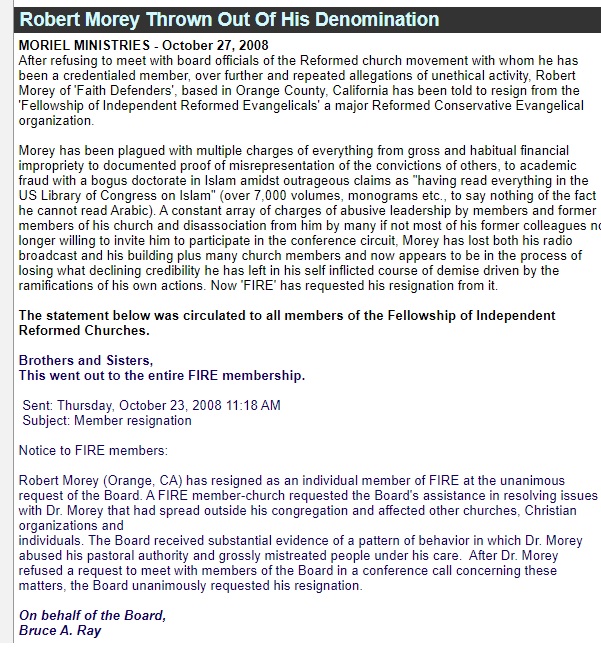
However, what we do not know is this, just like Robert Morey who was removed from his Church and asked to leave F.I.R.E (an Evangelical Christian Outreach) Phil Arms too was removed from his church! The full story follows. I am sure that sooner or later sincere Christians are going to get real tired of these Evangelist, and Pastors and Apologist who claim to be fighting ‘the good fight’ against Islam but instead are busy embezzling funds, and robbing the congregation of their hard-earned money, and molesting members of the body of Christ both physically and spiritually!
“Phil Arms grew up in West Texas. His dynamic Christian mother raised her six children in the local church. However, Phil did not commit his life to Christ during his younger years and chose to join himself with the sub-culture of the sixties and seventies in Houston, Texas. After experiencing one dead end after another, running from the love and voice of God, he began to search for reality and gave his life to Christ on a street corner in 1972. Immediately after his conversion, he began a ministry on the streets of Houston, Texas, witnessing to those in need of Jesus. Within a short time, God began to open wide the doors for Phil to minister in churches, schools, and evangelistic rallies.” Source: http://www.lifereachministries.com/aboutus.aspx
The interesting part above is that it says that Pastor Phil “chose to join himself with the sub-culture of the sixties and seventies in Houston, Texas.” Anyone who knows about the 60s and 70s knows that the sub-culture referred to at that time was one of drugs, drugs and you guessed it more drugs…
No amount of lawyering could have placated Jim Miller, who rose from his seat in the crowd and said, “I will not stand for more lies.” Taken aback, Arms threatened to have the dissenter removed. In a passively resistant protest, Miller threw himself on the green-carpeted steps below the pastor and prayed for him to repent. When Arms had finished his speech, he crawled down onto the steps with Miller and spoke to him harshly under his breath, like a parent scolding a child in public. “Now, God’s told me to wash your feet,” Arms said. “I want you to get up here right now.”
But the forced foot-washing did little to bring Miller back into the fold. From the altar, he pointed out that Arm’s repayment of the money didn’t negate the fact that he stole it, and this sparked shouts for truth and repentance throughout the congregation. Finally, Suzanne Arms took the stage to try to help her husband defend himself, but she ended up just giving the crowd more of the blood they wanted. “Yes, he took too many drugs, he’s confessed that,” she said. “Yes, he took the money, and he shouldn’t have — it was drug-driven.”
Apparently, he has been wrestling with the drug hydrocodone. The following picture is taken from one of his publications, “The Man Who Would Be God.”
If you take a hard look at the picture it makes you wonder what goes through the minds of people who conjure up such images. In fact, the image looks like one person who is two different beings, a split personality, or someone who maybe wrestling with something (drugs) or someone (Jinn or evil spirits). Personally looking at it gives me the creeps, and I do not know why Christians are not spiritually guided as not to have books with such images in reach of their children. The book itself, though a polemic against the Anti-Christ, does an excellent job of subliminally projecting satanic imagery. Also, it says “PHIL ARMS” underneath. For those with a discerning spirit if you get chills I think its time you pick up the Qur’an and stop listening to the lies spread by Satan’s minions. If I wrote a book I would put ‘By Phil Arms’. Why would you have such a controversial image and then just put your name at the bottom? Is Allah trying to tell us something?
In Conclusion: We as Muslims should make du’a and pray that Allah guides Phil Arms, his ministries, and those duped by his drug charades and lies so that they can understand the truth and simplicity of Islam. I invite everyone who ever listened to Phil Arms ministries to take the time to rethink some of the statements he may have made about Islam while under the influence of narcotics. Repeatedly we see those who direct their energies against Islam are exposed for their nefarious agendas and inwardly shallow spirits groping in darkness and being used as pawns of Satan. May Allah guide him and his family to Islam and may Allah give him a job that provides him with sustenance and makes things easy upon him. Next up is Assemblies of God’s very own Jimmy Swaggart.
Reverend Jimmy Swaggart (Assemblies of God) World famous televangelist and firebrand preacher will always be remembered by the world for his fiasco with the prostitute(s) in Louisiana. Jimmy Swaggart preached what he thought to be the Gospel of Christ Jesus to over 132 countries around the world! This all changed one fateful evening when his fall from grace came.
The interesting thing surrounding this event from the Muslim perspective is his well-known debate with Shaykh Ahmed Deedat.
In the debate “Is the Bible God’s Word” the two titans of Christianity and Islam, the Reverend Jimmy Swaggart and Shaykh Ahmed Deedat had finally met.
The background of the debate seems to have ignited after Jimmy Swaggart appeared on television claiming the Qur’an to be “incantations of frail men”. The Muslims of course did not take too kindly to the statement and thought that a debate between Reverend Jimmy Swaggart and Shaykh Ahmed Deedat should be arranged.
During the opening of the debate Reverend Jimmy Swaggart made an interesting remark on polygyny to the effect that he said:
“I was just talking to Mr. Deedat this afternoon I should say this evening really, and he’s one of the gentlemen whom you meet and you like him instantly. He was teasing my wife and I and said Islam allows four wives. He just corrected me he said, ‘up to four’ and I said, “Well Christianity only allows one so I had to get the best on the first shot”.
The link to the debate: “Is the Bible God’s Word” is as follows…
My review of the debate: I thought that Reverend Jimmy Swaggart was able to maintain his composure in the debate which was quite important. The most glowing comment as a true follower of Christ Jesus was his statement, “I want to say that every true Christian loves the Muslim people and I mean that with all of my heart.” His reference to a person crying out in the name of Muhammed for a demon to come out of a possessed individual Is a questionable assertion. I thought Shaykh Ahmed Deedat did an excellent job of dealing with the issue of miracles and just how important they are.
What happened subsequently after the debate will soon not be forgotten. Reverend Jimmy Swaggart was caught being defiled with prostitutes.
The link to Reverend Jimmy Swaggart’s confession of being with prostitutes is as follows…
Now, this is very interesting because of his attack on Islam’s position of polygyny. Now it would be very awkward for me as a man to say that a man should marry another woman simply to gratify his sexual desires; however why a man chooses to take a second wife is not my concern. Muslims simply point out that time and again we get attacked for polygyny while many people practice polygamy and polyandry in the form of sexual freedom with no strings attached.
Islam is simply saying to the Christians and Jews nowhere does the Bible stipulate not to have more than one wife. It is simply a modern norm that has been adopted by most Christians. Jesus, John, and Paul were never married so they cannot be examples of monogamy.
Reverend Jimmy Swaggart’s plea to ‘ship the Muslims back home’.
The Reverend Jimmy Swaggart made the recent outburst that every single Muslim in the United States college campuses should be shipped back to where they came from. Source: (https://abcnews.go.com/WNT/Beliefs/story?id=130008&page=1)
This outburst is very disheartening on two accounts.
1) If every Muslim is shipped back to where they came from, what would happen to the Muslims who are born right here in America? So I am not sure his statement was inspired by the Holy Spirit.
2) Why would we want to ship Muslims back to countries that deny the Gospel of Christ Jesus? Why not keep them right here in America where they can still be reached through the Campus Crusade for Christ? This also makes me hesitant to believe the statement was inspired by the Holy Spirit.
In Conclusion: I think Muslims and people of all faith persuasions should take a step back and examine this debate and what happened before the debate and subsequently. We pray that the Reverend Jimmy Swaggart, whom otherwise a cordial man, may reconsider his comments that all Muslim students should be made to leave the United States. We also pray that Allah opens his heart to the truths and beauty of Islam.
Next up is Ted Haggard. He was the head of the 30 million-strong National Association of Evangelicals. In the end, he was a man who struggled with his Gay Sex and Methamphetamines.
Somehow, this doesn’t surprise me coming from Ted Haggard who was the former head of the 30 million-strong National Association of Evangelicals. The following article taking from a website that also supports Pat Robertson (the peaceful Christian who says we should kill Hector Chavez, president of Venezuela, is a shareholder of Coors Beer, and has shady ties to blood diamond mines in Africa). This man Ted Haggard was also a spiritual adviser to George Bush Jr. if that says anything! He was in the popular DVD the Jesus Camp video and in this video, he was bashing homosexuals.
However, as one will see after this short article of his attacking Islam, Ted Haggard had to step down from the National Association of Evangelicals for being caught doing Homosexual acts with another man and for his abuse of Methamphetamine.
I appreciate that he did some research on the issue of abrogation but it’s still skewed. In the end
Any way a sample of his anti-Islamic diatribe is as follow
The first picture is very telling. Imagine Muslims engrossed in prayer and some Christian says this to his son, “They’re praying to their moon god son.” He obviously must be saying that so loud as in the cartoon the one Muslim hears him and abruptly stops his prayer. So what Robert Morey is doing here is saying that Christians should come across as people who have no class. I can’t imagine a Muslim witnessing a Christian in prayer and saying to his son, “They are worshiping their FALSE GOD CHRIST.” So loud as to hope the worshipers would hear him. That would be absolutely tactless.
The Rise and Fall of Robert Morey: It’s O.K To Tell Lies!
Probably one of the best places to start with Dr. Robert Morey would be his view on truth.
Five Point Calvinist and “Saint of God” Robert Morey (who was on the run from legal prosecution in California) and was rumored to be trying to mount some kind of come-back in the Pennsylvania area made a living off the good people of America by peddling lies to the unwary masses about Islam.
Robert Morey (One of God’s Elect in Reformed Theology) made a claim to fame with his bizarre and now-debunked claim ‘Allah is the Moon-God’ theory.
Listen to what God’s Elect has to say…
“Well that’s the whole point is that the word, ‘Lie’ needs to be defined. Uh sometimes not telling the truth, all of the truth is your Moral Obligation. And you have a moral obligation to tell the whole truth and nothing but the truth at all times to anyone who asks you. You would say, ‘That’s not in the Bible’. The moral thing to do is for me not to tell you. You ain’t getting nothing out of me. Those issues relating to rather you have a moral obligation to tell the whole truth at all times to everyone. That needs to be answered by pointing out you don’t. You do not owe them the truth. See that’s another fallacy. People run around thinking ‘life is just’ and they run around thinking you owe the truth to everyone. You don’t! That’s what the Bible teaches.”-Robert Morey.
Think about that! Oh and did Robert Morey not only stretch the truth he outright lied again, and again and again.
Reformed Christians believe that God is a deceiver and that God in his sovereignty can lie to you. They believe you can be given an evanescent grace (in which you may think you are saved but in actuality, you are not). More on that in future post-Allah-willing.
In this debate with Dr. Khalid Abdullah Tariq Al Mansour, Morey makes the outlandish claim that Muslims killed 100 million Armenians! Then he changes the number and says it has been going on ‘since the 1st century’! The Muslims of the Prophet Muhammed (saw) was not even around during the 1st century! Then he made some claim about variant readings and Dr. Abdullah challenged him to produce a single one, his best one. Dr. Morey was so embarrassed by this debate he didn’t want it to be published or circulated at all!
Dr. Khalid Abdullah Tariq Al Mansour.
Dr. Khalid Abdullah Tariq Al-Mansour is an internationally esteemed attorney, author, and lecturer whose views have garnered worldwide attention; and serves as a special advisor to HRH Prince Alwaleed Bin Abdulaziz Al-Saud of Saudi Arabia.
Dr. Al-Mansour is an International Attorney and Businessman. His college education was obtained at Howard University, where he majored in Philosophy and Logic, and at the University of California School of Law at Berkeley where he received his Doctor of Jurisprudence degree. His web site is at the following address: http://www.world-hi.com/AAPressHome.html
Dr. Robert Morey also declined to debate Muslim apologist Hamza Abdul Malik on the issue: “Is Allah the true God?”. Morey and his camp declined that offer. Dr. Morey claimed to have a doctorate in “Islamic Studies” but neither he nor anyone else could find out where it came from.
Robert Morey also claims a Ph.D. in Islamic Studies from Louisiana Baptist University (LBU). This is an unaccredited institution that is not recognized by the U.S. Department of Education or by the Council on Higher Education Accreditation (CHEA). LBU is a “distance learning program” (teaching via the internet), with one alumnus boasting that “the LBU program may be completed 100% via distance learning” while noting that “I did spend one week on campus”. In other words, the Ph.D. is “earned” over the internet, not the classroom.
LBU is listed in Steve Levicoff’s Name It and Frame It?: New Opportunities in Adult Education and How to Avoid Being Ripped Off by “Christian” Degree Mills as a “degree mill”, a term used to refer to groups that issue bogus degrees for a fee. Outside his book, Levicoff put it bluntly: “LBU is a joke.” Perhaps LBU’s website words it best: “LBU has both the experience and reliability to provide an efficient quality degree program tailored to your needs.” Indeed! This is a case of “PhD-for-a-fee or your money back.”
In 1998, the Louisiana Board of Regents (a government agency responsible for overseeing higher education) issued a unanimous ruling to deny LBU an operating license for its business education programs and ordered the school to cease admitting students and cease advertising. LBU was later exempted based on the religious institution exemption and was allowed to operate as a religious institution.
Once again, things go from bad to worse for Morey when the matter is investigated further. Morey claims on his bio that he has obtained a Ph.D. degree in “Islamic Studies”. The only problem? LBU does not offer any such degree. As the OC Weekly noted:
Morey also claims to have received a doctorate from Louisiana Baptist University. Two problems: LBU is unaccredited by the United States government, which means no serious academy would recognize it. Then there’s this: LBU doesn’t offer a Ph.D. in Islamic studies.
He says this “research” was done at the Library of Congress where he read every book they had available on Islam written in English. He fails to tell anyone how many books are available at the Library of Congress on Islam at the time of his “research” (documentation reveals there were close to 2000 books available yet Morey’s small book only lists 130 references in the bibliography, with many of these coming from standard reference works – including nonstandard reference works like the American Tract Society). Robert Morey also made the outrageous claim that he could read 20 to 25 books an hour!
Another Christian evangelist had to call out Dr. Robert Morey for not double-checking his reference and worse still not admitting to error when shown he was wrong. You can watch that here: Robert Morey
Robert Morey was thrown out by his own denomination.
Robert Morey, instead of spending time teaching and sharing the Gospel of Christ Jesus, was getting himself rich off his own congregation. It is regrettable that Christians continue to trust such men who claim to be protecting them from their so-called “enemies”. As the old saying goes: “Who will police the police?”
To give people a typical example of something that Morey’s people would be doing is the following:
“The Research and Education Foundation has done more groundbreaking research, written more materials, produced more tapes, and debated more Muslims than any other organization of its kind… …and now they’re asking for YOUR help in the FIGHT AGAINST RADICAL ISLAM! Dr. Morey needs to raise $1,212,000 to mount a NATIONAL CRUSADE to educate the public about radical Islam and its JIHAD against the American people. The REF needs to supply education books and audio & videotapes to be used on university campuses and in the Federal and State prison system, to launch a massive challenge to the elements of radical Islam in America:….”
Robert Morey is also the same person who advised the U.S government to ‘bomb Mecca and Madinah’. So much for Christian love!
So here good Christian people across America were paying good money to make sure that ‘America was safe from radical Islam’. But then came the questions…
Where are all these videos of him debating Shabir Ally, Jamal Badawi, and Khalid Abdullah Tariq Al Mansour? Where can we find the complete list? Why have the so-called honest Calvinist Christians hid the videos of him ‘exposing the Qur’an and Islam for the lies that they are?’
How come Morey’s own church was being neglected financially?
Where did Morey actually get his self-proclaimed academic credentials in Islam?
The above people link has people asking where did some of this money raised to fight ‘radical Islam’ go to anyway?
Ironically Larry Wessels wasn’t getting his cut of the “bash Islam get paid” type of money. So there was a falling out between Larry Wessels of www.muslimhope.com and Robert Morey. The man in the videos above exposing Robert Morey is either Larry Wessels or closely associated with Larry Wessels. It is ironic because these people are also closely associated with individuals that have dubious knowledge about Islam as well as fake “Ex-Muslim” converts. Will come to that shortly insh’Allah.
That is proof that Reformed Christian theology beliefs include that the elect can backslide into grievous sins, and can for a time continue in that respect, have hardened hearts and scandalize others. Again, that is their version of a real Christian.
Conclusions: We Muslims should pray for the Christians of Robert Morey’s former church. My sincere advice to them is this. If Robert Morey has been dishonest to you and to others about your finances and Anti-Christ like in his mannerisms and treatment towards you then you should also realize that it is highly likely that he was misleading you about Islam as well. Robert Morey has to be the most dishonest Christian to come from camp “TULIP”.
T= Totally depraved U=Utterly helpless in the face of real scholarship L=Limited knowledge of the facts I=Irresistible temptation to lie P=Poorly trained academia
Robert Morey has since died. Now he will stand before a Sovereign and Just God, May Allah have mercy on your soul Robert Morey! Next is Dr. Anis Shorrosh
Dr. Anis Shorrosh was perhaps the one the Christian evangelist had been waiting for. He was Arab (or so he claims) and he was born and raised as a Christian in Palestine (or so he claims).
There are some anomalies about Shorrosh. First, of all, his name is not an Arab name. It appears to be Persian actually. Possibly he is a descendant of Armenians or Persians who settled in Palestine. Secondly, for someone born in Nazareth (as he claims), as an Arab by birth (yet in his debate with Dr. Jamal Badawi) he struggled to recite the Qur’an properly and the manner of his speaking Arabic is not as a native-born person but someone who had learned the language much latter. Especially if he was born in 1933 and served as a Pastor and an Evangelist from 1959-1966 that would put him at age 33 before he left the Middle East. Certainly, he should have a strong command of the Arabic language.
For example, you can see Anis Shorrosh struggle to read a few simple lines of the Qur’an in Arabic here:
The brother made an excellent point. In this debate between Anis Shorrosh and Jamal Badawi, Shorrosh claimed that there were mistakes in the Arabic grammar of the Qur’an. He claimed that certain words should have been other words instead. So this is quite a tall order. Yet Shorrosh claims he is not a scholar of the Arabic language! So the speaker asked Shorrosh to read a few lines of the Qur’an in Arabic of which Jamal Badawi noted were no less than 4 big mistakes let alone his struggle to even read the text!
Shorrosh also uses bait and switch tactics during debates. Observe his trickery here.
That ended up costing him the debate with Shabir Ally, which Dr. Shabir exposed him for it. Shorrosh is part of a deceptive evangelical missionary project that is called “The True Furqan” or also known as “The 21st Century Qur’an”. It has been distributed in places like Kuwait in private English schools. It contains 77 surahs which include Al Fatiha, “Al Jana” and “Al Injeel” Instead of the standard Bismillah it is replaced with a longer version that incorporates the Christian belief of three spirits. (Shabir Ally exposes this and also teaches Dr. Shorrosh that he actually ends up promoting Sabellianism! (https://www.youtube.com/watch?v=19a30uFvghI)
The 21st Century Quran opposes Islamic teachings by stating that having more than one wife is fornication (A teaching not even found in the Bible!), that divorce is not being permissible (poor Christians stuck in abusive marriages). This book is being targeted to children in English schools were often many upper-middle-class Muslim families send their children. Lastly, after all the deceit and bluster from Anis Shorrosh what sticks out most in our minds is his arrest for burning tax records and in the process almost setting his building on fire.
Now Christians were embarrassed by this and tried to say Shorrosh acted erratically after having a stroke and a heart attack and put a medication known as statins. Yet, this apologetic response meant to save face for one of their own doesn’t account for why Shorrosh tampered with security cameras and why of all the things he burned, he burned 20 years of tax returns. Sounds like his cognitive skills were working just fine to me.
Shorrosh has since died. May Allah (swt) have mercy on your soul!
One thing that Shorrosh certainly did was to tickle the minds and the dark hearts of many Evangelical Christians involved in polemics against Islam and Muslims. This can be seen in their repeated attempts to re-create Shorrosh or Shorrosh like characters. There was something appealing in an Arab Christian debating Muslims.
So these Christian think-tanks got together and their dark hearts and imaginations began to whisper. What if we could get an ex Muslim convert to Christianity who could expose Islam? Or even better than that, not just any ex Muslim, how about an Arab ex Muslim!!! Or even better how about an Arab ex Muslim from Saudi Arabia (gasp, the heartland of Islam!). It started to sound better and better. The case of “Ex Muslims” Ergun Caner and Emir Caner”.
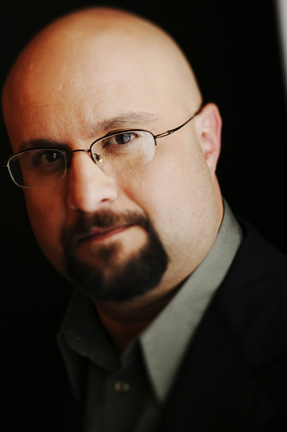
Look at the darkness in this man’s eyes. This particular controversy really became heated in the Evangelical Christian world, bringing in such notable Christian apologists such as Norman Geisler. Battle lines were drawn up between Calvinist and Arminians and it was the beginning of the rift between James White and former protege Sam Shamoun. Listen to this Evangelist, this man who has been “saved by the blood of Jesus” tell bald-faced lies about Islam and Muslims.
Listen to him poor out lie after lie after lie…
Look at his claims that he knows the Arabic language here…
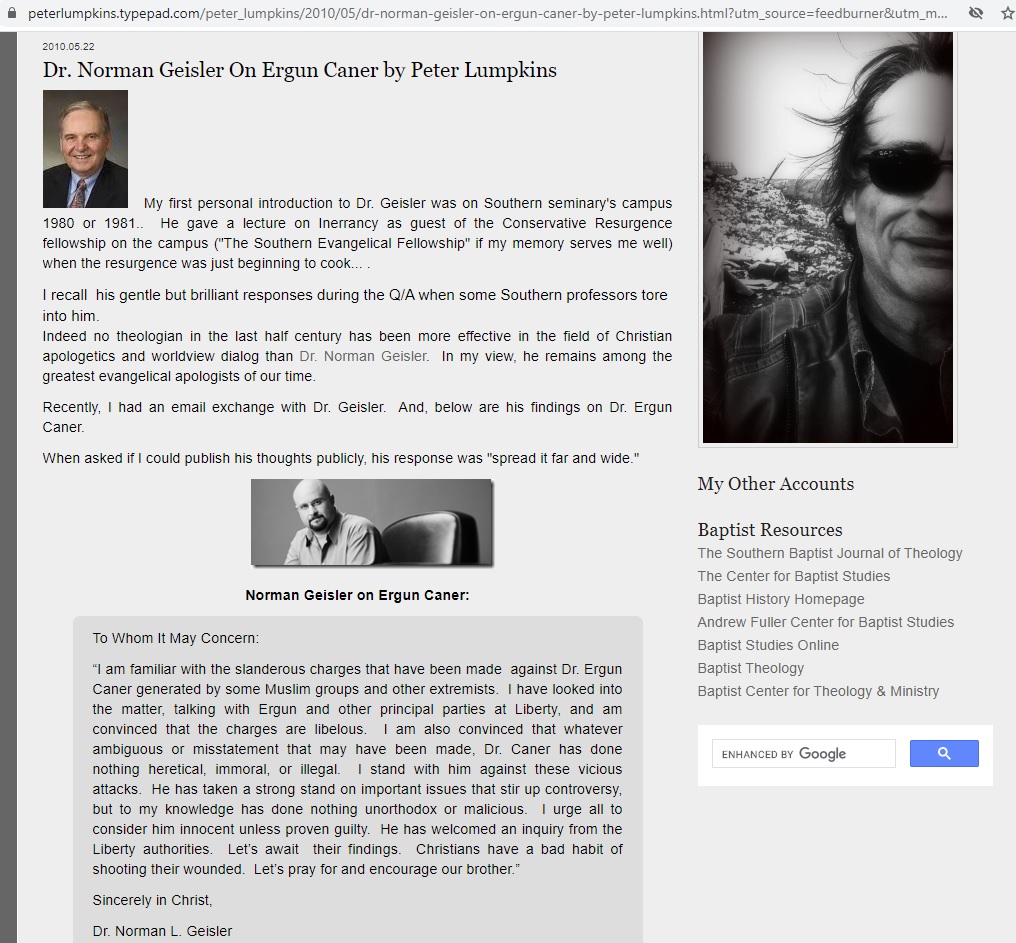
Ergun Caner was defended by Norman Geisler here:
Some more lies of Ergun Caner…If you want a complete catalog of videos exposing this mans lies and deceit I would highly suggest this YouTube channel https://www.youtube.com/user/mokhan247/videos
Calling the saum (fasting) pronounced as Psalm as Swan (a species of bird) is also awful.
One of the most awful lies is his claim in the following video: ‘One of our leaders Shabir Ally ….the debater is often famous for saying before he died….’ …https://www.youtube.com/watch?v=3uZvMX68QPg alhamdulillah!
By the way that the brother was able to recover the YouTube videos. Because initially, these dishonest and hateful Christians tried to censor the truth!
Now watch this ‘expert’ on Islam give the Shahadah the testification of faith… He says it is “Bismillah ir rahman ir raheem Muhamdulillahir rahman ir raheem… WHAT!?!
Now if you of you people doubt that this is not the Shahadah here is a simple straight forward challenge to you. You can verify it in one of two ways. 1) You can go down to your local Masjid (Mosque) and simply ask one are the words a person has to say to become a Muslim.) You can go to youtube and type up people converting to Islam. You will see them say the following words:
“Ash Hadu An La Ilaha il law lah WA Ash Hadu Anna Muhammed ar Rasulullah”. (I bear witness that there is no God except God and I bear witness that Muhammed is the Messenger of God)
By the way, a “devout X Muslim” like Ergun Caner should have known the Shahadah. It is only said 9 times during the five obligatory prayers. Once in the morning prayer. Twice in the afternoon, mid-afternoon, sunset, and night prayers. That’s only for the obligatory prayers let alone the optional devotional prayers.
This mix up on his part is a huge blunder! Mohammed Khan makes a good point that Ergun Caner throws in the hard KH sound so you get KHaadeth, rather than hadeeth.
Also in Islam, the question ‘Who is Jesus’ is not a difficult question at all. Jesus is the word of God, Jesus is the Messiah, Jesus is the Messenger of Allah. Jesus was born of the virgin Mary.
Again Ergun Caner’s blatant ignorance of the teachings of Islam is manifest. He mentions that he has the courage to go in front of a Masjid (Mosque) and tell us all day long that Jesus is the Messiah. We would simply reply Ameen (Amin).
When the angels said: “O Mary! Allah gives you the good news of a Word from Him, whose name is the Messiah, Jesus (Esau) son of Mary (Mariam) who is illustrious in this world and the hereafter, and who is one of those brought near (to Allah).” (Qur’an 3:45)
What is so hard to answer?
Notice when he mentions about the Church that doesn’t exist anymore? He crosses his arms please also pay close attention to his eyes. Why do they look away after the soft chuckle?
If this is not devilish and arrogant I don’t know what is.
There are also ways to find out if that Church existed remember he said it was not far from a Mosque (Masjid).
What mosque is it that he said he attended? Umm Google map and yellow pages anyone???As you know already as well, the clever and crafty John Ankerberg has also moved to have the videos removed from YouTube?
Why? Why would John Ankerberg a man who has held open debates between various views and religions on his television program do this? Why? Simple $$$$
Which Christian was it that said everybody who bought the books above should come together sign a petition and demand a complete 100% refund for the garbage books they bought thinking that it was done by scholars and people who had great insight into the religion of Islam!
Where was Ergun Caner born? In Stockholm Sweden or in Istanbul Turkey?
Note that he mentions he was a ‘sand monkey’ How much sand is there in Turkey? Again google map anyone? Or simply ask Christian missionaries who have been in Turkey.
Again the pejorative term ‘sand monkey’ makes you wonder what his true feelings are about Black people in America? I mean the term ‘sand monkey’ is a derogatory term used to disparage Arabs.
So even if he is of Turkish ancestry it was a racist remark to make about Arabs.
Then watch the end of the clip where he comes and speaks Arabic to his Turkish father in excitement he says ‘Isa bin Allah’ (Jesus son of God) why would you speak Arabic to your Turkish father? But even more revealing and the part where is where he follows that up with his gibberish. He is making you people out to play the fool.
Christians wake up! You have missionaries that go to Turkey and Arab countries and speak Farsi, Turkish, and Arabic. How about you do the following: You get one of these people who speak Turkish, or Arabic to play this video in front of Ergun and ask him what he was saying.
Then it’s game over! Unless he was going to claim that he was speaking in tongues out of ecstasy which would not surprise me. However, I would have to say that Christian credibility seems to wear thin as the days go by why this man is running the show at Liberty University. I have sent e-mails to Muslims asking that we stop engaging in any inter-faith dialogues of debates with any representative of the SBC until Ergun Caner is brought to justice.
I also have friends in high places and I think that it’s possible you could see the SBC missionary activities cease completely in all areas of operation in every Muslim country across the globe. You can laugh if you want to but once it is shown that Christians will stoop to any level to bring “the truth” this will alarm Muslims who do allow Christians to preach in their countries openly and will show that the Christians are not people who play by the rules.
Would the SBC like the news of waking up one morning and finding there was a joint decision by 57 member states of the OIC (Organization of the Islamic Conference) to halt all missionary activity? Not just the SBC because Christian indecision in the United States would reflect poorly upon Christians in general. I am sorry if you think it’s not fair. Welcome to my world where actions are done and taken by a few people in the name of Islam reflect poorly upon Muslims as a whole!
Did Ergun Caner Covert to Christianity in 1982? Did the brothers both convert in 1982 or did one of them convert a year prior?
Also the view that the Shi’a and the Sunni believe that the “Khalif” actually word should be Imam disappeared into ‘the caves’ is not factual. The belief in the Mahdi still alive and waiting to reappear is a belief held among the Shi’a but not among Sunni Muslims. Look at this book and look at the names on there. This book was quite a little cash cow for Ergun “FETHI” Caner and his brother Emir.
Only Allah (swt) knows what that young man was facing while growing up with someone as repulsive and vulgar as Ergun. Very heartbreaking indeed. Before he died Ergun’s son Braxton was posting pictures of him making out with girls and vulgar words.
We as Muslims should pray for Ergun Caner and his family. We pray that Allah (swt) removes the darkness from his heart and brings him into the light of a loving relationship with our Merciful Creator. May Allah (swt) make it easy on him and his family during this time of distress.
Next Is Hassamo Shamoun, Sam Shamoun.
He was a big part of the premier Christian apologetic website interacting with Islam and Muslims. answering-islam.org Shamoun’s stomping grounds was a social media platform called, “Paltalk”.
Paltalk would be used by Hassamo as a place where he could ‘field test’ his arguments. However, when he would come across knowledgeable Muslims, Sam would revert to screaming, yelling, and hurling all kinds of vulgar obscenities. It was clear that this was not a man who found peace but someone who was disturbed mentally.
These are just some of the small samples of Sam Shamoun interacting with other Christians (let alone Muslims) Hassamo loves to attack the character of the Blessed Prophet (saw).
Ironically this distasteful attack on the Blessed Messenger (saw) marriage backfired on Hassamo “Sam” Shamoun when his wife divorced him. Not following the principles of God’s guidance Hassamo thought it was morally acceptable for his wife to be alone with a strange man in the house and so forth.
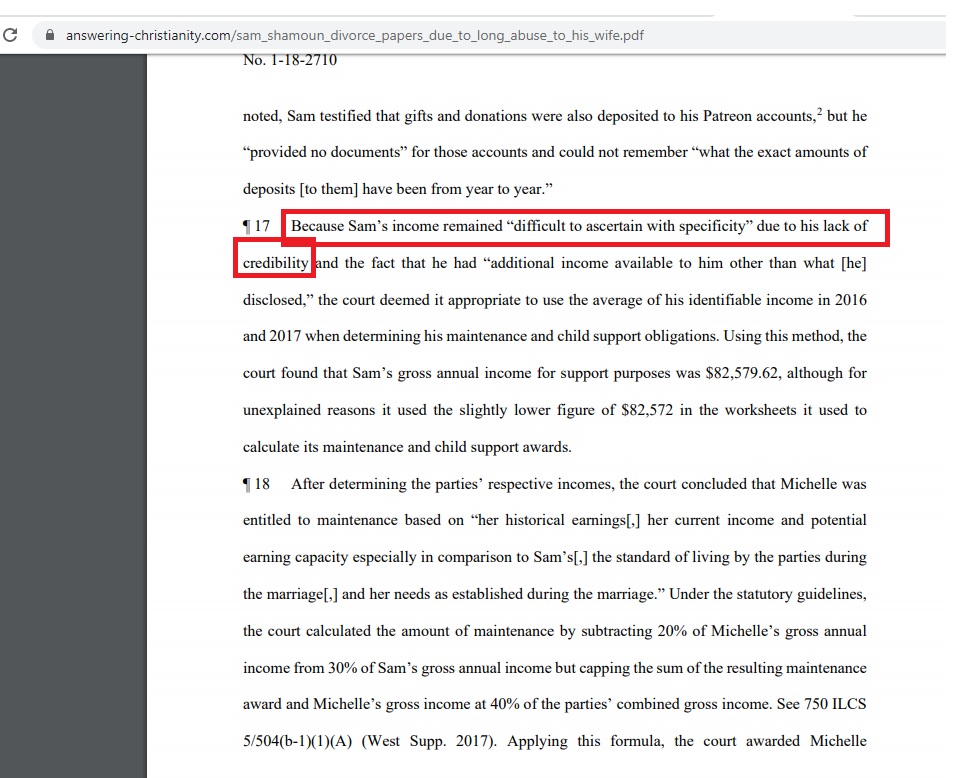
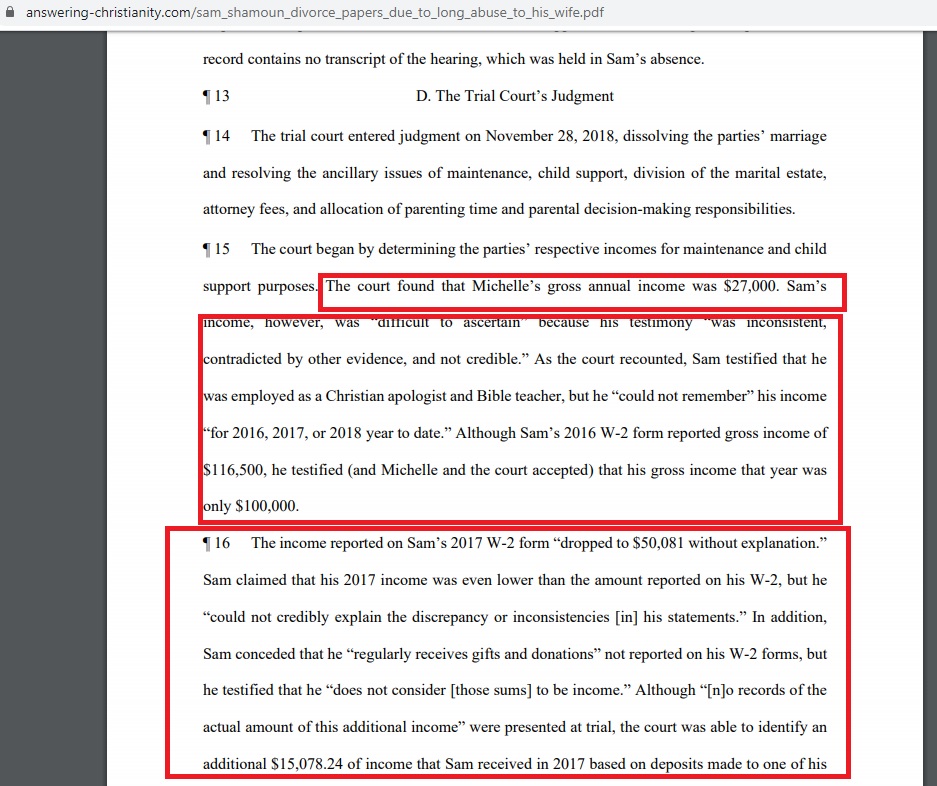
sam_shamoun_divorce_papers_due_to_long_abuse_to_his_wife Usually, most sensible people will do their level best to hide their character flaws. Not Hassamo he was an open book. He would crush, humiliate, destroy, vex, accost, assail, brutalize, assault, hurl abuse, and vitriolic all for the glory of Christ. His whole apologetics career was ended when the U.S court system stated:
Michelle requested that a two-year order of protection prohibited Sam from harassing, stalking, or physically abusing Michelle. Granting Michelle sole possession of the parties’ marital residence, and prohibiting Sam from entering the residence of Michelle’s place of employment.
Now what I find sad is that many Christians even after being aware of Hassamo’s vile behavior will come to his defense. Yet you have to keep in mind that Hassamo’s ex-wife Michelle is also a Christian.
So why take the testimony of a Sam Shamoun (who is clearly under the bondage of demons) over the testimony of his Christian wife? Not only that but it is a small world and there is much more than Michelle could have disclosed in regards to the very sick and disgusting behavior of Hassamo. What’s also interesting is that Sam Shamoun has burned so many bridges in the Christian community in the United States. As a person who believed in Reformed Theology, it certainly did not make him many friends across the aisle. Whereas James White has exposed Sam Shamoun’s courtship of Rome and Sam’s continuing march toward Roman Catholicism. That move makes sense for Sam Shamoun because his $$$ is drying up and Rome has plenty of $$$. Hassamo “Sam” Shamoun is attacking Protestants more and more particularly Calvinist and Reformed Theology. Sam recently admitted that for years he was worshiping a false god and inviting Muslims to believe in a false god, the ‘god of Calvinism’. Sam currently is gearing up for a conflict with Orthodox Christians (who cannot offer the same amount of cash infusion) that Roman Catholic Church can.
James White goes discusses this in the above video. Shamoun’s march towards Rome. The interesting thing is once Sam makes it official you have to wonder about all those evangelicals who cheered Sam on with his filthy language and vulgar methodology, will they support him when he crosses the Tiber river?
Conclusion: Muslims should pray for Hassamo Shamoun and his family. Pray that they can pick up the pieces of their lives and move forward. That Hassamo will find it in his heart to be a loving father to his two daughters and support them financially. That he will consider his vulgar speech that is all over the internet and hope that Allah will guide him not to speak like that anymore.
It is my hope that Sam Shamoun will one day find fulfillment and peace in loving willful submission to Allah (swt). However, and I say this not as an adversary but as someone genuinely concerned. I believe that he is in need of Ruqya. I can’t believe that any discerning Christian has not seen that the man is clearly in spiritual bondage. He constantly talks about others ‘manifesting’ which is the biggest projection ever. He often has weird body movements and jerks, which coupled with his vulgar language (towards Christians) let alone Muslims one can only imagine what ever entity resides him it certainly is not aligned to the light.
Next, we have David Wood.
David Wood is best known for being 1/2 of team ‘Atheist-Christ’. That is he teams up with an Atheist to attack Islam. This dynamic team of ‘Atheist -Christ’ has left many Christians puzzled. If Jesus is good enough for the Muslims why is he not good enough for his Atheist partner? David has his blog, ‘Answering Muslims’, and ‘Acts 17 apologetics’.
In the picture below he is wearing his wife’s gown (showing disrespect to his wife and not guarding her own privacy) while he was mocking Islam & Muslims.
Also, while doing this he blatantly ignored what God said stating the matter:
“A woman must not wear men’s clothing, nor a man wear women’s clothing, for the Lord your God detests anyone who does this.” (Deuteronomy 22:5)
I have often noticed when watching David Wood speak you can hear even until today the dry monotone in his speech. There is a lack of voice inflection. There is the twitching of the left eyebrow when he talks about uncomfortable subjects. So what has David Wood been up to lately?
David Wood has recently made a video with two ex Muslims. Can you imagine a Christian who hopes that Muslims hear the gospel of Christ shares a platform with two ex Muslims (Atheist) and does not spend anytime on the program sharing the gospel of Christ Jesus with them?! The only platform that brought those three together was HATRED for Islam. David Wood switched off evangelization mode and went into a complete debauched and depraved meltdown. See for yourself:
So this is what Christian apologetics has come to. David Wood in the video above suggests that he will create a domain name “pissonthequran.com”. Is this what Christianity is all about? You people keep telling the world that Islam is this and that and yet you go and make statements like this. No Muslim would ever even dare to make a website ‘pissonthebible.com”, only a perverse person who is in spiritual bondage would suggest things. That is the huge disadvantage that we Muslims have in debates with Christians. They can hurl all kinds of insults at the Blessed Prophet (saw), and yet we cannot say in kind about Christ Jesus (upon whom be peace) because he is a Prophet of Allah, he is the Messiah, and we believe in him. To lambaste Jesus or insult Jesus would take one out of Islam.
Another person doing the rounds is an individual by the name pseudonym of “Christian Prince”. I have listened to some of his “debates” with “Muslims” and they seem staged to me. Sure enough, my suspicion was confirmed. This “Christian Prince” was recently busted in a huge way when he lied about having a debate with a Muslim teacher, our beloved and kind brother Sabeel Ahmed. Mash’Allah Sabeel Ahmed has a beautiful disposition and a great deal of patience when outing this charlatan.
Mash’Allah Sabeel Ahmed has a beautiful disposition and a great deal of patience when outing this charlatan. This Anonymous “Christian Prince” has been called out to have a public moderated debate. Yet, he does not believe that God can protect him like he did here: “Then Nebuchadnezzar came near to the mouth of the burning fiery furnace, and spoke, and said, Shadrach, Meshach, and Abednego, ye servants of the most high God, come forth, and come hither. Then Shadrach, Meshach, and Abednego, came forth of the midst of the fire.” (Daniel 3:26)
Next is “Al Fadi”
This is the “Al Fadi” that you see pictured above going around the speaking circuit (much like Ergun Caner did). Now I am going to post his presentation of his testimony. (and if it gets deleted or removed) no worries because I have downloaded it.
So I have listened to the whole presentation. I have heard him say the word “MOZLUM” no less than 5 times in his presentation. Now there is absolutely no way on Earth that this guy is from Saudi Arabia and pronouncing ‘Muslim’ as ‘Mozlum’. He says @5:45 “Most my life in Saudi I memorized a book called the Qur’an.” “Half by age 12,” He says he went to an “Islamic University in Mecca” (doesn’t tell us the name of it). He went to study shariah to become a shariah scholar and judge later. He claims to have studied at the Local University pursuing an Engineering Degree at the U of A. Then he latter changed his major and went to ASU. He claims in the video that he was training to be a ‘jihadist’ (remember Ergun Caner gave the same story), and he (Al Fadi) was going to go to Afghanistan. Suddenly was abruptly stopped by his mother. What is interesting is that by his own modus oprendi has admitted that Allah (swt) is worth dying for and Jesus is not. Why do I say this? The fact that he uses a ‘pseudonym’. He uses a false name. T
o his credit and unlike (Christian Prince) at least he has given us a face. He hasn’t remained anonymous like “Abdul Saleeb” However, his name “Al Fadi” means the Redeemer. So that is obviously not his Muslim name.
This name is prevalent among Jordanian Christians in particular. Now, this is the new-look for “Al Fadi” So here we have “Al Fadi” going for the traditional Arab look (pictured left) and why not? The last person to try that was Dr. Anis Shorrosh pictured on the right. A live conversation with “Al Fadi” with someone talking to him a bit about his background would certainly yield some eye-opening inconsistencies.
Look at the end of the day both Muslims and Christians are convinced that one of us is upon the truth and the other is upon error. Yet, the number of Christians involved in Muslim and Islamic apologetics has been outed again and again for lies, deceit, deception, and a complete lack of concern for truth and transparency.
As I have said at the beginning of the article and I will say here again any Christian that encounters Islam one of three things happens:
a) Either they begin a serious study of Islam and end up seeing that Islam is a more cogent faith and world view than Christianity ever could be. They convert to Islam as I have.
b) They remain convinced of their own faith but develop a deep admiration and appreciation for Islam and Muslims (rather they admit it publicly or not)
c) Their hearts become diseased and their spiritual ailments are amplified and this becomes obvious in time. Greed, avarice, lust, anger, hate, racism begins to drip from their writings and public statements. Without fail repeatedly these people end up being humiliated publicly in this life. The hereafter is a painful and everlasting torment for them.
The truth is that many Christians are in spiritual bondage. Many of them have real trouble with marital fidelity, trouble erasing racism from their hearts, trouble with loving money, gambling, a predilection for the same sex, wrestling with drug addiction, and more. Many of them also find many Christian teachings problematic. chief of the more practical ones is the issue surrounding divorce. Many of them find are uncertain of their salvation and many of them who take time to seriously study Christian concepts of the Creator realize that it is not cogent at all.
What else explains the reason they feel they have to cheat and lie about Islam and Muslims? Why do they have to lie to their own congregations and people of their own denomination? Why do they need to use these types of tactics if they are certain of their beliefs?
It is my hope that this article will reach those people who have been lied to and duped by Christian missionary deceit. That you will take time to go to a Mosque yourself. That you will read the Qur’an yourself. That you will sit with learned Muslims and ask them about the questions that you have in your heart and mind.
“They want to extinguish the light of Allah with their mouths, but Allah will perfect His light, although the disbelievers dislike it.” (Qur’an 61:8)
“And when they hear what has been revealed to the Messenger, you see their eyes overflowing with tears because of what they have recognized as the truth. They say, “Our Lord, we have believed, so register us among the witnesses.” (Qur’an 5:83)
“Those who do good will have the finest reward and more. Neither gloom nor disgrace will cover their faces. It is they who will be the residents of Paradise. They will be there forever.” (Qur’an 10:26)
﷽
Those who believe that we will see Allah (swt) in the afterlife believe that the above verse is a proof of it.
“Those who do good will have the finest reward and (waziyādatun) more. Neither gloom nor disgrace will cover their faces. It is they who will be the residents of Paradise. They will be there forever.” (Qur’an 10:26)
We can see this زَادَ – yazīdu which basically means to ‘increase in something’. It is used throughout the Qur’an.
“That Allah may reward them the best of what they did and increase them (wayazīdahum) from His bounty. And Allah gives provision to whom He wills without account.” (Qur’an 24:38)
“And as for those who believed and did righteous deeds, He will give them in full their rewards and grant them extra (wayazīduhum) from His bounty.” (Qur’an 4:173)
“That He may give them in full their rewards and increase for them (wayazīdahum) of His bounty. Indeed, He is Forgiving and Appreciative.” (Qur’an 35:30)
” And He answers those who have believed and done righteous deeds and increases them (wayazīduhum)from His bounty.” (Qur’an 42:26)
“And those who are guided – He increases them (zādahum) in guidance and gives them their righteousness.” (Qur’an 47:17)
Their understanding is simply based on an exotic interpretation and not one based upon the meaning in the Arabic language.
We can see that every time they are increased from the genus or genre of what they are already being given. They are guided and guidance is increased. The finest reward and more of it. For example, in Arabic grammar it is fine to say I will give you 10,000 Euros and I will give you an additional 500 Euros, like this. Some people may scratch their heads wondering why there is a picture of an ice cream cone getting an additional scoop. The picture is to indicate what I mean in this point 2.
The following verse makes it abundantly clear that we will not see him:
“The faculties of seeing (tudriku) cannot grasp Him, and He grasp all–seeing (yudriku), He is the All-Subtle and All-Aware.” (Qur’an 6:103)
This indicates the description of the divine changes. What was once not true of Allah (swt) is now true of Allah (swt).
” Neither drowsiness nor sleep overtakes Him. To Him belongs whatever is in the heavens and whatever is on the earth.” (Qur’an 2:255)
So now it is possible that what is not currently true of Allah (swt) not being drowsy nor overtaken by sleep becomes possible.
If one can be gone then another attribute can be gone as well.
4. Not in the scope of this article but often those who believe that we will see Allah (swt) in the next life bring a number of hadith. This is an evidence for them. For us, as well as the majority of the Muslim Ummah, lone narrator reports (ahad) are not an evidence for us.
Zanni Hadith (الحديث الظني) refers to a narration that provides probable knowledge (ظن – Zann) rather than absolute certainty (يقين – Yaqeen)
Linguistically: Derived from “ظن” (Zann), meaning “assumption,” “probability,” or “conjecture.”
Technically: A Hadith that does not reach the level of definitive proof (Qat’i) but is still considered reliable enough for practical rulings.
For the Ibadi we do not build our belief upon the ahad. This is so even if we find the hadith to be sahih. That is because creedal matters are not based upon what is probable but what is certain.
Shaykh Massoud bin Mohammed Al Miqbali (h) explains this to us concerning a debate he had with one of the Salafi in Egypt. (A debate that they pulled offline).
The Shaykh also went on to explain that even in the case of an ayat of the Qur’an that is certain we may not build creedal matters upon it. That is because it could be from the mutashabih; and Allah (swt) has warned us:
“While other verses may have several possibilities. Those whose hearts are perverse, follow the unclear statements in pursuit of their own mischievous goals by interpreting them in a way that will suit their own purpose.” (Qur’an 3:7)
Thus the Qur’an itself can be certain and yet present verses that are multifaceted. How much more for the hadith?
Not to mention if they bring hadith we too can bring hadith.
Hadith like the following:
Narrated Abu Sa`id Al-Khudri:
The Prophet (saw) said, “Allah will say to the people of Paradise, “O the people of Paradise!” They will say, ‘Labbaik, O our Lord, and Sa`daik, and all the good is in Your Hands!’ Allah will say, “Are you satisfied?’ They will say, ‘Why shouldn’t we be satisfied, O our Lord as You have given us what You have not given to any of Your created beings?’ He will say, ‘Shall I not give you something better than that?’ They will say, ‘O our Lord! What else could be better than that?‘ He will say, ‘I bestow My Pleasure on you and will never be angry with you after that.’
Allah’s Messenger (saw) said, “Allah will say to the people of Paradise, ‘O the people of Paradise!’ They will say, ‘Labbaik, O our Lord, and Sa`daik!’ Allah will say, ‘Are you pleased?” They will say, ‘Why should we not be pleased since You have given us what You have not given to anyone of Your creation?’ Allah will say, ‘I will give you something better than that.’ They will reply, ‘O our Lord! And what is better than that?’ Allah will say, ‘I will bestow My pleasure and contentment upon you so that I will never be angry with you after for-ever.’ “
“Those who do good will have the finest reward and (waziyādatun) more. Neither gloom nor disgrace will cover their faces. It is they who will be the residents of Paradise. They will be there forever.” (Qur’an 10:26)
Recall what is stated above in point 2 above. That is to say that the more’ can be from the same genre or genus. This is what we have from Ali Ibn Abi Talib:
17634- حدثنا به يحيى بن طلحة قال ، حدثنا فضيل بن عياض، عن منصور، عن الحكم، عن علي رضي الله عنه: (للذين أحسنوا الحسنى وزيادة) ، قال: ” الزيادة “، غرفة من لؤلؤة واحدةٍ لها أربعة أبواب.
“Narrated to us by Yahya ibn Talha, who said: Narrated to us Fudayl ibn ‘Iyad, from Mansur, from Al-Hakam, from Ali regarding the verse: ‘For those who do good is the best reward and an increase.’ He said: ‘The “increase” is a chamber made of a single pearl with four doors.'”
Sources that cite the above narration include: Tafsir al-Tabari, Tafsir Ibn Abi Hatim, Tafsir al-Baghawi, Tafsir Ibn Kathir.
For those who are interested you may wish to see the following articles:
“so vie with one another in good works. Wheresoever you may be, Allah will bring you all together. Lo! Allah is Able to do all things.” (Qur’an 2: 148)
﷽
Ramadan Day 22:See you at the finish line. Allah-willing.
Heart Illness: Envy
Envy is the most dangerous characteristic, which leads to heart illness, and it’s to wish that some blessing is striped from others and given to you.
Allah says: “and from the evil of an envier when they envy.” (Qur’an 113:5), in another verse: “Or do they envy the people for Allah’s bounties? Indeed, We have given the descendants of Abraham the Book and wisdom, along with great authority.” (Qur’an 4:54)
Envy coupled with pride of one’s origin is the first sin ever committed, when Iblis envied Adam -(as)- and objected to perform Sujud for him, and it’s also the first sin on earth, when Qabil envied Habil so he killed him.
And an important note: There is a difference between Hasad (envy) and “ghibtah غبطة” Hasad is a bad attribute as we said, but ghibtah is to hope to get the blessing of others while not wishing for that blessing to be taken from them, the Blessed Prophet (saw) said: “No envy except in two: a man who was given knowledge by Allah and he teaches it in the morning and night, and a man who is given wealth by Allah and he spends it on those who deserve it.”
*The stages of the religion* The ways that Muslims take based on the surrounding conditions are called Masalik (ways/paths/stages) so that they do what they can to raise the flag of truth, and to establish the system of the religion.
Imam of concealment (Kitman): It’s the opposite of the manifest Imamate in meaning and in rulings, and it’s taken when the Muslims are weak and dispersed, and they can’t take any other path, and this was the way of the Blessed Prophet (saw) when he was in Mecca, and this was the way of Imam Jaber Bin Zaid when he realized that the Muslims cannot organize an Islamic system. He was followed by the great scholar, the pious, the leader, Imam Abu Ubaida Muslim Bin Abi Karima who was in concealment in Basra, but four of his students were able to establish manifest Imamates later on, and they are mentioned above, just like how the concealment of the Blessed Prophet (saw) produced a strong Islamic nation.
Then comes the Shira’ way: Shira’ linguistically means to sell, and it comes from many verses in the Qur’an like: “Allah has indeed purchased from the believers their lives and wealth in exchange for Paradise. They fight in the cause of Allah and kill or are killed. This is a true promise binding on Him in the Torah, the Gospel, and the Quran. And whose promise is truer than Allah’s? So rejoice in the exchange you have made with Him. That is ˹truly˺ the ultimate triumph.” (Qur’an 9:111). The Shira’ stage is taken when Muslims are oppressed and unable to raise the flag of truth, when there is an unjust ruler over them, an example of this is in the time of the Ummayads when Ziad Bin Abih was locating the people of truth to kill them and punish them, and the situation was unbearable, forty from the Shurah pledged allegiance to Imam Abu Bilaal Mirdas Bin Hudair Al Tamimi to repel by not fighting anyone except those who fight them, and these forty were able to defeat 1000 in the battle of ‘Asik. Shira’ can only be done with a minimum of forty people, and non of them can go back except if he dies, and in an opinion if there are only three left alive.
The final way is Manifestation (Dhuhur): it’s built on strength and unity of the Ummah, where the people can sail the ship of the Ummah, and this was the way of the Abu Bakr and Umar may Allah be pleased with them, and because this is the purest way, Ahl Alhaqq Wal Istiqamah never hesitated to establish it, some examples would be: in Hadhramout Imam Talib Al Haqq Al Kindi, in Oman Imam Al Julanda Bin Mas’ood Al Ma’wali and the righteous Imams after him, and in the west Imam Abu Al Khattab Al Ma’afiri and in the Rustumi state Imam Abdulrahman Bin Rustum may Allah be pleased with them all.
Difa’ (defence): It’s to make a temporary Imam in the situation of defense, when the state is invaded by an enemy.
To explain how the above takes place on a practical and pragmatic level in western nations like the former United States and the United Kingdom.
A) What the establishment thinks are progressive, liberal and reformist Muslims. These are perhaps the most important component of the plan. Their task is to ingratiate themselves to the left leaning thinkers and academia.
Related to them are fake apostates to Christianity or Agnosticism. This allows the Muslims to understand the networking and strategies of various Christian organizations.
Also related to them are people who have language speaking skills in Arabic, Farsi, Urdu etc. They are often tapped by intelligence apparatus in the above communities to act as informants. Some times these intelligence communities catch on that these people are double agents. Likewise and more often than not information via various channels is passed down to the relevant people.
The task of what the naïve think are ‘progressive’ , ‘liberal’ or ‘reformist’ Muslims are to form an echo chamber for anxious liberals or left leaning academic types. To give them the illusion that Islam can be molded and shaped according to the desires of these interest groups.
Among them are two sub groups:
Those who placate anxious left leaning and liberal leaning politicians all the while Islam grows in the country.
Those who may even call for the banning and vetting of Muslims from certain nations. While to the untrained eye this looks promising; it puts Western nations in a moral dilemma of hypocrisy. a) It makes the Western nations look as if they are compromising on plurality, and multiculturalism. b) It gives a strong hand to those Imams who teach the masses that the two world views are incompatible hence their restrictions.
B) What the establishment thinks are the moderate Muslims. The task of these Muslims is to be fluid between the political left and the political right. It also allows Western nations to save face by saying: “See we allow practicing Muslims in our societies and we welcome it!”
These Muslims are more often than not the activist types. Building Masjids, and Madrasah and grass roots organizations. One of the objectives of these ‘moderate’ Muslims is to create the illusion of conflict with the ‘progressive’ , ‘reformist’ or ‘liberal’ Muslims. So elaborate and orchestrated is this performance that by the time the policy makers know is happening it is already too late. So elaborate and orchestrated is this performance that the common Muslim actually perceives their is some kind of ideological battle between the two.
It is one of the reasons I am so confident to write this information. We are already beyond the threshold. We as Muslims just need to continue to have strong families, resilient communities, and keep winning hearts and minds. May Allah guide them to the truth!
Islam is salvation for the whole of mankind.
The west will try. They will do their best. Atheist will become cultural Christians as the realization sets in that perhaps pervasive hedonism wasn’t a great idea.
The moral relativism of the left is no match for Islam. The political right as they abandon Christianity will lean more into nativism, white nationalism.
All of this helps the Muslim communities and objectives.
In the end when the violence comes and it is coming (Allah knows best) -it will be from the political right. The violence will not be from the Muslims.
We just have to be patient. Act in accordance with the principles of justice and remember that none of those people truly are our enemies. They are people upon misguidance.
For those who want to read more about the four conditions of Islam.
*The Disliked in Wudu’* You should know dear believer that there are some actions that are disliked in Wudu’: 1. to perform it while standing 2. to talk in something other than mentioning Allah 3. to waste water 4. to increased the times of washing more than three times, and one in wiping 5. to perform it in a filthy place (to avoid the filth) 6. nudity in isolation, and it’s haram if people can see 7. to leave a Sunna of Wudu’
“Say, ˹O Prophet, that Allah says,˺ “O My servants who have exceeded the limits against their souls! Do not lose hope in Allah’s mercy, for Allah certainly forgives all sins. He is indeed the All-Forgiving, Most Merciful.” (Qur’an 39:53)
﷽
Ramadan Day 21: So many loved ones who have departed us who wished they could be in the last 10 days of Ramadan.
*21th of Ramadan* ——————————– *Heart Illness: Human Interaction*
Often we as human beings need to be in our own bodies with the silence of our own thoughts. We need to tune out the world around us and reach out to the heart with in. The Blessed Prophet (saw) would spend extended periods in the mountains alone. So, if that is the case you can say it is a Sunnah.
Often we need periods of isolation to protect ourselves from the chaos and instability of others and to protect others from periods of chaos and instability from ourselves.
The benefits of periods of isolation: Leisure time to contemplate, supplicate and to reorient. To get rid of sins To avoid trials and disorders
The benefits of contacting people: To learn and teach To benefit the people Fellowship Reward from Allah for doing obligatory things like congregation prayers To invite people to good deeds
So the Muslim should balance between isolation and mixing with people to maximise their rewards in this life and the hereafter.
*The pillars of the religion* The pillars are the strongest element of a building.
And in this metaphor the religion is like a building, and the pillars of this building are:
To Accept. To Delegate. To Submit and to Trust. These four things are the strong parts of the religion. These four pillars do not assemble in a soul except for one that’s sincere to Allah.
Acceptance: To accept the decree of Allah: It’s to accept everything from Allah, from command and prohibition, ease and hardship, so that the soul doesn’t find any problems in following the rule of Allah.
Delegation: It’s to be satisfied with the choice of Allah, as Allah knows best for his servants.
Submission: It’s to have complete obedience and submission for Allah without objection.
Trust: It’s to to have full trust in your creator and in what he has, and to not trust what is with the people, Allah says: “And whoever puts their trust in Allah, then He ˹alone˺ is sufficient for them.” (Qur’an 65:3), and this doesn’t mean that the person doesn’t need reasons, as that’s not trust, but it’s laziness and ignorance, as Allah has obligated linked matters with their reasons.
Some may ask: What is the difference between the fundamentals of the religion and the pillars of the religion?
The fundamentals are the base which the religion is built on, and the pillars are what strengthen the building to stand, so the pillars are built over the fundamentals.
*Janaza prayer (mourning)* The Janaza prayer is a prayer with no Ruku’ or Sujud, it starts with the Takbir of Ihram (Allahu Akbar) to start the prayer, then we say Isti’atha (Authu Billahi Minash shaitan Ar-ragim) and recite Al Fatiha، Then the Imam says the Allahu Akbar, and we send blessings upon the Noble Prophet Muhammed (saw) by saying (Allahuma Sali Ala Muhammed Wa’ali Muhammed Kama Sallaita Ala Ibrahim, Wabarik Ala Muhammed Wa’ali Muhammed Kama Barakta Ala Ibrahim Wa’ala ‘ali Ibrahim Fil Alamin Inaka Hamidun Majeed).
The above Arabic transliteration in English would be:
“O Allah, send your grace, honour and mercy upon Muhammed and the people of Muhammed, as You sent Your grace, honour and mercy upon Ibrahim. O Allah, bless Muhammed and the people of Muhammed, as you blessed Ibrahim and the people of Ibrahim. You are indeed Praiseworthy, Most Glorious.”
After this the the Imam says Allahu Akbar, then we pray for the dead person if he was from the people of Walayah. If he was not from the people of Walayah w pray for the Muslims in general, then after the final Takbir we do Taslim to the right and to the left.