“Do they not reflect upon the Quran, or are there locks on their hearts.” (Qu’ran 47:24)
﷽
Ramadan Day 10: Tips for Parents on Getting Children to Fast.
Dear brothers and sisters this is the 10th day of Ramadan. This means 1/3 of Ramadan will be behind us. Let us all make haste in doing what we can to make the most out of this Ramadan.
Know this dear brothers and sisters. If Allah (swt) is inspiring you to ask for something this means he wants to give you something!
Repeat this du’a again and again in this month! Allahumma inaka afuwon kareemun tuhibu alafwa faafu anaa (Oh Allah you are The Forgiver, the Generous and you Love Forgiving So Forgive Us.)
Dear brothers and sisters this is the month where we ask Allah (swt) to save us from the hellfire and all that is needed, let me repeat this ALL THAT IS NEEDED is for you to make this du’a this request ONCE and for Allah (swt) to ACCEPT IT and insh’Allah you have obtained the goal! Subhan’Allah!
*Heart Health Trusting Allah* “So in Allah let the believers put their trust.” (Qur’an 9:51)
Trusting Allah should be in the core of a believers daily affairs. However, we should know the difference between Tawakkul توكل and Tawakul تواكل.
Tawakkul is trust in Allah, and it should be done always, for example: when someone is sick, he should do All he can to get back his health, by taking medicine, visiting doctor or avoiding pathogens, but on top of this, one must have his full trust on Allah
Tawakul is reliance on Allah without taking reason, and this is a wrong behaviour, for example: when someone is sick and says I won’t go to the doctor, I trust on Allah, this kind of thinking will literally kill him.
However, Tawakkul is a powerful idea, knowing that everything you do is nothing without Allah’s help and will
*The Weights* “The weighing on that Day is truth. As for those whose scale will be heavy ˹with good deeds˺, ˹only˺ they will be successful.” (Qur’an 7:8)
In the day of judgment people’s deeds will be weighted, and Muslims have differed on this interpretation:
There will be a physical scale on which people’s deeds will be weighted, this is the opinion of Ash’aries and who agrees with them
Scale is just a metaphor meaning that deeds will be sorted to good and bad, as Allah doesn’t require a physical scale to know the deeds, and from the Qur’an we see that Allah describes the weights with Truth and Justice, both of them are not used to describe physical objects, and this is the opinion of our scholars and of Mu’tazilah
*Local customs are an authority and judge* The fifth of the five comprehensive rules, its explanation is that established norms by members of society is a valid reference in people’s transactions, as long as they don’t contradict the legal rulings
For example: conducting a transaction without any party verbally offering their services in the way of “give and take”.
Proof: “And due to the wives is similar to what is expected of them, according to what is reasonable.” (Qur’an 2:228)
If you wish to support Prima Qur’an.
Prima Qur’an humbly ask of the readers for any support. Many hours are often invested in research of articles and compilation of material. Academics usually devote themselves fully for research. This web site is for truth seekers helping truth seekers.
May Allah (swt) reward you all for your du’a, support and sincere efforts!
“O you who have believed, decreed upon you is fasting as it was decreed upon those before you that you may become righteous.” (Qur’an 2:183)
﷽
Ramadan Day 9: Guidance on teaching children how to fast.
*Heart health Praying to Allah* “When My servants ask you ˹O Prophet˺ about Me: I am truly near. I respond to one’s prayer when they call upon Me. So let them respond ˹with obedience˺ to Me and believe in Me, perhaps they will be guided ˹to the Right Way˺” (Qur’an 2:186)
Praying is to supplicate and take refuge to Allah, and praying has some manners, such as: To mention the names of Allah in the prayer Praying for The Blessed Prophet peace be upon him Avoiding prohibited food and drink To insist on the prayer and repeat it To not despair if it seems the prayer is not answered To pray with sincerity and a present heart To pray for every demand, big or small for Allah owns the treasures of the seen and unseen. To avoid sins and bad deeds To lower the voice when praying To respect the time of Du’as answer, which is encouraged for us to pray in: After obligated prayer At the depth of night The day of Arafah Friday Between call to prayer and starting When breaking the fast When it rains After reciting the entire Qur’an When prostrating (in Nafilah not obligation)
As is said: The most powerless person is the one who doesn’t make Du’a. For what weapon will you have against your lower self and the vile forces of chaos?
*Death, resurrection and reckoning* The arguments of proof came speaking of death, resurrection and reckoning.
Death is the truth that nobody disagrees upon, and it’s the separation of the soul from the body, to port from this life to the hereafter, from mortality to eternity, and from work to reward.
After death comes resurrection which is for the soul to return back to the body.
after that comes reckoning, where every human being is accountable for all his action, small or big. “You will then be presented ˹before Him for judgment˺, and none of your secrets will stay hidden.” (Qur’an 69:18)
We ask Allah safety when there is no way out except for his mercy.
*difficulty brings ease* The fourth of the five comprehensive rules of Shari’a, its explanation is when there is difficulty in some ruling, there would be clearance by law, there are many examples that illustrate this rule:
Breaking the fast in Ramadan in the state of illness or traveling Tayammum when there is no water for Wudu’ Eating prohibited food in the state of necessity Shortening prayer when traveling
Proofs: “Allah intends ease for you, not hardship.” (Qur’an 2:185) “For ˹it is˺ He ˹Who˺ has chosen you, and laid upon you no hardship in the religion.” (Qur’an 22:78) “And it is Allah’s Will to lighten your burdens, for humankind was created weak.” (Qur’an 4:28)
“We send down the Quran as a healing and mercy for the believers, but it only increases the wrongdoers in loss.” (Qur’an 17:82)
﷽
Ramadan Day 8: The Social Benefit where people are more charitable in assisting those in need.
*Heart health Remembering Allah* “O believers! Always remember Allah often.” (Qur’an 33:41)
It’s the worship that’s not bound by time or conditions, and from the forms of remembrance: Reciting the Qur’an Prayers Seeking knowledge Mentioning Allah (mentioning Allah in the morning أذكار الصباح, mentioning Allah at the evening أذكار المساء, mentioning Allah after every prayer, mentioning Allah before sleeping…etc)
Allah’s remembrance has many benefits, some of them are: Alienating the devil and the forces of darkness. Removes worries and sadness Strengthening the heart Planting the love of Allah in the heart Erases sins A reason for the descendance of mercy Keeps the tongue busy from backbiting and gossip Take the heart away from toughness and hypocrisy.
*Muhammed is the messenger of Allah* “Muhammed is not the father of any of your men, but is the Messenger of Allah and the seal of the prophets. And Allah has ˹perfect˺ knowledge of all things.” (Qur’an 33:40)
We should believe that Muhammed (saw) is the final Messenger of Allah (swt). And that he is the best of all prophets. We can believe all the prophets as a whole, but we should still believe in Muhammed (saw)by name, as this is a fundamental in the religion of Islam.
May Allahs peace and blessings be upon him.
*The Harm is Removed* The third of the five comprehensive rules. Its explanation is that every harm or damage is eliminated or prevented in Islam.
Islam came to protect the five necessities: (Ad-Darooriyyaat Al-Khams)
Which are religion, life, mind, wealth and lineage, for example:
Jihad. This protects religion. Prohibition of unlawful killing and suicide. This protects life. Prohibition of alcohol. This protects the mind. Prohibition of stealing. This protects wealth. Prohibition of fornicating. This protects lineage.
and so are the other things that cause harm.
Proof: The hadith: (There is no harm or return of harm), and many verses from the Qur’an like:
“No mother should be harmed through her child.” (Qur’an 2:233)
Sources: ( Musnad Al Rabi’i 692- ‘Abū Ubayda narrated from Jābir ‘Ibn Zayd that the Prophet, ﷺ, said: “Let him who believes in Allah and the last day, speak only good or keep quiet and do no harm to his neighbor”)
It was narrated from ‘Ubadah bin Samit that the Messenger of Allah (saw) ruled:
“There should be neither harming nor reciprocating harm.”
Source: (https://sunnah.com/ibnmajah:2340) -chain of transmission is weak but the matn is sound based upon the general principles of Islam.
“The Night of Glory is better than a thousand months.” (Qur’an 97:3)
﷽
Ramadan Day 7: The Mental Benefits of Fasting.
7th Day of Ramadan* ——————————– *Heart Health Struggle & Punishment of Nafs* “As for those who struggle in Our cause, We will surely guide them along Our Way.” (Qur’an 29:69)
Nafs is the self, the soul, the inner psyche, and the struggle of Nafs (Jihad An-nafs) is to force the Nafs to do the obligations, the Sunnan, and the Nafilahs, especially when the Nafs is in a lazy/fatigued state. When The Blessed Prophet (saw) used to pray the night until his feet swells, Aisha (ra) told him: (take it easy, Allah pardoned you from All your sins), so he replies: (should I not be a thankful servant!)
After Struggle of the Nafs comes punishing the Nafs. Thus, if a Muslim struggled his Nafs but then felt his shortcomings and laziness he increases his worship to tame the Nafs. , Here is Umar Bin Al Khattab (ra), entered a garden of his and when he returned he found that the people have finished Asr prayer, so he donated his garden for the sake Allah.
Practically people can apply this, whenever someone feels shortcomings by missing prayer in Jama’a for example, he can donate some money, fast some days, or increase the number of Nafilah prayers, so that he can tame his Nafs. To make his nafs tamed for the worship of Allah The Exalted.
*Allah is not encompassed by vision* “No vision can encompass Him, but He encompasses all vision. For He is the Most Subtle, All-Aware.” (Qur’an 6:103)
Allah is sanctified from being seen in this life or the hereafter, because there is nothing like him. His existence is not like any other beings existence. He is not in a physical place, and he can’t be described with color or visibility. Visibility cannot exist without a position, dense body described with a color, and Luminant or hit by a ray emitted by another object.
In fact, one of the reasons people cannot see Allah (swt) in this life or the next is due to his being absolutely one. Anything the mind tries to establish as one will be a multiple, or a compound unity. The human mind cannot picture absolute oneness, to do so would be to see Allah. Absolute oneness is a concept the mind can grasp but cannot envision.
Think of the concept of emptiness or nothingness. If you were asked to recline on a couch fold your hands on your chest, relax and take a deep breath in and out until you reach a calm state. Now you are told to picture or envision absolute nothingness. You are unable to do so. You will either picture or envision an all white space or an all black space. You can grasp the concept but your mind will always posit something.
Likewise you can grasp the concept of absolute oneness but given that we live in a reality where everything other than Allah (swt) is composite in some way so too our mind will picture or envision something composite, or multiple.
For more information about this topic return to the book: “The overwhelming truth”
*Things are judged by their purposes* The second of the five comprehensive rules. It’s explanation: legal considerations of actions are bound to their intentions not to their apparent wording. For example, if someone who is used to uttering the intention of a prayer prays Asr but accidentally utters that his intention is to pray Maghrib, then the consideration will be based on his real intention not on his wording.
The proof is what has been narrated by both Ibn ‘Abbas and ‘Umar b. al-Khattab that the Prophet (saw) said: ‘[The value of] an action depends on the intention behind it’
“And what will make you realize what the Night of Glory is?” (Qur’an 97:2)
﷽
The Physical Benefits of Fasting.
*Heart Health & Self accountability*
“O believers! Be mindful of Allah and let every soul look to what ˹deeds˺ it has sent forth for tomorrow.” (Qur’an 59:18)
Umar (May Allah be pleased with him) said: “Hold yourself accountable before you are held accountable, and weight your deeds before they are weighted, and be ready for the great show.”
Holding yourself accountable can be: – Before the action: ask yourself, is doing this action better than leaving it? If it was do it, if it’s the opposite then don’t do it, and if it was the former ask yourself again, am I doing this for the sake of Allah, or for the sake of this life?
After the action: you should hold yourself accountable over the obligations, is there any deficiency?, then over the prohibitions, if there were any, hasten toward a repentance, then over negligence, remedy it with mentioning Allah more, and hold yourself accountable for what your tongue says, what your ears hear and what your eyes see.
*Ascending over the throne* “The Most Compassionate, ˹Who is˺ established on the Throne.” (Qur’an 20:5)
The throne of Allah is of the greatest creations of Allah, so when Allah described his authority, he said: (then he ascended over the throne)
But is Allah physically on top of the throne? The answer is no, as we said previously that Allah cannot be described using place, as that would mean Allah is a physical body which is impossible.
Then why did Allah use this phrasing to describe his authority? The meaning of the word “Istiwa'” استواء is authority and ability, just like we can say for example: “The Imam ascended over the throne of Oman”, are we saying that he physically sat on the throne? or are we saying that he ruled and controlled Oman?
We use the throne to signify authority because if you control the throne you control the country, and (whereas to Allah belong the finest attributes), and because the throne of Allah is the greatest creation, if Allah owns the throne he definitely owns the rest of creation.
*Certainty is not removed by doubt* The first of the five comprehensive rules. It’s explanation: if someone is in some state, he doesn’t go from it to another by mere doubt and illusion. For example, if someone is sure he performed Wudu’, then he would be in a state of purity unless he is certain that he invalidated his Wudu’ by some reason like bleeding..etc
The proof is what is narrated on the authority of Ibn ‘Abbas, that the Prophet (saw) said: ‘If one has doubts in his prayer, he should not refrain from it until he hears a sound or detects an odour”
“Indeed, ˹it is˺ We ˹Who˺ sent this ˹Quran˺ down on the Night of Glory.” (Qur’an 97:1)
﷽
The Spiritual Benefits of Ramadan.
*5th of Ramadan* ——————————– *Heart Health Hope and Fear*
“They fear a Day when hearts and eyes will tremble.” (Qur’an 24:37)
Fear is one of the attributes of the righteous in the Qur’an, and it’s the pain in the heart that’s caused by expecting harm in the future.
“Say, ˹O Prophet, that Allah says,˺ “O My servants who have exceeded the limits against their souls! Do not lose hope in Allah’s mercy, for Allah certainly forgives all sins. He is indeed the All-Forgiving, Most Merciful.” (Qur’an 39:53)
Hope is the comfort in the heart caused by expecting something loved by it.
If fear overwhelmed hope, the servant will lose hope in Allah (And do not lose hope in the mercy of Allah, for no one loses hope in Allah’s mercy except those with no faith).
In contrast, if hope overwhelmed fear, the servant will guarantee paradise for himself.
“Neither by your wishes nor those of the People of the Book! Whoever commits evil will be rewarded accordingly, and they will find no protector or helper besides Allah.” (Qur’an 4:123)
So the Muslim should try to keep the balance between these two forces, and if we take a look at the Salaf, they gave the best examples of this, here is Imam Abu Hamza Ashari (may Allah have mercy on him) describing the companions in his famous speech in Medina after freeing it from the injustice of Bani Umayah: (Were the companions of the prophet peace be upon him anything but youth, by Allah they were youth, perfect in their youth, their eyes are hidden from evil, their feet are slow to falsehood, weak from worship, hungry from staying late, when one of them goes through a verse that mentions paradise he cries in eagerness to it, and if he goes through a verse mentioning hell, he sobbed as if the roaring of hell is in his ears…TO THE END OF HIS SPEACH)
*The attributes of essence* Allah’s attributes can be described as attributes of Dhat (essence) and attributes of Fi’l (action).
The attributes of essence are the attributes that Allah cannot be described by with their opposites.
Examples: Knowledge, so we can’t say Allah is ignorant. Vision so we can’t say Allah is blind. Eternal so we can’t say Allah is created ‘ and so on.
We should know that the attributes of essence are Allah him self and not something other than Allah.
How?
We say Allah is all seeing in his essence, so he doesn’t need a tool to see like humans that need eyes, if we say that Allah is all seeing with something else that would mean Allah is dependent on that thing, this will also mean that Allah has parts which contradicts the absolute oneness.
In conclusion, the attributes of essence are the essence of Allah Subhanahu Wata’ala
*Ghusl from impurity* Ghusl is an important topic in Fiqh, it’s like Wudu’ but it should be done after ejaculation (sleeping or awake), sexual intercourse or menstruation for women.
If someone had this and didn’t perform Ghusl then he is in a state of major Hadath, and in this state no prayer or fasting is accepted, and one can not touch a Mushaf or enter a mosque.
How to perform Ghusl: 1- Intention 2- Washing the private part(s) 3- Wash between the naval and the knee, and clean any filth in the body 4- Perform normal ablution while delaying the feet 5- Wash the entire body with water (with force like rubbing or shower) starting from the top to The bottom and the right before the left 6- Wash the feet
Other notes: From the sunna is saying Basmalah, passing urine before Ghusl, performing ablution before Ghusl, starting from the top to bottom and right to left. Water should reach every piece of hair in Ghusl.
May Allah (swt) bless this youth for his beautiful recitation of the glorious Qur’an.
“Ramaḍan is the month in which the Quran was revealed as a guide for humanity with clear proofs of guidance and the decisive authority.” (Qur’an 2:185)
﷽
The second day of Ramadan! May Allah (swt) continue to bless this Ummah and bless all of you!
Great tips by brother Hatim Abdis-Salam on what to eat and how to organize one’s day during Ramadan.
*Heart Health: Sincerity*
Sincerity is for a Muslim to seek the pleasure of Allah in their actions. It is also said to be breaking one’s self-interests, cutting off worldly desires, and dedicating oneself to the Hereafter.
The truth of sincerity is between the servant and his lord, so no creature can access one’s intentions, that’s why when a Muslim starts an action, his intention should be for the sake of Allah, so that it’s free of hypocrisy, and in the Hadith: “The intention of the believer is better than his action”
*The three sentences* The first obligation in Islam is three sentences: 1- I bear witness there is no god except for Allah. 2- And that Muhammed is the messenger of Allah. 3- And that what Muhammed came with is the truth from Allah. in Arabic: أشهد الا إله إلا الله، وأن محمداً رسول الله، وأن ما جاء به محمد هو الحق من عند الله The third sentence is differed on, but many of our scholars include it. It is differed on the sense on rather it needs to be uttered. The first two sentences are agreed upon.
The importance of these sentences lie on the fact that they bring people to the fold of Islam, whoever pronounces them then his blood and wealth are Haram.
*Delaying fasting and breaking the fast early* If someone eats after Adhan Al Fajr thinking that it’s still not Fajr, what is his ruling? Answer: Nothing is on him, because the origin is the continuation of the night.
If someone eats before Maghreb thinking it’s already Maghreb, what is his ruling? Answer: He should redo that day after Ramadan, his fasting is broken, because the origin is the continuation of the day.
“And they say, “Never will the Fire touch us, except for a few days.” Say, “Have you taken a covenant with Allah? For Allah will never break His covenant. Or do you say about Allah that which you do not know?” Yes, whoever earns evil and his sin has encompassed him – those are the companions of the Fire; they will abide therein eternally.” (Qur’an 2:80-81)
“But whoever disobeys Allah and His Messenger and exceeds their limits will be cast into Hell, to stay there forever. And they will suffer a humiliating punishment.” (Qur’an 4:14)
Do you not consider, [O Muhammed], those who were given a portion of the Scripture? They are invited to the Scripture of Allah that it should arbitrate between them; then a party of them turns away, and they are refusing. “This because they say: “The Fire shall not touch us but for a few numbered days.” What will happen to their belief when We bring them together on the Inevitable Day when every soul will be justly recompensed for its deeds?” For their forgeries deceive them as to their own religion.” (Qur’an 3:23-24)
“Indeed, your Lord’s torment is fearsome.” (Qur’an 17:57)
﷽
As mentioned in a previous post, we would like to clarify that, for those of us who follow the Ibadi school of Islam, for us, it is not important if our school is right or wrong on the matter.
What is important for us is that we are following the clear evidence as given by the Qur’an and the agreed-upon traditions of the Blessed Messenger (saw) Al Sunnah.
What is also important to note is that on this very important issue it is absolutely impossible for us to lose on this issue. As we mentioned to a brother before. We believe that the Ash`aris & Maturidis & Athari are upon batil (falsehood) and we are upon haqq (truth) in this matter.
So why is it impossible for us to lose? Because if the Ashari and Maturidi and Athari are correct, then we will all eventually be in paradise. However, if we are correct, and they are mistaken, your eternal salvation is the price of being upon misguidance.
The first point of clarification. Difference between infinite and everlasting (going backward and forward in time).
The difference between infinite and everlasting. Infinite is something beyond counting, beyond a real measurement. In this regard, only Allah (swt) is truly eternal. The knowledge of the created things is eternal.
Knowledge of the eternal does not equate to the eternality of the thing known.
Whereas everlasting is enduring forever; existing or continuing without end.
“That is Allah, your Lord; there is no deity except Him, the Creator of all things, so worship Him. And He is Disposer of all things.” (Qur’an 6:102)
Only Allah (swt) has no beginning.
Prevalent Muslim attitudes towards the afterlife have precipitated a moral and ethical decline.
Some may wonder if such an article is necessary? What benefit does this have for the Muslim community? Such an article is necessary, and it has an immense benefit for those who are willing to take heed. Every one of us has come short of the Glory of Allah (swt). Every one of us has fallen short in some aspect of our relationship with Allah (swt). Some of us more than others.
Do you ever wonder about moral erosion even in the Muslim communities? Do you think that this possibly has some root in the theology that Muslims have concerning the afterlife?
Do you not think that an attitude that says:
I’ll only be in the hellfire for a little while.
The Blessed Messenger (saw) will make intercession for me, so I have nothing to worry about.
Do you not think that such attitudes are flippant? To already treat hellfire as such a light matter has certainly led many of us not to fear Allah (swt).
An over-emphasis on the Love of Allah (swt). Of course, Allah (swt) is known as Al-Wadud (The Loving) twice in the Qur’an. After that, people have to read Rumi and other forms of poetry and books of saints to get their fix.
However, the Al-Nar (The Fire) is mentioned some 120+ times.
Jahnnam (The Abode of Hell) is mentioned some 70+ times.
Jaheem (Blazing Flames) is mentioned 20+ times.
It is a theme that is threaded all throughout the Qur’an.
We have often wondered at the success of Christian evangelism throughout certain parts of the world. Certainly, they bring food, build wells, hospitals, and schools. All of this is good and Muslims are doing this and should increase our efforts in doing this. Yet, for the Evangelicals, there is one central message that comes packaged with this help. That message is one that says, ‘I care about your eternal hereafter‘. It is a frightening warning, that without faith in Christ Jesus we will burn for all eternity. Unless one is in the habit of scoffing outright at such a proclamation, it is certainly something many take very seriously.
“And thus We have revealed to you an Arabic Qur’an that you may warn the Mother of Cities [Makkah] and those around it and warn of the Day of Assembly, about which there is no doubt. A party will be in Paradise and a party in the Blaze.” (Qur’an 42:7)
Allah (swt) revealed the Qur’an in Arabic. He wanted the Blessed Messenger (saw), to convey the message about the day of resurrection, that people would be in paradise and that people would be in hellfire.
Now, with calling people to Allah (swt), there should be a methodology and wisdom in how we call people. Yet, it cannot be denied that the Blessed Messenger (saw) was sent to warn people against the hellfire.
Keep in mind as well, those very few but loud voices that say that hellfire is an allegory, are now saying the same thing about paradise and the resurrection. They came as a packaged message.
“This is the fire which you used to deny. Is this an illusion (afasih’run) or is it you who are still unable to see?” (Qur’an 52:14-15)
We would like to begin as well with a quotation that is a very heartfelt response taken by the majority of our brothers from Ahl Sunnah today. That those who commit the major sins will still enter paradise. As well as the view as taken by the majority of Sunni Muslims that sinful Muslims will eventually enter paradise.
“This objection is rejected in that, on the basis of this opinion of theirs, they must then say that the committers of fornication, those who do the deed of the people of Lut, the consumers of usury, the killers of souls without right, those who prevent the payment of zakah, and the rest of the people who commit major sins other than shirk, will be counted among the righteous who have been promised Bliss, and greater contentment from Allah. By Allah, there is no more effective means to demolish the foundations of the religion, to abase the rituals, to diffuse evil, than this opinion. It demolishes all the commands and prohibitions of Allah and blows up everything that has come in His Book and the Sunnah of His Messenger, of the warning for people who commit major sins. It is sufficient that fornication, homosexuality, drinking wine, indifference to being cuckolded, and all the prohibited things will be among acts of righteousness because those who commit them are in the ranks of the righteous.” — Shaykh Ahmad b. Hamad al-Khalili (Grand Mufti of the Sultanate of Oman)
“The belief of us Ibadis is that whoever enters the Fire from among the muwahhid disobedient and the associators (mushriks) will remain there permanently, not for a finite period.”-Shaykh Ahmed b. Hamad al-Khalili
“The difference between us and the Kharijis is that they oppose us only in that they judge every punishable act of shirk entailing expulsion from the millah.”-Shaykh Ahmed b. Hamad al-Khalili.
What is the methodology that is used to establish the truth in this matter?
The established rule is that any major belief of the Muslims should come from the agreed- upon text. We see, for example, that those who believe in the second coming of Christ Jesus (as) will try and appeal to various texts of the Qur’an, among them are the following: Qur’an 4:159 Qur’an 43:61 Qur’an 3:46
Yet, when it comes to the belief that a believer will enter hellfire, we do not see that our opponents can establish any evidence from the Qur’an at all for this.
We can turn to the hadith, and we can find hadith promising because of this or that such and such a person will enter paradise. We can also find hadith promising that such and such a person for doing this or that will enter the hellfire. That they will never see paradise or even smell the slightest scent of paradise.
Thus, we turn to the Qur’an.
Methodological principles.
When we analyze the text of the Qur’an. We take the verses that are firm and decisive in their meaning, whereas the Ahl Khilaf (the People of Opposition) base their evidence upon verses that are subject to various interpretations.
“It is He who caused the Book to descend to you. In it are verses, that are (muḥkamāt) definitive. They are the essence of the Book and others, ones that are (mutashābihāt) unspecific. Then, those whose hearts are swerving, they follow what was unspecific in it, looking for dissent and looking for an interpretation.” (Qur’an 3:7)
That is to say we build our belief upon clear-cut evidence from the Qur’an. Ahl Khilaf (the People of Opposition) take an isolated verse that is subject to more than one interpretation and make the clear-cut verses bend to an interpretation.
Looking at the evidence from theQur’an.
“And they say, “Never will the Fire touch us, except for a few days.” Say, “Have you taken a covenant with Allah? Allah will never break His covenant. Or do you say about Allah that which you do not know?” Yes, whoever earns evil and his sin has encompassed him – those are the companions of the Fire; they will abide therein eternally(khaliduna).”(Qur’an 2:80-81)
Among the people who believe that hellfire is not permanent are the Jews. This assertion of theirs is rebuked and made public to emphasize how very wrong they were in their assertion.
Verily, what has reached us from the Qur’an is that Allah (swt) not once informed us about this doctrine of exit from the hellfire, neither from the Jews nor from others. Rather, what Allah (swt) has informed us is the doctrine of uninterrupted torment, and it includes the invalidation of the doctrine of the exit from hellfire. It also nullifies the doctrine of cessation of torment and its absolute end.
The idea of being in the hellfire ‘except for a few days‘ or ‘awhile’ is juxtaposed next to the phrase ‘companions of the Fire; they will abide therein eternally‘.
There are those who will object to the word khaliduna. Two things must be kept in mind:
The term khaliduna is being contrasted with the bold lie of being in hell for a little while.
” And We granted not to any human being immortality before you (O Muhammed), then if you die, would they live forever (khaliduna)?” (Qur’an 21:34) -This verse contrasts living a long time with living forever.
Whom Allah (swt) addresses in verses: 81–82.It is very clear that this distinguishes a few days, a little while, from non-permanence with everlasting permanence.
This is another text that should make this very clear.
“But I have for you only notification from Allah and His messages.” And whoever disobeys Allah and His Messenger – then indeed, for him is the fire of Hell; they will abide therein(khalidina) forever(abadan).” (Qur’an 72:23)
Those who do not understand the obvious text and wording of khalidina to be forever will also have to come to terms with the idea that heaven is not abiding forever, the paradise will not abide forever, neither will the Blessed messenger (saw) or his family.
They will one day come out of paradise. Do you believe it?
The idea of hellfire being some temporary stay is certainly Jewish penetration into Islamic thought.
Do you not consider, [O Muhammed], those who were given a portion of the Scripture? They are invited to the Scripture of Allah that it should arbitrate between them; then a party of them turns away, and they are refusing. “This is because they say: “The Fire shall not touch us but for a few numbered days.” What will happen to their belief when We bring them together on the Inevitable Day when every soul will be justly recompensed for its deeds?” For their forgeries deceive them as to their own religion.” (Qur’an 3:23-24)
There are a few things to take note of for those who fear Allah (swt) in the above verse:
This text would in no way be sensible to those it addressed if the Qur’an itself contained such a doctrine! (limited time in the hellfire)
These people will say hell is only a number of days, they are going to be in for a really terrible surprise when they approach the inevitable day. ‘What will happen to their belief?‘
These lies have deceived them about their own religion—that there could be laxity in obeying the commands of Allah (swt).
“But whoever kills a believer intentionally – his recompense is Hell, wherein he will abide eternally, and Allah has become angry with him and has cursed him and has prepared for him a great punishment.” (Qur’an 4:93)
Killing is a major sin (less than shirk) but still deserving of everlasting hellfire.
“Those who consume interest cannot stand on the Day of Resurrection except as one stand who is being beaten by Satan into insanity. That is because they say, “Trade is just like interest.” But Allah has permitted trade and has forbidden interest. So whoever has received an admonition from his Lord and desists may have what is past, and his affair rests with Allah. But whoever returns to dealing in interest or usury- those are the companions of the Fire; they will abide eternally therein.” (Qur’an 2:275)
“For them who have done good is the best reward and extra. No darkness will cover their faces, nor humiliation. Those are companions of Paradise; they will abide therein eternally. But they who have earned blame for evil doings – the recompense of an evil deed is its equivalent, and humiliation will cover them. They will have from Allah no protector. It will be as if their faces are covered with pieces of the night – so dark, are they! Those are the companions of the Fire; they will abide therein eternally.” (Qur’an 10:26-27)
Prima Qur’an Comments:
People who were in hell for a while and then admitted to heaven can hardly be described as having, “no darkness covering their faces nor humiliation.”
Those who do not understand the obvious text and wording of khalidina to be forever will also have to come to terms with the idea that heaven is not abiding forever, the paradise will not abide forever, neither will the Blessed messenger (saw) or his family.
They will one day come out of paradise. Do you believe it?
“And those who say, “Our Lord, avert from us the punishment of Hell. Indeed, its punishment is (gharanama) everlasting debt…” (Qur’an 25:65)
“Our Lord! bring us out of this: if ever we return to Evil, then shall we be wrong-doers indeed!” He will say: “Be driven into it with ignominy! And do not speak to Me!” (Qur’an 107- 108)
“But as for those who defiantly disobeyed, their refuge is the Fire. Every time they wish to emerge from it, they will be returned to it while it is said to them, “Taste the punishment of the Fire which you used to deny.” (Qur’an 32:20)
“And for those who disbelieve will be the fire of Hell. Death is not decreed for them so they may die, nor will its torment be lightened for them. Thus do we recompense every ungrateful one. And they will cry out therein, “Our Lord, remove us; we will do righteousness – other than what we were doing!” But did We not grant you life enough for whoever would remember therein to remember, and the warner had come to you? So taste the punishment, for there is not for the wrongdoers any helper.” (Qur’an 35:36-37)
“And those who do not invoke with Allah another deity or kill the soul which Allah has forbidden to be killed, except by right, and do not commit unlawful sexual intercourse. And whoever should do that will meet a penalty. Their punishment will be multiplied on the Day of Judgment, and they will remain in it forever (wayakhlud), in disgrace .” (Qur’an 25:68-69)
“So taste the penalty, and never will We increase you except in torment.” (Qur’an 78:30)
“Indeed, the righteous will be in pleasure, And indeed, the wicked will be in Hellfire. They will [enter to] burn therein on the Day of Recompense, And will not be removed from it.” (Qur’an 82:13-16)
“Indeed, Allah has cursed the ungrateful and prepared for them a Blaze Abiding therein forever (khalidina fiha abadan), they will not find a protector or a helper., they will not find a protector or a helper.” (Qur’an 33:64-65)
Prima Qur’an Comments:
These people are not going to be let out during Ramadan (no helper, no protector).
Allah (swt) is not going to release them after a period of time. (no helper, no protector).
They find no reprieve in the annihilation of hellfire and/or their own existence (no helper, no protector).
“Indeed, those who disbelieve and commit wrong or injustice – never will Allah forgive them, nor will He guide them to a path. Except for the (tariqah)path of Hell; they will abide therein forever(khalidina fiha abadan). And that, for Allah, is always easy.” (Qur’an 4:168-169)
“But the ones who disbelieved and denied Our verses – those are the companions of the Fire, abiding eternally (khalidina) therein; and wretched is the destination.” (Qur’an 64:10)
“Indeed, the criminals will be in the punishment of Hell, abiding eternally (khaliduna). It will not be allowed to subside for them, and they, therein, are in despair. And We did not wrong them, but it was they who were the wrongdoers. And they will call, “O Malik, let your Lord put an end to us!” He will say, “Indeed, you will remain.” (Qur’an 43:74-77)
Prima Qur’an Comments:
Once again, if anyone has any doubts about khaliduna being eternal, forever, everlasting, the guardian of Hellfire himself, the noble angel Malik, told the inhabitants that they will remain there.
The proof of the enduring, eternal, everlasting nature of the punishment of hellfire is overwhelming. In fact, based upon the evidence that has been given every place in the Qur’an that talks about hellfire (is talking about eternal agony)
This is absolutely terrifying. In fact, We would encourage anyone reading this to go and listen to their favorite Qur’an reciter, reciting the verses of Hellfire and you will feel as if a hand has reached deep within your soul and shook you to the core of your being! Except possibly those whose hearts are dead or bereft of faith. May Allah (swt) protect us from that!
POSSIBLE OBJECTIONS TO THIS FIRMLY ESTABLISHED BELIEF.
First, it is important to understand that there are two groups here:
There is Jahm bin Safwan and Ibn Al Qayyim. Keep in mind that most of what is known about Jahm is through polemical works directed at him, so how fair the assessment is can be debated. Their understanding is that there is an end to punishment for both the associators and the disobedient muwahhid .
The Ash’ari holds permanence is for both places. However, they hold that the non-muwahhid will abide in hell forever, whereas the muwahhid disobedient will be in hell for a short while (undefined).
As regards the term ‘khalidina‘, both groups try to dismiss this by interpreting it metaphorically. We have already shown above the problem with doing this, especially when we look at the context.
The argument of the first and the last.
As regards evidence that Jahm bin Safwan advanced to show that heaven and hell are not eternal is the following:
“He is the First and the Last, the Ascendant and the Intimate, and He is, of all things, Knowing.” (Qur’an 57:3)
The argument is that, if we understand this, is that, as Allah (swt) is The Last, it means heaven and hell cannot be enduring.
We understand ‘The First and The Last‘ as the first meaning taking precedence and The Last as remaining after every existent. Nothing brought into being can cancel out anything about him. Presidency over -remaining after every existent. Nothing is before Him and nothing is after Him.
We also understand that Allah (swt) is one. However, we do not understand this as numerically ‘one‘ as zero precedes one.
The argument that ages comes to an end.
Another proof that is used is:
“They will abide therein for ages.” (Qur’an 78:23)
The argument is that ages come to an end.
It is simply an expression of time. One age passes, another follows. Note it does not say ‘until the ages come to an end’.
Even one has to agree that the evidence here is implicit. Whereas the explicit is what is mentioned here:
“They would desire to go forth from the fire, and they shall not go forth from it, and they shall have a lasting punishment.” (Qur’an 5:37)
“Everything(kullu)will perish save His Face.” (Qur’an 28:88)
Texts taken at their apparent meaning in and of themselves are foundational.
If this text is understood without understanding Arabic grammar, it can present a challenge.
This text is a challenge that takes the attributes of Allah (swt) based upon their apparent meaning.
We take into account other places where this is mentioned:
“Everyone upon the earth will perish. And there will remain the Face of your Lord, Owner of Majesty and Honor.” (Qur’an 55:26-27)
We understand this to be that every single being will perish, and their lives will be short. Whereas Allah (swt) is Ever-Living.
This text cited above brings us to the next point.
This above text (Qur’an 28:88) is also used by believers who ascribe to Neoplantonism, and those among the Muslims who believe in the eternality of the universe.
They will argue everything comes to an end (hell, heaven, all of it). That is a huge logical fallacy.
There is a huge logical flaw in this. You cannot have an infinitude that goes one way and not the other. That is why you will see them often come up with other arguments that are nothing more than the machinations of their own imaginations.
In the next section, we will bring forth proof text that can be used by Jahm bin Safwan and Ibn Al Qayyim as well as the Ash’ari/Maturidi
The proof texts
The following will always be the ‘go to’ verse for those who wish to go against the clear verses. They will take a verse that is not definite in meaning and use it to bend the verses which are definitive in meaning.
“As for those who were destined to be wretched, they will be in the Fire. For them therein is violent exhaling and inhaling. They will be abiding therein as long as the heavens and the earth endure, except what your Lord should will. Indeed, your Lord is an effecter of what He intends. And as for those who were destined to be prosperous, they will be in Paradise, abiding therein as long as the heavens and the earth endure, except what your Lord should will – a bestowal uninterrupted.” (Qur’an 11:106-108)
A look at the two clauses.
The first clause: “Except what Allah wills.”
This will deal primarily with the Ash’ari/Maturidi objection.
Those who also cite the above text (Qu’ran 11:106-108) in conjunction with the following verse:
“And the Day when He will gather them together and say, “O company of jinn, you have misled many of mankind.” And their allies among mankind will say, “Our Lord, some of us made use of others, and we have now reached our term, which you appointed for us.” He will say, “The Fire is your residence, wherein you will abide eternally, except for what Allah wills. Indeed, your Lord is Wise and Knowing.” (Qur’an 6:128)
So at 11:108 above and at 6:128, they focus on the phrase: “Except for what Allah wills.“
First, it is important to understand that Allah’s will is not like a human will. If a human being wills something today, that person may change their mind tomorrow, and when tomorrow comes they may again adopt a completely different idea.
“There is no changing in the words of Allah.” (Qur’an 10:64)
“We would have invented against Allah a lie if we returned to your religion after Allah had saved us from it. And it is not for us to return to it except what Allah wills. Our Lord has encompassed all things in knowledge. Upon Allah, we have relied. Our Lord, decide between us and our people in truth, and You are the best of those who give a decision.” (Qur’an 7:89)
We can see the phrase: ‘Except what Allah wills’ above.
Does anyone think for a moment that the will of Allah (swt) is that people leave Islam for their previous religion? Does anyone think, ‘Well you know there may be exceptions where Allah wants people to leave Islam and practice Shirk again!’. It is an absolutely ridiculous idea.
“The response to this is that exception does not denote the ending (of the punishment). Because exception by the Will of Allah comes in the Word of Allah to emphasize that what is reported happens by His Will (not otherwise). If he wills the opposite of that, it will be so. When Allah (swt) says that something happens if He wills it, it is intended to show His power and majesty because He has control over all things.
That is like in His saying, Exalted is He:
“By degrees shall We teach you, so you will not forget, except what Allah wills” (Qur’an 87:6-7)
With the assurance that the Prophet does not forget anything of what Allah (swt) revealed or taught him.”-Shaykh Ahmed Al Khalili
“By degrees shall We teach you, so you shall not forget except as Allah wills” (Quran 87:6-7)
The meaning is that the exception here is to emphasize the negation.
If Allah (swt) wants the Prophet (saw) to recite the Qur’an without forgetting it, the exceptional clause cannot be construed to mean that, if He wishes, Ee will make him forget it. That would be a contradiction and defeat the whole purpose of the passage.
Another example:
Certainly, has Allah showed to His Messenger the vision in truth. You will certainly enter al-Masjid al-Haram, if Allah wills, in safety, with your heads shaved and hair shortened, not fearing anyone. He knew what you did not know and has arranged before that a conquest near at hand.” (Qur’an 48:27)
This verse cannot be construed so that Allah (swt) will ‘change his mind‘ as Allah (swt) has already given his decision on this matter: “You will CERTAINLY enter.”
So, as we have seen,’Except what Allah wills‘ can be seen as a rhetorical device.
“In any case, they have not argued from any text which means what they claim. They have only presented some interpretations which can be opposed by what invalidates them. And matters of the faith-as I said above-must rely upon the firm text.” -Shaykh Ahmed Al Khalili.
If anyone was ever to be taken out ofthe hellfire it would be a clear contradiction of the following verses:
“And those who followed shall say: Had there been for us a return, then we would renounce them as they have renounced us. Thus will Allah show them their deeds to be intense regret to them, and they shall not come forth from the fire.” (Qur’an 2:167)
“And as for those who disbelieve, for them is the fire of hell; it shall not be finished with them entirely so that they should die, nor shall the chastisement thereof be lightened to them: even thus do We retribute every ungrateful one.” (Qur’an 35:36)
“And as for those who transgress, their abode is the fire; whenever they desire to go forth from it they shall be brought back into it, and it will be said to them: Taste the chastisement of the fire which you called a lie.” (Qur’an 32:20)
“They would desire to go forth from the fire, and they shall not go forth from it, and they shall have a lasting punishment.” (Qur’an 5:37)
“Surely as for those who reject Our communications and turn away from them haughtily, the doors of heaven shall not be opened for them, nor shall they enter the garden until the camel pass through the eye of the needle; and thus do We reward the guilty.” (Qur’an 7:40)
These texts are sufficient to prove that ‘Except As Allah wills‘ -that Allah (swt) has not willed for them anything except enduring punishment.
The ‘will of Allah’ in the verses above is undefined and not defined.
The verses that declare the permanence of punishment are clear, there is no uncertainty as to what they denote.
Matters of Aqidah have to be derived from the explicit text and not ambiguous evidence.
As for the Ash’ari, we say to them there is nothing in those verses that indicates differentiation between the muwahhid disobedient and the others. Rather, those verses are about the warning of ALL the people of the fire.
The second clause: “They will be abiding therein as long as the heavens and the earth endure.”
“As for those who were destined to be wretched, they will be in the Fire. For them therein is violent exhaling and inhaling. They will be abiding therein as long as the heavens and the earth endure, except what your Lord should will. Indeed, your Lord is an effecter of what He intends. And as for those who were destined to be prosperous, they will be in Paradise, abiding therein as long as the heavens and the earth endure, except what your Lord should will – a bestowal uninterrupted.” (Qur’an 11:106-108)
For Jahm bin Safwan and Ibn Al Qayyim. They are focused on the part that says, “They will be abiding therein as long as the heavens and the earth endure.” This means the enjoyment of heaven and the punishment of hellfire are conditional upon the existence of heaven and earth.
However, that very verse can be used to demolish their view. It says, “a bestowal uninterrupted.” Certainly, it would be interrupted if it was contingent upon the endurance of heaven and earth. Unless we are not talking about heaven and the earth that you and I know!
“On the Day when the earth shall be changed into another earth, as shall be the heavens, they will all appear before God, the One, the Most Supreme.” (Qur’an 14:48)
This is an important point. It is important because it is proof that demolishes any claims against the abiding punishment of hellfire. So the clause ‘except as your Lord wills‘ is also understood by the clause ‘abiding therein as long as the heavens and the earth endure‘. This in turn is ‘a bestowal without interruption‘.
Summary:
The bestowal will be uninterrupted
This means the new heavens and the new earth will have no end.
This in turn means no end to paradise and no end to the suffering of hellfire.
So this deals a crushing blow to Jahm bin Safwan and Ibn Al Qayyim.
The Ash’ari will also use the following as an argument:
“Perhaps will wish those who disbelieved, if they had been those-who-submit/Muslims.” (Qur’an 15:2)
Their argument is that those people will so wish to be Muslims when they see the disobedient Muslims getting out of the fire, whereas they still remain in it. That is an interpretation not supported by the wording of the verse, and there is no evidence for it from anywhere else.
There is no scope to argue from what is unclear.
“Indeed, Hell has been lying in wait For the transgressors, a place of return, In which they will remain for ages. They will not taste therein any coolness or drink. Except for scalding water and foul purulence -An appropriate recompense. Indeed, they were not expecting an account. And denied Our verses with emphatic denial. But all the things We have enumerated in writing. “So taste [the penalty], and never will We increase you except in torment.” (Qur’an 78:21-30)
Prima Qur’an Comment:
Also, if the Ash’ari were to apply consistent hermeneutic principles, their understanding invalidates the understanding of surah 78 because it necessarily entails saying the same about the mushrikin, that they will come out of hell, and saying that there is a term (an end) to the blessings of Paradise.
That is in regard to the Qur’an. If the Qur’an is not sufficient for anyone to draw their theological conclusions from, then let that be known.
Arguments from the Sunnah.
They (the Ash’ari)rely on narrations that speak of release from the fire, yet there are narrations that speak of dwelling permanently in the fire. We can give those upon request. We take the text of that which conforms to the strongest evidence, the Qur’an,and not what opposes it.
“Abrogation is never permitted in the reports of the Law-Maker because His Knowledge is not refreshed and He is not ignorant of anything that happens, and He does not reveal but the truth.”-Shaykh Ahmed Al Khalili
Ash’ari rational arguments:
As for their rational argument: that is that, if the muwahhid disobedient are equal to the muhsrikin in dwelling permanently, then there will be no effect of the word of tawhid, and no advantage from pious actions.
The answer to this is that they, though equal in permanence, are not equal in punishment in the same way as the righteous will not be equal in reward. Rather, they will differ in their actions. The fire has stages as the garden has grades.
Philosophical objections:
Allah’s actions are not bound by systems and world views decided by human reason, nor are they to be related to norms derived from human imagination.
“He cannot be questioned concerning what He does and they shall be questioned.” (Qu’ran 21:23)
We must believe that our limited intellects are too disabled, wearied, feeble, and powerless to encompass His wise purpose in His actions, or to penetrate His secrets in His creation:
“You are not given of the knowledge but little.” (Quran 17:85)
Our duty is only to surrender to what Allah (swt) informs us about. Our certainty that Allah, Exalted is He, does not speak but the truth, just as He does not command but to the truth:
“Who is truer in speaking than Allah?” (Quran 4:122)
As the Sufi poet Rabia Basri is recorded to have said: “O my Lord, if I worship you from fear of hell, burn me in hell. If I worship you for the hope of Paradise, bar me from its gates. But if I worship you for yourself alone, grant me then the beauty of your Face.”
Source: (Women in Praise of the Sacred (HarperCollins Publishers Inc, 1994)
One can admire such longing and desire, but it must be realized that such a statement was uttered by a person who never tasted the flames of hellfire. As is the case, paradise should be sufficient for her, you and me.
May Allah (swt) grant you the reader, all Muslims who truly repent and all truth seekers everlasting paradise. Amin!
“This because they say: “The Fire shall not touch us but for a few numbered days.” What will happen to their belief when We bring them together on the Inevitable Day when every soul will be justly recompensed for its deeds?” For their forgeries deceive them as to their own religion.” (Qur’an 3:24)
“O you who believe! If a wicked person comes to you with any news, verify it, lest you harm people in ignorance and afterwards regret what you have done.” (Qur’an 49:6)
﷽
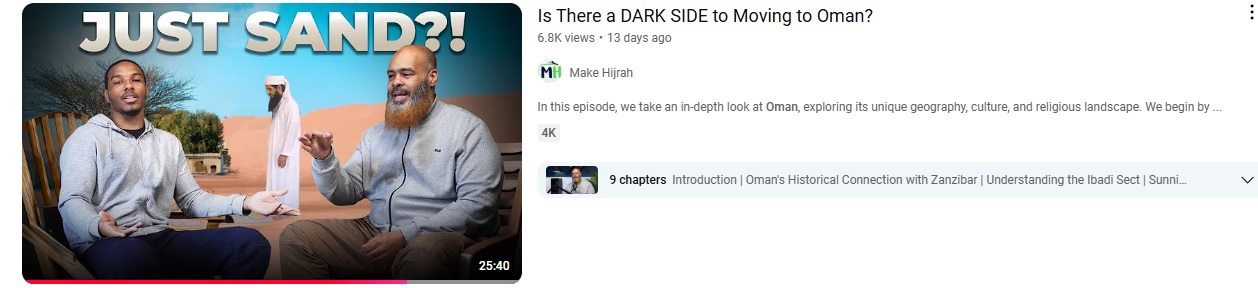
A recently started YouTube Channel called: Make Hijrah (which otherwise seemingly had good objectives) looks to promote sectarian strife in Muslim countries.
Now, in fairness and because Allah (swt) calls us to be just and to do justice there was an excellent interview here:
Also, to all Omani brothers reading this please note that the brother above, (brother Mustafa) has absolutely nothing to do with the sectarianism that the Make Hijrah channel promotes.
Also, I do want to bring attention to a Sunni Muslim brother that has an excellent website about moving to Muscat.
He is absolutely worth it to follow on X (Elon’s echo-chamber)
His X account is: https://x.com/movetomuscat and he has a website here: https://movetomuscat.com/ His name is Anwar. He has shown nothing but respect and love to Oman and the Omani people and I have only ever seen him speak respectfully about Shaykh Ahmed Al Khalili (h).
Please follow the brother below. Anwar@Move to Muscat. He is a respectful person and respects Oman’s diversity.
Dear readers by Allah (swt) in whose power is my life, there was an Omani brother that was going to do an interview with Make Hijrah YouTube channel about coming to Oman and living in Oman. However, this Make Hijrah channel flat out asked the brother, ‘Are you Ibadi’ to which he replied ‘yes’ and that was an issue for them!
What does being an Ibadi have to do with an interview about people coming to live in Oman?
So, instead the Make Hijra channel decided to make this blunder of a video:
So the title has: “Is There a DARK SIDE to Moving to Oman.” And most likely Jr. (the one on the left) chose the thumbnail of someone in prayer standing with their arms at the side. Once again the Salafis showcase their deficiency in fiqh and over all ignorance of the Sunnah of the Blessed Messenger (saw).
These are not the 90s. These must be the only Salafis I have encountered that didn’t the memo that they were so thoroughly refuted on the issue of hand placement in prayer that one must have been living in an isolated village in Papua New Guinea that didn’t get the memo.
Listen to Shaykh Assim Al Hakeem explain here:
@ 1:51 “These are fiqhi differences, whether you put your hand here (on the chest) you put your hand here (below the navel)you don’t put your hands at all in salat.“
You would expect with a title like: “Is There a DARK SIDE to Moving to Oman.” that these individuals might speak about hidden cost of living, or maybe there is bribery in the country, or perhaps there is a red light district that people do not know about. Maybe there is human trafficking going on.
Or maybe they had something controversial like Avicii’s death in Oman was not truly a suicide. They could have brought anything, but noooo, they had to focus on sectarianism.
Here it is:
“Is There a DARK SIDE to Moving to Oman.”
Jr speaks @3:15 “It then spread in Oman following the remnants of the Khawarijduring the Umayyad period.”
Senior speaks @3:20 “If you really want to know if the Ibadi are from the Khawarijor not it would require examining their statements from their original sources approved books and the words of their contemporary scholars. This is not for the average person. For common people and beginner students it’d be better to consult a person of knowledge you trust on this issue.”
Senior @4:24 “If you decided you want to move to Oman you can completely avoid that issueby just going to the south of the country and living among the Sunnis and in the Sunni cities.”
Jr speaks up @14:02 “Not one dude on the corner of the road praying like with his (out/down?)” This solicits laughter from Senior.
Jr. chimes in again @14:11 “It just wasn’t there like regular joint.”
So really the question for Jr. and Senior is as follows:
What is the issue in praying with the Ibadi or even behind an Ibadi Imam?
Let us say for the sake of argument that Ibadi are Khawarij or their descendants. Are Jr. and Senior more knowledgeable then the companions of the Blessed Prophet (saw)?
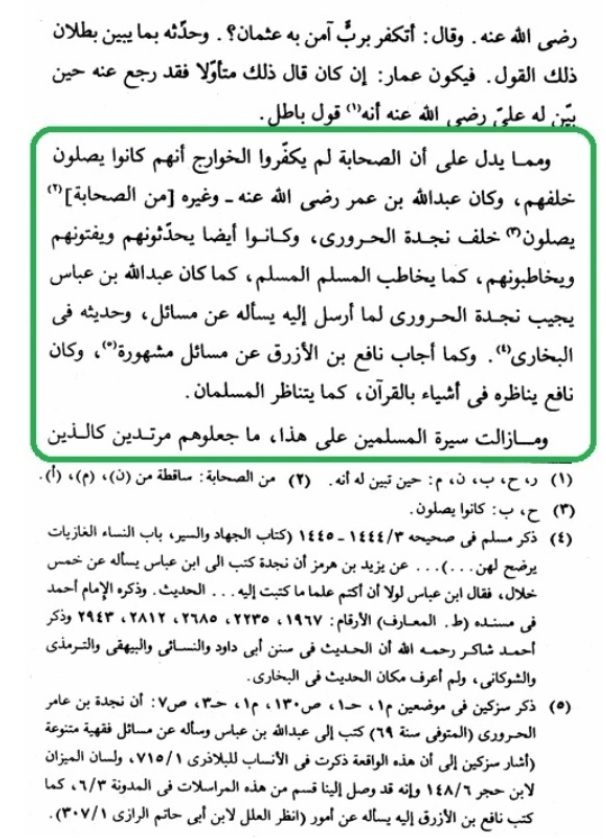
They can feel free to consult the sources:
However, from the video it does not seem that Jr. and Senior are fluent in reading and writing Arabic. This means they make Taqlid to the Salafi school and make Taqlid to it’s scholars as they have neither the tools or the means to go to the sources directly.
The translation of the above Arabic text states:
“And what indicates that the Companions did not consider the Khawarij to be disbelievers is that they used to pray behind them. Abdullah ibn Umar -RA- and others[companions] used to pray behind Najda al-Haruri. They also used to engage in debates with them, as the Muslim would debate with a Muslim, as Abdullah ibn Abbas debated with Najda al-Haruri when he was sent to him to ask about certain issues, and his hadith is in Al-Bukhari. Likewise, Nafi’ ibn Al-Azraq debated on famous issues. Nafi’ used to debate on matters in the Quran, as any two Muslims would debate among themselves”
Source: (The Path of the Prophetic Sunnah-In Refutation of the Shiite Qadariyyah Doctrine By Ibn Taymiyya Abu Al Abbas Taqi al Din Ahmad ibn Abd al-Halim.-Edited by Dr. Muhammed Rashad Salim Volume 5)
2. They (Jr & Senior mentioned that after eating camel meat the topic switched to jurisprudence (fiqh). So that is fiqh what about aqidah which to Salafis is the number one issue.
So my question for Jr & Senior is on what consistent basis can one pray behind an Ash’ari Shafi’i (whom they believe are deviant in aqidah but not pray behind an Ibadi) ???
Unless of course when they (Jr & Senior) say Sunni what they really mean is: “Their Salafi sect.”
So this should certainly alarm the Sunni Muslims in Oman (and indeed it has from the comments) because that means that ultimately these people would not just separate from the Ibadi but from the dominant Sunni Muslims as well!
Unfortunately all the Make Hijrah did was get the attention of the Omani government and immigration to look closer at their channel and scrutinized their intentions.
I would encourage the readers to listen to the interview between two Omanis, Sunni & Ibadi who speak about the video. Oman FM is listened all across Oman.
Listen to Religious Tolerance & Islamic Values – Shaykh Hatim Al Abdissalaam by Oman FM (English) on #SoundCloud
The only part where I would personally disagree with brother Shaykh Hatim on is where he said that in Oman they do not speak of these things or discuss them. Everyone’s upbringing is different in Oman. What Shaykh Hatim experiences is not the experience of another Omani.
What Shaykh Hatim may be speaking to is his own experience growing up and/or his own household and their particular priorities, and outlook.
There are Omani youth, 14 years of age that are very well acquainted with the conflicts that arose among the companions, and the history of the Ibadi school. This is widely discussed -because it is a right of a people to not be ignorant nor blur about their history.
That being said, they are also taught by the Mufti, May Allah (swt) continue to bless us by him, that we as Muslims need to live together in tolerance and respect for each other. This is certainly instilled in them as well.
In Oman all Muslims live together and they do not want the ghettoization of their country! So for those who want to come and live in Oman, you have something to contribute and you can live there in peace and coexistence Oman will welcome you with open arms.
However, anyone who wants to go to Oman and spread fitna or sectarianism and has that mindset, Oman does not want you, Oman certainly does not need you and the people of Oman are free from you nor are you welcomed!
“And hold firmly to the rope of Allah and do not be divided. Remember Allah’s favour upon you when you were enemies, then He united your hearts, so you—by His grace—became brothers. And you were at the brink of a fiery pit and He saved you from it. This is how Allah makes His revelations clear to you, so that you may be ˹rightly˺ guided.” (Qur’an 3: 103)
﷽
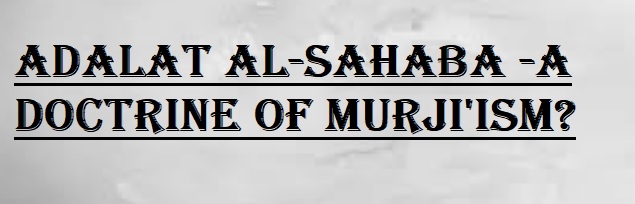
The following PDF file upload is an article written by Amr Osman a Professor from Qatar University about the Sunni doctrine of Adalat Al Sahaba.
We cannot hide the fact that over all we are dissapointed with the paper.
We feel one does not get into the meat until page 33 and 34 and even then it is designated to a mere footnote 145.
We feel the author could have done more to give concrete Murji’ sources rather than that which is held in dispute.
He could have elaborated examples of the Murji’ making use of the same hadith that Sunnis in general use for justification of all the companions being just.
The other point we disagree with is the contention that Adalat Al Sahaba is some how a Sunni doctrine. This is something we have come to learn is simply not true. It is simply not true because it is well known that the Umayyads had cursing of Ali at the pulpits. So, if there was such a doctrine it was either blatantly ignored (a highly contentious position) or simply was not developed as of yet (which is what we contend).
It would be correct to say that Adalat Al Sahaba is an Abbasid Sunni doctrine. Yes, this we would agree. But we certainly would not hold this doctrine to be contemporaneous with the Umayyads.
In fact it is a real missed opportunity to show why the growing Sunni Abbasid imperium would develop such a doctrine that would do it’s level best to try and bridge the gap between Umayyad, Alid and other factions of the Muslims. Especially when it came to the contentions civil wars of the early companions.
This would have given a great deal of thrust to the article and indeed show the readers ‘how the sausage is made‘ so to speak.
The other point in the article is the tired oft repeated and lazy claims concerning the so called “Khawarij.”
“Other 4th/10th-century writings reflect more aspects of the emerging doctrine. Defining the proper attitude towards the Companions as a middle way between excessive hate (similar to that of Harigis towards ‘Ali b. Abi Talib and Mu’awiya b. Abi Sufyan who fought each other during the schisms) and excessive love (like that of Si’is towards ‘Ali).”
1) You have to wonder on what basis is the claim being made. Source material for example?
2) The Ibadis are the one’s who went to Umar Abdul Aziz and asked that they stop cursing Ali at the pulpits. This is hardly the marker of people who hate an individual.
The other eye opening take away from the PDF article below, is that practically every study done by orientalist you will find one of them contradicting the findings of other other.
One of them strongly disagrees with the perspective of the other. This simply shows that they do not have a consistent ontology nor a consistent epistemology either. They often critique traditional views as speculative only for the avid reader to find out that they (orientalist) offer speculation as well. Albeit with the wide eyed claim of not having any presuppositions.
What we can show is that the doctrine of everyone’s ijtihad is correct, even if it leads to the separation of the Muslim Ummah, and killing; is demonstrably a false doctrine.
“And hold firmly to the rope of Allah and do not be divided. Remember Allah’s favour upon you when you were enemies, then He united your hearts, so you—by His grace—became brothers. And you were at the brink of a fiery pit and He saved you from it. This is how Allah makes His revelations clear to you, so that you may be ˹rightly˺ guided.” (Qur’an 3: 103)
Hold firm to the rope of Allah and do not be divided.
You were enemies and Allah united your hearts.
By the unification of your hearts you became brothers.
By being divided and being enemies you were at the bring of a fiery pit.
By being being united and being brothers you avoid this fiery pit.
This whole idea that everything the companions did is simply a matter of ijtihad even if it leads to killing each other flies in the face of this very verse of the Qur’an!
Meeting on a field and killing each other does not result in being united and not being divided.
Killing each other’s sons and father’s does not unite a person’s heart and make one have the feeling of brotherhood.
In fact, those Sunnis doing Daʿwah in Hyde Park United Kingdom and other venues throughout the world would get destroyed in a discussion on logic.
You see if person A says that an Elephant has a tail and person B says that an Elephant has four legs these are not mutually exclusive points.
It is both possible that a person A and person B are correct.
However, if person B says that an Elephant has four legs and person A says that an Elephant has two legs we have a problem. One of them is in clear error.
So on this point, those who engage with these people can point out that Sunnis do indeed believe that contradictory information can indeed be acceptable.
Now, it is one thing to believe that contradictory information is acceptable, and quite another thing, altogether to say contradictory information that leads to separation and division and killing is acceptable.
Those that believe that ijtihad that leads to killing and strife among the believers and on top of it gets rewarded even if they are upon error is such a surprising doctrine.
Narrated Ibn `Umar:
I heard the Prophet (saw) saying, “Do not revert to disbelief after me by striking (cutting) the necks of one another.”





 Prima Quran