“At that, Zechariah called upon his Lord, saying, “My Lord, grant me from Yourself a good offspring. Indeed, You are the Hearer of supplication.” So the angels called him while he was standing in prayer in the chamber, “Indeed, Allah gives you good tidings of John, confirming a word from Allah and [who will be] honorable, abstaining, and a prophet from among the righteous.” He said, “My Lord, how will I have a boy when I have reached old age and my wife is barren?” The angel said, “Such is Allah; He does what He wills.” He said, “My Lord, make for me a sign.” He said, “Your sign is that you will not [be able to] speak to the people for three days except by gesture. And remember your Lord much and exalt [Him with praise] in the evening and the morning.” And [mention] when the angels said, “O Mary, indeed Allah has chosen you and purified you and chosen you above the women of the worlds. O Mary, be devoutly obedient to your Lord and prostrate and bow with those who bow [in prayer].” That is from the news of the unseen which We reveal to you, [O Muhammed]. And you were not with them when they cast their pens as to which of them should be responsible for Mary. Nor were you with them when they disputed. [And mention] when the angels said, “O Mary, indeed Allah gives you good tidings of a word from Him, whose name will be the Messiah, Jesus, the son of Mary – distinguished in this world and the Hereafter and among those brought near [to Allah]. He will speak to the people in the cradle and in maturity and will be of the righteous.” She said, “My Lord, how will I have a child when no man has touched me?” The angel said, “Such is Allah; He creates what He wills. When He decrees a matter, He only says to it, ‘Be,’ and it is. And He will teach him writing and wisdom and the Torah and the Gospel. And [make him] a messenger to the Children of Israel, [who will say], ‘Indeed I have come to you with a sign from your Lord in that I design for you from clay like the form of a bird, then I breathe into it and it becomes a bird by permission of Allah. And I cure the blind and the leper, and I give life to the dead – by permission of Allah. And I inform you of what you eat and what you store in your houses. Indeed in that is a sign for you, if you are believers.’” (Qur’an 3:38-49)
﷽
The Case for the Virgin Birth of Jesus – peace be upon him.
“Indeed, the example of Jesus to Allah is like that of Adam. He created him from dust; then He said to him, ‘Be,’ and he was.” (Qur’an 3:59)
“And remember her who guarded her farjaha (vagina): We breathed into her of Our Spirit, and We made her and her son a sign for all peoples.” (Qur’an 21:91)
“And We made the son of Mary and his mother a sign and sheltered them within a high ground having level [areas] and flowing water.” (Qur’an 23:50)
“And Mary, the daughter of ‘Imran, who guarded her farjaha (vagina) in chastity, so We blew into it of Our Spirit, and she believed in the words of her Lord and His scriptures and was of the devoutly obedient.” (Qur’an 66:12)
“And mention, in the Book, the story of Mary, when she withdrew from her family to a place toward the east. And she took, in seclusion from them, a screen. Then We sent to her Our Angel, and he represented himself to her as a well-proportioned man. She said, ‘Indeed, I seek refuge in the Most Merciful from you if you should be fearing of Allah.’ He said, ‘I am only the messenger of your Lord to give you news of a pure boy.’ She said, ‘How can I have a boy while no man has touched me and I have not been unchaste?’ He said, ‘Your Lord says, “It is easy for Me, and We will make him a sign to the people and a mercy from Us. And it is a matter [already] decreed.”’ (Qur’an 19:16-21)
“And the pains of childbirth drove her to the trunk of a palm tree. She said, ‘Oh, I wish I had died before this and was in oblivion, forgotten.’ But he called her from below her, ‘Do not grieve; your Lord has provided beneath you a stream. And shake toward you the trunk of the palm tree; it will drop upon you ripe, fresh dates. So eat and drink and be contented. And if you see from among humanity anyone, say, “Indeed, I have vowed to the Most Merciful abstention, so I will not speak today to any man.”’ Then she brought him to her people (tahmiluhu), carrying him. They said, ‘O Mary, you have certainly brought forth a fabricated lie. O sister of Aaron, your father was not a man of evil, nor was your mother unchaste.’ So she pointed to him. They said, ‘How can we speak to one who is in the (l-mahdi) cradle?’ Jesus said, ‘Indeed, I am the servant of Allah. He has given me the Scripture and made me a prophet.’” (Qur’an 19:23-30)
“That is Jesus, the son of Mary – the word of truth about which they are in dispute. It is not for Allah to take a son; exalted is He! When He decrees an affair, He only says to it, ‘Be,’ and it is.” (Qur’an 19:34-35)
“When Allah will say, ‘O Jesus, Son of Mary, remember My favor upon you and upon your mother when I supported you with the Pure Spirit and you spoke to the people in the cradle and in maturity…’” (Qur’an 5:110)
So there are a number of issues for any Muslim who wants to deny the virgin birth of Jesus to contend with the following:
Any Muslim who wants to deny the virgin birth of Jesus should do so by using proofs and evidence based upon the Qur’an.
Any Muslim who wants to deny the virgin birth of Jesus should not give us ‘should have,’ ‘could have,’ and ‘would have’ been scenarios. In other words, do not add your own narrative. Don’t just make things up as you go along, but give us the text and make your case.
From the Qur’an, tell us why the Qur’an addresses Jesus time and again as ‘Jesus the son of Mary.’ Why not address Jesus by the name of his father… if any?
From the Qur’an, tell us why would Allah (swt) need to repudiate people who claim He has a son (in connection with Mary) if there were not miraculous circumstances surrounding her birth?
If Mary did not have a miraculous birth, when the angel comes to her announcing that she will have a child, Mary responds ‘that no man has touched her.’ Why does the angel give the very queer response of,‘It’s easy for Me’and ‘Such is Allah; He creates what He wills’? It is such a very queer response to give to someone whom Allah (swt) simply intends to marry a man.
After childbirth, how do you account for the statement, “But he called her from below her”?
If the person rejects the idea of Jesus speaking as an infant (which they obviously do as they reject miracles), ask them to explain what is meant by “she brought him to her people (tahmiluhu), carrying him.”
On the basis of the Qur’anic text, why would Mary need to be carrying Jesus anyway (if he was not an infant)?
If Jesus wasn’t an infant when he was speaking, then how do you account for the following text: “How can we speak to one who is in the (l-mahdi) cradle?”
If you are going to say that Jesus wasn’t an infant when he spoke, then why the objection to begin with? Why couldn’t they speak to a child/pre-teen/teenager?
If Mary was already married and it was widely known, then why this curious outburst from the people? “O Mary, you have certainly brought forth a fabricated lie. O sister of Aaron, your father was not a man of evil, nor was your mother unchaste.”
If the answer to point 11 above is because they didn’t know she was married, then why point to Jesus?
If the answer to point 11 above is because they didn’t know she was married and Jesus is a child/pre-teen/teenager, why didn’t he simply respond, “Yeah, my mom got married — sorry we didn’t invite you to the walimah!”
Why did Mary point to Jesus at all? If a person believes that Jesus was a child/pre-teen/teenager, it means there was a lapse of time after childbirth. Zechariah was commanded to refrain from speaking for three days; are we to believe that Mary didn’t speak to anyone for 6-9 years?
Given that Allah (swt) calls Jesus the son of Mary and repudiates Christians who claim that Jesus is the ‘Son of Allah’ in the same context, why not simply mention the father of Jesus?
Why is the birth of Jesus given such intimate attention if it was a normal birth like anyone else?
Why were early Muslim commentators like Al-Tabari and Ibn Kathir so bashful over the verses such as 21:91 and 66:12 above?
Why did Allah (swt) use such graphic terminology about blowing His spirit into Mary’s private parts if it was just a normal, run-of-the-mill birth? Seems a bit much for an uneventful birth.
So these are the issues that Muslims who do not believe in the virgin birth of Jesus are going to have to address.
Even one of the most rationalist movements—one that generally downplays or reinterprets miracles—still affirms the virgin birth of Jesus as a literal, historical fact based on the Qur’an
The Ahmadiyya movement, founded by Mirza Ghulam Ahmad in 19th-century India, is known for its rationalist and naturalistic approach to many miracles.
However, on the virgin birth of Jesus, they do not apply this rationalist lens. Ahmadiyya theology explicitly affirms that Jesus was born of the Virgin Mary without a human father, as a direct creative act of Allah. Their founder, Mirza Ghulam Ahmad, wrote:
“We believe that Mary became pregnant with Jesus without the intervention of a man, as the Qur’an clearly states: ‘She said, “My Lord, how can I have a child when no man has touched me?” He said, “Thus Allah creates what He wills.” Source: (Chashma-e-Masihi, Ruhani Khaza’in, vol. 20, p. 249)
Even a group famous for rationalizing miracles concedes that the Qur’anic text cannot be read any other way when it comes to Mary’s virgin conception.
Conclusion
The overwhelming evidence is that Jesus was born of a virgin. Those who deny this are going to have to deny the clear text of the Qur’an. They will have to add to the text or, worse, manipulate the text to say what it does not say.
You may be interested in reading the following articles:
“Allah who created the heavens and the earth! How can God have a child, when He did not have a wife?” (Qur’an 6:101)
“Allah who created the heavens and the earth! How can Allah have a child, when He did not have a companion” (Qur’an 6:101)
﷽
Ultimately the rejection of the Virgin birth of Christ Jesus is not due to any plain reading of the Qur’an. It is due to aprior belief that some how miracles violate laws of causality.
Muhammed Asad was of this view. Notice how he deals with the text of the Qur’an that talks about Jesus creating the clay birds.
“And [will make him] an apostle unto the children of Israel.” “I have come unto you with a message from your Sustainer. I shall create for you out of clay, as it were, the shape of [your] destiny, and then breathe into it, so that it might become [your] destiny by God’s leave; and I shall heal the blind and the leper, and bring the dead back to life by God’s leave; and I shall let you know what you may eat and what you should store up in your houses. Behold, in all this there is indeed a message for you, if you are [truly] believers.” (Qur’an 3:49)
One may think he mentioned healing the blind, the leper and bringing the dead back to life. However, in this frame work Jesus heals the spiritually blind, and the spiritually sick and spiritually brings dead hearts back to life.
“The sunnah of Allah with those who passed on before; and you will not find in the sunnah of Allah any change.” (Qur’an 33:62)
“No change will you find in Allah’s Sunnah, and no turning off will you find in Allah’s Sunnah.” (Qur’an 35:43)
The above verses are often appealed to at the very least ground the argument in something textual. Which is certainly appreciated. However, these same people believe that Allah (swt) created the first thing he created directly. Yet, after that they have two options.
Option 1: Allah Creates Everything Directly.Meaning he has willed what the state of any given thing will be at any particular time. If Allah’s Sunnah requires that every effect has a prior physical cause, then the first created thing had no prior physical cause. This means Allah willed what state a particular thing would be at any given time.
But if Allah can create the first thing directly—violating the supposed “rule” that every effect needs a prior physical cause—then He can create anything directly at any time.
This includes:
Creating Jesus without a father.
Creating a snake from a staff.
Creating life from clay.
Conclusion: Miracles are not violations of Allah’s Sunnah. They are direct acts of Allah, just like the original creation.
Option 2: Allah Creates Through an Intermediary Chain. If you insist that Allah never creates directly but always through a chain of causes and effects, then you face an infinite regress:
Who created the first cause?
And who created the cause of that cause?
To avoid infinite regress, you must eventually arrive at a first cause that creates directly—which is Option 1.
Alternatively, if you say the chain is eternal (no first cause), that is philosophical nonsense (and shirk, as it implies an uncreated universe alongside Allah).
The Neoplatontonic Trap. If miracle-deniers insist that Allah never creates directly but only through intermediaries, they fall into a Neoplatonic emanationist framework:
A series of intelligences or spheres that mediate creation.
The “First Intellect” emanates from Allah, then creates the next, and so on.
This effectively creates demi-gods—intermediary creators.
This is shirk because it attributes creative power to beings other than Allah. The Qur’an is clear:
“Allah is the Creator of all things, and He is, over all things, Disposer of affairs.” (Qur’an 39:62)
“Is there any creator other than Allah who provides for you from the heaven and earth?” (Qur’an 35:3)
Allah created the first thing directly, without any prior cause. This act of direct creation is itself the origin of Allah’s Sunnah, not a violation of it. Allah may choose what state or conditoin anything will be in at any given time-what are called miracles. They do not change Allah’s Sunnah; they are expressions of His absolute power to create as He wills.
The verse that our opponents use (Qur’an 35:43) actually proves our position.
The verse speaks of Allah’s sunnah in dealing with arrogant nations—His pattern of sending messengers, giving them time to repent, and then punishing them if they persist in evil. This has nothing to do with physical causality.
They are committing category error by taking a verse about divine justice and applying it to physics. The “no change” in Allah’s Sunnah refers to His moral and historical patterns—not to whether He can create a fatherless child.
This article will be addressing points that Mufti Abu Layth made in regards to the ‘Virgin birth of Jesus’. We should say that, for the most part, We disagree with Mufti Abu Layth on few issues. He was willing to make himself accessible to the general public and found favour among some Muslim youth. Many of those Muslim youth were reconsidering their own convictions about Islam. For that effort and ijtihad, surely his reward is with Allah.
However, We don’t really feel that this article is a refutation of points raised by Mufti Abu Layth at all. That is because to those who pay attention to detail will find that these are in reality not arguments presented by Mufti Abu Layth.
Another article that We wrote was in agreement with Mufti Abu Layth on the issue of the ‘Second coming of Jesus’. Yet, even in that article We pointed out that perhaps Mufti Abu Layth may have some misgivings about the Christian tradition.
@40:12 ” The second coming of Jesus is so important in Christianity. It perhaps is the second most important belief in Christianity. It is on the back of this belief that Christianity rose. If you don’t believe me go do your research. Because…the…believe it or not things like the virgin birth…Jesus uh uh Mary having a virgin birth are actually not that important in Christianity. Contrary to what many people think. They’re actually not, hence many early Christians did not even believe in that. The Gospel of Matthew doesn’t accept the virgin birth. The uh St. Paul didn’t even accept things like that. It was only 2-300 years after Jesus that the Christian Church made the virgin birth as part of its belief. But this, Jesus coming back was so important for Christianity.”
There are in our opinion some problematic statements in the aforementioned.
Mufti Abu Layth has said: “It perhaps is the second most important belief in Christianity.” Not even close. In fairness he did say, “perhaps.”
Mufti Abu Layth has said: ”It is on the back of this belief that Christianity rose. “
Perhaps he misspoke here. Or perhaps We misunderstood him.
We have to believe that he did, because it doesn’t even make any sense. How does an belief in the second coming of Jesus become the bedrock and foundation of Christianity?
Christianity would have to be established first before you could even know what its basic doctrines even are! In other words Jesus has to be credible the first time around before We can even start talking about him returning. We have to believe he misspoke here. Or perhaps We misunderstood his point.
Mufti Abu Layth has said: “Things like the virgin birth…Jesus uh uh Mary having a virgin birth are actually not that important in Christianity.“
Mufti Abu Layth couldn’t make this claim to any reputable Christian scholar, without being taken to task for it. The immaculate conception of Christ Jesus, his nature, the nature of his birth, the prophecies concerning his birth are of utmost importance to the Christian faith tradition.
Mufti Abu Layth has said: “Contrary to what many people think. They’re actually not, hence many early Christians did not even believe in that. “
From that it follows We may inquire:
Which early Christians didn’t believe in the virgin birth?
What are your sources?
Whom are you relying upon for this information?
Mufti Abu Layth has said: “The Gospel of Matthew doesn’t accept the virgin birth.“
The response to that is: “Behold, a virgin shall be with child and shall bring forth a son, and they shall call his name Emmanuel, which being interpreted is, God with us.” (Matthew 1:23)
Mufti Abu Layth has said: “ The uh St. Paul didn’t even accept things like that.”
This claim is being made on the basis of what?
What text?
What source?
We would be willing to respectfully suggest to him that Perhaps he had Galatians 4:4 or Romans 1:3 in mind?
Mufti Abu Layth has said: It was only 200-300 years after Jesus that the Christian Church made the virgin birth as part of its belief.”
Ourresponse: That is not accurate.Not even close. In fact, it is a belief of Muslims as well.
You can see the evidence for it being a belief of Muslims here:
The actual evidences that are brought to reject the virgin birth of Christ Jesus.
Now, let us turn our attention to his statements concerning the Qur’an and this matter.
So please see what Mufti Abu Layth has said on the subject here:
So this is the video that is titled: “Does the Qur’an Mention a Virgin Birth for Jesus?” Mufti Abu Layth lays out his view, his proofs and justifications.
So where do We begin with the 20 minutes and 21 seconds that have been allotted to this subject by Mufti Abu Layth?
Well, the beginning of course!
Allow us to preface by saying that We do not think that people are unbelievers for saying that Jesus the son of Mary was conceived through a father and mother. We certainly don’t believe that.
We will say this though, something has to be said about combing through the mountain of scholarship that exists across the Shia/Sunni/Ibadi communities and coming up with two names; both of whom which are anonymous and not given to us.
Now, just because We may not have heard of these people does that mean anything bad? No, it is simply a demonstration of my ignorance and those of us who have never heard of them. However, the absolute, overwhelming, tsunami of scholarship across sectarian lines in Islam is that Jesus the son of Mary was born of a virgin. That being said We agree with Mufti Abu Layth that truth is not a democracy.
Truth is truth and it stands or falls based upon the veracity and scrutiny of it’s own claims.
We would also add that it is the theological view of Mufti Abu Layth in denying miracles that is what drives him to impose this view upon the text. After all, if you are going to deny miracles taking place you are either all in or all out.
That has been a particular view held by some Muslims in Islamic history, namely that miracles violate the laws of causality.
An interesting thought experiment in regards to the available text.
What would be interesting as a social experiment would be to find a group of people, who are not Muslims and who are not privy to these discussions in Islam and give them all the relevant text on the subject and after they read the text to ask them the following:
Based upon the available data in the text you read do you believe that the text teaches that Jesus was born miraculously and/or from a virgin birth?
Based upon the available data in the text you read do you believe that the text teaches that Mary got married and she conceived Jesus through a natural process?
That would be most intriguing.
Mufti Abu Layth @0:35 makes an astonishing claim in the beginning. He says that the language of the Qur’an is quite interesting and that it is styled in a way that no Muslim believes about Jesus the son of Mary.
Our response: We certainly believe that Jesus is a word proceeding from Allah (swt). We certainly believe that Jesus is a spirit proceeding from Allah (swt).
Mufti Abu Layth claims that ‘That it is styled in a way that no Muslim believes about Jesus’ that claim of his is patently false.
Certainly what our respected brother Mufti Abu Layth has said is factually incorrect.
In fact, We are telling you in all our years and exposure to Islam and Muslims, and an array of opinions and perspectives this is the very first time We are seeing any Muslim raise an objection. So it is quite the opposite of what he claimed.
@0:38 Mufti Abu Layth says, “For example, Jesus is referred to on more than one occasion in the Qur’an as ‘The word of God’, now that doesn’t resonate with Muslims.”
Again, this is absolute news to us. That it does not resonate with Muslims?
Yet, it is a curiosity that he chose to render the text as ‘The word of God‘?
@0:56 Mufti Abu Layth We feel he meant to quote Qur’an 3:45 and not 3:43 but he quotes:
“Allah says, when giving glad tidings to Mary that she had received bi kalimatin min’hu (of the word coming from God) us’muhu l-masīḥu ʿīsā ub’nu maryama (the Messiah, Jesus the son of Mary).”
Comment: Notice that Mufti Abu Layth himself translates as “the word coming from God.” We didn’t tell him to do that. No one else told him to do that either.
@1:20 Mufti Abu Layth continues: “In another verse surah al Nisa 170 (4:170) innamā l-masīḥu ʿīsā ub’nu maryama rasūlu l-lahi wakali (that Jesus is the messenger of God and his Word which he sent down or threw down onto Mary, and the Spirit of God)warūḥun min (once again what are these words. No Muslim really believes this about Jesus. If you want to accept literal no Muslim believes that.”
Comment: Notice that Mufti Abu Layth himself translates “his word which he sent down.” We didn’t tell him to do that. No one else told him to do that either.
@1:54 Mufti Abu Layth continues: “You see this is very very like in the Gospel of John that in the beginning there was the you know the the in the beginning there was the word, and the word was with God and the word was God.”
Mufti Abu Layth has stated: @0:38 “For example Jesus is referred to on more than one occasion in the Qur’an as ‘the word of God‘, now that doesn’t resonate with Muslims.”
He says that the Qur’an says on more than one occasion Jesus is called, ‘the word of God’ but he himself didn’t give us one example of this. Instead, he himself translated the text as ‘his word sent down’ and ‘word coming from God.’
If Mufti Abu Layth doesn’t know the vast theological difference between the Qur’anic concept of Jesus as ‘a word proceeding from Allah’ (swt) and the Christian idea of the Word being the Logos than he might want to take some time to read up on and research these matters.
“Kalimatullah” is an honorific title given most likely by the Sunni Muslim tradition to Jesus the son of Mary. However, We haven’t personally seen the Qur’an refer to Jesus as ‘The Word of Allah’. We have no idea where Mufti Abu Layth derived that from.
The concept put forth in the prologue of the Gospel according to John, the Christian understanding of Jesus as the Logos is understood by the following text:
“He is the image of the invisible God, the firstborn over all creation. For by him all things were created: things in heaven and on earth, visible and invisible, whether thrones or powers or rulers or authorities; all things were created by him and for him.”—(Colossians 1:15–16)
There is no theological school among Muslims (that We are aware of) that comes even remotely close to such an understanding of Jesus role as ‘word’.
However, if Jesus is not understood as the Created word of Allah than this indeed is problematic. If this is the point that Mufti Abu Layth is driving home than he and us are of one accord.
For example is statement here @2:03 with:
“And as Muslims, IF you believe that ‘the word of God’ is uncreated than by that it follows almost ties into Jesus being uncreated.”
This point Mufti Abu Layth is echoing comes from those of us who do not believe that the Qur’an is uncreated. The Qur’an is created.
We do recall a brother sending us a clip of Mufti Abu Layth claiming that this theological controversy surrounding the Qur’an was a non-issue. However, We can see by the point that he has raised by those us who do not believe the Qur’an to be eternal, that it is an issue.
In fact, We think it would be great if Mufti Abu Layth cleared up for us what his position is on this issue. Does Mufti Abu Layth believe that the Qur’an is eternal and uncreated or does he believe it is created? He certainly hasn’t been shy from controversy in the past so why not make this stance clear?
Mufti Abu Layth says, @2:17, “Now Muslims will say oh by ‘the word of God’ here We just mean he was a miracle. No, but that word of God isn’t used for any other prophet.”
Our comments:
We think Mufti Abu Layth is making a non-argument. We are certainly not in the habit of calling Jesus, ‘the word of God.’
The Holy Spirit.
Mufti Abu Layth continues @2:42 “And than the word ‘The Holy Spirit’ is used with no other prophet. We mean it’s used as revelation coming down with the ‘Holy Spirit’ but otherwise it’s used on three occasions just for Jesus. So you have for example Allah says in Surah al Baqarah verse 87, wa-ayyadnāhu birūḥi l-qudusi (We assistedWe gave him assistance, help with the Holy Spirit)”
He continues @3:12 “In Surah Baqarah verse 253, waātaynā ʿīsā ib’na maryama l-bayināti (We gave him the clear signs) wa-ayyadnāhu birūḥi l-qudus (and We helped him with the Holy Spirit).”
He continues @3:23 “In Surah Maidah verse 115 Allah says,” idh qāla l-lahu yāʿīsā ib’na maryama (and when God said oh Jesus the son of Mary) udh’kur niʿ’matī ʿalayka (remember my blessing upon you and your mother) wālidatika idh ayyadttuka birūḥi l-qudusi (when I helped you with the Holy Spirit).”
Mufti Abu Layth continues @ 3:43 “What is this Holy Spirit? This isn’t mentioned with any other prophet generally you don’t get any of the…So there’s allot of rhetoric being used that when it comes to Jesus was generally the kind of Christian rhetoric that is used in the Qur’an perhaps in a sense of building bridges; between the Muslims and the Christian communities and to maybe A) Find an ally in them. And B) maybe for many of them to convert and come closer. Find themselves in greater proximity to Islam and thereby embrace the message.”
Perhaps We are misunderstanding Mufti Abu Layth’s summary. Although, his language suggests someone who views the Qur’an as a product of the Prophet’s mind (saw) rather than divine revelation.
In other words, rather than the Qur’an being a divine revelation, in which common points of theology are discussed, it is simply a strategy or a device used to win over Christians. We would expect that train of thought from an Orientalist who sees the Qur’an as the product of the Prophet Muhammed’s mind. (saw).
Again maybe We are reading too much into what he is trying to convey; However, the language is concerning.
The Virgin Birth
So now we finally come to this section. Mufti Abu Layth starts off with making some rather bizarre statements.
He says, @6:22 “Now when it comes to the virgin birth, first of all, it’s a different topic that even in the Bible right, now, with the exception of the Gospel of Luke and Matthew, generally the Bible never really referred to in essence the virgin birth. I mean this wasn’t a the early Christians it’s not it’s most likely that the early Christians did not believe in a virgin birth.”
Our comments: We thought this statement was bizarre because the central theme of the Bible is about God acting in history to save his people (The Children of Israel). The central theme is a lost humanity that needs to be reconciled back with God. Thus the theme of salvation and redemption are central. So We thought it was a bizarre statement to imply that just because the Bible (New Testament) refers the virgin birth only twice We could somehow be dismissive of it.
He continues @6:59 “and the prophecy that they are referring to in the Old Testament even Biblical scholars highlight that word does not say, ‘betul’ (virgin) it says ‘almah’ (which meant a young girl); as in like a young maiden. Uh which most likely was a virgin, but didn’t have to be. So the same word is used with Solomon and the same word is used on a certain occasion ‘almah’ who had a child. So it’s one of the prophecies that they mentioned in the old testament that they kind of fall back on. But you will see before the Gospels are written, So any of the letters of the Apostles of the letters for example Paul and all of these there is never a mention of a miraculous birth of Jesus. And this comes much later, definitely by the second century, after Jesus. This becomes doctrine.”
Our comments: We feel that some Muslims most likely are deeply affected and moved by Western Orientalists. So the thinking here is that whoever wrote the virgin birth narrative wanted to justify this by appealing to text in the Old Testament.
The reliance of this author upon the Greek Septuagint could be a mistranslation error. So the Muslim thinking is, “Wouldn’t be odd if We incorporated into our faith (The Qur’an) something that turned out to be a simple translation error?”
I’m happy to see that Mufti Abu Layth has acknowledged that Matthew does mention the virgin birth, whereas before he made an error in saying that it didn’t.
Mufti Abu Layth’s train of thought on the writings of Paul is that he didn’t explicitly mention any narrative of the virgin birth and thus he does not believe it. However, this belies a few points.
1) Is it the task for Paul to reacquaint Christians with beliefs they already held?
2) Luke (who did indeed write about the virgin birth) was a companion of Paul.
3) Paul didn’t even mention Mary not a single time ever. So are We to assume that Paul didn’t believe that Mary existed?
We believe that Mufti Abu Layth is making some solid points but he needs to be prepared for what the other side will say.
Where Mufti Abu Layth really tries to force the points is where We can see that in this video he decries the fact that Muslims hold beliefs that are similar to Christians and yet tries to convince us that Christians themselves didn’t believe in the virgin birth!
The point here is that the text of the Qur’an is not beholden to what 1st, 2nd, or 3rd century Christians believed or did not believe.
@8:15 Mufti Abu Layth says, “Mary was definitely married and she was most likely definitely not a virgin.“
Our comments: What proof do you have Mufti Abu Layth that Mary was married and was ‘most likely definitely not’ a virgin?
@8:28 Mufti Abu Layth asserts, “Jesus had brothers and sisters. In fact, the Gospel of Mark and definitely Matthew 13 mention James, Joses, Jude, Simeon, and unnamed sisters were the children of Mary.”
Our comments: No where does the text of Matthew assert that the brothers of Jesus were the children of Mary. That is an open challenge to anyone; and not just Mufti Abu Layth.
We believe the text that Mufti Abu Layth had in mind is:
“When Jesus had finished these parables, he moved on from there. Coming to his hometown, he began teaching the people in their synagogue, and they were amazed. “Where did this man get this wisdom and these miraculous powers?” they asked. “Isn’t this the carpenter’s son? Isn’t his mother’s name Mary, and aren’t his brothers James, Joseph, Simon and Judas?Aren’t all his sisters with us? Where then did this man get all these things?” And they took offense at him.” (Matthew 13:54-57)
We do not know from memory what reference he had in mind for the Gospel of Mark.
So let’s unpack this further. Why do the ‘brothers of Jesus’ have to have come from Mary and not simply from another marriage of Joseph? The text not once calls any of them the children of Mary. That is an assumption.
Second, you have to understand that the name Mary itself was just as common as John is among English speakers today.
“Among whom were Mary Magdalene, and Mary the mother of James and Joseph, and the mother of the sons of Zebedee” (Matthew 27:56); “There were also women looking on from afar, among whom were Mary Magdalene, and Mary the mother of James the younger and of Joses, and Salome” (Mark 15:40).“But standing by the cross of Jesus were his mother, and his mother’s sister, Mary the wife of Clopas, and Mary Magdalene” (John 19:25)
Ahmed Deedat used to say, ‘sons by the tons’ now We have ‘Marys by the millions’.
Remember the difficulty Christians and Orientalist would give us over the following text in the Qur’an:
“At length she brought the (babe) to her people, carrying him (in her arms). They said: “O Mary! truly an amazing thing hast thou brought! “O sister of Aaron! Thy father was not a man of evil, nor thy mother a woman unchaste!” (Qur’an 19:27-28)
Today no one understands that Mary the mother of Jesus is the literal sister of Aaron the brother of Moses. This was certainly due to them not understanding Arabic and the context of how the language was used than.
@9:16 Mufti Abu Layth says, “Although no verse in the Qur’an says that she had a virgin birth.”
My response: The Qur’an nowhere says that Mary was married to Joseph or anyone. The Qur’an nowhere calls him, ‘ Jesus the son of Joseph’ or the son of any man.
The Qur’an taken as a whole conclusively proves that Jesus was born of the Virgin Mary.
@10:00 minutes into the video Mufti Abu Layth mentions the name of only two scholars that state that the birth of Jesus was from a mother and a father.
What would be nice is to have the references or citations from these two anonymous men so that one could look at what they said.
Now, all We have to go on is what Mufti Abu Layth relates from these two anonymous scholars. However, if what he relates from them is as he says then it is simply not grounded in anything concrete.
Mufti Abu Layth continues…
“What these people said that it was a natural birth and that’s not the case. The miracle they highlighted is that when she got married to Joseph that Joseph would abstain and he was not interested in any kind of intimacy. And hence when the angel came and she, ‘But how can I have a child when I haven’t even been touched.’ That after that she did conceive. She conceived naturally. Just as Ibrahim (as) wife said How can I have a child when the angel came to her and she said I’ve reached menopause I’m an old lady. And they said and the angel said its the decree of God. It doesn’t mean she had a natural somehow kind of non sexual birth. It didn’t mean that. Just as the wife of Zachariah in the Qur’an who says that uh she was barren. She says, ‘How can I have a child.’ And the angel says, It is the decree of God. It doesn’t’ mean she just conceived just like that. She had a husband Zechariah. So these people who have argued this point have gone with just those two prophets before them. They said, well the same thing was said to them. Same thing was said to Mary. Every body accepts Mary had a husband at the time Joseph. The difference however was was that birth a virgin birth. Muslims do not believe she remained a virgin throughout her life.”
Comments: So let us pause here and unpack what brother Mufti Abu Layth presented to us.
Mufti Abu Layth and/or these two scholars tell us that “She got married to Joseph and that Joseph would abstain” Where do We find this statement in the Qur’an or the Sunnah? Remember Mufti Abu Layth likes to say, “Quran wa Sunnah”, “Quran wa Sunnah.”
Mufti Abu Layth and/or these two scholars tell us that “How can I have a child when the angel came to her and she said I’ve reached menopause I’m an old lady.”
This is the part in the article where We step away from the keyboard and hand it over to my mother or sister…
“Dear Mufti Abu Layth did you just say this woman reached menopause?”
“Dear Mufti Abu Layth did you know that during menopause ovulation ceases and a woman is unable to have children naturally?”
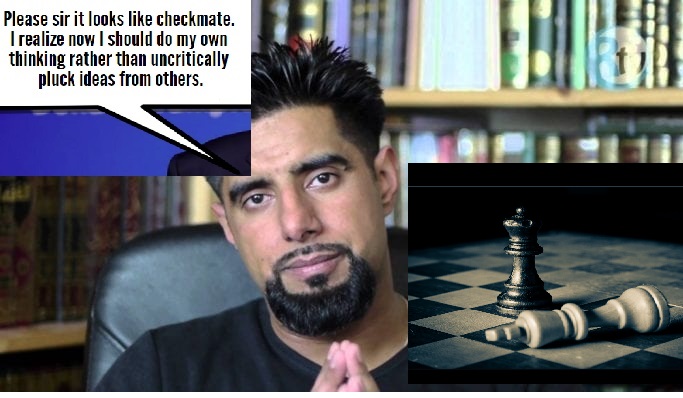
Now, this is the point where We can proclaim a checkmate on Mufti Abu Layth on three points.
The first is that he actually believes in a miraculous conception after all. A woman giving birth when she is no longer producing eggs is quite the miracle indeed!
Second, since this woman is having miraculous birth without eggs We can no longer discount the virgin birth of Christ Jesus.
The Third is that Mufti Abu Layth admits to angels being sent to break the natural laws. Why? Nothing in the text indicates that these women would have had children otherwise if not that an angel had appeared to them.
Why send an angel in the first place?
So this concept that Mufti Abu Layth doesn’t believe that the divine violates the natural laws has been brought into disrepute.
If Allah hadn’t intervened Ibrahim’s wife wouldn’t conceive after menopause, Zechariah’s wife would still be barren, and presumably, Joseph’s libido would be abysmal.
One last point on what Mufti Abu Layth said before We move on.
He rendered the Arabic text of Mary’s response as, “And hence when the angel came and she said, ‘But how can I have a child when I haven’t even been touched.”
Now Ustadh We have to say that was clever, clever indeed. You sir, naugty, naughty.
Again, We would like to ask you when you say, “Everybody accepts Mary had a husband at the time Joseph” and when you say, “Muslims do not believe she remained a virgin throughout her life.”
Where did you get this from?
We thought it was, “Quran wa Sunnah” Quran wa Sunnah” or do We take our beliefs from the Christians now?
Mufti Abu Layth continues @11:31
“And here’s another verse. Now this is an interesting one. Now Shaykh Yasir Qadhi who is saying, ‘No We only must go with literal readings of the Qur’an’, in Surah Al-Tahrim verse 12 you have the verse about Mary, wamaryama ib’nata ʿim’rāna allatī aḥṣanatfarjahā (And Mary who had been chased and safeguarded her private parts) and ‘ahsana‘ by the way is a verb that is used often in Arabic to do wife safe guarding through marriage. So hence they say somebody is in trouble for adultery were they ‘wahsan’. As Allah says in the Qur’an, ‘Waalmuhsanatu mina alnnisa’. Which is the beginning of the fifth Juz. Is referring to those women who were married. Who are chased through marriage. O.K? ‘nata ʿim’rāna allatī aḥṣanat farjahā fanafakhnā fīhi min rūḥinā’ You see this verse reads, ‘And Maryam the daughter of Imran who safeguarded her genitals her private parts We breathed into that, into it. Says, ‘ fanafakhnā fīhi’ (into her private parts) min rūḥinā (of our spirit) Now that’s in Surat Al Tahrim. As far as I’m aware no Muslim would generally believe that to be literal.”
My response: Yet, it doesn’t occur to Mufti Abu Layth, Allah (swt) using quite a literal language to get a point across?
No one else in the Qur’an is described with this type of language.
This language was not used of either Zecharia’s wife or Ibrahim’s wife. Allah (swt) again and again and again, addresses Jesus as ‘The son of Mary’, Jesus is called ‘A Spirit Proceeding from Him’ and even very strong literal language that shocked Muslim commentators is employed.
Are We really to believe as Mufti Abu Layth wants us to believe so that We as Muslims can believe that Jesus was born to a father named Joseph who is not even mentioned in the Qur’an, or Sunnah so that We can eventually adopt the Christian belief that Joseph is the father of Jesus? That is really quite something isn’t it.
@15:47 Mufti Abu Layth says, “Yes Allah could have clearly said and Yes Jesus didn’t have a dad but Allah doesn’t say that once in the Qur’an. He does not say that.”
My response: Yes and Allah could have clearly said and Yes Jesus does have a dad. But Allah doesn’t once say that Jesus had a dad.
In fact, what does Allah (swt) tell us?
There is a proof from the Qur’an that weighs in on this.
Allah (swt) tell us the following:
“Call them by the names of their fathers; it is more just in the sight of Allah.” (Qur’an 33:5)
So why doesn’t Allah (swt) do this when it comes to Jesus if he had a father?
Wouldn’t it be more just in the sight of Allah (swt) to call Jesus the son of (X) rather than Jesus the son of Mary?
Doesn’t’ this pique your interest at all brother Mufti Abu Layth? You don’t find it a bit odd that Allah (swt) calls Jesus the son of Mary over and over and over again?
With all due respect, you have resorted to incorporating Christian beliefs into Islam!
There is no mention of Joseph being the husband of Mary or the father of Jesus in the Qur’an.
There is no mention from the Blessed Prophet (saw) about Joseph being the husband of Mary or the father of Jesus from the lips of the Blessed Prophet (saw).
On what consistent basis do you tell us to guard against the idea of the second coming of Jesus as a belief that ‘crept into Islam’ when you have stormed the front gate with this? On what consistent basis can you do this?
@16:18 In fact, what does Allah (swt) tell us? is going to bring us the arguments of the two scholars he mentioned earlier. These supposedly rock-solid arguments against the idea that Jesus was born of a virgin. They are supposed to be arguments that Jesus was born of a natural father. So let us have at it.
Argument #1
And Zechariah and John and Jesus and Elias – and all were of the righteous. And Ishmael and Elisha and Jonah and Lot – and all of them We preferred over the worlds. And some among their fathers and their descendants and their brothers – and We chose them and We guided them to a straight path. (Qur’an 6:85-87)
Comments: So for those who may not follow the argument, basically the line of thinking here is that it mentions a whole grouping of Prophets and mentions in this context their fathers. So somehow Mufti Abu Layth and his scholars use this to advocate that all the prophets had fathers.
We will give you our understanding of this verse and We will show you why our understanding is valid and Mufti Abu Layth’s understanding is not.
Our understanding is that when it says, “their fathers and their descendants and their brothers” that this doesn’t mean that all of the prophets had fathers and children and brothers. Our understanding is that this verse addresses those who did have ‘fathers, descendants and brothers’.
Whereas if Mufti Abu Layth is going to be consistent and assert that ‘their fathers’ means ‘they all had fathers’ than the text that reads ‘their descendants’ if We are to be consistent must mean ‘they all had descendants.’
This would make Mufti Abu Layth the first Muslim to my knowledge to assert that John the Baptist and Jesus had children. That verse no more ‘weighs in on the side’ that Jesus had a father than it does ‘weigh in on the side’ that Jesus had children.
So that argument fails.
Argument #2
@17:40 Mufti Abu Layth brings the other argument that these scholars use. Mufti Abu Layth thinks that this is a very ‘powerful verse’ that they use!
“Allah who created the heavens and the earth! How can God have a child, when He did not have a wife or a companion” (Qur’an 6:101)
First We find it interesting that Mufti Abu Layth has decided to translate the Arabic term ‘sahibatun’ as ‘wife’ or a ‘companion’. The Arabic term ‘zawja‘ it is not used in this context. Whereas We would have translated it as ‘companion’ and for good reason. Whereas Mufti Abu Layth focuses on the term ‘wife’.
Mufti Abu Layth and his two scholars’ understanding of this verse is both theologically unsound and outright egregious.
The way they understand the text, We must either choose between a Creator that is impotent (May Allah forgive us and guide us) or a Creator that is like his creation (May Allah forgive us and guide us).
Some questions that Mufti Abu Layth and his scholars would need to reflect on in order to come to the proper understanding of the verse would be:
Why can’t Allah (swt) have a son without a wife?
If you understand it the way that Mufti Abu Layth and his two scholars do, it makes Allah (swt) imply that he would need to have a wife. On what consistent basis could you make this claim if taking the verse as a whole?
Would they be opposed to the idea of Allah (swt) having a wife or a son based upon their logic? In other words do they or do they not find it a theological impossibility for Allah (swt) to have a wife and/or a son? So could Allah (swt) have a wife or a son? (May Allah forgive us and guide us).
Why do they (Mufti Abu Layth) and his two scholars assert that Allah (swt) would need to be like his creation or unlike his creation in the process of bringing a son into being?
“There is nothing like unto Him.” (Qur’an 42:11)
@19:26 Mufti Abu Layth makes what has to be the most incoherent statement thatWe are aware of since making You-Tube videos. “God doesn’t need to. God could just make a child without having a female. That’s an argument, that’s an argument against God, for using that as an argument. The only way that verse can make sense is if all births follow a natural law of order.”
How about We actually look at the whole verse, and not just a section of the verse? Why not look at the whole verse? Is that fair?
“Originator of the heavens and the earth. How could He have a child when He does not have a companion and He created all things? And He is, of all things, Knowing.”(Qur’an 6:101)
Allah (swt) is the originator of the heavens and the earth. Does Mufti Abu Layth and/or his two scholars believe that there was a wife or an associate, or a partner or a companion that helped Allah (swt) in this?
Could Mufti Abu Layth and/or his two scholars tell us what natural laws did Allah (swt) follow or was beholden to when creating our reality and our existence?
The verse says, “He created all things.” In other words, if He Allah (swt) had a companion it would have to be a peer (a an equal to God). So Allah (swt) does not have a companion to begin with.
What is meant by having a companion?
Why do people seek out companionship/friendship/associates and peers?
Anything that human beings can receive from companions/friends/peers and associates stems from needs, and Allah (swt) is free from needs. Whatever people get from having associates and companions Allah (swt) can simply create it.
“There is nothing like unto Him.” (Qur’an 42:11)
If Allah (swt) had a companion /associate/ or peer it would entail being of the exact divine nature of Allah (swt). Allah (swt) crushes that notion with the following ‘He created ALL things’.
It is only logical that you can’t have two uncreated beings.
It is only logical that you can’t have two originators. This would also entail having a walad (a child)
Mufti Abu Layth is adamant that Allah (swt) is showing them their reasoning.
Mufti Abu Layth is focused on the issue of ‘walad’ whereas Allah (swt) is saying he doesn’t have a ‘sahibatun’ or a companion to begin with!
She said, “How can I have a boy while no man has touched me and I have not been unchaste?” (Qur’an 19:20)
So according to Mufti Abu Layth and his select scholars, they understand this as Mary saying, “But I’ll have a child when I get pregnant by my husband.”
“How can God have a child, when He did not have a wife or a companion” (Qur’an 6:101)
So according to Mufti Abu Layth and his two scholars, they understand Allah as saying, “But if I had a wife I could have a child.”
Which is simply theologically unsound.Their interpretation of the text ignores the whole of the verse; and worse yet, it doesn’t negate for Allah (swt) the possibility of having a companion! (May Allah pardon us).
If anything in this article is good and beneficial, all praise be to Allah (swt). If there are any mistakes then surely this is from us. May Allah (swt) continue to guide and bless us. We seek the help of Allah (swt) and the help of Allah (swt) is sought.
May Allah (swt) bless Mufti Abu Layth for what he has brought that is good and May Allah (swt) forgive him and forgive us. May Allah (swt) guide him and guide us.
For those interested you may wish to read the following articles:
“Also, mention when the angels said, “O Mary, indeed Allah gives you good news of a word from Him, whose name will be the Messiah, Jesus, the son of Mary – distinguished in this world and the Hereafter and among those brought near to Allah. He will speak to the people in the cradle and in maturity and will be of the righteous. “She said, “My Lord, how will I have a child when no man has touched me?” The angel said, “Such is Allah; He creates what He wills. When He decrees a matter, He only says to it, ‘Be,’ and it is. (Qur’an 3:45-47)
﷽
“Also, mention, in the book the story of Mary, when she withdrew from her family to a place toward the east and she took, in seclusion from them, a screen. Then We sent to her Our Angel, and he represented himself to her as a well-proportioned man. She said, “Indeed, I seek refuge in the Most Merciful from you, so leave me, if you should be fearing of Allah. He said, “I am only the messenger of your Lord to give you news of a pure boy. “She said, “How can I have a boy while no man has touched me and I have not been unchaste? “He said, “Thus it will be; your Lord says, ‘it is easy for Me, and We will make him a sign to the people and a mercy from Us. And it is a matter already decreed.” (Qur’an 19:16-21)
As Shaykh Ahmed Deedat (r) has mentioned in his Pamphlet “Is the Bible God’s Word?” page 11:
We do not have the time and space to go into the tens of thousands of — grave or minor —defects that the authors of the Revised Standard Version (RSV) have attempted to revise. We leave that privilege to the Christian scholars of the Bible. Here I will endeavor to cast just a cursory glance at a “half-a-dozen” or so of those “minor” changes.
1. “Therefore the Lord himself shall give you a sign: Behold, a VIRGIN shall conceive, and bear a son, and shall call his name Immanuel.” (Isaiah 7:14 – AV) The indispensable “VIRGIN” in the above verse has now been replaced in the RSV with the phrase “a young woman,” which is the correct translation of the Hebrew word almah. Almah is the word that has occurred all along in the Hebrew text and NOT bethulah, which means VIRGIN. This correction is only to be found in the English language translation, as the RSV is only published in this tongue. For the African and the Afrikaner, the Arab and the Zulu, in fact, in the 1500 other languages of the world, Christians are made to continue to swallow the misnomer “VIRGIN.”
The argument goes (from the Jews) and the atheists, for that matter, that if the Gospel writer ‘Matthew’ had been inspired and directed by the Holy Spirit, then he (Matthew) would not have relied upon the Jewish Septuagint for the source of his quote.
Technically, the word almah more than not was used for a young woman that could be married. Being a young, unmarried woman, it was often understood that she was not married and thus, a virgin.
However, those who argue against this state that the word ‘bethulah’, which actually does mean virgin, should have been used in place of ‘almah’, which has the possibility of being a virgin.
The website: Jews for Jesus has the following to say:
We as Muslims could agree with our Christian apologist and say look, ‘almah’likely means ‘virgin’ and that is good enough.
The reason that it is not good enough is that the author of the ‘Gospel According to Matthew’ had made some huge blunders when being reliant upon the Greek Septuagint.
We will give a clear example: Believe us, there are many!
“When they drew near Jerusalem and came to Bethphage on the Mount of Olives, Jesus sent two disciples, saying to them, “Go into the village opposite you, and immediately you will find an ass tethered, and a colt with her. Untie them and bring them here to me. And if anyone should say anything to you, reply, ‘The master has need of them.’ Then he will send them at once. “This happened so that what had been spoken through the prophet might be fulfilled: Say to daughter Zion, ‘Behold, your king comes to you, meek and riding on an ass, and on a colt, the foal of a beast of burden.’ “The disciples went and did as Jesus had ordered them. They brought the ass and the colt and laid their cloaks over them, and he sat upon them. The huge crowd spread their cloaks on the road, while others cut branches from the trees and strewed them on the road. The crowds preceding him and those following kept crying out and saying: “Hosanna to the Son of David; blessed is he who comes in the name of the Lord; hosanna in the highest.” And when he entered Jerusalem the whole city was shaken and asked, “Who is this? “And the crowds replied, “This is Jesus the prophet, from Nazareth in Galilee.” (Matthew 21:1-11)
This is disastrous. It is disastrous on several accounts. Whoever wrote the Gospel according to Matthew couldn’t have known the original Hebrew text. Instead, the Greek Septuagint was relied upon resulting in the mistaken belief that the so-called “prophecy” was about Jesus riding upon two donkeys!
Again, look at what Christian scholars have had to say about the matter.
4-5] The prophet: this fulfillment citation is actually composed of two distinct Old Testament texts, Isaiah 62:11 (Say to daughter Zion) and Zechariah 9:9. The ass and the colt are the same animal in the prophecy, mentioned twice in different ways, the common Hebrew literary device of poetic parallelism. Matthew takes them as two is one of the reasons why some scholars think that he was a Gentile rather than a Jewish Christian who would presumably not make that mistake (see Introduction).
7] Upon them: upon the two animals; an awkward picture resulting from Matthew’s misunderstanding of the prophecy.
So why could this be a Jewish contention against the Qur’an?
The Core of the Critique.
The criticism, as we’ve laid out, follows this logic:
The Christian Doctrine is Based on a Mistranslation: The Christian belief in a virgin birth prophecy in Isaiah 7:14 relies on the Greek Septuagint’s translation of the Hebrew word almah (young woman) as parthenos (virgin), rather than the more precise Hebrew word for virgin, bethulah.
Matthew’s Error Demonstrates Human Authorship: The author of the Gospel of Matthew (who used the Septuagint) further demonstrates his human fallibility by misreading Zechariah 9:9, thinking it describes two animals (an ass and a colt) instead of one animal described with poetic parallelism.
The Qur’an is Therefore Derivative and Human: Since the Qur’an also affirms the virgin birth, the critic argues that its author simply borrowed this “mistaken” Christian doctrine, which itself is based on a Greek mistranslation of a Hebrew text. This, they claim, proves the Qur’an is a human document from the 7th century, not a divine revelation.
The assumption that the Jew could make is that because Muslims believe in the virgin birth of Mary (May Allah honour her) that the “author of the Qur’an” simply copied the Christian doctrine — which in turn is based upon the Greek Septuagint and has no knowledge of the Hebrew text. Presumably, this makes the Qur’an all too human and not of divine authorship.
The Qur’an is Independent and Authoritative, Not Derivative. This is the most critical point. The Qur’an does not seek to prove the virgin birth by referencing the Hebrew Bible. It does not say, “And this happened to fulfill what was said by the prophet Isaiah…” as Matthew does.
Instead, the Qur’an narrates the event as a direct, fact revealed by Allah.
We as Muslims have a straightforward response to this. That is that whoever wrote the ‘Gospel according to Matthew’ was quote-mining the Jewish sacred text to get legitimacy for Jesus as the Messiah. Whereas, for us as Muslims, the Qur’an stands independent of any justification for the miraculous birth of Christ Jesus.
Muslims could agree with Christian apologists that almah can imply virginity. However, the Islamic position is stronger: We have no theological need to enter that debate. Our belief is not contingent on the interpretation of a single word in a text that could have been altered. Our belief is based solely on the clear, unambiguous words of the Qur’an:
“She said, ‘How can I have a boy while no man has touched me and I have not been unchaste?’ He said, ‘Thus [it will be]; your Lord says, ‘It is easy for Me…”(Qur’an 19:20-21)
The Qur’an uses the phrase “while no man has touched me” (وَلَمْ يَمْسَسْنِي بَشَرٌ), which is an explicit, clear statement of virginity that avoids the ambiguity of the Hebrew almah altogether
In other words, Christ Jesus was born of the Virgin Mary. This is our belief as Muslims who believe in the words of the Qur’an.
This was a real event that took place. Where we part with the Christians is this:
The Christians in particular whoever wrote the ‘Gospel according to Matthew’ felt a need to justify this event by reference to the Hebrew scriptures albeit reliance upon the Greek Septuagint.
More examples:
Contextomy: How New Testament writers quote the Old Testament for prophecies.
To show the reader that it is not very difficult to take passages out of context in the “Old Testament” and make them apply to Jesus, we decided to see if we were any good at it. None of these are prophecies that Christians currently accept. However, we quote mined the Tanach and found things that could be applicable to Jesus. This is known as contextomy. Thus, you could take any real life event of Jesus (as) and then try to find some text in the Tanach to make it applicable to that event.
You the reader be the judge.
“And Jesus increased in wisdom and in stature and in favor with God and man, thus fulfilling what was WRITTEN of him.” (Luke 2:52)
Well, we would then have a {footnote} that would say (Proverbs 3:4). You, the Christian wanting to see the amazing ‘prophecy’ fulfillment’ would turn to find.
“And you will find favor and understanding in the sight of God and man.” (Proverbs 3:4)
So that is fulfilled in Jesus. If not, why not?
“And they all forsook him and fled, thus fulfilling what was WRITTEN of him.” (Mark 14:50)
We would then have a {footnote} that would say (Isaiah 53:3). You, the Christian wanting to see the amazing ‘prophecy’ fulfilled, would turn to find:
“He was despised and rejected by men; a man of sorrows and acquainted with grief; and as one from whom men hide their faces he was despised, and we esteemed him not.” (Isaiah 53:3)
So that was fulfilled when the disciples all left Jesus. If not, why not?
“Jesus wept, thus fulfilling what the scripture said concerning him.” (John 11:35)
We would then have a {footnote} giving (Psalms 69:3). You, the Christian wanting to see this amazing ‘prophecy’ fulfilled, would then find:
” I am weary with my crying; my throat is parched. My eyes grow dim with waiting for my God.” (Psalms 69:3)
So this was fulfilled when Jesus wept. If not. why not?
If Christians object that these examples are ‘taken out of context,’ then they must apply the same standard to their own proof-texts. Context matters, unless it is being used to support a theological agenda.
Conclusion:
The mistakes of Matthew highlight the human process of trying to fit Jesus into Old Testament prophecies, sometimes through forced interpretations and errors from using a translation.
The Qur’an, by contrast, displays none of this. It is entirely self-contained and authoritative. It does not make interpretive errors about Zechariah or Isaiah because it does not reference them in the first place. It simply states the truth of the event as revealed by Allah.
Therefore, the argument that the Qur’an “copied” a mistake actually proves the opposite: its independence from the textual corruptions and human errors that affected the previous scriptures. The Qur’an’s account of the virgin birth is not evidence of its human origin but rather of its divine origin, as it provides a pristine, uncorrupted narrative free from the dilemmas of biblical scholarship.
As Muslims, our belief in this stands apart from needing any proof text or citation from previous scriptures. With Allah is the success!
May Allah (swt) guide the sincere among them so that they do not perish in ever lasting hellfire!
“Allah who created the heavens and the earth! How can Allah have a child, when He did not have a wife?” (Qur’an 6:101)
“Allah who created the heavens and the earth! How can Allah have a child, when He did not have a companion?” (Qur’an 6:101)
﷽
“Allah who created the heavens and the earth! How can Allah have a child, when He did not have a companion?” (Qur’an 6:101)
This a verse that is frequently misunderstood and used for very different, often opposing, theological arguments. We have identified the core issue: the misinterpretation of the word ṣāḥibatun (companion) and the failure to read the verse in its full rhetorical and theological context. The verse not a statement of inability or a lesson in biology. It is a powerful rhetorical device intended to shatter human-centric, anthropomorphic conceptions of God.
There are two categories of people who use this verse with two very different objectives.
Christians use this to show that the Qur’an gets Christian theology wrong.
Those that do not believe in miracles because they believe miracles violate the laws of causality. Thus, they want to negate the virgin birth of Christ Jesus.
The first category.
The Christian understanding is like the following:
Christians have no concept of The Father as having a companion. It would mean from their misunderstanding of the verse that the Qur’an is the product of a human mind. It would mean that the Qur’an has no grasp of the Christian theological position.
The second category.
“Sir Sayyid Ahmad Khan (d. 1898) This famous social reformer and educationist of nineteenth-century India denied that Jesus was born of a virgin”
Source: (See his Commentary of the Quran Tafsir al-Quran, published by Munshi Fazl Din, Kashmiri Bazaar, Lahore, vol. ii, pp. 24–35. See the section titled ‘Muslim Newspaper Sidq’)
Understanding the rhetorical question.
“Allah who created the heavens and the earth! How can Allah have a child, when He did not have a companion?” (Qur’an 6:101)
“How can Allah have a child, when He does not have a companion?”
Now the very clear and sensible understanding of this rhetorical question is simple. One Creator being contrasted with the idea of having a companion.
Who is Allah?
You can translate Qur’an 112:1-4 as following:
“Say: “Allah Is Absolutely One.” Who is independent of all and whom all depend on. He does not bring forth like-kind nor was he brought forth from like-kind; And there is none comparable to Him.” (Qur’an 112:1-4)
Say, He Allah is Absolute. That which is independent of all but which all things are dependent upon. He does not bring for like kind nor was he from like kind And there is no equivalent to His being Absolute. (Qur’an 112:1-4)
Who or what is the companion in the verse?
Look at all the verb forms as well as the nouns and their use within the Qur’an.
Ṣāḥibah (from the root Ṣ-Ḥ-B) carries meanings of companion, associate, partner, consort, or one who accompanies. In this theological context, it negates any notion of a divine partner, consort, or equal—not merely a spouse.
We find it interesting that, usually, people have decided to translate the Arabic term ‘sahibatun’ as ‘wife’ rather than ‘companion’. The Arabic term ‘zawja‘ (wife) is not used in this context at all. Whereas we would have translated it as ‘companion’ and for good reason. Whereas those in categories 1 and 2 above tend to focus on the term ‘wife’.
The way that these people have misunderstood the text, we either have to choose between some of the following options:
A) A creator that is incapable: (May Allah pardon us)
In other words Allah (swt) needs assistance in creating something.
B) A creator that is like his creation: (May Allah pardon us).
In other words Allah (swt) needs assistance in creating something.
C) A creator that takes on gender roles: (May Allah pardon us)
In other words if the companion is seen as a wife (zawja) than Allah (swt) is the husband.
D) A Creator who is ignorant of Christian theology: (May Allah pardon us) /An argument against virgin birth of Jesus.
In other words Allah needs a wife (zawja) in order to have a son. Which Christians do not believe. It would be a blatant misrepresentation of their beliefs. This argument is also used by those who want to argue against the virgin birth of Jesus (as).
Dealing with proposition A. The Incapable Creator
A creator that is incapable (May Allah pardon us)
It contravenes the following verse:
“His being alone is such that when He wills a thing to be, He but says unto it, “Be” — and it is.” (Qur’an 36:82)
It seems a bit of a stretch to think that Allah (swt) would make an argument that he couldn’t have a son without a companion and yet create a vast universe from the command ‘Kun’.
“It is not for Allah to take a son; exalted is He! When He decrees an affair, He only says to it, “Be,” and it is.” (Qur’an 19:35)
It even contravenes the very verse that they quote to make their case!
Resolution: Allah’s creative power is absolute and uncaused. He does not require mechanisms, partners, or processes.
Dealing with proposition B.The Creator Like Creation:
The creator that is like his creation (May Allah pardon us).
The following verse is sufficient to refute this.
“There is nothing like unto Him.” (Qur’an 42:11)
Resolution: An originator (badīʿ) is one who creates something without any prior model or precedent, emphasizing His utter transcendence and unlike-ness to creation.
Dealing with proposition C. The Gendered Creator
That the Creator takes on gender roles.
So, if Allah (swt) is making a rhetorical argument about human relations, is Allah (swt) now taking on the role of the husband or the male progenitor? Be sensible people! Allah (swt) is drawing attention to the fact that he has no peer, no companion.
Resolution: This is a result of the mistranslation “wife.” Islam completely rejects attributing gender or physical human characteristics to Allah. The argument is about divinity, not matrimony.
Dealing with proposition D.Ignorance of Christian Theology / Argument Against Virgin Birth.
A Creator who is ignorant of Christian theology/An argument against the virgin birth of Jesus.
Ironically, proposition D is also the position taken by those who want to deny the virgin birth of Christ Jesus in the Qur’an. So they (those who believe that miracles violate the laws of causality) have ironically sided with the Christian in their misunderstanding of the verse. Albeit to reach very different ends.
Christians have no concept of The Father as having a companion. It would mean from their misunderstanding of the verse that the Qur’an is the product of a human mind. It would mean that the Qur’an has no grasp of the Christian theological position.
The questions that are put forward by those who hold the view that the virgin birth (a miracle) would violate the laws of causality would be:
Why can’t Allah (swt) have a son without a wife?
To which the reply to this is:
On what consistent basis could you make this claim if taking the verse as a whole?
Another question for them would be: Based upon your interpretation of the verse, would you be opposed to the idea of Allah (swt) having a wife or a son based upon your logic?
In other words, do you find it a theological impossibility for Allah (swt) to have a wife and/or a son?
Another question for them would be:
Why would Allah (swt) need to be like his creation in the process of bringing a son into being?
Why not look at the whole verse? Why only quote part of it?
“Originator of the heavens and the earth. How could He have a son when He does not have a companion, and He created all things? And He is, of all things, Knowing.” (Qur’an 6:101)
First, Allah (swt) is the originator of the heavens and the earth. Do these people now believe that there was a wife or an associate, or a partner or a companion that helped Allah (swt) in this?
What natural laws did Allah (swt) follow or was beholden to when creating our reality? The verse all says, “He created all things.”
Why do people seek out companionship/friendship/associates and peers, to begin with? Ponder it.
The need for companionship?
“They say, “Allah has taken a child.” Glory be to Him! He is Self-Sufficient. Unto Him belongs whatsoever is in the heavens and whatsoever is on the earth. You have no authority for this. Do you say about Allah that which you know not?” (Qur’an 10:68)
Anything that human beings can receive from companions/friends/peers and associates stems from needs, and Allah (swt) is free from needs. Whatever people get from having associates and companions Allah (swt) can simply create it. Allah (swt) is the Self-Sufficient!
“There is nothing like unto Him.” (Qur’an 42:11)
If Allah (swt) had a companion /associate/ or peer that would entail being of the exact divine nature of Allah (swt). Allah (swt) crushes that notion with the following ‘He created ALL things’.
It is only logical that you can’t have two uncreated beings.
It is only logical that you can’t have two originators. This would also entail having a walad (a child). A walad or a child would be ‘like kind’.
The following verse more than drives home this point.
“Never did Allah take to Himself a son, and never was there with him any god– in that case would each god have certainly taken away what he created, and some of them would certainly have overpowered others; glory be to Allah above what they describe.” (Qur’an 23:91)
That verse crushes the idea that Allah (swt) could even have a companion.
“Allah who created the heavens and the earth! How can Allah have a child, when He did not have a companion?” (Qur’an 6:101)
As for those who believe that miracles violate the laws of causality and are trying to reinterpret scripture to appease atheists, they understand Allah as saying, “But if I had a wife, I could have a child.”
Which is simply theologically unsound. Their interpretation of the text ignores the whole of the verse; and worse yet, it doesn’t negate for Allah (swt) the possibility of having a companion! (May Allah pardon us).
This is the same train of thought by those who believe miracles violate the laws of causality and therefore reject the virgin birth of Christ Jesus.
The focus for people who use this text as an argument is on the word ‘walad’, whereas Allah (swt) is saying he doesn’t have a ‘sahibatun’, a companion to begin with.
Resolution:
Against Christian Critique: The Qur’an is not misrepresenting mainstream Christian theology. It is attacking the logical implication of the claim “God has a son.” From a purely logical, non-creedal standpoint, if a being has a son, that son must be of the same nature (a peer). The Qur’an argues that since Allah has no peers or companions (no other divine being), the concept of a “son” is logically incoherent. It challenges the metaphysics of the Trinity, not the biology of the Nativity.
Against the Naturalist/Mu’tazilite Critique (e.g., Sir Syed Ahmad Khan): Those who deny miracles like the virgin birth because they “violate causality” profoundly misunderstand the verse. They interpret it as, “Allah needs a wife to have a son.” This is a catastrophic error. The verse is not providing the necessary condition for divine filiation (“a wife is needed”). It is rejecting the entire paradigm as impossible. Allah does not need a wife to have a son; He transcends the very category of having offspring altogether. The miracle of Jesus’s birth (ʿĪsā ibn Maryam) is a sign of Allah’s absolute power to create as He wills (Kun fa-Yakūn), outside of natural causality, which He Himself established. To use this verse to deny the virgin birth is to completely invert its meaning.
Conclusion:
The verse in question is a masterful rhetorical tool that:
Affirms Surah Ikhlas: Allah is One, Unique, without peer, partner, or companion.
Denies Anthropomorphism: Allah is beyond human categories like gender and biological reproduction.
Establishes Logical Coherence: The concept of “divine offspring” is metaphysically absurd because it requires a plurality within the divine, which is impossible for the One who created all things and has no equal.
Upholds, Not Denies, Miracles: The power that created the heavens and the earth from nothing can certainly create a human being in a womb without a father. Denying this is a failure to understand Allah’s absolute power, which the verse itself emphasizes.
The focus is not on the word walad (son) in isolation, but on the impossible pre-condition for it: a ṣāḥibah (companion). Since the pre-condition is impossible (Allah has no companion), the conclusion (Allah has a son) is also impossible. This is a definitive negation of any form of shirk (associating partners with God) while simultaneously affirming Allah’s limitless power to create as He wills.
“Say: “Allah Is Absolutely One.” Who is independent of all and whom all depend on. He does not bring forth like-kind nor was he brought forth from like-kind; And there is none comparable to Him.” (Qur’an 112:1-4)
For those interested, you may want to read the following articles: