“Dinde zorlama yoktur. Hak yol, batıl yoldan apaçık ayrılmıştır. Kim tağuta küfredip, Allah’a iman ederse, muhakkak ki o (kimse) kopması mümkün olmayan en sağlam kulpa yapışmıştır. Allah, hakkıyla işitendir, hakkıyla bilendir.” ( Kur’an-ı Kerim 2:256)
﷽
Değerli Okuyucularımız,
Web sitemize hoş geldiniz. Burada İbadi mezhebi ve güncel konular hakkında geniş kapsamlı bilgi edinebilirsiniz. İbadi mezhebi, İslam’ın önemli mezheplerinden biri olan ve özellikle Umman, Cezayir, Tunus ve Libya gibi ülkelerde yaygın olarak takip edilen bir mezheptir. Bu web sitesi, İbadi mezhebinin temel prensiplerini, tarihini ve uygulamalarını ayrıntılı bir şekilde ele almaktadır.
İbadi mezhebi hakkında daha fazla bilgi edinmek veya bu konudaki sorularınızı yanıtlamak için bizimle iletişime geçmekten çekinmeyin. İbadi mezhebi ile ilgili hocalarımız, size yardımcı olmaktan memnuniyet duyacaklardır.
Ayrıca, İbadi mezhebi ile ilgilenenler için özel olarak oluşturduğumuz bir WhatsApp grubumuz bulunmaktadır. Bu gruba katılmak isterseniz, bize bildirin ve size gerekli bilgileri sağlayalım.
İbadi mezhebini sizlere tanıtmaktan ve sorularınıza cevap vermekten memnuniyet duyarız.
“And when it is said to them, “Do not cause corruption on the earth,” they say, “We are but reformers.” Of a surety, they are the ones who make mischief, but they realise (it) not.” (Qur’an 2:11-12)
“And whoever kills a believer intentionally, their reward will be Hell—where they will stay indefinitely. Allah will be displeased with them, condemn them, and will prepare for them a tremendous punishment.” (Qur’an 4:93)
﷽
Ibn Taymiyya and his sect are ready to slaughter all Muslims in the world.
Ibn Taymiyya and his Salafiyyah sect are the one’s who espouse ideas to cut off the heads of all Muslims who are against them and their ideology.
All you need to do is spend a little time on social media, Twitter, Facebook, Instagram, TikTok and you will not fail to who those who are extremist in their ideology, whom they support in reality.
Read it and weep! If people want to ascribe to the early Khawarij the doctrine of take no prisoners and slaughter them all than what do we have here?!
These so called callers of Salafiyyah tell people: “The Khawarij are the dogs of hellfire!” “They Kill Muslims Who Disagree With Them And They’re Views And Give Bloodshedding Fatwas And They’re Blood Is Halal For Them, They’re Extreme Takfiris!”
But let us look at the following text and be reminded of the saying: If the shoe fits wear it!
Interesting…Interesting…
That sounds awfully familiar (ask them the ruling for one who says the Qur’an is Created)
The following text are from Ibn Taymiyya al Harrani as well as his sect!
“We bear witness-and we are the scholars of Makkah-the Authors of these statements and the conclusions found here. That this religion/sect was established by Shaykh Muhammed B. Abdulwahab and was called too by the Imam of the Muslims. Shaykh Saud B AbdulAziz, To the Oneness of Allah and Negating Polytheism. -That is mentioned in the book is the truth of which there is no doubt or uncertainty of. And of that which occurred prior in Makkah and Madinah. -In Egypt and Syria -and all other countries-up until now is from the forms of polytheism (Shirk). That is mentioned in this book as being disbelief (kufr) that makes the committers of such wealth and blood permissible. And they will be damned to hell forever, residing there and whoever does not enter this religion/sect and acts upon it and supports its people and hates its enemies is a disbeliever (kafir) of Allah and the Last Day. And it is obligatory for the Imam of the Muslims and the Muslims themselves to wage war against them (Jihad) and to Kill them until they repent to Allah from that which they were upon. And he must uphold this religion/sect.”
Source: (Al Duraru Sunniyah Fi Al Jawabat Al Najdiyyah, Vol 1, Pg 314.)
“And the caller too innovation what is deserving of them-is the recompense-by agreement of all Muslims. And that recompense is given by killing them or other than that. As the Salaf killed Jahm B. Safwaan, al-Ja’d b. Dirham (teacher of Jahm bin Safwan) and Gilaan Al Qadari and others..”
He goes on to say if you cannot kill them-that being the first and best option-you should at least warn of them. As he says it is from: “Enjoying Good and Forbidding the Evil”, that “Allah has ordered.”
Source: (Majmoo Al Fatawa: Ibn Taymiyya, Page 242.)
“And whoever amongst them is a caller to misguidance, his deviance cannot be removed except by death! Either he shows open repentance and if he does not he is given judgement for his disbelief (kufr). Like the Imams of the Rafidhis (Shias); they are among those who have misguided people. As the Muslims, Gilan Al Qadari, al-Ja’d b. Dirham (teacher of Jahm bin Safwan) and their likes form the deviant callers. Therefore this dajjal is killed absolutely. -And Allah knows best. And for the killing the caller to innovation then he can be killed as well, to stop his misguidance from affecting the people. Just as one at war is killed. Even if the the situation is not the same as the infidels.”
Source: (Majmoo Al Fatawa: Ibn Taymiyya Page 303 And Page 197)
According to the above Fatwa they are ready to kill all Muslims in the world that accept these views!
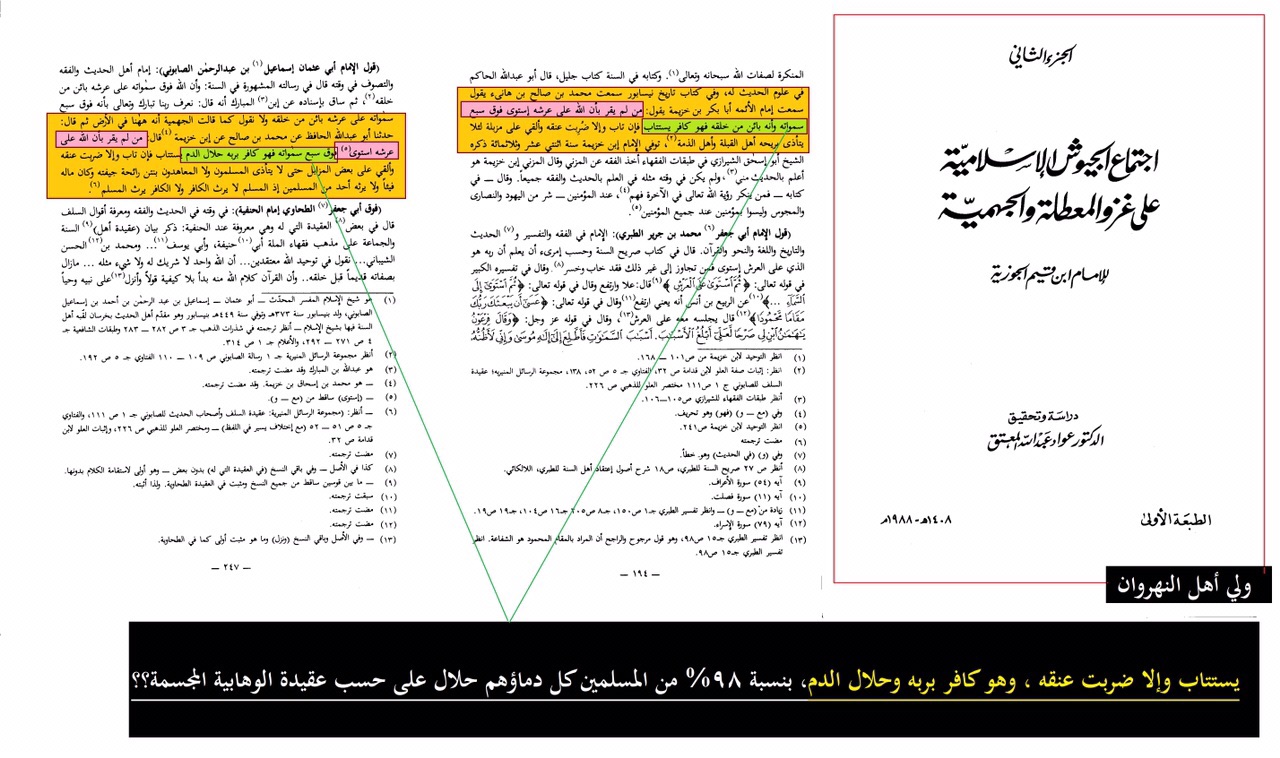
“And from the book: Taarikh Al Naysapuri – I heard from Muhammed B. Saleh B. Haani, who heard the Imam of the Scholars: Abu Bakr B. Khuzaymah say: “Whoever does not affirm that Allah is over the throne, and has settled on the throne, above the seven heavens and that he is separate from his creation, then he is a kafir-he is obligated to repent or to be struck (killed). Otherwise he will harm the people of the qiblah and the non-Muslims with his presence.”
Source: (Kitab Ijtima Al Juyush Vol 2: Ibn Qayyim.)
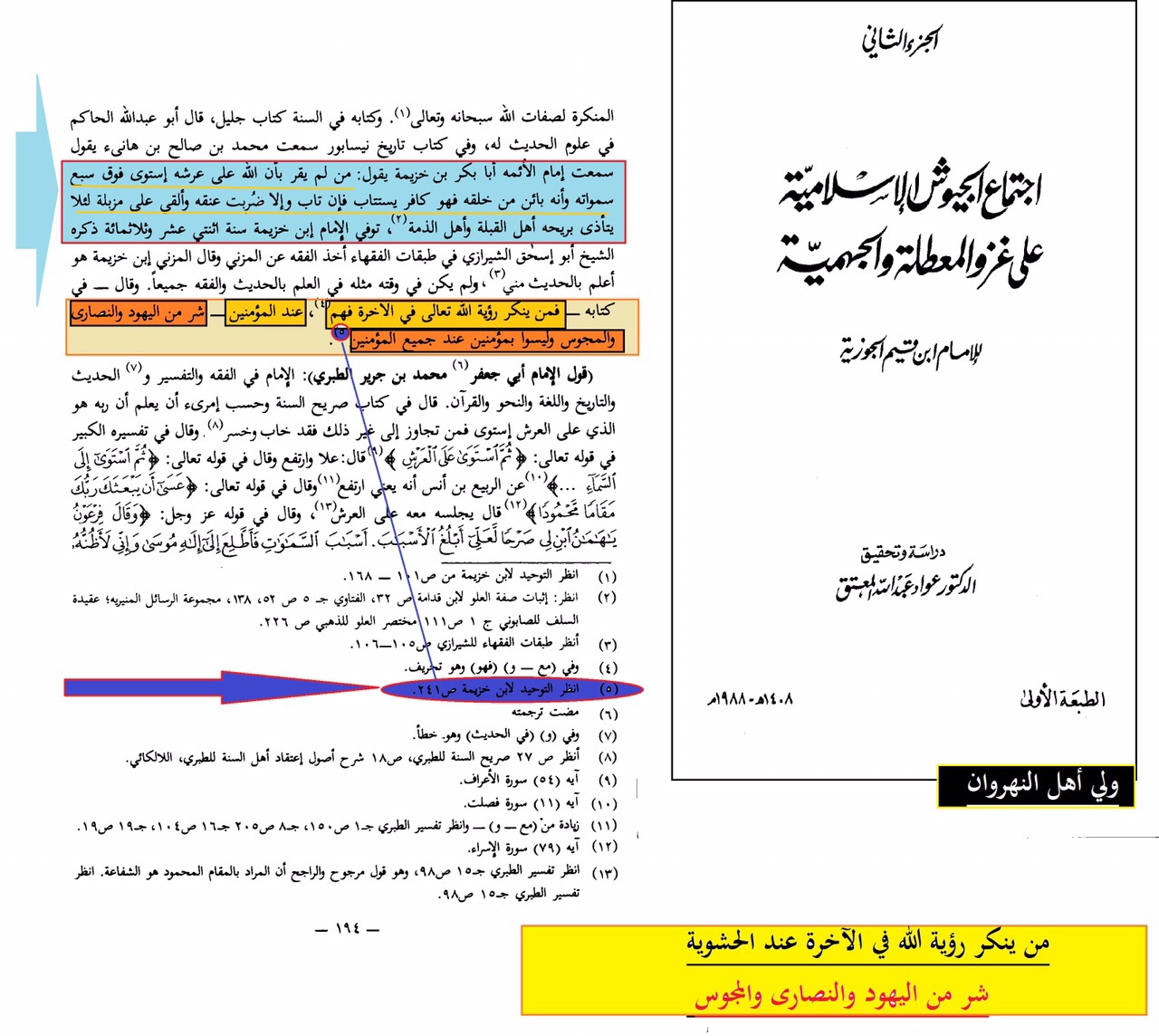
“And he was in the 7th Heaven, Because the Prophet (saw) – Saw his Lord. While he was in this world, and did you know that the scholars did no differ that the entirety of the believers will see they’re lord in the hereafter, and not in this world. Whoever denies the seeing of they’re Lord on the day of gathering is not a believer in the eyes of the believers. And He is worse to the scholars than the Jews and Christians and the Magians. As Ibn Mubarak said: “We can bare the sayings of the Christians and Jews but we cannot bare the saying of the Jahmiyyah.” [end of blue section]
Source: (Page 587 Kitab Al Tawheed By Ibn Khuzaymah)
“And from the book: Taarikh Al Naysapuri – I heard from Muhammed B. Saleh B. Haani, who heard the Imam of the Scholars: Abu Bakr B. Khuzaymah say: “Whoever does not affirm that Allah is over the throne, and has settled on the throne, above the seven heavens and that he is separate from his creation, then is a kafir-he is obligated to repent or to be struck (killed). Otherwise he will harm the people of the qiblah and the non-Muslims with his presence.”
The Imam, Ibn Khuzaymah Died In The Year 312 a.h And he says in his book also, “Whoever denies the seeing of Allah in the hereafter, then he is in the sight of the believers, more worse than a Jew or a Christian or a Magian-and they are not believers in the view of the believers.”
Sources: (Kitab ijtima al Juyush Vol 2 Page 194: Ibn Qayyim Kitab Ijtima Al Juyush Vol 2: Ibn Qayyim.)
“This Is The Saved Group, Those who have gathered upon the truth brought by the The Messenger (saw) and that which he was steadfast upon and those who steer upon the path of the Messenger (saw) and his companions. These are the Ahlul Sunnah Wal Jamaah, The people of the noble hadith-the Salafis those that follow the righteous Salaaf-and strive upon their path in upholding the Qur’an and Sunnah and any other sect opposing them-for them is the promise of Hell.”
“Therefore you-oh seeker-are too look at every sect that proclaims they are the saved sect and look into their actions. If their actions actions is in compliance with the Shari’ah then they are the saved sect and if not, then no. And what is the scale that is meant of judging is the Qur’an and Purified Sunnah in (validating) the truth all of it.”
Source: (Fatawaa Noor Alaa Al Darb, Vol 2, Pg 12: Ibn Baz.)
OPEN YOUR EYES DEAR READERS AND SEE FOR YOURSELF! THE SALAFI MANJAH IS UPON THE MANHAJ OF SLAUGHTER AND KILLING.
Ibn Taymiyya al Harrani what is he is talking about!?
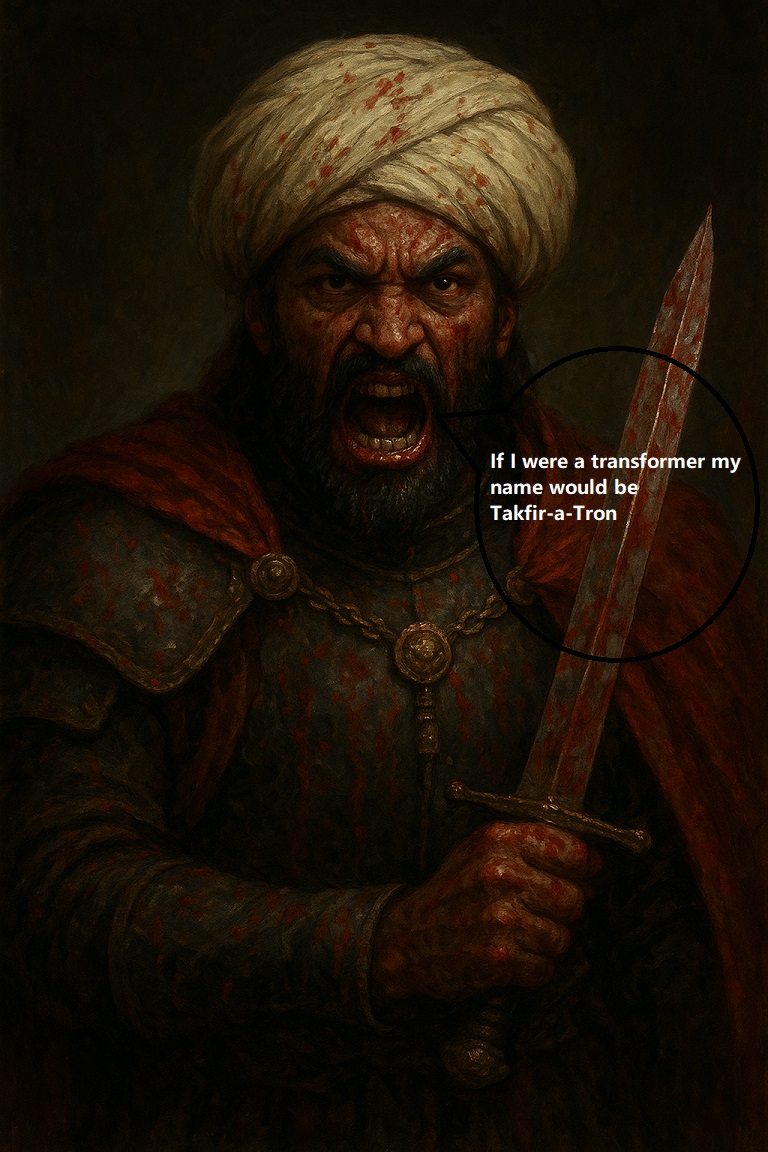
If this guy was a transformer his name would be TAKFIRA-TRON.
This Salafiyyah dawah is effective ONLY in that the people they talk to on the streets they only show the people what they want them to see. Those people (who they invite to Islam) are not researchers and they don’t have access to the Arabic language.
If people really know about them they will know that what they present is not Islam at all.
And those who say, ‘Our Lord, give us from our spouses and successive generations of offspring a pure joy to set eyes upon for their righteousness; And make us to those who fear Allah an example.’” (Qur’an 25:74)
﷽
نسب الدين عند الإباضية في المشرق
نشر الشيخ مسعود المقبالي ردا فيه نقل لنسب الدين عند الاباضية في المشرق الاسلامي للاجابة عن سؤال :
من أين أخذ الإباضية :
1-دينهم
2-وفقههم
3-وسيرهم
4-وحديثهم
” جوابا أقول إن الإباضية أخذوا فقههم وتفسيرهم وحديثهم ودينهم عموما أخذوه عن أئمتهم العدول الأكابر جيلاً بعد جيل وقرناً بعد قرن
ففي زماننا هذا ننعم وبحمد لله بشيخنا وقدوتنا وفقيه عصرنا ومصرنا سماحة الشيخ أحمد بن حمد الخليلي يحفظه الله تعالى ومن معه من الفقهاء الكبراء الكرماء
والذين أخذوا دينهم عن عدول القرن الرابع عشر وهم :
نور الدين عبدالله بن حميد السالمي
والمحقق عامر بن خميس المالكي
وأمام المسلمين محمد بن عبدالله الخليلي
والعلامة المعمر ماجد بن خميس العبري
والشيخ الثقة محمد بن عبدالله الريامي
والشيخ عيسى بن صالح الحارثي
والشيخ خلفان بن جميّل السيابي ، وغيرهم
وهؤلاء أخذوا دينهم عن عدول القرن الثالث عشر وهم :
الشيخ الرباني سعيد بن خلفان الخليلي
وصالح بن علي الحارثي
ومحمد بن سليّم الغاربي
وناصر بن جاعد الخروصي
وسلطان بن محمد البطاشي
وغيرهم كثير
وهؤلاء أخذوا دينهم عن عدول القرن الثاني عشر وهم :
الشيخ سعيد بن بشير الصبحي
والشيخ جاعد بن خميس الخروصي
والشيخ سعيد بن أحمد الكندي
والشيخ خلف بن سنان الغافري
والشيخ ناصر بن سليمان
والشيخ محمد بن مداد
وهؤلاء أخذوا دينهم عن عدول القرن الحادي عشر وهم :
الشيخ خميس بن سعيد الشقصي
والشيخ مسعود بن رمضان النبهاني
والشيخ خميس بن رويشد المجرفي
والشيخ صالح بن سعيد الزاملي
والشيخ عبدالله بن محمد بن غسان الكندي
وهؤلاء أخذوا دينهم عن عدول القرن العاشر وهم :
كالشيخ العلامة الكبير محمد عبدالباقي
والشيخ عبدالله عمر بن زياد الشقصي
والشيخ محمد بن احمد بن غسان
والفقيه أحمد بن مداد
والشيخ محمد بن عبدالله بن مداد
وهؤلاء أخذوا دينهم عن عدول القرن التاسع وهم :
الشيخ علي عبدالباقي
والشيخ أحمد بن صالح بن مفرج
والشيخ صالح بن وضاح
والشيخ سليمان بن أحمد بن مفرج
والشيخ أبي الحسن خميس بن عامر
وهؤلاء أخذوا دينهم عن عدول القرن الثامن و هم :
كالعلامة سعيد بن أحمد بن محمد بن صالح
والشيخ أبي القاسم بن أبي شائق
وأخيه عبدالرحمن بن أبي شائق
والشيخ سليمان بن راشد بن صقر العدوي
وأخيه دهمان بن راشد بن صقر
وهؤلاء أخذوا دينهم عن عدول القرن السابع وهم :
الشيخ أحمد بن النظر بن سليمان
(العالم الشهيد الذي قتله خردلة)
والشيخ أبي عمر النخلي
والشيخ سعيد بن أحمد بن محمود
والشيخ أبي الميكال موسى بن كهلان
والشيخ أبي عثمان الأصم
وهؤلاء أخذوا دينهم عن عدول القرن السادس وهم :
الشيخ العلامة الخضر بن سليمان
والشيخ أحمد بن عبدالله بن موسى
والشيخ محمد بن إبراهيم بن موسى
والشيخ أبي محمد عبدالله بن محمد بن إبراهيم السمائلي
وهؤلاء أخذوا دينهم عن عدول القرن الخامس وهم :
كالعلامة أبي علي الحسن
والعلامة سلم بن مسلم العوتيبي الصحاري
والعلامة محمد بن عبدالله الكندي
والقاضي محمد بن عبدالله
والقاضي أبو حسن بن أحمد الهجاري
والعلامة أبي الحسن البسيوي
وهؤلاء أخذوا دينهم عن عدول القرن الرابع وهم :
إمام المذهب أبو سعيد محمد بن سعيد الكدمي الناعبي
والشيخ الأصولي ابن بركة
والعلامة أبي محمد الحواري
والعلامة أبي المؤثر
وهؤلاء أخذوا دينهم عن عدول القرن الثالث وهم :
العلامة الكبير موسى بن علي
والعلامة محمد بن محبوب بن الرحيل
والعلامة أبو المؤثر
والعلامة أبو جابر محمد بن جعفر
والعلامة بشير بن محمد بن محبوب
والعلامة
وهؤلاء أخذوا دينهم عن عدول القرن الثاني وهم :
الربيع بن حبيب (صاحب المسند)
وسيف بن هبيرة
والمنير بن النير الجعلاني الريامي
ومحمد الكندي
وبشير بن المنذر النزواني
والأزكوي
وهؤلاء أخذوا دينهم عن عدول القرن الأول وهم :
جابر بن زيد أبي الشعثاء
زميل الحسن البصري
ومازن بن غضوبة السعدي السمائلي
وسيف بن هبيرة فارس رسول الله
وعبد و جيفر ابنا الجلندى
وجعفر
ومن الذين حملوا العلم وأخذ أهل عُمان عنهم :
أبو عبيدة مسلم بن أبي كريمة التميمي
وعبدالله بن إباض ، الذي تنسب إليه هذه الفرقة
وعبدالله بن إباض هو إمام سياسة الإباضية لا إمام علم
After the Muslims, the People of the Truth and Steadfastness had captured Mecca and Medina the following Khutbah was given.
Abu Hamza al-Mukhtar bin Awf al-Uzdy al-Umany. Also known as Abu Hamza al-Shari. One of the prominent Ibadhi’s of Basra. The sermon was delivered in Medina in the presence of Imam Malik ibn Anas:
“I counsel you in fear of Allah and the Sunnah of His Prophet (Blessings and peace be upon him) and to observe the ties of blood, and magnify the truth of Allah which tyrants have diminished, and to diminish the falsehood they have magnified, to put to death the injustice they have brought to life, and to revivify laws they have let die; to obey Allah and to those who obey Him, disobey others in obedience to Him, for there is no obeying a creature which disobeys its Creator. We call you to the Book of Allah and the Sunna of His Prophet, and to equal sharing, and to justice for the subject peoples and to putting the fifth of the booty in the place Allah ordained for them. As for us, we have not taken arms lightly or frivolously, for play or amusement, or for a change of government on which we hope to immerse ourselves, or for the revenge that was taken from us; but we did it when we saw the earth had grown wicked, and proofs of tyranny had appeared, and religious propagandist increased, but men did as the pleased, and laws were neglected, and the just were put to death, and speakers of truth treated violently, and we heard a herald calling us to Truth and the straight Path, so we answered the summoner of Allah…And by His grace we became brethren.”
“O people of Medina! Children of the Muhajirin and the Ansar! How sound are your roots, and how rotten are your branches! Your fathers were men of certainty and religious knowledge and you are a people of error and ignorance. For Allah opened the door of religion for you, and you (let it grow choked with rubbish); He locked the door of this world for you and you forced it open; hasty to temptation and laggards in the way of the Prophet; blind to the demonstration of Truth and deaf to knowledge; slaves of greed and allies of affliction! How excellent was the legacy your fathers left, had you preserved it, and how miserable will be that of your children if you hold on to it! Them He aided to the Truth you He deserts in error. Your ancestors were few and pious, and you are many and malicious. The preachers of the Qur’an cry out to you, and you are not chidden’ they warn you, and you do not ponder!
(Islam by John A. Williams (London & New York 1961 pp 215-217)
“I did not translate this too give validation by Malik’s statement far from that, I only did this too show the irony in the term “salaf” and how precedent this School Of Thought Is. What Malik thinks or thought about us grants me no relief nor worry-Wallahu Mustaan.”- Abu Azzan al-Muttarjim
“We do not abrogate an ayat or cause it to be forgotten except that We bring forth better than it or similar to it. Do you not know that Allah is over all things competent?” (Qur’an 2:106)
“And when We substitute an ayat in place of an ayat – and Allah is most knowing of what He sends down – they say, “You, [O Muhammed], are but an inventor [of lies].” But most of them do not know.” (Qur’an 16:101)
﷽
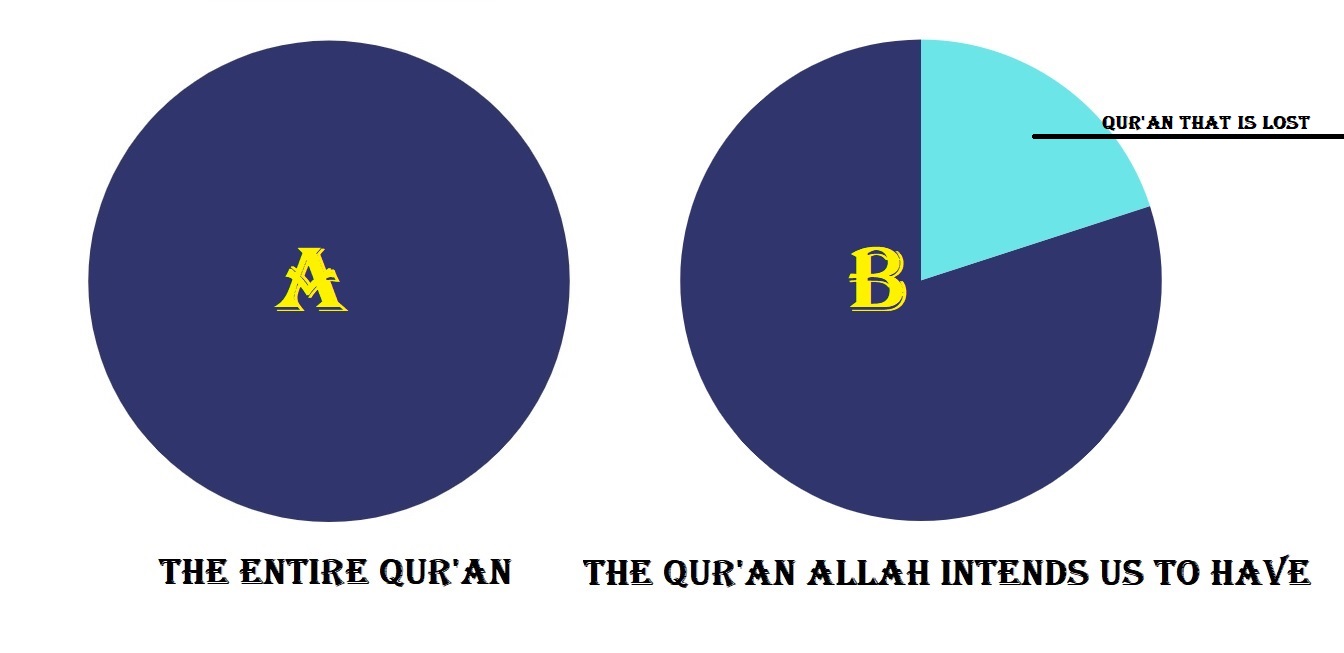
One of the major differences in aqidah (creed) between the Ibadi school and those from ‘Ahl Sunnah’ is on the issue of the preservation of the Qur’an.
The Ibadi position is this:
We have the entire Qur’an. (Chart A)
We have the Qur’an that Allah (swt) intended for us to have which is Chart A
The Sunni position is this:
We have the Qur’an that Allah (swt) intended for us to have. Chart B
We do not have the entire Qur’an.* Chart B
*Note. This is not an outlier or strange position. This is the major position with in what is called ‘Ahl Sunnah Wal Jammah‘. You may be surprised at those who call themselves Sunni who are simply ignorant of this. However; as with any school of theology, jurisprudence or approach taken it is always possible to have minority voices and or those that dissent from the mashur (majority view).
This entry will discuss some observations by a Sunni apologist whom is replying to what is commonly referenced on internet culture as team: “Atheist-Christ*” . In this particular response to 1/2 of team Atheist-Christ an enterprising Sunni apologist gives what he feels is a robust response.
*Note: For those not familiar, an Atheist-Christ is a Christian unbothered by an unsaved Atheist among them. He (the Christian) teams up with the Atheist and they jointly attack Islam.
Thus, 1/2 of team Atheist-Christ is an apologist whom has taken issue with the idea of the Qur’an having lost and/or forgotten chapters/verses/words and so forth.
When it comes to the idea or concept of abrogation the only consensus that the Sunni Muslims seem to have is that such a concept exist. What actually abrogates what is anyone’s guess.
Some of them even believe in scenarios such as that the Qur’an used to have verses that explicitly mention stoning adulterers to death and that the verses were abrogated/lost/forgotten/eaten by a goat. However, the ruling remains! In our school this concept is one in which refuge in Allah (swt) is sought.
You get into issues such as the Qur’an abrogating the Qur’an. The Sunnah abrogating the Sunnah. Or even the Sunnah abrogating the Qur’an. The last one being the most dangerous of all, as the sunnah is primarily preserved and transmitted via lone narrator reports. It is an excellent opportunity for something that is dhan (uncertain) to overrule or overwrite something that is qati (decisive) such as the Qur’an.
The basis for this belief is the following text from the Qur’an.
“We do not abrogate an ayat or cause it to be forgotten except that We bring forth better than it or similar to it. Do you not know that Allah is over all things competent?” (Qur’an 2:106)
The assumption here is that the word ayat is referencing a verse in the Qur’an. It is not assumed for example that is a reference to miracles, that are no longer witnessed or tangible. or that it a reference to even the previous revelations. Now there are so many things to be said about this in and of itself. Notice that it does not say the word surah (chapter). For example in the following verse:
“And if you are in doubt about what We have sent down upon Our Slave, then produce a Surah (chapter) the like thereof and call upon your witnesses other than Allah , if you should be truthful.” (Qur’an 2:23)
This part also deserves pensive reflection on the part of those who believe the Qur’an is eternal and uncreated.
“We bring forth better than it or similar to it“
Abrogation is omission, removal and it is impossible for that which is eternal. The idea that some part of Allah’s sifat of attribute of ‘speech‘ would be ‘better‘ or “improved upon” over other parts merits pensive reflection.
“We bring forth better than it or similar to it”
If a person believes that this statement is a reference to the Qur’an than it creates a circular reasoning. If you no longer have the original source to compare it with than you have no way of knowing in what way that which was brought was improved upon.
An example:
As mentioned there is the view among a great many Sunni scholars that there used to be verses of stoning the adulterers in the Qur’an and that was abrogated/lost/forgotten/eaten by a goat. Recall the verse they base their belief on states: “We bring forth better than it or similar to it.” So which verse in the Qur’an now is now similar to it or better than it?
Why are Christians scolded for forgetting the revelation where as for Muslims it becomes a proof and a miracle for Islam? So much so that for the Christians hate and enmity was stirred up between them?!
“And with those who say ‘We are Christians’ We took compact; and they have forgotten (fanasu)a portion of that they were reminded of. So We have stirred up among them enmity and hatred, till the Day of Resurrection; and Allah will assuredly tell them of the things they wrought.” (Qur’an 5: 14)
In fact because I can anticipate how these people think. I can almost guarantee you the immediate response will be something akin to the following: “The difference here is that Allah made the companions forget where as the Christians forgot from negligence.”
Which also baffles me. The Creator causes you to forget his revelation = something meritorious.
The Arabic word Insan is derived from the Arabic nasiya meaning to forget. In fact you can see that in the very text of Q 5:14 above.
So allow me to share with you the video from a Sunni apologist who goes by the name of Farid. I think he means well and over all he some good material.
So after listening to 1/2 of team Atheist-Christ put up his objections against the Qur’an Farid had the following to say:
“”Alright. So Firstly the common answer to this which is the answer I adopt is that this this chapter was abrogated. That’s what that’s the classical position. So the argument for that is really simple. Uh basically this specific verse. This specific verse that speaks of the son of Adam having valleys of gold or valleys of wealth, this specific uh verse was memorized and documented by um according to Sayuti 15 companions. That’s quite a high number. and yet it never got into the Qur’an.” -Farid
Prima Qur’an comments:
Actually, it is very surprising that Farid says this. Perhaps to give him the benefit of the doubt what he means is the Uthmanic codex; because to say that it was never part of the Qur’an is to totally misread what was plainly stated.
Look again:
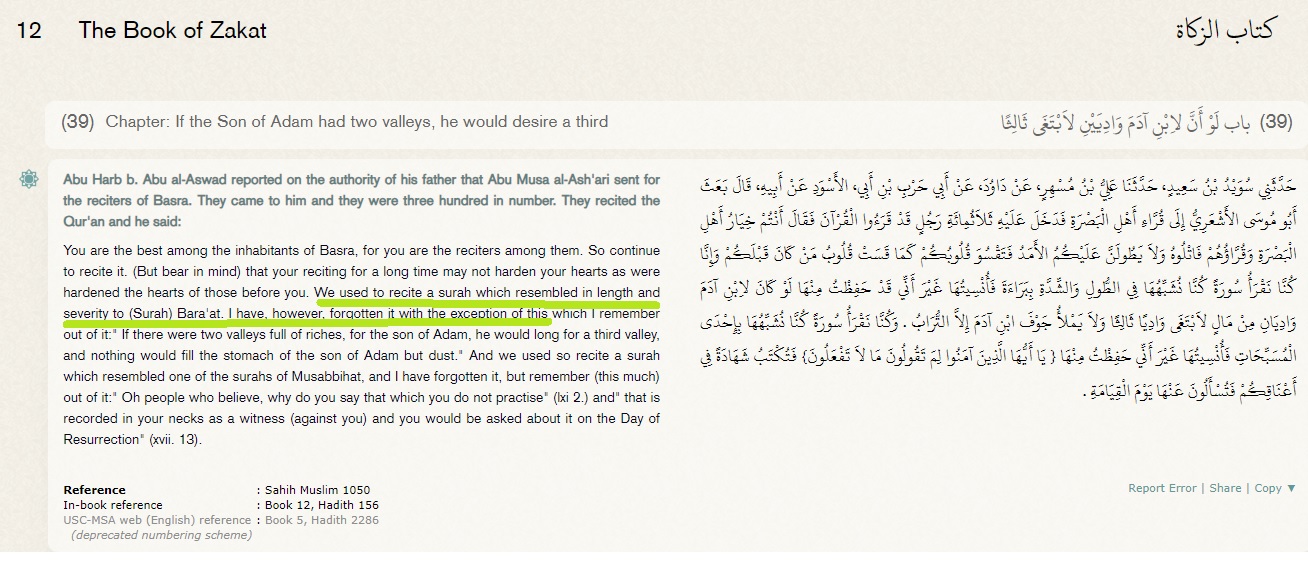
“We used to recite a surah which resembled in length and severity to (Surah) Bara’at. I have, however, forgotten it with the exception of this…..”
It is clear that was considered part of the Qur’an. We do not call du’a and invocations surah. So the more correct perspective here (if it were true at all) is that it was part of the Qur’an. It just doesn’t become part of the Uthmanic codex.
Farid continues:
“Now there is nothing controversial about the verse. There’s no reason for someone to hide the verse away or anything like that. So yes the traditional Islamic answer is this verse EXCUSE ME THIS CHAPTER was abrogated. And that itself will be convincing to any Muslim.”-Farid
Prima Qur’an comments:
Well, I am a Muslim and I am not the only one that doesn’t buy this at all. The Mufti of Oman, learned scholar and Shaykh, has this to say:
“Abrogation is never permitted in the reports of the Law-Maker because His Knowledge is not refreshed and He is not ignorant of anything that happens, and He does not reveal but the truth.”-Shaykh Ahmed Al Khalili (h)
Notice that Farid does a kind of bait and switch. In the above paragraph he uses the word ‘verse’ twice and the third time finally says, “Excuse me This CHAPTER.” Because that is what is being discussed. Recall “We used to recite a surah which resembled in length and severity to (Surah) Bara’at. I have, however, forgotten it with the exception of this…..”
So since the entirety of the chapter(surah) was lost or forgotten Farid is in no position to say that nothing controversial was in its contents. The reason he cannot say that is accordingly the chapter (surah) as a whole was lost/forgotten. However, the portion the chapter that was remembered was: “If there were two valleys full of riches, for the son of Adam, he would long for a third valley, and nothing would fill the stomach of the son of Adam but dust.”
Also, recall the verse in the Qur’an that is the basis for this belief.
“We bring forth better than it or similar to it”
So what verse did Allah (swt) bring that was better than or equivalent to the one of the two valleys full of riches?
Farid continues.
“Now before getting to my arguments I want you to be aware that the concept of abrogation is not something that is specific to Islam. It’s something that existed in Christianity previously you have the laws of Christianity abrogating the laws of Judaism. Right? Umm You even have specific examples of works that were abrogated because they were not important um in Judaism. So this is again this is not something that’s exclusive to Islam.”-Farid
Prima Qur’an comments:
It would have been great if Farid would have given an example of a law in Christianity abrogating a law of Judaism. If he done that perhaps we could see even how problematic such a concept was in their traditions as well. For example:
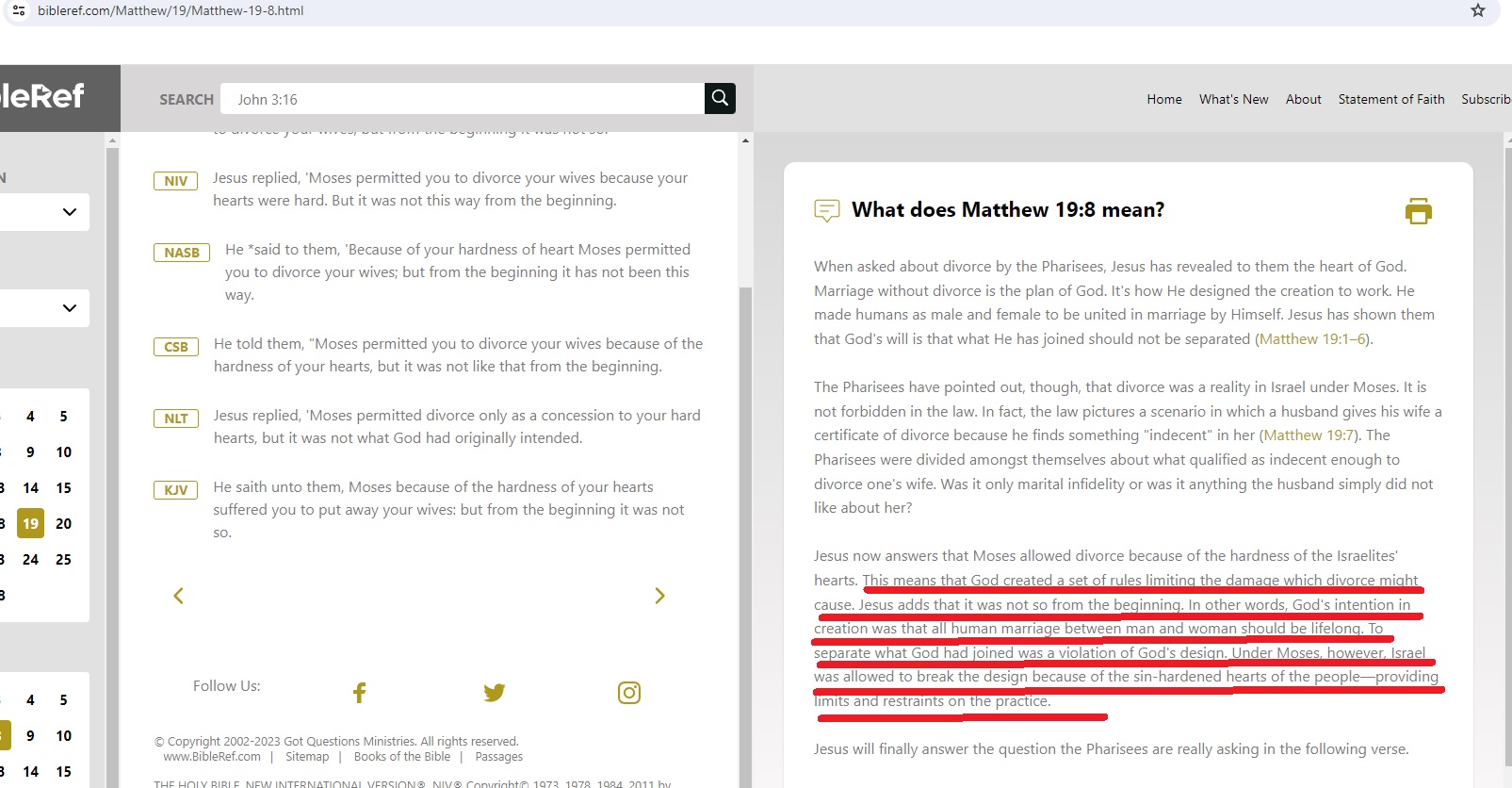
Jesus replied, “Moses permitted you to divorce your wives because your hearts were hard. But it was not this way from the beginning. I tell you that anyone who divorces his wife, except for sexual immorality, and marries another woman commits adultery.” (Matthew 19:8-9)
“If a man marries a woman who becomes displeasing to him because he finds something indecent about her, and he writes her a certificate of divorce, gives it to her and sends her from his house, and if after she leaves his house she becomes the wife of another man, and her second husband dislikes her and writes her a certificate of divorce, gives it to her and sends her from his house, or if he dies, then her first husband, who divorced her, is not allowed to marry her again after she has been defiled. That would be detestable in the eyes of the Lord. Do not bring sin upon the land the Lord your God is giving you as an inheritance.” (Deuteronomy 24:1-4)
So initially Jesus (whom is God the Son) according to the Athanasian Trinity gave Moses this command that it was o.k to divorce a woman if he found something displeasing or indecent about her. After she marries another man and he too divorces her or dies she cannot go back to the first husband as that would be ‘detestable’ in the eyes of the Lord. Yet, this same Jesus (whom is God the Son) than tries to say it was Moses who gave such a law because “your hearts’ were hard”
Christian damage control
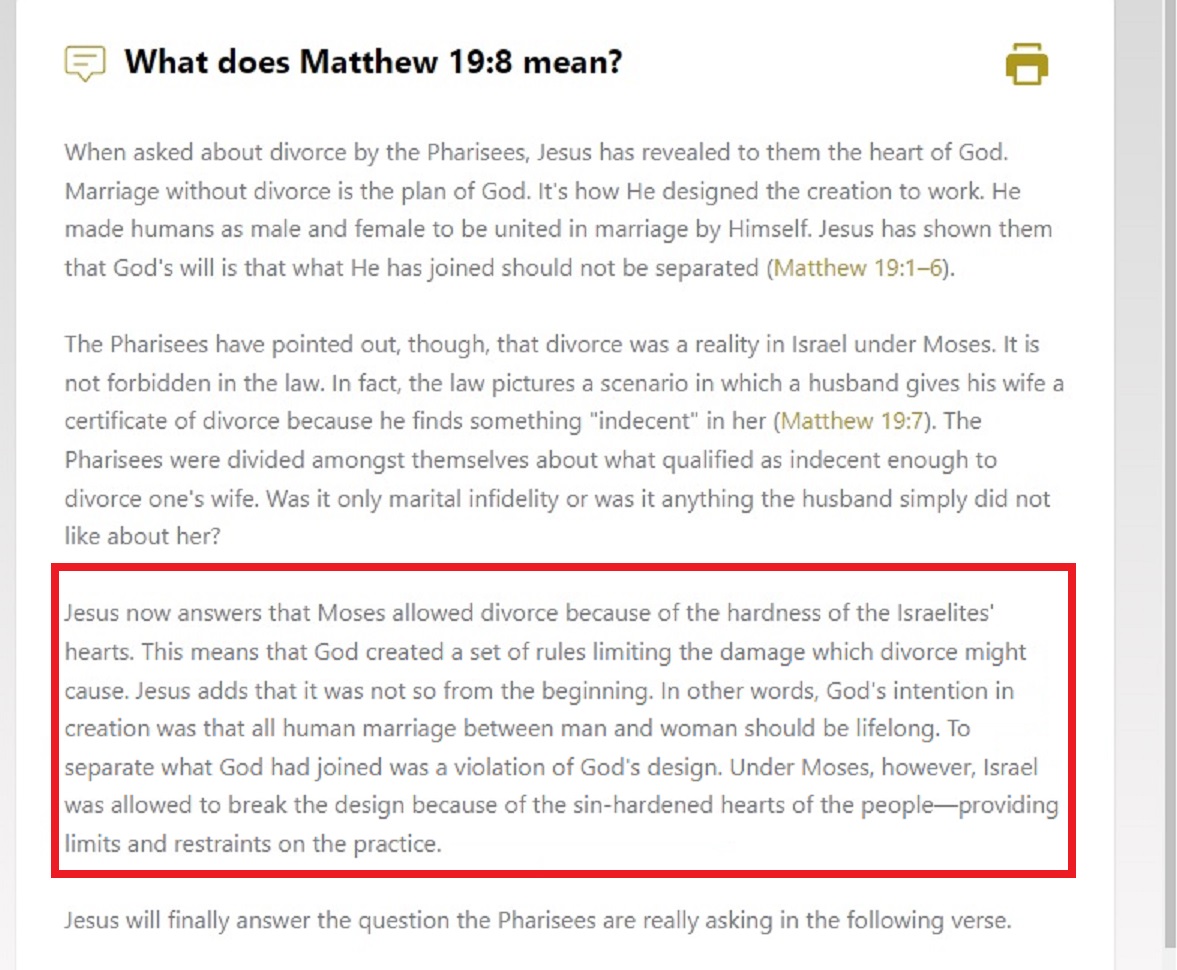
“Jesus now answers that Moses allowed divorce because of the hardness of the Israelites’ hearts. This means that God created a set of rules limiting the damage which divorce might cause. Jesus adds that it was not so from the beginning. In other words, God’s intention in creation was that all human marriage between man and woman should be lifelong. To separate what God had joined was a violation of God’s design. Under Moses, however, Israel was allowed to break the design because of the sin-hardened hearts of the people—providing limits and restraints on the practice.”
God (Jesus as God the Son) first allowed this type of divorce even though it was a violation of his (Jesus) design. Mostly because of the recognition that people’s hearts were hard. However, he suddenly changes that. Umm why? Aren’t the hearts still hard? You mean to say that human hearts are not hard anymore?
Do you know the irony of all this dear readers?
Religious Jews will see this a proof against Christianity and the capricious nature of how they perceive God.
Religious Christians will see this a proof for Jesus divinity because: Who else can give laws that they personally dislike, and violate the very intended pattern hey have planned for human beings (but not yet cause their hearts are hard) but some time 2000 years ago (possibly their hearts were not as hard) and yes you know what that was not adultery than but it is now: who can do that but God?
Religious Muslims who are involved in polemic with Christians (people like brother Farid) would possibly use arguments like this against the Christian faith and yet see things like this as a case for Islam.
This doesn’t become about being consistent and defending the haqq (truth). It’s about the football jersey that I wear and yours doesn’t’ match mine!
Farid continues.
“Now in regards to this specific matter what I find really interesting here this is referring to Abu Musa Al Ashari; who taught the Qur’an in Basra who taught the Qur’an in Yemen he was seen as one of the main reciters of the Qur’an. We rely upon Abu Musa for our Qir’aat today however, however, interestingly Abu Musa forgot a complete chapter of the Qur’an And what’s really interesting about that specific chapter is like we have no information about it.”-Farid
Prima-Qur’an comments:
These statements by Farid prove my previous points. Namely,
A) We can’t say that the chapter contained anything controversial because as he stated, “We have no information about it.”
B) Farid stated earlier that “and yet it never got into the Qur’an.” Than he says, “Abu Musa forgot a complete chapter of the Qur’an” This is why I give him the benefit of the doubt that what he means is the Uthmanic codex. Not that it was never part of the Qur’an ever.
Farid continues.
“Now in this specific hadith we find Abu Musa not saying not saying I forgot this chapter. He says, I was made to forget this chapter. Where do we find this concept? Well we find it in the Qur’an in verse 106 in Surat al Baqarah mā nansakh min āyatin aw nunsihā nati bikhayrin min’hā aw mith’lihā (We do not abrogate a verse or cause it to be forgotten except that We bring forth [one] better than it or similar to it.”-Farid
Prima Qur’an comments:
Actually, Abu Musa does not say, “I was made to forget this chapter.” He says, “I have, however, forgotten it with the exception of this.” Thus, he did not forget the whole chapter. He forgot all of it with the exception of a certain portion. A portion which Farid admits was recited as the Qur’an and it is still there (as it is in the hadith) but it not recited as part of the Qur’an today.
Is this really what Qur’an 2:106 is saying?
Does it say, “We do not abrogate an entire chapter, with the exception of some verses that will remain but will not be in the final version of this Qur’an, or cause it to be forgotten except that We bring forth [one] better than it or similar to it, except for the two valleys verse which will remain and not be included in the final compilation.”
This is absolutely bizarre.
Farid continues.
“Now I want you to focus on the words cause it to be forgotten. That is what Abu Musa is saying I was made to forget this. That’s what Abu Musa is saying. Now, how can that even be proven right? I mean that’s the concept is very strange in itself, but is there any precedence for this? Now what really blew my mind was this specific narration That is narrated by Abu Umamah ibn Sahl in which he says, One night a man tried to read a chapter of the Qur’an that he had but he could not. Another man tried to read it but he also could not. Another man also tried to read it but failed. In the morning they went to the Messenger of Allah and gathered there. One of them said: “O Messenger of Allah! Yesterday night I tried to read chapter so-and-so but I could not.” The other said: “I have come for this very reason.” The third man said: “Me too.” The Messenger (saw) said: “It was abrogated yesterday.” Uh this specific hadith is narrated in nasikh wal mansukh by Abi Obaid; it was also narrated in other works like (I did not catch this part) Um it was also narrated by Tabarani in his Mu’jam al-Kabir in which he says that the Ansar that actually go to recite this verse only managed to recite the words bismillah ir rahman ir raheem, in the name of Allah, The Most Gracious, Most Merciful, and than they just freeze. Not knowing forgetting the rest of the chapter. Which is just it’s really interesting.Basically, what happened was you have this collective amnesia that occurred. Now, now I don’t have the answers in regards to why this occurred. I have no idea what was in that chapter. I have no idea what was in the chapter that abu musa narrated. Um it may even be the same chapter; but for some reason God in his infinite wisdom decided to abrogate that chapter in the same way he decided to abrogate the laws of the old testament and the..(pause) and other books in the old testament as well.”
Prima Qur’an comments:
Al hamdulillah. At least Farid realizes that this whole thing does seem “very strange'”
Farid proposes that there was some how this “collective amnesia” that occurred.
Now neither Farid or myself (to my knowledge) are medical doctors. However, what I can see is that there are considered to be three types of amnesia.
Types of Amnesia
Retrograde amnesia. Having retrograde amnesia means you’ve lost your ability to recall events that happened just before the event that caused your amnesia. …
Anterograde amnesia. …
Transient global amnesia (TGA).
You may read more the distinction between Anterograde Amnesia VS. Retrograde Amnesia here:
I was not satisfied that what Farid describes really fits into any of these categories. At first I thought that maybe Transient global amnesia (TGA) would fit the description. Yet this seems temporary with the memories coming back. So than I thought I would search selective amnesia. This seems to fall under a type of dissociative psychiatric disorder. I do not believe that Farid attributes that to the companions at all.
Farid quotes an example of a few people not being able to remember a particular surah (chapter) and than the Blessed Messenger (saw) is attributed with saying that it was abrogated the night before.
Farid than quotes two other sources but does not bring the references.
“ it was also narrated in other works like (I did not catch this part) Um it was also narrated by Tabarani in his Mu’jam al-Kabir.”
So for example we do not know the type of “amnesia” they had. Was it temporary?
There seems to be temporary memory loss. Where did I place those car keys? There seem to be permanent memory loss, associated above with one of the types of amnesia.
There seems to be forgetfulness of something tangible and non tangible. There seems to be a situation where you were forgetful of what you are forgetful of. Another is something tangible.
So again this creates a type of circular reasoning where if you do not really recall a particular chapter or verse it is possible that you did not forget it at all but just think that you did. You could misplace or forget where you put your car keys. Yet, you know the item in question is tangible, they are car keys. But where did you place them? However, if you think about something obscure like a passage from a book and you think you forgot how to recollect it, it is very possible that actually didn’t commit it to memory to begin with. A type of paradox.
Farid continues.
“Now the Non-Muslim that’s watching this video naturally will be skeptical. Um will probably say, but you see this hadith of Abu Musa it’s speaking about a miracle why should I believe this narration that’s speaking about a miracle there’s no reason for me to believe this. Now I understand where you’re coming from. But that’s why the hadith of Abu Musa that David{1/2 of Atheist-Christ} is quoting is really interesting; and the reason is because again it’s narrated by around 15 people um at least of course at least that’s what we have received. Right? Now none of those 15 actually provide um any context to this. They simply say stuff like oh I heard Rasulullah (saw) recite this verse that speaks of the son of Adam having two valleys of wealth right? Um and you have them narrating this and it’s preserved arbitrarily. It’s narrated at different times at different places. So, yes you have Abu Musa narrating this in Basra. Uh Ibn Abbas, Ibn Zubair narrating this in Mecca. You have Zaid bin Arqam narrating this in Kufa; and of course you have the rest of the sahaba um narrating this in Medina. That’s really interesting. Their narrating this without a context. No one, none of them are arguing that there is a um collective amnesia going on. However, there is absolutely no trace of this chapter. We don’t know anything about this chapter; except for this one verse. Subhan’Allah. Now, there’s one last thing that comes to mind, which is why does this verse exist. Why do they all remember this verse? And why have they all forgotten the rest of the chapter? Now it seems to me like wallahu’alim that Allah (swt) has left this as a trace to point to there being something there once, and now it’s all gone. Subhan’Allah. And Subhan’Allah I mean I wouldn’t have even come across this if it weren’t for our good friend David Wood {1/2 of Atheist-Christ} Um so thank you David {1/2 of Atheist-Christ} I really appreciate this one. Um trust me I wouldn’t have come across this if not for your video. So please keep it up I’m enjoying, I’m learning I’m hoping that everyone else is enjoying the show as well.” -Farid
Prima-Qur’an comments:
Notice that Farid says, “it’s narrated by around 15 people” latter on he states: “Why do they all remember this verse? And why have they all forgotten the rest of the chapter?“
Now I know that English may not be brother Farid’s native language. May Allah (swt) bless him for doing his level best to combat the false narratives about Islam. However, for an English speaker following along the way Farid words things it gives the impression that these 15 narrators all made comments similar to Abu Musa Al Ashari above; namely, “We used to recite a surah which resembled in length and severity to (Surah) Bara’at. I have, however, forgotten it with the exception of this.” However, that is simply not the case at all. This is why it is important to double check sources and to have those sources available for everyone to scrutinize. Source “Trust me bro” is not helpful. For example:
Anas reported Allah’s Messenger (saw) as saying: قَالَ قَالَ رَسُولُ اللَّهِ
If the son of Adam were to possess two valleys of riches. he would long for the third one. And the stomach of the son of Adam is not filled but with dust. And Allah returns to him who repents.
Ibn Abbas reported Allah’s Messenger (saw) as saying:
If there were for the son of Adam a valley full of riches, he would long to possess another one like it. and Ibn Adam does not feel satiated but with dust. And Allah returns to him who returns (to Him). Ibn Abbas said: I do not know whether it is from the Qur’an or not; and in the narration transmitted by Zuhair it was said: I do not know whether it is from the Qur’an, and he made no mention of Ibn Abbas.
Now it is not possible for the companions to not know the difference between a saying or statement of the Blessed Messenger (saw) and the Qur’an.
Narrated Sahl bin Sa`d:
I heard Ibn Az-Zubair who was on the pulpit at Mecca, delivering a sermon, saying, “O men! The Prophet (saw) used to say, “If the son of Adam were given a valley full of gold, he would love to have a second one; and if he were given the second one, he would love to have a third, for nothing fills the belly of Adam’s son except dust. And Allah forgives he who repents to Him.” Ubai said, “We considered this as a saying from the Qur’an till the Sura (beginning with) ‘The mutual rivalry for piling up of worldly things diverts you..’ (102.1) was revealed.”
If anything is correct about this it is most likely of a similar nature to the Qudsi hadith. That is the content being attributed to Allah (swt) but actually the words of the Blessed Messenger (saw).
Now there is something that Farid said above that sounds sensible when it comes to his point about a trace of something. However, trying to make a connection between 15 narrators and the exact statements of Abu Musa Al Ashari is not something he established. Nonetheless when he says, “Now it seems to me like wallahu’alim that Allah (swt) has left this as a trace to point to there being something there once, and now it’s all gone.“
That is how you avoid the paradox I mentioned earlier. You have to be able to recall that you forgot something and having a trace of that can help to establish something was forgotten(temporarily, forever) that is not established. The point that I made above:
“So again this creates a type of circular reasoning where if you do not really recall a particular chapter or verse it is possible that you did not forget it at all but just think that you did.”
Prima-Qur’an Conclusion:
I do not think that anything presented by Farid presents any type of proof or miracle for Islam and/or the preservation of the Qur’an. Not being able to know if a particular thing forgotten was temporary or permanent is important.
The very hadith cited that kicked off the conversation could very well fall into the genre of Qudsi hadith. There is evidence that the companions felt this was a saying of the Blessed Messenger (saw).
The statement from At Tabarani was not given the source or actual quote. You would think something this phenomena would be more wide spread as well. The concept of abrogation as mentioned in my other entry here: https://primaquran.com/2022/10/04/why-abrogation-in-the-quran-is-a-false-doctrine/ is an absolute train wreck of a doctrine!
Sunni Muslims (with dissenting voices) believe things like there used to be verses about stoning in the Qur’an and it was removed (abrogated) and yet the ruling remains! Why?
Than as Farid states apparently one companion is made to forget an entire chapter of the Qur’an (with the exception of one verse) and even that verse does not end up in the Qur’an we have today.
The idea that Allah’s verses (his eternal speech) and sifat is superseded by (other eternal speech) better than before merits pensive reflection.
When it comes to our school, Ahl Haqq Wal Istiqama we believe the following:
A) We have the whole of the Qur’an with us.
B) We have the Qur’an that Allah (swt) intended for us to have.
Sunni Muslims (with dissenting voices) for the most part hold to position B. They do not hold position A, as they believe whole chapters, verses etc. were lost/forgotten/ etc.
I am motivated to write articles like this because I imagine there is someone persuaded by the depth, comfort, beauty and cohesiveness of Islam. That person than becomes deterred by others telling them, have you seen this video by Atheist-Christ? Than that well intentioned person watches that video and in fairness watches Farid’s video. That person maybe driven further into doubt because Farid’s video could come across as massive copium. In fact that video response could be what drives that person away from embracing the faith!
I want individuals to find responses like this so that they may know that yes Islam is cogent, beautiful, comforting and has depth. If you find certain presentations of Islam disheartening that is not an aspersion on Islam, it is an aspersion on that particular presentation of Islam.
May Allah (swt) guide us to what is beloved to Allah (swt). May Allah (swt) grant victory to our brothers in Palestine amin!
For those interested I also have some entries on abrogation here:
This was in response to statements by Dr. Abdullah Bin Hamid Ali of Lamppost productions and affiliate of Zaytuna Institute in the United States. He is a Sunni Maliki Ashari’i Islamic scholar.
“My Lord! Increase me in knowledge.” (Qur’an 20:114)
﷽
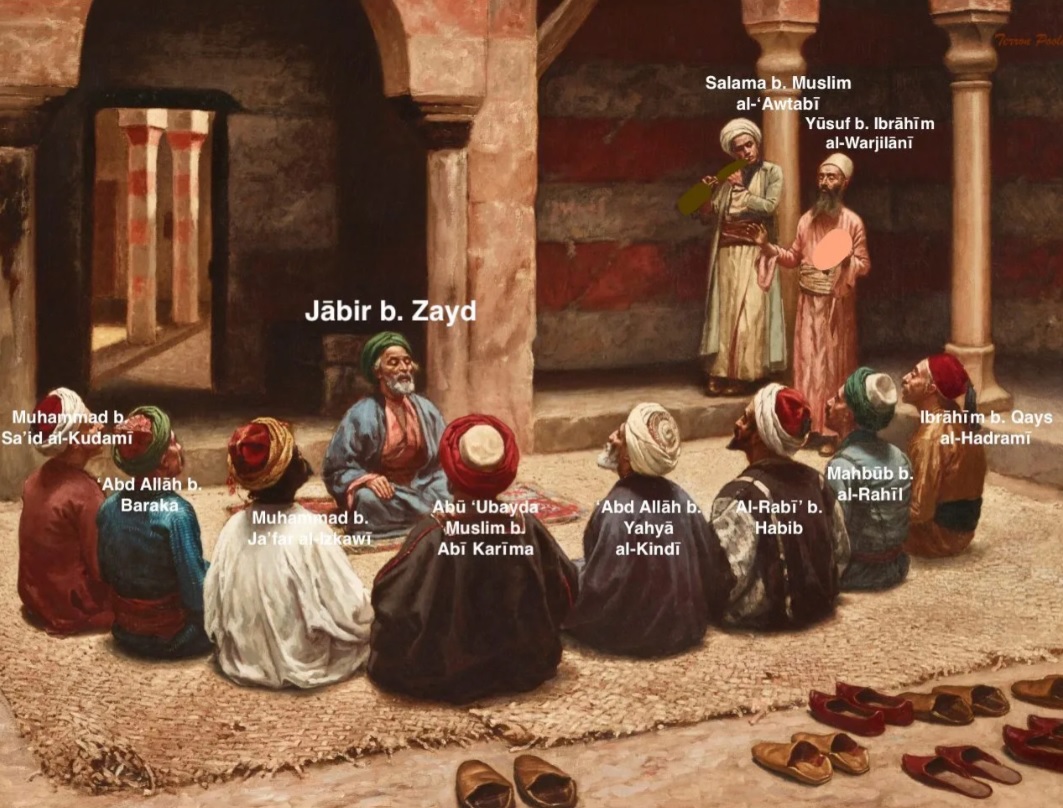
The Ibadi school is the earliest surviving school of jurisprudence. The legal founder of the school is the Tabi’i Jabir Bin Zayed (ra). He took knowledge from many of the companions chief among them are the mother of the believers Aisha (ra) and Abd Allah ibn Abbas (ra).
If you would like to learn more I would invite you to read the following:
“Allah said, O Jesus, I shall cause you to die and will raise you up to Me and shall purify you of the ungrateful disbelieving people, and shall place those who follow you above those who deny the truth, until the Day of Judgement; then to Me shall all return and I will judge between you regarding your disputes.” (Qur’an 3:55)
﷽
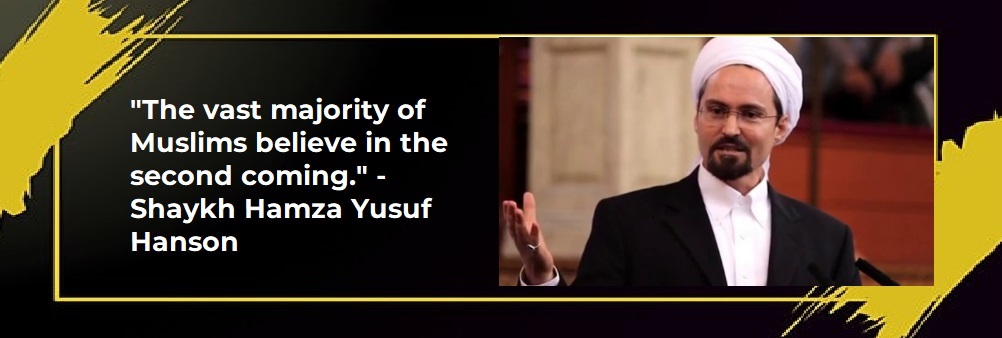
Shaykh Hamza Yusuf states in the interview with Kim Iversen: “What Islam Really Says About Jihad, Martyrdom, and Women’s Rights“, which has been shortened to: “What Islam Really Says About Jihad.“
@17:27 minute mark, Shaykh Hamza says: “The vast majority of Muslims believe in the second coming.”
“My Lord! Increase me in knowledge.” (Qur’an 20:114)
﷽
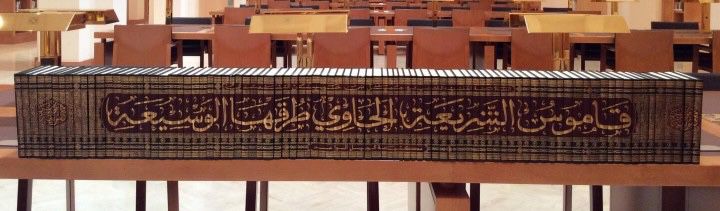
The above book: by Shaykh Jamil bin Khamis as-Sa’adi (r). This book is 90 volumes and 1 volume by the publisher. For a total of 91 volumes. NO Computer, NO electricity, NO printer! Subhan’Allah! The book name is: Qamus al-shari’ah. A dictionary of Islamic Law.
As one can see it is a gargantuan encyclopedia detailing many issues in Islamic law corresponding to the Ibadi manuscripts.
He is a big faqih in our Ibadi school. Lived in 13th century of Islamic calendar.
A friend of ours was offered this set for free but did not know where to place it upon the plane!
When we see this we are astonished.
This is his grandson:
May Allah (swt) reward Shaykh Jamil bin Khamis as-Sa’adi, his son and grandson and all his family and admit them into his spacious garden!
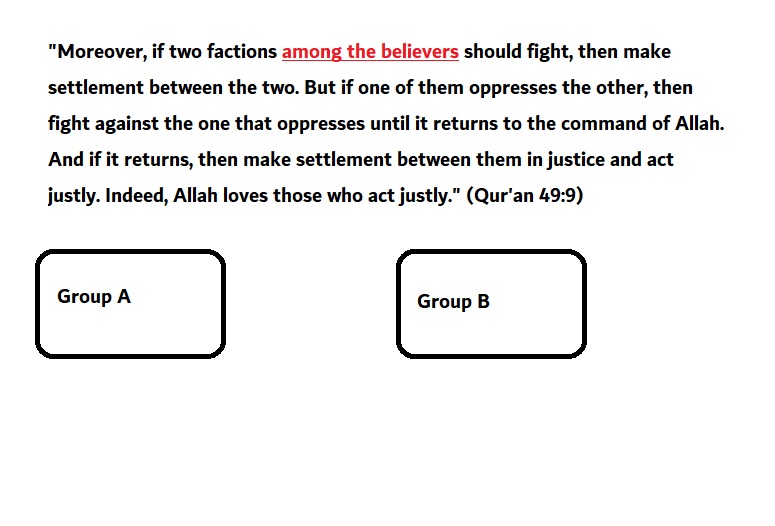
“Moreover, if two factions among the believers should fight, then make settlement between the two. But if one of them oppresses the other, then fight against the one that oppresses until it returns to the command of Allah. And if it returns, then make settlement between them in justice and act justly. Indeed, Allah loves those who act justly.” (Qur’an 49:9)
﷽
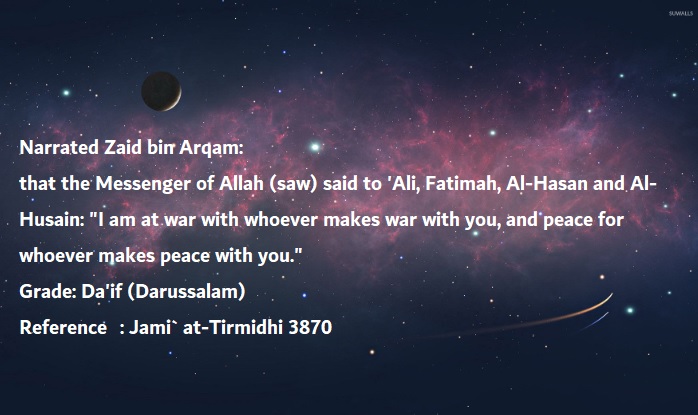
So today we are going to be looking at the following hadith:
Narrated by Zaid bin Arqam:
That the Messenger of Allah (saw) said to ‘Ali, Fatimah (ra), Al-Hasan and Al-Husain (ra): “I am at war with whoever makes war with you, and peace for whoever makes peace with you.”
You can see from the above source that it has a grading of Da’if (meaning weak/fabricated).
Now, even without going into the chains of narrators, we know that this hadith has a major weakness.
However, let us say, for the sake of argument, that this hadith had a grading of Sahih (meaning sound). It would still have a defect. Not even a hidden one. Not even something that would require a hadith specialist.
It would require familiarity with the text of the Qur’an.
CONTROL GROUP A: BEING OPPRESSED
CONTROL GROUP B: DOING THE OPPRESSING.
So, in the above scenario. Ali, Fatimah (ra), Al-Hasan and Al-Husain (ra) could be in control group B. They could be doing the oppressing. However, since our interlocutors (Shi’i, Sunni, ect) will get emotionally charged over such a suggestion, we will not entertain it at this point.
Thus, Ali, Fatimah (ra), Al-Hasan and Al-Husain (ra) could be in control group A. That means they are being oppressed. They are locked in conflict with control group B. However, notice Allah (swt) says:
“If two factions among the believers should fight.”
And since the hadith states that being in conflict or at war with Ali, Fatimah (ra), Al-Hasan and Al-Husain (ra) is ipso facto being at war with the Blessed Messenger (saw) and since it is not conceivable for one to be labeled as a believer and to be at war with or conflict with the Blessed Prophet (saw) himself that hadith is baseless. It is null and void.
Next: Aisha (ra) has Wilāyat al-Ḥaqīqah (real guardianship of Allah), whereas he (Ali) only has the Wilāyatal-Dhahir (apparent guardianship).
“The Prophet has a stronger affinity to the believers than they do themselves. And his wives are their mothers.” (Qur’an 33:6)
Narrated Abu Huraira:
Allah’s Messenger (saw) said, “Allah said, ‘I will declare war against him who shows hostility to a pious worshipper of Mine. And the most beloved things with which My slave comes nearer to Me, is what I have enjoined upon him; and My slave keeps on coming closer to Me through performing Nawafil (praying or doing extra deeds besides what is obligatory) till I love him, so I become his sense of hearing with which he hears, and his sense of sight with which he sees, and his hand with which he grips, and his leg with which he walks; and if he asks Me, I will give him, and if he asks My protection (Refuge), I will protect him; (i.e. give him My Refuge) and I do not hesitate to do anything as I hesitate to take the soul of the believer, for he hates death, and I hate to disappoint him.”
Narrated Abu Maryam `Abdullah bin Ziyad Al-Aasadi:
“When Talha, AzZubair and `Aisha moved to Basra, `Ali sent `Ammar bin Yasir and Hasan bin `Ali who came to us at Kufa and ascended the pulpit. Al-Hasan bin `Ali was at the top of the pulpit and `Ammar was below Al-Hasan. We all gathered before him. I heard `Ammar saying, “`Aisha has moved to Al-Busra. By Allah! She is the wife of your Prophet in this world and in the Hereafter. But Allah has put you to test whether you obey Him (Allah) or her (`Aisha).”
So using this standard of logic. It is Ali ibn Abi Talib who risks war with Allah (swt) and not Aisha (ra) who risks war with the Messenger of Allah!
Ali’s own brother Aqil fought on the side of Muawiya.
Aqil ibn Abi Talib (cousin of the Blessed Prophet) and elder brother of Ali. So does this now mean a cousin of the Blessed Prophet (saw) like Ali, and brother of Ali was at war with the Blessed Prophet (saw)?
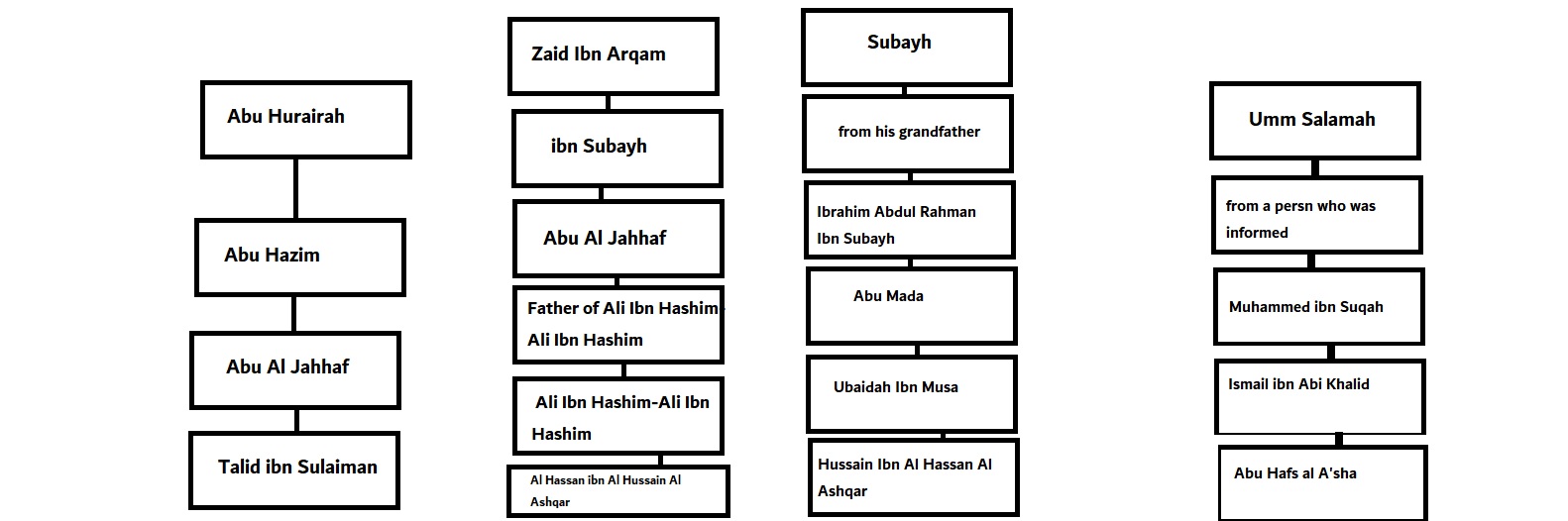
Abu Hafs al ‘Asha (is munkar al hadith) — narrates unacceptable hadith)
The teacher of Muhammed ibn Suqah is majhul (unknown).
So, in the end, this hadith is discarded.
The Shi’i may not like it. The Zaydi may not like it. The Imami may not like it. But the evidence has been laid out and the refutation (if any awaits).
“Hikmetle ve güzel öğütle Rabbinin yoluna çağır ve onlarla en güzel biçimde mücadele et. Kuşkusuz Rabbin, işte yolundan sapanları en iyi bilen O’dur ve O, yola gelenleri de en iyi bilendir.” (Qur’an 16:125)
﷽
İslam Mezhepleri Tarihi – İbadilik – DPÜ İslami İlimler Fakültesi
Yrd. Doç. Dr. Abdullah İbn Said AL-MAMARİ “İbadilik ve Günümüzdeki Durumu”
Bunlar kardeşimiz tarafından Türkçe’ye çevrilmiş bazı videolar. Allah onu korusun
“Kabirlerde Kuran okunur mu? – Şeyh Kahlan el-Kharousi cevaplıyor”
Ölmüş olan bir kimse için kesin olarak cennetliktir veya cehennemliktir diyebilir miyiz?
“Tağut kimdir ve nedir? – Şeyh Raşid bin Seyf el-Rabi açıklıyor”
“Cennet sadece Ibadiler için mi? – Şeyh Salim bin Khalfan açıklıyor”







 نسب الدين عند الإباضية في المشرق
  نور الدين عبدالله بن حميد السالمي
  وغيرهم كثير
  زميل الحسن البصري
  ومن الذين حملوا العلم وأخذ أهل عُمان عنهم :
 والصحابة عن رسول الله ﷺ
 ورسول الله ﷺ عن جبريل الأمين
  الشيخ مسعود المقبالي


 Prima Quran