“My Lord, increase me in knowledge.” (Qur’an 20:114)
﷽
Background
Ar-Rabee’ ibn Habib ibn Rashid ibn Amr Al-Farahidi Al-Azdi Al-Omani, nicknamed Abu Amr Al-Bisri, was the third Ibadhi imam of knowledge. Al-Shammakhi says about him in Al-Siyar: “The lofty mountain of Maddhab (sect), and the great sea of knowledge.”
Birth and upbringing
Ar-Rabee’ Al-Farahidi was born in Al-Batinah region in Oman; either in the State of Sohar or in the State of Liwa or in the State of Widam, in the second half of the first century, around the year 75 A.H. (694 A.D.). He grew up and spent his childhood in Oman and then he traveled to seek knowledge from Basrah, which was the center of knowledge and packed with scholars at that time. He studied under great Successors and was keen on meeting scholars and taking from them and hearing their Hadith narrations. He also took Tafsir (Quran exegesis) and jurisprudence. He became one of the counted scholars in Basrah and, therefore, he deserved to succeed his teacher Abu ‘Ubaidah at the head of the Ibadhi mission in Basrah.
Teachers
Imam Ar-Rabee’ was considered as one of the prominent students of Imam Abu ‘Ubaidah Muslim and was one of the oldest students (in age); as some historians have stated that he overtook Imam Jabir ibn Zaid when he was a young man and took knowledge from him. He also received knowledge from Dhummam ibn Al-Sa’eb and Abu Noah Salih ibn Al-Duhhan. It was reported that he was saying: “I memorized jurisprudence from three (persons): Abu ‘Ubaidah, Dhummam, and Abu Noah.” He meant that these scholars are his principal teachers.
Whoever reads his book “Musnad Ar-Rabee'” and its additions will find that Imam Ar-Rabee’ has taken knowledge from a large number of the nation’s scholars and has sat in circles of a number of narrators, but has narrated more from his three principle teachers than others.
He overtook the Ibadhi School in Basrah at the peak of its bounty. He devoted himself to taking knowledge in Abu ‘Ubaidah’s Centers (Majalis) and acquired the merits of the people of mission. He also elevated among his associates in the grades of the ability of leadership and pioneering.
Students
A large number of students took knowledge from Imam Ar-Rabee’, among them Abu Sufyan Mahbub ibn Al-Rahil Al-Qurashi, Musa ibn Abi Jaber Al-Uzkawi, Bashir ibn Al-Munthir Al-Nazwani, Abu Sufrah Abdul Malik ibn Sufrah, Munir ibn Al-Nayir Al-Ju’lani, Mohammed ibn Al-Mu’ala Al-Kindi, Abu Ayyub Wa’il ibn Ayyub Al-Hadhrami, Hisham ibn Ghailan Al-Sijani, and many other scholars.
Tawtheeq (Reliability)
Praise increased upon Imam Ar-Rabee’ from Ibadhis and others. His teacher, Abu ‘Ubaidah, said about him: “He (i.e Ar-Rabee’) is our Jurist, our imam, and our confidence.” Mahbub ibn Al-Rahil, Ar-Rabee”s student, said about him: “The jurist and scholar of Muslims after Abu ‘Ubaidah.”
Imam Ar-Rabee’ was described asthiqah (reliable) by a number of Traditionalists. Yahya ibn Ma’een and Ibn Shaheen said about him: “Thiqah“. Al-Daraqutni said: “Ar-Rabee’ ibn Habib Al-Basri (Hadith’s) is not left.” Ibn Hibban mentioned him in “Ath-thiqat” and Al-Bukhari in “At-Tareekh Al-Kabeer” but they did not mention any Jarh (criticizing) or Ta’deel (praising) regarding him. In addition, Ahmad ibn Hanbal in “Al-Ilal” said: “I see no problem with him.” From here, it is obvious that Imam Ar-Rabee’ is among the great Traditionalists and his narration is not rejected by Hadith scholars and others.
Death
Imam Ar-Rabee’ lived the last of his life in Oman. He died in Ghadhafan, a village in Oman, around the year 175 A.H. (791 A.D.), thus he lived more than ninety years that he spent in education, dissemination of knowledge and leadership of the mission, which was established by Imam Jabir and Imam Abu ‘Ubaidah, Allah’s mercy upon them all.
Writings
Imam Ar-Rabee’ had many writings besides the monumental Al-Jami’ Al-Sahih. He was one of the first scholars who wrote in Sharia science in the second AH century. Unfortunately, not all of his works have survived to this day. His most prominent works include the following:
· Musnad Al-Imam Ar-Rabee’ (Al-Jami’ Al-Sahih)
This is a compilation of hadith narrated by Ar-Rabee’ from his teachers. It is the oldest book of Prophetic traditions and most of it is tripartite in ascription. Ar-Rabee’ organized his book according to the names of narrators. Insh’Allah
· The Book of Creed
This book contains some prophetic traditions and some traditions that were narrated by some companions. These narrations were added by Imam Abu Ya’qub Al-Wrajalani to Al-Jami’ Al-Sahih. They occupy part three of the current editions and contain the narrations from Ar-Rabee’ on theological questions.
· Ar-Rabee”s Traditions Book
This book contains traditions narrated by Ar-Rabee’ from his teacher Dhummam ibn Al-Sa’eb from Jaber ibn Zaid. They were Maqtu’ (Severed) Hadiths, and they were compiled by Abu Sufrah Abdul Malik ibn Sufrah.
· His opinions and juristic answers
They are scattered in the books of his students and who came after them; e.g. Abu Ghanim Bishr ibn Ghanim Al-Kharasani.
· Ar-Rabee”s Futya (Legal Opinions)
It is a manuscript which contains legal opinions of Ar-Rabee’; almost on rulings, worships and transactions.
· The Argumental Letter (for Ar-Rabee’ and Others)
This is a letter that was attributed to Ar-Rabee’ ibn Habib, Mukhallad ibn Al-Amrud and Wa’il ibn Ayyub, on the matter of separation that was in the East and the West; about the ruling of Juma Prayer, a suspicion of adultery on a woman, and the opinion on interpreters.
· Ar-Rabee”s (and others) Letter to the People of Maghrib in the Matter of Ibn Fundeen.
References:
The Doctrines of the Ibadhi Creed Till the End of the Second AH Century; by Musallam Salim Al-Wahibi
“And We have also sent down unto you (Muhammed) the Reminder and the Advice (the Qur’an), that you may explain clearly to men what is sent down to them.” (Qur’an 16:44)
﷽
This article if anything is going to show the importance of understanding the Arabic language. Not only understanding the Arabic language but understanding the breadth, depth and richness of this language.
I have seen Christian polemist try to twist the Arabic meaning of the Qur’an to suit an agenda that they have. I have seen a “Muslim” from Harvard chime in to the same effect, to suggest that Christianity and Islam are basically the same. That same reformist surprise surprise, not grounded in the Arabic language.
I have seen a known follower of the ‘Hafs Only Quranic Transmission’ Religion opine on the matter. Relying upon his Lisan Al Arabi and Hans WEHR Dictionary of Modern Arabic.
All of them suffer from the same issue. They do not have even foundational knowledge of the Arabic language, let alone advanced knowledge.
For those interested you may want to revisit our article in which our noble teacher Shaykh Juma Mazrui (May Allah bless him) instructed us on the usage of Majaz in the Qur’an and Sunnah.
I’ll pull up something from the article there and re-post it here as it is relevant.
“Be patient over what they say, and remember Our servant, David, the possessor of many hands(l-aydi); he was one who repeatedly turned back [to Us].” (Qur’an 38:17)
Plural in Arabic begins with three and not two! So, at the very least David had three hands. However, notice something from the following site:
It is unanimous that they all translate ‘many hands’ as strength! Even the Salafi/Saudi translations do! Even the translation that gives us the most literal word for word meaning possible was too shy to translate David having many hands.
Be patient over what they say and remember Our servant, David, the possessor of strength; indeed, he was one who repeatedly turned back [to Allah ] (Sahih International)
Be patient (O Muhammad SAW) of what they say, and remember Our slave Dawood (David), endued with power. Verily, he was ever oft-returning in all matters and in repentance (toward Allah) (Muhsin Khan & Muhammed Al Hilal)
So we can say to those who believe in literal translations: Why don’t you take these verses on the apparent meaning? If Allah (swt) says that David has many hands then say that David had many hands!
You are shy to ascribe many hands to David but not to Allah (swt)?!
This is also the case any place any where we see ‘hands’ attributed to Allah (swt).
You can see all such instances relating to having power over, authority over, under the provision of etc…
“And that which We have revealed to you, of the Book is the truth, (ma bayna yadayhi) that is between its hands. Indeed, Allah , of His servants, is Acquainted and Seeing.” (Qur’an 35:31)
“They said, “O our people, indeed we have heard a Book revealed after Moses and (ma bayna yadayhi) what is between its hands. which guides to the truth and to a straight path.” (Qur’an 46:30)
“He has sent down upon you, the Book in truth, (ma bayna yadayhi) what is between its hands. And He revealed the Torah and the Gospel.” (Qur’an 3:3)
All of those verses when taken literally clearly states that the Qur’an has something ‘in between its hands’.
In the case of our Harvard graduate (mentioned above) he is among those who rail against the Salafist and their literal interpretations; but he himself is bereft of a consistent hermeneutic.
Even in the case of the one who follows the ‘Hafs Only Quranic Transmission’ Religion there was a clear acknowledgement that the text is an idiomatic expression and yet still decided on a literal translation! He even used Qur’an 3:3 as an example!
“Indeed, it is not the eyes that are blind, but it is the hearts in the chests that grow blind.” (Qur’an 22:46)
The very definition of idiomatic expression is:
an expression whose meanings cannot be inferred from the meanings of the words that comprise it.
THE DECEPTION OF CHRISITAN POLEMICIST
So how do these Christian apologist and polemicist use these idiomatic expressions in the Qur’an to deceive the layman Muslim?
“And We sent, following in their footsteps, Jesus , the son of Mary, (ma bayna yadayhi) having authority over the Torah; and We gave him the Gospel, in which was guidance and light and having authority over that which preceded it of the Torah as guidance and instruction for the righteous.” (Qur’an 5:46)
“And when Jesus, the son of Mary, said, “O children of Israel, indeed I am the messenger of Allah to you(ma bayna yadayhi) having authority over that which came before me of the Torah and bringing good tidings of a messenger to come after me, whose name is Ahmad.” But when he came to them with clear evidences, they said, “This is obvious magic.” (Qur’an 61:6)
“He has sent down upon you, the Book in truth, (ma bayna yadayhi) have total authority. And He revealed the Torah and the Gospel.” (Qur’an 3:3)
How do these Christian polemist and apologist twist Qur’an 5:46 and Qur’an 61:6?
They want it to read something like this:
“And We sent, following in their footsteps, Jesus , the son of Mary, confirming the Torah that is between his hands; and We gave him the Gospel, in which was guidance and light and having authority over that which preceded it of the Torah as guidance and instruction for the righteous.” (Qur’an 5:46)
“And when Jesus, the son of Mary, said, “O children of Israel, indeed I am the messenger of Allah to you confirming the Torah that is between my hands and bringing good tidings of a messenger to come after me, whose name is Ahmad.” But when he came to them with clear evidences, they said, “This is obvious magic.” (Qur’an 61:6)
Is it now obvious what they are up to?
They are trying by way of deception to make it look as if Jesus (as) had some physical copy of the Torah in his hands that he is reading from. Since the Torah of the time of Christ Jesus can reasonably be argued to be the one that Jews are using today -ipso facto it is preserved, untampered and uncorrupted.
This very idea has been destroyed by the Qur’an itself. It charges something much deeper than textual corruption. We are talking about corruption of in the oral process before it even becomes written text.
“Then woe to those who write the Book with their own hands, and then say:” This is from Allah,” to traffic with it for miserable price!- Woe to them for what their hands do write, and for the gain they make thereby.” (Qur’an 2:79)
Note the text above is not talking about people editing a book. It is stating that the very things they are writing themselves are a fabrication! Not that they had something in hand and started editing and omitting. It is deeper than that!
The Qur’an has no qualms about the fact that what Christians and Jews call sacred scriptures can have some truth in them. However, it has never endorsed their sacred text wholesale.
It is not possible to do so because Jews and Christians have internal disputes about what their sacred canon consist of. The Qur’an never settles these disputes between them.
“But why do they come to you for judgment when they have the Torah containing Allah’s judgment, then they turn away after all? They are not believers.” (Qur’an 5:43)
“And let the People of the Gospel(ahlu l’injili) judge by what Allah has revealed therein. And whoever does not judge by what Allah has revealed – then it is those who are the defiantly disobedient.” (Qur’an 5:47)
“Tell believing men to lower their gaze and guard their private parts. That is purer for them. God is acquainted with what they do.” (Qur’an 24:30)
“And do not spy, nor backbite one another. Would any of you like to eat the flesh of their dead brother? You would despise that! And fear Allah. Surely Allah is ˹the˺ Accepter of Repentance, Most Merciful.” (Qur’an 49:12)
﷽
Ramadan Day 25:The two that lead to hellfire: The private parts and the tongue.
25th of Ramadan* ——————————– *Heart Illness: Hypocrisy* Allah and his messenger have described hypocrites for us so that we can avoid being like them, here are some attributes extracted from the Qur’an and the Sunnah:
Disloyalty: and it’s the opposite of trustworthiness, it can be in covenants, wealth, responsibilities and others. Lying: starting from light lies until lying becomes a habit for the hypocrite. Betrayal: the hypocrite will try to find anyway to betray. Immorality: making no difference between a Haram and a Halal due to the lack of faith. Laziness in worship: Allah says about them: (“And when they stand for prayer, they stand lazily, showing [themselves to] the people and not remembering Allah except a little.” (Qur’an 4:142)) Over-caring about looks: Allah said:
“When you see them, their appearance impresses you. And when they speak, you listen to their ˹impressive˺ speech. But they are ˹just˺ like ˹worthless˺ planks of wood leaned ˹against a wall’ (Qur’an 63:4) Deception: Allah said:
“They seek to deceive Allah and the believers, yet they only deceive themselves, but they fail to perceive it.” (Qur’an 2:9) Corruption: Allah says:
“And when it is said to them, Do not cause corruption on the earth, they say, We are but reformers.” (Qur’an 2:11)
*Walayah and Bara’ah of Jumlah and Haqiqah* We spoke about Walayah and Bara’ah previously, now we will know some types of walayah and bara’ah.
Firstly, “Jumlah” meaning “as a whole” and it’s an obligation for every Muslim, it’s to (ally all the allies of Allah from the past and the present until the day of judgment, and to dissociate from all the enemies of Allah in the past, present and until the day of judgment)
The other type we will mention today is Haqiqah, and it’s to ally and dissociate based on certain texts, like to ally the wife of Fir’aun, Maryam the mother of Isa (as), the messengers etc, and dissociate from people like Abu Lahab, the wife of Nuh and Lut because these people are mentioned in the Qur’an for their righteousness or misery
*Things allowed in prayer* from the things that are allowed in the prayer are: To open the next verse for the Imam if he forgets To say SubhanAllah for the Imam if he made a mistake in the prayer To cry for the matters of the hereafter Light movement to fix the prayer To stop people from walking In front of you Killing the snake and the scorpion and other harmful things To save souls or wealth from destruction To carry a child and to quite him To swallow the saliva or spit the saliva.
“Allah will throw their mockery back at them, leaving them to continue wandering blindly in their defiance.” (Qur’an 2:15)
﷽
The people who have attacked us on this issue act as if they are scoring points for their team. They act like the fact we say it is haram to eat the penis of goats as something negative about us and our school, our approach to the Qur’an and Sunnah.
Let the people of sincerity and good reason judge the truth of the matter.
Of the issues, that the detractors have with the Muslims, the People of the Truth and Steadfastness is that we do not eat the Goat’s Penis.
This on top of other lies. That we say one can make the hajj all year around. That we require that a fish be ritually slaughtered before being eaten! Ibadis allow tayammum near wells!
I mean really?
Honestly?
Out of all the things to find fault with the path of another you want to take issue with this?
When this individual decided to write such vitriolic against the Muslims, the People of the Truth and Steadfastness, our noble Shaykh (raheemullah) replied:
“By Allah, a sacrifice is placed within your hands, with its meant and fat, you leave all that and go to the penis?! For us is the sacrifice, and we’ll leave the penis for the Shaykh.” -Shaykh Saeed bin Hamed Al Harthi
“Because of that, We decreed upon the Children of Israel that whoever kills a soul unless for a soul or for corruption in the land it is as if he had slain mankind entirely. And whoever saves one – it is as if he had saved mankind entirely. And our messengers had certainly come to them with clear proofs. Then indeed many of them, after that, throughout the land, were transgressors.” (Qur’an 5:32)
﷽
Narrated `Ikrima:
“Some Zanadiqa (atheists) were brought to `Ali and he burnt them. The news of this event reached Ibn `Abbas who said, “If I had been in his place, I would not have burnt them, as Allah’s Apostle forbade it, saying, ‘Do not punish anybody with Allah’s punishment (fire).’ I would have killed them according to the statement of Allah’s Apostle, ‘Whoever changed his Islamic religion, then kill him.'”
‘Ali came to some people of Az-Zutt, who worshipped idols, and burned them. Ibn ‘Abbas said: “But the Messenger of Allah [SAW] said: ‘Whoever changes his religion, kill him.'”
There is something similar in Imami Shi’i sources.
Narrated from Abū ʿAbdillāh (Imām Jaʿfar al-Ṣādiq), who said: Amīr al-Muʾminīn (ʿAlī), said: “If it were possible for me, and if I found someone to help me, I would kill all the adherents of these sects (aṣnāf), and I would burn them with fire. And this is [in accordance with] the saying of Allah, Mighty and Exalted:
‘Say, I am only a man like you to whom it has been revealed that your God is but one God. So whoever would hope for the meeting with his Lord – let him do righteous work and not associate anyone in the worship of his Lord’ (Qur’an 18:110).”
Source: (Bihār al-Anwār al-Jāmiʿah li-Durar Akhbār al-Aʾimmat al-Aṭhār Volume and Page: Vol. 25, p. 265, Hadith #30)
Now we are going to examine a hadith that reports that Ali Ibn Abi Talib had a group of apostates burned alive.
What is important to note is that Ibn Abbas (ra) felt that Ali made an error in his ijtihad, in his decision to burn apostates.
In this regard Ibn Abbas (ra) was acting upon what Allah (swt) has mentioned in the Qur’an.
You are the best nation that ever existed among humanity. You command people to good and prohibit them from (l-munkari) evil, and you believe in Allah.” (Qur’an 3:11)
Ibn Abbas (ra) was saying he would not have done the munkar that Ali had done. He would have acted according to the Sunnah of the Blessed Messenger (saw).
We are also going to look at how a top Sunni scholar and a top Sunni apologist approach the issue.
Thus, in this particular article. We are also get to see some insights from Bassam Zawadi and Shaykh Abdullah Bin Bayyah
Now according to the scholars of our brothers from ‘Ahl Sunnah’, all the companions are ‘adil’-just.
Burning people alive doesn’t seem to be a very upright thing to do!
I have saved the published works of both links. Things do tend to disappear from the internet (from time to time).
Let us deal with imminent and respected scholar Shaykh Abdullah bin Bayyah and his response to this first.
“I read on a website that Ali ibn Abu Talib burnt some of the Kharijites during his caliphate. But this made me confused due to the hadith we know where the Prophet (peace and blessings be upon him) forbade torturing others with fire since this is a sort of associating others with Allah. So how did Ali do this?”
Shaykh Abdullah bin Bayyah replies:
“And upon you is the peace of Allah, together with his mercy and blessings. This report was narrated by al-Bukhary (6922) on the authority of `Ikrimah who said: Heretics were brought before Ali and he burnt them. When Ibn `Abbas was informed about this, he said, “If I were in his place, I would not have burnt them for the Messenger of Allah (peace and blessings be upon him) forbade this saying, “Do not torment with the torment of Allah” and I would have killed them, for the Messenger of Allah (peace and blessings be upon him) said, “Whoever changes his religion, kill him.”“
When a deviant group called al-Saba’iyyah, who were the followers of the Jewish `Abdullah ibn Saba’, went astray and believed that Ali was a god – we seek refuge with Allah from this – he (Ali) set them on fire and said, “When I saw such an enormous evil, I set them on fire and called.”
“Besides, this issue is a particular case that has no general application, as al-Shatiby said,
In general, there are many interpretations concerning this report, whether he burnt them after he had killed them, or he was just about to burn them, but he did not. Whatever the case was, this was an opinion viewed by a companion that has nothing to do with associating gods with Allah. Burning a person is not permissible in the Shari`ah; but this does not amount to associating others with Allah. Associating others with Allah means to worship another god with Allah or to believe in other gods with Almighty Allah. Yes, the Prophet (peace and blessings be upon him) forbade burning others and said, “None should torment with fire except Allah.” [Reported by al-Bukhary (3016)]”
“Yet, this does not mean that whoever burns others with fire is considered as associating others with Allah. It rather means that this punishment is a punishment in the Hereafter, not in this world. This is what we should believe. The issue has no relation to associating others with Allah. As mentioned above, this interpretation may prove untrue. Perhaps he intended to burn them, but he did not, or he intended to burn them after killing them. Even if he actually burnt them, this would be a kind of ijtihad from a companion that disagrees with the text. The ultimate reference is always to the text. Nonetheless, we have to believe that they acted according to their ijtihad and that they are illuminating guides.” -Shayh Bin Bayyah (May Allah continue to benefit many by him and bless him)
Our focus here is on the following statement:
“Even if he actually burnt them, this would be a kind of ijtihad from a companion that disagrees with the text. The ultimate reference is always to the text. Nonetheless, we have to believe that they acted according to their ijtihad and that they are illuminating guides.”
This is because for our brothers in ‘Ahl Sunnah’ the doctrine is that the companions can do no wrong. Even though we clearly have Ibn Abbas (ra) saying that he would not have done what Ali did!
Prima Qur’an comments:
Notice that Shaykh Abdullah bin Bayyah did not attack the chain of narrators. He also did not have any critique of the hadith at all.
The frightening prospect from respected Shaykh bin Bayyah’s response is that even if he did burn them it’s simply his ‘ijtihad’ and we have to believe he is still an illuminating guide.
Can you imagine? This is the standard for being ‘adil’ -upright.
The noble Shaykh bin Bayyah’s response was short and yet it has left us wanting.
In many ways, Shaykh Bin Bayyah’s understanding of this text gives grounds for extremism.
Why?
“Even if he actually burnt them, this would be a kind of ijtihad from a companion that disagrees with the text. The ultimate reference is always to the text. Nonetheless, we have to believe that they acted according to their ijtihad and that they are illuminating guides.”- Shaykh Abdullah Bin Bayyah.
Now take a moment and think about that. So even if Ali actually burned apostates, it was his ijtihad. In other words, he did what he thought was right! The very problematic response by Shaykh Abdullah bin Bayyah is that no principles of the sanctity of life, rules of engagement, etc. were given to us.
So, what if now ISIS, Al-Qaeda, and others want to use their ‘ijtihad’?
So let us look at how brother Bassam Zawadi deals with the issue:
A Christian missionary has cited the following Hadith from Bukhari and is demanding an explanation:
Volume 9, Book 84, Number 57:
Narrated `Ikrima:
“Some Zanadiqa(atheists) were brought to `Ali and he burnt them. The news of this event reached Ibn `Abbas who said, “If I had been in his place, I would not have burnt them, as Allah’s Apostle forbade it, saying, ‘Do not punish anybody with Allah’s punishment (fire).’ I would have killed them according to the statement of Allah’s Apostle, ‘Whoever changed his Islamic religion, then kill him.'”
—————
“Can you briefly describe the background, which compelled Hadhrat`Ali to take this action? How valid is the isnad[1] and matn [2] and the legality of such a punishment? If there is an argument that Hadhrat`Ali cited to justify this action, that too is welcome. Jazakumallah Khaira”
Answer Bassam Zawadi:
“The referred narrative is placed in the Kitaab Al-Jihaad as well as the Kitaab Istitaabah Al-Murtaddeen by Al-Bukhari in his “Sahih”.
Although Bukhari’s narratives do not give any details regarding the incident, yet in his exegesis on Bukhari – “Fath Al-Baari” – Ibn Hajar has mentioned a few other versions of the same incident [3]. Considering all the narratives reporting this incident, the following major variations come to the forefront:
Firstly, there is quite a bit of variation regarding the people, who were subjected to this punishment. According to one version, they were atheists, according to a second version, they were apostates, according to a third version, they were a group of people, who secretly used to practice idolatry and according to a fourth version, they were a group of Rawafidh [4], who believed in the divinity of Ali.”
“Secondly, there is a significant difference between the reports regarding the incident itself. Although, the narratives given in Bukhari do not give any details of how the incident happened, yet Ibn Hajar has given a few narratives, which give some details of the happening. According to one version, when `Ali was informed regarding a people who considered him to be God, he called them and asked them to refrain from such blasphemy. They refused to comply. This went on for three days. Till, finally, `Ali ordered to dig a deep pit and burn a huge fire in it. The criminals were brought to the fire. `Ali told them that if they do not agree to refrain from their blasphemy, they would be thrown in the fire. They persisted in their refusal and were, subsequently, thrown in the fire. According to a second version, `Ali was informed of a people who secretly worshipped idols in a house. `Ali went to investigate the report. An idol was recovered from the house and, subsequently, the house was burnt to ashes. According to a third version, `Ali was informed of some apostates. He called for them. When they arrived, `Ali gave them food to eat and asked them to return to Islam. They refused. At their refusal, `Ali made them stand in a pit and killed them in it. Subsequently, he burnt them.”
“These are some of the various versions of the incident as reported in books of history and Hadith. One may take whichever explanation he believes to be more plausible to be accurate.”
“In my opinion, the second and third versions of the incident are quite considerable. It seems that:
After it had become evident that the house was secretly being used for idolatry, `Ali (ra) ordered that it be burnt down. However, due to a mistake on the part of one or more of the narrators, the incident has been reported in a way that it gives the impression that the house was burnt down with its inhabitants. Whereas, it may not have been so; or
People were killed for their apostasy and later, their corpses were burnt to ashes. This is clearly implied in the third stated version of the incident.”
“Nevertheless, if someone is not willing to accept any of the above explanations and is persistent that `Ali actually burnt these criminals to death, even then the most that can be said is that `Ali’s decision of burning the criminals to death was not correct, in view of the directive of the Prophet (pbuh) to the contrary. This, obviously, would amount to criticism of Ali’s decision – not a criticism of Islam.”
“After all, `Ali was but a human being, he may have erred in his decision.”
I hope this helps.
October 11, 2000
[1] That is the chain of narrators of this reporting.
Now, this is why I really miss Bassam Zawadi when he was involved in apologetic. I know Bassam Zawadi is passionate about his understanding of Islam, but who isn’t?
Notice also, that Bassam like Bin Bayyah did not attack the chain of narrators, nor does he have any issue with the hadith themselves.
Though it would have been nice to have all the narrations laid out for us, we can clearly see that there is a need to rescue Ali from anything wrongfully attributed to him. That is admirable. That is understandable because that is usually what our brothers from the ‘Ahl Sunnah’ will do to rescue the character of all the companions.
However, at least Bassam is willing to make the following assertion/concession.
“`Ali actually burnt these criminals to death, even then the most that can be said is that `Ali’s decision of burning the criminals to death was not correct, in view of the directive of the Prophet (pbuh) to the contrary. This, obviously, would amount to criticism of `Ali’s decision – not a criticism of Islam.
After all, `Ali was but a human being, he may have erred in his decision.”
Beautiful! Well said!
So, in other words like Shaykh Abdullah bin Bayyah, Bassam is trying to clear Ali of these reports. Yet, unlike Shaykh Abdullah bin Bayyah, Bassam is not willing to be defined by this! In other words, look the companions could have made mistakes, big errors in judgment, and did things that are not correct.
I also hope that one has gleaned the following from what Bassam has said as well.
“Although Bukhari’s narratives do not give any details regarding the incident”
“Firstly, there is quite a bit of variation regarding the people, who were subjected to this punishment. According to one version.”
“According to a second version,”
“According to a third version”
“According to a fourth version,”
“The narratives given in Bukhari do not give any details of how the incident happened, yet Ibn Hajar has given a few narratives, which give some details of the happening.”
“However, due to a mistake on the part of one or more of the narrators, the incident has been reported in a way that it gives the impression….”
I hope people reflect well on these statements. This is true for the vast corpus of hadith literature. They simply give you snippets and snapshots. Just bits and pieces of information.
The interesting observation is how two champions of the ‘Ahl Sunnah’ have made their concluding remarks.
To me, in my humble opinion brother, Bassam’s response was more robust and more keeping to the truth.
Whatever these companions and successors did does not have to be a reflection upon Islam!
Lastly, I also think that Bassam Zawadi’s understanding and response is much grounded and keeping with the justice and compassion of Islam.
Bassam Zawadi’s response does not give room for groups like ISIS and Al-Qaeda to act brash in the name of “personal ijtihad.” Where as Bin Bayyah’s response certainly does.
THE REACTION OF IBN ABBAS IS KEY
Also, Bassam Zawadi’s response shows that Ali could have made an error in his ijtihad. In fact, Ibn Abbas (ra) is shown not to agree with Ali’s decision. This means that Ibn Abbas (ra) felt that the Ijtihad of Ali was incorrect. After all that is a key part of these hadith reports about what Ali is said to have done. Surely Ibn Abbas (ra) is not going to object to Ali burning dead bodies?
If Ali could be wrong in ijtihad in this area, could he have been wrong in his ijtihad in the battle of Siffin?
Whereas Shaykh Abdullah bin Bayyah’s response was, well, ‘It was his opinion’. This is important in the jargon of ‘Ahl Sunnah’ because it implicitly implies that Ali could very well have made an error.
However, he would still be rewarded for his error. Whereas Bassam Zawadi made clear daylight between the teachings of the Blessed Messenger (saw) and a very probable and unjust emotional decision based upon a companion.
This is also important because this is exactly what happened at Siffin. Many companions felt that Ali not only made an error in his ijtihad but that he failed to judge by what Allah (swt) had instructed us to judge by.
Alas, some people maybe dismissive of Bassam Zawadi being a Salafi. It is rather unfortunate to dismiss him on account of that. However, this statement by Shaykh Muhammed Al Yaqubi in his book is not so easily dismissed. * Would like to give credit to a brother who commented on this entry for the following information. Hamza Malik -May Allah (swt) reward you.
“ISIS uses the story of Ali as a proof, as it is narrated that he burned someone. However, the story does not provide any proof to the permissibility of burning people for the following reasons. First, Ibn Abbas, cousin of Ali, opposed him and declared that it was wrong. Second, Imam al-Bukhari narrated this story to caution the reader that it is not valid, as he narrated the counter-proofs. His job was to compile every text related to the subject, and the job of the doctors of law was to establish what is valid and what is not. Third, Ali himself agreed with his cousin Ibn Abbas that this is forbidden, as narrated by al-Tirmidhi (Tuhfat al-Ahwadhi, vol. 5, pp. 24-25).”
Source: (Refuting Isis (2nd edition p. 27) in regard to Ali using fire to punish.)
It is note worthy that Shaykhs: Muhammed Al Yaqubi is widely believed to be a descendant of the Blessed Prophet’s grandson Hassan. Yet, this did stop Shaykh Yaqubi from seeing Ali as someone who could be mistaken in his ijtihad.
In other words, the common gas lighting tactics of: “He is from the Ahl Bayt how could you?” was not used.
Islam does not stand, or fall based upon what companions did or did not do. It is based upon the teachings of the Qur’an and the clear teachings of the Blessed Messenger (saw).
May Allah (swt) bless Bassam Zawadi and Shaykh Bin Bayyah for their sincere efforts.
Allah (swt) knows best, and the help of Allah (swt) is sought in all matters. It is also interesting that this hadith so bothers crypto-Shi’i (Shi’a in the guise of a Sunni) don’t be surprised to see them try and discredit ‘Ikrma altogether! Not only that but some Shi’a have failed to discredit ‘Ikrma have tried to have a go at Ibn Abbas (ra) Even though, ‘Ikrma also narrates a juicy hadith that the Shi’i like to use about Ammar bin Yassar being killed by the rebellious group. Can’t have your cake and eat it to folks!
“O you who have believed, let not a people ridicule other people; perhaps they may be better than them, nor let women ridicule other women; perhaps they may be better than them. And do not insult one another and do not call each other by offensive nicknames. Wretched is the name of disobedience after one’s faith. And whoever does not repent – then it is those who are the wrongdoers.” (Qur’an 49:11)
“Allah will throw their mockery back at them, leaving them to continue wandering blindly in their defiance.” (Qur’an 2:15)
﷽
SUNNI HISTORICAL BOOKS MOCK ABU HANIFA AND IMAM AHMAD. (while pretending to mock the belief of others).
Demonstrative evidence of how Sunni historical books mock Imam Abu Hanifa, and Imam Ahmed when attempting to misrepresent the beliefs and views of others.
Recently a brother was asking about reliable information in regards to the historical accounts of Muslims.
I replied by saying, ” walakum salaam wr wb, “reliable and fair ” that will be a challenge because every side will allege that the other is not being truthful.”
“What I can do is provide for you some sources and also suggest you read any sources that anyone suggests to you, and look for the inconsistencies, telltale signs of manipulation.”
When one side distorts the truth and relies upon fabled interactions between their group and the other it is nigh time to question what else they may be content to allow to be propagated in the name of ‘haqq’.
I’m going to give here and now demonstrable evidence of exactly how the misrepresentation of one group by another is done and how often it backfires and makes a mockery of the group who thought they were being clever, to begin with.
The first example is of Imam Abu Hanifa. Here is how the story goes:
“The Khawarij who based their thoughts on rebelling against the leader of the Muslims, accuse the sahaba -especially Abu Musa al-Ashari (ra) and Amr b As (ra)- with ‘committing kufr’ because they witnessed the hakam incident, they also oppressed the ulama among the tabi’in generation.”
“When Dahhak b Kays who is among the khawarij, came to Kufa, he visited Abu Hanifa and asked him to repent. Abu Hanifa asked him what he was supposed to make tawbah from.”
“Dahhak said: ‘Make tawbah from your view which you permit the referring (appointing) the issue of Ali and Muawiyah to the arbitrators for the peace (agreement).’ Abu Hanifa said: ‘Are you going to kill me or, just discuss with me?’ Dahhak said: ‘I am going to discuss it with you.’ Abu Hanifa said: ‘Who is going to be the arbitrator between us –if we come to an opposition- regarding the matter we are going to discuss?’ Dahhak said: ‘Appoint someone as an arbitrator as you wish.’ Therefore Abu Hanifa asked one among the companions of Dahhak: ‘Have a seat. You are going to be the arbitrator between us –if we come to the opposition- regarding the matter we are going to discuss.’ Then he turned to Dahhak and said:‘Do you accept him being an arbitrator between us?’ When Dahhak said: ‘Yes’ Abu Hanifah said:‘So you also accept (the permissibility of) appointing an arbitrator.’ Dahhak, who could not find anything to reply with, left the gathering and went away.”
Source: (Takýyyuddin b. Abdilkadir at-Tamimi, Tabaqatu’s-Saniyye fi Tarajmi’l-Hanafiyya, I, 151-2.)
Source: (The four Imams and their schools Gibril Fouad Haddad pg. 66)
Prima-Qur’an comments:
So here you are reading and quite impressed and saying, “Mash’Allah” Wow! Abu Hanifa was really a clever fellow, wasn’t he!
Actually, whoever narrated this fable should be ashamed of themselves for mocking Abu Hanifa. If this was an example of his debating skills it is at best the utmost mockery of Imam Abu Hanifa.
Why do I say this?
“‘Do you accept him being an arbitrator between us?’ When Dahhak said: ‘Yes’ Abu Hanifah said: ‘So you also accept (the permissibility of) appointing an arbitrator.’ “
This makes Imam Abu Hanifa as someone who is a complete ignoramus when it comes to the beliefs of the beliefs of the Muslims whom were in Narhawan. It is not that the people of Narhawan didn’t accept arbitration. It’s that they didn’t accept arbitration in a matter where Allah (swt) has given a clear ruling.
It is obviously one of the teachings of the Qur’an.
“And if you fear dissension between the two, send an arbitrator from his people and an arbitrator from her people. If they both desire reconciliation, Allah will cause it between them. Indeed, Allah is ever Knowing and Acquainted [with all things].” (Qur’an 4:35).
“O you who believe! Kill not game while in the sacred precincts or in pilgrim garb. If any of you does so intentionally, the compensation is an offering, brought to the Ka’ba, of a domestic animal equivalent to the one he killed, as adjuged by two just men among you; or by way of atonement, the feeding of the indigent; or its equivalent in fasts: that he may taste of the penalty of his deed. Allah forgives what is past: for repetition, Allah will exact from him the penalty. For Allah is Exalted, and Lord of Retribution.” (Qur’an 5:95)
So this is clearly what the people of Narhawan believed in. However, they did not believe in arbitration on a matter that is already decided by Allah! It’s not that they didn’t believe in arbitration at all. That’s a ridiculous misrepresentation and mockery of other people’s beliefs.
So what this narrative does is it makes Imam Abu Hanifa look extremely ignorant of the beliefs of his opponents. It’s a classic example. Now I don’t expect you to embarrass the teachers at Sunniport, Ilmgate, Seekershub, Sunnipath, Eshaykh, or Livingislam or whomever else.
However, you could ask them in private if they could refer you to material written by those who disagreed with Ali’s arbitration and show you where it clearly states that they don’t believe in arbitration at all.
May Allah (swt) guide us to a course that is truthful and just.
May Allah (swt) open the eyes of this Ummah!
Or how about this juicy tale that totally misrepresents those of us who believe that the Qur’an is created.
Excerpt from “Foundations of the Sunnah” pg.93
Imam Ahmed Ibn Hanbal died 241H
“When I arose (the next morning) I made my way to the door (of al-Mu’tasim) and the people were entering, so I entered along with them. Al Mu’tasim approached and sat on his chair and said, “Bring Ahmed ibn Hanbal”, and so he was brought. When he stood in front of him, Al Mu’tasim said to him, “How were you in your cell yesterday, O Ahmad?”.
“Imam Ahmad said, “In goodness and alhamdulillah except that in my cell, O Ameerul Mumineen, I saw something amazing.” He said to him, “And what did you see?”. So he replied, “I arose in the middle of the night, performed ablution for the prayer, and prayed two rakah. In one rakah I recited Alhamdulillah….and Qul Authoo bi rabin naas, and in the second rakah I recited Alhamdulillah….and Qul authoo bi rabil Faalaq. Then I sat down, read the tashahud, and gave salutation (to my right and left)… and then I stood again, made the takbeer and recited Alhumdulillah …and then I desired to read: Qul huwallahu ahad, And I was not able to. I tried hard to read something else from the Quran and I was not able. Then I stretched my eyes to the corner of the prison and (behold) I saw the Quraan laid out on the floor, dead. So I washed it and shrouded it, then prayed over it and buried it.“
“So Al Mu’tasim said, “Woe be to you, O Ahmed, and does the Quraan die!?”. So Ahmed said to him, “Well that is what you say – That is created. And everything created dies”. Al Mu’tasim said, “Ahmad has subdued us, Ahmad has subdued us”.
Prima-Qur’an comments. I really believe that our Ummah is not this gullible.
Now I don’t even know if this needs commenting because I can imagine that 99.9% of the readers understand how absolutely ridiculous this story makes Imam Ahmad out to be. It is an absolute mockery of him.
As for that .1% who may not know how we will explain now insh’Allah
“So Ahmed said to him, “Well that is what you say – That is created. And everything created dies.”
Really?
Rocks die? Minerals, emeralds, rubies, sapphires, diamonds die? How many funeral prayers have Imam Ahmad made over them? Obviously none.
So then you have Al Mu’tasim saying, “Al Mu’tasim said, “Ahmad has subdued us, Ahmad has subdued us”.
This is obviously a flat lie.
Are we expected that a great luminary of Islam subdued his opponent with such ridiculous antics?
Not only this but you are accusing Imam Ahmed of doing bid’ a!
Is there a single example from among the companions doing this? Do we have one example of the companions making the funeral prayer over minerals, emeralds, rubies, sapphires, diamonds, rocks, stones, etc.?
So these are just two examples in relation to the esteemed Imam Abu Hanifa and Imam Ahmad in which they have these fabricated narratives that make it look like they are mocking other people’s beliefs when in reality it makes them both look either ignorant or downright foolish.
Certainly, Allah (swt) will deal justly with those who have redacted these statements, put them in the mouths of these Imams; and willfully misrepresented the beliefs of others.
This type of mockery and caricatures of Sunni Imams by Sunni Muslims in their own books while trying to misrepresent the views of others.
Do better! Fear Allah!
“Allah will throw their mockery back at them, leaving them to continue wandering blindly in their defiance.” (Qur’an 2:15)
“And now they reject the truth when it reaches them: but soon shall they learn the reality of what they used to mock at.” (Qur’an 6:5)
“And strive in His cause as ye ought to strive, (with sincerity and under discipline). He has chosen you, and has imposed no difficulties on you in religion; it is the cult of your father Abraham. It is He Who has named you Muslims, both before and in this (Revelation); that the Messenger may be a witness for you, and ye be witnesses for mankind! So establish regular Prayer, give regular Charity, and hold fast to Allah! He is your Protector – the Best to protect and the Best to help!” (Qur’an 22:78)
﷽
Did you know that the vast majority of Muslim layman and even some learned people believe that the Blessed Prophet (saw) said something along the following:
“My Ummah will be split into 73 groups and all of them will be in the hellfire except one, and that is ‘Ahl Sunnah Wal Jammah‘.
This is absolutely not true. In fact, it is imputing a lie to the Blessed Prophet (saw).
There is absolutely no such statement of the Blessed Prophet (saw).
Does anyone know any verse in the Qur’an any sound Hadith that says that we as Muslims are to call ourselves: ourselves ‘Ahl Sunnah Wal Jammah‘?
I have been searching high n low, and coming up empty. I am not infallible or above reproach. So I think its best I consult with others.
Have you the readers found any clear statement from the Qur’an that we are to call ourselves: ‘Ahl Sunnah Wal Jammah‘?
Have you the readers found any clear statement from the Qur’an that the saved people on the day of judgement are: ‘Ahl Sunnah Wal Jammah‘?
Have you the readers found any sound hadith, (whose chain of narration was so spotless it was not disputed by any of the scholars) where the blessed Prophet Muhammed (saw) told us to call ourselves: ‘Ahl Sunnah Wal Jammah‘?
Have you the readers found any sound hadith, (whose chain of narration was so spotless it was not disputed by any of the scholars) where the blessed Prophet Muhammed (saw) said that the saved group are the: ‘Ahl Sunnah Wal Jammah‘?
Here is what I found.
I found that there has been some deception and sleight of hand to fool people into thinking words have meaning that they do not have.
jama’a literally denotes a group, a collective, a congregation.
jama’a does NOT mean largest group, largest collective, largest congregation.
If one searches through the history books, he will find the origin story of the ‘Jama’ah is the year in which Muawiyah seized the power. It was known as the “The Year of al- Jama’ah”.
It was called so, because the Ummah of the Blessed Prophet (saw) had already become divided into two factions after the death of Uthman: The Shia of Ali and the followers of Muawiyah. When Imam Ali was killed and Muawiyah took over the power, the year was called “al- Jama’ah”. Out of the many Jama’ah. The majority was being lead by Muawiyah, who usurped power and any other parties were considered as a dangerous rivals. Therefore the name of “Ahl al-Sunnah and al-Jama’ah” indicates a forged terminology between the Blessed Sunnah of the Prophet (saw) merged with the innovations by Muawiyah, and the agreement upon his leadership.
Correction: The Muslim community did not come together in recognizing Mu’awiyah. There remained Muslims that up until today do not recognize Mu’awiyah usurping the Imamate of the Muslims.
MORE DECEPTION IN REGARD TO THE TERM JAMA’A
You may have heard a hadith along the lines of: “Allah’s hand is with the Jammah.”
However, as we have already noted jama’a literally denotes a group, a collective, a congregation.
At-Tirmidhi (2167) narrated from Ibn ‘Umar (may Allah be pleased with him) that the Messenger of Allah (blessings and peace of Allah be upon him) said: “Allah will not cause my ummah to agree on falsehood; the hand of Allah is with thejamaa‘ah (the main body of the Muslims).” Classed as hasan by al-Albaani.”
(the main body of the Muslims) is a bracketed insertion. It is not the meaning of the word jama’a.
” ‘Arfajah ibn Shurayh reported: I saw the Prophet, peace and blessings be upon him, delivering a sermon to the people, saying, “Verily, the Hand of Allah is over the united community, for Satan is with one who secedes from the community, running after him.”
Source: Sunan al-Nasā’ī 4020
Grade: Sahih (authentic) according to Al-Albani.”
However, the Arabic text says no such thing. Observe how it (along with the fuller text) is translated here:
It was narrated that ‘Arfajah bin Shuraih Al-Ashja’I said:
“I saw the Prophet [SAW] on the Minbar addressing the people. He said: ‘After me there will be many calamities and much evil behavior. Whoever you see splitting away from the Jama’ah or trying to create division among the Ummah of Muhammed [SAW], then kill him, for the Hand of Allah is with the Jama’ah, and the Shaitan is with the one who splits away from the Ummah, running with him.'”
Again, nothing about ‘united community’. Which would be problematic even if that were to be accepted. All the different group of Muslims are united with in themselves. When they become disunited on a matter they split and become another Jama’ah.
This is why the people over at islamqa inserted: the main body of the Muslims
WHAT I AND MY COMPANIONS ARE UPON.
Then we have the following:
Narrated ‘Abdullah bin ‘Amr:
that the Messenger of Allah (saw) said: “What befell the children of Isra’il will befall my Ummah, step by step, such that if there was one who had intercourse with his mother in the open, then there would be someone from my Ummah who would do that. Indeed the children of Isra’il split into seventy-two sects, and my Ummah will split into seventy-three sects. All of them are in the Fire Except one sect.” He said: “And which is it O Messenger of Allah?” He said: “What I am upon and my Companions.”
This hadith has been classified as weak. Not everyone is in agreement upon it’s authenticity.
Notice there is no mention of the theologically and politically loaded terminology jama’a
Certainly this hadith which has been classified as weak has to be tempered in light of the hadith that has been graded sound which states:
Narrated Anas:
The Prophet (saw) said, “Some of my companions will come to me at my Lake Fount, and after I recognize them, they will then be taken away from me, whereupon I will say, ‘My companions!’ Then it will be said, ‘You do not know what they innovated (new things) in the religion after you.“
I said to ‘Ammar: What is your opinion about that which you have done in case (of your siding with Hadrat ‘Ali)? Is it your personal opinion or something you got from Allah’s Messenger (saw)? ‘Ammar said: We have got nothing from Allah’s Messenger (saw) which people at large did not get, but Hudhaifa told me that Allah’s Apostle (saw) had especially told him amongst his Companion, that there would be twelve hypocrites out of whom eight would not get into Paradise, until a camel would be able to pass through the needle hole. The ulcer would be itself sufficient (to kill) eight. So far as four are concerned, I do not remember what Shu’ba said about them
AbdurRahman ibn Amr as-Sulami and Hujr ibn Hujr said: We came to Irbad ibn Sariyah who was among those about whom the following verse was revealed: “Nor (is there blame) on those who come to thee to be provided with mounts, and when thou saidst: “I can find no mounts for you.”
We greeted him and said: We have come to see you to give healing and obtain benefit from you.
Al-Irbad said: One day the Messenger of Allah (saw) led us in prayer, then faced us and gave us a lengthy exhortation at which the eyes shed tears and the hearts were afraid.
A man said: Messenger of Allah! It seems as if it were a farewell exhortation, so what injunction do you give us?
He then said: I enjoin you to fear Allah, and to hear and obey even if it be an Abyssinian slave, for those of you who live after me will see great disagreement. You must then follow my sunnah and that of the rightly-guided caliphs. Hold to it and stick fast to it. Avoid novelties, for every novelty is an innovation, and every innovation is an error.
Even though this particular hadith is classified as sound I believe that it has been subject to mudraj (interpolated). In particular the phrase: “and that of my rightly -guided caliphs.”
The Arabic term: الْمَهْدِيِّينَ or almahdiiyn also could be translated as ‘The Mahdis’ is certainly problematic.
This hadith does not leave really any good options either for the Umayyad Sunni(s) or the Abbasid Sunni (s).
Why?
There are just too many companions that fought against Imam Ali to have thought him to be (rightly guided) in all his actions.
This means they heard this hadith and ignored it. Not good!
It means that they never heard this hadith because it is mudraj (interpolated) i.e forged.
This extra addition: “and that of my rightly -guided caliphs.” seems cooked up after the fact. Most likely to counter opposition to a particular historical narrative.
If some groups are going to have rightly guided Imams why not rightly guided Caliphs?! Allah (swt) knows best!
THE POSSIBILITY OF NO JAMA’A OR NO IMAM? THEN WHAT?
Narrated Hudhaifa bin Al-Yaman:
The people used to ask Allah’s Messenger (saw) about the good but I used to ask him about the evil lest I should be overtaken by them. So I said, “O Allah’s Messenger (saw)! We were living in ignorance and in an (extremely) worst atmosphere, then Allah brought to us this good (i.e., Islam); will there be any evil after this good?” He said, “Yes.” I said, ‘Will there be any good after that evil?” He replied, “Yes, but it will be tainted (not pure.)” I asked, “What will be its taint?” He replied, “(There will be) some people who will guide others not according to my tradition? You will approve of some of their deeds and disapprove of some others.” I asked, “Will there be any evil after that good?” He replied, “Yes, (there will be) some people calling at the gates of the (Hell) Fire, and whoever will respond to their call, will be thrown by them into the (Hell) Fire.” I said, “O Allah s Apostle! Will you describe them to us?” He said, “They will be from our own people and will speak our language.” I said, “What do you order me to do if such a state should take place in my life?” He said, “Stick to the group of Muslims and their Imam (ruler).” I said, “If there is neither a group of Muslims nor an Imam (ruler)?” He said, “Then turn away from all those sects (al-firqa) even if you were to bite (eat) the roots of a tree till death overtakes you while you are in that state.”
Here this text addresses the possible scenario of there being no jama’a at all! In particular, no group of Muslims (jamaat al muslimin)
Also, it is hard to imagine that the Blessed Prophet (saw) is advocating for a ‘do it yourself’ Islam in the statement: Then turn away from all those sects (al-firqa)
So let us look at what has been clearly established. We have nothing from the Qur’an or the Sunna of the Blessed Prophet (saw) telling us to follow: Ahl al-Sunnah and al-Jama’ah
CLAIMS THAT THE COMPANIONS USED THE TERM: ‘AHL SUNNAH WAL JAMMAH’ ?
‘Amr ibn Maymun reported: Abdullah ibn Mas’ud, may Allah be pleased with him, said, “Verily, the majority of groups have left the united community. The united community is only the one that conforms to the obedience of Allah, even if you are by yourself.”
The title is: Ibn Mas’ud on Jama’ah: You are Ahl al-Sunnah even if you are alone
But Ibn Mas’ud (ra) did not say: “You Are Ahl al-Sunnah even if you are alone!”
What he is reported to have said is: “The jamaat is only the one that conforms to the obedience of Allah, even if you are by yourself
Remember this translator likes to translate jamaat as ‘united community’ and we already went over this.
The above transmission that is reported to have come from Ibn Mas’ud (ra) is quite eye opening because the truth has nothing to do with a group and especially not an overwhelming majority group. Rather, the truth is that which conforms to the obedience of Allah (swt).
Unfortunately some people will dismiss the above website: https://www.abuaminaelias.com/ because of it’s association with the Salafi sect or Ahl Hadith sect.
Well, if you are an acclaimed Sunni Muslim whom has an aversion for the Salafi you can chew on the following bit of information:
Imam an-Nablusi stated in his book al-Hadiqat an-Nadiyya (vol. 2, pg. 103)
“Jama’ah is rahma, that is, the union of Muslims on truth brings Allahu ta’ala’s Compassion. Tafriqa is adhab, that is, separation from the Community of Muslims brings about punishment from Allahu ta’ala. Hence, it is necessary for every Muslim to unite with those who are on the right path. He must join and believe like them even if they are only a small group. The right path is the path of as-Sahaba al-Kiram. Those who follow this path are called Ahl as-Sunnah Wa’l Jama’ah. It should not confuse us that many heretical groups appeared after the time of as-Sahaba al-Kiram. Al-Imam al-Bayhaqi (d. 458/1066; Rahimahullah) said, ‘When Muslims go astray, you should follow the right path of those who came before them! You should not give up that path even if you are left alone on the path!
It is said that Ibn Mas’ud (ra) had a commentary on the following verse of the Qur’an:
“And hold fast, all of you together, to the Rope of Allah, and be not divided among yourselves.” (Qur’an 3:103). Where apparently he explains that the rope mentioned in the verse was the Jama’ah(group).
Insh’Allah when I get the source for this attributed statement I will share it. However, even if it checks out the term again is Jama’ah or simply ‘group’.
The closest you will get to any companion of the Blessed Prophet (saw) coining the phrase: “Ahl al-Sunnah and al-Jama’ah” is that which has been attributed to Abdullah Ibn Abbas (ra).
Commenting on the verse:
“On the Day when some faces will be (lit up with) white, and some faces will be (in the gloom of) black: To those whose faces will be black, (will be said): “Did you reject Faith after accepting it? Taste then the penalty for rejecting Faith.” (Qur’an 3:106)
Ibn Kathir in his commentary on the above verses attributes the following to Ibn Abbas (ra)
“This is when the faces of followers of the Sunnah and the Jama`ah will radiate with whiteness, and the faces of followers of Bid`ah (innovation) and division will be darkened, as has been reported from Ibn `Abbas.”
However, even this statement cannot be authentically attributed to Ibn Abbas (ra).
What I DO find interesting about this particular grouping of words being attributed to Ibn Abbas (ra) is that the Abbasids (from his name sake) are the real intellectual progenitors of what is now commonly known as: Ahl al-Sunnah and al-Jama’ah
Christopher Melchert, Professor of Arabic and Islamic studies at the University of Oxford’s Oriental Institute and fellow in Arabic at Pembroke College, Oxford had the following to say:
“The 9th-century hadith folk’s own preferred term for themselves was“Ahl al-sunna.” It is not convenient for us to call the hadith folk “Sunnis” because that term now calls to mind the great tripartite division of Sunnis, Shi’is, and Kharijis. At least for the 9th century and earlier, a mere tripartite division is simplistic and practically impossible to document. To begin with, 9th-century definitions of Shi’ism were considerably different from those of later times; for example, traditionalist rijal critics regularly distinguished between ‘tashayyu’, special regard for ‘Ali and his house that the hadith folk was willing to overlook, and rafid, the rejection of Abu Bakr and ‘Umar that they thought put one outside the Muslim community. With equal emphasis, the 9th-century hadith folk distinguished themselves from Qadariyya, Murji’a, Mu’tazila, and other theological parties not accounted for by a simple, anachronistic dichotomy between Sunnis and Shi’is. The polarity of Sunni and Shi’i was not strong until the mid-10th century, and full Sunni mutual recognition and self-awareness appeared only in the mid 10th century. Finally, modern scholars should avoid endorsing the hadith folk’s own estimate that they were the overwhelming majority, as calling them “Sunnis” might do.”
” The significance of their calling themselves ‘Ahl al-sunna’ is not that their views were identical to those of the later, great Sunni community, which they were not, but that the later community deliberately identified them as its forebears. We need to understand their piety. Their adversaries preferred not to call them ‘Ahl al-sunna’ and proposed various other terms.’ Al-Jahiz disparaged the nabita, those who sprouted up like weeds to extol the enemies of ‘Ali and to promulgate such crass ideas as assigning God an imaginable body (tajsim, taswfr). Other writers attributed similar errors to the hash- wiyya (vulgar). The hadith folk complained that the Murji’a called them shukkak (doubters) for saying, “I am a believer, God willing,” while the Qadariyya called them mujbira or jabriyya for upholding divine predestination. To use any of these terms for the hadith folk would mean taking sides as much as it would mean calling them ‘Ahl al-sunna’, which is needless for modern scholars.”
“The hadith folk emerged as a distinct group at about the end of the 8th century. They lost importance in the 10th century. Chroniclers usually refer to their 10th-century successors in Baghdad as the Hanabila or simply al-‘amma (the general), periodically rioting against the Shias. Meanwhile, their own name for themselves, ‘Ahl al-sunna’, was claimed by virtually all parties except the Shi’is.Even Mu’tazila called themselves Ahl al-sunna wa-al-jama’a, on the plea that if they were not actually the great majority, they ought to have been. (I have not compared the piety of the hadith folk with that of 9th-century Shi’is, rewarding though such a comparison would be. At least a wing of the Shi’ movement probably had something very close, which ought to show up in Shi’i hadith.)
Source: (The Piety of the Hadith Folk by Christopher Melchert)
Then when you actually look at those who claim: Ahl al-Sunnah and al-Jama’ah you begin to realize the difference between those who claim that title, and all the one’s that think the others have misappropriated the title.
As long as one goes to the Masjid and performs their prayers there seems to be a great deal of unity among those who call themselves: ‘Ahl Al-Sunnah And Al-Jama’ah‘. This actually happens any where in Muslim majority countries. It happens in Mecca where the Sunni, Shi’i and Ibadi all pray together, behind one Imam.
However, the secret to maintaining this outward unity is simply this: Be very very careful what you talk about. Because depending upon the topic, jurisprudence, theology, history, science, politics things could turn quite volatile.
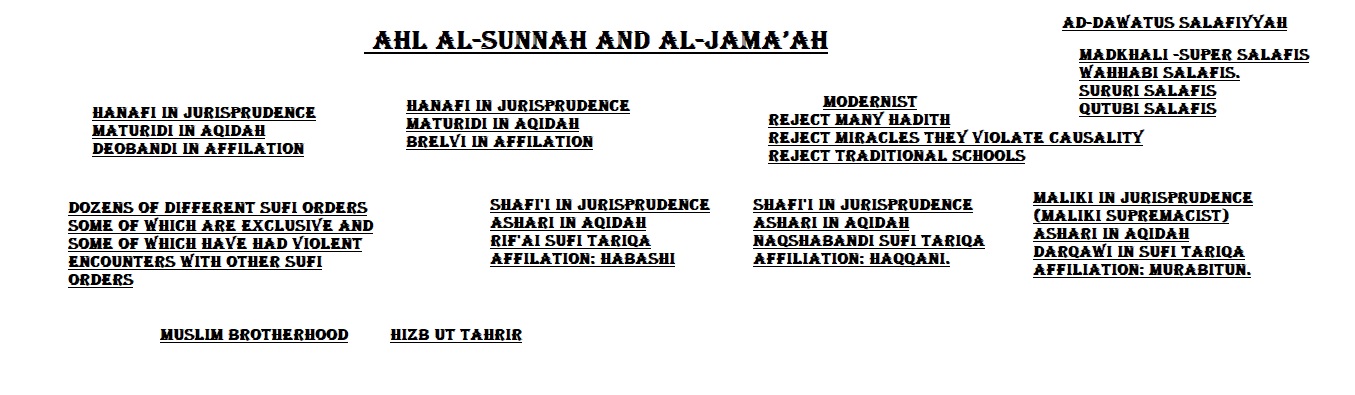
The above image no where does justice to the very real divisions that exist among those who claim the title: ‘Ahl Al-Sunnah And Al-Jama’ah‘.
It seems this ahadith about the ‘jamaat’ or the ‘group’ can easily be interpreted by any group of any given sect of Muslims at any point in history as a reference to themselves.
If Sunni Muslims believe that the majority is correct then the whole lot of them should follow the Hanafi school of jurisprudence. That is because around 60% of Sunni Muslims follow this particular school.
The Abbasids, Mughal and Ottoman empires adopted it and promulgated it. The followers of other schools of Sunni jurisprudence would have to be considered shameful to hold on to to the Hanbali, Maliki and Shafi’i schools of jurisprudence in light of what looks like the apparent favour of Allah (swt) given to the Hanafi school.
Conclusion:
The term or phrase: “Ahl Al-Sunnah Wal-Jama’ah” cannot be authentically attributed to the Blessed Messenger (saw). This term is not in the Qur’an. This term is not from the Blessed Messenger (saw).
“The faculties of seeing (tudriku) cannot grasp Him, and He grasp all–seeing (yudriku), He is the All-Subtle and All-Aware.” (Qur’an 6:103)
﷽
Dear Muslim Ummah.
This is a collection of articles on the issue of Seeing Allah (swt) in the hereafter. May Allah (swt) guide you to the path and way of the Muslims. May Allah (swt) guide you to the doctrine of transcendence. The way of the Qur’an and the Sunnah. Because this is the safest and secure road.
Among those who profess to be Sunni Muslims, you see such a division among them on this matter. One will claim that their lord has a shape and a form. The other side, realizing the problematic nature of such a position, will claim a sort of ‘beatific vision’. All sides come with their proofs and evidence.
Among them are those who say both believers and disbelievers will see Allah and others say seeing Allah is a reward exclusive to the believers.
For example: what form or shape did the disbelievers see Allah in?
On Seeing Allah: The following article breaks down a video from a brother upon the Ashʿarī theology giving our critical analysis from the Ibadi perspective.
The following section deals with a fringe group who call themselves ‘Salafi;: They claim that they are upon the belief of the early generation of Muslims. In reality they are those who have very eccentric and bizarre views.
According to Sahih Bukhari what Form/Shape of Allah did the disbelievers see? What Every Christian Should Ask Every Muslim. Christians believe that God took upon himself a form or a shape. The Salafi sect also believes that Allah took upon a form or a shape.
They built for him as many temples as he wished, and figures, basins like cisterns, and caldrons fixed [in the ground]. ‘O House of David, observe thanksgiving, and few of My servants are grateful.’ (Qur’an 34:13)
﷽
Perhaps one of the more sobering reminders of the Qur’an is the fact that the believers are never described as being the vast majority or even the majority of people.
How or why you came to this blog is best known to Allah (swt). Perhaps you want to learn more about this particular school of Islam, or perhaps you just want to learn about Islam. You may even be a believer of some other faith and antagonistic to Islam. Yet, here you are.
To know that we are blind is itself a blessing. To be blind to our blindness is a calamity beyond measure.
“Indeed, your Lord is most knowing of who has strayed from His way, and He is most knowing of who is guided” (Qur’an 16:125)
A few are those who believe.
David] said, “He has certainly wronged you in demanding your ewe [in addition] to his ewes. And indeed, many associates oppress one another, except for those who believe and do righteous deeds – and few are they.” And David became certain that We had tried him, and he asked forgiveness of his Lord and fell down bowing [in prostration] and turned in repentance [to Allah]. (Qur’an 38:24)
And [recall] when We took the covenant from the Children of Israel, [enjoining upon them], “Do not worship except Allāh; and to parents do good and to relatives, orphans, and the needy. And speak to people good [words] and establish prayer and give zakāh.” Then you turned away, except a few of you, and you were refusing. (Qur’an 2:83)
When Saul marched forth with his army, he cautioned: “Allah will test you with a river. So whoever drinks ˹his fill˺ from it is not with me, and whoever does not taste it—except a sip from the hollow of his hands—is definitely with me.” They all drank ˹their fill˺ except for a few! When he and the ˹remaining˺ faithful with him crossed the river, they said, “Now we are no match for Goliath and his warriors.” But those ˹believers˺ who were certain they would meet Allah reasoned, “How many times has a small force vanquished a mighty army by the Will of Allah! And Allah is ˹always˺ with the steadfast.” (Qur’an 2:249)
Until, when Our command came and the oven overflowed1, We said, “Carry in it, of each kind, a male and female couple , and your family—except those against whom the sentence has already been passed—and those who have attained faith.” But none attained faith with him except a few. (Qur’an 11:40)
And [We cursed them] for their breaking of the covenant and their disbelief in the signs of Allah and their killing of the prophets without right and their saying, “Our hearts are wrapped”. Rather, Allah has sealed them because of their disbelief, so they believe not, except for a few. (Qur’an 4:155)
Most are ungrateful. Most are defiantly disobedient. Most are liars. Most of them do not know, are ignorant and do not believe.
Or ˹because˺ they say, “He is insane?” In fact, he has come to them with the truth, but most of them are resentful of the truth: (Qur’an 23:70)
You are the best nation produced [as an example] for mankind. You enjoin what is right and forbid what is wrong and believe in Allah. If only the People of the Scripture had believed, it would have been better for them. Among them are believers, but most of them are defiantly disobedient. (Qur’an 3:110)
Have you ˹O Prophet˺ not seen those who fled their homes in the thousands for fear of death? Allah said to them, “Die!” then He gave them life. Surely Allah is ever Bountiful to humanity, but most people are ungrateful. (Qur’an 2:243)
They listen eagerly, but most of them are liars.” (Qur’an 26:223)
And if you ask them who sends down rain from the sky, giving life to the earth after its death, they will surely say, “Allah!” Say, “Praise be to Allah!” In fact, most of them do not understand. (Qur’an 29:63)
Is it not that whenever they make a covenant, a group of them throws it away? In fact, most of them do not believe.” (Qur’an 2:100)
But verily thy Lord is full of grace to mankind: Yet most of them are ungrateful. (Qur’an 27:73)
And We have not sent you except comprehensively to mankind as a bringer of good tidings and a warner. But most of the people do not know. (Qur’an 34:28)
And even if We had sent down to them the angels [with the message] and the dead spoke to them [of it] and We gathered together every [created] thing in front of them, they would not believe unless Allah should will. But most of them, [of that], are ignorant. (Qur’an 6:111)
“Surely in this is a sign. Yet most of them would not believe.” (Qur’an 26:8)
And most of them believe not in Allah except that they attribute partners (unto Him). (Qur’an 12:106)
Do not be deceived by this life. Allah (swt) never in the Qur’an states that the majority believed or that the majority are grateful. The opposite is true. The believers are few. The grateful are few. May each and everyone of us die as grateful believers. In a state of Islam.







 Prima Quran