
Tag Archives: islamic-dilemma

The so called ‘Islamic Dilemma’ is a Protestant attack upon the Eastern Orthodox, Oriental Orthodox, Assyrian and Roman Catholic Churches.

“The Jews and Christians each claim that none will enter Paradise except those of their own faith. These are their desires. Reply, “Produce your proof if what you say is true.” (Qur’an 2:111)

﷽ 

This above verse encapsulates the Qur’anic approach to interfaith debate, which is not limited to textual proofs, but reasoned proof. This is sensible considering huge swathes of the population were illiterate. Illiteracy does not mean one could not reason or one could not think.

What is striking and deeply ironic is that the ‘Islamic Dilemma’ is not merely a Protestant argument against Islam. It is a veiled attack on traditional Christianity itself. Roman Catholics, Eastern Orthodox, Oriental Orthodox, and Assyrian Christians who adopt this argument are unwittingly fighting on Protestant ground, using Protestant weapons, against their own ecclesial principles.

The “Islamic Dilemma” is a very specific form of argument. It is a logical, text-based trap: if it is assumed that the Qur’an says the Bible is true, and the Bible contraditcts Islam, then Islam is false. However, If the Bible is unreliable and corrupted, then it is assumed that Islam is still false because of the claim that the Qur’an repeatedly affirms the divine authority, inspiration, and preservation of the very same scriptures.

The trap is clever, but it rests on a fatal assumption: that the Qur’an is referring to the Protestant canon, and that it commands the laity to consult it directly. Neither assumption is true.

For the Protestant this is a debate about the accuracy and authority of written texts.

For a Catholic, Orthodox, or Assyrian Christian, this framing is a false start as well as a betrayal of their own tradition. The ‘dilemma’ demands that the Bible be treated the way Protestants imagine Muslims treat the Qur’an: as a direct, self-interpreting, accessible text for the laity. Yet this is a caricature of both traditions.

Muslims have always had direct access to the Qur’an through recitation and prayer. It is memorized, recited, and heard. Yet like Christians before the Reformation, they have never approached it as a text for private interpretation. The Shi’i have their Imams; the Sunni and Ibadi have their scholars and jurists. The Church, not the text, is the pillar of truth for traditional Christians. And the community of scholars, not the individual, is the pillar of interpretation for Muslims. Both traditions are built on communal, mediated authority. Only Protestantism is built on the chaos of the individual.

The Protestant ‘Islamic Dilemma’ is demonstrably historically fallacious.

  1. It posits that Christians in the 7th century engaged with their scriptures rather than defer to Church authority.
  2. It posits that Muslims in the 7th century accept books that Protestants themselves today do not accept.
  3. It posits that Muslims and Christians engaged in cross referencing Bible canons with the Qur’an.
  4. It posits that people in the 7th century have a high degree of literacy.
  5. It posits that Bible canons were widely availabe to every Christian household.

The Qur’an engages communities and their learned.

“We did not send before you except as men to whom We revealed. Ask the People of the Reminder if you do not know.” (Qur’an 16:43)

You can read various Tafsir here:

https://quranx.com/Tafsirs/16.43

Al Wahidi says:

(And We sent not (as Our messengers) before thee other than men whom We inspired…) [16:43]. This verse was revealed about the idolaters of Mecca who denied the prophethood of Muhammed, Allah bless him and give him peace. They said: “Allah is too great to have a human being as His messenger; could He not have sent an angel?”

Source: (https://quranx.com/Tafsirs/16.43)

Notice that the people are being told to ask the people. They are not being told to consult the gospel or the torah.

“So “if you are in doubt concerning that which We have revealed unto you, then ask those who are reciting the Book before you. Verily, the truth has come to you from your Lord. So be not of those who doubt (it).” (Qur’an 10:94)

Notice it says ask those who are reciting the book. The one(s) being addressed are not being told to consult the gospel or the torah.

As regard the ‘if’ Arabic grammar has conditionals that are similar to what we find in English.

The zero conditional is used for universal truths or general facts. Example: If water reaches 100°C, it boils.

The second conditional is used for unlikely or hypothetical scenarios. Example: If I won a million dollars, I would travel the world.

So the example used above is the conditional used for universal truths and general facts.

The zero conditional in Arabic (as in English) is not a genuine hypothetical. When the Qur’an says ‘If you are in doubt…’ it is not suggesting that doubt is possible. Rather, it is establishing a universal principle: when in doubt (and the Prophet -peace be upon him, was not), the remedy is to ask the learned. The ‘if’ is rhetorical. To make a point, not to suggest a real possibility.

Examples in the Qur’an:

“Say, “If The Most Merciful had a son, I would certainly have been the first one to worship him.” Exalted is the Lord of the heavens and the earth, Lord of the Throne, above what they describe.”(Qur’an 43:81-82)

The if here is not one of a hypothetical but rather a universal truth. Allah does not have a son.

“Say, “If there had been with Him gods, as they say, then they would have sought to the Owner of the Throne a way.” (Qur’an 17:42)

The if here is not one of a hypothetical but rather a universal truth. There are no other gods.

Also, let us take a look at a key part of the text. “Ask those who are reciting the book.” It doesn’t say ask the Jews or Samaritans. It doesn’t say ask the Oriental Orthodox, the Assyrian Christian, or the Eastern Orthodox. It says, ‘those who are reciting the book‘. So, if Muhammed (saw) asked ‘those who are reciting the book, he would receive some common themes but also a cacophony of discordant voices. 

This confirms the following:

“Do not be like those who became divided and differed after the clear proofs had come to them.” (Qur’an 3:105)

“The Jews and Christians each claim that none will enter Paradise except those of their own faith. These are their desires. Reply, “Produce your proof if what you say is true.” (Qur’an 2:1111)

Notice the text says ‘produce your proof’ it does not say ‘let us consult the torah and the gospel’.

Another example.

“Or have they taken gods besides Him? Say, Produce your proof. This is the message for those with me and the message of those before me.” But most of them do not know the truth, so they are turning away.” (Qur’an 21:24)

In both examples with the idolaters of mecca, the jews and the christians all are being told to ‘produce their proofs’ what are your arguments.

Why do the rabbis (l-rabaniyuna) and religious scholars (ahbaru) not forbid them from saying what is sinful and devouring what is unlawful? How wretched is what they have been practicing.” (Qur’an 5:63)

This is a clear appeal to authority. The rabbis and scholars could only be faulted if it was known that they had authority over thier people. The verse presupposes that the religious leaders have authority and that they are failing in their duty. This is a direct parallel to the traditional Christian model, where bishops and councils, not laypeople, are the authority.

This is not accidental. The Protestant project has always sought to undermine ecclesiastical authority. By recruiting traditional Christians to fight the ‘Islamic Dilemma,’ Protestants are achieving what centuries of polemics could not: getting Catholics and Orthodox to abandon their own ecclesial principles and adopt the Protestant method of direct textual engagement.

It is bad enough that Protestant Evangelicals are ignorant of the context of 7th century Arabia, as well as the reality of the Pagan Arabs, as well as the Jewish and Christian communities.

What is extremely shocking is that representatives of traditional churches are willingy to drink from the same cup of ignorance.

Sola Scriptura (scripture alone) has never been the position of any traditional church.

Jesus claims that neither he nor the Bible guide you into all truth.

“I have many things to say unto you, but you cannot bear them now. Howbeit when HE, the Spirit (Pneuma)Πνεῦμα of truth comes HE will guide you into all truth: (HOW?) For HE shall not speak of HIMSELF; But whatsoever HE shall hear (from God) that shall HE speak: and HE will show you things to come.” (John 16:12-13)

The problem for the Protestant: If the Spirit guides into all truth, then the Scripture can’t be the only infallible authority. This means The Bible alone does not contain all truth. It is only a partial revelation at bests and awaiting the Spirit of Truth and his guidance.

The problem for Catholics/Orthodox: If the Church (tradition) is the vehicle of the Spirit’s guidance, then the Church’s authority is self-referential and circular.

This is circular because:

The Church’s authority depends on the Bible
The Bible’s authority depends on the Church
Neither can independently validate the other.

So here we are. The real issue is we were promised someone who would SPEAK but in reality all we have are church councils (EO/Catholic) or private interpretations (1001 Protestant denominations). Stalemate.

The problem for the Catholics/Orthodox is that Protestants have unwittingly recruited them into an argument that undermines them and their authority.

The layman did not go directly to the text in the 7th century Arabia.

There are number of reasons historically why this is not the case.

1) Literacy, one cannot assume that the average person could read and write, Arabic, Amharic, Ge’ez, Aramaic, Greek. For example the reference in Qur’an 10:94. This has to obviously be a reference to those who can read. This brings us to the next point.

2) Not only does Qur’an 10:94 have to be a reference to those who can read but those who would have access to a text. So this brings us to the lack of accessibility to the text. Today a Bible can be found in your average hotel. In that time people were not walking around with full canons.

3) It is a Protestant approach to go direct to the scripture and not a Traditional Church perspective. If one was Oriental Orthodox, Eastern Orthodox or Assyrian Church of the East, it was not the habit of laypeople to go directly to the text.

Thus, the Qur’anic command to ‘judge by what Allah has revealed’ cannot mean ‘read the Bible for yourself.’ It would have been historically impossible for the vast majority of Christians to comply. The command must mean something else entirely something consistent with both the traditional model of authority and the lived reality on the ground.

The Protestant use of the Islamic Dilemma is actually a full frontal attack on traditional Christianity (be it Eastern Orthodox, Oriental Orthodox, Roman Catholic, Assyrian Church of the East). Imagine Protestants telling Muslims to go direct to the Torah or the Injeel without the medium of the Holy Spirit or the guidance of the Church!! This is very mischievous and very cunning proposition propagated by the Protestants (esp evangelicals).

There were no Protestant churches nor a Protestant canon in the 7th century.

The following verse is often used by Protestant Christians.

Do you believe in some of the book and reject the rest? Is there any reward for those who do so among you other than disgrace in this worldly life and being subjected to the harshest punishment on the Day of Judgment? For Allah is never unaware of what you do.” (Qur’an 2:285)

For the sake of argument let us say that Muslims understand this verse in the way that Protestants do.

What objective basis do the Protestants have for determing what is part of the book and what is not?

What objective basis do the Protestants have for determing what is scripture and what is not?

If a Muslim in the 7th or 8th century were to listen to the children of Israel, in particular the tribes of the tribes of Ephraim and Manasseh what would the Samaritans advise in regard to following which scriptures?

The Muslim would find that the Samaritans reject all parts of the Bible except what they consider the Torah. That is to say they only accept Genesis, Exodus, Leviticus, Numbers and Deuteronomy. They reject the rest.

If a Muslim in the 7th or 8th century were to listen to the children of Israel, in particular those who are called Jews, what would be the advise in terms of scripture?

The Muslims would find that the bulk of Jews follow more than the five books that the Samaritans follow. They also follow an oral torah.

If a Muslim in the 7th or 8th century were to embrace Christianity they would join any number of traditional churches that accepted the following books: Tobit, Judith, Wisdom, Sirach, Baruch, 1 & 2 Maccabees.

The Protestant canon of 66 books did not exist in the 7th century. It was a 16th-century invention. The Qur’an could not possibly be endorsing a canon that did not yet exist. This alone destroys the ‘Islamic Dilemma’.

If a Muslim in the 7th or 8th century were to embrace Christianity they would join any number of traditional churches that differ on the canon of the New Testament as well.

“By the beginning of the 5th century, or slightly earlier, the Syrian Church’s version of the Bible, the Peshitta (‘simple’ translation) was formed. For the New Testament it represented an accommodation of the Syrian canon with that of the Greeks. It contains 22 books – all of the present New Testament except:

II Peter, II John, III John, Jude, Revelation of John.”

“For the eastern part of the Syrian Church this constituted the closing of the canon, for after the Council of Ephesus (431 CE) the East Syrians separated themselves as the Nestorians. There are many surviving manuscripts of the Peshitta, the oldest of which bears the date 442. For much more on Peshitta history, see the article at The Encyclopedia of New Testament Textual Criticism. It is noteworthy that exactly these 22 books are cited by John Chrystosom (~347-407) and Theodoret (393-466) from the School of Antioch. For a visual summary of these 22 books see the Cross Reference Table.”

Source: (http://www.ntcanon.org/Peshitta.shtml)

Thus, even if we assume the Qur’an is endorsing the Peshitta canon, it would be endorsing a Bible that lacks five books the Protestant considers canonical. Which canon did the Qur’an endorse? The answer: none. The Qur’an does not endorse any canon. It endorses the original revelation, which is now lost or corrupted.

The Protestants imagine that the Qur’an is somehow endorsing a tangible canon.

What tangible canon would that be? Especially seeing that the Christians themselves were/are in dispute over it?

This is the same question that Christians who follow a traditional Church pose to those who espouse ‘anti-Islamianity’. That is why their whole preaching is against Islam, but they don’t have anywhere for Muslims to go after they apostate from Islam. It’s just anti-Islam teaching, but they (those preachers) do not reveal which church they are affiliated with. That is if they are affiliated with one at all.

This is also known as ‘churchless apologetic’.

This is why the ‘Islamic Dilemma’ is promoted primarily by ‘churchless apologists’. Grifters and independent evangelicals with no affiliation to any traditional Church. They have no stake in defending a particular ecclesiastical tradition. They simply want to tear down Islam, with no thought to where the Muslim convert would go. They are a law unto themselves, accountable to no one but their own whims and private interpretations. And this, ironically, is precisely what the traditional Churches have always warned against i.e The chaos of sola scriptura without the anchor of ecclesiastical authority.

Let us reflect on what Pope Benedict XVI said in his ‘What Is Christianity?’

“All of this means that the Christian faith is not a religion of the Book (see Catechism of the Catholic Church n. 108 and the Post Synodal Apostolic Exhortation Verbum Domini of 2008). Holy Scripture speaks only in the living community of the Church. There is a double exchange here, a relationship of subordination and superordination. On the one hand, the Church clearly submits to the Word of God, always having to let itself be guided and judged by it, on the other hand, however, Scripture, starting
from its whole, can only be adequately interpreted in the living Church. This position, adopted by the whole Church until the 16th century, was rejected in the Reformation with the principle of sola
scriptura . Christianity now appears as a religion of the Book.

Source: (Benedetto XVI Che Cos’e il Cristianesimo quasi un testamento spirituale).

Here we have the Pope himself affirming that the Catholic Church does not treat the Bible as a self-interpreting text. The Qur’an says the same thing: ‘Ask the People of the Reminder.’ The Protestant ‘Islamic Dilemma’ is not just unhistorical it is anti-Catholic, anti-Orthodox, and anti-Assyrian.

Holy Scripture speaks only in the living community of the Church. -Pope Benedict.

Example.

The doctrine of Invincible Ignorance.

The Roman Catholic Church teaches that not everyone necessarily needs to confess Jesus Christ as their lord and saviour simply becuase not everyone is able to do so.

“Salvation is found in no one else, for there is no other name under heaven given to mankind by which we must be saved.” (Acts 4:12)

“But what does it say? “The word is near you, in your mouth and in your heart” (that is, the word of faith which we preach): That if you confess with your mouth the Lord Jesus and believe in your heart that God has raised Him from the dead, you will be saved.” (Romans 10:8-9)

“Whoever believes in him is not condemned, but whoever does not believe stands condemned already.” (John 3:18)

These text seem very clear that one needs to confess their faith in Jesus to be saved. However, the Roman Catholic Church via it’s doctrine of ‘Invincible Ignorance’ says not so fast.

The concept of invincible ignorance allows for the salvation of young children, the mentally disabled, and others who never heard the gospel.

St Augustine has a whole chapter title called: Chapter 2 [II.]— Faith in Christ Not Necessary to Salvation, If a Man Without It Can Lead a Righteous Life.

He states:

“Therefore the nature of the human race, generated from the flesh of the one transgressor, if it is self-sufficient for fulfilling the law and for perfecting righteousness, ought to be sure of its reward, that is, of everlasting life, even if in any nation or at any former time faith in the blood of  Christ was unknown to it. For God is not so unjust as to defraud righteous persons of the reward of righteousness, because there has not been announced to them the mystery of Christ’s divinity and humanity, which was manifested in the flesh. 1 Timonty 3:16 For how could they believe what they had not heard of; or how could they hear without a preacher? Romans 10:14 For faith comes by hearing, and hearing by the word of Christ. But I say (adds he): Have they not heard? Yea, verily; their sound went out into all the earth, and their words unto the ends of the world. Romans 10:17-18.  Before, however, all this had been accomplished, before the actual preaching of the gospel reaches the ends of all the earth — because there are some remote nations still (although it is said they are very few)”

Source: (https://www.newadvent.org/fathers/1503.htm)

The doctrine of invincible ignorance even allows for pagans who persecuted and killed Christians to enter heaven if the Pope prays for their deliverance. There is no need for the person to confess Christ even if they are able.

John of Damascus said that God freed Trajan from Hell after the prayers of Saint Gregory the Great.

“Further, the Damascene in the same sermon relates that Gregory, while praying for Trajan, heard a voice from heaven saying to him: “I have heard thy voice, and I pardon Trajan; : and of this fact the Damascene adds in the same sermon, “the whole East and West are witnesses. ” Yet it is clear that Trajan was in hell, since “he put many martyrs to a cruel death” [De his qui fide dormierunt]. Therefore the suffrages of the Church avail even for those who are in hell.”

Source: (https://www.newadvent.org/summa/5071.htm)

The Roman Catholic Church can appeal to scripture but it is not necessay.

“And Jesus said, “Father, forgive them, for they know not what they do.” (Luke 23:34)

“In the past God overlooked such ignorance, but now he commands all people everywhere to repent.” (Acts 17:30)

So Catholics argue that God cannot issue commands that people can’t obey.

If the Catholic Church can interpret away the seemingly clear words of Acts 4:12 and Romans 10:9, then on what basis do Protestants claim that the Bible is self-iexplanatory? The very existence of the doctrine of invincible ignorance proves that the Church and not the text is the final authority.

Catholics like Sam Shamoun and Cameron Bertuzzi stand ready to debate Protestants like Anthony Rogers and Samuel Green on Invincible Ignorance.

The Protestant project has always sought to undermine church authority.

In Mainz, Germany, in the mid-1450s, Johann Gutenberg and his partner Johann Fust published more than 150 large-format copies of the Bible in Latin. This is the book known today as the Gutenberg Bible. That was in the 1450s, and there were 150 copies.

Up until that point, imagine all the Christian souls scattered throughout the Earth; they lived and died without once having or holding an individual Bible in their possession. Hopefully, some Christians will be more appreciative of this fact.

For over a millennium, Christians had no personal Bibles. They relied on the Church. They relied upon its liturgy, its priests, its bishops, its councils. The Protestant idea that the Bible is for the laity is a 16th-century invention. The Qur’an, revealed in the 7th century, could not have been commanding Christians to do what was historically impossible.

Books in those times were luxury items reserved exclusively for the ultra-wealthy, ruling elites, and church communities.

Ordinary Christians experienced the scriptures orally. They would gather together at church services to hear a literate priest or bishop read the letters and gospels aloud.

That Christian laity did not rely upon the Bible to receive their guidance. They relied upon their respective church, whether it was the Latin Roman Catholic, Assyrian Church, Oriental or Eastern Orthodox Church. The Church, and not scripture, was the source of guidance and inspiration for the average Christian.

We can clearly see that the Qur’an has never endorsed the entirety of any Biblical canon or text.

The Protestant ‘Islamic Dilemma’ has two horns both of which rest on an assumption. The assumption is that the Qur’an claims the Bible is true.

Does the Qur’an claim the Bible is true?

The word Bible has its etymological root in the Greek ta biblia, which means “small books”.

Possibly the closest equivalent would be the following:

“The Messenger believes in what has been revealed to him from his Lord, and so do the believers. They believe in Allah, His angels, His Books (kutubihi), and His messengers.” (Qur’an 2:285)

This particular verse does not clarify which books are to be believed. Only that Muslims are to believe
in ‘His Books’.

As we have demonstrated that historically speaking, Protestants cannot prove that the Qur’an 2:285 is identical to a 66 book canon.

One thing is certain. The Gospel is not included in the text of Qur’an 2:285. Hoever, Jesus is included in Qur’an 2:285.

The Qur’an never describes the Gospel as a book given to Jesus.

“And He will teach him the Scripture and wisdom, and the Torah and the Gospel.” (Qur’an 3:48)

An interesting note on the above. If the Torah was intact there would be no need for Allah to teach the Torah to Jesus.

“And We sent, following in their footsteps, Jesus , the son of Mary, (ma bayna yadayhi) having authority over the Torah; and We gave him the Gospel, in which was guidance and light and having authority over that which preceded it of the Torah as guidance and instruction for the righteous.” (Qur’an 5:46)

“So let the people of the Gospel judge by what Allah has revealed in it. And those who do not judge by what Allah has revealed are the rebellious.” (Qur’an 5:47)

If the Gospel was in pristine condition the verse would have simply stated:

“And let the Christians judge by the Gospel.”

Yet, it is drawing attention to the ‘People of the Gospel’ (ahlul l’injili) to judge by what Allah has revealed therein.

The people who have the nomenclature ‘People of the Gospel’ are to judge.

Again keep in mind this is not a call for Christian laity to engage directly with their text.

Recall that we have already established two unassailable points. 1. Literacy was not widespread among all people. 2. Even it were not everyone had access to a text.

“Those who follow the Messenger, the unlettered prophet, whom they find written in the Torah and the Gospel (which are) with them(ʿindahum).” (Qur’an 7:157)

If a person possesses a heavily edited or condensed version of a historical document, it is still legally and conversationally “with them” (ʿindahum).

Example.

“And those who disbelieve say, ‘Why was the Qur’an not revealed to him all at once?” (Qur’an 25:32)

This is a reference to the Qur’an but the entirety of the Qur’an was not revealed at this time. Yet the text is still calling it the Qur’an.

The Qur’an debunks the Protestant claim of preservation.

“There are some among them who distort what is in the Book(bil-kitabi) with their tongues to make you think this is from (l-kitabi) the Book but it is not what the (l-kitabi) Book says. They say, “It is from Allah”—but it is not from Allah. And they attribute lies to Allah knowingly.” (Qur’an 3:78)

The Protestants sweep this accusation aside by affirming that the text doesn’t say anything about textual corruption. It is about people who twist the words and meanings of their sacred text. However, as pointed out in a society where illiteracy was common place, the laity did not go directly to the text and many of them did not have the requisite language skills to acces it. This was already quite poisonous.

However, the next text are not so easily swept aside.

“Have you any hope that they will be true to you when a party of them used to listen(yasma’una) to the word of Allah, then used to (yuharrifunahu)change it, after they had understood(‘aqaluhu) it, knowingly.” (Qur’an 2:75)

This verse is quite explicit in the damnation of these people. That they actually would listen to the words of Allah (auditory hearing), they understood it, confirmed it and knowingly changed it during the oral transmission process!

  1. Received the revelation from Allah.
  2. Understood it.
  3. Knowingly distorted it during the oral transmission process.

One would have to be extremely vile to do such a thing.

‘Then woe to those who write the Book (l-kitaba) with their own hands, and then say: “This is from Allah,” to traffic with it for miserable price!- Woe to them for what their hands do write, and for the gain they make thereby.’ (Qur’an 2:79)

This is what we find “with them” (ʿindahum).

“How can you say, ‘We are wise, and the (תּוֹרַת יְהֹוָה Torat YHWH) law of the LORD is with us’? But behold, the lying pen of the scribes has made it into a lie. (Jeremiah 8:8)

Notice the text of Qur’an 2:79 says they make gain by what they wrote.

The following says that Jews can give interest to non-Jews but not to one another.

“Unto a foreigner you may lend interest; but not unto your brother you shall not lend interest, that Jehovah your God may bless you in all that you put your hand on, in the land wherever you go into possess it. When you shall vow a vow unto Jehovah your God, you shall not be slack to pay it: For Jehovah your God will surely require it of you; and it would be sin in you.” (Deuteronomy 23:20-21)

The Protestant ‘Islamic Dilemma’ uno verse card.

The Qur’an claims that the Gospel, Zabur and Torah are revelation from Allah.
If one claims they have the Gospel, Zabur or Torah and those contents do not claim it is from Allah then it should be rejected.

For example, let us imagine that the Gospel is equivalent to any number of competing New Tesatament canons (35 books, 22 books or 27 books) this in and of itself raises questions how one objectively comes to the correct number of books.

However, is there anywhere where the New Testament claims that it is from God?

Many Christians will point to 2 Timothy 3:16.

Let us examine the text.

“Every writing inspired by God is profitable for teaching, for reproof, for correction, and for instruction which is in righteousness.”

Well, this doesn’t say much. Every writing (graphé)inspired by God is profitable. This begs the question. On what objective basis does the Protestant determine which writings are inspired by God?

πᾶσα γραφὴ θεόπνευστος καὶ ὠφέλιμος πρὸς διδασκαλίαν, πρὸς ἐλεγμόν, πρὸς ἐπανόρθωσιν, πρὸς παιδείαν τὴν ἐν δικαιοσύνῃ

The Two Possible Readings

TranslationReadingImplication
KJV / ESV / NIV“All writing is God-breathed and profitable…”Predicative: All scripture (as a category) is inspired
ASV / RSV / NEB“Every writing inspired by God is also profitable…”Restrictive: Only inspired scripture is profitable

The Grammatical Issue

The Greek construction πᾶσα γραφὴ θεόπνευστος (pasa graphē theopneustos) is ambiguous:

  1. Predicative Reading: “All writing is God-breathed” (the adjective describes the entire category)
  2. Restrictive Reading: “Every writing that is God-breathed” (the adjective limits the category)

The Critical Point:

The absence of the verb “is” (ἐστιν – estin) in the Greek makes the translation a matter of interpretation. There is no explicit “is” in the text. The translator must decide whether to supply it as a predicative or a restrictive statement.

By the way, most of your translations will translate graphé as ‘scripture’ to give you the indication that it is somehow sacred.

Look how the various translations render the Greek into English.

https://www.biblestudytools.com/2-timothy/3-16-compare.html.

The restrictive reading makes the most sense. That is because there is no Christian on Earth that believes that every writing is God -breathed. That would also make the Qur’an God-breathed and we would not be having this conversation.

The problem for the Protestant. (Every Christian must ask this in reality).

If only some writings are God-breathed, then:

  • Who determines which writings are inspired?
  • What is the criterion for inspiration?
  • How do we know which graphē are God-breathed?

This leads to the question of canon.

The Circular Problem:

  1. Protestant Claim: 2 Timothy 3:16 proves that all Scripture is inspired.
  2. Problem: The verse does not tell us which writings are Scripture.
  3. Result: We must have a canon to know which writings are inspired.
  4. But: The canon is determined different competing apostolic Churches, not by the text itself.

This is circular because:

The Church’s authority depends on the Bible.
The Bible’s authority depends on the Church.
Neither can independently validate the other.

So here we are. In reality all we have are church councils (EO/Catholic) or private interpretations (1001 Protestant denominations). Stalemate.

The Protestant ‘Islamic Dilemma’ undermines Jesus teachings and becomes a Satanic Dilemma for themselves.

“If Satan drives out Satan, he is divided against himself. “How then will his kingdom stand?” (Matthew 12:26)

The context of Matthew 12:26 is Jesus’ response to the Pharisees, who accused him of driving out demons by the power of Beelzebul (Satan). Jesus used logical reasoning to expose the flaw in their claim, explaining that a divided kingdom or household cannot survive. Therefore, it would make no sense for Satan to cast out his own demons, as that would mean working against himself and destroying his own kingdom

The Protestant claim is that the spiritual force behind the Qur’an is none other than Satan.

If Satan inspired the Qur’an, why would he command people to follow the Torah and Gospel?

The Bible says Satan is the father of lies.

“You belong to your father, the devil, and you want to carry out your father’s desires. He was a murderer from the beginning, not holding to the truth, for there is no truth in him. When he lies, he speaks his native language, for he is a liar and the father of lies.” (John 8:44).

If he is the father of lies, he would not inspire a book that tells people to follow the truth (the Bible).

Therefore, the Qur’an cannot be from Satan. It must be from God.

The Christian cannot escape this without admitting that the Qur’an is either:

A) From God (which they deny), or

B) A bizarre, self-defeating satanic book that commands people to follow the very scripture that would lead them to Jesus and save them from Satan. This ultimately debunks Jesus logic given in Matthew 12:26.

C) The Christian must admit that the Qur’an does not confirm the totality of what Christians call the Gospel and what Jews call the Torah. This would mean the Qur’an’s confirmation is selective, conditional, and discriminatory. But this undermines the entire foundation of the ‘Islamic Dilemma’.

The Christian cannot say the Qur’an is entirely false (because it commands people to follow the Bible) and cannot say it’s entirely true (because that would mean accepting Islam). The only logical exits are:

Admit the Qur’an is from God (conversion).

Admit that Satan sometimes commands people to follow God (which is theologically absurd)

Admit the Muslim position is true (the Qur’an does not confirm the totality of what Christians call the Gospel and what the Jews call the Torah -which undermines both faiths.) < This would be what Satan would do. Satan would obfuscate a matter not lead people to God.

This is why traditional Christian Churches such as the Eastern Orthodox, Oriental Orthodox, Roman Catholic, Assyrian Church of the East did not use these type of arguments against Islam.

They recognized the logical fallacy of such arguments. However, many catechumens of both the Roman Catholic and Eastern Orthodox tradition have fallen for the Protestant approach. They have brought shame and disrepute towards their respective churches.

The ‘Islamic Dilemma’ is a Protestant invention. It is historically ignorant, theologically shallow, and logically self-defeating. It betrays the very traditions it purports to defend. Traditional Christians who embrace it are unwittingly abandoning their own principles and fighting a battle on Protestant ground. The Qur’an invites a different approach: reasoned argument, consultation with the learned, and a return to the original revelation that it confirms and clarifies. The question is not ‘Which text is true?’ but ‘Where is the truth?’ And the Qur’an answers: it is in the Reminder that Allah has sent down. It is clear, preserved, and accessible to all who seek it.

To fully appreciate the Qur’anic message, we must imagine the religious landscape of the 7th century. it was a world of competing factions, warring sects, and conflicting claims to truth.

Consider the scene. The Jews and Samaritans were at odds with one another. The Samaritans accepted only the Pentateuch, rejected the Prophets and Writings, and worshipped on Mount Gerizim. The Jews accepted the entire Tanakh and worshipped in Jerusalem. Both claimed to be the true heirs of Abraham. Both anathematized the other neither accepting Jesus as the Messiah, each claiming to possess the true Torah. The Samaritans had their own version of the Torah, their own Mount Gerizim, their own priesthood. The Jews had their own Torah, their own Temple Mount, their own rabbinic traditions.

Then you had the Christians. But which Christians? The Oriental Orthodox, the Assyrian Christians, the Eastern Orthodox all arguing with one another over the nature of Christ, the number of his natures, the proper way to calculate Easter, the veneration of icons. Each claimed to be the true Church. Each claimed to have the true faith. Each anathematized the others.

These Christians practiced baptism as a death and resurrection ritual.

Then you had the Sabeans, also known as the Mandeans. They accepted John the Baptist but not Jesus. They practiced ritual baptism, but it carried a different meaning than what the Christians claimed. They had their own scriptures, their own prophets, their own traditions. They were a living witness to the fact that baptism was not the exclusive property of Christianity.

And among all these groups, there was no unified voice. The Pope in Rome claimed authority over the West. The Patriarch of Constantinople claimed authority over the East. The Patriarch of Alexandria claimed authority over Egypt and Ethiopia. The Patriarch of Antioch claimed authority over Syria and beyond. Each claimed to be the successor of Peter, the guardian of the true faith.

There was no single Bible. There were multiple canons: the 27-book canon of the West, the 22-book canon of the Syrian Church, the longer canons of the Ethiopian and Coptic Churches. There were multiple languages: Greek, Syriac, Coptic, Ge’ez, Armenian. There were multiple traditions: the Latin Rite, the Byzantine Rite, the Syriac Rite, the Alexandrian Rite.

Into this chaos came Muhammed, peace be upon him, with a single, powerful, unifying voice. He did not claim to bring a new religion. He came to restore the ancient faith of Abraham. The faith that all the prophets had taught. He did not speak from his own authority. He recited what was revealed to him by Allah, through the Angel Gabriel. He did not claim to be a new pope or patriarch. He claimed to be the final Messenger, confirming what was true in the previous revelations and correcting what had been corrupted.

The message was simple, clear, and cohesive:

  • There is no god but Allah, and Muhammed (saw) is His Messenger.
  • Allah is One. Not three, not incarnate.
  • All the prophets from Adam to Jesus (upon them be peace) taught the same message: submission to the One God.
  • The Qur’an is the final, preserved, and clarifying revelation.
  • Judgment is coming. Believe and do good. Or reject it and face the consequences.

For a truth-seeker in the 7th century, the choice was clear. On one side, a cacophony of competing sects, conflicting canons, and anathematizing councils. On the other side, a single, powerful, unifying voice calling all people to submit to the One God. Which message was more cohesive? Which message was more compelling? Which message would you follow?

Allah/God addresses this very scene:

‘So He has made the religion straight and simple. And do not be divided over it.’ (Qur’an 42:13)

‘And hold firmly to the rope of Allah all together and do not become divided.’ (Qur’an 3:103)

‘And those who have been given the Book did not differ except after knowledge had come to them—out of jealousy among themselves.’ (Qur’an 42:14)

The Qur’anic message of unity was not just theological it was a lived reality. It offered clarity in a world of confusion. It offered authority in a world of division. It offered access to revelation in a world where the layperson was excluded from the text. And it offered a single, unified community in a world of warring sects.

“O humanity! What has emboldened you against your Lord, the Most Generous?” (Qur’an 82:6)

May Allah guide the sincere Christians who are longing for the truth. Those who have a hunger in their heart for guidance.

May Allah Guide the Ummah.

May Allah Forgive the Ummah.


Leave a comment

Filed under Uncategorized

The Islamic Dilemma. Let the People of The Gospel Judge.

“With the clear proofs and the Zabur. And We sent down to YOU (l-dhik’ra) the Remembrance, that YOU may make clear to the people, what has been sent down to them and that they may reflect.” (Qur’an 16:44)

“Then in the footsteps of the prophets, We sent Jesus, son of Mary, having authority over the Torah revealed before him. And We gave him the Gospel containing guidance and light and having authority over the Torah—a guide and a lesson to those who fear Allah.” (Qur’an 5:46)

And let the People of the Gospel (ahlu l-injili) judge by what Allah has revealed therein. And whoever does not judge by what Allah has revealed – then it is those who are the defiantly disobedient.” (Qur’an 5:47)

“Have you not turned Your vision to those who have been given a (nasiban) portion of the (l-kitabi) Book? They are invited to the (kitabi l-lahi) Book of Allah, to settle their dispute, but a party of them Turn back and decline.” (Qur’an 3:23)

﷽ 

This is a Christian polemic directed towards the Qur’an and Islam in general. The gist of the argument rests on two points. 

  1. The Qur’an tells the people of the Gospel to judge by what Allah has revealed therein, with the assumption being that the Qur’an confirms what Christians claim that Gospel is.
  2. If the People of the Gospel do not even know what that  entails, how can they judge by what Allah has revealed therein? 

Several hasty conclusions are then reached. 

  1. The Gospel mentioned in the Qur’an is equal to one of the competing New Testament canons. 
  2.  The Qur’an does something that Christians themselves are unable to do.  Namely: The Qur’an settles the canon of the New Testament. 

Alas, what the academics, historians and orientalists have discussed on the matter is rather blithe.

For example, we have not seen any academic, historian or orientalist even attempt to engage with the following questions in any meaningful way.

What might it mean for the Qur’an to tell a people that are primarily illiterate, to ‘judge by what Allah has revealed there’?

Taking for granted that today Christians go door to door, with a particular New Testament canon in possession, what might it mean for the Qur’an to tell a people who did not have in their possession personal copies of manuscripts to judge by what Allah has revealed?

Even if we assumed that the ‘People of the Gospel’ were all literate and had some type of canon in their possession, their approach was not to go directly to the text. For many Christians of that time, they believed it was the Church that guided, and not the text.

Even if we assumed that the ‘People of the Gospel’ were all literate, and they had some type of canon in their possession, why is it assumed they were all polyglots? Meaning, that they themselves would even understand the language of the particular text?

This is why we have not been amused by the scholarship on this issue. It surprisingly does not engage with key points.

So let us flesh out these points.

The first point. The vast majority of people were unlettered. A polite way of saying illiterate.

“Among them are unlettered (ummiyuna) folk who know (l-kitaba)the book not except from hearsay. They but guess.” (Qur’an 2:78)

“It is He who has sent among the unlettered (l-umiyina) a Messenger from themselves reciting to them His verses and purifying them and teaching them the Book (l-kitaba)and wisdom – although they were before in clear error .” (Qur’an 62:2)

You are not going to find among the beliefs of the Muslims any notion that the Blessed Prophet (saw) himself, being unlettered, is now teaching unlettered people how to read and write a book.

“Among them are unlettered (ummiyuna) folk who know (l-kitaba)the book not except from hearsay. They but guess.” (Qur’an 2:78)

How might the following verse in Qur’an 5:47 engage illiterate people in any meaningful way?

The second point.

Today we take for granted that we can go to a hotel and, more often than not, find the Gideon’s Bible in the top drawer next to the bed. Missionaries knock on your door, and surprise, surprise, they have in their hands an entire biblical canon! Something the vast majority of Christians that have lived on this planet in the past have never held in their hands even once!

Let us repeat this astonishing fact! The vast majority of Christians on this planet in the past never held a biblical canon in their hands, not even once!

When did paper reach the Muslim world? How many sheep had to be slaughtered to obtain their shoulder blades to copy down parchments to compile books was a huge project.

The Gutenberg Bible

In Mainz, Germany, in the mid-1450s, Johann Gutenberg and his partner Johann Fust published more than 150 large-format copies of the Bible in Latin. This is the book known today as the Gutenberg Bible. That was in the 1450s, and there were 150 copies.

Up until that point, imagine all the Christian souls scattered throughout the Earth; they lived and died without once having or holding an individual Bible in their possession. Hopefully, some Christians will be more appreciative of this fact.

In fact, Christians, if anything, would have religious relics or crosses. That did not rely upon the Bible to receive their guidance. They relied upon their respective church, whether it was the Latin Roman Catholic or any competing denomination between Oriental or Eastern Orthodox Churches, Syriac, and so forth. The Church, and not scripture, was the source of guidance and inspiration for the average Christian.

So knowing that having in one’s personal possession the New Testament canon is a very recent phenomenon, how might the following verse engage them in any meaningful way?

How might the following verse in Qur’an 5:47 engage people not in possession of any manuscripts in a meaningful way?

Third point. Let us take a trip down fantasy land for a moment. A complete hypothetical.

Even if the ‘People of the Gospel’ were 100% lettered, literate, and let us assume that each of them even had (any one of many competing) New Testament canons in their possession, they still would not go directly to the text.

Because, as we said before, and we will say again: The Church, and not scripture, was the source of guidance and inspiration for the average Christian.

This idea of approaching the text directly is a very modern Protestant-fueled approach. Fueled in part by translating one of the (many competing) New Testament canons into the vernacular of local people.

“Indeed, We revealed the taurat (l-tawrāta), containing guidance and light, by which the prophets, who submitted themselves to Allah, made judgments for Jews. So too did the rabbis and scholars judge according to (kitabi l-lahi) the Book of Allah, with which they were entrusted and of which they were made keepers. So do not fear the people; fear Me! Nor trade my revelations for a fleeting gain. And those who do not judge by what Allah has revealed are the disbelievers.” (Qur’an 5:44)

Prophets Judged. After the Prophet’s death, people are judged by the rabbis and authorities of their respective faiths. We see the same in the Qur’an in regard to Islam itself. Albeit here something novel is introduced due to the nature of the Qur’an.

“O you who have believed, obey Allah and obey the Messenger and those in authority among you. And if you disagree over anything, refer it to Allah and the Messenger, if you should believe in Allah and the Last Day. That is the best [way] and best in the result.” (Qur’an 4:59)

Here the idea is introduced that the believers, if they differ with the people in authority over them, are to take it back to Allah (the revelation of the Qur’an) and the Prophet (his transmitted Sunnah).

Why is this? Because this is a faith in which its sources are being made publicly available and accessible to all! We will come back to this very important point. 

And let the People of the Gospel (ahlu l-injili) judge by what Allah has revealed therein. And whoever does not judge by what Allah has revealed – then it is those who are the defiantly disobedient.” (Qur’an 5:47)

How might the following verse in Qur’an 5:47 engage people who are reliant upon a scholastic class or clergy to guide them? In fact, which “People of the Gospel” are even being addressed?

Fourth point. Even if the ‘People of the Gospel’ were 100% lettered, literate, and let us assume that each of them even had (any one of many competing) New Testament canons in their possession. Why assume they could read the particular language of the documents in their possession?

Depending on the type of Christian community, they spoke an array of languages, such as: Coptic, Aramaic, Greek, Amharic, Ge’ez, Sabaean.

So, even if we were to suspend belief and go out on a far-reaching limb and assert a 100% literacy rate, and 100% possession of some type of canon, why is it assumed that the document in their possession would be in a language that everyone else could access?

Our response effectively dismantles the ‘Islamic Dilemma’ by arguing that the polemic commits several historical and contextual errors:

Anachronism: It projects modern realities (universal literacy, personal ownership of Bibles, Protestant sola scriptura) onto 7th-century Christian communities.

Ignorance of Historical Context: It fails to consider the oral, communal, and clerical nature of religious authority in most historical Christian traditions.

We have established three key points.

Illiteracy and Lack of Access to Texts
We have correctly noted that the vast majority of people in the 7th century, including Christians, were illiterate (“ummi”). They did not have personal copies of scriptures. Religious knowledge was mediated through clergy, oral tradition, and liturgical practice. The Qur’anic command to “judge by what is within it” is not a command for every individual Christian to personally read a codex but a directive to their religious leaders (rabbis, priests, scholars) to make assessments on the data available to them. This is parallel to the command for Jews to judge by the Torah (5:43) and for Muslims to obey Allah and the Messenger (4:59).

Religious Authority: Church vs. Text
We astutely observed that for most historical Christians (Catholic, Orthodox, Oriental), religious authority resided in the Church and its tradition, not in a personally accessible text. The idea of individuals judging directly by scripture is a Protestant innovation. The Qur’anic command is thus aimed at the religious authorities (“rabbaniyyun” and “ahbar”) who were entrusted with preserving and teaching the revelation (5:44). Their failure to do so is a central Qur’anic critique (5:63, 9:31, 9:34).

Linguistic Barriers
Even if a Christian community possessed scriptures, they were often in languages (Greek, Syriac, Coptic) not understood by the laity. The Qur’an, in contrast, was revealed in the vernacular Arabic of its audience and was memorized and transmitted orally, making it immediately accessible to all, literate or not.

Elaboration upon the first point.

The example of the Blessed Prophet (saw).

“If you are in doubt about what We have revealed to you, then ask those who are (yaqrauna l-kitaba (reading the Book). “The truth has certainly come to you from your Lord, so do not be one of those who doubt it.” (Qur’an 10:94)

  1. If you doubt what is revealed to you (the context indicates what has been revealed about Moses), then ask (which is not him reading a text but consulting those who claim to have a revealed revelation)
  2. The Prophet (saw) was not in doubt, as Allah (swt) says: “The Truth has certainly come to you from your Lord, so do not be one of those who doubt.” 

Say, “Have you considered if the Qur’an was from Allah, and you disbelieved it while a witness from the Children of Israel has testified to something similar and believed that you were arrogant… ?” Indeed, Allah does not guide people who are constant in wrongdoing.“ (Qur’an 46:10)

“We did not send before you except mere men inspired by Us. So ask the (ahla l-dhik’ri) people of the reminder if you do not know.” (Qur’an 16:43)

“And We sent no messenger before you, but that they were men unto whom We revealed. So ask the people of the Reminder (ahla l-dhik’ri), if you know not.” (Qur’an 21:7)

Prima Qur’an comments: As we can see, the Blessed Prophet (saw) was informed to ask not to read.

So what is being said is to go and ask for a person to weigh the arguments not as much as examine textual evidence. Something the vast majority would not have access to any way.(textual evidence)

The question is: how many are in a similar situation?  

Again, people who do not read and write? 

Let us take a moment to ask a few more questions.

  1. How would a Muslim or a Christian convey the message of their faith to a person who could not read, not because they were illiterate, but because they were physically blind? 
  2. How would a Muslim or a Christian convey the message of their faith to a person who was physically deaf? 

Some insightful statements in the Qur’an in regard to the Jewish and Christian communities.

A) The Qur’an acknowledges schisms and sectarianism among the Jewish and Christian communities.

B) The Qur’an acknowledges that the Christians forgot a portion of what they were reminded of. This is a reference to the oral transmission of the Injeel (Gospel), as their community was given no other reminder but that. 

And the Jews say, “The hand of Allah is chained.” Chained are their hands, and cursed are they for what they say. Rather, both His hands are extended; He spends however He wills. And that which has been revealed to you from your Lord will surely increase many of them in transgression and disbelief. And We have cast among them animosity and hatred until the Day of Resurrection. ” (Qur’an 5:64)

“And from those who say, “We are Christians” We took their covenant; but they forgot (fanasu) a portion of that of which they were reminded (dhukkiru). So We caused among them animosity and hatred until the Day of Resurrection. And Allah is going to inform them about what they used to do.” (Qur’an 5:14)

C) The Qur’an charges oral corruption of the previous revelation.

“So for their breaking of the covenant, We cursed them and made their hearts hard. They distort (yuḥarrifūna) words upon delivery (mawāḍiʿihi) and have forgotten(wanasu) a portion of that of which they were (dhukkiru) reminded. And you will still observe deceit among them, except a few of them. But pardon them and overlook [their misdeeds]. Indeed, Allah loves the doers of good.” (Qur’an 5:13)

“Have you any hope that they will be true to you when a party of them used to listen(yasma’una) to the word of Allah, then used to (yuharrifunahu)change it, after they had understood(‘aqaluhu) it, knowingly.” (Qur’an 2:75)

This verse is quite explicit in the damnation of these people. That they actually would listen to the words of Allah (auditory hearing), they understood it, confirmed it and knowingly changed it -during the oral transmission process!

  1. Received the revelation from Allah.
  2. Understood it.
  3. Knowingly distorted it–during the oral transmission process.

Notice in the above text (Qur’an 5:13 & 5:14) were reminded (dhukkiru)–past tense.

Whereas the Qur’an:

“Surely We have revealed the Reminder (l-dhik’ra) and We will most surely be its (lahafizuna) guardian.”

Whereas it has to be remembered that these (ahla l-dhik’ri) -people of the reminder “have forgotten(wanasu) a portion of that of which they were (dhukkiru) reminded.” (Qur’an 5:13)

Analyzing (Qur’an 5:63-68)

Why do their rabbis and (ahbaru)scholars not forbid them from saying what is sinful and consuming what is unlawful? Evil indeed is their inaction! The Jews said, “Allah’s hands are tied.” May their fists be tied, and they be condemned for what they said. Rather, He is open-handed, giving freely as He pleases. That which has been revealed to you from your Lord will only cause many of them to increase in wickedness and disbelief. We have stirred among them hostility and hatred until the Day of Judgment. Whenever they kindle the fire of war, Allah puts it out. And they strive to spread corruption in the land. And Allah does not like corruptors. Had the People of the Book only been faithful and mindful, We would have certainly absolved them of their sins and admitted them into the Gardens of Bliss. And had they observed the Torah, the Gospel, and what has been revealed to them from their Lord, they would have been overwhelmed with provisions from above and below. Some among them are upright, yet many do nothing but evil. O Messenger! Convey everything revealed to you from your Lord. If you do not, then you have not delivered His message. Allah will protect you from the people. Indeed, Allah does not guide people who disbelieve. Say, “O People of the Book! You have nothing to stand on unless you observe the Torah, the Gospel, and what has been revealed to you from your Lord.” And your Lord’s revelation to you will only cause many of them to increase in wickedness and disbelief. So do not grieve for the people who disbelieve.” (Qur’an 5:63-68)

  1. The Rabbis and learned people do not forbid them from saying what is sinful and consuming what is unlawful.
  2. The People of the Book are not faithful and mindful.
  3. The People of the Book do not observe the Torah and the Gospel and what has been revealed to them from their Lord.
  4. The People of the Book do not stand upon anything until they observe the Torah, the Gospel and what has been revealed to you from your Lord.

You are the best community ever raised for humanity—you encourage good, forbid evil, and believe in Allah. Had the People of the Book believed, it would have been better for them. Some of them are faithful, but most are rebellious. They can never inflict harm on you, except a little annoyance. But if they meet you in battle, they will flee and they will have no helpers. They will be stricken with disgrace wherever they go, unless they are protected by a covenant with Allah or a treaty with the people. They have invited the displeasure of Allah and have been branded with misery for rejecting Allah’s revelations and murdering prophets unjustly. This is because of their disobedience and violations. Yet they are not all alike: there are some among the People of the Book who are upright, who recite Allah’s revelations throughout the night in prostration. They believe in Allah and the Last Day, encourage good and forbid evil, and race with one another in doing good. They are ˹truly˺ among the righteous.” (Qur’an 3:110-114)

  1. Muslims are the best community for humankind. No need to follow another community.
  2. Most of the People of the Book are rebellious.
  3. The People of the Book earn Allah’s displeasure for rejecting his revelations and murdering the Prophets.
  4. Point 3 points to the People of the Book in the above context, as being the Children of Israel or the Jews.
  5. Among the People of the Book (in this context the Children of Israel) are the upright.
  6. They recite/recall/remember Allah’s ayats (rather, revelations, or miracles) throughout the night while in prostration.

Point 3 is interesting because it shows the particular people of the book here cannot be Christians. The Christians had two Prophets. Their prophets were Jesus and John. It is not said that Christians murdered their Prophets.

Point 6 is interesting because it points to the practice of these particular Jews (Children of Israel) making prostrations in their prayer.

This is common among Yemeni Jews as well as Karaties.  Their name comes from the Hebrew word qara ‘to read’.

https://www.tabletmag.com/sections/belief/articles/the-jews-youve-never-heard-of

The Qur’an has identified the Torah as Dhikr.

“And verily we have written in the Zabur, after the Reminder (l-dhik’ri): My righteous slaves will inherit the earth.” (Qur’an 21:105)

“We did not send before you except mere men inspired by Us. So ask the (ahla l-dhik’ri) people of the reminder if you do not know.” (Qur’an 16:43)

“With the clear proofs and the Zabur. And We sent down to YOU (l-dhik’ra) the Remembrance, that YOU may make clear to the people, what has been sent down to them and that they may reflect.” (Qur’an 16:44)

If what was with them had provided clarity, they would not need it clarified by the Blessed Prophet (saw).

If the Qur’an itself is in need of an expositor, and an interpreter, what makes one think that the Torah, the Zabur, or the Injeel would not need one? That they are standalone texts? Not even the traditional Jews or the traditional Christians believe this!

In fact, not until the rise of Protestantism, (and in part due to direct access to translations and a rise in literacy rates), did Christians even think it feasible to even approach the text directly.

One of the myriad of problems that Latin Roman Catholics, Oriental Orthodox, and Eastern Orthodox Christians, point out concerning the Protestant tradition is the doctrine of perspicuity. A doctrine also known as the doctrine of clarity.

Interestingly enough, it is this very issue that Muslims have with the Hafs Only Qur’an Religion, which claims each individual can approach the Qur’an directly.

“And obey Allah and obey the Messenger. But if you turn away, then Our Messenger is responsible only for conveying the message (l-balaghu) clearly (l-mubina). (Quran 64:12)

“But if you turn away [Prophet], remember that you are only conveying this message clearly.” (Qur’an 16:82)

So the point stands. If the Qur’an itself is in need of an expositor and an interpreter, what makes one think that the Torah, the Zabur or the Injeel would not need one?

“The Jews say, “The Christians have nothing to stand on,” and the Christians say, “The Jews have nothing to stand on.'” Although they (yatluna l-kitaba (recite the book)) recite the Scripture. The ignorant ones say the same thing. But Allah will judge between them on the Day of Resurrection concerning that over which they used to differ.” (Qur’an 2:113)

The group of Christians in the above text are very likely to be the sect of Marcion. The sect of Marcion is the one most likely to the Jews that ‘they have nothing to stand upon.

Marcion developed the first Christian New Testament canon, consisting of 11 books. Many believe that Marcion is the source for what is now called ‘The Gospel according to Luke.’.

That being said, when we look at the above text (Qur’an 2:113), it makes absolute sense for the Jews to say that the Christians do not stand on anything. This is given that Christian tradition has had to distort and deliberately alter Hebrew scriptures to justify many of its proof texts. Whereas it is difficult for Christians to say that the Jews stand on nothing, given that most Christians acknowledge a shared canon with the Jews. The exception here is the followers of Marcion.

In reality Jewish and Christian lay people do not go directly to their revelations.

  1. Because a great many of them are illiterate.
  2. Many of them simply did not have access to their sacred writings to begin with.
  3. Those that could read or had access to some manuscripts may not have understood the language of the source material.

D) The Qur’an speaks about the learned people of the Jews and Christians.

“Why do the rabbis (l-rabaniyuna) and religious scholars (ahbaru) not forbid them from saying what is sinful and devouring what is unlawful? How wretched is what they have been practicing.” (Qur’an 5:63)

“They have taken their scholars (ahbarahum) and (warhu’banahum) monks as lords besides Allah , and [also] the Messiah, the son of Mary. And they were not commanded except to worship one Allah; there is no deity except Him. Exalted is He above whatever they associate with Him.” (Qur’an 9:31)

“O you who have believed, indeed, many of the scholars (ahbari) and the monks (walruh’bani) devour the wealth of people unjustly and avert [them] from the way of Allah. And those who hoard gold and silver and spend it not in the way of Allah – give them tidings of a painful punishment.” (Qur’an 9:34)

“You will surely find the most bitter towards the believers to be the Jews and polytheists and the most gracious to be those who call themselves Christian. That is because there are (qissisina) priests and monks (waruh’banam) among them and because they are not arrogant. When they listen to what has been revealed to the Messenger, you see their eyes overflowing with tears by recognizing the truth. They say, “Our Lord! We believe, so count us among the witnesses.” (Qur’an 5:82-83)

The crucial verses.

“Indeed, We revealed the Torah, containing guidance and light, by which the prophets, who submitted themselves to Allah, made judgments for Jews. So too did the rabbis (rabaniyuna) and scholars (ahbaru) judge according to (kitabi l-lahi) the Book of Allah, with which they were entrusted and of which they were made keepers. So do not fear the people; fear Me! Nor trade my revelations for a fleeting gain. And those who do not judge by what Allah has revealed are the disbelievers.” (Qur’an 5:44)

From the above we understand that the Prophets judged by the Torah.

The rabbis and learned people also judged according to the book of Allah.

“But why do they come to you for judgment when they have the Torah containing Allah’s judgment, then they turn away after all? They are not believers.” (Qur’an 5:43)

What are the Jews being told to judge by?

The Jewish people are told to judge by the book of Allah (in this case, the Torah)

  1. There is no internal evidence to suggest the people of the Torah are the laity.
  2. This is not a command for the laity to directly approach the text. That is because they turn to their learned people.

Allah (swt) has told us concerning their learned people the following:

a) They devour the wealth of people unjustly.

b) They do not forbid saying what is sinful

c) Devouring the unlawful.

What are the People of the Gospel being told to judge by?

“Then in the footsteps of the prophets, We sent Jesus, son of Mary, having authority over the Torah revealed before him. And We gave him the Gospel containing guidance and light and having authority over the Torah—a guide and a lesson to those who fear Allah.” And let the People of the Gospel (ahlu l-injili) judge by what Allah has revealed therein. And whoever does not judge by what Allah has revealed – then it is those who are the defiantly disobedient.” (Qur’an 5:46-47)

Let us establish a few key points from the above text.

  1. There is no internal evidence to suggest the people of the Gospel are the laity.
  2. The wording of the text asks the People of the Gospel to judge by what Allah has revealed ‘therein’

Allah (swt) has told us concerning their learned people the following:

a) They devour the wealth of people unjustly.

Ultimately in either scenario Allah (swt) tells the People of the Book:

“Say, “O People of the Book! You have nothing to stand on unless you observe the Torah, the Gospel, and what has been revealed to you from your Lord.(Qur’an 5:68)

How is this done?

“With the clear proofs and the Zabur. And We sent down to YOU (l-dhik’ra) the Remembrance, that YOU may make clear to the people, what has been sent down to them and that they may reflect.” (Qur’an 16:44)

That YOU may make clear to the people.

Just as Jesus (as) was the authority during his time:

“And will make him a messenger unto the Children of Israel, (saying): Lo! I come unto you with a sign from your Lord. Lo! I fashion for you out of clay the likeness of a bird, and I breathe into it and it is a bird, by Allah’s leave. I heal him who was born blind, and the leper, and I raise the dead, by Allah’s leave. And I announce unto you what you eat and what you store up in your houses. Lo! herein verily is a portent for you, if ye are to be believers.” (Qur’an 3:49)

“And I will confirm the Torah revealed before me and legalize some of what had been forbidden to you. I have come to you with a sign from your Lord, so be mindful of Allah and obey me.” (Qur’an 3:50)

The Qur’an is internally consistent with itself in saying that the Messenger of the time has power and authority over what came before it. Jesus (as) having power and authority over what came before him, the Torah, the Zabur. In fact, as we will see, the New Testament has Jesus quote a Torah that the Jews do not have in their possession!

Thus, the bulk of the Christians could not read. Did not have any access to their text, those that were literate often could not read the language their manuscripts were written in. These, the bulk of Christians had to rely upon introspection and self-reflection.

This argument is common sense and self-evident. 

Islam has no veneration of monks. The Prophet is not worshiped. We go to Allah directly. Direct access to the revelation. The literate and illiterate had direct access to the Qur’an via oral preservation and transmission. Direct encouragement to learn this revelation. A religion in which women have direct access to this revelation. The example of the Blessed Prophet (saw) himself. Jesus is like Adam. Jesus is the created word of Allah.

What about the learned Christians?

Those that could read.

Those that would have access to some type of sacred text.

Those that could read the respective languages?

What would the learned Christians find when they reflect upon their sacred text?

This would all depend upon the type or sect of Christianity interacting with Islam.

For example, how would Christians who identified with the teachings of Marcion interact with the following verse of the Qur’an?

“On the Day the earth will be replaced by another earth, and the heavens [as well], and all creatures will come out before Allah, the One, the Prevailing.” (Qur’an 14:48)

The Marcionites were not known to either contain or believe in 2 Peter or Revelation.

Let us say we stick with the Canon most Christian sects today believe in. That is 27 book New Testament canon as opposed to only 22 or 35 books of other Christian sects.

What does the learned Christian find?

The learned Christian is shocked to find just how Jesus-Less the New Testament is as a whole.

Next, you have to take into account that according to the document of the New Testament (27-book canon and not the 22-book New Testament or the 35-book New Testament that rival Christians hold as canon), the actual number of words attributed to Christ Jesus is (once you exclude the duplication of Jesus’s speeches in the four accepted gospels) the total number of words spoken by Jesus is 31,426.

Source: (https://synopticgospel.com/blog/how-many-words-of-jesus-christ-are-red/)

Then, if you enter this number into Convert Words to Minutes – Speech Calculator (Free), you find that it would take 242 minutes, or about 4 hours, to read all of Jesus’ words aloud.

So we have about 4 hours of reading the words attributed to Jesus.

If we are to grant a 27 NT Canon as opposed to the 22 or 35 book New Testaments that were in dispute among Christians in the time of the Blessed Prophet (saw). 19/27 have absolutely no words of Jesus in them at all! 70.67% of the New Testament has nothing attributed to Jesus!!

1 and 2 Corinthians, two other books have two passages ascribed to Jesus:

1 Cor 11:24 & 2 Cor 12:9 The rest of these two letters is nothing.

This means only the Four traditional Gospels, the Apocalypse of John, and the book of Acts are the the only NT books that have words attributed to Jesus in them! (other than the 2 Corinthians citations) Most Christians do not stop to think about this!

The following books from a 27-book New Testament canon have absolutely no words of Jesus in them at all.

Romans (no words of Jesus at all)
Galatians (no words of Jesus at all)
Colossians (no words of Jesus at all)
1 Timothy (no words of Jesus at all)
2 Timothy (no words of Jesus at all)
Ephesians (no words of Jesus at all)
Philippians (no words of Jesus at all)
1 Thessalonians (no words of Jesus at all)
2 Thessalonians (no words of Jesus at all)
Hebrews (no words of Jesus at all)
James (no words of Jesus at all)
Titus (no words of Jesus at all)
Philemon (no words of Jesus at all)
1 John (no words of Jesus at all)
2 John (no words of Jesus at all)
3 John (no words of Jesus at all)
Jude (no words of Jesus at all)
1 Peter (no words of Jesus at all)
2 Peter (no words of Jesus at all)

1 Corinthians
“And when he had given thanks, he broke it, and said, “Take, eat: this is my body, which is broken for you: this do in remembrance of me.” After the same manner he also took the cup, when he had supped, saying, This cup is the New Testament in my blood: this do ye, as oft as ye drink it, in remembrance of me.” (1 Corinthians 11:24-25)

2 Corinthians
“And he said unto me, My grace is sufficient for thee: for my strength is made perfect in weakness. Most gladly, therefore, will I rather glory in my infirmities, that the power of Christ may rest upon me.” (2 Corinthians 12:9)

The other thing that the learned Christian would find is that of the four books that are given the title: The Gospel. According to Matthew, Mark, Luke and John that the book of John does not contain the word Gospel in it at all!

The learned Christian would find that the gospel was something Jesus preached. That the times the Christian canon do refer to the Gospel of Jesus, it is referenced as a sort of vague revelation concerning the coming of the kingdom. The Gospel was certainly not some biography about the life of Jesus written after him.

“And he went throughout all Galilee, teaching in their synagogues and proclaiming the gospel of the kingdom and healing every disease and every affliction among the people.” (Matthew 4:23)

“And saying, ‘The time is fulfilled, and the kingdom of God is at hand; repent and believe in the gospel.” (Mark 1:15)

“One day, as Jesus was teaching the people in the temple and preaching the gospel, the chief priests and the scribes with the elders came up.” (Luke 20:1)

The learned Christian might be startled to find that the New Testament speaks about rival gospels!

“For if he that comes preach another Jesus, whom we have not preached, or if you receive another spirit, which you have not received, or another (εὐαγγέλιον) gospel, which you have not accepted, you might well bear with him.” (2 Corinthians 11:4)

“I marvel that ye are so soon removed from him that called you into the grace of Christ unto another(εὐαγγέλιον) gospel.” (Galatians 1:6)

“But though we, or an angel (ἄγγελος) from heaven, preach any other gospel (εὐαγγελίζηται) unto you than that which we have preached unto you, let him be accursed. As we said before, so say I now again, If any man preach any other gospel (εὐαγγελίζεται) unto you than that you have received, let him be accursed.” (Galatians 1:8-9)

The learned Christian finds out that not everything Paul wrote was inspired and if it was, it was not preserved!

“I wrote unto you in an EPISTLE not to accompany fornicators:” (1 Corinthians 5:9)

Prima Qur’an Comment: Well, if everything Paul wrote was inspired by God, then where is this epistle at? By the way, this is 1st Corinthians, not 2nd Corinthians.

The learned Christian finds out that not everything that is called Scripture has been preserved. 

“Or do you suppose it is in vain that the SCRIPTURE says, “He yearns jealously over the spirit which he has made to dwell in us”? (James 4:5)

Where is the Scripture that this quote comes from? So does the Bible contain all of God’s scripture or not?

The learned Christian finds out that the New Testament informs us that Jesus said things that are not recorded at all!

“After three days, they found him in the temple courts, sitting among the teachers, listening to them and asking them questions.” (Luke 2:46)

Those questions are not recorded.

The learned Christian (those whose churches accept the book of Revelation as canonical) would read Revelation chapters 2 and 3 and wonder what happened to the 7 lost letters to the Churches apparently authorized by Jesus to the angels?

The learned Christian finds there is not a shred of historical data outside this dream of John, where in these letters were written to any Churches!

The learned Christian finds that his New Testament quotes a Torah that no one had in possession at the time of Jesus until today.

“To this day, I have had the help that comes from God, and so I stand here testifying both to the small and great, saying nothing but what the prophets and Moses said would come to pass: that Christ must suffer and that, by being the first to rise from the dead, he would proclaim light both to our people and to the Gentiles.” (Acts 26:22-23)

The learned Christian finds that there are three claims which Paul says Moses and the prophets made:

  1. Christ must suffer.
  2. Christ would be the first to rise from the dead.
  3. Christ would proclaim light both to the Jews and to the Gentiles.

The learned Christian will find that Moses made no such claims.

The learned Christian will find the New Testament having Jesus quote from a TNCH that did not exist in the time of Jesus nor exist today.

“He went to Nazareth, where he had been brought up, and on the Sabbath day he went into the synagogue, as was his custom. He stood up to read, and the scroll of the prophet Isaiah was handed to him. Unrolling it, he found the place where it is written: “The Spirit of the Lord is on me, because he has anointed me to proclaim good news to the poor.” He has sent me to proclaim freedom for the prisoners and recovery of sight for the blind, to set the oppressed free, to proclaim the year of the Lord’s favour.” (Luke 4:16-19)

“And the scroll of the prophet Isaiah was handed to him.”

“The Spirit of the Lord is on me, because he has anointed me to proclaim good news to the poor. He has sent me to proclaim freedom for the prisoners and recovery of sight for the blind, to set the oppressed free, to proclaim the year of the Lord’s favour.”

So when we go to this Latin Roman Catholic website here:

https://www.newadvent.org/bible/luk004.htm

The footnote says: [6] Is. 61.1, 2. So, this means this text from Isaiah that Jesus is allegedly reading is Isaiah 61:1-2 right?

So when I check this against the Septuagint 2.0 (The Holy Spirit’s Fav Version)

I find the following:
“The Spirit of the Lord is upon me, because he has anointed me; he has sent me to preach glad tidings to the poor, to heal the broken in heart, to proclaim liberty to the captives, and recovery of sight to the blind; to declare the acceptable year of the Lord, and the day of recompense; to comfort all that mourn (Isaiah 61:1-2 Septuagint 2.0)

Source: (https://biblehub.com/sep/isaiah/61.htm)

But wait a minute! Hold up! It says: ” He stood up to read, and the scroll of the prophet Isaiah was handed to him. Unrolling it, he found the place where it is written…”

Here is the rub: Jesus was not reading from the Septuagint 2.0 It says he was reading from the scroll! What would the Hebrew Isaiah 61 look like?

The spirit of the Lord God was upon me, since the Lord anointed me to bring tidings to the humble, He sent me to bind up the broken-hearted, to declare freedom for the captives, and for the prisoners to free from captivity. To declare a year of acceptance for the Lord and a day of vengeance for our God, to console all mourners. (Isaiah 61:1-2)

Source: (https://www.chabad.org/library/bible_cdo/aid/15992)

“The spirit of my Sovereign GOD is upon me, because God has anointed me. I have been sent as a herald of joy to the humble, To bind up the wounded of heart, To proclaim release to the captives, Liberation to the imprisoned; To proclaim a year of GOD’s favor And a day of vindication by our God; To comfort all who mourn.” (Isaiah 61:1-2)

Source: (https://www.sefaria.org/Isaiah.61.2?lang=bi&with=all&lang2=en)

“To give sight to the blind” That is no where there!

So are the Eastern Orthodox, Oriental Orthodox, Latin Roman Catholics and Protestants justified to maliciously tamper with the text like this? Do they have the right to alter God’s words?

The Learned Christian will discover the malicious tampering of Habakkuk 2:4 by the Christians.

“Behold, it is puffed up-his soul is not upright within him, but the righteous shall live by his faith.” (Habakkuk 2:4)

Another manipulation by Paul.

“Clearly no one who relies on the law is justified before God, because “the righteous will live by faith.” (Galatians 3:11)

“For in the gospel the righteousness of God is revealed—a righteousness that is by faith from first to last, just as it is written: “The righteous will live by faith.” (Romans 1:17)

Christians are fine with this! Because they are a people who are not sincere and do not mind if God’s scriptures are contorted and manipulated.

The Learned Christian discovers that an anonymous New Testament book alters the words of Jeremiah! Do keep in mind this depends on whether that particular learned Christian accepted Hebrews as canonical.

An Anonymous New Testament Book Alters the Words of Jeremiah!

The Book of Hebrews-according to church tradition, is ascribed to Paul. However, today, modern Christian scholarship has walked away from this claim.

Nonetheless, why would Christians trust a book by an anonymous author that deliberately and maliciously misquotes the Jewish Scriptures?

“It will not be like the covenant which I made with their fathers, on the day when I took them by the hand, to rescue them from Egypt; that they should break my covenant, and I (says the Lord) should abandon them.” (Hebrews 8:9)

Footnote states: [4] vv. 8 and the following: Jer. 31.31.

Source: (https://www.newadvent.org/bible/heb008.htm)

“It will not be like the covenant which I made with their fathers, on the day when I took them by the hand, to rescue them from Egypt; that they should break my covenant, and I, all the while, their master, the Lord says.” (Jeremiah 31:32)

Source: (https://www.newadvent.org/bible/jer031.htm)

Jeremiah 31:31 in the Hebrew TNCH (Jeremiah 31:32 in the Christian Bible)

“Not like the covenant that I formed with their forefathers on the day I took them by the hand to take them out of the land of Egypt, that they broke My covenant, although I was a lord over them, says the Lord.” (Jeremiah 31:31)

Source: (https://www.chabad.org/library/bible_cdo/aid/16028)

“It will not be like the covenant I made with their ancestors, when I took them by the hand to lead them out of the land of Egypt, a covenant that they broke, though I espoused them—declares GOD.” (Jeremiah 31:31)

Source: (https://www.sefaria.org/Jeremiah.31.32?lang=bi)

The deliberate and malicious changes to the text are obvious to all those who do not have a veil over their eyes.

A huge difference between saying God abandoned his people or simply disregarded them and saying that God was like a husband or espoused or a watchful master/lord over them.

The learned Christian will find when reading the New Testament the claim that the (New Testament) itself is not the ultimate arbiter of truth for the Christian.

“But when he, the Spirit of truth, comes, he will guide you into all the truth. He will not speak on his own; he will speak only what he hears, and he will tell you what is yet to come.” (John 16:13)

The learned Christian will find the claim that Jesus tells them the scriptures are not what gives eternal life, but contrary to this, the scriptures speak of one to come who has authority.

“You study the Scriptures diligently because you think that in them, you have eternal life. These are the very Scriptures that testify about me, yet you refuse to come to me to have life.” (John 5: 39-40)

The learned Christian will find the claim that Jesus tells the crowds not to turn to the Torah for guidance but to listen to the teachers of the law, and obey all that they tell you. They are the ones who teach and inform the masses.

“Then Jesus said to the crowds and to his disciples:  “The teachers of the law and the Pharisees sit in Moses’ seat.  So you must be careful to do everything they tell you. “But do not do what they do, for they do not practice what they preach.” (Matthew 23:1-3)

The average Christian, the vast majority of whom would not even be able to read their sacred sources, much less have access to them. The vast majority of Christians do not believe their sacred sources guide them; rather, they believe their respective Church or Bishops guide them. Such people certainly do not have any recourse to any injeel. They would instead rely upon the merits of the propositions, positions and the arguments of each faith community.

When they hear the verse recited: “And let the People of the Gospel (ahlu l-injili) judge by what Allah has revealed therein.” It can come across as a taunt to them. A powerful-in-the face reminder that they have no access to their Injil; whereas the Muslim, poor and powerful, man and woman, slave and free person all have direct access to their revelation.

Likewise, the learned Christian can also perceive the verse as a taunt when they too realize they are not in possession of a revelation of Christ Jesus, but rather biographies concerning him. The learned Christian watches in breath-taking amazement as revelation is revealed in real time to the Blessed Prophet Muhammed (saw).

Lastly, the so-called “Islamic Dilemma” has become a huge Christian Dilemma. Why is that?

The Christians are arguing against what they believe is an argument of Jesus for his (Jesus) being authentic!

How?

“If Satan drives out Satan, he is divided against himself. “How then will his kingdom stand?” (Matthew 12:26)

Christians claim that the Qur’an is from Satan. So why would Satan want people to go back to the Bible as evidence or source of truth?

Thus, Christian claims become a huge dilemma for them.

In summary: Let the People of The Gospel Judge. Where is the Injeel?

Key Points of Our Critique

The Nature of “Injeel” in the Qur’an
The Qur’anic concept of “Injeel” is not synonymous with the New Testament canon. It refers to the divine revelation given to Jesus, which was likely an oral message (a “Reminder” or dhikr), not a written biography. The Qur’an (5:14) states that Christians “forgot a portion of that which they were reminded of,” indicating an oral tradition that was corrupted or neglected over time. The demand to judge by the Injeel is a call to return to the core, uncorrupted message of Jesus, which the Qur’an claims to confirm and restore.

The Qur’an as Clarifier and Restorer
The Qur’an positions itself as the “Dhikr” (Reminder) that clarifies previous revelations (16:44). It does not assume that Jews and Christians have perfectly preserved, accessible texts. Instead, it calls them back to the original teachings of their prophets, which the Qur’an itself confirms and elucidates. The command to “judge by what Allah has revealed” is a call to ethical and theological consistency with the original revelation, which the Qur’an claims to represent authentically.

The Christian Dilemma
We turn the tables on the polemic by invoking the Christian argument that the Qur’an must be from Satan. If that were true, why would “Satan” command people to judge by the Bible, which would ultimately lead them to reject Satan? This creates a logical inconsistency for the Christian critic.

Our analysis successfully argues that the Christian polemic is based on a fundamental misunderstanding of both history and the Qur’an’s own claims. The Qur’an is not attempting to “settle the New Testament canon” for Christians. It is making a theological and ethical challenge to Christian communities and their leaders: to live up to the original message of Jesus, which the Qur’an asserts it has come to confirm and restore.

The command in 5:47 is not an impractical demand for individual Christians to consult a non-existent universal book; it is a call to action for the community as a whole, and especially its scholars, to return to the principles of their faith—principles that the Qur’an claims to embody most perfectly.

Our critique exposes the weakness of scholarship that fails to engage with the historical reality of 7th-century religious communities and the nuanced way the Qur’an addresses them.

The “Taunt” and the Invitation
We suggest that the verse can be seen as a “taunt”, a wake up call, or a powerful reminder to Christians that they have lost direct access to their revelation, while Muslims have it in the Qur’an. For the sincere Christian, it is an invitation to recognize the truth in the Qur’anic message, as described in 5:82-83, where some Christians recognize the truth revealed to Muhammed and embrace Islam.

The insincere among them are certainly damned to hell.

The sincere among them, well…

“And when they hear what has been revealed to the Messenger, you see their eyes overflowing with tears because of what they have recognized of the truth. They say, “Our Lord, we have believed, so register us among the witnesses.” (Qur’an 5:83)

May Allah Guide the Ummah.

May Allah Forgive the Ummah.
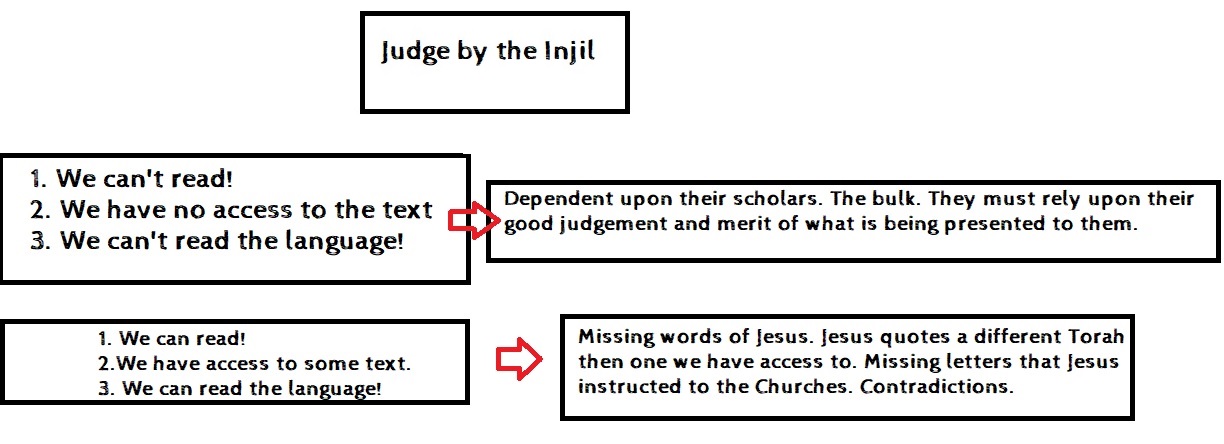
May Allah guide the sincere among the Christians before the penalty of the hellfire engulfs them.

Leave a comment

Filed under Uncategorized