“The faculties of seeing (tudriku) cannot grasp Him, and He grasp all–seeing (yudriku), He is the All-Subtle and All-Aware.” (Qur’an 6:103)
﷽
Dear Muslim Ummah.
This is a collection of articles on the issue of Seeing Allah (swt) in the hereafter. May Allah (swt) guide you to the path and way of the Muslims. May Allah (swt) guide you to the doctrine of transcendence. The way of the Qur’an and the Sunnah. Because this is the safest and secure road.
Among those who profess to be Sunni Muslims, you see such a division among them on this matter. One will claim that their lord has a shape and a form. The other side, realizing the problematic nature of such a position, will claim a sort of ‘beatific vision’. All sides come with their proofs and evidence.
Among them are those who say both believers and disbelievers will see Allah and others say seeing Allah is a reward exclusive to the believers.
For example: what form or shape did the disbelievers see Allah in?
On Seeing Allah: The following article breaks down a video from a brother upon the Ashʿarī theology giving our critical analysis from the Ibadi perspective.
The following section deals with a fringe group who call themselves ‘Salafi;: They claim that they are upon the belief of the early generation of Muslims. In reality they are those who have very eccentric and bizarre views.
According to Sahih Bukhari what Form/Shape of Allah did the disbelievers see? What Every Christian Should Ask Every Muslim. Christians believe that God took upon himself a form or a shape. The Salafi sect also believes that Allah took upon a form or a shape.
And of no effect is the repentance of those who continue to do evil deeds until death faces one of them and he says: ‘Now I repent;’ NOR of those who die while they are ungrateful disbelievers. For them We have prepared a painful torment” (Qur’an 4:17-18)
﷽
What about all those hadiths that say if you do this or that you will be GUARANTEED PARADISE?
So for example there are a great many hadith that say that if a person does this act or says this statement they will be guaranteed paradise.
Examples:
It is narrated on the authority of ‘Uthman that the Messenger of Allah (saw) said. He who died knowing (fully well) that there is no god but Allah entered Paradise.
The Prophet, (saw) said, “Whoever recites ten times, ‘Say: He is Allah, the One,’ a palace will be built for him in Paradise. Whoever recites it twenty times, two palaces will be built for him. Whoever recites it three times, three palaces will be built for him.”
Abu Umamah reported: The Messenger of Allah, peace and blessings be upon him, said, “Whoever recites the ‘verse of the Throne’ after every prescribed prayer, there will be nothing standing between him and entry into Paradise but his death.”
The first response to the above hadith is that they have to be all taken into account with many other hadith. Because the singular narrations (ahad) put a few strokes on the canvas they do not paint the whole picture.
Hadith that do not guarantee Muslims paradise.
Narrated Abu Huraira:
Allah’s Messenger (saw) said, “All my followers will enter Paradise except those who refuse.” They said, “O Allah’s Messenger (saw)! Who will refuse?” He said, “Whoever obeys me will enter Paradise, and whoever disobeys me is the one who refuses (to enter it).”
How to reconcile these contradictory hadith? A simple solution and one that even Sunni schools of theology are forced to acknowledge.
All of those ahadith that guarantee paradise for a Muslim based upon this action or this statement have to be taken into context with all those hadith that says if a Muslim does this or that they will not enter paradise. Those hadith about the guarantee for paradise is for a Muslim who stays the course, who practices their Islam who is diligent in all matters of their faith.
Otherwise we run into the following logical problems. Examples:
Question: What happens if that person was to miss the verse of the throne recitation even after just one prayer?
Would they now not be guaranteed paradise?
The Prophet, (saw) said, “Whoever recites ten times, ‘Say: He is Allah, the One,’ a palace will be built for him in Paradise. Whoever recites it twenty times, two palaces will be built for him. Whoever recites it three times, three palaces will be built for him.
Question: What happens if I recite surah ikhlas ten times today 7/7/2024 but decide to stop praying, fasting paying zakat?
Am I guaranteed paradise then?
Also what happens if I recite surah ikhlas ten times and then I become a backbiter and I break the ties of kinship?
So it is not logical that one statement or one action is going to get a person into paradise. Especially when all the ahadith are taken as a whole.
What happens to the one leaves Islam completely?
Do their deeds, and statements of creed effect their salvation?
Do the murtad become the people of paradise?
There is no verse in the Qur’an that says Kafir will enter paradise! None!
There is no verse in the Qur’an that states you can sin and continue sinning without repentance without restitution and you will enter paradise! None.
“Allah accepts only the repentance of those who do evil in ignorance and foolishness and repent SOON afterwards; it is THEY WHOM Allah will forgive and Allah is Ever All-Knower, All-Wise.
And of no effect is the repentance of those who continue to do evil deeds until death faces one of them and he says: ‘Now I repent;’ NOR of those who die while they are disbelievers. For them We have prepared a painful torment” (Qur’an 4:17-18)
Truly, Allah loves THOSE who turn unto Him in repentance and loves those who purify themselves” (Qur’an 2:222)
“But whosoever repents AFTER his crime and does righteous good deeds (by obeying Allah), then verily, Allah will pardon him (accept his repentance). Verily, Allah is Oft Forgiving, Most Merciful.” (Qur’an 5:39)
“O you who believe! Turn to Allah with sincere repentance! It may be that your Lord will expiate from you your sins, and admit you into Gardens under which rivers flow (Paradise)” (Qur’an 66:8)
“Say to those who have disbelieved, if they cease (from disbelief), their past will be forgiven” (Qur’an 8:38)
“Your Lord has written (prescribed) Mercy for Himself, so that if any of you does evil in ignorance, and thereafter repents and does righteous good deeds (by obeying Allah), then surely, He is Oft-Forgiving, Most Merciful” (Qur’an 6:54)
“Allah wishes to accept your repentance, but those who follow their lusts, wish that you (believers) should deviate tremendously away (from the Right Path).” (Qur’an 4:27)
“Say: Oh my slaves who have transgressed against themselves (by committing evil deeds and sins)! Despair not of the Mercy of Allah, verily, Allah forgives all sins. Truly, He is Oft-Forgiving, Most Merciful” (Qur’an 39:53)
“And whoever does evil or wrongs himself but afterwards seeks Allah’s forgiveness, he will find Allah Oft Forgiving, Most Merciful” (Qur’an 4:110)
Islam is salvation through repentance. Islam is NOT salvation simply because I am Muslim.
All of those verses explicitly tell us as Muslims that we have an incredibly Merciful, Compassionate, Loving and Forgiving Creator. The verse even says that Allah wishes to accept your repentance. It doesn’t get more clear than this!
Yet, if we do not care about our own selves, and our own salvation, if we do not even have a modicum of decency and awareness to turn towards Allah (swt) and repent for our sins. Make restitution, reform our conduct, than we have absolutely no one to blame if we end up in hellfire forever.
The point we can make is that even if all such hadith are 100% correct, chains hold up etc. It shows the extent of Allah’s mercy. His readiness to accept us into paradise.
Yet as mentioned they need to be interpreted in light of all such hadith that say the polar opposite.
A logical problem if one takes those hadith in isolation.
Also, logic as mentioned I say Shahahada with sincerity guarantees me paradise but then I decide not to practice the deen?
Surely they see it as problematic.
If one takes those hadith that promise a person paradise in isolation without considering all the other hadith evidence that clearly state if one does such and such as well as the clear text of the Qur’an we will end up with serous logical contradictions.
Likewise, this is an issue of morals and ethics.
Has Islam really come to teach that a person can take the declaration of fast and afterwards not pray, not fast, not purify our wealth, and that one can lie, cheat, steal, commit fornication and adultery and will be among the people of paradise?
We are to do our level best to control our based desires, restrain our tongues and hands from harm. We are NOT to be the very devils Allah tells us to seek refuge from.
So it is very clear that Sunni Muslims have to agree with us on these points. They are crystal clear. That the kafir does not enter paradise.
We are upon the model of Adam (alayi salam) One who sinned and repented and was forgiven.
To sin and to never seek forgiveness. What is that except the model of Iblis.
Choose wisely dear truth seekers.
The only difference that now remains between us is as follows:
Our school states that no disbeliever enters into the paradise and no believer enters into the hellfire. Such a belief about the believer entering into hellfire has no basis in the primary source of Islam, the Qur’an.
So the differences are:
Do some believers go to hell for a while (as Sunni schools claim).
Or.
Do believers all go to paradise without any sojourn in hell (as the Ibadi school claims).
Does Allah replace some Jews and Christians (destined to paradise) and swap them for (Muslims destined to hell) as some Sunni claim?
Does Allah grant polytheist salvation (as the case of Ibrahim’s father) and place in his stead a goat or sheep?
“And they say, “Never will the Fire touch us, except for a few days.” Say, “Have you taken a covenant with Allah? For Allah will never break His covenant. Or do you say about Allah that which you do not know?” Yes, whoever earns evil and his sin has encompassed him – those are the companions of the Fire; they will abide therein eternally.” (Qur’an 2:80-81)
﷽
This is by no means an exhaustive list. However, this should suffice. Yet there is much much more hadith evidence.
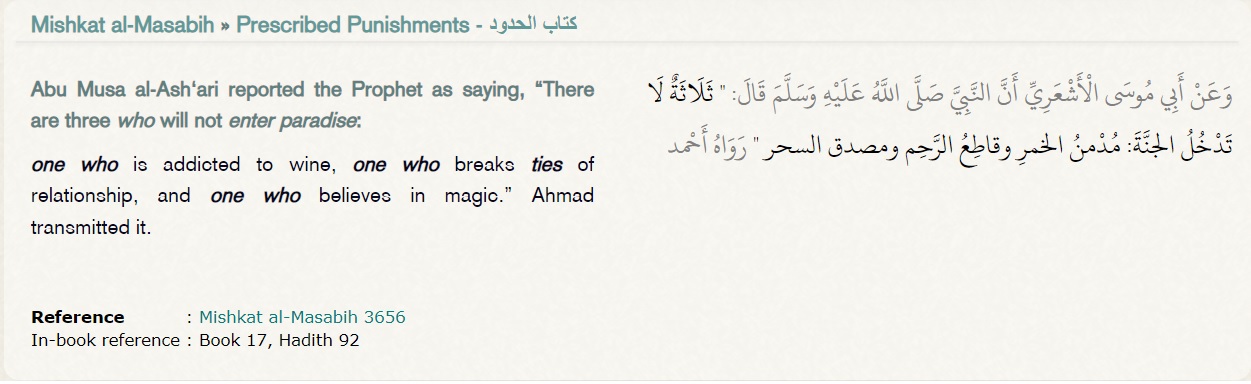
Abu Musa al-Ash’ari reported the Prophet as saying, “There are three who will not enter paradise: one who is addicted to wine, one who breaks ties of relationship, and one who believes in magic.” Ahmad transmitted it.
“But the Children of Israel certainly knew that whoever purchased the magic would not have in the Hereafter any share. And wretched is that for which they sold themselves, if they only knew.” (Qur’an 2:102)
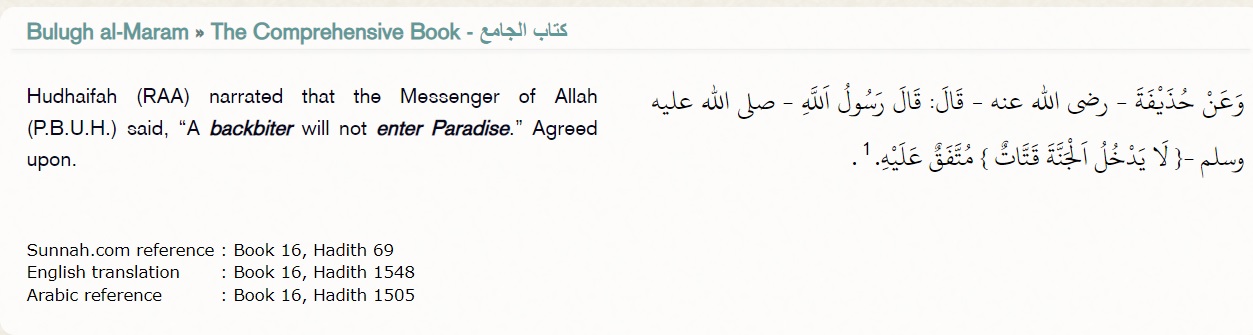
Hudhaifah (ra) narrated that the Messenger of Allah (saw) said:
“A backbiter will not enter Paradise.” Agreed upon.
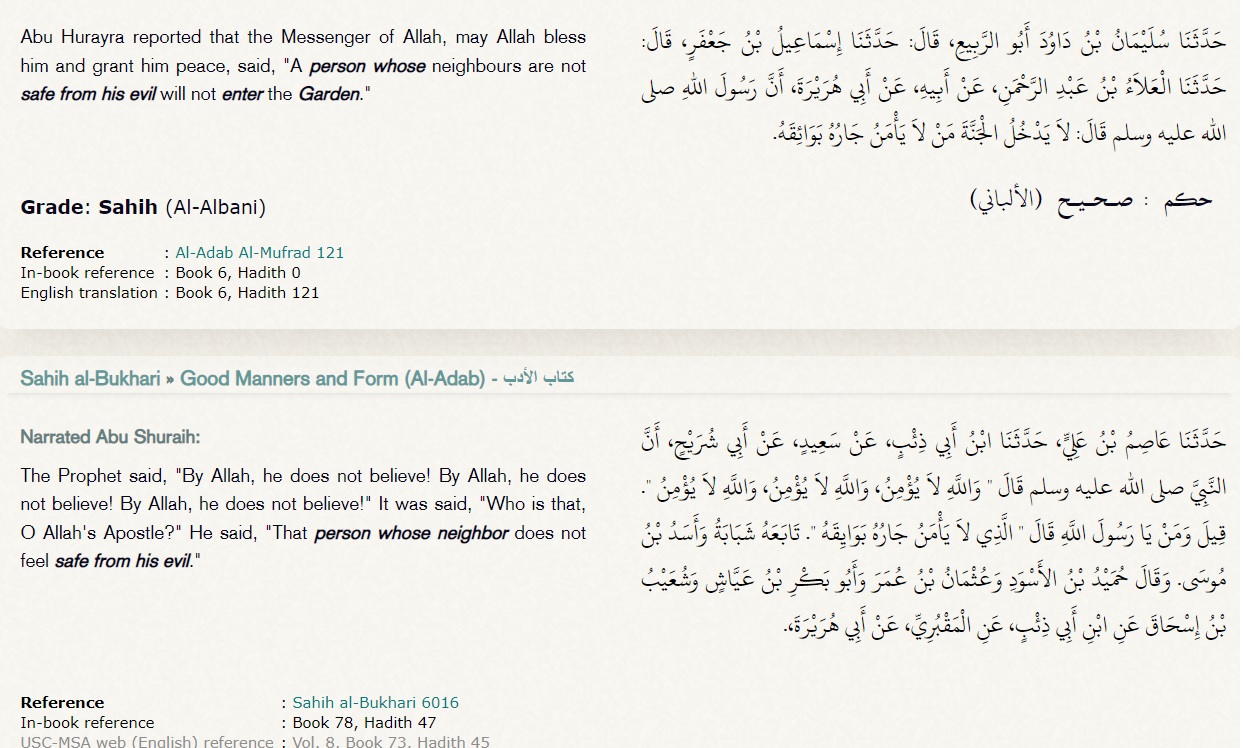
Narrated Abu Shuraih:
The Prophet (saw) said, “By Allah, he does not believe! By Allah, he does not believe! By Allah, he does not believe!” It was said, “Who is that, O Allah’s Messenger (saw)?” He said, “That person whose neighbor does not feel safe from his evil.”
Abu Hurayra reported that the Messenger of Allah, may Allah bless him and grant him peace, said, “A person whose neighbors are not safe from his evil will not enter the Garden.”
“Worship Allah and associate nothing with Him, and to parents do good, and to relatives, orphans, the needy, the near neighbor, the neighbor farther away, the companion at your side, the traveler, and those whom your right hands possess. Indeed, Allah does not like those who are self-deluding and boastful.” (Qur’an 4:36)
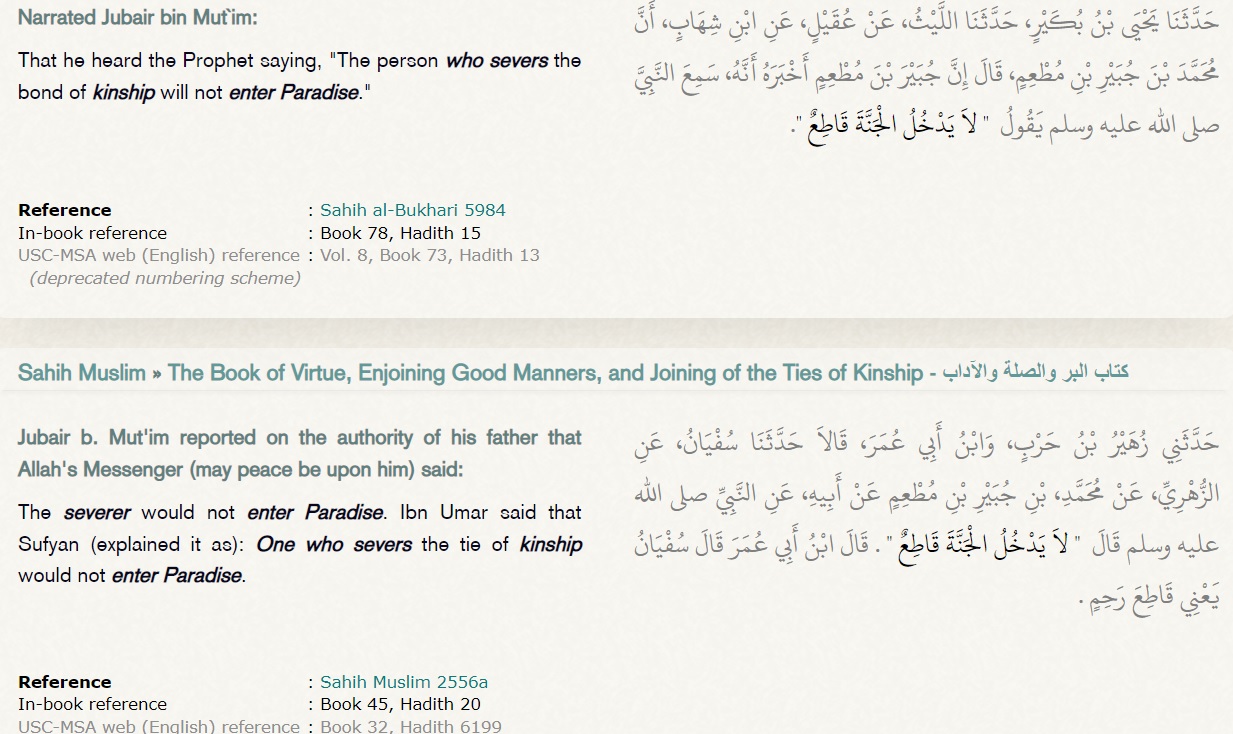
Jubair bin Mut’am (RAA) narrated that the Messenger of Allah (saw) said: “The one who severs the ties of kinship will not enter Paradise.” Agreed upon.
Jubayr ibn Mu’tim reported that he heard the Messenger of Allah, may Allah bless him and grant him peace, say, “The one who severs ties of kinship will not enter the Garden.”
Jubair b. Mut’im reported on the authority of his father that Allah’s Messenger (saw) said:
The severer would not enter Paradise. Ibn Umar said that Sufyan (explained it as): One who severs the tie of kinship would not enter Paradise.
Narrated Jubair bin Mut`im:
That he heard the Prophet (saw) saying, “The person who severs the bond of kinship will not enter Paradise.”
“So would you perhaps, if you turned away, cause corruption on earth and sever your ties of relationship.” (Qur’an 47:22)
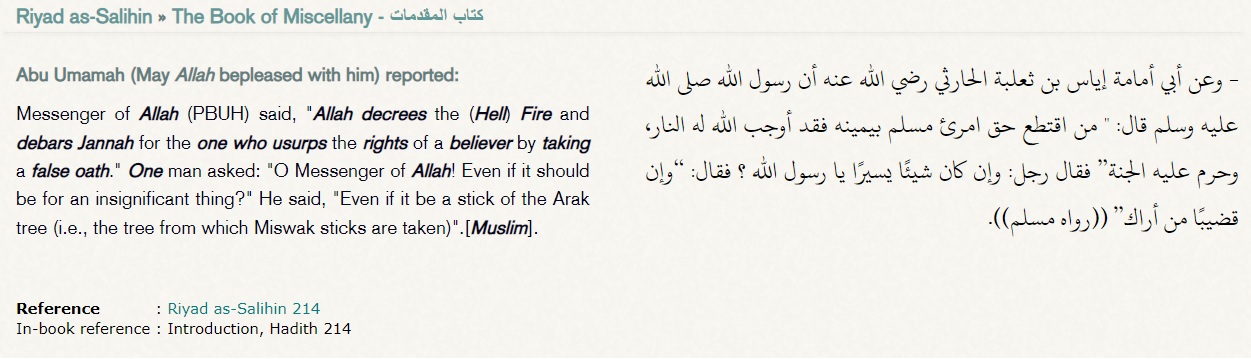
Abu Umamah (May Allah bepleased with him) reported:
Messenger of Allah (saw) said, “Allah decrees the (Hell) Fire and debars Jannah for the one who usurps the rights of a believer by taking a false oath.” One man asked: “O Messenger of Allah! Even if it should be for an insignificant thing?” He said, “Even if it be a stick of the Arak tree (i.e., the tree from which Miswak sticks are taken)”.
“They took their false oaths as a cover, so they averted people from the way of Allah , and for them is a humiliating punishment.” (Qur’an 58:16)
Narrated Ma’qil:
Allah’s Messenger (saw) said, “If any ruler having the authority to rule Muslim subjects dies while he is deceiving them, Allah will forbid Paradise for him.”
Narrated Ma’qil:
I heard the Prophet (saw) saying, “Any man whom Allah has given the authority of ruling some people and he does not look after them in an honest manner, will never feel even the smell of Paradise.”
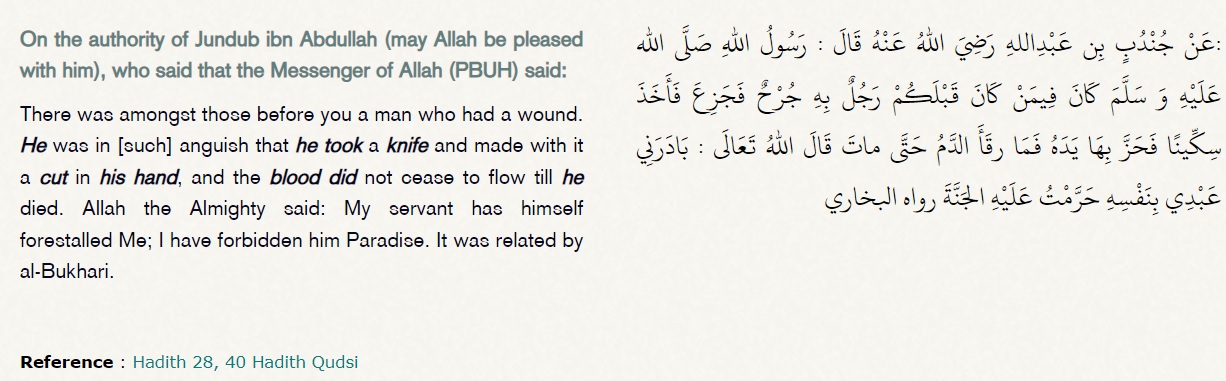
On the authority of Jundub ibn Abdullah (may Allah be pleased with him), who said that the Messenger of Allah (peace be upon him) said: There was a among those before you a man who had a wound. He was in [such] anguish that he took a knife and made with it a cut in his hand, and the blood did not cease to flow till he died. Allah the Almighty said: My servant has himself forestalled Me; I have forbidden him Paradise. It was related by al-Bukhari.
May Allah (swt) protect us and guide and keep us on a path that is straight. We seek the forgiveness of Allah (swt) and turn in repentance to Allah (swt).
“And they say, “Never will the Fire touch us, except for a few days.” Say, “Have you taken a covenant with Allah? Allah will never break His covenant. Or do you say about Allah that which you do not know?” Yes, whoever earns evil and his sin has encompassed him – those are the companions of the Fire; they will abide therein eternally(khaliduna).”(Qur’an 2:80-81)
﷽
For those of you familiar with the parker brothers board game, monopoly one of the cards one could draw is the ‘get out of jail free card’. Thus, if you landed on the spot that says, ‘go to jail’ you could play this card. The card name is a bit of a misnomer as you don’t go to jail to begin with. You bypass going completely.
Well, believe it or not because of these interpretations and influences upon our faith, there are Muslims who believe in the ‘hadith of the card’. The ‘get out of hell free card!
Narrated ‘Abdullah bin ‘Amr bin Al-‘As:
that the Messenger of Allah (saw) said: “Indeed Allah will distinguish a man from my Ummah before all of creation on the Day of Judgement. Ninety-nine scrolls will be laid out for him, each scroll is as far as the eye can see, then He will say: ‘Do you deny any of this? Have those who recorded this wronged you?‘ He will say: ‘No, O Lord!’ He will say: Do you have an excuse?’ He will say: ‘No, O Lord!‘ So He will say: ‘Rather you have a good deed with us, so you shall not be wronged today.” Then He will bring out a card (Bitaqah); on it will be: “I testify to La Ilaha Illallah, and I testify that Muhammad is His servant and Messenger.” He will say: ‘Bring your scales.’ He will say: ‘O Lord! What good is this card next to these scrolls?’ He will say: ‘You shall not be wronged.’ He said: ‘The scrolls will be put on a pan (of the scale), and the card on (the other) pan: the scrolls will be light, and the card will be heavy, nothing is heavier than the Name of Allah.'”
This means that there are No Muslims who will go to hell at all (even briefly) as the Sunni believe. That is if Allah (swt) is fair and just, as every Muslim has said this statement!
Are we going to invite the world to Islam and inform the world of the moral decline of society and then present to them a model of so called justice in which a person who claims to be a Muslim did rape, killed a person without right, molested their relatives, committed adultery and/or fornication and died without any repentance for these things?!
All the horrific things that Zionist are currently doing to Palestinians that disgust each and everyone of us would be absolutely fine as long as they said: la ilaha illallah
The above hadith is absolutely destroyed by the following verse of the Qur’an.
“And those who do not invoke with Allah another deity or kill the soul which Allah has forbidden [to be killed], except by right, and do not commit unlawful sexual intercourse. And whoever should do that will meet a penalty. Multiplied for him is the punishment on the Day of Resurrection, and he will abide therein humiliated –Except for those who repent, believe and do righteous work. For them Allah will replace their evil deeds with good. And ever is Allah Forgiving and Merciful.” (Qur’an 25:70)
Emaan or faith is uttered by the tongue , takes root in the heart and is affirmed by the limbs by either doing the actions one is required to do and/or restraining the limbs from doing what is prohibited.
If the Emaan by the tongue or heart is enough than why are there are so many verses and ahadith that exhort the believers to make tauba (repentance)?
This type of belief makes repentance ineffectual and renders it of no consequence. May Allah (swt) protect and guide the ummah!
Mu`adh bin Jabal (May Allah be pleased with him) reported:
The Messenger of Allah (saw) said, “He whose last words are: `La ilaha illallah’ (There is no true god except Allah) will enter Jannah.”
This can only mean He was living his life in accordance with this and righteousness, and finally he end his life like this. In this condition.
THE GET OUT OF HELL FREE CARD!
It is reported on the authority of Abu Huraira:
We were sitting around the Messenger of Allah (saw). Abu Bakr and Umar were also there among the audience. In the meantime, the Messenger of Allah got up and left us. He delayed coming back to us, which caused anxiety that he might be attacked by some enemy when we were not with him; so, being alarmed, we got up. I was the first to be alarmed. I, therefore, went out to look for the Messenger of Allah (may peace and blessings be upon him) and came to a garden belonging to the Banu an-Najjar. A section of the Ansar went round it looking for a gate but failed to find one. Seeing a rabi’ (i.e. streamlet) flowing into the garden from a well outside, I drew myself together, like a fox, and slinked into (the place) where Allah’s Messenger was. He (the Holy Prophet) said: Is it Abu Huraira? I (Abu Huraira) replied: Yes, Messenger of Allah. He (the Holy Prophet) said: What is the matter with you? You were among us but got up and went away and delayed for a time, so fearing that you might be attacked by some enemy when we were not with you, we became alarmed. I was the first to be alarmed. So when I came to this garden, I drew myself together as a fox does, and these people are following me. He addressed me as Abu Huraira and gave me his sandals and said: Take away these sandals of mine, and when you meet anyone outside this garden who testifies that there is no god but Allah, being assured of it in his heart, gladden him by announcing that he shall go to Paradise. Now the first one I met was Umar. He asked: What are these sandals, Abu Huraira? I replied: These are the sandals of the Messenger of Allah with which he has sent me to gladden anyone I meet who testifies that there is no god but Allah, being assured of it in his heart, with the announcement that he would go to Paradise. Thereupon ‘Umar struck me on the breast and I fell on my back. He then said: Go back, Abu Huraira, So I returned to the Messenger of Allah (saw), and was about to break into tears. ‘Umar followed me closely and there he was behind me. The Messenger of Allah (saw) said: What is the matter with you, Abu Huraira? I said: I happened to meet ‘Umar and conveyed to him the message with which you sent me. He struck me on my breast which made me fall down upon my back and ordered me to go back. Upon this the Messenger of Allah (saw) said: What prompted you to do this, ‘Umar? He said: Messenger of Allah, my mother and father be sacrificed to thee, did you send Abu Huraira with your sandals to gladden anyone he met and who testified that there is no god but Allah, and being assured of it in his heart, with the tidings that he would go to Paradise? He said: Yes. Umar said: Please do it not, for I am afraid that people will trust in it alone; let them go on doing (good) deeds. The Messenger of Allah (saw) said: Well, let them.
In the above hadith we are told that Abu Huraira gets this information from the Blessed Prophet (saw) and he is met by Umar and than Umar is basically telling the Blessed Prophet (saw) please do not do it as the people will trust in it alone.
Abu Huraira receives the information.
Umar is the one who is startled by this information.
The Prophet (saw) wants this information to be known.
Narrated Anas bin Malik:
“Once Mu`adh was along with Allah’s Messenger (saw) as a companion rider. Allah’s Messenger (saw) said, “O Mu`adh bin Jabal.” Mu`adh replied, “Labbaik and Sa`daik. O Allah’s Messenger (saw)!” Again the Prophet (saw) said, “O Mu`adh!” Mu`adh said thrice, “Labbaik and Sa`daik, O Allah’s Messenger (saw)!” Allah’s Messenger (saw) said, “There is none who testifies sincerely that none has the right to be worshipped but Allah and Muhammed is his Apostle, except that Allah, will save him from the Hell-fire.” Mu`adh said, “O Allah’s Messenger (saw) ! Should I not inform the people about it so that they may have glad tidings?” He replied, “When the people hear about it, they will solely depend on it.”Then Mu`adh narrated the above-mentioned Hadith just before his death, being afraid of committing sin (by not telling the knowledge).
.In the above hadith Mu’adh ibn Jabal receives the information.
The Blessed Prophet (saw) apparently does not want the information broadcasted.
Now we can reconcile the issue of who the Blessed Prophet (saw) told the information to. Because him telling Mu’adh ibn Jabal does not preclude him telling Abu Huraira. Likewise him telling Abu Huraira does not preclude him telling Mu’adh ibn Jabal.
What does raise an eye brow are the following points.
In the first narration it is Umar who makes the statement: Please do it not, for I am afraid that people will trust in it alone
Where as in the second narration it is the Blessed Prophet (saw) who makes the statement:
“When the people hear about it, they will solely depend on it.”
In the first narration the Blessed Prophet (saw) seems to not mind if this information is distributed in fact he tells Abu Huraira to inform all those he meets along the way.
In the second narration the Blessed Prophet (saw) seems to not want the information disclosed.
The information that the sub narrator provides is also a bit concerning.
Then Mu`adh narrated the above-mentioned Hadith just before his death, being afraid of committing sin (by not telling the knowledge).
How does Mu ‘adh know better than the Prophet (saw)?!
How is Mu’adh portrayed as someone who is afraid of the sin of not disclosing knowledge but apparently the Prophet (saw) is fine with the sin of not disclosing knowledge?
May Allah (swt) protect us from perversion of the pure faith!
“O Messenger, announce that which has been revealed to you from your Lord, and if you do not, then you have not conveyed His message. And Allah will protect you from the people. Indeed, Allah does not guide the disbelieving people.” (Qur’an 5:67)
“Those who hide the clear proofs and guidance that We have revealed—after We made it clear for humanity in the Book—will be condemned by Allah and ˹all˺ those who condemn.” (Qur’an 2:159)
“And do not conceal testimony, for whoever conceals it – his heart is indeed sinful, and Allah is Knowing of what you do.” (Qur’an 2:283)
Not to mention…
You can see just a handful of these hadith here:
There is the whole issue of rather or not there are scales to begin with!
“Those who do good will have the finest reward and more. Neither gloom nor disgrace will cover their faces. It is they who will be the residents of Paradise. They will be there forever.” (Qur’an 10:26)
﷽
Those who believe that we will see Allah (swt) in the afterlife believe that the above verse is a proof of it.
“Those who do good will have the finest reward and (waziyādatun) more. Neither gloom nor disgrace will cover their faces. It is they who will be the residents of Paradise. They will be there forever.” (Qur’an 10:26)
We can see this زَادَ – yazīdu which basically means to ‘increase in something’. It is used throughout the Qur’an.
“That Allah may reward them the best of what they did and increase them (wayazīdahum) from His bounty. And Allah gives provision to whom He wills without account.” (Qur’an 24:38)
“And as for those who believed and did righteous deeds, He will give them in full their rewards and grant them extra (wayazīduhum) from His bounty.” (Qur’an 4:173)
“That He may give them in full their rewards and increase for them (wayazīdahum) of His bounty. Indeed, He is Forgiving and Appreciative.” (Qur’an 35:30)
” And He answers those who have believed and done righteous deeds and increases them (wayazīduhum)from His bounty.” (Qur’an 42:26)
“And those who are guided – He increases them (zādahum) in guidance and gives them their righteousness.” (Qur’an 47:17)
Their understanding is simply based on an exotic interpretation and not one based upon the meaning in the Arabic language.
We can see that every time they are increased from the genus or genre of what they are already being given. They are guided and guidance is increased. The finest reward and more of it. For example, in Arabic grammar it is fine to say I will give you 10,000 Euros and I will give you an additional 500 Euros, like this. Some people may scratch their heads wondering why there is a picture of an ice cream cone getting an additional scoop. The picture is to indicate what I mean in this point 2.
The following verse makes it abundantly clear that we will not see him:
“The faculties of seeing (tudriku) cannot grasp Him, and He grasp all–seeing (yudriku), He is the All-Subtle and All-Aware.” (Qur’an 6:103)
This indicates the description of the divine changes. What was once not true of Allah (swt) is now true of Allah (swt).
” Neither drowsiness nor sleep overtakes Him. To Him belongs whatever is in the heavens and whatever is on the earth.” (Qur’an 2:255)
So now it is possible that what is not currently true of Allah (swt) not being drowsy nor overtaken by sleep becomes possible.
If one can be gone then another attribute can be gone as well.
4. Not in the scope of this article but often those who believe that we will see Allah (swt) in the next life bring a number of hadith. This is an evidence for them. For us, as well as the majority of the Muslim Ummah, lone narrator reports (ahad) are not an evidence for us.
Zanni Hadith (الحديث الظني) refers to a narration that provides probable knowledge (ظن – Zann) rather than absolute certainty (يقين – Yaqeen)
Linguistically: Derived from “ظن” (Zann), meaning “assumption,” “probability,” or “conjecture.”
Technically: A Hadith that does not reach the level of definitive proof (Qat’i) but is still considered reliable enough for practical rulings.
For the Ibadi we do not build our belief upon the ahad. This is so even if we find the hadith to be sahih. That is because creedal matters are not based upon what is probable but what is certain.
Shaykh Massoud bin Mohammed Al Miqbali (h) explains this to us concerning a debate he had with one of the Salafi in Egypt. (A debate that they pulled offline).
The Shaykh also went on to explain that even in the case of an ayat of the Qur’an that is certain we may not build creedal matters upon it. That is because it could be from the mutashabih; and Allah (swt) has warned us:
“While other verses may have several possibilities. Those whose hearts are perverse, follow the unclear statements in pursuit of their own mischievous goals by interpreting them in a way that will suit their own purpose.” (Qur’an 3:7)
Thus the Qur’an itself can be certain and yet present verses that are multifaceted. How much more for the hadith?
Not to mention if they bring hadith we too can bring hadith.
Hadith like the following:
Narrated Abu Sa`id Al-Khudri:
The Prophet (saw) said, “Allah will say to the people of Paradise, “O the people of Paradise!” They will say, ‘Labbaik, O our Lord, and Sa`daik, and all the good is in Your Hands!’ Allah will say, “Are you satisfied?’ They will say, ‘Why shouldn’t we be satisfied, O our Lord as You have given us what You have not given to any of Your created beings?’ He will say, ‘Shall I not give you something better than that?’ They will say, ‘O our Lord! What else could be better than that?‘ He will say, ‘I bestow My Pleasure on you and will never be angry with you after that.’
Allah’s Messenger (saw) said, “Allah will say to the people of Paradise, ‘O the people of Paradise!’ They will say, ‘Labbaik, O our Lord, and Sa`daik!’ Allah will say, ‘Are you pleased?” They will say, ‘Why should we not be pleased since You have given us what You have not given to anyone of Your creation?’ Allah will say, ‘I will give you something better than that.’ They will reply, ‘O our Lord! And what is better than that?’ Allah will say, ‘I will bestow My pleasure and contentment upon you so that I will never be angry with you after for-ever.’ “
“Those who do good will have the finest reward and (waziyādatun) more. Neither gloom nor disgrace will cover their faces. It is they who will be the residents of Paradise. They will be there forever.” (Qur’an 10:26)
Recall what is stated above in point 2 above. That is to say that the more’ can be from the same genre or genus. This is what we have from Ali Ibn Abi Talib:
17634- حدثنا به يحيى بن طلحة قال ، حدثنا فضيل بن عياض، عن منصور، عن الحكم، عن علي رضي الله عنه: (للذين أحسنوا الحسنى وزيادة) ، قال: ” الزيادة “، غرفة من لؤلؤة واحدةٍ لها أربعة أبواب.
“Narrated to us by Yahya ibn Talha, who said: Narrated to us Fudayl ibn ‘Iyad, from Mansur, from Al-Hakam, from Ali regarding the verse: ‘For those who do good is the best reward and an increase.’ He said: ‘The “increase” is a chamber made of a single pearl with four doors.'”
Sources that cite the above narration include: Tafsir al-Tabari, Tafsir Ibn Abi Hatim, Tafsir al-Baghawi, Tafsir Ibn Kathir.
For those who are interested you may wish to see the following articles:
“And he is with you wherever you are.” (Qur’an 57:4)
﷽
First and foremost let us be clear.
There is no such hadith of the Slave Girl.
As if it is an ahad narration with only one type of matn (textual tradition).
What is true however, is that there is the incident of the slave girl and then we have many narrations of that incident with many textual variations.
We can see that those who call themselves the Sunni Muslims will dispute over the question: Where is Allah?
They get into conflict among themselves in regard to the following ahadith:
Narrated Mu’awiyah b. al-Hakam al-Sulami:
I said: Messenger of Allah, I have a slave girl whom I slapped. This grieved the Messenger of Allah (saw). I said to him: Should I not emancipate her? He said: Bring her to me. He said: Then I brought her. He asked: Where is Allah ? She replied: In the heaven. He said: Who am I ? She replied: You are the Messenger of Allah. He said: Emancipate her, she is a believer.
A man brought the Prophet (saw) a black slave girl. He said: Messenger of Allah, emancipation of believing slave is due to me. He asked her: Where is Allah ? She pointed to the heaven with her finger. He then asked her: Who am I ? She pointed to the Prophet (saw) and to the heaven, that is to say: You are the Messenger of Allah. He then said: Set her free, she is a believer.
So what happens is that the Sunni Muslims that are Ash’ari or Maturidi will usually quote the hadith about the woman using an action by “pointing to heaven“.
This gives opportunity for a quick counter rebuttal (to those who believe Allah is in a defalt location) because we know that Earth is spinning on its axis. Thus, if the Blessed Prophet (saw) were to ask the woman the same question a few hours from that point or eleven hours later the same response would hold true.
The Sunni Muslims that are Athari/Salafi/Wahabbi they tend to prefer the first hadith where the woman is reported to have verbally replied: “In the heaven”.
Not withstanding that some of their scholars have graded the hadith on pointing with the finger as being weak.
I have always found their appeal to this particular narration about the woman replying: “In the heaven” to be quite fascinating and perplexing. Why I find it as such is because I was always of the impression that Athari/Salafi/Wahhabi have always found the concept of Hulul (divine indwelling) in the creation to be blasphemous.
Yet, not so fast….Prima Qur’an!
Do the Athari/Salafi/Wahabbi REALLY BELIEVE ALLAH IS IN THE HEAVEN as the woman affirmed?
No, no they don’t.
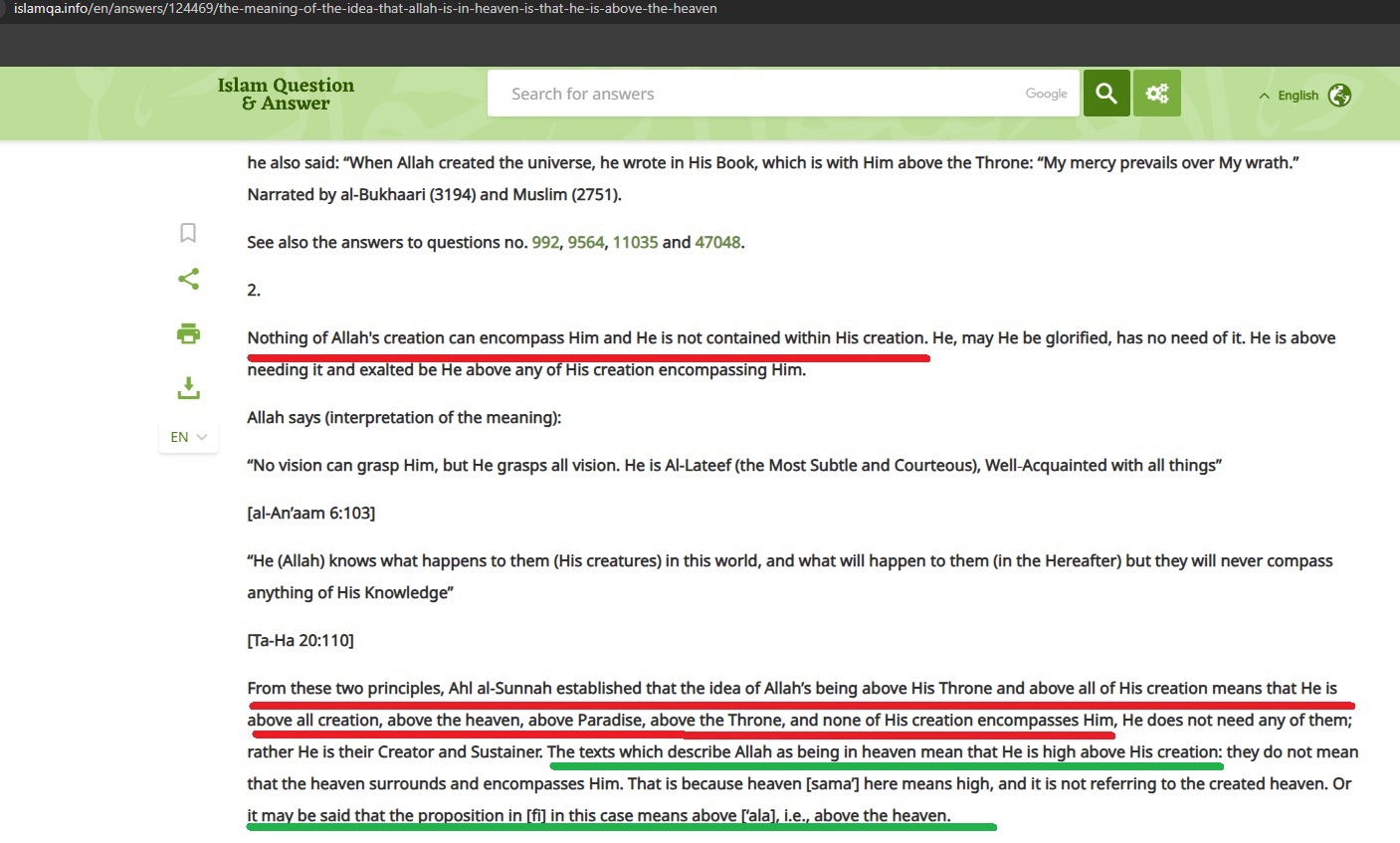
“The text which describe Allah as being in heaven mean that He is high above his creation: they do not mean that the heavens surrounds and encompasses Him. That is because heaven [sama’] here means high, and it is not referring to the created heaven. Or it may be said that the proportion in [fi] in this case means above [‘ala], i.e, above the heaven.”
In other words these people practice Ta’wil figurative interpretation of text that state that Allah (swt) is IN and replace it with ABOVE. Even thought the text have an explicit meaning.
Narrated `Abdullah:
A (Jewish) Rabbi came to Allah’s Messenger (saw) and he said, “O Muhammed! We learn that Allah will put all the heavens on one finger, and the earths on one finger, and the trees on one finger, and the water and the dust on one finger, and all the other created beings on one finger. Then He will say, ‘I am the King.’ Thereupon the Prophet (saw) smiled so that his pre-molar teeth became visible, and that was the confirmation of the Rabbi. Then Allah’s Messenger (saw) recited: ‘They made not a just estimate of Allah such as is due to Him. And on the Day of Resurrection the whole of the earth will be grasped by His Hand and the heavens will be rolled up in His Right Hand.Glorified is He, and High is He above all that they associate as partners with Him.‘ (39.67)
“They did not recognise the true worth of Allah.(Such is Allah’s power that) on the Day of Resurrection the whole earth will be in His grasp, and the heavens (wal-samāwātu) shall be folded up in His Right Hand. Glory be to Him! Exalted be He from all that they associate with Him.” (Qur’an 39:67)
“Have you taken security from Him Who is in the heaven(fi samwati) that He will not cause the earth to swallow you when lo! it is convulsed?” (Qur’an 67:16)
So this is how we know that there is majaz figurative language in the Qur’an and the Sunnah. There is a section of Muslims who endanger the creed of themselves and the Ummah because they take the apparent meaning of text (well they do when they can’t except for when they are trapped like we demonstrated above).
The above verse of the (Qur’an 39:67) states that the heavens will be rolled up.
Narrated Imran bin Husain:
I went to the Prophet (saw) and tied my she-camel at the gate. The people of Bani Tamim came to the Prophet (saw) who said “O Bani Tamim! Accept the good tidings.” They said twice, ‘You have given us the good tidings, now give us something” Then some Yemenites came to him and he said, “Accept the good tidings, O people of Yemem, for Bani Tamim refused them.” They said, “We accept it, O Allah’s Messenger (saw)! We have come to ask you about this matter (i.e. the start of creations).” He said, “First of all, there was nothing but Allah, and (then He created His Throne). His throne was over the water, and He wrote everything in the Book (in the Heaven) and created the Heavens and the Earth.” Then a man shouted, “O Ibn Husain! Your she-camel has gone away!” So, I went away and could not see the she-camel because of the mirage. By Allah, I wished I had left that she-camel (but not that gathering).
Is is quite obvious from even the apparent reading of the above text that Allah (swt) is not above the heavens and the earth at the point of which they are not even have been created.
Waki’ bin Hudus narrated that his paternal uncle Abu Razin said:
“I said: ‘O Messenger of Allah (saw), where was our Lord before He created His creation?’ He said: He was above the clouds, below which was air, and above which was air and water. Then He created His Throne above the water.'”
This hadith has a grading of Hassan (it is fair) and before the establishment of various categories of hadith it would have received the grading of sahih (sound). Yet, the problem with it is very clear from the matn (text) itself.
Clouds, air, water are all creations. The wording of the text indicates that these things existed along with Allah (swt) and that his relation with them is simply in being above them but not being the creator of them. This can be solved by harmonizing it with other text that Allah (swt) clearly mention Allah (swt) is the creator of all things and by that it would mean the clouds, air and water.
There are other obvious problems with just taking the hadith of the slave girl at face value: Even if she replied that Allah is in the heaven how would that be taken to mean that she is a believer?
The belief that “Allah is in the heaven” neither establishes monotheism nor negates polytheism — because some polytheists acknowledged the existence of Allah, as do Christians, yet they associate others with Him in divinity.
The Christians believe that as well:
“He sat down at the right hand of the Majesty in heaven.” (Hebrews 1:3)
“But Stephen, full of the Holy Spirit, looked up to heaven and saw the glory of God, and Jesus standing at the right hand of God. “Look,” he said, “I see heaven open and the Son of Man standing at the right hand of God.” (Acts 7:55-56)
The very fact of something being in heaven does not indicate that it is God.
The very concept or idea of God being in heaven does not indicate that someone believes that this God is one being that is not comprised of persons.
Recall what the Ahl Khilaf (people of the opposition) of the truth: Salafi/Athari/Wahhabis have said above:
“The texts which describe Allah as being in heaven mean that He is high above His creation: they do not mean that the heaven surrounds and encompasses Him. That is because heaven [sama’] here means high, and it is not referring to the created heaven. Or it may be said that the proposition in [fi] in this case means above [‘ala], i.e., above the heaven.”
DOES THE IBADI HADITH COLLECTION HAVE ANYTHING INTERESTING TO SAY ON THIS MATTER?
We find in the Al Jami al Sahih, musnad al rabi’
47) – “Freeing of a Slave”
681- ‘Abū Ubayda narrated from Jābir ‘Ibn Zayd that a man went to the Prophet (saw), and said to him: “O Prophet, I have a slave girl who tends my flock of sheeps. But, I just found out that I lost a sheep. When I questioned her about this, she replied that the wolf had devoured her. I became irritated so much that I slapped her. Now, I have to free a slave. Should I free her?” The Prophet (saw) said: “If she can come, bring her to me!”. The man went to get her and brought her with him. The Prophet, (saw) said to her: “Who is your lord?“. She said: “Allah is my lord”. The Prophet, (saw) said: “Who then is your Prophet?”. She replied: “You are Muḥammad, the Prophet of Allah”. So, the Prophet, (saw) said at that time: “free her because she is a believer”.
Source:al-Imām al-Rabī‘ — His Status and His Musnad, by Shaykh Sa‘īd al-Qanūbī.
(“Who is your lord”) Source: https://sunnah.com/nasai:3653 this matches with the hadith in the ibadi hadith collection.
There are many other issues with the particular version of the hadith
First: It contradicts what has been mutawātir (mass-transmitted) from the Prophet (saw) — that when someone came to him wanting to accept Islam, he would command them to utter the two testimonies (shahādah), without asking them this question or anything similar.
Second: It contradicts what has been authentically established from the Prophet (saw)— that when he sent some of his Companions to call people to Islam, he instructed them to order the people to testify “that there is no god but Allah and that Muhammad is the Messenger of Allah”, without commanding them to explain or ask about this alleged belief.
Third: The Prophet (saw) explained the pillars of Islam and faith in the Hadith of Jibrīl (Gabriel) — peace be upon him — and did not mention the belief that “Allah is in the heaven”, which is the belief of the anthropomorphist (mujassimah). Exalted is Allah far above that.
Fourth: It contradicts the Hadith: “I have been commanded to fight the people until they testify that there is no god but Allah and that Muhammed is the Messenger of Allah. If they do so, they have protected from me their blood and their wealth, except by the right of Islam, and their reckoning is with Allah.” Many have stated that this Hadith is mutawātir.
Fifth: It contradicts the consensus of the ummah — that whoever utters the two testimonies and believes in what the Messenger (saw) brought has entered Islam.
Sixth: As mentioned from the beginning there is no such thing as ‘the hadith of the slave girl’. Rather we have many narrations of that incident with many textual variations
Among them: it has also been reported as: “Do you testify that there is no god but Allah?” She replied: “Yes…” etc. Reported by Mālik, Ahmad (vol. 3 p. 452), ‘Abd al-Razzāq in al-Muṣannaf (vol. 9 p. 175), ‘Abd ibn Ḥumayd, al-Bazzār, al-Dārimī (vol. 2 p. 187), al-Ṭabarānī (vol. 12 p. 27), Ibn Abī Shaybah, Ibn al-Jārūd (no. 931), and al-Bayhaqī (vol. 10 p. 57). Al-Haythamī said in Majma‘ al-Zawā’id (vol. 4 p. 244): “The men of Ahmad’s chain are those of the authentic collections”, and similarly in vol. 1 p. 23. Ibn Kathīr said in his Tafsīr (1/547): “Its chain is authentic, and the anonymity of the Companion does not harm it.” It was also authenticated by Ibn ‘Abd al-Barr in al-Tamhīd (vol. 9 p. 114)
The second wording is correct, as it conforms to the mutawātir practice of the Prophet (saw), as explained above.
If it is said: The first wording is correct because Imām Muslim narrated it — we reply: Preferring the narration of the two Shaykhs (al-Bukhārī and Muslim) or one of them over others merely for that reason is very weak, rather baseless, for there is no evidence for it. In fact, the evidences — by Allah’s grace — are abundant against it. This is the view of the majority of the ummah.
Among those who adopted this view from later scholars are: the great scholar Qāsim, al-Kamāl ibn al-Humām in Fatḥ al-Qadīr and al-Taḥrīr, his commentators Ibn Amīr al-Ḥajj Muḥammad al-Amīn (known as Amīr Bād Shāh), Ibn Kathīr, al-Qasṭallānī, ‘Alī al-Qārī, al-Ṣan‘ānī, Akram al-Sindī, Aḥmad Shākir, al-Kawtharī, and others — and it is the truth
Seventh: Even if we hypothetically accepted that Muslim’s wording is equal to the other two, it would still not be permissible to use it as proof, because in that case the Hadith would be open to multiple interpretations. And when there is such uncertainty, the proof is invalidated, as is established among the people of knowledge and virtue.
Eighth: Yaḥyā ibn Abī Kathīr — one of the narrators of this Hadith — was a mudallis (one who conceals the source of his narration). Although he did explicitly state hearing in some reports, some scholars still do not accept the narration of a mudallis even if he states hearing. There is no doubt that what is agreed upon takes precedence over what is disputed.
Ninth: This Hadith contradicts definitive rational and textual proofs indicating that the Exalted Lord is not confined to the direction above. A solitary (āḥād) Hadith is not used as proof in matters of creed — as we have clarified in the treatise Akhbār al-Āḥād — especially when it contradicts definitive proofs.
Be careful of those who are not sound in their theology.
“Allah said, O Jesus, I shall cause you to die and will exalt you in my presence and shall purify you of the ungrateful disbelieving people, and shall place those who follow you above those who deny the truth, until the Day of Judgement; then to Me shall all return and I will judge between you regarding your disputes.” (Qur’an 3:55)
“And they have thereof no knowledge. They follow not except assumption, and indeed, assumption avails not against the truth at all.” (Qur’an 53:28)
﷽
The Pseudo-Salafis are attacking Imam Imran Hossein because he basically doesn’t believe that the Qur’an says the following:
“And for their saying, “Indeed, we have killed the Messiah, Jesus, the son of Mary, the Messenger of Allah.” And they did not kill himnor did they impalecrucify him but Allah made some random individual look exactly like Jesus and that person was crucified instead of Jesus. Those who differ therein are full of doubts. They have no certain knowledge of it, but only follow conjecture. For certainly, they did not kill him.” (Qur’an 4:157)
“What did Allah do to make it appear…that he died? Let me warn you! And my language some time is very harsh. Because that is the only language some people can understand. Don’t come with this nonsense! Because it is not only pathetic nonsense it is absolutely sinful! To say that Allah (authubillah) caused someone else to take the appearance of Nabi Isa (a.s) and that innocent man, innocent because he never claimed to be the Messiah! He was crucified. Wait for judgement day with that nonsense! Pathetic nonsense! It’s not there in the Qur’an. It’s in your imagination. That’s where it is. Yet it took the world of Islam by storm. What a brain washed ummah we are today! Well than what happened? Well, then why don’t you go to the Qur’an and let the Qur’an explain rather than go on fancy flights of imagination. “-Shaykh Imran Hossein.
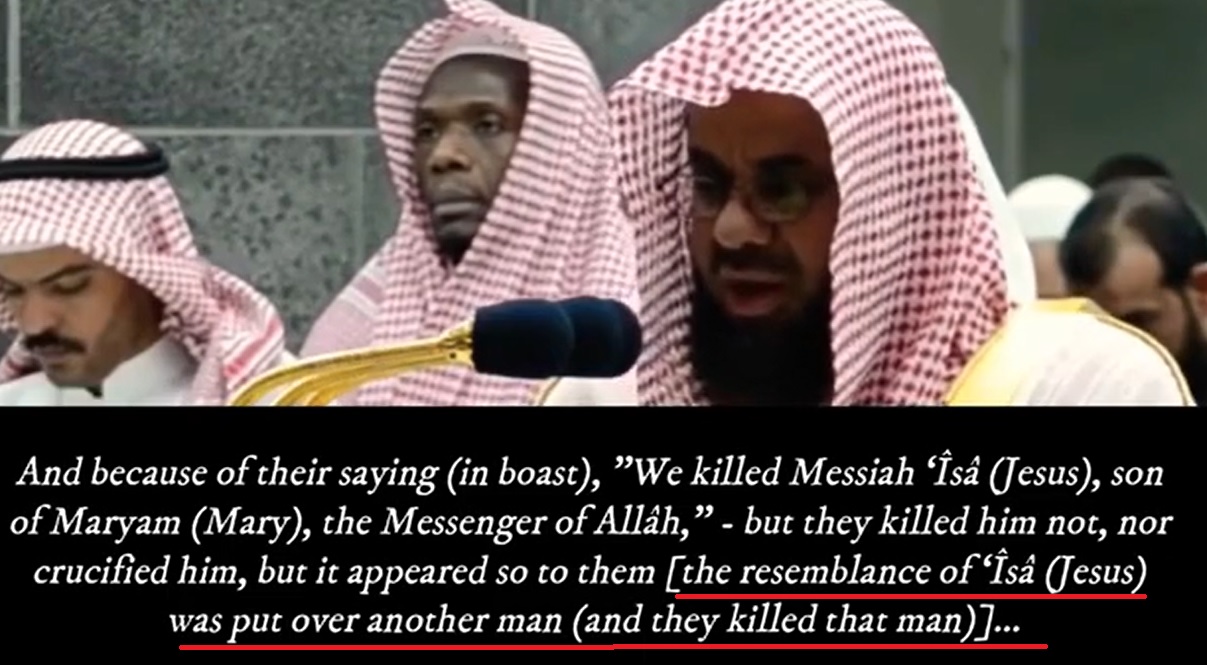
Now notice that @ 1:27 this “Nasir Al Hanbali” states:
“We will bring the Ayah in the Qur’an and the Tafsir from ibn Kathir narrated by Shaykh Salih al-Fawzan, but notice how this creep (Shaykh Imran Hossein) says: “why don’t you go to the Qur’an and let the Qur’an explain…” but he brings no Ayah from the Qur’an, just his weird: “LET ME WARNN YOUUU!!!“
“You gonna tell Allah on judgement day you caused that man to assume the appearance of someone? And he who never claimed to be the Messiah he was crucified that is an act of injustice! You are attributing injustice to Allah what foolishness. Where are the scholars who will correct this foolishness? That’s why I have to be so forceful in my language. Allah took his soul. That he was dead. They took down the body. They put the body in a cave. They sealed the cave. Allah returned the soul. As simple as that. Nobody knew that the body, that the soul was returned and Allah raised him. But let me warn you one more time. If you stick with this theory of substitution you are going to be in a pathetic state on judgement day. Let me warn you one more time. This is a simple explanation from the Qur’an. “- Shaykh Imran Hossein.
So than “Nasir Al Hanbali” puts the following recitation up:
“Nasir Al Hanbali” than ask us: “Do you think Shaykh Ali Jaabir was wrong and the creep was right?”
My comment:
Where did Shaykh Ali Jabir recite “the resemblance of Isa was put over another man (and they killed that man” ? Shaykh Ali Jabir did not recite that at all! Yet the text put up there fools those who do not understand the Arabic text!
Then, ‘Nasir Al Hanbali’ gives us another reciter.
“Nasir Al Hanbali” than ask us: “Do you think Shaykh Abu Bakr ash-Shatiri was wrong and the creep was right? Let us listen to the next reciter, Shaykh Sa’ood ash-Shuraim.”
Prima Qur’an comment:
Where did Shaykh Abu Bakr ash-Shatiri recite “the resemblance of Isa (Jesus) was put over another man (and they killed that man)”? Shaykh Abu Bakr ash-Shatiri did not recite that at all! Yet the text put up there fools those who do not understand the Arabic text!
Prima Qur’an comment:
Where did Shaykh Sa’ood ash-Shuraim recite “the resemblance of Isa (Jesus) was put over another man (and they killed that man)” ? Shaykh Sa’ood ash-Shuraim did not recite that at all! Yet the text put up there fools those who do not understand the Arabic text!
This is simply pure deception on behalf of the one who put the video up.
“Allah said to Isa: Allah said: O Isa (Jesus)! I will take you and raise you to Myself [Qur’an 3:55] Allah said: “Ya Isa” referring to Isa ibn Maryam (a.s) when the Jews plotted against him, they wanted to kill him. They entered upon him wanting to kill him [because] their norm was to kill Prophets. When they entered upon [Isa ibn Maryam], Allah raised him from amongst them. He made another man resemble him. They grabbed that man, crucified him and killed him thinking that he was Isa. As for Isa, then Allah raised him from amongst and they did not perceive it. That is why Allah says: “but they killed him not, nor crucified him, but it appeared so to them [the resemblance of Isa (Jesus) was put over another man (and they killed that man)],” [Qur’an 4:157] -Shaykh Salih al-Fawzan
Prima Qur’an comment:
Shaykh Salih al-Fawzan has invented an outright lie about Allah (swt)! Let the Shaykh be reminded the following:
“And who is more unjust than one who invents a lie about Allah or says, ‘It has been inspired to me,’ while nothing has been inspired to him, and one who says, ‘I will reveal something like what Allah revealed.’ And if you could but see when the wrongdoers are in the overwhelming pangs of death while the angels extend their hands, saying, ‘Discharge your souls! Today you will be awarded the punishment of [extreme] humiliation for what you used to say against Allah other than the truth and that you were, toward His verses, being arrogant.’” (Qur’an 6:93)
Prima Qur’an comment:
Where did Shaykh Salih al-Fawzan get the daleel from the Qur’an and Sunnah that ” He made another man resemble him.” This is Aqeedah! The Qur’an does not say this! This is not from the Sunnah!
Shaykh Salih al-Fawzan continues:
“Allah made this man resemble the Messiah, Isa. He himself accepted it and ransomed himself; he ransomed himself and he accepted that he would be killed and crucified. Allah honored him and did not waste this person and what he did with the Messiah. It is said that the one who Allah made to resemble Isa was the one who practiced treason; the one who led [the Jews] to Isa. The one employed treachery or betrayed Isa and led the Jews to him. Allah made him resemble Isa, so they killed him. However, the first opinion is more famous, that the one who chose to resemble Isa was honored and he chose to take his place. This man sacrificed himself for the sake of Allah, he was crucified and killed, so the Messiah Isa ibn Maryam could be saved from them. And Allah knows best. Allah raised him alive with him soul and his body. Not how some of the ignorant individuals say: “he was only raised with his soul.” He was raised with his soul and body alive. They were not able to touch him with any harm.” -Shaykh Salih al-Fawzan
Prima Qur’an comment:
Where did Shaykh Salih al-Fawzan get the daleel from the Qur’an and Sunnah that “Allah made this man resemble the Messiah.” This is Aqeedah! The Qur’an does not say this! This is not from the Sunnah! How can we be so carefree in ascribing to Allah (swt) such things and in the next breath say, “he first opinion is more famous.” Of course the opinion that some random person volunteered to be killed sounds better than just some random guy being chosen! The point being Shaykh Salihi al-Fawzan we don’t attribute opinions and conjecture to Allah (swt) !! It would have been appropriate to say that this is an interpretation of the text that was taken from the People of the Book and it does not have a sound chain of narration.
Also, which text in the Qur’an says that Allah (swt) “He was raised with his soul and body alive.”
Shaykh Salih al-Fawzan continues:
“As for His statement: I will take you.. [Qur’an 3:55] The word Wafaat can mean death and it can also mean to sleep. “It is He who takes your souls by night (when you are asleep), and has knowledge of all that you have done by day,. [Quran 6:60]” -Shaykh Salih al-Fawzan
“Wafaat here means to sleep and Allah knows best or I will take you…[Qur’an 3:55], It can also mean to take you. Mutawaffi also means to take; Tawaffa haqqahu min fulaan [he took his rights from so and so]. The word Wafaat here does not mean death. Because the Messiah is still Alive and will descend at the end of times, he will kill the Dajjal and then he will die after that.” -Shaykh Salih al-Fawzan
“Because: “Every soul shall taste death.” [Qur’an 3:185] He [Isa a.s] will die after that. The point of evidence here is that [the Ayah]: “I will take you and raise you to Myself” [Qur’an 3:55] To raise him to him is not done except to a higher place. This is proof that Allah is [always] high and above [His creation]. -Shaykh Salih al-Fawzan
Prima Qur’an comment:
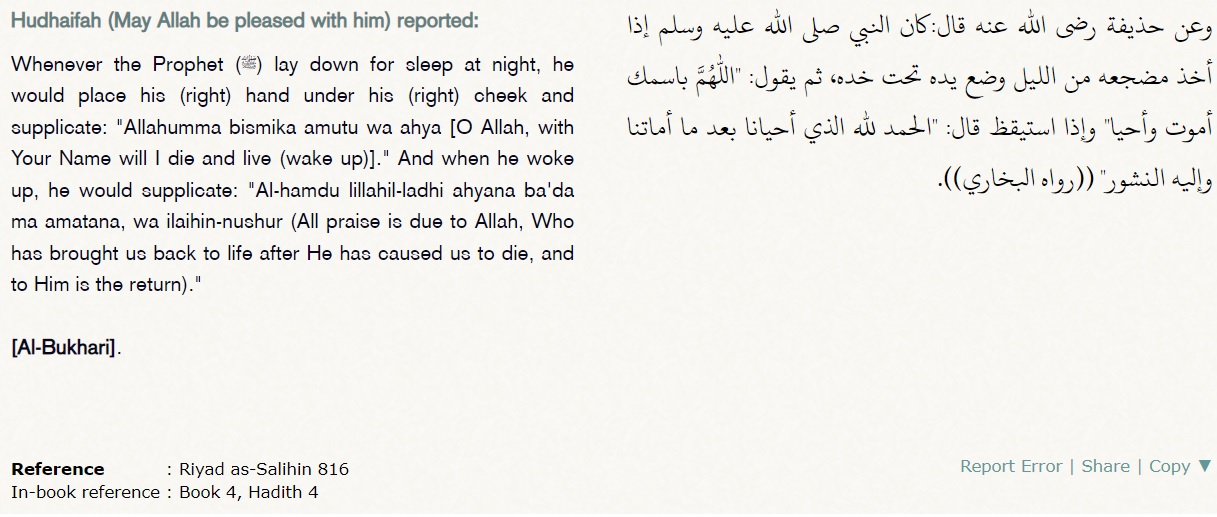
Shaykh Salih al-Fawzan quotes the verses: “It is He who takes your souls by night (when you are asleep), and has knowledge of all that you have done by day,. [Quran 6:60]” Does he not realize that he further proves our point that Jesus is dead? If there is any confusion as to what happens when we “sleep” let the Blessed Messenger (saw) explain it to you.
When we sleep we die. Our soul travels. If Allah (swt) does not return to the soul to the body than we die in our sleep. As far as Shaykh Salih al-Fawzan statement: “To raise him to him is not done except to a higher place. This is proof that Allah is [always] high and above [His creation].”
To Allah (swt) shall all return [not just Jesus].
“Indeed, to Allah we belong and to Allah we shall return.” [Qur’an 2: 156]
It does not mean spatial location. Even though Shaykh Salih al-Fawzan who is fond of taking his creed from the people of the book Allah (swt) is not contained in a spatial location.
“And he said: Lo! I am going to my Lord Who will guide me.” [Qur’an 37:99]
Ibrahim a.s says I am going to my Lord did he mean from place to place? No.
It is unfortunate because the more you investigate the beliefs of ‘Ahl Sunnah Wal Jammah‘ on this you can see they are in disarray over it.
Some say someone random was made to look like Jesus and he was put on a cross.
Other’s say Jesus was on a cross and died.
Other’s say that Jesus was on a cross but he passed out and latter was resuscitated.
“And they have thereof no knowledge. They follow not except assumption, and indeed, assumption avails not against the truth at all.” (Qur’an 53:28)
“Our Lord, do not take us to task in case we forget or we make mistakes.” (Qur’an 2:286)
﷽
APOLOGY TO FELLOW MUSLIMS AND TRUTH SEEKERS.
May Allah (swt) forgive me. Praise be to Allah (swt) who guides us to a way that is best.
I used to rely upon a particular translation of the Qur’an 4:31 until upon closer examination I realized the game that was being played upon the unaware.
I’m thankful to Shaykh Hafidh Hamed Al Sawafi for pointing this out to me!
Most people are usually familiar with this translation:
“If you avoid major sins that you are prohibited, We will absolve YOU YOUR MINOR SINS and cause you to enter a generous gate.” (Qur’an 4:31)
Any translation that comes remotely close to that is a FALSE
Take a look at the different translations into English here:
Those people who are either translating this text as such are doing so according to their i’tiqad or without giving much thought about it -according to the i’tiqad of others.
The most correct translation is: the one from Yusuf Ali (1985) which states:
“IF (but) eschew the evilest of the things which you are forbidden to do, We shall expel out of (Saiyiatikum) YOU ALL THE EVIL IN YOU, and admit you to a gate of great honor.” -(Qur’an 4:31)
The reason that certain translators translate it the way that they do is because of their theology. Which is that the small sins get wiped out and the big sins get purified in the hell-which one latter is released from.
However, the correct understanding is that if a Muslim avoids the major big sins, or if they do them and rush to repent and reform, Allah (swt) will forgive our minor mistakes and faults.
Imposing their theological suppositions upon the Qur’an Al-Kareem!
As one Muslim brother pointed out: “Saiyiatikum” is “all evil in you”.
To interpret it as “minor sins” or the likes is but an interpretation.
The literal meaning takes precedence over an interpretation unless there’s a hujjah to support the interpretation.
Insh’Allah in time I will begin to replace the translation with the appropriate translation free from i’tiqad -may Allah (swt) help me.
Kindly take note. My humble and sincere apologies.
“And protect them from the evil consequences [of their deeds]. And he whom You protect from evil consequences that Day – You will have given him mercy. And that is the great attainment.” (Qur’an 40:9)
“When Musa came to the place appointed by Us, and his Lord addressed him, He said: “O my Lord! show (Yourself) to me, that I may look upon you.” Allah said: “You shall never see me; But look upon the mount; if it abides in its place, then you will see me.”
When his Lord manifested His glory on the Mount, He made it as dust. And Moses fell down in a swoon. When he recovered his senses he said: “Glory be to Thee! to Thee I turn in repentance, and I am the first to believe.” (Qur’an 7:143)
﷽
Our brothers have done it again. An excellent overview of the meaning of the request of Musa (as) to see Allah (swt).
As for Musa (as), we get that he knows the attributes of Allah -Transcendent and Exalted He is. That which concerns the positive side and that which concerns the negative side. So he knows of the impossible -to affirm- attributes upon Allah. As we said that this is perceived through the natural instinct and the mind. And Musa (as) without doubt is greater than that; rather he is a prophet whom revelation is passed onto, and he has been chosen by Allah from all creation. So he cannot attribute to Allah that which is not suited. So he is not ignorant-dignified he is- rather he is knowledgeable. He is knowledgeable on the fact that it’s impossible for Allah to be described with being perceived.
As for connecting his request {“My Lord, show me [Yourself] that I may look at You.”} [Qur’an 7:143] and his Belief that this is impossible, then that is understood by saying that he didn’t request the ‘action of seeing’/ru’ya for himself. Rather, he asked (that) for his people. Even if it came in the singular form or first person(perspective). When he said {“My Lord, show me [Yourself] that I may look at You.”}. As for the proof that he asked it for his people then the ayats of the Qur’an are clear! {And [recall] when you said, “O Musa, we will never believe you until we see Allāh outright”;} [Qur’an 2:55].
So, they are the ones who asked Musa (as) for that. And they negate belief upon themselves until that is achieved for them. And Allah the Exalted also said, {For truly, they had asked Moses for something even greater than that, for they said, “Show us Allah openly.”} [Qur’an 4:153] The evidence is also when Musa (as) and those of those who were with him (from bani Israel, when asked for ru’ya) were struck.
He said {Will You annihilate us for what the fools among us have done?} [Qur’an 7:155]. So the sign here is that they are ignorant and they have brought this upon themselves. This all signifies that he asked the ‘action of seeing’ for them, as in him being attentive for them to believe. So he was Merciful to his people, benevolent towards them, even though he knows that this is a grave matter. But he wanted to prove its impossibility not in acceptance to them for what they asked. Rather they were stubborn, so he asked this not in respect to their request to them. All the while knowing it being impossible. Rather to show them by proof that it is not happening. Because they know with their stubbornness that he is better than them; and that he is a messenger of Alllah whom revelation is passed onto.
For if the perception was unachievable for him , then it will be all the more so unachievable for them, thus not happening. And indeed , this is what happened. And reality has been shown with the decimation of the mountain, and with them being struck alongside Mosa (as) by the lightning. And that signified the danger of what was asked.
And that was a punishment for them, but as for Musa (as) it was a type of guidance, because Allah the almighty knows the truth of Musa (as) , but this from Allah was due to Musa (as) being hasty in asking that which he should have sought permission in first. It was more appropriate and fitting for him to first ask permission from Allah the Exalted. Then, his repentance from this indicates that this is grave upon Allah, because when he became unconscious. What did he say, he first said {And when he awoke, he said, “Exalted are You! I have repented to You, and I am the first of the believers.”} [Qur’an 7:143]
“And he is with you wherever you are.” (Qur’an 57:4)
﷽
Shaykh Masoud Al Miqbali- May protect him and benefit us from his knowledge.
“The existence of Allah is without beginning. Just like how it is without end. Just like how it is without place. So, just like how He -the transcendent-was without beginning and He is remaining with no ending like that He is existing with out a place.”
“So whomever clashes and argues with you on the ‘place’ and he told you: “How can I imagine an existence without a place and how can I believe in an existence without place?”
Say to him: “Just like how you affirmed the existence of Him that is without beginning. How did you accept, process and affirm an existence that has no beginning? With which mind did you accept an existence without a beginning? You affirmed that because that is the appropriate evaluation to this God. Who there is nothing like unto Him. Only! This is what made you accept that He is existing without beginning. Not because of something you’re used to. You’re not used to an existence existing without beginning. But when the topic was concerning a God who there is nothing like unto Him, you affirmed, complied, submitted, and believed this God has no beginning to his existence and there is no ending to His remaining.”
“So like so say to His place, that he has none. Because He is the God who is exalted from the shackles of time; and like so from the shackles of space. Him who is exalted from the shackles of time is exalted from the shackles of space/place. “