Tag Archives: quran-4157

A Christian Dilemma & How might Jesus have died?


“And so, for the breaking of their pledge, and their refusal to acknowledge Allah’s signs, and their slaying of prophets against all right, and their boast, “Our hearts are already full of knowledge”- not so, but Allah has sealed their hearts as a result of their denial of the truth, and now they believe in but few things.(Qur’an 4:155)

﷽ 

“And because of their disbelief and of their speaking against Mary a terrible slander.”

“And for their saying: “We have killed the Messiah Jesus the son of Mary, the messenger of Allah!” They did not kill him, nor did they impale him, but it appeared to them so. Those who dispute are in doubt of him, they have no knowledge except to follow conjecture; they certainly did not kill him.”

“Rather, Allah exalted him in his presence. Allah is Almighty, the Wise.” (Qur’an 4:155-158)

It is important to understand that the whole context of these verses is in reference to Jews. The Qur’an asserts they, their and them all in reference to Jews. There is absolutely no reference to Romans.

The Qur’an asserts that the Jews mocked Jesus, ‘We have killed the Messiah, Jesus the son of Mary the messenger of Allah!’

This is similar to the mocking recorded here:


“And they said, Prophecy to us, Messiah. Who hit you?” (Matthew 26:68)

As well as:

“In the same way the chief kohen and the teachers of the law mocked him among themselves. “He saved others,” they said, “But he can’t save himself. Let this Messiah, this King of Israel, come down from the cross, that we may see and believe.” (Mark 15:31-32)

It is important to note that the Qur’an in the above passages does not categorically deny the death of Christ Jesus. The Qur’an refutes that Jews were responsible for it.

They did not kill him” (It means in any way conceivable)

This statement is also asserted here:

“And behold! I did restrain the Children of Israel from (violence to) you when you did show them the clear Signs, and the unbelievers among them said: ‘This is nothing but evident magic.'” (Qur’an 5:110)

Qur’an 4:157 is not a reference to the supposed “Crucifixion” either in support or denial. The Qur’an simply does not mention the event known as the ‘Crucifixion’. The Qur’an is simply ambivalent about it.

Also of importance to note is that the Qur’an 4:157 does not interact with the supposed historical event called the “Crucifixion”. There is no mention of the Romans anywhere in the Qur’an 4:157. It does not even interact with Christian historical beliefs at all!

The only place that Allah (swt) mentions Romans is the following text:

“The Romans have been defeated.” (Qur’an 30:2)

Some people just see Romans where there are no Romans!

Is Qur’an 4:157 an Anti-Semitic Anti-Jewish Text of the Qur’an?

First, the Qur’an cannot be anti-Semitic, because the Arabs themselves are a Semitic people.

Allah informs us in regard to the children of Israel:

“Yet they are not all alike: there are some among the People of the Book who are upright, who recite Allah’s revelations throughout the night, prostrating.” (Qur’an 3:113)

As regards to the clam of Qur’an 4:157 let’s examine the text closely

This is important because most Muslims see Qur’an 4:157 as relating to the so-called “Crucifixion”. They also somehow see Romans in the text! Those Muslims make Jews culpable in the death of Jesus.

Because they somehow, for some ungodly reason, think that the text has to do with Romans crucifying Jesus, they have to make sense of the following:

BUT IT APPEARED TO THEM SO.

It is important that the following views all posit cross, crucifixion and Roman involvement in Qur’an 4:157.

View one: Mistaken identity. Allah made someone look like Jesus, and presumably he was killed. Jews are still culpable. They just got the wrong guy. Jews kill “stealth” Jesus.

Second view: Swoon theory. Jews attempted murder via Roman proxy. Jesus was crucified but, he was not crucified to death.

Third view: The Jews didn’t kill Jesus the Romans did! Jews are culpable though, as they hand Jesus over to Roman authorities. The Jews, via Roman proxy, did indeed kill Jesus’ body but not his soul. People like Todd Lawson hold this view.

Prima-Qur’an comments:


Notice that “but it appeared to them so” is in reference to the double denial. Whereas the three views above connect it only to “they did not (ṣalabūhu) him”.

However, the “but it appeared to them so” is in reference to any and all accusations. It is obvious that all the accusations cannot be synchronous, unless it is to be interpreted as a denial of a death (like stoning) and a post-mortem event (like impaling). Which means that(salabuhu) is not a death act.

Please see our article under the discussion of Qur’an 5:33

The three above views believe somehow there was only one particular event and the people were contemporaneous to said event.

Jews did not kill Jesus at all. They are not culpable, they did not kill the body and they did not use the Romans as proxies. The Qur’an does not affirm any of this.

Anti-Semitic. Anti-Jewish Text of the New Testament?

Note this statement by Paul:

“For you, brothers and sisters, became imitators of God’s churches in Judea, which are in Christ Jesus: You suffered from your own people the same things those churches suffered from the Jews who killed the Lord Jesus and the prophets and also drove us out. They displease God and are hostile to everyone.” Source: (1 Thessalonians 2:14-15)  

This one statement, ‘The Jews who killed the Lord Jesus’, has been the bedrock of Christian hatred of Jews for centuries. They were called ‘Christ Killers’ and guilty of committing deicide. Upon this statement, Jews were put in ghettos.

The Protestant Reformer Martin Luther wrote a book: “The Jews and their Lies.”

Some of Martin Luther’s comments were:

That the Jews were: “venomous beasts, vipers, disgusting scum, canders, devils incarnate.”

He also stated: “Their private houses must be destroyed and devastated, they could be lodged in stables. Let the magistrates burn their synagogues and let whatever escapes be covered with sand and mud. Let them be forced to work, and if this avails nothing, we will be compelled to expel them like dogs in order not to expose ourselves to incurring divine wrath and eternal damnation from the Jews and their lies.”

At one point he wrote: “...we are at fault in not slaying them...”

There can be no doubt that such sentiment was influential among Christians who did what they did to Jews during World War 2.

Prior to that, history tells us that:

“On 31 March 1492,Ferdinand 2 of Aragon and Isabella I of Castile, the rulers of Spain in 1492, declared that all Jews in their territories should either convert to Christianity or leave the country.”

It is very important that we give you just an overview of why the Qur’an clears Jews of this false charge; as well as the theological, social and political impact that such a belief had among Christians towards Jews.

The Qur’an refutes the idea that Jews did either of two things:

They did not kill him, nor did they impale him.”

They did not kill him: (Which is a very general meaning. They did not kill him at all)

Nor did they impale (ṣalabūhu) him.

The Qur’an is interacting with information in circulation among Jews concerning any notion they had about him killing him or playing a part in him being impaled in reference to the idea circulating from oral traditions that Jesus was stoned to death and his body was impaled.

One such report in circulation could be:

Other writings assert that Jesus was killed AND THAN displayed in a tree.

“The mishna teaches that a crier goes out before the condemned man. This indicates that it is only before him, i.e., while he is being led to his execution, that yes, the crier goes out, but from the outset, before the accused is convicted, he does not go out. The Gemara raises a difficulty: But isn’t it taught in a baraita: On Passover Eve they hung the corpse of Jesus the Nazarene after they killed him by way of stoning. And a crier went out before him for forty days, publicly proclaiming: Jesus the Nazarene is going out to be stoned because he practiced sorcery, incited people to idol worship, and led the Jewish people astray. Anyone who knows of a reason to acquit him should come forward and teach it on his behalf. And the court did not find a reason to acquit him, and so they stoned him and hung his corpse on Passover eve.”

Source: [ https://www.sefaria.org/Sanhedrin.43a ]


This is, of course, from the Jewish rabbinical literature. It asserts that Jesus was stoned to death for sorcery, idol worship and leading the Jewish people astray — all charges of which Allah clears Christ Jesus from.

By the way, the above text is taken from the Jewish Sanhedrin. Many times we have noted that Christian apologists will cut the passage up and not mention anything about stoning. Some people can be very slippery.

Remember that according to the Gospel of John, Jews say to Pilate:

“Pilate said, “Take him yourselves and judge him by your own law.” “But we have no right to execute anyone,” they objected.” (John 18:31)

However, this itself is flatly contradicted by the following:

“Then they suborned men, which said, We have heard him speak blasphemous words against Moses, and against God. And they stirred up the people, and the elders, and the scribes, and came upon him, and caught him, and brought him to the council.” (Acts 6:11-12)

” The Jews and religious leaders listened to Stephen. Then they became angry and began to grind their teeth at him. He was filled with the Holy Spirit. As he looked up to heaven, he saw the shining-greatness of God and Jesus standing at the right side of God. He said, “See! I see heaven open and the Son of Man standing at the right side of God!” They cried out with loud voices. They put their hands over their ears and they all pushed on him. Then they took him out of the city and threw stones at him. The men who were throwing the stones laid their coats down in front of a young man named Saul. While they threw stones at Stephen, he prayed, “Lord Jesus, receive my spirit.” After that he fell on his knees and cried out with a loud voice, “Lord, do not hold this sin against them.” When he had said this, he died.” (Acts 7:54-60)

In fact, several times the Gospel accounts tell us that Jews tried to stone Jesus.

“At this, they picked up stones to stone him, but Jesus hid himself, slipping away from the temple grounds.” (John 8:59)

“Again his Jewish opponents picked up stones to stone him..” (John 10:31)

Those Jews certainly don’t sound like people who would say, ” But we have no right to execute anyone, “


“And we are witnesses of all things which he did both in the land of the Jews, and in Jerusalem; whom they slew and hanged on a tree.” (Acts 10:39)

Jesus was put to death first and than hanged on a tree.

“The God of our fathers raised up Jesus, whom you slew and hanged on a tree.” (Acts 5:30)

Jesus was put to death first and then hanged on a tree.

By the way, some translations see the problem with the above text, and they cover this up by saying: “Hung him on the tree and killed him.” or ‘Killed him by hanging him on the tree.”

Again very slippery.

“Christ has redeemed us from the curse of the law, being made a curse for us: for it is written, cursed is everyone that hangs on a TREE.” (Galatians 3:13)

(This is the text that will eventually come back to haunt the Christians.)

Note: The above-mentioned verse is found here:

“If a man have a stubborn and rebellious son, which will not obey the voice of his father, or the voice of his mother, and that, when they have chastened him, will not listen to them: Then shall his father and his mother lay hold on him, and bring him out to the elders of his city, and to the gate of his place; And they will say to the elders of his city, This our son is stubborn and rebellious, he will not obey our voice; he is a glutton, and a drunkard. And all the men of his city should stone him with stones, that he will die: so that you put evil away from among you; and all Israel will hear, and fear.”


“If a man guilty of a sin worthy of death, and is put to death AND his corpse hung on a tree, it shall not remain on the tree overnight. You shall bury it the same day, otherwise, since God’s curse rest on him who hangs on a tree, you will defile the land which the Lord, your God is giving you as an inheritance.” (Deuteronomy 21:18-23)

The Hebrew root ת.ל.ה/י can mean hang. But in the context of corpses, it means “impale,” and thus עץ here means not “tree” or “gallows” but “stake.”

You will notice this as well when you look at disparate translations of the text.

Hung on a tree‘ or ‘impaled on a tree.’

In any case, the hanging or impaling was not the means used to execute the criminal; he was first put to death by the ordinary means, stoning, and his corpse was then exposed on high as a salutary warning for others.” Source: (New American Bible pg. 180 commentary on Deuteronomy 21)

So what is the objective of Qur’an 4:157-158 ?

a) It repudiates the claims of those Jews who claimed that they killed him in any way shape or form. In this case, the ‘they didn’t kill him’ would be a reference to stoning.

b) It repudiates the claims of those Jews who claimed the impailed Jesus. The text clearly mentions salabu-impailed. Jesus died by being impailed. The text of Qur’an 4:157 is a reference to what Jews claimed about Jesus.

c) In connection to this, it repudiates the claim that Jesus became a curse or accursed. (Deuteronomy 21:18-23)

All of this can be seen by the following:

Rather, Allah exalted him in his presence. Allah is Almighty, the Wise.” Source: (Qur’an 4:158)

Whereas the New Testament claims:

Christ has redeemed us from the curse of the law, being made a curse for us: for it is written, cursed is everyone that hangs on a TREE.” (Galatians 3:13)

Question? Did Jesus commit a sin worthy of death?

“And if a man have committed a sin worthy of death, and he be put to death, and you hang him on a TREE: his body shall not remain all night upon the TREE, but you shall in any wise bury him that day; that thy land be not defiled, which the Lord thy God gives thee for an inheritance.” (Deuteronomy 21:22-23)

If the answer is yes, then Jesus is not an unblemished sacrifice!
If the answer is no, then Jesus is obviously not accursed as he is not guilty of sin and thus never lifted anyone from any law! Allah obviously knows who is guilty and who is not.

Merely being displayed in the tree does not mean one is accursed. You have to have committed a sin worthy of death.

Paul said above in Galatians 3:13 that Jesus became a curse for us.

“Therefore, I make known to you that no one speaking by the Spirit of God calls Jesus accursed, and no one can say that Jesus is Lord except by the Holy Spirit.” (1 Corinthians 12:3)

If no one speaking ‘by the Spirit of God’ calls Jesus accursed, we wonder what spirit motivated Paul to make such a statement?

Accursed has reference to the state of one’s heart. This is not something to attribute to a messenger of Allah.

“When you do read the Qur’an, seek Allah’s protection from Satan the l-rajimi.” (Qur’an 16:98)

l-rajimi means the rejected, accursed or stoned. This verse is also a rejection of the claims of Christians that Jesus became a curse, or those Jews who claim that Jesus was stoned, or the overall claim by those who never accepted him as being rejected.

Satan is the raijim not Jesus!

All three claims in one are refuted.

This is why Christians believe that Jesus said:

“And about the ninth hour, Jesus cried out with a loud voice, saying, “Eli, Eli, lama sabachthani?” that is, “My God, My God, why have You forsaken Me?” (Matthew 27:46)

The Qur’an also repudiates the claim that Jesus was ever forsaken by Allah. Both before, during, and after the death of Jesus.

BEFORE HIS DEATH

“Behold,” the angels told Mary, “Allah has given you the glad news of the coming birth of a son whom He calls His Word, whose name will be Messiah, Jesus, son of Mary, who will be a man of honor in this life and the life to come, and who will be one of the ones nearest to Allah.” (Qur’an 3:45)

Can it be argued that there ever was a time in which Jesus was not ‘near to Allah‘?

During his death. If we assume the Roman imperium impaled Jesus, the following could have been revealed to him as reassurance and solace:

“Allah said, O Jesus, I shall cause you to die and will exalt you in my presence and shall purify you of the ungrateful disbelieving people, and shall place those who follow you above those who deny the truth, until the Day of Judgement; then to Me shall all return and I will judge between you regarding your disputes.” (Qur’an 3:55)

This is also what is meant by:

“The Day when Allah will say, “O Jesus, Son of Mary, remember My favor upon you and upon your mother when I supported you with the Holy Spirit.” (Qur’an 5:110)


This is why we know that if Jesus actually cried out while being impaled, it is an acknowledgment of him willing to die in holy armed struggle against the Roman imperium.

“And at the ninth hour, Jesus cried out with a loud voice, saying, Eli, Ali, lemana, shabakthani! Which means, My God, my God, for this is my purpose! “

Source: (Mark 15: 34 George M Lamsa translation)

AFTER HIS DEATH

“Rather, Allah exalted him in his presence. Allah is Almighty, the Wise.” (Qur’an 4:158)

” And how I prevented the children of Israel from harming you when you came to them with all evidence of the truth.” (Qur’an 5:116)

“I did not say anything to them except what you commanded me with: That worship Allah, my Lord, and your Lord.” (Qur’an 5:116)

THE CHRISTIAN DILEMA. REVISITING GALATIANS 3:13

Temporal Mismatch (Ante-mortem vs. Post-mortem)

Deuteronomy 21:22-23 explicitly describes a two-step process:

  1. The man is put to death (executed by legal means, typically stoning).
  2. Then his corpse is hung on a tree.

The hanging is not the means of execution. It is an additional act of post-mortem shaming.

In Roman crucifixion (or impalement), the person dies on the tree. The tree/cross is the instrument of death, not a display after death. Paul applies “cursed is everyone who hangs on a tree” to a living person dying on the tree. That is a category error according to the original legal context.

The Curse Attaches to a Convicted Criminal, Not the Method Alone

Deuteronomy 21:22 says the man was put to death for a capital offense — a sin worthy of death. The curse is not magical or mechanical. It is juridical: God’s law says a executed criminal’s displayed corpse brings a defilement if left overnight.

Paul, however, treats the phrase “cursed is everyone who hangs on a tree” as if hanging itself imparts a curse, regardless of the person’s innocence or guilt. He then claims Jesus became that curse for us, even though Jesus was (in Christian belief) innocent.

But the Torah text assumes guilt. An innocent person would never be executed, let alone hung. So Paul inverts the logic: an innocent person takes on a curse meant for the guilty by undergoing a death resembling the post-mortem display.

This is massively devastating to Christianity.

The Qur’anic Critique.

The Qur’an implicitly rejects this entire move in *Q 4:157-158* by:

  • Denying Jewish claims to have killed or impaled Jesus.
  • Affirming God exalted Jesus to Himself — no curse, no humiliation.
  • Rejecting the idea that any prophet of God could be in a state of divine curse or abandonment.

From a Qur’anic perspective, Paul’s error is not exegetical sloppiness but theological overreach — applying a law about executed criminals to an innocent messenger of Allah, and then turning that into a doctrine of vicarious atonement.

The writer of Galatians misapplies Deuteronomy 21:22-23 by:

  1. Ignoring the post-mortem context and treating it as ante-mortem.
  2. Ignoring the requirement of a prior capital crime.
  3. Using the verse to claim Jesus became a “curse” — something the Qur’an explicitly denies.

The Dilemma Restated

Premise 1 (from Torah, Deuteronomy 21:22-23):
The “curse of God” applies only to a person who has committed a sin worthy of death, who is executed, and whose corpse is then displayed on a tree.

Premise 2 (from Christian theology):
Jesus died by hanging on a tree (cross), and Galatians 3:13 says he became a curse for us.

Question: Did Jesus commit a sin worthy of death?


A: Yes, Jesus committed a sin worthy of death.

  • If yes, then:
    • Jesus was a legitimate criminal under Torah law.
    • He was not innocent.
    • He cannot be an “unblemished” or sinless sacrifice (contradicting 1 Peter 1:19, Hebrews 9:14).
    • His death was his own just punishment, not a vicarious atonement for others.
    • Christianity collapses because the entire sacrificial logic requires a sinless victim.

Conclusion: Christianity is false.


B: No, Jesus did not commit any sin worthy of death.

  • If no, then:
    • Deuteronomy 21:22-23 does not apply to him.
    • The “curse” in that verse has no legal or theological standing over an innocent person.
    • Paul’s application of the curse to Jesus in Galatians 3:13 is invalid — he is quoting a verse that has nothing to do with an innocent man.
    • Jesus did not “become a curse” for anyone.
    • He therefore did not redeem anyone from the curse of the law, because there is no mechanism by which an innocent person’s undeserved death transfers to the guilty under Torah.

Conclusion: Paul made an exegetical and theological error. Jesus remains innocent, but Pauline atonement theology is unfounded.


Why This Dilemma Is Fatal to Pauline Christianity?

Christian theology wants both:

  1. Jesus is absolutely sinless (no sin worthy of death).
  2. Jesus became a curse for us (Galatians 3:13 quoting Deuteronomy 21).

But the Torah text does not allow an innocent person to be “cursed” in that juridical sense. The curse is not magical or transferable — it is a legal declaration attached to a guilty, executed criminal’s corpse.

Paul’s move is to sever the curse from guilt and reattach it to the method of death alone. That is not exegesis; it is creative theology. But it violates the plain meaning of the Hebrew text.


The Qur’anic Resolution

The Qur’an simply rejects the premise that Jesus was ever in a state of curse or humiliation before God:

“Rather, Allah exalted him in His presence. Allah is Almighty, the Wise.” (Qur’an 4:158)

And:

“They did not kill him, nor did they impale him, but it appeared to them so.” (Qur’an 4:157)

From the Qur’anic perspective:

  • Jesus committed no sin.
  • He was not accursed.
  • He was not abandoned by God (contra Matthew 27:46).
  • Therefore, Galatians 3:13 is a false attribution to God’s law.
  • Allah knows who is guilty and who is innocent. An innocent man does not become cursed, and no prophet is made a curse for others.

Possible Christian Responses (And Why They Fail)

Christian ResponseWhy It Fails
“Jesus became a curse representatively, not because he was guilty.”Deuteronomy 21 does not recognize representative curse. The curse is on the actual criminal.
“The curse is on the manner of death, not the person’s sin.”The text says “cursed by God is everyone who hangs” — but that “everyone” is already defined as an executed criminal. You cannot separate the curse from guilt.
“Paul is doing midrash, not literal exegesis.”Then it is not a proof text. If you abandon literal meaning, you abandon legal force.
“Jesus bore the curse for us as a substitution.”Substitution requires the substitute to be legally eligible to bear the curse. Torah never allows an innocent substitute to be cursed in place of the guilty.

None of these responses resolve the core logical contradiction we have identified.

THE LESSON FOR MUSLIMS IN THE DEATH OF JESUS AS A MARTYR.

This is based on speculation.

It is likely that Jesus died as a martyr in an armed struggle against the authority of the Roman imperium.

And never think of those who have been killed in the cause of Allah as dead. Rather, they are alive with their Lord, receiving provision, Rejoicing in what Allah has bestowed upon them of His bounty, and they receive good tidings about those after them who have not yet joined them – that there will be no fear concerning them, nor will they grieve.” (Qur’an 3:169-170)

Allow me to share with you a very interesting text from the Qur’an.

The Injil or Gospel is mentioned 12 times in 12 verses of the Qur’an. In one of those verses we have the following:

“Indeed, Allah has purchased from the believers their lives and their properties [in exchange] for that they will have Paradise. They fight in the cause of Allah, so they kill and are killed. [It is] a true promise [binding] upon Him in the Torah and the Gospel and the Qur’an. And who is truer to his covenant than Allah? So rejoice in your transaction which you have contracted. And it is that which is the great attainment.” (Qur’an 9:111)

Prima Qur’an Comment: Out of all the teachings that Allah could inform us about concerning what Jesus taught in the Injil, why did Allah mention the teaching concerning martyrdom? Why would Jesus teach about ‘killing and being killed’ if he was simply a pacifist?

“Do not be afraid of those who kill the body, but cannot kill the soul. Rather, be afraid of the One who can destroy both soul and body in hell.” (Matthew 10:28)

“I tell you, my friends, do not be afraid of those who kill the body and after that can do no more.” (Luke 12:4)

This is exactly what Allah [swt] would have revealed to Jesus if indeed the Romans impaled Christ Jesus.

“Allah said, O Jesus, I shall cause you to die and will exalt you in my presence and shall purify you of the ungrateful disbelieving people, and shall place those who follow you above those who deny the truth, until the Day of Judgement; then to Me shall all return and I will judge between you regarding your disputes.” (Qur’an 3:55)

Jesus received good tidings about those that would come after him and have not joined him yet. While the people were perceiving that Jesus had a horrible ending, the death of Jesus was a tranquil experience, and Jesus was told that he would be cleared of the falsehoods said concerning him.

It is Allah Who takes away the souls at the time of their death, and those that die not during their sleep. He keeps those for which He has ordained death and sends the rest for a term appointed. Verily, in this are signs for a people who think deeply” (Qur’an 39:42)

“And do not say about those who are killed in the way of Allah, “They are dead.” Rather, they are alive, but you perceive [it] not.(Qur’an 2:154)

“Indeed, Allah has purchased from the believers their lives and their properties in exchange for that they will have Paradise. They fight in the cause of Allah, so they kill and are killed. It is a true promise binding upon Him in the Torah and the GOSPEL and the Qur’an. And who is truer to his covenant than Allah? So rejoice in your transaction which you have contracted. And it is that which is the great attainment.” (Qur’an 9:111)

Look at this astonishing verse above. That the idea of fighting in the cause of Allah [swt] killing and being killed is established in the Qur’an, the Torah and the GOSPEL.

Rather than Christ Jesus being seen as some theological projection onto Judaism, a very different picture emerges. We have a Christ Jesus who was a Jewish prophet, a Muslim, a Messenger of Allah [swt], and a figure ultimately wanted dead by the Roman authorities.

Instead, what emerges is a picture of a Messenger of Allah [swt] who was defiant to the very end. He challenged the religious authorities of his time and challenged the government of his time, ultimately leading to his trial and his death. In the face of this death, Jesus became triumphant and became a symbol of martyrdom.


Jesus had spent most of his life calling the children of Israel to Allah and correcting the learned on points where they were in error. Jesus’ teachings on martyrdom were a threat to the Roman government. Jesus and a group of pious Jews who were sick and tired of the Roman Imperium most likely led a violent revolt against the Romans. Jesus and some of his people were charged with sedition and impailed.

Jesus didn’t die with relative dignity hanging from the cross. He died, suspended on one single stake penetrating his body: he was impaled. There were no nails in his hands or feet. He did not die on a cross-shaped execution tool († or T). Just a sharp stake shoved right into his body upon which he was suspended – that is the most logical and plausible form of execution of Jesus by far…

Furthermore, one of the alleged witnesses, St. Mark, tells us that at the most critical juncture in the life of Jesus — “All his disciples forsook him and fled“- (Mark 14:50).

The Roman spectacle of impalement was meant to be as savage and tortuously cruel as possible because it had to accomplish two things.

  1. To act as a visual deterrent to crime and, in the case of Jesus — uprising against an oppressive regime.
  2. To provide a theater of gore to satisfy the bloodlust of those who came to watch. The spike was the centerpiece of this typically gruesome Roman conception. That is why they didn’t just kill Jesus with a sword and be done with it.


Most likely the Romans introduced the tip of the spike into the victim’s back side and continued hammering it, pushing it far enough to where it passed under the pelvic bone so it would support the body on the impale.

The two thieves, if they were real, (most likely really guilty of sedition), get the same treatment. When the impale device was upright, it kept the victim’s body from being torn loose by his own weight and sliding off. That was its practical use.


But there was also a kind of diabolical sideshow, something to further attract the viewer interest in the impalement process. With the spike thrust under the pelvic bone, but not yet coming out of the body, a man could use the leverage of his arms and his legs to project his body outward, curving it away from the impale and thus preventing the spike from penetrating any further up into the bowels. But as one’s arms gave out, one’s body would slowly sink down on the spike, causing the spike to penetrate further along through one’s maze of intestines.

Eventually, after the leg strength also gave out, all leverage was lost and the body, of its own weight, would slump/slide back against the vertical beam, driving the spike slightly upwards through the body’s maze of vital organs until it pierced the stomach lining from the inside out, spewing blood and guts all over the ground.

Mercifully, death usually followed in a short time thereafter. When it came to devising fiendish methods of torture and death, the Romans were absolutely without equal. They left no sadistic, bloodthirsty detail behind.

It is also reasonable that Jesus hastened his own death by forcing his body down on the spike, an extremely awesome and heroic achievement! It indicates that Jesus had no fear of death. We imagine Jesus looking on at the Romans, with a certain look in his eye as if to say, “Go ahead, make my day!” Whereas the two thieves, if they were real, (most likely rebels) used all their strength to cling to life as long as possible. Hence, the breaking of the legs!

During his death: When the Romans impaled Jesus, it is possible the following was revealed to him as reassurance:

“Allah said, O Jesus, I shall cause you to die and will exalt you in my presence and shall purify you of the ungrateful disbelieving people, and shall place those who follow you above those who deny the truth, until the Day of Judgement; then to Me shall all return and I will judge between you regarding your disputes.” (Qur’an 3:55)

This is also what is meant by:

“The Day when Allah will say, “O Jesus, Son of Mary, remember My favor upon you and upon your mother when I supported you with the Holy Spirit.” (Qur’an 5:110)

WHAT HAPPENS TO THE BODY OF JESUS?

This would be an obvious question from Christian. One that they may find suspect.

The Christian version:

“Jesus, when he began his ministry, was about thirty years of age, being the son (as was supposed) of Joseph, the son of Heli.” (Luke 3:23)

We are told that God incarnate was on the earth for 30-something years, not really doing much of anything. Only 3 years of his life were truly important. He died on the double cross, rose from the dead and ascended bodily up into heaven.

A possible Muslim version

During the impalement, Allah (swt)took the soul of Jesus, leaving behind his body, as he does with everyone else. His body was either given over to his followers or they stole it at night for a more proper burial.

“While the women were on their way, some of the guards went into the city and reported to the chief priests everything that had happened. When the chief priests had met with the elders and devised a plan, they gave the soldiers a large sum of money, telling them, “You are to say, ‘His disciples came during the night and stole him away while we were asleep.’ If this report gets to the governor, we will satisfy him and keep you out of trouble.” So the soldiers took the money and did as they were instructed. And this story has been widely circulated among the Jews to this very day.” (Matthew 28:11-15)

Even though we have not even a shred of evidence outside the New Testament accounts that this was a Jewish polemic directed towards Christianity, we believe it to be plausible. Namely, the disciples took the corpse of Jesus and buried it in a place they found suitable.

The life of Jesus can be likened to a 3-hour Blu-ray in which, in the Christian version, the first 2 hours and 30 minutes are missing (30 years) and in the Islamic version [that we find plausible] the last 15 minutes are missing (last few days).

Whatwe mean by this is that the last 15 minutes are so important to Christian theology that they are obviously not going to be agreeable to what we believe.

Muslims don’t have to lose any sleep over where the bodies of prophets are buried. In the end Allah (swt) knows best.

For reasons why we do not find the supposed crucifixion historical kindly see our article here:

“The Messiah, son of Mary, was no other than a messenger, messengers (the like of whom) had already passed away before him. And his mother was a saintly woman. And they both used to eat (earthly) food. See how We make the revelations clear for them, and see how they are turned away!” (Qur’an 5:75)

“And when they hear what has been revealed to the Messenger, you see their eyes overflowing with tears because of what they have recognized of the truth. They say, “Our Lord, we have believed, so register us among the witnesses.” (Qur’an 5:83)

May Allah (swt) Guide the Ummah.

May Allah (swt) Forgive the Ummah.
11 Comments

Filed under Uncategorized

Dr. Ali Ataie and his understanding of شُبِّهَ لَهُمْ (shubbiha lahum) Qur’an 4:157

“And for their saying, “Indeed, we have killed the Messiah, Jesus, the son of Mary, the Messenger of Allah.” And they did not kill him nor did they impale (ṣalabūhu) him; (وَمَا قَتَلُوهُ وَمَا صَلَبُوهُ وَلَٰكِنْ شُبِّهَ لَهُمْ)but it was made to appear to them so. Those who differ therein are full of doubts. They have no certain knowledge of it, but only follow conjecture. For certainly, they did not kill him.”  (Qur’an 4:157)

As mentioned before we do a tight textual analsysis of the Qur’an in order to reach the correct understanding. This is done by comparing a word with all other instances of that word in the Qur’an. This is done by also comparing the context of verses with their surrounding verses. This is known as  Tafsir al-Quran bi-l-Quran. (Interpreting the Qur’an by the Qur’an)

In a discussion on Blogging Theology titled: “Jesus was not crucified: the evidence with Dr. Ali Ataie.” Dr. Ali Ataie made some very interesting assertions. Assertions which move him closer to our position.

@40:28 Dr. Ataie states: “But I do believe that myth and legend has probably soo permeated the gospel accounts of Jesus passion narratives that it is not at all beyond reason to dismiss them completely as historical fiction!”

Prima-Qur’an comments: Allahu Akbar! there you go Dr. Ataie now that is the ticket!
Than the idea that someone was “crucified” is likely based upon what? Myth and legend.

Dr. Ataie gets into his understanding of: Qur’an 4:157 “It was made to appear to them so.

@53:38 “They did not have information. It did not come from a reliable source.”
@54:11 “Jews and Christians ended up following hearsay reports about some crucifixion event from non eye-witnesses….”

Prima-Qur’an comments: Dr. Ataie state: ” “Jews and Christians ended up following hearsay reports about some crucifixion event from non eye-witnesses….”

I would replace some words in the above sentence: “Jews and Christians ended up following hearsay reports about some imaplement event from non eye-witnesses….

“Christ has redeemed us from the curse of the law, having become a curse for us (for it is written, “Cursed is everyone who hangs on a tree”), (Galatians 3:13)

  1. Paul is quoting from a text that mentions a post mortem suspension punishment. The individual is killed first and while dead then supsended. Christians understand the Crucifixion as an ante mortem suspension punishment where the person is killed via asphyxiation while alive and being suspended.

This is exactly what shubbiha lahum means. It is not shubi ha alayhim!

In fact because we love you the readers insh’Allah I will give you a sneak peak at one of the slides that Shaykh Hilal and I are working on.

No pay wall and no gate keeping information!

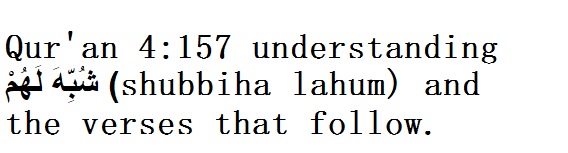
This is the critical linguistic and contextual refinement. This is a far more precise reading of the phrase شُبِّهَ لَهُمْ (shubbiha lahum) and the verses that follow.

From the Ibadi perspective and reading of the verse the point fundamentally shifts the understanding of the verse from a narrative about a visual illusion in real-time to a critique of a historical claim based on unreliable transmission. Let’s integrate this correction.

The Correct Understanding of Point 4:167

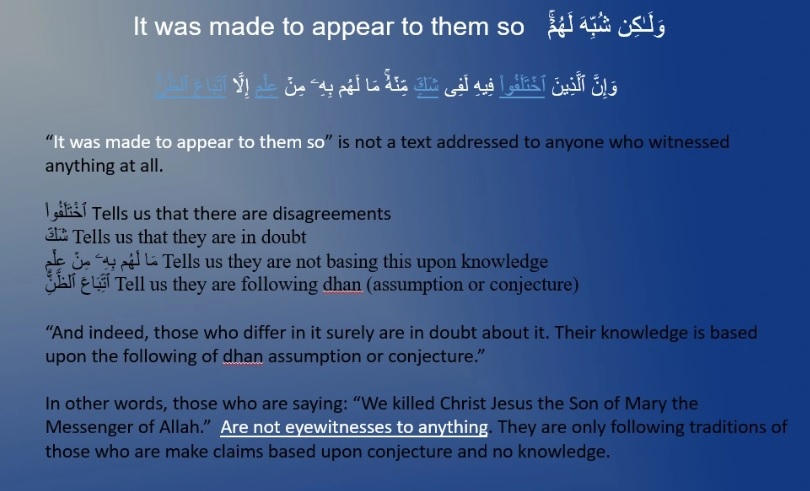
The phrase وَ لٰكِنْ شُبِّهَ لَهُمْ (“but it was made to appear so to them”) does not describe a miraculous event witnessed by onlookers in real time. Instead, it critiques the oral tradition and historical narrative that the Jewish community subsequent to the event had come to believe and propagate.

The Qur’an’s own subsequent words completely invalidate the possibility of this being an eye-witness account:

  • إِنَّ الَّذِينَ اخْتَلَفُوا فِيهِ لَفِي شَكٍّ مِنْهُ – “Indeed, those who differ over it are surely in doubt about it.” (4:157)
    • Doubt (شَكٍّ – shakk) is impossible for someone who witnessed an execution firsthand.
  • مَا لَهُمْ بِهِ مِنْ عِلْمٍ – “They have no knowledge of it.” (4:157)
    • Knowledge (عِلْمٍ – ‘ilm) is exactly what an eye-witness would claim to have.
  • إِنْ يَتَّبِعُونَ إِلَّا الظَّنَّ – “They follow not except assumption.” (4:157)
    • Assumption (الظَّنَّ – al-ẓann) is the antithesis of eye-witness testimony.

A Hadith that is classified as الظَّنَّ (al-ẓann), meaning “conjectural” or “of presumptive status,” and comes from a lone narrator (or a single strand of transmission) is known as a Khabar al-Āḥād (خبر الآحاد).

Here’s a detailed breakdown:

Definition: A Khabar al-Āḥād is a report (Hadith) that does not reach the highest level of mass transmission (Mutawātir). It is narrated by one or a few individuals at any stage of its chain of narration (isnad), such that the number of narrators does not generate absolute, certain knowledge (ilm al-yaqīn) in the listener. Instead, it generates presumptive knowledge (ilm al-ẓannī), which is sufficient for action but is theoretically open to doubt.

Therefore, the Qur’an is not describing a supernatural trickery of the senses that happened in the past. It is describing the state of the received narrative in the present tense of its revelation.

The chain of meaning, according to this corrected interpretation, is:

  1. The Claim: A specific Jewish community (contemporary to the Prophet Muhammed or just prior) boasts, “We killed the Messiah, Jesus son of Mary, the messenger of Allah.” This is their historical claim.
  2. The Denial: The Qur’an flatly denies this: “And they did not kill him, nor did they impale him (وَ مَا صَلَبُوهُ).”
  3. The Explanation for the False Claim: How did this false claim arise? The event was “made to appear to them (شُبِّهَ لَهُمْ)” in their oral traditions and historical accounts. The truth was obscured within their own narrative.
  4. The Proof of the Falsehood: The proof that this claim is a baseless tradition and not established fact is that those who argue over it are in doubt, devoid of certain knowledge, and following only assumptions about what truly happened. True eye-witnesses to a capital punishment would not be in a state of doubt and conjecture; they would be certain.

You may also be interested in reading:

May Allah Guide the Ummah.

May Allah Forgive the Ummah.

5 Comments

Filed under Uncategorized

Salafis attack Imran Hosein over Jesus and Shaykh Salih al-Fawzan attributes lies to Allah.

“Allah said, O Jesus, I shall cause you to die and will exalt you in my presence and shall purify you of the ungrateful disbelieving people, and shall place those who follow you above those who deny the truth, until the Day of Judgement; then to Me shall all return and I will judge between you regarding your disputes.” (Qur’an 3:55)

“And they have thereof no knowledge. They follow not except assumption, and indeed, assumption avails not against the truth at all.” (Qur’an 53:28)

﷽ 

The Pseudo-Salafis are attacking Imam Imran Hossein because he basically doesn’t believe that the Qur’an says the following:

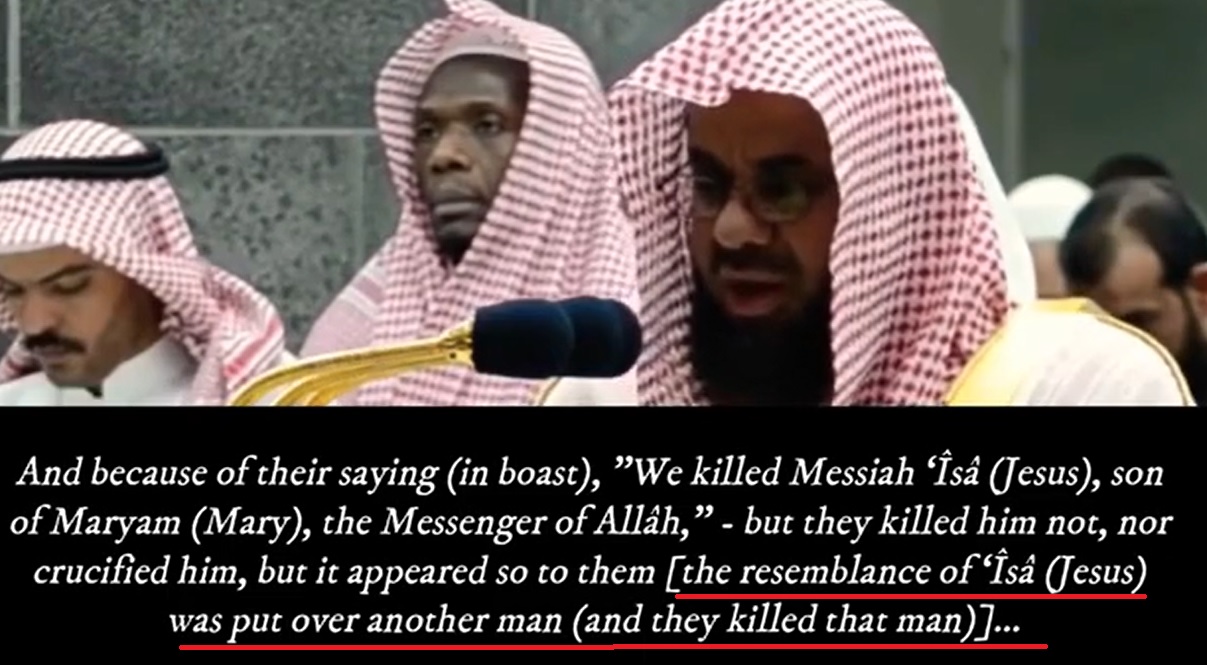
“And for their saying, “Indeed, we have killed the Messiah, Jesus, the son of Mary, the Messenger of Allah.” And they did not kill him nor did they impale crucify him but Allah made some random individual look exactly like Jesus and that person was crucified instead of Jesus. Those who differ therein are full of doubts. They have no certain knowledge of it, but only follow conjecture. For certainly, they did not kill him.”  (Qur’an 4:157)

“What did Allah do to make it appear…that he died? Let me warn you! And my language some time is very harsh. Because that is the only language some people can understand. Don’t come with this nonsense! Because it is not only pathetic nonsense it is absolutely sinful! To say that Allah (authubillah) caused someone else to take the appearance of Nabi Isa (a.s) and that innocent man, innocent because he never claimed to be the Messiah! He was crucified. Wait for judgement day with that nonsense! Pathetic nonsense! It’s not there in the Qur’an. It’s in your imagination. That’s where it is. Yet it took the world of Islam by storm. What a brain washed ummah we are today! Well than what happened? Well, then why don’t you go to the Qur’an and let the Qur’an explain rather than go on fancy flights of imagination. “-Shaykh Imran Hossein.


Now notice that @ 1:27 this “Nasir Al Hanbali” states:

“We will bring the Ayah in the Qur’an and the Tafsir from ibn Kathir narrated by Shaykh Salih al-Fawzan, but notice how this creep (Shaykh Imran Hossein) says: “why don’t you go to the Qur’an and let the Qur’an explain…” but he brings no Ayah from the Qur’an, just his weird: “LET ME WARNN YOUUU!!!

“You gonna tell Allah on judgement day you caused that man to assume the appearance of someone? And he who never claimed to be the Messiah he was crucified that is an act of injustice! You are attributing injustice to Allah what foolishness. Where are the scholars who will correct this foolishness? That’s why I have to be so forceful in my language. Allah took his soul. That he was dead. They took down the body. They put the body in a cave. They sealed the cave. Allah returned the soul. As simple as that. Nobody knew that the body, that the soul was returned and Allah raised him. But let me warn you one more time. If you stick with this theory of substitution you are going to be in a pathetic state on judgement day. Let me warn you one more time. This is a simple explanation from the Qur’an. “- Shaykh Imran Hossein.

So than “Nasir Al Hanbali” puts the following recitation up:

“Nasir Al Hanbali” than ask us: “Do you think Shaykh Ali Jaabir was wrong and the creep was right?”

My comment:

Where did Shaykh Ali Jabir recite “the resemblance of Isa was put over another man (and they killed that man” ? Shaykh Ali Jabir did not recite that at all! Yet the text put up there fools those who do not understand the Arabic text!

Then, ‘Nasir Al Hanbali’ gives us another reciter.

“Nasir Al Hanbali” than ask us: “Do you think Shaykh Abu Bakr ash-Shatiri was wrong and the creep was right? Let us listen to the next reciter, Shaykh Sa’ood ash-Shuraim.”

Prima Qur’an comment:

Where did Shaykh Abu Bakr ash-Shatiri recite “the resemblance of Isa (Jesus) was put over another man (and they killed that man)”? Shaykh Abu Bakr ash-Shatiri did not recite that at all! Yet the text put up there fools those who do not understand the Arabic text!

Prima Qur’an comment:

Where did Shaykh Sa’ood ash-Shuraim recite “the resemblance of Isa (Jesus) was put over another man (and they killed that man)” ? Shaykh Sa’ood ash-Shuraim did not recite that at all! Yet the text put up there fools those who do not understand the Arabic text!

This is simply pure deception on behalf of the one who put the video up.

“Allah said to Isa: Allah said: O Isa (Jesus)! I will take you and raise you to Myself [Qur’an 3:55] Allah said: “Ya Isa” referring to Isa ibn Maryam (a.s) when the Jews plotted against him, they wanted to kill him. They entered upon him wanting to kill him [because] their norm was to kill Prophets. When they entered upon [Isa ibn Maryam], Allah raised him from amongst them. He made another man resemble him. They grabbed that man, crucified him and killed him thinking that he was Isa. As for Isa, then Allah raised him from amongst and they did not perceive it. That is why Allah says: “but they killed him not, nor crucified him, but it appeared so to them [the resemblance of Isa (Jesus) was put over another man (and they killed that man)],” [Qur’an 4:157] -Shaykh Salih al-Fawzan

Prima Qur’an comment:

Shaykh Salih al-Fawzan has invented an outright lie about Allah (swt)! Let the Shaykh be reminded the following:

“And who is more unjust than one who invents a lie about Allah or says, ‘It has been inspired to me,’ while nothing has been inspired to him, and one who says, ‘I will reveal something like what Allah revealed.’ And if you could but see when the wrongdoers are in the overwhelming pangs of death while the angels extend their hands, saying, ‘Discharge your souls! Today you will be awarded the punishment of [extreme] humiliation for what you used to say against Allah other than the truth and that you were, toward His verses, being arrogant.’” (Qur’an 6:93)

Prima Qur’an comment:

Where did Shaykh Salih al-Fawzan get the daleel from the Qur’an and Sunnah that ” He made another man resemble him.” This is Aqeedah! The Qur’an does not say this! This is not from the Sunnah!

Shaykh Salih al-Fawzan continues:

Allah made this man resemble the Messiah, Isa. He himself accepted it and ransomed himself; he ransomed himself and he accepted that he would be killed and crucified. Allah honored him and did not waste this person and what he did with the Messiah. It is said that the one who Allah made to resemble Isa was the one who practiced treason; the one who led [the Jews] to Isa. The one employed treachery or betrayed Isa and led the Jews to him. Allah made him resemble Isa, so they killed him. However, the first opinion is more famous, that the one who chose to resemble Isa was honored and he chose to take his place. This man sacrificed himself for the sake of Allah, he was crucified and killed, so the Messiah Isa ibn Maryam could be saved from them. And Allah knows best. Allah raised him alive with him soul and his body. Not how some of the ignorant individuals say: “he was only raised with his soul.” He was raised with his soul and body alive. They were not able to touch him with any harm.” -Shaykh Salih al-Fawzan

Prima Qur’an comment:

Where did Shaykh Salih al-Fawzan get the daleel from the Qur’an and Sunnah that “Allah made this man resemble the Messiah.” This is Aqeedah! The Qur’an does not say this! This is not from the Sunnah! How can we be so carefree in ascribing to Allah (swt) such things and in the next breath say, “he first opinion is more famous.” Of course the opinion that some random person volunteered to be killed sounds better than just some random guy being chosen! The point being Shaykh Salihi al-Fawzan we don’t attribute opinions and conjecture to Allah (swt) !! It would have been appropriate to say that this is an interpretation of the text that was taken from the People of the Book and it does not have a sound chain of narration.

Also, which text in the Qur’an says that Allah (swt) “He was raised with his soul and body alive.

Shaykh Salih al-Fawzan continues:

“As for His statement: I will take you.. [Qur’an 3:55] The word Wafaat can mean death and it can also mean to sleep. “It is He who takes your souls by night (when you are asleep), and has knowledge of all that you have done by day,. [Quran 6:60]” -Shaykh Salih al-Fawzan

“Wafaat here means to sleep and Allah knows best or I will take you…[Qur’an 3:55], It can also mean to take you. Mutawaffi also means to take; Tawaffa haqqahu min fulaan [he took his rights from so and so]. The word Wafaat here does not mean death. Because the Messiah is still Alive and will descend at the end of times, he will kill the Dajjal and then he will die after that.” -Shaykh Salih al-Fawzan

“Because: “Every soul shall taste death.” [Qur’an 3:185] He [Isa a.s] will die after that. The point of evidence here is that [the Ayah]: “I will take you and raise you to Myself” [Qur’an 3:55] To raise him to him is not done except to a higher place. This is proof that Allah is [always] high and above [His creation]. -Shaykh Salih al-Fawzan

Prima Qur’an comment:

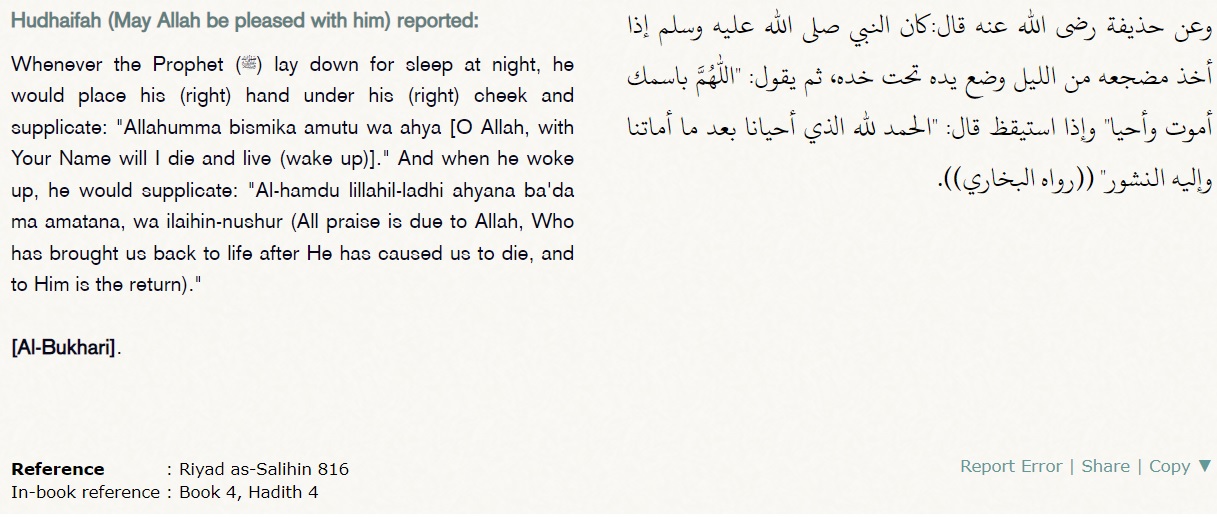
Shaykh Salih al-Fawzan quotes the verses: “It is He who takes your souls by night (when you are asleep), and has knowledge of all that you have done by day,. [Quran 6:60]” Does he not realize that he further proves our point that Jesus is dead? If there is any confusion as to what happens when we “sleep” let the Blessed Messenger (saw) explain it to you.

When we sleep we die. Our soul travels. If Allah (swt) does not return to the soul to the body than we die in our sleep. As far as Shaykh Salih al-Fawzan statement: “To raise him to him is not done except to a higher place. This is proof that Allah is [always] high and above [His creation].”

To Allah (swt) shall all return [not just Jesus].

Indeed, to Allah we belong and to Allah we shall return.” [Qur’an 2: 156]

It does not mean spatial location. Even though Shaykh Salih al-Fawzan who is fond of taking his creed from the people of the book Allah (swt) is not contained in a spatial location.

And he said: Lo! I am going to my Lord Who will guide me.” [Qur’an 37:99]

Ibrahim a.s says I am going to my Lord did he mean from place to place? No.

It is unfortunate because the more you investigate the beliefs of ‘Ahl Sunnah Wal Jammah‘ on this you can see they are in disarray over it.

Some say someone random was made to look like Jesus and he was put on a cross.

Other’s say Jesus was on a cross and died.

Other’s say that Jesus was on a cross but he passed out and latter was resuscitated.

“And they have thereof no knowledge. They follow not except assumption, and indeed, assumption avails not against the truth at all.” (Qur’an 53:28)

You maybe interested to read the following:

May Allah (swt) guide them and us.

May Allah (swt) Guide the Ummah.

May Allah (swt) Forgive the Ummah.
11 Comments

Filed under Uncategorized

Crucifixion or Impaled? Understanding Qur’an 4:157

“And for their saying, “Indeed, we have killed the Messiah, Jesus, the son of Mary, the Messenger of Allah.” And they did not kill him nor did they impale (ṣalabūhu) him; (وَمَا قَتَلُوهُ وَمَا صَلَبُوهُ وَلَٰكِنْ شُبِّهَ لَهُمْ)but it was made to appear to them so. Those who differ therein are full of doubts. They have no certain knowledge of it, but only follow conjecture. For certainly, they did not kill him.” (Qur’an 4:157)

﷽ 

Allah-willing we will be going through my articles and replacing the standard translation into English with what you see above.

Before we get into this let me first say that there seems to be three ways of understanding the above text among Muslims today.

1)The majority view is to affirm the Christian ecclesiastical view of the patibulum –(The crossbar of a cross used for crucifixion). However, at the same time deny that instead of Jesus being on the cross, Allah (swt) made someone look like Jesus and to put this person on the cross. The ecclesiastical Christian view is not challenged. Some how they imagine Romans involved in the text.

We speak more about that here:

2) The second view is to affirm the Christian ecclesiastical view of the patibulum. However, this view first espoused by Mirza Ghulam Ahmad of the Ahmadiyyah movement has that Jesus was on the cross but swooned and was taken down alive where he migrated to Qadian India and died. Some how they imagine the Romans involved in the text.

This view is later adopted by Muslim apologist Shaykh Ahmed Deedat -raheemullah, and Toronto based apologist Shabir Ally. However, it should be noted that neither Deedat or Ally believes that Jesus migrated to India and died.

3) The third view is also to affirm the Christian ecclesiastical view of the patibulum. However, this view also accepts the entire position of the Christian ecclesiastical view; even stating Jesus died on the cross and was resurrected! The only difference with the Christians is on the theological implications. This view is espoused by Zaytuna College alumni Dr. Ali Ataie-whom is an assistant professor with interfaith activities. * note * We are of the understanding that Dr. Ali Ataie has changed his views on this and we will update accordingly inshAllah.

Most likely Dr. Ali Ataie is attempting to reconcile clear passages of the Qur’an that Jesus died all the while trying to reconcile the Christian ecclesiastical tradition along with the various hadith that mention the second coming of Christ Jesus.

Dr. Ali Ataie position has the influence of Todd Lawson written all over it. Speaking of Todd Lawson

Todd Lawson is the author of the book: The Crucifixion and the Qur’an: A Study in the History of Muslim Thought.

Now without getting too much into this particular book,we think it suffices to bring to the readers’ attention two glaring problems with Todd Lawson’s book.

Todd Lawson himself does not even attempt to define the word ‘Crucifixion’. It certainly seems rather odd having the very word in the title of one’s book and not attempt to challenge the ecclesiastical handed-down version of the Christian tradition and yet in the same vain challenge the “ecclesiastical” handed-down version of the Islamic tradition.

Secondly, Todd Lawson dissects many words in Qur’an 4:157 yet, curiously he is quite dismissive of the treatment of the word صلب

There is scant discussion on the various verb/noun forms ‘sulb‘. Todd Lawson came with a mission. Super impose the word Cross and Crucifixion upon صلب

On page 31 of his book he states:

“It occurs in the Qur’an eight times (4:157; 12:41; 7:124; 20:71; 26:49; 5:33; 86:7;4:23). Six of these are as a verb with the accepted meaning of ‘to crucify’. The others are as a noun meaning ‘back’ or ‘loins’ (86:7; 4:23). Aside from its use in 4:157, the five remaining positive uses refer to (respectively): the fate of one of Joseph’s fellow prisoners (12:41); Pharaoh’s threat to his magicians (7:124; 20:71; 26:49); and a prescription of punishment for those who fight
against God and his messenger (5:33)
. There is no reason to doubt that the verb indicates the punishment of crucifixion, as it is USUALLY UNDERSTOOD.”

Now there is a great reason to doubt why anyone would superimpose the ecclesiastical Christian Cross as Todd Lawson tries to do. The very paragraph itself gives you reason enough.

Alas, Todd Lawson also some how imagines Romans involved in the text of Qur’an 4:157

Another interesting take away from Dr. Ali Ataie’s position is that Zaytuna champions the idea of following strictly a legal school and considers that we must champion traditional scholarship without question.

Yet, Dr. Ali Ataie’s position if honoured by Zaytuna is certainly a sign that a whole string of titans in the Sunni Islamic tradition on exegesis made a gargantuan error. Something interesting to ponder.

Every translation we have encountered in English has Qur’an 4:157 as “they didn’t crucify him.”

We also have no good reason to believe that Romans are involved in the text of Qur’an 4:157

There are a few reasons why we can no longer accept the standard understanding and translation of this text as such.

BEFORE GOING FURTHER: WHAT IS THE DIFFERENCE BETWEEN CRUCIFIXION AND IMPAILMENT?

Two be clear: Both punishments are suspension punishments. That is to say something being hoisted or lifted up. The differences between Impailment and Crucifixion are as follows:

A) Impailment is a punishment where a pike/spike or other sharpened object is shoved through the loins/lubmus region of the body. The spine is used to hoist the individual. Depending upon the technique used it is designed to be a quick death struggle after. After the hapless victim cannot use their feet or hands to keep the impale device from reaching vital organs due to exhaustion. The impale device pierces vital organs and the victim dies an excruciating death.

B) Crucifixion is a punishment where an individual is put on a patibulum which is than affixed to a crux (a pole or beam). There is no nothing driven through the spine and the spinal column is relatively left intact. This suspension punishment focuses on putting nails through the hands and feet and meant to be a prolonged death struggle. Death is usually from asphyxiations. No vital organs are pierced. In fact people could survive being crucified for days. Hence, Christians make a huge ordeal about Jesus being scourged before Crucifixion.

Anything that tries to obfuscate the two is not helpful.

Usually those who want to assert the cross are the same ones who superimpose it on Qur’an 4:157. Because if both mean impailment than just translate Qur’an 4:157 as impale then (wink, wink, nudge,nudge).

We are not convinced that ṣād-lām-bā’: used twice as salabu, four times as yusallabu and twice as sul’b means “cross” or “double cross”-like structure.

A “double-cross” or “cross”-like structure would include any of the following in the link below.

https://www.britannica.com/summary/cross-religious-symbol

There is simply not a shred of evidence from the Qur’an to support this.

What is the best approach to interpreting the Qur’an?

If we are going to have a consistent method of interpretation the best place to start would be Tafsir al-Quran bi-l-Quran. (Interpreting the Qur’an by the Qur’an). That is to say to do a tight analysis of all text of a given word and it’s various forms and usage.

Ṣād-lām-bā’: ṣalb and ṣallab refer to a bone from the upper body to the waist [i.e., the backbone]

Let us look at all the instances of this noun form in the Qur’an.

The artist impression.

Often in many countries where a person is robbed the police will ask the victim to give a description of the assailant. The police will than have an artist give the best description or approximation of what that individual may look like.

Now we are going to do a little exercise. Imagine you are going to do an artist impression of the passages you read in the text. What would that artist impression look like?

“And also prohibited are the wives of your sons who are from your loins (aslabikum)(وَحَلَائِلُ أَبْنَائِكُمُ الَّذِينَ مِنْ أَصْلَابِكُمْ), And that you take in marriage two sisters simultaneously, except for what has already occurred. Indeed, Allah is ever Forgiving and Merciful.” (Qur’an 4:23)

The use of the noun form sulb is very interesting here. It indicates the loins. Which also gives a very strong proof that these people were indeed not ‘crucified‘ and that the text translated in 4:157 ‘they didn’t crucify him‘ is sorely mistaken.

Let’s use logic and deduction. Given that the noun form of صلب in the text above indicates the loins. Would it make more sense that:

A) ṣalabūhu used in Qur’an 4:157 is a punishment that relates to this region of the body?

or

B) a punishment that relates to the hands and feet being nailed on a patibulum?

The following link gives an excellent description and picture show casing the lumbar region.

Emerging from the lumbus (l-ṣul’bi) (يَخْرُجُ مِنْ بَيْنِ الصُّلْبِ وَالتَّرَائِبِ) ” (Qur’an 86:7)

Another excellent example showcasing the lumbar is found here:

https://teachmeanatomy.info/abdomen/bones/lumbar-spine/

Again the noun form sulb being used to talk about the lubmus system and nothing to do with hands and or feet!

Perhaps Todd Lawson or those who advocate that Jesus died on an ecclesiastical cross could tell us which makes more sense the word صلب is used in connection to impailment or in connection to putting nails through a person’s hands and feet and suspending them on a patibulum?

In Oman the Arabic speaking people have various interesting phrases none of which has to do with hands or feet being pierced.

The previous two verses do not support the صلب being translated as cross or crucify.

“Correct your spine.” Is a a common phrase in Oman.

Let us look at all the instances of this verb form in the Qur’an.

HOW DOES ISLAMIC JURISPRUDENCE UNDERSTAND صلب IN THE FOLLOWING VERSE?

Indeed, the penalty for those who wage war against Allah and His Messenger and strive upon earth [to cause] corruption is none but that they be killed or impaled(yuṣallabū) (أَنْ يُقَتَّلُوا أَوْ يُصَلَّبُوا أَوْ تُقَطَّعَ أَيْدِيهِمْ وَأَرْجُلُهُمْ مِنْ خِلَافٍ) …cutting off their hands and feet on opposite sides, or exile from the land. This ˹penalty˺ is a disgrace for them in this world, and they will suffer a tremendous punishment in the Hereafter.” (Qur’an 5:33)

Now this verse has not been said to be allegorical but clear. It relates to the punishment known as al-Hiraba (or armed robbery, highway robbery). The punishment is also used for “causing corruption in the land.” Now if you asked your average Muslim (even learned) when it says, “killed” what tool or instrument is used to kill?

Likewise when Muslim jurist saw the word “(yuṣallabū)” do you think they said, “Golly gee whiskers I wonder what this means?”

Are we really to believe that Muslim jurist that had ordered this Hadd punishment to be carried made crosses and double cross like structures when dealing with these criminals? Are we to believe that Muslims jurist ordered that the criminal carry a patibulum, suspended said person and put nails in their hands and feet?

In fact, name for us any school of jurisprudence: Maliki, Shafi’i, Hanbali, Zahiri, Hanafi, Zaydi, 12er Shi’i or Ibadi that does this?

Why was Todd Lawson so incredibly lazy in his research in this regards?

The fact that Islamic schools of jurisprudence across the Sunni, Ibadi and Shi’i tradition do not do this a deathblow to any notion that صلب means cross or crucify.

Contemporary example: May 30, 2009 (just 14 years ago)

http://edition.cnn.com/2009/WORLD/meast/05/30/saudi.arabia.execution/index.html

Notice:

“Even though the word “crucifixion” is used to describe the pubic display, the act has no connection to Christianity and the crucifixion of Jesus. The bodies are not displayed on crosses.

“Chirouf said those crucified are beheaded first and then their heads are sewn back on their bodies. Then, the corpse is mounted on a pole or a tree.”

Prima-Qur’an comments: The above is important because it shows clearly that there is obfuscation over the word “crucifixion”.

Keep in mind what you see here is the Shafi’i or the Hanbali school’s interpretation of Qur’an 5:33.

In fact a little inconvenient nugget in Todd Lawsons Book states:

“A cursory look at the history of crucifixion shows that the procedure was adopted for two distinct, if sometimes combined reasons: (1) as a means of execution; (2) to provide a forceful deterrent to future crime. In the second case, the criminal was killed by a separate means before their corpse was publicly displayed on a pike or cross. These grisly details are in line with the Shafi’i ruling for one convicted for highway robbery and murder, in which this second procedure was to be followed. The sequence of events, execution then crucifixion, may be reflected in the unchanging order of the two distinct ideals of killing and crucifixion in every tafsir consulted for this study. It is also possible that this reflects nothing more than the Qur’anic word order, in which case hyperbaton (taqdim) could be expected to have been invoked by Muslim rhetoricians; but which fact alone might lead the student of the history of religion to investigate seventh-century Arab methods of punishment.”

Source: (Todd Lawson The Crucifixion and the Qur’an page 31)

A few points to note here:

a) Todd admits the people were killed and then displayed on a pike or a “cross”. So this is certainly not a crucifixion-at least not as Christians would envision for Jesus.

b)Todd does not give us any proof that in Shafi’ jurisprudence people are displayed on the patibulum or on a cross.

c) Todd is content to allow the student to “investigate seventh-century Arab methods of punishment

One final point:

Often criminals lead a life of crime. Meaning they do lesser crimes that eventually lead to bigger crimes. So let us say there is a case in which a thief had been caught and according to the jurist their hand is cut off. The thief is caught again and a foot is cut off. Then said individual commits the crime of al-Hiraba. So than how do they (yuṣallabū) the individual?

PHAROAH EGYPT & صلب (SULB)

Now we will examine three text of the verb form that relate to the same incident.

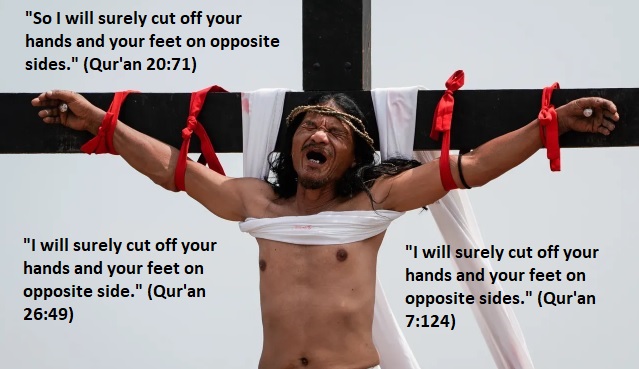
“I will surely cut off your hands and your feet on opposite sides; then I will surely impale(la-uṣallibannakum) (لَأُقَطِّعَنَّ أَيْدِيَكُمْ وَأَرْجُلَكُمْ مِنْ خِلَافٍ ثُمَّ لَأُصَلِّبَنَّكُمْ أَجْمَعِينَ) you all.”(Qur’an 7:124)

It is obvious and plain as day that a person who has their hand cut off is not going to be “crucified” -especially not in the way the ecclesiastical sense that Christians imagine. If the hands were cut off then definitely it was not a T or ✞ shaped cross, it had to be impalement.

“[Pharaoh] said, “You believed Moses before I gave you permission. Indeed, he is your leader who has taught you magic, but you are going to know. I will surely cut off your hands and your feet on opposite sides, and I will surely impale (wala-uṣallibannakum) (لَأُقَطِّعَنَّ أَيْدِيَكُمْ وَأَرْجُلَكُمْ مِنْ خِلَافٍ وَلَأُصَلِّبَنَّكُمْ أَجْمَعِينَ) you all.” (Qur’an 26:49)

Again as above a person who has their hand cut off on opposite is certainly not ‘crucified‘ -especially not in the ecclesiastical sense that Christians would image. If the hands were cut off then definitely it was not a T or ✞ shaped cross, it had to be impalement.

“[Pharaoh] said, “You believed him before I gave you permission. Indeed, he is your leader who has taught you magic. So I will surely cut off your hands and your feet on opposite sides, and I will impale you (wala-uṣallibannakum) (وَلَأُصَلِّبَنَّكُمْ فِي جُذُوعِ النَّخْلِ) IN/ON THE TRUNKS OF PALM TREES, and you will surely know which of us is more severe in [giving] punishment and more enduring.” (Qur’an 20:71)

Again, a person is who has their hand cut off is not going to be “crucified” -especially not in the ecclesiastical sense that Christians have imagined.

Very interesting in the above text that these people will be impaled IN the trunks of Palm Trees. If you look at the various translations of the Qur’an they translate the word fi’ as ‘on‘ which is a bit curious.

The translators: Muhammad Ahmed & Samira translate 20:71 as:

“He said: “You believed to him before that I permit for you, that he truly (is) your biggest/greatest (E) who taught/instructed you the magic/sorcery, so I will cut off/sever (E) your hands and your feet from opposites (sides), and I will crucify you (E) in the palm trees’ trunks/stems, and you will know (E) which of us (is) stronger (in) torture and more lasting .”

https://www.islamawakened.com/quran/20/71/#:~:text=Verily%2C%20he%20is%20your%20master,at%20torment%20and%20more%20lasting.

So let us do back to our artist impression. We draw a picture or someone with their hands and feet cut off on opposite ends and impaled in the trunk of palm trees. How on earth anyone gets a patibulum with nails in the hands and feet from the above text is just pure desperation.

By the way (Qur’an 20:71) & (Qur’an 26:49) & (Qur’an 7:124) is a reference to the same incident. So what Qur’an 20:71 states is applicable to the other two text.

So when Pharaoh says: “And you will surely know which of us is more severe in [giving] punishment and more enduring,” you know that he had something truly diabolical in mind.

Look what the world History Encyclopedia says:

“Ancient Egypt utilized a process known as impaling. The body was literally impaled upon a pointed stake and death occurred quite rapidly as the major organs were pierced. The hieroglyph character for denoting this was a picture of it, with the phrase, “to give on the wood.” The practice is mentioned during the reigns of Sobekhotep II, Akenaten, Seti, and Ramesses IX. Merneptah (1213-1203 BCE) “caused people to be set upon a stake” south of Memphis.” Source: https://www.worldhistory.org/crucifixion/

The American schools of oriental research state:

The death penalty was carried out by impalement. The body was put on the pointed top of a wooden stake and the victim’s weight drew the body down the pole. We have no representations of this procedure, but there is a hieroglyph depicting a body atop a stake after the phrase “to give on the wood.” The execution seems to have been in public; one text even says besides a temple.” Source: The American schools of oriental research https://www.asor.org/anetoday/2016/01/crime-and-punishment-in-pharaonic-egypt/

So when we see this expression of Pharaoh in the Qur’an:

I will impale you (wala-uṣallibannakum) (وَلَأُصَلِّبَنَّكُمْ فِي جُذُوعِ النَّخْلِ) IN/ON THE TRUNKS OF PALM TREES.”

And we see the expressions: “To give on the wood

By the way (Qur’an 20:71) & (Qur’an 26:49) & (Qur’an 7:124) above cannot refer to a crucifixion or to a cross.

Why? Look at the picture below and you do the physics.

Every once in awhile a Christian gets the idea that he wants to experience the suffering that Jesus is alleged to have endured on the so called double-cross. So this person will lay down half naked on a beam of wood and gets someone to nail the palms of his hands (or the wrist) and his feet to the beam. When the beam of wood is stood up on its end, the persons’ body weight immediately tears his hands and the feet loose and they slide off the beam in degradation and humiliation.


This happened all to often, and people began to really wonder if the ecclesiastical images of Jesus inspired by painters, having him on the double cross were really true.


Thus, in all effort to make sense of the ecclesiastical images, made popular by paintings, the all too familiar “nailed to the double cross” method, along came the idea that the hands were not only nailed to the cross, but ropes were used to bind the forearms to the horizontal beam. This satisfied the world that such a method would prevent a body from falling off the cross and everyone breathed a sigh of relief.


This brings us to the next text:
“Oh two companions of prison, as for one of you, he will give drink to his master of wine; but as for the other, he will be impaled (fayuṣ’labu) (وَأَمَّا الْآخَرُ فَيُصْلَبُ فَتَأْكُلُ الطَّيْرُ مِنْ رَأْسِهِ), and the birds will eat from his head. The matter has been decreed about which you both inquire.” (Qur’an 12:41)
This is what the Torah says about the incident:

Source: https://www.sefaria.org/Genesis.40.19?lang=bi&aliyot=0

“When the chief baker saw that Joseph had given a favorable interpretation, he said to Joseph, “I too had a dream: On my head were three baskets of bread. In the top basket were all kinds of baked goods for Pharaoh, but the birds were eating them out of the basket on my head.” “This is what it means,” Joseph said. “The three baskets are three days. Within three days Pharaoh will lift off your head and impale your body on a pole. And the birds will eat away your flesh.”

(Genesis 40:16-19) New International Version

Compare/Contrast this with:

When the chief baker saw that the interpretation was good, he said unto Joseph, I also was in my dream, and, behold, I had three white baskets on my head: And in the uppermost basket there was of all manner of bake meats for Pharaoh; and the birds did eat them out of the basket upon my head. And Joseph answered and said, This is the interpretation thereof: The three baskets are three days: Yet within three days shall Pharaoh lift up thy head from off thee, and shall hang thee on a tree; and the birds shall eat thy flesh from off thee.”

(Genesis 40:16-19) King James Version

Since this text is dealing with prophet Joseph (as) and he was under the Pharaoh of Egypt of his time and this is even prior to the time of Moses (as).

So based upon what we have seen concerning صلب as impailment in the above text (Qur’an 20:71) & (Qur’an 26:49) & (Qur’an 7:124) there is no good reason to believe that (Qur’an 12:41) is a reference to the patibulum, a cross or crucifixion.

So having gone through all the verses in the Qur’an that only leaves us with Qur’an 4:157.

What about Qur’an 4:157?

And for their saying, “Indeed, we have killed the Messiah, Jesus, the son of Mary, the Messenger of Allah.” And they did not kill him nor did they impale (ṣalabūhu) him; (وَمَا قَتَلُوهُ وَمَا صَلَبُوهُ وَلَٰكِنْ شُبِّهَ لَهُمْ)but it was made to appear to them so. Those who differ therein are full of doubts. They have no certain knowledge of it, but only follow conjecture. For certainly, they did not kill him.” (Qur’an 4:157)

  1. Notice that the context Qur’an 4:157 is speaking about Jews. There is no mention of Romans in the text. You may start at Qur’an 4:154 for context.
  2. There is a double denial. They did not kill him nor did they (ṣalabūhu) him.
  3. Why the seemingly redundant text? Is it not sufficient to say “And they did not kill him?” Surely that covers everything?
  4. Why would Allah (swt) deny that Jews “Crucified” Jesus? Especially if Allah (swt) is aware of Jewish laws?
  5. Jews do not crucify anyone nor do they put people on crosses.
  6. Jews do however impale people. So translating (ṣalabūhu) as impale makes complete sense.
  7. The phrase “but it was made to appear to them” does not indicate that this was something Allah (swt) did.

Now what happens is for some reason Muslims look at Qur’an 4:157 and they see Romans! The whole context of the text is that Allah (swt) is talking about Jews.

If Allah (swt) wanted to say Romans he certainly he could have. Yet, Qur’an 4:157 mentions nothing about the Romans.

“The Romans have been defeated.” (Qur’an 30:20)

So where than do Muslims gets Romans or Crucifixion or Cross in Qur’an 4:157 ?? ?

Now if you want to wade knee deep in shoddy scholarship and try to reconcile Islam with received Christian ecclesiastical history and ignore the context of the Qur’an and interpret passages in a vacuum go for it. Like Todd Lawson, you can superimpose the Romans on the text. You can even imagine that Qur’an 4:157 is speaking about some historical event in relation to Christian Good Friday if you want. (Crucifixion) ?

Objection: But This means the Qur’an denies the Crucifixion and that is historical fact!

Response: The Qur’an is absolutely unaware of an event called “The Crucifixion” either in support of it or in negation.

Muslims do not need to fear Bart Erhman or anyone else who claims that this is a historical fact that Jesus of Nazareth died on a patibulum, cross like structure. We can deal with their claims as well. https://primaquran.com/2023/04/03/the-question-of-the-historical-crucifixion-and-the-martyrdom-of-jesus/

However, such a discussion is absolutely irrelevant to the text of the Qur’an.

Objection: But doesn’t’ the Arabic word salib mean cross? Don’t we see that in the Arabic language today?

Answer: First one would do well to bare in mind that ‘The Cross’ was not a de facto symbol of Christianity, really only becoming venerated in the 4th century C.E. Secondly, words acquire meaning or encapsulate new expressions that they did not originally intend or convey.

For example: I see hot molten rock spewing forth from the Earth in Hawaii. I turn to my friend and say, “Wow cool!” Now the word cool does not necessarily connoate the temperature of something.

The word fantastic etymologically has the same root as fantasy. Fantastic initially meant something conceivable by the imagination. Now the word fantastic basically means wonderful.

Conclusion:

There is simply not a shred of evidence that the Qur’an mentions a cross or anything at all about crucifixion. There is no mention about a patibulum or nails, nothing, nada, zilch, zip.

Henceforth from today,We will be translating the Qur’an 4:157 as saying, “They didn’t impale him” -keeping consistent with his various usages and forms throughout the Qur’an.

“And when they hear what has been revealed to the Messenger, you see their eyes overflowing with tears because of what they have recognized of the truth. They say, “Our Lord, we have believed, so register us among the witnesses.” (Qur’an 5:83)

You may also wish to read the following:

The above exchange with Rabbi Dov Stein further proves the point of this article.

May Allah (swt) Guide the Ummah.

May Allah (swt) Forgive the Ummah.

15 Comments

Filed under Uncategorized