“Certainly you have in the Messenger of Allah an excellent exemple for him who hopes in Allah and the latter day and remembers Allah much.” (Qur’an 33:21)
﷽
Malik ibn Al-Huwayrith reported:
We came to the Prophet (saw) while we were young men, and we stayed with him twenty nights. Then the Prophet considered that we were anxious to see our families, so he asked us who we had left behind to take care of them, and we told him. The Prophet was kindhearted and merciful, and he said, “Return to your families, teach them, and enjoin good upon them.” Pray as you have seen me praying. When the time of prayer arrives, then one of you should announce the call to prayer and the eldest of you should lead the prayer.
One of the most contentious issues among Muslims, more often than not, has to do with the way the Blessed Messenger (saw) did his prayers. This video below is well worth the listen. It is done by someone who follows the Hanafi school of jurisprudence, the Sunni denomination of Islam.
What he is explaining is that it is impossible to find a ‘Sahih’ hadith for every single act that is done in the prayer. He then argues that this is why for some Muslims in the Sunni denomination they decide to follow a school of jurisprudence.
The truth of the matter is that the prayer was established by the Blessed Messenger (saw). It is a mass transmitted sunnah. The hadith are written records for those who need to furnish proofs for things that were found to be objectionable. Things that stood out as different needed to have proof or evidence, more so than something people picked up as mass practice from those who preceded them and from those who preceded them.
The hadith in book form is a documented sunnah. Sometimes the documented sunnah captures the living sunnah and other times it does not. A proof of this is that the schools of jurisprudence believe that certain acts of the Blessed Prophet (saw) were either abrogated or abandoned altogether.
Kindly see our article here where we expand upon how the sunnah is received.
“Then he who is trusted should deliver his trust, and let him be careful (of his duty to) Allah, his Lord; and do not conceal testimony, and whoever conceals it, his heart is surely sinful; and Allah knows what you do.” (Qur’an 2:283)
﷽
Imam Khalid Yasin is world renown orator and public speaker. He has delivered lectures on Islam all over the world. This is his testimony in regards to his time in Oman and being among those who follow Ahl Haqq Wal Istiqamah (The People of Truth and Steadfastness)
Sheikh Khalid Yasin in Oman.
May Imam Khalid Yasin be in good health and in an excellent state of Emaan. May Allah (swt) guide us to what is beloved to Allah (swt).
“The Originator of the heavens and the earth; He made mates for you from among yourselves, and mates of the cattle too, multiplying you thereby; there is nothing like unto Him; and He is the Hearing, the Seeing.” (Qur’an 42:11)
The faculties of seeing (tudriku) cannot grasp Him, and He grasp all–seeing (yudriku), He is the All-Subtle and All-Aware.” (Qur’an 6:103)
“Allah has promised the believing men and believing women Gardens beneath which rivers flow. They shall abide in it. There are delightful dwelling places for them in the Gardens of Eternity. They shall, above all, enjoy the good pleasure of Allah. That is the great achievement.” (Qur’an 9:72)
﷽
My friend had his brother in law send him these clips by a preacher from the Salafi sect claiming people will ‘see the face of Allah’ in the paradise.
The preacher in the above video says:
“O Rabb, show Your Face.” “We want to look at You.” “So Allah (swt) Orders for the Hijab to be removed. And the Hijab of Allah Is Light (Noor).” “And you will see your Lord Like you see the sun at its noon Or the moon at its full. ” “There will be faces looking at their Lord. Looking so much so that Allah” (swt)
“May Allah makes us of those who will lay eyes On the Blessed Face of Allah” (swt)
You ever notice how these people talk about seeing the ‘Face of Allah’ ? Why don’t they ask to see the foot of Allah? Why don’t they ask to see the two right hands of Allah? Why don’t they ask to see the shin of Allah? Why would it be shameful to ask that? Does Allah (swt) have attributes that are shameful? Astaghfiurllah! Of course not!
When I asked this of a brother his response was:
“I guess because the face is considered to be the seat of beauty in human beings.”
Right! However,
“There is nothing like unto Him; and He is the Hearing, the Seeing.” (Qur’an 42:11)
AS FAR AS ALLAH (SWT) REMOVING SOME HIJAB….WELL THINK AGAIN!
Curious to see more?
Like where Imam Shafi’i is reported to have said that if he knew he would not see Allah (swt) he would not worship him, even though Allah (swt) NEVER made that a condition of worshipping him.
Allah (swt) has already told us what the great attainment is! It is not seeing his face!
“Allah has promised the believing men and believing women Gardens beneath which rivers flow. They shall abide in it. There are delightful dwelling places for them in the Gardens of Eternity. They shall, above all, enjoy the good pleasure of Allah. Thatis the great achievement.” (Qur’an 9:72)
You might benefit from reading the following articles:
“He is Allah , other than whom there is no deity, the Sovereign, the Pure, the Perfection, the Bestower of Faith, the Overseer, the Exalted in Might, the Compeller, the Superior. Exalted is Allah above whatever they associate with Him.” (Qur’an 59:23)
﷽
The Salafis agreed to debate The Muslims, The People of Truth and Steadfastness, on the issue of ‘Seeing Allah in the hereafter‘. The Salafis are a people not very strong or grounded in theology.
Our noble Shaykh Masoud ibn Muhammed al Maghbali, from the Muslims debated with representatives of the Salafi sect. Professor Hossam Al-Jed from Egypt. Shaykh Masoud went to Egypt to represent the Muslims, while Professor Hossam Al-Jed represented the Salafi sect.
The full debate can be seen here:
Allah’s victory is in the creed of those whom he has purified. The Muslims, The People of the Truth and Steadfastness. The Professor read from his paper, but our noble Shaykh was confident with the arguments Allah (swt) supplied him from sound theology. All praises be to Allah (swt).
Indeed, the arguments for seeing Allah Almighty are weak.
Did Allah (swt) really reveal himself to that mountain? In the anthropomorphic sense that the Salafi claim?
He appeared in His true form?
Then where is he after this Transfiguration? Did he remain there or did he disappear?
Did he vanish?
Allah (swt) is the friend of the Blessed and Noble Messenger, Ibrahim who said in the same Qur’an:
“When the night overshadowed him, he saw a star and said, “This is my Lord!” But when it went down he said, “I do not like things that vanish.” (Qur’an 6:76)
Then they go against the apparent meaning of the verse: “The eyes do not perceive him, and he perceives the sight, and he is The Gentle, The Expert.” (Qur’an 6:103)
So they interpreted the word that the eyes cannot see him in another sense contrary to what came in the linguistic dictionaries, where they interpreted perception by ‘encompassing’ as some type of victory for their scandalous and decrepit doctrine.
After these debates many from among the Arabs left the Salafi sect and entered upon the way of the Muslims, The People of The Truth and Steadfastness. The Salafi’s deleted videos. Their Professor Hossam Al-Jed from Egypt was demoted from Professor to ‘Student of Knowledge’. Well, in this case Shaykh Masoud ibn Muhammed al Maghbali is also a student of knowledge.
We continue to call them and all others to the way of the Muslims, To the doctrine of transcendence. For this is the safest and securest road.
The faculties ofseeing (tudriku) cannot grasp Him, and He grasp all–seeing (yudriku), He is the All-Subtle and All-Aware.” (Qur’an 6:103)
﷽
Salafi Shaykh Muqbil Al Wadi’i Hadith in Sahih Muslim on Seeing Allah is actually weak!
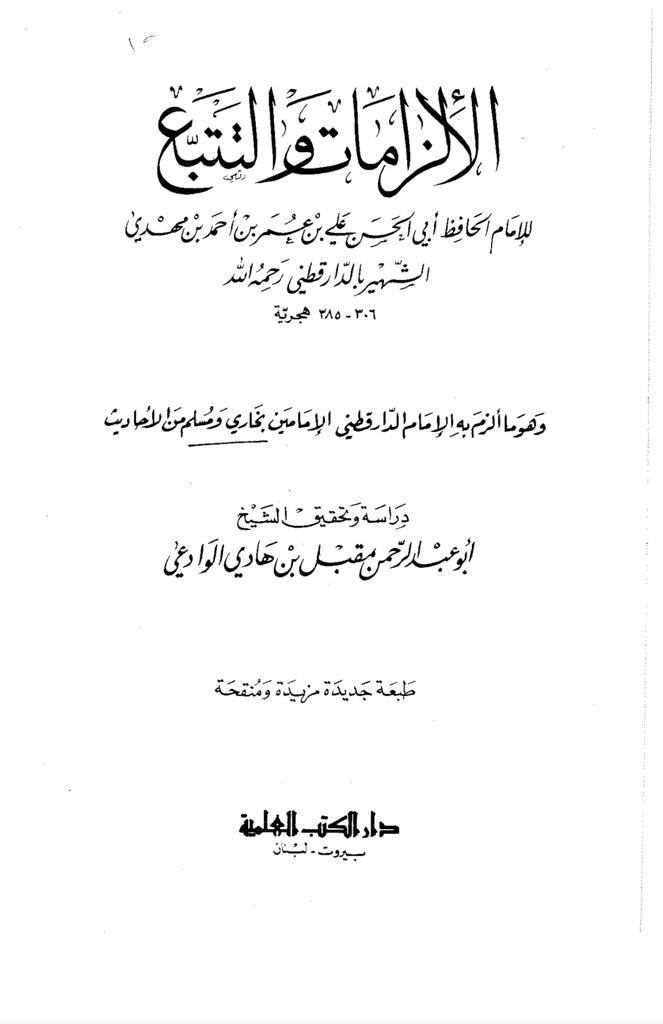
So Imam Al Daraqutni had a commentary about these hadith. In his book he made notes about these ahadith. Than comes along this big hadith scholar from Yemen. This hadith scholar is from the Salafi sect. His name is Muqbil bin Hadi bin Muqbil bin Qa’idah al-Hamdani al-Wadi’i al-Khallali.
So he took the book written by Imam Al Daraqutni and he made his own notes.
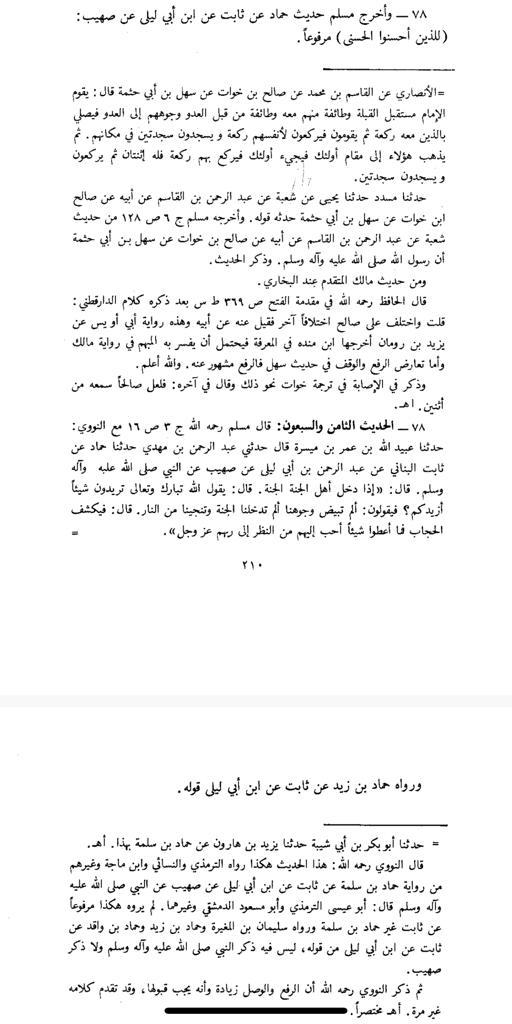
He said about the hadith of Ziyada under Sahih Muslim about the hadith ziyada that the ahl jannah will see Allah (swt) in the Jannah. (Astaghfirullah)
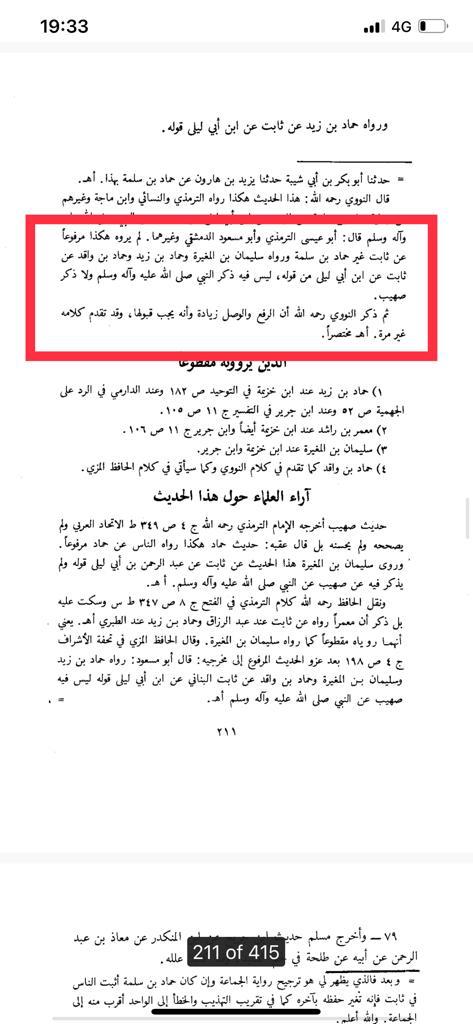
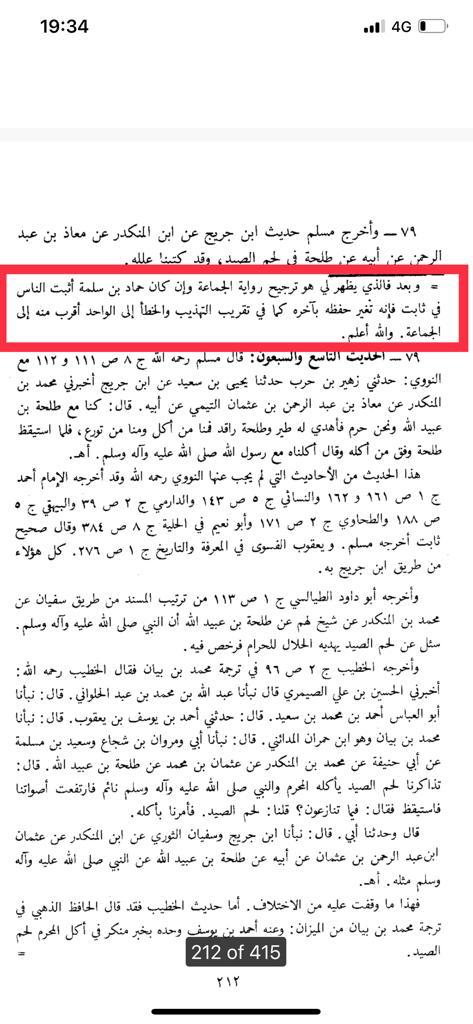
Imam Muqbil al-Wadi’i As Salafi, says this hadith is mistake by Thabit Umani. In the chain, the sanaad.
No one else has ever made this claim other than Muqbil al-Wadi’i Only Thabit al Bunani says this hadith is from Suhayb
The words of the hadith from Shaykh Thabit Bunani only go up to Abdulrahman bin Abi Laylaa only!
It is not from Suhayb nor from the Blessed Messenger (saw).
The words go up to Shaykh Abdulrahman bin Abi Laylaa (only!)
And according to their statement the mistake is coming by Hamaad bin Salamah. For any Hadith that comes through the channel of this man be careful!
There are four students under Thabit al Bunani
Hammad ibn Salamah
Sulaymān ibn al-Mughīrah
Hammad bin Zayd
Hamaad bin Waaqid
So this Imam Muqbli is saying the hadith is in Sahih Muslim is either weak or outright fabricated! On this point he is in agreement with the safe road, The Muslims, the Ibadi school.
May Allah (swt) guide this ummah to what is beloved to Allah (swt). We continue to call the people to the way of the Muslims, To the doctrine of transcendence. The way of the Qur’an and the Sunnah. For this is the safest and securest road.
Say, “My Lord has only forbidden immoralities – what is apparent of them and what is concealed – and sin, and oppression without right, and that you associate with Allah that for which He has not sent down authority, and that you say about Allah that which you do not know.” (Qur’an 7:33)
“And who is more unjust than he who invents a lie about Allah ? Those will be presented before their Lord, and the witnesses will say, “These are the ones who lied against their Lord.” Unquestionably, the curse of Allah is upon the wrongdoers.” (Qur’an 11:18)
﷽
It is wrong to lie about a messenger of Allah (swt) and to deceive the people in the matter of theology.
“Even in the case of Prophet Moses (Peace be upon him) Prophet Musa (alayi salam) begged Allah to see him. Because he could hear him. Now he wanted to see him. He said, and that is recorded in surah Al Araf My Lord allow me to see you. His Lord said, You will never be able to see me….in this life. But when he insisted He said: Look at the mountain if the mountain stands still then perhaps you can see me. And a mountain is definitely much more stronger and powerful than Musa and all the human beings. So Allah The Almighty did as follows: The ayat 143 of surah Al Araf So Allah The Almighty allowed light beam of his light to shine at the mountain, the mountain turned into dust. Full of thunder, it turned into dust, like shredded wool. Then Musa (alayi salam) upon seeing what happened to the mountain he fell unconscious and then when he came back to his consciousness he realized that he was mistaken when he insisted on seeing Allah The Almighty. I repent unto you, I shall not ask for that again.” -Dr. Muhammad Salah
There are quite a few things wrong here with what the Salafi preacher had said.
#1) No where in the Qur’an does Allah (swt) say, “You will never be able to see me in this life” as if to indicate you will see Allah (swt) in the next life. It simply says, ‘You will never be able to se me!’ These people will tell lies about Allah (swt) and go against the clear text of the Qur’an and the Sunnah.
#2) Actually what Musa (alayi salam) said was:
“Highly Exalted are You; I have indeed repented to you, and I am the first of the believers.“
First of the believers in what?
Let us look at how various translations deal with verse in question:
“When Moses came at the appointed time and his Lord spoke to him, he said, “My Lord, show [Yourself] to me, so that I might see You.” Allah said, “You can never see Me. However, behold this mountain. If it remains firm in its place, then you will see Me.” As soon as his Lord revealed His limitless glory to the mountain, He caused it to crumble to dust and Moses fell down unconscious. After he recovered, he said, “May You be exalted in Your glory! I repent! I will be the first of the believers!” (Qur’an 7:143)
Time to manipulate English translations based upon the theological bent one has!
“Never can you see me.”
“You can never see me”
Both of the above translations are correct. It is the one that Dr. Muhammad Salah uses as well. Except, that he added to what Allah (swt) stated with the “in this life.”
“You cannot see me” This translation can be understood as “You cannot see me now” Notice the absence of the word ‘never’.
“But when his Lord manifested Himself to the mountain.” Is the belief that Allah (swt) did reveal himself to the mountain.
Did Allah (swt) really reveal himself to that mountain? In the anthropomorphic sense that the Salafi claim? He appeared in His true form? Then where is he after this Transfiguration? Did he remain there or did he disappear? Did he vanish? Allah (swt) is the friend of the Blessed and Noble Messenger, Ibrahim who said in the same Qur’an:
“When the night overshadowed him, he saw a star and said, “This is my Lord!” But when it went down he said, “I do not like things that vanish.” (Qur’an 6:76)
“When his Lord manifested His glory on the mountain.” This is more sensible especially when consider that even the revelation of Allah (swt), the Qur’an could crush mountains.
“If We had sent down this Qur’an upon a mountain, you would have seen it humbled and coming apart from fear of Allah. And these examples We present to the people that perhaps they will give thought.” (Qur’an 59:21)
What is the view of the Muslims, The Ahl Al Haqq Wal Istiqamah?
Well, dear reader, know that we Muslims put the Qur’an first. We do not attribute words and sayings to Allah (swt) that Allah (swt) did not say. This is a huge sin.
Musa (alayi salam) was aware of the impossibility of seeing Allah, but in asking for it he did not intend obtaining the impossible. He only intended thereby to hold back his people, who were stubborn in seeking it and made their belief in his Message dependent upon it.
“And recall when you said, “O Moses, we will not believe in you unless we see Allah plainly.” Thereupon the thunderbolt struck you while you were beholding.” (Qur’an 2:55)
It is obvious that these demands came before the Musa (alayi salam) approached Allah (swt). Musa (alayi salam) It is not difficult to see that this was a repeated request on their behalf, as the Qur’an mentions this in another place as well.
“The People of the Book demand that you make a book physically come down to them from heaven, but they demanded even more than that of Moses when they said, ‘Show us Allah face to face,’ and were struck by the thunderbolt for their presumption. Even after clear revelations had come down to them, they took the calf as an object of worship, yet We pardoned this, and gave Moses clear authority.” (Qur’an 4:153)
Now is it sensible to think that Musa would ask for the very same thing that they asked for and received the rebuke that they did for doing so? By Allah, to allege such a thing is nothing other than to put Musa (alayi salam) among the despicable ones from among the Children of Israel and to lower him to the level of the ignorant ones.
The proof that Musa (alayi salam) was not asking for himself, is because Allah (swt) could have replied to Musa (alayi salam), “You can never see Me.” This would have been sufficient for a believer.
The proof is that the mountain was destroyed.
Who witnessed the destruction of this mountain? Do you not think people would notice the sudden destruction of a mountain?
If the following happened to Musa (alayi salam) “He caused it to crumble to dust and Moses fell down unconscious.”
What do you think happened to the children of Israel who witnessed this?
“Thereupon the thunderbolt struck you while you were beholding.”
“and were struck by the thunderbolt for their presumption“
Notice after Musa (alayi salam) recovered he says, “”May You be exalted in Your glory! I repent! I will be the first of the believers!“
Why did Musa (alayi salam) say that he will be ‘the first of the believers’ when he is already a believer? Did the incident prove that Allah (swt) can be seen or not seen? Was Allah (swt) seen? No! So Musa (alayi salam) was testifying that he would be foremost among those who deny that Allah (swt) can be seen.
This is the correct belief on the matter:
This is the belief of the Muslims, those who are upon sound theology.
“Do they not consider the Qur’an (with care)? Had it been from other Than Allah, they would surely have found therein Much discrepancy.” (Qur’an 4:82)
﷽
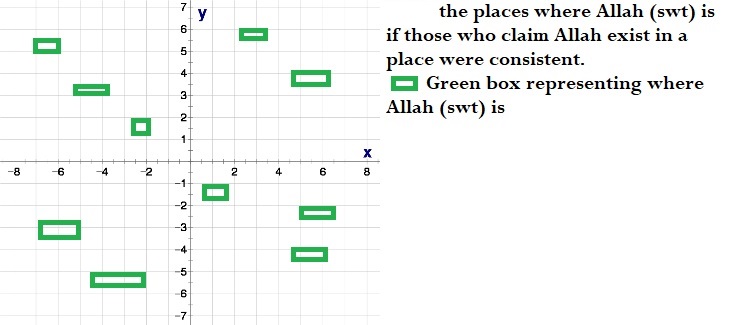
Now if I was to follow that particular aqidah view I would have to be at least be consistent with myself and consistent with the text of the Qur’an. So again we have nothing stating that x/y is the default place for Allah (swt).
The correct view if we are to take the verses as they and apply a consistent methodology would be to say that Allah (swt) exist in a set [4,0 & 0,4 & 3,4 & 4,3 & 3,5 & 5,3 etc.…]
We describe Him (swt) by what has been authenticated that he described himself with. And we affirm for Him (swt) what the Prophet (saw) has affirmed for Him in his authentic Sunnah. As for those that say that we affirm for Allah what He has affirmed for Himself. They wanted from that to believe in the literal text and pass it as it came. For example, when He (Allah)-Great and Glorious God says:
“The Most Merciful [who is] above the Throne established.” (Qur’an 20:5) For this ayat (verse) when taken literally implies that Allah has a position, and he is above the throne, he says like this. This is the literal meaning.
And when I discussed with one of them regarding this,. I asked him, “Do you always stick to the literal meaning?”
He said, “Yes I do stick to the literal always, I don’t differ nor do I alter.” I said, “Let’s agree to stick to the literal meaning and I will agree on this ruling till a certain time, but I hope that you’ll stick to it and don’t change your words. Now me and you have both agreed on the same madhab and the same opinion.
Which is to say: The affirmation and passing of the ayats (verses) like they came, and taking the literal meanings, and building the belief upon it. (the opinion).
“Good”, he said, “Good”. I said, “Then this ayat (verse), Allah affirms a position for himself which is above the throne {The Most Merciful [who is] above the Throne established.} But in another ayat(verse) Allah says, “Indeed, my Lord is on a path [that is] straight.” (Qur’an 11:56)
Is the straight path the same as the throne or a different thing? Without doubt it’s another place, then this is a 2nd position. And you must affirm the literal meaning.
In a third ayat, Our Lord, Great and Glorious God says: “There are not three in a private conversation but that He is the fourth of them, nor are there five but that He is the sixth of them-and no less than that and no more except that He is with them.” (Qur’an 58:7)
This is a third place, different from the throne and different from the straight path.
And in a fourth ayat (verse), He (Allah) Great and Glorious God says about his Prophet Musa (as) ”No! Indeed, with me is my Lord; He will guide me.” Qur’an 26:62 and Musa (as) was on the beach of the Red Sea when he said this.
And in a fifth ayat, Allah tells us about our Prophet (saw) that he said when he was in Ghar Thawr (a cave that Muhammed-saw hid in)
“Have no fear, for Allah is with us.” (Qur’an 9:40)
And Allah tells us about his Khalil (Friend), Ibrahim (as) that he said: “I will go to my Lord! He will surely guide me!” (Qur’an 37:99)
And he (Allah) Great and Glorious God says in another ayat (verse) “But there he finds Allah, Who settles his account in full.” (Qur’an 24:39)
And he says in another ayat (verse) He says: “There is no creature but that He holds it by its forelock.” (Qur’an 11:56)
And the Prophet (saw) says in his Sunnah “A slave becomes nearest to his Lord when he is in prostration.” Source: (https://sunnah.com/riyadussalihin:1428)
And he says as well mentioning about Allah “Did you not know that my servant so and so was ill and yet you did not visit him? Did you not know that if you had visited him you would have found me with him?” Source: (https://sunnah.com/muslim:2569)
“When any one of you prays, he must not spit in front of him, for Allah is in front of him when he is engaged in prayer.” Source: (https://sunnah.com/bukhari:416)
Which of these literal meanings will you take? Now I am following your madhab.
On the throne? Or on the straight path, or is he the fourth of the three or the sixth of the fifth or in Ghar Thour, or on the beach of the Red Sea or in or where? Or in the prostration position?
He said: “All of these are not taken literally except {The Most Merciful [who is] above the Throne established.}”
I said: “Then you broke your ruling.” “You broke your ruling.”
Anyhow, taking the literal meaning falsifies the fact that the source of the Qur’an is from Allah. It falsifies that, why?
Because Allah says, “Had it been from anyone other than Allah, they would have certainly fund in it many inconsistencies.”(Qur’an 4:82) -and taking the literal meanings leads to that.
Sticking to the literal meaning leads to this inconsistency, because Allah Great and Glorious God affirms a hand for himself, and two hands, and affirms more than that..
{Allah’s hand is over theirs.}-Qur’an 48:10 {Rather, both his hands are extended}-Qur’an 5:64 {Do they not see that We have created for them from what Our hands have made, grazing livestock} –Qur’an 36:71
Which of these literal meanings will you take?
{sailing under Our ‘watchful’ Eyes} –Qur’an 54:14 { so that you would be brought up under My ‘watchful’ Eye.} –Qur’an 20:39 This is singular and that is plural, and lowest plural is 3 some say.
So, which of these literal meaning will you take? {they would have certainly found in it many inconsistencies.}
Taking the literal meaning is a ruling that is broken and false but actually rotten and sluggish. It’s not looked upon and not depended upon. And it’s throwed to the side of the walls. The same is in the sunnah as well.
Those that take the path of affirming the attributes by affirming and passing them like they came and took the literal meaning have contradicted this ruling of theirs and have heavily crushed it and they have left it crumbled and fragmented and have not left a peaceful (part) of it ever!
And there’s nothing which implies that as much as the act of some when he came to the hadith “Do not curse Time, for it is Allah Who is Time.” Is it not like this?
He said: “No this hadith is not taken by the literal meaning.” (For it is Allah Who is Time) Else its literal meaning implies the divinity of time! Does it not?
Also, “I become the hearing with which he hears, his seeing with which he sees, his hand with which he strikes, and his leg with which he walks.” -taking the literal meaning leads to the belief of divine indwelling, is that not the case?
“Verily, those who believe and work deeds of righteousness, the Most Beneficent (Allah) will bestow love for them (in the hearts of the believers).” (Qur’an 19:96)
﷽
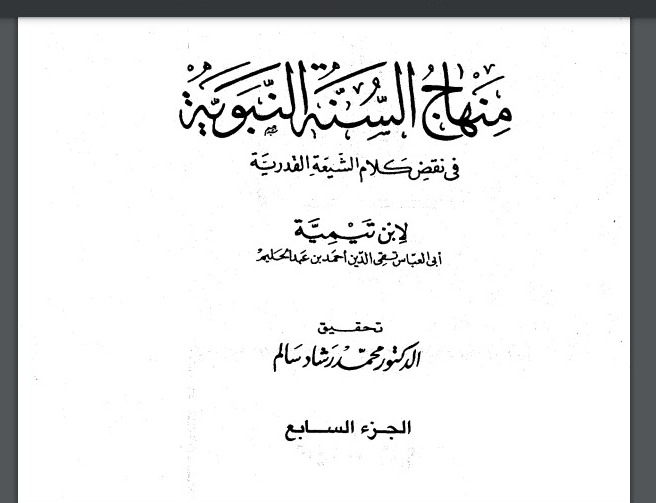
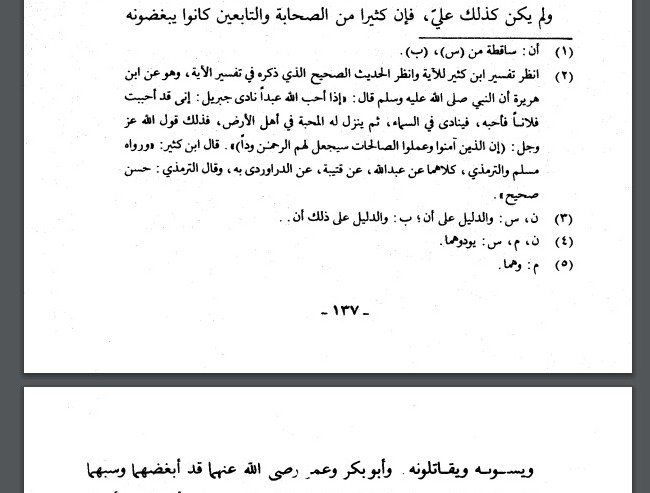
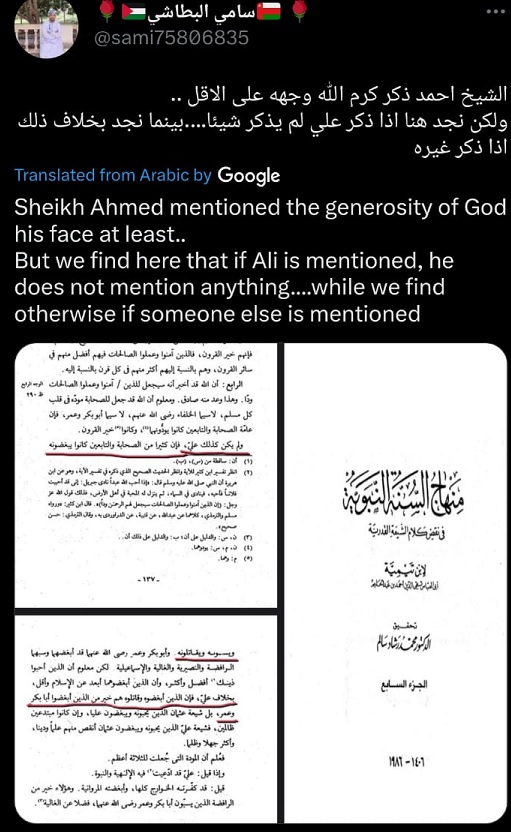
Ibn Taymiyya al Harrani in his as–Sunnah an-Nabawiyyah when he comments about the above ayat in relation to Ali ibn Abi Talib that:
“Allah (swt) has told that He will place on the believers and those that preform good, love. And this is a true promise from him. Especially for the Caliphs Abu Bakr (ra) and Umar Ibn Al Khattab (ra) for the general amount of companions loved them and they were the best periods of Islam. Ali was not like that, as a large number of companions (sahabah) and followers (tab’ieen) hated him, cursed him and fought him.”
Source: (منهاج السنة النبوية في نقض كلام الشيعة والقدريةMinhaj al-Sunnah al-Nabawiyyah fi Naqd Kalam al-Shi’a wa al-Qadariyyah)
The implication (though not explicitly stated by Ibn Taymiyya) was that Ali was not of those who worked deeds of righteousness.
Ibn Taymiyya continues:
“They love and venerate him, while Abu Bakr and Umar – may God be pleased with them – have been hated and cursed by the Rafidah (Rejectors), the Nusayriyyah, the Ghulat (Extremists), and the Ismailis. However, it is known that those who loved those two (1) are better and more numerous, and that those who hated them are further from Islam and fewer.”
“This contradicts the case of Ali, for those who hated and fought him are better than those who hated Abu Bakr and Umar. In fact, the faction of Uthman, who love him and hate Ali, even if they are innovators and wrongdoers, are more knowledgeable and religious than the faction of Ali who love him and hate Uthman, and they are greater in jihad and justice. Thus, it is clear that the affection mandated for the three [first Caliphs] is greater.”
“And if it is said: ‘Claims of divinity and prophethood have been made about Ali (2),’ it is replied: ‘All the Khawarij considered him a disbeliever and the Marwaniyyah hated him. And these are better than the Rafidah who curse Abu Bakr and Umar – may God be pleased with them – let alone the Extremists (3).'”
Source: [Chapter: The Thirteenth Proof “You are only a warner, and for every people there is a guide.”]
“Indeed, Allah commands you to render trusts to whom they are due and when you judge between people to judge with justice. Excellent is that which Allah instructs you. Indeed, Allah is ever Hearing and Seeing.” (Qur’an 4:58)
﷽
This is a sociological experiment our colleague conducted on their social media regarding the tale of some from among the Shi’i in relation to Umar (ra), Ali and Fatima (ra).
Narrated `Aisha:
Once, Fatima came walking and her gait resembled the gait of the Prophet (saw). The Prophet (saw) said, “Welcome, O my daughter!” Then he made her sit on his right or on his left side, and then he told her a secret and she started weeping. I asked her, “Why are you weeping?” He again told her a secret and she started laughing. I said, “I never saw happiness so near to sadness as I saw today.” I asked her what the Prophet (saw) had told her. She said, “I would never disclose the secret of Allah’s Messenger (saw).” When the Prophet (saw) died, I asked her about it. She replied. “The Prophet (saw) said: ‘Every year Gabriel used to revise the Qur’an with me once only, but this year he has done so twice. I think this portends my death, and you will be the first of my family to follow me.’ So I started weeping. Then he said. ‘Don’t you like to be the chief of all the ladies of Paradise or the chief of the believing women? So I laughed for that.”
If indeed the Shi’i believe that this narration is true and that Fatima (ra) would be the first from among the family of the Beloved Messenger (saw) to die, it cannot also be true that the “unborn” son of Fatima would die as he would technically be the ‘first of my family’ to follow.
Ali bin Abi Talib said:
“When al Hassan was born, the Prophet (saw) came and said: Show me, my boy, what have you named him? I said: I called him Harb, he said: Nay,” He is Hassan When al Hussein was born, the Prophet (saw)said: Show me my boy, what have you named him? I said: Harb, he said: Nay, he is Hussein, and when the third was born, the Prophet (saw) came, then said: Show me, my boy, what have you named him? I said: Harb. He said: Nay, he is Muhassin, then he said: I have named them after the names of the children of Haroun(Aaron). They are Shibr, Shubeir, Mushabbar.”
Source: (Musnad Ahmad 1/98, Isnad is sound)
لمَّا وُلِد الحَسنُ فقال أروني ابنِي ما سمَّيْتُموه قُلْتُ حَرْبًا قال بل هو حَسنٌ قال فلمَّا وُلِد الحُسَينُ سمَّيْتُه حَرْبًا فجاء رسولُ اللهِ صلَّى اللهُ عليه وسلَّم فقال أروني ابنِي ما سمَّيْتُموه قُلْتُ حَرْبًا قال بل هو حُسَينٌ فلمَّا وُلِد الثَّالِثُ سمَّيْتُه حَرْبًا فجاء النَّبيُّ صلَّى اللهُ عليه وسلَّم فقال أروني ابنِي ما سمَّيْتُموه قُلْتُ حَرْبًا قال بل هو مُحَسِّنٌ ثُمَّ قال سمَّيْتُهم بأسماءَ ولدِ هارونَ شَبَرٍ وشُبَيرٍ ومُبشِّرٍ [ وفي روايةٍ ] قال سمَّيْتُهم بأسماءِ ولدِ هارونَ جَبَرٍ وجُبَيرٍ ومُجَبِّرٍ. خلاصة حكم المحدث: رجالهما رجال الصحيح غير هانئ بن هانئ وهو ثقة الراوي: علي بن أبي طالب المحدث: الهيثمي المصدر: مجمع الزوائد الصفحة أو الرقم: 8/55 التخريج : أخرجه أحمد (769)، وابن حبان (6958)، والطبراني (3/ 96) (2773) جميعا بلفظه.
It’s not believable to say that Muhassin was aborted as a fetus and yet the above narration says that he was born.
Here is a video of Ayatollah Sayyid Fadhlallaha, a Shi’i Imam, who thinks this whole tale about Ali, Umar (ra) and Fatima (ra) is a big fat, juicy fabrication. For those who can’t click on English subtitles in the post, we have put the YouTube link where you can click on English subtitles.
Surely the Imam has his reward with Allah (swt) for seeking truth on the matter.
Also, remember the presence of a statement in a book does not necessarily make it authentic. We do not know of anyone who holds this position. The chains of narrators the isnad needs to be scrutinized. Do the reports contradict other pieces of evidence? This is what needs to be understood when engaging in dialogue with anyone from among the Muslims.
Now let us assume, for the sake of argument, that this incident took place as suggested by the Shi’i. Obviously, learned people like the Ayatollah above don’t buy it for a hot minute.
SOCIOLOGICAL EXPERIMENT ON FACEBOOK.I CALL THIS: “THE FATIMA EXPERIMENT”
So, knowing that Muslims have a vested interest in this alleged incident and there are emotional attachments to it, I decided to ask people who were absolutely clueless about this incident.
I decided that I would ask my non-Muslim friends about their thoughts concerning the characters of the two major individuals in this incident. So this is the data that I gave to them:
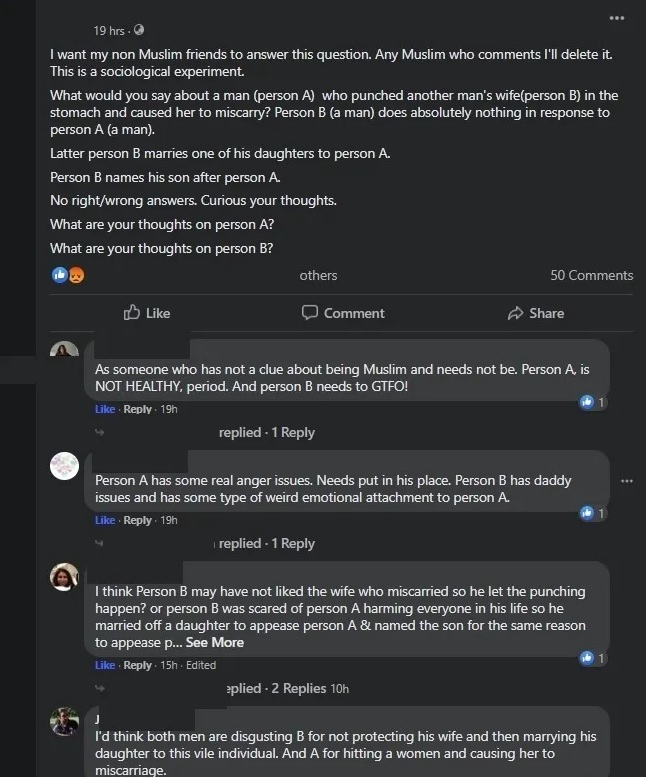
I want my non-Muslim friends to answer this question. Any Muslim who comments, I’ll delete it. This is a sociological experiment.
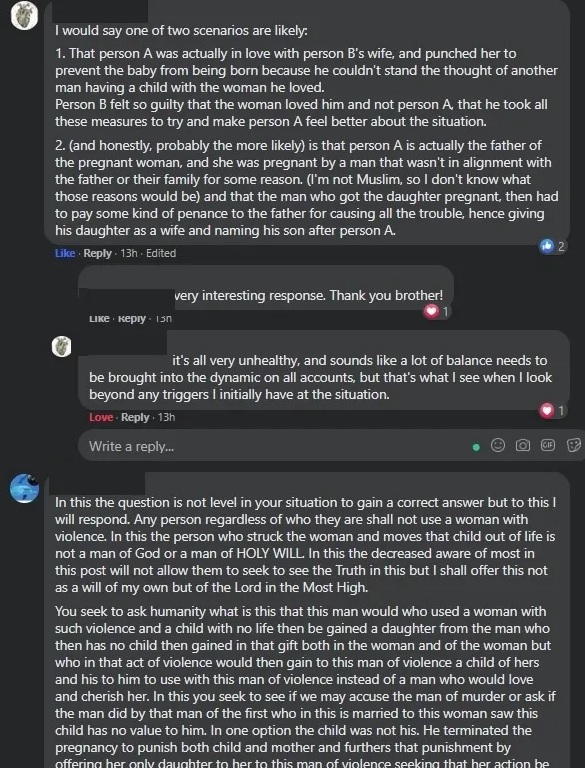
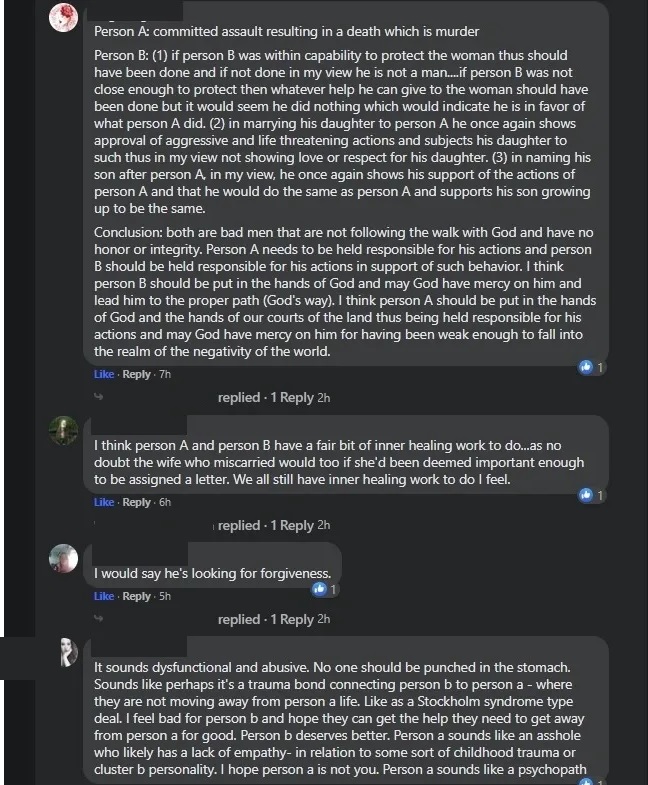
What would you say about a man (person A) who punched another man’s wife (person B) in the stomach and caused her to miscarry? Person B (a man) does absolutely nothing in response to person A (a man).
Later, person B marries one of his daughters to person A.
Person B names his son after person A.
In the Fatima experiment. Person A is Umar Ibn Al Khattab (ra) and Person B is Ali ibn Abu Talib.
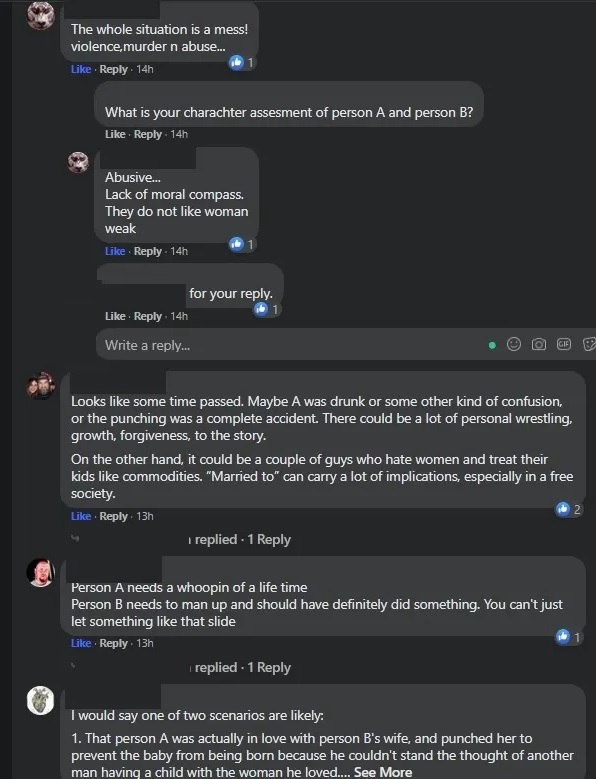
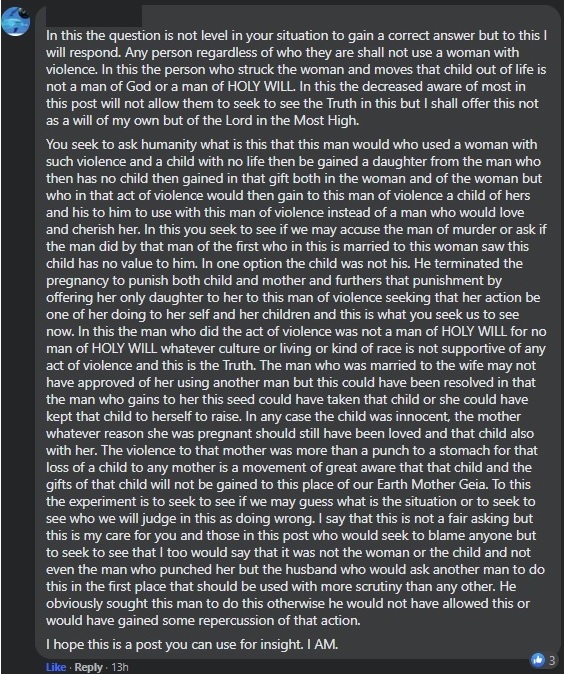
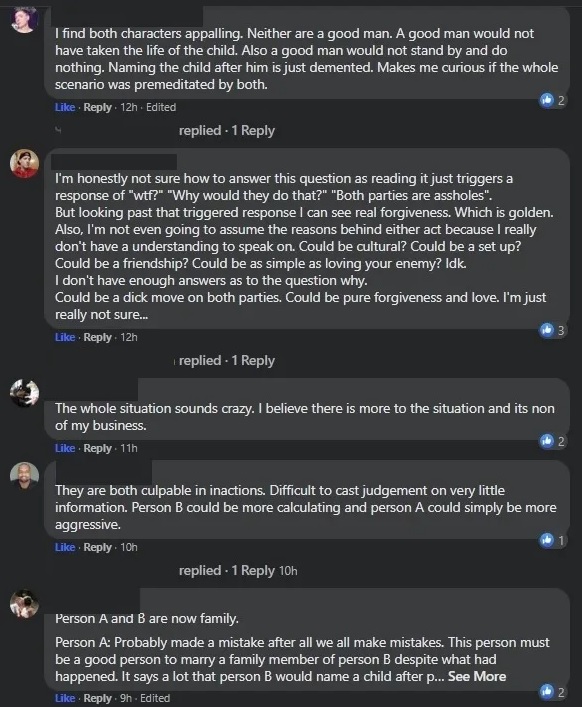
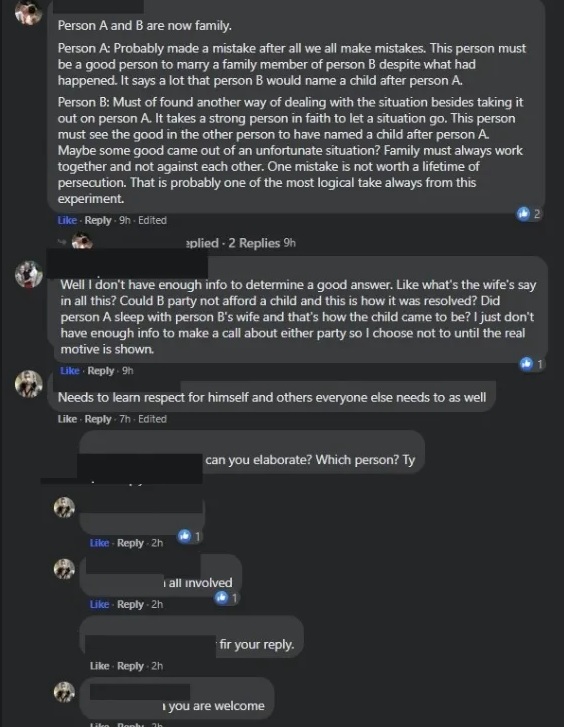
What follows are their responses. Some of them are quite interesting. I have covered up their names to protect/respect their personal privacy. These are mostly U.S. Americans. They hold nothing back.
Well, so there you have it. 20 different responses to this scenario. Not favourable views of Umar (ra) and almost unanimously unfavourable views of Ali
Now we have The Lady of Heaven film that has created quite a controversy.
May Allah (swt) guide our tongues to speak the truth and our hearts to have the courage to say it. May Allah (swt) guide us from speaking falsely about any person’s incident or matter. Amin!
“Wherever you are ˹O Prophet˺, turn your face towards the Sacred Mosque. And wherever you ˹believers˺ are, face towards it, so that people will have no argument against you, except the wrongdoers among them. Do not fear them; fear Me, so that I may ˹continue to˺ perfect My favour upon you and so you may be ˹rightly˺ guided.” (Qur’an 2:150)
﷽
Logic and facts will always rule over feelings and fallacy.
First it should be known that the default position of all the companions of the Blessed Prophet (saw) is Wilayat al dhahir. Which means they are known to follow the Qur’an and the Sunnah, and they are known for their piety. This is the default position for all companions.
Now, if anyone of them did a major sin and did not make tauba to Allah (swt) up until his death, you can put that companion in Bara’ah al Dhahir.
So, in regard to Ali, there are three positions held among the Ibadi.
Wuqoof. Suspend judgement. That is not to put Ali in wilayah or bara’ah. To leave his matter to Allah.
Bara’ah al-Dhahir – The apparent dissociation. This is a matter of jurisprudence. Ali committed kufr ni’ma and there is no indication that he repented of his sins.
Walayah al-Dhahir – The apparent friendship. This is a matter of jurisprudence. Ali was remorseful and repented of his sins.
Bara’ah and Wilayah are a huge part of Islam of which many Muslims are ignorant of. If you want to know how it is understood. We would suggest you read the following:
Wuqoof is to pause if there is khilaf on the person. Wuqoof is to stop at everyone you don’t know. You do not make a judgement on him/her to be in Walayah or Bara’ah. This is a very safe path to take.
Bara’ah al Dhahir– The Apparent disassociation. This to perform Bara’ah to whoever you see disobeying the commandments of his Lord. Be it in the Quran or Sunnah- whether you’ve seen him by yourself or by him admitting to committing that sin or by the famous/infamous act that he did. They can return to Walayah if they repent and reform.
Walayah al-Dhahir – The Apparent Friendship. This means to show walayah (loyalty/friendship) to anyone you see following the commandments of Allah—whether from the Qur’an or Sunnah. Even those who have committed sins and repented of the sins.
Shaykh Massoud bin Muhammed Al Miqbali (hafidullah) gives the range of the Ibadi views regarding Ali bin Abi Talib. We did our best to clean up the subtitles below. The Shaykh is giving a reply to one of the Salafi detractors.
The Ibadi stance regarding Ali bin Abi Talib.
“The Ibadis have different positions on Ali bin Abi Talib. And it cannot be said that Ibadis takfir Imam Ali (kufr ni’amah) and it cannot be said that they associate with him (wilayah), and it can not also be said that Ibadis stop on him (Wuqoof). Rather, all three positions exist.”
“So it cannot be said that it is only one of these sayings that the Ibadi adopt.”
“And those that stated he was a kafir by that didn’t mean to remove him out of the fold of Islam. Rather, they looked upon the events and clashes that occurred in Siffin, and they built upon it a judgement. And it’s a Godly judgement. They see that Ali is alike to the people, alike to anyone else. For him, it is that for others, and for him, it is that for others, and he is obligated by what they’re obligated to.”
“So, if it falls on that which obligates deviance, he is considered a deviant, tafseeq he is considered a fasiq, kufr he is takfeered. And this is the madhab of the sahaba which you narrate. The companions who had insulted, killed and cursed him. Was it out whim? Or by a religious obligation?”
“Without a doubt, the madhab of the sahaba (and you claim you follow the salaf, and you say that you’re salafiyyah). This is the madhab of the salaf, where whoever falls on kufr is takfeered, and whoever falls on that which obligates cursing is cursed, and whoever falls on what obligates criticism is criticized. This is the madhab of the salaf, rather it is the madhab of the Qur’an and the honest Prophet (saw). This is the madhab that we adopt.”
“And we do not, after that, believe that if it’s permissible to takfir him, that he’s out of the fold of Islam. No! We say that kufr is split into two. Kufr Shirk and Kufr ni’ama. (That doesn’t take him out of Islam). To make this simple: all mushriks are kafirs, but not all kafirs are mushriks. This is with those that adopted the madhab of takfir, but there are those that didn’t adopt it. And there’s him who stopped.”
“And if you have knowledge just like they have, then it is permissible for you to judge like they have. And if you’re a jahi (not learned), then stopping on him is enough for you, and that is a known way with us.”
“And they say that a monotheist isn’t takfeered except for shirk, and this is a false saying. Here are the texts of the shari’ah and its infallible proof that the takfir doesn’t take its committer out of islam.”
“It is the duty of all men towards Allah to come to the House a pilgrim, if he is able to make his way there. As for the (kafara) ungrateful, Allah is All-sufficient nor needs any being.” (Qur’an 3:97)
“This is a favor from my Lord by which He wants to test whether I am grateful or ungrateful.” (Qur’an 27:40)
Narrated ‘Abdullah:
The Prophet (saw) said, “Abusing a Muslim is Fusuq (an evil doing) and killing him is Kufr (disbelief).” Source: (https://sunnah.com/bukhari:48)
Narrated Ibn `Umar:
I heard the Prophet (saw) saying, “Do not revert to disbelief (kuffaran) after me by striking (cutting) the necks of one another.”
“Abu Hurairah narrated that the Prophet (saw) said: “Whoever engages in sexual intercourse with a menstruating woman, or a woman in her anus, consults a soothsayer, then he has disbelieved (kafar) in what was revealed to Muhammed.”
“All of these texts show clearly that there is from kufr which doesn’t take its committer out of Islam. Rather, it’s a synonym to fusooqi, fujoori, isyaani. So trying to distort the picture of the Ibadi madhab is a miserable and desperate and unsuccessful try. And I said that there are those that said he (Ali) repented, and that narration has been denied by the other group.”
“This narration exists within our books, and if we hated and considered him (Ali) a kafir for personal reasons, we wouldn’t have mentioned this narration, which acquits his position.”
“We have in our athars and books like Bayan al-Shar‘ (بيان الشرع) — written by Muhammed b. Ibrahim al-Kindi, which was written in the 5th century, shows evidence of him (Ali) repenting. And this repenting narration maybe it is something that only the Ibadis have. It doesn’t exist with others. So if they were opposing him (Ali) personally, they wouldn’t have narrated his repentance.”
“But they (The Ibadi scholars) are the just ummah, the righteous ummah, they narrate all that is for them, and they narrate all that is against them. There is no opposition between them and the truth.”
“So we take the truth whenever we see it, even if it’s a hater that brought it, and the false is the rejected by us, even if it was brought by a friend who is taken highly.”
“We accept what Allah accepts from his deen, and reject what He rejects. Our biography is that of Ahmed (saw) companions. We do not accept people of injustice as models. This is the Minhaj that we walked upon. We narrate that which is for us, and narrate that which is against us, and it’s not really our concern about the pleasure of whoever is pleased and the anger of whoever is angry.”
First: From the outset, one must understand that our predecessors were what one may call the Shiat Ali. They were in the battles of the Camel and Siffin and fought hard on behalf of Ali Ibn Abu Talib. Losing life and limbs and relatives. Which is more than what those who claim to profess him can claim.
Second: The disappointment comes with his decision at Siffin, and his injustice in taking the life of the believers at Nahrawan. It becomes abundantly clear that his followers never had even any concept of the terms maʿṣūm (معصوم) and ʿiṣmah (عصمة) being applied to him. If that were the case, they would not have left his camp. Nor were these concepts used by Ibn Abbas (ra) in his debate with the people of the river. (Nahrawan).
Third: The issue surrounding Ali Ibn Abu Talib is similar to that of Uthman ibn Affan, in that they are political in nature. No one from our school accuses either Ali Ibn Abu Talib or Uthman ibn Affan of being a mushrik. Far from it.
Fourth: Just like a group of companions were the ones to rise up against Uthman ibn Affan, likewise, a group of companions differed with Ali’s decision of arbitration.
All Muslim groups today are formed on the basis of political events in the early period of Islamic history.
There are a few things in the video a person should take away.
The differences in the types of kufr. Kufr ni’ma doesn’t put the person out of the fold of Islam.
The other point is that those who have knowledge of this subject may form a particular opinion on it. Those who do not have knowledge of this subject can and should refrain from having any opinion on it. (wuqoof)
The fact that he (Ali) went against the Qur’an-based ruling at Siffin and killed the Muslims at Nahrawan put him in the state of kufr ni’ma (which doesn’t take the person out of Islam).
However, that person would still need to repent of their kufr before they died. To us, Ali is like others. He can make mistakes.
Indeed, major sins nullify obedient acts, no matter how great. In the case of Ali, he committed major sins. So the point of difference in the school is on rather or not he repented before he met his end.
Those who do not believe he repented before death can say that Ali would be in Bara’ah-al dhahir. The apparent disassociation.
For those that believe Ali repented before he died. Ali would be in Walayahal dhahir. The apparent association.
So, basically to sum up, the Ibadi position. There are three positions regarding Ali Ibn Abi Talib.
Anyone who refuses to mention this (three views) or relates only one view is either willfully ignorant or a deceiver and a liar.
Background into some of the reasons for the opposition of the companions against Ali bin Abi Talib
The main cause of fierce opposition to Ali was the perceived failure or reluctance to punish the culprits, including his stepson, Muhammed bin Abu Bakr, who was involved in the killing of Uthman. Ali married his (Abi Bakar’s) mother, Asma (ra), after the death of Abu Bakr (ra). So there was a marriage relationship between Ali and Muhammed bin Abu Bakr, although, as we have seen, Muhammed bin Abu Bakr did not actually kill Uthman, at best he aided and abetted the assassins. (This for another article).
What might have strengthened people’s suspicion on Ali was that Ali appointed Muhammed bin Abi Bakar as governor of Egypt, which his opponents may have interpreted (right or wrong) as a type of reward for his hand in the matter of killing Uthman.
Furthermore, Ali’s own brother Aqil ibn Abi Talib fought on the side of Muawiya. Aqil ibn Abi Talib is the cousin of the Blessed Prophet (saw) and elder brother of Ali. So, as one can see, these were quite chaotic times.
Prior to this, there was the whole incident of Ali bin Abi Talib burying Fatima (ra) in secret and people were not pleased about it. You may read about this here:
Ali bin Abi Talib disappeared from the scene of events throughout the caliphate of the three Shaykhs: Abu Bakr (ra), Umar (ra), and Uthman. For a total of 25 years (a quarter of a century), the man was absent, completely out of sight. No one knew what he was doing. It is said that he did not participate in a single Muslim battle, neither with himself, nor with his children, nor with his money. While the chieftains of the Arabs were crushing the apostates and toppling the thrones of the Caesars, not a single inch did he conquer for Islam!
To many, the greatest of shocks came. When he finally ascended to power after what many saw as the conspiracy to kill Uthman, the momentum of the conquests was paralyzed, the flame of victories of tawhid was extinguished, so that the sword that “slept” on the enemies of the Ummah would awaken suddenly in the breasts of the Muslims!
Furthermore, what set the people against Ali are the various conflicting narratives about how he dealt with Aisha (ra), a member of the purified household according to (Qur’an 33:30-34) as well as “Mother of the Believers” as per (Qur’an 33:6).
They ask how Ali bin Abi Talib would face the Messenger of Allah, (saw) when he fought his wife!! And he sent his helpers against her until they hamstrung her camel and she fell from her litter, and her enemies paraded her around like a captive? This is a sign of humiliation for the man’s family, her violation, her captivity, and the foreigners’ force to subjugate, humiliate, and degrade her!
The test of Aisha (ra) and the test of Ali.
Thus, the case of Ali with us, Ibadi, is similar to the case of Aisha (ra) with many Shi’i. Consider the following:
Aisha (ra) was a test on rather the believers will follow her or the Imam. Ali Ibn Abu Talib himself became a test for the believers at Siffin; to see whether or not people would follow what Allah (swt) ordered in the Qur’an, or Ali’s decision.
Narrated by Abu Maryam `Abdullah bin Ziyad Al-Aasadi:
“When Talha, AzZubair and `Aisha moved to Basra, `Ali sent `Ammar bin Yasir and Hasan bin `Ali who came to us at Kufa and ascended the pulpit. Al-Hasan bin `Ali was at the top of the pulpit and `Ammar was below Al-Hasan. We all gathered before him. I heard `Ammar saying, “`Aisha has moved to Al-Busra. By Allah! She is the wife of your Prophet in this world and in the Hereafter. But Allah has put you to test whether you obey Him (Allah) or her (`Aisha).”
So even though Aisha (ra) is acknowledged by Ammar bin Yasir to be the ‘wife of the Prophet in this world and in the Hereafter‘, he was not about to leave the dhahir (the apparent) evidence.
Which is that Ali was the rightful 4th Imam of the Muslims. One who is to be obeyed as long as he obeys the Qur’an and Sunnah.
The idea that a particular blood tie, clan or family affiliation exempted one from the Sharī’ah is absolutely foreign to the Blessed Prophet (saw).
Narrated `Aisha:
Usama approached the Prophet (saw) on behalf of a woman (who had committed theft). The Prophet (saw) said, “The people before you were destroyed because they used to inflict legal punishments on the poor and forgive the rich. By Him in Whose Hand my soul is! If Fatima (the daughter of the Prophet (saw) did that (i.e. stole), I would cut off her hand.”
When Allah revealed the verse: “Warn your nearest kinsmen,” Allah’s Messenger (saw) got up and said, “O people of Quraish (or said similar words)! Buy (i.e. save) yourselves (from the Hellfire) as I cannot save you from Allah’s Punishment; O Bani `Abd Manaf! I cannot save you from Allah’s Punishment, O Safiya, the Aunt of Allah’s Messenger (saw)! I cannot save you from Allah’s Punishment; O Fatima bint Muhammed! Ask me anything from my wealth, but I cannot save you from Allah’s Punishment.”
Likewise, whatever alleged superiority that Ali enjoyed and is claimed to have had does not eclipse one’s obedience to the Qur’an and Sunnah.
As Aisha (ra) was abandoned in favour of the apparent, likewise Ali was abandoned in favour of the apparent. In our madhab, Jabir Bin Zaid (ra) informed us that Ayesha (ra) repented from her sins before she died. The sin being to make war against the legitimate Imam of the Muslims.
This must be the case because Allah (swt) has confirmed this.
Aisha (ra) mother of the believers.
“The Prophet is more worthy of the believers than themselves, and his wives are their mothers (ummahatuhum). And those of relationship are more entitled in the decree of Allah than the] believers and the emigrants, except that you may do to your close associates a kindness. That was in the Book inscribed.” (Qur’an 33:6)
So Aisha (ra) is in Walayah al Haqiqah -The real friendship or friendship that is with Allah (swt).
The Three views among Ibadis regarding Ali Ibn Abu Talib.
1. Bara’ah al Dhahir- The Apparent disassociation. Disavowed.
This view is that Ali Ibn Abi Talib did not repent of his sins and, therefore, the one who dies without repenting of major sins is doomed. What happens to the one who does not repent from major sins is no secret in Islam.
We must understand that disavowing a person who commits major sins (even if they are a companion) is actually a Sunnah of the Blessed Prophet (saw).
Narrated Salim’s father:
The Prophet (saw) sent Khalid bin Al-Walid to the tribe of Jadhima and Khalid invited them to Islam but they could not express themselves by saying, “Aslamna (i.e. we have embraced Islam),” but they started saying “Saba’na! Saba’na (i.e. we have come out of one religion to another).” Khalid kept on killing (some of) them and taking (some of) them as captives and gave every one of us his Captive. When there came the day then Khalid ordered that each man (i.e. Muslim soldier) should kill his captive, I said, “By Allah, I will not kill my captive, and none of my companions will kill his captive.” When we reached the Prophet, we mentioned to him the whole story. On that, the Prophet (saw) raised both his hands and said twice, “O Allah! I am free from what Khalid has done.” اللَّهُمَّ إِنِّي أَبْرَأُ إِلَيْكَ مِمَّا صَنَعَ خَالِدٌ
Loyalty to the Qur’an and Sunnah takes primacy over any other affiliation, or perceived rank or status of an individual.
“You will not find those who believe in Allah and in the Hereafter having (yuwadduna) love/affection with those who oppose Allah and His Messenger, even though they may be their fathers or their sons or their brothers or their clan. They are such that Allah has inscribed faith on their hearts, and has supported them with a spirit from Him. He will admit them to gardens beneath which rivers flow, in which they will live forever. Allah is pleased with them, and they are pleased with Allah. Those are the party of Allah. Be assured that it is (the members of) the party of Allah that are the successful.” (Qur’an 58:22)
Imami Shi’i would take issue with this because of the doctrine of ‘Iṣmah
Todays Sunnis would take issue with this because of they under went aa Shi’ification under the Abbasid empire and developed the doctrine of Adalat al-Sahaba.
2. Walayah al-Dhahir – The Apparent Friendship.
This view is that Ali Ibn Abi Talib, possibly after seeing that the arbitration with Muaviya did not bring any good for the Muslim ummah, and seeing the world crumble around him and possibly at the prompting of Ibn Abbas (ra), he repented to Allah (swt) and therefore his ending was a good ending.
The evidence that Imam Ali was remorseful and repented is found at the end of this article:
Under the section: Evidence used by the Ibadi school to show that Ali Ibn Abu Talib had repented for his sins.
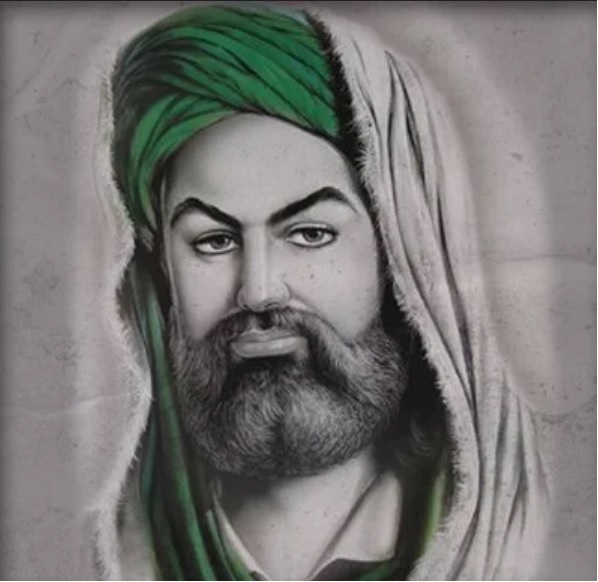
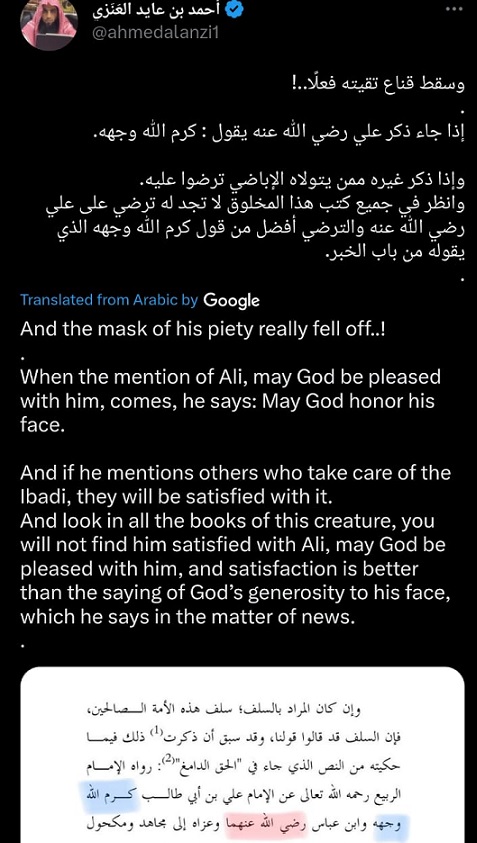
Often these Ibadi’ may say, Karram-Allah-u Wajhah, meaning: “Allah honored his face” as a statement of fact, rather than a du’a. Meaning that he embraced Islam and was not known to have worshiped idols. Also, the statement: “Allah honored his face” is almost said with a tinge of disappointment, as if to recall what could have been and what sadly was not.
These Ibadi will not do Taraddi. This is a technical term which refers to invoking Allah’s pleasure upon someone by saying Radiy Allahu ‘Anh
“May Allāh be pleased with him”. That is because it is not possible to say May Allah be pleased with the deeds of the one who went against the word of Allah and killed the Muslims without right.
For example: The Mufti of Oman, Shaykh Ahmed Al Khalili (h) is not known to say “May Allah be pleased with him” after mentioning the name of Ali. So some of the detractors point this out. Trying to make a mountain out of a molehill. We share with you because nothing is hidden about our school. Cards are on the table!
So one of them, this @ahmedalanzi1 (who blocked many Ibadi who tried to engage with him) his claim is that saying Radiy Allahu ‘Anh : meaning: May Allah be pleased with him is higher and better than saying: Karram-Allah-u Wajhah: meaning Allah honoured his face.
The following is where our teacher: Shaykh Juma Al Mazruii explained this is not necessarily the case:
So Shaykh Juma Al Mazruii mentioned that this Salafi agitator (which is what he is) wants to have some issue about it than he can take it up with Ibn Kathir. Ibn Kathir was not happy that people say, “Allah honuored his face” after mentioning Ali, but not when mentioning Abu Bakr (ra) or Umar (ra). So he (Ibn Kathir) actually feels that statement is higher than saying, “May Allah be pleased with him.”
Likewise, Shaykh Juma mentions that Ibn Taymiyyah himself felt Ali was inferior to other companions. So this Salafi agitator can go and sort out his own house before he tries to knock on our door or the door of anyone else, for that matter.
To this, our beloved Shaykh Juma Al Mazrui gave a very befitting reply (the audio above).
3. Ambivalence (Wuqoof) towards Ali Ibn Abu Talib. An individual does not have enough data or information to put Ali in Bara’ah or Walayah.
Wuqoof is to pause iif there is khilaf on the person. Wuqoof is to stop at everyone you don’t know. You do not make a judgement on him to be in Walayah or Bara’ah. This is by far the position of the vast majority, as they are layman and do not bother to look into these matters..
Those who are ambivalent as they just do not have enough data to give a conclusive answer. They hold their tongues regarding companions like Ali Ibn Abi Talib. They do not say radhiallahu anhu for those who are possibly under Allah’s wrath. Nor do they say this one met doom when they may have repented for their sins and met a good endunder Allah’s spacious grace. This regards students of knowledge and the masses of Muslims in particular who have not investigated these matters. This is a recommended and safe road.
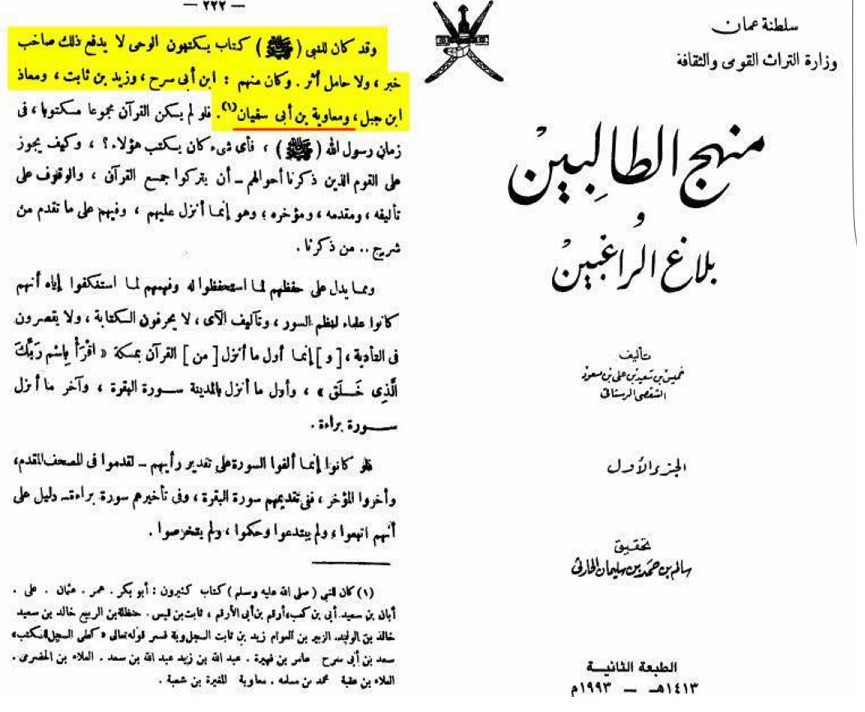
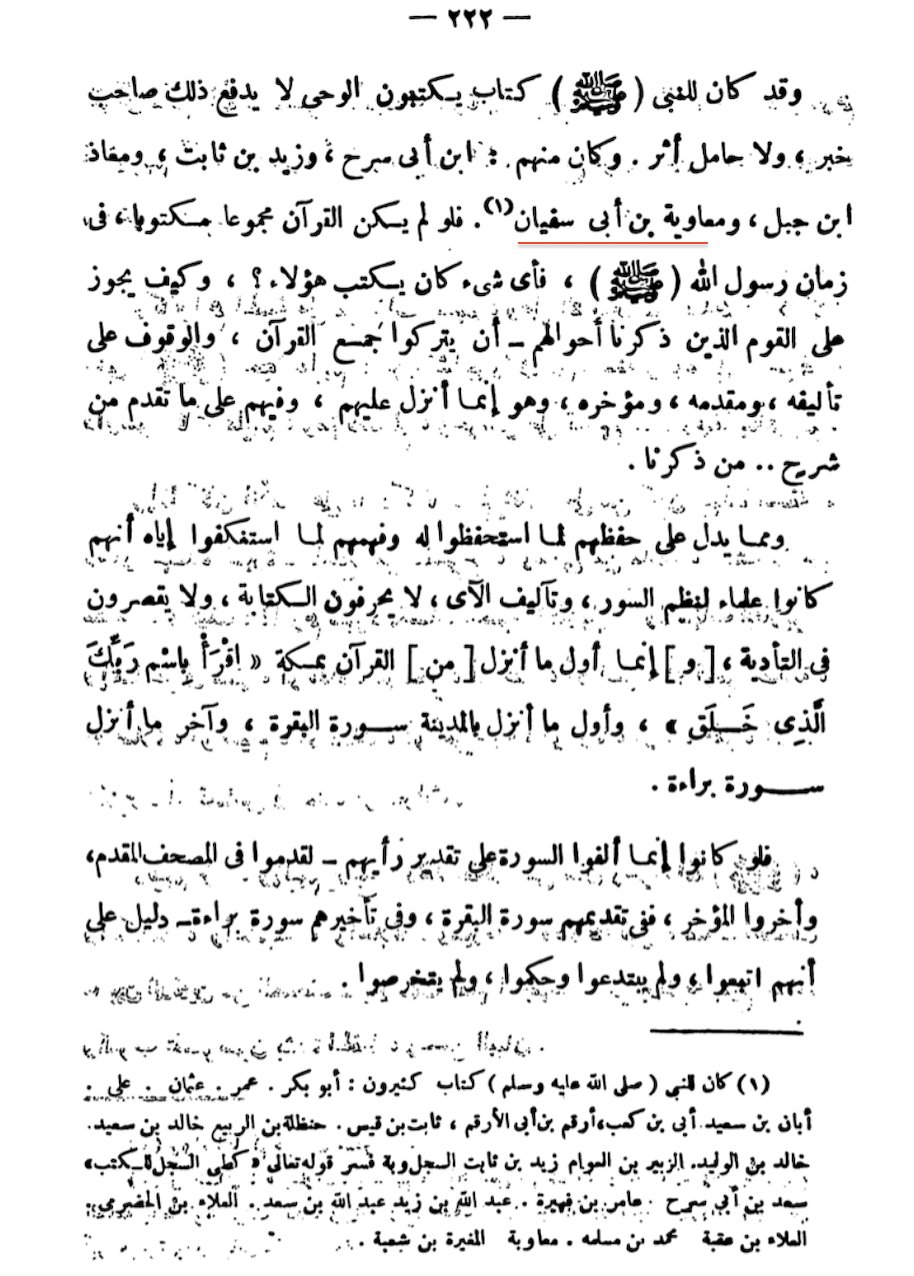
Do not be surprised to find none other than Shaykh Khamis bin Saeed Al-Shaqsi (r) say, “May Allah be pleased with him” after mentioning the name of Muaviya!
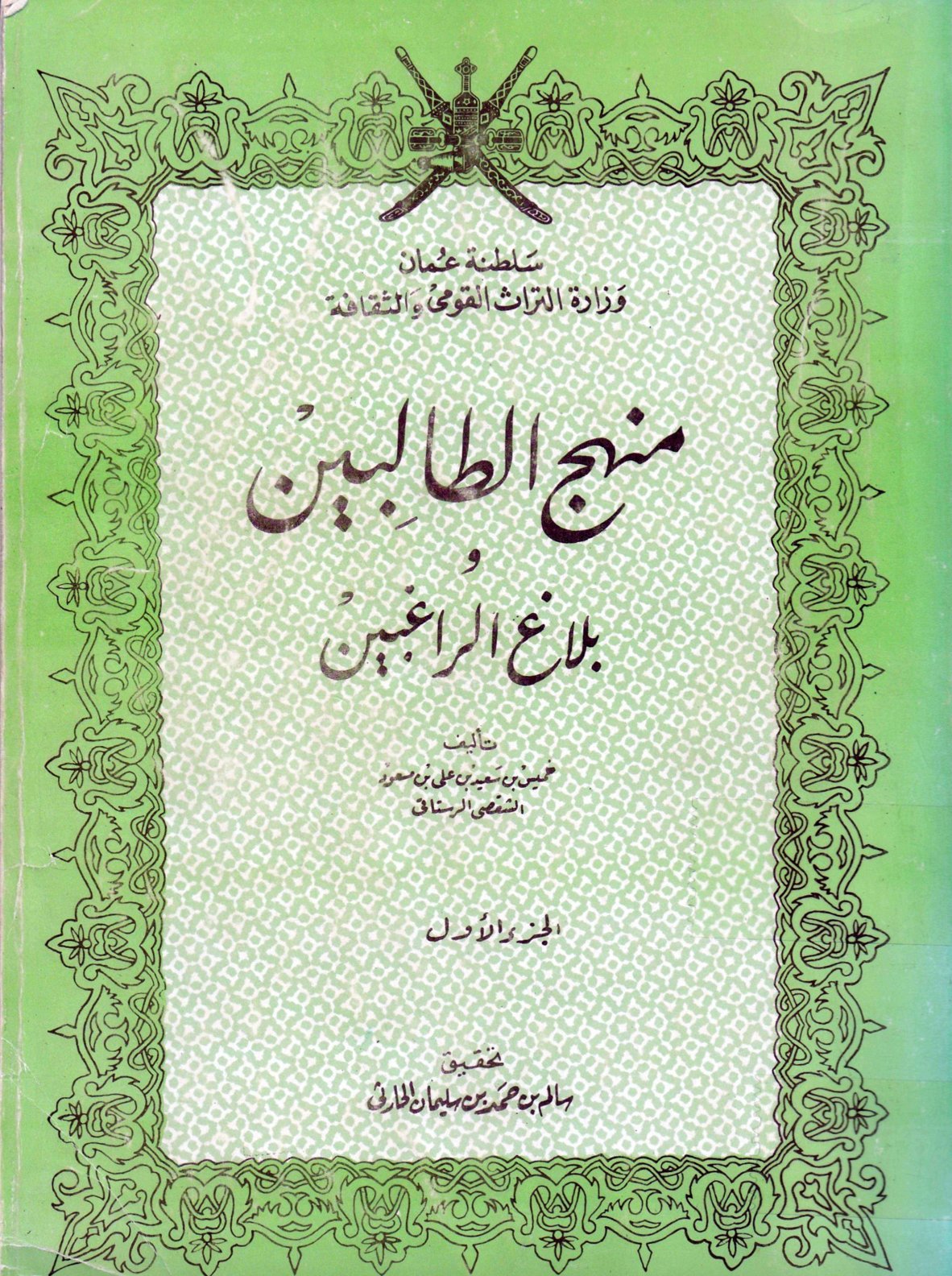
Do not be surprised to find none other than Shaykh Khamis bin Saeed Al-Shaqsi (خميس بن سعيد الشقصي) (r) say, “May Allah be pleased with him” after mentioning the name of Muaviya! He is a highly significant and foundational scholar in the Ibadi school of Islam. He is best known for his monumental encyclopedia, Manhaj al-Talibin wa Balagh al-Raghibin (منهج الطالبين وبلاغ الراغبين).
Sources: (Manhaj Al Talibeen and Balagh Al-Raghibhin)
Do the Ibadi hate Ali because of his actions at Siffin and Nahrawan?
As we have seen, there are three views of the Ibadi. We ask you to imagine that if you were among those companions of the Blessed Prophet (saw) that personally suffered loss at the hands of Ali and his soldiers, you would not have a high or favourable view of him. This is human nature. However, those people would not be Ibadi in a technical sense. As they were the companions and successors who disengaged from Ali. The term ‘Ibadi’ or the school was simply non-existent at that point. This could be a reason why Abd al-Rahman ibn Muljam took revenge. Allah knows best.
You must hate those whom you apply the judgement of Allah (swt) to? No, not necessarily.
Based upon mantiq (logic) and the fact that this particular statement of the narration would clash with the qati’i (decisive) nature of Qur’an, such that a particular understanding of being infallible or not accountable becomes null and void.
Secondly. There is a story which you can read here full of grandiose verbiage that many are familiar with. Ali fights a man and the man spits in Ali’s face. Ali is said to have sheathed his sword. You can read that here: https://www.dar-al-masnavi.org/n-I-3721.html
The point is that just because you oppose someone does not necessarily entail hatred.
An example is this:
Narrated `Aisha:
Usama approached the Prophet (saw) on behalf of a woman (who had committed theft). The Prophet (saw) said, “The people before you were destroyed because they used to inflict legal punishments on the poor and forgive the rich. By Him in Whose Hand my soul is! If Fatima (the daughter of the Prophet (saw) did that (i.e. stole), I would cut off her hand.”
So let us imagine a scenario where Fatima (ra) did steal, and she did get caught. Would one necessarily have to have hatred in his/her heart towards Fatima (ra) when executing the punishment?
That means that every judge or Qadi would need to hate the person they pass sentence on?
Would it mean that Ali, as an Amir, any time he inflicted a punishment upon anyone who transgressed, means he would need hatred in his heart as a prerequisite?
However, does one need to necessarily hate an individual that has gone against Allah (swt) and his Messenger (saw)?
Lastly, if someone loves or hates someone or something for the sake of Allah (swt), then there is no harm in this.
Narrated Abu Umamah: The Prophet (saw) said: “If anyone loves for Allah’s sake, hates for Allah’s sake, gives for Allah’s sake and withholds for Allah’s sake, he will have perfect faith.”
First point. As Shaykh Massoud bin Muhammed Al Miqbali (hafidullah) has mentioned in the video, if the matter of Ali was based upon whims and personal grudges you would not have found in our books that he (Ali) repented..
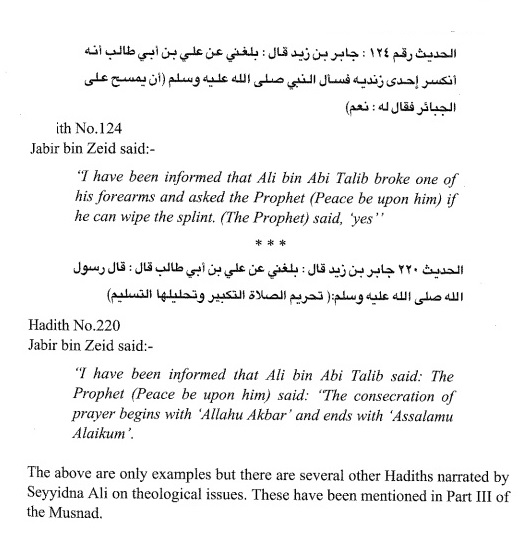
Ali Ibn Abi Talib is quoted as a transmitter of hadith in our Musnad Al-Imam Ar-Rabee’.
Ali Ibn Abi Talib is used as a transmitter of hadith in the Musnad Al- Imam Ar-Rabee’
Parting thoughts.
So let us be practical for a moment. Whatever feelings may have been stirred up by you reading this entry, think of the feelings that may be stirred up among Sunni Muslims when they know of your view concerning some of the companions? Yet, you want to be on cordial terms with them? Then do the same with us.
What amazes and perplexes the thinking individual is that there are among the Shi’i who hold very unfavorable views of Muviyah, Abu Bakr (ra), Umar(ra), Aisha (ra) and other companions, and they expect, no! They almost demand unity with Sunni Muslims.
So, if there are Sunnis who want unity with Shi’i, knowing full well that they (Shi’i) hold unfavourable views of Talha, Zubair, Muaviya and others, then they should have no issues wanting unity with Ibadi, who holds three distinct positions concerning Ali.
So, those who are thinking about following the Ibadi school and have reservations due to certain positions in regard to Ali Ibn Abu Talib. This is not something fundamental to our school. Our school is not about digging up the graves of the people of the past or cursing anyone. We simply give our account of how things were and what that may entail. Practice Wuqoof and focus on your relationship with Allah (swt). Simple.
“We take the truth even from a man of hatred, and we reject falsehood even from a chosen friend. We have no respect for a man, however exalted, if from the truth he has deflected.”-Shaykh Abdullah bin Humeid Al Salmy.
There is a very moving poem by the eloquent poet, the Sufi, Abu Muslim al-Bahlani expressing his remorse and admonishment over the actions of Ali at Siffin.














 Prima Quran