“They made not a just estimate of Allah such as is due to Him. ” (Qur’an 39:67)
﷽
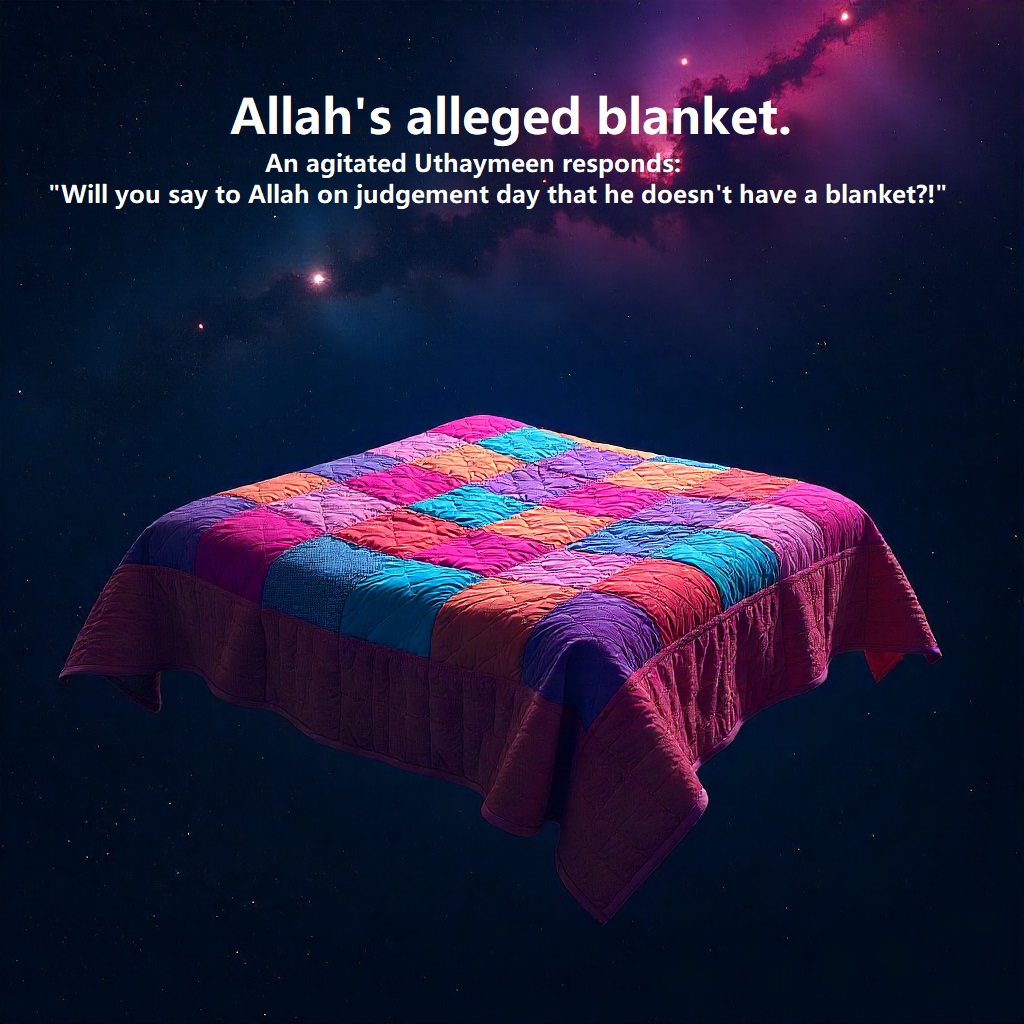
So Shaykh Uthaymeen was asked about Allah’s blanket.
The questioner says, can we say it is a metaphor?
Uthaymeen is agitated. “Will you say to Allah on judgement day that he doesn’t have a blanket?!”
If you want to perfect your aqidah (your creed) in accordance with this bizarre sect then if it is affirmed that Allah (swt) has a blanket are you going to deny this?!
You may also be interested in reading the following:
“The Messiah, son of Mary, was not but a messenger; [other] messengers have passed on before him. And his mother was a supporter of truth. They both used to eat food. Look how We make clear to them the signs; then look how they are deluded.” (Qur’an 5:75)
“There is nothing like unto Him, and He is the Hearing, the Seeing.” (Qur’an 42:11)
“There is no comparison to His absoluteness.” (Qur’an 112:4)
﷽
I used to think that the Salafi/Athari were people who had subtlety in their doctrine. And people who at least claimed to take the apparent meaning of a text. They would claim that Allah (swt) is not like his creation and that they do not liken Allah (swt) to the creation.
I couldn’t have been more wrong!
I am now of the view that the God of the Salafis is one that has a form or a shape. This is from THEIR understanding of certain text.
It was narrated that Abu Umamah Al-Bahili said:
“The Messenger of Allah (saw) addressed us, and most of his speech had to do with telling us about Dajjal. He warned about him, and among the things he said was: ‘There will not be any tribulation on earth, since the time Allah created the offspring of Adam, that will be greater than the tribulation of Dajjal. Allah has not sent any Prophet but he warned his nation about Dajjal. I am the last of the Prophets, and you are the last of the nations. He will undoubtedly appear among you. If he appears while I am among you, I will contend with him on behalf of every Muslim, and if he appears while I am not among you, then each man must fend for himself and Allah will take care of every Muslim on my behalf. He will emerge from Al-Khallah, between Sham and Iraq, and will wreak havoc right and left. O slaves of Allah, remain steadfast. I will describe him to you in a manner in which none of the Prophets has described him before me. He will start by saying “I am a Prophet,” and there is no Prophet after me. Then a second time he will say: “I am your Lord.” But you will not see your Lord until you die. He is one-eyed, and your Lord is not one-eyed, and written between his eyes is Kafir. Every believer will read it, whether he is literate or illiterate.”
Notice that the text that is attributed to the Blessed Prophet (saw) does not even remotely begin to refute the idea that Allah could be in the form of a human being.
The text only gives the following assurances.
Your Lord is not One-Eyed.
You will not see your Lord until you die.
In other words it is not at the core of one’s innate fitra or it is not innate to the mind that Allah (swt) is not something that takes on forms and shapes!
To have such an assurance tied to this particular hadith, of which the multitude have not even heard of!?
The proof is irrefutable.
The Prophet (saw) said, “Allah did not send any prophet but that he warned his nation of the one-eyed liar (Ad-Dajjal). He is one-eyed while your Lord is not one-eyed, The word ‘Kafir’ (unbeliever) is written between his two eyes.”
Now those who follow the Neo-Salafi Athari school will use the above text to claim that Allah (swt) has two eyes. Although that is pure speculation. Saying that the Dajjal has eye one does not necessitate that Allah (swt) has two eyes. Or saying that Allah (swt) isn’t defective in one eye does not entail Allah (swt) has more than one eye. You could say that a spider has 8 eyes and that it does not have a defective eye and both statements could be true.
However, when Allah (swt) opened my eyes to something deeper and more sinister. That the Neo-Salafi believe that the above text is trying to teach a theological point!
So what they are saying and think about this…what they are saying is that the way to DISTINGUISH Allah (swt) from the dajjal, is that the dajjal has ONE EYE and ALLAH DOES NOT HAVE ONE EYE.
What about the fact that the very hadith says, “THE WORD KAFIR IS WRITTEN BETWEEN HIS TWO EYES.”? Wouldn’t that be a big tale tell sign that THIS IS NOT Allah (swt)?
But even more bone chilling and down right frightening is that this flawed analogy leads one to think what seems to be THE ONLY thing that distinguishes Allah (swt) from the dajjal? Wouldn’t it be OBVIOUS that if a PERSON, ANY PERSON were to claim to Allah (swt) that we as Muslims would KNOW that this person is a charlatan, simply on the basis of:
Allah (swt) cannot be and is not a man/human being.
Allah (swt) cannot and does not assume form/shape.
Allah (swt) cannot be and is not a person.
However, if one is to take the Neo-Salafi perspective apparently not! Think about this good people.
What if you were to find a person that does amazing feats of magic, or breaks the laws of physics or does the unexplained. Would YOUR criteria as a Muslim be, well the person has two eyes, 20/20 vision, so maybe, possibly it COULD be Allah?
REALLY?
If the Neo-Salafi do not understand this hadith as the Blessed Messenger (saw) simply informing that Allah (swt) is not unaware and has full grasp, and has no defects than brothers and sisters, dear readers…
WE HAVE A BIG PROBLEM!
We have a big problem because nothing else is obvious; like the fact that the dajjal is:
human
has eyes.
has hands.
has feet.
has curly hair.
has a mouth.
most likely eats food (Qur’an 5:75) thus answers the call of nature.
has mass.
occupies space.
needs to have an army to effect change. Where as Allah (swt) gives the command ‘Kun faya kun’ (be and it is) ?wouldn’t ALL THESE BE A DEAD GIVE AWAY THAT THIS IS NOT ALLAH? According to the Neo-Salafi, NOPE!
But one way to POSSIBLY TELL THAT IT IS NOT ALLAH IS THIS: Is the person blind in one eye?
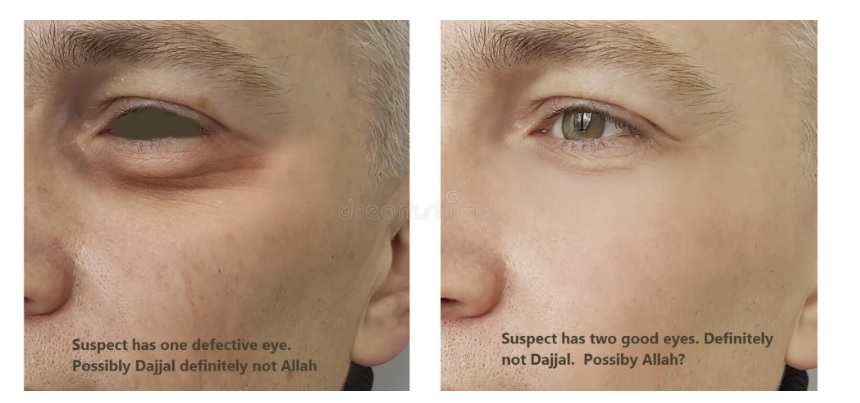
Imagine being brought up with this belief and you are out on police patrol one night in Saudi Arabia and you spot someone with one eye. “Hello, headquarters this is dispatch. Suspect has one defective eye. Possibly Dajjal, Definitely not Allah.”
So according to the Neo-Salafi the above hadith has come to teach us a theological point concerning Allah (swt). That being don’t be fooled because dajjal has one eye (one eye is defective) and your Lord does not have a defective eye.
This is what lead me to believe beyond a shadow of a doubt that these people believe that Allah (swt) has a form, and can even come in the form of a human being!
Saying that the Lord is not one eyed is not an affirmation that he has two eyes!
“The Originator of the heavens and earth. How could He have children when He has no mate? He created all things and has knowledge of everything.” (Qur’an 6:101)
This is a negation that Allah (swt) could not have children as he has no companion. So does this entail the opposite? If Allah (swt) had a companion he could have children? How bizarre is this type of thinking! That Allah (swt) would need anything in order to accomplish what he wants is not the belief of the Muslims.
Subhan’Allah!
May Allah (swt) rescue the Muslims and save the Muslims from perversion in their faith!
“Oh, Mankind! Behold, We have created you all out of a male and a female, and have made you into nations and tribes so that you might come to know one another. Truly, the noblest of you in the sight of Allah is the one who is most deeply conscious of Him. Behold, God is all-knowing, All-Aware.” (Qur’an 49:13)
﷽
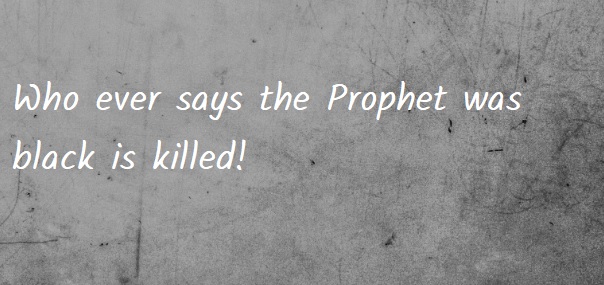
Ahmad ibn Sulayman, Sahnun’s companion, said: “That whoever says that the Prophet was black is killed. The Prophet was not black.”
One of our team members was in a discussion with someone named ‘Rider’ who had commented on the recent post titled “Are Arabs superior to Malays and everyone else? Imam Shafi’i and Ibn Taymiyyah think so!”
Rider seems to suggest that it is quite fine to treat African Americans differently from Caucasians in the United States as long as, ultimately, we are all treated spiritually equal (by our creator).
So those Muslim converts, rather than being converts from the Dalit in India, or our African American sisters and brothers coming to Islam expecting not to be treated in a prejudiced manner, may need to reassess the reasons for which they came into Islam.
Now coming to this statement.
Ahmad ibn Sulayman, Sahnun’s companion, said: “That whoever says that the Prophet was black is killed. The Prophet was not black.”
If we were an apologist for “classical scholarship” we would reply and say, this whole text was really aimed at those who falsely attributed something to the Blessed Messenger (saw) that is not true. Thus, the issue is not whether the Blessed Messenger (saw) was ‘black’ or not, but rather whether someone attributed a false ascription to him. That is what our defending “classical scholarship” at all costs response would be.
However, our rationale is we are no longer prepared to defend this kind of nonsense says, “That is all fine and well except that the person could have simply stated, ‘falsely ascribing anything to the Prophet (saw) is punishable by death’.”
It must have been such an issue for this particular point (ascribing blackness) to be highlighted.
Seems like it may even have some merit in it and Allah (swt) knows best.
Lastly, it still does not answer the point. Why would death be issued against anyone who made false physical descriptions of the Blessed Messenger (saw)? Like if they said he (saw) was 5 9in instead of 5–8 in? Or if they said that he (saw) had a broad forehead instead of around one?
Seems like correcting someone would be in order rather than a knee-jerk emotional reaction like this.
So this drives home the point that this statement seems embedded in some of the more racist elements in the Muslim ummah. Racism is a disease of the heart. So, ironically, even a classical text called “Al Shifa” (Healing, Purification, Cure) didn’t seem to be free of this. Wallahu ‘Alim!
However, we now understand that Muslims like Rider may understand “Verily, the noblest of you in the sight of Allah is the one who is most deeply conscious of Him.” to mean that, yes, we are equal in the sight of Allah. However, the understanding of Islam that they have is that some people, even among Muslims, can be given preference and special treatment simply based upon their ethnic-racial origins.
It is now a curiosity of ours about how they would interact with the Brahman philosophical schools that give sound arguments to the caste system, or maybe they wouldn’t try to approach from that angle, seeing that Islam can, from Rider’s perspective, share some strong similarities with the Brahman caste system.
Or how appropriate these teachings may not be in a nation like Singapore that teaches meritocracy not based upon purported notions of racial superiority. Should a nation like Singapore not only be on guard against certain aspects of the Salafi movement, but equally should nations like Singapore and others engage more robustly with such concepts coming from ‘traditionalists?’.
We were wondering how this bias may cause prejudice among our local Imams, Shyookh, or even Professors when it came to their interaction with people of other races, even judging their term papers. For example: Let us say that these professors or teachers had this concept that the Arabs are superior to non-Arabs. How might this affect a situation where the Chinese student is performing better than the Arab student in a particular field? Assuming that this is true and that we have some elements in our Muslim community who hold this position on what consistent basis, they should be allowed to hold teaching positions or positions of authority over other ethnic groups.
This is a grave matter that any society that has a growing Muslim population needs to look at quite seriously and earnestly. Allah (swt) knows best and Allah’s help is sought.
Interesting times we live in.
Recently, an Ex-Qadiani convert to Sunni Islam, who embraced the Hanafi-Barelvi-aligned school of thought used this verse of the Qur’an to disparage Muslims that have more melatonin.
“On the Day when some faces will be (lit up with) white, and some faces will be (in the gloom of) black: To those whose faces will be black, (will be said): “Did ye reject Faith after accepting it? Taste then the penalty for rejecting Faith.” (Qur’an 3:106)
It really says more about what is in this individual’s heart. However, being from the Sub Continent where the caste system is still operative and being inundated with a belief in a racial and genetic hierarchy (You will find this among the Zaydi, Shi’i, and Sufi’) in particular.
“It has been narrated on the authority of Ibn ‘Abdullah al-Bajali that the Messenger of Allah (saw) said:
One who is killed under the banner of a man who is blind (to his just cause), who raises the slogan of family or supports his own tribe, dies the death of one belonging to the days of Jahiliyya.
This individual and those like him are reminiscent of Iblis, who defiantly says in the Qur’an:
“He said, “Never would I prostrate to a human whom You created out of clay from an altered (hama-in)black mud.” (Qur’an 15:33)
Here clearly Allah (swt) honoured this particular pigment, the pigment black, and our All-Wise, All-Knowing Creator deemed it fit to create the progenitor of the human race out of black mud.
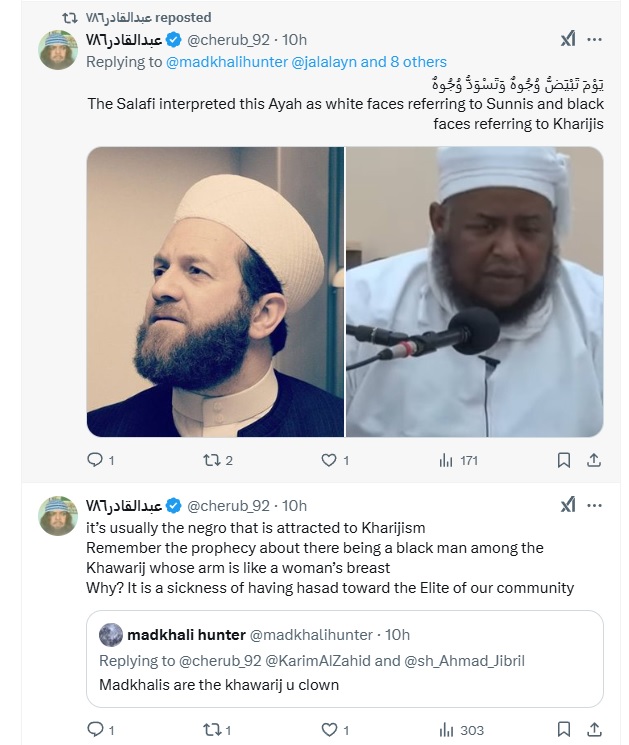
The way this lost individual states that: “The Salafi interpreted this Ayah as white faces referring to Sunnis and black faces referring to Kharijis.”
As no sources are cited, we are inclined to believe this individual received this suggestion from the one who whispered (and we seek protection with Allah from that).
Secondly, let us say that there was such a source. The Qur’an does not say this.
To draw the type of bizarre conclusion that this individual did would be akin to condemning a great many Caucasians on account of simply having blue eyes? Or anyone who has blue eyes, for that matter.
“(The) Day will be blown in the Trumpet, and We will gather the criminals, that Day, blue-eyed.” (Qur’an 20:102)
“It’s usually the negro that is attracted to Kharijism. Remember the prophecy about there being a black man among the Khawarij whose arm is like a woman’s breast. Why? It is a sickness of having hasad towards the Elite of our community.”
So here he is saying that usually the negro is attracted to “kharijism”.
Our response to this individual (who clearly suffers from an inferiority complex himself) is that Allah (swt) has illuminated the hearts of people who have more melatonin in their skin to the truth than surely that is a favour from Allah (swt)!
That there is a prophecy about a black man among the Khawarij.
Presumably he is talking about the following hadith in which the Ahl Sunnah attack one of the companions of the Blessed Prophet (saw).
That, ultimately, the Negro has hasad (jealousy) towards the Elite (which seemingly are those with less melanin in their skin).
It is a wonder to me those who are blinded by tribalism and racism and the idea of hereditary supremacy based upon family and clan in the face of the light of the Qur’an.
The light of the Qur’an is such that it blinds not the eyes, but illuminates the heart.
“Indeed, it is not the eyes that are blind, but it is the hearts in the chests that grow blind.” (Qur’an 22:46)
Adam (as) had two sons. One of which murdered the other. How does being a descendant of a Prophet (saw) guarantee righteousness?
As regards the proper understanding of the verse:
“On the Day when some faces will be (lit up with) white, and some faces will be (in the gloom of) black: To those whose faces will be black, (will be said): “Did ye reject Faith after accepting it? Taste then the penalty for rejecting Faith.” (Qur’an 3:106)
The verse is self-explanatory. This is the day of judgement. People are being distinguished by their piety and deeds; rather, they held fast or became among those who rejected faith.
It has nothing to do with the amount of melatonin an individual has.
“My Lord! Increase me in knowledge.” (Qur’an 20:114)
﷽
Most people, when they think of Turkey, do not think of it as a bastion of Shi’ism.
What makes obtaining numbers difficult in the case of Turkey is that they conduct census based only on religion, not on sects, races or ethnicity because according to the law, only religions are recognized, not sects. Additionally, another law states that everyone living in Turkey is considered a Turk.
Did you know that the Alevi Shi’a community is estimated to be between as low as 4 million and as high as 20 million of Turkey’s 80 million citizens?!
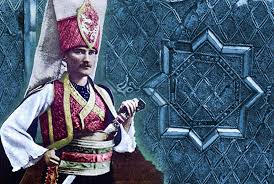
In fact, did you know that the bulwark of the Ottoman Military Machine, the famed Janissaries, were not Sunni Muslims?!
They cursed Muaviya, and they believed in the 14 infallibles, The Blessed Prophet (saw), Fatima (ra) and the 12 imams! They held that Ali was superior to the other companions. They were Shi’i; however not in the traditional sense. They were part of a Sufi order that was strongly influenced by Shi’i ideas and beliefs.
Bekta-Shism: A Sufi order that originated in Anatolia in the 13th century and named after their Saint: Haji Bektsah Veli.
Yeniçeriler gelsin!
Once that Shofar horn is blown, the only thing that awaits the opponent is swift and merciless death.
We don’t know if it was genius or mischievous of the Ottomans to send people who had heterodox views to be shock troops knowing they would take the brunt of the causalities. In a sense: canon fodder.
It must have been terrifying for Christian armies to see legions of soldiers basically dressed like Orthodox Christian Bishops coming to kill them! Just an unstoppable juggernaut chanting Allah, Allah, Allah, Allah has they charge forth.
Genius or diabolical would be a matter of perspective here.
Psychology is just as much a part of war as the weapons we wield!
The Daily Sabah says:
“Alevis, who make up the second-largest religious community in the country with approximately 20 million followers.”
“The number of Alevis is a matter of contention. Estimates from different sources range considerably – from around 10 percent to as much as 40 percent of the total population – but recent figures suggest Alevis number in the region of 20 to 25 million.”
Not surprising is that Sunni Muslims opposed to Shi’ism altogether would opt for polls or data that suggest that their population is not divided.
Recently, on X (Twitter), one Turkish Muslim we engaged with on the subject favoured KONDA Research, which suggests a very low 4% of the Turkish population to be Alevi Shi’a.
“Leaders of the Alevi Foundation estimate Alevi Muslims comprise 25 to 31 percent of the population. KONDA Research and Consultancy estimates the Alevi community at approximately 6 percent of the population, almost 5 million individuals. The Shia Jafari community estimates its members make up 4 percent of the population.”
Curious as to why that individual quoted KONDA research, we asked the individual what he thought about Tarhan Erdem’s view that Turkey was responsible for the genocide of Armenians, of which he offered no engagement on the question.
Turkey is allies with Shi’a Azerbaijan against Christian Armenia and Shi’a Iran.
Azerbaijan facts:
Religions:
Shi’i Muslim 97.3%, Christian 2.6%, other <0.1, unaffiliated <0.1 (2020 est.)
Why many Turks unfortunately feel sour about Palestine and Palestinians.
Why do many Turks unfortunately feel sour about Palestine and Palestinians?
We have had many religiously observant Turkish Muslim friends express to us that they felt betrayed by Palestine.
One Turkish brother shared with us a picture from X (Twitter) that says: “I stand with Armenia forever. From Palestine.
To which he replied: “This is what makes me angry. My people and my nation support them. Going against Israel and having economic problems. And these shameless people support our enemies! Brother, there are Turks who support Israel, but those Turks are not Muslims. But these Palestinians claim to be Muslim and oppressed but still support Armenia and China. I have not seen a single Palestinian or Pan-Arab or supports other Muslims. Those oppressed in Myanmar, China or elsewhere.”
A Palestinian had said in response to such sentiment:
“I’m sorry for the Turks. We need to kiss their feet because we lived with Armenians in our neighborhoods when we were kids. And they were good people. I’m so sorry, Brother Turk, you have every right to feel sour and not care about us being subject to genocide. Empires rise and fall. The Turks betrayed the Ottoman Empire way before any Arab did.”
As you can see, our brothers from Turkey and Palestine equally have valid points. My point to the Turkish brother is that the Palestinians as a whole should not be made to suffer because of the statements or actions of Mahmoud Abbas or those in the past.
This unfortunately is the sad state of our Muslim Ummah.
If we had a word of caution for my brothers in Turkey it would be this.
“Keep your friends close and your enemies closer.”
This seemingly innocuous Bekta-Shism state being carved out of Albania (with EU approval) might not be as innocent as one thinks.
“And whoever obeys Allah and the Messenger will be in the company of those blessed by Allah: the prophets, the people of truth, the martyrs, and the righteous—what honourable company!” (Qur’an 4:69)
﷽
Shaykh Al Qanoubi (h) is the luminary of the Ibadi school in the sciences of the hadith. The one whom Allah (swt) has illuminated his mind, and given sharp wit. Able to be among the scientists who detect the ʿillah, the hidden defects that often escape the grasp of the most astute.
This entry is in regard to what is known as: Hadith Al Thaqalyan or two matters of weight or two matters of importance.
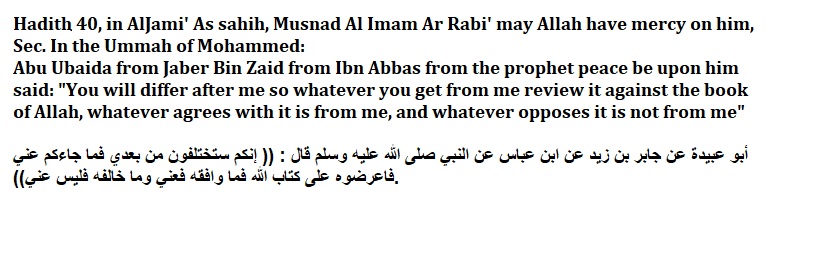
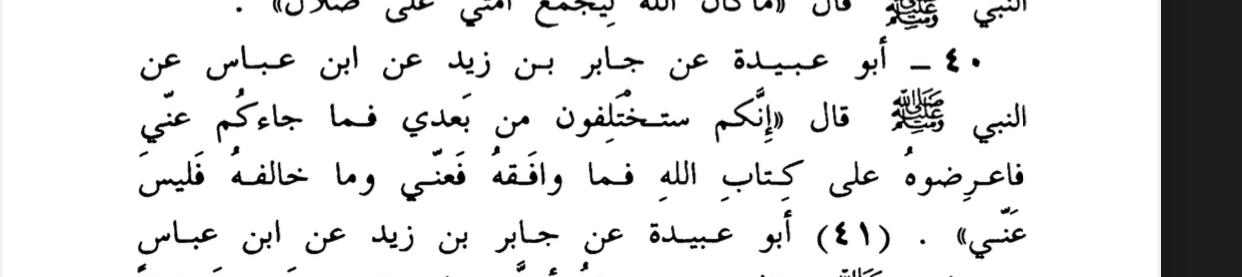
Source: (Hadith 40, in Al Jami’ Al Sahih)
In the short video clip below, Shaykh Dr. Abdullah bin Sa’ed Al Ma’mari (h) mentions that Shaykh Al Qanoubi (h), in his study on the subject, has not found the narrations that include: “and my family” as being authentic from the Blessed Prophet (saw).
As Shaykh Dr Abdullah bin Sa’ed Al Ma’mari (h) says, what is authentic for us in the Ibadi school are the words: “The book of Allah and my Sunnah.”
Obeying Allah and his Messenger is transmitted via tawatur from the Qur’an.It does not need confirmation from the hadith.
What Shaykh Dr Abdullah bin Sa’ed Al Ma’mari (h) has said is true. We don’t find a single mention of obey Allah, Obey the Messenger and Obey the Ahl Bayt.
“He who obeys the Messenger has obeyed Allah, but those who turn away-We have not sent you over them as a guardian.” (Qur’an 4:80)
“O you who believe, you shall obey Allah, and obey the messenger. Otherwise, all your works will be in vain.” (Qur’an 47:33)
“And obey Allah and obey the Messenger. But if you turn away, then Our Messenger is responsible only for conveying the message clearly. (Quran 64:12)
“Say, “Obey Allah and obey the Messenger. But if you turn away, then he is only responsible for his duty, and you are responsible for yours. And if you obey him, you will be guided. The Messenger’s duty is only to deliver the message clearly.” (Qur’an 24:54)
“Believe in Allah and His Messenger, and the scripture which He has sent to His Messenger and the scripture which He sent to those before (him)” (Qur’an 4:136)
O you who have believed, obey Allah and obey the Messenger and those in authority among you. And if you disagree over anything, refer it to Allah and the Messenger, if you should believe in Allah and the Last Day. That is the best [way] and best in the result. (Qur’an 4:59)
The hadiths that the Sunni and Shi’i primarily dispute about are as follows:
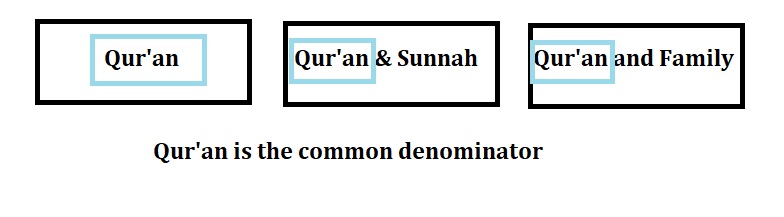
Follow the Qur’an
“I have left among you the Book of Allah, and if you hold fast to it, you would never go astray. And you would be asked about me (on the Day of Resurrection), (now tell me) what would you say? They (the audience) said: We will bear witness that you have conveyed (the message), discharged (the ministry of Prophethood) and given wise (sincere) counsel. He (the narrator) said: He (the Holy Prophet) then raised his forefinger towards the sky and pointing it at the people (said):” O Allah, be witness. 0 Allah, be witness,” saying it thrice.”
On the authority of Ikrimah, on the authority of Ibn Abbas, that the Messenger of Allah, (saw) , addressed the people during the Farewell Pilgrimage and said: “O people, I have I have left among you that which if you hold fast to it you will never go astray: the Book of Allah and the Sunnah of His Prophet.”
“On the authority of Ikrimah, on the authority of Ibn Abbas, that the Messenger of Allah, (saw), The Prophet (saw) addressed the people during the Farewell Pilgrimage and said: “Satan has despaired of being worshipped in your land, but he is content to be obeyed in other than that, of your deeds that you despise. So beware, O people, for I have left among you that which, if you hold fast to it, you will never go astray: The Book of Allah and the Sunnah of His Prophet (saw). Indeed, every Muslim is a brother to Allah.” A Muslim, Muslims are brothers, and it is not permissible for a man to take from his brother’s wealth except what he gives of his own free will. And do not wrong, and do not revert after me to disbelief, striking one another’s necks . ”
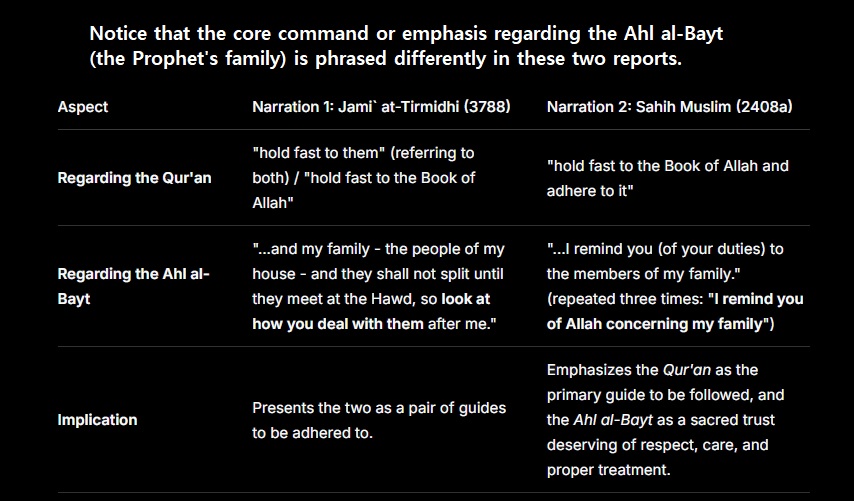
That the Messenger of Allah (saw) said: “Indeed, I am leaving among you, that which if you hold fast to them, you shall not be misguided after me. One of them is greater than the other: The Book of Allah is a rope extended from the sky to the earth, and my family – the people of my house – and they shall not split until they meet at the Hawd, so look at how you deal with them after me.”
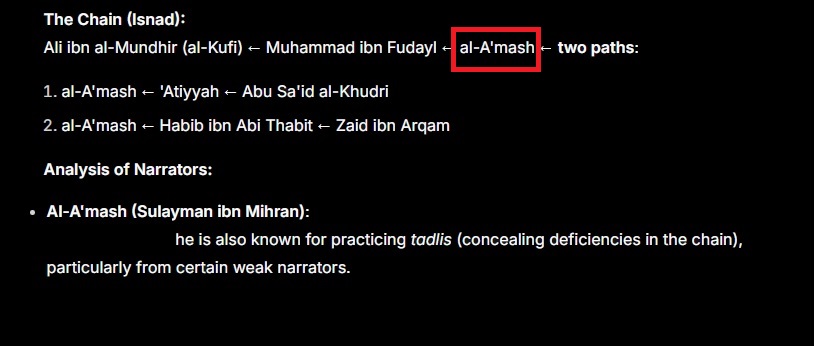
The problem with the above hadith is it contains the vile and evil al-A’mash! No consideration is given to it.
Narrated Jabir bin ‘Abdullah:
“I saw the Messenger of Allah during his Hajj, on the Day of ‘Arafah. He was upon his camel Al-Qaswa, giving a Khutbah, so he said: ‘O people! Indeed, I have left among you, that which if you hold fast to it, you shall not go astray: The Book of Allah and my family, the people of my house.'”
Yazid b. Hayyan reported, I went along with Husain b. Sabra and ‘Umar b. Muslim to Zaid b. Arqam and, as we sat by his side, Husain said to him:
Zaid. you have been able to acquire a great virtue that you saw Allah’s Messenger (saw) listened to his talk, fought by his side in (different) battles, offered prayer behind me. Zaid, you have in fact earned a great virtue. Zaid, narrate to us what you heard from Allah’s Messenger (saw). He said: I have grown old and have almost spent my age and I have forgotten some of the things which I remembered in connection with Allah’s Messenger (saw), so accept whatever I narrate to you, and which I do not narrate do not compel me to do that. He then said: One day Allah’s Messenger (saw) stood up to deliver sermon at a watering place known as Khumm situated between Mecca and Medina. He praised Allah, extolled Him and delivered the sermon and. exhorted (us) and said: Now to our purpose. O people, I am a human being. I am about to receive a messenger (the angel of death) from my Lord and I, in response to Allah’s call, (would bid good-bye to you), but I am leaving among you two weighty things: the one being the Book of Allah in which there is right guidance and light, so hold fast to the Book of Allah and adhere to it. He exhorted (us) (to hold fast) to the Book of Allah and then said: The second are the members of my household I remind you (of your duties) to the members of my family.He (Husain) said to Zaid: Who are the members of his household? Aren’t his wives the members of his family? Thereupon he said: His wives are the members of his family (but here) the members of his family are those for whom acceptance of Zakat is forbidden. And he said: Who are they? Thereupon he said: ‘Ali and the offspring of ‘Ali, ‘Aqil and the offspring of ‘Aqil and the offspring of Ja’far and the offspring of ‘Abbas. Husain said: These are those for whom the acceptance of Zakat is forbidden. Zaid said: Yes.
Notice dear reader: “and the offspring of ‘Abbas.” Surely Ibn Abbas (ra) would know best what the Blessed Prophet (saw) said.
Prima Qur’an comments:
As mentioned, the inclusion of the Book of Allah and my family is important for the Shi’i in helping to establish their positions. This is not the case for us (the Ibadi school).
Some Sunni Muslims (in particular those who follow a Sufi Tariqah) reconcile the narrations by stating that they (Sunni Muslims who follow a Sufi Tariqah) follow the Qur’an and Sunnah via the descendants of the Blessed Messenger (saw). Since it is claimed by Sunni Muslims that the bulk of the descendants of Prophet Muhammed (saw) are actually contained within the house of ‘Ahl Sunnah Wal Jammah’, then they are best suited to teach and guide.
So, for example: Shaykh Muhammed Al Yaqoubi, who is a claimed descendant of the Blessed Prophet (saw) via Hasan ibn Ali. People who follow a Sufi order that he is affiliated with would find that he is best suited to guide.
As seen in two of the narrations above, Ibn Abbas (ra) is in the chain of transmission. For us (The Ibadi school) he is part of the household of the Blessed Prophet (saw). Thus, he, being a member of Ahl Bayt, transmitted that we are to follow the Qur’an and Sunnah.
That statement aligns with what we find in the Qur’an.
It could be very well that the Prophet (saw) was meant to convey the following:
Did he convey the message? Did he bring the Qur’an? Of which everyone agrees that he did.
That he would want people to look after and take care of his kinsfolk. This is only natural and something any honourable person would desire. How much more the most honorable among creation?
As we find in the Qur’an:
“That is the good news which Allah gives to His servants who believe and do good. Say, “I do not ask you for a reward for this—only honour for kinship.” Whoever earns a good deed, We will increase it in goodness for them. Surely Allah is All-Forgiving, Most Appreciative” (Qur’an 42:23)
Rest assured that if there are any lectures or writings from Shaykh Al Qanoubi (h) where he fleshes out the more reasons for not accepting the transmissions that include ‘and my family’ insh’Allah will be sure to share them. Allah-Willing.
“And We have certainly made the Quran easy to remember. So is there anyone who will be mindful?” (Qur’an 54:40)
﷽
Our colleague relates the encounter.
Imagine if you will that you have a son or a daughter that informs you that they wish to get married. You sit down with your son or daughter and ask them the following: “What do you wish for a life partner?” “What are some of the traits or qualities you would like to have in a life partner?” Their response is: “I don’t have any standards, I will just take anything!”
That response is the surest way of knowing that they are not ready for marriage at all!
This Muslim Ummah needs to have some standards. We are talking about elementary standards. We are talking about ‘the bare minimum‘.
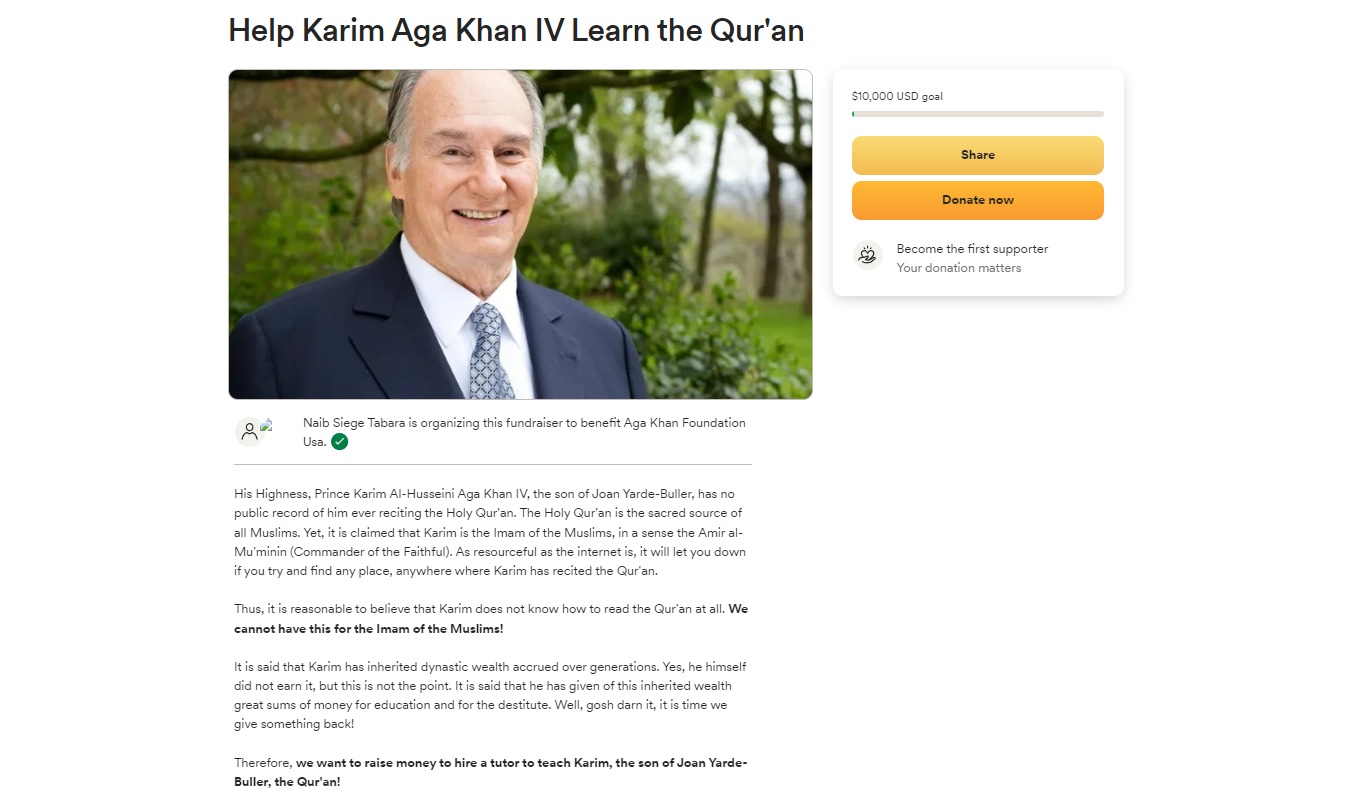
If one is going to be acclaimed to be the commander of the faithful, the Imam of the Muslims, the Imam is such that if you do not recognize him you die the death of an unbeliever, then at the very least you had best be able to recite the Qur’an. That is not asking for much. It is, however, asking the Ummah to require some very basic standards.
So, no, we are not talking about theology, we are not talking about jurisprudence, we are not talking about philosophy. We are asking a very basic simple question: “Can you Qur’an tho?”
I do not know about other Muslims, but I would like my commander of the faithful and my Imam to be able to recite the Qur’an at ….the….very…..least.
In fact, this may be a very interesting academic article. When did the Imams of the Nizari Isma’ili community begin to distance themselves from the Qur’an? In other words, when did these phenomena of having an insouciant relationship with the Qur’an begin? Which of the Nizari Isma’ili imams set this off?
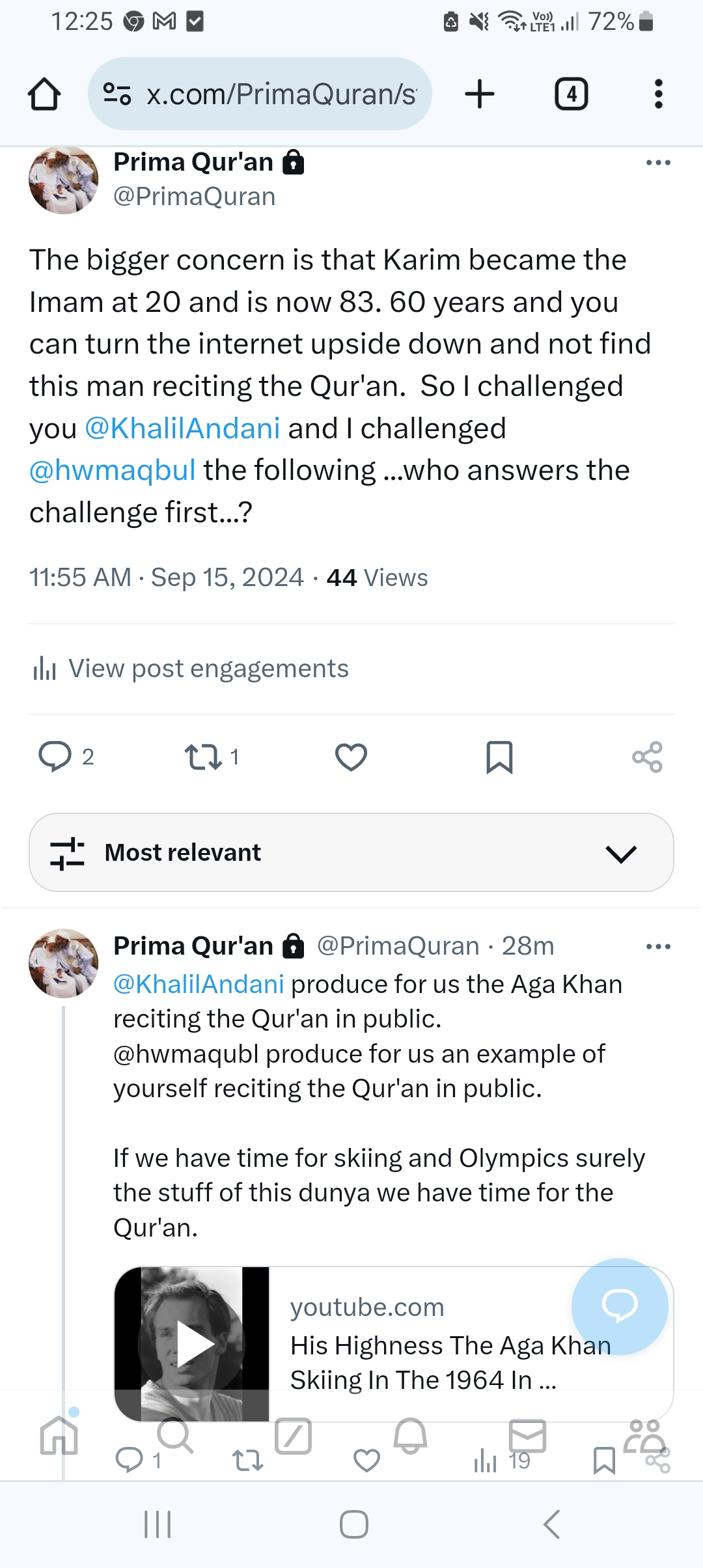
So recently, when encountering one of many arguments that took place in the wild world of X (Twitter). I saw some mutual fat shaming going on between Imam Hamza wald Maqbul and Professor Khalil Andani.
So, being mildly agitated by this bickering, I put out a challenge to both men.
It was quite a simple and straight-forward point-blank challenge to Professor Andani and Imam Hamza wald Maqbul. I challenged Professor Andani to produce for us the Aga Khan reciting the Qur’an in public. I also challenged Imam Hamza wald Maqbul to produce an example of him reciting the Qur’an in public.
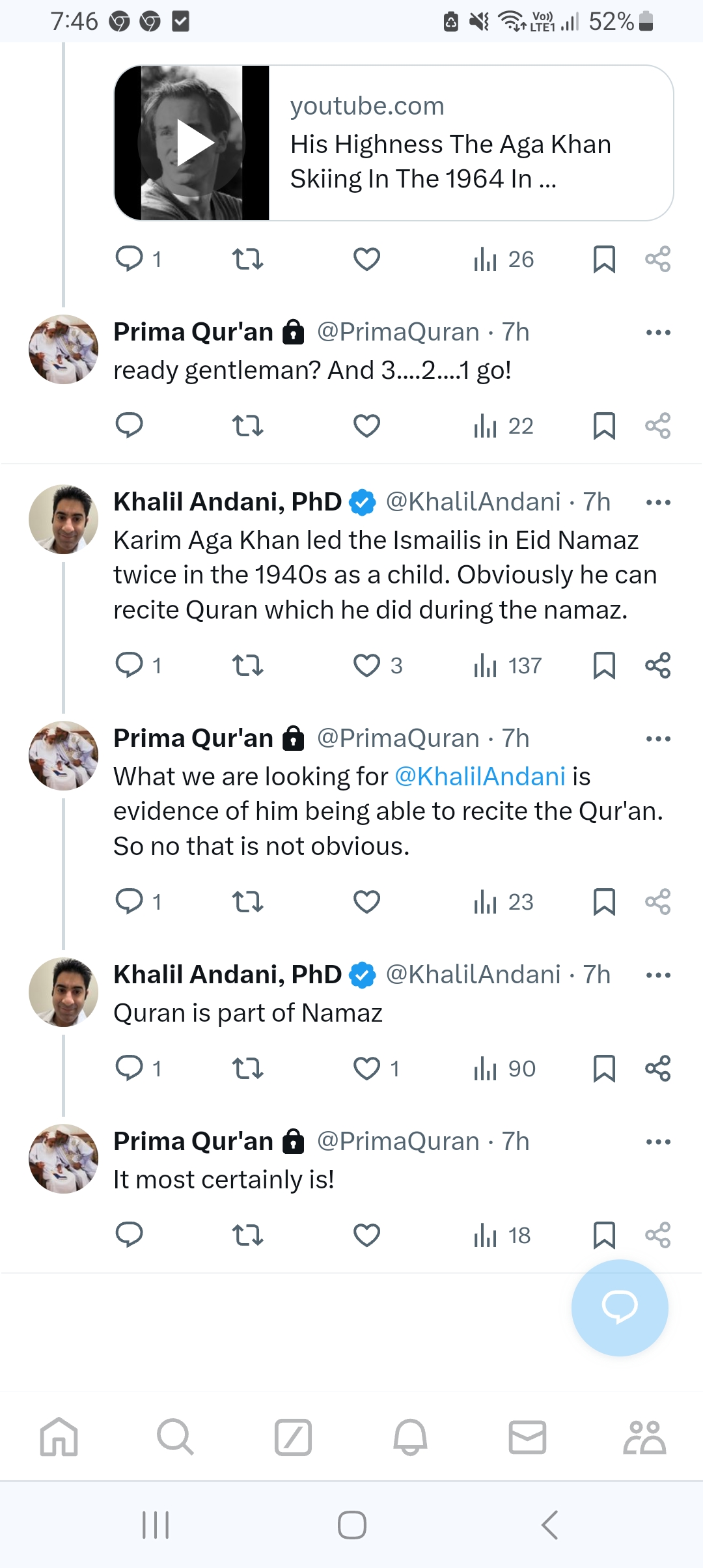
To be quite honest, I do not doubt that Imam Hamza wald Maqbul can properly recite the Qur’an. Professor Andani, over all, is a guy who can comprehend more than basic English. Thus, his response was puzzling.
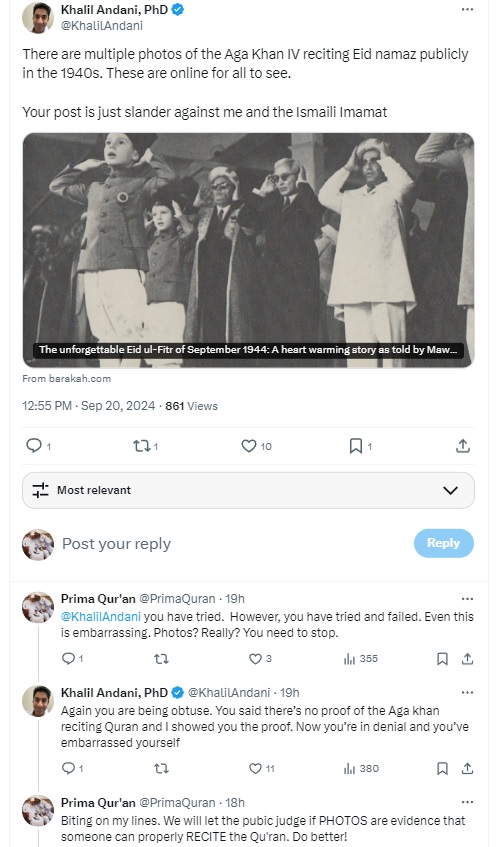
Produce for us the Aga Khan reciting the Qur’an in public. Professor Andani did the best he could, so he meekly offered: “Karim Aga Khan led the Ismailis in Eid Namaz twice in the 1940s as a child. Obviously he can recite the Quran, which he did during namaz.”
It was after this comment that I now publicly retract every glowing attribute I gave to Professor Andani during his debate with Jake Brantecella. Do I think Professor Andani won that debate? Absolutely. However, after I am quite dismayed at the response given by Professor Andani.
First there is the matter of plain English. “Produce for us the Aga Khan reciting the Qur’an in public.” That is people in the Julian calendar year of 2024.
Second, to make claims that (Professor Andani) himself did not witness is not “obvious” at all. Claims that he led the Eid prayer twice in the 1940s is not proof that he can properly recite the Qur’an. We want proof that Karim, the son of Joan Yarde-Buller, can properly recite the Qur’an.
Then Professor Andani gave another meek reply: “Quran is part of Namaz.” Indeed, it is. Indeed, it is. One could do the dhur prayer or asr prayer. In many schools of jurisprudence, the Qur’an is not recited out loud. Meaning that one would not be able to ascertain that one could properly recite the Qur’an. I will give the benefit of the doubt and say that it is possible that he may not be aware of this.
However, as the Eid Prayers have parts where the Qur’an is recited out loud, one could assume that a person knows how to properly recite the Qur’an. However, the idea that Karim, the son of Joan Yarde-Buller, did so twice as a child, of which Professor Andani did not witness (as he was not even born then) as being obvious has to be one of the most obtuse statements ever.
Ultimately, it is an admission of being unable to answer the challenge. The man, Karim, the son of Joan Yarde-Buller, became the Imam around/at the age of 20. He is currently 83 years of age. For 60 years on this Earth there is no evidence for us to ascertain whether this man can properly recite the Qur’an. You can turn the internet upside down and inside out, and you will find no evidence of him being able to recite the Qur’an at all.
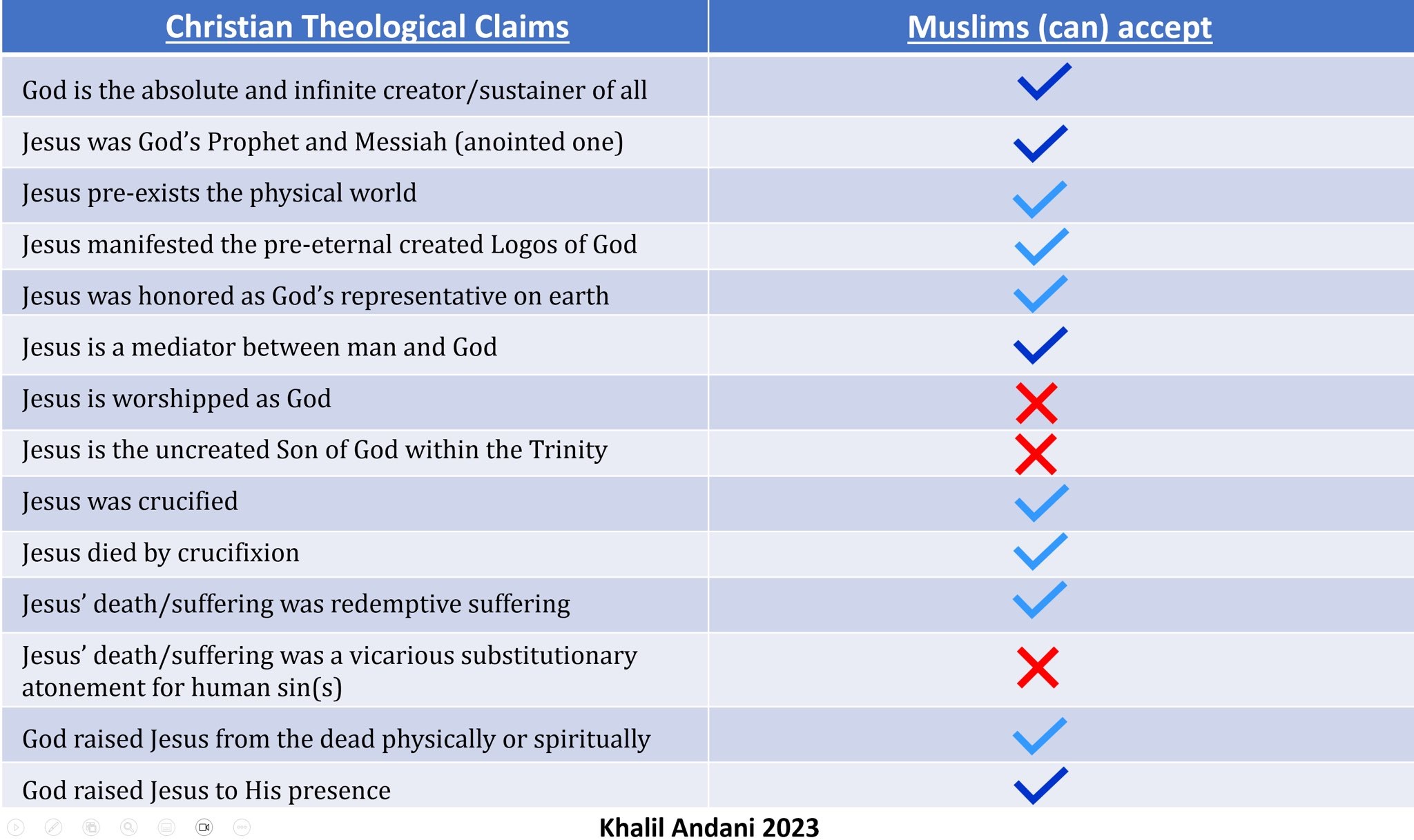
Professor Andani doesn’t strike me as someone who wouldn’t bring his ‘A’ game. However, he hasn’t been the most forthcoming with Christians when he shows them his chart. You know the one:
The one that leaves out the Virgin birth of Christ Jesus (quite important to every Christian under the sun).
The one that leaves out the second coming of Jesus:
So all you Christians interacting with Professor Andani, open up your eyes and don’t be blind to it!
Thus, the meek response that Professor Khalil Andani is now proof positive for the whole world that it was the best he can do in the way of evidence. Meaning that there was some event that he himself did not witness or partake in which it is said that Karim, the son of Joan Yarde-Buller, twice as a child, led the Eid prayers. No evidence at all that he can properly read the Qur’an.
It is disheartening. If I thought for one moment that Karim, the son of Joan Yarde-Buller, was the commander of the faithful, the Imam of the Muslims how I would love to have his recitation of the Qur’an. How it could console me in dark times! Just to hear the cadence of his voice and the unison of heart and tongue as his holiness brought forth a most sublime and majestic recitation.
Unfortunately, for the Nizari, Isma’ili will never get this experience. Hey! There are always his sons! Perhaps they may take up seriously the learning to read the Qur’an! Or would that be a problem?
Is that the issue? How can someone who is not Allah’s divine representative on Earth possibly teach the divine representative the Qur’an?
*** UPDATE ***
There is an update to this article. Professor Andani thought he would give it one more shot.
First let me start with a major correction to Professor Andani.
Professor Andani states: “Your post is just a slander against me and the Ismaili Imamat.”
First, I do not see how stating the truth about something of which Professor Andani has failed time and again to prove the opposite of is slander.
Second, a major correction. It is more correct and circumspect to say Nizari Ismaili Imamat! It is hubris to think the Nizrari branch represents the entirety of Ismailism. It does not represent the Musta’li Ismai’li branch. A branch which includes the Dawoodi-Taybi as well as the Sulaymani-Tabi.as well as the Sulaymani-Tabi.
In fact, considering the Musta’li Ismai’li consider the Nizari claims null and void, they could very well be delighted to see such challenges. They may even be reading this article with a certain sense of satisfaction. They may be hoping that their Ismai’li brothers, who are following a man who has not been proven to recite the Qur’an with proper recitation, may decide to leave the Nizari and follow them instead!
Ladies and gentlemen. Dear truth seekers. A picture of a boy standing with his hands behind his ears is not proof that he can properly recite the Qur’an.
Imagine if you will there are people who doubted claims that, when I was an eight-year-old little girl I stood in front of the congregation of my church and recited the entire chapter of the book of Acts (King James Version) with perfect memory and no errors.
Then some people doubted this claim. So my mother, driven by emotional attachment to her daughter, rushes to produce a picture of me as an eight-year-old little girl in Church. “Here is your evidence!”
Surely one can see the futility of such.
If you enjoyed the above article you maybe interested in the following:
In this article we did our level best to help the Imami Shi’a solve a dilemma (the Ismaili included) we have not found any contemporary approaches among the Imami Shi’a to approach this dilemma.
” Indeed, it is We who sent down the Qur’an and indeed, We will be its guardian.” (Qur’an 15:9)
﷽
First let us post what the original video clip has to say about Sayyid Ali’s presentation:
“In this video, the Sayyid responds to a questioner who asks whether the Qurʾān that is present between us today has been subject to distortion or not. Instead of going through the traditions related to whether this has indeed been the case, the Sayyid outlines some epistemological points to bear in mind when trying to evaluate this claim. He delineates general historical principles and facts that cause us to deem such an occurrence, as historians, to be extremely far-fetched. He then outlines the possible goals of a distorter and contrasts these objectives to what is found within the Qurʾānic text, whence we find that had these been the objectives of the distorters, then we would not possess certain verses and contents of the Qurʾān that we do today.” –Source:https://www.youtube.com/watch?v=l7y9bstcnXM&t=1453s
We would also like to say that this explanation by Sayyid Ali is one of the best, if not the best we have seen. It answers a lot of questions that are put forward in regard to this.
There are those who claim that the Shi’i themselves make this claim. The claim of tahrif of the Qur’an. Sayyid Ali beautifully responds to these claims.
This is a short and succinct lecture, equal to about 29 minutes of your time. It is absolutely worth it.
Those Orientalists and advocates of the historical critical method are most welcome to put this in their pipes and smoke it. The Imam laid out a very cohesive and cogent argument.
We would highly recommend you listen to the whole of the presentation.
@20:04 “Pay attention with me, in the Glorious Qur’an, now if someone wants to distort, what would they want to distort? What are his objectives hind distortion? I mean, what are the possible objectives of distortion? We will mention objectives, and let’s see if they have any basis.”
@20:18 “It may be said, for example, that among the objectives of distortion: Is the removal of certain criticisms directed towards some of the Companions who ruled. I mean, those who had authority. They are all present in the Qur’an. They are found in Surat al-Tahrim, Surat al-Hujurat, which contains: {Do not raise your voices above the voice of the Prophet} [Qur’an 49:2]“
@20:40 “And it’s mentioned about whom it was revealed. The issue of fleeing on the day of Uhud, and Hunayn, all these details are mentioned. The details of the events are mentioned. If someone wanted to distort, why would they distort? I mean, if one of the objectives of authorities was distortion, it would have been something related to them.”
@:20:58 “Those who ruled, the criticisms directed at them in the Book of Allah are present. This is a possible objective [for distortion]. Of coruse, I mention these as supporting points, not as evidence. The [main] evidence has concluded. The evidence has concluded, now we’re mentioning supporting [points].
@21:10 “The second objective is, for example, that these individuals want to remove some matters regarding the Prophet (peace be upon him and his family) [being portrayed in a negative light].
@21:19 “They love the Prophet, so they try. The Glorious Qur’an, the criticisms made by the polytheist against the Prophet (peace be upon him and his family) are present in the harshest articulation. In fact, some addresses in the Qur’anic chapters to the Prophet (peace be upon him and his family) that contain-where principally one may perceive some sort of harshness and severity within, for example, {And had We not strengthened you, you would have almost inclined to them a little} [Qur’an 17:74], it’s all there.”
@21:49 “Alright? Of course, we say it’s in the sense of “I mean you, and listen O neighbor.” But the address is there.”
@22:17 “Very well. Among the objectives that are mentioned, is removing the names of Ahl al-Bayt (upon them be peace), from the Qur’an. I say—I say, firstly, what’s the meaning of this verse? We’re talking now as Shi’a. {O Messenger, announce that which has been revealed to you from your Lord, and if you do not not, then you have not conveyed His message}[Qur’an 5:67]
@22:38 “How do we interpret this? Isn’t it about Wilaya? Isn’t it about Wilaya in the last days of the Prophet (peace be upon him and his family). And Surat al-Ma’ida is amongst the last [chapters] to be revealed, if not the very last.”
@22:53 “If Wilaya was detailed in previous chapters, then what would be the meaning of: {announce that which has been revealed to you from your Lord} [Qur’an 5:67]? We fundamentally believe that it’s natural for the mention of the Commander of the Faithful (peace be upon him) to not be frequent in the Qur’an.“
“This is natural. And this is what we believe. I mean, his mentioned as an Imam. I speak of his mention as an Imam. Clear? Not as a man of virtues. Otherwise if we’re speaking of virtues, then a “a quarter [of the Qur’an] is about us”. Clear?”
@23:23 “We are not speaking for that perspective. We’re speaking from the perspective of those in power. Alright? Concerning those in power, {Announce that which has been revealed to you from your Lord, and if you do not, then you have not conveyed His message} [Qur’an 5:67] Now, this verse, what’s the reason for its revelation? It’s natural that the mention of Imam ‘Ali (upon him be peace) will not be frequent in the Qur’an. As for mentioning the rest of the Imams (upon them be peace), in the Qur’an.”
@23:50 “Fundamentally, we Shi’a do not believe in the necessity of believing in [all] the Imams (upon them be peace) except after the death of the previous Imam.
However the Imam later admits:
@27:25 “The thing that may be brought up is the issue of Wilaya. So it would be problematic only on the Shi’a side. But we explained that the Shi’a, when it comes to revealing all of the Imams’ [names], that is something they have deemed far-fetched. Fundamentally. It’s not something to be expected, that there would be something in the Qur’an about Imamate. And on the other hand, concerning the Commander of the Faithful (upon him be peace), we believe that the Prophet (peace be upon him and his family) proclaimed this towards the end of his life. {O Messenger, announce that which has been revealed to you from your Lord, and if you do not, then you have not conveyed His message} [Qur’an 5:67]. So in reality, naturally, if the name of the Commander of the Faithful (upon him be peace) was in the Qur’an, it would have been rare and minimal. For example, had it been the case. Up to this extent, I mean, this degree of speculation.”
@28:14 “This does not outright negate the existence of the name of Imam ‘Ali (upon him be peace). This is a speculative argument. However, I just want to say, that upon reflection on the matter, the degree of distortion will not, some people, I mean, naturally, the name of Imam Ali, had it been in the Qur’an, it would be rare, Had it been there, it would be rare. Had it been there. Clear? According to the Shi’i view. Nothing else. I’m saying this according to the Shi’i Twelver view. Alright?”
Prima Qur’an comments: First and foremost again, the overall explanation by the respected Imam was/is brilliant! It is unfortunate that some people will allow themselves to be clouded by sectarianism and not benefit by what he said.
The only part where he dropped the ball was giving his minor points (because, as he mentioned, the main case has already been established), but in regard to the minor points is concerning the mention of the ahl bayt and/or the mention of the name of Imam Ali (at the very least).
By quoting a vague reference:”Announce that which has been revealed to you from your Lord, and if you do not, then you have not conveyed His message} [Qur’an 5:67] This does little to dissuade anyone from the idea that a redactor or editor wanted to remove explicit mention of the Ahl Bayt or Imam Ali as the leader of Imam of the Muslims.
The Imam was also honest and transparent enough to say:
“@22:38 “How do we interpret this? Isn’t it about Wilaya? Isn’t it about Wilaya in the last days of the Prophet (peace be upon him and his family)
“How do we interpret this.”
“I mean, naturally, the name of Imam Ali, had it been in the Qur’an, it would be rare, Had it been there, it would be rare. Had it been there.”
He was also very objective and fair-minded when he stated:
“The thing that may be brought up is the issue of Wilaya. So it would be problematic only on the Shi’a side. But we explained that the Shi’a, when it comes to revealing all of the Imams’ [names], that is something they have deemed far-fetched
That is correct. It would only be a problem for the Shi’a side, as they are the ones who have as a theological foundation the concept of being ruled by the family of the Prophet (saw), a concept we absolutely do not find in the Qur’an at all.
So, for the Sunni or the Ibadi, this is not something we would expect to find in the Qur’an.
“We have neglected nothing in the Book, then unto their Lord they (all) shall be gathered.” (Qur’an 6:38)
﷽
We as Muslims believe in an All-Wise, All-Intelligent, All-Knowing, Creator. We do not describe the Creator as being frivolous or mercurial. We seek refuge in Allah.
Thus, while reading through the Qur’an, we come across this very interesting verse.
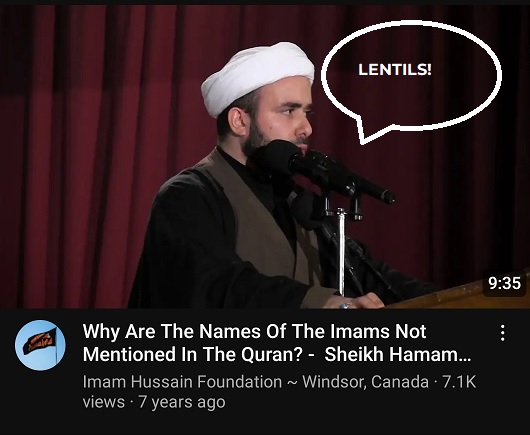
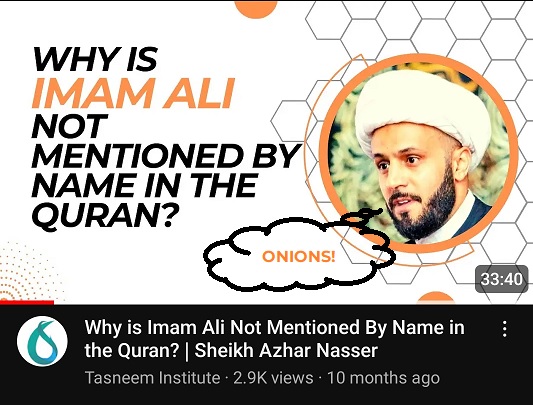
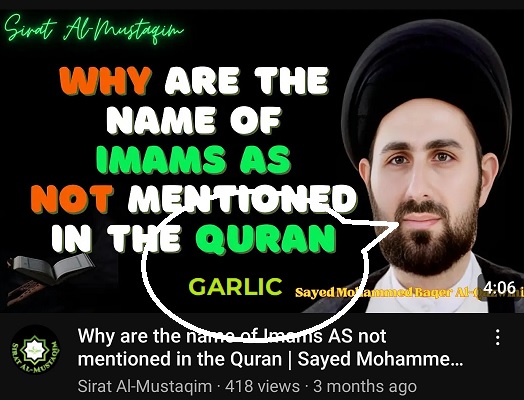
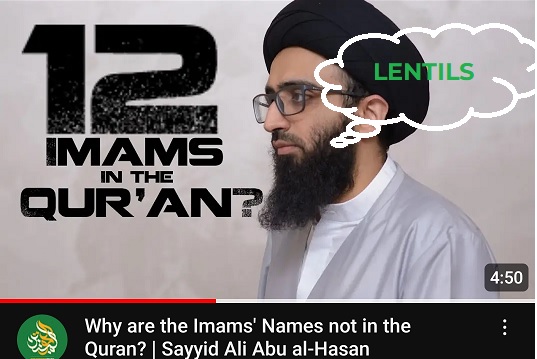
“And when you said, “O Moses, we can never endure one kind of food. So call upon your Lord to bring forth for us from the earth itsgreen herbs and its cucumbers and its garlic, and its lentils and its onions.” [Moses] said, “Would you exchange what is better for what is less? Go into any settlement and, indeed, you will have what you have asked for.” And they were covered with humiliation and poverty and returned with anger from Allah upon them. That was because they repeatedly disbelieved in the signs of Allah and killed the prophets without right. That was because they disobeyed and were habitually transgressing.” (Qur’an 2:61)
So here our colleague sat with their thoughts looking at this amazing verse. We thought about all the intra-Islamic debates over various points of doctrine and jurisprudence and the blood that has been shed over such. Cucumbers, garlic, lentils & onions, the words just jumped out at them.
“WoW!” they thought. We do not believe this verse has been the centre of any type of controversy among us as Muslims. Empires or dynasties built upon the verse that mentions cucumbers, garlic, lentils and onions.
So let us imagine that this verse came down to us in another form. Would any vital information be lost? Would we not know that the children of Israel complained about not being able to endure only one type of food and that Allah (swt) responded to them expressing disappointment?
So let us imagine that this verse came down to us in another form. Would any vital information be lost? Would we not know that the children of Israel complained about not being able to endure one type of food and that Allah (swt) responded to them expressing disappointment?
Imagine the verse said:
And when you said, “O Moses, we can never endure one kind of food. So call upon your Lord to bring forth for us from the earth its green herbs.” [Moses] said, “Would you exchange what is better for what is less? Go into any settlement and, indeed, you will have what you have asked for.” And they were covered with humiliation and poverty and returned with anger from Allah upon them. That was because they repeatedly disbelieved in the signs of Allah and killed the prophets without right. That was because they disobeyed and were habitually transgressing.” (Qur’an 2:61)
What is missing? What did we excise out?
The following: “and its cucumbers and its garlic and its lentils and its onions!”
Subhan’Allah! We as Muslims do not believe in redundant revelation.
Often, when the Shi’i engage other Muslims (usually Sunni), they will ask them: “Do you really believe that the Blessed Prophet (saw) would leave a matter like the leadership of the Muslims up in the air!?”
Often, questions like this evoke reflection and indeed they should!
But in this case, this is a loaded question. As it implies that such an issue is of vital importance to begin with. That begs the question of whether or not this is even a pillar of faith that is established in the Qur’an first and foremost.
In the Qur’an Allah (swt) establishes our most vitally important beliefs. Yet, nowhere in the entirety of the Qur’an from Al Fatiha to Al-Nas do we find mention of who should succeed the Blessed Prophet (saw)!
Rhetorical questions in the Qur’an like the following do not need to be asked if there is a clear line of succession.
“Muḥammed is not but a messenger. Messengers have passed on before him. So if he was to die or be killed, would you turn back on your heels? And he who turns back on his heels will never harm Allah at all; but Allah will reward the grateful.” (Qur’an 3:144)
We look through this astonishing beautiful revelation, this sublime source of guidance that leaves us enthralled for hours upon hours on end. Pondering its verses and yet there is no clear mention of statements like: “Ali should succeed the Prophet (saw) when he dies.” In fact, his name is not mentioned at all in the Qur’an! Statements like the following are simply not found: “The Ahl Bayt holds the leadership of the Muslims.” “The Muslims should be led by so-and-so when the Prophet (saw) dies. “
Yet…cucumbers and its garlic and its lentils and its onions! Here they are mentioned by name clear as day.
Which of the two matters does one believe is of more weight and magnitude?
Knowing by name and having spelled out to us clearly the four different food types the children of Israel were craving or knowing by name and having spelled out to us clearly that we are to obey infallible guides or guides from the family of the Blessed Messenger (saw)
Which of the two matters have the Muslims wrangled over, fought each other over, and spilled blood the most?
It has to be a point of embarrassment for those that uphold such doctrines:
A) Muslims must be ruled by the family of the Prophet (saw)
&
B) Muslims are to be ruled by infallible family members of the Prophet (saw)
It must be embarrassing for believers in such doctrines to see Our All-Wise, All-Intelligent, All-Knowing, Creator acknowledge cucumbers and its garlic and its lentilsand onionsby name in his glorious revelation and not once mention the name of Ali Ibn Abu Talib.
It should not surprise us that in any discussion in relation to topic A or B above the Shi’a are anxious to pivot the conversation away from the Qur’an and towards any (dear God, sweet Lord in heaven) and we do mean any data extraneous to the Qur’an that assist them in building their case.
We should also not be surprised that some Shi’a held to tahrif (corruption) of the Qur’an on these very topics!
Let us say that we were to gather a bunch of atheists and Agnostics in a room, and we were to pose them the following question.
Are you more likely to believe in a Creator that mentions in passing the name of a few random vegetables that people craved in the past, while not mentioning clearly a line of succession and leadership that leads to internecine conflicts among those devoted to him?
Or
A Creator that mentions clearly a line of succession & leadership that, if not mentioned clearly, would lead to internecine conflicts among those devoted to him?
There are many people on this planet that would argue fiercely, cogently and intelligently that mentioning by name a few random vegetables that the people of the past craved seems almost trivial compared to mentioning by name a clear line of succession and leadership that, if not mentioned, would lead to internecine conflicts and loss of life.
Yazeed is mentioned in the Qur’an and it is a miracle! (Qur’an 19:76)
Now this doesn’t necessitate an argument against the wisdom of the Creator. It just argues for a Creator that may want his creation to figure some things out like a puzzle, an enigma or a riddle.
After all, what would we know, this is simply a run-of-the-mill garden variety refutation.
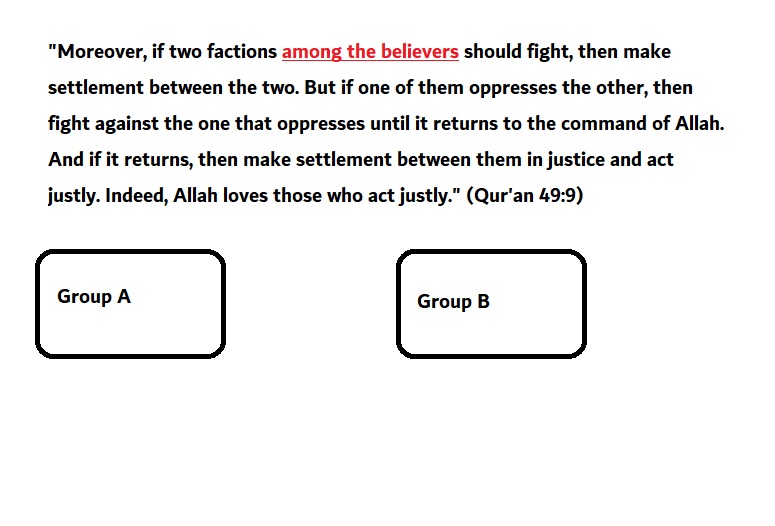
“Moreover, if two factions among the believers should fight, then make settlement between the two. But if one of them oppresses the other, then fight against the one that oppresses until it returns to the command of Allah. And if it returns, then make settlement between them in justice and act justly. Indeed, Allah loves those who act justly.” (Qur’an 49:9)
﷽
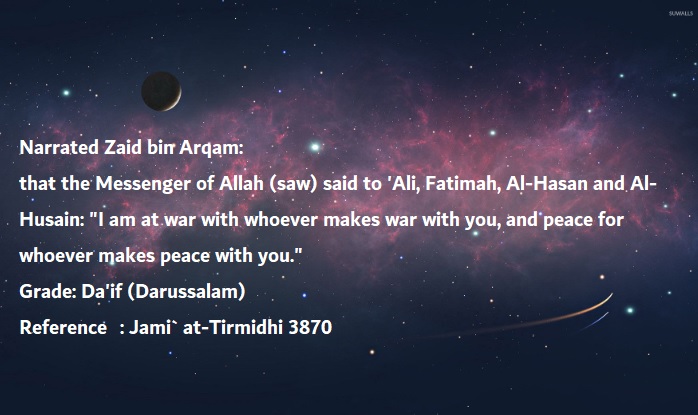
So today we are going to be looking at the following hadith:
Narrated by Zaid bin Arqam:
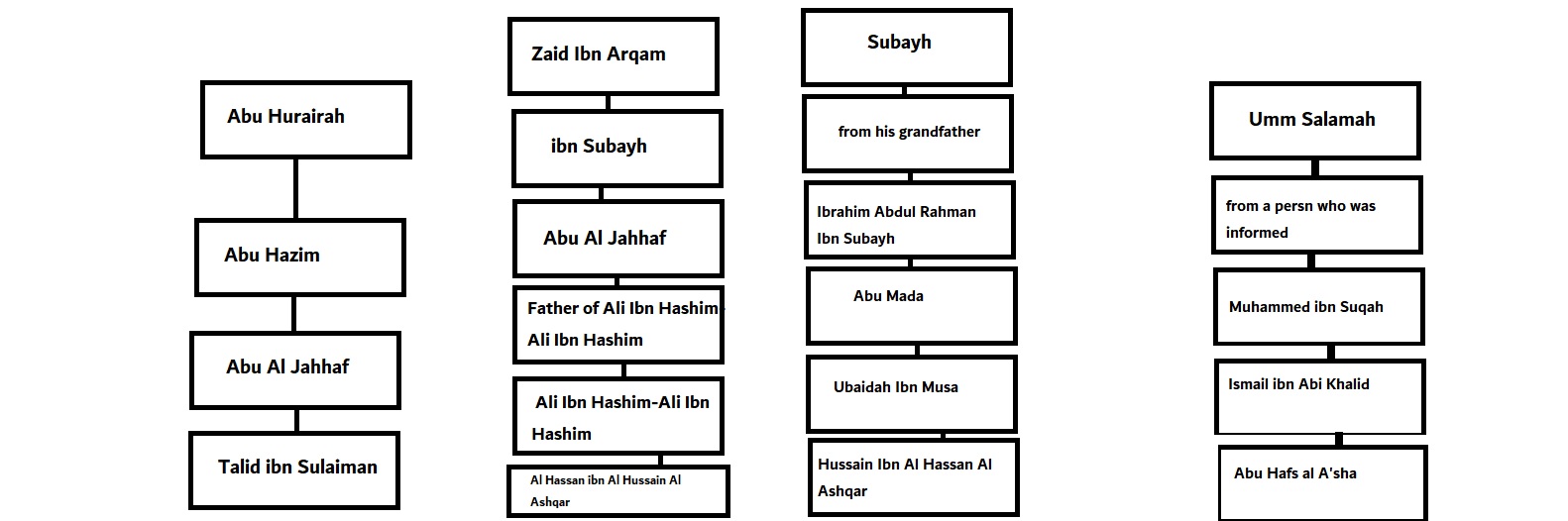
That the Messenger of Allah (saw) said to ‘Ali, Fatimah (ra), Al-Hasan and Al-Husain (ra): “I am at war with whoever makes war with you, and peace for whoever makes peace with you.”
You can see from the above source that it has a grading of Da’if (meaning weak/fabricated).
Now, even without going into the chains of narrators, we know that this hadith has a major weakness.
However, let us say, for the sake of argument, that this hadith had a grading of Sahih (meaning sound). It would still have a defect. Not even a hidden one. Not even something that would require a hadith specialist.
It would require familiarity with the text of the Qur’an.
CONTROL GROUP A: BEING OPPRESSED
CONTROL GROUP B: DOING THE OPPRESSING.
So, in the above scenario. Ali, Fatimah (ra), Al-Hasan and Al-Husain (ra) could be in control group B. They could be doing the oppressing. However, since our interlocutors (Shi’i, Sunni, ect) will get emotionally charged over such a suggestion, we will not entertain it at this point.
Thus, Ali, Fatimah (ra), Al-Hasan and Al-Husain (ra) could be in control group A. That means they are being oppressed. They are locked in conflict with control group B. However, notice Allah (swt) says:
“If two factions among the believers should fight.”
And since the hadith states that being in conflict or at war with Ali, Fatimah (ra), Al-Hasan and Al-Husain (ra) is ipso facto being at war with the Blessed Messenger (saw) and since it is not conceivable for one to be labeled as a believer and to be at war with or conflict with the Blessed Prophet (saw) himself that hadith is baseless. It is null and void.
Next: Aisha (ra) has Wilāyat al-Ḥaqīqah (real guardianship of Allah), whereas he (Ali) only has the Wilāyatal-Dhahir (apparent guardianship).
“The Prophet has a stronger affinity to the believers than they do themselves. And his wives are their mothers.” (Qur’an 33:6)
Narrated Abu Huraira:
Allah’s Messenger (saw) said, “Allah said, ‘I will declare war against him who shows hostility to a pious worshipper of Mine. And the most beloved things with which My slave comes nearer to Me, is what I have enjoined upon him; and My slave keeps on coming closer to Me through performing Nawafil (praying or doing extra deeds besides what is obligatory) till I love him, so I become his sense of hearing with which he hears, and his sense of sight with which he sees, and his hand with which he grips, and his leg with which he walks; and if he asks Me, I will give him, and if he asks My protection (Refuge), I will protect him; (i.e. give him My Refuge) and I do not hesitate to do anything as I hesitate to take the soul of the believer, for he hates death, and I hate to disappoint him.”
Narrated Abu Maryam `Abdullah bin Ziyad Al-Aasadi:
“When Talha, AzZubair and `Aisha moved to Basra, `Ali sent `Ammar bin Yasir and Hasan bin `Ali who came to us at Kufa and ascended the pulpit. Al-Hasan bin `Ali was at the top of the pulpit and `Ammar was below Al-Hasan. We all gathered before him. I heard `Ammar saying, “`Aisha has moved to Al-Busra. By Allah! She is the wife of your Prophet in this world and in the Hereafter. But Allah has put you to test whether you obey Him (Allah) or her (`Aisha).”
So using this standard of logic. It is Ali ibn Abi Talib who risks war with Allah (swt) and not Aisha (ra) who risks war with the Messenger of Allah!
Ali’s own brother Aqil fought on the side of Muawiya.
Aqil ibn Abi Talib (cousin of the Blessed Prophet) and elder brother of Ali. So does this now mean a cousin of the Blessed Prophet (saw) like Ali, and brother of Ali was at war with the Blessed Prophet (saw)?
Abu Hafs al ‘Asha (is munkar al hadith) — narrates unacceptable hadith)
The teacher of Muhammed ibn Suqah is majhul (unknown).
So, in the end, this hadith is discarded.
The Shi’i may not like it. The Zaydi may not like it. The Imami may not like it. But the evidence has been laid out and the refutation (if any awaits).
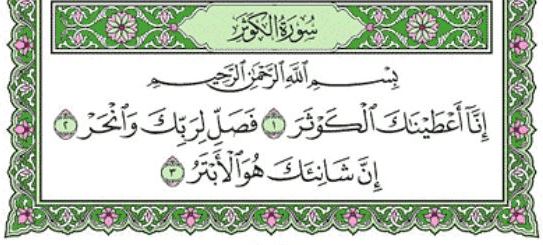
“Indeed, We have granted you, al-Kawthar. So pray to your Lord and sacrifice. Indeed, your enemy is the one cut off.” (Qur’an 108:1-3)
﷽
These sublime verses (Qur’an 108:1-3) were revealed to console the heart of the Blessed Prophet Muhammed (saw) in the face of repeated antagonism by those who called him, ‘abtar‘, which means ‘the animal whose tail is cut off’.
It means one who has no one to come in succession, the one who has none to inherit.
1. Truly, We have granted you Al-Kawthar.)
2. Therefore, turn in prayer to your Lord and sacrifice.)
3. For he who hates you, he will be cut off.)
Muslim, Abu Dawud, and An-Nasa’i, all recorded from Anas that he said, “While we were with the Messenger of Allah in the Masjid, he dozed off into a slumber. Then he lifted his head smiling. We said, `O Messenger of Allah! What has caused you to laugh?’ He said,
(Truly, a Surah was just revealed to me.) Then he recited…
“Indeed, We have granted you, al-Kawthar. So pray to your Lord and sacrifice. Indeed, your enemy is the one cut off.” (Qur’an 108:1-3)
The Blessed Prophet (saw) had lost his flesh and blood son Ibrahim — May Allah have abundant mercy on him.
“When Ibrahim, the son of the Messenger of Allah (saw), died, the Messenger of Allah (saw) wept. The one who was consoling him, either Abu Bakr or ‘Umar, said to him: ‘You are indeed the best of those who glorify Allah with what is due to him.’ The Messenger of Allah (saw) said: ‘The eye weeps and the heart grieves, but we do not say anything that angers the Lord. Were it not that death is something that inevitably comes to all, and that the latter will surely join the former, then we would have been more than we are, verily we grieve for you.’”
We can see that the Blessed Messenger (saw) was overcome with grief from the death of his flesh and blood son. It was a cause of derision from his enemies. Yet, Allah (swt) revealed an entire chapter of the Qur’an on account of this.
“And We will surely test you with something of fear and hunger and a loss of wealth and lives and fruits, but give good news to the patient,
Who, when disaster strikes them, say, “Indeed we belong to Allah, and indeed to Him, we will return.“ (Qur’an 2:155-156)
So this is the attitude of the believers and who best to lead by example than the Blessed Messenger (saw). He expressed grief over the loss of his flesh and blood son. Allah (swt) revealed an entire chapter of the Qur’an which, He did not do for the death of anyone else in the Blessed Prophet’s family.
Furthermore…
Narrated Al-Mughira bin Shu`ba:
“On the day of Ibrahim’s death, the sun eclipsed, and the people said that the eclipse was due to the death of Ibrahim (the son of the Prophet). Allah’s Messenger (saw) said, “The sun and the moon are two signs among the signs of Allah. They do not eclipse because of someone’s death or life. So when you see them, invoke Allah and pray till the eclipse is clear.”
Now, if there was an occasion for the Muslims of this Ummah to mourn annually, it would certainly have been for the death of the Blessed Prophet’s son.
There is not a single hadith of the Blessed Prophet Muhammed (saw) proclaiming Hussain will be a martyr or that the Prophet (saw) cried because he was a martyr. Not one!
People commemorate the deaths of others because, in their hearts, it is politics and the stirring of emotions. Yet, the Blessed Prophet Muhammed (saw) son dies and our Noble Prophet (saw)cried and the whole Muslim Ummah has no day of grieving?
Now someone may retort, ‘There are millions of Hadiths. Have you read them all?’ It would be hubris to say that we have read them all.
However, what we can say is this. We can say that those who are more studied than us, more learned than us, more familiar with the traditions, and those who make political capital out of tragedy would have such hadith and utilize them.
The fact that they did not and still have not until this very day makes our case airtight.
Hadith from the Shi’a sources: (Update 8/31/2020) This is a typo. It is meant to say: Hadith that Shi’a relies on.
“Ummul Fadhl the daughter of al-Harith said that she entered on the Messenger of Allah (S) and she said: “Oh! Messenger of Allah, I had a strange dream last night. He said: And what is it? She said: It was difficult. He said: And what is it? She said: I saw, as if, a piece of your body was severed and was put in my lap! The Messenger of Allah (S) said: You saw well – Fatima will give birth, God willing, a boy so he will be in your lap. Then Fatima gave birth to al-Hussain (AS) and he was in my lap – just as the Messenger of Allah (S) said. So I entered one day on the Messenger of Allah (S) and put him in his lap, but I noticed that the eyes of the Messenger of Allah (S) were pouring tears! So I said: Oh! Prophet of Allah, my parents are your ransom, what is with you? He said: Gabriel (AS) came to me and informed me that my nation (ummah) will kill this son of mine.”
Source: (al-Mustadrak al-Sahih, al-Hafidh al-Hakim al-Nisapouri, v. 3, p. 176)
“Umm Salamah has said: “al-Hussain entered on the Prophet (S), while I was sitting at the door, so I saw in the hand of the Prophet (S) something he turned over while (Hussain) sleeping on his stomach. I said: Oh Messenger of Allah, I looked and saw you turning something over in your hand when the kid was sleeping on your stomach and your tears were pouring? He said: Gabriel came to me with the sand upon which he (Hussain) will be killed. And he informed me that my nation (umma) will kill him.”
Source: (al-Musannaf, al-Hafidh Abu Bakr bin abi Shaibah, v. 12.)
Prima Qur’an Comments:
Both of these hadiths are from sources that the Shi’i rely upon. Yet notice the following:
1 There is absolutely no mention that Hussain would die as a martyr. No mention at all.
2 That the Blessed Messenger (saw) cried upon information that a family member died would be a very human thing to do.
3 That the Blessed Messenger (saw) said that ‘my nation will kill him’.
The Blessed Messenger (saw) could have said, ‘renegades will kill him’. ‘He will be killed by unbelievers’ etc…..and He (saw) did not say that at all.
This is crucial when we consider the following:
Narrated `Aisha:
“Usama approached the Prophet (saw) on behalf of a woman (who had committed theft). The Prophet (saw) said, “The people before you were destroyed because they used to inflict legal punishments on the poor and forgive the rich. By Him in Whose Hand my soul is! If Fatima (the daughter of the Prophet) did that (i.e. stole), I would cut off her hand.”
So even if the mother of Hussain, the wife of Ali, stole something, the law would apply to her. This is important because there is no unequivocal statement from the Blessed Messenger (saw) stating that Hussain would die as a martyr.
Now imagine that noble Fatima (ra) did steal something. You don’t think it would grieve the Blessed Messenger (saw)?
Wouldn’t you as a parent be grieved if your child or grandchild was injured or punished? Even if they did something right or wrong?
How do we know that the Blessed Messenger (saw) wasn’t crying over the fact that Hussain brought women and children into a conflict where he was advised by senior companions not to do so?
What does it say about the character of Hussain if what we are told is true? That he ‘knowingly‘ knew that he would be ‘sacrificed?’ That he would ‘knowingly‘ sacrifice the honour of his noble sister Zaynab (ra) as well?
“He (saw) said: Gabriel came to me with the sand.”
If Gabriel could bring the sand, he could have brought an item of Hussain clothing. He could have brought anything. Yet, he brought the sand. The sand where many children and women were unnecessarily killed. Ill-advised indeed.
Hadith from the Sunni sources:
“Narrated Wakee’, narrated Abdullah bin Sa’eed, from his father from Aisha or Umm Salamah [Wakee’ said this doubt came from Abdullah bin Sa’eed] that the Prophet (saw) said to one of them [either Aisha or Umm Salamah], “An angel entered the house on me, he never entered on me before, and he said to me, ‘this son of yours, al-Hussain, will be killed, and if you wish I can show you the soil from the earth where he will be killed’. Then he took out some red soil”.
Source:[Recorded in Musnad al-Imam Ahmad, vol. 6 p. 294]
“Narrated Muhammed bin Udaid, narrated Shurahbil bin Mudrik, from Abdullah bin Nujayy, from his father, that he traveled with Ali, and he used to carry his purifying water. When they were next to Nainawa on his way to Siffin, Ali called, “Be patient Oh Abu Abdillah (the kunya of his son al-Hussain), be patient Oh Abu Abdillah by the banks of the Euphrates. I [Nujayy] said, “what is this?”. He [Ali] said, “I entered upon the Prophet (saw) one day while his eyes were shedding tears. I said, ‘what is it with yours eyes shedding tears?’. He said, ‘Rather, Jibreel was here earlier and he told me that al-Hussain will be killed by the bank of the Euphrates and he [Jibreel] said ‘do you want me to provide you a sample from his soil [where he will be killed] so you can smell it?’ and I said ‘yes’. So he extended his hand and he took a grip from the soil and gave it to me so I couldn’t help my eyes to fill with tears’”
Source: [Recorded by Ahmad, vol. 1, p. 85.]
Prima Qur’an Comments:
What is interesting and indeed telling, is that the Shi’i -from what we observe love to jump on the chance to show that there are problems with Sunni narrations on this or that. They are quite the hadith critiques. However, when it comes to anything from Sunni sources that will make their claims legitimate, all the critical thinking skills seem to go right out the window.
The first hadith has an interesting statement: “An angel entered the house on me, he never entered on me before, ” An unknown angel apparently comes to give the information.
The other odd contradictory piece of information is this.
That he traveled with Ali,
They were next to Nainawa on his way to Siffin,
Entered the house on me
So did the angel give this information when they were traveling on the way to Siffin or while the Blessed Messenger(saw) was in his house? It is quite redundant to bring the same information. Three of the hadith feel it is important to mention the sand, and one of them leaves it out completely.
Who entered in on the Blessed Messenger (saw)?
Ummul Fadhl?
Ali Ibn Abu Talib?
Umm Salamah?
Aisha?
We can reconcile this because Aisha and Umm Salamah are both wives of the Blessed Messenger (saw). Ummul Fadhl is a paternal Aunt. Ali Ibn Abu Talib, of course, is a cousin and son-in-law. So it is reasonable that they all entered in on different occasions. However, it is not reasonable to think these were separate locations and days. So, one can search the history and see if there are records of the four of them traveling together at that location. Which can’t be true as one of the narrations has it that the unidentified angel came to the Blessed Messenger (saw) while he was at home.
One thing is abundantly clear from the two Hadith from Sunni sources. There is absolutely no mention that Hussain would die as a martyr. No mention at all.
The conclusion?
People commemorate the deaths of others because, in their hearts, it is politics and the stirring of emotions. Yet, the Blessed Prophet Muhammed (saw) son dies and our Noble Prophet (saw) cried, and the whole Muslim Ummah has no day of grieving?
The text of the hadith themselves raise questions and none of them unequivocally say that Hussain died as a martyr. There was one individual who tried to interact with this article some time ago on Facebook. That individual was shutdown. He did not interact with the material at all. Simply used emotionalism.








 Prima Quran