“O you who have believed, fear Allah, and speak words of appropriate justice.” (Qur’an 33:70)
﷽
We find the “Hafs Qur’an Only”Religion to be intellectually bankrupt.
Beyond the idea of saying that ‘I bear witness that Muhammed is the Messenger of Allah’ upon entering Islam, or saying Salawat upon the Blessed Messenger (saw) to be acts of shirk—or association of partners with Allah (swt), they really have little more to offer in theology.
We find no attempt at all to discuss theological issues about the attributes of Allah in any meaningful way.
No discussion on issues like free will and determinism, no discussion on whether we see Allah in the hereafter, rather souls remain in hell or are released, rather Allah is divinely simplistic in being or unity, rather the Qur’an is created or uncreated, rather than who or what creates actions, nor any meaningful definition of the sifat of Allah (swt).
Just rail against Hadith. It is all they can bring to the table as to the rest….good luck!
As regards the Quraniyoon.
We can’t think of a greater diabolical system for the systematic dismantling of Islam.
We are talking about communal worship and communal bonding and the masjid as a place of khutbah calling for social justice. Erased.
At what point is this platform not a sting or intelligence operation to dismantle islam as a political and ideological source that challenges western hegemony?
Look how fragmented Protestant churches are.
But imagine now, we don’t even have a church. Just private study circles that splinter into another private study circle. You are left with your translation of the Qur’an and your own individual speculations.
The claim they make is that the Qur’an is sufficient and clear, yet we keep seeing YouTube videos of them popping up wanting to explain Allah’s kitab and in the process refute other Qur’an only views.
The Arabic language itself becomes the ultimate arbiter of truth and not the Qur’an.
Allah doesn’t need a book, he can give direct gnosis.
What is the degree of fluency that you need before you start telling people what Allah is and is not saying based upon your personal speculation?
Look at all other faith traditions; Buddhism, Hinduism, Judaism, Christianity, etc….
Why is it they all have structure, ritual and suddenly these people want to come along and dismantle it?
The success of that movement = handing over the so-called third world over to complete dominion of the West.
At the end of the day, this movement turns the Qur’an into a simple self-help book. You could find it in the same section as a book with the title ‘a road to a better you.’
In fact, one of them mentioned recently that you don’t even need the Qur’an! The Qur’an is just a shortcut!
Nor have we seen among those who follow the Hafs Qur’an Only Religion any meaningful attempt to engage in theological issues.
Yet the only thing that the adherents of the “Hafs Qur’an Only Religion” can offer is constant railing against Hadith literature.
We have a feeling that many of these people (at least those we met) are well-educated but don’t really have insight and wisdom. It is possible that many of them were exposed to the very heavy-handed tactics of traditional Muslims. It would make anyone want to run away from it all.
The fact that many of the adherents of the “Hafs Qur’an Only Religion” rely heavily upon orientalist writings is very telling.
When we announced what our intentions were for this blog, a Quraniyoon follower approached us. She was (is) a level-headed woman. Her husband is of Pakistani origin. They raise money for charitable causes… and work with NGOs.
Her husband was quite excited to learn that we put emphasis upon the Qur’an.
Yet, he was unable to answer questions about the textual history of Islam, that the concept of the number (19) MIGHT work for certain qir’aat of the Qur’an, but not for others.
That we can’t even speak about “over it are 19” until we have established that the basmallah is indeed a verse over every surah of the Qur’an.
How do we do that?!!
Submission.org has appealed to extra-Qur’anic material to prove their claims.
We respected their identity, but we parted ways, telling the husband (who got easily irritated) that we did not believe in their ‘Hafs Qur’an only Religion.’
We turned down funding from this couple because we will not promote a cause that we don’t believe in nor do we find to be intellectually viable at all.
We have found that many among the ‘Hafs Qur’an only Religion’, for the most part, are as easily agitated, turned up, and unfocused as are many traditionalist Muslims.
So yes, the ‘Hafs Qur’an Only Religion’ may be a rallying cry for Muslims who have had it up to their neck with ‘traditionalists’.
Yet it is important for those Western Muslims, those in Turkey, Kuwait, Pakistan, India, Malaysia, Egypt, or anywhere else who are enamored with the ‘Hafs Qur’an Only Religion’ to understand just how intellectually bankrupt the position is. It’s just almost like they have these small support groups which become echo chambers for their ideas. All we ever see is railing against the hadith.
A movement that cannot interact with the compilation and transmission of the Qur’an in any meaningful way, nor a movement that interacts with the theological questions that have gripped the Muslim ummah is not a movement or position we would want to invest my trust in.
“Allah and His angels send blessings to the Prophet: O you that believe! Send blessings on him, and salute him with all respect.” (Qur’an 33:56)
﷽
What an honour it is that Allah, exalted and glorified above all else, has singled out his beloved Messenger (saw) to be singled out for praise and blessings. The one who’s very name means the praiseworthy!
This article is written to refute the extremist view of the (Hafs Qur’an only Religion) as well as others that believe that we as Muslims when we say: “ashadu an la ilaha illalah wa ashadu an muhammadur rasoolullah” (I bear witness that there is no God except God and I bear witness that Muhammed is the Messenger of God.) is a form of shirk!
For those who do not know, shirk is the most heinous sin in Islam. It is the association of partners with God.
Here are links to a website that espouses a view that is both extreme and unwarranted.
*Note* For some reason the link was not working. However, was able to retrieve it via the archives.
Muslims have handed down the tradition that when we enter into Islam we bear witness of foremost importance that there is only one God worthy of worship. We also bare witness that we accept as God’s Messenger, the one who brought his message.
“In which their prayer will be, “Glory be to You, O Allah!” and their greeting will be, “Peace!” and their closing prayer will be, “All praise (l-ḥamdu) is for Allah—Lord of all worlds!” (Qur’an 10:10)
Note that in the above verse it says that all the hamd (praise) is for Allah. Yet, Allah (swt) himself says the following:
“And from [part of] the night, pray with it as additional [worship] for you; it is expected that your Lord will resurrect you to a praised (maḥmūdan) station.” (Qur’an 17:79)
“And those who believe and do righteous deeds and believe in what has been sent down upon Muhammed – and it is the truth from their Lord – He will remove from them their misdeeds and amend their condition.” (Qur’an 47:2)
“And when Isa son of Marium said: O children of Israel! surely I am the messenger of Allah to you, verifying that which is before me of the Taurat and giving the good news of an Messenger who will come after me, his name being Ahmed, but when he came to them with clear arguments they said: This is clear magic.” (Qur’an 61:6)
Muhammed and Ahmed both derive from the Arabic root meaning “praise” (hamd). Muhammed means “the praised one,” while Ahmed means “the more/most praiseworthy”.
Root word: Both names come from the Arabic root word “ḥ-m-d,” which means “praise”. This root is found in phrases like “Al-hamdu lillah” (praise be to God).
Mahmud, Muhammed and Ahmed. All mean one worthy of praise, praiseworthy.
So we should not be concerned with followers of the Hafs Qur’an Only Religion come along and say that Muslims who say Tashahhud or Shahada are associating partners with Allah.
Mentioning another along Allah (swt) in our prayers or testification of faith is far from worshipping that person.
There are many places in the Qur’an where Allah is mentioned alongside the Noble Messenger (saw). There are also many places in the Qur’an where Allah is mentioned alongside his blessed angels.
“O you who have believed, fear Allah and give up what remains of interest if you should be believers. And if you do not, then be informed of war from Allah and His Messenger. But if you repent, you may have your principal – you do no wrong, nor are you wronged.” (Qur’an 2:278-279)
It would have been easy enough just to say ‘a war from Allah’.
“Indeed, those who disbelieve and die while they are disbelievers – upon them will be the curse of Allah and of the angels and the people, all together.” (Qur’an 2:161)
Again, it would have been enough to say the ‘curse of Allah’.
“Those – their repayment will be that upon them is the curse of Allah and the angels and the people, all together.” (Qur’an 3:87)
Again, it would have been sufficient to say ‘the curse of Allah’.
Those who annoy Allah and the Prophet, Allah curses them in this life and in the hereafter.” (Qur’an 33:57)
Annoying the Blessed Prophet (saw) is deserving of a curse just as if one were to annoy Allah (swt).
“He who obeys the Messenger has obeyed Allah; but those who turn away – We have not sent you over them as a guardian.” (Qur’an 4:80)
Here the Qur’an has compared obeying the Messenger to obeying Allah himself. Assuredly, this is more than sufficient proof testifying that the Blessed Prophet Muhammed (saw) is the Messenger of Allah is not idol worship. Such a notion is truly absurd, to say the least.
What did Rasul Allah (saw) think when Angel Gabriel (as) said:
”Indeed this, your religion, is one religion, and I am your Lord, so worship Me.” (Qur’an 21:92)
Was Gabriel (as) making ‘shirk’ when he said that?
Here is something else for people who hold such a view to think about.
“You alone do we worship; You alone do we ask for help.” (Qur’an 1:5)
So are we to understand that if one were to ask the doctor to cure our children, we are now associating partners with Allah?
If one were to hold a belief that if they were to pursue a university degree that it would somehow help their lot in life that this would be tantamount to an association of partners with Allah?
What is important for the person to realize is that the Creator is in control of all affairs. The Creator is Sovereign. If one were to believe that the doctor himself can cure their child, then yes, this is an association of partners with Allah. If one were to believe that the Blessed Prophet Muhammed (saw) can guide us independent of Allah, then yes, that is in error. If one were to believe that their university degree will, in and of itself, guarantee them a livelihood, then yes, this necessitates a dangerous position. If one believes that a knife can cut them independently of the power of Allah (swt), then yes, that is in error.
Adherents of the Qur’an only Religion do not think deeply about these things because their religion is theologically bankrupt.
However, if we believe that Allah has endowed the doctor with the ability to cure our child, and that Allah has blessed the Noble Muhammed (saw) with the ability to guide, and that our degree could increase our chances of getting employment by Allah’s grace, then this is the proper focus.
The focus, of course, should always be Allah (swt).
It is said that this world that we live in is also known as Darul Asbaab– a world of means.
Asbaab can mean ’cause’, ‘reason’.
So we live in a world of cause and effect.
When a Muslim does something kind to another Muslim, one will usually say to the other ‘JazakAllahu Khayran‘ (thanks be to God who gave the provision). If you were ignorant of this, you might say to a Muslim, ‘Thank you, brother’. The Muslim may respond, “Al hamdulilllah wa ShukrAllah” (All the praise be to Allah and Thanks to Allah). Notice that the praise and the thanks are deflected away from the person and directed to Allah.
However, if someone says ‘you’re welcome‘, it is not haram (forbidden) nor are they committing blasphemy. No one would assume that if a person said ‘you’re welcome‘ that they are making a claim to divinity.
The reason one says jazakAllahu Khayran to a person is that there is a recognition that Allah (swt) is giving you provision through this person.
Examples in the Qur’an of people making sujud -prostration to other than Allah.
“So he raised his parents upon the throne, and they bowed to him in prostration. And he said, “O my father, this is the explanation of my vision of before. My Lord has made it a reality. And he was certainly good to me when he took me out of prison and brought you here from bedouin life after Satan had induced estrangement between me and my brothers. Indeed, my Lord is Subtle in what He wills. Indeed, it is He who is the Knowing, the Wise.” (Qur’an 12:100)
“When Joseph said to his father: O my father. Lo. I saw in a dream eleven planets and the sun and the moon, I saw them prostrating themselves unto me.” (Qur’an 12:4)
Allah (swt) himself orders the prostration of all the angels and jinn to Adam.
“And when We said to the angels, “Prostrate to Adam,” and they prostrated, except for Iblees. He said, “Should I prostrate to one You created from clay?” (Qur’an 17:61)
Say, “Indeed, my prayer, my rites of sacrifice, my living and my dying are for Allah, Lord of the worlds.” (Qur’an 6:162)
After the Death of the Noble and Blessed Prophet (saw) Abu Bakr (ra) said this very eye opening statement:
Narrated `Aisha:
Abu Bakr came riding his horse from his dwelling place in As-Sunh. He got down from it, entered the Mosque and did not speak with anybody till he came to me and went direct to the Prophet, who was covered with a marked blanket. Abu Bakr uncovered his face. He knelt down and kissed him and then started weeping and said, “My father and my mother be sacrificed for you, O Allah’s Prophet! Allah will not combine two deaths on you. You have died the death which was written for you.” Narrated Abu Salama from Ibn `Abbas : Abu Bakr came out and `Umar , was addressing the people, and Abu Bakr told him to sit down but `Umar refused. Abu Bakr again told him to sit down but `Umar again refused. Then Abu Bakr recited the Tashah-hud (i.e. none has the right to be worshipped but Allah and Muhammed is Allah’s Messenger (saw)) and the people attended to Abu Bakr and left `Umar. Abu Bakr said, “Amma ba’du, whoever amongst you worshipped Muhammed, then Muhammed is dead, but whoever worshipped Allah, Allah is alive and will never die. Allah said: ‘Muhammed is no more than an Apostle and indeed (many) Apostles have passed away before him ..(up to the) grateful.’ ” (3.144) (The narrator added, “By Allah, it was as if the people never knew that Allah had revealed this verse before till Abu Bakr recited it and then whoever heard it, started reciting it.”)
“Abu Bakr said, “Amma ba’du, whoever amongst you worshipped Muhammad, then Muhammad is dead, but whoever worshipped Allah, Allah is alive and will never die.”
Subhan’Allah! That means that the love and devotion that the companions had for the Blessed and Noble Prophet (saw)…..bordered on….understand? It bordered on…but it did not exceed! It did not cross that threshold!
“And woe, that day, to those that reject the truth! Then in what hadith, after this, will they believe?” (Qur’an 77:49-50)
﷽
“And woe, that day, to those that reject the truth! Then in what hadith, after this, will they believe?” (Qur’an 77:49-50)
This is certainly their pre-eminent verse. It is a mega verse verse among all the Quranist.
Many people who believe in the ‘Hafs Qur’an Only Religion’ will often advance this particular verse of the Qur’an to advance their position.
Here is an interesting argument put forward by Dr. Jeffery Lang, one of the greatest Muslim minds of our age.
“It is doubtful that hadith in these passages refers to the narratives relating to the deeds and utterances of the Prophet. In the first place, it came to have this restricted meaning in Islamic scholarship well after his lifetime. Secondly, it is inconceivable that while the Prophet was alive his enemies preferred his hadith to the Qur’an or were promoting them in an effort to undermine his mission. Instead, hadith must carry here one of its more common connotations, such as speech, chitchat, conversation, prattle, gossip, tales, report, or account.”
Source: (pg. 174 “Losing My Religion: A Call for Help-Jeffery Lang”)
There are two points to be gleaned from this.
a) In the first place, it came to have this restricted meaning in Islamic scholarship well after his lifetime.
This is true, and Dr. Jeffery Lang has an irrefutable point here.
b). Secondly, it is inconceivable that while the Prophet was alive his enemies preferred his hadith to the Qur’an or were promoting them in an effort to undermine his mission.
This is also an excellent point! Why on earth would the enemies of the Blessed Messenger (saw) use his hadith over the Qur’an? In fact, why would they use his oral narrations at all?
So let us break this verse down:
“And woe, that day, to the rejectors of truth!” -This statement is talking about those who are rejecting the Qur’an. It is directed towards an immediate target audience, towards a future impending doom.
That is why the adherents of the Quran Only Religion are at a loss to try to use this statement as a reference to those who use hadith. You can shut them down every single time.
Jeffery Lang (May Allah have abundant mercy on him).
“Proclaim! (or read!) in the name of thy Lord and the One whom Cherishes, Who created” (Qur’an 96:1)
﷽
We have seen this issue raised by Christians repeatedly. We have also remembered Dr. Anis Shorrosh using it in his debate with Dr. Jamal Badawi. Debate: (Qur’an word of God or word of Muhammed?)
It is one of the reasons why we choose the Yusuf Ali translation above.
One could ask: what was God thinking?
You are approaching a man that is obviously illiterate, and you’re asking him to read, again and again….and yet again.
However, the narrative shows that the term ‘Iqra‘ can mean read (as from a book) or recite, or repeat (as in a repetition).
What we find fascinating is that the account of the Blessed Messenger (saw) and his receiving of the revelation are not found in the Qur’an. Rather, it is found in secondary sources. We think this is very profound.
In the Bible, we would read the historical bits, get some revelation as well as the thoughts of the narrators all mixed in together.
The very fact that the Qur’an does not have a detailed narrative of how the Blessed Messenger (saw) received the revelation speaks well for the Prophet (saw), the Qur’an, and the veracity of Islam.
In fact, it is one of the most remarkable things for us. Because we never hear in the Bible what that was like. What is that moment like when you encounter the divine? What is it like to know that you are being appointed as a Prophet of God? What is your mental state? How does that feel?
That has to be indescribable beyond words! Powerful!
In the Bible, we are just given the impression that one day the Holy Spirit moved Matthew to write, so he picked up his pen and off he went. Not really inspiring. Rather lackluster for a divine encounter.
“So if you are in doubt, [O Muhammed], about that which We have revealed to you, then ask those who have been reading the Scripture before you. The truth has certainly come to you from your Lord, so never be among the doubters.” (Qur’an 10:94)
Question: If Muhammed (saw) were in the habit of reading and writing, he wouldn’t need to ask the people of the book anything. He could simply go to their text for verification.
Now, this is, of course, assuming that they had their text with them.
However, the interesting thing about this passage is asking the Blessed Messenger (saw) to verify the truth outside the Qur’an or at the very least corroborate with what the divine directive was, by checking outside references.
No doubt those who follow the ‘Qur’an Only Religion’ would like to dismiss the dominant narrative for two reasons.
Our colleague was in an exchange with Dr. Shabbir Ahmed, @ our Beacon http://www.galaxydastak.com refuting the points he made that the Blessed Messenger (saw) was the one who wrote the Qur’an. Needless to say, he was banned from the forum for ‘not participating in the project’.
He was initially invited there by a friend and former teacher, Hamza Abdulmalik from IPCI. He believes his former teacher was testing the waters before he decided to leave Islam for the “Qur’an Only Religion“.
The two reasons that ‘Qur’an Only Religion’ would want to reject the dominant narrative are these:
The very first word ‘iqra‘ suggests that the Qur’an is composed in a language that has depth, nuances, clarity, and ambiguity. This takes the wind out of one of their sails. Namely, that the Qur’an is clear; which usually means “Agree with our interpretation.”
The very first word ‘iqra’ also suggests that the Qur’an would be transmitted through both written and oral means. The idea that the Qur’an would be transmitted orally is problematic to those who castigate oral transmission in its entirety.
Understand that point 2. above is their sole reason for making the claim that the Blessed Prophet (saw) wrote the Qur’an. It is because they do not like the idea of the Qur’an being preserved through oral transmission.
This might cause other uncomfortable thoughts like: “What else may be preserved through oral transmission?“
The “Qur’an Only Religion” does not like the historical narrative that has been passed down to us about how the Blessed Messenger (saw) received the revelation.
Let us see if their perspective holds true.
“Read in the name of your Lord Who created. He created man from a clot. Read and your Lord is Most Honorable,” (Qur’an 96:1-3)
If the Blessed Messenger (saw) is being asked to ‘read‘ rather than recite/repeat, where is this text at?
In other words, whoever is telling Muhammed (saw) to read, what exactly is he being asked to read? Is it a divine template? Is this an ethereal revelation that is appearing like a holographic image?
Wouldn’t it make sense to say, ‘write‘?
So let us deal with the next point.
“Who taught (to write) with the pen. Taught man what he knew not.” (Qur’an 96:4-5)
So the “Qur’an Only Religion” will say, “How can Muhammed be taught by the PEN if he cannot write?“
However, this assumes two things.
That this verse does not generally address the gift of literacy, which is a blessing from Allah (swt).
That Muhammed (saw) is the one being addressed here. After all, the verse does say, taught man (plural)…
. To suggest that the above verse is imperative. Meaning that Allah (swt) has taught every person to read that would be incorrect. Vast swathes of humanity still cannot read. The proliferation of literacy is a modern phenomenon.
“In honored sheets, exalted and purified, In the hands of scribes noble, virtuous.” (Qur’an 80:13-16)
It would have been a perfect occasion to say, “I will teach you the use of the pen, or I will teach you that which you know not.”
In fact, we never get an example of the Blessed Messenger (saw) reading the Qur’an to anyone. However, we do have examples of him reciting it.
“A messenger from Allah, reciting pure pages.” (Qur’an 98:2)
“Move not thy tongue concerning the (Qur’an) to make haste therewith. It is for Us to collect it and promulgate it; but when We have promulgated it, follow thou its recital’ (Qur’an 75: 16-19).
Why not ‘move not thy eyes‘ concerning the Qur’an?
Why not ‘move not thy pen‘ concerning the Qur’an?
It is interesting to note here that the Blessed Messenger (saw) was told to not be hasty in his recitation; nothing about ‘move not thy pen‘ concerning the Qur’an.
Now we are going to use a translation of the Qur’an that we think is one of the worst possible. Interestingly enough, this translation gets as close as is grammatically possible to supporting the proposition that the Blessed Messenger (saw) wrote the Qur’an.
So we are going to use a translation that actually favours our interlocutors (Qu’ran only Religion) in this regard.
“Neither did you (O Muhammed SAW) read any book before it (this Quran), nor did you write any book (whatsoever) with your right hand. In that case, indeed, the followers of falsehood might have doubted.” (Qur’an 29:48) – Muhsin Khan translation.
We would encourage the readers to see how this verse is translated from disparate translations from translators with disparate theological backgrounds etc…
The reason we chose the ‘Muhsin Khan’ translation above; is because it can give the impression that Muhammed (saw) didn’t read any book before the Qur’an; meaning he can now! Nor has he (saw) written any book (until now!!)…
So let us put our focus on the second part of this verse…
“In that case, indeed, the followers of falsehood might have doubted.”
Let us say that for the sake of argument we take the understanding of those who claim the Blessed Prophet (saw) wrote the Qur’an. Meaning that, suddenly, Muhammed (saw) is now able to read and write.
How does that alleviate the doubt of unbelievers?
It seems the argument being made is that “Haha, you can’t doubt that the Qur’an is a product of Muhammed because he can read and write, and therefore wrote it!
Erm…….. (stares off blankly into space)….. are we missing something here?
What argument is that? Seriously?
We would encourage anyone to carefully read how “Qur’an Only Religion” will posture in regard to the above verse. They half quote it.
Let us look at some of their other claims.
“Moreover, they say, “Legends of the former peoples which he has written, and they are dictated to him morning and afternoon.” (Qur’an 25:5)
We actually found this argument to be very desperate. The fact that (unbelievers) alleged that the Blessed Messenger (saw) wrote down the Qur’an is now proof that he actually did write the Qur’an?
This is a specious argument for anyone who is intellectually honest.
“We know indeed that they say, “It is a man that teaches him.” The tongue of him they wickedly point to is notably foreign, while this is Arabic, pure and clear.” (Qur’an 16:103)
“Moreover, the Unbelievers would almost trip you up with their eyes when they hear the Message; and they say: “Surely he is possessed!” (Qur’an 68:51)
Let’s stop for a moment on this above claim. The claim that ‘he is possessed.’
This is a very fascinating and insightful claim against our Blessed Prophet (saw). The unbelievers ascribed to the Qur’an a supra natural origin. They were just not ready to say that it came from Allah. However, the fact that even they ascribed to it a supra natural origin is quite powerful.
Let us follow the fuzzy logic given to us by these people who claim that the Blessed Messenger (saw) could read and write the Qur’an.
So here it is:
Just because the (unbelievers) charged Muhammed (saw) with writing the Qur’an, does it also follow that a man taught him the Qur’an?
Just because the (unbelievers) charged Muhammed (saw) that he was possessed means that it is true?
So those people who make such claims would do well to remember it was non-Muslims who charged that the Prophet Muhammed (saw) wrote the Qur’an.
The first claim that the Blessed Messenger (saw) wrote the Qur’an came from (unbelievers). That is the company that followers of the ‘Quran Only‘ religion are in; not the company we would like to be in.
Another text they would use.
“And if he had invented false sayings concerning Us We surely should have seized him by his right hand (or with power and might), And then severed his life-artery.” (Qur’an 69:44-46)
There is certainly a lot to be desired in this translation.
Invented is taqawwala -this should have been translated as spoken
So this should read: “And if he had spoken some sayings over Us, We surely should have...”
seized him –la-akhadhna-can be translated as to take or to seize or to call to account.
his right hand-bil-yamini-can be translated as hand or oath.
So this should read: “And if he had spoken some sayings over Us, We surely should have seized him with power and might.”
Alternatively, it could read: “And if he had spoken some sayings over Us, We surely would have called him to account for his oath.”
The first part is how we understand the second part. If someone is speaking and saying it would make sense to say, ‘we seize him by his tongue.’
That is why that argument put forward by the ‘Hafs Qur’an Only Religion’ is easily dismissed. When someone is speaking lies, why is the attention directed towards the hand?
So let us take their understanding and translate it the way they want to: “We surely should have seized him by his right hand.”
Why doesn’t the text before it say:
“So if he had written false sayings concerning Us.”
“Had he uttered any other teachings.”-Rashad Khilafa
“Also, had he attributed anything falsely to Us.”-The Monotheist Group.
In fact, the only person trying to be sly among the Quraniyoon in their translation is Shabir Ahmed
“So if he had ascribed his sayings unto Us.” -Shabir Ahmed
Why handle the Qur’an in such a false manner? Why the deception? What is the agenda here?
Was the Qur’an only revealed to those who were literate? Even today, there are vast areas of the world where people cannot read and write. What of the situation in the past? What was the situation of slaves, farmers, and people from other trades?
How was a textual Qur’an distributed to all of these people? If that is the case, why is there a dearth of written Qur’anic material from the early period?
“However, if they turn away, you are responsible only for conveying the message clearly.” (Qur’an 16:82)
If the Blessed Messenger (saw) was writing the Qur’anand the Qur’an is clear, there would be no need for him to explain anything to anyone. He would simply tell them to refer to the book itself! Better yet to their own written copies, parchments, etc. I think we know better.
We think the idea that the Blessed Messenger (saw) wrote the Qur’an is both intellectually lazy and the result of wanting to skirt around the issue of the preservation through oral transmission of the Qur’an.
We think that issues are nuanced, and sometimes a little more academically challenging than we are ready to admit. Some answers are simply not microwavable.
Something else we want to point out. Was it possible that the Blessed Messenger (saw) learned to recognize and understand some words in the Arabic script over time? Of course!
When our colleague was the Executive Docent Officer at the Singapore Sultan Mosque and leading the ATMT (Awareness Through Mosque Tour) program, they used to have fun showing copies of the Qur’an to curious non-Muslims.
They would open a page of the Qur’an that had many usages of the word ‘Allah‘ in Arabic. They would point out the word. They would then ask them to find that word anywhere on the two pages. They did without fail! They asked them to read that word, and they said, ‘Allah’!
For example, they have highlighted the word ‘Allah’ in the Arabic text below. See if you can find at least 3 other examples of it.
This was a great interactive experience for our colleague and them. Our point here is that it’s possible that the Blessed Messenger (saw) was able to recognize words (after all they are simply symbols) and say or repeat what they mean.
“Neither did you (O Muhammed SAW) read any book before it (this Quran), nor did you write any book (whatsoever) with your right hand. If that was the case, indeed, the followers of falsehood might have doubted.” (Qur’an 29:48)
“And who is more unjust than one who invents a lie about Allah or denies His verses? Indeed, the wrongdoers will not succeed.” (Qur’an 6:21)
﷽
Now one thing you will immediately notice when dealing with the hafs Qur’an only religion is that most of them do not even speak Arabic. Most of them try and appeal to converts (who have very poor or weak Arabic). They have a reason for doing this, because they prey upon the fact that you do not understand the Arabic and thus, are able to manipulate what the text says.
A prime example is their manipulation of this verse:
“We did not leave anything out of this book.” (Qur’an 6:38)
Now, as this website is directed primarily to an English-speaking audience, let us ask you this.
You will note that ‘The Monotheist Group’ -a quranist translation has rendered the Arabic as:
“And there is not a creature on the earth, nor a bird that flies with its wings, except they belong to nations like you belong. We did not leave anything out of the record; then to their Lord they will be gathered.” (Qur’an 6:38)
The verse in full actually states:
“All the creatures on earth, and all the birds that fly with wings, are communities like you. We did not leave anything out of this book. To their Lord, all these creatures will be summoned.” (Qur’an 6:38)
Is there a difference between saying:
“We did not leave anything out of this book.” and
“We did not leave anything out of the book.”
If one were to say ‘the book‘, then this is vague. What book are we actually referring to? If we say ‘this book‘, then we are referring to a book that is actually with me.
The Arabic word used here is l-kitabi. L-kitabi need not necessarily be a reference to the Qur’an at all.
It is the same word that is used in the following verses:
“And there followed them successors who inherited the book, taking the commodities of this lower life and saying, “It will be forgiven for us.” And if an offer like it comes to them, they will take it. Was not the covenant of the book taken from them that they would not say about Allah except the truth, and they studied what was in it? And the home of the Hereafter is better for those who fear Allah, so will you not use reason?” (Qur’an 7:169)
It is very obvious that l-kitabi is not a reference to the Qur’an in the above text.
“And We conveyed to the Children of Israel in the book that, “You will surely cause corruption on the earth twice, and you will surely reach haughtiness.” (Qur’an 17:4)
It is very obvious that l-kitabi is not a reference to the Qur’an in the above text as it was sent down to the Blessed Prophet Muhammed (saw).
“And do not argue with the People of the book except in a way that is best, except for those who commit injustice among them, and say, “We believe in that which has been revealed to us and revealed to you. And our Allah and your Allah is one; and we are Muslims to Him.” (Qur’an 29:46)
It is very obvious that l-kitabi is not a reference to the Qur’an in the above verse.
“Have you not considered those who practice hypocrisy, saying to their brothers who have disbelieved among the People of the Book, “If you are expelled, we will surely leave with you, and we will not obey, in regard to you, anyone – ever; and if you are fought, we will surely aid you.” But Allah testifies that they are liars.” (Qu’ran 59:11)
Can you imagine Allah (swt) calling (ahli Qur’an) people of the Qur’an liars? Obviously, l-kitabi above is not a reference to the Qur’an.
Indeed, they who disbelieved among the People of the book and the polytheist will be in the fire of Hell, abiding eternally therein. Those are the worst of creatures.” (Qur’an 98:6)
Can you imagine Allah (swt) saying those who disbelieve among the (ahli Qur’an) will be with the polytheists in hell forever? It is obvious that l-kitabi above is not a reference to the Qur’an.
The logical contradiction.
“We did not leave anything out of this book.” (Qur’an 6:38)
In order for this verse to be true in the way that those who follow the Qur’an only religion would have us to believe, this verse would have to be the last verse revealed in the Qur’an. If any other verses come after it, this entails a logical and absolutely devastating blow to their position.
The Qur’an was not sent down all at once.
“And those who disbelieve say: Why is not the Quran revealed to him all at once? Thus, that We may strengthen your heart thereby. And We have revealed it to you gradually, in stages.” (Qur’an 25:32)
Also, if they don’t know the last verse of the Qur’an to be revealed that is also a logical and devastating blow to the way they understand the verse. Because it means that what was revealed first and last has been left out of the Qur’an! This is important for their argument.
Allah (swt) has clearly told us that he has not included everything in the Qur’an.
“And messengers, We have mentioned unto you before, and messengers, We have not mentioned unto you; and Allah spoke directly to Moses.” (Qur’an 4:164)
So how exactly do we understand this verse in a way that is consistent with not only logic but with the Qur’an itself?
“And the book will be placed open, and you will see the criminals fearful of that within it, and they will say, “Oh, woe to us! What is this book that leaves nothing small or great except that it has enumerated it?” And they will find what they did present before them. And your Lord does injustice to no one.” (Qur’an 18:49)
Are we really to understand this to mean: “So as for he who is given the Qur’an in his right hand, he will say, “Here, read my Qur’an!” No. That is ridiculous.
It is very obvious that l-kitabi (this book) above is not a referee to the Qur’an at all. Rather, it is a reference to the book that contains each and every single act that we have done. The Qur’an, for example, obviously does not contain each and every evil small or great that humans have done.
So as for he who is given his book in his right hand, he will say, “Here, read my book! (Qur’an 69:19)
“But as for he who is given his book behind his back.” (Qur’an 84:10)
Are we really to understand this as “But as for he who is given his Qur’an behind his back?”
It is best if we understand (Qur’an 6:38) in light of a verse that will help bring clarity to the confusion of those who follow the myriad of sects of the Qur’an Only Religion.
It is crystal clear that the above text is a reference to the book of deeds. The verse is talking about disbelievers on the day of judgement.
If only they were guided to reflect upon the following verse:
“There is no creature on earth whose sustenance is not undertaken by Allah. He knows where it lives and where it rests. Everything is in a Book that is clear.” (Qur’an 11:6)
It should be more than obvious that both the verses above refer to some celestial register where the minutia of all things are kept, and not to the Qur’an.
Prima Qur’an Conclusion:
The verse (Qur’an 6:38) itself does not indicate if it is talking about the Qur’an or not.
There is no way out of this airtight argument from an intra-Qura’n perspective. Accept that the verses mentioned above are talking about the book of deeds that is with Allah (swt).
The followers of the Qur’an Only Religion don’t want to accept this because it completely nukes one of their central talking points. It takes a talking point away from them that they use to scam the masses.
Dear readers, those people who follow the Qur’an only religion more often than not have very poor and weak knowledge of the Arabic language. Many of them can barely speak it, if at all. You do not see them offering to recite to you the Qur’an in Arabic, with proper recitation. The level of understanding of Arabic among them is quite atrocious. This is not to be mean; however, to be brutally honest. This is why they rely upon such very weak arguments to present their case.
“We sent them with clear proofs and the Zabur. And we revealed to you the message that you may make clear to mankind what was sent down to them and that they might give thought.” (Qur’an 16:44)
﷽
This section will be on engaging the Pseudo-Islamic.
In particular this section of the blog will have all articles related to two Pseudo-Islamic movements.
The first being the Hafs Qur’an Only Religion.
THE HAFS QUR’AN ONLY RELIGION
It is important to understand that we believe that the adherents of the Hafs Qur’an only movement are a distinct religion in much as we respect the way the Baha’i movement is a distinct religion from Islam.
Insh’Allah this section will deal with common arguments among the federation of sects that are known collectively as the ‘Qur’anist’.
This section will be refuting their many bold assertions; as well as showing why this particular attempt to re-interpret Islam and make it altogether different religion is deeply flawed.
Now why are they called the Hafs Qur’an only view? These people will either out of ignorance about the transmission and textual history of the Qur’an refer to their platform as ‘Qur’an Only’ or Quraniyoon. However, the Hafs Qur’an did not fall out of the sky. Thus, is important for them to reflect on why so much foundational trust is put into the men that transmittedthe Hafs Qur’an to the exclusion of all other transmissions of the Qur’an.
At the core of this religion of theirs is a massive epistemological problem.
In regard to approving comments from followers of the Hafs Qur’an Only Religion we have taken seriously the verse of the Qur’an: “And cooperate in righteousness and piety, but do not cooperate in sin and aggression. And fear Allah ; indeed, Allah is severe in penalty.” (Qur’an 5:2)
Thus, they would do well to read the article listed below: Is the Qur’an a detailed explanation of all things? to understand the policy on this website that keeps them as well as us from sinning and keeps them consistent with in their worldview. Insh’Allah.
THE QADIANI MOVEMENT Also known as AHMADIYYA MOVEMENT is a divided movement, split into two competing jama’at or congregations. That is the LAHORI whom we refer to as The Ahmadiyya A and the QADIANI whom we refer to as the Ahmadiyya B.
As the Qadiani or Ahmadiyyah B believe that Mirza Ghulam Ahmad is a Prophet after The Blessed Prophet Muhammed (saw), they have been marked as being outside the millat of Islam. Likewise, they (the Ahmadiyyah B) or Qadiani have made anyone outside of their jama’at to be kafirs. Though, their is some tongue in cheek wordplay see their website. Source: (https://www.alislam.org/articles/are-non-ahmadis-muslim-or-non-muslim-ahmadiyya-muslim-perspective/)
To the dismay of the Muslim Ummah, The Qadiani have a Khalifa, named MIrza Masroor Ahmed, he lives in Tilford, United Kingdom, where he pays taxes to the United Kingdom. Abu Bakr, Umar, Uthman and Ali were not known to have paid taxes to a Non Muslim government.
For future reference all articles addressed to either of the above movements will be found under: AHL AL-QIBLA / AHL AL-KHILAF under: Engaging with the Pseudo-Islamic:
Refutation that oral traditions came 300 years after the Prophet.
Even though they used to say that the hadith -oral traditions came some 300 years after the Blessed Messenger (saw). Praise be to Allah the more educated among them have backed away from that claim. However, this article is here because many in that movement may be unaware.
See Harold Motzki (a Non-Muslim orientalist and academic) who made short work of that Quranist claim
Does the Qur’an itself tell us to reject all hadith?
This article is a nail in the coffin for the entire movement. Some from their movement have commented but ended up leaving in frustration. It looks at their arguments and misquotations of the Qur’an. Also given in this article is an irrefutable example of Allah confirming a hadith to the Blessed Messenger [saw].
Did the Blessed Prophet Muhammed (saw) write the Qur’an?
Our colleague had written a refutation like this many years ago on the ‘Qur’an only‘ web site known as http://www.ourbeacon.com/ or it used to be known as ‘GalaxyDastak‘. Dr. Shabbir Ahmed founder of the forum had me banned. This was also the last our colleague heard from their former teacher Hamza AbdulMalik. Hamza AbdulMalik used to be the director of IPCI international until he dropped off the radar and re-emerged as a Quranist.
Well, our colleague may have been removed from the forum but here is the refutation of their arguments for all to see here:
A pre-eminent argument used by ‘Quranist’ ripped to shreds By Dr. Jeffery Lang.
The most oft-quoted verse used by Quranist is analyzed and ripped apart by a Muslim convert, academic, and professor of math, Dr. Jeffery Lang.
This is a centerpiece argument used by Edip Yuksel, Sam Gerrans, “Joseph Islam”, Rashad Khilafa, Shabir Ahmed and the lot of them. The reason why this argument is especially devastating coming from someone like Dr. Jeffry Lang is that Dr. Lang is critical of the hadith corpus as we have it today.
The following is a look how Quranist have both misunderstood the word hikma as a reference to the Qur’an and how they do not understand that it is something that Allah gives his messengers to deal with situations and context not immediately addressed by the revelations they were given.
Hating a hadith just for the sake of hating a hadith.
This article a hypothetical question is posed. What if a particular ahad hadith turned out to be correct? Especially one that is of a scientific nature? What would the Quranist do in such a scenario?
Salaat in the Qur’an is not ritual prayer? Examining the claim of some Quranist.
This article looks at one Quranist claim that salat is not ritual prayer. This is what happens when you abandon the understanding of the Blessed Messenger and follow the ‘every man for himself’ approach of the Quranist.
“Verily, in the messenger of Allah, you have a good example for him who looks unto Allah and the Last Day and remembers Allah much.” (Qur’an 33: 21)
﷽
“The believers are only the ones who have believed in Allah and His Messenger and then doubt not but strive with their properties and their lives in the cause of Allah. It is those who are truthful.” (Qur’an 49:15)
“When the Prophet disclosed a hadith in confidence to one of his consorts, and she then divulged it (to another), and Allah made it known to him, he confirmed part thereof and repudiated a part. Then, when he told her thereof, she said, “Who told you this? “He said, “He told me Who knows and is well-acquainted (with all things).” (Qur’an 66:3)
It would be very difficult to imagine a Messenger of Allah (swt) confirming part of a hadith (The Qur’an) and repudiating part of a hadith (The Qur’an) if the word hadith was used exclusively of the Qur’an.
This is the death blow to the position from which the followers of the Quraniyoon religion are unable to escape from.
“The worst animals before Allah are the deaf and dumb, those who do not use their reason.” (Qur’an 8:22)
Let us see if those people who follow the Quraniyoon religion are capable of using their intellect when they discuss with Muslims.
The first point of consideration
For anyone who would use their faculties of intellect would be this. If we are going to use a hadith that supposedly prohibits the use of writing hadith and yet these very hadith are found in hadith canons that have been collected, collated and written down, it stands to reason that those who included the very hadith of prohibition would have cogent and viable reasons to write the hadith down themselves!
We have never come across anyone from the federation of Quraniyoon sects that alleges that these hadith came into the hadith corpus by accident.
In other words, those who collect the hadith canons are aware of those hadiths. That is sensible, right? Couldn’t we all agree that is a logical first acknowledgment?
After all, they are relying upon the work of al-Khatib al Baghdadi titled: “Tqid al-‘Ilm”
Let’s move to the second point.
The second point.
This line of attack from the Quraniyoon religion involves using circular reasoning.
Imagine that you follow any number of sects from the Quraniyoon religion. Now your premise is that all the hadiths are false:
Based upon that premise, what would be your logical conclusion?
The Quraniyoon have some very foggy thinking about deep matters.
The irony is that the vast majority of them from any sect of the Quraniyoon have never even bothered to look at the science of hadith themselves. They have just taken this argument without investigating it.
Ironically, this makes them guilty of blind trust.
For example, those who use these hadiths and come to the conclusion that these hadiths give accurate information. On what basis do they assert this?
Is it because of the sanad-chain of transmission? If that is the case, then what is their actual problem with Hadith?
If not, then it shows a fatal flaw in their thought process here.
It reminded us of when one of our bloggers at primaquran hosted a group of tourists when doing guided Mosque tours in Singapore. This man suddenly blurted out, “There is no truth! Nothing is true!” So our colleague turned and asked him, “Is that true?”
The third point.
This point is very important. There is not a single hadith anywhere from the Blessed Messenger [saw] that forbids the oral transmission of hadith.
That is an open challenge to anyone from any sect of the Quraniyoon.
Let us repeat that:
There is not a single hadith anywhere from the Blessed Messenger [saw] that forbids the oral transmission of hadith.
What we do have are hadith attributed to the Blessed Messenger [saw] that discourage people from writing down anything other than the Qur’an.
However, this itself has a context and we will come to that soon enough.
Abu Sa’id Khudri reported that Allah’s Messenger (saw) said:
“Do not take down anything from me, and he who took down anything from me except the Qur’an, he should efface that and narrate from me, for there is no harm in it and he who attributes any falsehood to me—and Hammam said: I think he also said:” deliberately” -he should, in fact, find his abode in the Hell-Fire.”
No prohibition against the oral transmission of hadith.
Fourth point.
Quoting hadith like this is actually a strong point against the Quraniyoon religion.
The reason being is that it shows that the companions must have been writing things from the Blessed Messenger (saw) other than the Qur’an to the point that it needed to be addressed.
The intention behind the proclamation of not writing anything down from the Blessed Messenger (saw) besides the Qur’an is the fear that other material would get mixed up with the Qur’an.
We should also keep in mind that writing materials were scarce.
We have proof of this.
Examples:
Source: Ahmed Von Denfer’s book: An Introduction to the sciences of the Qur’an pages 21–22
You can see that in the Mushaf of Ubay bin Ka’b that he included two du’a from the Blessed Messenger [saw] as well as a hadith from him.
“I heard Ibn Az-Zubair who was on the pulpit at Mecca, delivering a sermon, saying, “O men! The Prophet used to say, “If the son of Adam were given a valley full of gold, he would love to have a second one; and if he were given the second one, he would love to have a third, for nothing fills the belly of Adam’s son except dust. And Allah forgives he who repents to Him.” Ubai said, “We considered this as a saying from the Qur’an till the Sura (beginning with) ‘The mutual rivalry for piling up of worldly things diverts you..’ (102.1) was revealed.”
How do the people who follow the Quraniyoon religion answer this?
We as Muslims have the answers to it. It puts ease and tranquility into the hearts and the minds of the believers. Whereas the position of the Quraniyoon fills the mind and heart with doubts and whispers from the enemy.
Fifth point.
The hadith must be understood in the context of not mixing the hadith of the Blessed Messenger (saw) with his recommended supplications and the Qur’an because of the following evidence:
If the statement is understood in the way those of the Quraniyoon want the masses to understand, then it would indicate that the Blessed Messenger (saw) went against the instructions of Allah (swt).
If the Prophet (saw) forbade the writing down of anything other than the Qur’an, then he would have gone against the Qur’an itself!
“O you who have believed, when you contract a debt for a specified term, write it down. And let a scribe write it between you with justice. Let no scribe refuse to write as Allah has taught him. So let him write and let the one who has the obligation to dictate. And let him fear Allah, his Lord, and not leave anything out of it. But if the one who has the obligation is of limited understanding or weak or unable to dictate himself, then let his guardian dictate with justice. And bring to witness two witnesses from among your men. And if there are not two men, then a man and two women from those whom you accept as witnesses-so that if one of the women errs, then the other can remind her. and let not the witnesses refuse when they are called upon. And do not be weary to write it, whether it is small or large, for its specified term. That is more just in the sight of Allah and stronger as evidence and more likely to prevent doubt between you, except when it is an immediate transaction that you conduct among yourselves. For then there is no blame upon you if you do not write it. And take witnesses when you conclude a contract. Let no scribe be harmed or any witness. For if you do so, indeed, it is grave disobedience in you. And fear Allah. And Allah teaches you, and Allah is Knowing of all things.” (Qur’an 2:282)
Allah (swt) himself demands a written record for credit transactions.
Sixth point.
Recall that we mentioned the prohibition on writing the hadith came with a context, and we will come to that soon enough.
Writing down the hadith was not prohibited from those who had trouble with memory retention.
“There was a man among the Ansar who would sit with the Messenger of Allah (saw), and he would listen to the Ahadith of the Prophet (saw) and he was amazed with them, but he could not remember them. So he complained about that to the Messenger of Allah (saw). He said: ‘O Messenger of Allah! I listen to your Ahadith, and I am amazed, but I can not remember them.’ So the Messenger of Allah (saw) said: ‘Help yourself with your right hand’ and he motioned with his hand as if writing.'”
Conclusion: This is more than sufficient evidence to refute the claims of those who say that the Blessed Messenger (saw) forbade the writing of hadith.
One thing is certain: no one can claim that the Blessed Messenger (saw) forbade the oral transmission of hadith.
“There has certainly been for you in the Messenger of Allah an excellent pattern of conduct for anyone whose hope is in Allah and the Last Day and [who] remembers Allah often” (Qur’an 33:21)
﷽
One of the reasons that we know that the Sunnah of the Blessed Prophet (saw) is a source of revelation and guidance for us is that every aspect of his blessed life down to the minute minutia would be regulated and corrected by Allah (swt).
In other words, if there is something that the Blessed Prophet (saw) said, or did that was not approved by Allah (swt), there would be a revelation that would bring correction and guidance.
“And He found you lost and guided [you].” (Qur’an 93:7)
It is very clear that the Sunnah of the Blessed Messenger is an authoritative source of law for us as Muslims.
“He who obeys the Messenger has obeyed Allah, but those who turn away-We have not sent you over them as a guardian.” (Qur’an 4:80)
So it is clear we are not seeking to dispute the Sunnah (words, deeds, actions, treaties) of the Blessed Messenger (saw) as a source of law.
We are simply saying that it is not equal to the authoritative weight of the Qur’an.
Let us start off with something very powerful from Allah (swt).
“This [Qur’an] is sent down from the Lord of all the worlds. If [the Prophet] had said anything against Us, We would certainly have seized his right hand and cut off his artery, and none of you could have defended him.” (Qur’an 69:43-47)
ALLAH!!!
Now can you imagine the Blessed Prophet (saw) being known as Rasūlullāh, Ḥabībullāh, Nabiyyullāh and Shafīʿullāh? That even this blessed being esteemed as He (saw) is that the Lord of the Worlds, the Lord of Might, did not leave out from his revelation that he would cut off his aorta valve!
This is if he said anything against Allah (swt). So we know from this verse that it is impossible for the Prophet (saw) to have said anything contrary to what Allah (swt) said! Nor would the Prophet (saw) act, or speak in a way that displeases Allah (swt). In fact, this article will show you that the life of the Blessed Messenger (saw) was regulated down to the most minute details. It also shows us that this is conclusive proof that the life of the Blessed Messenger(saw) is a source of divine guidance for Muslims.
“And follow that which is revealed to you from your Lord. Indeed, Allah is ever, with what you do, Acquainted.” (Qur’an 33:2)
There are four misunderstandings that are common among Muslims.
That everything that the Prophet (saw) said, or did is revelation.
That everything that the Prophet (saw) said, or did is not revelation.
That the Sunnah is equal in weight to the Qur’an as being authoritative.
The idea that the Sunnah can abrogate or override the Qur’an.
In fact, the above text (Qur’an 69:43-47) is sufficient to prove points 1 & 2 & 3 & 4 above.
This method is internally cogent and consistent and other methods in jurisprudence are hard-pressed to find any flaws in this methodological approach.
The next verse
“Nor does he speak out of desire.” (Qur’an 53:3)
I would honestly say this has to be the most abused text of the entire revelation.
It is this very verse that is unjustifiably used (and abused, might we add) to claim that every action, deed, saying, of the Blessed Messenger (saw) had divine sanction behind it.
We feel that the context of this verse is completely ignored by many fellow traditionalists.
“I swear by the star when it goes down. Your Companion is neither astray nor being misled Nor does he speak out of (l-hawa) desire. It is an inspiration (wahyun) that is inspired (yuha).” (Qur’an 53:1-4)
The ‘It’ is in the revelation is not definitive.
The ‘It’ can refer to the ‘words, deeds, actions, and treaties‘ of the Blessed Messenger (saw).
The ‘It’ can be a reference to the Qur’an itself.
The difference between divine inspiration (the Sunnah) and divine revelation sent down (Qur’an, Torah, Injil)
“And who is more unjust than one who invents a lie about Allah or says, “It has been inspired(uhiya) to me,” while nothing has been (yuha) inspired to him, and one who says, “I will reveal (sa-unzilu) like what Allah (anzala) revealed.” And if you could but see when the wrongdoers are in the overwhelming pangs of death while the angels extend their hands, [saying], “Discharge your souls! Today you will be awarded the punishment of [extreme] humiliation for what you used to say against Allah other than the truth and [that] you were, toward His verses, being arrogant.”(Qur’an 6:93)
Three categories: The one who invents a lie about Allah. The one who says it has been (yuha) inspired to me. The one who says I will (anzala) reveal like what Allah revealed.
“With truth have We sent it (anzalna) down, and with truth hath it (nazala)descended. And We have sent thee as naught else save a bearer of good tidings and a warner.” (Qur’an 17:105)
“And your Lord (ahwa) inspired the Bee to build its cells in hills, on trees, and in (men’s) habitations.” (Qur’an 16:68)
And the verse “He does not speak of his desire” is so badly abused and the claim is that every single thing that came out of the Blessed Prophets mouth was an inspired revelation.
Well, didn’t the Blessed Prophet (saw) have private conversations with his wives?
So if he said something like “Oh Aisha! I am thirsty, so could you give me some water?” Is this revelation?
Or if he said, “I need to go take care of something, and I’ll be back in 5 minutes.”
Is this revelation? Think about it! He was a human being as well as a Messenger of Allah. Surely he had daily conversations with people.
The real truth is everything the Prophet (saw) said or did is inspired revelation unless it was corrected and guided by Allah (swt).
Without a doubt, this misconception begins with the misunderstanding of the previous verses: (Qur’an 53:1-4)
The idea that the Sunnah can abrogate or override the Qur’an
You will never find any instance or example internally in the Qur’an (common agreed-upon point of reference) where the Blessed Prophet (saw) corrected Allah (swt), overturned a decision of Allah (swt). There is not a single reference at all for this.
However, we do have the following internal evidence within the Qur’an (common agreed-upon point of reference) where Allah (swt) corrected the Blessed Messenger (saw), overturned a decision by the Blessed Messenger (saw).
“The Prophet is a friend (awla) to the believers more than they are to their own selves, and his wives are their mothers. Blood relations have more rights to one another, according to the Book of Allah, than do the believers and Muhajirun. Nevertheless, you may act kindly toward your (awla) friends. All this is inscribed in the Book.” (Qur’an 33:6)
The Blessed Prophet (saw) is the mawla (ally, protector) of the believers. Even in this capacity, Allah (swt) has given guidance or correction on where the Blessed Messenger (saw) went, of course.
“O Prophet! Why are you holding something to be forbidden which Allah has made lawful to you? You seek to please your consorts. But Allah is Oft-Forgiving, Most Merciful.” (Qur’an 66:1)
Anyone familiar with what is considered the historical context of this verse knows the Blessed Messenger (saw) swore off honey for a period of time to please some of his jealous and envious wives. Yet, Allah (swt) has reminded the Blessed Messenger (saw), telling him to not make forbidden that which Allah (swt) has made permissible!
We will never find a single example internally within the Qur’an in which the Prophet (saw) corrected Allah (swt), advised Allah (swt), or overturned a decision given by Allah (swt). Not once!
Yet another example:
“Allah has indeed heard (and accepted) the statement of the woman who argues with you concerning her husband and carries her complaint (in prayer) to Allah and Allah (always) hears the arguments between both sides among you: for Allah hears and sees (all things). If any men among you divorce their wives by Zihar (calling them mothers), they cannot be their mothers: None can be their mothers except those who gave them birth. And in fact, they use words (both) iniquitous and false: but truly Allah is one that blots out (sins), and forgives (again and again). But those who divorce their wives by Zihar, then wish to go back on the words they uttered,- (It is ordained that such a one) should free a slave before they touch each other: You are admonished to perform: and Allah is well-acquainted with (all) that you do. And if any has not (the wherewithal), he should fast for two months consecutively before they touch each other. But if any is unable to do so, he should feed sixty indigent ones, this, that you may show your faith in Allah and His Messenger. Those are limits (set by) Allah. For those who reject (Him), there is a grievous Penalty.” (Qur’an 58: 1-4)
As many of you may know regarding what is considered the historical context of these verses, Khawlah bint Tha‘labah (ra) went to the Blessed Messenger (saw) to complain about her husband. Many times it is reported that the Blessed Messenger (saw) gave his verdict on the matter.
Now, this should give us pause.
Here we have the case of this woman who, even after hearing the decision of the Blessed Messenger (saw), continued to argue with him! In other words, the Sunnah of the Prophet (saw) wasn’t good enough for her! That’s right. She didn’t simply say, “Yes, Oh Messenger of Allah, thank you!” No! This woman went to the highest authority of justice and wisdom that there is. She took her pain directly to Allah (swt)!
So Allah (swt) took the side of the woman over the side of the Blessed Messenger (saw)!
That is why there is a distinction between:
When the Messenger decides a matter and when Allah and his Messenger decide a matter.
“It is not for a believer, man, or woman when Allah and His Messenger have decreed a matter that they should have any option in their decision. And whoever disobeys Allah and His Messenger, he has indeed strayed in plain error.” (Qur’an 33:36)
This is why we have:
“The only statement of the [true] believers when they are called to Allah and His Messenger to judge between them is that they say, “We hear and we obey.” And those are the successful.” (Qur’an 24:51)
Now in light of the above verses, if Khawlah bint Tha‘labah (ra) had not received a response in which Allah (swt) responded to her, she would have been sinful for disobeying the Messenger of Allah.
So this lets us know that when the Blessed Messenger (saw) decrees something, it is absolutely authoritative unless Allah (swt) has stated otherwise.
We will never find a single example internally within the Qur’an in which the Prophet (saw) corrected Allah (swt), advised Allah (swt), or overturned a decision given by Allah (swt). Not once!
In fact, this historical narrative shows that the Blessed Messenger (saw) was/is indeed a Messenger of Allah (swt) and not a messenger of his own design and making.
“When you said to the one whom Allah has blessed and you have favored, “Keep your wife and be mindful of Allah” while concealing within yourself that which Allah was about to disclose. In doing so You feared people, whereas it is Allah whom you should fear. So, when Zayd divorced her, We married her to you. We do not want believers to have restrictions concerning their adopted sons’ wives after they divorce them, for Allah’s God’s command must be carried out.” (Qur’an 33:37)
Now while one may ultimately conclude from this that Allah gave to the Blessed Messenger (saw) that which was intended to give him, without this verse he would have no indication of this. The sunnah of the Prophet (saw) was to advise Zayd to stay with his wife. Allah (swt) has overridden the decision.
The Prophet (saw) was guided by Allah (swt) when he used his own ijtihad (his own understanding) in devising a strategy in giving dawah.
“He frowned and turned ˹his attention˺ away, simply˺ because the blind man came to him ˹interrupting. You never know ˹O Prophet˺, perhaps he may be purified, or he may be mindful, benefitting from the reminder. As for the one who was indifferent, you gave him your ˹undivided˺ attention, even though you are not to blame if he would not be purified. But as for the one who came to you, eager ˹to learn˺, being in awe ˹of Allah, you were inattentive to him. But no! This ˹revelation˺ is truly a reminder. (Qur’an 80:1-11)
Another example:
And say not of anything: Lo! I shall do that tomorrow without adding, “if Allah so wills!” But if you forget, then remember your Lord, and say, “I trust my Lord will guide me to what is more right than this.” (Qur’an 18:23-24)
This is an important reminder to the Blessed Prophet (saw) and to the believers.
We do not know if we will even be around the next day or if we will even have the ability to say things. If we ever find ourselves by mistake making a promise, we should remember Allah (swt) immediately with ‘Insh’Allah’
“Verily, you (O Muhammed) guide not whom you like, but Allah guides whom He wills. And He knows best those who are guided.” (Quran 28:56)
So the Blessed Prophet (saw) can make all the du’a and supplications for any person he wishes. Yet, if that person goes against what Allah (swt) has decreed and has gone against the Sunnah of the Blessed Messenger (saw) and has not reformed themselves, they would not be among the guided. Even if they are a beloved companion or a beloved family member.
“˹It does not matter˺ whether you ˹O Prophet˺ pray for them to be forgiven or not. Even if you pray for their forgiveness seventy times, Allah will never forgive them. That is because they have lost faith in Allah and His Messenger. And Allah does not guide the rebellious people.” (Qur’an 9:80)
“May Allah pardon you, [O Muhammed]; why did you give them permission [to remain behind]? [You should not have] until it was evident to you who were truthful and you knew [who were] the liars.” (Qur’an 9:43)
To usdear respected readers, those who have followed Prima-Qur’an: Ibadi perspectives on Islam for some time, this has to be a very big oversight on behalf of some of our respected scholars.
The inability of not being able to distinguish the following:
1) Muhammed (saw) the human being
&
2) Muhammed (saw) the Messenger of Allah (saw).
Take, for example, the following text:
Rafi’ b. Khadij reported that Allah’s Messenger (saw) came to Medina and the people had been grafting the trees. He said:
What are you doing? They said: We are grafting them, whereupon he said: It may be good for you if you do not do that, so they abandoned this practice (and the date palms began to yield less fruit). They made a mention of it (to the Holy Prophet), whereupon he said: I am a human being, so when I command you about a thing pertaining to religion, do accept it, and when I command you about a thing from my personal opinion, keep it in mind that I am a human being. ‘Ikrima reported that he said something like this.
I and Allah’s Messenger (saw) happened to pass by people near the date palm trees. He (the Holy Prophet) said: What are these people doing? They said: They are grafting, i. e. they combine the male with the female (tree) and thus they yield more fruit. Thereupon Allah’s Messenger (saw) said: I do not find it to be of any use. The people were informed about it and they abandoned this practice. Allah’s Messenger (saw) (was later) informed (that the yield had dwindled), whereupon he said: If there is any use of it, then they should do it, for it was just a personal opinion of mine, and do not go after my personal opinion; but when I say to you anything on behalf of Allah, then do accept it, for I do not attribute lie to Allah, the Exalted and Glorious.
Anas reported that Allah’s Messenger (saw) happened to pass by the people who had been busy in grafting the trees. Thereupon he said:
If you were not to do it, it might be good for you. (So they abandoned this practice) and there was a decline in the yield. He (the Holy Prophet) happened to pass by them (and said): What has gone wrong with your trees? They said: You said so and so. Thereupon he said: You have better knowledge (of a technical skill) of the affairs of the world.
Unfortunately, many do not seem to make this distinction.
Recall the above verse:
“This [Qur’an] is sent down from the Lord of all the worlds. If [the Prophet] had said anything against Us, We would certainly have seized his right hand and cut off his artery, and none of you could have defended him.” (Qur’an 69:43-47)
Nor does he speak out of (l-hawa) desire. It is an inspiration (wahyun) that is inspired (yuha)(Qur’an 53:3-4)
“O you who believe, you shall obey Allah, AND obey the messenger. Otherwise, all your works will be in vain.” (Qur’an 47:33)
So we know that obey Allah AND obey the Messenger is a reference to the Qur’an and to the inspiration that Allah (swt) has given to his Messenger (saw).
In regard to the Qur’an, the Prophet (saw) is an expositor or muffasir. That means to explain via his Sunnah those instructions which are not spelled out in the Qur’an. Or to explain that which is not clear, if the message in and of itself is clear, then one would only need to deliver the message if the message contains data that needs to be spelled out or an expositor would need to explain it clearly.
“And obey Allah and obey the Messenger. But if you turn away, then Our Messenger is responsible only for conveying the message (l-balaghu) clearly(l-mubina). (Quran 64:12)
“But if you they turn away [Prophet], remember that your only conveying this message clearly.” (Qur’an 16:82)
We know that the Messenger (saw) spoke like a human being having normal human conversations in his day-to-day interactions with his wives and his companions. We also know that he spoke as an authority just as Allah (swt) informed us. He also spoke under divine inspiration and gave divinely inspired instructions that are not recorded in the Qur’an.
Just as in the time of the Blessed Messenger (saw) he has authority over us and would command us:
“˹Remember, O Prophet,˺ when you left your home in the early morning to position the believers in the battlefield. And Allah is All-Hearing, All-Knowing.” (Qur’an 3:121)
Or, for example, the appointment of the Qibla which is not mentioned at all in the Qur’an.
When the Muslims arrived in Madina, the Blessed Messenger (saw) commanded them to pray facing Jerusalem. This continued until Allah (swt) revealed:
“So turn your face toward al-Masjid al-haram.” (Qur’an 2:144)
Some of the non-Muslims criticized this order, and demanded to know why the Qiblah was originally Jerusalem, but had now been changed. So Allah revealed:
We did not appoint the Qiblah that you were on, except to distinguish the ones who follow the messenger from the ones who would turn back on their heels.” (Qur’an 2:143)
In other words, this was a trial from Allah. However, although Allah attributes the appointment of the previous Qiblah to Himself, this appointment is not found anywhere in the Qur’ān. It was the Blessed Messenger (saw) who told the believers to face Jerusalem, based upon revelation from Allah. This revelation was not part of the Qur’ān, but it was a revelation via the Sunnah which Allah (swt) revealed to the Prophet (saw).
Behold! Allah promised you one of the two parties, that it should be yours: You wished that the one unarmed should be yours, but Allah willed to justify the Truth according to His words and to cut off the roots of the Unbelievers.” (Qur’an 8:7)
Does anyone recall when Allah (swt) made this promise to the Blessed Messenger (saw)? Where is that statement at anywhere in the Qur’an?
Allah promised that the Muslims would either gain the caravan of Abū Sufyān, or defeat the army of Abū Jahl. However, this promise made by Allah is not found anywhere in the Qur’ān.
It was conveyed to the believers by the Blessed Prophet. However, the verse states ‘Allah promised you’ and not ‘the Prophet promised you’. Hence, the Blessed Prophet (saw) received the promise from Allah through unrecorded revelation that is not included in the Qur’an!
“With clear proofs and divine Books. And We have sent down to you the Reminder, so that you may explain to people what has been revealed for them, and perhaps they will reflect.” (Qur’an 16:44)
Where is this explanation at? If the Qur’an was a self-evident revelation, there would be no need for an expositor.
Those who reject the instruction to follow the Blessed Prophet (saw) are dumbfounded about how to carry out the following order:
“and bow down with those who bow down.” (Qur’an 2:43)
and
“and bow along with those who bow down.” (Qur’an 3:43)
They can only offer glibly it means to bow down with others. However, the Qur’an itself does not indicate how this is done or in what manner.
We then become like those whom Allah (swt) warned about in the Qur’an.
“Although they have no knowledge of this. They follow nothing but assumptions. And surely assumptions can in no way replace the truth.” (Qur’an 53:28)
“It is He who has sent among the unlettered a Messenger from themselves reciting to them His verses and purifying them and teaching them the Book and wisdom – although they were before in clear error.” (Qur’an 62:2)
The above verse becomes even more powerful when you reflect on the fact that the masses of people were illiterate at that time, and they were dependent upon oral recitation.
All the Qur’an is revelation but not all of Allah’s revelation is in the Qur’an.
Further proof that the Blessed Messenger (saw) received revelation other than the Qur’ān is that the compilation of the Qur’ān is not in its chronological order. Verses revealed in Makkah are found in Madanī chapters and vice versa. Likewise, chapters revealed in Madina come before the chapters revealed in Makkah. The arrangement of verses within surahs, and the arrangement of the surahs within the Qur’ān could only have been done by the Blessed Messenger (saw) based upon revelation from Allah. As Allah commands the Blessed Messenger (saw) to say:
“When Our clear revelations are recited to them, those who do not expect to meet Us say ˹to the Prophet˺, “Bring us a different Quran or make some changes in it.” Say ˹to them˺, “It is not for me to change it on my own. I only follow what is revealed to me. I fear, if I were to disobey my Lord, the punishment of a tremendous Day.” (Qur’an 10:15)
So, following the Qur’an in the order that it is today, verse after verse everyone who calls themselves a Muslim is following the Sunnah, and not the Qur’an. The Qur’an does not give us the order and arrangement of its verses and surahs.
PRIMA QUR’AN OR PRIMA MUHAMMED?
It had occurred to us that in reality this website could very well be called: “Prima-Muhammed.” In what sense? In the sense that in reality the early community of Muslims had very little Qur’an and a great deal of the Blessed Messenger (saw).
Think about it. Who witnessed the Blessed Prophet (saw) receive the revelation in the Cave?
If Muhammed (saw) was not established as Al Amin (The Trustworthy), would the Qur’an even be accepted? From the seerah (life & history) of the Blessed Messenger (saw), we read how people became Muslim, more so because of the noble and honorable character of the Blessed Messenger (saw) and less so because they actually sat down and pondered over particular verses and chapters of the Qur’an. When these occasions do happen—as in the case of the conversion of Umar (ra)—they stand out and are noteworthy.
And We made them leaders guiding by Our command. (wa-awḥaynā) And We inspired to them the doing of good deeds, establishment of prayer, and giving of zakah; and they were worshippers of Us.” (Qur’an 21:73)
The Blessed and Noble Prophet (saw) his doing of good, his establishing of the Prayer and his method of giving Zakah are all revelation. Those who reject the clear verses of Allah (swt) are none but the disbelievers. The methodology to establish the prayer and the amount and methodology of giving the zakah are revelations not recorded in the Qur’an.
“Say, “If I should err, I would only err against myself. But if I am guided, it is by what my Lord reveals to me. Indeed, He is Hearing and near.” (Qur’an 34:50)
“O you who believe, you shall obey Allah, AND obey the messenger. Otherwise, all your works will be in vain.” (Qur’an 47:33)
“Say, “I am not something original among the messengers, nor do I know what will be done with me or with you. I only follow that which is revealed to me, and I am not but a clear warner.” (Qur’an 46:9)
“When the prayers are over, remember Allah—whether you are standing, sitting, or lying down. But when you are safe, establish regular prayers. Indeed, performing prayers is a duty on the believers at the appointed times.” (Qur’an 4:103)
If Allah revealed to the Prophet (saw) to do the prayer and the zakat, then what is that way that Allah revealed to him obligated upon the Prophet (saw) and not upon us?!
Why is that way preserved for that community and not for us?!
“And follow what is revealed to you, [O Muhammed], and be patient until Allah will judge. And He is the best of judges.” (Qur’an 10:109)
“Recite, [O Muhammed], what has been revealed to you of the Book and establish prayer. Indeed, prayer prohibits immorality and wrongdoing, and the remembrance of Allah is greater. And Allah knows that which you do.” (Qur’an 29:45)
So Muhammed (saw) had to follow prayer, but we do not?
As the Muslims have split into various theological and sectarian factions, we have no choice but to weigh the various oral traditions in light of the Qur’an. However, to dismiss the oral traditions outright is to dismiss the revelation given to the Blessed Messenger (saw) that is extraneous to the Qur’an.
“They are invited to the book of Allah to settle their dispute”. (Qur’an 3:23)
It is theQur’an that regulates and gives authority to the Sunnah; not the other way around.
“It is not for any human being that Allah should give him the Book, and the wisdom and the Prophethood that he should then say to men: ‘Be devoted to me rather than Allah, but rather (he would say): “Become men of Allah by spreading the knowledge of the divine writ, and by your own deep study of it.”(Qur’an 3:79)
You will never find any instance or example internally in the Qur’an (common agreed-upon point of reference) where the Blessed Prophet (saw) corrected Allah (swt), overturned a decision of Allah (swt).
TheQur’an totally dominates the Sunnah and regulates its characteristics and behaviors. It is never the other way around.
In fact, what we feel many Muslim and Christian theologians fail to recognize is that no human being, Prophet, or otherwise can truly be an example for us unless they make mistakes and errors in judgment and learn from them. It is, after all, part of the human experience. That is after all the teaching of Adam and Eve (upon them both be peace).
It is the teaching not of perfect infallible human beings devoid of human experience, so that we can achieve this idea of the Insān-i Kāmil — ‘The Perfect Man’, far from it. The teaching is about Allah (swt), a loving Creator that forgives when we err and guides when we stray. All this provided that we in turn do our part by obeying his commands and asking for repentance when we err.
Often our theologians have imposed their own ideas upon the text and made them say things they didn’t say to begin with.
An example (and in relation to this post). This example is for educational purposes, and it is not intended to slight any of our respected scholars.
“That Allah may forgive you of your errorsthat which is past and that which is to come, and may perfect His favour unto you, and may guide you on a right path,” (Qur’an 48:2)
This verse perhaps has been manipulated in the English translation as well.
*Mohammad Tahir-ul-Qadri* has translated the above as:
“So that Allah forgives, for your sake, all the earlier and later sins (of all those people) of your Umma ([Community]* who struggled, fought and sacrificed by your command), and (this way) may complete His blessing on you (outwardly and inwardly) in the form of Islam’s victory and forgiveness for your Umma (Community), and may keep (your Umma) firm-footed on the straight path (through your mediation).”
This seems like quite an abuse of the text.
* Note: We understand the people of Sufism to be lovers of Al-Haqq (The Truth) and not people who manipulate the religion. So I am suggesting that this is perhaps an oversight on behalf of our respected Shaykh Tahir-ul-Qadri.
Or it is perhaps that the apparent meaning is that the Blessed Messenger (saw) committed minor infractions. Perhaps due to the theological inclinations of respected Shaykh Tahir ul Qadri, it was his intention to have this be interpreted in another manner.
Once a person understands the theological underpinnings that some have concerning the infallibility of prophets, perhaps it becomes crystal clear why he would want to make the text conform to a certain understanding.
May Allah (swt) bless him and bless us. May Allah (swt) guide him and guide us.
The translation of the respected Shaykh clashes with translators from such diverse and disparate backgrounds as (Yusuf Ali, Pickthall, Muhsin Khan, Sahih International, Aisha Bewley, Dr. Ghali, T. B Irving, and Muhammad Asad)
The Arabic text is: Liyaghfira laka Allahu mataqadd
We leave that to you, the reader, to reflect upon.
“He who obeys the Messenger has obeyed Allah, but those who turn away-We have not sent you over them as a guardian.” (Qur’an 4:80)
Both the revelation of Allah revealed as the Qur’an and the revelation as inspiration revealed to the Blessed Messenger are authoritative as guidance for Muslims.
However, as the following verse shows Allah (swt) is in total control over all things.
“This [Qur’an] is sent down from the Lord of all the worlds. If [the Prophet] had said anything against Us, We would certainly have seized his right hand and cut off his artery, and none of you could have defended him.” (Qur’an 69:43-47)
“Allah wishes to make clear to you, and guide you to the traditions of those who were before you, and to accept repentance of you, and Allah is All-Knower, All-Wise.” (Qur’an 4:26)
We as Muslims ask in our five daily prayers in every rakat to follow the straight path.
“Guide us to the the straight path (ih’dina l-sirata l-mus’taqima)” (Qur’an 1:6)
That straight path is adhering to the Qur’an and the Sunnah.
“And thus We have revealed to you an inspiration of Our command. You did not know what is the Book or [what is] faith, but We have made it a light by which We guide whom We will of Our servants. And indeed, you guide to a (siratin mus’taqimin) straight path.”(Qur’an 42:52)
“Then learned Adam from his Lord words of inspiration, and his Lord turned towards him; for He is Oft-Returning, Most Merciful” (Qur’an 2:35-37)
“Say, “Is it other than Allah I should desire as a lord while He is the Lord of all things? And every soul earns not [blame] except against itself, and no bearer of burdens will bear the burden of another. Then to your Lord is your return, and He will inform you concerning that over which you used to differ.” (Qur’an 6:164)
﷽
“Then learned Adam from his Lord words of inspiration, and his Lord turned towards him; for He is Oft-Returning, Most Merciful” (Qur’an 2:35-37)
The above touching heartfelt verse teaches us original forgiveness.. We know that he was forgiven because it was Allah that taught Adam the very words by which to seek reconciliation with The Divine!
Allah! Ar Rahman Ar Raheem! Allah!!!! Most Merciful!!!! The Ever Compassionate!!!!
After he learned to turn towards Allah (swt), he was forgiven. That is it. Full stop!
There is no sin through which death entered the world, causing amoebas and single-celled organisms and everything else to die because of this person’s actions!
Now, dear respected reader, what you read is two different accounts of what happened with Adam and Eve.
You are not reading a Muslim response to Genesis chapter 3. We want to make that very clear.
What you are reading is what God has revealed in the Qur’an.
The choice you need to make is to discern which of these two accounts is true. The account as given by God in the Qur’an or the account as given in Genesis chapter 3.
It is important for you as a Christian, dear reader, to understand that the concepts of Original Sin, Inherited Sin, Total Depravity, Limbo, God Incarnate, the idea of God sending a ‘Son’, the Crucifixion, the Resurrection, Vicarious Atonement, Justification by Faith, Paul’s letters and the entirety of the New Testament all have their basis in Genesis chapter 3.
There is no need for Muslims to engage in any of these other beliefs, because if what God revealed in the Qur’an about Adam and Eve is correct, then all of these Christian beliefs that have their basis in Genesis chapter 3 are in and of themselves irrelevant.
Genesis chapter three is all that stands between Islam and Christianity.
One chapter in the entire Bible is all that separates Islam and Christianity.
If it was not for that chapter in the Bible there would be no Christianity.
That particular chapter gives us the following:
Original Sin
Inherited Sin
Total Depravity
Limbo
The concept of God Incarnate
The need for God to send His Son
The Crucifixion
The Resurrection
Vicarious Atonement
Justification By Faith
Paul’s Letters
The New Testament as a whole.
Adam and the events that unfolded in the Garden of Eden is such a central theme in Christology and if we were to juxtapose the events as related by Genesis chapter 3 with what is revealed in the Qur’an, we will be able to get a deeper appreciation of what is central that divides the two faith traditions.
We will also find out that which brings much needed clarity.
Let us begin with the question:
Who truly committed The First Sin?How does sin enter into the universe?
What does sin mean?
Christians define sin as transgression, lawlessness, and missing the mark.
The first issue to clear up is that Christians are absolutely forced to agree with Muslims on this.
The first sin, missing the mark or transgression against Allah, was done by a non-human entity!
In Christian theology, it is an X-Angel named Lucifer.
In Islamic theology, it is a Jinn named Iblis.
Either way, it was not Adam or Eve (May Allah’s peace be upon them both) that erred first.
“So behold, We said to the angels: “Bow down to Adam: “And they bowed down: not so Iblis: he refused and was arrogant: he was of those who reject Faith. We said: “O Adam! Dwell you and your wife in the Garden, and eat of the bountiful things in that respect as you will, but approach not this tree, or you will run into harm and transgression.”(Qur’an 2:30-37)
Sin enters into the universe via beings created with sovereign choice.
The sovereign choice to obey or to submit to the will of God.
So the position of Islamic theology is clear. Howeve, have you ever read any text anywhere in the Bible that makes the claim that Satan was an X-Angel named Lucifer and that he rebelled against Allah?
There is no such text anywhere in the Bible at all! It is a fable that came into Christian circles from apocryphal sources. The best attempt at trying to glean such a view comes from the following:
“How have you fallen from heaven, the morning star? You have been cut down to earth, You who cast lots on nations.” (Isaiah Chapter 14:12)
What did Protestant reformer John Calvin have to say about this text?
“How art thou fallen from heaven! Isaiah proceeds with the discourse which he had formerly begun as personating the dead, and concludes that the tyrant differs in no respect from other men, though his object was to lead men to believe that he was some god. He employs an elegant metaphor, by comparing him to Lucifer, and calls him the Son of the Dawn; 220 and that on account of his splendor and brightness with which he shone above others. The exposition of this passage, which some have given, as if it referred to Satan, has arisen from ignorance; for the context plainly shows that these statements must be understood in reference to the king of the Babylonians. But when passages of Scripture are taken up at random, and no attention is paid to the context, we need not wonder that mistakes of this kind frequently arise. Yet it was an instance of very gross ignorance, to imagine that Lucifer was the king of devils, and that the Prophet gave him this name. But as these inventions have no probability whatever, let us pass by them as useless fables.”
As Calvin rightly states, it is a metaphor. Otherwise, we have the very awkward situation of calling Jesus ‘Lucifer’ as Lucifer simply means “Morning Star” or a reference to Venus — a star that outshines the others.
Jesus is called “Lucifer” or Morning Star in the following verse in the Bible.
“I, Jesus, have sent my angel to testify to you about these things for the churches. I am the root and the descendant of David, the bright morning star.” (Revelations 22:16)
There are two other texts that Christians often appeal to as well:
“And he said to them, “I saw Satan fall like lightning from heaven.” (Luke 10:18)
This text says nothing about Satan being an X-Angel or that his name was Lucifer etc.
“So war broke out in heaven and Michael and his angels fought against the Dragon and his angels, and the Dragon and his angels prevailed not.” (Revelation 12:7)
This is possibly the closest text as it does mention angels waring with each other in heaven. Yet this text does not mention angels becoming X-Angels, but rather angels at war with each other.
At the very least, the Christian book of Revelation and the Qur’an both point to the fact that a non-human(s) was(were) the first to transgress or sin against Allah; however, there are major points of difference in the two theologies.
In Christian theology, an X-Angel rebelled against Allah. However, in Islamic theology it was a Jinn. In Islamic theology, angels do not go against the divine plan. There is a race of beings known as the Jinn that can go against the divine plan.
So the first question here would be: Why is there not a doctrine of salvation for fallen angels? In Islam, we know that the Qur’an was sent to save humanity and the Jinn.
“So when we (Jinn) heard the guidance, we believed in it. And whoever believes in his Lord will not fear deprivation or burden.” (Qur’an 72:13)
“And We have sent you not but as a mercy for the ‘Alamin.” (Qur’an 21:107)
‘Alamin (mankind, jinn, and all that exists beyond)
“You say you have faith, for you believe that there is one God. Good for you! Even the demons believe this, and they tremble in terror.” (James 2:9)
So, in Islam, any being that sins against Allah (swt) can repent and reconcile with Allah (swt).
“By which Allah guides those who pursue His pleasure to the ways of peace and brings them out of darknesses into the light, by His permission, and guides them to a straight path.” (Qur’an 5:16)
The second question would be: Who wants to go to a heaven where wars break out? I mean people constantly deride the Qur’an for its metaphorical usages of women and wine in paradise; yet the Christian heaven is one of intrigue, assassination attempts, and wars!!!
In Islamic theology, the fall of Iblis (not the fall of humanity) fits logically into the greater picture of Allah’s wisdom.
However, we want to know in Christian theology what is to prevent the next disgruntled angel from trying to create wars and strife in heaven?
Finally, the Qur’an gives us a teaching of original forgiveness!! Allahu Kareem (Allah is Most Generous)
Though Adam did transgress, he was not the first transgressor.
The story of Adam, Eve and the Garden as compared/contrasted by Genesis chapter 3 and the Qur’an.
The whole Genesis account gives us a picture of a capricious divine being that lacks attributes of mercy, wisdom, justice or foreknowledge.
Again, dear truth seeker, contrast again the accounts in Genesis and the Qur’an.
“The Lord saw how great the wickedness of the human race had become on the earth, and that every inclination of the thoughts of the human heart was only evil all the time. The Lord regretted that he had made human beings on the earth, and his heart was deeply troubled.So the Lord said, “I will wipe from the face of the earth the human race I have created—and with them the animals, the birds and the creatures that move along the ground—for I regret that I have made them.” (Genesis 6:5-7)
Now, this does not sound like a divine plan at all. This sounds like a plan going terribly wrong.
How can a person find hope in the Christian tradition when Allah himself is in despair?
To attribute despair and regret to Allah is an affront to divine sovereignty and to the understanding that Allah is All-Knowing, All-Aware.
Contrast dear reader the absolute lack of sovereignty, will, and divine foreknowledge as given in the above passage with what Allah has revealed to us in the Qur’an.
“Behold, your Lord said to the angels: “I will create a vicegerent on earth.” They said: “Will you place therein one who will make mischief therein and shed blood?- while we do celebrate Thy praises and glorify your sanctity?” He said: “I know what you know not.” (Qur’an 2:30)
“So set your purpose for the way of life aligned with humanity’s upright nature – the nature (framed) by Allah, in which He has created humanity. There is no altering of the work wrought by Allah. That is the correct way of life, but most men do not know.” (Qur’an 30:30)
The angels look at the crude form of humanity and immediately see the capacity for violence. Also, notice that the angels are basically saying that they praise and worship Allah (swt) as is so what possible purpose does humanity serve?
The response of Allah (swt) is “I know what you know not.” That was a sufficient response to the angels. In other words, there is a plan for humanity.
You should know, dear reader, that in the order of Creation in Islam there are four types of creation with regard to will (choice).
Two in the unseen world.
Angels which oscillate at frequencies of pure light. They do not go against their nature. Thus, there is no concept of fallen angels in Islam.
Jinn are beings which are made from a fire that does not emit smoke. These beings can go against their nature and go against the divine plan.
Two in the natural seen world.
Animals, plants and other living creations that do not go against their nature.
Humanity can go against nature and go against the divine plan.
The first point of agreement between Christianity and Islam concerning Adam and Eve is that they were both blameless and sinless. They also had to have in some sense had the faculties of reasoning and understanding in order to understand commands and prohibitions.
The whole of Christianity is based upon Genesis chapter 3.
That one chapter presents to humanity a bizarre picture of The Divine Being and human destiny. It is the very foundation upon which Christian theology is built.
Whereas the Islamic Theological position is simply surrendering to the will of Allah. Adam and Eve slipped, they were reprimanded and ultimately forgiven.
Whereas in Christology, Adam and Eve were placed in the company of their mortal enemy with absolutely no heads up and no warning!
Can you imagine what kind of loving father puts their children in a garden with a shape-shifting entity intent on hurting the children and when the shape-shifting entity ends up duping the children, not only are the children punished but the whole of humanity is culpable for their slip?
Contrast this with what Allah revealed in the Qur’an.
“Did I not forbid you from the tree and tell you that Satan is to you a clear enemy?” (Qur’an 7:22-23)
“So We cautioned, “O Adam! This is surely an enemy to you and to your wife. So do not let him drive you both out of Paradise, for you would then suffer hardship.” (Qur’an 20:177)
“We cautioned, “O Adam! Live with your wife in Paradise and eat as freely as you please, but do not approach this tree, or else you will be wrongdoers.” (Qur’an 2:35)
Adam and Eve were good creatures with a free will. Yet they chose to sin. Why?
Adam and Eve had sovereign free will.
Adam and Eve were not alone. They had an agent provocateur.
We can see that Allah clearly gave warning to Adam and Eve about their enemy and disobeying Allah. In fact, due to this warning about an adversary in Islam, Adam and Eve are more culpable than they are in the Christian tradition!
Whereas in Genesis 3 there is no indication of any agent provocateur at all! It’s as if Adam and Eve were walking into an ambush!
“God saw all that he had made, and it was very good. And there was evening, and there was morning—the sixth day.” (Genesis 1:31)
“Now the serpent was more crafty than any other beast of the field that the LORD God had made.”(Genesis 3:1)
All that God creates is very good. God created snakes (serpentes) that were very good and very crafty at the same time?
Not only this, but to show you this vengeful portrayal of the Divine has whole entire species (serpentes) or snakes condemned simply because a shape-shifting entity imitated one of their kind!
“So the Lord God said to the serpent, “Because you have done this, “Cursed are you above all livestock and all wild animals! You will crawl on your belly and you will eat dust all the days of your life.” (Genesis 3:14)
So even more bizarre is the fact that Satan doesn’t get punished at all in Genesis chapter 3. It is the entire species of snakes (serpentes) that get punished instead!
“Allah said, “Descend, both of you, from here together ˹with Satan˺ as enemies to each other. Then, when guidance comes to you from Me, whoever follows My guidance will neither go astray ˹in this life˺ nor suffer ˹in the next˺. (Qur’an 20:123)
What was the snake’s method of locomotion before it was to “crawl on it’s belly?”
Why wouldn’t Allah know that Satan was either a shapeshifter who appeared as a snake (serpentes) or that Satan made it appear that a snake (serpentes) was speaking to them?
It doesn’t justify a punishment upon a whole suborder of animals, namely snakes (serpentes).
So none of this is good! None of this is an accurate portrayal of A Wise and Judicious Creator working in this world. None of this is an accurate portrayal of the attributes of mercy, wisdom, justice, foreknowledge, or will at all!
The whole Genesis account gives us a picture of a capricious divine being that lacks attributes of mercy, wisdom, justice or foreknowledge.
Again, dear truth seeker, contrast again the accounts in Genesis and the Qur’an.
“The Lord saw how great the wickedness of the human race had become on the earth, and that every inclination of the thoughts of the human heart was only evil all the time. The Lord regretted that he had made human beings on the earth, and his heart was deeply troubled.So the Lord said, “I will wipe from the face of the earth the human race I have created—and with them the animals, the birds and the creatures that move along the ground—for I regret that I have made them.” (Genesis 6:5-7)
Now, this does not sound like a divine plan at all. This sounds like a plan going terribly wrong.
How can a person find hope in the Christian tradition when Allah himself is in despair?
In the Christian tradition, the agent provocateur is not immediately punished. Rather, wrathful punishment is given to an entire suborder of animals, namely snakes (serpentes).
To a Muslim reading and reflecting on this, it all seems very bizarre and even a case of misplaced judgement.
As Allah says in the Qur’an:
“My mercy has encompassed everything.” (Qur’an 7: 156).
Allah (swt) never states that his wrath encompasses everything but his mercy does.
You cannot imagine anything not benefiting from His mercy; otherwise, nothing could have come to existence, and even if so, nothing could have survived.
Even the fact that Satan is able to continue his life is due to Allah’s mercy. When Satan insisted on his wrong behaviour and was cursed, he requested Allah to be given time until the day of Resurrection:
“My Lord. Respite me until the day they will be resurrected.” (Qur’an 15:36)
Allah replied:
“You are indeed among the reprieved until the day of the known time.” (Qur’an 15:37-38)
The very role of Satan/Iblis as laid out in the Qur’an.
He said: “Since you have let me wander off, I’ll waylay them along Your Straight Road; then I´ll come at them from in front of them and from behind them, on their right and on their left. You will not find that most of them are grateful.” (Qur’an 7:16-17)
The whole point of Iblis, the arch enemy of mankind is to show that most of us (humanity) will be kaffir (ungrateful) to Allah (swt).
“And incite whoever you can of them with your voice, mobilize against them all your cavalry and infantry, manipulate them in their wealth and children, and make them promises.” But Satan promises them nothing but delusion.” “You will truly have no authority over My servants.” And sufficient is your Lord as a Guardian.” (Qur’an 17:64-65)
“Allah said, “This is the Way, binding on Me: you will certainly have no authority over My servants, except the deviant who follow you,” (Qur’an 15:41-42)
What is it that Allah makes obligatory on himself? To give certain of his creations choice.
“Allah responded, “Be gone! Whoever of them follows you, Hell will surely be the reward for all of you—an ample reward.” (Qur’an 17:63)
Genesis chapter 3. The Origin of Wrath or the Origin of Forgiveness? Is the woman to blame or are Adam and Eve both culpable?
Apparently, according to the Book of Genesis, after Adam and Eve ate from the tree of good and evil and had a conversation with Allah, they were quite cavalier about the whole ordeal.
Whereas Allah tells us in the Qur’an that the progenitors of the human race were more sensible, whereas they said:
“They said, “Our Lord, we have wronged ourselves, and if You do not forgive us and have mercy on us, we will surely be among the losers.” (Qur’an 7:23)
“Then Adam learned from his Lord words of inspiration, and his Lord turned towards him; for He is Oft-Returning, Most Merciful” (Qur’an 2:35-37)
This is the teaching of original forgiveness, and we know that he was forgiven because it was Allah that taught Adam the words by which to seek reconciliation with the divine.
Also, of note that in Islamic theology both Adam and his wife were deceived and both asked for forgiveness, and they were both forgiven. Whereas in Christian theology the woman is the one who was deceived.
“And he succeeded in deceiving them. As soon as the two had tasted [the fruit] of the tree, their nakedness became obvious to them, and they started covering themselves with leaves from the Garden. Their Lord called to them, “Did I not forbid that tree to you and tell you, ‘Satan is your clear enemy?” (Qur’an 7:22)
“And Adam was not the one deceived; it was the woman who was deceived and became a sinner.” (1 Timothy 2:14)
When the woman saw that the fruit of the tree was good for food and pleasing to the eye, and also desirable for gaining wisdom, she took some and ate it. She also gave some to her husband, who was with her, and he ate it. Then the eyes of both of them were opened, and they realized they were naked; so they sewed fig leaves together and made coverings for themselves. (Genesis 3:6-7)
Now pay attention to the above text. The woman was apparently duped by the Snake (Serpentes). However, when she took the fruit and ate it didn’t she realize immediately that she was naked so that she could warn her husband?
Apparently not. The text allows for interpretative story telling. Such that Eve got the fruit (she hadn’t eaten it yet) and then brought some to Adam. They began to eat together and had the joint discovery together. Yet, this is where the text is extremely hurtful to women in a way that the Qur’an never is.
The question now arises.
Did Eve just give Adam the fruit without telling him what it was? Or did Eve tell Adam where that fruit was from, and he ate it anyway?
The text simply does not say.
Imagine a man who steals a fruit from a garden, and he gives it to another man to eat that fruit. In Christian theology, both the man who stole the fruit and the one who ate it are guilty. However, in Islamic theology, as long as the man who eats the stolen fruit is unaware that the fruit is stolen, he is not guilty of eating stolen fruit.
So, in Christian theology, Adam is punished for a sin he very well could have been unaware of! Islamic theology does not allow this type of ambiguity. Especially, in regard to the severity of the consequences of such an action in Christian theology.
The nature of death and dying in Christianity and Islam. Are human beings culpable for the sin and errors of others?
“And no burdened soul can bear another’s burden. And if one weighed down by a burden calls another to carry his load, naught of it will be carried, even though he be near of kin. You warn only those who fear their Lord in secret and keep up prayer. And whoever purifies himself purifies himself only for his own good. And to Allah is the eventual coming.” (Qur’an 35:18)
Contrast this with:
“For since death came through a human being, the resurrection of the dead came also through a human being: For just as in Adam all die, so too in Christ shall all be brought to life.” (1 Corinthians 15:21-22).
“Therefore, just as sin entered the world through one man, and death through sin, and in this way death came to all people because all sinned. To be sure, sin was in the world before the law was given, but sin is not charged against anyone’s account where there is no law. Nevertheless, death reigned from the time of Adam to the time of Moses, even over those who did not sin by breaking a command, as did Adam, who is a pattern of the one to come.” (Romans 5:12-14).
Death and the nature of death.
“He is the One Who created you from clay, then appointed a term ˹for your death˺ and another known only to Him ˹for your resurrection˺—yet you continue to doubt!” (Qur’an 6:2)
“We settle whatever We will in the womb for an appointed term, then bring you forth as infants, so that you may reach your prime. Some of you die earlier, while others are left to reach the most feeble stage of life so that they may know nothing after having known much.” (Qur’an 22:5)
“He brings you out as an infant, then causes you to grow into full maturity, and then causes you to grow further so that you may reach old age, while some of you He recalls earlier. All this is in order that you may reach an appointed term and that you may understand.” (Qur’an 40:67)
“His is the dominion of the heavens and the earth. He gives life and causes death, and He is over all things competent.”(Qur’an 57:2)
Allah is the giver of death, the taker of life. One of the names of Allah is the Taker of Life.
Because Allah is also the giver of life.
“Say, “Call upon Allah or call upon the Most Merciful. Whichever name you call -To Him belongs the best names.”(Qur’an 17:110)
“For the wages of sin is death: but the gift of God is eternal life in Christ Jesus our Lord.” (Romans 6:23)
Prima Qur’an Comment: “The wages of sin is death.” So because of what Adam and Eve did not only does this sin get transferred to every newborn child, but amoebas, single-celled organisms, insects, fish, and every type of living thing dies because of this.
This peculiar doctrine leads one to reflect on some of the following points:
What kind of world would there be if nothing died?
Surely if Allah created predatory animals there would be animals that would be the prey?
If Allah ordered Adam and Eve to eat all the fruit, surely the fruit would ‘die’ once it was removed from said tree or plant?
What would be the population of the planet if nothing died?
Al hamdulilah! We as Muslims do not have such a bizarre and unnatural doctrine. Death is a natural part of life. In fact, we as Muslims believe that Allah (swt) is Al Hayyu (The Ever Living).
What would be the point of calling Allah ‘The-Ever-Living’ if all living things were to be ‘Ever-living’ as well?
The very fact that Allah, God, is ‘The Ever Living’ in and of itself shows you that the nature of everything else is opposite to that. This includes Adam.
Death is a contrast to life so that we understand the sacredness of life, the sanctity of life, and to appreciate the limited time we have been given to live on such a beautiful planet that offers many delights.
There is an entire Goth subculture in the West. They see death as something beautiful.
There is beauty in things not lasting and a peace in knowing that everything is in transition. It causes one to embrace the moment and to cherish the now. Perhaps more than the busy denizens of the city, the goth appreciates the currency of time, and they understand that, perhaps more than most, one must spend it wisely.
One of the contributors to Primaquran, ‘Abd al-Mumit’ chose this name because of this very fact.
There is no eternal permanence except Allah.
If Christians claim that Adam’s death was a ‘spiritual death‘, you have to reflect on the following:
Why is there absolute silence on Adam’s reconciliation to Allah in the Book of Genesis?
In light of Adam’s knowledge of the tree of ‘good and evil‘, why does the Bible portray Adam and Eve as so cavalier regarding their spiritual estrangement from Allah?
Adam is such a central figure, especially in Christology, and we hear nothing more than that he had some children and then died.
The deity of divine forgiveness and restoration for all or the deity of divine wrath, making pain and suffering the path of redemption for the few.
The God that desires that we are sincere, that we repent with a contrite heart and gives opportunity after opportunity for man to reform.
“It is not their flesh, nor their blood, reaches Allah, but it is your piety that reaches him. Thus has He made them subservient to you, that you may magnify Allah for guiding you. And give good news to those who do good.” (Qur’an 22:37)
This statement from the Qur’an is very important. Accordingly, the first idea of blood sacrifice goes back to the story of Cain and Abel.
The Biblical Version:
“Adam made love to his wife Eve, and she became pregnant and gave birth to Cain. She said, “With the help of the Lord I have brought forth a man.” Later she gave birth to his brother Abel. Now Abel kept flocks, and Cain worked the soil. In the course of time, Cain brought some of the fruits of the soil as an offering to the Lord. And Abel also brought an offering—fat portions from some of the firstborn of his flock. The Lord looked with favour on Abel and his offering, but on Cain and his offering, he did not look with favour. So Cain was very angry, and his face was downcast. Then the Lord said to Cain, “Why are you angry? Why is your face downcast? If you do what is right, will you not be accepted? But if you do not do what is right, sin is crouching at your door; it desires to have you, but you must rule over it.” (Genesis 4:1-7)
The Version in the Qur’an:
“Recite to them the truth of the story of the two sons of Adam. Behold! They each presented a sacrifice (to Allah): It was accepted from one, but not from the other. He said: I will most certainly slay you.”Surely,” said the former, “Allah does accept of the sacrifice of those who are righteous.” (Qur’an 5:27)
Prima Qur’an comments:
Notice that in both accounts we are not told of the treachery that one of the brothers did. In fact, up until the point of murder, whatever he did that estranged him from his Lord was kept as a personal matter between him and God.
The Christians get the idea [with absolutely no proof] that Allah favoured Abel’s sacrifice because he brought Allah some fat — a sacrifice from one of his flock. Whereas, according to the Christians, Allah didn’t like the vegetables that Abel brought.
Now think about this for a moment. Doesn’t this make God sound capricious? Of course, it does!
However, you can read in both accounts in the Qur’an and in the Bible that the reason that one sacrifice was accepted was due to the fact that one was righteous. It was the state of his heart and not what was presented!
So who will it be?
Contrasting a divine being that delights in the blood atonement and suffering from an animal, the outward material things of this world, with that of a divine being that looks at the contents of the human heart.
“The Day when neither wealth nor children shall profit, only the one will be saved who comes before God with a sound heart.” (Qur’an 26:88-89).
“And when they hear what has been revealed to the Messenger, you see their eyes overflowing with tears because of what they have recognized of the truth. They say, “Our Lord, we have believed, so register us among the witnesses.” (Qur’an 5:83)
May Allah Guide them to the truth so that they do not burn in hellfire.
“Had We sent down this Quran upon a mountain, you would have certainly seen it humbled and torn apart in awe of Allah. We set forth such comparisons for people, perhaps they may reflect.” (Qur’an 59:21)
﷽
The first thing you should understand dear reader is that this issue on rather or not the Qur’an is created or uncreated was not discussed by the Blessed Prophet (saw) himself.
This issue was also not addressed by the noble companions of the Blessed Prophet (saw).
This issue came about later. The Umayyads did not restrain the tongue of John of Damascus and it is via his machinations that this debate and intrigue came to the Muslims.
Each side took a position and gave their proofs and justifications.
As regarding making takfir of other Muslims on this issue.
As our teacher, Shaykh Juma Muhammed al-Mazrui, (Hafidhullah) taught us we do not make takfir of other Muslims on this issue.
His Eminence Shaykh Dr Kahlan B. Nabhan al Kharusi, The Assistant Mufti of Oman, (Hafidhullah) has made our position clear:
What is not in dispute between us and the Sunni Muslims.
The things we both affirm about the Qur’an.
1) That Allah (swt) has never been unable to produce speech from all eternity.
2) That the Qur’an does not originate from any other than Allah (swt).
3) It is his Word, His Revelation and that which He sent down.
4) It was revealed in letters and words.
5) It was revealed to the heart of the Blessed Messenger (saw).
6) It is inimitable in its combinations and meanings. No human being can produce the like thereof.
7) It has been narrated from the Blessed Messenger (saw) through firm tawatur
The Truth about the Qur’an: Created or Uncreated? (This article shows some of the proofs and evidences that each side uses to justify their position.)
This discussion relates to some possible theological conundrums and challenges they can face when holdling the view that the Qur’an is eternal and uncreated.
The position of Sunni/Atheist/Materialist. Allah is worthy of worship based upon auditory perception i.e the ability to be heard.
The Created Qur’an: Yasir Qadhi, Salafis and Atheist.
The position of the Sunni/Neo Platonist. The Monad & the Logos
An uncreated ‘Kun’ by which everything else is created. The ‘kun’ acts as the intermediary between Allah, the transcendant and the material world.
However, the Sunni believe that this uncreated ‘kun’ is not identical to the essence of Allah nor other than Allah’s essence. In our view this is a step away from monotheism and a bridge towards Christology and logos theology.
“In the beginning was the Word, and the Word was with God, and the Word was God.” (John 1:1)
“Through him all things were made; without him nothing was made that has been made.” (John 1:3)
Thus for the Ibadi school. The Qur’an is created because Jesus is Not God.
You can see this student of Bin Baz asking Bin Baz that he had the chance to refute Al Khalili(h) and show that he was upon batil (falsehood) so why did he not take it? Bin Baz replied but what if Khalili (h) has strong evidence then what?
The way the following video is framed it paints a picture as if Bin Baz was the wise one in the situation. As if he was saying: “If I debate him he might have a stronger argument and this will cause the misguidance of many people.”
How can the Qur’an be eternal if the first thing created was the Pen, The Throne, Water, Spatiality, the Light of Muhammed. If any of these are in order then one comes before or one comes after.
Noble Shaykh Khalid Al Abdali (h)has an excellent 10-part series in Arabic on the Qur’an being created.
Conclusion:
As a Muslim, regardless of whether it is created or not, your duty is to adhere to every single verse in it and believe in it all. We are to continue to ponder upon the Qur’an. To be transformed by it and healed by it.
The Ummah has bigger challenges. Many Muslims today are being led astray. There are many expressions of Islam today, pseudo-groups who follow as Caliphs and Imams, people who do not even know how to recite the Qur’an. It is not even proven that these people know how to recite the Qur’an properly. Yet, people are being duped into following them.




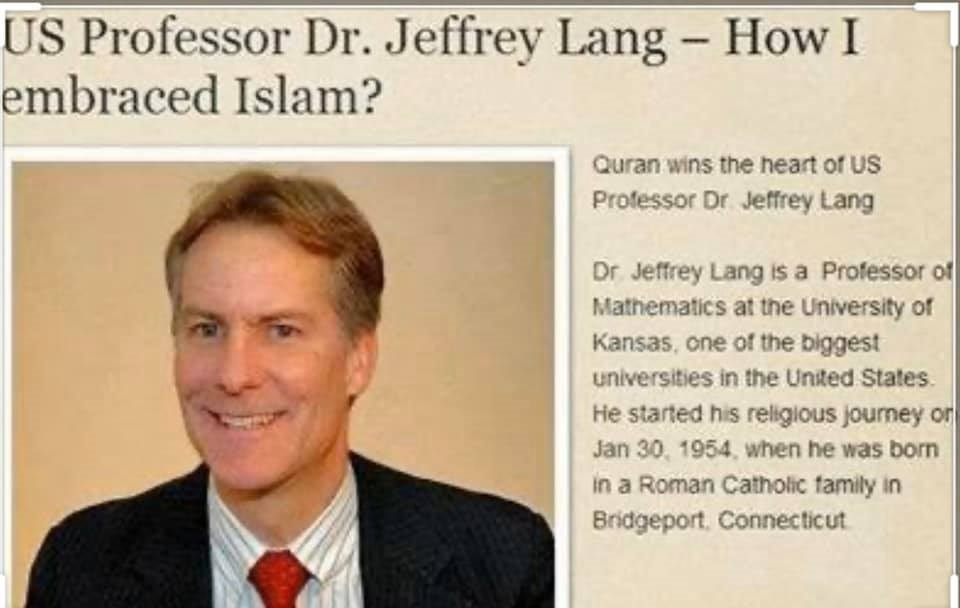





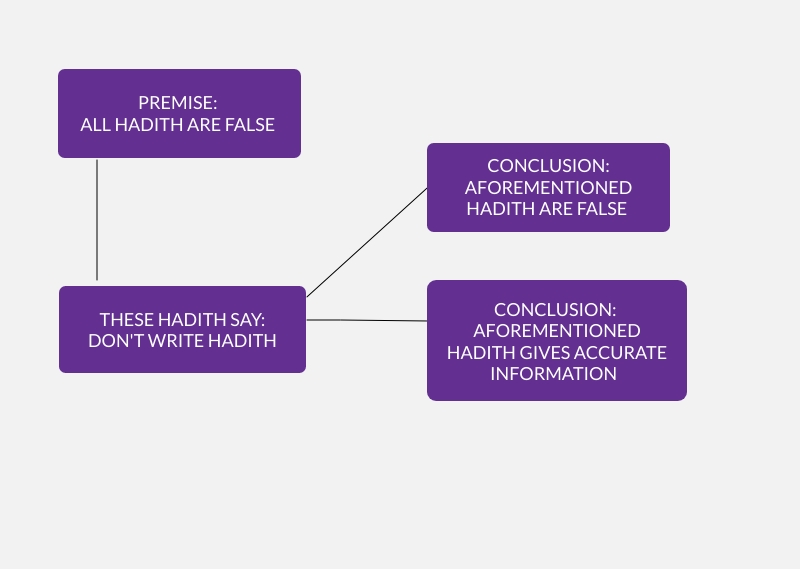
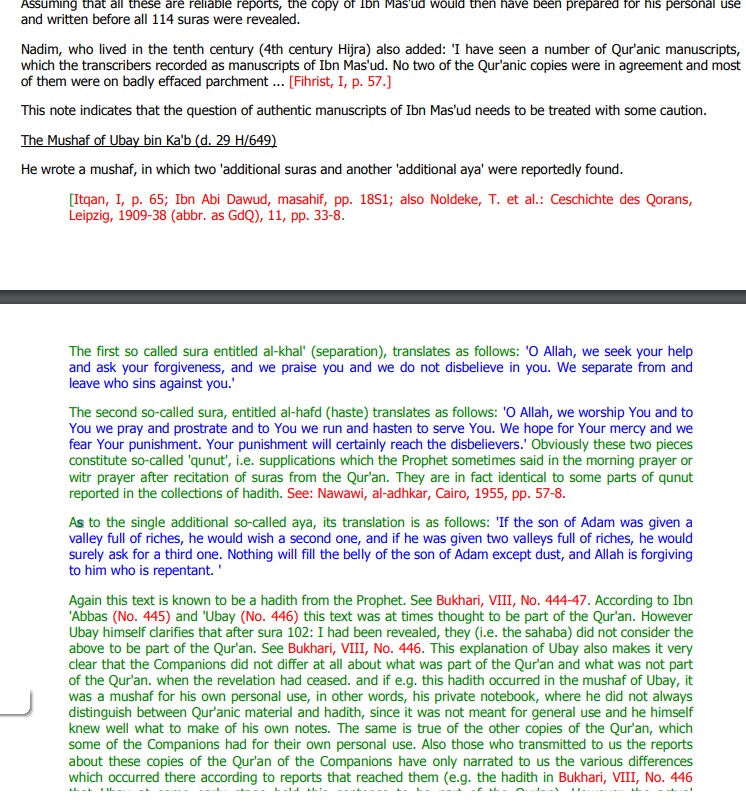


 has translated the above as:




 Prima Quran
