“And each one hath a goal toward which he turns; so contend with one another in good works. Wheresoever you may be, Allah will bring you all together. Lo! Allah is Able to do all things.” (Qur’an 2:148)
“Allah will judge between you on the Day of Resurrection concerning that over which you used to differ.” (Qur’an 22:69)
“So after the truth, what else can there be, save error? How then are you turned away?” –(Qur’an 10:32).
﷽
Insh’Allah the following section in the future will be found under the section above: Ahl Al-Qibla/Ahl Al-Khilaf.
Those of you who are used to seeing these people all over the internet and present on every social media platform available may come to the conclusion that their dawah is dominant. However, those of you who have access to the Arabic language, speak, read and write it will see that in the Arabic sphere these people (Wahhabis and Madkhalis) get absolutely pummelled by the Ibadi school. You will almost pity them (Wahhabis & Madkhalis). Though one should pity them and pray for their deliverance from the corruption and misguidance that they are upon.
The success of those who call themselves Salafi, Athari or those upon the Salafi Manhaj lies primarily in their ability into duping the masses to think that what they are upon is the view of the first three generation of Muslims.
They also feign the idea of taking the text by what they claim is the apparent meaning of a particular text. In fact, they apply ta’wil (interpretation) as do their opponents. Their opponents among Sunni Muslims (The Ash’ari & Maturidi) make the colossal mistake by granting a ‘default meaning’ to said words. Then turn around and say that they apply taʾwīl (interpretation). Whereas we (The Ibadi)say that if a word has a range of meanings and the context determines the meaning, then it becomes dishonest to claim the word can only have one possible meaning. The context based upon use of the Arabic language itself, and the culture that the revelation was revealed in.
Understand that not everyone who goes by the title of Salafi, Athari is adversarial or antagonistic to the Ibadi school. Many of them we can cooperate with on many issues of concern to our communities and respective countries that we live in. Cooperation is always a good thing for the Muslim Ummah.
The inconsistency and flawed theology can readily be seen by the inconsistency that it deploys. Examples abound but the following should suffice:
Demanding a default location for Allah (swt). Where neither the Qur’an or Sunnah give a ‘default’ location for Allah (swt). If one was to follow their literalist approach the Qur’an and Sunnah ascribe to Allah (swt) many locations. The Muslims believe that Allah exist without a place.
Using kalaam to speculate that Allah (swt) has two real eyes when we have no firm text on the matter.
The inconsistency in denying a gender for Allah (swt) when the apparent text clearly states: “There is nothing like Him, for He is the All-Hearing, All-Seeing.” (Qur’an 42:11) They say the language determines the characteristic without realizing that Allah (swt) is the one that chose the rules for the language to begin with. The Muslims believe Allah has no gender.
Their bidʿah disclaimer when referencing what they claim are attributes of Allah (swt) with their bid’ah disclaimer “in a way that befits his majesty” as if there would be anything un-majestic about Allah (swt) having this or that to begin with!
The inconsistency in telling the people to believe in the attributes of Allah (swt) without asking ‘how’ and then the same people saying that the attributes of Allah (swt), are neither identical to the essence of Allah and yet not other than Allah! A deep dive into kalaam to speculate about the Creator what they have no evidence from the Qur’an or Sunnah.
The inconsistency in affirming Allah as the All-Hearing(Qur’an 42:11) without having to have ears; while simultaneously demanding that if Allah exist it must be in a place.
Allah (swt) himself gave mankind the faculty of reasoning and the ability to understand majaaz (metaphor) when He (swt) says:
so I become his sense of hearing with which he hears, and his sense of sight with which he sees, and his hand with which he grips, and his leg with which he walks; and if he asks Me, I will give him, and if he asks My protection (Refuge), I will protect him; (i.e. give him My Refuge) and I do not hesitate to do anything as I hesitate to take the soul of the believer, for he hates death, and I hate to disappoint him.”
But these people would have us to believe that the text is taken by the apparent and Allah (swt) does in some way becomes our hearing, our sight, our hand and our leg!
We have exposed the corruption in their misguided mis-understanding of the primary and secondary sources here:
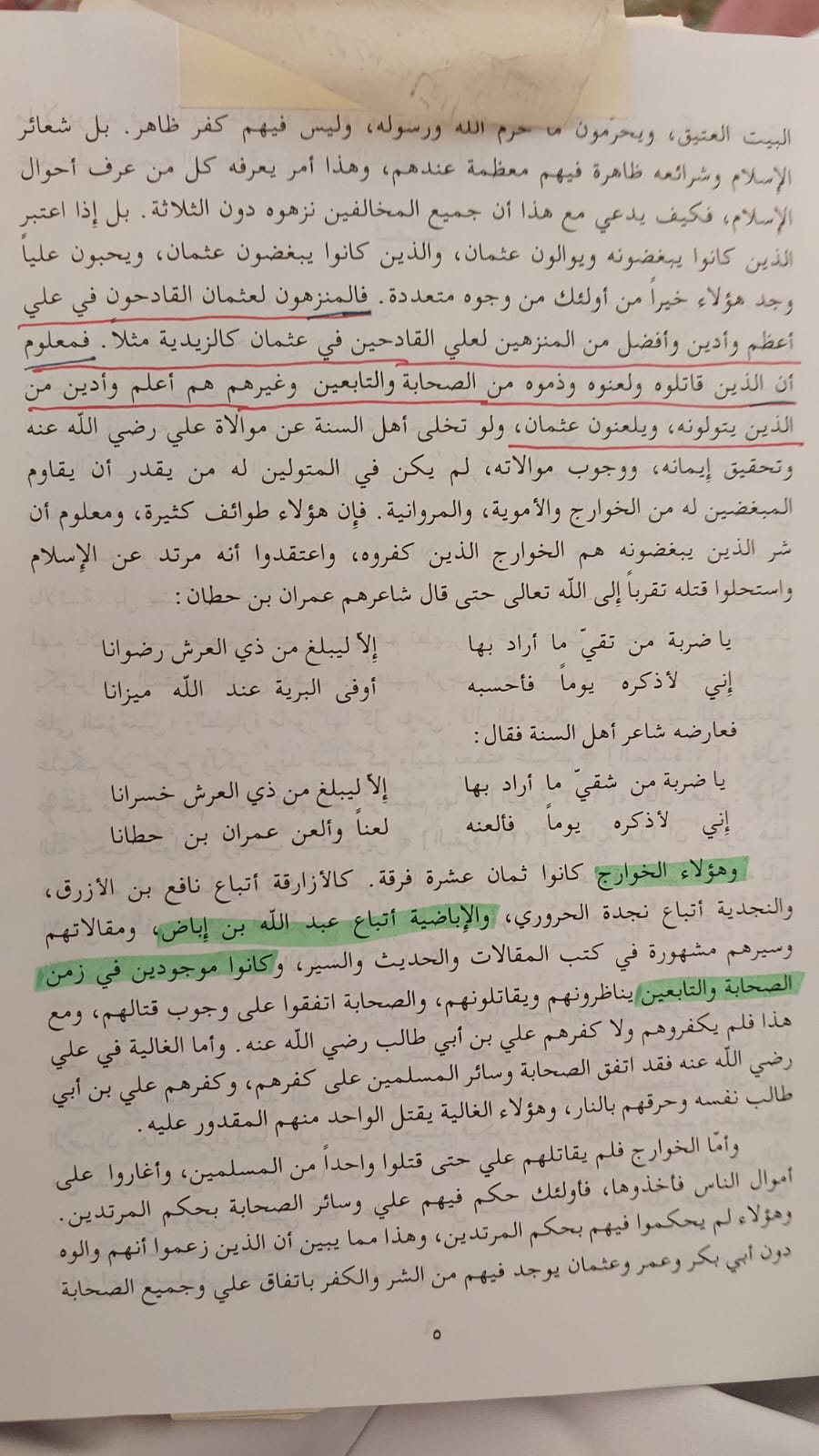
Since they call us Ibadi as “Khawarij” let us see what Ibn Taymiyya has to say about the so called “Khawarij”.
“No one among the people who follow their desire, the more truthful and more just than the Khawarij. They do not intend to invent lies, indeed they are very famous for truthfulness to the extent that it has been said that the traditions narrated by them are the most authentic of all.”
Source: (Ibn Taymiyya Minhaj Al Sunnah Vol 3. p 3. Dr. Al-Sib’i Al-Sunna Wal Makanatuha Fii Al-Tashrii Al-Islami p. 99-101)
“No one of them has ever been known for lying.” Source: (Ibn Taymiyyah Al Tafsiru Al Kabir Vol. 1, p. 124)
“Their religion is more correct because they do not say lies.” Source: (Ibn Taymiyya Mukhtasar Minhaji Al-Sunna Vol.2, p. 197)
“The Khawarij never says lies, indeed they are more truthful braver and more promise-keeping then the (Shi’ia)” Source: (Ibid Vol. 1 p. 393)
“The Khawarij are truthful, so their accounts are among the most correct ones.” Source: (Ibn Taymiyyah Al Furqan p. 227)
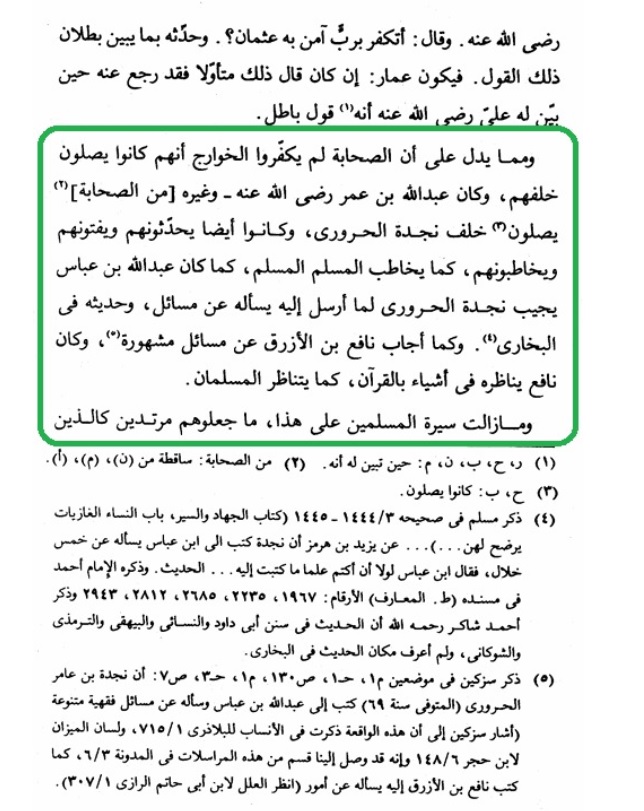
“And what indicates that the Companions did not consider the Khawarij to be disbelievers is that they used to pray behind them. Abdullah ibn Umar -RA- and others[companions] used to pray behind Najda al-Haruri. They also used to engage in debates with them, as the Muslim would debate with a Muslim, as Abdullah ibn Abbas debated with Najda al-Haruri when he was sent to him to ask about certain issues, and his hadith is in Al-Bukhari. Likewise, Nafi’ ibn Al-Azraq debated on famous issues. Nafi’ used to debate on matters in the Quran, as any two Muslims would debate among themselves”
Source: (The Path of the Prophetic Sunnah-In Refutation of the Shiite Qadariyyah Doctrine By Ibn Taymiyya Abu Al Abbas Taqi al Din Ahmad ibn Abd al-Halim.-Edited by Dr. Muhammed Rashad Salim Volume 5)
This entry will be split into three sections:
Section one: This will be aimed at refuting the lies, deception and outright propaganda that they aim at Ahl al-Haqq wal-l istiqama (The Ibadi school).
Section two: This will be the Ibadi school exposing the bizarre beliefs and strange views of those who call themselves: Salafi, Athari etc..
Section three: Those who may loosely identify as Salafi, Athari etc that have had and do have cordial relations with our school. Because they simply see us as Muslims. Muslims perhaps they disagree with but Muslims none the less. Articles in relation to them will be posted under section three.
THE MORE ONE LEARNS SALAFI AQIDAH THE MORE CHRISTIANITY MAKES SENSE.
SALAFI-SAUDI SHAYKH DR. SAAD AL-HUMID PROFESSOR OF HADITH SCIENCES IN MEDINA FLEES FROM DEBATE WITH SHAYKH SAEED AL QANOUBI: IBADI HADITH MASTER, ON THE CREATION OF THE QUR’AN
MAJOR DIFFERENCE BETWEEN IBADIS AND SALAFIS/ATHAIRS: IBADIS BELIEVE WE HAVE THE ENTIRE QUR’AN. SALAFIS/ATHARIS BELIEVE WE ONLY HAVE THE QUR’AN ALLAH INTENDED FOR US TO HAVE.
THE CLAIM THAT THE IBADIS CURSE AND REVILE THE COMPANIONS.THIS FALSE ALLEGATION IS TURNED ON IT’S HEAD! THE WAHHABI/MADHKALI/SALAFIYYA RELY UPON THOSE WHO SAY VILE THINGS ABOUT ALI
HADITHS THE SALAFIYYA AND AHL SUNNAH IN GENERAL RELY UPON TO CALL HUGE SWATHES OF THE PROPHET’S COMPANIONS DOGS OF HELLFIRE! (THE IBADIS RIP APART THESE CHAINS)
SECTION THREE: THOSE WHO MAY LOOSELY IDENTIFY AS SALAFI, ATHARI ETC THAT HAVE HAD AND DO HAVE CORDIAL RELATIONS WITH OUR SCHOOL. ARTICLES IN RELATION TO THEM WILL BE POSTED UNDER HERE.
MY EXPERIENCE WITH SALAFIS AND SUFIS (NOT ALWAYS CHALK AND CHEESE)
“That was a community that had already gone before. For them is what they earned and for you is what you have earned. And you will not be accountable for what they have done.” (Qur’an 2:141)
“Do not mix truth with falsehood or hide the truth knowingly.” (Qu’ran 2:42)
﷽
This is a summary given by one of our Sunni brothers concerning this debate.
“I am not an Ibadi, but I say that Brother Omar was unable to provide Ibn Salam’s interpretation regarding seeking Allah’s pleasure with Imam Ali. Thus, the debate concluded that it was Al-Hawari, the Ibadi, who sought Allah’s pleasure with Imam Ali, who proved the Ibadi’s claim to be true.”
“That al-Tabari is satisfied in his book with Ali ibn Abi Talib, whereas the other two shaykhs from the Hanbali school’s perspective did not express satisfaction with him in their books even a single time!”
Before we break down this debate these are some of our thoughts. Of course we are a site in which the participants follow the Ibadi school. Some may accuse us of bias. That is why you yourself (if you have access to the Arabic language) can watch and see for yourself. Likewise, you can judge if this is a faithful translation of the debate. With Allah is success.
Shaykh Muhammed al-Rashidi stated with complete clarity, without any dissimulation, that among our companions, there are some who disavow certain companions, while others are pleased with them. Thus, we, the Ibadi do not hold to a single position on this matter, and there is also the stance of suspension regarding them.
The Wahhabis focus on the issue of certain prominent Ibadi scholars’ disavowal of certain companions related to the arbitration incident and what accompanies it, because they firmly believe this is the killing blow against us. If they examined it, they would find it is deliberate denial of the Messenger (saw) not disagreement with the companions, for infallibility belongs to the Prophet (saw) alone that expels one from the millat. Accordingly everyone is an opponent among the Wahhabis.
They forget that justice does not mean infallibility, and they forget that the companions cursed and fought one another, and that the phrase “and we do not delve into what transpired among them” is ijtihad, not consensus, even if it is called consensus. Here, the saying “Whoever claims consensus is a liar” proves true to a great extent, for partial consensus of some of the ummah is not consensus of the entire ummah, despite the permissibility of accepting and relying upon it as taking a credible view among views. But not at the expense of expelling some from the community of consensus of the Muslims, and one is not declared kafir with certainty for not seeing some opinion as valid ijtihad or interpretation.
And there is kufr short of kufr, as Ibn ‘Abbas (ra) said, which does not expel its holder from the religion. Some say that hating ‘Ali may be a is a sign of hypocrisy, but hating actions differs from hating persons.
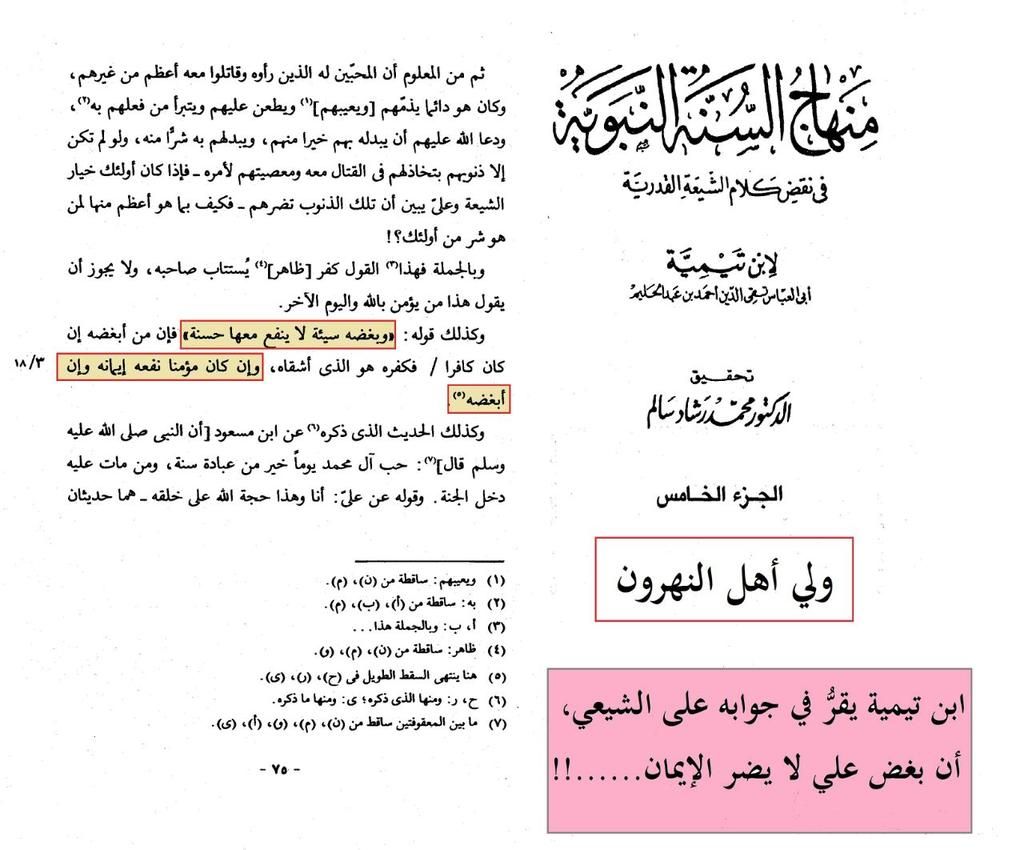
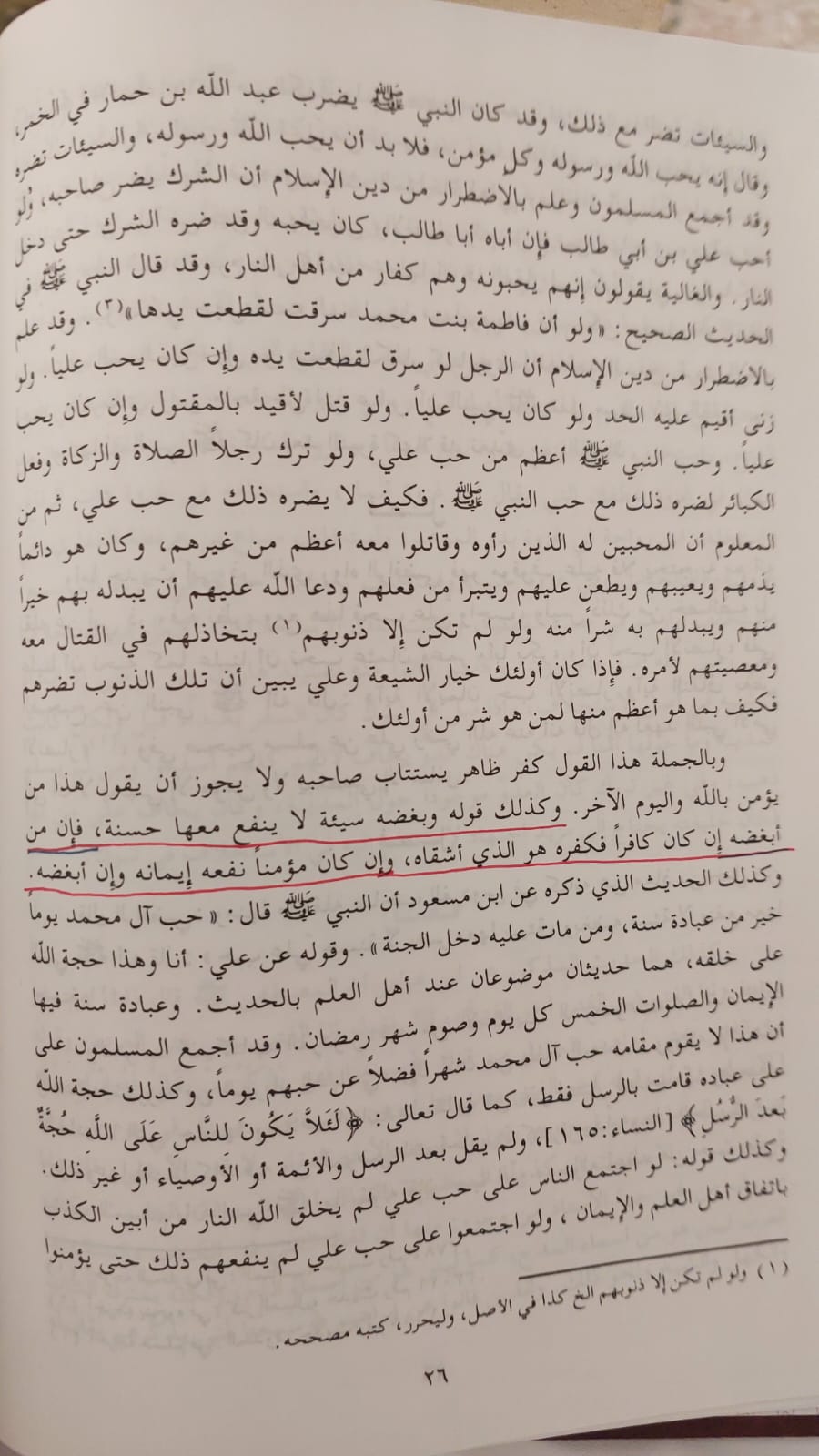
Although Ibn Taymiyyah was of the view that hatred of Ali does not harm faith.
Source: (Volume 5 of Minhaj as-Sunnah an-Nabawiyyah (The Path of Prophetic Sunnah) by Ibn Taymiyyah)
Those among the Ibadi school who show disavowal of Ali cannot be said that they hate the person of ‘Ali but they hated his agreeing to the Arbitration, which led to the fighting. This is a strong excuse with no denial of the Messenger in it, and the Ibadi disavowal cannot be interpreted except according to our principles and rules, for we are an independent Islamic school with our own principles and branches. It is forbidden to expel any Muslim from the fold of Islam except with certainty, just as one enters it with certainty. Shaykh Muhammed ibn ‘Abdullah al-Rashidi excelled in his debate with al-Zahrani, who took it as an opportunity to savage our Ibadi school.
The reason for this debate. Once again the Zionist and the proxies have attacked a Muslim country, Iran. There are certain segments in the Muslim Ummah who shield these Zionist and shield the Muslim rulers that aid the Zionist. Therefore there can be no empathy shown towards Iran and no solidarity shown with the Iranian people. They do not accept this from Sunni Muslims nor from the Ibadi.
Examples:
Shaykh Uthman Ibn Farooq made the following video:
What he said is absolutely true. However, he did not use that opportunity to attack and assail the Shi’i. Therefore most likely he got a call from those Zionist handlers. Guess what immediately followed? Attacks upon Iran of course.
Or, when Zakir Naik mentioned his support for Iran. Zakir Naik clearly mentioned Iran did things that are not appropriate. However, people came out and attacked Zakir Naik for it.
So the reason for this debate is that it well known that Oman and the Omani people stand with and support Muslims against the Zionist. So in this case this means standing with Iran and with the people of Iran against the Zionist aggressors.
Thus, this man Omar Al-Zahrani came with a mission. That mission is to create division and animosity between the Shi’i and Ibadi. You will see in the debate he brings up fatwa from 12er Shi’i about the Ibadi. He brings up some poem by an Ibadi scholar in praise of Ibn Muljam. All the red herrings that he can. Yet mash’Allah, he was no match for the calm, poise and overwhelming knowledge that Shaykh Muhammed Al Rashidi has.
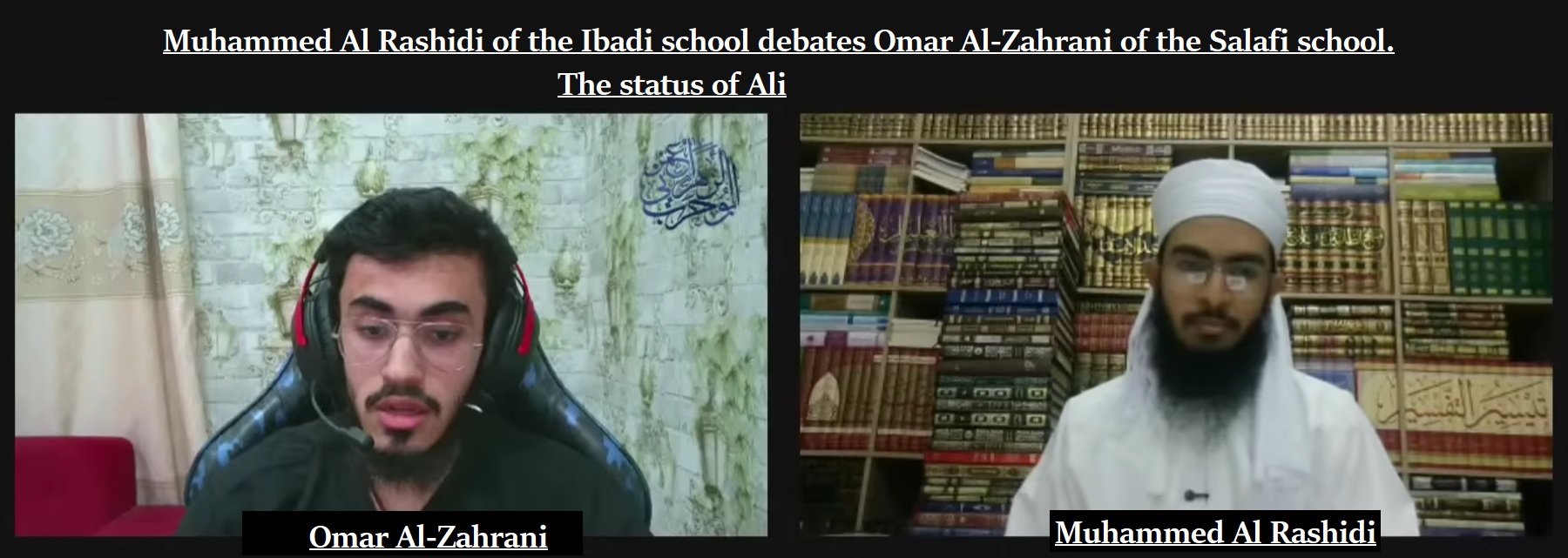
The status of Ali: Muhammed Al Rashidi of the Ibadi school debates Omar Al-Zahrani of the Salafi school.
Opening statement from the moderator:
My greetings to all of you, all the lovers and followers of the “Facts of Religions” channel. The meeting renews with you, respected gentlemen, and with the esteemed guests who are proficient in the language of dialogue, research, thought, and reflection on religion. Diversity is also required. The goal is for you, respected gentlemen, to receive accurate information from this one and that one. Today’s episode and today’s debate are very important because they have a dimension for us to get to know the Ibadi doctrine. Of course, our brother Omar will be with us; he will represent the Salafi belief or concept.
My greetings to all of you, all the lovers and followers of the “Facts of Religions” channel. I hope for mutual respect between you on the chat: respect for symbols, respect for sanctities, respect for guests. The channel’s goal is an intellectual meeting point, setting corrective and clarifying controls for what has been documented in our books.We welcome Brother Muhammed, who will represent the Ibadi thought through the “Dictionary of Sharia.”
He will also clarify, first as an introductory title. Brother Muhammed, you have five minutes, then we will move on to Brother Omar afterwards. It’s better, Brother Muhammed, if you could give an introductory title in the first minute, then start presenting the initial givens that Brother Omar will document and interact with you on. Go ahead, Brother Muhammed.
Muhammed Al Rashidi of the Ibadi school self introduction and opening statements:
In the name of Allah, the Most Gracious, the Most Merciful. O Allah support our brothers in Palestine, Iran, Yemen, Sudan, and in all corners of the earth, O Lord of the worlds. O Allah, protect our homelands, strengthen our ruler, support him with truth, and support truth with him, O Lord of the worlds. O Allah, make this debate beneficial for the seeker of truth and the listener, and keep it away from division and sectarianism.
Regarding this debate: It was raised a while ago that the Ibadis pray for the mercy of Imam Ali (Yataradaw ‘an). I presented evidence from this book, which is the “Tafsir Kitab Allah al-Aziz” by Imam al-Hawari, who is from the scholars of the third century AH, one of the Ibadi scholars. I extracted a text from it and said that the Ibadis pray for the mercy of Imam Ali, and I proved that. Brother Omar (may Allah bless him) came and took a part from the introduction of this book, where the investigator says that Imam al-Hawari relied on another Tafsir, which is the Tafsir of Imam Yahya ibn Salam al-Qayrawani. This is a wonderful thing. Imam al-Hawari indeed relied on this book; no problem, no issue. But the talk here is… Brother Omar, at the beginning, said that since there is “Taraddi” (praying for mercy) in this book, then this “Taraddi” belongs to Yahya ibn Salam, not to Hud ibn Muhakkam al-Hawari, who is one of the Ibadi scholars. He said that the Ibadis took this Tafsir (of Yahya ibn Salam), changed only the title, attributed it to Hud ibn Muhakkam al-Hawari, and made it Ibadi.
Of course, he raised other matters that we will discuss all of them, Allah willing, with Brother Omar, and we will discuss them fully, Allah willing. But I will start with a simple matter, Alah willing. I will prove with three pieces of evidence that these “Taraddiyat” (expressions of seeking mercy) found in this book are “Taraddiyat” of Imam Hud ibn Muhakkam al-Hawari, not of Yahya ibn Salam.
The first matter: Since we are talking about the “Taraddiyat,” and I presented evidence containing “Taraddi” for Imam Ali in this book, it was expected of Brother Omar to show us the same text from the book of Yahya ibn Salam al-Qayrawani and say that this same “Taraddi” exists there, regardless of the fact that the Tafsir of Yahya ibn Salam is incomplete (22 surahs). No problem.
But I tell you now, Brother Omar, what if I challenged you or asked you to produce just one “Taraddi” for Imam Ali in the book of Yahya ibn Salam? Just one “Taraddi” in the Tafsir of Yahya ibn Salam, from the remaining surahs. Ali is mentioned several times; we want just one “Taraddi.”
Now, the “Taraddiyat” are proven in this book. I have prepared dozens of texts, and I have other texts, but ten suffice. I also have a comparison between several texts from the two books. Excellent. So first, I have three pieces of evidence, as I said. I will present two here in this debate or dialogue (better to call it a dialogue). I will keep the third and final evidence for a separate discussion, Allah willing, you will see it. As for now, as we said, I think for every statement there is a challenge, a question, or a request. So we ask Brother Omar, may Allah bless him, to produce for us just one “Taraddi” on Imam Ali from the book of Yahya ibn Salam al-Qayrawani. If he does not produce a “Taraddi” for us, then the “Taraddiyat” were added by Imam Hud ibn Muhakkam al-Hawari, and they are Ibadi “Taraddiyat.” May Allah bless you. The remaining time is for you, Brother Omar.
Moderator speaking:
Okay, I don’t know if Dr. Muhammed is present… Okay, let me thank you, Brother Muhammed. I thank you for your punctuality, and I also thank you for the introduction. I hope from all the lovers and followers of the “Facts of Religions” channel and everyone to focus very well on the data being presented now, especially since it will introduce you to the reality of the Ibadi belief or concept. Brother Omar, you have five minutes with us for initial data. Could you make my picture bigger, Dr. Muhammed, please? On the camera. Okay.
Omar Al-Zahrani of the Salafi school self introduction and opening statements:
Peace be upon you and Allah’s mercy and blessings. In the name of Allah, the Most Gracious, the Most Merciful. O Allah, bless Muhammed and the family of Muhammed and all his companions and wives. Of course, may Allah protect our shyookh, kings, princes in the Gulf countries and in the rest of the Muslim lands.
Of course, as I told you, I will not leave a single word that the guest says without clarifying it. Iran, which you are sitting there… I don’t know why you pray for them, I don’t know if it’s to provoke us or what is your goal? Look at what they say about you in the book “Madinat al-Ma’ajiz” when they talk about the Khawarij. This is the “Mu’assasat al-Ma’arif al-Islamiyyah” in Iran, the ones you pray for. It says: “They are outcasts from Islam by the judgment of all Islamic scholars, ancient and modern. The most important of their sects are the Ibadis, may Allah’s curse be upon them all until the Day of Judgment.” This is not my words; this is the words of Iran. So, may Allah bless you, we try to adhere to the text.
Brother Omar, this phrase you just said, this phrase is attributed to…
Omar Al-Zahrani speaks again.
“…to an Iranian institution for printing. Of course, this investigator says they are outcasts from Islam by the judgment of all Islamic scholars, ancient and modern. The most important of their sects are the Ibadis. I am not saying “May Allah curse you, Muhammed al-Rashidi,” but Iran, the ones you pray for, who bombed our countries and your country, said “May Allah’s curse be upon you until the Day of Judgment.” Got it? Allah forbid, I don’t say such things to you. This is your books that conveyed this to you. Sorry, not your books, their books that you are happy with.”
Okay, the second issue, my dear brothers, may Allah bless you. When he asked me, he said, “I challenge you to prove that this ‘Taraddi’ exists in books…” I will give you from the words of the scholars… What does the investigator, Al-Hajj bin Sa’id Sharif (from Algeria), say? Look, my dear brothers, when he mentioned… even what did he say? “The Messenger of Allah, may Allah bless him and grant him peace.” He says: “This is from al-Hawari?” I tell you, no. He says: “An addition that is necessary, because what follows is a text of an authentic hadith.” Meaning even the prayer upon the Prophet (saw) was added by the investigator, not al-Hawari. So you tell me this “Taraddi” is from… from al-Hawari? No, my dear brother, this is the words of the investigator. So this issue is very natural.
Okay, my dear brothers, of course, now I will show you the many proofs. Our topic was about al-Hawari’s Tafsir and so on, but I will give you this issue: Basically, this entire book, all of it, is taken from… as I explained, from the Tafsir of Yahya ibn Salam. But the strange thing, my dear brothers, the strange thing is that after researching and investigating this book, I discovered that… What’s the idea? That al-Hawari took the complete book of Yahya ibn Salam al-Basri. And when he came to matters that benefit the Ibadi school of thought, or sorry, that harm the Ibadi school of thought (like divine vision, like intercession, etc.), he deleted them. My brothers, this is not my words, this is their books. There is a Master’s thesis… Basically, Hud ibn Muhakkam al-Hawari, hardly anyone talked about him, meaning few researches on “The Methodology of Hud al-Hawari in Tafsir.” It says: “And it concluded with the following results: Complete omission of the personality of Hud ibn Muhakkam al-Hawari – no one, by Allah, knows who Hud al-Hawari is, nor when he was born, nor when he lived, nor his shyookh. No one knows anything about him.”
Second: “Hud’s Tafsir is an abridgment of the Tafsir of Ibn Salam al-Basri the Sunni.” Okay. “The bias of Hud al-Hawari towards his Ibadi school of thought is evident in doctrinal rulings, practical rulings, and in his omission of narrations that contradict his school of thought.” Meaning, as long as you are taking an issue from our books, you must adhere to it. If you are taking an issue from our books, you must be committed to it, Dr. Muhammed. If possible, just enlarge my picture because the quality for some doesn’t show clearly during my intervention. Just enlarge it, may Allah reward you. Okay, my dear brothers, these are the evidences that confirm that the origin of the book is taken from us, from the Tafsir of Yahya ibn Salam al-Basri. For you to prove otherwise, you must bring… For example, this “Taraddi” (رضي الله عنه) is found in your book, while in the original, this “Taraddi” is not found at all. Even the prayer upon the Prophet (saw) – Hud thought it was too much to pray upon the Prophet (saw). So you tell me this action was… My dear brothers, unfortunately, this man (Hud al-Hawari) did not even know the basics of his religion. It says: “Among the criticisms against Hud is his mixing between the hypocrite and the polytheist in some rulings.” Hud says: “Whoever associates partners (with Allah) and is a hypocrite, We will punish him,” meaning killing. And we know that the hypocrite is not killed. Meaning, even the fundamentals of the Ibadi school of thought are deficient according to Hud al-Hawari.
You tell me that this, by the way, is not only taken from the Tafsir of Yahya ibn Salam al-Basri, but also taken from the Tafsir of Ibn Zaminayn, who is also one of our scholars. It is taken from both books. You tell me there is no “Taraddi” in the Tafsir of Yahya ibn Salam? It is found in the Tafsir of Ibn Zaminayn, by the way, found in the same narration about Ali (RA). I will give it to you in the next intervention. I have absolutely no problem with this. Okay. Now, my dear brothers, the next intervention will be…
Moderator: Okay, let’s thank you, Brother Omar. We’ll quickly move to Brother Muhammed. I hope all the esteemed viewers focus well on what is being presented now. Go ahead.
Muhammed Al Rashidi speaks:
Praise be to Allah, and after: “And say, ‘The truth has come, and falsehood has vanished. Indeed, falsehood is [ever] bound to vanish.'” Brother Omar, what do I care if the Tafsir of Hud ibn Muhakkam al-Hawari is correct or incorrect? Now our discussion is about the “Taraddi,” proving the “Taraddi.” Whether it is correct or incorrect, that’s another topic.
The issue of “Taraddi”… You told me about the prayer upon the Prophet. I demanded from you just one “Taraddi”! One “Taraddi”! I have dozens of texts, dozens of texts containing “Taraddi” on Imam Ali. Don’t tell me they added “Salla Allahu alayhi wa sallam” (saw). If they added it, that’s a weak argument. Bring me a text… For example, the investigator himself… I have statements from the investigator himself. He made mistakes in several things. One of the things he said is that this book is an abridgment or called an abridgment. This book cannot be called an abridgment at all; this book is a refinement of the book of Yahya ibn Salam, not an abridgment.
Second, he said that what is criticized in this book is the omission of chains of narration (asanid). Omitting chains of narration is the methodology of the Ibadis, the methodology of the school. You have “Al-Jami'” behind me, the explanation of “Musnad al-Imam al-Rabi'”, without chains of narration. “Musnad al-Imam al-Rabi'” which is the most authentic chain we have, explained without chains of narration. No problem.
I challenged you with one “Taraddi.” You know that the book of Yahya ibn Salam does not contain a single “Taraddi” on Imam Ali, not one! As for this book, it has several “Taraddiyat,” dozens, we can say. No problem. I will show Brother Omar… I will mention something before continuing. He said that Imam al-Hawari added things that benefit his school of thought. Previously, he said the Ibadis only changed the title and kept the Tafsir of Yahya ibn Salam. Why change the statement now?
Second, you said that Imam al-Hawari abbreviated some things, not that he added anything. Your statement is with me. Do you deny any word? Let’s show the clip. No problem, everything is there. These are three contradictions, three statements you made about the book of Imam al-Hawari. I demand from you only one text, one text where Imam Yahya ibn Salam al-Qayrawani prays for mercy on Imam Ali.
This is excellent. We will show pages if possible. There’s still time. Excellent. Let’s show some pages. Brother Omar said… or open a page from the pages. I’ll share it. Open a page from the pages where he compares the Tafsir of al-Hawari and the Tafsir of Yahya ibn Salam. Actually, if I complete that page… Let’s open a page. Does the page appear? Does it appear? It appears, it appears. Yes, go ahead. Excellent, excellent, excellent. This page: Right side is the Tafsir of Imam Yahya ibn Salam, left side is the Tafsir of Hud ibn Muhakkam al-Hawari. He said: “And some said, ‘It does not afflict her in the east nor in the west.'” This is in both books, in the Tafsir of Surat An-Nur. If we go down a little in the book of Imam al-Hawari, he prays for mercy on Imam Ali. As for Yahya ibn Salam, the book of Yahya ibn Salam did not pray for mercy on Imam Ali. I have dozens of texts like this, comparing the same texts from the two Tafsirs. Imam Hud ibn Muhakkam al-Hawari prays for mercy on Imam Ali, while Yahya ibn Salam does not pray for mercy on Imam Ali.
This is the first evidence that the Tafsir… that Hud ibn Muhakkam al-Hawari is the one who added these “Taraddiyat.” Of course, there are other errors in your statement besides this huge contradiction: Imam al-Hawari added jurisprudential things, added doctrinal things from “Musnad al-Imam al-Rabi'”. I have surprises for you as well. He added doctrinal things. I have texts I will show later. There are 30 seconds left. The remaining time is for you. Give me only one text where Imam al-Hawari or Imam Yahya ibn Salam prays for mercy on Imam Ali, just one text. You have now shown the viewer that Yahya ibn Salam does not pray for mercy on Imam Ali. This is clear. Go ahead, Brother Omar.
Omar Al-Zahrani speaks
Okay, could you enlarge me, Dr. Muhammed, so I can show the sources? Yes. In the name of Allah, the Most Gracious, the Most Merciful. Enlarge me, Doctor, may Allah bless you. Okay, my dear brothers, I think my statement is clear. Did I say that al-Hawari only took the Tafsir from Yahya ibn Salam? In the previous intervention, I told you he also took it from Ibn Zaminayn, the Sunni. The evidence for my statement is from “The Methodology of Hud ibn Muhakkam al-Hawari in Tafsir.” It says: “Hud al-Hawari followed, to some extent, the process of abridgment.”
The problem is your scholars say “abridgment,” and you tell me “refinement”! No, it’s not refinement, it’s abridgment. “However, he is criticized for not distinguishing between his opinions and the opinions of Ibn Salam, as Ibn Abi Zaminayn did.”
So, where did he take it from? He took it from two: from Ibn Salam and from Ibn Abi Zaminayn. You demand a “Taraddi” from me. This, my dear brothers, in “Uṣūl al-Sunnah” by Ibn Abi Zaminayn, it says about Ali ibn Abi Talib (RA). There! I have brought you your request. This request is fulfilled. Thank you. Okay, my dear brothers, now we come to the second issue. You are really bringing scandals, may Allah bless you. When you say, “We take our religion without a chain of transmission (sanad), we explain it without a chain.” May Allah bless you, this is a good thing, honestly. I don’t know why there’s a comment in the stream… The problem is, to say “We take our religion without a chain and explain without a chain” – this is not something, my dear brother, you should be proud of. On the contrary, it goes against you. Okay.
Moderator:
“The network weakness is from you, Brother Omar. The network weakness is from you. Just for your information.”
Omar Al-Zahrani speaks:
Okay, no problem. Let’s go back to show the source, my dear brothers. Okay, sorry, so this is in “The Methodology of Hud al-Hawari.” It says: “Hud al-Hawari followed, to some extent, the process of abridgment. However, he is criticiz
ed for not distinguishing between his opinions and the opinions of Ibn Salam, as Ibn Abi Zaminayn did.” Let’s go back to the books of Ibn Abi Zaminayn. He says about Ali ibn Abi Talib (RA). So this is the “Taraddi” now. May Allah bless you. Okay, my dear brothers, now we come, Allah willing, to the second issue with which he challenged me. He said, “You see, we take it without Tafsir, etc.” Brother, this is against you, not for you. Allah is sufficient. Your request I answered. It didn’t come with anything else. Okay, he says, “No, you must retract because Hud ibn Muhakkam al-Hawari added some words.” I know he added two or three words, a line or two. This does not count as an addition to the book. It is indeed an abridgment.
Evidence, my dear brothers, come, let’s make a simple comparison. Okay, this is, my dear brothers, the Tafsir of Yahya ibn Salam al-Basri the Sunni. He says regarding Surat An-Nahl: “In the name of Allah, the Most Gracious, the Most Merciful. ‘The command of Allah is coming, so do not impatiently seek to hasten it.’ Al-Hasan said: ‘This is a response from Allah.'” Let’s go back to the Tafsir of Yahya ibn Salam. He said: “Al-Hasan said: ‘This is a response from Allah to the saying of the polytheists to the Prophet: Bring us the punishment of Allah.'” The exact same thing! Where is the addition? You tell me, “By Allah, he added two words, added two letters”! This does not change the meaning. It’s very natural.
My dear brothers, if I go and take Al-Bukhari and at the end add two words, “Peace be upon you,” does that mean I have added to the interpretation? Absolutely not! Impossible. This is considered an addition by me, two or three words I wrote. It’s a normal matter. Okay, my dear brothers, now we come to the important issue which we will also clarify, because our topic today is about two things: al-Hawari’s Tafsir and the “Dictionary of Sharia.”
The “Dictionary of Sharia,” my dear brothers, Brother Muhammed al-Rashidi presented this source on his account. He said, “We have in the book ‘Dictionary of Sharia’ there is ‘Taraddi’ on Imam Ali. He interpreted it as ‘Ali, may Allah be pleased with him.'” I went back to the introduction of the investigation and discovered a catastrophe, by Almighty Allah! It says: “The words of Taraddi, Tarahhum, Tasliyah, and Taslim were proven in the text as they appeared in the manuscripts, and no intervention was made in them, neither modification nor alteration. Likewise, the author of the dictionary used to prove these words as he found them in their sources. This does not necessarily mean the author’s belief in that Taraddi or Tarahhum, because he was transmitting the text as it appeared in the source.” Meaning, just by him transmitting “Radhiya Allahu ‘anhu,” it does not necessitate that he believes in this Taraddi.
What is the evidence for your statement, Omar? What is the evidence that this man does not believe in this Taraddi? Get ready for the shock, by Almighty Allah! Don’t be shocked! This, my dear brothers, is the same book, “Dictionary of Sharia,” but a few pages later. It says: “We declare allegiance to Abu Bakr al-Siddiq and Umar ibn al-Khattab.” (It was supposed to say Uthman and Ali) – No Uthman, no Ali! And Abu Ubaydah ibn al-Jarrah, Abu Dharr al-Ghifari, Abd al-Rahman ibn Awf, Mu’adh ibn Jabal, Abdullah ibn Mas’ud, Salman al-Farisi, Ubayy ibn Ka’b, and Abdullah ibn Wahb al-Rasibi (who abandoned Ali ibn Abi Talib) – they are present. But Ali ibn Abi Talib is not present!
They declare allegiance to him? Take the great calamity: “And we declare disavowal (al-bara’ah) from those from whom our prominent Imams declared disavowal in the biographies, without needing to disclose or specify.” Who are these you disavow? Let’s go down below and see who you disavow. It says: “And we declare the correctness (taswib) of the people of Nahrawan” (those who fought Ali). “And disavowal (al-bara’ah) from those who killed them.” Who killed them? Ali ibn Abi Talib killed them! So you disavow Ali ibn Abi Talib! From the same book you brought! Not me, you brought this book!
Do you want a clearer declaration that he indeed disavows Ali? Take the catastrophe, brothers. The same book, “Dictionary of Sharia,” Volume 8, by al-Sa’di. It says: “And after the Prophet, we disavow the people of the Qibla (Muslims) who are… Uthman ibn Affan, they disavow him, and Ali ibn Abi Talib, they disavow him, and Talhah, al-Zubayr, Mu’awiyah, Amr ibn al-As, Abu Musa al-Ash’ari, and all who were satisfied with the arbitration of the two arbitrators and abandoned the judgment of Allah.”
Abu Abdullah Muhammed ibn Mahbub (may Allah have mercy on him) said: “We agree with them on this disavowal of those named.” We disavow Ali, we disavow Uthman.And Abu Sa’id al-Kudami prays for mercy on this man… He says: “We agree with them on the disavowal… we disavow Uthman ibn Affan, Ali ibn Abi Talib, Talhah, al-Zubayr, Mu’awiyah, Amr, and Abu Musa al-Ash’ari, and all who were satisfied…”
The sources, Brother Omar! The sources! The same book, brothers, that Brother Muhammed al-Rashidi brought. Not a new book. The same book he brought, “Dictionary of Sharia”! It says: “And after the Prophet, we disavow the people of the Qibla who are Uthman ibn Affan, Ali ibn Abi Talib, Talhah, al-Zubayr, Mu’awiyah ibn Abi Sufyan, Amr ibn al-As, Abu Musa al-Ash’ari, and all who were satisfied with the arbitration of the two arbitrators…” …Disavowal. Okay.
So, my dear brothers, those who agreed to this… Abu Sa’id… Then you come and hold onto an issue saying, “By Allah, he prayed for mercy on him, he said ‘Ali, may Allah be pleased with him.'” Where is the love here? Where is this love?
Moderator:
Okay, thank you, Brother Omar. Thank you for this data, really. Brother Muhammed is indeed worthy of interacting with it for clarification and correction. Go ahead.
Muhammed Al Rashidi speaks:
First, I hope we adhere to the time, first of all. Secondly, we haven’t finished with the Tafsir of Yahya ibn Salam and the Tafsir of Hud ibn Muhakkam al-Hawari. You haven’t denied your contradiction in the statements you made about the book of Yahya ibn… Hud ibn Muhakkam al-Hawari. First.
Second… You did not bring a single “Taraddi” from the book of Yahya ibn Salam! Excellent! Second or third… You talked about Ibn Abi Zaminayn. Excellent! I now challenge you as well to bring one “Taraddi” from the abridgment of Ibn Abi Zaminayn of the Tafsir of Yahya ibn Salam. Don’t give me from the book “Al-Sunnah”! Bring it to me from the Tafsir. Didn’t he abridge the Tafsir? Come on, here’s the shock! Look at the shock!
I will say it while I open the pages… Ibn Abi Zaminayn, in his introduction, says that he abridged much of what was in Yahya ibn Salam’s book and omitted many chains of narration and many reports. In the first preface. Excellent! So, you are dependent on the Ibadis for this as well. Now, if you want the Tafsir of Yahya ibn Salam, it’s incomplete (22 surahs). If you want to refer back, you cannot refer to Ibn Abi Zaminayn’s book because it is very incomplete, and that’s a criticism against it.
As for the Tafsir of Hud ibn Muhakkam al-Hawari, I repeat to you: You say “my scholars say it’s an abridgment.” He is not my scholar! That’s the investigator of the book! Don’t say “your scholars,” he is the investigator of the book, and he made a mistake in this. I say it once more: This book is a refinement. I think you understand – I trust your academic ability – the difference between refinement and abridgment. Excellent! You yourself said he added things! So how can it be an abridgment if he added? Wonderful!
Likewise, will you say that your scholars who abridged, refined, or relied on other books… will you say they stole? Will you say they removed a title and took a book? Can you say this, or only because he is Ibadi? Excellent!
Now, I challenged you with two or three Tafsirs. The first Tafsir contains “Taraddiyat.” The second evidence that Yahya ibn Salam did not pray for mercy on Imam Ali is the Tafsir of Ibn Abi Zaminayn. The Tafsir of Ibn Abi Zaminayn did not pray for mercy on Imam Ali, and he transmitted from reliable books in his abridgment. So, the two books did not pray for mercy: neither the book of Yahya ibn Salam nor Ibn Abi Zaminayn. The one who prayed for mercy is the Ibadi, Hud ibn Muhakkam al-Hawari.
This is evidence that Hud is the one who added the “Taraddiyat” in his Tafsir. Among the things he added are statements in jurisprudence: statements of Abu Ubaydah Muslim ibn Abi Karimah, statements of Jabir ibn Zayd, statements of “our companions,” “our school of thought.” These are additions! They do not exist in the Tafsir of Yahya ibn Salam. Doctrinal statements: I have prepared seven doctrinal issues, on Al-Istiwa’ (The Rising on the Throne), etc. All are Ibadi interpretations. So, how can you say they only took the title? “They only took the title or changed the title and took it” – how is this, Ibadis?
Your Tafsir is incomplete. I challenge us to compare. I tell you, open Surat Al-Fatihah and compare now! Between this Tafsir… The audio is present, your voice is there. You say, “I am ready to compare.” We open the book from the beginning and compare word for word. How? And the things that Yahya… that Hud ibn Muhakkam al-Hawari added…
Alright, I tell you, open Surat Al-Fatihah so we can compare. It’s not present in Surat Al-Fatihah. You rely on the Ibadi Tafsir to refer back to the book of Yahya ibn Salam. Even the Tafsir of Ibn Abi Zaminayn is not sufficient for you! Not sufficient for you to complete! I have brought many texts. Okay, let’s open this text… another text… containing a comparison. Open this text for me…
Moderator:
You have about two minutes…
Muhammed Al Rashidi speaks:
Yes, may Allah bless you. We have this text, the two Tafsirs. This Tafsir (right) is Yahya ibn Salam’s. He mentioned Hamzah and Ali, but did not pray for mercy on them. Look at the Ibadi Tafsir: “Hamzah ibn Abdul-Muttalib and Ali ibn Abi Talib, may Allah be pleased with them all.” This is the Ibadi Tafsir! Okay. Open the other text…. This is another text.
We haven’t even finished with the Tafsir of Hud ibn Muhakkam al-Hawari, and you move to another topic, the “Dictionary of Sharia.” Look at this text: “From Al-Harith, from Ali, that he asked the Messenger of Allah…” This is in Yahya ibn Salam’s Tafsir. Look at the book of Hud ibn Muhakkam al-Hawari: He said about “Ali ibn Abi Talib, may Allah be pleased with him, that he asked the Messenger of Allah…” Okay, now you say the investigator added this. Where is the evidence? Don’t just tell me so.
This is a refinement by… to Hud al-Hawari. Go ahead, but I emphasize an issue now. I challenged you regarding two of his Tafsirs: to produce just one “Taraddi” from two Tafsirs, not one! One “Taraddi” on Imam Ali! I brought dozens!
Moderator:
Okay, thank you, Brother Muhammed. We’ll move on.
Omar Al-Zahrani speaks:
Okay, if possible, could you share with me, Dr. Muhammed? I don’t know what the problem is with the sources I presented. Share this text with me, may Allah bless you, and enlarge my picture, please. Dr. Muhammed, share, may Allah bless you. Yes.
My dear brothers, as I explained to you, this text and these additions… Are they from al-Hawari? I tell you, no! Rather, this is from the scribes (nussakh). In the “Tafsir Kitab Allah al-Aziz,” it says: “The Messenger of Allah, may Allah bless him and grant him peace,” – the prayer upon the Prophet… he says: “An addition that was necessary.” He added it!
So you tell me it’s “Taraddi”? Which “Taraddi”? Naturally, the scribes added it, and you have that he prayed for mercy on Ali. I know. But did al-Hawari say it? The answer is no. Evidence: the text I gave you just now.
If possible, Dr. Muhammed, also share with me in the book “Dictionary of Sharia.” My dear brothers, “Dictionary of Sharia” which we proved… Dr. Muhammed, share with me, may Allah bless you. Yes, this is the “Dictionary of Sharia” we showed earlier. This is “Dictionary of Sharia.” What does it say? “Ali, may Allah be pleased with him.” Then what does the investigator say? “The words of Taraddi, Tarahhum… were proven in the text as they appeared in the manuscripts, and no intervention was made in them, neither modification nor alteration. Likewise, the author of the dictionary used to prove these words… and this does not necessarily mean the author’s belief.” Meaning, this does not necessarily mean the author believes in this Taraddi and Tarahhum. I know that “Radhiya Allahu ‘anhu” is written, correct.
But remember the name of the book. What is the name of the book? “Dictionary of Sharia.” Correct. My dear brothers, the same book “Dictionary of Sharia”… Look, my dear brothers, the same “Dictionary of Sharia”… What does it say? Dr. Muhammed, share, please… the text, may Allah bless you. Yes, this is “Dictionary of Sharia.” It says: “We declare allegiance (nuwalli) to Abu Bakr al-Siddiq, may Allah be pleased with him, and Umar ibn al-Khattab, may Allah be pleased with him.” Where is the name of Uthman? Deleted. The name of Ali? Not there! “And Abu Ubaydah, Abu Dharr, Abd al-Rahman ibn Awf, Mu’adh ibn Jabal, Abdullah ibn Mas’ud, Salman al-Farisi, Ubayy ibn Ka’b, and Abdullah ibn Wahb al-Rasibi, the Khariji who removed Ali ibn Abi Talib from governance at Nahrawan, who said: ‘We don’t want you as a ruler.'” He said: “We declare allegiance to these.” “And we declare disavowal (al-bara’ah) from those from whom our Imams declared disavowal among the famous…”
Who are those you disavow? He tells you: “And we declare the correctness (taswib) of the people of Nahrawan and disavowal (al-bara’ah) from those who fought them.” Question: Who fought the people of Nahrawan? Ali ibn Abi Talib!
So the first “Taraddi” is something… it has no value, no benefit whatsoever, because basically he concealed “Radhiya Allahu ‘anhu.” Does he believe in this? Does he believe in this “Taraddi”? I tell you, no! He does not believe in this “Taraddi”!
Dr. Muhammed, share with me. I assure you, he does not believe in this “Taraddi.” Why, my dear brothers? Because the same book, “Dictionary of Sharia”… first thing, it had “Radhiya Allahu ‘anhu” written. But it says: “And after the Prophet, we disavow the people of the Qibla who are… Uthman ibn Affan – we disavow him. Ali ibn Abi Talib – Ali ibn Abi Talib, the one you go to the Shia for and we love Imam Ali! We love Imam Ali! But Ali ibn Abi Talib – we disavow him! And Talhah, al-Zubayr, Mu’awiyah, Amr ibn al-As, Abu Musa al-Ash’ari, and all who were satisfied with the arbitration of the two arbitrators, abandoned Allah’s judgment, and their followers and supporters, and those who ally with them – upon their disbelief.”
Disbelievers! O disbelievers! And their injustice! From the people of innovation and followers of whims. Who agreed to this statement? Abu Abdullah Muhammed ibn Mahbub (may Allah have mercy on you). “We agree with them on this, and the disavowal of those named.” Abu Sa’id al-Kudami, your friend, the one you love very much, says: “We agree with them on the disavowal of those named, calling them disbelievers.” Who? Uthman ibn Affan, Ali ibn Abi Talib – our brothers, our own selves! Ali ibn Abi Talib! My dear brothers, what… They disavowed him! We disavow you, Ali ibn Abi Talib!
And I explained to you the Tafsir of Ibn Abi Zaminayn, this is present. In “Uṣūl al-Sunnah” by Ibn Abi Zaminayn, this “Taraddi” is present. So I tell you, if you have a million “Taraddiyat” now, a thousand “Taraddiyat”… let’s say you have 10 million “Taraddiyat” in the book, does this mean you believe in them? I tell you, no! You deleted the name of Ali! You prayed for mercy on Ali in “Dictionary of Sharia,” and in the same “Dictionary of Sharia” you said: “We disavow Ali!” And Abu Sa’id al-Kudami says: “Whoever allies with them, upon their disbelief – disbelievers!”
My dear brother, by Allah, “disbelievers”! This is the problem. I don’t know, the sources earlier apparently didn’t appear, sorry, because I’m presenting them again, just to confirm the information which is “Madinat al-Ma’ajiz.” When you prayed for Iran, sorry, by Allah, I don’t know what this situation is, but it must be resolved. “Madinat al-Ma’ajiz” by the “Mu’assasat al-Ma’arif al-Islamiyyah.” When it mentioned the Khawarij, it said: “They are outcasts from Islam.” They declare you disbelievers! And the “Qadhafat al-Kham” (Iranian officials) that you are happy with! It says: “By the judgment of all Islamic scholars, you are outcasts from Islam, and the most important of their sects are the Ibadis.” They declare you disbelievers! Who is this? Iran! Iran declared you disbelievers! “May Allah’s curse be upon them all until the Day of Judgment!” Not my words, by Allah, not my words. On the contrary, I absolve you of such words. I went to Oman and saw respectable Ibadis, by Allah, they are good people. But Iran itself says: “May Allah’s curse be upon you until the Day of Judgment!”
Yes. This is their statement, their own statement! Go ahead, Brother…
Moderator:
Brother Omar Khalil, I thank you, and I don’t know why you are focused on the Iran part. I don’t know. The man mentioned it briefly at the beginning. But certainly, you have dimensions to it. Brother Muhammed is very capable of interacting with this aspect. Brother Muhammed, because I think Brother Omar is somewhat focused on it. Go ahead, Brother Muhammed.
Muhammed Al Rashidi speaks:
No problem, my teacher. But this is not the topic of the debate now. The topic of the debate now is… three rounds?…I agree.
Moderator:
Wait, wait, Brother Muhammed. I agree with you. But it is on the periphery. Since you started it, and he insisted on stopping at this point, you could clarify and correct for the viewers on the periphery, not for him, and then we finish this aspect and move to the title of the episode.
Muhammed Al Rashidi speaks:
No problem, we will clarify. But first, let’s finish what we started, and we will clarify quickly: The Ibadis do not declare their opponent as disbelievers, nor do they pass judgment on their opponent based on what their opponent has within them. Let’s finish this. There are evidences and other matters by which they judge their opponents… Shia, Sunnis… we consider all of them our brothers and do not enter into these matters.
But now, this Tafsir… I told you, or if you zoom in on this… I challenged you with two Tafsirs: the first is the original, and the second is taken from the original (Yahya ibn Salam) and abridged by Ibn Abi Zaminayn. The absence of “Taraddi” in the book of Ibn Abi Zaminayn is evidence that Yahya ibn Salam did not pray for mercy on Imam Ali, or that this “Taraddi” was not present in his book.
Your statement that the Ibadis lack chains of narration and so on is a methodological issue. Ibn Taymiyyah, your shaykh, says the Khawarij do not lie. Even if we differ with him about the name Khawarij, he says the Khawarij do not lie. So what need do we have for chains of narration if the Khawarij do not lie? If you want to verify the hadiths of the Khawarij, the hadiths of the Ibadis, you have something called “mutaba’at” and “shawahid” (follow-ups and supporting evidence). Refer to the book “Musnad al-Imam al-Rabi'”. We have an explanation called “Sharh Sahih al-Rabi'”. Imam al-Salimi explained it. In every hadith, he mentions the “mutaba’at”, “shawahid”, and other such matters. Our methodology is that we do not mention these chains of narration. Omitting chains of narration is not a flaw; rather, it is the methodology of the Ibadis. This is a feature.
But what are we talking about? The “Taraddiyat.”
Regarding the “Dictionary of Sharia,” the text you showed in the introduction says that these “Taraddiyat” exist in the original book and were not added by scribes or investigators. Excellent. It says the author may not believe in them, but he takes them from their sources.
Okay, let me ask you a question, Brother Omar. What are the sources used by the author of the “Dictionary of Sharia”? Did you go to the introduction of the first volume and research which books he relies on? Most of the books he relies on are Ibadi books. All or most of the books he relies on are Ibadi books: “Bayan al-Shar'” and others. So the “Taraddiyat” are inevitably Ibadi “Taraddiyat,” whether he said them or not, whether he believed in them or not.
The other issue: “Al-Wala’ wal-Bara'” (Loyalty and Disavowal) with us Ibadis applies to a specific person. Therefore, they used to mention “so-and-so scholar” is the one who disavows. It applies to that specific person, not to all of us. The disavowal is excellent. Even if the group that was with him agrees, no problem. But the evidence that reached them about disavowing Imam Ali applies to them. We may consider them mistaken.
Excellent. We may consider them mistaken.
But now… I challenged you with two Tafsirs… Excellent. And I proved to you that the “Taraddi” in the “Dictionary of Sharia” is an Ibadi “Taraddi,” whether al-Sa’di believed in it or not. It is an Ibadi “Taraddi.” Now, I want you to produce just one text, one text of “Taraddi” either in the Tafsir of Yahya ibn Salam or in the Tafsir of Ibn Abi Zaminayn. It is difficult for you to produce one text. I produce dozens of texts from this book that you criticize. This book that you say the Ibadis took its title… I bring you dozens of texts. But prove to me just one text, one text from the book of Yahya ibn Salam or from the book of Ibn Abi Zaminayn, no more. Excellent.
I will show some texts… Excellent… Alright… You can’t see these texts?
For example, here is a text on aqeedah. Go to “Al-Istiwa’.” Look at this text… Take this. Pay attention. Yes. Did Yahya ibn Salam interpret it? Or did Hud ibn Muhakkam al-Hawari interpret it? Alright. He said: “The Most Merciful rose over the Throne (istawa).” Is the text clear? He said: “Istawaa… His command and power prevailed over His creation.” Excellent. If you search for this text in the book of Yahya ibn Salam… Although, look in which surah? Look in which surah? In Surat Ta-Ha. If you search for it in Yahya ibn Salam’s book, you will not find it. This is an addition by Hud ibn Muhakkam al-Hawari. Where did Hud ibn Muhakkam al-Hawari bring it from? Go ahead…
Where did al-Muhakkam al-Hawari bring it from? He brought it from “Al-Jami’ al-Sahih” of Imam al-Rabi’ ibn Habib, from the third century AH. Look at this from al-Rabi’: “His command and power prevailed over His creation.” This exact text does not exist with Yahya ibn Salam. But it exists here with al-Muhakkam al-Hawari.
Okay, so the issue of the “Taraddiyat,” Brother Omar, once again, I tell you that the “Taraddiyat” were added by Hud ibn Muhakkam al-Hawari. Even “Salla Allahu alayhi wa sallam” and “Alayhi wa alihi salam” which were added by the investigator or scribes. “Radhiya Allahu ‘anhu” is from the original book! There’s a mark, I don’t know if you noticed it or not.
Can you bring me… I’ll go with you… Can you bring me one “Taraddi” in Yahya ibn Salam’s book and say the scribes added it? Can you? One “Taraddi”! I demanded “Taraddiyat” from two Tafsirs. We Ibadis, when we enter debates… I have read three Tafsirs. I don’t say this unless I know that the only Tafsir that prays for mercy on Imam Ali among these three is this Tafsir.Yes? Excellent! Yes?
So, I demand… mostly in this battle, you bring one “Taraddi” from a Tafsir. If it’s not there, say it’s not there, and we’re done with this. Meaning, you are demanding one “Taraddi”? I demand one “Taraddi.” Why? Because he says the “Taraddiyat” in this book were taken from Yahya ibn Salam. Of course, before, he said “they took them from Yahya ibn Salam”…
Now he says… …because no one knows, professor. Go ahead. Okay, thank you.
Moderator:
Thank you. Brother Omar is also capable of interacting with these issues. Go ahead, Brother Omar.
Omar Al-Zahrani speaks:
Okay, if possible, could you share with me, may Allah bless you, this text that I requested? Share, Dr. Muhammed. Share.
Yes, my dear brothers, “Uṣūl al-Sunnah” by Ibn Abi Zaminayn. He says about Ali ibn Abi Talib, “Radhiya Allahu ‘anhu.” He took it from… Ibn Abi Zaminayn took it, as he says… from the people of the methodology… they studied the methodology of Hud… “Ali ibn Abi Talib, Radhiya Allahu ‘anhu.” By the way, I brought you your request. I don’t know why you repeat it. Maybe you’ve run out of answers, by Allah, I don’t know. My dear brothers, the problem is in the next clip, he will respond to Dr. Asim. Listen…
“Shaykh al-Hadrami, author of ‘Al-Kawkab al-Duri,’ is not Ibadi because he prays for mercy on Imam Ali. Therefore, the author of the ‘Qamus’ (Dictionary) is also not Ibadi. Do not forget…
Yes, meaning he now used the author of the “Dictionary of Sharia” as evidence. Now, when we shocked him that the author of the “Dictionary of Sharia” actually disavows Ali, disavows Uthman, and disavows the companions, and says “disbelievers” and whatnot… By Allah, he definitely took it from an Ibadi book. By Allah, I don’t know from which Ibadi book he took it. But he took it from you. This is the response, my dear brother! This is not a response! This is not a response! He did not take it from you; rather, he found it in some Sunni source and took it and placed it there. Evidence is that he says “We disavow them”! Of course, my dear brothers, he continues to throw words. I am paying attention, by Allah, to every word. He said: “Ha, by Allah, we don’t declare them disbelievers as they declare us disbelievers.” Look at the screen, my dear brothers. Dr. Muhammed, share with me, may Allah bless you.
Okay, my dear brothers, the book “Lubab al-Athar” by Sayyid Muhanna ibn Khalfan. It says: “Issue: About Shaykh Ahmad ibn Madad, may Allah have mercy on him. What do you say about all the other schools of thought besides the Ibadi? What do you say about them? Is it permissible to declare them mistaken and misguided? Is it permissible to curse them (Yal’anuhum)? Does the ablution of the one who does that break or not?” He said: “Yes, that is permissible. Curse them (Tal’anuhum)! And the ablution of the one who does that does not break, because he has spoken the truth.” The truth is that they are cursed! Accursed! You, O Sunnis, according to this man’s tongue! The correct and the truth is that all our opponents from other schools are, with us, perishing, innovators in religion, heretics, ungrateful disbelievers, hypocrites, oppressors. The Book of Allah and the Sunnah of His Messenger testify to that.
Whoever dies on other than the Ibadi religion is in the Fire, in Hell. With this we testify and declare our religion. Whoever doubts the Ibadi religion and claims the truth is in other than the Ibadi religion is, with us, an ungrateful disbeliever, a sinner, a hypocrite, a misguided innovator, an innovator in religion. You don’t declare us disbelievers? By Allah, I wish you would declare us disbelievers rather than saying all this to us!
Also, in the book “Qawa’id al-Islam,” it says about disavowal (al-bara’ah) from whoever leaves the school of the people of truth. Not just takfir now… Take this calamity: Whoever leaves the school of the people of truth for the school of those in opposition, and allies with their Imams and disavows the Imams of the Muslims, it is obligatory upon the Muslims to hate him, be hostile to him, and remove his allegiance until he repents and returns to the Muslims. If he leaves the school of the Muslims, opposes them, criticizes their school, and finds fault with it, then his killing is permissible, his assassination by any means to cause his destruction and death.
Got it, dear teacher? Beware once again! Someone tells me, “You Salafis are takfiris, you Wahhabis are takfiris, you are blood-shedders”! No, I tell you this statement. It shouldn’t appear these days. I know this statement shouldn’t appear. But don’t accuse us of a disease that you yourselves suffer from. If you see this as a disease, then it is a life-ending matter.
It’s a camera, just a question, if you please. Why shouldn’t it appear now? What is the reason? My dear brother, I tell you, now we are in a time of tolerance. What are they doing?
Moderator:
Sorry, transparency and clarity, Brother Omar.
Omar Al-Zahrani speaks:
No, no, I will tell you. Listen to me. Listen to me. What do they do? They go to old books from a certain period, a certain time when some boundaries (hudud) were not suspended, and they apply its rulings. They say, “Look, you have a book from 1000 years ago that says ‘kill’ so-and-so.” It’s not that we kill. Rather, this matter is referred to the ruler (Wali al-Amr), who considers it. There are conditions and prerequisites for seeking repentance (istitabah). They don’t read that. They just see the word “kill” – “Attack the Sunni! Kill the Sunni! Beat the Sunni!” The Sunni commands all this, and we are innocent and good, we don’t do anything. Meanwhile, the opposite is these books of theirs that are hidden in the bellies, no one sees them. And I tell you, we don’t show them. By Almighty Allah, I know the Ibadis are good people, there is goodness and blessing in them. I personally went to Oman, by Allah, I found the immigrant treated better than the citizen, with all manners and respect. But these books… I tell you, hide these books, it’s better.
Moderator:
Thank you, Brother Omar. Faithful transmission is required from you and Brother Muhammed. Faithful transmission. Brother Muhammed, go ahead. May Allah bless you, Brother Omar and Brother Muhammed.
Muhammed Al Rashidi speaks:
Brother Omar has left the topic of the debate several times now, several times, and goes far away from the challenge. You tell me the book “Al-Sunnah” by Ibn Abi Zaminayn. He abridged the Tafsir of Yahya ibn Salam in the book “Al-Sunnah” or in the Tafsir? Why can’t you bring one text from the Tafsir? One text of “Taraddi” from the Tafsir? You say, “Where did he take it from Yahya?” From the book “Al-Sunnah”? How? From the book “Al-Sunnah”? He abridged the Tafsir of Yahya ibn Salam in another Tafsir. Why don’t you bring one text? We are done with this topic.
Let’s repeat it. You have this book, “Dictionary of Sharia,” “Al-Hawi” its wide ways. The introductions that Brother Omar went to… he went to the introduction of the volume, but he did not go to this book, which is the introduction to all the volumes. Here on page 376, you have the sources of the “Dictionary of Sharia.” He took these “Taraddiyat” and others from Ibadi books. You find that Ibadi books constitute more than 90%.
So how can you say that “Taraddi” was taken from a Sunni book? You have said this several times without evidence. You said this “Taraddi” they took from a Sunni book. To this moment, Brother Omar has no evidence that these “Taraddiyat” in the two books are taken from Sunni books.
Now, the topic of the debate is this. I can now say, for example, Ibn Taymiyyah says the companions are disbelievers! Ibn Taymiyyah says the companions are disbelievers based on the Prophet’s hadith: “Do not return after me as disbelievers, striking the necks of one another.” Yes, he said it is a restricted designation, no problem. But he labeled them with the name “disbelievers,” did he not? He said they are disbelievers!
If I want to go away from these texts, I can bring you your takfir of the companions. The people of Nahrawan are not companions? I can bring you this. I can bring you those who besieged Uthman ibn Affan – they are not companions? I can bring you those who fought Imam Ali at the Battle of the Camel and others – they are not companions? I can bring you these texts, and we can discuss this. But what is our topic now? Our topic is this Tafsir and this book. I hope we don’t leave them, we don’t go out from them.
Brother Omar has not been able to prove that the “Taraddiyat” in the two books are Sunni “Taraddiyat” or that they took them from such. Alright, I have other texts once again. I do not leave the topic of research. Every time you leave, I bring you back to the same topic.
Look at these texts that Imam al-Hawari added to his Tafsir. For example, this text… So you don’t say he abridged. You said “abridged.” Pay attention, you said “abridged.” If he abridged and didn’t add anything, why are these texts here? For example, “The general statement of our jurists, Abu Ubaydah, etc.” This text… Search for it in the Tafsir of Yahya ibn Salam. Will you find it?
This other text… “And Abu Ubaydah said” – Abu Ubaydah here means Abu Ubaydah Muslim ibn Abi Karimah. Can you bring these texts from the Tafsir of Yahya ibn Salam? You cannot. Why? An addition by Hud ibn Muhakkam al-Hawari, whom you say the Ibadis only took the title of his book? If they only took the title and the Tafsir itself, then the Tafsir would be identical to the Tafsir of Yahya ibn Salam, wouldn’t it? The two Tafsirs would be presumed to be identical if they only changed the title, as you said. You said they changed the title. You said the “Taraddiyat” are not of Hud al-Muhakkam al-Hawari. Okay, the viewers are waiting for one text… The book “Al-Sunnah”… Did Ibn Abi Zaminayn abridge in the book “Al-Sunnah”? He didn’t abridge it in the Tafsir, or he didn’t abridge it in the book “Al-Sunnah”? He abridged it in another Tafsir. Produce for us from that Tafsir, and produce for us from the Tafsir of Yahya ibn Salam one “Taraddi”! Difficult, very difficult. I now say to you, and I demand the same thing, I say to you, I have not left this topic. You haven’t been able to produce a single text of “Taraddi” from a complete Tafsir! There is no single text of “Taraddi”!
Alright, let’s say the investigator added it. Didn’t the investigator add it? Or didn’t the scribes add it? How is it that this Tafsir has dozens of texts of “Taraddi”? And they are from the original book? Yes. Alright. Yes, okay.
Moderator:
Thank you, thank you, Brother Muhammed. In the next intervention for Brother Omar, then Brother Muhammed, the time will be three minutes. There will be obligations: each guest will ask one question. We are responsible for obligating the guest to answer the question. Thank you, Brother Muhammed. We move to Brother Omar. We have shared your screen. We see what you are also presenting. Brother Omar, go ahead.
Omar Al-Zahrani speaks:
Okay, my dear brothers, by Almighty Allah, I don’t know why the guest attacks me and says, “Why did you say it is an abridgment?” My dear brothers, a question: Did my mother, Um Omar al-Zahrani, say this Tafsir is an abridgment? No! Your scholars say that the Tafsir of Hud ibn Muhakkam al-Hawari is an abridgment! They said! He is biased! I challenge you! Challenge your scholars! Challenge your investigators, dear teacher, who said it is an abridgment!
“Mukhtasar” (abridged) – Meem, Kha, Ta, Sad, Ra – “Mukhtasar”! When I say it, by Allah, you have the right to tell me, “Omar, give me a page!” The cover page! The cover page!
Okay, and the cover page… It’s a complete Master’s thesis. Dr. Muhammed, share with me, please. This, my dear brothers, is “The Methodology of Hud ibn Muhakkam al-Hawari in Tafsir.” The People’s Democratic Republic of Algeria – because al-Hawari is there in Algeria, he’s not Omani.
It’s a complete Master’s thesis. Subhanallah, I read it in one day, finished all of it. This says it is an abridgment, and the investigator himself, the author of the book, says it’s an abridgment. So you… I don’t know why you attack me and get upset at me.
As for Ibn Taymiyyah declaring the companions disbelievers, etc… Where did Ibn Taymiyyah declare the companions disbelievers? Dr. Muhammed, share with me, may Allah bless you. My dear brothers, in the book “Majmu’ al-Fatawa” by Ibn Taymiyyah (may Allah have mercy on him), Ibn Taymiyyah was asked about what happened between the companions: Ali, Mu’awiyah, Talhah, and Aisha. Are they accountable for it or not? He answered: “It is proven by authentic texts that Uthman, Ali, Talhah, al-Zubayr, and ‘Aisha are among the people of Paradise.” May Allah bless you. That’s enough for me. “People of Paradise” means Muslims, their Islam is proven. Thank you.
On the other hand, what do we have, my dear brothers? What is the catastrophe we have on the other hand? Dr. Muhammed, sorry, share with me… Sorry to bother you… In the book “Dictionary of Sharia” which he used as evidence… What is the problem? I am not bringing another book. He brought it in his clip. He was shocked that the author of the book says: “We disavow after the Prophet the people of the Qibla who are the people of the Qibla. Uthman ibn Affan – we disavow them, we don’t want them. Ali ibn Abi Talib – we disavow him.” It’s not “Imam Ali” or anything. On the contrary, basically, I am sorry for the sermon you gave that day, the sermon of Imam Ali… You disavow him in your books! “And after the Prophet, we disavow the people of the Qibla: Uthman ibn Affan, Ali ibn Abi Talib, Talhah, al-Zubayr, Mu’awiyah, Amr ibn al-As, Abu Musa al-Ash’ari, and all who were satisfied with the arbitration of the two arbitrators, their followers, their supporters, and those who ally with them – upon their disbelief and their injustice.”
Oppressors! He tells you Ali ibn Abi Talib is an oppressor, from the people of innovation and followers of whims. And al-Kudami… By Allah, I challenge you to even say that al-Kudami is described as you described the Imam, or as they described the Imam. I challenge you, of course, I don’t say this, but by necessity, you say that al-Kudami is the disbeliever, the one who disavowed… you cannot say that. But what did al-Kudami say about the companions? He said: “Calling them disbelievers.” He said it clearly: “Calling them disbelievers.”
As for the issue… By Allah, since you brought it up, here you are. I obligate you by your own tongue. You said, “By Allah, we have… the one who explained ‘Musnad al-Rabi” is al-Salimi.” Look at what al-Salimi says in “Jawabat al-Imam al-Salimi.” The issue is well-known. You brought it to say he explains the ‘Musnad al-Rabi”. And about Ali ibn Abi Talib, look at what he says: “The issue is well-known among those who agree and those who disagree. However, those who disagree often make excuses for Ali while acknowledging the reality.”
We say, as we say, “We disavow Ali,” even though the reality is that Ali was wrong. Because his Imam, Abdullah ibn Wahb (who removed Ali), said to Ali: “Go away, we don’t want you.” This was after they removed Ali from the Imamate themselves. So the people of Nahrawan who fought Ali, who waged war against Ali, are the ones in the right (muhaqqun). And those who fought them are the ones in the wrong (mubtilun). Whoever understands this, it is obligatory upon them… and those who fought them means Ali, who fought the people of Nahrawan, is in the wrong. And he is not accused of otherwise. Likewise, disavowal of those who fought them is obligatory.
Who is al-Salimi? The al-Salimi you brought? Not me, by Allah, I didn’t bring him. The al-Salimi you brought! Moreover, al-Salimi says later… he tries to soften the expression a little. He says: “It is not from our religion to insult, nor from our school of thought to criticize. We have seen among the specific group (the Ibadis) and the general public (the Sunnis) that we have not seen anyone criticize those who passed, or insult, or curse. People are safe from that.”
Fine. Even if you don’t curse him… If he believes in the allegiance (walayah) of the people of Nahrawan and the disavowal (bara’ah) of those who fought them, fulfilling an obligation from Allah’s religion, without insult, obscenity, or condemnation… except for what occurred with Ibn al-Nadhar in his ‘Lamyyah’ poem. His intention (may Allah forgive him) was to show the truth, but anger for the sake of Allah led him to utter a curse. He started cursing and insulting Ali in his poem. May Allah forgive him. He cursed Ali ibn Abi Talib. May Allah forgive him. He said “May Allah curse him” in the poem. What was appropriate for the school of thought was to clarify who is right and who is wrong. You just say Ali was wrong, but don’t go and curse him. He went to extremes in his statement. What did he say in the poem? “That Ali is in the lowest depth (of Hell).” Ali ibn Abi Talib is in the lowest depth, Ali ibn Abi Talib is in Hell. This is from Ibn al-Nadhar.
I challenge you yourself to denounce Ibn al-Nadhar. But what does al-Salimi say? “May Allah forgive him.” “Allah forgive him, he cursed Ali…” “May Allah curse him”? “He insulted Ali ibn Abi Talib, may Allah forgive him.” He said Ali is in the Hellfire, in the lowest depth. “May Allah forgive him.” This is your al-Salimi that you brought!
Not me, “May Allah forgive him”…
Moderator:
Yes, yes. Okay, Brother Omar, I thank you. Brother Muhammed, we will start from now. You will take five minutes. In the last five minutes, you will ask Brother Omar a question, and he is obligated to answer it, and vice versa. Brother Muhammed, go ahead.
Muhammed Al Rashidi speaks:
Excellent. But, my teacher, we are Muslims according to their conditions. We stipulated not to leave the topic. Brother Omar, every statement he makes leaves the topic. Every round, he leaves the topic of the Tafsir of Imam al-Hawari and the “Dictionary of Sharia.” Almost every statement he makes leaves them. Excellent. So I hope Brother Omar adheres to the hadith of the Prophet (saw). And you, Brother Muhammed, also remind him. Excellent.
Let’s come back to the Tafsir again, Brother Omar. You say the scholars, our scholars, say it’s an abridgment. You yourself read the introduction. Let’s open the clip if… Go ahead. This…Open this.Aha…Is the clip appearing? The reader assumes, like yourself… Yes. That his statement is just audio. Yes, go ahead.
Moderator:
No, we can’t play a video. I can share a screenshot, a picture. Brother Muhammed, you can play the audio. You can let me hear the audio. You can play the audio without showing anything. No problem, we hear the audio if you want.
Muhammed Al Rashidi speaks:
No problem, no problem. I will state what Brother Omar says and he denies it. We will open this. He says that Brother Omar, after reading the introduction, says he discovered the texts are similar between the two Tafsirs after comparison. I tell you now: By comparison, I say the investigator is wrong.
By comparison, can you prove to me that the Tafsir of Hud ibn Muhakkam al-Hawari is an abridgment? This is one of the things you were mistaken about. You said it’s an abridgment once, and that he didn’t add anything. Then in the debate, you said he added what benefits him, what benefits the Ibadi school of thought. You said this in front of people. Third, you said the “Taraddiyat” are not his.
In this statement of yours, Brother Omar, you said the “Taraddiyat” are not his. How do you prove they are not his? You have two methods, one method: to bring these “Taraddiyat” from the Tafsir of Yahya ibn Salam. Can you bring these “Taraddiyat” from the texts that contain prayers for mercy on Imam Ali from the book of Yahya ibn Salam?
You will move to another topic. I know this. And you will not be able to bring texts that pray for mercy on Imam Ali from the Tafsir of Ibn Abi Zaminayn either. Excellent.
How much time is left? Excellent.
What I want to raise, as I told you, Brother Omar… Even the Tafsir of Ibn Abi Zaminayn is an incomplete Tafsir. You have two incomplete Tafsirs. If you want to go back to the original texts of Yahya ibn Salam’s book, you are dependent on the Ibadis. You need the Ibadis. The person who transmitted the most texts of Yahya ibn Salam are the Ibadis. This Tafsir is not less than others… The Tafsir of Ibn Abi Zaminayn is much more incomplete. This is what he said in the preface.
I will show the preface..I think…They don’t lie…
No, Take it out, take it out from my display, or the viewer will go back to it later. No problem. If it doesn’t appear on my screen… He said this in the preface, on page 117. He says in the preface: “I found a lot of repetition in it” – meaning what? The book of Yahya ibn Salam – “and hadiths that the science of Tafsir can do without. So the book became lengthy.” Then in the next line: “So I abridged its repetitions and some of its hadiths.” If you look at the Tafsir of Ibn Abi Zaminayn, it’s a very severe abridgment. There’s no… I mean, there’s no… Even the “Taraddiyat” are not present. Excellent.
Now, what we obligate you with, Brother Omar… We obligate you to either bring a text… We want to finish this issue so we can move to other things you raised. Either you bring a text with “Taraddi” from the two Tafsirs. I gave you two, not one. I made it very easy for you. One text from two Tafsirs! Okay, or admit and say it does not exist. Yahya ibn Salam did not pray for mercy. This is what we want. Go ahead…
Moderator:
Doctor…Okay, Brother Muhammed. Sorry, Brother Omar, this is one. The formulation of your question again, in a sentence, Brother Muhammed.
Muhammed Al Rashidi speaks:
I say to Brother Omar: Are there “Taraddiyat” in the Tafsir of Yahya ibn Salam and in the book of Ibn Abi Zaminayn? The two Tafsirs, don’t bring the book “Al-Sunnah”. The two Tafsirs. Are there “Taraddiyat” in them? If there are, then show us one “Taraddi” from the two Tafsirs. Just one from the two Tafsirs. I show you dozens of texts. I want one from the two Tafsirs. Just one. Go ahead.
Moderator:
Thank you, Brother Muhammed. Brother Omar, you have five minutes to answer the question, and you continue. At the end of your intervention, you will ask your question. Go ahead.
Omar Al-Zahrani speaks:
I’m ready, Dr. Muhammed. But could you share with me and be there? If you don’t mind, just share this text for me… Yes, Dr. Muhammed. Sorry, I apologize. Could you just read this word for me? “Ali ibn Abi Talib”… what? It’s very far away. Enlarge the picture on your end. The words…”Ali ibn Abi Talib”… what? It’s not clear.
Muhammed Al Rashidi speaks:
This is not the Tafsir. It’s a book.
Omar Al-Zahrani speaks:
La ilaha illa Allah. “Radhiya Allahu ‘anhu” also. O Ali, “Radhiya Allahu ‘anhu” for Ibn Abi Zaminayn. In “Al-Sunnah”? In Shia? In Tafsir? This is not my question. You asked for the “Taraddi.” I brought you the “Taraddi” from the same scholar. I didn’t change my word. From Ibn Abi Zaminayn. You tell me “in another book”. Since when am I committed to one book just so you can obligate me with something I am not committed to?
My teacher, now, Professor Muhammed, this is my time. Did you see? The first one who started changing the conditions is you! Then he accuses me of not adhering to the condition. We agreed not to interrupt during the time. He started interrupting me. Then, by Almighty Allah, it’s a catastrophe. He says, “We have Imam al-Salimi, he explained such and such.” Yes, Imam al-Salimi is good. Why, when I respond to him from Imam al-Salimi, he says “this is leaving the topic”? By Allah, this is not leaving the topic. I obligate you with the scholar you brought yourself. Do you understand, good people? So it’s not reasonable that I respond 1000 times, then he comes back and asks me the same question: “Ali, Radhiya Allahu ‘anhu” in the book “Uṣūl al-Sunnah” by Ibn Abi Zaminayn. You tell me, “I want from the Tafsir.” Sorry, respect… It’s not up to you. It exists in this book. Why do you obligate me? Because we don’t commit to it? It exists in this book.
The second issue: You will say we have additions. I know there are additions. I tell you there are additions. 9%? 95% of al-Hawari’s Tafsir is taken from the book of Yahya ibn Salam. You tell me there are additions. I know there are additions. I myself read earlier for you. I told you there are changes, omissions of some verses, some interpretations that do not benefit his school of thought, as I said from the beginning. So it’s not reasonable that I say something and he repeats it. Catastrophe, by Almighty Allah, catastrophe. Okay, and every time I give him something, he doesn’t respond to it.
Dr. Muhammed, you are present, Allah willing, or not? Look at the agreement, Dr. Muhammed, before we started the stream. Didn’t the guest himself say we will talk about the “Taraddi” on Imam Ali? Didn’t he say this, Dr. Muhammed? Sorry… Dr. Muhammed… Dr. Muhammed is the channel owner.
Moderator:
Yes, he pointed out, yes, he pointed this out, may Allah
Omar Al-Zahrani speaks:
Excellent! Did you see, my dear brothers? The one he accuses of fleeing and leaving the topic… we agreed on this. So now, when I talk and give him from other books, I have the right, by the way, to use any book as evidence. Nevertheless, I commit to bringing from the books you bring. The topic of “Taraddi” you requested… I swear by Allah that in the introduction, and with the clear admission just now… he said “we talk about ‘Taraddi’ on Imam Ali.” When we talk about “Taraddi”, he says “this is not our topic, you left the topic”. I did not leave the topic. I am speaking directly about the topic, which is “Taraddi”! Got it? When is it considered leaving the topic? Okay, my dear brothers, may Allah bless you. Look at the screen. I will talk about the topic which is “Taraddi on Imam Ali”.
Moderator:
Yes, but Brother Omar, I will add time for you, don’t worry. But the topic of “Taraddi” was an integral part of the main title, not the primary title. Correct? Go ahead.
Omar Al-Zahrani speaks:
Excellent, and that’s what I brought. I brought the “Taraddi” and explained the words of the scholars. The problem is the words of the investigators… he doesn’t accept them. I bring him from… where should I bring from? Should my mother speak? Should my father speak? He starts explaining. Not reasonable, my dear brother. I bring him from his own investigators, he doesn’t accept. Master’s theses, he doesn’t accept. Who should I bring to explain to him? He says “this is refinement, this is not refinement”. No one from your side said it’s refinement. You said it’s refinement. Your investigators, what do they say? The investigators say it’s an abridgment. The researchers, Masters, a Master’s thesis on his biography, they say abridgment. So what should I do for you? Is there a problem? I give him from books, he doesn’t accept. He says the investigator made a mistake. I challenge you to show me one mistake the investigator made. You are the first one mistaken about him. If it wasn’t for this, by the way, I read the biography of this investigator from the beginning. The poor man died, his back was bent from how much he sat to compile for you. I saw the manuscripts myself. His eyes were exhausted. This poor man came to verify your books for you. At the end of it, you coldly say “the investigator made mistakes”. No, the investigator did not make a mistake. If it wasn’t for this investigator, al-Sharifi, you wouldn’t have al-Hawari’s Tafsir! He said, “By Allah, I found it after 1100 years, I don’t know where it was thrown away, in the ‘Kabt’? We found scattered manuscripts, brought them together, compiled the book.” This is what he says, by Allah, in the introduction. All this is present.
Okay, now, my dear brothers, on the topic of “Taraddi on Imam Ali”… Dr. Muhammed, share with me, may Allah bless you. Dr. Muhammed, share, please.
Okay, my dear brothers, may Allah reward you. Look at the screen. He says in “Al-Siyar wal-Jawabat” for the scholars and Imams of Oman, Volume 2: “We said to them: Likewise, Allah commanded Ali to fight them, so it is not permissible for him to abandon that nor to consider it forbidden to kill them until they fulfill the command of Allah.” This is evidence of the disbelief and misguidance of Ali, and the correctness and justice of the people of Nahrawan. “Then Ali (Allah scattered his command) was killed by Abd al-Rahman ibn Muljam out of anger for Allah, and that was permissible for him because he killed him.” Allah! “Those who command justice from the people. May Allah have mercy on Abd al-Rahman” – not Abd al-Rahman, son of my uncle, no – “May Allah have mercy on Abd al-Rahman ibn Muljam. Yes, may Allah have mercy on Abd al-Rahman ibn Muljam, the killer of Ali!” Did you see? Did you see this? This is what you have! “May Allah have mercy on Abd al-Rahman ibn Muljam who killed Ali.” So, clarify for us…
Moderator:
Thank you, Brother Omar. Where is your question? Your question?
Omar Al-Zahrani speaks:
This is my question. The author of the “Dictionary of Sharia”: does he disavow Ali ibn Abi Talib or not? A clear question. I want a clear answer.
Moderator:
Thank you, Brother Muhammed. Go ahead.
Muhammed Al Rashidi speaks:
My dear teacher, first, I think you remember that what I requested from him was a “Taraddi” from the two Tafsirs. You, Professor Muhammed, did not obligate him for this. Sorry. I requested a “Taraddi” from the two Tafsirs. I did not request from the book “Al-Sunnah”. Why did I request from the two Tafsirs? To prove that this book, Hud ibn Muhakkam al-Hawari, is the one who prayed for mercy. You bring me from the book “Al-Sunnah”? He abridged it in the Tafsir, not in “Al-Sunnah”!
I say to you, this “Taraddi” here… this “Taraddi” here is the original, not the Tafsir of Yahya ibn Salam. This is the first thing.
Secondly, you contradict yourself. You say al-Muhakkam added additions, then you say it is an abridgment. How can it be an abridgment if he adds things? Addition is called refinement! Addition, arrangement, and comments are called refinement. You are contradicting yourself now.
Leave this. You have not been able to bring a single “Taraddi” from the two Tafsirs. I hope you obligate this. You say I am the first person who opposed the conditions. Brother Omar, you leave the topic every time. How am I the first person to oppose the conditions? Likewise, you go to other books to lead us to other topics. I will answer the issue of the “Dictionary of Sharia.” I already answered you originally that “Al-Wala’ wal-Bara'” among the Ibadis applies to a specific person. It applies to a specific person. This is known to every Ibadi. If I disavow Imam Ali, this binds me alone. It does not bind the others. It does not bind you. It binds me alone. But if so-and-so, likewise Imam Ali, that binds him alone. This is all about “Al-Wala’ wal-Bara'” with us. Except, its allegiance and disavowal are realities with us… it has categories. That’s a completely different topic.
Therefore, our topic is this Tafsir. These are things you must study the books of the Ibadis and study “Al-Wala’ wal-Bara'” and other things before entering these topics, so you are aware of this. Don’t bring me texts, understand?
Now, this Tafsir… I tell you, this Tafsir and this book relied in its “Taraddi” on Ibadi books. You say it relied on Sunni books. We want… No problem. It relied on Sunni books. We want evidence that it relied on Sunni books. This you say… or that the “Taraddi” in it is a “Taraddi” of Yahya ibn Salam. No problem. Let’s say it’s a “Taraddi” of Yahya ibn Salam. But where is the evidence that it is a “Taraddi” of Yahya ibn Salam?
You say 95% of the Tafsir is taken from the Tafsir of Yahya ibn Salam. I tell you that only 22 surahs of Yahya ibn Salam’s Tafsir exist today! How are you going to prove this? You say things like this without being able to prove them, Brother Omar. I tell you: open Surat Al-Fatihah today in Yahya ibn Salam’s book so we can compare. You cannot. Why? Because it’s not there. That’s one.
The other issue: the texts he added – how can 95% be from Yahya ibn Salam’s book? The aqeedah, fiqh, and other additions, and the Tafsirs from al-Rabi’, etc. – where are these from? They are not from Yahya ibn Salam. So I hope you stay on topic with these two books.
Likewise, I mentioned Imam al-Salimi in response to you on the point about chains of transmission and the point that the investigator says this is a flaw in the Tafsir, but in reality, it is a feature for the Ibadis. Beyond this, now… I remain on the same challenge because you haven’t answered it. Truthfully. We want one “Taraddi” from the two Tafsirs. I have other questions, other matters. But we want this. We want clarification. We want a statement that the “Taraddiyat” are original in this book. You bring me the book “Al-Sunnah” by Ibn Abi Zaminayn. What does the book “Al-Sunnah” have to do with it? Sorry, he abridged the Tafsir in another book called “Al-Tafsir”. Let’s open the Tafsir of Ibn Zaminayn. No problem. Or bring it out here, it would be clearer.
This is “Tafsir al-Quran al-Aziz”. I don’t know if it’s clear or not. “Tafsir al-Quran al-Aziz” by Ibn Abi Zaminayn. This book. Excellent. Bring out a “Taraddi” from it now. Two Tafsirs! I tell you two Tafsirs. You cannot bring me a single “Taraddi”. What does this mean? It means that the “Taraddi” was original in the book of Yahya ibn Salam. This is the challenge, my teacher.
Moderator:
Is this your question? And you built the challenge upon it. Brother Omar (he misspoke and meant brother Muhammed) wants a “Taraddi” from the two books he relies on.
Omar Al-Zahrani speaks:
My teacher, okay, if possible, enlarge me, may Allah bless you. My dear brothers, I tell you now: For example, this product exists in this supermarket. You go to another supermarket… Why? I tell you, the “Taraddi” exists in the book “Uṣūl al-Sunnah” by Ibn Abi Zaminayn – the same scholar, but in a different book! By Almighty Allah, it’s a catastrophe, my dear brother. It exists in that book! It’s a disaster, by Almighty Allah. How many times do we return and explain this? It exists in this book. No problem. It exists in any book. It exists in the book “Uṣūl al-Sunnah” by Ibn Abi Zaminayn. You tell me, “It doesn’t exist in the Tafsir.” That’s my least concern. Okay, let it exist in “Uṣūl al-Sunnah”. Your problem is you obligate us with an issue we don’t want. It doesn’t matter to me if it exists in “Uṣūl al-Sunnah” or in the Tafsir of Ibn Abi Zaminayn. In the end, it’s the same scholar himself, the same man, Ibn Abi Zaminayn. So this is exactly my point.
Okay, my dear brothers, let’s go back once again. My dear brothers, when he says the Tafsir of al-Hawari is an abridgment… Omar, do you get this statement from your pocket or from a book? You are reading, I tell you, by Allah, from a book! He says: “Today, and after more than years of investigation, comparison, and induction, I can say without hesitation that Shaykh Hud al-Hawari relied heavily, if not completely, on the Tafsir of Ibn Salam al-Basri.” He relied completely, fully, totally!
My dear brothers, I’ll spoil it from the beginning, by Almighty Allah. I came to give you this research: a person named Hud al-Hawari – you want it in Arabic – there is no person named Hud al-Hawari! Evidence for my statement… Enlarge me, please. In this source I presented, the book “The Methodology of Hud al-Hawari”, it says: “The second branch: His birth and death. The Ibadi sources, nor others, have not determined the century in which the Shaykh was born, nor the year of his death. It is not known when he was born, when he died, who he is. No one knows him.” Additionally, his travels and sheikhs: “His travels – where did he travel? And who are his shyookh? Did he leave his country in travels seeking knowledge? Who are his sheikhs whom he sat with and took from? The Ibadi sources have completely omitted talking about the travels of Hud al-Hawari and his sheikhs, except for his father. So his only sheikh was his father! They don’t have a dirham! Even the commentator Hud himself did not tell us about his academic life.”
Because no one knows! How did they get this book of Tafsir? Al-Sharifi from Algeria came. He said: “I found with us a manuscript from 1100 years ago. I took it, compiled it, wrote it.” A person named Hud al-Hawari – who is he? We don’t know. Then we find the investigator asserting that there is no trace of any mention of his shyookh in the Tafsir. He says: “I tried hard to find a reference to some of his shyookh within his Tafsir, but I did not come across any of them.” Talking about the travels of Hud and his shyookh is mere guesswork. This is the reality, brothers. No one knows him. He even says: “The Tafsir of Hud remained for more than 11 centuries, 1100 years, forgotten, obscure. It did not exist until scattered manuscripts appeared in some private libraries.” He found a manuscript in a library. “Come on, this is Tafsir.” Meanwhile, the Tafsir of Ahl al-Sunnah wal-Jama’ah… look where it exists! Look how they took it, researched it, and revised it! This is the issue.
Okay, my dear brothers, let’s go back to the topic of “Taraddi” which we agreed on from the beginning: “Taraddi” on Imam Ali. Basically, the whole issue revolves around “Taraddi” on Ali ibn Abi Talib. Okay, “Al-Jawahir al-Muntaqa” by the scholar Abu al-Qasim ibn Ibrahim al-Baraddi. It says: “But Ali insisted on arbitration, so they left him and he left them. They disavowed him (bari’u minhu) and he disavowed them (tabarra’a minhum). Ali fought them – Ali fought the people of Nahrawan, meaning he fought them while they were ‘Hujjatullah’ (Allah’s proof).” Meaning the truth was with them, the truth was with those whom Ali fought. Oh, peace!
And in the book of Abu Sufyan Mahbub (may Allah be pleased with you): “I asked Abu Sufyan about the statement of the Muslims regarding Abd al-Rahman ibn Muljam. He said: ‘I have not heard anyone praise him nor criticize him, and nothing has reached me about him.’ I said: ‘Perhaps that is due to treachery…’ He said: ‘No, I have come across a biography attributed to Shaykh Abi al-Hasan al-Bisyawi.'” Not “al-Basyawi” – some say “al-Bisyawi” is a mistake, it’s “al-Bisyawi” with kasra. Do you know any of his students? Students of Ibn Barakah. Who is Ibn Barakah? Abdullah ibn Muhammed ibn Barakah, a scholar from the major scholars of the Ibadis, al-Zahrani. Yes. “In it, he mentions the Imams of the Muslims and their shyookh, and those who were people of ‘Al-Wala’ wal-Bara’. He explicitly states in it the disavowal (al-bara’ah) of Ali, disavows Ali, and the allegiance (walayah) to Abd al-Rahman ibn Muljam, and being pleased with him, and praying for mercy on him (tarahhum).” Meaning “May Allah have mercy on Ibn Muljam, and may Allah be pleased with him”, and disavows Ali ibn Abi Talib. So, when we shocked him with the book “Dictionary of Sharia” (which I didn’t bring, he brought it), he said “this applies to him, not to us.” You used it as evidence, and now you say it applies to him? Oh, peace…
Moderator:
Yes, where is your question, Brother Omar?
Omar Al-Zahrani speaks:
This is the question, the second time. I want a clear answer, yes or no. Does Imam al-Salimi and the author of the “Dictionary of Sharia”, al-Sa’di – answer yes or no – do they pray for mercy on Imam Ali or do they disavow him, as individuals? I want this answer: yes, they pray for mercy, or no, they disavow? Clear.
Moderator:
Thank you, Brother Omar. Brother Muhammed, go ahead.
Muhammed Al Rashidi speaks:
Professor Muhammed, remind me of the title of the debate, if you please. Remind me of the title of the debate, Professor Muhammed. I think the “Taraddiyat” we are requesting in this debate are related to…
Moderator:
I said, kind sir, I said and pointed out, I said that “Taraddi” was an integral part of the main title, not the primary title.
Muhammed Al Rashidi speaks:
Thank you, may Allah reward you. This is a clear, good admission that Brother Omar leaves the topics and goes to other books, and this is not the topic of the debate. My topic is to prove that the “Taraddiyat” in these two books are original “Taraddiyat” for the authors of the two books. This is my topic today. I came for this.
You go and talk about “bara’ah” (disavowal) and such. What do I care? Prove to me that the authors of these two books do not pray for mercy. That’s it. Excellent. You go and talk about the book “Al-Sunnah”. I ask you: what is the origin of this book? Is it not the Tafsir of Yahya ibn Salam? Yahya ibn Salam. If you want to say that this “Taraddi” text is originally from Yahya ibn Salam, how do you say that? You go and bring this text from the Tafsir of Yahya ibn Salam. Very simple. Very simple. I bring texts from the Tafsir of Yahya ibn Salam and from the Tafsir of Hud ibn Muhakkam al-Hawari. He prays for mercy. Let’s open the text again, please.
Let’s open the text again. This text you opened and used as evidence. This… Go ahead… Excellent. This text in the two Tafsirs. Yahya ibn Salam… Look at the scientific matter. Look at the scientific comparison like this. You compare. You have two books. The same text. The text exists in the book of Yahya ibn Salam. It exists in the “Tafsir Kitab Allah al-Aziz” of al-Muhakkam al-Hawari, Hud ibn Muhakkam al-Hawari. He prays for mercy. Yahya ibn Salam did not pray for mercy. This is the comparison. We came for these two books, for these two books. This text is clear in Surat An-Nur. Search for them. I have many other texts.
You mention the book “Al-Sunnah”. Is the origin of the book “Al-Sunnah” the book of Yahya ibn Salam? No. The Tafsir! May Allah bless you. The Tafsir book! Bring me a text from the two Tafsirs. You mention Ibn Barakah and Imam al-Salimi, and this is not the debate. Stay on the topic of the debate. You have run out of arguments. You have nothing to say about these two books that we came to debate about, these two books.
I can, by the way, answer all the questions, everything you raised with texts. I can answer you starting from the topic of “Al-Wala’ wal-Bara'”. No problem. Do you want us to stay on the topic of “Al-Wala’ wal-Bara'” today, open the books of the Ibadis on “Al-Wala’ wal-Bara'”, and explain the conditions of “Al-Wala’ wal-Bara'” to understand these texts? No problem. Even if it leads to another discussion, I have no problem. But what is the title of the debate, Professor Muhammed? Please remind us.
Professor Muhammed?
These two Tafsirs, the topic of the debate, and the “Taraddi” within them. You say the topic of the debate is “Taraddi”. Yes, in “Taraddi”. But in these two books! Prove to us that the “Taraddi” is not from the original books! It’s a difficult topic. It seems very difficult. I think Professor Muhammed disconnected…
Moderator:
Okay. Now, Brother Muhammed, from my point of view, if the books you have confirm this “Taraddi”, you have confirmed this matter, sir.
Muhammed Al Rashidi speaks:
I indeed confirmed it. I presented texts of “Taraddi” from this book and from this book. Brother Omar says the “Taraddiyat” in these two books – his argument is that they are not from the original book or the author does not believe in them. That’s what he said. Excellent. That’s what he said. I came to this debate for this topic.
Yes. Can he prove that the “Taraddiyat” are not Ibadi “Taraddiyat”? Starting with the Tafsir. I was generous and gave him two Tafsirs. Yes. Tafsir, Tafsir.
Moderator:
Yes, your message is taken. Okay, I always say something, and the “Facts of Religions” channel says… Brother Muhammed, Brother Omar knows this: the data being presented now… the respected viewers who have a right on the program and a right on you… let them choose. The debate is clear, and the presentation is clear. But between this and that, there must be a dialectic component. I won’t start it now. Sorry, Brother Omar will take an intervention, and Brother Muhammad will take an intervention. Then there will be a dialectic segment. This segment is vital for the viewer. Afterwards, we will leave the judgment to the Lord of the Worlds. Go ahead, Brother Omar.
Omar Al-Zahrani speaks:
Dr. Muhammed, before I take my turn, a question. The thing that Brother Muhammad al-Rashidi wants from me: to give him one “Taraddi” from the Tafsir of Yahya ibn Salam. If I bring it, have I answered the question? Correct?
Moderator:
Professor, I will allow you to interact with… I will stop the timer now. A procedural point. Because what he must answer, he must answer. Go ahead, interact with him.
Muhammed Al Rashidi speaks:
My teacher, to be clear, to be clear: What does Brother Omar say? He says the “Taraddiyat” in this book are “Taraddiyat” of Yahya ibn Salam, not “Taraddiyat” of Hud al-Muhakkam al-Hawari. Excellent? Excellent! Now, bring us a text from here and from here so we can compare. Or to say this, for your statement to be complete, the book must be complete. But I obligate you to only what exists in Yahya ibn Salam’s book, 22 surahs.
Omar Al-Zahrani speaks:
The question is clear. If I bring a “Taraddi” on Ali ibn Abi Talib from the Tafsir of Yahya ibn Salam, then I have answered your question.
Muhammed Al Rashidi speaks:
Yahya ibn Salam’s Tafsir or Ibn Abi Zamin’s.
Omar Al-Zahrani speaks:
Excellent. If I bring it, I have answered your question. You won’t repeat the question. Okay, Dr. Muhammed… Another thing… Just before this, another thing. But I answered you now. My dear brothers… Tafsir…Yahya ibn Salam. From the very first debate, I challenged. Yahya ibn Salam. Part 1, page 241. “And Abu Al-Ash’ath narrated to me from Abu Ishaq al-Hamdani, he said: I heard Ali ibn Abi Talib, may Allah be pleased with him…” Spare me! From where? From the Tafsir of Yahya ibn Salam! I wanted to drag you, drag you, drag you, so I could know that I will answer you in the end. Did you see, my dear brothers? I fled the topic? No, I returned to the topic. I brought your request precisely. “Ali ibn Abi Talib, Radhiya Allahu ‘anhu” – from the same book! By Allah, are we being fair or not? By Allah, fair.
Okay, my dear brothers, now that I have answered his question, I have the right to use my rocket launcher now. My dear brothers, Dr. Muhammed, share with me, may Allah bless you, so we can read these texts. Okay.
My dear brothers, in the book “Sharh Kitab al-Nil wa Shifa’ al-Alil” by Muhammed ibn Yusuf al-Tayyish (an Algerian scholar, but Ibadi). “According to the effect, no one is appointed to the Imamate except one for whom the Muslim scholars have concluded and whose Imamate was valid. Umar ibn Abd al-Aziz (his Imamate was valid) due to the correctness of his conduct, but the Muslims did not appoint him because they did not put him forward, it is said. What is well-known is that they did not appoint him because he did not disavow Uthman.” Disavowal of Uthman! Beautiful!
“Al-Siyar wal-Jawabat” – we read it earlier. “Al-‘Uqud al-Fiddiyyah fi Usul al-Ibadi” by al-Harithi. It says: “The answer: In the name of Allah, the Most Gracious, the Most Merciful. From Abdullah ibn Wahb al-Rasibi, who removed Ali, and Zayd ibn Hisn (or Husayn), and those with them from the Muslims, to Ali ibn Abi Talib: Peace be upon whoever follows the guidance. We praise Allah besides whom there is no deity. To proceed: Your letter has reached us, mentioning that the two arbitrators discarded the Book of Allah and judged by other than what Allah revealed. We have known, praise be to Allah, that their matter was contrary to the truth from the beginning. By appointing them as arbitrators, you committed a greater crime than both of them, O Ali! You, when you appointed them, your crime is greater. If you are truthful, then enter into what the Muslims have entered in obedience to Allah and His Messenger… And who? …Not your Imamate. The Imam of the Muslims is Abdullah ibn Wahb al-Rasibi.” He became the Imam of the Muslims. He removed Ali and put himself in place. “We have pledged allegiance to him after we removed you, O you who are removed (ya makhlu’), because you deserved to be removed by us. It is not possible for us to do otherwise. You must be removed. And peace be upon you.”
Al-Qutb Muhammed ibn Yusuf al-Jaza’iri, the Ibadi, one of the verifying scholars, said: “If you say, ‘Why do they not accept his repentance and return him as an Imam?’ I say: He insisted on arbitration, appeased Mu’awiyah, commanded what is false, refused to repent, repented but broke his promise as mentioned, continued breaking the promise, deserved removal, rather he removed himself, so it was permissible to appoint someone else.”
As for the claim of repentance… They say Ali repented. He claimed repentance after the appointment of Abdullah ibn Wahb. Meaning he claimed repentance after they appointed Abdullah ibn Wahb. So it’s too late.
These books… Okay. Also, we read the “Dictionary of Sharia”: “And after the Prophet, we disavow the people of the Qibla: Uthman ibn Affan and Ali ibn Abi Talib – we disavow him, Ali ibn Abi Talib…” Why? Because they are upon disbelief and injustice, from the people of innovation and followers of whims. And al-Kudami, what does he say? “We agree with them on the disavowal of those named, calling them disbelievers.” Disbelievers! Who is the disbeliever? Uthman ibn Affan, Ali ibn Abi Talib, Talhah, al-Zubayr, Mu’awiyah, Amr ibn al-As, Abu Musa al-Ash’ari, and all who were satisfied with the arbitration of the two arbitrators and abandoned the judgment of Allah.
The issue is over. So, your takfir of us – we brought it. Your call to kill us – naturally, from your Ibadi books. I’m not saying this represents every Ibadi, no. It exists in your books. I criticize it.
Moderator:
What do you mean “your call to kill us,” Brother Omar?
Omar Al-Zahrani speaks:
It’s a problem. He threw the word. I didn’t start it with him. He threw it. He said, “We don’t label you as you label us, declaring us disbelievers, etc.” Declare us disbelievers or not, O good people? The answer is they declared us disbelievers. Okay. Evidence for this statement is that they declared us disbelievers. Let’s look at the screen. Okay, if possible, share, Dr. Muhammed. Okay. The book “Lubab al-Athar”: “Issue: About Shaykh Ahmad ibn Madad. What do you say about all the other schools of thought, everyone other than the Ibadi school? What do you say about them? Is it permissible to declare them mistaken and misguided? Is it permissible to curse them (Yal’anuhum)? And ablution does not break for the one who does that…”
Moderator:
Sorry, sorry, the phrase says… “Yal’anuhum”? It says… Go back, the phrase again. It doesn’t say “Yal’anuhum”, my teacher. Where did you get “Yal’anuhum” from?Wait, wait. Amanat al-naql (Faithful transmission). “Yal’anuhum” – what does it mean? The correct is “Yal’anuhum” (they curse them).
Omar Al-Zahrani speaks:
I don’t know, what is the phrase?
Moderator:
A moment. Ask me “curse”. Tell me, where is the curse? Mistake and misguidance… and now see the catastrophe. Okay, I say there is no curse.
Omar Al-Zahrani speaks:
Yes, “It is permissible. For he has spoken the truth, the correct, and the honest. Because all our opponents from other schools are, with us, perishing.” Come on, not cursed? Perishing! “Innovators in religion, heretics, ungrateful disbelievers, hypocrites, oppressors. The Book of Allah and the Sunnah of His Messenger, and the consensus of the Muslims testify to that.” Okay. “Whoever dies on other than the Ibadi religion…” Where is he? Disneyland? No, he is in the Fire, certainly. With this we testify, not just statements… with this we testify and declare our religion. “Whoever doubts the Ibadi religion, if you doubt the Ibadis are wrong, and claims the truth is in other than the Ibadi religion, is, with us, an ungrateful disbeliever, a sinner, a hypocrite, a misguided innovator, an innovator in religion – doomed.”
Moderator:
We will stop here. Stop here. Thank you, Brother Omar. We will move quickly to Brother Muhammed, who is worthy of interacting with this data.
Muhammed Al Rashidi speaks:
May Allah reward you and thank you very much for this beautiful debate. But Brother Omar, where did you get that “Taraddi” from, may Allah bless you? Could you open the PDF of the book on the same page for us? I have read both books, read the Tafsirs, Brother Omar. I did not find a single “Taraddi”. Where did you bring this “Taraddi” from? This book… on the same page that Brother Omar opened, he mentioned “Ali ibn Abi Talib”. The PDF, I don’t know if it’s clear or not… Excellent. It exists. He did not pray for mercy on him. Here, on the same page, in the same hadith that Brother Omar showed… Where did you get that “Taraddi” from the Tafsir of Yahya ibn Salam? It’s okay. If you want to show now, in my time, the PDF and hack the book, no problem, I have no problem. Hack the PDF and show us this “Taraddi”. I know the two books. I know the Tafsir of Yahya ibn Salam and the Tafsir of Ibn Abi Zaminayn. There are no “Taraddiyat” in them. This “Taraddi” is new to me. I have not seen it before. Excellent.
The issues raised by Brother Omar, once again, I tell you, the debate is about these two books. Don’t drag me to another topic. The debate is about these two books. Any escape from these two books is considered weakness, considered an admission by you that they prayed for mercy on Imam Ali. We’re done. We’re done.
You talk about takfir… First, I did not say “you declare us disbelievers and we do not declare you disbelievers”. I did not say that. I said the Ibadis do not pass judgment on their opponent based on what their opponent has within them. Excellent. When you mentioned the statements of the Shia, I told you that the Ibadis… and that they declared us disbelievers… we do not declare them disbelievers except if those reasons occur. If those reasons occur, we declare them disbelievers. No problem. Excellent. But if those reasons do not occur… not just because they declared us disbelievers, we declare them disbelievers.
Likewise, unlike you, because you declare us disbelievers, we declare you disbelievers if those reasons occur. No problem. We declare you disbelievers. What is takfir? Is not takfir from Allah’s religion, Glorified and Exalted be He, if disbelief occurs? Is it not in Allah’s religion? No problem. So, we agree on this. We do not declare our opponent a disbeliever simply because our opponent declares us a disbeliever. Once again, Brother Omar, where did you bring that “Taraddi” from? Honestly, I see this “Taraddi” for the first time. If you could, Brother Muhammed, stress this, so we can see this “Taraddi” in a PDF book, for example. Because this PDF I have does not have it, this website also does not have it, and Al-Shamilah does not have it.
Moderator:
Since the viewers have a right on you, and the channel has a right, there will be a dialectic segment now between you and the professor. Please, go ahead.
Muhammed Al Rashidi speaks:
Excellent.
Omar Al-Zahrani speaks:
Okay, my dear brothers, as I showed you in the editions… I tell you with all honesty, there are editions that pray for mercy on Ali, and there are editions that do not pray for mercy on Ali. So, I came now… No, please, I now obligate you in the same way… What did he do? No, no… The dialectic, go ahead. Yes.
Look, my dear brothers… So as in the Tafsir of al-Hawari… Look, brothers, look how… There are words in the editions where it says “The Messenger of Allah” and stops. In other editions, it says “Salla Allahu alayhi wa sallam”. So now, how do you prove to us that this is the words of the investigator or the words of the author of the book? The prayer upon the Prophet – is it the words of the investigator or the words of al-Hawari?
Muhammed Al Rashidi speaks:
Excellent. I talked about the prayer upon the Prophet, not the “Taraddi” on Imam Ali.
Omar Al-Zahrani speaks:
The prayer upon the Prophet is greater! The prayer upon the Prophet is greater!
PRIMA QUR’AN COMMMENTS:
Dear readers at this point in the debate there is lots of interruptions and the exchange is free flowing. We will try and break this down differently here.
Omar Al Zahrani: The debate about what? Just answer me this: “Salla Allahu alayhi wa sallam” – this addition is from whom?
Omar Al Zahrani: This addition is from whom? I will show you what you presented. I will show you what you presented on the debate account. I know what you presented. This prayer, this prayer is an addition by whom? You presented… The prayer is an addition by whom? We talked…
Omar Al Zahrani: Just answer. Explain to me. Why am I telling you? What do I have to do with the prayer? Because editions differ. You have editions that do not include the prayer, and you have editions that do include the prayer.
Omar Al Zahrani: So why, when you came to me… why, when you came to the “Taraddi”, are there editions that pray for mercy? Are there editions that pray for mercy? We showed, we showed. Go ahead. I gave you this text earlier.
Omar Al Zahrani: Go ahead, go ahead. Show it to us. Let’s see it.
Omar Al Zahrani: I gave you this text. Go ahead.
Omar Al Zahrani: This is the Tafsir of Yahya ibn Salam: “Ali ibn Abi Talib, Radhiya Allahu ‘anhu”?
Muhammed Al Rashidi: No, no, no. It’s the Tafsir of Hud ibn Muhakkam al-Hawari, not the Tafsir of Yahya ibn Salam.
Omar Al Zahrani: Now we’re back. Now we’re back. Yes, see how he couldn’t…
Omar Al Zahrani: Now it became… Now it became the Tafsir of…
Muhammed Al Rashidi: No, no. The prayer upon the Prophet – where did you bring it from? The prayer upon the Prophet – where did you bring it from? It’s not from the Tafsir…
Omar Al Zahrani: This is my question to you. I asked you. You brought it. Go ahead with it.
Omar Al Zahrani: May Allah bless you.
Omar Al Zahrani: This is my question. You turned the question back on me?
Muhammed Al Rashidi: No, no, I didn’t turn the question back on you. You… the prayer upon the Prophet…
Omar Al Zahrani: My teacher, may Allah bless you. The prayer upon the Prophet: the investigator says he added it.
Muhammed Al Rashidi: Wonderful. But from which book?
Omar Al Zahrani: How should I know? You have to ask the investigator. Not me.
Muhammed Al Rashidi: The investigator’s addition.
Muhammed Al Rashidi: From which book? Which book did you present where there is an investigator’s addition?
Muhammed Al Rashidi: Al-Hawari. Excellent. Then give us a text in the book of al-Hawari indicating that there are texts or editions that did not mention… You don’t bring me Yahya ibn Salam. This is the statement, Professor. He said “The Messenger of Allah”. He, the one who added it, he says to you in the margin: “An addition that is necessary,” he added it.
Omar Al Zahrani: Wonderful, excellent. I am with you on this. Now you say there are editions that include it and editions that don’t. I say to you: show me an edition of the “Tafsir Kitab Allah al-Aziz” that says “An addition that is necessary” – who added it? Understand? Not the author of the book. He says to you: “An addition that is necessary.”
Muhammed Al Rashidi: No problem, I’m with you. I talked about the “Taraddi”.
Omar Al Zahrani: Excellent. This statement – is it from the investigator or from the author of the book?
Muhammed Al Rashidi: What do I care, Brother Omar? What do I care?
Omar Al Zahrani: And what do I care? Okay, and what do I care? No, the debate is about what? The debate is about what? I use this to tell you that the existing “Taraddi” – you don’t know who prayed for mercy? This is the idea. The prayer upon the Prophet, I don’t know. The “Taraddi” – for whom?
Muhammed Al Rashidi: No, by Allah, I know. You can’t use an analogy. The “Taraddi” belongs to al-Muhakkam al-Hawari. Your evidence? My evidence is that Imam al-Muhakkam al-Hawari added the “Taraddi”. No, it exists. Subhanallah. I tell him: prove that Hud added it. He says evidence that Hud added it… He transfers evidence, the least evidence… The “Taraddi” does not exist in the book of Yahya ibn Salam, nor does it exist in the book of Ibn Abi Zaminayn. These two Tafsirs do not contain it. So, he added it.
Omar Al Zahrani: Does not exist? How did he add it? Do you have evidence?
Muhammed Al Rashidi: Evidence is that the investigator tells you… why did I use this phrase? The prayer on the Prophet…
Omar Al Zahrani: Excellent. The investigator said they added the prayer. Did the investigator say they added the “Taraddi”? I tell you: if they added the prayer, what makes you think they didn’t add the “Taraddi”?
Muhammed Al Rashidi: No, now you are relying on the statement of the investigator, aren’t you?
Omar Al Zahrani: Correct.
Muhammed Al Rashidi: You accepted the investigator’s statement originally?
Omar Al Zahrani: No, you rely on it, not me. You rely on it. Correct?
Muhammed Al Rashidi: From your books. Very natural, I mean. No, I ask you, Brother Omar. You rely on it, don’t you?
Omar Al Zahrani: Yes.
Muhammed Al Rashidi: Excellent. Give me a statement from the investigator where he says the scribes added the “Taraddi”. Go ahead. What’s this? You have to answer that, not me. How do you know this addition is from the scribes or not?
Omar Al Zahrani: You are returning the question to me? This is my question! The prayer… you don’t know who added it.
Muhammed Al Rashidi: Brother Omar, organizing the speech is better for the listener.
Omar Al Zahrani: Organization happens with time. Subhanallah. Ask… I say my statement and stay silent. My first questions I asked: Did al-Salimi disavow Ali?
Muhammed Al Rashidi: No, the debate is about what?
Omar Al Zahrani: You said “Taraddi” on Ali in the Kuwalis, and Dr. Muhammed admitted that this is a sub-title. From these two Tafsirs. Excellent. Sub-title, may Allah bless you. Among the branches: Did al-Salimi disavow Ali? “Taraddi” in these two books? Agreed. The second book, “Dictionary of Sharia”. Did the author of the book disavow Ali? These two? No. These two? No. Dr. Muhammed, share how… Dr. Muhammed, share, may Allah bless you, in the book “Dictionary of Sharia”. Or he meant “Taraddi”… “Taraddi”… both of them. “Dictionary of Sharia” when he said: “And after the Prophet, we disavow the people of the Qibla: Uthman and Ali…” Does he disavow or not?
Muhammed Al Rashidi: My teacher, the “Taraddi”… he says “disavowed” or not?
Omar Al Zahrani: Excellent. I will answer you, but you be quiet for a little while.
Muhammed Al Rashidi: I will be quiet for a little while.
Omar Al Zahrani: This book transmitted from other books. Excellent. This book, “Dictionary of Sharia”, transmitted from other books. These books it transmitted from are listed in the introduction. Excellent. All of them are Ibadi books. I say to you that the “Taraddiyat” in the two books are “Taraddiyat” of our companions.
Muhammed Al Rashidi: Agreed.
Omar Al Zahrani: When he said “And after the Prophet, we disavow Ali”… our companions…
Muhammed Al Rashidi: Agreed, by Allah, agreed. I am conceding to you. I am talking to you about the “Dictionary of Sharia”.
Omar Al Zahrani: This is the topic of the debate. Dr. Muhammed, don’t remove the share. Dr. Muhammed, understand his question: Did al-Sa’di, the author of the “Dictionary of Sharia”, say “we disavow Ali”? Yes, he transmitted that.
Muhammed Al Rashidi: He said “we disavow Ali”.
Omar Al Zahrani: He transmitted that. Yes.
Muhammed Al Rashidi: Transmitted from whom?
Omar Al Zahrani: Transmitted from our companions. Yes.
Muhammed Al Rashidi: Our companions disavowed Ali?
Omar Al Zahrani: Some of our companions, yes, disavowed Ali.
Muhammed Al Rashidi: Wait, wait. When I say “I disavow Ali”, how can I have transmitted from someone else?
Omar Al Zahrani: How does he say… man, the introduction, please. The introduction! You read the introduction, didn’t you? The introduction says… This is transmission, not a confession. Correct?
Muhammed Al Rashidi: You say yes.
Omar Al Zahrani: This is transmission, not an explicit confession from him. I tell you he transmitted. I tell you he transmitted, I don’t tell you he confessed.
Muhammed Al Rashidi: The disavowal… Does the author of the “Dictionary of Sharia” disavow Ali or not?
Omar Al Zahrani: I tell you: does he pray for mercy or does he not pray for mercy? I tell you, the “Taraddi” is useless! It’s the reason! He prays for mercy, okay? That’s it. He does not believe in it. How, man? “And we disavow Ali”!
Muhammed Al Rashidi: You first said… Let’s understand. Dr. Muhammed, share. My dear brothers, “Dictionary of Sharia” by al-Sa’di: “We declare allegiance to Abu Bakr al-Siddiq and Umar…”
Omar Al Zahrani: Where is Ali? Do they declare allegiance to Ali?
Muhammed Al Rashidi: No, but…
Omar Al Zahrani: A clear question: “We declare allegiance” – why did he not mention Ali ibn Abi Talib?
Muhammed Al Rashidi: What did I tell you? I told you, my brother, my answer is clear, explicit, very clear, very comfortable. I told you: transmitted from our companions. He transmitted. “We declare allegiance” – he sat and said “We declare allegiance to the Messenger of Allah, we declare allegiance to Abu Bakr…”
Omar Al Zahrani: Go to the introduction of this volume you have. Go to its introduction and see…
Muhammed Al Rashidi: Yes.
Omar Al Zahrani: Man, he says “We declare allegiance” (Nadinu), he doesn’t say “We declare allegiance” (Nadinu).
Muhammed Al Rashidi: By Almighty Allah, it’s correct. By Allah, your guardian, you, the first day, look at this text. You don’t know, by Almighty Allah, that this is his belief? Evidence…
Omar Al Zahrani: He said…
Muhammed Al Rashidi: By Allah, I swear by Almighty Allah that this is the belief of al-Sa’di! He is not transmitting from anyone. This is his belief with which he worships Allah.
Omar Al Zahrani: No, no, you said “I saw it for the first time.” Don’t change the subject. You said “I saw it for the first time.” I tell you that the “Taraddiyat”…
Omar Al Zahrani: The existing “Taraddiyat”… Professor, let’s finish this topic. Let’s stay on this topic. I will bring you, I promise I will bring you… Does he say “We declare allegiance” to Ali? He prays for mercy on him? Yes.
Muhammed Al Rashidi: No, he does not pray for mercy on him. This is not his belief at all. This is his belief! Man, if you open… Professor, my brother…
Omar Al Zahrani: Muhammed, I want to open a text.
Muhammed Al Rashidi: Man, professor, respected, when he said “and disavowal from those who killed him”…
Omar Al Zahrani: Who?
Muhammed Al Rashidi: Please, a minute, open this. You said he does not believe in it. He does not believe in the “Taraddi”? You are trying to confuse people, meaning.
Omar Al Zahrani: You are entering his intention! You say “he does not pray for mercy.” I say the investigator. The investigator is the one who says…
Muhammed Al Rashidi: That he does not believe in it. Yes, he said he does not believe in that “Taraddi”. Yes, he does not believe in the “Taraddi”. Come on, I’ll make you a Shaykh who says… the investigator, come on.
Muhammed Al Rashidi: Let’s open the text. A minute.
Omar Al Zahrani: This text is in front of me. A minute.
Muhammed Al Rashidi: Open it. Let’s read together. Please.
Omar Al Zahrani: In the name of Allah.
Muhammed Al Rashidi: Come on.
Omar Al Zahrani: From “Dictionary of Sharia”. Look at what it says.
Muhammed Al Rashidi: No, a minute.
Omar Al Zahrani: “He does not believe in these ‘Taraddiyat’.” The text.
Muhammed Al Rashidi: Please, if you would, open the text for us and see. They complete it to the end. I am with you. And of course, Brother Omar, I did not leave the topic of addition…
Omar Al Zahrani: The “Taraddi” addition.
Muhammed Al Rashidi: The problem is that this question I answered…
Omar Al Zahrani: A moment, just…
Muhammed Al Rashidi: If you would, open the text in the introduction.
Omar Al Zahrani: I will bring you the introduction. This is Dr. Muhammed. Share with me, please.
Omar Al Zahrani: Okay, this is “Dictionary of Sharia”.
Muhammed Al Rashidi: No, just read.
Omar Al Zahrani: The “Taraddi” on Ali: “He interpreted it as ‘Ali, Radhiya Allahu ‘anhu’.” Wait, wait, wait. I brought this from the very first intervention. I brought it from the first intervention.
Muhammed Al Rashidi: Complete, complete.
Omar Al Zahrani: What does it say in the introduction?
Omar Al Zahrani: “The words of Taraddi and Tarahhum were proven in the text as they appeared in the manuscripts.” Beautiful.
Omar Al Zahrani: “And no intervention was made in them, neither modification nor alteration.” Amen.
Muhammed Al Rashidi: Excellent.
Omar Al Zahrani: “Likewise, the author of the dictionary used to prove these words as he found them in their sources.” Agreed. “And this does not necessarily mean the author’s belief…”
Muhammed Al Rashidi: Complete.
Omar Al Zahrani: “…in that Taraddi or Tarahhum, because he was transmitting it as it appeared in its source.” Excellent. This is exactly what I said!
Muhammed Al Rashidi: Excellent. Now, how do we know the belief of al-Sa’di personally?
Omar Al Zahrani: By going back to his official statements.
Muhammed Al Rashidi: Dr. Muhammed, share with me when he said: “We declare the correctness (taswib) of the people of Nahrawan and disavowal (al-bara’ah) from those who killed them” – who killed them? Who is meant by the one who killed them?
Omar Al Zahrani: The statement is mine.
Muhammed Al Rashidi: Okay, so for me, who killed them?
Omar Al Zahrani: Okay, let’s talk about “Taraddi” first, since you raised the topic…
Muhammed Al Rashidi: La ilaha illa Allah. No, man, answer me: “and disavowal from those who killed them” – what is it? What is it? The debate is about “Taraddi”, isn’t it?
Muhammed Al Rashidi: By Allah, Muhammed al-Rashidi, by Almighty Allah, I tell you it. You mean, honestly, your clips, you just want to reach “Explorer” with them. This is your belief! This is your correct belief, the one that contains the disavowal of Ali.
Muhammed Al Rashidi: Who is the person who killed the people of Nahrawan? What is his name?
Omar Al Zahrani: I, Brother Omar… First, first, from “Dictionary of Sharia”. Before I go, you read in this introduction that “as it appeared in their sources” – what appeared in their sources? The books of the Ibadis are the source of this book, “Dictionary of Sharia”. Above 91 volumes! Excellent.
Omar Al Zahrani: 91 volumes are these Ibadi books. So, whatever the case, this “Taraddi” is an Ibadi “Taraddi”.
Omar Al Zahrani: First, second: The “Taraddi” in the book of Yahya ibn Salam and the book of Hud al-Muhakkam al-Hawari – we haven’t finished this, Brother Omar!
Omar Al Zahrani: Wonderful, wonderful! You just brought a “Taraddi” that doesn’t even exist in the manuscripts!
Omar Al Zahrani: Don’t try to go. Don’t try to go. Don’t try to go. We are still talking about “We declare the correctness of the people of Nahrawan”. Dr. Muhammed, share with me. “And disavowal from those who killed them” – who killed the people of Nahrawan?
Omar Al Zahrani: Go ahead.
Omar Al Zahrani: Who killed the people of Nahrawan?
Muhammed Al Rashidi: This text is in a book! Professor, man, man! “And disavowal from those who killed them” – who killed the people of Nahrawan?
Omar Al Zahrani: Brother Omar, Brother Omar…
Muhammed Al Rashidi: Have mercy on my mother, answer me! Who killed the people of Nahrawan?
Omar Al Zahrani: The “Taraddi” you brought from this book… Where is it?
Muhammed Al Rashidi: See, professor…
Omar Al Zahrani: Bring the mobile closer. Bring the mobile a little closer. Bring the mobile a little closer to the camera, Brother Muhammad. What is this display you are showing?
Muhammed Al Rashidi: Go ahead. A minute. This might be unclear. I will send it to the laptop. No problem. The text that Brother Omar brought in…
Omar Al Zahrani: Man, don’t try to go right or left. By Allah, I won’t leave you until you tell me: “disavowal from those who killed them” – who killed them?
Omar Al Zahrani: Who killed the people of Nahrawan?
Muhammed Al Rashidi: Professor Muhammed, he asked me now.
Omar Al Zahrani: Who killed the people of Nahrawan?
Muhammed Al Rashidi: Let me, Brother Muhammed, asked me, didn’t he? Let him ask.
[Moderator]: Yes. Let’s, Brother Omar. I apologize. Let me just… Let the brother present what he has so the viewer can see what he is using as evidence.
Omar Al Zahrani: Dr. Muhammed, you said there is an obligation to answer the question. Where is my question? This is my question: Ali ibn Abi Talib, when he said “We declare disavowal from those who killed them” – who killed them, Professor?
Muhammed Al Rashidi: And I also said the dialectic segment…
Omar Al Zahrani: He doesn’t want to answer! You didn’t obligate him!
Muhammed Al Rashidi: I obligated you. I brought you the answer. He is now turning it around. He is now saying “Where is the answer?”
Muhammed Al Rashidi: Where is the answer to “We declare disavowal from those who killed them”? Man, I told you there are editions that exist and editions that don’t, just like with al-Hawari you have editions that exist and editions that don’t.
Muhammed Al Rashidi: This statement of yours is not correct. Show me. Show me. Your statement is not correct.
Muhammed Al Rashidi: Dr. Muhammed, share with me. Share the PDF page.
Muhammed Al Rashidi: Dr. Muhammed, share, please. “From those who disavowed…” “From those who killed them” – who killed them? Who is the subject? Who?
Muhammed Al Rashidi: By Allah, you will not leave this topic yourself. The same book, “Dictionary of Sharia”, which you brought: “disavowal from those who killed them” – who killed them?
Muhammed Al Rashidi: Now, Brother Omar, who killed the people of Nahrawan?
Muhammed Al Rashidi: By Allah, if you try…
(Interruption)
Moderator: I apologize with your permission. Each guest will take two minutes because the dialectic segment is not disciplined. Theoretically, between question and answer, we wait about 10-15 seconds. Brother Muhammed, start your two minutes.
Muhammed Al Rashidi: Professor, now… my killer?…
Muhammed Al Rashidi: You said… you said to him… you didn’t answer my questions or my challenges, Brother Omar.
Moderator: Excellent, meaning he hasn’t answered.
Muhammed Al Rashidi: You brought a Taraddi from a website. I don’t know which website you brought it from. Open a PDF for us. I want to prove my theory or the truth that I believe: that the Taraddiyat exist only in this book. Open a PDF in front of the people. Let the people see it. Bring out that text containing the Taraddi. You said there are editions that contain the Taraddi and editions that don’t. Isn’t that right? Bring out the edition that contains the Taraddi. Here is a PDF. Go ahead. This is simple, very simple. I am clear, simple, and very lenient with you. Go ahead.
Omar Al Zahrani: Thank you for your leniency. I, my dear brothers, am very clear. When I ask…
Moderator: Okay, my dear brothers. Dr. Muhammed, share, please. Two minutes, my dear brothers.
Omar Al Zahrani: When he said “We declare the correctness of the people of Nahrawan and disavowal from those who killed them” – who, my dear brothers, killed the people of Nahrawan? Who is this who crushed the people of Nahrawan? Who is this who destroyed the people of Nahrawan? He is the Commander of the Faithful, Ali ibn Abi Talib!
Omar Al Zahrani: What are they doing? They declare him correct (yusawwibunahu)! Who fought Ali? In which book? In the same book he brought, the one he wants to debate about! It says: “We declare the correctness of the people of Nahrawan.” Moreover, the author of the book himself says: “We disavow after the Prophet the people of the Qibla: Uthman ibn Affan and Ali.” He says “disavowal is our belief.” And Ali ibn Abi Talib… And al-Kudami says: “We agree with them on the disavowal, calling them disbelievers.” Why? Because they are disbelievers! “And their followers, supporters, and those who ally with them, upon their disbelief and their injustice, from the people of innovation and followers of whims, according to the saying of Allah Almighty: ‘And who is more unjust than one who follows his own desire?’” What is this? Disbelief! Disbelievers! From the same book you brought!
Omar Al Zahrani: I give him from other books – problem. I give him from the same books he brought, he doesn’t respond! I give him from other books, he says “this is not our topic”! By Allah, this is not the state. This is not the state, brothers.
Omar Al Zahrani: Is my time now?
Moderator: Your time now. Go ahead.
Muhammed Al Rashidi: May Allah reward you, Brother Omar. I demanded one text from you, and I repeat: one text. Open a PDF – simple. Open a PDF in front of the people so they see that the book of Yahya ibn Salam contains a Taraddi. Okay. The only copy that contains the Taraddi that you opened… an electronic copy. Give him a PDF copy. Give him a PDF copy. They add a lot to those electronic copies. You know this. Excellent. Give us an authenticated PDF copy that says Yahya ibn Salam prayed for mercy on Imam Ali. I brought a book with dozens of texts that pray for mercy on Imam Ali, from a scholar of the third century, Imam al-Hawari.
Muhammed Al Rashidi: Because I also demanded from the people, and the texts… Open the text that Brother Omar opened exactly. Give me a little time… Excellent…
Muhammed Al Rashidi: You open it.
Muhammed Al Rashidi: A minute, just a few minutes…
Muhammed Al Rashidi: A few minutes…
Muhammed Al Rashidi: This is the blue one…
Muhammed Al Rashidi: Yes, yes.
Muhammead Al Rashidi: The same text that Brother Omar brought from a PDF copy. Excellent. Yes.
Muhammed Al Rashidi: This…
Muhammed Al Rashidi: The same text…
Moderator: Two minutes…
Muhammed Al Rashidi: Go ahead. The same text. I presented it to you. A gift from me. Go ahead.
Omar Al Zahrani: Thank you. Thank you for the gift. May Allah bless you.
Omar Al Zahrani: Okay, Dr. Muhammed, enlarge me, may Allah bless you.
Omar Al Zahrani: My dear brothers, let’s go back to the same text, Allah willing. Look, brothers. By Allah, I will treat it the same way. Isn’t it an electronic copy, my dear brothers? The PDF he has, doesn’t he have a book? This book was a PDF, an electronic print. Okay. I tell you that the Taraddi was added by those who wrote it, those who placed it in this book. They added the Taraddi. You tell me, “What is the evidence?” I say, like his evidence – he has no evidence. He just throws words: “Perhaps it is like this and that.” Okay. Let’s go back once again, my dear brothers.
Omar Al Zahrani: My dear brothers, I requested from him a very simple request. As he says, “simple, simple, easy, very easy.” He doesn’t need anything. He just answers us.
Omar Al Zahrani: When he said “We declare the correctness of the people of Nahrawan and disavowal from those who killed them” – who killed the people of Nahrawan? Just a simple word…
Omar Al Zahrani: Just “disavowal from those who killed them”… who is the one who killed them? “We declare disavowal from those whom our famous Imams disavowed in the biographies without disclosure or specification… We declare the correctness of the people of Nahrawan and disavowal from those who killed them.” The problem is, I ask him “who killed them?” because I want him to say the name. He can say the name. But here, in the declaration, it says “We disavow Ali ibn Abi Talib.” We disavow Ali ibn Abi Talib. So why all this trouble?
Omar Al Zahrani: By Almighty Allah, it’s a disaster!
Omar Al Zahrani: Then he tells me, “This is an electronic copy.” I agree. It’s an electronic copy. Suppose there is no other. Okay. The book you have basically – what is the evidence that the one who wrote this Taraddi is al-Hawari? Perhaps the scribes wrote it. Perhaps the printer of the book wrote it. Perhaps the investigator wrote it. You haven’t proven anything. It’s all “perhaps, perhaps, perhaps.” Meanwhile, when I came to the most important issue and told you, “Here is a Taraddi on Ali, and the author of the book does not believe in it.” What is the evidence? The evidence is that he said “We disavow Ali.” He said “We disavow Ali, we disavow Ali, and we declare the correctness of the people of Nahrawan, and we disavow those who killed them.” So the issue is easy.
Omar Al Zahrani: I will repeat. Just tell me: who are the ones you declared correct? Who are those who killed the people of Nahrawan?
Omar Al Zahrani: Brother Omar, Brother Muhammed…
Moderator: Professor, Professor Muhammed, may Allah bless you. Is it possible in debates to present such unreal evidence? Because this is the first time I know…
Muhammed Al Rashidi: Are you accusing me of something? What are you saying, sir?
Moderator: I’m saying, is it possible in debates to present unreal evidence?
Moderator: Let me just comment on this point. Is it permissible to present unreal evidence? Why? So that the respected viewer, who has a right on you and us, after reviewing, is certain that the person is a liar or the person is deceptive. We always leave the judgment to the viewer and leave the first and final judgment to the Lord of the Worlds. Not to me, not to you. Go ahead, Brother Muhammed.
Muhammed Al Rashidi: Brother, you are a man. I love you for the sake of Allah. May Allah bless you. Now…
Muhammed Al Rashidi: We leave the judgment to the viewer, as Professor Muhammed said, may Allah bless you.
Muhammed Al Rashidi: Open any book, any electronic copy, I mean any PDF copy of the Tafsir of Yahya ibn Salam, and see if it contains Taraddi. Any copy, even printed. Does it contain Taraddi or not? If it does not exist, then the origin of the Taraddi is from this book that I came today to prove. You come to me with “disavowal”! I came to prove the Taraddi in this book. Moreover, I answered you, Brother Omar. I answered you. I told you that this book transmits from our companions, and indeed, some of our companions disavow. I don’t hide anything from you. There are indeed some of our companions who disavow Imam Ali. But that judgment is for them, not for all Ibadis. They themselves… I am with you, very clear. He mentioned the names of scholars. But I tell you, the Taraddi in it – for whom? Is the Taraddi for the Ibadis or not? And the Taraddi here – is it from Hud ibn Muhakkam al-Hawari or not? This is the topic of the debate. The judgment is for the viewer.
Muhammed Al Rashidi: These two books… Allah bears witness that I did not leave these two books. I did not leave these two books.
Muhammed Al Rashidi: Dr. Muhammed, two minutes have passed. Okay.
Muhammed Al Rashidi: Look, my dear brothers, the issue is that I specified certain scholars. He says, “Yes, we have others, and we have others.” No. I specified specific ones. I said al-Salimi, al-Sa’di. Do they disavow or not?
(Interruption)
Muhammed Al Rashidi: The beloved al-Salimi and al-Sa’di – do they disavow or not disavow?
Omar Al Zahrani: Al-Salimi and al-Sa’di…
Moderator: Aha…
Muhammed Al Rashidi: I think the debate is about these two books, Brother Omar.
Omar Al Zahrani: La ilaha illa… Who is al-Sa’di? The author of which book? Not “Dictionary of Sharia”?
Muhammed Al Rashidi: No, I…
Omar Al Zahrani: Surely from the two books, better.
Omar Al Zahrani: Answer me clearly: Does he believe in disavowal or not?
Muhammed Al Rashidi: He transmitted.
Omar Al Zahrani: No, he said “Nadinu” (we declare as religion). What does “Nadinu” mean?
Muhammed Al Rashidi: “Nadinu” is that which Imam al-Sa’di transmitted. Where did he transmit it from? He doesn’t say… Belief, belief… No, no, no. Evidence is that he said at the end of the book… I read the book, by the way…
Muhammed Al Rashidi: At the very end, he said “Nadinu” with… meaning he is mentioning what he worships Allah with. He said this statement in the introduction…
Omar Al Zahrani: Ma sha’ Allah.
Omar Al Zahrani: Sorry, sorry, on the last page… Dr. Muhammed, share with me, may Allah bless you. Look, brothers… Okay, this said: “We declare as religion (Nadinu) upholding family ties, honoring parents, what the right hand possesses, the rights of the neighbor, we declare as religion all of Allah’s rights, we declare as religion all avoidance of major sins…” This is “Nadinu” – belief of whom? This is al-Sa’di!
Omar Al Zahrani: You tell me it’s someone else. I tell you, the evidence you don’t have. “By allegiance”… I answered you, I told you that this book relies on other books. Here, al-Sa’di is not speaking in his own tongue.
Muhammed Al Rashidi: Not correct. He says “Nadinu” – he believes. No, he believes with his own tongue, by his own self. He said this statement. At the very end of it…
Omar Al Zahrani: Not correct. By Allah, not correct. I challenge you to show me one… Wait, wait. I challenge you to show me from whom he transmitted this statement…
Omar Al Zahrani: Go ahead. No, no, just a moment. Just a moment, I’ll tell you… “The one in which he said ‘Nadinu‘”…
Muhammed Al Rashidi: No, just a moment. He says to you…
Omar Al Zahrani: From the book “Dictionary of Sharia”… You read the book, and in it “Nadinu” – from Ali? “Nadinu” – from the disavowal of Ali ibn…
Omar Al Zahrani: The fifth, the fifth, the fifth…
Muhammed Al Rashidi: Excellent, excellent.
Omar Al Zahrani: Excellent. I will bring you from where he transmitted it…
Moderator: Okay, until he brings the source, let me just remind the respected viewer… My greetings to you all, all lovers and followers of the “Facts of Religions” channel. The channel transmits the written to visual and audio. The guests who are part of the program’s family participate in this work. It is counted for them, which is transmitting the written to visual and audio, whether you disagree with them or agree with them.
Moderator: Okay, Dr. Muhammed, why doesn’t the guest… Could you share with me, please, this text?
Omar Al Zahrani: Look, my dear brothers, he says now, “By Allah, we love Imam Ali and pray for mercy on Imam Ali, etc.” But do you know, my dear brothers, who called them liars? I don’t call them liars. Look who calls them liars…
Omar Al Zahrani: In the book “Ali wal-Khawarij”… Yes, go ahead.
Omar Al Zahrani: Go ahead.
Omar Al Zahrani: Open.
Omar Al Zahrani: Yes.
Omar Al Zahrani: Page 376.
Muhammed Al Rashidi: Which book?
Omar Al Zahrani: “Dictionary of Sharia”… What does it say? What does it say?
Omar Al Zahrani: Go ahead, the books it relied on.
Muhammed Al Rashidi: I know it relied on books. I tell you, “Nadinu” – this statement, “Nadinu” – whose statement is it? Whose statement?
Omar Al Zahrani: It says here that he used to write them…
Muhammed Al Rashidi: He wrote them from whom?
Omar Al Zahrani: He wrote them from our scholars who did…
Muhammed Al Rashidi: From whom? Name for me. Name for me who said “Nadinu” with disavowal from Ali. Name him.
Muhammed Al Rashidi: Name him.
Muhammed Al Rashidi: Name the Ibadi scholar who prays for mercy… who disavows Imam Ali.
Omar Al Zahrani: No, the one from whom he transmitted that text.
Omar Al Zahrani: He transmitted that… Yes, he disavows Ali. What is the fifth…
Muhammed Al Rashidi: I know he transmitted from him the disavowal of Ali. Who is this scholar? What is his name?
Omar Al Zahrani: Okay, Dr. Muhammed, share with me… Yes, this is the book “Ali wal-Khawarij” by Sayyid Ja’far Murtada al-‘Amili. Remember his name, ‘Adil. He says: “It has become apparent that the Ibadis and others, when they showed some flexibility towards Ali (AS), they were not truthful in what they showed.” This is a Shi’i. He says: “As it has become apparent from some of their writings published in this era.” He says you use Taqiyya! From Ja’far Murtada al-‘Amili! Imagine! Of course, Ja’far Murtada al-‘Amili died recently, around 2019. Imagine who praised and commended this man? Imagine! Who is Ja’far Murtada? Who praised him when he died? It was Khamenei! Imam Khamenei offered condolences on the death of Sayyid Ja’far Murtada al-‘Amili and said: “This venerable scholar provided great service to the Islamic world and filled an important cultural gap with his solid writings.” What are his solid writings? That he goes and lies about the Ibadis! What is the devil… I quote lines from Professor Muhammed al-Rashidi: “The devil hopes for a meteor’s flame, but these are the Qadhafat al-Kham!” You see what the Qadhafat al-Kham are? Indeed, he lied about the Ibadis!
Muhammed Al Rashidi: Allah…
Muhammed Al Rashidi: I repeat to you, Brother Omar… I repeat to you, Brother Omar: The judgment of the Ibadis on their opponent is not like the judgment of their opponent upon them. We are done with this. Even if you repeat it dozens of times.
Muhammed Al Rashidi: Here, Imam al-Sa’di is mentioned… that he transmitted in the first volumes of this book from several books… The first is “Bayan al-Shar’”, the second is “Jami’ ibn Barakah”, “Jami’ ibn Ja’far”… It is known that he transmitted “Nadinu” with disavowal – this statement “Nadinu” with disavowal – from whom did he disavow Ali? Wonderful. He transmitted in these volumes from these scholars. We’re done.
Omar Al Zahrani: No, who specifically disavowed Ali? Name him.
Muhammed Al Rashidi: How can I name him? He transmitted from these four…
Omar Al Zahrani: Meaning, Ibn Barakah disavows Ali?
Muhammed Al Rashidi: I tell you he transmitted from these four. He does not explicitly say…
Omar Al Zahrani: You couldn’t. You couldn’t say. I tell you, basically, this is the statement of al-Sa’di. You can’t say it because you know what will happen to you. Since you, masha’Allah, have a good relationship with the Shia, if you say the scholar’s name, you will harm yourself. You know what? You can’t say it. So, I prove to you very much, dear one, that the Taraddi exists in this book… And I prove to you that the Taraddiyat exist in this book. What do I have to do with the Shia? I have already declared to you that there are scholars among us who disavow Ali. What is their name? What is their name? Al-Kudami disavows Ali! How? Now I… Now I’m not… I mean, close…
Muhammed Al Rashidi: No, what are you saying? You say “we have”, you don’t want to name them. Al-Kudami disavows Ali.
Muhammed Al Rashidi: Isn’t it my time?
Omar Al Zahrani: Brother Omar…
Muhammed Al Rashidi: Al-Kudami disavows Ali… He is taking your time and spoke now…
Moderator: Leave him. Let him take his time, Brother Omar.
Omar Al Zahrani: Brother Omar, I have declared to you with my tongue. You say he will ruin his relationship with the Shia. I declared it to you with my tongue.
Omar Al Zahrani: I said there are scholars who disavow. That binds them.
Muhammed Al Rashidi: What business is it of yours? What business is it of yours?
Omar Al Zahrani: My question, my question, my question! What business is it of yours? What business is it of yours with the Tafsir of Yahya ibn Salam? What business is it of yours? It’s a debate, now it’s a debate about “What business is it of yours?”
Muhammed Al Rashidi: You said the Taraddi is not from the original book.
Omar Al Zahrani: What business is it of yours? What business is it of yours? Done…
Muhammed Al Rashidi: You can’t name them…
Muhammed Al Rashidi: You can’t name them. So once again, don’t come and attack the Sunni shyookh when they say the Ibadis declared disbelief. I know…
Muhammed Al Rashidi: Disbelief… The Ibadis do not declare disbelief… The Ibadis do not declare Ali a disbeliever. Not all of them disbelieve Ali, or some of them disbelieve Ali. Not all of them. This is not the statement. I informed you that whoever disbelieves Ali, it applies to him alone. You cannot say “the Ibadis disbelieve Ali.”
Omar Al Zahrani: Excellent. Al-Kudami – did he say it or not?
Muhammed Al Rashidi: So your statement is wrong. The Ibadis do not disbelieve…
Omar Al Zahrani: I ask you, does al-Kudami say it or not? Answer me.
Muhammed Al Rashidi: By Allah, you can’t say. By Allah, you can’t say. I ask you a clear question: Al-Kudami – he is like Imam Ahmad to them. Do you know Imam Ahmad ibn Hanbal? This al-Kudami of theirs, you can’t say anything about him? Not correct. Not correct. This statement…
Moderator: So, for the sake of us understanding and the viewer understanding, is your actual belief, Dr….? You answer the opposite, Brother Omar. Just like that, without interruption. Just two minutes. Two minutes. Is your belief effective, Brother Muhammed?
Muhammed Al Rashidi: I have explained several times, in the same debate and in several rounds, I said that “Al-Wala’ wal-Bara’” applies to a specific person. I said this and repeated it several times. We cannot say that the belief of the Ibadis is the disavowal of Imam Ali, or the belief of the Ibadis is the allegiance to Imam Ali, or the belief of the Ibadis is to stop (tawaqqquf) regarding Imam Ali. Each person is bound by his own self. This is our school of thought. This is our school of thought. We know our school of thought. The books on “Al-Wala’ wal-Bara‘” exist. Do you want to open a book explaining “Al-Wala’ wal-Bara‘” now in front of you? “Qawa’id al-Wala’ wal-Bara‘”. Even books used by our children on “Al-Wala’ wal-Bara‘”. I will explain to you the topic of “Al-Wala’ wal-Bara‘” among the Ibadis. No problem. You are now talking about the takfir of Imam Ali. This topic is related to “Al-Wala’ wal-Bara‘”. But now, I am surprised by this matter, honestly. Our topic is proving the Taraddiyat of this book and proving the Taraddiyat of this book. You have moved to many topics. I am still with these two books and have not…
Moderator: But you concealed concepts. You denied this claim so that the viewer who will review the episode has a document. You deny it, and that’s it.
Muhammed Al Rashidi: May Allah bless you. I said, “Yes, I said that the ‘Taraddiyat‘ – prayers for mercy on Imam Ali – firstly, exist in our books in abundance. I can open several books from this library for you that contain many prayers for mercy on Imam Ali.” Imam Abu Muslim al-Bahlani al-Rawahi praises him in his verses. Our Imams, many of them praise him, and others, especially our Maghrebi scholars. Many, I think even most, if not all… So what I say is that the topic of today’s debate, may Allah bless you, is about these two books. We agreed on these two books. I say, so as not to prolong… I say, so as not to prolong it for you, that the Taraddiyat in the Tafsir of Hud ibn Muhakkam al-Hawari, “Tafsir Kitab Allah al-Aziz”, are originally from Hud ibn Muhakkam al-Hawari. The evidence is that they are not present in the book of Yahya ibn Salam (first), and not present in the abridgment of Yahya ibn Salam, which is the abridgment of Ibn Abi Zaminayn (second). These two books, the original and the branch, do not contain them. But they are present in this Ibadi book, which is Hud al-Muhakkam al-Hawari. Likewise, in this book, “Dictionary of Sharia”. Brother Omar says the investigator says that this Taraddi in this book may not be the belief of the author, but he may transmit from other books. Okay, what are the other books, Brother Omar? The other books, in the introduction, he tells you they are Ibadi books. So, this Taraddi is, in any case, an Ibadi Taraddi. So, the Ibadis pray for mercy on Imam Ali. That’s it. These two books… I…
Muhammed Al Rashidi: Dr. Muhammed, I just want the last intervention… I need…
Moderator: Yes, yes, yes.
Moderator: Yes, just a second. Just a second. A point of view. Thank you for the confirmation. Brother Omar, now you have the opportunity to refute what Brother Muhammed has just said and say the opposite, through the books. And we leave the judgment to the viewer. Go ahead.
Omar Al Zahrani: Meaning it will be the last intervention. Okay, because he started, I will conclude. Enlarge me, please. May Allah bless you.
Moderator: No, just…
Omar Al Zahrani: Last intervention. Okay, so I know if I should go or not. Okay.
Moderator: Yes, go ahead. Enlarge me, enlarge me, please.
Omar Al Zahrani: Okay, my dear brothers, may Allah bless you. Enlarge my picture, Doctor. The picture itself. Yes.
Omar Al Zahrani: Okay, brothers, may Allah bless you. To summarize the issue. We talked about al-Hawari’s Tafsir. This Tafsir is an abridgment – not by my statement, but by the statement of his scholars and his investigators: that it is an abridged book. You will tell me, “There are additions, some matters.” Yes, I tell you, yes, there are some additions, but you cannot find a single page except that it is taken from the Tafsir of Yahya ibn Salam. This is a proven issue.
Omar Al Zahrani: Okay, the Tafsir… Sorry, the book “Dictionary of Sharia” by al-Sa’di. Does this book contain Taraddi? I tell you, yes, it contains Taraddi. Okay, does the author of the book believe in this Taraddi? The answer is no. Evidence: The author of the book himself said “We declare as religion (Nadinu) the disavowal of Ali”, “We declare as religion the correctness of the people of Nahrawan”, “We declare as religion the disavowal of those who killed the people of Nahrawan.” So this is the belief of al-Sa’di, the one you brought.
Omar Al Zahrani: That’s regarding the two books. We’re done with this.
Omar Al Zahrani: Regarding your beliefs… Why can’t you declare? You say “What business is it of mine with their names?” or “What business is it of mine with their names?” No, declare their names! He can’t. Al-Kudami said this. The scholars of the Ibadis said this, that they disavow. Evidence, my dear brothers, look at the screen. Dr. Muhammed, share with me now…
Omar Al Zahrani: We’ll give it all. Okay, brothers, okay. In the book “Manhaj al-Talibin”: “So whoever did not change nor alter, and denounced the evil when it appeared from them…” Look who did not change: Abu Bakr and Umar. It was supposed to be Uthman and Ali. Not there. “And Abdullah ibn Mas’ud, Abu Dharr al-Ghifari, Ammar ibn Yasir – those who denounced evil when it appeared. And Abdullah ibn Wahb al-Rasibi (the one who removed him) and his companions, the people of Nahrawan and his companions, the people of Nahrawan, and those martyred with them. These are the ones who did not change nor alter the religion.” Meaning their opposite is Ali ibn Abi Talib, he changed and altered.
Omar Al Zahrani: “Dictionary of Sharia”, we read it 1000 times: “We declare allegiance to Abu Bakr al-Siddiq and Umar ibn al-Khattab.” No Ali, no Uthman. Rather, we find the opposite. “We declare the correctness of the people of Nahrawan. We declare correct the people of Nahrawan. We disavow those who killed them” – who is Ali ibn Abi Talib – “we disavow him.” And here, in bold letters, it says: “And after the Prophet, we disavow the people of the Qibla: Uthman ibn Affan and Ali ibn Abi Talib – we disavow him, Talhah, al-Zubayr, Mu’awiyah…”
Omar Al Zahrani: “Jawabat al-Imam al-Salimi”: “The issue is well-known among those who agree and those who disagree. However, those who disagree often make excuses for Ali while acknowledging the reality. So his Imam, Abdullah ibn Wahb (who removed Ali), was only after Ali himself removed himself from the Imamate. So the people of Nahrawan are the ones in the right (muhaqqun), and those who fought them are the ones in the wrong (mubtilun). Whoever understands this, it is obligatory upon him… and he is not accused, with no disagreement among the Muslims. Likewise, disavowal of those who fought them is obligatory upon him” – meaning you must disavow Ali. He also says: “It is not from our religion to insult, nor from our school of thought to criticize. We have seen among the specific and the general that we have not seen anyone criticize those who passed, or insult, or curse. People are safe from that. Except for what occurred with Ibn al-Nadhar in his ‘Lamyyah’. His intention (may Allah forgive him) was to show the truth, but anger for the sake of Allah led him to utter a curse. He started cursing and insulting Ali in his poem. What was appropriate for the school of thought was only to clarify who is right and who is wrong. He went to extremes in his statement: ‘That Ali is in the lowest depth (of Hell).’ That Ali is in the lowest depth – meaning Ali ibn Abi Talib is in Hell. Allah forbid!”
Omar Al Zahrani: “Al-‘Uqud al-Fiddiyyah”: The answer, of course, when he said: “By appointing them as arbitrators, you committed a greater crime than both of them, O Ali. If you are truthful, then enter into what the Muslims have entered. Come and pledge allegiance to Abdullah ibn Wahb. We have pledged allegiance to him after we removed you, because you deserved to be removed by us. You are removed (makhlu’), O Ali, you do not deserve to be the Caliph.” Al-Qutb Muhammed ibn Yusuf al-Jaza’iri, the Ibadi, one of the verifying scholars, said: “If you say, ‘Why do they not accept his repentance and return him as an Imam?’ I say: He insisted on arbitration, appeased Mu’awiyah, commanded what is false, refused to repent, repented but broke his promise as mentioned, continued breaking the promise, deserved removal, rather he removed himself, so it was permissible to appoint someone else.” As for the claim of repentance – Ali claimed repentance – meaning Ali did not repent. He claimed repentance only after the appointment of Abdullah ibn Wahb al-Rasibi.
Omar Al Zahrani: “Al-Siyar wal-Jawabat” for the scholars and Imams of Oman: “We said to them: Likewise, Allah commanded Ali to fight them, so it is not permissible for him to abandon that nor to consider it forbidden to kill them until they fulfill the command of Allah. This is evidence of the disbelief and misguidance of Ali, and the correctness and justice of the people of Nahrawan.” Then Ali removed the two arbitrators, he was not satisfied with their judgment. Allah scattered his command. Ali was killed by Abd al-Rahman ibn Muljam out of anger for Allah, and that was permissible – the blood was permissible originally because he killed him. So, “May Allah have mercy on Abd al-Rahman ibn Muljam,” the one who killed Ali.
Omar Al Zahrani: And in “Al-Jawahir al-Muntaqa”: “But Ali insisted on arbitration, so they left him and he left them. They disavowed him and he disavowed them. He fought them…” Meaning the truth was with them, the truth was with those whom Ali fought, not with Ali.
Omar Al Zahrani: Abu Sufyan Mahbub (may Allah be pleased with you)… “I asked Abu Sufyan about the statement of the Muslims…” until he says: “I have come across a biography attributed to Shaykh Abi al-Hasan al-Bisyawi. In it, he mentions the Imams of the Muslims and their sheikhs, and those who were people of ‘Al-Wala’ wal-Bara‘. He explicitly states in it the disavowal (al-bara’ah) of Ali… and the allegiance (walayah) to Abd al-Rahman ibn Muljam, and being pleased with him, and praying for mercy on him (tarahhum) – on Ibn Muljam, the one who killed Ali ibn Abi Talib.”
Omar Al Zahrani: So, Ahl al-Sunnah wal-Jama’ah are the people of truth and righteousness. And peace be upon you and the mercy and blessings of Allah.
Moderator: Wait, wait, Brother Omar. Wait, Brother Omar, please. So that the conclusion is musk, and you are striving and capable of it. Brother Muhammed, there is a phrase: the test (ikhtibar) through the certificate (shahada). If we ask a question, we leave its results to the respected viewer, who has a right on you. This is the channel’s goal: the viewer.
Moderator: Who bears witness for you that the Ibadi creed is the correct creed, the true creed? Who is the witness for this, sir?
Muhammed Al Rashidi: The Messenger of Allah , may Allah bless him and his family and grant them peace, bears witness, and Allah Almighty bears witness to that. Okay. And the sources of deriving the Sharia are known: the Quran and Sunnah. The researcher can research the Quran and Sunnah. I always say the phrase: “Whoever reads the entire Holy Quran and ponders over it will not end up except as an Ibadi.” Excellent. But I draw attention to a point: I say that the people of piety (Ahl al-Taqwa) may be from any school of thought. Excellent. They may be from any school of thought: pious, pure, knowledgeable, a worshipper. No problem. I see this. So, who bears witness? Allah and His Messenger bear witness to that. May Allah bless you.
Moderator: Thank you very much, Brother Muhammed. You said the testimony for the Ibadi, the Ibadi belief, is Allah, the Messenger, the Book, or the Sunnah. Brother Omar, who bears witness for you that the Salafi belief is the true and correct belief?
Omar Al Zahrani: Bears witness to this: Firstly, Allah and His Messenger. And the Shia and the Ibadis. Why? Because, by Almighty Allah, you will hardly find a single book in the world, neither from the Shia nor from the Ibadis, except that it takes from the Sunnah. Some take from the Sunnah. I even went to some of their books of biography. All of it: “So-and-so narrated, and Al-Tabarani narrated, and Al-Haythami narrated, and Ibn Hajar narrated, and he cited such and such.” Meanwhile, do you find in the books of the Sunnah – with rare exception – they say “and Al-Tabarsi narrated”? Impossible! We don’t need Al-Tabarsi, nor al-Kudami. Not to belittle them, but I say we don’t need them. Praise be to Allah, our scholars are present. My dear brothers, have you ever found in our books of creed we say, “By Allah, So-and-so said…” meaning we adhere to his statement? The answer is no. You find the Shia using the statement of Umar as evidence. The Ibadis take, for example, the statement of Sunni scholars…
Moderator: So, Omar, the witness that the Salafi creed is the truth is Allah and His Messenger…
Omar Al Zahrani: …And the Shia and the Ibadis.
Moderator (Closing): Thank you. My greetings to all of you, all the lovers and followers of the “Facts of Religions” channel. A very important debate with good data. I hope you review it well. Brother Muhammed, thank you, you honored and enlightened us on the “Facts of Religions” channel. Brother Omar, thank you, you honored and enlightened us on the “Facts of Religions” channel. All the respected viewers, lovers and followers of the channel, we hope from Allah Almighty that we have contributed to presenting visual and audible material that you can benefit from later. My greetings to all of you. Peace be upon you.
Prima Qur’an scores the debate.
Muhammed Al Rashidi (Ibadi)
Strengths:
Stayed on topic: Throughout the debate, Muhammed repeatedly tried to return the discussion to the two agreed-upon books: al-Hawari’s Tafsir and Yahya ibn Salam’s Tafsir. He consistently refused to be dragged into other issues.
Clear, repeated challenge: He asked Omar a simple, direct, and verifiable question dozens of times: “Bring me just one text of ‘Taraddi’ (prayer for mercy) for Imam Ali from the Tafsir of Yahya ibn Salam or from the Tafsir of Ibn Abi Zaminayn.”
Procedural victory: Omar never produced this text. The one time Omar claimed to have found it (page 241 of Yahya ibn Salam’s Tafsir), Muhammed immediately pointed out that the text Omar showed was actually from al-Hawari’s Tafsir, not Yahya ibn Salam’s. Omar conceded this (“Now we’re back. Yes, see how he couldn’t…”).
Cautious on takfir: Muhammed explained the Ibadi doctrine of Al-Wala’ wal-Bara’ (loyalty and disavowal) as applying to specific individuals, not entire groups.
Weaknesses:
Defensive on al-Sa’di: When Omar quoted the “Dictionary of Sharia” showing al-Sa’di disavowing Ali and declaring the people of Nahrawan correct, Muhammed’s response (“he transmitted from our companions”) was technically correct but appeared evasive to a neutral viewer.
Admitted some Ibadis disavow Ali: This was an honest admission but weakened his position that the Ibadis as a whole pray for mercy on Ali.
Verdict:Won the debate on technical grounds. He successfully defended his original claim (that the Taraddiyat in al-Hawari’s Tafsir are Ibadi additions) by forcing Omar to fail the simple challenge. He remained focused and disciplined.
Omar Al Zahrani (Salafi)
Strengths:
Strong command of sources: Omar demonstrated extensive knowledge of Ibadi texts (al-Salimi, al-Kudami, al-Sa’di, Ibn al-Nadhar, al-Tayyish, al-Harithi) and effectively quoted them to show that some classical Ibadi scholars held hostile views toward Ali.
Effective use of the “Dictionary of Sharia”: He successfully showed that the same book Muhammed relied upon for Taraddi also contains explicit disavowal (bara’ah) of Ali and support for the people of Nahrawan. This was a powerful rhetorical point.
Exposed potential contradictions: He highlighted that Muhammed could not definitively prove whether the phrase “Salla Allahu alayhi wa sallam” (PBUH) was added by the author or by later scribes, using this as an analogy for the Taraddi.
Weaknesses (Significant):
Repeatedly left the core topic: Instead of answering Muhammed’s simple challenge (produce one Taraddi from Yahya ibn Salam’s Tafsir), Omar continually shifted to new topics: Iran, the “Dictionary of Sharia,” the people of Nahrawan, Ibn Muljam, al-Salimi’s poems, Shia sources, and takfir.
Failed the core challenge: Despite dozens of opportunities, Omar never produced the requested text from Yahya ibn Salam’s Tafsir. When he thought he had, he was immediately corrected by Muhammed.
Emotional and accusatory tone: Omar frequently accused Muhammed of lying, hiding beliefs, and using taqiyya. He also made several personal comments and invoked Iran repeatedly, which was outside the agreed scope.
Cinematic turn: His closing segment quoting multiple Ibadi books (al-Siyar wal-Jawabat, al-‘Uqud al-Fiddiyyah, al-Jawahir al-Muntaqa) was rhetorically powerful but largely irrelevant to the original question about the two Tafsirs.
Verdict:Lost the debate on focus and procedural grounds. While he demonstrated broader knowledge and landed some strong rhetorical blows, he failed the central challenge and spent most of the debate introducing new topics rather than answering the specific question.
Who tried to derail the debate and bring in issues outside the context?
Omar Al Zahrani overwhelmingly. He introduced:
Iran and its statements about Ibadis.
The “Dictionary of Sharia” (not one of the two agreed Tafsirs).
The people of Nahrawan and Ali’s battle against them.
Abd al-Rahman ibn Muljam (killer of Ali).
Imam al-Salimi’s poems and Ibn al-Nadhar’s “Lamyyah.”
Muhammed Al Rashidi occasionally responded to these topics but consistently tried to return to the core topic.
Who stayed focused on the debate?
Muhammad Al Rashidi stayed significantly more focused. His repeated refrain was: “The debate is about these two books. Don’t drag me to another topic. We haven’t finished with al-Hawari’s Tafsir.”
Omar even admitted this when he said: “You said ‘Taraddi’ on Ali in the Kuwalis, and Dr. Muhammed admitted that this is a sub-title. From these two Tafsirs. Excellent. Sub-title, may Allah bless you.” This was an inadvertent acknowledgment that Muhammed had consistently tried to stay on the topic.
Final Observation
The moderator, Dr. Muhammed (channel host), recognized the dynamic and eventually decided to leave the judgment to the viewer. He stopped trying to enforce the original scope and allowed the debate to become a broader theological exchange. You decide if this was a wise decision.
The two participants were effectively debating different questions:
Muhammed wanted to debate: “Did the Ibadis add the ‘Taraddi’ to al-Hawari’s Tafsir?”
Omar wanted to debate: “Do the Ibadis secretly disbelieve in Ali and support his killer?”
Because they were never debating the same question, a decisive knockout was impossible. However, on the agreed-upon original topic, Muhammed clearly prevailed, and Omar avoided the core challenge.
With Allah is the final argument. (Qur’an 6:149)
You might be interested in the following articles:
“We have sent you only as a mercy for the whole world.” (Qur’an 21:107)
“I did not create jinn and humans except to worship Me.” (Qur’an 51:56)
“And when your Lord brought forth from the loins of the children of Adam their descendants and had them testify regarding themselves. “Am I not your Lord?” They replied, “Yes, You are! We testify.” “Now you have no right to say on Judgment Day, ‘We were not aware of this.’ (Qur’an 7:172)
“Messengers of good cheer and of warning, in order that mankind might have no argument against Allah after the messengers. Allah was ever Mighty, Wise.” (Qur’an 4:165)
“And We will extract from every nation a witness and say, “Produce your proof,” and they will know that the truth belongs to Allah , and lost from them is that which they used to invent.” (Qur’an 2:75)
﷽
There are several key differences between the Ibadi school of creed and the Ash’ari when it comes to the status of the Ahl Al Fatrah or those people who did not hear about the message of Islam.
We as Muslims take the Qur’an in total. We look at verses within their immediate context as well as look at verses in light of other verses. This helps give us an overall picture of what Allah (swt) is conveying to us.
The Ash’ari stance makes Islam into a curse and a burden.
The Ash’ari stance makes it more of a mercy to never hear about the Prophet (saw) than to hear about him. This is a damnable position.
The Ash’ari stance makes the objective of Da’wah redundant and illogical.
The Ash’ari admit that in many cases the kufar go to paradise!
Worse the Ash’ari have to admit that those who commit shirk go to paradise!
Before we proceed let us say that the following will look like this is a critique of Dr. Shadee El Masry, it is not.
You can replace him with any other Ash’ari and it would be the same message. This is a critique of that view. As regard Dr. Shadee El Masry (if you live in or around New Jersey) we would recommend you to be part of his community. The man talks the talk and walks the walk. In their community it is known they try and reach out to people who are struggling (both Muslim and not-yet-Muslim). They have soup kitchens and they are activist. We sincerely believe you are in safe hands with him and his community. May Allah bless him and that community.
Shadee El Masry an Ash’ari explains what happens to those Non Muslims who did hear about Islam.
“As a result of that nobody is Mukhalif. What is the aqidah of Muslims when someone can’t find the truth or there is no truth or no prophet? They go to janna right away. What’s the proof for that? wama kunna mu’adhibinia hatta nab’atha rasulan. (Qur’an 17:15) That’s the qati’i proof. What do you have to say? They get tested in the afterlife that’s an ahad hadith. That’s ahad hadith. Why is it rejected by most of the Ulemah? Because the Qur’an affirms ….huh? The people who will be tested on the day of judgement that is an opinion but I’ll tell you why it’s weak. The hadith basically says that people will be tested on the day of judgement if they never received a prophet. Or they were mentally incapacitated or something like that. Yeah, Senile when the Messenger came, things like that. The proof for that, the reason they hold that against that is that is that the Qur’an itself states that the akhira is not the abode of testing. This world is the abode of testing. And they don’t take an ahad hadith over a Qur’anic verse, in aqidah. That’s Ash’ari aqidah; if there’s a clear cut Quranic verse and there’s a solitary chain hadith, they’ll go with the Quranic verse as the proof. Not the solitary chain hadith. Yup.”
Prima Qur’an comments: Can you imagine that this is the belief of the Ash’ari? They don’t even believe that the person goes to hellfire to be purified of shirk!
Shadee El Masry discusses: Are the Prophet’s Parents in Hellfire?
“He said abi wabuka fi nar. O.k let me answer both of them. So the first one the mother of the Prophet (saw) to say that she’s in the hellfire because he asked to make du’a for her and that he was told no. The answer is this. There’s a category of people who never received the message they are by fiqh by sharia mulhaqq bil kufar hukam an sharan-in our law they are treated as kufar; but the message never reached them and hence they are people of paradise. Because we say:wa kinabata wa rasula( )this is the aqidah right? Of the Ashariya and Matrudiya and many of the Hanabila. We don’t punish until you get the message. So she didn’t get the message obviously. Right? There’s no message at that time. Right? So she didn’t get the message, so we must-they must be treated kufar mulhaqq bil kufar meaning what? Meaning when I go to Native American they never heard about Islam right? Can I go now and and make du’a at his grave? I can’t. Okay? If a person comes to me and brings me a person and tells me they never heard about Islam. I said to her on her deathbed have you ever heard anything called Islam? Allah? Muhammed? She said no I never heard of that and before I could speak another word she died. So we say is Min Ahl Fatrah, she never heard the message she goes to jannah. But we bury her in the Non-Muslim grave yard. By law she’s not a Muslim but with Allah she’s forgiven; goes to paradise. That’s number one.“
The rest of the discussion he addresses the issue of the parents of the Blessed Prophet (saw).
Our position in regard to this is outlined by Dr. Shaykh Abdullah al-Mu’ammari here:
The Ash’ari stance makes Islam into a curse and a burden.
Let us think about this. If you had to choose between one of two options which would you choose.
Hear about Islam, embrace Islam, eventually choose the wrong sect and go to hellfire, and/or commit major sins and go to hell-fire for a while (maybe a few billion years who knows) and than enter paradise.
Never hear about Islam and enter into paradise no questions asked.
The choose is rather obvious. The position of the Ash’ari turns Islam into some type of curse. Allah-forbid anyone hear about Islam!
The Ash’ari stance makes it more of a mercy to never hear about the Blessed Prophet (saw) than to hear about him.
“We have sent you only as a mercy for the whole world.” (Qur’an 21:107)
Let us think about this. How does it make sense that not hear about the mercy for the whole world is more of a mercy than hearing about the mercy sent to mankind? In the Ash’ari aqidah not hearing about rahmatan lil’alamin becomes more a mercy for the person than hearing about him! Assuredly this is a damnable position!
The Ash’ari stance makes the objective of Da’wah redundant and illogical.
What is the point of da’wah? Is it not to invite people to ‘the’ truth. So that they may be rightly guided and obtain salvation?
“Invite to the Way of your Lord with wisdom and kind advice, and only debate with them in the best manner. Surely your Lord knows best who has strayed from His Way and who is guided.” (Qur’an 16:125)
This verse is rendered moot in the Ash’ari position. Allah already knows who is rightly guided and since Allah (swt) already knows he will forgive those who do not encounter the guidance than we are in a situation with circular reasoning.
The Ash’ari admit that in many cases the kufar go to paradise!
You heard the Shaykh above state the following:
“in our law they are treated as kufar; but the message never reached them and hence they are people of paradise.“
“But we bury her in the Non-Muslim grave yard. By law she’s not a Muslim but with Allah she’s forgiven; goes to paradise.”
Allah (swt) has stated:
“Indeed, they who are kafaru-ungrateful among the People of the Scripture and the polytheists will be in the fire of Hell, abiding eternally therein. Those are the worst of creatures.” (Qur’an 98:6)
“Indeed, those who are ungrateful-kafaruand die while they are ungrateful-kuffarun– upon them will be the curse of Allah and of the angels and the people, all together.” (Qur’an 2:161)
“Indeed, Allah does not forgive association with Him, but He forgives what is less than that for whom He wills.” (Qur’an 4:48)
What is the Ibadi Aqidah position on Ahl Al Fatrah?
It is important to understand that for our school there are two types of information one may utilize to come to knowledge about the existence of Allah.
Where we differ with the Mu’tazilah is that human reason and intellect is insufficient in and of itself to determine if an action is inherently good or evil a part from divine guidance.
1) Sama’ -Hearing arguments from the Qur’an, Sunnah, Prophets. 2) Al Aql-The Mind, reasoning.
It is also important to note that we take the following hadith as authentically transmitted:
It was narrated from ‘Aishah that the Prophet (saw) said:
“The pen has been lifted from three: From the sleeper until he wakes up, from the minor until he grows up, and from the insane until he comes back to his senses or recovers.”
That the Messenger of Allah (saw) said: “The pen has been lifted from three; for the sleeping person until he awakens, for the boy until he becomes a young man and for the mentally insane until he regains sanity.”
What we do in our sleep we are not held accountable for it.
The young of all people who have ever lived on the face of the earth, rather they are from tribes that are polytheist, animist etc. If they die before they become mukhalif -the are not held accountable.
The person mentally insane -until they regain sanity (if ever).
So imagine the worse possible oppressor ever. This person is drunk with the blood of the Muslim believers. This person kills the Muslim man, women and children. If this person (the evil doer) has children that die before they become mukhalif -those children go to paradise.
The people of Fatrah. Do we say they are excused?
Are they are excused in their kufr and worship of idols or are they not excused? The popular opinion with us is that they are not excused. They are not excused for their disbelief of shirk or worship of idols because the proof of Allah’s existence is established by the mind. So for as long as they have gone through puberty and have their minds, then the proof has been established by their minds. Every human knows this by his natural disposition even if no messenger has reached him. The evidence for this is the fact that Allah (swt) directed his speech to the mind to establish the proof of his existence by the observation of the signs of Allah:
“Indeed, in the creation of the heavens and the earth and the alternation of the day and night there are signs for people of reason.” (Qur’an 3:190)
Indeed, in the creation of the heavens and the earth; the alternation of the day and the night; the ships that sail the sea for the benefit of humanity; the rain sent down by Allah from the skies, reviving the earth after its death; the scattering of all kinds of creatures throughout; the shifting of the winds; and the clouds drifting between the heavens and the earth—are surely signs for people of understanding. (Qur’an 2:164)
“In the earth, there are diverse regions side by side and gardens of grapes and cultivated fields, and palm-trees sharing one root and others with individual roots, all watered with the same water. And We make some things better to eat than others. There are Signs in that for people who use their intellect.” (Qur’an 13:4)
“Those who remember Allah while standing, sitting, and lying on their sides, and reflect on the creation of the heavens and the earth, “Our Lord! You have not created this without purpose. Glory be to You! Protect us from the torment of the Fire.” (Qur’an 3:191)
“There is also evidence of the Truth within your own selves. Will you then not see?” (Qur’an 51:21)
Every person of sound intellect reaches this conclusion, it is not necessary to know that this particular creator is called Allah, for the mind doesn’t give such information.
“Say, “Call upon Allah or call upon the Most Compassionate—whichever you call, He has the Most Beautiful Names.” (Qur’an 17:110)
In fact Allah (swt) tells about those who do not use their faculty of reason and intellect:
“Notwithstanding that no human being can ever attain to faith otherwise than by Allah’s leave, and it is He who cast uncleanliness upon those who will not use -their reason!” (Qur’an 10:100)
Allah has condemned the polytheist for worshipping idols, for the mind knows that such things cannot be gods. This is a proof that Ibrahim was able to establish to his people.
“He said, “Then do you worship instead of Allah that which does not benefit you at all or harm you? Uff to you and to what you worship instead of Allah. Then will you not use reason?” (Qur’an 21:66-67)
Them worshipping something that neither benefits nor harms them proves they are not using reason. Thus not using their brains and making them upon misguidance. And it is not said that this only applies to polytheist living in the time of the Prophet (saw) and remained on their misguidance.
Even in the case of those polytheist they were not people without any clue. There were vestiges of the truth among them. In fact, the most important point was already established among them.
“And if you asked them, “Who created the heavens and earth?” they would surely say, ” Allah.” Say, “[All] praise is [due] to Allah “; but most of them do not know.” (Qur’an 31:25)
“And if you asked them, “Who created the heavens and the earth?” they would surely say, ” Allah.” Say, “Then have you considered what you invoke besides Allah ? If Allah intended me harm, are they removers of His harm; or if He intended me mercy, are they withholders of His mercy?” Say, “Sufficient for me is Allah ; upon Him rely the wise.” (Qur’an 39:38)
“If you ask them who created the heavens and the earth and subjected the sun and the moon , they will certainly say, “Allah!” How can they then be deluded ˹from the truth˺?” (Qur’an 29:61)
Allah (swt) also reprended them for following the footsteps of their predecessors
“But when they are told, Follow what Allah has sent down, they answer, We will follow the ways of our fathers, even though their fathers did not use their reason, and were devoid of all guidance.” (Qur’an 2:170)
What did Allah say? He says, “Even though their fathers did not use their reason, and were devoid of all guidance?”
He (swt) described them as not having reason, and described them as being misguided. If they were not guided, if they were excused how could he describe them as possessing no minds? If they had minds then they will be guided by their intellects to the monotheism of Allah (swt). And if they were upon guidance it would be impossible for Him to denounce their right to it, if they were excused believers.
More thoughts on what Dr. Shadee El Masry said.
Notice that the Shaykh said: “We don’t punish until you get the message.” That is a huge twist. The actual text says: “And never would We punish until We sent a messenger.”
There is a huge difference between saying:
“We don’t punish until you get the message.”
“And never would We punish until We sent a messenger.”
What Dr. Shadee El Masry said in the red implicitly states passivity. As if one can sit at home and a messenger has to knock on their door (like the Jehovah’s Witness) and ask for their time and attention.
Where as the verse in the Qur’an does not imply in any shape or form passivity at all.
In fact, the very verse that Dr. Shadee El Masry quoted is a proof against him. Has not Allah (swt) sent a Messenger? Many in fact, so what onus is upon an individual to actually actively seek out that message?
Allah has sent prophets and messengers to every people -the whole of humanity.
The Message of the Fitra and why reason is a proof against us for denying the Creator.
“And when your Lord brought forth from the loins of the children of Adam their descendants and had them testify regarding themselves. “Am I not your Lord?” They replied, “Yes, You are! We testify.” “Now YOU HAVE NO RIGHT TO SAY on Judgment Day, ‘WE WERE NOT AWARE OF THIS.’ (Qur’an 7:172)
“They will further say: “Had we but listened or used our intelligence, we should not (now) be among the Companions of the Blazing Fire!” (Qur’an 67:10)
Notice the above listened OR used intelligence.
1) Sama’ -Hearing arguments from the Qur’an, Sunnah, Prophets. 2) Al Aql-The Mind, reasoning.
The progenitor of the human race-Adam (as) was a monotheist that believed in Allah. So that is the basis of the tribes of humanity. Default position are people who are aware of Allah (swt).
“We said, “Descend all of you! Then when guidance comes to you from Me, whoever follows it, there will be no fear for them, nor will they grieve.” (Qur’an 2:38)
“Allah said, “Descend, both of you, from here together as enemies to each other. Then when guidance comes to you from Me, whoever follows My guidance will neither go astray nor suffer.” (Qur’an 20:123)
In both of the above verses Allah (swt) is using a rhetorical device to foreshadow the coming of guidance to you(humanity).
“For every community We appointed a code of life to follow. So do not let them dispute with you in this matter. And invite to your Lord, for you are truly on the Right Guidance.” (Qur’an 22:67)
“And [mention] the Day when We will resurrect among every nation a witness over them from themselves. And We will bring you, [O Muhammed], as a witness over your nation. And We have sent down to you the Book as clarification for all things and as guidance and mercy and good tidings for the Muslims.” (Qur’an 16:89)
“Have they not traveled through the earth and observed how was the end of those before them? They were greater than them in power, and they plowed the earth and built it up more than they have built it up, and their messengers came to them with clear evidence. And Allah would not have wronged them, but they were wronging themselves.” (Qur’an 30:9)
Examining the Ash’ari positin in light of the Qur’an.
The Ash’ari love to quote the following verse:
“Whoever is guided is only guided for the benefit of his own soul. And whoever errs only errs against it. And no bearer of burdens will bear the burden of another.And never would We punish until We sent a messenger.” (Qur’an 17:15)
So the question has to be asked. Is there anyone on this Earth that has not received a messenger?
“For We assuredly sent among every People a Messenger, (with the Command), “Serve Allah, and eschew Evil”: of the People were some whom Allah guided, and some on whom error became inevitably (established). So travel through the earth, and see what was the end of those who denied (the Truth).” (Qur’an 16:36)
So the Ash’ari claim is moot. It is bunk.
Their misunderstanding also clashes with the following:
“If Allah were to punish people for their wrongdoing, He would not have left a single living being on earth. But He delays them for an appointed term. And when their time arrives, they cannot delay it for a moment, nor could they advance it.” (Qur’an 16:61)
At the very least the Ash’ari see the force of the verse. At the very least the wrongdoing that can be ascribed to such people is shirk.
It is very clear that Allah (swt) has already sent a messenger. So he most assuredly can punish.
It is also very clear that Allah (swt) has sent a messenger to every people.
So that this has been established we have to look at the follow scenarios.
In Diagram A a Messenger has come. What obligation do the people around this messenger have to ascertain the truth of his message? Note there will be people who will call to haqq and people who will call to batil. There were detractors. So the fact that there are people who try and distort the message does that lift the obligation upon the people to discern the truth?
“And [there are] those [hypocrites] who took for themselves a mosque for causing harm and disbelief and division among the believers and as a station for whoever had warred against Allah and His Messenger before. And they will surely swear, “We intended only the best.” And Allah testifies that indeed they are liars.” (Qur’an 9:107)
In Diagram B the messenger has passed away. There is no current messenger. The message of the messenger has been distorted. Does this now lift the obligation of the people to ascertain the truth? To discern between distortion and authenticity?
Up until what generation are said people under obligation to learn the truth or lifted from that obligation?
In Diagram C Islam (in its current manifestation) came and there were detractors. There were people who called to the haqq and those who called to batil. So the fact that there are people who try and distort the message does that lift the obligation upon the people to discern the truth?
In Diagram D Islam (in its current manifestation) being debated over by 73 (or more) different sects and groups. There are those who call to the haqq and those who call to batil. So the fact that there are people who try and distort the message does that lift the obligation upon people to discern the truth? What about the adherents of the religion themselves. Is there any obligation upon them to discern the facts about their religion?
On what consistent basis do the Ash’ari claim that a Muslim who could be following one of the 72 misguided sects will be in hell while the rest of the world who did not hear about Islam will be granted paradise?
“Then will We treat the Muslims like the criminals?What is [the matter] with you? How do you judge?” (Qur’an 68: 35-36)
People are only accountable for the legal codes that were revealed to them.
“Allah does not burden a soul beyond that it can bear.” (Qur’an 2:286)
All that can be deduced from this is that if a legal code and/or moral law is not revealed to a particular people they cannot be held accountable for that. However, they are held accountable to that which was revealed to them.
The Example of the Prophet Ibrahim (as)
“He has made night and day subservient to you, and the sun and moon and stars, all subject to His command. There are certainly Signs in that for people who use their intellect.” (Qur’an 16:12)
This is exactly what Ibrahim (as) did.
“We also showed Ibrahim the wonders of the heavens and the earth, so he would be certain (l-muqinina) in faith. When the night grew dark upon him, he saw a star and said, “This is my Lord!” But when it set, he said, “I do not love things that set.” Then when he saw the moon rising, he said, “This one is my Lord!” But when it disappeared, he said, “If my Lord does not guide me, I will certainly be one of the misguided people.” Then when he saw the sun shining, he said, “This must be my Lord—it is the greatest!” But again when it set, he declared, “O my people! I totally reject whatever you associate. I have turned my face towards the One Who has originated the heavens and the earth—being upright—and I am not one of the polytheists.” (Qur’an 6:75-79)
Ibrahim (as) was observing that the stars, moon and sun are all following an order. Or they were all subject to some phenomena. Thus, Ibrahim (as) reasoned that which follows laws and patterns can not be the law giver or the pattern maker.
Thus the verse above:
“He has made night and day subservient to you, and the sun and moon and stars, all subject to His command. There are certainly Signs in that for people who use their intellect.” (Qur’an 16:12)
Notice that at that point Ibrahim (as) had not received any formal revelation (wahyu) from Allah (swt). Ibrahim (as) is even known as the friend of Allah. So this millat (creed) of Ibrahim that was so basic and fundamental which was not to associate anything as equal to Allah (swt). It was to worship the ultimate source of all.
If that is sufficient for Ibrahim (as) that is sufficient enough for all the Ahl Al Fatara. Allah (swt) knows best.
“Then We revealed to you, [O Muhammed], to follow the creed (millata) Ibrahim, inclining toward truth; and he was not of (l-mush’rikina) those who associate with Allah.” (Qur’an 16:123)
“And who is better in their way of life (dinan) than those who (aslama) submit themselves fully to Allah, do good, and follow the millata (creed) Ibrahim, the upright? Allah chose Ibrahim as a close friend.” (Qur’an 4:125)
Among societies that became predominantly polytheist or animist one can still come to the conclusion that Allah is one. Human beings have been given intellect and with this intellect, a person would realize that they were created. As this Creator has created me it is a right of the Creator that I believe in him.
“We will soon show them Our signs in the Universe and in their own souls until it will become quite clear to them that it is the truth. Is it not sufficient as regards your Lord that He is a witness over all things?” (Qur’an 41:53)
For the Ash’ari simply to claim that all these people will go to heaven belies the fact that they were sent Messengers, and if it is unnecessary for these people to reflect and research due to the distortion of the message than the same can be said of the Muslims today, even though ironically we have our sources.
Second, it believes the justice of Allah (swt) concerning any evil these people may/may not have done. At the very least to not suggest that among them will be judged based upon how they lived their lives in the same way Muslims will be judged based upon how we lived our lives would is folly.
“And when it is said to them, “Follow what Allah has revealed,” they say, “Rather, we will follow that upon which we found our fathers.” Even if Satan was inviting them to the punishment of the Blaze?” (Qur’an 31:21)
This verse is crystal clear that during the period of distortion and corruption or when no messenger was sent it was still likely for Satan to suggest things to their base selves that would lead them to hellfire.
“On a Day when their tongues, their hands, and their feet will bear witness against them as to what they used to do.” (Qur’an 24:24)
This is a very powerful verse.
Everywhere one travels on this Earth there is certainly an understanding of selfishness, injustice, cruelty, and malice towards others. One’s own consciousness is a witness against his/her self.
“And the earth shines bright with the light of her Lord, and the Book is set up, and the prophets and the witnesses are brought, and it is judged between them with truth, and they are not wronged. And every soul shall be paid back fully what it has done, and He knows best what they do.” (Qur’an 39:70)
“And We will set up a just balance on the day of resurrection, so no soul shall be dealt with unjustly in the least; and though there be the weight of a grain of mustard seed, (yet) will We bring it, and sufficient are We to take account.” (Qur’an 21:47)
The most that can be said is that those among them who committed shirk they will be in the hellfire. The least that can be said is that we suspend judgement (wuqoof) and leave their matter to Allah (swt).
“Notwithstanding that no human being can ever attain to faith otherwise than by Allah’s leave, and it is He who cast uncleanliness upon those who will not use -their reason!” (Qur’an 10:100)
Yet to grant paradise to every person that they claim has not heard the undistorted message of Islam is fallacious for the many reasons that have been given.
Even if messengers reach people it does not guarantee guidance.
As one of the sages have said:
“The person who is seeking the truth, one evidence will be enough for him. A person who is upon their desires, a thousand clues will still not be clear for him.”
“And if you invite them to guidance, they do not hear; and you see them looking at you while they do not see.” (Qur’an 7:198)
“[Even] if you should strive for their guidance, [O Muhammed], indeed, Allah does not guide those He sends astray, and they will have no helpers.” (Qur’an 16:37)
“And who does more wrong than those who, when reminded of their Lord’s revelations, turn away from them and forget what their own hands have done? We have certainly cast veils over their hearts—leaving them unable to comprehend this and deafness in their ears. And if you invite them to guidance, they will never be guided.” (Qur’an 18:57)
So just as Messengers, and Revelations and Miracles can be sent to people it does not mean that they will be guided just as the inverse is true. By this we mean just because a messenger, or revelation or miracle was not sent to a people it does not mean they will not be guided. [Even though Allah has stated he sent to every people a Prophet].
Lastly, guidance is the purview of Allah (swt).
“It is certainly upon Us to show guidance.” (Qur’an 92:12)
Conclusion: Guidance is a blessing and not a curse. Guidance is both for serenity, safety, stability and peace in this life as well as increases the certainty of those who obey Allah of entering into ever lasting paradise in the next.
The Ash’ari say the believers go to hell (possibly for billions or trillions of years) and non believers go to paradise just on not hearing about Islam.
The Ibadi school based upon the Qur’an and Sunnah say that the believers do not enter hell and that the disbelievers do not enter into paradise.
“Tell them, “I do not claim to have all the treasures of Allah in my hands, nor to know the unseen, nor do I claim to be an angel. I follow only what is revealed to me.” Say to them, “Are the blind and the seeing equal?” Will, you not reflect? (Qur’an 6:50)
“Those blind and those who can see are not equal, nor are those who believe and do good to those who do evil. Yet you are hardly mindful.” (Qu’ran 40:58)
Rather, in the Ash’ari aqidah the blind are those who are the inheritors of paradise.
If you are interested to read more we would suggest the following:
“And if it was not for the favor of Allah upon you, and His mercy, a group of them would have determined to mislead you. But they do not mislead except themselves, and they will not harm you at all. And Allah has revealed to you the Book and wisdom and has taught you that which you did not know. And ever has the favor of Allah upon you been great.” (Qur’an 4:113)
“By Allah , We did certainly send messengers to nations before you, but Satan made their deeds attractive to them. And he is the disbelievers’ ally today [as well], and they will have a painful punishment.” (Qur’an 16:63)
“And when Satan made their deeds seem fair to them and said: No-one of mankind can conquer you this day, for I am your protector.” (Qur’an 8:48)
“If only, when Our calamity came upon them, they humbled themselves. But their hearts hardened, and Satan made their deeds appear good to them.” (Qur’an 6:43)
“And Satan had made pleasing to them their deeds and averted them from the path, and they were endowed with perception.” (Qur’an 29:38)
﷽
“As for the disbelievers, their deeds are like a mirage in a desert, which the thirsty perceive as water, but when they approach it, they find it to be nothing. Instead, they find Allah there ˹ to settle their account. And Allah is swift in reckoning. Or ˹ like the darkness in a deep sea, covered by waves upon waves, topped by clouds. Darkness upon darkness! If one stretches out their hand, they can hardly see it. And whoever Allah does not bless with light will have no light!” (Qur’an 24:39-40)
This entry is not to say that the Ibadi school holds disdain for the Mu’tazila for they agree with us on many positions. Positions that are based upon the Qur’an & Sunnah. This is where the Ashari school agrees with the Ibadis of Basra on this matter.
However, as Allah (swt) has informed us:
“Such is Allah, your Lord, the Truth. So after the truth, what else can there be, save error? How then are you turned away?” (Qur’an 10:32)
We should state that our team has neither a theologians or a philosophers and not classically trained in either field. We weigh in on this matter as a students. Much of the depth, richness and treasure of the Ibadi perspective in is behind the grasp of the Arabic language.
Surely the point of difference with the Mu’tazila on this matter are twofold
That human beings via reason alone can reach absolute truth of moral laws apart from divine revelation or divine inspiration. Which leads people to believe in point 2.
That actions have innate qualities of ‘good’ or ‘bad’ and/or that actions have innate qualities of ‘evil’ and ‘righteousness’ apart from being informed by revelation on the matter.
Our school stands apart from the Mu’tazila on these doctrinal errors.
That is to say the Ibadi school stands on the belief of what is called by others as ‘Divine Command Theory‘.
What is divine command theory? That is the belief that actions in and of themselves are neither morally evil nor good. Rather it is divine revelation that reveals to us if actions are morally ‘good’ or ‘bad’.
Take eating pork for example. In general Muslims are prohibited from eating pork. Thus eating pork would be morally wrong according to revelation. However, revelation has also revealed that there are situations in which eating pork is necessary, and therefore a meritorious act. So it is not that the action of eating the pork in and of itself is morally repugnant or morally meritorious. It is what divine guidance informs us about the matter.
“Prohibited to you are dead animals, blood, the flesh of swine, and that which has been dedicated to other than Allah, and killed by strangling or by a violent blow or by a head-long fall or by the goring of horns, and those from which a wild animal has eaten, except what you slaughter, and those which are sacrificed on stone altars, and that you seek decision through divining arrows. That is grave disobedience. This day those who disbelieve have despaired of your religion; so fear them not, but fear Me. This day I have perfected for you your religion and completed My favor upon you and have approved for you Islam as religion. But whoever is forced by severe hunger with no inclination to sin – then indeed, Allah is Forgiving and Merciful.” (Qur’an 5:3)
Some of us used to hold to the position 1. That was before we were graced with this right guidance on this matter.
So as what they published on the matter was public they hereby make a public repentance to Allah (swt) and to all thosethey may have unknowingly mislead on this essential epistemological matter.
Another point is this. Many in the Muslim ummah understand the problems of ascribing Allah (swt) parts such as limbs and hands and a foot. Yet, we equally must be careful in creating an idol of Allah (swt) in our minds by superimposing upon the Creator that he should or should not be like this or that.
Allah (swt) has never been, is not and never will be under the sovereignty of his Creation. Allah is sovereign and we are under him!
Allah is not constrained by any laws. Physical, Natural or Moral laws. The only constraints upon Allah are that which he imposes upon himself.
“The word will not be changed with Me, and never will I be unjust to the servants.” (Qur’an 50:29)
Allah has clearly stated that he has the capability and capacity to be unjust. However, it is something that he has forbidden to himself.
Note that Allah (swt) has never ascribed himself with the ability or capacity to lie.
“Those messengers – some of them We caused to exceed others. Among them were those to whom Allah spoke, and He raised some of them in degree. And We gave Jesus, the Son of Mary, clear proofs, and We supported him with the Pure Spirit. If Allah had willed, those [generations] succeeding them would not have fought each other after the clear proofs had come to them. But they differed, and some of them believed and some of them disbelieved. And if Allah had willed, they would not have fought each other, but Allah does what He intends.” (Qur’an 2:253)
Allah tells us that it IS his will that they fight each other, otherwise they would not.
“Mankind was a single community, then Allah sent prophets to bring good news and warning, and with them He sent the Scripture with the Truth, to judge between people in their disagreements. It was only those to whom it was given who disagreed about it after clear signs had come to them, because of rivalry between them. So by His leave Allah guided the believers to the truth they had differed about: Allah guides whoever He will to a straight path.” (Qur’an 2:213)
“Indeed, those who say, “Allah is the Messiah, son of Mary,” have fallen into disbelief. Say, ˹O Prophet,˺ “Who has the power to prevent Allah if He chose to destroy the Messiah, son of Mary, his mother, and everyone in the world all together?” To Allah ˹alone˺ belongs the kingdom of the heavens and the earth and everything in between. He creates whatever He wills. And Allah is Most Capable of everything.” (Qur’an 5:17)
When Allah (swt) says and who would prevent Allah from destroying Jesus the son of Mary, including his mother and everyone on the earth altogether? The answer is no one. Allah is a the ultimate sovereign creator.
“He is not questioned about what He does, but they will be questioned.” (Qur’an 21:23)
So a major difference between Ahl al-Haqq wa-l istiqama (The People of Truth and Straightness) and the Mu’tazila is that we believe that Allah (swt) is Sovereign above all. Allah (swt) determines what is good or bad via his commands and prohibitions.
Where as for the Mu’tazila Allah is good and must do good because we want Him to be good. A god of our own making.
Note the following:
” Verily, we know with certainty that some things are [morally] good and some things are [morally] bad, [and we know this] without considering revelation. Thus, every sane person firmly believes that charity is good, and they praise the charitable, and [firmly believes] that injustice is [morally] bad, and they blame the unjust. These [moral beliefs] are necessary judgments, and not subject to any doubt; and they are not acquired from Sharia, as the Brahmins and atheists, who do not believe in any Sharia, also make the [moral] judgments.”
Sources: (al-Ṭūsī & al-Ḥillī, Kashf al-murād, 281. Cf. al-ʿAllāma al-Ḥillī, Nahj al-ḥaqq, 83. For an articulation of the argument in earlier kalām periods, see ʿAbd al-Jabbār, al-Mughnī, vol. 6, part 1, 18, 106, and 109; vol. 14, 152)
Prima-Qur’an comments. So the Mu’tazila claim that it is innate that charity is good.
Our position is that charity is not some how innately ‘good’. Charity can breed short term dependency this can become long term dependency, stops one from becoming self reliant and makes them feel dependent upon others. Charity can be used to manipulate people, organizations and institutes.
The aim of charity often cultivates a false sense of duty to society.
As Warren Buffet stated:
“The American investor and philanthropist Warren Buffett acknowledges that he would not have acquired his own wealth without certain necessary conditions: “If you stick me down in the middle of Bangladesh or Peru, you’ll find out how much this talent is going to produce in the wrong kind of soil.” Without stable infrastructures, it will be difficult if not impossible to rise above poverty, no matter how hard you work or how talented you are .”
Source: (Peter Singer, The Life You Can Save, p. 31).
Thus, instead of tackling the core reasons why people need charity, charity becomes a simple cop out to make one feel they have done some moral good for society.
To make statements like: “every sane person firmly believes that charity is good.” is emotive rhetoric and poisons the well.
As regard what is just and what is injustice that is also begging the question. What is justice and what is injustice?
“As the Brahmins and atheists, who do not believe in any Sharia, also make the [moral] judgments.”
Note the Mu’tazila appeal to atheism. We will crush this argument soon enough. Allah-willing.
It is also this man made inclination to make Allah in our own image that lead to strife among the Mu’tazila, The position of the Zaydi, Twelver Shi’i, and Ibadi is that hellfire is eternal for whoever enters it. However, some under the umbrella of Mu’tazila notions of ‘justice’ present the idea of an eternal hellfire as not just. Does any evil action truly merit eternal suffering and damnation?
Interestingly and perhaps ironically the Ibadi school recognizes the logical outcome of Nihilistic societies wherein we are left with moral relativism. The irony here being that adherents of the Mu’tazila school often appeal to absolute truth and revelation in the push back against moral relativism.
Yet, when the human reason is left at the seat of power moral relativism is one of logical outcomes.
“These are the ones who have purchased straying with guidance; their trade did not profit them, nor were they guided.” (Qur’an 2: 16)
“It is they who take error in exchange for guidance, and suffering in exchange for forgiveness: yet how little do they seem to fear the fire.” (Qur’an 2:175)
The two schools of Islam that follow the position of the Mu’tazila are Twelver Imami Shi’i and Zaydis.
The Twelver Imami Shi’i believe that divine guidance comes from the infallible interpretation of a divinely appointed Imam.
Yet, the Mu’tazila position undermines guidance from divinely appointed Imams. It certainly does not make the juristic position of a learned Imam from the line of Fatima (ra) conclusive; especially If human beings can reach absolute truth concerning morality via reason then being led by Imams or practicing taqlid becomes moot.
Questions for the Mu’tazila position.
Is belief in Allah morally good?
Is it morally evil?
Is belief in Allah inherently good or inherently bad?
How is this reasoned apart from divine revelation, or divine inspiration?
So what does it say about a worldview in which a person can be moral atheist?
Because our argument is there are moral atheist but there is no moral atheism. Mu’tazila would bring in a world view in which moral atheism is plausible.
The Mu’tazila position is able to accept and accommodate a deist view of God. No God at all. Pantheism, Pan-deism. It is an accommodating model.
So when having such an accommodating model one must ask:
How does that enjoin the good and forbid the bad? How does this invite people to believe in Allah?
The Mu’tazila effectively strip the da’wah of Muslims against moral relativism.
Have we not noticed that people like Sam Harris whom are trying to argue for a world in which science will be able to tell us what we ought to do to live the best lives possible.
“Sam Harris’s first book, The End of Faith, ignited a worldwide debate about the validity of religion. In the aftermath, Harris discovered that most people—from religious fundamentalists to non-believing scientists—agree on one point: Science has nothing to say on the subject of human values. Indeed, our failure to address questions of meaning and morality through science has now become the most common justification for religious faith. It is also the primary reason why so many secularists and religious moderates feel obligated to “respect” the hardened superstitions of their more devout neighbors.”
“In this explosive new book, Sam Harris tears down the wall between scientific facts and human values, arguing that most people are simply mistaken about the relationship between morality and the rest of human knowledge. Harris urges us to think about morality in terms of human and animal well-being, viewing the experiences of conscious creatures as peaks and valleys on a “moral landscape.” Because there are definite facts to be known about where we fall on this landscape, Harris foresees a time when science will no longer limit itself to merely describing what people do in the name of “morality”; in principle, science should be able to tell us what we ought to do to live the best lives possible.”
“Bringing a fresh perspective to age-old questions of right and wrong, and good and evil, Harris demonstrates that we already know enough about the human brain and its relationship to events in the world to say that there are right and wrong answers to the most pressing questions of human life. Because such answers exist, moral relativism is simply false—and comes at increasing cost to humanity. And the intrusions of religion into the sphere of human values can be finally repelled: for just as there is no such thing as Christian physics or Muslim algebra, there can be no Christian or Muslim morality.”
Just a quick comment about the above statement:
“Harris foresees a time when science will no longer limit itself to merely describing what people do in the name of “morality”; in principle, science should be able to tell us what we ought to do to live the best lives possible.”
Allah (swt) knows best the future. Yet, given that this world is dominated by global conglomerates and economic interest watch and see a dark utopian world unfold where science does not merely tell us what we ought to do but science compels us to do what we must do.
The Mu’tazila have objections against divine command theory. However, they do not have solid epistemological evidence for their position.
It’s good because it’s good is circular. In order for reason to be reasonable it must have imposed limitations on it.
Who or what imposes those limitations upon reason?
The same in our position against moral relativism. Sam Harris has to make a case for some kind of morality otherwise he and his colleagues lose a basis or a grounding to attack hudud laws of the Shari’a. He has to make a case (under the rubric of the so called ‘neutrality’ of science) so as to mask the attacks for what they really are: Namely arguing for the cultural/civilizational superiority of one people over another.
So just as the there has to be an objective basis to determine what is moral there therefore needs to be an objective basis to determine what is reasonable. Otherwise it would not have an opposite: unreasonable.
In order for reason to be reasonable it must have imposed limitations on it.
The self evident and self refuting nature of reason being some type of objective basis to determine what is rationally good or rationally bad is that people have not come to a consensus on the matter.
Killing animals to sustain ourselves. Is this ethical? On what reasonable basis is such an action deemed good or bad?
Are our positions more or less justified and/or reasonable on the basis concerning the manner in which we kill the animal? Bullet to the head, strangulation, arrow to the jugular?
What about plants? If they are sentient on what objective basis grounded in reason is it morally good or bad to uproot them and eat them? What about destroying trees to make way for the building of residences?
If I have been informed that over population of the planet will most definitely lead to the extinction of our species would it be unreasonable for me to develop a virus with the intent to save the species by killing of a huge number of people in the process? I could cover my tracks by releasing said virus near a biolab to make it look like it was an accidental contagion leak. I could further justify my reasoning by stating to myself that the virus is indiscriminate it kill rich and poor and all ethnic groups alike.
In fact, in 2019 Marvel Studios debuted a movie called: End Game. The Protagonist, a not-very-well-thought-out villain named ‘Thanos’ did not see himself as a villain. His objective was to collect a series of 6 stones with the ability to grant him any wish he wanted. His motive or his reasoning was that the universe is filling up with life forms, thus he wanted to indiscriminately annihilate half of all life so that the other half could be grateful and thrive.
However, his reasoning is deeply flawed on many accounts.
By annihilating half of all living things including those living things that other living things consume, eat or depend upon for their own survival essentially made things the way they were before.
The above example amounts to 500 trillion we can say represent higher life forms and sentient beings. The 1000000 trillion represent the living things that the 500 trillion depend on. Thus, Thanos by eliminating half of all life forms across the board did not really fix much of anything. His reasoning being deeply flawed.
Lastly, he could have willed for a universe of infinite resources and cooperation across all sentient species. But that would not have made for an interesting film.
Metaethics. Who would you kill and why?
This question tries to determine the basis or reason that each party would give for doing what they do. The very fact that there are different responses to this question also shows that human reasoning is limited. It is limited in both its ability and capacity to see what is ultimately good or bad.
The question also assumes that a person would want to make the decision to kill anyone at all. Though the counter is that by not acting the person is killing. The counter to that counter is that by not acting the person is taking into account the possibility of train malfunction or derailment etc..
Many might reason that killing one is preferable to killing five. Thus life is quantified. However, are there situations when killing more people is preferable to killing less? Think of a battlefield. Killing more of the enemy soldiers does it instill in them reason to come to the negotiating table or surrender or does it instill in them hardened resolve wanting them to press on to victory?
What if a person reasons killing the five is better than killing the one. The justification, basis or reasoning can be that they know nothing about the one or the individual. The one is a potentially nasty person and the five are nasty people. Thus sparing one nasty person is better than sparing five nasty people.
On and on it goes. In fact there could be organizations willing to test the moral fabric of a human being on the basis of reasoning alone by posing hypothetical questions to see how far they would be willing to go to commit certain acts.
There is a perfectly healthy human child. Humans are born all the time. This child has not manifested anything note worthy about themselves. Yet we have five well known philanthropist and entrepreneurs who contribute a great deal to human culture and civilization. Each of them are gong to die unless they get a Heart, Kidney, Liver, Lungs and Pancreas respectively. It could be perfectly reasonable to kill the child who has yet to manifest any potential and harvest those organs.
Recall Harris remark:
“Harris foresees a time when science will no longer limit itself to merely describing what people do in the name of “morality”; in principle, science should be able to tell us what we ought to do to live the best lives possible.”
There are already people on this planet who have a great deal of disdain for the impoverished.
We learn our ethics and our morality and our right and wrong via our culture.
The Ibadi view is that culture conditions us where as revelation breaks this conditioning.
The limits of the mind and the limits of human sensory perception.
“The human intellect is a gift from Almighty Allāh, and the ability to think and reason is one of his favours bestowed upon us. Thus, pondering over the written verses of the Qur’ān and reflecting over visual signs of Allāh are things both the Book of Allāh and His Prophet’s Sunnah urge us to practice. However, deactivating the mind from understanding the texts in their entirety leads to serious issues, such as likening all-Powerful Allāh to human beings and giving Him some of His creatures’ physical and non-physical attributes. This group of literalists became captives to the apparent literal wordings of the texts, forgetting that the Qur’ān is an Arabic book, including both literality and metaphor. On the one hand, it is beyond doubt that the human mind is limited, just like any limb or organ in a human being. Likewise, the human senses that feed the mind with intellectual material are also limited. On the other hand, it is well-known that the human mind cannot work in a vacuum without intellectual material to deal with, and to conduct its logical processes. Hence, al-Akmah (who was born blind) cannot imagine in his mind colours, such as red and yellow, even if he or she hears about their beauty and descriptions of them.”-Shaykh Al-Muatasim Al-Mawali
Shaykh Al-Muatasim continues…
“Similarly, the person who was born deaf and never heard people’s speech cannot, even with his sound mind, express with his tongue what he finds within himself. This is because of the fact that his mind does not perceive such images or words, due to the simple fact that the receivers for this data are not working. In the same manner, it is said regarding the rest of these human faculties. Likewise, it is said about the favours of paradise, the human being cannot imagine its reality, as is narrated in the tradition: ‘There will be bounties which no eye has seen, no ear has heard and no human heart has ever perceived’.” -Shaykh Al-Muatasim Al-Mawali
“The senses that represent the mind’s intellectual sources, even in their ideal condition, are limited. Our bare eyes cannot see what is too far away, such as those millions of stars, planets and galaxies with their magnificent sizes; neither can they see what is too close to them, nor the millions of microscopic living creatures floating around us. Equally, we are unable to see sound and electromagnetic waves, even though they undoubtedly exist, as proven by specially designed devices. On the contrary, the human eyesight might see a mirage from afar and would think it is fresh water. This optical scene has been affirmed in His saying:
‘But those who disbelieved – their deeds are like a mirage in a lowland which a thirsty one thinks to be water until, when he comes to it, he finds it is nothing’ (Qur’an 24:39).
“The same is applicable to the other source of the mind, hearing. The human ear cannot perceive the super-fine sounds around it, despite them being very close to the ears. It does not hear loud and noisy voices if they are too far away, nor can it hear the voices of earthly explosions that might take place under our feet.” -Shaykh Al-Muatasim Al-Mawali
“With all that in mind, and with the assumption that the inputs entering through these limited senses are correct, the mental outputs do not have to be necessarily correct and conclusive, because the mind might be influenced by various secondary factors caused by the impact of the surrounding environment. Another influencing factor is the different beliefs and ideologies that different people assume to be unquestionable reality. Had all these differences not existed, people would not have been different from each other. But such difference is the divine will and an ongoing precedent in creatures, as Allāh states: ‘
And if your Lord had willed, He could have made mankind one community; but they will not cease to differ. Except whom your Lord has given mercy, and for that He created them’ (Qur’an 11:118-119).
“Besides these external factors, some people might be influenced by some inner diseases, such as pride, arrogance and showing off, with which some are obsessed. Consequently, such subtle diseases could mask reality from people so much so that they view reality as an illusion, the truth to be falsehood and a mirage to be sweet water.”-Shaykh Al-Muatasim Al-Mawali
“Additionally, the soundness of the mind is a prerequisite of responsibility/accountability (taklīf). Thus, none of the legal responsibilities are binding upon the insane, as the scholars say: ‘If Allāh takes what he granted (i.e. the mind), he drops what he obliged’. Hence, the mind is just a condition of obligation, and not a legislating source for legally responsible/accountable humans (mukallaf). The issue of legislation is tied to sending messengers of warning, as the all-Powerful says:
“And We never punish until We have sent a Messenger’ (Qur’an 17:15).
“We can see here, in this verse, that He did not say until We have fixed minds. Otherwise, everybody around the globe would have his unique religion, due to the variety of thoughts and ways of thinking. Therefore, even if the mind arrives at a conclusion regarding something being good or bad, that does not mean in any way that it is permissible or prohibited, because the matters of Sharī‘ah and legal rulings are dependent on the two kinds of revelation: explicit (the Qur’ān) and implicit (His Prophet’s Sunnah).” -Shaykh Al-Muatasim Al-Mawali
Source: (Shaykh Al-Muatasim Al-Mawali Al-Muatamad The Reliable Jurisprudence on Prayer pgs. 32-35)
Section 9: Divine Law Has No Rational Foundation
“The corruption of the Mu‘tazilite doctrine that the laws of the Shari‘a concerning human acts can be rationally discerned, even without a prophetic mission, can also be clarified by admitting, for the sake of argument, the principle of the rational necessity of deeming something good or evil because of the contradiction between different perspectives, in order that the corruption of their opinion on this matter may become manifest.”
“If we consider gratitude to The Most High for His blessings on us before the coming of the law, according to them reason would make gratitude to The Most High obligatory, without requiring the coming of a lawgiver, because knowledge of The Most High and the knowledge that He bestows blessings are rationally comprehended without the law, as are the goodness of thanking the One who bestows blessings and the evil of ingratitude to Him. Therefore, the obligation to give thanks and the prohibition of ingratitude are understood without the law.”
“We will say to them: This obligation to give thanks before the Shari‘a must have a benefit, because if there is no benefit to it, then it is not good until it becomes obligatory. But the affirmation of a benefit before the coming of the Shari‘a is absurd, because either its benefit goes to the person who gives thanks, or to the Lord Who is thanked. If it goes to the person, the benefit is either immediate or postponed, or all the allotments [of benefit] are void. Th e falseness of its going to the person immediately is because the immediate impact on him is only fatigue. The falseness of its going to him later is because, according to consensus, the intellect had no ability to understand the affairs of the afterlife before the coming of the law. The falseness of its going to the Lord Most High is because He transcends any renewal of His perfection; indeed, in His essence He has no need of people and their deeds.”
“This point of view is rational and repels the obligation of giving thanks and contradicts their point of view which makes it obligatory, which is the comprehension that The Most High bestows blessings.”
“If they say, “We do not accept that there is no benefit to giving thanks before the coming of the Law; indeed, there is a benefit to the person, and that is safety from the punishment that could be imposed for turning away from giving thanks,” we say that likewise it is possible for the act of giving thanks to be punished, for two reasons:
“First, he has caused fatigue to someone who belongs to Allah Most High and has done this without His permission. In this he is like someone who thanks a king who has enabled him to receive a blessing, in that he causes the king’s servant fatigue by giving thanks for it without his permission. There is no doubt that by thanking the king for this blessing, he has exposed himself to punishment.”
“Second, it is a matter of an extremely generous king giving him a little piece of barley bread, for example, while he has treasure-houses of different types of food and infinite wealth, and it would not diminish him in any way for him to give him from his stores. Then that poor, needy person mentions the king and praises him in social gatherings for giving him this piece of barley bread. He would deserve punishment from the king for mocking him and thinking little of him, making him out to be a coward by praising him for something that imposes no burden on him at all. There is no doubt that all the blessings of this life and the next are like nothing compared to the greatness of Allah Most High and the wideness of His dominion and majesty. So it is clear to you by this that for reason to enter into the laws of Allah Most High concerning acts with the scale of approval and disapproval is to enter with a faulty scale that will make its owner turn back exhausted.”
“If you say, “All this clashes with what you have affirmed before from the teaching of your imams, who agree with the doctrine of the Mu‘tazila,” I say, as for its clashing with it, you are right; what I have affirmed here is the teaching of the company of our companions, as well as the Ash‘arites. As for the teaching of some of our imams being the same as that of the Mu‘tazila, this is incorrect, as I have already explained, because of the evident difference between the two schools: the Mu‘tazila say that the judge is reason and that the law is an affirmation of rational judgment, and that it does not bring anything that differs from this, whereas the teaching of those imams is that judgment belonged to reason before the coming of the law, but after it comes, the law is the foundation, and it may bring something that does not accord with human reason. So there is a difference.”
“Another thing that demonstrates the denial of the principle that good and bad can be rationally known is that we say, regarding someone with respect to whom all acts are equal, that nothing he does can be deemed good or bad. Acts are equal with respect to the Creator; nothing He does can be deemed good or bad, because if an act is deemed good, this requires a preference for doing it over not doing it, and if it is deemed bad, this requires a preference for abandoning it over doing it, but deeming them equal negates any preference. This is why we said previously that what is preferred in contingent things is simply whatever The Most High wills.”
“The demonstration (bayan) that all acts are equal with respect to Him is that the Glorified One transcends benefit and harm. If we are able to do something that causes us no harm, and if by not doing it no benefit escapes us, then there are no repercussions from our doing it or not doing it. All acts with respect to The Most High are like this supposed act with respect to us. Furthermore, if all acts were not equal with respect to Him, it would be better for Him to bring them into existence than not to bring them into existence, which would lead to His perfection being due to His acts, and you know that He is perfect in His essence and in His attributes, which are the same as His essence, not by His acts. So the conclusion is that with respect to The Most High, nothing is either good or evil. And Allah grants success (wa-bi-’l-lahi ’l-tawfi q).”
Source: (Shaykh ‘Abd al-Aziz al-Thamini al-Mus’abi on God’s Power and Human Acts, from Kitab Ma’alim al-Din)
What about the justice of Allah in creating humanity?
One may say, “I was never asked to be created. I was never asked to be brought into an existence in which I had to choose between heaven and hell.” “The stakes are so high. I could go to heaven but I could end up in hell.” “I never asked for this reality to be foisted upon me!”
If Allah must do what is good at all times cannot it not be effectively and rationally argued that given the choice between non being and non existence and being brought into being exposed to a world of different belief sets, choosing the wrong belief set or the wrong course of action could damn one to eternity in hell; than what is maximally good is to not create or bring that individual into being in the first place. Unless, no matter what choices or what actions the individual does they would be guaranteed paradise.
“He is not questioned about what He does, but they will be questioned.” (Qur’an 21:23)
The proof of “Fitrah” (natural inborn belief in Allah)
Allah (swt) has informed us in the Qur’an:
“I did not create jinn and humans except to worship Me.” (Qur’an 51:56)
For those Arabic grammarians out there look closely at the above text.
the lam [translated here as “so that”] is placed there only to indicate the outcome (al-sayrura wa-’l-‘aqiba) thus the verse can be understood as: “I created the jinn and humans therefore they worship.”
There is a growing field of scientific research centered around neurology that states: ‘Human beings are wired for worship.’
“When your Lord brought forth from the loins of the children of Adam their descendants and had them testify regarding themselves. “Am I not your Lord?” They replied, “Yes, You are! We testify.” “Now you have no right to say on Judgment Day, ‘We were not aware of this.’” (Qur’an 7:172)
“So, set your face toward the religion in uprightness. That is the “Fitrah” of Allah, upon which He has created mankind. Let there be no changing of Allah’s creation.” (Quran 30:30)
The pledge which Allah took from the soul of every one of us before we came into this world.
“And [remember], when your Lord took from the children of Adam, their children behind them, and made them testify over their own selves, [saying to them], ‘Am I not your Lord?’ They said, ‘Yea.'” (Quran 7:172)
The human being has an inherent and inborn recognition of the Creator.
Abstract language.
The very fact that the word ‘nothing’ has a meaning that we understand but cannot give a physical representation to. If you were to close your eyes and try to imagine nothingness you would either imagine an all black space or an all white space, both of which would still be something.
How many times have we known about atheists who find themselves in the middle of turbulence on an airplane reaching out to Allah? And how feeble and uncertain are the disbelievers when death or old age approaches one of them. Suddenly, they are not so arrogant.
“[Allah] it is who causes you to travel over land and sea; until, when you are in the ships, and they sail with [their passengers] with a fair breeze, and they are glad therein, a tempestuous wind reaches them, waves are coming at them from everywhere, and they think that they are overwhelmed therein; [then] they call to Allah, making their faith pure for Him [alone], ‘If You save us from this, we will surely be among the thankful!'” (Quran 10:22)
“Yet, this sincerity is often short-lived. Allah Says (what means): “Then, when He saves them, behold, they rebel upon the earth wrongfully.” (Quran, 10:23)
“Even though they were convinced, they rejected them out of spite and pride. So consider what happen to those who spread corruption.” (Qur’an 27:14)
Objections that the Mu’tazila raise against our position.
“If [moral] goodness and badness are determined by Sharia, then it would be fine for Allah to command disbelief, denying the prophets, glorifying the idols, observing adultery and theft … as the actions would not be evil per se . . . and thanking the benefactor, returning the deposit, and truth-telling would not be good per se; if Allah were to prohibit them they would become evil. But since it happened, without any objective or reason, that Allah commanded them, they became good. Likewise, it happened that Allah prohibited those [former] actions, and so they became evil. Before He commanded [the latter actions] and prohibited [the former actions] there was no difference between the actions. Anyone whose reason leads him to follow someone whose conviction is this is the most ignorant of the ignorant, and the most foolish of the foolish.”
Prima Qur’an responds: If these are the best arguments they have surely they are upon error. An argument like this is half mad and half sound. Allah commands people to disbelieve in him is circular in reasoning. “I am Allah therefore disbelieve in me!”
As regard the points on adultery and theft if Allah commanded it than it would be what is done. Do they not say that Muslims can take the property of the mushrik in battle?
By theft are we not talking about the acquisition of a good, item or property that belonged to one and is considered unlawfully taken by another. But than again who or what determines if an item good or property was taken unlawfully if not Allah? Consider for example war booty.
“And know that anything you obtain of war booty – then indeed, for Allāh is one fifth of it and for the Messenger and for [his] near relatives and the orphans, the needy, and the [stranded] traveler, if you have believed in Allāh and in that which We sent down to Our Servant on the day of criterion [i.e., decisive encounter] – the day when the two armies met [at Badr]. And Allāh, over all things, is competent.” (Qur’an 8:41)
From the vantage point of those who have had their booty taken from them would they not argue that this was indeed theft and acquisition of their property that was not taken with consent?
Again as regard the comment on adultery who or what defines what is a legal marriage and what is not if not Allah? The Mu’tazila wants to impose some moral order on the Sovereign, Allah. However, for those who submit to the Sovereign Allah it comes down to: “Did Allah command this or not?” “Is this something permissible or not?”
Again we turn to the Qur’an.
“O you who have believed, when the believing women come to you as emigrants, examine them. Allah is most knowing as to their faith. And if you know them to be believers, then do not return them to the disbelievers; they are not lawful [wives] for them, nor are they lawful [husbands] for them. But give the disbelievers what they have spent. And there is no blame upon you if you marry them when you have given them their due compensation. And hold not to marriage bonds with disbelieving women, but ask for what you have spent and let them ask for what they have spent. That is the judgement of Allah ; He judges between you. And Allah is Knowing and Wise.” (Qur’an 60:10)
So it can be asked is it not inherently morally wrong to marry a woman who is already “lawfully” married to another man according to their custom, beliefs or creed?
Notice I said lawfully in brackets. Because who determines what is or is not? So in the above text that believing woman is indeed married to a disbelieving man according to the laws, customs and beliefs of his society and his people. Thus, she is in adultery in accordance to them. However, Allah (swt) has made that marriage null and void!
In fact, Allah (swt) is being rather magnanimous by ordering: But give the disbelievers what they have spent. When Allah (swt) could have ordered that they receive nothing!
Example of two sisters taking in marriage.
“And [also prohibited are] the wives of your sons who are from your [own] loins, and that you take [in marriage] two sisters simultaneously, except for what has already occurred. Indeed, Allāh is ever Forgiving and Merciful.” (Qur’an 4:23)
Was it morally wrong to do that before? If so why the quasi-tolerance of it by Allah (swt) during the transition period of the Muslims?
Allah is not constrained nor shaped by morality but morality is constrained and shaped by Allah.
The Mu’tazila say that Allah does not do anything immoral -so they want to put human constraints upon Allah. How is it possible for Allah (swt) to do anything immoral when morality itself is defined by Allah (swt).
Thus, is it not surprising to find those who want to shape Islam in accordance with whatever the moral whim of society is to often claim themselves as the inheritors of the Mu’tazila.
Another argument used by the Mu’tazila is as follows:
“If morality is determined by Allah’s will, then, given that Allah might will different things for different communities, morality would turn out to be relative. Thus, one and the same action would be good for one community and bad for another community. However, morality is not relative. Therefore, morality is not determined by Allah’s will.”
Prima Qur’an responds: Not at all. As in the case that context determines the will of Allah. Just as he wills a woman one thing and a man a different thing he can will one community one thing and another community different. Saying it makes morality relative makes man the author of what is and what is not moral. This is man centric not Allah centric.
This was also addressed by Shaykh Al-Muatasim above.
“To each of you We have ordained a code of law and a way of life. If Allah had willed, He would have made you one community, but His Will is to test you with what He has given ˹each of˺ you. So compete with one another in doing good.” (Qur’an 5:48)
The Question the Mu’tazila cannot address.
Below map let us say represents the entirety of Earth. The Mu’tazila would have to prove that the idea of human reason deciphering or learning that something is inherently good or inherently evil happened in isolation far from any religious tradition. That there was no mark of having any contact with any religious tradition and therefore able to thwart the charge that what they claim that what they claim happened apart from revealed faith, was actually inspired by those who either received revealed faith or received it from those before them.
There has not been until this day an effective response from the Mu’tazila on this point.
Mu’tazila argument:
“Then people who do not believe in any revelation will not have moral knowledge.”
False it is possible for people to have remnants of knowledge based upon previous moral codes before.
“For every community We appointed a code of life to follow. So do not let them dispute with you in this matter. And invite to your Lord, for you are truly on the Right Guidance.” (Qur’an 22:67)
The other thing is people can simply assume. They can assume but how certain is that? Would it be Relative or Absolute? (Again what is the objective criteria)
“And they have thereof no knowledge. They follow not except assumption, and indeed, assumption avails not against the truth at all.” (Qur’an 53:28)
“If you obey most of those on earth they would mislead you far from Allah’s way. They follow naught but an opinion, and they do but guess.” (Qur’an 6:116)
The guess, zann, assumption. They have the probability of being correct and the probablity of being incorrect.
Where are all these ancient cultures and societies where everyone was an atheist? Or did they have theist and atheist? The assumption is that they did not get their morality from revealed revelation.
A massive assumption on behalf of the Mu’tazila considering the default position of humanity is Adam (as) who learned words from his lord!
Nothing in the Mu’tazila position entails a readiness to accept a sovereign God that interacts with humanity.
If Mu’tazila believe in good and bad independent of sharia than it stands to reason that they must have an objective means to determine what is truth from what is not truth. Where does this objective means come from?
The Mu’tazila argue as follows:
“We can only make sense of divine justice if God abides by predetermined moral principles.”
Again these put human reasoning of what is and is not concerning the moral law before Allah. Who is in control of what gets pre-determined by God? Man of course!
Mu’tazila believe in a constructed deity that is perfect moral being (because we deem it so).
Other poor arguments -directed against the Ash’ari (but by that token us as well)
They may propose a scenario as follows: One might appeal to cases where no clear end is served by an appreciably good action. For instance, suppose whether you tell the truth or lie, you will achieve your desired end.”
The question itself contains a contradiction. How can there be no clear end being served along with the idea of an achievable desired end?
This Machiavellian reasoning by the Mu’tazila further strengthens our argument because the argument itself is that telling the truth or lying in this scenario is not ethically or morally wrong as the desired outcome was achieved either way.
But this cannot be. This maybe so for this life but not in the life to come. Allah’s curse is upon the liars. How can it said to be an argument at all?
“Allah certainly does not guide whoever persists in lying and disbelief.” (Qur’an 29:3)
As regard the ‘beneficial truth telling’ and ‘harmful lying’ -who or what determines it to be ‘beneficial’ or ‘harmful’.
Beneficial to the one telling the truth or to the one being told the truth? The same applies to harmful lying. Harmful to the one lying or to the one being lied to?
No to mention the unseen motives of the individual telling this supposed ‘beneficial truth telling’ or the ‘harmful lie’- is the individual altruistic or egocentric?
Lastly, as this is a thought experiment it is difficult to concede that this happening in a society independent of revelation and guidance as this was the default position of humanity and as mentioned Allah (swt) had sent prophets to every people.
And again, there are cases where being transparent and truthful are deemed by Allah (swt) not to be morally or ethically the best judgement call.
“Whoever disbelieves in Allah after their belief—not those who are forced while their hearts are firm in faith, but those who embrace disbelief wholeheartedly—they will be condemned by Allah and suffer a tremendous punishment.” (Qur’an 16: 106)
Again it only solidifies our position.
“Or, suppose that a child is drowning, that saving the child will not benefit you, and that it may even be a hardship for you. In such a scenario, it is still appreciably good to save the child, even though no benefits are gained from the action.”
Another poor argument. Everything is taken into account by Allah (swt)
“And be not slack so as to cry for peace and you have the upper hand, and Allah is with you, and He will not bring your deeds to naught.” (Qur’an 47:35)
Question for the Mu’tazila is Allah telling the truth when he says:
“Fighting has been made obligatory upon you, though you dislike it. Perhaps you dislike something which is good for you and like something which is bad for you. Allah knows and you do not know.” (Qur’an 2:216)
That you can incline towards something that is ultimately not good for you. You can recoil from something that is ultimately good for you? So does Allah know or do you know?
This includes the moral law and ethics. Remember, culture conditions us. Revelation breaks that conditioning.
The Qur’an itself is testimony to this. It is filled with edicts that repeal what was culturally acceptable to the Arabs of that time.
In order for us to be truly objective concerning Allah (swt) we would have to encompass all knowledge and it is known that only Allah (swt) encompasses all knowledge. We cannot encompass the whole but we are encompassed by the whole.
We and the Mu’tazila both posit a belief in Allah. We both believe that the need and desire to worship Allah or practice ritual is instilled in us. We believe that an aspect of that is trigged from our fitra; which leads us to Allah.
Our challenge lies therein where we impose upon Allah (swt) our concepts of what is morally good or morally evil. If we are to talk about Free Will & Suffering.
Take for example the Komodo Dragon.
“Any prey manages to escape an attack might not consider themselves lucky for long. A Komodo dragon’s killing power is intensified by a combination of secondary weapons: venom and bacteria. The sharp, serrated shape of a Komodo dragon’s tooth makes it easy for bits of rotten flesh to get caught in the reptile’s mouth, turning their saliva into a mini-habitat for harmful bacteria that can cause untreated bite wounds to become septic. Researchers have also documented a venom gland in the dragon’s lower jaw. This venom prevents their prey’s blood from clotting, which causes massive blood loss and induces shock. Even larger prey animals like water buffaloes may succumb to their wounds after escaping an initial attack—although it may take days for that to happen.”
This is how this creature was designed by Allah (swt) to survive. It’s survival comes at the cost of immense , immense unimageable pain and suffering in this case to this water buffalo. Already imagine the discomfort of sepsis setting in after a bite from one of these Komodo Dragons. Sepsis lasting days and these Buffalo do not have a natural form of defense against it. It is plausible that Allah (swt) could have given them any number of means to defend against this bacteria. Than as you slow down imagine being over powered and eaten alive.
WARNING THIS VIDEO CONTAINS GRAPHIC IMAGES.
Whereas it cannot be effectively argued that it is a must for this creature to exist; or even to survive in this way. There are a myriad of other living things that exist that are not sustained through such obvious suffering.
So does this reflect Allah’s power, terror, wrath, wisdom it is not something readily discernable.
Notable personalities that are influenced by this Mu’tazila position water down sharia.
Lastly, we were thinking of using ad hominem to actually launch a blistering attack upon known personalities that take on Mu’tazila positions. What have we seen from them? Watering down of the sharia. Fantastical interpretations of text they find problematic. Open to accepting LGBTQ+
This is a fundamentally important position of belief that cannot be emphasized enough.
Muslims are having to justify themselves according to the world views of others; and we have done that long enough.
If morality is fully deductible by reason, then what’s the point of revelation to begin with?
If one can just ponder and reach answers on moral questions it completely robs religion of any meaningful role really.
And this is doubly worse for imami shi’i who try to put forth their imamate doctrine in everything. So it is bizarre for those imami shi’i who do take this counterintuitive view.
Let us rather be justified by our Creator, by submitting to his commands and avoiding his prohibitions and let us not give a concern for the detractors of truth.
“And they say, ‘Our hearts are in a covering from that to which you call us, and in our ears is a deafness, and between us and you is a veil, so act, we [also] are acting.” (Quran 41:5)
“Those against whom the decree of your Lord has been verified, will not believe, although every sign should come to them, until they see the painful punishment.” (Quran 10:96-97)
“Say, “You will not be accountable for our misdeeds, nor will we be accountable for your deeds.” (Qur’an 34:25)
“Allah will judge between you on Judgment Day regarding your differences.” (Qur’an 22:69)
﷽
Some people ask what our view or understanding of Ibn Muljam is. Before understanding the positions that may exist concerning Ibn Muljam it is important for one to be familiar with various positions in regard to Ali ibn Abu Talib.
You can find the three stances that are found in the school here:
How can an individual be both in walayah and bara’ah with the righteous?
Possible scenario.
Person A left Gwadar Port. The people of that place know person A to be upright and fair dealing. However, Person A, when he arrives in Port Bell, is known to swindle and cheat people.
The righteous people at Gwadar port judge based upon his outward actions. The righteous at Port Bell judge based upon his outward actions.
The actions of the person in Port Bell never reach the people of Gwadar port.
The Ibadi and Ibn Muljam.
First, one has to realize that the early community of Muslims who differed with Ali’s decision at Siffin were not very fond of the Umayyads. Thus, it is not difficult to imagine that every grievance one had with the Umayyads would most likely would have implicated Ali in some way shape or form.
In a recent interview, Shaykh Sassi Ben Yahyateen from Tunisia (h) mentioned Ibn Muljam.
Interviewer: In my research, I found a historical accusation I don’t want to believe, so I will ask you about it. It is said that the Ibadis venerate and sanctify Abdul Rahman ibn Muljam, who killed Imam Ali (may Allah be pleased with him). What is your response?
Shaykh Sassi: You will not find in any reliable, respected book the sanctification of Abdul Rahman ibn Muljam.
Interviewer: What is the stance of Ibadis…
Shaykh Sassi:and Abdul Rahman ibn Muljam is not Ibadi. They say he was Sufri.
Interviewer: So, what is your stance on this figure?
Shaykh Sassi: We do not attack or sanctify any person in our books. If the accusations of murder are proven, he will be held accountable for it. We do not exonerate anyone. Conversely, you will not find cursing of any person in our books.
Interviewer: So, the murder is not proven in your narrations?
Shaykh Sassi: The murder is proven. But who killed? Who incited? Who planned? This is found in Hisham Ja’it and found in other books that explain it.
Prima Qur’an comments: “and Abdul Rahman ibn Muljam is not Ibadi. They say he was Sufri.“
With due respect to the esteemed Shaykh, Ibn Muljam was neither Ibadi nor Sufri. That is because these political/juristic distinctions did not happen until later.
One of our teachers Shaykh Hilal Al Wardi when asked about Abdur-Rahman Ibn Muljam gave a fair and balanced perspective concerning him (Abdur-Rahman Ibn Muljam).
As the Shaykh said, in general, no one speaks well or ill of him However, out of the thousands of Ibadi scholars that existed down through the ages there are some exceptions to the general rule.
Two examples of those exceptions.
Example one:
Abdullah ibn Muhammed ibn Barakah (r), a major scholar of the Ibadi school. He explicitly states in it the disavowal (al-bara’ah) of Ali, disavows Ali, and the allegiance (walayah) to Abd al-Rahman ibn Muljam, and being pleased with him, and praying for mercy on him (tarahhum).” Meaning “May Allah have mercy on Ibn Muljam, and may Allah be pleased with him”, and disavows Ali ibn Abi Talib.
So this is the view of the respected Shaykh. It is not a view that all Ibadi scholars agree with.
The second example.
In The book Al-Siyar wa-l-Jawabat li-‘Ulama’ wa-A’immat ‘Uman which was compiled and edited by Sayyidah Ismāʻīl Kāshif, who published the collection of these historical Ibadi text we find a view that states:
“We said to them: Likewise, Allah commanded Ali to fight them, so it is not permissible for him to abandon that nor to consider it forbidden to kill them until they fulfill the command of Allah.” This is evidence of the disbelief and misguidance of Ali, and the correctness and justice of the people of Nahrawan. “Then Ali (Allah scattered his command) was killed by Abd al-Rahman ibn Muljam out of anger for Allah, and that was permissible for him because he killed him.” Allah! “Those who command justice from the people. May Allah have mercy on Abd al-Rahman.”
This is the view of those who put Ali in bara’ah. When you see the word ‘disbelief’ yes you can read that as kufr. You have to understand that kufr can be of two types. One that expels form the millat of Islam and one that does not. The example for Ali ibn Abu Talib is the example of that which does not expel from the millat of Islam.
So there are three things in relation to Abdur-Rahman ibn Muljam.
That he took the right of the people of Al Nahrawan. Ali killed them with injustice and Abdur-Rahman was applying Qisas. *
That Abdur-Rahman Ibn Muljam fell in love with a woman named Qatam bint Shajna and that he chanced upon her while she was broken with grief over the loss of loved ones at Al Nahrawan. Abdur-Rahman Ibn Muljam proposed to marry her at which she wanted as dowry the head of Ali Ibn Abu Talib.
That Al-Ash’ath bin Qais, the double agent was not done sabotaging Ali. That Mu’awiya received word of what happened at Nahrawan and how people were deeply displeased with Ali’s actions (we saw the cooling in relation between Ali and Ibn Abbas-ra) and we also noted that Ibn Abbas (ra) was with Ali at the battles of Jamal and Siffin but absent at Nahrawan. Mu’awiya received word of the people’s displeasure sent Al-Ash’ath bin Qais who chanced upon Abdur-Rahman Ibn Muljam and hatched the plot to kill Ali.
*Note* There are historical reports that Abdur Rahman Ibn Muljam was with Ali in the killing of the people of Al Nahrawan, felt guilt and remorse and wanted to make amends by extracting vengeance upon Ali. The other is that he was with the people of Al Nahrawan all the while.
Other information is that he migrated during the Caliphate of ‘Umar (ra) And that he had received knowledge of Islam at the hands of Mu’aath ibn Jabal (ra) he was among the people of piety, and jurisprudence and among the and he was among the qurrā and the people of Fiqh and worship.
So for us in the Ibadi school we don’t have this view that the blood of the people of Nahrawan is cheap and Ali’s blood is expensive. Just like we do not say the blood of a white man is exspensive and the blood of a blackman is cheap. Just like we do not say the blood of an Arab is expensive and the blood of the Non Arab is cheap.
Justice is blind to status, lineage, or political allegiance.
No one is above the law.
We remind the people of what Allah (swt) says:
“That is why We ordained for the Children of Israel that whoever takes a life unless as a punishment for murder or mischief in the land—it will be as if they killed all of humanity; and whoever saves a life, it will be as if they saved all of humanity.” (Qur’an 5:32)
If anyone has an issue with Shaykh Hilal’s comments then this person would take issue with the Blessed Prophet (saw) himself who said:
Narrated `Aisha:
Usama approached the Prophet (saw) on behalf of a woman (who had committed theft). The Prophet (saw) said, “The people before you were destroyed because they used to inflict the legal punishments on the poor and forgive the rich. By Him in Whose Hand my soul is! If Fatima (the daughter of the Prophet (saw) did that (i.e. stole), I would cut off her hand.”
No one from among the Muslims is exempt from the justice of Islam, regardless of their status, clan, heritage etc.
So it could simply be that Abdul Rahman Ibn Muljam wanted revenge for the death of his loved ones, friends, and family who fell to Ali’s army. There are some people who among Muslims that believe that the blood of Ali is expensive and the blood of other Muslims is cheap. No, this is not the case at all.
Nonetheless Allah (swt) is the final judge. In regard to Abdul Rahman Ibn Muljam acting as some type of lone wolf. The last he knew is that the people of Nahrawan were unjustly attacked by Ali’s forces. To his (Ibn Muljam’s) knowledge there was no peace treaty or terms reached with Ali or his forces. Thus, being in a state of war he continued to act as a person in a state of war whose last legitimate authority was attacked and killed.
“Two years later Seyyidina Ali was murdered by one Ibn Muljam in 40H (661 CE) to avenge the massacre of the relatives of his wife at the battle of Nahrawan. The conspiracy to kill him was hatched, according to Jalaluddin Assyuti, In Mecca, not in Basra where there was a large concentration of the people of Nahrawan. The identity of Ibn Muljam is not known but some historical sources allege that he was a Khariji, and so they accuse the Khawarij including the Ibadhis, of having murdered Seyyidna Ali. Today some Muslim leaders bitterly complain that the Western media unjustifiably accuse Muslims in general of terrorism because of the tragedy which happened in the World Trade Center in New York on 11th of September, 2001 and perpetrated by a group of young men belonging allegedly to the Islamic faith. But the same Muslim leaders had been in the forefront in accusing Ibadhis today for a crime which was committed by one man almost 1400 years ago. Allah will punish the individual who murdered Seyyidna Ali but not all future generations belonging to a particular sect or madh-hab.”
Source: (pg.152 Ibadhism The Cinderella of Islam by Shaykh Soud H. Al-Ma’awaly)
Prima Qur’an comments: So you can see by the title of Seyyidina in front of the name Ali that Shaykh Soud H. Al-Ma’awaly is among those who believe that Ali repented for his actions. Though, we do not know on what basis he says that Allah (swt) will punish Ibn Muljam for his actions if the news of Ali’s repentance did not reach Ibn Muljam or as stated above no news of a cessation in hostilities reached him (Ibn Muljam). Allah knows best.
Lastly, Nahrawan & Karbala. Can you imagine if those of our school commemorated the atrocity of Nahrawan in the way that many Shi’i do with Karbala. Think about it. Imagine if every year people from the Ibadi school commemorated the massacre of the Muslims of al Nahrawan with poems, and wailing, and public displays of anger and sadness. How is that helpful to the unity of Muslims to commemorate such historical tragedies?
And a large majority of those killed from Ahl Nahrawan were companions and thousands of Muslims and the majority of those killed from Ahl Nahrawan that day were from the best of people on the earth that day and the most ascetic. Amongst them were those who fought the battle of Badr; those who gave allegiance under that tree and reciters and the best of the tabi’un.
Indeed, Allah Almighty purified them and praised them in the Quran, where He said: “Certainly was Allah pleased with the believers when they pledged allegiance to you, [O Muhammed], under the tree” (Qur’an 48:18)
And it is a known position that whomever Allah purifies becomes among the people of wilaya (divine allegiance/guardianship). No one specific is mentioned in the above verse. It simply says: “pleased with the believers.”
So how is it that, in the end, they label the Ibadiyya as Kharijites, as if they are challenging Allah by passing a judgment upon those whom Allah (swt) is possibly pleased with?!!
So as regard Ibn Muljam and the killing of Ali rather it was done with justice or not done with justice. It is best to leave it to history. However, if people want to be emotional about it we can propose the following.
We can say to those filled with emotion: “You make du’a that if Ali was not killed with justice that the one who killed him will be dealt justly by Allah and we will say ‘Amin’ along with you.
Likewise make the following du’a: “If the people of Nahrawan were not killed with justice that the one’s who killed them be dealt justly by Allah and we will say ‘Amin’ along with you.”
That is both reasonable and fair.
“If some of you do believe in what I have been sent with while others do not, then be patient until Allah judges between us. He is the Best of Judges.” (Qur’an 7:87)
Simple. No one from our school has any reason to be uncomfortable. So that is that, and let us move forward as an Ummah.
Our way is to be civil and to move on from the issues of the past.
This is unlike those Sunni Muslims on social media who come to the defense of the Umayyads dynasty and they frequently post pictures of Ali with his head severed. Or those Shi’i who made an entire film disparinging Umar ibn Al Khattab (ra) or who frequently insult Lady Aisha (ra).
If you have found this post educational you may enjoy the following:
This section will be miscellaneous information on a wide range of topics. This section does not necessarily reflect the views or attitudes of either the Ibadi school or adherents of the school.
Do note some links are broken. We are in the process of restoring those links.
Allah willing we will continue to update this section and organize it accordingly as well:
“That is from the news of the unseen which We reveal to you. And you were not with them when they cast their pens as to which of them should be responsible for Mary. Nor were you with them when they disputed.”(Qur’an 3:44)
﷽
“This is the Book in which there is no doubt, a guide for the righteous. Those who believe in the unseen, and perform the prayers, and give from what We have provided for them. And those who believe in what was revealed to you, and in what was revealed before you, and are certain of the Hereafter.” (Qur’an 2:3-4)
The Qur’an is a book of which there is no doubt. It is for those who believe in the unseen. It is for those who are certain in the life to come. It is for those who believe in what was revealed before the Blessed Prophet (saw).
Those who are skeptical of those points will quite naturally arrive at different conclusions. So that is of no consequence for the believer.
“As for those who persist in disbelief, it is the same whether you warn them or not—they will never believe. Allah has sealed their hearts and their hearing, and their sight is covered. They will suffer a tremendous punishment.” (Qur’an 2:6-7)
Now, historians and orientalists cannot speak of the supernatural as these are matters of belief. They are beyond their point of historical investigation. However, we are always thrilled when we find historians and Orientalists corroborating the testimony of narratives in the Qur’an by finding manuscripts or parchments of information that, though not verbatim, closely mimic what Allah (swt) has revealed before. This is the understanding of the believer.
Do we find some information from various cultures that preceded the coming of the Blessed Prophet (saw) that seems to corroborate the beliefs of Islam? Yes! That is not scary! That is exciting!
Recall what Allah (swt) himself informed us of:
“We surely sent a messenger to every community, saying, “Worship Allah and shun false gods.” But some of them were guided by Allah, while others were destined to stray. So travel throughout the land and see the fate of the deniers!” (Qur’an 16:36)
Remember we are not responsible for the conclusions or perceptions of others.
If we look at the above graph. We can see that in block B the apparent (the dhahir) is that there are parchments, manuscripts, scrolls, oral traditions, inscriptions etc. that come before the Qur’an. However, when we look at block B, the haqiqah (the reality) is that Allah’s knowledge of what really happened precedes the information in B.Because of that reality, what is in C (The Qur’an) actually precedes the information in B. This is precisely why this hobbyhorse of orientalist and those who use the historical critical method is of absolutely no consequence for the believing Muslim.
We Muslims have been the first critics of our own sources. The clash of historical narratives between the Ibadi, Sunni and Shi’a is proof positive of this. The grading of the ahadith and the mention of variants in the transmission of the Qur’an have not come from people who lost faith, agnostics or atheists. They came from us, as believers. Subhan’Allah!
These other Johnny Come Lately types, HCM, etc., welcome to the party!
History and Miracles.
We don’t believe that miracles are historical. This does not mean that we do not believe that miracles did not happen. We just don’t believe that history can capture them.
Case in point: An Indian king, Cheraman Perumal, was reported to have seen the moon split. History can report such data, but it does not necessarily confirm nor interpret the data.
This particular entry is directed towards Christians. It is rather shameful that they have taken the approach that they have in these matters. Given that they too claim to believe in the unseen. They claim to believe in a Creator that can narrate past events that present people were not privy to.
“Then she brought him to her people, carrying him. They said, “O Mary, you have certainly done a thing unprecedented. O sister of Aaron, your father was not a man of evil, nor was your mother unchaste.”But she pointed to the babe. They said: “How can we talk to one who is a child in the cradle?” He said: “I am indeed a servant of Allah: He has given me revelation and made me a prophet; And He hath made me blessed wheresoever I will be and has enjoined on me Prayer and Charity as long as I live; He has made me kind to my mother, and not overbearing or miserable; So peace is on me the day I was born, the day that I die, and the day that I shall be raised up to life (again)”! Such (was) Jesus the son of Mary: (it is) a statement of truth, about which they (vainly) dispute.”(Qur’an 19:27-34)
“When Allah will say, “O Jesus, Son of Mary, remember My favor upon you and upon your mother when I supported you with the Pure Spirit and you spoke to the people in the cradle and in maturity; and [remember] when I taught you writing and wisdom and the Torah and the Gospel; and when you designed from clay like the form of a bird with My permission, then you breathed into it, and it became a bird with My permission, and you healed the blind and the leper with My permission; and when you brought forth the dead with My permission; and when I restrained the Children of Israel from [killing] you when you came to them with clear proofs and those who disbelieved among them said, “This is not but obvious magic.”(Qur’an 5:110)
“And a messenger to the Children of Israel, who will say, ‘Indeed I have come to you with a sign from your Lord in that I design for you from clay like the form of a bird, then I breathe into it and it becomes a bird by permission of Allah. And I cure the blind and the leper, and I give life to the dead – by permission of Allah. And I inform you of what you eat and what you store in your houses. Indeed in that is a sign for you, if you are believers.” (Qur’an 3:49)
Prima Qur’an comments:
In this article, we will give a response to those Christians who use as a polemic against Muslims the claim that the Qur’an contains apocryphal material in it and therefore cannot be a revelation from Allah (swt).
Now, of course, they will claim that there are more than the three verses of the Qur’an we quoted above as being from apocryphal material. However, we have chosen to focus on these three, as they are most often used by Christian polemicists in debates with Muslims.
Now, personally, we find this particular line of Christian attack against Islam amusing. However, they have to eventually come up with something, right?
Now let’s look at and listen carefully to what these Christians are actually disputing with us about.
*Note*
They are not raising the issue of “healing the blind.“
They are not raising issues against “curing people affected by leprosy.”
They are not raising issues against “give life to the dead.”
They are not disputing these points because they are miracles attributed to Christ Jesus that they find in their accepted canonical text. We will come to the term canonical in a moment.
What they are disputing is:
Jesus speaking as an infant
Jesus creating birds out of clay
Why do they dispute about these miracles?
Because they are not in what they accept to be their canonical text.
So what do the terms apocryphal and canonical mean?
Canonical in relation to Christian scriptures means:
“A biblical canon or canon of scripture is a set of texts (or “books”) which a particular religious community regards as authoritative scripture. … Believers consider canonical books as inspired by God or as expressive of the authoritative history of the relationship between God and his people.”
Apocryphal in relation to Christian scriptures means:
“Biblical or related writings not forming part of the accepted canon of Scripture; or writings or reports not considered genuine.”
So, if a Christian were to come to us and say that these statements in the Qur’an are found in apocryphal sources, the first thing you have to keep in mind that what they are actually saying isthat it is apocryphal according to their particular sect of Christianity!
The reason that is important is as follows: As we write this to you on 11/4/2024, Christendom has still not settled the issue of what is and is not apocryphal for the whole of Christianity.
Glaring examples are the following:
Depending on how you want to word it, you could say that the Protestants have 7 fewer books in their version of the Old Testament. Or you could say that the Roman Catholics have 7 extra books in their Old Testament that they accept to be inspired and not apocryphal.
Yet the Orthodox Church has additional Old Testament texts (or if you want to be neutral, the Protestants and Catholics have less). The same can be said for the Ethiopian Orthodox Church.
The same goes for the New Testament.
What is canonical is an issue that is still not settled among them.
The Chaldean Syrian Church does not accept the following as canon:
In fact, many Protestant Christians have declared Mark 16:8-20, & John 7:53–8:11 to not be canonical.
You have to wonder about the Protestant Christian theologians like John Calvin, Martin Luther, and others who most likely held such passages to be canonical. Yet there are Christians who do not agree with the idea that such passages are non-canonical. These Christians very much believe that Mark 16:8-20, &John 7:53–8:11 are inspired scripture.
So what is the point that is being made?
The point is that when a Christian says to us that those verses in the Qur’an are allegedly taken from apocryphal sources, it is important to understand that:
That though it may be apocryphal for that particular Christian, we can’t say for certain that it was apocryphal for the other Christians.
To keep in mind that what is and is not apocryphal has been and continues to be an internal dispute among Christians.
If the Christian is to counter by saying, “Can you name for me any Christian denomination today that accepts such and such text as canonical?”
The answer to that is: “No we can’t.” Many Christian sects and denominations over time have long perished. Most often the information we do have about them comes from their opponents.
What is also interesting, and we hope Muslims reading this bear in mind, is that no Christian committed to a consistent world view in which the supernatural happens can tell us that:
Jesus did not speak as an infant.
Jesus did not create birds out of clay.
This assertion is also supported by the text they accept as canon. Namely, the following:
“And Jesus did many other miracles in the presence of his disciples which are not written in this book: But these are written that you might believe that Jesus is the Christ, the Son of God; and that believing you might have life through his name” (John 20:30-31).
Prima Qur’an comments:
Now this writer, apparently inspired by Allah, felt that it was necessary to inform his readers that Jesus did many other miracles that are not contained within this book.
“There are many more things that Jesus did. If all of them were written down, I suppose that not even the world itself would have space for the books that would be written.” (John 21:25)
Prima Qur’an comments: Though we can all agree this statement is hyperbole, yet it is obvious that the writer knew that there was much more information about Jesus that could be shared.
Now, a possible Christian objection to our understanding of John 20:30-31 is that ‘the many other miracles that are not present in this book‘ could only be a reference to the miracles listed in Matthew, Mark, Luke that are not in the Gospel according to John.
The response to this is that it is simply an assumption.
It could be that:
It could be a reference only to the miracles present in Matthew, Mark, Luke that are not in the Gospel, according to John.
It could be a reference to miracles that are not present in any of those Gospel accounts.
It could be a reference to miracles present in Matthew, Mark, Luke as well as those not present in any Gospel accounts.
Christians could well ask: “Why wouldn’t these accounts of Jesus speaking as an infant or making birds out of clay make it into any of the Four Gospels commonly accepted among all of Christendom?”
Well, we have a clue about that from a text we have already mentioned.
“And Jesus did many other miracles in the presence of his disciples, which are not written in this book: But these are written, that you might believe that Jesus is the Christ, the Son of God; and that believing you might have life through his name” (John 20:30-31).
Prima Qur’an comments: This Gospel writer is telling us that he is informed about other miracles, but the seven particular miracles that he has selected is so that we may believe that Jesus is:
The Christ
The Son of God
Having eternal life through his name.
So, in the example of this Gospel writer, we have the reasons plainly stated why some miracles were chosen over others. Whereas for the other Gospels it’s hard to discern why they may have left out certain miracles.
For example, John’s Gospel includes the story of Lazarus rising from the dead. I’m puzzled why such an awesome event is not recorded by the other Gospels. Or Jesus turning water into wine is only included in the Gospel, according to John.
Equally puzzling is the following awesome account, which is not recorded by any ancient documents outside of Matthew itself.
“And behold, the curtain of the temple was torn in two, from top to bottom. And the earth shook, and the rocks were split. The tombs also were opened. And many bodies of the saints who had fallen asleep were raised, and coming out of the tombs after his resurrection they went into the holy city and appeared to many. When the centurion and those who were with him, keeping watch over Jesus, saw the earthquake and what took place, they were filled with awe and said, ‘Truly this was the Son of God’” (Matthew. 27:51-54).
There are no extra-biblical sources that mention this awesome event. Surely witnessing such an event would have been worthy of mention somewhere. In fact, this particular text created controversy even among conservative Christians when New Testament scholar and associate professor of theology Michael Licona raised questions about this text.
You can read about where Christians have done some damage control concerning this at the following:
So, again, going back to the Christian inquiry into why some awesome and miraculous events are recorded by some sources and not others, we can only surmise as to the motives behind this.
Why is it that Jesus speaking as an infant is recorded in some sources and not others?
Why is that Jesus making birds out of clay recorded in some sources and not others?
Why is it that the Gospel of Mark is now considered not to have a resurrection narrative, but other sources have it?
Why is it that Jesus raised Lazarus from the dead from some sources and not others?
Why is it that Jesus turned water into wine from some sources and not others?
Why is that only the Gospel of Matthew has this narrative about the mass resurrections of people appearing to many in the city?
Another interesting point to note is that, in the case of the Christian tradition that many of us will encounter today, Roman Catholics, Orthodox, and Protestants of many types, we have 30 years of the life of Christ Jesus that is completely missing altogether!
“Now Jesus himself was about thirty years old when he began his ministry. He was the son, so it was thought, of Joseph, the son of Heli.” (Luke 3:23)
So imagine all the people who needed to be healed, those who needed salvation, and what does the current Christian canon tell us about the early life of Jesus? Its silence about the early life of Jesus is awkward, to say the least.
It is honestly both shocking and disappointing that Christians would use these types of arguments against the Qur’an. It absolutely reeks of atheism, smacks of radical skepticism, and is stepped in a worldview bereft of the supernatural.
For us, as Muslims, we are informed about what happened concerning Jesus through divine revelation. As Allah (swt) says to the Blessed Messenger (saw):
“That is from the news of the unseen which We reveal to you. And you were not with them when they cast their pens as to which of them should be responsible for Mary. Nor were you with them when they disputed.” (Qur’an 3:44)
Also, notice that when the Christians make their particular claim about the Qur’an, they more often than not do present the sources which they claim the Qur’an takes the following from:
Speaking as an infant.
Creating birds out of clay.
We also find it interesting that Muslims don’t ask them for their sources.
The Christian polemicist usually has two sources in mind for this:
Those sources are: The Infancy Gospel of Thomas & The Protoevangelium of James.
“This little child Jesus when he was five years old was playing at the ford of a brook: and he gathered together the waters that flowed there into pools, and made them straightway clean, and commanded them by his word alone. 2 And having made soft clay, he fashioned thereof twelve sparrows. And it was the Sabbath when he did these things (or made them). And there were also many other little children playing with him.
“And a certain Jew when he saw what Jesus did, playing upon the Sabbath day, departed straightway and told his father Joseph: Lo, your child is at the brook, and he has taken clay and fashioned twelve little birds and has polluted the Sabbath day. 4 And Joseph came to the place and saw: and cried out to him, saying: Why are you doing these things on the Sabbath, which it is not lawful to do? But Jesus clapped his hands together and cried out to the sparrows and said to them: Go! and the sparrows took their flight and went away chirping. 5 And when the Jews saw it they were amazed, and departed and told their chief men that which they had seen Jesus do.”
Source: (Infancy Gospel of Thomas Chapter 2:1-5)
Prima Qur’an Comments:
This narrative speaks about Jesus creating 12 birds. The emphasis on the number 12 is there twice. This must relate to the 12 disciples. Whereas in the Qur’an we find no mention of this.
“Indeed I have come to you with a sign from your Lord in that I design for you from clay like the form of a bird, then I breathe into it and it becomes a bird by permission of Allah.” (Qur’an 3:49)
There is no mention of Jesus doing this act on the Sabbath Day. There is no mention of Jesus creating 12 birds. It is interesting to note that the Qur’andoes not name the number of Jesus’ disciples. Christians have not addressed this.
It would be interesting to know where the writer(s) of the ‘Infancy Gospel of Thomas’ got their information from. The earliest possible date of authorship is 80 A. D to 250 A. D. This is also roughly the time that the date of authorship is ascribed to ‘The Epistle to Titus‘, which is considered canonical by Christians today. These scholars date the epistle from the 80 A. D up to the end of the 250 A. D.
Source: (Raymond E. Brown, An Introduction to the New Testament. New York: Anchor Bible, p. 662)
“And when Jesus was five years old, there fell a great rain upon the earth, and the boy Jesus walked up and down through it. And there was a terrible rain, and He collected it into a fish-pond, and ordered it by His word to become clear. And immediately it became so. Again He took of the clay which was of that fish-pond, and made of it to the number of twelve sparrows. And it was the Sabbath when Jesus did this among the boys of the Jews. And the boys of the Jews went away and said to Joseph His father: Behold, thy son was playing along with us, and he took clay and made sparrows, which it was not lawful to do on the Sabbath; and he has broken it. And Joseph went away to the boy Jesus, and said to Him: Why have you done this, which is not lawful to do on the Sabbath? And Jesus opened His hands, and ordered the sparrows, saying: Go up into the air and fly; nobody shall kill you. And they flew, and began to cry out, and praise God Almighty. And the Jews seeing what had happened, wondered, and went away and told the miracles which Jesus had done.”
Source: (Infancy Gospel of Thomas Chapter 4)
Prima Qur’an Comments:
This story is very similar to the one in the ‘Infancy Gospel of Thomas’. What becomes apparent is that both of these sources are relying upon some oral tradition–one in which does not have a chain of transmission.
Now here is what is interesting about the Protoevangelion Jacobi or Infancy Gospel of James. One of the Christian polemicists that used this type of attack upon the Qur’anwas himself put in a difficult position in relation to this text.
@19:20 Ehrman asks: “What other documents are found in P72 as this is a document that resonates with you?”
James responds, “There are some non-canonical documents in P72 …
Ehrman replies, “Right, so I am just wondering about you resonating with this document”. Do you think that the scribe thought what he was copying was scripture?“
James, “Well, I don’t think you can simply jump to the conclusion that, because scribes included books in a single codex that they believed that everything within that codex was necessarily scripture.” There are sorts of works that were considered to be beneficial to people that were included in codices that were not necessarily canonical.”
Ehrman, “Yeah, I just think that it was odd that that particular manuscript was one that you resonated with because it’s the earliest attestation that we have of the protoevangelium jacobi.” (The Infancy Gospel of James) ..
Prima Qur’an Comments:
In other words, you can’t know for certain if the scribe who was copying this text (obviously from an even earlier source) was transcribing what he thought was divine writing! Especially in light of the fact that it is in the same genre of manuscripts that are generally described as “the most significant” papyrus of the New Testament to be discovered so far.
“Now, when the Lord Jesus had completed seven years from His birth, on a certain day He was occupied with boys of His own age. For they were playing among clay, from which they were making images of asses, oxen, birds, and other animals; and each one boasting of his skill, was praising his own work. Then the Lord Jesus said to the boys: The images that I have made I will order to walk. The boys asked Him whether then he was the son of the Creator, and the Lord Jesus made them walk. And they immediately began to leap; and then, when He had given them leave, they again stood still. And He had made figures of birds and sparrows, which flew when He told them to fly, and stood still when He told them to stand, and ate and drank when He handed them food and drink. After the boys had gone away and told this to their parents, their fathers said to them: My sons, take care not to keep company with him again, for he is a wizard: flee from him, therefore, and avoid him, and do not play with him again after this.”
Source: (The Arabic Infancy Gospel of Jesus)
Prima Qur’an Comments:
This text has Jesus not only making birdsbut apparently donkeys, oxen, and other (undisclosed) animals out of clay. There is an inquiry about him being the son of the Creator. There is no mention of the sabbath or any mention of the animals being of any number.
It’s thought that this Gospel has its origins in Syriac sources in the 5th or 6th century.
“We find what follows in the book of Joseph the high priest, who lived in the time of Christ. Some say that he is Caiaphas. He has said that Jesus spoke, and, indeed, when he was lying in His cradle, said to Mary His mother: “I am Jesus, the Son of God, the Logos, whom you have brought forth, as the Angel Gabriel announced to you; and my Father has sent me for the salvation of the world.”
Source: (The Arabic Infancy Gospel of Jesus).
Prima Qur’an Comments:
There is no mention of Mary carrying Jesus as a baby. There is no mention of the people asking Mary where this baby came from. This text has Jesus addressing his mother, the Qur’an has him addressing the people. The text above is filled with Christian doctrine: Jesus is the Son of God, he has a ‘Father’ and he was sent for the salvation of the world.
None of this is found in the account of the Qur’an.
Conclusion:
The attacks that Christian polemicists have leveled towards the Qur’anare the kind one would expect from radical skepticism, and a worldview bereft of the supernatural.
We can see that these sources the Christians point to have important details and radically different theological statements that we do not find at all within the Qur’an.
More telling is that Christians do not even quote these sources, or give the details of the accounts. Many of the people they speak to will not go and double-check the sources for themselves.
The fact that some Christians find these sources apocryphal is of no concern to us as Muslims. We as Muslims do not rely upon them or accept them as revelation either. Our acceptance of what is stated in the Qur’an comes from our faith in it as divine revelation and in what Allah (swt) himself has stated:
“That is from the news of the unseen which We reveal to you. And you were not with them when they cast their pens as to which of them should be responsible for Mary. Nor were you with them when they disputed.” (Qur’an 3:44)
Just as our faith in Jesus as the Messiah, the Word of Allah, and the Son of Mary are not dependent upon any book of the New Testament (even if the whole of Christendom) accepts it as canonical.
Christians themselves cannot totally rule out the possibility of Jesus having spoken as an infant or having given life to the clay birds based upon the following evidence:
“And Jesus did many other miracles in the presence of his disciples, which are not written in this book: But these are written, that you might believe that Jesus is the Christ, the Son of God; and that believing you might have life through his name” (John 20:30-31).
As well as the fact that the Gospel writers themselves have admitted to leaving out particular miracles that did not suit their desired goals.
“The truth is from your Lord, so never be among the doubters.”(Qur’an 2:147)
“And when they hear what has been revealed to the Messenger, you see their eyes overflowing with tears because of what they have recognized of the truth. They say, “Our Lord, we have believed, so register us among the witnesses.” (Qur’an 5:83)
May Allah (swt) guide the truth seekers!
If you enjoyed this article you may enjoy the following:
“You do not guide someone you love, but God guides anyone He wishes. He is quite Aware as to who are guided.” (Qur’an 28:56)
﷽
These are hadith that are brought against the Ibadi. They will say to us, how can some in your school put him in bara’ah when you have hadith like this?! The man was loved by Allah and his Messenger.
We do appreciate the passion as well as the question. Now this question is not directed to those in the Ibadi school who put Ali in walayah. Rather, it is directed towards those who have him in bara’ah.
As the majority are layman and people who have not delved into historical matters, the majority position is wuqoof.
So insh’Allah, we will examine the claims made in these hadith and respond to them.
The claim begins by quoting one of these hadith. In fact, if we are to be truthful, often our opponents are not honest people or they themselves innocent of the situation. Some of the dishonest will try and quote one hadith and hope you do not look at all the hadith being transmitted.
The first that can be said is that these hadith are ahad. They cannot be used to establish matters of aqidah for us. The majority view of our scholars is that none of the companions are in wilayat al-haqiqah-the real guardianship other than the wives of the Blessed Prophet (May Allah be pleased with them all and may the peace and blessings be upon our Prophet).
The hadith on the flag of Khaibar.
Narrated Sahl:
On the day (of the battle) of Khaibar the Prophet (saw) said, “Tomorrow I will give the flag to somebody who will be given victory (by Allah) and who loves Allah and His Apostle and is loved by Allah and His Apostle.” So, the people wondered all that night as to who would receive the flag and in the morning everyone hoped that he would be that person. Allah’s Messenger (saw) asked, “Where is `Ali?” He was told that `Ali was suffering from eye-trouble, so he applied saliva to his eyes and invoked Allah to cure him. He at once got cured as if he had no ailment. The Prophet (saw) gave him the flag. `Ali said, “Should I fight them till they become like us (i.e. Muslim)?” The Prophet (saw) said, “Go to them patiently and calmly till you enter the land. Then, invite them to Islam, and inform them what is enjoined upon them, for, by Allah, if Allah gives guidance to somebody through you, it is better for you than possessing red camels.”
Suhail reported on the authority of Abu Huraira that Allah’s Messenger (saw) said on the Day of Khaibar:
I shall certainly give this standard in the hand of one who loves Allah and his Messenger and Allah will grant victory at his hand. Umar b. Khattab said: Never did I cherish for leadership but on that day. I came before him with the hope that I may be called for this, but Allah’s Messenger (saw) called ‘Ali b. Abu Talib and he conferred (this honour) upon him and said: Proceed on and do not look about until Allah grants you victory, and ‘Ali went a bit and then halted and did not look about and then said in a loud voice: Allah’s Messenger, on what issue should I fight with the people? Thereupon he (the Prophet) said: Fight with them until they bear testimony to the fact that there is no god but Allah and Muhammad is his Messenger, and when they do that then their blood and their riches are inviolable from your hands but what is justified by law and their reckoning is with Allah.
`Ali happened to stay behind the Prophet (saw) and (did not join him) during the battle of Khaibar for he was having eye trouble. Then he said, “How could I remain behind Allah’s Messenger (saw)?” So `Ali set out following the Prophet (saw) , When it was the eve of the day in the morning of which Allah helped (the Muslims) to conquer it, Allah’s Messenger (saw) said, “I will give the flag (to a man), or tomorrow a man whom Allah and His Apostle love will take the flag,” or said, “A man who loves Allah and His Apostle; and Allah will grant victory under his leadership.” Suddenly came `Ali whom we did not expect. The people said, “This is `Ali.” Allah’s Messenger (saw) gave him the flag and Allah granted victory under his leadership.
“Tomorrow I will give the flag to somebody who will be given victory (by Allah) and who loves Allah and His Apostle and is loved by Allah and His Apostle.”
This indicates that Ali loves Allah (swt) and His Blessed Messenger (saw). It also indicates that this love is reciprocal.
“I shall certainly give this standard in the hand of one who loves Allah and his Messenger.”
This text indicates that Ali loves Allah (swt) and His Blessed Messenger (saw). However, it does not indicate that the love is reciprocal. In other words it does not indicate that Allah (swt) or his Messenger (saw) love him.
““I will give the flag (to a man), or tomorrow a man whom Allah and His Apostle love will take the flag,” or said, “A man who loves Allah and His Apostle.”
This text indicates confusion on what was actually stated.
This indicates to us that the hadith is muḍṭarib .
What is a muḍṭarib Hadith?
In Islamic Hadith sciences, a hadith is classified as muḍṭarib (meaning “shaky,” “agitated,” or “inconsistent”) when:
It is transmitted in multiple, contradictory ways (either in the chain of narrators or the text itself).
The opposing versions are of equal strength.
Because they are equally weighted, scholars cannot easily choose one version as the “correct” one over the other, leaving the absolute wording in doubt.
Applying the Concept to the Khaibar Text
If we look closely at the phrasing of the Prophet’s prophecy on the eve of Khaibar across all compiled sources, there is a clear textual Idtirab (inconsistency) regarding who loves whom:
Because these chains are all sound(narrated by premier companions and recorded in the Sahihayn), textually they clash with each other. They are of equal weight.
Why This Matters Theologically
This is exactly why your previous point carries so much weight. If a researcher isolates the Abu Hurairah variant (Muslim 2405), the theological conclusion is completely different from the standard narrative.
If the wording is unilateral (“he loves Allah”), the text only proves outwardly the companion’s intense loyalty and faith. It leaves the question of whether Allah reciprocated that love completely unstated.
Does this indicate that Ali is in wilayat al haqiqah (the real guardinship)? No. Because wilayat with the Prophets (peace be upon them all) is also in the dhahir (apparent).
“Ibrāhīm’s plea for his father’s forgiveness was only because of a promise he had made. But when it became clear that his father was an enemy of Allah, he (tabarra-a) disassociated from him. Indeed, Ibrāhīm was tender-hearted and forbearing.” (Qur’an 9:114)
This hadith is weak. One of the evidences that we use to establish that it is weak is that it contradicts the Qur’an. It has the Blessed Prophet (saw) displaying behavior in his prophecy that makes him as being one negligent of Allah (swt). May Allah (swt) forgive us.
“Tomorrow I will give the flag.”
“I shall certainly give this standard.”
“I will give the flag (to a man.”
“AndNever say(lā taqūlanna)about anything, “Behold, I shall do this tomorrow,”Without adding, “if Allah so wills!” But if you forget, then remember your Lord, and say, “I trust my Lord will guide me to what is more right than this.” (Qur’an 18:223-24)
This hadith goes against history.
Unless one wants to say the correct version is that Ali loved Allah (swt) and the Blessed Prophet (saw) and that is what the companions and the generation after them understood from the above narration. That is because if it is understood from the other way meaning , ‘Allah (swt) and his Blessed Prophet (saw) loved him’. It means the companions were completely oblivious to this or they simply didn’t care and attacked Ali anyway.
Different wordings.
The Prophet (saw) did not say if Allah wills and this hadith goes against the Qur’an.
It has the Prophet (saw) going against what Allah (swt) commands.
This hadith should be Mutawātirbut it is only ahad.
Logically, if the Blessed Prophet (saw) gathered his entire army on the eve of a major military victory and made a sweeping public declaration about who would receive the flag tomorrow, that event should have been witnessed and transmitted by hundreds, if not thousands, of people. It should be textually Mutawātir(mass-transmitted in identical wording across every single generation).
But structurally, it isn’t. It is classified as Ahad (solitary/isolated), split into narrow, competing chains of transmission (Isnad) that trace back to only a handful of individual Companions (mainly Sahl bin Sa’d, Salama bin Al-Akwa, and Abu Hurairah).
This reality presents two massive historical and structural problems:
1. The Bottleneck Problem (Why isn’t it Mutawātir?)
To be Mutawātir, a report needs a large volume of narrators at every single level of the chain. Even if 1,500 companions heard the Prophet say those words at Khaibar, the transmission immediately bottlenecked.
Only a few individuals actively chose to quote it to the next generation (Tabi’un). Because the vast majority of the army went home and didn’t formally establish a teaching chain for this specific sentence, the text legally lost its Tawatur status and fell into the Ahad category.
2. The Inevitable Result: Idtirab (Inconsistency)
Because the text relies on a few solitary paths (Ahad), it was stripped of the self-correcting safety net that a mass-transmitted Mutawātir text enjoys.
When hundreds of people repeat a sentence, memory errors get filtered out by the majority. But when only three or four narrow lines carry a quote down through the decades, any slight slip in a narrator’s memory, any paraphrasing, or any theological bias stands out immediately. This is precisely why we see the Idtirab we discussed earlier:
One line says: “Who loves Allah…”
Another says: “Whom Allah loves…”
Another says: “Both…”
The Critical Takeaway
By realizing that this hadith is Ahad and not Mutawātir, we have exposed the exact vulnerability that allows for these theological contradictions.
The hadith contradicts historical data.
Ibn Taymiyya said the following:
“Similarly, his statement: “Hating him (Ali) is a sin that no good deed can outweigh,” if someone hates him (Ali) and is an unbeliever, then his unbelief is what makes him miserable, and if he is a believer, then his faith benefits him even if he hates him (Ali).”
Source: (Minhaj As-Sunnah by Ibn Taymiyya Volume 3 page 26)
“Those who exonerate Uthman while criticizing Ali are greater, more devout, and better than those who exonerate Ali while criticizing Uthman, such as the Zaydis. It is well known that those among the Companions, the successors, and others who fought, cursed, and condemned Ali were more knowledgeable and devout than those who support him and curse Uthman.“
Source: (Minhaj As-Sunnah by Ibn Taymiyya Volume 3 page 5)
Prima Qur’an Comments: So given the historical data and the historical facts this also tells us that Ali was certainly not among some group of ten promised paradise.
Also, this does not mean that the incident at Khaibar itself was not historical but the historical reality afterwards can only indicate the following:
a) With the companions Ali only had the outward wilayah. Also known as Walāyah al-Ẓāhir(The apparent friendship).
b) The statement in the transmission “who loves Allah and his Messenger” must have been deemed more authentic by them. Meaning that Ali did indeed outwardly display love for Allah (swt) and his Blessed Messenger (saw) but it was not reciprocal.
This is the only explanation that makes sense of the historical data. Given the fact that they as Ibn Taymiyya stated, ‘who fought, cursed, and condemned Ali ‘. Also given the statement of Ibn Taymiyya that hate towards Ali does not harm one’s faith.
Hypothetical scenario
Let us say the hadith concerning the flag of Khaibar was Mutawātir. Let us say that they did not contain any variant. The wording was: Tomorrow, by the will of Allah, I will give the flag to somebody who will be given victory (by Allah) and who loves Allah and His Apostle and is loved by Allah and His Apostle.
This could mean that those Ibadi who hold Ali in walayah would be correct. That is to say that Ali repented for his actions in Siffin and Nahrawan. That he had a good ending. Allah knows best.
If you have enjoyed this article you may find the following beneficial.
“He has created you (all) from a single soul; then made its mate from it. He has sent down(wa-anzala)eight types of livestock for you. He creates you in your mothers´ wombs, one creation following upon another creation in three [stages of] darkness. Such is Allah, your Lord. Control belongs to Him; there is no god except for Him. Yet you disregard [Him]!” (Qur’an 39:6)
“He has (nazzala) sent down upon you, [O Muhammed], the Book in truth, confirming what was before it. And He revealed the Torah and the Gospel.” (Qur’an 3:3)
﷽
Shaykh Khalid Al Abdali (h) explains.
The Ibadi say that the Qur’an is created. What is your opinion on this, and what does it mean? What is the issue here? I hear people asking me: the Ibadi say that Allah brought the Qur’an into existence. So what is your opinion? It’s as if they are saying there are two groups: one group says that Allah Almighty brought the Qur’an into existence, and another group says that Allah did not bring the Qur’an into existence. So what is your view?
My view is that He brought it into existence, because creation — some people think creation means [something like] hair and blood. He created death. You know that death is a created thing among the created beings. Death, death, death, death is created. Alright.
Then he says: Is the Qur’an created or uncreated? What kind of question is this? This is a wrong question. Say to me: Did Allah send down the Qur’an or did He not send it down? I say to you: He sent it down, because we all believe that He sent it down, and it is His speech and His revelation, clearly.
Alright, let us focus on this issue: The Qur’an is the speech of Allah, without doubt. No one has a problem with that. I say that the Qur’an is the speech of Allah; Allah sent it down. Correct or not?
Do you have camels, cattle, sheep, goats in your country? Alright, did Allah send them down or create them? A little child, this young one, this offspring — did Allah create them or send them down? Look, if someone asks like this, what would you say? He would say, “He created them.” May Allah bless you. Since you answered, you first — Allah willing, you will read the verse for us. Give us the mushaf (Quran). He knows it by heart.
“I seek refuge with Allah from Satan the accursed. He created you from one soul, then made from it its mate, and sent down for you of the cattle eight pairs.” — Once with “sent down” and once with “created”? “Of the cattle eight pairs” — “sent down”? Or “created”? “Sent down, sent down, sent down” — or “created”? Let’s see. “Sent down” — “sent down” — “sent down.” He focuses on the question: “sent down” or “created”? “Of the cattle” — so He sent them down. When did you see this verse? First time you see it today? First time you focus on it, yes. Because I told you, many Muslims hear but do not read. Not him, but this is an example so you understand.
“Send down” — therefore, Ibn Kathir said regarding this verse: “Send down” means “created.” Something — the interpretation of Ibn Kathir here. Whoever wants to read: “And He sent down for you of the cattle eight pairs” — meaning He created for them from the cattle eight pairs. Enough, enough. “Send down” means “created.” Do you understand? Yes. Therefore, he is amazed at people who do not want to understand this issue. They may become fanatical — “not allowed,” “disbelief,” “not allowed,” “no way.” You say the truth, but you do not know. Emotion has taken you because so-and-so was imprisoned and beaten, then released. While so-and-so who said the opposite was imprisoned, beaten, slaughtered, and killed, yet you did not grieve for him, even though he was the one with the truth — you grieved for this one. Do you understand? Therefore, focus well.
The Qur’an — Allah Almighty brought it into existence. It did not exist, so He brought it into existence. Is it possible for Allah Almighty to have His life go away? Can a attribute of Him go away?
Some people say: The speech of Allah is an attribute of Him. Who told you — from your destruction? Listen. One day I ask: Do you know that one whose attribute is from his destruction? His speech — is it his speech or not his speech? He says: “It is an attribute of Him, from His attributes.” From his destruction, from His attributes. Why did he say? Because of His speech. And who told you that speech can be an attribute? Do you understand? Therefore, I give you advice: Most Muslims on earth say that the Qur’an is created, except a small group that terrorizes Muslims. They say “no,” and they clothe falsehood for people. Why? Because the Ash’aris — according to them — either the internal speech or the Qur’an. The internal speech is uncreated, but this Qur’an is created. They write this in their books. So this small group that dominates the world says to people regarding these Ash’aris: Are there two Qur’ans? Why? Because they say: “Internal speech” and “Qur’an” — internal speech is uncreated, and the Qur’an is created. Do you understand it? Cut.
Look, the issue of the creation of the Qur’an is not, meaning, of great benefit. Unfortunately, Muslims made it bigger than its actual worth. Had they remained silent and all said: “The Qur’an is the speech of Allah, Allah sent it down, His revelation” — enough, Almighty Allah speaks the truth — enough. But do not come and say to people: “Say ‘uncreated,’ and it is not allowed to say ‘created.’ No, no, I do not agree with you.” Let us agree together: “The Qur’an is the speech of Allah, His revelation, and His sending down. He sent it down, revealed it, and it is Allah’s speech.” Agreed? No problem. We stop here, and this belief accommodates all Muslims. Beware of saying to the one who speaks the truth that you are upon falsehood. Do you understand? Yes.
What is the reason? It is said: It was a Jew or a Christian — Abu Shakir al-Daysani — it is said it was one of them who said that Jesus is the word of Allah. So they said: If it (the word) is uncreated, then Jesus is uncreated. Thus, they confused the Islamic world.
Prima Qur’an comments: Online reference for Ibn Kahtir is the following:
((And He has sent down for you of cattle eight pairs.) means, He has created for you from among the cattles, eight pairs. These are the ones that are mentioned in Surat Al-An`am, eight kinds — a pair of sheep, a pair of goats, a pair of camels and a pair of oxen.) -Tafsir Ibn Kathir.
For those who would like to read more on this subject you may enjoy the following:
“Shall We treat those who believe and do good works as those who spread corruption in the earth; or shall We treat the pious as the wicked?” (Qur’an 38:28)
﷽
His Eminence Shaykh Masoud Al-Miqbali (r) with a wake up call to the believers and the seekers of truth.
A person that dies upon continuously committing major sins.How is such a person?
Describe them for me.
Is he a transgressor (fājir)? Allah says: “And indeed, the transgressors will be in Hellfire.”They will burn therein on the Day of Judgment, and never will they be absent from it.” (Qur’an 82:14-16)
Or is he defiantly immoral (fāsiq)? “But as for the defiant (fāsiq), their refuge is the Fire.” “Every time they wish to come out of it, they are put back into it.” (Qur’an 32:20)
Is he disobedient (ʿāṣī)? “And whoever disobeys Allah and His Messenger — then indeed, for him is the Fire of Hell; they will abide therein forever.” (Qur’an 72:23)
Is he a hypocrite (munāfiq)? “Indeed, the hypocrites will dwell at the lowest levels of Hellfire, and never will you find them a helper!” (Qur’an 4:145)
Is he a garner of sins? “Nay! Rather, those who garner sins and are encompassed by them — they will surely be companions of the Hellfire, forever residing in it.” (Qur’an 2:81)
Nothing is left — transgressor, defiant, disobedient, hypocrite, garner of sins. The Qur’an judges all of them with permanent dwelling in Hell!
There is nothing left except that you include this person among the righteous (muttaqīn). Is that possible?
Such a person is righteous? Huh? Why do you not answer (audience)? Is he righteous or not? (Audience:) “No!”
“Such is the Garden which We gave as inheritance to those of Our servants who were righteous.” (Qur’an 19:63)
If he is not righteous, then there is no Heaven for him!