
“And for their saying, “Indeed, we have killed the Messiah, Jesus, the son of Mary, the Messenger of Allah.” And they did not kill him nor did they impale (ṣalabūhu) him; (وَمَا قَتَلُوهُ وَمَا صَلَبُوهُ وَلَٰكِنْ شُبِّهَ لَهُمْ)but it was made to appear to them so. Those who differ therein are full of doubts. They have no certain knowledge of it, but only follow conjecture. For certainly, they did not kill him.” (Qur’an 4:157)
﷽
As mentioned before we do a tight textual analsysis of the Qur’an in order to reach the correct understanding. This is done by comparing a word with all other instances of that word in the Qur’an. This is done by also comparing the context of verses with their surrounding verses. This is known as Tafsir al-Quran bi-l-Quran. (Interpreting the Qur’an by the Qur’an)
In a discussion on Blogging Theology titled: “Jesus was not crucified: the evidence with Dr. Ali Ataie.” Dr. Ali Ataie made some very interesting assertions. Assertions which move him closer to our position.
@40:28 Dr. Ataie states: “But I do believe that myth and legend has probably soo permeated the gospel accounts of Jesus passion narratives that it is not at all beyond reason to dismiss them completely as historical fiction!”
Prima-Qur’an comments: Allahu Akbar! there you go Dr. Ataie now that is the ticket!
Than the idea that someone was “crucified” is likely based upon what? Myth and legend.
Dr. Ataie gets into his understanding of: Qur’an 4:157 “It was made to appear to them so.“
@53:38 “They did not have information. It did not come from a reliable source.”
@54:11 “Jews and Christians ended up following hearsay reports about some crucifixion event from non eye-witnesses….”
Prima-Qur’an comments: Dr. Ataie state: ” “Jews and Christians ended up following hearsay reports about some crucifixion event from non eye-witnesses….”
I would replace some words in the above sentence: “Jews and Christians ended up following hearsay reports about some imaplement event from non eye-witnesses….
“Christ has redeemed us from the curse of the law, having become a curse for us (for it is written, “Cursed is everyone who hangs on a tree”), (Galatians 3:13)
- Paul is quoting from a text that mentions a post mortem suspension punishment. The individual is killed first and while dead then supsended. Christians understand the Crucifixion as an ante mortem suspension punishment where the person is killed via asphyxiation while alive and being suspended.
This is exactly what shubbiha lahum means. It is not shubi ha alayhim!
In fact because we love you the readers insh’Allah I will give you a sneak peak at one of the slides that Shaykh Hilal and I are working on.
No pay wall and no gate keeping information!
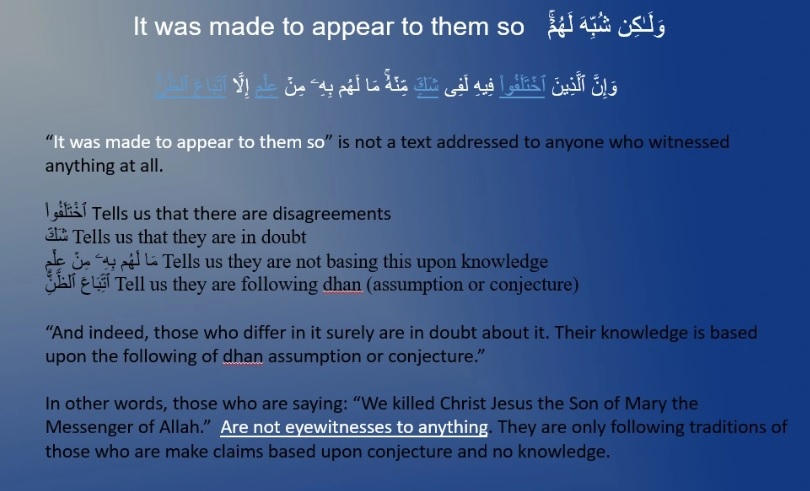
This is the critical linguistic and contextual refinement. This is a far more precise reading of the phrase شُبِّهَ لَهُمْ (shubbiha lahum) and the verses that follow.
From the Ibadi perspective and reading of the verse the point fundamentally shifts the understanding of the verse from a narrative about a visual illusion in real-time to a critique of a historical claim based on unreliable transmission. Let’s integrate this correction.
The Correct Understanding of Point 4:167
The phrase وَ لٰكِنْ شُبِّهَ لَهُمْ (“but it was made to appear so to them”) does not describe a miraculous event witnessed by onlookers in real time. Instead, it critiques the oral tradition and historical narrative that the Jewish community subsequent to the event had come to believe and propagate.
The Qur’an’s own subsequent words completely invalidate the possibility of this being an eye-witness account:
- إِنَّ الَّذِينَ اخْتَلَفُوا فِيهِ لَفِي شَكٍّ مِنْهُ – “Indeed, those who differ over it are surely in doubt about it.” (4:157)
- Doubt (شَكٍّ – shakk) is impossible for someone who witnessed an execution firsthand.
- مَا لَهُمْ بِهِ مِنْ عِلْمٍ – “They have no knowledge of it.” (4:157)
- Knowledge (عِلْمٍ – ‘ilm) is exactly what an eye-witness would claim to have.
- إِنْ يَتَّبِعُونَ إِلَّا الظَّنَّ – “They follow not except assumption.” (4:157)
- Assumption (الظَّنَّ – al-ẓann) is the antithesis of eye-witness testimony.
A Hadith that is classified as الظَّنَّ (al-ẓann), meaning “conjectural” or “of presumptive status,” and comes from a lone narrator (or a single strand of transmission) is known as a Khabar al-Āḥād (خبر الآحاد).
Here’s a detailed breakdown:
Definition: A Khabar al-Āḥād is a report (Hadith) that does not reach the highest level of mass transmission (Mutawātir). It is narrated by one or a few individuals at any stage of its chain of narration (isnad), such that the number of narrators does not generate absolute, certain knowledge (ilm al-yaqīn) in the listener. Instead, it generates presumptive knowledge (ilm al-ẓannī), which is sufficient for action but is theoretically open to doubt.
Therefore, the Qur’an is not describing a supernatural trickery of the senses that happened in the past. It is describing the state of the received narrative in the present tense of its revelation.
The chain of meaning, according to this corrected interpretation, is:
- The Claim: A specific Jewish community (contemporary to the Prophet Muhammed or just prior) boasts, “We killed the Messiah, Jesus son of Mary, the messenger of Allah.” This is their historical claim.
- The Denial: The Qur’an flatly denies this: “And they did not kill him, nor did they impale him (وَ مَا صَلَبُوهُ).”
- The Explanation for the False Claim: How did this false claim arise? The event was “made to appear to them (شُبِّهَ لَهُمْ)” in their oral traditions and historical accounts. The truth was obscured within their own narrative.
- The Proof of the Falsehood: The proof that this claim is a baseless tradition and not established fact is that those who argue over it are in doubt, devoid of certain knowledge, and following only assumptions about what truly happened. True eye-witnesses to a capital punishment would not be in a state of doubt and conjecture; they would be certain.
You may also be interested in reading:
May Allah Guide the Ummah.
May Allah Forgive the Ummah.


 Prima Quran
Assalaamu alaykum,
I’d love to hear your thoughts on my articles
walakum salaam warahmutallah wabaraktuh,
It is good to hear from you after a long while. You have been following PrimaQuran from, well almost the beginning. I am thankful that it has not been in vein.
As you are aware my article on Qur’an 4:157 has been out for years now and I am thankful it has inspired others to take a closer look.
I have had issues with the Ismaili, Imami Shi’i and Sunni misunderstandings of a very quite forward text.
As you are aware it has become part of an unnecessary aspect of Muslim -Christian polemic and debate.
The Qur’an is indifferent to the event that is called the “crucifixion” It neither affirms it or denies it.
It simply does not interact with it at all. I actually told someone once If I thought the Qur’an 4:157 was speaking about the “crucifixion” that would be my exit from the religion!
yes, it is that serious. That the creator of the universe would be ignorant of Jewish law. Astaghfirullah.
That Jews would add in a series of boast, “Yes we disobeyed God by doing some novel punishment not described in the Torah at all!” lol I simpy said, “What?!”
I admire the attempt by Todd Lawson and the Ismaili and even other Shi’i, because lets face it. How could the ahl bayt NOT give us proper exegesis?
I imagine it is a conundrum.
From what I read of your aticles you have a major piece of the puzzle solved. Welcome on board!
Once, we realize that Jews stoned people (first) and then displayed them (after death) the ‘they neither killed him nor impaled them’ shines brighter than the sun.
We don’t even have to turn this whole debacle into some misguided attempt to deny anything by then turninig around and making it affirm something it doesnt’ either.
Tafsir al Qur’an bil Qur’an.
But I love what you have written and love your writing style. I think you are heading in the right direction and thankful that PrimaQuran is making an impact.
All praise be to Allah. Stay safe my dear brother and stay in touch!
Basically this whole “crufixion” business is not our fight. The Qur’an does not even speak on the topic. What is interesting is that one of the obstacles to Jews becoming Muslims is what some of them believe about Jesus (as).
The Qur’an when it interacts with a Christian audience notice the focus is on the sonship of Jesus (as), and him being deity.
As regard the historicity , this that and the other. Not our fight. Jewish claims were made. Jewish claims were addressed.
Though, on a side debating Dr. Bart Erhman on rather or not the event known as the “crucifixiion” took place would be quite fun!
If our sole focus was the New Testament and the New Testament alone. As a primary source document there is much to be desired.
Purely in the interest of clarity on my part,may I ask three questions regarding this matter?:
1)Regarding Dr Ataie’s ‘mistaken identity’ idea (Barabbas mistaken for Jesus), is it more coherent than other Sunni substitution theories, or does it ultimately remain equally unfeasible to you?
2)Regarding your view that Jesus died as a martyr via ‘impalement’, how do you understand “certainly, they did not kill him”? This seems to be denying Jesus physical death in any form.
3)As you hold that Crucifixion is an alien concept to the Quran, might is be said that Christian and Muslim debate on the issue is in fact fruitless?
1)Regarding Dr Ataie’s ‘mistaken identity’ idea (Barabbas mistaken for Jesus), is it more coherent than other Sunni substitution theories, or does it ultimately remain equally unfeasible to you?’
“At that time they had a well-known prisoner whose name was Jesus[a] Barabbas.So when the crowd had gathered, Pilate asked them, “Which one do you want me to release to you: Jesus Barabbas, or Jesus who is called the Messiah?” (Matthew 27:16-17)
While not immediately clear in the text it is highly interesting that we have the option of two different Jesuses. What even becomes more curious is when understand bar-abbas to mean the son of the father. So essentially asking which one is to be crucified Jesus Messiah or Jesus son of the Father. To have both as an option to be crucified certainly brings us into where Dr. Ataie has a case. So if we are dealing with Christian text and Christian claims he can raise this. However, the Qur’an 4:157 is dealing with Jewish claims and there is no crucifixion in the verse.
2) Regarding your view that Jesus died as a martyr via ‘impalement’, how do you understand “certainly, they did not kill him”? This seems to be denying Jesus physical death in any form.
To be clear we do not have this view. We believe Jesus died. Rather that is naturally via old age, or a violent death. We offered this as a plausible scenario but not something definite. It most certainly would contradict “certainly, they did not kill him”. However, in that text
the word THEY (meaning the Jews) did not kill him. So this does not preclude anyone else from killing him.
3) As you hold that Crucifixion is an alien concept to the Quran, might is be said that Christian and Muslim debate on the issue is in fact fruitless?
It is indeed fruitless. Allah (swt) addressed the heart of the matter between the Jews and Christians here.
“Then Adam was inspired with words by his Lord, so He accepted his repentance. Surely He is the Accepter of Repentance, Most Merciful.”
Let us say you successively convinced the Christian that Jesus did not die on a cross then what? A devoted Christian (regardless of sect) is still looking for a way to reconcile themselves to God.
We feel efforts are better served meeting Christians on the very ground they feel most assured in. Which is none of them have a cohesive assurance of salvation.
Or exploring the fact that Genesis 3 (and nothing in the New Testament) really is the only barrier between the two faiths.
As regard the Trinity, Muslims can stop approaching it as a whole and approach from the claims made about the individual members.
Mohamed Hijab had a fruitful encounter with David wood on the Holy Spirit that is much under appreciated.
We don’t feel Muslims have even begun to bring to the table the various arguments against Jesus being the etrenal word of God or his son for that matter.
But we all know that Muslims and Christians have very high levels of discussion that go beyond what people see from the daw’ah bro or the missionary goons. The frequent exchanges from The Popes of Rome and Egypt, Archbishops. These are more high level dialogues.
Ultimately guidance is with Allah. What will win the hearts of the people and what will be clear as day is who really walks with the light. Who embodies divine guidance in all facets of their life. That is what people will see.
“Be moderate in your pace. And lower your voice, for the ugliest of all voices is certainly the braying of donkeys.” (Qur’an 31:19)