“Have the unbelievers not ever considered that the heavens and the earth were one piece and that We tore them apart from one another. From water, We have MADE/CREATED all living things. Will they then have no faith?” (Qur’an 21:30)
﷽
The Arabic text above says, “waja’alna” (We have created)
When a person makes something, he/she does it out of other materials made by Allah. For example, a carpenter who makes a table does not create it but he/she merely assembles and joins pieces of wood with nails and glue together.
In other words, he/she has made a table out of materials created by Allah. But when Allah (swt) makes something he makes it out of nothing or out of other materials he has created out of nothing.
“And it is He who has created man from water” (Qur’an 25:54)
The Arabic text above says, “khalaqa” (created). Allah (swt) has used in Qur’an 25:54 and Qur’an 21:30 two different Arabic terms, yet both of these words are synonymous in what they convey.
“It is He who created you from one soul and created from it its mate so that he might dwell in security with her.” (Qur’an 7:189)
In the above text, the first term used is “khalaqakum” (created) and the second term “ja’ala” (created). Again, this shows the interchangeable nature of these two terms.
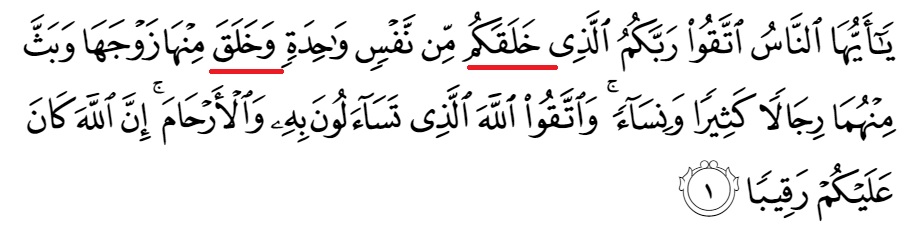
“Oh, mankind! Fear your Lord, who created you from a single person and created, out of him, his wife.” (Qur’an 4:1)
The above Arabic text is “khalaqakum” (created) and wa “khalaqa”(created). Allah (swt) used the same word twice. Allah (swt) did not use the word “ja’ala” (created) as he did in Qur’an 7:189. This once more shows that the two words convey the same meaning.
“Indeed, We have made it an Arabic Qur’an that you might understand.” (Qur’an 43:3)
The Arabic term that is used here is “ja’alnahu” (made/created)
“Truly I am going to create man from clay” (Qur’an 38:71)
The Arabic term here is “khaliqun” (create)
Now let us look at Qur’an 38:72
The underlying words in verse 72 have, however, been given contradictory interpretations.
Professor Abdullah Yusuf Ali has translated them as: “And I breathed unto him of my spirit.”
So when I have fashioned him and breathed into him (his) soul created by Me, then you fall down prostrate to him.”
The implication of the first translation is that Allah (swt) has given part of His spirit, so man is the essence of Allah.
This sounds very much like those who say the Qur’an is the essence of Allah.
In the second translation by Dr. Al Hilali and Dr. Khan, it means that Allah created man’s soul and then breathed it into him. This interpretation agrees with those who say that the Qur’an is created.
This is also the way the Sahih International translates it this way: “So when I have proportioned him and breathed into him of My [created] soul, then fall down to him in prostration.” (Qur’an 38:72)
The three translations (Abdullah Yusuf Ali & Dr. Al Hilali /Dr. Khan and Sahih International are all three contradictory and have both been endorsed by the religious institutions in Saudi Arabia.
Fortunately for us, neither of the translators were Ibadi or the so-called, “Khariji” and thus, no sectarian uproar in the Islamic World!!
Unfortunately, this particular issue is complicated by the fact that there is quite a bit of obfuscation on behalf of our brothers from ‘Ahl Sunnah’ and that is because they do not want to tell us if they regard the attributes of Allah (swt) as being identical with the essence of Allah (swt) or being outside the essence of Allah (swt).
If you would like to learn more about the Qur’an being a creation of Allah (swt), you may wish to read the following:
“This day are things good and pure made lawful unto you. The food of the People of the Book is lawful unto you and yours is lawful unto them. Lawful unto you in marriage are not only chaste women who are believers, but chaste women among the People of the Book, revealed before your time when you give them their due dowers, and desire charity, not lewdness, nor secret intrigues. If anyone rejects faith, fruitless is his work, and in the Hereafter, he will be in the ranks of those who have lost.” (Qur’an 5:5)
“O you who have believed, do not prohibit the good things which Allah has made lawful to you and do not transgress. Indeed, Allah does not like transgressors.” (Qur’an 5:87)
﷽
This entry will give the position of the Muslims, otherwise known as (Ahl Haqq Wal Istiqama) or the Ibadi school. It will give our justifications from the Qur’an and Sunnah for marrying the people of the book (Jews and Christians).
Companions such as Ibn Abbas, Saad bin al-Musayyab, Said bin Jubair, Uthman, Talha, Tawus, Mujahid are all known to have married people of the book. The Blessed Messenger (saw) himself is known to have married from among the Ahl Kitab.
So, yes, in the Ibadi school, a Muslim man can marry a Christian or Jewish woman if certain conditions are met.
Ad-Darooriyyat Al-Khams—The Five Basic Necessities that are protected and recognized by Islamic law-shari’ah.
The five necessities—religion, life, intellect, lineage, and property are defined.
This ruling would fall under the category of: preservation of lineage & preservation of religion.
Among our brothers from the Ahl Sunnah, there are two positions. The position of Imam Malik and Imam Abu Hanifa is that Muslim men can marry Christian and Jewish women and until today there are no restrictions put on this.
The position of Imam Ahmad and Imam Shafi’i is that Muslim men cannot marry Christian or Jewish women.
The position of the Ibadi school is in between these two camps. It is very clear that we cannot make impermissible what Allah (swt) made permissible.
That being said, there is a context to these verses and conditions that must be met.
Conditions placed on marrying the Ahl Kitab.
1st condition is that this takes place under Muslim governance, where there is full compliance of the shariah law.
The 2nd Condition is that the interest of the Muslims dominates. The children, for example, are to be raised as Muslims.
The 3rd condition is that the Muslim man actually is a practicing Muslim.
The 4th Condition is that the Jewish or Christian woman actually be practicing Judaism or Christianity.
The 5th condition is that she did not ever commit fornication or have an extramarital affair.
Understanding the first condition.
“O you who have believed, obey Allah and obey the Messenger and those in authority among you. And if you disagree over anything, refer it to Allah and the Messenger, if you should believe in Allah and the Last Day. That is the best way and best in result.” (Qur’an 4:59)
What happens today in North Africa and in Turkey is that many of these men who are exposed to the Maliki and Hanafi schools of jurisprudence will marry women from the United States, Europe, Russia. Often the children of these marriages are split between nationalities. The inheritance laws are not decided by the laws of Islam they are decided by secular institutions. The fate of the children will be decided by the laws of those lands. More often than not, the court awards the custody of the children to the mother. The children are brought up without a Muslim father, an Imam leading the prayers and teaching the deen of Islam. This is totally unacceptable.
Understanding the second condition.
“Our Lord, and make us Muslims that submit to You, and from our descendants a community that submits to You. And show us our rites and accept our repentance. Indeed, You are Ever-Accepting of our repentance, the Most Merciful.” (Qur’an 2:128)
“O you who have believed, protect yourselves and your own families from a Fire whose fuel is mankind and stones, (and) over which are harsh, severe Angels, who do not disobey Allah in whatever He commands them and who perform whatever they are commanded to.” (Qur’an 66:6)
Anyone who loves their children does not want to expose them to the dangers of hellfire. The best and clearest way to help ensure this is to raise them as Muslims. To instill in them the articles of faith. The love and fear of Allah (swt). The love of the Blessed Messenger (saw) and following his noble example. Muslims cannot give blessings to their children to be raised by other religions because they were all abrogated with the coming of Islam. Qur’an 2:106 establishes this.
“Men are in charge of women by right of what Allah has given one over the other and what they spend for maintenance from their wealth. So righteous women are devoutly obedient, guarding in the husband’s absence what Allah would have them, guard. But those wives from whom you fear ill/strange conduct advise them; then if they persist, forsake them in bed; then if they persist strike them. But if they obey you once more, seek no means against them. Indeed, Allah is ever Exalted and Grand.” (Qu’ran 4:34)
It is difficult enough to get Muslim-majority nations to want to establish the Imamate. Does anyone think that non-Muslim majority nations have a vested interest in doing so? They have different world views and different principles upon which they base their concepts of justice. Many of them promote egalitarianism. Too many times, Muslim men are taken by the charms and beauty of non-Muslim women. Non-Muslim women may make promises to them. However, none of those promises are legally binding. This will lead us to understand the third condition.
Understanding the third and fourth conditions.
“And do not marry polytheistic (l-mush’rikati) women until they believe. And a believing slave woman is better than a polytheist, even though she might please you. And do not marry polytheistic men to your women until they believe. And a believing slave is better than a polytheist, even though he might please you. Those invite you to the Fire, but Allah invites to Paradise and to forgiveness, by His permission. And He makes clear His verses to the people that perhaps they may remember.” (Qur’an 2:221)
This verse is ‘Aam. There is an exception or allowance to marry the mush’rikati women. That exception is given in Qur’an 5:5
Many of these Muslim men who want to marry Christian or Jewish women are themselves not practicing Islam. That is not a good foundation to start a marriage with a Muslim woman, let alone a non-Muslim woman. The children are likely to be swayed by the parent who shows more conviction and practice of their faith tradition than the parent that does not show conviction or practice their faith tradition. That is why Allah (swt) says that marrying someone who is a slave is better than marrying a free, non-believing woman, even though her /his looks may please you.
Allah (swt) also said you can marry Christian and Jewish women.
Understanding fourth and fifth conditions.
“This day are things good and pure made lawful unto you. The food of the People of the Book is lawful unto you and yours is lawful unto them. Lawful unto you in marriage are not only chaste women who are believers, but chaste women among the People of the Book, revealed before your time when you give them their due dowry, and desire charity, not lewdness, nor secret intrigues. If anyone rejects faith, fruitless is his work, and in the Hereafter, he will be in the ranks of those who have lost.” (Qur’an 5:5)
That Christian or Jewish woman has to be a practicing Jewish or Christian woman. She has to follow the tenets and edicts of her faith tradition. She cannot be a ‘nominal’ Jew or a ‘nominal’ Christian. If the Christian or Jew converts to Buddhism, Hinduism, Sikhism, Taoism, Shintoism, New Age spirituality, or anything of the kind, the marriage can become null and void.
Also, Allah (swt) says, ‘chaste women’—muhsanatu. This means if these women have committed fornication or adultery, you cannot marry them. So this only leaves you with the option of marrying someone who is a virgin or a divorcee.
These Muslim men should be aware of one of the very strong positions in the Ibadi school in regard to themselves (the Muslim men) being chaste.
The same rule applies to Muslims as well. Muslims who have committed fornication for adultery can only marry other Muslims who have done similar. They cannot marry chaste believers, nor can they marry those people they have done fornication/adultery with.
This is not an example of abrogation. This is an example of a specification. Now you ask yourself are these conditions met today?
The Ibadi school is priority to Muslim Women First.
What happens in places where the Maliki and Hanafi schools reign supreme? You do see Muslim men often marry “Christian” or “Jewish” women, many of whom are actually agnostic or even atheist. They do so while many hundreds of thousands of Muslim women go unmarried. There are hundreds of thousands of Muslim women who are widows, divorcees, orphans, single people, or simply never been married before.
Shouldn’t our priority be the Ummah of Muhammed (saw)? Remember the wisdom of Allah (swt)
“And a believing slave woman is better than a polytheist, even though she might please you.”
What happens in those places where the Shafi’i school is dominant? For example: places like Indonesia or Malaysia? What happens is that Muslim men or Muslim women will tell non-Muslims to convert to Islam, and then they will marry them. At least these approaches are more sensible. Bringing people to Islam. That, of course, is acceptable by Islamic law. However, every action is judged by intention and so too will be the fruit of that intention.
There are thousands of Muslim men and women who convert to Islam every year of their own free will and volition. Not under any social pressure to convert because of love. Would it not be wise to give preference to these people for marriage?
May Allah (swt) continue to guide the Ummah of Muhammed (saw)!
You may be interested in reading the following articles:
“Forbidden unto you are your mothers, and your daughters, and your sisters, and your father’s sisters, and your mother’s sisters…” (Qur’an 4:23).
﷽
The short of it is that Imam Al Shafi’i is not going against the clear verses of the Qur’an.
This article will discuss the very controversial opinion held by Imam Al Shafi’i, which says that if you had a daughter born out of wedlock (marriage) that you could (on a technicality) marry her, and have intimate relations with her!
Here is a short article that got quite a bit of attention about the subject.
Now the issue with this article is that neither side really furnishes evidence for the claims that are made. One side claims that Imam Shafi’i held this opinion and the other side claims that it is a blatant misrepresentation of his viewpoint.
Shaykh Hamza Yusuf of Zaytuna spoke on this issue not long ago.
@058: “And if I say I am Shafi’i, they say, “Oh he permits marrying daughters. And everybody knows that the daughters are haram.” -Hamza Yusuf
“And this comes from a Mas’ala Fariyya. If a man fornicated and the woman had a child, and it was a girl, and then he married the girl later, that legally the contract would be valid. It’s a horrible thing; but it is one of those legal, legalisms. And so they said. “Oh, that’s he permits marrying the daughter and everybody knows that the daughter is haram.” -Hamza Yusuf
However, we have an official Shafi’iFiqh website with a reference that shows this indeed was the opinion of Imam Shafi’i.
The official position of the Shafi’i Madhhab is that a girl born out of wedlock is not a daughter, marriage to her is permissible but disliked. (Minhaj al-Talibin w/ Tuhfah 2/299) To claim that Imam Shafi’i said it is permissible for one to marry his ‘daughter’ is a misrepresentation of his opinion. Other scholars who wrote on this issue treated Imam Shafi’i and his opinion with a more mature and academic approach than what circulates in some contemporary discourses on this topic. For example, in Sharh Mukhtasar al-Rawd 3/434, al-Tufi mentioned this as an example of qiyas al-shabah. He pointed out that, from the biological angle, she is a daughter. But from where the Sacred Law stands, she is not: she does not inherit nor does he inherit from her, he is punished for accusing her of being unchaste, his hand is cut off if he steals from her, and he is executed if he takes her life. Tufi says that “we”, i.e. the Hanabilah considered the biological factor when ruling on marriage with her, considering it unlawful. And Imam Shafi’i considered that, in all other cases, the Sacred Law negates paternalistic rights, and therefore she is, likewise in this case, not his ‘daughter’ according to the Law. In his Muhalla 8/334, Ibn Hazm mentioned that there is no difference of opinion among scholars on the suspension of these rights, except for when it comes to tahrim.”
“With that, the As-hab al-Awjuh differed on how they understood Imam Shafi’i on this particular point. Some of them considered that a girl born out of wedlock was ruled lawful as there is no marital bed she may be ascribed to,and it is dubious as to who her father really is. This position is alluded to in the commentaries on Minhaj. In al-Hawi al-Kabir 11/393, Mawardi related from Abu Is-haq al-Marwazi that it is permissible as her being from him is only a mere possibility. However, if that would be a defiantly confirmed fact, then his marrying her would be unlawful. Marwazi gives the example of a man and woman being imprisoned together from the time of their relations until the child is born. He says if a child came from such a situation, then it would be unlawful.”
“After this citation, Mawardi cited another understanding from Abu Is-haq al-Marwazi’s student, Qadi Abu Hamid. According to him, Imam Shafi’i ruled it was disliked because of the differences of opinion on the matter [khurujan min al-khilaf]. But otherwise, she is not his daughter and therefore she is not unlawful for him. The reasons Mawardi cited for this ruling, those supporting Imam Shafi’s application of qiyas al-shabah, are the same as what was cited above. Tarjih in the Madhhab, at the hands of Shaykhayn and Shaykh al-Islam’s students, went with Qadi Abu Hamid on this particular issue.”
And Allah knows best.
Answered by Shaykh Yaqub Abdurrahman”
The screenshot is included because, as those who follow Prima-Quran know, sometimes these links have the unfortunate habit of mysteriously disappearing.
PRIMA QUR’AN COMMENTS:
So we all agree that marrying one’s daughter is forbidden in the Qur’an. What is actually very sad is that the Creator had to reveal this as a law, to begin with. You would think that it would be common sense for people not to want to have intimacy with their own daughter!
You would think the very idea would be disgusting and reprehensible.
So let us deal with the points in the answer above.
Point 1) It is without a shadow of a doubt that Imam Shafi’i has a position that one can marry their own ‘daughter’.
Point 2) The dispute is whether or not she is a daughter in a biological sense or a legal sense. Notice the use of apostrophe when using the word daughter as ‘daughter‘.
To address point 2 here above, we remember having a discussion in Singapore with a well-known Ustaz who mentioned to us a case of a young teenage boy who was notorious for sleeping with women and getting them pregnant. He is literally the father of children of a number of women. However, because of the viewpoint in the Shafi’i school, MUIS (Majlis Ugama Islam Singapura) had their hands tied.
So what about the justice due to these women? Wham, Bam Thank you, Ma’am!
What about the justice due to the children?
So the scholars, to bring justice to the children and the women, had to develop a new fatwa in such a scenario. In the end, that sexually promiscuous young man had to pay support for the children. Such is the recourse in a secular nation state.
In Malaysia/Indonesia — where sexual promiscuity among Muslim teens is quite high, we are not certain how they handle such scenarios either. However, these things want to happen.
Especially when:
You make getting married a great difficulty, almost a burden.
You allow free mixing of the sexes all throughout society.
You have theological views that take such matters lightly. The All Merciful Creator will forgive you again and again and yet again, no matter how many times.
Not engaging the youthful and energetic with something worthy and laudable to occupy their time with.
“However, repentance is not accepted from those who knowingly persist in sin until they start dying, and then cry, “Now I repent!” nor those who die as disbelievers. For them We have prepared a painful punishment.” (Qur’an 4:18)
For us and our position, there is no such thing as illegitimate children in Islam!
There are only illegitimate means to have children.
As one brother recently told us, people in many parts of the world, especially in the Indo-Pak region, treat children out of wedlock as though they are disease, scum of the earth or filth, and either they’re thrown in rubbish bins at birth or given to orphanages and throughout their entire lives deprived of all basic human rights and dignity!
You can read the following link to get an idea of the scope of damage that such jurisprudence has done to humanity!
The following verses in the Qur’an support the idea that children should not be deprived because of the actions of their parents.
“No one will bear the burden of another. Even if an overburdened soul should ask another to bear a part of his burden, no one, not even a relative, will do so.” (Qur’an 35:18)
“That no bearer of burdens will bear the burden of another.” (Qur’an 53:38)
“Whoever is guided is only guided for [the benefit of] his soul. And whoever errs only errs against it. And no bearer of burdens will bear the burden of another. And never would We punish until We sent a messenger.” (Qur’an 17: 15)
The idea of making a daughter a ‘daughter’ in the case of the so-called sacred law deprives and punishes such children because of their parent’s actions.
Point 3) As the article shows, even the position of Imam Shafi’i collapses under the weight of logic.
“Marwazi gives the example of a man and woman being imprisoned together from the time of their relations until the child is born. He says if a child came from such a situation, then it would be unlawful.”
This is an excellent example of using the Allah given faculty of reason and logic.
Point 4) Why not err on the side of caution?
The article says:
“Some of them considered that a girl born out of wedlock was ruled lawful as there is no marital bed she may be ascribed to, and it is dubious as to who her father really is.”
So the logic here is: It’s dubious who her father is, Thus you can marry her and have sex with her?!
Why not let the logic here be: It’s dubious who her father is, so it’s a good idea if you don’t marry her and have sex with her?!
This is what we don’t get sometimes dear respected readers. We are told these Imams are unassailable in their jurisprudence. Yet here you will have the Shafi’i school, which will make it forbidden to marry Jews and Christians based upon what they believe is dubious grounds for them actually being Jews and Christians; and yet, say it is permissible to marry one’s daughter if she is born out of wedlock!
We are told to approach this topic with a more ‘academic’ and ‘mature’ mindset. This is certainly true. We deal with proofs and evidences. Emotions are not the metric for truth. However, often these statements are made to simply table discussion of controversial matters. May Allah (swt) rectify our condition.
There are two points alone that should give pause to those who hold to this position of Imam Shafi’i.
#1 Modern DNA testing.
#2 Those places that do not have DNA testing available the very inconsistency of the qiyas -analogy applied is enough to refute it. As mentioned before, instead of the dubious nature of who her father is giving a green light for permission to for the marital bed, why not simply err on the side of caution and let there be a red light for this?
Some people will say, “How brazen! You really think you can do better than these imams?”
We believe they want us to do better than them. We also believe that the future of Muslims depends on us adding to their monumental contributions and leaving aside their conclusions that are flawed.
Also, according to the Sunni Muslims, if an Imam makes an ijithihad, and he is mistaken in that, he still gets a reward. That being said, reflect for a moment on how many words you speak in a day. What is the tally of words that you speak in a year? Now take that and multiply by 10 or 15 or 20 years. Do you really think that you have not said something you regret? Even people who are astute in their fields of science make mistakes. This does not take away from their dedication and their tireless efforts for the Muslim ummah.
If you do not feel we were just representing this opinion with in the Shafi’i school, please feel free to leave a comment. All corrections and/or additional information is welcomed.
With Allah (swt) is success!
If you are keen, perhaps the following articles may interest you.
The Ibadi school’s position on marrying Jews & Christians. Should we give preference to the Ahl Kitab over Muslim women?
“O you who have believed, do not take the disbelievers as allies instead of the believers. Do you wish to give Allāh against yourselves a clear case?” (Qur’an 4:144)
﷽
Who is Wilferd Madelung?
For those not familiar with Wilferd Madelung. He has had a deep engagement with Islamic scholarship, in particular the Shia tradition. He was a highly respected scholar of Islamic and Iranian studies. He dedicated his career to studying Islamic history and theology, including the nuances of different Islamic sects like Twelver, Ismaili, and Zaydi Islam. He was honoured as an Iranian dignitary and received praise for his works supporting the Shia view on the succession to the Prophet Muhammed (saw).
Curriculum Vitae-
Wilferd was educated in Stuttgart (Eberhard Ludwig Gymnasium), Washington DC (Woodrow Wilson High school, Georgetown University), Cairo (Fuad I University), Göttingen, and Hamburg, where he obtained his PhD in 1957. Between 1958 and 1960, he served as cultural attaché at the West-German Embassy in Baghdad, followed by a visiting professorship at the University of Austin, Texas (1963). Following his Habilitation in Hamburg, he taught as Privatdozent in Hamburg during the academic year 1963-64. Since 1964, Madelung has taught at Chicago University as Assistant professor (Associate Prof., 1966; Professor of Islamic History, 1969). Between 1978 and 1998, Madelung taught as Laudian Professor of Arabic at Oxford University. Between 1999 and 2021, Wilferd Madelung was affiliated with The Institute of Ismaili Studies as a Senior Research Fellow. Wilferd Madelung passed away on 9 May 2023 in Oxford.
Rumors of conversion to Imami Ismaili Nizari Shi’ism.
What fuled the rumors and speculation?
His relationship with the Aga Khan, Madelung’s rigorous and sympathetic work, earned him immense respect within the Ismaili community. He was appointed as the Head of the Department of Academic Research and Publications at The Institute of Ismaili Studies (IIS) in London, an institution established by His Highness the Aga Khan IV (the current Imam of the Nizari Ismailis). This close association with the spiritual leader of the Ismailis fueled speculation.
To outsiders, the combination of deep, sympathetic understanding and a high-ranking position within an Ismaili institution seemed to suggest something more than academic interest. The conclusion some jumped to was that he must have converted.
The counter to the rumor.
No public declaration or evidence: There has never been a public statement from Madelung, his family, the IIS, or the Ismaili community claiming he converted. In the absence of any evidence, the claim remains a baseless rumor.
Paragraph 1
“Among the prominent Companions of the Prophet Muhammed, ‘Abd Alla b. Al-Abbas (d. 68/687), paternal cousin of Muhammed and of ‘Ali b. Abi Talib, became the primary religious teacher of the muhakkima who after the slaying of the caliph Uthman had been vigorous supporters of Ali, but then deserted him in protest against his arbitration agreement with Mu’awiya. Ibn al-‘Abbas evidently had been well known to them, and highly regarded by them, long before their revolt against ‘Ali. Born three years before the hijra and still a minor at the time of the death of the Prophet, he had first been drawn into a political role by the caliph ‘Umar, who took him into his intimate confidence as a representative of the Banu Hashim, the kin of Muhammed. The caliph Uthman, while besieged by rebels from Egypt in his place in Medina, appointed him a leader of the pilgrimage to Mecca and entrusted him with reading a lengthy message to the assembled pilgrims in which ‘Uthman defended his conduct in office and appealed for their help. Ibn al-Abbas read the message to the Mecca pilgrims on 7 Dhu-l-Hijja 35/6 June 656, just eleven day before the caliph was killed. He then became a close adviser of ‘Ali and was appointed by him governor of Basra after the Battle of the Camel. Like ‘Ali, he did not view the rebels against ‘Uthman as culpable in his death.”-Wilferd Madelung
Paragraph 2
“When after ‘Ali’s arbitration agreement with Mu’awiya some 12,000 muhakkima seceded in protest from his army and camped at Harura outside Kufa in Rabi’ I 37/Aug-Sept, 657. ‘Ali first sent Ibn al-‘Abbas to them as a mediator. The majority of the seceders, however, rejected his unsound argument that arbitration was generally allowed by the Qur’an and only a few of them returned to Kufa. ‘Ali then was able to persuade all of them to return by promising them to resume the war against Mu’awiya in six months. He evidently expected the arbitration attempts to have failed by then. Quarrelling between the muhakkima and the supporters of arbitration in Kufa delayed ‘Ali’s expedition of his arbitrator, Abu Musa l-Ash’ari, beyond the six months, and when Abu Musa left for the site of arbitration in Dumat al-Jandal accompanied by Ibn al-‘Abbas and an escort of 400 Kufan warriors, the muhakkima decided to leave Kufa secretly and to assemble in al-Nahrawan near al-Mada’in. This time they chose ‘Abd Allah b’ Wahb al-Rasibi as their chief and asked their muhakkima brethren in Basra to join them. Some 2,000 men thus gathered in al-Nahrawan while the meeting of the two arbitrators took place in Dumat al-Jundal in Shawwal-Dhu l-Qa’da 37/March-April 658.“--Wilferd Madelung
Paragraph 3
“After the breakup of the arbitration meetings in failure to resolve the conflict, ‘Ali immediately denounced the arbitrators and ordered his army to mobilize for a new campaign against Mu’awiya. He wrote to the muhakkima in al-Nahrawan inviting them to join. Their position, however, had now hardened and they demanded that ‘Ali publicly repents of his earlier agreement to arbitration. As ‘Ali led the Kufan army northward toward al-Anbar, some of the muhakkima vented their frustration in wanton murder of Muslims, including ‘Abd Allah, the son of the Companion Khabib b al-Aratt, his pregnant wife and an envoy sent by ‘Ali to them. ‘Ali saw himself forced to abandon his campaign against Mu’awiya and to deal with the muhakkima rebels. In the battle of al-Nahrawan in Dhu l-Hijja 37/ May 658u more than 1,000 of them were killed.”--Wilferd Madelung
Paragraph 4
“‘Abd Allah b al-‘Abbas, it should be noted, was not present at the Battle of al-Nahrawan, as ‘Ali had deputed him to lead the pilgrimage to Mecca for the year. Ibn al-‘Abbas evidently regretted the assault on the rebels collectively and the resulting massacre. Had he been present, he would no doubt have counseled to restrict any punishment to the actual perpetrators of criminal violence and to leave the others alone, whatever their incendiary rhetoric. As it were, he soon advised ‘Ali, when the latter bitterly complained about the lack of support he had from his men for his campaign against Mu’awiya, to treat them kindly in patience, since they might change their mind in the future. His different attitude toward the seceders soon turned Basra into a safe haven for the muhakkima. While they were unable to establish themselves as a dissident community in the extremely hostile environment of Kufa under the rule of ‘Ali, they found refuge as a tolerated opposition party in Basra under the governorship of Ibn al-‘Abbas, who would not interfere with their activity as long as they abstained from acts of violence and breach of the peace in the city. The muhakkima in Basra fully appreciated the policy of Ibn al-Abbas and looked to him as their trustworthy religious teacher, even though he had defended the legitimacy of ‘Ali’s agreement to arbitration. The bulk of them were tribesmen of Tamim, and they kept the peace with the majority of Tamim and the other tribes in the arbitration.”--Wilferd Madelung
Paragraph 5
“When Mu’awiya, after the surrender of al-Hasan b ‘Ali in the year 41/661, claimed the rule of Basra, the muhakkima, who had declared him an infidel (kafir), refused to pledge allegiance to him. Mu’awiya then appointed Ziyad b Abih, his bastard paternal brother, who had been Ibn al-‘Abbas trusted assistant in the government of Basra, governor of the town. Although personally less sympathetic to the muhakkma, Ziyad prudently treated them as Ibn al-Abbas had done. They were now led by the Tamimi Abu Bilal Mirdas b Udayya, the brother of ‘Urwa b Udayya who was reputed to have been the first in the army of Ali to proclaim the takhaim: “la hukma illa li-illlah-No rule but God’s”. Abu Bilal continued to keep the peace in the town for two decades during the Caliphate of Mu’awiya. In his later years of leadership he befriended Abu l-Sha’tha Jabir b. Zayd, a pupil of Ibn al-‘Abbas ,and accepted him as his adviser in matters of religion.”--Wilferd Madelung
Paragraph 6
“Mu’awiya’s professed policy of seeking revenge for the slaying of the caliph ‘Uthman on all of his opponents and even on neutrals who had failed to rally to his defense, as well as his affirmation of the exclusive right of the Qurash to the caliphate in Islam drove many Muslims in Iraq and the eastern provinces, who had not objected to the arbitration or had even supported it, to join the ranks of the seceders. During Mu’awiya’s divisive caliphate, the muhakkima became a widespread, nonviolent opposition movement in the eastern Islamic world. Especially the eastern Arabian tribes of Rabi’a were now attracted to the ideology of the muhakkima. The seceders basic dogma that Islam implied the sovereign rule of God rather than any human being, be he of Quraysh or not, and the recognition that the rule of God meant to obey the Qur’an to the letter, appealed to them. Rabi’a, especially Bakr b Wa’il, had made up the backbone of ‘Ali’s army at Siffin and he thwarted Mu’awiya’s hope for outright victory in the battle. After the surrender of al-Hasan b ‘Ali, Mu’awiya sought to humiliate them by seizing from them the sword of the caliph ‘Umar, called Dhu-l-Wishah, which they had acquired as war booty after killing Umar’s son, Ubayd Allah at Siffin. The bulk of Rabi’a would not pledge allegiance to Mu’awiya and remained in opposition to his caliphate.”-Wilferd Madelung
Paragraph 7
“Special was the case of the Banu Hanifa, a sub-tribe of Bakr b. Wa’il mostly sedentary in al-Yamama. Their grievance against the pretention of the Quraysh was long standing. Their king Hawdha had offered Muhammed to accept the religion of Islam if the Prophet allowed him to share in the political rule of his people. His negotiations with Muhammed, however, failed and when he died, his successor Musaylima claimed to be a prophet to his people, presumably as a rival to Muhammed, not a denier of his prophethood. Only a small group of Hanifa at the time opposed Musaylima and accepted Muhammed as their prophet.”--Wilferd Madelung
Paragraph 8
“After the death of Muhammed and the establishment of the caliphate of Quraysh, the Muslims viewed Hanifa as apostates and followers of a false prophet. In the Battle of al-‘Aqraba, they subdued them breaking fierce resistance. While many companions of the Prophet fell, the Banu Hanifa were decimated and some of their women and children enslaved. They were excluded form the wars of conquest under ‘Umar, stayed neutral in the revolt against ‘Uthman, and unlike the bulk of Rabi’a, did not join the army of ‘Ali. There were no tribesmen of Hanifa among the original muhakkima. Busr b Abi Artah, Mu’awiya’s general sent to subdue Arabian towns and countryside, and to punish former supporters of ‘Ali and neutrals alike, carried off the son of the former chief of Hanifa, Mujja’a b Murara, as a captive to Mu’awiya and recommended that the caliph kill him as a punishment. Mu’awiya, however, accepted the pledge of allegiance of the captive and confirmed him as chief of his people. He then claimed the agricultural land of Hanifa in al-Yamama as crown property and had it cultivated by his slaves. The majority of the Banu Hanifa joined the muhakkima movement evidently early during the caliphate of Mu’awiya.”--Wilferd Madelung
Paragraph 9
“Two of the leaders of the Hanifa muhakkima, Nafi b al-Azraq and Najda b ‘Amir, are known to have had ‘Abd Allah b al-‘Abbas as their authoritative teacher in religion. They are described as rivals for the leadership in their community and as seeking to bolster their own authority by relying on religious verdicts of the cousin of the Prophet. Nafi’ b. Al-Azraq al-Hanifa-Hanzali, who later became the chief of the most radical sect of the Kharijis, was the son of a freedman of Greek origin. He put questions to Ibn al-‘Abbas, presumably in Mecca during the pilgrimage season, about the meaning of Qur’anic terms and then asked him for confirmation of that meaning by their use by Arab pre-Islamic poets. Numerous such masa’il were later transmitted and collected by Sunni scholars. While western scholars following J. Wansbrough have viewed all reports of Masa’il Nafi’ b. Al-Azraq as entirely fictitious, the authenticity of at least a core of them has been defended by A. Neuwirth with strong arguments. Given the paramount importance of the correct understanding of the meaning of the Qur’an for the muhakkima, it is evidently quite reasonable that a non-Arab mawla should have put such questions to Ibn al-‘Abbas and have asked for proof-text form Islamic poetry. Neuwirth suggested that the meeting of Nafi’ and Najda with Ibn al-‘Abbas most likely took place in the year 60/680. It seems more likely, however, that the two interrogated Ibn al-‘Abbas earlier during the caliphate of Mu’awiya, when Ibn al-‘Abbas is known to have regularly taught and responded to questions during the pilgrimage season.”-–Wilferd Madelung
Paragraph 10
“Najda b ‘Amir, a native Arab tribesman of Hanifa who evidently had a much larger following among them than Nafi’ b. Al-Azraq, put question on theology to Ibn al-‘Abbas. ‘Abd Allah b. Yazid al-Fazari, the 2nd/8th century Kufan Ibadi kalam theologian, quotes a report according to which Najda asked Ibn al-‘Abbas about how he recognized his Lord remarking that there was disagreement among the people in that regard. Ibn al-‘Abbas answered with a lengthy statement that he recognized his Lord as He described Himself in His Book. Ibn al-‘Abbas then denied that God could be seen or perceived by the senses and rejected any anthropomorphic concept of God (tashbih). He affirmed God’s justice in all His decisions and judgement, but emphasized His determination of all acts of His creatures by His decisive will and foreknowledge.”-–Wilferd Madelung
Paragraph 11
“The great expansion of muhakkima ideology in the eastern Muslim world came into the open during the second inter-Muslim War (fitna) that raged for over a decade from 61/681 to 73/692. The war was provoked by Mu’awiya’s appointment of his son Yazid as his successor and his demand for an immediate pledge of allegiance to him. The refusal of several prominent Companions, especially ‘Abd Allah b. Al-Zubayr, al-Husayn b ‘Ali and ‘Abd Allah b. Al’Abbas, to pledge allegiance encouraged tribal chiefs to withhold their pledge. Mu’awiya’s poisoned murders of potential rivals and opponents of his son then inflamed the latent enmity against him. Mu’awiya first poisoned al-Hasan b. Ali whom he had contractually promised an election of his successor by consultation (shura), thus inciting Shi’i revolt. When the tribal leaders in Syria expressed their preference for ‘Abd al-Rahman, the son of the ‘Sword of Islam’ Khalid b. Al-Walid, for the succession, he had him poisoned. This drove the Banu Makhzum, Khalid’s kinsmen in Mecca to solid support of the counter-caliphate of ‘Abd Allah b. Al-Zubayr. In Basra the Rabi’a resisted Mu’awiya’s demand that they pledge allegiance to Yazid, and many of them left the town. Mu’awia then put pressure on Khaild b al-Mu’ammar, the chief of Bakr b. Wa’il, who promised him to secure the loyal support of Rabi’a to him. Mu’awiya now appointed him governor of Armenia, but still distrusting him as a former supporter of ‘Ali, he had him poisoned when he reached Nasibin.”--Wilferd Madelung
Paragraph 12
“After the death of Mu’awiya in 60/680, the muhakkima came in large number to Mecca, where ‘Abd Allah b. Al-Zubayr was then seeking asylum, preparing to defend the Holy City against any Syrian assault and to recognize Ibn al-Zubayr as their imam. When they questioned about his views concerning the caliphate of ‘Uthman and he insisted that ‘Uthman had been wrongfully killed, they turned away from him. They continued, however, to protect Mecca against any Syrian encroachment. In 64/683-4 they aided Ibn al-Zubayr’s supporters in holding off the Syrian attack on Mecca before the death of caliph Yazid. Ibn al-Zubayr now claimed the caliphate and gained wide recognition throughout the central and eastern regions of Islam. The muhakkima and the Shi’a, however, would not recognize him, and in Syria the Umayyad Marwan b. Al-Hakam soon found recognition as caliph. By 67/687 Najda b. ‘Amir, the leader of the Hanifa muhakkima, gained control over all of Arabia except Mecca and Medina. Ibn al-Zubayr now expelled Muhammed b. Al-Hanafiyya, whom the Shi’a in Kufa recognized against his will as the imam and mahdi from Mecca. When Ibn al-‘Abbas publicly protested the expulsion, Ibn al-Zubayr furiously expelled him, too, from his home town. The two and their families sought refuge in al-Ta’if which was under Najda’s rule. Najda again consulted Ibn al ‘Abbas on questions of religion. When he considered blocking the food supply to the two holy cities, ‘Abd Allah b. Al-‘Abbas remonstrated with him, and he desisted. Internal conflict among the Hanifa about the leadership weakened his position gradually and eventually he was killed by his rival Abu Fudayks in 72/691. Abu Fudayk in turn was killed in al-Bahrayn a year later by the Caliph ‘Abd al-Malik’s commander ‘Umar b ‘Ubayd Allah b. Ma’mar, and Ummayad rule was finally restored over all of Arabia.”-–Wilferd Madelung
Paragraph 13
“After the death of Ibn al-‘Abbas in 68’687 in exile in al-Ta’if, his Berber freedman ‘Ikrima d. ca. 105/723) became an active propagandist for the muhakkima, ‘Ikrma had been given a slave boy to Ibn al-‘Abbas when he came to Basra as governor. Ibn al-‘Abbas educated him in Qur’an exegesis and the sunna and then employed him to teach and give legal counsel in his master’s place. ‘Ikrima took part in the burial of Ibn al-‘Abbas in al-Ta’if. Shortly afterward he is mentioned during the pilgrimage to Mecca serving Najda b ‘amir as his doorman. Since he is called in the report the slave (ghulam) of Ibn al-‘Abbas, it seems not unlikely that the latter had before his death attached ‘Ikrima to Najda to counsel him in religious law He was then manumitted by Ibn al-‘Abbas son and heir ‘Ali b. ‘Abd Allah. In any case, ‘Ikrima became widely recognized as the foremost and best informed transmitter of the Qur’an exegesis of Ibn Al-‘Abbas, but was also accused of falsifying his master’s teaching in promoting muhakkima doctrine. He is described as traveling throughout the Muslim world spreading Khariji ideology. His teaching now became radically anti-Shi’i. Thus he proclaimed that the ahl al-bayt whom according to the Qur’an 33:33 God wanted to purify meant specially the wives of the Prophet, excluding his kin, daughter and grandsons. This was entirely contrary to the view of Ibn al-‘Abbas, who ever upheld the divinely privileged religious rank of the Prophet’s kin and progeny, and ‘Ikrima could not have asserted it during his life-time. ‘Ikrima is further described as coming jointly with an Ibadi missionary sent by Abu ‘Ubayda to the Maghrib in the early 2nd/8th century where he summoned to the Sufriyya. It was at this time that the muhakkima expanded widely in the Maghrib as they had expanded a generation earlier throughout the eastern Muslim world and Arabia. The Sufriyya are known to have constituted a substantial community in the far western Maghrib for some time, but later the Ibadiyya prevailed.”--Wilferd Madelung
Paragraph 14
“The long term impact of Ibn al-‘Abbas’s teaching on the muhakimma and the Ibadiyya in particular has been significant. In theology they have consistently repudiated the tendencies to anthropomorphism apparent in the Sunni traditionalist doctrine including the dogma of the visio beatifica of God in the hereafter. Against Murj’i tendencies they have vigorously upheld the eternal punishment of Muslim wrongdoers by God. Against Mu’tazili rationalist doctrine divine justice entailing free will, they have mostly affirmed the determining effectiveness of God’s eternal will and foreknowledge. There were, however, significant groups in the 1st/7th and 2nd/8th centuries who inclined the Mu’tazili position on divine justice.”-–Wilferd Madelung
Paragraph 15
“In religious law and ritual, the muhakkima were in general less influenced by the teaching of Ibn al-‘Abbas than the Shi’a. Fully supporting the caliphate of ‘Umar, they, unlike the Shi’a, did not question the legitimacy of ‘Umar’s religious reforms, such as the change of the wording of the call to prayer and the prohibition of the mut’ah temporary marriage. However, in the question of the permissibility of al-mash ‘ala l-khuffayn, the rubbing of the footwear instead of washing the feet for ritual purification, they sided with the Shi’a denying it against the Sunni consensus. While there was apparently no ruling of the caliph ‘Umar concerning al-mash ‘ala l-khuffayn, it was definitely declared impermissible by Ibn al-‘Abbas.”=–Wilferd Madelung
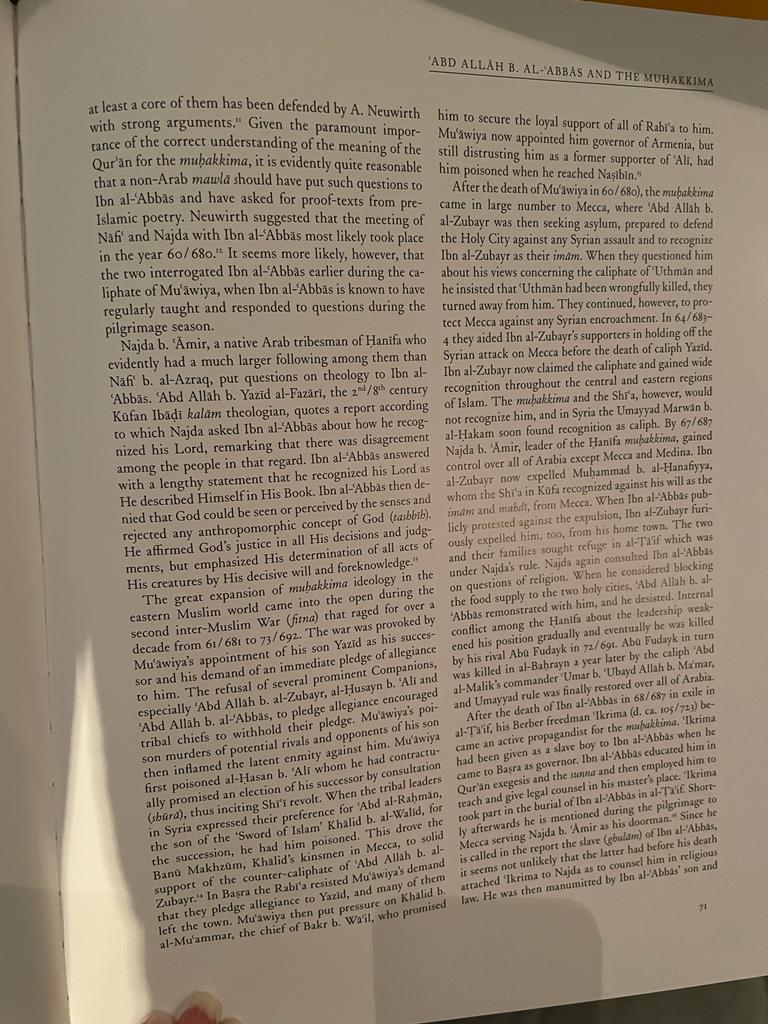
Source: (‘Abd Allah b. al-‘Abbas and the Muhakkima by Wildred Madelung pgs 69-73)
Our thoughts on what Professor Wilferd Madelung has stated.
You will notice there are basically two source materials thath Madelung draws upon.
Al Baladhuri – 9th century Sunni historian
Al-Tabari 9th – 10 century Sunni historian
Reading this we did not feel that there were any new discoveries or any particular breakthroughs. There did not seem to be any original thoughts, ideas or contributions. Perhaps the readers could glean something from the material that we could not.
For example, you could read the above information and make the horrible mistake that Madelung is sharing his own personal thoughts. In reality, in today’s world we call this copypasta.
Interacting with the material in Paragraph 2
Madelung states: “The majority of the seceders, however, rejected his unsound argument that arbitration was generally allowed by the Qur’an and only a few of them returned to Kufa.”
Prima-Qur’an comments: Where does Madelung get this information from? Is this truly their position? Who is reporting that this is their position? Where do they get this information from or base this information on?
Madelung states: “Ali then was able to persuade all of them to return by promising them to resume the war against Mu’awiya in six months.”
Prima-Qur’an comments: Source for this?
Interacting with the material in Paragraph 3
Madelung also curiously states: “As ‘Ali led the Kufan army northward toward al-Anbar, some of the muhakkima vented their frustration in wanton murder of Muslims, including ‘Abd Allah, the son of the Companion Khabib b al-Aratt, his pregnant wife and an envoy sent by ‘Ali to them.”
Prima-Qur’an comments: Wanton killing of Muslims (plural) who?
Which of the muhakkima vented these frustrations?
We thought the point of academics and historians was not to embellish accounts.
Madelung: “Hey guys, I am feeling very frustrated about what happened.”
Bob: “Me too, Wilferd.”
Madelung: “Not only am I very frustrated, I am also quite bored.”
Bob: “Yeah, what can we do with all this pent-up frustration?”
Madelung: “Well, we could always go ambush someone, and if we happen upon a pregnant woman we could just gut her and take her child out.”
Bob: “Wil my man sounds like a plan!”
Nevermind this very interesting piece of information from At Tabari.
Ali heard that the men were saying among themselves, “If only he would go with us against these Haruriyyah (Ahl Nahrawan) , and we dealt with them first and then, having finished with them, we turned our attention to the profaners of Allah’s law (al-mu1 illin-Syrians)!” So Ali addressed them, and after praising Allah and extolling Him, said, “I have heard what you have been saying : ‘If only the Commander of the Faithful would go with us against this group of Kharijites that has rebelled against him, and we dealt with them first and then, having finished with them, we turned to the profaners of Allah law.’ But others are more important for us than these Kharijites. Stop talking about them and march instead against a people who are fighting you so that they may be tyrants and kings and take the servants of Allah as chattel .” And the men shouted from every side, “Commander of the Faithful, lead us wherever you wish!”
So these sources which are not Kharijite sources admit to the fact that there were people (agitators) who wanted to go and fight the Haruriyyah (Ahl Nahrawn) first!
Interacting with the material in Paragraph 4
Madelung states: “‘Abd Allah b al-‘Abbas, it should be noted, was not present at the Battle of al-Nahrawan, as ‘Ali had deputed him to lead the pilgrimage to Mecca for the year. Ibn al-‘Abbas evidently regretted the assault on the rebels collectively and the resulting massacre. Had he been present, he would no doubt have counseled to restrict any punishment to the actual perpetrators of criminal violence and to leave the others alone, whatever their incendiary rhetoric.”
Prima-Qur’an comments: The implication here by Madelung is that Ibn ‘Abbas would have participated in the battle of al-Nahrawan.
Interacting with the material in Paragraph 6
Madelung states: “as well as his affirmation of the exclusive right of the Qurash to the caliphate in Islam drove many Muslims in Iraq and the eastern provinces, who had not objected to the arbitration or had even supported it, to join the ranks of the seceders.“
Prima Qur’an comments: Seems like the idea that the Qurash or a particular family of the Qurash was certainly not embedded among the Muslim masses.
Note that Madelung states: “During Mu’awiya’s divisive caliphate, the muhakkima became a widespread, nonviolent opposition movement in the eastern Islamic world.”
Prima-Qur’an comments: That certainly really does not sound like the crazed, sword-wielding Kharijites declaring all who differ with them infidels that we hear all too often from the Sunni and Shi’i.
Interacting with the material in Paragraph 12
Madelung states: “When they questioned about his views concerning the caliphate of ‘Uthman and he insisted that ‘Uthman had been wrongfully killed, they turned away from him.”
He also states: “When he considered blocking the food supply to the two holy cities, ‘Abd Allah b. Al-‘Abbas remonstrated with him, and he desisted.”
Prima Qur’an comments: So, Ibn al-Zubayr would not denouce Uthman they kill him? They cut him into tiny pieces? They stuffed him in a donkey and burned him? No! “They turned away from him.” When they considered blocking the food supply to the two holy cities they considered ‘Abd Allah b. A’-‘Abbas advise and headed it. Seems these people are capable of reason.
Interacting with the material in Paragraph 13
Madelung states: “but was also accused of falsifying his master’s teaching in promoting muhakkima doctrine. He is described as traveling throughout the Muslim world spreading Khariji ideology.”
Prima-Qur’an comments: In what way did Ikrima (ra) falsify his master’s teaching in promoting the muhakkima doctrine? Do tell us.
Madelung states: “His teaching now became radically anti-Shi’i. Thus he proclaimed that the ahl al-bayt whom according to the Qur’an 33:33 God wanted to purify meant specially the wives of the Prophet, excluding his kin, daughter and grandsons. This was entirely contrary to the view of Ibn al-‘Abbas, who ever upheld the divinely privileged religious rank of the Prophet’s kin and progeny, and ‘Ikrima could not have asserted it during his life-time.“
Prima-Qur’an comments: This is due to the poor reading or gross misunderstanding that Madelung has. Madelung, nor any other historian or orientalist will bring any evidence of ‘Ikrima stating it “excludes his kin, daughter and grandsons.” This is lazy. What Ikrima (ra) is saying is that concerning the Asbab an-Nuzool (the occasion for the revelation) it was due soley to the wives of the Prophet (saw).
Ikrima (ra) simply taught what the Qur’an teaches. Alas, it is what Ibn Abbas (ra) taught as well.
Ibn Abi Hatim recorded that Ibn `Abbas said concerning the Ayah: ( Allah wishes only to remove Ar-Rijs from you, O members of the family, ) “It was revealed solely concerning the wives of the Prophet .”
You also have to wonder why Ikrima (ra) transmits instances where Ibn Abbas (ra) admonishes him (Ikrima).
Narrated `Ikrima:
I prayed behind a Sheikh at Mecca and he said twenty two Takbirs (during the prayer). I told Ibn `Abbas that he (i.e. that Sheikh) was foolish. Ibn `Abbas admonished me and said, “This is the tradition of Abul-Qasim.”
Madelung states: “Against Mu’tazili rationalist doctrine divine justice entailing free will, they have mostly affirmed the determining effectiveness of God’s eternal will and foreknowledge.”
Prima-Qur’an comments:
We believe the reason why Madelung makes such claims is that in his mind he sees the Muhakkima as people who leave all matters up to Allah (swt) in the sense that no human element is involved in anything related to the laws of Allah (swt).
We can see this where he states above:
“The majority of the seceders, however, rejected his unsound argument that arbitration was generally allowed by the Qur’an and only a few of them returned to Kufa.”
At the very least Magdelung states in the very next sentence:
“There were, however, significant groups in the 1st/7th and 2nd/8th centuries who inclined the Mu’tazili position on divine justice.”
Again, just to reiterate a small irritation we have with people who use Orientalist is this. An example. So someone writing a paper wanting to discredit Ikrima as a narrator may have a section that states: “He is described as traveling throughout the Muslim world spreading Khariji ideology. His teaching became radically anti-Shi’i. ” They will quote Magdelung.
O.K. so now what are we supposed to do with that information? It must be true because Magdelung said so! No, based upon what? Give us some examples. Let us explore this further.
We say this not only about Orientalists, but the same standard applies to Muslim historians. It is obvious that we question historical narratives, or we would be following the majoritarian narrative concerning Siffin.
Many on our team are people who are converts who had to go through a process of inquiry to arrive at the conclusions they did.
We leave it to you the respected reader to do the research and come to your conclusions.
May Allah (swt) guide us to what is beloved to Allah (swt).
“Do not mix truth with falsehood or hide the truth knowingly.” (Qur’an 2:42)
﷽
So, an ex-12er, Shi’i shared the following video with us and what an eye-opener!
The YouTube channel, known to be Pro-Alid, featured a “Sunni” ?? Scholar Dr. Suhail Zakkar (possibly Shi’i or diet-Shi’i) who pulled out all the stops to throw Ibn Abbas (ra) under the bus!
Ibn ‘Abbas reported that Allah’s Messenger (saw) came to the privy and I placed water for him for ablution. When he came out he said:
Who placed it here? And in one version of Zuhair they (the Companions) said, and in the version of Abu Bakr (the words are): I said: It is Ibn ‘Abbas (who has done that), whereupon he (the Holy Prophet) said: May Allah grant him a deep understanding of religion.
Dr. Suhail Zakkar (1936–2020) was a highly respected and prolific Syrian historian and academic, widely considered a leading authority on medieval Arab history, particularly the Crusades and early Islamic history.
Early Life & Formative Years: Being born under the French Mandate and experiencing its economic hardships firsthand instilled in him a strong sense of Arab nationalism and a desire to understand the forces—historical and colonial—that shaped the modern Arab world. This personal context deeply influenced his academic pursuits.
Academic Credentials: After obtaining his bachelor’s and master’s degrees in Damascus, he earned a doctorate from the prestigious School of Oriental and African Studies (SOAS), University of London. This gave him Western academic training which he combined with his deep knowledge of Arabic sources.
Magnum Opus: His life’s work, the “Comprehensive Encyclopedia in the History of the Crusades” (Al-Mawsuʻah al-shamilah fi tarikh al-hurub al-salibiyah), is a monumental 50-volume reference work. It is not a narrative history but a critical compilation and analysis of primary sources, making it an indispensable resource for scholars.
Legacy: He represented a school of serious, source-critical Arab historiography. He passed away in Damascus in March 2020.
Ibn Abbas (ra) and his empathy with the Khawarij?
Complete Withdrawal and Neutrality: Ibn Abbas did not just withdraw from his post; he withdrew entirely from the conflict. He did not return to Ali’s camp in Kufa, nor did he offer further political or military support during the escalating war with the so-called Khawarij. This neutrality in a conflict he had previously argued was a matter of truth versus error that could be interpreted by Dr. Zakkar as a fundamental shift in allegiance.
Interpretation of His Silence: From a historical analysis perspective, Dr. Zakkar could argue that Ibn Abbas’s silence and absence during the latter part of Ali’s caliphate and during the period of the so-called Khawarij’s peak activity is deafening. For a figure of his stature and previous unwavering support, this silence could be read as tacit approval or, at a minimum, a strong empathy for the Khawarij’s grievances against Ali.
In our school we know why this is. For those who are reading up on history, and they know that Ibn Abbas (ra) saw the soundness of the argument of the sahaba of Al Nahrawan.
What the good Dr. left out was the fact that Ali sent Ibn Abbas (ra) to the sahaba of Al Nahrawan to try and when them back after leaving Ali’s camp over the arbitration.
Ali knew that they had been correct from the beginning!
The companion Ibn Abbas (ra) debates the companions at Nahrawan.
Argument #1
“O you who believe! Kill not game while in the sacred precincts or in pilgrim garb. If any of you does so intentionally, the compensation is an offering, brought to the Ka’ba, of a domestic animal equivalent to the one he killed, AS ADJUDGED BY TWO JUST MEN AMONG YOU; or by way of atonement, the feeding of the indigent; or its equivalent in fasts: that he may taste of the penalty of his deed. Allah forgives what is past: for repetition, Allah will exact from him the penalty. For Allah is Exalted, and Lord of Retribution.”(Qur’an 5:95)
‘As adjudged by two just men among you’. Keep this in mind as well. This is a key part of the text.
The companions of the Blessed Prophet (saw) replied:
“Are you comparing the law relating to the killing of game animal on the sacred land or the law that is intended to resolve the misunderstandings that occur between a man and his wife, with the law that is intended to govern the matters of greater magnitude such as the act of shedding of Muslims’ blood?”
Source: (Al-Tabari, Al-Taarikh Vol. 6, p. 13.)
So, through qiyas (analogy), it is logical to reason that, in the above verse, during the pilgrimage, when someone kills a game animal, they are ordered to compensate for the following judgement by two just men than it stands to reason the shedding of Muslim blood has a better claim to be dealt with diplomatically.
In response to what Ibn Abbas (ra) had presented, the companions of the Blessed Prophet (saw) argued that there is a significant difference between the verses Ibn Abbas (ra) refereed to and the verse which is used to justify Ali’s war against Mu’awiya.
In the verses Ibn Abbas (ra) referred to, Allah did not mention any ruling, nor did he make any decision between contending parties. Instead, He assigned the task of arbitrating to men.
On this point, there is no issue with Ibn Abbas (ra) and his thought process here.
However, in the verse which gave Ali the right to fight the war against Mu’awiya, Allah (swt) Himself has mentioned step by step the measures that should be taken and decided on. What should be done at each step?
Thus, Allah (swt) lays down the ruling in this case. The verse states: “Moreover, if two factions among the believers should fight, then make settlement between the two. But if one of them oppresses the other, then fight against the one that oppresses until it returns to the ordinance of Allah. And if it returns, then make settlement between them in justice and act justly. Indeed, Allah loves those who act justly.” (Qur’an 49:9)
Also, another point concerning the text that Ibn Abbas brought forth.
‘As adjudged by two just men among you’
Naturally, people would ask, “Are you saying Amru bin Al-As is a man of justice when it was he who spilled our blood yesterday?” If you believe that he is just, then we (including you — Ibn Abbas and Ali) are not just because we all fought the war against Mu’awiya and Amru bin Al-As who are just!”
So, the unfilled questions put to Ibn Abbas (ra) were.
A) Were there two arbitrators or one?
B) Were they just or unjust?
To the Shi’i reading this (Zaydi and Imami), we implore you to tell us. Who are the just ones in the camp of Mu’awiya? Can one who takes up arms against Ali be considered just? If you say yes, then let that stand on the record.
To the Sunnis reading this, we implore you to tell us. The one who rebels against the recognized Imam who has not been proven to go against the Qur’an and Sunnah. Are they just or unjust?
Ibn Abbas (ra) was quoted by Ahmad Ibn A’tham as saying: “O, men! Amru bin Al’As was not an arbiter, why then oppose us because of him? He was but an arbiter representing Mu’awiya.” Source: (Ibn A’tham, Al Futuh Vol. 4, p. 94.)
Is it imaginable that Ibn Abbas (ra) wanted to substantiate his position with a verse which strongly opposed him?
Naturally, our brothers from among the ‘Ahl Sunnah’ or the ‘Shi’i’ are either not informed about this side of the story or simply the learned among them withhold information. Allah (swt) sees and knows all.
It has been narrated on the authority of Aba Sa’id al-Khudri that the Messenger of Allah (saw) said: “When oath of allegiance has been taken for two caliphs, kill the one for whom the oath was taken later.”
Argument #2 Let us look at the other verse that is said that Ibn Abbas (ra) brought as proof.
“If you fear a breach between couples, send an arbiter from his people and an arbiter from her people. If the couple desire to put things right, Allah will bring about a reconciliation between them. “Allah is All-Knowing, All-Aware” (Qur’an 4:35)
This verse orders us to reconcile between a man and his wife in case of misunderstanding or breach. But the steps that ought to be taken when resolving such domestic disputes have not been mentioned. The arbiters are generally required to do their best, in being fair and just, to reach a peaceful, acceptable resolution for the concerned parties.
When you compare the two mentioned verses you will notice that they are intended for different purposes.
In the verse which gave Ali the right to wage war against Mu’awiya, Allah (swt) delegated no one to rule and decide on the issue. But He rather ordered the believers to abide by what He had ruled.
On the other hand, what Ibn Abbas (ra) armed himself with, was the verse that Allah (swt) granted deciding on a role to two fair and just arbiters. That is a clear and a huge difference between the two verses. So, we can say with confidence that Ibn Abbas’s analogy of linking this verse with the conflict of war between Ali and Mu’awiya is debatable.
It does not seem suitable for a person of his stature and understanding. Now, as mentioned above, Ibn Abbas (ra), after hearing all of this, knew very well that the arguments produced by the companions of the Blessed Prophet (saw) that were in Nahrawan were airtight!
When Ibn Abbas (ra) was convinced by their arguments, he (Ibn Abbas) sheathed his sword. Meaning he did not assist Ali in his unprovoked attack upon the Muslims at Nahrawan. Remember, as the Dr. said, this same Ibn Abbas (ra) was with Ali at the battle of the Camel & Siffin.
So we are talking about the same Ibn Abbas (ra) who was with Ali opposite a field with Aisha (ra), Talha and Zubayr, and Ibn Abbas (ra) was with Ali opposite a field with Muaviya and Amr ibn al-As.
This same Ibn Abbas (ra) who said after his debate with the sahaba of Al Nahrawan the following:
“(The People of Nahrawan) have been on the Right Path“
Source: (Al-Shammakhi, Al-Siyar Vol. 1 p, 72,)
Another account says concerning Ibn Abbas (ra) and his debate with the sahaba of Al Nahrwan, that he (Ibn Abbas) “could not crush their proofs.”
Source: (Abu Qahtaan, Al-Siyar p. 107)
Another narration says he (Ibn Abbas) went back from this exchange with them: “Without being able to do anything.”
Source: (Al-Tabari, Al-Taarikh Vol 6, p 18, Al-Barrad Al-Jawaahir p. 122)
“He could not prove anything to them!“
Source: (Ibn Abi Shaibah, Al-Musannaf Vol. 15, p. 312)
“The Nahrawanees established their proofs to him(Ibn Abbas).”
Source: (Al-Ya’qubi, Al-Taarikh Vol. 2 p. 191)
First they (Diet-Shi’i) tried to throw Ikrima (ra) under the bus. So, when they did not turn over any leaves, some of them started to go after Ibn Abbas (ra).
Ibn Abbas (ra) begins to distance himself from Ali
Can’t keep the truth hidden from the Muslims for too long!
Look at what Ibn Abbas (ra) says here
“I swear by Allah, it is better for me that I meet Allah with all that are beneath the Earth, starting with its gold and silver, and all that its surface is full with than meeting Him with my hands having split the blood of this umma (Islamic Nation) so that I may attain a kingship or leadership.” -Ibn Abbas
Ouch!
Source: (Al-Baladhuri, Al Ansab Vol 2, p 398. Ibn Abd Rabbi, Al-‘Iqdu Al-Farid Vol. 4, p. 326. Al Futuh by Ibn A’atham Vol. 4, p.75)
“If my act of taking money was wrong, that could be easier to me than taking part in shedding the blood of a believer.” -Ibn Abbas.
Ouch Again!
Source: (Al-Qalhati, Al-Kashf Vol 2, p 251. IbnAbdiRabih, Al-Iqdu Al-Farid Vol. 4, p. 331.)
It is very clear from the aforementioned that Ibn Abbas (ra) had developed a disapproving attitude towards the war fought against the sahaba of Al Nahrawan. A complete change of heart from the previous conflicts.
It is clear that, in this war with the Nahrawanees, Ibn Abbas (ra) found fault with Ali and condemned him for his unjustifiably wrong act of fighting those fellow sahaba.
After he was sent to debate with them, Ibn Abbas (ra) realized they were upon the truth. He accepted that he (Ibn Abbas) was wrong and the sahaba of Al Nahrawan were right. Certainly there is a lesson to be learnt from this experience that the accurate criteria with which to draw a distinction between right and wrong is not a coin-flip, but rather the Qur’an and authentic Prophetic traditions. After all, Ali made his hasty decision in the heat of the moment (giving in to pro-arbitration forces) and possibly did not consider the full ramifications of his decision.
When those sahaba who left Ali’s camp answered Ibn Abbas (ra) and his objections clearly and decisively, there was nowhere to go but the truth.
Having been fully convinced by the position of the Nahrwanees and the evidence that they had for their succession from Ali’s leadership, Ibn Abbas also detached himself from Ali and set out for Mecca.
Source: (Al-Tabari, Al-Taarikh Vol 6, p. 20)
Even though one of the reasons why Ibn Abbas (ra) left Ali and set out to Mecca was from their differences in the bait al-mal (House of Treasury/House of Properties), from which Ibn Abbas (ra) took what he regarded to be his lawful portion of the money, their differences were compounded by the fact that they were on opposing sides of the issue of the Nahrwanees.
Recall the statement:
“If my act of taking money was wrong, that could be easier to me than taking part in shedding the blood of a believer,” — Ibn Abbas.
In this statement, Ibn Abbas (ra) is basically saying: If I disagree with you on the issue of bait al-mal, then I am strongly opposing you on the issue of the Companions at Nahrawan. This was about the point in time where Ibn Abbas (ra) detached himself from Ali’s leadership.
May Allah (swt) open the eyes of the truth seekers!
Dear readers, you have been provided the information. All you need to do is to plug in the pieces. You were told that Ibn Abbas (ra) went and debated the companions at Nahrawan and that he (Ibn Abbas) had won hands down. Notice how you are never told their reply or their responses?
Brought to you by the same people who have no problem with mocking their own Imams!
“But whoever kills a believer intentionally – his recompense is Hell, wherein he will abide eternally, and Allah has become angry with him and has cursed him and has prepared for him a great punishment.” (Qur’an 4:93)
﷽
Praise be to Allah (swt) for the noble and truthful companion Ikrima (ra). He is the one who informed us that Ali Ibn Abu Talib had errors in his ijtihad. That a senior member of the Ahl Bayt Ibn Abbas (ra) corrected Ali Ibn Abu Talib.
Ikrima (ra) informs us that Ali had errors in his ijtihad that would go against the Qur’an & Sunnah. That he would get corrected by a senior member of the Ahl Bayt.
Narrated `Ikrima:
“Some Zanadiqa (atheists) were brought to `Ali and he burnt them. The news of this event reached Ibn Abbas who said, “If I had been in his place, I would not have burnt them, as Allah’s Apostle forbade it, saying, ‘Do not punish anybody with Allah’s punishment (fire).’ I would have killed them according to the statement of Allah’s Apostle, ‘Whoever changed his Islamic religion, then kill him.’”
This noble and truthful companion, Ikrima (ra), also informed us that Ammar bin Yasir (ra) would be killed by the rebel group.
Ikrima (ra) informs us that Ammar bin Yasir (ra) would be killed by the rebel group.
Narrated `Ikrima:
“That Ibn Abbas told him and `Ali bin `Abdullah to go to Abu Sa`id and listen to some of his narrations; So they both went (and saw) Abu Sa`id and his brother irrigating a garden belonging to them. When he saw them, he came up to them and sat down with his legs drawn up and wrapped in his garment and said, “(During the construction of the mosque of the Prophet) we carried the adobe of the mosque, one brick at a time while `Ammar used to carry two at a time. The Prophet (saw) passed by `Ammar and removed the dust off his head and said, “May Allah be merciful to `Ammar. He will be killed by a rebellious aggressive group. `Ammar will invite them to (obey) Allah and they will invite him to the (Hell) fire.”
Such a problem is the above sahih hadith that the Hanbali Ibn Taymiyyah al Harrani tried to come up with all kinds of crafty ways of dealing with the impact of the statement from the Blessed Messenger (saw).
Some have said that it is not authentic, and others have interpreted it. People have had different statements about the tradition of ‘Ammaar; of them are those who have criticized it.” He goes on: “But the people who have knowledge of this tradition have had three different statements. One group of them regards it to be inauthentic because to them, it has been narrated through a weak chain of transmitters!”
The tradition itself despite being in Bukhari is actually daif.
It has a suitable interpretation.
The Imam of the Muslims, the People of The Truth and Steadfastness, Al-Imamu Al-Qannubi says: “We do not know whom Ibn Taymiyyah means by his claim “Some (have said that it is not authentic)….” There will come explanation that many have classified this tradition as authentic….”
Source: (Al-QannubiAl-Tufan Al-JarifVol. 3, section two, p. 625)
But this interpretation has been objected to by even Ibn Taymiyyah himself!
Source: (Ibn Taymiyyah Minhaju Al-Sunna Vol. 2, p. 210-211)
But – all of a sudden – we, finally, find Ibn Taymiyyah himself turning around to clearly state that the said tradition is authentic. “The tradition is proved, and it is authentic, being from the Prophet (saw).”
Source: (Ibn Taymiyyah Minhaju Al-Sunna Vol. 2, p. 211)
Yet, surprisingly, he has misinterpreted it by saying: “His killers were those who held weapons and killed him.” Which he means to say not Mu’awiya!!! He says again: “The word “killer”, if loosely or absolutely used, means the one that has killed: not the one that has issued the order (of killing).”
This bizarre philosophy of Ibn Taymiyyah indicates that if he were to live in the present age, he would – of course – agree with the claim that presidents are not responsible for the crime of the illegal, haphazard bloodshed committed by their armies in different Muslim and non-Muslim countries, but rather their troops are the ones responsible for that! Indeed, while Ibn Taymiyyah defends Mu’awiya in that way, we find that Mu’awiya himself proves him wrong, as he says: “Ali had two right hands (two strong assistants and supporters), one of which I cut on the day of Siffin, meaning ‘Ammaar bin Yasir; and the other I cut today, meaning Al-ashtar”
Source: (Al-Tabari Al-Taarikh Vol. 3, p. 133. Ibn Al-Athir Al-Kamil Vol. 2, p. 705.)
Check mate!
Not only this but here is a tradition that contradicts Ibn Taymiyyah’s bizarre idea. The tradition says:
Not only this, but here is a tradition that contradicts Ibn Taymiyyah’s bizarre idea. The tradition says:
“He who assists with a half-uttered word in the killing of a Muslim, will come on the day of judgment between his two eyes there has been written “He has despaired of the Mercy of Allah.”
Source: (Al-Rabi’u bin Habib Al-Jami’u Al-Sahih p. 368, tradition no. 960. Ibn Majah Al-Sunan p. 444, tradition no. 2620. )
How does it come, then, that Ibn Taymiyya excludes the one from whose order the killing is carried out from being responsible for it?!
Typically, many Sunnis have used these tactics to get around this hadith. Even some of the early proto-Umayyad-proto-Sunnis say that the ones who slew Ammar ibn Yasir were the ones who brought him to the battlefield, meaning Ali ibn Abu Talib himself!
However, pro-Alid groups have tried to cast aspersions on this narrator, Ikrima, as well!
You can’t have your cake and eat it too! You can’t use ‘Ikrima as evidence against Muaviya and then say his evidence is not good when it comes to Ibn Abbas (ra) disagreeing with Ali burning people alive.
For those of you interested in reading more, you are invited to read:
May Allah (swt) open the eyes and the hearts of this ummah! May Allah (swt) unite us upon the truth!
“My Lord! Increase me in knowledge.” (Qur’an 20:114)
﷽
We have absolutely been fascinated by those few individuals who have found there to be controversy surrounding the identity of Dhul-al-Qarnayn. The reason why we are fascinated is that historians and Orientalists are not actually interacting with the Qur’an per se. They are interacting with commentary about the Qur’an.
Historian: We found no evidence that X existed.
Believer: They have yet to find evidence that X existed.
Epistemology matters!
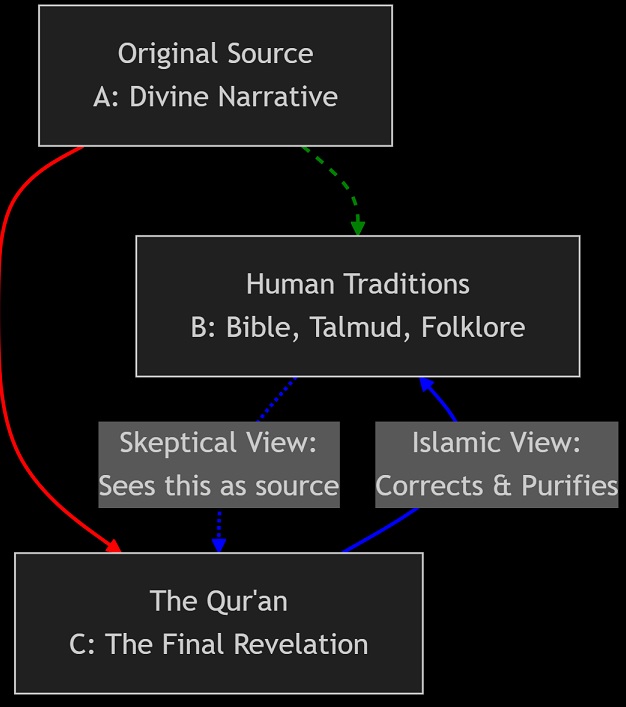
The chart above shows the difference between the different axioms of the believers and the doubters. Agnostics and atheists have a different epistemology than believers.
How The Above Chart Explains the Concept:
The Source (A): Everything begins with the “Original Source” (A), which is the divine, perfect narrative from God.
The Two Paths:
The human traditions (B) are a changed and corrupted version of the original story, having passed through centuries of human transmission (resulting in legends, folklore, and altered scriptures).
The Qur’an (C) comes directly and perfectly from the same original source (A), acting as a “Final Revelation” that restores the original message.
The Optical Illusion (The Core of Our Point):
The Skeptical View (dashed line) looks at the relationship between B and C and mistakenly concludes that C must have copied from B because B appears earlier in history.
The Islamic View (solid arrows) correctly identifies that both B and C draw from a common, older source (A). Therefore, when B contains elements that align with C, it doesn’t mean C copied B—it means B still contains remnants of the original truth (A) that the Qur’an (C) confirms and corrects.
The Verbatum Point: The arrow from C to B, labeled “Corrects & Purifies,” visually explains why you will never find verbatim copying. The Qur’an doesn’t replicate the corrupted narratives (B); it speaks with authority from the original source (A) to rectify them.
For the skeptics and doubters, their findings reinforce their epistemology and their axioms. For the Muslims, the findings of the skeptics and doubters provide corroborating evidence of our own epistemology and axioms.
As a Muslim, we know that a tafsir is not divine revelation.Tafsir is scholarly musings about the text.
1st, it should be noted that Dhul Al-Qarnayn, like Khidr, are simply epitaphs, like Al-Amin (The Trustworthy) is for the Blessed Prophet (saw).
The above are not real names they are descriptors.
2nd, it should be noted that not much attention is given to the individuals (Khidr & Dhul Al-Qarnayn) beyond their epitaphs. The attention is given to the events that unfold or surround them.
3rd, the Qur’an only mentions Dhul Al-Qarnayn thrice.
So let us get into the narrative of Dhul Al-Qarnayn in the Qur’an.
“And they will ask you about Dhul-Al Qarnayn. Say: I will recount to you a remembrance of him.” (Qur’an 18:83)
“We established him on earth, and We gave him from everything a way.” (Qur’an 18:84)
“And he followed a way.” (Qur’an 18:85)
“Till, when he reached the setting place of the sun, he found it setting in a muddy spring, and found a people thereabout. We said: O Dhul-Al Qarnayn! Either punish or show them kindness.” (Qur’an 18:86)
“He responded, “Whoever does wrong will be punished by us, then will be returned to their Lord, Who will punish them with a horrible torment.” (Qur’an 18:87)
“But as for the one who believes and does righteousness, he will have the best of rewards. We shall require him to do only easy things.” (Qur’an 18:88)
“Then he followed a path.” (Qur’an 18:89)
“Until he came to the rising of the sun. He found it rising on a people for whom We had provided no shade.” (Qur’an 18:90)
“And so it was, Our knowledge encompassed all that happened to him.” (Qur’an 18:91)
“Then he followed a path.” (Qur’an 18:92)
“Until he reached between a barrier, where he found a people who could hardly understand a word he was saying.” (Qur’an 18:93)
“They said, “O Dhul Al-Qarnayn, Gog and Magog are corrupting this land. Can we pay you to erect a barrier between us and them?” (Qur’an 18:94)
“He responded, “What my Lord has provided for me is far better. But assist me with resources, and I will build a barrier between you and them.” (Qur’an 18:95)
“Bring me blocks of iron!” Then, when he had filled up ˹the gap˺ between the barriers he ordered, “Blow!” When the iron became red hot, he said, “Bring me molten copper to pour over it.” (Qur’an 18:96)
“And so the enemies could neither scale nor tunnel through it.” (Qur’an 18:97)
“He said: This is a mercy from my Lord; but when the promise of my Lord comes to pass, He will lay it low, for the promise of my Lord is true.” (Qur’an 18:98)
“On that Day, We will let them surge ˹like waves˺ over one another. Later, the Trumpet will be blown, and We will gather all ˹people˺ together.” (Qur’an 18:99)
The first thing that we found fascinating about this set of texts is the use of twos. Things are in contradistinction to one another. Like two different items, two different scenarios, two things in contrast.
First, being the main focus of the individual in the narrative, is Dhul Al-Qarnayn — the two-horned one, one of two different epochs. The one with two braids. The one with two people.
ثُمَّ أَتْبَعَ سَبَبًا ثُمَّ أَتْبَعَ سَبَبًا
That exact phrase appears twice.
Setting-place of the sun/he came to the rising of the sun (two different scenarios in relation to the sun)
Either punish or show them kindness (two different ways to deal with a particular people).
A people for whom We had provided no shade contrasted with a people who had no protection against tribes.
The tribes in question are two gog/magog. Two tribes.
He met two different types of people; people who could hardly understand a word, contrasted with people he could communicate with readily.
A barrier between you and them-a barrier is a separation between at least two different things.
The barrier they were not able to do two things: neither scale nor tunnel through it.
The barrier itself is made from two different metals: iron and copper.
If we are looking for clues of a historical vestige (remembrance), we would want to note the following:
A)What is the meaning of Dhul Al-Qarnayn in the Arabic language?
B) They will ask you. Who is the ‘they’?
C)How did they respond to the information?
D) Tribes are identified as Gog and Magog.
E) Blocks of iron and molten copper are used to seal an apparent gap/breach in a barrier.
Ea) It is assumed that there is a garrison that defends the area. The purpose of the wall is to prevent being overrun. *note*
Note: This is an assumption on our behalf.
Eb) It is assumed that whoever the Gog and Magog are, that they are either
a) raiders b) expansionists
If we assume they are raiders, this means they have had a foray into these people’s territories before. Though they never established dominion over them.
If we assume that they are expansionists, then the people that Dhul Al-Qarnayn encounter are those who presume expansion is heading in their direction and thus, they want to make preparations.
As regards Qur’an 18:98 we do not see that as connected to Qur’an 18:99 as in events that happen at the same time. For more on this please see:
There is nothing that an individual using the historical critical method or an orientalist has brought that even remotely challenges the narrative of the Qur’an. Nihil ad rem. People having doubts because a tafsir was challenged. That is an absolute nothingburger.
Recall:
“And they will ask you about Dhul-Al Qarnayn. Say: I will recount to you a remembrance of him.” (Qur’an 18:83)
There is nothing in that verse that indicates that the answers to the questions that they posed were matters that concern anyone outside those that asked the questions.
“It is He who has sent His Messenger with guidance and the world view that is based on the truth to manifest it over all other world views, although the mushrik make dislike it.” (Qur’an 9:33)
﷽
The subject of the Mahdi concerns Islamic Eschatology or what is known as end-time events.
First and foremost, it is important to understand that when one speaks of Mahdi, different schools and expressions of Islam have different ideas in mind.
Twelver Shi’a
In Twelver Shi’a theology, the Mahdi is the twelfth and final Imam, Muhammed ibn al-Hasan al-Mahdi, believed to be the direct descendant of the Blessed Prophet Muhammed(saw) through his daughter Fatima (ra). He is in occultation: He is hidden from public view by Allah’s will. He will re appear in some future eschatological event to restore justice.
Isma’ili Shi’a & The Qarmatians & Muhammed bin Isma’il
The person of Muhammed bin Isma’il caused a fracture early on, causing one stream that historians label the ‘Qarmatians’ and the other founding the Fatimid Caliphate.
The Qarmatian View.
Muhammed ibn Isma’il was not just the 7th Imam; he was the Qā’im (the Resurrector) and the Mahdi.
The Ismaili (Later Fatimid) View.
Muhammed ibn Isma’il was the 7th Imam.
He went into hiding (satr) due to Abbasid persecution.
The Imamate continued in his descendants.
They recognized a hidden line of Imams following him, which eventually culminated in Abdullah al-Mahdi Billah, who publicly declared himself Imam in 899 CE and founded the Fatimid Caliphate in 909 CE.
For this group, the Imam was always present on earth, whether concealed or manifest.
The Zaydi Shi’a
For Zaydis, the term “Mahdi” (the Guided One) is not exclusively reserved for a single, predestined, end-of-times figure. Instead, it is a title that can be applied to any rightly guided Imam from the Ahl al-Bayt who rises to establish justice.
There are times when they have referenced their Imams as such. For example: Al-Mahdi Li-Din Allah
While not a core dogma, Zaydi literature does contain some hadith about a future messianic figure from the Ahl al-Bayt, often referred to as “al-Qa’im” (The One Who Will Arise) or “al-Mahdi.”
Sunni View.
The dominant view and position among Sunni Muslims is that Mahdi is a figure believed to be the direct descendant of the Blessed Prophet Muhammed(saw) through his daughter Fatima (ra). He will appear in some future eschatological event to restore justice.
Again, this is the view of the vast majority of Sunni Muslims. As the articles in this entry will clearly demonstrate, there are many in the Sunni tradition that do not share this belief.
Ibadi View. The idea of a Mahdi is not something found in our sources. We have no belief in any coming Mahdi. If the coming of this figure is true, we hope Allah opens our eyes to it. However, it is not a theological principle with us nor something we believe in.
It should be noted to the reader and researcher. Often, the various schools of Islam will have what is known as Shaadh (شاذ) — The Irregular/Anomalous Opinion. These are views that are anomalous or isolated. The Ibadi school has such and other schools do as well. Yet, on the issue of the Mahdi, we have not even come across a shaadh.
We establish the following facts.
The Qur’an has no mention of any Imam Mahdi.
The Ibadi hadith collection has no mention of Imam Mahdi.
There is no hadith about Mahdi in the Al-Jami’i Al-Salih, otherwise known as the Musnad Al-Imam Al Rabii.
The silence of Bukhari & Muslim.
The two great Imams of Hadith, Bukhari and Muslim, neither of them mentions Hadith concerning Imam Mahdi. What’s interesting about this is that both of them are aware of narrations on the subject that meet their criteria, yet they did not include them.
The silence of the Muwatta of Malik ibn Anas.
There is no hadith about Mahdi in the Muwatta of Malik ibn Anas.
What will Ahl Sunnah In the next 56 years and no Mahdi? Witness the genius of Ibn al-Hajr al-Asqalani as he tries to make sense of the data.
The man whho the ‘Abdulla bin Zaid Al Mahmoud Islamic Cultural Center’ in Qatar is named after and former Qāḍī al-Quḍāt, and Athari -Salafi , tells us why there is no coming Mahdi.
Shaykh Abu Abdullah Mustafa bin Al-Adawi is a renowned Egyptian Hadith and Fiqh scholar, often associated with Salafi methodology, known for his expertise in Tafsir and Hadith verification. A former student of Shaykh Muqbil bin Hadi al-Wadi’i, he focuses on authenticating religious texts and has written extensive works on Islamic jurisprudence.
Ali Erbaş Turkish Islamic scholar and president of directorate of religious affairs -diyanet in Turkey, believes Mahdi will not come and that Jesus (as) is dead. The Presidency of Religious Affairs (Diyanet) is Turkey’s highest official Islamic authority.
The great ibn Khaldūn al-Ḥaḍramī, Ashʿarī in theology, and Mālikī in jurisprudence. Writes in the Muqaddimah (Book 1, Chapter 3, section on the caliphate) about the weakness of the chains concerning narrations of Mahdi.
Shaykh Dr. Muhammed Bin Yahya Ninowy, a descendant of the Blesed Prophet Muhammed (saw) through the line of Imam al-Ḥusayn ibn ʿAlī ibn Abī Ṭālib, expreses his doubts about the Mahdi.
“It is He who has sent His Messenger with guidance and the world view that is based on the truth to manifest it over all other world views, although they who rely upon other than or associate partners with Allah dislike it.” (Qur’an 9:33)
﷽
Dr. Bashar Awad Maarouf, a Sunni historian and hadith specialist, has concluded that there is not a single authentic narration concerning the coming of some Mahdi.
While it is common knowledge that the Qur’an does not speak about the Mahdi at all. That the two most authentic collections of hadith, according to Sunni Muslims, Sahih Bukhari & Sahih Muslim, do not speak about the Mahdi at all, what is not so commonly known is the general weakness and unreliability of all other reports.
If you are interested to see the full interview we would recommend:
Some background concerning Dr. Professor Bashar Awad Maarouf.
Bashar Awad Marouf was born in 1940 in Alazamiyah, northern Baghdad. He graduated from primary and secondary schools in the 1960s. He enrolled in the Department of History at the College of Arts in Baghdad University from which he graduated in 1964. In that same year, he enrolled in the Master’s Program of History and Archeology at Baghdad University. Professor Marouf was appointed in 1967 as the teacher at the College of Shari’a Studies at Baghdad University. He later earned his PhD from the College of Arts at the same university in 1976. His doctoral thesis was titled: “Ad-Dhahabi’s Approach in the History of Islam.” Professor Marouf worked at Baghdad University and advanced through academic work, eventually earning a professorship in 1981. He has been keenly interested in studying and minutely scrutinizing the Prophet’s Hadiths. He has been particularly devoted to studying biographies, narrators and the ‘hidden defects’ of some of the Hadiths. He has taught as Professor of Hadith at several universities. Many of Marouf’s studies have been published in Baghdad, Cairo, Damascus, Beirut, Amman, Tunis and London.
Notable among his publications are: “The Impact of Hadith on the Emergency of Muslim History.”, “Al-Mundhiri and his ‘Al Takmila”, “Baghdad’s Biographical Histories.”, “Ad Dhahabi’s approach to the History of Islam.” , “A Journey through Thought and Heritage.” , “The History of Islam and the concept of the Arab Leadership of the Islamic Ummah.” , “Explanation of the Rulings on Chanting the Qur’an.” “A Selection of the Prophet’s Hadith.” , “The Whole Musnad (22 volumes)” “Classified and Verified Musnad” (41 volumes)
Among the many books Professor Marouf verified are: “Al-Wafayat” by Abu Masoud Al Hajji, “Ahlu Al Mi’a and Upward” by Al Hafiz Ad Dahabi. “Postscripts of the History of Baghdad, City of Peace by Ibn Al-Daybathi (5 volumes). “The Grand Mosque” -by Imam Abu Issa Al Tirmidhi (six volumes), “Sunan Ibn Majah by Imam Muhammed Ibn Yazid Al Qazwini (6 volumes), “The Hstory of the City of Peace” by Hafiz Abu Bakr Al Khatib Al-Baghadadi (17 volumes). “The History of Islam and the Deaths of Celebrities and the Famous” by Al Hafiz Shams Addeen Ad-Sahabi (17 volumes) and many more.
Some of his works and publications may be purchased here:
A dean of investigators in the science of Prophetic Hadith. Former rector at the Islamic University in Baghdad. He is a Fellow of the Royal Aaal Al-Bayt Institute for Islamic Thought in Amman, Jordan.
Dr. Professor Bashar Awad Maarouf does not fear the blame of the blamer. He made his conclusion after thorough investigation, tracking all the narrators and investigating all the paths.
In regard to those who say: “But our club says this, and if you differ with the club it is a departure from faith!”
Is the weakness of these hadiths considered a denial of the Sunnah and a departure from Islam!!! Fear Allah!
We personally have considered that there are many such scholars among Ahl Sunnah who have come to this conclusion. However, they do not come out to the public for one of two reasons.
Being ostracized and condemned. Not being welcomed to the table anymore.
The fear that if this widely held belief is now considered mistaken it could cause the masses to wonder what other views or beliefs are mistaken. Thus, a desire to protect the tradition.
“Today those who disbelieve have lost all hope of (damaging) your faith. So, do not fear them, and fear Me. Today, I have perfected your religion for you, and have completed My blessing upon you, and chosen Islam as Dīn (religion and a way of life) for you. But whoever is compelled by extreme hunger, having no inclination towards sin, then Allah is Most-Forgiving, Very-Merciful.” (Qur’an 5:3)
﷽
“O.K. Settle down, settle down.” We are going to go about this in a very orderly manner. Which one of you is the Mahdi? Simply raise your hand!”
“EARLIER this year Iran’s authorities arrested a score of men who, in separate incidents, claimed to be the Mahdi, a sacred figure of Shia Islam, who was “hidden” by God just over a millennium ago and will return some time to conquer evil on earth.”
“A website based in Qom, Iran’s holiest city, deemed the men “deviants”, “fortune-tellers” and “petty criminals”, who were exploiting credulous Iranians for alms during the Persian new-year holiday, which fell in mid-March.”
“Many of the fake messiahs were picked up by security men in the courtyard to the mosque in Jamkaran, a village near Qom, whose reputation as the place of the awaited Mahdi’s advent has been popularized nationwide by President Mahmoud Ahmadinejad. When he took office in 2005 he gave the mosque $10m.”
“Iran’s economic doldrums may have helped to cause this surge in people claiming to be mankind’s saviour—and in women saying they were the Mahdi’s wife. “In an open atmosphere where people could criticise the government they would not believe these people,” says an ex-seminarian in Tehran, the capital, noting that most Iranians still get all of their news from state television and state-owned or -sanctioned newspapers.”
“Last year a seminary expert, Mehdi Ghafari, said that more than 3,000 fake Mahdis were in prison. Mahdi-complexes are common, says a Tehran psychiatrist. “Every month we get someone coming in, convinced he is the Mahdi,” she says. “Once a man was saying such outrageous things and talking about himself in the third person that I couldn’t help laughing. He got angry and told me I had ‘bad hijab’ and was disrespecting the ‘Imam of Time’,” as the Mahdi is known.”
“The most famous case was that of Ayatollah Boroujerdi, who was sentenced to 11 years in prison in 2007 for—among other things—claiming he was the Mahdi. Like many influential “false” messiahs, he was forced to recant on state television, confessing that he had been against the Islamic Republic’s core tenets.”
“Mr Ahmadinejad has called his administration “the government of the hidden imam”. Last month he told a batch of new Iranian ambassadors to consider themselves “envoys of the Mahdi”. After his first speech at the UN in 2005, a video circulated showing Mr Ahmadinejad telling a leading Iranian cleric that world leaders had been enchanted, during his oration, by a halo around his head that had been put there by the Mahdi himself.”
Prima-Qur’an Comments:
We have no idea where they keep all these 3000 Mahdis, but could you imagine if they were all in the same prison or same facility? Surely that would be volatile.