“And there is none of the People of the Book but must believe in him before his death; and on the Day of Judgment he will be a witness against them.” (Qur’an 4:159)
﷽
The misunderstanding of the verse is used as evidence for them to believe in some ‘Second Coming’ of Jesus (as).
You may look at all the various ways the verse has been translated into English here:
In this article we will focus on the justifications and proofs as they are given by the respected Mufti Zameel Ur Rahman. That is because what he statesis the majority view on the matter.
MUFTI ZAMEEL UR RAHMANS UNDERSTANDING OF QUR’AN 4:159
Let us examine what Mufti Zameel Ur Rahman has put forward:
“These verses then state that the Jews will believe in him before he dies. That is, before ‘Īsā (‘alayhissalām) dies (after he defeats the Dajjāl), the Jews that are remaining on the earth will all believe in him as the Messiah/Masīḥ about whom they were foretold. This is the dominant interpretation of the concluding verse that reads: “There will be none from the people of the scripture [i.e. Jews] but will believe in him before his death.” This has been recorded authentically from Abū Hurayrah (raḍiyallāhu ‘anhu) (see below).”
“Al-Ṭabarī transmits through two chains from Sufyān al-Thawrī from Abū Ḥaṣīn from Sa‘īd ibn Jubayr from Ibn ‘Abbās that he said “before his death” means “before the death of ‘Īsā ibn Maryam”. (Tafsīr al-Ṭabarī, Maktabah Hajr, 7:664) This is an authentic chain.”
“He also narrates with an authentic chain to the Tābi‘ī, Abū Mālik Ghazwān al-Ghifārī (ca. 25 – 100 H), that he said of this verse: “That is, upon the descent of ‘Īsā ibn Maryam – none from the people of the scripture will remain but will believe in him.” (ibid. 7:665) He also transmits with an authentic chain to the eminent Tābi‘ī, al-Ḥasan al-Baṣrī (21 – 110 H), that he said: “Before the death of ‘Īsā. By Allāh! He is now alive in the presence of Allāh; but when he comes down, they will all believe in him.” (ibid.)”
“This is also transmitted from the mufassir of the Tābi‘īn, Qatādah ibn Di‘āmah. Al-Ṭabarī also transmits authentically from ‘Abd al-Raḥmān ibn Zayd ibn Aslam (d. 182), a mufassir from the Tab‘ Tābi‘īn, that he said of this verse: “When ‘Īsā ibn Maryam descends and then kills the Dajjāl, no Jew will remain on the earth but will believe in him.” (ibid. 7:666)”
“Ibn Jarīr al-Ṭabarī explains that this is the most correct explanation. (ibid. 7:672) He explains that thus the meaning of the verse is: “[There is none from the people of the book] but will believe in ‘Īsā before the death of ‘Īsā – and that is about a specific [group] of the people of the book; those intended are the people of one particular time from them, not people of all times, who came after ‘Īsā; and that this will occur after his descent.” (ibid. 7:674)”
“Similarly, Ibn Kathīr says after mentioning this interpretation: “This opinion is the truth,” (Tafsīr Ibn Kathīr, Maktabah Awlād al-Shaykh, 4:342), and further states: “There is no doubt that what Ibn Jarīr said [giving preference to this interpretation] is what is correct, as that is what was intended from the context of the verses.” (ibid. 4:344) As Ibn Kathīr mentions, it is clear from the context that this is what is meant. The verses are talking about the Jews’ claim to have executed ‘Īsā (‘alayhissalām). Allāh says they did not kill or execute him but Allāh raised him up to Himself. Furthermore, not one of them will remain but will believe in ‘Īsā before his actual death. Hence, these verses clearly demonstrate that ‘Īsā (‘alayhissalām) was not killed, but was taken up alive into the sky, and further indicate that he will return and the Jews who remain (after he kills the Dajjāl) will believe in him.”
Notice that Mufti says,
“These verses then state that the Jews will believe in him before he dies. That is, before ‘Īsā (‘alayhissalām) dies (after he defeats the Dajjāl).”
However, that is not what the verse says, and he knows this! If he was simply reading the traditions into the commentary, that is one thing, but forcing them into the text is altogether dishonest!
“This is the dominant interpretation.” Well, Mufti, on what basis do you say this is the ‘dominant interpretation’ ? Can you tell us the total amount of tafsir literature you studied on this matter to conclude this? Also, if this is the ‘dominant interpretation’, it is by your own admission not necessarily the only one!
Truth vs. Popularity: The truth is not a matter of democratic opinion but of sound evidence from the Quran itself.
Next, Mufti seems to quote from a disparate number of tafsir commentaries (albeit selectively). So let’s keep count, shall we?
Tafsir #1, Ibn Kathir
Tafsir #2, Ibn Jarir Al-Tabari
Tafsir #3, Qatada ibn Di’amah
Looking at the Tafsir of Qatada Ibn Di’amah.
Qatada Ibn Dia’ama has two traditions — disconnected from unknown sources about (Qur’an 4:157-158)
“And it was related to us that the prophet of God, Jesus son of Mary, said to his disciples: ‘Who of you will have my likeness [shibh/shabah] cast upon him and thereby be killed? One of the disciples said, ‘I, Oh prophet of God!’ ‘Thus that man was killed and God protected [mana’a] His prophet as HE RAISED HIM TO HIMSELF.
Concerning his statement: “AND THEY DID NOT KILL HIM AND THEY DID NOT CRUCIFY HIM, BUT IT APPEARED SO TO THEM. Qatada said: ‘The likeness of Jesus was cast upon one of his disciples, and he was killed. Jesus had appeared before them and said: “Whoever of you will have my likeness cast upon him will have paradise.” And one said: “Upon me!”
Prima Qur’an comments:
Qatada Ibn Dia’ama has two traditions from disconnected unknown sources.
This information is from Israʼiliyyat material.
There is a 700 year gap in the chain of transmission!
Also notice how there is no attempt to identify or name the substitute.
Looking at the Tafsir of Ibn Jarir Al-Tabari
Al-Tabari cites eleven traditions all going back to Wahb ibn Munabbih concerning (Qur’an 4:157-158)
Here is the verdict of Al-Tabari:
“Or the affair was according to what ‘Abd al-Samad related (that is the second tradition) from Wahb ibn Munabbih, that is, that the people who were with ‘Isa in the house scattered from the house before the Jews came upon him. ‘Isa remained, and his LIKENESS was cast upon one of his companions, who still remained with him in the house. And ‘Isa was RAISED UP, and one who was changed in the LIKENESS of ‘Isa was killed. And his companions through that the one CRUCIFIEDwas ‘Isa, because of what they saw happens to the one who was made to look like him. And the truth of the matter was hidden from them, because his being RAISED UP and the changing of the one who was killed into his LIKENESS happened after the SCATTERING of his friends. and [because] they [had] heard ‘Isa that night announce his death, and mourn because he thought that death was approaching him. And they related what happened as true, but the affair with God was really quite different from what they related. And those disciples who related this do not deserve to be called liars.”
Source: (Al-Tabari, vol 9, p 374)
Remember that Al-Tabari is getting his information from Wahb ibn Munabbih, so maybe we spend just a little bit of time on him.
Remember that Mufti Zameel ur Rahman had the following to say about Mufti Abu Layth on the matter:
“Recently, an individual has been promoting the misguided belief that the Prophet ‘Īsā (‘alayhissalām) will not return, claiming that this is an idea that has mistakenly been imported into Islām and the teachings of the Prophet (ṣallallāhu ‘alayhi wasallam) from Christianity.”
Well, let us see if Mufti Zameer ur Rahman would be humble enough to apologize to Mufti Abu Layth concerning Wahb ibn Munabbih:
“It is not known clearly if he converted to Islam from Judaism or that his father is a convert from Judaism. There are various reports.” “He was known for reporting Isra’ilyyat material. -well known.” “He required a reputation from trustworthy to audacious liar.”
Source: (Aḥmad ibn Muḥammad ibn Khallikān (d. 1282 CE) and his work Wafayāt al-aʿyān wa-anbāʾ abnāʾ al-zamān (وفيات الأعيان وأنباء أبناء الزمان,) The Obituaries of Eminent Men and the History of the Contemporaries p. 673)
Ibn Khallikān was a renowned Shafi’i jurist, judge (qāḍī), and historian of the 13th century. He is celebrated for his scholarly rigor and intellectual integrity.
Ibn Ishaq used his work for the beginnings of Christianity but did not take from him as a source for the Prophet (saw) biography!
Ibn Khaldun didn’t have a high opinion, mentioning that he frequently told flat lies.
Source: (“Notices et Extraits des Manuscrits,” xx.part 1, p. 461; De Slane, Ibn Ḥallikan, iii. 673, note 2 | Notices et Extraits des Manuscrits de la Bibliothèque du Roi et autres bibliothèques.
For the English readers: (Notices and Extracts from the Manuscripts of the King’s Library and Other Libraries. The Citation (xx.part 1, p. 461): This refers to Volume 20, Part 1, page 461. The article claims that on this page, there is a discussion about Wahb ibn Munabbih that references Ibn Khaldun’s low opinion of him.
Companions and scholars like Abdullah ibn Mas’ud warned people not to learn Tafsir from the ‘Ahl Kittab’ and his argument was that they may use it to interpolate their own biblical beliefs, teachings and history replacing the Islamic belief and preaching.
Source: (Dr. Muhammed Husayn al-Dhahabi and his monumental work Al-Tafsīr wa al-Mufassirūn (التفسير والمفسرون, Quranic Exegesis and Its Exegetes Volume 1)
Why Dr. Dhahabi’s scholarship is important.
al-Dhahabi provides a powerful, mainstream Sunni scholarly critique of the very sources that underpin the traditional narrative about Jesus’ death. The reference serves several key argumentative purposes:
Historical Validation of the Problem: Al-Dhahabi meticulously documents how these foreign narratives entered Islamic scholarship. This was primarily through early converts from Judaism and Christianity (like Ka’b al-Aḥbār, Wahb ibn Munabbih, and Abdullah ibn Salam) who, while well-intentioned, began to fill in the gaps in Quranic stories with details from their own traditions. This gives historical credence to the warning from the Companion Abdullah ibn Mas’ud that the article also references.
al-Dhahabi, argues that the classical commentaries on verses like 4:157-159 are contaminated with unreliable material. Al-Dhahabi’s work is essentially a scholarly condemnation of the uncritical acceptance of Isrā’īliyyāt.
So let us take a look again at what Al-Tabari believed:
“Or the affair was according to what ‘Abd al-Samad related (that is the second tradition) from Wahb ibn Munabbih, that is, that the people who were with ‘Isa in the house scattered from the house before the Jews came upon him. ‘Isa remained, and his LIKENESS was cast upon one of his companions, who still remained with him in the house. And ‘Isa was RAISED UP, and one who was changed in the LIKENESS of ‘Isa was killed. And his companions thought that the one CRUCIFIED was ‘Isa, because of what they saw happens to the one who was made to look like him.And the truth of the matter was hidden from them, because his being RAISED UP and the changing of the one who was killed into his LIKENESS happened after the SCATTERING of his friends. and [because] they [had] heard ‘Isa that night announce his death, and mourn because he thought that death was approaching him. And they related what happened as true, but the affair with God was really quite different from what they related. And those disciples who related this do not deserve to be called liars.”
Source: (Al-Tabari, vol 9, p 374)
Prima Qur’an comments:
So, basically, in this narrative, Allah (swt) didn’t fool the non-believers, but he actually fooled the believing disciples of Jesus into believing that He (Jesus) was killed—when he wasn’t?!? Also, the 12 disciples couldn’t use logic, deduction and simple basic math and say, (Well, you know Jesus is gone and so is ….such and such disciple) Hey, maybe Jesus didn’t die?! Maybe so-and-so took his place! Notice the obfuscation especially with the quote from Qatada Ibn Dia’ama? We don’t get to know who this legendary disciple is? Who is this masked man? Oh well, you can hear them saying, ‘it doesn’t matter his reward is with his Lord’. Also why would the ascension of Jesus be withheld from his own disciples?
Looking at the Tafsir of Ibn Kathir
So what is the view of Ibn Kathir concerning Qur’an 4:157-158?
“They disobeyed Jesus and tried to harm him in every possible way, until God led His prophet away from them-Jesus and Mary traveled extensively to avoid such persecution. Ultimately, the Jews notified the King of Syria that there was a man in the holy house was was charming and subverting the people. The king wrote to his deputy in Jerusalem to be on guard against this. Moreover, the deputy was instructed to crucify the culprit (Jesus) and place thorns on his head to stop him from harming the flock. The deputy obeyed the order and led a group of Jews to where Jesus was staying with his twelve or thirteen followers. When Jesus was aware that they were after him, he asked for a volunteer to take his place. One stepped forward and was taken by the Jews and crucified, while Jesus was himself raised through the roof of the house. The Jews then announced that they had crucified Jesus and boasted about it. In their ignorance and lack of intellect ,a number of Christians accepted this claim. The fact that the other disciples had seen Jesus raised was ignored. Everyone else though that the Jews had crucified Jesus.”
Source: (Ibn Kathir, ‘Umdat al-tafsir, ed Ahmad Muhammed Shakir, 5 vols located in: vol 4 pp.28-34)
Prima Qur’an comments :
So notice how Ibn Kathir’s commentary is totally different from Al-Tabari on very key points. Again, obfuscation is a common theme. We don’t know if Jesus had 12 or 13 disciples. The brave unsung hero disciple who just jumped at the chance to be killed (we have no idea who he is). However, unlike Al-Tabari, who was ready to accept on face value the claim of Jesus’ disciples — although they were apparently fooled by Allah (swt), Ibn Kathir isn’t ready to pen that on the disciples. Instead, he simply offers that the Christians were ignorant and lacked intellect, so they accepted that Jesus died. The fact that ‘other disciples’ saw what went down was just simply ignored. The strange claim that the Jews took and crucified Jesus which is not part of Torah law at all. So whoever narrates this is ignorant of that fact. But these disciples definitely witnessed an ascension.
Summary of the Tafsir Sources:
The three tafsir sources that Mufti Zameer ur Rahman are all ultimately reliant upon anonymous, disconnected chains and sources that are traceable to the very sources (Ahl Kitab) that Ibn Masud warned us about!
How can Mufti Zameer ur Rahman (and anyone else who holds his position) claim with confidence that they know what (Qur’an 4:157-159) is talking about? This so-called ‘unified tradition’ holds disparate and conflicting perspectives that are frankly all over the place.
The testimony of Ibn Masud (ra)
Al-Barqānī informed me, saying: Abū Bakr al-Ismāʿīlī narrated to us, saying: I heard Abū ʿAbd Allāh al-Ḥāfiẓ, and he was asked about tafsīr (Qur’an exegesis): From where should a person begin it? He replied: From the Book of Allah, the Exalted. If that is difficult for him, then he should rely upon the transmitted reports (al-athar). If that is difficult for him, then he should resort to reasoning (al-naẓar). Then he said: It is necessary that above all of this he gives precedence to the Book of Allah. Then he said: I heard Abū al-ʿAbbās Muḥammad ibn Isḥāq al-Thaqafī say: I heard ʿAbdān ibn Aḥmad say: I heard ʿAbd Allāh ibn al-Mubārak say: ʿAbd Allāh ibn Masʿūd used to say: ‘Transmit the Qur’an (faithfully), and do not follow the People of the Book, for indeed they relate to you the most false of narrations, and they burden you with their falsehoods.”
Source: ( Imam Al-Khatib al-Baghdadi Work: Al-Jāmi‘ li-Akhlāq al-Rāwī wa Ādāb al-Sāmi‘ (الجامع لأخلاق الراوي وآداب السامع) – A Compendium of the Ethics of the Narrator and the Etiquette of the Listener. Volume 1, Page 289 )
Chapter: The Qurra from among the Companions of the Prophet (saws)
Narrated Masriq:
`Abdullah bin `Amr mentioned `Abdullah bin Masud and said, “I shall ever love that man, for I heard the Prophet (saw) saying, ‘Take (learn) the Qur’an from four: `Abdullah bin Masud, Salim, Mu`adh and Ubai bin Ka`b.’ “
“Waki’ narrated to us, from Sufyan, from Abu Hasin, from Abu Wa’il, from Abdullah (ibn Mas’ud), who said:
‘When the People of the Book narrate to you, do not believe them nor disbelieve them. Rather, say: “We believe in what has been revealed to us and what has been revealed to you.”‘”
Source: (Al-Musannaf by Ibn Abi Shaybah, Dar al-Taj, Riyadh (1st ed., 1409 AH), Volume 6, Page 101, Hadith Number 29990.)
The testimony of the Blessed Prophet (saw).
Narrated Abu Huraira:
The people of the Book used to read the Torah in Hebrew and then explain it in Arabic to the Muslims. Allah’s Messenger (saw) said (to the Muslims). “Do not believe the people of the Book, nor disbelieve them, but say, ‘We believe in Allah and whatever is revealed to us, and whatever is revealed to you.’ “
Conclusion: In the Ibadi school we will take the firm testimony of the Blessed Prophet (saw). We will take the advice of one of the best people to learn the Qur’an from, Ibn Masud (ra). What we will not do is take the testimony of a person who is narrating Israʼiliyyat with a 700-year gap in the chain of transmission. What we will do is disobey the Blessed Prophet (saw) by taking this material from the people of the book as if they inform us about our religion!
You find that the Sunni and the Shi’i get themselves into a huge exegetical mess over this. They somehow imagine that Qur’an4:157 is speaking about something the Romans are claimed to have done to Jesus!
Ahl al-Haqq wa-l istiqama (The People of Truth and Straightness)The Ibadi school and Quran 4:159
How does the Ibadi school understand Qur’an 4:159?
“And there is none of the People of the Book but must believe in him before his death; and on the Day of Judgment he will be a witness against them.” (Qur’an 4:159)
The death mentioned here could refer either to the death of Jesus (as) or to the death of each and every Jew. The text lends itself to both meanings.
It is important to note that from the (Qur’an 4:153-to 4:159) the entire theme is directed towards Jews.
None among the Jews that Jesus preached to but that it is a prerequisite for them to believe in him before their death.
Jesus is a witness against those who witnessed his preaching and rejected him.
If the people died believing in Jesus, then he would be a witness for them, not against them.
This is confirmed by: “I said not to them except what You commanded me – to worship Allah , my Lord and your Lord. And I was a witness over them as long as I was among them; but when you caused me to die, You were the Observer over them, and You are, over all things, Witness. (Qur’an 5:117)
Who else would he be a witness against?
What is so special about those particular Jews who are alive when Jesus (as) supposedly returns is that they get to witness and see Jesus (as) whereas the Jews who have lived for the last 2000 years simply died upon batil (falsehood)?
If we believe in the interpretation that Mufti Zameer ur Rahman gives (and those like him) they need to answer the following questions:
Why would Jesus be a witness against them if they all died believing in him?
Wouldn’t Jesus be a witness against those who did not believe in him?
If you interpret it, none must believe in him, but before their death, surely thousands of Jews and Christians died without believing Jesus was a prophet.
How can this apply to Christians if they already believe in him?
How do you answer that if it meant to believe in him as a prophet before his alleged return, then he wouldn’t need to be a witness against them anyway.
Prove grammatically that Qur’an 4:159 is a break in theme from 4:153 onwards and refers to some future eschatological event.
Prove grammatically and thematically that the verse in question includes Christians.
Further Proofs:
“And when Allah will say: O Jesus son of Mary! did you say to men, Take me and my mother for two gods besides Allah, he will say: Glory be to You, it did not befit me that I should say what I had no right to (say); if I had said it, You would indeed have known it; You know what is in my mind, and I do not know what is in your mind, surely you are the great Knower of the unseen things. I did not say anything to them except what you commanded me with: That worship Allah, my Lord and your Lord, and I was a witness over them as long as I was among them, but when you caused me to die (Arabic: Tawafaytani), you were the watcher over them, and you are witness of all things.” (Qur’an 5:116-117)
There are several things to take from the above passage:
1) This dialogue takes place on the Day of Judgment, where Prophet Jesus suggests that he has no knowledge of what has happened since his demise on Earth and after his ministry ended. “I was a witness over them as long as I was among them.”
2) From the discussion, it is clear that Prophet Jesus only came to Earth once, acting as a witness over his people. If indeed there was a ‘second coming‘ before the Day of Judgment, he would have full knowledge of what had happened since his first departure. After all, he abolished the Jizya and forced the Christians to convert to Islam. This conversation with Allah (swt) would make little to no sense.
3) Imagine if the ahadiths that are put in the mouth of the Blessed Prophet (saw) were true for a moment. So now Jesus (as) comes back and everyone becomes a Muslim. The Dajjal is defeated. Jesus (as) gets married. Then Allah (swt) causes Jesus (as) to die.
Then we have Jesus (as) saying after he dies to Allah (swt): “I was a witness over them as long as I was among them, but when you caused me to die, you were the watcher over them, and you are witness of all things.”
A rather bizarre understanding, it seems.
Especially if we take the following text into consideration: “And there is none from the People of the Scripture but that he will surely believe in Jesus before his death.” (Qur’an 4:159)
It is clear to all whom Allah has lifted the veils that Qur’an 5:116-117 is talking about Jesus (as) earthly life and ministry.
The very presence of Jesus creates a bizarre redundant time paradox if we are to believe the Sunni position.
Think about it.
Look at the verse again: Imagine that Allah is saying this to Jesus, who came down from the skies, fought the Dajjal, got married and died.
“Allah said, O Jesus, I shall cause you to die and will raise you up to Me and shall purify you of the ungrateful disbelieving people, and shall place those who follow you above those who deny the truth, until the Day of Judgement; then to Me shall all return and I will judge between you regarding your disputes.” (Qur’an 3:55)
If Jesus is alive in the heavens, why is he not aware of this already?
Why is he not aware that Allah has already cleared him of falsehood by the Qur’an?
Even if he wasn’t aware after 2000 plus years, then surely he would have access to the Qur’an when he came back to Earth? Would he not be aware of the text that had already cleared him? Can you imagine Jesus (as) attending the tarweeh prayers in Ramadan and hearing Qur’an 5:116-117 being recited?
Whereas if we understand the text (Qur’an 3:55) as a revelation from Allah [swt] to his Prophet Jesus (as) it at the time of his death, it comes across as very comforting and reassuring. That Allah [swt] is the cause of your death, and you will return to your lord as the statement: “Indeed, to Allah we belong and to Allah we shall return.” That he [Jesus] will be cleared of false accusations. That his followers will be superior over the detractors on the day of judgment.
Sunni Muslims begin to take a new approach to Qur’an 4:159
Jesus bin Maryam will come down to them. Their leader will step backwards so that Jesus can come forward and lead the people in prayer, but Jesus will place his hand between his shoulders and say to him: “Go forward and pray, for the Iqamah was given for you.” Then their leader will lead them in prayer. When he has finished, Jesus (as), will say: “Open the gate.” So they will open it and behind it will be Dajjal with seventy thousand Jews, each of them carrying an adorned sword and wearing a greenish cloak. When Dajjal looks at him, he will start to melt as salt melts in water. He will run away, and Jesus (as), will say: “I have only one blow for you, which you will not be able to escape!” He will catch up with him at the eastern gate of Ludd, and will kill him. Then Allah will defeat the Jews, and there will be nothing left that Allah has created which the Jews will be able to hide behind, except that Allah will cause it to speak – no stone, no tree, no wall, no animal – except for Al-Gharqad (the box-thorn), for it is one of their trees, and will not speak – except that it will say: “O Muslim slave of Allah, here is a Jews, come and kill him!“
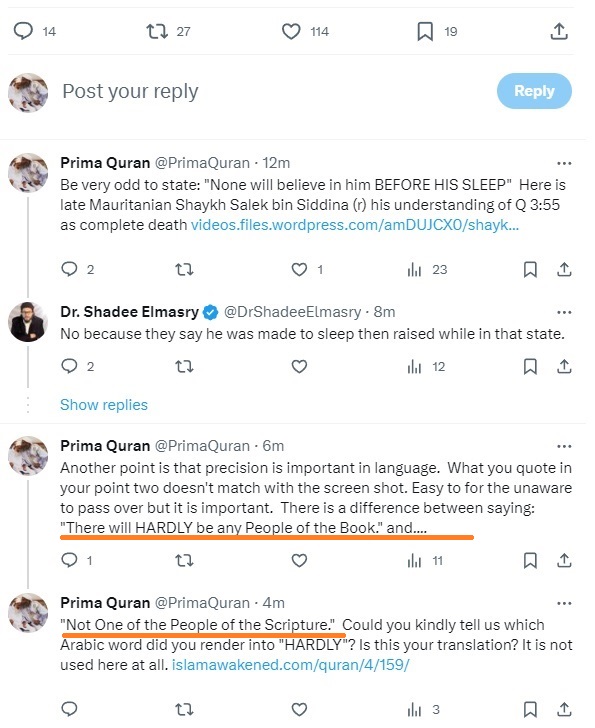
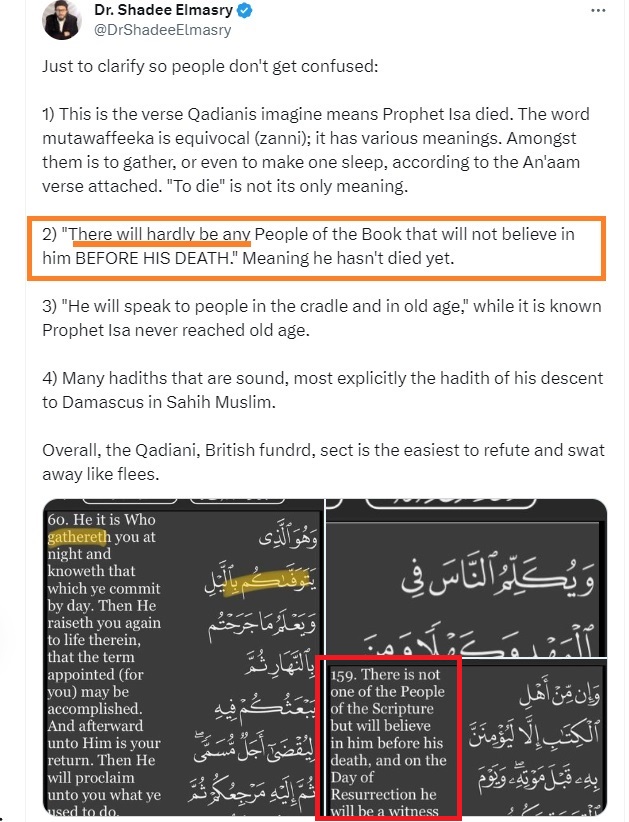
In our discussion with respected Dr. Shaykh Shadee El Masry (and a recent clash he had with the Ahmadi religion) We were curious as to the way Dr. Shadee translated Qur’an 4:159
We never did get an answer to which Arabic word(s) he used to translate the text into ‘Hardly’. Do you, the reader, the truth seeker, see what is happening here? We Love Dr. Shaykh Shadee Elmasry and if you are in his community, Allah-willing, you are in good hands. However, sometimes people will be tenacious in defending the indefensible.
The Jews and Christians will be at each other’s throat until the day of judgement
“Every one of the People of the Book will definitely believe in him before his death.” (Qur’an 4:159) If you were to take the standard Sunni misunderstanding this would flatly contradict the following:
“And the Jews say, “The hand of Allah is chained.” Chained are their hands, and cursed are they for what they say. Rather, both His hands are extended; He spends however He wills. And that which has been revealed to you from your Lord will surely increase many of them in transgression and disbelief. And We have cast among them animosity and hatred until the Day of Resurrection. ” (Qur’an 5:64)
“And from those who say, “We are Christians” We took their covenant; but they forgot a portion of that of which they were reminded. So We caused among them animosity and hatred until the Day of Resurrection. And Allah is going to inform them about what they used to do.” (Qur’an 5:14)
So the above verses do not give one the impression that Jesus (as) is going to come back and sing kumbaya with the Jews and the Christians.
We would not be surprised if some really desperate (clutching at straws) interpretation came that argued. Yes, Jesus (as) will bring the Jews and & Christians together, but they will still have animosity and hatred among them!!
Which begs the question: Why is he coming back?
Those of the Jews and Christians who see the truth and embrace insh’Allah are upon the path of safety. Those of the Jews and Christians who see the truth and reject it will be in hellfire.
“Indeed, that is My Path—perfectly straight. So follow it and do not follow other ways, for they will lead you away from His Way. This is what He has commanded you, so perhaps you will be conscious ˹of Allah˺” Qur’an 6:153)
“O mankind! Surely has come to you a convincing proof from your Lord, and We (have) sent down to you a clear light.” (Qur’an 4:174)
Our final point. We finish where we began.
“This is the dominant interpretation.” Well, Mufti, on what basis do you say this is the ‘dominant interpretation’ ? Can you tell us the total amount of tafsir literature you studied on this matter to conclude this? Also, if this is the ‘dominant interpretation’, it is by your own admission not necessarily the only one!
Truth vs. Popularity: The truth is not a matter of democratic opinion but of sound evidence from the Quran itself.
So dear respected readers which understanding of Qur’an4:159 do you accept as being more cogent?
The Sunni position.
The position of Mufti Zameer ur Rahman, Ahl Sunnah Wal Jammah and the mufassirun — whom rely upon hearsay and disconnected chains coming often from anonymous sources.
A position that allows for whispering, speculation, doubt and uncertainty?
A position that ignores the advice of one of the four we are to learn the Qur’an from—none other than Ibn Masud (ra)?
A position that structures a belief that goes against the Sunnah? “Do not believe the people of the Book, nor disbelieve them.”
The Ibadi position.
A position that takes the sincere council of one of the four we are to learn the Qur’an from—none other than Ibn Masud (ra)?
A position that does not go against the clear Sunnah. A position where we do not disbelieve them but we certainly do not build a belief based upon their reports.
A position that ask if it is reasonable to accept a 700 year gap in the chain of transmission as admissible evidence.
A position that is primarily reliant upon Tafsir al-Quran bi-l-Quran. (Interpreting the Qur’an by the Qur’an).
A position that allows the Qur’an to be interpreted by the use of other passages in the Qur’an, the use of grammar, context and theme?
A position that provides certainty and conviction?
“And indeed, it surely is a knowledge of the Hour. So do not be in doubt about it, and follow Me. This is the Path Straight.” (Qur’an 43:61)
﷽
This text also has to be one of the most used and abused texts of the whole of the Qur’an. It is used to assert the so-called “2nd coming” of Christ Jesus. The fact that this is the ‘go to’ verse when anyone is trying to assert that the Qur’an affirms the “2nd coming” of Christ Jesus shows you just how weak their argument is.
Such people are better off using the ahadith to argue their position.
1st point.
Let us start off with a major problem and contradiction with this understanding.
Narrated Abu Hurairah:
That the Prophet (saw) said: “There are three, for which, when they appear, a soul will not benefit by its faith, if it did not believe before the Signs: Ad-Dajjal, the Beast, and the rising of the sun from its setting place” – or “from the west.”
The majority of Sunni Muslims believe that Jesus (as) is coming a second time. Those who believe this believe that he is coming afterthe Dajjal. Remember, according to the above hadith and many like it faith does not benefit a person anymore!
“Do they wait for anything except that the angels should come to them or your Lord should come or that there come some of the signs of your Lord? The Day that some of the signs of your Lord will come no soul will benefit from its faith as long as it had not believed before or had earned through its faith some good. Say, “Wait. Indeed, we [also] are waiting.” (Qur’an 6:158)
It is very clear that when these signs happen, the faith and belief of those who came before will be rejected. Part of being a believer is to believe in the unseen.
“Who believe in the unseen, establish prayer, and donate from what We have provided for them.” (Qur’an 2:3)
Those signs spoken of in Qur’an 6:158 will be so clear that after their appearance will neither avail the unbeliever to repent of his unbelief nor the disobedient to forsake his disobedience.
So what would the point of Jesus (as) coming back and converting people to Islam (either by sword or by choice) when their belief counts for nothing any way?
2nd point.
Even if the verse was about Jesus is it ironclad evidence of his return?
Let us read the verse as:
“And indeed, he surely is a knowledge of the Hour. So do not be in doubt about it, and follow Me. This is the Path Straight.” (Qur’an 43:61)
Narrated Sahl bin Sa`d:
I saw Allah’s Messenger (ﷺ) pointing with his index and middle fingers, saying. “The time of my Advent and the Hour are like these two fingers.”
Whosoever recites the Qur’an finds that the signs of the Hereafter have already taken place.
Allah says: “Do they then only wait for the Hour that it should come on them of a sudden? But already come some tokens thereof, and when it comes to them, how shall they have their reminder?” (Qur’an 47: 18).
The most important portents are sending the Prophets and Messengers.
“This is a Warner of the series of the Warners of old. The (hour) ever approaches draws nigh” (Qur’an 53: 56-57).
This means the fact that Jesus (as) has already come is a knowledge of the hour in the same way that the advent of Muhammed (saw) is a knowledge of the hour.
3rd point.
“Another verse that is cited to refer to the second coming of Jesus is Surah 43, verse number 61. So what does it say in the Arabic? (Shabir speaks Arabic). And the English translation – here, I will read first, then we will try to analyze it: “And his second coming is truly a sign for the hour. So have no doubt about it, and follow me. This is the straight path.” Now when it says “second coming” here in the English translation, the translator has used a half square bracket to insert the word “second” and mark it off as an insertion. But even without marking that word as an insertion, even the word “coming” is not there in the Arabic. There is nothing like (Shabir speaks Arabic) in the Arabic – “his coming” – it just says (Shabir speaks Arabic), which literally means “and he is” or “it is.” Now if it is understood to mean “it is,” then that is a reference to the Quran, which has been mentioned previously within the same context. So it (the Quran) will be a sign of the hour, or as it is also read alternatively, it will contain knowledge of the hour – that the Quran itself is knowledge of the hour, or knowledge personified, something like this. “-Dr. Shabir Ally.
“Only if it refers to “he” as a human person can it possibly refer to Jesus. But does it refer to his second coming? It may be just that it is referring to him as a fact because of some miracles pertaining to him or associated with him that he will become a sign, or he is a sign of the hour. By his performing these miracles, people can take heed from that and realize that God, who made it possible for Jesus to do all of these things, is able to bring about what is called the hour. So in short, we can say that there is no verse of the Quran that clearly indicates that Jesus, on whom be peace, is coming again. And apart from that, there is no future messianic figure that is mentioned in the Quran. The closest you have to a figure is Dabbat al Ard (a creature from the earth who will speak to people) or Ya’juj and Ma’juj. They are mentioned in the 18th chapter of the Quran and also in the 21st chapter of the Quran. But there is no future messianic figure in the Quran. Why? We will try to come back and analyze that. But I want to go forward to look at scriptures of the other Abrahamic faiths.” Dr. Shabir Ally.
The obvious. Ask anyone to point out to you the Arabic for ‘coming’ or ‘return’ The verse does not say “he will return.” If would say: “he is knowledge/sign.” The return is inferred from hadith, not from the above verse.
4th point.
Many translations interpolate their presuppostion and bias onto the text.
Note how the text is being translated from the Qur’an corpus.
Muhammed Asad, Abdl Haleem & Mohamed Shafi translations have the “it” as the passage referring to the Qur’an.
Shabir Ahmed has ‘it’ as a reference to the Qur’an, but unlike Muhammed Asad and Abdul Haleem and Mohamed Shafi, he has the Qur’an talking about an “oncoming Revolution” rather than “the hour”.
Yusuf Ali’s Saudi version just goes all in!
“And (Jesus) shall be a Sign (for the coming of).”
Prima Qur’an comments: So, according to that translation, not only is it Jesus, but he is a Sign as well!
Safi Kasas has Jesus in brackets but, unlike Yusuf Ali, he puts the [a sign] in brackets as well.
Abdul Hye goes all in with the second coming. “And he (Jesus) is a KNOWN SIGN.”
Dr. Munir Munshey gets carried away with: “In fact he, (and his fatherless birth) is a sign”
Then we have the Mustafa Khattab translation, really overselling it with their translation,
“And his ˹second˺ coming is truly a sign for the Hour. So have no doubt about it, and follow me. This is the Straight Path.”
Muhsin Khan & Muhammad al-Hilah (another Saudi translation) have it as: “And he (Iesa (Jesus), son of Maryam (Mary) shall be a known sign.”
Dr. Mohammed Tahir ul Qadri takes a que from his Salafi opponents and follows their lead with: “And surely (when) he, (Isa[Jesus], descends from heaven), he will be a sign…”
Ali Unai just goes on a tangent: “Surely he (Jesus) (brought into the world without a father, and granted such miracles as reviving the dead) is a means to knowledge of the Last Hour.”
Hamid S. Aziz is more neutral, non-committal in translation:
“And most surely it is (the above events or the Quran or he, Jesus) is a sign of the knowledge of coming of the Hour (of Resurrection and Judgment). Therefore have no doubt about it and follow Me: this is the Straight Way.”
Muhammad Taqi Usmani has it as: (‘Isa)
Syed Vickar Ahamed has it as: “And (Isa)
Farook Malik has it as: He (Jesus)
Maududi has it as: “Verily he [i.e, Jesus)
Rashad Khalifa has a bizarre translation: “He is to serve as a marker for knowing the end of the world, so you can no longer harbor any doubt about it.”
The Monotheist group — taking a que from their former mentor and master, Rashad Khalifa, has it as “He” and this becomes “a lesson for the Hour”
Are those who think the verse is a reference to Jesus justified?
Well, if you look at the surrounding context of the verse, the immediate context is about Jesus.
The verses before:
“Jesus was not but a servant upon whom We bestowed favor, and We made him an example for the Children of Israel.And if We willed, We could have made [instead] of you angels succeeding [one another] on the earth.” (Qur’an 43:59-60)
As well as the text after.
“And when Jesus brought clear proofs, he said, “I have come to you with wisdom and to make clear to you some of that over which you differ, so fear Allah and obey me.” (Qur’an 43:63)
So this could be a reason why some have considered 43:61 to be about Jesus.
However, as you will see when we see the over-arching theme of Qur’an 43 as well as whom the immediate audience is, that justification will quickly disappear.
What about Arabic grammar?
A closer look at the Arabic text. “wa-innahu”, this is the 3rd person masculine singular object pronoun. We have third-person pronouns in English as well. We have object pronouns—me, you, him, her, it.
Secondly, the word “biha” is a 3rd person feminine singular personal pronoun. So this further clarifies how “wa-innahu” should be understood.
“And indeed, it surely is a knowledge of the Hour. So do not be in doubt about it, and follow Me. This is the Path Straight.” (Qur’an 43:61)
So, to support their claim, they would have to go against Arabic grammar!
5th point.
What is the overarching theme of Qur’an 43?
Do not just look at the verses immediately before or after. Read all the verses before and after.
Verses 43:2-5 are references concerning the Qur’an.
43:14 is a reference concerning the resurrection.
43:21 is a reference to the Qur’an.
43:31 is a reference to the Qur’an.
43:35 is a reference to the hereafter.
43:43-44 are both references to the Qur’an.
Yes, Allah spoke about Jesus (as) in the past tense. Just as Allah spoke about Moses (as) in the past tense. Allah spoke about Abraham (as) in the past tense.
Not only this but think about this.Who is the immediate audience of the Qur’an 43:61?
The immediate audience is the pagan Quresh. How is some “2nd coming” of Jesus supposed to be an argument for the oneness of Allah (swt), or the truth of the resurrection to that immediate audience?
What is more sensible?
Understanding A)
“And indeed, he (Jesus) surely is a knowledge of the Hour. So do not be in doubt about it(second coming of Jesus), and follow Me. This is the Path Straight.” (Qur’an 43:61)
How are you asking a group of pagan idolater Quresh to not be in doubt concerning it to believe in some second coming of Jesus (as) that they will never witness?
In what universe does this make sense?
Understanding B)
“And indeed, it surely is a knowledge of the Hour. So do not be in doubt about it, and follow Me. This is the Path Straight.” (Qur’an 43:61)
Or, are a group of pagan idolater Quresh being asked to believe in the Qur’an (it) with arguments about the hereafter and resurrection that they can ponder and believe in during their own lifetime?
Which of the two understandings of the verse above is more sensible?
Not only this, we still have to contend with the fact that, as per our other articles, Jesus(as) has died. That Muhammed (saw) is the last and final Prophet. The text of the Qur’an should be in harmony with one another. The supposition that the Qur’an supports the idea that Jesus (as)is not based upon solid evidence.
“Until, when HE reached THE SETTING OF THE SUN, HE found IT SET IN a spring of murky water: Near it he found a People: We said: “O Zul-qarnain! ,either to punish them, or to treat them with kindness” (Qur’an 18:86)
﷽
“Until, when HE came to the rising of the sun, HE found IT RISING on a people for whom We had provided no covering protection against the sun.” (Qur’an 18:90)
We believe these are the translations most favoured by atheists and skeptics. There are no parentheses around any of the text in English.
For example: he found it [as if] setting in a dark (Safi Kasas translation)
or
he found it [seemed to be] setting into a muddy spring (Abdel Haleem)
So we want to do away with any translation that has parenthesis. As if the authors are aware of the problem of the apparent reading of the English translation. However, we do want to bring another text into the discussion. We will use Arberry, a non-Muslim Christian translation of the Qur’an. We will use this translation because it bolsters the resolve of the skeptic and the atheist. Yet, we will see why insh’Allah
“And the sun — it runs to a fixed resting-place; that is the ordaining of the All-mighty, the All-knowing.” (Qur’an 36:38)
What we have noticed is that Christians and Jews do not use these types of arguments as they once did to attack the veracity of the Qur’an.
Why do Christians and Jews not use these types of arguments against the Qur’an anymore?
Why is that?
“On the day the Lord gave the Amorites over to Israel, Joshua said to the Lord in the presence of Israel: Sun, stand still over Gibeon, and you, moon, over the Valley of Aijalon. So the sun stood still, and the moon stopped, till the nation avenged itself on its enemies, as it is written in the Book of Jashar. The sun stopped in the middle of the sky and delayed going down about a full day. There has never been a day like it before or since, a day when the Lord listened to a human being. Surely the Lord was fighting for Israel!” (Joshua 10:12-14)
“And the third angel sounded, and there fell a great star from heaven, burning as it were a lamp, and it fell upon the third part of the rivers, and upon the fountains of waters.” (Revelation 8:10)
Does everyone realize that the smallest star discovered so far is the size of Saturn? We hope people realize that you cannot actually hurl a star down to Earth the size of Saturn because that would do more than fall upon a third of the rivers!
What about this scientific blunder and simply fallacious statement?
“Swarms of living creatures will live wherever the river flows. There will be large numbers of fish, because this water flows there and makes the salt water fresh; so where the river flows everything will live.” (Ezekiel 47:9)
Let’s give some context, shall we?
“He said to me, “This water flows toward the eastern region and goes down into the Arabah, where it enters the Dead Sea. When it empties into the sea, the salty water there becomes fresh.” (Ezekiel 47:8)
Can it be said that the Dead Sea is freshwater? Does salt water become freshwater?
“He put another parable before them, saying, ‘The kingdom of heaven is like a grain of mustard seed that a man took and sowed in his field. It is the smallest of all seeds, but when it has grown it is larger than all the garden plants and becomes a tree, so that the birds of the air come and make nests in its branches (Matthew 13:31-32)
This is not to be condescending, and we do apologize if it comes across as such. However, if you were to talk to the average everyday speaker of the English language, and even those of you who speak it as a second or third language, would you know the following if someone stopped and asked you?
Give me an example of the predicate of the sentence. Give me an example of a lowercase nominative. Even some people would need to pause and think about what a helping verb is! Many people are simply not grounded in the grammar of their own language.
The Qur’an uses metaphors.Example:
“Then your hearts became hardened after that, being like stones or even harder. For indeed, there are stones from which rivers burst forth, and there are some of them that split open and water comes out, and there are some of them that fall down for fear of Allah. And Allah is not unaware of what you do.” (Qur’an 2:74)
We are surprised the atheists and the skeptics have not asked us Muslims for examples of a stone that you can split open and water would come forth. Or anywhere on the Earth where we can find water gushing forth from stones!
The Qur’an uses idioms. Example:
And who say, “Our Lord, bestow upon us from our spouses and offspring that will be the comfort of the eyes, (Literally: the coolness (when) the eyes settle down) and make us an imam (leader) of the pious.” (Qur’an 25:74)
Now the view common to people in the time in which the Qur’an was revealed would be:
That the world/earth is flat.
That the Sun revolves around the earth.
Here is a question you never see Muslims involved in daw’ah, apologetics or polemic ask these skeptics and atheists. Using the Arabic language of the 7th century, how would you construct the sentences of Qur’an in 18:86 and Qur’an 18:90 that would be palatable to 21st century understanding?
For example, if the Qur’an had used a different way of describing events, we would have been described as flat earthers!
On the flat earth wiki the question is asked:
How do you explain day/night cycles and seasons?
“The sun moves in circles around the North Pole. When it is over your head, it’s day. When it’s not, it’s night. The light of the sun is confined to a limited area, and its light acts like a spotlight upon the Earth.”
Now let us look at the two passages in question again:
“Until, when HE reached THE SETTING OF THE SUN, HE found IT SET IN a spring of murky water: Near it he found a People: We said: “O Zul-qarnain! ,either to punish them, or to treat them with kindness” (Qur’an 18:86)
“Until, when HE came to the rising of the sun, HE found IT RISING on a people for whom We had provided no covering protection against the sun.” (Qur’an 18:90)
The English translated text “he found it” in Arabic wajadaha.
“And establish prayer and give zakah, and whatever good you put forward for yourselves – you will find it with Allah. Indeed, Allah of what you do, is Seeing.” (Qur’an 2:11)
‘Will find it’ in Arabic is tajiduhu
No one among Muslims believes that a person is going to find their prayers, or purification of wealth, and good actions in a pile somewhere with Allah (swt). It is perceived, as the verse itself says, that Allah (swt) is acquainted with what we do. Our intention behind every action, everything. Now you have to wonder what Zul-qarnain actually found, given his own empirical data about the sun.
The sun is hotter than other days. Even looking at this sentence we used in English, it is problematic. It is not that the sun may necessarily be hotter than other days, it is that the proximity of the sun is closer to the earth during certain times of the year.
The sun appears brighter on some days more than on others.
The sun obviously does not literally set in a murky spring because its light is not doused or put out. If the Qur’an was describing something literal, you would think that the sun being dipped in a murky spring would produce some type of noteworthy phenomena.
wajadahā -he found it. This is the perception of Zul-Qarnain.
Let us look at some other verses in this conversation, Qur’an 21:33.
We will use three orientalist/Christian translations; not necessarily Islam-friendly.
“It is He who created the night and the day, the sun and the moon, each swimming in a sky.” Arthur John Arberry
“It is He who hath created the night, and the day, and the sun, and the moon; all the celestial bodies move swiftly, each in its respective orb.” -George Sale(all celestial bodies) is not in the Arabic text.
“And He it is who hath created the night and the day, and the sun and the moon, each moving swiftly in its sphere.” -John Medows Rodwell
Now those are the type of text that flat earthers would just love to use. Do note that one thing that is clear about the three above translations taken together is that the moon and the sun “do something” in their own respective sphere/lane.
Now why we say “do something” is that the Arabic that is used is the same word for ships. So a ship can float and seem stationary and yet a ship can be moving at the same time. A force can move a ship.
Let’s look at another verse: Qur’an 36:40
“It behoves not the sun to overtake the moon, neither does the night outstrip the day, each swimming in a sky.” Arthur John Arberry
“It is not expedient that the sun should overtake the moon in her course; neither doth the night outstrip the day: But each of these luminaries moveth in a peculiar orbit.” George Sale
“To the Sun it is not given to overtake the Moon, nor doth the night outstrip the day; but each in its own sphere doth journey on.” John Medows Rodwell.
The empirical data that people see and observe is that the sun does indeed overtake the moon. The empirical data that people see and observe is that the night does outstrip the day. Yet, Allah (swt) described natural phenomena couched in a language that contradicts the idea that the earth is flat (sunset/sunrise).
All the text taken in their literal apparent sense states that:
The sun sets, the sun rises. This does not happen on a flat earth.
The Sun and the Moon float/move in their own respective sphere, orb. Something that apparent empirical data does not suggest.(different spheres of influence).
The sun does not overtake the moon (as if they were in the same lane-line), something that the apparent, empirical data suggest. (your turn/my turn).
Now one more verse that clearly shows that the sun setting in a murky spring is in accord with the empirical observable data that human beings see and witness. This verse, subhan’Allah, has something very interesting to say.
“And the sun — it runs to a fixed resting-place; that is the ordaining of the All-mighty, the All-knowing.” (Qur’an 36:4) Arberry translation.
Interestingly, the words used in Qur’an 18:86 are taghrubu (setting) and maghriba (The setting of the sun). They are both used to denote the west. Out of our five daily prayers, the fourth prayer is called the ‘maghrib’ prayer. North Africa is known as the ‘Maghreb’—a westernmost place or place where the sun sets.
Whereas in Qur’an 36:4 this verse says nothing about setting in a murky spring. The Arabic here is ‘limus’taqarrin’. The verse is describing the ultimate end of the sun. The choice of ‘limus’taqarrin’ is mind-blowing. After reflecting on this, is it not time to stop typing and do sujudd and thank Allah (swt) that we are Muslim! Al hamdulillah!
To be or become cool, remain quiet, be steadfast, be firm, refresh, be stable, be firm, receive satisfy, affirm, agree, settle, last. qarar – stability, a fixed or secure place, depository, place ahead. qurratun – coolness, delight. aqarra (vb. 4) – to confirm, cause to rest or remain. istaqarra (vb. 10) – to remain firm. mustaqirrun – that which remains firmly fixed or confirmed, in hiding, is lasting, which certainly comes to pass, which is settled in its being/goal/purpose. mustaqar – firmly fixed/established, sojourn, abode. qurratun – coolness, refreshment, source of joy and comfort. qawarir (pl. of qaruratun) – glasses, crystals.
“To be or become cool, remain quiet, be steadfast, be firm, refresh, be stable, be firm, receive satisfy, affirm, agree, settle, last. qawarir-glasses, crystals
“Which is settled in its being/goal/purpose.” This is also interesting because the Arabic that is used indicates a stage that has been fulfilled but not that it does not have any more purpose of use. One purpose has been served and a new purpose awaits.
“Then do they not reflect upon the Qur’an, or are there locks upon [their] hearts? (Qur’an 47:24)
“My Lord! Increase me in knowledge.” (Qur’an 20:114)
﷽
We have absolutely been fascinated by those few individuals who have found there to be controversy surrounding the identity of Dhul-al-Qarnayn. The reason why we are fascinated is that historians and Orientalists are not actually interacting with the Qur’an per se. They are interacting with commentary about the Qur’an.
Historian: We found no evidence that X existed.
Believer: They have yet to find evidence that X existed.
Epistemology matters!
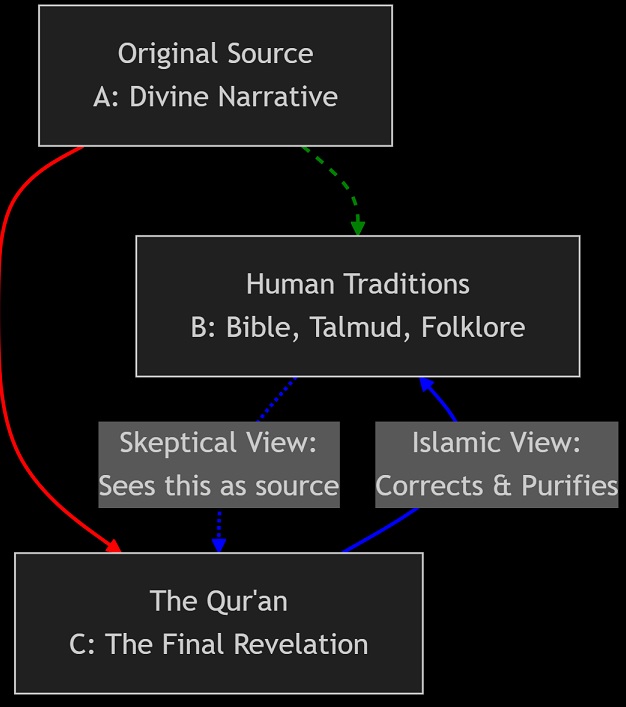
The chart above shows the difference between the different axioms of the believers and the doubters. Agnostics and atheists have a different epistemology than believers.
How The Above Chart Explains the Concept:
The Source (A): Everything begins with the “Original Source” (A), which is the divine, perfect narrative from God.
The Two Paths:
The human traditions (B) are a changed and corrupted version of the original story, having passed through centuries of human transmission (resulting in legends, folklore, and altered scriptures).
The Qur’an (C) comes directly and perfectly from the same original source (A), acting as a “Final Revelation” that restores the original message.
The Optical Illusion (The Core of Our Point):
The Skeptical View (dashed line) looks at the relationship between B and C and mistakenly concludes that C must have copied from B because B appears earlier in history.
The Islamic View (solid arrows) correctly identifies that both B and C draw from a common, older source (A). Therefore, when B contains elements that align with C, it doesn’t mean C copied B—it means B still contains remnants of the original truth (A) that the Qur’an (C) confirms and corrects.
The Verbatum Point: The arrow from C to B, labeled “Corrects & Purifies,” visually explains why you will never find verbatim copying. The Qur’an doesn’t replicate the corrupted narratives (B); it speaks with authority from the original source (A) to rectify them.
For the skeptics and doubters, their findings reinforce their epistemology and their axioms. For the Muslims, the findings of the skeptics and doubters provide corroborating evidence of our own epistemology and axioms.
As a Muslim, we know that a tafsir is not divine revelation.Tafsir is scholarly musings about the text.
1st, it should be noted that Dhul Al-Qarnayn, like Khidr, are simply epitaphs, like Al-Amin (The Trustworthy) is for the Blessed Prophet (saw).
The above are not real names they are descriptors.
2nd, it should be noted that not much attention is given to the individuals (Khidr & Dhul Al-Qarnayn) beyond their epitaphs. The attention is given to the events that unfold or surround them.
3rd, the Qur’an only mentions Dhul Al-Qarnayn thrice.
So let us get into the narrative of Dhul Al-Qarnayn in the Qur’an.
“And they will ask you about Dhul-Al Qarnayn. Say: I will recount to you a remembrance of him.” (Qur’an 18:83)
“We established him on earth, and We gave him from everything a way.” (Qur’an 18:84)
“And he followed a way.” (Qur’an 18:85)
“Till, when he reached the setting place of the sun, he found it setting in a muddy spring, and found a people thereabout. We said: O Dhul-Al Qarnayn! Either punish or show them kindness.” (Qur’an 18:86)
“He responded, “Whoever does wrong will be punished by us, then will be returned to their Lord, Who will punish them with a horrible torment.” (Qur’an 18:87)
“But as for the one who believes and does righteousness, he will have the best of rewards. We shall require him to do only easy things.” (Qur’an 18:88)
“Then he followed a path.” (Qur’an 18:89)
“Until he came to the rising of the sun. He found it rising on a people for whom We had provided no shade.” (Qur’an 18:90)
“And so it was, Our knowledge encompassed all that happened to him.” (Qur’an 18:91)
“Then he followed a path.” (Qur’an 18:92)
“Until he reached between a barrier, where he found a people who could hardly understand a word he was saying.” (Qur’an 18:93)
“They said, “O Dhul Al-Qarnayn, Gog and Magog are corrupting this land. Can we pay you to erect a barrier between us and them?” (Qur’an 18:94)
“He responded, “What my Lord has provided for me is far better. But assist me with resources, and I will build a barrier between you and them.” (Qur’an 18:95)
“Bring me blocks of iron!” Then, when he had filled up ˹the gap˺ between the barriers he ordered, “Blow!” When the iron became red hot, he said, “Bring me molten copper to pour over it.” (Qur’an 18:96)
“And so the enemies could neither scale nor tunnel through it.” (Qur’an 18:97)
“He said: This is a mercy from my Lord; but when the promise of my Lord comes to pass, He will lay it low, for the promise of my Lord is true.” (Qur’an 18:98)
“On that Day, We will let them surge ˹like waves˺ over one another. Later, the Trumpet will be blown, and We will gather all ˹people˺ together.” (Qur’an 18:99)
The first thing that we found fascinating about this set of texts is the use of twos. Things are in contradistinction to one another. Like two different items, two different scenarios, two things in contrast.
First, being the main focus of the individual in the narrative, is Dhul Al-Qarnayn — the two-horned one, one of two different epochs. The one with two braids. The one with two people.
ثُمَّ أَتْبَعَ سَبَبًا ثُمَّ أَتْبَعَ سَبَبًا
That exact phrase appears twice.
Setting-place of the sun/he came to the rising of the sun (two different scenarios in relation to the sun)
Either punish or show them kindness (two different ways to deal with a particular people).
A people for whom We had provided no shade contrasted with a people who had no protection against tribes.
The tribes in question are two gog/magog. Two tribes.
He met two different types of people; people who could hardly understand a word, contrasted with people he could communicate with readily.
A barrier between you and them-a barrier is a separation between at least two different things.
The barrier they were not able to do two things: neither scale nor tunnel through it.
The barrier itself is made from two different metals: iron and copper.
If we are looking for clues of a historical vestige (remembrance), we would want to note the following:
A)What is the meaning of Dhul Al-Qarnayn in the Arabic language?
B) They will ask you. Who is the ‘they’?
C)How did they respond to the information?
D) Tribes are identified as Gog and Magog.
E) Blocks of iron and molten copper are used to seal an apparent gap/breach in a barrier.
Ea) It is assumed that there is a garrison that defends the area. The purpose of the wall is to prevent being overrun. *note*
Note: This is an assumption on our behalf.
Eb) It is assumed that whoever the Gog and Magog are, that they are either
a) raiders b) expansionists
If we assume they are raiders, this means they have had a foray into these people’s territories before. Though they never established dominion over them.
If we assume that they are expansionists, then the people that Dhul Al-Qarnayn encounter are those who presume expansion is heading in their direction and thus, they want to make preparations.
As regards Qur’an 18:98 we do not see that as connected to Qur’an 18:99 as in events that happen at the same time. For more on this please see:
There is nothing that an individual using the historical critical method or an orientalist has brought that even remotely challenges the narrative of the Qur’an. Nihil ad rem. People having doubts because a tafsir was challenged. That is an absolute nothingburger.
Recall:
“And they will ask you about Dhul-Al Qarnayn. Say: I will recount to you a remembrance of him.” (Qur’an 18:83)
There is nothing in that verse that indicates that the answers to the questions that they posed were matters that concern anyone outside those that asked the questions.
“As for the ship, it belonged to some poor people, working at sea. So I intended to damage it, for there was a king ahead of them who seizes every ship by force.” “And as for the boy, his parents were believers, and we feared that he would pressure them into defiance and disbelief. So we hoped that their Lord would give them another, more virtuous and caring in his place.” (Qur’an 18:79-81)
﷽
The Qur’an is sublime.
“Indeed, We have made it an Arabic Qur’an that you might understand.” (Qur’an 43:3)
In the Qur’an, in chapter 18, verses 65 to 82, we have information related to us by a figure that Islamic scholars have named ‘Khidr’.
Finally, when Prophet Moses (as) is no longer able to keep patient with this figure and the things that this figure does prompt Moses (as) on every occasion to question why he does the things that he does, he finally gets resolution.
“As for the ship, it belonged to some poor people, working at sea. So I intended to damage it, for there was a king ahead of them who seizes every ship by force.” “And as for the boy, his parents were believers, and we feared that he would pressure them into defiance and disbelief. So we hoped that their Lord would give them another, more virtuous and caring in his place.” “And as for the wall, it belonged to two orphan boys in the city, and there was beneath it a treasure for them, and their father had been righteous. So your Lord intended that they reach maturity and extract their treasure, as a mercy from your Lord. And I did it not of my own accord. That is the interpretation of that about which you could not have patience.” (Qur’an 18:79-81)
None of the translations of the meaning can give justice to the Arabic Qur’an.
As regards the action of damaging the ship. The individual ascribes that action to himself.
So I intended to damage it. I intended: fa-aradttu 1st person singular verb.
“and we feared that he would pressure them into defiance and disbelief. So we hoped that their Lord would give them another, more virtuous and caring in his place.”
We feared:fakhashina 1st person plural perfect verb. The ‘we feared’ is better translated or understood as ‘we disliked’. Whatever displeases Allah (swt) displeases his loyal and faithful servants.
We hoped: fa-aradna 1st person plural perfect verb. The ‘we hoped’ is better translated as we intended.
In here fakhashina ‘we disliked’ he returns it to himself and to Allah (swt). Why?
Killing the child, he returns back to himself.
“So they proceeded until they came across a boy, and the man killed him. Moses protested, “Have you killed an innocent soul who killed no one?” You have certainly done a horrible thing.” (Qur’an 18:74)
“So we hoped that their Lord would give them another, more virtuous and caring in his place.”
Allah is replacing the child with another.
So the killing is from the companion of Moses (as) and the replacement is from Allah (swt). You can use the ‘We’ as Allah (swt) is the creator of all things and human beings acquire the actions.
“So your Lord intended that they reach maturity and extract their treasure, as a mercy from your Lord.”
The Lord intended: fa-arada rabbuka 3rd person masculine singular perfect verb
fa-aradttu (I intended) an a’ibaha (cause a defect) -I wanted to. fa-aradna- (we intended) fa-arada rabbuka (so intended Your Lord)
Very often the various translations rob the reader of the depth of the Arabic language.
Another example is Qur’an 3:7
“And none know its interpretation save God and those firmly rooted in knowledge. They say, “We believe in it; all is from our Lord.”
Those who may lack depth of Arabic grammar and syntax would argue that the verse should be read as: “But none knows its interpretation except Allah”. And those who are firmly rooted in knowledge say: “We believe in this, it is all from our Lord.”
Whereas the better reading is:
“But none knows its interpretation except Allah and those who are firmly rooted in knowledge. They say, “We believe in this it is all from our Lord.”
However, due to the lack of depth of the Arabic grammar and syntax, they would object by looking at English translations of the meanings and say:
That Allah (swt) would not say: “We believe in this it is all from our Lord.”
But this is not the proper understanding at all. The part of the verse: “We believe in this it is all from our Lord.” Is a reference to : “Those who are firmly rooted in knowledge.” and not to Allah (swt).
Issues that arise from the verses by those not grounded in theology.
They argue that it looks as if Allah (swt) is certain of the righteousness of the substitute son that does not exist yet; all the while, the unbelieving son, Allah (swt) was simply using the principle of probability.
But this type of reasoning is turned on its head. If Allah (swt) knew, the righteousness of the substitute son, which does not exist yet, he certainly knew of the actions of the unbelieving son.
Allah (swt) allowing for the son to be killed as well as the announcement of another son are all based upon certain knowledge that Allah (swt) has.
“Nasty women are for nasty men, and nasty men are for nasty women. And virtuous women are for virtuous men, and virtuous men are for virtuous women. The virtuous areinnocent of what the wicked say. They will have forgiveness and an honourable provision.” (Qur’an 24:26)
﷽
This article is written so that the masses can understand the correct understanding of the verse and not the faulty understanding that is widespread among the Ummah.
Shaykh Masoud bin Muhammed Al Miqbali (h) explains the correct understanding of this verse:
This is from the ill understanding of some ayats, actually.
For example: {Nasty ones are for nasty people} (Qur’an 24:26) {good ones are for good peole} (Qur’an 24:26)
What do most people understand from this ayat? What does {good ones are for good people} mean?
Audience: “Means that the pious women is for the pious man.”
Shaykh Miqbali: “He understands that the pious woman is for the pious man, and this is not true, ever.”
{good ones are for good people,} and {Nasty ones are for nasty people,}
{good ones are for good people} and {Nasty ones are for nasty people}
He means the good words and sayings are for the good people, and the nasty words and sayings are for the nasty people.
So the nasty refers to the words and the good refers to the words, not that good women are for good men. Or else, Asia, a woman from the women of Jannah, is the woman of the Pharaoh! The Pharaoh is nasty, and she’s from the people of Jannah. So this can’t be!
And the women of Lut and Nuh are in the fire while they (Lut & Nuh) are prophets. So it’s not meant that women are wives…. No. Words are meant.
This ayat came in surah Al Nur, after mentioning the story of Ifk and the words
that were said to Lady Aisha (ra) and the accusations and false things.
So after that came the saying of Allah:{Nasty ones are for nasty people, and nasty people are for nasty ones, and the good ones are for the good people, and the good people are for the good ones.}
{Those are acquitted of what they…} ??? {…. SAY} (Qur’an 24:26)
Qutb Al A’ima (the centre of Imams) (ra) also mentioned this in his Tafseer Himyan Al Zad. He also said that it’s the view of the majority. And he stated that Ibn Abbas (ra) also went with this interpretation. He’s one of the biggest Imams of the madhab. And he has written more than 300 books!
If the Qutb is not enough, then there’s also the statement of Al Hawari in his tafseer, and it’s one of the earliest Ibadi tafseer books, 3rd hijri century. He also said the same.
For other examples of verses that have been misinterpreted or misunderstood, you may wish to see the following articles:
“It is He who has sent His Messenger with guidance and the world view that is based on the truth to manifest it over all other world views, although the mushrik make dislike it.” (Qur’an 9:33)
﷽
The subject of the Mahdi concerns Islamic Eschatology or what is known as end-time events.
First and foremost, it is important to understand that when one speaks of Mahdi, different schools and expressions of Islam have different ideas in mind.
Twelver Shi’a
In Twelver Shi’a theology, the Mahdi is the twelfth and final Imam, Muhammed ibn al-Hasan al-Mahdi, believed to be the direct descendant of the Blessed Prophet Muhammed(saw) through his daughter Fatima (ra). He is in occultation: He is hidden from public view by Allah’s will. He will re appear in some future eschatological event to restore justice.
Isma’ili Shi’a & The Qarmatians & Muhammed bin Isma’il
The person of Muhammed bin Isma’il caused a fracture early on, causing one stream that historians label the ‘Qarmatians’ and the other founding the Fatimid Caliphate.
The Qarmatian View.
Muhammed ibn Isma’il was not just the 7th Imam; he was the Qā’im (the Resurrector) and the Mahdi.
The Ismaili (Later Fatimid) View.
Muhammed ibn Isma’il was the 7th Imam.
He went into hiding (satr) due to Abbasid persecution.
The Imamate continued in his descendants.
They recognized a hidden line of Imams following him, which eventually culminated in Abdullah al-Mahdi Billah, who publicly declared himself Imam in 899 CE and founded the Fatimid Caliphate in 909 CE.
For this group, the Imam was always present on earth, whether concealed or manifest.
The Zaydi Shi’a
For Zaydis, the term “Mahdi” (the Guided One) is not exclusively reserved for a single, predestined, end-of-times figure. Instead, it is a title that can be applied to any rightly guided Imam from the Ahl al-Bayt who rises to establish justice.
There are times when they have referenced their Imams as such. For example: Al-Mahdi Li-Din Allah
While not a core dogma, Zaydi literature does contain some hadith about a future messianic figure from the Ahl al-Bayt, often referred to as “al-Qa’im” (The One Who Will Arise) or “al-Mahdi.”
Sunni View.
The dominant view and position among Sunni Muslims is that Mahdi is a figure believed to be the direct descendant of the Blessed Prophet Muhammed(saw) through his daughter Fatima (ra). He will appear in some future eschatological event to restore justice.
Again, this is the view of the vast majority of Sunni Muslims. As the articles in this entry will clearly demonstrate, there are many in the Sunni tradition that do not share this belief.
Ibadi View. The idea of a Mahdi is not something found in our sources. We have no belief in any coming Mahdi. If the coming of this figure is true, we hope Allah opens our eyes to it. However, it is not a theological principle with us nor something we believe in.
It should be noted to the reader and researcher. Often, the various schools of Islam will have what is known as Shaadh (شاذ) — The Irregular/Anomalous Opinion. These are views that are anomalous or isolated. The Ibadi school has such and other schools do as well. Yet, on the issue of the Mahdi, we have not even come across a shaadh.
We establish the following facts.
The Qur’an has no mention of any Imam Mahdi.
The Ibadi hadith collection has no mention of Imam Mahdi.
There is no hadith about Mahdi in the Al-Jami’i Al-Salih, otherwise known as the Musnad Al-Imam Al Rabii.
The silence of Bukhari & Muslim.
The two great Imams of Hadith, Bukhari and Muslim, neither of them mentions Hadith concerning Imam Mahdi. What’s interesting about this is that both of them are aware of narrations on the subject that meet their criteria, yet they did not include them.
The silence of the Muwatta of Malik ibn Anas.
There is no hadith about Mahdi in the Muwatta of Malik ibn Anas.
What will Ahl Sunnah In the next 56 years and no Mahdi? Witness the genius of Ibn al-Hajr al-Asqalani as he tries to make sense of the data.
The man whho the ‘Abdulla bin Zaid Al Mahmoud Islamic Cultural Center’ in Qatar is named after and former Qāḍī al-Quḍāt, and Athari -Salafi , tells us why there is no coming Mahdi.
Shaykh Abu Abdullah Mustafa bin Al-Adawi is a renowned Egyptian Hadith and Fiqh scholar, often associated with Salafi methodology, known for his expertise in Tafsir and Hadith verification. A former student of Shaykh Muqbil bin Hadi al-Wadi’i, he focuses on authenticating religious texts and has written extensive works on Islamic jurisprudence.
Ali Erbaş Turkish Islamic scholar and president of directorate of religious affairs -diyanet in Turkey, believes Mahdi will not come and that Jesus (as) is dead. The Presidency of Religious Affairs (Diyanet) is Turkey’s highest official Islamic authority.
The great ibn Khaldūn al-Ḥaḍramī, Ashʿarī in theology, and Mālikī in jurisprudence. Writes in the Muqaddimah (Book 1, Chapter 3, section on the caliphate) about the weakness of the chains concerning narrations of Mahdi.
Shaykh Dr. Muhammed Bin Yahya Ninowy, a descendant of the Blesed Prophet Muhammed (saw) through the line of Imam al-Ḥusayn ibn ʿAlī ibn Abī Ṭālib, expreses his doubts about the Mahdi.
“So after the truth, what else can there be, save error? How then are you turned away?” (Qur’an 10:32)
﷽
We were alerted to a fascinating discussion recently between Shaykh Dr. Muhammed bin Yahya Ninowy and Tafhim Kiani on the subject: The Sunni Identity: Can Salafis Be Seen As Sunni Muslim? – Shaykh Ninowy
You may watch the very informative discussion here:
Before we comment further, we feel it is important to give some background information on Shaykh Dr. Muhammed bin Yahya Ninowy .Dr. Muhammed bin Yahya al-Ninowy is widely recognized as a descendant of the Blesed Prophet Muhammed (saw)through the line of Imam al-Ḥusayn ibn ʿAlī ibn Abī Ṭālib
Shaykh Ninowy was featured in ‘The Muslim 500’ as regards those who were deemed to exert a great deal of influence on the Muslim Ummah.
“Sheikh Dr Muhammad Al-Ninowy is a Syrian-American scholar, author, and medical doctor based in Atlanta, Georgia, whose lineage is traced back to the Prophet Muhammad (blessings and peace be upon him). In addition to a PhD in Islamic studies from the University of Georgia, he holds a Doctor of Medicine degree. He is the founding director of Madina Institute and Seminaries, The Center for Non-Violence and Peace Studies, and the charitable organization Planet Mercy, with campuses in the USA, Canada, the UK, South Africa, Malaysia, and Norway. Al-Ninowy also leads a school that follows the Sufism of Ahl-Al-Hadith. He was appointed by the Sultan of Malaysia in 2020 to serve as a member of the board of directors of the Islamic University. An upcoming book is: Nonviolence; a fundamental Islamic principle.”
In the above exchange, Shaykh Dr. Muhammed Al-Ninowy had some eye-opening statements concerning ahadith in relation to “The Mahdi.”
@1:19:33 “The hadith of the Mahdi is frankly in our Sunni tradition and also in the Shi’a tradition, but let’s say in the Sunni tradition there are one and half hadith that are ambiguous in my view. So, Sahih lilghairihi ghair sahih, the explicit are not authentic; and the authentic are not explicit. So, therefore you see, the earlier scholars did not even put it as part of the… did not put the Mahdi as part of the Aqaid.”
This is a welcome statement. It is welcomed because we can see more and more come to this realization.
Recently even Shaykh Hamza Yusuf made an interesting statement when he said:
The vast majority of Muslims believe in the second coming.
Which means there are Muslims who do not believe in the coming of Jesus (as)
Wonder which Muslims those are?
You can find Shaykh Hamza’s statement in an interview here;
Now, Shaykh Dr. Muhammed Al-Ninowy did have a little blurb about the Ibadi school in the above interview.
@1:16:05 “The Khawarij of today, the Ibadis.”@1:16:52 “Not as verbally violent anymore to be honest with you.” Their tradition is.”
He was rather mild. The important thing is that for him, we are Muslims. Albeit he is clearly in error in terms of understanding our history. We also have to keep in mind that it is claimed he is a descendant of Husayn, the son of Imam Ali, as well as being disciplined in the Shaadhili Tariqah. Thus, given his own admission (in the above interview) of Sufism and its connection to Imam Ali, you can’t expect Shaykh Ninowy to give away the store. Albeit we are hopeful that gaps in information are an opportunity to learn about the Ibadi school. He has access to the Arabic language and resources, and surely he will not be excused on the day of judgement.
“So after the truth, what else can there be, save error? How then are you turned away?” –(Qur’an 10:32).
One of our team members has met him before, and he does not strike us as a person who is egotistical or driven by winning points and debates.
May Allah (swt) continue to support Shaykh Ninowy when he strives to build bridges of mutual trust and cooperation throughout the world. Personally, we feel Muslims who attend his Masjid and his circles of learning are in good hands, and Allah (swt) knows best.
“They ask you, [O Muhammed], about the Hour: when is its arrival? Say, “Its knowledge is only with my Lord. None will reveal its time except Him. It lays heavily upon the heavens and the earth. It will not come upon you except unexpectedly.” They ask you as if you are familiar with it. Say, “Its knowledge is only with Allah, but most people do not know.” (Qur’an 7:187)
﷽
3471246720
days
hours minutes seconds
until
Arrival of Imam Mahdi
The day of Judgement was already supposed to happen.
A’isha reported:
“That when the desert Arabs came to Allah’s Messenger (saw) they asked about the Last Hour as to when that would come. And he looked towards the youngest among them and said:
If he lives he would not grow very old that he would find your Last Hour coming to you (he would see you dying).”
“They ask you, [O Muhammed], about the Hour: when is its arrival? Say, “Its knowledge is only with my Lord. None will reveal its time except Him. It lays heavily upon the heavens and the earth. It will not come upon you except unexpectedly.” They ask you as if you are familiar with it. Say, “Its knowledge is only with Allah, but most people do not know.” (Qur’an 7:187)
Ibn Hajar Al Asqalani made a calculation that the time of the Ummah should have already come and gone:
Narrated `Abdullah bin `Umar:
I heard Allah’s Messenger (saw) while he was standing on the pulpit, saying, “The remaining period of your stay (on the earth) in comparison to the nations before you, is like the period between the `Asr prayer and sunset. The people of the Torah were given the Torah and they acted upon it till midday, and then they were worn out and were given for their labor, one Qirat each. Then the people of the Gospel were given the Gospel and they acted upon it till the time of the `Asr prayer, and then they were worn out and were given (for their labor), one Qirat each. Then you people were given the Qur’an and you acted upon it till sunset and so you were given two Qirats each (double the reward of the previous nations).” Then the people of the Torah said, ‘O our Lord! These people have done a little labor (much less than we) but have taken a greater reward.’ Allah said, ‘Have I withheld anything from your reward?’ They said, ‘No.’ Then Allah said, ‘That is My Favor which I bestow on whom I wish.’ “
Hafiz Ibn al-Hajr al-Asqalani says in his Fath al-Bari, (in vol.4, the book of hijara, page 448-449) commenting on these two narrations: “and it is evident ( from these stated narrations) that the lasting of this Islamic nation is somewhat a thousand years, this is because the age of the Jewish nation is equivalent to that of the time periods of the Christian and Muslim ages combined, and the people of transmission (ahl an naql) have agreed that the period of the Jews till the advent of Allah’s final Apostle Muhammad was more than 2000 years, and the span of the age of the Christians was 600 years from them. And also this narration points the fact about how little of the age of this world has remained.”
Torah time is = to Injil time + Qur’an time.
Torah time =2000 years.
Torah time = 2000 years -600 years = (1400) From Moses to Jesus.
Let us be generous and add 100 years.
The time of this ummah of the Blessed Messenger [saw] is 1500-600 which means only 900 years and now we are in 1441.
When Muslims reached the 1,000th year they thought they were nearing the end because of these Sahih ahadith which indicated we will have half the time the Jewish nation had, but Imam as-Suyuti [the author of the Tafsir al jalalayn] who was born in the 10th century and lived into the 11th century was alive during these times, he wrote a fatwa [legal ruling] to reassure Muslims, in which he said it was supposed to be 1000 years but there is a dua of Rasul Allah in which he supplicates Allah to give his Ummah another half a day and the companions asked the prophet how long is half a day and he answered 500 years. So the imam said the life of this Ummah is 1,500 years.
Imam as Suyuti mentions in his book: “Risalah Al-Kashf ‘An Mujawazt Hadehel Ummah Al Alf” ”, or “Treatise on Revealing of the Proceeding of this Nation Beyond the Thousand,” page 206 about the advent of the Mahdi that:
“From what the narrations reveal is that the age of this ummah extends beyond a thousand but it doesn’t exceed in increase another 500 in actuality beyond this thousand.”
So if you do the math 1500-1443=59 years left. So in these next 59 years according to them, we should see this Mahdi, the coming of Jesus, the Gog and Magog causing havoc on the Earth, the Sun rising in the West.
Keep in mind according to the above hadith: “He will destroy the Antichrist and will live on the earth for forty years and then he will die.” 59-40=19. So accordingly Jesus will show up in the year 2039.
So what is going to happen to these Muslims who, after 59 years have passed and nothing of the sort has happened? Will they apostate from the faith? Will they leave the deen?
Ya Allah [swt] I sincerely hope not. We hope that they realize that just because certain interpretations and understandings of Islam are wrong, it does not mean that Islam is wrong.
The Ibadi school, we know what it is that influenced our brothers in ‘Ahl Sunnah’.
We know that many Christians and Jews who embraced Islam in the past influenced our religion, its understanding and teachings.
We know they got this concept straight from the following:
Matthew: 20: 1-16
You may also be interested in reading the following:
“With the clear proofs and the Zabur. And We sent down to YOU(l-dhik’ra) the Remembrance, that YOU may make clear to the people, what has been sent down to them and that they may reflect.” (Qur’an 16:44)
“Then in the footsteps of the prophets, We sent Jesus, son of Mary, having authority over the Torah revealed before him. And We gave him the Gospel containing guidance and light and having authority over the Torah—a guide and a lesson to those who fear Allah.” (Qur’an 5:46)
And let the People of the Gospel (ahlu l-injili) judge by what Allah has revealed therein. And whoever does not judge by what Allah has revealed – then it is those who are the defiantly disobedient.” (Qur’an 5:47)
“Have you not turned Your vision to those who have been given a (nasiban) portion of the (l-kitabi) Book? They are invited to the (kitabi l-lahi) Book of Allah, to settle their dispute, but a party of them Turn back and decline.” (Qur’an 3:23)
﷽
This is a Christian polemic directed towards the Qur’an and Islam in general. The gist of the argument rests on two points.
The Qur’an tells the people of the Gospel to judge by what Allah has revealed therein, with the assumption being that the Qur’an confirms what Christians claim that Gospel is.
If the People of the Gospel do not even know what that entails, how can they judge by what Allah has revealed therein?
Several hasty conclusions are then reached.
The Gospel mentioned in the Qur’an is equal to one of the competing New Testament canons.
The Qur’an does something that Christians themselves are unable to do. Namely: The Qur’an settles the canon of the New Testament.
Alas, what the academics, historians and orientalists have discussed on the matter is rather blithe.
For example, we have not seen any academic, historian or orientalist even attempt to engage with the following questions in any meaningful way.
What might it mean for the Qur’an to tell a people that are primarily illiterate, to ‘judge by what Allah has revealed there’?
Taking for granted that today Christians go door to door, with a particular New Testament canon in possession, what might it mean for the Qur’an to tell a people who did not have in their possession personal copies of manuscripts to judge by what Allah has revealed?
Even if we assumed that the ‘People of the Gospel’ were all literate and had some type of canon in their possession, their approach was not to go directly to the text. For many Christians of that time, they believed it was the Church that guided, and not the text.
Even if we assumed that the ‘People of the Gospel’ were all literate, and they had some type of canon in their possession, why is it assumed they were all polyglots? Meaning, that they themselves would even understand the language of the particular text?
This is why we have not been amused by the scholarship on this issue. It surprisingly does not engage with key points.
So let us flesh out these points.
The first point. The vast majority of people were unlettered. A polite way of saying illiterate.
“Among them are unlettered (ummiyuna) folk who know (l-kitaba)the book not except from hearsay. They but guess.” (Qur’an 2:78)
“It is He who has sent among the unlettered (l-umiyina) a Messenger from themselves reciting to them His verses and purifying them and teaching them the Book (l-kitaba)and wisdom – although they were before in clear error .” (Qur’an 62:2)
You are not going to find among the beliefs of the Muslims any notion that the Blessed Prophet (saw) himself, being unlettered, is now teaching unlettered people how to read and write a book.
“Among them are unlettered (ummiyuna) folk who know (l-kitaba)the book not except from hearsay. They but guess.” (Qur’an 2:78)
How might the following verse in Qur’an 5:47 engage illiterate people in any meaningful way?
The second point.
Today we take for granted that we can go to a hotel and, more often than not, find the Gideon’s Bible in the top drawer next to the bed. Missionaries knock on your door, and surprise, surprise, they have in their hands an entire biblical canon! Something the vast majority of Christians that have lived on this planet in the past have never held in their hands even once!
Let us repeat this astonishing fact! The vast majority of Christians on this planet in the past never held a biblical canon in their hands, not even once!
When did paper reach the Muslim world? How many sheep had to be slaughtered to obtain their shoulder blades to copy down parchments to compile books was a huge project.
The Gutenberg Bible
In Mainz, Germany, in the mid-1450s, Johann Gutenberg and his partner Johann Fust published more than 150 large-format copies of the Bible in Latin. This is the book known today as the Gutenberg Bible. That was in the 1450s, and there were 150 copies.
Up until that point, imagine all the Christian souls scattered throughout the Earth; they lived and died without once having or holding an individual Bible in their possession. Hopefully, some Christians will be more appreciative of this fact.
In fact, Christians, if anything, would have religious relics or crosses. That did not rely upon the Bible to receive their guidance. They relied upon their respective church, whether it was the Latin Roman Catholic or any competing denomination between Oriental or Eastern Orthodox Churches, Syriac, and so forth. The Church, and not scripture, was the source of guidance and inspiration for the average Christian.
So knowing that having in one’s personal possession the New Testament canon is a very recent phenomenon, how might the following verse engage them in any meaningful way?
How might the following verse in Qur’an 5:47 engage people not in possession of any manuscripts in a meaningful way?
Third point. Let us take a trip down fantasy land for a moment. A complete hypothetical.
Even if the ‘People of the Gospel’ were 100% lettered, literate, and let us assume that each of them even had (any one of many competing) New Testament canons in their possession, they still would not go directly to the text.
Because, as we said before, and we will say again: The Church, and not scripture, was the source of guidance and inspiration for the average Christian.
This idea of approaching the text directly is a very modern Protestant-fueled approach. Fueled in part by translating one of the (many competing) New Testament canons into the vernacular of local people.
“Indeed, We revealed the taurat (l-tawrāta), containing guidance and light, by which the prophets, who submitted themselves to Allah, made judgments for Jews. So too did the rabbis and scholars judge according to (kitabi l-lahi) the Book of Allah, with which they were entrusted and of which they were made keepers. So do not fear the people; fear Me! Nor trade my revelations for a fleeting gain. And those who do not judge by what Allah has revealed are the disbelievers.” (Qur’an 5:44)
Prophets Judged. After the Prophet’s death, people are judged by the rabbis and authorities of their respective faiths. We see the same in the Qur’an in regard to Islam itself. Albeit here something novel is introduced due to the nature of the Qur’an.
“O you who have believed, obey Allah and obey the Messenger and those in authority among you. And if you disagree over anything, refer it to Allah and the Messenger, if you should believe in Allah and the Last Day. That is the best [way] and best in the result.” (Qur’an 4:59)
Here the idea is introduced that the believers, if they differ with the people in authority over them, are to take it back to Allah (the revelation of the Qur’an) and the Prophet (his transmitted Sunnah).
Why is this? Because this is a faith in which its sources are being made publicly available and accessible to all! We will come back to this very important point.
And let the People of the Gospel (ahlu l-injili) judge by what Allah has revealed therein. And whoever does not judge by what Allah has revealed – then it is those who are the defiantly disobedient.” (Qur’an 5:47)
How might the following verse in Qur’an 5:47 engage people who are reliant upon a scholastic class or clergy to guide them? In fact, which “People of the Gospel” are even being addressed?
Fourth point. Even if the ‘People of the Gospel’ were 100% lettered, literate, and let us assume that each of them even had (any one of many competing) New Testament canons in their possession. Why assume they could read the particular language of the documents in their possession?
Depending on the type of Christian community, they spoke an array of languages, such as: Coptic, Aramaic, Greek, Amharic, Ge’ez, Sabaean.
So, even if we were to suspend belief and go out on a far-reaching limb and assert a 100% literacy rate, and 100% possession of some type of canon, why is it assumed that the document in their possession would be in a language that everyone else could access?
Our response effectively dismantles the ‘Islamic Dilemma’ by arguing that the polemic commits several historical and contextual errors:
Anachronism: It projects modern realities (universal literacy, personal ownership of Bibles, Protestant sola scriptura) onto 7th-century Christian communities.
Ignorance of Historical Context: It fails to consider the oral, communal, and clerical nature of religious authority in most historical Christian traditions.
We have established three key points.
Illiteracy and Lack of Access to Texts We have correctly noted that the vast majority of people in the 7th century, including Christians, were illiterate (“ummi”). They did not have personal copies of scriptures. Religious knowledge was mediated through clergy, oral tradition, and liturgical practice. The Qur’anic command to “judge by what is within it” is not a command for every individual Christian to personally read a codex but a directive to their religious leaders (rabbis, priests, scholars) to make assessments on the data available to them. This is parallel to the command for Jews to judge by the Torah (5:43) and for Muslims to obey Allah and the Messenger (4:59).
Religious Authority: Church vs. Text We astutely observed that for most historical Christians (Catholic, Orthodox, Oriental), religious authority resided in the Church and its tradition, not in a personally accessible text. The idea of individuals judging directly by scripture is a Protestant innovation. The Qur’anic command is thus aimed at the religious authorities (“rabbaniyyun” and “ahbar”) who were entrusted with preserving and teaching the revelation (5:44). Their failure to do so is a central Qur’anic critique (5:63, 9:31, 9:34).
Linguistic Barriers Even if a Christian community possessed scriptures, they were often in languages (Greek, Syriac, Coptic) not understood by the laity. The Qur’an, in contrast, was revealed in the vernacular Arabic of its audience and was memorized and transmitted orally, making it immediately accessible to all, literate or not.
Elaboration upon the first point.
The example of the Blessed Prophet (saw).
“If you are in doubt about what We have revealed to you, then ask those who are (yaqrauna l-kitaba (reading the Book). “The truth has certainly come to you from your Lord, so do not be one of those who doubt it.” (Qur’an 10:94)
If you doubt what is revealed to you (the context indicates what has been revealed about Moses), then ask (which is not him reading a text but consulting those who claim to have a revealed revelation)
The Prophet (saw) was not in doubt, as Allah (swt) says: “The Truth has certainly come to you from your Lord, so do not be one of those who doubt.”
Say, “Have you considered if the Qur’an was from Allah, and you disbelieved it while a witness from the Children of Israel has testified to something similar and believed that you were arrogant… ?” Indeed, Allah does not guide people who are constant in wrongdoing.“ (Qur’an 46:10)
“We did not send before you except mere men inspired by Us. So ask the (ahla l-dhik’ri) people of the reminder if you do not know.” (Qur’an 16:43)
“And We sent no messenger before you, but that they were men unto whom We revealed. So ask the people of the Reminder (ahla l-dhik’ri), if you know not.” (Qur’an 21:7)
Prima Qur’an comments: As we can see, the Blessed Prophet (saw) was informed to ask not to read.
So what is being said is to go and ask for a person to weigh the arguments not as much as examine textual evidence. Something the vast majority would not have access to any way.(textual evidence)
The question is: how many are in a similar situation?
Again, people who do not read and write?
Let us take a moment to ask a few more questions.
How would a Muslim or a Christian convey the message of their faith to a person who could not read, not because they were illiterate, but because they were physically blind?
How would a Muslim or a Christian convey the message of their faith to a person who was physically deaf?
Some insightful statements in the Qur’an in regard to the Jewish and Christian communities.
A)The Qur’an acknowledges schisms and sectarianism among the Jewish and Christian communities.
B)The Qur’an acknowledges that the Christians forgot a portion of what they were reminded of. This is a reference to the oral transmission of the Injeel (Gospel), as their community was given no other reminder but that.
“And the Jews say, “The hand of Allah is chained.” Chained are their hands, and cursed are they for what they say. Rather, both His hands are extended; He spends however He wills. And that which has been revealed to you from your Lord will surely increase many of them in transgression and disbelief. And We have cast among them animosity and hatred until the Day of Resurrection. ” (Qur’an 5:64)
“And from those who say, “We are Christians” We took their covenant; but they forgot (fanasu) a portion of that of which they were reminded (dhukkiru).So We caused among them animosity and hatred until the Day of Resurrection. And Allah is going to inform them about what they used to do.” (Qur’an 5:14)
C)The Qur’an charges oral corruption of the previous revelation.
“So for their breaking of the covenant, We cursed them and made their hearts hard. They distort (yuḥarrifūna) words upon delivery (mawāḍiʿihi) and have forgotten(wanasu) a portion of that of which they were(dhukkiru) reminded. And you will still observe deceit among them, except a few of them. But pardon them and overlook [their misdeeds]. Indeed, Allah loves the doers of good.” (Qur’an 5:13)
“Have you any hope that they will be true to you when a party of them used to listen(yasma’una) to the word of Allah, then used to (yuharrifunahu)change it, after they had understood(‘aqaluhu) it, knowingly.” (Qur’an 2:75)
This verse is quite explicit in the damnation of these people. That they actually would listen to the words of Allah (auditory hearing), they understood it, confirmed it and knowingly changed it -during the oral transmission process!
Received the revelation from Allah.
Understood it.
Knowingly distorted it–during the oral transmission process.
Notice in the above text (Qur’an 5:13 & 5:14) were reminded (dhukkiru)–past tense.
Whereas the Qur’an:
“Surely We have revealed the Reminder (l-dhik’ra) and We will most surely be its (lahafizuna) guardian.”
Whereas it has to be remembered that these (ahla l-dhik’ri) -people of the reminder “have forgotten(wanasu) a portion of that of which they were(dhukkiru) reminded.” (Qur’an 5:13)
Analyzing (Qur’an 5:63-68)
“Why do their rabbis and (ahbaru)scholars not forbid them from saying what is sinful and consuming what is unlawful? Evil indeed is their inaction! The Jews said, “Allah’s hands are tied.” May their fists be tied, and they be condemned for what they said. Rather, He is open-handed, giving freely as He pleases. That which has been revealed to you from your Lord will only cause many of them to increase in wickedness and disbelief. We have stirred among them hostility and hatred until the Day of Judgment. Whenever they kindle the fire of war, Allah puts it out. And they strive to spread corruption in the land. And Allah does not like corruptors. Had the People of the Book only been faithful and mindful, We would have certainly absolved them of their sins and admitted them into the Gardens of Bliss. And had they observed the Torah, the Gospel, and what has been revealed to them from their Lord, they would have been overwhelmed with provisions from above and below. Some among them are upright, yet many do nothing but evil. O Messenger! Convey everything revealed to you from your Lord. If you do not, then you have not delivered His message. Allah will protect you from the people. Indeed, Allah does not guide people who disbelieve. Say, “O People of the Book! You have nothing to stand on unless you observe the Torah, the Gospel, and what has been revealed to you from your Lord.” And your Lord’s revelation to you will only cause many of them to increase in wickedness and disbelief. So do not grieve for the people who disbelieve.” (Qur’an 5:63-68)
The Rabbis and learned people do not forbid them from saying what is sinful and consuming what is unlawful.
The People of the Book are not faithful and mindful.
The People of the Book do not observe the Torah and the Gospel and what has been revealed to them from their Lord.
The People of the Book do not stand upon anything until they observe the Torah, the Gospel and what has been revealed to you from your Lord.
You are the best community ever raised for humanity—you encourage good, forbid evil, and believe in Allah. Had the People of the Book believed, it would have been better for them. Some of them are faithful, but most are rebellious. They can never inflict harm on you, except a little annoyance. But if they meet you in battle, they will flee and they will have no helpers. They will be stricken with disgrace wherever they go, unless they are protected by a covenant with Allah or a treaty with the people. They have invited the displeasure of Allah and have been branded with misery for rejecting Allah’s revelations and murdering prophets unjustly. This is because of their disobedience and violations. Yet they are not all alike: there are some among the People of the Book who are upright, who recite Allah’s revelations throughout the night in prostration. They believe in Allah and the Last Day, encourage good and forbid evil, and race with one another in doing good. They are ˹truly˺ among the righteous.” (Qur’an 3:110-114)
Muslims are the best community for humankind. No need to follow another community.
Most of the People of the Book are rebellious.
The People of the Book earn Allah’s displeasure for rejecting his revelations and murdering the Prophets.
Point 3 points to the People of the Book in the above context, as being the Children of Israel or the Jews.
Among the People of the Book (in this context the Children of Israel) are the upright.
They recite/recall/remember Allah’s ayats (rather, revelations, or miracles) throughout the night while in prostration.
Point 3 is interesting because it shows the particular people of the book here cannot be Christians. The Christians had two Prophets. Their prophets were Jesus and John. It is not said that Christians murdered their Prophets.
Point 6 is interesting because it points to the practice of these particular Jews (Children of Israel) making prostrations in their prayer.
This is common among Yemeni Jews as well as Karaties. Their name comes from the Hebrew word qara ‘to read’.
“And verily we have written in the Zabur, after the Reminder (l-dhik’ri): My righteous slaves will inherit the earth.” (Qur’an 21:105)
“We did not send before you except mere men inspired by Us. So ask the (ahla l-dhik’ri) people of the reminder if you do not know.” (Qur’an 16:43)
“With the clear proofs and the Zabur. And We sent down to YOU(l-dhik’ra) the Remembrance, that YOU may make clear to the people, what has been sent down to them and that they may reflect.” (Qur’an 16:44)
If what was with them had provided clarity, they would not need it clarified by the Blessed Prophet (saw).
If the Qur’an itself is in need of an expositor, and an interpreter, what makes one think that the Torah, the Zabur, or the Injeel would not need one? That they are standalone texts? Not even the traditional Jews or the traditional Christians believe this!
In fact, not until the rise of Protestantism, (and in part due to direct access to translations and a rise in literacy rates), did Christians even think it feasible to even approach the text directly.
One of the myriad of problems that Latin Roman Catholics, Oriental Orthodox, and Eastern Orthodox Christians, point out concerning the Protestant tradition is the doctrine of perspicuity. A doctrine also known as the doctrine of clarity.
Interestingly enough, it is this very issue that Muslims have with the Hafs Only Qur’an Religion, which claims each individual can approach the Qur’an directly.
“And obey Allah and obey the Messenger. But if you turn away, then Our Messenger is responsible only for conveying the message (l-balaghu) clearly (l-mubina). (Quran 64:12)
“But if you turn away [Prophet], remember that you are only conveying this message clearly.” (Qur’an 16:82)
So the point stands. If the Qur’an itself is in need of an expositor and an interpreter, what makes one think that the Torah, the Zabur or the Injeel would not need one?
“The Jews say, “The Christians have nothing to stand on,” and the Christians say, “The Jews have nothing to stand on.'” Although they (yatluna l-kitaba (recite the book)) recite the Scripture. The ignorant ones say the same thing. But Allah will judge between them on the Day of Resurrection concerning that over which they used to differ.” (Qur’an 2:113)
The group of Christians in the above text are very likely to be the sect of Marcion. The sect of Marcion is the one most likely to the Jews that ‘they have nothing to stand upon.‘
Marcion developed the first Christian New Testament canon, consisting of 11 books. Many believe that Marcion is the source for what is now called ‘The Gospel according to Luke.’.
That being said, when we look at the above text (Qur’an 2:113), it makes absolute sense for the Jews to say that the Christians do not stand on anything. This is given that Christian tradition has had to distort and deliberately alter Hebrew scriptures to justify many of its proof texts. Whereas it is difficult for Christians to say that the Jews stand on nothing, given that most Christians acknowledge a shared canon with the Jews. The exception here is the followers of Marcion.
In reality Jewish and Christian lay people do not go directly to their revelations.
Because a great many of them are illiterate.
Many of them simply did not have access to their sacred writings to begin with.
Those that could read or had access to some manuscripts may not have understood the language of the source material.
D) The Qur’an speaks about the learned people of the Jews and Christians.
“Why do the rabbis (l-rabaniyuna) and religious scholars (ahbaru) not forbid them from saying what is sinful and devouring what is unlawful? How wretched is what they have been practicing.” (Qur’an 5:63)
“They have taken their scholars (ahbarahum) and (warhu’banahum) monks as lords besides Allah , and [also] the Messiah, the son of Mary. And they were not commanded except to worship one Allah; there is no deity except Him. Exalted is He above whatever they associate with Him.” (Qur’an 9:31)
“O you who have believed, indeed, many of the scholars (ahbari) and the monks (walruh’bani) devour the wealth of people unjustly and avert [them] from the way of Allah. And those who hoard gold and silver and spend it not in the way of Allah – give them tidings of a painful punishment.” (Qur’an 9:34)
“You will surely find the most bitter towards the believers to be the Jews and polytheists and the most gracious to be those who call themselves Christian. That is because there are (qissisina) priests and monks (waruh’banam) among them and because they are not arrogant. When they listen to what has been revealed to the Messenger, you see their eyes overflowing with tears by recognizing the truth. They say, “Our Lord! We believe, so count us among the witnesses.” (Qur’an 5:82-83)
The crucial verses.
“Indeed, We revealed the Torah, containing guidance and light, by which the prophets, who submitted themselves to Allah, made judgments for Jews. So too did the rabbis (rabaniyuna) and scholars (ahbaru) judge according to (kitabi l-lahi) the Book of Allah, with which they were entrusted and of which they were made keepers. So do not fear the people; fear Me! Nor trade my revelations for a fleeting gain. And those who do not judge by what Allah has revealed are the disbelievers.” (Qur’an 5:44)
From the above we understand that the Prophets judged by the Torah.
The rabbis and learned people also judged according to the book of Allah.
“But why do they come to you for judgment when they have the Torah containing Allah’s judgment, then they turn away after all? They are not believers.” (Qur’an 5:43)
What are the Jews being told to judge by?
The Jewish people are told to judge by the book of Allah (in this case, the Torah)
There is no internal evidence to suggest the people of the Torah are the laity.
This is not a command for the laity to directly approach the text. That is because they turn to their learned people.
Allah (swt) has told us concerning their learned people the following:
a) They devour the wealth of people unjustly.
b) They do not forbid saying what is sinful
c) Devouring the unlawful.
What are the People of the Gospel being told to judge by?
“Then in the footsteps of the prophets, We sent Jesus, son of Mary, having authority over the Torah revealed before him. And We gave him the Gospel containing guidance and light and having authority over the Torah—a guide and a lesson to those who fear Allah.” And let the People of the Gospel (ahlu l-injili)judge by what Allah has revealed therein. And whoever does not judge by what Allah has revealed – then it is those who are the defiantly disobedient.” (Qur’an 5:46-47)
Let us establish a few key points from the above text.
There is no internal evidence to suggest the people of the Gospel are the laity.
The wording of the text asks the People of the Gospel to judge by what Allah has revealed ‘therein’
Allah (swt) has told us concerning their learned people the following:
a) They devour the wealth of people unjustly.
Ultimately in either scenario Allah (swt) tells the People of the Book:
“Say, “O People of the Book! You have nothing to stand on unless you observe the Torah, the Gospel, and what has been revealed to you from your Lord.” (Qur’an 5:68)
How is this done?
“With the clear proofs and the Zabur. And We sent down to YOU(l-dhik’ra) the Remembrance, that YOU may make clear to the people,what has been sent down to them and that they may reflect.” (Qur’an 16:44)
That YOU may make clear to the people.
Just as Jesus (as) was the authority during his time:
“And will make him a messenger unto the Children of Israel, (saying): Lo! I come unto you with a sign from your Lord. Lo! I fashion for you out of clay the likeness of a bird, and I breathe into it and it is a bird, by Allah’s leave. I heal him who was born blind, and the leper, and I raise the dead, by Allah’s leave. And I announce unto you what you eat and what you store up in your houses. Lo! herein verily is a portent for you, if ye are to be believers.” (Qur’an 3:49)
“And I will confirm the Torah revealed before me and legalize some of what had been forbidden to you. I have come to you with a sign from your Lord, so be mindful of Allah and obey me.” (Qur’an 3:50)
The Qur’an is internally consistent with itself in saying that the Messenger of the time has power and authority over what came before it. Jesus (as) having power and authority over what came before him, the Torah, the Zabur. In fact, as we will see, the New Testament has Jesus quote a Torah that the Jews do not have in their possession!
Thus, the bulk of the Christians could not read. Did not have any access to their text, those that were literate often could not read the language their manuscripts were written in. These, the bulk of Christians had to rely upon introspection and self-reflection.
This argument is common sense and self-evident.
Islam has no veneration of monks. The Prophet is not worshiped. We go to Allah directly. Direct access to the revelation. The literate and illiterate had direct access to the Qur’an via oral preservation and transmission. Direct encouragement to learn this revelation. A religion in which women have direct access to this revelation. The example of the Blessed Prophet (saw) himself. Jesus is like Adam. Jesus is the created word of Allah.
What about the learned Christians?
Those that could read.
Those that would have access to some type of sacred text.
Those that could read the respective languages?
What would the learned Christians find when they reflect upon their sacred text?
This would all depend upon the type or sect of Christianity interacting with Islam.
For example, how would Christians who identified with the teachings of Marcion interact with the following verse of the Qur’an?
“On the Day the earth will be replaced by another earth, and the heavens [as well], and all creatures will come out before Allah, the One, the Prevailing.” (Qur’an 14:48)
The Marcionites were not known to either contain or believe in 2 Peter or Revelation.
Let us say we stick with the Canon most Christian sects today believe in. That is 27 book New Testament canon as opposed to only 22 or 35 books of other Christian sects.
What does the learned Christian find?
The learned Christian is shocked to find just how Jesus-Less the New Testament is as a whole.
Next, you have to take into account that according to the document of the New Testament (27-book canon and not the 22-book New Testament or the 35-book New Testament that rival Christians hold as canon), the actual number of words attributed to Christ Jesus is (once you exclude the duplication of Jesus’s speeches in the four accepted gospels) the total number of words spoken by Jesus is 31,426.
So we have about 4 hours of reading the words attributed to Jesus.
If we are to grant a 27 NT Canon as opposed to the 22 or 35 book New Testaments that were in dispute among Christians in the time of the Blessed Prophet (saw). 19/27 have absolutely no words of Jesus in them at all! 70.67% of the New Testament has nothing attributed to Jesus!!
1 and 2 Corinthians, two other books have two passages ascribed to Jesus:
1 Cor 11:24 & 2 Cor 12:9 The rest of these two letters is nothing.
This means only the Four traditional Gospels, the Apocalypse of John, and the book of Acts are the the only NT books that have words attributed to Jesus in them! (other than the 2 Corinthians citations) Most Christians do not stop to think about this!
The following books from a 27-book New Testament canon have absolutely no words of Jesus in them at all.
Romans (no words of Jesus at all) Galatians (no words of Jesus at all) Colossians (no words of Jesus at all) 1 Timothy (no words of Jesus at all) 2 Timothy (no words of Jesus at all) Ephesians (no words of Jesus at all) Philippians (no words of Jesus at all) 1 Thessalonians (no words of Jesus at all) 2 Thessalonians (no words of Jesus at all) Hebrews (no words of Jesus at all) James (no words of Jesus at all) Titus (no words of Jesus at all) Philemon (no words of Jesus at all) 1 John (no words of Jesus at all) 2 John (no words of Jesus at all) 3 John (no words of Jesus at all) Jude (no words of Jesus at all) 1 Peter (no words of Jesus at all) 2 Peter (no words of Jesus at all)
1 Corinthians “And when he had given thanks, he broke it, and said, “Take, eat: this is my body, which is broken for you: this do in remembrance of me.” After the same manner he also took the cup, when he had supped, saying, This cup is the New Testament in my blood: this do ye, as oft as ye drink it, in remembrance of me.” (1 Corinthians 11:24-25)
2 Corinthians “And he said unto me, My grace is sufficient for thee: for my strength is made perfect in weakness. Most gladly, therefore, will I rather glory in my infirmities, that the power of Christ may rest upon me.” (2 Corinthians 12:9)
The other thing that the learned Christian would find is that of the four books that are given the title: The Gospel. According to Matthew, Mark, Luke and John that the book of John does not contain the word Gospel in it at all!
The learned Christian would find that the gospel was something Jesus preached. That the times the Christian canon do refer to the Gospel of Jesus, it is referenced as a sort of vague revelation concerning the coming of the kingdom. The Gospel was certainly not some biography about the life of Jesus written after him.
“And he went throughout all Galilee, teaching in their synagogues and proclaiming the gospel of the kingdom and healing every disease and every affliction among the people.” (Matthew 4:23)
“And saying, ‘The time is fulfilled, and the kingdom of God is at hand; repent and believe in the gospel.” (Mark 1:15)
“One day, as Jesus was teaching the people in the temple and preaching the gospel, the chief priests and the scribes with the elders came up.” (Luke 20:1)
The learned Christian might be startled to find that the New Testament speaks about rival gospels!
“For if he that comes preach another Jesus, whom we have not preached, or if you receive another spirit, which you have not received, or another (εὐαγγέλιον) gospel, which you have not accepted, you might well bear with him.” (2 Corinthians 11:4)
“I marvel that ye are so soon removed from him that called you into the grace of Christ unto another(εὐαγγέλιον) gospel.” (Galatians 1:6)
“But though we, or an angel (ἄγγελος) from heaven, preach any other gospel (εὐαγγελίζηται) unto you than that which we have preached unto you, let him be accursed. As we said before, so say I now again, If any man preach any other gospel (εὐαγγελίζεται) unto you than that you have received, let him be accursed.” (Galatians 1:8-9)
The learned Christian finds out that not everything Paul wrote was inspired and if it was, it was not preserved!
“I wrote unto you in an EPISTLE not to accompany fornicators:” (1 Corinthians 5:9)
Prima Qur’an Comment: Well, if everything Paul wrote was inspired by God, then where is this epistle at? By the way, this is 1st Corinthians, not 2nd Corinthians.
The learned Christian finds out that not everything that is called Scripture has been preserved.
“Or do you suppose it is in vain that the SCRIPTURE says, “He yearns jealously over the spirit which he has made to dwell in us”? (James 4:5)
Where is the Scripture that this quote comes from? So does the Bible contain all of God’s scripture or not?
The learned Christian finds out that the New Testament informs us that Jesus said things that are not recorded at all!
“After three days, they found him in the temple courts, sitting among the teachers, listening to them and asking them questions.” (Luke 2:46)
Those questions are not recorded.
The learned Christian (those whose churches accept the book of Revelation as canonical) would read Revelation chapters 2 and 3 and wonder what happened to the 7 lost letters to the Churches apparently authorized by Jesus to the angels?
The learned Christian finds there is not a shred of historical data outside this dream of John, where in these letters were written to any Churches!
The learned Christian finds that his New Testament quotes a Torah that no one had in possession at the time of Jesus until today.
“To this day, I have had the help that comes from God, and so I stand here testifying both to the small and great, saying nothing but what the prophets and Moses said would come to pass: that Christ must suffer and that, by being the first to rise from the dead, he would proclaim light both to our people and to the Gentiles.” (Acts 26:22-23)
The learned Christian finds that there are three claims which Paul says Moses and the prophets made:
Christ must suffer.
Christ would be the first to rise from the dead.
Christ would proclaim light both to the Jews and to the Gentiles.
The learned Christian will find that Moses made no such claims.
The learned Christian will find the New Testament having Jesus quote from a TNCH that did not exist in the time of Jesus nor exist today.
“He went to Nazareth, where he had been brought up, and on the Sabbath day he went into the synagogue, as was his custom. He stood up to read, and the scroll of the prophet Isaiah was handed to him. Unrolling it, he found the place where it is written: “The Spirit of the Lord is on me, because he has anointed me to proclaim good news to the poor.” He has sent me to proclaim freedom for the prisoners and recovery of sight for the blind, to set the oppressed free, to proclaim the year of the Lord’s favour.” (Luke 4:16-19)
“And the scroll of the prophet Isaiah was handed to him.”
“The Spirit of the Lord is on me, because he has anointed me to proclaim good news to the poor. He has sent me to proclaim freedom for the prisoners and recovery of sight for the blind, to set the oppressed free, to proclaim the year of the Lord’s favour.”
So when we go to this Latin Roman Catholic website here:
The footnote says: [6] Is. 61.1, 2. So, this means this text from Isaiah that Jesus is allegedly reading is Isaiah 61:1-2 right?
So when I check this against the Septuagint 2.0(The Holy Spirit’s Fav Version)
I find the following: “The Spirit of the Lord is upon me, because he has anointed me; he has sent me to preach glad tidings to the poor, to heal the broken in heart, to proclaim liberty to the captives, and recovery of sight to the blind; to declare the acceptable year of the Lord, and the day of recompense; to comfort all that mourn (Isaiah 61:1-2 Septuagint 2.0)
But wait a minute! Hold up! It says: ” He stood up to read, and the scroll of the prophet Isaiah was handed to him. Unrolling it, he found the place where it is written…”
Here is the rub: Jesus was not reading from the Septuagint 2.0 It says he was reading from the scroll! What would the Hebrew Isaiah 61 look like?
The spirit of the Lord God was upon me, since the Lord anointed me to bring tidings to the humble, He sent me to bind up the broken-hearted, to declare freedom for the captives, and for the prisoners to free from captivity. To declare a year of acceptance for the Lord and a day of vengeance for our God, to console all mourners. (Isaiah 61:1-2)
“The spirit of my Sovereign GOD is upon me, because God has anointed me. I have been sent as a herald of joy to the humble, To bind up the wounded of heart, To proclaim release to the captives, Liberation to the imprisoned; To proclaim a year of GOD’s favor And a day of vindication by our God; To comfort all who mourn.” (Isaiah 61:1-2)
“To give sight to the blind” That is no where there!
So are the Eastern Orthodox, Oriental Orthodox, Latin Roman Catholics and Protestants justified to maliciously tamper with the text like this? Do they have the right to alter God’s words?
The Learned Christian will discover the malicious tampering of Habakkuk 2:4 by the Christians.
“Behold, it is puffed up-his soul is not upright within him, but the righteous shall live by his faith.” (Habakkuk 2:4)
Another manipulation by Paul.
“Clearly no one who relies on the law is justified before God, because “the righteous will live by faith.” (Galatians 3:11)
“For in the gospel the righteousness of God is revealed—a righteousness that is by faith from first to last, just as it is written: “The righteous will live by faith.” (Romans 1:17)
Christians are fine with this! Because they are a people who are not sincere and do not mind if God’s scriptures are contorted and manipulated.
The Learned Christian discovers that an anonymous New Testament book alters the words of Jeremiah! Do keep in mind this depends on whether that particular learned Christian accepted Hebrews as canonical.
An Anonymous New Testament Book Alters the Words of Jeremiah!
The Book of Hebrews-according to church tradition, is ascribed to Paul. However, today, modern Christian scholarship has walked away from this claim.
Nonetheless, why would Christians trust a book by an anonymous author that deliberately and maliciously misquotes the Jewish Scriptures?
“It will not be like the covenant which I made with their fathers, on the day when I took them by the hand, to rescue them from Egypt; that they should break my covenant, and I (says the Lord) should abandon them.” (Hebrews 8:9)
Footnote states: [4] vv. 8 and the following: Jer. 31.31.
“It will not be like the covenant which I made with their fathers, on the day when I took them by the hand, to rescue them from Egypt; that they should break my covenant, and I, all the while, their master, the Lord says.” (Jeremiah 31:32)
Jeremiah 31:31 in the Hebrew TNCH (Jeremiah 31:32 in the Christian Bible)
“Not like the covenant that I formed with their forefathers on the day I took them by the hand to take them out of the land of Egypt, that they broke My covenant, although I was a lord over them, says the Lord.” (Jeremiah 31:31)
“It will not be like the covenant I made with their ancestors, when I took them by the hand to lead them out of the land of Egypt, a covenant that they broke, though I espoused them—declares GOD.” (Jeremiah 31:31)
The deliberate and malicious changes to the text are obvious to all those who do not have a veil over their eyes.
A huge difference between saying God abandoned his people or simply disregarded them and saying that God was like a husband or espoused or a watchful master/lord over them.
The learned Christian will find when reading the New Testament the claim that the (New Testament) itself is not the ultimate arbiter of truth for the Christian.
“But when he, the Spirit of truth, comes, he will guide you into all the truth. He will not speak on his own; he will speak only what he hears, and he will tell you what is yet to come.” (John 16:13)
The learned Christian will find the claim that Jesus tells them the scriptures are not what gives eternal life, but contrary to this, the scriptures speak of one to come who has authority.
“You study the Scriptures diligently because you think that in them, you have eternal life. These are the very Scriptures that testify about me, yet you refuse to come to me to have life.” (John 5: 39-40)
The learned Christian will find the claim that Jesus tells the crowds not to turn to the Torah for guidance but to listen to the teachers of the law, and obey all that they tell you. They are the ones who teach and inform the masses.
“Then Jesus said to the crowds and to his disciples: “The teachers of the law and the Pharisees sit in Moses’ seat. So you must be careful to do everything they tell you. “But do not do what they do, for they do not practice what they preach.” (Matthew 23:1-3)
The average Christian, the vast majority of whom would not even be able to read their sacred sources, much less have access to them. The vast majority of Christians do not believe their sacred sources guide them; rather, they believe their respective Church or Bishops guide them. Such people certainly do not have any recourse to any injeel. They would instead rely upon the merits of the propositions, positions and the arguments of each faith community.
When they hear the verse recited: “And let the People of the Gospel (ahlu l-injili) judge by what Allah has revealed therein.” It can come across as a taunt to them. A powerful-in-the face reminder that they have no access to their Injil; whereas the Muslim, poor and powerful, man and woman, slave and free person all have direct access to their revelation.
Likewise, the learned Christian can also perceive the verse as a taunt when they too realize they are not in possession of a revelation of Christ Jesus, but rather biographies concerning him. The learned Christian watches in breath-taking amazement as revelation is revealed in real time to the Blessed Prophet Muhammed (saw).
Lastly, the so-called “Islamic Dilemma” has become a huge Christian Dilemma. Why is that?
The Christians are arguing against what they believe is an argument of Jesus for his (Jesus) being authentic!
How?
“If Satan drives out Satan, he is divided against himself. “How then will his kingdom stand?” (Matthew 12:26)
Christians claim that the Qur’an is from Satan. So why would Satan want people to go back to the Bible as evidence or source of truth?
Thus, Christian claims become a huge dilemma for them.
In summary: Let the People of The Gospel Judge. Where is the Injeel?
Key Points of Our Critique
The Nature of “Injeel” in the Qur’an The Qur’anic concept of “Injeel” is not synonymous with the New Testament canon. It refers to the divine revelation given to Jesus, which was likely an oral message (a “Reminder” or dhikr), not a written biography. The Qur’an (5:14) states that Christians “forgot a portion of that which they were reminded of,” indicating an oral tradition that was corrupted or neglected over time. The demand to judge by the Injeel is a call to return to the core, uncorrupted message of Jesus, which the Qur’an claims to confirm and restore.
The Qur’an as Clarifier and Restorer The Qur’an positions itself as the “Dhikr” (Reminder) that clarifies previous revelations (16:44). It does not assume that Jews and Christians have perfectly preserved, accessible texts. Instead, it calls them back to the original teachings of their prophets, which the Qur’an itself confirms and elucidates. The command to “judge by what Allah has revealed” is a call to ethical and theological consistency with the original revelation, which the Qur’an claims to represent authentically.
The Christian Dilemma We turn the tables on the polemic by invoking the Christian argument that the Qur’an must be from Satan. If that were true, why would “Satan” command people to judge by the Bible, which would ultimately lead them to reject Satan? This creates a logical inconsistency for the Christian critic.
Our analysis successfully argues that the Christian polemic is based on a fundamental misunderstanding of both history and the Qur’an’s own claims. The Qur’an is not attempting to “settle the New Testament canon” for Christians. It is making a theological and ethical challenge to Christian communities and their leaders: to live up to the original message of Jesus, which the Qur’an asserts it has come to confirm and restore.
The command in 5:47 is not an impractical demand for individual Christians to consult a non-existent universal book; it is a call to action for the community as a whole, and especially its scholars, to return to the principles of their faith—principles that the Qur’an claims to embody most perfectly.
Our critique exposes the weakness of scholarship that fails to engage with the historical reality of 7th-century religious communities and the nuanced way the Qur’an addresses them.
The “Taunt” and the Invitation We suggest that the verse can be seen as a “taunt”, a wake up call, or a powerful reminder to Christians that they have lost direct access to their revelation, while Muslims have it in the Qur’an. For the sincere Christian, it is an invitation to recognize the truth in the Qur’anic message, as described in 5:82-83, where some Christians recognize the truth revealed to Muhammed and embrace Islam.
The insincere among them are certainly damned to hell.
The sincere among them, well…
“And when they hear what has been revealed to the Messenger, you see their eyes overflowing with tears because of what they have recognized of the truth. They say, “Our Lord, we have believed, so register us among the witnesses.” (Qur’an 5:83)
May Allah Guide the Ummah.
May Allah Forgive the Ummah.
May Allah guide the sincere among the Christians before the penalty of the hellfire engulfs them.