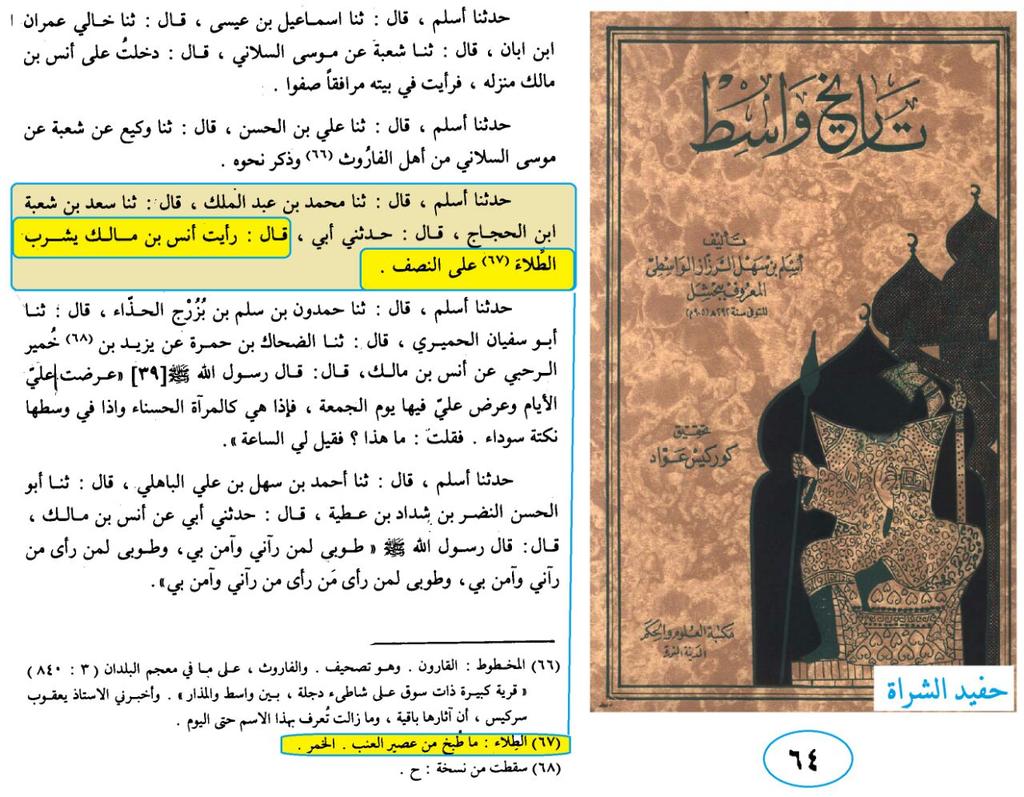
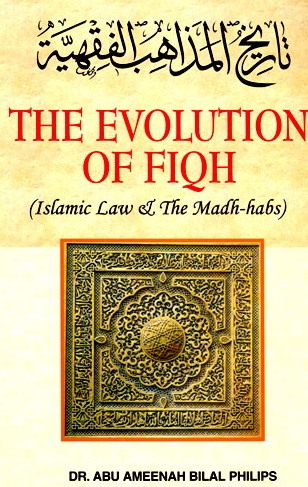
“This is the book of Shayk of Hanabila of his time, Al-Qadi Abi Ya’la, who was very opposed to Jahmiyya and Ashar’i. This book is intended as a rebuttal of the wrong interpretation and distorings about the names and attributes of Allah. However, the author has several weak or invented hadith, making it a controversial book from the people of knowledge.”
“But, Alhamdulillah we present this heritage of one of the Imams of the Salaf in a checked version, authenticated, and annotated. This allows the reader to distinguish the authenticate & the weak in the hadiths cited. And also to have the authentic position (words of imams of the Sunnah in support) on the weak chapters contained in this book.”
This narration attempts to answer the following question:
“Where is Allah is before creating sky and earth? It is answered by stating that He (Allah Most High) was riding on a whale that was made out of light... and the hadith continues and he says about it: “Even this is a strange hadith it finds support with other hadith!”
Christians must feel some form of poetic justice or vindication. All those years where Shaykh Ahmed Deedat was turned loose upon Christendom and jeering at anthropomorphic descriptions of God in the Bible and now the chickens have come home to roost.
May Allah (swt) forgive us. May Allah (swt) guide us.
“And he is with you wherever you are.” (Qur’an 57:4)
﷽
*There is no place for him* Just as there is *No when for him*
Be careful of the tricky questions the slicksters use. These people are the real Ahl Kalam, though they deny it for themselves. When the text clear text no longer support them they run to their kalam arguments.
The choice between two false proposition. They may ask you:
“Is Allah inside the creation or outside the creation?”
In reality the one who is asking this question believes that Allah (swt) is inside his creation. Because he believes that Allah (swt) occupies place.
This is a graphical representation of the thought process behind this trap.
And we know that there is nothing like unto Allah (swt).
They want you to say “Outside of the Creation” so that you posit for Allah (swt) a place.
Inside/Outside/Up/Down/Left/Right all relate to spatial location.
The response to that question is: Allah exist without a place.
Realizing you didn’t take the bait they will try and follow up with a second tricky question they will ask you is as follows:
When Allah (swt) created the creation did he create the creation inside himself or outside of himself?
Answer them by saying: “Mash’Allah! What an excellent question! When Allah (swt) created space and location where/when was Allah (swt)?”
That will give them their answer.
At this point your objective is to bring the Salafi/Athari away from their kalam and back to the revelation.
“Allah is Creator of all things, and He is Guardian over all things.” (Qur’an 39:62)
Like if you ask me can I comprehend the idea of my Creator w/o spatiality?
I can
Do I have a visual or a model?
I do not.
What I DO KNOW is that to say Allah co exist with something that he did not create is problematic.
Ibn Abbas reported: The Messenger of Allah (saw) said, “Reflect deeply upon the creation, but do not reflect upon the essence of the Creator. Verily, His essence cannot be known other than to believe in it.”
Source: (Musnad al-Rabī’ 742 عَنِ ابْنِ عَبَّاسٍ قَالَ قَالَ رَسُولُ اللَّهِ صَلَّى اللَّهُ عَلَيْهِ وَسَلَّمَ تَفَكَّرُوا فِي الْخَلْقِ وَلا تَتَفَكَّرُوا فِي الْخَالِقِ فَإِنَّهُ لا يُدْرَكُ إِلا بِتَصْدِيقِهِ 742 مسند الربيع بن حبيب 2976 المحدث الألباني خلاصة حكم المحدث حسن في صحيح الجامع)
* *وجود الله لا افتتاح له* *كما أن بقاءه لا انتهاء له* *كما أن وجوده لا مكان له* *فكما أنه سبحانه كان ولا إبتداء له وهو باقٍ ولا إنتهاء له كذلك هو موجود ولا مكان له* *فمن جادلك وحاجك في المكان، وقال لك : كيف لي أن أتصور موجودا لا مكان له، وكيف لي أصدق بموجود لا مكان له* *قل له : كما صدقت بموجود لا ابتداء له* *كيف تعقلت وتصورت وصدقت بموجود لا افتتاح لوجوده، بأي عقل صدقت، موجود ليس لوجوده نقطة بداية* *صدقت بذلك لأنه المقام اللائق بهذا الرب الذي ليس كمثله شيء* *فقط، هذا الذي دعاك للتسليم بأنه موجود بلا إبتداء ، لا عادتك التي اعتدتها ، أنت لم تعتد لوجود لا إفتتاح له* *لكن لما كان الكلام متعلقا برب ليس كمثله شيء، صدقت وأذعنت وسلمت وأمنت أن هذا الرب لا افتتاح لوجوده، ولا نهاية لبقائه* *فكذلك قل في مكانه لا مكان له؛ لأنه الرب الذي تعالى عن ظروف الازمنة وكذلك يتعالى عن ظروف الامكنة* *المتعالي عن ظروف الازمنة متعالي عن ظروف الأمكنة*
Some may also believe that Allah (swt) is omni present. Meaning that Allah (swt) is located every where (omni) all present. This is also an error.
May Allah (swt) guide us to what is beloved to Allah (swt). May Allah (swt) protect this Ummah from those who believe that Allah (swt) is inside of his creation and than provide the caveat: “In a way that befits him.”
“That was a nation which has passed on. It will have what it earned, and you will have what you have earned. And you will not be asked about what they used to do.” (Qur’an 2:133-134)
“And those who came after them say: “Our Lord! Forgive us, and our brethren who came before us into the Faith, and leave not, in our hearts, rancor (or sense of injury) against those who have believed. Our Lord! You are indeed Full of Kindness, Most Merciful.” (Quran 59:10)
﷽
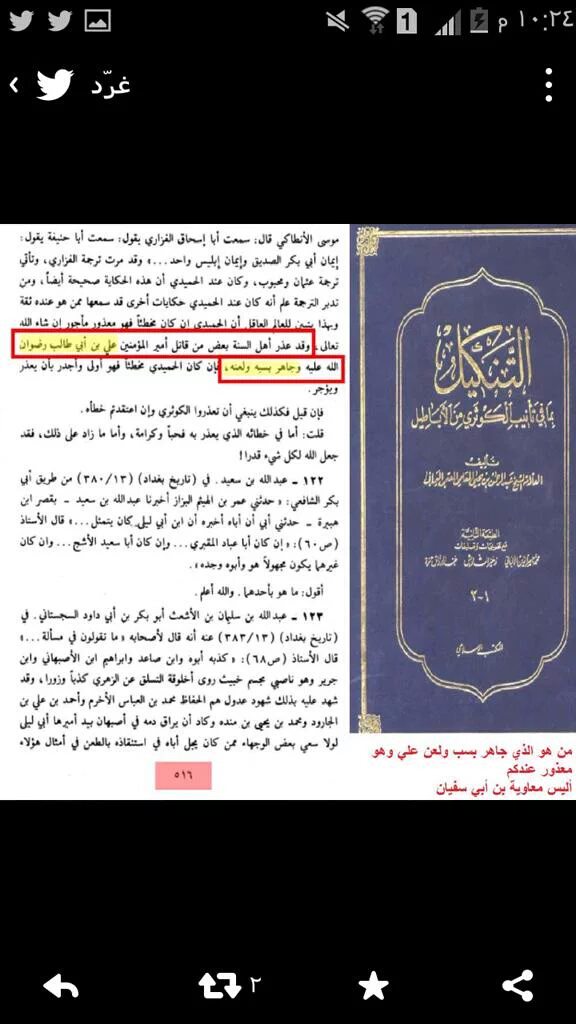
So some of those who claim they are upon the way of the Salafiyyah go rampaging through the books and works of our scholars. They will find among them those who disavow Uthman or those who disavow Muaviya or those who disavow Ali. We will bring evidence from the books of the scholars from our brothers from among the Ahl Sunnah to show you the double standards of their claims.
Truth be told, all schools have in their books people they disavow. However, one thing that can be said about us Ibadis is that we do not have the cursing of anyone in our books. The Shi’i and Sunni books are full of so-and-so cursing of companions.
In the Sunni books, these things are not so readily obvious because, under the Abbasid empire, a Shi’ification of Sunnism took place. The form of Sunni Islam that most people are familiar with today is a very sanitized Abbasid Sunnism.
As most are ignorant of history they do not know that for about a century, from 945 to 1055, the Abbasid Caliphs in Baghdad were effectively puppets of the Buyid dynasty.
A Shi’a “Protectorate”: The Buyids were a powerful Shi’i dynasty from Iran. They kept the Abbasid Caliph as a figurehead to appease the majority Sunni population. While they held the real political and military power.
For the astute reader, they are able to catch this.
So, for example, when Urwah ibn al-Zubayr narrated that Zaynab bint Muhammed (ra) was mentioned by the Blessed Prophet (saw) to be his most virtuous and beloved daughter, he (Zubayr) was accosted by Zayn al-Abidin who approached Urwah ibn Al-Zubayr in a very hostile manner demanding why he would put anyone anywhere near the rank of Fatima (ra).
A kind of terrorism and suppression by the Abbasids and Alids towards anyone who would put someone else other than Fatima and Ali first. Here we narrate to you how Ali ibn al-Husayn went after Urwah ibn al-Zubayr (ra) like a raving madman.
Ahmad Abu Bakr ibn Muhammed ibn Hamdan al-Sayrafi in Marw told me, Abu Ismail Muhammed ibn Ismail told us, Saeed ibn Abi Maryam told us, Yahya ibn Ayyub informed us, Ibn al-Had told me, Amr ibn Abdullah ibn Urwah ibn al-Zubayr told me, on the authority of Urwah ibn al-Zubayr, on the authority of Aisha, the wife of the Prophet, (saw) When the Messenger of Allah, (saw), arrived in Medina, his daughter Zaynab left Mecca with Kinanah—or the son of Kinanah—and they went after her. Habbar ibn al-Aswad caught up with her and kept stabbing her camel with his spear until it felled her, and she miscarried and bled. The Banu Hashim and the Banu Umayyah then quarreled over her. She said… The Banu Umayya said: We are more entitled to her, and she was married to their cousin Abu al-As, and she was with Hind bint Utbah ibn Rabi’ah, and Hind used to say to her: This is because of your father. So the Messenger of Allah, (saw), said to Zayd ibn Harithah: “Won’t you go and bring me Zaynab?” He said: Yes, O Messenger of Allah. He said: “Then take my ring.” So he gave it to him. Then Zayd set off and made his camel kneel. He kept being polite until he met a shepherd and said: Whose sheep do you tend? He said: For Abu al-Aas. He said: And whose sheep are these? He said: To Zainab bint Muhammed, so he walked with him for a while, then he said to him: Would you like me to give you something to give to her, and not mention it to anyone? He said: Yes, so he gave him the ring, so the shepherd went and brought his sheep in, and gave them the ring, and they recognized it, so she said: Who gave you this? He said: A man, she said: Where did you leave it? He said: In such and such a place. He said: So she remained silent until night came, then she went out to him. When she came to him, he said to her: Ride in front of me on his camel. She said: No, but you ride in front of me. So he rode and she rode behind him until she came. The Messenger of Allah, (saw), used to say: “She is the best of my daughters, and she was afflicted because of me.”This reached Ali ibn al-Husayn, so he went to Urwah and said: What is this hadith that I heard you narrate in which you diminish Fatimah’s right? He said, “By Allah, I would not wish to possess everything between the East and the West if it meant depriving Fatima of a right that belongs to her. And after that, you have the right to never speak of it again.” Urwah said, “This was before the revelation of the verse: {Call them by their fathers’ names; that is more just in the sight of God} [Al-Ahzab: 5]. This is an authentic hadith according to the criteria of the two Sheikhs (Al-Bukhari and Muslim), but they did not include it in their collections.”
We will say this. For Ibadi and Sunni Muslims, for both of us, we can move forward without going back and deliberating over these conflicts among the companions. Although some among the Salafi want to bring ambiguous from our books looking for firtnah. However, for the Shi’i, it is absolutely paramount for all their sects to belittle companions in order to advance their claims concerning Ali.
They (the shi’i) also have eulogies concerning Karbala. This often whips them up into a frenzy. One of our colleagues recalls how a former Shi’i friend mentioned to him while being in a Mosque commemorating Karbala he wanted to beat up the first Sunni that he saw!
Imagine if Ibadi Muslims held eulogies and mass gatherings concerning Nahrawan every year. Remembering in anguish Ali’s slaughter of the companions at Nahrwan. Our Imams and shuyookh reading poems and recounting in gruesome detail the events that unfolded that day. How would it be possible not to have some deep hatred towards the Shi’i?
Our scholars have pulled us back from this. This is why you see Shaykh Ahmed Al Khalili (h) support the Taliban or Erdoğan, and he has come out in support of Iran. He supports the causes of Muslims against non-Muslims. When Muslims fight, Muslims like the Shi’i of Azerbaijan fight the Sh’i of Iran. Or when the Sunni of Pakistan and the Sunni of Afghanistan fight each other, Shaykh Khalii (h) remains silent.
“That was a nation which has passed on. It will have what it earned, and you will have what you have earned. And you will not be asked about what they used to do.” (Qur’an 2:133-134)
Ibadi stance on the sahaba: According to the Qur’an.
“Look you see these Ibadites! They disavow certain ones from among the companions! They were all loved by each other and we love them all too! We would never say such things about the companions!”
About that…
It is from the Sunnah to disavow any Muslim (including a companion) when they commit a sin.
First and foremost to disavow any Muslim when they commit a sin is from the Sunnah of the Blessed Prophet (saw). This includes the companions.
Narrated Salim’s father:
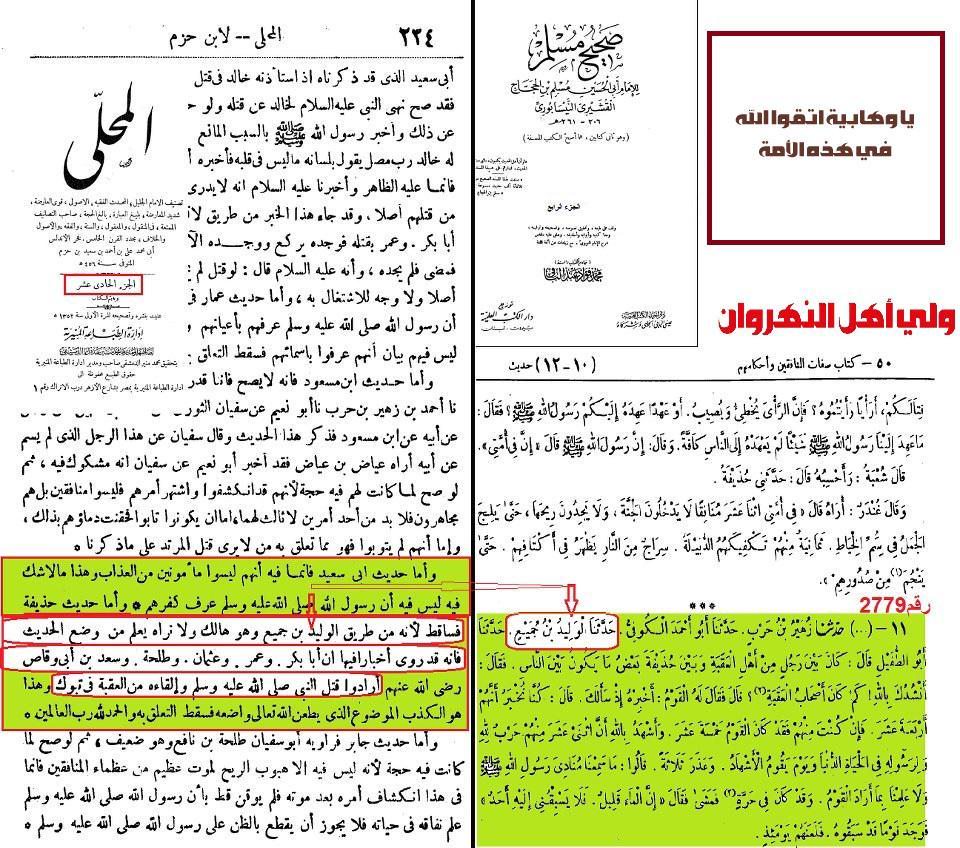
The Prophet (saw) sent Khalid bin Al-Walid to the tribe of Jadhima and Khalid invited them to Islam but they could not express themselves by saying, “Aslamna (i.e. we have embraced Islam),” but they started saying “Saba’na! Saba’na (i.e. we have come out of one religion to another).” Khalid kept on killing (some of) them and taking (some of) them as captives and gave every one of us his Captive. When there came the day then Khalid ordered that each man (i.e. Muslim soldier) should kill his captive, I said, “By Allah, I will not kill my captive, and none of my companions will kill his captive.” When we reached the Prophet, we mentioned to him the whole story. On that, the Prophet (saw) raised both his hands and said twice, O Allah, I disavow before You what Khalid has done.” اللَّهُمَّ إِنِّي أَبْرَأُ إِلَيْكَ مِمَّا صَنَعَ خَالِدٌ
Another point. If it was found in the books of the Ibadis that Ali or Uthman or Muaviya that they were kafir. First is that one has to remember that this is not cursing. Second, whereas in other schools, kafir is saying that someone is outside of Islam in our school, we differentiate between Kufr an-Ni’mah and Kufr Ash-Shirk. To be very clear, no one in our school says Ali or Uthman or Muaviya committed kufr-shirk! No one! Someone who follows the Ibadi school but commits a major sin is in a state of kufr an-ni’mah.
You may read about how the concept of kufr as defined by the Qur’an and Sunnah here:
This is describing a condition of the person. No one is insulting people’s mother’s like school yard bullies.
Remember you cannot unsee what you are about to see and you will be held accountable.
Narrated Jarir:
The Prophet (saw) said to me during Hajjat-al-Wida`: Let the people keep quiet and listen. Then he said (addressing the people), “Do not (become infidels) revert to disbelief after me by striking the necks (cutting the throats) of one another (killing each other).
Salih Al-Sheikh, in his explanation of the Tahawi creed, said that the fighting companions fell into minor disbelief, and they entered into the characteristics of disbelief!
Al-Albani says that the fighting companions after the Messenger of Allah have no refuge from calling them infidels!
In the statement of Al-Tahawi: (And their hatred is disbelief and hypocrisy and slander): Firstly: It includes the disbelief of the Companions:
A) If the hatred is due to religion or anger, as we have detailed, then the disbelief here is major disbelief.
B) If the hatred is for worldly reasons—as may occur due to fierce rivalry or hatred for worldly matters—then this is minor disbelief and does not reach the level of major disbelief. For this reason, the Prophet said:
“Do not revert to disbelief after me by hating one another?!”
(1) Narrated by Al-Bukhari (17), Muslim (74), Al-Nasa’i (5019), and others (30/134), from Anas bin Malik, may Allah be pleased with him. (2) Narrated by Al-Bukhari (1116), Muslim (66), Abu Dawood (4186), Al-Nasa’i (4216), and Ibn Majah.
Sheikh Saleh Al-Sheikh
The fighting among the Companions after the Prophet (peace be upon him) is minor disbelief, not major disbelief. And now, whoever declares the Companions to be disbelievers, even if it is minor disbelief.
Explanation of the Theological Punishment
The fact that some Companions fought one another involves characteristics of disbelievers, which is why he said: “Do not revert to disbelief after me.” There is no doubt that the motive behind this may be hatred.
In Al-Sharh al-Wafī ‘alā ‘Aqīdat al-Tahāwiyyah” (الشرح الوافي على عقيدة الطحاوية), a well-known commentary on “Al-‘Aqīdah al-Tahāwiyyah”—a foundational text on Sunni creed attributed to Imam Abu Ja’far al-Tahawi (d. 321 AH)
It states that the Companions fight each other. It may be lesser kufr, or it may be greater kufr (i.e. polytheism) and that depends on the level of hatred!
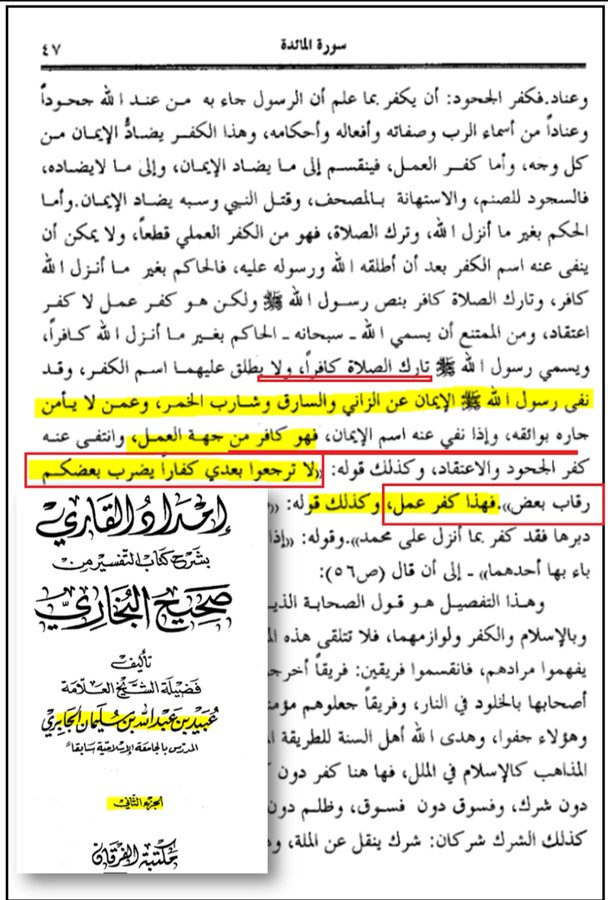
Shaykh ‘Ubayd bin ‘Abdullah al-Jabri (عُبَيْد بن عبد الله الجابري), a contemporary Salafi scholar from Saudi Arabia, and his book “Imdād al-Qārī bi Sharḥ al-Bukhārī” (إمداد القاري بشرح البخاري), which is a commentary on Sahih al-Bukhari states that the fighting companions fell into blasphemy!
Then it is said, “and we consider it good,” because it indicates that love for them (the Companions) is sound in religion and is a means of drawing closer to Allah through adherence to sincerity and truthfulness in faith. Naturally, “and we declare them free from blame,” and “we consider it good”—all these are not the same. The methodology in loving the Companions is refined, and their status is measured by their sound companionship, righteousness, and understanding of their elevated rank.
Similarly, it is stated, “and we declare them disbelievers”—an additional clarification: “and we affirm.” Hatred toward the Companions is firmly established—whether the hatred is due to religion or personal malice, in which case it constitutes major disbelief. If the hatred is for worldly reasons, as may arise from fierce rivalry or worldly motives, then it is minor disbelief and does not reach the level of major disbelief. Hence, the Prophet (peace be upon him) said: “Do not revert to disbelief after me by striking one another’s necks!”
The fact that some Companions fought one another involves falling into the traits of disbelievers, which is why he said: “Do not revert to disbelief after me.” It is most accurate to say that the motive behind this was hatred and disbelief, because fighting is accompanied by elements of hatred. However, given the mutual relations among the Companions (where some may not have loved others until death, and hatred may exist without clear justification), this disbelief may be minor or may vary based on the nature of the hatred (with further elaboration).
Because the intent is to derive from this the preservation of the religion, the safeguarding of Islam among the people, and striving in the Sunnah with true jihad—as the Companions did under the Messenger of Allah (peace be upon him). Yet, some later turned into opponents of the Companions and aligned with the disbelievers. Allah described them: “The hypocrite men and hypocrite women are of one another…” (Surah At-Tawbah: 67).
The intent may be major ideological hatred, depending on the condition of the heart, or practical hatred, based on the type of love or its absence, or the type of hatred and its cause. “And we affirm,” and regarding their transgression—this is specific to the one who harbors it and the gravity of the matter. For Allah (Exalted and Majestic) commanded some of them (or the lesser among them) to “be patient,” meaning He commanded some to endure and restrain themselves from those who wronged them, even if they had the power to retaliate. This indicates that whoever swore allegiance (to the truth) had knowledge and insight in this matter.
Shaykh Ibn al-Qayyim Yusri al-Sayyid Muhammad and his work “Jāmi’ al-Fiqh” (جامع الفقه) by Lisr al-Sayyid: States that the fighting companions had fallen intodisbelief by their actions.
The Disbelief of Denial and Stubbornness
The disbelief of denial (كفر الجحود)-kufr al juhud occurs when someone knowingly rejects what the Messenger (peace be upon him) brought from Allah—whether it pertains to Allah’s Lordship, His attributes, His actions, or His rulings—out of sheer arrogance and obstinacy. This type of disbelief completely contradicts faith in every aspect.
As for practical disbeliefby actions (كفر العمل), kufr al amal it is divided into two categories:
That which contradicts faith entirely—such as prostrating to idols, disrespecting the Quran, or killing a prophet.
That which does not entirely negate faith—such as ruling by other than what Allah has revealed or abandoning prayer.
However, ruling by other than what Allah has revealed and abandoning prayer are undoubtedly forms of practical disbelief. It cannot be denied that these carry the label of “disbelief” (كفر) after Allah and His Messenger have explicitly applied it. Thus:
“Whoever rules by other than what Allah has revealed is a disbeliever.”
“Whoever abandons prayer is a disbeliever,” as stated in the explicit texts of the Prophet (peace be upon him).
The Disbelief of Denial and Belief, and His Saying:
“Do not revert to disbelief after me, striking one another’s necks…” This refers to practical disbelief (كفر عمل). Similarly, his saying: “Whoever does so intentionally has disbelieved in what was revealed to Muhammad.” And his saying: “If one of them has indeed earned it…”
This detailed classification is the position of the Companions regarding the relationship between Islam and disbelief. Do not think that they did not understand the implications—rather, they divided into two groups:
A group that considered such people to be eternally in Hellfire.
A group that regarded them as sinful believers (not complete disbelievers).
Allah has guided Ahl al-Sunnah to the moderate path, where:
There is disbelief (كفر) that does not reach polytheism (شرك).
There is sin (فسق) that does not amount to disbelief.
There is oppression (ظلم) that does not constitute apostasy.
(Page: 5)
“Whoever rules by other than what Allah has revealed is a disbeliever.” It is on this basis that many of the salaf had broke ranks with Ali’s decision for arbitration. As the text is explicit fight until. In that sense Ali would have committed (كفر العمل), kufr al amal.
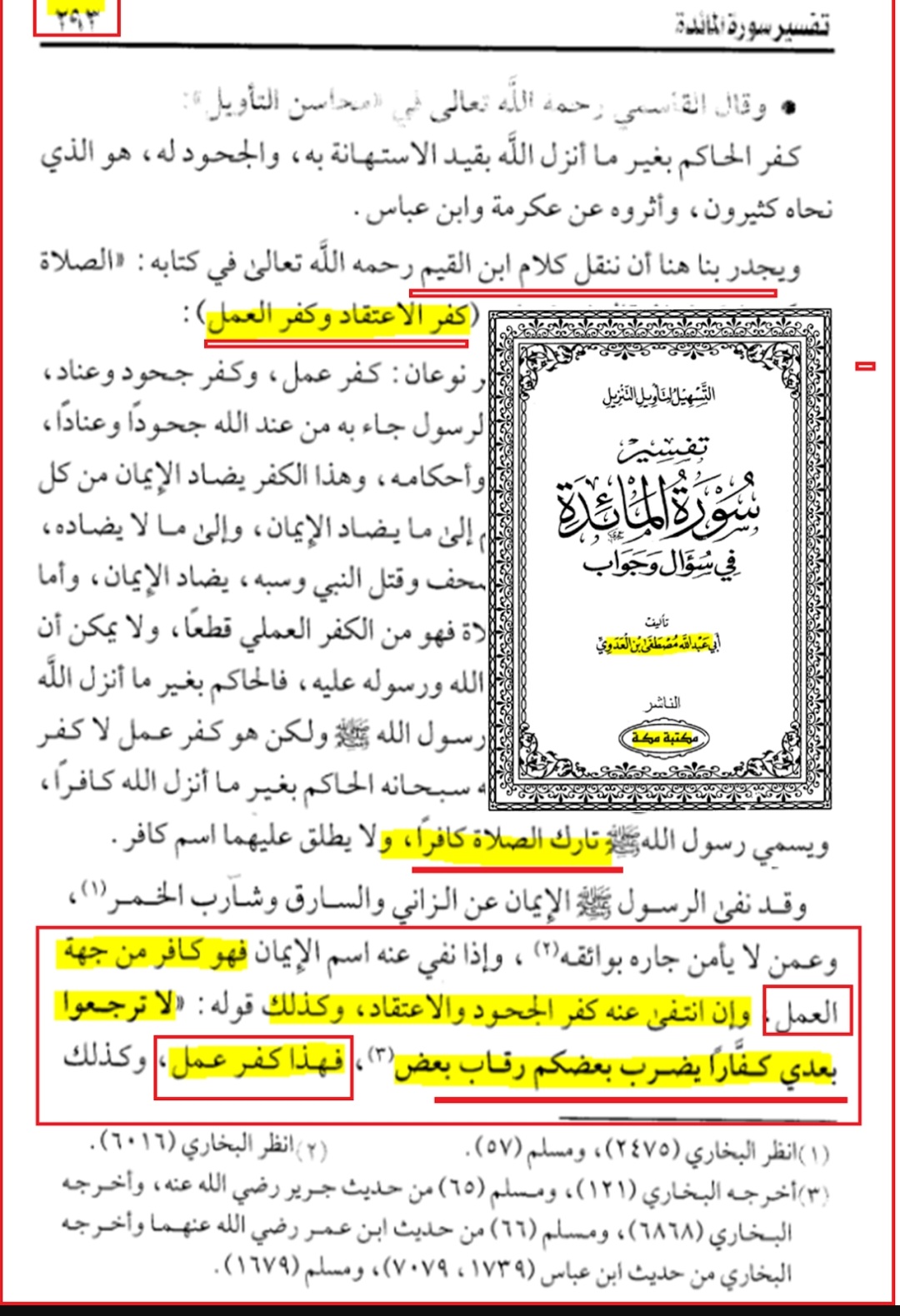
Shaykh Muṣṭafā bin al-ʿAdawī (مصطفى العدوي ) mentioned that the fighting companions are falling into kufr al-Amal!
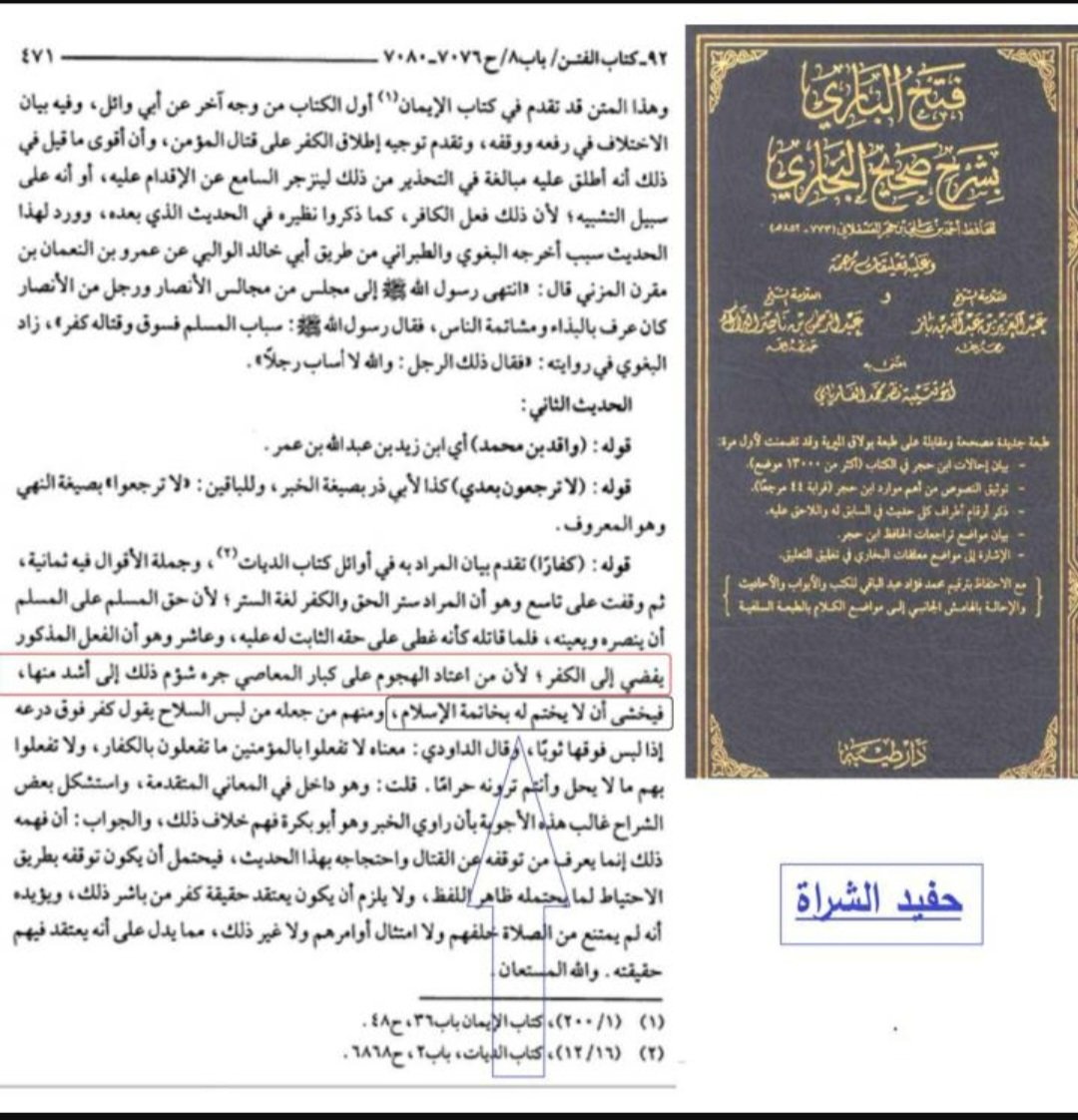
“Fatḥ al-Bārī bi Sharḥ Ṣaḥīḥ al-Bukhārī” (فتح الباري بشرح صحيح البخاري), the legendary commentary on Ṣaḥīḥ al-Bukhārī by Imam Ibn Ḥajar al-‘Asqalānī (d. 852 AH) that the companions are considered to be upon blasphemy And that the misfortune of disobedience may lead to greater sins, and it is feared that he will not be sealed with the seal of Islam!
One will note that the warning of the Blessed Messenger (saw) was do not revert to disbelief.
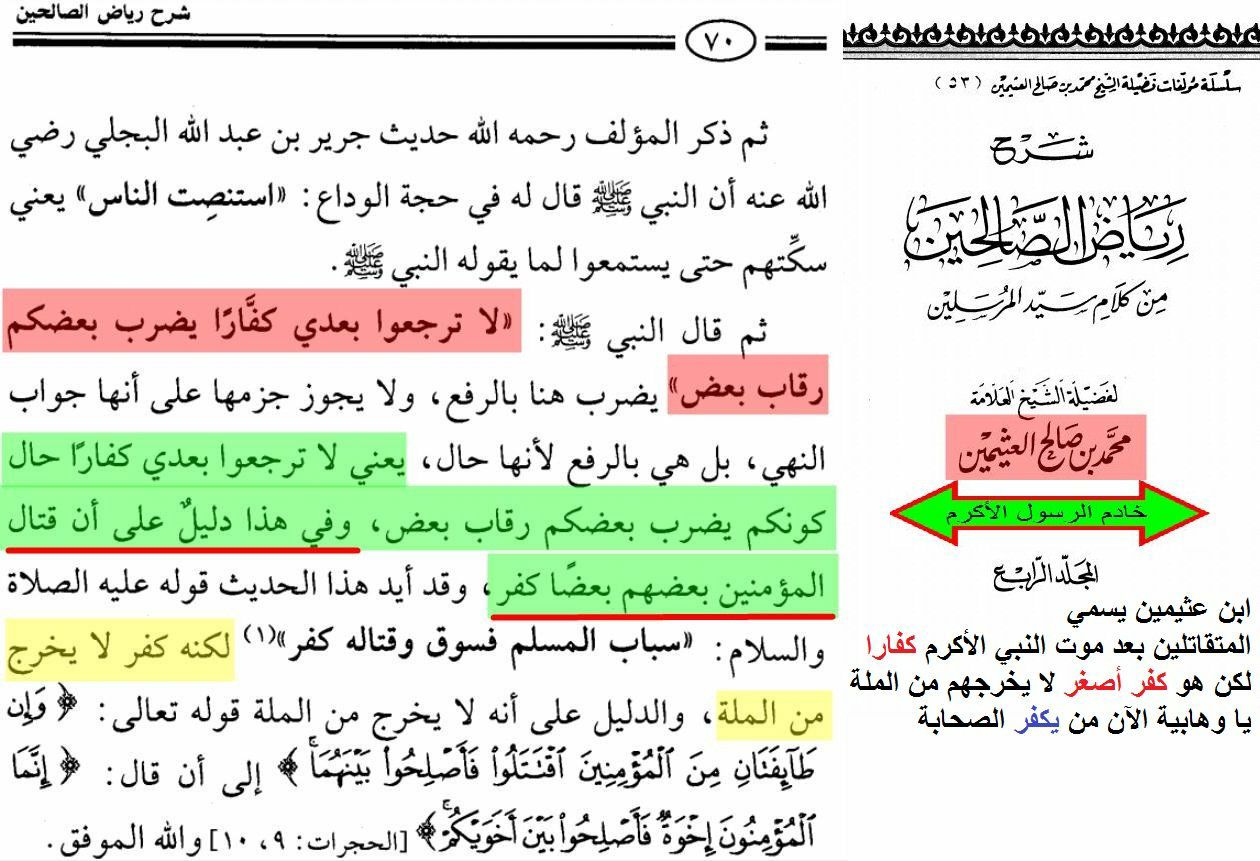
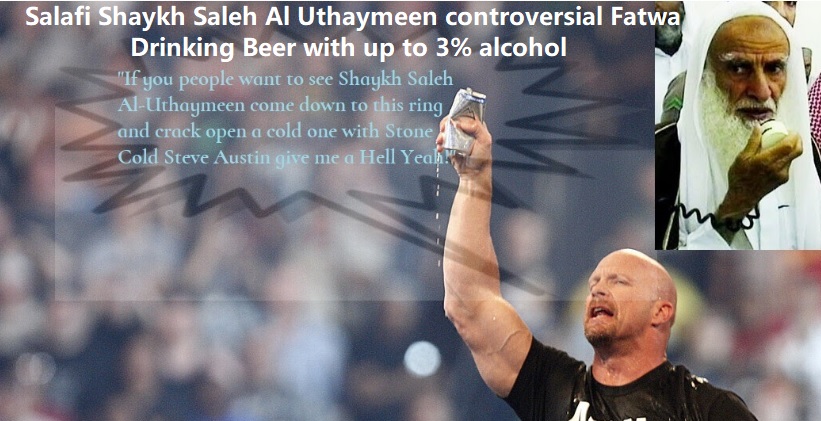
Shaykh Ibn al-Uthaymeen says that the Companions fighting each other is considered kufr, but it does not expel one out of the religion!
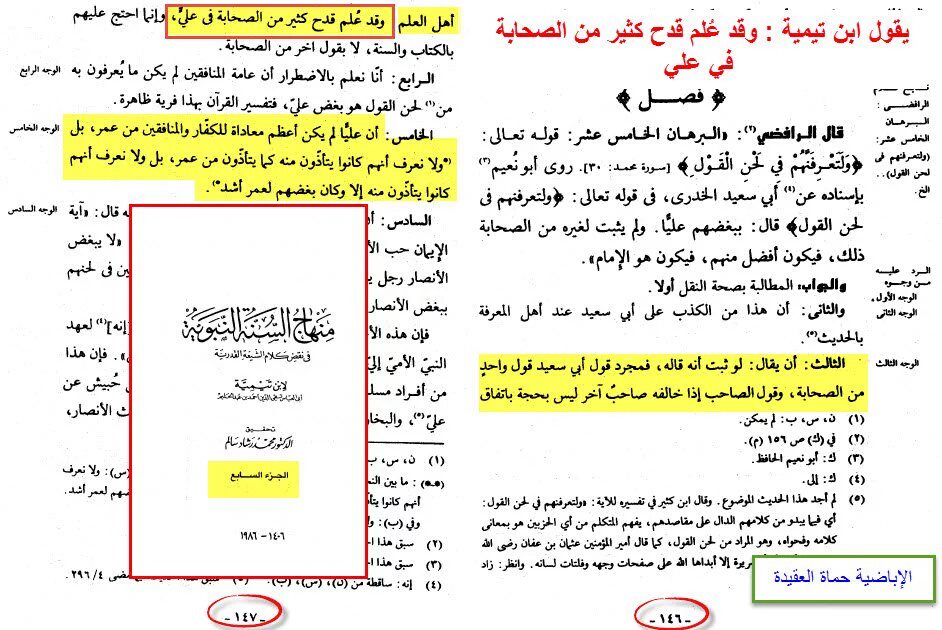
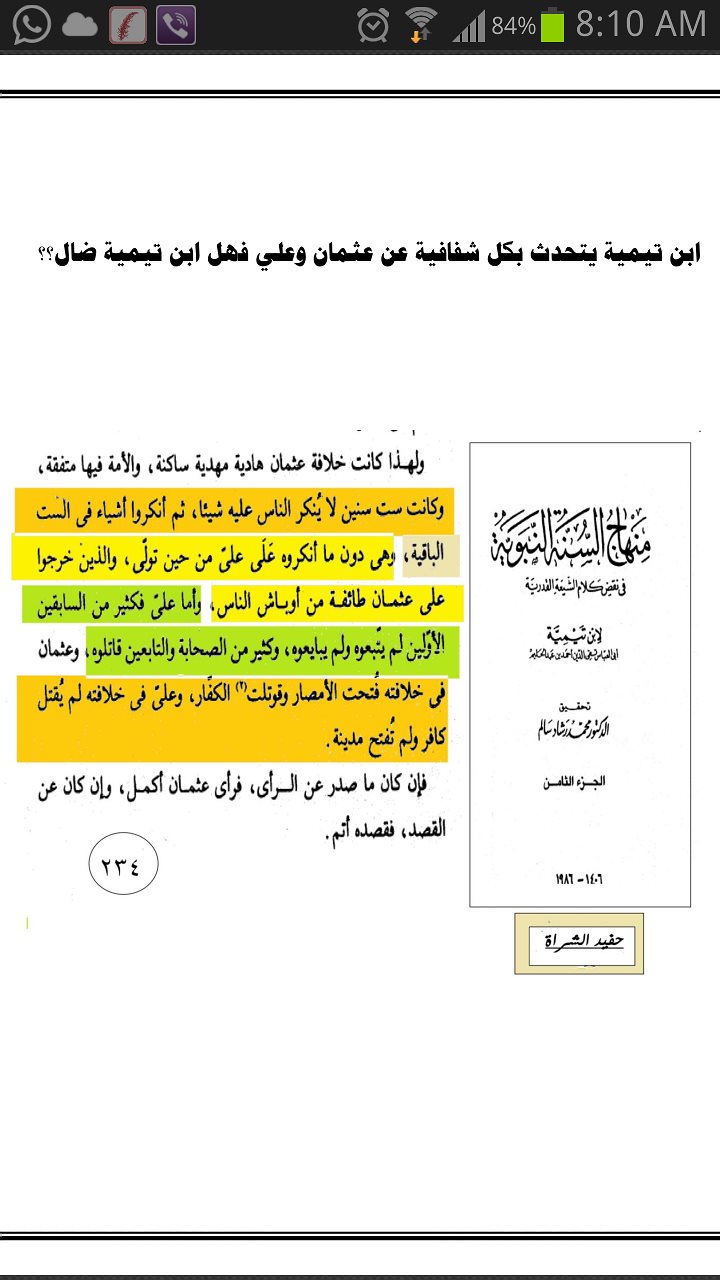
Ibn Taymiyyah says that the companions who fought each other are called infidels, and it is a restricted designation!
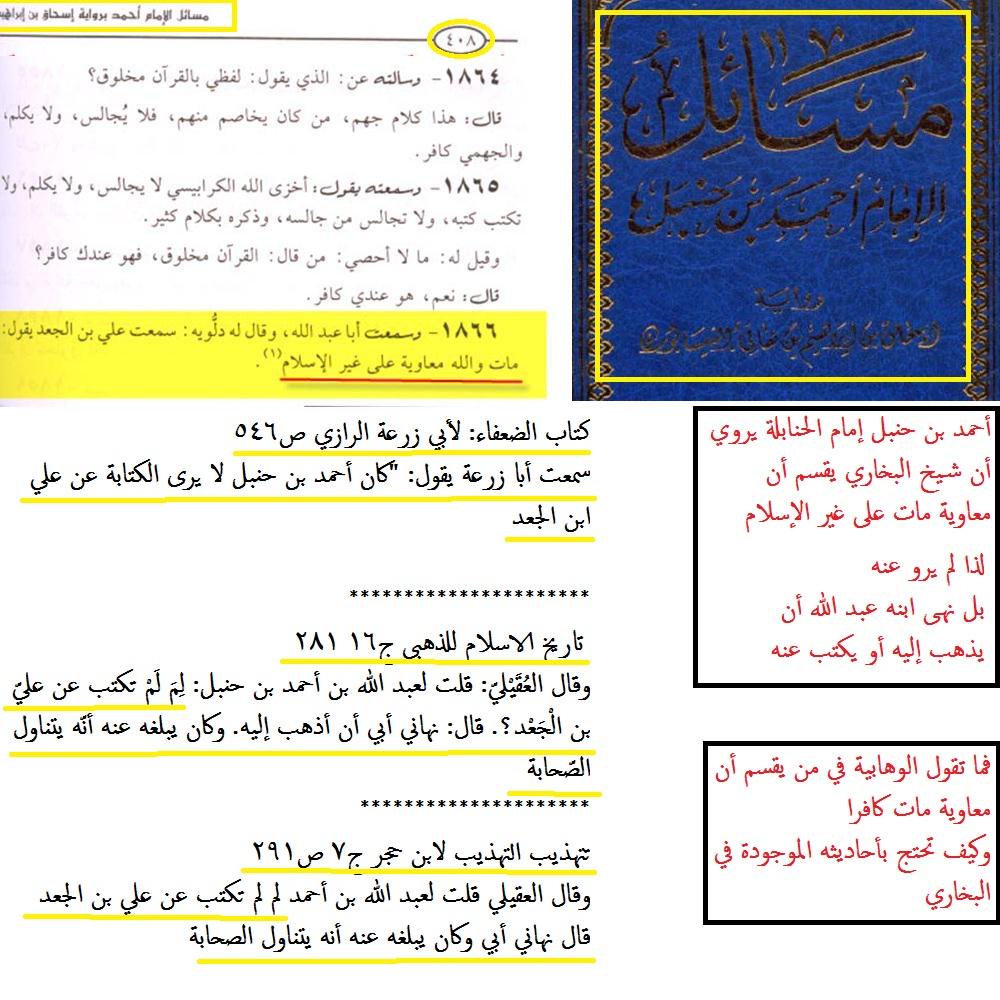
It was stated in the book, The Masa’il of Imam Ahmad (مسائل الإمام أحمد) that the Sunni hadith scholar: Ali bin Al-Jaad says that Muawiyah died upon other than Islam!!!
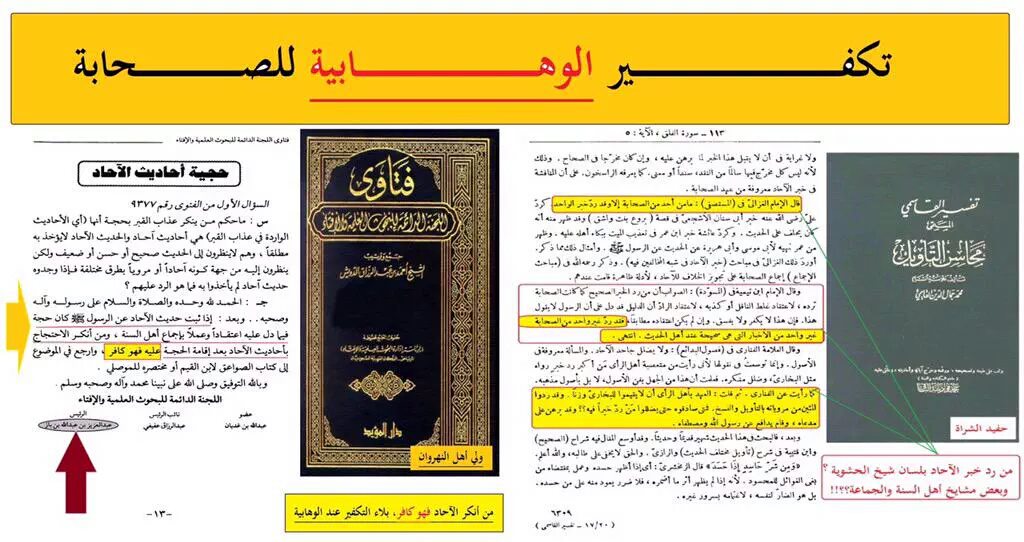
The Salafiyah will end up declaring all the Companions to be unbelievers altogether, according to their claim that whoever rejects the Hadith of Ahad is an infidel! Shaykh Al-Ghazali says that none of the companions accept this!
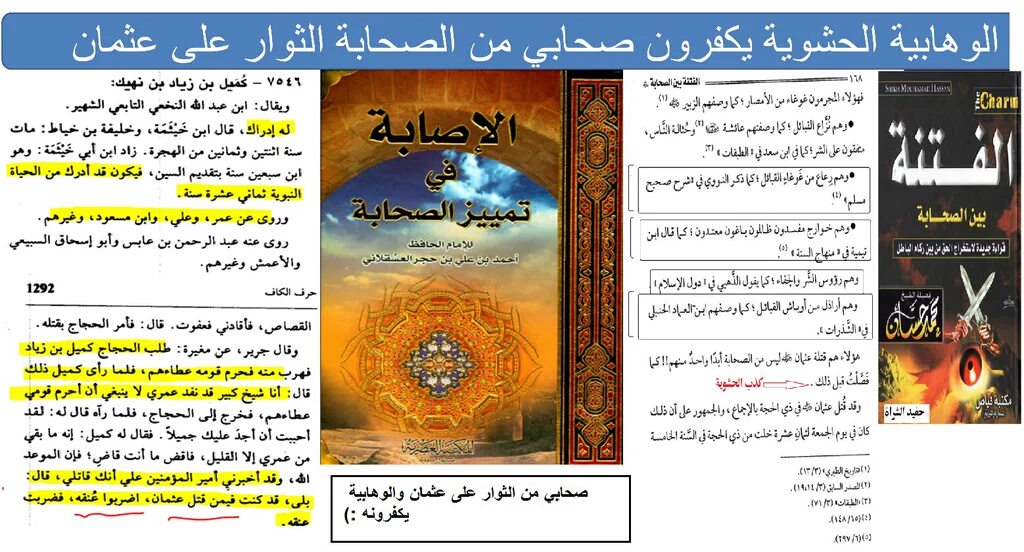
Salafiyah have declared one of the companions who rebelled against Caliph Uthman to be an infidel!
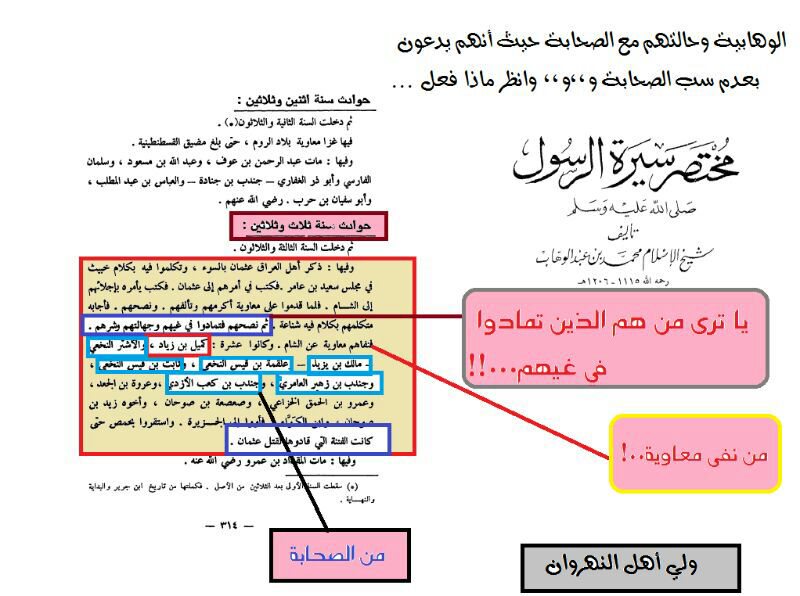
Muhammed bin Abd al-Wahhab describes a group of the Companions as ignorant, evil and rebellious!
Ibn Taymiyya in his book Kitaab Al-‘Arsh (كتاب العرش), says that the Companions did takfir upon one another and this is well known!
Ibn Taymiyya, in his book Iqtidaa al-Sirat al-Mustaqeem Mukhaalafat Ashaab al-Jaheem (اقتضاء الصراط المستقيم مخالفة أصحاب الجحيم) criticizes the honorable companion Abdullah bin Umar (ra), who is one of the strongest people in following the Sunnah of the Messenger of Allah! That Abdullah bin Umar (ra) committed bid’ah!
Muhammed bin Abd al-Wahhab had strong criticism for a number of the companions!
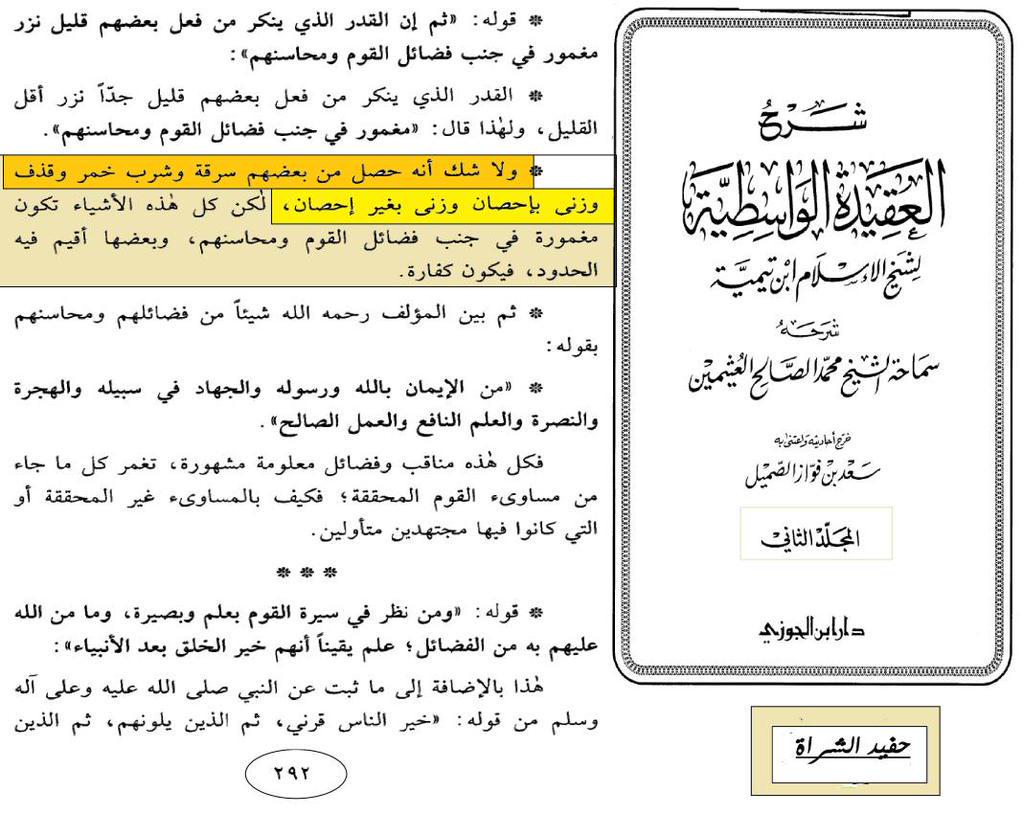
“Sharh Al-‘Aqeedah Al-Wasitiyyah” (شرح العقيدة الواسطية), the explanation of Ibn Taymiyyah’s famous creedal work, authored by Shaykh Muhammed ibn Salih al-Uthaymeen.
Uthaymeen states:
“Undoubtedly, some of them committed theft, drank alcohol, engaged in slander, or even committed adultery (whether punishable by hadd or not). Yet, all these misdeeds are overshadowed by their overwhelming virtues and merits. Some of these sins were met with legal punishments (hudud), serving as expiation (kaffarah).”
The misdeeds committed by a few among them are exceedingly few and negligible, which is why the author states: “They are drowned out by the virtues and merits of these people.”
However, if they committed adultery, or theft then they committed acts of kufr ni’mah or what others say is: kufr al amal
If Uthaymeen says the companions committed acts of kufr no one bats an eye. A scholar from the Ibadi schools it and suddenly the emotions overcome the senses.
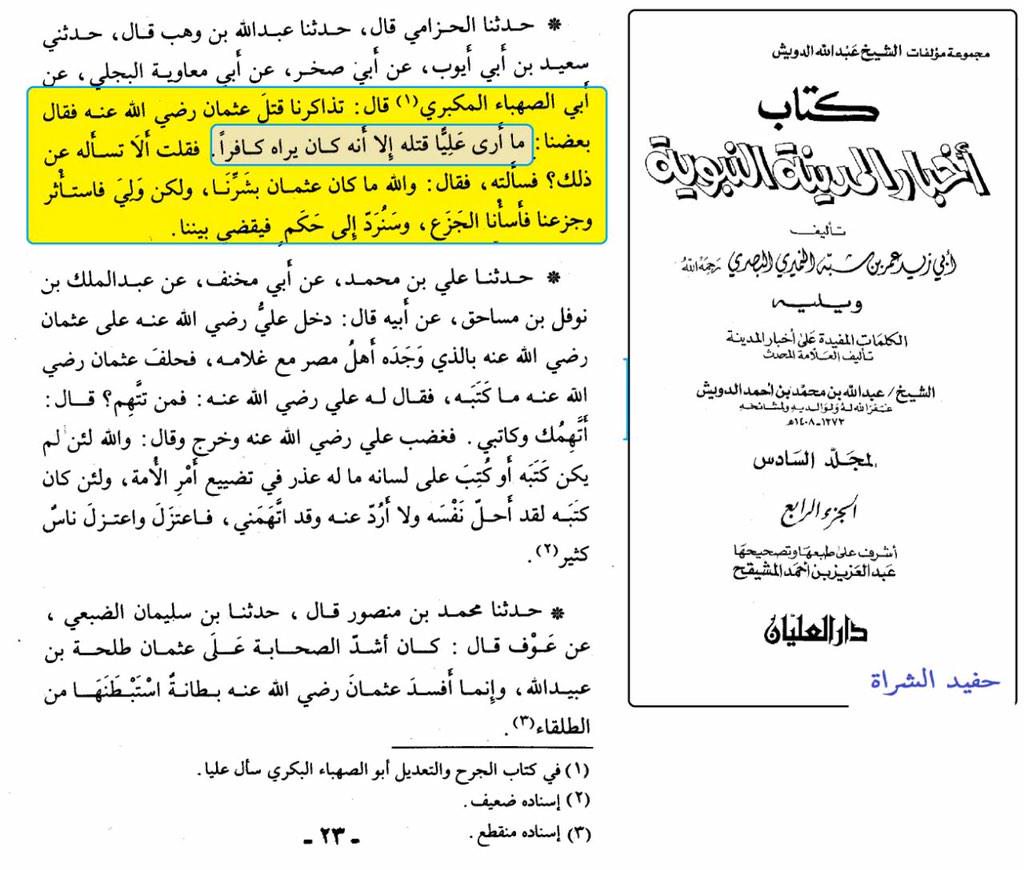
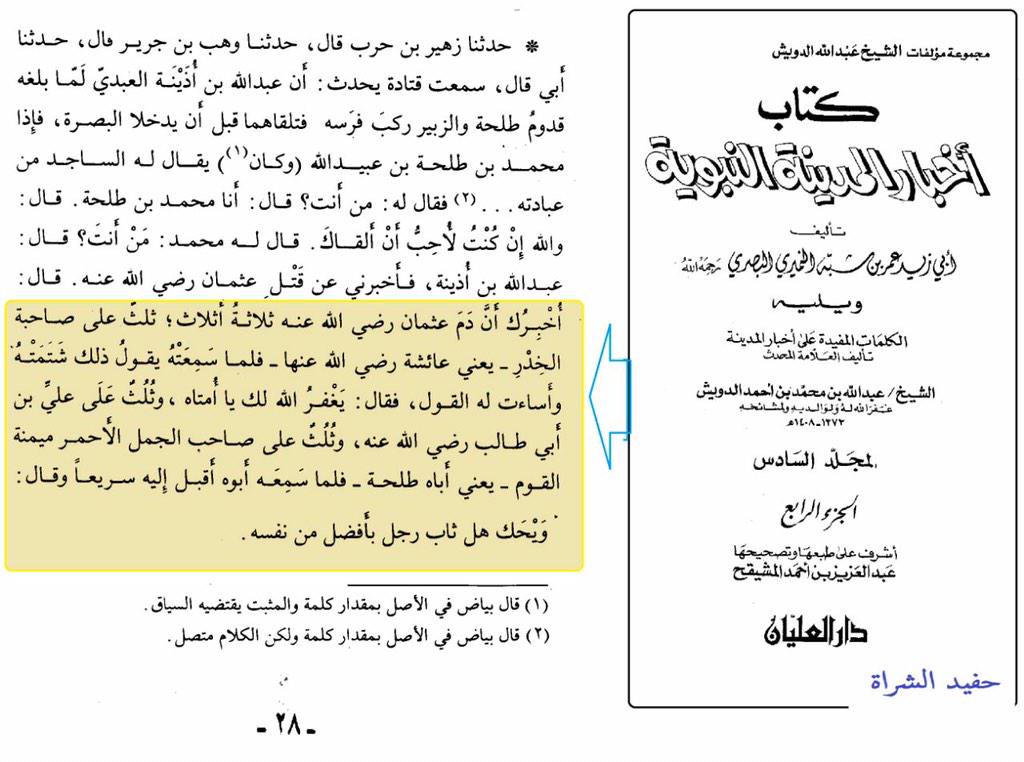
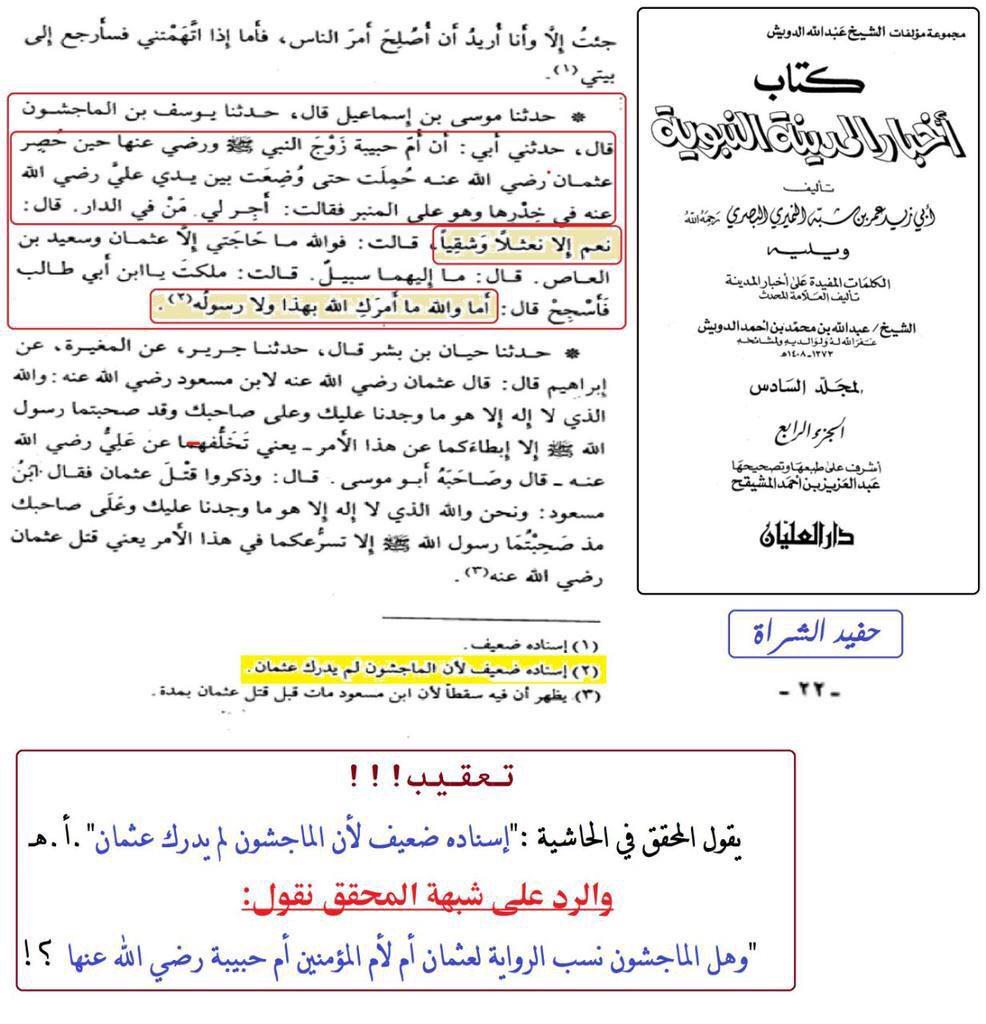
What about this? It was mentioned in the book Akhbār al-Madīnah al-Munawwarah (أخبار المدينة المنورة) that the blood of Uthman is divided into three. A third on the mother of the believers Aisha (ra), and a third on Talha, and a third on Ali bin Abi Talib! That darkness was over each of them!
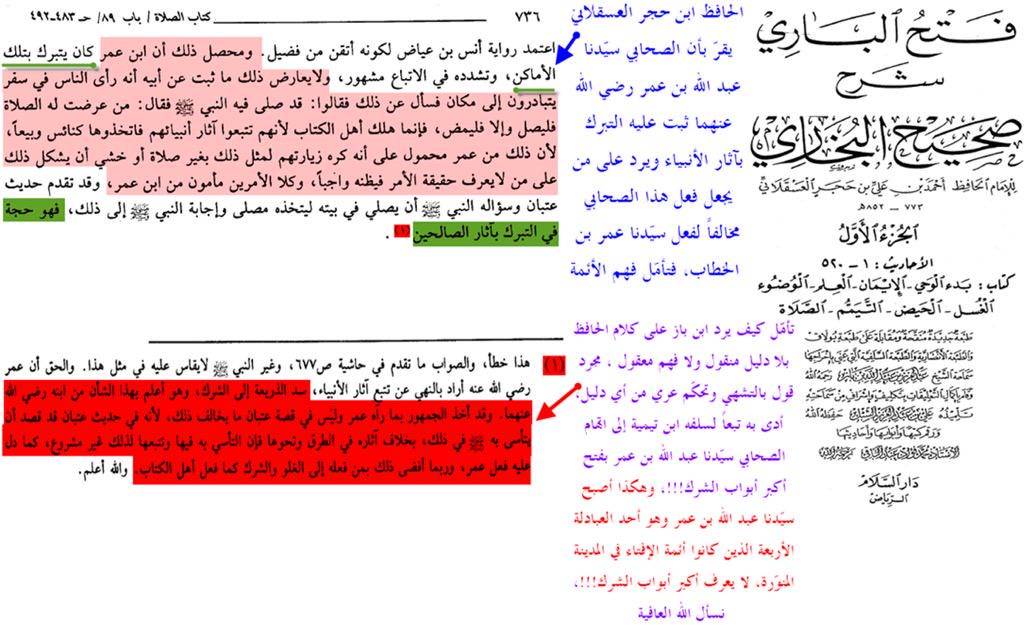
Ibn Baz responds to Ibn Hajar and claims that the act of the companion Abdullah bin Umar in seeking blessing from the relics of the saints (tabarruk) leads to polytheism. And here Ibn Baz declared himself more knowledgeable than the great companion Abdullah bin Umar!
Shaykh Ibn Al-Uthaymeen once again says that the Companions are not all just, so whoever is known for an insult is not just! Some of them committed theft, drank wine, committed fornication while married and some outside of marriage!
An explicit accusation and takfir without hinting that Ali did not kill Uthman except that he considered him an infidel!
Narration 1:
Narrated by Al-Humaidi: Abdullah ibn Wahb reported from Sa’id ibn Abi Ayyub, from Abi Sakhr, from Abi Mu’awiyah al-Bahili, from Abi al-Sahba’ al-Mukabbar (1), who said: “We discussed the killing of Uthman, and some of us said: ‘I believe Ali killed him only because he considered Uthman a disbeliever.’ I said: ‘Should we ask Ali about this?’ So they asked him, and he replied: ‘By Allah, Uthman was not the worst among us. But he ruled, became arrogant, and we acted poorly in our impatience. Matters escalated until judgment was passed between us.'”
Narration 2:
Narrated by Ali ibn Muhammad, from Abi Mukhtalif, from Abdulmalik ibn Nawfal ibn Musahiq, from his father, who said: “Ali entered upon Uthman after the people of Egypt found a letter with his servant. Uthman denied writing it, so Ali asked: ‘Whom do you accuse?’ Uthman replied: ‘I accuse you and my scribe.’ Ali became angry, left, and said: ‘By Allah, if he did not write it—or if it was falsely attributed to him—then he bears no blame for the Ummah’s turmoil. But if he did write it, he has brought this upon himself. Yet, I will not abandon him despite his accusation.’ Many people then withdrew their support .”
Narration 3:
Narrated by Amr ibn Mansur, from ibn Sulayman al-Dab’i, from Awf, who said: “Among the Companions, Talhah ibn Ubaydullah was the most severe against Uthman, but he later regretted his stance due to delays in justice.”
Ibn Taymiyya in Majmū’ al-Fatāwā (مجموع الفتاوى) mentioned that the Companions fought and cursed each other and declared each other infidels, and their statements concerning this is well known!
“Moreover, the early predecessors (Salaf) erred in some of these matters—major figures among them—yet they were not excessively criticized for it.” For example:
Some Companions denied that the Blessed Prophet (saw) could hear the call of the dead (e.g., at Badr).
Others denied that a woman could have a ghayrah (rightful jealousy) over her husband.
Some disputed whether the Blessed Prophet (saw) saw his Lord (during the Mi’raj).
There were disagreements among them about the caliphate and the superiority of certain individuals—well-known debates.
Some engaged in fighting one another, while others cursed certain figures—explicit statements are documented.
Similarly, the judge once mentioned a recitation of the Quranic verse ‘Bal ‘Īdu’ (بل عيد) [instead of ‘Bal ‘Īdu’ (بل عيد)] and claimed, ‘Allah does not cause hardship.’ When this reached Ibrahim al-Nakha’i, he said: ‘He has innovated! ‘Abdullah [ibn Mas’ud] was more knowledgeable than him and recited it correctly.’ Here, a confirmed recitation was denied, and an attribute affirmed by the Quran and Sunnah was rejected—yet the Ummah still regards him as one of its imams.
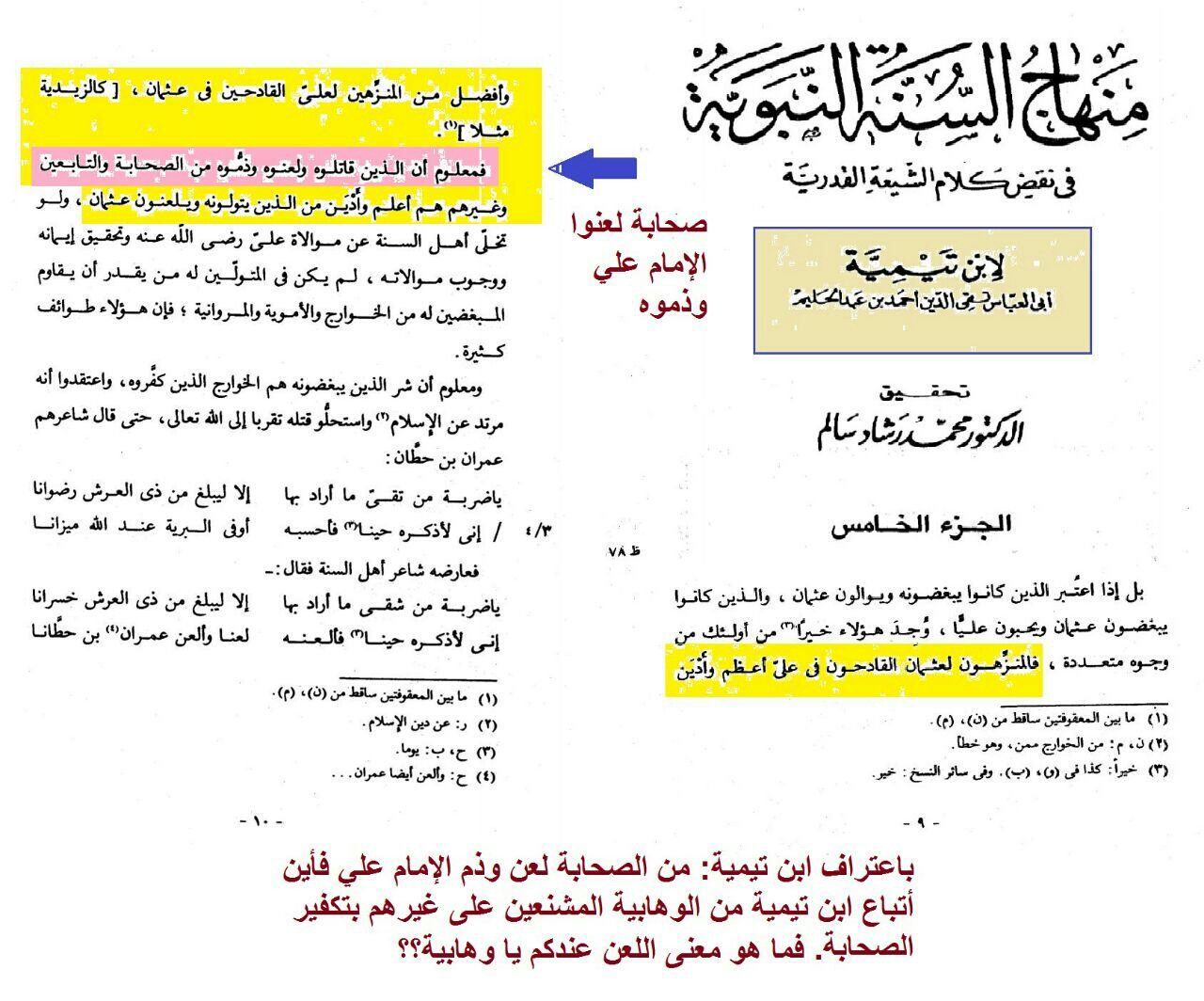
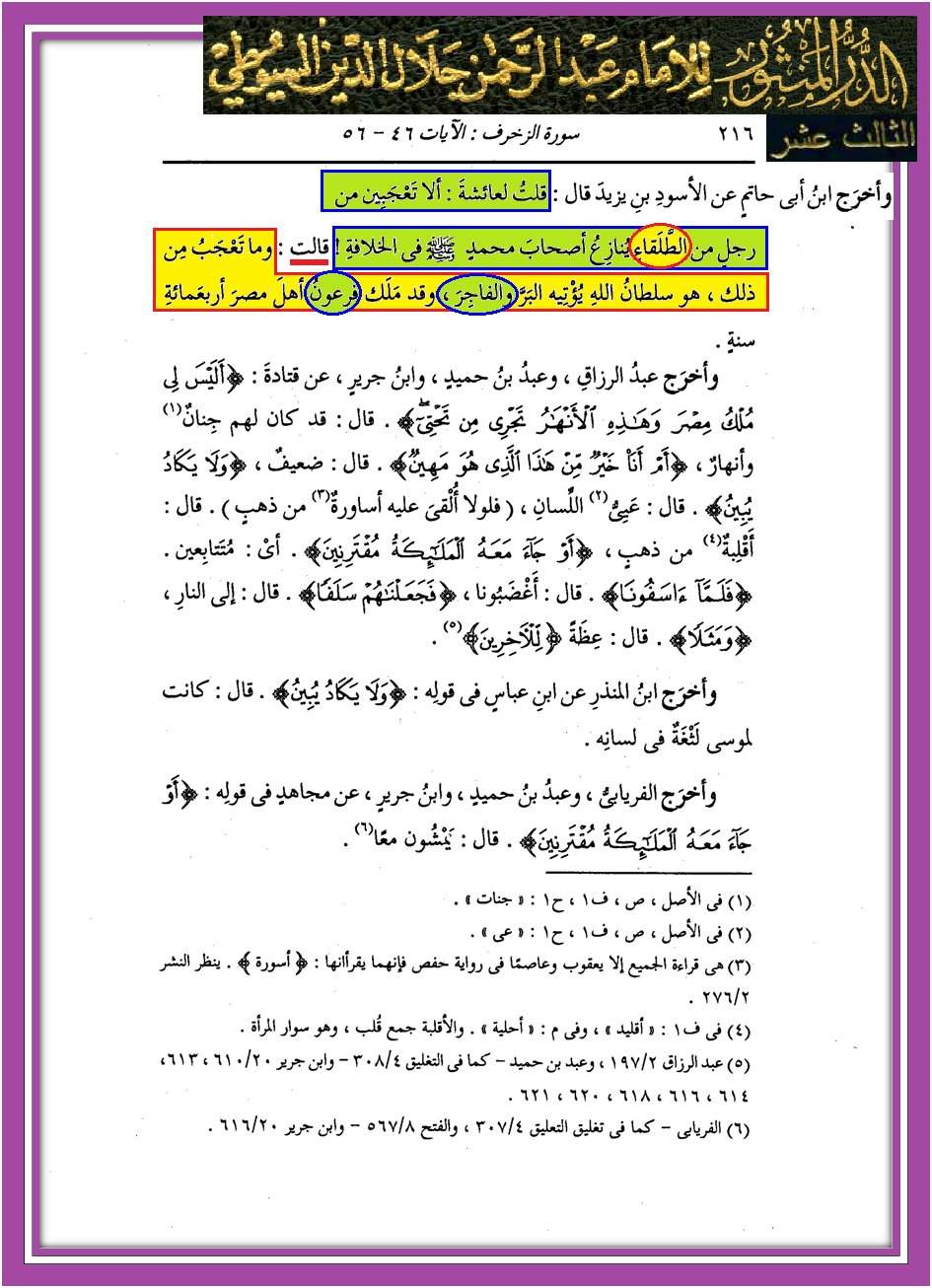
Some criticized Ibn Taymiyya for affirming that certain Companions cursed others—explicitly referring to Mu’awiyah, ‘Amr ibn al-‘As, and those like them who cursed Ali from the pulpits.
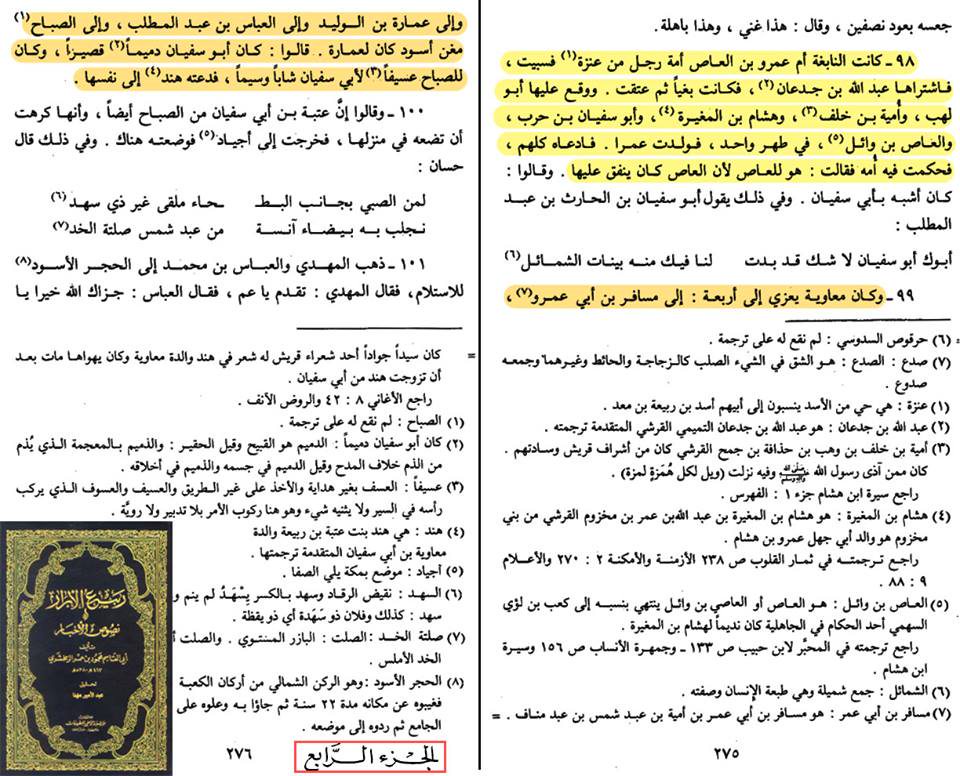
This is documented in Tarikh al-Tabari and Al-Sunnah by Ibn Abi ‘Asim.
Accusing The Mother of the Believers Aisha (ra) of killing Caliph Uthman; and that she was responsible for inciting people to kill him! Saying, “Kill Nathla, for he has disbelieved!” (Nathla was a Jew). Accused of likening Uthman to a Jew named Nathla.
In a commentary explaining the aqidah of Tahawi. Muawiyah bin Abi Sufyan is blamed for approving the insult of Imam Ali, and by approving it he insulted Ali in Iraq and the Levant!
“The first king in Islam was Mu‘awiyah, and he was the best and most virtuous of their kings because he was righteous, the son of a righteous man, and because his lineage was noble. However, he is criticized because he allowed… due to his stance toward ‘Ali. As a result of his policy, the cursing of ‘Ali became widespread during his rule in Iraq and Syria, leading to this abominable practice, which gave rise to lies about the cursing of the Companions and exaggeration in the praise of ‘Ali.”
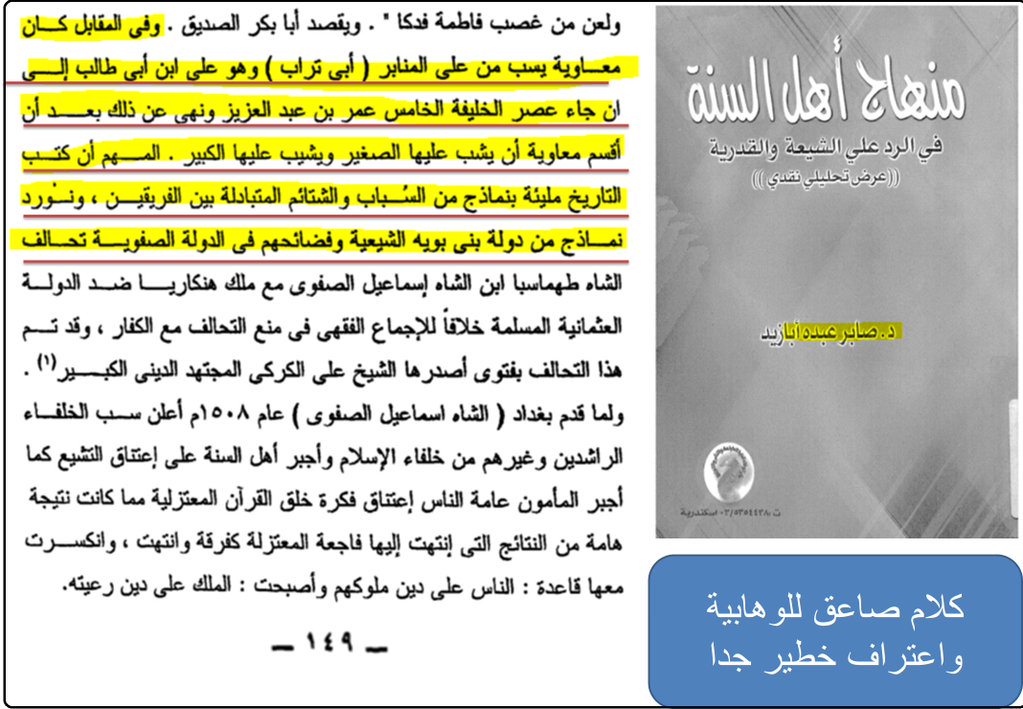
“Because of this, the Rafidah (a sect of extremists) harbor intense hatred toward Mu‘awiyah and all of Banu Umayyah, except for ‘Umar ibn ‘Abd al-‘Aziz (may Allah be pleased with him). This is because the cursing of ‘Ali continued in Iraq and Syria—though not in all places, only in some mosques—throughout the reign of Banu Marwan, until ‘Umar ibn ‘Abd al-‘Aziz came to power and abolished this practice, putting an end to it.”
Do you know who encouraged ‘Umar Ibn ‘Abd Al-‘Aziz to stop the cursing of ‘Ali from the pulpits?
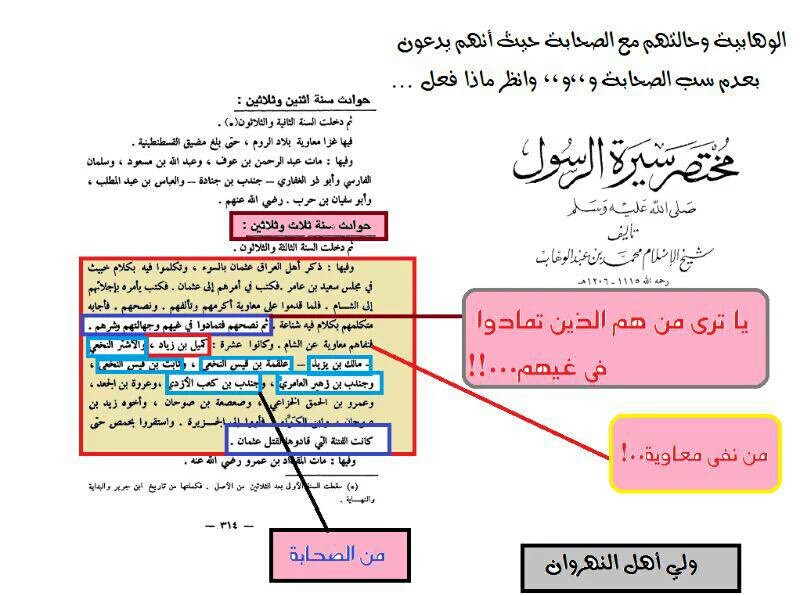
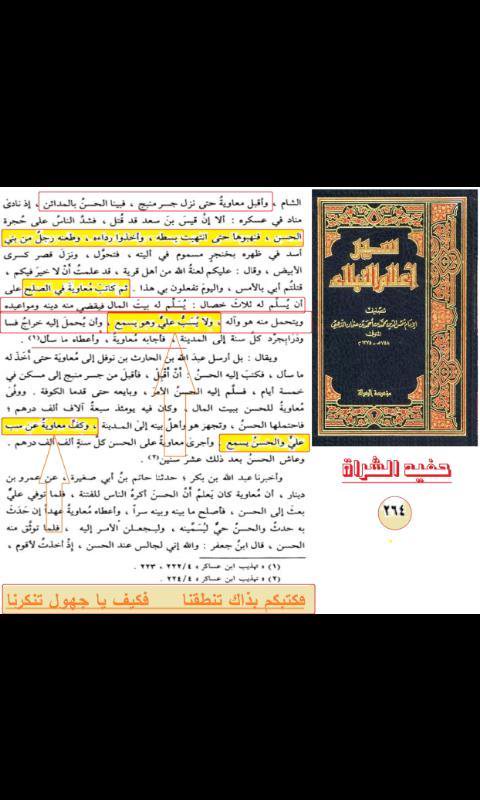
Muawiyah used to curse Ali and ordered him to be cursed on the pulpits and continued to curse him even after the death of Ali!
We have seen and reliably transmitted that Mu’awiyah’s cursing of Ali is recorded in authentic sources—specifically on page 45 of Volume 2 of Al-Fikr al-Sa’bi. Historians like Ibn Jarir al-Tabari and others have unanimously confirmed this.
They would not give anything except after disavowing Imam Ali and testifying against him with hypocrisy!
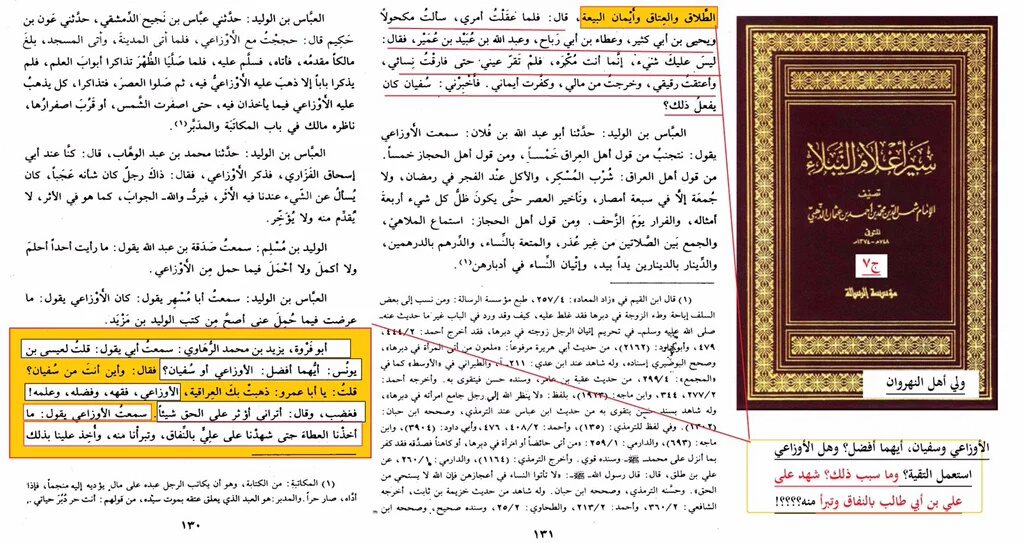
Al-Awza’i (a renowned scholar) said: “They did not grant us stipends until we testified that Ali was a hypocrite—and I am innocent of such a claim! They forced us into this by threatening to withhold salaries, divorce our wives, and take our children. When I realized the gravity of the matter, I consulted Mak’hul, Yahya ibn Abi Kathir, ‘Ata ibn Abi Rabah, and Abdullah ibn ‘Ubayd ibn ‘Umayr. They all said: ‘You are under duress; there is no sin upon you.’ Yet my conscience remained unsettled until I divorced my wives, freed my slaves, relinquished my wealth, and repented for what I had done under coercion.”
Al-Hakim recorded this narration through Ali al-Hafiz, who cited Mak’hul of Beirut, from Abu Farwah.
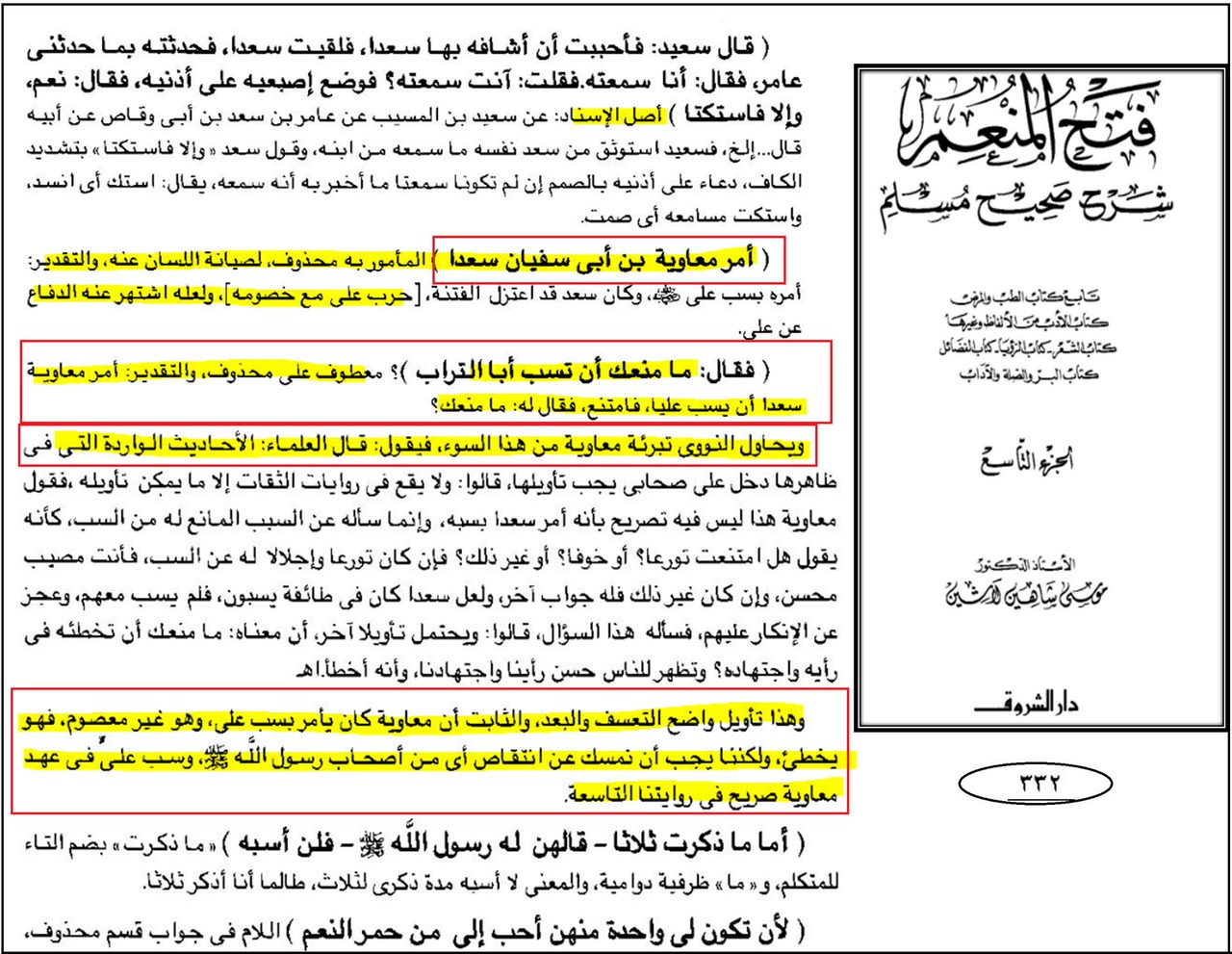
It is proven that Mu’awiyah was ordering Sa’d to insult Imam Ali and he explained that in detail and you will find among the Salafiyah those who defend Mu’awiyah and those trying to abuse the text!
Mu’awiyah’s Demand for Cursing ‘Ali
Context:
Mu’awiyah ibn Abi Sufyan pressured Sa’d to curse ‘Ali.
Sa’d had remained neutral during the Fitna (civil strife) but was known to defend ‘Ali.
The Dialogue:
Mu’awiyah: “What prevents you from cursing him?”
Sa’d: “What prevents me? [I refuse.]”
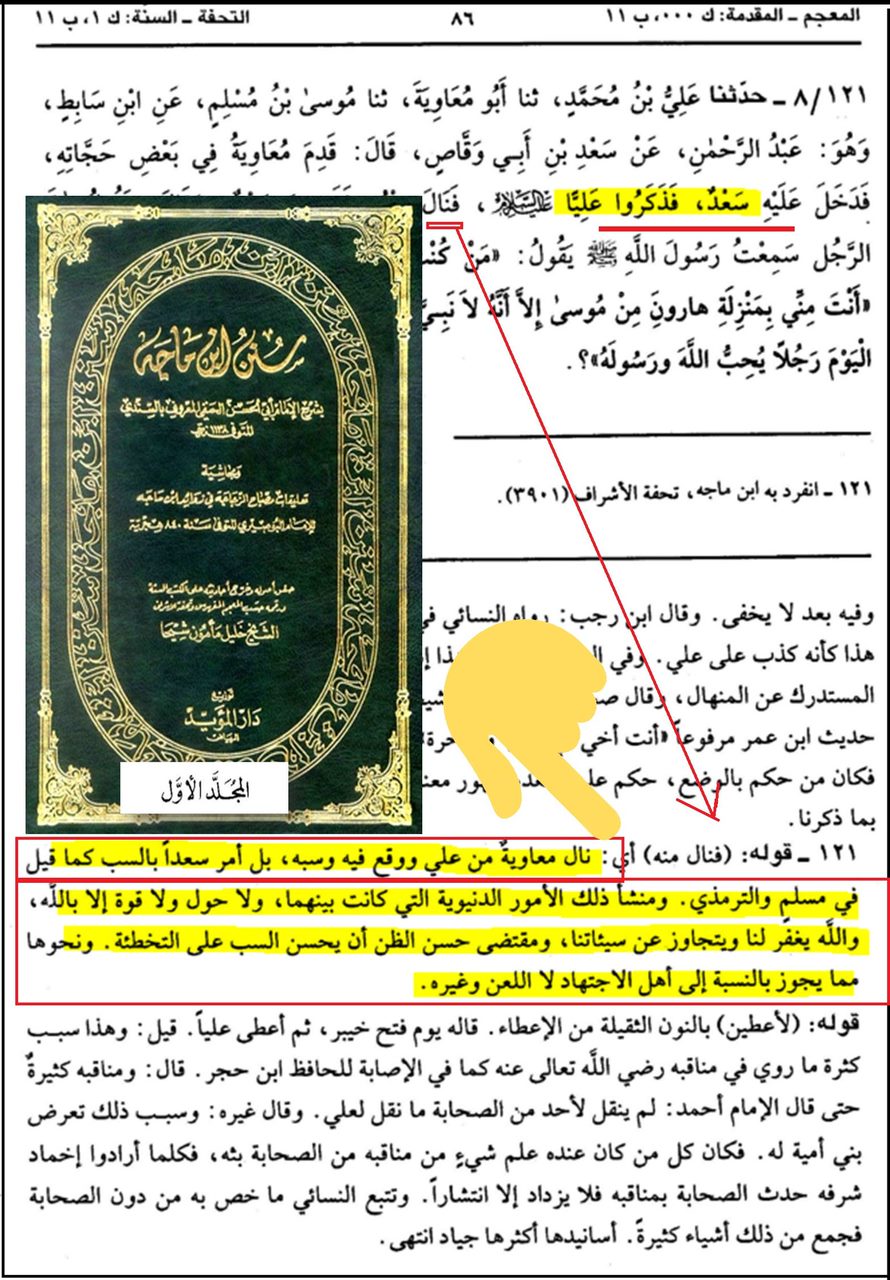
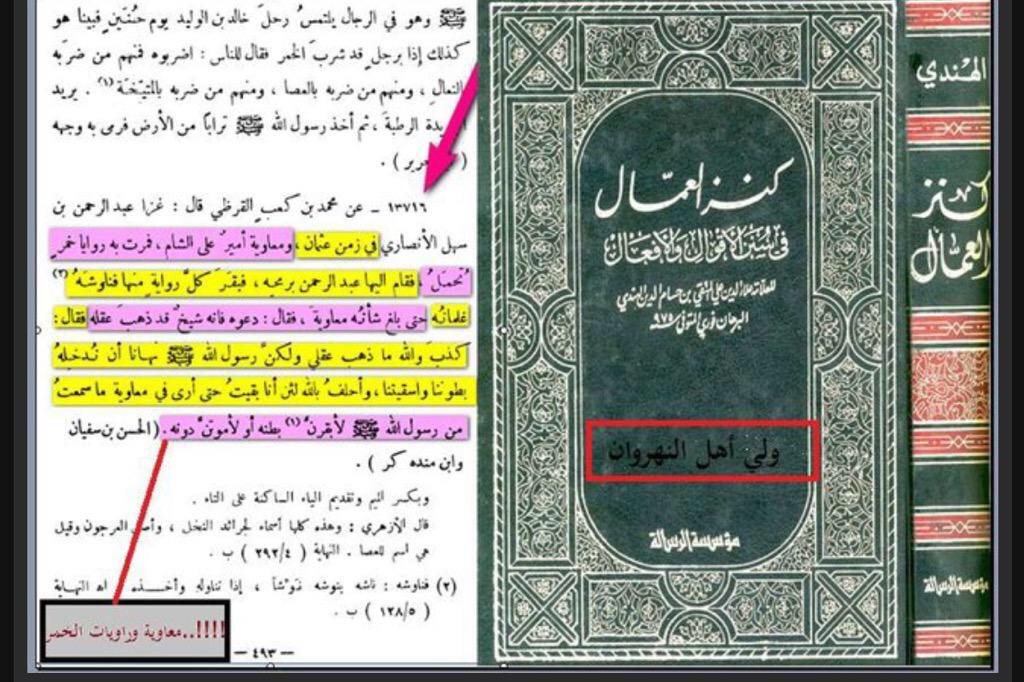
It was stated in the book Sunan Ibn Majah that Muawiyah used to insult and curse Imam Ali, and the reason was due to worldly matters between them!
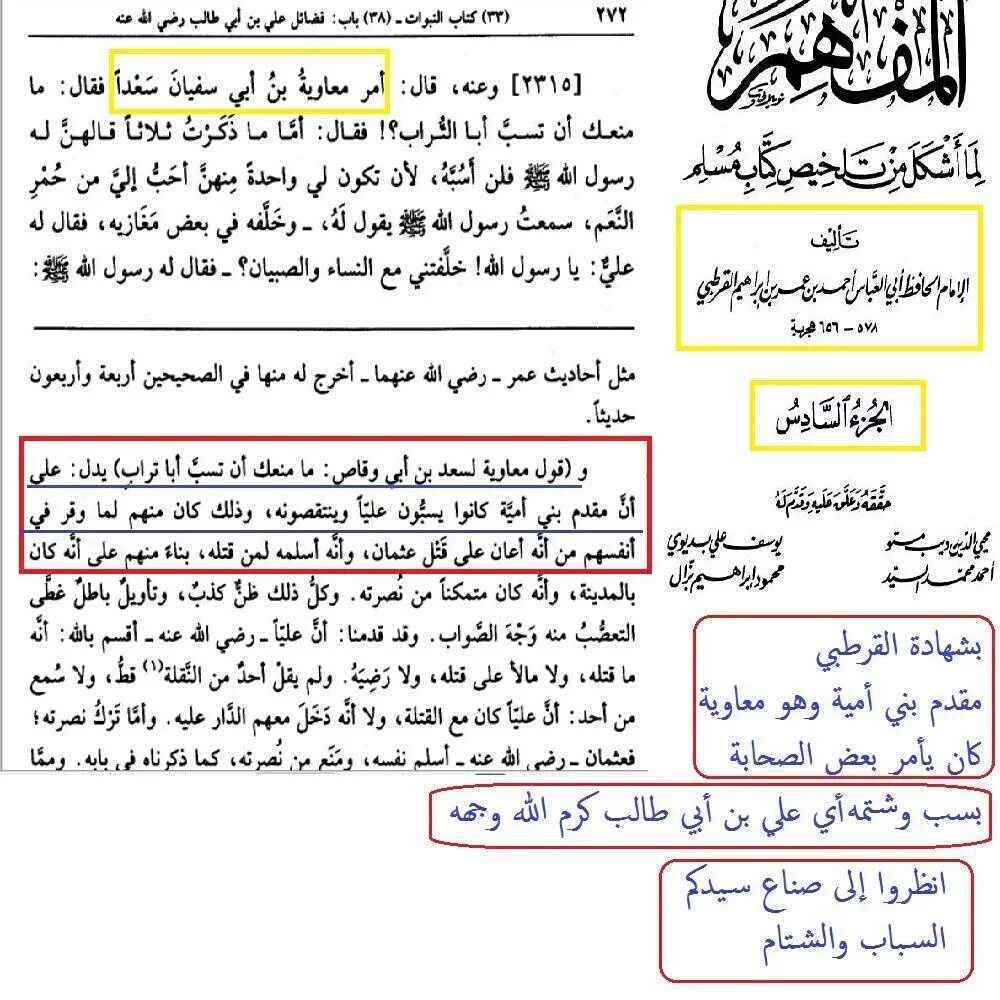
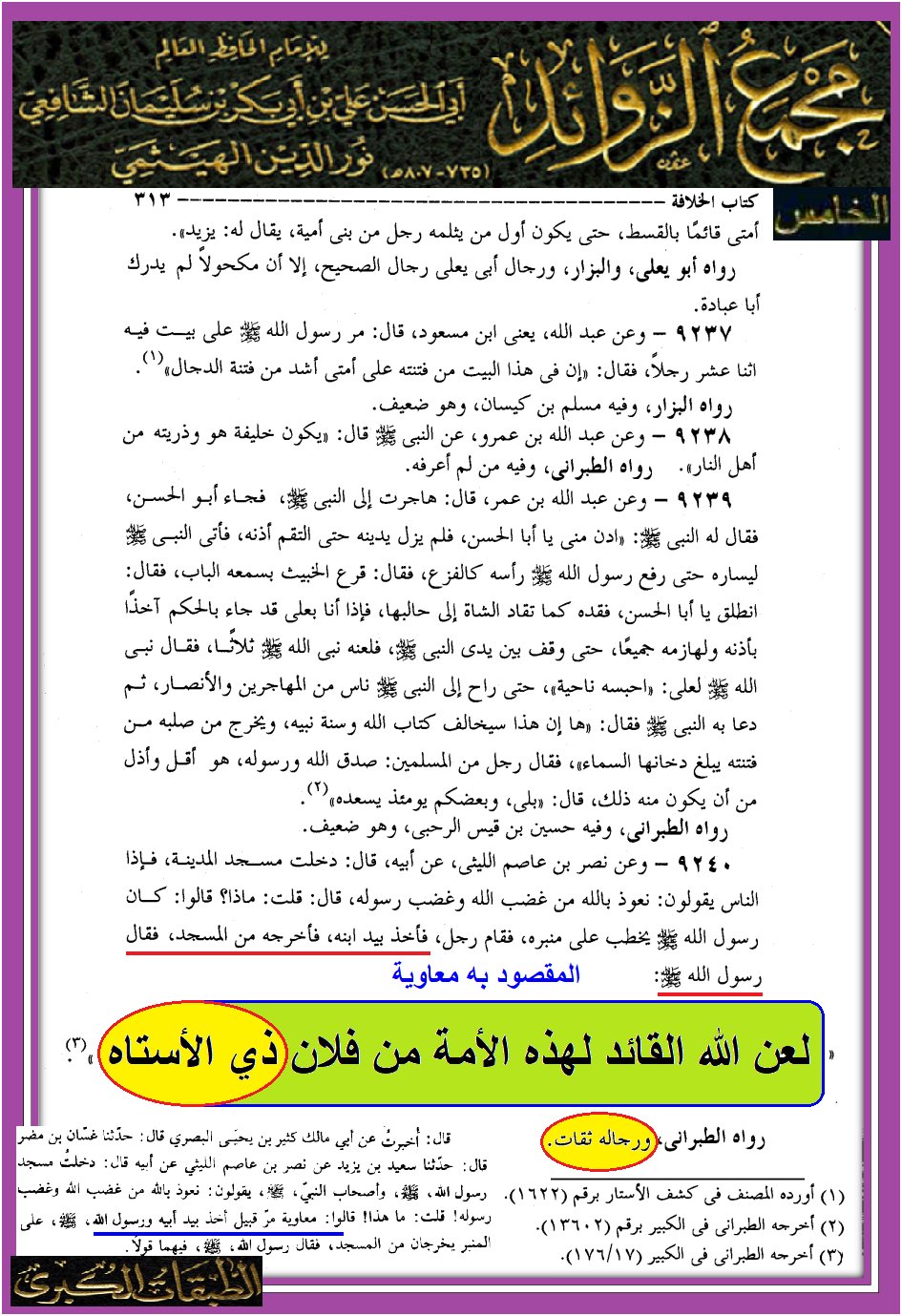
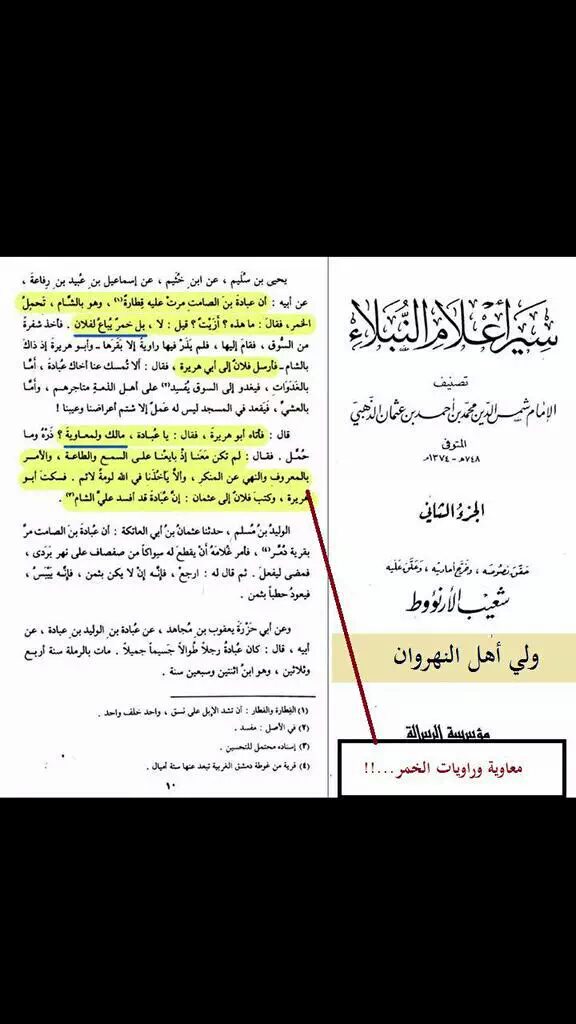
It was stated in the book on the explanation of Sahih Muslim that Muawiyah ordered Saad to insult Imam Ali! And with all this, you find the Salafiyyah defending and fighting for Muawiya, and it was safer for them to desist from that period in its entirety. But no, not them! One standard for them and one standard for others. They use double standards in sedition and make the common people think that they are the lovers of the Companions!
Banu Umayyah used to insult and curse Imam Ali on their platforms! And the Salafiyyah defend the injustice of the Umayyads and cursing of Imam Ali!
According to Imam Al-Qurtubi’s testimony Muawiyah insults Imam Ali and commands people to insult him! And guess who is defending those who curse and insult the Companions?
The great Companions used to curse the other great Companions, and many are the Salafi who conceal this and pretend to love the Companions, while in reality Companions are innocent of them.
Read below:
“The people of Sham (Syria) departed to Mu’awiyah and pledged their allegiance to him, forsaking and exposing him (a reference to a disputed event). Ibn ‘Abbas and Sharhabeel ibn Hanī’ returned to Ali with the news. Thereafter, whenever Ali would pray the morning prayer (Fajr), he would invoke curses (Qunoot) and say: ‘O Allah, curse Mu’awiyah, ‘Amr (ibn al-‘As), Abū al-A’war, Habīb ibn Maslamah, ‘Abd al-Rahmān ibn Khālid ibn al-Walīd, al-Fasaḷ ibn Qays, and al-Walīd ibn ‘Uqbah.’
This reached Mu’awiyah, so he, in turn, began to curse Ali, al-Ashtar, Qays ibn Sa’d, al-Hasan, al-Husayn, Ibn ‘Abbas, and ‘Abdullāh ibn Ja’far, may Allah the Exalted be pleased with them all.
In the text Imam Ali is cursed, yet the one who curses him he is considered trustworthy and honest! Yet look how they assault the Ibadi school. Where is the balance? Where do we insult any of the companions and worse yet where do we call any of them dogs of hellfire?!
Raja’ bin Haywah , considered a man of trust with those who attack us. (Those who attack the Ibadi). He (Raja’ bin Haywah) denounced the just caliph Umar bin Abdul Aziz for leaving cursing and cursing of Imam Ali on the pulpits!
Which by the way this was at the urging of the Ibadi delegation. (Thank you Muslim majority for conveniently leaving that tid bit out)
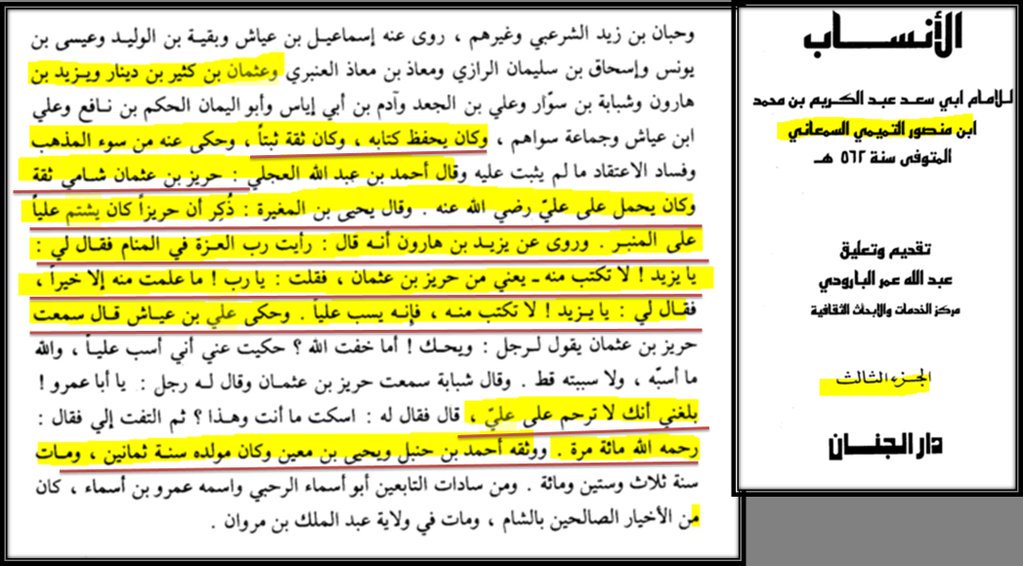
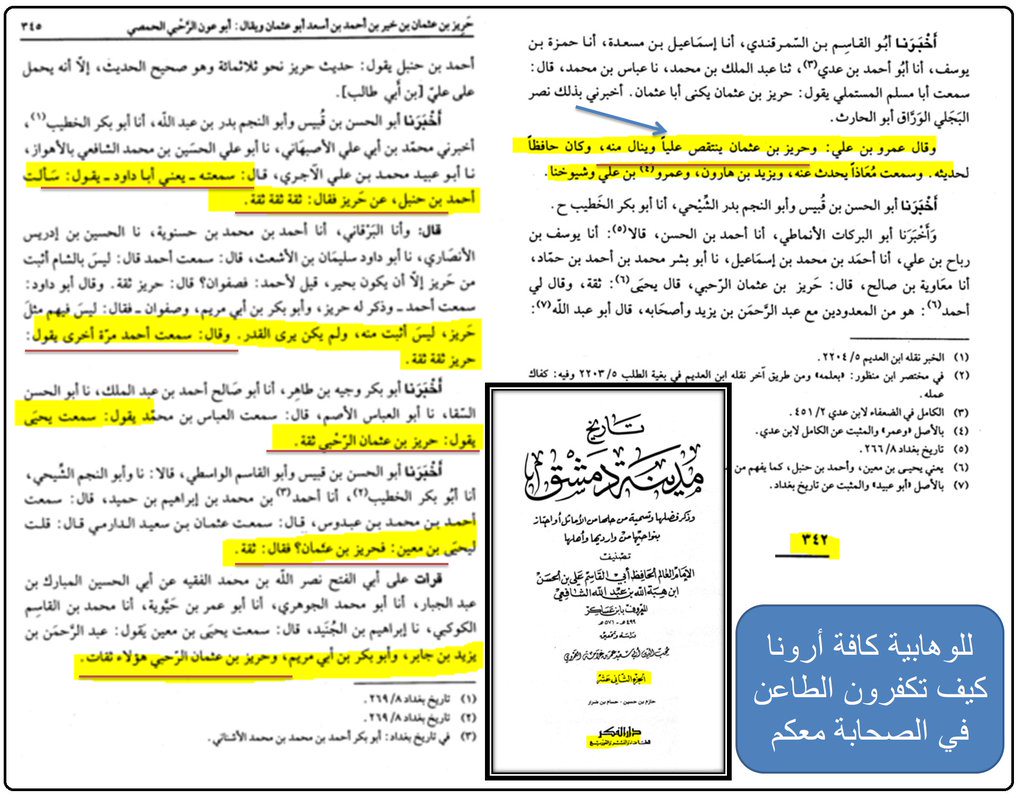
Harir bin ‘Uthman, he is one of the men of Bukhari. This man was cursing and cursing Imam Ali, and despite all this, he is proven trustworthy and has the trust of Ibn Mu’in and Ahmad bin Hanbal!
In Tahdhīb al-Tahdhīb, Volume 2, page 409-410, Entry No. 852
وَرَوَى الْعَقِيلِيُّ عَنْ يَحْيَى بْنِ مَعِينٍ أَنَّهُ كَانَ يَسُبُّ عَلِيًّا رضي الله عنه كُلَّ يَوْمٍ مِائَةً وَأَرْبَعِينَ مَرَّةً.
“And al-‘Uqaylī narrated from Yaḥyā bin Ma‘īn that he [Ḥarīr] would curse Ali one hundred and forty times every day.”
Ahmad bin ‘Abdullah al-‘Ijli said: “Harir bin ‘Uthman was a Syrian, reliable (thiqah), and he used to bear hostility (yahmil) against ‘Ali.”
Yahya bin Ma’in said: “It was mentioned that Harir used to revile (yashnum) ‘Ali from the pulpit (al-minbar).”
It was narrated from Yazid bin Harun that he said: “I saw the Lord of Might (Rabb al-‘Izzah) in a dream, and He said to me: ‘O Yazid! Do not write from him’—meaning from Harir bin ‘Uthman. I said: ‘O Lord, I have not known anything from him except good.’ He said to me: ‘O Yazid! Do not write from him, for he reviles (‘sabb‘) ‘Ali.'”
‘Ali bin ‘Ayyash narrated, saying: “I heard Harir bin ‘Uthman say to a man: ‘Woe to you! Do you not fear God? You have reported from me that I revile (‘asubbu‘) ‘Ali. By Allah, I do not revile him, and I have never reviled him.'”
Shababah said: “I heard Harir bin ‘Uthman, and a man said to him: ‘O Abu ‘Amr, it has reached me that you do not show mercy upon ‘Ali?’ He said to him: ‘Be quiet! What business is this of yours?’ Then he turned to me and said: ‘May Allah have mercy on him (‘Ali)’ a hundred times.”
Ahmad bin Hanbal and Yahya bin Ma’in considered his narrations to be stopped (waqafuhu – a term in hadith criticism, possibly meaning they did not use his narrations as evidence due to this issue).
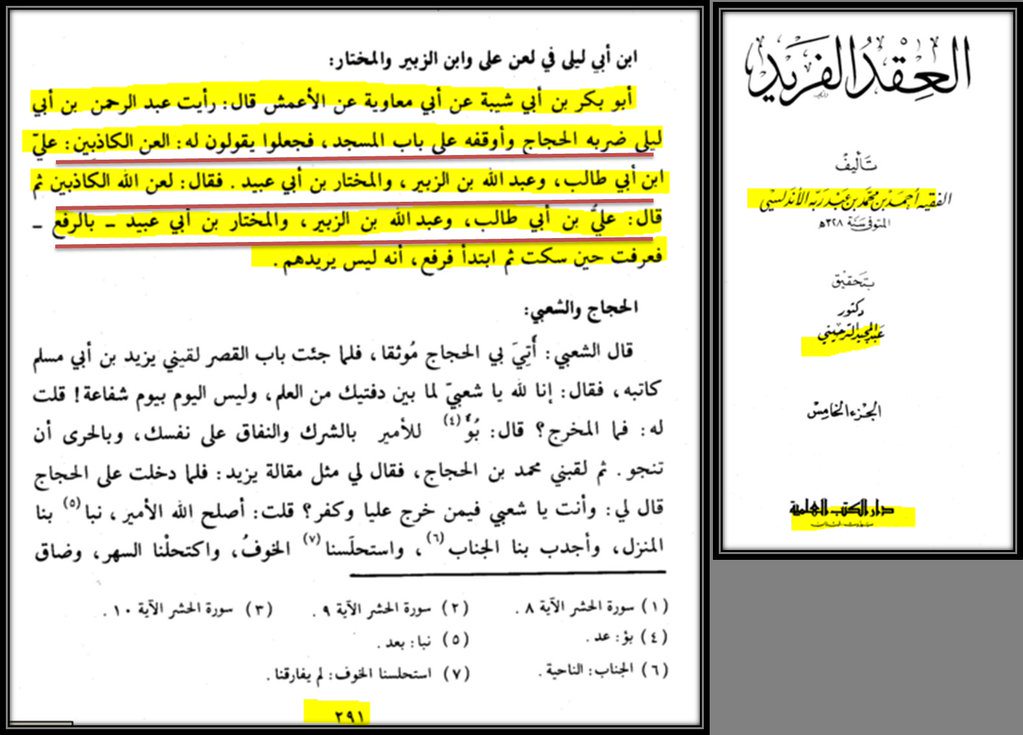
Al-Hajjaj beats people who do not curse Imam Ali and punishes them with flogging!
Ibn Abi Layla, and Ibn al-Zubayr, and Al-Mukhtar:
Abu Bakr bin Abi Shaybah narrated from Abu Mu’awiyah from Al-A’mash, who said: “I saw ‘Abd al-Rahman bin Abi Layla. Al-Hajjaj had him beaten and made him stand at the door of the mosque. They began saying to him: ‘Who are the liars?'” He said: “So who are the liars of Allah?” Then he said: “‘Ali ibn Abi Talib, ‘Abdullah ibn al-Zubayr, and Al-Mukhtar bin Abi ‘Ubayd.” – [he said it] quietly. So I knew when he fell silent, then he started again and raised his voice, that he did not mean them.
Harir bin ‘Uthman, it was known about him that he insulted Imam Ali, and he was famous for that. However, when Ahmed bin Hanbal was asked about him, he said about him: trustworthy, trustworthy, trustworthy!
A question to the Salafiyyah, On what consistent basis do you attack the Ibadi when some of our past scholars put Ali inBarā’ah, and some practice Wuqoof, while others hold him in Walāyah and yet you keep defending the Umayyads whose Sunnah was to curse Imam Ali in the streets and on the pulpits?!
Now imagine dear readers that we take a time machine back to the Umayyad period. We have those among the companions, the early salaaf who disavow Ali for arbitration and killing the believers at Nahrawan. Meanwhile what will be going on in the Umayyad territories? Cursing Imam Ali on the pulpits as a necessary Sunnah.
Who is reviling who?
Who is disavowing who?
Ibn al-Qayyim criticizes the Companions for masturbating during their battles, and criticizes their women! Certainly these are the ethics of the downward road!
Marwan bin Al-Hakam used to insult and curse Ali as well as his two sons Al-Hassan and Al-Hussein on the pulpits! Marwan would claim that Hassan smelled of donkey urine!
…Narrated by Ishaq bin Rahawayh (1) and Abu ‘Ubayd (2).
[Narration 7566] And from ‘Umayr bin Ishaq who said: “Marwan was our governor for a year, and he would curse [‘Ali] – – for us from the pulpit.” He would address the people, then Marwan was deposed, and Sa’id bin al-‘As was appointed for a year, and he did not curse. Then Sa’id was deposed, and Marwan was reinstated, and he resumed cursing. So it was said to Al-Hasan bin ‘Ali: “Do you not hear what Marwan is saying?” But he would not respond at all. He would prepare on Friday, then enter the pulpit of the Prophet (saw)and it would be there. When the pulpit was brought forward, he would enter the mosque and not prepare, then return to his family. Marwan was not satisfied with that until he sent a message to him in his house, so that when he sat with him, he would address the people. So he sent for him, and he entered. He said: “Your proximity is part of the sultan’s might, and your proximity is a resolution.” He [Al-Hasan] said: “[Say] what you want.” He said: “Marwan has sent me to you with so-and-so and so-and-so, and I have not found anyone like you except the urine of a female mule.
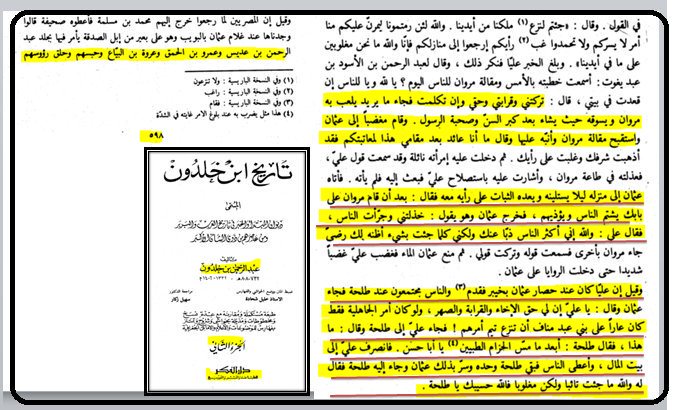
Caliph Uthman begged Ali bin Abi Talib and Talha to defend him when his house was besieged. However, he was not as supported as it should have been. And Marwan was cursing the people and antagonizing them more! Why didn’t the companions support Uthman?!
The Salafiyyah spread lies among the people that Muawiyah loves Ali and takes care of him, to the extent that if the two groups fight, it is because of the excessive longing between the brothers, so if the night comes, they congregate until the morning, then they shed crocodile tears to deceive the common people! Here, their lies are exposed!
The Salaafiyah are deceiving the common people by saying that Muawiyah did not order Sa`d to insult Mu`awiyah, and that his purpose was not to insult, but rather he wanted to test Sa‘d, Yet the deception is clear!
Muawiya used to send his agents to interrogate people and disavow Ali and curse him, and if they did not respond to his request, they would be sentenced to death!
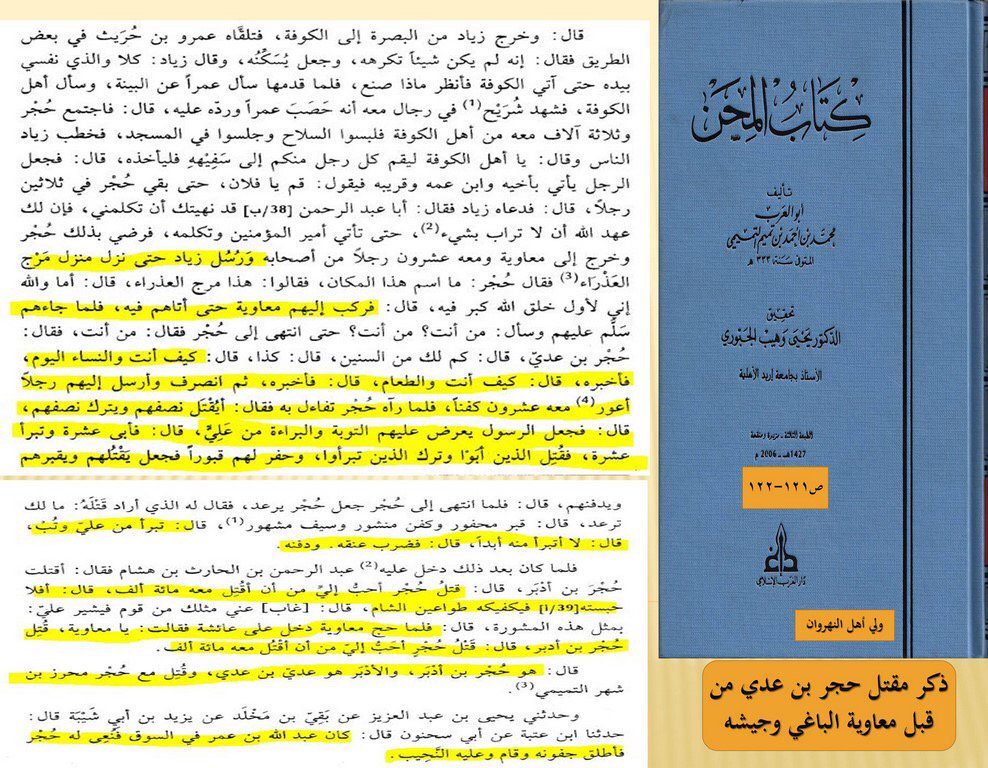
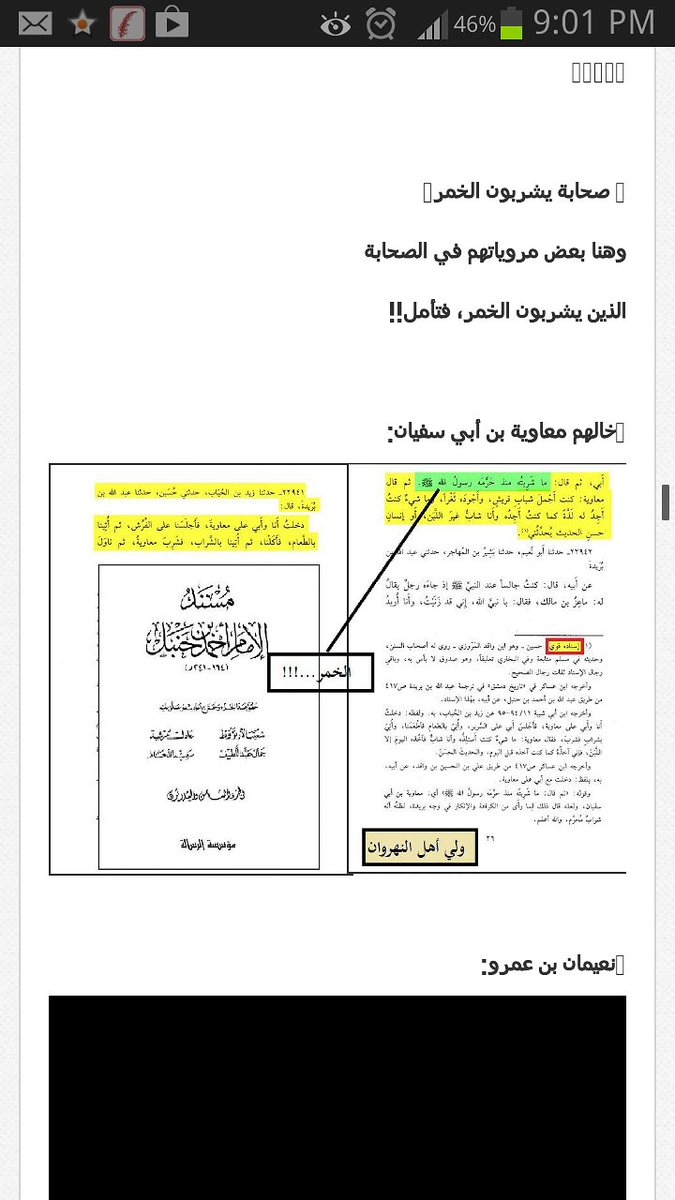
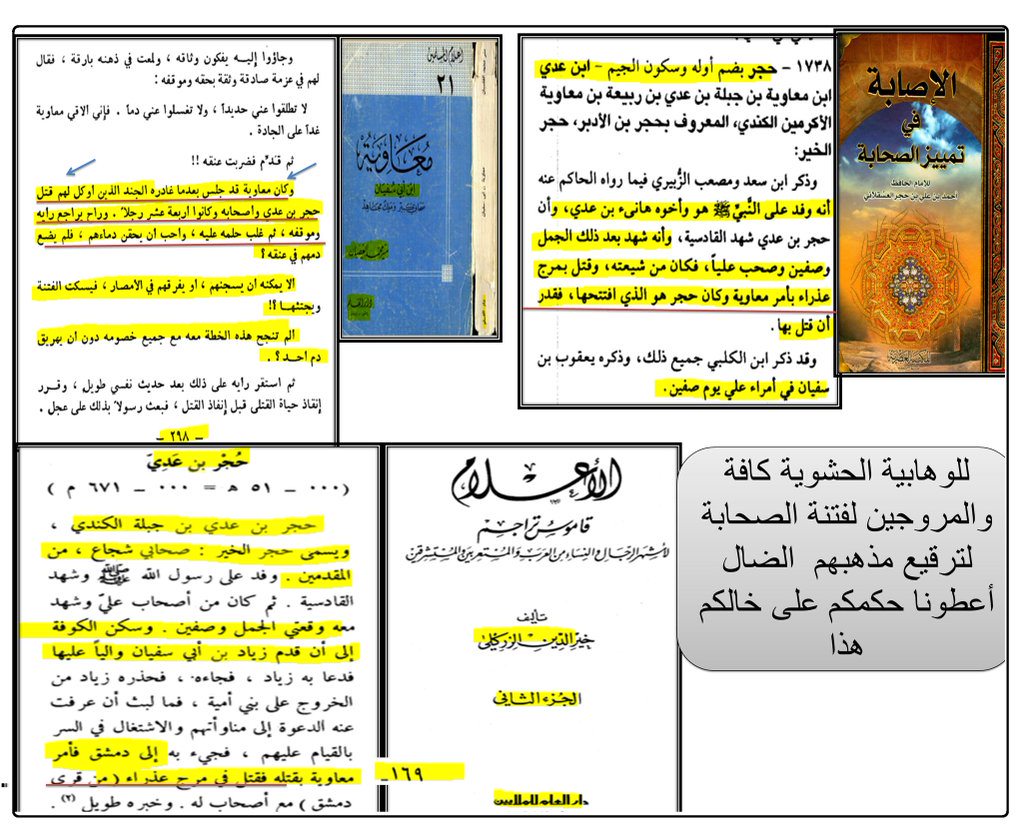
Muawiyah orders Hajr and his companions to disavow Ali and curse him, but they refuse to do so and are killed! This is Muawiyah the one we are supposed to say (May Allah be pleased with his deeds) after his name!
A torrent of insults and cursing of Imam Ali, and this insult remained the Sunna of the Umayyads, and Muawiyah swore that their young ones would grow old and their old ones would grow older (they would be granted prolonged life) because of cursing Imam Ali!
And the Salafiyyah want it to be remained concealing from the common people and defend the Umayyads of the Nawasib! The truth has appeared and revealed the hidden!
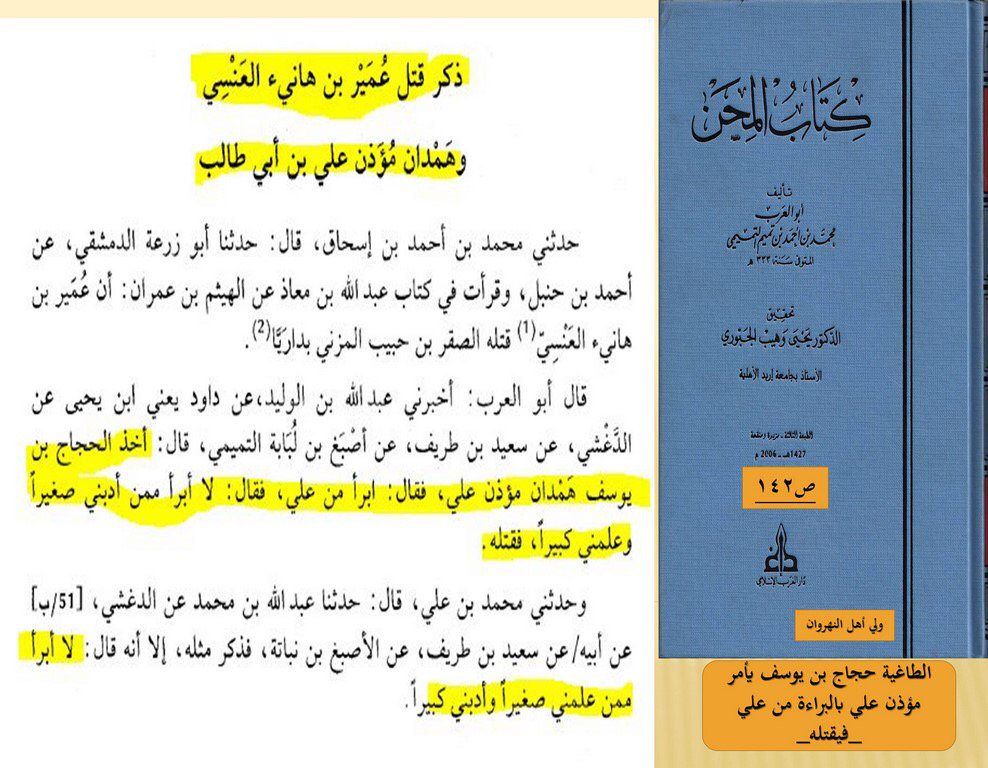
Here is is mentioned the killing of Hujr bin Adi al-Kindi and his companions by Muawiyah Al-Baghy and his army of miscreants!
Al-Hajjaj orders the muezzin of Ali to disavow Ali, but he refuses and thus is killed!
Abdullah Al-Jabreen admits that the Umayyads insulted and cursed Ali on the pulpits until the era of Umar bin Abdul Aziz. Then he said that people began to mention the virtues of Ali, but even than he was upset that they alienated the people from the Umayyads!!!
Hence the split that last until today between the Abbasid Sunnis (those who incorporated Ali as the fourth “rightly guided”) and their antagonist, the Umayyad Sunnis (those who have real hate towards Ali).
Shaykh `Abdullah ibn `Abdur-Rahman al-Jibreen was a prominent Saudi Islamic scholar who served on the Council of Senior Scholars and the Permanent Committee for Islamic Research and Issuing Fatwas. Here is what he had to say.
“During the era of the Umayyads, and specifically after the caliphate of Mu’awiyah until the end of the [first] century—from the year sixty-one until the year ninety-nine—some of the Umayyad caliphs would curse Ali from the pulpits and in his absence, and they would accuse him of participating in the killing of Uthman. This continued until the time of Umar ibn Abd al-Aziz, who put an end to this heinous practice.”
“And there were in Kufa individuals who extreme in their devotion to Ali (yaghulūn fī ‘Alī), from among his ministers and students in Kufa. They were harmed and enraged by what they saw of the public cursing from the pulpits, and it became excessive. So they began to gather in private places for themselves and they would console each other. Then there joined them whoever wished to secede (from the community), so then people began to join them and they became numerous. They would exaggerate in his virtue, inventing many fabricated hadiths about his merits, and they claimed by doing this that they were endearing the people to him and turning the people away from the Umayyads.”
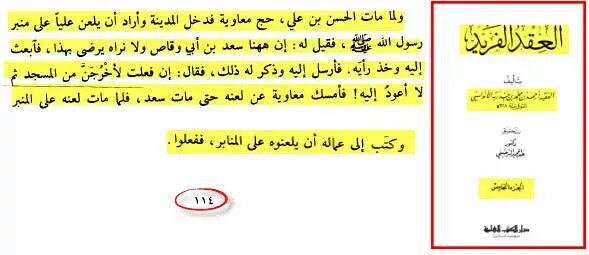
Muawiya’s first act after the death of Al-Hassan bin Ali was to perform Hajj and ascend to the pulpit of the Messenger of Allah in Medina to curse Imam Ali! Imagine the minbar of light and barakah being used to pour out vomit and hate!
The following is from: Al-‘Iqd al-Farid by Ahmad ibn Muhammed ibn Abd Rabbih. A book about adab! Imagine!
“And when Al-Hasan bin Ali died, Mu’awiyah performed Hajj and entered Medina. He wanted to curse Ali from the pulpit of the Messenger of Allah (saw). It was said to him: “Among us is Sa’d bin Abi Waqqas, and we do not think he will be pleased with this at all. So send for him and seek his opinion.” So he sent for him and mentioned that to him. Sa’d said: “If you do that, I will leave the mosque and never return to it!”
So Mu’awiyah refrained from cursing him until Sa’d died. After he (Sa’d) died, he (Mu’awiyah) cursed him (Ali) from the pulpit.
And he wrote to his governors to curse him on the pulpits, and they did so.
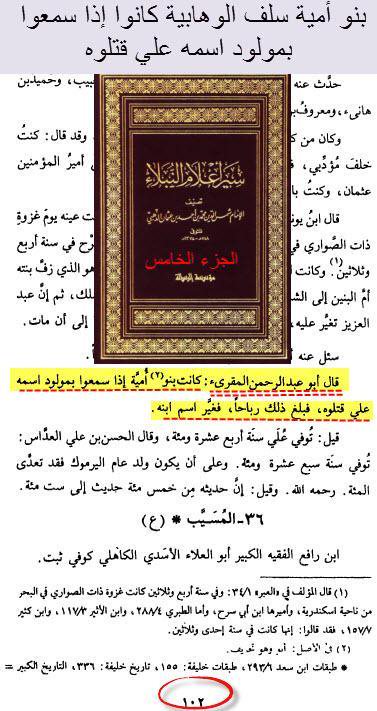
The Banu Umayyah, they had the vile practice that if they heard that someone had named his son Ali, they killed him!
Abu Abd al-Rahman al-Aqri said:
“The Banu Umayyah, whenever they heard of a newborn named ‘Ali, they would kill him. This reached Rabah, so he changed his son’s name.”
By the way dear reader many of you may not be aware but a revival of the Umayyad spirit is happening among the Sunni Muslims, in particular Salafist types. They wear the title nawasib as a badge of honour. As an indication of one’s loyalty to Sunnism they will name their kids as Yazid or Mu’awiyah. The fighting in Syria accelerated this movement. Insh’Allah have an article on this coming.
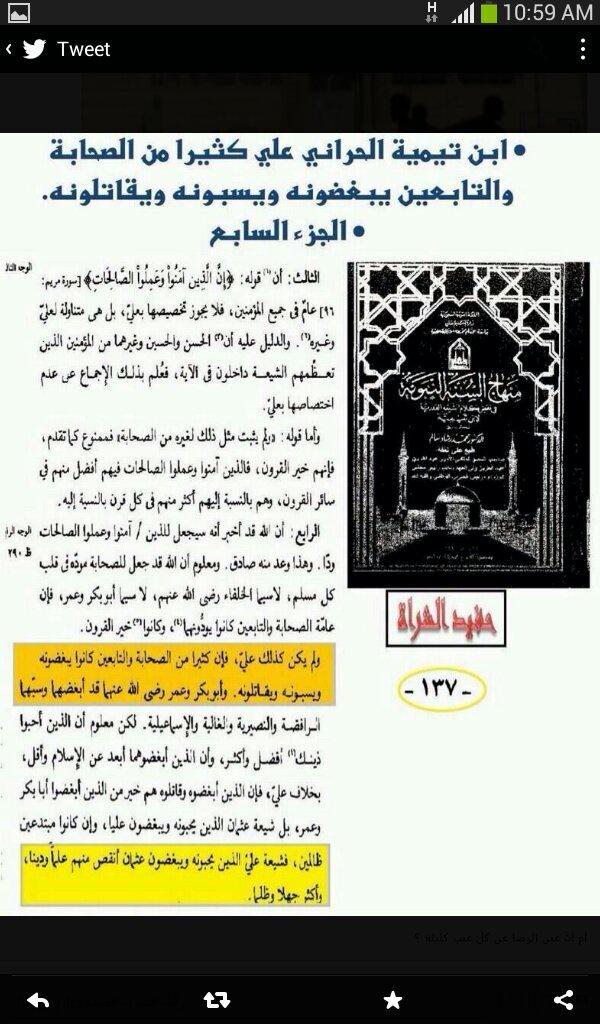
Shaykh Ibn Taymiyyah al-Harrani states about Ali that many of the companions and followers hated him, insulted him and fought him!
Ahl al-Sunnah excused some of those who killed Ali. And them themselves openly insulted and cursed him!
Ibn Al-Qayyim recounts the story of Al-Hajjaj in cursing Imam Ali and ordering people to curse him in the markets in front of the shops!
Ibn Taymiyyah proves the infighting and killing among the companions, and each group despising the other!
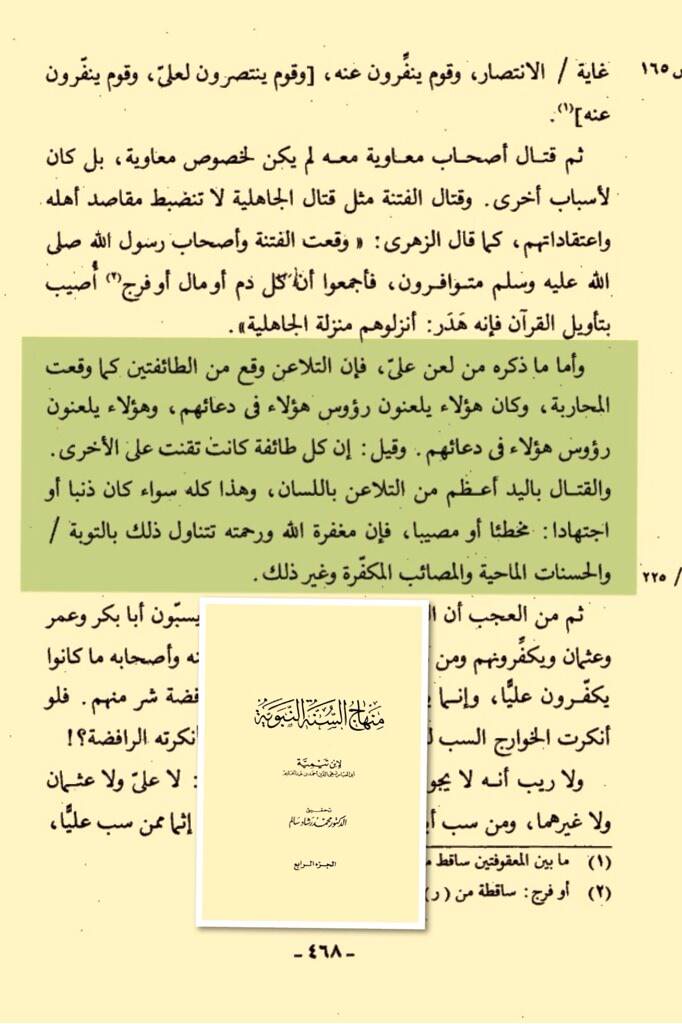
“As for what he mentioned regarding mutual cursing, the cursing was done by both groups, just as the fighting took place. One group would curse the leaders of the other in their supplications, and the other would curse the leaders of the first in their supplications. It is said that each faction would invoke curses upon the other in their prayer (qunut).”
“Fighting with the hand is greater [in sin] than cursing with the tongue. All of this—whether it was a sin, an effort of independent legal judgment (ijtihad), an error, or a correct opinion—is encompassed by the forgiveness and mercy of God through repentance, the erasing of sins by good deeds, great calamities that expiate sin, and other means.”
Source: (“Minhaj as-Sunnah an-Nabawiyyah” (منهاج السنة النبوية)
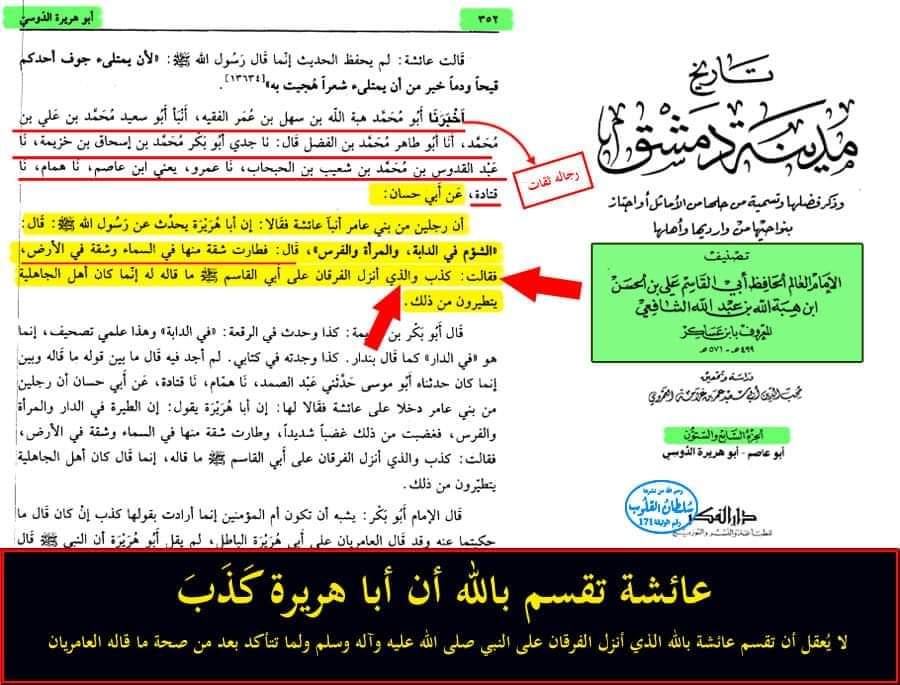
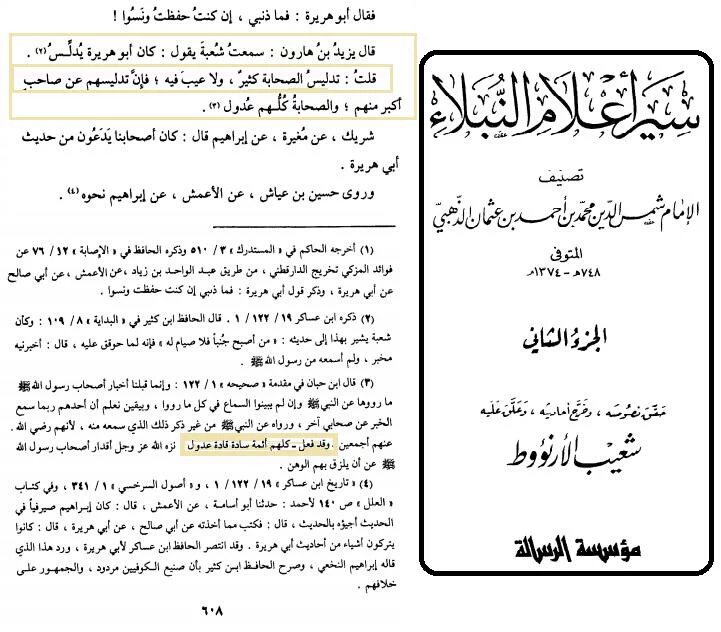
The Salafiyah tell us that the mother of the believers Aisha (May Allah be pleased with her) swears by Allah that Abu Huraira lied! Is this the amount of respect for the Companions have for each other according to the Salafiyah?
In the books of Ahl Sunnah a sahabah is accused of adultery!
A Companion eats the head of another Companion!
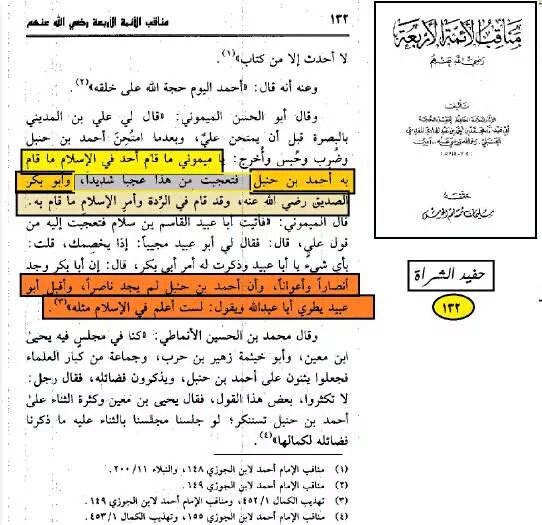
Salafiyah claim that what Ahmed bin Hanbal did for Islam was not done by anyone other than him not even Abu Bakr Al-Siddiq! (May Allah be pleased with him!) Are these words said in truth about the best companion of the Blessed Messenger (saw)?!
The sahaba used to drink wine! (After becoming Muslims)
A Companion Drinks Alcohol!(After embracing Islam)
A companion leads the people in the morning prayer, four units while in a state of sloppy drunkenness, and says to the crowd of worshipers, “Shall I add more for you?”
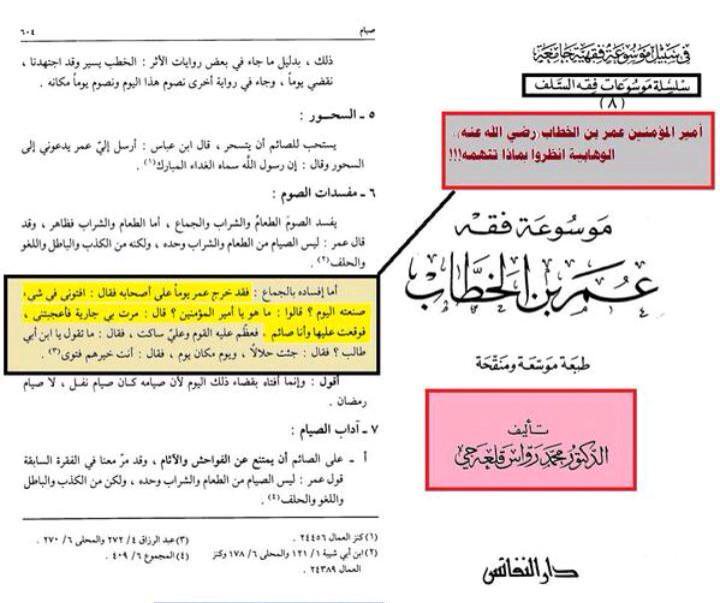
Umar bin Al-Khattab appoints a companion who drinks alcohol in Bahrain and asks the companions to testify to his drunkenness’. This is how the Salafiyah convey to us about the companions challenging and calling each other out like this!
They say the companions were cheaters and that Abu Hurarira was the chief of them in cheating! Imagine! And there are among the Ahl Sunnah who have the audacity to call the People of Truth and Straightness as Non Muslims?!
What does it mean by calling a noble companion a thief?
See what is said about the companions here:
Who were those who persisted in their ignorance and evil, then Muawiyah banished them from the Levant? ! Muhammed bin Abdul Wahhab answers you!
Shaykh Ibn Baz accuses the companions of polytheism!
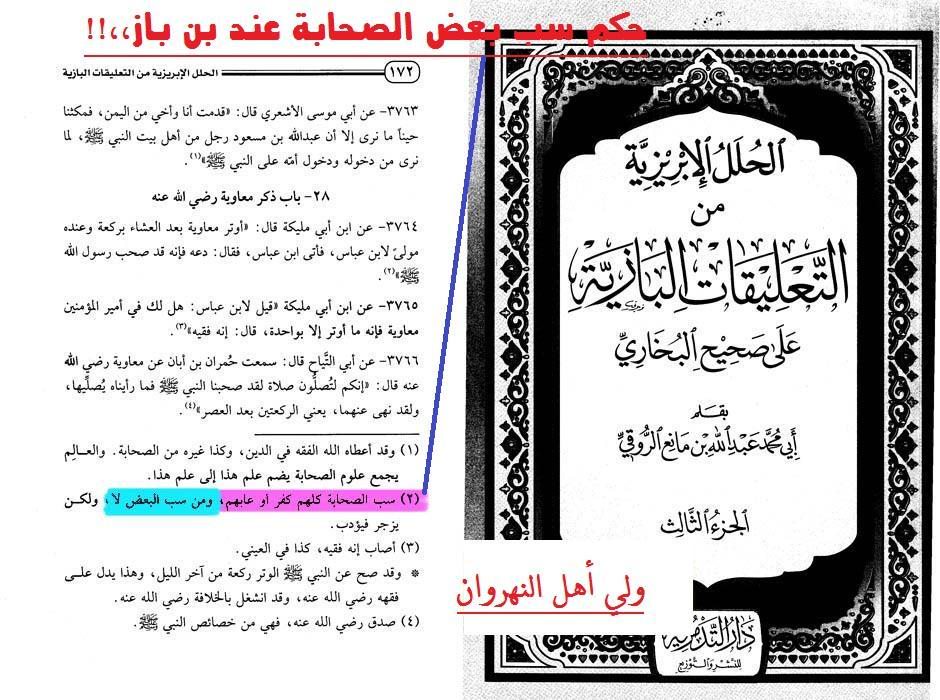
Shaykh Ibn Baz’s ruling on cursing some of the companions! Surprise Surprise!
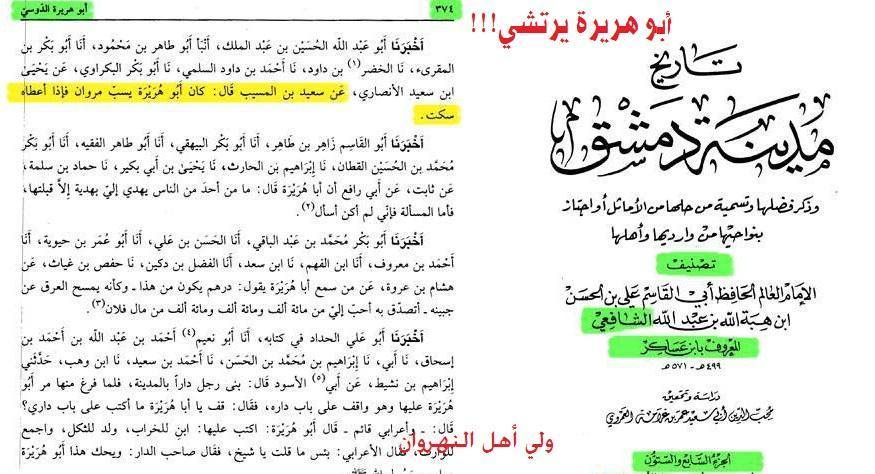
Ahl Sunnah say that Abu Hurairah was known for taking bribes! Who attacks the companions?
Shaykh Ibn Al-Uthaymeen, states that not all the Companions are not all just! In them there is rank debauchery!
Ibn Al-Atheer describes the companion Abu Musa as a fool! Who respects the companions?
Yahya Ibn Mu’een insults the companion Ammar bin Yasir and follows up his insults with curses! Who respects the companions?
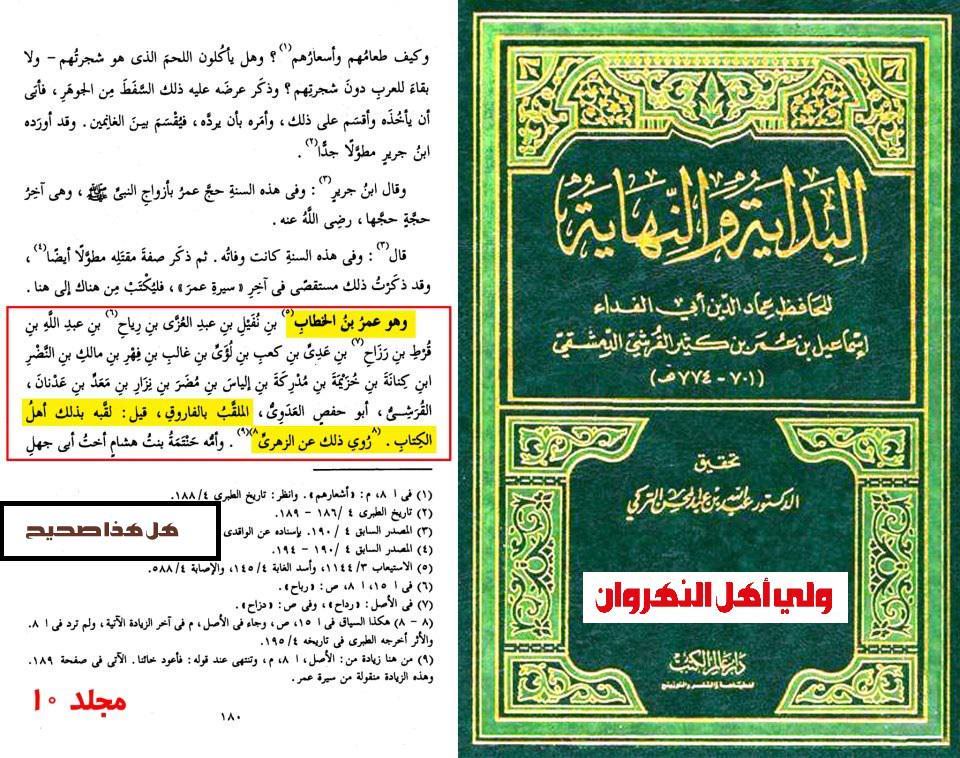
Umar ibn al-Khattab, May Allah be pleased with him, called the People of the Book al-Faruq. Is this true, ya Salafiyah?
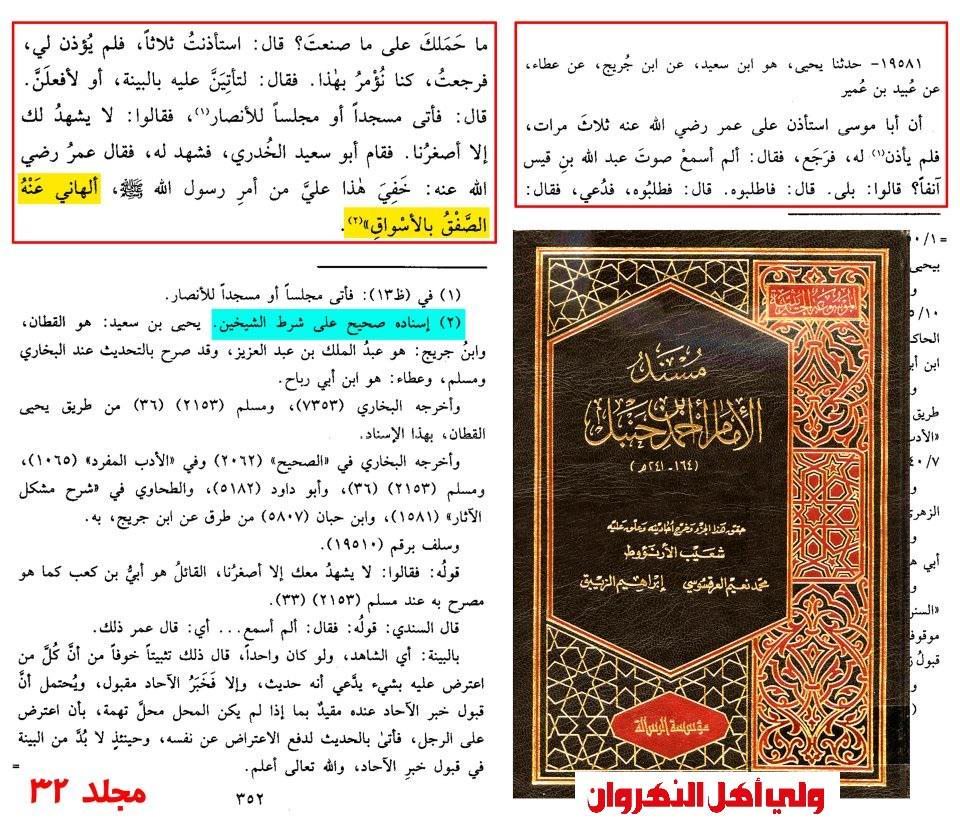
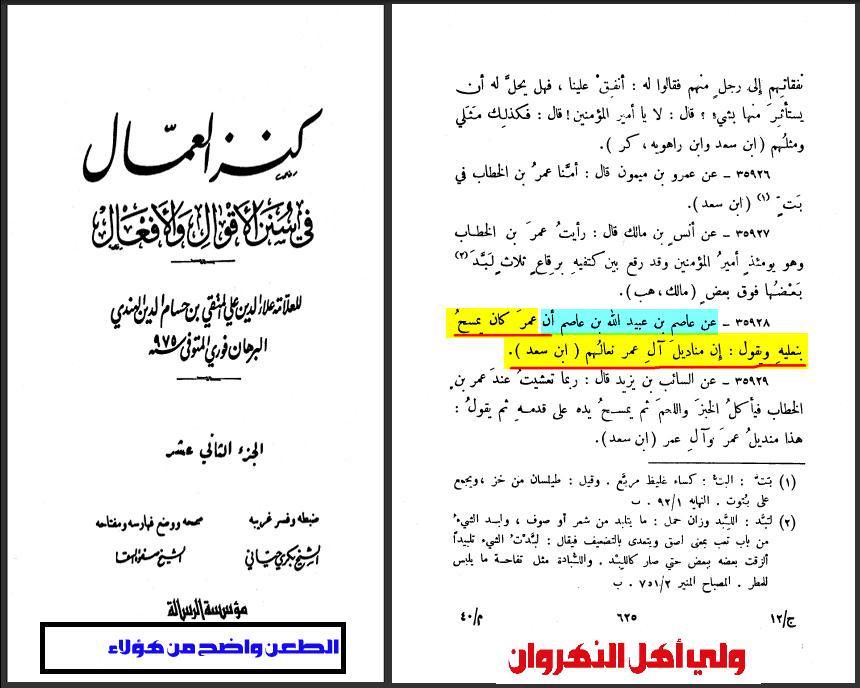
Ahl Sunnah defaming Umar Ibn Al-Khattab! (May Allah be pleased with him), by saying that he was distracted by clapping in the markets!! Who respects the companions? Only the people who have no haya insult Umar (ra)
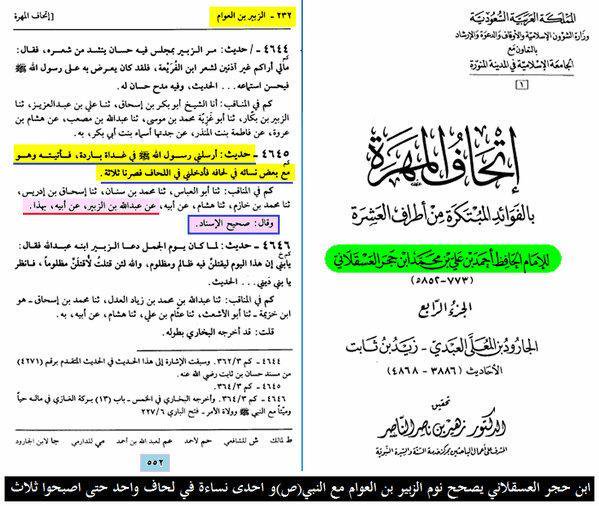
They imagine that the companions of the Messenger of Allah are flirting with a beautiful woman while they are praying! Is this the state of the companions of the Messenger of Allah with you?
Shaykh Ibn Taymiyyah accuses Imam Ali that his war was not for Allah and His Messenger, and if it was for Allah and His Messenger, victory would have been for him! One of the positions of the Ibadi is that Ali came short for going against the hukm of Allah (swt) and later slaughtered the Muslims of Nahrawan. Allah knows best his ending. The other is that Ali had realized his wrong, was overwhelmed with grief and turned in repentance to Allah (swt) and met with a good ending. husnal khatimah
Shaykh Ibn Taymiyyah says that Ali deems the blood of Muslims lawful, and thus he is out and out a Kafir.
Al-Waleed bin Juma’ is from the narrators of Sahih Muslim and Ibn Hazm says his hadeeth is defective and Al-Waleed is a doomed man!
Here they are defaming the Prophet of Allah (saw), his honorable companions, and his pure wives!
Another wretched statement!
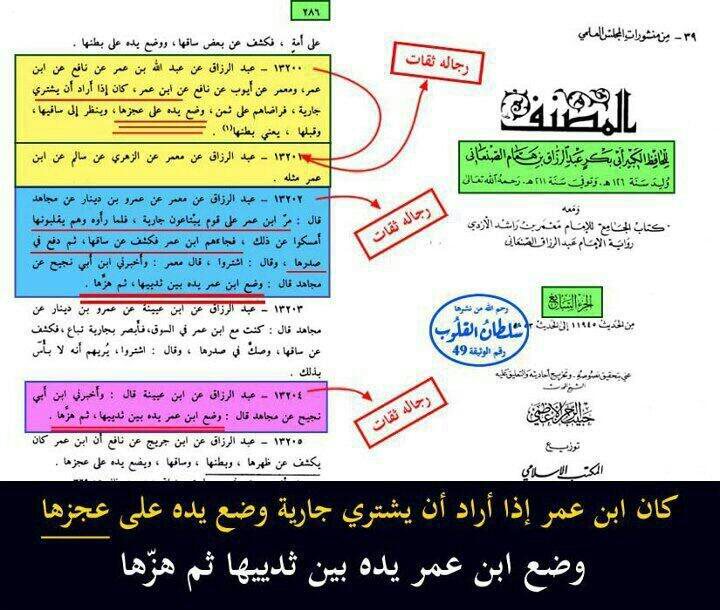
If Ibn Umar wanted to buy a slave girl, where would he place his hand?! Who honors the companions?
Defaming the great companion Umar Ibn Al-Khattab (May Allah be pleased with him).
They claim the Companion Abdullah bin Umar called Abu Hurairah a flat liar!
Among the terms of the reconciliation between Muawiyah and Al-Hassan, after he was betrayed and almost killed, is that Muawiya stop cursing Imam Ali in Al-Hassan’s presence!
Shi’a tend to think Al Hassan’s reconciliation with Muawiya was wrong but that Ali’s arbitration with Muawiya was fine and dandy!
One of Ahl Sunnah says that the faith of Abu Bakr Al-Siddiq (ra) and the faith of Iblees are one! No one says this except for someone who has left the fold of Islam. And the Sunnis excused those who killed Imam Ali and openly insulted and cursed him!
The claim that Fatima Al-Zahraa was a lying woman and lied to Abu Bakr Al-Siddiq, and his narration was received, then she deserted him until she died!
None other than Shaykh Ibn Taymiyyah criticizes the “Rightly Guided Caliphs”!
According to the testimony of Ibn Katheer!
More from Shaykh Ibn Taymiyyah!
Shaykh Ibn Taymiyyah says that Ali fought and killed many Muslims who perform the prayers and pay the zakat, and the matter of blood is more severe! Why is if it an Ibadi scholar says it it is an offense but if Shaykh Ibn Taymiyyah says it is fine?
Shaykh Ibn Taymiyyah says that in Ali’s caliphate there was no mercy, rather people were killed and they curse each other, and they did not have a sword against the infidels, but rather the infidels coveted them and took a country from them and their money.
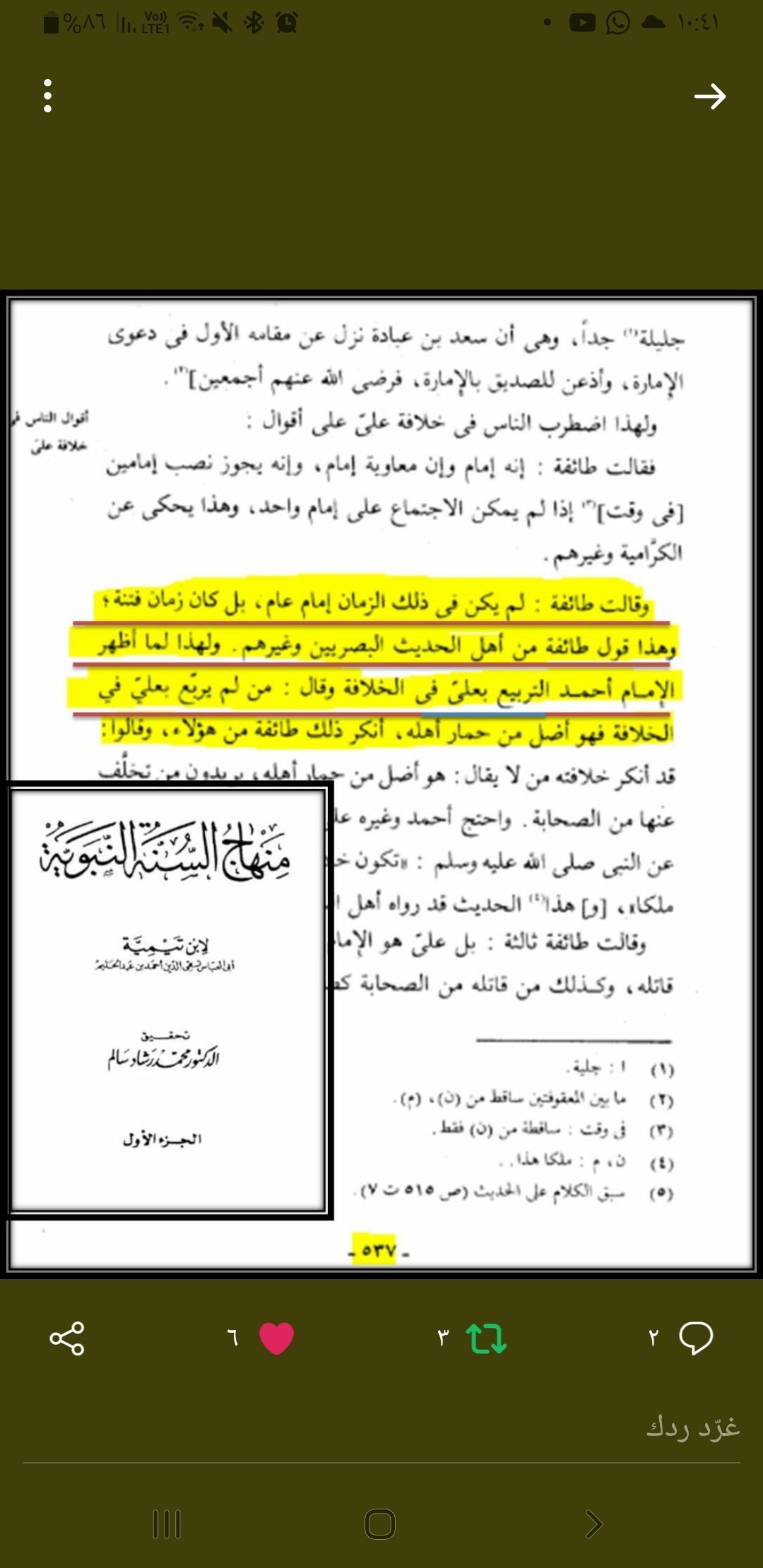
Shaykh Ibn Taymiyyah says that the time of Ali is a time of sedition, and there was no general imam!
Shaykh Ibn Taymiyyah says that the Companions who fought Ali, vilified him and cursed him were more knowledgeable than those who supported Ali and cursed Uthman. Who is disavowing who here?
The predecessors of the Salafiyah are those who did not consider Imam Ali to be the caliph of the Muslims until the time of Ahmed bin Hanbal! Think about that! Do not get it twisted. The Imami Shi’i never accepted the first three Caliphs. The Ahl Sunnah the fourth until Imam Ahmed rehabilitated the image of Ali among them. Where as the Ibadi are the one’s who recognized all four from the beginning! Learn the truth!
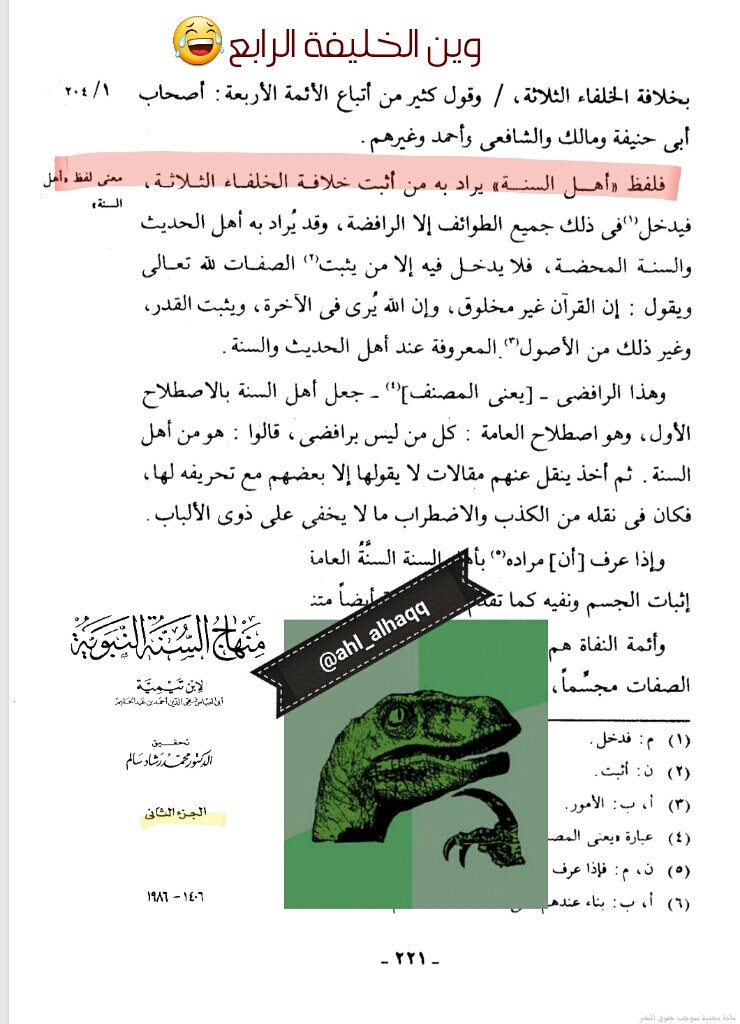
Shaykh Ibn Taymiyyah defines the Sunnis as the ones who established the succession of the three caliphs! Where is Ali?
The jurists of the Hejaz and Iraq from the two groups of theologians and the people of opinion, including Malik, Al-Shafi’i, Al-Awzai, and the majority of Muslims and theologians, agreed that Ali was right in his war in Siffin and in the Battle of the Camel, and that those who fought him were unjust oppressors ! (i.e. Muawiyah and his army, Our Mother Aisha (ra), Talha and Al-Zubayr)
Muawiyah tempts the child killer Ibn Arta’ah to kill Ali bin Abi Talib and promises him the best of this world and the Hereafter! But remember Ahl Sunnah will tell you they loved each other as brothers! Of course they did!
Shaykh Ibn Taymiyyah says that Umar is less mistaken than Ali, and they found the weakness in Ali’s sayings more, and they found contradiction in Ali’s sayings more than the contradictory sayings of Umar!
Ibn Asakir The Syrian Sunni Islamic scholar says that Marwan Ibn Al-Hakam used to curse Imam Ali on the pulpit every Friday for six years, then he was dismissed and reinstated again, and he did not stop insulting him!
Muawiyah mobilizes the people of Basra to fight Imam Ali.
Shaykh Ibn Taymiyyah says that many of the Companions were known to have slandered Ali!
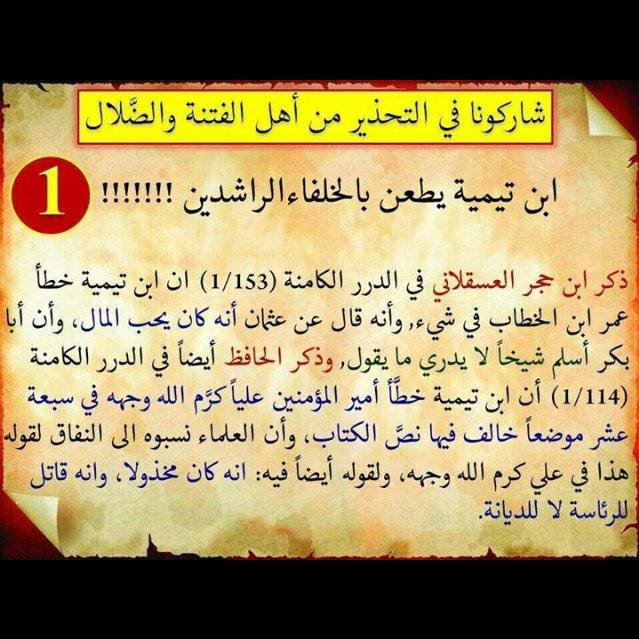
Ibn Hajar Al Asqalni openly quotes the things Ibn Taymiyyah has said about the companions that Ibn Taymiyyah and his supporters want to hide from people.
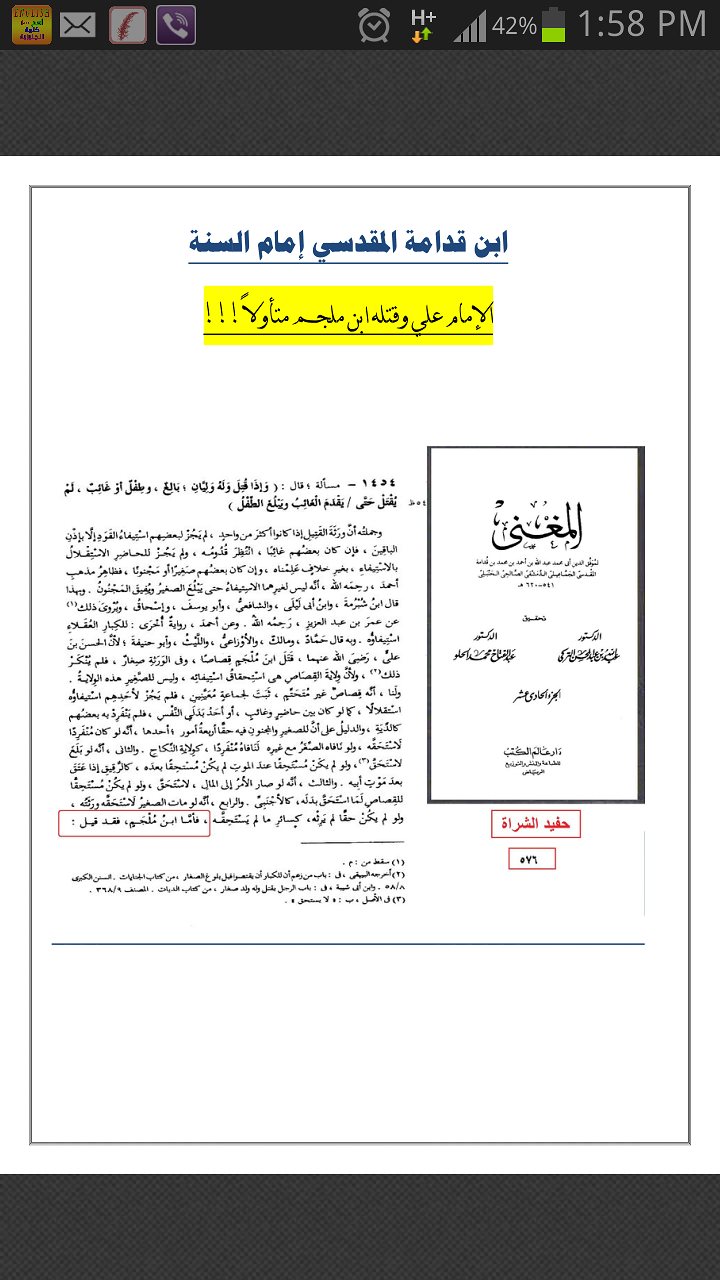
Look what the Hanbali Imam Ibn Qudama said about Ibn Muljim killing Imam Ali!
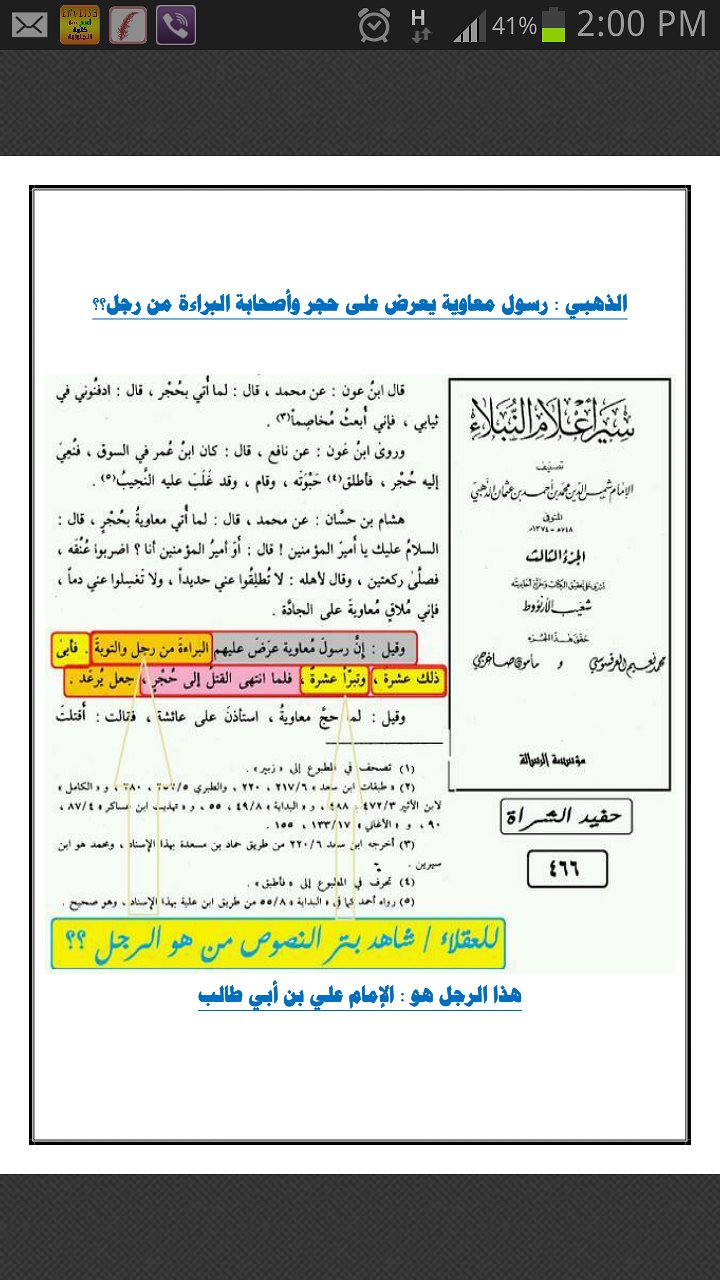
Al-Dhahabi: The Messenger of Muawiyah offers Hajr and his companions the innocence of a man! And the man is Imam Ali However, why amputate and hide the texts?
Shaykh Ibn Taymiyyah is skeptical whether Imam Ali memorized the Qur’an or not?
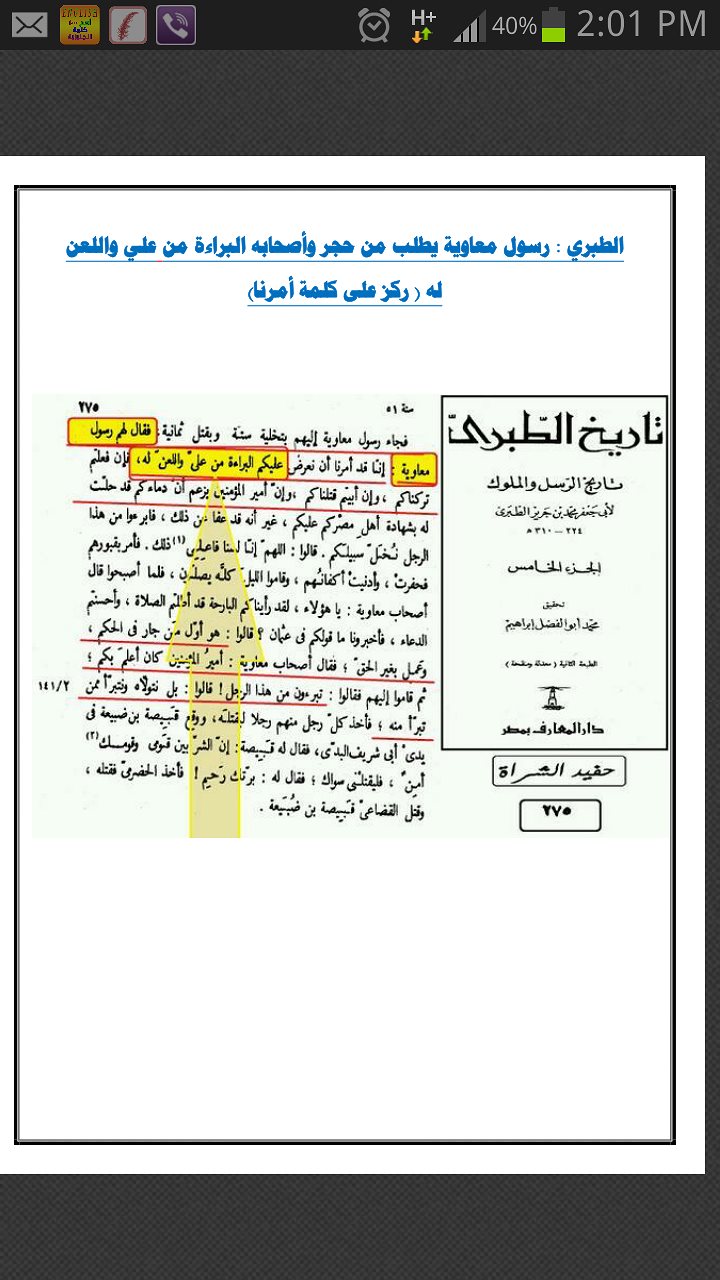
Al-Tabari: The Messenger of Muawiyah asks Hujr and his companions to disavow Ali and curse him, and tells them that we have been commanded to do so!
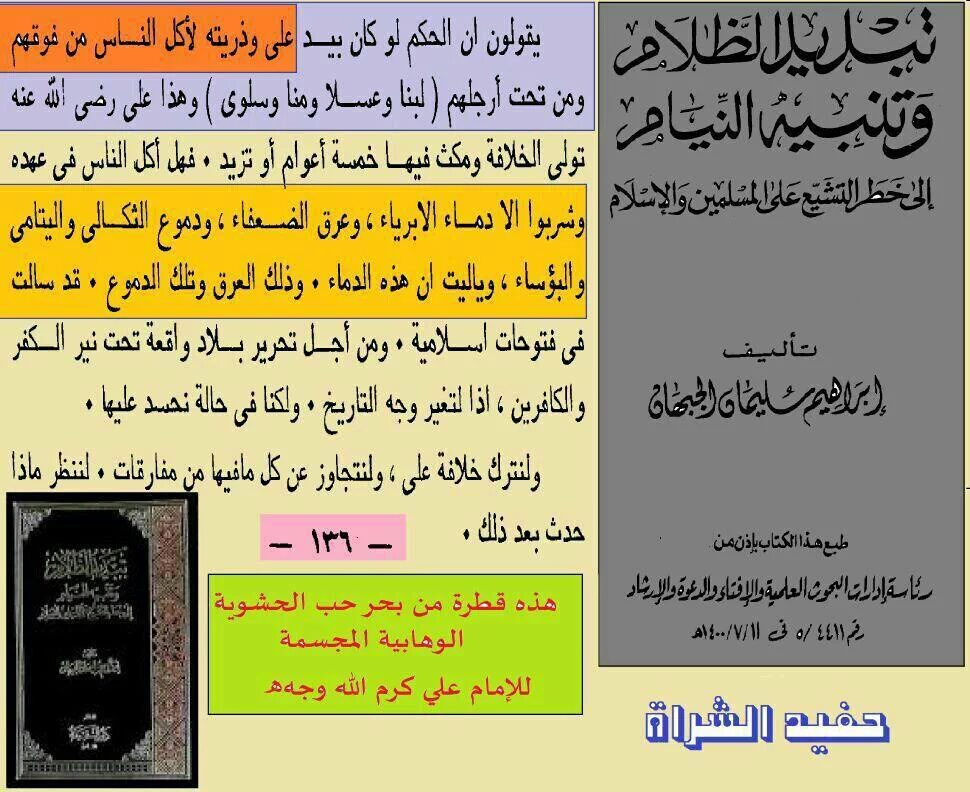
Imam Ali stayed in the caliphate for five years or more, so people ate and drank the blood of the innocent, lived off the sweat of the weak, and the tears of the bereaved, as well as the suffering of the orphans and the miserable!
Shaykh Ibn Taymiyyah’s opinion laid bare regarding the leadership of Imam Ali and those who fought Imam Ali and those who did not fight with him!
Shaykh Ibn Taymiyyah, the three caliphs agreed upon by the Muslims, and the sword was unsheathed against the infidels and kept from the people of Islam. Ali, the Muslims did not agree to pledge allegiance to him, but rather sedition occurred during his reign, and the sword was kept from the infidels and unleashed on the people of Islam! In fact I (Prima-Qur’an) being non-partisan am inclined to agree with Shaykh Ibn Taymiyyah here. It is a point against the Shi’i as the reign of Ali was not one of barakah, but of blood shed of believers and deep divisions that have lasted until this very day. If I say it as an Ibadi I will be called Kharijite where as Ibn Taymiyyah makes a good observation and gets a free pass.
Al-Abbas describes Ali as a treacherous sinner and a traitor; and ask Umar to judge between them? ! Hey Ahl Sunnah what is the ruling on the treacherous, the sinner, the traitor? Where is the love of the Companions?
Shaykh Ibn Taymiyyah: Hating Ali does not harm faith one bit!
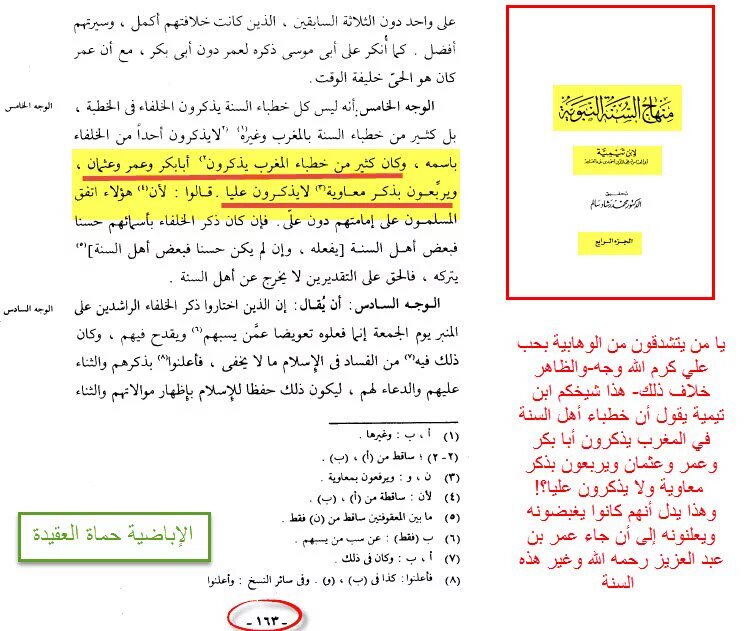
Shaykh Ibn Taymiyyah: The preachers of Morocco mention Abu Bakr, Umar and Uthman, and they mention Muawiyah, but they do not mention Ali. It is clear that they hated him and cursed him!
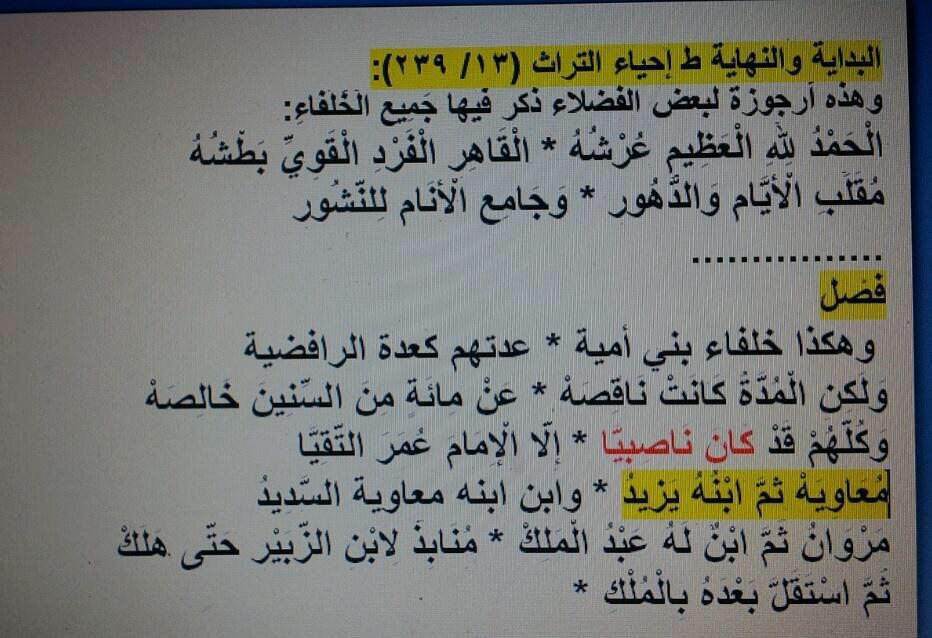
The whole of Banu Umayyah, are a clan of Ali haters, all except for Umar bin Abdul Aziz, the just!
Al-Awza’i: We did not accept the giving until we witnessed Ali’s hypocrisy and disavowed him! Is this the love of the Companions?
Shaykh Ibn Taymiyyah: Imam Ali did not show the religion of Islam during his caliphate, and their enemies among the infidels and Christians coveted them! If the religion of Islam did not appear during Ali’s caliphate, then what religion did appear during his caliphate?
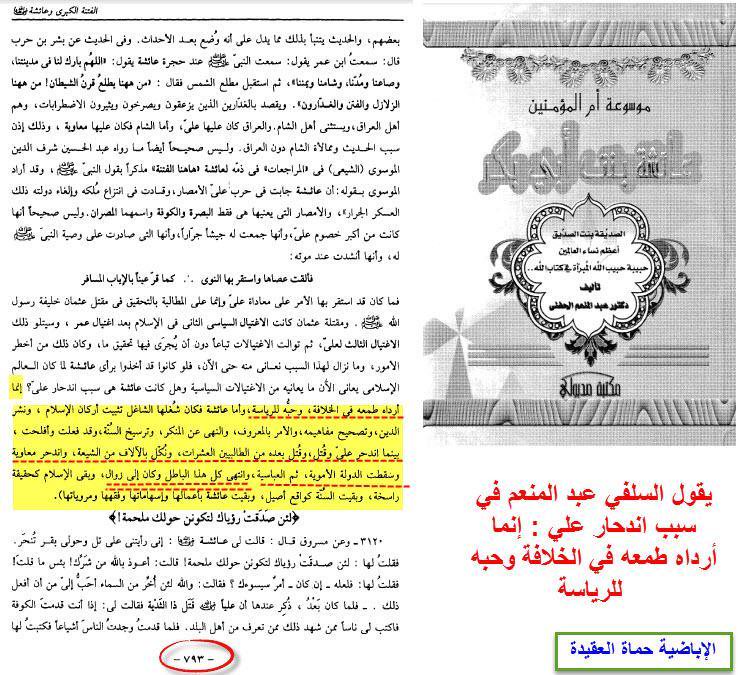
The Salafi Shaykh Abdel Moneim Al-Shahat states: “The reason for Ali’s defeat was caused by his greed for the caliphate and his love for leadership!”
How does he know what is in Ali ibn Abu Talib’s heart? Rather the reason for Ali’s defeat was going against the Amr of Allah (swt) in the Qur’an and in all my encounters with the Shi’i they Shi’i flee from this point!
Shaykh Ibn Taymiyyah expresses what is in his heart towards Imam Ali here:
Ibn Hajar in Al-Durar Al-Kamina transmits from Ibn Taymiyyah his visciousness towards Imam Ali!
Here they are – slandering the Mothers of the Believers, the Messenger of Allah, and Umar ibn al-Khattab!!!
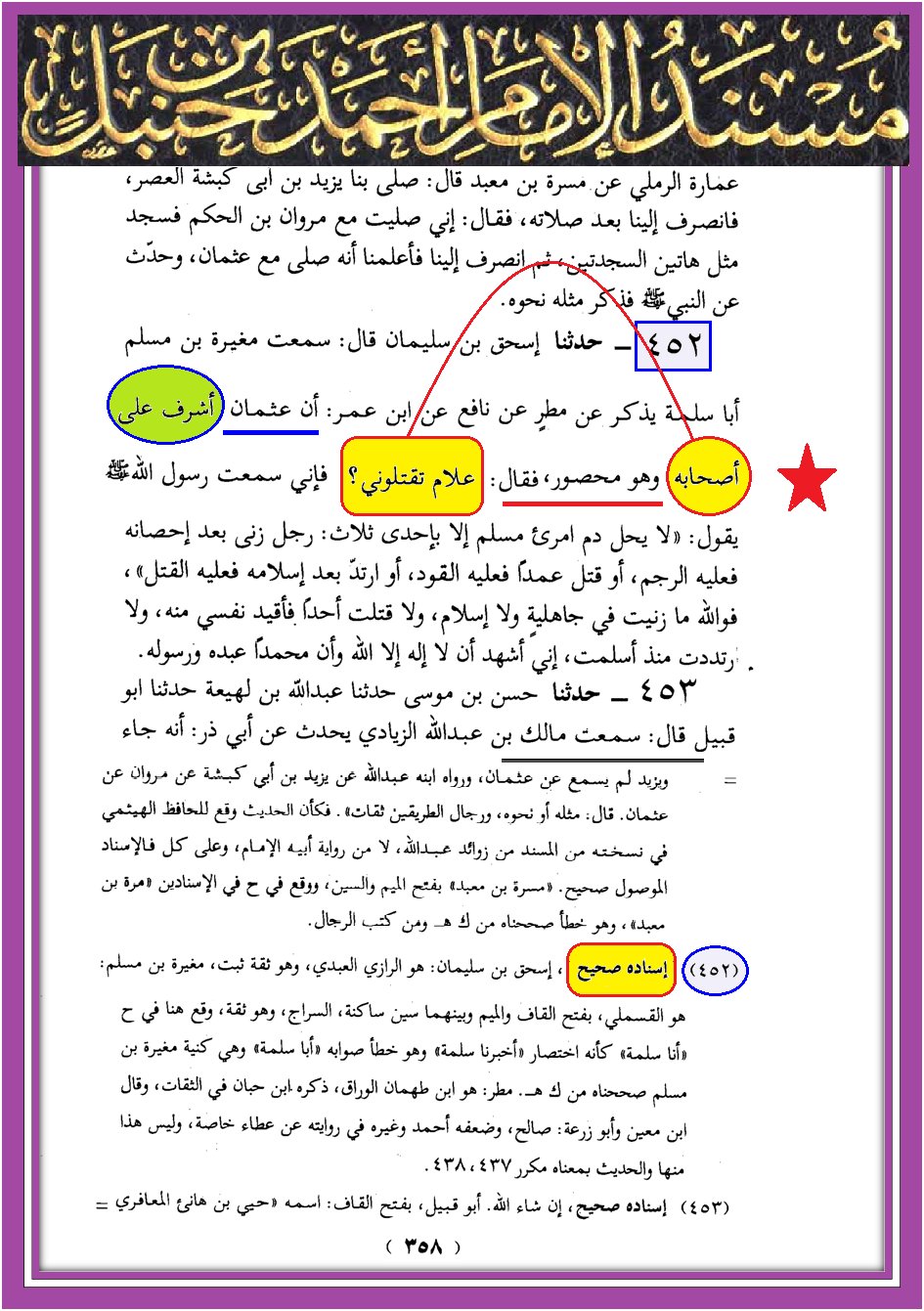
The book of Musnad Imam Ahmad: Caliph Uthman directs his words to his companions while he is besieged and says to them: “Why are you killing me?!” A question for the Sunnis, why do you spread rumors among the people that the one who killed Uthman were rabble and bandits who came from Egypt?!
And why are you basically exposing the sedition of the Companions?! These books expose your lies!
They have admitted to fabricating false hadiths about Uthman!
Marwan killed Talha, one of the so called ten promised paradise, and because of him, events unfolded to lead to what what happened to Uthman, and he was severely cursing and abusing Imam Ali. Despite all that the Ahl Sunnah praise him.
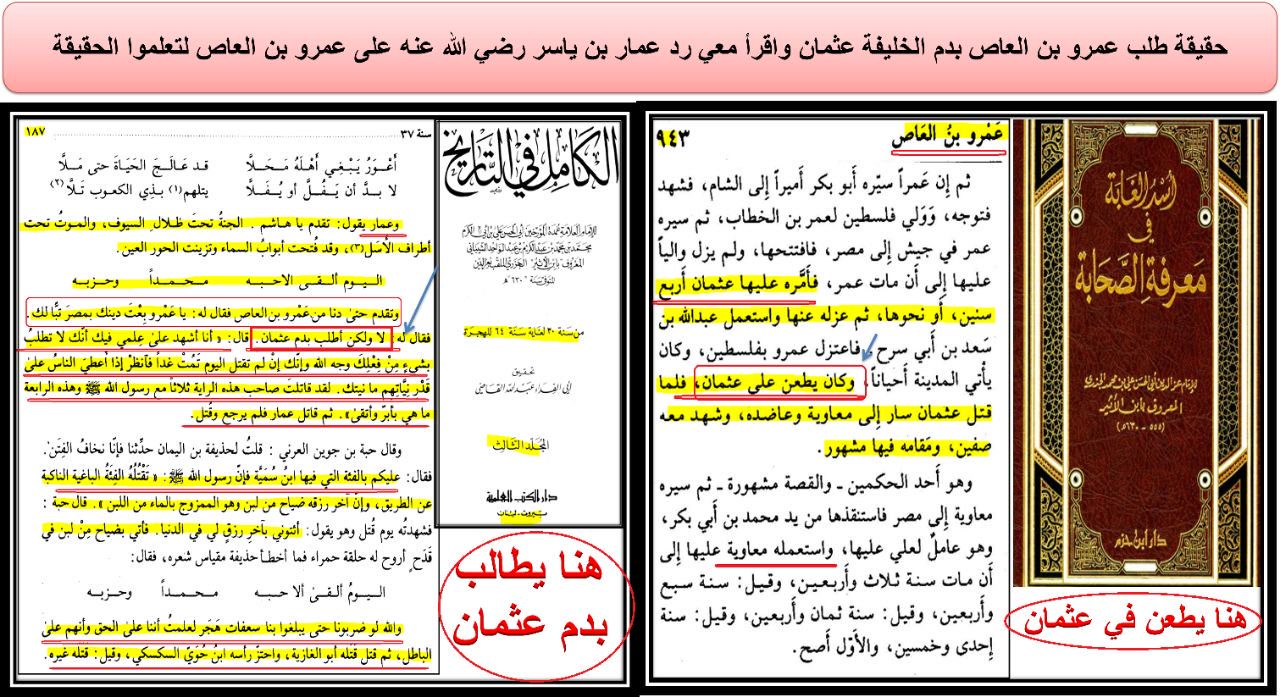
Amr Ibn Al-Aas once stabbed the caliph Uthman and once demanded the blood of Uthman. The books of Ahl Sunnah expose their lies!
In The Book of The Comprehensive Explanations on the Tahawi Creed: They Criticize Uthman and Deplore His Killers!
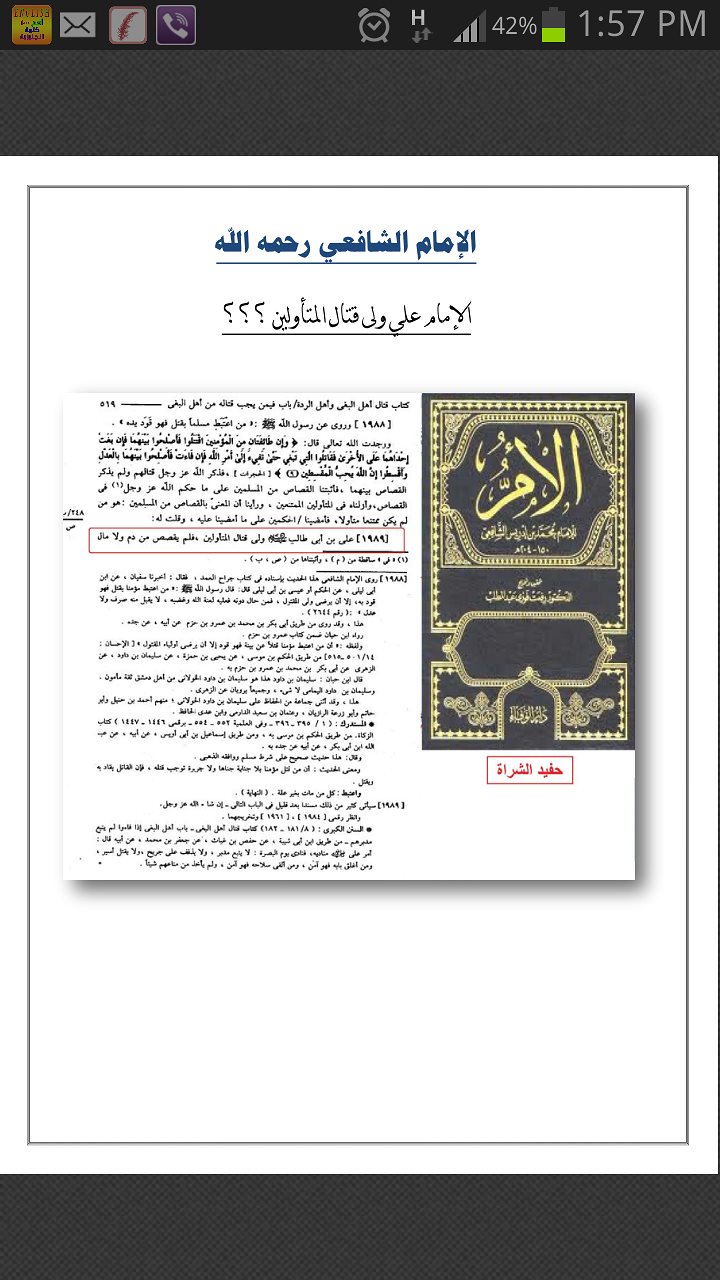
Imam Al-Shafi’i says Imam Ali that he did not take revenge on blood or money! That is, those who participated in the killing of the caliph Uthman, Imam Ali did not take revenge on them because they were not in the wrong! Is this correct?
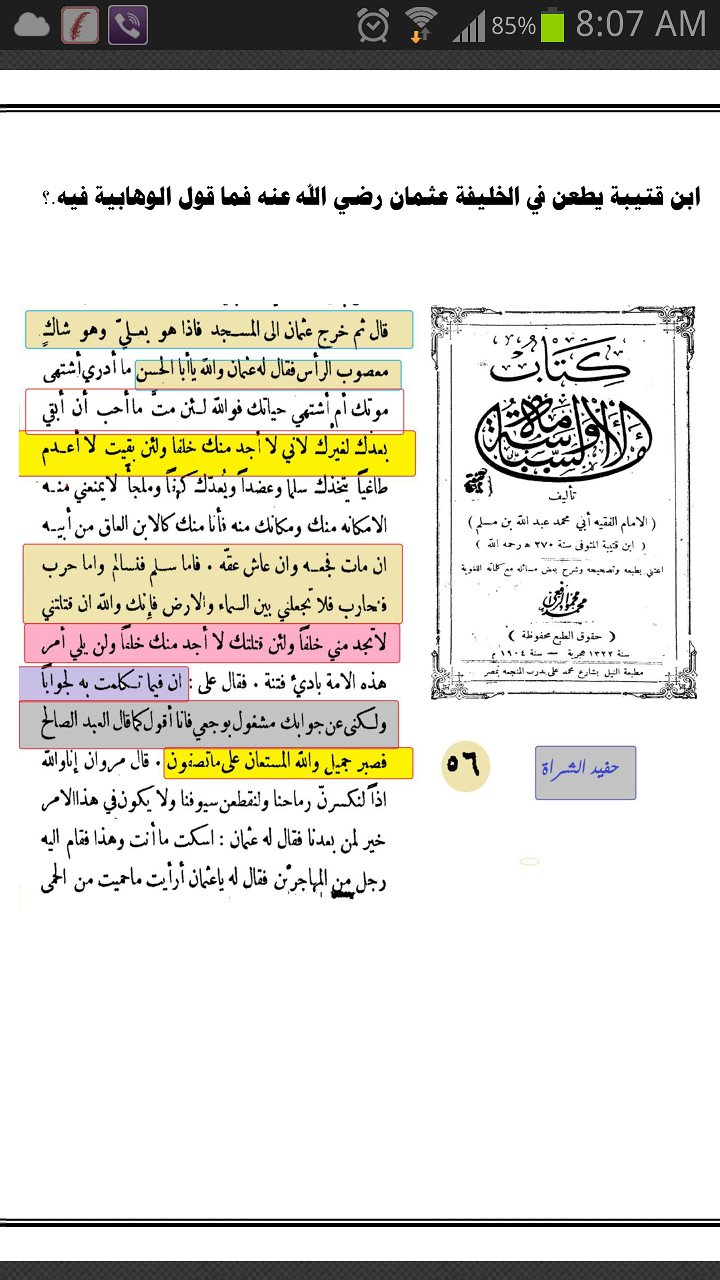
Ibn Qutayba criticizes Caliph Uthman so is he a kharijite?
Shaykh Ibn Taymiyyah at it again! This time he slanders both Uthman and Ali!!
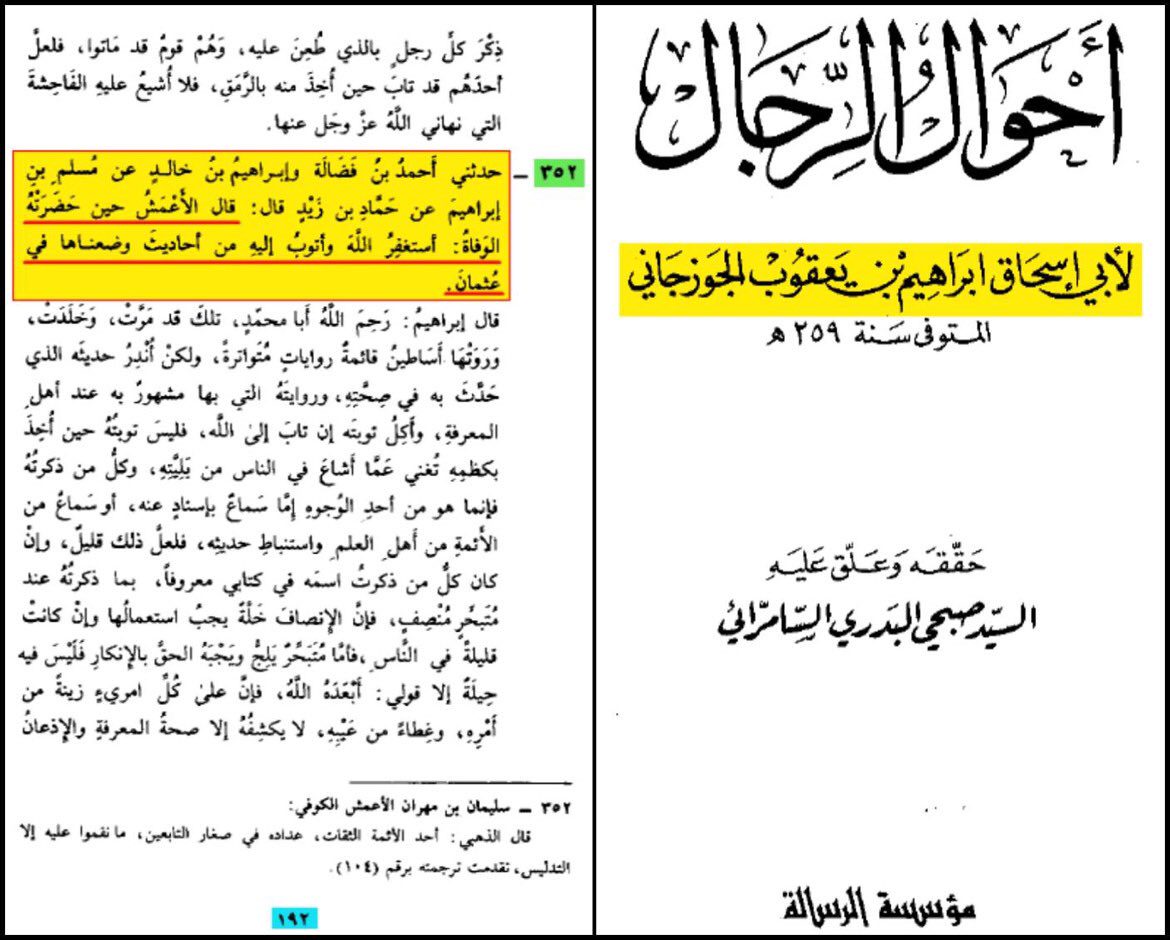
The companions in Kufa slander Uthman, some of whom witnessed Badr! Obviously they did not believe the Qur’an teaches that all companions go to paradise.
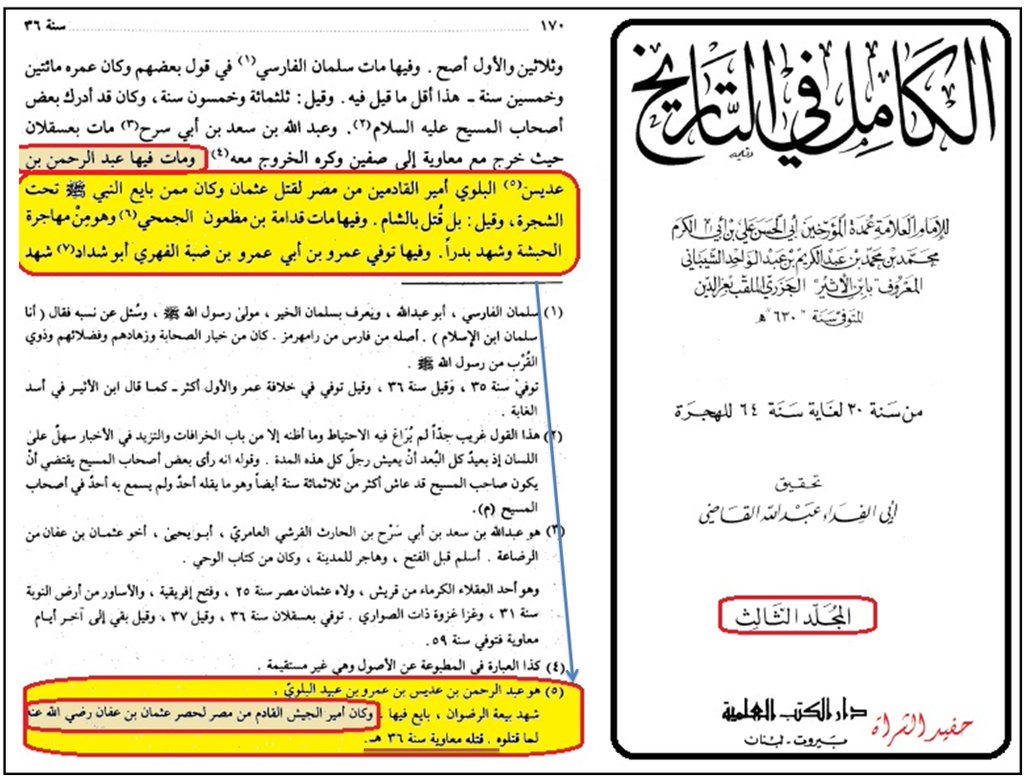
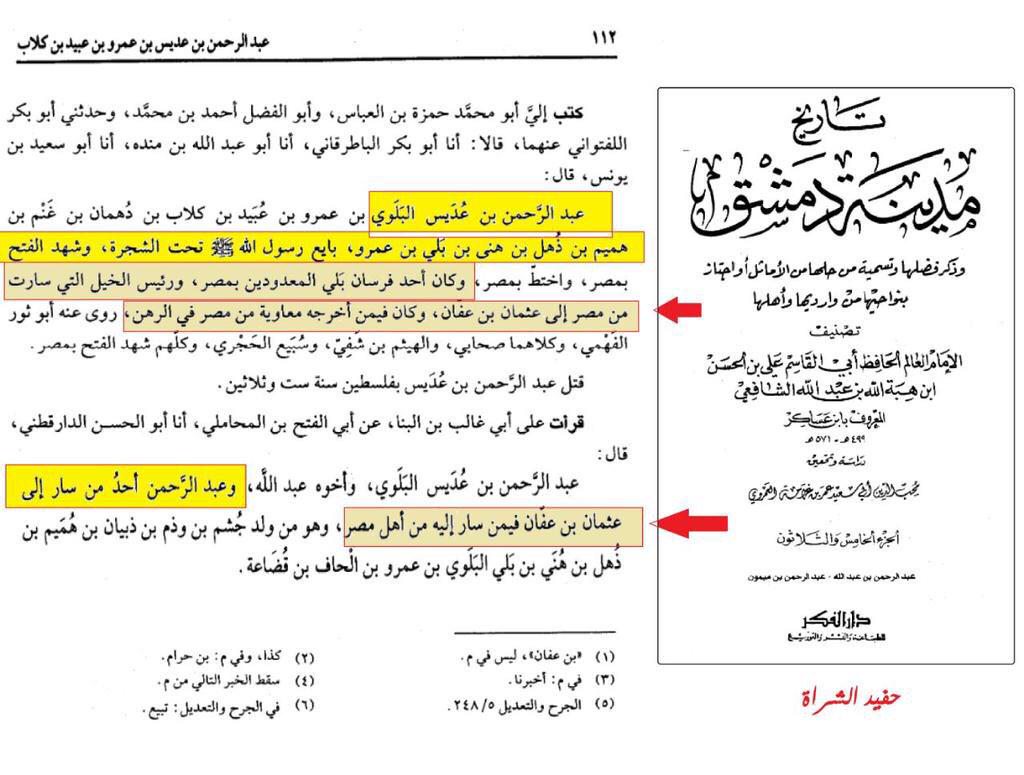
The companion Abd al-Rahman bin Udays was among those who pledged allegiance under the tree. He was the commander of those coming from Egypt to besiege Uthman! And many are those among the Sunni who enjoy sedition and lie to the people that those coming from Egypt are nothing but rabble and deviants!
Remember the Salafi preacher who went on air and cursed the companion Amr b. al-Hamiq al-Khuzāʿī for stabbing Uthman in the chest 9 times! Even after he found out the man really was a companion he did a 180 but still maintained all the companions are just. Then the conclusion can only be that Uthman was killed with justice. Or the companion killed Uthman without justice with is a major major sin. It is a difficulty no doubt about it.
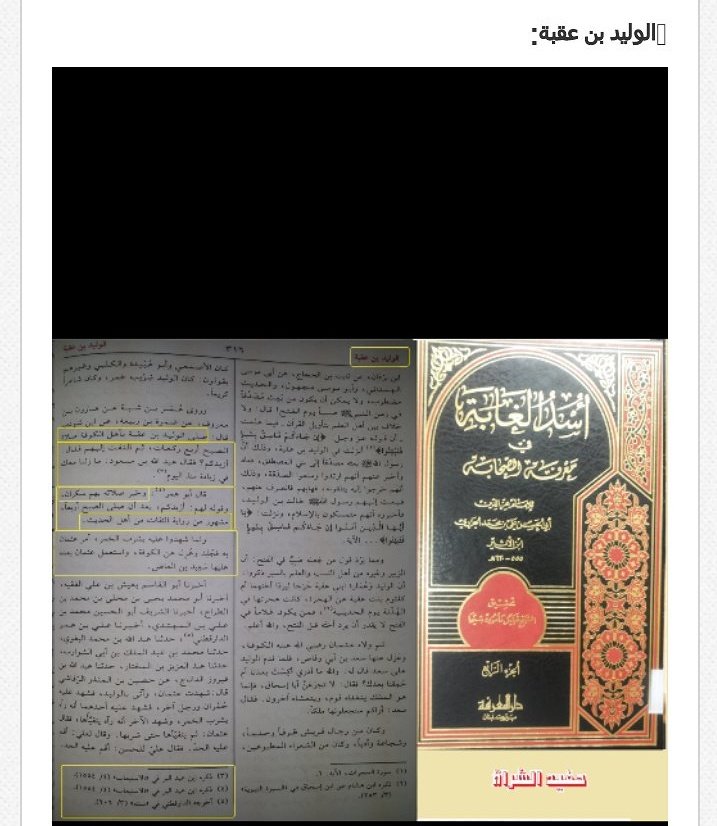
The Ahl Sunnah scholar says about the companion Al-Walid bin Uqba, Uthman’s brother to his mother, that his beard drips with wine!
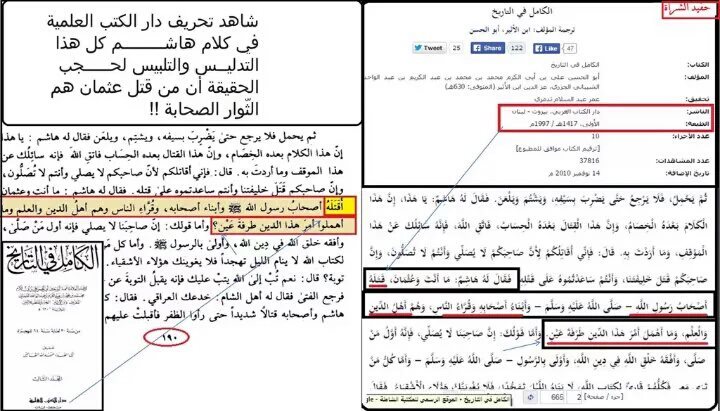
Al-Kamil fi at-Tarikh edited to hide the truth from people!!
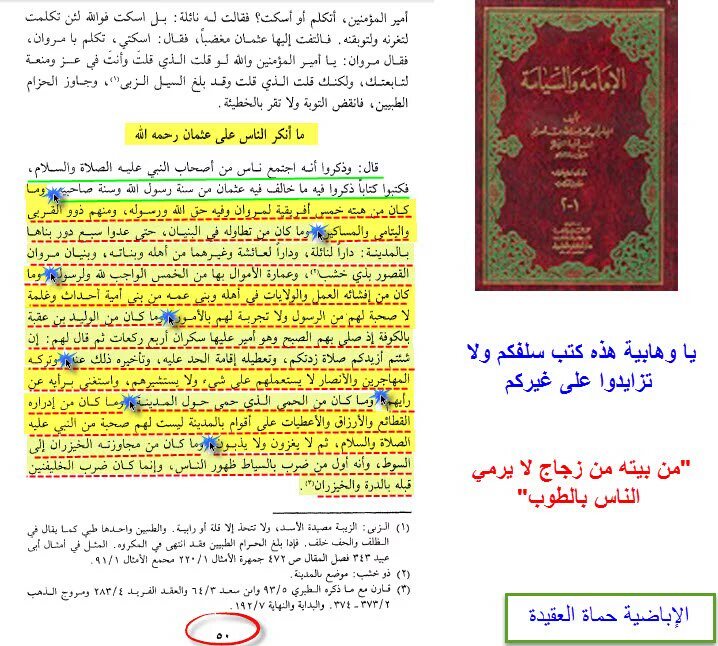
A complete chapter titled: “Why people denounced Uthman!” Imagine if Ibadi’s wrote a book like that with a title like this!
In the Sunni books the mother of the believers, Aisha (r.a) is stated to have said: “Kill Nathla, for he has committed blasphemy,” Nathla meaning Uthman!
Uthman spoiled the innermost secret of the divorced (freed-slaves)!
With in the book of Ibn Qutayba we find more censures against Caliph Uthman by a number of companions!
Aisha (r.a) the mother of the believers orders the killing of the companion Uthman bin Hanif!
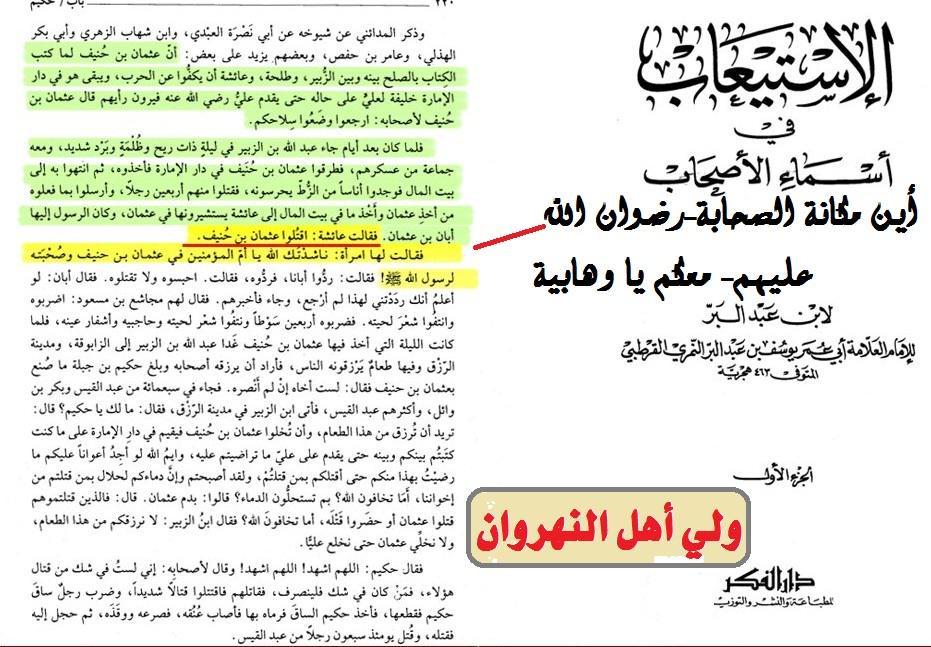
Accusations of the murder of Caliph Uthman distributed among three: Aisha, Talha and Imam Ali!
The honorable companion Abd al-Rahman bin Udays al-Balawi who was among those who witnessed the conquest and was among those who pledged allegiance under the tree, and we see clearly his role in relation to Caliph Uthman!
The Sahabah themselves participated in the revolt against Caliph Uthman, as well as the sons of the Companions! Enough of your one sided views of history and delving into sedition and saying that that the Muslims were so stupid, so unaware, so aloof that Caliph Uthman was taken by surprise by unknown revolutionaries and unknown people!! All the while laughing at the common people and praising Muawiya and the Umayyads and telling the events to fit your lies to serve your agenda!
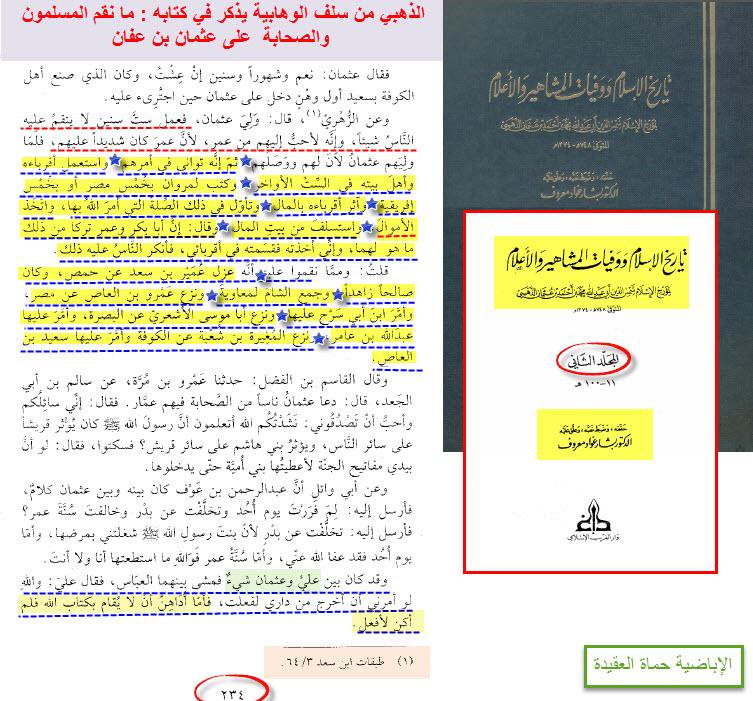
Al-Dhahabi, himself one of the predecessors of Al-Wahalia, mentions how Muslims resented Uthman! Where is the respect for the Companions and the shedding of crocodile tears to serve your malicious agenda?
A companion of the people of the allegiance of Al-Radwan and the leader of the revolutionaries was against Uthman!
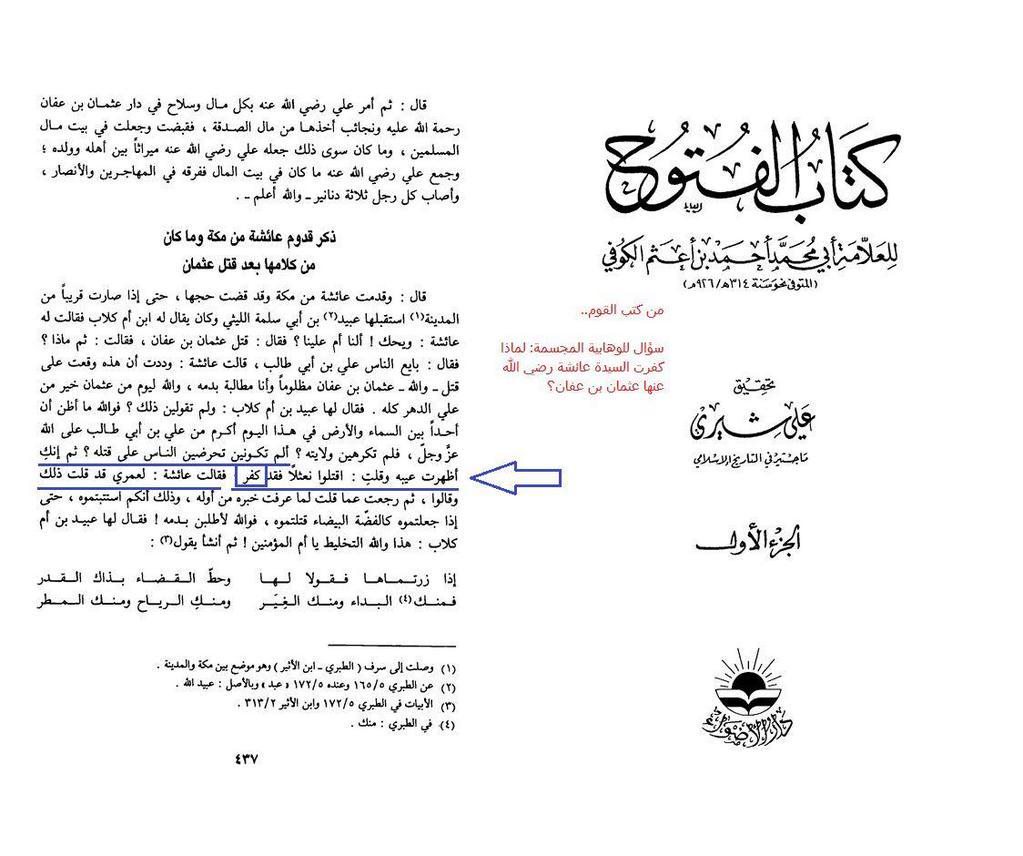
In the Kitab al-Futuh: Aisha calls for the death of Uthman!
Umm Habiba appeals to Ali bin Abi Talib to protect Uthman and respond to her, unless he is dishonorable and miserable, meaning Uthman! And what is the greatest and most grievous attack against the Companions, other than that?
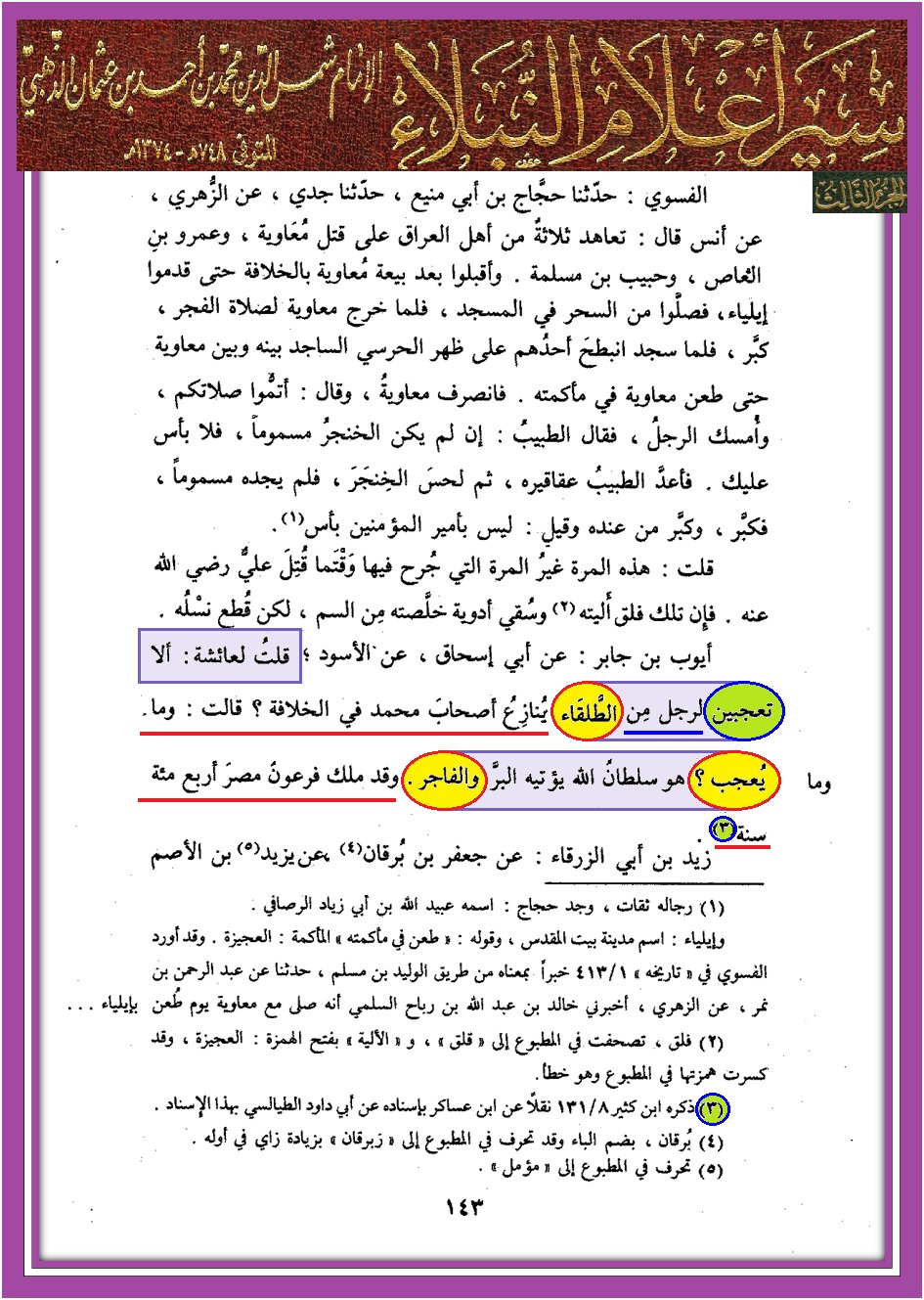
It was asked of the mother of the believers Aisha, “Do you not like a man from among the divorced men who disputes with Muhammed’s companions regarding the caliphate?” So what did Aisha say? !
Musannaf bin Abi Shaybah: Their are kings from the evil of kings, and the first of these kings is Muawiyah!
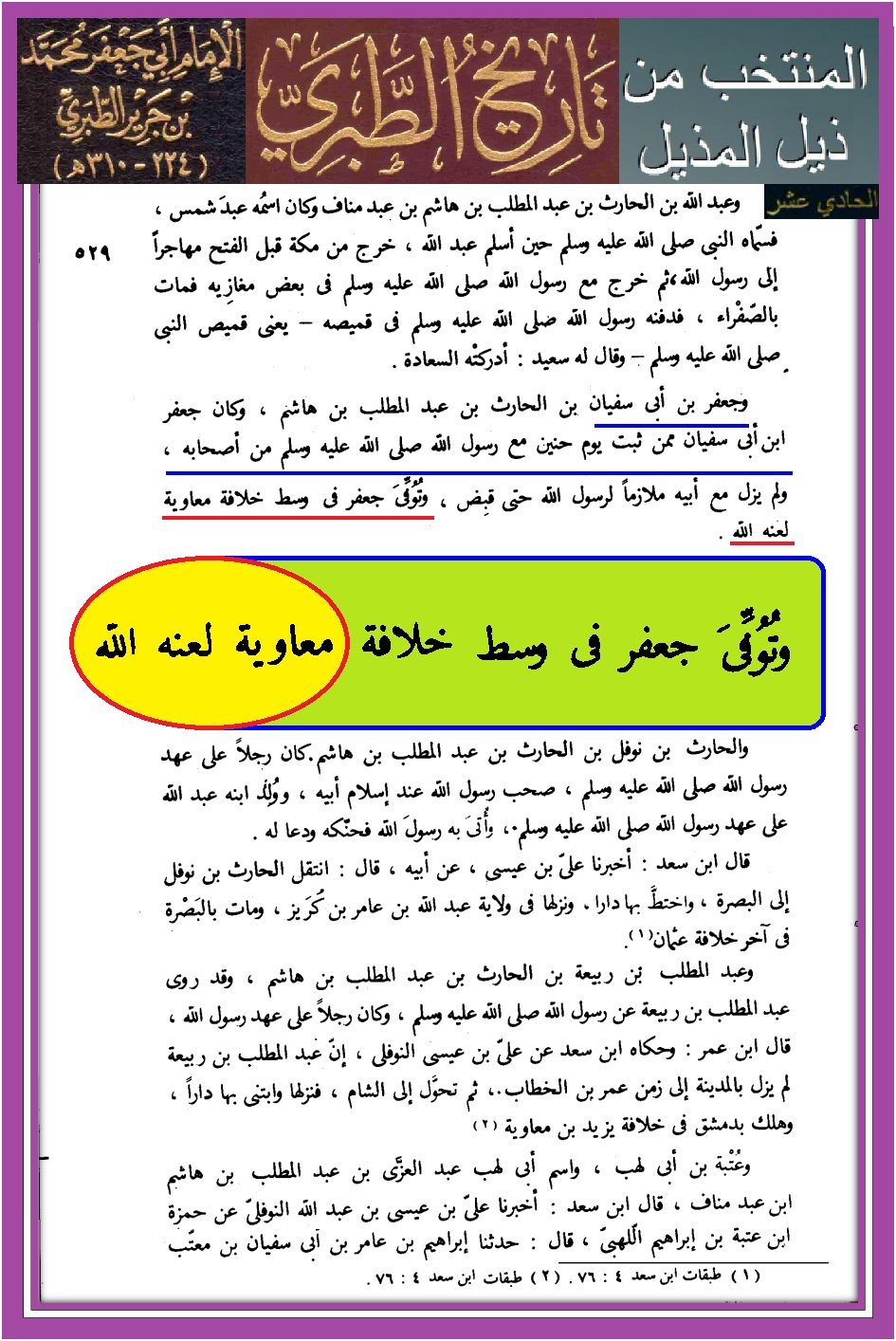
“Jaafar died in the midst of the caliphate of Muawiyah, may Allah curse him!”
“Yazid bin Muawiyah, may Allah curse them both!” More cursing and curses! Why all this cursing? Wasn’t Mu’awiyah one of the Companions?!
These books expose your hypocrisy!
The books of Ahl Sunnah are filled with it. May Allah (swt) curse so and so.
The Sunnis praise Muawiya and that he is the best of kings, then they add to this by saying that he approves of insulting Imam Ali! Have you gone mad?! Imam Ali is cursed and the one who curses him is said to be the best of kings!? WoW!
Let Imam Al-Suyuti quotes the words of Aisha (r.a) telling us what she really thinks about Muawiyah!
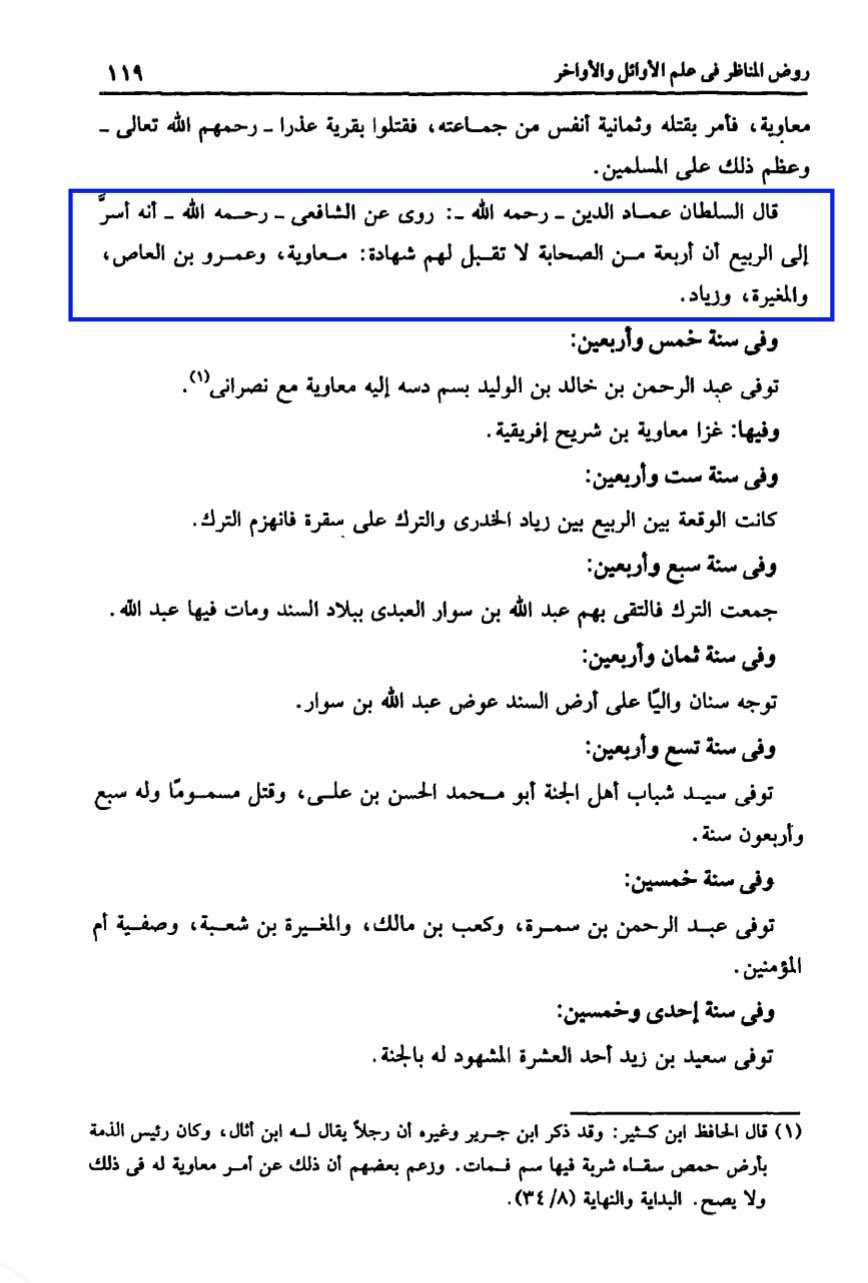
Imam Al-Shafi’i: list four sahabah whose testimony is not accepted! Testimony is taken from the truthful so what is the state of those four sahabah? These books expose their lies.
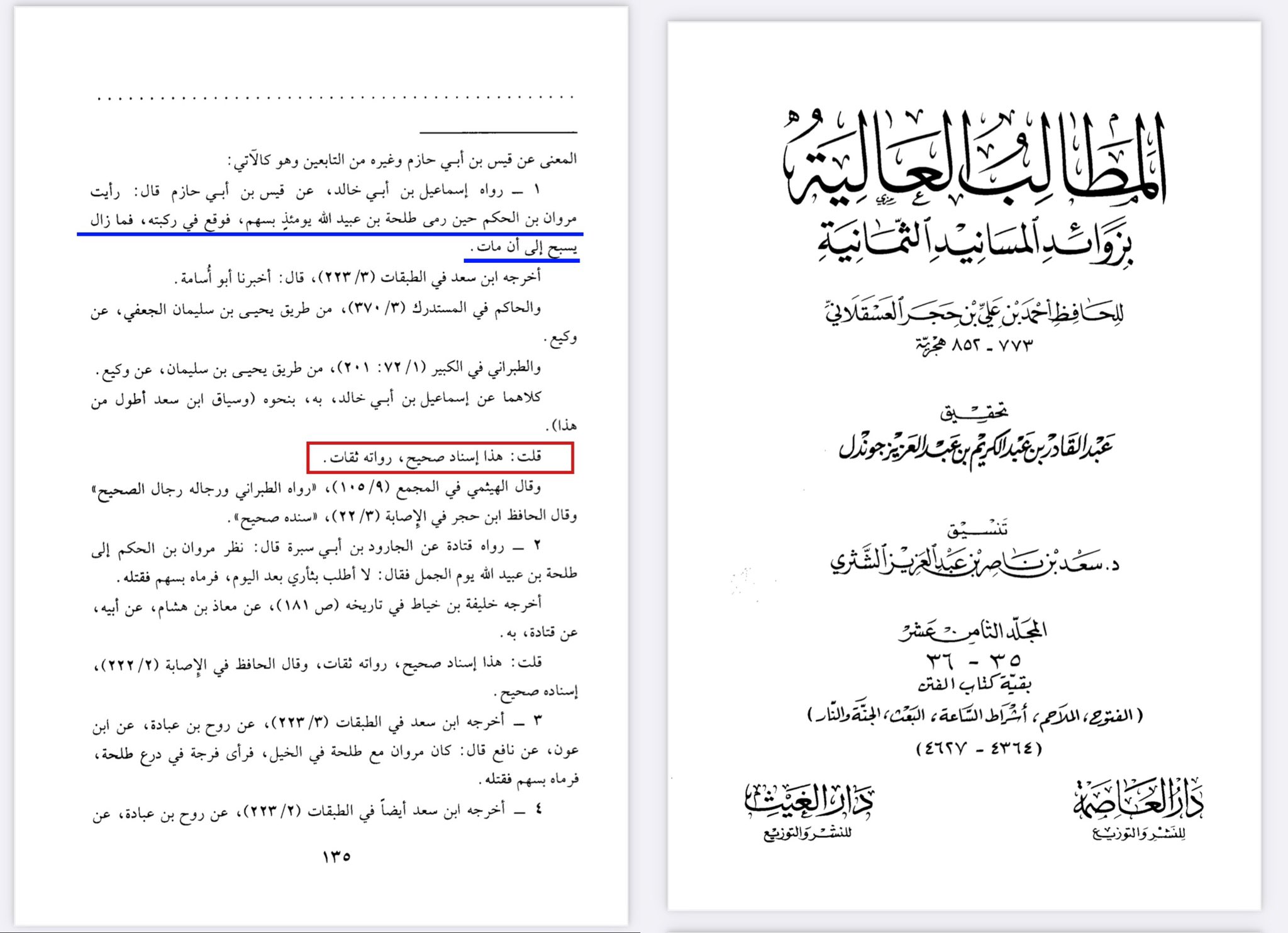
Marwan bin Al-Hakam, the first man with the caliph Uthman, hits the companion Talha bin Obaidullah with an arrow, and he kills him!
Shocker! Muawiyah bin Abi Sufyan and wine! Your books expose your hypocrisy.
Two companions insulted Muawiyah, and Imam Ali declared Muawiyah is upon misguidance!
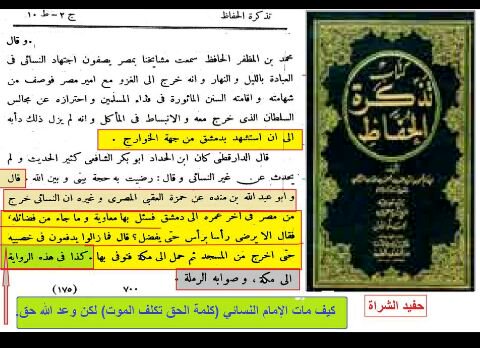
The cause of the death of Imam al-Nisa’i, May Allah have mercy on him, at the hands of the fanatical Banu Umayyah!
How did Imam Al-Nisa’i die!? The word of truth may cost you your life, but Allah’s promise is true! The curse of hatred, hypocrisy and criminality!
The position of Sunni scholars towards Muawiya!!
The books of the Salafiyah declare Muawiya to be an infidel.
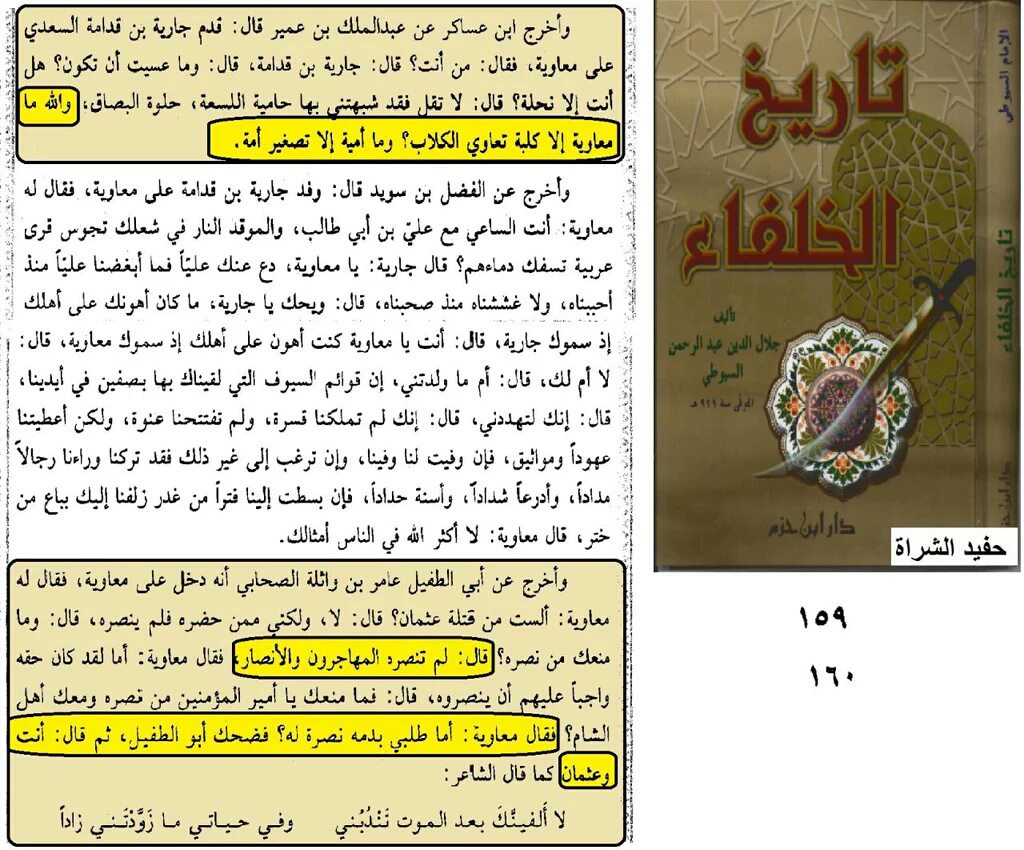
The Insulting and cursing of Muawiya and Uthman in Sunni books.,The Muhajireen and the Ansar did not support Uthman.
Ali bin Al-Jaad swears that Muawiyah died in a state other than Islam! Ali bin Al Ja’ad is a narrator in Bukhari and Imam Bukhari has taken some 13 narrations from him in his Sahih.
A fatal statement that afflicts Muawiya and which breaks those who glorify him!
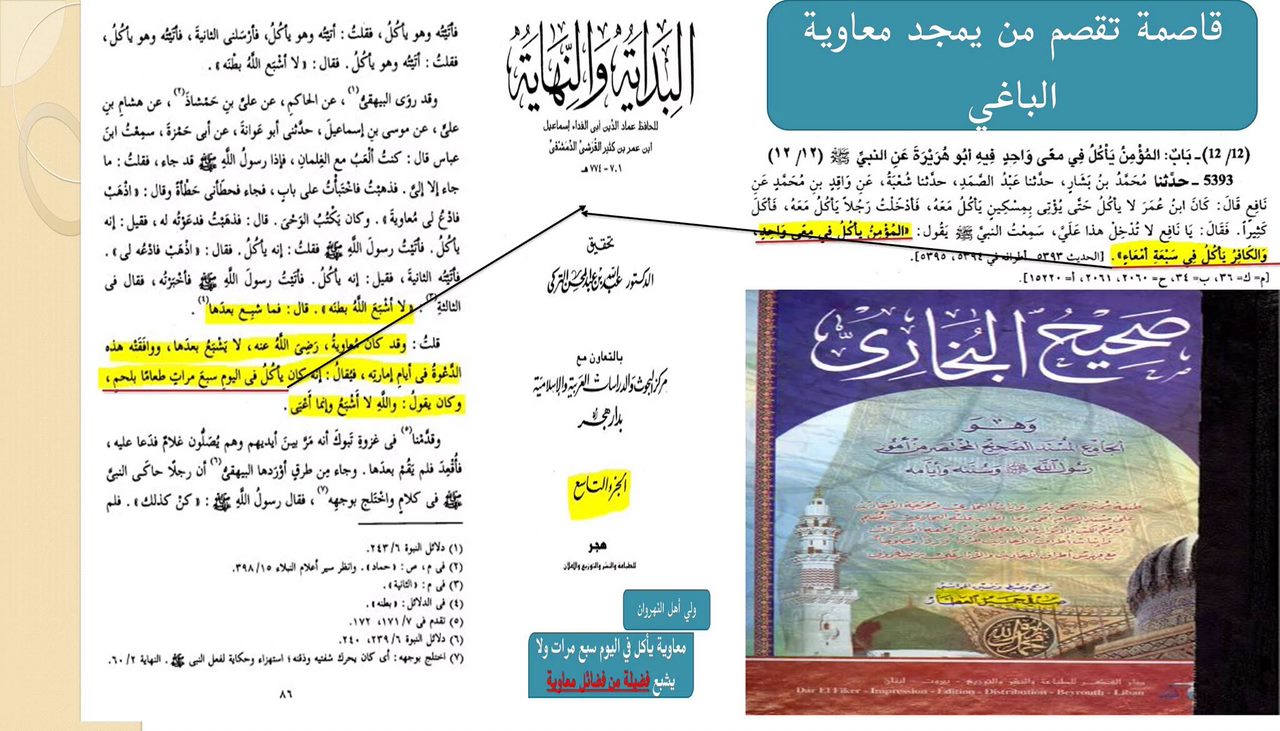
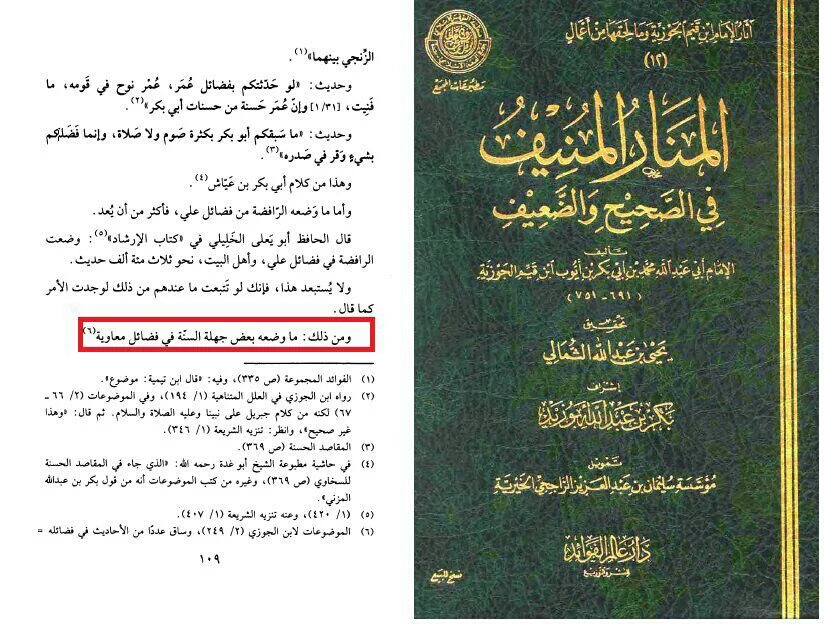
The ignorant who fabricate hadiths in favour of Muawiya!!
The Companion Hajr bin Uday who witnessed such battles such as the pivotal conflict of Al-Qadisiyah, Al-Jamal, and Siffin, and he was a Shiite of Ali, who was killed by Muawiyah’s order in Damascus!
If Ali Ibn Abu Talib had his hands drenched with the blood of the Muslims there is no doubt that Muawiyah bathed in it!
Muhammed bin Abi Bakr Al-Siddiq was killed on the orders of Muawiya. He was inserted into the stomach of a donkey and then burned! Shall we say “May Allah be pleased with such a man” and expect people to enter into Islam?!
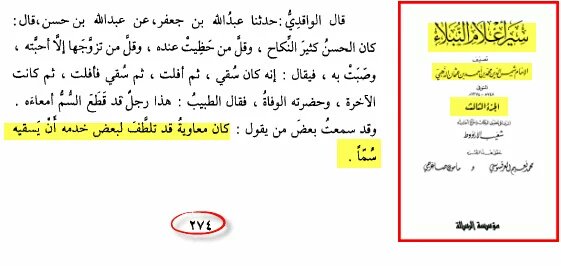
Muawiyah was kind to some of the servants of Al-Hassan, and thus, Al-Hassan died of poisoned! Your books expose your hypocrisy!
The killing of the companion Hajar bin Uday and his companions was mentioned with glee by Muawiya and his army!
Muawiya was the uncle of the believers!? With family like that who needs family!
Question for your Sunni friends: Lil game of trivia. Was Muawiya truthful in accusing Imam Ali?! If so Ali is a brigand that usurps rule without right. If not Muawiya is a bold face liar.
Al-Hassan Al-Basri states: Four qualities were in Muawiyah, if he had only one of them, he would have been disastrous!
Muawiyah drank what? “Then my father handed it to him and he said, “I have not drunk it since the Messenger of Allah (saw) prohibited it!” Drink what? Do not deceive people and say that he used to drink milk, because milk was not prohibited by the Messenger of Allah (saw), so what is the forbidden drink that Muawiyah indulged in according to your books?
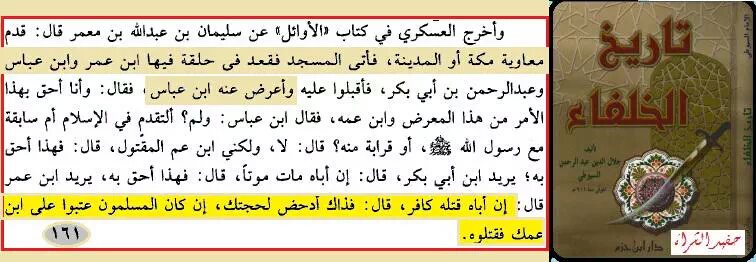
Ibn Abbas (r.a) replies to Muawiya after an exchange that your cousin, i.e. Uthman bin Affan, was rebuked by the Muslims, so they killed him! Notice that Ibn Abbas (r.a) doesn’t say rebels or some unknowns killed Uthman but that he was killed by the Muslims!
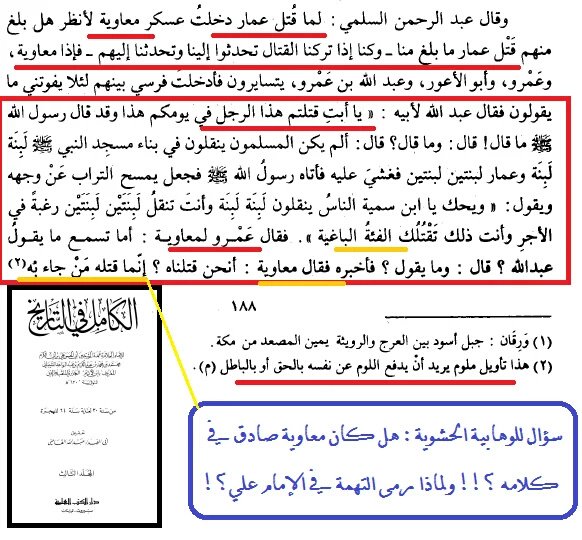
Who killed Ammar bin Yassir? What did the Blessed Messenger (saw) say about those who would kill Ammar (r.a)?
Muawiyah and the novels of wine! In Sunni books.
Muawiyah was a scribe between the Prophet and the Arabs, not as Sunni’s claim that he was a scribe of the revelation!!
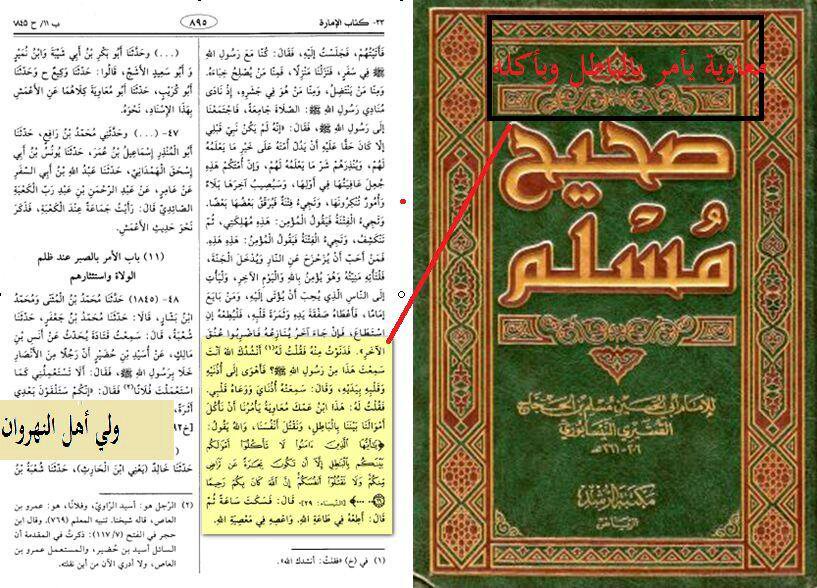
And it came in the book Musnad of Imam Ahmad that he was ordering them to consume money between them unjustly and to kill themselves, confirming the verses “do not consume one another’s wealth unjustly”
When Al-Hassan died, Muawiya said the Takbir and everyone in his council said Takbir! These are your books, so see how you are? Look what your books say!
Muawiya was busy waiting for Al-Hassan’s death, so when the news reached him, he said “Allahu Akbar” and “Allah is the Greatest” for the people of Sham!
Abd al-Razzaq, who has nearly 300 hadiths in al-Sahihayn, says that mentioning Muawiya in gatherings is filthy! Why all this great hatred?
When Al-Hassan bin Ali died, Muawiya went on pilgrimage and wanted to insult Imam Ali on the pulpit of the Messenger of Allah (saw), and wrote to his workers to curse Ali on the pulpits! Imagine! On the Blessed minbar of the Blessed Messenger (saw) cursing the companions!
Ahmed bin Hanbal narrates that Shaykh Al-Bukhari swears that Muawiyah died in a state other than Islam, and he did not narrate from him, and he forbade his son Abdullah to mention him or write about him!
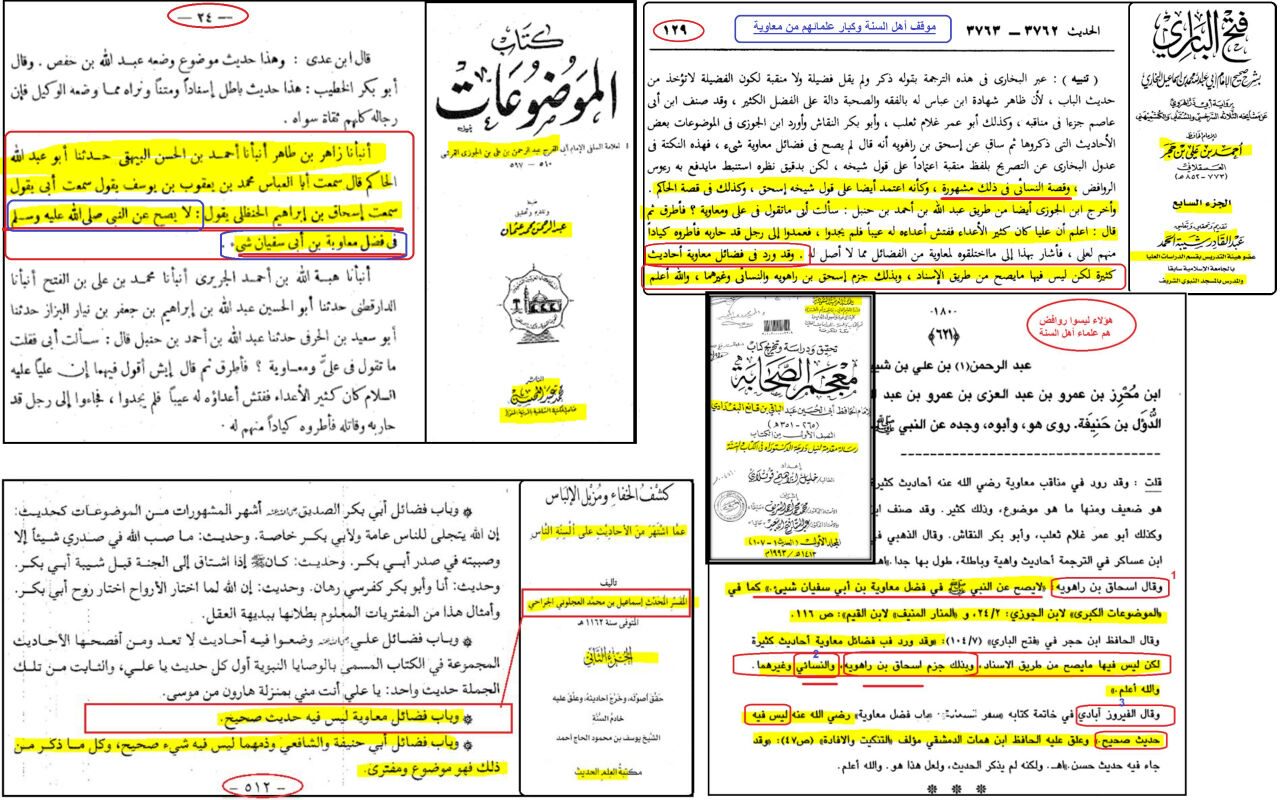
None other than the mountain of knowledge Ishaq bin Rahawayh states: “Nothing narrated from the Prophet (saw) regarding the merits of Muawiyah is authentic!”
Muawiyah removes Saeed bin Al-Aas from the mandate of Medina and appoints Marwan bin Al-Hakam in his place, so what is the reason?
According to the testimony of al-Dhahabi, Muawiyah curses Ali; and al-Hasan stipulated that he should not curse him while he was listening.
The hadith that states Muawiyah is one of the people of Hell, and al-Tabarani hides the name of Muawiyah and puts the word man! These books show your hypocrisy and deceit!
Muawiyah commands batil (falsehood and consumes it). Sunni books.
Muawiya and the novels of wine!
Abdullah bin Umar deeply regretted not fighting the oppressive faction Muawiya and his companions!
Muhammed ibn Abi Bakr’s neck was cut off by order of Mu’awiya, and he was the first head to be cut off in Islam!
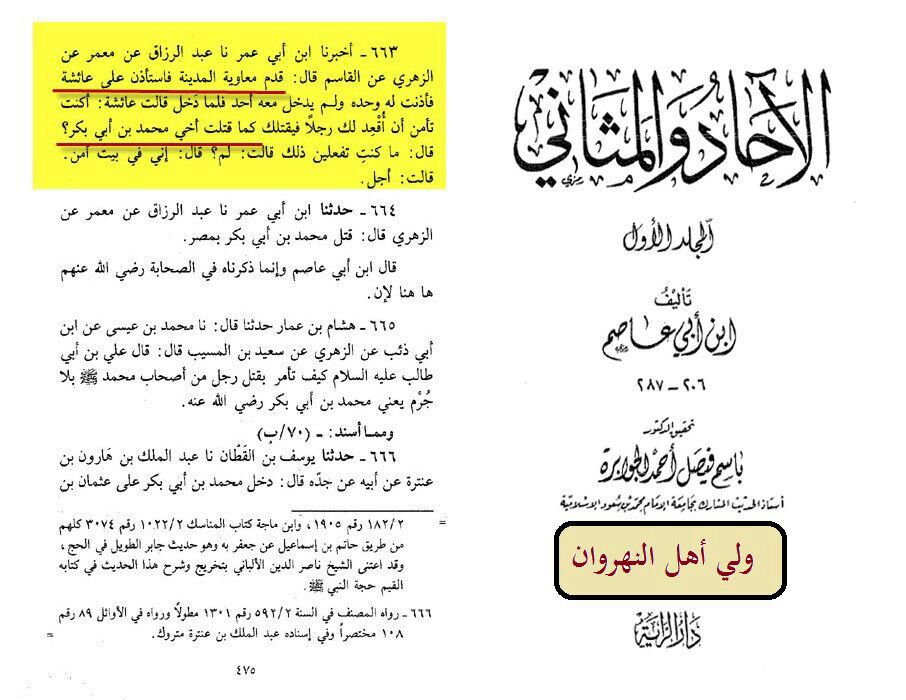
The mother of the believers, Aisha (r.a) threatens Muawiya with death for killing her brother. The companions were one big happy family? So we are told.
Amr bin Al-Aas, a well-known companion, was one of the instigators against Uthman!
Insulting the great Companions and defaming an honorable person in the books of the Sunnis.
Defaming the great companion Umar Ibn Al-Khattab! with words that are never befitting of a man like Umar (r.a). Is there no fear of Allah’s wrath in your hearts?!
The noble and honourable Khadija(r.a) made her father drink wine to marry her to the Messenger of Allah (saw), and when her father got drunk, he accepted her marriage!
May Allah suffice you! May Allah guide this ummah!
May Allah guide us! What disaster!
Mujaddid Al-Salafiyah Muhammed bin Abd Al-Wahhab lied and claimed that the Companions unanimously agreed that the Companion Qudama bin Madhu’un had been declared an unbeliever!
Accusing the companion Anas bin Malik of drinking paint, i.e. alcohol! The impression they give of the companions is of people who huff paint and absue whippets!
A companion accused of adultery!
We can lead the horse to the troph but you cannot make it drink.
So what will it be dear Muslim Ummah?
Will your Imam be hiding in occultation waiting to come out…. one day?
Will your Imam be a playboy who goes boating with scantly clad women and tells us the obligation of prayer and fasting has been lifted?
Will you be a Crypto-Sunni (An Abbasid) that holds disdain for Yazid, a little bit for Muaviya when your feeling edgy and none for Uthman because it’s a step too far?
Or do we go with the majority simply because it is convenient and we embrace the Islam of the Imperium and say (May Allah be pleased with the tyrants)? To rebel against the ruler is to be a kharijite?
Or do you just go your own way do it yourself Islam?
In conclusion what we do know is that no matter what happened between they did their job. Islam is here. There has been nothing left out of this deen. Some people want to keep going back and revisiting the past and digging up the graves and create fitna for the Ummah. The rest of us are content with moving on.
Even, I myself do not find benefit in delving into these matters other than it is necessary to get the record straight. What we as Muslims should truly focus on is our relationship with Allah (swt). To do our level best to obey His commands and avoid His prohibitions. To follow, the Sunnah of the Blessed Messenger (saw).
“The servants of the RaHmān (the All-Merciful, Allah) are those who walk on the earth humbly, and when the ignorant people speak to them, they reply peacefully.” (Qur’an 25:63)
﷽
So it was just after Farj on Jumaa morning here in Singapore when I checked my WhatsApp and there from that gentle and noble soul, brother Nazzam were the latest links of interest. Bless him! I would get updates from time to time on articles, blog posts and vlogs and debates that have taken place. So this particular morning was a debate between two people I had not really known before.
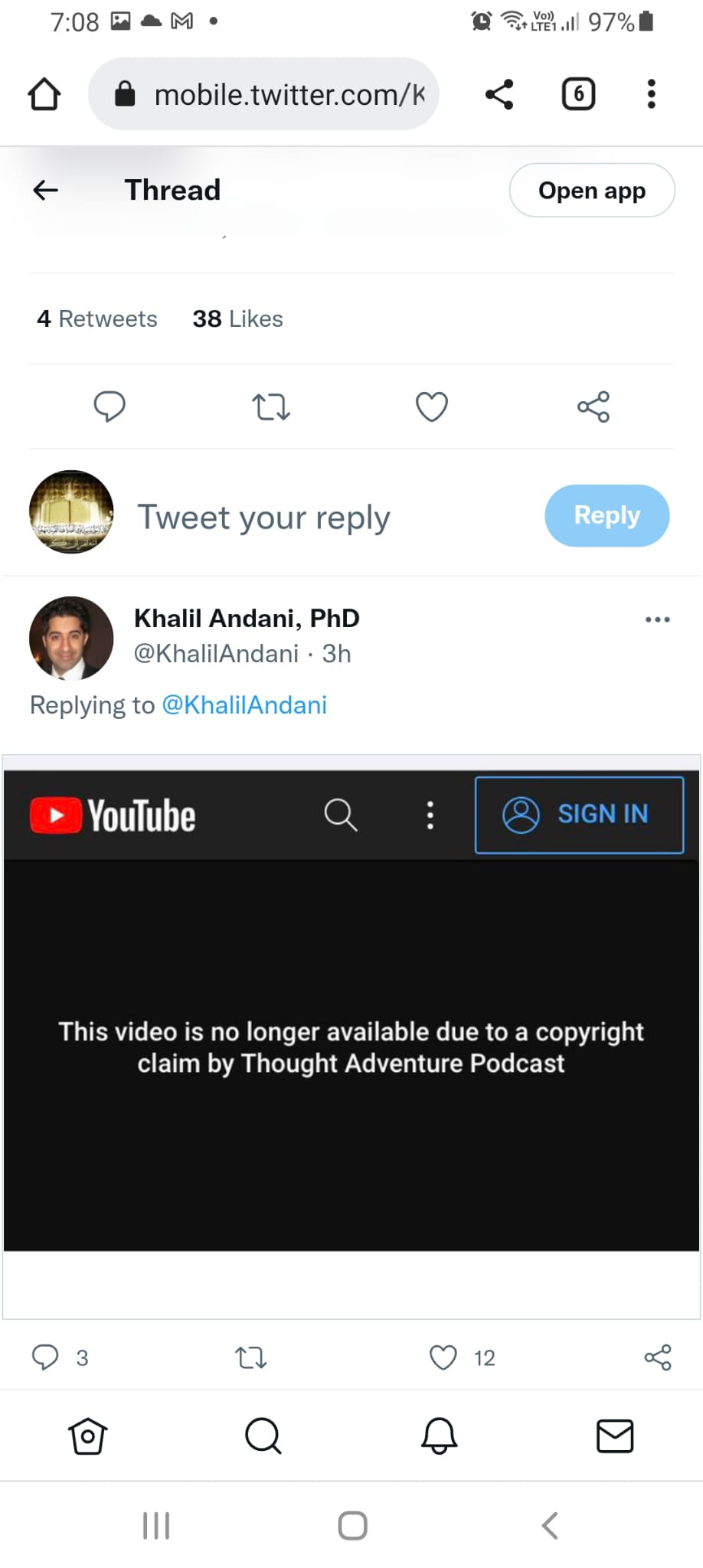
So I head over to twitter and what do I see, already that one side has censored comments. So, I go and click on the link to the debate posted on YouTube. The comment section was clearly pro Dr. Khalil. I saw many people in vigorous exchanges with followers of the Athari creed; and they were getting pressed. I then recalled that the first time I heard of this Jake guy. I believe he was introduced by Mufti Abu Layth (Naheim Ajmal) in one of his episodes. I believe it was pointed out that he used arguments he pinched from Professor Emad Hamdeh’s against the Quraniyoon, to use as reasons why (he), Jake, was no longer intrigued with that movement. From there on this Jake threw in his lot with the Athari/Salafist crowd. In this day and age if you want to gain followers and notoriety quickly through social media that is the most strategic decision one could make.
Not knowing of Dr. Khalil Andani, however, was clearly a loss for me. It is clear to me that Professor Andani is quite formidable. There is no doubt in mind that anyone who ever had the blessing of attending his class got their hard-earned money’s worth. Beyond that, they learned at the hands of an adept.
As for those people who are sitting comfortably in their homes drinking high grade coffee shrugging their shoulders and saying ‘who cares’ about such a debate. Welcome to the world of privilege and security! Professor Andani is doing you and everyone else a huge service! He is debating a person who is representative of a certain strain of thought that on the regular participates in the anathematization of other Muslims.
It is no stretch of the imagination to say that by putting a dent in such creedal positions he could be saving lives! Imagine an impressionable young Muslim who believes that Professor Andani and all like him hold such abhorrent aberrant and dangerous views that they must be dealt with. Imagine a gathering of high profile Muslim philosophers conducting a symposium, Professor Andani is in attendance, suddenly an attacker unleashes a few rounds killing many people in the process.
Imagine that same impressionable young Muslim saw the disasters performance on behalf of Jake, and although he may not be inclined to agree with everything Professor Andani says, he witnessed enough to make him question the absolute certainty that he once placed in the Athari creedal position. Instead of wanting to pop off a few rounds into a crowd of people who have been anathematized; this youth leaves Salafism altogether, or he becomes convinced of his own position, while holding space for other views.
I will be fair to say that Al Qaeda, Al Nusrat, ISIS and others do not necessary represent Salafism per say. However, it is not even a point of debate to say that Al Qaeda, Al Nusrat, ISIS have more in common with Salafi/Athari thought than they do Ashari/Maturidi/Mutazali theological positions.
Make no mistake about it, this debate is a watershed moment. The Athari creed has never been laid bare, deconstructed and destroyed in such a public formatted debate as it was in this debate.
Jake went in so cocksure of himself thinking Dr. Andani would be easy prey.
It was like watching a Discovery Channel documentary where you see the Mongoose carefree through the forest, and you spot a cobra skulking and slithering its way through the foliage, poised to strike. Yet, this Mongoose will be no prey! On the contrary, once the Mongoose caught on to the scent, and pressed the attack, the poor cobra takes such a thrashing that you almost feel sorry for the elapid.
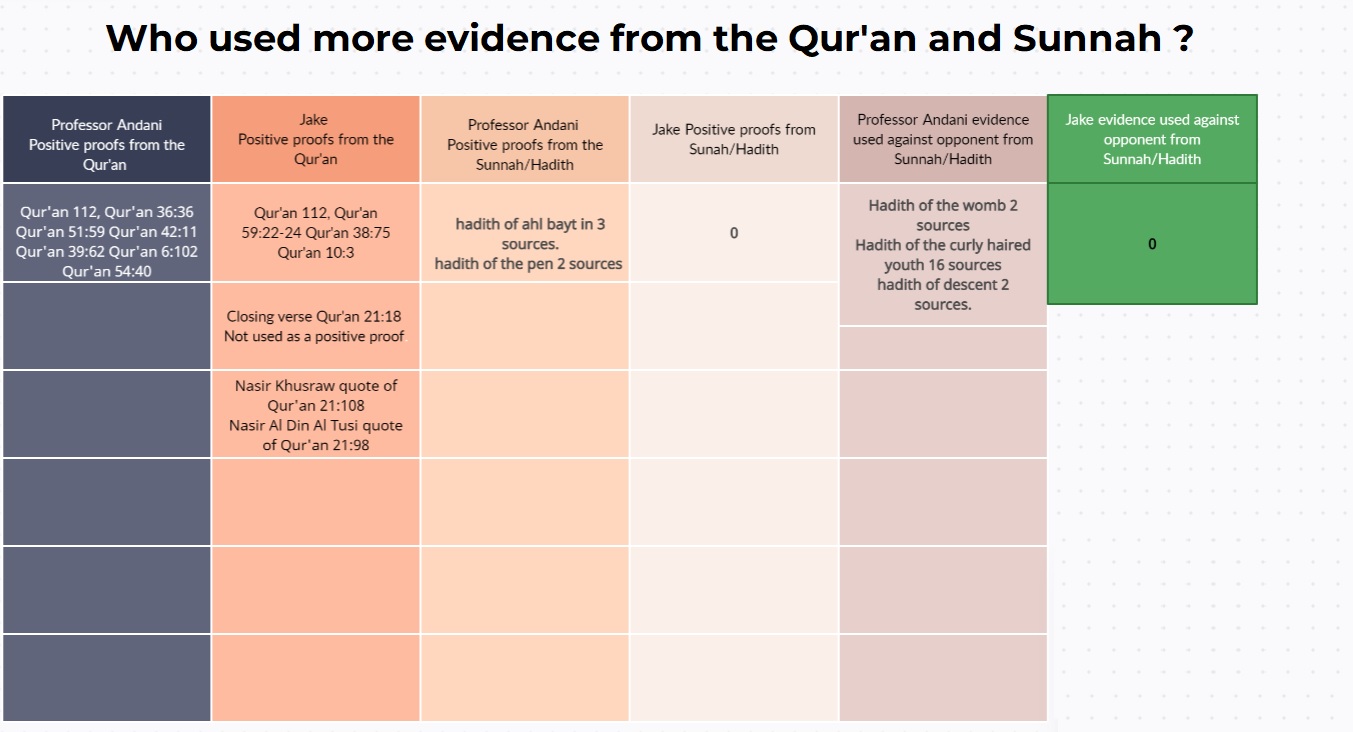
Let us look at the opening statements of each of the debaters. The big surprise for me not really knowing anything about these two debaters is who actually used more naql or text? My presumption would be that Professor Andani would come in using more philosophy, and logic and less textual proofs. My presumption is that the Athari would come to a debate loaded with textual proofs and evidence.
This was simply a no contest!
Professor Andani used 7 positive arguments from the Qur’an. Jake used 4. Andani gave us some commentary on how these text support his position. Jake simply quoted them without explaining how they support the Athari school. Jake used two other text from the Qur’an from Khusraw and Al Tusi in a polemical fashion against Andani. When it came to the Sunnah or ahadith, Professor Andani gave 5 a hadith. Firstly to show us that the guardians of proper understanding of the primary and secondary sources come from the Ahl Bayt. Secondly he gave two ahadith for his argument concerning the pen. Professor Andani quoted no less than 20 different source showing questionable ahadith that are an affront to the idea of a transcendent divine being. When it came to giving positive ahadith for the Athari position Jake gave us nothing. When it came to ahadith bringing into question Islamic philosophy Jake gave us nothing. Since Jake lacks the trade mark beard of the bulk of Salafi/Athari Muslims one could easily mistake Andani for being the Athari in the debate.
Since Athar means remnant or report, clearly not only is Professor Andani an adept in Islamic science, he is actually the true Athari between the two! Jake on the other hand, a nothing burger.
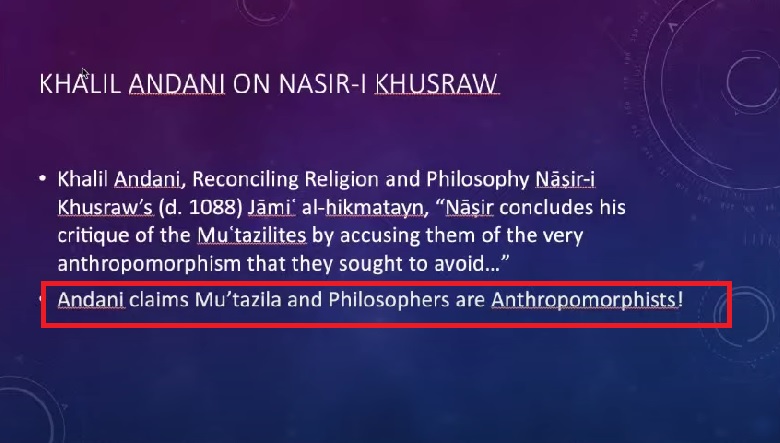
Not necessarily an argument against either Ismaili doctrine or Islamic Philosophy in general Jake repeated several times the Professor Andani asserts that anyone who claims that who ever states that Allah (swt) has names and attributes is tantamount to shirk and anthropomorphism. Please see @22:06 minute mark:
“Khalil does not believe that Allah is the direct creator of the heavens and the earth. He does not believe that Allah is All Knowing, All Powerful and Perfect, in fact HIS BOOK states: that to ascribe such names and attributes to God is shirk and anthropomorphism.”
A similar claim is made at the 23:37 minute mark.
Why didn’t Jake show us the extract from Professor Andani’s book? He claims that these are the beliefs of Professor Andani yet he doesn’t give us the quotes for this. This would certainly help Jake, as Jake has made takfir of Andani, he can now turn around and claim that Andani did the same thing.
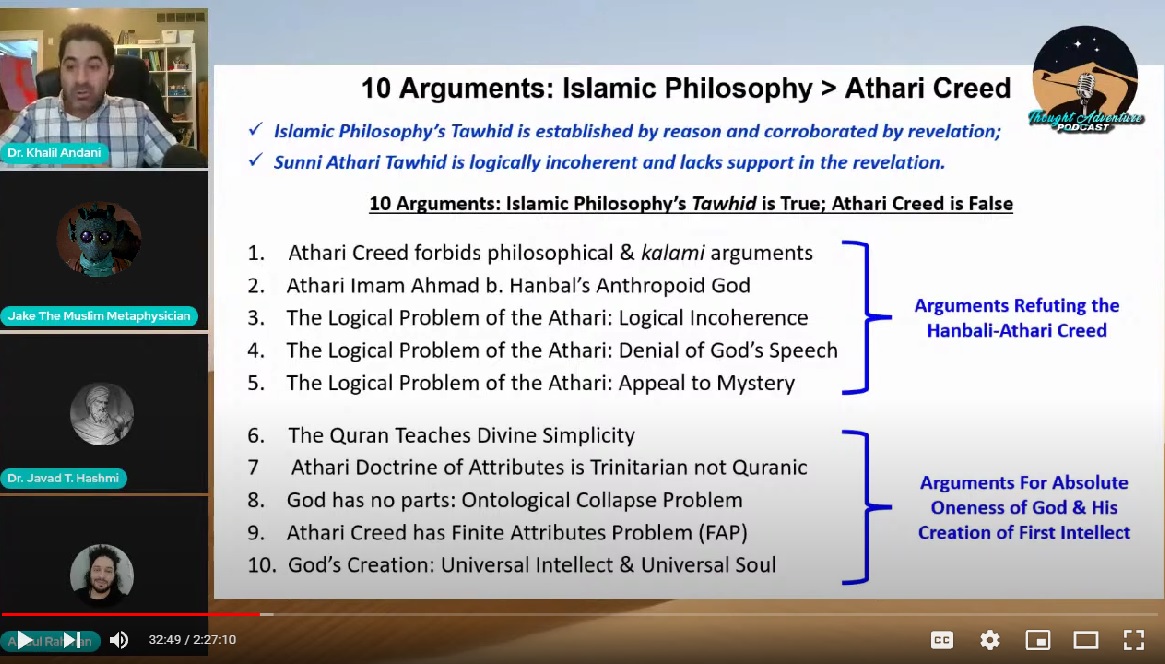
Professor Khalil gives 5 arguments for refuting the Hanbali creed. He gives 5 arguments for the Absolute Oneness of Allah & His Creation of First Intellect. Although, I feel Professor Khalil more than proved his case in regards to the Absolute Oneness of Allah (swt), he possibly needed more time to flesh out his argument of the creation of the First Intellect.
Professor Khalil showed quite forcefully the issue with Tafwid.
Affirming the apparent meaning, or do ta’wil for metaphorical meaning. Jake must affirm the apparent meaning and reject ta’wil. This leads us to Tafwid al-Ma’na where you deny the apparent meaning and deny the opposite of the apparent meaning. This position is logically incoherent. If you say you do not know the meaning, then there is no meaning that is accessible to humans. This is a devastating argument because it shows that Athari are actually the one with some esoteric belief in the divine. The Qur’an and Sunnah conveys that which is not intelligible to humanity. Another devastating point given by Professor Khalil @39:27 minute mark that if you want to argue for Tafwid al-Ma’na and Tafwid al-Kayf and say ‘Bi Li Kayf’ than you should stop debating with Christians. The argument here is that Athari are in reality believers of Mysterianism.
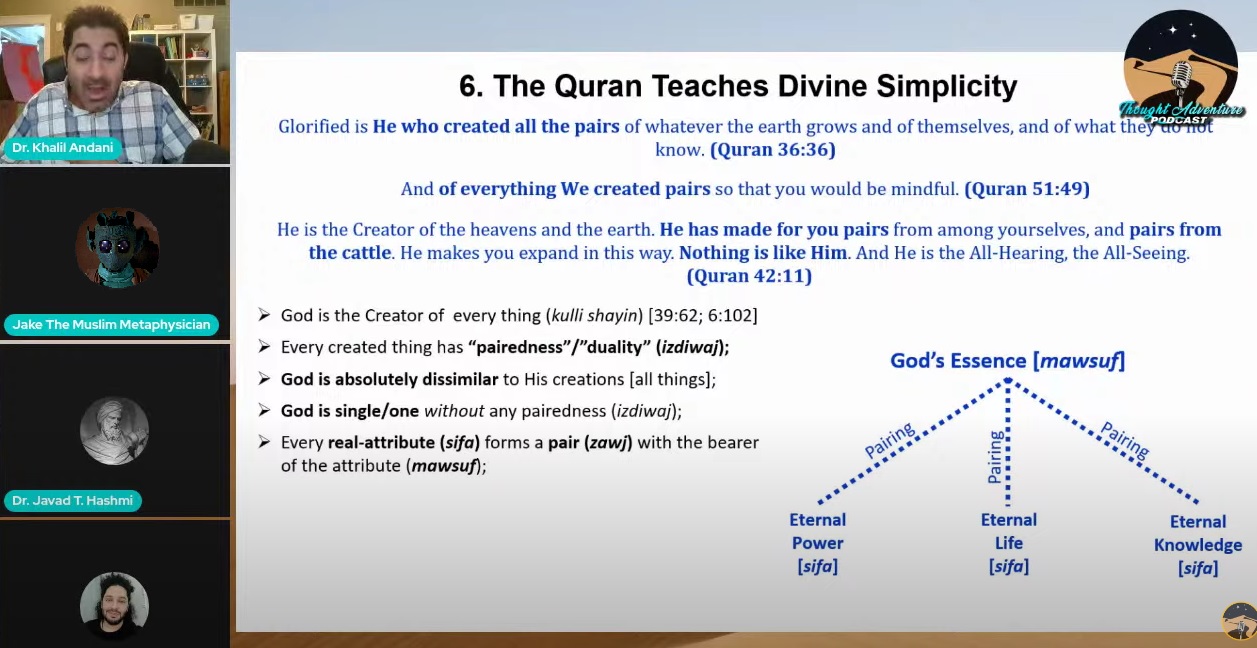
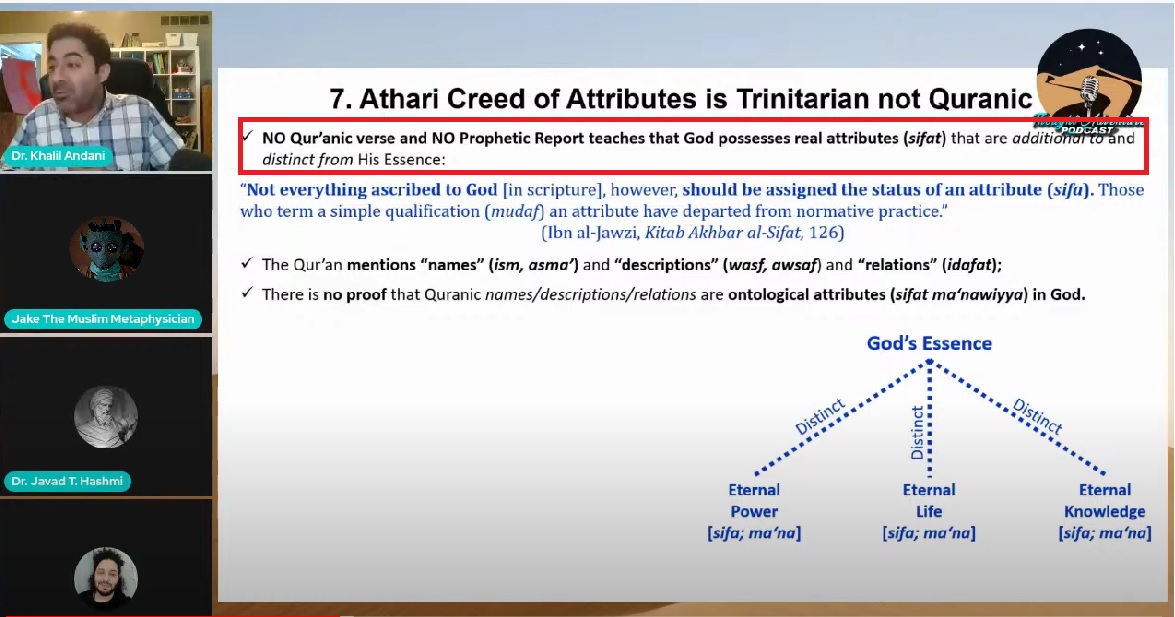
All of the points given in Professor Andani’s slides are effectively devastating for the Athari position.
“No Qur’anic verse and NO Prophetic Report teaches that God possesses real attributes (sifat) that are additional to and distinct from His Essence.” Where did they get the idea from? They got it from speculative theology.
During his first 10 minute rebuttal.
Surprisingly for someone who has done many debates Jake seemed to forget how the rebuttal part of a debate goes. Instead of showing why Dr. Andani’s five points against Athari creed were wrong, Jake continued his opening presentation of attacking Andani’s views. The only thing he really interacted with was that which was easy pickings. He scanned the list of the slide Professor Andani put up and picked out Shaykh Abdul Qadir Al Jilani. (An Athari). Even, I am not sure why Professor Khalil had him on that list.
When quoting Shaykh Abdul Qadir Al Jilani
“We believe that Allah CONSTRICTS, EXPANDS, rejoices, loves, dislikes, becomes pleased, becomes angry, and abhors, he has two hands and both of his hands are right. The hearts of his servants are between two of his fingers and he is in the direction of uluh…..” Jakes says @ 50:35 “This sounds like Athari creed to me.”
What did Jake mean when he says Allah (swt) constricts and expands? Does he mean that it is an action that Allah (swt) does to the creation? As in constricting the breast or expanding the breast? Or does he mean that Shaykh Abdul Qadir Al Jilani is asserting that Allah (swt) himself, his essence, expands/constricts? This sort of irresponsible reading of the text in English without proper explanation is no Bueno. Jake did not deal with the issues of divine simplicity or the problem of the ontological collapse of his position.
Professor Andani’s first 10 minute rebuttal.
@1:03:27 They were not putting up Professor Adnani slides. It is hard to know if that was intentional or not.
@1:11:36 Professor Adnani claims that Jake was intellectually dishonest by admitting a fact from Nasir al-Din Tusi’s work by not admitting the fact of what he had actually written. @1:12:07 Professor Adnani bemoans the fact that Jake cannot read Arabic and therefore cannot go to the primary sources. He is overly reliant upon Orientalism and Orientalist.
Jake’s second 5 minute rebuttal.
@1:18:34 Jake puts up the claim that he has a document ‘with all these references if anyone is interested I’ll make them publicly available and you can read them yourself.” This statement is followed up with a dig @ Professor Khalil doing Taqiyyah, practicing obfuscation or lying.
@1:19:44 “No it does not mean there are multiple necessary beings, we don’t say there are multiple humans, that Jake is multiple humans just because I have multiplicity within me. I’m still one being. We don’t say that there are multiple uh beings within Jake. This is not the language that we use”
Did he just use himself to compare with Allah (swt)? This is very problematic. It is a violation of “There is nothing like unto Him, and He is the Hearing, the Seeing.” (Qur’an 42:11)
@1:20:07 “My argument is quite simple, just read the Qur’an, for the most part.” WHAT??
@1:21:23 Jake says that he trusts someone else over going directly to the text himself! Especially doesn’t trust Professor Andani. “You keep talking about Arabic but you cannot even pronounce basic words, which I find to be quite shocking.” You can tell that Jake felt the sting of Professor Andani’s comment about Jake not being able to go to the primary sources because Jake lacks the requisite command of Arabic to do so.
Professor Khalil second 5 minute rebuttal.
@ 1:24:06 Professor Adnani wanted to know whom Jake will rely upon for creedal positions. Prior to the debate Jake gave Professor Andani the creed of Ibn Qudama. Ibn Qudama says: “We do not go beyond the traditions from the Prophet and his companions; nor do we know the how these, save by the acknowledgement of the Messenger and the confirmation of the Qur’an.”-Ibn Qudama (Tahrim)
“Debate is for people who can use logic and reason which you are not allowed to do!”
Ouch! That was yet another stinging point from Professor Andani.
@1:26:00 Professor Adnani makes another great point. Jake did not specify what he meant by necessary attributes.
1:26:34 I almost fell out of my chair, Captain Planet? It is good to see that Dr. Khalil is forceful in his presentation and can keep a serious topic light-hearted.
@1:26:45 Professor Adnani bemoans the fact that Jake is severely handicapped in this debate by not being able to read the primary sources.
@1:26:58 Professor Adnani puts forth a very blunt question to Jake. “How do you define wujud, existence?
15 minute cross examinations. Jake cross-examines Professor Andani
During his 15 minute cross-examination, Jake spent less time asking questions and more time giving a sermon. As regards demeanor, Jake was like this angry child, who ran away from home only to find a wise and comforting father in Dr. Khalil Andani. Khalil was warm and had presence, Jake was bitter and needed consoled.
@ 1:30:19 Jake ask Professor Andani about true knowledge of Allah (swt) only coming through the Imams. Through the intellect or the imams (qualified scholarship). Jake himself admits its from qualified scholarship when he even queerly offered, “just read the Qur’an, for the most part.”
1:30:57 Jake could frame his question another way. ‘During the time of the Blessed Messenger (saw) was true Tawhid known only through the Prophet (saw), whom would be the ‘rightly guided Imam’ or through other means? If we can understand this, it will help us to understand the position of not only Ismaili Shi’a but our Shi’a brothers in general. Even if we disagree with them.
When Professor Adnani gives his reply that there are two types of ‘ilm and one is supra discursive, also known as marifa. This is something that adherents of Sufi paths would appreciate. Where as those who have no familiarity with the Seeker-Shaykh relationship would have no appreciation of this.
@1:33:41, Jake moves on to the next point because he saw no way in. Usually if you strongly argue, you will overwhelm your opponent and press the attack until you get them to capitulate through the sheer strength of your argument.@1:34:12 Jake started to bite his fingernails which is usually a sign of stress or anxiety. I don’t know if it is me but it looks like he proceeds to chew for a moment on a piece of fingernail.
@1:37:40 Professor Andani makes the point that there is no way Kirmani is refuting Ibn Sina because Ibn Sina has not even written his works yet!!! “Remember Ibn Sina died in 1037 and Kirmani died in 1020. There is no way Kirmani is refuting Ibn Sina because Ibn Sina hasn’t even written his major works when Kirmani is writing. Kirmani is likely referring to a pre Ibn Sina falsifa tradition.”
@1:38:40 Professor Andani enlightens Jake who confuses the Ashari position of the divine will that is entirely self determined, with that of the Ismail’i position.
1@:40:00 Jake when pressed on whether he knows what type of shirk Al Sharistani is referencing, Jake replies, ‘You can’t respond with a question.” Professor Khalil is not familiar with debates or debate territory. So, he could have used the most common trick there is in this situation, which would be to ask a statement of clarity, ‘I’m not sure the type of shirk you are referring to?’ Interestingly, as a point of order Jake ignored the ‘you are not supposed to respond with a question’ when he was being questioned. He (Jake) did this multiple times.
Anyway, Jake gets educated on the two different types of shirk, shirk kafi and shirk jalil. This itself shows further lack of preparation on his behalf.
@1:40:40 You really have to love Professor Andani at this point, he is totally, relaxed and having a great time. That slight smile on the face is transporting him straight to the class room where he is tenured Professor teaching a subject he has full grasp of to a first year student, thirsty for knowledge and information.
More Than an interlocutor or debate opponent, Professor Andani at this point takes on the role of a willing teacher, trying to help Jake in writing a thesis paper. It’s delightful to watch the good Professor work and it has made me keen to read his published works and follow up with more of his material.
@1:42:11 Jake asks Professor Andani the question: “If creation did not exist would God exist? Khalil asks a question, but Jake doesn’t’ pause him. At this point Jake is clearly forsaken any crusade he may have thought he was upon. Jake actually looks tired.
@1:42:31 Jake asserts about Professor Andani “You said he couldn’t exist without creation” -Always not a good sign in a debate when the opponent wants to put words in the other’s mouth.
@1:43:54 Professor Andani again asserts that Jake is unfortunately relying upon secondary sources. Jake responds that’s not true. “Well it is!” Quick to the rejoinder Professor Andani is!
15 minute cross examinations. Professor Andani cross-examines Jake.
@1:45:24 “Do the attributes depend on God’s essence or are they ā sē necessary in themselves?
@1:45:27 Jake ask a question: “What do you mean by depend?” As you can see as a point of order Jake violates the stipulations of the debate.
Professor Andani presses the question again: “Does the existence of an attribute of Allah depend on the essence?”
Jake responds: @1:45:34 “In the SAME WAY that for you the existence of creation or God’s existence depends on the existence of creation.”
This is what happens when you are in attack mode and you do not think your arguments through.
Here Jake is involved in pure speculative theology upon which he has provided no clear proof text from the Qur’an or the Sunnah. He is comparing the creation of Allah (swt) with his attributes. He is also arguing against Athari creed; because, if he is saying he believes THE SAME WAY (that he assumes Adnani believes) this is a problem.
Again Professor Andani presses: “Do the attributes depend on God’s essence, either they do or they don’t?”
@1:45:44 Jake responds: “Yes, in the SAME WAY you would say that God’s existence depends upon creation.”
Trust me people there are Muslims who are Athari/Salafi in Aqidah listening to these statements of Jake and their jaws are gaping open and they are stroking beards repeated ‘astaghfirullah’ over and over upon hearing these things.
@1:46:15 Professor Andani ask: “Are the attributes of Allah are they ā sē or not ā sē?
1:46:22 Jake breaks the rules again and asks a question: “Why are you changing the question?”
The reason he is changing the question is you are so elusive and Professor Andani is trying to get you to clarify your position. @1:46:30 Professor Andani has to bring in the moderator because Jake is evading the questions.
@1:47:24 Professor Andani is having none of it. He presses Jake ‘You define dependence and tell us whether the attributes depend upon the essence or not.”
@1:47:42 Professor Khalil “Let’s make some breakthrough here. Creation depends on God I said that? Are you saying the attributes depend on the essence the same way creation depends on God?”
@1:47:50 Jake responds: “I am saying there is a counterfactual dependence.”
May Allah (swt) guide us and protect us from being among the lost! At this point I began to wonder if Jake really is a Muslim. Because, if he is now stating there is a counterfactual dependence, which is to state that the attributes and the essence are mutually dependent or inter-dependent. Not necessarily problematic in and of itself; However, either one in Islam is major shirk, especially if you juxtapose that statement to Jake’s earlier admission:
Thus, Allah (swt) and his creation are counterfactual? They are mutually dependant or inter-dependant? That is not the belief of the Muslims, and for us, Jakes’ statements take him out of Islam. That is unless Jake claims he misspoke or he was confused during the debate. Hopefully he will clarify in the future. Those statements juxtaposed together take one out of Islam.
Listen @1:48:48 “In a sense, one cannot exist without the other. We don’t say it’s a casual dependence.” @1:49:12 Professor Andani says, “The attributes depend upon the essence.”
Moreover, Jake responds: “Only in the sense that they cannot exist without each other.”
I was surprised by Professor Andani’s continued line of questioning considering Jake’s admission that he believes the essence and attributes are counterfactual and that the attributes depend on the essence in the same way that God depends on the existence of creation.
Nonetheless @1:49:45 “If something is not ā sē (aseity) can it be God?”
Jake responds: “Sorry” I do not believe that Jake is familiar with the Latin terminology for aseity.
Professor Andani continues: “If something is not ā sē is it contingent?”
Jake is uncertain about what he is being asked. He is not supposed to ask questions but answer them. Nonetheless: “Anything that is not God is a contingent is that the question?”
Jake responds: “Yeah sure.”
@1:51:00 Jake is buckling under the pressure, disengaging the rules of the debate, speaking out of turn. Jake established that he believes that God is the essence and the attributes.
@1:52:08 Professor Andani “So God contains and essence and real distinct attributes?”
1:52:22 Professor Andani presses the point: “The attributes are not identical to the essence and not identical to one another.”
“Jake responds: “Correct.”
@1:52:25 Professor Andani states: “O.K Therefore your God is a conglomerate of different entities. Thank you for confirming that. Next, I’m gonna move on now.”
@1:52:47 A very classic moment in this debate. Professor Andani set this up nicely. “My view is this, O.K.? The will of God is necessary. Every decision, choice that God has made could not have been any other way O.K.? Its the best possible choice. And any choice God has made it is impossible to conceive it could have been other way. This is my position.” “Is that position compatible with Islam according to you or not?
@1:53:24 Professor Andani “Does it go against Tawhid?” To which Jake responds: Yes it does!”
“It goes against Tawhid in the sense that your saying God does not have free will, that creation is just a necessitated by his essence. Yes that goes against Islam because the Qur’an and the authentic Sunnah say otherwise.”
An odd statement from Jake considering he just stated earlier:
Jake responds: @1:45:34 “In the SAME WAY that for you the existence of creation or God’s existence depends on the existence of creation.”
This Jake does not have a sound aqeedah position. Nonetheless, go back and read Professor Andani’s statement above @1:52:47 you will see that he is reading from either a piece of paper or screen. He is reading verbatim a statement from Mohamed Hijab!
That was very cunning of Professor Khalil. Remind me never to debate that guy!
If Professor Andani made any “bad” move during the debate it was @1:54:26. It is not an error per say. It’s just that he should have saved that explosive bit of information for his closing remarks! Because, the way that Professor Andani puts the bait on the hook, Jake caught on real fast, and knew what was up.
@1:55:05 Jake is sensible enough to know the trap that Dr. Khalil is laying out before him. However, he is reluctant to make that commitment. This shows the shifting nature of his own doctrinal position. Haqq is Haqq. How can you be firm on a position literally just 3 minutes ago and now you are hesitant!
@1:55:43 Professor Andani drops the bomb on Jakes “I read to you the words of Mohamed Hijab during his Londoniyyah video published 6 months ago! You can go see it! He literally says, what I just said!”
Professor Andani doesn’t stop there: “
“So Mohamed Hijab is teaching a view of Tawhid that you think is not Tawhid yet you go and work for the Sapiens Institute!” If there was a debate equivalent of Khabib Nurmagomedov making Conor McGregor submit during their UFC bout that was it! @1:55:57 “Can you read it?”
Jake at this point is desperate to find any contentious point to avoid the devastating blow just dealt to him. “Your claiming he is my Ustadh.” “How is he my Ustadh?”
Asking Professor Andani to read a text is a strategic move. It also gives Jake a breather, so that Professor Andani will just stop asking more devastating questions and the timer can run out.
You wanna know something telling. Is the heavy weights in the Athari/Salafi community. Those most visible out there in the Daw’ah. If anyone thinks for an iota of a second that Jake won this debate surely the silence of the Athari/Salafi dai’ee is deafening.@ 2:00:42 Professor Andani asks: “Where is Allah? Can you point with your finger?”
Jake pointing towards the direction of Allah (swt). The Earth spins on its axis on a 24 hour rotation. Now imagine if we placed someone on the polar opposite side of the Earth and asked the same question at the same time. Allah’s throne would have to be somewhere in the middle of the Earth. Then next we put Jake in a space suit in zero gravity and ask him the same question.
@2:00:50 Professor Andani asks: “Is the Throne below Allah?” Jake responds: “Yes”
Professor Andani ask: “Is the lowest heaven below the throne?” Jake responds: “Yes”
@2:01:26 Professor Andani ask: “Do you affirm Allah as per the hadith descends every night to the lowest heaven?” Jake responds: “Yes I affirm Nuzul.”
@2:01:41 Professor Andani ask: “Do you affirm that Allah descends from above the throne to below the throne?” Jake responds: “He never leaves the throne.”
22:01:51 Professor Andani asks: “What is the meaning of a descent here? Because descent means to go from above to below. So what does Nuzul mean?” Jake responds: “Yes we understand it in the plain meaning which is mentioned in a hadith….it’s very clear I think everybody knows what descent means.”
2:2:02:11 Professor Andani asks: “So you affirm that Allah descends from above the throne to the lowest heaven below the throne.” Jake: “Without entering his creation. Yes”
Jake just posited pure speculative theology. Where is there a text from the Qur’an or Sunnah that says that Allah (swt) does not enter his creation? Where did he get that idea from?!
2:02:08 Jake claims: “It’s very clear I think everyone knows what descent means.”
@2:02:25 Professor Andani asks: “What is the meaning of descent that everybody knows? Jake responds: “I just explained it to you.”
As one person on Twitter described this segment: “Descending means descending but not descending as descending can be descending when we say descending but you know and I know you know what descending is.”
Another point of contention. From what text of the Qur’an and Sunnah do the Athari get the idea that Allah (swt) is above the throne as some ‘default position‘?
Jakes closing remarks:
@2:06:36 Jake claims he will have a talk with Mohamed Hijab. So it will be interesting in the future, if Jake retracts his claim or claims Mohamed Hijab’s views on Tawhid are mistaken.
@2:08:30 Jake is clearly upset that he couldn’t turn this into an Athari Sunni vs a Shi’a Ismaili debate. This is also why either he or his team changed the name of the YouTube Video.The misleading and dishonest title vs the agreed upon debate topic and correct title.
@2:08:50 An admission from Jake that he did not address many of Khalil’s points.
Professor Adnani closing remarks:
In his closing remarks Dr. Khalil Andani had made comments about Jake that was not insulting. He said that Jake is certainly a smart individual; however, Jake needs practice in defending his creed (which he does).
In my humble opinion, Professor Andani messed up with giving good will points. Professor Andani means well but unfortunately in Jake’s mind saying that he (Jake) is intelligent but utterly demolishing his (Jakes) ability to defend the Athari creed was worse than if Andani had not said anything in good will at all.
@2:18:25 Professor Andani brings up a point that should have been brought up during his rebuttal period. I am not a fan of either party introducing pertinent points of a debate during closing statements. However, it would be interesting to see if Jake has any rejoinders to that statement in the future concerning Kashf Al Asrar-‘Abd al-Qadir al-Jilani
@2:19:35 Professor Andani comments on how Jake calls his presentation a machine gun approach, because he (Jake) was utterly unprepared. Which is true.
@2:21: Professor Andani likened Athari creed to mysterianism which was a very tight intellectual slap. It certainly hurts the Daw’ah and prepared Christians WILL use these counter arguments, as well they should.
Conclusion: Final Thoughts.
Professor Andani put on a clinic in that debate! If someone mentions his name to me I will reply, ‘Oh you mean the excellence of execution?’ Because Jake was excellently executed by the excellence of execution, Professor Andani. The man is not even a seasoned debater, but he was methodical, lucid and on point!
In fact as stated before, this is a watershed moment. Never that I can think of has Athari creed been laid bare in public in such a way. Professor Andani reached deep and took a piece of Jake’s soul. Not that this was the good Professor’s intention; however, you can tell by Jake’s Kamkazi approach after the debate that he realized he got destroyed.
Observe: Jake: The Kamkazi: I got destroyed in this debate but I am going to do my best in my little Mitsubishi A5M to take you down with me!
Who won this debate?
When I was first told about the debate in the early morning hours of 17/6/2002 I went to see the video and I observed in the comment section the Athari’s were getting pressed. The majority of comments were in favour of the Professor. So they deleted comments in favour of the Professor. They deleted comments of exchanges where athari were not doing too well. They changed the title of the debate. Finally, they stopped comments altogether.
You want to know something telling? It is this. The heavy weights in the Athari/Salafi community, those most visible out there in the Daw’ah, if they think one of their people did well in a debate it will be broadcasted all over social media. It will go viral. The after math of this debate is radio silence. If anyone thinks for an iota of a second that Jake won this debate surely the silence of the Athari/Salafi community is deafening. May Jake repent of the blasphemy he uttered during the debate and renew his Shahadah. May Allah (swt) bless Professor Andani, illuminate the way for him, forgive him and us, guide him and us.
Oh I see we are already playing games of censorship and control my Salafi friends?
Good thing I came prepared. For those of you who do not want to watch the debate (on a channel that blocks comments) I have uploaded the debate here:
“By which Allah guides those who pursue His pleasure to the ways of peace and brings them out from darkness into the light, by His permission, and guides them to a straight path.”(Qur’an 5:16)
﷽
F1 Racing, Tourism, WWE Wrestling… the Middle East had a new Sheriff in town.
Abu Dhabi opens its first ever brewery. Where U.A.E goes Saudi usually follows.
“Never did We send a Messenger or a Prophet before you but that when he recited Satan would make insinuations about the revelations But Allah abrogates whatever insinuations Satan may make, and then He confirms and establishes His Revelations. Allah is All-Knowing, All-Wise.” (Qur’an 22:52)
“They will ask you about intoxicants (khamri) and games of chance. Say: “In both, there is great evil as well as some benefit for man; but the evil which they cause is greater than the benefit which they bring.” And they will ask you as to what they should spend Say: “Whatever you can spare.” In this way, Allah makes clear unto you His messages, so that you might reflect.” (Qur’an 2:219)
“Oh, you who have attained to faith! Intoxicants (khamru), and games of chance, and idolatrous practices, and the divining of the future are but a loathsome evil of Satan’s doing:’ shun it, (fa-ij’tanibuhu) then so that you might attain to a happy state!” (Qur’an 5:90)
What does Allah (swt) tell us about Satan?
“Eat what Allah has provided for you and do not follow the footsteps of Satan. Indeed, he is to you a clear enemy.” (Qur’an 6:142)
Would you even sip from a cup from someone who was unto you a clear and open enemy? Think about it.
“By means of intoxicants (khamri) and games of chance, Satan seeks only to sow enmity and hatred among you, and to turn you away from the remembrance of God and from prayer. Will you not, then, desist?’ “(Qur’an 5:91)
The terms khamri, khamru also find another form here:
“And tell the believing women to reduce [some] of their vision and guard their private parts and not expose their adornment except that which [necessarily] appears thereof and to wrap [a portion of] their head-covers (bikhumurihinna) over their chests and not expose their adornment.” (Qur’an 24:31)
From the trilateral root khā mīm rā the word khamar means to cloud, obfuscate, conceal or cover.
Allah (swt) tells us about Khamar in verse 5:90 above to shun it (fa-ij-tanibuhu)
Let’s TAKE A LOOK AT THE TERM ‘IJTANIBU’
“And We certainly sent into every nation a messenger, saying, “Worship Allah and avoid (wa-ij’tanibu) Taghut.” And among them were those whom Allah guided, and among them were those upon whom error was deservedly]decreed. So proceed through the earth and observe how was the end of the deniers.” (Qur’an 16:36)
Comment: Now would anyone say that oppression in small quantities is good? Can I oppress my neighbor, fellow believer, fellow human being, wife, husband, parents, children just as long as it’s a little oppression and I don’t full-on oppress?
“That has been commanded, and whoever honors the sacred ordinances of Allah – it is best for him in the sight of his Lord. And permitted to you are the grazing livestock, except what is recited to you. So avoid (fa-ij’tanibu) the uncleanliness of idols and avoid (wa-ij’tanibu) a false statement.” (Qur’an 22:30)
Comment: Now is anyone going to say that it is ok to dabble with the uncleanliness of idols just a bit? Is anyone really going to say that it’s o.k to partake in false statements here and there just don’t make it a habit?
“And mention, when Ibrahim said, “My Lord, make this city secure and keep me and my sons away from (wa-uj-nub’ni) worshiping idols.” (Qur’an 14:35)
Comment: Now is anyone going to say that worshiping idols in small quantities or a bit is fine? It means to be careful when indulging in such things? Of course not!
Just as strong as the term ‘Haram’ the term ‘Ijtanibu’ is to avoid, shun, decline, reject, repudiate.
The other ayat that people will often use to say that alcohol was prohibited gradually or that you can drink as long as you don’t come to pray drunk is the following verse:”O you who believe, do not approach prayer with a confused mind (Sakara) until you can understand all that you say. Nor in a state of ceremonial impurity, until after washing your entire body. If you are ill, or on a journey, or one of you comes from offices of nature, or you have been intimate with your woman, and you find no water, then take for yourselves earth, and rub your faces and hands with it, for Allah removes sins and forgives again and again.” (Qur’an 4:43)
*Note* This is taken from: (A.L Bilal Muhammed et al 2018) translation of the Qur’an in English which is the most sensible translation of the entire list here: https://www.islamawakened.com/quran/4/43/default.htm
Honestly, these other translations when it comes to this verse are horrible. Don’t approach the prayer drunk or intoxicated so the unassuming English reader will think this relates to alcohol and it doesn’t!
The word ‘Khamar’ is not where in the Arabic text. The term used in the Arabic text is Sakara, which can mean intoxicating drinks like in the following text.
“And from the fruit of the date-palm and the grape-vine, you derive both intoxicants (sakaran) and wholesome provision. There is certainly a Sign in that for people who use their intellect.”(Quran 16:67)
However, the term Sakara refers to a confused and befuddled mind, be that from alcohol or not. Notice the text continues ‘until you can understand what you say‘.
So the text in 4:43 in no way is a proof text to advocate minimal drinking of alcohol or drinking in between prayers. It does not even address the issue of alcohol as it addresses being in a conscious and aware and sober state when approaching the prayers regardless if the cause is alcohol or not.
Finally for those who say well Allah (swt) is going to allow us to drink wine in heaven so how can Satan’s handiwork get into heaven?
“A cup shall be made to go round them from water running out of springs, White, delicious to the drinkers, Neither will these (drinks) cause any ruinous effect, nor they be deprived of intellectual faculties thereby.” (Qur’an 37:45-47)
Allah (swt) has told us that this drink will be pure not causing fatigue, or deprivation of mental faculties and thus it will not be like the drinks we find on Earth.
Mantiq-Logic. It is amazing that Muslims think that they are able to go from ritual impurity to ritual impurity and yet do not believe that Allah (swt) can make something that is impure into something that is pure.
So now we come to the fatwa of the Shaykh of the Salafiyah, Shaykh Saleh Al Uthaymeen.
What is the ruling on drinking beer, noting that there are two kinds of beer – one with an alcoholic content and one with no alcoholic content? Is that regarded as an intoxicant?.
Answer:
“Praise be to Allah. It is essential to differentiate between the two kinds of beer” -Shaykh Saleh Al Uthaymeen
“The first is the intoxicating beer that is sold in some countries. This beer is khamr (an intoxicant) and it is haram to sell it, buy it and drink it. The Prophet (peace and blessings of Allah be upon him) said: “Every intoxicant is khamr and every intoxicant is haram.” Narrated by Muslim, 2003.”-Shaykh Saleh Al Uthaymeen
“It is haram to drink a lot or a little of it, even a single drop, because the Prophet (peace and blessings of Allah be upon him) said: “Whatever intoxicates in large quantities, a little of it is haram.” Narrated by al-Tirmidhi, 1865; classed as sahih by al-Albaani in Sahih al-Tirmidhi.”-Shaykh Saleh Al Uthaymeen
“The second type is the beer that is not intoxicating, either because it is completely free of alcohol, or because it contains a minuscule amount of alcohol that does reach the level of causing intoxication no matter how much a person drinks of it. The scholars have ruled that this is permissible.”-Shaykh Saleh Al Uthaymeen
Shaykh Ibn ‘Uthaymeen said:
“The beer that is on sale in our marketplaces [in Saudi Arabia] is all halal, because it has been inspected by the officials and is completely free of alcohol. The basic principle concerning all kinds of food, drink and clothing is that they are permissible until and unless proof is established that they are haram. Allah says (interpretation of the meaning):
“It is He Who created for you all that is on the earth.”
(Qur’an 2:29)
So if anyone says, this drink is haram, or this food is haram, or this garment is haram, say to him, Bring your proof. If he brings proof then we should do whatever is indicated by the proof. If he does not bring proof, then his words are to be rejected because Allah says (interpretation of the meaning):
“It is He Who created for you all that is on the earth.”
(Qur’an 2:29)
Everything in this world Allah has created for us. This general meaning is confirmed by the word jamee’an (translated here as “all”). And Allah says (interpretation of the meaning):
“while He has explained to you in detail what is forbidden to you.”
(Qura’n 6:119)
“So if something is haram, there should be a clear and detailed indication that it is haram. If there is no such proof then it is not haram. The beer that is to be found in our markets here in the Land of the Two Holy Sanctuaries (Saudi Arabia) is all halal and there is no doubt concerning that in shaAllaah.”-Shaykh Saleh Al Uthaymeen
“We do not think that any alcoholic content in a thing makes it haram, rather if something contains a percentage of alcohol which will make a person intoxicated if he drinks it, then it is haram. But if the amount is minuscule and does not have any effect, then it is halal.”-Shaykh Saleh Al Uthaymeen
“Some people think that the words of the Prophet (peace and blessings of Allah be upon him), “Whatever intoxicates in large quantities, a little of it is haram”, meaning that if a small percentage of an intoxicant is mixed with a large amount of a substance that is not intoxicating, then it is haram. This is a misunderstanding of the hadith. “Whatever intoxicates in large quantities, a little of it is haram” means that if a lot of something will cause intoxication, and a little of it will not cause intoxication, then a lot or a little are both haram, because you may drink a little that does not cause intoxication, then you may be tempted to drink more and become intoxicated. But if something is mixed with alcohol but the alcohol is a small amount and does not have any effect, then it is halal and does not come under the ruling of this hadith.” -Shaykh Saleh Al Uthaymeen
Al-Baab al-Maftooh, 3/381-382.
COMMENTS
Where to begin?
Let us take a first look at the absolute abuse of the following verse:
“It is He Who created for you all that is on earth.” (Qur’an 2:29)
It is true that Allah (swt) is the creator of everything on this Earth. No one disputes this. However, the assumption that everything on the Earth is permissible is certainly mistaken.
“So consume of the lawful and good food which Allah has provided for you, and thank the bounty of your Lord if it is Him you serve.” (Qur’an 16:67)
Allah (swt) has made plutonium and uranium and yet I do not think the desire of Allah (swt) is for us to make weapons-grade materials and kill each other with them!
The reasoning of Shaykh Uthaymeen and those like him is evidently flawed.
Shaykh Uthaymeen says,
“So if anyone says, this drink is haram, or this food is haram, or this garment is haram, say to him, Bring your proof. If he brings proof, then we should do whatever is indicated by the proof. If he does not bring proof, then his words are to be rejected,……”
Well, we have done exactly that. This whole article was about giving the proofs of why it is forbidden to be shunned, a handiwork of Satan, and any sane person would not receive a drink from one who is an open enemy to them.
Now let us juxtapose three texts together that Shaykh Uthaymeen uses and see if it makes any sense.
The Prophet (peace and blessings of Allah be upon him) said: “Every intoxicant is khamr and every intoxicant is haram.” Narrated by Muslim, 2003.
Shaykh Uthameen says,
Some people think that the words of the Prophet (peace and blessings of Allah be upon him), “Whatever intoxicates in large quantities, a little of it is haram”, meaning that if a small percentage of an intoxicant is mixed with a large amount of a substance that is not intoxicating, then it is haraam. This is a misunderstanding of the hadith.
Yet didn’t Shaykh Uthaymeen just quote a hadith that said every intoxicant is kharm and every intoxicant is haram? Yet here we have Shaykh Uthaymeen saying, a small percentage of an intoxicant is fine??
That is a flat contradiction!
Not only that but Shaykh Uthaymeen says,
“Whatever intoxicates in large quantities, a little of it is haram” means that if a lot of something will cause intoxication, and a little of it will not cause intoxication, then a lot or a little are both haram, because you may drink a little that does not cause intoxication, then you may be tempted to drink more and become intoxicated.”
So here Shaykh Uthaymeen seems to have his wits about him. Here he is acknowledging the problem of saying it only contains a bit of intoxication because the person will end up drinking more and becoming intoxicated. This looks like the light is on upstairs. He has finally come to his senses!
Yet he finishes with saying,
” But if something is mixed with alcohol but the alcohol is a small amount and does not have any effect, then it is halal and does not come under the ruling of this hadith. “
What on Earth is going on! How does that not lead to the problem he mentioned in the paragraph just above the sentence? How does this not lead to someone drinking a small amount of another small amount and another small amount and another small amount?
Who or what determines what this ‘small amount‘ is? Who or determines the effects it will have on various weight classes, men, women, children?
Yet low and behold this so-called ‘non-alcohol‘ and so-called ‘low-level alcohol‘ is gaining ground in Saudi Arabia. Yes, that is correct, Saudi Arabia!
The truth of the matter is that psychologically this need or desire to drink alcohol or even ‘halal beer’ comes from an inferiority complex. The need to fit in and the desire to be accepted by western businessmen, the socially upward, etc…
Allah (swt) knows best!
We even have a video of Shaykh Saleh al Uthaymeen mentioning the drinking of alcoholic beverages with 1,2, and even 3% alcohol!!
Saleh al Uthaymeen was asked about beers. He said all the beers are halal in Saudi Arabia, then he continues to discuss the beers with alcohol content. He says even though if a beer has an alcohol content of about 1,2 or 3% it is still Halal.
Some people have misunderstood the hadith “Whatever intoxicates in larger quantities is also haram in smaller quantities”.
That if a smaller amount is mixed then it is haram as well, this is a wrong understanding.
Rather the correct understanding is if a larger quantity intoxicates and the smaller quantity doesn’t intoxicate then both quantities are haram, Why?
Because if a person takes a smaller quantity then his conscience asks for more and then he consumes a larger quantity thus becomes intoxicated.
However, if the amount of alcohol is smaller, then it is fine to drink it, as it is Halal.
Heineken has 3.2% alcohol content!!!
I have seen with my own eyes in Singapore in a place called Little India that our brothers from Bangladesh have begun picking up drinking.
They can get unruly and get into fights. In Algeria, alcohol consumption has picked up, which has led to domestic abuse and an increase in divorce cases.
Alcohol was the weapon of the colonizer against the Aboriginal people of Australia and against the Native people of North America.
These tailor-made fatwas are there for the benefit of the ruling elite and excuses for those who wish to satisfy their nafs! Can you imagine giving dawah at Hide Park while holding a can of 3% Heineken? Imagine going to a lecture on Islam and you have your beverage of choice, your 3% alcohol just sipping away on it during the conference!
Imagine breaking your fast with Heineken!
The unfortunate thing is, that it is actually Western nations and people that are slowing down their alcohol consumption whereas apparently Muslims and Muslim countries are slowly and steadily increasing their alcohol consumption!
May Allah (swt) protect the Ummah of the Blessed Messenger (saw). May Allah (swt) forgive the Ummah. It is my hope that the Muslim ummah will drop the scholars that call to fitna darkness and haram and follow those scholars that call them to peace, light and the permissible.
The following article has some excellent advice for Shaykh Saleh Al Uthaymeen.
Whether other drugs are taken around the same time
The amount consumed
The strength of the drink
Is there a safe alcohol limit?
Alcohol is a drug and, at the risk of being labeled a wowser, there is no safe level of drug use. The use of any drug, legal or illegal, always carries some risk. Due to the radically different ways that alcohol can affect people, there can be no one-size-fits-all safety rule for everyone. While there will always be some risk to general health and social well-being from consuming alcohol, there are ways to minimize the risks of alcohol-related harm.
So when Shaykh Saleh Al Uthayeem made such a fatwa did he consider.
size, weight, health, prescription drugs, amount consumed?No, he wrote a blank check by playing with what he felt were ambiguities in the sacred law!
Yet, when you look at the Qur’an carefully there are no ambiguities about this!
Dear brothers and sisters, the colonial powers introduced alcohol to the proud and noble Aborigines and Native American people before they worked their evil on them.
I leave you with the words of Allah (swt).
“Oh, you who have attained to faith! Intoxicants (khamru), and games of chance, and idolatrous practices, and the divining of the future are but a loathsome evil of Satan’s doing:’ shun it, (fa-ij’tanibuhu) then so that you might attain to a happy state!”(Qur’an 5:90)
“Invite to the way of your Lord with wisdom and good instruction, and argue with them in a way that is best. Indeed, your Lord is most knowing of who has strayed from His way, and He is most knowing of who is rightly guided.”(Qur’an 16:125)
﷽
Saudi Dr. Saad Al-Humid flees from debate with Shaykh Saeed Al-Qanoubi and his evasion of contact with Shaykh Dr.Khaled Abdali on the issue of the creation of the Qur’an.
Honorable Shaykh Saeed bin Mabrouk Al-Qanoubi is one of the contemporary Omani scholars specializing in the sciences of hadith. He is called by Omanis the Imam of the Sunnah and the Fundamentals, and they consider him their reference in the sciences of the Prophetic Sunnah.
Saad Al-Hamid is a professor of Hadith sciences at the Imam Muhammed bin Saud University in Medina (May Allah honor her). However, he appeared in a T.V episode with a stray Egyptian brother and hurled insult after insult and lied about Al-Ibadiyah.
Honorable Shaykh Saeed Al-Qanoubi stands upon what is the truth and the firm position. But those misguided people are not able to confront him.
We are posting this video to show the Muslims the reality and the truth. May Allah (swt) protect us from being perverts and those who treat lying like a minor thing.
Noble Shaykh Khalid Al Abdali (h)has an excellent 10-part series in Arabic on the Qur’an being created. Huge thanks to Brother Ahmad Abu Azzan for this!
Just as their premier scholar, Ibn Baz, refused to debate our Shaykh, the honorable Ahmed bin Hamad Al-Khalili (h). So his followers follow him in escaping from the people of truth and straightness. You can see that here:
“O you who have believed, be persistently standing firm in justice, witnesses for Allah, even if it be against yourselves or parents and relatives. Whether one is rich or poor, Allah is more worthy of both. So follow not [personal] inclination, lest you not be just. And if you distort [your testimony] or refuse [to give it], then indeed Allah is ever, with what you do, Acquainted.” (Qur’an 4:135)
﷽
I thought that for today’s entry I would share with you dear readers some of my personal experience with those who call themselves ‘Salafi’ or follow what is known as “daawat salafiyyah” as well as those who call themselves ‘Sufi’ and are associated with Sufi Tariqah (spiritual orders).
For the record I am writing this as someone who is not a ‘Salafi’ nor do I follow the manhaj that is known as “daawat salafiyyah”. I am inclined towards some ‘Sufi’ practices -with the exception of tawassul, and I do not belong to any tariqah.
But I want to share my experience with some people who are affiliated with or identify with either ‘Salafi’ or ‘Sufi’.
When I was in Manama Bahrain at the Discover Islam training centre there was a man who was driving us around in one of the vans around the city. To be honest I thought any moment we would meet our Lord because of the way he was driving. I was doing a loud dhikr to myself la ilaha il law lah. Some other brothers in the van joined in. One brother also began to do the dhikr but his Shaykh put his hand on his shoulder and said, “We don’t do that.” That was it. He didn’t condemn me or the others, he simply said of himself and his student that they do not do this.
Also, I observed at the great Masjid in Manama that the tourist were allowed to go into the Masjid unrestricted. They had to wear appropriate attire but they could go anywhere. All the way up to the niche in the wall facing the qiblah.
The hotel I stayed in Manama there was a small Masjid nearby and I can tell you that the Imam and nearly everyone in that masjid prayed in the style of brothers who are known to practice, ” “daawat salafiyyah” and at that time I was following the Maliki school of jurisprudence and I was praying with my arms to the side (as is one of the positions of the Maliki school). No one said anything to me, everyone greeted me, returned my salam, and smiled. They were all very kind.
The same can be said about the people of Discover Islam, whom I gather were a mixture of ‘Salafiyyah’ and ‘Ikwani’ influences.
Whereas when I went with a particular Tariqah (sufi group) to a place in Malaysia called, ‘hulul langat’, just outside of Kuala Lumpur. We had a wonderful group dhikr together. However one day one of the murids was relating how the shaykh got sick and blew his nose in the tissue paper. So one of the followers of the tariqah took the tissue paper out of the wastebasket boiled it in water and drank the water. I couldn’t have been more disgusted.
There was another time when I was with a tariqah in Singapore ‘Firqat ul Huda’ the sect of guidance, a Qadiri tariqah. Beautiful beautiful dhikr, wouldn’t trade it for anything. Yet one time of the murids invited me to his house for tea. Very hospitable brother. He then discussed with me about the hadith about the Blessed Messenger (saw) existing before Adam (as). So then he asked me what I understood about “The Prophet being called the Nur of Allah.” I told him that I thought it meant that he was an illuminating guide and representative of Allah (swt). He replied, “brother the light of Allah IS Allah.” I thanked him for the tea and the hospitality and I told him that he went to a place that I could not follow him in. I parted ways with him and have never seen him since.
I witnessed first hand with my own eyes as I volunteered at the Sultan Mosque in Singapore (predominantly Sunni/Shaf’i/Ashari/Balawi) I have witnessed first-hand tourists being clapped at and shooed away from the Masjid.
One brother came up to me and said, “how do we know they don’t have maniyy (sperm) on their underwear.” To which I exclaimed, “How do you know that I don’t?” Are we going to ask everyone to drop their pants for inspection before they enter the Masjid?”
Now this was coming from someone who
a) followed a madhab -Shafi’i
b- Ashari I cannot clarify this but I’ll assume because
c) he was associated with the Balawi Tariqah.
Whereas in the same Masjid (Sultan Mosque), I witnessed a Salafi brother bring his young daughter to the afternoon salah (prayer) and pray beside him (he would pray at the furthest end so his daughter would be between him and a wall) -this was done to respect the other’s views, and even then many of them shook their head at the brother.
Then came the ban of Mufti Menk from Singapore! Now I am not a follower of Mufti Menk and again it is clear that he is following what is called, ” “Daawat-us-Salafiyyah” -which for those who may not know what this means it is a claim to be following what the Blessed Messenger (saw) and his companions followed.
So Mufti Menk was banned from Singapore because someone asked him if we could say or respond to ‘Merry Christmas’ in kind with ‘Merry Christmas’ and he replied, ‘no’. Now because those Sunni Muslims who follow schools of jurisprudence and who are often associated with Sufi Tariqah are rivals of those Sunni Muslims who claim not to follow a particular school of jurisprudence this was an opportunity for them to ban Mufti Menk from Singapore.
Personally, I thought the way Mufti Menk was dealt with was quite cowardly. After all, if someone would have asked Mufti Menk can we celebrate the ‘Mawlid An Nabi’ (celebration of the Blessed Prophet’s birthday) he would say, ‘no we cannot’. It’s not like this was some personal swipe at Christianity. Mufti Menk comes from a school of thought that doesn’t recognize such ‘urf-customs, or anything such as bid’ah hasanah – (innovations that encourage good and do not contravene establish practices of the faith).
I just thought it was strange that since Christians have been such a huge presence in Syria, Jordan, Lebanon, Egypt etc…that surely there was something from the traditional schools that would warrant replying, ‘Merry Christmas‘ or something that the followers of Imam Shafi’i could have used to refute his (Mufti Menk) position.
I’m telling you this dear reader because not everything is chalk and cheese. Not all of these groups are alike and many of them even have subgroups. There is fierce competition among rival Salafi groups just as there is fierce competition among rival Tariqah groups.
However, as Muslims, we are always commanded to speak plainly, truthfully, and justly about one another even if that group does not share our world view or our approach to the Qur’an and Sunnah.
May Allah (swt) guide us all to what is beloved to Allah (swt).
“And hold firmly to the rope of Allah all together and do not become divided. And remember the favor of Allah upon you – when you were enemies and He brought your hearts together and you became, by His favor, brothers. And you were on the edge of a pit of the Fire, and He saved you from it. Thus does Allah make clear to you His verses that you may be guided.” (Qur’an 3:103)
Say, “My Lord has only forbidden immoralities – what is apparent of them and what is concealed – and sin, and oppression without right, and that you associate with Allah that for which He has not sent down authority, and that you say about Allah that which you do not know.” (Qur’an 7:33)
﷽
Once I was approached by a Salafi Muslim in a Masjid who asked me, “Brother where is Allah?” I thought this was an extraordinary question to ask but I asked him “What time it was“. He seemed puzzled but told me the current time. I thereby responded, “Allah is in London, England!”
He rapidly started to stroke his beard rapidly repeating “istaghfirullah!'” “‘istaghfirullah!” “Allah forgive you!” “Allah forgive you!”
This seemed like very neurotic behavior so I offered the following mutawatir hadith.
Abu Huraira reported Allah’s Messenger (saw) as saying:
“Allah descends every night to the lowest heaven when one-third of the first part of the night is over and says: I am the Lord; I am the Lord: who is there to supplicate Me so that I answer him? Who is there to beg of Me so that I grant him? Who is there to beg forgiveness from Me so that I forgive him? He continues like this till the day breaks.”
I don’t see what was so wrong with saying that Allah was in London, England considering that it was around 4:45 a.m London time (which would be the last third of the night).
I guess that was not the answer he was expecting. He was visibly upset as he said, “But brother Allah is in the highest heaven.” “What?!” I responded. I thought this was very strange for how could Allah be in London England and in heaven at the same time! Surely this man does not believe that Allah is multi-present? Could it be that he believed that Allah (swt) was in many places simultaneously?
“Who said Allah is in heaven?” I asked.
“Firaun (Pharoah) said Allah is in heaven.” the brother offered.
“Where does he say this?” I demanded!
The brother quoted the following,
“And Fir’aun (Pharaoh) said: “O Hâmân! Build me a tower that I may arrive at the ways, The ways of the heavens, and I may look upon the Ilâh (God) of Mûsa (Moses) but verily, I think him to be a liar.”(Qur’an 40:37)
I was simply shocked by this! “Brother,” I said, “I do not think we need to be taking our Aqidah (belief) from Fir’aun (Pharaoh)! We do not need to build a tower of babel to reach heaven.“
This was a real conversation that happened between me and a Malay Salafi brother in a Masjid in Singapore. Needless to say, I feigned ignorance of the subject and admittedly baited the brother because I am all too familiar with these topics.
However, keep in mind he did approach me first.
However, I did advise him that in the future he may wish to use the hadith of the blind woman pointing upwards into heaven or when asked, ‘Who said Allah is in heaven‘ perhaps he could say, ‘Allah himself says this.’ It is also advisable to simply use the verse of the Qur’an “The Beneficent One, Who is established on the Throne.” (Qur’an 20:5)
I am quite sure that our Salafi brothers continue to improve their techniques.
Yet the problem remains. The issue of Allah (swt) presumably being over the throne and descending down into the lowest part of the earth every night of course (in a way that befits his majesty) …..of course.
Now the Ashari and Maturidi among our Sunni brothers are quite sensible on this issue. However, those Sunni Muslims from the Salafi, Hanbali, Athari can get quite agitated over this very sensitive issue.
So sensitive that they tell you to just shut up and accept it! Blind faith!
You can’t make taqlid to a legal school but you damn well better make taqlid to their belief system!
Don’t worry yours truly has screenshots of the entire Q & A as many people make web sites, articles, and entries that disappear in a flash!
So here we go… I’ll highlight the text of interest.
Question
When asked, “Where is Allah ?” I reply “Above the seven Heavens and the Arsh” But taking the Hadith regarding that Allah descends to the lowest heaven in the latter part of the night. If someone asks where is Allah (swt) and they state He is the latter 3rd of the night now. What reply should you give?
Another point is that some people say it is the latter part of the night all the time (somewhere on the earth at a particular point in time) From this they conclude that Allah is not above His Arsh.
Answer
Praise be to Allah.
Firstly, we have to know the ‘aqeedah (belief) of Ahl al-Sunnah wa’l-Jamaa’ah concerning the names and attributes of Allah. The belief of Ahl al-Sunnah wa’l-Jamaa’ah is to affirm the names and attributes which Allah has affirmed for Himself, without distorting or denying them, discussing how they are or likening them to anything else. They believe that which Allah has commanded them to believe, for Allah says (interpretation of the meaning):
“There is nothing like Him, and He is the All-Hearer, the All-Seer”
[Qur’an 42:11]
Allah has told us about Himself. He says (interpretation of the meaning):
“Indeed, your Lord is Allah, Who created the heavens and the earth in Six Days, and then He rose over (Istawaa) the Throne (really in a manner that suits His Majesty).
Prima Qur’an comments: “The Throne (really in a manner that suits His Majesty)…” So now they are going to say no one knows how but then use the word ‘really’. Interesting.
[Qur’an 7:54]
“The Most Gracious (Allah) rose over (Istawaa) the (Mighty) Throne (in a manner that suits His Majesty).
[Qur’an 20:5]
and there are other ayats which mention that Allah rose over His Throne.
The rising of Allah over His Throne, which means that He Himself is High and above the Throne, is of a special nature which befits His Majesty and Might. No one knows how it is except Him.
This was proven in the saheeh Sunnah, where it is narrated from the Prophet (peace and blessings of Allaah be upon him) that Allaah descends during the last third of the night. It was narrated from Abu Hurayrah that the Messenger (peace and blessings of Allaah be upon him) said: “Our Lord descends every night to the lowest heaven when the last third of the night remains, and He says, ‘Who will call Me that I might answer him, who will ask of Me that I might give him, who will ask My forgiveness, that I might forgive him?’” (narrated by al-Bukhaari, Kitaab al-Tawheed, 6940; Muslim, Salaat al-Musaafireen, 1262)
According to Ahl al-Sunnah, the meaning of this descent is that Allaah Himself comes down to the lowest heaven in a real sense, as befits His Majesty, and no one knows how that is except Him.
Prima-Qur’ancomments: I thought that the doctrine of Ahl al-Sunnah according to the Hanbali, Salafi, and Athari is that no one knows how? So how are they saying tongue in cheek, “comes down to the lowest heaven in a real sense, as befits His Majesty.”
They continue:
“But does the fact that Allaah comes down means that He vacates the Throne or not? Shaykh Ibn ‘Uthaymeen said concerning a similar question: we say that this question is based on unnecessary and excessive questioning and that the one who asked this is not to be thanked for his question. We ask, are you keener than the Sahaabah to understand the attributes of Allah? If he says yes, we tell him, you are lying. And if he says no, we tell him, then be content with what they were content with. They did not ask the Messenger of Allah (peace and blessings of Allah be upon him), ‘O Messenger of Allah, when He comes down, does He vacate the Throne?’ Why do you need to ask this question? Just say, He comes down. Whether or not the Throne is vacated is not your business. You are commanded to believe the reports, especially concerning the essence of Allah and His attributes, for this matter is above rational thought.”
Prima-Qur’an comments: I have read many of Shaykh ‘Uthaymeen’s legal verdicts and this is as close to ‘Shut the hell up‘ as I have ever seen the Shaykh get. The whole of his response is about intimidation and shutting down the inquiry of the questioner.
They continue:
Majmoo’ Fataawa Shaykh Muhammad al-‘Uthaymeen, 1/204-205
Shaykh al-Islam Ibn Taymiyah (may Allaah have mercy on him) said concerning this matter:
“The correct view is that He descends and that He does not vacate the Throne. A person’s soul remains attached to his body night and day until he dies, but when he is asleep it ascends… It was said, night varies, and the last third of the night comes sooner in the east than in the west, so the descent of Allaah to the lowest heaven, of which His Messenger spoke, happens in the east first and then in the west…”
Prima-Qur’an comments: Whoa there Shaykh Ibn Taymiyah! Hold your horses! Are you now likening the descent/ascent of Allah (swt) to a human soul leaving the body? Furthermore are you saying that Allah (swt) has division with him self? A part of him that travels and a part of him that remains? By saying that Allah (swt) does not ‘vacate‘ the throne you are in fact establishing a ‘how’ for Allah swt! Authubillah min dhalik! Or if the Shaykh is suggesting that by his comparison to human beings that Allah (swt) can be in two places at the same time than my initial response to the brother that questioned me is not wrong at all!
They continue:
See Majmoo’ Fataawa Ibn Taymiyah, 5/132
Rising over (istiwaa’) and descending are two of the practical attributes which have to do with the will of Allaah. Ahl al-Sunnah wa’l-Jamaa’ah believe in that, but in this belief they avoid likening Allaah to any of His creation or discussing how He is. It cannot occur to them that Allaah’s descending is like the descending of any of His creatures or that His rising over the Throne is like the rising over of any of His creatures, because they believe that there is nothing like unto Allaah and He is the All-Hearer, All-Seer. They know on rational grounds that there is a great difference between the Creator and His creatures, in their essence, attributes and actions. It cannot occur to them to ask how He descends, or how He rose over His Throne. The point is that they do not ask how His attributes are; they believe that there is a ‘how’, but it is unknown, so we can never imagine how it is.
Prima Qur’an comments: Respected Shaykh Taymiyah you said, ‘we can never imagine how it is’ and yet you also say in the paragraph above, A person’s soul remains attached to his body night and day until he dies, but when he is asleep it ascends.
“We know for certain that what is narrated in the Book of Allaah or the Sunnah of His Prophet (peace and blessings of Allaah be upon him) is true and is not self-contradictory, because Allaah says (interpretation of the meaning):
“Do they not then consider the Qur’aan carefully? Had it been from other than Allaah, they would surely, have found therein many a contradiction”
[Qur’an 4:82]
Prima Qur’an comments: Well, you see 4:82 actually is a reference to the Qur’an. It is not a reference to hadith, sunnah, fiqh, ijtihad of imams, or anything else. How you lump the sunnah in with the Qur’an is anyone’s guess.
He continues:
“Because contradictions in the reports would mean that some of them were showing others to be false, and this is impossible in the case of that which Allaah and His Messenger tell us.
Whoever imagines that there are any contradictions in the Book of Allaah or the Sunnah of His Messenger (peace and blessings of Allaah be upon him), or between the two, it is either because of his lack of knowledge or because he has failed to understand properly or to ponder the matter correctly, so let him seek further knowledge and strive to think harder until the truth becomes clear to him. Then if the matter is still not clear to him, let him leave it to the One Who is All-Knowing and let him put a stop to his illusions and say, as those who are firmly grounded in knowledge say, “We believe in it; the whole of it (clear and unclear Verses) are from our Lord” [Aal ‘Imraan 3:7 – interpretation of the meaning]. Let him know that there is no contradiction in the Qur’aan and Sunnah and no conflict between them. And Allaah knows best.”
Prima Qur’an comments: Well, you see 3:7 actually is a reference to the Qur’an. It is not a reference to hadith, sunnah, fiqh, ijtihad of imams, or anything else. How you lump the sunnah in with the Qur’an is anyone’s guess.
He continues:
“See Fataawa Ibn ‘Uthaymeen, 3/237-238
Imagining that there is a conflict between Allaah’s descending to the lowest heaven and His having risen over the Throne and His being high above the heavens stems from making a comparison between the Creator and the created being. For man cannot imagine the unseen things of His creation, such as the delights of Paradise, so how can he imagine the Creator, may He be glorified and exalted, the Knower of the Unseen. So we believe in what has been narrated of His rising over (the Throne), His descending and His being High and Exalted. We affirm that (and state that it is) in a manner that befits His Majesty and Might.”
Prima-Qur’an comments: So there you have it. ‘Uthaymeen telling a person to shut up. Ibn Taymiyah basically resorted to blatant Tashbih and Tamthil. (Making resemblance and drawling parallels to) the creation.
Being accurate and circumspect in our beliefs. So the next time someone asks you, “Where is Allah?”’ in order to answer the question accurately one would need to ask the person back. “Do you believe Allah is the creator of all things?” “Do you believe Allah is the creator of space and time?”
Because apparently Allah (swt) is separate and distinct from his creation. Who said that? This website affirms that Imam Ahmad (r) said that.
“So Yoosuf bin Moosaa al-Qattaan, the Shaykh of Abu Bakr al-Khallaal, said: It was said to Abu Abdullah (Ahmad bin Hanbal): “Allaah is above the seventh heaven, over His Throne, separate and distinct (baa’in) from His creation, and His power and knowledge are in every place?” He said:
Yes, He is over His Throne, and nothing escapes His knowledge.”
If the answer is yes, you have to wonder if the throne is a creation or not. If the throne, space, and time are all creations you have to wonder at the question: “Where is Allah?” before the creation of the throne.
We also have this interesting verse. This has to be taken into consideration since some of our brothers from Ahl Sunnah say that Allah (swt) will “come in ranks with the angels.”
“So your Lord comes and also the angels in ranks..” (Qur’an 89:22)
“Lo! those who swear allegiance unto you (Muhammed), swear allegiance only unto Allah. The Hand of Allah is above their hands. So whoever breaks his oath, breaks it only to his soul’s hurt; while whoever keeps his covenant with Allah, on him will He bestow immense reward.” (Qur’an 48:10)
We also have to take into account this hadith:
Narrated Anas:
The Prophet (saw) said, “The people will be thrown into the (Hell) Fire and it will say: “Are there any more (to come)?’ (50.30) till Allah puts His Foot over it and it will say, ‘Qati! Qati! (Enough Enough!)'”
THE DIFFERENCE BETWEEN WHERE IS ALLAH AND WHEN IS ALLAH?
So what does all this mean? Especially if it is admitted that Allah (swt) is separate and distinct from his creation?
It means that the true answer of an Athari, someone who takes the apparent meaning of a text, that the true answer to the question “Where is Allah?” is to respond by saying:
Allah is as he is before space/time. While also being over the throne, while also coming down in the third part of the night (depending upon the time) and coming with rows of his angels. Allah’s foot is on the hellfire. His hand is over their hands. All of that in a way that befits his majesty.
Because here is the point. I challenge anyone to show me where the Blessed Messenger (saw) or any of the companions disputed any of those points above?
Why is Allah (swt) being over the throne: The Default Answer to the Question-Where is Allah?
Why is ‘Allah being over the throne’ THE DEFAULT POSITION?
Again I challenge anyone to show me where the Blessed Messenger (saw) or the companions made ‘above the throne’ as the default position to the exclusion of the other text/positions? Thus, making everything else like ‘coming down’ or ‘existing as he was before creation’ or ‘coming in rows’ relational to that?
Because keep in mind the person is asking you, “Where is Allah?” They are not asking you, “When is Allah?” They are not asking you ‘Where is Allah now?” Because ‘now‘ does not apply to Allah (swt).
Who gave them the authority to make ‘the throne’ the default position? So yes, when someone asks, “Where is Allah?” You could reply, “London England” depending upon what time of day/night it is where you are.
Those who say that Allah (swt) is over the throne bi dhati (in essence) have made a reprehensible innovation because we have nothing reliably transmitted to us on this account.
This is the state of these people who want to police the beliefs of the Muslims and do actually approach people in the Masjid and ask random people, “Where is Allah?” With beliefs like this no wonder, they go around asking such a question, because it certainly seems they have lost their Lord. If only Allah (swt) was always in the dhirk of their minds and and in their hearts they would not need to ask this. They are searching for Allah (swt).
“And do not mix the truth with falsehood or conceal the truth while you know it.” (Qur’an 2:42)
﷽
In Islam, one of our most cherished principles is to cover up the faults of others. To be tactful in how we correct each other. Yet, this needs to be balanced with those who are recalcitrant and unwilling to admit to their errors. When their publications and social media become widely viewed, the layperson takes at face value what is said than something must be done.
One of the more unfortunate things is that those who are claimants of a movement called ‘Salafiyah’ are being woefully uninformed about the prayer of the Blessed Messenger (saw). Namely, by saying that praying with arms to the side is some sort of innovative practice. When in reality that IS the default way the Blessed Messenger (saw) prayed!
One of those who have circulated this misunderstanding is the Salafi preacher Abu Ameenah Bilal Philips. Bilal Philips has otherwise benefited the English-speaking Muslim community through his media lectures and audio series.
We as human beings make mistakes. We hope that one day Allah (swt) will encourage him to correct this error.
In his book he says:
“He was severely beaten in the year 764 CE by the order of the Ameer of Madeenah, because he made a legal ruling that forced divorce was invalid. This ruling opposed the ‘Abbaasid rulers’ practice of adding in the oath of allegiance given to them by the masses the clause that whoever broke the oath was automatically divorced. Malik was tied and beaten until his arms became severely damaged to such a degree that he became unable to clasp them on his chest in Salaah and thus he began the practice of praying with his hands at his sides according to some reports.”
Source: (pg. 78. The Evolution of Fiqh Islamic Law & The Madh-habs By Abu Ameenah Bilal Philips International Islamic Publishing House.)
“Some reports” such as? Doesn’t Abu Ammenah Bilal Philips have to give his evidence or are we just supposed to accept what he said? No asterisk *, no footnote with a source or reference. Unforutnately, Bilal Philips gives us nothing.
Can such a claim be verified by and in any of the traditionally relied upon books of Islamic history? No! One will be hard-pressed to find any evidence substantiating this argument.
Remember what Allah said:
“Verily, those who conceal the clear proofs, evidence, and the guidance, which We have sent down after We have made it clear for the people in the Book, they are the ones cursed by Allah and cursed by those who curse.” (Qur’an: 2:159)
So where is the proof?
Secondly, how could Imam Malik not have enough strength to clasp his hands on his chest but still be able to do the tabkir—, go into ruku, and go into sajdah and to push his hands up from sujuud, since Imam Malik’s view is that the knees go up than the hands after sajdah?
What about all the other Tabieen who prayed the way Imam Malik did? Did each one of them have their arms broken as well?
Also, don’t you think Imam Malik would have said as plain as day, “Hey everyone, as you know, I’m only praying this way because my arm was pulled out of my socket, don’t follow me, follow the Blessed Messenger!”
Next are the flat untruths coming from Assim al Hakeem.
“Some scholars say that the followers of Imam Malik started doing this when he started praying like that. Why would Imam Malik, Imam Dar Al Hijra, pray like that way? He knows that the Sunnah of the Prophet (as) as in the hadith of Wail Ibn Hujr (May Allah be pleased with him) was to put the right over the left on the chest and this is the sunnah of all the prophets. Why would Imam Malik do this? The reason was that at some time or period of history there was a disagreement between the Muslim ruler and Imam Malik; which happens throughout history with all scholars. This happened with Imam Ahmad. This happened with Imam Abu Hanifa. This happened with uh Imam Ibn Taymiyah, who died in prison. All great scholars are tested; and usually if they don’t kiss the backside or they don’t polish shoes, they will be thrown in jail. This is the norm. So there was this disagreement which Imam Malik refused to compromise the religion, which led then to a Muslim ruler to flog him and beat him in prison. That led to an injury to his arm which prevented him from being able to lift it so he began to pray with his arms to his side. Some of his disciples and students (apparently who were not very smart followed that way of prayer instead of going back to his books, to his hadiths that he used to teach to learn how the prophet used to pray. And they mimicked that and made it part of their religion, or part of their school of thought. Which is totally bogus. Which is totally not true. And Ali my friend as a Muslim we have to go back to the references, Qur’an and Sunnah. Not to what Tom, Dick and Harry did (with all due respect to THEM), but Allah ordered us to follow the Qur’an and the Sunnah. And people differ. People have their different preferences, and understanding of things. So we are not to get closer to Allah by THEIR understanding rather by the Qur’an and the Sunnah whereby the understanding of the three favourite generations, the companions, tabi’een and tab’tabi’een.”
Let us analyze what Shaykh Assim al Hakeem says.
“Some scholars say.” Who are these scholars? What do they base their statements on?
“Some of his disciples and students (apparently who were not very smart) followed that way of prayer instead of going back to his books, to his hadiths that he used to teach to learn how the prophet used to pray. And they mimicked that and made it part of their religion.”
Let us do a little thought experiment. Let us assume the arms were broken, so he prayed like that story checks out. So this means….
Group A
Imam Malik was negligent.
Direct students of Imam Malik started doing that. Imam Malik was derelict in his duties and said nothing while his students did innovation in their prayer. This is a huge evil to attribute to Imam Malik.
Which of these students, who were “apparently who were not very smart” started this innovative practice? Was it:
Asad ibn al Furat ?
Ibn al-Qasim ?
Sahnun ?
Ashhab ibn ‘Abd al-Aziz ?
Group B.
The students of Imam Malik’s students innovated this practice.
All of Imam Malik’s students were faithful and diligent in following the Sunnah. However, the students of these teachers decided to start practicing sadl in honour of Imam Malik being tortured. So then, when they started to do this, why didn’t their teachers (the students of Imam Malik) stop them? Why would they do what their teachers were not even doing?
ABU HANIFA, IMAM MALIK, IMAM SHAFI’I, IMAM AHMAD = (TOM, DICK, AND HARRY) ?
“Not to what Tom, Dick and Harry did (with all due respect to THEM), but Allah ordered us to follow the Qur’an and the Sunnah. And people differ. People have their different preferences, and understanding of things. So we are not to get closer to Allah by THEIR understanding.”
The shocking and dismissive statements directed at some of his own great scholars are most unfortunate. This is nothing new for the Salafi preachers. In one breath he speaks of Imam Malik as ‘Imam Dar Al Hijra‘, and in the next breath he is just a ‘Tom, Dick or Harry‘.
I guess we as Muslims, those that follow the Ibadi school, shouldn’t be shocked when some of the more uneducated among the ‘Salafiyah’ call us dogs, and kafir. After all, these men will refer to their own Imams as ‘Tom, dick or harry’. This makes for an unfortunate discourse.
May Allah (swt) guide them and us to a way and course that is just.
Shaykh Assim Al-Hakeem has yet to correct his lie concerning Imam Malik. However, he has stated in public it is no problem if you leave your arms to the side.
“The Originator of the heavens and the earth; He made mates for you from among yourselves, and mates of the cattle too, multiplying you thereby; there is nothing like unto Him; and He is the Hearing, the Seeing.” (Qur’an 42:11)
The faculties of seeing (tudriku) cannot grasp Him, and He grasp all–seeing (yudriku), He is the All-Subtle and All-Aware.” (Qur’an 6:103)
“Allah has promised the believing men and believing women Gardens beneath which rivers flow. They shall abide in it. There are delightful dwelling places for them in the Gardens of Eternity. They shall, above all, enjoy the good pleasure of Allah. That is the great achievement.” (Qur’an 9:72)
﷽
My friend had his brother in law send him these clips by a preacher from the Salafi sect claiming people will ‘see the face of Allah’ in the paradise.
The preacher in the above video says:
“O Rabb, show Your Face.” “We want to look at You.” “So Allah (swt) Orders for the Hijab to be removed. And the Hijab of Allah Is Light (Noor).” “And you will see your Lord Like you see the sun at its noon Or the moon at its full. ” “There will be faces looking at their Lord. Looking so much so that Allah” (swt)
“May Allah makes us of those who will lay eyes On the Blessed Face of Allah” (swt)
You ever notice how these people talk about seeing the ‘Face of Allah’ ? Why don’t they ask to see the foot of Allah? Why don’t they ask to see the two right hands of Allah? Why don’t they ask to see the shin of Allah? Why would it be shameful to ask that? Does Allah (swt) have attributes that are shameful? Astaghfiurllah! Of course not!
When I asked this of a brother his response was:
“I guess because the face is considered to be the seat of beauty in human beings.”
Right! However,
“There is nothing like unto Him; and He is the Hearing, the Seeing.” (Qur’an 42:11)
AS FAR AS ALLAH (SWT) REMOVING SOME HIJAB….WELL THINK AGAIN!
Curious to see more?
Like where Imam Shafi’i is reported to have said that if he knew he would not see Allah (swt) he would not worship him, even though Allah (swt) NEVER made that a condition of worshipping him.
Allah (swt) has already told us what the great attainment is! It is not seeing his face!
“Allah has promised the believing men and believing women Gardens beneath which rivers flow. They shall abide in it. There are delightful dwelling places for them in the Gardens of Eternity. They shall, above all, enjoy the good pleasure of Allah. Thatis the great achievement.” (Qur’an 9:72)
You might benefit from reading the following articles: