“Muhammed is not the father of any man among you, but he is the messenger of Allah and the Seal of the Prophets, and Allah is ever Aware of all things.” (Qur’an 33:40)
“Blessed is He who has revealed the criteria (for discerning truth from falsehood) to His servant so that He could warn all beings.” (Qur’an 25:1)
﷽
All such articles related to this subject will be found here:
This is not an aqidah point for us. Thus, those Muslims who believe in and continue to believe that Jesus (as) will return are not a problem for us.
In regard to the harm or the benefit. The belief that Jesus (as) will return is in the same league with those Muslims who believe in Aliens, Sasquatch or the alleged lost cities of Lemuria and Atlantis. It will only become an issue when those who believe in such things want all others to believe in them as well. When they make it a point of creed or contention.
Of course, no doubt there are innovations introduced to the religion with such beliefs. It certainly undermines the belief that Muhammed (saw) is the last and final messenger. Those who believe that Jesus (as) will return deploy a series of ta’wil (if we want to be nice). copium (if we are being candid).
The idea that Jesus (as) is coming back and Muhammed (saw) is still somehow the last Prophet is usually done via the following three types of novelties (if we want to be nice). bid’ah (innovation if we are being candid).
The first is the idea of the Prophets coming non sequentially. Which has never happened. In order for it not to contradict that the Prophet (saw) is the seal and final Prophet.
The non-sequential argument. Basically, Jesus (as) is A in the diagram below and Muhammed (saw) is B in the diagram below.
It is clear that if A comes before B and comes again after B that B is last in the sequence, and thus the last Prophet. The haqq, the truth about this is so clear that we could ask a small child. Which of the letters appears last? A or B?
The second idea is that a Prophet (saw) left the world with an uncompleted task. In this case, that Prophet would be Jesus -alayi salam.
“And when Jesus, son of Mary, said, “O children of Israel! I am truly Allah’s messenger to you, confirming the Torah which came before me, and giving good news of a messenger after me whose name will be Aḥmad.” Yet when the Prophet came to them with clear proofs, they said, “This is pure magic.” (Qur’an 61:6)
There is nowhere in the Qur’an where Jesus (as) mentions to his people about him returning in the future.
Only in the case of Jesus — alayhi salam is the novelty introduced of a prophet having an unfinished buisness.
The third idea is to strip the prophet from the office of anbiya. In order for it not to contradict that the Prophet (saw) is the seal and final Prophet. No one has the authority to strip a Prophet of Prophethood!
Those who affirm Jesus’ future return cannot, without qualification, say Muhammed (saw) is the last prophet — only the last law-giving prophet.
In effect, Sunnī and Shi’i theology shifted from: “No prophet after Muhammed”
To: “No prophet initiated after Muhammed”
Next, the Sunnī cannot assail the Shi’i belief in the occultation of the Mahdi. Especially if they (Sunnī) believe that Jesus — Alayhi Salam himself is in occultation.
The strength of the belief in the second coming of Christ Jesus is threefold.
It is based upon an erroneous and groundless tafsir of Qur’an 4:157.
Inconsistent application of tawaffa when it relates to Jesus in (Qur’an 5:117 and Qur’an 3.55)
Based upon Hadith reports in which a great many believe are Tawātur and therefore convincing, if not binding, to believe in it altogether.
Lastly, if indeed we are mistaken in this position, we ask Allah (swt) to forgive us. Certainly there is a difference between not believing that Jesus (alayi salam) will return and not believing in him should he return.
Let’s be honest. Who wouldn’t want to see Prophet Jesus (alayi salam) come back and deal justice to the rebellious children of Banī Isrāʾīl?
The erroneous and groundless tafsir of this verse is partially responsible for this belief.
Muhammad al-Tahir ibn Ashur, a famous Maliki scholar who wrote a tafsir of the Qur’an. He believed that Jesus (as) died. We did not hear any takfir made of him or any excommunication made of him.
Ali Erbaş Turkish Islamic scholar and president of directorate of religious affairs -diyanet in Turkey, believes that Jesus (as) is dead. The Presidency of Religious Affairs (Diyanet) is Turkey’s highest official Islamic authority.
“Every soul shall have a taste of death: And only on the Day of Judgment shall you be paid your full recompense. Only he who is saved far from the Fire and admitted to the Garden will have attained the object (of Life): For the life of this world is but goods and chattels of deception.” (Qur’an 3:185)
﷽
The first point to keep in mind while reading this is there is absolutely no definite text anywhere in the Qur’an that says that Jesus will return. Albeit we recognize that there are texts that have been interpreted to be understood as such.
Our position.
We do not believe that Jesus -alayi salam will return. We do not believe that he will return physically, metaphysically, a shadow Jesus, or one in his likeness. Nothing of the kind.
The strength of the belief in the second coming of Christ Jesus is threefold.
It is based upon an erroneous and groundless tafsir of Qur’an 4:157.
Inconsistent application of tawaffa when it relates to Jesus in (Qur’an 5:117 and Qur’an 3.55)
Based upon Hadith reports in which a great many believe to be Tawātur and therefore convincing, if not binding, to believe in it altogether.
We have discussed the first issue here: (No Romans and No Christians!)
The reports that are considered to be Tawātur. We will not address those reports in this article. Insh’Allah, that will be for another entry. We may touch on a few. Suffice it to say that the Ummah iare not in agreement about what is Tawātur.
For example, illustrious scholars of our school such as Shaykh Imam Al-Salimi (r) regarded the evidence for the punishment in the grave to be mutawatir whereas Shaykh Nabhan (r) regarded them as ahad.
So for the Sunni. Seeing Allah (Ruʾyat Allāh) in the hereafter is something which many of them regard as being mutawatir whereas we do not.
For the Shi’i. Ghadir Khumm is considered mutawatir whereas we do not.
The purpose of this article is to outline the reasons from the Qur’an that we believe Jesus (as) has died and that he will not return.
It is important to keep in mind while reading this is there is absolutely no definite text anywhere in the Qur’an that says nobody killed Jesus ever or that he did not die.
“Get you down, with enmity between yourselves. On earth, it will be your dwelling place and your means of livelihood—for a time. Allah said: “Therein shall you live, and therein shall you die, but from it shall you be taken out.” (Qur’an 7:24-25)
“And they say, “There is not but our worldly life; we die and live, and nothing destroys us except time.” And they have of that no knowledge; they are only assuming. And when Our verses are recited to them as clear evidence, their argument is only that they say, “Bring [back] our forefathers, if you should be truthful. ”Say, “ Allah causes you to live, then causes you to die; then He will gather you for the Day of Resurrection, about which there is no doubt, but most of the people do not know.” (Qur’an 45:24-26)
The Qur’an’s universal law: life → death → resurrection
We anchor the discussion in verses like Qur’an 45:24–26 and Qur’an 7:24–25. These establish a non-negotiable human pattern:
Life on earth
Death on earth
Resurrection from earth
This is presented as a universal sunnah, from Adam (as) onward, without exception.
No verse ever states:
A prophet bypasses death
A prophet lives bodily in heaven
A prophet returns after death to resume earthly legislation
Any claim of exception must be explicit in the Qur’an. It is not.
This has been the case from the time of Adam (as) and his descendants for every human being until today, without exception.
If anyone tries to counter by saying that Christ Jesus (as) is still living on Earth just in one of the seven heavens, then we have the right to ask them. “When it says that Allah (swt) took him to himself do any of you believe that Allah (swt) is one of the seven heavens?”
And He has made me blessed wherever I am and has enjoined up me prayer and zakah as long as I remain alive.” (Qur’an 19:31)
What kind of embellished claims is one going to make about Jesus (as) giving zakat in the heavens?
Does Rafaʿa mean bodily ascent in the Qur’an?
“Rather, Allah raised him to Himself. And ever is Allah Exalted in Might and Wise.“(Qur’an 4:158)
rafaʿahu is the Arabic used here.
“And mention Idrīs in the Book, surely he was a truthful man, a Prophet. And We elevated him to an honourable status.” (Qur’an 19:57-58)
warafa’nahu – is the Arabic used here.
The comparison with Idrīs is devastating to the “bodily ascension” claim.
Qur’an 4:158 (Jesus): rafaʿahu Allāhu ilayhi
Qur’an 19:57 (Idrīs): rafaʿnāhu makānan ʿaliyyā
What happened to Idris?
So, now taking the example of Idrīs, commonly identified as Enoch [Akhnukh] in the Judeo-Christian tradition, one should ask the scholars that they trust, what happened to Idrīs ? Where is he now? If you believe that Jesus is alive bodily in heaven based upon your understanding of that verb, then what about Enoch?
We would invite you, dear reader, to look at the various views they have on this matter here:
The hadiths they quote about the Blessed Messenger (saw) meeting Idrīs in heaven does nothing to establish that Idrīs died. Just like they would argue that the Blessed Messenger (saw) meeting Jesus in heaven does nothing to establish that Jesus died.
A similar belief is found here:
“By faith, Enoch was taken from this life, so that he did not experience death: “He could not be found, because God had taken him away.” For before he was taken, he was commended as one who pleased God. ” (Hebrews 11:5)
“Enoch walked faithfully with God; then he was no more because God took him away.” (Genesis 5:24)
Now there are three things we can do with this verb form – rafaʿah
1)Apply it consistently in saying that Jesus and Idrīs were both raised in honor and status by Allah [swt]. This is sensible.
2)Apply it consistently in saying that Jesus and Idrīs are both bodily alive in heaven. Neither has yet to die. Yet the question then becomes :why isn’t Idrīs coming back to aid the Muslims? If Jesus is 2000 years of age, Idrīs has to be thousands of years older.
3)Apply it inconsistently and have it mean one thing to Jesus which has never been used in any other instance and have it mean something else to Idrīs.
In every Qur’anic usage, rafaʿa means:
Raising in rank
Raising in honor
Raising in status
Never:
Spatial relocation to heaven
Suspension of death
Immortality
If one insists Jesus was bodily raised:
Consistency demands Idrīs is too.
Yet no coherent doctrine exists for Idrīs’ return.
Inconsistent special pleading (what actually happened)
Qur’an 3:55 only makes sense if Jesus has died
“Allah said, O Jesus, I shall cause you to die and will raise you up to Me and shall purify you of the ungrateful, disbelieving people, and shall place those who follow you above those who deny the truth, until the Day of Judgement; then to Me shall all return and I will judge between you regarding your disputes.” (Qur’an 3:55)
Four points to note here:
a. Allah [swt] is the one who causes Jesus to die and takes his life.
b. That Allah will raise Jesus up to him.
c. That Allah will purify Jesus.
d. That to Allah shall all return [not just Jesus].
Point A Allah [swt] causes Jesus to die and takes his life.
“His is the dominion of the heavens and earth. He gives life and causes death, and He is over all things competent.” (Qur’an 57:2)
The verb tawaffā (verbal noun: tawaffī) seems to cause a great deal of needless distress among Muslim exegetes. Why is this so?
Yet the Qur’an itself offers no cause for confusion. Tawaffā appears in twenty-five passages in the Qur’an, and twice in relation to Christ Jesus (Q 5:117 and Q 3.55).
For twenty-three of those passages the Muslim commentators generally follow the standard definition of this term, that is that Allah (swt) separates the soul from the body or makes someone die.
Think about it. For those passages that are not tied into ahadith about Jesus(as) coming back, they are translated and understood as per usual.
This is sufficient evidence that Jesus is dead. It is clear.
In the above article we have demonstrably shown that if it was not for these oral traditions Muslim exegetes would not argue the way they do at all.
So keep in mind that the interpretation of the verses that clearly say that Jesus died is influenced by ‘the tradition‘.
Point B Allah will raise Jesus up to him.
This is exactly what will eventually happen to everyone.
It does not indicate a spatial location.
For example:
“And he said: Lo! I am going to my Lord Who will guide me.”(Qur’an 37:99)
Ibrahim(as) says, I am going to my Lord. Did he mean from place to place? No.
Another example:
“Behold,” the angels told Mary, “Allah has given you the glad news of the coming birth of a son whom He calls His Word, whose name will be Messiah, Jesus, son of Mary, who will be a man of honor in this life and the life to come, and who will be one of the ones nearest to Allah.” (Qur’an 3:45)
Can it be argued that there ever was a time in which Jesus was not ‘near to Allah‘?
In fact, Ibn Taymiyyah used Qur’an 3:55 to try and say that Allah (swt) has a location. This was responded to by Ibn Jahbal Al-Kilabi
“Perhaps he believes that elevation (al-raf’) can only be in the upward direction? If this is what occurred to him, then this, also, is inconceivable except in corporeal and dimensional terms. If he holds other than that, then his inference is not on a literal basis at all. If he actually asserts corporeality and dimensionality, then there is no need to point out his error. Perhaps he never heard of elevation being used in the sense of rank and the obtainment of status in the language of the Arabs and in common usage. Perhaps he never heard the phrase “Allah raised So-and-so’s state.”
Source: (The Refutation of Him Who Attributes Direction to Allah translated by Gibril Fouad Haddad on page 178)
Point C that Allah [swt] will purify Jesus.
What would Allah (swt) need to purify Jesus of? You mean Allah(swt)hasn’t already purified Jesus and cleared him of that which was said about him?
That line of thinking makes absolutely no sense, especially if the following conversation is taking place after some second coming:
“Allah said, O Jesus, I shall cause you to die and will raise you up to Me and shall purify you of the ungrateful, disbelieving people, and shall place those who follow you above those who deny the truth, until the Day of Judgement; then to Me shall all return and I will judge between you regarding your disputes.” (Qur’an 3:55)
The very presence of Jesus creates a bizarre redundant time paradox.
Think about it.
Look at the verse again: Imagine that Allah (swt) is saying this to Jesus, who came down from the skies, fought the Dajjal, got married and died.
Allah said, O Jesus, I shall cause you to die and will raise you up to Me and shall purify you of the ungrateful, disbelieving people, and shall place those who follow you above those who deny the truth, until the Day of Judgement; then to Me shall all return and I will judge between you regarding your disputes.”
If Jesus is alive in the heavens,why is he not aware of this already?
Why is he not aware that Allah (swt) has already cleared him of falsehood by the Qur’an?
Even if he wasn’t aware after 2000 plus years, then surely he would have access to the Qur’an when he returned to Earth, and he could read the text that had already cleared him? After all, he gets married and lives among the Muslims. Muslims recite the Qur’an all the time. Jesus (as) would not hear of these verses?
Whereas if we understand the text as a revelation from Allah (swt) to his Prophet Jesus at the time of his death, it comes across as very comforting and reassuring. That Allah(swt) is the cause of your death (as he is ultimately the cause of all death) and you will return to your lord as the statement: “Indeed, to Allah we belong and to Allah we shall return.” That he [Jesus] will be cleared of false accusations. That his followers will be superior to his detractors on the day of judgment.
“His is the dominion of the heavens and earth. He gives life and causes death, and He is over all things competent.” (Qur’an 57:2)
All of this makes more sense and is in keeping with context. This fits more with the context rather than a redundant revelation to Jesus about something he already knows.
Point D. That to Allah shall all return [not just Jesus].
“Indeed, to Allah we belong and to Allah we shall return.” (Qur’an 2: 156)
Our four-point breakdown (a-d) is key.
“I shall cause you to die (mutawaffīka), raise you to Me, purify you, and judge all disputes.”
This reads naturally as:
A deathbed reassurance
Not a 2,000-year-later reminder of facts Jesus already knows
Otherwise, absurdities arise:
Why tell a living heavenly Jesus he will be purified? He read the Qur’an while on Earth the second time. Why relate redundant information?
Why tell him his followers will be vindicated when the Qur’an already did that?
Under the death reading, the verse is coherent, pastoral, and Qur’anically elegant.
Further proofs:
We have a word already established in the Qur’an, that the word was used of the Blessed Messenger (swt), to show that he was carried up, and that word is ‘asra’.
“Holy is He Who carried ‘asra’ His servant by night from the Holy Mosque (in Makka) to the farther Mosque (in Jerusalem) – whose surroundings We have blessed – that We might show him some of Our signs. Indeed He alone is All-Hearing, All-Seeing.” (Qur’an 17:1)
Qur’an 5:75 and Qur’an 3:144 destroy the “exception” theory.
“The Messiah, son of Mary, was no other than a messenger, messengers (the like of whom) had already passed away before him. And his mother was a saintly woman. And they both used to eat (earthly) food. See how We make the revelations clear for them, and see how they are turned away!” (Qur’an 5:75)
This text is in reference to the prophet ‘Isa, Christ—Jesus. If you read this text, it does not occur in your mind to think that Moses, David, and Solomon are alive. You have no reason to think that.
There is no reason to believe that Idrīs, commonly identified as Enoch [Akhnukh] in the Judeo-Christian tradition, is alive.
There is no reason to believe that Khidr has been alive since the time of Moses. The above text indicates the opposite of it. That is to say that Jesus is not divine. Thus, one should expect him to pass away like those before have.
However, if Jesus did not pass away like those before him, then perhaps the people of that time have credible evidence to suggest divine-like qualities.
“And Muhammed is no more than a messenger; the messengers have already passed away before him; if then he dies or is killed, will you turn back upon your heels? And whoever turns back upon his heels! He will by no means do harm to Allah in the least and Allah will reward the grateful”. (Qur’an 3:144)
This same text that is used of Jesus above is also used of the Blessed Messenger (swt).
In fact, if Jesus had not already passed away, this text would make little to no sense. It could be objected that, ‘Jesus, Khidr, and Idrīs are still alive; and we expect the same for Muhammed‘.
Why would the All-Wise Creator open himself up to such an obvious counter-argument?
If an objection is raised that this means ‘some prophets and not all prophets’, the text would lose the thrust of its argument. “is no more than a messenger.”
How does it argue that he is no more than a messenger? It does this by asserting the fact that those before him have died.
“The Messiah, son of Mary, was not but a messenger; [other] messengers have passed on before him.” (Qur’an 5:75)
In fact, if those before him have not died, then it can be argued that they [Khidr, Idrīs, and Jesus] are something other than just prophets.
These verses argue against divinization by stressing mortality:
“Messengers before him passed away”
“Muhammed is no more than a messenger…”
The force of the argument collapses if:
Jesus
Idrīs
Khidr
are secretly alive somewhere.
If exceptions existed, opponents could reply: “Some messengers don’t die.”
Yet the Qur’an never allows that escape.
The Seal of the Prophets (33:40) excludes a returning prophet.
“Muhammed is not the father of any man among you, but he is the messenger of Allah and the Seal of the Prophets, and Allah is ever Aware of all things.” (Qur’an 33:40)
wakhatama l-nabiyina This seal is a barrier over which nothing can penetrate or go beyond. The term alone completely turns to ash any argument that prophets come non-sequentially.
The non-sequential argument is used by the ‘Qadiani Ahmadiyya’ as well as Sunni Muslims.
Not only that, but all messengers were prophets, but not all prophets were messengers. If the term used here was messenger, then one could have scope to argue that more prophets would come. However, as the term used here is prophet, it is inclusive and final.
Not only this, but often the crucial statement ‘not the father of any man among you‘is overlooked.
There are many Father-Son combo prophets that have come and gone. Abraham was the father of Ishmael and Isaac. Isaac was the father of Jacob. Nathan was the father of David and David was the father of Solomon.
Even though being a son of a Prophet does not guarantee that one will become a prophet. An example of this is Adam’s son Cain.
However, the fact that the Blessed Messenger (swt)has not left behind any sons and the phrase ‘not the father of any man among you‘ make it abundantly clear that he (swt) is the last.
The Blessed Messenger (swt) message is not meant for one tribe or nation but for the whole of mankind. His message is universal in scope.
“Blessed is He who has revealed the criteria (for discerning truth from falsehood) to His servant so that He could warn all beings.” (Qur’an 25:1)
Verses 33:40 and 25:1 form a powerful one-two combination that knocks out any concept or idea that any prophet will come after the Blessed Messenger (swt). This includes the prophet Jesus or any misguided sects that have claimed prophets after the Blessed Messenger (saw).
Khatam al-nabiyyīn is final, inclusive, and absolute
A returning prophet who:
Rules
Judges
Abrogates law
Compels belief
is not functionally different from a new prophet.
A prophet returning after finality voids finality.
That is why:
Qādiyānī claims
Sunni second-coming claims
Both struggle here, despite opposing each other.
There are three types of Bid’ah introduced in the belief in the second coming of Jesus (as)
The idea that a Prophet (saw) left the world with an uncompleted task.
Stripping a Prophet from the office of anbiya.In order for it not to contradict that the Prophet (saw) is the seal and final Prophet. No one has the authority to strip a Prophet of Prophethood!
The idea of the Prophets coming non sequentially. Which has never happened. In order for it not to contradict that the Prophet (saw) is the seal and final Prophet.
A cursory look at some of the hadith on the matter.
Hadith that support the Ibadi position.
Although this is a subject for another article. We will take a cursory look at some hadith on the matter that supports our position.
Narrated Abu Huraira:
Allah’s Messenger (saw) said, “My similitude, in comparison with the other prophets before me, is that of a man who has built a house nicely and beautifully, except for a place of one brick in a corner. The people go about it and wonder at its beauty, but say: ‘Would that this brick be put in its place!’ So I am that brick, and I am the last of the Prophets.”
* Note* that the Blessed Messenger (saw) is the completion of the house and the final brick. That would not be so if Jesus (as) was to come again in the future. In fact, if any other Prophet were to come, then the Blessed Messenger (saw) would not be that final brick. More work would need to be done.
Narrated Abu Huraira:
The Prophet (saw) said, “The Israelis used to be ruled and guided by prophets: Whenever a prophet died, another would take over his place. There will be no prophet after me, but there will be Caliphs who will increase in number.” The people asked, “O Allah’s Messenger (saw)! What do you order us (to do)?” He said, “Obey the one who will be given the pledge of allegiance first. Fulfil their (i.e. the Caliphs) rights, for Allah will ask them about (any shortcoming) in ruling those Allah has put under their guardianship.”
Thawban narrated that the Messenger of Allah(saw) said:
“The Hour shall not be established until tribes of my Ummah unite with the idolaters, and until they worship idols. And indeed there shall be thirty imposters in my Ummah, each of them claiming that he is a Prophet. And I am the last of the Prophets, there is no Prophet after me.”
Allah’s Messenger (saw) set out for Tabuk, appointing Ali as his deputy (in Medina) Ali said, “Do you want to leave me with the children and women?” The Prophet (saw) said, “Will you not be pleasedthat you will be to me like Aaron to Moses? But there will be no prophet after me.”
Hadith that support the opposition and oppose the Qur’an.
The day of judgement was already supposed to have happened.
‘A’isha reported that when the desert Arabs came to Allah’s Messenger (saw they asked about the Last Hour as to when that would come. And he looked towards the youngest amongst them and said:
If he lives, he would not grow very old that he would find your Last Hour coming to you (he would see you dying).
First. This is a flat contradiction of the Qur’an.
“They ask you regarding the Hour, “When will it be?” Say, “That knowledge is only with my Lord. He alone will reveal it when the time comes. It is too tremendous for the heavens and the earth and will only take you by surprise.” They ask you as if you had full knowledge of it. Say, “That knowledge is only with Allah, but most people do not know.” (Qur’an 7:187)
Narrated Abu Hurayrah:
The Prophet (saw) said: There is no prophet between me and him, that is, Jesus (as). He will descend (to the earth). When you see him, recognise him: a man of medium height, reddish fair, wearing two light yellow garments, looking as if drops were falling down from his head, even though it will not be wet. He will fight the people for the cause of Islam. He will break the cross, kill swine, and abolish jizyah. Allah will perish all religions except Islam. He will destroy the Antichrist and will live on the earth for forty years and then he will die. The Muslims will pray over him.
So, according to the above hadith, Jesus abolished the following:
“Fight those who do not believe in Allah nor in the Last Day and who do not consider unlawful what Allah and His Messenger have made unlawful and who do not adopt the religion of truth from those who were given the Scripture – [fight] until they give the jizyah willingly while they are humbled.” (Qur’an 9:29)
“And had your Lord willed, those on earth would have believed – all of them entirely. Then, [O Muhammed], would you compel the people in order that they become believers?” (Qur’an 10:99)
There are so many teachings of the Qur’an that Jesus would be abrogating if we were to believe the above hadith.
The hadith indicates a change in Allah (swt) because the Qur’an teaches that Allah [saw]doesn’t want people to be compelled to believe and yet sends Jesus to compel people to believe. It is rejected. It is totally rejected.
There are other hadiths in which the Muslims are supposed to take these as if they are revelations, they contain patently false information.
For example:
Ibn Hajar Al Asqalani made a calculation that the time of the Ummah should have already come and gone:
Narrated `Abdullah bin `Umar:
I heard Allah’s Messenger (saw) while he was standing on the pulpit, saying, “The remaining period of your stay (on the earth), in comparison to the nations before you, is like the period between the `Asr prayer and sunset. The people of the Torah were given the Torah, and they acted upon it till midday, and then they were worn out and were given for their labor, one Qirat each. Then the people of the Gospel were given the Gospel,and they acted upon it till the time of the `Asr prayer, and then they were worn out and were given (for their labor), one Qirat each. Then you people were given the Qur’an and you acted upon it till sunset and so you were given two Qirats each (double the reward of the previous nations).” Then the people of the Torah said, ‘O our Lord! These people have done a little labor (much less than we) but have taken a greater reward.’ Allah said, ‘Have I withheld anything from your reward?’ They said, ‘No.’ Then Allah said, ‘That is My Favor which I bestow on whom I wish.’ “
Hafiz Ibn al-Hajr al-Asqalani says in his Fath al-Bari, (in vol.4, the book of hijara, page 448-449) commenting on these two narrations: “and it is evident ( from these stated narrations) that the lasting of this Islamic nation is somewhat a thousand years, this is because the age of the Jewish nation is equivalent to that of the time periods of the Christian and Muslim ages combined, and the people of transmission (ahl an naql) have agreed that the period of the Jews till the advent of Allah’s final Apostle Muhammad was more than 2000 years, and the span of the age of the Christians was 600 years from them. And also this narration points the fact about how little of the age of this world has remained.”
Torah time is = to Injil time + Qur’an time.
Torah time =2000 years.
Torah time = 2000 years -600 years = (1400) From Moses to Jesus.
Let us be generous and add 100 years.
The time of this ummah of the Blessed Messenger (saw) is 1500–600, which means only 900 years, and now we are in 1441.
When Muslims reached the 1,000th year, they thought they were nearing the end because of these Sahih ahadith which indicated we would have half the time the Jewish nation had, but Imam as-Suyuti [the author of the Tafsir al jalalayn] who was born in the 10th century and lived into the 11th century was alive during these times, he wrote a fatwa [legal ruling] to reassure Muslims, in which he said it was supposed to be 1000 years, but there is a dua of Rasul Allah in which he supplicates Allah to give his Ummah another half a day and the companions asked the prophet how long is half a day, and he answered 500 years. So the imam said the life of this Ummah is 1,500 years.
Imam as Suyuti mentions in his book: “Risalah Al-Kashf ‘An Mujawazt Hadeedth ul Ummah Al Alf” ”, or “Treatise on Revealing of the Proceeding of this Nation Beyond the Thousand,” page 206 about the advent of the Mahdi that:
“From what the narrations reveal is that the age of this ummah extends beyond a thousand, but it doesn’t exceed in increase another 500 in actuality beyond this thousand.”
So, if you do the math, 1500-1441=59 years left. So in these next 59 years, according to them, we should see this Mahdi, the coming of Jesus, the Gog and Magog causing havoc on the Earth, the Sun rising in the West.
Keep in mind according to the above hadith: “He will destroy the Antichrist and will live on the earth for forty years, and then he will die.” 59-40=19. So, accordingly, Jesus will show up in the year 2039.
So what is going to happen to these Muslims who, after 59 years have passed and nothing of the sort has happened? Will they apostate from the faith? Will they leave the deen?
Ya Allah (saw) we sincerely hope not. wehope that they realize that just because certain interpretations and understandings of Islam are wrong, it does not mean that Islam is wrong.
“And when Allah will say: O Jesus, son of Mary! did you say to men, Take me and my mother for two gods besides Allah, he will say: Glory be to You, it did not befit me that I should say what I had no right to (say); if I had said it, You would indeed have known it; You know what is in my mind, and I do not know what is in your mind, surely you are the great Knower of the unseen things. I did not say anything to them except what you commanded me with: That worship Allah, my Lord and your Lord, and I was a witness over them as long as I was among them, but when you caused me to die (Arabic: Tawafaytani), you were the watcher to them, and you are witness of all things.”(Qur’an 5:116-117)
There are several things to take from the above passage:
1) This dialogue takes place on the Day of Judgment, where Prophet Jesus suggests that he has no knowledge of what has happened since his demise on Earth and after his ministry ended. “I was a witness to them as long as I was among them.”
2) From the discussion, it is clear that Prophet Jesus only came to Earth once, acting as a witness to his people. If indeed there was a ‘second coming’ before the Day of Judgment, he would have full knowledge of what had happened since his first departure. After all, he abolished the Jizya and forced the Christians and Jews to convert to Islam. This conversation with Allah (swt) would make little to no sense.
3) For the sake of the argument, let us imagine that those hadith that are claimed to have been spoken by the Blessed Prophet (saw) were true for a moment. So now Jesus (as) comes back and everyone becomes a Muslim. The Dajjal is defeated. Jesus (as) gets married. Then Allah (swt) causes Jesus (as) to die.
Then we have Jesus (as) saying after he dies to Allah (swt) “I was a witness to them as long as I was among them, but when you caused me to die, you were the watcher over them, and you are witness of all things.”
A rather bizarre understanding, it seems.
Especially, if we take the following text into consideration: “And there is none from the People of the Scripture but that he will surely believe in Jesus before his death.” (Qur’an 4:159)
A rather bizarre situation the ‘traditional‘ and ‘dominant‘ position leaves us in.”
Jesus says on the Day of Judgment:
“I was a witness to them as long as I was among them, but when You caused me to die (tawaffaytanī), You were the Watcher over them.”
This statement is incompatible with:
A second earthly mission
A global enforcement of Islam
A forty-year reign
If such events occurred, Jesus could not truthfully say this.
The verse only works if:
Jesus lived once
Died once
And never returned
Shaykh Abdullah As Salmi (h) says:
“Let it be known that the Prophet has no Prophet after him. What people narrate that Christ will descend has not been heard before.” -meaning this is something not grounded in strong evidence.
Shaykh Nasser bin Abi Nabhan (h) says:
“Some people narrate that Allah sends the Mahdi and Anti-Christ appears. They also believe that Christ descends. All of this is a far cry from the truth. What we know is that Jesus is dead.”
Ibadi position: historically sober, Qur’an-first
Our citations from Ibadi scholars reflect a methodological clarity:
No doctrine without Qur’anic certainty
No speculative eschatology overriding revelation
No imported Judeo-Christian motifs
This is not “denialism.”
It is discipline.
“And when they hear what has been revealed to the Messenger, you see their eyes overflowing with tears because of what they have recognized of the truth. They say, “Our Lord, we have believed, so register us among the witnesses.”(Qur’an 5:83)
“And there is none of the People of the Book but must believe in him before his death; and on the Day of Judgment he will be a witness against them.” (Qur’an 4:159)
﷽
The misunderstanding of the verse is used as evidence for them to believe in some ‘Second Coming’ of Jesus (as).
You may look at all the various ways the verse has been translated into English here:
In this article we will focus on the justifications and proofs as they are given by the respected Mufti Zameel Ur Rahman. That is because what he statesis the majority view on the matter.
MUFTI ZAMEEL UR RAHMANS UNDERSTANDING OF QUR’AN 4:159
Let us examine what Mufti Zameel Ur Rahman has put forward:
“These verses then state that the Jews will believe in him before he dies. That is, before ‘Īsā (‘alayhissalām) dies (after he defeats the Dajjāl), the Jews that are remaining on the earth will all believe in him as the Messiah/Masīḥ about whom they were foretold. This is the dominant interpretation of the concluding verse that reads: “There will be none from the people of the scripture [i.e. Jews] but will believe in him before his death.” This has been recorded authentically from Abū Hurayrah (raḍiyallāhu ‘anhu) (see below).”
“Al-Ṭabarī transmits through two chains from Sufyān al-Thawrī from Abū Ḥaṣīn from Sa‘īd ibn Jubayr from Ibn ‘Abbās that he said “before his death” means “before the death of ‘Īsā ibn Maryam”. (Tafsīr al-Ṭabarī, Maktabah Hajr, 7:664) This is an authentic chain.”
“He also narrates with an authentic chain to the Tābi‘ī, Abū Mālik Ghazwān al-Ghifārī (ca. 25 – 100 H), that he said of this verse: “That is, upon the descent of ‘Īsā ibn Maryam – none from the people of the scripture will remain but will believe in him.” (ibid. 7:665) He also transmits with an authentic chain to the eminent Tābi‘ī, al-Ḥasan al-Baṣrī (21 – 110 H), that he said: “Before the death of ‘Īsā. By Allāh! He is now alive in the presence of Allāh; but when he comes down, they will all believe in him.” (ibid.)”
“This is also transmitted from the mufassir of the Tābi‘īn, Qatādah ibn Di‘āmah. Al-Ṭabarī also transmits authentically from ‘Abd al-Raḥmān ibn Zayd ibn Aslam (d. 182), a mufassir from the Tab‘ Tābi‘īn, that he said of this verse: “When ‘Īsā ibn Maryam descends and then kills the Dajjāl, no Jew will remain on the earth but will believe in him.” (ibid. 7:666)”
“Ibn Jarīr al-Ṭabarī explains that this is the most correct explanation. (ibid. 7:672) He explains that thus the meaning of the verse is: “[There is none from the people of the book] but will believe in ‘Īsā before the death of ‘Īsā – and that is about a specific [group] of the people of the book; those intended are the people of one particular time from them, not people of all times, who came after ‘Īsā; and that this will occur after his descent.” (ibid. 7:674)”
“Similarly, Ibn Kathīr says after mentioning this interpretation: “This opinion is the truth,” (Tafsīr Ibn Kathīr, Maktabah Awlād al-Shaykh, 4:342), and further states: “There is no doubt that what Ibn Jarīr said [giving preference to this interpretation] is what is correct, as that is what was intended from the context of the verses.” (ibid. 4:344) As Ibn Kathīr mentions, it is clear from the context that this is what is meant. The verses are talking about the Jews’ claim to have executed ‘Īsā (‘alayhissalām). Allāh says they did not kill or execute him but Allāh raised him up to Himself. Furthermore, not one of them will remain but will believe in ‘Īsā before his actual death. Hence, these verses clearly demonstrate that ‘Īsā (‘alayhissalām) was not killed, but was taken up alive into the sky, and further indicate that he will return and the Jews who remain (after he kills the Dajjāl) will believe in him.”
Notice that Mufti says,
“These verses then state that the Jews will believe in him before he dies. That is, before ‘Īsā (‘alayhissalām) dies (after he defeats the Dajjāl).”
However, that is not what the verse says, and he knows this! If he was simply reading the traditions into the commentary, that is one thing, but forcing them into the text is altogether dishonest!
“This is the dominant interpretation.” Well, Mufti, on what basis do you say this is the ‘dominant interpretation’ ? Can you tell us the total amount of tafsir literature you studied on this matter to conclude this? Also, if this is the ‘dominant interpretation’, it is by your own admission not necessarily the only one!
Truth vs. Popularity: The truth is not a matter of democratic opinion but of sound evidence from the Quran itself.
Next, Mufti seems to quote from a disparate number of tafsir commentaries (albeit selectively). So let’s keep count, shall we?
Tafsir #1, Ibn Kathir
Tafsir #2, Ibn Jarir Al-Tabari
Tafsir #3, Qatada ibn Di’amah
Looking at the Tafsir of Qatada Ibn Di’amah.
Qatada Ibn Dia’ama has two traditions — disconnected from unknown sources about (Qur’an 4:157-158)
“And it was related to us that the prophet of God, Jesus son of Mary, said to his disciples: ‘Who of you will have my likeness [shibh/shabah] cast upon him and thereby be killed? One of the disciples said, ‘I, Oh prophet of God!’ ‘Thus that man was killed and God protected [mana’a] His prophet as HE RAISED HIM TO HIMSELF.
Concerning his statement: “AND THEY DID NOT KILL HIM AND THEY DID NOT CRUCIFY HIM, BUT IT APPEARED SO TO THEM. Qatada said: ‘The likeness of Jesus was cast upon one of his disciples, and he was killed. Jesus had appeared before them and said: “Whoever of you will have my likeness cast upon him will have paradise.” And one said: “Upon me!”
Prima Qur’an comments:
Qatada Ibn Dia’ama has two traditions from disconnected unknown sources.
This information is from Israʼiliyyat material.
There is a 700 year gap in the chain of transmission!
Also notice how there is no attempt to identify or name the substitute.
Looking at the Tafsir of Ibn Jarir Al-Tabari
Al-Tabari cites eleven traditions all going back to Wahb ibn Munabbih concerning (Qur’an 4:157-158)
Here is the verdict of Al-Tabari:
“Or the affair was according to what ‘Abd al-Samad related (that is the second tradition) from Wahb ibn Munabbih, that is, that the people who were with ‘Isa in the house scattered from the house before the Jews came upon him. ‘Isa remained, and his LIKENESS was cast upon one of his companions, who still remained with him in the house. And ‘Isa was RAISED UP, and one who was changed in the LIKENESS of ‘Isa was killed. And his companions through that the one CRUCIFIEDwas ‘Isa, because of what they saw happens to the one who was made to look like him. And the truth of the matter was hidden from them, because his being RAISED UP and the changing of the one who was killed into his LIKENESS happened after the SCATTERING of his friends. and [because] they [had] heard ‘Isa that night announce his death, and mourn because he thought that death was approaching him. And they related what happened as true, but the affair with God was really quite different from what they related. And those disciples who related this do not deserve to be called liars.”
Source: (Al-Tabari, vol 9, p 374)
Remember that Al-Tabari is getting his information from Wahb ibn Munabbih, so maybe we spend just a little bit of time on him.
Remember that Mufti Zameel ur Rahman had the following to say about Mufti Abu Layth on the matter:
“Recently, an individual has been promoting the misguided belief that the Prophet ‘Īsā (‘alayhissalām) will not return, claiming that this is an idea that has mistakenly been imported into Islām and the teachings of the Prophet (ṣallallāhu ‘alayhi wasallam) from Christianity.”
Well, let us see if Mufti Zameer ur Rahman would be humble enough to apologize to Mufti Abu Layth concerning Wahb ibn Munabbih:
“It is not known clearly if he converted to Islam from Judaism or that his father is a convert from Judaism. There are various reports.” “He was known for reporting Isra’ilyyat material. -well known.” “He required a reputation from trustworthy to audacious liar.”
Source: (Aḥmad ibn Muḥammad ibn Khallikān (d. 1282 CE) and his work Wafayāt al-aʿyān wa-anbāʾ abnāʾ al-zamān (وفيات الأعيان وأنباء أبناء الزمان,) The Obituaries of Eminent Men and the History of the Contemporaries p. 673)
Ibn Khallikān was a renowned Shafi’i jurist, judge (qāḍī), and historian of the 13th century. He is celebrated for his scholarly rigor and intellectual integrity.
Ibn Ishaq used his work for the beginnings of Christianity but did not take from him as a source for the Prophet (saw) biography!
Ibn Khaldun didn’t have a high opinion, mentioning that he frequently told flat lies.
Source: (“Notices et Extraits des Manuscrits,” xx.part 1, p. 461; De Slane, Ibn Ḥallikan, iii. 673, note 2 | Notices et Extraits des Manuscrits de la Bibliothèque du Roi et autres bibliothèques.
For the English readers: (Notices and Extracts from the Manuscripts of the King’s Library and Other Libraries. The Citation (xx.part 1, p. 461): This refers to Volume 20, Part 1, page 461. The article claims that on this page, there is a discussion about Wahb ibn Munabbih that references Ibn Khaldun’s low opinion of him.
Companions and scholars like Abdullah ibn Mas’ud warned people not to learn Tafsir from the ‘Ahl Kittab’ and his argument was that they may use it to interpolate their own biblical beliefs, teachings and history replacing the Islamic belief and preaching.
Source: (Dr. Muhammed Husayn al-Dhahabi and his monumental work Al-Tafsīr wa al-Mufassirūn (التفسير والمفسرون, Quranic Exegesis and Its Exegetes Volume 1)
Why Dr. Dhahabi’s scholarship is important.
al-Dhahabi provides a powerful, mainstream Sunni scholarly critique of the very sources that underpin the traditional narrative about Jesus’ death. The reference serves several key argumentative purposes:
Historical Validation of the Problem: Al-Dhahabi meticulously documents how these foreign narratives entered Islamic scholarship. This was primarily through early converts from Judaism and Christianity (like Ka’b al-Aḥbār, Wahb ibn Munabbih, and Abdullah ibn Salam) who, while well-intentioned, began to fill in the gaps in Quranic stories with details from their own traditions. This gives historical credence to the warning from the Companion Abdullah ibn Mas’ud that the article also references.
al-Dhahabi, argues that the classical commentaries on verses like 4:157-159 are contaminated with unreliable material. Al-Dhahabi’s work is essentially a scholarly condemnation of the uncritical acceptance of Isrā’īliyyāt.
So let us take a look again at what Al-Tabari believed:
“Or the affair was according to what ‘Abd al-Samad related (that is the second tradition) from Wahb ibn Munabbih, that is, that the people who were with ‘Isa in the house scattered from the house before the Jews came upon him. ‘Isa remained, and his LIKENESS was cast upon one of his companions, who still remained with him in the house. And ‘Isa was RAISED UP, and one who was changed in the LIKENESS of ‘Isa was killed. And his companions through that the one CRUCIFIED was ‘Isa, because of what they saw happens to the one who was made to look like him.And the truth of the matter was hidden from them, because his being RAISED UP and the changing of the one who was killed into his LIKENESS happened after the SCATTERING of his friends. and [because] they [had] heard ‘Isa that night announce his death, and mourn because he thought that death was approaching him. And they related what happened as true, but the affair with God was really quite different from what they related. And those disciples who related this do not deserve to be called liars.”
Source: (Al-Tabari, vol 9, p 374)
Prima Qur’an comments:
So, basically, in this narrative, Allah (swt) didn’t fool the non-believers, but he actually fooled the believing disciples of Jesus into believing that He (Jesus) was killed—when he wasn’t?!? Also, the 12 disciples couldn’t use logic, deduction and simple basic math and say, (Well, you know Jesus is gone and so is ….such and such disciple) Hey, maybe Jesus didn’t die?! Maybe so-and-so took his place! Notice the obfuscation especially with the quote from Qatada Ibn Dia’ama? We don’t get to know who this legendary disciple is? Who is this masked man? Oh well, you can hear them saying, ‘it doesn’t matter his reward is with his Lord’.
Looking at the Tafsir of Ibn Kathir
So what is the view of Ibn Kathir concerning Qur’an 4:157-158?
“They disobeyed Jesus and tried to harm him in every possible way, until God led His prophet away from them-Jesus and Mary traveled extensively to avoid such persecution. Ultimately, the Jews notified the King of Syria that there was a man in the holy house was was charming and subverting the people. The king wrote to his deputy in Jerusalem to be on guard against this. Moreover, the deputy was instructed to crucify the culprit (Jesus) and place thorns on his head to stop him from harming the flock. The deputy obeyed the order and led a group of Jews to where Jesus was staying with his twelve or thirteen followers. When Jesus was aware that they were after him, he asked for a volunteer to take his place. One stepped forward and was taken by the Jews and crucified, while Jesus was himself raised through the roof of the house. The Jews then announced that they had crucified Jesus and boasted about it. In their ignorance and lack of intellect ,a number of Christians accepted this claim. The fact that the other disciples had seen Jesus raised was ignored. Everyone else though that the Jews had crucified Jesus.”
Source: (Ibn Kathir, ‘Umdat al-tafsir, ed Ahmad Muhammed Shakir, 5 vols located in: vol 4 pp.28-34)
Prima Qur’an comments :
So notice how Ibn Kathir’s commentary is totally different from Al-Tabari on very key points. Again, obfuscation is a common theme. We don’t know if Jesus had 12 or 13 disciples. The brave unsung hero disciple who just jumped at the chance to be killed (we have no idea who he is). However, unlike Al-Tabari, who was ready to accept on face value the claim of Jesus’ disciples — although they were apparently fooled by Allah (swt), Ibn Kathir isn’t ready to pen that on the disciples. Instead, he simply offers that the Christians were ignorant and lacked intellect, so they accepted that Jesus died. The fact that ‘other disciples’ saw what went down was just simply ignored.
Summary of the Tafsir Sources:
The three tafsir sources that Mufti Zameer ur Rahman are all ultimately reliant upon anonymous, disconnected chains and sources that are traceable to the very sources (Ahl Kitab) that Ibn Masud warned us about!
How can Mufti Zameer ur Rahman (and anyone else who holds his position) claim with confidence that they know what (Qur’an 4:157-159) is talking about? This so-called ‘unified tradition’ holds disparate and conflicting perspectives that are frankly all over the place.
The testimony of Ibn Masud (ra)
Al-Barqānī informed me, saying: Abū Bakr al-Ismāʿīlī narrated to us, saying: I heard Abū ʿAbd Allāh al-Ḥāfiẓ, and he was asked about tafsīr (Qur’an exegesis): From where should a person begin it? He replied: From the Book of Allah, the Exalted. If that is difficult for him, then he should rely upon the transmitted reports (al-athar). If that is difficult for him, then he should resort to reasoning (al-naẓar). Then he said: It is necessary that above all of this he gives precedence to the Book of Allah. Then he said: I heard Abū al-ʿAbbās Muḥammad ibn Isḥāq al-Thaqafī say: I heard ʿAbdān ibn Aḥmad say: I heard ʿAbd Allāh ibn al-Mubārak say: ʿAbd Allāh ibn Masʿūd used to say: ‘Transmit the Qur’an (faithfully), and do not follow the People of the Book, for indeed they relate to you the most false of narrations, and they burden you with their falsehoods.”
Source: ( Imam Al-Khatib al-Baghdadi Work: Al-Jāmi‘ li-Akhlāq al-Rāwī wa Ādāb al-Sāmi‘ (الجامع لأخلاق الراوي وآداب السامع) – A Compendium of the Ethics of the Narrator and the Etiquette of the Listener. Volume 1, Page 289 )
Chapter: The Qurra from among the Companions of the Prophet (saws)
Narrated Masriq:
`Abdullah bin `Amr mentioned `Abdullah bin Masud and said, “I shall ever love that man, for I heard the Prophet (saw) saying, ‘Take (learn) the Qur’an from four: `Abdullah bin Masud, Salim, Mu`adh and Ubai bin Ka`b.’ “
“Waki’ narrated to us, from Sufyan, from Abu Hasin, from Abu Wa’il, from Abdullah (ibn Mas’ud), who said:
‘When the People of the Book narrate to you, do not believe them nor disbelieve them. Rather, say: “We believe in what has been revealed to us and what has been revealed to you.”‘”
Source: (Al-Musannaf by Ibn Abi Shaybah, Dar al-Taj, Riyadh (1st ed., 1409 AH), Volume 6, Page 101, Hadith Number 29990.)
The testimony of the Blessed Prophet (saw).
Narrated Abu Huraira:
The people of the Book used to read the Torah in Hebrew and then explain it in Arabic to the Muslims. Allah’s Messenger (saw) said (to the Muslims). “Do not believe the people of the Book, nor disbelieve them, but say, ‘We believe in Allah and whatever is revealed to us, and whatever is revealed to you.’ “
Conclusion: In the Ibadi school we will take the firm testimony of the Blessed Prophet (saw). We will take the advice of one of the best people to learn the Qur’an from, Ibn Masud (ra). What we will not do is take the testimony of a person who is narrating Israʼiliyyat with a 700-year gap in the chain of transmission. What we will do is disobey the Blessed Prophet (saw) by taking this material from the people of the book as if they inform us about our religion!
You find that the Sunni and the Shi’i get themselves into a huge exegetical mess over this. They somehow imagine that Qur’an4:157 is speaking about something the Romans are claimed to have done to Jesus!
Ahl al-Haqq wa-l istiqama (The People of Truth and Straightness)The Ibadi school and Quran 4:159
How does the Ibadi school understand Qur’an 4:159?
“And there is none of the People of the Book but must believe in him before his death; and on the Day of Judgment he will be a witness against them.” (Qur’an 4:159)
The death mentioned here could refer either to the death of Jesus (as) or to the death of each and every Jew. The text lends itself to both meanings.
It is important to note that from the (Qur’an 4:153-to 4:159) the entire theme is directed towards Jews.
None among the Jews that Jesus preached to but that it is a prerequisite for them to believe in him before their death.
Jesus is a witness against those who witnessed his preaching and rejected him.
If the people died believing in Jesus, then he would be a witness for them, not against them.
This is confirmed by: “I said not to them except what You commanded me – to worship Allah , my Lord and your Lord. And I was a witness over them as long as I was among them; but when you caused me to die, You were the Observer over them, and You are, over all things, Witness. (Qur’an 5:117)
Who else would he be a witness against?
What is so special about those particular Jews who are alive when Jesus (as) supposedly returns is that they get to witness and see Jesus (as) whereas the Jews who have lived for the last 2000 years simply died upon batil (falsehood)?
If we believe in the interpretation that Mufti Zameer ur Rahman gives (and those like him) they need to answer the following questions:
Why would Jesus be a witness against them if they all died believing in him?
Wouldn’t Jesus be a witness against those who did not believe in him?
If you interpret it, none must believe in him, but before their death, surely thousands of Jews and Christians died without believing Jesus was a prophet.
How can this apply to Christians if they already believe in him?
How do you answer that if it meant to believe in him as a prophet before his alleged return, then he wouldn’t need to be a witness against them anyway.
Prove grammatically that Qur’an 4:159 is a break in theme from 4:153 onwards and refers to some future eschatological event.
Prove grammatically and thematically that the verse in question includes Christians.
Further Proofs:
“And when Allah will say: O Jesus son of Mary! did you say to men, Take me and my mother for two gods besides Allah, he will say: Glory be to You, it did not befit me that I should say what I had no right to (say); if I had said it, You would indeed have known it; You know what is in my mind, and I do not know what is in your mind, surely you are the great Knower of the unseen things. I did not say anything to them except what you commanded me with: That worship Allah, my Lord and your Lord, and I was a witness over them as long as I was among them, but when you caused me to die (Arabic: Tawafaytani), you were the watcher over them, and you are witness of all things.” (Qur’an 5:116-117)
There are several things to take from the above passage:
1) This dialogue takes place on the Day of Judgment, where Prophet Jesus suggests that he has no knowledge of what has happened since his demise on Earth and after his ministry ended. “I was a witness over them as long as I was among them.”
2) From the discussion, it is clear that Prophet Jesus only came to Earth once, acting as a witness over his people. If indeed there was a ‘second coming‘ before the Day of Judgment, he would have full knowledge of what had happened since his first departure. After all, he abolished the Jizya and forced the Christians to convert to Islam. This conversation with Allah (swt) would make little to no sense.
3) Imagine if the ahadiths that are put in the mouth of the Blessed Prophet (saw) were true for a moment. So now Jesus (as) comes back and everyone becomes a Muslim. The Dajjal is defeated. Jesus (as) gets married. Then Allah (swt) causes Jesus (as) to die.
Then we have Jesus (as) saying after he dies to Allah (swt): “I was a witness over them as long as I was among them, but when you caused me to die, you were the watcher over them, and you are witness of all things.”
A rather bizarre understanding, it seems.
Especially if we take the following text into consideration: “And there is none from the People of the Scripture but that he will surely believe in Jesus before his death.” (Qur’an 4:159)
It is clear to all whom Allah has lifted the veils that Qur’an 5:116-117 is talking about Jesus (as) earthly life and ministry.
The very presence of Jesus creates a bizarre redundant time paradox if we are to believe the Sunni position.
Think about it.
Look at the verse again: Imagine that Allah is saying this to Jesus, who came down from the skies, fought the Dajjal, got married and died.
“Allah said, O Jesus, I shall cause you to die and will raise you up to Me and shall purify you of the ungrateful disbelieving people, and shall place those who follow you above those who deny the truth, until the Day of Judgement; then to Me shall all return and I will judge between you regarding your disputes.” (Qur’an 3:55)
If Jesus is alive in the heavens, why is he not aware of this already?
Why is he not aware that Allah has already cleared him of falsehood by the Qur’an?
Even if he wasn’t aware after 2000 plus years, then surely he would have access to the Qur’an when he came back to Earth? Would he not be aware of the text that had already cleared him? Can you imagine Jesus (as) attending the tarweeh prayers in Ramadan and hearing Qur’an 5:116-117 being recited?
Whereas if we understand the text (Qur’an 3:55) as a revelation from Allah [swt] to his Prophet Jesus (as) it at the time of his death, it comes across as very comforting and reassuring. That Allah [swt] is the cause of your death, and you will return to your lord as the statement: “Indeed, to Allah we belong and to Allah we shall return.” That he [Jesus] will be cleared of false accusations. That his followers will be superior over the detractors on the day of judgment.
Sunni Muslims begin to take a new approach to Qur’an 4:159
Jesus bin Maryam will come down to them. Their leader will step backwards so that Jesus can come forward and lead the people in prayer, but Jesus will place his hand between his shoulders and say to him: “Go forward and pray, for the Iqamah was given for you.” Then their leader will lead them in prayer. When he has finished, Jesus (as), will say: “Open the gate.” So they will open it and behind it will be Dajjal with seventy thousand Jews, each of them carrying an adorned sword and wearing a greenish cloak. When Dajjal looks at him, he will start to melt as salt melts in water. He will run away, and Jesus (as), will say: “I have only one blow for you, which you will not be able to escape!” He will catch up with him at the eastern gate of Ludd, and will kill him. Then Allah will defeat the Jews, and there will be nothing left that Allah has created which the Jews will be able to hide behind, except that Allah will cause it to speak – no stone, no tree, no wall, no animal – except for Al-Gharqad (the box-thorn), for it is one of their trees, and will not speak – except that it will say: “O Muslim slave of Allah, here is a Jews, come and kill him!“
In our discussion with respected Dr. Shaykh Shadee El Masry (and a recent clash he had with the Ahmadi religion) We were curious as to the way Dr. Shadee translated Qur’an 4:159
We never did get an answer to which Arabic word(s) he used to translate the text into ‘Hardly’. Do you, the reader, the truth seeker, see what is happening here? We Love Dr. Shaykh Shadee Elmasry and if you are in his community, Allah-willing, you are in good hands. However, sometimes people will be tenacious in defending the indefensible.
The Jews and Christians will be at each other’s throat until the day of judgement
“Every one of the People of the Book will definitely believe in him before his death.” (Qur’an 4:159) If you were to take the standard Sunni misunderstanding this would flatly contradict the following:
“And the Jews say, “The hand of Allah is chained.” Chained are their hands, and cursed are they for what they say. Rather, both His hands are extended; He spends however He wills. And that which has been revealed to you from your Lord will surely increase many of them in transgression and disbelief. And We have cast among them animosity and hatred until the Day of Resurrection. ” (Qur’an 5:64)
“And from those who say, “We are Christians” We took their covenant; but they forgot a portion of that of which they were reminded. So We caused among them animosity and hatred until the Day of Resurrection. And Allah is going to inform them about what they used to do.” (Qur’an 5:14)
So the above verses do not give one the impression that Jesus (as) is going to come back and sing kumbaya with the Jews and the Christians.
We would not be surprised if some really desperate (clutching at straws) interpretation came that argued. Yes, Jesus (as) will bring the Jews and & Christians together, but they will still have animosity and hatred among them!!
Which begs the question: Why is he coming back?
Those of the Jews and Christians who see the truth and embrace insh’Allah are upon the path of safety. Those of the Jews and Christians who see the truth and reject it will be in hellfire.
“Indeed, that is My Path—perfectly straight. So follow it and do not follow other ways, for they will lead you away from His Way. This is what He has commanded you, so perhaps you will be conscious ˹of Allah˺” Qur’an 6:153)
“O mankind! Surely has come to you a convincing proof from your Lord, and We (have) sent down to you a clear light.” (Qur’an 4:174)
Our final point. We finish where we began.
“This is the dominant interpretation.” Well, Mufti, on what basis do you say this is the ‘dominant interpretation’ ? Can you tell us the total amount of tafsir literature you studied on this matter to conclude this? Also, if this is the ‘dominant interpretation’, it is by your own admission not necessarily the only one!
Truth vs. Popularity: The truth is not a matter of democratic opinion but of sound evidence from the Quran itself.
So dear respected readers which understanding of Qur’an4:159 do you accept as being more cogent?
The Sunni position.
The position of Mufti Zameer ur Rahman, Ahl Sunnah Wal Jammah and the mufassirun — whom rely upon hearsay and disconnected chains coming often from anonymous sources.
A position that allows for whispering, speculation, doubt and uncertainty?
A position that ignores the advice of one of the four we are to learn the Qur’an from—none other than Ibn Masud (ra)?
A position that structures a belief that goes against the Sunnah? “Do not believe the people of the Book, nor disbelieve them.”
The Ibadi position.
A position that takes the sincere council of one of the four we are to learn the Qur’an from—none other than Ibn Masud (ra)?
A position that does not go against the clear Sunnah. A position where we do not disbelieve them but we certainly do not build a belief based upon their reports.
A position that ask if it is reasonable to accept a 700 year gap in the chain of transmission as admissible evidence.
A position that is primarily reliant upon Tafsir al-Quran bi-l-Quran. (Interpreting the Qur’an by the Qur’an).
A position that allows the Qur’an to be interpreted by the use of other passages in the Qur’an, the use of grammar, context and theme?
A position that provides certainty and conviction?
“And indeed, it surely is a knowledge of the Hour. So do not be in doubt about it, and follow Me. This is the Path Straight.” (Qur’an 43:61)
﷽
This text also has to be one of the most used and abused texts of the whole of the Qur’an. It is used to assert the so-called “2nd coming” of Christ Jesus. The fact that this is the ‘go to’ verse when anyone is trying to assert that the Qur’an affirms the “2nd coming” of Christ Jesus shows you just how weak their argument is.
Such people are better off using the ahadith to argue their position.
Let us start off with a major problem and contradiction with this understanding.
Narrated Abu Hurairah:
That the Prophet (saw) said: “There are three, for which, when they appear, a soul will not benefit by its faith, if it did not believe before the Signs: Ad-Dajjal, the Beast, and the rising of the sun from its setting place” – or “from the west.”
The majority of Sunni Muslims believe that Jesus (as) is coming a second time. Those who believe that he is coming afterthe Dajjal. Remember, according to the above hadith and many like it faith does not benefit a person anymore!
“Do they wait for anything except that the angels should come to them or your Lord should come or that there come some of the signs of your Lord? The Day that some of the signs of your Lord will come no soul will benefit from its faith as long as it had not believed before or had earned through its faith some good. Say, “Wait. Indeed, we [also] are waiting.” (Qur’an 6:158)
It is very clear that when these signs happen, the faith and belief of those who came before will be rejected. Part of being a believer is to believe in the unseen.
“Who believe in the unseen, establish prayer, and donate from what We have provided for them.” (Qur’an 2:3)
Those signs spoken of in Qur’an 6:158 will be so clear that after their appearance will neither avail the unbeliever to repent of his unbelief nor the disobedient to forsake his disobedience. So what would the point of Jesus (as) coming back and converting people to Islam (either by sword or by choice) when their belief counts for nothing any way?
Note how the text is being translated from the Qur’an corpus.
Muhammed Asad, Abdl Haleem & Mohamed Shafi translations have the “it” as the passage referring to the Qur’an.
Shabir Ahmed has ‘it’ as a reference to the Qur’an, but unlike Muhammed Asad and Abdul Haleem and Mohamed Shafi, he has the Qur’an talking about an “oncoming Revolution” rather than “the hour”.
Yusuf Ali’s Saudi version just goes all in!
“And (Jesus) shall be a Sign (for the coming of).”
Prima Qur’an comments: So, according to that translation, not only is it Jesus, but he is a Sign as well!
Safi Kasas has Jesus in brackets but, unlike Yusuf Ali, he puts the [a sign] in brackets as well.
Abdul Hye goes all in with the second coming. “And he (Jesus) is a KNOWN SIGN.”
Dr. Munir Munshey gets carried away with: “In fact he, (and his fatherless birth) is a sign”
Then we have the Mustafa Khattab translation, really overselling it with their translation,
“And his ˹second˺ coming is truly a sign for the Hour. So have no doubt about it, and follow me. This is the Straight Path.”
Muhsin Khan & Muhammad al-Hilah (another Saudi translation) have it as: “And he (Iesa (Jesus), son of Maryam (Mary) shall be a known sign.”
Dr. Mohammed Tahir ul Qadri takes a que from his Salafi opponents and follows their lead with: “And surely (when) he, (Isa[Jesus], descends from heaven), he will be a sign…”
Ali Unai just goes on a tangent: “Surely he (Jesus) (brought into the world without a father, and granted such miracles as reviving the dead) is a means to knowledge of the Last Hour.”
Hamid S. Aziz is more neutral, non-committal in translation:
“And most surely it is (the above events or the Quran or he, Jesus) is a sign of the knowledge of coming of the Hour (of Resurrection and Judgment). Therefore have no doubt about it and follow Me: this is the Straight Way.”
Muhammad Taqi Usmani has it as: (‘Isa)
Syed Vickar Ahamed has it as: “And (Isa)
Farook Malik has it as: He (Jesus)
Maududi has it as: “Verily he [i.e, Jesus)
Rashad Khalifa has a bizarre translation: “He is to serve as a marker for knowing the end of the world, so you can no longer harbor any doubt about it.”
The Monotheist group — taking a que from their former mentor and master, Rashad Khalifa, has it as “He” and this becomes “a lesson for the Hour”
Are those who think the verse is a reference to Jesus justified?
Well, if you look at the surrounding context of the verse, the immediate context is about Jesus.
The verses before:
“Jesus was not but a servant upon whom We bestowed favor, and We made him an example for the Children of Israel.And if We willed, We could have made [instead] of you angels succeeding [one another] on the earth.” (Qur’an 43:59-60)
As well as the text after.
“And when Jesus brought clear proofs, he said, “I have come to you with wisdom and to make clear to you some of that over which you differ, so fear Allah and obey me.” (Qur’an 43:63)
So this could be a reason why some have considered 43:61 to be about Jesus.
However, as you will see when we see the over-arching theme of Qur’an 43 as well as whom the immediate audience is, that justification will quickly disappear.
What about Arabic grammar?
A closer look at the Arabic text. “wa-innahu”, this is the 3rd person masculine singular object pronoun. We have third-person pronouns in English as well. We have object pronouns—me, you, him, her, it.
Secondly, the word “biha” is a 3rd person feminine singular personal pronoun. So this further clarifies how “wa-innahu” should be understood.
“And indeed, it surely is a knowledge of the Hour. So do not be in doubt about it, and follow Me. This is the Path Straight.” (Qur’an 43:61)
So, to support their claim, they would have to go against Arabic grammar!
What is the overarching theme of Qur’an 43?
Do not just look at the verses immediately before or after. Read all the verses before and after.
Verses 43:2-5 are references concerning the Qur’an.
43:14 is a reference concerning the resurrection.
43:21 is a reference to the Qur’an.
43:31 is a reference to the Qur’an.
43:35 is a reference to the hereafter.
43:43-44 are both references to the Qur’an.
Yes, Allah spoke about Jesus (as) in the past tense. Just as Allah spoke about Moses (as) in the past tense. Allah spoke about Abraham (as) in the past tense.
Not only this but think about this.Who is the immediate audience of the Qur’an 43:61?
The immediate audience is the pagan Quresh. How is some “2nd coming” of Jesus supposed to be an argument for the oneness of Allah (swt), or the truth of the resurrection to that immediate audience?
What is more sensible?
Understanding A)
“And indeed, he (Jesus) surely is a knowledge of the Hour. So do not be in doubt about it(second coming of Jesus), and follow Me. This is the Path Straight.” (Qur’an 43:61)
How are you asking a group of pagan idolater Quresh to not be in doubt concerning it to believe in some second coming of Jesus (as) that they will never witness?
In what universe does this make sense?
Understanding B)
“And indeed, it surely is a knowledge of the Hour. So do not be in doubt about it, and follow Me. This is the Path Straight.” (Qur’an 43:61)
Or, are a group of pagan idolater Quresh being asked to believe in the Qur’an (it) with arguments about the hereafter and resurrection that they can ponder and believe in during their own lifetime?
Which of the two understandings of the verse above is more sensible?
Not only this, we still have to contend with the fact that, as per our other articles, Jesus(as) has died. That Muhammed (saw) is the last and final Prophet. The text of the Qur’an should be in harmony with one another. The supposition that the Qur’an supports the idea that Jesus (as)is not based upon solid evidence.
“It is He who has sent His Messenger with guidance and the world view that is based on the truth to manifest it over all other world views, although the mushrik make dislike it.” (Qur’an 9:33)
﷽
The subject of the Mahdi concerns Islamic Eschatology or what is known as end-time events.
First and foremost, it is important to understand that when one speaks of Mahdi, different schools and expressions of Islam have different ideas in mind.
Twelver Shi’a
In Twelver Shi’a theology, the Mahdi is the twelfth and final Imam, Muhammed ibn al-Hasan al-Mahdi, believed to be the direct descendant of the Blessed Prophet Muhammed(saw) through his daughter Fatima (ra). He is in occultation: He is hidden from public view by Allah’s will. He will re appear in some future eschatological event to restore justice.
Isma’ili Shi’a & The Qarmatians & Muhammed bin Isma’il
The person of Muhammed bin Isma’il caused a fracture early on, causing one stream that historians label the ‘Qarmatians’ and the other founding the Fatimid Caliphate.
The Qarmatian View.
Muhammed ibn Isma’il was not just the 7th Imam; he was the Qā’im (the Resurrector) and the Mahdi.
The Ismaili (Later Fatimid) View.
Muhammed ibn Isma’il was the 7th Imam.
He went into hiding (satr) due to Abbasid persecution.
The Imamate continued in his descendants.
They recognized a hidden line of Imams following him, which eventually culminated in Abdullah al-Mahdi Billah, who publicly declared himself Imam in 899 CE and founded the Fatimid Caliphate in 909 CE.
For this group, the Imam was always present on earth, whether concealed or manifest.
The Zaydi Shi’a
For Zaydis, the term “Mahdi” (the Guided One) is not exclusively reserved for a single, predestined, end-of-times figure. Instead, it is a title that can be applied to any rightly guided Imam from the Ahl al-Bayt who rises to establish justice.
There are times when they have referenced their Imams as such. For example: Al-Mahdi Li-Din Allah
While not a core dogma, Zaydi literature does contain some hadith about a future messianic figure from the Ahl al-Bayt, often referred to as “al-Qa’im” (The One Who Will Arise) or “al-Mahdi.”
Sunni View.
The dominant view and position among Sunni Muslims is that Mahdi is a figure believed to be the direct descendant of the Blessed Prophet Muhammed(saw) through his daughter Fatima (ra). He will appear in some future eschatological event to restore justice.
Again, this is the view of the vast majority of Sunni Muslims. As the articles in this entry will clearly demonstrate, there are many in the Sunni tradition that do not share this belief.
Ibadi View. The idea of a Mahdi is not something found in our sources. We have no belief in any coming Mahdi. If the coming of this figure is true, we hope Allah opens our eyes to it. However, it is not a theological principle with us nor something we believe in.
It should be noted to the reader and researcher. Often, the various schools of Islam will have what is known as Shaadh (شاذ) — The Irregular/Anomalous Opinion. These are views that are anomalous or isolated. The Ibadi school has such and other schools do as well. Yet, on the issue of the Mahdi, we have not even come across a shaadh.
We establish the following facts.
The Qur’an has no mention of any Imam Mahdi.
The Ibadi hadith collection has no mention of Imam Mahdi.
There is no hadith about Mahdi in the Al-Jami’i Al-Salih, otherwise known as the Musnad Al-Imam Al Rabii.
The silence of Bukhari & Muslim.
The two great Imams of Hadith, Bukhari and Muslim, neither of them mentions Hadith concerning Imam Mahdi. What’s interesting about this is that both of them are aware of narrations on the subject that meet their criteria, yet they did not include them.
The silence of the Muwatta of Malik ibn Anas.
There is no hadith about Mahdi in the Muwatta of Malik ibn Anas.
What will Ahl Sunnah In the next 56 years and no Mahdi? Witness the genius of Ibn al-Hajr al-Asqalani as he tries to make sense of the data.
The man whho the ‘Abdulla bin Zaid Al Mahmoud Islamic Cultural Center’ in Qatar is named after and former Qāḍī al-Quḍāt, and Athari -Salafi , tells us why there is no coming Mahdi.
Ali Erbaş Turkish Islamic scholar and president of directorate of religious affairs -diyanet in Turkey, believes Mahdi will not come and that Jesus (as) is dead. The Presidency of Religious Affairs (Diyanet) is Turkey’s highest official Islamic authority.
The great ibn Khaldūn al-Ḥaḍramī, Ashʿarī in theology, and Mālikī in jurisprudence. Writes in the Muqaddimah (Book 1, Chapter 3, section on the caliphate) about the weakness of the chains concerning narrations of Mahdi.
Shaykh Dr. Muhammed Bin Yahya Ninowy, a descendant of the Blesed Prophet Muhammed (saw) through the line of Imam al-Ḥusayn ibn ʿAlī ibn Abī Ṭālib, expreses his doubts about the Mahdi.
“Who can be more wicked than one who invents a lie against Allah, or says, “I have received inspiration,” when he has received none, or again who says, “I can reveal the like of what Allah has revealed”? If you could but see how the wicked fare in the flood of confusion at death! – the angels stretch forth their hands, saying,” Yield up your souls: this day you will receive your reward,- a penalty of shame, for that you used to tell lies against Allah, and scornfully to reject of His signs!” (Qur’an 6:93)
﷽
The subject of Islamic Eschatology is vast, especially as it relates to the sacred sublime oral traditions. There have been many claimants to be the ‘Mahdi’ in the past. More often than not, it led to disastrous consequences for their followers.
This particular entry will focus on the subject of the Mahdi. We have found it curious time and time again how certain partisans and sectarians among Muslims will claim time and time again that many certain views are only espoused by ‘modernists’ and ‘those with an agenda against Islam’. Yet, when we delve into the history and works of scholars, we find that they hold many of the claims that ‘modernist’ Muslims advocate.
One should bear this in mind. The Islamic tradition is vast.
Hopefully, this will be an eye-opener for many with regard to one of the great scholars of the past who raised questions about the various well-known and widely reported oral traditions as they relate to the ‘Mahdi’.
One particular interesting figure is Ibn Khaldun.
He was an active teacher and taught various Islamic disciplines in Cairo. He was appointed a Qadi, a judge, a number of times.
Before we begin with the honourable scholar Ibn Khaldun, let us give you a quote from Professor Mohammad Hashim Kamali:
“Muhammad Zubayr Siddiqi has similarly stated that “In spite of the great care of their compilers, there are still some weak or forged traditions in the standard collections; which have been discussed and criticized by their commentators.” Siddiqi then commented that “most of the traditions concerning the coming of Dajjal and the Mahdi, and those concerning Khidr in the various collections of hadith are declared by the traditionalist as forged ones, and are included in the works on Mawdu’at.”
Source: (pg. 204 A Textbook of Hadith Studies: Authenticity, Compilation, Classification, and Criticism of Hadith by Mohammad Hashim Kamali)
Interestingly, the above quote is under the section of the book entitled: “Conclusion and Reform Proposals.”
This, in turn, is taken from the following source:
This, in turn, is taken from the following source:
(pg. 202-203 Hadith Literature: Its Origin, Development, Special Features and Criticism by Muhammad Zubayr Siddiqi)
The Qur’an has no mention of any Imam Mahdi.
The silence of Bukhari & Muslim.
The two great Imams of Hadith, Bukhari and Muslim, neither of them mentions Hadith concerning Imam Mahdi. What’s interesting about this is that both of them are aware of narrations on the subject that meet their criteria, yet they did not include them.
The Ibadi hadith collection has no mention of Imam Mahdi.
There is no hadith about Mahdi in the Al-Jami’i Al-Salih, otherwise known as the Musnad Al-Imam Al Rabii.
The silence of the Muwatta of Malik ibn Anas.
There is no hadith about Mahdi in the Muwatta of Malik ibn Anas.
In fact, there is no authentic chain of narration going back to the Blessed Messenger (saw) on the subject of ‘Mahdi’ that is not disputed or challenged.
In our school, the Ibadi school, we do not believe that there will be any Mahdi that will come. The majority of Ibadis also do not believe in any second coming of Jesus (as). This view protects us from any invitation from deviant groups that try and get us to believe in any Prophet to come after the Prophet Muhammed (saw).
The following information is made available to English-speaking audiences by the hard work and vigilant efforts of the respected, Abdassamad Clarke. Ustaz Abdassamad Clarke is an English convert to Islam and a follower of the Maliki school of jurisprudence in Islam. A very respected and respectable man. Very humble and sincere individual. May Allah (swt) grant him paradise.
The Fatimi (Mahdi): translated by Abdassamad Clarke
FROM THE MUQADDIMAH OF IBN KHALDUN
Section 51 (of the Muqaddimah of Ibn Khaldun)
On the matter of the Fatimi (The Mahdi) and the position people take concerning him, removing the veil from all of that.
“Know that it has been commonly accepted (mashhour) among the masses (al-kaffah) of the people of Islam throughout the ages that there must be at the end of time the appearance of a man from the People of the House who will help the deen and make justice triumphant and whom the Muslims will follow and who will gain control over the Islamic lands, and who will be called the Mahdi. The appearance of the Dajjal and what comes after him of the preconditions of the Hour which are firmly established in the Sahih (literature) will be right after him. ‘Isa, peace be upon him, will descend after him and will kill the Dajjal or he will descend at the same time as he (appears) and will help him to kill him and then he will follow the Mahdi as his Imam in prayer. They argue in favour of this matter using hadith which the Imams published. Those who deny (the Mahdi) discussed them (those hadith) and opposed them with some other traditions.”
“The later Sufis have another path with respect to this Fatimi and a way of drawing indications and they probably rely on that upon the unveiling which is the source of their paths.”
“Here we will now mention the hadith which are narrated about this matter and what matters those who deny them have which would invalidate them, and what hadiths with isnads they have with which to oppose them, which we will follow with mention of the Sufis’ words so that the sound and authentic of them may become clear to you, insha’Allah ta’ala.”
“We say a group of the Imams narrated the hadith about the Mahdi, of whom are at-Tirmidhi, Abu Dawud, al-Bazzar, Ibn Majah, al-Hakim, at-Tabarani, and Abu Ya’ala al-Mawsili, and they ascribed them to a group of the companions, for example, ‘Ali, Ibn ‘Abbas, Ibn ‘Umar, Talhah, Ibn Mas’ud, Abu Hurairah, Anas, Abu Sa’id al-Khudri, Umm Habibah, Umm Salamah, Thawban, Qurrah ibn Iyas, ‘Ali al-Hilali and ‘Abdullah ibn al-Harith ibn Jaz’ with isnads which those who deny (the Mahdi) object to, as we shall mention, except that it is well known to the people of hadith that (the factors which cause the) invalidation (of a hadith narrator) take precedence over the (the factors which result in the) attribution of veracity (to him), so that when we find a flaw in some of the men in the isnads because of carelessness, bad memory, weakness or a bad view that will find a way (to affect) the soundness of the hadith and will weaken it.”
“Do not say, “Similar things may affect the soundness of the men of the two Sahih volumes,” because the consensus of the Ummah has been reached on accepting both of them and acting upon the contents of both of them, and in consensus, there is the greatest and best protection. Books other than the two Sahihs do not have the same degree of agreement in that respect. You will find an opportunity to discuss their isnads in what has been transmitted from the Imams of hadith about that.”
Criticism:
“Abu Bakr ibn Abi Khaythamah went excessively far, according to that which as-Suhaili transmitted from him, in his collecting the hadith which have been related concerning the Mahdi, so he said, “One of the strangest of them in isnad is that which Abu Bakr al-Iskaf mentioned in his Fawa’id al-Akhbar with an isnad to Malik ibn Anas from Muhammad ibn al-Munkadir from Jabir that he said, “The Messenger of Allah, may Allah bless him and grant him peace, said, ‘Whoever denies the Mahdi has become a kafir, and whoever denies the Dajjal has become a liar’.” And he said, “In The Rising of the Sun from its Place of Setting is the like of it, I think,” and this is enough for excessive behaviour, and Allah knows best about the soundness of its path to Malik ibn Anas, because Abu Bakr al-Iskaf is suspected of forgery by them (the scholars of hadith).”
“As for at-Tirmidhi, he and Abu Dawud published, with their two isnads to Ibn ‘Abbas by way of ‘Asim ibn Abi an-Nujud, one of ‘The Seven’ Qur’an reciters, to Zirr ibn Hubaysh from ‘Abdullah ibn Mas’ud from the Prophet, may Allah bless him and grant him peace, “If there did not remain of the world anything but one day, Allah would lengthen that day until Allah would send in it a man from me, or from the people of my house, whose name coincides with my name and whose father’s name coincides with my father’s name.” This is the wording of Abu Dawud, and he remained silent about it, and he said in his famous letter/treatise, “What he was silent about in his book is correct.” The wording of at-Tirmidhi is, “The world will not depart until a man of my house will take control of the Arabs, whose name coincides with my name,” and in another wording, “…until a man from the people of my house rules…”
Criticism: And both of them are good sound hadiths, and he related them also by a path that stops short at Abu Hurairah. Al-Hakim said, “Ath-Thawri, Shu’bah, Za’idah, and other Imams of the Muslims narrated it from ‘Asim.”
“He said, “The paths of ‘Asim from Zirr from ‘Abdullah are all sound according to what? Of deriving a proof from the traditions of ‘Asim since he is one of the Imams of the Muslims.” (What these Imams have said is) finished (here). However, Ahmad ibn Hanbal said about him (‘Asim), “He was a right-acting man, reciting the Qur’an, good and trustworthy, and al-‘Amash has a better memory than him, and Shu’bah used to choose al-‘Amash over him if he was trying to make sure of a particular hadith, and al-‘Ijli said, ‘They used to disagree about him concerning his narration from Zirr and Abu Wa’il,’ indicating by that the weakness of his narration from the two of them.” Muhammad ibn Sa’d said, “He was trustworthy except that he made a lot of mistakes in his hadith.” Ya’qub ibn Sufyan said, “There is some disquiet about his hadith.” ‘Abdarrahman ibn Abi Hatim said, “I said to my father, ‘Abu Zar’ah says that ‘Asim is trustworthy.’ He said, ‘That is not his place. Ibn ‘Ulayyah spoke about him and said, “Everyone whose name is ‘Asim has a bad memory”.’ Abu Hatim said, ‘His standing with me is a standing of truthfulness, with good hadith, and yet, by that, he is not a memoriser of hadith (a hafidh).’” There are different statements from an-Nasa’i about him. Ibn Harrash said, “In his hadith there is an indefiniteness.” Abu Ja’far al-‘Aqeeli said, “He had nothing (said against him) but (that he had) a bad memory.” Ad-Daraqutni said, “There was something about his memorization.” Yahya al-Qattan said, “I have not found a man whose name was ‘Asim but that I found him to have a weak memory.” He also said, “I heard Shu’bah say, ‘Asim ibn Abu an-Nujud narrated to us, and in people is what is in it/her.’”Adh-Dhahabi said, “(He was) Firm (trustworthy) in recitation and good in hadith (i.e. less than his rank in recitation),and if any argues with us saying that the two Shaykhs (Bukhari and Muslim) narrated from him then we say, ‘They narrated from him coupling (his hadith) with another person, not as a source (in himself) and Allah knows best.‘”
“Abu Dawud published in the chapter (of hadith on the Mahdi) from ‘Ali, may Allah be pleased with him, from the narration of Qatan ibn Khalifah from al-Qasim ibn Abi Murrah from Abu at-Tufail from ‘Ali from the Prophet, may Allah bless him and grant him peace, that he said, “Even if nothing remained of time but one day, Allah would send a man from the people of my house who would fill it with justice just as it has been filled with injustice.”
Criticism: And even if Ahmad, Yahya ibn al-Qattan, Ibn Mu’in, an-Nasa’i, and others found Qatan ibn Khalifah trustworthy, yet al-‘Ijli said, “He has good hadith but there is a little bit of Shi’a in him.” Ibn Mu’in once said, “A Shi’a trustworthy.” Ahmad ibn Abdullah ibn Yunus said, “We used to pass by Qatan and he was rejected; we would not write down (hadith) from him.” He said once, “I used to pass by him and leave him alone like a dog.” Ad-Daraqutni said, “He may not be used as a proof.” Abu Bakr ibn ‘Ayyash said, “I did not abandon narrating from him except because of the evil of his school.” Al-Jurjani said, “A deviant who is untrustworthy.”
“Abu Dawud also published with his isnad to Ali, may Allah be pleased with him, from Marwan ibn al-Mughirah from ‘Umar ibn Abi Qays from Shu’ayb ibn Abi Khalid from Abu Ishaq an-Nasafi, that ‘Ali said while looking at his son al-Hasan, “This son of mine is a lord as the Messenger of Allah, may Allah bless him and grant him peace, named him; a man will come from his loins who will be named with the name of your Prophet, salla’llahu ‘alaihi wa sallam; he will resemble him in disposition but he will not resemble him in appearance; he will fill the earth with justice.” Harun said, “Umar ibn Abi Qays narrated to us from Mutarfif ibn Tarif from Abu’l-Hasan from Hilal ibn ‘Umar, ‘I heard ‘Ali saying, “The Prophet, may Allah bless him and grant him peace, said, ‘A man will come out from beyond the river who will be known as al-Harith, in advance of whom will be a man known as Mansur, who will facilitate or establish things for the family of Muhammad as Quraysh established things for the Messenger of Allah, salla’llahu ‘alaihi wa sallam; it is obligatory on every believer to help him’ or he said, ‘…to respond to him’.”‘”
Criticism: Abu Dawud was silent about it. He said in another place, “Harun is one of the offspring of the shi’ah.” And as-Sulaymani said, “There is an opinion about him.” Abu Dawud said about ‘Umar ibn Abi Qays, “No harm. And in his hadith there is a mistake.” Adh-Dhahabi said, “Straight (as a spear)! He has suppositions.” As for Abu Ishaq the shi’ah, even if he has been narrated from in the two Sahih books it is established that he mixed things up towards the end of his life, and his narration from ‘Ali is interrupted, and similarly the narration of Abu Dawud from Harun ibn al-Mughirah. As for the second isnad, Abu’l-Hasan and Hilal ibn ‘Umar in it are unknown and Abu’l-Hasan is not known except in Mutarrif ibn Tarif’s narration from him.”
“Abu Dawud also published from Umm Salamah, radiya’llahu ‘anha, that she said, “I heard…” and in Al-Mustadrak by way of ‘Ali ibn Nufayl from Sa’eed ibn al-Musayyab from Umm Salamah that she said, “I heard the Messenger of Allah, may Allah bless him and grant him peace, saying, ‘The Mahdi is one of the descendants of Fatimah’.” The wording of al-Hakim is, “I heard the Messenger of Allah, may Allah bless him and grant him peace, mentioning the Mahdi and then he said, ‘Yes, he is real, and he is one of the descendants of Fatimah’.
Criticism: ”And he (al-Hakim) did not speak about it as being sahih or anything else, and Abu Ja’far al-‘Aqeeli declared it weak. He said, “‘Ali ibn Nufayl is not to be followed over it, and it is unknown except him.”
“Abu Dawud also published from Umm Salamah by way of Salih Abu’l-Khaleel from a companion of his from Umm Salamah, that he said, “There will be disagreement at the death of a khalifah, so a man from Madinah will come out fleeing to Makkah, and the people of Makkah will come to him and bring him out (as a claimant for the khalifate) against his will and swear allegiance to him between the Corner (of the Ka’bah in which the Black Stone is) and the Station (of Ibrahim). An expeditionary force will be sent against him from Sham (Syria) and the earth will swallow them up in the water-less desert between Makkah and Madinah. When people see that, the Abdal of the people of Sham will come to him and the companies of the people of Iraq and they will swear allegiance to him. Then a man of Quraysh will arise (in rebellion) whose maternal uncles are (the tribe of) Kalb, and an expeditionary force will be sent against them and they will conquer them, and that is the expeditionary force of Kalb, and there is a disappointment for whoever does not attend (the division of) the spoils of Kalb. So he will divide up the wealth, and he will act among people according to their Prophet’s Sunnah, may Allah bless him and grant him peace, and he will throw Islam by its neck on the earth. He will remain for seven years.” One of them said, “Nine years.” Moreover, Abu Dawud narrated it from the narration of Abu’l-Khaleel from ‘Abdullah ibn al-Harith from Umm Salamah, which will make clear to you the unnamed person in the former isnad, and its men are men of the two Sahihs against whom there are no allegations or cause for slander. It has been said that it is one of the narrations of Qatadah from Abu’l-Khaleel, and Qatadah was a mudallis (who neglected to mention an intermediary in the isnad between him and the first man in the isnad). Perhaps because the intermediary was less well trusted than the first name in the isnad) and he narrated his hadith using the terminology “from so-and-so from so-and-so” (to avoid saying “I heard it from so-and-so who heard it from so-and-so” and thus having to give the name of the less trusted intermediary) and the hadith of a mudallis isnot to be accepted unless he declares unequivocally that he heard it (directly from the first person he mentions in his isnad who heard it directly from his transmitter, and so on). Along with that, there is no mention of the Mahdi by name in the hadith. Yes, though, Abu Dawud mentioned it in his chapters (on the Mahdi).
Abu Dawud also published, and al-Hakim followed him in it, from Abu Sa’id al-Khudri that he said, “The Messenger of Allah, may Allah bless him and grant him peace, said, ‘The Mahdi is from me, clear-browed, crook-nosed, he will fill the earth with equity and justice as it was filled with wrongdoing and injustice; he will have seven years’.” This is the wording of Abu Dawud and he was silent about it. The wording of al-Hakim is, “The Mahdi is from us, the people of the house, proud-nosed, hooked, clear (browed), he will fill the earth with equity and justice just as it was filled with tyranny and injustice; he will live like this,’ and he spread out (the fingers of) his left hand and two fingers of his right hand, the index finger, and the thumb, and he bent down (the other) three (fingers).”
Criticism: Al-Hakim said, “This is a sahih hadith according to the conditions of Muslim, and the two of them (Bukhari and Muslim) did not publish it.” There is disagreement about seeking to prove something by means of ‘Amran al-Quttan. Bukhari only published as extra evidence, not as a primary source. Yahyaal-Qattan would not narrate from him and Yahya ibn Mu’in said, “He is not strong,” and he said one time, “He is not anything.” Ahmad ibn Hanbal said, “I would hope that he would be (a) good (source) of hadith.” Yazid ibn Zurai’ said, “He was a Haruri, and he held the view that the sword could be used against the people of the Qiblah.” An-Nasa’i said, “Weak.” Abu ‘Ubaidah al-Ajiri said, “I asked Abu Dawud about him and he said, ‘(He was) One of the companions of al-Hasan (al-Basri) and I have not heard anything but good about him.’ Another time I heard him mention him and he said, ‘Weak. He gave a severe fatwa about Ibrahim ibn ‘Abdullah ibn Hasan (who contended for the Khalifate and took up arms against the Abbasids and was killed), in which there was the spilling of blood’.”
“At-Tirmidhi, Ibn Majah and al-Hakim all published from Abu Sa’id al-Khudri by way of Zayd al-‘Ammi from Abu Sadeeq an-Naji from Abu Sa’id al-Khudri that he said, “We were afraid that things might happen, so we asked the Prophet of Allah, may Allah bless him and grant him peace,‘In my Ummah there will be the Mahdi; he will come out and live five, seven or nine,’” Zayd was the one who was not sure. He said, “We said, ‘What is that?’ He said, ‘Years.’ He said, ‘So he will come to him and say, “O Mahdi, give me!” He said, ‘So he will spread his garment for him as open as he can to carry it (what the Mahdi will give him)’.” The wording is that of at-Tirmidhi, and he said, “This is a good hadith,” and he narrated it in more than one way from Abu Sa’id from the Prophet, may Allah bless him and grant him peace. The wording of Ibn Majah and al-Hakim is, “There will be in my Ummah the Mahdi; if it is shortened then seven, and if not, then nine, and my Ummah will be blessed in him with a blessing the like of which they will have never heard. The earth will give its produce and nothing of it will be stored, and wealth on that day will be in heaps so that a man will stand up and say, ‘Mahdi, give me!’ and he will say, ‘Take’.”
Criticism: (As for) Zayd al-‘Ammi, even if ad-Daraqutni, Ahmad ibn Hanbal and Yahya ibn Mu’in said about him that he was right-acting, and Ahmad said moreover that he was above Yazid ar-Rafashi and Fadl ibn ‘Isa yet Abu Hatim said about him, “(He was) Weak. He used to write his hadith and he is not used as a proof.” Yahya ibn Mu’in said in another narration, “Nothing,” and he said one time, “He writes his hadith and he is weak.” Al-Jurjani said, “One who holds on strongly.” Abu Zar’ah said, “He is not strong, baseless hadith, weak.” Abu Hatim said, “He is not that, and Shu’bah narrated from him.” An-Nasa’i said, “Weak.” Ibn ‘Adi said, “The mass of what he narrates and those from whom it was narrated are weak, except that Shu’bah narrated from him, and perhaps Shu’bah narrated from nobody weaker than him.”
“It has been said, “The hadith of at-Tirmidhi came about as a commentary for that which Muslim narrated in his Sahih of the hadith of Jabir. He said, ‘The Messenger of Allah, may Allah bless him and grant him peace, said, “There will be at the end of my Ummah a Khalifah who will pour out wealth without counting it.” And also the hadith of Abu Sa’id that he said, “Of your khulafa there will be a khalifah who will pour out wealth,” and by another way from the two of them that he said, “There will be at the end of time a khalifah who will apportion out wealth and he will not count it’.”‘”
Criticism: “In the ahadith of Muslim, there is no mention of the Mahdi and there is no indication which would establish that he was intended by them.”
“Al-Hakim also narrated it by way of al-‘Awf al-A’rabi from Abu as-Sadeeq an-Naji from Abu Sa’id al-Khudri that he said, “The Messenger of Allah, may Allah bless him and grant him peace, said, ‘The Hour will not arise until the earth is filled with tyranny, injustice and enmity, and then a man will come out from the people of my house who will fill it with equity and justice just as it was filled with injustice andenmity’.” Al-Hakim said about it, “It is sahih according to the conditions of the two shaykhs, and they did not publish it.” Al-Hakim also narrated it by way of Sulayman ibn ‘Ubaid from Abu as-Sadeeq an-Naji from Abu Sa’id al-Khudri from the Messenger of Allah, may Allah bless him and grant him peace, that he said, “The Mahdi will come out at the end of my Ummah, and Allah will give him the rain to drink, and the land will produce its plants and he will give wealth free from defect, cattle will be plentiful, and the Ummah will be vast. He will live seven, or eight,” meaning years. Al-Hakim said about it, “It is a hadith whose isnad is sahih, and the two of them did not publish it,” although none of the six published anything from Sulayman ibn ‘Ubaid, Ibn Hibban mentioned him among the trustworthy and he did not relate that anyone had said anything (negative) about him. Moreover, al-Hakim narrated it by way of Asad ibn Musa from Hamad ibn Salamah from Matar al-Warraq and Abu Harun al-‘Abdi from Abu as-Sadeeq an-Naji from Abu Sa’id that the Messenger of Allah, may Allah bless him and grant him peace, said, “The earth will be filled with tyranny and injustice, then a man from my offspring will come out and he will have seven or nine, and the earth will be filled with justice and equity as much as it was filled with tyranny and injustice.”
Criticism: Al-Hakim said about it, “This is a sahih hadith according to the condition of Muslim since it was published from Hamad ibn Salamah and from his shaykh, Matar al-Warraq,” but as for his other shaykh, Abu Harun al-‘Abdi he did not publish anything from him and he is extremely weak and suspected of lying, and there is no need to publish the sayings of the Imams in which they expose his weakness.” “As for the one who narrated to him from Hamad ibn Salamah, Asad ibn Musa who was nicknamed Asad as-Sunnah (The Lion of the Sunnah), even if al-Bukhari said, “His hadith are well-known,” and he used him as evidence in his Sahih, and Abu Dawud and an-Nasa’i sought to use him in proof, yet he said about him another time, “(He is) trustworthy; if only he did not compile (hadith) it would be better for him.” Muhammad ibn Hazm said about him, “(His) hadith are rejected.”
“At-Tabarani narrated it in his al-Mu’jam al-Awsat in the narration of Abu al-Wasil ibn ‘Abd al-Hamid ibn Wasil from Abu as-Sadeeq an-Naji from al-Hasan ibn Yazid as-Sa’di one of Bani Bahdalah from Abu Sa’id al-Khudri that he said, “I heard the Messenger of Allah, may Allah bless him and grant him peace, saying, ‘A man from my Ummah will come out speaking by my Sunnah. Allah, mighty and majestic is He will send down the rain for him from the sky and the earth will bring out its blessing and the earth will be filled because of him with equity and justice as it had been filled with tyranny and injustice. He will rule over this Ummah seven years and he will dwell at the Bayt al-Maqdis’.”
Criticism: At-Tabarani said about it, “A group narrated it from Abu as-Sadeeq and none of them entered anyone between him and between Abu Sa’id except for Abu al-Wasil, for he narrated it from al-Hasan ibn Yazid from Abu Sa’id.” Abu Hatim mentioned this al-Hasan ibn Yazid and he did not make him known for anything more than this isnad of his narration from Abu Sa’id, and Abu as-Sadeeq’s narration from him. Adh-Dhahabi said, in al-Mizan, “He is unknown.” However, Ibn Hibban mentioned him among the trustworthy. As for Abu al-Wasil who narrated it from Abu as-Sadeeq none of the six narrated from him, but Ibn Hibban mentioned him among the trustworthy of the second rank, and said about him, “He narrated from Anas and Shu’bah and ‘Itab ibn Bushr narrated from him.”
“Ibn Majah published in the book as-Sunan from ‘Abdullah ibn Mas’ud by way of Yazid ibn Abi Ziyad from Ibrahim ibn* from ‘Alqamah from ‘Abdullah that he said, “While we were with the Messenger of Allah, may Allah bless him and grant him peace, some men of Banu Hashim came up. When the Messenger of Allah, may Allah bless him and grant him peace, saw them his eyes flowed and his complexion changed colour.” He said, “I said, ‘We still see something in your face which we dislike.’ Then he said, ‘We, the people of the house, Allah has chosen the next life for us over the world, and the people of my house after me will receive trial, dispersal, and expulsion until a people come from the direction of the east with whom there are black banners, and they will ask for news and will not be given it, and so they will fight and be given victory and be given what they asked, but they will not accept it until they give it to a man from the people of my house, and he will fill it (the earth) with equity as much as they had filled it with tyranny. Whoever of you reaches that let him come to them even if it were crawling on the snow.”
Criticism: This hadith is known among the scholars of hadith as the “hadith of the banners”. Shu’bah said about its narrator, Yazid ibn Abi Ziyad, “He used to be araffa’”, meaning that he would raise unknown hadith (by ascribing them to the Prophet, salla’llahu ‘alaihi wa sallam). Muhammad ibn al-Fadeel said, “One of the great Imams of the Shi’ah.” Ahmad ibn Hanbal said, “He was not a hafidh (memoriser of the hadith),” and he said one time, “His hadith is not that.” Yahya ibn Mu’in said, “Weak.” Al-‘Ijli said, “His hadith are permissible, and he used at his end to yulaqqinu* *.”Abu Zar’ah said, “Soft; he writes his hadith, and a proof cannot be made by him.” Abu Hatim said, “He is not strong.” Al-Jurjani said, “I heard them declaring his hadith to be weak.” Abu Dawud said, “I don’t know of anybody who abandoned his hadith, and (anyone) other than him is preferable to me.” Ibn ‘Adi said, “He is one of the Shi’a of the people of Kufah, and along with his weakness he writes his hadith.” Muslim did narrate from him except coupled with others (not as an independent source). In sum, most people hold him to be weak, and the Imams have openly declared the weakness of this hadith which he narrated from Ibrahim from ‘Alqamah from ‘Abdullah, which is the ‘hadith of the banners’. Wakee’ ibn al-Jarrah said about it, “It is not anything,” and Ahmad ibn Hanbal said the same. Abu Qudamah said, “I heard Abu Usamah saying about the hadith of Yazid from Ibrahim on the banners, ‘Even if Usamah were to swear fifty oaths in my presence I would not believe it. Is this the madhhab of Ibrahim? Is this the madhhab of ‘Alqamah? Is this the madhhab of ‘Abdullah?‘”Al-‘Aqeeli narrated this hadith among the weak, and adh-Dhahabi said, “It is not sahih.”
“Ibn Majah narrated from ‘Ali, may Allah be pleased with him, by the narration of Yasin al-‘Ijli from Ibrahim ibn Muhammad al-Hanafiyyah from his father from his grandfather (‘Ali) that he said, “The Messenger of Allah, may Allah bless him and grant him peace, ‘The Mahdi is from us, the people of the house. Allah will put things right by him in one night’.”
Criticism: Even if Ibn Mu’in said about Yasin al-‘Ijli, “There is nothing wrong with him,” yet al-Bukhari had said, “There is an opinion about him,” and this expression is one of his technical terms which very strongly expresses his view of him as being weak. Ibn ‘Adi narrated this hadith from him in al-Kamil and adh-Dhahabi in al-Mizan as a way of rejecting it, and said, “He is well known for it.”
“At-Tabarani published in his al-Mu’jam al-Awsat from ‘Ali, may Allah be pleased with him, that he said to the Prophet, may Allah bless him and grant him peace, “Is the Mahdi from us or from other than us, Messenger of Allah?” So he said, “No, he is from us. With us will Allah conclude, as with us He began. With us, they will rescue from shirk and by us, Allah will unite their hearts after clear enmity, just as by us He united their hearts after the enmity of shirk.” ‘Ali said, “Believers or disbelievers?” He said, “One who is tried and a disbeliever.”
Criticism: In it, there is ‘Abdullah ibn Luhay’ah who is weak, whose state is known. In it, there is ‘Umar ibn Jabir al-Hadrami who is weaker than him. Ahmad ibn Hanbal said, “Many things which are to be rejected are narrated from Jabir and it has reached us that he used to lie.” An-Nasa’i said, “He is not trustworthy.” He said, “Ibn Luhay’ah was a foolish old man, weak of the intellect. He used to say, ‘Ali is in the clouds’, and he would sit with us and, seeing a cloud, he would say, ‘This is ‘Ali who has passed in the clouds’.”
“At-Tabarani published from ‘Ali, may Allah be pleased with him, that the Messenger of Allah, may Allah bless him and grant him peace, said, “There will be a trial at the end of time in which men will be extracted as gold is extracted from the mines, so do not curse the people of Syria, but curse their worst ones, because among them are the Abdal. Soon a rain-cloud from the sky will be sent against the people of Syria which will divide up their community, so much so that if foxes were to fight them they would conquer them. At that time one of the people of my house will come out with three banners; the one who estimates (their number) high would say, ‘They have fifteen thousand,’ and the one who estimates low would say, ‘They have twelve thousand,’ and their mark is ‘Amit! [Kill!] Amit!’ They will cast seven banners, underneath each of those banners a man seeking kingship. Allah will kill all of them and Allah will return to the Muslims their union, their blessing, their distance and their view.”
Criticism: In it is ‘Abdullah ibn Luhay’ah who is weak, and whose state is well known. Al-Hakim narrated it in al-Mustadrak and said, “A sahih isnad and the two of them (al-Bukhari and Muslim) did not narrate it.” In his narration of it, there is, “Then later the Hashimi will appear and Allah will return people to their union.” Ibn Luhay’ah is not in this isnad, and it is a sahih isnad as he mentioned.”
“Al-Hakim published in al-Mustadrak from ‘Ali, may Allah be pleased with him, from the narration of Abu at-Tufail from Muhammad ibn al-Hanafiyyah that he said, “We were with ‘Ali, may Allah be pleased with him, and a man asked him about the Mahdi. He said to him ‘How remote from the truth!’ Then he counted with his hand seven, and said, ‘That one will come out at the end of time, when if a man says, “Allah, Allah,” he will be killed. Allah will unite around him a wispy people like the wisps of the clouds, and Allah will unite their hearts so that they do not need anyone and do not rejoice in anyone who joins them. Their number will be as the number of the people of Badr the first ones will not outrace them and the last ones will not reach them and as the number of Talut’s companions who crossed the river with him.’” Abu at-Tufail said, “Ibn al-Hanafiyyah said, ‘Do you want it?’ I said, ‘Yes.’ He said, ‘He will come out from between these two rugged mountains.’ I said, ‘By Allah, I will not leave it until I die.’” And he died in it, i.e. Makkah.
Criticism: Al-Hakim said, “This is a sahih hadith according to the conditions of the two shaykhs.” And it is only on the condition of Muslim, because ‘Ammar adh-Dhahabi, Yunus ibn Abi Ishaq are in it, and al-Bukhari did not narrate from the two of them. ‘Amr ibn Muhammad al-‘Abqari is in it, and al-Bukhari never narrated from him as a proof but only as extra evidence, as well as what connects to that of the Shi’ah inclinations of ‘Amr adh-Dhahbabi. Even if Ahmad, Ibn Mu’in, Abu Hatim, an-Nasa’i and others regarded him as trustworthy, ‘Ali ibn al-Madani said from Sufyan that Bushr ibn Marwan cut his Achilles’ tendons. I said, “For what reason?” He said, “For his becoming a Shi’a.”
“Ibn Majah published from Anas ibn Malik, may Allah be pleased with him, in the narration of Sa’d ibn ‘Abd al-Hamid ibn Ja’far from ‘Ali ibn Ziyad al-Yamami from ‘Ikrimah ibn ‘Ammar from Ishaq ibn ‘Abdullah from Anas that he said, “I heard the Messenger of Allah, may Allah bless him and grant him peace, saying, ‘We, the descendants of ‘Abd al-Muttalib, are the lords of the people of the Garden: I, Hamzah, ‘Ali, Ja’far, al-Hasan, al-Husein, and al-Mahdi.’”
Criticism: Even if Muslim published from ‘Ikrimah ibn ‘Ammar, yet he only did so in following (on from someone else already having published the hadith); some did declare him to be weak and others declared him trustworthy. Abu Hatim ar-Razi said, “He was a mudallis (i.e. he covered up gaps in his isnads by not mentioning missing persons or by saying so-and-so “from” so-and-so rather than the more explicit so-and-so “heard” it from so-and-so), and he is not accepted until he declares that ‘Ali ibn Ziyad heard (the hadith directly).”Adh-Dhahabi said in al-Mizan, “We don’t know who he was,” then he said, “The correct statement concerning him ‘Abdullah ibn Ziyad and Sa’d ibn ‘Abd al-Hamid even if Ya’qub ibn Abi Shaybah declared him to be trustworthy.” Yahya ibn Mu’in said about him, “There is no harm in him.” Ath-Thawri spoke against him, they say because he saw him giving fatwas on some issues and making mistakes in them. Ibn Hibban said, “He was one of those whose giving was excessive, so no proof can be derived from him.” Ahmad ibn Hanbal said, “Sa’id ibn ‘Abd al-Hamid claims that he heard the review of the books of Malik, and people reject that, and here he is in Baghdad and no-one takes him as a proof, so how could he have heard them?” Adh-Dhahabi regarded him as one of those whom the words of those who talk against him do not injure.”
“Al-Hakim published in al-Mustadrak in the narration of Mujahid from Ibn ‘Abbas stopping short at him, that Mujahid said, “Ibn ‘Abbas said to me, ‘If I had not heard that you are like the people of the house I would not have told you this hadith.’” He said, “Mujahid said, ‘Then it is in a veil and I will not mention it to whoever dislikes it’.” He said, “Ibn ‘Abbas said, ‘From us, the people of the house, there are four: there is as-Saffah, there is al-Mundhir, there is al-Mansur, and from us, there is the Mahdi.’” He said, “Mujahid said, ‘Explain to me these four.’ Ibn ‘Abbas said, ‘As for as-Saffah, most likely he will kill his friends and pardon his enemies. As for al-Mundhir,’ I think that he said, ‘He will give away much wealth and will not become exalted in himself, and he will withhold a little which is his own right. As for al-Mansur, he will be given half of the victory over his enemy which the Messenger of Allah, may Allah bless him and grant him peace, was given, for his enemy feared from the distance of a two month’s journey, and al-Mansur’s enemy will fear him from the distance of a month’s journey. As for al-Mahdi, he will fill the earth with justice as it was filled with tyranny, and (in his time) the wild beasts will be secure, and the earth will cast out the pieces of its liver.’ He said, “I said, ‘And what are the pieces of its liver.’ He said, ‘The likes of columns of gold and silver.’”
Criticism: Al-Hakim said, “This hadith has a sound isnad, and the two of them (al-Bukhari and Muslim) did not publish it,” and it is one of the narrations of Isma’il ibn Ibrahim ibn Muhajir fromhis father, and Isma’il is weak. As for Ibrahim, his father, even if Muslim related from him, most people regard him as weak.”
“Ibn Majah published from Thawban that he said, “The Messenger of Allah, may Allah bless him and grant him peace, said, ‘Three will fight at the moment of your pride, each one the son of a khalifah, then it will not go to anyone of them, then the black banners will rise from the direction of the east and they will kill them with a killing which a people have not killed with,’ then he mentioned a thing which I have forgotten, and said, ‘So when you see him, pledge allegiance to him, even if it must be crawling on snow, for he is the Khalifah of Allah, the Mahdi.‘”
Criticism: The men of it are the men of the two Sahihs except that in it there is Abu Qalabah al-Jarmi, and adh-Dhahabi and others mentioned that he was a mudallis,and in it, there is Sufyan ath-Thawri who is famous for being a mudallis,and both of them narrated “from” so-and-so “from” so-and-so, and did not clearly state that they had heard it so that it is not accepted.In it, there is ‘Abd ar-Razzaq ibn Hammam who was well-known for his being a Shi’a, and he became blind at the end of his life and became confused. Ibn ‘Adi said, “He narrated hadith about the excellent qualities about which no-one agrees with him, and which they ascribed to his espousal of Shi’ism.”
“Ibn Majah also published from ‘Abdullah ibn al-Harith ibn Jaz’, az-Zabeedi by way of Ibn Luhay’ah from Abu Zar’ah from ‘Umar ibn Jabir al-Hadrami from ‘Abdullah ibn al-Harith ibn Jaz’ that he said, “The Messenger of Allah, may Allah bless him and grant him peace, said, ‘A people will come from the east and they will facilitate things for the Mahdi, meaning for his authority.‘”
Criticism: At-Tabarani said, “It is unique to Ibn Luhay’ah,” and we have previously seen, in respect of the hadith of ‘Ali which at-Tabarani narrated in his al-Mu’jam al-Awsat, that Ibn Luhay’ah is weak, and that his shaykh ‘Umar ibn Jabir is weaker than him.”
“Al-Bazzar narrated in his Musnad and at-Tabarani in his a l-Mu’jam al-Awsat, and the wording is that of at-Tabarani, from Abu Hurairah from the Prophet, may Allah bless him and grant him peace, that he said, “The Mahdi will be among my Ummah, if only for a little (time) then seven, and if not then eight, and if not then nine, in which my Ummah will be blessed with a blessing the like of which they will not have been blessed, the sky will be loosed upon them with abundant rain and the earth will not store up (and withhold) anything of its plants, and wealth will be plentiful (piled up in heaps). The man will stand and say, ‘Mahdi! Give me!’ and he will say, ‘Take!’”
Criticism: At-Tabarani and al-Bazzar said, “It is unique to Muhammad ibn Marwan al-‘Ijli.” Al-Bazzar added, “And we do not know of anyone following him in it.” Even if Abu Dawud declared him to be trustworthy and Ibn Hibban, inasmuch as he counted him among the trustworthy, and Yahya ibn Mu’in said about him, “Right acting,” and he said one time, “There is nothing wrong with him,” yet they disagreed about him. Abu Zar’ah said, “He is not, in my view, that (i.e. right-acting or trustworthy).” ‘Abdullah ibn Ahmad ibn Hanbal said, “I saw Muhammad ibn Marwan al-‘Ijli narrating hadith when I was present and we did not write them down. I intentionally abandoned them, and some of our company wrote them down from him,” as if he were declaring that he was weak.”
“Abu Ya’la al-Mawsili published in his Musnad from Abu Hurairah, and he said, “My close friend (khaleel) Abu’l-Qasim, may Allah bless him and grant him peace, told me. He said, ‘The Hour will not arise until a man from the people of my house comes out against them and strikes them until they return to the truth.’” He said, “I said, ‘How many (years) will he possess?’ He said, ‘Five plus two.’” He said, “I said, ‘What are five plus two?’ He said, ‘I don’t know.’”
Criticism: This isnad is not used in argument or proof. Even if Basheer ibn Naheek spoke about him, and Abu Hatim said about him, “He is not used in adducing a proof,” yet the two Shaykhs adduced proofs by him, and people regarded him as being trustworthy, and they didn’t turn to the statement of Abu Hatim that proof could not be adduced by him, except that Raja’ ibn Abi Raja’ al-Yashkuri said about him, “And there is disagreement about him.” Abu Zar’ah said, “Trustworthy.”Yahya ibn Mu’in said, “Weak.” Abu Dawud said, “Weak,” and he said one time, “Right-acting.” Al-Bukhari attached to him in his Sahih one hadith.”
“Abu Bakr al-Bazzar published in his Musnad, and at-Tabarani in his al-Mu’jam al-Kabir and al-Awsat from Qurrah ibn Iyas, that he said, “The Messenger of Allah, may Allah bless him and grant him peace, said, ‘The earth will definitely be filled with tyranny and injustice, then when it is full of tyranny and injustice, Allah will send a man from my Ummah whose name is my name and whose father’s name is my father’s name. He will fill it with justice and equity, just as it was filled with tyranny and injustice. The sky will not hold back anything of its rain, and the earth will not store anything of its plants. He will remain among you seven, or eight or nine,’ meaning years.”
Criticism: In it, there is Dawud ibn al-Muhibbi ibn al-Muhrim from his father, and they are both extremely weak.
“At-Tabarani published in his al-Mu’jam al-Awsat from Ibn ‘Umar that he said, “The Messenger of Allah, may Allah bless him and grant him peace, was in a group of the Muhajirun and the Ansar, and ‘Ali ibn Abi Talib was on his left, and al-‘Abbas on his right when al-‘Abbas and a man of the Ansar quarreled, and the Ansari became tough on al-‘Abbas. The Prophet, may Allah bless him and grant him peace, took hold of al-‘Abbas’s hand and ‘Ali’s hand, and said, ‘There will come out of the loins of this one until the earth is filled with tyranny and injustice, and there will come out of the loins of this one until he fills the earth with equity and justice. When you see that, you must take yourselves to the Tamimi youth, because he will come from the direction of the east, and he is the owner of the Mahdi’s banner.’”
Criticism: In it, there is ‘Abdullah ibn ‘Umar and ‘Abdullah ibn Luhay’ah and they are both weak.”
At-Tabarani published in his al-Mu’jam al-Awsat from Talhah ibn ‘Abdullah (perhaps Talhah ibn ‘Ubaidillah) from the Prophet, may Allah bless him and grant him peace, that he said, “There will be a trial from which, if one side will be at peace another side will break out in dispute, until a crier from the heaven announces, ‘Your Amir is so-and-so.’”
Criticism: In it, there is al-Muthanna ibn as-Sabah who is extremely weak, and there is no clear open mention of the Mahdi in the hadith, but they only mentioned it in his chapters and in his anticipatory biographical notice.
“This is the sum total of the hadith which the Imams related concerning the Mahdi and his appearance at the end of time. As you see they are not free of criticism except for a few which are the very least of them.”
“Those who reject his business probably seize hold of that which Muhammad ibn Khalid al-Jundi related from Aban ibn Salih ibn Abi ‘Ayyash from al-Hasan al-Basri from Anas ibn Malik from the Prophet, may Allah bless him and grant him peace, that he said, “There is no Mahdi but ‘Isa ibn Maryam.”
Criticism: Yahya ibn Mu’in said of Muhammad ibn Khalid, “He is trustworthy.” Al-Baihaqi said, “Only Muhammad ibn Khalid had it (narrated it).”Al-Hakim said about him, “He is an unknown man.” There is disagreement about its isnad, so that sometimes they narrate it as above, and that is ascribed to Muhammad ibn Idris ash-Shafi’i, and sometimes they narrate it from Muhammad ibn Khalid from Abban from al-Hasan from the Prophet, may Allah bless him and grant him peace, as a mursal (hadith). Al-Baihaqi said, “So, it (this second isnad as well as the first) returns to the narration of Muhammad ibn Khalid and he is unknown, from Abban ibn Abi ‘Ayyash and he is one (whose hadith are) abandoned, from al-Hasan from the Prophet, may Allah bless him and grant him peace so that its narration is interrupted. In summation then the hadith is weak and disquieting.”
Desperate interpretation of a Qur’anic ayat to equate Mahdi = Jesus.
“It has been said, “There is no Mahdi but ‘Isa ibn Maryam,” i.e. there is none who will speak in the cradle (mahd) except for ‘Isa, trying through this interpretation (ta’weel) to refute the line of argumentation utilizing it, or to synthesis between it and the (other) hadith, and it is rebutted by the hadith of Juraij and the like of it of the extraordinary (hadith).” – Ibn Khaldun
The Sufis Did not concern themselves with this.
“As for the Sufis, the early generations did not plunge into anything of this. Their speech was only about struggling with the nafs (mujahadah) in actions and what results from that of ecstasies and states.” – Ibn Khaldun
The Evidence is that the early Shi’a themselves did not delve into this idea of a Mahdi.
“The talk of the Imamiyyah and the Rafidah (i.e. “rejectors” of the Khalifates of the first three Companions) of the Shi’ah used to be on the superiority of ‘Ali, may Allah be pleased with him, and about his Imamate and their claim of his having been bequeathed that by the Prophet, may Allah bless him and grant him peace, and their declaring themselves free of the two Shaykhs (Sayyiduna Abu Bakr and Umar, radiya’llahu ‘anhuma) as we mentioned previously about their madhhabs. Then after that, they began to talk about the ‘Infallible (ma’sum) Imam’, and there grew to be a great number of compilations in their madhhabs. Then, of them, there came the Isma’iliyyah claiming the divinity of the Imam with a type of incarnation and others claiming the return of Imams who had died with a type of metempsychosis and there are others who are awaiting the coming of one of them who was cut off by his death. There are others who are awaiting the return of authority to the People of the House seeking an indication of that in those hadith on the Mahdi we have mentioned already and others.”– Ibn Khaldun
“Then there also occurred among later Sufis some talk about unveiling and what lies behind the sensory realm. Many of them began to talk in an unqualified manner about incarnation and unity, in which they shared with the Imamiyyah and Rafidah because of their saying about the divinity of the Imams and the incarnation of God in them.” — Ibn Khaldun
“They also began to talk about the Qutb and the Abdal, which was as if in imitation of the madhhab of the Rafidah in respect to the ‘Imam’ and his nuqaba (chiefs). They were made to imbibe the sayings of the Shi’ah. They advanced further into the sect with their madhhabs so much so that they made the support of their path, in respect of the wearing of the Khirqah (patched robe), that ‘Ali, may Allah be pleased with him, had robed al-Hasan al-Basri in it and had taken a promise from him on that occasion to stick to the path, and that had continued from them until al-Junaid, one of their Shaykhs. This is not known of ‘Ali in any sound and authentic manner, nor was this path something particularly to do with ‘Ali, may Allah ennoble his face, rather all of the Companions are models on the path of guidance, and to single out Ali apart from them reeks of Shi’ism, from which it is known, and from other things which come from the people, their entrance into Shi’ism and their entrance into its community. They also began to speak about the Qutb and the books of the Isma’iliyyah from among the Rafidah, and the books of the later Sufis are full of the like of this about the awaited Fatimi.” — Ibn Khaldun
“Some of them have dictated it to others and some have been instructed in it by others, and it is as if it is built on feeble foundations by both parties. Probably some of them try to seek evidence in the words of the astrologers on the conjunctions which is like the type of talk about massacres, about which we will talk in the chapter which follows this.” — Ibn Khaldun
“The ones, of these later Sufis, who most talked about the matter of the Fatimi was Ibn al-Arabi al-Hatimi in his book ‘Unqa al-Maghrib (The Phoenix of the West), and Ibn Qissi in the book Khal’ an-Na’layn (Removal of the Sandals) and ‘Abdalhaqq ibn Sab’een and Ibn Abi Wasil his pupil in his commentary on the book Khal’ an-Na’layn . Most of their discussion of his affair is enigmas and metaphors, and probably they, or the commentators on their words, speak clearly the least. The upshot of their madhhab on him, according to what Ibn Abi Wasil says, is that by prophethood truth and guidance appeared after error and blindness and that Khilafah followed it and then later kingship followed Khilafah which then later returned to the condition of tyranny and arrogance and falsehood. They said, that since it is well known of the Sunnah of Allah that affairs must return to what they were, it became necessary that the matter of prophethood and the truth must live in wilayah then later in its khilafah, then later in deceit in place of the kingship and authority, then later kufr itself returned, indicating by this that which happened of prophethood and the khalifate after it, and the kingship after khilafah, which are three degrees. Similarly, the wilayah of this Fatimi and the deceit after that, alluding to the coming out of the Dajjal right after him, and then the kufr after that, and they are three degrees in accordance with the above three degrees. They said, since the affair of Khilafah belongs to Quraysh by a Sharia’h judgement which is unanimously agreed upon with a unanimity which is not weakened by the denial of one who did not apply himself to its study, then it is necessary that the Imamate should belong to a group which is more select to the Prophet, may Allah bless him and grant him peace, than Quraysh, either outwardly such as Bani Abd al-Muttalib or inwardly from among whoever was of the reality of the Family, and the Family is whoever, when he is present he does not give a title to whoever is his family.”– Ibn Khaldun
“Ibn al-Arabi al-Hatimi named him, in his book,‘Unqa al-Maghrib from among his authorship, the Seal of the Awliya, and nicknamed him the Brick of Silver indicating the hadith of al-Bukhari in the chapter of the “Seal of the Prophets”. He said, may Allah bless him and grant him peace, “My likeness with respect to whoever was before me of the prophets is like a man who built a house and completed it until there only remained the place for one brick, and I am that one brick,” and they interpret the Seal of the Prophets as the Brick, “until I complete the building.” Its meaning is the Prophet who received complete prophethood, and they liken wilayah with its different degrees to prophethood, and they make the possessor of perfection in it to be the Seal of the Awliya, i.e. the one who obtains the rank which is the seal of wilayah just as the Seal of the Prophets obtained the rank which is the seal of prophethood, the commentator alluding to this concluding rank as the brick of the house in the aforementioned hadith. They are based on one relationship between them, so there is one brick in representation. In prophethood, it is the brick of gold and in wilayah the brick of silver according to the difference in the degree which is as the difference between gold and silver. They make the brick of gold an allusion to the Prophet, may Allah bless him and grant him peace, and the brick of silver an allusion to this awaited Fatimi wali.” – Ibn Khaldun
“That one is the Seal of the Prophets, and this one is the Seal of the Awliya. Ibn al-Arabi said, in that which Ibn Abi Wasil narrated from him, “This awaited Imam is from the Family of the House from the descendants of Fatimah, and his appearance will be after the passing of kha faa jeem after the Hijrah”, and he symbolised it with three letters, meaning its number (the number of years) by the arithmetic of using letters of the alphabet according to their numerical value, which is the kha with one dot above, which is 600, the fa which is the sister of the qaf which is eighty, and the jeem with one dot beneath, which is three. That is 683, which is at the end of the seventh century. When that time had passed and he had not appeared, then some of their followers took that to mean that what was meant was his birth, and they took his ‘appearance’ to be an expression indicating his birth, and that his uprising would be after 710AH, and he is the Imam who will appear from the direction of the Maghrib.” – Ibn Khaldun
“He said, if his birth is as Ibn al-Arabi claimed 683AH, then his age at his uprising would be twenty-six years. He said, and they claimed that the uprising of the Dajjal would be 743 years after the Muhammadan day, and the Muhammadan day begins according to them from the day of the death of the Prophet, may Allah bless him and grant him peace, up until the completion of a thousand years. Ibn Abi Wasil said in his commentary on the book Khal’ an-Na’layn, “The awaited wali who undertakes the command of Allah and who is indicated by Muhammad al-Mahdi and the Seal of the Awliya, and he is not a prophet, but he is only a wali whose ruh and whose beloved dispatched him. He said, may Allah bless him and grant him peace, ‘The man of knowledge among his people is like the prophet among his Ummah,’ and he said, ‘The men of knowledge of my Ummah are like the prophets of Bani Isra’il.’ The good tidings never ceased to follow about him in succession from the beginning of the Muhammadan Day to just shortly before 500 [years], which is a half of the Day, and it was emphasized and compounded by the Shaykhs bringing the good tidings of the closeness of his time and the approach of his age since it came to an end, and so on.” – Ibn Khaldun
“He said, “And al-Kindi mentioned that this Wali is the one who will lead the people in praying Salat adh-Dhuhr and he will renew Islam, and make justice manifest and he will conquer the Andalusian peninsula and reach Rome and conquer it, and travel to the east and conquer it and conquer Constantinople, and the kingdom of the earth will become his, the Muslims will become strong, Islam will be exalted and the deen of the Hanif will be purified, for from Salat adh-Dhuhr to Salat al-‘Asr is a time for prayer. He said, ‘alaihi’s-salatu wa’s-salam, ‘What is in between these two [prayers] is a time.’ Al-Kindi also said, “The undotted Arabic letters, meaning those with which the Surahs of the Qur’an open, the sum of their numbers is seven hundred and forty-three, [perhaps there is something missing here] and seven are Dajjali in nature, and then later ‘Isa will descend at the time of al-‘Asr, and he will reform the world, and the sheep will walk with the wolf. Then the extent of the kingdom of the non-Arabs after their acceptance of Islam with ‘Isa will be one hundred and sixty years according to the number of the dotted letters, which are Qaf, Ya, Nun, of which the just state will be forty years.” – Ibn Khaldun
“Ibn Abi Wasil said, “That which is narrated of his saying ‘There is no Mahdi except for ‘Isa,’ means that there is no Mahdi whose guidance will equal his [‘Isa’s] guidance, and it has been said that no one will speak in the cradle [mahd] except for ‘Isa, and this is refuted by the hadith of Jurayj and others.” – Ibn Khaldun
“It has been narrated in the Sahih [hadith] that, “This matter will continue to stand until the Hour rises or there will have been [in command] over them twelve khalifahs” meaning from Quraysh, and existence has given that of them there are some who were at the beginning of Islam, and of them some who will be at the end of it. He said, may Allah bless him and grant him peace, “The Khalifate after me will be thirty, or thirty-one or thirty-six” and it ended during the Khalifate of al-Hasan and at the beginning of the Khalifate of Mu’awiyyah, so that the beginning of Mu’awiyyah’s affair was a khalifate, taking by the beginnings of the names, so he is the sixth of the khulafah. As for the seventh of the khulafa, he was ‘Umar ibn ‘Abd al-‘Azeez, and of the rest, five are from the Ahl al-Bayt from the descendants of ‘Ali, which is supported by his saying, “You are the possessor of two of its horns [or generations],” meaning the Ummah, i.e. “You are the khalifah at its beginning and your descendants at its end.” It is very probable that those who assert the return of ‘Ali seek to prove it by this hadith. So the first, according to them, is the one indicated by the rising of the sun from its place of setting.” — Ibn Khaldun
“The Messenger of Allah, may Allah bless him and grant him peace, said, “When Khosrau perishes there will be no Khosrau after him, and when Caeser perishes there will be no Caesar after him. By the One in Whose hand my self is! You will spend their treasures in the way of Allah,” and ‘Umar ibn al-Khattab spend the treasures of Khosrau in the way of Allah. The one who will destroy Caesar and who will spend his treasures in the way of Allah is this awaited one when he conquers Constantinople, so blessed is its Amir and blessed is that army, and in that manner spoke the Messenger of Allah, may Allah bless him and grant him peace, and the extent of his rule will be several [years] and ‘several’ is from three up to nine, and it has been said ten. Forty has been mentioned and in some narrations seventy. As for forty, it is the extent of he himself (his rule) and of the four khulafa remaining from his family who undertake his affair after him, peace be upon all of them. He said, “And the astrologers mention that the extent of the duration of his affair and [the affair] of his family after him is 159 years. The affair will be in the form of the khilafah and justice for forty or seventy, then conditions will change, and it will become a kingdom.” This is the end of what Ibn Abi Wasil said.”- Ibn Khaldun
“He said in another place, “The descent of ‘Isa will be at the time of Salat al-‘Asr of the Muhammadan Day when three-quarters of it has passed.” He said, “Al-Kindi Ya’qoub ibn Ishaq mentioned in the book al-Jafr in which he mentioned astrological conjunctions that when the Qur’an reaches Taurus at the beginning of“da ha” with the two letters, ‘dad’ with the diacritical point and the ‘ha’ without a diacritical point, meaning 698 after the Hijrah, the Messiah will descend and will rule over the earth as long as Allah ta’ala wills.” He said, “And it has been narrated in the hadith that ‘Isa will descend at the white minaret to the east of Damascus.”- Ibn Khaldun
1 It is impossible that this should be the Companion ‘Abdullah ibn ‘Umar, may Allah be pleased with him, for no-one has ever said that he is weak. Al-Bukhari’s golden silsilah, i.e. the best of all possible isnads, was Malik from Nafi’ from ‘Abdullah ibn ‘Umar from the Messenger of Allah, may Allah bless him and grant him peace. Some people said that the Golden silsilah was ash-Shafi’i from Malik from Nafi’ from ‘Abdullah ibn ‘Umar from the Messenger of Allah, may Allah bless him and grant him peace, because of the honour of each person in the silsilah.
2 A pre-Islamic Christian Wali accused of having made a young girl pregnant. The baby spoke and exonerated him. The baby was the only other baby, apart from ‘Isa, ‘alaihi’s-salam, who spoke in the cradle.”
In the words of the great Maliki Shaykh ‘Muhammed bin ‘Alawi al-Maliki al Hasan, who says it best:
“The scholars differ concerning many Hadith, and they refute each other in authentication, weakening, or rejecting them due to their differing views concerning the strength of the chains of narration and the critique of the men (in the chain). Whoever among them authenticates that which is weak, weakens that which is authentic, establishes the authenticity of that which is rejected, or rejects that which is established—all with evidence, interpretation, or what resembles proof—then he has traversed the path of the scholars in research and investigation. That is his right as a human who possesses his own intellect and understanding. The sphere is open, the field is expansive, and the knowledge is spread among all.”
Source: (pg. 160 Notions That Must Be Corrected by Shaykh Muhammed b. ‘Alawi al-Maliki al-Hasani)
May Allah (swt) open the hearts and minds of the Muslims. Amin! For the Ibadi school we have never really given any credence to narrations concerning any Mahdi. It is not part of our belief system, and we do not hang any future hopes upon it.
However, if, in any event that it is true, may Allah (swt) open all our eyes to the reality of it. Amin!
For further reading, you might be interested in the following:
“So after the truth, what else can there be, save error? How then are you turned away?” (Qur’an 10:32)
﷽
We were alerted to a fascinating discussion recently between Shaykh Dr. Muhammed bin Yahya Ninowy and Tafhim Kiani on the subject: The Sunni Identity: Can Salafis Be Seen As Sunni Muslim? – Shaykh Ninowy
You may watch the very informative discussion here:
Before we comment further, we feel it is important to give some background information on Shaykh Dr. Muhammed bin Yahya Ninowy .Dr. Muhammed bin Yahya al-Ninowy is widely recognized as a descendant of the Blesed Prophet Muhammed (saw)through the line of Imam al-Ḥusayn ibn ʿAlī ibn Abī Ṭālib
Shaykh Ninowy was featured in ‘The Muslim 500’ as regards those who were deemed to exert a great deal of influence on the Muslim Ummah.
“Sheikh Dr Muhammad Al-Ninowy is a Syrian-American scholar, author, and medical doctor based in Atlanta, Georgia, whose lineage is traced back to the Prophet Muhammad (blessings and peace be upon him). In addition to a PhD in Islamic studies from the University of Georgia, he holds a Doctor of Medicine degree. He is the founding director of Madina Institute and Seminaries, The Center for Non-Violence and Peace Studies, and the charitable organization Planet Mercy, with campuses in the USA, Canada, the UK, South Africa, Malaysia, and Norway. Al-Ninowy also leads a school that follows the Sufism of Ahl-Al-Hadith. He was appointed by the Sultan of Malaysia in 2020 to serve as a member of the board of directors of the Islamic University. An upcoming book is: Nonviolence; a fundamental Islamic principle.”
In the above exchange, Shaykh Dr. Muhammed Al-Ninowy had some eye-opening statements concerning ahadith in relation to “The Mahdi.”
@1:19:33 “The hadith of the Mahdi is frankly in our Sunni tradition and also in the Shi’a tradition, but let’s say in the Sunni tradition there are one and half hadith that are ambiguous in my view. So, Sahih lilghairihi ghair sahih, the explicit are not authentic; and the authentic are not explicit. So, therefore you see, the earlier scholars did not even put it as part of the… did not put the Mahdi as part of the Aqaid.”
This is a welcome statement. It is welcomed because we can see more and more come to this realization.
Recently even Shaykh Hamza Yusuf made an interesting statement when he said:
The vast majority of Muslims believe in the second coming.
Which means there are Muslims who do not believe in the coming of Jesus (as)
Wonder which Muslims those are?
You can find Shaykh Hamza’s statement in an interview here;
Now, Shaykh Dr. Muhammed Al-Ninowy did have a little blurb about the Ibadi school in the above interview.
@1:16:05 “The Khawarij of today, the Ibadis.”@1:16:52 “Not as verbally violent anymore to be honest with you.” Their tradition is.”
He was rather mild. The important thing is that for him, we are Muslims. Albeit he is clearly in error in terms of understanding our history. We also have to keep in mind that it is claimed he is a descendant of Husayn, the son of Imam Ali, as well as being disciplined in the Shaadhili Tariqah. Thus, given his own admission (in the above interview) of Sufism and its connection to Imam Ali, you can’t expect Shaykh Ninowy to give away the store. Albeit we are hopeful that gaps in information are an opportunity to learn about the Ibadi school. He has access to the Arabic language and resources, and surely he will not be excused on the day of judgement.
“So after the truth, what else can there be, save error? How then are you turned away?” –(Qur’an 10:32).
One of our team members has met him before, and he does not strike us as a person who is egotistical or driven by winning points and debates.
May Allah (swt) continue to support Shaykh Ninowy when he strives to build bridges of mutual trust and cooperation throughout the world. Personally, we feel Muslims who attend his Masjid and his circles of learning are in good hands, and Allah (swt) knows best.
“They ask you, [O Muhammed], about the Hour: when is its arrival? Say, “Its knowledge is only with my Lord. None will reveal its time except Him. It lays heavily upon the heavens and the earth. It will not come upon you except unexpectedly.” They ask you as if you are familiar with it. Say, “Its knowledge is only with Allah, but most people do not know.” (Qur’an 7:187)
﷽
3471246720
days
hours minutes seconds
until
Arrival of Imam Mahdi
The day of Judgement was already supposed to happen.
A’isha reported:
“That when the desert Arabs came to Allah’s Messenger (saw) they asked about the Last Hour as to when that would come. And he looked towards the youngest among them and said:
If he lives he would not grow very old that he would find your Last Hour coming to you (he would see you dying).”
“They ask you, [O Muhammed], about the Hour: when is its arrival? Say, “Its knowledge is only with my Lord. None will reveal its time except Him. It lays heavily upon the heavens and the earth. It will not come upon you except unexpectedly.” They ask you as if you are familiar with it. Say, “Its knowledge is only with Allah, but most people do not know.” (Qur’an 7:187)
Ibn Hajar Al Asqalani made a calculation that the time of the Ummah should have already come and gone:
Narrated `Abdullah bin `Umar:
I heard Allah’s Messenger (saw) while he was standing on the pulpit, saying, “The remaining period of your stay (on the earth) in comparison to the nations before you, is like the period between the `Asr prayer and sunset. The people of the Torah were given the Torah and they acted upon it till midday, and then they were worn out and were given for their labor, one Qirat each. Then the people of the Gospel were given the Gospel and they acted upon it till the time of the `Asr prayer, and then they were worn out and were given (for their labor), one Qirat each. Then you people were given the Qur’an and you acted upon it till sunset and so you were given two Qirats each (double the reward of the previous nations).” Then the people of the Torah said, ‘O our Lord! These people have done a little labor (much less than we) but have taken a greater reward.’ Allah said, ‘Have I withheld anything from your reward?’ They said, ‘No.’ Then Allah said, ‘That is My Favor which I bestow on whom I wish.’ “
Hafiz Ibn al-Hajr al-Asqalani says in his Fath al-Bari, (in vol.4, the book of hijara, page 448-449) commenting on these two narrations: “and it is evident ( from these stated narrations) that the lasting of this Islamic nation is somewhat a thousand years, this is because the age of the Jewish nation is equivalent to that of the time periods of the Christian and Muslim ages combined, and the people of transmission (ahl an naql) have agreed that the period of the Jews till the advent of Allah’s final Apostle Muhammad was more than 2000 years, and the span of the age of the Christians was 600 years from them. And also this narration points the fact about how little of the age of this world has remained.”
Torah time is = to Injil time + Qur’an time.
Torah time =2000 years.
Torah time = 2000 years -600 years = (1400) From Moses to Jesus.
Let us be generous and add 100 years.
The time of this ummah of the Blessed Messenger [saw] is 1500-600 which means only 900 years and now we are in 1441.
When Muslims reached the 1,000th year they thought they were nearing the end because of these Sahih ahadith which indicated we will have half the time the Jewish nation had, but Imam as-Suyuti [the author of the Tafsir al jalalayn] who was born in the 10th century and lived into the 11th century was alive during these times, he wrote a fatwa [legal ruling] to reassure Muslims, in which he said it was supposed to be 1000 years but there is a dua of Rasul Allah in which he supplicates Allah to give his Ummah another half a day and the companions asked the prophet how long is half a day and he answered 500 years. So the imam said the life of this Ummah is 1,500 years.
Imam as Suyuti mentions in his book: “Risalah Al-Kashf ‘An Mujawazt Hadehel Ummah Al Alf” ”, or “Treatise on Revealing of the Proceeding of this Nation Beyond the Thousand,” page 206 about the advent of the Mahdi that:
“From what the narrations reveal is that the age of this ummah extends beyond a thousand but it doesn’t exceed in increase another 500 in actuality beyond this thousand.”
So if you do the math 1500-1443=59 years left. So in these next 59 years according to them, we should see this Mahdi, the coming of Jesus, the Gog and Magog causing havoc on the Earth, the Sun rising in the West.
Keep in mind according to the above hadith: “He will destroy the Antichrist and will live on the earth for forty years and then he will die.” 59-40=19. So accordingly Jesus will show up in the year 2039.
So what is going to happen to these Muslims who, after 59 years have passed and nothing of the sort has happened? Will they apostate from the faith? Will they leave the deen?
Ya Allah [swt] I sincerely hope not. We hope that they realize that just because certain interpretations and understandings of Islam are wrong, it does not mean that Islam is wrong.
The Ibadi school, we know what it is that influenced our brothers in ‘Ahl Sunnah’.
We know that many Christians and Jews who embraced Islam in the past influenced our religion, its understanding and teachings.
We know they got this concept straight from the following:
Matthew: 20: 1-16
You may also be interested in reading the following:
“It is He who has sent His Messenger with guidance and the world view that is based on the truth to manifest it over all other world views, although they who rely upon other than or associate partners with Allah dislike it.” (Qur’an 9:33)
﷽
Ali Erbaş Turkish Islamic scholar and President of Directorate of Religious Affairs (Diyanet) in Turkey says Jesus is dead and will not return. He also has stated that there is no Mahdi that will come. This is quite a huge deal because Ali Erbas is in essence the Mufti of Turkey.
These positions (especially concerning the Mahdi) are part of a de-shificiation process we see happening among Sunni Muslims.
It is interesting that more and more learned scholars around the round are coming to the Ibadi school’s position on these points. I wonder how many more actually hold such views but are not so bold as to proclaim them for fear of reprisal?
In the comment section you see threats, emotions and not proofs and evidences.
Here we look at the verse in the Qur’an 43:61 often quoted and used to affirm the second coming Jesus (as).
The following examines the word ‘tawaffa’ Yet, the Qur’an itself offers no cause for confusion. Tawaffā appears in twenty-five passages in the Qur’an, and twice in relation to Christ Jesus (Q 5:117 and Q 3.55).
For twenty-three of those passages the Muslim commentators generally follow the standard definition of this term, that is that Allah (swt) separates the soul from the body or makes someone die.
Think about this Muslim brothers and sisters. For those passages that are not tied into ahadith about Jesus(as) coming back they are translated and understood as per usual.
What about all those hadith that speak about some second coming of Jesus? Aren’t they tawatur?
Al Ma’rij Imam Abu Muhammed Abdulllah Al- Salimi (r) Volume 1. It is actually is a fiqh book. Many times in our school when our scholars write a book about fiqh they will start with a short section on aqidah.
The coming of Isa Ibn Maryam 1) There is no Prophet after Muhammed (saw). 2) That which is narrated from the people (Ahl Sunnah) about Jesus (as) coming back it is not sound. 3) Even if it was sound, the time of Isa Ibn Maryam has already passed. 4) Same have said that Khidr and Elias (as) they are still alive then their status would be like angels. Their live would be veiled from the seen world. They would not eating drinking indulging. These things are not correct with our school. 5) If he comes he will come in the Shari’a of the Prophet (saw), which Ahl Sunnah has conceded. They have conceded he cannot come back as a prophet.
Source: (The Ascents of Hope in the Stages of Perfection, in the Introductions by Imam Abu Muhammed Abdullah Al-Salimi -may Allah have mercy on him)
“He will speak to the people in the cradle and in maturity and will be of the righteous.” (Qur’an 3:46)
﷽
Shaykh Imran Hosein has recently used the following as evidence for the return of Nabi ‘Isa — Christ Jesus the following:
“He will speak to the people in the cradle and in maturity and will be of the righteous.” (Qur’an 3:46)
So what is this all about? It is really about those who believe that Jesus (as) will return again before the end of times being so desperate that they will clutch at straws to try and exegetically extract such an idea from the Qur’an.
Listen to the lecture from the 22 minute mark.
Shaykh Imran Hosein
@ 23:18 Shaykh Imran says, “But the Qur’an went on to say something more. Remember that this is Surah Al Maidah, ‘ tukallimun Nasa fil mahdi wa kahlan.”
“Twice, twice, you will speak. The first time is as a baby in the cradle and the second time is as an adult.” -Shaykh Imran Hosein
“But uh, even in London adults speak. There’s nothing big, there’s nothing miraculous about that. That’s normal. If you are an adult, and you don’t speak you’re dumb.” — Shaykh Imran Hosein
“But if you are an adult, and you are not dumb, then it is normal for an adult to speak. So where is the need for the ‘ruh al qudus’?” “Answer: The Qur’an is saying that you will speak miraculously twice.” -Shaykh Imran Hosein
“You will speak miraculously as a baby in the cradle, and you will speak miraculously again as an adult.” — Shaykh Imran Hosein
“C’mon, put on your thinking caps.” -Shaykh Imran Hosein
Prima Qur’an comments: At this juncture let us stop and do exactly as the Shaykh asks us to do.
Now, this is important because Shaykh Imran Hosein is one of those people who have as his entire focus eschatology, the Mahdi, Dajjal, and the so-called 2nd coming of Christ Jesus.
Someone who holds such views should be able to provide evidence for them, and the fact that Shaykh Imran Hosein has to make such exegetical stretches of the Qur’an shows the patently false nature of such beliefs.
A few minutes into his lecture, Shaykh Imran Hosein has some words for the Ahmadiyyah movement as well as for Muhammed Asad. However, Shaykh Imran’s misinterpretation of the Qur’an is equally bad.
It is amazing how the crowd gathered around Shaykh Imran soaked up all these words he had to say, and we just hope that they did indeed: ‘put on their thinking caps.’
Notice the slyness of his approach here:
“But uh, even in London adults speak. There’s nothing big, there’s nothing miraculous about that. That’s normal. If you are an adult, and you don’t speak you are dumb.” — Shaykh Imran Hosein
This subtle point is where he slowly lures his audience. In almost a trance-like state fixated upon his words, they can’t help but agree. After all, there is nothing miraculous about adults speaking, is there?
This is where he slips in his suggestion and whispers to the subconscious.
First the agreement of the negative: adults speaking is nothing miraculous. [everyone is now on the same page].
Then comes the delivery: The mixture of truth with falsehood.
“Answer: The Qur’an is saying that you will speak miraculously twice.”
As the subconscious is now primed, the reader will understand that Jesus will speak while in the cradle and as an adult. So there is already a bias confirmation: Ah, so Jesus does speak twice. Then comes the falsehood attached: miraculously twice.
wayukallimu l-nāsa fī l-mahdi wakahlan wamina l-ṣāliḥīna -which of these Arabic words means miraculously?
The answer: None of them, of course.
“And do not mix the truth with falsehood or conceal the truth while you know [it].” (Qur’an 2:42)
Now it is a given that if a person speaks like a baby in the cradle that this is indeed miraculous, but even the Shaykh himself said: “Adults speak. There’s nothing big, there’s nothing miraculous about that.”
Thus, what Shaykh Imran has done is to mix the haqq that-Jesus will speak as a baby and in maturity with batil -that both events would be miraculous.
Then you will see how he needs to interpolate such falsehood in the Qur’an in order to get you to buy into his concept of some messianic figure coming later.
So now, after establishing his false premise that he has convinced his audience into accepting, he continues the rest of his speech.
Wake up dear Muslim brothers and sisters. You are being deceived.
What about kahl and kahlan in the Arabic text of the Qur’an.
If people want to say kahlan means 70 years old or even 800, let them roll with it, because no matter how old Nabi ‘Isa Christ Jesus was, we have the following text:
“[The Day] when Allah will say, “O Jesus, Son of Mary, remember My favor upon you and upon your mother when I supported you with the Pure Spirit and you spoke to the people in the cradle[wakahlan]and in maturity; and [remember] when I taught you writing and wisdom and the Torah and the Gospel; and when you designed from clay [what was] like the form of a bird with My permission, then you breathed into it, and it became a bird with My permission; and you healed the blind and the leper with My permission; and when you brought forth the dead with My permission; and when I restrained the Children of Israel from [killing] you when you came to them with clear proofs and those who disbelieved among them said, “This is not but obvious magic.” (Qur’an 5:110)
So, whatever these people want to say, the context of the above verse makes it abundantly clear that Jesus was wakhalan when he was being taught the Torah and the Gospel and dealing with the children of Israel.
Also, those who want to say that Jesus (as) did not reach maturity before he had the chance to speak, thus he must come back. This idea is based upon what? What verse in the Qur’an tells the age in which Jesus (as) died? Even those who say he did die but was taken bodily alive into heaven. Tell us his age? The New Testament is not a proof text for Muslims.
Are we really going to say that Allah [swt] is teaching Nabi ‘Isa—Christ Jesus the Torah and the Gospel upon his return? Why? What for?
So, even if you want to be extremely, and we do mean extremely charitable and go against references like:
Lisan Al Arab or Al Razi in Tafsir al Kabir, just remember to remind them that this 50+-year-old Jesus, this 80+year old Jesus was doing all the above as mentioned in Qur’an 5:110 before ANY SO-CALLED BODILY ASCENSION.
“This day those who disbelieve have despaired of [defeating] your religion; so fear them not, but fear Me. This day I have perfected for you your religion and completed My favor upon you and have approved for you Islam as religion.” (Qur’an 5:3)




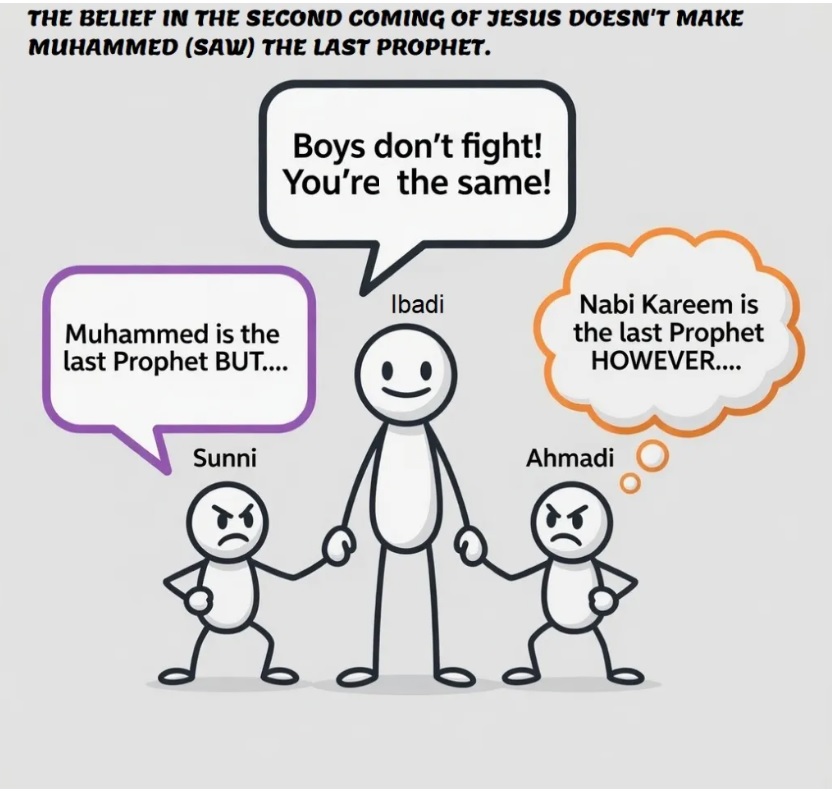
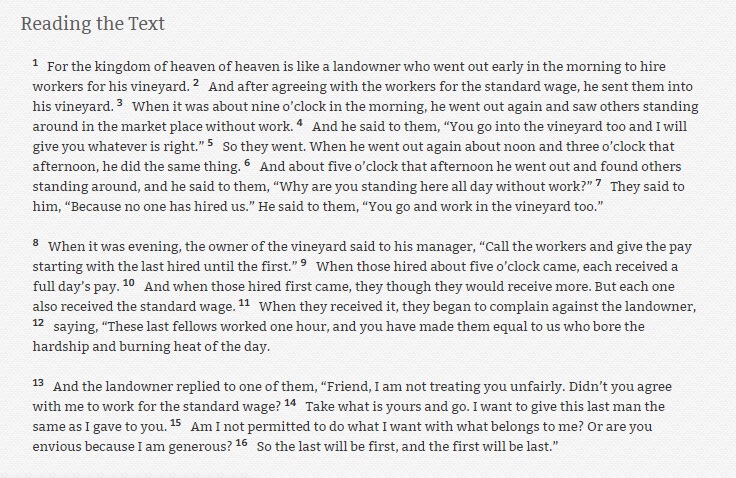
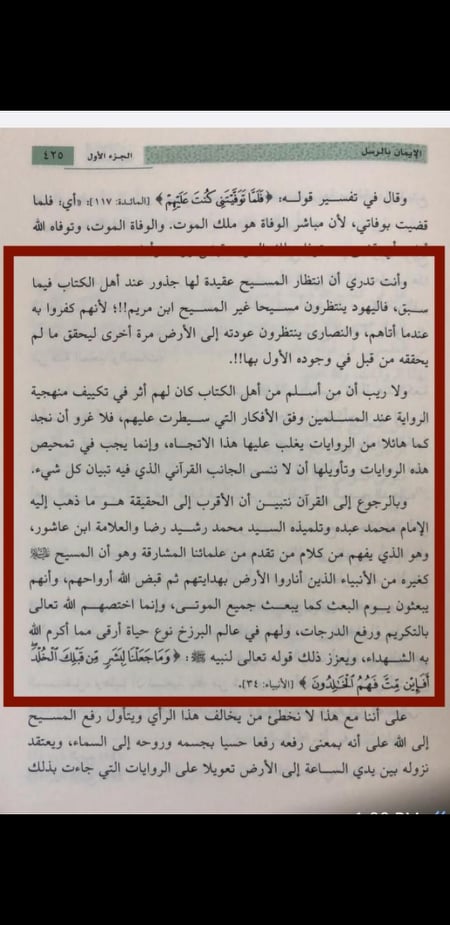
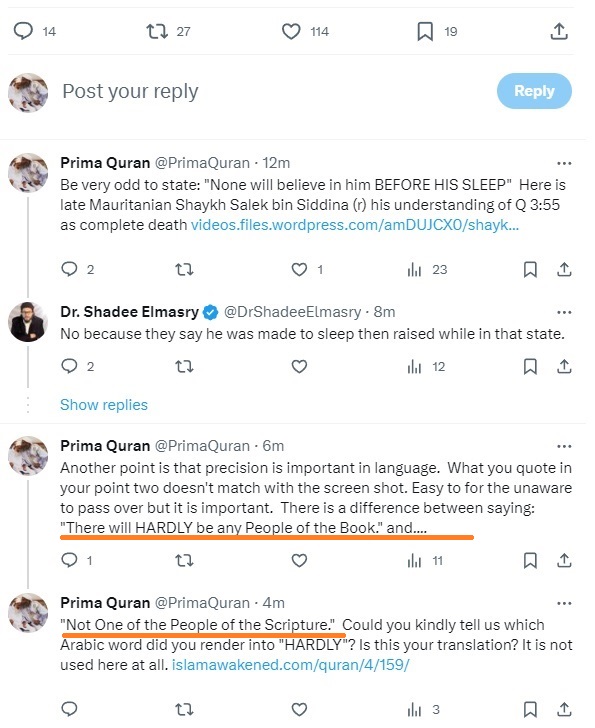
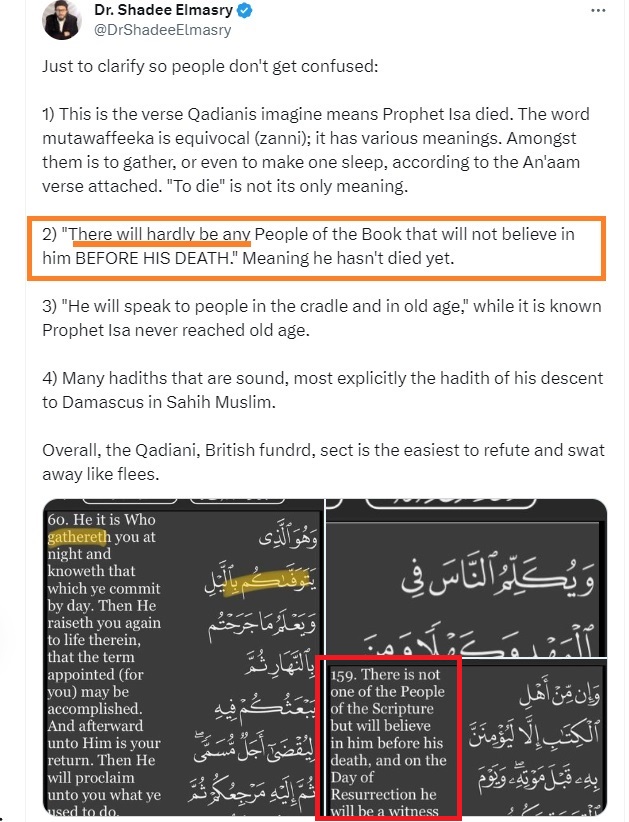


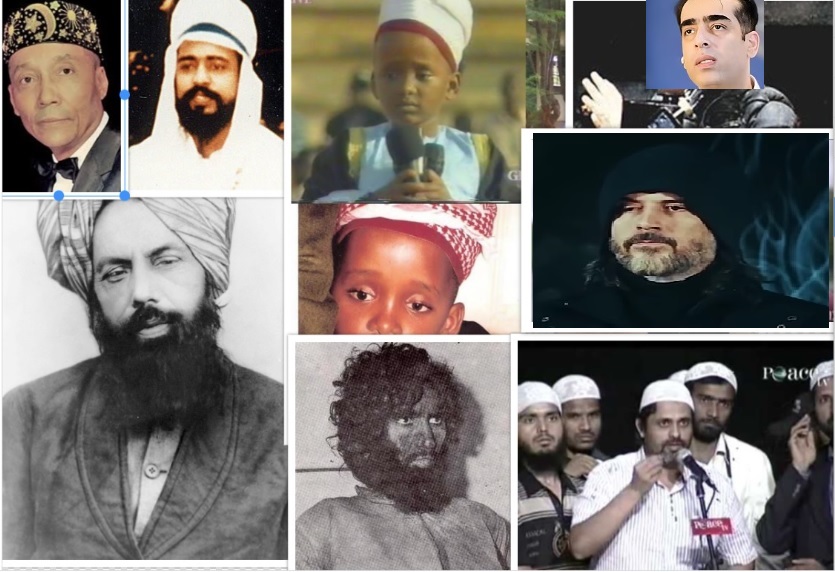



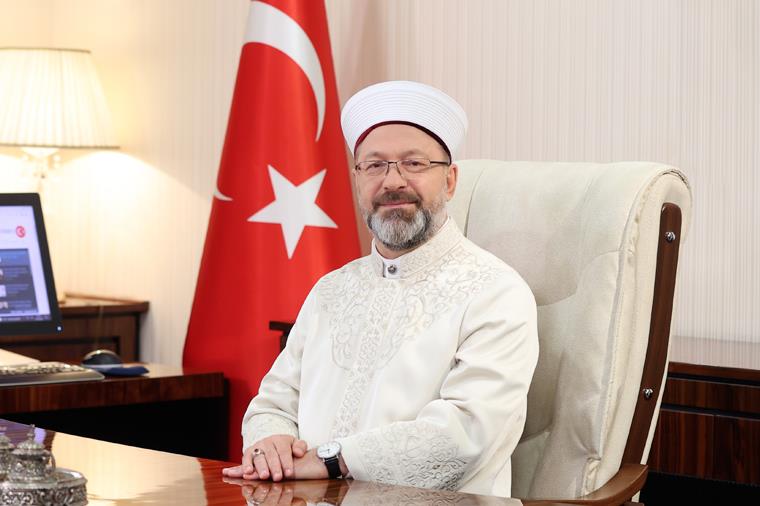


 Prima Quran