“Those who believe and whose hearts find comfort in the remembrance of Allah. Surely in the remembrance of Allah do hearts find comfort.” (Qur’an 13:28)
﷽
Ramadan Day 23:There is nothing better than the remembrance of Allah.
23rd day of Ramadan ——————————– *Heart Illness: The Ego* Arrogance is from the characteristics that kills the heart, Allah had vilified it in many verses such as: “I will turn away from My signs those who act unjustly with arrogance in the land.” (Qur’an 7:46).
The Blessed Prophet (saw) said:
“A person doesn’t enter the paradise if he has arrogance the weight of an atom.”
The types of arrogance: 1- Arrogance against Allah: And it is by rejecting to believe in him and to obey him, just like the Pharaoh who claimed to be a god, and Iblis who rejected the command of Allah to prostrate to Adam
2- Arrogance against prophets: By rejecting to believe in them and follow them, just like the people of Quraish who said that “Muhammed is an orphan, how can Allah send him to us?”
3- Arrogance against people: This can be caused by many things: Your knowledge/academic level. The amount of worship you engage in. Your lineage. Your beauty. Your wealth Your social status
Each one of these has a solution, but a good comprehensive solution to All these things is as
Ahnaf ibn Qays would often sit with Mus’ab ibn Zubayr. On one occasion, when he arrived, Mus’ab had extended his legs and didn’t make room. Ahnaf took his seat, feeling somewhat cramped. In response, he remarked, “It’s truly remarkable how a person can be proud and arrogant, considering that he has passed through the urinal passage twice.” [i.e., At the time of conception and birth]
Source: (At-Tawāḍuʿ wal-Khumūl (Humility and Modesty) – p. 201)
*The Sorting of People in the Religion* People are sorted to three: 1. A believer: we spoke about the attributes of a believer before.
2. A hypocrite: Is someone who shows outside the opposite of what is in his inside, and it’s of two types:
Doctrinal hypocrisy: It’s when someone shows belief in Islam and hides his Shirk as a way to protect them from being treated as such, and this type was described a lot in the Qur’an like: “When the hypocrites come to you ˹O Prophet˺, they say, “We bear witness that you are certainly the Messenger of Allah”—and surely Allah knows that you are His Messenger—but Allah bears witness that the hypocrites are truly liars.” (Qur’an 63:1)
Practical hypocrisy: It’s better than the previous type but it’s still a grave matter, and it’s when someone claims to be a Muslim but does not commit to the obligations of Islam by doing commands nor leaving prohibitions, and there are many evidences for this type. The Blessed Prophet (saw) said:
“Four things whoever has them is a pure hypocrite, and whoever has one of them he has an attribute of hypocrisy until he leaves it, if he was trusted he betrays, if he spoke he lies, if he made a covenant he breaks it, and if he quarrels he deviates from the truth.”
3. A Mushrik: Someone who rejects Islam outwardly and inwardly, this includes idol worshippers, atheists or the people of the book, and from the rulings of Mushriks: no inheritance between them, they are not buried in the Muslim cemeteries, we don’t pray for their dead, they aren’t greeted with the greeting of Islam. If they die between Muslims and there is no one from their faith the Muslims should bury them somewhere else without praying for them nor washing them, but their body should be covered to save the human sanctity.
We will discuss this later in the topic of the six doctrines/faiths -Allah Willing.
*Disliked Things in Prayer* Here are some disliked things that should be avoided when praying: Praying while holding back urine and faeces, in one opinion it doesn’t break the prayer until you raise a leg. Praying while fighting back sleepiness. Praying when the food is present. Praying in front of a distraction like a mirror or a picture. Adhering to a specific position in the mosque. Slightly looking around without a reason, some say the prayer doesn’t break until he looks at the sky or looks behind, and if the person looks around too much then his prayer is corrupted. Smiling slightly by accident. Performing Sahu prostration without having to. Yawning.
“Those who do good will have the finest reward and more. Neither gloom nor disgrace will cover their faces. It is they who will be the residents of Paradise. They will be there forever.” (Qur’an 10:26)
﷽
Those who believe that we will see Allah (swt) in the afterlife believe that the above verse is a proof of it.
“Those who do good will have the finest reward and (waziyādatun) more. Neither gloom nor disgrace will cover their faces. It is they who will be the residents of Paradise. They will be there forever.” (Qur’an 10:26)
We can see this زَادَ – yazīdu which basically means to ‘increase in something’. It is used throughout the Qur’an.
“That Allah may reward them the best of what they did and increase them (wayazīdahum) from His bounty. And Allah gives provision to whom He wills without account.” (Qur’an 24:38)
“And as for those who believed and did righteous deeds, He will give them in full their rewards and grant them extra (wayazīduhum) from His bounty.” (Qur’an 4:173)
“That He may give them in full their rewards and increase for them (wayazīdahum) of His bounty. Indeed, He is Forgiving and Appreciative.” (Qur’an 35:30)
” And He answers those who have believed and done righteous deeds and increases them (wayazīduhum)from His bounty.” (Qur’an 42:26)
“And those who are guided – He increases them (zādahum) in guidance and gives them their righteousness.” (Qur’an 47:17)
Their understanding is simply based on an exotic interpretation and not one based upon the meaning in the Arabic language.
We can see that every time they are increased from the genus or genre of what they are already being given. They are guided and guidance is increased. The finest reward and more of it. For example, in Arabic grammar it is fine to say I will give you 10,000 Euros and I will give you an additional 500 Euros, like this. Some people may scratch their heads wondering why there is a picture of an ice cream cone getting an additional scoop. The picture is to indicate what I mean in this point 2.
The following verse makes it abundantly clear that we will not see him:
“The faculties of seeing (tudriku) cannot grasp Him, and He grasp all–seeing (yudriku), He is the All-Subtle and All-Aware.” (Qur’an 6:103)
This indicates the description of the divine changes. What was once not true of Allah (swt) is now true of Allah (swt).
” Neither drowsiness nor sleep overtakes Him. To Him belongs whatever is in the heavens and whatever is on the earth.” (Qur’an 2:255)
So now it is possible that what is not currently true of Allah (swt) not being drowsy nor overtaken by sleep becomes possible.
If one can be gone then another attribute can be gone as well.
4. Not in the scope of this article but often those who believe that we will see Allah (swt) in the next life bring a number of hadith. This is an evidence for them. For us, as well as the majority of the Muslim Ummah, lone narrator reports (ahad) are not an evidence for us.
Zanni Hadith (الحديث الظني) refers to a narration that provides probable knowledge (ظن – Zann) rather than absolute certainty (يقين – Yaqeen)
Linguistically: Derived from “ظن” (Zann), meaning “assumption,” “probability,” or “conjecture.”
Technically: A Hadith that does not reach the level of definitive proof (Qat’i) but is still considered reliable enough for practical rulings.
For the Ibadi we do not build our belief upon the ahad. This is so even if we find the hadith to be sahih. That is because creedal matters are not based upon what is probable but what is certain.
Shaykh Massoud bin Mohammed Al Miqbali (h) explains this to us concerning a debate he had with one of the Salafi in Egypt. (A debate that they pulled offline).
The Shaykh also went on to explain that even in the case of an ayat of the Qur’an that is certain we may not build creedal matters upon it. That is because it could be from the mutashabih; and Allah (swt) has warned us:
“While other verses may have several possibilities. Those whose hearts are perverse, follow the unclear statements in pursuit of their own mischievous goals by interpreting them in a way that will suit their own purpose.” (Qur’an 3:7)
Thus the Qur’an itself can be certain and yet present verses that are multifaceted. How much more for the hadith?
Not to mention if they bring hadith we too can bring hadith.
Hadith like the following:
Narrated Abu Sa`id Al-Khudri:
The Prophet (saw) said, “Allah will say to the people of Paradise, “O the people of Paradise!” They will say, ‘Labbaik, O our Lord, and Sa`daik, and all the good is in Your Hands!’ Allah will say, “Are you satisfied?’ They will say, ‘Why shouldn’t we be satisfied, O our Lord as You have given us what You have not given to any of Your created beings?’ He will say, ‘Shall I not give you something better than that?’ They will say, ‘O our Lord! What else could be better than that?‘ He will say, ‘I bestow My Pleasure on you and will never be angry with you after that.’
Allah’s Messenger (saw) said, “Allah will say to the people of Paradise, ‘O the people of Paradise!’ They will say, ‘Labbaik, O our Lord, and Sa`daik!’ Allah will say, ‘Are you pleased?” They will say, ‘Why should we not be pleased since You have given us what You have not given to anyone of Your creation?’ Allah will say, ‘I will give you something better than that.’ They will reply, ‘O our Lord! And what is better than that?’ Allah will say, ‘I will bestow My pleasure and contentment upon you so that I will never be angry with you after for-ever.’ “
“Those who do good will have the finest reward and (waziyādatun) more. Neither gloom nor disgrace will cover their faces. It is they who will be the residents of Paradise. They will be there forever.” (Qur’an 10:26)
Recall what is stated above in point 2 above. That is to say that the more’ can be from the same genre or genus. This is what we have from Ali Ibn Abi Talib:
17634- حدثنا به يحيى بن طلحة قال ، حدثنا فضيل بن عياض، عن منصور، عن الحكم، عن علي رضي الله عنه: (للذين أحسنوا الحسنى وزيادة) ، قال: ” الزيادة “، غرفة من لؤلؤة واحدةٍ لها أربعة أبواب.
“Narrated to us by Yahya ibn Talha, who said: Narrated to us Fudayl ibn ‘Iyad, from Mansur, from Al-Hakam, from Ali regarding the verse: ‘For those who do good is the best reward and an increase.’ He said: ‘The “increase” is a chamber made of a single pearl with four doors.'”
Sources that cite the above narration include: Tafsir al-Tabari, Tafsir Ibn Abi Hatim, Tafsir al-Baghawi, Tafsir Ibn Kathir.
For those who are interested you may wish to see the following articles:
“so vie with one another in good works. Wheresoever you may be, Allah will bring you all together. Lo! Allah is Able to do all things.” (Qur’an 2: 148)
﷽
Ramadan Day 22:See you at the finish line. Allah-willing.
Heart Illness: Envy
Envy is the most dangerous characteristic, which leads to heart illness, and it’s to wish that some blessing is striped from others and given to you.
Allah says: “and from the evil of an envier when they envy.” (Qur’an 113:5), in another verse: “Or do they envy the people for Allah’s bounties? Indeed, We have given the descendants of Abraham the Book and wisdom, along with great authority.” (Qur’an 4:54)
Envy coupled with pride of one’s origin is the first sin ever committed, when Iblis envied Adam -(as)- and objected to perform Sujud for him, and it’s also the first sin on earth, when Qabil envied Habil so he killed him.
And an important note: There is a difference between Hasad (envy) and “ghibtah غبطة” Hasad is a bad attribute as we said, but ghibtah is to hope to get the blessing of others while not wishing for that blessing to be taken from them, the Blessed Prophet (saw) said: “No envy except in two: a man who was given knowledge by Allah and he teaches it in the morning and night, and a man who is given wealth by Allah and he spends it on those who deserve it.”
*The stages of the religion* The ways that Muslims take based on the surrounding conditions are called Masalik (ways/paths/stages) so that they do what they can to raise the flag of truth, and to establish the system of the religion.
Imam of concealment (Kitman): It’s the opposite of the manifest Imamate in meaning and in rulings, and it’s taken when the Muslims are weak and dispersed, and they can’t take any other path, and this was the way of the Blessed Prophet (saw) when he was in Mecca, and this was the way of Imam Jaber Bin Zaid when he realized that the Muslims cannot organize an Islamic system. He was followed by the great scholar, the pious, the leader, Imam Abu Ubaida Muslim Bin Abi Karima who was in concealment in Basra, but four of his students were able to establish manifest Imamates later on, and they are mentioned above, just like how the concealment of the Blessed Prophet (saw) produced a strong Islamic nation.
Then comes the Shira’ way: Shira’ linguistically means to sell, and it comes from many verses in the Qur’an like: “Allah has indeed purchased from the believers their lives and wealth in exchange for Paradise. They fight in the cause of Allah and kill or are killed. This is a true promise binding on Him in the Torah, the Gospel, and the Quran. And whose promise is truer than Allah’s? So rejoice in the exchange you have made with Him. That is ˹truly˺ the ultimate triumph.” (Qur’an 9:111). The Shira’ stage is taken when Muslims are oppressed and unable to raise the flag of truth, when there is an unjust ruler over them, an example of this is in the time of the Ummayads when Ziad Bin Abih was locating the people of truth to kill them and punish them, and the situation was unbearable, forty from the Shurah pledged allegiance to Imam Abu Bilaal Mirdas Bin Hudair Al Tamimi to repel by not fighting anyone except those who fight them, and these forty were able to defeat 1000 in the battle of ‘Asik. Shira’ can only be done with a minimum of forty people, and non of them can go back except if he dies, and in an opinion if there are only three left alive.
The final way is Manifestation (Dhuhur): it’s built on strength and unity of the Ummah, where the people can sail the ship of the Ummah, and this was the way of the Abu Bakr and Umar may Allah be pleased with them, and because this is the purest way, Ahl Alhaqq Wal Istiqamah never hesitated to establish it, some examples would be: in Hadhramout Imam Talib Al Haqq Al Kindi, in Oman Imam Al Julanda Bin Mas’ood Al Ma’wali and the righteous Imams after him, and in the west Imam Abu Al Khattab Al Ma’afiri and in the Rustumi state Imam Abdulrahman Bin Rustum may Allah be pleased with them all.
Difa’ (defence): It’s to make a temporary Imam in the situation of defense, when the state is invaded by an enemy.
To explain how the above takes place on a practical and pragmatic level in western nations like the former United States and the United Kingdom.
A) What the establishment thinks are progressive, liberal and reformist Muslims. These are perhaps the most important component of the plan. Their task is to ingratiate themselves to the left leaning thinkers and academia.
Related to them are fake apostates to Christianity or Agnosticism. This allows the Muslims to understand the networking and strategies of various Christian organizations.
Also related to them are people who have language speaking skills in Arabic, Farsi, Urdu etc. They are often tapped by intelligence apparatus in the above communities to act as informants. Some times these intelligence communities catch on that these people are double agents. Likewise and more often than not information via various channels is passed down to the relevant people.
The task of what the naïve think are ‘progressive’ , ‘liberal’ or ‘reformist’ Muslims are to form an echo chamber for anxious liberals or left leaning academic types. To give them the illusion that Islam can be molded and shaped according to the desires of these interest groups.
Among them are two sub groups:
Those who placate anxious left leaning and liberal leaning politicians all the while Islam grows in the country.
Those who may even call for the banning and vetting of Muslims from certain nations. While to the untrained eye this looks promising; it puts Western nations in a moral dilemma of hypocrisy. a) It makes the Western nations look as if they are compromising on plurality, and multiculturalism. b) It gives a strong hand to those Imams who teach the masses that the two world views are incompatible hence their restrictions.
B) What the establishment thinks are the moderate Muslims. The task of these Muslims is to be fluid between the political left and the political right. It also allows Western nations to save face by saying: “See we allow practicing Muslims in our societies and we welcome it!”
These Muslims are more often than not the activist types. Building Masjids, and Madrasah and grass roots organizations. One of the objectives of these ‘moderate’ Muslims is to create the illusion of conflict with the ‘progressive’ , ‘reformist’ or ‘liberal’ Muslims. So elaborate and orchestrated is this performance that by the time the policy makers know is happening it is already too late. So elaborate and orchestrated is this performance that the common Muslim actually perceives their is some kind of ideological battle between the two.
It is one of the reasons I am so confident to write this information. We are already beyond the threshold. We as Muslims just need to continue to have strong families, resilient communities, and keep winning hearts and minds. May Allah guide them to the truth!
Islam is salvation for the whole of mankind.
The west will try. They will do their best. Atheist will become cultural Christians as the realization sets in that perhaps pervasive hedonism wasn’t a great idea.
The moral relativism of the left is no match for Islam. The political right as they abandon Christianity will lean more into nativism, white nationalism.
All of this helps the Muslim communities and objectives.
In the end when the violence comes and it is coming (Allah knows best) -it will be from the political right. The violence will not be from the Muslims.
We just have to be patient. Act in accordance with the principles of justice and remember that none of those people truly are our enemies. They are people upon misguidance.
For those who want to read more about the four conditions of Islam.
*The Disliked in Wudu’* You should know dear believer that there are some actions that are disliked in Wudu’: 1. to perform it while standing 2. to talk in something other than mentioning Allah 3. to waste water 4. to increased the times of washing more than three times, and one in wiping 5. to perform it in a filthy place (to avoid the filth) 6. nudity in isolation, and it’s haram if people can see 7. to leave a Sunna of Wudu’
“And each one hath a goal toward which he turns; so contend with one another in good works. Wheresoever you may be, Allah will bring you all together. Lo! Allah is Able to do all things.” (Qur’an 2:148)
“Allah will judge between you on the Day of Resurrection concerning that over which you used to differ.” (Qur’an 22:69)
“So after the truth, what else can there be, save error? How then are you turned away?” –(Qur’an 10:32).
﷽
Insh’Allah the following section in the future will be found under the section above: Ahl Al-Qibla/Ahl Al-Khilaf.
Those of you who are used to seeing these people all over the internet and present on every social media platform available may come to the conclusion that their dawah is dominant. However, those of you who have access to the Arabic language, speak, read and write it will see that in the Arabic sphere these people (Wahhabis and Madkhalis) get absolutely pummelled by the Ibadi school. You will almost pity them (Wahhabis & Madkhalis). Though one should pity them and pray for their deliverance from the corruption and misguidance that they are upon.
The success of those who call themselves Salafi, Athari or those upon the Salafi Manhaj lies primarily in their ability into duping the masses to think that what they are upon is the view of the first three generation of Muslims.
They also feign the idea of taking the text by what they claim is the apparent meaning of a particular text. In fact, they apply ta’wil (interpretation) as do their opponents. Their opponents among Sunni Muslims (The Ash’ari & Maturidi) make the colossal mistake by granting a ‘default meaning’ to said words. Then turn around and say that they apply taʾwīl (interpretation). Where as we say that if a word has a range of meanings and the context determines the meaning, then it becomes dishonest to claim the word can only have one possible meaning. The context based upon use of the Arabic language itself, and the culture that the revelation was revealed in.
Understand that not everyone who goes by the title of Salafi, Athari is adversarial or antagonistic to the Ibadi school. Many of them we can cooperate with on many issues of concern to our communities and respective countries that we live in. Cooperation is always a good thing for the Muslim Ummah.
The inconsistency and flawed theology can readily be seen by the inconsistency that it deploys. Examples abound but the following should suffice:
Demanding a default location for Allah (swt). Where neither the Qur’an or Sunnah give a ‘default’ location for Allah (swt). The Qur’an and Sunnah ascribe to Allah (swt) many locations.
Using kalaam to speculate that Allah (swt) has two real eyes when we have no firm text on the matter.
The inconsistency in denying a gender for Allah (swt) when the apparent text clearly states: “There is nothing like Him, for He is the All-Hearing, All-Seeing.” (Qur’an 42:11) They say the language determines the characteristic without realizing that Allah (swt) is the one that chose the rules for the language to begin with.
Their bidʿah disclaimer when referencing what they claim are attributes of Allah (swt) with their bid’ah disclaimer “in a way that befits his majesty” as if there would be anything un-majestic about Allah (swt) having this or that to begin with!
The inconsistency in telling the people to believe in the attributes of Allah (swt) without asking ‘how’ and then the same people saying that the attributes of Allah (swt), are neither identical to the essence of Allah and yet not other than Allah! A deep dive into kalaam to speculate about the Creator what they have no evidence from the Qur’an or Sunnah.
The inconsistency in affirming Allah as the All-Hearing(Qur’an 42:11) without having to have ears; while simultaneously demanding that if Allah exist it must be in a place.
Allah (swt) himself gave mankind the faculty of reasoning and the ability to understand majaaz (metaphor) when He (swt) says:
so I become his sense of hearing with which he hears, and his sense of sight with which he sees, and his hand with which he grips, and his leg with which he walks; and if he asks Me, I will give him, and if he asks My protection (Refuge), I will protect him; (i.e. give him My Refuge) and I do not hesitate to do anything as I hesitate to take the soul of the believer, for he hates death, and I hate to disappoint him.”
But these people would have us to believe that the text is taken by the apparent and Allah (swt) does in some way becomes our hearing, our sight, our hand and our leg!
We have exposed the corruption in their misguided mis-understanding of the primary and secondary sources here:
Since they call us Ibadi as “Khawarij” let us see what Ibn Taymiyya has to say about the so called “Khawarij”.
“No one among the people who follow their desire, the more truthful and more just than the Khawarij. They do not intend to invent lies, indeed they are very famous for truthfulness to the extent that it has been said that the traditions narrated by them are the most authentic of all.”
Source: (Ibn Taymiyya Minhaj Al Sunnah Vol 3. p 3. Dr. Al-Sib’i Al-Sunna Wal Makanatuha Fii Al-Tashrii Al-Islami p. 99-101)
“No one of them has ever been known for lying.” Source: (Ibn Taymiyyah Al Tafsiru Al Kabir Vol. 1, p. 124)
“Their religion is more correct because they do not say lies.” Source: (Ibn Taymiyya Mukhtasar Minhaji Al-Sunna Vol.2, p. 197)
“The Khawarij never says lies, indeed they are more truthful braver and more promise-keeping then the (Shi’ia)” Source: (Ibid Vol. 1 p. 393)
“The Khawarij are truthful, so their accounts are among the most correct ones.” Source: (Ibn Taymiyyah Al Furqan p. 227)
“And what indicates that the Companions did not consider the Khawarij to be disbelievers is that they used to pray behind them. Abdullah ibn Umar -RA- and others[companions] used to pray behind Najda al-Haruri. They also used to engage in debates with them, as the Muslim would debate with a Muslim, as Abdullah ibn Abbas debated with Najda al-Haruri when he was sent to him to ask about certain issues, and his hadith is in Al-Bukhari. Likewise, Nafi’ ibn Al-Azraq debated on famous issues. Nafi’ used to debate on matters in the Quran, as any two Muslims would debate among themselves”
Source: (The Path of the Prophetic Sunnah-In Refutation of the Shiite Qadariyyah Doctrine By Ibn Taymiyya Abu Al Abbas Taqi al Din Ahmad ibn Abd al-Halim.-Edited by Dr. Muhammed Rashad Salim Volume 5)
This entry will be split into three sections:
Section one: This will be aimed at refuting the lies, deception and outright propaganda that they aim at Ahl al-Haqq wal-l istiqama (The Ibadi school).
Section two: This will be the Ibadi school exposing the bizarre beliefs and strange views of those who call themselves: Salafi, Athari etc..
Section three: Those who may loosely identify as Salafi, Athari etc that have had and do have cordial relations with our school. Because they simply see us as Muslims. Muslims perhaps they disagree with but Muslims none the less. Articles in relation to them will be posted under section three.
SECTION ONE: REFUTING THE LIES, DECEPTION AND OUTRIGHT PROPAGANDA THAT IS AIMED AT AHL AL-HAQQ WAL-ISTIQAMA (THE IBADI SCHOOL)
A REPLY TO THE CLAIMS OF THE SALAFI: MUHAMMED BIN SHAMS AL-DIN
SALAFI-SAUDI SHAYKH DR. SAAD AL-HUMID PROFESSOR OF HADITH SCIENCES IN MEDINA FLEES FROM DEBATE WITH SHAYKH SAEED AL QANOUBI: IBADI HADITH MASTER, ON THE CREATION OF THE QUR’AN
MAJOR DIFFERENCE BETWEEN IBADIS AND SALAFIS/ATHAIRS: IBADIS BELIEVE WE HAVE THE ENTIRE QUR’AN. SALAFIS/ATHARIS BELIEVE WE ONLY HAVE THE QUR’AN ALLAH INTENDED FOR US TO HAVE.
THE CLAIM THAT THE IBADIS CURSE AND REVILE THE COMPANIONS.THIS FALSE ALLEGATION IS TURNED ON IT’S HEAD! THE WAHHABI/MADHKALI/SALAFIYYA RELY UPON THOSE WHO SAY VILE THINGS ABOUT ALI
HADITHS THE SALAFIYYA AND AHL SUNNAH IN GENERAL RELY UPON TO CALL HUGE SWATHES OF THE PROPHET’S COMPANIONS DOGS OF HELLFIRE! (THE IBADIS RIP APART THESE CHAINS)
SECTION THREE: THOSE WHO MAY LOOSELY IDENTIFY AS SALAFI, ATHARI ETC THAT HAVE HAD AND DO HAVE CORDIAL RELATIONS WITH OUR SCHOOL. ARTICLES IN RELATION TO THEM WILL BE POSTED UNDER HERE.
MY EXPERIENCE WITH SALAFIS AND SUFIS (NOT ALWAYS CHALK AND CHEESE)
“Say, ˹O Prophet, that Allah says,˺ “O My servants who have exceeded the limits against their souls! Do not lose hope in Allah’s mercy, for Allah certainly forgives all sins. He is indeed the All-Forgiving, Most Merciful.” (Qur’an 39:53)
﷽
Ramadan Day 21: So many loved ones who have departed us who wished they could be in the last 10 days of Ramadan.
*21th of Ramadan* ——————————– *Heart Illness: Human Interaction*
Often we as human beings need to be in our own bodies with the silence of our own thoughts. We need to tune out the world around us and reach out to the heart with in. The Blessed Prophet (saw) would spend extended periods in the mountains alone. So, if that is the case you can say it is a Sunnah.
Often we need periods of isolation to protect ourselves from the chaos and instability of others and to protect others from periods of chaos and instability from ourselves.
The benefits of periods of isolation: Leisure time to contemplate, supplicate and to reorient. To get rid of sins To avoid trials and disorders
The benefits of contacting people: To learn and teach To benefit the people Fellowship Reward from Allah for doing obligatory things like congregation prayers To invite people to good deeds
So the Muslim should balance between isolation and mixing with people to maximise their rewards in this life and the hereafter.
*The pillars of the religion* The pillars are the strongest element of a building.
And in this metaphor the religion is like a building, and the pillars of this building are:
To Accept. To Delegate. To Submit and to Trust. These four things are the strong parts of the religion. These four pillars do not assemble in a soul except for one that’s sincere to Allah.
Acceptance: To accept the decree of Allah: It’s to accept everything from Allah, from command and prohibition, ease and hardship, so that the soul doesn’t find any problems in following the rule of Allah.
Delegation: It’s to be satisfied with the choice of Allah, as Allah knows best for his servants.
Submission: It’s to have complete obedience and submission for Allah without objection.
Trust: It’s to to have full trust in your creator and in what he has, and to not trust what is with the people, Allah says: “And whoever puts their trust in Allah, then He ˹alone˺ is sufficient for them.” (Qur’an 65:3), and this doesn’t mean that the person doesn’t need reasons, as that’s not trust, but it’s laziness and ignorance, as Allah has obligated linked matters with their reasons.
Some may ask: What is the difference between the fundamentals of the religion and the pillars of the religion?
The fundamentals are the base which the religion is built on, and the pillars are what strengthen the building to stand, so the pillars are built over the fundamentals.
*Janaza prayer (mourning)* The Janaza prayer is a prayer with no Ruku’ or Sujud, it starts with the Takbir of Ihram (Allahu Akbar) to start the prayer, then we say Isti’atha (Authu Billahi Minash shaitan Ar-ragim) and recite Al Fatiha، Then the Imam says the Allahu Akbar, and we send blessings upon the Noble Prophet Muhammed (saw) by saying (Allahuma Sali Ala Muhammed Wa’ali Muhammed Kama Sallaita Ala Ibrahim, Wabarik Ala Muhammed Wa’ali Muhammed Kama Barakta Ala Ibrahim Wa’ala ‘ali Ibrahim Fil Alamin Inaka Hamidun Majeed).
The above Arabic transliteration in English would be:
“O Allah, send your grace, honour and mercy upon Muhammed and the people of Muhammed, as You sent Your grace, honour and mercy upon Ibrahim. O Allah, bless Muhammed and the people of Muhammed, as you blessed Ibrahim and the people of Ibrahim. You are indeed Praiseworthy, Most Glorious.”
After this the the Imam says Allahu Akbar, then we pray for the dead person if he was from the people of Walayah. If he was not from the people of Walayah w pray for the Muslims in general, then after the final Takbir we do Taslim to the right and to the left.
“We have indeed revealed this in the ‘Night of Power’. And what will explain to you what the Night of Power is? The Night of Power is better than a thousand months. Therein come down the angels and the Spirit by Allah’s permission, on every errand. Peace!…This until the rise of dawn!” (Qur’an 97:1-5)
﷽
Ramadan Day 20:Prepare for Laylat-Ul-Qadr
*20th of Ramadan* ——————————– *Heart Illness: Food & Eating* “Eat and drink, but do not waste. Surely He does not like the wasteful.” (Qur’an 7:31)
The Blessed Prophet (saw): “Son of Adam didn’t fill a container worse than his stomach, it’s enough for the son of Adam to eat a few bites that strengthen him, if it’s inevitable then a third for his food, a third for his drink and a third for his breathing.”
Some say, whoever over eats may: Lose the sweetness in supplication. Have an inability to memorize the wisdom. Lose tenderness towards others. Think that others are also full. Find acts of worship heavy. Increase in his desires.
Our mother Aisha (ra) said: “The first test for the Ummah after their prophet is fullness, when the people filled their bellies, their bodies grew, their hearts weakened, and their desires became wild.”
And this doesn’t mean that Muslims should not eat the good things that were permitted by Allah; However, the Muslim should be careful with his desires, as desires are many, and the nafs doesn’t get satisfied.
A good medicine for this is to follow the Sunnah of the Blessed Prophet (saw) and fasting, and to to remember that the value of the food is not in the quantity but in the quality.
*The fundamentals of the religion* The fundamentals of the religion are knowledge followed by action, intention and devotion.
KNOWLEDGE:
Knowledge Is the first of the four fundamentals as everything else is based on it, and knowledge here refers to knowledge in the religion as Allah said:
“Say, ˹O Prophet,˺ “Are those who know equal to those who do not know?” None will be mindful ˹of this˺ except people of reason.” (Qur’an 39:9) and the Blessed Prophet (saw) said: “Whoever Allah wants good for, will give him knowledge in the religion.”
How can someone worship Allah in a correct way without knowing how to worship him?
ACTION:
Action here refers to the good deeds that aligns with the Shari’a, and it’s considered a fundamental of the religion because Islam didn’t come with a theoretical approach, rather Islam is theory and application, and we can see this in many verses where faith and deeds are connected, and it’s the only to safety, Allah says:
“By the ˹passage of˺ time!, Surely humanity is in ˹grave˺ loss, except those who have faith, do good, and urge each other to the truth, and urge each other to perseverance.” (Qur’an 103:1-3)
INTENTION:
Intention is the soul of deeds, we aren’t commanded to do anything but to worship Allah with sincerity to his religion, The Blessed Prophet (saw) said:
“Deeds are with intention, and everyone will receive n accordance with his intention.”
This means that there are no deeds that can be achieved without intentions, and intention is in the heart not on the tounge- as many people think.
DEVOTION:
Devotion (Wara’ ورع) is to avoid all that displeases Allah, devotion in reality is righteousness, and not all people are equal in it: 1- The first level is the level of fairness: and it’s to avoid all sins and do all obligations. 2- The second level is the level of the righteous: it’s to avoid what is allowed out of fear of doing what is not allowed, while also doing obligations and Nafilas. 3- The third level is the level of the people of truth: it’s to avoid what is allowed even if you don’t fear doing what is not allowed, while also trying to hasten toward any good deeds, and this is the best of levels
*I’tikaf* I’tikaf is the worship of staying in the mosque to worship Allah in a specific way.
The Blessed Prophet (saw) used to stay in the mosque for the last days of Ramadan.
The location of I’tikaf: Any mosque where the five prayers are established, and it’s better if the Jum’a prayer is also established in that mosque
The conditions of I’tikaf: Intention Fasting Leaving intimacy even at night Staying in the mosque Succession
The least amount of time for I’tikaf: from before Fajr or Maghrib until Maghrib
“Your only friends (waliy) are Allah, His Messenger, and fellow believers—who establish prayer and pay alms-tax with humility.” (Qur’an 5:55)
﷽
While many in our Ummah talk about the importance of ʿaqīdah (correct belief), one of the most important—and neglected—topics is the one we are about to address, in shā’ Allāh.
It is the lack of proper understanding and application of these principles that has left the Muslim Ummah, as well as many Muslim communities and individuals, in ruin.
Encouraging and inviting others to good is the hallmark of true believers in any sincere faith, while obstinate rebellion and persistence in it portend a ruinous end.
“You are the best community ever raised for humanity—you encourage good, forbid evil, and believe in Allah. Had the People of the Book believed, it would have been better for them. Some of them are faithful, but most are rebellious.” (Qur’an 3:110)
In many instances, we have become people who abandon the call to encourage good out of fear of ridicule and mockery. Yet, one should welcome such trials, for patience in the face of ridicule and mockery is the Sunnah of the Prophets (upon them all be peace).
On the other side of the spectrum are Muslims who mean well but whose approach is often filled with vitriol. Through their lack of manners, they end up pushing people away from the truth. May Allāh guide us.
Perhaps the English-speaking world’s first encounter with these concepts was through Professor Valerie J. Hoffman’s notable translation work, The Essentials of Ibāḍī Islam. I found the section on Walāyah & Barā’ah to be more suited for an advanced audience. Her choice to begin with Al-ʿAqīdah al-Wahbiyyah—by the esteemed scholar and Sufi Shaykh Nāṣir b. Sālim b. ʿUdayyam al-Rawāḥī (raḥimahullāh)—was an interesting one.
However, more than a decade has now passed, and as I am sure Professor Hoffman realized while in Oman, views are shifting. Thus, when one reads The Essentials of Ibāḍī Islam, the impression is that since the book quotes authoritative sources, it must represent current trends—though this is not necessarily the case.
Moreover, many of these teachings are ingrained in children from a young age. In fact, it is wājib (obligatory) upon reaching maturity to learn these matters. Nevertheless, Allāh (subḥānahu wa taʿālā) does not let any good deed be lost. Surely, she has her reward with her Lord.
The objective of this article, then, is to provide an overview of this fundamental teaching, so deeply ingrained in our school of Islam. Everything we do should be for the sake of Allāh (swt).
The Blessed Prophet (saw) said:
“If anyone loves for Allāh’s sake, hates for Allāh’s sake, gives for Allāh’s sake, and withholds for Allāh’s sake, he will have perfected his faith.” Source: (https://sunnah.com/abudawud:4681)
The English say: “Blood is thicker than water.” In Islam, we could say: “Faith is thicker than blood.”
Walayah, Bara’ah, and Wuqoof
What Do These Terminologies Mean?
Walayah (Affiliation): To befriend someone for the sake of Allah—by following the Qur’an and Sunnah. This includes:
Praying for their entry into Paradise.
Speaking well of them.
Taking an interest in their well-being.
Maintaining contact, assisting them, and upholding friendship.
Proofs for Walayah from the Qur’an:
“The believers, men and women, are allies (awliyā’) of one another. They enjoin good, forbid evil, establish prayer, give zakāh, and obey Allah and His Messenger. It is they who will receive Allah’s mercy. Surely, Allah is Almighty, All-Wise.” (Qur’an 9:71)
“Know that there is no deity except Allah, and seek forgiveness for your sins and for the believing men and women.” (Qur’an 47:19)
“Muḥammed is the Messenger of Allah, and those with him are firm against the disbelievers yet compassionate among themselves.” (Qur’an 48:29)
“Cooperate in righteousness and piety, but do not cooperate in sin and aggression. And fear Allah; indeed, Allah is severe in punishment.” (Qur’an 5:2)
“Believers, do not take your fathers and brothers as allies (awliyā’) if they prefer disbelief over faith. Whoever does so is unjust.” (Qur’an 9:23)
“Ibrāhīm’s plea for his father’s forgiveness was only because of a promise he had made. But when it became clear that his father was an enemy of Allah, he disassociated from him. Indeed, Ibrāhīm was tender-hearted and forbearing.” (Qur’an 9:114)
“You will not find those who believe in Allah and the Hereafter loving/showing affection to (yuwadduna) those who oppose Allah and His Messenger—even if they are their fathers, sons, brothers, or kin. For such believers, Allah has inscribed faith in their hearts and strengthened them with His spirit. He will admit them into Gardens beneath which rivers flow, where they will abide forever. Allah is pleased with them, and they are pleased with Him. They are the party of Allah, and it is they who will succeed.” (Qur’an 58:22)
Bara’ah (Dissociation): To disassociate from someone for the sake of Allah—due to their major sins, persistence in minor sins, or ingratitude toward Allah through their actions or negligence. This means:
Distancing oneself from such a person.
Being released from the obligations owed to them as a believer (similar to being freed from a debt).
Proofs for Bara’ah from the Qur’an:
“Whoever allies themselves with them (disbelievers) is indeed one of them.” (Qur’an 5:51)
This indicates that whoever befriends a disbeliever (mushrik) or hypocrite becomes like them.
“Do not ally yourselves with a people with whom Allah is angry.” (Qur’an 60:13)
Major sinners are among those with whom Allah is angry.
“Let not the believers take disbelievers as allies instead of believers.” (Qur’an 3:28)
“Those who believed, emigrated, and struggled in Allah’s cause with their wealth and lives—and those who sheltered and aided them—are allies to one another. But as for those who believed yet did not emigrate, you owe them no alliance unless they emigrate. However, if they seek your help in religious matters, you must assist them—except against a people with whom you have a treaty. Allah is All-Seeing of what you do.” (Qur’an 8:72)
This verse shows that even believers who failed to emigrate were denied full walāyah until they corrected their stance.
“This is a declaration of disassociation from Allah and His Messenger to the polytheists with whom you had treaties.” (Qur’an 9:1)
General Guidelines for Bara’ah: Bara’ah applies to individuals whose misdeeds are known, falling into two categories:
(A) Those who commit major sins (kabā’ir).
(B) Those who persist in minor sins.
Conditions for Applying Bara’ah:
Confession: The person admits to their sin.
Personal Witness: You see them commit major sins or persist in minor sins.
Testimony of Two Just Witnesses.
Wuqoof (Reservation/Suspension of Judgment): To pause, evaluate, and refrain from hasty judgment. It means:
Slowing down.
Assessing carefully.
Remaining ambivalent when uncertain.
Evidence for Wuqoof:
Ḥadīth: Mu‘ādh ibn Jabal reported that the Blessed Prophet (saw) said when sending him to Yemen: “Do not judge or decide except based on what you know. If you are uncertain about a matter, wait until you understand it fully, or write to me concerning it.”
Although some scholars consider this ḥadīth weak, it is supported by the Qur’an.
“Do not follow what you have no knowledge of. Indeed, the hearing, sight, and heart—all will be questioned.” (Qur’an 17:36)
Human Affairs Fall into Three Categories:
Clearly Right: Follow it.
Clearly Wrong: Avoid it.
Unclear/Doubtful: Leave it to Allah.
The Three Types of Walayah
Walayah al-Haqiqah – The real friendship. This is a matter of theology.
Walayah al-Dhahir – The apparent friendship. This is a matter of jurisprudence.
Walayah al-Jumlah – The general or common friendship. This is a matter of jurisprudence.
The Three Types of Bara’ah
Bara’ah al-Haqiqah – The real dissociation. This is a matter of theology.
Bara’ah al-Dhahir – The apparent dissociation. This is a matter of jurisprudence.
Bara’ah al-Jumlah – The general or common dissociation. This is a matter of jurisprudence.
Walayah al-Haqiqah – The Real Friendship with Allah
What does it mean to have real walayah with Allah ?
It means Allah (swt) is the ultimate Judge and knows the innermost details of every human being. He knows best who will die upon true faith. The only forms of walayah we as human beings can have with each other are dhahir (apparent) and jumlah (general).
Is There Any Proof from the Qur’an for This?
“Invite to the way of your Lord with wisdom and good instruction, and argue with them in a way that is best. Indeed, your Lord is most knowing of who has strayed from His way, and He is most knowing of who is [rightly] guided.” (Qur’an 16:125)
“The decision is only for Allah, He declares the truth, and He is the Best of judges.” (Qur’an 6:57)
Is there any other proofs?
‘Abdullah bin ‘Utbah bin Mas’ud reported:
I heard ‘Umar bin Al- Khattab (ra) reported saying: “In the lifetime of Messenger of Allah (saw) some people were called to account through Revelation. Now Revelation has discontinued and we shall judge you by your apparent acts. Whoever displays to us good, we shall grant him peace and security, and treat him as a near one. We have nothing to do with his insight. Allah will call him to account for that. But whosoever shows evil to us, we shall not grant him security nor shall we believe him, even if he professed that his intention is good.”
Walayah al-Haqiqah – Those in the Real Friendship with Allahare as follows:
The first and most obvious examples are those preserved from sin or died having all sins forgiven:
Angels
Prophets
Messengers of Allah
1. Eve & Adam (upon them peace), the Mother & Father of Mankind
“They said, ‘Our Lord, we have wronged ourselves, and if You do not forgive us and have mercy upon us, we will surely be among the losers.'” (Qur’an 7:23)
2. Aisha (ra), the Mother of the Believers
“The Prophet is more worthy of the believers than themselves, and his wives are their mothers…” (Qur’an 33:6)
3. The Angels
“O you who have believed, protect yourselves and your families from a Fire whose fuel is people and stones, over which are [appointed] angels, harsh and severe; they do not disobey Allah in what He commands them but do what they are commanded.” (Qur’an 66:6)
4. The Believers Persecuted by the People of the Trench
“Indeed, those who have believed and done righteous deeds will have gardens beneath which rivers flow. That is the great attainment.” (Qur’an 85:11)
5. The People of Jonah
“Then has there not been a [single] city that believed so its faith benefited it except the people of Jonah? When they believed, We removed from them the punishment of disgrace in worldly life and gave them enjoyment for a time.” (Qur’an 10:98)
6. Those Who Repented from Sorcery in the Time of Musa (as)
“But whoever comes to Him as a believer, having done righteous deeds—for them will be the highest ranks: the Gardens of Eternity, beneath which rivers flow, wherein they will abide forever. And that is the reward of one who purifies himself.” (Qur’an 20:75-76)
7. Habib the Carpenter
“Because of this, Allah has forgiven me and placed me among the honored ones.” (Qur’an 36:27)
8. The Unnamed Believer from Pharaoh’s Family
“And a believing man from Pharaoh’s family, who concealed his faith, said, ‘Would you kill a man for saying, “My Lord is Allah,” while he has brought you clear proofs from your Lord? If he is lying, then upon him is [the consequence of] his lie; but if he is truthful, there will strike you some of what he promises you. Indeed, Allah does not guide one who is a transgressor and a liar.'” (Qur’an 40:28)
9. Those Whose Eyes Overflowed with Tears
“And when they hear what has been revealed to the Messenger, you see their eyes overflowing with tears because of what they have recognized of the truth. They say, ‘Our Lord, we have believed, so register us among the witnesses. And why should we not believe in Allah and what has come to us of the truth? And we aspire that our Lord will admit us [to Paradise] with the righteous people.'” (Qur’an 5:83-84)
There are many other examples. What is required of us is to show walayah to those whom Allah (swt) has described in the Qur’an as righteous—those who follow His commands and are among the people of happiness—whether they are mentioned by name, by kunya, or by their attributes.
Barā’ah al-Ḥaqīqah – The Real Dissociation
What does the real barā’ah with Allah (swt) mean?
This means Allah (SWT) is the ultimate Judge and knows the minutiae of every human being. He knows best those who will die as mushrikūn (polytheists) or as ingrates. The only possible barā’ah (dissociation) we, as human beings, can have with one another is ẓāhir (apparent) and jumla (general).
Are There Any Proofs from the Qur’an for This?
“Call unto the way of thy Lord with wisdom and fair exhortation, and reason with them in the better way. Lo! Thy Lord is Best Aware of him who strays from His way, and He is Best Aware of those who go aright.” (Qur’an 16:125)
“The decision is only for Allah, He declares the truth, and He is the Best of judges.” (Qur’an 6:57)
Is there any other proofs?
‘Abdullah bin ‘Utbah bin Mas’ud reported:
I heard ‘Umar bin Al- Khattab (ra) reported saying: “In the lifetime of Messenger of Allah (saw) some people were called to account through Revelation. Now Revelation has discontinued and we shall judge you by your apparent acts. Whoever displays to us good, we shall grant him peace and security, and treat him as a near one. We have nothing to do with his insight. Allah will call him to account for that. But whosoever shows evil to us, we shall not grant him security nor shall we believe him, even if he professed that his intention is good.”
– The Real Dissociation: Those Truly Cut Off from Allah (swt).
1. Iblis, The Open Enemy of Mankind.
“Satan is indeed a sword enemy to humankind.” (Qur’an 17:53)
2. Hāmān, The Supporter of Pharaoh:
“So We seized him and his hosts, and cast them into the sea, while he was blameworthy.” (Qur’an 51:40)
3.Qārūn (Korah):
“So We caused the earth to swallow him and his dwelling-place. Then he had no host to help him against Allah, nor was he of those who can save themselves.” (Qur’an 28:81)
4.Pharaoh:
“Go you to Pharaoh, for he has indeed transgressed all bounds.” (Qur’an 20:24)
5. Al-Namrūd (Nimrod):
“Have you not considered the one who argued with Abraham about his Lord [merely] because Allah had given him kingship? When Abraham said, ‘My Lord is the One who gives life and causes death,’ he said, ‘I give life and cause death.’ Abraham said, ‘Indeed, Allah brings up the sun from the east, so bring it up from the west.’ So the disbeliever was overwhelmed [by astonishment], and Allah does not guide the wrongdoing people.“(Qur’an 2:258)
6. The wives of Noah and Lot:
“Allah presents an example of those who disbelieved: the wife of Noah and the wife of Lot. They were under two of Our righteous servants but betrayed them, so they did not avail them from Allah at all, and it was said, ‘Enter the Fire with those who enter.'” (Qur’an 66:10)
Even if any of these individuals appeared to do good in the eyes of people, Allah (swt) knew their ultimate fate. Thus, this is barā’ah ḥaqīqah (the true dissociation).
The example of Abu Lahab Flawed Argument Regarding Abu Lahab
Some Muslims use a flawed argument about Abu Lahab to prove the truth of the Qur’an, saying: “If Abu Lahab had taken the shahādah, it would have made the Qur’an false.”
This is incorrect. The words of Allah (swt) are absolute truth, whereas Abu Lahab’s actions (if he had ever claimed faith) would have been deception. Allah (swt) has already decreed his fate. He is the very definition of one being in barā’ah ḥaqīqah (the true dissociation), being truly cut off.
The inverse is also true: If Allah (swt) states in the Qur’an that someone will enter Paradise, and that person commits sins, it is because Allah knows they will sincerely repent. Thus, their ending is good.
The established principle regarding spiritual guardianship (wilayah) is that one who possesses true guardianship never loses it regardless of sins committed – we are certain they will die repentant. Thus, we reject their wrong actions while maintaining connection to their essential spiritual station.
This is why Imam Abu Sa’id al-Kudmi (May Allah have mercy on him) said: ‘We accept no falsehood from the blessed, nor reject any truth from the wretched.’
The examples of Adam (as) and Ayesha (ra)
The case of Adam (as).
We believe in the true spiritual guardianship (Walayah al-Haqiqah) of our father Adam (as), while Allah explicitly states in Scripture that he disobeyed and erred, then sought forgiveness and repented. We affirm his true guardianship while disassociating from his wrong action – his expulsion from Paradise being the consequence of his sin, constituting a divine punishment.
“And Adam and his wife ate of it, and their private parts became apparent to them, and they began to fasten over themselves from the leaves of Paradise. And Adam disobeyed his Lord and erred.” (Qur’an 20:121)
The case of the mother of the believers (Ayesha).
Ayesha (ra) fought against Ali. Ali is regarded as the Imam of the Muslims. This is true for the Imami Shi’i, Zaydi, Ibadi and most of Sunni Islam. Only a small (and rising faction) among them bring it into question.
“And if two groups from among the believers fight, effect reconciliation between them, but if one of them wrongfully oppresses the other then fight against the one which has wrongfully oppressed, till it returns to Allah’s command, then if it returns effect reconciliation between them with justice and act equitably, Allah certainly likes those who are equitable.” (Qur’an 49:9)
The amr of Allah belonged with Ali. Ayesha (ra) opposed him and later repented. We also know this because she (Ayesha) -may Allah be pleased with her is in the real spiritual guardianship (wilayat al-haqiqah).
Narrated Abu Maryam `Abdullah bin Ziyad Al-Aasadi:
“When Talha, AzZubair and `Aisha moved to Basra, `Ali sent `Ammar bin Yasir and Hasan bin `Ali who came to us at Kufa and ascended the pulpit. Al-Hasan bin `Ali was at the top of the pulpit and `Ammar was below Al-Hasan. We all gathered before him. I heard `Ammar saying, “`Aisha has moved to Al-Busra. By Allah! She is the wife of your Prophet in this world and in the Hereafter. But Allah has put you to test whether you obey Him (Allah) or her (`Aisha).”
So even though Aisha (ra) is acknowledged by Ammar bin Yasir (ra) to be the ‘wife of the Prophet in this world and in the Hereafter‘ he was not about to leave the commands of Allah (swt).
Whoever violates these divine limits must face the prescribed punishment, even if they possess true spiritual guardianship (wilayat al-haqiqah).
“The Prophet is more worthy of the believers than themselves, and his wives are their mothers…” (Qur’an 33:6)
This is a death blow to Shi’i aqidah. Because the guardianship of Allah (swt) does not change, and, likewise, Allah’s enmity does not change. That is because He is the All-Knowing, nothing is hidden from Him. Therefore, whoever is a friend of Allah is His Friend. Even if sins and grave offenses appear from the person, that person will not die except after repenting from them. And whoever is an enemy of Allah is his enemy, even if piety and acts of righteousness appear from them, that one will certainly die persisting in sinning against Allah the Almighty.
Thus, since Allah (swt) called Aisha (ra) the mother of the believers, she cannot, as Shi’i claim, be a person of the hellfire. This would indicate a change in guardianship and thus a change within Allah (swt).
The Believers’ Stance Toward Those in Barā’ah Ḥaqīqah
The believers must dissociate from those whom Allah (swt) has mentioned in the Qur’an as sinners or those promised punishment—whether they are mentioned by name, kunya, or attribute (e.g., Iblīs, Abu Lahab, his wife, etc.).
A Point of Reflection: Islam’s Theological Consistency Over Christianity in This Matter
Christians believe they are saved from Hellfire simply by uttering a confessional statement, being baptized, performing miracles, or doing meritorious acts. Yet, Christians from every denomination have seen members of their own churches abandon faith, convert to other religions, or reject Allah altogether.
This proves their salvation is ẓāhir (apparent), not al-ḥaqīqah (the true reality). True salvation is known only to Allah (swt).
Walayah al-Dhahir – The Apparent Friendship
These are the six basic rights that a Muslim owes to another Muslim.
Abu Hurairah reported Allah’s Messenger (saw) as saying: “Six are the rights of a Muslim over another Muslim.” It was said to him: “O Allah’s Messenger, what are these?” He replied:
When you meet him, greet him.
When he invites you, accept his invitation.
When he seeks your counsel, advise him.
When he sneezes and says, ‘Alhamdulillah,’ respond with ‘Yarhamuk Allah’ (May Allah have mercy on you).
There are, of course, other obligations Muslims have toward one another.
It was narrated that ‘Abdullah bin ‘Amr said: “I heard the Messenger of Allah (saw) say: ‘The Muslim is the one from whose tongue and hand the Muslims are safe, and the Muhajir is the one who forsakes (Hajara) what Allah has forbidden.’”
This means to show walayah (loyalty/friendship) to anyone you see following the commandments of Allah—whether from the Qur’an or Sunnah—regardless of whether:
You have personally observed their piety, or
They are widely known for their piety.
(This applies only if there is no contradiction in their reputation. For example, if you visit two towns and find that in the first, he is known for piety, but in the second, he is known for dishonesty in business, then you must pause and withhold judgment—perform wuqoof (reservation, assessment)—or make a decision based on the testimony of two just witnesses.)
Conditions for Accepting Testimony (Shahada) in Walayah
For a walayah testimony to be valid:
The two just witnesses must be in walayah with each other.
The questioner must be in their walayah.
They must be in the walayah of the questioner.
The person in question must be in their walayah.
Their testimonies must agree.
(If one witness says, “He is in my walayah,” while the other says, “He is in my bara’ah (disassociation),” then you must perform wuqoof—pause, reevaluate, and withhold judgment.)
Important Points: What If a Wali Commits a Sin?
Is there any sin worse than shirk (worshipping other than Allah)? Yes—one can imagine a sin graver than polytheism, worse than all major sins: despairing of Allah’s mercy and forgiveness.
Allah says: “Say, ‘O My servants who have transgressed against themselves [by sinning], do not despair of Allah’s mercy. Indeed, Allah forgives all sins. Truly, He is the Forgiving, the Merciful.’” (Qur’an 39:53)
“Never give up hope of Allah’s mercy, for none despairs of Allah’s mercy except the disbelieving people.” (Qur’an 12:87)
According to al-Diya’:
If one person calls a wali to repent, and he does so, then everyone else should maintain their affiliation with him.
It is unjust to dissociate from someone who has repented, as the door of repentance is always open.
No one has the right to say:
“Allah did not accept his repentance” (because this is unknowable),
“I do not accept it” (as no one can arrogate Allah’s role),
“When he sinned, his immorality was clear, so I assume he will sin again” (because dissociation cannot be based on mere speculation).
So be careful!
Bara’ah al-Dhahir
Bara’ah al-Dhahir is to disassociate from whoever you see disobeying the commandments of his Lord—whether from the Quran or Sunnah. If a waliy (ally) commits a major sin, he must be asked to repent. This applies if:
You witness the sin yourself,
The person admits to it,
The sin is infamous (without khilaf, i.e., no legitimate dispute—e.g., Epstein), or
There is testimony (shahada) from two just individuals confirming the sin.
Conditions for Accepting the Testimony (Shahada) of Bara’ah:
The two just witnesses must be in walayah (loyalty) to each other.
The questioner must be in their walayah.
They must be in the walayah of the questioner.
The one being asked about must be in their bara’ah (disavowal).
The testimony must be in agreement.
If there is khilaf (dispute), then one must practice wuqoof (reservation—stopping, evaluating, suspending judgment, and remaining ambivalent).
What Should You Do If You Witness a Major Sin?
(Note: Not all major sins are equally known; ignorance is not an excuse for well-known sins.)
Example: Someone eats during Ramadan while it is still daytime.
First, make excuses for them—perhaps they were sick, excessively hungry (fearing death), etc.
“O you who have believed, avoid much [negative] assumption. Indeed, some assumption is sin. And do not spy or backbite each other. Would one of you like to eat the flesh of his brother when dead? You would detest it. And fear Allah; indeed, Allah is Accepting of repentance and Merciful.” (Quran 49:12)
If they repeat the sin, investigate privately and remind them gently.
“And remind, for indeed, the reminder benefits the believers.” (Quran 51:55)
If they have no excuse, teach them with proofs.
It is obligatory to call all sinners to repentance.
Failure to do so:
For a major sin: Makes one a hypocrite.
For a minor or unclear sin: Is itself a sin (according to the strongest opinion in our school).
If they refuse to repent, ask them to make tawba (repentance).
There is khilaf on how many times:
Some say once,
Others say three times in three days,
Others say five times after each obligatory prayer (fareeda).
During this period, the person is in wuqoof with you personally—neither in walayah nor bara’ah (if they were in walayah, it would be general loyalty; if in bara’ah, general disavowal).
Declaring Bara’ah:
There is khilaf on whether to declare bara’ah directly:
Some say you must,
Some say no,
Some say it depends on whether it will deter them from sinning.
Example: You say, “You are in the bara’ah of the Muslims, and whoever is in the bara’ah of the Muslims is also in the bara’ah of Allah (swt and His Messenger (saw).”
If they respond dismissively (“What does that mean?” or “So what?”), explain the severity.
If you believe declaring bara’ahwill not stop them, you are not obligated to declare it.
Only after completing these steps do you perform bara’ah upon them.
Walayah al-Jumlah
Walayah al-Jumlah: General Wilayah (guardianship/loyalty) with mankind, jinn, angels, and all believers—past, present, and future—until the Day of Judgment. In other words, you maintain walayah (allegiance) toward all those who are in the walayah of Allah (swt). And those who are in Allah’s (swt) walayah are those whom Allah knows as the people of Jannah (Paradise).
Bara’ah al-Jumlah
Bara’ah al-Jumlah: General disassociation (bara’ah) from mankind, jinn, and all disbelievers—past, present, and future—until the Day of Judgment. In other words, you disassociate from whoever is in the bara’ah of Allah (swt), meaning those whom Allah (swt) knows as the people of the Hellfire.
Point of Difference Regarding Bara’ah al-Jumlah / Walayah al-Jumlah in Relation to Angels and Jinn
As previously mentioned in the discussion on Walayah al-Haqiqah, the angels are believers and do not rebel against Allah (unlike what Christians believe).
When it comes to the jinn, we must remember the following:
“Say: It has been revealed to me that a group of the jinn listened and said, ‘We have heard a wonderful recitation, guiding to the right way, so we have believed in it, and we will not associate anyone with our Lord.’” (Qur’an 72:1-2)
Whoever completely disassociates from all jinn is a munafiq (hypocrite), and whoever disassociates from all jinn is an unbeliever, because he has rejected those whom Allah (swt) has affirmed as believers.
Wuqoof
Wuqoof means to stop, pause, slow down, assess, evaluate, suspend judgment, or remain ambivalent. It applies to everyone you do not know—you should not judge them to be in walayah (allegiance) or bara’ah (disavowal).
It is obligatory because walayah and bara’ah are matters of aqidah (creed), so they cannot be based on doubts or probabilities. They must be founded on certain evidence.
The Rulings and Conditions for Wuqoof
Wuqoof applies to a person in your walayah who does something ambiguous. It does not apply to those in your bara’ah—there is no wuqoof for them.
Wuqoof is temporary, lasting only until the individual’s status becomes clear. This is for the living.
Wuqoof that is permanent. This can be for past individuals that you don’t have access to enough information from them. Their condition has not been estabished.
We do not declare walayah based on a single good deed. However, we do declare bara’ah based on a single sin—after presenting the evidence to the person, calling them to repentance (istitaba), and declaring bara’ah if they persist.
Types of Wuqoof
Wuqoof in Religion (Wuqoof Deen)
This applies to someone whose condition is unknown.
It is obligatory and a religious duty because it is impermissible to declare walayah or bara’ah for them without certainty.
Wuqoof of Opinion (Opinion Wuqoof)
This applies to someone in your walayah who does something you are unsure how to judge.
It also applies if it is confirmed that they did something that would necessitate bara’ah.
You pause judgment until you fulfill the conditions for declaring bara’ah (as mentioned above).
Wuqoof Due to Uncertainty (Questionable Wuqoof)
This occurs when someone does something whose ruling you do not know.
You pause judgment until you research the ruling of their action.
Once you know the ruling, you first fulfill the conditions for bara’ah (if applicable).
Wuqoof in Conflict (Problematic Wuqoof)
This applies when two people in your walayah do something, and you cannot determine who is right or wrong.
You pause judgment on both until the truth becomes clear.
Wuqoof Due to Doubt (Doubtful Wuqoof)
This occurs when you doubt the walayah of someone who is already in your walayah, while others do not share this doubt.
Removing them from walayah based solely on this doubt is forbidden according to Imam Al-Salimy (may Allah have mercy on him), because it is based on uncertainty.
ʿilm al-ẓāhir & ʿilm al-ghayb
Why it is important to differentiate between ʿilm al-ẓāhir (the knowledge of the seen) and ʿilm al-ghayb (the knowledge of the unseen).
The former is what we, as human beings, are required to base our judgments upon, whereas the latter is exclusively attributed to Allah. On this basis, if a person commits a wrongful act but his intention was good, we—as people limited to knowledge that does not extend beyond the visible world—are commanded to judge based on what is apparent.
This is why you can have courts that give a verdict that a person is guilty but latter found to be innocent. In the afterlife such errors in judgement are impossible.
The Messenger of Allah (saw) said: “I have not been commanded by Allah to search the hearts of people or to cut open their bellies.” Source: (Sahih al-Bukhari 4351)
So, unless Allah (swt) informs the Blessed Prophet (saw) about a matter he too judges based upon the apparent.
Furthermore, it was narrated that ʿUmar ibn al-Khaṭṭāb (ra) said:
The Messenger of Allah (saw) said: “Actions are but by intentions, and every person will have only what they intended. Whoever emigrated for the sake of Allah and His Messenger, then his emigration was for Allah and His Messenger. But whoever emigrated to attain some worldly benefit or to marry a woman, then his emigration was for that which he intended.” Source: (Sunan an-Nasa’i 3437)
Again this should be a clear reminder to all of us that our judgement is based upon the Dhahir or apparent. Where as the judgement of Allah (swt) is based upon the Ḥaqīqah or reality.
The Companions – The Sahaba
We affirm our allegiance to all the Companions except those who clearly committed grave sins during the turmoil (al-fitan) that arose among them. We also affirm our allegiance to those who suspend judgment concerning them because they are unable to discern the truth, as it is obligatory for those who lack understanding to withhold judgment—unless it becomes clear that someone is capriciously suspending judgment after having recognized the truth.
We do not suspend judgment concerning those who were aware of the actions of ‘Uthman and ‘Ali and were present when they committed reprehensible acts—unless they considered wrong to be right or right to be wrong, for such a stance is intolerable.
Walayah with Allah
Regarding our friendship and guardianship with our Creator, it consists of willing surrender—obeying His commands and avoiding what He has forbidden.
Allah’s Walayah with Us
What do we receive in return for our willing surrender? In reality, Allah (swt) owes us nothing. Yet, by His grace, we are granted His promise of guidance, support, and protection:
“As for those who accept guidance, Allah increases them in guidance and blesses them with righteousness.” (Qur’an 47:17)
“So, surely with hardship comes ease. Surely with hardship comes ease. So when you have finished, strive, and to your Lord direct your longing.” (Qur’an 94:5-8)
“Say, ‘Nothing will befall us except what Allah has decreed for us. He is our Protector.’ So in Allah let the believers put their trust.” (Qur’an 9:51)
“Do not grieve or despair; Allah is certainly with us.” So Allah sent down His serenity upon the Prophet, supported him with unseen forces, and made the word of the disbelievers inferior while the Word of Allah remained supreme. And Allah is Almighty, All-Wise.” (Qur’an 9:40)
It is astonishing that some outsiders believe our faith is solely about flogging, stoning, and amputations. In truth, we have a tightly integrated system of disavowal and reconciliation, of repentance and restored bonds, of friendship and necessary detachment.
When Muslims apply this to their lives, it becomes the spiritual equivalent of Japanese minimalism. You should seek the company of those who prioritize obedience to Allah and His Messenger—those aligned with devotion, not rebellion.
Once we realize that walayah (loyalty) and bara’ah (disavowal) extend beyond humans to the Jinn and the unseen world, we will step back and declutter our lives. We will recognize darkness—and its temptations—for what they truly are.
For example: The desire to go to a particular concert—but wait, who or what is truly inviting me? What forces are pulling me in that direction? Are they forces I should align with—those that nurture my spiritual growth—or forces I must reject?
As our Creator reminds us:
“Surely Satan is your enemy, so treat him as an enemy. He only invites his followers to become dwellers of the Blaze.” (Qur’an 35:6)
Satan has already declared bara’ah against us. The question is: Have we declared it against him and his minions?
“It is He who has sent His Messenger with guidance and the religion of truth to manifest it over all religion, although they who associate others with Allah dislike it.” (Qur’an 9:33)
The four conditions (Masalik al-din) according to Ahl al-Haqq wa-l istiqama (The People of Truth and Straightness) are as follows:
Kitman: The State of Secrecy.
Shira’: The state of trading one’s life for the cause of Allah.
Dhuhur: The state of being Manifest.
Difa’: State of Defense.
The arrival of the Umayyad Imperium completed the cycle of four stages that the Muslim community underwent. From the Blessed Prophet (saw) teaching Islam in secret (Kitman), to the command in Qur’an 15:94 to teach Islam openly and to fight in the cause of Allah (Shira’), to when Madinah was under the rule of Islam and the rule was total (Dhuhur), until the fighting among the companions and the appointment of the 5th Imam, Imam Ar Rasibi (May Allah be pleased with him) (Difa’).
This is the Prophecy of the Blessed Prophet (saw)
It was narrated that Anas bin Malik said:
“It was said: ‘O Messenger of Allah, when should we stop enjoining what is good and forbidding what is evil?’ He said: ‘When there appears among you that which appeared among those who came before you.’ We said: ‘O Messenger of Allah, what appeared among those that came before us?’ He said: ‘Kingship given to your youth, immorality even among the old, and knowledge among the base and vile.’”
IMPORTANT! The rulings of the sharīʿah tighten or loosen depending upon the condition of the Muslims and the context that they find themselves in.
You could ask an audience a trick question: Can Muslims eat pork yes or no? The deception is in the false dichotomy. The correct answer is: It depends on context.
KITMAN: The State of Secrecy
Kitman means hiding one’s beliefs. In reality, the word kitman comes from the verb katama, which means to hide, to conceal. In this state the believers keep their beliefs in secret to avoid suppression by their enemies who will not allow the Ibadis to profess their beliefs if they discovered them. In this sense, hiding one’s beliefs is the best way to preserve them. So ‘secrecy’ becomes an obligation in such a case. Ibadis started their movement in secrecy to avoid suppression by the Umayyad rulers. Both Ibadi leaders Jabir b. Zaid (ra) and his successor Abu Ubaidah Muslim b. Abi Karimah (ra) acted in the stage of secrecy (kitman). All their activities were carried out in secret. During this time, secrecy was recommended almost in everything.
“He said, “O my son, do not relate your vision to your brothers or they will contrive against you a plan. Indeed Satan, to man, is a manifest enemy.” (Qur’an 12:5)
Kitman is of much greater importance when we realize that it is a type of trust. When one discloses some of his secrets to you and asks you to keep them secret from others, then it is your duty to keep them secret as required by that person. Even between the two spouses, they have to practice kitman, i.e. they are in no way allowed to talk to others about the details or generalities of their conjugal life or intimate relations. Kitman may extend to cover the secrets of the whole state at the time of war and peace where a person who is loyal to his people cannot divulge to anyone or tell the enemy about his country’s affairs.
Also, we know that not everyone needs to know about all of our day to day affairs. There are some real busy bodies in this world.
Mu’adh ibn Jabal reported: The Messenger of Allah, peace and blessings be upon him, said, “Seek help in the fulfillment of your needs by being discrete, for everyone who is given a blessing will be envied.”
Ibadi scholars claim that the stage of secrecy (kitman) in their doctrine is derived from the life of the Blessed Prophet (saw) ; but they differ in fixing the exact period of secrecy in the life of the Prophet. According to Shaikh Muhammad Yusuf Atfaiyish (r), it is the period between the beginning of the revelation up to the time when the number of the Muslims reached forty by Umar b. al-Khattab (ra) declaring his acceptance of Islam. Abu Sulaiman Dawud b. Ibrahim al-Talati (r) regards all the period before the Prophet’s immigration to Madina as a stage of secrecy, while Abu Ammar Abd al-Kafi (r) says, “The Prophet stayed in Mecca for some time after the revelation, in secrecy.” It seems that he meant the period of three years of the prophethood before the revelation of this verse: “Proclaim what you have been ordered and turn aside from the polytheists.” (Qur’an 15:94) However, this was the basis on which Ibadi scholars furnished the proof for the obligation of secrecy (kitman) as a religious duty ordered in the Qur’an.
Special rules that apply when in kitman and/or living under the rule of tyrants and/or any situation where one fears for their life.
The most important aspect is the suspension of the hadd punishment during kitman.
During kitman Ibadis have to live under the rule of tyrants. Special rules were laid down for Ibais regarding their relationship with ‘tyrants’ in the time of kitman. The main principle is that the Ibadis must not be of any help to tyrants in their rule, so they must not hold any posts for them. The exception to this rule is that those members of the Ibadi community who are known for their opposition to the ‘tyrants’ and were capable of commanding them to good and forbidding them from evil, such members can hold posts in the rule of ‘tyrants’; they can lead their troops in jihad, be in charge of the spoils (ghanaim), Qadiship, or futya (delivering legal opinions on religious questions). Ibadis, in this attitude, follow the example of Ibn Abbas, Jabir b. Zaid, al-Hasan al-Basri and Shuraih al-Qadi. All these great scholars were known for their opposition to the rule of ‘tyrants’ and held posts under them. The condition for such an attitude is to run the posts according to the shari’ah and not fear anybody in practising justice.
The teachings of Islam still continue as per the following verses:
It was narrated that Abu Hurairah said:
“The Messenger of Allah (saw) said: ‘Whoever is asked about knowledge that he has and he conceals it, will be bridled on the Day of Resurrection with reins of fire.'”
“Verily those who conceal that which We have revealed of clear signs and guidance, after We have made it clear for people in the Book – on them shall be Allah’s curse, and the curse of those who curse. Except those who repent, make amends, and make manifest [the truth]; to them I relent, for I am Oft-returning, Most Merciful.” (Qur’an 2:159-160)
There are certain occasions on which the ‘tyrants’ force Ibadis to act or speak contrary to their beliefs. In such circumstances, Ibadi school allows its followers to use a special dispensation (rukhsah) under the principle of religious dissimulation (taqiyah) to avoid the punishment of death. They can, for example, say that there is more than one God, or claim walayah for the enemies of Allah, and baraah from the true believers, or give false testimony, or tell lies, all these with the tongue only without believing it. They also can eat during the day in Ramadhan, or eat carrion, blood, or pork, all this to avoid the punishment of death.
Some of the proofs for the above views are as follows:
“Whoever disbelieves in Allah after their belief—not those who are forced while their hearts are firm in faith, but those who embrace disbelief wholeheartedly—they will be condemned by Allah and suffer a tremendous punishment.” (Qur’an 16: 106)
“He has only forbidden to you dead animals, blood, the flesh of swine, and that which has been dedicated to other than Allah . But whoever is forced [by necessity], neither desiring [it] nor transgressing [its limit], there is no sin upon him. Indeed, Allah is Forgiving and Merciful.” (Qur’an 2:173)
“The believers must not take the disbelievers as friends instead of the believers. And whoever does that has no relation with Allah whatsoever, unless you (do so) as a protective measure (in order to) save yourself from them. Allah warns you of Himself, for unto Allah is the return.” (Qur’an 3:28)
Exceptions to Kitman: When you must risk your life being forfeit.
As the whole point of Kitman is the preservation of human life you may not do the following:
There are certain actions that must not be done even if that should cause the one using kitman the loss of their lives. Such as slaying the innocent. If you are asked to kill someone unjustly you must drop your cloak of kitman as the point of kitman was preservation of your life. In this case you trade your life for the innocent. May Allah (swt) reward the one who does it. Other instances where the cloak of kitman must be dropped: One cannot seize people’s property or lay waste to it. One must not give up their weapons to their enemies. One must not drink wine, commit adultery or eat and drink unclean (najas) things like urine or excrement.
One may not fail to note that khamr (alcohol) is given stricter treatment than that of pork. Both are haram, yes, but the former opens up more doors to greater sins while the later just stops there. The drinking of khamr (alcohol) also affects judgement, which in turn can affect the point of kitman.
“Whoever disbelieves in Allah after their belief—not those who are forced while their hearts are firm in faith, but those who embrace disbelief wholeheartedly—they will be condemned by Allah and suffer a tremendous punishment.” (Qur’an 16: 106)
If we revisit the above verse for a moment there is an interesting asbab-an-nuzul or occasion for this revelation being revealed.
In the Asbab Al-Nuzul by Al-Wahidi we find:
Said Ibn ‘Abbas: “This verse was revealed about ‘Ammar ibn Yasir. The idolaters had taken him away along with his father Yasir, his mother Sumayyah, Suhayb [al-Rumi], Bilal [ibn Rabah], Khabbab [ibn al-Aratt] and Salim [the client of Hudhayfah] and tortured them. As for Sumayyah, she was tied up between two camels and stabbed with a spear in her female organ. She was told: ‘You embraced Islam for the men’, and was then killed. Her husband Yasir was also killed. They were the first two persons who were killed in Islam. As for ‘Ammar, he was coerced to let them hear what they wanted to hear. The Messenger of Allah (saw), was told that ‘Ammar has renounced faith, but he said: ‘Never, ‘Ammar is filled with faith from his head to his toes; faith is admixed with his flesh and blood!’ ‘Ammar then went to see the Messenger of Allah (saw), crying. The Messenger of Allah (saw) wiped his tears with his own hand and said: ‘if they return to you, let them hear again what you told them’. Then, Allah, exalted is He, revealed this verse”. Mujahid said: “This verse was revealed about some Meccans who accepted faith. The Muslims of Medina wrote to them urging them to migrate and told them that they did not consider them part of them unless they migrated. And so they left Mecca intending to migrate to Medina. The Quraysh caught up with them on the way and coerced them to renounce their faith. It is about them that this verse was revealed
Besides, Ibadis, although living under the rule of ‘tyrants’, must have their own organisation to look after their affairs, and to plan for the safety of their community and to preserve the teachings of their schools; in other words, to prevent the Ibadis from melting into the large body of their opponents, and to ultimately prepare for ‘manifestation’
Saving yourself is from one of the major rules in Islam. Self preservation is a very basic rule in Islam.
In Islam we have what is known as : Ad-Darooriyyaat Al-Khams-The Five Basic Necessities that are protected and recognized by the Islamic law (shari’ah).
Protection and sanctity of ones: Life Religion Wealth Lineage Mind (intellect)
A modern example of this in action is where those who have have adopted the Ibadi school from other schools (be they Hanafi, Shafi’i, Hanbali, Maliki, Imam Shi’i, etc.) fear that if they pray the way the Blessed Prophet (saw) prayed they maybe violently attacked. So they are allowed to join the congregation and pray according tot he ijtihad of the prevailing school.
Another example: A woman in some remote part of the former United States or Canada embraces Islam. If her family knows she could be expelled from her home. She could be violently attacked even by members of her own family. If she outwardly adorns the khimar she could become violently attacked. So, in a place where the people wear winter attire (examples: Toboggan, Tuque, Toque, Touque, and neck scarfs) that woman can adorn winter wear and dress as modestly as she can. She can and must blend in to protect the sanctity of her life. However, the moment she moves to an area where the believers are both strong and able to defend her she must adorn the appropriate attire or be in a state of rebellion to Allah (swt) and his commands.
SHIRA’: The Sacrifice of one’s life for the cause of Allah
The Arabic word shira’ means buying and selling. This term is used in Ibadi writings for the action of sacrificing one’s life in the cause of Allah to attain Paradise.
Shira’ as an individual obligation; it is understood as a voluntary duty only.
Shurat (pl.) are: Those who have sold their souls for the cause of Allah .
The term al-shira’ is derived from the following verses of the Qur’an:
“Allah has bought from the believers their selves and their possessions against the gift of Paradise; they fight in the way of Allah; they kill, and are killed; that is a promise binding upon Allah in the Torah, and the Gospel, and the Qur’an; and who fulfil his covenant truer than Allah? So rejoice in the bargain you have made Him.”(Qur’an 9:111)
*Note* the above verse of the Qur’an teaches us clearly that Jesus (as) taught martyrdom against oppressors.
“So let them fight in the way of Allah who sell the present life for the world to come, and whosoever fights in the way of Allah and is slain, or conquers, We shall bring him a mighty wage.” (Qur’an 4:74)
“But other men there are that sell themselves desiring Allah’s pleasure.” (Qur’an 2:207)
The first to practice shira’ was none other than the Blessed Prophet (saw) and his noble companions who fought in the cause of Allah (swt) against those who wanted to physically stop the teaching and call to Islam.
Latter, after the arrival of the Umayyad Imperium it was practised by Abu Bilal Mirdas b. Hudair (ra). The idea of shira’ or Khuruj (coming out) occurred to him when he saw the harm caused by The Umayyad Imperium under Ubaidullah b. Ziyad against his fellow-Muslims. His comment on the situation was, “Surely, being content with tyranny is an offence, and drawing the sword and frightening the people is grave, but we come out and fight no one but those who do us wrong.”
They, i.e. the Shurat, agree that they sell themselves desiring Allah’s pleasure, and show no claim for ruling, but to end tyranny and revive righteousness. They must not revolt with less than forty men; they can complete the number with a woman. If their intention was not to return before ending falsity, batil), they, therefore, must not return to their homes unless they ended falsehood or died. If they went out with the intention to return if they wanted, they can return at any time. Their homes are their swords, so if they return to their original homes for any purpose, they must pray short prayers qasr and pray complete prayers during their revolt even though they were far away from their original homes
The following are the main principles of Shira’:
Shira’ is a voluntary duty for Ibadis in general, and an obligation for those who imposed it on themselves.
The minimum number of forty persons must carry it out.
.They must elect their leader among themselves. Imam of Shira‘. The authority of their leader is binding on his followers only.
Religious dissimulation, Taqiyah, does not behoove the Shurat, they have to fight till they bring tyranny to an end or are killed. Some scholars say that they can return if only three of them were left
They have no home except the places where they gather to fight their enemies; if they return to their original homes to get supplies, or information, or for any other purpose, they must consider themselves travelers and pray short prayers (qasr) while in their original homes.
They must not fight anyone except those who fight them, must not follow the defeated or kill the injured, must not kill old men, women, or children, and must not take any spoils or property unless they have a right to it
Regarding the stage of Shira’, it has already been mentioned that it is a voluntary duty for more than forty persons, and that they must pray full prayer during their revolt though they are far from their original homes. In case the Shurat wanted to take over during the Imamate of defence, they have all the right to do so, for the Imam of the Shurat, for his intention of sacrificing his life for the cause of the Ibadi community, is more entitled to the right of leadership than the Imam of defence.
Some scholars suggest that the state of Shira’ was practised first during the Meccan period of the Prophet’s life. They point out that the Prophet declared Islam openly when the number of his followers reached forty, this was about the time that Umar ibn al-Khattab (ra) had embraced Islam. It was thus, directed by the Qur’an to leave the house of al-Arqam b. Abi al-Arqam which was “the centre of his preaching activities.” When he had passed the stage of secrecy, Allah revealed to him, “O Prophet, Allah suffices you, and the believers who follow you.” (Qur’an 8:64)
DHUHUR:The State of Manifestation
The Blessed Prophet (saw) died leaving the Muslims in the stage of manifestation (Dhuhur). It is when Islam is established and it is dominant. It is not in a state of fracture or subjugation by enemies.
It is obligatory for Muslims to maintain this state in order to execute the commands of Allah (swt). Hadd punishments, the Friday prayers, the collection of zakat and protection tax (jizyah), fighting such enemies as Polytheists and rebels (al-bughat) the proper division of spoils and zakat, none of these obligations can be carried out without the authority of the Imam.
Note about Zakat. Yes Zakat is being paid by the Muslims today. However, it is being done by will alone. In reality the Zakat is a forced taxed collection by the Amir (Imam) to make sure that those who can do contribute to the betterment of the society. Abu Bakr (ra) fought people who refused to pay Zakat.
Ibadi scholars cite the Caliphates of Abu Bakr and Umar (May Allah be pleased with them both) as examples of the stage of manifestation in early Islam. Whenever Muslims attain satisfactory conditions of proper, wealth, and knowledge of religion, so that they can execute the commands of Allah, and when they number about half of the enemy around them, they must move from the condition of kitman via shira’ to the condition of Dhuhur by electing their own Imam from among their outstanding men.
The Imazighen or Free-Men of North Africa were the last to try to establish the Imam Adh- Dhuhur or the Manifest Imam. Manifestation (Dhuhur)
After the collapse of the Rustamid Imamate in Tahert in 909 A.D. Ibadis of North Africa tried to revive their Imamate under the leadership of Abu Khazr Yaghla b. Zaltaf, but they lost the battle of Baghy which they fought against the Fatimids on the year 358 A.H. After this the Ibadis entered the stage of secrecy up to our times. No attempt was made afterwards by the Ibadis of North Africa to establish the Imam Adh Dhuhur.
So a question arises: Are the Ibadis today without an Imam?
The answer to that is no. The Ibadis today are not without an Imam. The Imam today is the Imam Kitman. That is to say, the Imam in a state of secrecy. This Imam is known to his inner circle and it kept as such until the condition changes.
DIFA’:The state of Defence
Defence becomes the obligatory duty in the absence of manifestation (Dhuhur).
When under attack, or suspecting a sudden attack, the Muslims must elect a leader to lead them in fighting their enemy. Such a leader is calledImam al difa’, Imam of defence. He must be a learned man of high military capability. He has the same full authority as the Imam of Dhuhur until the end of the war. At the end of the war his Imamate dissolves automatically, so the Muslims would have no difficulty in removing him from his office. The Muslims must then elect their new Imam as required by the resultant state, either of ‘manifestation’ or ‘secrecy’. The first Imam of defence given in Ibadi sources is Abdullah b. Wahb al-Rasibi (ra) who was elected before the battle of al-Nahrawan. The other Imams of defence of North Africa included Abu Hatim al-Malzuzi (r) who tried to revive the Imamate of ‘manifestation’ which was established by Abu al-Khattab Abd al-Ala b. al-Samh al-Ma’afiri (r) and Abu Khazr Yaghla b. Zaltaf (r) who tried to revive the Rustamid Imamate and fought the Fatimids for this purpose.
Concerning the stage of difa’, it is already mentioned that the Imamate of defence (Imamat al-difa’) dissolves automatically after the end of the war, but some scholars hold that the Imamate of defence can remain after the end of the war as well. In the case of Imam Ali Ibn Abu Talib if he would have repented for the arbitration the Muslims would have rejoined him and the Imam of defense (Abdullah b. Wahb al-Rasibi –might have pledged allegianceto him (Ali) and rejoined him again, and Imam Ali would have been the Imam Adh-Dhuhur. However, this is only apossibilityas Ali also removed himself from the authority; so the people were free to choose their Imam. People think that the Ibadi position is that if a leader makes one mistake than we do khurooj against him or make tafkir. This is not correct. It depends on the type and nature of the mistake. IF he has committed a sin for which there is a required punishment such as adultery, or the act of the people of Lut, or theft, or drinking alcohol, unlawful killing and the arguments and proofs are established against him are proven by the Shari’ah judiciary, then there must be another Imam to carry out the Sharia punishment against him. He must retire or be isolated by the people of the contract and someone else is to be chosen. If he refuses, he will be judged as a transgressor and a revolt against him will be legislated.
May Allah (swt) guide the Ummah!
May Allah (swt) forgive the Ummah!
May Allah (swt) grant us the strength to return to the commands of Allah (swt).
“On the Day their tongues, hands, and feet will testify against them for what they used to do.” (Qur’an 24:24)
﷽
Ramadan Day 19:Control this beast (the tongue).
Replace the filth we say by the remembrance of Allah (swt). The remembrance of Allah (swt) sweetens the tongue from the filth of backbiting, lying, idle talk.
19th of Ramadan ——————————– *Heart Illness: The Eyes* ˹O Prophet!˺ Tell the believing men to lower their gaze and guard their chastity.” (Qur’an 24:30) Allah has created the eye for the sake of contemplation in the creation of Allah, and looking at what Allah has allowed. However, it can be an entrance for the devil, and a path for corrupting the heart. The misuse of the blessings of vision should not be underestimated.
Looking at women lustfully is an arrow from the arrows of Iblis. Whoever leaves it for the sake of Allah, Allah will give him the sweetness of Iman.
When The Blessed Prophet (saw) was asked about unexpected look, he commanded us to lower the gaze. So the first glimpse is for you and the second is against you.
It was narrated that ‘Ali said:
The Messenger of Allah (saw) said to me: “Do not follow one glance with another; you may be allowed the first but not the second.
From the benefits of lowering the gaze: Strengthening the heart Repels the Muslim from following desires
and many other benefits,. May Allah guide us and all Muslims to follow his commands and avoid the seduction of Satan.
As the poet said. First a look, then a glance then a nod of the head, then a kiss, then an embrace then the warmth of the bed and soon the fire.
*Faith and what it Entails* “The ˹true˺ believers are only those whose hearts tremble at the remembrance of Allah, whose faith increases when His revelations are recited to them, and who put their trust in their Lord.” (Qur’an 8:2)
Iman is to believe, and in the Islamic Shari’a Iman is believing in the unknowns that came with the messages of Allah, and the origins of Iman are collected in the Hadith of Gabriel (as) “It’s to believe in Allah, his angles, his books, his messengers, the day of judgment and destiny.”
Our faith is saying and acting. So after saying the Shahadah, you have to confirm it with deeds. Starting with obligations and to Nafilas when you can.
The sentence of monotheism has a doctrinal and practical interpretation. We have looked at the doctrinal interpretation from the beginning of Ramadan which includes: Allah and his attributes, prophets, angles, hell, paradise, Qur’an…etc
but know we will get into the practical interpretation of faith with topics such as: the fundamentals of the religion, the pillars of the religion, the stages of the religion, sorting the religion, the protection of the religion and guardianship and dissociation…etc
May Allah grant us success to do what he pleases.
*What the Imam carries for the followers*
There are things that the Imam carries for the Ma’moom (follower):
1. Reading the verses after Al Fatiha, so when the Imam recites the verses after Fatiha the followers should just listen and they don’t have to recite by their own nor repeat after the Imam.
2. Saying “Sami’al lahu liman hamidah” while standing from Ruku’, the followers should only say “Rabbana walakal hamd” after standing from Ruku’.
3. Sahu (inattention in prayer) because the heart may get busy with other than the prayer sometimes. May Allah protect us.
“Moreover, if two factions among the believers should fight, then make settlement between the two. But if one of them oppresses the other, then fight against the one that oppresses until it returns to the ordinance of Allah. And if it returns, then make settlement between them in justice and act justly. Indeed, Allah loves those who act justly.” (Qur’an 49:9)
﷽
Setting the Historical Record Straight.
All praise be to Allah. Those who are not thankful to people are not thankful to Allah. I want to thank our teacher, Shaykh Hilal Al Wardi, a brilliant man who has been patient with us in answering our questions. I want to thank Tanweer Oqul -the servant of Allah.
The aim and objective of this article is to seek and to prove that those companions of the Blessed Messenger (saw) who differed with Imam Ali’s decision for arbitration were on the right path.
This is a subject in which many Ibadi is well acquainted. In summer camps throughout Oman by the time many youths are in the 10th grade they can give you a recounting of the narrative, major figures in the battle of Siffin, as well as the Ibadi view.
That Imam Ali Ibnu Abu Talib was mistaken in seeking arbitration with Mu’awiya.
The first point to establish is that in hindsight all the sects among the Muslims agree that when Imam Ali was the commander of the faithful that his selection was legitimate.
1) The Sunni Muslims agree to this. 2) The Shi’i agree to this. Although, Shi’i believe it should have been earlier; however, they do not deny that his Imamate was legitimate. 3) The Ibadi Muslims agree to this.
In fact, the Ibadi are the first to accept without question the legitimacy of Abu Bakr, Umar, Uthman and Ali.
The Shi’a believe that Ali was overlooked or outright usurped. Imam Ali did not get rehabilitated into the Sunni paradigm until much later.
However, “Al Rashidun” or ‘rightly guided’ is a loaded Sunni theological terminology which seeks to indicate that the Caliphs or Imams of the early Muslims were beyond reproach.
ʿAdālat aṣ-Ṣaḥābah (عدالة الصحابة) is translated as uprightness of the companions. They may think this precludes them from major or minor sins. The Sunni scholars will often say that major sins were done before Islam. So the masses think that uprightness means free from sins.
This is mistaken.
However, the swerve comes when it comes to acts of injustice. They will add a caveat that it was not done intentionally. It is simply a matter of ijtihād. This, of course, is based upon aprior commitments to a particular doctrinal commitment.
“That the collective impunity of the Companions was a later construct of the Sunni worldview is evident when one finds occasional minor Companions listed in early books of weak hadith transmitters.” Source: (Hadith: Muhammed’s Legacy in the Medieval and Modern World’ by Dr Jonathan Brown page 88)
We can clearly see the emotionalism attached to the defense of the character of the companions by statements from Ibn Main.
“The shaykh of Imam Bukhari, Ibn Ma’in where he said about someone who critiqued a companion, calling the man ‘a sucker of his mother’s clitoris’.”
Source: (Hadith: Muhammed’s Legacy in the Medieval and Modern World’ by Dr Jonathan Brown page 87)
“There are even reports from the early historian al-Mada’ini that Mu’awiya encouraged systematic forging and circulation of hadiths affirming the virtues of the caliphs and companions at Ali’s expense.” (cited from Al-Mada’ini’s Kitab al-ahdath; Ahmad b Sa’d al-Din al-Miswari, Al Risala al-munqidha min al-ghiwaya fi turuq al riwaya, pp. 51-55)” This citation is found in Dr Jonathan Browns book: “Hadith Muhammad’s Legacy in the Medieval and Modern World page 70.”
This is also noted in one of the earlier books of Sunni creed: Al-Aqidah al-Tahawiyyah or the Creed of Imam al-Tahawiyyah. Under the section: الثَّنَاءُ عَلَى الصَّحَابَةِ (Praise for the Companions)
“We love the companions of the Messenger of Allah, (saw). We do not exaggerate in our love for any of them, nor do we disown any of them.”
Here there should be a subtext: “Except the Muhakkima in general and Ahl al-Nahrawan in particular.” Did Imam Al Tahawi distinguish between major /minor companions? He did not.
So, the position that the companions could do no wrong is a deeply rooted theological position among Sunni Muslims. Thus, any conversation on this subject must be done while bearing this in mind.
Suffice it to say that the verse we will come to examine further, pushes back against this idea.
Analyzing the text of Qur’an 49:9
“Moreover, if two factions among the believers should fight, then make settlement between the two. But if one of them oppresses the other, then fight against the one that oppresses until it returns to the ordinance of Allah. And if it returns, then make settlement between them in justice and act justly. Indeed, Allah loves those who act justly.” (Qur’an 49:9)
The English translations do not convey very important yet subtle points.
First point to take note of. Before identifying which party is the aggressor, Allah says “from the believers”and not “two believing groups“, commanding reconciliation because mistakes may occur.
As stated: ‘It is not for a believer to kill another believer except by mistake.’(Qur’an 4:92)
Through reconciliation, the aggressor party becomes known and must repent to remain within the circle of faith. If they persist in their aggression, then fighting them becomes obligatory – this being one of Allah’s prescribed limits (hudud), like the punishments for theft, slander, adultery, brigandage, and alcohol consumption.
Note that Allah (swt) said that if two factionsfight that we fight the one that oppresses the other. So, can it be said that the oppressor is just?
Whoever violates these divine limits must face the prescribed punishment, even if they possess true spiritual guardianship (wilayat al-haqiqah). This is why Ammar (Ra) fought against the Mother of the Believers (Aisha -May Allah be pleased with her) in the Battle of the Camel while still affirming her status.
“The Prophet (saw) said, “While I was sleeping, a group (of my followers were brought close to me), and when I recognized them, a man (an angel) came out from among (us) me and them, he said (to them), ‘Come along.’ I asked, ‘Where?’ He said, ‘To the (Hell) Fire, by Allah’ I asked, ‘what is wrong with them’ He said, ‘They turned apostate as renegades after you left.’ Then behold! (Another) group (of my followers) were brought close to me, and when I recognized them, a man (an angel) came out from (me and them) he said (to them); Come along.’ I asked, “Where?’ He said, ‘To the (Hell) Fire, by Allah.’ I asked, what is wrong with them?’ He said, ‘They turned apostate as renegades after you left. So, I did not see anyone of them.” Source: (https://sunnah.com/bukhari:6587)
I said to ‘Ammar: What is your opinion about that which you have done in case? Is it your personal opinion or something you got from Allah’s Messenger (saw)? ‘Ammar said: We have got nothing from Allah’s Messenger (saw) which people at large did not get, but Hudhaifa told me that Allah’s Apostle (saw) had especially told him amongst his Companion, that there would be twelve hypocrites out of whom eight would not get into Paradise, until a camel would be able to pass through the needle hole. The ulcer would be itself sufficient (to kill) eight. So far as four are concerned, I do not remember what Shu’ba said about them.
“When Talha, Az-Buair and Aisha moved to Basra, Ali sent Ammar bin yasir and Hasan bin Ali who came to us at Kufa and ascended to the pulpit. Al Hasan bin Ali was at the top of the pulpit and Ammar was below Al Hasan. We all gathered before him. I heard Ammar saying, “Aisha has moved to Al Busra. By Allah! She is the wife of your Prophet in this world and in the Hereafter. But Allah has put you to test whether you obey Him (Allah) or her (Aisha).”
So even though Aisha (ra) is acknowledged by Ammar bin Yasir (ra) to be the ‘wife of the Prophet in this world and in the Hereafter‘, he was not about to leave the dhahir (the apparent) evidence.
Notice he says: “Allah has put you to test whether you obey him (Allah) or her (‘Aisha)“.
Just as Ammar bin Yasir (ra) was not about to leave the Amr (Authority and command of Allah) regardless of the station of Aisha (ra) likewise at Siffin those insightful companions of the Blessed Messenger (saw) were not about to leave the Amr (Authority and command of Allah) regardless of the station of Imam Ali.
Both the Sunni and Imami Shi’a are theologically invested in the battle of Siffin.
Do note dear reader that this is not just a matter of competing narratives. The consistency or lack of consistency is what is being measured.
Those who call themselves ‘Ahl Sunnah Wal Jammah’ -will grant that all this fighting and killing that took place among the companions was simply a matter of ijtihad.
Nevertheless, we will find some people who are confused about the matters during that time, mistaking the people of Nahrawan and not describing them as being guided in their view and mujtahids!
However, they describe Mu’awiya and Imam Ali as diligent and mujtahid !!!
Yet, the inconsistency is laid bare when we see that they do not afford this to those companions of the Blessed Prophet (saw) that differed with the decision of Imam Ali at Siffin. Instead, some of these blessed companions such as, Owais Al-Qurni, Hurqus ibn Zuhair Al-Sa’di, Abdullah ibn Wahb Al-Rasibi Al-Azdi, Zaid bin Husayn Al-Taie, Shajrah bin Aufa Al Salmi, Shuraih bin Uufa al-Abasi, Thermala bin Bani Handala, Nafi Mawla Thermala, Umair bi Al-Harith, Abu Amr bin Al-Nafi’, Hakam bin Amr Al-Ansari, Al-Khairat bin Rashid Al-Sami (May Allah be pleased with them all) are reviled as the dogs of the hellfire! (see note A)
Ahadith are inserted in the mouth of the Blessed Prophet (saw) without shame, or fear of Allah (swt).
For Imami Shi’a even more is at stake. If you have a doctrine that the Imams are infallible in their guidance and ‘ijtihad and even one error in judgement can be attributed to them it is game over. That whole doctrine becomes absolutely crushed.
Fighting & Killing each other: Simply a matter of Ijtihad?
Think about this: Talha and Zubair fought against Ali. Mu’awiya and Amr Ibn Al-As fought against Ali. All sides killed many Muslims at the battle of Jamal and Siffin. All of them are just. Killing each other is simply a matter of ‘ijtihad’? Ijtihad-to the point that if they were in error they would still get rewarded?!?
The illogical and inconsistent methodology that results from such a view.
We, the Muslims, The People of the Truth and Steadfastness do not agree that every ‘ijtihad’ is correct or rewarded. A Judge, for example, when hearing a dispute between two parties will not rule that both parties are right and should be compensated for their role in the dispute. An even more absurd conclusion would be if the Judge, after ruling that one party was right in its claim and awarding it; then turned to the other side, pardoned them and then awarded them for their wrongdoing. Is this a rational concept? If a Judge would never behave in such an unjust way, do you honestly believe that the greatest Judge of all, Allah (swt) would order us to act in this way? If we take this to its logical conclusion, then no one is entitled to criticize or resolve any disputes!
Imagine if one were to say to those people who claim that Muslims cannot rebel against their leaders, “In my ijtihad the ruler is unjust, so I wish to rebel against him!”
They would argue that this goes against firmly established evidence. Thus, the ijtihad of any Muslims cannot go against what is firmly established.
“Al-Harith ibn ‘Amr reported: The Messenger of Allah (saw), sent Mu’adh to Yemen and he said, how will you judge?” Mu’adh said, “I will judge according to the Book of Allah.” The Prophet said, “What if it is not in the Book of Allah?” Mu’adh said, “Then, with the Sunnah of the messenger of Allah.” The Prophet said, “What if it is not in the Sunnah of the messenger of Allah?” Mu’adh said, “Then, I will strive to form an opinion.” The Prophet said, “All praise is due to Allah, who has made suitable the messenger of the messenger of Allah.”
Let us first say that this idea that the companions of the Blessed Messenger (saw) that differed with Imam Ali over the arbitration, that they are the so-called ‘Khawarij’ it is simply a flat lie. (see note B)
It is a derogatory term perpetuated by both the Shi’a and the Umayyad rulers, as well as their intellectual descendants until this very day. Even among the people today who perceive themselves as intellectuals and well-read they persist with these statements without a shred of evidence to support them. It is used to “other” one’s opponents and to demonize them.
Inconsistency in the application of the term Khawarij
We need to make sure we have fair and consistent methodology before applying labels to people. A) Ask your people (those whom you the reader trust) to define the term Khawarij. What is the Arabic etymological root of the word and what does it mean in the Arabic language. Once this is done, please proceed to point B.
The meaning of khuruj is to go out, or to exit from.
تأشيرة خروج tashirat khuruj -visa, exist visa تسجيل خروج tasjil khuruj- log out. خروج عن النص khuruj ‘ayn alnas -exit text.
B) Now with that definition in mind, ask on what consistent basis is this not applied to Talha and Zubair? Why are Talha and Zubair not called Khawarij for opposing Imam Ali?
Imam Ali Ibn Abu Talib was the rightful Amir of Muslims at that time, was he not? C) Now with that definition in mind ask on what consistent basis is this not applied to Mu’awiya or Amr ibn Al-As?
Why are Mu’awiya and Amr ibn al As not called a Khawarij for opposing Imam Ali? Imam Ali Ibn Abu Talib was the rightful Amir of the Muslims at that time, was he not?
So, Mu’awiya and Amr ibn al As are the Khawarij.
They are the one’s who went out from the Ummah. The rest of the Ummah recognize the Imamate of Ali Ibn Abu Talib and gave bay’ah
This in and of itself shows the supreme bias and inconsistency when the narrative is being told through the historical lenses of sectarianism.
The Creation of false Narratives.
Praise be to Allah (swt) who has put the truth in the mouth of the people of the opposition. (Ahl Khilaf)
As we saw above: “There are even reports from the early historian al-Mada’ini that Mu’awiya encouraged systematic forging and circulation of hadiths affirming the virtues of the caliphs and Companions at Ali’s expense.” (cited from Al-Mada’ini’s Kitab al-ahdath; Ahmad b Sa’d al-Din al-Miswari, Al Risala al-munqidha min al-ghiwaya fi turuq al riwaya, pp. 51-55)”
This citation is found in Dr Jonathan Browns book: Hadith Muhammad’s Legacy in the Medieval and Modern World page 70“
Dr Musa Al-Musawi (The grandson of Ayatollah Abul Hassan Al Isfahani) says the following: “Although we believe that most of the forged narratives from the Imams, were forged after al-ghiba al-kubra (the disappearance of Al-Mahdi Al Muntadhar) …..but any impartial researcher will necessarily conclude that even during the time of the Shiite Imams, many narratives were fabricated and ascribed to the Imams, in the like manner as they were fabricated and attributed to the Prophet.”
Source: (al-Shi’a wa-l-tashih: al-Sira’ bayn al-shi’a wa-l-tashayyu'(the struggle between Shia and Shiism p. 135)
“Certainly, the researcher into accounts that the Shiites collected in their books which they authored between the fourth and fifth centuries A.H., will reach the extremely saddening results. For the efforts that were made by some of the Shiite narrators to undermine Islam were equal to the heavens and the Earth in gravity. And I suppose that those Shiite narrators did not merely intend to implant the Shiite beliefs in the hearts (of their followers), but they did also intend to destroy Islam, and everything connected to it.”
Source: (al-Shi’a wa-l-tashih: al-Sira’ bayn al-shi’a wa-l-tashayyu'(the struggle between Shia and Shiism p. 15)
The honesty and integrity of the so-called Khawarij.
‘Among all people who follow their desire, there have been no men whose traditions are authentic as the Khawarij” Source: (Al-Dhahabi Mizanu Al-Itidal Vol. 4 p. 156 in the biography of Imran bin Hittan)
Ibn Hajar agrees with this. Source: (Ibn Hajar Hadyu Al-Sari: Muqaddimatu Alaa Fat-hi Albari p.611.)
Imam Al Sayuti also has a similar stance.
Source: (Al-Suyuti: Tadribu Al-Rawi p.285)
Now, when we consider what these giants among Sunni Muslims have said is it not bizarre that the so-called “Khawarij” are people on the one hand who follow their desire and yet strictly only narrate authentic traditions disregarding fabricated hadith, unlike the Shi’i and Sunni?
Ponder that for a moment….
Again, we have: Dr Mustafa Al-Siba’i founder of the Syrian branch of the Muslim brotherhood states: “I have never discovered any narrative that has been fabricated by the Khawarij; I have made extensive research in books specially authored on fabricated traditions and narratives, I have never found any man among the Khawarij who has been regarded to be among the liars and fabricators of false traditions.…………. And I have searched for evidence which could have supported the allegation of ascribing to the Khawarij the act of forging traditions, but I have found that the evidence is contrary to that.”
Source: (Dr Al-Siba’i Al-Sunna Wa Makanatuha Fii Al-Tashrii Al-Islami p.99.)
Dr Muhammad Ajjaj Al Khatib, says: ” We have not detected, from the references that are close to us, anything indicating that the Khawarij have ever forged traditions, or even that they have depended upon them (upon forged traditions) in supporting their position and proving their claim.”
Ikrimah (ra) was an Ibadi Omar bin Qais al-Makki said, on the authority of Ata: Ikrimah was an Ibadhi. And Ibrahim bin Yaqoub al-Jawzjani said: I asked Ahmed bin Hanbal about Ikrimah, he said: “He was of the opinion of the Ibadis.” Source: (Refinement of Perfection for Mazi – Imam Jamal Al-Din Abi Al-Hajjaj Yusuf Al-Mazi)
Keep in mind that the historical accounts of what happened are told through historians who are in no way, shape, or form impartial to the events that have happened. Sometimes when telling the narrative of the opposition you make their position and counterarguments seem ludicrous or not well-thought-out.
It is what we call a clear misrepresentation.
We have for example people ascribing to Imam Ali some of the most incredulous statements. Here is an excerpt from Khaled Abou El Fadl who co-authored a book with Joshua Cohen. By Allah I have possibly never read a more insulting portrayal of Imam Ali’s intelligence than I have from this excerpt.
It is not even so much about what is said about the so called “Khawarij” it is the injustice done to Imam Ali here! To think that he would use such infantile “arguments” is just beyond incredulous!
We see a Shi’a reformist and polemicist use the same type of convoluted thinking here:
” And and obviously the judgement of why do you have a qadi in courts then? You know tell tell the government of Oman to fire all the qadis. Who are they? Why are they bringing human agents? You know they should just put a Qur’an on the seat of the qadi; and let the Qur’an give the judgement.” -Syed Ali Hur (See note C)
The Ahl Khilaf (People of the Opposition) have been notorious for the mischaracterization of their opponents. (See note D)
Here is another point. Imam Ali and Mu’awiya are human beings. They can make ijtihad, and their ijtihad can be wrong. Only the Imami Shi’a will find this proposition difficult to agree with.
For the Sunni reading this you need to ask on what consistent basis can those companions (Talha, Zubair, Mu’awiya, Amr Ibn Al-As) fight Imam Ali and be known as just and acting upon personal ijtihad. Yet the same gratuity is not extended to those companions (Owais Al-Qurni, Hurqus ibn Zuhair Al-Sa’di, Abdullah ibn Wahb Al-Rasibi Al-Azdi) who differed with Imam Ali over the arbitration?
Instead, those companions are reviled and castigated as the ‘dogs of hellfire’?! (See note E)
How can one be commander of the faithful if they are commanded by the disobedient?
For the Imami Shi’i reading this. Think about this for a moment. Imam Ali -whom according to you is divinely appointed Imam was duped and manipulated by his own followers. Think about that for a moment. Take all the time you need.
The narrative ranges from the idea that this was a decision that Imam Ali willfully took. Thus, a more empowering image of him.
Or a narrative that he was forced by his followers. Such an image of Imam Ali shows that he is not the commander of the faithful; for how is that an individual be the ‘commander of the faithful’ when you are commanded by the disobedient?!
“Say, “Nothing will ever befall us except what Allah has destined for us. He is our Protector.” So, in Allah let the believers put their trust.” (Qur’an 9:51)
Imam Ali’s letters to Mu’awiya and their implication in all of this. (feel free to consult whatever sources you trust).
(In the Name of Allah, Most Gracious Most Merciful). From the servant of Allah, Ali, leader of the Muslims, to Mu’awiya bin Sakhr! Oh Mu’awiya! You know very well that the Shura (to hold a consultative council on who should be a leader) is the privilege of the Muhajirin and the Ansar alone. If they agree on a person and appoint him to be an Imam (leader), Allah is content with that. If anyone goes outside their agreement by criticizing or by heretical innovations, they will have to take him back to the (Right Path from which) he has gone out. If he refuses, they will have to kill him because of his act to follow the way different from that of the Muslims.
Source: (Ibn A’atham Al-Futuh Vol. 2, p. 374.) Source: (Ibn Abdi Rabih AL-Iqdu Al-Farid Vol. 4, p, 309.) Source: (Al-Musawi in his Al-Tashihu p. 20, has also quoted it from Nahju Al Balagha Vol. 3, p.7)
In some of the Shi’a books, there is an account narrated from Imam Ali that he said to his followers: “If anyone wants to disunite you and one wants to take this matter (of Islamic leadership) without Shura (holding a consultative council on who should be a leader), kill him. Truly, Allah the Most Exalted has ordered so”.
Source: (Ahmad Al Katib, Tatawuru Al Fikri Al Siyasi Al Shi’i p. 444, quoting it from Al Sadduuq’s Uyunu Al Akhbari, Vol. 2, p. 62)
So, when Imam Ali says “Kill him. Truly, Allah the Most Exalted has ordered so.”
Where did Imam Ali get this order from? Well, he got it from the following: “Moreover, if two factions among the believers should fight, then make settlement between the two. But if one of them oppresses the other, then fight against the one that oppresses until it returns to the command of Allah. And if it returns, then make settlement between them in justice and act justly. Indeed, Allah loves those who act justly.” (Qur’an 49:9)
This verse is what gave Imam Ali the right to wage a war against Mu’awiya and his Syrian troops. Allah (swt) delegated no one to rule and decide on this issue.
So, remember Imam Ali is now the commander of the faithful and according to a certain faction of Muslims (infallible in his decision-making).
He was swift to bring the sword against Talha and Zubair just as he was against Mu’awiya. No one is disputing Ali’s actions up until this point.
A major point of consideration.Please reflect upon this dear truth seekers.
The legitimate ‘Amr of the Muslims is without question Imam Ali. Again, remember the opening to this article. The Sunni, Shi’a and Ibadi all agree on this point.
Imam Ali is writing many letters to Mu’awiya. He is telling Mu’awiya that to investigate the murder of Uthman that he (Mu’awiya) would need to recognize the legitimate ‘Amr of the Muslims.
Thus, it is without question that Mu’awiya is in rebellion against the ‘Amr of the Muslims. If Mu’awiya was avenging Uthman did he create an alliance with Amr ibn al-As, and start this rival political sphere, against Imam Ali? Notably, once Mu’awiya was the Caliph of the Ummayad imperium; so why not bring the killers to justice then? Furthermore, why go against the established practice of the companions (who used shura) to select a ruler and transfer the power of the state to your own son?
Alas, how do you recognize the outcome of an investigation of a government that you do not recognize the legitimacy of? If you want to bring the killers of Uthman to justice, we can identify the killers and we can talk about qisas, but we cannot begin this process until you give bay’ah. You cannot demand the rights of a judicial process to a government that you do not recognize. If you do not recognize the rights of the government how can you accept the outcome of it’s judiciary process?
This process is not something new to the companions or even Imam Ali himself.
At the Battle of Jamal, the opponents of Imam Ali admitted they were wrong and gave bay’ah and they submitted to the authority. Imam Ali was demanding the same from Mu’awiya (except, no one is claiming Mu’awiya is wrong for seeking justice for Uthman). However, the point mentioned above still stands.
The only thing that needed to be decided at the battle of Siffin is rather or not Mu’awiya gives bay’ah and you do not need an arbitration for that!
There is nothing to arbitrate. Do you or do you recognize the legitimate Imam of the Muslims?! Until you give bay’ah we continue fighting and if you do give bay’ah the fight is over.
“Moreover, if two factions among the believers should fight, then make settlement between the two. But if one of them oppresses the other, then fight against the one that oppresses until it returns to the ordinance of Allah. And if it returns, then make settlement between them in justice and act justly. Indeed, Allah loves those who act justly.” (Qur’an 49:9)
The true believers and supporters of Imam Ali were quite shocked by this. He is reneging on the whole point of fighting Mu’awiya to begin with.
Finally, it has to be asked. Why did Imam Ali make it a condition for Mu’awiya to recognize him before they could talk terms but suddenly it is not a condition for the arbitration?
What did all those people loyal to Imam Ali die for? They were killed, many of them maimed, losing their loved ones and suddenly it’s like “Yeah all that about submitting to my authority, never mind!” What?!
This makes the whole reason for Imam Ali to fight Mu’awiya to seem incompressible. The reason he is fought is because he (Mu’awiya) is a rebel (baghi), and he has no rights to ask for anything until he gives bay’ah.
Not only this but it gets worse. If we are to believe that Imam Ali thought it was a ruse to begin with then it means he was not sincere in accepting the arbitration. Also, if he went into the arbitration with even the slightest feeling that if the outcome were not favourable to him, he would not accept it -it also means he would not be sincere. Arbitrators come to decisions we do not necessarily agree with. You cannot latter say the decision of the arbitrator is null and avoid because than you look fickle.
The charges against Mu’awiya are crystal clear.
He never gave bay’ah to the Amir al-Mu’minin.
He took up arms against a legitimate Muslim government.
He caused the unnecessary death of hundreds if not thousands of believers.
He never avenged the so called murder of Uthman; even when usurping power.
Feigned a pretext of unity only when Byzaintines threatened his territory.
Went against the ‘ijma of the companions of shura by electing his son to office.
Mu’awiya and many of his people did not accept Islam until the conquest of Mecca and it was clear that Islam would be the clear victor. And likewise among the camp of Mu’awiyais the one expelled by the Messenger of Allah (saw) himself! That one is Hakam ibn al-‘As!
The one whom the blessed Messenger (saw) made the following du’a about him.
“I was playing with children that Allah’s Messenger (saw) happened to pass by (us). I hid myself behind the door. He (the Prophet) came and patted my shoulders and said: Go and call Mu’awiya. I returned and said: He is busy in taking food. He again asked me to go and call Mu’awiya to him. I went (and came back) and said that he was busy in taking food, whereupon he said: May Allah not fill his belly! Ibn Muthanna, said: I asked Umm Umayya what he meant by the word Hatani. He said: It means “he patted my shoulders.”
Busy with the food when called by the Messenger of Allah (saw)!
The historical sources have Mu’awiya himself saying: “Ali had two right hands (two strong assistants and supporters), one of which I cut on the day of Siffin, (meaning ‘Ammar bin Yasir); and the other I cut today, (meaning Al-Ashtar).”
Source: (Al-Tabari Al-Taarikh Vol. 3, p. 133. Ibn Al-Athir Al-Kamil Vol. 2, p. 705.)
“Let us raise the copies of the Holy Qur’an” on the spearheads as a sign of wishing to cease the war “So that we may stop ‘Ali’s forces and weaken their strength.” Source: (l-Ya’aqubi Tarikh al-Yaqubi Vol. 2, p. 188.)
All of these evidences were strongly present among the loyal believers of the people of Nahrawan. And all the events that followed this confirmed the sincerity and strength of the view of the people of Nahrawan
There is no doubt that sincere believers see the light of Allah!!
The allegations against the companions (Ahl Narhawan) of the Prophet (saw) that differed with Imam Ali’s decision for arbitration.
1) They are condemned for suggesting the idea of arbitration -They were Pro Arbitration 2) They are condemned for not agreeing to the idea of arbitration) -They were Anti Arbitration 3) They seceded from the authority of Imam Ali
Note even some have been so vile as to say that those companions (Ahl Narhawan) who forced Imam Ali into arbitration even made threats to kill Hassan and Hussein!
We are going to put that to bed right here and now!
The first point.
I want you the reader to think about your love for Imam Ali. How much do you love him? Think about that intensity and that passion. What does it say about the so-called Shi’a of Imam Ali or the supporters of Imam Ali that if someone was to suggest such a thing about Hassan and Hussein -that they (the supporters of Imam Ali) would not remove the heads of such vile creatures at once! How is that you the reader would have more animosity towards those who would propose such a vile action while those who were present were unmoved?
This and of itself is cause for reflection.
The second point.
We have the following from Imam Ali that says one of the reasons he did not want to press the attack was the fear of losing Hassan and Hussein to the forces of Mu’awiya
“Then he (Imam Ali) went to a close area, he met Abdullah Bin Wadimah Al Ansari, He got closer to him and asked him: What did you hear people saying about our matter (the arbitration)? He replied: Some like it, some hate it. The people as Allah said: (They are still in difference), He said: what does the people of opinion say? He said: They said that Ali had a great united front and he scattered them, and a strong fort so he destroyed it. So when will he build again what he destroyed, and when would he unite what he scattered? Only if he moved on with those who obeyed him when some disobeyed, and fought until he wins or dies, that is determination! Ali said: I destroyed it or they did? Did I divide it or did they divide it? And for when they said if only he moved on with those who obeyed him when some disobeyed, and fought until he wins or dies! (Imam Ali replies) “By Allah this opinion wasn’t hidden from me, even though I am generous with myself from this life and deal well with death I strived to attack the people, but I saw these two – referring to Hassan and Hussein – Then I saw these two have gone in front of me -Abdullah Bin Jafar and Muhammed Bin Ali- So I knew that if those two die the offspring of Muhammed would be cut off, so I disliked this, and I feared that those two would die. I knew if it wasn’t for my position they wouldn’t have gone to the front. By Allah if I met them after this day I would meet them and they are not with me in an army nor in a house.
Source: (Waqat Siffin -Nasr bin Muzahim Al Munqari pgs 529-530)
Prima Qur’an comments:
You read for yourself. That is not an Ibadi or Sunni source. That one is from Shi’a sources.
Notice that the true loyalist of Imam Ali wanted to press the attack. Even with the traitors in their midst. Imam Ali acknowledges this when he states: “By Allah this opinion wasn’t hidden from me.” However, it was Imam Ali himself who did not like the idea of pressing the attack because he feared that Hassan and Hussein would be killed in the battle , thus the descendants of the Blessed Prophet (saw) would come to an end.
This is contrary to those who claim that those in his own army threatened the lives of Hassan and Hussein unless he (Imam Ali) sued for arbitration.
The irony of this is that it was not pressing the attack that ended up being the cause of death and ruin for the descends of the Blessed Prophet (saw). Imam Ali knew in his heart that this arbitration is wrong. However; his decision for arbitration brought about that which he feared any how. That is the treachery that befell Hassan and Hussein. Hassan via poisoning and the tragedy of Karbala is well known.
Say, “Nothing will ever befall us except what Allah has destined for us. He is our Protector.” So in Allah let the believers put their trust.” (Qur’an 9:51)
Now which is it? 1) Imam Ali did not want to press the attack with Mu’awiya for fear that Mu’awiya and his forces will kill them. 2) Imam Ali was forced into arbitration by his own people under threat that they would kill Hassan and Hussein?
The third point.
For Instance, the account that quotes the companions of the Blessed Messenger (saw) that went to Nahrawan as saying to Imam Ali about his acceptance of the true and later the arbitration: “That was a sin of which you have to repent.”
Source: (Al-Tabari, Al-Tarikh Vol. 6. P.18.)
Ali according to this account replied: “That was not a sin at all!”
Source: (Al Tabari Al-Tarikh Vol. 6. P.18.)
Accordingly, Imam Ali is reminding the companions of the Blessed Prophet (saw) of Al Nahrawan that it was they who insisted upon the idea of accepting the reconciliation. Surprisingly, in this narrative, when Imam Ali was asked to repent of his act of yielding to the Syrians’ demand for stopping the war and making peace he replied: “That was not a sin at all.”?
Now the obvious question that arises here is: If that was not a sin worthy of repentance, then why blame them for insisting on the arbitration if indeed it was the correct thing to do. If it was indeed they who responded favourably to it?
Also, if the act of arbitration was something good then it means that the companions of the Blessed Prophet (saw) in Nahrawan wanted the good thing and Imam Ali did not!
More contradictions than you can shake a stick at.
Another major contradiction in the Tabarian account is that
After the discussion between Imam Ali and the companions of the Blessed Messenger (saw) at Nahrawan that: “All returned to join Ali”
Prima Qur’an comments: Yet surprisingly in these accounts the purpose of Imam Ali to go to the companions of the Blessed Prophet (saw) in Nahrawan was to do with the alleged murder of Abdullahi bin Khabab. Yet, in the same accounts Imam Ali does not even mention him he simply asks those people to rejoin in!
It also needs to be pointed out that in our school (The Ibadi School) we recognize four stages of the Imam. Different categories of the Imams. (See note F)
Manifestation (zuhur) Defense (difa) Sacrifice of one’s life (shira) The Stage of Secrecy (kitman)
It needs to be pointed out that even after Imam Ali faltered at Siffin, the Muhakima (Companions of the Prophet in Nahrawan) kept asking Imam Ali to repent and they would rejoin him!
That is not hatred for a person. That is saying you faltered, acknowledged it and we will rejoin your campaign. As long as you (Imam Ali) accept it (arbitration) as false and it is the wrong decision and repent and we will rejoin you.
Imam Ali refused to do so.
Imam of defense (difa) is a temp Imam (interim Imam) which is what Imam Wahb Ar Rasibi (ra) was when appointed as the Imam for the battle of Al Nahrawan. Had they succeeded in the battle than a council (shura) would be formed to decide on the commander of the faithful (The Manifest Imam) -which Imam Ali previously was.
The fourth point.
من كتاب شرح نهج البلاغة :
“فأتى الأشعث عليا (ع)، فقال: يا أمير المؤمنين، أن الناس قد تحدثوا أنك رأيت الحكومة ضلالا والإقامة عليها كفرا، فقام على (ع) يخطب، فقال:
من زعم أنى رجعت عن الحكومة فقد كذب، ومن رآها ضلالا فقد ضل، فخرجت حينئذ الخوارج من المسجد فحكمت”.
Al-Ash’ath ibn Qays said: O Amir al-Mu’minin, The people said that you saw the arbitration as misguidance, and establishing upon it is disbelief. So Ali stood up and addressed this: “Whoever claims that I reconsider arbitration has lied, and whoever sees it (arbitration) as a misguidance then he is misguided.” So the Khawarij exited the Masjid and they accepted arbitration.”
Source: (Nahjul Balagha pg. 401)
A variation of the above narrative is found In the book: Ali: The Elixir of Love -Jalal Moughania
The abridged version (No doubt for the purpose of story telling) has as follows:
“The band of the Khawarij lowered their arms and followed Ali. Six thousand men entered into his fold and returned with him to Kufa. When they settled in Kufa, they began spreading a rumor that Ali has retracted his position on the arbitration and saw it as a deviant thing.
“The Commander of the Faithful is waiting for the treasury to be filled and for the resources to be reinforced, and then he will launch his campaign against Syria,” they said.
When Ali got wind of this, he spoke to the people in the mosque of Kufa and set the record straight. “Whoever claimed that I have retracted from the arbitration has lied, and whoever saw it as a deviance, then he is more deviant.” The Khawarij left the mosque, shouting “The verdict is for Allah alone.”
Source: (Ali: The Elixir of Love -Jalal Moughaniapgs. 161-162)
Prima Qur’an comments: Not sure the source material that Jalal Moughania has relied upon for his narrative. However, the source for the above information is clear. How can it be said that companions of the Blessed Messenger (saw) at Nahrawan forced Imam Ali into arbitration when it is clear as daylight that they were against it and saw it as deviance. Contrary to that, Imam Ali is reported to have said that ‘those who saw it as misguidance/deviance are the ones upon misguidance/deviance.’
The fifth point.
“The liar is he who alleges that I have withdrawn myself from the arbitration. Let me tell you; whoever regards the arbitration to be straying from the right path, it is who has gone astray.”
Source: (Al Mubarrid, Al Kamil Vol 2. pg 605)
The sixth point
The Qurraa repeatedly went to ‘Ali to beseech him not to agree with what Mu’awiya demanded, but ‘Ali gave a deaf ear to their advice. Finally, seeing that ‘Ali was reluctant to agree with them, the four thousand Qurraa (the learned ones) decided to abandon him and set out for a village of Al-Harauraa near Al-Kufa in Iraq where they appointed their new Imam with the object of – in the common Islamic phrase – enjoining what is just and forbidding what is evil. Their decision to disconnect themselves from the central leadership came as a result of ‘Ali’s position towards this crisis; for they found that what he did was contrary to the clear verse of the Qur’an.
Source: (Al-Tabari Al-Taarikh Vol. 6, p. 12.)
The seventh point.
Al-Khawarij came and we, at that time, referred to them as Al-Qurraa .When they came they were placing their swords on their shoulders. They said (to ‘Ali): ‘Oh Amir al-Mu’minin, what are we waiting for about these people who are on the hill; why not go to them with our swords until Allah passes His judgment between us and them?
Sources: (Ibn Abi Shaiba Al-Musannaf Vol. 8, p. 736, narrative no. 34. Ahmad Al-Musnad Vol. 5, p. 484, hadith no. 16071. Abu Ya’ala Al-Musnad Vol. p. 365. Al-Sabi’i has also quoted it from Al-Minqari’s book entitled Siffin p. 497.)
The eighth point.
The Shi’a and the Sunni both have in their historical records that Ibn Abbas (ra) was sent to debate with those companions that were at Narhawan. The reason he was sent to debate was to convince them that arbitration was the correct thing to do. If they were already pro arbitration why try to convince the convinced? Why preach to the converted?
Arguments used by Ibn Abbas (ra) and their refutation by the companions of the Blessed Prophet (saw) that resided in Nahrawan.
Now dear readers if you go to websites that mention the exchange between Ibn Abbas (ra) and the companions of the Blessed Messenger (saw) at Nahrawan you are not given their rebuttal. Imagine if a debate happened between Christians and Muslims and the Christians edited the debate and/or only showed their side of the debate without showing the Muslim response to the Christians arguments. Would we deem this just?
So let us look at the evidence that was brought forward by Ibn Abbas (ra) to convince the companions of Nahrawan about arbitration. The following are proof text put forward by Ibn Abbas (ra) to justify Ali’s arbitration with Mu’awiya
Argument #1
“O you who believe! Kill not game while in the sacred precincts or in pilgrim garb. If any of you does so intentionally, the compensation is an offering, brought to the Ka’ba, of a domestic animal equivalent to the one he killed, AS ADJUDGED BY TWO JUST MEN AMONG YOU; or by way of atonement, the feeding of the indigent; or its equivalent in fasts: that he may taste of the penalty of his deed. Allah forgives what is past: for repetition, Allah will exact from him the penalty. For Allah is Exalted, and Lord of Retribution.” (Qur’an 5:95)
‘As adjudged by two just men among you’. Keep this in mind as well. This is a key part of the text.
The companions of the Blessed Prophet (saw) replied:
“Are you comparing the law relating to the killing of game animal on the sacred land or the law that is intended to resolve the misunderstandings that occur between a man and his wife, with the law that is intended to govern the matters of greater magnitude such as the act of shedding of Muslims’ blood?” Source: (Al-Tabari, Al-Taarikh Vol. 6, p. 13.)
So, through qiyas (analogy), it is logical to reason that in the above verse during the pilgrimage that someone kills a game animal they are ordered to compensate the following judgement by two just men than it stands to reason the shedding of Muslims blood has a better claim to be dealt with diplomatically. In response to what Ibn Abbas (ra) had presented, the companions of the Blessed Prophet (saw) argued that there is a significant difference between the verses Ibn Abbas (ra) refereed to and the verse which is used to justify Ali’s war against Mu’awiya.
In the verses Ibn Abbas (ra) referred to, Allah did not mention any ruling, nor did He make any decision between contending parties, instead, He assigned the task of arbitrating to men. On that point, there is no issue with Ibn Abbas (ra) and his thought process here.
However, in the verse which gave Ali the right to fight the war against Mu’awiya, Allah (swt) Himself has mentioned step by step the measures that should be taken and decided on. What should be done at each step?
Thus, Allah (swt) lays down the ruling in this case. The verse states: “Moreover, if two factions among the believers should fight, then make settlement between the two. But if one of them oppresses the other, then fight against the one that oppresses until it returns to the ordinance of Allah. And if it returns, then make settlement between them in justice and act justly. Indeed, Allah loves those who act justly.” (Qur’an 49:9)
Also, another point concerning the text that Ibn Abbas brought forth. Naturally, people would ask “Are you saying Amru bin Al-As is a man of justice when it was, he who spilled our blood yesterday? If you believe that he is just then we (including you -Ibn Abbas and Ali) are not just because we all fought the war against Mu’awiya and Amru bin Al-As who are just!” So, the unfilled questions from Ibn Abbas (ra) were. A) Were there two arbitrators or one? B) Were they just or unjust?
To the Shi’i reading this (Zaydi and Imami) I implore you to tell us. Who are the just ones in the camp of Mu’awiya? Can one who takes up arms against Ali be considered just? If you say yes then let that stand on the record.
How could a person think they are just and sincere in what they are doing? That is why it is important to differentiate between ilmu al-dhahir (the knowledge of the seen) and ilmu al-ghaib (the knowledge of the unseen).
The former is where we, the human beings, are required to base our judgment on, whereas the latter is exclusively attributed to Allah. On this basis, if a man committed any wrong but his intention was good, then we – the people, having merely the knowledge which never goes beyond the limits of the visible world, are ordered to judge based upon the apparent. In fact, in a sublime oral tradition attributed to the Blessed Messenger (saw) we read: Allah’s Messenger (saw) said, “I have not been ordered by Allah to search the hearts of the people or cut open their bellies.” Source: (https://sunnah.com/bukhari:4351)
Those Sahabah, those Companions who differed with Imam Ali whom they saw clearly going against the book of Allah (swt) they were upon what Umar (ra) was upon.
They were upon what Umar (ra) was upon in the following sense: They were following what Umar bin Al-Khattab said: I heard ‘Umar bin Al- Khattab reported saying: “In the lifetime of Messenger of Allah (saw) some people were called to account through Revelation. Now Revelation has discontinued, and we shall judge you by your apparent acts. Whoever displays to us good, we shall grant him peace and security, and treat him as a near one. We have nothing to do with his insight. Allah will call him to account for that. But whoever shows evil to us, we shall not grant him security, nor shall we believe him, even if he professed that his intention is good.” Source: (Riyad as-Salihin 395 Bukhari, Hadith 395)
So, what Umar ibn Al-Khattab was saying was that in the time of the Blessed Messenger (saw) people were called to account via revelation, the Qur’an and/or guidance directly from the Blessed Messenger (saw). Now with the revelation discontinued, and having the Qur’an and the Sunnah, we shall judge you by your apparent acts!
Ibn Abbas (ra) was quoted by Ahmad Ibn A’tham as saying: “O, men! Amru bin Al’As was not an arbiter, why then oppose us because of him? He was but an arbiter representing Mu’awiya.” Source: (Ibn A’tham, Al Futuh Vol. 4, p. 94.)
Is it imaginable that Ibn Abbas (ra) wanted to substantiate his position with a verse which strongly opposed him? Naturally, our brothers from among the ‘Ahl Sunnah’ or the ‘Shi’i’ are either not informed about this side of the story or simply the learned among them withhold information. Allah (swt) sees and knows all.
Argument #2 Let us look at the other verse that is said that Ibn Abbas (ra) brought as proof. “If you fear a breach between couples, send an arbiter from his people and an arbiter from her people. If the couple desire to put things right, Allah will bring about a reconciliation between them. Allah is All-Knowing, All-Aware.” (Qur’an 4:35)
This verse orders us to reconcile between a man and his wife in case of misunderstanding or breach. But the steps that ought to be taken when resolving such domestic disputes have not been mentioned. The arbiters are generally required to do their best, in being fair and just, to reach a peaceful, acceptable resolution for the concerned parties.
When you compare the two mentioned verses you will notice that they are intended for different purposes. In the verse which gave Ali the right to wage war against Mu’awiya, Allah (swt) delegated no one to rule and decide on the issue. But He rather ordered the believers to abide by what He had ruled.
On the other hand, what Ibn Abbas (ra) armed himself with, was the verse that Allah (swt) granted deciding on a role to two fair and just arbiters. That is a clear and a huge difference between the two verses. So, we can say with confidence that Ibn Abbas’s analogy of linking this verse with the conflict of war between Ali and Mu’awiya is debatable.
It does not seem suitable for a person of his stature and understanding. Now as mentioned above Ibn Abbas (ra) after hearing all of this knew very well that the arguments produced by the companions of the Blessed Prophet (saw) that were in Nahrawan were airtight!
One thing that neither those who call themselves ‘Ahl Sunnah’ or ‘Shi’a’ can do is to cover up the cooling of relations between Ibn Abbas (ra) and Imam Ali.
Ibn Abbas (ra) was with Imam Ali in his campaigns with those companions who opposed Ali at Battle of the Camel and those companions who opposed Ali at Siffin. However, he was nowhere to be found in Imam Ali’s campaign against the companions at Nahrawan.
This same Ibn Abbas (ra) who said after his debate with the sahaba of Al Nahrawan the following: “(The People of Nahrawan) have been on the Right Path “
Source: (Al-Shammakhi, Al-Siyar Vol. 1 p, 72,)
Another account says concerning Ibn Abbas (ra) and his debate with the companions of the Blessed Prophet (saw) that were in Nahrwan that he (Ibn Abbas) “Could not crush their proofs.”
Source: (Abu Qahtaan, Al-Siyar p. 107)
Another narration says he (Ibn Abbas) went back from this exchange with them: “Without being able to do anything.”
Source: (Al-Tabari, Al-Taarikh Vol 6, p 18, Al-Barrad Al-Jawaahir p. 122)
“He could not prove anything to them! “
Source: (Ibn Abi Shaibah, Al-Musannaf Vol. 15, p. 312)
“The Nahrawanees established their proofs to him (Ibn Abbas).”
Source: (Al-Ya’qubi, Al-Taarikh Vol. 2 p. 191)
Look at what Ibn Abbas (ra) says here:
“I swear by Allah, it is better for me that I meet Allah with all that are beneath the Earth, starting with its gold and silver, and all that its surface is full of than meeting Him with my hands having split the blood of this umma (Islamic Nation) so that I may attain a kingship or leadership.” -Ibn Abbas
OUCH! Source: (Al-Baladhuri, Al Ansab Vol 2, p 398. Ibn Abd Rabbi, Al- ‘Iqdu Al-Farid Vol. 4, p. 326. Al Futuh by Ibn A’atham Vol. 4, p.75)
“If my act of taking money was wrong, that could be easier to me than taking part in shedding the blood of a believer.” -Ibn Abbas.
OUCH AGAIN! Source: (Al-Qalhati, Al-Kashf Vol 2, p 251. Ibn Abdi Rabih, Al-Iqdu Al-Farid Vol. 4, p. 331.)
It is very clear from the that Ibn Abbas (ra) had developed a disapproving attitude towards the war fought against the companions of the Blessed Messenger (saw) in Al Nahrawan. A complete change of heart from the previous conflicts.
It is clear, in this war with the companions of the Blessed Messenger (saw) at Al Nahrawan, Ibn Abbas (ra) found fault with Imam Ali and condemned him for his unjustifiably wrong act of fighting those fellow companions. Those companions who fought and bled for him. Those true companions that would have fought shoulder to shoulder with Imam Ali against that rebel, Mu’awiya until the bitter end. After he was sent debate with them Ibn Abbas (ra) realized where the truth laid. He accepted that he (Ibn Abbas) was wrong and the companions of the Blessed Messenger (saw) in Al Nahrawan were right.
Certainly, there is a lesson to be learnt in this experience that the accurate criteria with which to draw a distinction between right and wrong is not a coin-flip, but rather the Qur’an and authentic Prophetic traditions. After all, Imam Ali made his hasty decision in the heat of the moment and possibly did not consider the full ramifications of his decision.
When those companions of the Blessed Prophet (saw) who left Imam Ali’s camp answered Ibn Abbas (ra) and is objections clearly and decisively there was nowhere to go but the truth.
Having been fully convinced by the position of the companions of the Blessed Messenger (saw) at Al Nahrawan and the evidence that they had for their succession from Imam Ali’s leadership, Ibn Abbas also detached himself from Imam Ali and set out for Mecca. Source: (Al-Tabari, Al-Taarikh Vol 6, p. 20)
Even though one of the reasons why Ibn Abbas (ra) left Ali and set out to Mecca was from their differences in the bait al-mal (House of Treasury/House of Properties), from which Ibn Abbas (ra) took what he regarded to be his lawful portion of the money, their differences were compounded by the fact that they were on opposing sides of the issue concerning the companions of the Blessed Messenger (saw) at Al Nahrawan.
Recall the statement: “If my act of taking money was wrong, that could be easier to me than taking part in shedding the blood of a believer.”-Ibn Abbas.
In this statement Ibn Abbas (ra) is basically saying: If I disagreed with you on the issue of bait al-mal, then I am strongly opposing you on the issue of the People of Nahrawan. This was about the point in time where Ibn Abbas (ra) detached himself from Imam Ali’s leadership.
May Allah (swt) open the eyes of the truth seekers!
That in and of itself should be sufficient.
The removal of the title of Amir al-Mu’minin from the arbitration document.
This in and of itself for us shows the insincerity of Mu’awiya, the rebel.
Now, you will read in the sources of the Ahl Khilaf (people of opposition)-those opposed to us that Ibn Abbas (ra) said the following:
“As for ‘Ali removing the title of ‘Leader of Believers’, then I will give you something that will please you; verily, the Messenger of Allah (saw) contracted an agreement with the disbelievers of Quraysh on the Day of Hudaybiyyah, and the Prophet said to ‘Ali:
اكتب هذا ما قضى عليه محمد رسول الله
Write (O ‘Ali). “This is what Muhammed, the Messenger of Allah, agrees with.”
They, the polytheists, said, ‘If we knew you to be the Messenger of Allah, we would not have fought you and stopped you from going to the Ka’bah. Write Muhammed ibn ‘Abdullah.’
The Messenger of Allah said:
والله اني لرسول الله حقا وان كذبتموني اكتب يا علي محمد بن عبد الله
By Allah, indeed I am the messenger of Allah(swt) even if you belie me. Erase it ‘Ali, and write, “This is what Muhammed ibn ‘Abdullah agrees upon.”
I swear by Allah that the Messenger of Allah is better than ‘Ali and even he erased his own name and erasing his name does not erase his prophet-hood. Have we finished with this point, and have you retracted?”
Response from the companions of the Prophet (saw) to Ibn Abbas (ra) on removing the title of Amir al-Mu’minin
What is the response of the companions of the Blessed Prophet (saw) that differed with Ali over the arbitration? What is their response to Ibn Abbas (ra)?
Let us assume that someone of such great statue and wisdom as Ibn Abbas (ra) would use such an obviously fallacious line of reasoning. Let us show why this line of thinking (if it did come from him) is faulty.
1) The Prophet (saw) is fighting the Mushrik and they do not believe that the Prophet (saw) is the Messenger of Allah.
If one wants to make this analogous to the situation with Imam Ali, it means for certain that Mu’awiya certainly did not recognize that Imam Ali is the Amr of Allah. It is an obligation upon Mu’awiya to recognizes the legitimate Imam of the Muslims.
It is unnecessary to remove the name to seek justice for the so-called murderers of Uthman. In fact, removing the name undermines the very government authority that would administer such justice.
2) “By Allah, indeed I am the messenger of Allah(swt) even if you belie me.” The Prophet (saw)has divine authority. He is the Messenger of Allah (swt) rather one recognizes this or not. The same is not the case with Imam Ali, removing that title put him on an equal footing with Mu’awiya.
Whereas removing the title ‘Messenger of Allah’ did not put Suhail on the status of a Prophet.
3) Imam Ali did not get any revelation from Allah (swt) that by removing the title “Amir al-Mu’minin” that it would guarantee him a victory, as was the case for the Blessed Prophet (saw).
4) What is the result of this arbitration? Because the Blessed Prophet (saw) received revelation the result is victory for the believers. Whereas the arbitration the result was a victor for the rebellious group. Imam Ali had his Imamate stripped from him. Hassan and Hussein were killed.
It is an absolute disaster on all accounts.
So, either:
Ibn Abbas (ra) did not make such a preposterous case.
Or
2) He did make such a case but realized the counter arguments were airtight!
Examining the conflicting claims that the companions of the Blessed Prophet (saw) that differed with Imam Ali were in favour of it and forced Imam Ali into it.
Al hamdulillah! We are thankful that the Muslim ummah today is a thinking ummah. They are not people who you can spoon feed information, and they just swallow it.
Does it make sense that both the Sunni and Shi’a sources tell us that Imam Ali sent Ibn Abbas (ra) to the people (Ahl Narhawan) to use persuasive arguments to give them evidence from the Qur’an that arbitration was the correct thing to do?! (See note G)
1) Now, the story of Ibn Abbas (ra) debating the companions that went to Narhawan is a concocted fiction. Or, 2) The idea that the Ahl Narhawan are pro arbitration is a flat lie!
You can’t have it both ways. Why would you need to send someone to convince people of the correctness of an action if they were for it to begin with? Things that make you go hmm.
Thank Allah (swt) that the you the reader are not a gullible individual. Allah (swt) has given you the ability to think and process information.
So either the story of Ibn Abbas (ra) debating the companions that went to Narhawan is true, (which proves beyond doubt that they were against arbitration)
Or, Someone concocted this whole story which brings us to the question of motive.
Why would someone contrive this story?
Which faction does it benefit?
Proof that people at the time did not consider Ali to be the divinely appointed Imam.
Mu’awiya replied: “And I, on my part, invite your fellow (‘Ali) to surrender to me those who killed ‘Uthman so that I may kill them, then he steps down so that the Shura may be held anew.”
Source: (Al-Baladhariy Al-Ansab Vol. 3, p. 84.)
In fact, the words of Mu’awiya are enough to prove that Caliph/Imam is appointed through a Shura and that there is no text neither in the Qur’-an’an nor in the Prophetic traditions that ‘Ali or any other person would succeed the Blessed Prophet (saw). Otherwise Imam Ali himself and his followers would respond to Mu’awiya that Caliph/Imam is not appointed through a Shura, for Allah and His Messenger have already appointed him.
Does it make sense that neither Ibn Abbas (ra) nor Imam Ali appealed to supposed verses from the Qur’an or traditions of the Blessed Prophet (saw) that mandated that Imam Ali was some how divinely appointed or even explicitly appointed after the Blessed Prophet (saw)?
Before his death Ammar Bin Yasir (ra) castigates Imam Ali & The Prophecy that Ammar Bin Yasir will be killed by the rebels.
Before his death Ammar Bin Yasir (ra) castigates Imam Ali
When Ali showed that he did that, Ammar Bin Yasir stood and said: O Amir al-Mu’minin! ibn Sufyan brought it out white to you(the arbitration papers). Whoever condones it dies, and whoever denies it reigns. So, what is with you O Abu Hassan! You made us doubt our religion! Regressed us back after the killing of 100s and thousands from them and from us? Shouldn’t this have happened before the sword? Before Talhah, Zubair and Aisha they invited you to this very thing and you rejected it! You claimed you have more right, and that those opposed us are misguided and their blood is halal as well as informing us that Allah has ruled in this situation. So if those people are Mushriks disbelievers, then we shouldn’t take the sword away from them their necks until they return to the command of Allah. And if they were people of Fitnah then we shouldn’t take the sword away from their necks until there is no Fitnah and the religion is for Allah. “Fight them until there is no more fitnah (subversion) and [until] the religion, all of it, is for Allah. ” (Qur’an 2:193) By Allah they didn’t submit, nor given the Jiziyah nor have they returned to the command of Allah, nor did the fitna get extinguished. Ali said: By Allah I am averse to this matter.
The murder of Ammar bin Yasir (ra)
He said: So when Ali replied to Ammar that he is opposed to the issue, and that it’s not from his opinion. Ammar called, “Oh people is there anyone going to the paradise!?” “Oh people is there anyone going to the paradise!?” Five hundred people answered the call of Ammar and they went with and rushed into the flanks of Mu’awiya’s forces. Among them were Abu Al Haitham and Khuzaimah Bin Thabit(the one with two testimonies). So Ammar called for water. A servant came to him with (leban) milk. When he saw it he said “Allahu Akbar!” I heard The Messenger of Allah (saw) say: “The last provision for you is milk!” Then Ammar said: “Today I meet the loved ones, Muhammed and his party, then Ammar and his companions went forth into battle. During the fray two people met him and killed him. They went forth to Mu’awiya with his head each saying”” I killed him” -(Ammar bin Yasir).
Amr Bin Al As said to them: “By Allah you are just arguing for hell fire I heard The Messenger of Allah say: Ammar will be killed by the transgressing group!” Mu’awiya replied to Amr: “May Allah make you ugly as an old man!” “You are still sticking with what you said, that we killed him?” “Rather the ones that killed him are the ones who brought him here!”. Then Mu’awiya looked at the people of Sham and said: “Are we the transgressing group?” “The one that seeks revenge for Uthman?” When Ammar got killed the people were uneasy. Some of the people of banners abandon their positions. The people of Sham ran, and that was late in the evening. Some of the people dispersed away from Ali as well. Uday Bin Hatim said: “By Allah O Amir al-Mu’minin, this incident didn’t leave a deen for us or them, So fight until Allah opens for us now victory. Fight while we still have the numbers!” Ali inquired: “Ammar Bin Yasir was killed?” Uday Bin Hatim replied: “Yes.” Ali began to cry and said: “May Allah have mercy on you O Ammar!” “Bliss is obligated for him.” “How much do you want Ammar to live when he approached 90 years of age.”
Source: (Al-Imamah Wal Siyasah pg. 145 by ibn Qutayba al-Dīnawarī )
Prima Qur’an comments: When I read this I get chills. You can see the blood of Ammar Bin Yasir (ra) crying out for justice. In other words, Ammar is pleading with Imam Ali, “Do not let this all be in vein!” The spilling of the blood of the believers is not a light matter at all. “Why are you causing these doubts among us and why is your policy now different than it was when you faced Talha, Zubair and Aisha(ra)?”
The defiant plunge into battle by an aging Ammar bin Yasir (ra) and his companions. The way that Mu’awiya, the rebel tried to twist the prophecy of the Blessed Prophet (saw).
Also notice that the above text mentions: Khuzaimah Bin Thabit (ra) the one with the two testimonies. The one whom when Abu Bakr (ra) compiling the mushaf had the following verses with him.
“There certainly has come to you a messenger from among yourselves. He is concerned by your suffering, anxious for your well-being, and gracious and merciful to the believers. But if they turn away, then say, “Allah is sufficient for me. There is no god ˹worthy of worship˺ except Him. In Him I put my trust. And He is the Lord of the Mighty Throne.” (Qur’an 9:128-129)
Indeed, how very sad when we think about what befell those early companions.
The Prophecy that Ammar bin Yasir (ra) will be killed by the rebellious group.
Abu Sa`id Khudri reported:
One who is better than I informed me, that Allah’s Messenger (saw) said to `Ammar as he was digging the ditch (on the occasion of the Battle of the Ditch) wiping over his head: O son of Summayya, you will be involved in trouble and a group of the rebels would kill you.
that Ibn `Abbas told him and `Ali bin `Abdullah to go to Abu Sa`id and listen to some of his narrations; So they both went (and saw) Abu Sa`id and his brother irrigating a garden belonging to them. When he saw them, he came up to them and sat down with his legs drawn up and wrapped in his garment and said, “(During the construction of the mosque of the Prophet) we carried the adobe of the mosque, one brick at a time while `Ammar used to carry two at a time. The Prophet (saw) passed by `Ammar and removed the dust off his head and said, “May Allah be merciful to `Ammar. He will be killed by a rebellious aggressive group. `Ammar will invite them to (obey) Allah and they will invite him to the (Hell) fire.”
“Fight the transgressing group (tabghi) until they are willing to submit to the rule of Allah.” (Qur’an 49:9)
“Ammar will invite them to (obey) Allah.”
“Whoever condones it dies, and whoever denies it reigns. So, what is with you O Abu Hassan! (Imam Ali) You made us doubt our religion!
The Treachery ofAl-Ash’ath bin Qais & His Betrayal of Imam Ali
The Call for Arbitration.
After the night of clamour, the two armies found themselves in such a state that they could not withstand any more fighting. Al Ash’ath bin Qais, the leader of Kindah, addressed his companions after the night of clamour and said:
“O Muslims, you have seen what happened yesterday and how many of the Arabs were killed. By Allah, I have reached old age as Allah willed, and I have never seen anything like this. Let those who are present tell those who were absent. If we resume fighting tomorrow, that will be the end of the Arabs, and there will be no one left to protect what is sacred. By Allah, I am not saying this for fear of fighting, but I am an old man, and I fear that there will be no one to protect the women and children if we all die tomorrow. O Allah, You know that my intention is to do what is best for my people and my co-religionists, and I have not fallen short.”
Source: (Waq’at Siffin Nasr bin Muzahim Munqari p. 479)
The loyalist of Imam Ali wanted to press the attack but Al-Ash’ath Bin Qais hatched his plans.
Uday Bin Hatem came and said: “O Amir al-Mu’minin If the people of falsehood do not stand by the people of truth, then no group from us would be harmed without a group of them getting harmed equally, and all are hurt, but we are better lasting compared to them.” The people became impatient and nothing comes after impatience except what you like, so hasten to the people. Al-Ashtar An-Nakhmi said: “O Amir al-Mu’minin, Mu’awiya doesn’t have a successor from his men, while you by the grace of Allah have a successor, If he had men like you he wouldn’t have your patience nor vision, so hit the iron with iron, and seek help from Allah the praised!”
Then Amr Bin Al-Hamq stood and said: “O Amir al-Mu’minin, By Allah we wouldn’t answer you, nor would we support your extravagance in falsehood, we won’t answer anyone but Allah, and we seek nothing but truth, and if someone other than you invited us to what you are inviting us to, the sea would become tough from it, and talking about it would have been elongated, and truth has reached its dead end, and we do not share the same opinion.”
Al-Ash’ath Bin Qais stood in anger saying: “O Amir al-Mu’minin, we are today to you as we were yesterday, the end of our matter is not like its beginning, and there is no one from the people that has more sympathy to the people of Iraq from us, nor more acute to the people of the Levant from us, so answer the people by the book of Allah, for you are more deserving of it from them, and the people liked staying and hated fighting.”
Ali said: “This is something to be considered.”
Source: (Waqat Siffin -Nasr bin Muzahim Al Munqari pg. 482)
Prima Qur’an comments: It is clear that many people wanted Imam Ali to press the attack. Those are the people of the right side. However, who is the one who is demanding that Imam Ali answer the army of Mu’awiya call for arbitration. He even twist with his tongue ‘for you are more deserving of it from them.’ He is none other than Al-Ash’ath Bin Qais!
And what is the response of the commander of the faithful? “This is something to be considered!”
In other words the advise of Al-Ash’ath Bin Qais is the one who’s advice will be considered! Not the companions of the Blessed Messenger (saw) who later left the army and went to Nahrawan! They are not being consulted!
Al-Ash’ath bin Qais advocates for a Yemeni.
Nasr, from Amr Bin Shamr, from Jaber, that Abu Jafer Muhammed Bin Ali related to us that when the people wanted Ali to put two arbitrators, Ali said: “Mu’awiya wouldn’t put in this someone that he trusts more than Amr Bin Al-As, and nobody can defeat a Qurashi except for someone like him. So I recommend Abdullah Bin Abbas to cast him on them. For Amr doesn’t tie a knot except that Abdullah can untie it, and Amr doesn’t untie a knot except that Abdullah ties it, and Amr doesn’t decide something except that Abdullah nullifies it, and Amr doesn’t cancel something except that Abdullah affirms it.”
Al-Ash’ath bin Qais said: No! By Allah no two Mudaries arbitrate until the hour is established, rather make him a man from Yemen as they chose a man from Mudar, Ali said: I fear that your Yemeni gets tricked; as Amr has nothing to do with Allah if he had desire in something, Al-Ash’ath bin Qais said: “By Allah, them arbitrating with what we dislike while one of them is Yemeni is better for us than us liking some of their arbitration while they are Mudaries.” ( Al-Shabi mentioned something similar.)
Source: (Waqat Siffin -Nasr bin Muzahim Al Munqari pg. 500)
Prima Qur’an comments:
“We want one from Yemen!” So who is the one to put Abu Musa al-Ash’ari forward? This Abu Musa al-Ash’ari is not strong in supporting Imam Ali like those companions who warned and warned against this treachery of arbitration altogether. He, Abu Musa al-Ash’ari is not loving Imam Ali like Amr ibn Al-As is loving Mu’awiya ibn Sufyan. So this is one big failures of Imam Ali Ibn Abu Talib.
When he listened to Al-Ash’ath bin Qais. Anyone can see at this point the leadership of Imam Ali is broken. As was said before how can you be the commander of the faithful when you are commanded by the disobedient?
Abu Musa Al-Ash’ari is chosen to represent Imam Ali.
He said: Al-Ahnaf Bin Qais At-Tamimi came and said: “O Amir al-Mu’minin, you threw in a shrewd man, the one who fought Allah and his Messenger at the start of Islam, and I tested this man -meaning Abu Musa Al-Ash’ari, And I knew his good and bad, so I found him weak with the blade, close in depth. But no one is good for those people except someone who gets close to them until he reaches their hands, and no one gets far from them until he becomes like a star to them. So if you want to make me an arbitrator then make me, and if you refuse to do so then make me a second or third one, as there is no knot except that I loosen it, And he wont untie a knot except that I re-knot it and knot one that is more intense than it.” So he (Al-Ahnaf Bin Qais At-Tamimi) presented this to the people and they refused, they said: “He can’t be anyone but Abu Musa Al-Ash’ari.”
Source: (Waqat Siffin -Nasr bin Muzahim Al Munqari pg. 501)
Prima Qur’an comments: The loyalist and people who are strong with Imam Ali like Al Ahnaf Bin Qais At-Timimi (ra) would advice very strongly against Abu Musa Al-Ash’ari. It was known among the loyalist that Abu Musa Al-Ash’ari is very weak.
Shi’a are aware of the treachery of Al-Ash’ath bin Qais.
In fact, something that the Shi’a often quote but seem not to reflect upon the implications of is the following:
In fact, they quote a Sunni historical source as a provocative claim about Abu Bakr (ra) in regards to the house of Fatima (ra). Yet these same Shi’a do not ponder the implications of someone so hated by Abu Bakr (ra) being among one the confidents of Imam Ali!
“Yes, I am not upset for anything in this world, except three things I have done and I wish I had not done them and three things I have not done and I wish I had done them and three things I wish I had asked the Prophet (saw). But what I wish I had not done, first is that I wish I had not invaded the house of Fatima even if they closed it to me for war, second is that I wish I had not burned Fuja’a Sullami and instead I either had killed or released him. The third is that I wish on the Day of Saqifa, I had left the caliphate on either of these two men ‘Umar or Abu ‘Ubayda that one of them would become the caliph and I would become his minister.
But the three things I did not do and wish I had: the first is that when Al-Ash’ath bin Qais was brought to me in captivity, I wish I had struck his neck, because I suspect he will enforce evil wherever he finds it; and the other one is that I wish when I sent Khalid Bin Waleed to the battle of the apostates I had remained at Zil Qissah so that I could help the army if they were defeated; and the third one, I wish that when I delegated Khalid to Sham I had sent Omar to Iraq so that I had opened my two hands in the cause of Allah.
Then he opened his hands and added:
I wish I had asked the Messenger of Allah (saw)that to whom the caliphate belonged, so that nobody would go to war on it; and I wish I had asked him did Ansar have any right in this matter; and I wish I had asked him if the the brother’s daughter and the father’s sister would inherit anything [from the deceased], because I’m not sure about it.
Source: (Târîkh Tabarî, v 3 p 429 ; Târîkh Ya’qûbî, v 2 p 137)
Many became renegades during the rule of Abu Bakr As-Siddiq (ra) then they returned to Islam, however Abu Bakr(ra) regretted -after a while- not killing Al-Ash’ath bin Qais and said: (If only when I brought Al-Ash’ath bin Qais that I strike his neck, as I imagine that he doesn’t find an evil or fitna except that he jumps to support it and helped it.).
Possibly what provoked Al-Ash’ath bin Qais against Imam Ali is that Imam Ali isolated Al-Ash’ath bin Qais from Azarbijan, after Uthman gave him governance in it.
And from what Imam Ali said to him in the message to isolate him: (However what decieved you is Allah dictating to you, so you are still eating from his sustainance, enjoying his blessings and your goodness goes during your lifetime, so come and carry what is before you from treasures and do not make for yourself a path)
And this is what pushed Al-Ash’ath bin Qais to message Mu’awiya as narrated, (And by that Al-Ash’ath bin Qais starts his life with Imam Ali on an unfriendly footing to start with. Certainly not a loyal one. So, Al-Ash’ath bin Qais, h!e was looking for his calamities, and looking for opportunities to take revenge and he did)
And after Siffin, we see for Al-Ash’ath bin Qais an effective role and a noticeable presence, in that:
1- His persistence to stop the battle.
2- His persistence to choosing Abu Musa
3- Presenting the arbitration paper on the tribes to Imam Ali’s army
4- Persisting on Imam Ali to withdraw from his promise to the people of Harawra’ to not proceed with Abu Musa to Azruh.
Source: (Al-Khawarij Wal Haqiqatul Gha’ibah -(The Khawarij and the lost truth) by Shaykh Naser As-Sabe’i Chapter one: (The manifestation of Khawarij and outlining their most important opinions and groups page 175)
Prima Qur’an comments:
I feel there is a blindness in the hearts of those who have an emotional attachment to Imam Ali.
There are two points of consideration here. If you were looking at this from the perspective of being hypervigilant and alert there are two problems with Al-Ash’ath bin Qais that Imam Ali erred in choosing this man as a flag bearer for his army.
Imam Ali stripped Al-Ash’ath bin Qais from his post in Azerbaijan. People are human and most humans do not like being stripped from any position of power. You don’t think in your heart Al-Ash’ath bin Qais feels any kind of way about this? It is like Imam Ali stripped him of his post in Azerbaijan so he turn he strips Imam Ali from the Imamate!
Al-Ash’ath bin Qais was one of those people who became apostate from Islam in the time of Abu Bakr (ra) and than came back to Islam. I know that we should be willing to forgive people for past indiscretions. Yet, entrusting someone who has shown past instability as a flag bearer of Islam may have been misplaced.
Imam Ali Ibn Abu Talib and Mu’awiya ibn Sufyan have hundreds and thousands of Muslims killed over a mystery?
The Million dollar question for the sincere truth seekers.
So on the one hand we have Shi’a & Sunni who claim that Imam Ali & Mu’awiya wanted to settle the matter by the Qur’an & Sunnah. However, they are not prepared to flesh out for us exactly what that entails.
On the other hand you have the sahaba (May Allah be pleased with them all) the Muhakkima with penetrating insights who already saws the signals (as the teacher mentioned in his reply) . They know the verdict of Allah (swt) in Qur’an (Qur’an 49:9) and were not interested in playing anymore games of cat and mouse.
Dear Ummah, May Allah (swt) open your eyes wide to what has happened.
You mean to tell us that Mu’awiya and Imam Ali went to war over a matter that is unclear? Imam Ali rallied people to fight fellow Muslims over matters that are unclear, and still needed to be discussed and deliberated upon? Mu’awiya did the same? Human life is so cheap?
The idea that the arbitration was to make matters clear that were not clear before is an absolute joke! The blood of the believers is something trivial? It is an insult to the intelligence of thinking people.
The point of this article is to set the historical narrative straight. Our school is one of cooperation with the believers. Our school is one of unification against the adversaries of Islam. The author (Prima-Qur’an), myself wrote this to you while keeping in mind the command of Allah (swt).
“And do not mix truth with an error or knowingly hide the truth.” (Qur’an 2:42)
May Allah guide the Ummah. May Allah forgive the Ummah.



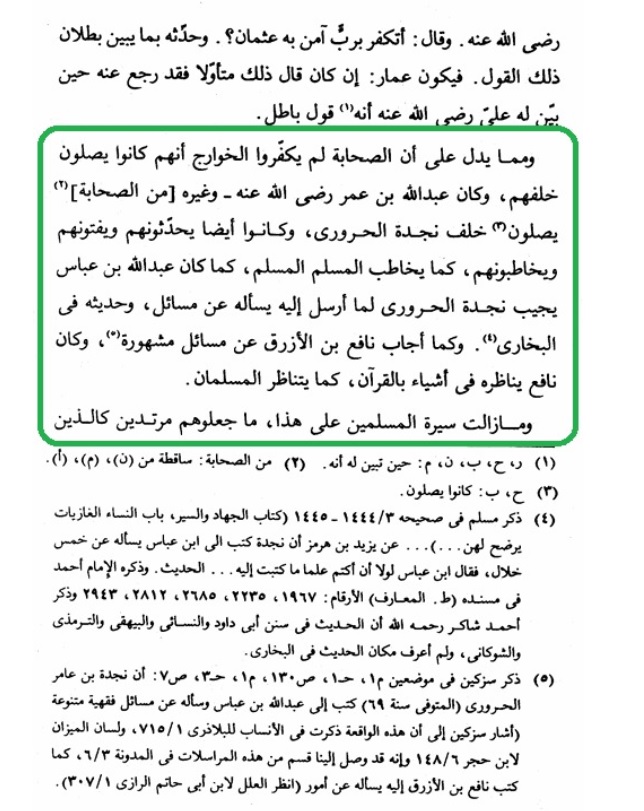

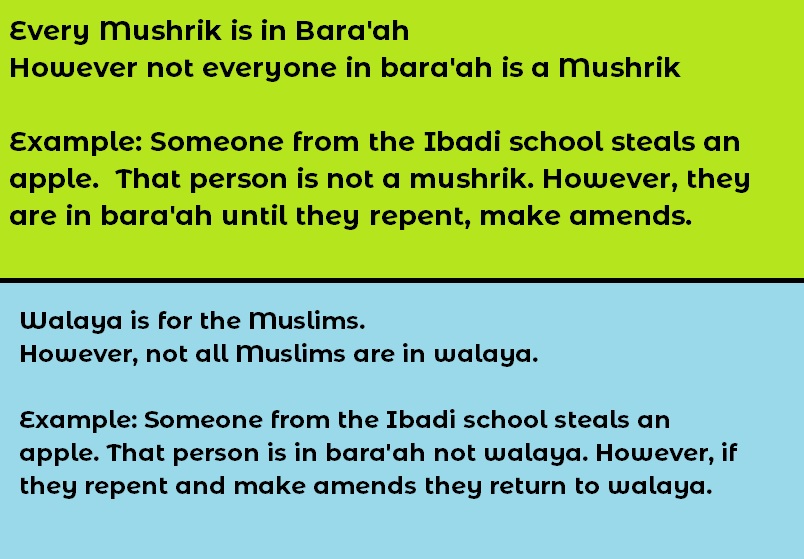

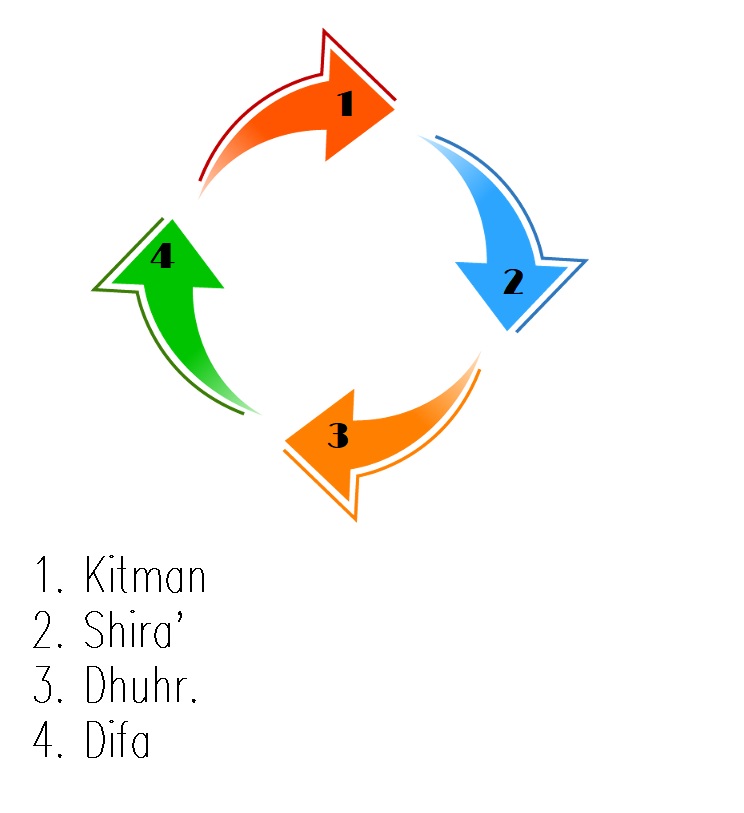


 من زعم أنى رجعت عن الحكومة فقد كذب، ومن رآها ضلالا فقد ضل
 ، فخرجت حينئذ الخوارج من المسجد فحكمت”.

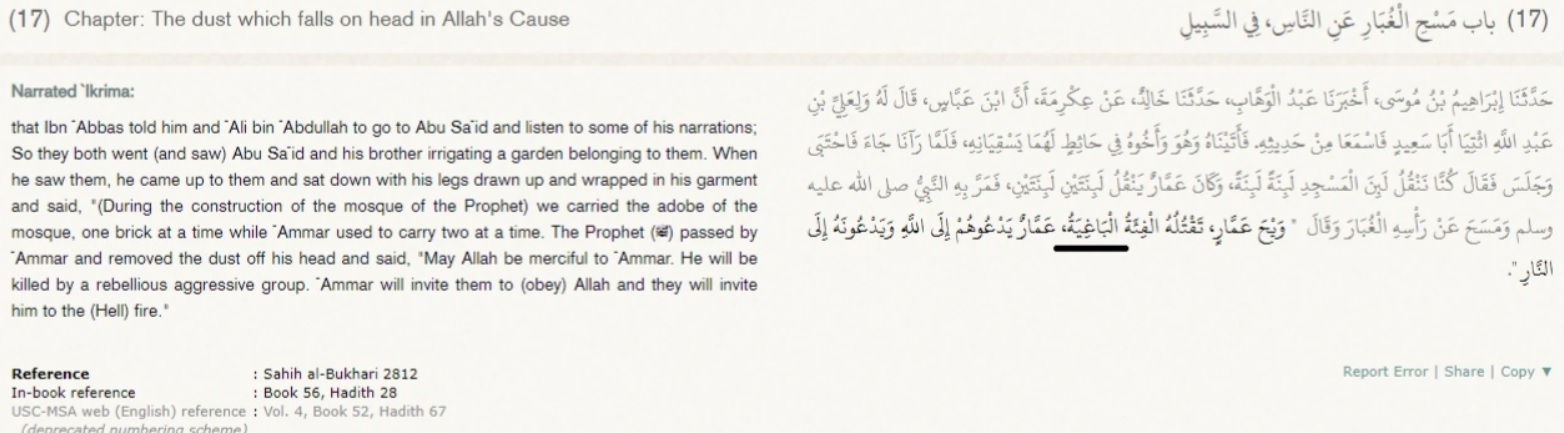
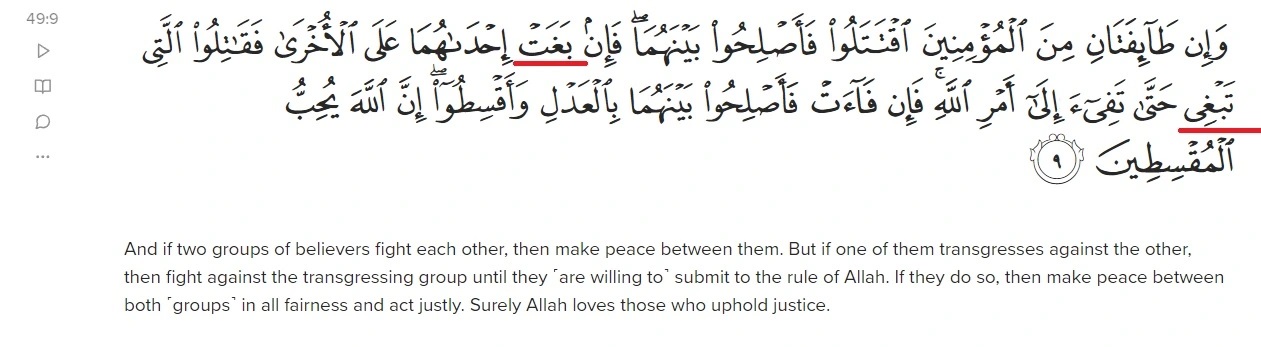
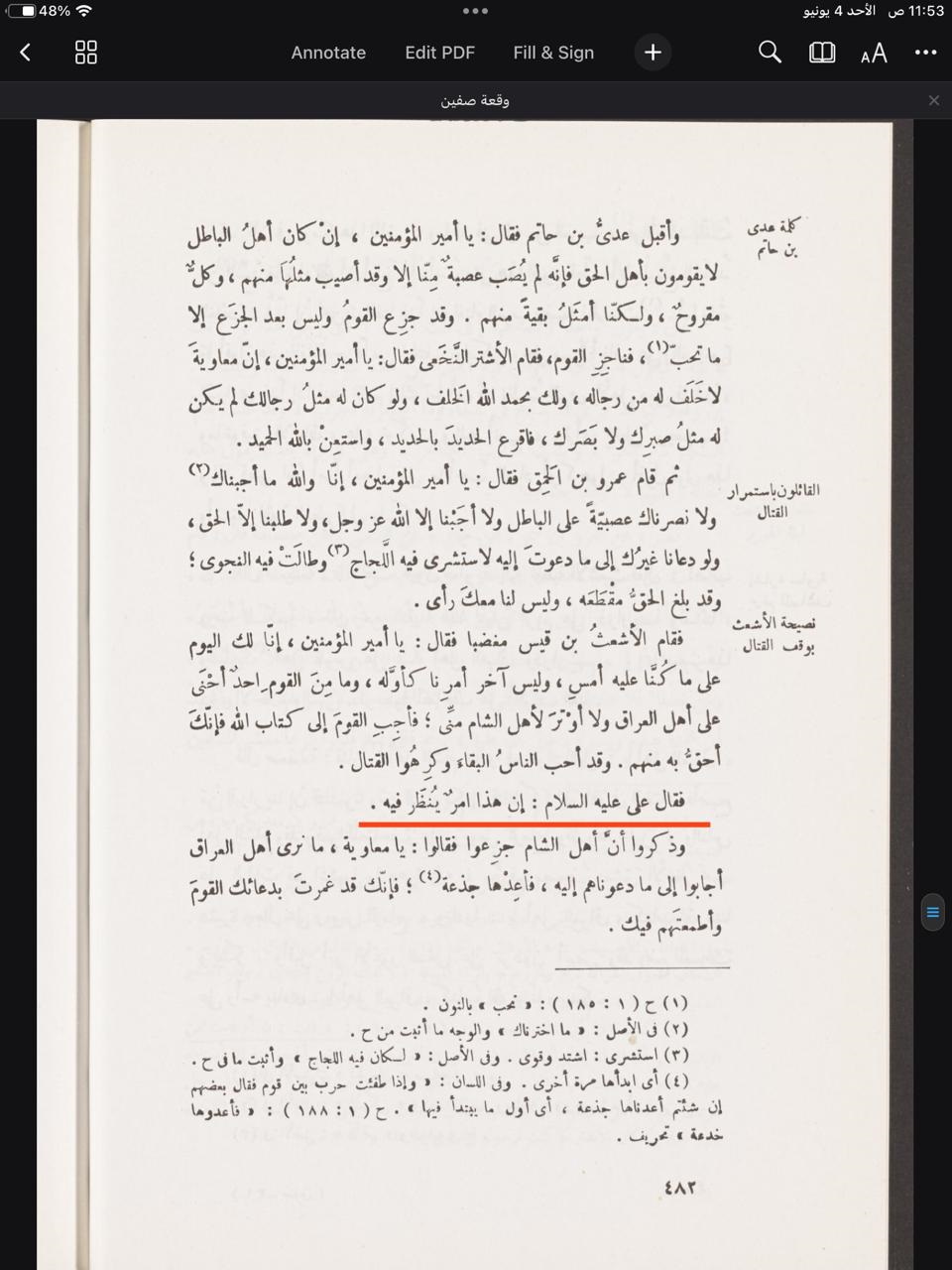


 Prima Quran