
“Oh Mankind! Behold, We have created you all out of a male and a female, and have made you into nations and tribes so that you might come to know one another. Truly, the noblest of you in the sight of Allah is the one who is most deeply conscious of Him. Behold, Allah is all-knowing, All-Aware.” (Qur’an 49:13)

﷽
There are many across the Islamic spectrum who claim superiority based upon lineage, family affiliation via blood ties, tribe or ethnicity.
This includes and is not limited to all Alids, Imami Shi’i, Zaydis, and the Sunni scholars this article will address in particular. Prepare to deal with the overwhelming force of the Qur’an, Sunnah, and basic 101 common sense logic.
By the way, the above-mentioned groups are glib when it comes to this issue anyway. You would think that if you claim superior merit based upon lineage, family affiliation via blood ties, tribe or ethnicity, that this would be the case for the whole of said lineage, family, tribe or ethnicity.
Yet, you have Hussein bin Talal, former Viceroy of Jordan who was married once to Toni Avril Gardiner & Lisa Halaby.
These names didn’t sound very Islamic, nor did they cater to the sensitivities of Arab superiority, to say, King Hussein and “Queen Toni” so she became: “Muna Al Hussein.”
Likewise, it didn’t sound very Islamic, nor cater to the sensitivities of those who believed in Arab superiority to say, King Hussein and “Queen Lisa,” so she became: Noor Al Hussein.”
Guess what happens to all these alid women, rather they are from the lineage of Hassan or Hussein? Well, very often they are confined to a life of bitter spinsterhood.
While the men get their pick of the entire planet (and often do pass up the supposed superior brand), the superior brand often get consigned to a life of Netflix, cats and spinsterhood.
What is the point of mentioning these things? Is it to shame these women? Did Toni Avril Gardiner & Lisa Halaby do something wrong by getting wooed and marrying a wealthy man? No, we pity these women (in the case of the Alid spinsters). They are simply victims of an unjust system and a flawed representation of Islam.
Remember how we are told that the Aga Khan is a descendant of the Blessed Prophet (saw) via Fatima(ra)? What does that even matter?
Andrew Ali Aga Khan Embiricos
A descendant of the Aga Khan, Andrew Embiricos made headlines in 2007 when his secret life as an amateur porn star was exposed. He was found to be posting a series of raunchy videos starring himself. It was said he contracted HIV and battled drug addiction.
You can read more about this whole sordid, and very tragic affair here: https://www.dailymail.co.uk/news/article-2071150/Rita-Hayworths-grandson-Andrew-Ali-Aga-Khan-Embiricos-did-commit-suicide.html
- The claim being refuted: That descent from the Prophet (saw) confers some inherent spiritual status, nobility, or moral excellence.
- The evidence: Andrew Embiricos—a descendant of the Aga Khan, and thus tracing lineage to the Prophet through Fatima (ra)—lived a life dramatically contrary to Islamic teachings (pornography, drug addiction).
- The rhetorical question: “What does that even matter?” — i.e., if this person has the lineage but not the righteousness, what value did the lineage actually provide?
Once again, you have acclaimed descendants of the Blessed Prophet (saw) passing over the women of the household for western women.
This entry is to soundly refute the unfounded and baseless assertions made by scholars from the Ahl Sunnah, in particular, Abū ʿAbdullāh Muhammed ibn Idrīs al-Shāfīʿī and Abu Zakaria Muhiy ad-Din Yahya Ibn Sharaf al-Nawawi. As well as Aḥmad ibn ʿAbd al-Ḥalīm ibn ʿAbd as-Salām Ibn Taymiyya al-Ḥarrānī whom we reference as Ibn Taymiyya.
You know it is rather tongue in cheek when many of these so-called ‘traditionalists’ lament about ‘the good ‘ole days’. Especially in the imaginary chess game of ‘Islam vs the West’. What a rather clever and sinister thing to do; rally the masses to throw off one oppressor only to clothe themselves in another tyranny.
So before we begin our refutationn let us take a look at what some from Ahl Sunnah have to say shall we?
Note: We are not quite sure if this is a troll site because there are numerous other articles here that are simply bizarre. However, there have been people within our tradition who have held some of the views that he posts. As regards this particular article, everything he says here checks out. It checks out, meaning he did not misquote any of the sources.
We are going to produce the totality of what is said here:
http://islamicvirtues.com/2013/12/13/non-arab-men-are-not-suitable-for-marriage/
In the name of Allaah
Recently I’ve noticed a trend among Arab Muslim families, especially those living in the West, where they allow their daughters to get married to non-Arab men.
Yes, it is true,I am not making this up.
How disgusting!
Yes, I know that it is not haraam to do so, but neither is rubbing feces on your face! Would you do that as well?
Brothers and Sisters, our deen is clear. It is recommended for people to marry someone who is their kafa’a (religiously suitable match), and non-Arab men are NOT a suitable match for Arab women.
This is well-established in our faith. Read, for example, my previous post about how Arabs are the most superior of all races. But if that isn’t enough, read what our worthy scholars have told us about this matter. We see the following regarding the kafa’a for marriage in the classic Shafi’i manual of Islamic law titled ‘Umdat as-Salik wa ‘Uddat an-Nasik (Reliance of the Traveller and Tools of the Worshipper):
والكفاءةُ في: النسَبِ والدِّينِ والحريةِ والصَّنعةِ وسلامة العيوبِ المُثْبِتَةِ للخِيار، فلا يُكافئ العجميُّ عربيةً، ولا غيرُ قُرَشيٍّ قُرشيَّةً، ولا غيرُ هاشميٍّ أو مُطَّلبيٍّ هاشميةً أو مطَّلبيةً، ولا فاسقٌ عفيفةً، ولا عبدٌ حرةً، ولا العتيقُ أو من مسَّ آباءَهُ رِقٌّ حرةَ الأصلِ، ولا ذو حِرفَةٍ دنيئةٍ بنتَ ذي حِرفةٍ أرفعَ، كخياطٍ بنتَ تاجرٍ، ولا معيبٌ بعيبٍ يُثْبِتُ الخِيارَ سليمةً منهُ، ولا اعتبارَ باليسارِ والشيخوخةِ، فمتى زوَّجها بغَيْرِ كُفءٍ بغَيرِ رضاها ورِضا الأولياءِ الذينَ هم في درَجتهِ فالنِّكاحُ باطلٌ، وإن رَضُوا أو رضيَتْ فليسَ للأبعدِ اعتراضٌ.
(Taken from the section of Kafa’a in the chapter of Nikaah in the text)
Translation: Kafa’a (Suitability in marriage for a female) is in the lineage (ancestry of the man), and in religiousness, and his being a free man (not a slave), and in his profession, and his being free of defects that can cause the annulment of the marriage. And the ajami (non-Arab) is NOT suitable for an Arab woman, and a non-Qurayshi is NOT suitable for a Qurayshi woman (Quraysh was the tribe of the Holy Prophet (S)), nor is a non-Hashimi or non-Muttalabi suitable for a Hashimi or Muttalabi woman (Hashimites are the members of the clan to which the Holy Prophet (S) belonged to, and Muttalabites are the descendants of the grandfather of the Holy Prophet(S)). Nor is an immoral man suitable for a virtuous woman, nor is a slave suitable for a free woman, nor is a freed slave or one whose ancestors were touched by slavery suitable for a (free) woman whose ancestors were free. Nor is a man of a lowly profession suitable for the daughter of someone with a noble profession, such as a tailor wanting to marry a tradesman’s daughter.
So we see that the following are NOT kafa’a (suitable for marriage) for women:
- Non-Arab men for Arab women
- Non-Qurayshi man for a Qurayshi woman
- Non-Hashimi or non-Muttalabi for a Hashimi or Muttalabi woman
- Sinful man for virtuous a woman
- A slave or a freed slave for a free woman
- A free man but one whose ancestors might have been slaves for a free woman whose ancestors were not slaves
- A man with a lowly profession for a woman whose father has a noble profession
Brothers and Sisters, your deen is not a game. Do not ignore the instructions of our scholars who labored long and hard for our benefit and left us with such treasures. As for this book, you might be pleased to know that there exists a partial translation of this work in English as well, which you can read more about here and here. The translator included the Arabic text I’ve quoted above in the book (pages 523-524), but did not translate it into English. It seems that he is also one of these “modern Muslims” who stoops low to ingratiate the Western kuffaar by ignoring the teachings of our Muslim scholars.
So I warn you again, do not ignore your deen for the sake of worldly desires or to please the kuffaar Westerners, and keep your daughters and sisters away from non-Arab men, descendants of slaves, and those in lowly professions.
But that is only if you are Arab. If you do not belong to this superior race, then these conditions do not apply to you, so do with your women as you please.”
Prima Qur’an comments: We will respond to the above. They continue with:
“SubhanAllaah! What has the ummah come to when Muslims ban you for quoting Imam Nawawi! You’re right, Imam Nawawi has been very clear about this issue in his Minhaj. He says:
وَخِصَالُ الْكَفَاءَةِ: سَلَامَةٌ مِنْ الْعُيُوبِ الْمُثْبِتَةِ لِلْخِيَارِ وَحُرِّيَّةٌ، فَالرَّقِيقُ لَيْسَ كُفْئًا لِحُرَّةٍ، وَالْعَتِيقُ لَيْسَ كُفْئًا لِحُرَّةٍ أَصْلِيَّةٍ، وَنَسَبٌ، فَالْعَجَمِيُّ لَيْسَ كُفْءَ عَرَبِيَّةٍ، وَلَا غَيْرُ قُرَشِيٍّ قُرَشِيَّةً، وَلَا غَيْرُ هَاشِمِيٍّ وَمُطَّلِبِيٍّ لَهُمَا، وَالْأَصَحُّ اعْتِبَارُ النَّسَبِ فِي الْعَجَمِ كَالْعَرَبِ، وَعِفَّةٌ فَلَيْسَ فَاسِقٌ كُفْءَ عَفِيفَةٍ، وَحِرْفَةٌ فَصَاحِبُ حِرْفَةٍ دَنِيئَةٍ، لَيْسَ كُفْءَ أَرْفَعَ مِنْهُ، فَكَنَّاسٌ وَحَجَّامٌ وَحَارِسٌ وَرَاعٍ وَقَيِّمُ الْحَمَّامِ لَيْسَ كُفْءَ بِنْتِ خَيَّاطٍ، وَلَا خَيَّاطٌ بِنْتَ تَاجِرٍ أَوْ بَزَّازٍ، وَلَا هُمَا بِنْتَ عَالِمٍ وَقَاضٍ، وَالْأَصَحُّ أَنَّ الْيَسَارَ لَا يُعْتَبَرُ، وَأَنَّ بَعْضَ الْخِصَالِ لَا يُقَابَلُ بِبَعْضٍ، وَلَيْسَ لَهُ تَزْوِيجُ ابْنِهِ الصَّغِيرِ أَمَةً، وَكَذَا مَعِيبَةٌ عَلَى الْمَذْهَبِ، وَيَجُوزُ مَنْ لَا تُكَافِئُهُ بِبَاقِي الْخِصَالِ فِي الْأَصَحِّ.
Minhaj al-Talibin – al-eman.com
(Alternative link: http://shamela.ws/browse.php/book-12096/page-236)
Translation:
The characteristics of suitability (kafa’a) are the following:
Absence of permanent (bodily) defects
And freedom: The male slave is not suitable for a free woman. And the freed slave is not suitable for a woman who is free since birth (hurratun asliyyah).
And genealogy: The non-Arab male (A’jamiy) is not suitable for an Arab woman, nor is a non-Qurayshi male (suitable) for a Qurayshi woman, nor a non-Hashimi or non-Muttalibi male for a Hashimi or Muttalibi female. Rather the consideration of genealogy among non-Arabs is to be taken into account just as it is with Arabs.
And virtuousness: An evil-doer man is not suitable for a virtuous/chaste woman.
And occupation (job/profession): A male with a lowly occupation is not suitable for a woman whose rank (in society) is higher than his. A sweeper, a cupper (or barber), a doorkeeper (or guard), a shepherd, a person who works at a bathhouse (hummaam) are not suitable for the daughter of a tailor. And a tailor is not suitable for the daughter of a merchant or clothier. And neither of those are suitable for the daughter of a scholar or judge.
Differences in ease of circumstances (wealth) are not considered (in suitability for marriage).
Defects in certain characteristics (of suitability) are not compensated by (excellence in) other characteristics.
(As for men) A man cannot marry his minor (sagheer), son, to a slave woman, for this is dishonorable for the religion (madhab), but it is allowed for him to marry his son to a woman even if the remaining suitability conditions (mentioned above) do not match his.
We might as well throw this link in as well:
http://islamicvirtues.com/2013/12/12/superiority-of-the-race-of-arabs-over-non-arabs/
Prima Qur’an comments: They continue.
“Bismillaahil ADheem
From the beginning of Creation, humans of every race have been wondering which race is the most superior. Alhamdulillah, with the arrival of our Blessed Prophet (S), this question has been thoroughly answered to the satisfaction of all. For our Blessed Prophet (S) has said in this authentic narration:
حَدَّثَنَا خَلاَّدُ بْنُ أَسْلَمَ الْبَغْدَادِيُّ، حَدَّثَنَا مُحَمَّدُ بْنُ مُصْعَبٍ، حَدَّثَنَا الأَوْزَاعِيُّ، عَنْ أَبِي عَمَّارٍ، عَنْ وَاثِلَةَ بْنِ الأَسْقَعِ، رضى الله عنه قَالَ قَالَ رَسُولُ اللَّهِ صلى الله عليه وسلم “ إِنَّ اللَّهَ اصْطَفَى مِنْ وَلَدِ إِبْرَاهِيمَ إِسْمَاعِيلَ وَاصْطَفَى مِنْ وَلَدِ إِسْمَاعِيلَ بَنِي كِنَانَةَ وَاصْطَفَى مِنْ بَنِي كِنَانَةَ قُرَيْشًا وَاصْطَفَى مِنْ قُرَيْشٍ بَنِي هَاشِمٍ وَاصْطَفَانِي مِنْ بَنِي هَاشِمٍ ” . قَالَ أَبُو عِيسَى هَذَا حَدِيثٌ حَسَنٌ صَحِيحٌ .
Narrated Wathilah bin Al-Asqa’:
that the Messenger of Allah (S) said: “Indeed Allah has granted eminence (istafa) to Isma’il [the ancestor of the Arabs] from the children of Ibrahim, and He granted eminence to Banu Kinanah from the children of Isma’il, and He granted eminence to the Quraish [the tribe of the Prophet(s)] from Banu Kinanah, and He granted eminence to the Banu Hashim [the clan of the Prophet(S)] from the Quraish, and He granted eminence to me from Banu Hashim.”
http://sunnah.com/urn/634660
As well as in this authentic narration from Imam Muslim’s Saheeh:
حَدَّثَنَا مُحَمَّدُ بْنُ مِهْرَانَ الرَّازِيُّ، وَمُحَمَّدُ بْنُ عَبْدِ الرَّحْمَنِ بْنِ سَهْمٍ، جَمِيعًا عَنِ الْوَلِيدِ، – قَالَ ابْنُ مِهْرَانَ حَدَّثَنَا الْوَلِيدُ بْنُ مُسْلِمٍ، – حَدَّثَنَا الأَوْزَاعِيُّ، عَنْ أَبِي عَمَّارٍ، شَدَّادٍ أَنَّهُ سَمِعَ وَاثِلَةَ بْنَ الأَسْقَعِ، يَقُولُ سَمِعْتُ رَسُولَ اللَّهِ صلى الله عليه وسلم يَقُولُ “ إِنَّ اللَّهَ اصْطَفَى كِنَانَةَ مِنْ وَلَدِ إِسْمَاعِيلَ وَاصْطَفَى قُرَيْشًا مِنْ كِنَانَةَ وَاصْطَفَى مِنْ قُرَيْشٍ بَنِي هَاشِمٍ وَاصْطَفَانِي مِنْ بَنِي هَاشِمٍ ” .
Wathila b. al-Asqa’ reported:
I heard Allah’s Messenger (S) as saying: Verily Allah granted eminence to Kinana from amongst the descendants of Isma’il [the ancestor of the Arabs] and he granted eminence to the Quraish amongst Kinana, and he granted eminence to the Banu Hashim amongst the Quraish, and he granted me eminence from the tribe of Banu Hashim.
http://sunnah.com/muslim/43/1
And in a similar authentic narration from our Blessed Prophet (S), he said:
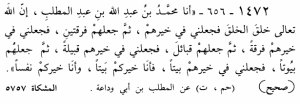
أنا محمدُ بنُ عبدِ اللهِ بنِ عبدِ المطلبِ ، إنَّ اللهَ تعالى خلق الخلْقَ فجعلني في خيرِهم ، ثم جعلهم فرقتَين ، فجعلَني في خيرِهم فرقةً ، ثم جعلهم قبائلَ ، فجعلني في خيرِهم قبيلةً ، ثم جعلهم بيوتًا ، فجعلني في خيرهم بيتًا ، فأنا خيركُم بيتًا ، وأنا خيرُكم نفسًا
(The Prophet(S) said): ‘I am Muhammad bin ‘Abdullah bin ‘Abdul-Muttalib. Indeed, Allah created the creation and made me from the best of them, and He then made them two groups (Arabs and non-Arabs) and made me from the best of them (the Arabs), then He made the tribes and made me from the best tribe, then He made the houses and made me from the best house. So I am the best house among them, and I am the best person among them.’”
This narration has been recorded and authenticated by Shaykh Albani in his Saheeh Jami` al-Sagheer, hadith number 1472 (the book (in Arabic) can be read here: http://www.alalbany.net/4314)
The following is the text from the scanned PDF of this text:
This narration has also been authenticated in the following texts:
- Shaykh Albani also authenticated it (as narrated by Abbas bin Abd al-Muttalib) in his Takhreej Mishkat al-Masabeeh, hadith number 5689
- Imam Ahmad bin Muhammad Shakir authenticated it in his Umdah at-Tafseer, volume 1, page 819
- Imam Ibn Hajar al-Asqalaani said it is sound (Hasan) in his Al-Amaali al-Mutlaqah, page 70
- Imam Ibn Hajar al-Haythami authenticated it in his Mujma` al-Zawa’id, vol 8, pg 218
- Imam Ibn Katheer said it has a good (jayyid) chain in his Jami` al-Masaneed wal-Sunan, hadith #5933
Shaykh Amjad Rasheed of SunniPath.com has also clarified this matter for us:
It is obligatory on a Muslim to believe that Arabs are preferred over other nations because there is a proof for it. However, this is not one of the pillars of our religion such that if someone rejected this, they would be considered outside of Islam. But if one does reject this, one has sinned for not believing in it because it is an affirmed matter according to a clear rigorously authenticated hadith.
http://qa.sunnipath.com/issue_view.asp?HD=7&ID=9427&CATE=1
So, dear brothers and sisters, do not be deceived by the propaganda of the Westerners, who wish to debase the deen of Allaah because of their own racial inferiority. But what Allaah has elevated, no one can debase!
To close, I will leave you with this statement from Shaykh al-Islaam Ibn Taymiyyah in his IqtiDaa’ Siraat al-Mustaqeem, volume 1, page 419:
فإن الذي عليه أهل السنة والجماعة اعتقاد أن جنس العرب أفضل من جنس العجم عبرانيهم وسريانيهم رومهم وفرسهم وغيرهم وأن قريشا أفضل العرب وأن بني هاشم أفضل قريش وأن رسول الله صلى الله عليه وسلم أفضل بني هاشم فهو أفضل الخلق نفسا وافضلهم نسبا
Indeed it is the belief of the Ahlus-Sunnah wal Jama’ah that the race of Arabs is superior to the race of non-Arabs, the Hebrews (Jews), the Syrians (Arameans), the Romans (Europeans), the Persians, and others. And indeed the Quraysh [tribe of the Prophet (S)] is the most superior among the Arabs. And indeed the Banu Hashim [the clan of the Prophet (S)] is the most superior among the Quraysh. And indeed the Prophet, may the Blessings and Peace of Allaah be upon him, is the most superior of the Banu Hashim, for he is the most superior of all creation by his own self, and also the most superior among them because of his lineage (ancestry) PDF Scan of the above:
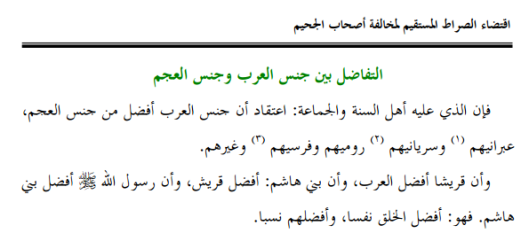
http://www.riyadhalelm.com/book/1/347_hqtza.pdf (see page 384)”
——————————-—————————————————————————–
The Ibadi school refutes the claims of Arab superiority.
How the Ibadi school uses the Qur’ān, Sunnah, and manṭiq(logic).
Let’s get into it.
As far as preference and superiority are concerned. Allah (swt) has himself informed us that he has given preference to some people over others in various situations.
“Behold! The angels said: “O Mary! Allah has chosen you and purified you- chosen you above the women of all nations.” (Qur’an 3:42)
“O Children of Israel, remember My favor which I have bestowed upon you and that I preferred you over the worlds.” (Qur’an 2:122)
It is likely and even factual that there are people who are ‘superior’ to us in terms of mathematical knowledge, basketball skills, archery skills, typing speed, etc.
In fact, we know this to be the case. The opposite is also true. However, this has absolutely nothing to do with one’s ethnicity, family affiliation or tribal identity.
In fact, often when Allah (swt) does favour one group of people or an individual over the other with his blessings, they ‘repay’ Allah (swt) with blatant rebellion, defiance of his command or outright negligence.
An example would be the following verse:
“And on some of you Allah has bestowed more abundant means of sustenance than on others: and yet, they who are more abundantly favoured are [often] unwilling to share their sustenance with those whom their right hands possess, so that they [all] might be equal in this respect. Will they, then, Allah’s blessings [thus] deny?” (Qur’an 16:71)
How about the fact that Allah (swt) conditions his statements of praise? for example:
“You are the best of people, evolved for mankind, enjoining what is right, forbidding what is wrong, and believing in Allah. If only the People of the Book had faith, it would be best for them: among them are some who have faith, but most of them are perverted transgressors.” (Qur’an 3:110)
Why are they the best of people? They enjoin what is right and forbid what is wrong. Yet some of those people from the above-mentioned groups believe that those who are the ‘best of people’ betrayed the trust of the blessed Prophet (saw).
The station of people can change before Allah (swt). This should go without saying, as one can go from a sinner to one who is repentant. One who is far from Allah (swt) to one who is close to Allah (swt).
“Say: “O Allah! Lord of Sovereignty! You give power to whom You please, and You strip off power from whom You please: You endow with honour whom You please, and You bring low whom You please: In Your hand is all good. Verily, over all things You have power.” Qur’an 3:26)
“Lo! you are those who are called to spend in the way of Allah, yet among you, there are some who hoard. And as for him who hoards, he hoards only from his soul. And Allah is the Rich, and you are the poor. And if you turn away He will exchange you for some other folk, and they will not be the likes of you.” (Qur’an 47:38)
Allah (swt) not once gives anyone in the Qur’an some protected status based solely upon their lineage, family blood ties, tribe or ethnicity.
Let the Alids, Imami Shi’i, Zaydis, and the Sunni scholars bring their proofs and evidence.
On the contrary, this is what we find:
“So they say, “Never will the Fire touch us, except for a few days.” Say, “Have you taken a covenant with Allah? Allah will never break His covenant. Or do you say about Allah that which you do not know?” (Qur’an 2:80)
“But the Jews and the Christians say, “We are the children of Allah and His beloved (hibbaohu).” Say, “Then why does He punish you for your sins?” Rather, you are human beings from among those He has created. He forgives whom He wills, and He punishes whom He wills. And to Allah belongs the dominion of the heavens and the earth and whatever is between them, and to Him is the [final] destination.” (Qur’an 5:18)
“So when the Horn is blown, no relationship will there be among them that Day, nor will they ask about one another.” (Qur’an 23:10)
“O humanity! Be mindful of your Lord, and beware of a Day when no parent will be of any benefit to their child, nor will a child be of any benefit to their parent. Surely Allah’s promise is true. So do not let the life of this world deceive you, nor let the Chief Deceiver deceive you about Allah.” (Qur’an 31:33)
The English say: Blood is thicker than water. In Islam, we say: Faith is thicker than blood.
Believers, do not take your fathers and brothers for allies if unbelief is dearer to them than faith; those of you who do so are unjust. (Qur’an 9:23)
You will not find a people who believe in Allah and the Last Day having affection for those who oppose Allah and His Messenger, even if they were their fathers or their sons or their brothers or their kindred. Those – He has decreed within their hearts faith and supported them with spirit from Him. And We will admit them to gardens beneath which rivers flow, wherein they abide eternally. Allah is pleased with them, and they are pleased with Him – those are the party of Allah . Unquestionably, the party of Allah – they are the successful. (Qur’an 58:22)
“The Day when neither wealth nor children will be of any benefit. Only those who come before Allah with a pure heart.” (Qur’an 26:88-89)
So, basically, the ‘adab’ or the hierarchy when it comes to phenotypes, according to Ibn Taymiyya, Imam Al Shafi’i, The Imami Shi’i, Zaydis and Alids, are as follows:
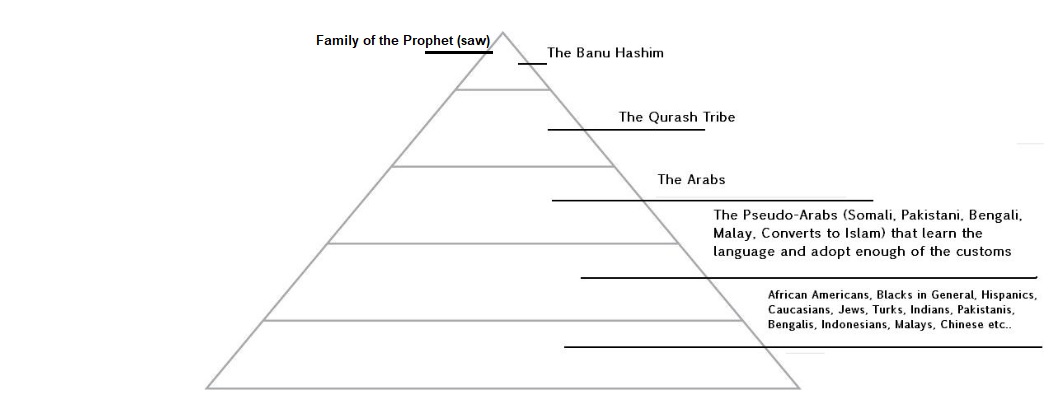
So let us see if this pyramid that is championed by Ibn Taymiyya (Imami Shi’i, Shafi’i, Zaydi, Alids) stands up to scrutiny.
Allah (swt) not once gives anyone in the Qur’an some protected status based solely upon their lineage, family blood ties, tribe or ethnicity.
The best that any of them are going to bring forward is as follows:
“O wives of the Prophet, whoever of you should commit a clear immorality – for her, the punishment would be doubled two fold, and ever is that, for Allah, easy. And whoever of you devoutly obeys Allah and His Messenger and does righteousness – We will give her reward twice; and We have prepared for her a noble provision. O wives of the Prophet, you are not like anyone among women. If you fear Allah, then do not be soft in speech [to men], lest he in whose heart is disease should covet, but speak with appropriate speech. And abide in your houses and do not display yourselves as [was] the display of the former times of ignorance. And establish prayer and give zakah and obey Allah and His Messenger. Allah intends only to remove from you the impurity of sin, O people of the Prophet’s household, and to purify you with extensive purification. And remember what is recited in your houses of the verses of Allah and wisdom. Indeed, Allah is ever Subtle and Acquainted with all things.” (Qur’an 33:30-34)
Wives, women, her. The wives of the Prophet (saw) are all pure and purified. These verses, in their context, have absolutely nothing to do with any male relations of the Prophet (saw).
- Allah (swt) gives instructions for how the wives of the Blessed Prophet (saw) are to become purified.
- There is no ‘ismah or infallibility being imputed here and this is clear from the admonishment that Allah (swt) gives: “O wives of the Prophet, whoever of you should commit a clear immorality – for her, the punishment would be doubled twofold, and even is that, for Allah, easy.”
- The purification is due to their being wives and proximity to the Blessed Prophet (saw) and not because of blood ties. Safiyya bint Huyayy (ra) is proof of this.
- Whatever blessing is being conferred upon the wives of the Blessed Prophet (saw) the verses are absolutely silent about their descendants.
We went into more depth about this here:
Similar to Allah (swt) doing this for the Blessed Virgin Mary (as)
“Behold! the angels said: “O Mary! Allah has chosen you and purified you- chosen you above the women of all nations.” (Qur’an 3:42)
Look again at point 4.
“Whatever blessing is being conferred upon the wives of the Blessed Prophet (saw) the verses are absolutely silent about their descendants.”
“Moreover, remember that Abraham was tried by his Lord with certain commands, which he fulfilled: He said: “I will make you an Imam to the Nations.” He pleaded: “And also (Imams) from my offspring!” He answered: “But My Promise is not within the reach of evildoers.” (Qur’an 2:124)
The Shi’i (Zaydi, Imami) would counter as follows: “My covenant does not include the wrongdoers.” This is a cornerstone of their argument. They use it to prove that an Imam must be free from wrongdoing (infallible). They would argue that Abraham, after passing his tests, was made an Imam, and then asked about his progeny. Allah’s response clarified that the Imamate would continue in his progeny, but only among those who are not wrongdoers. Therefore, they would say, the Imamate is a divinely bestowed position that runs in the purified lineage of Abraham, through Ismail, and ultimately to the Prophet Muhammed (saw) and his purified Ahl al-Bayt (Ali, Fatima, and their righteous descendants). The sinful descendants we mention are precisely the ones who are excluded from this covenant because they are wrongdoers.
This counter argument is also deeply flawed. It puts the carriage before the horse. We will not know which of the descendants are just. We can only know by observing their behavior through their lifetime.
This brings a crucial distinction between ontological reality (what something is) and epistemological access (how we know what it is).
If you notice Allah (swt) didn’t write a blank check for the descendants of Abraham. If you were made virtuous by being a descendant of a prophet, then Allah(swt) would have simply granted Abraham’s du’a; however, he did not. He made a caveat, “My promise is not within reach of the evildoers.”
Is this not interesting? Make Imams of me and my offspring!
In other words, I will grant your du’a to those who hold on to my commands and strive their utmost to be righteous servants.
What did these descendants of Prophet Ibrahim (as) get up to?
They cried, “Our father! We went racing and left Joseph with our belongings, and a wolf devoured him! But you will not believe us, no matter how truthful we are.” (Qur’an 12:17)
These Muwahid, The Ahl Bayt of Jacob (as), Sons of a Prophet lied to their father! Imagine telling your own father that his son (your own brother) was eaten by a wolf! Can you imagine the grief it would bring him?!
Allah (swt) tells us in very vivid language how severe was the grief and trauma of Jacob (as). The trauma that Prophet Jacob (as) went through on account of his progeny, the progeny of the Household.
“He turned away from them, lamenting, “Alas, poor Joseph!” And his eyes turned white out of the grief he suppressed.” (Qur’an 12:84)
A more recent example.
As mentioned above, Andrew Ali Aga Khan Embiricos is a more recent and widely known example, that if this person has the lineage but not the righteousness, what value does the lineage actually provide?
Allah (swt) has given us multiple examlpes of lineage not equating to piety or righteousness.
Cain killed his brother Abel. Both were descendants of the Prophet Adam (upon whom be peace). Yet, one was righteous and the other became the ‘first’ murderer. Such that Allah (swt) made an example of this particular incident throughout time.
“So his soul permitted to him the murder of his brother, so he killed him and became among the losers.” (Qur’an 5:30)
In reality, if you want to be technical, from the perspective that we all came from Adam, or are ‘Bani Adam‘—the children of Adam, we are in reality all descendants of the Prophets.
However, there has not been revealed in the Qur’an (the primary source for all Muslims) any indication that righteousness, piety, awareness of Allah, humility, humbleness, charity, chivalry etc. are traits that one acquires via genetics.
So let us take this group’s ideas that tend to be shared among the cabal that preaches supremacy on the basis of tribal affiliation.
“And the ajami (non-Arab) is NOT suitable for an Arab woman, and a non-Qurayshi is NOT suitable for a Qurayshi woman (Quraysh was the tribe of the Holy Prophet (saw), nor is a non-Hashimi or non-Muttalabi suitable for a Hashimi or Muttalabi woman (Hashimites are the members of the clan to which the Holy Prophet (saw) belonged to, and Muttalabites are the descendants of the grandfather of the Holy Prophet (Saw). Nor is an immoral man suitable for a virtuous woman, nor is a slave suitable for a free woman, nor is a freed slave or one whose ancestors were touched by slavery suitable for a (free) woman whose ancestors were free.”
Their first argument: and a non-Qurayshi is NOT suitable for a Qurayshi woman
Ibadi response: You can go and tell that to the Blessed Prophet (saw) whom married Zayd ibn Haritha al-Kalbi (ra) of a non-Qurayshi to Zaynab bint Jahsh (ra) a Qurayshi.
When there was some consternation from the family of Zaynab (ra) on the very point of tribal concerns the following verses were revealed:
“It is not fitting for a Believer, man or woman when a matter has been decided by Allah and His Messenger to have any option about their decision: if anyone disobeys Allah and His Messenger, he is indeed on a clearly wrong Path.” (Qur’an 33: 36)
So it does not matter what people think.
What matters is what Allah (swt) and his Messenger (saw) has given us.
No Qurayshi individual is praised by name in the Qur’an. This is a valid observation.
In fact, the only companion that is mentioned by name in the Qur’an just so happens to be a Non-Qurashi.
“And [remember, O Muhammed], when you said to the one on whom Allah bestowed favor and you bestowed favor, “Keep your wife and fear Allah ,” while you concealed within yourself that which Allah is to disclose. And you feared the people, while Allah has more right that you fear Him. So when Zayd had no longer any need for her, We married her to you in order that there not be upon the believers any discomfort concerning the wives of their adopted sons when they no longer have need of them. And ever is the command of Allah accomplished.” (Qur’an 33:37)
Where as the one Qurashi mentioned by name is done so in damnation and dishonour!
“May the hands of Abu Lahab perish, and he ˹himself˺ perish!” (Qur’an 111:1)
Their second argument: And the ajami (non-Arab) is NOT suitable for an Arab woman
Ibadi response: Yet here we have Bilal Ibn Rabah (ra) whom married Arab women. He married Halah bint Auf (Halal bint Awf) the sister of Abd al-Rahman ibn Awf. He married Hind Khaulaniyah (Hind bint Awf Al-Khazraji).
Their third argument: nor is a slave suitable for a free woman, nor is a freed slave or one whose ancestors were touched by slavery suitable for a (free) woman whose ancestors were free
Pay close attention to the status of the on in this verse before society and before Allah.
“And do not marry mushrik women until they believe. And a believing slave woman is better than a mushrik, even though she might please you. And do not marry mushrik men until they believe. And a believing slave is better than a mushrik, even though he might please you. Those invite to the Fire, but Allāh invites to Paradise and to forgiveness, by His permission. And He makes clear His verses to the people that perhaps they may remember.” (Qur’an 2:221)
In the scenario above the slave has a low status before the people. The free person has the high status before the people.
In both situations when a believer is to access who to give their son or daughter to for the continuation of their lineage the believer is always superior to the unbeliever in every scenario.
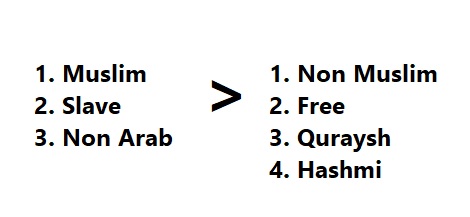
They may even agree and say yes, yes, but the slave is not suitable for a believer that is free. Well, Allah (swt) didn’t qualify that at all. Allah (swt) shows us in the text above that, in a consideration of marriage, that a believing slave is better than a mushrik. Which does not disbar the free from marrying them, as the text itself would not make any sense.
Not withstanding the previous examples given. Coupled with the fact that none of these people who are obsessed with lineage give us clear text from the Qur’an or Sunnah to counter our evidence.
THE QUR’AN NEVER ONCES REFERENCES THE ARABS AS A QAWM (PEOPLE or NATION)
The Qur’an’s silence on “Arabs” as a distinct people (qawm) is striking precisely because the term existed and was used in pre-Islamic poetry and contemporary sources. The Qur’an could have addressed them as a qawm—but it doesn’t. This isn’t accidental.
When the Qur’an wants to address a people by their collective identity, it does so repeatedly:
- “Children of Israel” (Bani Isra’il) — over 40 times
- “People of Pharaoh” (Āli Fir’awn)
- “People of Noah” (qawmi Nūh)
- “People of ‘Ād” (qawmu ‘Ād)
- “People of Thamūd” (qawmu Thamūd)
- “People of Abraham” (qawmi Ibrāhīm)
- “People of Lot” (qawmi Lūt)
- “People of Shu’ayb” (qawmi Shu’ayb)
The contrast with “Children of Israel” is telling
Allah repeatedly addresses the Children of Israel, reminding them of their favored status and holding them accountable. The Qur’an could have similarly addressed “Arabs” or “Children of Ishmael”—but it doesn’t. Instead, the only ethnic/national group addressed as a collective with a shared genealogy is the Israelites.
This suggests the Qur’an is deliberately decentering genealogy-based collective identity for the new community, except as a point of reference to past nations.
“Arab” in the Qur’an is adjectival, not nominal
“arabiyyun” appears 11 times—always describing:
- The Qur’an itself (lisanun ‘arabiyyun mubin)
- Clear Arabic speech
- Arabic judgment
The term describes a linguistic medium of revelation, not an ethnic identity that confers privilege. This shifts the frame: what matters is that the message was revealed in a particular language for accessibility, not that the people who spoke it are inherently superior.
You will not find the expression: “lisan al qawm al Arabi” in the Qur’an. Rather, the Qur’an uses the adjective arabiyy-un to describe the Qur’an and as a language. It does this 11 times.
“Had We made it a Quran not in Arabic, surely they would have said, “These verses should have been understandable! A non-Arabic (Quran) to one Arabic speaking? ” (wa’arabiyyun) Say, “It is guidance and healing (enabling healthy thought) for the believers!” As for those who do not believe, there is heaviness in their ears; it is an unperceivable object for them! (Thus it is as though) they are being called from a distant place.” (Qur’an 41:44)
“Indeed, We have sent it down as an (‘arabiyyan) Arabic Qur’an that you might understand.” (Qur’an 12:2)
What does this mean?
First, it is important to know that the Blessed Prophet (saw) himself is a descendant of Ishmael (Ismail). Ismail (as) is said to have had 12 sons. One of those are Kedar.
“These are the names of the sons of Ishmael, listed in the order of their birth: Nebaioth the firstborn of Ishmael, Kedar, Adbeel, Mibsam.” (Genesis 25:13)

Those who claim descent from Qahţān were called al-‘Arab al-Āribah (The Arabizing Arabs) while the descendants of Ismā’īl were called Al-‘Arab al-Musta’ribah (The Arabized Arabs). The Quraysh, the tribe of the Blessed Prophet Muhammed (saw) belonged to the class of Arabized Arabs and they were the Northern Arabs.
The Blessed Prophet (saw) comes from Ismail (as) whom is the progenitor of the musta’rab. This means they became Arab via adoption of the language and customs.
An eye opening and powerful reminder of those who put stock in one’s lineage. Interestingly, this also gives the meaning of what it is to be an Arab a broader range relating to adaptation and adoption and language culture and customs.
Think about the case of adoption. People in the former United States who adopt children from Cambodia or other places raise those children as their own. Those children will be raised learning to speak the English language and not Khmer. Culturally that child would be part of what ever cultural milieu is part and parcel of the family that adopted him/her; as well as the dominant society that surrounds them.
This totally undermines the kafa’a framework structurally
In discussions of marriage, كفاءة (kafāʾa) refers to compatibility or suitability between spouses (for example in religion, social standing, character, etc.).
If the Qur’an consistently avoids treating “Arab” as a qawm with inherent spiritual status, then building a marriage suitability system on that very category (al-‘arabiyyah vs. al-‘ajamiyyah) imports a framework the Qur’an itself doesn’t authorize. The kafa’a rules require “Arab” to be a meaningful religious-legal category. The Qur’an’s linguistic usage suggests otherwise.
So why does this matter?
We are pointing out that the classical jurists’ entire edifice of racial/ethnic hierarchy in marriage relies on treating “Arab” as a qawm with inherent spiritual weight. But the Qur’an—the primary source—doesn’t do that. It uses “Arab” adjectivally, for language. It uses “qawm” for peoples who receive prophets and face judgment.
This is textual evidence for a deliberate divine framing: your value isn’t in your ethnic identity but in your response to the message delivered in your tongue. We are defending what the Qur’an itself authorizes versus what categories later jurists imported.
Let’s take this statement of Ibn Taymiyyah:
“That the race of Arabs is superior to the race of non-Arabs, the Hebrews (Jews)…”
We can drop a precision guided nuke right on top of that statement with the following:
“Behold! The angels said: “O Mary! Allah has chosen you and purified you — chosen you above the women of all nations.” (Qur’an 3:42)
It is impossible for the Arabs to be above all people as this would include their women too. The Qur’an flat contradicts this assertion by asserting that the Blessed Mother Mary was above women of all nations.
This would mean that Arabs could not be de facto superior to Jews, because a Jewish woman is above all their women. Preferred by none other than Allah (swt)!
Not only this, but it is also not possible for the Quraysh or the Arabs to ever be superior to any other tribes of people who received Prophets and Messengers from Allah (swt) while they (the Quraysh and the Arabs — in general) were in a state of Jahiliyyah.
How anyone in their right frame of mind could argue this to be the case is truly beyond us!
Allah (swt) has reminded humanity of their lowly origins in the following verse:
“Surely We created man from a sperm-drop, a mingling, trying him; so We made him constantly hearing, constantly beholding.” (Qur’an 76:2)
The Blessed Messenger (saw) was brought into this world through conjugal relations.
Contrast that with the following:
“Behold! The angels said: “O Mary! Allah has chosen you and purified you — chosen you above the women of all nations.” (Qur’an 3:42)
Christ Jesus’ miraculous birth did not evolve the use of conjugal relations.
However, do we hold Christ Jesus (as) to be superior to the Blessed Prophet (saw)?
We do not.
Allah (swt) didn’t give the Blessed Messenger (saw) any sons. He gave other prophets many sons. However, Allah (swt) gave the Blessed Prophet (saw) Al Kawthar, the river of abundance. Which shows that this blessing supersedes the blessing of having children.
As mentioned above: Notice that Allah (swt) also admonished that those who given material wealth often squandered it over others.
“And on some of you Allah has bestowed more abundant means of sustenance than on others: and yet, they who are more abundantly favoured are [often] unwilling to share their sustenance with those whom their right hands possess, so that they [all] might be equal in this respect. Will they, then, Allah’s blessings [thus] deny?” (Qur’an 16:71)
Notice what Allah (swt) says to the children of Jacob
“O Children of Israel, remember My favor which I have bestowed upon you and that I preferred you over the worlds.” (Quran 2:122)
Yet, in the Bible we find:
” Thus says the LORD, which gives the sun for a light by day, and the ordinances of the moon and of the stars for a light by night, which divides the sea when the waves roar; The LORD of hosts is his name: if those ordinances depart from before me, says the LORD, then the seed of Israel also shall cease from being a nation before me forever. Thus says the LORD; If…the foundations of the earth [can be] searched out beneath, I will also cast off all the seed of Israel for all that they have done, saith the LORD.” Source: (Jeremiah 31:35-36)
Thus, being in favour with Allah (swt) is contingent.
“You are the best of people, evolved for mankind, enjoining what is right, forbidding what is wrong, and believing in Allah. If only the People of the Book had faith, it would be best for them: among them are some who have faith, but most of them are perverted transgressors.” (Qur’an 3:110)
- This verse shows that being the ‘best of people’ is contingent upon: A enjoining what is right. B forbidding what is wrong
- This verse cannot refer to Arabs (only) because there were and are many Arabs who are not-yet-Muslims. Many of them (Arabs) even killed those near and dear to the Blessed Messenger (saw).
“Lo! you are those who are called to spend in the way of Allah, yet among you, there are some who hoard. And as for him who hoards, he hoards only from his soul. And Allah is the Rich, and you are the poor. And if you turn away He will exchange you for some other folk, and they will not be the likes of you.” (Qur’an 47:38)
We also know, as the verse above and others like it show us that Allah (swt) only replaces with that which is better.
Again, Allah (swt) would not threaten the people of that time by being replaced by other folk if their status was not contingent upon obeying Him, following His commands and leaving that which He prohibited.
“Even if the one appointed over you is a mutilated Ethiopian slave whose nose and ears have been cut off, listen to him and obey, so long as he leads you according to the Book of Allah.”
Source: (https://sunnah.com/ibnmajah:2861)
This is extremely powerful in several ways.
- Be prepared to be ruled over by people you used to own.
- Be prepared to be ruled over by someone who you may even personally find uncomely or unsightly.
“The Messenger of Allah (saw), said: Be upright to the Quraysh as they are upright to you. If they do not do so, put your swords on your shoulders and annihilate their green crops. If you do not do so, then be wretched farmers and eat from the toil of your hands.”
Source: (https://thearchive.me/ask/drhakem/-bo0m1lqOz)
Prima Qur’an Commentary on the above hadith: What does it mean to take the sword on the shoulders and to “annihilate their green crops” ? It means to “take their ni’ama” (take their blessings from them). Another meaning is to “waste their face,” i.e. annihilate them. To fight them because they are rejecting the orders of Islam. They become unjust. Just like the Prophet (saw) fought them when they rejected the truth.
As the Alids and the Ahl Bayt are from the Quraysh, the statement of the Blessed Prophet (saw) equally applies to them. If they are just to us, we are just to them. If they are not, we annihilate their green crops.
They are no better than anyone else.
So these (Alids, Imami Shi’a, Zaydis and those among the Sunnis) who claim superiority of this family or that tribe or this ethnic group is the same tired tune that was played by the Children of Israel before them.
The Quraysh tribe have something over the vast majority of the other tribes of the Earth. They put an embargo on the Blessed Prophet (saw). They killed many of his companions and loved ones. They treated him ill and more.
We can clearly see that Jews started to develop such doctrines themselves. In fact, the Talmud is filled with disdain for non-Jews.
It can be easy to be a member of the 12 tribes of Israel or, as Jews are the descendants of Judah and think that since they are ‘chosen’, they are somehow superior.
“But the Jews and the Christians say, “We are the children of Allah and His beloved (hibbaohu).” Say, “Then why does He punish you for your sins?” Rather, you are human beings from among those He has created. He forgives whom He wills, and He punishes whom He wills. And to Allah belongs the dominion of the heavens and the earth and whatever is between them, and to Him is the [final] destination.” (Qur’an 5:18)
Narrated by Abdullah ibn Umar:
When we were sitting with the Messenger of Allah (saw), he talked about periods of trial (fitnahs), mentioning many of them.
When he mentioned the one when people should stay in their houses, some asked him: Messenger of Allah, what is the trial (fitnah) of staying at home?
He replied: It will be flight and plunder. Then there will come a test which is pleasant. Its murkiness is due to the fact that it is produced by a man from the people of my house, who will assert that he belongs to me, whereas he does not, for my friends are only the God-fearing. (رَجُلٍ مِنْ أَهْلِ بَيْتِي يَزْعُمُ أَنَّهُ مِنِّي وَلَيْسَ مِنِّي وَإِنَّمَا أَوْلِيَائِيَ الْمُتَّقُونَ) Then the people will unite under a man who will be like a hip-bone on a rib. Then there will be the little black trial which will leave none of this community without giving him a slap, and when people say that it is finished, it will be extended. During it a man will be a believer in the morning and an infidel in the evening, so that the people will be in two camps: the camp of faith which will contain no hypocrisy, and the camp of hypocrisy which will contain no faith. When that happens, expect the Antichrist (Dajjal) that day or the next.
Source: (https://sunnah.com/abudawud:4242)
“Say: “O Allah! Lord of Sovereignty! You give power to whom You please, and You strip off power from whom You please: You endow with honour whom You please, and You bring low whom You please: In Your hand is all good. Verily, over all things You have power.” (Qur’an 3:26)
The following is such a powerful verse!
Oh Mankind! Behold, We have created you all out of a male and a female, and have made you into nations and tribes so that you might come to know one another. Truly, the (akramakum) noblest of you in the sight of Allah is the one who is (atqākum)most deeply conscious of Him. Behold, Allah is all-knowing, All-Aware.” (Qur’an 49:13)
Akram — embodies the high qualities of nobility, honour and dignity.
Atqa — The one most fearful of Allah. Most conscious of one’s duty to Allah (swt).
Allah is addressing all mankind with a common point of origin and a common denominator. All of mankind is addressed in the above verse. Allah (swt) did not automatically give the qualities of atqa to blood ties, tribe, or ethnic group. Never!
“Those who avoid the major sins and immoralities, save small faults. Indeed, your Lord is vast in forgiveness. He was most knowing of you when He produced you from the earth and when you were fetuses in the wombs of your mothers. So do not claim yourselves to be (tuzzaku) pure; He is most knowing of who fears (ittaqa) Him.” (Qur’an 53:32)
- Do not ascribe purity to yourselves.
- Allah is most knowing of who truly fears him.
Prima Qur’an Conclusion:
Dear reader, any impartial and fair-minded individual will recognize from the preceding discussion, along with the many Qur’anic verses cited, that the Ibadi arguments—supported by evidence from the Qur’an, the Sunnah, and historical precedent—provide a compelling refutation of the opposing view on this issue.
It is already challenging enough that many Muslim men and women are being denied an opportunity to marry another believer because they are from another tribe or have a particular social status.
The last thing we need is people trying to Judaize Islam with some false notion of superior lineage, clans and families.
Simple basic logic shows the self-refutation nature of such a stance. It’s not made wajib for men to marry the best of women, but the best of women can only marry the best of the men?
Human all to human that doctrine is.
You may be interested in reading the following:
May Allah (swt) open up the eyes and the hearts of the believers. May Allah (swt) guide us to what is beloved to Allah (swt).
May Allah (swt) Forgive the Ummah.
May Allah (swt) Guide the Ummah.




 Prima Quran