“We sent them with clear proofs and the Zabur. And we revealed to you the message that you may make clear to mankind what was sent down to them and that they might give thought.” (Qur’an 16:44)
﷽
This section will be on engaging the Pseudo-Islamic.
In particular this section of the blog will have all articles related to two Pseudo-Islamic movements.
The first being the Hafs Qur’an Only Religion.
THE HAFS QUR’AN ONLY RELIGION
It is important to understand that we believe that the adherents of the Hafs Qur’an only movement are a distinct religion in much as we respect the way the Baha’i movement is a distinct religion from Islam.
Insh’Allah this section will deal with common arguments among the federation of sects that are known collectively as the ‘Qur’anist’.
This section will be refuting their many bold assertions; as well as showing why this particular attempt to re-interpret Islam and make it altogether different religion is deeply flawed.
Now why are they called the Hafs Qur’an only view? These people will either out of ignorance about the transmission and textual history of the Qur’an refer to their platform as ‘Qur’an Only’ or Quraniyoon. However, the Hafs Qur’an did not fall out of the sky. Thus, is important for them to reflect on why so much foundational trust is put into the men that transmittedthe Hafs Qur’an to the exclusion of all other transmissions of the Qur’an.
At the core of this religion of theirs is a massive epistemological problem.
In regard to approving comments from followers of the Hafs Qur’an Only Religion we have taken seriously the verse of the Qur’an: “And cooperate in righteousness and piety, but do not cooperate in sin and aggression. And fear Allah ; indeed, Allah is severe in penalty.” (Qur’an 5:2)
Thus, they would do well to read the article listed below: Is the Qur’an a detailed explanation of all things? to understand the policy on this website that keeps them as well as us from sinning and keeps them consistent with in their worldview. Insh’Allah.
THE QADIANI MOVEMENT Also known as AHMADIYYA MOVEMENT is a divided movement, split into two competing jama’at or congregations. That is the LAHORI whom we refer to as The Ahmadiyya A and the QADIANI whom we refer to as the Ahmadiyya B.
As the Qadiani or Ahmadiyyah B believe that Mirza Ghulam Ahmad is a Prophet after The Blessed Prophet Muhammed (saw), they have been marked as being outside the millat of Islam. Likewise, they (the Ahmadiyyah B) or Qadiani have made anyone outside of their jama’at to be kafirs. Though, their is some tongue in cheek wordplay see their website. Source: (https://www.alislam.org/articles/are-non-ahmadis-muslim-or-non-muslim-ahmadiyya-muslim-perspective/)
To the dismay of the Muslim Ummah, The Qadiani have a Khalifa, named MIrza Masroor Ahmed, he lives in Tilford, United Kingdom, where he pays taxes to the United Kingdom. Abu Bakr, Umar, Uthman and Ali were not known to have paid taxes to a Non Muslim government.
For future reference all articles addressed to either of the above movements will be found under: AHL AL-QIBLA / AHL AL-KHILAF under: Engaging with the Pseudo-Islamic:
Refutation that oral traditions came 300 years after the Prophet.
Even though they used to say that the hadith -oral traditions came some 300 years after the Blessed Messenger (saw). Praise be to Allah the more educated among them have backed away from that claim. However, this article is here because many in that movement may be unaware.
See Harold Motzki (a Non-Muslim orientalist and academic) who made short work of that Quranist claim
Does the Qur’an itself tell us to reject all hadith?
This article is a nail in the coffin for the entire movement. Some from their movement have commented but ended up leaving in frustration. It looks at their arguments and misquotations of the Qur’an. Also given in this article is an irrefutable example of Allah confirming a hadith to the Blessed Messenger [saw].
Did the Blessed Prophet Muhammed (saw) write the Qur’an?
Our colleague had written a refutation like this many years ago on the ‘Qur’an only‘ web site known as http://www.ourbeacon.com/ or it used to be known as ‘GalaxyDastak‘. Dr. Shabbir Ahmed founder of the forum had me banned. This was also the last our colleague heard from their former teacher Hamza AbdulMalik. Hamza AbdulMalik used to be the director of IPCI international until he dropped off the radar and re-emerged as a Quranist.
Well, our colleague may have been removed from the forum but here is the refutation of their arguments for all to see here:
A pre-eminent argument used by ‘Quranist’ ripped to shreds By Dr. Jeffery Lang.
The most oft-quoted verse used by Quranist is analyzed and ripped apart by a Muslim convert, academic, and professor of math, Dr. Jeffery Lang.
This is a centerpiece argument used by Edip Yuksel, Sam Gerrans, “Joseph Islam”, Rashad Khilafa, Shabir Ahmed and the lot of them. The reason why this argument is especially devastating coming from someone like Dr. Jeffry Lang is that Dr. Lang is critical of the hadith corpus as we have it today.
The following is a look how Quranist have both misunderstood the word hikma as a reference to the Qur’an and how they do not understand that it is something that Allah gives his messengers to deal with situations and context not immediately addressed by the revelations they were given.
Hating a hadith just for the sake of hating a hadith.
This article a hypothetical question is posed. What if a particular ahad hadith turned out to be correct? Especially one that is of a scientific nature? What would the Quranist do in such a scenario?
Salaat in the Qur’an is not ritual prayer? Examining the claim of some Quranist.
This article looks at one Quranist claim that salat is not ritual prayer. This is what happens when you abandon the understanding of the Blessed Messenger and follow the ‘every man for himself’ approach of the Quranist.
“The Messenger of Allah is certainly a good example for those of you who have hope in Allah and in the Day of Judgment and who remember Allah very often.” (Qur’an 33:21)
“And perform the prayer, and pay the alms, and bow with those that bow.” (Qur’an 2:43)
“And obey Allah and obey the Messenger. But if you turn away, then Our Messenger is responsible only for conveying the message clearly. (Quran 64:12)
﷽
What you are about to see cannot be unseen.
You are about to learn information concerning the prayer of the Blessed Prophet (saw). Whoever adopts it adopts and is blessed and whoever leaves it is accountable.
It has been attributed to the Blessed Messenger (saw) in the following hadith:
Malik ibn Al-Huwayrith reported:
We came to the Prophet (saw) while we were young men, and we stayed with him twenty nights. Then the Prophet considered that we were anxious to see our families, so he asked us who we had left behind to take care of them, and we told him. The Prophet was kindhearted and merciful, and he said, “Return to your families, teach them, and enjoin good upon them.” Pray as you have seen me praying. When the time of prayer arrives, then one of you should announce the call to prayer and the eldest of you should lead the prayer.
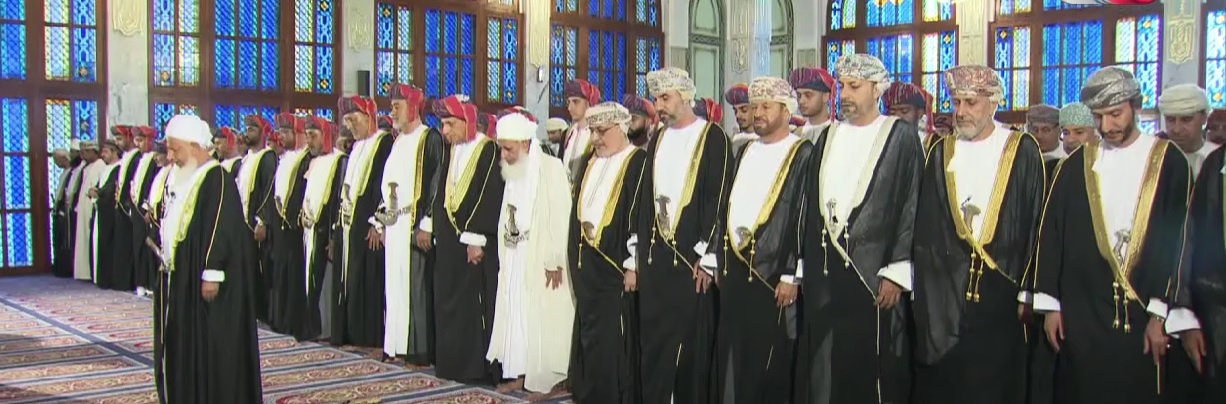
The hadith above has been used by many people to advocate that Muslims should try and pray the way that the Blessed Messenger (saw) prayed.
Often what they really mean is to pray the way they think he prayed.
Clarity from Obfuscation: Where to place the hands in the prayer?
We have a situation in the Muslim Ummah in which there are certain groups who go around and police other people’s prayers. They are like the ‘prayer police’. I honestly think that many of them are coming from a place of sincerity in that they only want you to follow what they believe the Blessed Messenger (saw) was doing.
However, they give the false impression that the correct way of doing the prayer is to place the right hand over the left hand (somewhere…) –we will come to this latter. Thus, they will give the impression that anyone who does anything different from this is not doing the prayer of the Blessed Messenger (saw) or worse, ye,t they are doing innovation!
Interestingly enough, the statement “placing the hands on the chest” is not contained in either of the two most authentic collections of the Sunni hadith corpus, namely, al-Bukhari or Muslim!
What we have are two ways of obtaining evidence about the way the Blessed Messenger (saw) performed his prayer.
Since we do not have a video recording of how the Blessed Prophet (saw) prayed how is the sunnah of the Blessed Messenger (saw) preserved and transmitted?
1. Diagram A: Sunnah preserved via mass living connected chains via the mass transmitted living sunnah as actual practice. This means that masses of people pray who observe their seniors, scholars and learned people pray who observe their seniors and scholars, and learned people pray who observe their seniors, scholars and learned people pray who observed the Prophet (saw) prayed.
2. Diagram B: Sunnah preserved in the form of an oral report as theoretical practice. Theoretical practice because these are scholar’s interpretations of what the lone narrator reports entail. Often they contain many conflicting suggestions about how the Prophet (saw) prayed. Often the scholar who employs this method does his/her best to deduce how the Prophet (saw) might have prayed. These become documented in writings.
3. Diagram C: Now, obviously, the hadith (report) or sunnah (practice) — which we have in our hands in the form of writings, started off as khabar al-wahid or lone narrator oral reports. However, without context, (mass living and mass transmitted practice) it is difficult to determine with certainty and clarity the authority they convey. This is why these reports are often called dhaani, which means they imply certainty about a matter but do not necessarily convey it.
Diagram B & Diagram C, for all practical purposes, are the same methodologies.
An example of context in regard to the sunnah is knowing if a prophetic practice was enforced or abrogated.
An example of abrogated sunnah
“Narrated Al-Bara:
The Prophet (saw) prayed facing Bait-ul-Maqdis (i.e. Jerusalem) for sixteen or seventeen months but he wished that his Qibla would be the Ka`ba (at Mecca). (So Allah Revealed (2.144) and he offered `Asr prayers(in his Mosque facing Ka`ba at Mecca) and some people prayed with him. A man from among those who had prayed with him, went out and passed by some people offering prayer in another mosque, and they were in the state of bowing. He said, “I, (swearing by Allah,) testify that I have prayed with the Prophet (saw) facing Mecca.” Hearing that, they turned their faces to the Ka`ba while they were still bowing. Some men had died before the Qibla was changed towards the Ka`ba. They had been killed and we did not know what to say about them (i.e. whether their prayers towards Jerusalem were accepted or not). So Allah revealed:– “And Allah would never make your faith (i.e. prayer) to be lost (i.e. your prayers offered (towards Jerusalem). Truly Allah is Full of Pity, Most Merciful towards mankind.” (2.143)
What this means is that it was the sunnah of the Blessed Messenger (saw) to pray facing towards Jerusalem and then the sunnah was to pray facing towards the Ka’ba and there were companions who died, and this information did not reach them.
An example of the sunnah in theoretical practice as interpreted by scholars.
“Abdullah ibn Maslama related to us, on the authority of Malik from Abi Hazim from Sahl ibn Sa’d He said:
“The people were ordered that a person is to place their right hand over their left forearm during prayer” Abu Hazim said, “I know only that he attributes that (yanmi dhalika) to the Prophet.” Isma’il said,” (I only know that) That is attributed (yunma dhalika).”
#1) It is not an explicit report or statement or action of the Prophet (saw).
#2) The statement, “That the people were ordered that a person is to place their right hand over their left forearm during prayer” is the statement of the Companion, Sahl. And he doesn’t say that the Prophet (saw) gave this order. So there is a possibility that another could have given this order.
#3) The statement, “I know only that he attributes that (yanmi dhalika) to the Prophet” is not the statement of Sahl. Rather, it is the statement of the Tab’i Abu Hazim. So there is no certainty that Sahl actually attributed this to the Prophet (saw), since Abu Hazim is merely conjecturing about what he remembers.
#4) The statement of Isma’il is that (I only know that) That is attributed to (yunma dhalika).” And he didn’t say, “He attributes (yanmi).” Further emphasizes the belief that Abu Hazim didn’t actually hear Sahl attribute the order to the Prophet (saw).
TAKING THE SUNNAH BY THE METHOD OF DIAGRAM Bor DIAGRAM C
The problem with scholars’ interpretations of lone narrator’s reports will be shown.
Notice that many Muslims pray with their right hand over their left hand below their navel or up midway above the navel or high up on the chest. So, obviously that hadith above (which has been shown not to be firmly established by the Prophet) doesn’t help us to know where to place the hands.
You could even do takbir and then put your hands behind your back taking the left forearm with the right hand as in the picture above! Of course, no one among Muslims is doing this. However, this clearly demonstrates why relying upon the methodology relied upon in diagrams B & C above can be problematic.
The group(s) that proclaim the ‘Salafi Manhaj’ are in major dispute in regard to the Prophets prayer based upon the principles of interpretation in diagrams B & C
Sticking with the already previously mentioned Hadith: “The people were ordered that a person is to place their right hand over their left forearm during prayer” and showing the challenges of interpretation rather than going by mass-living mass-transmitted practice.
A very important point.
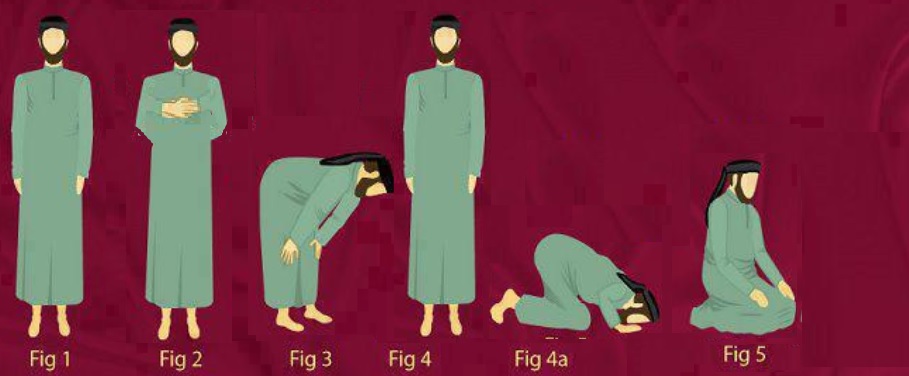
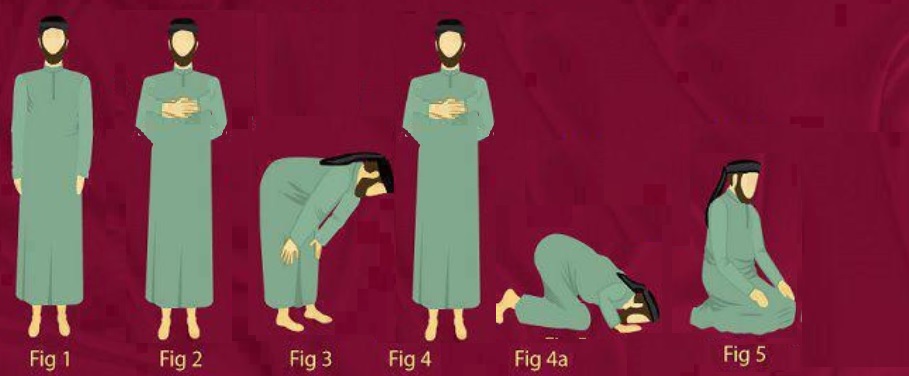
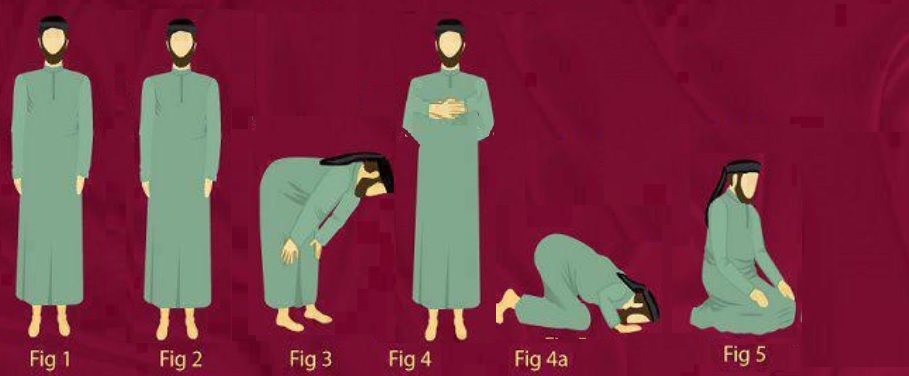
Many among the Salafis think that just quoting the above hadith is enough to negate sadl-laying the arms at the side. However, that is simply not the case at all! Because that hadith does not indicate if this was to be done before the ruku (see fig 3. and fig 4. below)or the returning position after ruku.
Salafi Interpretation number 1.
The Salafi will place the right hand over the left hand before bowing and after bowing, they leave the hands at the side (sadl).
In figure 4, the majority of Muslims, Ibadi, Shi’i, Shafi’i, Maliki, Hanafi leave their hands at the side after bowing.
Salafi Interpretation number 2.
The Salafi will place right hand over the left hand before bowing and after bowing, they again place the right hand over the left!
In figure 4, the majority of Muslims, Ibadi, Shi’i, Shafi’i, Maliki, Hanafi do not grasp their hands after bowing.
For some strange reason someone didn’t want you to see the above video. As if it was a national intelligence secret. Thankfully, for you dear reader, we saved it. Voilà!
So you can see those Salafis who follow interpretation number 2 in the video below. They place the right hand over the left hand after bowing.
It is a point of dispute among those Muslims who claim to be following: “The way of the Salaaf.”
Among the big Salafi Shaykhs who practice this are:
Shaykh Badeeu deen As-Sanadi and Shaykh Bin Baaz, whereas Shaykh al-Albaani declared that those who did that are innovators.
The proof text that Bin Baaz uses for his position is the very hadith under discussion above! So this hadith does not tell us if the hand is placed one over the other (where they are to be placed) and if they are to be folded (before or after the bowing- ruku)!
So who was the correct way of praying? Who was upon innovation? If people say this is just a matter of ijtihad (interpretation), what they are saying is that one can still be rewarded for guessing how the Prophet (saw) prayed. One of them, either Bin Baz or Albaani, went their entire life without praying one prayer correctly? Yikes!
Possible Salafi Interpretation number 3.
A possible interpretation of the above hadith is to leave the hands at the side before bowing and, after bowing, they place the right hand over the left.
In figure 4, now no one is currently doing this, but it does show the problem of simply relying upon interpretation of the hadith.
In the above hadith you will not find any of the following information:
It doesn’t tell you to place your right hand over your left forearm behind your back.
It doesn’t tell you to place your right hand over your left forearm below your navel.
It doesn’t tell you to place your right hand over your left forearm in the mid-section.
It doesn’t tell you to place your right hand over your left forearm before ruku.
It doesn’t tell you to place your right hand over your left forearm after ruku.
It doesn’t tell you to place your right hand on your left shoulder.
It doesn’t tell you to place your right hand under the chin at the top of the sternum.
THE PEOPLE WERE ORDERED THAT A PERSON IS TO PLACE THEIR RIGHT HAND OVER THEIR LEFT FOREARM DURING PRAYER.
Various Muslim polities and empires would often force their viewpoints and positions on the masses. They would also force people to change their acts of worship.
Example being: The Shirazi Shi’a dynasty that forced people to adopt their prayer as well as adopt their version of Shiasm in general!
“It was, however, nothing less than a reign of terror that inaugurated the new dispensation. On capturing Tabriz in 907/1501, a city two-thirds Sunnite in population, Shah Esmāʿil threatened with death all who might resist the adoption of Shiʿite prayer ritual in the main congregational mosque, and he had Qezelbāš soldiers patrol the congregation to ensure that none raise his voice against the cursing of the first three caliphs, viewed as enemies of the Prophet’s family. In Tabriz and elsewhere, gangs of professional executors known as the tabarrāʾiān would accost the townsfolk at random, forcing them to curse the objectionable personages on pain of death. Selective killings of prominent Sunnites occurred in a large number of places, notably Qazvin and Isfahan, and in Shiraz and Yazd, outright massacres took place. Sunnite mosques were desecrated, and the tombs of eminent Sunnite scholars destroyed (Aubin, 1970, pp. 237-38; idem, 1988, pp. 94-101).”
Another example of prayer being an issue of politics is the history of the rivalry in West Africa between the two Sufi Tariqah: The Tijani and The Qadiri.
“Beginning with the 1949 demolition of the Tijani mosque in Sokoto Province at the order of the sultan of Sokoto, tensions between Tijaniyya and Qadiriyya periodically erupted into violence throughout the 1950s and 1960s. A 1956 riot in two districts of Sokoto resulted in four deaths, including that of a Qadiri imam. In 1965, again in Sokoto Province, clashes attributed to Tijaniyya-Qadiriyya disputes resulted in the deaths of eleven policemen. As in Mali , a potent symbol of and perhaps pretext for inter-brotherhood antagonism remains the posture of arms during prayer: Tijanis cross their arms over the chest (kabalu), whereas Qadaris keep their arms straight at their sides. The Qadiris regard kabalu as heretical.”
Source: (The History of Islam in Africa page 219)
“The exact ritual of prayer has long been an expression of difference-especially whether the arms are folded (kablu) or at one’s side(sadlu) when standing in the course of prayer. After Friday prayer, there is also the issue of what dhikr is said and for how long-and whether, as a novelty, bandiri drums are used. There were thus very visible and audible differences between Qadiri and Tijani Muslims, and these could become a source of much controversy. In some emirates, the Tijaniyya clearly represented opposition to the ruling establishment when that establishment was Qadiri. Given that ‘Uthman dan Fodio was a Shaikh of the Qadiriyya and his son was a successor Muhammad Bello refused to abandon his father’s tariqa in favour of the new, radical Tijaniyya (which a visitor to Sokoto, ‘Umar al-Futi, was then strongly promoting), then joining the Tijaniyya was in effect an act of dissidence or at least dissent.”
Source: (Sects & Social Disorder: Muslim Identities & Conflict in Northern Nigeria page 43)
The issue of the kabalu (folding the hands) or the sadlu (leaving them) was ordered in the Tijani Tariqa as an outward display of political dissonance and a means of separating them and making them distinct.
“For example, Shaykh al-Tijani (RA) strongly recommended us to recite the Basmalah loudly before the Fatihah. This is against the Maliki and Hanafi Madhhabs, but we have to follow it. Shaykh Ibrahim (RA) ordered his (mostly Maliki) followers to pray with folded hands, so Maliki Tijanis have to do it, even if it goes against the Maliki Madhhab. Indeed, when he was ordered by Allah, Rasul (SAW), and Shaykh al-Tijani (RA) to order the people to pray with folded hands, many people in West Africa fought him. They said to him: “But your father (RA) prayed with open arms???” He replied: “Al-Humduli’Llah! Allah has not ordered us to follow anyone absolutely but the Prophet (SAW)”. Also, when someone said: “But Shaykh al-Tijani (RA) is related to have prayed with open arms too?” Baye (RA) replied: “We take the Tariqah from Shaykh al-Tijani (RA) and we don’t go an inch against him. But, we take the Shari’ah from Rasul-Allah (SAW).” As Shaykh Mahy Cisse told me, Shaykh al-Tijani (RA) also wished to pray Qabd but was not given the permission than as he had other affairs to see to, as well as the fact that his following in Fes and Morocco was not big enough to bring about such a major change. Everything has a time, and the Shaykh al-Tijani (RA) ordered Shaykh Ibrahim (RA) to revive this Sunnah among the Malikis.”
We should be careful not to take our fiqh and our ijtihad from dreams as anyone can say anything.
If a Shaykh, especially a Sufi Shaykh, does such a thing, they put you in a difficult position. They are either lying or telling the truth.
Shaykh Hamza Yusuf on the politics of prayer.
Shaykh Hamza Yusuf had quoted something very interesting from the great Hanafi master of fiqh and hadith: Mulla ‘Ali al-Qari.
Quoting from Mulla ‘Ali Qari Shaykh Hamza Yusuf says,
“Mulla ‘Ali Qari says it could have been the Prophet, It could have been the Khulafa, or it could have been the rulers that were telling people to do that.”
Shaykh Hamza Yusuf continues:
“So even the Hanafi, one of the great Hanafi scholars of Hadith, it’s not clear who was telling who to do what.”
Shaykh Hamza Yusuf continues:
My conclusion is, I actually think it’s a political thing. Because the two people who were leaving their hands at their side were the people who were most resistant to the Umayyad rule. And that was the Khawarij and the Shi’a. So it’s very interesting that the thing that immediately distinguishes your political allegiance is the prayer.”
Source is: @ 07:20 seconds into the video
In fact, further proof of what Shaykh Hamza Yusuf says comes to us in the following hadith:
Ibn ‘Abd Al-Barr in his book al-Tamheed narrates that:
‘Abd Allah ibn al-Izar said, ‘I used to make tawaf around the Kaba with Said ibn al-Jubayr. Once, he saw a man placing one hand over the other, so he went to him, separated his hands, and then returned to me.
Source: (al-Tamheed Ibn ‘Abd al-Barr 20:76)
Placing one hand over the other was considered to be munkar by Said ibn Al-Jubayr because you can only change an act that is known to be munkar. It is also interesting that he (Said ibn Al-Jubayr) observed a man doing this, meaning that this novel practice ‘stood out to him’. So the majority practice during the time of the companions and their successors was to place the arms at the side.
Keep in mind that Said ibn Al-Jubayr took part in the Battle of Dayr al-Jamājim against the Umayyds!
Also, keep in mind that not everyone who prayed sadl (hands to the side) opposed the Umayyads.
An example of this is: Sa’id ibn al-Musayyib. Sa’id ibn al-Musayyib refused to give allegiance to Abdullah ibn Al-Zubayr, who was opposed to the Umayyads.
Also, the hadith narrated in al-Tamheed: ‘Abd Allah ibn Yazid said, “I never saw Said ibn al-Musayyib holding his left hand with his right hand in the prayer, he used to lay them straight.”
Sa’id ibn al-Musayyib was one of the biggest Tabi’een in Madina, and this was thus the practice of the people of Madina that Imam Malik witnessed.
Source: (al-Tamheed Ibn ‘Abd al-Barr 20:76)
These pieces of information are important and anyone who takes this religion seriously needs to pause and reflect.
Where did these men get the practice of laying their hands straight in prayer from?
Where these people innovators? If they were, how can we trust information from them?
Is there anyone from among the Salafi, or any other group of Muslims who claims that Sadl (laying hand straight) was a sunnah of the Prophet (saw) that was abrogated?
If yes to question 3, what is the proof?
HOW DID ABU UMAMA BIN SAHL PRAY?
How did Abu Umama Bin Sahl Ibn pray?
Abu Umama bin Sahl is one of the Sahaba. His full name is Asad bin Sahal bin Hunaif Al Ansari and The Blessed Messenger (saw) used to call him Abu Umama.
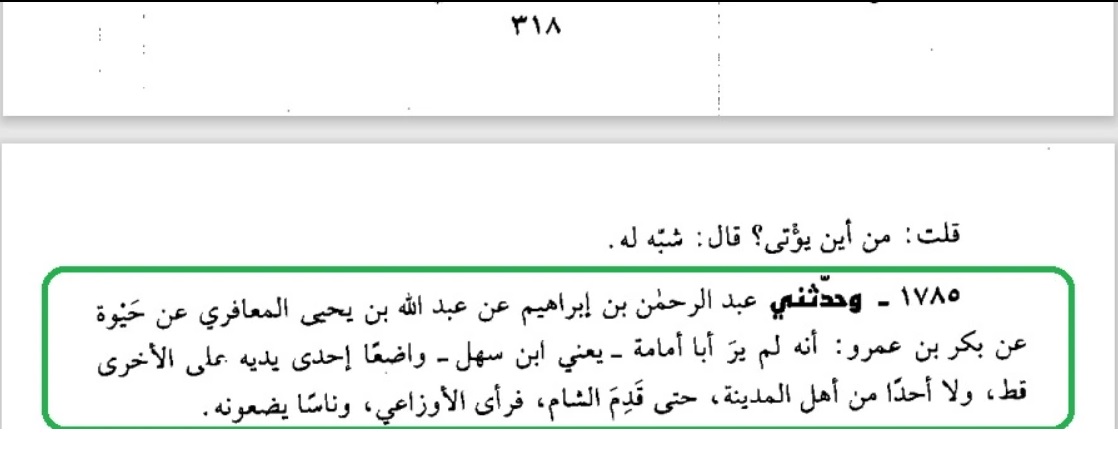
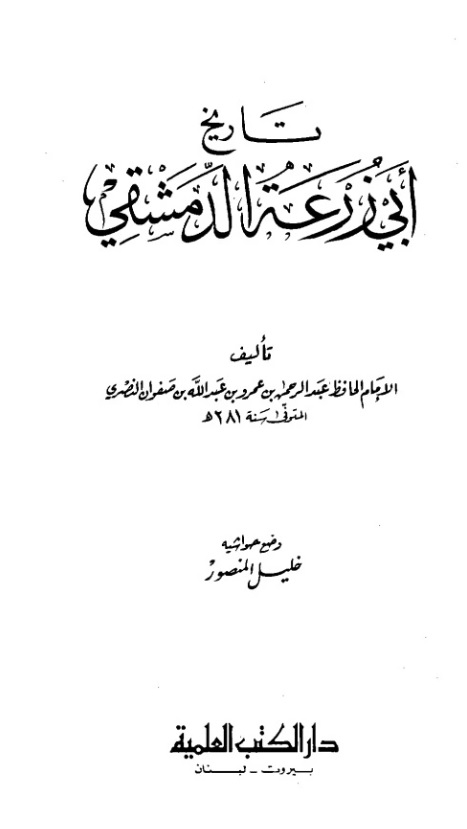
Look at the hadith of Imam Abu Zur’ah, the Shaykh of Imam Al Bukhari!
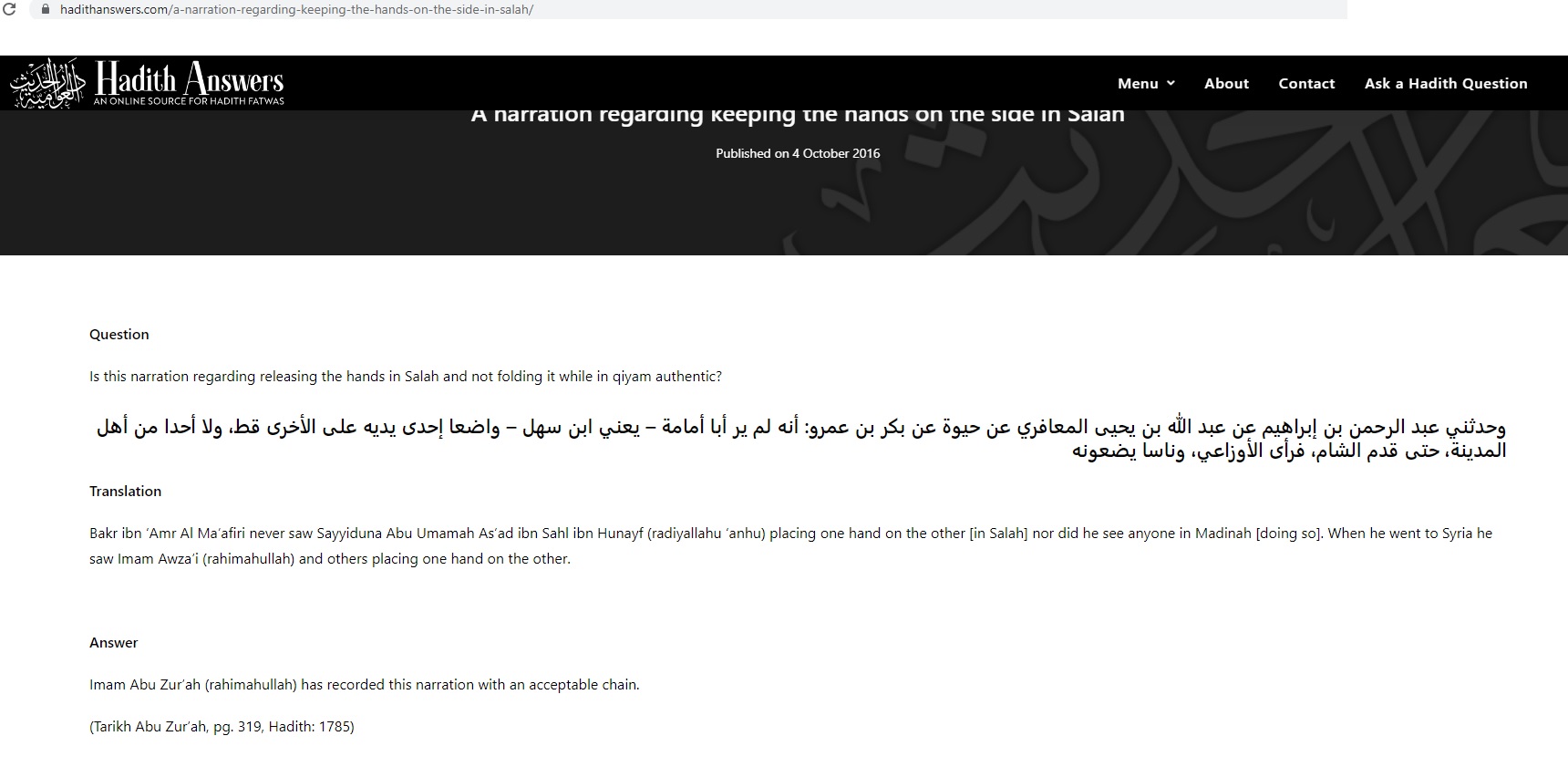
وحدثني عبد الرحمن بن إبراهيم عن عبدالله بن يحيى المعافري عن حيوة عن بكر بن عمرو أنه لم ير أبا أمامة -يعني ابن سهل- واضعا إحدى يديه على الأخرى قط ولا أحدا من أهل المدينة حتى قدم الشام فرأى الأوزاعي وناسا يضعونه
Source: (Tarikh Abu Zur’ah pg. 319. Hadith 1785)
“Abd al-Rahman ibn Ibrahim told me on the authority of Abdullah ibn Yahya al-Ma`fari on the authority of Haywa on the authority of Bakr ibn Amr that he had never seen Abu Umamah – meaning Ibn Sahl -ever put one of his hands on the other [in prayer], and no one from the people of Madinah did that either. When he came to Syria he saw al-Awza`i and other people placing one hand on the other.”
In other words, Bakr ibn Amr observed that this was a practice of the Syrians.
Recall the hadith:
“Abdullah ibn Maslama related to us, on the authority of Malik from Abi Hazim from Sahl ibn Sa’d He said:
“The people were ordered that a person is to place their right hand over their left forearm during prayer” Abu Hazim said, “I know only that he attributes that (yanmi dhalika) to the Prophet.” Isma’il said,” (I only know that) That is attributed (yunma dhalika).”
Sahl ibn Sa’d — the same one who has informed us that people were ordered by an undisclosed source to initiate a practice in prayer (namely, put the right hand over the left arm in the prayer),is the same one who informed usthat some vile undisclosed individual ordered him (Sahl ibn Sa’d) to curse Ali.
Sahl b. Sa`d reported that a person from the offspring of Marwan was appointed as the governor of Medina. He called Sahl b. Sa`d and ordered him to abuse `Ali. Sahl refused to do that. He (the governor) said to him:
If you do not agree to it (at least), say: May Allah curse Abu Turab. Sahl said: There was no name dearer to `Ali than Abu Turab (for it was given to him by the Prophet himself) and he felt delighted when he was called by this name. He (the governor) said to him: Narrate to us the story of his being named as Abu Turab. He said: Allah’s Messenger (saw) came to the house of Fatima, and he did not find `Ali in the house; whereupon he said: Where is your uncle’s son? She said:”There was something that cropped up between me and him which had annoyed him. He went out and did not rest there. Allah’s Messenger (saw) asked a person to find out where he was. He came and said: Allah’s Messenger, he is sleeping in the mosque. Allah’s Messenger (saw) came to him and found him lying in the mosque and saw that his mantle had slipped from his back and his back was covered with dust and Allah’s Messenger (saw) began to wipe it away from him (from the body of Hadrat `Ali) saying: Get up, covered with dust (Abu Turab); get up, covered with dust.
THE THREE PIECES OF EVIDENCE THAT ARE USED BY SOME MUSLIMS TO ADVOCATE CLASPING THE HANDS ABOVE THE NAVEL.
Now we will be looking at the only three pieces of evidence to support the majority practice (all three of them hotly disputed).
1) The Hadeeth of Wa’il Ibn Hujr in Ibn Khuzaimah
2) The Hadeeth of Halb At-Taa’ee in Tirmidhi3)
The Mursal report of Tawus in Sunan Abu Dawud
Now we will be looking at the only three pieces of evidence to support the idea of placing the hands on the chest in prayer (all three of them hotly disputed).
Before we begin this section,we want to say that the proofs and evidence are largely taken from the Sunni Maliki scholar, Mukhtar ibn Muhaydimat ad-Daudi ash-Shinqiti.
He wrote a treatise called: “The Legality of Draping the Arms in Salah”. His works are often used but rarely is the source credited. Allah (swt) has certainly rewarded all who have contributed towards learning and truth!
1) The Hadith of Wa’il Ibn Hujr in Ibn Khuzaimah
2) The Hadith of Halb At-Taa’ee in Tirmidhi
3) The Mursal hadith of Tawus in Sunan Abu Dawud
HADITH NO. 1 THE HADITH OF WA’IL IBN HUJR
Sayyiduna Wail bin Hujr says, ‘I prayed with the Prophet (saw) and he placed his right hand over his left on his chest’.
Source: (Ibn Khuzaimah, 479)
This hadith has been reported by Muammal bin Ismaeel from Sufyan al Thawri from Aasim bin Kulaib from Wail bin Hujr.
However, it is only Muammal who reports these additional words from Sufyan al Thawri.
Sufyan’ al Thawri’s other student, Abdullah bin al Waleed, who also narrates this hadith from him, does not include these words in his narration as recorded in Imam Ahmad’s Musnad. Source: (Ahmad 18392)
It is an accepted principle of hadith that if a certain authentic and reliable narrator contradicts other equally authentic or more reliable narrators in his wording of a hadith, then his narration will be declared shaadh (irregular) and will not be accepted.
Ibn al Qayyim al Jawziyyah also says in I’laam al Muwaqqieen, ‘No one has said upon the chest apart from Muammal bin Ismaeel.’
Source: (I’ilaam al Muwaqqieen 2/361)
Study the following observations of the scholars of Jarh and T’adeel about Muammal bin Ismaeel:
Hafiz Ibn Hajar Al Asqalani has made it clear in his Fath al-Bari that there is daif (weakness) in Muammal bin Ismaeel’s narration from Sufyan. The above hadith has this very chain of narration
Source: (Fath al Bari, 9/297).
WHY IS SUCH A HADITH NOT INCLUDED IN BUKHARI OR MUSLIM?
Imam Bukhari mentions that Muammal ibn Ismaeel is among the munkarul Hadith (denounced in hadith).
Source: (Aathar Us-Sunan Pg. 65, Chapter: Placing the hand on the chest).
(People who view Imam Bukhari as the ultimate authority in matters of hadith should note his following statement:
“It is not permissible to narrate from anyone whom I have labeled munkar al hadith” Source: (Mizan al I’itidal. 1/119)
Shaykh ibn al-Hammaam said in ‘at-Tahreer’, ‘when al-Bukhari says about someone, “there is a problem in him” then his hadith is not depended upon or used for support, or given any consideration.’
Observe the following list of narrators who have all reported the same hadith from Aasim bin Kulaib but none of them have included the additional words‘upon the chest’reported by Muammal bin Ismaeel
Sh’ubah, Abdul Wahid, and Zubair bin Muawiyah as in Imam Ahmad’s Musnad.
Source: (Ahmad 18398, 18371 & 18397)
Zaidah as in Imam Ahmad’s Musnad, Darimi, Abu Dawood. Nasai and Baihaqi
Source: (Ahmad 18391, Darimi 1357, Abu Dawood 726, Nasai 889 and Baihaqi 2325)
Bishr bin al Mufaddhal as in Ibn Majah, Abu Dawood, and Nasai
Source: (Ibn Majah 810, Abu Dawood 726 & 957, and Nasai 1265)
Abdullah bin Idrees as in Ibn Majah
Source: (Ibn Majah 810)
Salam bin Saleem as in Abu Dawood Tayalisi’s Musnad
Source: (Abu Dawood Tayalisi 1020)
In Layperson understanding, it is like this.
A -B-C-D-E-F than G says… A -B-C-D-E-F A -B-C-D-E-F A -B-C-D-E-F
So what happens if we go and double-check what G says? So after double-checking what G says, we go back and see transmissions from F through other chains and none of them say what G is saying. G stands alone in his statement!
Those who claim the Salafi approach have some bizarre logic.
We have 7 people in the example above who narrate this hadith from Aasim bin Kulaib. 6 out of 7 confirm they do not have the extra wording. One of these students, Sufyan Al Thawri, now has two people narrating from him. One of the two students, Abdullah bin al Waleed, also narrated the same as the other 6 students of Aasim bin Kulaib. However, one of Sufyan’s students, Muammal bin Ismail, has the extra wording.
This is what passes as daleel for the Salafi!
Which should be a huge eye-opener to anyone reading this. If the prayer of the Blessed Messenger (saw) was folding the right hand over the left upon the chest, it would be a mass-transmitted practice.
This is something as frequent as praying five times a day, every day until He (saw) died! The very fact that they need to go and double-check these statements should open some eyes!
Questions:
So, before we would be inclined to accept such a description of the prayer, just our hearts and curiosity:
1) Is it possible to have the quote from Sufyan Al Thawri or Aasim bin Kulaib where he said the Blessed Prophet (saw) prayed with his hands upon his chest?
We would ike to ensure thjat we are following the Salaaf and not someone’s simple mistake by making an added addition.
2) Why did Imam Bukhari denounce Muhammal ibn Ismaeel, and why does he not use him in his narrations?
3) Why did Ibn Hajar Al Asqalani declare Muhammal’s narrations from Sufyan At Thawri as weak?
HADITH NO. 2 THE HADITH OF HULB AT-TA’I
The hadith of Hulb Al-Ta’i reported by Imam Ahmad in his ‘Musnad’. Also reported in Tirmidhi, Ibn Majah, and Daraqutni,
“That Yahya bin Sa’eed narrated to us from Sufyan At Thawri , from Simak bin Harb from Qabisa bin Hulb from his father that, ‘I saw the Messenger of Allah (saw) turn from his left to right, and place these on his chest, and Yahya al-Yamanee depicted this by placing the right hand upon the left (on the chest) above the level of the elbows.’
The above hadith contains the words ‘upon his chest‘. This extra wording is not firmly established or confirmed, because of all the narrators who report this hadith from Simak, only one reports this extra wording.
Observe the following narration of the same hadeeth without the extra wording of ‘upon his chest’.
Abu al Ahwas reports from Simak bin Harb from Qabisa bin Hulb from his father that the Prophet (saw) would lead us in prayer and would clasp his left hand with his right.
Source: (Ibn Abi Shaibah 3934, Ahmad 21467, Ibn Majah 809 and Tirmidhi 252. Imam Tirmidhi adds that it is a hasan-fair hadith)
Shareek reports from Simak from Qabisa bin Hulb from his father, who says (towards the end of a longer hadith), ‘I saw him place one of his hands on the other and I also saw him turn once towards his right and once towards his left.’
Source: (Ahmad 21464)
Wakee reports from Sufyan from Simak bin Harb from Qabisa bin Hulb from his father, who says, ‘I saw the Prophet (saw) place his right hand upon his left in prayer and I also saw him turn away from both his right and left.’
Source: (Ahmad2146I & 21475. Daruqutni 1087. al T’aleeq al Hasan 1/145)
Daraqutni narrates from Abdul Rahman bin Mahdi and Wakee’, from Sufyan from Simak bin Harb from Qabisa bin Hulb from his father who says, ‘I saw the Prophet (saw) place his right hand upon his left in prayer.’ Source: (Daruqutni 1087)
The above narrations all clearly show that the wording ‘upon his chest’ is an unreliable addition on the part of one of the reporters and therefore this particular narration is shaadh.
The weakness of this Hadith.
Weakness #1: Qabisa ibn Hulb has been classified as weak and unknown.
Shawkani said: “In the chain of this hadith is Qabisa ibn Hulb. Simak bin Harb is the only one to narrate from him. Al-‘Ijli considered him to be reliable. And Ibn Al-Madini and Nasa’i said: “(He is) Unknown.”
Source: (Nayl Al-Awtar [2/200])
Weakness #2: Simak bin Harb has been classified as weak.
Dhahabi said about him: “Sufyan At Thawri, Shu’ba, and others declared him to be weak. And Imam Ahmad said: “He is unstable (mudtarib) in Hadith.” And Nasa’i said: “He used to be dictated to. And he would learn (from those dictated notes.).”
Source: (Al-Mizan [2/422 &423])
So there is a weak transmitter that transmits from another who is unknown. So no attention is to be shown to it!
As for what Tirmidhi relates from Simak bin Harb from Qabisa ibn Hulb from his father, who said:
“The Messenger of Allah used to lead us, and take his left with his right.” and declared it to be Hasan (of fair grading), then said, “Action is in accordance with this among the companions of the Prophet (saw). “
There is no doubt that he (Tirmidhi) depended upon the hadith of Hulb in attributing this action, since there is a distance (in time) between him, and between the Sahaba and Tabieen. Also, because he didn’t mention any support for that (placing hands on the chest) other than the Hadith of Hulb.
If it (the hadith) had been Sahih (sound) in chain and text, it could have possibly passed as evidence. However, it is one of the narrations of Simak and Qabisa. And it has already preceded that Simak is weak… and Qabisa is unknown (majhool). And only Simak narrates on his authority. And Tirmidhi’s choosing of this chain from (all) the different chains going back to the Prophet in this chapter is proof that all chains of transmission fall in the center of embarrassment.
In the layperson’s understanding, it is like this: A -B-C-D-E-F than G says…H…says A -B-C-D-E-F A -B-C-D-E-F A -B-C-D-E-F
So, what happens is we go and double-check what G says. So after double-checking what G says, we go back and see transmissions from F through other chains and none of them say what G is saying from F. Not only that, but it is known that G is unstable as a transmitter. Not only this but G is relying upon H and no one seems to know who H is!
Those who claim the Salafi approach have some bizarre logic.
Three transmitters transmit from Simak without the extra wording, and out of those three transmitters, one of them, Sufyan, has three transmitters and only one of them, Yahya bin Sa’eed, has the extra wording. It is highly likely that this is a text corruption by a scribe.
Questions:
1) Again why isn’t such a Hadith in Bukhari or Muslim?
2) Why did Tirmidhi choose this chain from all the different ones going back to the Prophet (saw)?
3) Why did Imam Ahmad declare him (Simak bin Harb) to be unstable in Hadith?
4) Why did Imam Nasa’i declare Qabisa ibn Hulb as unknown?
HADITH NO. 3 THE HADITH OF TAWUS
And from the Hadith these people depend upon is the hadeeth of Tawus.
Reported by Abu Dawud in ‘al-Maraaseel’ who said, ‘Abu Tawba narrated to us from al-Haytham (ibn Humaid) from Thawr bin Yazeed from Sulaiman bin Musa from Tawus who said, ‘The Messenger of Allah (saw) placed his right hand upon his left and then hold them tight on his chest while in prayer.’’
Source: (Abu Dawud 759)
Weakness #1:
This report is incompletely transmitted since there are undisclosed companion and/ or even non-companion intermediaries between these Tabi’in.
So the Hadith of Tawus is Musral, because Tawus is a Taabi’ee. So he could not have seen the Blessed Messenger (saw).
However, the mursal hadith is considered a proof by Imam Abu Hanifa, and the Hanafi’s have their response to this.
Status of Mursal Hadith.
How did the Sunni Imams deal with mursal Hadith?
It is a proof with Imam Malik when it confirms the Amal of Madinah. This does not confirm the Amal of Madinah from a Maliki point of view, because the view of Imam Malik is that the hands are laid to the sides.
Unless the report describes the nawaafil or sunnah prayers.
It’s a proof with Imam Ahmad in general, and we all know the best position of Imam Ahmad is that the hands are below the navel.
And according to Imam Shafi’i, the mursal hadith are not acceptable unless there is another chain with a complete isnaad that backs it up.
Weakness #2: The first narrator of this tradition is Abu Tawba, whose full name is Ahmed bin Salem. IIbn Hajar Al-Asqalani, said of him, “He is famous for tailoring fake traditions.”
Source: (Mizan ul E’tidaal, volume 1, page 100
Ibn Hajar writes in Taqreeb al-Tehzeeb that, “he was unreliable and an extreme liar“. “He used to make changes in the traditions and steal traditions, he could never find a person more of a liar than him.”
Source: (Taqreeb al-Tehzeeb, volume 2, page 69.)
Weakness #3: The second narrator is Haytham, whose full name is Haytham bin Hameed al-Damishqi; Abu Dawud himself has called Haytham a follower of Qadri religion, Abu Mushar Ghasani has called him a Qadri and unreliable.
Source: (Al Mizan ul E’tidaal volume 4, page 319, series 9289)
Weakness #4:
This hadith is mursal and its isnad contains Sulaiman bin Musa, who has been classified as weak by some scholars.
Bukhari claims that he has munkar narrations.
Source: (Aathar Us-Sunan Pg. 65, Chapter: Placing the hand on the chest)
Dhahabi said about him that Nasa’i says that he is a weak narrator of hadith.
Source: (Al-Mizan volume 2, page 225)
Weakness #5:
The third narrator is Thawr bin Yazeed; he too followed the Qadri faith.
Source: (Mizan ul E’tidaal, volume 1, page 373)
In the Layperson’s understanding, it is like thisA -B-C-D-E-F than G says… A -B-C-D-E-F A -B-C-D-E-F A -B-C-D-E-F
So in this case, we have a report from G, who has been declared to be an outright liar and someone who is known for making up traditions. Then G takes from F, who apparently has issues with his creed. F takes from E, who is apparently classified as weak by some scholars, and Bukhari outright claims he has denounced traditions! E takes from D, who again has issues with his creed. D claims to get information from C, who relates information from an undisclosed source.
Which hadith are these popular da’i following?
In the picture below I see most gripping the left forearm with the right hand. I see placement just above the navel, on the stomach and on the sternum.
“Placed his right hand upon his left and then hold them tight on his chest while in prayer.” -Hadith of Tawus
“By placing the right hand upon the left (on the chest) above the level of the elbows.” -Hadith of Hulb At-Tai
“‘I prayed with the Prophet (saw) and he placed his right hand over his left on his chest’. ” -Hadith of Wail ibn Hujr
The above picture is not to defame or discredit any of the teachers above. The picture is for illustration purposes to show that they themselves do not have uniformity in the approach to prayer.
Questions:
1) Why isn’t such a report in Bukhari, or Muslim?
2) Why is such a description of the prayer such as ‘pressing one hands to the chest tightly‘ only a Musral Hadith?
3) Is it possible that, since there is a break in this chain the Blessed Messenger (saw) may not have even done it at all?
4) Since Abu Dawud mentions many ahadith about the positions of the hands in prayer, can we know for certain the hadith that he followed?
Abu Dawud transmits hadith with different placements for the hands.
Abu Dawud transmitted the following hadith:
hands below the navel
on the chest
and even hands to the sides
Just like Imam Malik related the hadith from Sahl ibn Sa’d, in his Muwatta as mentioned above. Imam Malik related this hadith to show his awareness of this hadith being in circulation.
Similarly, Abu Dawud has transmitted three hadith that he was aware of in regard to the placement of the hands.
Proof that Imam Malik related the same hadith above:
“Yahya related to me from Malik from Abu Hazim ibn Dinar that Sahl ibn S’ad said,
The people were ordered that a person is to place their right hand over their left forearm during prayer” Abu Hazim said, “I know only that he attributes that (yanmi dhalika) to the Prophet.” Isma’il said,” (I only know that) That is attributed (yunma dhalika).”
Source: (pg. 59 Al Muwatta of Imam Malik ibn Anas translated by Aisha Abduurrahman Bewley)
Yet, Imam Malik, who was from the city of Madinah, was of the view that the hands should be placed at the sides during the prayer.
This is the opinion narrated by his student Ibn al-Qasim.
Source: (al-Mudawanna (1:74) )
Salafis claim to be people of evidence, and yet they spread rumors about Sunni Mujtahid Imams.
The false claim regarding Imam Malik.
Yet there are some untruths and some huge lies being circulated concerning why Imam Malik prayed with his hands to the side. One of these lies is being circulated by Salafi preacher Abu Ameenah Bilal Philips.
“He was severely beaten in the year 764 CE by the order of the Ameer of Madeenah, because he made a legal ruling that forced divorce was invalid. This ruling opposed the ‘Abbaasid rulers’ practice of adding in the oath of allegiance given to them by the masses the clause that whoever broke the oath was automatically divorced. Malik was tied and beaten until his arms became severely damaged to such a degree that he became unable to clasp them on his chest in Salaah and thus he began the practice of praying with his hands at his sides according to some reports.”
Source: (pg 78. The Evolution of Fiqh Islamic Law & The Madh-habs) By Abu Ameenah Bilal Philips International Islamic Publishing House.)
“Some reports” such as? Doesn’t Abu Ammenah Bilal Philips have to give his evidence or are we just supposed to accept what he said?
Can such a claim be verified by and in any of the traditionally relied upon books of Islamic history? No! One will be hard-pressed to find any evidence substantiating this argument.
Remember what Allah said:
“Verily, those who conceal the clear proofs, evidence, and the guidance, which We have sent down after We have made it clear for the people in the Book, they are the ones cursed by Allah and cursed by those who curse.” (Qur’an: 2:159)
So where is the proof? Secondly, how could Imam Malik not have enough strength to clasp his hands on his chest but still be able to do the tabkir—, go into ruku, and go into sajdah and to push his hands up from sujuud, since Imam Malik’s view is that the knees go up than the hands after sajdah? What about all the other Tabieen who prayed the way Imam Malik did? Did each one of them have their arms broken as well? Also, don’t you think Imam Malik would have said as plain as day, “Hey everyone, as you know, I’m only praying this way because my arm was pulled out of my socket, don’t follow me, follow the Blessed Messenger!”
Likewise, where did the Shi’a get the idea of praying with the arms to the side?
Where did the so-called Khawarij get the idea of praying with their arms to the side?
Where did the Ibadi get the idea of praying with their arms to the side?
Are they all following someone who got their arms pulled out of their shoulder joint? We need to use some common sense!
AAnd when a narrator narrates something about the Blessed Messenger (saw) and doesn’t follow it he’s either:
A fasiq
He knows that it isn’t Authentic about the Blessed Messenger (saw)
He may have forgotten
And since Malik is a respectable scholar, then the first option is removed. The last option is also removed because Imam Malik mentioned the hadith in his Muwatta. Which means only option 2 is left, because he saw another thing than what was reported.
THE THREE POSITIONS OF IMAM ABU DAWUD ON WHERE THE HANDS GO DURING THE PRAYER:
So what was Abu Dawud’s position on the matter? Did he pray with hands below the navel, at the sides, just above the navel or pressed tight to the chest? Abu Dawud transmits three hadith concerning the position of the hands in prayer.
Inquiring minds want to know!
For example:
Abu Dawud also narrates the following:
Place them below the navel.
Narrated / Authority Of Abu Huraira (The established way of folding hands is) to hold the hands by the hands in prayer below the navel.
Reported by Abu Dawud in ‘al-Maraaseel’ who said, ‘Abu Tawba narrated to us from al-Haytham (ibn Humaid) from Thawr bin Yazeed from Sulaiman bin Musa from Tawus who said, ‘The Messenger of Allah (saw) placed his right hand upon his left and then hold them tight on his chest while in prayer.’’
No indication that the hands were to be lifted or placed anywhere.
It has been related by Abu Dawud on the authority of `Amr ibn `Ataa al-Qurashi al-`Aamiri who said:
He said: “I heard Abu Humayd as-Sa`adi, who was present among ten of the Companions of the Messenger of Allah, (saw), among whom was Abu Qatada, say the following. ‘ I am the most learned of you regarding the prayer of the Messenger of Allah, (saw).’ They said to him: ‘How is this? By Allah! You did not follow him more than us nor did you proceed us in companionship to him.’ He replied: ‘Indeed, this is true.’ They then said: ‘Then show us.’ He said: ‘The Messenger of Allah, may Allah bless him and grant him peace when he stood for the prayer he would raise his hands equal with his shoulders.
يَقِرَّ كُلُّ عَظْمٍ فِي مَوْضِعِهِ مُعْتَدِلًا
He would then make the takbir letting all of his limbs settle in their proper places... … قَالُوا صَدَقْتَ هَكَذَا كَانَ يُصَلِّي صَلَّى اللهُ عَلَيْهِ وَسَلَّمَ They all said: “You have told the truth. Likewise did he, may Allah ta`ala bless him and grant him peace perform his prayer.”
This hadith can be found in the Sunan of Abu Dawud, Ibn Maajah, and others and is sound!
So far, we quoted the ahadith from Abu Dawud about pressing the hands on the chest and two hadith about placing the hands under the navel, and leaving the arms and hands to the side.
Anyone who studies these Hadiths knows they are fraught with issues and intra-madhab rivalry and intra-Sunni conflict about where the hands are to be placed and how they are to be placed.
Does this mean he found this to be the strongest evidence or acted upon it? Why even narrate such a hadith at all?
Similarly, Imam Malik narrated the hadith that people were ordered to place ‘the right over the left’ (unspecified place). Does this mean he found this to be the strongest evidence or acted upon it?
Why even narrate such a hadith at all? Malik related such hadith just as Abu Dawud did to let people know he was aware of such a narration. So, just because Malik narrates a hadith doesn’t mean he acts upon it. Just as Abu Dawud narrates a hadith does not mean he acts upon it.
*Note* It should be understood that placing the hands below the navel is the view of the Hanafi school of Sunni jurisprudence. It is also one of many views that are ascribed to Imam Ahmed of the Hanbali school of jurisprudence.
The Hanafi school brings us an anomaly. This anomaly consists of instructing men to place their hands below the navel and instructing women to place their hands on their chest.
The placing of the hands on the chest is considered ‘makrooh’ and extremely disliked in the Hanafi school.In the school it is next to haram. One then wonders why one standard for the men and another for the women?
Certainly, this issue has perturbed many in the Hanafi school.
THE IBADI SCHOOL FOLLOWS THE PRAYER OF THE BLESSED PROPHET AS SHOW CASED IN BUKHARI
So then what about the hadith about praying with arms on the side (which is not disputed or controversial) and actually is in Bukhari and is simply brushed aside?
It is related from Abu Hurayra, “The Messenger of Allah, may Allah bless him and grant him peace, entered the mosque and a man entered and prayed. He greeted the Prophet, may Allah bless him and grant him peace, who returned the greeting and said, ‘Go and back and pray. You have not prayed.’ He went back and prayed as he had prayed before. Then he came and greeted the Prophet, may Allah bless him and grant him peace, who said three times, ‘Go back and pray for you have not prayed.’ He said, ‘By the One who sent you with the truth, I cannot do any better than that, so teach me.’ He said, ‘When you stand for the prayer, say the takbir and then recite something you know well from the Qur’an and then do ruku’ until you are at rest in your ruku’ . Then stand back up until you are completely upright. Then go into sajda until you are at rest in your sajda. Then sit back until you are at rest in the sitting position. Do that throughout all of your prayers.’
So where is all the critique of this hadith? Where is the critique of its chains of transmissions, its matn, its narrators?
By the way, we do not even need these lone narrator reports. Everyone knows that our school has lived in relative isolation from the rest of the ummah. Anyone who has met and lived and studied with our scholars knows they have the utmost circumspect adherence to the Blessed Sunnah of the Blessed Messenger (saw).
We follow the Sunnah preserved via mass living connected chains via the mass transmitted living sunnah as actual practice. This means that masses of people pray, who observe their scholars and elders and learned people pray, who observe their scholars and elders, and learned people pray, who observe their scholars and elders and learned people pray who observed the Prophet (saw) pray.
Whereas the confusion of the rest of the ummah began with a hadith that says that the people were ordered to place their hands somewhere. It doesn’t even tell you where to place your hands and this has led to confusion and debate about where to place one’s hands in the prayer. Leading to some bizarre displays in the prayer that do not resemble anything remotely close to tranquility and serenity.
Now our dear brothers and sisters and respected readers, after reading all of this, we have to do some reflection.
How is that the Ibadi, Shi’a, Maliki and even people like Said ibn Al Musayyib who were all opposed to each other historically and would jump at the opportunity to cite the other for innovation and infraction can all agree that the method of the prayer of the Blessed Messenger (saw) is to let the hands be at the side?
How is it the ‘Ahl Sunnah Wal Jammah’ who seem to have a clearer majority than any of the groups mentioned above, and yet have such conflicting views on where the hands are to be placed in the prayer?
We have, in the Hanafi school, men placing their hands below the navel and women placing them on the chest. We have disputes among the Salafi, who do not know if they place their hands on the chest after the ruku or not.
In fact, the Salafi have disputes about actually where to place their hands. The Arabic word yad could refer to any part of the human arm up to and including the shoulder joint.
This is why you see them placing their hands:
Pressed on the chest.
Clasped over the left hand.
On the forearm.
On the shoulder.
Just below the chin…
After examination and close consideration, you will find that the practice of placing one hand over the other above the navel has as their evidence basically only two ahadith and one mursal hadith.
We can see that our brothers are relying upon lone narrator’s reports that are chalked full of problems. However, a very clear report about the Blessed Messenger (saw) praying without placing one hand over the other is reported in Abu Dawud, Bukhari, Muslim, Ibn Majah, and the only ones who seem to be following it are a few Sunni Muslims of the Maliki school.
“If you stand up for prayer say ‘Allāhū Akbar’ then read that which is easy for you from the Qurʾān. Then bow (make rukūʿ) until you are at ease and tranquil in your rukūʿ. Then stand up fully until you are standing up straight. Then prostrate until you are at ease and tranquil in your sujūd. Then sit until you are tranquil in you sitting – and do this in your entire prayer. Source: (Bukhārī (757), Muslim (397) from Abū Hurayrah)
So, when it comes to anyone who wants to separate us from the Blessed Sunnah of the prayer of the Blessed Messenger (saw), we will say to them:
“Produce your proof, if you should be truthful” (Qur’an 2:111)
May Allah (swt) open the hearts and the eyes of this Ummah!
With Allah (swt) is success!
If you would like to learn the prayer of the Blessed Prophet (saw), you are encouraged to use the following as a guide.
Ha-Mim By the Book that makes things clear,-We have made it a Qur’an in Arabic, that you may be able to understand and learn wisdom. And verily, it is in the Mother of the Book, in Our Presence, high in dignity, full of wisdom. Shall We then take away the Message from you and repel (you), for that you are a people transgressing beyond bounds? (Qur’an 43:15)
“Nay! it is a Glorious Qur’an, In a guarded tablet” (Qur’an 85:21-22)
﷽
This is an entry that discusses the problematic theological position held by those who call themselves ‘Salafi’ or ‘Athari. That is the belief that the Qur’an is the eternal uncreated word of Allah.
Now this is a belief of those who ascribe to Ahl Sunnah in general. However, there is an aberrant and bizarre perspective held by those who call themselves as ‘Salafi’ or ‘Athari’.
That is what this article will focus on.
I want to say from the outset that the Ibadi school does not make takfir of any Muslim who believes the Qur’an is created. This issue was not addressed by the Blessed Prophet (saw) nor by his companions. Takfir of other Muslims is not something that our school is known for.
This is a matter of dispute between the scholars. Each side will bring thier proofs and justifications for the position that they hold.
It is truly unfortunate that some of the Muslim intelligentsia and academics would feel so threatened by any discussion on this subject that it would incur a death penalty.
For example in one of the great works that are praised by the Sufi Muslims, Qadi Iyad we find
He said about someone who said that the Qur’an is created, “He is an unbeliever, so kill him.” He said in the version of Ibn Nafi’, “He should be flogged and painfully beaten and imprisoned until he repents.” In the version of Bishr ibn Bakr at-Tinnisi we find, “He is killed and his repentance is not accepted.”
Source: (Qadi ‘Iyad Musa al-Yahsubi, Muhammed Messenger of Allah (Ash-Shifa of Qadi ‘Iyad), translated by Aisha Abdarrahman Bewley [Madinah Press, Inverness, Scotland, U.K. 1991; third reprint, paperback], p. 419)
In fact, Muhammed ibn Isma’il Al-Bukhari (of Sahih Bukhari oral collection fame) was persecuted by a group of those from the Hanbali school of jurisprudence for a remark he made.
“Al-Dhuhli was fierce (shadîd) in his adhesion to the Sunna. He confronted Muhammed ibn Isma‘il [al-Bukhari] because the latter had alluded, in his Khalq Af‘al al-‘Ibad, to the fact that the reader’s utterance of the Qur’an was created. Bukhari made it understood without explicitly saying it, but he certainly made it clear. On the other hand, Ahmad ibn Hanbal flatly refused to explore the question, as well as Abu Zur‘a and al-Dhuhli, or indulge in the terminology of dialectic theologians (al-mutakallimûn), and they did well – may Allah reward them excellently. Ibn Isma‘il had to travel from Naysabur undercover, and he was pained by what Muhammed ibn Yahya [al-Dhuhli] had done to him.”
Source: (Al-Dhahabi, Siyar (10:207)
Also:
Al-Hakim [narrated with his chains]: Muhammed ibn Yahya [al-Dhuhli] said: “This Bukhari has openly subscribed to the doctrine of ‘pronunciationists’ (al-lafziyya), and for me those are worse than the Jahmiyya.” . . . Ahmad ibn Salama visited Bukhari and told him: “O Abu ‘Abd Allah, this is a respected man [i.e. al-Dhuhli] in Khurasan, especially in this town [Naysabur], and he has thundered with this speech until none of us can say anything to him about it, so what do you think we should do?” Bukhari grasped his beard then he said: (I confide my cause unto Allah. Lo! Allah is Seer of His slaves.) (40:44) He continued: “O Allah! You know that I did not want for one moment to settle in Naysabur out of arrogance, nor in quest of leadership, but only because my soul would not let me return to my own country [Bukhara] because of my opponents; and now this man intends harm for me out of jealousy, only because of what Allah gave me and for no other reason.” Then he said to me: “O Ahmad, tomorrow I shall leave and you will be rid of his talk which I caused.” . . . Muhammed ibn Ya‘qub the hadith master said: “When al-Bukhari settled in Naysabur Muslim ibn al-Hajjaj took to visiting him frequently. When the affair of the pronunciation of Qur’an took place between al-Bukhari and [al-Dhuhli] and the latter roused people against him and forbade them to visit him, most people stopped visiting him, but not Muslim. Then al-Dhuhli said: ‘Anyone that subscribes to the pronunciation [being created], it is not permitted for them to attend our gathering.’ Whereupon Muslim placed a cloak on top of his turban, stood up in front of everyone, and sent back to al-Dhuhli what he had written from him carried by a camel-driver, for Muslim openly subscribed to the pronunciation and made no attempt to conceal it.” . . . Ahmad ibn Mansur al-Shirazi also narrated it from Muhammed ibn Ya‘qub, adding: “And Ahmad ibn Salama stood up and followed him.” (See Al-Dhahabi, Siyar (10:314-315). Cf. Bayhaqi’s al-Asma’ wa al-Sifat (al-Hashidi ed. 2:20-21 #591).
As Hamza Yusuf correctly remarked. if you follow this line of reasoning you eventually end up with
@ 1:32 Listen carefully people. Shaykh Hamza Yusus if a public orator and a supremely articulate man. Listen very carefully to the doctrine you are being asked to subscribe to.
@ 3:00 “It definitely doesn’t mean though the mushaf you have in your house. Because that would then…I mean some of the Christians argue that well the Qur’an is imbibliation. Like we believe in incarnation of the logos the Muslims believe in imbibliation of the logos. That God became book and so we don’t we don’t see that as valid. That view of it so.” -Hamza Yusuf.
Salafi Da’wah hooks you with the transcendence of Allah (swt). Most people who are introduced to Islam through the street preachers who hold Salafi doctrine are intrigued by concepts such as: Allah being one. What seems to look like a simplistic creed. That Allah has no parents or no children or no partners. Allah is neither black nor white. Allah is not male or female.
However, once you have taken your Shahadah or delcaration of faith how much longer until you are taught ‘Kitab Al Tawhid’ and here come the bizarre concepts. Allah has two right hands, and one of those right hands is a left hand, Allah occupies space, has a shin, a foot, chuckles at people’s despair, comes down the third part of the night, appears to the disbelievers in forms and shapes that they knew and then appears to the disbelievers in forms and shapes they do not know.
SaidNO ONE EVER!
Yasir Qadhi, Salafis and Atheist.
Unfortunately Yasir Qadhi has come under fire from people who seemingly do not understand what he has been saying as of late.
Atheist and Agnostics have a different epistemology and world view when evaluating history then do believers. This also should not come as a shock or a surprise to anyone.
Agnostic/Skeptic: “We have not found any evidence of X.”
Believer: “They have yetto find any evidence of X.” The believer takes note that the Agnostic/Skeptic did not claim “We will neverfind.”
However, in one of his books he has given a very powerful argument to the atheist and agnostics to dismantle Salafi theology.
In reality I should not fault Yasir Qadhi for this as if it was some novel idea that he came up with. Rather, he is parroting the learned polemic that he would have picked up from his teachers.
Yasir Qadhi says:
“These Attributes are understood literally (in the case of the Attributes of kalam, that Allah, Speaks, whenever He wishes, with a sound, in different languages, and this Speech is composed of words and letters and is not created), but the actuality and ‘how-ness’ of these Attributes are not delved into, and any negative similarity be-tween these Attributes and the attributes of the creation are negated (in the case of this Attribute, that the speech of the creation is created, but the Speech of Allah is not.) Understanding these Attributes ‘literally’ does not mean understanding them in the manner that they are found in the creation, or comparing them with the attributes of the creation; rather, it means affirming the linguistic meaning of that Attribute in a manner that befits the Creator, and will never completely be understood by mankind.”
Source: (An Introduction to the Sciences of the Qur’an pg 52)
We are told that the ‘how-ness‘ is not delved into and yet this whole paragraph does exactly that! When you negate comparison you are comparing and contrasting ‘how‘ something is unlike something else.
When speaking of prophet Ibrahim (a.s) and the story of the idols Shaykh Yasir Qadhi says:
“In these verses, Ibrahim showed his people that their idols were not worthy of worship, primarily because they could not speak. After they themselves acknowledged this, Ibrahim rebuked them, and asked them, “Have you no sense?!” meaning, “How can an object that cannot even speak be worthy of worship?” Notice that Ibrahim was referring to a speech that could be heard, for Ibrahim’s people did not answer Ibrahim with the belief of the Ash’arees, “Our god speaks, but a speech that is not heard-an internal speech of the mind!” for they understood what Ibrahim meant!! This is why they turned to themselves, and realized the foolishness of their actions, and could only reply with the feeble response that everyone knew that their idols could not speak!”
Source: (An Introduction to the Sciences of the Qur’an pg 46)
Yasir Qadhi thinks that he has the goods on the Ash’ari Sunnis latter making a quote that in effect turns the Ash’ari Sunnis into idol worshipers.
Yet, look at the quotation above where he says:
“‘literally’ does not mean understanding them in the manner that they are found in the creation.”
Rather than help Islam, Yasir Qadhi and his Salafist-Athari creed and those who think like him have handed over to skeptics of their position a devastating argument.
So like Ibrahim (as) demands above the atheist has the right to demand from him speech from his Creator.
They have the right to demand “a speech that could be heard”
A typical discussion between an Atheist-Agnostic/Skeptic and one who follows Salafist theology could go something like this:
Atheist/Agnostic/Skeptic: “Does your god, Allah speak? Let’s hear it then!”
Salafi: “Of course and here is the proof!” (pulls out Qur’an).
Atheist/Agnostic/Skeptic: “Ibrahim didn’t ask the idols for a book; he asked if they can speak!”
Salafi:
Yet Yasir Qadhi is not done with the Ash’ari.
Yasir Qadhi thinks he has the goods on the Ash’ari when he says,
“1) If the kalam of Allah is without sound, then what did Musa hear when Allah spoke to Him? If they respond that Allah created a sound, and caused Musa to hear that created sound, then this means that this created object stated, “O Musa, verily, I am your Lord…Verily, I am Allah, there is no God save Me, so worship Me… [ Qur’an 20:12-14]
Therefore, if they state this, it implies that this created object claimed to be Allah, and asked Musa to worship it! However, if they stated that it was the actual kalam of Allah, then it must be asked, “How then did Musa hear it if you claim that Allah’s kalam is without sound? ” The scholars of the Ash’arees have not been able to provide a satisfactory response for this.”
Source: (An introduction to the Sciences of the Qur’an pg 44)
Prima Qur’an Comments:
So Yasir Qadhi thinks that it was the object cried out ‘I am Allah, there is no God save Me, so worship Me’. Yet, obviously, we know that Moses (as) did not perform any act of worship towards the direction of the voice. Or at least no act of worship is recorded.
Yasir Qadhi and those who agree with his position have to wonder the following:
What did Rasul Allah (saw) think when Angel Gabriel (as) said. ” Indeed this, your religion, is one religion, and I am your Lord, so worship Me.” (Qur’an 21:92)
Did the Blessed Messenger (saw) fall down and worship Gabriel? Obviously not!
Gabriel(as) was used as a medium in the same way the burning bush was.
As regards if Musa (as) heard audible sounds from the burning bush you ask yourself, did the companions hear audible sounds as the Qur’an was being revealed to the Blessed Messenger (saw)?
“And [We sent] messengers about whom We have related [their stories] to you before and messengers about whom We have not related to you. And Allah spoke to Moses with [direct] speech.” (Qur’an 4:164)
“When he saw a fire and said to his family, “Stay here; indeed, I have perceived a fire; perhaps I can bring you a torch or find at the fire some guidance.” And when he came to it, he was called, “O Moses, Indeed, I am your Lord, so remove your sandals. Indeed, you are in the sacred valley of Tuwa. And I have chosen you, so listen to what is revealed [to you] Indeed, I am Allah. There is no deity except Me, so worship Me and establish prayer for My remembrance.” (Quran 20:10-14)
“And when Moses had completed the term and was traveling with his family, he perceived from the direction of the mount a fire. He said to his family, “Stay here; indeed, I have perceived a fire. Perhaps I will bring you from there [some] information or burning wood from the fire that you may warm yourselves.” But when he came to it, he was called from the right side of the valley in a blessed spot – from the tree, “O Moses, indeed I am Allah, Lord of the worlds.” (Qur’an 28:29-30)
“Has there reached you the story of Moses? When his Lord called to him in the sacred valley of Tuwa” (Qur’an 79:15-16)
Likewise, since the Qur’an acts as a guardian of the previous scriptures let us see what is claimed to be the Torah has to say as well.
“There the angel of the LORD appeared to him in flames of fire from within a bush. Moses saw that though the bush was on fire it did not burn up. So Moses thought, “I will go over and see this strange sight–why the bush does not burn up.”When the LORD saw that he had gone over to look, God called to him from within the bush, “Moses! Moses!” And Moses said, “Here I am.””Do not come any closer,” God said. “Take off your sandals, for the place where you are standing is holy ground.” (Exodus 3:2-5)
Allah (swt) created a sound and caused Moses (as) to hear that created sound. In fact, if you go on further the whole context shows how Allah (swt) is the creator of perception. Moses (as) was made to perceive a burning fire, it did not indicate if anyone saw it or not. He (as) was made to perceive his hand becoming white. He (as) was made to perceive a voice from a tree. He (as) was made to perceive his staff move like a snake.
“And it is not for any human being that Allah should speak to him except by revelation or from behind a partition or that He sends a messenger to reveal, by His permission, what He wills. Indeed, He is Most High and Wise.” (Qur’an 42:51)
Unless our respected Yasir Qadhi wants to say that the Qur’an contains a flat contradiction he will need to understand ‘Allah spoke to Moses with direct speech‘ in light of the above verses.
Coming back to Ibrahim:
First of all notice that there are different approaches that the Prophets of Allah take when dealing with different groups.
“Say: “Do you see what it is you invoke besides Allah? Show me what it is they have created on earth, or have they a share in the heavens bring me a book (bikitabin) before this, or any remnant (atharatin) of knowledge (you may have), if you are telling the truth!” (Qur’an 46:4)
Why do people worship at all?
What is the motivation for worship?
A) Either derive from benefit. These deities bring fortune, or blessings.
B) Either to avoid some harm. These deities will bring misfotune, or wrath.
Now comes the question: What is the authority for this worship!
Notice that in the Qur’an 46:4 The Blessed Prophet (saw) is asking if these people have some authority for doing what they do. Do they have a revelation or an athar (report, hadith from a previous athority).
Ibrahim (as) and his approach is very logical and methodical.
There is no prophet or oracle from these people he needs to consult or contend with.
There is no claim of sacred revelation that he needs to consult or contend with.
It is obvious that Ibrahim (as) is trying to trigger these people. He is getting them to reflect on the basis for dong what they do.
They said, “Have you done this to our gods, O Ibrahim?” He said, “Rather, this – the largest of them – did it, so ask them, if they should speak.” (Qur’an 21:62-63)
“Ibrahim asked, “Can they hear you when you call upon them? Or can they benefit or harm you?” (Qur’an 26:72-73)
There is nothing in these text that even remotely suggest that it is the personal belief of Ibrahim (as) that in order for Allah to exist and be real, then He must communicate via audible sounds that can be perceived by the ear.
It would be great if we had the response of these idol worshippers.
Wait..we do!
In reply to Qur’an 26:72-73 we have:
“They replied, “No! But we found our forefathers doing the same.” Ibrahim responded, “Have you considered what you have been worshipping, you and your ancestors?” (Qur’an 26:74-76)
Now we get to the justification. They are simply following what the people who came before them did. At least here they are forthcoming.
In reply to (Qur’an 26:72-73) we have:
“So they came back to their senses, saying, “You yourselves are truly the wrongdoers. Then they regressed to their mind -set. “You already know that they cannot speak.” He said “Do you then worship besides Allah, what can neither benefit nor harm you? (Qur’an 21:64-66)
What can neither benefit nor harm you. This is proven by the previous episode of the idols being smashed to pieces. If they cannot benefit or protect themselves then what guarantee do you have that they can benefit or protect you.
People should really think carefully before they set up a whole generation of young people to be demolished in an age of Atheist, Agnostics and Skeptics.
“Behold, you received it on your tongues, and said out of your mouths things of which you had no knowledge; and you thought it to be a light matter, while it was most serious in the sight of Allah.” (Qur’an 24:15)
For those interested the book: “An Introduction to the Sciences of the Qur’an” by Yasir Qadhi is still the best book in the English language on the topic. Nothing else comes close.
“Because of that, We decreed upon the Children of Israel that whoever kills a soul unless for a soul or for corruption in the land it is as if he had slain mankind entirely. And whoever saves one – it is as if he had saved mankind entirely. And our messengers had certainly come to them with clear proofs. Then indeed many of them, after that, throughout the land, were transgressors.” (Qur’an 5:32)
﷽
Narrated `Ikrima:
“Some Zanadiqa (atheists) were brought to `Ali and he burnt them. The news of this event reached Ibn `Abbas who said, “If I had been in his place, I would not have burnt them, as Allah’s Apostle forbade it, saying, ‘Do not punish anybody with Allah’s punishment (fire).’ I would have killed them according to the statement of Allah’s Apostle, ‘Whoever changed his Islamic religion, then kill him.'”
‘Ali came to some people of Az-Zutt, who worshipped idols, and burned them. Ibn ‘Abbas said: “But the Messenger of Allah [SAW] said: ‘Whoever changes his religion, kill him.'”
There is something similar in Imami Shi’i sources.
Narrated from Abū ʿAbdillāh (Imām Jaʿfar al-Ṣādiq), who said: Amīr al-Muʾminīn (ʿAlī), said: “If it were possible for me, and if I found someone to help me, I would kill all the adherents of these sects (aṣnāf), and I would burn them with fire. And this is [in accordance with] the saying of Allah, Mighty and Exalted:
‘Say, I am only a man like you to whom it has been revealed that your God is but one God. So whoever would hope for the meeting with his Lord – let him do righteous work and not associate anyone in the worship of his Lord’ (Qur’an 18:110).”
Source: (Bihār al-Anwār al-Jāmiʿah li-Durar Akhbār al-Aʾimmat al-Aṭhār Volume and Page: Vol. 25, p. 265, Hadith #30)
Now we are going to examine a hadith that reports that Ali Ibn Abi Talib had a group of apostates burned alive.
What is important to note is that Ibn Abbas (ra) felt that Ali made an error in his ijtihad, in his decision to burn apostates.
In this regard Ibn Abbas (ra) was acting upon what Allah (swt) has mentioned in the Qur’an.
You are the best nation that ever existed among humanity. You command people to good and prohibit them from (l-munkari) evil, and you believe in Allah.” (Qur’an 3:11)
Ibn Abbas (ra) was saying he would not have done the munkar that Ali had done. He would have acted according to the Sunnah of the Blessed Messenger (saw).
We are also going to look at how a top Sunni scholar and a top Sunni apologist approach the issue.
Thus, in this particular article. We are also get to see some insights from Bassam Zawadi and Shaykh Abdullah Bin Bayyah
Now according to the scholars of our brothers from ‘Ahl Sunnah’, all the companions are ‘adil’-just.
Burning people alive doesn’t seem to be a very upright thing to do!
I have saved the published works of both links. Things do tend to disappear from the internet (from time to time).
Let us deal with imminent and respected scholar Shaykh Abdullah bin Bayyah and his response to this first.
“I read on a website that Ali ibn Abu Talib burnt some of the Kharijites during his caliphate. But this made me confused due to the hadith we know where the Prophet (peace and blessings be upon him) forbade torturing others with fire since this is a sort of associating others with Allah. So how did Ali do this?”
Shaykh Abdullah bin Bayyah replies:
“And upon you is the peace of Allah, together with his mercy and blessings. This report was narrated by al-Bukhary (6922) on the authority of `Ikrimah who said: Heretics were brought before Ali and he burnt them. When Ibn `Abbas was informed about this, he said, “If I were in his place, I would not have burnt them for the Messenger of Allah (peace and blessings be upon him) forbade this saying, “Do not torment with the torment of Allah” and I would have killed them, for the Messenger of Allah (peace and blessings be upon him) said, “Whoever changes his religion, kill him.”“
When a deviant group called al-Saba’iyyah, who were the followers of the Jewish `Abdullah ibn Saba’, went astray and believed that Ali was a god – we seek refuge with Allah from this – he (Ali) set them on fire and said, “When I saw such an enormous evil, I set them on fire and called.”
“Besides, this issue is a particular case that has no general application, as al-Shatiby said,
In general, there are many interpretations concerning this report, whether he burnt them after he had killed them, or he was just about to burn them, but he did not. Whatever the case was, this was an opinion viewed by a companion that has nothing to do with associating gods with Allah. Burning a person is not permissible in the Shari`ah; but this does not amount to associating others with Allah. Associating others with Allah means to worship another god with Allah or to believe in other gods with Almighty Allah. Yes, the Prophet (peace and blessings be upon him) forbade burning others and said, “None should torment with fire except Allah.” [Reported by al-Bukhary (3016)]”
“Yet, this does not mean that whoever burns others with fire is considered as associating others with Allah. It rather means that this punishment is a punishment in the Hereafter, not in this world. This is what we should believe. The issue has no relation to associating others with Allah. As mentioned above, this interpretation may prove untrue. Perhaps he intended to burn them, but he did not, or he intended to burn them after killing them. Even if he actually burnt them, this would be a kind of ijtihad from a companion that disagrees with the text. The ultimate reference is always to the text. Nonetheless, we have to believe that they acted according to their ijtihad and that they are illuminating guides.” -Shayh Bin Bayyah (May Allah continue to benefit many by him and bless him)
Our focus here is on the following statement:
“Even if he actually burnt them, this would be a kind of ijtihad from a companion that disagrees with the text. The ultimate reference is always to the text. Nonetheless, we have to believe that they acted according to their ijtihad and that they are illuminating guides.”
This is because for our brothers in ‘Ahl Sunnah’ the doctrine is that the companions can do no wrong. Even though we clearly have Ibn Abbas (ra) saying that he would not have done what Ali did!
Prima Qur’an comments:
Notice that Shaykh Abdullah bin Bayyah did not attack the chain of narrators. He also did not have any critique of the hadith at all.
The frightening prospect from respected Shaykh bin Bayyah’s response is that even if he did burn them it’s simply his ‘ijtihad’ and we have to believe he is still an illuminating guide.
Can you imagine? This is the standard for being ‘adil’ -upright.
The noble Shaykh bin Bayyah’s response was short and yet it has left us wanting.
In many ways, Shaykh Bin Bayyah’s understanding of this text gives grounds for extremism.
Why?
“Even if he actually burnt them, this would be a kind of ijtihad from a companion that disagrees with the text. The ultimate reference is always to the text. Nonetheless, we have to believe that they acted according to their ijtihad and that they are illuminating guides.”- Shaykh Abdullah Bin Bayyah.
Now take a moment and think about that. So even if Ali actually burned apostates, it was his ijtihad. In other words, he did what he thought was right! The very problematic response by Shaykh Abdullah bin Bayyah is that no principles of the sanctity of life, rules of engagement, etc. were given to us.
So, what if now ISIS, Al-Qaeda, and others want to use their ‘ijtihad’?
So let us look at how brother Bassam Zawadi deals with the issue:
A Christian missionary has cited the following Hadith from Bukhari and is demanding an explanation:
Volume 9, Book 84, Number 57:
Narrated `Ikrima:
“Some Zanadiqa(atheists) were brought to `Ali and he burnt them. The news of this event reached Ibn `Abbas who said, “If I had been in his place, I would not have burnt them, as Allah’s Apostle forbade it, saying, ‘Do not punish anybody with Allah’s punishment (fire).’ I would have killed them according to the statement of Allah’s Apostle, ‘Whoever changed his Islamic religion, then kill him.'”
—————
“Can you briefly describe the background, which compelled Hadhrat`Ali to take this action? How valid is the isnad[1] and matn [2] and the legality of such a punishment? If there is an argument that Hadhrat`Ali cited to justify this action, that too is welcome. Jazakumallah Khaira”
Answer Bassam Zawadi:
“The referred narrative is placed in the Kitaab Al-Jihaad as well as the Kitaab Istitaabah Al-Murtaddeen by Al-Bukhari in his “Sahih”.
Although Bukhari’s narratives do not give any details regarding the incident, yet in his exegesis on Bukhari – “Fath Al-Baari” – Ibn Hajar has mentioned a few other versions of the same incident [3]. Considering all the narratives reporting this incident, the following major variations come to the forefront:
Firstly, there is quite a bit of variation regarding the people, who were subjected to this punishment. According to one version, they were atheists, according to a second version, they were apostates, according to a third version, they were a group of people, who secretly used to practice idolatry and according to a fourth version, they were a group of Rawafidh [4], who believed in the divinity of Ali.”
“Secondly, there is a significant difference between the reports regarding the incident itself. Although, the narratives given in Bukhari do not give any details of how the incident happened, yet Ibn Hajar has given a few narratives, which give some details of the happening. According to one version, when `Ali was informed regarding a people who considered him to be God, he called them and asked them to refrain from such blasphemy. They refused to comply. This went on for three days. Till, finally, `Ali ordered to dig a deep pit and burn a huge fire in it. The criminals were brought to the fire. `Ali told them that if they do not agree to refrain from their blasphemy, they would be thrown in the fire. They persisted in their refusal and were, subsequently, thrown in the fire. According to a second version, `Ali was informed of a people who secretly worshipped idols in a house. `Ali went to investigate the report. An idol was recovered from the house and, subsequently, the house was burnt to ashes. According to a third version, `Ali was informed of some apostates. He called for them. When they arrived, `Ali gave them food to eat and asked them to return to Islam. They refused. At their refusal, `Ali made them stand in a pit and killed them in it. Subsequently, he burnt them.”
“These are some of the various versions of the incident as reported in books of history and Hadith. One may take whichever explanation he believes to be more plausible to be accurate.”
“In my opinion, the second and third versions of the incident are quite considerable. It seems that:
After it had become evident that the house was secretly being used for idolatry, `Ali (ra) ordered that it be burnt down. However, due to a mistake on the part of one or more of the narrators, the incident has been reported in a way that it gives the impression that the house was burnt down with its inhabitants. Whereas, it may not have been so; or
People were killed for their apostasy and later, their corpses were burnt to ashes. This is clearly implied in the third stated version of the incident.”
“Nevertheless, if someone is not willing to accept any of the above explanations and is persistent that `Ali actually burnt these criminals to death, even then the most that can be said is that `Ali’s decision of burning the criminals to death was not correct, in view of the directive of the Prophet (pbuh) to the contrary. This, obviously, would amount to criticism of Ali’s decision – not a criticism of Islam.”
“After all, `Ali was but a human being, he may have erred in his decision.”
I hope this helps.
October 11, 2000
[1] That is the chain of narrators of this reporting.
Now, this is why I really miss Bassam Zawadi when he was involved in apologetic. I know Bassam Zawadi is passionate about his understanding of Islam, but who isn’t?
Notice also, that Bassam like Bin Bayyah did not attack the chain of narrators, nor does he have any issue with the hadith themselves.
Though it would have been nice to have all the narrations laid out for us, we can clearly see that there is a need to rescue Ali from anything wrongfully attributed to him. That is admirable. That is understandable because that is usually what our brothers from the ‘Ahl Sunnah’ will do to rescue the character of all the companions.
However, at least Bassam is willing to make the following assertion/concession.
“`Ali actually burnt these criminals to death, even then the most that can be said is that `Ali’s decision of burning the criminals to death was not correct, in view of the directive of the Prophet (pbuh) to the contrary. This, obviously, would amount to criticism of `Ali’s decision – not a criticism of Islam.
After all, `Ali was but a human being, he may have erred in his decision.”
Beautiful! Well said!
So, in other words like Shaykh Abdullah bin Bayyah, Bassam is trying to clear Ali of these reports. Yet, unlike Shaykh Abdullah bin Bayyah, Bassam is not willing to be defined by this! In other words, look the companions could have made mistakes, big errors in judgment, and did things that are not correct.
I also hope that one has gleaned the following from what Bassam has said as well.
“Although Bukhari’s narratives do not give any details regarding the incident”
“Firstly, there is quite a bit of variation regarding the people, who were subjected to this punishment. According to one version.”
“According to a second version,”
“According to a third version”
“According to a fourth version,”
“The narratives given in Bukhari do not give any details of how the incident happened, yet Ibn Hajar has given a few narratives, which give some details of the happening.”
“However, due to a mistake on the part of one or more of the narrators, the incident has been reported in a way that it gives the impression….”
I hope people reflect well on these statements. This is true for the vast corpus of hadith literature. They simply give you snippets and snapshots. Just bits and pieces of information.
The interesting observation is how two champions of the ‘Ahl Sunnah’ have made their concluding remarks.
To me, in my humble opinion brother, Bassam’s response was more robust and more keeping to the truth.
Whatever these companions and successors did does not have to be a reflection upon Islam!
Lastly, I also think that Bassam Zawadi’s understanding and response is much grounded and keeping with the justice and compassion of Islam.
Bassam Zawadi’s response does not give room for groups like ISIS and Al-Qaeda to act brash in the name of “personal ijtihad.” Where as Bin Bayyah’s response certainly does.
THE REACTION OF IBN ABBAS IS KEY
Also, Bassam Zawadi’s response shows that Ali could have made an error in his ijtihad. In fact, Ibn Abbas (ra) is shown not to agree with Ali’s decision. This means that Ibn Abbas (ra) felt that the Ijtihad of Ali was incorrect. After all that is a key part of these hadith reports about what Ali is said to have done. Surely Ibn Abbas (ra) is not going to object to Ali burning dead bodies?
If Ali could be wrong in ijtihad in this area, could he have been wrong in his ijtihad in the battle of Siffin?
Whereas Shaykh Abdullah bin Bayyah’s response was, well, ‘It was his opinion’. This is important in the jargon of ‘Ahl Sunnah’ because it implicitly implies that Ali could very well have made an error.
However, he would still be rewarded for his error. Whereas Bassam Zawadi made clear daylight between the teachings of the Blessed Messenger (saw) and a very probable and unjust emotional decision based upon a companion.
This is also important because this is exactly what happened at Siffin. Many companions felt that Ali not only made an error in his ijtihad but that he failed to judge by what Allah (swt) had instructed us to judge by.
Alas, some people maybe dismissive of Bassam Zawadi being a Salafi. It is rather unfortunate to dismiss him on account of that. However, this statement by Shaykh Muhammed Al Yaqubi in his book is not so easily dismissed. * Would like to give credit to a brother who commented on this entry for the following information. Hamza Malik -May Allah (swt) reward you.
“ISIS uses the story of Ali as a proof, as it is narrated that he burned someone. However, the story does not provide any proof to the permissibility of burning people for the following reasons. First, Ibn Abbas, cousin of Ali, opposed him and declared that it was wrong. Second, Imam al-Bukhari narrated this story to caution the reader that it is not valid, as he narrated the counter-proofs. His job was to compile every text related to the subject, and the job of the doctors of law was to establish what is valid and what is not. Third, Ali himself agreed with his cousin Ibn Abbas that this is forbidden, as narrated by al-Tirmidhi (Tuhfat al-Ahwadhi, vol. 5, pp. 24-25).”
Source: (Refuting Isis (2nd edition p. 27) in regard to Ali using fire to punish.)
It is note worthy that Shaykhs: Muhammed Al Yaqubi is widely believed to be a descendant of the Blessed Prophet’s grandson Hassan. Yet, this did stop Shaykh Yaqubi from seeing Ali as someone who could be mistaken in his ijtihad.
In other words, the common gas lighting tactics of: “He is from the Ahl Bayt how could you?” was not used.
Islam does not stand, or fall based upon what companions did or did not do. It is based upon the teachings of the Qur’an and the clear teachings of the Blessed Messenger (saw).
May Allah (swt) bless Bassam Zawadi and Shaykh Bin Bayyah for their sincere efforts.
Allah (swt) knows best, and the help of Allah (swt) is sought in all matters. It is also interesting that this hadith so bothers crypto-Shi’i (Shi’a in the guise of a Sunni) don’t be surprised to see them try and discredit ‘Ikrma altogether! Not only that but some Shi’a have failed to discredit ‘Ikrma have tried to have a go at Ibn Abbas (ra) Even though, ‘Ikrma also narrates a juicy hadith that the Shi’i like to use about Ammar bin Yassar being killed by the rebellious group. Can’t have your cake and eat it to folks!
“And each one hath a goal toward which he turns; so contend with one another in good works. Wheresoever you may be, Allah will bring you all together. Lo! Allah is Able to do all things.” (Qur’an 2:148)
“Allah will judge between you on the Day of Resurrection concerning that over which you used to differ.” (Qur’an 22:69)
“So after the truth, what else can there be, save error? How then are you turned away?” –(Qur’an 10:32).
﷽
Insh’Allah the following section in the future will be found under the section above: Ahl Al-Qibla/Ahl Al-Khilaf.
Those of you who are used to seeing these people all over the internet and present on every social media platform available may come to the conclusion that their dawah is dominant. However, those of you who have access to the Arabic language, speak, read and write it will see that in the Arabic sphere these people (Wahhabis and Madkhalis) get absolutely pummelled by the Ibadi school. You will almost pity them (Wahhabis & Madkhalis). Though one should pity them and pray for their deliverance from the corruption and misguidance that they are upon.
The success of those who call themselves Salafi, Athari or those upon the Salafi Manhaj lies primarily in their ability into duping the masses to think that what they are upon is the view of the first three generation of Muslims.
They also feign the idea of taking the text by what they claim is the apparent meaning of a particular text. In fact, they apply ta’wil (interpretation) as do their opponents. Their opponents among Sunni Muslims (The Ash’ari & Maturidi) make the colossal mistake by granting a ‘default meaning’ to said words. Then turn around and say that they apply taʾwīl (interpretation). Where as we say that if a word has a range of meanings and the context determines the meaning, then it becomes dishonest to claim the word can only have one possible meaning. The context based upon use of the Arabic language itself, and the culture that the revelation was revealed in.
Understand that not everyone who goes by the title of Salafi, Athari is adversarial or antagonistic to the Ibadi school. Many of them we can cooperate with on many issues of concern to our communities and respective countries that we live in. Cooperation is always a good thing for the Muslim Ummah.
The inconsistency and flawed theology can readily be seen by the inconsistency that it deploys. Examples abound but the following should suffice:
Demanding a default location for Allah (swt). Where neither the Qur’an or Sunnah give a ‘default’ location for Allah (swt). The Qur’an and Sunnah ascribe to Allah (swt) many locations.
Using kalaam to speculate that Allah (swt) has two real eyes when we have no firm text on the matter.
The inconsistency in denying a gender for Allah (swt) when the apparent text clearly states: “There is nothing like Him, for He is the All-Hearing, All-Seeing.” (Qur’an 42:11) They say the language determines the characteristic without realizing that Allah (swt) is the one that chose the rules for the language to begin with.
Their bidʿah disclaimer when referencing what they claim are attributes of Allah (swt) with their bid’ah disclaimer “in a way that befits his majesty” as if there would be anything un-majestic about Allah (swt) having this or that to begin with!
The inconsistency in telling the people to believe in the attributes of Allah (swt) without asking ‘how’ and then the same people saying that the attributes of Allah (swt), are neither identical to the essence of Allah and yet not other than Allah! A deep dive into kalaam to speculate about the Creator what they have no evidence from the Qur’an or Sunnah.
The inconsistency in affirming Allah as the All-Hearing(Qur’an 42:11) without having to have ears; while simultaneously demanding that if Allah exist it must be in a place.
Allah (swt) himself gave mankind the faculty of reasoning and the ability to understand majaaz (metaphor) when He (swt) says:
so I become his sense of hearing with which he hears, and his sense of sight with which he sees, and his hand with which he grips, and his leg with which he walks; and if he asks Me, I will give him, and if he asks My protection (Refuge), I will protect him; (i.e. give him My Refuge) and I do not hesitate to do anything as I hesitate to take the soul of the believer, for he hates death, and I hate to disappoint him.”
But these body worshippers would have us to believe that the text is taken by the apparent and Allah (swt) does in some way becomes our hearing, our sight, our hand and our leg!
We have exposed the corruption in their misguided mis-understanding of the primary and secondary sources here:
Since they call us Ibadi as “Khawarij” let us see what Ibn Taymiyya has to say about the so called “Khawarij”.
“No one among the people who follow their desire, the more truthful and more just than the Khawarij. They do not intend to invent lies, indeed they are very famous for truthfulness to the extent that it has been said that the traditions narrated by them are the most authentic of all.”
Source: (Ibn Taymiyya Minhaj Al Sunnah Vol 3. p 3. Dr. Al-Sib’i Al-Sunna Wal Makanatuha Fii Al-Tashrii Al-Islami p. 99-101)
“No one of them has ever been known for lying.” Source: (Ibn Taymiyyah Al Tafsiru Al Kabir Vol. 1, p. 124)
“Their religion is more correct because they do not say lies.” Source: (Ibn Taymiyya Mukhtasar Minhaji Al-Sunna Vol.2, p. 197)
“The Khawarij never says lies, indeed they are more truthful braver and more promise-keeping then the (Shi’ia)” Source: (Ibid Vol. 1 p. 393)
“The Khawarij are truthful, so their accounts are among the most correct ones.” Source: (Ibn Taymiyyah Al Furqan p. 227)
“And what indicates that the Companions did not consider the Khawarij to be disbelievers is that they used to pray behind them. Abdullah ibn Umar -RA- and others[companions] used to pray behind Najda al-Haruri. They also used to engage in debates with them, as the Muslim would debate with a Muslim, as Abdullah ibn Abbas debated with Najda al-Haruri when he was sent to him to ask about certain issues, and his hadith is in Al-Bukhari. Likewise, Nafi’ ibn Al-Azraq debated on famous issues. Nafi’ used to debate on matters in the Quran, as any two Muslims would debate among themselves”
Source: (The Path of the Prophetic Sunnah-In Refutation of the Shiite Qadariyyah Doctrine By Ibn Taymiyya Abu Al Abbas Taqi al Din Ahmad ibn Abd al-Halim.-Edited by Dr. Muhammed Rashad Salim Volume 5)
This entry will be split into three sections:
Section one: This will be aimed at refuting the lies, deception and outright propaganda that they aim at Ahl al-Haqq wal-l istiqama (The Ibadi school).
Section two: This will be the Ibadi school exposing the bizarre beliefs and strange views of those who call themselves: Salafi, Athari, the body worshippers etc..
Section three: Those who may loosely identify as Salafi, Athari etc that have had and do have cordial relations with our school. Because they simply see us as Muslims. Muslims perhaps they disagree with but Muslims none the less. Articles in relation to them will be posted under section three.
SECTION ONE: REFUTING THE LIES, DECEPTION AND OUTRIGHT PROPAGANDA THAT IS AIMED AT AHL AL-HAQQ WAL-ISTIQAMA (THE IBADI SCHOOL)
A REPLY TO THE CLAIMS OF THE SALAFI: MUHAMMED BIN SHAMS AL-DIN
SALAFI-SAUDI SHAYKH DR. SAAD AL-HUMID PROFESSOR OF HADITH SCIENCES IN MEDINA FLEES FROM DEBATE WITH SHAYKH SAEED AL QANOUBI: IBADI HADITH MASTER, ON THE CREATION OF THE QUR’AN
MAJOR DIFFERENCE BETWEEN IBADIS AND SALAFIS/ATHAIRS: IBADIS BELIEVE WE HAVE THE ENTIRE QUR’AN. SALAFIS/ATHARIS BELIEVE WE ONLY HAVE THE QUR’AN ALLAH INTENDED FOR US TO HAVE.
THE CLAIM THAT THE IBADIS CURSE AND REVILE THE COMPANIONS.THIS FALSE ALLEGATION IS TURNED ON IT’S HEAD! THE WAHHABI/MADHKALI/SALAFIYYA RELY UPON THOSE WHO SAY VILE THINGS ABOUT ALI
HADITHS THE SALAFIYYA AND AHL SUNNAH IN GENERAL RELY UPON TO CALL HUGE SWATHES OF THE PROPHET’S COMPANIONS DOGS OF HELLFIRE! (THE IBADIS RIP APART THESE CHAINS)
SECTION THREE: THOSE WHO MAY LOOSELY IDENTIFY AS SALAFI, ATHARI ETC THAT HAVE HAD AND DO HAVE CORDIAL RELATIONS WITH OUR SCHOOL. ARTICLES IN RELATION TO THEM WILL BE POSTED UNDER HERE.
MY EXPERIENCE WITH SALAFIS AND SUFIS (NOT ALWAYS CHALK AND CHEESE)
“O you who believe! If a wicked person comes to you with any news, verify it, lest you harm people in ignorance and afterwards regret what you have done.” (Qur’an 49:6)
﷽
A recently started YouTube Channel called: Make Hijrah (which otherwise seemingly had good objectives) looks to promote sectarian strife in Muslim countries.
Now, in fairness and because Allah (swt) calls us to be just and to do justice there was an excellent interview here:
Also, to all Omani brothers reading this please note that the brother above, (brother Mustafa) has absolutely nothing to do with the sectarianism that the Make Hijrah channel promotes.
Also, I do want to bring attention to a Sunni Muslim brother that has an excellent website about moving to Muscat.
He is absolutely worth it to follow on X (Elon’s echo-chamber)
His X account is: https://x.com/movetomuscat and he has a website here: https://movetomuscat.com/ His name is Anwar. He has shown nothing but respect and love to Oman and the Omani people and I have only ever seen him speak respectfully about Shaykh Ahmed Al Khalili (h).
Please follow the brother below. Anwar@Move to Muscat. He is a respectful person and respects Oman’s diversity.
Dear readers by Allah (swt) in whose power is my life, there was an Omani brother that was going to do an interview with Make Hijrah YouTube channel about coming to Oman and living in Oman. However, this Make Hijrah channel flat out asked the brother, ‘Are you Ibadi’ to which he replied ‘yes’ and that was an issue for them!
What does being an Ibadi have to do with an interview about people coming to live in Oman?
So, instead the Make Hijra channel decided to make this blunder of a video:
So the title has: “Is There a DARK SIDE to Moving to Oman.” And most likely Jr. (the one on the left) chose the thumbnail of someone in prayer standing with their arms at the side. Once again the Salafis showcase their deficiency in fiqh and over all ignorance of the Sunnah of the Blessed Messenger (saw).
These are not the 90s. These must be the only Salafis I have encountered that didn’t the memo that they were so thoroughly refuted on the issue of hand placement in prayer that one must have been living in an isolated village in Papua New Guinea that didn’t get the memo.
Listen to Shaykh Assim Al Hakeem explain here:
@ 1:51 “These are fiqhi differences, whether you put your hand here (on the chest) you put your hand here (below the navel)you don’t put your hands at all in salat.“
You would expect with a title like: “Is There a DARK SIDE to Moving to Oman.” that these individuals might speak about hidden cost of living, or maybe there is bribery in the country, or perhaps there is a red light district that people do not know about. Maybe there is human trafficking going on.
Or maybe they had something controversial like Avicii’s death in Oman was not truly a suicide. They could have brought anything, but noooo, they had to focus on sectarianism.
Here it is:
“Is There a DARK SIDE to Moving to Oman.”
Jr speaks @3:15 “It then spread in Oman following the remnants of the Khawarijduring the Umayyad period.”
Senior speaks @3:20 “If you really want to know if the Ibadi are from the Khawarijor not it would require examining their statements from their original sources approved books and the words of their contemporary scholars. This is not for the average person. For common people and beginner students it’d be better to consult a person of knowledge you trust on this issue.”
Senior @4:24 “If you decided you want to move to Oman you can completely avoid that issueby just going to the south of the country and living among the Sunnis and in the Sunni cities.”
Jr speaks up @14:02 “Not one dude on the corner of the road praying like with his (out/down?)” This solicits laughter from Senior.
Jr. chimes in again @14:11 “It just wasn’t there like regular joint.”
So really the question for Jr. and Senior is as follows:
What is the issue in praying with the Ibadi or even behind an Ibadi Imam?
Let us say for the sake of argument that Ibadi are Khawarij or their descendants. Are Jr. and Senior more knowledgeable then the companions of the Blessed Prophet (saw)?
They can feel free to consult the sources:
However, from the video it does not seem that Jr. and Senior are fluent in reading and writing Arabic. This means they make Taqlid to the Salafi school and make Taqlid to it’s scholars as they have neither the tools or the means to go to the sources directly.
The translation of the above Arabic text states:
“And what indicates that the Companions did not consider the Khawarij to be disbelievers is that they used to pray behind them. Abdullah ibn Umar -RA- and others[companions] used to pray behind Najda al-Haruri. They also used to engage in debates with them, as the Muslim would debate with a Muslim, as Abdullah ibn Abbas debated with Najda al-Haruri when he was sent to him to ask about certain issues, and his hadith is in Al-Bukhari. Likewise, Nafi’ ibn Al-Azraq debated on famous issues. Nafi’ used to debate on matters in the Quran, as any two Muslims would debate among themselves”
Source: (The Path of the Prophetic Sunnah-In Refutation of the Shiite Qadariyyah Doctrine By Ibn Taymiyya Abu Al Abbas Taqi al Din Ahmad ibn Abd al-Halim.-Edited by Dr. Muhammed Rashad Salim Volume 5)
2. They (Jr & Senior mentioned that after eating camel meat the topic switched to jurisprudence (fiqh). So that is fiqh what about aqidah which to Salafis is the number one issue.
So my question for Jr & Senior is on what consistent basis can one pray behind an Ash’ari Shafi’i (whom they believe are deviant in aqidah but not pray behind an Ibadi) ???
Unless of course when they (Jr & Senior) say Sunni what they really mean is: “Their Salafi sect.”
So this should certainly alarm the Sunni Muslims in Oman (and indeed it has from the comments) because that means that ultimately these people would not just separate from the Ibadi but from the dominant Sunni Muslims as well!
Unfortunately all the Make Hijrah did was get the attention of the Omani government and immigration to look closer at their channel and scrutinized their intentions.
I would encourage the readers to listen to the interview between two Omanis, Sunni & Ibadi who speak about the video. Oman FM is listened all across Oman.
Listen to Religious Tolerance & Islamic Values – Shaykh Hatim Al Abdissalaam by Oman FM (English) on #SoundCloud
The only part where I would personally disagree with brother Shaykh Hatim on is where he said that in Oman they do not speak of these things or discuss them. Everyone’s upbringing is different in Oman. What Shaykh Hatim experiences is not the experience of another Omani.
What Shaykh Hatim may be speaking to is his own experience growing up and/or his own household and their particular priorities, and outlook.
There are Omani youth, 14 years of age that are very well acquainted with the conflicts that arose among the companions, and the history of the Ibadi school. This is widely discussed -because it is a right of a people to not be ignorant nor blur about their history.
That being said, they are also taught by the Mufti, May Allah (swt) continue to bless us by him, that we as Muslims need to live together in tolerance and respect for each other. This is certainly instilled in them as well.
In Oman all Muslims live together and they do not want the ghettoization of their country! So for those who want to come and live in Oman, you have something to contribute and you can live there in peace and coexistence Oman will welcome you with open arms.
However, anyone who wants to go to Oman and spread fitna or sectarianism and has that mindset, Oman does not want you, Oman certainly does not need you and the people of Oman are free from you nor are you welcomed!
“They made not a just estimate of Allah such as is due to Him. ” (Qur’an 39:67)
﷽
So Shaykh Uthaymeen was asked about Allah’s blanket.
The questioner says, can we say it is a metaphor?
Uthaymeen is agitated. “Will you say to Allah on judgement day that he doesn’t have a blanket?!”
If you want to perfect your aqidah (your creed) in accordance with this bizarre sect then if it is affirmed that Allah (swt) has a blanket are you going to deny this?!
You may also be interested in reading the following:
“The Messiah, son of Mary, was not but a messenger; [other] messengers have passed on before him. And his mother was a supporter of truth. They both used to eat food. Look how We make clear to them the signs; then look how they are deluded.” (Qur’an 5:75)
“There is nothing like unto Him, and He is the Hearing, the Seeing.” (Qur’an 42:11)
“There is no comparison to His absoluteness.” (Qur’an 112:4)
﷽
I used to think that the Salafi/Athari were people who had subtlety in their doctrine. And people who at least claimed to take the apparent meaning of a text. They would claim that Allah (swt) is not like his creation and that they do not liken Allah (swt) to the creation.
I couldn’t have been more wrong!
I am now of the view that the God of the Salafis is one that has a form or a shape. This is from THEIR understanding of certain text.
It was narrated that Abu Umamah Al-Bahili said:
“The Messenger of Allah (saw) addressed us, and most of his speech had to do with telling us about Dajjal. He warned about him, and among the things he said was: ‘There will not be any tribulation on earth, since the time Allah created the offspring of Adam, that will be greater than the tribulation of Dajjal. Allah has not sent any Prophet but he warned his nation about Dajjal. I am the last of the Prophets, and you are the last of the nations. He will undoubtedly appear among you. If he appears while I am among you, I will contend with him on behalf of every Muslim, and if he appears while I am not among you, then each man must fend for himself and Allah will take care of every Muslim on my behalf. He will emerge from Al-Khallah, between Sham and Iraq, and will wreak havoc right and left. O slaves of Allah, remain steadfast. I will describe him to you in a manner in which none of the Prophets has described him before me. He will start by saying “I am a Prophet,” and there is no Prophet after me. Then a second time he will say: “I am your Lord.” But you will not see your Lord until you die. He is one-eyed, and your Lord is not one-eyed, and written between his eyes is Kafir. Every believer will read it, whether he is literate or illiterate.”
Notice that the text that is attributed to the Blessed Prophet (saw) does not even remotely begin to refute the idea that Allah could be in the form of a human being.
The text only gives the following assurances.
Your Lord is not One-Eyed.
You will not see your Lord until you die.
In other words it is not at the core of one’s innate fitra or it is not innate to the mind that Allah (swt) is not something that takes on forms and shapes!
To have such an assurance tied to this particular hadith, of which the multitude have not even heard of!?
The proof is irrefutable.
The Prophet (saw) said, “Allah did not send any prophet but that he warned his nation of the one-eyed liar (Ad-Dajjal). He is one-eyed while your Lord is not one-eyed, The word ‘Kafir’ (unbeliever) is written between his two eyes.”
Now those who follow the Neo-Salafi Athari school will use the above text to claim that Allah (swt) has two eyes. Although that is pure speculation. Saying that the Dajjal has eye one does not necessitate that Allah (swt) has two eyes. Or saying that Allah (swt) isn’t defective in one eye does not entail Allah (swt) has more than one eye. You could say that a spider has 8 eyes and that it does not have a defective eye and both statements could be true.
However, when Allah (swt) opened my eyes to something deeper and more sinister. That the Neo-Salafi believe that the above text is trying to teach a theological point!
So what they are saying and think about this…what they are saying is that the way to DISTINGUISH Allah (swt) from the dajjal, is that the dajjal has ONE EYE and ALLAH DOES NOT HAVE ONE EYE.
What about the fact that the very hadith says, “THE WORD KAFIR IS WRITTEN BETWEEN HIS TWO EYES.”? Wouldn’t that be a big tale tell sign that THIS IS NOT Allah (swt)?
But even more bone chilling and down right frightening is that this flawed analogy leads one to think what seems to be THE ONLY thing that distinguishes Allah (swt) from the dajjal? Wouldn’t it be OBVIOUS that if a PERSON, ANY PERSON were to claim to Allah (swt) that we as Muslims would KNOW that this person is a charlatan, simply on the basis of:
Allah (swt) cannot be and is not a man/human being.
Allah (swt) cannot and does not assume form/shape.
Allah (swt) cannot be and is not a person.
However, if one is to take the Neo-Salafi perspective apparently not! Think about this good people.
What if you were to find a person that does amazing feats of magic, or breaks the laws of physics or does the unexplained. Would YOUR criteria as a Muslim be, well the person has two eyes, 20/20 vision, so maybe, possibly it COULD be Allah?
REALLY?
If the Neo-Salafi do not understand this hadith as the Blessed Messenger (saw) simply informing that Allah (swt) is not unaware and has full grasp, and has no defects than brothers and sisters, dear readers…
WE HAVE A BIG PROBLEM!
We have a big problem because nothing else is obvious; like the fact that the dajjal is:
human
has eyes.
has hands.
has feet.
has curly hair.
has a mouth.
most likely eats food (Qur’an 5:75) thus answers the call of nature.
has mass.
occupies space.
needs to have an army to effect change. Where as Allah (swt) gives the command ‘Kun faya kun’ (be and it is) ?wouldn’t ALL THESE BE A DEAD GIVE AWAY THAT THIS IS NOT ALLAH? According to the Neo-Salafi, NOPE!
But one way to POSSIBLY TELL THAT IT IS NOT ALLAH IS THIS: Is the person blind in one eye?
Imagine being brought up with this belief and you are out on police patrol one night in Saudi Arabia and you spot someone with one eye. “Hello, headquarters this is dispatch. Suspect has one defective eye. Possibly Dajjal, Definitely not Allah.”
So according to the Neo-Salafi the above hadith has come to teach us a theological point concerning Allah (swt). That being don’t be fooled because dajjal has one eye (one eye is defective) and your Lord does not have a defective eye.
This is what lead me to believe beyond a shadow of a doubt that these people believe that Allah (swt) has a form, and can even come in the form of a human being!
Saying that the Lord is not one eyed is not an affirmation that he has two eyes!
“The Originator of the heavens and earth. How could He have children when He has no mate? He created all things and has knowledge of everything.” (Qur’an 6:101)
This is a negation that Allah (swt) could not have children as he has no companion. So does this entail the opposite? If Allah (swt) had a companion he could have children? How bizarre is this type of thinking! That Allah (swt) would need anything in order to accomplish what he wants is not the belief of the Muslims.
Subhan’Allah!
May Allah (swt) rescue the Muslims and save the Muslims from perversion in their faith!
“And he is with you wherever you are.” (Qur’an 57:4)
﷽
First and foremost let us be clear.
There is no such hadith of the Slave Girl.
As if it is an ahad narration with only one type of matn (textual tradition).
What is true however, is that there is the incident of the slave girl and then we have many narrations of that incident with many textual variations.
We can see that those who call themselves the Sunni Muslims will dispute over the question: Where is Allah?
They get into conflict among themselves in regard to the following ahadith:
Narrated Mu’awiyah b. al-Hakam al-Sulami:
I said: Messenger of Allah, I have a slave girl whom I slapped. This grieved the Messenger of Allah (saw). I said to him: Should I not emancipate her? He said: Bring her to me. He said: Then I brought her. He asked: Where is Allah ? She replied: In the heaven. He said: Who am I ? She replied: You are the Messenger of Allah. He said: Emancipate her, she is a believer.
A man brought the Prophet (saw) a black slave girl. He said: Messenger of Allah, emancipation of believing slave is due to me. He asked her: Where is Allah ? She pointed to the heaven with her finger. He then asked her: Who am I ? She pointed to the Prophet (saw) and to the heaven, that is to say: You are the Messenger of Allah. He then said: Set her free, she is a believer.
So what happens is that the Sunni Muslims that are Ash’ari or Maturidi will usually quote the hadith about the woman using an action by “pointing to heaven“.
This gives opportunity for a quick counter rebuttal (to those who believe Allah is in a defalt location) because we know that Earth is spinning on its axis. Thus, if the Blessed Prophet (saw) were to ask the woman the same question a few hours from that point or eleven hours later the same response would hold true.
The Sunni Muslims that are Athari/Salafi/Wahabbi they tend to prefer the first hadith where the woman is reported to have verbally replied: “In the heaven”.
Not withstanding that some of their scholars have graded the hadith on pointing with the finger as being weak.
I have always found their appeal to this particular narration about the woman replying: “In the heaven” to be quite fascinating and perplexing. Why I find it as such is because I was always of the impression that Athari/Salafi/Wahhabi have always found the concept of Hulul (divine indwelling) in the creation to be blasphemous.
Yet, not so fast….Prima Qur’an!
Do the Athari/Salafi/Wahabbi REALLY BELIEVE ALLAH IS IN THE HEAVEN as the woman affirmed?
No, no they don’t.
“The text which describe Allah as being in heaven mean that He is high above his creation: they do not mean that the heavens surrounds and encompasses Him. That is because heaven [sama’] here means high, and it is not referring to the created heaven. Or it may be said that the proportion in [fi] in this case means above [‘ala], i.e, above the heaven.”
In other words these people practice Ta’wil figurative interpretation of text that state that Allah (swt) is IN and replace it with ABOVE. Even thought the text have an explicit meaning.
Narrated `Abdullah:
A (Jewish) Rabbi came to Allah’s Messenger (saw) and he said, “O Muhammed! We learn that Allah will put all the heavens on one finger, and the earths on one finger, and the trees on one finger, and the water and the dust on one finger, and all the other created beings on one finger. Then He will say, ‘I am the King.’ Thereupon the Prophet (saw) smiled so that his pre-molar teeth became visible, and that was the confirmation of the Rabbi. Then Allah’s Messenger (saw) recited: ‘They made not a just estimate of Allah such as is due to Him. And on the Day of Resurrection the whole of the earth will be grasped by His Hand and the heavens will be rolled up in His Right Hand.Glorified is He, and High is He above all that they associate as partners with Him.‘ (39.67)
“They did not recognise the true worth of Allah.(Such is Allah’s power that) on the Day of Resurrection the whole earth will be in His grasp, and the heavens (wal-samāwātu) shall be folded up in His Right Hand. Glory be to Him! Exalted be He from all that they associate with Him.” (Qur’an 39:67)
“Have you taken security from Him Who is in the heaven(fi samwati) that He will not cause the earth to swallow you when lo! it is convulsed?” (Qur’an 67:16)
So this is how we know that there is majaz figurative language in the Qur’an and the Sunnah. There is a section of Muslims who endanger the creed of themselves and the Ummah because they take the apparent meaning of text (well they do when they can’t except for when they are trapped like we demonstrated above).
The above verse of the (Qur’an 39:67) states that the heavens will be rolled up.
Narrated Imran bin Husain:
I went to the Prophet (saw) and tied my she-camel at the gate. The people of Bani Tamim came to the Prophet (saw) who said “O Bani Tamim! Accept the good tidings.” They said twice, ‘You have given us the good tidings, now give us something” Then some Yemenites came to him and he said, “Accept the good tidings, O people of Yemem, for Bani Tamim refused them.” They said, “We accept it, O Allah’s Messenger (saw)! We have come to ask you about this matter (i.e. the start of creations).” He said, “First of all, there was nothing but Allah, and (then He created His Throne). His throne was over the water, and He wrote everything in the Book (in the Heaven) and created the Heavens and the Earth.” Then a man shouted, “O Ibn Husain! Your she-camel has gone away!” So, I went away and could not see the she-camel because of the mirage. By Allah, I wished I had left that she-camel (but not that gathering).
Is is quite obvious from even the apparent reading of the above text that Allah (swt) is not above the heavens and the earth at the point of which they are not even have been created.
Waki’ bin Hudus narrated that his paternal uncle Abu Razin said:
“I said: ‘O Messenger of Allah (saw), where was our Lord before He created His creation?’ He said: He was above the clouds, below which was air, and above which was air and water. Then He created His Throne above the water.'”
This hadith has a grading of Hassan (it is fair) and before the establishment of various categories of hadith it would have received the grading of sahih (sound). Yet, the problem with it is very clear from the matn (text) itself.
Clouds, air, water are all creations. The wording of the text indicates that these things existed along with Allah (swt) and that his relation with them is simply in being above them but not being the creator of them. This can be solved by harmonizing it with other text that Allah (swt) clearly mention Allah (swt) is the creator of all things and by that it would mean the clouds, air and water.
There are other obvious problems with just taking the hadith of the slave girl at face value: Even if she replied that Allah is in the heaven how would that be taken to mean that she is a believer?
The belief that “Allah is in the heaven” neither establishes monotheism nor negates polytheism — because some polytheists acknowledged the existence of Allah, as do Christians, yet they associate others with Him in divinity.
The Christians believe that as well:
“He sat down at the right hand of the Majesty in heaven.” (Hebrews 1:3)
“But Stephen, full of the Holy Spirit, looked up to heaven and saw the glory of God, and Jesus standing at the right hand of God. “Look,” he said, “I see heaven open and the Son of Man standing at the right hand of God.” (Acts 7:55-56)
The very fact of something being in heaven does not indicate that it is God.
The very concept or idea of God being in heaven does not indicate that someone believes that this God is one being that is not comprised of persons.
Recall what the Ahl Khilaf (people of the opposition) of the truth: Salafi/Athari/Wahhabis have said above:
“The texts which describe Allah as being in heaven mean that He is high above His creation: they do not mean that the heaven surrounds and encompasses Him. That is because heaven [sama’] here means high, and it is not referring to the created heaven. Or it may be said that the proposition in [fi] in this case means above [‘ala], i.e., above the heaven.”
DOES THE IBADI HADITH COLLECTION HAVE ANYTHING INTERESTING TO SAY ON THIS MATTER?
We find in the Al Jami al Sahih, musnad al rabi’
47) – “Freeing of a Slave”
681- ‘Abū Ubayda narrated from Jābir ‘Ibn Zayd that a man went to the Prophet (saw), and said to him: “O Prophet, I have a slave girl who tends my flock of sheeps. But, I just found out that I lost a sheep. When I questioned her about this, she replied that the wolf had devoured her. I became irritated so much that I slapped her. Now, I have to free a slave. Should I free her?” The Prophet (saw) said: “If she can come, bring her to me!”. The man went to get her and brought her with him. The Prophet, (saw) said to her: “Who is your lord?“. She said: “Allah is my lord”. The Prophet, (saw) said: “Who then is your Prophet?”. She replied: “You are Muḥammad, the Prophet of Allah”. So, the Prophet, (saw) said at that time: “free her because she is a believer”.
Source:al-Imām al-Rabī‘ — His Status and His Musnad, by Shaykh Sa‘īd al-Qanūbī.
(“Who is your lord”) Source: https://sunnah.com/nasai:3653 this matches with the hadith in the ibadi hadith collection.
There are many other issues with the particular version of the hadith
First: It contradicts what has been mutawātir (mass-transmitted) from the Prophet (saw) — that when someone came to him wanting to accept Islam, he would command them to utter the two testimonies (shahādah), without asking them this question or anything similar.
Second: It contradicts what has been authentically established from the Prophet (saw)— that when he sent some of his Companions to call people to Islam, he instructed them to order the people to testify “that there is no god but Allah and that Muhammad is the Messenger of Allah”, without commanding them to explain or ask about this alleged belief.
Third: The Prophet (saw) explained the pillars of Islam and faith in the Hadith of Jibrīl (Gabriel) — peace be upon him — and did not mention the belief that “Allah is in the heaven”, which is the belief of the anthropomorphist (mujassimah). Exalted is Allah far above that.
Fourth: It contradicts the Hadith: “I have been commanded to fight the people until they testify that there is no god but Allah and that Muhammed is the Messenger of Allah. If they do so, they have protected from me their blood and their wealth, except by the right of Islam, and their reckoning is with Allah.” Many have stated that this Hadith is mutawātir.
Fifth: It contradicts the consensus of the ummah — that whoever utters the two testimonies and believes in what the Messenger (saw) brought has entered Islam.
Sixth: As mentioned from the beginning there is no such thing as ‘the hadith of the slave girl’. Rather we have many narrations of that incident with many textual variations
Among them: it has also been reported as: “Do you testify that there is no god but Allah?” She replied: “Yes…” etc. Reported by Mālik, Ahmad (vol. 3 p. 452), ‘Abd al-Razzāq in al-Muṣannaf (vol. 9 p. 175), ‘Abd ibn Ḥumayd, al-Bazzār, al-Dārimī (vol. 2 p. 187), al-Ṭabarānī (vol. 12 p. 27), Ibn Abī Shaybah, Ibn al-Jārūd (no. 931), and al-Bayhaqī (vol. 10 p. 57). Al-Haythamī said in Majma‘ al-Zawā’id (vol. 4 p. 244): “The men of Ahmad’s chain are those of the authentic collections”, and similarly in vol. 1 p. 23. Ibn Kathīr said in his Tafsīr (1/547): “Its chain is authentic, and the anonymity of the Companion does not harm it.” It was also authenticated by Ibn ‘Abd al-Barr in al-Tamhīd (vol. 9 p. 114)
The second wording is correct, as it conforms to the mutawātir practice of the Prophet (saw), as explained above.
If it is said: The first wording is correct because Imām Muslim narrated it — we reply: Preferring the narration of the two Shaykhs (al-Bukhārī and Muslim) or one of them over others merely for that reason is very weak, rather baseless, for there is no evidence for it. In fact, the evidences — by Allah’s grace — are abundant against it. This is the view of the majority of the ummah.
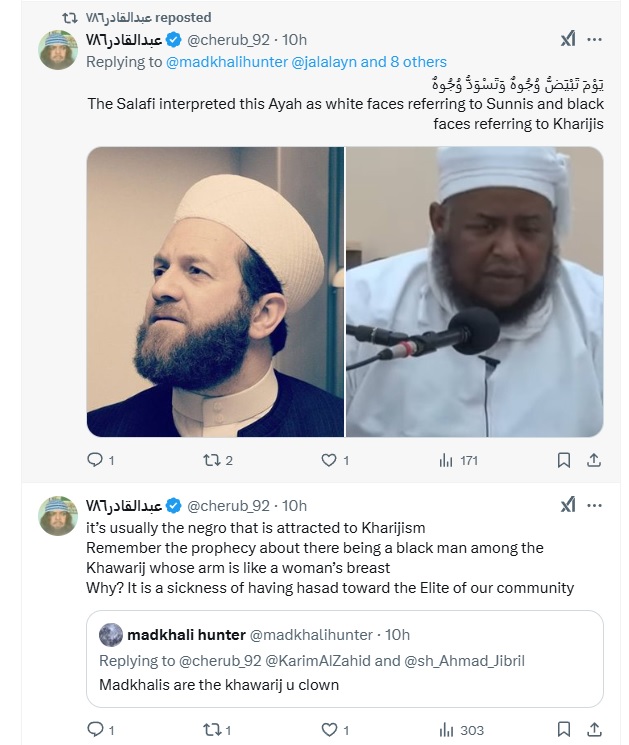
Among those who adopted this view from later scholars are: the great scholar Qāsim, al-Kamāl ibn al-Humām in Fatḥ al-Qadīr and al-Taḥrīr, his commentators Ibn Amīr al-Ḥajj Muḥammad al-Amīn (known as Amīr Bād Shāh), Ibn Kathīr, al-Qasṭallānī, ‘Alī al-Qārī, al-Ṣan‘ānī, Akram al-Sindī, Aḥmad Shākir, al-Kawtharī, and others — and it is the truth
Seventh: Even if we hypothetically accepted that Muslim’s wording is equal to the other two, it would still not be permissible to use it as proof, because in that case the Hadith would be open to multiple interpretations. And when there is such uncertainty, the proof is invalidated, as is established among the people of knowledge and virtue.
Eighth: Yaḥyā ibn Abī Kathīr — one of the narrators of this Hadith — was a mudallis (one who conceals the source of his narration). Although he did explicitly state hearing in some reports, some scholars still do not accept the narration of a mudallis even if he states hearing. There is no doubt that what is agreed upon takes precedence over what is disputed.
Ninth: This Hadith contradicts definitive rational and textual proofs indicating that the Exalted Lord is not confined to the direction above. A solitary (āḥād) Hadith is not used as proof in matters of creed — as we have clarified in the treatise Akhbār al-Āḥād — especially when it contradicts definitive proofs.
Be careful of those who are not sound in their theology.
“Allah! There is no god except Him, the Ever-Living, All-Sustaining. Neither drowsiness nor sleep overtakes Him.” (Qur’an 2:55)
﷽
This article is written to explode one of the huge myths that is propagated by the Wahhabi sect. This Wahhabi sect also goes by the name of Salafiyah, or the Athari creed.
One of the most absurd theological positions to hold is the idea that Allah (swt) chose to communicate with mankind via a revelation that he himself said would need to be explained and he himself says it contains verses which are apparent in meaning and subject to layers of understanding, containing words that could have multiple meanings that one would walk a way with only one particular meaning on any given verse!
In our school, the Ibadi school we take the Qur’an as the primary source of evidence. We interpret the Qur’an by the Qur’an as the primary tafsir. Anything that conflicts with the Qur’an is heavily scrutinized. If on the apparent it looks as if it conflicts with the Qur’an a forensics analysis is done of the hadith on a few accounts.
The sanad-the chain of narrators.
The matn (the text itself).
The eloquence of the language of the Prophet (saw).
In other words does this match the linguistic style of the Blessed Messenger (saw).
“DO not stir your tongue hastily (to commit the Revelation to memory). Surely it is for Us to have you commit it to memory and to recite it. And so when We recite it ,follow its recitation attentively; then it will be for Us to explain it.” (Qur’an 75:16-19)
“Allah! There is no god except Him, the Ever-Living, All-Sustaining. Neither drowsiness nor sleep overtakes Him.” (Qur’an 2:55)
The apparent meaning of the above verses is that Allah (swt) does not get tired, bored or fatigued.
However, this does not stop the Wahhabi/Athari from asserting that Allah (swt) gets bored-in a way that befits his majesty! May Allah (swt) protect us from the perverts!
Basing their information on the apparent meaning of the text of the following hadith:
“It was narrated that ‘Aishah said:
“The Messenger of Allah (saw) had a mat which he would spread in the day and make into a small booth at night to pray in it. The people found out about that and they prayed when he prayed, with the mat in between him and them. He said: ‘Do as much of good deeds as you can, for Allah does not get tired (of giving reward) until you get tired. And the most beloved of deeds to Allah are those that are continuous, even if they are few.’ Then he stopped that prayer and did not return to it until Allah took him (in death), and if he started to do something he would persist in it.”
“However, the boredom/tiredness/weariness of Allah is not like the boredom/tiredness/weariness of the creatures.
Welcome to Salafiyah disarming Muslims of arguments against the deity of Jesus since….forever.
“Jesus was inside the boat, sleeping with his head on a pillow.” (Mark 4:38)
Salafi: “God doesn’t sleep!”
Christian: “Sure he does in a way that befits his majesty!”
So here the explanation goes some common sense, taw’il (interpretation) and some inconsistency. The link given above we read:
“As for the hadeeth that reads, ‘Allaah never gets tired until you get tired,’ some scholars held that this hadeeth serves as proof that the attribute of tiredness (or boredom) is affirmed for Allaah. However, the tiredness (or boredom) of Allaah is not like that of the creature. The tiredness of the creature is an imperfection, while that of Allaah is free of any imperfection. This is similar to all other attributes that we affirm for Allaah as an aspect of perfection although, when attributed to creatures, they are aspects of imperfection. Some scholars held that the statement, ‘Allaah never gets tired until you get tired,’ is meant to indicate that no matter how many good deeds you do, Allaah rewards you for them; so do whatever you wish for Allaah never gets tired of giving you rewards until you get tired of doing good deeds. Thus, what is meant by tiredness here is what such tiredness entails, which is stopping (to give rewards).Other scholars held that the hadeeth does not imply attributing tiredness to Allaah at all because when one says, ‘I shall not get up until you get up,’ this does not necessitate that the latter will get up. Similarly, ‘Allaah never gets tired until you get tired,’ does not necessitate affirming the attribute of tiredness for Allaah.In any case, it is incumbent on the Muslim to believe that Allaah is Exalted above any aspect of imperfection, be it tiredness, boredom, weariness or anything else. If it is established that this hadeeth is evidence to affirm the attribute of tiredness for Allaah, then we must believe that the tiredness of Allaah is nothing like that of the creatures. ” [Majmoo’ Al-Fataawa]
Prima Qur’an response: So we can see the answer is already given.
This absolutely has to be the case since the Qur’an categorically rejects, tiredness, sleepiness, boredom to Allah (swt)!
“Allah! There is no god except Him, the Ever-Living, All-Sustaining. Neither drowsiness nor sleep overtakes Him.” (Qur’an 2:55)
So for those of their scholars who affirm boredom of Allah (swt) maybe they could …I dunno…..perhaps pick up the Qur’an and read it?
Ibn Taymiyya throws the idea of holding to the apparent meaning out the window.
He states in the link above:
““It is known that the principle held by Ahlus-Sunnah Wal-Jamaaʻah (mainstream Muslims) is that we describe Allaah only with what He describes Himself (in the Quran or the authentic Sunnah), without tamtheel (likening Allaah to His creation) or takyeef (trying to describe ‘how’ an attribute is by attempting to determine the manner in which attributes of Allaah take form). If this hadeeth indicates that Allaah is described with tiredness, then it should be noted that the tiredness of Allaah is not like our tiredness; rather, it is tiredness that is free from any aspect of imperfection or deficiency. As for the tiredness of human beings, it involves imperfection because it implies psychological and physical weariness because of a burden beyond one’s ability to endure. As for the tiredness of Allaah, if this hadeeth indicates it, then it is tiredness that befits Him. It is totally devoid of any aspect of imperfection. ” [Majmoo’ Al-Fataawa]”
But the very apparent meaning of one who gets tired or bored itself indicates need! The very apparent meaning of one who gets bored or tired is one who is deficient!
But for the Salafi/Athari the apparent meaning here will not suffice because of it’s obvious implication is that Allah (swt) -authubillah, gets tired and bored.
So the theology of the Salafi/Athari is superimposed upon the text. Than added to it is the Bid’ah addition which the Blessed Prophet (saw) nor any of his companions ever used….ever!
That bid’ah addition is “I a way that befits him” or “In a way that suits his majesty” etc…
Ibn Taymiyya flatly contradicts his own advise in the same discussion with a questioner!
“You know that the Prophet, sallallaahu ʻalayhi wa sallam, addressed his companions with this hadeeth and that they were keener than all of us on knowing the attributes of Allaah; did they ask the Messenger whether Allaah gets tired or not? Or did they rather say, ‘We hear and we believe that Allaah never gets tired (of giving rewards) until we get tired (of doing good deeds)?! The imperfection that tiredness implies is for us human beings, for Allaah is perfect in His Attributes. Hence, we must stop discussing and investigating this matter any further.”
Prima Qur’an: Very good Ibn Taymiyya well done!
Oops!
On second thought let us continue to discuss and investigate it as he does….
“As long as we do good deeds, then Allaah, The Exalted, rewards us, and He never gets tired of giving rewards until we get tired of doing good deeds.’ If you believe that getting tired in this sense is an imperfection in you, then do not attribute an imperfection to Allaah. Verily, it is tiredness befitting of Him. We know that if the attribute of tiredness is affirmed for Allaah, then this entails that it is free of all aspects of imperfection. I warn you, and I warn all listeners of going to extremes and delving deeper into such a serious issue. Instead, you should preoccupy yourselves with carrying out the religious obligations and duties instead of indulging in investigating the matters that you are not obliged to investigate.”
BEWARE THE SALAFI (WAHHABI) SMOKE AND MIRRORS!!!
“Oh the common people just take it at only one meaning, which happens to be what we affirm.”
Notice that the article in the link above continue to say:
At-Tahaawi wrote:
“Someone may ask, ‘How could you accept to attribute this hadeeth to the Messenger of Allaah, sallallaahu ʻalayhi wa sallam, although it indicates describing Allaah with getting tired in a certain case, and this can never be an attribute of Allaah?’ Our answer is: Tiredness can never be an attribute of Allaah as mentioned, and it is not as he understood. Arabic linguists advised that the hadeeth that reads, ‘Allaah never gets tired until you get tired,’ means that tiredness is expected from you but not expected from Allaah. This is similar to what people commonly say when they describe someone as being a good speaker endowed with eloquence and great debate skills, that ‘he does not stop and give up his argument until his opponent does,’ referring to a merit of his in this regard because if they had intended that he does stop, then they would not be affirming a merit for him since he stops when his opponent stops just like his opponent. Rather, what they really mean is that he does not stop after his opponent stops and that he remains as powerful and capable as he was before his opponent stopped. Similar to that – and Allaah knows best – is the hadeeth that reads, ‘Allaah never gets tired until you get tired.’ It means that you may get tired (of performing good deeds), and stop; while Allaah, after you have gotten tired and stopped, is as He was before, never tiring and never stopping.” Source: [Sharh Mushkil Al-Aathaar]
Ah I see! So now we are appealing to Arabic linguist. It’s as if the Arabic language has depth and nuance, idiom and poetic expressions? Who would have thought?
Ibn ʻAbd Al-Barr wrote:
“With regard to the hadeeth that reads, ‘Allaah never gets tired until you get tired,’ the adjective ‘tired’ in this context is used to oppose the weariness on their part. It is well-known that Allaah, The Exalted, does not get tired regardless of whether people got tired or not, and nothing or nobody causes Him to get tired; Exalted is He above such imperfection. The hadeeth used a common style in the Arabic language, called mujaanasah, which means that if they (the Arabs) use a word as an answer and reward for another, it is the same as the original word though different in meaning. Examples on this style are clear in the verses that read (what means):
– {And the retribution for an evil act is an evil one like it…} [Quran 42:40]
– {So, whoever has assaulted you, then assault him in the same way that he has assaulted you.} [Quran 2:194]
In the first example, the second word ‘evil’ is merely for mujaanasah i.e. it does not convey its original meaning; it is only the same as the first. Of course, the reward of evil is not a similar evil, and retribution is not an assault because it is a due right.
The same applies to the following verses:
– {And the disbelievers plotted, but Allaah plotted. And Allaah is the best of plotters.} [Quran 3:54]
– {…they say, “Indeed, we are with you; we were only mockers.” (But) Allaah mocks them and prolongs them in their transgression (while) they wander blindly.} [Quran 2:14-15]
– {…Indeed, they are planning an evil plan, but I am planning an evil plan.} [Quran 86:15-16]
“The Arabic words for plotting, mocking, and evil planning used in the verses as the actions of Allaah are merely used for the sake of mujaanasah. Verily, Allaah, The Exalted, is above mocking, plotting, and planning evil; rather, the terms are used to indicate that Allaah shall punish them for their mockery, plotting, and evil planning. The same applies to the hadeeth that reads, ‘Allaah never gets tired until you get tired;’ the adjective ‘tired’ used for Allaah is merely used for the sake of mujaanasah…” Source: [At-Tamheed]
Imagine that! The Arabic language uses a grammatical device known as mujaanasah!
So be careful of those who pose simplistic scenarios that are dishonest to begin with.
The manner and context of the question is just as important as the question itself.
For example are we to believe that the majority of Muslims believe the literal Arabic of the following verse (easily missed in the English translation) but in the Arabic you have the wall “wanting” to collapse. So are we going to attribute a will to this wall?!
“So they moved on until they came to the people of a town. They asked them for food, but the people refused to give them hospitality. There they found a wall ready to collapse, so the man set it right. Moses protested, “If you wanted, you could have demanded a fee for this.”(Qur’an 18:77)
To read more on this topic I would encourage you to read the following: