“Cooperate with one another in goodness and righteousness.” (Qur’an 5:2)
﷽
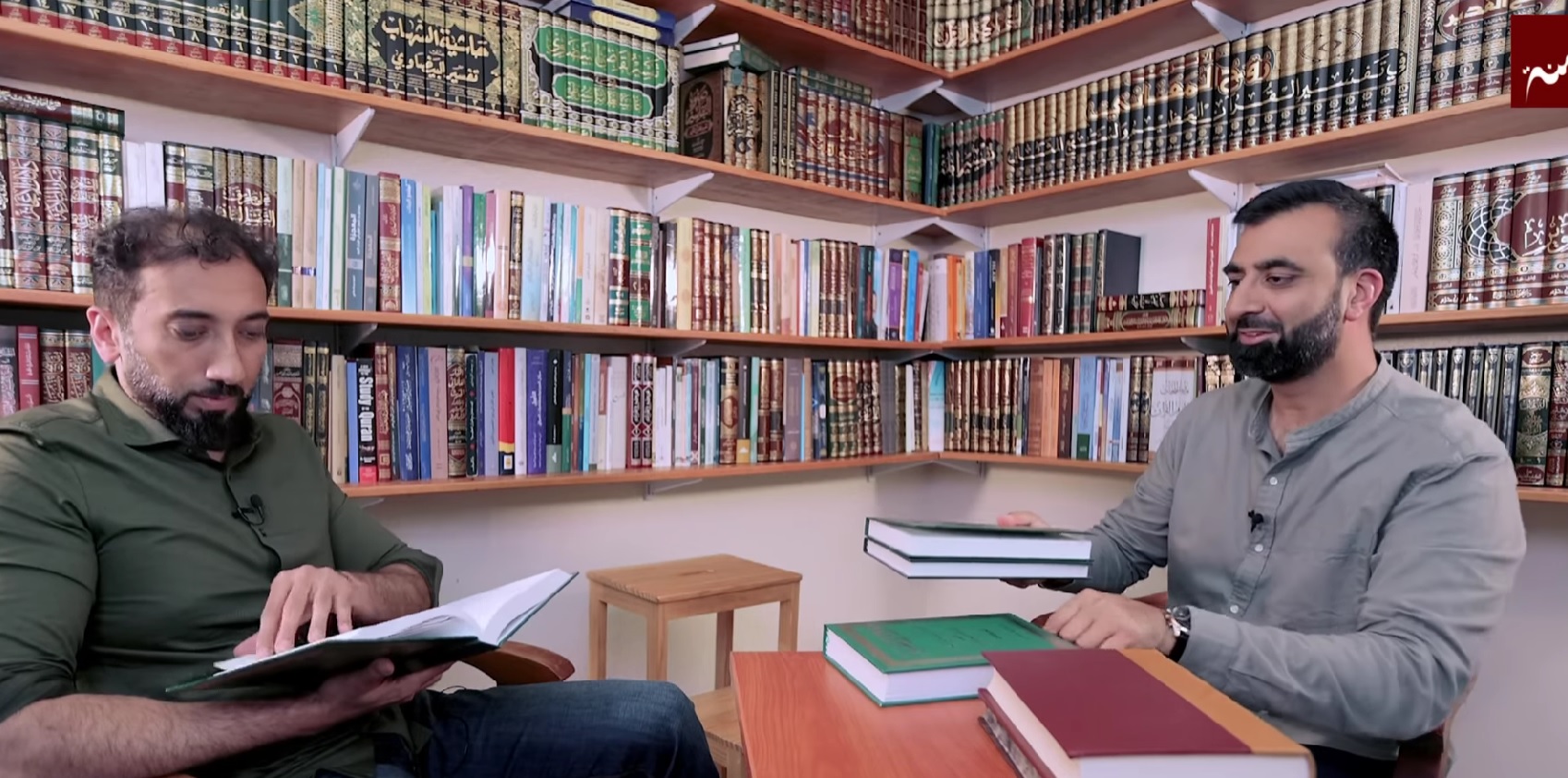
Dr. Soahib Saeed is speaking about his love for tafsir with Ustadh Nouman Ali Khan. You can watch this joyful interaction here. May Allah continue to bless and guide them both.
Nouman Ali Khan makes an excellent point @19:45
“People come into Islam by an investigative process and the moment they come into Islam you should say stop investigating, stop thinking. It’s counter-intuitive.”
They continue until this lighthearted exchange.
@19:52 Sohaib Saeed says: “So, speaking of different groups, I was with you when I got this can you identify where and when?”
Sohaib Saeed @20:22 “This is the Mufti of, ah there we are.”
Nouman Ali Khan @20:28 “Oh Wow!
Sohaib Saeed @20:30 “Did I not tell you did you not get a copy?
Nouman Ali Khan @20:33 “No, I didn’t get a copy.”
Sohaib Saeed @20:34 “Well, I was the one who was going to read it, so let’s be honest here.”
Nouman Ali Khan @20:37, “I hate you.”
@20:51 “And this is the Mufti of Oman.”
@21:10 “These people belong to the Ibadi school.”
Ustadh Nouman Ali Khan is very beloved in Oman.
He attending a Qur’an course while in Oman that was led by – Shaykh Dawud Bu-Sinani (h). He is based in Algeria.
He speaks about his experience in Oman during a retreat with Shaykh Dawud Bu-Sinani (h).
No cellphone. If an emergency someone will contact you via the details you have given the administration.
You can only mention your name and where you are from. You cannot mention anything else about yourself.
Not your marital status, your educational background, your status in society or your job.
You are there for one purpose and one only. To focus on Allah’s revelation.
منصة رقمية تُعنى بجمع وحفظ التسجيلات الشعرية العمانية والإباضية، نهدف من خلالها إلى تسهيل الوصول إلى هذه التسجيلات والرجوع إليها ومشاركتها عن طريق خاصية البحث وقوائم التشغيل.
ومما يميز المنصة مشغل التسجيلات الذي يمكن استخدامه للاستماع إلى التسجيلات وترتيبها والتحكم بها.
معنى اسم صدى الشُّراة
يتكون الاسم من كلمة “صدى” وهو ترداد الصوت، وكلمة “الشراة” وتطلق على الذين شروا أي باعوا نفوسهم ودنياهم لله ابتغاء الآخرة، وذكرت في القرآن الكريم، مثل قول الله تعالى:
واستخدم أصحابنا — أهل الحق والاستقامة — هذا المصطلح بكثرة فدل عليهم.
فاسم المنصة يدل على ترديد الأصوات التي نطق بها أصحابنا في ما خلفوه من آثار شعرية بلسان من سخره الله تعالى لذلك في هذا الزمن؛ لتستمر رسالة السلف عند الأجيال القادمة حرصاً عليها من الضياع والله الموفق.
“And they say, “Never will the Fire touch us, except for a few days.” Say, “Have you taken a covenant with Allah? For Allah will never break His covenant. Or do you say about Allah that which you do not know?” Yes, whoever earns evil and his sin has encompassed him – those are the companions of the Fire; they will abide therein eternally.” (Qur’an 2:80-81)
“Allah effaces whatever He wills and retains whatever He wills. With Him is the Mother of the Book.” (Qur’an 13:39)
﷽
Some questions/objections that are raised by some on this particular subject.
For us the matter is clear, crystal clear.
The hellfire is eternal for who ever enters it.
Our creed is taken from clear verses and not verses subject to multiple interpretations.
Objections are based upon interpretations or emotive in nature.
There is not a single verse anywhere in the Qur’an that believers (mumin) enter the hellfire.
There is not a single verse anywhere in the Qur’an that the ungrateful (kafir) enter heaven.
The Qur’an has to be in harmony with all its verses.
Allah has prescribed mercy for himself.
You often see this quoted in discussions about the eternal suffering of the kafir. However, you usually do not see the verse quoted in its fullness.
“When the believers in Our revelations come to you, say, “Peace be upon you! Your Lord has taken upon Himself to be Merciful. Whoever among you commits evil ignorantly then repents afterwards and mends their ways, then Allah is truly All-Forgiving, Most Merciful.” (Qur’an 6:54)
“Say, “Unto whom belongs whatsoever is in the heavens and on the earth?” Say, “Unto Allah. He has prescribed Mercy for Himself. He will surely gather you on the Day of Resurrection, in which there is no doubt. Those who have lost their souls, they do not believe.” (Qur’an 6:12)
They will also quote the following hadith:
“Narrated Abu Huraira:
The Prophet (ﷺ) said, “When Allah had finished His creation, He wrote over his Throne: ‘My Mercy preceded سَبَقَتْ (sabaqat) = preceded My Anger.’
When Allah created the creation as He was upon the Throne, He put down in His Book: Verily, My mercy predominates تَغْلِبُ (taghlibu) = prevails over / overcomesMy wrath.
First, it should be noted that none of those texts promise an eventual exit or release from hell at all. Neither do any of those texts promise anything about the punishment of hellfire being diminished.
This is completely subjective. There is no measurable scale. One could just as easily argue that Allah sparing no one from eternal hell is still an act of mercy relative to what sinners deserve.
You can see a distinction in the two hadith that are usually quoted.
تَغْلِبُ (taghlibu) = prevails over / overcomes
سَبَقَتْ (sabaqat) = preceded / has gone before
This is exactly why the lone narrator’s reports are not used to produce certainty in matters of creed. However, if we were to offer an interpretation and one interpretation is as good as any other, it would be this. That mercy preceded wrath in the form of sending prophets, scriptures, and warnings. Whoever rejects that mercy after it has come deserves the wrath.
“If Allah were to punish people for their wrongdoing, He would not have left a single living being on earth. But He delays them for an appointed term. And when their time arrives, they cannot delay it for a moment, nor could they advance it.” (Qur’an 16:61)
In a single act of defiance of our Sovereign Majestic Lord deserves utter destruction right then and there. Allah’s forbearance is mercy. His restraint is mercy.
Much of what is addressed here are old discussions that were discussed back and forth at a forum here:
“And they say, “Never will the Fire touch us, except for a few days.” Say, “Have you taken a covenant with Allah? For Allah will never break His covenant. Or do you say about Allah that which you do not know?” Yes, whoever earns evil and his sin has encompassed him – those are the companions of the Fire; they will abide therein eternally.” (Qur’an 2:80-81)
And this alone should be sufficient.
Why would this be true only for Jews and not for every believer? On what consistent basis is this claim made?
“While the wicked will be in Hell. They will roast on the Day of Judgment. And they will never be absent from it.” (Qur’an 82: 14-16)
This verse above is also clear. It says that theywill never be absent from it. Not that they will be there forever and one day maybe not. Never. It is as clear as it may get.
“And when the appointed Day comes, no one shall even dare to speak except by the leave of Allah. Then some will be declared wretched, others blessed. As for the wretched, they shall be in the Fire, and in it they shall sigh and groan. They shall abide in it as long as the heavens and the earth endure, unless your Lord may will otherwise. Surely your Lord does whatsoever He wills. And as for those who are blessed, they shall abide in the Garden as long as the heavens and the earth endure, unless your Lord may will otherwise. They shall enjoy an unceasing gift.” (Qur’an 11:105-109)
So the main point of one of the commenters is as follows:
Notice God says “…your Lord carries out whatever He wills…” after the description of potential release from Hell, as if to support this possibility. Yet, after the same statement made in reference to Heaven, God says “…an unceasing gift”. He doesn’t say “…whatever He wills”, which would support the statement that Heaven will end, but rather “unceasing gift” supports the continuation of Heaven.
Point 1.
Nothing happens except by the will of Allah who has full and total control over all things.
“As for the Righteous, they will be in bliss; And the Wicked – they will be in the Fire, Which they will enter on the Day of Judgment, And they will not be able to keep away therefrom. And what will explain to you what the Day of Judgment is? Again, what will explain to you what the Day of Judgment is? (It will be) the Day when no soul shall have power (to do) aught for another: For the command, that Day, will be (wholly) with Allah.” (Qur’an 82:13-19)
They shall abide in (hellfire) it as long as the heavens and the earth endure, unless your Lord may will otherwise.
they shall abide in the Garden as long as the heavens and the earth endure, unless your Lord may will otherwise.
These people are clearly overlooking the eternality of the garden and hell based upon the eternality of the new heaven and earth itself.
“On the day when the earth is changed into another earth, as well as the heavens, and they emerged before Allah, the One, the Subduer.” (Qur’an 14:48)
Now let us do a thought experiment. What would be the reason or purpose for someone to leave paradise? Is there any text suggesting that a person would be expelled from or leave paradise after entering it?
“Then We said, “O Adam, you and your wife, both dwell in the Garden and eat to your hearts’ content where from you will, but do not go near this tree otherwise you shall become transgressors” After a time Satan tempted them with that tree to disobey Our Command and brought them out of the state they were in, and We decreed, “Now, go down all of you from here; you are enemies of one another. Henceforth you shall dwell and provide for yourselves on the Earth for a specified period.” At that time Adam learnt appropriate words from his Lord and repented, and his Lord accepted his repentance, for He is very Relenting and very Merciful.” (Quran 2:35-37)
Point 3.
The proponents of the idea that people will leave hell seem fixated on the the following endings:
After mentioning hellfire : Surely your Lord does whatsoever He wills.
After mentioning paradise, they shall enjoy an unceasing gift.
Yet, they seem to forget that both statements are preceded by: unless your Lord May will otherwise.
They wish to only focus on ‘They shall enjoy an unceasing gift’ and ignore that the text is preceded by ‘unless your Lord May will otherwise’ as well as ‘as long as the heavens and earth pass’.
For example, in the English language one may say:
Except as I will, you children may have all the chocolates on the table.
Or
You children may have all the chocolates on the table, except as I will.
Both sentence structures indicate that the children may enjoy as long as I will.
Point 4.
Inconsistent methodology.
So, using their logic, and if one was to be consistent, we would need to understand under what circumstances would those believers who go to heaven not enjoy heaven any longer? In the same vein, those who are sent to hellfire under what circumstances would they leave?
Allah (swt) could have removed the “unless your Lord may will otherwise” statement. That would have given the proponents the same weight as that verse. Yet, they would still need to contend with the numerous verses in the Qur’an in which Allah (swt) clearly indicated his will regarding those in hellfire.
“While the wicked will be in Hell. They will roast on the Day of Judgment. And they will never be absent from it.” (Qur’an 82: 14-16)
Point 5.
Lastly, on that text above. It would not indicate who would leave the hell fire.
Remember, there is a belief among Sunni Muslims that believers can enter the hellfire and then be taken out.
They cannot bring a single verse of the Qur’an to substantiate this. So if we are to use the logic of those who believe that hellfire is not eternal for its inhabitants (contrary to what Allah clearly says), it would mean that the polytheist, mushrik, anyone will eventually leave hell.
For us the matter is clear, crystal clear.
The hellfire is eternal for who ever enters it.
Our creed is taken from clear verses and not verses subject to multiple interpretations.
Objections are based upon interpretations or emotive in nature.
There is not a single verse anywhere in the Qur’an that believers (mumin) enter the hellfire.
There is not a single verse anywhere in the Qur’an that the ungrateful (kafir) enter heaven.
The Qur’an has to be in harmony with all its verses.
The next text that was discussed in that forum actually works against them.
“To those who reject Our Signs and treat them with arrogance, no opening will there be of the gates of Heaven, nor will they enter the Garden, until the camel can pass through the eye of the needle: such is Our reward for those in sin.” (Qur’an 7:40)
In the Tafsir attributed to Ibn Abbas (ra) Tanwîr al-Miqbâs min Tafsîr Ibn ‘Abbâs it says:
(Lo! they who deny Our revelations) Muhammed (pbuh) and the Qur’an (and scorn them) scorn believing in them, (for them the gates of Heaven will not be opened) to receive their works or souls (nor will they enter the Garden until the camel goes through the needle’s eye) they will not enter Paradise just as a camel cannot pass through the eye of a needle; it is also said that this means: they will not enter Paradise until a rope goes through a needle’s eye. (Thus do We requite the guilty) the idolaters.”
Even our teacher, Shaykh Hilal Al Wardi (hafidulah), favours the understanding of rope instead of camel.
Even then, as the Shaykh says, it means a big rope and not the thin thread that easily passes through the eye of the needle. The big rope is impossible.
Let us follow through logically.
ALL SUNNI Muslims believe that, at the very least, the unbelievers will go to hellfire. So, if the above verse is to be understood as something possible, a rope that can go through the eye of a needle, then no one will go to hellfire at all!
Now we know that this verse is clear. Allah (swt) has made it clear when he states: “Surely your Lord does whatsoever He wills.” That Allah (swt) has not willed for these people anything other than for them to remain in hellfire.
We know that Allah’s (swt) promise and statements are true.
“But the ones who believe and do righteous deeds – We will admit them to gardens beneath which rivers flow, wherein they will abide forever. It is the promise of Allah , which is truth, and who is more truthful than Allah in statement.” (Qur’an 4:122)
The only other possible straw for these people to clutch is the evil and heinous position that Allah (swt) can lie. So then when Allah (swt) says:
“While the wicked will be in Hell. They will roast on the Day of Judgment. And they will never be absent from it.” (Qur’an 82:14-16)
or
“To those who reject Our Signs and treat them with arrogance, no opening will there be of the gates of Heaven, nor will they enter the Garden, until the camel can pass through the eye of the needle: such is Our reward for those in sin.” (Qur’an 7:40)
We have refuted that vile and godless position here:
“And they say, “Never will the Fire touch us, except for a few days.” Say, “Have you taken a covenant with Allah? For Allah will never break His covenant. Or do you say about Allah that which you do not know?” Yes, whoever earns evil and his sin has encompassed him – those are the companions of the Fire; they will abide therein eternally.” (Qur’an 2:80-81)
﷽
Every now and again there is someone who stops by this blog/website and leaves an amazing comment. Something that is so eye-opening and poignant that it deserves not to be tucked away in the comment section but broadcast as far as Allah (swt) allows the knowledge to transmit.
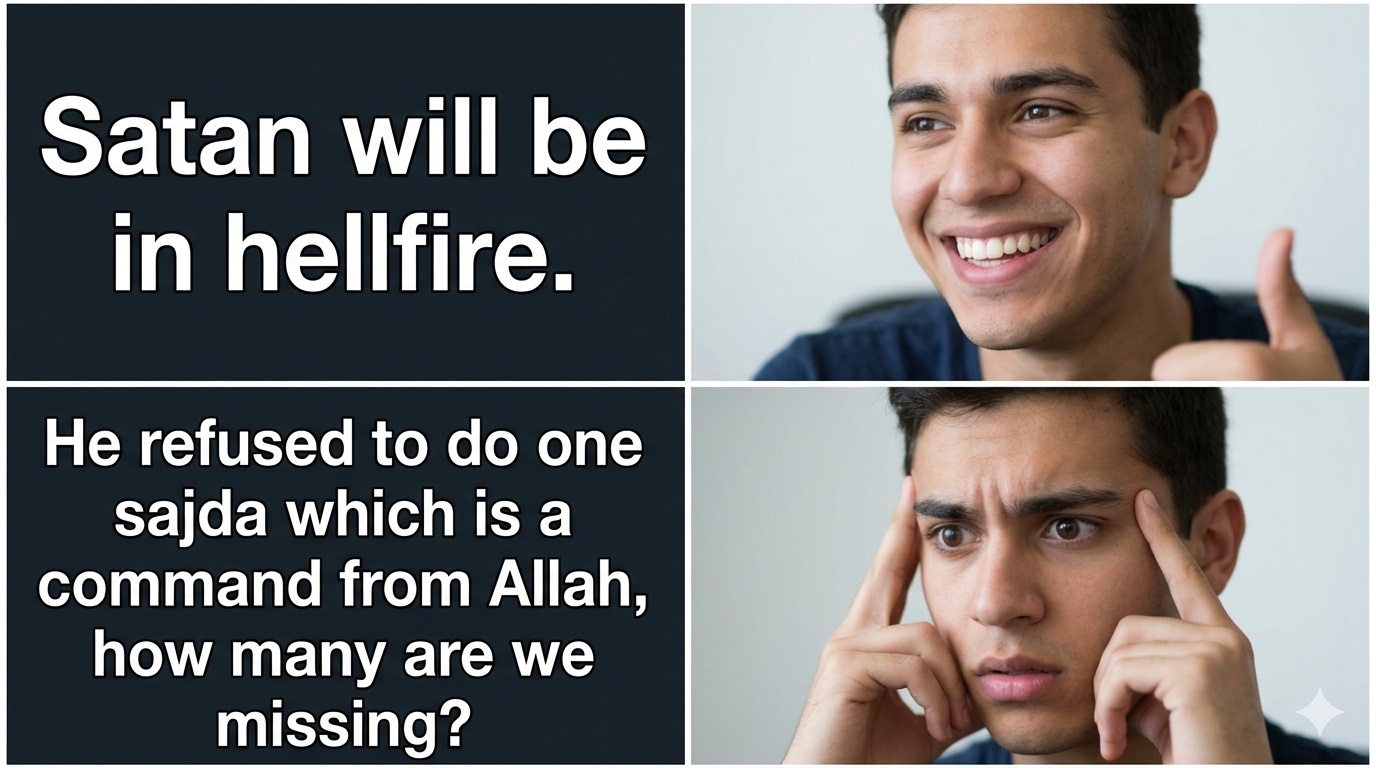
“By the logic of those who argue that sinful believers who earned Jahannam will eventually go to paradise, Iblis himself would eventually enter Jannah because of his “righteous deeds” before he disobeyed Allah. We know, according to the Quran, he had the rank of the angels.”
“But the undeniable fact that Allah cursed Iblis to Jahannam over ONE sin, not prostrating to a creation. Allah commanded you to prostrate too. That is more than enough evidence that just because you believe doesn’t mean you will enter Jannah.”
“Iblis NEVER denied that Allah was his lord. Rather, he became arrogant and disobeyed the command of Allah. It seems this sin in and of itself is far more damning than a disbeliever not believing. It’s because Iblis KNEW about Allah’s power, yet he still disobeyed.”
“Even in Iblis’s khutbah to the companions of the fire, Iblis denies the association of him as a partner to Allah, and he affirms that Allah promised them the truth, and he promised them but betrayed them.”
“Anyone who accepts the notion that Jahannam is temporary for ANYONE without explicit proof is only responding to shaytan. Allah promises eternal bliss or eternal torment. Shaytan promises delusion.”
“I pray more Muslims see and understand the severity of this topic.”
What more can be said except Amin! Very well said, Zheyn!
Fore more on this topic you may wish to read the following:
“And they say, “Never will the Fire touch us, except for a few days.” Say, “Have you taken a covenant with Allah? For Allah will never break His covenant. Or do you say about Allah that which you do not know?” Yes, whoever earns evil and his sin has encompassed him – those are the companions of the Fire; they will abide therein eternally.” (Qur’an 2:80-81)
﷽
Beautiful Recitation and Powerful Reminder.
May Allah (swt) cause us to die as Muslims! May Allah (swt) cause us to die upon faith! This is a very powerful reminder!
All we need to do is make taubah (turn towards Allah, with our heart, our mind, and soul) and sincerely repent. Cut our connection to those things that lead us to haram. Find the company of righteous good companions. Bring all of our troubles and challenges to Allah (swt).
“Call upon Me; I will respond to you.” (Qur’an 40:6)
“O you who believe! save yourselves and your families from a fire whose fuel is men and stones; over it are angels stern and strong, they do not disobey Allah in what He commands them, and do as they are commanded.”(Qur’an 66:6)
Take heed believers. Do not be beguiled by this short and fleeting life. The hereafter is better than this life!
This is a welcome change from the perspective of the last time!
“And of no effect is the repentance of those who continue to do evil deeds until death faces one of them and he says: “Now I repent;” nor of those who die while they are ungrateful (kuffarun). For them, We have prepared a painful torment.” (Qur’an 4:18)
“IF (but) eschew the evilest of the things which you are forbidden to do, We shall expel out of (Saiyiatikum) YOU ALL THE EVIL IN YOU, and admit you to a gate of great honor.” –(Qur’an 4:31)
﷽
We can establish two quick points from the very beginning.
1. There is not a verse in the entirety of the Qur’an that gives a single example of a believer (mumin) entering hellfire.
2. There is not a verse in the entirety of the Qur’an that gives a single example of a kafir (ingrate) entering paradise.
“O you who believe! be careful of (your duty to) Allah with the care which is due to Him, and do not die unless you are Muslims.” (Qur’an 3:102)
“And return in repentance to your Lord and submit to Him before the punishment comes upon you; then you will not be helped.” (Qur’an 39:54)
What should be important for us it is not important if our school is right or wrong on the matter.
What is important for us is that we are following the clear evidence as given by the Qur’an and the agreed-upon traditions of the Blessed Messenger (saw)- Al-Sunnah.
The only reason the title is put as such is to make a distinction between what we believe to be the truth of the matter. Other schools have their reasons and justifications.
It is important to understand how we understand the word ‘Muslim’ and the word ‘kufr’ and what they mean based on the agreed-upon sources.
There are states or conditions that we are born into that we can lose and those states or conditions that we cannot lose. For example, if you are born a man or a woman for the rest of your life you will be a man or a woman. (though in this day and age some may even scoff at this reasoning!)
There is one’s ethnic group to which you belong that you are born with. If one is born an Arab they will die as an Arab.
So your gender, your ethnicity you are born as such and die as such.
Now a status can change. You could go from being single to married. You could go from being married to single. You could begin a career as a lawyer and die as a farmer.
So this is why it is important to understand the word ‘Muslim’ as-a state of being.
You can be Muslim and you can lose your faith in Islam. One of the most obvious examples of this without resorting to proof text is that if a Muslim chooses to leave Islam for another religion or no religion at all. This person has gone out of the Milla of Islam.
“Say, My Lord has guided me to a straight path, and to an upright religion, the religion (millata) of Abraham the upright, who was not of those who associate partners with Allah. Say. Surely my prayer and my sacrifice and my life and my death are (all) for Allah, the Lord of the worlds; No associate has He, and this am I commanded, and I am the first of those who submit (l-muslimina)” (Qur’an 6:161-163)
“And those who disbelieved said to their messengers: We will most certainly drive you forth from our land, or else you shall come back into our religion (millatina). So their Lord revealed to them: Most certainly We will destroy the unjust.” (Qur’an 14:13)
“Lo! those who believe, then disbelieve and then (again) believe, then disbelieve, and then increase in disbelief, Allah will never forgive them, nor will He guide them on the way. Give tidings to the hypocrites that for them there is a painful punishment.” (Qur’an 4:137-138)
These verses are very clear that one can leave the Milla of Islam and that one can be upon faith and than kufr and than return to faith and then return back to kufr and than continue on in their kufr.
You want to make sure that when you die you die upon the cycle of iman (belief). Allah (swt) has mentioned several times that we are not to die except in a state of Islam. We should die while upon belief and in a state of surrender, submission, to die as Muslims. Amin for all of us!
“And you do not take revenge on us except because we have believed in the communications of our Lord when they came to us! Our Lord: Pour out upon us patience and cause us to die insubmission (muslimina) ” (Qur’an 7:126)
“And the same did Ibrahim enjoin on his sons and (so did) Yaqoub. O, my sons! surely Allah has chosen for you (this) faith, therefore die not unless you are Muslims (muslimuna). (Qur’an 2:132)
“O you who believe! be careful of (your duty to) Allah with the care which is due to Him, and do not die unless you are Muslims.” (Qur’an 3:102)
So there are two points to be taken from the above text
We want to die in a state of surrender in a state of submission. For these commands to be there means it is possible for one not to die in a state of surrender and submission. We seek protection with Allah (swt) from that-for all of us!
We want to die while having belief/ faith in our hearts. We make supplication that this happens for all of us!
Notice that one of the three verses quoted above admonishes the following:
“Pour out upon us patience.” – In other words, grant us patience in doing what we need to do. & “be careful of (your duty to) Allah with the care which is due to Him.”
So please understand that the word Muslim means action. It is more an adjective that describes a state of being rather than a noun -regardless of anything one says or does.
Muslims are not like our gender or ethnicity. Being in a state of Islam is not something that stays with us no matter what we do. So it is something we must be careful to guard.
Based upon the Qur’an and Sunnah have two types of kafir.
All mushriks (those who associate partners with Allah) are kafir.
However, not all kafir are mushriks.
An example of the first point. Mushrik are kafirs.
“Certainly they are ungrateful (KAFARA)who say: Surely, Allah– He is the Messiah, son of Mary. Say: Who then could control anything as against Allah when He wished to destroy the Messiah son of Mary and his mother and all those on the earth? And Allah’s is the kingdom of the heavens and the earth and what is between them; He creates what He pleases; and Allah has power over all things,” (Qur’an 5:17)
An example of the second point. Not all kafirs are Mushriks.
” And whoever does not judge by what Allah has revealed – then it is those who are the disbelievers (l-kāfirūna).” (Qur’an 5:44)
While the immediate context is a reference to the Jews, it would be a strange thing to say that Jews who do not judge by what Allah has revealed are kafir while Muslims get a free pass.
“Now, surely, sincere obedience is due to Allah (alone) and as for those who take awliyaa besides Him, saying, We do not serve them save that they may make us nearer to Allah, surely Allah will judge between them in that in which they differ; surely Allah does not guide him aright who is a liar, ungrateful(kaffarun) (Qur’an 39:3)
So what or how do we understand the word kufr?
Some want to make the word kufr as that which brings one out of Islam. Often you may see in their books and translations of the Qur’an that the various iterations of the word kufr or kafir will be translated into English as: ‘infidel’ or ‘disbeliever’ or ‘nonbeliever’ or ‘unbeliever’.
However, we want to look at how Allah (swt) the lord of all the worlds uses the word and its different forms throughout the revelation that He (swt) has given to us.
“Know that this world’s life is a sport and play and gaiety and boasting among yourselves, and a vying in the multiplication of wealth and children, like the rain, whose causing the vegetation to grow, pleases the tillers (al-kuffara), then it withers away so that you will see it become yellow, then it becomes dried up and broken down, and in the hereafter is a severe chastisement and (also) forgiveness from Allah and (His) pleasure, and this world’s life is naught but means of deception.” (Qur’an 57:20)
Maa sha Allah! This verse is very powerful. It also has a double meaning on the word kuffar. You can see that people in this life are all about hedonism and narcissism, boasting, and competition. Yet these people are ungrateful. They are compared to tillers who cover the earth. They are happy with their efforts.
Yet, as Allah (swt) mentions that the produce itself becomes nothing. That the life of this world is but means of deception. The produce becomes nothing, we see our youth give way to the challenges of old age. Even the wealth and children disperse. How many families fight over wealth and inheritance? How many children, in turn, are ungrateful to their parents for the sacrifices they made to give them a better lifestyle?
So much can be said about this amazing verse! Subhan’Allah.
“And when your Lord made it known: If you are grateful (shakartum), I would certainly give to you more, and if you are ungrateful (kafartum) , then My torment will be severe.“ (Qur’an 14:7)
So here Allah (swt) contrasted gratefulness with kafar (ungrateful). He also again warned us that His ‘torment will be severe‘ for those who are ungrateful. Note in the above verse one is either grateful or ungrateful. There is no in between. It is akin to a light switch what is the position between on/off?
“How is it you are ungrateful (takfurūna) to Allah? You had been lifeless, then, He gave you life. again, He will cause you to die. Again, He will give you life. And, again, you are returned to Him.” (Qur’an 2:28)
“So when they ride in the ships they call upon Allah, being sincerely obedient to Him, but when He brings them safely to the land, lo! they associate others (yush’rikūna) with Him; being ungrateful (liyakfuru) for what We gave them. So let them take joy for soon they will know!” (Qur’an 29:65-66)
So with all these verses in mind, it should be known that in the Ibadi school we understand Kufr as a denial of truth and ingratitude-either by one’s actions or inaction.
So the second type as mentioned above is kufr ni’mah. So this kufr-ni’mah is when any of us as Muslims commit major sins -persist in those sins and do not repent.
So those Muslims are kafir ni’mah. Ungrateful to Allah (swt) for the overwhelming and manifest blessings that He (swt) has given to them. They show this by their actions or inaction.
Our view is that any Muslim who does this and does not repent before death reaches/him or her will be in eternal hellfire.
So to be clear this is our position. In this life, there are three groups.
There are the Mushrik -those who are outside of Islam. Kufr Ash-Shirk
There are the Mumin (those are the believers) -They are part of the millat of Islam.
There are those who are kafir ni’mah (nifaq).- They are part of the millat of Islam. They share the beliefs of the Muslims. The share with those outside of Islam in kufr.
The one in kafir ni’mah he/she shares with the Mushrik in kufr -not of associating partners with Allah(swt) but in covering up the truth and/or being ungrateful to Allah(swt).
The one in kafir ni’mah he/she shares with the Muslims, thee beliefs of Islam. They are part of the Millat of Islam. Yet, they are Muslim by their tongues and the affirmation of the people. But if they are truly people of wara, and taqwa and emaan they will rush to ask forgiveness from their Lord.
Some people may be familiar with the term:
“The difference between us and the Kharijis is that they oppose us only in that they judge of every punishable act of kufr entailing expulsion from the millah.”-Shaykh Ahmed b. Hamad al-Khalili
As regards the afterlife we believe there are two types of categories and two abodes and the inhabitants of one do not enter the abode of the other.
The two categories are:
One is a destination for the kufar
One is a destination for the mumin.
The two destinations are:
The paradise and the believers do not come out from it. There is no verse in the Qur’an that paradise is for the kafir.
The hellfire and no one comes out from it. There is no verse in the Qur’an that hellfire is for the mumin.
The following three ahadith are something to ponder.
Jabir ibn ‘Abd-Allah reported: The Prophet, (saw) said, “Verily between a man and shirk and kufr there stands his neglect of the prayer.”
“I heard the Messenger of Allah ( saw) ‘The covenant that distinguishes between us and them is the prayer, and whoever neglects it has disbelieved (become a kafir).’”
Abdullah bin Buraidah narrated that his father said: “The Messenger of Allah (saw) said: The covenant that distinguishes between us and them is the prayer; so whoever neglects it, has become a kafir (committed kufr).”
When a person willfully, abandons the prayer he/she/ become a kafir.
They are in a state of Kufr.
The type of kufr is called: “kufr ni’mah” ungratefulness to Allah (swt), for his many blessings by covering or hiding the reality of what Allah (swt) has commanded and prohibited and enjoined upon us.
Muslims who do major sins and persist in this without tauba are in a state of “kufr ni’mah” -they are still part of the Milla of Islam, their children inherit from them. However, if these people die in such a state, without making repentance the position of the Qur’an is clear. That person will go to hell fire-where they will neither reprieve nor escape.
“And of no effect is the repentance of those who continue to do evil deeds until death faces one of them and he says: “Now I repent;” nor of those who die while they are ungrateful (kuffarun). For them, We have prepared a painful torment.” (Qur’an 4:18)
This verse is very clear.
Repentance is no use who continue to do evil deeds upon until death faces them (which could be at any moment) mind you. So it is risky to delay repentance and also shows a type of satisfaction with the sin.
Those who die while they are in a state of ungratefulness (kuffarun).
A painful punishment is prepared for such.
May Allah (swt) protect you and me and all of us!
“Surely as for those whom the angels cause to die while they are unjust to their souls, they shall say: In what state were you? They shall say: We were weak in the earth. They shall say: Was not Allah’s earth spacious so that you should have migrated therein? So those it is whose abode is hell, and it is an evil destination.” (Qur’an 4:99)
“The repentance accepted by Allah is only for those who do wrong in ignorance or carelessness and then repent soon after. It is those to whom Allah will turn in forgiveness, and Allah is ever Knowing and Wise..” (Qur’an 4:17)
So notice that it says even for people who do sins out of ignorance or carelessness that they should repent “soon after” How much more for those who do the major evil sins?
Now, this doesn’t mean if you did something out of ignorance or carelessness that you will be punished. Allah (swt) is merciful and does not want to punish someone for carelessness or slight acts of negligence.
What this verse is stating is that when it now becomes clear to you that what you were doing out of ignorance or carelessness is now made clear that you should repent from it immediately.
“IF (but) eschew the evilest of the things which you are forbidden to do, We shall expel out of (Saiyiatikum) YOU ALL THE EVIL IN YOU, and admit you to a gate of great honor.” -(Qur’an 4:31)
This verse is conditional. If we do our level best to avoid the major sins than Allah (swt) will remove from us the lesser sins. Allah (swt) forgives sins because He is al-ʿAfūw & al-Ghafūr
For more on the above verse please read our article here:
“It is right to hope that Allah will pardon them. For Allah is The one who Effaces, The Ever Forgiving..” (Qur’an 4:99)
Even with this in mind, we should do our level best to avoid small sins. We should never despair of the Mercy of Allah (swt) nor should we take for granted the Mercy of Allah (swt). That is the point is that by taking for granted the Mercy of Allah (swt) is in and of itself ingratitude.
As regards the majority of Muslims supposedly not praying or keeping their duty to Allah (swt) that is not your problem nor mine. We love them and hope they quickly amend their ways. Our duty is to save ourselves and our family from the fire whose fuel is men and jinn, whose fuel is men and stones.
So what does taubah mean?
It means to return or to turn.
Return or turn to whom?
Why would you need to return or turn if you are already in a state of surrender?
The matter of whether or not hell is eternal.
This is another reason why I feel the Muslim community is in the state that it is in. Think about it. The majority Muslim position is telling everyone that:
“Don’t worry Allah will put you in hell for a while, and then you will come out of it.” “Don’t worry you will only be in hell for 257 million years and then you can come out of it!“
May Allah (swt) protect us from perverse doctrines!
As if hell were a light matter! Not only that but they teach that hellfire is not eternal for the Muslim who commits major sins and does not repent!
Now let me ask you, dear readers. What actually is a Muslim?
What do you think should be the case for the Muslim who says:
“I know killing people is wrong but I’ll do it anyway.” “I know drinking alcohol is forbidden, and extramarital affairs are wrong but I’ll do them anyway”
“O you who have believed, fear Allah and give up what remains of interest if you should be believers. And if you do not, then be informed of war against you from Allah and His Messenger. But if you repent, you may have your principal – thus you do no wrong, nor are you wronged.” (Qur’an 2:278-279)
Can you imagine the condition of such a person? A person who says:
“I know that usury is forbidden, and I am in a state of war with Allah and His Messenger and I know that it is wrong, but I will do it anyway.” ?!?
So is simple lip service and acknowledging that it’s a sin and yet continuing to revel in it the hallmark of a Muslim? What is this based on?
Then you have to wonder about the moral decay in the Muslim community. Even though we could die at any moment, the personal reasons, “I can do this and Allah (swt) will just forgive me. Worst-case scenario I’ll go to hell for a while be purified and then released into heaven.” Authubillah min dhalik!
But a Muslim who neglect the prayers from simple laziness or no desire, you have to ask yourself what actually is a Muslim?
What is so hard about doing taubah?
Look at all the places it is mentioned in the Qur’an.
If you think about the major sins they are not things that are altogether to difficult to avoid.
Like do you personally find it difficult not to kill people?
Do you have some overwhelming desire to worship idols and associate partners with Allah (swt)?
Do you feel it’s absolutely necessary to cheat on your husband/wife when divorce is open to you?
The prayer takes discipline, but at the end of the day, it’s roughly 5 minutes (25 minutes) out of a 24 hour period.
You can perform it sitting down, lying on your side, you can combine prayers when traveling, shorten it during the conflict, and so forth.
Look at this hadith.
On the authority of Anas (ra), who said: I heard the Messenger of Allah (saw) say: Allah the Almighty said: O son of Adam, so long as you call upon Me and ask Me, I shall forgive you for what you have done, and I shall not mind. O son of Adam, were your sins to reach the clouds of the sky and were you then to ask forgiveness of Me, I would forgive you, O Son of Adam were you to come to Me with sins nearly as great as the Earth and were you then to face Me, ascribing no partner to Me, I would bring you forgiveness nearly as great as it.”
“He said: “O my people! why do you seek to hasten on the evil before the good? Why do you not ask forgiveness of Allah so that you may be dealt with mercifully? (Qur’an 27:46)
You really have to be a person actively fleeing from the mercy of Allah, an individual actively fleeing from Allah’s forgiveness and mercy to end up in hell. You actively have to want to participate in that end. You do so by continuing to disobey Allah (swt) and not seeking forgiveness, and not wanting transformation in your life. May Allah suffice us!
“The day when neither wealth nor sons shall profit except for him who comes to Allah with a pure heart.” (Qur’an 26:88-89)
“Nay! But on their hearts is the Ran (covering of sins and evil deeds) which they used to earn.’” (Qur’an 83:14)
Can a heart that is filled with ingratitude and hypocrisy be said to be a pure heart?
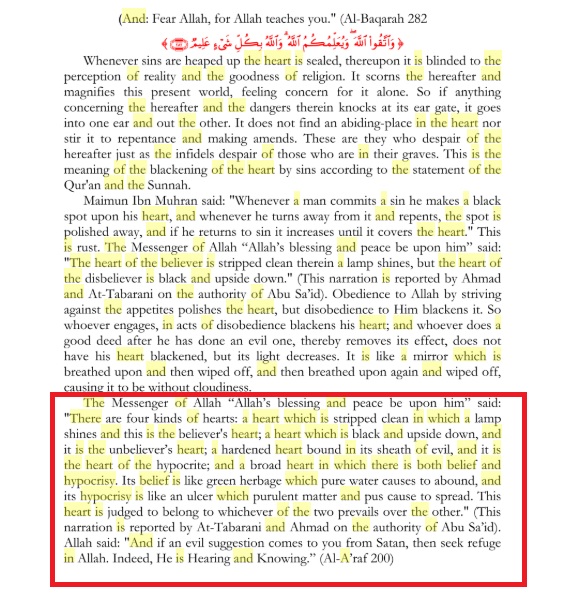
Look at what the great Shaykh and teacher of spirituality, Imam Al Ghazali has quoted:
“The Messenger of Allah “Allah’s blessings and peace be upon him,” said: “There are four kinds of hearts: a heart which is stripped clean in which a lamp shines and this is the believer’s heart; a heart which is black and upside down, and it is the unbeliever’s heart; a hardened heart bound n its sheath of evil, and it is the heart of the hypocrite; and a broad heart in which there is both belief and hypocrisy. Its belief is like green herbage which pure water causes to abound, and its hypocrisy is like an ulcer which purulent matter and pus cause to spread. This heart is judged to belong to whichever of the two prevails over the other.” This heart is judged to belong to whichever of the two prevails over the other.”
Indeed, the hypocrites will be in the lowest depths of the Fire – and never will you find for them a helper – Except for those who repent, correct themselves, hold fast to Allah, and are sincere in their religion for Allah, for those will be with the believers. And Allah is going to give the believers a great reward. Why should Allah punish you if you are grateful and believe? And ever is Allah Appreciative and Knowing.” (Qur’an 4:145-147)
“Allah does not charge a soul except with that within its capacity. It will have the consequence of what good it has gained, and it will bear the consequence of what evil it has earned. “Our Lord, do not impose blame upon us if we have forgotten or erred. Our Lord, and lay not upon us a burden like that which You laid upon those before us. Our Lord, and burden us not with that which we have no ability to bear. And pardon us, and forgive us, and have mercy upon us. You are our protector, so give us victory over the ungrateful (l-kafirina) people.” (Qur’an 2:286)
“O you who believe! be careful of (your duty to) Allah with the care which is due to Him, and do not die unless you are Muslims.” (Qur’an 3:102)
“And return [in repentance] to your Lord and submit to Him before the punishment comes upon you; then you will not be helped.” (Qur’an 39:54)
Oh Muslims die in a state of surrender to Allah (swt) and not in a state of rebellion to Allah (swt)
There is not a verse in the entirety of the Qur’an that gives a single example of a kafir (ingrate) entering paradise.
One final note. Anyone who in a state of kufr will go to hell. Hell is not for the mumin.
So how to avoid this fate?
Avoid major sins. If you find that you fall short, repent immediately! Return to Allah (swt).
Allah is our success!
You may also be interested in the following articles:
“As for those who struggle in Our cause, We will surely guide them along Our Ways. And Allah is certainly with the good-doers.” (Qur’an 29:69)
﷽
One of the searchers for truth among the Shi’i has had some questions to the Ibadi in regard to the matters of Siffin and Nahrawan.
Question: Why did the people who differed with Ali over the arbitration not continue fighting if Ali had stopped fighting?
Answer: It is not permissible to continue the fighting while they are without an imam, for fear that they will die a death of ignorance. They must be under the banner of an Imam. So, a new imam should have been appointed. It is not reasonable to appoint an imam while they are at war. They must rest a little and agree on a specific person away from the battle front.
The people were angry with him because the consensus of the nation is that he (Ali) is the legitimate caliph and those who rebelled against him are rebels according to the text of the Qur’an and must be fought. But his pledge of allegiance was broken, so how could Imam Ali be a caliph when he submitted to the rule and accepted the two arbitrations, and how could they pledge allegiance to him as caliph when he was not of their opinion and did not join them?
Question: Why didn’t the people of Nahrawan after electing Abdullah ibn Wahb Al-Rasibi press the attack against Mu’awiya and his forces?
Answer: How do we know if the people of Nahrawan wanted to fight Mu’awiya?
Did Ali give them a chance to do as such? He surprised them with his army and caused their deaths through the treachery of al-Ash’ath himself, whom had forced (Ali) into arbitration. Likewise, the people of Nahrawan are innocent because they were never followers of Mu’awiya, otherwise they would not have refused to pledge allegiance to Mu’awiya and they were fought against the Umayyad state. This is well known from history.
You may also be interested in reading the following:
“By degrees shall We teach you, so you will not forget, except what Allah wills” (Qur’an 87:6-7)
﷽
The clause, except by the Will of Allah comes in the Word of Allah to emphasize that what is reported happens by His Will (not otherwise). If he wills the opposite of that, it will be so. When Allah (swt) says that something happens if He wills it, it is intended to show His power and majesty because He has control over all things.
That is like in His saying, Exalted is He:
“By degrees shall We teach you, so you will not forget, except what Allah wills” (Qur’an 87:6-7)
If one argues that ‘except by what Allah wills’ is redundant language such that Muhammed (saw) must indeed have forgotten what Allah (swt) taught him then this would leave the whole of Islam in flux.
The meaning is that the exception here is to emphasize the negation.
If Allah (swt) wants the Prophet (saw) to recite the Qur’an without forgetting it, the exceptional clause cannot be construed to mean that, if He wishes, He will make him forget it. That would be a contradiction and defeat the whole purpose of the passage.
If one was to interpret the above passage that Muhammed (saw) did indeed forget some of what Allah (swt) taught him then we have no objective basis to determine what Muhammed (saw) fogot and what he did not.
This is why those who rely upon that which is unclear in tafsir always falter in their creed.
For that cause We decreed for the Children of Israel that whosoever kills a human being for other than manslaughter or corruption in the earth, it shall be as if he had killed all mankind, and whoever saves the life of one, it shall be as if he had saved the life of all mankind.” (Qur’an 5:32)
﷽
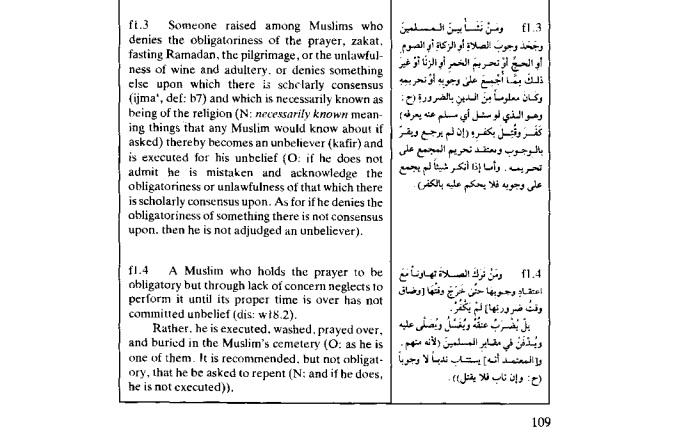
Our colleague recalls this when they were at Zaytuna, California. So, one of the views of the Sunni school of Islam is that as long as someone hides their kufr/nifaq among the believers, they are safe.
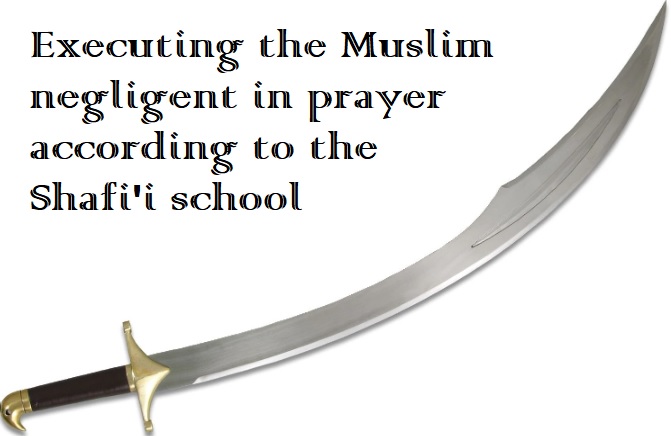
However, in the Shafi’i school of jurisprudence, if a Muslim is knowingly negligent in prayer, he is killed and buried with the Muslims. It is recommended he repent, but not a must.
f1.3 Someone raised among Muslims who denies the obligatoriness of the prayer, zakat, fasting Ramadan, the pilgrimage, or the unlawfulness of wine and adultery, or denies something else upon which there is scholarly consensus (ijma`, def:b7) and which is necessarily known as being of the religion (N: necessarily known meaning things that any Muslim would know about if asked) thereby becomes an unbeliever (kafir and is executed for his unbelief (O: if he does not admit he is mistaken and acknowledge the Obligatoriness or unlawfulness of that which there is scholarly consensus upon. As for if he denies the obligatoriness of something there is not consensus upon, then he is not adjudged an unbeliever).
f1.4 A Muslim who holds the prayer to be obligatory but through lack of concern neglects to perform it until its proper time is over has not committed unbelief (dis: w18.2). Rather, he is executed, washed, prayed over, and buried in the Muslim’s cemetery as he is one of them. It is recommended, but not obligatory, that he be asked to repent (and if he does, he is not executed)).
Source: (‘Umdat al-Salik (Reliance of the Traveller) by Ahmad Ibn Naqib Al-Misri Translated by Shaykh Nuh Ha Mim Keller)
Prima Qur’an comment: “It is recommended, but not obligatory, that he be asked to repent (and if he does, he is not executed)).”
This is a position that would never be accepted in the Ibadi school. This is because it is the right of every Muslim who falters to be called to repentance. What to do with a Muslim who is willfully negligent in his prayers will be decided by the ruling Imam, Hakam etc.
Taking a life is a huge matter in Islam and one of the things that reached us on taking a life of the believer from the sunnah are:
1. Adultery
2. Apostasy coupled with fighting the Muslims.
3. A person who killed somebody unjustly, was killed (in Qisas)
So someone who is negligent in the prayer (as in just doesn’t even care) is executed?
Would this fall under the category of:
Adultery?
Apostasy?
Manslaughter?
Spreading corruption in the earth?
If the Shafi’i are honest with themselves and with you, it must be reasoned that, according to their principles of interpretation of all that which is based on their understanding of the Qur’an and Sunnah, the clearest category would be that of apostasy.
f1.4 A Muslim who holds the prayer to be obligatory but through lack of concern neglects to perform it until its proper time is over has not committed unbelief (dis: w18.2). Rather, he is executed, washed, prayed over, and buried in the Muslim’s cemetery as he is one of them. It is recommended, but not obligatory, that he be asked to repent (and if he does, he is not executed)).
This view would have many Muslims today executed. As there are a great many Muslims who are negligent in performing the prayer.
‘Abdullah bin Buraidah narrated that his father said:
“The Messenger of Allah (saw) said: ‘The covenant that distinguishes between us and them is prayer; so whoever leaves it, he has committed Kufr.’”
It is narrated on the authority of Abu Zubair that he heard Jabir b. ‘Abdullah saying. I heard the Messenger of Allah (may peace and blessings be upon him) observing this:
“Between man and polytheism and unbelief is the abandonment of salat.”
Buraidah (May Allah be pleased with him) reported:
Messenger of Allah (saw) said, “That which differentiates us from the disbelievers and hypocrites is our performance of Salat. He who abandons it, becomes a disbeliever.”
We have seen from the text above that their belief is as follows:
A person can neglect every aspect of Islam — prayer, fasting, zakat, enjoining good and forbidding evil, as long as they acknowledge through some lip service that what they are doing is wrong.
Only if a person states that the above aspects are not obligatory do they become a kafir (apostate, as Sunnis define it).
“Do you enjoin right conduct on the people, and forget to practice it yourselves, and yet you study the book? Will you not understand?” (Qur’an 2:44)
Dear Muslim brothers and sisters, this Murji’ah doctrine of Sunni Islam is plain error.
May Allah suffice us!
Do you not want certainty in your life? Do you not want certainty in your heart?
Do you not want to know if you are truly a believer or not?
“Say: “If you do love Allah, Follow me: Allah will love you and forgive you your sins: For Allah is Oft-Forgiving, Most Merciful.” (Qur’an 3:31)
Do you love Allah?
Than follow the Prophet Muhammed (saw) by doing such.
Allah will love you AND forgive your sins!
One of the signs that Allah loves us is that we actually obey Allah by following his commands and prohibitions. One of the signs that we are under the wrath of Allah is that we do not follow his commands and prohibitions.
Qur’an (23:1-9) The self-measurement test.
Read for yourself and see that prayer is an essential ingredient to being a believer!
“And they who carefully maintain their prayers.”
Ask yourself: “Am I in a state of ingratitude towards Allah? After everything our creator has given us, that which is beyond counting will I not be a Muslim? Will I not submit? Will I not surrender?”
There is no verse anywhere in the Qur’an where Islam means 51% submission. There is no verse where Islam means even 90% submission.
Read the following and may Allah flood your heart with light!
“Certainly will the believers have succeeded “ (Qur’an 23:1)
﷽
Faith is not based on inheritance. We don’t inherit it from a family. You get it through conviction. Through understanding. Through contemplation. You can get rituals from your parents, from your family. However, faith is not an inheritance.
What are the signs that you have faith?
We do not have a device that can measure the faith of others. We do not have the right to measure the faith of others. We do not have a device where we can measure the faith of others. You are a level 10 and your faith is at level 2. No! Faith is in the chest (concealed).
“So whoever Allah wants to guide – He expands his breast to [contain] Islam; and whoever He wants to misguide – He makes his breast tight and constricted as though he were climbing into the sky. Thus does Allah place defilement upon those who do not believe.”(Qur’an 6:125)
However, what are some of the manifest signs that are the signs of faith?
Allah (swt) himself has given each of us a way to check ourselves. Allah (swt) himself has given a unit of measure.
Allah (swt) gave us Qur’an 23:1-9 as a means of self assessment.
Qur’an (23:1-9) The self measurement test.
Certainly will the believers have succeeded:
“They who are during their prayer humbly submissive.”
Question: Are we humbly submissive during our prayers or is it a ritual you seek to get done and over with?
“And they who turn away from ill speech.”
Question: Do we turn away from ill speech? Or do we tolerate it, and indulge in it ourselves?
“And they who are observant of zakah.”
Question: Have we payed our Zakat Fitri and our Zakat Harta? Have we given what is due to others?
“And they who guard their private parts Except from their wives or those their right hands possess, for indeed, they will not be blamed.”
Question: Do we guard our private parts? Do we act modestly with our speech our eyes and our tongues? Are we involved in looking at what we should not be looking at?
“But whoever seeks beyond that, then those are the transgressors.”
Question: If we do beyond what Allah (swt) has enjoined will we not be among the transgressors?
“And those who are to their trusts and their promises attentive.”
Question: Are we keeping our promises? Are we keeping to our commitments?
“And they who carefully maintain their prayers.”
Question: Are we being vigilant about our prayers? Are we constantly missing prayers or not even praying at all? Are we aware of what we need to do to perform our prayers correctly?
This check list is not for us to measure others. This is a self-check list that Allah (swt) has given to each of us to measure ourselves.