Tag Archives: fiqh

The appropriate age for a female to marry and bear children according to the Bible.

“Oh My Lord Advance me in knowledge.” (Qur’an 20:114)

“Trust in the Lord with all your heart and lean not on your own understanding;
 in all your ways submit to him, and he will make your paths straight.” (Proverbs 3:5-6)

﷽ 

One thing one will not fail to notice when reading the Bible is that in some areas God seems very focused on precision.

 The angel who talked with me had a measuring rod of gold to measure the city, its gates and its walls. The city was laid out like a square, as long as it was wide. He measured the city with the rod and found it to be 12,000 stadia in length, and as wide and high as it is long. The angel measured the wall using human measurement, and it was 144 cubits thick.” (Revelation 21:15-17)

 In the twenty-fifth year of our exile, at the beginning of the year, on the tenth of the month, in the fourteenth year after the fall of the city—on that very day the hand of the Lord was on me and he took me there.  In visions of God he took me to the land of Israel and set me on a very high mountain, on whose south side were some buildings that looked like a city.  He took me there, and I saw a man whose appearance was like bronze; he was standing in the gateway with a linen cord and a measuring rod in his hand. The man said to me, “Son of man, look carefully and listen closely and pay attention to everything I am going to show you, for that is why you have been brought here. Tell the people of Israel everything you see.” I saw a wall completely surrounding the temple area. The length of the measuring rod in the man’s hand was six long cubits, each of which was a cubit and a handbreadth. He measured the wall; it was one measuring rod thick and one rod high. Then he went to the east gate. He climbed its steps and measured the threshold of the gate; it was one rod deep The alcoves for the guards were one rod long and one rod wide, and the projecting walls between the alcoves were five cubits thick. And the threshold of the gate next to the portico facing the temple was one rod deep. Then he measured the portico of the gateway; it was eight cubits deep and its jambs were two cubits thick. The portico of the gateway faced the temple.Inside the east gate were three alcoves on each side; the three had the same measurements, and the faces of the projecting walls on each side had the same measurements.  Then he measured the width of the entrance of the gateway; it was ten cubits and its length was thirteen cubits. In front of each alcove was a wall one cubit high, and the alcoves were six cubits square. Then he measured the gateway from the top of the rear wall of one alcove to the top of the opposite one; the distance was twenty-five cubits from one parapet opening to the opposite one. He measured along the faces of the projecting walls all around the inside of the gateway—sixty cubits. The measurement was up to the portico facing the courtyard.The distance from the entrance of the gateway to the far end of its portico was fifty cubits. The alcoves and the projecting walls inside the gateway were surmounted by narrow parapet openings all around, as was the portico; the openings all around faced inward. The faces of the projecting walls were decorated with palm trees.Then he brought me into the outer court. There I saw some rooms and a pavement that had been constructed all around the court; there were thirty rooms along the pavement. It abutted the sides of the gateways and was as wide as they were long; this was the lower pavement. Then he measured the distance from the inside of the lower gateway to the outside of the inner court; it was a hundred cubits on the east side as well as on the north.Then he measured the length and width of the north gate, leading into the outer court.  Its alcoves—three on each side—its projecting walls and its portico had the same measurements as those of the first gateway. It was fifty cubits long and twenty-five cubits wide Its openings, its portico and its palm tree decorations had the same measurements as those of the gate facing east. Seven steps led up to it, with its portico opposite them. There was a gate to the inner court facing the north gate, just as there was on the east. He measured from one gate to the opposite one; it was a hundred cubits. Then he led me to the south side and I saw the south gate. He measured its jambs and its portico, and they had the same measurements as the others.  The gateway and its portico had narrow openings all around, like the openings of the others. It was fifty cubits long and twenty-five cubits wide. Seven steps led up to it, with its portico opposite them; it had palm tree decorations on the faces of the projecting walls on each side. The inner court also had a gate facing south, and he measured from this gate to the outer gate on the south side; it was a hundred cubits.Then he brought me into the inner court through the south gate, and he measured the south gate; it had the same measurements as the others. Its alcoves, its projecting walls and its portico had the same measurements as the others. The gateway and its portico had openings all around. It was fifty cubits long and twenty-five cubits wide (The porticoes of the gateways around the inner court were twenty-five cubits wide and five cubits deep.) Its portico faced the outer court; palm trees decorated its jambs, and eight steps led up to it.

Then he brought me to the inner court on the east side, and he measured the gateway; it had the same measurements as the others.  Its alcoves, its projecting walls and its portico had the same measurements as the others. The gateway and its portico had openings all around. It was fifty cubits long and twenty-five cubits wide. Its portico faced the outer court; palm trees decorated the jambs on either side, and eight steps led up to it. Then he brought me to the north gate and measured it. It had the same measurements as the others, as did its alcoves, its projecting walls and its portico, and it had openings all around. It was fifty cubits long and twenty-five cubits wide. Its portico faced the outer court; palm trees decorated the jambs on either side, and eight steps led up to it. A room with a doorway was by the portico in each of the inner gateways, where the burnt offerings were washed. In the portico of the gateway were two tables on each side, on which the burnt offerings, sin offerings and guilt offerings were slaughtered. By the outside wall of the portico of the gateway, near the steps at the entrance of the north gateway were two tables, and on the other side of the steps were two tables. So there were four tables on one side of the gateway and four on the other—eight tables in all—on which the sacrifices were slaughtered. There were also four tables of dressed stone for the burnt offerings, each a cubit and a half long, a cubit and a half wide and a cubit high. On them were placed the utensils for slaughtering the burnt offerings and the other sacrifices.  And double-pronged hooks, each a handbreadth long, were attached to the wall all around. The tables were for the flesh of the offerings. (Ezekial 40:1-44)

So the above text presents us with a God who seems to be all about precision when it comes to temple measurements.

However, if one were looking for a straightforward answer on the appropriate age for a female to marry and bear children. Here the bible does not give a specific age. In terms of exact precision, you will not find an answer. You will, however, get some clues as to the physical question

“Myriads, like the plants of the field I have made you, and you have increased and grown, and you have come with perfect beauty, breasts fashioned and your hair grown, but you were naked and bare. And I passed by you and saw you, and behold your time was the time of love, and I spread My skirt over you, and I covered your nakedness, and I swore to you and came into a covenant with you, says the Lord, and you were Mine.” (Ezekial 16:7-8)

Chabad.org translation.

I let you grow like the plants of the field; and you continued to grow up until you attained to womanhood, until your breasts became firm and your hair sprouted.
You were still naked and bare when I passed by you [again] and saw that your time for love had arrived. So I spread My robe over you and covered your nakedness, and I entered into a covenant with you by oath—declares the Sovereign GOD; thus you became Mine. (Ezekial 16:7-8)

Sefaria.org translation.

So, in the above passage, God is speaking about a betrothal to the nation of Israel. God is noting the development of breasts and hair. The hair here means public hair. It was only then that God saw that her time of love had arrived. Thus, the signs of puberty were appropriate for betrothal.

“We have a little sister, and she has no breasts. What shall we do for our sister on the day when she is spoken for?” (Song of Solomon 8:8)

The word little in Hebrew is qatan.

Source: (https://biblehub.com/hebrew/6996.htm)

Little here can mean: least, lesser, little one, smallest, one, quantity, thing, younger,

Taking her by the hand he said to her, “Talitha cumi,” which means, “Little girl, I say to you, arise.” (Mark 5:41)

Much of the discussion around age is based upon social constructs.

In the United States, you can be 18 to go to war, fight and kill another human being.
However, you cannot drink a beer until you are 21.

In the United States, it sets 14 as the minimum age of employment. So they must think an individual at the age of 14 is old enough to understand contractual agreements and that if you show up and work on time you will be paid x amount.

In the United States, you legally can leave your home without parental permission.

In Australia and Singapore, the age of consent is 16, meaning that anyone above the age of 16 can legally have sexual relations with a person who is 16.

In the United States, to travel abroad one can generally be 14 or 15. If you are younger
You will need a letter from a parent or guardian.

In the United States, most states make it illegal for anyone under the age of 18 to be out later than 10pm or 11pm on school nights.

Age at which someone can be tried as an adult in the United States. Some states allow minors as young as 10,12 or 13 to face adult charges.

Christians when they assail Islam do so under the pretext that one of the wives of the Blessed Prophet (saw) was prepubescent. Although they bring up age as if it is a factor. So if the individual is pubescent, then what?

Thus, any supposed argument they have against Islam collapses.

May Allah (swt) guide them out of the darkness and into the light.

May Allah (swt) forgive the Ummah. May Allah (swt) guide the Ummah.

Leave a comment

Filed under Uncategorized

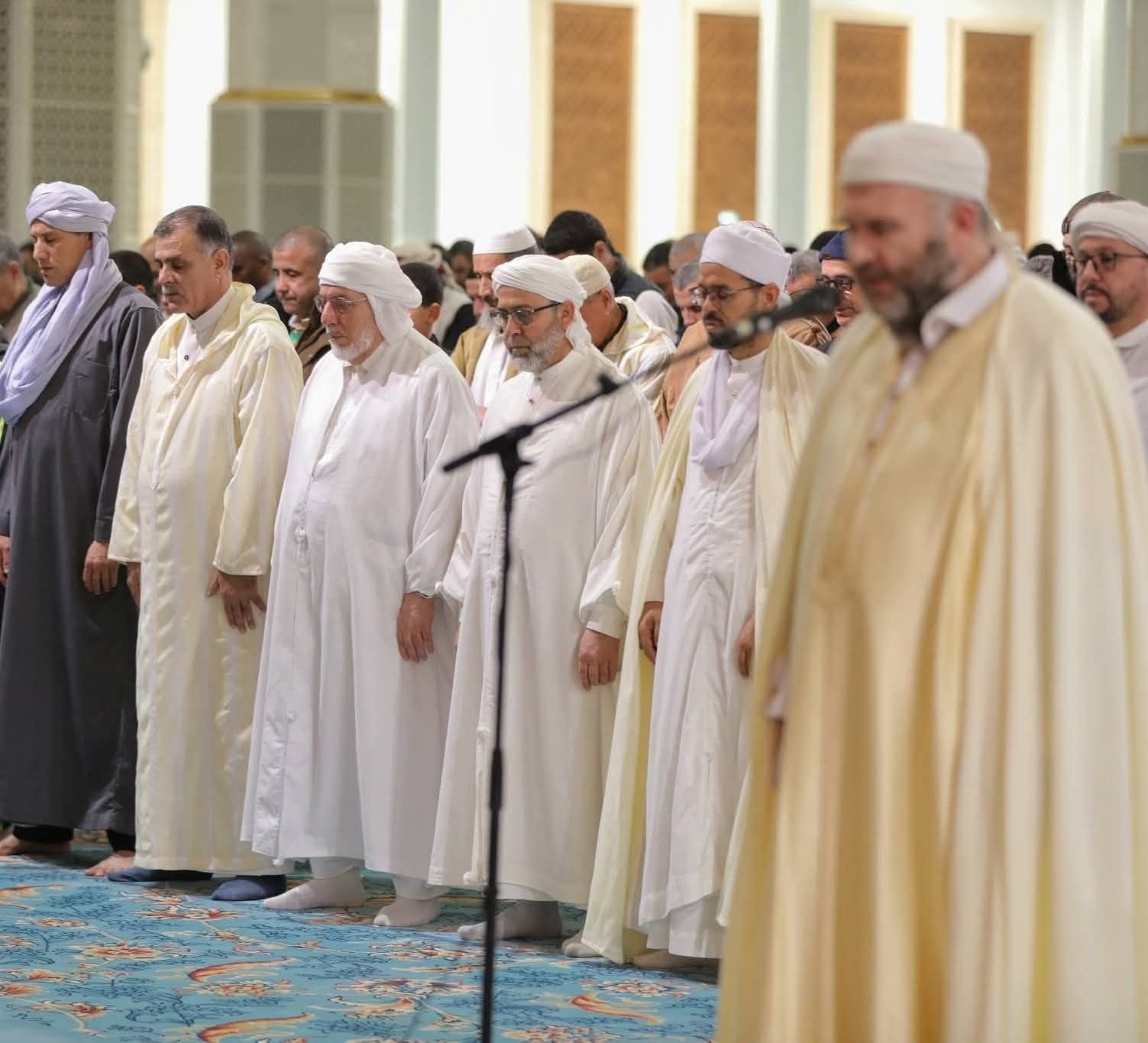
Shaykh Uthman Ibn Farooq: “If you pray with your hands down, your salah is still acceptable.”

“So woe to those who pray yet are unmindful of their prayers.” (Qur’an 107: 104-105)

﷽ 

Malik ibn Al-Huwayrith reported:

We came to the Prophet (saw) while we were young men, and we stayed with him twenty nights. Then the Prophet considered that we were anxious to see our families, so he asked us who we had left behind to take care of them, and we told him. The Prophet was kindhearted and merciful, and he said, “Return to your families, teach them, and enjoin good upon them.” Pray as you have seen me praying. When the time of prayer arrives, then one of you should announce the call to prayer and the eldest of you should lead the prayer.

Source: (https://sunnah.com/bukhari:6008)

This is a commentary on the following video:

Shaykh Uthman REFUTES Shia lies on Folding Hands in Prayer [MUST WATCH]

It is refreshing to see that those who claim to be following the early generations are starting to relax their position on this matter. Al hamdulillah.

For example, Salafi preacher, Assim Al Hakeem mentions that one can pray with their arms to the side with no problem.

If you pray with your hands down, your salah is still acceptable -Shaykh Uthman Ibn Farooq.

Shaykh Uthman says @0:46If you feel that you want to pray with your hands to your side ,and you feel that’s the correct opinion based on the evidence that you have seen, it’s up to you. No problem. That’s between you and Allah. I believe with the evidences from the Qur’an itself and from the authentic hadith of the Prophet (saw) and the sahabam, ahl bayt and others that the sunnah is to fold the hands.”

Shaykh Uthman says @1:09 “But I’m not pushing that opinion. I don’t believe in dividing the ummah based on this. I believe even if you pray with your hands down, your salah is still acceptable.”

Shaykh Uthman says @3:24 “Now when, whether you fold your hands or don’t fold your hands, personally I’m not going to argue with you on this issue. If you feel this is the way of the Prophet (saw), then that’s between you and Allah.”

Shaykh Uthman Ibn Farooq: Misquotes the Shi’a man.

@7:14 “This man is saying there’s not a single narration that shows among the Ahl Sunnah to fold the hands. That’s hwat he’s saying. Listen to him again.”

Actually, that is not what the man said.

The Shi’a man: “Within Ahl Sunnah there is no single proven tradition from the holy prophet (peace be upon him and his family in regard to folding of the hands in prayer.”

Proven (adjective) = established beyond doubt.

Something to be mindful of. The idea that something is more established than it truly is.  In fact, throughout the video, Shaykh Uthman makes this claim about the Sh’ia man several times. 

If one person narrates something to 50 students and those 50 students copy this narration into their books and a person quotes those 50 students, the one listening may get the false impression that the evidence is overwhelming.  They may reason to themselves. “Look how many people narrate this.” However, in reality they all quote the one channel. 

This is not necessarily dishonest, however, it can give the false impression that something is stronger than what it actually is. 

@12:06 “But he mentioned that Ibn Mundhir has mentioned from Ibn Zubayr, from Hassan Al Basri from Nakha’i, about leaving the hands on the side. That not folding the right on the left and this was reported by an-Nawawi, upon the authority of Layth ibn Sa’ad.” (Shaykh Uthman stops reading..)

@12:26 “Now, the honesty that we believe in we quote this. We’re not going to hide anything from you.” (NOTICE THE VIDEO EDIT).

Notice, dear reader, and in this case, dear viewer, that at the point where Shaykh Uthman says, ‘We’re not going to hide anything from you.” The video skips. Which shows that part
was cut. Does this mean that nothing was hidden or revealed? Allah knows best. However, it is worth taking note of.

@12:31 “Now what does he say? He says Ibn Al Qassim has mentioned this from Imam Malik one of the great a’immah of Medina that is also reported from him Ibn Al Qassim, but he says he was opposed (@12:47 the video is cut) by Ibn Al Hikim who said that Imam Malik believed in folding the hands as well.

Prima Qur’an: Why can’t Shaykh Uthman simply quote the narration that Imam Malik regarded praying with the hands at side? The way the video is sliced and spliced is done in such a way that it skips over it.

Where did these knowledgeable salaaf get their view from about placing the hands at the side in prayer?

Abdullah ibn al-Zubayr
Al Hassan al-Basri
Ibrahim al-Nakha’i
Imam Malik

Shaykh Uthman says: @13:49 “20 authentic narrations leading back to 18 different sahaba from the Prophet (saw).”

You have to wonder if that is what Shaykh Uthman believes himself? Are all those narrations authentic? Because it is important to note what Shaykh Uthman is doing is talking about narrations concerning folding the hands in prayer.

Shayky Uthman Ibn Farooq is caught lying.

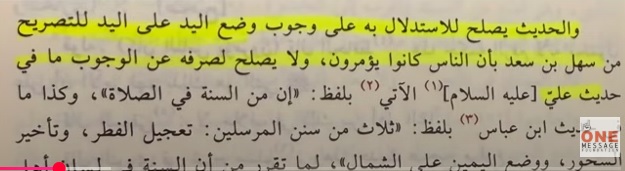
Shaykh Uthman, while reading from a text, says: @15:04 “We were ordered in the time of the Prophet (saw), as Abu Hazim has clarified, to fold the hands, right on left in the prayer.”

Which Arabic in the text below is he rendering as: ‘In the time of the Prophet’ ?

Often Shaykh Uthman makes mistakes in his Arabic.

@16:03 “Ali radianhu” ???

Insh’Allah we will come back to this hadith. This hadith they feel is their ultimate trump card. Suffice it to say that the text does not say: “were ordered in the time of the Prophet.”

They wish it said that!

We remind Shaykh Uthman the seriousness about lying on the Blessed Prophet (saw).

Narrated `Ali:

The Prophet (saw) said, “Do not tell a lie against me for whoever tells a lie against me (intentionally) then he will surely enter the Hell-fire.”

Source: (https://sunnah.com/bukhari:106)

The word intentionally is not in the Arabic text.

Does the Qur’an mention anywhere about the placement of the hands?

“Therefore pray to your Lord and make a sacrifice.” (Qur’an 108:2)

https://www.islamawakened.com/quran/108/2/

Does this really need any comment? Does one really see anything in this text about the placement of hands in the prayer?

Shaykhk Uthman says: @17:12 “Imam Malik himself and I’m going to put a link to the Muwatta Imam Malik in the description. He has an entire chapter in his Muwatta about folding the hands in prayer; from the people of Medina. Not a single hadith in the Muwatta, not a single chapter that says, ‘dangle the hands in prayer’. And Imam Malik style of writing if he saw the people of Madina doing something opposite to that which was narrated, then in the Muwatta he would write, ‘This is what is narrated, but the people of Madina
did opposite. But he did not say that about folding the hands.”

There are a few points to take note of.

  1. The Muwatta is not the only work attributed to Imam Malik. The following are also attributed to him.
  • al-Mudawwanah al-Kubrā
  • Risālat Mālik ilā al-Layth ibn Saʿd
  • al-ʿUtibiyyah

2. @12:31 Shaykh Uthman didn’t actually give us the quote that is from Malik on his stance.

3. As we mentioned in our other article. Just because someone narrated something doesn’t mean they acted upon what was narrated. Narrating a hadith shows awareness of its existence.

Abu Dawud transmitted the following hadith:

  • Hands below the navel
  • On the chest
  • And even hands to the sides

You can read more about that here:

4. Fiqh is stronger than hadith. Hadith is a narration and fiqh is understanding of the narration.

We mentioned that we would come back to this: “were ordered in the time of the Prophet.”

Narrated Sahl bin Sa`d:

The people were ordered to place the right hand on the left forearm in the prayer. Abu Hazim said, “I knew that the order was from the Prophet (saw) .”

Source: (https://sunnah.com/bukhari:740)

So for them this hadith serves as a neutralizer to any idea of the Blessed Prophet (saw) praying with arms to the side.

Go look at how the render the English over here: (https://sunnah.com/bukhari:740)

What a juciy dishonest lie! In plain sight!

The whole of the Arabic text actually says:

Abdullah ibn Maslamah narrated to us, from Malik, from Abu Hazim, from Sahl ibn Sa’d, who said: “People were commanded that a man should place his right hand on his left forearm during prayer.” Abu Hazim said: “I know of it only as being attributed to the Prophet (peace be upon him).” Isma’il (a narrator in the chain) said: “It is attributed” — and he did not say “he attributes it.”

Effectively, the hadith they think is a trump card actually is an athar.  It doesn’t describe something that the Blessed Prophet (saw) did. It describes actions that people did that were attributed to the Prophet (saw). 

A note about Sahl ibn Sa’d he lived to see the Umayyad imperium.

Al-Bukhari’s hadith comes through two chains: one from ‘Abdullah ibn Maslama and the other from Isma‘il ibn Abi Uways, both narrating from Imam Malik ibn Anas, from Abu Hazim, from Sahl ibn Sa‘d, who said: “The people used to be commanded…”

• In the narration of ‘Abdullah ibn Maslama, Abu Hazim said: “I do not know it except that he attributes it (yanmī dhālika) to the Blessed Prophet (saw).”

• In the narration of Isma‘il ibn Abi Uways, it says: “I do not know it except that it is attributed (yunmā dhālika) to him.”

Based on this, the hadith is defective (ma‘lūl), weak, and cannot be used as evidence, because it is merely Abu Hazim’s supposition, and it is also inconsistent (muḍṭarib).

20 different chains from 18 different sahabah?

A Sunni, Maliki scholar Shaykh Abdullah bin Hamid Ali translated a work that showed the problems in these chains.

So when the Shi’a man says: “Within Ahl Sunnah there is no single proven tradition from the holy prophet (peace be upon him and his family in regard to folding of the hands in prayer.”

Proven (adjective) = established beyond doubt.

This is correct.

As the article by Shaykh Abdullah states:

“True or not, there exists sufficient doubt about every single report that exists to this effect that weakens the “popular” claim and understanding that it is well established that the Prophet prayed while placing one hand over the other.”

You may also be interested in reading the following:

Final thoughts.

Shaykh Uthman Ibn Farooq, his first point, lands hard.  That was quite embarrassing for the Shi’a to quote that as a reference.  Also, something Shi’a has to contend with is the idea of women praying with their hands folded.  

However, Shaykh Uthman Ibn Farooq himself blatantly lied and misled his audience concerning what the Arabic text said. 

Allah Guide the Ummah.

May Allah Forgive the Ummah.

Leave a comment

Filed under Uncategorized

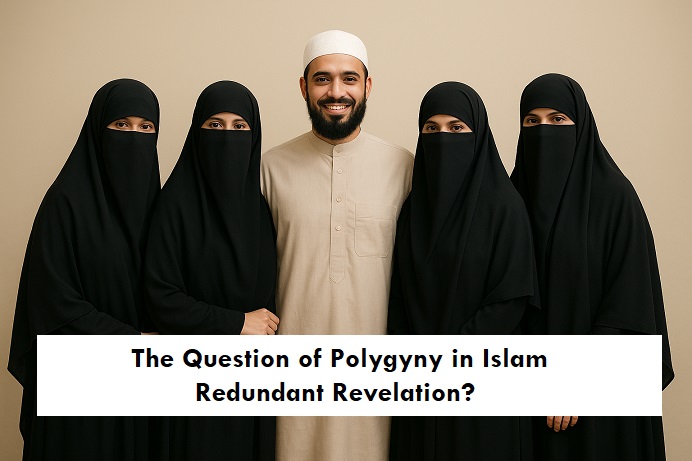
Redundant Revelation? The Question of Polygyny in Islam

“And if you fear that you will not deal justly with the orphans, then marry other women those that please you, two or three or four. But if you fear that you will not be just, then marry only one or those your right hand possesses. That is more suitable that you may not incline to injustice. (Qur’an 4:3)

﷽ 

The above-mentioned verses have been used by self-proclaimed spokespersons for Islam past and present, albeit unwittingly, to regulate these verses to redundancy.

So it is disheartening to see Muslims with a ‘modernist‘ bent turn certain verses of the Qur’an to redundancy.

Also, we all need to be very careful not to prohibit that which Allah (swt) has made permissible.

“O you who have believed, do not prohibit the good things which Allah has made lawful to you and do not transgress. Indeed, Allah does not like transgressors.”(Qur’an 5:87)

Redundant Revelation: The Question of Polygyny.

The example we will discuss today is the following verse:

“And if you fear that you will not deal justly with the orphans, then marry other women, those that please you, two or three or four. But if you fear that you will not be just, then marry only one of those whom your right hand possesses. That is more suitable that you may not incline to injustice.” (Qur’an 4:3)

We would also have to rank this particular verse of the Qur’an as the one most used and abused.

We would have to say those who ‘use and abuse’ it the most are those who follow under three broad categories.

Category A)

‘Modernists’ or ‘reformers’.

Category B)

The next group most likely to abuse these verses are those Muslims who consider themselves ‘traditionalists’. Often they are trying to find favour with post-modern liberalism.

Category C)

The last group that we would say that are most likely to abuse these verses are those who follow the ‘Hafs Qur’an only’ Religion.

What do we mean by abuse of the text?

Flat lies concerning the Asbab Al-Nuzul?

By this we mean those who are usually not favorable towards traditionalist interpretation will tell you how this verse was ‘revealed during the context of a war’. They will mention how there was a ‘surplus of all these widows’ and ‘men just rushed out to marry them all.’ This is to elicit the ‘Oh, so very noble‘ response from you.

The reality of this verse is that it does no such thing.  It doesn’t tell me to marry widows. In fact, the next time someone tells you that this verse was revealed in the context of war, ask them:

“Can you kindly show me the source for this information?”

This is not in the Asbab Al-Nuzul by Al Wahidi.

“(And if you fear that you will not deal fairly by the orphans…) [4:3]. Abu Bakr al-Tamimi informed us> ‘Abd Allah ibn Muhammad> Abu Yahya> Sahl ibn ‘Uthman> Yahya ibn Za’idah> Hisham ibn ‘Urwah> his father> ‘A’ishah who said, regarding the words of Allah (And if you fear that you will not deal fairly by the orphans): “This was revealed about any custodian under whose care is a female orphan who possesses some wealth and does not have anyone to defend her rights. The custodian refuses to give this orphan in marriage out of greed for her money, harms her, and treats her badly. And so Allah, exalted is He, says (And if you fear that you will not deal fairly by the orphans marry of the women, who seem good to you…) as long as they are lawful to you and leave this one”. This was narrated by Muslim> Abu Kurayb> Abu Usamah> Hisham. Sa‘id ibn Jubayr, Qatadah, al-Rabi‘, al-Dahhak and al-Suddi said: “People used to be wary of the wealth of orphans but took liberty with women and married whoever they liked. And sometimes they were fair to them and sometimes they were not. So when they asked about the orphans and the verse (Give unto orphans their wealth), regarding the orphans, was revealed, Allah, exalted is He, also revealed (And if you fear that you will not deal fairly by the orphans). He says here: ‘Just as you fear that you will not deal fairly by the orphan, so should you fear that you do not deal fairly by women. Therefore, marry only as many as you can fulfill their rights, for women, are like orphans as far as weakness and incapacity are concerned’. This is the opinion of Ibn ‘Abbas according to the narration of al-Walibi”.

Source: (Tafsir of Qur’an 4:3 by Al Wahidi)

This idea that these verses were revealed during the context of war is not in the Tanwir al-Miqbas of Tafsir Ibn Abbas.

This idea that these verses were revealed during the context of war is not in the Tafsir of Al Jalalayn.

This idea that these verses were revealed during the context of war is not in the Tafsir of Al Qushairi.

This idea that these verses were revealed during the context of war is not in the Tafsir of Ibn Kathir.

Not limited to asbab al-nuzul.

Now, even if we were to imagine that the order to marry only orphans or up to four women came during the context of war (which we still await evidence of), even then it would not be limited to that context. Asbab al-nuzul is the timing that Allah (swt) feels is appropriate to deliver a specific revelation.

It would be very strange if the Blessed Prophet (saw) and his companions were having a meal together and suddenly a revelation came saying, “Marry women of your choosing, 2, 3 or 4...” It makes sense that certain rulings are revealed in a certain context. However, it does not mean they are limited only to that context. If that was the case, we would have real problems in the implementation of the Qur’an 2:256.

Masruq said: “A man from the Helpers, from among the Banu Salim Banu ‘Awf, had two sons who had converted to Christianity before the advent of the Prophet, (saw). After the migration of the Prophet,(saw), these two sons came to Medina along a group of Christians to trade in food. Their father went to them and refused to leave them, saying: ‘By Allah! I will not leave you until you become Muslim’. They refused to become Muslim and they all went to the Messenger of Allah, (saw), to settle their dispute. The father said: ‘O Messenger of Allah! How can I leave a part of me to enter hell fire while I just sit and look?’ Allah, glorious and majestic is He, then revealed (There is no compulsion in religion…) after which he let them go”.

Source: (Tafsir of Qur’an 2:256 by Al Wahidi)

If we are to follow the logic of modernists, who say that the Qur’an 4:3 only applies to the context of orphans and/or to women after the war, it would mean that the Qur’an 2:256 only applies to sons. Or it only applies to those who convert to Christianity. So, this means if they were daughters they could be compelled. This means if they converted to a religion other than Christianity, they could be compelled to. Would anyone reason like this?

What is the context of the Qur’an 4:3?

The whole context of the Qur’an 4:1-12 is the distribution of wealth and property.

Quite a number of conflicts in tribal society would erupt over this. It happens until this very day. We find people fighting over the distribution of property and wealth even in our times.

So let us look at the verse in question again.

“And if you fear that you will not deal justly with the orphans, THEN marry other women those that please you, TWO or three or four. But if you fear that you will not be just, then marry only one or those your right hand possesses. That is more suitable that you may not incline to injustice. (Qur’an 4:3)

Note three interesting points.

POINT 1)

The verse starts off with ‘And if you fear that you will not deal justly with orphans, then.….”

So let us look at the verse before this one.

“And give to the orphans their properties and do not substitute the defective [of your own] for the good [of theirs]. And do not consume their properties into your own. Indeed, that is ever a great sin. (Qur’an 4:2)

This is in context with a verse that comes later:

“Indeed, those who devour the property of orphans unjustly are only consuming into their bellies fire. And they will be burned in a Blaze.” (Qur’an 4:10)

POINT 2)

After orphans, it addresses marrying women who are neither orphans nor slaves.

Notice that it starts off by saying, “Marry 2, or 3 or 4. It is interesting that it does not start off by saying, ” marry 1.”

Now if one wanted to manipulate the Qur’an in the way that Muslims who pander to post-modern liberalism do, you could make the argument that marrying 2 was imperative!

You could also make the argument that 2 is actually optimal followed by more; as 1 was simply offered up as a ‘better than nothing’ solution.

So the fact that it starts off by saying “marry 2” is interesting and flat out neglected (ignored?) by post-modern liberal interpretations.

However, we have also noted that those given to post-modern- liberal interpretations will say, “2 or 3 or 4 but if you cannot deal justly with them, then only one.

Yet the text does not stop there. There is a conjunctive.

The Arabic word ‘aw’ which means ‘or’

There is a flow that I feel is ignored by the three categories (mentioned above).

So then the verses pick back up by saying, “but if you fear that you will not deal justly, then marry those whom your right hand possesses.”

This is addressed here:

“And whoever among you cannot [find] the means to marry free, believing women, then [he may marry] from those whom your right hands possess of believing slaves. And Allah is most knowing about your faith. You [believers] are of one another. So marry them with the permission of their people and give them their due compensation according to what is acceptable. [They should be] chaste, neither [of] those who commit unlawful intercourse randomly nor those who take [secret] lovers. But once they are sheltered in marriage, if they should commit adultery, then for them is half the punishment for free women. This is for him among you who fears sin, but to be patient is better for you. And Allah is Forgiving and Merciful.” (Qur’an 4:25)

So, if we are to follow the approach that some people take, and we are to be consistent, we should understand Qur’an 4:2-3 as this.

1) You should marry orphans first and foremost.

2) Failing to do justice to them, you should marry free-believing women.

3) Failing to deal with them justly, you should marry those whom your right hand possesses.’

However, notice it stops here. Why does it not continue and say, failing to do justly with them…. etc.?

Ponder some of the translations of this verse:

http://quran.com/4/3

& here as well:

http://www.islamawakened.com/quran/4/3/

Please take note on two points:

1) How the translators have used the conjunction ‘aw‘.

2) How they have translated ‘Thus it is more likely that you will not do injustice.’

The whole thrust of Qur’an 4:3 if one looks at it in light of the overall context of the distribution of wealth and property is what is a man looking at getting married for?

What may he find beneficial for him? In fact, the verse itself is obviously directed towards men.

It tells us that men may find the idea of marrying an orphan appealing, as some may want to usurp their property, wealth, and/or belongings, as we are told in the Qur’an 4:10.

“Indeed, those who devour the property of orphans unjustly are only consuming into their bellies fire. And they will be burned in a blaze.” (Qur’an 4:10)

It then goes into the idea of marrying free-believing women. Nowhere does the verse say that we are to marry one woman. Interestingly enough, it starts off with the number two.

However, a man may find that he still has financial constraints in trying to marry free-believing women.

Thus, it is simultaneously brought to his attention to marry his slave women.

This is dealt with in more detail in Qur’an 4:25.

“And whoever among you cannot [find] the means to marry free, believing women, then [he may marry] from those whom your right hands possess of believing slave girls. And Allah is most knowing about your faith. You [believers] are of one another. So marry them with the permission of their people and give them their due compensation according to what is acceptable. [They should be] chaste, neither [of] those who commit unlawful intercourse randomly nor those who take [secret] lovers. But once they are sheltered in marriage, if they should commit adultery, then for them is half the punishment for free women. This is for him among you who fears sin, but to be patient is better for you. And Allah is Forgiving and Merciful.” (Qur’an 4:25)

So let us look at the other verse that is brought in to say that Muslim men can only marry one woman.

And you will never be able to be equal between wives, even if you should strive [to do so]. So do not incline completely [toward one] and leave another hanging. And if you amend [your affairs] and fear Allah – then indeed, Allah is ever Forgiving and Merciful. (Qur’an 4:129)

This verse is nowhere telling men that, because they cannot deal justly with more than one wife that they should marry only one. The context itself tells us this. The following sentence reminds the man not to incline towards one wife, letting the other feel neglected.

What we feel many of us neglect when reading the Qur’an 4:129 is that not only do men read this verse, but women do too! Thus, women are reminded that men won’t be able to be totally equal in all respects. Some women may have more needs than others. You may have a wife who has a mental or physical handicap. So this verse is also a reminder to women to keep the larger picture in mind.

Hafs Only Qur’an Religion begin their manipulation of the translation.

In fact, you will see that the post-modern ‘free minds translation’ of the Qur’an is being manipulated right here:

http://www.islamawakened.com/quran/4/129/

& here:

https://www.free-minds.org/quran/PM/4

“And you will not be able to be fair regarding the women even if you make every effort; so do not sway too greatly and leave her as one hanging in a void. And if you reconcile and do right, then God is Forgiver, Merciful.”.

Wouldn’t be surprised if they ‘clean up’ this translation later. Notice the verse is obviously addressing women (plural) and then suddenly the theme is switched to one woman (the wife)?

Manipulation of the text at its best!

There is no text in the Qur’an that tells men they are restricted to marrying only one wife.

If Allah (swt) wanted Muslim men to marry only one woman, he would have told us this in very clear terms.

If we are to believe the view of modernists, this means that when the Qur’an mentions 2 or 3 or 4 and then says, well, in reality it only means one is to say the Qur’an is not only couched in obfuscation but that it contains redundant language.

Surely, as Allah (swt) says, if the oceans were ink to write his words, the oceans would deplete before Allah (swt) would run out of things to say.

Say: “If the ocean were ink to write the words of my Lord, sooner would the ocean be exhausted than would the words of my Lord, even if we added another ocean like it for its aid.” (Qur’an 18:109)

Surely, Allah (swt) would say simply marry only one. Simple.

Now one thing I want to clear up is that the Qur’an is not saying that it is mandatory for a man to marry more than one woman.

However, to say that the Qur’an does not allow men to marry more than one wife is simply pandering to a post-modern liberal world view.

Mind you, there are also those who say, well, if a man marries another woman, she should be absolutely destitute, having been divorced and so forth.

The Qur’an also does not say those marrying women who are destitute or divorced are a priority. Again, these are people who seek to impose their own criteria on whom a man may or may not marry. Did these very people go and seek to marry the handicapped, the most destitute, those considered ‘undesirable’ by society?

To marry such people is a choice. The irony is that many men and women who claim that the verse in Qur’an 4:3 is only in regard to women who are destitute and down and out not only ignore the verse itself but gives the impression that women are weak and powerless.

Note the following part of the verse again,

THEN marry other women those that please you, TWO or three or four.

These “other women” are not slaves nor orphans. There are women in a society that are socially upwardly mobile. Women in society that are wealthy or have careers. These women want husbands because they have any number of needs.

They might want children. They could simply want affection and male companionship. They could want sexual gratification. They might feel more secure being in a relationship with a man that has already proven he can be a good Imam for his children and household than to risk a marriage with someone who is unproven.

The point is that if a woman or any woman who marries a man of their own free will and volition are in agreement with such an arrangement, then who are we to impose post-modern liberal values upon them?

It is also interesting to note that verse 4:129 does not say “You will not be able to love them equally.” The theme is justice.

Allah (swt) is admonishing the husband by taking the perspective of one of the wives. Allah (swt) is also reassuring a husband who may be having doubts about his ability to be a good husband that He (Allah) is forgiving and merciful.

In the end, perfect justice is the purview of the divine; and complete and perfect justice belongs only to Allah (swt).

“Have you not turned your vision to those who claim sanctity for themselves? Nay-but Allah Does sanctify whom He pleases. But never will they fail to receive justice in the least little thing.” (Qur’an 4:49)

Muslim men can marry an unrestricted number of women according to modernist, liberal interpretations!

You read that correctly! If we are to believe, even for a moment, the modernist interpretations of the Qur’an, then it means that Muslim men can not only marry 4 wives but possibly 5,6, 7 unlimited! Why? Because, according to them, Qur’an 4:3 is an example of takhsees—the specification of a general ruling.

1) The Qur’an nowhere tells us to marry only one woman. It obviously has no such verse if it does indeed tell men they can marry more than one orphan (as modernists agree it says).

2) If Qur’an 4:3 is only restricted to orphans, and it does not mean women in general, then this means it is laying down no rules concerning women other than orphans. So the marry-up to 4 rule is only applicable to orphans. This means that for modernists, the Qur’an gave no principle in regard to women who are not orphans, therefore allowing a man to marry an unrestricted number of women!

Conclusion:

The Qur’an nowhere restricts men from marrying only one wife. Even those people who say that marrying more than one wife is only concerning orphans are the same people who would say that polygyny is not applicable today! Even though there are certainly orphans in Yemen, Syria, Palestine. Anyone who leaves their ivory tower in Indonesia, Bangladesh, India, Malaysia, the Philippines knows there are plenty of orphan women. 

The people who restrict polygyny to only orphans have actually unwittingly given license for men to marry an unlimited number of women! Those who are dead set against polygyny claim that the Qur’an 4:3 was revealed in the context of war, and yet they do not furnish proof of this. It is clear there is no verse in the Qur’an that tells men not to marry more than one woman

If there was such a verse, the opponents of polygyny would produce it. Obviously, no verse can exist as it would contradict even by their own standards concerning Qur’an 4:3. As regards saying that no man can deal justly with more than one woman, therefore, they are to marry one, Allah (swt) himself said that a man would not be able to deal justly but admonished a man not to incline towards one wife and neglect the other.

You may be interested in reading the following entries:

https://primaquran.com/2022/10/05/the-hypocrisy-of-bidi-talaq-innovated-divorces-weighed-against-the-wisdom-of-the-quran/

May Allah Guide the Ummah.

May Allah Forgive the Ummah.

10 Comments

Filed under Uncategorized

Blowing on Knots. Saving Muslim Marriages

And they learn from them that by which they cause separation between a man and his wife. But they do not harm anyone through it except by permission of Allah. And the people learn what harms them and does not benefit them. But the Children of Israel certainly knew that whoever purchased the magic would not have in the Hereafter any share. And wretched is that for which they sold themselves if they only knew.” (Quran 2:102-103)

﷽ 

Is it not curious that, out of all the things that people learned concerning magic that an emphasis is put on causing separation between a man and his wife? That there are extremely dark forces at play working against the foundations of a family should be something that we really think about.

In Islam, marriage completes half of one’s faith. 60% of Shari’ah law is focused on the family.

There is a significant gap between the holistic guidance of the Qur’an and Sunnah and the often-mechanistic application of certain legal rulings, particularly concerning marriage and divorce.

The Reality of Supra-Natural Forces and Their Target.

The Qur’an explicitly confirms the existence of magic and the efforts of Shaitan to sow discord, especially within the most sacred of institutions: the family.


“The Shaitan only desires to cause enmity and hatred to spring in your midst by means of intoxicants and games of chance, and to keep you off from the remembrance of Allah and from prayer.” (Qur’an 5:91)

“If an evil impulse from Shaitan provokes you, seek refuge with Allah; He is All-hearing and all-knowing.” (Qur’an 7:200)

“And march forth in the way of forgiveness from your Lord, and for Paradise as wide as the heavens and the earth, prepared for the pious. Those who spend in prosperity and in adversity, who repress anger, and who pardon the people; verily, Allah loves the good-doers.”(Qur’an 3:133-134)

“So whatever you have been given is but enjoyment for this worldly life, but that which is with Allah is better and more lasting for those who believe and put their trust in their Lord. And those who avoid the greater sins, and illegal sexual intercourse, and when they are angry, they forgive.” (Qur’an 42:36)

It can be seen from the aforementioned verses that enmity, anger, hate are things that Shaitan provokes us with. We also see that tempering our anger and forgiveness are more wholesome.

“Say: ‘I seek refuge with the Lord of Daybreak, from the evil of duality, and from the evil of the darkness as it gathers and from the evil of those who blow on knots (l-‘uqadi) and from the evil of an envier when he envies.'” (Qur’an 113:1-5)

From those who ‘blow on knots‘. The term ‘l-uqadi’ .

This term is used in the following instances of the Qur’an:

“There is no blame upon you for that to which you indirectly allude concerning a proposal to women or for what you conceal within yourselves. Allah knows that you will have them in mind. But do not promise them secretly except for saying a proper saying. And do not determine to undertake a (uq’data l-nikahi)marriage contract until the decreed period reaches its end. And know that Allah knows what is within yourselves, so beware of Him. And know that Allah is Forgiving and Forbearing.” (Qur’an 2:235)

“And in case you divorce them even before you have touched them, and you have already ordained for them a marriage-portion, then give her one half of what you have ordained except in case the women remit, or he in whose hand is the (uq’datu l-nikahi) knot of marriage remits; that you remit is nearer to piety. And do not forget the virtue of grace among yourselves; surely Allah is Ever-Beholding of whatever you do.” (Qur’an 2;237)

When you look at those instances of the word, it becomes apparent that ‘blow on knots‘ means ‘blow on marriages’. “Devise plots against marriages.”

The phrase “those who blow on knots” (an-naffathati fil ‘uqad) has a primary meaning referring to sorceresses who literally tie knots and blow spells upon them. However, the linguistic drawn to the “knot of marriage” (‘uqdat an-nikah) in verses 2:235 and 2:237 is a powerful and valid tafsir (interpretation). It highlights that one of the primary objectives of these dark forces is to unravel the sacred bond (‘aqd) between spouses. This is not a minor issue; it is a direct assault on half of a Muslim’s faith.

Aqad literally means to ‘tie’ or to ‘bind’. In English, we have the interesting idiom of ‘tying the knot‘ as a reference to getting married.

The Arabic word Khul means to ‘untie or to disrobe’.

Whereas the word Talaq means to abandon or rid oneself of something.

“Definition of “divorce” (talaq) Literally, the word “divorce” (talaq) means to abandon a thing or get rid of a thing. When an animal tied with a string is untied it is called talaq. If the tied with a string she-camel is untied, the Arabs mention this state as: “talaqa al-naqata talaqan” 23 (The she-camel has been released).”

Source: (Pg 15. Islamic Law of Marriage and Divorce by Shehza Sham)

So, if the term Talaq means to untie, to abandon or to get rid of something, it makes no sense to say to someone “I abandon you” thrice, because in order to be abandoned the second time or the third time just like saying ‘I untie you thrice’.  In order to be ‘untied’ a second or third time, you would need to be tied or in a state of ‘aqad’ for a second or third time.

If we take into account that supra-natural forces are at work in bringing about discord in Muslim marriages, why is it not taken into the calculation by certain Muslim jurists and especially those influenced by ‘tassawuf’ when deciding the fate of Muslim marriages?

Here is something that those of our brothers of the Ahl Sunnah need to take on board. If you believe the following haidth, we have a question for you.

Narrated Aisha:

Magic was worked on Allah’s Messenger (saw) so that he used to think that he had sexual relations with his wives while he actually had not (Sufyan said: That is the hardest kind of magic as it has such an effect)…….the hadith is longer.

Source: (https://sunnah.com/bukhari:5765)

If you believe the best of creation, the Blessed Prophet Muhammed (saw), could be affected by magic to the extent that it created a false reality in his personal life, then it is a form of arrogance for any scholar or jurist to dismiss the possibility that ordinary Muslim couples could be acting under similar influences of anger, hatred, miscommunication, and irrational behavior provoked by Shaitan.

Until today, there has been no meaningful engagement in regard to this question. 

We also need to keep the following verses in mind:

O Prophet! When any of you divorce women, divorce them during their period of purity and calculate their ‘idda carefully. And have fear of Allah, your Lord. Do not evict them from their homes, nor should they leave, unless they commit an outright indecency. Those are Allah´s limits, and anyone who oversteps Allah´s limits has wronged himself. You never know, it may well be that after that Allah will cause a new situation to develop.” (Qur’an 65:1)

Even though this is what the Qur’an clearly states, the jurist will allow couples’ marriages to be dissolved without asking questions like:

“Did you intend to divorce your wife while she was in menses?”

If the answer is yes, then you cannot intend to divorce your wife while she is in her menses.

If the answer is “I don’t know”, then again, you cannot intend to divorce your wife on an “I don’t know.”

Yet, we, unfortunately, know of many Muslims who have gone through the divorce process, and they have informed us that the judge, the counselor, didn’t even bother to ask this question. Most unfortunate.

Another aspect of the revelation that unfortunately gets ignored is the following:

“Then, when they have reached their term (3 months), take them back in kindness or part from them in kindness, and call to witness two just men among you, and keep your testimony upright for Allah. Whoso believes in Allah and the Last Day is exhorted to act thus. And whosoever keeps his duty to Allah, Allah will appoint a way out for him…” (Qur’an 65:2)

People do not realize it, but it is very possible for people to part amicably. Sometimes a woman cannot produce children, and she has the option to be a co-wife. Whereas, if a man cannot produce children, he does not have the option to be the co-husband.

People can decide to amicably part if having biological children is an absolute deal-breaker in a relationship. They may find, for various other reasons, that they are not suitable as partners.

Yet, unfortunately, once again, the judges or the counselors do not ask about the emotional state of the man/wife when words are uttered? The answer is no.

If any men among you divorce their wives by Zihar (calling them mothers), they cannot be their mothers: None can be their mothers except those who gave them birth. And in fact, they use words (both) iniquitous and false: but truly Allah is one that blots out (sins), and forgives (again and again).” (Qur’an)

This verse clearly repudiates those men who would use an idiom or simply a verbal expression to divorce women. This verse is also clear when coupled with other verses about having just two witnesses present, and consultation that it repudiates instant divorce simply through pronunciation.

“They are invited to the book of Allah to settle their dispute”. (Qur’an 3:23)

“And this is a Book which We have revealed as a blessing, so follow it and be righteous, that you may receive mercy”. (Qur’an 6:155).

“Lo! this Qur’an guides to that which is most upright”. (Qur’an 17:9)

The Juristic (Fiqh) Response vs. The Holistic (Tazkiyah) Approach

The Problem: In many contemporary contexts, these two streams have become separated. A judge in a civil or family court, or even an imam acting in an advisory capacity, often wears only the hat of the jurist. They apply the law as a set of rules without the accompanying spiritual and pastoral context that is essential for dealing with something as sensitive as divorce.

The Qur’anic procedure for divorce is not a mere utterance but a process designed for contemplation and reconciliation.

Divorce during Menses (Tuhr): The ruling in (65:1) to divorce women during their period of purity is precisely to prevent a rash decision made in a state of emotional turmoil (which can sometimes coincide with a wife’s menses). A man who says “I divorce you” in a fit of rage during her menses has transgressed Allah’s law. The juristic consensus is that such a divorce is still legally effective but is considered bid’ah (reprehensible innovation) and a sin.

The practical consequence is that the marriage is often considered dissolved, and the crucial pastoral step of questioning the validity of the intention and context is skipped.

The Role of Witnesses and Kindness: Verse (65:2) emphasize kindness, witnesses, and a measured process. This stands in stark contrast to the instantaneous, often unilateral, and highly emotional divorces that occur. The Qur’anic ideal is a mediated separation, not a sudden outburst.

Before any divorce is finalized, a mandatory mediation process should be instituted that involves:

  • Questioning the emotional state and intention at the time of the utterance.
  • Investigating possible external factors (family interference, financial stress, etc.).
  • Recommending ruqyah (Qur’anic healing) if there is a legitimate suspicion of magic or evil eye.
  • Exhausting all avenues for reconciliation, as the Qur’an commands.

May Allah (swt) sanctify and bless all of your marriages. May Allah (swt) protect you all from the evil eye. May you and your spouse work out your differences. May Allah (swt) make your wife or wives appear as the most loving and beautiful of women. May Allah (swt) make your husband appear to you as the most kind, generous, understanding and handsome of men.

You might be interested in reading the following articles:

https://primaquran.com/2023/04/05/can-a-child-of-fornication-adultery-be-an-imam/

https://primaquran.com/2022/10/04/polygyny-and-redundant-revelation/

https://primaquran.com/2022/10/05/the-hypocrisy-of-bidi-talaq-innovated-divorces-weighed-against-the-wisdom-of-the-quran/

May Allah Guide the Ummah.

May Allah Forgive the Ummah.

1 Comment

Filed under Uncategorized

The position of the Ibadi school on marrying Ahl Kitab

“This day are things good and pure made lawful unto you. The food of the People of the Book is lawful unto you and yours is lawful unto them. Lawful unto you in marriage are not only chaste women who are believers, but chaste women among the People of the Book, revealed before your time when you give them their due dowers, and desire charity, not lewdness, nor secret intrigues. If anyone rejects faith, fruitless is his work, and in the Hereafter, he will be in the ranks of those who have lost.” (Qur’an 5:5)

“O you who have believed, do not prohibit the good things which Allah has made lawful to you and do not transgress. Indeed, Allah does not like transgressors.” (Qur’an 5:87)

﷽ 

This entry will give the position of the Muslims, otherwise known as (Ahl Haqq Wal Istiqama) or the Ibadi school. It will give our justifications from the Qur’an and Sunnah for marrying the people of the book (Jews and Christians).

Companions such as Ibn Abbas, Saad bin al-Musayyab, Said bin Jubair, Uthman, Talha, Tawus, Mujahid are all known to have married people of the book. The Blessed Messenger (saw) himself is known to have married from among the Ahl Kitab.

So, yes, in the Ibadi school, a Muslim man can marry a Christian or Jewish woman if certain conditions are met.

 Ad-Darooriyyat Al-Khams—The Five Basic Necessities that are protected and recognized by Islamic law-shari’ah. 

The five necessities—religion, life, intellect, lineage, and property are defined.

This ruling would fall under the category of: preservation of lineage & preservation of religion.

Among our brothers from the Ahl Sunnah, there are two positions. The position of Imam Malik and Imam Abu Hanifa is that Muslim men can marry Christian and Jewish women and until today there are no restrictions put on this.

The position of Imam Ahmad and Imam Shafi’i is that Muslim men cannot marry Christian or Jewish women.

The position of the Ibadi school is in between these two camps. It is very clear that we cannot make impermissible what Allah (swt) made permissible.

That being said, there is a context to these verses and conditions that must be met.

Conditions placed on marrying the Ahl Kitab.

  • 1st condition is that this takes place under Muslim governance, where there is full compliance of the shariah law.
  • The 2nd Condition is that the interest of the Muslims dominates. The children, for example, are to be raised as Muslims.
  • The 3rd condition is that the Muslim man actually is a practicing Muslim.
  • The 4th Condition is that the Jewish or Christian woman actually be practicing Judaism or Christianity.
  • The 5th condition is that she did not ever commit fornication or have an extramarital affair.

Understanding the first condition.

“O you who have believed, obey Allah and obey the Messenger and those in authority among you. And if you disagree over anything, refer it to Allah and the Messenger, if you should believe in Allah and the Last Day. That is the best way and best in result.” (Qur’an 4:59)

What happens today in North Africa and in Turkey is that many of these men who are exposed to the Maliki and Hanafi schools of jurisprudence will marry women from the United States, Europe, Russia. Often the children of these marriages are split between nationalities. The inheritance laws are not decided by the laws of Islam they are decided by secular institutions. The fate of the children will be decided by the laws of those lands. More often than not, the court awards the custody of the children to the mother. The children are brought up without a Muslim father, an Imam leading the prayers and teaching the deen of Islam. This is totally unacceptable.

Understanding the second condition.

“Our Lord, and make us Muslims that submit to You, and from our descendants a community that submits to You. And show us our rites and accept our repentance. Indeed, You are Ever-Accepting of our repentance, the Most Merciful.” (Qur’an 2:128)

“O you who have believed, protect yourselves and your own families from a Fire whose fuel is mankind and stones, (and) over which are harsh, severe Angels, who do not disobey Allah in whatever He commands them and who perform whatever they are commanded to.” (Qur’an 66:6)

Anyone who loves their children does not want to expose them to the dangers of hellfire. The best and clearest way to help ensure this is to raise them as Muslims. To instill in them the articles of faith. The love and fear of Allah (swt). The love of the Blessed Messenger (saw) and following his noble example. Muslims cannot give blessings to their children to be raised by other religions because they were all abrogated with the coming of Islam. Qur’an 2:106 establishes this.

Men are in charge of women by right of what Allah has given one over the other and what they spend for maintenance from their wealth. So righteous women are devoutly obedient, guarding in the husband’s absence what Allah would have them, guard. But those wives from whom you fear ill/strange conduct advise them; then if they persist, forsake them in bed; then if they persist strike them. But if they obey you once more, seek no means against them. Indeed, Allah is ever Exalted and Grand.” (Qu’ran 4:34)

It is difficult enough to get Muslim-majority nations to want to establish the Imamate. Does anyone think that non-Muslim majority nations have a vested interest in doing so? They have different world views and different principles upon which they base their concepts of justice. Many of them promote egalitarianism. Too many times, Muslim men are taken by the charms and beauty of non-Muslim women. Non-Muslim women may make promises to them. However, none of those promises are legally binding. This will lead us to understand the third condition.

Understanding the third and fourth conditions.

“And do not marry polytheistic (l-mush’rikati) women until they believe. And a believing slave woman is better than a polytheist, even though she might please you. And do not marry polytheistic men to your women until they believe. And a believing slave is better than a polytheist, even though he might please you. Those invite you to the Fire, but Allah invites to Paradise and to forgiveness, by His permission. And He makes clear His verses to the people that perhaps they may remember.” (Qur’an 2:221)

This verse is ‘Aam. There is an exception or allowance to marry the mush’rikati women. That exception is given in Qur’an 5:5

Many of these Muslim men who want to marry Christian or Jewish women are themselves not practicing Islam. That is not a good foundation to start a marriage with a Muslim woman, let alone a non-Muslim woman. The children are likely to be swayed by the parent who shows more conviction and practice of their faith tradition than the parent that does not show conviction or practice their faith tradition. That is why Allah (swt) says that marrying someone who is a slave is better than marrying a free, non-believing woman, even though her /his looks may please you.

Allah (swt) also said you can marry Christian and Jewish women.

Understanding fourth and fifth conditions.

“This day are things good and pure made lawful unto you. The food of the People of the Book is lawful unto you and yours is lawful unto them. Lawful unto you in marriage are not only chaste women who are believers, but chaste women among the People of the Book, revealed before your time when you give them their due dowry, and desire charity, not lewdness, nor secret intrigues. If anyone rejects faith, fruitless is his work, and in the Hereafter, he will be in the ranks of those who have lost.” (Qur’an 5:5)

That Christian or Jewish woman has to be a practicing Jewish or Christian woman. She has to follow the tenets and edicts of her faith tradition. She cannot be a ‘nominal’ Jew or a ‘nominal’ Christian. If the Christian or Jew converts to Buddhism, Hinduism, Sikhism, Taoism, Shintoism, New Age spirituality, or anything of the kind, the marriage can become null and void.

Also, Allah (swt) says, ‘chaste women’—muhsanatu. This means if these women have committed fornication or adultery, you cannot marry them. So this only leaves you with the option of marrying someone who is a virgin or a divorcee.

These Muslim men should be aware of one of the very strong positions in the Ibadi school in regard to themselves (the Muslim men) being chaste.

The same rule applies to Muslims as well. Muslims who have committed fornication for adultery can only marry other Muslims who have done similar. They cannot marry chaste believers, nor can they marry those people they have done fornication/adultery with.

Please see the article here:

This is not an example of abrogation. This is an example of a specification. Now you ask yourself are these conditions met today?

The Ibadi school is priority to Muslim Women First.

What happens in places where the Maliki and Hanafi schools reign supreme? You do see Muslim men often marry “Christian” or “Jewish” women, many of whom are actually agnostic or even atheist. They do so while many hundreds of thousands of Muslim women go unmarried. There are hundreds of thousands of Muslim women who are widows, divorcees, orphans, single people, or simply never been married before.

Shouldn’t our priority be the Ummah of Muhammed (saw)? Remember the wisdom of Allah (swt)

And a believing slave woman is better than a polytheist, even though she might please you.”

What happens in those places where the Shafi’i school is dominant? For example: places like Indonesia or Malaysia? What happens is that Muslim men or Muslim women will tell non-Muslims to convert to Islam, and then they will marry them. At least these approaches are more sensible. Bringing people to Islam. That, of course, is acceptable by Islamic law. However, every action is judged by intention and so too will be the fruit of that intention.

There are thousands of Muslim men and women who convert to Islam every year of their own free will and volition. Not under any social pressure to convert because of love. Would it not be wise to give preference to these people for marriage?

May Allah (swt) continue to guide the Ummah of Muhammed (saw)!

You may be interested in reading the following articles:

https://primaquran.com/2023/04/05/can-a-child-of-fornication-adultery-be-an-imam

https://primaquran.com/2022/10/04/marriage-to-people-of-the-book-polygyny-and-redundant-revelation

https://primaquran.com/2022/10/05/the-hypocrisy-of-bidi-talaq-innovated-divorces-weighed-against-the-wisdom-of-the-quran

https://primaquran.com/2017/10/23/blowing-on-knots-saving-muslim-marriages

May Allah Guide the Ummah.

May Allah Forgive the Ummah.

2 Comments

Filed under Uncategorized

Which Mushriks can Muslims marry?

“And do not marry polytheistic (l-mush’rikati) women until they believe. And a believing slave woman is better than a polytheist, even though she might please you. And do not marry polytheistic men [to your women] until they believe. And a believing slave is better than a polytheist, even though he might please you. Those invite [you] to the Fire, but Allah invites to Paradise and to forgiveness, by His permission. And He makes clear His verses to the people that perhaps they may remember.” (Qur’an 2:221)

﷽ 

“And do not marry polytheistic (l-mush’rikati) women until they believe. And a believing slave woman is better than a polytheist, even though she might please you. And do not marry polytheistic men until they believe. And a believing slave is better than a polytheist, even though he might please you. Those invite [you] to the Fire, but Allah invites to Paradise and to forgiveness, by His permission. And He makes clear His verses to the people that perhaps they may remember.” (Qur’an 2:221)

This verse is known as ‘Aam. It is general. The ruling applies in all situations unless there is an exception made.

The exception to this ruling is the following verse:

This day [all] good foods have been made lawful, and the food of those who were given the Scripture is lawful for you and your food is lawful for them. And [lawful in marriage are] chaste women from among the believers and chaste women from among those who were given the Scripture before you, when you have given them their due compensation, desiring chastity, not unlawful sexual intercourse or taking [secret] lovers. And whoever denies the faith – his work has become worthless, and he, in the Hereafter, will be among the losers.” (Qur’an 5:5)

This above verse is khaas — It is specific. Notice the words: “This day” meaning before that it was not the case. This often happens in the Qur’an. There is a general ruling and there is either further restriction on a certain aspect or an allowance to the general ruling.

This specific verse also has a further specification in that this allowance is only given to Muslim men to marry the mushrik women from among the People of the Book. Whereas a Muslim woman is not allowed to marry the mushrik men from among the People of the Book.

Why this specific allowance? The Qur’an mentions the Torah and the Injeel. There are shared histories, prophets and beliefs about angels and so forth. The thinking is that the mushrik women from among the People of the Book will be moved by the compassion, love, protection, warmth and guidance given by the Muslim husband. Also, considering that in the situation where such a marriage would be allowed, the children would be Muslim by default, there should be little barrier for these mushrik from the Ahl Kitab to embrace Islam.

For example: Mariyah al-Qibtiyyah (May Allah be pleased with her) was a Christian whom, after marrying the Blessed Prophet (saw), converted to Islam, and she died upon the haqq!

However, note the warning by Allah (swt).

“And whoever denies the faith — his work has become worthless, and he, in the Hereafter, will be among the losers.” An understanding that this could go the other way. The mushrik woman may convince the man to leave his faith.

This is why it becomes all the more clear under which situations and circumstances the Ibadi school allows such marriages to take place.

https://primaquran.com/2023/02/21/ibadi-school-position-on-marrying-ahl-kitab

Fight those who do not believe in Allah or in the Last Day and who do not consider unlawful what Allah and His Messenger have made unlawful and who do not adopt the religion of truth from those who were given the Scripture – [fight] until they give the jizyah willingly while they are humbled. The Jews say, “Ezra is the son of Allah “; and the Christians say, “The Messiah is the son of Allah .” That is their statement from their mouths; they imitate the saying of those who were kafara (ungrateful disbelievers [before them]. May Allah destroy them; how are they deluded? They have taken their scholars and monks as lords besides Allah , and [also] the Messiah, the son of Mary. And they were not commanded except to worship one God; there is no deity except Him. Exalted is He above whatever they associate (yush’rikuna) with Him. They want to extinguish the light of Allah with their mouths, but Allah refuses except to perfect His light, although the (ungrateful disbelievers) dislike it. It is He who has sent His Messenger with guidance and the religion of truth to manifest it over all religions, although those who associate others (l-mush’rikuna) with Allah dislike it. (Qur’an 9:29-33)

“Those who say, “Allah is the Messiah, son of Mary,” have certainly become ungrateful disbelievers. The Messiah ˹himself˺ said, “O Children of Israel! Worship Allah—my Lord and your Lord.” Whoever associates (yush’rik) others with Allah ˹in worship˺ will surely be forbidden Paradise by Allah. Their home will be the Fire. And the wrongdoers will have no helpers. Those who say, “Allah is one in a Trinity,” have certainly become ungrateful disbelievers.There is only One God. If they do not stop saying this, those who disbelieve among them will be afflicted with a painful punishment.” (Qur’an 5:72-73)

Those slippery followers of Perennialism and Qur’an 5:5

“This day [all] good food have been made lawful, and the food of those who were given the Scripture is lawful for you and your food is lawful for them. And [lawful in marriage are] chaste women from among the believers and chaste women from among those who were given the Scripture before you, when you have given them their due compensation, desiring chastity, not unlawful sexual intercourse or taking [secret] lovers. And whoever denies the faith – his work has become worthless, and he, in the Hereafter, will be among the losers.” (Qur’an 5:5)

Now, the slippery among those who follow perennialism have three choices here.

  1. Tell us the sect/denomination of Christians today that would meet the acceptable criteria of “believers” and those upon true understanding of Allah, that would be acceptable in accordance with declarations made by the Qur’an. Those that would not meet with damnation because of their theological positions? Would they be Orthodox Christians? Catholic Christians? Protestant Christians? Perhaps Jehovah’s’ Witness and/or Unitarian Christians?
  2. Admit that such Christians from Ahl Kitab are no longer existent and thus, this verse, as much as it applies to such Christians, is no longer operational. 
  3. Concede the point to the correct understanding that the Ibadi school has of the verses.

“And to warn those who claim, Allah has taken to Himself a son, a thing about which they have no knowledge, neither they nor their ancestors. Dreadful is the word that comes out of their mouths. What they utter is merely a lie.” (Qur’an 18:4-5)

Why warn those who claim this?

Because anyone who makes false claims about Allah (swt) will be brought for punishment.

Allah has children. They are simply liars. Has He chosen daughters over sons? What is the matter with you? How do you judge? Will you not then be mindful? Or do you have any compelling proof? Then bring us your scripture, if what you say is true! They have also established a relationship between Him and the jinn. Yet, the jinn themselves know well that such people will certainly be brought for punishment. Glorified is Allah far above what they claim!” (Qur’an 37: 152-159)

Furthermore, as we explained in our article about the correct understanding if Allah (swt) forgives shirk or not we have shown the text that is relied upon is a reference to the Ahl Kitab.

“Surely Allah does not forgive associating (yush’raka)˹others˺ with Him ˹in worship˺, but forgives anything else of whoever He wills. Indeed, whoever (yush’rik) associates ˹others˺ with Allah has clearly gone far astray.” (Qur’an 4:116)

“Indeed, Allah does not forgive associating (yush’raka) others with Him ˹in worship˺, but forgives anything else of whoever He wills. And whoever (yush’rik) associates others with Allah has indeed committed a grave sin.” (Qur’an 4:48)

O you who were given the Scripture, believe in what We have sent down, confirming that which is with you, before We obliterate faces and turn them toward their backs or curse them as We cursed the sabbath-breakers. And ever is the decree of Allah accomplished. Indeed, Allah does not forgive association with Himbut He forgives what is less than that for whom He wills. And he who associates others with Allah has certainly fabricated a tremendous sin. Have you not seen those who claim themselves to be pure? Rather, Allah purifies whom He wills, and injustice is not done to them, [even] as much as a thread [inside a date seed]. Look how they invent about Allah untruth, and sufficient is that as a manifest sin. Have you not seen those who were given a portion of the Scripture, who believe in superstition and false objects of worship and say about the disbelievers, “These are better guided than the believers as to the way”? (Qur’an 4:47-4:51)

You can read our article on that here:

This particular issue is one in which an orientalist and western academic made a mistake in regard to the jurisprudence of the Ibadi school. You can see our comment on that error here:

May Allah (swt) guide the Ummah!

May Allah (swt) forgive the Ummah!

2 Comments

Filed under Uncategorized

A collection of articles on the Prayer of the Blessed Prophet (saw).

“The Messenger of Allah is certainly a good example for those of you who have hope in Allah and in the Day of Judgment and who remember Allah very often.” (Qur’an 33:21)

And perform the prayer, and pay the alms, and bow with those that bow.” (Qur’an 2:43)

And obey Allah and obey the Messenger. But if you turn away, then Our Messenger is responsible only for conveying the message clearly. (Quran 64:12)

﷽ 

This is a collection of articles that have been written about prayer. The way the Blessed Prophet (saw) did his prayer.

The way some who claim to be those who uphold the truth have lied to the masses and outright distorted the way that the Prophet (saw) did his prayers.

It is hoped that these articles will be an eye-opener for many.  That one will be tranquil in their prayers.  Dear brother and sisters, in our prayers we do not have a position where we turn to the left or the right. This happens at the termination of the prayer with the taslim: ‘As salamu ‘alikum’.

Our prayers are about facing forward and looking forward and keeping our heads forward. When our focus is on Allah (swt) we do not concern ourselves with what others are doing. When our focus is on what people do in the prayer rather than our prayer (whether it was accepted or not/ whether it was sincere or not), then we become among the distracted.

It was narrated from Abu Hurairah that:

The Messenger of Allah (saw) entered the Masjid, then a man entered and prayed, then he came and greeted the Messenger of Allah(saw) with Salam. The Messenger of Allah (saw)returned his greeting and said: Go back and pray, for you have not prayed.” So he went back and prayed as he has prayed before, then he came to the Prophet (saw) and greeted him with Salam, and the Messenger of Allah (saw) said to him: “Wa alaika as-salam (and upon you be peace). Go back and pray for you have not prayed.” He did that three times, then the man said: “By the One Who sent you with the truth, I cannot do any better than that; teach me.” He said: “When you stand to pray, say the Takbir, then recite whatever is easy for you of Quran. Then bow until you have tranquility in your bowing, then stand up until you are standing straight. Then prostrate until you have tranquility in your prostration, then sit up until you have tranquility in your sitting. Then do that throughout your entire prayer.

Source: (https://sunnah.com/nasai:884)

Be tranquil in your prayers!

The value of the prayer in Islam.

Step by step video guide that shows the prayer of the Blessed Prophet (saw).

A very useful guide: Prayer in sketches and color prints by Dr. Ali Bin Hilal Al’Abri.

There is not a single uncontested hadith that says the Blessed Prophet (saw) would pray with his right hand over his left hand.

What are the Sunnah prayers in the Ibadi school? (Mu’akkad, Ghair mu’akkadah, Qabliyah, B’adiyyah, Witr)

The Ibadis do not raise their hands at all during the prayers.

The complete salah (prayer) based only on sahih hadiths impossible? The importance of the living transmitted sunnah vs documented sunnah.

Ibadis follow the blessed Sunnah of opening the hands in prayer.

Who is truly reviving the authentic Sunnah of the Prayer of the Blessed Prophet (saw) ?

manipulation of hadith to advocate prayer positions.

Salafis, Wahabbis and their lies – they lie even on their own Imams!

Salafi preachers Bilal Philips and Assim Al Hakeem lie about Imam Malik, For Assim Al Hakeem Imam Malik is like any: “Tom, Dick, Harry.” -his words!

Salafi preacher Assim Al-Hakeem: “You can pray with arms to the side.”

Muhammed Mufti Muneer: Ignores the Athar focuses on Problematic hadith.

Ecumenical Ibadi Islam: We can pray behind any of the Ahl Qibla.

Ibadi Muslims can pray behind the Imams of any of the Ahl Qibla.

Non Ibadi Muslims: Can they pray behind us?

Prayind behind an Ibadi Imam: Sunni views run the gamut.

Salafi Preacher: If he is willing to throw Imam Malik on the bus imagine what he may say about the Ibadi?

Practical pragmatic Ibadi Islam: Blending in to save your life.

Recently adopted the Ibadi school? Afraid that the Muslims at your local masjid may physically assault you? We have you covered.

Very useful tools to assist you in learning the prayer of the Blessed Prophet (saw).

Salaat Simplied Z Card.

Premier Ibadi Fiqh book in the English language on the performance of the Prayer by Shaykh Al-Muatasim Al-Mawali 

May Allah Guide the Ummah.

May Allah Forgive the Ummah.

Leave a comment

Filed under Uncategorized

Muhammed Ibn Muneer: Misguided statements on prayer.

And do not pursue that of which you have no knowledge. Indeed, the hearing, the sight and the heart – about all those [one] will be questioned.” (Qur’an 17:36)

It was recently brought to our attention that a youtuber who goes by the name of “Mufti Muhammed Ibn Muneer” made a video in an attempt to address his students, those in attendance, about praying with their arms to the side.

If we had to retitle this entry it would be: ‘Trick ’em with Hadith. Ignore the Athar.’

We listened to the video and informed the brother that the video has an innocence to it for the most part. The speaker is simple.  The statements he puts forward are simple. This is to be expected because those who claim they are upon the way of the early companion are often not well researched on matters. 

However, there are other rather alarming statements put forward by the speaker that border on tafkir (excommunication) of other Muslims, which is most unfortunate. 

The very simple approach used by Mufti Ibn Muneer had no depth or nuance to it. We do not blame him because it is clear from the matter in which he approached the subject with a naivety and innocence and that he has not really looked into the matter.  Let us take a look at the video and comment on some of the comments Mufti Muhammad Ibn Muneer says.

@1:58 “I’ve heard people say this before, Maliki scholars.  Uuhh, and that’s a whole long issue of madhabs, is it permissible in maliki etc. That’s a long issue in itself. The concept of their argument, many of their arguments not all of them they say there is nothing wrong with making sadl in the salah. And there is no specific text stating that you have to do it. Put your hand on top of the other hand. And some of the ulemah of the past said it was o.k and the mujtahideen said it was o.k and perhaps Imam Malik did it and Amal al Madinah etc. etc. etc… and most people unfortunately they argue and they fight over these points. We don’t have to argue over those points and fight over those points. Where did the Nabi Kareem (saw) pray like this? Mandatory or not. Where did he pray like this? What narration states that the Prophet had his hands to the side from the takbir to the taslim? If you can bring a hadith sahih or daif. Bring it, bring it to the table and we can see what’s the proper understanding what’s the strongest view. But if you can’t even bring that and you are basing it off of what’s permissible and what an Imam allowed raksafi, fulan fulan and this one and that one debated but the Nabi Kareem, your example, your uswa, the one you are to emanate, emulate, imitate and be like did he do it yes or no?  If he did it than we can look at the other hadith what’s the correct whatchyou do all of the time. If he didn’t do it and your basing the second pillar of Islam the most important physical act of worship off of something that an Imam allowed and differed over you have serious problems with your Islam. Serious problems with your Islam. If the most important physical act of worship a big part of it is based off of the view and the fatwa of a later scholar that’s a problem. And I don’t think any intellectual Muslim is gonna differ on this point. I don’t think any intellectual Muslim is gonna differ on this point. Were not gonna get into it being haram or not. Everybody understand this? The concept did the Nabi Kareem do it? How did he pray? Everybody understand this? Regardless of where he put his hands but did he have his hands to the side? If you can’t prove that then you need to look at the statement ash hadu an la ilaha illallah wa ashhadu anna muhammed rasulullah what does that mean? For you to continue to do something in the salaah the second pillar of Islam that the prophet never did and that an Imam allowed, and that an Imam did. That’s a mushkila. Thats’ a big, huge, mushkila. That’s in brief. The argument o.k on this point you can find in the books of shurul hadith, the books of fiqh, classical four schools.  The other non orthodox four schools. They dealt with this issue in detail; of is it permissible to put your hands at the side. When you do fold your hands where do they go, chest, navel, belly etc… Our Muhim is that the Nabi Kareem (saw) he said in Sahih Bukhari (after reciting the text in Arabic) He said, ‘we the prophets, the assembly of the prophets we have been commanded and ordered to place our right hands over our left hands in the salaah’. We have been commanded and ordered to put our right over our left in the salaah. There’s another narration that the people were commanded to place their hands the right hand on the left hand in the salaah. And many other narrations which the prophet put his hand on his left hand in the salaah, regardless of where. That is a whole different issue. Here, here, here, like this, like that. Those are secondary issues. What is important is that the Nabi Kareem (saw) he didn’t pray like that. His companions didn’t pray like that. And if there is a narration here or there they do not stand up to the light of the numerous narrations. So this has nothing to do with Maliki or Hanafi or Shafi’i. First and foremost you have to be Muhamadi. Muhamadi. How did Imam Malik understand, How did Imam Abu Hanifa understand, How did Imam Shafi’i understand and the do’s and the extract. That’s fine and that’s peachy. But when the daleel comes to you clear and pristine what Muhammed (saw) did or didn’t do. That is your stance as a Muslim, as a Muhamadi. The madhab of Muhammed ibn Abdullah. Something that is unclear something that is detailed something that you don’t understand that’s a different story. You blindly follow a scholar that you trust. You study this traditional school; but when the daleel is in front of your face your nothing more than Muhamadi Dhahiri. You take the apparent text. Every Muslim initially is dhahiri. Has to take that which is apparent from the text. Everybody understand this? Initially. Therefore it depends upon the person’s level of knowledge. If you can study and research you have to follow what you study and what you research. If you are a blind follower then take what I just said. Put your right hand on your left hand. That’s what the Prophet (saw) did. That’s my advise. No Muslim should make sadl. Allah knows best.  Next question says: Many say that those who pray sadl are not upon the sunnah. We’ve explained this many times. If it’s an issue of ijtihad that’s one thing. Is it correct to say someone is not on the sunnah over one issue that they do? Or, because the sadl is so apparent and so outward and a major part of the salah perhaps it does take you away from quote unquote “being on the sunnah.” It’s not a hidden thing. You’re doing it five times a day at least.  Not doing what the Nabi Kareem did over and over and over again. But in general, in general ‘Ahl Sunnah Wal Jammah’ hadith, we do not love and hate, we do not show wala and bara based off of maseel ijtihadi faqiya. That’s not from our way. This is what’s correct, what we believe, what we teach, what we understand. We don’t base our love and our hate off of these maeel ijtihad. Everybody understand this? Which there is room for more than one view. Even if the second view is incorrect.” 

Our response: 

Where to begin? That was quite a mouthful!

We believe the first question to address would be the question of methodology.  What is the methodology of Mufti Ibn Muhammad Muneer? What tools does he limit himself to in order to ascertain truth? What is admissible as evidence?  

If he identifies himself as a follower of the ‘Ahl Sunnah Wal Jammah’, then does he understand that that evidence is not restricted to the Qur’an and Sunnah? For ‘Ahl Sunnah Wal Jammah’, the consensus (‘Ijma’) is legal proof. Analogy (Qiyas) is legal proof. The amal of Madinah (mass practiced Sunnah) of the people of Madinah is a proof of the Maliki school. 

The second question is:

Are we to be “Muhmadi” as he claimed or “Muhamadi Dhahiri”? Because, on the one hand, he seems to indicate that it is wrong to follow the juristic conclusions of great scholars of Islam, while on the other hand, he flatly contradicts himself by being an advocate for the Dhahiri Madhab. 

If every Muslim was to be ‘Dhahiri’, how would he answer the question: Can we eat pig fat/lard? 

Say, “I do not find within that which was revealed to me anything forbidden to one who would eat it unless it be a dead animal or blood spilled out or the flesh of swine – for indeed, it is impure – or it be that slaughtered in disobedience, dedicated to other than Allah . But whoever is forced by necessity, neither desiring it nor transgressing the limit, then indeed, your Lord is Forgiving and Merciful.” (Qur’an 6:145) 

What do the Qur’an and the Sunnah say? The verse is clear that only the flesh of swine is prohibited.

Third question: By saying every Muslim should be Muhamadi, is he suggesting that Malik, Abu Hanifa and Shafi’i were not ‘Muhamadi’? 

Fourth question: If it can be established that Sa’id b. Al-Musayyib, Sa’id b. Jubayr, Al-Hasan Al-Basari, Ibrahim Al-Nakha’i, Muhammed b. Sirin, and the Companion, ‘Abd Allah ibn Al-Zubayr as well as Imam Layth b. S’ad all prayed sadl (arms to the side). Would he say that they ‘have serious problems with their Islam’?’

Fifth question: When you say, “If you are a blind follower, then take what I just said.” Wouldn’t that make a person ‘Muhamedi Muneeri’? Thus, again another contradiction in your statements?

Sixth question: Would he even accept the evidence? “His companions didn’t pray like that (Oops, he catches himself) AND IF THERE IS A NARRATION HERE OR THERE, they do not stand up to the light of the numerous narrations.”

Looks as if, even when presented with evidence, he would reject it. Hopefully, he, as well as the readers, can understand that when he speaks of ‘one or two narrations up against numerous’ that one brick is stronger than 10 pieces of straw even when combined. 

Final comments/thoughts.  The rest of Mufti Muhammed Ibn Muneer’s comments were sensible in the sense that he says that all of us are negligent of the Sunnah in one way or another.  Notice that Mufti Muhammrd Ibn Muneer said the following: “regardless of where.” That is a whole different issue. Here, here, here, like this, like that. Those are secondary issues. In other words, they do not know where the hands are supposed to go. They just know that they should be in opposition to those who place them on the side!  May Allah (swt) increase our ability to follow the example of the Blessed Messenger (saw).

“Which there is room for more than one view. Even if the second view is incorrect.” 

Ditto! 

All Muslims are reliant upon narrations from the early period of Muslims. People like Mufti Muhammed Ibn Muneer are reliant upon the hadith.  So, for those like him, they want a statement of the hadith. They know full well that bringing a hadith does not end the discussion. Hadiths have gradings, they have chains of narrators.  In this case, they would not be able to bring a single authentic hadith that states that the Blessed Prophet (saw) prayed with one hand over the other hand in the prayer. 

The only thing they can bring is

Narrated Sahl bin Sa`d:

The people were ordered to place the right hand on the left forearm in the prayer. Abu Hazim said, “I knew that the order was from the Prophet (saw) .”

Source: (https://sunnah.com/bukhari:740)

So for them this hadith serves as a neutralizer to any idea of the Blessed Prophet (saw) praying with arms to the side.

Go look at how the render the English over here: (https://sunnah.com/bukhari:740)

What a juciy dishonest lie! In plain sight!

The whole of the Arabic text actually says:

Abdullah ibn Maslamah narrated to us, from Malik, from Abu Hazim, from Sahl ibn Sa’d, who said: “People were commanded that a man should place his right hand on his left forearm during prayer.” Abu Hazim said: “I know of it only as being attributed to the Prophet (peace be upon him).” Isma’il (a narrator in the chain) said: “It is attributed” — and he did not say “he attributes it.”

Effectively, the hadith they think is a trump card actually is an athar.  It doesn’t describe something that the Blessed Prophet (saw) did. It describes actions that people did that were attributed to the Prophet (saw). 

When we go into the deep water where the Salafis do not like to go to the Athar, the reports of the actions of the companions, the information and data points overwhelm the opposition. 

We discuss about that more here in our articles:

May Allah Guide the Ummah.

May Allah Forgive the Ummah.

Leave a comment

Filed under Uncategorized

Why do Ibadis not have Qunut in prayer?

“Indeed, in the Messenger of Allah you have an excellent example for whoever has hope in Allah and the Last Day, and remembers Allah often.” (Qur’an 33:21)

﷽ 

Why do Ibadis not have Qunut in the prayer?

Malik ibn Al-Huwayrith reported: We came to the Prophet, (saw), while we were young men and we stayed with him twenty nights. Then the Prophet considered that we were anxious to see our families, so he asked us who we had left behind to take care of them and we told him. The Prophet was kindhearted and merciful, and he said, “Return to your families, teach them, and enjoin good upon them. Pray as you have seen me praying. When the time of prayer arrives, then one of you should announce the call to prayer and the eldest of you should lead the prayer.”

Source: (https://sunnah.com/bukhari:6008)

We acknowledge that the Blessed Prophet (saw) used to do Qunut for the companions in time of crisis.  However, this was something abrogated. That is our position.

Imam Malik and Imam Al Shafi’i considered Qunut in Fajr a confirmed Sunnah. Imam Ahmad considers it recommended during times of crisis. They do it during the witr prayers. Although they are not doing it currently for Palestine. Even if they think Hamas is a calamity, then still let them pray for their brothers! The Hanafi school believes that the Qunut is not done in any of the five daily prayers. However, they believe it is for the witr prayer. Zahiris do not do Qunut unless in times of crisis.

It was narrated from Abu Malik Al-Ashja’i that his father said:

“I prayed behind the Messenger of Allah (saw) and he did not say the Qunut, and I prayed behind Abu Bakr and he did not say the Qunut, and I prayed behind Umar and he did not say the Qunut, and I prayed behind Uthman and he did not say the Qunut, and I prayed behind Ali and he did not say the Qunut.” Then he said: “O my son, this is an innovation.”

Source: (https://sunnah.com/nasai:1080)

It was narrated from Anas:

“The Messenger of Allah (saw) said the Qunut for a month.”- (One of the narrators) Shu’bah said: “He cursed some men.” Hisham said: “He supplicated against some of the tribes of Arabs.”-“Then he stopped doing that after bowing.” This is what Hisham said. Shu’bah said, narrating from Qatadah, from Anas that the Prophet (saw) said the Qunut for a month, cursing Ri’l, Dhawkan and Lihyan.

Source: (https://sunnah.com/nasai:1077)

Please know, dear reader, that all the schools of Islamic jurisprudence have their proofs and justifications for why they do as they do. We follow what we believe is the correct sunnah of the Blessed Prophet (saw).

We also believe that the Blessed Prophet (saw) abolished raising the hands altogether. 

Please see the link below.

Click to access 10-reasons-that-prohibits-raising-the-hand-and-folding-them-in-prayer.pdf

May Allah Guide the Ummah

May Allah Forgive the Ummah

Leave a comment

Filed under Uncategorized

Reviving the way the Blessed Messenger Prayed. -Arabic

“The Messenger of Allah is certainly a good example for those of you who have hope in Allah and in the Day of Judgment and who remember Allah very often.” (Qur’an 33:21)

And perform the prayer, and pay the alms, and bow with those that bow.” (Qur’an 2:43)

And obey Allah and obey the Messenger. But if you turn away, then Our Messenger is responsible only for conveying the message clearly. (Quran 64:12)

﷽ 

It has been attributed to the Blessed Messenger (saw) in the following hadith:

Malik ibn Al-Huwayrith reported: We came to the Prophet, (saw), while we were young men and we stayed with him twenty nights. Then the Prophet considered that we were anxious to see our families, so he asked us who we had left behind to take care of them and we told him. The Prophet was kindhearted and merciful, and he said, “Return to your families, teach them, and enjoin good upon them. Pray as you have seen me praying. When the time of prayer arrives, then one of you should announce the call to prayer and the eldest of you should lead the prayer.” Source: (https://sunnah.com/bukhari:6008)

Listen carefully to what our brother is saying here.

You may also be interested in the following:

May Allah (swt) open the hearts and may Allah (swt) open the eyes.

May Allah Guide the Ummah.

May Allah Forgive the Ummah.

2 Comments

Filed under Uncategorized