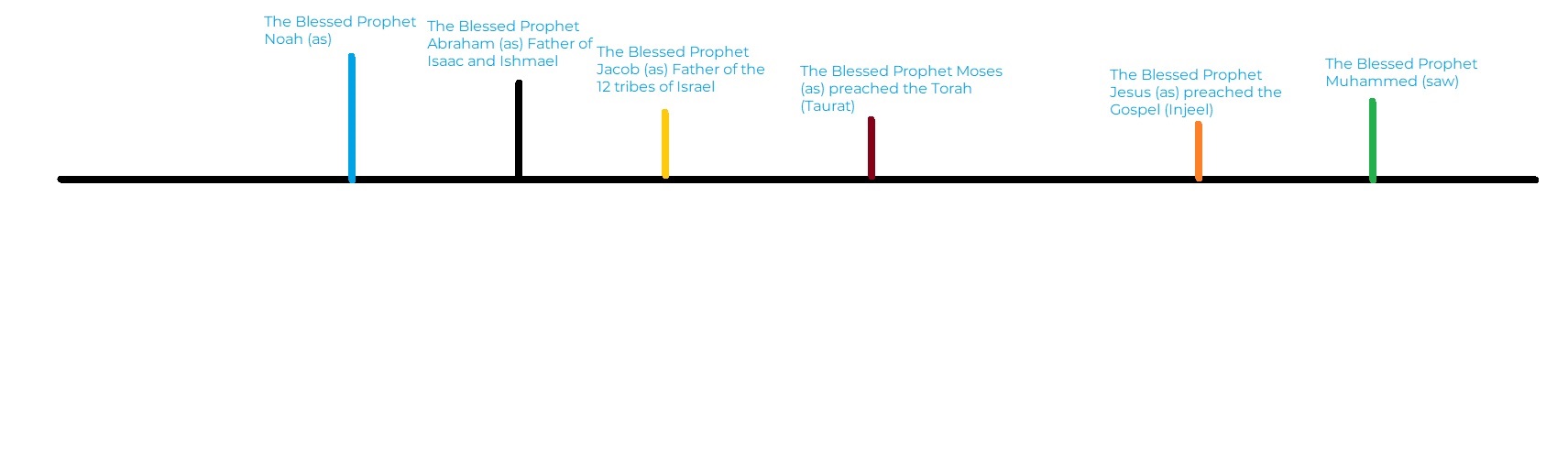
“Or do you say, “Abraham, Ishmael, Isaac and Jacob, and the Tribes — they were Jews, or they were Christians”?’ Say: ‘Have you then greater knowledge, or Allah? And who does greater evil than he who conceals a testimony received from Allah? And Allah is not heedless of the things you do.” (Qur’an 2:140)
﷽
“Then set your face towards the way of life (lilddini), inclining towards truth (hanifan). The nature (fit’rata) made by Allah in which He has made men; there is no altering of Allah’s creation; that is the right way of life (l-dinu), but most people do not know.” (Qur’an 30:30)
“They say, “Be Jews or Christians [so] you will be guided.” Say, “Rather, the creed (millata) of Abraham, inclining toward truth(hanifan), and he was not of the polytheists.” (Qur’an 2:135)
“Abraham was neither a Jew nor a Christian, but he was one inclining toward truth (hanifan), a Muslim(mus’liman) . And he was not of the polytheists.” (Qur’an 3:67)
“Indeed, the way of life (l-dina) in the sight of Allah is Islam(l-is-lamu). And those who were given the Scripture did not differ except after knowledge had come to them – out of jealous animosity between themselves. And whoever disbelieves in the verses of Allah , then indeed, Allah is swift in [taking] account.” (Qur’an 3:19)
“Whoever desires something other than Islam (l-is’lami) as a way of life (dinan) – never will it be accepted from him, and he, in the Hereafter, will be among the losers.” (Qur’an 3:85)
In this article we will see that Islam is the religion that was before Christianity or Judaism. That it is the deen al hanifan (the way of life that is upright).
When we say that Islam existed before Judaism or Christianity, we are in no way suggesting that there were people who believed in the Qur’an or the Prophet Muhammed (saw). Such a suggestion would be absolutely incredulous.
What we are saying is that if you look at what Islam means. The word itself, then yes then it is clear this has existed prior to the rise of Christianity or Judaism.
Let us start by looking at words and terminologies first.
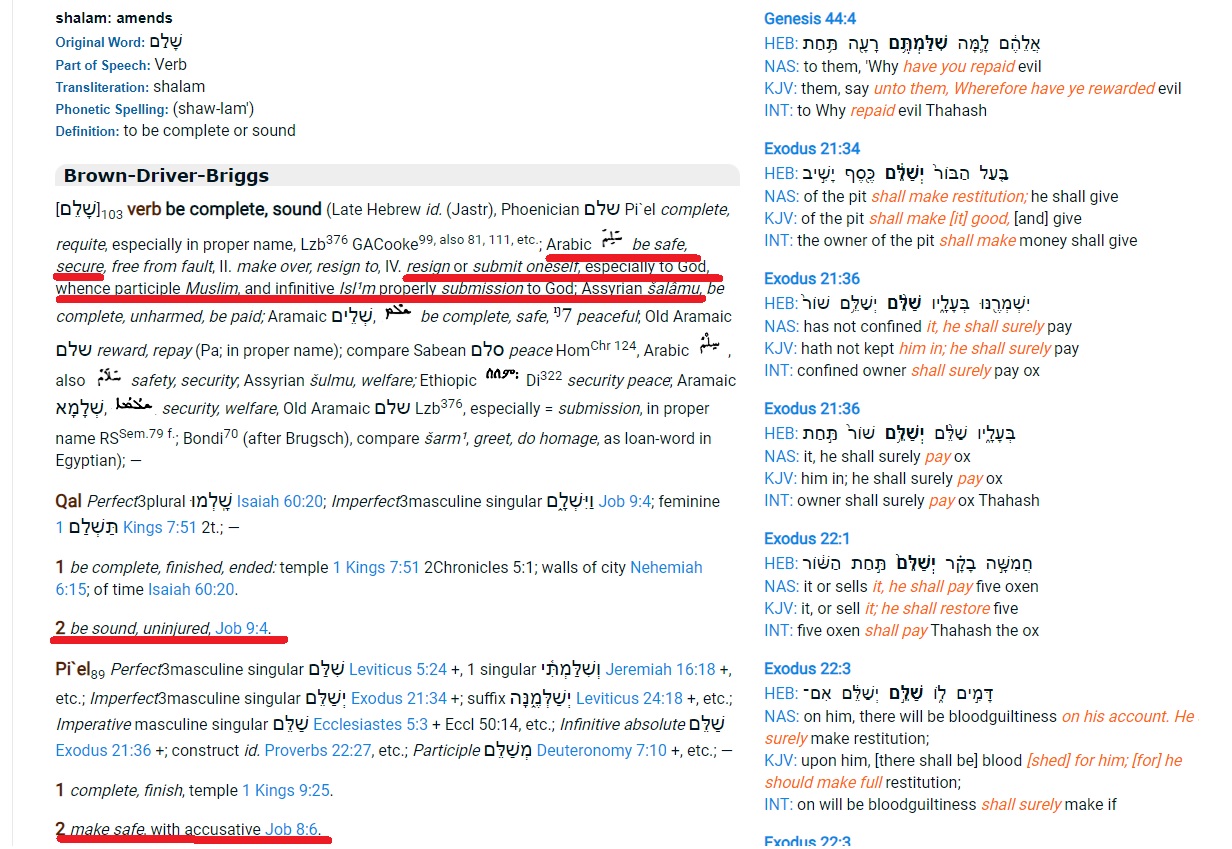
The word Islam means: Surrender, Submission, Safety, Tranquility, Peace.
The word Muslim means: One who gains safety, peace and tranquility through surrender and submission of one’s own will to the will of Allah.
The origin of the word Christian.
Christian — a generic definition is one who professes the teachings of Christ and/or one who is a member of a Christian church. However, a better definition of Christian in the English (one loaded with theological language) would be one who, after being christened (rather than through sprinkling of water or full water immersion), then seeks to become Christ-like in their walk with God.
In Greek it would be Χριστιανός (Christianós)and this comes from the same etymological root as Χριστός or Christos, meaning anointed.
In the Bible, Jesus never called himself a Christian and neither did any of his disciples. Not once
It is a simple matter of picking up any Bible and seeing for yourself if this is the case. Rather, the first appearance of the word is in the Book of Acts.
“And when he found him, he brought him to Antioch. So for a whole year Barnabas and Saul met with the church and taught great numbers of people. The disciples were called Christians first at Antioch.” (Acts 11:26)
Then Agrippa said to Paul, “Do you think that in such a short time you can persuade me to be a Christian?” Paul replied, “Short time or long—I pray to God that not only you but all who are listening to me today may become what I am, except for these chains.” (Acts 26:28-29)
“However, if you suffer as a Christian, do not be ashamed, but praise God that you bear that name.” (1 Peter 4:16)
So the first point is that the word “Christian” cannot be substantiated by the lips of Jesus (as) from the New Testament text at all. Agrippa simply stated that Paul wished him to join his movement that bears the name ‘Christian’. Also, Peter seems to encourage his audience to not be ashamed of this appellation “Christian” that is being given to them.
What we do find is references to the way, or in Arabic sabeel (the way, the path).
Followers of Jesus (as) were associated with terminology often referred to as ‘THE WAY’.
“And [Paul] asked for letters from him [the high priest] to the synagogues at Damascus, so that if he found any belonging to the Way, both men and women, he might bring them bound to Jerusalem.” (Acts 9:2)
“But when some were becoming hardened and disobedient, speaking evil of the Way before the people, [Paul] withdrew from them and took away the disciples, reasoning daily in the school of Tyrannus.” (Acts 19:9)
“About that time there occurred no small disturbance concerning the Way.” (Acts 19:23)
“I [Paul] persecuted this Way to the death, binding and putting both men and women into prisons.” (Acts 22:4)
“But this I [Paul] admit to you, that according to the Way which they call a sect I do serve the God of our fathers, believing everything that is in accordance with the Law and that is written in the Prophets.”(Acts 24:14)
“But Felix, having a more exact knowledge about the Way, put them off, saying, ‘When Lysias the commander comes down, I will decide your case.’” (Acts 24:22)
“A voice of one calling in the wilderness:/Prepare the way for the Lord. Make Straight the paths of our God. (Isaiah 40:3)
In the Qur’an we have:
“Surely those who have believed, emigrated, and struggled in the Way of Allah—they can hope for Allah’s mercy. And Allah is All-Forgiving, Most Merciful.” (Qur’an 2:218)
“And do not say about those who are killed in the way of Allah , “They are dead.” Rather, they are alive, but you perceive [it] not.” (Qur’an 2:154)
“Alms are only for the poor and the needy, and the officials (appointed) over them, and those whose hearts are made to incline (to truth) and the (ransoming of) captives and those in debts and in the way of Allah and the wayfarer; an ordinance from Allah; and Allah is knowing, Wise.” (Qur’an 9:60)
Does the Qur’an call the followers of Jesus Al-Nasara?
Let us look at the word ‘Al Nasara’ which is often translated as “Christians” in English translations of the Qur’an.
The Jews say “Christians (l-nasara) have nothing [true] to stand on,” and the Christians (l-nasara) say, “The Jews have nothing to stand on,” although they [both] recite the book. Thus the polytheists speak the same as their words. But Allah will judge between them on the Day of Resurrection concerning that over which they used to differ.” (Qur’an 2:113)
The Qur’an is not saying anything about whom these Nasara are here other than they are a group who see themselves distinct from the group that are called “Jews.”
The other point is that both of these groups are referencing literature that is common and authoritative to both groups. The Qur’an is not saying that this literature is authoritative or correct but merely that these two groups are referencing the same sources and coming away with radically different takes that put them at odds with one another.
“And with those who say, We are Christians (nasara), We made a covenant, but they neglected a portion of what they were reminded of, therefore We excited among them enmity and hatred until the day of resurrection; and Allah will inform them of what they did.” (Qur’an 5:14)
The above verse acknowledges that there are whole factions under the umbrella terminology ‘Nasara’ . That these factions clash with one another. Therefore, it is foolhardy to think that the term ‘Nasara’ is a blanket term to refer to all those who call themselves Christians. It can refer to those who were faithful before the breaking of the covenant as well as those who came after.
This verse is also a strong rejection of the belief held by many Muslims that Jesus (as) comes back and unites Christians under the banner of Islam. Allah (swt) says differently that they would continue to be in opposition to one another until the day of judgment itself.
For example, in the above verse (Qur’an 2:113) it references a group of these ‘Nasara’ that share an authoritative source similar to that of Jews.
Whereas in the following verse, Qur’an 9:30 it could very well refer to another group of ‘Nasara’ who would not accept a common authoritative religious source with Jews.
“The Jews say, “Ezra is the son of Allah “; and the Christians (l-nasara) say, “The Messiah is the son of Allah.” That is their statement from their mouths; they imitate the saying of those who disbelieved [before them]. May Allah destroy them; how are they deluded?” (Qur’an 9:30)
One of the beliefs of at least one faction under the appellation (l-nasara) is that they believe that the Messiah is the son of Allah.
“But the Jews and the Christians (wal-nasara) say, “We are the children of Allah and His beloved.” Say, “Then why does He punish you for your sins?” Rather, you are human beings from among those He has created. He forgives whom He wills, and He punishes whom He wills. And to Allah belongs the dominion of the heavens and the earth and whatever is between them, and to Him is the [final] destination.” (Qur’an 5:18)
Allah (swt) acknowledges that both the Jews and the Nasara make claims of being the children of Allah. The appellation of ‘children of Allah’ implies some time of special or favoured status with Allah (swt) which meets swift rebuke.
“Strongest among men in enmity to the believers will you find the Jews and All Polytheist; and nearest among them in love to the believers will you find those who say, “We are Christians (nasara)“: because amongst these are men devoted to learning and men who have renounced the world, and they are not arrogant.” (Qur’an 5:82)
This verse says that, in general, the Jews and all Polytheists will have the strongest hate towards Muslims. The verse also acknowledges that at least some under the blanket umbrella term ‘nasara’ would we find those who are near to the Muslims in love.
Now recall our definition of Islam & Muslim
The word Islam means: Surrender, Submission, Safety, Tranquility, Peace.
The word Muslim means: One who gains safety, peace and tranquility through surrender and submission of one’s own will to the will of Allah.
Is there anything in the sources that Christians today hold sacred that would indicate that Jesus (as) was someone who submitted his will to Allah?
“Submit yourselves, then, to God. Resist the devil, and he will flee from you.” (James 4:7)
“The mind governed by the flesh is hostile to God; it does not submit to God’s law, nor can it do so.” (Romans 8:7)
Also, do note that the concept of gaining wholeness, safety through reliance on submission and surrender to Allah is not a concept unfamiliar with the Bible according to Christians themselves!
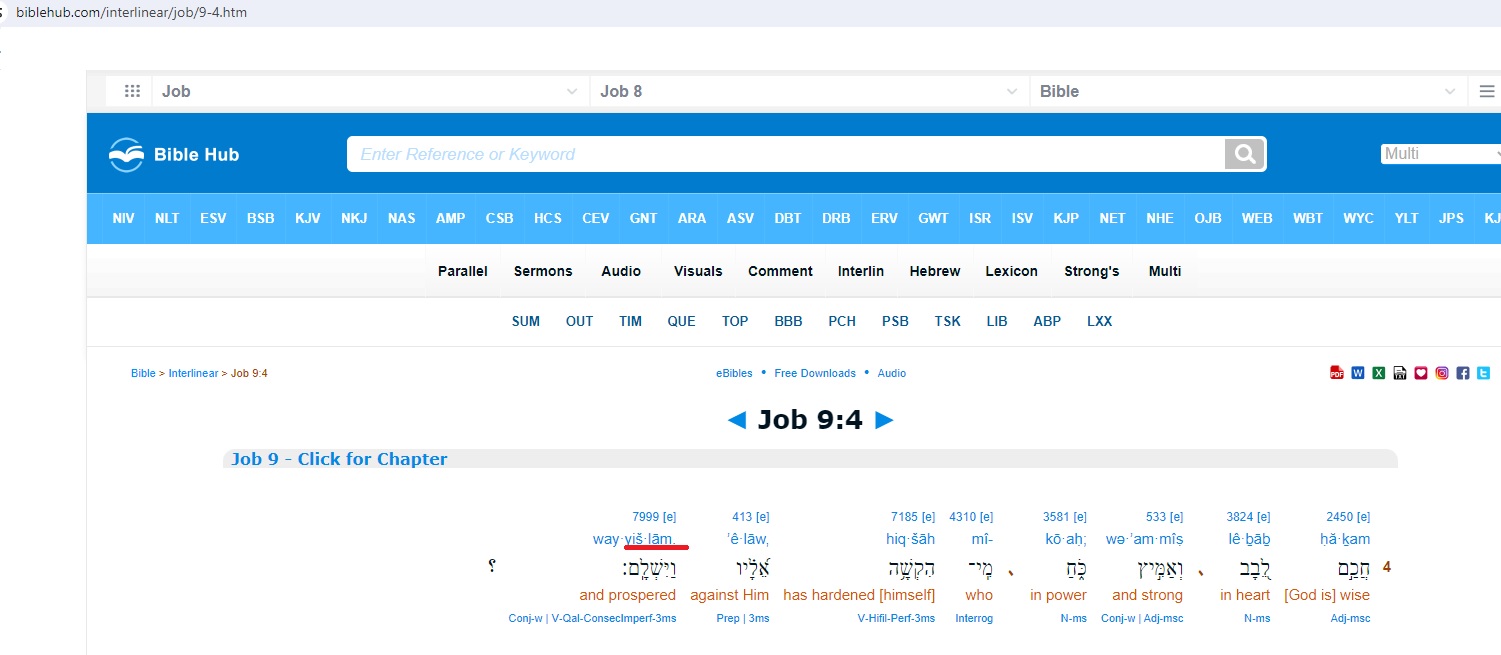
The word Muslim/Islam equivalent in the Bible itself.
“Submit to God, and be at peace with him; in this way prosperity will come to you. Listen to his instructions, and store them in your heart. If you return to the Almighty, you will be restored— so clean up your life. If you give up your lust for money and throw your precious gold into the river, the Almighty himself will be your treasure. He will be your precious silver.” (Job 22:21-25)
Origin of the word Jew or Judaism?
Unlike the word Christian, which, as we saw, was used thrice in the New Testament and never once by the lips of Jesus (as), the word Judaism is nowhere to be found in the TNCH.
TNCH is what Jews would call, the Law, the Writings and the Prophets. *Note* To be fair to the differences in the world of Judaism we want to mention that Karaite Judaism do not recognize as sacred script the Writings and the Prophets nor the oral torah.
However, the word Jew can be found in both the New Testament and the TNCH.
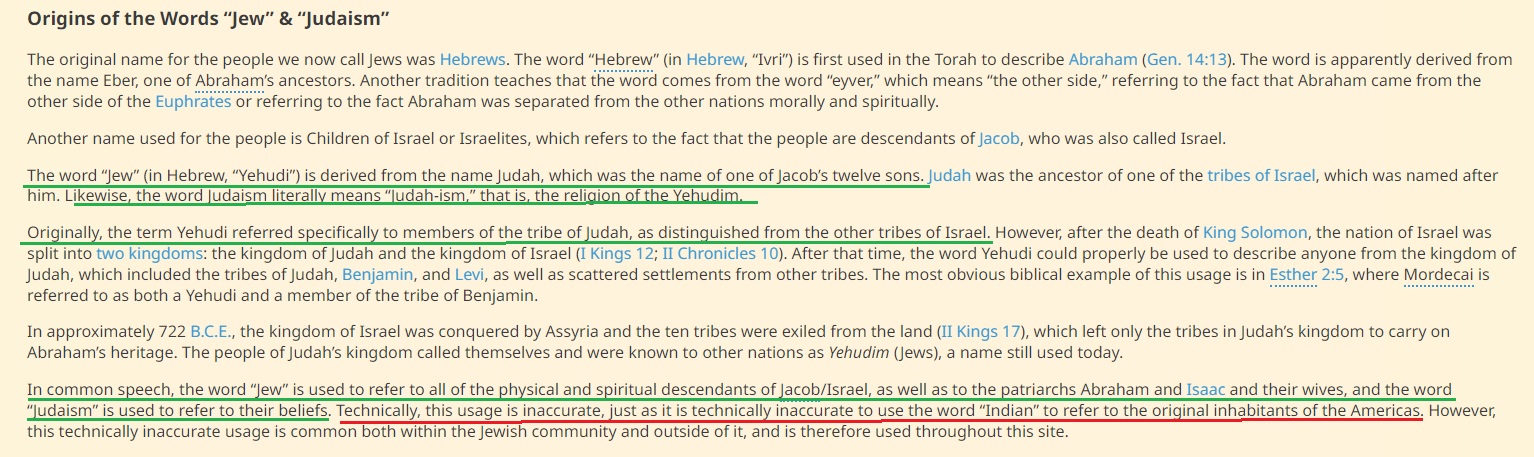
“The word “Jew” (in Hebrew, “Yehudi”) is derived from the name Judah, which was the name of one of Jacob’s twelve sons. Judah was the ancestor of one of the tribes of Israel, which was named after him. Likewise, the word Judaism literally means ‘Judah-ism.” that is, the religion of Yehudim.” -jewishvirtuallibrary.
“Originally, the term Yehudi referred specifically to members of the tribe of Judah, as distinguished from the other tribes of Israel. However, after the death of King Solomon, the nation of Israel was split into two kingdoms: the kingdom of Judah and the kingdom of Israel (I Kings 12; II Chronicles 10). After that time, the word Yehudi could properly be used to describe anyone from the kingdom of Judah, which included the tribes of Judah, Benjamin, and Levi, as well as scattered settlements from other tribes. The most obvious biblical example of this usage is in Esther 2:5, where Mordecai is referred to as both Yehudi and a member of the tribe of Benjamin.”–jewishvirtuallibrary.
“In approximately 722 B.C.E., the kingdom of Israel was conquered by Assyria and the ten tribes were exiled from the land (II Kings 17), which left only the tribes in Judah’s kingdom to carry on Abraham’s heritage. The people of Judah’s kingdom called themselves and were known to other nations as Yehudim (Jews), a name still used today.”–jewishvirtuallibrary.
“In common speech, the word “Jew” is used to refer to all the physical and spiritual descendants of Jacob/Israel, as well as to the patriarchs Abraham and Isaac and their wives, and the word “Judaism” is to refer to their beliefs. Technically, this usage is inaccurate, just as it is technically inaccurate to use the word “Indian’ to refer to the original inhabitants of the Americas. However, this technically inaccurate usage is common both within the Jewish community and outside of it, and is therefore used throughout this site.”–jewishvirtuallibrary.
Prima-Qur’an comments:
The first point is that the word Judaism as a religion mandated by Allah is not found in the TNCH/Christian Old Testament. Judah-ism is a named after a particular tribe and what they believed and practiced. The key sacred text of Judaism is the Torah, which was given to Moses on Mt. Sinai.
As mentioned above, the name “Jew” was derived from Judah, who was one of Jacob’s 12 sons. So that is only 1/12 of the children of Israel. As mentioned, the name “Jew” became interchangeable for all the other 12 tribes.
So, basically, “Jew” can be used by anyone of the descendants of Jacob rather if they are actually from the Jewish tribe or not. For example, in Ethiopia, there are a group of children of Israel who claim to come from the tribe of Dan.
The article above also mentions that the Jews had fought Israel. That sounds strange given today’s context. However, it also shows you that, from their own sources to be against Israel is not anti-Semitic.
How could being against Israel be anti-Semetic when the Jews themselves fought Israel? Are we going to call Judah and Benjamin anti-Semites because they were against Israel (the 10 northern tribes)?
We also learn that Abraham and Isaac are called Jews, but as the article says: “Technically, this usage is inaccurate.”
Abraham and Isaac could not be Jews as the technically correct term refers only to those who are descendants from the tribe of Judah. Abraham and Isaac (peace be upon them both) came way before those tribes. Also, Abraham and Isaac could not follow a religion called Judaism.
Allah was with Abraham before Judaism or Christianity. Allah gives a very powerful rhetorical question for the Jews and Christians and truth seekers to reflect upon.
“O People of the Book! Why do you argue about Abraham, while the Torah and the Gospel were not revealed until long after him? Do you not use reason?” (Qur’an 3:65)
In other words, let’s think about this with reason and logic. It is obvious that Abraham was not a Christian as he was not a follower of Christ. He was not bound by the teachings of the Gospel. Christ came long after Abraham. Abraham could not be a Christian.
Abraham was not a Jew or a follower of Judaism because the term Jew comes from the tribe of Judah (which was long after Abraham) and Judaism has as its foundational source of guidance the Torah. He was not bound by the teachings of the Torah. Moses came long after Abraham.
You do not even have to be religious to acknowledge the above point. You could be an agnostic or an atheist and see that the point is logical. Especially when we recall definitionally what it means to be Muslim.
“Or do you say, “Abraham, Ishmael, Isaac and Jacob, and the Tribes — they were Jews, or they were Christians”?’ Say: ‘Have you then greater knowledge, or Allah? And who does greater evil than he who conceals a testimony received from Allah? And Allah is not heedless of the things you do.” (Qur’an 2:140)
Now recall our definition of Islam & Muslim
The word Islam means: Surrender, Submission, Safety, Tranquility, Peace.
The word Muslim means: One who gains safety, peace and tranquility through surrender and submission of one’s own will to the will of Allah.
Is there anything in the sources that Jews today hold sacred that would indicate that Abraham (as) was someone who submitted his will to Allah?
Yes! He was willing to sacrifice his son, which Allah (swt) did not allow. It was a test of his willingness to surrender and submit his will to the will of Allah.
The message of Allah (swt) in the Qur’an is that the way of life before Allah (swt) is one. It is Islam.
Allah (swt) is not the tribal deity of Israel. This is full on refuted by the Creator himself, where He says, “All praise is for Allah—Lord of all worlds.” (Qur’an 1:2)
Allah (swt) never sanctioned or gave humanity a religion called Judaism. Then suddenly, some centuries later, He gave humanity another religion called Christianity. Allah (swt) has given us one way of life for all humanity from the get-go. The way of life (din) of Islam.
“Indeed, the religion (l-dina) in the sight of Allah is Islam(l-is-lamu). And those who were given the Scripture did not differ except after knowledge had come to them – out of jealous animosity between themselves. And whoever disbelieves in the verses of Allah , then indeed, Allah is swift in [taking] account.” (Qur’an 3:19)
Before there was a Christ or Moses, there was Allah. There was God Almighty having a relationship with humanity. Before there was a Gospel or a Torah, there was guidance.
Christian—named after a person (Christ)
Judaism—named after a tribe. (Judah)
Islam is not named after a person, place or thing.
A Muslim is both a noun (a descriptor) and a verb (connotates a way of being).
Islam is the universal right of all of humanity. We are not called Muhammedans. We are not called Qureshi’s. We are Muslims! Al hamdulillah!
“And strive for Allah with the striving due to Him. He has chosen you and has not placed upon you in the religion (l-dini) any difficulty. The creed (millata) of your father, Abraham. Allah named you “Muslims”(l-mus’limina) before and in this that the Messenger may be a witness over you and you may be witnesses over the people. So establish prayer and give zakah and hold fast to Allah. He is your protector; and excellent is the protector, and excellent is the helper.” (Qur’an 22:78)
May Allah (swt) open the hearts and may Allah (swt) guide us all to what is beloved to Him!
“O humanity! Eat from what is lawful and good on the earth and do not follow Satan’s footsteps. He is truly your sworn enemy. He only incites you to commit evil and indecency, and to claim against Allah what you do not know.” (Qur’an 2:168-169)
﷽
According to Islamic teachings does Allah have attributes such as teeth, biceps, 66 thumbs, 17 hooves, a tail, gills, or fur?
First, let it be clear that we are not aware of any sects among Muslims today who does affirm such things for Allah (swt).
However, we need to understand something.
If someone asks usdoes Allah have attributes such as teeth, biceps, 66 thumbs, 17 hooves, a tail, gills, or fur we can answer absolutley not. We can negate these for Allah (swt). This is because of our holistic approach to the Qur’an and the Sunnah.
We have dealt with that in the following articles:
However, there is another vocal group among the Muslims who would not be able to deny that Allah (swt) has attributes such as teeth, biceps, 66 thumbs, 17 hooves, a tail, gills, or fur.
The best they can do is to say: We have no revealed texts in regard to these attributes. We can neither affirm nor deny.
They could quote the following:
“Although they have no knowledge of this. They follow nothing but assumptions. And surely assumptions can in no way replace the truth.” (Qur’an 53:28)
The text is warning us not to speculate about that which we have no certain knowledge of. Howver, according to the appraoch of these Muslims the above text does not negate those possible attributes for Allah (swt).
Likewise, we may outright reject the idea of Allah (swt) having attributes such as teeth, biceps, 66 thumbs, 17 hooves, a tail, gills, or fur by quoting the following:
“To those who disbelieve in the Hereafter belong all evil qualities, whereas to Allah belong the finest attributes. And He is the Almighty, All-Wise.” (Qur’an 16:60)
But to those who interpret otherwise, they would claim that there is nothing inherently evil to Allah (swt) having teeth, biceps, 66 thumbs, 17 hooves, a tail, gills, or fur.
Other examples:
Say: “Take on Allah’s colour.” And whose colour is better than Allah’s? It is Him that we serve.” (Qur’an 2:138)
The Arabic Term: The word used is Sibghah (صِبْغَةَ), which literally means dye, tint, or color.
The Meaning of “Colour of Allah”: It refers to the true faith of Islam that permeates a person’s inner and outer life, just as dye changes the color of a cloth entirely. It represents purity, sincerity, and the adoption of divine characteristics in behavior and worship.
However, some Muslims may understand from the above verse that Allah (swt) has a colour! Though accordingly, Allah (swt) has not revealed what colour he is it leaves some to wonder rather Allah (swt) is white (in a way that befits his majesty) or rather Allah (swt) is black (in a way that befits his majesty).
Those Muslims do not seem to understand or appreciate that the Qur’an and Sunnah has Majaz.
Majaz (مجاز) in Arabic has a few related meanings depending on the context, but the most common and important one — especially in language, literature, and Islamic studies — is figurative language or metaphor/trope.
“Such as took their religion to be mere amusement and play, and were deceived by the life of the world.” That day shall We forget them as (كَمَا) they forgot the meeting of this day of theirs, and as they were wont to reject Our signs.” (Qur’an 7:51)
The Arabic word كَمَا (transliterated as kamā or kama) is a very common conjunction and particle. Its primary meaning is “as”, “like”, or “just as” (indicating similarity, manner, or comparison).
We know that it is a huge error to say that Allah (swt) forgot anything.
“He replied, “That knowledge is with my Lord in a Record. My Lord neither falters nor forgets.” (Qur’an 20:52)
Another way to translate Qur’an 7:51 would be:
“Those who took this faith as mere amusement and play and were deluded by worldly life.” “Today We will ignore them just as they ignored the coming of this Day of theirs and for rejecting Our revelations.” (Qur’an 7:51)
You can see multiple translations of the above verse here:
While Allah (swt) does not forget anyone, He may leave those who are arrogant and refuse to repent, or those who commit sins against others without seeking forgiveness, to face the consequences of their actions. This can be interpreted as a form of divine abandonment.
This is why translating as ignoring makes more sense in light of the other verses of the Qur’an that clearly state that Allah (swt) is All Knowing.
It also make sense in regard to human beings. No human being really forgets that they will die or ultimately meet their fate. However, they put this issues off. Proof of this is how many people who believe in the afterlife have not even made a will?
There is Majaz in the hadith as well.
Narrated Abu Huraira:
Allah’s Messenger (saw) said, “Allah said, ‘I will declare war against him who shows hostility to a pious worshipper of Mine. And the most beloved things with which My slave comes nearer to Me, is what I have enjoined upon him; and My slave keeps on coming closer to Me through performing Nawafil (praying or doing extra deeds besides what is obligatory) till I love him, so I become his sense of hearing with which he hears, and his sense of sight with which he sees, and his hand with which he grips, and his leg with which he walks; and if he asks Me, I will give him, and if he asks My protection (Refuge), I will protect him; (i.e. give him My Refuge) and I do not hesitate to do anything as I hesitate to take the soul of the believer, for he hates death, and I hate to disappoint him.”
So to say that Allah (swt) becomes something means he was not that before. This means that Allah (swt) changes based upon a believer’s particular state at any given moment.
The outward reading of the hadith leads to unacceptable positions such as: incarnation (hulul) or union (ittihad).
“Say “Each is waiting, so keep waiting! You will soon know who is on the Straight Path and is guided.” (Qur’an 20:135)
“They regard their acceptance of Islam as a favour to you. Tell ˹them, O Prophet˺, “Do not regard your Islam as a favour to me. Rather, it is Allah Who has done you a favour by guiding you to the faith, if ˹indeed˺ you are faithful.” (Qur’an 49:17)
﷽
But if you wanna leave, take good care Hope you have a lot of nice things to wear But then a lot of nice things turn bad out there
Such are the lyrics of brother Yusuf Islam. Formely Cat Stevens, in his song, Willd World.
We recall when a brother said to man who proclaimed: “I have left Islam.” The brother said to him: “You did not leave Islam, rather Islam left you.” Subhan’Allah.
May Allah cause us to die as Muslims. May Allah grant us a good death.
“O believers! Be mindful of Allah in the way He deserves, and do not die except in submission.” (Qur’an 3:102)
There are many reasons why people choose to leave any faith.
It could come from reasons we could have empathy for.
A) Having overbearing parents. It could be from lack of support from the community (in the case of converts to Islam, or that isolated wife who is being abused). Perhaps the person had genuine doubts about questions and did not find competent or compelling answers to the doubts or questions that vexed him/her.
It could even be that there are those who were born and raised as Muslims and, because they did not get to taste the darkness, they never got an appreciation for the light.
For them insh’Allah they will make their way back to Islam.
It could come for reasons that we would have little empathy for.
B) It could also be that they are resolved not to submit to Allah. That their needs and desires come first before Allah’s decree.
For them if they cannot overcome being slaves to their desires how will they be slaves to Allah?
“Have you seenthe one who has taken their own desires as their god? Will you then be a keeper over them?” (Qur’an 25:43)
Abu Hurairah (May Allah be pleased with him) reported:
I heard Messenger of Allah (saw) saying, “People are like gold and silver; those who were best in Jahiliyyah (Pre-Islamic Period of Ignorance) are best in Islam, if they have religious understanding; and the souls are like recruited soldiers, they get mixed up with those similar with them in qualities and oppose and drift away from those who do not share their qualities”.
Individuals who held high qualities such as honesty, generosity, courage, and leadership during Jahiliyyah are able to redirect these same positive traits toward the service of Islam.
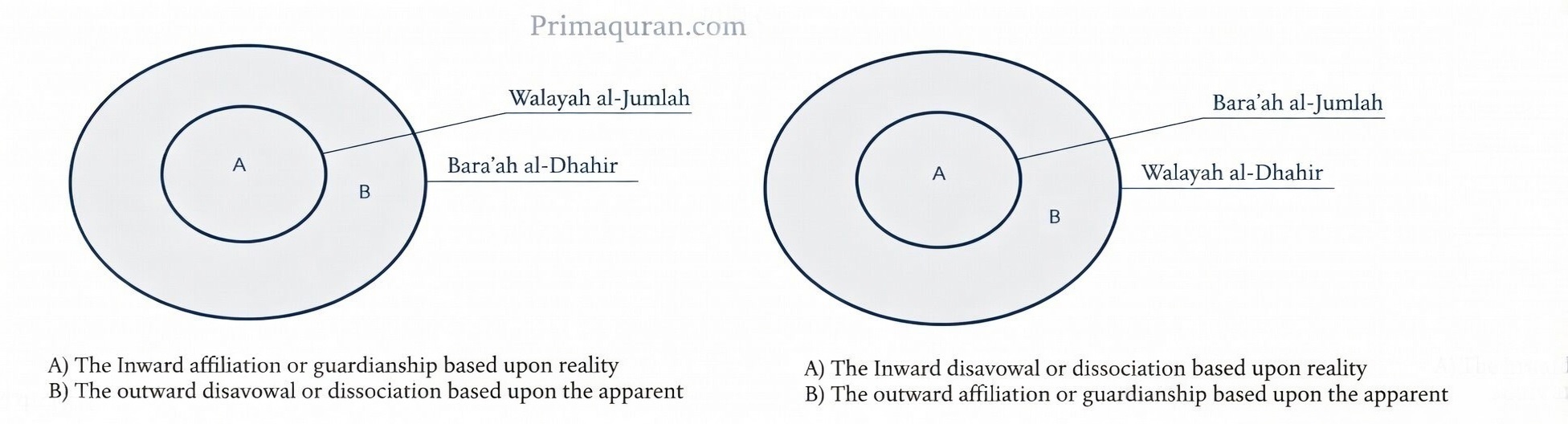
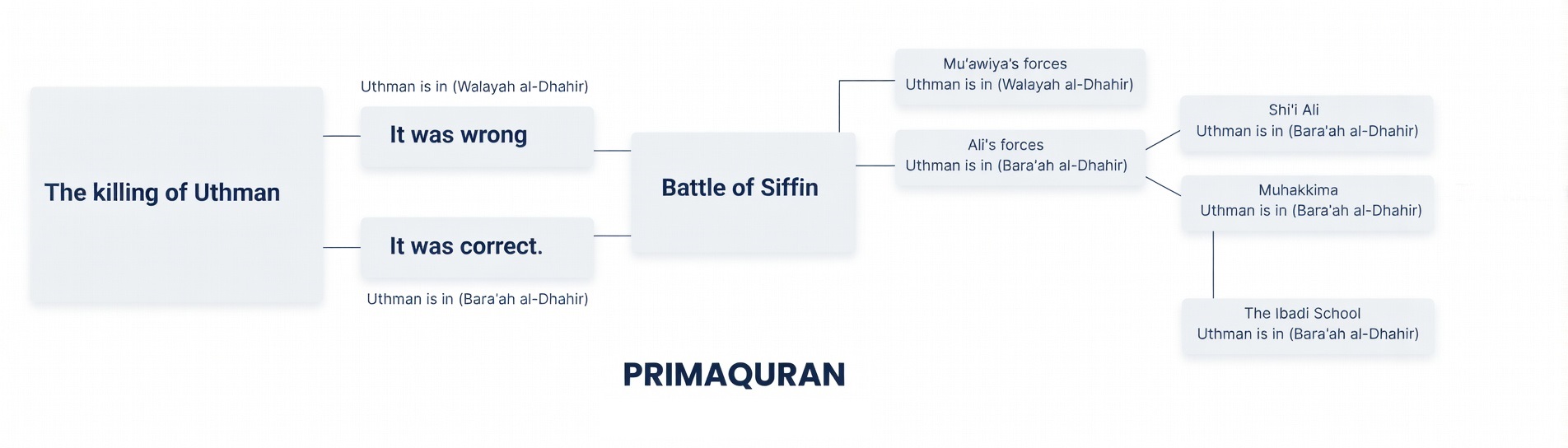
However, one thing that should not cause us to lose faith is when we find out that someone respected in our community left faith and/or they were involved in heinous things. The reason why we feel this affects people is because they were never taught about walayah and bara’ah, their levels and what it actually means.
Dissociation or guardianship is always based upon the outward. Even between husband and wife, seemingly best friends, seemingly worst enemies. Those you shun etc. Whereas the inward reality overrides and superceds the outward.
This is often why works of art, poetry are so precious. It is an outward manifestation of an inward secret. When someone writes poetry or creates art they let the world see what otherwise they would not have known.
When a person expresses a doubt they are expressing an inward turmoil. When we see this person who is admired by the community suddenly take a turn for the worst this should not cause turmoil with in us as well. Especially if you are properly taught about Walayah, Bara’ah.
Examples:
Why is the walayah between a husband and wife only dhahir? Dhahir here meaning the outward or the apparent. You would think a relationship like marriage would be based upon the haqiqah, or upon truth and reality. However, it is not.
However, husband and wives can betray each other. They can cheat on one another. They can lie or deceive or do great harm to each other. Some people are also part of arranged marriages where they have to put on a show of contentment.
So in all our dealings with people is always going to be based upon the dhahir (the outward, the apparent).
So looking at the chart above. You could put someone in bara’ah by their outward actions or beliefs. Even hate that person.
However, you could simultaneously love that person based upon their reality. You wouldn’t know it because that will ultimately be revealed by Allah. However, because of your declaration of walayah al-Jumlah you would love them.
So looking at the chart above. You could put someone in wilayah by their outward actions or beliefs. Even love that person.
However, you could simultaneously hate that person based upon their reality. You would’t know it becauseu that will ultimately be revealed by Allah. However, because your declaration of walayah al-bara’ah you would hate them.
We also make du’a that we are among the sincere and the truthful. We make du’a that those who lost thier way make their way back.
What is very intersting and why we absolutely have fallen in love with Allah’s deen is that Allah (swt) himself declares that those who leave Islam is ultimately a win for Islam!
“O believers! Whoever among you abandons their faith, Allah will replace them with others who love Him and are loved by Him. They will be humble with the believers but firm towards the disbelievers, struggling in the Way of Allah; fearing no blame from anyone. This is the favour of Allah. He grants it to whoever He wills. And Allah is All-Bountiful, All-Knowing.” (Qur’an 5:54)
Did you read that dear believers?
Allah (swt) not only replaces those who abandon faith with believers, Allah (swt) declares that many of these new believers are in walayah with Allah! Subhan’Allah. They are wali of Allah.
The other point to take rejoice in is the fact that the verse affirms that there will never be on this Earth except that it will have believers, those who love Allah and are loved by him! Subhan’Allah.
“Here you are—those invited to spend in the cause of Allah—but among you are those who withhold [out of greed]. And whoever withholds only withholds [benefit] from himself; and Allah is the Free of need, while you are the needy. And if you turn away, He will replace you with another people; then they will not be the likes of you,” (Qu’ran, 47:38).
“Did they then feel secure against the plan of Allah? None feels secure from the plan of Allah except the people who are the losers.” (Qur’an 7:99).
The people of knowledge have said that a servant should remain in state between fear of Allah and hope (in His mercy)―and that he does not allow himself to be overcome by feeling secure from the plan of Allah.
Likewise, he does not despair of the mercy of Allah―so the servant should always be in between fear and hope. To exaggerate in either fear or hope leads to destruction, whereas Istiqāmah (steadfastness) is to be in between the two.
The Messenger believes in what has been revealed to him from his Lord, and so do the believers. They believe in Allah, His angels, His Books, and His messengers. “We make no distinction between any of His messengers.” And they say, “We hear and obey. Your forgiveness, our Lord! And to You is the final return.” Allah does not require of any soul more than what it can afford. All good will be for its own benefit, and all evil will be to its own loss. “Our Lord! Do not punish us if we forget or make a mistake. Our Lord! Do not place a burden on us like the one you placed on those before us. Our Lord! Do not burden us with what we cannot bear. Pardon us, forgive us, and have mercy on us. You are our Guardian. So grant us victory over the disbelieving people.” (Qur’an 2:285-286)
“We have sent you only as a mercy for the whole world.” (Qur’an 21:107)
﷽
Face to Face with the Blessed Prophet (saw): How Oman Preserved Pure Islam Through Unbroken Transmission.
This will be a translation of the talk given by Shaykh Hilal Al Barwani (h) below:
The school of reciters: A starting point in Omani History -Shaykh Hilal Al Barwani (h).
Allah-Willing this lecture will establish a few key points.
The Islam of Oman was not a late or secondary arrival. It was taken directly, face-to-face, from the Prophet Muhammed (saw) through multiple delegations (wufud), and preserved through an unbroken, mutawatir (mass-transmitted) chain of transmission. Due to Oman’s geographical remoteness, this Islam remained pure, uncorrupted by foreign influences (Persian, Roman, Greek, Indian).
The Delegations (Wufud): The Shaykh lists at least 12 delegations from Oman to the Prophet (saw), including:
Mazin bin Ghadhub Al-Ta’i (three separate visits: pre-Hijra, 3 AH, 7 AH). The Prophet (saw) famously prayed for Oman: “O Allah, guide them and reward them… grant them chastity, sufficiency, and contentment… do not empower an outsider enemy against them.”
Delegations from Bani Nabhan, Bani Tahiyeh (including Ka’b bin Bursha’, who recognized the Prophet’s description in the Torah and Gospel), Bani Al-Haddan, Bani Thamalah, Bani Al-Farahid, Al-Atiq, Abdul Qais, Bani Rasib (Abdullah bin Wahb Al-Rasibi), and even a delegation of Omani women who met Aisha (ra).
Early Mosques and Qiblas: The existence of mosques in Oman oriented toward two qiblas (first Jerusalem, then Mecca) proves that prayer was established before the Prophet’s migration to Medina.
The School of the Reciters (Qurra’): After the Blessed Prophet’s school at Dar Al-Arqam in Mecca, the “School of the Reciters” was established in Medina. These Qurra’ (who memorized Quran, knew Sunnah, and reasons for revelation) were the elite missionaries, judges, and army leaders. Their tragic martyrdom at Bi’r Ma’unah and later at Nahrawan (alongside Abdullah bin Wahb Al-Rasibi) is highlighted.
Imam Jabir bin Zaid (18-21 AH – c. 93-103 AH): The central figure in preserving Omani Islam. A Tabi’i (Follower), he met 70 Companions who fought at Badr, traveled 40 times for Hajj to collect narrations, and copied the Blessed Prophet’s letter on sadaqat from the sons of Amr bin Hazm. He founded the school of Ahl al-Haqq wal-Istiqamah (People of Truth and Righteousness). His students included Abu Bilal Mirdas, Abdullah bin Ibadh, and Salim bin Dhakwan.
Codification (Tadwin): The lecture argues that Imam Jabir bin Zaid was the first to codify the Blessed Prophetic Sunnah, before any other school. This codification passed through Abu Ubaidah Muslim bin Abi Karimah → Al-Rabi’ bin Habib → then to Oman (Mahbub Al-Rahil in Sohar, Abu Al-Mundhir in Nizwa, Abu Ali Al-Azri in Izki).
Al-Khalil bin Ahmad Al-Farahidi (d. 175 AH / 791 CE): An Omani scholar who founded Arabic prosody (‘arud), diacritical marks, grammar (nahw), and authored the first Arabic dictionary (Kitab Al-‘Ayn), all in service of the Quran.
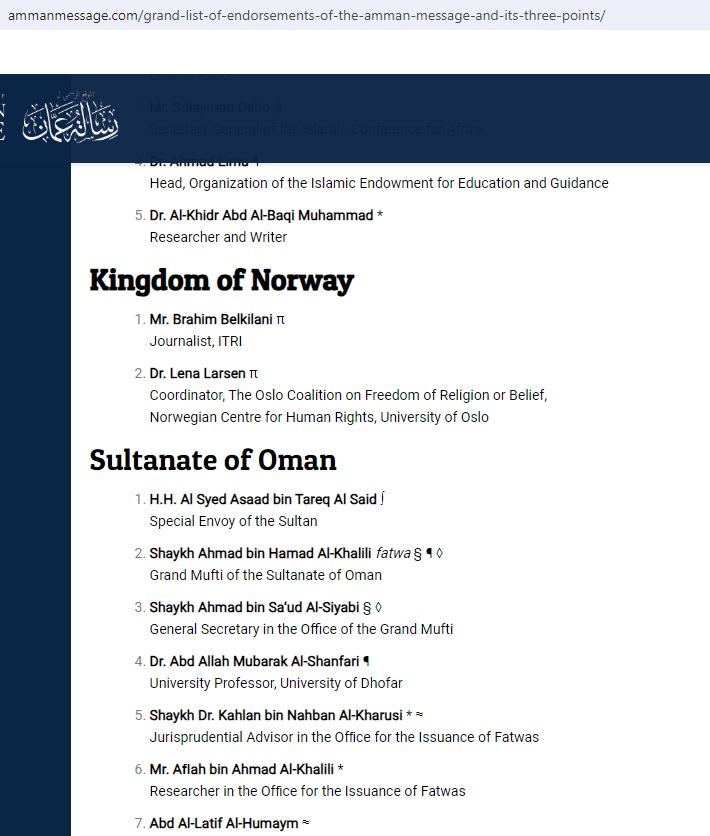
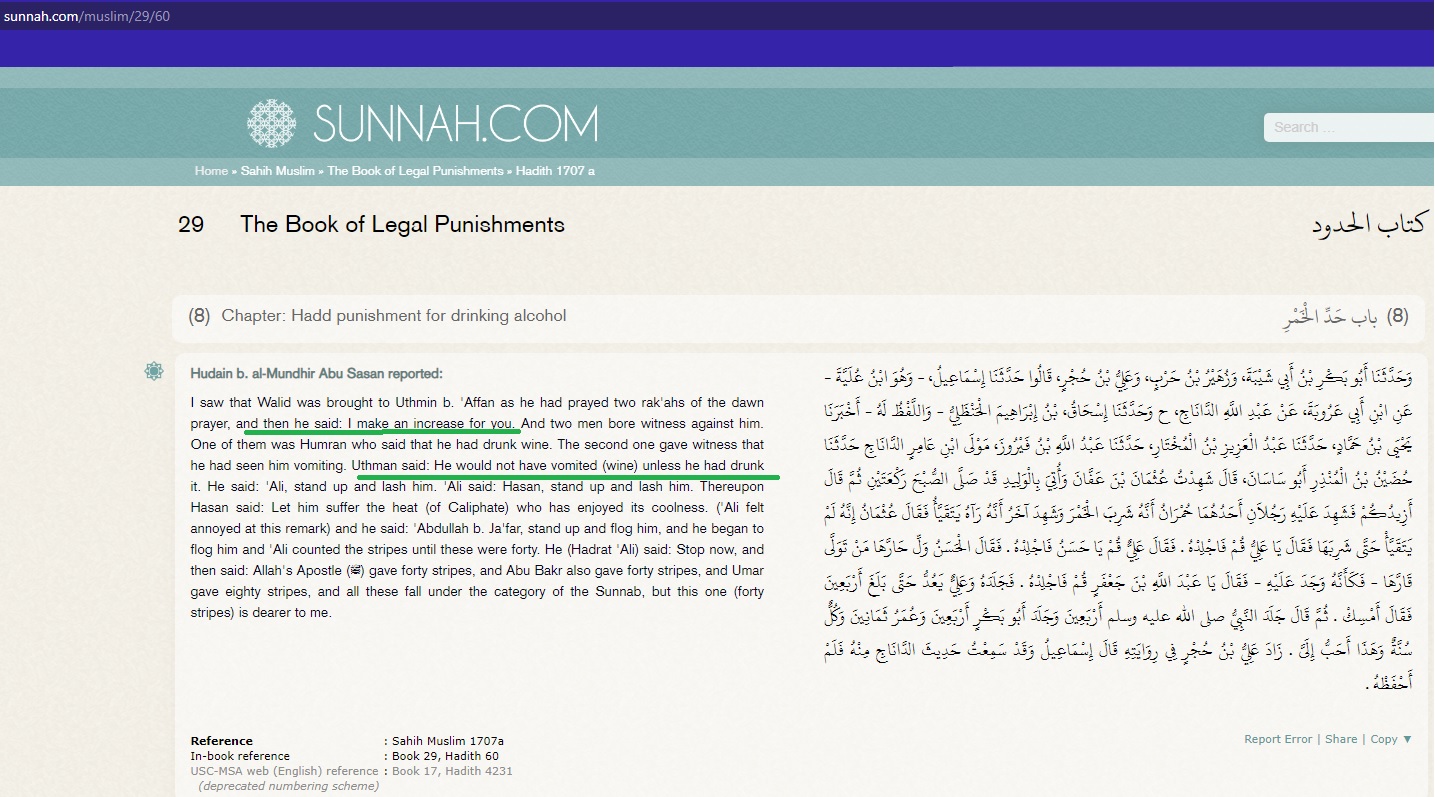
Reasons for Marginalization: Economic blockades, famine, migration to Africa, lack of enduring institutions (unlike Al-Azhar or Qayrawan), focus on tribal wars, and the burning of libraries by Abbasid forces (e.g., Ibn Bur). Over 12,000 Omani manuscript titles exist but lack publication and institutional support.
Lost Heritage: The repeated references to lost or unprinted manuscripts (Jami’ Abi Safrah, Musnad of Al-Rabi’, Diwan Al-Muarad, Jabir bin Zaid’s original books) point to a rich but endangered scholarly tradition.
Praise be to Allah, Lord of the worlds. We praise Him, the Exalted, seek His help, His guidance, and His forgiveness for all sins, and repent to Him. We send prayers and peace upon our Master Muhammed, and upon all his family and companions. Allah, the Glorified and Exalted, sent him as a mercy to the worlds. He delivered the message, fulfilled the trust, advised the nation, removed distress, and strove in the way of his Lord until certainty came to him. We ask Allah, the Glorified and Exalted, to make us among those who listen to the saying and follow the best of it. So, peace be upon you, and the mercy and blessings of Allah.
In this pleasant and blessed meeting, in a house among the houses of Allah, and in this gathering, we wish to present some of what concerns us from the history of our nation. That is the period during which the Messenger (saw) was sent, how it happened, and how our forefathers transmitted this Islam to us, and their relationship with the Messenger (saw). This is because historical references need someone to read and review them, and they need someone to study them. Also, much of what was written in the Omani biographical literature (Siyar) has not seen the light of day. Many of these Siyar still need verification, printing, and study.
Because people have not fully grasped this history, nor have they known it, if someone were to ask them: “How did Islam reach you? From whom did you take the religion? The Messenger (saw) was sent in Mecca and Medina, so how did you (in Oman) receive it? Who transmitted Islam to you from there to here?” In this phase, meaning in this context of historical understanding, we must know about the delegations that came from the people of Oman to the Messenger of Allah (saw).
And also the second point: the role of the scholars from the people of Oman in establishing the principles of Islam by establishing various schools, the codifications (mudawwanat) they wrote, the books they authored, and through which they preserved Islam. Islam remained with them in a strong context, untouched by alteration, substitution, or distortion. With Allah’s will, I will address two points.
The First Point: The delegations (Wufud) that came from the people of Oman to the Messenger of Allah (saw).
Of course, history mentions that a number of people from Oman came as delegations to the Messenger of Allah (saw). I will mention some of these delegations to make it clear to everyone that your fathers and forefathers took Islam through continuous transmission (mutawatir) from the Messenger of Allah (saw), generation after generation, group after group, so that it becomes firmly established in every person’s mind that the Islam our fathers and forefathers preserved was pure and correct, originating from the Messenger of Allah (saw).
These are the delegations that set out to the Messenger of Allah (saw) when they heard of his mission. As you know, only Mazin bin Ghadhub Al-Ta’i is studied in the school curricula, and his meeting with the Messenger (saw) is studied as if he was an individual who visited the Messenger (saw). However, in history books like the history of Ibn Kathir’s Al-Sirah Al-Nabawiyyah and books on the biographies of the Companions, it is mentioned that Mazin had three delegations.
It is mentioned in the book Subul Al-Huda wal-Rashad that a narration from Mazin bin Ghadhub says: “We arrived to the Messenger of Allah (saw) in Mecca Al-Mukarramah.” This narration indicates that Mazin met the Messenger (saw) in Mecca before his migration to Medina. He said: “We found Abu Bakr Al-Siddiq (RA), and he guided us to the Messenger of Allah (saw.” This indicates that there was a meeting between the people of Oman and the Messenger (saw). This view is supported by the fact that when Prophet Ibrahim (AS) built Mecca, he supplicated to his Lord: “My Lord, I have settled some of my descendants in an uncultivated valley near Your sacred House, our Lord, that they may establish prayer. So make hearts among the people incline toward them…” Thus, visitors to the Sacred House have come since the time of Prophet Ibrahim, so there were necessarily people from the tribes of Oman and the land of Oman who came to Mecca. This is evidence that they met the Messenger before his migration to Medina.
A second piece of evidence supporting this view is the existence of some mosques in Oman oriented towards the two Qiblas, such as one with us in Ibra, one mentioned in Nizwa, or some other mosques. This also indicates that they established prayer… What? Before the Messenger’s (saw) migration to Medina, and therefore they used to face Al-Aqsa Mosque.
The third piece of evidence is found in some graves indicating that, before Islam, they used to bury their dead facing Al-Aqsa Mosque, not facing the Qibla of the Kaaba. All these pieces of evidence support the view that the people of Oman met the Messenger (saw) in Mecca before his migration to Medina.
The second matter: After the migration, it is also narrated that Mazin came to the Messenger (saw). This is mentioned in the books of Companions’ biographies (those who met the Messenger). Mazin met the Messenger a second time in the third year of the Hijra. The books of Companions’ biographies detail this journey: he set out to the Messenger (saw). Of course, as you know, in that past time, it was not possible for a person to travel alone from these remote, distant areas to Medina due to the distance and the danger of the road. Therefore, they would travel in a caravan, a group, or a delegation. Also, as was the custom of the Arabs when meeting with rulers and princes, one would not go alone but rather in a delegation or a caravan with his group and family. So, they set out in a delegation.
It is also mentioned that among the delegation with Mazin bin Ghadhub in the sixth year was his student and servant, Abu Al-Kathir Salih bin Al-Mutawakkil. They arrived to the Messenger of Allah (saw) in Medina, stood before him, and recited verses found in history books and Companions’ biography books, saying: “To you, O Messenger of Allah, my mount wearily travels, crossing deserts from Oman to Al-Arj, so that you may intercede for me, O best of those who tread the earth, and my Lord forgives me, and I return with success.”
Out of love, honor, and reverence for the Messenger of Allah (saw), he recited the poem. It is narrated that the Messenger (saw asked him, “Who is this who is with you?” – referring to his young servant. He said, “This is my servant, Abu Al-Kathir Salih bin Mutawakkil.” The Messenger (saw) said, “Take good care of him,” so Mazin set him free in the presence of the Messenger (saw), out of love, reverence, and honor for the Messenger of Allah (saw).
As you know, when Mazin bin Ghadhub went out the first time he met him, and now the second time with those from Oman, what were they carrying? They were the nation (Ummah), wanting to save the nation from the ignorance (Jahiliyyah) they were upon. Mazin said to the Messenger (saw): “Supplicate to Allah for the people of Oman.” The Messenger (saw) said: “O Allah, guide them and reward them.” Mazin said, “More, O Messenger of Allah.” He said: “O Allah, grant them chastity, sufficiency, and contentment with what You have given them.” Mazin said, “More, O Messenger of Allah. The sea splashes next to us, so supplicate to Allah regarding our sea produce, our footwear (khuff), and our livestock (dhalf).” He (saw) said: “O Allah, increase the good from their sea for them, and bless them in their footwear and livestock.” Mazin said, “More, O Messenger of Allah.” The Messenger (saw) said: “O Allah, do not empower an outsider enemy against them. Say ‘Ameen,’ O Mazin.” So he said ‘Ameen,’ and then the supplication is answered.
Of course, after that, Mazin requested supplication for himself. The rest of the narration or story is known to you. In it, Mazin said upon returning to Oman, as mentioned in Ibn Kathir’s Al-Sirah Al-Nabawiyyah: “Then my people rebuked me, blamed me, and treated me harshly. They ordered their poet to satirize me. I said, ‘If I satirize them, I satirize myself.’ So I withdrew to one side, built a mosque, and stayed there…” The mosque upon his return in the sixth year after (meeting) the Messenger. He established the mosque and raised the call ‘Hayya ‘ala as-Salah’ (come to prayer) in it, and established the congregation. At that time, in Mecca, the Adhan had not been raised, nor was prayer established. So the Adhan was raised and prayer was established in Oman before Mecca, because Mecca was conquered in the eighth year of the Hijra, while Mazin established the mosque and raised the call to prayer there from the sixth year.
He says: “Then my people said… This mosque, no one in need would come and supplicate to Allah except that Allah answered him, nor would a sick person come and supplicate to Allah except that He cured him. He says: Then my people blamed themselves and came to me saying, ‘Yours is your religion, and you are the one in charge of our affairs, so return to us.’ So I returned to them.” Then he says: “Then Allah guided a people from Oman, and they entered Islam.” He says: “And in the following year, i.e., the seventh year of the Hijra, those whose souls yearned (for the Prophet) also came, accompanied by people from Oman, when he had told them about the Messenger’s (saw) conduct. They went to the Messenger of Allah (saw), and the Messenger (saw) gave them glad tidings, saying: ‘O pure one from the pure ones, O most generous from the most generous ones, Allah has guided a people from Oman, and they have entered Islam. Allah has made Oman prosperous and increased profits and abundant goodness from the land and sea.’ The Messenger (saw) said: ‘My religion is the religion of Islam, and Allah will increase the people of Oman in Islam. So blessed (Tuba) is he who believes in me and sees me, and blessed is he who believes in me but does not see me, and blessed, and then blessed is he who believes in me but does not see me, nor sees the one who saw me.'”
So here are three delegations with Mazin: before Mecca, the third year, and the seventh year.
Likewise, it is also mentioned – and you know that Mazin bin Ghadhub is from Bani Tayy, from As-Sa’di, from Sa’d Tayy in Samail – that there was another delegation. Perhaps it was with Mazin, before, or after – Allah knows best – but history does not mention it. They were from Bani Nabhan of Tayy, led by Khalid bin Sadus bin Asma’ Al-Nabhani, accompanied by Yazid bin Jabir bin Asma’ Al-Nabhani. They came to the Messenger of Allah (saw), embraced Islam, and took Islam directly from him.
So, how many delegations now? Four delegations. Also, in the sixth year when the Messenger concluded the Treaty of Hudaybiyyah, and in the seventh year he began writing to the leaders and kings of the world. The Messenger (saw) sent a letter to Kisra Shiroweih, the king of Persia. When the letter reached the Persian king, he tore it up. He wrote to his governor… so Allah empowered his son Shiroweih over him, who killed his father Kisra and Shiroweih and seized control of the Persian lands. Then Shiroweih wrote to some of his governors in Oman, called the Marzaban, saying: “Select for me a man, Arab-Persian (i.e., fluent in both languages), and send him to investigate the matter of this man (Muhammed).” So he selected Ka’b bin Bursha’ Al-Tahi from Bani Tahiyeh of the desert… So they formed a delegation – as you know, one cannot travel alone – and they came to the Messenger of Allah (saw). This was the first delegation from Bani Tahiyeh.
Ka’b bin Bursha’ Al-Tahi had read the scriptures of the People of the Book, the Torah and the Gospel, leaving nothing, and recognized what was in them. He knew the descriptions of the promised Prophet who would be sent at the end of time. When he arrived in Medina, he threw down his riding stick (signifying travel gear) before the Messenger (saw), sat with him, and began to learn from him, asking him about Islam and what he calls to. The Messenger (saw) clarified for him. He found those descriptions mentioned in the books of the People of the Book applied to the Messenger (saw). The proof was established for him, he entered Islam, and brought those with him into the religion. He returned to Oman and informed the Marzaban there of the truth of the Messenger’s (saw) prophethood. The Marzaban said, “Give me time until I return to Persia.” Ka’b began to inform the people of the truth of the Messenger’s (saw) prophethood, of the evidence and proofs he saw, and that the descriptions in the Torah and Gospel applied to the Messenger (saw). The souls of the people of Oman, the people of Sohar (Ka’b was sent from Sohar), yearned for the meeting with the Messenger (saw).
It is narrated that the Messenger, in the sixth year of the Hijra, sent Abu Zaid Al-Ansari (whose name was Thabit bin Qais bin…) to the people of Oman to call them to Islam. He sent Abu Zaid Al-Ansari in the sixth year, and he remained until the eighth year when Amr bin Al-Aas came, calling them to Islam and managing their affairs.
Also, after the return of the delegation of Bani Tahiyeh, the Messenger (saw) sent Al-Ala’ bin Al-Hadrami as governor over Oman and Bahrain. At that time, Bahrain was part of Oman. He sent him as governor over Oman and Bahrain. When Al-Ala’ Al-Hadrami arrived – and the Messenger (saw) had written a letter for him, a letter that exists in the Omani Sirah, printed but without verification, in the book Al-Muntakhab by the Ministry of Heritage – it is the Sirah of the Messenger of Allah (saw) by Al-Ala’ bin Al-Hadrami, which is the oldest Sirah. So the people of Oman formed a delegation led by Asad bin Yabraḥ Al-Tahi. They came to the Messenger of Allah (saw), met him, and took Islam directly from him, face to face. The Messenger taught them directly, and they took it by word and deed. They stayed with him, studied under him, and were honored by his companionship. When they wanted to return, they said, “O Messenger of Allah, send with us someone to teach us the matters of our religion.” Mukharrib Al-Abd (whose name was Mudrik bin Khowt) stood up and said, “O Messenger of Allah, send me with them, for they have a favor upon me. They captured me on the day of Janoub and then freed me as a favor.” So the Messenger (saw) sent them with him to Oman.
How many delegations now? Mazin’s three, the delegation of Bani Abban is four, the delegation of Ka’b bin Bursha’ Al-Tahi is five, and the delegation of Asad bin Yabraḥ Al-Tahi is six. All of them were from the desert region. So, six delegations.
When they came to Oman, Islam began to spread, and they themselves spread Islam. It is said that the Azd of Oman formed a delegation led by Salamah bin Iyadh Al-Azdi. They came to the Messenger of Allah (saw) – these delegations are mentioned in Ibn Sa’d’s Al-Tabaqat Al-Kubra – they met with him, learned from him, and took Islam directly from him, face to face. Then, when they wanted to return, they said, “O Messenger of Allah, supplicate to Allah to unite us.” The Messenger (saw) said: “O Allah, unite us.” So they returned to Oman, Islam spread among the people of Oman, and began to spread among the tribes.
Then the people of Oman formed two more delegations: the delegation of Bani Al-Haddan and the delegation of Bani Thamalah. As you know, there are mountains called the Haddan mountains, belonging to Bani Shams, Ma’awil bin Shams, and Tahi bin Shams, all from the Azd of Oman. The author of Al-Tabaqat says that they had already entered Islam in Oman (meaning they were Muslims when they left Oman, but they wanted to be honored by the company of the Messenger). The delegation of Bani Al-Haddan was led by Musalliyah bin Hazzan Al-Haddani, and the head of the delegation of Bani Thamalah was Abdullah bin Illas Al-Thamali. They came to the Messenger (saw), stayed with him, sat by his side, and sought blessings from his company. The Messenger (saw) wrote a letter for them when they wanted to return to Oman, which included: “In the name of Allah, the Most Gracious, the Most Merciful, from Muhammed, the Messenger of Allah (saw), to the dwellers of the coasts and the valleys of Sohar…” It is a letter regarding charity (Sadaqat), also found in Al-Tabaqat Al-Kubra, written by Thabit bin Qais bin Shammas, witnessed by Sa’d bin Ubadah and Muhammed bin Maslamah. They came to Oman, established themselves, and Islam spread throughout Oman, and they began teaching the people.
How many delegations now? With Allah’s will: Mazin’s two (or three), Bani Abban is four, the two Bani Tahiyeh delegations are six, the Azd of Oman delegation is seven, Al-Haddan delegation is eight, Bani Thamalah delegation is nine. Also, the delegation of Bani Al-Farahid.
Ibn Duraid, who is from Sohar and a famous scholar of the Arabic language, author of Al-Jamharah and Al-Ishtiqaq, lived in the third century (AH). He met Imam Al-Salt bin Malik in Nizwa and stayed with him. Ibn Duraid said: “I went out to Nizwa during days of rain and fertility. Imam Al-Salt bin Malik (may Allah have mercy on him) said to me, ‘Listen to us tomorrow, insha’Allah. We will pray two rak’ahs and supplicate to Allah to remove the rain from us,’ due to the heavy rainfall that had damaged houses. So he sat with him. In the morning, Imam Al-Salt prayed two rak’ahs and supplicated to Allah to place it on the mountains, hills, and tree growths – meaning he supplicated to Allah to lighten the rain for them. Ibn Duraid said: ‘The first one from the people of Oman to come to the Messenger of Allah (saw) was my grandfather Hammam bin Jarw bin Wasi’ Al-Farahidi, along with some people from his tribe.’ He said ‘with some people from his tribe,’ indicating it was a delegation, but it’s not specified whether it was before or after these other delegations. He said ‘the first,’ so perhaps it is among the earliest delegations that came to the Messenger (saw), perhaps even in Mecca – and Allah knows best. Because his phrasing is ‘The first from the people of Oman to come to the Messenger of Allah (saw) was my grandfather Hammam… with some people from his tribe.’ So it wasn’t just one individual, but they stayed with him, learned from him, and returned to Oman.
So, how many delegations now? Ten. The eleventh delegation is the delegation of Al-Atiq, led by Abu Safrah Sarif bin Dhalim from Sohar and also Dibba. He came to the Messenger (saw) wearing a yellow turban dragging behind him by a forearm’s length, with dignity and awe. The Messenger (saw) asked, “Who are you?” He said, “My name is Sarif bin Dhalim” (in one narration, ‘Sariq bin Dhalim’). The Messenger (saw) said… in a narration, ‘Ibn Al-Halqan, Ibn Al-Julanda, Ibn Al-Mustakbir, who seizes every ship by force’… narrations vary. The Messenger said, “Leave ‘Sarif’ or ‘Sariq’ and ‘Dhalim’ (names implying theft and injustice); you are Abu Safrah.” He said, “I bear witness that there is no god but Allah and that you are the Messenger of Allah, truly, truly. Allah blessed me with 18 children, and the last of them was a daughter, so I named her Safrah.” They stayed with him. However, it is mentioned that this delegation might have been after the eighth or ninth year of the Hijra.
So, delegations so far: 11.
The delegation of Abdul Qais: The author of Al-Tahdheeb (in the biography of the Companions) said that the delegation of Bani Abdul Qais came to the Messenger (saw). Their leader or chief was Al-Mundhir bin Al-Harith bin Abdul Qais. He was from Oman. He came to the Messenger (saw) and sat with him, wearing his best clothes. When they sat with the Messenger (saw) and he looked at them, he said: “There are two qualities in you that Allah and His Messenger love: forbearance (Hilm) and deliberation (Anah).” The author of Al-Tahdheeb said he was from Oman.
So, delegations now: 12.
The delegation of Bani Rasib, led by Abdullah bin Wahb Al-Rasibi. Sheikh Salim bin Hamud (Al-Siyabi) mentions in his book that he came as a delegation to the Messenger (saw) with his group and people from Oman. He stayed with the Messenger (saw), and his companionship was established. It is also mentioned in his biography that afterwards, perhaps they participated in the conquests during the time of Umar bin Al-Khattab (RA). When Umar (RA) wrote to his governor in Oman, Uthman bin Abi Al-Aas Al-Thaqafi, to advance to fight the Persians, crossing the sea, and after they were victorious, Al-Khattab gave them a part of Basra. They settled there. Later, when Sa’d bin Abi Waqqas needed help during the conquest of Persia, he wrote a letter to Umar bin Al-Khattab (RA) requesting assistance, so Umar wrote to Abdullah bin Wahb Al-Rasibi to come to him. He was the right-hand man in the conquests of Iraq. He participated twice: with the people of Oman and in the conquest of Iraq.
Also, the delegation of the women of Oman. As you know, women also used to go for Hajj. In Lawahaq Al-Musnad, Abu Sufyan (may Allah have mercy on him) said: “Azwar (the best I met from Oman) told me that some women from Oman entered upon Aisha (RA) during the days of Hajj… They entered upon Aisha (RA), and she asked them, ‘Who are you?’ They said, ‘From the people of Oman.’ She said, ‘I heard my beloved (saw) say: “Many people from Oman will come to my Basin (Hawd).”‘”
These are some of the delegations mentioned. See, even the women of Oman – from where did we take Islam? From the very heart of the Messenger’s (saw) house. We met the Mothers of the Believers and learned from Aisha (RA). Also, when the Messenger (saw) passed away to the Highest Companion, the news reached Oman. The people of Oman formed a delegation led by Abdul Janda, the ruler of Oman, accompanied by Amr bin Al-Aas. Seventy people from Oman went out with him. They came to Abu Bakr Al-Siddiq (RA), expressed their condolences regarding the Messenger (saw), and pledged allegiance to his Caliphate. They accompanied Amr bin Al-Aas and said, “This is a trust that the Messenger (saw) sent to us, and we return your trust to you.” So, see, 70 people from Oman stayed with Abu Bakr, with Al-Khattab, and with the senior Companions. They sat among them and took Islam directly from them, meeting the senior Companions.
Also, during the time of Abu Bakr Al-Siddiq (RA), the issue of the Dibba incident occurred. Khalaf bin Ziyad Al-Bahrani (a scholar from Oman around the 2nd century AH) wrote a letter (Sirah) explaining that when the Zakat collector came to Dibba to a woman there, he was supposed to take a mature (Musinnah) sheep, but she gave him a young one (Saghirah). He forcibly took a mature sheep from her. She sought help from her people. Hudhayfah bin Mihsan Al-Ghalfani thought she and her people had apostatized, so he surrounded them, captured them, and took them to Medina. The people of Dibba formed a delegation of three: Al-Hadid, Al-Hamhami… They came to Umar bin Al-Khattab (RA), explained the issue to him, clarified it, and met with senior Companions. Al-Khattab (RA) returned their wealth and offspring to them and gave each of them 300 dirhams.
The conclusion is that the people of Oman – your forefathers and fathers – had a meeting with the Messenger of Allah (saw). They took Islam directly from the Messenger (saw), face to face. They also took it through continuous transmission (mutawatir), meaning group from group, not individual from individual. Therefore, transmitted knowledge is the most authentic form of transmission – group from group, making it impossible for them to agree on a lie. They preserved it from the time of the Messenger (saw) in their lands. They were far from other civilizations. Because of this, when they preserved it, Roman, Persian, Greek, or Indian ideas did not mix with it. Thus, they preserved it correctly and purely. Consequently, the people of Oman did not have unusual religious rituals like others, because they were not influenced by other civilizations. They were far away and preserved Islam correctly as they transmitted it from the Messenger (saw). So, this removes any doubt: we took it directly from the Messenger.
This is the first path.
The Second Path: The matter of codification (Tadwin) and the precise control of codification. (But time is short, the lesson would be long and people might get bored).
The second phase is the phase of codification. After the Messenger (saw) began his call, every individual entering Islam had to learn the matters of the religion, especially those related to creed and faith in Allah. The Messenger established the first school for them: Dar Al-Arqam bin Abi Al-Arqam. He began to instill Islam and the foundations of the religion in them. In summary, the Messenger instilled in the souls of the Companions that Islam is a complete, integrated reality that does not accept partition, half-solutions, equality (with falsehood), or compromises. The Messenger alone was the ideal model and practical application of Islam. As you know, wealth and status were offered to the Messenger – did he agree? He was asked to compromise on the matter of Islam when they gathered with his uncle Abu Talib. He said his famous statement: “O uncle, by Allah, if they put the sun in my right hand and the moon in my left to leave this matter, I would not leave it until Allah makes it victorious.” A firm creed with no compromise, and it affected the Companions.
Similarly, in the second situation when Utbah bin Rabi’ah came to him and said, “Muhammed, if you want wealth by this matter, we will gather wealth for you; if you want leadership or sovereignty, we will make you our master,” etc. The Messenger recited the beginning of Surah Fussilat to him, and Utbah saw no sign of compromise from him. Then they came with half-solutions, saying, “Alright, you worship your god one day, and we will worship our god one day.” Then Allah revealed: “Say, O disbelievers, I do not worship what you worship…” Finally, they said, “Keep your religion, but stop criticizing our gods.” The Messenger said: “Say, ‘It is not for me to change it on my own accord. I only follow what is revealed to me. Indeed, I fear, if I disobey my Lord, the punishment of a tremendous Day.'” He told them all: Islam is a complete, integrated creed that does not accept partition. If part collapses, the whole collapses.
This creed selected the men who led this nation. Allah tested them. An example of a test: the boycott of Banu Hashim lasted three years. But the Messenger instilled the creed, and it bore fruit; they did not compromise their faith or creed, despite the hardship and suffering during that boycott. Sa’d bin Abi Waqqas (RA) said: “I went out one day to relieve myself. I heard a crunching under my feet. It was a camel hide. I took it, washed it, burned it, ground it, and subsisted on it for three days.”
In short, the school of Al-Arqam produced in the Companions the correct creed that the Messenger (saw) instilled. They never compromised their religion and sacrificed themselves for Islam. Later, when the Islamic call spread and the number of Muslims increased, and the harm from Quraysh intensified, the Messenger (saw) permitted them to migrate first to Abyssinia, but it was far. Then, after Allah blessed him with the second pledge of Aqabah from the people of Medina, who promised him victory, he permitted the weak Muslims to migrate to Medina. When they migrated, the Companions who graduated from the school of Al-Arqam established a school called the School of the Reciters (Qurra’). At that time, terms like exegetes, jurists, hadith scholars didn’t exist. Anyone who memorized the Quran or part of it, studied under the Messenger, preserved the Sunnah, and knew the reasons for revelation was called a Reciter (Qari’).
They built a school in Medina called the School of the Qurra’. The Companions would migrate to it and stay. These Qurra’ would go out in the morning, gather firewood, sell it, and bring food to the Qurra’. Every new convert to Islam would come to that school and sit there, and they would teach him the Quran and prayer matters. This school remained a beacon until the Messenger came to Medina and beyond. The Messenger relied on the graduates of this school for calling to Islam (Da’wah). He would send those who were proficient, had memorized the Quran, knew the Sunnah, and knew the reasons for revelation. Many Muslims in Medina, but he didn’t send just anyone. An example is the story of the companions of Ar-Raji’ when the delegations of Adal and Qarah came to the Messenger. They said, “Send with us those who will teach us the matters of our religion.” He sent with them seven or ten of the Qurra’. Also, when Al-Amir (Amr bin Malik) came to the Messenger and asked him to send a group to the people of Najd. The Messenger said, “I fear for them.” He said, “I guarantee their safety.” It is said he sent 40 or 70 of the Qurra’. He used the Qurra’ for Da’wah. They were the ones who led the army, presided over judgments, and upon them revolved the affairs of Islam and the Muslims. But the people of Najd betrayed them and killed them at Bi’r Ma’unah. This is called the Expedition of the Qurra’ or the Expedition of Bi’r Ma’unah.
The school remained in Medina, and then after the Messenger, Abu Bakr As-Siddiq (RA) relied on the Qurra’. In the battle of Al-Yamamah, the Companions said: “When the heat of battle intensified, we would seek refuge with the Qurra’,” as they stood firm on the battlefield because they sought death more than life and loved martyrdom. Umar bin Al-Khattab (RA) came to Abu Bakr and said, “O Caliph of the Messenger of Allah, preserve the memorizers of the Quran, for nearly 70 of the Qurra’ were killed in Al-Yamamah.” Abu Bakr ordered the Qurra’ to review the noble Mushaf written during the time of the Messenger and teach the people, so that the Qurra’ would not all be killed in battle, as they were the ones who stood firm.
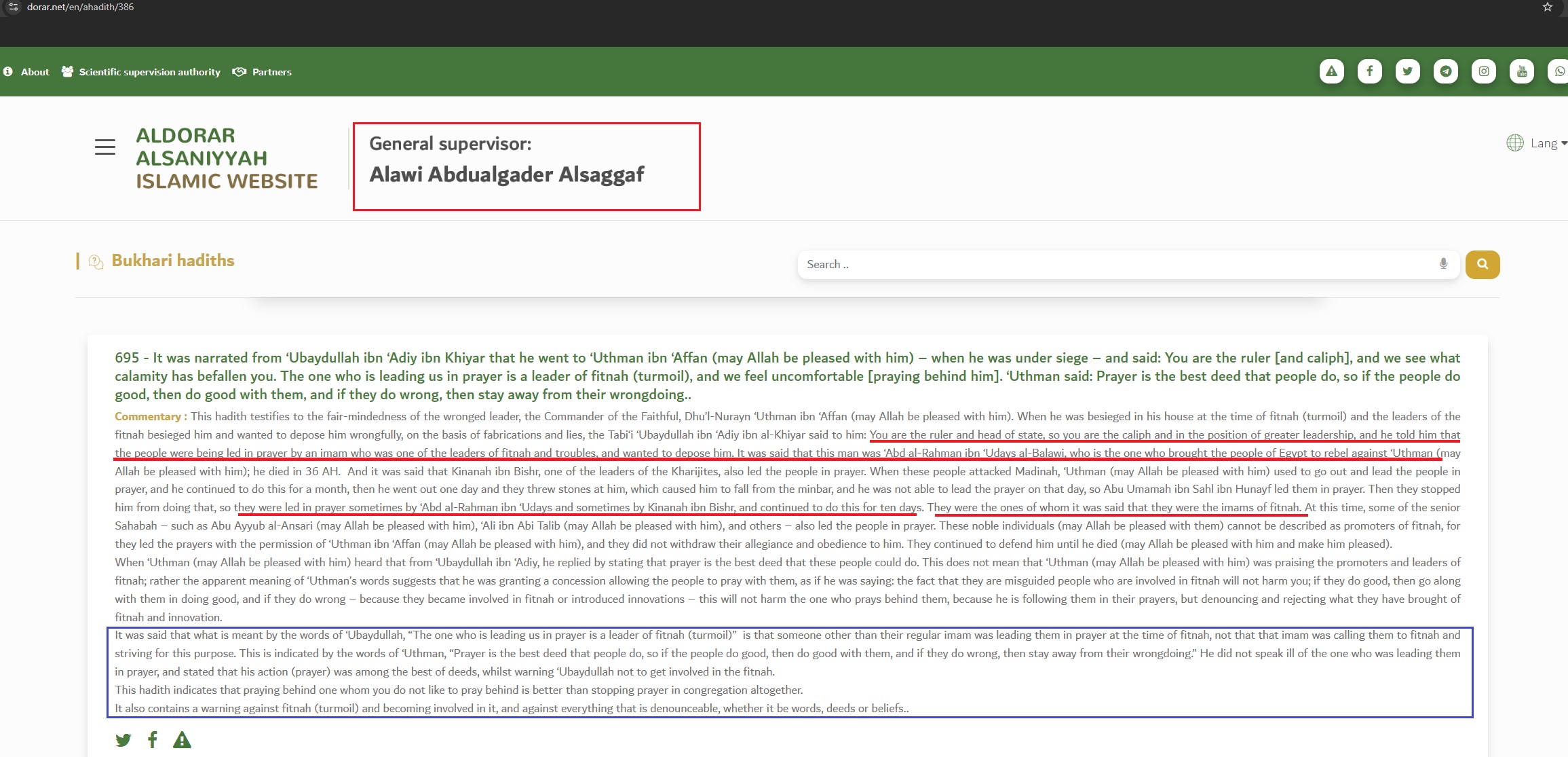
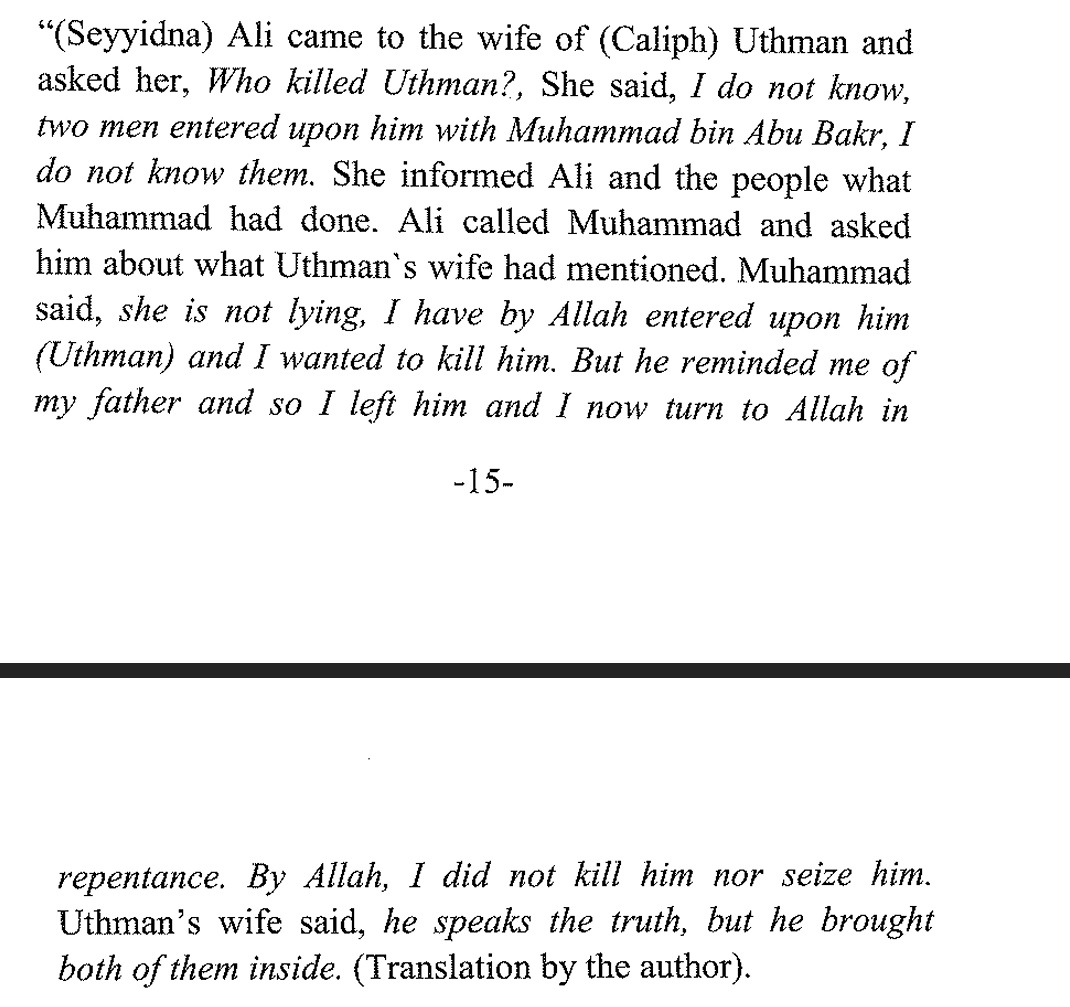
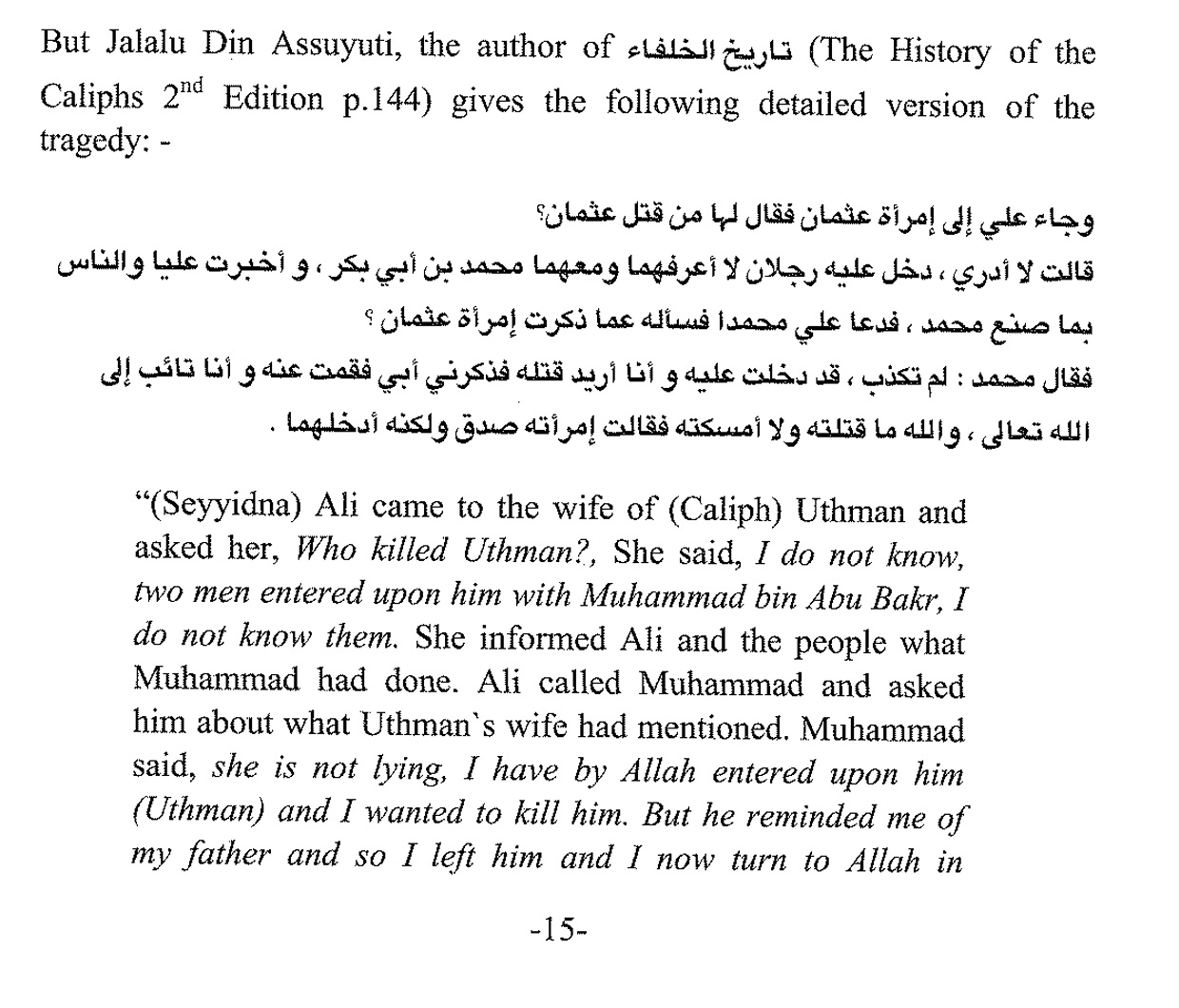
Then came the era of Umar bin Al-Khattab (RA). He relied on them, brought them close in his gatherings, they were his army leaders and callers to Islam. So, during the time of Abu Bakr and Umar, the state was strong by relying on the scholars, the Qurra’. Then came the time of Uthman (RA). In the early years, he relied on them, but in later years, he brought his relatives closer, and the state began to show weakness. A rebellion occurred in Medina against Uthman, leading to his assassination. Then Ali bin Abi Talib (RA) assumed power, and the Qurra’ gathered around him. Some Muslims rebelled against him in the Battle of the Camel, and he defeated them. Then Muawiyah staged a military coup against Ali bin Abi Talib at Siffin. The Qurra’ gathered with him and fought with him, until victory was near for Ali, were it not for the trickery of Amr bin Al-Aas. What happened, happened.
When the Qurra’ advised Ali bin Abi Talib not to accept arbitration and that Muawiyah was a transgressor, and that he should fight them, but Ali did not listen to their opinion. The Qurra’ withdrew themselves. When the arbitration occurred and Ali was removed from the Caliphate, they said to him: “You have removed yourself from the Caliphate.” So they withdrew from him. Those people who withdrew were called the “Muhakkamah” (those who declare ‘Judgment belongs to Allah’). This Muhakkamah pledged allegiance to Abdullah bin Wahb Al-Rasibi as their imam. They considered Abdullah bin Wahb Al-Rasibi as the fifth of the Rightly Guided Caliphs after Ali bin Abi Talib. Then what happened between Ali and the Muhakkamah at the Battle of Nahrawan occurred. Abdullah bin Wahb Al-Rasibi was killed, along with many of the Qurra’ and those who remained with him. Among them were Abu Bilal Mirdas bin Hudayr, his brother Urwah bin Udiyyah, and others.
Those who remained gathered around Jabir bin Zaid (may Allah have mercy on him). Discussions took place among them. Imam Jabir bin Zaid established his school. When was that? Imam Jabir bin Zaid was born in 18 AH (or 21 AH). He abandoned fighting and that affair and returned to Da’wah. He began to establish this school, meaning he codified and wrote it down. Imam Jabir bin Zaid (may Allah have mercy on him) began to collect authentic narrations from the Companions from the Messenger of Allah (saw). Abu (?) Jabir bin Zaid traveled from Basra to Medina and Mecca in 40 journeys, during 40 Hajj seasons, to meet as many Companions as possible, ask them about the Messenger (saw), the situations they experienced with him, the events they witnessed, what they heard from the Messenger, and what he told them. It is narrated that Imam Jabir said: “I met 70 of the Badriyyun (those who fought at Badr) and took from their knowledge.” (He meant Abdullah bin Abbas was considered young on the day of Badr…). Imam Jabir bin Zaid would codify what he heard from those narrations. He said, “I met a number of Companions of the Messenger of Allah (saw),” and “A number of Companions narrated to me,” indicating the many he met. It was said to him, “The Messenger (saw) wrote a letter on Sadaqat to Amr bin Hazm Al-Ansari when he sent him as governor over Yemen.” So he traveled specifically from Basra to Medina, went to the house of Amr bin Hazm Al-Ansari, knocked on the door of his sons, and asked them to show him the letter the Messenger (saw) had written to their father. They gave him the letter, he saw it, and he copied it. It is said he wrote it down and transmitted it. Imam Jabir was extremely keen on transmitting these narrations.
Imam Jabir was not alone; with him were Abu Bilal Mirdas bin Hudayr, Abdullah bin Ibadh, Salim bin Dhakwan Al-Hilali, and Salim bin Hatti. Imam Jabir bin Zaid began to codify the narrations with those with him.
Firstly, the school of Imam Jabir bin Zaid and his followers was called the School of the People of Truth and Righteousness (Ahl al-Haqq wal-Istiqamah). The founders were some Companions, like Abdullah bin Wahb Al-Rasibi, Zaid bin Husn Al-Ta’i, and other Companions – the Qurra’ who were martyred at Nahrawan. The Followers (Tabi’un) met the senior Companions. Imam Jabir bin Zaid met all the Companions. He met the leaders who participated with Ali bin Abi Talib during the days of turmoil: the Day of the House (siege of Uthman), the Day of the Camel, the Day of Siffin, the Day of Nahrawan, the Day of Nakhlah. He met all of them and asked them in detail. He asked the Companions about these events. It is said that Imam Jabir bin Zaid and Abu Bilal Mirdas bin Hudayr (may Allah have mercy on him) entered upon Aisha (RA) – who was one of the Prophet’s wives well-acquainted with events – sat with her, and asked her in detail about the life of the Messenger (saw), what she heard, about the events, including the era of Abu Bakr, the events of Umar, the Day of Uthman, and the Battle of the Camel (in which she participated). She repented and sought Allah’s forgiveness. Imam Jabir and Abu Bilal had vast knowledge of the complex political events.
So, the summary: Firstly, the school of Imam Jabir bin Zaid met the Companions who met the Messenger (saw), so their transmission was correct and firmly established from the Messenger (saw). Secondly, they met the leaders who participated in those complex political events and battles, starting from the Day of the House, the Day of the Camel, Siffin, Nahrawan, Nakhlah. They met the leaders and knew who was correct and who was in error, so their understanding of the events was clear. Thirdly, they were residents of Basra, Iraq, and most of these events occurred in Iraq – they were present. So, they had a wide understanding of these matters. For example, Abdullah bin Ibadh wrote a letter (still extant, needing explanation and commentary) in which he says he met Uthman, Ali bin Abi Talib, and Muawiyah, and knew these events in detail. It is one of the oldest Siyar. Also, there is a Sirah by Salim bin Dhakwan Al-Hilali, a contemporary of Imam Jabir bin Zaid. The manuscript still exists, not yet printed, needing verification. There is also a Sirah by Salim bin Hilal, I don’t know if it exists or not. These Siyar were written in the first half of the first century AH or shortly after. They are codifications proving they were correct and on the right path because they witnessed the events, knew those who participated in them, met their leaders, took it directly from the correct sources, had full detail, and codified it. Therefore, their beliefs and narrations are truthful. It is not narrated that they fabricated a single narration attributed to the Messenger (saw).
Then, after Imam Jabir bin Zaid came Abu Ubaidah Muslim bin Abi Karimah, who further clarified and expanded the school. Then after Abu Ubaidah came Al-Rabi’ bin Habib. Then the school divided: to Oman, to Yemen, and to North Africa. In Oman, during the time of Imam Al-Rabi’ bin Habib, he came to Oman and settled there. He had students of knowledge (or bearers of knowledge) with him. Mahbub Al-Rahil established a school in Sohar. Scholars from the Al-Rahili family and others emerged from Sohar. Upon this school revolved the learning of this family and scholars, as you read in Omani history: the 2nd, 3rd, 4th, 5th centuries AH. Also, Abu Al-Mundhir Bashir bin Al-Mundhir was in Nizwa, established a school, built a mosque (later the Great Mosque), and was given the title ‘Sheikh’ in Omani heritage. He established his school, which continued. Also, Abu Ali Musa bin Ali Al-Azri in Izki. These schools branched from the school of Al-Rabi’. So, the chain connects: Al-Rabi’ from Abu Ubaidah, Abu Ubaidah from Jabir, Jabir from the senior Companions from the Prophet (saw). It is said that the books written by Imam Jabir bin Zaid were transmitted to Oman with Mahbub Al-Rahil, then Muhammed bin Mahbub carried them to Mecca. From Mecca, the people of the Maghrib (North Africa) copied them. But, by Allah, the books of Imam Jabir bin Zaid are still lost. What remains is what the students of Al-Rabi’ recorded from Abu Ubaidah or from some sheikhs from Imam Jabir bin Zaid. These were collected by Maghribi scholars in a book called Al-Diwan Al-Muarad ‘ala Al-Ashyakh (The Anthology Presented to the Sheikhs), consisting of 22 books. It is a compilation authored by scholars of Ahl al-Haqq wal-Istiqamah in the first and second centuries AH.
Among them is the Jami’ Abi Safrah, which are narrations of Al-Rabi’ from Dhamam from Jabir bin Zaid from the Companions. The second book is the Musnad of Imam Al-Rabi’, which are narrations of Al-Rabi’ from Abu Ubaidah from Jabir bin Zaid. The difference is that the narrations of Al-Rabi’ from Dhamam are one type, and his narrations from Abu Ubaidah are another. This book also contains the Book of Marriage (Nikah al-Shighar) by Imam Jabir bin Zaid, as well as the Fatwas of Al-Rabi’, narrations of his fatwas, his effects (Athar), letters from scholars of Basra, letters from scholars of Medina, Mecca, Mosul, and Kufa. This book is still a manuscript, not printed. May Allah provide someone to review it, publish it, and bring it to light. This is a very brief summary of the codification of this period.
Thus, we realize fully that the Companions codified it before others. The arrangement of the Noble Quran – the arrangement of the surahs (Alif-Lam-Mim, Al-Baqarah, An-Nisa’, Aal-Imran) – this arrangement according to the narration of Imam Jabir bin Zaid was written down. The first to codify the Prophetic Sunnah was Imam Jabir bin Zaid. Al-Khalil bin Ahmad Al-Farahidi (may Allah have mercy on him), who was from Oman, was the one who established the science of Arabic prosody (Al-Farahidi), the science of diacritical points (dotting), as writing was without dots. He established the vowel marks (fatha, damma, kasra, shadda). He established the dictionary (lexicon) – his first dictionary is Kitab Al-Ayn. He established the science of grammar (Nahw). All of this was in service of the Quran. The people of Oman were the foremost in serving the Noble Quran.
…Does anyone have a question about the topic? Discussions, comments, or a point not understood? Please, go ahead.
(The speaker continues)
The arrangement of the Mushafs (written copies of the Quran)… Al-Aswad. It is said – and Allah knows best – that some books mention this point. I have found references to it. But it is also said regarding Al-Khalil bin Ahmad, though they do not make explicit the favor of the people of Oman. I even found that Al-Khalil bin Ahmad Al-Farahidi (may Allah have mercy on him) used to make this supplication: “My Lord, forgive me and grant me knowledge that no one after me will need, for You are the Bestower.” He always made this supplication, so Allah opened for him the science of the Arabic language; he was the one who founded and established its principles.
Excellent.
Glory be to You, O Allah, and with Your praise.
Questioner: Shaykh, the reasons for marginalizing this history – ancient and modern Omani history – are there reasons that have led to its marginalization among many of the people, in their books or in their Siyar?
Shaykh Hilal Al Barwani: There are many reasons. The people of Oman themselves neglected it. A period came upon the people of Oman during the days of economic blockade, famine, and drought. They were preoccupied with earning a living. They migrated, and many went to Africa. At that time, so much history was lost because no one studied it or taught it. Also, the neglect of history, lack of reading, lack of study, and no institutions existed for them. For example, if we look at Egypt, they have Al-Azhar, which codified that jurisprudence and took charge of education, teaching, and instruction. It has been like a university since the time of the Fatimids. In the Maghrib (North Africa), the University of Qayrawan also played this role. In Iraq, Karbala and Najaf Al-Ashraf have their own Hawzas (religious seminaries), strong institutions supported by funds, and there are those who take on (the role). All of them have students of knowledge. As for us, we have absolutely nothing. Add to that our love for tribal histories and wars, and so on. It was all lost. And none of our Imams tried, except Imam Al-Arab bin Sultan (may Allah have mercy on him), who built Jabrin Fort as the first university for students of knowledge. But later, due to division and disagreement, it was lost, and no one followed up after that. The hope now is that history is being investigated, the Siyar are being printed, reviewed, and so on.
Questioner: Shaykh, are there existing (manuscripts) or effects of our companions?
Shaykh Hilal Al Barwani: In Rustaq? In Nizwa? We mean great libraries. But due to war… due to the Abbasid wars and the (campaigns) of (the Abbasid general) Ibn Bur? They burned these libraries. Our companions truly had large libraries… However, some of them are in the forts. But they were burned. Some remain in the private collections of individuals. For example, in Oman, more than 12,000 titles of manuscripts, documents, and Siyar have been discovered. The Omani Siyar contain more than 300 Sirah (singular of Siyar), which need verification and review – they exist. Many manuscripts exist now, but there is no institution to print them, publish them, review them, nor anyone to support them. Nor are there people to buy them. Even if someone prints the books, no one buys from him. So all circumstances pressure the reality, preventing publication. We truly call upon the Omani people and the scholars to do something, even a small thing, so that people can access it.
Questioner: (Insha’Allah, we will write, Mr. Shaykh Ahmad?) I understand.
Shaykh Hilal Al Barwani: Insha’Allah.
Questioner: Alright.
Shaykh Hilal Al Barwani: Excellent. Glory be to You, O Allah, and with Your praise. I bear witness that there is no god but You. I seek Your forgiveness and repent to You. O Allah, make this gathering of ours a blessed gathering, and make our dispersal after it a protected dispersal. Do not let there be among us or with us any wretched or deprived person. O Allah, make us doers of good with knowledge and avoiders of indecency. Remove from us the injustice of the oppressors. And may Allah send prayers and peace upon our Master Muhammed, and upon his family and all his companions.
Complete Translation: Interview with Shaykh Sassi Ben Yahyaten (Ibadi Scholar from Tunisia)
We have translated from the interview found here:
If there are any errors or mistakes from the translation that we overlooked, kindly reach out to us.
Interviewer (voiceover): He is the most famous Ibadi Shaykh in Tunisia. On the rare occasions he attends a media meeting, today’s guest is Shaykh Sassi Ben Yahya Bek.
Interviewer (onscreen): Allah bless you. Thank you, Saad. May Allah give you health. Welcome to Jerba.
Interviewer: May Allah give you life. Today is a very special occasion. Many people do not know the Ibadi school. So, in the first segment, we will talk about the origin of this school and what it means. Most people know that Islam has Sunnis and Shiites. Are the Ibadis part of the Sunnis, part of the Shiites, or a completely different branch? What is Ibadism and who are the Ibadis?
Shaykh Sassi: In the name of Allah, the Most Gracious, the Most Merciful. Praise be to Allah, Lord of the worlds, and peace and blessings be upon the most honorable of messengers. Thank you for the question. Ibadism is an Islamic school that arose in the first century AH. Its founder is Jabir bin Zaid al-Azdi al-Omani, one of the great Successors (Tabi’un). It is not Sunni in the political sense of Sunnism, nor is it Shiite. Rather, it is a school that follows the Sunnah and the Noble Qur’an. One of the Orientalists called it ‘the third voice of Islam.’
Shaykh Sassi: The third voice of Islam, or the third path.
Shaykh Sassi: The third path of Islam. So it was established in the first century because Jabir bin Zaid died in 93 AH. It relies, like most Islamic schools, on the Qur’an as the first source, on the Sunnah as the second source, and on everything related… besides the Qur’an and Sunnah, it relies on opinion (ra’y), analogy (qiyas), and ijtihad, etc., expressed through ‘ra’y’. Why ‘ra’y’? To give value to human thought and human opinion in understanding the Qur’an and understanding the Sunnah. That is in terms of principle. What are the distinguishing features of the Ibadi school?
Shaykh Sassi: The features that distinguish the Ibadi school in creed, jurisprudence, biography (sira), or history – we call it ‘siyar’ (plural) – and I’ll give you an example: political thought and governance. Regarding creed: Ibadi creed is distinguished by combining confession by the heart, utterance by the tongue, and action by the limbs. In creed, action is part of faith. This is what is mentioned in all verses of the Noble Qur’an; it does not separate faith from action. Some Muslims say that faith is sufficient and action comes in second place. But we establish a strong link between faith and action. The faith of a believer cannot be complete unless he applies what he believes in in all aspects of life. What results from that? I will mention the features, but we must also note criticisms. What results from that is that a Muslim must be upright in his life. ‘Guide us to the straight path’ we repeat many times. Upright, and he does not commit major sins. This does not mean the Muslim becomes an angel. But if he commits a major sin, he must repent from it, hasten to repent to Allah, especially regarding the rights of other people. The rights of Allah are easy; perhaps repentance from them is easier, because Allah forgives all sins for those who repent and believe.
Interviewer: We will address this point of repentance. Give me the other features quickly.
Shaykh Sassi: Quickly, because whoever does not repent will be eternally in Hell. We will come to that point. The second point: jurisprudence is linked to creed. The third point: political thought. We do not have political Islam, we have political thought. If the great human principles mentioned in the Noble Qur’an are available, such as justice, equality, consultation (shura), and the rotation of political positions, then we accept this as political thought. Regarding ‘siyar’ (biographies/history), our ‘siyar’ are characterized by… meaning the application of all this in society, a literal application. Therefore, Ibadi societies are characterized by trust and honesty, as is known, for example, in Jerba, Tunisia. Then the status of women: the status given to women by Islam. They have their own opinion and stance in politics, in the selection of judges. If a woman is wronged… In the engineering of the Jerbian mosques, in the prayer niche (mihrab), there are two speakers (qawatan), right and left. If a woman is wronged by anyone, husband, brother, or father, she comes between the Adhan and the Iqamah, speaks through that speaker (a loudspeaker) and says, ‘I am so-and-so, daughter of so-and-so, wronged by such-and-such person.’ Then one of the ‘Azzabah adopts her case. If it is easy, it is resolved. If not, he adopts it, and the prayer is not held until someone adopts her case, defends her, and restores her right.
Interviewer: One of the ‘Azzabah. Explain to people what ‘Azzabah is. It is an ancient political system.
Shaykh Sassi: Yes. After the fall of the Rustamid state in 296 AH, the Ibadis in North Africa refrained from forming or establishing a state. After that, they thought of a social system that would bring together Ibadi communities. This system was called ‘Al-Halaqah’ or ‘Al-Azzabah’. It includes 12 or more members, headed by a person called the ‘Shaykh of the Azzabah’, who acted as a just imam governing the Ibadi community in all of North Africa.
Interviewer: We want to understand the name ‘Ibadi’. For example, the Shiites are the ‘party of Ali’ (Shi’at Ali), the Sunnis are the ‘Sunnah of the Prophet’. What about the Ibadis? What is the origin of this word?
Shaykh Sassi: Thank you. Ibadism is attributed to Abdullah bin Ibadh al-Murri al-Tamimi. He was a student of Jabir bin Zaid. He emerged in the political field because he defended Ibadism. He even had correspondence with Abd al-Malik ibn Marwan – these letters exist. He belonged to the large tribe of Banu Tamim, which the Umayyad state feared. So he emerged as a defender, but he has no jurisprudential opinions in Ibadi books. During the time of Jabir bin Zaid and until the second century, Ibadis were called the ‘Community of the People of the Call’ (Jama’at Ahl al-Da’wa) or the ‘Community of Muslims’ (Jama’at al-Muslimeen). What does Imam al-Salimi say? ‘Our opponents named us that, but we are satisfied with it, and its origin is that so-and-so was our lawyer and passed away, but this person has no remaining issue in the school.’ Others named us Ibadis. Why did they name us Ibadis? Because Jabir bin Zaid is disputed, and Ibadi was associated with the Kharijites because Abdullah bin Ibadh was with Ibn al-Azraq, then separated from him when they disagreed on fundamental matters regarding the relationship with other Muslims.
Interviewer: Are the Ibadis closer to Sunnis or Shiites? I don’t draw closer to this or that.
Shaykh Sassi: At the same distance from both sides.
Interviewer: No, we are an independent school, because ‘Ahl al-Sunnah’ is a political term.
Shaykh Sassi: ‘Ahl al-Sunnah wa al-Jama’ah’?
Interviewer: ‘Ahl al-Sunnah wa al-Jama’ah’ dates to 41 AH when the agreement took place between Mu’awiyah and Hasan bin Ali. That year was called the ‘Year of the Community’ (Am al-Jama’ah), an agreement between Ahl al-Sunnah and the Umayyad state. Thus ‘Ahl al-Sunnah wa al-Jama’ah’ was formed. We follow the Qur’an and the Sunnah, the Sunnah of the Messenger, may Allah bless him and grant him peace. We are equally distant from all Islamic sects and schools.
Shaykh Sassi: Through my research to prepare this episode, I found an accusation being promoted as historical information: that the origin of the Ibadis is from the Kharijites. These Kharijites are divided into Azariqah, Sufriyyah, Ibadis… colors. What is the extent of the connection between the Ibadis of Tunisia, especially the Ibadis of the world today, and that group of Ibadis from the Kharijites? They are originally… Allah has purified our hands from that blood, so let us purify our tongues from it. The Great Fitna (Civil Strife) – we leave it asleep. Leave it asleep. But we will clarify a historical point: this accusation is stuck to us to fight us.
Interviewer: ‘Al-Khuruj’ (seceding/rebelling) has two meanings: political secession or secession from religion. If it is political secession, we are honored by it, because our predecessors seceded from the most oppressive state, the Umayyad state. The revolutions that occurred in 2010-2011 in Egypt, Tunisia, Yemen, Libya, and Syria – if so, all of these are Kharijites. Hussein bin Ali was a Khariji because he seceded against the Umayyad state. But more dangerous than this is that they stick this accusation to us, that we have seceded from Islam. These are our books, these are our beliefs, this is our conduct. Read them objectively, and you will find that we are the closest and most adherent people to the Qur’an and the pure Muhammedan Sunnah.
Interviewer: But do you support or deny the existence of a historical connection between the two groups: Ibadis of today and Ibadis of that time?
Shaykh Sassi: Of course, we call those early groups ‘Al-Muhakkimah’. Others call them Kharijites – a secession that was only political. As for sticking the accusation of seceding from the true religion, some groups among Al-Muhakkimah exaggerated in religion, were aggressive, and killed… but I challenge anyone, and I have said this in historical conferences, give me one established example where the hands of the Ibadis were stained with the blood of others, whether Muslims or non-Muslims. Just one example. The sanctity of a human being, Muslim or non-Muslim, is a great sanctity that God has made sacred. A drop of blood that we are never allowed to shed. Absolutely. The sanctity of a Muslim: his body, his blood, his wealth, his honor. And the sanctity of every human being must be respected.
Interviewer: There are many shared creedal points between you. For example, considering one who commits a major sin (fā’il al-kabīrah) a disbeliever or eternally in Hell. The disobedient Muslim will be eternally in Hell. Explain this point to us.
Shaykh Sassi:There is a term ‘kufr’ here. There are two terms: kufr of blessings (kufr ni’mah) and kufr of polytheism (kufr shirk). Kufr shirk – we distance ourselves from it; we do not accuse any Muslim of kufr shirk. But kufr ni’mah is committed by one who commits a major sin, whether Ibadi or non-Ibadi.Shaykh al-Salimi says: ‘We do not demand from the worshipper beyond his two testimonies of faith with belief. Whoever comes with the two phrases (the Shahada) – we say he is our brother, and we fulfill his rights.’ Whoever comes with the two phrases, ‘I bear witness that there is no god but Allah, and I bear witness that Muhammed is the Messenger of Allah’ – he is our brother in Islam. He has rights upon us as we have rights upon him. We do not declare anyone a disbeliever, we do not declare anyone an innovator, we do not ostracize anyone. Whoever says ‘There is no god but God, Muhammed is the Messenger of Allah’ is a brother in Islam, in addition to human brotherhood.
Interviewer: But here, you exclude him from Paradise?
Shaykh Sassi: We are not the ones who exclude. Read the Qur’an, and I challenge anyone to bring a clear Qur’anic verse indicating the exit of one who enters it (Hell).
Interviewer: So you rely on the Qur’an?
Shaykh Sassi: Of course.
Interviewer: But those who rely on hadith… there are hadiths indicating this and that. But the Qur’an… any hadith that contradicts the Qur’an is not accepted, as Shaykh Muhammed al-Ghazali said.
Interviewer: Let me interact with you a bit.
Interviewer: When we studied… Tunisia is known to be Sunni Maliki. But when we studied as children, we didn’t know what Maliki or Ibadi was. We studied in Islamic education that no matter what you do or what your sin is… you will be in the fire of Hell for a period of time… then you complete the required period in the fire… then you are purified from sins and go to Paradise.
Shaykh Sassi: Yes.
Interviewer: Why is this wrong?
Shaykh Sassi: Look at all the Qur’anic verses: ‘abiding therein forever’ (khalidina fiha abada). ‘Whenever they desire to get out of it, they will be returned to it.’ All Qur’anic verses.
Interviewer: Possibly this verse includes Pharaoh?
Shaykh Sassi: We will explain to you. A Muslim who commits a major sin, persists in it, refuses repentance, and refuses to seek forgiveness… as if, Allah forbid… as if he is arrogant towards Allah Almighty. What do you expect from him? A person who refuses repentance? Eternity in Hell? Committing a major sin is not the end of the world. Committing a major sin must be followed by repentance.
‘Repentance is only accepted by Allah from those who do evil in ignorance, then repent soon after.’ (Qur’an 4:17)
Interviewer: What if he seeks forgiveness, but was not given the opportunity to repent before he dies or passes away?
Shaykh Sassi:That’s why Allah Almighty says: ‘Race towards forgiveness from your Lord.’ (Qur’an 3:133) The Muslim must race. I emphasized in the first instance, especially the rights of other people. This idea has had a very positive impact on Ibadi societies. Look at Ibadi societies: we are very careful regarding the rights of others, we do not transgress. There might be some who transgress, but the general idea is that whoever commits a major sin repents soon after, seeks forgiveness from Allah Almighty, and finds Allah Accepting of Repentance, Merciful. If a Muslim persists in his action, does not seek forgiveness, does not do any good deed, does not apply anything of Islam throughout his life… what is the difference between this person and someone who merely utters the Shahada with his tongue? The tongue alone means nothing and bears no fruit. It must produce fruits in society: trust, honesty, uprightness, good conduct.
Interviewer: But the problem with this principle is that it places two types or categories of people far apart from each other, but with the same outcome: the disbeliever and the disobedient Muslim. These two meet the same eternal fate.
Shaykh Sassi: Paradise has degrees, and Hell has degrees. Give me the difference between a person who says ‘There is no god but Allah, Muhammed is the Messenger of Allah’… Look at what is happening now. Muslims are killing each other. One Muslim kills saying ‘Allahu Akbar’, and the other kills saying ‘Allahu Akbar’. What is the result? The result of negligence regarding these principles. He says: ‘Whoever says “There is no god but Allah” enters Paradise.’ Why the Qur’an? Why this commitment? Why did you come from Sfax to here seeking reward, seeking to spread thought, and perhaps tolerance? Why do I commit to the Qur’an, get up early in winter, perform ghusl, make ablution with cold water, pray, and deprive myself of many of the pleasures of this worldly life, as long as whoever says ‘There is no god but Allah’ enters Paradise, even if he steals or commits adultery? And the other returns three times… There’s a hadith from Abu Dharr that they narrate, but we do not acknowledge it because it contradicts the Qur’an. So what is the difference between me and a person who does not believe in Allah but performs deeds better than mine?
Interviewer: Okay.
Shaykh Sassi: You believe in this creed. This difference, even in creed, in this worldly life, should not spoil the friendship. You believe that the Muslim who commits a major sin… the Qur’an names him ‘Fasiq’ (rebellious/disobedient)… he will go to Hell, I will go to Paradise. You are free, and I am free in my creed. I do not declare you a disbeliever, and you do not declare me a disbeliever. These are matters of the Hereafter; we leave them for the Hereafter. You believe what you wish, and I believe what I wish. We remain brothers. I treat you as a believing Muslim. Whoever kills a believer intentionally… if you are a Muslim, I deal with you on this basis: I respect you, you respect me, and I do not pass judgment on you.
Shaykh Sassi: Because who knows? Perhaps your end is better than my end, even though they believe this creed. So in this world, we do not judge one another.
Interviewer: Last question on this specific point: you say that the committer of a major sin is in Hell forever if he dies without repentance. Okay. Does this not limit the vastness of Allah’s mercy, which precedes His wrath? And does it not contradict His saying: ‘and He forgives what is less than that for whom He wills’? (Qur’an 4:48) Are you restricting Allah’s mercy to repentance only?
Shaykh Sassi: Allah’s mercy is conditional in the Qur’an. ‘and He forgives what is less than that for whom He wills.’ Here, ‘for whom He wills’ – does it refer only to Allah?
Shaykh Sassi: No, there are different readings of the Qur’an.
Shaykh Sassi: It means man wills, and then Allah Almighty wills. When He commands you or commands me: ‘Race towards forgiveness from your Lord’ – we must race. Forgiveness requires us to repent. The Messenger, may Allah bless him and grant him peace, and what will make you know? The Messenger, may Allah bless him and grant him peace, used to repent and seek forgiveness 70 times a day, and he did not commit major or minor sins.
Shaykh Sassi: So Allah’s mercy is what made us Muslims. Allah’s mercy is what made us apply the Qur’an. Allah’s mercy is what drives us to repent, as Allah commanded repentance: ‘Repent to Allah.’ How many verses in the Qur’an command repentance? Why do we differentiate? We apply the verse that commands prayer, and we apply the verse that commands reading (‘Iqra’)… an obligation, a duty. We left it and took other things. ‘Repent to Allah.’ A verse containing a command, and a command indicates obligation, unless there is evidence to divert it from obligation. ‘Race towards forgiveness from your Lord’ – a verse containing a command, and a command obligates racing. Not just repentance. When we gather all these verses, we must repent. Every son of Adam makes mistakes, and the best of those who make mistakes are the repentant. That is the difference.
Interviewer: Good. There is a point I want you to answer quickly. Through my research, I found an accusation that my mind did not accept. They say that there is a group among the Ibadis who hold a harsh stance against Imam Ali, to the point of cursing him and considering him not among the people of Paradise, but rather among the people of Hell. My mind did not accept this information, so I wanted you to clarify right from wrong in this story.
Shaykh Sassi: Regarding Imam Ali – we say ‘May Allah honor his face’. When we say ‘May Allah honor his face’, what does that mean? Allah honored him.
Shaykh Sassi: You… would you name your son after someone you disbelieve in?
Shaykh Sassi: Of course not.
Interviewer: Is the name ‘Ali’ common among you?
Shaykh Sassi: Of course. Is it reasonable that we name our sons with a name that we reject, disbelieve in, and ostracize? Is this acceptable?
Interviewer: No.
Shaykh Sassi: Enough. I’ll tell you who disbelieved in Ali – it’s not the Ibadis. The Ibadis defended Ali. Was Mu’awiyah, or whoever established the practice, cursed Ali from the pulpits? During the reign of Umar bin Abdul Aziz, an Ibadi delegation went to Umar bin Abdul Aziz asking him to remove and abandon this evil practice. This exists in sources from the year 99 AH. So who defended Ali? The Ibadis and others. I’ll add something: if anyone among us curses Imam Ali, he bears his responsibility alone. Look at our books; all of them narrate from Imam Ali. The Musnad of Al-Rabi’ bin Habib contains hadiths narrated from Ali. Would we narrate from a person we consider a disbeliever?
Interviewer: Enough. Let’s go back to the beginning.
Shaykh Sassi: Go ahead.
Interviewer: The Ibadi school, yes. Its prominent figures? When did it begin? For example, the Maliki school has Malik bin Anas, the Hanafi has Abu Hanifa al-Nu’man. Tell me about the Ibadi school: its figures and when it began.
Shaykh Sassi: The Ibadi school’s symbol, founder, and imam is Jabir bin Zaid al-Azdi al-Omani. He was born in 18 or 23 AH according to narrations, and died in 93 AH. He was one of the great Successors (Tabi’un) and studied under great Companions like Abdullah bin Abbas, Ibn Umar, Jabir bin Abdullah, Umm Aisha (may Allah be pleased with them all). Ibn Abbas has many sayings about Jabir bin Zaid: ‘If you meant Jabir bin Zaid, his knowledge would suffice you.’ I cannot mention all the characteristics of Jabir bin Zaid. He was the founder, established the rules, and founded the Ibadi school. After him came his student, Abu Ubaida Muslim bin Abi Karima in Basra, who died in 145 AH. Then after him, his student Al-Rabi’ bin Habib, who compiled the hadiths. Abu Ubaida Muslim bin Abi Karima had a school in Basra. He used to teach his students in a passageway, in a cellar, for fear of the Umayyad state. Students of knowledge came to him from the West and from Oman. Five from the Maghreb: Abd al-Rahman bin Rustam, Abu al-Khattab Abd al-Ala ibn al-Samh al-Ma’afiri from Yemen. Dawud al-Qibli, al-Ghadamisi, and Asim al-Sidrati joined them. They were called the ‘Carriers of Knowledge’, not the ‘Carriers of Weapons’. We are carriers of knowledge, not carriers of weapons. I emphasize this point. As I told you before, praise be to Allah, our hands have not been stained with the killing of any person, Muslim or otherwise. The Muslim, if he is a carrier of knowledge, not a carrier of weapons…
Interviewer: A carrier of thought, not…
Shaykh Sassi: Thought, yes.
Interviewer: The Sunni school, for example, is based on the Qur’an and Sunnah. What is the Ibadis’ view and creed regarding the Noble Qur’an? What are the sources and approved commentaries (tafasir) according to you?
Shaykh Sassi: The Noble Qur’an is the book revealed by God Almighty, preserved, ‘Falsehood cannot approach it from before it or from behind it.’ (Qur’an 41:42) ‘Indeed, it is We who sent down the Remembrance (the Qur’an), and indeed, We will be its guardian.’ (Qur’an 15:9) We do not say that it has been added to or decreased from, as found in other sources. The two Mu’awwidhatin (Surahs Al-Falaq and An-Nas) are part of the Qur’an, etc. Is it established with you that the Qur’an is complete and perfect?
Interviewer: Complete and perfect?
Shaykh Sassi: Complete and perfect. Evidence from the verse. Our school is also distinguished by the belief that the Qur’an was compiled during the lifetime of the Messenger of Allah, may Allah bless him and grant him peace. The Messenger, may Allah bless him and grant him peace, did not pass on to the Highest Companion except while the Qur’an was being recited and compiled in a single codex (mushaf).
Interviewer: Compiled in a single codex (mushaf)?
Shaykh Sassi: Yes.
Interviewer: But the well-known narration is that our master Uthman bin Affan was the one who compiled it.
Shaykh Sassi: That is the well-known narration among Ahl al-Sunnah. Among the Shiites, it is Ali who compiled the Qur’an.
Interviewer: What do the Ibadis believe regarding this point?
Shaykh Sassi: That the Qur’an was compiled during the lifetime of the Messenger of Allah, may Allah bless him and grant him peace, complete, recited, between the covers of a book. In the commentaries (tafasir), you find ‘Mushaf of Ibn Mas’ud’, ‘Mushaf of Aisha’, ‘Mushaf of Zaid’, etc. Many mus’hafs. What does mus’haf mean? It means a book compiled between two covers, starting with Al-Fatihah and ending with An-Nas. This idea and this creed removed the Qur’an from all the accusations directed at it by non-Muslims, especially that the Qur’an is incomplete, or that there were verses only found with one person or two. In the modern era, starting around 1990-1995, what is called ‘le Coran de pierres’ (the Qur’an of stones) appeared – verses found written on stones and rocks along caravan routes from Medina to Damascus and Yemen. These verses were collected, and they accused the Qur’an of being incomplete. Why? Because we say that the Messenger of Allah, may God bless him and grant him peace, left the Qur’an scattered on palm fronds, shoulder blades, etc. If the Messenger did not compile his Qur’an, his holy book, what did he do? Then during Ramadan, Gabriel (peace be upon him) would come and the Messenger would review the Qur’an with him. In the year he died, he reviewed it twice, called ‘the last review’. So he reviewed the Qur’an as it is today, with the order of surahs. Some say – I think As-Suyuti says – that the Companions were the ones who arranged the surahs. There’s a narration that Umar bin al-Khattab, when a person came with two verses from the end of Surah At-Tawbah, said: ‘If it were three verses, I would have made it a separate surah.’ With all respect to the Companions, do we believe that they would act with the Qur’an in such a way? Allah Almighty says: ‘Indeed, it is We who sent down the Remembrance, and indeed, We will be its guardian.’
Interviewer: Regarding the Companions acting with the Qur’an, there is a well-known narration about a well-known figure, the brother of our master Uthman bin Affan. When the Messenger narrated the revelation that came to him, this Companion would write it down, but he would write it with modification. When the Messenger noticed that, he took a stance against him. This narration is known. Do you believe it or deny it?
Shaykh Sassi: We do not believe all narrations that offend the Messenger. It might be authentic, but this supports our position: if the Messenger had not compiled the Qur’an, such narrations and such writings would have crept into the Qur’an.
Interviewer: Just as Isra’iliyyat crept in?
Shaykh Sassi: Isra’iliyyat. We do not accept Isra’iliyyat at all. Our creed is free from Isra’iliyyat.
Interviewer: The Ibadi creed, or the Islamic creed in general?
Shaykh Sassi: Our creed is the Islamic creed. We are Muslims before being Ibadis. We are Muslims following an Ibadi methodology.
Interviewer: Okay. The Sunni refers to Sahih al-Bukhari and Muslim. The Shiite refers to Al-Kulayni, for example. To whom does the Ibadi refer? What are their references, and how reliable are they?
Shaykh Sassi: We refer to the Musnad, the authentic Musnad of Al-Rabi’ bin Habib. Al-Rabi’ bin Habib is the student of Abu Ubaida Muslim bin Abi Karima, from the second century AH. It contains about 1050 hadiths. 90% or more of these hadiths are narrated in other authentic books (Sihah), sometimes with different wording. We take hadiths from others, like Bukhari and Muslim, if they match the Qur’an. Any hadith that contradicts the Qur’an, textually or in spirit, we do not accept.
Shaykh Sassi: Regarding the hadith in Sahih al-Rabi’: ‘Whatever comes to you from me, compare it to the Book of Allah. If it agrees with it, then it is from me; otherwise, it is not.’ So the correct criterion is this hadith. This is the opinion of many contemporary scholars, for example, Shaykh Muhammed al-Ghazali. This is Musnad al-Rabi’. There is also the Mudawwanah of Abu Ghanim al-Khurasani, also from the second century, which contains jurisprudence and hadiths that do not contradict the hadiths of Al-Rabi’ bin Habib.
Interviewer: Good. Let’s talk now about jurisprudence (fiqh). Jurisprudentially, which school is closest to you: Maliki, Hanbali, Shafi’i, Ja’fari? What are the most prominent points of difference?
Shaykh Sassi: In reality, in jurisprudence, you find much closeness and similarity between most Islamic schools. There are some points of disagreement, but they do not spoil the friendship.
Interviewer: For example?
Shaykh Sassi: For example, things that Tunisians notice: the Ibadi does not raise his hands at the initial takbir (Takbirat al-Ihram).
Interviewer: The Maliki raises his hands at the initial takbir, then lets them hang (sadl). We agree with the Maliki school on letting the arms hang (sadl). We do not fold them (qabd). We stand, we do not raise our hands at the initial takbir. We say ‘Allahu Akbar’ and that’s enough. Do you rely on hadiths for this?
Shaykh Sassi: Of course, we rely on hadiths in Al-Rabi’ bin Habib. ‘Pray as you have seen me pray.’ Jabir bin Zaid was the closest imam of the schools to the Companions. He died in 93 AH. He said: ‘I met 70 Badris (Companions who fought at Badr), and I absorbed the knowledge they had, like the sea…’ meaning Abdullah bin Abbas. So he was close to narrating from them. Let me give you another issue, for example, regarding fasting (sawm). In fasting, one of the conditions for the validity of fasting is ritual purity (taharah).
Interviewer: A Muslim cannot fast while in a state of major ritual impurity (junub)? Is that reasonable?
Shaykh Sassi: Other Islamic schools do not say that.
Interviewer: Meaning before dawn, he has intercourse?
Sheikh Sassi: No, excuse me. Even among the Maliki brothers, they permit fasting for a person who wakes up junub. Research the Maliki school. You wake up junub… investigate the issue.
Interviewer: By Allah, I didn’t know that.
Shaykh Sassi: You will find it. Is it reasonable for a Muslim to wake up junub during Ramadan?
Interviewer: What I know is that you perform ghusl and…
Shaykh Sassi: Before… if, for example, sleep overcomes you.
Interviewer: Sleep should not overcome you because you must take precautions, right or not? But with precautions, you set your alarm for 4 a.m., but the alarm rings and you don’t wake up.
Shaykh Sassi: This is being overcome. But if you insist and say, ‘No, I’ll wake up at 8 a.m. or after sunrise’… They rely on a hadith narrated by Aisha and Umm Salamah that the Prophet, may Allah bless him and grant him peace, would wake up junub and not perform ghusl. Is it reasonable that the Messenger…
Interviewer: Hadiths that offend…
Shaykh Sassi: Allah bless you. That’s what I wanted. This is a very important point of disagreement.
Interviewer: Ramadan, and the state of fasting in general, is a state of spiritual and physical purification.
Shaykh Sassi: And physical.
Interviewer: So reason aligns with the idea that we must perform ghusl and…
Shaykh Sassi: May Allah have mercy on your parents. You came up with this on your own, with an open mind. All people who do not have a preconceived mindset carrying a preconceived notion, the Ibadis accept our thought. Evidence is your own dignity.
Interviewer: Great. What are the jurisprudential rulings that distinguish the Ibadis?
Shaykh Sassi: There aren’t major jurisprudential rulings. I gave you an example regarding prayer (salah). Prayer, in all schools, is based on purity of body, purity of clothing, purity of place. Prayer consists of four rak’ahs for Dhuhr, Asr, and Isha, and three rak’ahs for Maghrib. We agree on all that. There is a small detail we differ on: in our silent prayers, we only recite Al-Fatihah.
Interviewer: Do you rely on a hadith for that?
Shaykh Sassi: Of course.
Shaykh Sassi: Dhuhr is four silent rak’ahs; we only recite Al-Fatihah. Asr is four silent rak’ahs; we only recite Al-Fatihah. The third rak’ah of Maghrib is silent; we recite Al-Fatihah. The last two rak’ahs of Isha are silent; we recite Al-Fatihah only. We recite Al-Fatihah with a Surah in the loud prayers, and the Sunnah and voluntary prayers (nawafil) are all loud.
Shaykh Sassi: For example, in the chapter on prayer: The Shiites combine prayers; this is permissible. The Sunnis do not combine prayers. What is the Ibadis’ stance on this?
Shaykh Sassi: It is permissible to combine two prayers for reasons, for example, travel.
Shaykh Sassi: Compelling reasons, sort of.
Shaykh Sassi: Compelling reasons. Give you an example now: a surgeon enters the operating room. Do we force him to come out to pray Dhuhr and leave…?
Shaykh Sassi: His work doesn’t permit that.
Shaykh Sassi: It doesn’t permit that. The traffic policeman… should he leave traffic and go pray in the nearby mosque? He is not permitted to do that. In this case, the student starts school at a specific time. He is permitted to combine Dhuhr and Asr, as early or late combination, in exceptional circumstances. But a person who is comfortable at home is not permitted to combine.
Interviewer: Shaykh Sassi.
Shaykh Sassi: Yes.
Interviewer: What is your creed regarding Allah?
Shaykh Sassi: Our creed regarding Allah is absolute transcendence (tanzih). It relies on a methodology: there are clear verses (muhkamat) in the Noble Qur’an and there are ambiguous verses (mutashabihat). We refer the ambiguous to the clear. ‘There is nothing like unto Him.’ (Qur’an 42:11) When you encounter ‘the Hand of Allah is above their hands’, it means the power of Allah is above their power. We interpret verses that could imply likening Allah to humans or anthropomorphism. We do not anthropomorphize Allah at all. We absolve Him with absolute transcendence, as commanded in the Noble Qur’an.
Interviewer:You have a principle of negating the vision (of God). You deny that humans can see their Creator on the Day of Resurrection and consider it intellectually impossible. From which aspect do you believe this principle? Always and forever from the aspect of transcendence?
Shaykh Sassi: Because when you see something, you perceive its characteristics, and it must be limited. Can a human see something infinite? Impossible. Furthermore, the issue of the vision of Allah is disputed: will Allah be seen at the standing (Mahshar) or in Paradise? Will all people see Him, or only the believers in Paradise? When a debate occurs between us and our brothers, in the end they say: ‘Allah Almighty will create another sense in us, besides sight, and then enable us to see Allah.’ We, to transcend Allah Almighty, say He will never be seen. ‘You will not see Me’ (Qur’an 7:143) He said to Moses. Al-Zamakhshari negates vision in this world and negates it in the Hereafter. Those who rely on the verse: ‘Some faces that Day will be shining, looking at their Lord.’ (Qur’an 75:22-23) ‘Looking’ (Nazirah) here… the verse is about the Mahshar. ‘Looking’ from ‘Nazar’ (waiting/expecting). They are waiting for Alla’s mercy and His admission to Paradise. We interpret these verses from the aspect of transcending Allah Almighty regarding vision. A final note: this issue is a matter of the Hereafter and does not spoil our relationship. I want to focus on this point: it does not spoil. If you believe that you will see Him, you will see Allah in Paradise. I strive to go to Paradise.
Shaykh Sassi: And I strive to go to Paradise.
Interviewer: Consider it an incentive.
Shaykh Sassi: Perhaps. But this issue, like the issue of the creation of the Qur’an, should not cause a rift between Muslims. Leave it aside.
Interviewer: Has it been established with you that any of the prophets actually saw God?
Shaykh Sassi: It has not been established. When this hadith or idea was narrated, I went to Lady Aisha (for her opinion). She said: ‘O man, my hair stood on end! Muhammed, may Allah bless him and grant him peace, did not see his Lord.’ Because some say that our Messenger saw his Lord during the Mi’raj (Ascension).
Interviewer: And most Islamic schools negate this.
Shaykh Sassi: Negate this.
Interviewer: Negate this. Okay. Let’s return to the Qur’anic verse you mentioned. Your principle that humans cannot see their Lord on the Day of Resurrection, they say this contradicts divine power and denies the verse: ‘Some faces that Day will be shining, looking at their Lord.’ So they interpret it as ‘waiting’ not ‘seeing’. Do you have definitive evidence that ‘looking at their Lord’ means ‘waiting’ and not ‘seeing’? The verse indicates… ‘to their Lord looking’ (li rabbiha nadhirah) is at the Mahshar, not in Paradise. ‘Some faces that Day will be shining, laughing, rejoicing, and some faces that Day will have upon them dust, covered with darkness. Those are the disbelievers, the wicked.’ When we take the Qur’anic verses and gather them, you will see that they indicate one thing: the expectation (nazar) of the Muslim who awaits the mercy of God Almighty. The other (darkness) for the faces of the disbelievers who have despaired of the mercy of God Almighty.
Interviewer: On the issue of prophetic infallibility (‘isma), do you believe in it?
Shaykh Sassi: Yes.
Interviewer: From major and minor sins?
Shaykh Sassi: Of course.
Shaykh Sassi: Good. His infallibility from major and minor sins, except for mistakes that any human can make. Because the Messenger of Allah is human, and to indicate his humanity… For example, regarding the pollination of palm trees in Medina. They used to pollinate the palms. He said to them: ‘Would that you had left the palms as they are?’ So they left the pollination, and the palm crop did not do well, producing poor dates. They told him, and he said: ‘You know your worldly affairs better.’ Similarly, when he dismounted at a location during the Battle of Badr, Al-Hubab bin Al-Mundhir came and said: ‘O Messenger of Allah, is this a place where Allah has alighted you, or is it opinion, battle, and strategy?’ He said: ‘It is opinion, battle, and strategy.’ He said: ‘Then let us move.’ These are human matters. We do not even consider them minor sins, just human mistakes.
Interviewer: There is a controversial issue raised recently. We studied in Sunni schools the story of ‘He frowned and turned away’ (‘Abasa wa tawalla) which was revealed concerning the Messenger of Allah, may Allah bless him and grant him peace, when he was preoccupied with the elite of Quraysh. The Shiite periphery says that ‘He frowned and turned away’ does not touch the infallibility of the Prophet and could not have been revealed concerning him. Rather, they interpret this verse as having been revealed concerning the Companion Uthman bin Affan (may Allah be pleased with him). What is the Ibadis’ interpretation of this issue?
Shaykh Sassi: The Ibadis’ interpretation is that it was revealed concerning the Messenger, may Allah bless him and grant him peace. And as I told you, it does not diminish the value of the Messenger. He made an effort (ijtihad) to bring the elite of Quraysh disbelievers to Islam. He said… this was an effort on his part. This was a gain for us – he gained a Muslim. He could wait for the others, the Quraysh elite, perhaps to call them or attract them to Islam. The Shiite brothers who interpret that verse… this interpretation is their right, because he frowned and turned away… It is their right to interpret, and it is our right to interpret.
Interviewer: Regarding the Companions.
Shaykh Sassi: Yes.
Interviewer: Do you believe in the principle of the justice of all Companions? Give me yes or no.
Shaykh Sassi: No.
Interviewer: Because if you said yes, my question would be: do you believe in it absolutely?
Shaykh Sassi: That’s why I said no. We believe in the justice of the Companions before the Fitna (Great Strife). After the Fitna, the Companions became divided. The Companions who fought each other at the Battle of the Camel – they were Companions and not Companions.
Interviewer: Yes.
Shaykh Sassi: At Siffin – Companions and not Companions.
Interviewer: You said after the Great Fitna. Let’s go back to before the Fitna. It is said in some narrations that there were Companions during the time of the Messenger but were hypocrites. Other narrations say that there were Companions who plotted to overthrow our Messenger, even during some battles. Do you support these narrations or deny them?
Shaykh Sassi: Each narration must be considered individually. We do not generalize. There is truth to this, but we do not generalize, and we cannot dig into these matters. This is correct. The position is that the Companions are just, with exceptions.
Interviewer: With exceptions. Your position starts after the Fitna.
Shaykh Sassi: After the Fitna.
Interviewer: My question is about before the Fitna.
Shaykh Sassi: Before the Fitna, there were hypocrites mentioned in the Noble Qur’an.
Interviewer: But we do not search for who the hypocrite is unless he displays…
Shaykh Sassi: It doesn’t matter if they existed or not. The Qur’an is clear.
Interviewer: Only.
Shaykh Sassi: The Qur’an is clear. We cannot contradict the Qur’an, but it did not name them.
Interviewer: It did not name them, to preserve the unity of the nation.
Shaykh Sassi: Of course, of course. The Qur’an did not name them. We do not dig into these matters.
Interviewer: Good. So you do not seek Allah’s pleasure for all Companions. There are Companions you seek Allah’s pleasure for, and there are Companions you have a stance towards.
Shaykh Sassi: Yes.
Interviewer: Do we name them or not name them?
Shaykh Sassi: For example, Mu’awiyah.
Interviewer: Okay. Mu’awiyah. Many schools have a stance… Ahl al-Sunnah…
Shaykh Sassi: Even books… they refer to Ahl al-Sunnah books. Our books, praise be to Allah, are free from these things, because our predecessors saw that extra things neither advance nor delay a matter. So we should build on the positive that advances us and does not delay us.
Interviewer: What is your stance on the Rightly Guided Caliphs (Al-Khulafa’ al-Rashidun)?
Shaykh Sassi: The Rightly Guided Caliphs: Abu Bakr, Umar – by agreement. Uthman: he remained in the caliphate for 12 years. The first six years were according to the Rightly Guided Caliphate. In the last six years, his closeness to the Umayyads affected him, so his rule deviated from what his predecessors were upon. Even Sayyid Qutb mentions this in ‘Social Justice’, and Ibn Taymiyyah acknowledges this, but he blames the Umayyad environment, saying he grew old and aged, so it was easy to influence him.
Interviewer: So I understand from your words that the beginning of the decline of Islamic civilization started with the infiltration or dominance of the Umayyads.
Shaykh Sassi: Of course, of course.
Shaykh Sassi:And therefore Uthman was killed. Then comes Ali, our master Ali, who they recognized, then Talhah, Al-Zubayr, and our mother Aisha rose against him at the Battle of the Camel. Then Mu’awiyah comes to overthrow him.
Interviewer: Wait, wait. You just said something important. You said Talhah, Al-Zubayr, and Lady Aisha ‘rose against him’ (thara ‘alayh). The Sunnis say that Lady Aisha came out for reform. You said ‘rose against him’.
Shaykh Sassi: No, no, no. She did not come out for reform. Sources… historical book sources of Ahl al-Sunnah say that.
Interviewer: More than that, there was a Sunni Shaykh who appeared with me on the channel and said Lady Aisha came out to support our master Ali.
Shaykh Sassi: No, no, no. The source… if he has a source we haven’t seen, and researchers haven’t seen…
Shaykh Sassi: He hasn’t seen it. Enough. Because we say regarding her: Lady Aisha repented. She repented from that. Enough. Whoever repents, Allah accepts his repentance. When her camel was hamstrung, Imam Ali sent her back, honored and respected, to Medina.
Interviewer: The caliphate of our master Ali – what is your stance on it?
Shaykh Sassi: A legitimate caliphate, legitimate.
Interviewer: My question is not about its legitimacy, but your assessment of its duration, your assessment when the caliphate was established.
Interviewer: When… he was not permitted to rule.
Shaykh Sassi: Our master (Ali) was not permitted to rule. Talhah, Al-Zubayr, and then Mu’awiyah rose against him. He remained a short period and was not permitted to apply the rule.
Interviewer: And he was assassinated…
Shaykh Sassi: He was assassinated. Assassination is normally attributed to the Kharijites. But Hisham Ja’it, in ‘Al-Fitna’, and other historians prove that the hand extended for the assassination of Ali was a plot from Mu’awiyah. Clear. Read Ibn al-Athir, read other history books, you will find a very fabricated narration about how three people agreed secretly, then their secret came out, and they set up this theatrical scene. He said: ‘Sa’id bin Uthman was struck on his backside, so he could no longer father children. Amr ibn al-As was struck, and he didn’t go out for the Fajr prayer…’ All these are fabrications.
Interviewer: What is your stance on the wives of the Messenger Muhammed, may Allah bless him and grant him peace?
Shaykh Sassi: The wives of the Messenger are our mothers, the Mothers of the Believers.
Interviewer: Do you have a specific classification, or are they all on the same level?
Shaykh Sassi: We have no classification. We classify neither the Companions nor the Mothers of the Believers.
Interviewer: None has preference over another?
Shaykh Sassi: That knowledge is with Allah.
Interviewer: According to your reading?
Shaykh Sassi: According to our reading, they are all equal. We respect all of them.
Shaykh Sassi: When we say ‘our mothers’…
Interviewer: Respect…
Shaykh Sassi: Yes. We do not prefer one over another except… that is with Allah Almighty.
Interviewer: What is the Ibadis’ stance on Sahih al-Bukhari?
Shaykh Sassi:Sahih al-Bukhari is a book like other books, a human book. It contains right and wrong. Even Ibn Hajar al-Asqalani in ‘Fath al-Bari’, his commentary on Bukhari, rejects or contradicts some hadiths. Al-Albani criticizes some hadiths in Bukhari. Our principle: any hadith that matches the Qur’an, we consider it authentic. Any hadith that contradicts the Qur’an, we do not accept it.
Interviewer: What are the most important hadiths in Bukhari and Muslim that contradict your beliefs?
Shaykh Sassi: I don’t want to go into these details. But there are hadiths, for example, the story of Gabriel… the Angel of Death went to take the soul of Moses (peace be upon him). You know this hadith. It is not intellectually acceptable. Or the hadith that says Moses (peace be upon him) was bathing; the Children of Israel used to bathe naked, and Moses did not accept that. We absolve him of that. He went to a river, put his clothes on a stone, and the stone fled with his clothes… We accept that? No. Any hadith that diminishes the value of any prophet or any messenger, we do not accept it.
Interviewer: Ahl al-Sunnah accept this hadith; rather, they defend it.
Shaykkh Sassi: They are free to do so.
Interviewer: Are there other examples in Bukhari and Muslim that contradict your creed?
Shaykh Sassi: These contradict the Qur’an. Al-Razi mentions in his Tafsir the hadith that says: ‘Abraham (peace be upon him) lied, he only lied three times.’ Al-Razi says, narrating: He said to the narrator: ‘Do you accuse Abraham of lying?’ They said: ‘We would rather accuse Abraham of lying than accuse the narrator of lying.’ This is in Tafsir al-Razi, ‘Al-Tafsir al-Kabir’. Is it reasonable that a Prophet lied three times, and they don’t accuse the narrator, they accuse Abraham?
Shaykh Sassi: It is found in Tafsir al-Kabir by Al-Razi.
Shaykh Sassi: This means we absolve the prophets with a human absolvement. There is a difference between absolving the Lord Almighty and absolving the prophets. Human absolvement. The prophets are perfect people. They did not commit major sins. Even minor mistakes, we cannot call them ‘minor’ out of respect for the prophets.
Interviewer: Good. What is your stance on Abu Hurairah? I heard you in some videos saying things that some classify as dangerous about him. I want to hear from you: what is your stance on Abu Hurairah?
Shaykh Sassi: When we criticize a statement, we do not criticize the person. Abu Hurairah as a person is respected. But what is attributed to him – approximately 7000 hadiths – and he only became Muslim in the eighth year of the Hijra. The eighth year. Abu Bakr al-Siddiq (may Allah be pleased with him) and the senior Companions – Abu Bakr, Umar, Ali (may Allah be pleased with them) – only narrated a few hadiths. Abu Hurairah narrated both the insignificant and the significant, and his narrations contain many Isra’iliyyat. This means it is a criticism of the Companion’s statement, not of the Companion himself.
Interviewer: You told me that our Islam is free from Isra’iliyyat, then you tell me that Abu Hurairah was among those who introduced the door of Isra’iliyyat into Islam.
Shaykh Sassi: Yes, yes. Many hadiths… Allah Almighty created the universe in six days, then rested on the seventh… anthropomorphism of Allah Almighty. Many he narrated from some Jews who entered Islam. I emphasize, our criticism of Abu Hurairah is not a criticism of his person.
Shaykh Sassi: It is a criticism of what was narrated from him. And perhaps…
Interviewer: But he is one of the narrators of hadith, so he must be viewed with a critical scholarly eye in some cases.
Shaykh Sassi: Only critical, just critical. We view him with a critical scholarly eye. We do not attack the person. Ahl al-Sunnah venerate Abu Hurairah to the point of believing that he strangled a jinn. Do you acknowledge this narration or not?
Interviewer: No, no, no.
Shaykh Sassi: Because there is a breaking of the barrier between the human and the other.
Shaykh Sassi:No, no, we do not acknowledge this. We venerate all Companions who have not been proven to have committed heinous acts.
Shaykh Sassi: On the other hand, the Shiite sect says that if Abu Hurairah narrated to us, we would not believe him, because he used to narrate from people who disbelieved, not only from the Messenger.
Shaykh Sassi: We separate two things. In our book, Musnad al-Rabi’ bin Habib, which is our hadith book, he narrates from Abu Hurairah.
Shaykh Sassi: But he does not narrate everything from Abu Hurairah. So there is respect… we respect people, but respecting a person does not negate criticizing his statements.
Interviewer: Shaykh Sassi, let’s go back to history a bit, especially in Tunisia. Tunisia is known for being Sunni Maliki. When did the Ibadi school appear in Tunisia?
Shaykh Sassi: The Ibadi school in Tunisia appeared before the Maliki school.
Interviewer: Good, okay.
Shaykh Sassi: The Ibadi school appeared in Tunisia from 125 AH.
Interviewer: Documented that it appeared before the Maliki school? Reliable sources?
Shaykh Sassi: Yes, documented, reliable. Year 125 AH.
Interviewer: And the Maliki school appeared… with the Aghlabid state.
Shaykh Sassi: It appeared with the Aghlabid state. All of southern Tunisia was Ibadi. All of southern Tunisia, even the Sahel. We have texts proving that. Ibadis were in Mount Waslat.
Interviewer: So why did it recede?
Shaykh Sassi: It receded because the Ibadis were fought, a great and fierce fight.
Interviewer: By the Aghlabid state?
Shaykh Sassi: No, not just the Aghlabids. There was a balance of power between the Aghlabid state and the Rustamid state. The Rustamid state in Tiaret, Algeria, and the Aghlabid state in Kairouan. All of southern Tunisia was under the control of the Rustamid state.
Interviewer: Okay, why did it recede?
Shaykh Sassi: When the Fatimids (the Ubaydid state) came, they eliminated the Aghlabid state and eliminated the Rustamid state in Tiaret. North Africa became Fatimid. This is known. They fought the Ibadi school just as they fought the Sunni Maliki school. The Ibadis revolted against the Fatimid state. Abu Yazid Makhlad bin Kaydad, nicknamed ‘Sahib al-Himar’ (the Man on the Donkey), nearly eliminated the mightiest empire in the Islamic Maghreb.
Interviewer: This is the ‘Sahib al-Himar’ revolution.
Shaykh Sassi: Sahib al-Himar – why was he called that? Because this person was close to the soldiers with him. The soldiers rode splendid horses, and he rode a donkey, to tell them: ‘Pay attention, I will not flee from the battle. Even if you flee on your splendid, fast horses, I ride a donkey, I will be the last.’ This was the first revolution, around 330-335 AH. Then a second revolution led by a Shaykh named Abu Khazr Yaghla bin Zaltaf al-Wisyani. Why did these revolutions occur? They occurred to fight the oppression of the Fatimid state. When oppression became severe and its pressure intensified on the Ibadis, they revolted. They revolted, but the revolution did not succeed. The second revolution did not succeed. The fight against the Ibadis continued, trying to eliminate them. And indeed, Ibadis began to shrink little by little. They became confined to the mountain peaks… destroyed in southern Tunisia: Beni Khash and Tin Al-Haliyah? And in the Nafusa mountains in Libya, and on the island of Jerba. After that, when the Hafsid state came, they also tried to eliminate the Ibadis by all means. Therefore, they strongly enforced the Maliki school in Jerba and fought the Ibadis strongly there. If you want to expand on this, read the book ‘Ibadis on the Island of Jerba in the Modern Era’ by Muhammed al-Marami; it shows this from the archives. Then the Ottoman state came and eliminated what remained on Jerba.
Interviewer: Who are the symbols of Ibadism in Tunisia and their scholars?
Shaykh Sassi: Contemporary?
Interviewer: From historical to now.
Shaykh Sassi: Historical to now. There is the family of Abu Maswar, the family of Abu Sitta, the family of Al-Shammakhi, the family of Al-Misbahi. All these are scholars, thinkers. From the present era, for example, Shaykh Sulayman al-Jadawi, the famous journalist during the colonial era, who fought colonialism with his journalistic writings. Shaykh Muhammed Fadil bin Ashour mentioned him in his writings. Also, we have Shaykh Salem bin Ya’qub, the historian of the island, who died around 1990. Now we have Shaykh Dr. Farhat al-Ja’biri, who was a professor at the Faculty of Arts. He had great merit, thanks to Allah Almighty, in defining Ibadism and introducing Ibadi studies to the Faculty of Arts on April 9th, etc. He has many students now.
Interviewer: How many Ibadis are there today in Tunisia?
Shaykh Sassi: In Jerba, perhaps around… we don’t have statistics because…
Interviewer: According to estimates, between…
Shaykh Sassi: According to estimates, perhaps between 50 and 70 thousand.
Interviewer: A respectable number. When I visited the island of Jerba, I noticed unique architecture in your mosques. For example, the minaret: the higher it goes, the narrower it gets. Simple architecture. What is the wisdom behind this?
Shaykh Sassi: The wisdom is that all our mosques are simple, because the Mosque of the Messenger of Allah was simple. You will find no ornamentation in our mosques. The greatness of our mosques lies in their simplicity. We have types of mosques in Jerba: coastal mosques called ‘fortress mosques’ (masajid qila’), especially on the northeast coast of the island. Why? Because the island was subjected to Crusader attacks from the 6th century AH to the 10th century. Crusader attacks came by sea. There are guard mosques on the beach, small mosques where the people of Jerba stay to guard the coasts. When an overwhelming attacking force comes to the island during the day, they light a fire that produces smoke. This smoke is seen from those tall minarets – always guarding. When they see the smoke, they light a fire on the mosque for smoke, the message is sent, reaching every part of the island very quickly. The people of Jerba prepare to defend their island. At night, smoke is not visible; they light a fire that produces a flame. That flame is seen, and the news spreads. These are fortress mosques: Mosque of Miradjan in Mazraya, Mosque of Lakayn in Ghizan, Mosque of Tajdid in Fatu, and the Great Mosque you visited in Mallitah. In all these, the news spreads in less than the time of sight, because it is seen and transmitted by vision. They prepare to meet their enemy. Indeed, the people of Jerba defended their island alone. Aid did not come from the Hafsid state except sometimes after the island was occupied. The people of Jerba would attack the Spaniards, Italians, and Genoese and liberate their island. Were it not for their defense of Jerba, Jerba would now be like Lampedusa or Sicily. There are other mosques: schools, universities spread in every neighborhood of the island.
Interviewer: But the unique architecture… the minaret that narrows as it goes up… what is it?
Shaykh Sassi: That is architecture, a matter of architectural ijtihad. The architecture that narrows as it goes up when the minaret is tall… like in Tajdid.
Interviewer: But when the minaret is built on the roof of the mosque, it is usually square-shaped.
Interviewer:continuing): I noticed a unique creedal issue among the Ibadis. A group of you, or most of you, believe in the Isra’ (Night Journey) only, without the Mi’raj (Ascension). You rely on the fact that the Noble Qur’an mentions only the Isra’, not the Mi’raj. What is your stance on the event of the Isra’ and Mi’raj?
Shaykh Sassi: It’s not only the Ibadis; this is a point of disagreement found among many Muslims. To understand the Qur’an and interpret it… Among Ibadis, some say the Isra’ – no one denies it because it is clear in the Noble Qur’an. Regarding the Mi’raj, some interpret the verses of Surat An-Najm with a different interpretation. Some affirm the Mi’raj. They say the Mi’raj has not been proven, perhaps only in spirit. What is proven is the Isra’. It is not considered a core creedal issue by us, because it is a secondary issue, depending on the interpretation of the Noble Qur’an. Those who affirm the Mi’raj rely on certain verses, and those who do not affirm it rely on the interpretation of the verses. It does not spoil the creed at all.
Interviewer You personally do not believe in the Mi’raj? You said…
Shaykh Sassi: No, not all Ibadis disbelieve in the Mi’raj. There are Ibadis who believe in the Mi’raj.
Interviewer: There is no Ibadi consensus?
Shaykh Sassi: There is some difference of opinion.
Interviewer: You, as Shaykh Sassi Ben Yahya, do you believe in the Mi’raj or not?
Shaykh Sassi:I do not believe in the Mi’raj. I only believe in the Isra’.
Interviewer: Why? What is your interpretation?
Shaykh Sassi: Because the other verses that challenge the Messenger to ascend to heaven… Allah denies that. There are verses… as I told you, it’s not a fundamental creedal issue, only a secondary creedal issue.
Interviewer: Sheikh Sassi.
Shaykh Sassi: Shaykh Al-Khalili, for example, believes in the Mi’raj. I respect him, he is my Shaykh, and I venerate him.
Interviewer: Why does this stereotypical view exist? Why are the Ibadis viewed as Kharijites? Where did this come from?
Shaykh Sassi: All those who rely on books of sects and history books that do not scrutinize say that. No matter what we do, we cannot remove this mentality from them. Because if the concept of Kharijites is a political concept, then it should include everyone who revolted, starting from the Battle of the Camel, then Mu’awiyah, then Hussein, and so on. And everyone who revolted against their rulers in the modern era – they are Kharijites. But if it means seceding from the religion, we absolutely reject that, without reservation.
Interviewer: What is your stance on the early Kharijite groups that included Ibadis, Azariqah, and Sufriyyah? What is your stance on them?
Shaykh Sassi: Al-Muhakkimah were one group. Then, after killings occurred among them, and many were killed, there was a reaction to the killing, which caused extremism. This extremism… when Ibn al-Azraq, Abdullah bin Ibadh, and others wanted to leave Basra, they agreed on the secession. Abdullah bin Ibadh heard the recitation of the Qur’an being recited in mosques and hermitages. He said: ‘I will not secede from these people, for they are Muslims.’ He separated from those who would be Kharijites. The Kharijites went out attacking people and killing innocents. We are innocent of all that.
Interviewer: In my research, I found a historical accusation I don’t want to believe, so I will ask you about it. It is said that the Ibadis venerate and sanctify Abdul Rahman ibn Muljam, who killed Imam Ali (may Allah be pleased with him). What is your response?
Shaykh Sassi: You will not find in any reliable, respected book the sanctification of Abdul Rahman ibn Muljam.
Interviewer: What is the stance of Ibadis…
Shaykh Sassi: and Abdul Rahman ibn Muljam is not Ibadi. They say he was Sufri.
Interviewer: So, what is your stance on this figure?
Shaykh Sassi: We do not attack or sanctify any person in our books. If the accusations of murder are proven, he will be held accountable for it. We do not exonerate anyone. Conversely, you will not find cursing of any person in our books.
Interviewer: So, the murder is not proven in your narrations?
Shaykh Sassi: The murder is proven. But who killed? Who incited? Who planned? This is found in Hisham Ja’it and found in other books that explain it.
Interviewer: Is it permissible in the Ibadi school to pray behind a Sunni imam?
Shaykh Sassi: You came to Jerba. You must visit the mosques of Jerba – Ibadi and Maliki. You will find the rows mixed between Ibadis and Malikis. No difference in that.
Interviewer: There are no fanatical groups?
Shaykh Sassi: No, no, no. I don’t deny, perhaps there is a fanatic in this school just as there is a fanatic in the other school. But the predominant characteristic in Jerba, and we Ibadis are merchants spread throughout all of the Tunisian republic. We have no mosques in Sfax, Gafsa, Kairouan, Benzart, or El Kef. Our merchants pray in those mosques – the five daily prayers and Friday prayer – and they find no objection.
Interviewer: Possibly out of necessity?
Shaykh Sassi: He can pray at his home.
Interviewer: The reward is in the congregational mosque?
Shaykh Sassi: No, if the reward… it does not come from necessity; reward only comes with choice.
Interviewer: Beautiful. You have previously explained to me the specifics of prayer among Ibadis. But what are the specifics of your ablution (wudu), prayer, and call to prayer (adhan)?
Shaykh Sassi: There is no difference in ablution. Perhaps they accuse us of being strict regarding purity. This is an honor for us. For example, istibra’ (cleansing oneself thoroughly) from urine. People nowadays use toilet paper, whether available in the toilet or not. We, before toilet paper existed, must perform istibra’ from urine, then make ablution. Relying on what? The hadith narrated in Bukhari when the Messenger passed by a grave in Medina and said: ‘I came across two graves. He said: They are being punished, and they are not being punished for a major sin. As for one, he used not to clean himself thoroughly from urine. As for the other, he used to walk with slander (namimah).’ We maintain purity – purity of the body and purity of clothing – it is essential. This is the concern of all Muslims. We do not accuse any Muslim of not being thorough in purity.
Interviewer: This narration you mentioned, that the Messenger passed by some graves and heard…
Shaykh Sassi: No, not ‘heard’. Allah knows how he knew.
Interviewer: I didn’t say heard. He said ‘they are being punished’. My question is: Do the Ibadis believe in the principle of the punishment of the grave (Adhab al-Qabr)? Yes or no?
Shaykh Sassi: Thank you. This is also a point of disagreement among Ibadis, because it is not an issue we focus on. We focus on the major, fundamental issues that result in behavior for the Muslim. Whether we believe the punishment of the grave exists or not neither advances nor delays the matter. Among Ibadis, some believe in it and some do not. In this, you see the freedom of thought and reasoning among Ibadis. However, could it advance or delay? Because a person who has many, many major sins… we say it’s among the seventh impossible things that he will be in Hell. But on the other hand, there are people who have died but are very close to entering Paradise. We know that when a person dies, his deeds cease except for three. Those three, if they continue, he can enter Paradise. Therefore, the page of a person’s record is not folded until the Day of Resurrection comes and that person’s deed truly ends. So how does Allah judge His servant before closing his book? For this reason, this idea negates punishment in the grave.
Interviewer: I want to understand the position…
Shaykh Sassi: Because the Hereafter is the abode of recompense. The person in the grave is perhaps in the barzakh (intermediate realm) between this world and the Hereafter. Allah Almighty has not brought any verse in the Qur’an indicating punishment in the barzakh.
Interviewer: What is your interpretation of the issue of the punishment of the grave? Do you believe in it or not?
Shaykh Sassi: I do not believe in it. But there are among the Ibadis who believe in it, for example, Jabir bin Zaid believed in it.
Shaykh Sassi: So it is not enough for a person to be burned in the fire of Hell in the Hereafter, he also suffers in his grave before the deeds have even concluded? They rely on the verse about Pharaoh: ‘The Fire, they are exposed to it morning and evening’ (Qur’an 40:46). They understood the meaning of the verse. Among us, some see that punishment… what is the punishment? Is it physical punishment or spiritual punishment? Is the body punished or the soul? Therefore, it is an unseen matter (ghaybiyyah) that is best left aside.
Interviewer: What I understood from the Ibadis is that they do not like to delve into unseen matters.
Shaykh Sassi: In unseen matters, of course, for which there is no explicit text in the Qur’an.
Interviewer: Okay, Shaykh Sassi. The Ibadis go through stages, according to what I studied. You go through stages of ‘Duhur’ (Manifestation), ‘Difa” (Defense), ‘Shira” (Purchase/Sacrifice), ‘Kitman’ (Concealment)… These are all new words to me. Explain to people what Duhur, Difa’, Shira’, and Kitman mean. This characterizes Ibadi thought.
Shaykh Sassi: This is based on the biography (Sirah) of the Messenger, may Allah bless him and grant him peace. Duhur (Manifestation) is when governance is in the hands of Muslims, and they apply Islam completely, like the Messenger in Medina who established his state, and like the Rightly Guided Caliphs. The Ibadis add the Rustamid state. Manifestation means Islam is apparent, all its rulings are applied. If Muslims cannot achieve that, and the Manifestation period ends… what comes next? Kitman (Concealment) comes. Kitman is not ‘discretion’, it is not Taqiyya, it is not dissimulation as the French explain it. Kitman is when Muslims do not control the state. The Muslim cannot fully establish the rulings of Islam. He is in a state of Kitman; he suffices with personal obligations: prayer, fasting, zakat, hajj, etc. Here, the rulings of Islam are not applied, for example. I don’t want to focus too much on Hudud (penal laws) because Hudud are a part of the details. But Islam as a whole… we are currently in the period of Kitman. We pray, fast, give zakat, perform hajj. The rest of the matters are left to the state. The state applies them or not; it is free, and we do not interfere. This is Kitman. Al-Shira’ (Purchase/Sacrifice) is when oppression becomes widespread in society, and a type of awareness arises among a group of people, and they revolt against the oppressive ruler. They revolt if the revolution has a high chance of success. Revolution against oppression, provided that there is no aggression against property or innocent people. Usually, the revolution is from the outside, meaning they leave the capital or the country, as occurred in Tunisia in 2011. We call this Shira’ only, but with the condition that there is no aggression against property or people. This is a very essential and necessary condition. Al-Difa’ (Defense) is when the enemy attacks, the community organizes its ranks. For example, in all these matters, the state is involved. But in the past, when, for example, the Hafsid state existed, and the enemy came to attack Jerba, and the Hafsid state was in Tunis, 600 km away, for armies to come from Tunis… done. Jerba… the people of Jerba organized their ranks and chose a person they called ‘Imam of Defense’, because organization requires someone to lead. If the people of Jerba are victorious over the attackers, they either choose or elect this person for Duhur if Duhur is possible, otherwise they remain in a state of Kitman. As I told you from the beginning, after the fall of the Rustamid state, the Ibadis refrained from establishing a state, so they definitively moved to the period of Kitman. Are matters clear? Good, good, good.
Interviewer: Because some understood Kitman as Taqiyya (dissimulation).
Shaykh Sassi: We do not have Taqiyya. And Taqiyya is in speech, not in actions. Taqiyya is in speech, not in actions.
Interviewer: Actions are more important.
Shaykh Sassi: No, actions are more important, but especially actions that lead to committing sins. For example, actions like drinking alcohol – not permissible, even with Taqiyya. Not permissible.
Interviewer: Correct, correct.
Shaykh Sassi: But to say, for example… ‘except one who is forced while his heart is firm in faith’ (Qur’an 16:106) – this verse is clear. When we… we hope to reach this. But if someone goes to another country, a non-Muslim state, and they torture Muslims and say: ‘Disbelieve in my Lord, or we will kill you’ – it is permissible for you to do so in speech, not in action.
Interviewer: Clear. Do you recognize the legitimacy of the Umayyad and Abbasid Caliphates?
Shaykh Sassi: We do not recognize them, nor do we consider them caliphates. Rather, they were oppressive kingship (mulkan ‘adudan).
Interviewer: What does ‘adudan’ mean?
Shaykh Sassi: Kingship meaning seized by force and inherited by force. And this is established in your sources?
Shaykh Sassi: This is established in Sunni sources before our sources. We rely on reliable history books. Mu’awiyah seized power. He made a peace treaty with Al-Hasan on the condition that he would rule justly, and then after him, rule would be by consultation (shura) among Muslims. But he did not do that. He appointed his son Yazid. All sources know who Yazid was in terms of deviation. Then, when the Abbasid state came, they took revenge on the Umayyads and did even more than them.
Interviewer: And did even more than them.
Shaykh Sassi: More than them, of course. History proves that. It is all written in history.
Interviewer: Since you do not recognize these caliphates, does this make you believe that the rule or the Islamic nation at that time was in clear misguidance?
Shaykh Sassi: There is a difference between the nation and the rulers. The history of rule was a history of oppression and tyranny. As for the nation, it still had good in it. Evidence is the emergence of prominent figures in the nation who emerged with their courageous positions, even if only with words, to fight Umayyad tyranny.
Interviewer: According to your Ibadi sources, who was the legitimate imam who should have been the ruler of the Islamic nation in those times?
Shaykh Sassi: The legitimate imam was Ali ibn Abi Talib (may Allah honor his face) and his son Al-Hasan, according to the peace treaty. After Al-Hasan, the Rustamid state was established in the Maghreb as a legitimate state that applied the Shura. As for the Umayyads and Abbasids, we do not recognize them. There is a famous saying among our scholars: “Two men (Abu Bakr and Umar) and a caliphate (the Rustamid)” meaning the first two caliphs are recognized, then the legitimate caliphate moved to the Rustamids.
Interviewer (final closing statement): Shaykh Sassi, thank you for this comprehensive explanation.
Shaykh Sassi: Thank you. Allah bless you. This is our school: following the Qur’an and Sunnah, based on justice, consultation, and the purification of hearts. We are Muslims first, and we extend our hands to all who seek truth and brotherhood. Praise be to Allah, Lord of the worlds.
“Indeed, your Lord is most knowing of who has strayed from His way, and He is most knowing of who is guided” (Qur’an 16:125)
“Do they feel secure from Allah’s plan? None can feel secure from Allah’s plan except the people who are losers.” (Qur’an 7:99)
﷽
Our colleague recalls the first time they encountered this sentiment from an individual from another school. “Look! This Ibadi scholar says that Non Ibadis are going to hell!” They claimed they had the Arabic text, the book, the quote of the author, the whole package.
It turns out that the statement was that Non Ibadis are guilty of kufr ni’ama (ungrateful of blessings). However, this same nomenclature is used of Ibadis, who commits major sins as well.
So we find these claims incredulous and extremely insincere. Contrary to popular belief, takfir is not a known way with us (those who follow the Ibadi school).
Anyone who says the shahadatayn is a Muslim by default. Just to be clear, this means the Ahmadis, Sunnis (including the Salafis, Sufis, Deobandis, Dhahiri, Maliki, Shafi’i, Hanbali and Hanafi schools), The Shi’i (including the Ismaili, Zaydi, Ithnā ʿAshariyyah). This is the default position with us. All of them are afforded what is afforded a Muslim brother or sister.
That is because it is common knowledge that when you meet any individual you deal with them on the basis of their dhahir (their apparent). People’s beliefs are not known unless they divulge them. When they do, one of their rights upon us is that we correct their errors.
All we have are labels. However, it is best that we deal with beliefs and positions. That we deal with proofs and evidences.
It is important to know that we are not Ibadis who follow Islam. Rather, we are Muslims who follow the Ibadi school. If we put our sectarian label first, how can our commitment ever be to the truth?
In fact, in our experience, we have known of an Ithnā ʿAshariyyah Shi’i, who left the beliefs of his sect behind but retrained the fiqh (jurisprudence of their prayer). Possibly he did not see the need to reinvent the wheel. The same can be said of a Nizari Ismaili who kept the label because he wanted the social contacts that came with the affiliation, but he no longer believed in their creed. Or the Sunni who doesn’t believe the Qur’an is uncreated or that he will see Allah in the hereafter.
So who knows best the inward state and condition of any individual at any given time?
So all we have are labels and dealing with the dhahir (the apparent).
Who is truer than Allah (swt) who says:
“You cannot guide whoever you please: it is Allah who guides whom He will. He best knows those who would accept guidance.” (Qur’an 28:56)
The simple fact that all schools of traditional Islam (even pseudo-Islamic groups) have exclusivist statements.
We have said it before, and we will say it again: Every Muslim is some other Muslims non-Muslim.
It was narrated from ‘Awf bin Malik that the Messenger of Allah(saw) said:
“The Jews split into seventy-one sects, one of which will be in Paradise and seventy in Hell. The Christians split into seventy-two sects, seventy-one of which will be in Hell and one in Paradise. I swear by the One Whose Hand is the soul of Muhammad, my nation will split into seventy-three sects, one of which will be in Paradise and seventy-two in Hell.” It was said: “O Messenger of Allah, who are they?” He said: “The main body.”
In a recent irony, someone from another school brought up that view among some Ibadi scholars that followers of other schools are in kufr ni’ama (ungrateful of blessings). Then this same person claimed that his school was saved, and he quoted the hadith of the 73 groups.
Imagine the irony of the thinking involved here: “Did you know that your school has exclusivist views and, therefore, it is flawed. However, my school has exclusivist views and it is correct.”
Like, really, what was the thought process here? “Look! Your school has scholars who have this view and others who do not. Yet, come and join my school, where there is unanimity that everyone else but us goes to hell. That is because they are the people of innovation.”
Our advise concerning dealing with people like him are as follows:
“Ask him about the 73 sects hadith, are we Ibadi that magical saved group or are we on Pan Am Flight 72 with an express ticket to hell?”
“If we are on Pan Am Flight 72, ask him how long we are in hell for? If he says, 17 minutes, 100 years, a billion, reply: “See you in heaven big guy!” If he says “forever”, then put your hand on your hip and say in your best Southern Mississippi accent: “Darling, look at you over here kicking up a fuss!”
For those who do not understand our sense of humor, the question is very straightforward.
It is to ask this individual how they understand the ultimate destiny of the other 72 sects — aka Pan Am Flight 72? If the rest of us (Ibadi and others) go to hell, what is the duration?
a) If it is only for a little while, then as per instructions to reply to him: “See you in heaven big guy!”
b) If it is forever well, then our second reply is equally relevant: “Darling, look at you over here kicking up a fuss!” Meaning to say: Then why is it a big deal if we have exclusivist views which you, yourself and your school hold onto? This means they believe those who consider themselves Muslims wil burn in hell forever.
c) A way out of the dilemma presented by a and b is to make takfir of the other 72 groups. Which expells them from Islam altogther; and makes the group or individuals takfiris. And if that is not exculusivist we don’t know what exclusivism is.
EXCLUSIVIST VIEWS ARE NOT SOMETHING NOVEL TO THE IBADI SCHOOL.
Recall what what we said above:
The simple fact is that all schools of traditional Islam (even pseudo-Islamic groups) have these types of exclusivist statements.
The Qadiani sect, which is considered pseudo-Islamic due to its belief in another Prophet after Muhammed (saw), has a similar position to some in the Ibadi school on the concept of kufr ni’ama, (though they do not use this terminology). Their moto is : Love for All, Hate for None. However, all Muslims who do not accept their views are Kafir.
The above stance is very clear about who are those going to heaven. The title Muslim for other sects is futile when it comes to the day of judgment. This, however, is actually a very moderate position.
The above belief you will find among 12er Shi’i and Imami Shi’i in general, that whoever does not recognize the Imam of the time dies the death of a kafir (unbeliever).
This would mean that different Imami Shi’i groups would takfir each other after splits or schisms.
A concerned member of the Ismaili sect sent us the following concerning the refutation of the Nizari Ismaili (he himself) being a Mustaali Ismaili. He wrote to us of his concern that Nizar, in their view, was a shyster and a fraud.
“Hey brother , I’ll send a reply to the first question later on. Concerning the Nizari-Mustaali split and how to know who is the actual Imam. The primary evidence for any Imam is the Nass from the previous Imam, we as Fatimid Ismailis can demonstrate that Imam Mustaali is the true Imam through the following points :
1-His Nass from his father Imam Mustansir as mentioned in our sources you can find it in Al-Sijillat Al-Mustansariya and Uyun Al-Akhbar. Our Nizari friends fail in providing Nizars Nass.
2- The big Dais of Imam Mustansir in Yemen one of them the Sayyida Arwa Alsulaihi who was the Imams Hujjah (a hujjah is someone very close to the Imam and knows his secrets in a nutshell) all recognized Mustaali as Imam even those in Egypt recognized his Imamate.
3- The family of the Fatimids also recognized Mutaalis Imamate including all his brothers and even Nizars close sister witnessed that Nizar was never an Imam.
4- Nizars fishy behavior makes it even more doubtful that his claims in Imamate were Genuine. e.g Al-Maqrizi mentions in his book that when Mustaali became Imam-Khalifa Nizar refused to accept his Imamate and claimed that he has a Nass from his father, he was given time to go and bring his alleged Nass to the Fatimid officials but instead he secretly escaped to Alexandria and caused a civil war.
“IF he was indeed an Imam and has a Nass why didn’t he show it to the Fatimids and their officials? That would be strong evidence for his case, instead he ran away not demonstrating any evidence for his claim. This behavior shows that his claims were not true and he just wanted the power and prestige of being a Caliph for his own good.“
We wish the brother would do some introspection. Because, by his own admission, this statement itself is enough to show that not everyone who is a descendant of Ali is an upright individual.
THE ZAYDI SHI’I WE HAVE, FOR EXAMPLE, THE FOLLOWING:
Watch and listen to what he says, citing what came in the book “Al-Ahkam” by Yahya al-Rassi, who brought Zaydism to Yemen. “Islam is not complete except by the guardianship of Ali. The imamate of Ali is one of the pillars of Islam. No one escapes the punishment of the Merciful, nor is the name of faith fulfilled for him, until he believes in the guardianship of Ali with certainty of certainty.”
For us, we do not find this to be a creedal issue or even one of its branches. For Zaydi, this is obviously not the case.
MAKING TAKFIR UPON OTHER GROUPS OR SECTS IS NOT A KNOWN WAY WITH THE IBADI.
AHL SUNNAH WAL JAMMAH (THE PEOPLE OF THE SUNNAH AND THE GROUP).The name itself implies that ‘They’ are the only people following the Sunnah: as if Shi’i or Ibadis do not eat with their right hands, or keep beards etc or follow the Sunnah.
DOES IMAM MALIK GET HARD CORE ON THE IBADIS?
What does the text attributed to Imam Malik say?
And DO NOT pray behind the Ibadis-Neither should their dead be prayed over nor should they’re deceased be followed to the burial. Nor, should their sick be visited. It is more beloved to me that one should leave the home/city/country where the Ibadis are.
The Ibadis/ Hururis, and all people of desire: I believe they should repent; either they repent or they are to be killed.
What is important to note about the above image is that only the green part of the text is attributed to Imam Malik. All the red parts indicate that the rest of the page belongs to Ibn ‘Abd al-Hakam. So, even if not authentically attributed to Malik there were certainly people who held such views and wanted to attribute them to Malik.
The vast majority of their scholars uphold the validity of the hadith of the 73 groups (though they have dissenting views).
Those that uphold that hadith believe that every other group (Ibadis, Shi’i, Mu’tazilah etc….are on that Pan Am Flight 72, meaning we are all bound for hellfire.
However, it doesn’t stop there.
AMONG THE AHL SUNNAH WAL JAMMAH (THE PEOPLE OF THE SUNNAH AND THE GROUP) ARE MAJOR DIVISIONS.
Ahl Sunnah Wal Jammah (The People of the Sunnah and the Group)
Salafi/Athari — very often believe that followers of the other schools of aqidah (creed), Ashari/Maturidi, are going to hell and vice versa. (Though there are dissenting views).
There is the Deobandi and Barelvis split. With many among them considering the other to be outright kafir (and for them that means outside the fold of Islam).
VIOLENCE AND DIVISION AMONG SUFI TARIQA
If you think for one moment that those loveable hugable Sufis are all above the board when it comes to politics, mud slinging and even violence. Well, let us hold up a mirror and show you a person who has never been affiliated with a Sufi Tariqa.
Lots of rivalry and fighting (often leading to violence) among them.
The “Battle of the Book Seven” (Internal Mevlevi Conflict) A fascinating example of rivalry within a single order is the controversy over Rumi’s Mathnawī in the 17th century. This dispute shows how doctrinal interpretation could split a community and draw in outside authorities.
The Spark: The renowned Mevlevi shaykh Ismāʿīl Rusūkhī Anqarawī wrote a commentary on what he claimed was the “Book Seven” of Rumi’s Mathnawī. The problem was that the vast majority of Mevlevis believed Rumi’s masterpiece consisted of only six books and considered the seventh text apocryphal.
The Rivalry: This created a bitter internal rift within the Mevlevi order. Anqarawī and his followers were pitted against other Mevlevi shaykhs who saw his work as an illegitimate innovation.
THE HADITH OF THE 73 SECTS ANALYZED & NEUTRALIZED BY THE IBADIS
From what we know (and we admit our collective ignorance of the other schools in this regard), from what we know is that we are the first among the schools of Islamto interpret the hadith of the 73 groups under a lens and interpret it in a more ecumenical fashion.
We are not aware of any school of Islam that has preceded us in this. If you, the reader, find information to the contrary, feel free to correct us.
The above book is: Kitab al Wada’ Al Mukhtasar Fi Usul Al -Fiqh Abu Zakariyah Yahya B. Abil Khayer Al Jannawiny. Commentary by: Shaykh Ibrahim At-Fayyish (h)
The comment is concerning Muslims being divided into 73 sects. All will be in loss, except one, and they will all claim that their group is the one that is correct.
In the comments under the line: He states: “It is better to bring the sayings or the view of Shamsu-Deen Abu Ya’aqub Yusuf B. Ibrahim al-Warijilani (May Allah have abundant mercy on him) (d. 570 ah)
Shaykh Shamsu-Deen says: “Whoever worshiped Allah, that which came to him from Islam and that one was ‘wara in his din (that means that person was pious). He was not eating haram. This person had ‘wara (self vigilance against the haram). This one does not say, ‘I am right, and he is wrong’ This one will escape and be on the path to safety. This applies to everyone who follows Allah (swt) and the Sunnah of his Prophet (saw) up to what has reached that individual from his madhab (his school) and this one has not said bad things by his tongue to the Muslims. That would be enough for him because this is what has reached him of his religion by his striving and sincere efforts and ability. The group that escapes is the one that follows the Prophet (saw) and his companions (the pious among them).”
When you look at the time in which the venerable Shaykh al-Warijilani (r) lived, his view would be quite progressive by today’s standards.
This understanding seems to be what is espoused by Shaykh Hatim Abdis-Salam.
We would also like to bring your attention to the understanding of the hadith of the 73 groups by Shaykh Hatim Abdis-Salam (May continue to bless him).
Next we have this intelligent insight into the hadith by the Ibadi master Shaykh Ali Yahya Muammar (r). This is a very short, concise and insightful read.
We are in agreement with the assessment of this master, Shaykh Ali Yahya Muammar (r)
“The hadith states that each of these sects will claim that it is saved. The claim of every sect that is alone is the saved one is only natural: only a madman would insist on following a sect that will perish. The members of each of the sects have tried hard to prove that they follow the truth and are on the right path, the one followed by the Messenger of God, may God bless him and grant him peace and his companions, and that all others have strayed from the way of God, in both doctrine and conduct.”
The following video is titled:PARADISE IS FOR WHO?(Shaykh Dr. Majid Al Kindi. The general custodian of the Iftaa office in Oman. A very knowledgeable scholar with two PhDs.
The following is a translation of the respected Shaykh
“That is Paradise, which We give as inheritance to those of Our servants who were fearing (of Allah).”
“And not for the one who was an ibadi, nor a hanafi, nor a shafi’, nor a maliki and not for other than them from every group, whether it being from a school of theology or a school of jurisprudence, (but) for the one who was God-fearing (God conscious).”
“That which we have affection for and desire, is that people leave all of these labels and commit to that which Allah the Almighty has labelled us when He said,
“And strive for Allah with the striving due to Him. He has chosen you and has not placed upon you in the religion any difficulty. [It is] the religion of your father, Abraham. Allah named you “Muslims” before [in former scriptures] and in this [revelation] that the Messenger may be a witness over you and you may be witnesses over the people. So establish prayer and give zakah and hold fast to Allah . He is your protector; and excellent is the protector, and excellent is the helper.”
This is what we want.
And the Imam (May Allah have mercy on him), when he was asked about the school (ie. al-Ibadiyyah) and its naming, he (May Allah have mercy on him) replied by saying, “We don’t have any school except Islam.”
So, we don’t take the individual’s understanding as Islam or the Shariah of Allah. It is instead ideas that people have come with and call to.”
THERE ARE NO SECTS AT THE GATES OF HELL.
Even though Shaykh Dawud Al BuSinan (h) is of our school, he is giving us a clear and sobering reminder!
So where does your aqidah lead you to? Does it lead you to cause fasad; have pride, disobey Allah; sin more and fear him less? Make light of his promises and punishments and that of his blessed Prophets (upon them all be peace). Does it encourage you to do good and speak good. There is no gate in heaven called: “Ibadiyyah gate.”
There is most likely someone who follows our school, and they are the worst sinner than any of the other groups and Allah (swt) knows best!
SECTARIANISM IS CAUSING DIVISION: OUR MISSION A UNIFIED UMMAH — By Shaykh Khalfan ibn Muhammed Al Esry (May Allah have mercy on him) He is a prominent Omani scholar, and he was a former member of the Omani state council (before he passed away)-May Allah have mercy on him.
IF IBADIS ARE NOT GOING TO CHUCK EVERYONE IN HELL THAN WHY FOLLOW THE SCHOOL?
In an interesting and unfortunate turn of events that once happened in our English WhatsApp group, a brother objected: “Well, if we are not sure if they are all going to hell, then what is the point?” What he means is what is the point of propagating this school of thought?
We feel there is a huge misunderstanding here. How can we be deciders of who goes to heaven or hell when we are not certain about ourselves? How can we be deniers of who goes to paradise when we are not guarantors of paradise ourselves?
In fact, this very much sets us apart from those schools that believe they will all go to heaven (even after a brief sojourn in hell). We have no such position.
For many of us, we follow this school because it is the most sensible and honest about what happened in the past. We discuss it and move on. We are not fiaxted with the past.
We find this school most cohesive and cogent in its theological positions and that gives me peace of mind and peace of heart. We find this school to be a school frozen in time, as if we can see and live the very Islam of the companions. May Allah be pleased with them. We find this school holding fast to the Qur’an and being fervent in calling to the Sunnah of the Blessed Messenger (saw).
Though we have our hardline views, we are also welcoming and willing and ever ready to work with other schools of Islam. We marry Sunni and Shi’i. Our scholars read the works and writings of all other schools of Islam because we recognize and believe what Allah (swt) says:
“He gives wisdom to whom He chooses, and whoever is given wisdom is blessed abundantly. But only insightful people bear this in mind.” (Qur’an 2:269)
Knowledge is not an exclusive to the Ibadi school.
We are probably the only school in Islam in which our scholars have given legal verdicts for the permissibility to pray behind the Imams of other schools. Nor do we issue fatawa saying to kill other Muslims who have different aqidah.
WE HAVE NOT DONE A GOOD JOB OF CLARIFYING THESE POINTS TO PEOPLE OUTSIDE OUR SCHOOL
Observe:
So recently this website received the following comment:
So, we head on over to Shaykh Wikipedia and what do we see? We see impossible feats of mathematics!
“Ibadism is currently the second-largest Muslim denomination in Oman with over a third of its population being adherents.”
“Ibadis still form the majority of the contemporary Omani population and the royal family of Oman are Ibadi.”
Prima Qur’an has a question for Shaykh Wikipedia. How are we the second-largest denomination and yet still form the majority of the population? Your math is not mathing.
However, it looks like the real source of the misunderstanding with Shaykh Wikipedia was from Ms. Valerie Hoffmans book: Source: The Essentials of Ibadi Islam:-Valerie J. Hoffman.(pg. 30)
“Although one must treat non-Ibadi Muslims with the courtesy that all monotheists deserve, according to classical Ibadi doctrine, neither they nor sinning Ibadis will be allowed into paradise. They are doomed to hellfire.”-Valerie Hoffman
This is extremely reckless and can be the cause of real-life physical attack upon those in our community. For example, it has NEVER been the position of the Ibadi school that sinning Ibadi or sinning non-Ibadi Muslims are doomed to hellfire. The position has ALWAYS been that Ibadi’s who repent are subject to the mercy of Allah. Second, as regards non-Ibadi, at the very least a person needs to be: mukallāf—someone pubescent and sane. Next, the clear evidence has to be presented to the individual, and we take as evidence the following:
“So after the truth, what else can there be, save error? How then are you turned away?” –(Qur’an 10:32). That judgement can only be passed on non-Ibadi on the basis of masail al-din and not masail al-ra’y.
If she bothered to look into the position of the school in regard to the theological position as regards those who Islam may not have reached (isolated islands etc.) she would have appreciated it as such.
Again, personally, we find it a bit of a disrespect. Here you are being welcomed in a country by its people. They open up their libraries and manuscripts to you. The claim is that you are exposing the Western world to Ibadhism. Yet, you leave comments like the above which could have been clarified. It is certainly not helpful. In regard to one passing comment, it is actually dangerous in today’s hyper-sectarian world not to clarify the position of the school or at the very least pass over the matter.
One thing you will get from Prima Qur’an is full disclosure, transparency and the fact that we believe in laying the cards on the table.
THE “HARD LINE POSITION” AMONG IBADI SCHOLARS CONCERNING NON IBADI MUSLIMS.
So remember what we said about the term: “Ahl Sunnah Wal Jammah”. Well, in general we call ourselves as: Ahl al-Haqq wa-l istiqama (The People of Truth and Straightness). So the very name can imply that others are not people of truth or straightness. Just as the term Ahl Sunnah can imply that others are not following the Sunnah.
If you watch this video on YouTube, do take note of the comments below. The updated comments in the black text are provided by our sincere brother. The brother that is doing his level best to provide all of you with unfiltered information. May Allah (swt) reward him for his sincere efforts! We will provide those comments below:
This is an important video by the late Qadi, Shaykh Salim bin Khalfan al Rashidi(May Allah have mercy on him) where he talks about who will go to heaven and refutes the common notion put forth by people that Ibadis believe only they will go to heaven.(May Allah make this video open our hearts and ease us all and make us amongst the people of Jannah, Ameen. * I think that I need to make this clear to not misunderstand the qadi. Basically, for us Ibadis, all those who disagree with us on anything of aqeeda/belief/whatever you call it, is in Bara’ah. Because in Aqeeda there can only be one absolute truth, unlike fiqh issues where khilaf is possible. But does that mean we say they’ll go to hellfire? No (as they may have repented). Go to Jannah? No. Rather, their judgment is up to Allah (swt). And when someone says it’s not only Ibadis that’ll enter Jannah, then that’s true, as the name is not necessary rather the belief is.* This translation was done by the Ahlul Haqq wal Istiqamah English group, link to our discord is below.
Prima Qur’an comments: May Allah (swt) bless this brother.
So, basically, this is the so-called “hardline view.” We have already mentioned that every sect, or school in Islam has exclusivist views. This is nothing novel to the Ibadi school.
So this line of thinking is that Non-Ibadi Muslims are in a state of “Kufr Ni’ama” — recall the perspective of the Qadiani sect above. That they are still Muslims but because they have rejected the truth. Rejecting the truth = being in a state of sin.
The evidence must be presented.
“So after the truth, what else can there be, save error? How then are you turned away?” –(Qur’an 10:32).
So we can see in the first verse the first condition. “How then are you turned away?”
The proof must come to them by proof it can be : from (messengers, scholars, TV, Internet), whichever way by invitation. Even reading this blog.
You have to present the evidence. You cannot be turned away from something not presented to you. We are 100% supportive of this position, not because this is due to our desires, it is because it is self-evident. If one sees the truths and strengths and evidence of this school, acknowledges it and turns away, they are without doubt in ‘kufr ni’ama’ and if they die in that state, then the apparent with us is that they will meet a terrible ending. As do all who reject the truth. However, in the end, ultimately, Allah is the judge.
“And those who argue about God after having answered His call, their argument has no basis whatsoever with their Lord. Anger enfolds them, and a severe punishment awaits them.” (Qur’an 42:16)
2. Being Baligh, Mukallak or Muhallaq!
“And as for the wall, it belonged to two orphan boys in the city, and under the wall was a treasure that belonged to them, and their father had been a righteous man. So your Lord willed that these children should come of age and retrieve their treasure, as a mercy from your Lord. I did not do it ˹all˺ on my own. This is the explanation of what you could not bear patiently.” (Qur’an 18:82)
“Test the orphans until they reach a marriageable age. Then, if you feel they are capable of sound judgment, return their wealth to them.” (Qur’an 4:6)
It is clear that for one to be able to be entrusted to receive their property and or wealth, they must be both physically and mentally capable to care for it. If this is for the dunya — which is dust and perishing, how much more for the hereafter which is forever and enduring?
Baligh, Mukallak or Muhallaq, one who has reached puberty and mentally matured. That is when they come under Taklif responsibility. Considering that out of 1.8 billion Muslims with an explosion in youth population, how many countless millions who are not of the Ibadi school and at any given time and are not baligh, mukallak or muhallaq!
3. Masa’il Ad-Din & Masa’il Al-Ra’y What the differences must be concerning:
As mentioned above: “Because in Aqeeda there can only be one absolute truth, unlike fiqh issues where khilaf is possible.“
Masa’il Ad-Din: Matters that are proven from the clear nass (text) on aqeeda — the Ahl Khilaf (People of the opposition, those who oppose our school) should not disagree with us on matters of aqeeda, or they would be in “Kufr Ni’ama.”
Masa’il Al-Ra’y: Matters that pertain to (usul al fiqh), if it is a clear text, then there is no room for ijtihad; however, if it is not a clear text, the ijtihad is in the text itself.
4. The different categories of Ahl Khilaf.
A) Muqallids: Understanding that the majority of the people of all schools (including the Ibadi school) are Muqallid—That means one who practices Taqlid. They follow qualified scholars according to their school without knowing the evidence (dalil, burhan, and hujat).
B) Scholars of the different schools.
Further divided into two:
B1) Scholars who have received the evidence, understood the evidence,acknowledge the evidence. Or they knowingly reject the evidence= “Kufr Ni’ama” (Judgement is based upon the dhahir in this case, we are correct) — We judge according to the apparent.
B2) Scholars that are not catching the evidence are not comprehending the evidence. (From the outward we perceive they are rejecting the truth) (Judgement is based upon the dhahir in this case, we are in error) — We judge according to the apparent.
5. A clear delivery of the truth.
“And obey Allah and obey the Messenger. But if you turn away, then Our Messenger is responsible only for conveying the message clearly. (Quran 64:12)
The Blessed Messenger (saw) is said to have delivered the message clearly. So how about non-Messenger humans that use our own styles and methods to speak and demonstrate and use of reasoning which may or may not be flawed?
“˹Say to the believers, O Prophet,˺ “Whatever you may differ about, its judgment rests with Allah. That is Allah—my Lord. In Him I put my trust, and to Him I ˹always˺ turn.” (Qur’an 42:10)
5. Factor of Time. The time needed to comprehend and implement the truth of any particular subject.
For example, a new individual just embraces Islam. The upcoming time for prayer is coming. Is this person excused from the prayer? No they are not. However, they do not know the dalil, burhan, and hujat concerning the prayer. How much time is needed for someone to know the akham — meaning what is wajib (obligatory), mustahabb (recommended), muharram (outright forbidden), makruh (disliked), halal (permissible).
And this is only for prayer. How much more time is needed to establish certainty in other disciplines, like aqeeda.
TOP SCHOLARS OF THE IBADI SCHOOL HAVE SIGNED THE AMMAN MESSAGE.
Ibadi Muslims signed the Amman accords.
The Grand Mufti and Assistant Grand Mufti both signed.
Top scholars of our school have signed the Amman Message. Shaykh Ahmad bin Hamad Al -Khalili (h) the Mufti of the Sultanate of Oman.
Shaykh Dr. Kahlan bin Nahban Al-Kharusi (h) The Jurisprudential Advisor in the Office for the Issuance of Fatwas.
The Muslims can continue to compete and vie with one other for influence over the Ummah of Muhammed (saw).
So respectful engagement is absolutely key to having meaningful discussion. We have Husn al-Dhan, that Muslims from other sects are generally brought up with good parenting. This is the default thinking in regard to them. However, when a Muslim from another sect starts to hurl abuse and insults, we shut down. The dialogue stops immediately. Is this because we wish to retreat? No. Because at that moment the thinking among us is that your parents brought you up with good mannerisms. Mannerism that you are now ignoring. Which means you must not respect your parents. If you do not respect your parents, how can you respect us or even the conversation?
“So compete with one another in doing good. To Allah you will all return, then He will inform you ˹of the truth˺ regarding your differences.” (Qur’an 5:48)
However, it is also incumbent upon us to work together when ever and however we can for the betterment of the communities and countries that each of us live in. Social cohesion is a prerequisite to convey the truth. For, after all, who can convey the truth among the piercing sounds of gunfire and the terrified screams of little children?
“Invite to the way of your Lord with wisdom and good instruction, and argue with them in a way that is best. Indeed, your Lord is most knowing of who has strayed from His way, and He is most knowing of who is guided.” (Qur’an 16:125)
You may also be interested in reading the following:
“They shall have whatever they wish with their Lord.” (Qur’an 39:34)
﷽
The Christian Heaven: Virgins, Violence, and Coup D’état!
Much seems to be made of the idea that the Qur’an mentions carnal pleasure in heaven, drinking of heavenly wine, and/or the eating of foods. Thus, the Qur’an is made out to be a depraved book that focuses on the lust and passions of men in particular.
This is unlike Christianity, where when we reach heaven we have an ‘eternal walk’ with the Lord. As Shabir Ally said in a debate with Jay Smith, “That’s going to be a long walk, Jay.”
First and foremost, it is absolutely imperative that anyone reading this should know that the Qur’an nowhere promises anyone 72 virgins in paradise! Nowhere!
This statement is in Hadith literature.
“It was mentioned by Daraj Ibn Abi Hatim, that Abu al-Haytham ‘Adullah Ibn Wahb narrated from Abu Sa’id al-Khudhri, who heard the Prophet (saw) saying, ‘The smallest reward for the people of Heaven is an abode where there are eighty thousand servants and seventy-two houri, over which stands a dome decorated with pearls, aquamarine, and ruby, as wide as the distance from al-Jabiyyah to San’a.”
Even then it should be noted that the above hadith is considered to have weak chain.
It is attributed to the Messenger of Allah (saw) that he said:
“In Paradise, there is a pavilion made of a single hollow pearl sixty miles wide, in each corner of which there are wives who will not see those in the other corners; and the believers will visit and enjoy their wives.”
So one hadith above mentions servants and houri (beings created for pleasure) and it is not mentioned if they are for those without spouses, those with spouses or not. The second hadith is addressing people who have wives. Now, if there was no decency involved, one would wonder the need to have distance? Again, the idea is that this is a reference to a man who has more than one wife and just as you would not make love to one wife in front of the other in this life (this is just etiquette and respect), you would not do as such in the next life.
“He it is Who has sent down the Book upon thee; therein are signs determined; they are the Mother of the Book, and others symbolic. As for those whose hearts are given to swerving, they follow that of it which is symbolic, seeking temptation and seeking its interpretation. And none know its interpretation save God and those firmly rooted in knowledge. They say, “We believe in it; all is from our Lord.” And none remember, save those who possess intellect.” (Qur’an 3:7)
“No soul knows what comfort is kept hidden for it as a recompense for that which they used to do.” (Qur’an 32:17)
Abu Hurairah reported that the Messenger of Allah (saw) said that Allah said: “I have prepared for My righteous servants what no eye has seen and no ear has heard, nor has it occurred to the human heart. Thus, recite if you wish, ‘And no soul knows what joy has been kept hidden for them.”’
The above verse of the Qur’an coupled with the below hadith is often argued to say that the afterlife is allegorical. This is not true. The verse of the Qur’an coupled with the hadith says exactly what it says. That is that no soul knows what comfort is kept hidden from it. It does not mean we will not have that which we are familiar with or that we do not have a frame of reference for.
So now let’s get to two places in the Qur’an that the missionaries seem to be having a field day with. Here is comparing three different translations of the Qur’an chapter 56, verses 35–37.
Now some Christian apologists, being embarrassed about details and language that the Holy Spirit supposedly inspired people to write in the Bible, are pulling out all the stops to make the verses above say ‘swelling breast’.
We think Christians like them are embarrassed that the Holy Spirit inspired someone to write the following in the Bible (according to their theology)…
“Yet she became more and more promiscuous as she recalled the days of her youth when she was a prostitute in Egypt. There she lusted after her lovers, whose genitals were like those of donkeys and whose emission was like that of horses.” (New International Version Ezekiel chapter 23 verse 20)
Ain’t nobody trying to hear that! We already got the picture that this woman was carried away.
The sad thing is that in the Bible you will never see a man match a woman in terms of lewdness or promiscuity.
Women are always used as symbols for evil, and that which is vile and filthy.
“The Whore of Babylon” …for example…
“All of us have become like one who is unclean, and all our righteous acts are like filthy rags;….” (Isaiah 64:6)
Giving charity to the people of Haiti, or giving your organ to a dying child or spouse so that they may live, is simply described as a woman’s ‘filthy rag’ in Christianity. All good deeds on this Earth are compared to a woman’s menstrual cloth.
Every noble act ever committed by any human being anywhere is simply a ‘filthy rag’
Feeding a starting child. Giving comfort to an orphan. Providing a blanket for the homeless cold and feeble old man. All of it is likened to a woman’s menstrual cloth!
So no better image could be conjured up in the mind of the Holy Spirit than a woman having her monthly bleeding – bleeding we might add that was given to her as a punishment by God according to Christianity.
However, later we find out that God gets cheated on. That the ‘wife’ of God became like a prostitute.
“‘But you trusted in your beauty and capitalized on your fame by becoming a prostitute. You offered your sexual favors to every man who passed by so that your beauty became his. You took some of your clothing and made for yourself decorated high places; you engaged in prostitution on them.” (Ezekiel 16:15-16)
Prima Qur’an: We have always wondered why many Christian and Jewish men had a very unhealthy relationship and attitude towards women. When the Creator of Heaven and Earth gets cheated on, then who is the average man compared to God?
Even some Christian polemist who got cheated on may feel a kindred spirit with God.
So here are the verses that Christians think are embarassing for Muslims.
(Qur’an 56:35)
YUSUFALI: We have created of special creation. PICKTHAL: Lo! We have created them a creation SHAKIR: Surely We have made them to grow into a growth,
(Qur’an 56:36)
YUSUFALI: And made them virgin – pure, – PICKTHAL: And made them virgins, SHAKIR: Then We have made them virgins,
(Qur’an 56:37)
YUSUFALI: Beloved, equal in age,- PICKTHAL: Lovers, friends, SHAKIR: Loving, equals in age,
And let us look at the next set of verses in the Qur’an comparing three different translations. (Qur’an chapter 78 verses 31-33)
(Qur’an 78:31)
YUSUFALI: Verily for the Righteous there will be a fulfillment of desires; PICKTHAL: Lo! for the duteous is an achievement – SHAKIR: Surely for those who guard is an achievement,
(Qur’an 78:32)
YUSUFALI: Gardens enclosed, and grapevines; PICKTHAL: Gardens enclosed and vineyards, SHAKIR: Gardens and vineyards,
(Qur’an 78:33)
YUSUFALI: And voluptuous women of equal age; PICKTHAL: And voluptuous women of equal age; SHAKIR: And voluptuous women of equal age;
In talking about the Qur’an mentioning of physical pleasure in heaven, a Lebanese Christian convert to Islam, Hajji Gibril Houdad, says the following,
“The perfection of Islam dictates that it have a motivation for every type of person including those that are not motivated except through sensory reward, which is the common lot whether Christians deny it or not and that the principle of Paradise as a reward for martyrs is also very much present in their doctrine. However, Paradise in Islam also describes a higher level called Ridwan i.e. the lavishing of Divine good pleasure, to which we pray that Allah guides us.”
What about Muslim women? What will they get in paradise?
“And whoever does righteous deeds, whether male or female, while being a believer – those will enter Paradise and will not be wronged, even as much as the speck on a date seed.”(Qur’an 4:124)
“Women shall derive benefit from what they acquired. Ask, therefore, Allah out of His bounty: behold, Allah has indeed full knowledge of everything.” (Qur’an 4:32)
One of the scholars said that the rewards of women in the Quran are implied (rather than specifically stated)because they are more bashful than a man. A man needs it to be spelled out to him and a woman can read between the lines.
Allah mentions some of the pleasures of Paradise. The translation of the verse is: “And round about them will (serve) boys of everlasting youth. If you see them, you would think of them as scattered pearls.” (Qur’an 76:19)
“These are creatures that are created for service. This is what they love to do. There is no exploitation or anything like that in the modern politically-correct world we live in. These people are created for this. This is their Ibadah (worship) to Allah. If you –the prophet SAAWS- saw them you would consider them scattered pearls and this is just indicating how beautiful they are” -Shaykh Hamza Yusuf.
“They shall have whatever they wish with their Lord.” (Qur’an 39:34)
So in Islam, we are not crude people. We are taught to be refined and to be cultured. Allah says that women will have what they wish from Allah. If a person wants to ask for details, this just shows the level of their own civility. We don’t speak about our mothers, sisters, and daughters in such an open way as many people do today. May Allah give them more shyness, modesty, and refinement! Amin!
In this article, we ask: Does the Christian Heaven have a place for women? We were hard-pressed to find any verse in the Bible that unequivocally stated this as such:
Women are little more than an afterthought in the Christian salvific scheme.
It also seems to me that the Christian paradise is not really something to look forward to but simply a refuge away from something.
Unlike the Qur’an, where Allah is inviting people to paradise, Christians never use descriptions of paradise or ‘long walks with God for all eternity’ as a means of bringing people close to God.
Christianity is more or less about being ‘saved’. Saved from what? Saved from eternal everlasting hellfire.
In Christianity, heaven is not something to be invited to, rather it is an escape from.
It’s as if someone is telling you that you have the choice between:
A) Go into a room and be burned alive forever and ever for all eternity.
Or
B) You can go into a room and eat potato soup for all eternity.
Only a glutton for punishment would choose option A.
Now the analogy of spending time with God to potato soup is most definitely lacking. Yet this is what Christianity does. For all its doctrine and evangelical teaching, none of it is about calling people to God. It’s all about fleeing from wrath!
Now, obviously the Qur’an teaches that hellfire is eternal. Those who dwell therein will dwell forever. Yet as Shaykh Gibril mentioned above, some people are motivated by reward/punishment and others may not be so.
Early Christianity and, indeed, western civilization seem to have some rather unhealthy feelings towards sex and sexuality in general.
So there you are, long walks with the heavenly father, the lion lays down with the sheep (how nice for the sheep) and so forth…
So there you have it….paradise ….heaven, a place of eternal peace, with everyone singing kumbaya……OR IS IT?
War and Coup D’état in heaven!
“And there was WAR IN HEAVEN. Michael and his angels fought against the dragon, and the dragon and his angels fought back.” (Revelation 12:7)
Good grief!
Is heaven a place of war and violence? Let’s keep reading…
So much for Jesus’ argument that he wasn’t casting out devils by the power of Satan!
“So Jesus called them together and began to speak to them in parables: “How can Satan drive out Satan? If a kingdom is divided against itself, it cannot stand. If a house is divided against itself, it cannot stand.” (Mark 3;23-25)
“And from the days of John the Baptist until now the kingdom of heaven suffers violence, and the violent take it by force.” (Matthew 11:12)
Well, apparently you don’t have to be saved after all! If you’re violent enough, you can simply take the kingdom of heaven by force!
What on Earth is going on?
“He replied, “I saw Satan fall like lightning from heaven.” (Luke 10:18)
“The great dragon was hurled down–that ancient serpent called the devil, or Satan, who leads the whole world astray. He was hurled to the earth, and his angels with him.” (Revelation 12:9)
Ahh yes, Sunday school days. As one of our colleagues recalls the story. There was an angel named Lucifer who apparently got jealous of God. Lucifer wanted to run things, and so he had a secret meeting with some angels, and together they tried to sack the boss!
Now the story itself is nowhere in the Bible. It’s not Biblical! We have no idea who cooked this up. Allah knows best. There are a lot of problems with this story. It makes you wonder where the idea to rebel against God came from? If everything was as pure as the driven snow.
It also makes a mockery of God, as if Allah wouldn’t know that the angels were plotting against him. Not only this, but this is NOT Islamic theology. We have NO concept of fallen angels.
“O believers! Protect yourselves and your families from a Fire whose fuel is people and stones, overseen by formidable and severe angels, who never disobey whatever Allah orders—always doing as commanded.” (Qur’an 66:6)
“who do not speak until He has spoken, acting at His command.” (Qur’an 21:27)
As we asked before what is to stop the next disgruntled angel from wanting to sack the boss!
So we don’t know about you but as a believing man or woman, we would much prefer the heaven in which we are relaxing on a couch, with handsome servant boys (if we are a women) and beautiful young maidens (if we are men) than to be witness to the next Coup D’état!
Jesus, heaven, and virgins…
Let’s open our Bibles to Matthew chapter 25 verses 1-13
Matthew 25
“The Parable of the Ten Virgins”
1 “At that time the kingdom of heaven will be like ten virgins who took their lamps and went out to meet the bridegroom. 2 Five of them were foolish and five were wise. 3 The foolish ones took their lamps but did not take any oil with them. 4 The wise ones, however, took oil in jars along with their lamps. 5 The bridegroom was a long time coming, and they all became drowsy and fell asleep. 6 “At midnight the cry rang out: ‘Here’s the bridegroom! Come out to meet him!’
7 “Then all the virgins woke up and trimmed their lamps. 8 The foolish ones said to the wise, ‘Give us some of your oil; our lamps are going out.’
9 “‘No,’ they replied, ‘there may not be enough for both us and you. Instead, go to those who sell oil and buy some for yourselves.’
10 “But while they were on their way to buy the oil, the bridegroom arrived. The virgins who were ready went in with him to the wedding banquet. And the door was shut. ???
11 “Later the others also came. ‘Lord, Lord,’ they said, ‘open the door for us!’
12 “But he replied, ‘Truly I tell you, I don’t know you.’
13 “Therefore keep watch, because you do not know the day or the hour.
Now did you notice that it says, “The Parable”? It does not say that in the Greek Text. This is a heading that someone has put into the story. Anyhow, there are a number of things about this story that are odd. If Jesus is the bridegroom, then are these the brides,plural—polygamy?
“In the parable of the ten virgins (Matt 25:1-13), there is no mention of the bride simply because the virgins are the brides. In fact, copyists of New Testament manuscripts recognized the straightforward meaning and added “and bride” to a number of manuscripts at the end of Matthew 25:1. As mentioned above in the quote from Maimonides, Jewish law permitted marrying multiple wives at the same time and no doubt some Israelite kings built their polygamous households in this manner.” -Blaine Robinson
Now it gets strange because, apparently, these virgins go with Jesus, “The virgins who were ready went in with him to the wedding banquet. And the door was shut.”
Now, of course, there is no mention of sex, but there is a picture of virgins being married to Jesus. If people say that the brides refer to both men and women, you’re not helping your case. You are actually painting a picture which, indeed, would be even more bizarre.
So who are these virgins that go with Jesus?
144,000 Virgin Men Offered To Jesus In Heaven!!!!
Move over Islam and your paltry sum of “72 virgin women” you ain’t seen anything yet! Here comes’ Jesus with 144,000 virgin men!
“Then I looked, and there before me was the Lamb, standing on Mount Zion, and with him 144,000 who had his name and his Father’s name written on their foreheads.” (Revelation 14:1)
*note* Jesus and the Father do not share the same name!
“No one could learn the song except the 144,000 who had been redeemed from the earth. These are those who did not defile themselves with women, for they remained virgins(parthenos). They follow the Lamb wherever he goes. They were purchased from among mankind and offered as first fruits to God and the Lamb.” (Revelation 14:3-5)
Now, if we allowed ourselves to enter into the minds of perverted polemicists like many of the Christians who assail Islam, we could allow our imaginations to just run wild with passages like the ones above. Like why are 144,000 virgin men likened to fruit?
Why is sex (as we mentioned above) seen as something dirty in Christian theology? Remember it says “who did not defile themselves with women” –This also means sex in marriage.
Why the emphasis upon virgin men?
Does the Bible ever give us a clue anywhere else as to the use of virgins?
“Now, therefore, kill every male among the little ones, and kill every woman who has known a man by sleeping with him. But all the young girls who have not known a man by sleeping with him, keep alive for yourselves.” (Numbers 31.17-18)
According to the Christians, “Jesus” orders the Israelites to keep alive the young virgin girls for themselves because they have special purposes (shrugs shoulders).
Take a look at the the weak hadith that mentions the 72 houri again.
“It was mentioned by Daraj Ibn Abi Hatim, that Abu al-Haytham ‘Adullah Ibn Wahb narrated from Abu Sa’id al-Khudhri, who heard the Prophet (saw) saying, ‘The smallest reward for the people of Heaven is an abode where there are eighty thousand servants and seventy-two houri, over which stands a dome decorated with pearls, aquamarine, and ruby, as wide as the distance from al-Jabiyyah to San’a.”
The text does not say the houri are for pleasure. But if it is assumed to be the case, then…
“But while they were on their way to buy the oil, the bridegroom arrived. The virgins who were ready went in with him to the wedding banquet. And the door was shut. ???
Thus, it is hoped that Christians will take our understanding of the Qur’an based upon its chief principle of interpretation of chapter 3 verse 7 a little more seriously.
The Christian heaven: Wars, Sedition, Violence, and filled with 144,000 lucky virgin men!
The Islamic heaven: Eternal peace. The sovereignty of Allah reigns supreme, mind-blowing cosmic orgasmic sex with earthly beings and celestial beings on a level you could never have imagined! A place where delights await both men and women.
“And from the people, there are those who will purchase a baseless narratives with which to mislead from the path of Allah without knowledge, and to make it a mockery. These will have a humiliating retribution.” (Qur’an 31:6)
﷽
“The Myth of the Mahdi” Is among the clearest evidence of the falsehood of the hadiths about the Mahdi and the falsehood of the appearance of his character at the end of time, and that it is a purely Hashimite fabrication.
Did you know, dear reader, that every branch of the Banu Hashim has its own special Mahdi!? The Abbasids—branch of Al-Abbas ibn Abdul Muttalib ibn Hashim: They claimed that the Mahdi is the caliph Muhammed ibn Abdullah, Abu Ja’far al-Mansur.
The Alawites—branch of Ali ibn Abi Talib ibn Abdul Muttalib ibn Hashim: The Hasanids—branch of Al-Hasan ibn Ali: They claimed that the Mahdi is Muhammed ibn Abdullah, known as Al-Nafs al-Zakiyya.
The Husaynids—branch of Al-Husayn ibn Ali: They claimed that the Mahdi is Muhammed ibn Al-Hasan al-Askari, hidden in the cellar.
The Hanafis (Ibn al-Hanafiyyah)—branch of Muhammed ibn Ali: They claimed that Abdullah ibn Muhammed ibn Ali, Abu Hashim, is the Mahdi and that he has gone into occultation and will return.
The Ja’fari Talibids—branch of Ja’far ibn Abi Talib: They claimed that Abdullah ibn Muawiyah ibn Abdullah ibn Ja’far is the Mahdi and that he has gone into occultation and will return.
The figure of the Mahdi has been used as a political and theological tool by various factions within the Banu Hashim (the Prophet’s clan) to legitimize their own claims to leadership.
Let’s break down the evidence we’ve presented.
The Political Utility of the Mahdi
Our central argument—that the Mahdi is a “Hashimite priestly fabrication”—aligns with the scholarly view that messianic figures often emerge in times of political crisis or succession disputes. In early Islam, the idea of a restorer of justice (the Mahdi) was particularly useful for:
Legitimizing a new caliph: Claiming that a ruler is the Mahdi gave him divine sanction.
Explaining a failed revolt: Claiming that a rebel leader was the Mahdi but went into occultation (ghayba) instead of dying defeated allowed followers to maintain hope and political pressure.
Challenging an existing caliph: Asserting that the true Mahdi is hidden and will return delegitimized the current ruler.
Examples: A Survey of Hashimite Mahdis
We’ve listed several factions, each with its own Mahdi. Let’s verify and expand slightly:
Branch of Banu Hashim
Claimed Mahdi
Key Detail
Abbasids
Muhammed ibn Abdullah (Abu Ja’far al-Mansur, the second Abbasid caliph)
He was proclaimed Mahdi by some early Abbasid propagandists to rally support against the Umayyads. Later Abbasid caliphs like al-Mahdi (r. 775–785) even took the title.
Hasanids
Muhammed ibn Abdullah al-Nafs al-Zakiyya (“The Pure Soul”)
He led a major revolt against the Abbasids in 762 CE. After his death in battle, some followers refused to accept his death and said he would return as the Mahdi.
Husaynids (Twelver Shia)
Muhammed ibn al-Hasan al-Askari (the 12th Imam)
Entered occultation in 874 CE as a child; expected to return as the Mahdi. This became the mainstream Twelver doctrine. The “cellar” (sardab) in Samarra is a pilgrimage site.
Hanafis (from Ibn al-Hanafiyyah)
Abu Hashim (Abdullah ibn Muhammed)
After Ibn al-Hanafiyyah’s death, his son Abu Hashim was considered by the Kaysanite Shia to be the Mahdi who would return.
Ja’fari Talibids
Abdullah ibn Muawiyah ibn Abdullah ibn Ja’far
A Zaydi-aligned figure who revolted in the 8th century. His followers claimed he was the Mahdi and had gone into occultation.
The Problem This Poses for Traditional Understandings.
If the Mahdi were a genuine, unambiguous prophecy from the Blessed Prophet Muhammad (saw), you would expect:
One consistent figure across all Hashimite branches.
Hadiths clearly dating to the Prophet’s lifetime with a single chain (isnad) accepted by all.
No need for post-facto “occultations” to explain historical failures.
Instead, what we see is:
Multiple, contradictory Mahdis emerging after political defeats (e.g., after the deaths of al-Nafs al-Zakiyya, Abu Hashim, and al-Askari).
Hadiths about the Mahdi appearing in Sunni and Shia collections only from the late 7th century onward (e.g., in the Musnad of Ahmad ibn Hanbal, d. 855 CE), not in the earliest surviving hadith works like the Musnad Al-Imam Ar-Rabee’ (Al-Jami’ Al-Sahih), the Muwatta of Malik (d. 795 CE), Bukhari and Muslim– showing the tradition developed over time.
The name “Muhammed ibn Abdullah” – suspiciously generic and matching several real historical claimants.
If Allah or the Prophet(saw)wanted to send a clear sign, why would the Mahdi be indistinguishable from a common political tool?
Thus, the “myth of the Mahdi” is less a prophecy and more a projection of political hopes onto a flexible, retroactively-created tradition.
You may be interested in reading the following article:
What happens is that people who have more knowledge than ordinary people will come to them with a list and try and overwhelm them with a mountain of evidence. But a pile of dust, even if it reaches the sky, is still but a pile of dust.
For example:
Names of the Imams who recorded the hadiths and reports concerning the Mahdi in their books:
Abu Dawud in his Sunan
Al-Tirmidhi in his Jami’
Ibn Majah in his Sunan
Ibn Abi Shaybah in Al-Musannaf
Ahmad (ibn Hanbal) in his Musnad
Al-Harith ibn Abi Usamah in his Musnad
Al-Bazzar in his Musnad
Ibn Hibban in his Sahih
Al-Hafiz Abu Nu’aym in Kitab al-Mahdi and in Al-Hilyah
Al-Tabari in Al-Kabir, Al-Awsat, and Al-Saghir
Al-Daraqutni in Al-Afrad
Abu Ya’la al-Mawsili in his Musnad
Al-Barudi in Ma’rifat al-Sahabah
Al-Khatib in Talkhis al-Mutashabih and in Al-Muttafaq wal-Muftariq
Ibn ‘Asakir in his Tarikh
Ibn Mandah in Tarikh Asbahan
Tamam al-Razi in his Fawa’id
Ibn Jarir in Tahdhib al-Athar
Abu Bakr ibn al-Muqri’ in his Mu’jam
Abu ‘Amr al-Dani in his Sunan
It all looks very impressive at first. Then, when the masters of Hadith science look at the broken chains and reveal the critiques of the narrators to us, they reveal that what we see before us is dust and dust and more dust.
Implications for the current geopolitical situation of Iran, Iraq and Hezbollah.
The followers of Muhammed ibn al-Hasan are becoming disillusioned. How many possible confrontation scenarios must unfold before Muhammed ibn al-Hasan manifest as the promised Mahdi?
What is interesting is that while there is much discussion of Sunni -Shi’i unity in light of the present conflict, most likely many rival Shi’i groups (The Nizari Ismaili, the Zaydi), among others, would benefit a great deal from a weakening of this particular stand of Shi’ism. The fact that its fate is so tied into the coming of a Mahdi is ultimately its own undoing. Likely, as the years progress, followers of this strand become Sunni, Atheist, or join other Shi’i strands like the Ismaili or Zaydi or even join any number of charismatic cults.
Concluding thoughts.
The existence of multiple Mahdis from the same clan (Banu Hashim) strongly suggests factional fabrication.
The timing (after deaths or defeats) is textbook myth-making.
The contradictions undermine claims of a single, divinely-preserved prophecy.
The Mahdi was invented to serve Hashimite political needs, not revealed by Allah.
“It is He who has sent His Messenger with guidance and the world view that is based on the truth to manifest it over all other world views, although the mushrik make dislike it.” (Qur’an 9:33)
﷽
The following is a translation from the talk by Shaykh Mustafa al Adawi. Any mistakes or flaws in the translation belong to us.
What is the truth about the awaited Mahdi?
“The awaited Mahdi, as they call him, is ultimately a righteous man who will be an imam, establishing justice among the people. This is the extent of his role according to the established evidence from the Messenger of Allah, (saw). Most of these narrations do not explicitly mention the Mahdi. Rather, they state that before long, his name will appear, coinciding with mine and his father’s name, and he will fill the earth with justice and equity after it has been oppressed. This is the most that can be said about him.” -Shaykh Mustafa al-Adawi
“Furthermore, even if there is a chain of narration (isnad) that is not strong enough to allow us to base significant rulings on it—such as a hadith narrated by Malik from Nafi’ from Ibn Umar, or by Zirr from Salim from his father, or one that was narrated by al-Bukhari and Muslim—there is none of that. It is not narrated by al-Bukhari or Muslim, and it is not a definitively strong chain of narration. Many narrations revolve around Aim ibn Abi al-Najud, and Asim is a narrator whose reliability is questioned. Some scholars consider his hadiths acceptable, but others question his memory. This is the strongest narration I have found on this topic. It is not explicit in mentioning the Mahdi. Rather, it is a hadith about how you will be when the son of Mary descends among you. And before you, from among you, the Muslims present the Messiah, (as), to lead them in prayer. The Muslims present the Messiah to lead them in prayer, and the Messiah, (as), says, “No, rather some of you are imams for one another. Allah has honored this nation.” -Shaykh Mustafa al-Adawi
“Beyond that, many sayings have been woven about the awaited Mahdi. I repeat that the hadiths concerning this awaited one are not so strong that they can reassure the soul without doubt or uncertainty. Rather, their chains of transmission are questionable. One can accept that the hadith is sound in this regard, but the wording of the sound hadith is: “The Hour will not come until a man emerges whose name is like my name and whose father’s name is like my father’s name. He will fill the earth with justice and equity after it has been filled with injustice and oppression.” I had mistakenly thought there was an authentic hadith in this regard, which is the hadith: “When you see the black banners coming from Khorasan, then go towards them, for among them is the Caliph of Allah, the Mahdi.” But Abu Hatim al-Razi mentioned that this hadith is flawed and rejected, and it is as Abu Hatim al-Razi, may Allah have mercy on him, said.” -Shaykh Mustafa al-Adawi
“As for the much talk about the awaited Mahdi, it should not be taken lightly. This matter has garnered significant attention because of the hadiths it contains, as I mentioned earlier. I tasked one of our brothers, a student of knowledge named Adil ibn Abd al-Salam, with compiling all the related material. He compiled it, and the result, after careful review with him and after I researched it in my book,The Authentic and Attributed Collection of Hadiths on Tribulations, Battles, and the Signs of the Hour, is as follows: With Allah’s help, I see that many have spoken on this topic, but many of them are not scholars of hadith; rather, they are like those who gather firewood in the dark. The meaning of “those who gather firewood in the dark” is that they collect what is true and what is weak, like someone gathering firewood at night who might also gather a snake. Allah knows best. As for the Shia, they have myths that have no basis whatsoever in this regard.” -Shaykh Mustafa al-Adawi
Question from the students of knowledge.
Peace be upon you. Peace be upon you and Allah’s mercy. And upon you be peace and Allah’s mercy and blessings.
How are you, Sheikh Mustafa? Praise be to Allah. Please, Shaykh, I have a question: Is there a single authentic hadith that mentions the name of the Mahdi? And if there isn’t, how can someone who denies the Mahdi be considered wrong?
“Yes, praise be to Allah, and peace and blessings be upon the Messenger of Allah. There is a hadith on this matter: “If you see the black banners coming from Khorasan, then know that the Caliph of Allah, the Mahdi, is among them.” However, this hadith appears to have a good chain of narration, but it was deemed weak by the learned Imam Abu Hatim al-Razi, may Allah have mercy on him. I agree with his assessment, as the hadith is weak. As for the hadith, “The Mahdi is from us, the family of the Prophet. The Mahdi has a broad forehead and a prominent nose. The Mahdi will rule for seven years. Allah will rectify the Mahdi in one night”—it is all weak and not authentic.” -Shaykh Mustafa al-Adawi
“The most prominent hadith on this topic is one narrated by Asim ibn Abi al-Najud: “The days an dnights will not pass until a man emerges whose name matches my name and whose father’s name matches my father’s name. He will fill the earth with justice and equity after it has been filled with injustice and oppression.” Regarding Asim ibn Abi al-Najud, there is some scholarly debate; some accept his hadiths, while others question his reliability. Another hadith states: “What will you do when the son of Mary descends among you, and your imam is from among you? Will he be presented to lead the prayer, or will they present the Messiah? He will say, ‘No, rather some of you are imams over others, a blessing from Allah to this nation.'” As you mentioned, I have not found any authentic hadith from the Messenger of Allah explicitly stating the name of the Mahdi, except for the hadith I mentioned to you: “The Mahdi is from the progeny of Fatima.” This hadith is weak and unreliable. Many hadiths on this subject are also unreliable. I have researched this extensively and have not found any authentic hadith except for the one I mentioned to you: “When you see the black banner coming from Khorasan.” However, this hadith is flawed, as Abu Hatim al-Razi, may Allah have mercy on him, pointed out. The hadith of `Asim ibn Abi al-Najud and the hadith of Muslim are also problematic.” -Shaykh Mustafa al-Adawi
“The text mentions the name of the Mahdi. Also, I sent a message to some of our sons and brothers who are students of knowledge here. I was tasked with compiling a comprehensive treatise, and they dedicated time to this, and it came out with the same result. A treatise, I think it was printed, O Abd al-Rahman. Yes, check if it was printed or not. In short, what is notewrothy is that the two Shaykhs (al-Bukhari and Muslim) did not include any hadith about the Mahdi except what I mentioned form the hadith of Muslim: “What will you do when the son of Mary descends among you, and your imam is from among you?” Our beloved Shaykh, yes, if you encountered someone who denied the Mahdi, would you rebuke him? By Allah, I mean, we iniform him of what is established according to the opinion of Hasan al-Khabar and Asim ibn Abi al-Najud, but the rebuke is not severe. May Allah reward you and the Muslims. What I have brought to your attention regarding the hadiths of the awaited Mahdi—you may be surprised if I tell you that most of them are not authentic, and I do not know of a single authentic hadith that contains the name of the Mahdi. Rather, they are all fabricated. For example, the hadith, “If you see the black banners coming from Khorasan, then among them is the Caliph of Allah, the Mahdi.” I used to doubt its authenticity, but it turned out to be defective.” -Shaykh Mustafa al-Adawi
“Abu Hatim al-Razi, in his book Al-`Ilal, mentions a hadith that might be considered acceptable: “What will you do when the son of Mary descends among you, and your imam is from among you?” However, it doesn’t explicitly state that he is the Mahdi. Another hadith states: “The days and nights will not pass until a man emerges whose name is my name and whose father’s name is my father’s name. He will fill the earth with justice and equity after it has been filled with oppression and tyranny.” This hadith also doesn’t name the Mahdi. He then asks about the hadiths concerning the awaited Mahdi. Praise be to Allah, and peace and blessings be upon the Messenger of Allah. Regarding the Mahdi, there are few hadiths, and people are divided between excess and negligence in their understanding of him. Some cite a vast number of weak hadiths on this subject and base their rulings upon them, while others deny the Mahdi altogether. Both approaches are reprehensible. As I mentioned earlier, very few hadiths are considered authentic or sound.” -Shaykh Mustafa al-Adawi
“The authentic ones include: “What will you do when the son of Mary emerges among you?” or “When the son of Mary descends among you, and your imam is from among you?” In this hadith, Jesus,(as), is presented by the Muslims to lead them in prayer, but he says, “No, rather some of you are imams over others.” Allah honors him for this. The nation is divided into two groups of scholars. Some said this is the Mahdi. Another authentic hadith, or one considered acceptable despite some ambiguity in its narrators, states: “The Hour will not come until a man emerges whose name matches my name and whose father’s name matches my father’s name. He will fill the earth with justice and equity after it has been filled with oppression and tyranny.” This hadith is acceptable and does not explicitly state that this person’s name is the Mahdi. Rather, the hadith states: “His name matches my name and his father’s name matches my father’s name.” A third hadith appears to have a sound chain of transmission, but it is flawed due to the wording: “When you see the black banners coming from Khorasan, then go towards them, for among them is the Caliph of Allah, the Mahdi.” This hadith is flawed, and Abu Hatim al-Razi mentioned its flaw in his book Al-`Ilal.” -Shaykh Mustafa al-Adawi
“These are almost all the reports that have been transmitted concerning the Mahdi with authentic chains of transmission. Yes, I know that some eminent scholars have compiled books in which they gathered the hadiths of the Prophet (saw) concerning the Mahdi. However, upon reviewing and scrutinizing these books, it became clear to me that most of what they included is not authentic. Their excuse is that they are not scholars of hadith. They included everything related to the Mahdi without considering its authenticity or weakness. This is a very brief summary. The most accurate thing that can be said is what Muslim included: “What will you do when the son of Mary descends among you, and your Imam is from among you?” Scholars interpreted this Imam as the Mahdi, peace be upon him. The second hadith is: “He will fill the earth with justice and equity after it has been filled with injustice and oppression.” As I mentioned earlier, some of the men in its chain of narration are not mentioned by al-Bukhari, may Allah have mercy on him. He is not mentioned at all in either al-Bukhari or Muslim. Rather, in Muslim, there is the hadith that mentions: “What will you do when the son of Mary descends among you?” Regarding the name of the Mahdi, I do not recall at the moment a hadith with a sound chain of transmission that includes the name of the Mahdi. Rather, all that I have come across in this regard has a weak chain of transmission, or a sound chain but with a flaw, as I mentioned earlier in the hadith alluding to the black banners coming from Khorasan: “Then go towards them, for among them is the Caliph of Allah, the Mahdi.” -Shaykh Mustafa al-Adawi
Prima Qur’an comments. What we found interesting is that Shaykh Mustafa al-Adawi really went out on a limb to throw a life jacket to those who hold onto the belief that Mahdi is established in the authentic sunnah.
But what certainly raises an eye brow is the following:
“Regarding the Mahdi, there are few hadiths, and people are divided between excess and negligence in their understanding of him. Some cite a vast number of weak hadiths on this subject and base their rulings upon them, while others deny the Mahdi altogether. Both approaches are reprehensible.”
On what basis can those who deny the Mahdi altogether be considered among the reprehensible when Shaykh al-Adawi himself is among them.
You may also be interested in reading the following:
It seems that the trend is such that in another 20 to 30 years one will scarcely find someone from the scholars who believes in the coming of the Mahdi unless that one is a pariah. Allah knows best.
“Wherever you are, turn your face towards the Sacred Mosque. And wherever you are, face towards it, so that people will have no argument against you, except the wrongdoers among them. Do not fear them; fear Me, so that I may perfect My favour upon you and so you may be guided.” (Qur’an 2:150)
﷽
Introduction: The Qur’anic Framework and the Principle of Non-Accountability
“That was a community that had already gone before. For them is what they earned and for you is what you have earned. And you will not be accountable for what they have done.” (Qur’an 2:141)
“And those who came after them say: “Our Lord! Forgive us, and our brethren who came before us into the Faith, and leave not, in our hearts, rancor (or sense of injury) against those who have believed. Our Lord! You are indeed Full of Kindness, Most Merciful.” (Quran 59:10)
These verses from the Qur’an should be very important for us. Sometimes, when reading these reports about what happened among the companions, people’s faith can be shaken. It shouldn’t. What can be shaken are false doctrines likeʿadālah aṣ-ṣaḥābah’. What we can say is that the companions of the Blessed Messenger (saw) did their job and Islam is here. None of them worshiped a golden calf. None of them declared Muhammed (saw) the son of Allah or even worshiped the Blessed Prophet (saw).
In general, the issue of the Caliphate of Uthman is historical, though a controversial one, but should not be the cause of discord in the Muslim community today. It is irrelevant because none of the existing sects took part in it. But enemies of Islamic unity keep recalling it repeatedly and putting the blame on the Ibadis as if they were the ones who killed him. The Ibadis recognizes the Caliphate of Uthman and have no dispute with him in the matter of religion. In fact, in the collection of hadiths by Imam Rabi’ which Ibadis rely on has recorded several traditions narrated by Uthman.
Sometimes some Muslims seem so certain of a particular companion’s status. Wasn’t he known as the one who opened Khaybar? Wasn’t he the one who married the daughter of the Prophet (saw)? In fact, did he not marry two of the Prophet’s (saw) daughters!!?
And so forth. These same people tend to forget the following hadith:
Narrated Anas:
The Prophet (saw) said, “Some of my companions will come to me at my Lake Fount, and after I recognize them, they will then be taken away from me, whereupon I will say, ‘My companions!’ Then it will be said, ‘You do not know what they innovated in the religion after you.”
This indicates that after the death of the Blessed Prophet (saw), he was unaware of the affairs and conditions of the companions.
Being married to righteous people does not indicate righteousness for oneself.
“Allah sets forth an example for the disbelievers: the wife of Noah and the wife of Lot. Each was married to one of Our righteous servants, yet betrayed them. So their husbands were of no benefit to them against Allah whatsoever. Both were told, “Enter the Fire, along with the others!” And Allah sets forth an example for the believers: the wife of Pharaoh, who prayed, “My Lord! Build me a house in Paradise near You, deliver me from Pharaoh and what he does, and save me from the wrongdoing people.” (Qur’an 66:10-11)
Another point to note is that the manifest declaration of disavowal regarding specific individuals and entities is reserved solely for scholars and jurists who are well-versed in the detailed rulings pertaining to it.
As for us laypeople, the innocence of the general statement suffices. Without singling out specific individuals. Except for those whom the Qur’an has identified as disbelievers or destined for the Fire.
Wuqoof is a well known and safe positioin within the Ibadi school.
“Do not judge or decide except based on what you know. If you are uncertain about a matter, wait until you understand it fully, or write to me concerning it.”
The Ibadi Methodological Distinction: Politics vs. Theology
Uthman, like Ali and Muawiyah, are narrators of hadith in the Al-Jami’i Al-Sahih (Musnad Al- Imam Al-Rabii).
Despite these political dissociations (which are a matter of barā’ah, or disassociation), we do not equate a political error with being a liar in religious matters. This allows us to accept a hadith from Ali or Uthman if its chain of transmission is sound by our own standards .
In short, the Sunnis find it strange because their ilm al-rijal (science of narrators) methodology is more intertwined with a narrator’s political and theological affiliations, whereas the Ibadi approach is to judge a hadith’s authenticity based on a separate set of criteria that can accept narrations from figures we politically disagree with.
As Shaykh Soud H. Al Ma’awaly (May Allah continue to benefit us by him) mentioned above that Uthman, Ali and Muawaiyah are dissociated on political grounds, not theological grounds. So you will find transmissions from them.
The above are taken from Shaykh’s book: Ibadhism: The Cinderella Story of Islam.
The Two Ibadi Positions: Wuqoof vs. Barā’ah al-Dhāhir
So, in regard to Uthman, there are two positions held among the Ibadi.
Wuqoof. Suspend judgement. That is not to put Uthman in wilayah or bara’ah. To leave his matter to Allah.
Bara’ah al-Dhahir – The apparent dissociation. This is a matter of jurisprudence. Uthman committed kufr ni’ma and there is no indication that he repented of his sins.
The Ibadi position on Uthman is that during the first part of his reign he was upon guidance, and it was good. However, gradually Uthman gave way to nepotism and corruption. Uthman was counseled many times by the believers.
The believers felt that he, as commander of the faithful, was duty-bound to be in service. From the perspective of those who revolted, so tone-deaf was Uthman to the cries of those who were suffering, those who were calling out inconsistencies in his administration that everything came to a head.
What started off as a protest became a full-blown insurrection. Once seen as a commander and servant of the faithful, Uthman, now a despot in the eyes of some of his companions, was violently deposed.
Ibadi authorities based upon their research have reported divergent attitudes held by companions concerning Uthman.
Those who held that Uthman deserved to be killed by Muslims for his innovations. The Muslims tried for six years to make him change and keep the path of his predecessors or resign. When he refused to agree with them they kliled him. Among this group were the companions: Abdullah bin Masud, Ammar bin Yasir, Abu Dharr, Al-Ghifari, Abdul Rahman bin Awf, Amr bin Muhammed bin Maslamah, and Zaid bin Thabit as well as most of the Ansaris. (Bara’ah al-Dhahir)
Those who held that the question of civil war (fitna) was a matter of personal judgement (ijtihad) some even say that both sides were correct. (Wuqoof)
Those who say that Uthman had repented for his innovations, and that he was killed after he repented, therefore his opponets were wrong. This was the opinion of the companions Talha, Al-Zubair and A’isha. (Walayah al-Dhahir)
Those who reserved their opinion on the civil war and refused to take part in it. Among those were Sa’ad bin Abi Waqqas, Abdullah bin Umar, Muhammed bin Maslamah and others. (Wuqoof)
Finally, the attitude of Mu’awiya and Amr bin Al’As who held that Uthman was right all the way and claimed revenge for his death. In fact, one thing you are not told is that those who went to fight Ali felt that he (Ali) had a hand in the death of Uthman. (Walayah al-Dhahir)
It is important to note there are no so called ‘Khawarij’ at this time. The Ibadi school did not come about until much later.
A person has to be truly lacking in intelligence to think anyone alive today took part in that revolution. That was 1400 years ago. Which person alive today is that age? Secondly, what of the people who convert to Islam and adopt the school? What possible part did their non-Muslim ancestors play?
In the case of the Caliph Uthman, there were no sects when he was killed; but there had been general complaints from all the spectrum of society in the Islamic state. The Ibadi historians reiterated what those complaints were, which happened to be shared by many of the companions.
The above chart shows the chains of transmission in regard to those who put Uthman in (Bara’ah al-Dhahir). That is those companions who removed Uthman by force. As those people joined the ranks of Ali Ibn Abu Talib. That was the position of the Shi’i Ali or the supporters of Ali. At Siffin, some of the companions differed over Ali’s decision. These are the Muhakkima. From the Muhakkima later came the Ibadi school. The position of Bara’ah al-Dhahir for Uthman is not something new or novel to the Ibadi school. Rather they are following a pattern. Rather, these were the views held by those deemed righteous and the views before them by those deemed righteous and so on. Ultimately we are with the companion Ammar bin Yasir (ra). Our position is his position.
The Sunni Shaf’i scholar Al-Dhahabī relates concerning the above.
In his book on trustworthy narrators, al-Dhahabī says on page 23:
“If we opened this door for ourselves, many Companions, Followers, and imams would enter into it. Some Companions declared others disbelievers based on interpretation.”
Al-Dhahabī affirms takfīr occurring among the Companions themselves. Based on interpretive ijtihād, not because the target of takfīr had actually left Islam.
If anyone from among the Sunni Muslims suggests that you kill those whom you are in walayah with, you need to tell them to take matters of the religion more seriously.
One of the secrets of the history of the people of truth and integrity is that if they appointed an imam after the advice of the people of the solution and the contract, the imam was their servant, and if he erred, they replaced him with another imam, and they never sanctified him and did not put him before the command of Allah.
This certainly seems to be the attitude of the sahabah, the first generation of Muslims.
The Imamate as a Servant-Leader.
First and foremost, it should be understood that the office of the Imamate or Caliphate has never been proven to be a position or post (for life).
For us, the office of the Imamate or Caliphate is like being the CEO of a company. If the CEO does well and manages the company well, it is good for everyone. If the CEO mismanages the company, it is unfortunate for everyone.
Part of our faith is an-naseehah (sincere advice). It is to be given to all Muslims, including the leadership. Thus, in the case of the CEO, he is advised by his board members, senior members and if he changes course, that is a good thing. It has khayer (goodness) and baraka (blessings) in it.
If he, the CEO, does not change course, he is asked to step down (peacefully) and if he does, no harm comes to him nor his family. Why should it?
Lastly, if the CEO does not change course after advice and after being asked to step down, then he is forcefully removed from office. We should add here that Ibadi scholars have stated this also depends upon the will of the people and their initiative to remove such a one. Otherwise a stale mate with civil war is not considered practical or pragmatic.
Two points of consideration and refutation of the lies said against this school.
Ibadis do not encourage revolts against the Imams. This is in order to avoid the obvious bloodshed that could result from such an undertaking.
The proof of the above is that the Ibadis had the third-longest running continuity of leadership in the history of the Muslims.
Which are the top 3 longest lasting Muslim empires/dynasties in terms of longevity & stability?
1. 1299-1922 Ottoman/Sunni/Hanafi = 623 years
2. 750-1258 Abbasid/Sunni/Hanafi = 508 years
3. 1154-1624 Nabhani/Ibadi = 470 years
The massive lie that Uthman was not removed by the companions of the Blessed Prophet (saw).
Do not be fooled by those who would lead you to think that Uthman was killed by some secret clan of ninjas, or delta force etc. It was the very companions of the Prophet (saw) that removed him.
In fact, one famous Salafi—Athari Shaykh had choice words for a companion that stabbed Uthman in the chest 9 times. When that same Salafi-Athari Shaykh was informed that it was a companion who stabbed Uthman, he walked back his words!
(May Allah be pleased with them all) is the doctrine. At least of the Abbasid Sunnis, not so the Umayyad Sunnis.
“‘Abdur-Rahmaan bin ‘Udays, the ringleader of the rioters rejected it saying: “If you are a liar, you are not fit to remain as a Caliph. In case you are true in your claim, then such a weak Caliph should not be left to rule if he is not able to keep control over his administration and lets anybody write anything on his behalf.” At last, ‘Abdur-Rahmaan bin ‘Udays asked ‘Uthmaan bin ‘Affaan to quit the Caliphate. However, he said: “I can’t put off the garment that Allah has caused me to put on.” That is, he refused to give up the post of the Caliph.”
“When the intensity of the siege increased and even the supply of water was stopped, ‘Uthmaan bin ‘Affaan went to the roof of his house and reminded them of his sacrifices for Islam and the position he held after embracing Islam. A section of the rioters seemed to forgive him but Maalik bin Al-Ashtar intervened to keep them firm in their plan. Moreover, when the rioters were convinced of the arrival of rescue forces from the provinces, they determined to do away with the Caliph.”
“The rioters scaled the walls, entered the house of ‘Uthmaan bin ‘Affaan, and made an assault on him. First of all Muhammed bin Abu Bakr came near ‘Uthmaan bin ‘Affaan, may Allah be pleased with him, and said catching hold of his beard: “O long-bearded one, may Allah put you to disgrace.” ‘Uthmaan, may Allah be pleased with him, replied: “I am not a long-bearded man, but ‘Uthmaan, the Chief of the Believers.” Thereupon Muhammed bin Abu Bakr angrily said: “You covet the Caliphate even in your old age.” ‘Uthmaan, may Allah be pleased with him, said: “Had your father been alive, he would have valued my old age.” At this Muhammed bin Abu Bakr got ashamed and left. Followed by his retreat a group of criminals came down scaling the wall. The group included ‘Abdur-Rahmaan bin ‘Udays, ‘Amr bin Hamiq, ‘Umayr bin Jannabi, Sudan bin Humraan, Al-Ghaafiqi and Kinaanah bin Bishr, who first struck ‘Uthmaan, may Allah be pleased with him, with a sword. His wife Naa’ilah came forward and stretched her hand to stop the stroke, with the result that her fingers were cut off and thrown away. However, he struck ‘Uthmaan, may Allah be pleased with him, a second time, which led to his martyrdom. It so happened when ‘Uthmaan, may Allah be pleased with him, was reciting the Quran, his blood dropped on the verse (which means): “…. and Allah will be sufficient for you against them. And He is the Hearing, the Knowing.” [Quran 2:137]”
“‘Amr bin Hamiq gave him nine wounds with his spear. ‘Umayr bin Jannabi moved forward and kicked him violently more than once, so that his ribs were broken. At every kick he would say: “It was you who had imprisoned my father and the poor man died in captivity.” Naa’ilah called out to those upstairs who were unaware of what was happening in the house. The rioters had completed their evil act before those upstairs arrived. The criminals fled and the slaves of ‘Uthmaan killed a few of them.”
“Nobody was needed now to guard the door. The rioters then made a forced entry into the house and plundered all the articles that they found. The news of this tragedy spread like lightning. This soul-shattering incident came to pass on Friday, Thul-Hijjah 18, 35 AH. The dead body of ‘Uthmaan laid unshrouded and unburied for three days.”
What information do we get from this? The following is claimed.
Abdur-Rahmaan bin ‘Udays, calls Uthman a liar. Demands he is removed from office.
Malik bin Al-Ashtar encourages people to continue to deny Uthman water. Muhammed bin Abu Bakr says to Uthman: “May Allah disgrace you!”
Amr bin Hamiq stabbed Uthman with a spear nine times.
Uthman’s body remained unburried for three days.
It is reported from the companion Hashim ibn Utbah bin Abi Waqqas that he, in introducing Uthman’s killers, said:
“He rushed to the attack and did not turn away until he had struck with his sword. He then made free with abuse and curses, and Hashim b. ‘Utbah said to him: “Servant of God, after such talk there is conflict and after such fighting there is the reckoning. Fear God, for you are returning to Him, and He will question ou about this encounter and what you sought by it.” He replied,”I am fighting you because your master does not perform the prayer ritual, as I have been told, and neither do you; I am fighting you because your master killed our caliph, and you urged him to it.” Hashim said to him: “What have you got to do with Ibn ‘Affan? It was the companions of Muhammed and the sons of his companions and the qurra’ of the people who killed him when he introduced innovations (ahdath) and opposed the authority (hukum)of the Book. They were people of religion (din) and more worthy of handling the affairs of the people than you and your companions. I do not think the affairs of this community and of this religion have been neglected even for an instant.”
“It was said that this man was ‘Abd al-Rahman ibn ‘Udays al-Balawi, who is the one who brought the people of Egypt to rebel against ‘Uthman (may Allah be pleased with him); he died in 36 AH. And it was said that Kinanah ibn Bishr, one of the leaders of the Kharijites, also led the people in prayer. When these people attacked Madinah, ‘Uthman (may Allah be pleased with him) used to go out and lead the people in prayer, and he continued to do this for a month, then he went out one day and they threw stones at him, which caused him to fall from the minbar, and he was not able to lead the prayer on that day, so Abu Umamah ibn Sahl ibn Hunayf led them in prayer. Then they stopped him from doing that, so they were led in prayer sometimes by ‘Abd al-Rahman ibn ‘Udays and sometimes by Kinanah ibn Bishr, and continued to do this for ten days. They were the ones of whom it was said that they were the imams of fitnah.”
Prima Qur’an comments: You will notice that they put Kinanah ibn Bishr as “one of the leaders of the kharijites” but when it comes to ‘Abd al-Rahman ibn ‘Udays al-Balawi, they do not add such a description! They patch up the case in the commentary.
Ibadis are the first group among the Muslims to accept the following as the first four caliphs: Abu Bakr-Umar-Uthman-Ali.
For the proto-Sunni -Umayyads, the first four caliphs are Abu Bakr-Umar-Uthman-Muaviya. None of the Umayyads put anyone after Uthman other than Muaviya. The proto-Sunnis kept the original Tashahhud, which did not be used to support an interpretation that included sending blessings upon the household of Ali.
The Abbasid Sunnis (those who are the majority today) the caliphs are: Abu Bakr-Umar-Uthman-Ali (in line with the Ibadis). These latter Sunnis accepted a modified Tashahhud which can be interpreted as including the sending of blessings upon the household of Ali.
Narrated by Ibn Mas`ud:
Allah’s Messenger (saw) taught me the Tashah-hud as he taught me a Sura from the Qur’an, while my hand was between his hands. (Tashah-hud was) all the best compliments and the prayers and the good things are for Allah. Peace and Allah’s Mercy and Blessings be on you, O Prophet! Peace be on us and on the pious slaves of Allah. I testify that none has the right to be worshipped but Allah, and I also testify that Muhammed is Allah’s slave and His Apostle. (We used to recite this in the prayer) during the lifetime of the Prophet (saw) , but when he had died, we used to say, “Peace be on the Prophet.”
The same happened over the meaning of the Āl Muḥammed
Interpretation
Meaning
Broad / General
Āl Muḥammed refers to all believers, the ummah (community) of the Prophet. This interpretation is sometimes supported by the idea that the “family” of a prophet includes his followers in a spiritual sense. Thus, they are covered.
Specific / Narrow
Āl Muḥammed refers specifically to the Prophet’s blood relatives: ʿAlī, Fāṭimah, and their descendants (Ali’s children), often excluding those who were not part of the household, such as the Umayyad branch. This usually intends to exclude the Prophet’s descendants through his other daughters.
You can imagine which version the Abbasis favoured.
The Historical Grievances: A Categorized List of Complaints
Uthman was besieged by his companions.
Abu ‘Abdur-Rahman narrated:
When ‘Uthman (ra) was circled (by the rebels), he looked upon them from above and said, “Ias you by Allah,I ask nobody but the Companions of the Prophet (saw), dont you know that Allah’s Messenger (saw) said, ‘Whoever will (buy and) dig the well of Ruma will be granted Paradise,’ and I (bought and) dug it? Don’t you know that he said. ‘Whoever equips the army of ‘Usra (i.e., Tabuk’s Ghazwa) will be granted Paradise,’ and I equipped it ?” They attested whatever he said. When ‘Umar founded his endowment, he said, “Its administrator can eat from it.” The management of the endowment can be taken over by the founder himself or any other person, for both cases are permissible.
Dear readers. These words that you see in red: (by the rebels) are not in the Arabic text at all! The people who translate this are trying to deflect the fact that those who are besieging Uthman were the companions of the Prophet (saw). Think about it. He (Uthman) was alive. He is speaking to his companions.
It was narrated by Nafi` from Ibn `Umar, that Uthman (رضي الله عنه) looked out at his companions when he was under siege and said:
Why do you want to kill me? I heard the Messenger of Allah (saw) say: `It is not permissible to shed the blood of a Muslim man except in one of three cases; a man who commits zina after being married, so he is to be stoned, or a man who killed deliberately (committed murder), so he is to be killed in retaliation, or a man who apostatised after having become Muslim, so he is to be executed.” By Allah, I never committed zina either during the Jahiliyyah or in Islam, I never killed anyone such that my life should be taken in retaliation; and I never apostatised since [became Muslim bear witness that there is no god but Allah and that Muhammed is His slave and His Messenger,
It is a wonder that Uthman did not shout from his house: “Oh, people who here remembered the Hadith of the ten promised paradise?”
The fact that Uthman appealed to his actions (digging the well, equipping the army) rather than a prophetic pronouncement about his status is itself revealing about what the community recognized as authoritative.
The besieging Companions many of whom were themselves among the ten (Talha, Zubayr, Sa’d, Abd al-Rahman ibn Awf, Ali) did not reference it either in their criticism of him or in his defense
This failure to do so raises legitimate historical questions about the provenance and circulation of this tradition at the time of the siege.
Talha and Zubayr, both among the ten promised Paradise according to Sunni tradition. They were part of the opposition to Uthman. Sa’d ibn Abi Waqqas and Abd al-Rahman ibn Awf, also among the ten, adopted a position of wuqoof (suspension) rather than actively defending Uthman. The behavior of these figures toward a fellow member of the ten is itself a historical problem for those who insist upon this tradition.
As our article shows: “Ali did not wash Uthman for burial nor did he pray the funeral prayer over him.”
If Ali believed Uthman was among the ten promised Paradise, his refusal to perform the funeral prayer is significant.
While Sunnis hold that Uthman was among the ten promised Paradise, Ibadi historians note that Uthman himself did not invoke this promise during the siege, suggesting this tradition may have been a later Umayyad-era attribution.
Ali ibn Abi Talib also did not invoke the “ten promised Paradise” tradition during his conflict with Mu’awiya. There are many questionable hadiths that inflate the status of Ali as well.
Some of the historical collections have been very careful in how they try to narrate events. Observe the following:
Source: Jalal al-Din al-Suyuti’s Tarikh al-Khulafa’ (تاريخ الخلفاء) History of the Caliphs.
Aisha (ra) the wife of the Messenger of Allah (saw) and mother of the believers incites others to kill Uthman?!
The Sunni, Shafi’i, Ash’ari, Shaykh Izz ad-Dīn Abū al-Hasan Ibn al-Athīr and others narrate that Aisha (ra) claim she issued a fatwa in which she says: “Kill Na’thal (meaning Uthman) becuase he has become a disbeliever.”
Sources: (See: Al-Futuh by ibn A’tham, Vol. 2, p. 437. The history of al-Tabari, Vol. 3, p. 477. Tajarib al-Umam by ibn Miskawayh, Vol. 1, p. 469. The complete history by ibn al–Athīr, Vol. 3, p. 206. al-Imāmah wal-Siyāsas by ibn Qutaybah, Vol. 1, p. 51.)
Nepotism and the Appointment of Relatives
The Case of the Governor of Egypt: Abdullah bin Abi Al Sarh
Let’s talk about this Abdullah bin Abi Al Sarh for a moment. Uthman in his prudent wisdom, gave control of the governorship to Abdullah bin Abi Al Sarh.
Abdullah bin Abi Al Sarh. This companion embraced Islam than left Islam and claimed that he was actually a Prophet! So not only was this a matter of leaving Islam, the man was clearly involved in the sedition of the highest magnitude for the fledgling community.
Source:(Abd al-Ghani al-Ghanimi al-Maydani, Sharh al-‘Aqida al-Tahawiya. Damascus: Dar al-Fikr, 1988, p. 124)
Narrated Sa’d:
“On the day when Mecca was conquered, the Messenger of Allah (saw) gave protection to the People except for four men and two women, and he named them. Ibn Abi Sarh was one of them. He then narrated the tradition. He said: Ibn Abi Sarh hid himself with Uthman ibn Affan. When the Messenger of Allah (saw) called the people to take the oath of allegiance, he brought him and made him stand before the Messenger of Allah (saw). He said: Messenger of Allah, receive the oath of allegiance from him. He raised his head and looked at him three times, denying him every time. After the third time he received his oath. He then turned to his Companions and said: Is not there any intelligent man among you who would stand to this (man) when he saw me desisting from receiving the oath of allegiance, and kill him? They replied: We do not know, Messenger of Allah, what lies in your heart; did you not give us a hint with your eye? He said: It is not proper for a Prophet to have a treacherous eye.”
So out of all the people that Uthman ibn Affan could have appointed governor of Egypt he appointed his own brother (Abdullah bin Abi Al Sarh) (through breast feeding), and one whom the Blessed Messenger (saw) would not have minded at all if he was killed for his treachery.
The Case of Al-Walid ibn Uqba.
He is also Uthman’s maternal half-brother. Al-Walid ibn Uqba converted to Islam only after the Blessed Messenger (saw) conquered Mecca. When it was obvious that Islam was the victor over the polytheist.
Uthman appointed al-Walid bin Uqba b bi Mua’ayt over Kufa Al-Walid led the people in the morning prayer while drunk, making four prostrations; then he vomited in the mihrab and turned to those praying behind him and said, Shall I give you more?”
“When al-Walid arrived (in Medina) , Uthman said, “Who will flog him?” The people held back due to al-Walid’s kinship. He was Uthman’s half-brother on his mother’s side. ‘Ali then rose up and flogged him. Later Uthman sent al-Walid to be in charge of collecting the alms payments (sadaqat) from the tribes of Kalb and Balqayn.”
Source: (The works of Ibn Wadih Al-Yaqubi An English Translation volume 3 pg. 800-801)
What is interesting is the report from Al-Yaqubi, a Shi’i historian, as well as the hadith in Bukhari (a Sunni hadith collection).
Now, of course, a big difference is the chains of transmission.
Woefully absent from Yaqubi’s telling. In Yaqubi’s telling, Ali is decisive and doesn’t hesitate to whip Uthman’s brother. Whereas in the Hadith, Ali refuses a direct order from the commander of the faithful. Ali passes the order to his eldest son Hasan, who refuses the order of his father (this annoys Ali), until finally Ali instructs Abd Allah ibn Ja’far (Ali’s nephew) to flog him.
In Yaqubi’s telling, Al-Walid ibn Uqba increases the rakats to 4, whereas in the hadith transmission the number is not disclosed, if any. Also, the way Al Walid presents himself is as if he is mocking the well-known occasion where the Blessed Messenger (saw) accidently performed an extra rakat in prayer.
The Shi’i don’t narrate this because it comes back to damage to their doctrines.
The case of Al Hakam (Uthman’s paternal uncle)
“Uthman wrote to al-Hakam b [Abi]l-As that he should come to him. Al-Hakam had been a man expelled by Allah’s messenger. When Abu Bakr came to power, Uthman and a group of the Banu Umayya came to Abu Bakr and petitioned him concerned al-Hakam, but Abu Bakr would not grant permission for him to return. When Umar came to power, they did the same thing, but Umar would not grant him permission. Therefore the people disapproved of Uthman’s permission to al-Hakam. One of them said: I saw al-Hakam b. Abi -‘As the day he arrived in Medina; he was wearing a tattered old garment and driving a Billy goat. He entered Uthman’s residence while people gazed at his evil state and that of his companions; he came out wearing a silk tunic (jubba) and a shawl (taylasan)
The reason for the Blessed Messenger (saw) expelling al-Hakam to al-Ta’if is given variously as his eavesdropping on the Blessed Messenger (saw), and relaying to his Qurayshi opponents his sayings about them or his mocking imitation of the Prophet’s gait. He would mock the way the Blessed Messenger (saw) would walk. Al Hakam had accepted Islam after the conquest of Mecca on 8/30. He was Uthman’s paternal uncle.
Sources: (Al Baladhuri, Ansab, 5:27; Ibn al–Athīr, al-Usd al-ghābah fi ma‘rifat al-sahabah, 2:35)
Uthman and his treatment of Companions
The case of Abdullah Ibn Mas’ud
Of the tribe of Hudhayl. This is the companion whom the Blessed Messenger (saw) spoke about when he said:
Narrated Masriq:
`Abdullah bin `Amr mentioned `Abdullah bin Masud and said, “I shall ever love that man, for I heard the Prophet (saw) saying, ‘Take (learn) the Qur’an from four: `Abdullah bin Mas’ud, Salim, Mu`adh and Ubai bin Ka`b.’ “
Uthman Ibn Affan withheld the pension and salary of Abdullah Ibn Mas’ud for two years.
Source: (History of Ibn Kathir 7/163 and al- Mustadrak 3/13)
“Abdullah Ibn Mas’ud entered the mosque while Uthman was giving the sermon. Uthman said, “Truly an evil beast has come to you!” When Ibn Mas’ud spoke harshly to Uthman, Uthman gave orders, and he was dragged away by his foot, so that two of his ribs were broken. When A’isha spoke up and said many things, Uthman sent her to the Ansar.”
Source: (al-Baladhuri, Ansab, IV/1, 524-526, and The Works of Ibn Wadih Al Ya’qubi volume 3, pages 810-811)
Abu Dharr had begun his agitation in Medina after Uthman had given 500,000 dirhams to Marwan I, 300,000 to al-Harith ibn al-Hakam, and 100,000 to the Medinan Zayd ibn Thabit from the khums of the booty seized in Africa in 27/647. He then quoted relevant Qur’anic passages threatening the hoarders of riches with hell-fire. Marwan complained to Uthman, who sent his servant Natil to warn Abu Dharr, but to no avail. Uthman displayed patience for some time until, in the presence of the caliph, Abu Dharr launched an angry verbal attack on Ka’ab al-Ahbar, who had backed Uthman’s free use of public money. Uthman now chided Abu Dharr and sent him to Damascus.
Historians have recorded Uthman’s letter to Mu’awiya. When Mu’awiya sent a report against Abu Dharr from Syria, Uthman wrote to him, “Send Jundub (Abu Dharr) to me on an unsaddled camel, alone, with a harsh man driving it day and night.” When he reached Medina, Abu Dharr’s legs were bruised and bleeding.
Sources: (Ibn Sa’d, in his Tabaqat, Volume IV, page 168 & Ibn -Athīr’s al-Nihayah fi Garib al-Hadith wa al-Athar)
“Words were exchanged between Ali and Uthman on account of this, so much so that Uthman said, As far as I am concerned, you are no better than he!” -and they spoke coarse words to each other. People criticized what Uthman had said and intervened between the two until they made peace.” Source:(Al-Baladhuri, Ansab, IV/1, 544)
“When Uthman learned of Abu Dharr’s death, he said: “May Allah have mercy on Abu Dharr.” Ammar b Yasir replied: “Yes, may Allah have mercy on Abu Dharr more than us!” This annoyed Uthman. Source:(Al-Baladhuri Ansab, IV/1,545)
Was Abu Dharr subtly accused of being a deviant by Mu’awiya?
Notice Abu Dharr’s ingenious way he deals with it. So Mu’awiya asked Abu Dharr to list down the deviants in Damascus. Abu Dharr knows that the only people who know them are those who associate with them. Hence, his reply: “What do I have to do with the deviants of Damascus and how would I know them?”
Hadith reports where Abu Dharr chided Uthman and those who hoard wealth.
Narrated Zaid bin Wahab:
I passed by a place called Ar-Rabadha and by chance I met Abu Dharr and asked him, “What has brought you to this place?” He said, “I was in Sham and differed with Mu’awiya on the meaning of (the following verses of the Qur’an): ‘They who hoard up gold and silver and spend them not in the way of Allah.’ (9.34). Mu’awiya said, ‘This verse is revealed regarding the people of the scriptures.” I said, It was revealed regarding us and also the people of the scriptures.” So we had a quarrel and Mu’awiya sent a complaint against me to `Uthman. `Uthman wrote to me to come to Medina, and I came to Medina. Many people came to me as if they had not seen me before. So I told this to `Uthman who said to me, “You may depart and live nearby if you wish.” That was the reason for my being here because even if an Ethiopian had been nominated as my ruler, I would have obeyed him.
While I was sitting with some people from Quraish, a man with very rough hair, clothes, and appearance came and stood in front of us, greeted us and said, “Inform those who hoard wealth, that a stone will be heated in the Hell-fire and will be put on the nipples of their breasts till it comes out from the bones of their shoulders and then put on the bones of their shoulders till it comes through the nipples of their breasts the stone will be moving and hitting.” After saying that, the person retreated and sat by the side of the pillar, I followed him and sat beside him, and I did not know who he was. I said to him, “I think the people disliked what you had said.” He said, “These people do not understand anything, although my friend told me.” I asked, “Who is your friend?” He said, “The Prophet (saw) said (to me), ‘O Abu Dharr! Do you see the mountain of Uhud?’ And on that I (Abu Dharr) started looking towards the sun to judge how much remained of the day as I thought that Allah’s Messenger (saw) wanted to send me to do something for him and I said, ‘Yes!’ He said, ‘I do not love to have gold equal to the mountain of Uhud unless I spend it all (in Allah’s cause) except three Dinars (pounds). These people do not understand and collect worldly wealth. No, by Allah, Neither I ask them for worldly benefits nor am I in need of their religious advice till I meet Allah, The Honorable, The Majestic.”
Abu Dharr said that he came with his stick in his hand and asked ‘Uthman for permission to enter and this was granted. ‘Uthman then told Ka‘b that ‘Abd ar-Rahman had died leaving some property and asked what he thought about it. When he replied that if he had given what was due to God on it there was no harm in it, Abu Dharr raised his stick and struck Ka’b and said he had heard God’s messenger say, “If I had a quantity of gold equivalent to this mountain which I could spend and have accepted from me, I would not like to leave six uqiyas behind me.” He then adjured ‘Uthman three times to tell him if he had not heard him, and he replied that he had. Ahmad transmitted it.
As for Ammar’s case, Al-Khatib al-Baghdadi mentions a report related by Al-Tabari which suggests that there was some friction between Ammar and Abbas ibn Utbah. Uthman felt that the two needed to be disciplined by physical punishment. Al-Khatib al-Baghdadi states that this is within the right and jurisdiction of the Caliph. Umar used to do that with many people, several of whom were of a higher standing than Ammar.
Source: (Al-Khatib in Tarikh Baghdad)
When Miqdad b ‘Amr died he appointed Ammar as his executor and Ammar prayed over hm without notifying Uthman. Uthman became furious at Ammar and said: “Woe to me from that son of a black woman! Yes, I know of his hidden antagonism towards me.”
Sources: (Ibn ‘Abd al-Barr, al-Isti’ab, 4:1863; a& Khalil ibn Aybak al-Safadi, Kitab al-Wafi bi’l-Wafayat, 15:457)
Fiscal Policy and Distribution of Public Funds
The case of Al Hurmazan and Ubayd Allah ibn Umar
“The people talked much about the blood of al-Hurmuzan and Uthman’s withholding of Ubaydallah b Umar. Uthman therefore ascended the pulpit and addressed the people. He said: I am indeed the guardian (wali) of al-Hurmuzan’s blood: I have granted it to Allah and to ‘Umar, and have relinquished it for ‘Umar’s blood.”
Al-Miqdad Bin Amr rose up and said: “Al-Hurmuzan was a client (mawla) of Allah and His Messenger. it is not up to you to grant that which belongs to Allah and His Messenger.” Uthman said, “We see things our way and you see things your way.” Uthman then sent Ubayd Allah ibn Umar out of Medina to Kufa and settled him in a residence; the place came to be called: “Kuwayfat Ibn Umar” after him.
This became a huge grievance against Uthman Ibn Affan. Al-Hurmuzan was killed without judicial process and he was a Muslim!
By withholding of Ubayd Allah ibn Umar from punishment for having killed al-Hurmuzan, the Persian general who been granted protection as a Muslim. Ubayd Allah ibn Umar killed al-Hurmuzan because he suspected him of involvement with his father’s assassin. Because al-Hurmuzan’s involvement was not proved, and because he had no heirs to take vengeance on his behalf, the onus fell on Uthman as head of the community. Uthman’s decision not to exact blood vengeance by killing Umar’s soon, and to accept blood money (which he paid himself) caused controversy.
It is also little wonder that Ubayd Allah ibn Umar fought on the side of Muaviyah at Siffin, against Ali. Rather or not, that was loyalty/treachery for Uthman, sparing him depends on whose side you were on and how you look at it.
Sources: (al-Tabari, Tarikh,1:2795-2797 & Al-Baladhuri Ansab, IV/1, 510 (where Ali is mentioned as explicitly demanding the death of Ubayd Allah ibn Umar via qisas.).
Apparently it’s O.K. for Al Miqdad Bin Amr to say to Caliph Uthman: “Al-Hurmuzan was a client (mawla) of Allah and His Messenger. It is not up to you to grant that which belongs to Allah and His Messenger.“
However, for some reason, it’s not O.K. for the Sahaba to say to Caliph Ali: “It is not up to you to grant which belongs to Allah,” at the battle of Siffin. Double standards much?
Al-Miqdad bin Amr also had a famous Qira’at of the Qur’an that is attributed to him. The Qira’at of Miqdad! He married Duba’ah Bint Al-Zubayr, the relative of the Blessed Messenger (saw), the daughter of his (saw) paternal uncle.
Analysis of the Assassination: Deconstructing the “Mysterious Letter” Narrative and the Role of Key Figures
The Most Shocking Account of Historical Events.
The following account from al-Suyuti is presented not as an objective fact, but as a narrative preserved in Sunni historiography. It contains literary motifs—such as the ‘mysterious letter’ and the forensic identification of handwriting—that warrant critical examination.
“Ibn Asakir narrated by another route that az-Zuhri said: I said to Sacid ibn al-Musayyab, ‘Can you tell me how was the killing of Uthman? What were people up to and what was he up to? And why did the Companions of Muhammed (saw), fail to help him? Ibn al-Musayyab said, ‘Uthman was killed unjustly, whoever killed him was wrongdoing, and whoever failed to help him is free of blame.’ I said, ‘How was that?’ He said, ‘When Uthman was appointed, a group of the Companions disliked his appointment, because Uthman used to love his people. He ruled people for twelve years. He used to appoint people from Bani Umayyah who had not kept company with the Prophet (saw). His amirs used to produce matters which the Companions of Muhammed (saw) would repudiate. Uthman used to ask people to have good will for them and he would not remove them.”
“In the year 35 AH. During the six last years he chose in preference the tribe of his paternal uncle. He appointed them and did not let anyone share with them. He ordered them to fear Allah, he appointed Abdullah ibn Abi Sarh in charge of Egypt and he remained in control there for years. The people of Egypt came to complain of him and to complain of his wrongdoing. There had been slights before from Uthman to Abdullah ibn Masud, Abu Dharr and Ammar ibn Yasir. Banu Hudhayl and Banu Zuhrah had what they had in their hearts because of the state of Ibn Masud. Banu Ghifar, their allies and whoever was angry because of Abu Dharr, had in their hearts what they had in them. Banu Makhzum were furious at Uthman because of the condition of Ammar ibn Yasir. ‘The people of Egypt came to complain of Ibn Abi Sarh, so he wrote a letter to him in which he threatened him, but Ibn Abi Sarh refused to accept what Uthman forbade him, he struck one of those of the people of Egypt who came to him from Uthman, one of those who had gone to Uthman, and he killed him. Seven hundred men left Egypt and dwelt in the mosque (of Madinah). They complained to the Companions at the times of the prayers about what Ibn Abi Sarh had done. Talhah ibn Ubaydullah stood and addressed Uthman very severely. A’ishah (ra) sent a message to him saying, “The Companions of Muhammed (saw) came to you and they asked you to remove this man and you refused? This one has killed a man from among them so treat them with justice (in their complaint) against your governor.”
“Ali ibn Abi Talib came to him and said, “They are only asking you for a man in place of (in retaliation for) a man and they have claimed from him (retaliation for the spilling of) blood. Remove him from over them and give a (just) decision between them. If there is anything due against him, be just to them.” He (Uthman) said to them (the Egyptians), “Choose from amongst yourselves a man whom I shall appoint over you in his (Ibn Abi Sarh’s) place.” The people indicated to him Muhammed ibn Abi Bakr. They said, “Appoint Muhammed ibn Abi Bakr over us.” He wrote his covenant and appointed him. A number of the Muhajirun and Ansar went with them to look into that (dispute) which was between the people of Egypt and Ibn Abi Sarh. Muhammed went and those with him. When they were about three days’ journey from Madinah they came upon a black slave on a camel beating the camel so much that it was as if he was pursuing or being pursued. The Companions of Muhammed (saw), said to him, “What is your story? What is your business? It is as if you were fleeing or pursuing someone.” He said to them, “I am the slave of the Amir al-Mu’minin and he has directed me to the governor of Egypt.” A man said to him, “This (Muhammed ibn Abi Bakr) is the governor of Egypt.” He said, “It is not this one I want.” Muhammed ibn Abi Bakr was told of his affair and so he sent a man in search of him who took him and brought him to him. He said, “Slave, who are you?” He began to say, one time, “I am the slave of the Amir al- Mu’minin,” and another time, “I am the slave of Marwan,” until one man recognised that he was the slave of Uthman.”
“Muhammed said to him, “To whom are you sent?” He said, “To the governor of Egypt.” He said, “With what?” He said, “With a message.” He said, “Do you have a letter with you?” He said, “No.” They searched him and didn’t find a letter with him. He had with him an ewer which was dry, in which was something which moved about, so they moved it about to bring it out but it didn’t come out. They broke the ewer and there was a letter in it from Uthman to Ibn Abi Sarh. Muhammed gathered those with them of the Muhajirun, the Ansar and others, then he opened the letter in their presence. There was in it, “When Muhammed, so-and-so, and so-and-so come to you, then find a way to kill them, and declare this letter to be false. Uthman ibn Afan ( Consider yourself confirmed in your governorship until my advice on it comes to you, and imprison whoever tries to come to me to accuse you of wrongdoing. My advice on that will certainly come to you, if Allah wills.” ‘When they read the letter they were terrified. Then they became resolved and returned to Madinah. Muhammed sealed the letter with the signet rings of the group who were with him, and then entrusted the letter to a man who was with them.”
“Then they went to Madinah. There they gathered together Talhah, az-Zubayr, Ali, Sa’d, and whoever there was of the Companions of Muhammed (saw). He broke (the seals of) the letter in their presence, and told them of the story of the slave. They read out the letter to them, and none of the people of Madinah was left who was not enraged at Uthman. It only increased those who were angry because of Ibn Masud, Abu Dharr and Ammar ibn Yasir in fury and rage. The Companions of Muhammed rose and kept to their houses. There was no-one among them who was not incoherent when he read the letter. The people besieged Uthman in the year 35 AH, and Muhammed ibn Abi Bakr raised Bani Taym and others against him.”
“When Ali saw that, he sent for Talhah, az-Zubayr, Sa’d, Ammar and a group of the Companions, all of whom were at Badr. Then he went in to Uthman, with him the letter, the slave and the camel. Ali said to him, “This slave is your slave?” He said, “Yes.” He said, “And the camel is your camel?” He said, “Yes.” He said, “Then you wrote this letter?” He said, “No,” and he swore an oath, “By Allah I did not write this letter, I did not order it, and I had no knowledge of it.” Ali said, “The seal is your seal?” He said, “Yes.” He said, “How does your slave go out on your camel, with a letter upon which is your seal, and you know nothing about it?” He swore again, “By Allah, I did not write this letter, I didn’t order it, and I never directed this slave to go to Egypt.” As for the handwriting, they recognised that it was that of Marwan, and they came to doubt as to Uthman. They demanded that he should give them Marwan and he refused, while Marwan was with him in the house. The Companions of Muhammed (saw) left him in anger, and in doubt about his affair. They knew that Uthman would not swear an oath that was false, but people said, “Uthman will never be free of guilt in our hearts unless he hands Marwan over to us for questioning, so that we know the situation of the letter, and how he could order the killing of a man of the Companions of Muhammed (saw) without right. If ‘Uthman wrote it, we will remove him from office. If Marwan wrote it as if it had been written by Uthman, then we will have to look seriously at what we shall do in the case of Marwan.”
“They stuck to their houses, and Uthman refused to send Marwan out to them, for he feared that he would be killed. People continued laying siege to Uthman, and they prevented water (from reaching him). He looked over the people (from an upper floor) and said, “Is Ali among you?” They said, “No.” He said, “Is Sa’d among you?” They said, “No.” He was silent and then he said, “Will no-one reach Ali and ask him to get us water to drink?” That reached Ali, so he sent him three water-skins full of water, but they almost didn’t reach him. Because of them a number of the freed slaves of Banu Hashim and Banu Umayyah were wounded in the course of the water getting to him. ‘It reached Ali that it was intended to kill Uthman, and he said, “We only want Marwan from him. As for the killing of Uthman, no!” He said to al-Hasan and al-Hussein, “Go with your two swords and stand at the door of Uthman and allow no-one to reach him.” | Then az-Zubayr sent his son, Talhah sent his son and a number of the Companions of the Prophet (saw) sent their sons to prevent people getting to Uthman, and to demand the surrender of Marwan.”
“When people saw that, they shot arrows against the door of Uthman until al-Hasan ibn ‘ Ali was reddened with blood at his door, an arrow struck Marwan while he was in the house. Muhammed ibn Talhah was smeared with blood and also Qanbar, the freed slave of Ali, was wounded in the head. ‘Muhammed ibn Abi Bakr was afraid that Banu Hashim would become angry because of the state of al-Hasan and al-Hussein and provoke a tumult. He took the hands of two men and said to them, “If Banu Hashim come and see blood on the face of al-Hasan they will remove these people from around Uthman and what we wanted will be rendered useless. Let us go and scale the wall of the house and kill him, without anyone knowing about it.”Muhammed andhis two mengot over the wall from the house of a man of the Ansar and entered Uthman’s house, without any of those who were with him (Uthman) knowing, because everyone with him was up above the houses (on the roofs). There was no-one with him but his wife. Muhammed said to the two of them, “Stay where you are, because his wife is with him, until I first enter. When I have taken hold of him, then you come in and strike him until you have killed him.” Muhammed went in and took hold of his beard, and Uthman said to him, “By Allah, if your father could see you, your behaviour to me would cause him great distress,” and so his hand slackened (and he held back), and then the two men entered and struck him until they had killed him. ‘They went out in flight by the same way that they had come in, and his wife cried out, but her cry was not heard in the house because of the commotion in the house. His wife went up to the people and said, “The Amir al-Mu’minin has been killed!” The people entered and they found him slaughtered. The news reached Ali, Talhah, az- Zubayr, Sa’d and whoever was in Madinah and they went out – and their intellects had gone, because of the news which had come to them — until they came in to Uthman and found him killed. They repeated again and again, “Truly we belong to Allah and truly we are returning to Him.” Ali said to his two sons, “How was the Amir al-Muminin killed while you two were at the door?” He raised his hand and slapped al-Hasan, struck the chest of al-Hussein, abused Muhammad ibn Talhah and Abdullah ibn az-Zubayr, and went out – enraged – until he came to his house.”
Source: (The History of the Khalifahs who took the right way by Jalal ad-Din as-Suyuti translated by Abdassamad Clarke pgs 167 to 173)
Prima Qur’an comments: First take a deep breath. Take time to process what you just read. It certainly is a very creative piece of narrative writing. Especially given that this is done in retrospect. Keep in mind we have to protect the doctrine of ʿadālah aṣ-ṣaḥābah‘. Marwan ibn al-Hakam becomes the fall guy, and of course, he gets removed from the list of companions.This narrative structure serves to exonerate Uthman by shifting culpability entirely to Marwan ibn al-Hakam, a figure whose reputation was already compromised in later Islamic historiography. It fits very nicely and dovetails into ʿadālah aṣ-ṣaḥābah‘. With the Umayyads out of the picture, using Marwan ibn al-Hakam as a plot device makes perfect sense.
However, we would like to draw the reader’s attention to some all too revealing points in the above account.
The first plot device.
The mysterious letter.
“When Muhammed, so-and-so, and so-and-so come to you, then find a way to kill them, and declare this letter to be false. Uthman ibn Afan (Consider yourself confirmed in your governorship until my advice on it comes to you, and imprison whoever tries to come to me to accuse you of wrongdoing.“
Notice: and declare this letter to be false? That doesn’t seem like thinking ahead. It’s as if the person knows the letter will be discovered. Notice that the letter is to the governor, Ibn Abi Sarh. So the letter instructs Ibn Abi Sarh to deny the letter after he receives it, which would be pointless. Simply destroy the letter duh! Also, if Ibn Abi Sarh is the type of person to just kill those under his rule, why the hell would he need to explain a letter to anyone?
Second plot device.
Forensic science.
“As for the handwriting, they recognised that it was that of Marwan, and they came to doubt as to Uthman.” As if they are forensic scientist!
Then just a little further down.
“If ‘Uthman wrote it, we will remove him from office. If Marwan wrote it as if it had been written by Uthman, then we will have to look seriously at what we shall do in the case of Marwan.”
So which is it? Did these forensic scientist recognize that the handwriting was that of Marwan or are they still wrangling over the possibility that Uthman really did write the letter and was lying. Really shows you what some of them thought of Uthman!
Third plot device.
Who are the two that killed Uthman?
“He said to al-Hasan and al-Hussein, “Go with your two swords and stand at the door of Uthman and allow no-one to reach him.”
“Muhammed ibn Abi Bakr was afraid that Banu Hashim would become angry because of the state of al-Hasan and al-Hussein and provoke a tumult. He took the hands of two men.“
“Muhammed andhis two mengot over the wall from the house of a man of the Ansar and entered Uthman’s house.“
“Muhammed said to the two of them.”
“Then the two men entered and struck him until they had killed him.“
“Ali said to his two sons, “How was the Amir al-Muminin killed while you two were at the door?” He raised his hand and slapped al-Hasan, struck the chest of al-Hussein.”
The Identity of the Assailants
Who were the two men who entered with Muhammed ibn Abi Bakr and struck Uthman? The account in al-Suyuti’s Tarikh al-Khulafa’ does not name them directly. Yet the narrative structure is striking.
Consider the sequence: Ali orders al-Hasan and al-Husayn to stand guard at the door with their swords, instructing them to allow no one to reach Uthman. Later, Muhammed ibn Abi Bakr enters the house from another direction—scaling the wall—accompanied by “two men.” These two deliver the fatal blows. When Ali discovers the assassination, his immediate reaction is not to pursue the intruders but to turn to his two sons, strike them, and demand: “How was the Amir al-Muminin killed while you two were at the door?”
The text does not explicitly name al-Hasan and al-Husayn as the killers. But it places them at the door, positions the actual assailants as anonymous figures who enter from elsewhere, and then shows Ali holding his sons accountable. The narrative, as preserved in al-Suyuti’s work, seems to invite the reader to connect these details—whether the implication is that they failed to prevent the killing or that they were more directly involved, the text leaves the reader to discern the connection.
It couldbe argued that the narrative subtly implicates al-Hasan and al-Husayn in the assassination itself. Others contend that it merely shows them failing in their protective duty, not participating in the killing, and that Ali’s anger was directed at their negligence. Still others point out that the historical sources are contradictory on this point, with different traditions assigning responsibility to different individuals—some naming Muhammed ibn Abi Bakr alone, others implicating figures whose identities have been obscured by later apologetic revision.
What is clear is that the ambiguity is itself revealing. Whether the sources intend to implicate them or simply place them at the scene in a protective role, the narrative’s structure speaks to the contested nature of these events. The convenient anonymity of the actual assailants, combined with the pointed direction of Ali’s fury, suggests a literary hand at work—one that must navigate between preserving the reputations of Ali’s household and recording the historical reality that those same household members were deeply entangled in the conflict.
This ambiguity is characteristic of historical writing from this period. Later historiographical traditions—whether Sunni, Shi’i, or Ibadi—reflect the deep divisions that emerged from these events, and each tradition has shaped its sources accordingly. For the contemporary reader, the most responsible approach is to acknowledge the uncertainty, resist the temptation to assign blame with certainty, and recognize that these are matters about which even the early sources do not speak with one voice.
Reflection.
Dear readers, consider the convert who comes to Islam seeking peace, clarity, and connection with Allah. What possible benefit could it bring them to be drawn into the conflicts of Ali’s family and the Umayyad clan? These were political struggles of a particular era. They are not the substance of faith. The substance of faith is the Qur’an, the Prophetic example, and the sincere worship of Allah alone.
The Prophet (saw) said: ‘Leave that which causes you doubt for that which does not cause you doubt.’ The disputes between Banu Hashim and Banu Umayya are a source of doubt, division, and confusion. Leave them. Turn instead to what is certain: the Qur’an, the authentic Sunnah, and the worship of Allah. In that is your spiritual fulfillment.
For the contemporary Muslim—whether a new convert or one born into the faith—the question of whether Banu Hashim or Banu Umayya held the upper hand in the seventh century is spiritually irrelevant. Islam came to address the heart’s longing for its Creator, not to enlist believers as partisans in dynastic disputes over which tribe or bloodline is meant to rule over the Muslims.
Enough! The Muslim who turns to Allah in prayer, who weeps over the Qur’an, who seeks to purify their soul—what have they to do with the quarrels of Banu Hashim and Banu Umayya? Those were political conflicts born of their time and place. To make them the centerpiece of Islamic identity is to miss the entire point of the revelation.
Conclusion: The Case for Wuqoof
The following is based upon the information provided to us by the Sunni, Shafi’i, Ash’ari, Shaykh Izz ad-Dīn Abū al-Hasan Ibn al-Athīr.
We are thankful to our teacher, Shaykh Masoud bin Muhammed Al Miqbali (hafidullah) for explaining the truth to the people!
TRANSCRIPT FROM THE SHAYKH.
“Moreover, before this there was manifest evil from Uthman towards Abdullah bin Masoud, Abi Thar, and Ammar bin Yasir.” “The people of Uthail and the people of Zuhra had in their hearts grieved concerning the condition of Ibn Masoud.” “And the tribe of Ghifar and it’s allies and all of them had rage in their hearts for what happened to Abu Thar.” “And the tribe of Makhzum were enraged against Uthman for the condition of Ammar bin Yasir.” –Shaykh Masoud bin Muhammed Al Miqbali (h)
“It says, “Uthman remained for three days not buried and then Hakim ibn Hizam Al Qurashi and Jubayr ibn Muṭʽim talked to Ali to allow his burial and he allowed it.” So the final decision was with Ali. And Hakim ibn Hizam and Jubayr ibn Mut’im talked to Ali to allow his burial. “And Hakim ibn Huzam and Jubayr ibn Mu’tim went and talked to allow, “allow”, his burial. What does this phrase mean? “Allow?!”-Shaykh Masoud bin Muhammed Al Miqbali (h)
What do you understand from their act of talking to Ali to allow his burial so he allowed? What do you understand from that?
Food for thought.
Ali did not wash Uthman for burial nor did he pray the funeral prayer over him.
“When those seeking him (Uthman) heard that, they stood along the way with rocks [to throw at his janaza] and few family members of Uthman accompanied his body. The people of Medina didn’t leave for his janaza, the people of Medina, the armies of which flattened the Persians and the Romans in the life of the Prophet (saw) and the life of the two Caliphs before, they were completely unconcerned with the burial of Uthman!” –Shaykh Masoud bin Muhammed Al Miqbali (h)
“This is what is documented in classical Sunni sources Oh Dr., this is not an Ibadi book. This is a book from the books which you trust and depend on. ” –Shaykh Masoud bin Muhammed Al Miqbali (h)
“And from those who did not bother with the burial is Al Zubayr, and Al Hassan and Abu Jahm and Hudaifa and Marwan, between Maghrib and Isha, and they brought him to a wall from the walls of Madina called, ‘Hash Kawkab’ and it’s outside of Baqee’ and Jubayr bin Mut’im prayed over him.” –Shaykh Masoud bin Muhammed Al Miqbali (h)
Ali bin Abi Talib did not wash the dead body of Uthman nor did he pray over him.
Ali bin Abi Talib didn’t pray over him, Ali didn’t pray the janaza over Uthman, even though he exists.
“And it was said Hakim ibn Hizam and it was said that Marwan, and the people from the Ansar, Al Andar which the Prophet (saw) advised us concerning: “And people from the Ansar approached to stop them from praying the janaza, then they let them be for fear of fitnah.” –Shaykh Masoud bin Muhammed Al Miqbali (h)
“There were people from the Ansar who wanted to stop them from praying on him. And Ali went to those sitting on the way wanting to throw stones at Uthman’s body and he stopped them. “And he was buried in Hash Kawkab’ “Meaning that he wasn’t buried in Al Baqee’. They were stopped from burying him in Al Baqee’.” “And when Muawiyah bin Abi Sufyan was in charge he ordered that the wall be crushed and so it was. And he was entered into Al Baqee.” “And he ordered the people, so they buried the dead near his grave till the grave eventually connected to the graves of Muslims.” –Shaykh Masoud bin Muhammed Al Miqbali (h)
“And it was said that he was buried in Al Baqee’ near Hash Kawkab and it was said that his Janaza was attended by Ali and Talha and Zaid bin Thaib and Ka’b bin Malik, the general population and then from his companions. “And it was said that they didn’t perform ghusl on him and he as shrouded in his clothes.” “These are documented in classical Sunni sources which testify to and speak about that.” -Shaykh Masoud bin Muhammed Al Miqbali (h)
“These are the stances of the sahaba. And in the book: “Tarikh Al-Khulafa” for Al Sayuti: “and narrated from Abi Al Tufayl Amr bin Wa’ila the companion that he entered on Muawiya, so Muawiya asked him: “Are you not from the killers of Uthman? He said: No, but I’m from those who were present but didn’t support him.” He said: “And what stopped you from helping him? He said: “The Muhajiroon and the Ansar didn’t support him.” -Shaykh Masoud bin Muhammed Al Miqbali (h)
“So the list is long. “If I wanted to narrate to you all those who stopped on Uthman. From them is Ammar bin Yasir. Ammar bin Yasir, the one who’s stomach was stomped on by Uthman’s leg, causing him severe pain. And a whole bunch of sahabah, I can narrate you a list with those that are documented in classical Sunni sources. For example: al-Isaba from Ibn Hajar and al-Usd al-ghābah from Ibn al–Athīr, and at-Tabaqat from Ibn Sa’d and many other books which you trust and depend upon. They mentioned who did Khuruj on Uthman and who faced him and declared his deviance and so on.” -Shaykh Masoud bin Muhammed Al Miqbali (h)
Final Reflections
In the end, the history seems rather murky. It seems the chief complaint against Uthman was nepotism. This is followed by accusations of what looks like Uthmans inability or unwillingness to punish his relatives when they did acts of injustice. The third accusation seems to be the distribution of public funds to members of his own family.In the end, it is probable although not certain that the sons of Ali Ibn Abi Talib, along with Muhammed ibn Abi Bakr, assassinated Uthman. This, of course, led to a permanent division among Muslims that has not healed until this day. It seems in hindsight and in retrospect, after the development of the doctrine of ʿadālah aṣ-ṣaḥābah’ and a few strokes of the pen, people are most likely companions and suddenly not companions and there are anonymous individuals where convenient.
It is very curious that you don’t see the Abbasid Sunnis (the majority of Sunnis today) remember the killing of Uthman like you see them remember the killing of Ali ibn Abu Talib. It is also noteworthy that you do not see the Abbasid Sunnis ask Allah (swt) to curse the killers of Uthman. Maybe they know something they don’t want to tell you.
The accusations against Uthman were used to justify his killing and later to delegitimize the Umayyads (who were his clan). The first Abbasid caliph, al-Saffah (“the Blood-Shedder”), ordered the hunting down of all Umayyad members, effectively destroying the dynasty in the east.
Ultimately those who championed the cause of Uthman came to be known as the Umayyads. They brought Islam to places it had not been before. At it’s height during the years 661 to 750 the caliphate was 11.1 million square km making it one of the largest contiguous empires in world history. It was an empire where the praise of Ali and his household was not central at all.
When it comes to Uthman Ibn Affan, the best position is to practice Wuqoof.
Wuqoof is to pause if there is khilaf on the person. Wuqoof is to stop at everyone you don’t know. You do not make a judgement on him/her to be in Walayah or Bara’ah. This is a very safe path to take.
“That was a community that had already gone before. For them is what they earned and for you is what you have earned. And you will not be accountable for what they have done.” (Qur’an 2:141)
“And those who came after them say: “Our Lord! Forgive us, and our brethren who came before us into the Faith, and leave not, in our hearts, rancor (or sense of injury) against those who have believed. Our Lord! You are indeed Full of Kindness, Most Merciful.” (Quran 59:10)
And, of course, for our Arabic readers: This is prepared by the noble and respected, Shaykh Abu Tayyib Khalfan Altywani. May Allah (swt) bless him for this enlightening work!
May Allah (swt) guide this Ummah to a course that is just!