Tag Archives: Islam

The Salafi (Wahhabi) view that Allah gets bored.

“Allah! There is no god except Him, the Ever-Living, All-Sustaining. Neither drowsiness nor sleep overtakes Him.” (Qur’an 2:55)

﷽ 

This article is written to explode one of the huge myths that is propagated by the Wahhabi sect. This Wahhabi sect also goes by the name of Salafiyah, or the Athari creed.
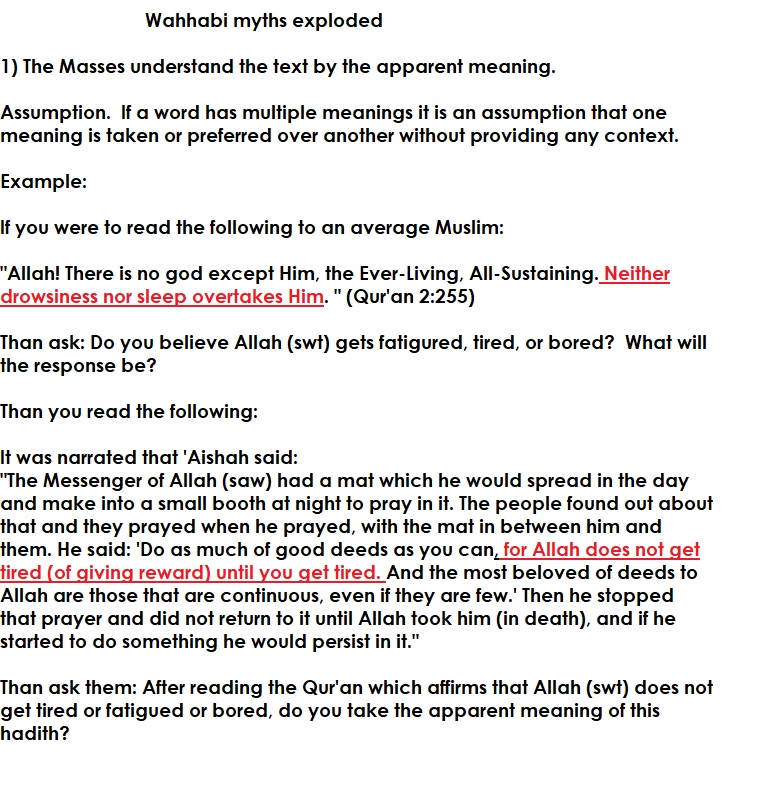
One of the most absurd theological positions to hold is the idea that Allah (swt) chose to communicate with mankind via a revelation that he himself said would need to be explained and he himself says it contains verses which are apparent in meaning and subject to layers of understanding, containing words that could have multiple meanings that one would walk a way with only one particular meaning on any given verse!

In our school, the Ibadi school we take the Qur’an as the primary source of evidence. We interpret the Qur’an by the Qur’an as the primary tafsir. Anything that conflicts with the Qur’an is heavily scrutinized. If on the apparent it looks as if it conflicts with the Qur’an a forensics analysis is done of the hadith on a few accounts.

  1. The sanad-the chain of narrators.
  2. The matn (the text itself).
  3. The eloquence of the language of the Prophet (saw).

In other words does this match the linguistic style of the Blessed Messenger (saw).

“DO not stir your tongue hastily (to commit the Revelation to memory).  Surely it is for Us to have you commit it to memory and to recite it. And so when We recite it ,follow its recitation attentively; then it will be for Us to explain it.” (Qur’an 75:16-19)

“Allah! There is no god except Him, the Ever-Living, All-Sustaining. Neither drowsiness nor sleep overtakes Him.” (Qur’an 2:55)

The apparent meaning of the above verses is that Allah (swt) does not get tired, bored or fatigued.

However, this does not stop the Wahhabi/Athari from asserting that Allah (swt) gets bored-in a way that befits his majesty! May Allah (swt) protect us from the perverts!

Basing their information on the apparent meaning of the text of the following hadith:

“It was narrated that ‘Aishah said:

“The Messenger of Allah (saw) had a mat which he would spread in the day and make into a small booth at night to pray in it. The people found out about that and they prayed when he prayed, with the mat in between him and them. He said: ‘Do as much of good deeds as you can, for Allah does not get tired (of giving reward) until you get tired. And the most beloved of deeds to Allah are those that are continuous, even if they are few.’ Then he stopped that prayer and did not return to it until Allah took him (in death), and if he started to do something he would persist in it.”

Source: (https://sunnah.com/nasai:762)

You may seem them expound upon this here:

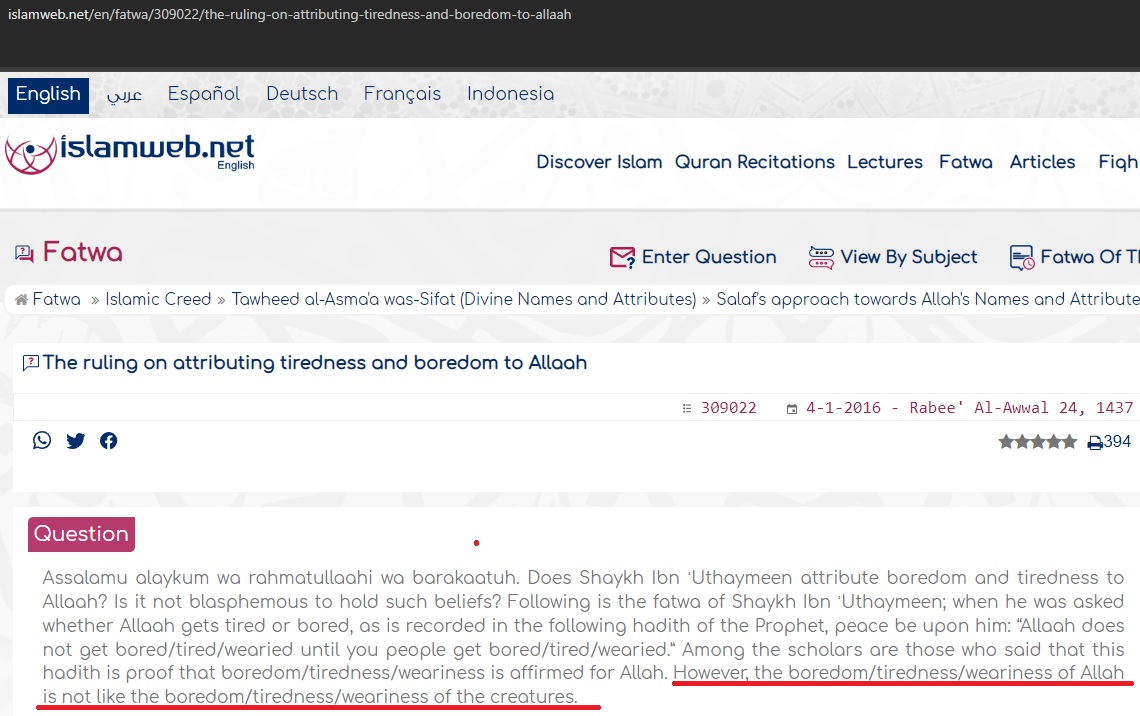
https://www.islamweb.net/en/fatwa/309022/the-ruling-on-attributing-tiredness-and-boredom-to-allaah

“However, the boredom/tiredness/weariness of Allah is not like the boredom/tiredness/weariness of the creatures.
Welcome to Salafiyah disarming Muslims of arguments against the deity of Jesus since….forever.

“Jesus was inside the boat, sleeping with his head on a pillow.” (Mark 4:38)

Salafi: “God doesn’t sleep!”

Christian: “Sure he does in a way that befits his majesty!”

So here the explanation goes some common sense, taw’il (interpretation) and some inconsistency. The link given above we read:

As for the hadeeth that reads, ‘Allaah never gets tired until you get tired,’ some scholars held that this hadeeth serves as proof that the attribute of tiredness (or boredom) is affirmed for Allaah. However, the tiredness (or boredom) of Allaah is not like that of the creature. The tiredness of the creature is an imperfection, while that of Allaah is free of any imperfection. This is similar to all other attributes that we affirm for Allaah as an aspect of perfection although, when attributed to creatures, they are aspects of imperfection. Some scholars held that the statement, ‘Allaah never gets tired until you get tired,’ is meant to indicate that no matter how many good deeds you do, Allaah rewards you for them; so do whatever you wish for Allaah never gets tired of giving you rewards until you get tired of doing good deeds. Thus, what is meant by tiredness here is what such tiredness entails, which is stopping (to give rewards).Other scholars held that the hadeeth does not imply attributing tiredness to Allaah at all because when one says, ‘I shall not get up until you get up,’ this does not necessitate that the latter will get up. Similarly, ‘Allaah never gets tired until you get tired,’ does not necessitate affirming the attribute of tiredness for Allaah.In any case, it is incumbent on the Muslim to believe that Allaah is Exalted above any aspect of imperfection, be it tiredness, boredom, weariness or anything else. If it is established that this hadeeth is evidence to affirm the attribute of tiredness for Allaah, then we must believe that the tiredness of Allaah is nothing like that of the creatures.
” [Majmoo’ Al-Fataawa]

Prima Qur’an response: So we can see the answer is already given.

This absolutely has to be the case since the Qur’an categorically rejects, tiredness, sleepiness, boredom to Allah (swt)!

“Allah! There is no god except Him, the Ever-Living, All-Sustaining. Neither drowsiness nor sleep overtakes Him.” (Qur’an 2:55)

So for those of their scholars who affirm boredom of Allah (swt) maybe they could …I dunno…..perhaps pick up the Qur’an and read it?
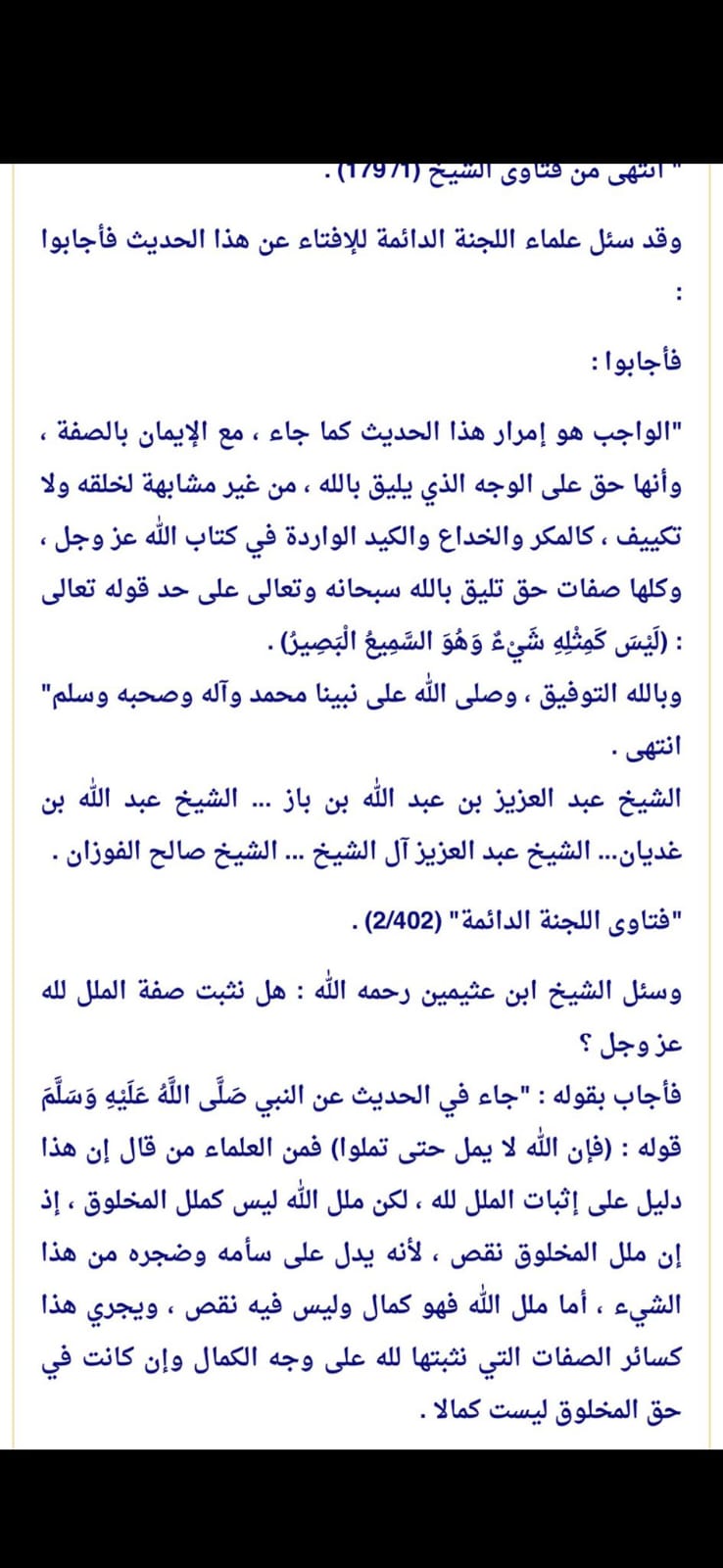

Ibn Taymiyya throws the idea of holding to the apparent meaning out the window.

He states in the link above:

““It is known that the principle held by Ahlus-Sunnah Wal-Jamaaʻah (mainstream Muslims) is that we describe Allaah only with what He describes Himself (in the Quran or the authentic Sunnah), without tamtheel (likening Allaah to His creation) or takyeef (trying to describe ‘how’ an attribute is by attempting to determine the manner in which attributes of Allaah take form). If this hadeeth indicates that Allaah is described with tiredness, then it should be noted that the tiredness of Allaah is not like our tiredness; rather, it is tiredness that is free from any aspect of imperfection or deficiency. As for the tiredness of human beings, it involves imperfection because it implies psychological and physical weariness because of a burden beyond one’s ability to endure. As for the tiredness of Allaah, if this hadeeth indicates it, then it is tiredness that befits Him. It is totally devoid of any aspect of imperfection. ” [Majmoo’ Al-Fataawa]”

But the very apparent meaning of one who gets tired or bored itself indicates need! The very apparent meaning of one who gets bored or tired is one who is deficient!

But for the Salafi/Athari the apparent meaning here will not suffice because of it’s obvious implication is that Allah (swt) -authubillah, gets tired and bored.

So the theology of the Salafi/Athari is superimposed upon the text. Than added to it is the Bid’ah addition which the Blessed Prophet (saw) nor any of his companions ever used….ever!

That bid’ah addition is “I a way that befits him” or “In a way that suits his majesty” etc…

Ibn Taymiyya flatly contradicts his own advise in the same discussion with a questioner!

“You know that the Prophet, sallallaahu ʻalayhi wa sallam, addressed his companions with this hadeeth and that they were keener than all of us on knowing the attributes of Allaah; did they ask the Messenger whether Allaah gets tired or not? Or did they rather say, ‘We hear and we believe that Allaah never gets tired (of giving rewards) until we get tired (of doing good deeds)?! The imperfection that tiredness implies is for us human beings, for Allaah is perfect in His Attributes. Hence, we must stop discussing and investigating this matter any further.”

Prima Qur’an: Very good Ibn Taymiyya well done!

Oops!

On second thought let us continue to discuss and investigate it as he does….

“As long as we do good deeds, then Allaah, The Exalted, rewards us, and He never gets tired of giving rewards until we get tired of doing good deeds.’ If you believe that getting tired in this sense is an imperfection in you, then do not attribute an imperfection to Allaah. Verily, it is tiredness befitting of Him. We know that if the attribute of tiredness is affirmed for Allaah, then this entails that it is free of all aspects of imperfection. I warn you, and I warn all listeners of going to extremes and delving deeper into such a serious issue. Instead, you should preoccupy yourselves with carrying out the religious obligations and duties instead of indulging in investigating the matters that you are not obliged to investigate.”

BEWARE THE SALAFI (WAHHABI) SMOKE AND MIRRORS!!!

“Oh the common people just take it at only one meaning, which happens to be what we affirm.”

Notice that the article in the link above continue to say:

At-Tahaawi  may  Allaah  have  mercy  upon  him wrote:

“Someone may ask, ‘How could you accept to attribute this hadeeth to the Messenger of Allaah, sallallaahu ʻalayhi wa sallam, although it indicates describing Allaah with getting tired in a certain case, and this can never be an attribute of Allaah?’ Our answer is: Tiredness can never be an attribute of Allaah as mentioned, and it is not as he understood. Arabic linguists advised that the hadeeth that reads, ‘Allaah never gets tired until you get tired,’ means that tiredness is expected from you but not expected from Allaah. This is similar to what people commonly say when they describe someone as being a good speaker endowed with eloquence and great debate skills, that ‘he does not stop and give up his argument until his opponent does,’ referring to a merit of his in this regard because if they had intended that he does stop, then they would not be affirming a merit for him since he stops when his opponent stops just like his opponent. Rather, what they really mean is that he does not stop after his opponent stops and that he remains as powerful and capable as he was before his opponent stopped. Similar to that – and Allaah knows best – is the hadeeth that reads, ‘Allaah never gets tired until you get tired.’ It means that you may get tired (of performing good deeds), and stop; while Allaah, after you have gotten tired and stopped, is as He was before, never tiring and never stopping.” Source: [Sharh Mushkil Al-Aathaar]

Ah I see! So now we are appealing to Arabic linguist. It’s as if the Arabic language has depth and nuance, idiom and poetic expressions? Who would have thought?

Ibn ʻAbd Al-Barr  may  Allaah  have  mercy  upon  him wrote:

“With regard to the hadeeth that reads, ‘Allaah never gets tired until you get tired,’ the adjective ‘tired’ in this context is used to oppose the weariness on their part. It is well-known that Allaah, The Exalted, does not get tired regardless of whether people got tired or not, and nothing or nobody causes Him to get tired; Exalted is He above such imperfection. The hadeeth used a common style in the Arabic language, called mujaanasah, which means that if they (the Arabs) use a word as an answer and reward for another, it is the same as the original word though different in meaning. Examples on this style are clear in the verses that read (what means):

– {And the retribution for an evil act is an evil one like it…} [Quran 42:40]

– {So, whoever has assaulted you, then assault him in the same way that he has assaulted you.} [Quran 2:194]

In the first example, the second word ‘evil’ is merely for mujaanasah i.e. it does not convey its original meaning; it is only the same as the first. Of course, the reward of evil is not a similar evil, and retribution is not an assault because it is a due right.

The same applies to the following verses:

– {And the disbelievers plotted, but Allaah plotted. And Allaah is the best of plotters.} [Quran 3:54]

– {…they say, “Indeed, we are with you; we were only mockers.” (But) Allaah mocks them and prolongs them in their transgression (while) they wander blindly.} [Quran 2:14-15]

– {…Indeed, they are planning an evil plan, but I am planning an evil plan.} [Quran 86:15-16]

“The Arabic words for plotting, mocking, and evil planning used in the verses as the actions of Allaah are merely used for the sake of mujaanasah. Verily, Allaah, The Exalted, is above mocking, plotting, and planning evil; rather, the terms are used to indicate that Allaah shall punish them for their mockery, plotting, and evil planning. The same applies to the hadeeth that reads, ‘Allaah never gets tired until you get tired;’ the adjective ‘tired’ used for Allaah is merely used for the sake of mujaanasah…” Source: [At-Tamheed]

Imagine that! The Arabic language uses a grammatical device known as mujaanasah!

So be careful of those who pose simplistic scenarios that are dishonest to begin with.

The manner and context of the question is just as important as the question itself.

For example are we to believe that the majority of Muslims believe the literal Arabic of the following verse (easily missed in the English translation) but in the Arabic you have the wall “wanting” to collapse. So are we going to attribute a will to this wall?!

“So they moved on until they came to the people of a town. They asked them for food, but the people refused to give them hospitality. There they found a wall ready to collapse, so the man set it right. Moses protested, “If you wanted, you could have demanded a fee for this.”(Qur’an 18:77)

To read more on this topic I would encourage you to read the following:

May Allah (swt) guide us to what is beloved to him!

May Allah (swt) forgive the Ummah!
1 Comment

Filed under Uncategorized

Is the Qur’an that we are in Possession of Distorted? | Sayyid Ali Abu al-Hasan

” Indeed, it is We who sent down the Qur’an and indeed, We will be its guardian.” (Qur’an 15:9)

﷽ 

First let us post what the original video clip has to say about Sayyid Ali’s presentation:

“In this video, the Sayyid responds to a questioner who asks whether the Qurʾān that is present between us today has been subject to distortion or not. Instead of going through the traditions related to whether this has indeed been the case, the Sayyid outlines some epistemological points to bear in mind when trying to evaluate this claim. He delineates general historical principles and facts that cause us to deem such an occurrence, as historians, to be extremely far-fetched. He then outlines the possible goals of a distorter and contrasts these objectives to what is found within the Qurʾānic text, whence we find that had these been the objectives of the distorters, then we would not possess certain verses and contents of the Qurʾān that we do today.” –Source: https://www.youtube.com/watch?v=l7y9bstcnXM&t=1453s

We would also like to say that this explanation by Sayyid Ali is one of the best, if not the best we have seen. It answers a lot of questions that are put forward in regard to this.

There are those who claim that the Shi’i themselves make this claim. The claim of tahrif of the Qur’an. Sayyid Ali beautifully responds to these claims.

This is a short and succinct lecture, equal to about 29 minutes of your time. It is absolutely worth it.

Those Orientalists and advocates of the historical critical method are most welcome to put this in their pipes and smoke it. The Imam laid out a very cohesive and cogent argument.

We would highly recommend you listen to the whole of the presentation.

@20:04 “Pay attention with me, in the Glorious Qur’an, now if someone wants to distort, what would they want to distort? What are his objectives hind distortion? I mean, what are the possible objectives of distortion? We will mention objectives, and let’s see if they have any basis.”

@20:18 “It may be said, for example, that among the objectives of distortion: Is the removal of certain criticisms directed towards some of the Companions who ruled. I mean, those who had authority. They are all present in the Qur’an. They are found in Surat al-Tahrim, Surat al-Hujurat, which contains: {Do not raise your voices above the voice of the Prophet} [Qur’an 49:2]

@20:40 “And it’s mentioned about whom it was revealed. The issue of fleeing on the day of Uhud, and Hunayn, all these details are mentioned. The details of the events are mentioned. If someone wanted to distort, why would they distort? I mean, if one of the objectives of authorities was distortion, it would have been something related to them.”

@:20:58 “Those who ruled, the criticisms directed at them in the Book of Allah are present.
This is a possible objective [for distortion]. Of coruse, I mention these as supporting points,
not as evidence. The [main] evidence has concluded. The evidence has concluded, now we’re
mentioning supporting [points].

@21:10 “The second objective is, for example, that these individuals want to remove some matters regarding the Prophet (peace be upon him and his family) [being portrayed in a negative light].

@21:19 “They love the Prophet, so they try. The Glorious Qur’an, the criticisms made by the polytheist against the Prophet (peace be upon him and his family) are present in the harshest articulation. In fact, some addresses in the Qur’anic chapters to the Prophet (peace be upon him and his family) that contain-where principally one may perceive some sort of harshness and severity within, for example, {And had We not strengthened you, you would have almost inclined to them a little} [Qur’an 17:74], it’s all there.”

@21:49 “Alright? Of course, we say it’s in the sense of “I mean you, and listen O neighbor.” But the address is there.”

@22:17 “Very well. Among the objectives that are mentioned, is removing the names of
Ahl al-Bayt (upon them be peace), from the Qur’an. I say—I say, firstly, what’s the meaning of this verse?
We’re talking now as Shi’a. {O Messenger, announce that which has been revealed to you from your Lord, and if you do not not, then you have not conveyed His message} [Qur’an 5:67]

@22:38 “How do we interpret this? Isn’t it about Wilaya? Isn’t it about Wilaya in the last days of the Prophet (peace be upon him and his family). And Surat al-Ma’ida is amongst the last [chapters] to be revealed, if not the very last.”

@22:53 “If Wilaya was detailed in previous chapters, then what would be the meaning of: {announce that which has been revealed to you from your Lord} [Qur’an 5:67]? We fundamentally believe that it’s natural for the mention of the Commander of the Faithful (peace be upon him) to not be frequent in the Qur’an.

“This is natural. And this is what we believe. I mean, his mentioned as an Imam.
I speak of his mention as an Imam. Clear? Not as a man of virtues. Otherwise if we’re speaking of virtues, then a “a quarter [of the Qur’an] is about us”. Clear?”

@23:23 “We are not speaking for that perspective. We’re speaking from the perspective of those in power. Alright? Concerning those in power, {Announce that which has been revealed to you from your Lord, and if you do not, then you have not conveyed His message} [Qur’an 5:67] Now, this verse, what’s the reason for its revelation? It’s natural that the mention of Imam ‘Ali (upon him be peace) will not be frequent in the Qur’an. As for mentioning the rest of the Imams (upon them be peace), in the Qur’an.”

@23:50 “Fundamentally, we Shi’a do not believe in the necessity of believing in [all] the Imams (upon them be peace) except after the death of the previous Imam.

However the Imam later admits:

@27:25 “The thing that may be brought up is the issue of Wilaya. So it would be
problematic only on the Shi’a side
. But we explained that the Shi’a, when it comes to revealing all of the Imams’ [names], that is something they have deemed far-fetched.
Fundamentally. It’s not something to be expected, that there would be something in the Qur’an about Imamate. And on the other hand, concerning the Commander of the Faithful (upon him be peace), we believe that the Prophet (peace be upon him and his family) proclaimed this towards the end of his life. {O Messenger, announce that which has been revealed to you from your Lord, and if you do not, then you have not conveyed His message} [Qur’an 5:67]. So in reality, naturally, if the name of the Commander of the Faithful (upon him be peace) was in the Qur’an, it would have been rare and minimal. For example, had it been the case. Up to this extent, I mean, this degree of speculation.”

@28:14 “This does not outright negate the existence of the name of Imam ‘Ali (upon him be peace). This is a speculative argument. However, I just want to say, that upon reflection on the matter, the degree of distortion will not, some people, I mean, naturally, the name of Imam Ali, had it been in the Qur’an, it would be rare, Had it been there, it would be rare. Had it been there. Clear? According to the Shi’i view. Nothing else. I’m saying this according to the Shi’i Twelver view. Alright?”

Prima Qur’an comments: First and foremost again, the overall explanation by the respected Imam was/is brilliant! It is unfortunate that some people will allow themselves to be clouded by sectarianism and not benefit by what he said.

The only part where he dropped the ball was giving his minor points (because, as he mentioned, the main case has already been established), but in regard to the minor points is concerning the mention of the ahl bayt and/or the mention of the name of Imam Ali (at the very least).

By quoting a vague reference:”Announce that which has been revealed to you from your Lord, and if you do not, then you have not conveyed His message} [Qur’an 5:67] This does little to dissuade anyone from the idea that a redactor or editor wanted to remove explicit mention of the Ahl Bayt or Imam Ali as the leader of Imam of the Muslims.

The Imam was also honest and transparent enough to say:

“@22:38 “How do we interpret this? Isn’t it about Wilaya? Isn’t it about Wilaya in the last days of the Prophet (peace be upon him and his family)


“How do we interpret this.”

I mean, naturally, the name of Imam Ali, had it been in the Qur’an, it would be rare, Had it been there, it would be rare. Had it been there.”

He was also very objective and fair-minded when he stated:

“The thing that may be brought up is the issue of Wilaya. So it would be problematic only on the Shi’a side. But we explained that the Shi’a, when it comes to revealing all of the Imams’ [names], that is something they have deemed far-fetched

That is correct. It would only be a problem for the Shi’a side, as they are the ones who have as a theological foundation the concept of being ruled by the family of the Prophet (saw), a concept we absolutely do not find in the Qur’an at all.

So, for the Sunni or the Ibadi, this is not something we would expect to find in the Qur’an.

We have already mentioned this in our article:

Also, when the Ahl Bayt are mentioned in the Qur’an it is specially speaking of the wives of the Blessed Prophet (saw).

Other than that one should watch and take note of this excellent presentation by Sayyid Ali Abu al-Hasan.

May Allah (swt) guide the Ummah.

May Allah (swt) forgive the Ummah.

Leave a comment

Filed under Uncategorized

Wahhabi Madhkhali try and create fitna between Maliki and Ibadi and are shut down.

“And [there are] those [hypocrites] who took for themselves a mosque for causing harm and disbelief and division among the believers and as a station for whoever had warred against Allah and His Messenger before. And they will surely swear, “We intended only the best.” And Allah testifies that indeed they are liars.” (Qur’an 9:107)

﷽ 

The right hand sword of the Umayyad Imperium, the Salafi Madhkalis, and left hand shield of the Zionist expansionism are at it once more.

Instead of giving focus to what is happening to our brothers and sisters in Palestine, Gaza, Rafah the Madhkalis being the agent provocateurs that they are try to cause fitna in the Ummah my digging up the graves of scholars long since past. They dig through the books seeking and finding what can cause strife between the Muslims.

Their swords are ever thirsty for the blood of the believers. Their vigor and fervor is for strife among the Muslims. While the people of Sudan and Libya are the victims of their tyranny they tire not in their fight against the Muslims.

We have already covered in an previous article that every group among the Muslims and even Pseudo-Islamic sects have exclusivist views. There is no exception.

We have covered the statement of Imam Malik there.

We also need to recall the words of Imam Malik himself: كُلُّ كَلَامٍ فِيْهِ مَقْبُوْلٌ وَ مَرْدُوْدٌ إِلّا كَلَامُ صَاحِبِ هَذا القَبْرِ

So his words can be rejected.

All of these statements of past scholars have social/political context. They were said in the context of which they live.

Yet the majority of the world’s Muslims want to live together and coexist. Sure, we can still have debates concerning who is upon truth and error upon this or that point. Albeit this should in reality be the domain of the scholars.

Do these agents really think that the Muslim Ummah are that gullible?

When the scholars of this Ummah had asked Shaykh Ahmed Al Khalili (h) to be head of the International Union of Muslim scholars do you not think they are aware of various positions stated in their books from long ago? Do you not think they are not aware of tough positions among some of our scholars? Of course they are!

These Wahhabi Madhkhali believe all people of Palestine who die not upon their creed will be people of the hellfire! The quote as evidence the hadith of 73 sects. Now we can ask these people that bark so loud the following? The 72 sects are they in hell for awhile only or forever?!

Actually not just Palestine but everyone and anyone.

a) If they are in hell only for a while than insh’Allah we will all see each other in heaven.

b) If they are in hell forever than at least be honest and transparent with the Ummah!

What Was the Position of the Salaf Concerning Praying Behind the so-called Khawarij According to Ibn Taymiyya?

   – The Path of the Prophetic Sunnah

2. *في نقض كلام الشيعة القدرية*

   – In Refutation of the Shiite Qadariyyah Doctrine

3. *لابن تيمية*

   – By Ibn Taymiyyah

4. *أبو العباس تقي الدين أحمد بن عبد الحليم*

   – Abu Al-Abbas Taqi al-Din Ahmad ibn Abd al-Halim

5. *تحقيق الدكتور محمد رشاد سالم*

   – Edited by Dr. Muhammed Rashad Salim

6. *الجزء الخامس*

   – Volume Five

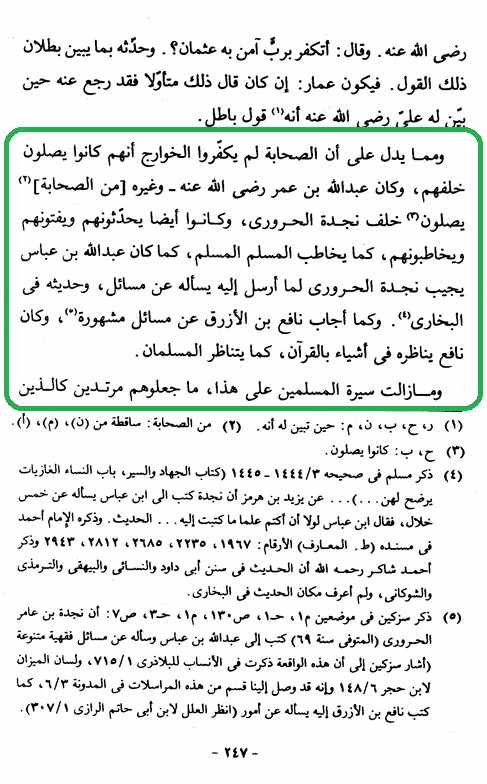
“And what indicates that the Companions did not consider the Khawarij to be disbelievers is that they used to pray behind them. Abdullah ibn Umar -RA- and others[companions] used to pray behind Najda al-Haruri. They also used to engage in debates with them, as the Muslim would debate with a Muslim, as Abdullah ibn Abbas debated with Najda al-Haruri when he was sent to him to ask about certain issues, and his hadith is in Al-Bukhari. Likewise, Nafi’ ibn Al-Azraq debated on famous issues. Nafi’ used to debate on matters in the Quran, as any two Muslims would debate among themselves”

Prima Quran Comment: By the way that admission above is enough for any thinking Muslim to come to understand that these so called hadith about the Khawarij that are put in the mouth of the Blessed Prophet (saw) are forgeries and blasphemy! These are no doubt the creation of a redactor.

Just as we ripped apart the chains here:

As well as the attack upon the noble companion Hurqus ibn Zuhair (ra).

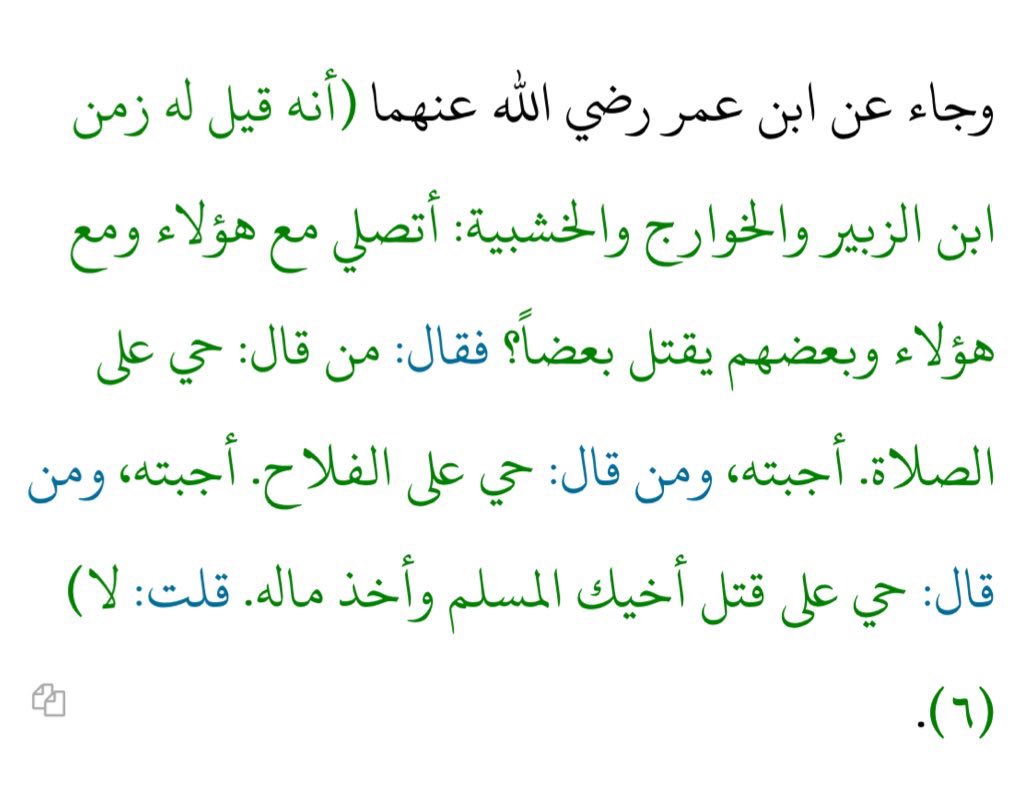
“It was narrated about Ibn Umar, (ra), that it was said to him during the time of Ibn Al-Zubair, the Khawarij, and Al-Hajjaj: ‘Do you pray with these people while some of them are killing others?’ He replied: ‘Whoever says “Come to prayer,” I answer him, and whoever says “Come to success,” I answer him. And whoever says “Come to kill your Muslim brother and take his property,” I say: No.'” Source: (Musannaf ibn Abi Shaybah)

Also, look what our teacher Shaykh Hamed Hafidh Al Sawafi (May Allah continue to benefit us by him) says:

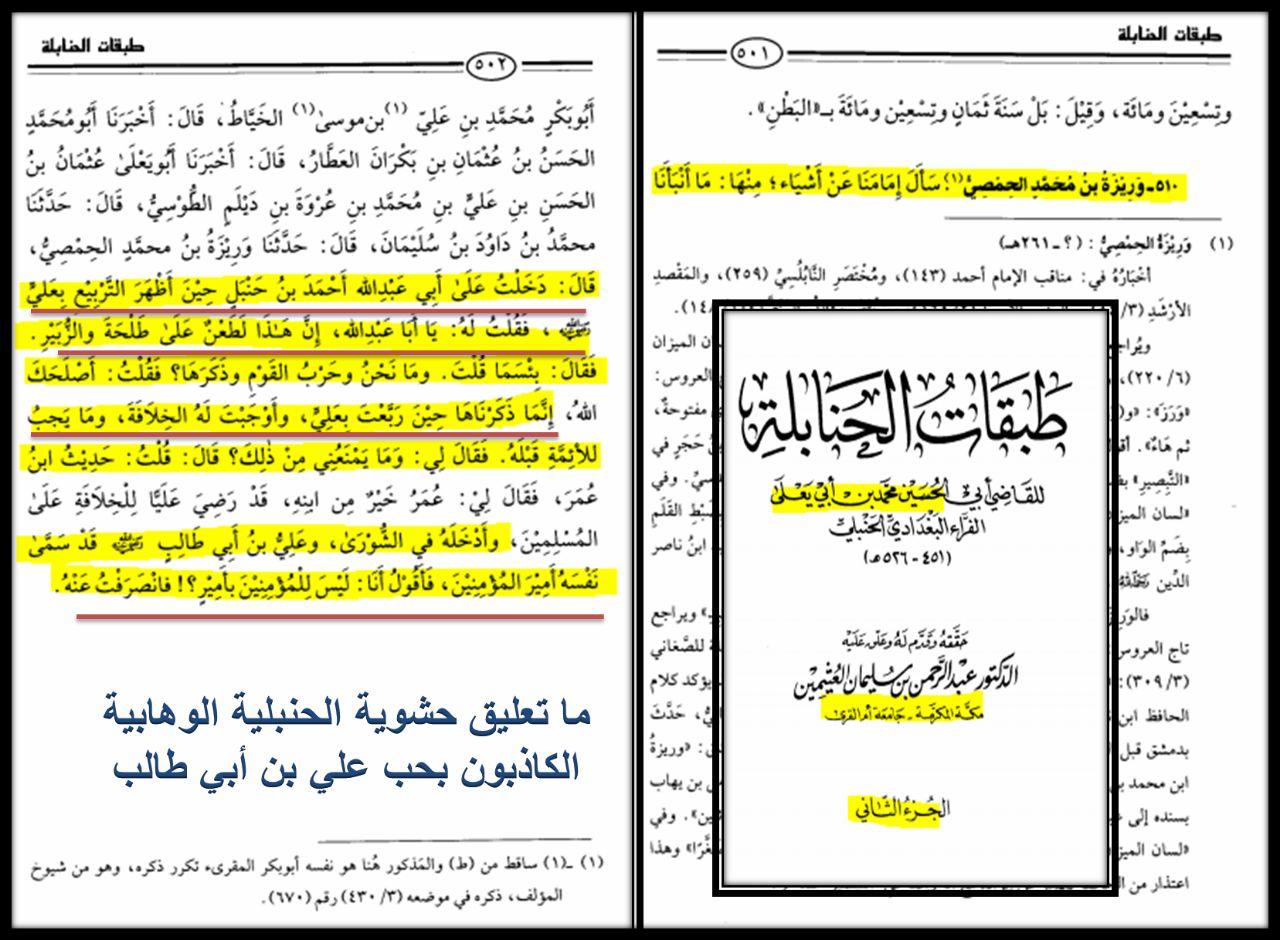
هناك ما يشير إلى أن الصحابي عبدالله بن عمر رضي الله عنهما لم يبايع الخليفة الرابع عليا بن أبي طالب كرم الله وجهه.

وكان من يسمون أنفسهم بأهل السنة على مذهبه حتى جاء أحمد بن حنبل فجاء بالتربيع بعلي فقاموا عليه فقالوا له إن التربيع بعلي طعن في طلحة والزبير وخروج عن نهج عبدالله بن عمر…. وكانت بينهم محاججة انتهت بالتسليم لموقف أحمد بن حنبل 

ومعروف أن أحمد بن حنبل من علماء القرن الثاني الثالث الهجري. (فترة مملكة بني عباس وهم خصماء مملكة بني أمية)

“There is evidence that the companion Abdullah Ibn Umar, (May Allah be pleased with them both, did not pledge allegiance to the fourth caliph, Ali bin Abi Talib, May Allah honour his face. Those who call themselves ‘Sunnis’ adhered to his doctrine until Ahmad ibn Hanbal came and brought them to be square with Ali, so they rose up against him (Imam Ahmad) and told him that trying to make them square with Ali was an attack on Talha and al-Zubayr and a departure from the approach of Abdullah ibn Umar…. There was an argument between them that ended with them submitting to the position of Ahmed ibn Hanbal. It is well known that Ahmad bin Hanbal is one of the scholars of the second and third century AH. The period of the Bani Abbas Imperium, who were opponents of the Umayyad Imperium.” -Shaykh Hamed Hafidh Al Sawafi

The source for that is as follows:

Anticipating a response from the Wahhabi Madhkhali

Now, if these Wahhabi Madhkhali want to reply and say:

“Oh! you are quoting the evidence of Ibn Taymiyya so does this mean you accept you are Khawarij?”

The Answer to that is: No! But you call us (the Ibadi as Khawarij) so even if we are by your standards than you must make the prayer behind us!

So the next time you get someone like Shaykh Assim Al-Hakeem (who admits he drinks alcohol and is proud of it) telling you that you cannot pray behind Ibadi it is best you get your information and sources from more sober minded people.

Hayya alas Salah means exactly that: Come to Prayer. It does not mean come to this or that group or sect. The Imam leads the prayer. You stand behind him as long as he is Ahl Qiblah. Simple.

May Allah (swt) forgive the Ummah!
May Allah (swt) guide the Ummah!

Leave a comment

Filed under Uncategorized

A bridge named as-Siraat where people fall down into hell?

“When the Hellfire sees them from a distant place, they will hear its fury and roaring.” (Qur’an 25:12)

“Surely those for whom the decree of ultimate good has already gone forth from Us. These
will be kept far away from not even hearing the slightest sound (of hell).
While they abide eternally in whatever their souls desire.” (Qur’an 21:101-102)

“Every human being is bound to taste death: and you shall receive your rewards in full on the Day of Resurrection. He who is kept away from the Fire and is admitted to Paradise, will surely triumph; for the life of this world is nothing but an illusory enjoyment.” (Qur’an 3:185)

﷽ 

First let us be clear about one thing. There is not a single verse any where in the Qur’an that states that a believer or a Muslim will enter into the hellfire. None.

No evidence at all that people are coming to As Siraat (The Bridge) over hellfire None!

Those who do not have proper understanding of the Qur’an and are upon error will in their misguidance quote the following:

Yet ˹some˺ people ask ˹mockingly˺, “After I die, will I really be raised to life again?
Do ˹such˺ people not remember that We created them before, when they were nothing?
By your Lord ˹O Prophet˺! We will surely gather them along with the devils, and then set them around Hell on their knees. Then We will certainly begin by drawling out of every group the ones most defiant to the Most Compassionate. And We truly know best who is most deserving of burning in it. There is none among you, (Those condemned to Hell), but he shall reach there (- the Hell). This is (a promise) binding on your Lord, an absolute decree. Moreover, saved are those who were righteous. Forsaken are the criminals therein on their knees.” (Qur’an 19:66-72)

  1. This verse is speaking about those who mocked the resurrection (verse 66)
  2. wa-in minukum (among you) in verse 71 who are they? They are the ones that are referenced in verse 66.
  3. These verses are not addressing the Muslim at all. Why?
  4. The Muslim is one who believes in the hereafter not denying it.
  5. The Muslim is one who believes in the hellfire not denying it.
  6. It makes no sense to say that Prophet Muhammed (saw), Prophet Jesus (as), all of the prophets, pious people would be put into hell.
  7. There is absolutely no reference to a bridge over hell in these verses.

In fact, to fortify point number 7 look at how all these translations render the Arabic text.

https://www.islamawakened.com/quran/19/71/

You may also look at the following:

“There is not one of you but (wariduha) shall approach it. That is a fixed ordinance of thy Lord.” (Qur’an 19:71)

How is this used throughout the Qur’an?

https://corpus.quran.com/qurandictionary.jsp?q=wrd#(19:71:4)

Thus is the false doctrine is crushed.

Also rushed into oblivion are the machinations of Christian missionaries who in their ignorance used such verses against the Muslims.

There is No Falling Of A Bridge! – His Eminence Shayh Dr Khalid Al-Abdali (h)

They say that, no these people will pass over a bridge. A bridge named as-Siraat.
And (as they pass) begin to fall down from this bridge.

Some will pass by quickly like the speed of lightning. Whilst some will crawl over it…and some will fall over (The Bridge).

Where are they falling to? Huh? “To Hell” (Says the Audience)

Allah the Exalted says: “It has seven gates; and each gate is assigned for a certain group of them.” (Qur’an 15:44)

This (Idea of a Bridge) -Is one of those propagated fables you will find no evidence for in the book of Allah. That-People will fall down.

This is because Allah -the Exalted has affirmed for us in the clearest of wordings that there are gates (to hell).

I believe that there are gates. Who believes otherwise? That there are no gates?

That, no no this is not correct. They will fall down into hell without passing a gate.

Tell me. If there is anyone here who dares to say that there are no gates (to hell).

Rather they fall into it instead! Focus! Some are misguiding people on this! Whilst considering themselves people of paradise and favour.

Wake up to reality! And stop deceiving yourself!

Pay attention! “Until, when They reach it(hell) And It’s gates are made opened.” (Qur’an 39:71)

It’s gates, Right? “And It’s guardians Say to them.” (Qur’an 39:71)

Are there gates found or not? I believe and I’m certain and convinced that there are gates there. Without a doubt! As for this issue of tukh(falling down) Then no!

May Allah guide the Ummah.

May Allah forgive the Ummah.

Leave a comment

Filed under Uncategorized

Salafis attack Imran Hosein over Jesus and Shaykh Salih al-Fawzan attributes lies to Allah.

“Allah said, O Jesus, I shall cause you to die and will exalt you in my presence and shall purify you of the ungrateful disbelieving people, and shall place those who follow you above those who deny the truth, until the Day of Judgement; then to Me shall all return and I will judge between you regarding your disputes.” (Qur’an 3:55)

“And they have thereof no knowledge. They follow not except assumption, and indeed, assumption avails not against the truth at all.” (Qur’an 53:28)

﷽ 

The Pseudo-Salafis are attacking Imam Imran Hossein because he basically doesn’t believe that the Qur’an says the following:

“And for their saying, “Indeed, we have killed the Messiah, Jesus, the son of Mary, the Messenger of Allah.” And they did not kill him nor did they impale crucify him but Allah made some random individual look exactly like Jesus and that person was crucified instead of Jesus. Those who differ therein are full of doubts. They have no certain knowledge of it, but only follow conjecture. For certainly, they did not kill him.”  (Qur’an 4:157)

“What did Allah do to make it appear…that he died? Let me warn you! And my language some time is very harsh. Because that is the only language some people can understand. Don’t come with this nonsense! Because it is not only pathetic nonsense it is absolutely sinful! To say that Allah (authubillah) caused someone else to take the appearance of Nabi Isa (a.s) and that innocent man, innocent because he never claimed to be the Messiah! He was crucified. Wait for judgement day with that nonsense! Pathetic nonsense! It’s not there in the Qur’an. It’s in your imagination. That’s where it is. Yet it took the world of Islam by storm. What a brain washed ummah we are today! Well than what happened? Well, then why don’t you go to the Qur’an and let the Qur’an explain rather than go on fancy flights of imagination. “-Shaykh Imran Hossein.


Now notice that @ 1:27 this “Nasir Al Hanbali” states:

“We will bring the Ayah in the Qur’an and the Tafsir from ibn Kathir narrated by Shaykh Salih al-Fawzan, but notice how this creep (Shaykh Imran Hossein) says: “why don’t you go to the Qur’an and let the Qur’an explain…” but he brings no Ayah from the Qur’an, just his weird: “LET ME WARNN YOUUU!!!

“You gonna tell Allah on judgement day you caused that man to assume the appearance of someone? And he who never claimed to be the Messiah he was crucified that is an act of injustice! You are attributing injustice to Allah what foolishness. Where are the scholars who will correct this foolishness? That’s why I have to be so forceful in my language. Allah took his soul. That he was dead. They took down the body. They put the body in a cave. They sealed the cave. Allah returned the soul. As simple as that. Nobody knew that the body, that the soul was returned and Allah raised him. But let me warn you one more time. If you stick with this theory of substitution you are going to be in a pathetic state on judgement day. Let me warn you one more time. This is a simple explanation from the Qur’an. “- Shaykh Imran Hossein.

So than “Nasir Al Hanbali” puts the following recitation up:

“Nasir Al Hanbali” than ask us: “Do you think Shaykh Ali Jaabir was wrong and the creep was right?”

My comment:

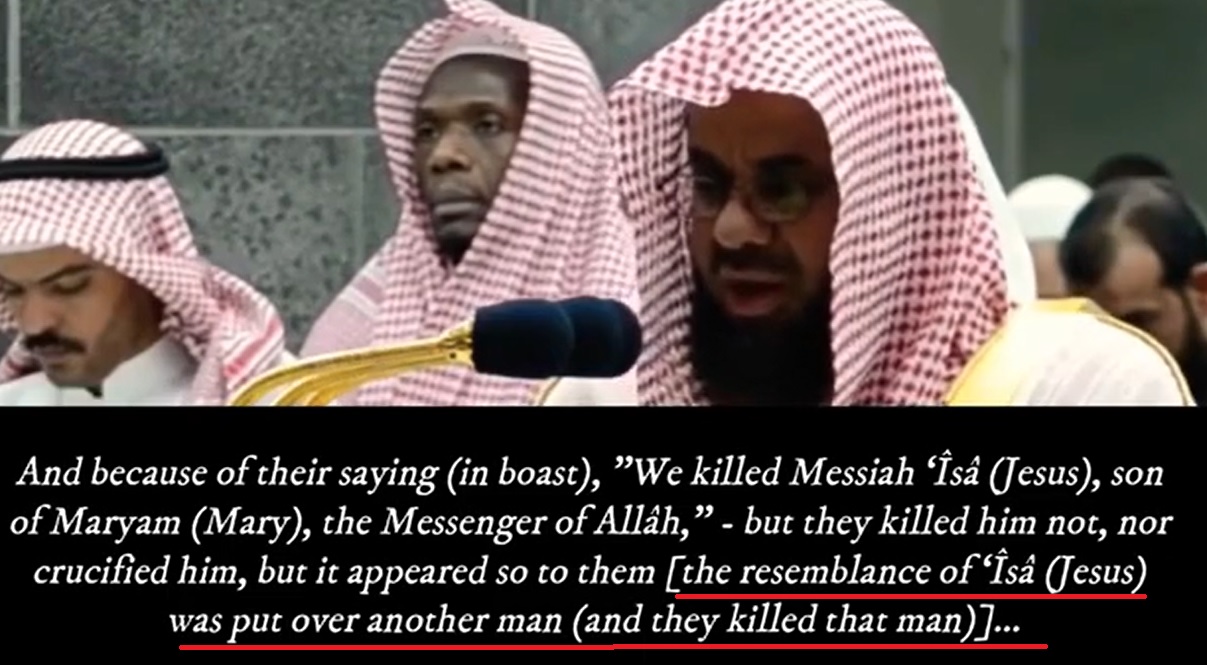
Where did Shaykh Ali Jabir recite “the resemblance of Isa was put over another man (and they killed that man” ? Shaykh Ali Jabir did not recite that at all! Yet the text put up there fools those who do not understand the Arabic text!

Then, ‘Nasir Al Hanbali’ gives us another reciter.

“Nasir Al Hanbali” than ask us: “Do you think Shaykh Abu Bakr ash-Shatiri was wrong and the creep was right? Let us listen to the next reciter, Shaykh Sa’ood ash-Shuraim.”

Prima Qur’an comment:

Where did Shaykh Abu Bakr ash-Shatiri recite “the resemblance of Isa (Jesus) was put over another man (and they killed that man)”? Shaykh Abu Bakr ash-Shatiri did not recite that at all! Yet the text put up there fools those who do not understand the Arabic text!

Prima Qur’an comment:

Where did Shaykh Sa’ood ash-Shuraim recite “the resemblance of Isa (Jesus) was put over another man (and they killed that man)” ? Shaykh Sa’ood ash-Shuraim did not recite that at all! Yet the text put up there fools those who do not understand the Arabic text!

This is simply pure deception on behalf of the one who put the video up.

“Allah said to Isa: Allah said: O Isa (Jesus)! I will take you and raise you to Myself [Qur’an 3:55] Allah said: “Ya Isa” referring to Isa ibn Maryam (a.s) when the Jews plotted against him, they wanted to kill him. They entered upon him wanting to kill him [because] their norm was to kill Prophets. When they entered upon [Isa ibn Maryam], Allah raised him from amongst them. He made another man resemble him. They grabbed that man, crucified him and killed him thinking that he was Isa. As for Isa, then Allah raised him from amongst and they did not perceive it. That is why Allah says: “but they killed him not, nor crucified him, but it appeared so to them [the resemblance of Isa (Jesus) was put over another man (and they killed that man)],” [Qur’an 4:157] -Shaykh Salih al-Fawzan

Prima Qur’an comment:

Shaykh Salih al-Fawzan has invented an outright lie about Allah (swt)! Let the Shaykh be reminded the following:

“And who is more unjust than one who invents a lie about Allah or says, ‘It has been inspired to me,’ while nothing has been inspired to him, and one who says, ‘I will reveal something like what Allah revealed.’ And if you could but see when the wrongdoers are in the overwhelming pangs of death while the angels extend their hands, saying, ‘Discharge your souls! Today you will be awarded the punishment of [extreme] humiliation for what you used to say against Allah other than the truth and that you were, toward His verses, being arrogant.’” (Qur’an 6:93)

Prima Qur’an comment:

Where did Shaykh Salih al-Fawzan get the daleel from the Qur’an and Sunnah that ” He made another man resemble him.” This is Aqeedah! The Qur’an does not say this! This is not from the Sunnah!

Shaykh Salih al-Fawzan continues:

Allah made this man resemble the Messiah, Isa. He himself accepted it and ransomed himself; he ransomed himself and he accepted that he would be killed and crucified. Allah honored him and did not waste this person and what he did with the Messiah. It is said that the one who Allah made to resemble Isa was the one who practiced treason; the one who led [the Jews] to Isa. The one employed treachery or betrayed Isa and led the Jews to him. Allah made him resemble Isa, so they killed him. However, the first opinion is more famous, that the one who chose to resemble Isa was honored and he chose to take his place. This man sacrificed himself for the sake of Allah, he was crucified and killed, so the Messiah Isa ibn Maryam could be saved from them. And Allah knows best. Allah raised him alive with him soul and his body. Not how some of the ignorant individuals say: “he was only raised with his soul.” He was raised with his soul and body alive. They were not able to touch him with any harm.” -Shaykh Salih al-Fawzan

Prima Qur’an comment:

Where did Shaykh Salih al-Fawzan get the daleel from the Qur’an and Sunnah that “Allah made this man resemble the Messiah.” This is Aqeedah! The Qur’an does not say this! This is not from the Sunnah! How can we be so carefree in ascribing to Allah (swt) such things and in the next breath say, “he first opinion is more famous.” Of course the opinion that some random person volunteered to be killed sounds better than just some random guy being chosen! The point being Shaykh Salihi al-Fawzan we don’t attribute opinions and conjecture to Allah (swt) !! It would have been appropriate to say that this is an interpretation of the text that was taken from the People of the Book and it does not have a sound chain of narration.

Also, which text in the Qur’an says that Allah (swt) “He was raised with his soul and body alive.

Shaykh Salih al-Fawzan continues:

“As for His statement: I will take you.. [Qur’an 3:55] The word Wafaat can mean death and it can also mean to sleep. “It is He who takes your souls by night (when you are asleep), and has knowledge of all that you have done by day,. [Quran 6:60]” -Shaykh Salih al-Fawzan

“Wafaat here means to sleep and Allah knows best or I will take you…[Qur’an 3:55], It can also mean to take you. Mutawaffi also means to take; Tawaffa haqqahu min fulaan [he took his rights from so and so]. The word Wafaat here does not mean death. Because the Messiah is still Alive and will descend at the end of times, he will kill the Dajjal and then he will die after that.” -Shaykh Salih al-Fawzan

“Because: “Every soul shall taste death.” [Qur’an 3:185] He [Isa a.s] will die after that. The point of evidence here is that [the Ayah]: “I will take you and raise you to Myself” [Qur’an 3:55] To raise him to him is not done except to a higher place. This is proof that Allah is [always] high and above [His creation]. -Shaykh Salih al-Fawzan

Prima Qur’an comment:

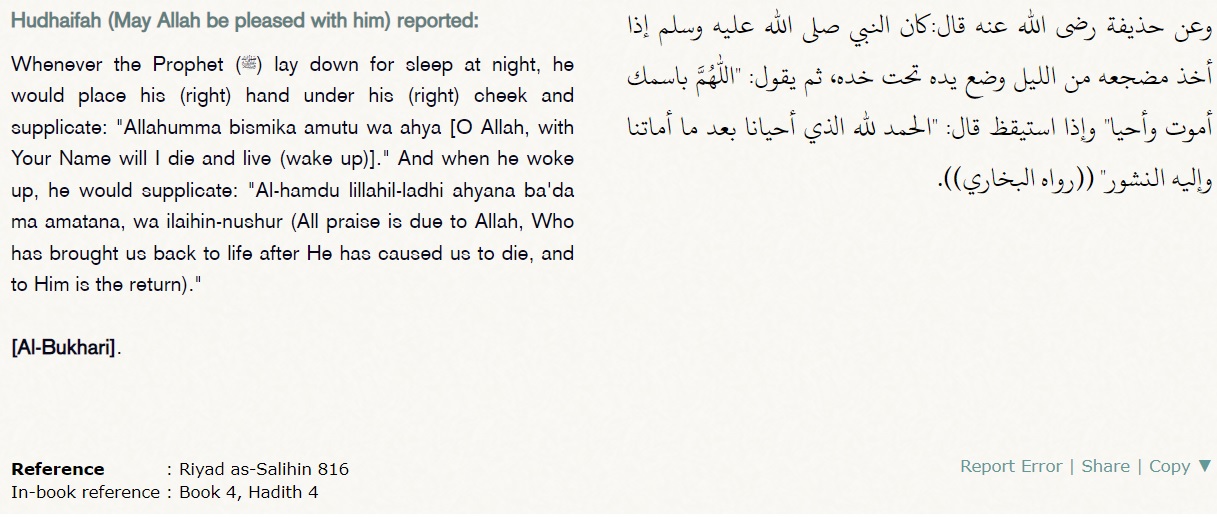
Shaykh Salih al-Fawzan quotes the verses: “It is He who takes your souls by night (when you are asleep), and has knowledge of all that you have done by day,. [Quran 6:60]” Does he not realize that he further proves our point that Jesus is dead? If there is any confusion as to what happens when we “sleep” let the Blessed Messenger (saw) explain it to you.

When we sleep we die. Our soul travels. If Allah (swt) does not return to the soul to the body than we die in our sleep. As far as Shaykh Salih al-Fawzan statement: “To raise him to him is not done except to a higher place. This is proof that Allah is [always] high and above [His creation].”

To Allah (swt) shall all return [not just Jesus].

Indeed, to Allah we belong and to Allah we shall return.” [Qur’an 2: 156]

It does not mean spatial location. Even though Shaykh Salih al-Fawzan who is fond of taking his creed from the people of the book Allah (swt) is not contained in a spatial location.

And he said: Lo! I am going to my Lord Who will guide me.” [Qur’an 37:99]

Ibrahim a.s says I am going to my Lord did he mean from place to place? No.

It is unfortunate because the more you investigate the beliefs of ‘Ahl Sunnah Wal Jammah‘ on this you can see they are in disarray over it.

Some say someone random was made to look like Jesus and he was put on a cross.

Other’s say Jesus was on a cross and died.

Other’s say that Jesus was on a cross but he passed out and latter was resuscitated.

“And they have thereof no knowledge. They follow not except assumption, and indeed, assumption avails not against the truth at all.” (Qur’an 53:28)

You maybe interested to read the following:

May Allah (swt) guide them and us.

May Allah (swt) Guide the Ummah.

May Allah (swt) Forgive the Ummah.

11 Comments

Filed under Uncategorized

Is Shaykh Imran Hosein Correct on The Return of Jesus?

“He will speak to the people in the cradle and in maturity and will be of the righteous.” (Qur’an 3:46)

﷽ 

Shaykh Imran Hosein has recently used the following as evidence for the return of Nabi ‘Isa — Christ Jesus the following:

“He will speak to the people in the cradle and in maturity and will be of the righteous.” (Qur’an 3:46)

So what is this all about? It is really about those who believe that Jesus (as) will return again before the end of times being so desperate that they will clutch at straws to try and exegetically extract such an idea from the Qur’an.  

Listen to the lecture from the 22 minute mark.

Shaykh Imran Hosein

@ 23:18 Shaykh Imran says, “But the Qur’an went on to say something more. Remember that this is Surah Al Maidah, ‘ tukallimun Nasa fil mahdi wa kahlan.”

“Twice, twice, you will speak. The first time is as a baby in the cradle and the second time is as an adult.” -Shaykh Imran Hosein

“But uh, even in London adults speak. There’s nothing big, there’s nothing miraculous about that. That’s normal. If you are an adult, and you don’t speak you’re dumb.” — Shaykh Imran Hosein

“But if you are an adult, and you are not dumb, then it is normal for an adult to speak. So where is the need for the ‘ruh al qudus’?” “Answer: The Qur’an is saying that you will speak miraculously twice.” -Shaykh Imran Hosein

“You will speak miraculously as a baby in the cradle, and you will speak miraculously again as an adult.” — Shaykh Imran Hosein

“C’mon, put on your thinking caps.” -Shaykh Imran Hosein

Prima Qur’an comments: At this juncture let us stop and do exactly as the Shaykh asks us to do.

Now, this is important because Shaykh Imran Hosein is one of those people who have as his entire focus eschatology, the Mahdi, Dajjal, and the so-called 2nd coming of Christ Jesus.

Someone who holds such views should be able to provide evidence for them, and the fact that Shaykh Imran Hosein has to make such exegetical stretches of the Qur’an shows the patently false nature of such beliefs.

A few minutes into his lecture, Shaykh Imran Hosein has some words for the Ahmadiyyah movement as well as for Muhammed Asad. However, Shaykh Imran’s misinterpretation of the Qur’an is equally bad.

It is amazing how the crowd gathered around Shaykh Imran soaked up all these words he had to say, and we just hope that they did indeed: ‘put on their thinking caps.’

Notice the slyness of his approach here:

“But uh, even in London adults speak. There’s nothing big, there’s nothing miraculous about that. That’s normal. If you are an adult, and you don’t speak you are dumb.” — Shaykh Imran Hosein

This subtle point is where he slowly lures his audience. In almost a trance-like state fixated upon his words, they can’t help but agree. After all, there is nothing miraculous about adults speaking, is there?

This is where he slips in his suggestion and whispers to the subconscious.

First the agreement of the negative: adults speaking is nothing miraculous. [everyone is now on the same page].

Then comes the delivery: The mixture of truth with falsehood.

“Answer: The Qur’an is saying that you will speak miraculously twice.”

As the subconscious is now primed, the reader will understand that Jesus will speak while in the cradle and as an adult. So there is already a bias confirmation: Ah, so Jesus does speak twice. Then comes the falsehood attached: miraculously twice.

Now, dear reader, check for yourself:

https://www.islamawakened.com/quran/3/46/

wayukallimu l-nāsa fī l-mahdi wakahlan wamina l-ṣāliḥīna -which of these Arabic words means miraculously?

The answer: None of them, of course.

“And do not mix the truth with falsehood or conceal the truth while you know [it].” (Qur’an 2:42)

Now it is a given that if a person speaks like a baby in the cradle that this is indeed miraculous, but even the Shaykh himself said: “Adults speak. There’s nothing big, there’s nothing miraculous about that.”

Thus, what Shaykh Imran has done is to mix the haqq that-Jesus will speak as a baby and in maturity with batil -that both events would be miraculous.

Then you will see how he needs to interpolate such falsehood in the Qur’an in order to get you to buy into his concept of some messianic figure coming later.

So now, after establishing his false premise that he has convinced his audience into accepting, he continues the rest of his speech.

Wake up dear Muslim brothers and sisters. You are being deceived.

What about kahl and kahlan in the Arabic text of the Qur’an.


If people want to say kahlan means 70 years old or even 800, let them roll with it, because no matter how old Nabi ‘Isa Christ Jesus was, we have the following text:

“[The Day] when Allah will say, “O Jesus, Son of Mary, remember My favor upon you and upon your mother when I supported you with the Pure Spirit and you spoke to the people in the cradle[wakahlan]and in maturity; and [remember] when I taught you writing and wisdom and the Torah and the Gospel; and when you designed from clay [what was] like the form of a bird with My permission, then you breathed into it, and it became a bird with My permission; and you healed the blind and the leper with My permission; and when you brought forth the dead with My permission; and when I restrained the Children of Israel from [killing] you when you came to them with clear proofs and those who disbelieved among them said, “This is not but obvious magic.” (Qur’an 5:110)


So, whatever these people want to say, the context of the above verse makes it abundantly clear that Jesus was wakhalan when he was being taught the Torah and the Gospel and dealing with the children of Israel. 

Also, those who want to say that Jesus (as) did not reach maturity before he had the chance to speak, thus he must come back.  This idea is based upon what? What verse in the Qur’an tells the age in which Jesus (as) died? Even those who say he did die but was taken bodily alive into heaven. Tell us his age? The New Testament is not a proof text for Muslims.

Are we really going to say that Allah [swt] is teaching Nabi ‘Isa—Christ Jesus the Torah and the Gospel upon his return? Why? What for?

So, even if you want to be extremely, and we do mean extremely charitable and go against references like:


Lisan Al Arab or Al Razi in Tafsir al Kabir, just remember to remind them that this 50+-year-old Jesus, this 80+year old Jesus was doing all the above as mentioned in Qur’an 5:110 before ANY SO-CALLED BODILY ASCENSION.

This day those who disbelieve have despaired of [defeating] your religion; so fear them not, but fear Me. This day I have perfected for you your religion and completed My favor upon you and have approved for you Islam as religion.” (Qur’an 5:3)

You may also wish to read:

May Allah Guide the Ummah.

May Allah Forgive the Ummah.

6 Comments

Filed under Uncategorized

Apologies to fellow Muslims and truth seekers over translation of Qur’an 4:31

“Our Lord, do not take us to task in case we forget or we make mistakes.” (Qur’an 2:286)

﷽ 

APOLOGY TO FELLOW MUSLIMS AND TRUTH SEEKERS.

May Allah (swt) forgive me. Praise be to Allah (swt) who guides us to a way that is best.

I used to rely upon a particular translation of the Qur’an 4:31 until upon closer examination I realized the game that was being played upon the unaware.

I’m thankful to Shaykh Hafidh Hamed Al Sawafi for pointing this out to me!

Most people are usually familiar with this translation:

“If you avoid major sins that you are prohibited, We will absolve YOU YOUR MINOR SINS and cause you to enter a generous gate.” (Qur’an 4:31)

Any translation that comes remotely close to that is a FALSE

Take a look at the different translations into English here:

https://www.islamawakened.com/quran/4/31/

Those people who are either translating this text as such are doing so according to their i’tiqad or without giving much thought about it -according to the i’tiqad of others.

The most correct translation is: the one from Yusuf Ali (1985) which states:

“IF (but) eschew the evilest of the things which you are forbidden to do, We shall expel out of ( Saiyiatikum) YOU ALL THE EVIL IN YOU, and admit you to a gate of great honor.” -(Qur’an 4:31)

The reason that certain translators translate it the way that they do is because of their theology. Which is that the small sins get wiped out and the big sins get purified in the hell-which one latter is released from.

However, the correct understanding is that if a Muslim avoids the major big sins, or if they do them and rush to repent and reform, Allah (swt) will forgive our minor mistakes and faults.

Imposing their theological suppositions upon the Qur’an Al-Kareem!

As one Muslim brother pointed out: “Saiyiatikum” is “all evil in you”.

To interpret it as “minor sins” or the likes is but an interpretation.

The literal meaning takes precedence over an interpretation unless there’s a hujjah to support the interpretation.

Insh’Allah in time I will begin to replace the translation with the appropriate translation free from i’tiqad -may Allah (swt) help me.

Kindly take note. My humble and sincere apologies.

“And protect them from the evil consequences [of their deeds]. And he whom You protect from evil consequences that Day – You will have given him mercy. And that is the great attainment.” (Qur’an 40:9)

May Allah (swt) Guide the Ummah.

May Allah (swt) Forgive the Ummah.

Leave a comment

Filed under Uncategorized

Be careful of Zionist interpretations of Qur’an 17:7

(We told you), “If you do good, it will be for your own benefit, but if you do bad, it will be against your souls. When the prophecy of your second transgression will come to pass, sadness will cover your faces. They (your enemies) will enter the mosque as they did the first time to bring about utter destruction. (Qur’an 17:7)

﷽ 

Recently I was watching a video circulating the internet over our brother, a former IDF soldier who found the light of Islam. Al hamdulillah! May Allah (swt) increase him in faith and bring him to a state of felicity. May many more of them be guided to the light of Islam.

The brother who was interacting with the former IDF soldier was doing an excellent effort in flashing the verses on the screen. However, something jolted me when the brother quoted Qur’an 17:7 and gave a very strange understanding of this verse. It raised the alarm and this is why I felt the urgency to write this post in hopes that you will also warn those you know!

I have personally not come across people understand the verse this way. unless they were from the United Arab Emirates, or Saudi Arabia.

The verse in question is:

(We told you), “If you do good, it will be for your own benefit, but if you do bad, it will be against your souls. When the prophecy of your second transgression will come to pass, sadness will cover your faces. They (your enemies) will enter the place of prostration (Masjid)as they did the first time to bring about utter destruction.” (Qur’an 17:7)

Please pay special attention to how the Arabic word ٱلۡمَسۡجِدَ is being translated into English.

Here is a complete list of known translations into English:

https://www.islamawakened.com/quran/17/7/

Notice the word ٱلۡمَسۡجِدَ has been translated as Temple in 32 translations. Why is this even important brothers and sisters?

This is the video I am referencing:

@22:50 minutes into the video The Muslim Lantern states: “In fact Allah azwajala said that the people children of Israel will take the Masjid,Masjid Al Aqsa from you.”

This is dead wrong. There is no such verse in the Qur’an at all. Surely brother Muslim Lantern will have his reward with Allah (swt). However, I think in this regard he is simply transmitting what he heard without investigating the verse.

Let us look at the context:

“And We gave (Clear) Warning to the Children of Israel in the Book, that twice would they do mischief on the earth and be elated with mighty arrogance.!” (Qur’an 17:4)

Allah (swt) is addressing the Children of Israel (Jacob).

“When the first of the warnings came to pass, We sent against you Our servants given to terrible warfare: They entered the very inmost parts of your homes; and it was a warning (completely) fulfilled.” (Qur’an 17:5)

Allah (swt) is mentioning that he sent against you (Meaning children of Israel) -They are the ones being attacked not the attackers!

Then did We grant you the Return as against them: We gave you increase in resources and sons, and made you the more numerous in man-power.” (Qur’an 17:6)

Allah (swt) grant you (Children of Israel) a return against them (the attackers of the Children of Israel)

(We told you), “If you do good, it will be for your own benefit, but if you do bad, it will be against your souls. When the prophecy of your second transgression will come to pass, sadness will cover your faces. They (your enemies) will enter the place of prostration (Masjid)as they did the first time to bring about utter destruction.” (Qur’an 17:7)

Allah (swt) is not saying that the children of Israel will be the one’s who will enter the places of prostration and bring utter destruction. It makes no sense! It makes no sense because the place that the destruction will come to is the place that the children of Israel themselves worship!

That is the temple of Solomon (as). Look at the text that are underlined in green. That is what people are getting confused. The Children of Israel will cause corruption in the earth twice and they will be punished by having their place of worship destroyed!

Allah (swt) will use someone else as a means of punishment for the disobedient Children of Israel.

They (your enemies) will enter the place of prostration (Masjid)as they did THE FIRST TIME to bring about utter destruction.”

The first time was the destruction of the place of prostration-by Nebuchadnezzar.

The second time that Allah (swt) is speaking about in the future in Qur’an 17:7 was by the Romans.

WHY IS THIS IMPORTANT AND WHAT HAS THIS HAVE TO DO WITH PALESTINE AND AL AQSA MASJID?

This is important because the false interpretation that was given to our brother The Muslim Lantern and not only him but to many Muslims will be used as a psychological weapon against the Palestinian and Muslim resistance when the Zionist eventually come to attack it! 

How will it be used a psychological weapon? Because, the false interpretation makes it that the Zionist (Israel) will conqueror Masjid Al Aqsa.

@22:50 minutes into the video The Muslim Lantern states: “In fact Allah azwajala said that the people children of Israel will take the Masjid,Masjid Al Aqsa from you.”

How will you defend a place knowing that Allah (swt) himself said that your enemies would take it from you? Do you see the point brothers and sisters?

In fact, watch the expression of our new brother in Islam (former IDF) when our brother Muslim Lantern says this. The new brother looked quite surprised? Why? Because he knows how the resistance is fighting, even after being almost entirely abandoned by the whole Muslim Ummah. He looks surprised because he can’t imagine the IDF just taking Al Aqsa Masjid. Jordan is the custodian of Al Aqsa Masjid. Jordan would be forced to go beyond just sending ‘a memo of protest‘ if the Zionist wanted to full on take the Masjid.

Rather or not the Zionist attempt to do so is another matter. The point of this post is do not read these verses of the Qur’an incorrectly. Especially do not read them in such away that would give a moral boost to the enemies of the faith!

May Allah (swt) guide our new brother in faith.

May Allah (swt) forgive the Ummah!
May Allah (swt) guide the Ummah!

Leave a comment

Filed under Uncategorized

The use of Majaz in the Sunnah by Shaykh Juma Mazrui

“So We did not send any messenger except [speaking] in the language of his people to articulate for them, and Allah sends astray [thereby] whom He wills and guides whom He wills. And He is the Exalted in Might, the Wise.” (Qur’an 14:4)

﷽ 

Shaykh Juma Mazrui (h) began his topic about the use of Majaz in the sunnah by giving us a recap of the previous lesson.  

He mentioned some more examples from the Qur’an which I will now proceed to quote here:

“So do not make your hand [as] chained to your neck or extend it completely and [thereby] become blamed and insolvent.” (Qur’an 17:29 Sahih international translation)

“And do not set up your hand shackled to your neck, (i.e., Do not be niggardly) nor outspread it widespread altogether, (Literally: outspread it all outspreading, i.e., do not be a spendthrift) for then you will sit blamed and regretfully rejected.” (Qur’an 17:29 Dr. Ghali translation)

This is another beautiful example of majaz, of metaphor in the Qur’an.  In fact if one was to take the literal interpretation of this verse, where exactly would this half-way point between tying one’s hand to one’s neck and extending it fully?   Would that look like?

So what the verse is saying, it using hand as a metaphor for that which gives, or distributes.  That one should not be stingy, nor should one be a spendthrift.  That we should be balanced in our approach to spending.

“Of them some seem to give heed to you; will you, then, make the deaf hear even though they understand nothing? And of them some look towards you; will you, then, guide the blind, even though they can see nothing?” (Qur’an 10:41-42)

Obviously it means those who are spiritually blind. The eyes are used as a metaphor for the ability to perceive, understand and be open to something.

“Indeed, the worst of living creatures in the sight of Allah are the deaf and dumb who do not use reason.” (Qur’an 8:22)

Yet Allah (swt) who created people in such a condition and than blames them for this? So it cannot mean what the apparent text says.

“They will say, “Indeed, you used to come at us from the right hand.” (Qur’an 37:28)

Look at how various translators have tried to deal with the above text!

https://www.islamawakened.com/quran/37/28/

Here the right hand is used as a metaphor, majaz which means to approach, admonish strongly.

So than moving to the ahadith, contrary to what people today tell us that the Salaaf, the Blessed Messenger (saw) and his companions took everything from their outward meaning on the contrary they understood the use of majaz in their language.

For those who have not seen the article concerning the first lesson: The Use of Majaz in the Qur’an please see: https://primaquran.com/2023/03/24/the-use-of-majaz-in-the-quran-by-shaykh-juma-mazrui/

The use of Majaz in the Sunnah.

On the authority of Abu Hurayrah, who said that the Messenger of Allah (saw) said:

“Allah (mighty and sublime be He) said: Pride is my cloak (upper garment) and greatness My robe (waist wrapper), and he who competes with Me in respect of either of them I shall cast into Hell-fire. It was related by Abu Dawud (also by Ibn Majah and Ahmad) with sound chains of authority. This Hadith also appears in Muslim in another version.”

Source: (Hadith 19, 40 Hadith Qudsi)

Are we to believe that Allah (swt) has an upper garment and a waist wrapper?

On the authority of Abu Hurayrah, who said that the Messenger of Allah (saw) said:

“Allah (mighty and sublime be He) said: Whoever shows enmity to someone devoted to Me, I shall be at war with him. My servant draws not near to Me with anything more loved by Me than the religious duties I have enjoined upon him, and My servant continues to draw near to Me with supererogatory works so that I shall love him. When I love him I am his ears with which he hears, his eyes with which he sees, his hand with which he strikes and his foot with which he walks. Were he to ask [something] of Me, I would surely give it to him, and were he to ask Me for refuge, I would surely grant him it. I do not hesitate about anything as much as I hesitate about [seizing] the soul of My faithful servant: he hates death and I hate hurting him.”

Source: (Hadith 25, 40 Hadith Qudsi)

Are we to believe that Allah (swt) becomes the ear of the person? The eyes of the person? The hand and the foot of the person?

On the authority of Abu Hurayrah, who said that the Messenger of Allah (saw) said:

Allah (swt) will say on the Day of Resurrection: O son of Adam, I fell ill and you visited Me not. He will say: O Lord, and how should I visit You when You are the Lord of the worlds? He will say: Did you not know that My servant So-and-so had fallen ill and you visited him not? Did you not know that had you visited him you would have found Me with him? O son of Adam, I asked you for food and you fed Me not. He will say: O Lord, and how should I feed You when You are the Lord of the worlds? He will say: Did you not know that My servant So-and-so asked you for food and you fed him not? Did you not know that had you fed him you would surely have found that (the reward for doing so) with Me? O son of Adam, I asked you to give Me to drink and you gave Me not to drink. He will say: O Lord, how should I give You to drink when You are the Lord of the worlds? He will say: My servant So-and-so asked you to give him to drink and you gave him not to drink. Had you given him to drink you would have surely found that with Me.”

Source: (Hadith 18, 40 Hadith Qudsi)

It is clear that Allah (swt) ascribes acts to himself which he does not actually do, such as falling ill, and asking for that which is apparent that he does not need such as food and drink.

On the authority of Abdullah ibn Umar reported:

The Messenger of Allah, (saw), said, “The upper hand is better than the lower hand. The upper hand is one that gives and the lower hand is one that takes.”

Source: (https://sunnah.com/bukhari:1427)

The hadith itself while using hand as a metaphor explains the meaning.  Thus the word hand is not used as an apparent real attribute of a person.

On the authority of Abu Hurayrah, who said that the Prophet (saw) said:

“Allah the Almighty said: I am as My servant thinks I am. I am with him when he makes mention of Me. If he makes mention of Me to himself, I make mention of him to Myself; and if he makes mention of Me in an assembly, I make mention of him in an assembly better than it. And if he draws near to Me an arm’s length, I draw near to him a cubit, and if he draws near to Me a cubit, I draw near to him a fathom. And if he comes to Me walking, I go to him running.”

Source: (https://sunnah.com/bukhari:7405)

Our Shaykh Juma Mazrui reminded us that unfortunately there are among those who take such statements upon their literal important and thus their teacher, Shaykh Al Uthaymeen has advocated for the ‘jogging of Allah’ as a real action and quality that Allah (swt) does. ‘Jogging but unlike our jogging’.

This hadith also poses other problems if taken upon face value.

If a person draws to Allah (swt) be an arms length, than Allah (swt) draws to that person by a cubit.  

If that person draws near by a cubit than Allah (swt) will draw near to them by a fathom.

It gives the impression that the opposite can be true in that a person can eventually go so far away from Allah (swt), that Allah (swt) would be out of reach, so to speak.

“When My slaves ask you ˹O Prophet˺ about Me: I am truly near. I respond to one’s prayer when they call upon Me. So let them respond ˹with obedience˺ to Me and believe in Me, perhaps they will be guided ˹to the Right Way˺. (Qur’an 2:186)

Insh’Allah, the third lesson will be this week.   Hopefully what has passed from our respected teacher is more than sufficient to dispel the myth that the Blessed Messenger (saw), his companions, the Salaaf did not understand the Arabic language nor did they employ the use of majaz.

May Allah guide the Ummah.

May Allah forgive the Ummah.

Leave a comment

Filed under Uncategorized

The use of Majaz in the Qur’an by Shaykh Juma Mazrui

“And We have also sent down unto you (Muhammed) the Reminder and the Advice (the Qur’an), that you may explain clearly to men what is sent down to them.” (Qur’an 16:44)

﷽ 

In our first lesson Shaykh Juma Mazrui (h) went over some of the disputes the scholars have had in regards to majaz in the Qur’an. Among those who dispute majaz are those who liken Allah (swt) to his creation by stating that he has two right hands, two eyes, and so forth.

Some people are under the mistaken impression that the apparent meaning of certain verses in the Qur’an indicate anthropomorphism. However, most of those who assume as such are either reading translations of the Qur’an into English and/or even among the Arabs those who have forgotten how deep and powerful the language of the Qur’anic Arabic actually is. They have forgotten the use of Majaz.

Such that when a person sees the word ‘yadahu’ they use their mind to scan one of the most common meanings possible for the word. However, not everyone can be said to take that meaning. The context would certainly dictate how one may scan a word search for an understanding.

An example:

And the Jews say, ‘The (yadu l-lahi) is tied up.’ Chained are their (aydihim), and cursed are they for what they say. Rather, (yadahu mabsūṭatāni) , HE spends however He Wills.” (Qur’an 5:64)

So these are words and phrases and terminologies that an Arab in the 7th century would have knowledge of. So when an Arab of that time read this page did they imagine Allah (swt) as being bound (like a prisoner) unable to have use of His “hands”?

Or, did they immediately recognizes the metaphor? That these people are claiming that Allah (swt) does not bestow upon them anything of good and/or is misrely. Where Allah (swt) retorts back that he is boundless in his generosity?

What went through their minds when the yadu (a feminine singular noun in the nominative case switched to yadahu (a noun and a possessive pronoun-the noun being feminine dual in the nominative case with the attached possessive pronoun in third person masculine singular).

Can it be said that they imagine some type of gender swapping happening? Or it can it be said that these people knew the function and style of their language.

Now if one was to give a person the Qur’an without any understanding of who or what Allah (swt) is what is the perception that they would walk away with. (Reading a translation or reading the Arabic).

If for example in our dawah we tell the Christians that Allah is not a man or a woman and Allah (swt) does not have a gender. What would be the impression of that Christian (reading a translation of the Qur’an) or that Arab Christian reading the Arabic Qur’an have when reading the following verse:

“There is nothing like unto Him, and He is the Hearing, the Seeing.” (Qur’an 42:11)

That apparent meaning or the meaning that comes when they use their mind to scan search for an understanding they may walk away with the impression that they were mislead.

Similarly, when reading the Qur’an when the are certain statements which are assumed to be attributes of Allah (swt) in which you will never find the following statement after such assumed attributes: Bila Kayfa meaning: ‘without how’ ‘without modality’

It is very clear that every language is rich in meaning , scope and depth. All languages to some degree or another deploy a range of literary devices. Chief among them is metaphor or as we would say in Arabic majaz.

Shaykh Juma Mazrui (h) has shown us clearly many examples of Majaz in the Qur’an.

Allah is the Guardian of those who believe, He brings them out of every darkness into light. And those who disbelieve, their guardians are the evil ones; they bring them out of light into all kinds of darkness. These are destined for the Fire, and there shall they abide.” (Qur’an 2:257)

This is an example of metaphor or Majaz. There is no real darkness that we are being brought out of and into a real light.  No one has been able to demonstrably prove this by the apparent meaning.

“Ignominy shall be their portion wherever they are found save (where they grasp) a rope from Allah and a rope from men. They have incurred anger from their Lord, and wretchedness is laid upon them. That is because they used to disbelieve the revelations of Allah, and slew the prophets wrongfully. That is because they were rebellious and used to transgress.” (Qur’an 3:112)

This is another example of metaphor or Majaz. There is no real rope from Allah and a rope from men that people are grasping onto.

Again we find:

“And hold firmly to the rope of Allah and do not be divided. Remember Allah’s favour upon you when you were enemies, then He united your hearts, so you—by His grace—became brothers. And you were at the brink of a fiery pit and He saved you from it. This is how Allah makes His revelations clear to you, so that you may be ˹rightly˺ guided.” (Qur’an 3:103)

There no real, physical or apparent rope from Allah (swt) that any of us are grasping on to for every moment of our life. This is a clear example of metaphor or Majaz. The rope that is referred to that we are to grasp or adhere to is the religion of Islam.

“Moreover, will say to those who were oppressed to those who were arrogant, “Nay, (it was) a plot (by) night and a plot (by) day when you were ordering us that we disbelieve in Allah and we set up for Him equals.” But they will conceal the regret when they see the punishment. And We will put shackles on (the) necks (of) those who disbelieved. Will they be recompensed except (for) what they used to do?” (Qur’an 34:33)

This is the majaz of hadhfi or the metaphor of omission.  Can it be said that the night plots and the day plots?  This is a clear example of metaphor and the overwhelming majority of translators have not translated nor interpreted it by its apparent meaning.

“To Him belong the keys to the heavens and the earth. As for those who have rejected the verses of Allah, it is they who are the losers.” (Qur’an 39:3)

If you translate this literally, or take it apparently it is to mean that Allah (swt) has two material keys. This would be a case of tashbih to liken one thing to another.  Like people have keys that they use to start their car or to unlock their homes.

That Allah (swt) would need two sets of keys to lock/unlock the heavens and the earth merits pensive reflection from those who beleive in the apparent meaning of the text.

17 times a day a Muslim says, “guide is to the right way.” That is from the opening chapter of the Qur’an.

Well, where is this ‘straight path, this straight way’? If you to take it from the apparent, from the literal meaning.

“Be patient over what they say, and remember Our servant, David, the possessor of many hands; he was one who repeatedly turned back [to Us].” (Qur’an 38:17)

Plural in Arabic begins with three and not two! So, at the very least David had three hands.  However, notice something from the following site:

https://www.islamawakened.com/quran/38/17/

It is unanimous that they all translate ‘many hands’ as strength! Even the Salafi/Saudi translations do!  Even the translation that gives us the most literal word for word meaning possible was too shy to translate David having many hands.

Be patient over what they say and remember Our servant, David, the possessor of strength; indeed, he was one who repeatedly turned back [to Allah ] (Sahih International)

Be patient (O Muhammad SAW) of what they say, and remember Our slave Dawood (David), endued with power. Verily, he was ever oft-returning in all matters and in repentance (toward Allah) (Muhsin Khan & Muhammed Al Hilal)

So we can say to those who believe in literal translations: Why don’t you take these verses on the apparent meaning? If Allah (swt) says that David has many hands then say that David had many hands!  

You are shy to ascribe many hands to David but not to Allah (swt)?!

“He is the One who has made the earth subjugated for you, so walk on its shoulders, and eat out of His provision, and to Him is the Resurrection.” (Qur’an 67:15)

The earth has shoulders? As I have?

“And He (is) the One Who sends the winds (of glad news between the two hands of his Mercy, until, when they have carried clouds ” (Qur’an 7:57)

Allah sends winds like herald of glad news, between the two hands of his Mercy.

Now his Mercy has two hands?

So those who believe in literal translations tell us that Allah (swt) has two right hands, and he has an attribute of Mercy and this attribute has two hands.  Are they also right hands?

Look how virtually everyone else translates the text!

https://www.islamawakened.com/quran/7/57/

“Moreover, it is He who sends the winds as good news before His mercy until, when they have carried heavy rain clouds, We drive them to a dead land and We send down rain in that respect and bring forth thereby [some] of all the fruits. Thus will We bring forth the dead; perhaps you will be reminded.” (Sahih International)

“And it is He Who sends the winds as heralds of glad tidings, going before His Mercy (rain). Till when they have carried a heavy-laden cloud, We drive it to a land that is dead, then We cause water (rain) to descend immediately. Then We produce every fruit besides that. Similarly, We shall raise the dead, so that you may remember or take heed.” (Muhsin Khan and Muhammed Al Hilali)

No one wants to take the literal, or apparent meaning of the text and ascribe to Allah’s mercy two hands! Why is that?

“Also, He (is) the One Who sends the winds (as) glad news (from) between (hands) His Mercy, and We send down from the sky water pure.” (Qur’an 25:48)

Even look at those at Corpus Qur’an. They are literally confused about how to translate the Arabic text:

“before, before”  “between before”  “before between” “between between” ???

“So, out of kindness, lower to them the wing of humility, and say: “My Lord! bestow on them your Mercy even as they cherished me in childhood.” (Qur’an 17:24)

Does humility have wings?

“And lower your wing to those who follow you of the believers.”  (Qu’ran 26:215 -Sahih International)

For some reason in this case Sahih International decides to go with the literal, apparent text.   But the question needs to be asked does the Blessed Messenger (saw) have a wing?

Allah (swt) said he did. So why can’t what Allah (swt) says be good enough for us?

“So when we accepted your covenant and lifted the mountain of Sinai over you, saying, receive the law which we have given you, with a resolution to perform it, and hear; they said, we have heard, and have rebelled: And they were made to drink down the calf into their hearts for their unbelief. Say, a grievous thing has your faith commanded you, if you indeed be true believers.” (Qur’an 2:93)  

Does anyone think they were drinking calf?  It means that their hearts were filled with worshipping the calf.

“And a faction of the People of the Scripture say [to each other], “Believe in that which was revealed to the believers at the face of the day and reject it at its end that perhaps they will abandon their religion.” (Qur’an 3:72)

wajha-face. Are we really to believe that the day has a face?

“Give good news, glad news, to the believers upon the foot of the truth.”(Qur’an 10:2)

The truth has a foot?

Corpus Qur’an translates it as:

“(will be) a respectable position.”

Those who understand that the word foot is used here translate it something similar to “sure footing”

https://www.islamawakened.com/quran/10/2/

“Have the people been amazed that We revealed [revelation] to a man from among them, [saying], “Warn mankind and give good news to those who believe that they will have a [firm] precedence of honor with their Lord”? [But] the disbelievers say, “Indeed, this is an obvious magician.” (Sahih International)

Muhsin Khan and Muhammed Al Hilali really went wild with this translation:

“Is it wonder for mankind that We have sent Our Inspiration to a man from among themselves (i.e. Prophet Muhammad SAW) (saying): “Warn mankind (of the coming torment in Hell), and give good news to those who believe (in the Oneness of Allah and in His Prophet Muhammad SAW) that they shall have with their Lord the rewards of their good deeds?” (But) the disbelievers say: “This is indeed an evident sorcerer (i.e. Prophet Muhammad SAW and the Quran)”  (Muhsin Khan & Muhammed Al Hilali)

The principle of rejecting the Mujaaz usually comes from those who say that Allah (swt) has two limbs, and two right hands, two eyes etc.  Shaykh Juma Mazrui had other examples that I did not have the chance to pin down but insh’Allah I will enquire about the missed examples and plug them into this article..

Shaykh Juma Mazrui will be going over with us in the coming weeks the following lessons: Insh’Allah.

In the traditions of the Prophet (saw) did he use Majaaz when he talks to the companions?

Majaz in the Arabic language.

Tawil in the Arabic language.

“See how Allah does make His revelations clear to them; yet see in what ways they are deluded away from the truth!” (Qur’an 5:75)

Leave a comment

Filed under Uncategorized