Tag Archives: muslim

The noble companion Hurqus ibn Zuhair and the deception of Ahl Sunnah “Be Just!”

“And know that among you is the Messenger of Allāh. If he were to obey you in much of the matter, you would be in difficulty, but Allāh has made beloved to you the faith and has beautified it in your hearts and has made hateful to you disbelief, wickedness, and disobedience. Those are the guided.” (Qur’an 49:7)

﷽ 

The noble companion Hurqus b. Zuhair al-Sa’di and the deception of Ahl Sunnah. “Be Just!”

In order to defame the noble companion, Hurqus ibn Zuhair (ra), some of the Ahl Sunnah have pulled out all the stops in their attempts at deception and blatant lying.

Allah (swt) has exposed them and laid bare their attempts to defame and besmirch him for no other reason than the fact that he saw through the lies and deception of Muaviya and left with those companions who deserted Ali bin Abu Talib who went against the hukm of Allah (swt).

This article will show you beyond a shadow of a doubt (Allah-willing) that some of the past scholars of Ahl Sunnah have mixed up Hurqus b. Zuhair al-Sa’di (ra) with one Abdullah ibn Dhul Khawaisara At Tamimi, Rather or not this was a major blunder on behalf of their scholars or done with evil intentions, will be up to you the reader to decide.

The Core Argument: Mistaken Identity or deliberate obfuscation?

Our central thesis is that Ahl al-Sunnah scholars have mistakenly—or perhaps deliberately—conflated two distinct individuals:

  • Ḥurqūṣ ibn Zuhayr aṣ-Ṣaʿdī (ra): A noble companion who later opposed ʿAlī due to his stance on the arbitration at Ṣiffīn.
  • ʿAbdullāh ibn Dhī al-Khawāṣira at-Tamīmī: The anonymous “man” in the hadiths who criticized the Blessed Prophet’s (saw) distribution of wealth and was prophesied to be the progenitor of the Khawārij.

We argue that pinning the so-called Kharijite prophecy on Ḥurqūṣ is a defamation stemming from sectarian motives to discredit those who opposed ʿAlī’s later political decisions.

The status of the hypocrites in Islam.

It was narrated from Umar bin al Khattab that the Messenger of Allah (saw) said:

`The thing I fear most for my Ummah is every hypocrite who speaks with knowledge`

Source: (https://sunnah.com/ahmad:143)

Allah (swt) says about the hypocrites:

“Indeed, the hypocrites will be in the lowest depths of the Fire – and never will you find for them a helper.” (Qur’an 4:145)

The very first exercise. The name of Hurqus ibn Zuhair in the hadith literature.

First thing that you, the truth seeker, should do is bring up this name of Hurqus ibn Zuhair as-Sadi (ra) and bring him to your teachers! Bring him to the people you trust. Rather, you are a Barelvi, Deobandi, Salafi, Ikwani, follower of one of the four madhabs.

Simply bring his name up and ask your learned people: “Show us the hadith with his name, ‘Hurqus ibn Zuhair’, explicitly mentioning where the Blessed Messenger (saw) said he is a Khawarij.” Should be quite a simple exercise!

“Be Just O Messenger of Allah!”

“O Muhammed, fear Allah!”

“O Messenger of Allah! Fear Allah!”

“Be Just”

Now let us analyze these various hadith shall we?

1st Hadith Analyzed.

Narrated by Jabir bin Abdullah

While Allah’s Apostle was distributing the booty at Al-Ja’rana, SOMEBODY said to him “Be just (in your distribution).” The Prophet replied, “Truly I would be miserable if I did not act justly.”

Source: (https://sunnah.com/bukhari:3138)

Prima Qur’an Comment: A “somebody” said. An anonymous individual. The Prophet (saw) was told to ‘be just‘.

2nd Hadith Analyzed.

It was narrated that Sharik bin Shihab said:

“I used to wish that I could meet a man among the Companions of the Prophet (saw) and ask him about the Khawarij. Then I met Abu Barzah on the day of ‘Id, with many of his companions. I said to him: ‘Did you hear the Messenger of Allah (saw) mention the Khawarij?’ He said: ‘Yes. I heard the Messenger of Allah (saw) with my own ears, and saw him with my own eyes. Some wealth was brought to the Messenger of Allah (saw) and he distributed it to those on his right and on his left, but he did not give anything to those who were behind him. Then A MAN stood behind him and said: “O Muhammed! You have not been just in your division!” He was a man with black patchy (shaved) hair, wearing two white garments. So Allah’s Messenger (saw) became furious and said: “By Allah! You will not find a man after me who is more just than me.” Then he said: “A people will come at the end of time; as if he is one of them, reciting the Qur’an without it passing beyond their throats. They will go through Islam just as the arrow goes through the target. Their distinction will be shaving. They will not cease to appear until the last of them comes with Al-Masih Ad-Dajjal. So when you meet them, then kill them, they are the worst of created beings.

Source: (https://sunnah.com/nasai:4103)

Prima Qur’an Comments: Then “a man” stood behind him. An anonymous individual.

Note: The Blessed Messenger (saw) did mention the word ‘Khawarij’. That is simply the statement of the narrator. Here the narrator does not say that the Blessed Messenger (saw) said: “Dogs of hellfire.”He does not allow the Prophet (saw) to go beyond what Allah (swt) ever did. So the narrator has the Prophet (saw) say, “The worst of created beings.”

They come “at the end of time.

Also, how ironic that it is claimed that the Prophet (saw) would say, “When you meet them, then kill them,” and that this hadith ends up in a section titled: “The Prohibition of Bloodshed.”

Also, note the lack of adaab. In other narrations, this man simply says, “Be Just.” However, in this narration we have to have the man call out the Blessed Messenger (saw) by name, “O Muhammed, you have not been just.”

Also note that such people appear “at the end of time.”

3rd Hadith Analyzed.

Narrated Abu Sa`id Al-Khudri:

When `Ali was in Yemen, he sent some gold in its ore to the Prophet (saw). The Prophet (saw) distributed it among Al-Aqra’ bin H`Abis Al-Hanzali who belonged to Bani Mujashi, ‘Uyaina bin Badr Al-Fazari, ‘Alqama bin ‘Ulatha Al-`Amiri, who belonged to the Bani Kilab tribe and Zaid AI-Khail at-Ta’i who belonged to Bani Nabhan. So the Quraish and the Ansar became angry and said, “He gives to the chiefs of Najd and leaves us!” The Prophet (saw) said, “I just wanted to attract and unite their hearts (make them firm in Islam).” Then there came A MAN with sunken eyes, bulging forehead, thick beard, fat raised cheeks, and clean-shaven head, and said, “O Muhammed! Be afraid of Allah! ” The Prophet (saw) said, “Who would obey Allah if I disobeyed Him? (Allah). He trusts me over the people of the earth, but you do not trust me?” A man from the people (present then), WHO, I THINK, was Khalid bin Al-Walid, asked for permission to kill him, but the Prophet (saw) prevented him. When THE MAN went away, the Prophet said, “Out of the offspring of this man, there will be people who will recite the Qur’an but it will not go beyond their throats, and they will go out of Islam as an arrow goes out through the game, and they will kill the Muslims and leave the idolaters. Should I live till they appear, I would kill them as the Killing of the nation of ‘Ad.”

Source: (https://sunnah.com/bukhari:7432)

Prima Qur’an comments: Then there came “a man”. Anonymous individual.

Able to recall bulging forehead, thick beard, fat raised cheeks, clean-shaven head, but not the name. Nope! Also, you think that if this man had a deformed hand that looked like a woman’s breast that it would be the most noteworthy description.  Nope! 

Also, *note* the lack of adaab. In other narrations, this man simply says, “Be Just.” In another narration we have to have the man call out the Blessed Messenger (saw) by name, “O Muhammed, you have not been just.” 

In this one: “O Muhammed Be afraid of Allah!“.

Which is it? Be just or be afraid of Allah?

Then, the narrator can’t recall who asked for permission to kill this guy. “I think it was Khalid bin Al-Walid.”

Then, apparently, the Blessed Messenger (saw) says, “Out of the offspring of this man will be a people who will kill the Muslims. Then, apparently the Blessed Messenger (saw) says, “Should I live till they appear, I would kill them as the Killing of the nations of ‘Ad”.

Yet the man is standing right there, so why doesn’t the Blessed Prophet (saw) kill the man then and there? The narrator is content to make the Blessed Prophet (saw) let future generations do the killing.

This is very much unlike Khidr, who slew a boy on the spot for future evils he would commit. Yet, here we have the Prophet (saw) apparently saying he would kill them. Yet, being fine to let this particular individual live and bring about all kinds of fitna!

“And as for the boy, his parents were ˹true˺ believers, and we feared that he would pressure them into defiance and disbelief. So we hoped that their Lord would give them another, more virtuous and caring in his place.” (Qur’an 18:80-81)

4th Hadith Analyzed.

Narrated Abu Sa`id Al-Khudri:

`Ali bin Abi Talib sent a piece of gold not yet taken out of its ore, in a tanned leather container to Allah’s Messenger (saw). Allah’s Messenger (saw) distributed that amongst four Persons: ‘Uyaina bin Badr, Aqra bin H`Abis, Zaid Al-Khail and the fourth was either Alqama or Amir bin at-Tufail. On that, ONE OF HIS COMPANIONS said, “We are more deserving of this (gold) than these (persons).” When that news reached the Prophet (saw) , he said, “Don’t you trust me though I am the truth worthy man of the One in the Heavens, and I receive the news of Heaven (i.e. Divine Inspiration) both in the morning and in the evening?” There got up A MAN with sunken eyes, raised cheek bones, raised forehead, a thick beard, a shaven head and a waist sheet that was tucked up and he said, “O Allah’s Messenger (saw)! Be afraid of Allah.” The Prophet (saw) said, “Woe to you! Am I not of all the people of the earth the most entitled to fear Allah?” Then that man went away. Khalid bin Al-Walid said, “O Allah’s Messenger (saw)! Shall I chop his neck off?” The Prophet (saw) said, “No, for he may offer prayers.” Khalid said, “Numerous are those who offer prayers and say by their tongues (i.e. mouths) what is not in their hearts.” Allah’s Messenger (saw) said, “I have not been ordered (by Allah) to search the hearts of the people or cut open their bellies.” Then the Prophet looked at HIM while the latter was going away and said, “From the offspring of this (man there will come out (people) who will recite the Qur’an continuously and elegantly but it will not exceed their throats. They would go out of the religion (i.e. Islam) as an arrow goes through a game’s body.” I THINK HE ALSO SAID, “If I should be present at their time I would kill them as the nations a Thamud were killed.”

Source: (https://sunnah.com/bukhari:4351)

Prima Qur’an comments:One of his companions” was complaining that he was upset about the distribution of the booty. “One of his companions was an anonymous individual.

That man doesn’t get scolded. No prophecy about his descendants being murderous individuals, nada, nothing.

Yet, another “man”, an anonymous individual, also shows his disdain. Then, when Khalid bin Al Walid wants to chop off his head, we get the narrator putting into the mouth of the Blessed Messenger (saw), “I have not been ordered (by Allah) to search the hearts of the people or cut open their bellies.” 

Yet, then they have the Blessed Messenger (saw)proceed to tell us knowledge of the unseen about this man’s children. In other words, I can’t tell you about the intentions of this guy who is alive right here in front of us both. However, I can tell you the murderous intentions of his children.

Welcome to the world of the bizarre! 

Then, the narrator isn’t sure if the Prophet (saw) said if he wanted to annihilate these people totally or not. “I think he also said.”

Well, you better jog your memory!” You are talking about annihilation here!

5th Hadith Analyzed.

Narrated Abu Sa`id:

While the Prophet (saw) was DISTRIBUTING (SOMETHING, ‘Abdullah bin Dhil Khawaisira at-Tamimi came and said, “Be just, O Allah’s Messenger (saw)!” The Prophet (saw) said, “Woe to you ! Who would be just if I were not?” `Umar bin Al-Khattab said, “Allow me to cut off his neck ! ” The Prophet (saw) said, Leave him, for he has companions, and if you compare your prayers with their prayers and your fasting with theirs, you will look down upon your prayers and fasting, in comparison to theirs. Yet they will go out of the religion as an arrow darts through the game’s body in which case, if the Qudhadh of the arrow is examined, nothing will be found on it, and when its Nasl is examined, nothing will be found on it; and then its Nadiyi is examined, nothing will be found on it. The arrow has been too fast to be smeared by dung and blood. The sign by which these people will be recognized will be A MAN whose one hand (or breast) will be like the breast of a woman (or like a moving piece of flesh). These people will appear when there will be differences among the people (Muslims).”

Abu Sa`id added: I testify that I heard this from the Prophet (saw) and also testify that `Ali killed those people while I was with him. The man with the description given by the Prophet (saw) was brought to `Ali. The following Verses were revealed in connection with that very person (i.e., `Abdullah bin Dhil-Khawaisira at-Tamimi): ‘And among THEM are MEN who accuse you (O Muhammed) in the matter of (the distribution of) the alms.’ (9.58)

Source: (https://sunnah.com/bukhari:6933)

Prima Qur’an Comments: So the Prophet (saw) was disturbing “something.” Ambiguous.

Why would need clarity on what the Prophet (saw) was distributing? It’s not like the narrator is about to quote the Qur’an in the distribution of alms! (reflect dear reader!)

In this narration, the narrator wastes no time. We get a name right from the start: “Abdullah bin Dhil Khawaisira at-Tamimi.”

This time it’s Umar bin Al Khattab and not Khalid bin Al Walid that wants to kill this man.

This time we do not need to make way for this man’s descendants or for those who come at the end of time. The companions will deal with him in their very lives!

We also get some identifying markers of this individual: whose one hand or breast (we are not quite sure) will be like the breast of a woman or a moving piece of flesh (or a goat, according to Ali Ibn Abu Talib). See: https://sunnah.com/muslim:1066g .

So here we are given some important identifiers from the Blessed Prophet (saw) but we aren’t quite sure what those are. Now as to the verse that narrator quoted.

“And among them are some who criticize you concerning the distribution of charities (ṣadaqāti). If they are given from them, they approve; but if they are not given from them, at once they become angry. If only they had been satisfied with what Allah and His Messenger gave them and said, “Sufficient for us is Allah ; Allah will give us of His bounty, and His Messenger; indeed, we are desirous toward Allah” (Qur’an 9:58-59)

In fact those verses were revealed about some of the Ansar that were upset with the distribution of booty from Hunain.

No future prophecy about some diabolical group of people that has yet to arrive.

Narrated Anas Bin Malik:

When it was the day (of the battle) of Hunain, the tributes of Hawazin and Ghatafan and others, along with their animals and offspring (and wives) came to fight against the Prophet (saw) The Prophet (saw) had with him, ten thousand men and some of the Tulaqa. The companions fled, leaving the Prophet (saw) alone. The Prophet then made two calls which were clearly distinguished from each other. He turned right and said, “O the group of Ansar!” They said, “Labbaik, O Allah’s Messenger (saw)! Rejoice, for we are with you!” Then he turned left and said, “O the group of Ansar!” They said, “Labbaik! O Allah’s Messenger (saw)! Rejoice, for we are with you!” The Prophet (saw) at that time, was riding on a white mule; then he dismounted and said, “I am Allah’s Slave and His Apostle.” The infidels then were defeated, and on that day the Prophet (saw) gained a large amount of booty which he distributed amongst the Muhajirin and the Tulaqa and did not give anything to the Ansar. The Ansar said, “When there is a difficulty, we are called, but the booty is given to other than us. The news reached the Prophet (saw) and he gathered them in a leather tent and said, “What is this news reaching me from you, O the group of Ansar?” They kept silent, He added,” O the group of Ansar! Won’t you be happy that the people take the worldly things and you take Allah’s Messenger (saw) to your homes reserving him for yourself?” They said, “Yes.” Then the Prophet said, “If the people took their way through a valley, and the Ansar took their way through a mountain pass, surely, I would take the Ansar’s mountain pass.” Hisham said, “O Abu Hamza (i.e. Anas)! Did you witness that? ” He replied, “And how could I be absent from him?”

Source: (https://sunnah.com/bukhari:4337)

Prima Qur’an Comments:

Notice that no one seems to have a problem with the Ansar saying they felt they were not being treated with justice. They are not called dogs of the hellfire.  

So, either Abu Said Al Khudri was absolutely wrong with regard to the Asbab-al-Nuzul (The Occasion of Revelation) of those verses, or worse, a latter redactor put those words in the mouth of Abu Said Al Khudri. Either way, it doesn’t look good!

A look at some Tafsir in regards to these verses:

“And among them are some who criticize you concerning the distribution of charities (ṣadaqāti). If they are given from them, they approve; but if they are not given from them, at once they become angry. If only they had been satisfied with what Allah and His Messenger gave them and said, “Sufficient for us is Allah ; Allah will give us of His bounty, and His Messenger; indeed, we are desirous toward Allah” (Qur’an 9:58-59)

Prima Qur’an Comments: In the commentary of Ibn Abbas (ra) we have:

“And of the hypocrites: Abu’l-Ahwas and his host. They claimed that he did not divide them fairly.”

In the commentary of Tafsir al-Jalalayn we have:

“Some of them defame you concerning the apportioning of voluntary alms-giving; if they are given a share of them they are content but if they are given none then they are enraged.”

In the commentary of Ibn Kathir we have:

“We were told that a Bedouin man, who had recently embraced Islam, came to the Prophet, when he was dividing some gold and silver.”

So the tafsir are all over the place!

Ibn Abbas tafsir has Abu’l-Ahwas and his host.

Jalalayn has them and they, unnamed and unspecified.

Ibn Kathir has a a Bedouin man, who had recently embraced Islam,

Asbāb al-Nuzūl Error: We correctly point out that the claim that Qur’an 9:58-59 was revealed about this specific Tamīmī man contradicts the well-established occasion of revelation (asbāb al-nuzūl) documented by Anas ibn Mālik, which attributes it to the Ansār after Ḥunayn. This is a strong point against the reliability of that specific chain or narrator’s addition in Bukhārī 6933 https://sunnah.com/bukhari:6933

Very important point that Ibn Kathir is the one who starts the obfuscation.


And also from Ibn Kathir: “This statement of Qatadah is similar to the Hadith that the Two Shaykhs narrated from Abu Sa’id about the story of Dhul-Khuwaysirah, whose name was Hurqus.” Hurqus protested against the Prophet’s division of the war spoils.”

Prima Qur’an comments:

Ibn Kathir mixes up Dhul-Khuwaysirah with Hurqus. This is where the confusion comes in from Ahl Sunnah. It has never been explained to anyone we have encountered among Ahl Sunnah hadith specialist why Ibn Kathir makes this connection?

Why does he say: “It is similar to the hadith that the two shaykhs narrated from Abu Sai’d about Dhul-Khuwaysirah?

Which hadith? Did Ibn Kathir have access to transmissions from Bukhari and Muslim that are no longer in circulation? Certainly raises some questions!

Also, a very important point! We have not seen any mention of Hurqus in any of these hadith!

“There stood up ‘Umar b. Khattab, and said: Should I not strike his neck? Upon this he said: No. Then he turned away, and Khalid the Sword of Allah stood up against him, and said: Prophet of Allah. shall I not strike off his neck? He said, No, and then said: A people would rise from his progeny who would recite the Book of Allah glibly and fluently. ‘Umar said: I THINK he (the Holy Prophet) also said this: If I find them I would certainly kill them like Thamud.”

Source: (https://sunnah.com/muslim:1064c)

Prima Qur’an Commentary:

When trying to reconcile obvious discrepancies, we get this innovative approach. We get both Umar bin Al Khattab and Khalid bin Al Walid both wanting to cut off the culprit’s neck! However, we are still not sure if the Prophet (saw) will kill such people in the future. “I think” he (the Holy Prophet) also said this...…

Narrated Jabir b. Abdullah

A PERSON came to the Messenger of Allah (saw) at Jirana on his way back from Hunain, and there was in the clothes of Bilal some silver. The Messenger of Allah (saw) took a handful out of that and bestowed it upon the people. HE (THE PERSON who had met the Prophet at Ji’rana) said to him:

Muhammed, do justice. He (the Holy Prophet) said: Woe be upon you, who would do justice if I do not do justice, and you would be miserable and a loser if I do not do justice. Upon this Umar b. Khattab said: Permit me to kill this hypocrite. Upon this he (the Holy Prophet) said: May there be protection of Allah! People would say that I kill my companions. This man and his companions would recite the Qur’an but it would not go beyond their throat, and they swerve from it just as the arrow goes through the prey.

Source: (https://sunnah.com/muslim:1063a)

Prima Qur’an Commentary: A person“. An anonymous individual.

In this instance it was silver from Bilal and not gold from Ali.

Umar ibn Al Khattab says, “Permit me to kill this hypocrite.” Upon which the Prophet (saw) is reported to have said: “People would say that I kill my companions.”

Why would that be an issue?

If a companion has done something deserving of death?

Who does the Prophet (saw) report to other than Allah (swt)?

Also, it didn’t seem to be an issue in the following hadith:

“On the day when Mecca was conquered, the Messenger of Allah (saw) gave protection to the People except for four men and two women, and he named them. Ibn Abi Sarh was one of them. He then narrated the tradition. He said: Ibn Abi Sarh hid himself with Uthman ibn Affan. When the Messenger of Allah (saw) called the people to take the oath of allegiance, he brought him and made him stand before the Messenger of Allah (saw). He said: Messenger of Allah, receive the oath of allegiance from him. He raised his head and looked at him three times, denying him every time. After the third time he received his oath. He then turned to his Companions and said: Is not there any intelligent man among you who would stand to this (man) when he saw me desisting from receiving the oath of allegiance, and kill him? They replied: We do not know, Messenger of Allah, what lies in your heart; did you not give us a hint with your eye? He said: It is not proper for a Prophet to have a treacherous eye.”

Source: (https://sunnah.com/abudawud:2683)

Prima Qur’an Commentary:

Remember that Umar ibn Al Khattab (ra) supposedly called this man a hypocrite and wanted permission to cut off his head (if we are to combine the reports). Ibn Kathir apparently says this person is Hurqus (ra). How could Umar ibn Al Khattab (ra) use Hurqus (ra) — (who is a supposed hypocrite) as a leader of armies and fighting battles on behalf of the Muslims? This makes no sense!

Tabari next says (paragraph 2538 Vol. 13, pp. 119–120):

“When Muslim warriors invaded al-Hurmuzan’s territory and set up their camp close to where he was in al-Ahwaz, he realized that he lacked manpower to overcome them. So he begged for peace, whereupon they wrote about that proposal to Utbah, asking him for directives in this matter. Al-Hurmuzan sent a letter to Utbah who, while accepting the proposed peace treaty, answered that al-Hurmuzan was to remain in control of all of al-Ahwaz and Mihrijan Qadhaq with the exception of Nahr Tira and Manadhir and that area of Suq al-Ahwas that the Muslims had already conquered. What we had liberated from Persian rule would not be returned to them. Sulma b. al-Qayn placed a garrison in Manadhir under the command of Ghalib, and Harmala placed one in Nahr Tira under the command of Kulayb. They had formerly commanded the forces of al-Basra.

(paragraph 2541) Umar Ibn Al Khattab sendsHurqus b. Zuhair al-Sadi one of the Prophet’s Companions as reinforcement.” and “So, when they crossed over the bridge to the other side, fighting broke out while they were still on that part directly facing Suq al-Ahwas. In the end al-Hurmuzan was beaten. He set out in the direction of Ramhurmuz took a village called al-Shaghar on the dam of Arbuk and finally alighted at Ramhurmuz. Hurqus conquered Suq al-Ahwaz and took up residence there. Then he entered the mountain region, and the administration of the whole region from Suq al-Ahwaz all the way to Tustar became well organized. He imposed the jizah, wrote the news about the conquest to Umar Ibn Al Khattab and sent fifth parts of the booty acquired in the different areas, dispatching a delegation to carry this to him.”

Tabari quotes a poem by “al-Aswad b. Sari” (paragraph 2542): “We wrested from al-Hurmuzan a whole area so rich in provisions in every district. It’s dry land and water supply well in balance, when excellent groves come to early fruition. This land has a turbulent stream into which pored tributaries from both sides, always overflowing.” Then In paragraph 2543, Tabari says: “When al-Hurmuzan had arrived in Ramhurmuz and the province of al_ahwaz had become full of the Muslims settling in it, even right in front of him, he sent a peace agreement and sent messages to Hurqus and Jaz asking for this.” Hurmuzan was defeated again in Ramhormoz.

Sources: (The History of al-Tabari Vol. 13 page 140)

Prima Qur’an Commentary:

Ask yourself the question dear reader. How on earth is Umar Ibn Al Khattab (ra) going to send a munafiq with the flag of Islam to go to conquered lands? Umar ibn Al Khattab (ra), who was a caliph of the Rashidun Caliphate sent an army under Hurqus ibn Zuhayr al-Sa’di (ra) who defeated Hormuzan in 638 at Hormizd-Ardashir!

The Historical Ḥurqūṣ: A Valued Commander, Not a Reviled Outcast
A most powerful evidence. The historical record from al-Tabari is unequivocal:

Caliph ‘Umar ibn al-Khattab (ra) personally appointed Ḥurqūṣ ibn Zuhayr (ra) as a commander of a Muslim army during the conquest of Persia.

Ḥurqūṣ (ra) was successful, leading troops to victory at Suq al-Ahwaz and imposing jizyah. He sent the khums (one-fifth of the booty) back to ‘Umar in Medina.

This is not the action of a caliph towards a man he believed to be the “progenitor of the dogs of hellfire.” ‘Umar, who in the hadiths wanted to behead the critic, would never later entrust a entire army and the spread of Islam to that same man.

This historical fact completely dismantles the narrative of conflation. It is logically impossible for the Ḥurqūṣ (ra) who was a trusted general under ‘Umar (ra) to be the same individual as the one ‘Umar (ra) wanted to kill for hypocrisy in front of the Blessed Prophet upon him be peace).

Sunni website goes all out in castigating the sahaba Hurqus b Zuhair al-Sa’di (ra)

Now go and look at this Sunni website and see how they try and defame the sahabah Hurqus (ra). First they bring up this name: Dhu’th-Thudayyah, which is not the companion Hurqus b. Zuhair al-Sa’di

https://islamqa.info/en/answers/191140/dhuth-thudayyah

Dhuth-Thudayyah’s

Praise be to Allah.

Dhuth-Thudayyah’s full name was Hurqoos ibn Zuhayr al-Bajali. He was one of the Khawaarij (Khaarijites) who rebelled against Ameer al-Mu’mineen ‘Ali (may Allah be pleased with him), spread mischief in the land and shed blood that it was forbidden to shed. ‘Ali (may Allah be pleased with him) fought them at the battle of an-Nahrawand and killed them; none of them escaped except a few.

The Messenger of Allah (blessings and peace of Allah be upon him) urged the believers to fight them. The first of them was Dhu’l-Khuwaysirah at-Tameemi, who told the Messenger of Allah (blessings and peace of Allah be upon him): Be fair! And Dhu’th-Thudayyah was the last of them.

He was a very dark black man, who had a foul odour and a deformed arm; there was only an upper arm, with no forearm, and at the end of his upper arm there was something like a nipple on which there were some white hairs.

They (the Khawaarij) are the ones concerning whom the Messenger of Allah (blessings and peace of Allah be upon him) said: “Among the progeny of this man will be people who will recite the Qur’an, but it will not go any further than their throats. They will pass through Islam as an arrow passes through the prey. They will kill the people of Islam and leave the idol-worshippers alone. If I live to see them, then I will certainly kill them like ‘Aad (i.e., as ‘Aad were destroyed).”.

Dhu’th-Thudayyah was the sign of these people; he was the sign of fitnah (turmoil) and a symbol of mischief and evil.

When ‘Ali (may Allah be pleased with him) and the believers who were with him fought them, he asked them to look for this man among the slain, and they found him. ‘Ali (may Allah be pleased with him) and those who were with him rejoiced greatly at that, and ‘Ali prostrated to Allah in gratitude.

al-Bukhaari (3610) and Muslim (1064) narrated that Abu Sa’eed al-Khudri (may Allah be pleased with him) said: Whilst we were with the Messenger of Allah (blessings and peace of Allah be upon him) and he was sharing out some wealth, Dhu’l-Khuwaysirah, a man from Banu Tameem, came to him and said: O Messenger of Allah, be fair! The Messenger of Allah (blessings and peace of Allah be upon him) said: “Woe to you! Who will be fair if I am not fair? You will be doomed and lost if I am not fair.” ‘Umar said: O Messenger of Allah, give me permission to strike his neck. The Messenger of Allah (blessings and peace of Allah be upon him) said: “Let him be, for he has companions, in comparison to whose prayer one of you would regard his prayer as insignificant, and he would regard his fasting as insignificant in comparison to their fasting. They recite the Qur’an but it does not go any further than their collarbones. They will pass out of the faith as an arrow passes out of the prey. Their sign will be a black man, one of whose upper arms will be like a woman’s breast, or like a piece of quivering flesh. They will emerge when there is division among the people.

Abu Sa’eed said: I bear witness that I heard this hadeeth from the Messenger of Allah (blessings and peace of Allah be upon him), and I bear witness that ‘Ali ibn Abi Taalib fought them when I was with him. He ordered that man be sought, and he was found and brought; I looked at him and saw that he was just as the Messenger of Allah (blessings and peace of Allah be upon him) had described him.

According to another report narrated by them (al-Bukhaari and Muslim): “Among the progeny of this man will be people who will recite the Qur’an, but it will not go any further than their throats. They will pass through Islam as an arrow passes through the prey. They will kill the people of Islam and leave the idol-worshippers alone. If I live to see them, then I will certainly kill them like ‘Aad (i.e., as ‘Aad were destroyed).

It was narrated that Naafi‘ ibn Maslamah al-Akhnasi said: Dhu’th-Thudayyah was a man from (the clan of) ‘Arnah from (the tribe of) Bajeelah. He was a very dark black man who had a foul odour. He was well-known among the troops, and before that he used to accompany us.

Al-Bidaayah wa’n-Nihaayah, 7/289

Ibn al-Atheer (may Allah have mercy on him) said:

Dhu’th-Thudayyah – thudayyah is the diminutive of thadiy (breast nipple) And may be taken as meaning a piece of a breast.

An-Nihaayah, 1/592

Muslim (1066) narrated from ‘Ubaydah as-Salmaani, from ‘Ali (may Allah be pleased with him) that he mentioned the Khawaarij and said: and said: Among them is a man with a defective arm, or a small arm. I would tell you what Allah promised on the lips of Muhammad (blessings and peace of Allah be upon him) to those who kill them. I said: Did you hear that from Muhammad (blessings and peace of Allah be upon him)? He said: Yes, by the Lord of the Ka‘bah; yes, by the Lord of the Ka‘bah; yes, by the Lord of the Ka‘bah.

Muslim (1066) and Abu Dawood (4768) narrated that Salamah ibn Kuhayl said: Zayd ibn Wahb al-Juhani told me that he was

He was in the army that was with ‘Ali and went out to fight the Khawaarij. ‘Ali said: O people, I heard the Messenger of Allah (blessings and peace of Allah be upon him) say: “There will appear some people among my ummah who will recite the Qur’an and your recitation will not compare to theirs, and your prayer will not compare to theirs, and your fasting will not compare to theirs. They will recite the Qur’an and you will think that it is to their credit but in fact it will count against them. Their prayer will not go any deeper than their collar bones and they will pass out of Islam as an arrow passes out of the prey. If the army that attacks them knew what has been decreed for them on the lips of their Prophet (blessings and peace of Allah be upon him), they would have relied on their deeds. The sign of that is that among them there is a man who has an upper arm but no forearm, and on his upper arm there is something like a nipple with white hairs on it. Would you go to Mu’aawiyah and the people of Syria, and leave these people in charge of your families and wealth in your absence? By Allah, I hope that they are the same people, for they have shed blood unlawfully and attacked the people’s cattle. March in the name of Allah.

Salamah ibn Kuhayl said: Zayd ibn Wahb described to me the stops (made by the army) until he said: then we crossed a bridge, and when we met (the Khawaarij), who were being led that day by ‘Abd-Allah ibn Wahb al-Raasibi, he (‘Abd-Allah) said to (his men): Throw your spears and draw your swords from their sheaths, for I am afraid that they may urge you to negotiate as they did on the day of Haroora’. So they threw their spears and unsheathed their swords, and (the companions of ‘Ali) fought back with their spears, and they (the Khawaarij) were killed and piled up one on top of another, but only two of the people (i.e., the companions of ‘Ali) were killed that day. ‘Ali said: Search among them for the one with the deformed hand. But they did not find him. Then ‘Ali himself went to some people who had been killed and were lying on top of one another. They took them out and found him among those who were closest to the ground (at the bottom of the pile). He said takbeer and said: Allah spoke the truth and His Messenger conveyed it. ‘Ubaydah al-Salmaani stood up and said: O Ameer al-Mu’mineen, by Allah besides Whom there is no other god, did you hear this from the Messenger of Allah (blessings and peace of Allah be upon him)? He said: Yes, by Allah besides Whom there is no other god – until he asked him to swear three times and he did so.

Then Abu Dawood narrated that Abu’l-Wadee’ said: It is as if I can see him, an Abyssinian wearing a shirt, one of his hands like a woman’s nipple with hairs on it like the hairs on the tail of a jerboa.

Classed as saheeh by al-Albaani in Saheeh Abi Dawood.

Ahmad (850) narrated that Taariq ibn Ziyaad said: We went out with ‘Ali to fight the Khawaarij, and he killed them then he said: Look, for the Prophet of Allah (blessings and peace of Allah be upon him) said that there would emerge people who would speak of the truth but it would not go past their throats; they will pass out of the truth as the arrow passes out of the prey. The sign is that one of them will be a black man with a deformed arm, with some black hairs on his arm. If it is him, then you have killed the worst of people, and if it is not him, then you have killed the best of people. And we wept, then he said: Look. So we looked and we found the deformed man, and we fell down in prostration and ‘Ali fell down in prostration with us.

This hadeeth has several isnaads; see al-Irwa’, 2/231

Al-Haafiz (may Allah have mercy on him) said:

It was narrated that Abu Maryam said: Indeed that deformed man was with us in the mosque, and he was a poor man. I gave him a burnous of mine to wear and I saw him attending meals with ‘Ali. He had on his arm something like the breast of a woman, with a nipple on its end like the nipple of a breast, with something on it like the whiskers of a cat. Both reports were narrated by Abu Dawood.

At-Tabari narrated it at length via Abu Maryam. In it, it says: Before that, ‘Ali used to tell us that some people would appear and the sign would be a man with a deformed arm. I heard that from him many times until I saw him – meaning the deformed man – not wanting to eat with ‘Ali because he often heard that from him. And in it, it says: Then he instructed his companions to look for the deformed man, so they looked for him but they could not find him until a man came and told him: We have found him beneath two slain men in a ditch.

According to the report of Aflah: ‘Ali said: Which of you recognizes this man? One of the people said: We recognize him; this is Hurqoos.

According to the report of ‘Aasim ibn Shamkh, Abu Sa‘eed said: Ten of the Companions of the Prophet (blessings and peace of Allah be upon him) told me that ‘Ali said: Look for the sign that the Messenger of Allah (blessings and peace of Allah be upon him) spoke of, for I have never told lies and I will never tell lies. He (that man) was brought, and ‘Ali praised and thanked Allah when he recognised the sign. In the report of Abu Bakr, the freed slave of the Ansaar, from ‘Ali, there were seven nipples around it. In that report it states that the people were upset after the killing of the people of the river, but ‘Ali said: I do not think but he was one of them. They found him on the bank of the river, beneath the slain. ‘Ali said: Allah and His Messenger spoke the truth. The people rejoiced when they saw his body, and what they had been feeling disappeared.

End quote from Fath al-Baari, 12/298

For more information on the sect of the Khawaarij (Kharijites), please see the answer to question no. 182237. And Allah knows best.

Prima Qur’an Comments.

Our argument is devastatingly simple and to the point: Show usthe hadith where the Blessed Prophet (saw) says, “Hurqus ibn Zuhayr is a Khariji.” They cannot, because it doesn’t exist. The named figure in the hadith is ‘Abdullah bin Dhil-Khawaisira at-Tamimi.

They get confused between Hurqus b. Zuhair al-Sa’di and Dhu’l-Khuwaysirah. This seems to have its origin with Ibn Kathir, who himself does not supply the narrations he claims are from Bukhari and Muslim. Also, don’t you find it odd that when mentioning the bad qualities of an individual you start off with:

He was a very dark black man, who had a foul odour and a deformed arm; there was only an upper arm, with no forearm, and at the end of his upper arm there was something like a nipple on which there were some white hairs.”

He was a very dark black man who had a foul odour.

This is jarring. Not a good look at all, Ahl Sunnah not a good look at all!

Remember the hadith quoted above? We will produce it here again:

Narrated Abu Sa`id:

While the Prophet (saw) was DISTRIBUTING (SOMETHING,`Abdullah bin Dhil Khawaisira at-Tamimi came and said, “Be just, O Allah’s Messenger (saw)!” The Prophet (saw) said, “Woe to you ! Who would be just if I were not?” `Umar bin Al-Khattab said, “Allow me to cut off his neck ! ” The Prophet (saw) said, Leave him, for he has companions, and if you compare your prayers with their prayers and your fasting with theirs, you will look down upon your prayers and fasting, in comparison to theirs. Yet they will go out of the religion as an arrow darts through the game’s body in which case, if the Qudhadh of the arrow is examined, nothing will be found on it, and when its Nasl is examined, nothing will be found on it; and then its Nadiyi is examined, nothing will be found on it. The arrow has been too fast to be smeared by dung and blood. The sign by which these people will be recognized will be A MAN whose one hand (or breast) will be like the breast of a woman (or like a moving piece of flesh). These people will appear when there will be differences among the people (Muslims).” Abu Sa`id added: I testify that I heard this from the Prophet (saw) and also testify that `Ali killed those people while I was with him. The man with the description given by the Prophet (saw) was brought to `Ali. The following Verses were revealed in connection with that very person (i.e., `Abdullah bin Dhil-Khawaisira at-Tamimi): ‘And among THEM are MEN who accuse you (O Muhammed) in the matter of (the distribution of) the alms.’ (9.58)

Source: (https://sunnah.com/bukhari:6933)

`Abdullah bin Dhil-Khawaisira at-Tamimi IS NOT Hurqus b. Zuhair al-Sa’di. Hurqus b. Zuhair al-Sa’di (ra) is a righteous companion. He fought hard to with the banner of Islam in his hand. He left the camp of Ali at Siffin when he saw that Ali settled for the arbitration. He is a noble man who the detractors of truth want to defame!

The Case for Ḥurqūṣ:

Companionship: He was a recognized companion (ṣaḥābī), and this status commands respect.

Sincere Motive: His opposition to ʿAlī at Nahrawān was, from his perspective, based on a rigorous understanding of the Qur’an and what it called for at that time: “No judgment but Allah’s” (لَا حُكْمَ إِلَّا لِلَّهِ).

Not the “First Kharijite”: Mainstream Sunni historiography distinguishes between the early Muḥakkima (those who cried “lā ḥukma” at Ṣiffīn) and what they consider the later, more extreme Khawārij

A Call for Nuance:

Contextualizing Ḥurqūṣ’s Actions: His opposition to ʿAlī should be understood within the complex political and theological chaos of the First Fitna. He was not a “dog of hellfire” but a sincere, Muslim who with a group that left ‘Ali’s camp because they believed his acceptance of arbitration was a sin against the rule of Allah. Ḥurqūṣ ibn Zuhayr (ra) was among them when ‘Ali waged war against them at the Battle of Nahrawan.

Later Sunni historiography, written from a polemical standpoint against the Muḥakkima, had a motive to tarnish the origins of this movement. What better way to do that than to retroactively link Ḥurqūṣ to the prophetic prophecies about the ‘dogs of hellfire’?

By conflating him with the anonymous/Dhul-Khuwaysirah figure, they could:

Demonize the Muḥakkima : Frame them not as sincere Muslims, but as the literal fulfillment of a prophecy about a people born from a hypocrite.

Justify their Extermination: If they are the “dogs of hellfire,” then fighting them is not just a political necessity but a religious duty.

Protect the Narrative: It discredits any potential valid criticism from the Muḥakkima’s early stance by associating it entirely with a condemned group.

Conclusion: A Successful Vindication insh’Allah
Our defense of Ḥurqūṣ ibn Zuhayr (ra) is compelling and, based on the evidence we’ve presented, largely successful. A just (‘ādil) conclusion must acknowledge:

Two Distinct Figures: The evidence strongly suggests that ‘Abdullah bin Dhil-Khawaisira at-Tamimi (the supposed critic in the booty distribution narrations) and Ḥurqūṣ ibn Zuhayr aṣ-Ṣa’di (the companion, general of ‘Umar, and later seceder at Ṣiffīn) were two different people.

Historical Conflation: A conflation of these two figures occurred in later Islamic historiography and continues to be perpetuated by modern scholars and websites (like IslamQA.info) without critical examination of the primary sources.

Motive for Conflation: This conflation served a sectarian and polemical purpose: to retroactively tarnish the early Muḥakkima movement by linking one of its prominent figures directly to a damning prophecy.

The Status of Ḥurqūṣ: He should be remembered as a Companion of the Blesed Prophet (saw) who was among the first teeth of Islam, was a trusted general of Caliph ‘Umar (ra).

Is acknowledged in the books of those who call themselves people of the Sunnah that the people of Nahrwan the following:

 He said: and who are these? By Allah they are the first teeth, the companions of Muhammed, Ahl Al Barani wa Sawari, which are the Ahl Suffa.”

Source: (Al-Kitab Al-Musannaf Fi Al-Ahadith Wal A’thar (The classified book in Hadiths and Narrations) By Imam Al-Hafiz: Abu Bakr Abdullah Bin Muhammed Bin Abi Shaibah Al-Kufi Al-Absi Volume 7)

Our call to “Be Just!” We have provided a powerful corrective to a historical injustice embedded within the tradition, demanding a return to the primary texts and a more nuanced understanding of the companions and the tragic conflicts that divided them.

You may also be interested in reading our article here:

May the Allah open the hearts and open the eyes of this Ummah!

May Allah guide the Ummah!

May Allah forgive the Ummah!

4 Comments

Filed under Uncategorized

Why Jesus Is Not The Name of God.

O People of the Scripture, do not commit excess in your religion or say about Allah except the truth. The Messiah, Isa, the son of Mary, was but a messenger of Allah and His word which He directed to Mary and a soul [created at a command] from Him. So, believe in Allah and His messengers. And do not say, “Three”; desist – it is better for you. Indeed, Allah is but one God. Exalted is He above having a son. To Him belongs whatever is in the heavens and whatever is on the earth. And sufficient is Allah as Disposer of affairs.” (Qur’an 4:171)

﷽ 

The name of God and the name of Jesus are distinctly different.

“The victor I will make into a pillar in the temple of my God, and he will never leave it again. On him, I will inscribe the name of my God, and the name of the city of my God, the new Jerusalem, which comes down out of heaven from my God, as well as my new name.” (Revelation 3:12)

Prima Qur’an Comment:

From the above text it can be seen that ‘the name of my God‘ AND ‘my new name‘ are distinctly different.

This becomes obvious from the fact that Jesus is a common name, like John, James, or Peter. The above text of Revelation 3:12 was taken from a ‘Red Lettered‘ New Testament, where the words of Jesus are in red.


JESUS IS NOT THE NAME OF GOD…

Many times, our Christians tell us that Jesus is the name of God. It is a name ‘above every name’. After all, how can a person have a personal relationship with God if you don’t know the name of God? I guess that sounds reasonable.

However, what most Christians are not aware of is the fact that the Hebrew language does not have a J. So, if the Jews spoke Hebrew, you know they didn’t pronounce Jesus with a ‘J‘.

The other point that is not realized so readily by our Christian sisters and brothers is that Jesus is really quite an ordinary name. It has no power in and of itself. It was a very common name then and it’s still a common name.

In fact, seeing that Spanish is ranked as the number 3 language in the world, Jesus, pronounced Hey Zeus, is a very common name among men in the Latin American community.

So, this is a rather uneventful name. It would be the equivalent of calling someone Chaz, or Lester or Herbert in English.

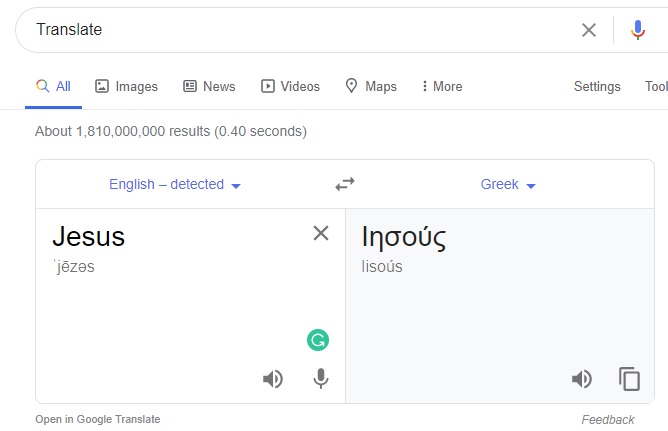
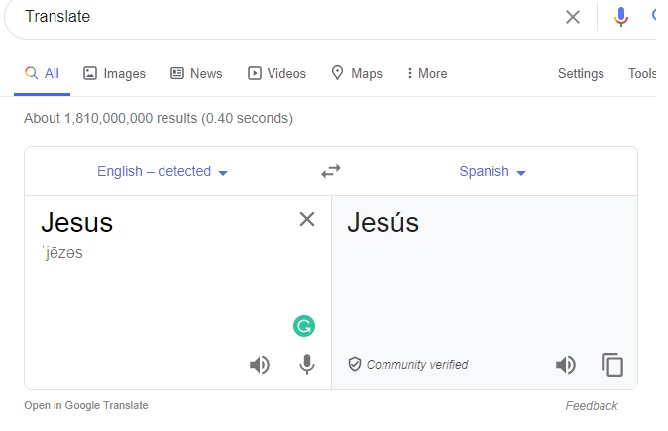
Feel free to go to Google Translate and listen to how the name ‘Jesus’ is pronounced.

Go to Google Translate and just listen to the name “Jesus” as it is pronounced in Spanish and Greek.

Go to Google Translate and just listen to the name “Jesus” as it is pronounced in Spanish and Greek.

Even more revealing is the fact that Jesus is a ‘bastardized’ (apologies for the terminology) Latin version of the name Yehoshua in Hebrew, or in other words, Joshua.

The name Yeshua appears 29 times in the Tanach.

Yehoshua (Joshua) of Nun is called Yeshua in Nechemyah (Nehemiah) 8:17. Yeshua is the name of the Cohain HaGadol (the high priest) in the time of Zerubavel in Ezra 3:2. It is the name of a Levite under King Hizkiyah (Hezekiah) in 2 Chronicles 31:15. There is even a city called Yeshua in the negev of Yehudah in Nechemyah11:26.

Yeshua is also a shortened version of the word Yehoshua, much like Bill is for William.

Before anyone gets angry with us using the word ‘bastardized’ in relationship to Jesus (may Allah’s peace and blessings be upon him), one must realize that the word ‘bastardized’ means—to modify, especially by introducing discordant or disparate elements.

Source: http://dictionary.reverso.net/english-cobuild/bastardize

After all, you take a very common name, Joshua, which means — ‘God is my salvation’ and turn it into this Latin that sounds a lot like a former Greek god ‘Zeus’.

Remember when the evangelist screams out in the name of ‘Jeeeee zuuus’. Or the Spanish speaker yells out on stage, “In the name of ‘Hey Zeus’.” Jesus /Zeus.

Hey Zeus. Hail Zeus.

HEY ZEUS! HAIL ZEUS!

In the Qur’an the son of Mary is called ‘Isa‘ or ‘Esau‘.

Recall that Hebrew was a dead language for a long time. It was only when Eliezer Ben Yehuda used the Arabic language to help revive Hebrew that it became a vibrant language again.

Source: https://www.haaretz.com/opinion/.premium-eliezer-ben-yehuda-is-turning-in-his-grave-over-israels-humiliation-of-arabic-1.5472510

“One prominent pioneer was Eliezer Ben-Yehuda, the famed Jewish lexicographer widely hailed as the reviver of modern Hebrew, and whose revivalist legacy rested on a genuine recognition of the essential role of Arabic in the rebirth and resurrection of modern Hebrew.

It is quite possible that some Christians may find it strange to use the name ‘Esau‘ or ‘Isa‘ in place of ‘Jesus‘ as there is a passage in the Bible that says that ‘God hates Esau‘.

The oracle of the word of the Lord to Israel by Malachi. “I have loved you,” says the Lord. But you say, “How have you loved us?” “Is not Esau Jacob’s brother?” declares the Lord. “Yet I have loved Jacob, but Esau I have hated.” (Malachi 1:1-3)

God hates Jesus but loves Jacob?

Imagine if in place of the word ‘Esau’ you had the word ‘Joshua’. You would have a very interesting passage in the Bible of God saying, “But Jesus, I hate.”

Let’s continue with Eliezer Ben Yehuda.

Since Hebrew, Aramaic, and Arabic are all based upon the same Semitic vowel system, Eliezer used the Arabic language.

A language that was still living and had wide currency to decipher the pronunciation and understanding of the Hebrew language.


Jesus” was a common name back in the day. In Acts 13:6 there was a magician named Bar Jesus.

When they had travelled through the whole island as far as Paphos, they met a magician named Bar-Jesus who was a Jewish false prophet.”

In Colossians 4:11 there was a contemporary of Paul called Jesus-Justus

And Jesus, who is called Justus, who are of the circumcision; these alone are my co-workers for the kingdom of God, and they have been a comfort to me.”

Another interesting example of two people called “Jesus” side by side in the following text:

So, when the crowd had gathered, Pilate asked them, “Which one do you want me to release to you: Jesus Barabbas, or Jesus who is called the Messiah?” (Matthew 27:17).

So, the people had the choice to have Jesus ‘son of the father‘ or Jesus ‘called Messiah‘ killed.


So, the name “Jesus” was a common name, like John, James or Mary.

This doesn’t sound like a ‘Name Above All Names’ to me. It sounds rather common and uneventful.

Do Christians Feel Power in The Name of Joshua?

We are whether we can call upon the name of Joshua and be saved? It is, however, the same as “Jesus”. Why should only the ‘bastardized‘ form of the Latin version of ‘Yehoshua‘ be the only name for salvation?

In other words, is the Christian mission only done in English? No it is not!

So, if there are Jews, wouldn’t they be screaming out ‘Yehoshua‘ in the congregation?

That being the case, why couldn’t they scream out ‘Joshua‘ as it is the Anglicized form?

Joshua Christ?


Imagine using terms like Joshua Christ! Imagine Christian missionaries asking people to accept faith in Joshua? Imagine Benny Hinn jumping up and down and healing people in the name of Joshua! Or imagine John Hagee being slain in the spirit of Joshua Christ!

What about the name Immanuel?

Immanuel is also a common Jewish name which means ‘God is with us‘.

Maher-shalal-hash-baz was called Immanuel in Isaiah 8:8

It shall pass into Judah and flood it all throughout up to the neck it shall reach; It shall spread its wings the full width of your land, Immanuel!

So, for Christians to say, “Hey look, there is a prophecy that says he will be called Immanuel, We can tell them that Maher-shalal-hash-baz was also called Immanuel.”

In Matthew 1:23 we read: “Behold, the virgin shall be with a child and shall bear a Son, and they shall call His name Immanuel,” which translated means, “God with us“.”

That this is an example of a failed prophecy plain pure and simple. It’s amazing the lengths that Christian apologists will go through to make this all add up.

In the end, I think that the position of Islam and the Qur’an is very clear. ‘Isa is an Arabized form of the word ‘Esau’. He was born of a virgin named Mariam (Mary).

There is much to be said about the fact that Christians use a name like Jesus (a common name like John, James, or Mary) when describing the ineffable name of the creator.

Maybe there is a way out of this. Maybe, after all, The Creator is not a person, much less person(s).

Since, after all, the words ‘person’ and ‘personality’ come from the Greek word ‘persona’ which means ‘a mask’. Think about it! Tri-Theist Christians believe in a God that is One Being that wears three masks.

In the end, “Jesus” is just a common name, like Chuck, or Daryl or Lester.

We sincerely hope people will read the Qur’an and learn as much as they can about Islam. We hope that Allah Most High opens the breasts and hearts of humanity and that Allah Most Merciful guides us all to what he loves.

“And when they hear what has been revealed to the Messenger, you see their eyes overflowing with tears because of what they have recognized of the truth. They say, “Our Lord, we have believed, so register us among the witnesses.” (Qur’an 5:83)

May Allah Guide the Ummah.

May Allah Forgive the Ummah.

Leave a comment

Filed under Uncategorized

Text clearly show Jesus is not God and the Bible does not understand human reproduction.

“For the truth stands out clearly from falsehood.” (Qur’an 2:256)

﷽ 

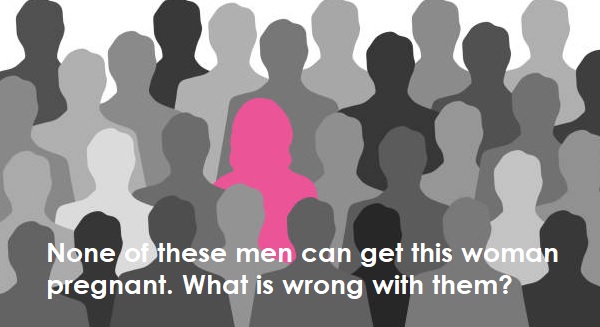
Let us see which of you reading this are quick-witted to spot the problem. Given what we know about human reproduction, what is the obvious error in sending brother after brother to impregnate a woman that fails to get pregnant?

Source: (Matthew 22:23-32)

“If brethren dwell together, and one of them die, and have no child, the wife of the dead shall not marry without unto a stranger: her husband’s brother shall go in unto her, and take her to him to wife, and perform the duty of an husband’s brother unto her.” (Deuteronomy 25:5)

“Then Judah said to Onan, “Sleep with your brother’s wife and fulfill your duty to her as a brother-in-law to raise up offspring for your brother.”  But Onan knew that the child would not be his; so whenever he slept with his brother’s wife, he spilled his semen on the ground to keep from providing offspring for his brother.  What he did was wicked in the Lord’s sight; so the Lord put him to death also.” (Genesis 38:8-10)

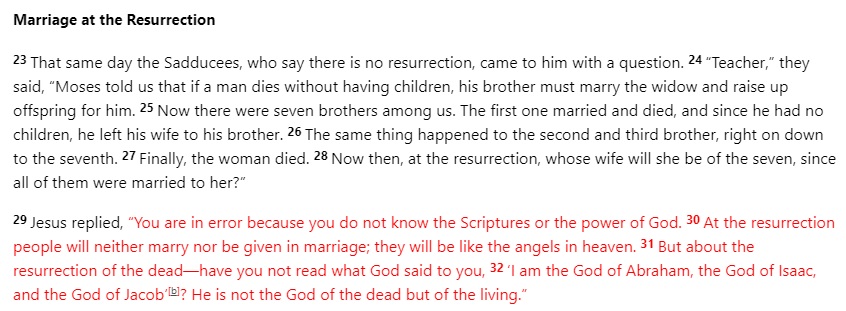
“That same day the Sadducees, who say there is no resurrection, came to him with a question.  “Teacher,” they said, “Moses told us that if a man dies without having children, his brother must marry the widow and raise up offspring for him.  Now there were seven brothers among us. The first one married and died, and since he had no children, he left his wife to his brother.  The same thing happened to the second and third brother, right on down to the seventh.  Finally, the woman died. Now then, at the resurrection, whose wife will she be of the seven, since all of them were married to her?” (Matthew 22:23-28)

You can replace the seven brothers with ten brothers or even 25 brothers if you like.

At what point does one realize that these men are not firing blanks but that this woman is infertile!

The woman has some type of medical condition that is preventing her from getting pregnant. Now if someone wants to raise an objection, stating that in Genesis 38:8-10 Onan was spilling his semen on the ground (coitus interruptus) and that perhaps all the brothers were doing that, it doesn’t help the case either.

  1. Did not have the foresight to realize that people would do this, evading their responsibility?
  2. If the story of Onan was known, the men would realize that God would strike them dead. Thus, the ever looming wrath of God.  
  3. Surely the women are not so gullible as to not know whether a man is ejaculating in them or not.

This law was before modern medicine in which we know that both a man and a woman may have issues of fertility. Given the low esteem that women are generally afforded in the Bible, it is not at all surprising to see the power of pro-creation as something that man is responsible for.

If Jesus was God, he would be aware that both men and women have a part to play in human reproduction. 

In the majority Christian view, Jesus shares the essence (being) of the Father and the Holy Spirit, which means that He (Jesus) gave those laws to Moses, proving further that he cannot be God and that the sacred text of the Jews and Christians are not free from egregious errors.

Another point to take note of:

The text has Jesus (as) say:

 Jesus replied, “You are in error because you do not know the Scriptures or the power of God.”  “At the resurrection people will neither marry nor be given in marriage; they will be like the angels in heaven.” (Matthew 22:29-30)

It looks like Jesus is in error for not knowing the scriptures!

However, the scriptures say:

“And it came to pass when men began to multiply on the face of the earth, and daughters were born unto them, That the sons of God saw the daughters of men that they were fair; and they took them wives of all which they chose.” (Genesis 6:1-2)

Jesus claims people will not marry nor be given in marriage being like the angels. Yet the angels themselves took human women as wives.

Now, watch out for the curveball they (some Christians will throw you) because they will say, “Oh, the text says,” Sons of God” not angels.   But angels are the sons of God. 

You can see where they are used interchangeably here:

https://biblehub.com/job/1-6.htm

“One day the angels came to present themselves before the LORD, and Satan also came with them.” (Job 1:6 New International Version)

“Now there was a day when the sons of God came to present themselves before the LORD, and Satan came also among them.” (Job 1:6 King James Version)

Lastly, if they persist that sons of God refer to men, then this shows you it is an appellation referring to mortal human beings without any divine connotation.

The Bible’s treatment of fertility is anthropologically conditioned and not scientifically precise.

From a modern scientific perspective, if multiple brothers fail to impregnate the same woman, it is statistically improbable that all men are infertile (assuming they are fertile with other women). The most logical conclusion is that the woman has a fertility issue. This highlights an ancient misunderstanding of reproduction, where infertility was often attributed solely to the woman. However, the levirate law implicitly places the burden on the man’s lineage to continue, ignoring potential female factors.

May Allah guide the sincere truth seekers.

May Allah guide the Ummah.

May Allah forgive the Ummah.

Leave a comment

Filed under Uncategorized

A misunderstanding of Qur’an 24:26: Nasty women for nasty men

“Nasty women are for nasty men, and nasty men are for nasty women. And virtuous women are for virtuous men, and virtuous men are for virtuous women. The virtuous are innocent of what the wicked say. They will have forgiveness and an honourable provision.” (Qur’an 24:26)

﷽ 

This article is written so that the masses can understand the correct understanding of the verse and not the faulty understanding that is widespread among the Ummah.

Shaykh Masoud bin Muhammed Al Miqbali (h) explains the correct understanding of this verse:

This is from the ill understanding of some ayats, actually.

For example: {Nasty ones are for nasty people} (Qur’an 24:26) {good ones are for good peole} (Qur’an 24:26)

What do most people understand from this ayat? What does {good ones are for good people} mean?

Audience: “Means that the pious women is for the pious man.”

Shaykh Miqbali: “He understands that the pious woman is for the pious man, and this is not true, ever.”

{good ones are for good people,} and {Nasty ones are for nasty people,}

{good ones are for good people} and {Nasty ones are for nasty people}

He means the good words and sayings are for the good people, and the nasty words and sayings are for the nasty people.

So the nasty refers to the words and the good refers to the words, not that good women are for good men. Or else, Asia, a woman from the women of Jannah, is the woman of the Pharaoh! The Pharaoh is nasty, and she’s from the people of Jannah. So this can’t be!

And the women of Lut and Nuh are in the fire while they (Lut & Nuh) are prophets. So it’s not meant that women are wives…. No. Words are meant.

This ayat came in surah Al Nur, after mentioning the story of Ifk and the words

that were said to Lady Aisha (ra) and the accusations and false things.

So after that came the saying of Allah:{Nasty ones are for nasty people, and nasty people are for nasty ones, and the good ones are for the good people, and the good people are for the good ones.}

{Those are acquitted of what they…} ??? {…. SAY} (Qur’an 24:26)

Qutb Al A’ima (the centre of Imams) (ra) also mentioned this in his Tafseer Himyan Al Zad. He also said that it’s the view of the majority. And he stated that Ibn Abbas (ra) also went with this interpretation. He’s one of the biggest Imams of the madhab. And he has written more than 300 books!

If the Qutb is not enough, then there’s also the statement of Al Hawari in his tafseer, and it’s one of the earliest Ibadi tafseer books, 3rd hijri century. He also said the same.

For other examples of verses that have been misinterpreted or misunderstood, you may wish to see the following articles:

https://primaquran.com/2023/12/14/jesus-will-be-a-sign-for-the-coming-of-the-hour-abuse-of-quran-4361/

https://primaquran.com/2023/03/24/apologies-to-fellow-muslims-and-truth-seekers-over-translation-of-holy-quran-431/

https://primaquran.com/2022/10/04/sunni-misunderstanding-of-quran-4159-concerning-jesus/

May Allah Guide the Ummah.

May Allah Forgive the Ummah.

Leave a comment

Filed under Uncategorized

The Mahdi: Collection of Articles

“It is He who has sent His Messenger with guidance and the world view that is based on the truth to manifest it over all other world views, although the mushrik make dislike it.” (Qur’an 9:33)

﷽ 

The subject of the Mahdi concerns Islamic Eschatology or what is known as end-time events.

First and foremost, it is important to understand that when one speaks of Mahdi, different schools and expressions of Islam have different ideas in mind.

Twelver Shi’a

In Twelver Shi’a theology, the Mahdi is the twelfth and final Imam, Muhammed ibn al-Hasan al-Mahdi, believed to be the direct descendant of the Blessed Prophet Muhammed(saw) through his daughter Fatima (ra). He is in occultation: He is hidden from public view by Allah’s will. He will re appear in some future eschatological event to restore justice.

Isma’ili Shi’a & The Qarmatians & Muhammed bin Isma’il

The person of Muhammed bin Isma’il caused a fracture early on, causing one stream that historians label the ‘Qarmatians’ and the other founding the Fatimid Caliphate.

The Qarmatian View.

Muhammed ibn Isma’il was not just the 7th Imam; he was the Qā’im (the Resurrector) and the Mahdi.

The Ismaili (Later Fatimid) View.

  • Muhammed ibn Isma’il was the 7th Imam.
  • He went into hiding (satr) due to Abbasid persecution.
  • The Imamate continued in his descendants.
  • They recognized a hidden line of Imams following him, which eventually culminated in Abdullah al-Mahdi Billah, who publicly declared himself Imam in 899 CE and founded the Fatimid Caliphate in 909 CE.
  • For this group, the Imam was always present on earth, whether concealed or manifest.

The Zaydi Shi’a

For Zaydis, the term “Mahdi” (the Guided One) is not exclusively reserved for a single, predestined, end-of-times figure. Instead, it is a title that can be applied to any rightly guided Imam from the Ahl al-Bayt who rises to establish justice.

There are times when they have referenced their Imams as such. For example: Al-Mahdi Li-Din Allah

While not a core dogma, Zaydi literature does contain some hadith about a future messianic figure from the Ahl al-Bayt, often referred to as “al-Qa’im” (The One Who Will Arise) or “al-Mahdi.”

Sunni View.

The dominant view and position among Sunni Muslims is that Mahdi is a figure believed to be the direct descendant of the Blessed Prophet Muhammed(saw) through his daughter Fatima (ra). He will appear in some future eschatological event to restore justice.

Again, this is the view of the vast majority of Sunni Muslims. As the articles in this entry will clearly demonstrate, there are many in the Sunni tradition that do not share this belief. 

Ibadi View. The idea of a Mahdi is not something found in our sources. We have no belief in any coming Mahdi. ​If the coming of this figure is true, we hope Allah opens our eyes to it. However, it is not a theological principle with us nor something we believe in.

It should be noted to the reader and researcher. Often, the various schools of Islam will have what is known as Shaadh (شاذ) — The Irregular/Anomalous Opinion. These are views that are anomalous or isolated. The Ibadi school has such and other schools do as well. Yet, on the issue of the Mahdi, we have not even come across a shaadh.

We establish the following facts.

The Qur’an has no mention of any Imam Mahdi.

The Ibadi hadith collection has no mention of Imam Mahdi.

There is no hadith about Mahdi in the Al-Jami’i Al-Salih, otherwise known as the Musnad Al-Imam Al Rabii.

The silence of Bukhari & Muslim.

The two great Imams of Hadith, Bukhari and Muslim, neither of them mentions Hadith concerning Imam Mahdi. What’s interesting about this is that both of them are aware of narrations on the subject that meet their criteria, yet they did not include them.

The silence of the Muwatta of Malik ibn Anas.

There is no hadith about Mahdi in the Muwatta of Malik ibn Anas.

What will Ahl Sunnah In the next 56 years and no Mahdi? Witness the genius of Ibn al-Hajr al-Asqalani as he tries to make sense of the data.

Sunni historian and hadith specialist Dr. Bashar Awad Maarouf. “Not a single hadith about Mahdi is authentic.”

The man whho the ‘Abdulla bin Zaid Al Mahmoud Islamic Cultural Center’ in Qatar is named after and former Qāḍī al-Quḍāt, and Athari -Salafi , tells us why there is no coming Mahdi.

Ali Erbaş Turkish Islamic scholar and president of directorate of religious affairs -diyanet in Turkey, believes Mahdi will not come and that Jesus (as) is dead. The Presidency of Religious Affairs (Diyanet) is Turkey’s highest official Islamic authority.

The great ibn Khaldūn al-Ḥaḍramī, Ashʿarī in theology, and Mālikī in jurisprudence. Writes in the Muqaddimah (Book 1, Chapter 3, section on the caliphate) about the weakness of the chains concerning narrations of Mahdi.

Shaykh Dr. Muhammed Bin Yahya Ninowy, a descendant of the Blesed Prophet Muhammed (saw) through the line of Imam al-Ḥusayn ibn ʿAlī ibn Abī Ṭālib, expreses his doubts about the Mahdi.

Top Shi’a Imam, Ayatollah Muḥammed Āṣif Muḥsinī, admits that waiting for the ‘Hidden Imam’ has been a waste of time.

3,000 Shi’a Mahdi’s in Iran. There are so many people who claim to be the Mahdi in Iran that the country has a special prison for them.

Dr Kahlan Al-Kharusi (h), assistant Mufti of Oman: No coming of Mahdi. Jesus is Dead. Jesus will not return.

As mentioned in the article above concerning the claimants of being Mahdi in Iran, Turkey would have to be the second-biggest offender here. 

May Allah Guide the Ummah.

May Allah Forgive the Ummah.

Leave a comment

Filed under Uncategorized

Shaykh Dr. Muhammed bin Yahya Ninowy expresses his doubts on Hadith concerning the Mahdi.

“So after the truth, what else can there be, save error? How then are you turned away?” (Qur’an 10:32)

﷽ 

We were alerted to a fascinating discussion recently between Shaykh Dr. Muhammed bin Yahya Ninowy and Tafhim Kiani on the subject: The Sunni Identity: Can Salafis Be Seen As Sunni Muslim? – Shaykh Ninowy

You may watch the very informative discussion here:

Before we comment further, we feel it is important to give some background information on Shaykh Dr. Muhammed bin Yahya Ninowy .Dr. Muhammed bin Yahya al-Ninowy is widely recognized as a descendant of the Blesed Prophet Muhammed (saw)through the line of Imam al-Ḥusayn ibn ʿAlī ibn Abī Ṭālib

Shaykh Ninowy was featured in ‘The Muslim 500’ as regards those who were deemed to exert a great deal of influence on the Muslim Ummah. 

The link can be found here:

The link says:

“Sheikh Dr Muhammad Al-Ninowy is a Syrian-American scholar, author, and medical doctor based in Atlanta, Georgia, whose lineage is traced back to the Prophet Muhammad (blessings and peace be upon him). In addition to a PhD in Islamic studies from the University of Georgia, he holds a Doctor of Medicine degree. He is the founding director of Madina Institute and Seminaries, The Center for Non-Violence and Peace Studies, and the charitable organization Planet Mercy, with campuses in the USA, Canada, the UK, South Africa, Malaysia, and Norway. Al-Ninowy also leads a school that follows the Sufism of Ahl-Al-Hadith. He was appointed by the Sultan of Malaysia in 2020 to serve as a member of the board of directors of the Islamic University. An upcoming book is: Nonviolence; a fundamental Islamic principle.”

In the above exchange, Shaykh Dr. Muhammed Al-Ninowy had some eye-opening statements concerning ahadith in relation to “The Mahdi.”

@1:19:33 “The hadith of the Mahdi is frankly in our Sunni tradition and also in the Shi’a tradition, but let’s say in the Sunni tradition there are one and half hadith that are ambiguous in my view. So, Sahih lilghairihi ghair sahih, the explicit are not authentic; and the authentic are not explicit. So, therefore you see, the earlier scholars did not even put it as part of the… did not put the Mahdi as part of the Aqaid.”

This is a welcome statement.  It is welcomed because we can see more and more come to this realization. 

Recently even Shaykh Hamza Yusuf made an interesting statement when he said:

The vast majority of Muslims believe in the second coming.

Which means there are Muslims who do not believe in the coming of Jesus (as)

Wonder which Muslims those are?

You can find Shaykh Hamza’s statement in an interview here;

https://primaquran.com/2024/03/29/the-vast-majority-of-muslims-believe-in-the-second-coming-shaykh-hamza-yusuf/

For those who are interested to read more on this subject:

https://primaquran.com/2024/12/30/no-mahdi-jesus-is-dead/

You may also wish to read the other entry featuring Shaykh Muhammed bin Yahya Al Ninowy here:

https://primaquran.com/2024/01/12/shaykh-muhammad-bin-yahya-al-husayni-al-ninowy-view-on-the-hadith-on-73-sects/

Now, Shaykh Dr. Muhammed Al-Ninowy did have a little blurb about the Ibadi school in the above interview.

@1:16:05 “The Khawarij of today, the Ibadis.”@1:16:52 “Not as verbally violent anymore to be honest with you.” Their tradition is.”

He was rather mild. The important thing is that for him, we are Muslims. Albeit he is clearly in error in terms of understanding our history. We also have to keep in mind that it is claimed he is a descendant of Husayn, the son of Imam Ali, as well as being disciplined in the Shaadhili Tariqah. Thus, given his own admission (in the above interview) of Sufism and its connection to Imam Ali, you can’t expect Shaykh Ninowy to give away the store. Albeit we are hopeful that gaps in information are an opportunity to learn about the Ibadi school. He has access to the Arabic language and resources, and surely he will not be excused on the day of judgement.

“So after the truth, what else can there be, save error? How then are you turned away?” –(Qur’an 10:32).

One of our team members has met him before, and he does not strike us as a person who is egotistical or driven by winning points and debates. 

May Allah (swt) continue to support Shaykh Ninowy when he strives to build bridges of mutual trust and cooperation throughout the world. Personally, we feel Muslims who attend his Masjid and his circles of learning are in good hands, and Allah (swt) knows best.

May Allah (swt) Guide the Ummah.

May Allah (swt) Forgive the Ummah.

Leave a comment

Filed under Uncategorized

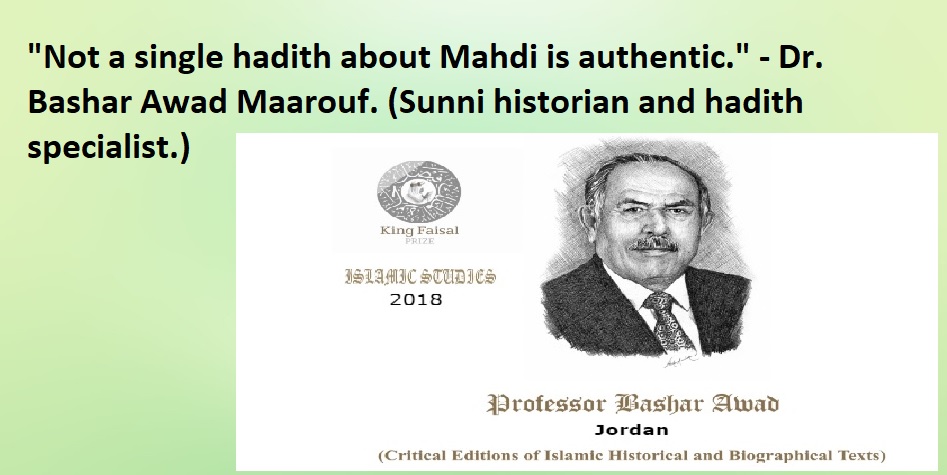
Sunni historian and hadith specialist Dr. Bashar Awad Maarouf. “Not a single hadith about Mahdi is authentic.”

“It is He who has sent His Messenger with guidance and the world view that is based on the truth to manifest it over all other world views, although they who rely upon other than or associate partners with Allah dislike it.” (Qur’an 9:33)

﷽ 

Dr. Bashar Awad Maarouf, a Sunni historian and hadith specialist, has concluded that there is not a single authentic narration concerning the coming of some Mahdi.

While it is common knowledge that the Qur’an does not speak about the Mahdi at all. That the two most authentic collections of hadith, according to Sunni Muslims, Sahih Bukhari & Sahih Muslim, do not speak about the Mahdi at all, what is not so commonly known is the general weakness and unreliability of all other reports.

If you are interested to see the full interview we would recommend:

Some background concerning Dr. Professor Bashar Awad Maarouf.

Bashar Awad Marouf was born in 1940 in Alazamiyah, northern Baghdad. He graduated from primary and secondary schools in the 1960s. He enrolled in the Department of History at the College of Arts in Baghdad University from which he graduated in 1964. In that same year, he enrolled in the Master’s Program of History and Archeology at Baghdad University. Professor Marouf was appointed in 1967 as the teacher at the College of Shari’a Studies at Baghdad University. He later earned his PhD from the College of Arts at the same university in 1976. His doctoral thesis was titled: “Ad-Dhahabi’s Approach in the History of Islam.” Professor Marouf worked at Baghdad University and advanced through academic work, eventually earning a professorship in 1981. He has been keenly interested in studying and minutely scrutinizing the Prophet’s Hadiths. He has been particularly devoted to studying biographies, narrators and the ‘hidden defects’ of some of the Hadiths. He has taught as Professor of Hadith at several universities. Many of Marouf’s studies have been published in Baghdad, Cairo, Damascus, Beirut, Amman, Tunis and London.

Notable among his publications are: “The Impact of Hadith on the Emergency of Muslim History.”, “Al-Mundhiri and his ‘Al Takmila”, “Baghdad’s Biographical Histories.”, “Ad Dhahabi’s approach to the History of Islam.” , “A Journey through Thought and Heritage.” , “The History of Islam and the concept of the Arab Leadership of the Islamic Ummah.” , “Explanation of the Rulings on Chanting the Qur’an.” “A Selection of the Prophet’s Hadith.” , “The Whole Musnad (22 volumes)” “Classified and Verified Musnad” (41 volumes)

Among the many books Professor Marouf verified are: “Al-Wafayat” by Abu Masoud Al Hajji, “Ahlu Al Mi’a and Upward” by Al Hafiz Ad Dahabi. “Postscripts of the History of Baghdad, City of Peace by Ibn Al-Daybathi (5 volumes). “The Grand Mosque” -by Imam Abu Issa Al Tirmidhi (six volumes), “Sunan Ibn Majah by Imam Muhammed Ibn Yazid Al Qazwini (6 volumes),
“The Hstory of the City of Peace” by Hafiz Abu Bakr Al Khatib Al-Baghadadi (17 volumes). “The History of Islam and the Deaths of Celebrities and the Famous” by Al Hafiz Shams Addeen Ad-Sahabi (17 volumes) and many more.

Some of his works and publications may be purchased here:

https://www.abebooks.com/book-search/author/bashar-awad-marouf/

A dean of investigators in the science of Prophetic Hadith. Former rector at the Islamic University in Baghdad. He is a Fellow of the Royal Aaal Al-Bayt Institute for Islamic Thought in Amman, Jordan. 

Dr. Professor Bashar Awad Maarouf does not fear the blame of the blamer.  He made his conclusion after thorough investigation, tracking all the narrators and investigating all the paths. 

In regard to those who say: “But our club says this, and if you differ with the club it is a departure from faith!” 

Is the weakness of these hadiths considered a denial of the Sunnah and a departure from Islam!!! Fear Allah! 

We personally have considered that there are many such scholars among Ahl Sunnah who have come to this conclusion. However, they do not come out to the public for one of two reasons.

  1. Being ostracized and condemned. Not being welcomed to the table anymore.
  2. The fear that if this widely held belief is now considered mistaken it could cause the masses to wonder what other views or beliefs are mistaken. Thus, a desire to protect the tradition.

Allah knows best.

You may be interested to read the following:

https://primaquran.com/2022/10/04/hadith-on-imam-mahdi-in-the-light-of-ibn-khaldun/

https://primaquran.com/2024/02/27/which-mahdi-would-you-choose/comment-page-1/

https://primaquran.com/2023/07/26/assistant-grand-mufti-of-oman-says-no-coming-of-mahdi-and-jesus-is-dead-and-will-not-return/

https://primaquran.com/2024/01/28/what-will-ahl-sunnah-do-after-57-years-have-passed-and-no-mahdi/

https://primaquran.com/2022/10/04/top-shia-imam-admits-waiting-for-hidden-imam-has-been-a-waste-of-time/

May Allah (swt) guide the Ummah!

May Allah (swt) forgive the Ummah!

3 Comments

Filed under Uncategorized

What will Ahl Sunnah do after 57 years have passed and no Mahdi.

“They ask you, [O Muhammed], about the Hour: when is its arrival? Say, “Its knowledge is only with my Lord. None will reveal its time except Him. It lays heavily upon the heavens and the earth. It will not come upon you except unexpectedly.” They ask you as if you are familiar with it. Say, “Its knowledge is only with Allah, but most people do not know.” (Qur’an 7:187)

﷽ 

3471246720

  days

  hours  minutes  seconds

until

Arrival of Imam Mahdi

The day of Judgement was already supposed to happen.

A’isha reported:

“That when the desert Arabs came to Allah’s Messenger (saw) they asked about the Last Hour as to when that would come. And he looked towards the youngest among them and said:

If he lives he would not grow very old that he would find your Last Hour coming to you (he would see you dying).”

Source: (https://sunnah.com/muslim:2952)

This hadith goes against the ayat of Allah [swt]

“They ask you, [O Muhammed], about the Hour: when is its arrival? Say, “Its knowledge is only with my Lord. None will reveal its time except Him. It lays heavily upon the heavens and the earth. It will not come upon you except unexpectedly.” They ask you as if you are familiar with it. Say, “Its knowledge is only with Allah, but most people do not know.” (Qur’an 7:187)

Ibn Hajar Al Asqalani made a calculation that the time of the Ummah should have already come and gone:

Narrated `Abdullah bin `Umar:

I heard Allah’s Messenger (saw) while he was standing on the pulpit, saying, “The remaining period of your stay (on the earth) in comparison to the nations before you, is like the period between the `Asr prayer and sunset. The people of the Torah were given the Torah and they acted upon it till midday, and then they were worn out and were given for their labor, one Qirat each. Then the people of the Gospel were given the Gospel and they acted upon it till the time of the `Asr prayer, and then they were worn out and were given (for their labor), one Qirat each. Then you people were given the Qur’an and you acted upon it till sunset and so you were given two Qirats each (double the reward of the previous nations).” Then the people of the Torah said, ‘O our Lord! These people have done a little labor (much less than we) but have taken a greater reward.’ Allah said, ‘Have I withheld anything from your reward?’ They said, ‘No.’ Then Allah said, ‘That is My Favor which I bestow on whom I wish.’ “

Source: (https://sunnah.com/bukhari:7467)

Narrated Salman:

“The interval between Jesus and Muhammad was six hundred years.

Source: (https://sunnah.com/bukhari:3948)

Hafiz Ibn al-Hajr al-Asqalani says in his Fath al-Bari, (in vol.4, the book of hijara, page 448-449) commenting on these two narrations: “and it is evident ( from these stated narrations) that the lasting of this Islamic nation is somewhat a thousand years, this is because the age of the Jewish nation is equivalent to that of the time periods of the Christian and Muslim ages combined, and the people of transmission (ahl an naql) have agreed that the period of the Jews till the advent of Allah’s final Apostle Muhammad was more than 2000 years, and the span of the age of the Christians was 600 years from them. And also this narration points the fact about how little of the age of this world has remained.”

Torah time is = to Injil time + Qur’an time.

Torah time =2000 years.

Torah time = 2000 years -600 years = (1400) From Moses to Jesus.

Let us be generous and add 100 years.

The time of this ummah of the Blessed Messenger [saw] is 1500-600 which means only 900 years and now we are in 1441.

When Muslims reached the 1,000th year they thought they were nearing the end because of these Sahih ahadith which indicated we will have half the time the Jewish nation had, but Imam as-Suyuti [the author of the Tafsir al jalalayn] who was born in the 10th century and lived into the 11th century was alive during these times, he wrote a fatwa [legal ruling] to reassure Muslims, in which he said it was supposed to be 1000 years but there is a dua of Rasul Allah in which he supplicates Allah to give his Ummah another half a day and the companions asked the prophet how long is half a day and he answered 500 years. So the imam said the life of this Ummah is 1,500 years.

Imam as Suyuti mentions in his book: “Risalah Al-Kashf ‘An Mujawazt Hadehel Ummah Al Alf” ”, or “Treatise on Revealing of the Proceeding of this Nation Beyond the Thousand,” page 206 about the advent of the Mahdi that:

“From what the narrations reveal is that the age of this ummah extends beyond a thousand but it doesn’t exceed in increase another 500 in actuality beyond this thousand.”

So if you do the math 1500-1443=59 years left. So in these next 59 years according to them, we should see this Mahdi, the coming of Jesus, the Gog and Magog causing havoc on the Earth, the Sun rising in the West.

Keep in mind according to the above hadith: “He will destroy the Antichrist and will live on the earth for forty years and then he will die.” 59-40=19. So accordingly Jesus will show up in the year 2039.

So what is going to happen to these Muslims who, after 59 years have passed and nothing of the sort has happened? Will they apostate from the faith? Will they leave the deen?

Ya Allah [swt] I sincerely hope not. We hope that they realize that just because certain interpretations and understandings of Islam are wrong, it does not mean that Islam is wrong.

The Ibadi school, we know what it is that influenced our brothers in ‘Ahl Sunnah’.

We know that many Christians and Jews who embraced Islam in the past influenced our religion, its understanding and teachings.

We know they got this concept straight from the following:

Matthew: 20: 1-16

You may also be interested in reading the following:

May Allah (swt) guide the Ummah!

May Allah (swt) forgive the Ummah!

2 Comments

Filed under Uncategorized

3,000 Shi’a Mahdi’s in Iran!

“Today those who disbelieve have lost all hope of (damaging) your faith. So, do not fear them, and fear Me. Today, I have perfected your religion for you, and have completed My blessing upon you, and chosen Islam as Dīn (religion and a way of life) for you. But whoever is compelled by extreme hunger, having no inclination towards sin, then Allah is Most-Forgiving, Very-Merciful.” (Qur’an 5:3)

﷽ 

“O.K. Settle down, settle down.” We are going to go about this in a very orderly manner. Which one of you is the Mahdi? Simply raise your hand!”

Source: https://www.businessinsider.com/3000-iranians-claim-to-be-the-madhi-2013-4

“EARLIER this year Iran’s authorities arrested a score of men who, in separate incidents, claimed to be the Mahdi, a sacred figure of Shia Islam, who was “hidden” by God just over a millennium ago and will return some time to conquer evil on earth.”

“A website based in Qom, Iran’s holiest city, deemed the men “deviants”, “fortune-tellers” and “petty criminals”, who were exploiting credulous Iranians for alms during the Persian new-year holiday, which fell in mid-March.”

“Many of the fake messiahs were picked up by security men in the courtyard to the mosque in Jamkaran, a village near Qom, whose reputation as the place of the awaited Mahdi’s advent has been popularized nationwide by President Mahmoud Ahmadinejad. When he took office in 2005 he gave the mosque $10m.”

“Iran’s economic doldrums may have helped to cause this surge in people claiming to be mankind’s saviour—and in women saying they were the Mahdi’s wife. “In an open atmosphere where people could criticise the government they would not believe these people,” says an ex-seminarian in Tehran, the capital, noting that most Iranians still get all of their news from state television and state-owned or -sanctioned newspapers.”

“Last year a seminary expert, Mehdi Ghafari, said that more than 3,000 fake Mahdis were in prison. Mahdi-complexes are common, says a Tehran psychiatrist. “Every month we get someone coming in, convinced he is the Mahdi,” she says. “Once a man was saying such outrageous things and talking about himself in the third person that I couldn’t help laughing. He got angry and told me I had ‘bad hijab’ and was disrespecting the ‘Imam of Time’,” as the Mahdi is known.”

“The most famous case was that of Ayatollah Boroujerdi, who was sentenced to 11 years in prison in 2007 for—among other things—claiming he was the Mahdi. Like many influential “false” messiahs, he was forced to recant on state television, confessing that he had been against the Islamic Republic’s core tenets.”

“Mr Ahmadinejad has called his administration “the government of the hidden imam”. Last month he told a batch of new Iranian ambassadors to consider themselves “envoys of the Mahdi”. After his first speech at the UN in 2005, a video circulated showing Mr Ahmadinejad telling a leading Iranian cleric that world leaders had been enchanted, during his oration, by a halo around his head that had been put there by the Mahdi himself.”

Prima-Qur’an Comments:

We have no idea where they keep all these 3000 Mahdis, but could you imagine if they were all in the same prison or same facility? Surely that would be volatile.

https://primaquran.com/2022/10/04/top-shia-imam-admits-waiting-for-hidden-imam-has-been-a-waste-of-time/

https://primaquran.com/2022/10/04/hadith-on-imam-mahdi-in-the-light-of-ibn-khaldun/

1 Comment

Filed under Uncategorized

Top Shi’a Imam admits waiting for ‘Hidden Imam’ has been a waste of time

Say, “None in the heavens and earth knows the unseen except Allah, and they do not perceive when they will be resurrected.” (Qur’an 27:65)

﷽ 

A Shia scholar from the 12er Shi’i school of Islam (as opposed to the Zaydi Shia or Ismaili Shia) has made an interesting observation about the so-called ‘Mahdi’.

Mash’Allah look at this man. He certainly has the passage of time on his face. You know, as people get older they often say things that they wanted to say before but didn’t. As each of us approaches death, we become more concerned with what Allah (swt) thinks of us and less concerned with what people think of us.

Imam Muhammed Asif Muhsini said in his book “Mashra`at Bihar al-Anwar”,volume 1 page 408:

الغيبة التي امتدت أكثر من ألف سنة وربما تمتد إلى آلاف أو ملايين السنين. فإن المؤمنين لم ينتفعوا ولا ينتفعون من إمامهم الغائب – عجل الله تعالى فرجه – في الأصول والفروع ، وما يقال بخلاف ذلك فهو تخيل وتوهم ولعب بالعقول

[This Ghaybah that has taken more than a thousand years and maybe it shall keep going for thousands or millions of years. The believers living in it did not and do not benefit from their hidden Imam(may Allah hasten his appearance) in Usool or Furu`, and all else which is said is nothing but illusions and imaginations and playing with people’s minds.]

Muhammad Asif Muhsini said in the same book volume 2 page 223:

ولا يمكن القول بانتفاعنا منه عليه السلام في زمن الغيبة في الأمور الدينية إلا ممن سلب الله عقله

[It is not possible for us to say that we benefit from him (peace be upon him) in religious matters during his Ghaybah, except those whom Allah has robbed them of intellect.]

Finally, Muhammed Asif Muhsini said in footnote #1, in volume 1 page 82:

وأي فائدة لهذه الأحكام المخزونة عند الأئمة: والمكلفون يحرمون منها في أكثر من ألف سنة ولعله في ألف مليون سنة
[And what benefit does this knowledge stored with Imams hold: when the Mukallafoun (Shia) are deprived of it for more than a thousand years, and maybe it’ll last for a billion years.]

So, yes, you can imagine as women get raped and murdered and children become fatherless, and mosque becomes decimated and the landfills the cup with the injustice that this so-called ‘hidden Imam’ is somewhere waiting for just the right moment………

Getting ready and prepared…………

Some time……….

Any time…..

Or maybe waiting for the Mahdi is just a waste of time.

May Allah Guide the Ummah.

May Allah Forgive the Ummah.

2 Comments

Filed under Uncategorized