Surely those who say, “Our Lord is Allah,” and then remain steadfast, the angels descend upon them, “Do not fear, nor grieve. Rather, rejoice in the good news of Paradise, which you have been promised.” (Qur’an 41:30)
﷽
The Prophet (saw) said to Ali: Lā yadkhulu al-jannah illā nafs muʾminah” (لَا يَدْخُلُ الْجَنَّةَ إِلَّا نَفْسٌ مُؤْمِنَةٌ)
Zaid bin Yathi’ said: We asked Sayyiduna Ali: With what message did the Messenger of Allah (saw) send you? He replied: I was sent with four things. First, that only a believing soul will enter Paradise.
Belief in Islam is composed of three major elements.
To proclaim with the tongue there is no God except Allah and Muhammed (saw) is his Messenger.
Sincerity with Allah.
Actions. To do righteous deeds and to avoid evil deeds.
Surely those who say, “Our Lord is Allah,” and then remain steadfast, the angels descend upon them, “Do not fear, nor grieve. Rather, rejoice in the good news of Paradise, which you have been promised.” (Qur’an 41:30)
Does anyone understand from the above verse that a person can enter paradise simply by believing in Allah and Muhammed is his Messenger without the need to perform any actions?
Have you ever pondered on the message delivered in one of the shortest chapters in the Qur’an?
Surah Al-‘Asr.
By the time! Surely humanity is in loss, except those who have faith, do good, and enjoin on each other the truth, and enjoin on each other patience. (Qur’an 103:1-3)
Can you imagine, based upon your own understanding of this previously quoted chapter, that people are entitled to receive that great reward of paradise, of Al Jannah, without doing good deeds?
This chapter of the Qur’an delivers a clear message. The salvation of mankind is linked to both faith and actions. Good deeds are inseparable from true faith. True faith is necessarily linked to good deeds. The two are interlocked.
If we want to know the correct Islamic creed, the correct Islamic aqidah as taught by the Blessed Prophet (saw), make sure first and foremost you base your creed on the verses of the Qur’an that are clear with clear meanings. If you do so, you will be able to differentiate between the authentic traditons of the Blessed Prophet (saw) from the fabricated ones.
Muslims the world over, in all their denominations, believe that on the day of judgement no one will enter paradise without the intercession of the Blessed Prophet (saw).
The debate comes down to the following:
Is this intercession for all those who testify that there is no god except Allah and Muhammed (saw) is his Messenger ?
A special honour and privilege for the Muslims who fear Allah.
“He knows what is before them, and what is behind them, and they cannot intercede except for him, with whom He is pleased. And they stand in awe for fear of Him.” (Qur’an 21:28)
Imagine an individual who, their whole life they miss the prayers, they commit fornication and adultery, and they die unrepentant.
Is Allah content or pleased with this person? The answer is no!
The above verse provides clear-cut evidence that whatever Shafa’at that there will be, it will be for those with whom Allah (swt) is pleased.
In Christianity, they have a theological position that Christ Jesus is their intercessor on the day of judgement.
“My dear children, I write this to you so that you will not sin. But if anybody does sin, we have an advocate with the Father—Jesus Christ, the Righteous One.” (1 John 2:1)
“Who then is the one who condemns? No one. Christ Jesus who died—more than that, who was raised to life—is at the right hand of God and is also interceding for us.” (Romans 8:34)
“For, There is one God and one Mediator who can reconcile God and humanity—the man Christ Jesus.” (1 Timothy 2:5)
In Christianity, Faith in Jesus is enough. It is sufficient to enter into paradise.
In Islam, true faith is accompanied by righteous living, righteous action, and righteous deeds.
“He knows what is before them, and what is behind them, and they cannot intercede except for him, with whom He is pleased. And they stand in awe for fear of Him.” (Qur’an 21:28)
“Those who carry the Throne and those around it glorify the praises of their Lord, have faith in Him, and seek forgiveness for the believers, Our Lord! You encompass everything in mercy and knowledge. So forgive those who repent and follow Your Way, and protect them from the torment of Hellfire.” (Qur’an 40:7)
From this verse we can understand that there are three major pre-conditions for Allah (swt) to forgive your sins.
To believe in Islam.
TTo actually want to be forgiven—via repentance.
Follow the way Allah (swt) has set out for us.
One of the most important methods of interpreting the Qur’an is to apply to it the rules and the principles of the Arabic language. As the Qur’an itself was sent down in Arabic.
Consider, for example, the following verse:
“And warn them, [O Muhammed], of the Approaching Day, when hearts are at the throats, filled [with distress]. For the wrongdoers there will be no devoted friend and no intercessor [who is] obeyed.” (Qur’an 40:18)
When you look at this verse you will see the مَا (mā) which is used in the Arabic language to negate. And then come two nouns. The first is ḥamīmin and the other is shafīʿin. Both are indefinite nouns. This means that this verse implies a general sense. Meaning that all intercessors and all friends will not be acceptable on the day of judgement to intercede for the wrong doers.
So there is a principle in the Arabic language and fundamentals of Islamic jurisprudence known as uṣūl al-fiqh saying that if an indefinite noun is found in a negative context or prohibitive context or conditional context, it will produce a general sense.
So what we get from this is that no one will intercede for a person who did not repent in this temporal world.
We have seen that one of the most damnable articles of faith held by some Muslims is the belief that the sinners who died unrepentant will be admitted into paradise on the day of judgement.
Now contrast this belief with the following authentic tradition of the Blessed Prophet (saw).
Narrated Abu Huraira:
When Allah revealed the verse: “Warn your nearest kinsmen,” Allah’s Messenger (saw) got up and said, “O people of Quraish (or said similar words)! Buy (i.e. save) yourselves (from the Hellfire) as I cannot save you from Allah’s Punishment; O Bani `Abd Manaf! I cannot save you from Allah’s Punishment, O Safiya, the Aunt of Allah’s Messenger (saw)! I cannot save you from Allah’s Punishment; O Fatima bint Muhammed! Ask me anything from my wealth, but I cannot save you from Allah’s Punishment.”
Now what do we understand from this tradition? Will there be intercession for the unrepentant sinners? Will there be intercession for the wrongdoers and wicked who died unrepentant?
“It is He who has sent His Messenger with guidance and the world view that is based on the truth to manifest it over all other world views, although the mushrik make dislike it.” (Qur’an 9:33)
﷽
Bio: Early Life and Education
Shaykh ʿAbdallāh b. Zayd Āl Maḥmūd was born in Najd and studied under prominent scholars of the Saudi reformist-Salafi tradition. He was influenced by the intellectual legacy associated with the Hanbali revival of central Arabia, which traced its theological orientation back to Ibn Taymiyyah and Muhammed ibn Abd al-Wahhab.
He studied Qur’an, hadith, fiqh (primarily Hanbali), and Arabic sciences in Najd before being invited to Qatar.
Move to Qatar and Judicial Career
In the 1930s, he moved to Qatar at the invitation of the ruling family, the Āl Thānī. He eventually became:
Chief Judge of Qatar
A key religious authority shaping Qatar’s legal and educational institutions
An advisor to the rulers during the formative pre-oil and early oil period
He played a central role in institutionalizing Sharīʿah courts and religious education in Qatar before the development of a modern state judiciary.
Intellectual Orientation
Shaykh Āl Maḥmūd was known for:
Strong adherence to Atharī creed
Emphasis on scriptural literalism in theology
Conservative positions on social and moral issues
Opposition to theological speculation (kalām)
He wrote against practices he regarded as bidʿah (religious innovations) and was critical of certain Sufi and Ashʿarī trends.
The ‘Abdulla bin Zaid Al Mahmoud Islamic Cultural Center’ in Qatar is named after him.
He wrote a book: “لا مهدي يُنتظر بعد الرسول محمد ﷺ خير البشر “No Mahdi is awaited after the Prophet Muhammed ﷺ, the best of mankind.”
His book is a masterpiece, and it gives no scope for his opponents to maneuver. The fairness and justice with which he writes about the subject is refreshing. This book alone would make one interested to read his other writings.
This Shaykh, who says he is Hasani in lineage, has urged Muslim scholars that if anyone comes claiming to be Mahdi, that the claimant should be killed. He argues as such based upon every other claim that has brought nothing but division and strife to the Muslim Ummah.
From his book:
The Epistle Sermon
Praise be to Allah, and there is no power or strength except with Allah.
Now then : This message, entitled “There is no Mahdi awaited after the Messenger Muhammed ﷺ, the best of mankind,” I chose this name for it so that it would be a good belief, which the tongues of every Muslim man and woman would pronounce, because I believe it to be an established fact.
I began by calling on scholars and students to unite in their sound belief that there is no Mahdi to be awaited after the Prophet, the best of mankind. This is because, although I believe that I have achieved fairness and justice in the message, and have not deviated in it to what is negated by Islamic law or rejected by reason, I am but a human being, prone to error and forgetfulness. In the message, I presented the Muslim’s belief regarding the Mahdi, including:
All people, scholars and commoners, in every time and place, fight against anyone who claims to be the Imam Mahdi, because they believe that he is a lying imposter who wants to corrupt the religion, divide the Muslim community, and fill what he has seized with injustice and immorality, as happened to many of those who claimed to be the Mahdi. They will continue to fight against anyone who claims to be the Mahdi until the Hour comes. So where is the Mahdi in this situation?
The idea of the Mahdi is not originally from the beliefs of the early Sunnis. It was not mentioned among the Companions in the first century, nor among the Successors. The origin of those who adopted this idea and belief is the Shiites, whose beliefs include belief in the awaited absent Imam, who will fill the earth with justice as it was filled with injustice. He is the twelfth Imam: Muhammed ibn al-Hasan al-Askari. This idea and belief was transmitted, through sitting, socializing, and mixing with the Sunnis, and it entered into their belief, even though it is not originally from their belief.
Then it was generally transferred to the Islamic community when it was proclaimed to the people by Abdullah bin Saba, who is known for his explicit atheism and hostility towards Islam and Muslims. He and his followers began to work on formulating hadiths and placing them on the tongue of the Messenger of Allah with organized chains of transmission from the people of the graves, and they began to spread them in the community of people, so that they would not lose the hope that they hoped for, in their claim, to return the rule to the people of the house, to remove from them the injustice and persecution that was happening to them at the hands of their opponents, the Umayyads. It is a political terrorist call.
When the Umayyads heard these hadiths directed at them from Iraq, which made them tremble and threatened to overthrow them, they became aware of this, so they placed Al-Sufyani in the position of the Mahdi, and their supporters did their work in fabricating hadiths about the Messenger of Allah concerning Al-Sufyani. Among these is what Al-Hakim narrated in his Sahih on the authority of Abu Hurayrah, who said: The Messenger of Allah , may Allah bless him and grant him peace, said: “A man called Al-Sufyani will emerge from Damascus, and most of those who follow him will be from Kalb. He will kill until he rips open the bellies of women and kills children.” He mentioned the rest of the hadith, then Al-Hakim said: This is a sound hadith according to the conditions of the two Shaykhs, but they did not include it. Then he presented a second hadith about Al-Sufyani with the wording and meaning of the first hadith.
Al-Hakim’s correction of the hadiths of Al-Sufyani is like his and Al-Tirmidhi’s correction of the hadiths of Al-Mahdi alike. In reality, they are all incorrect and not widely transmitted. If it is said: How did you know that these many hadiths with chains of transmission and a chain of narrators from a number of companions are fabricated, when they are in the Sunan of Abu Dawud, Al-Tirmidhi, Ibn Majah, Musnad of Imam Ahmad, Al-Hakim , and other books?
The answer is : These numerous hadiths, which amount to fifty hadiths about the Mahdi according to the Sunnis, some of which they claim are authentic, some of which are good, and some of which are weak. They amount to one thousand two hundred hadiths according to the Shiites. The Mahdi is one and not two, and the ideas of the Shiites and the ideas of the Sunnis have conflicted about him.
These hadiths are what captivated the hearts of most Sunni scholars, as has been said, and the majority holds sway, although quantity is of no consequence compared to quality. Most people are imitators, following one another, and few are the true scholars. The true scholars, both past and present, have subjected these hadiths to rigorous verification, scrutiny, and criticism, and have identified flaws in them that necessitate their rejection and non-acceptance, for several reasons:
Among them : The Prophet ﷺ was sent with a complete religion and a comprehensive law, based on bringing about benefits and increasing them, and repelling harms and reducing them. It is known that believing in the Mahdi and saying that his emergence is valid entails great harms and corruptions, and stirring up strife and shedding the blood of innocent people, the magnitude of which is witnessed by studied history and tangible reality, all of which the Prophet ﷺ is innocent of bringing about, since the religion is complete without it.
Among these claims is that the Mahdi, whose coming they assert is true, is named Muhammed ibn Abdullah and is described as having a broad forehead and a prominent nose. This description, along with these characteristics, is common among groups claiming descent from Hasan and Husayn, and therefore does not provide certainty in his identity. If someone possessing these attributes were to claim to be the Mahdi, the danger would arise of inciting discord between believers and disbelievers, and between those who love him and those who oppose him. Such a belief would become a source of misery for people throughout their lives, due to the constant confusion surrounding him. This contradicts the religion that Allah made a mercy for all of creation, as He, the Exalted, said: { And We have not sent you, [O Muhammed], except as a mercy to the worlds . } [Al-Anbiya: 107] Among them: It is impossible for the Prophet ﷺ to obligate his nation to believe in a man from the children of Adam, unknown in the unseen world, who is neither a close angel nor a sent prophet, nor does he bring a new religion from his Lord that must be believed in and acted upon, and then leave his nation to fight over believing in him and disbelieving in him, for this is contrary to his Sunnah and the wisdom of his message, ﴿ He is grieved by what you suffer ; [ He is] concerned over you and to the believers is kind and merciful. 128﴾ [At-Tawbah: 128].
Among them : We are not the first to reject these hadiths, as some scholars before us have rejected them. Shaykh al-Islam Ibn Taymiyyah, may Allah have mercy on him, said in al-Minhaj [147] after mentioning the hadiths about the Mahdi:
These hadiths about the Mahdi have been erred by groups of scholars. Some groups have denied them, which indicates that they have been a point of contention among scholars since ancient times, as is the case with the disagreement among scholars in this era.
Among them : that these hadiths were not taken by Al-Bukhari and Muslim, and they did not include them in their books, despite their popularity in their time, and that is only because they were not proven to them, as well as the fact that there is no mention of the Mahdi in the Qur’an, which reduces the celebration of him.
Among them : the contradiction and conflict of these hadiths on their subject, for there is a Mahdi whose name is the name of the Messenger, and his father’s name is the name of his father, and a Mahdi whose name is Abu Abdullah, and a Mahdi who resembles the Messenger in appearance, but does not resemble him in character, and a Mahdi whom Allah will reform in one night, and a man who will flee from Medina to Mecca, and pledge allegiance to him between the Corner and the Station, and a man whose name is Al-Harith bin Harran, who will pave the way or enable the family of Muhammed, and a man who will emerge from beyond the river, and a man who will pledge allegiance to him after a tribulation occurs at the death of a caliph, and a man whose maternal uncles are Kalb, and the black banners will come to him from the direction of Iraq, and the righteous of Syria, and a Mahdi behind whom Jesus, son of Mary, will pray, and a Mahdi who will be told in the presence of the Prophet of Allah, Jesus: “Pray, O Prince,” and he will say: “Every person is the prince of himself,” as an honor from Allah to this nation.
This and more than this has made the investigating scholars certain that it was fabricated and attributed to the Messenger of Allah, may Allah bless him and grant him peace, and that it did not originate from the source of his prophethood, and is not from his words, so it is not permissible to look at it, let alone believe it.
These hadiths, narrated by Abu Dawud, al-Tirmidhi, and Ibn Majah, led some Sunni scholars, due to their sheer number, to accept them as established principles and respected doctrines, obeying them without reflection or contemplation. This included figures like Shaykh Siddiq, al-Shawkani, al-Safarini, Shaykh Mar’i, al-‘Abbadi, and other later scholars. However, had these scholars examined the hadiths about the Mahdi narrated by Abu Dawud, Ibn Majah, and al-Tirmidhi more thoroughly and compared them, they would have recognized the inherent contradictions and discrepancies. They would have found evidence compelling them to reconsider their acceptance of these hadiths, realizing that most of them describe events that occurred with specific individuals, with no mention of the Mahdi.
Every hadith that mentions the Mahdi is weak, such as the hadith attributed to Ali, may Allah be pleased with him, in which he said: “Even if only one day remained of this world, Allah would send a man from among us who would fill it with justice as it was filled with injustice .” Similarly, there is a hadith attributed to Ali, may Allah be pleased with him, in which he said: “The Mahdi is from us, the People of the House .” Likewise, there is a hadith attributed to Ali, may Allah be pleased with him, in which he looked at his son Al-Hasan and said: “This son of mine is a leader, as the Messenger of Allah named him, and from his loins will come a man who will be named after your Prophet, resembling him in character but not in physical appearance.” Similarly, there is the hadith attributed to Umm Salamah, in which he said: “The Mahdi is from my family, and from the descendants of Fatimah.” All of these were narrated by Abu Dawud in his Sunan and others.
Most modern scholars have refrained from including many hadiths about the Ahl al-Bayt in their books, due to the extremists’ tendency to introduce a great deal of falsehood into their virtues. Al-Bukhari, Muslim, Al-Nasa’i, Al-Daraqutni, and Al-Darimi also avoided them, and did not mention them in their reliable books. This was only because they knew of their weakness, knowing that Al-Darimi was the teacher of Abu Dawud and Al-Tirmidhi, and he kept his Musnad free from hadiths about the Mahdi, so there is no mention of them in it.
Furthermore, it is the custom of modern scholars and early jurists to transmit hadiths and sayings from one another, even with their flaws, following the example of their predecessors. It is reported that Imam Ahmad used to borrow the compilation from Ibn Sa’d’s Tabaqat , copy it, and then return it to him. This is mentioned in the biography of Ibn Sa’d. Al-Shafi’i used to say to Imam Ahmad, “If you have a confirmed hadith, send it to me so that I may include it in my book.” Similarly, scholars of every era transmit from one another. Therefore, given this practice, it is no wonder that hadiths about the Mahdi spread throughout the books of Abu Dawud’s contemporaries, such as al-Tirmidhi and Ibn Majah. This is because a hadith spread from one book to a hundred, and errors were transmitted from one scholar to a hundred, since people tend to follow others, and few are truly diligent scholars. A follower is not considered a scholar.
In the treatise, I dedicated a chapter entitled ” The Reliable Investigation into the Hadiths of the Awaited Mahdi,” in which I explained all the hadiths narrated by Abu Dawud, al-Tirmidhi, Ibn Majah, Imam Ahmad, and al-Hakim, providing a comprehensive explanation. The treatise should be consulted. I clarified that the hadiths concerning the Mahdi are neither authentic, nor explicit, nor transmitted through multiple independent chains of narration (mutawatir) in meaning. We have already cited the words of Shaykh Ibn Taymiyyah (may Allah have mercy on him) regarding them, and that a group of scholars completely rejected them. Similarly, the scholar Ibn al-Qayyim (may Allah have mercy on him) stated in his book, ” Al-Manar al-Munif fi al-Sahih wa al-Da’if” (The Shining Beacon on Authentic and Weak Hadiths ): “People differed regarding the Mahdi, holding four opinions.”
One of them is : that he is the Messiah, son of Mary, and he is the Mahdi in reality.
The second : He is Al-Mahdi bin Al-Mansur, who was appointed by the Abbasids, and his time has ended.
Third : He is a man from the family of the Prophet (peace and blessings be upon him), from the descendants of Al-Hasan ibn Ali, who will appear at the end of time. Most of the hadiths support this.
Fourth : The Imamiyyah say that he is Muhammed ibn al-Hasan al-Askari.
These statements, despite their differences, indicate that the issue is a matter of dispute and disagreement, both in ancient and modern times, and is not a matter of agreement.
And it follows from his statement that what they claim about the emergence of the unknown Mahdi in the unseen world has no reality, but the fanatics for his emergence, since the time has been long for them, and fourteen centuries have passed – and I do not feel that more time will come than has passed without them seeing him until the Hour comes – for this reason they have begun to extend the time in order to prove the correctness of their statement about the fall, so they began to spread among the people that he will not emerge except in the time of Jesus, son of Mary, knowing that the hadiths that are in their hands, which they claim are authentic and continuous and which were narrated by Imam Ahmad, Abu Dawud, Al-Tirmidhi and Ibn Majah, were mentioned in general terms and were not restricted to the time of Jesus, peace be upon him, except for the hadith of Jesus praying behind the Mahdi, which Al-Dhahabi and Ali Al-Qari said: It is fabricated, that is, it is a lie, so it is not used as evidence.
The words of later scholars are numerous, and the most accurate one I have seen who hit the mark on the issue of the Mahdi is Abu al-A’la al-Mawdudi, as he said in a treatise called Al-Bayanat about the Mahdi:
The hadiths on this matter fall into two categories: those that explicitly mention the Mahdi, and those that speak only of a caliph to be born at the end of time who will elevate the word of Islam. Neither of these categories possesses the strength of a chain of transmission that would stand up to Imam al-Bukhari’s rigorous standards for hadith criticism. He did not include any of these hadiths in his Sahih , and Imam Muslim included only one in his Sahih, but even that one does not explicitly mention the Mahdi.
He said : It is impossible, through an unlikely interpretation, to say that in Islam there is a religious position known as Mahdism that every Muslim must believe in, and that not believing in it entails a range of doctrinal and social consequences in this world and the hereafter.
He said : It is appropriate to mention in this regard that there is no belief in the Mahdi among the beliefs of Islam, and no book of the Sunnis on beliefs mentions it. End quote.
The conclusion we believe, and profess to Allah, is that there is no Mahdi awaited after the Prophet Muhammed, the best of mankind, and that he does not condemn those who deny him, since his denial does not diminish faith. Rather, condemnation is directed at those who argue about his existence and the validity of his emergence. And Allah knows best.
* * *
[147] See Minhaj al-Sunnah al-Nabawiyyah: 4/211.
Calling upon scholars and wise people to unite on sound belief
All praise is due to Allah, Lord of the Worlds, and may Allah’s peace and blessings be upon our Prophet Muhammed, the Seal of the Prophets, and upon his family and all his companions. Now then: O esteemed scholars, and O wise people who listen to the word and follow the best of it.
Let us sit down and examine the hadiths about the Mahdi that have been the subject of much debate and gossip, so that we may look at their validity and authenticity, what must be believed in them, and what Muslims must believe and reject.
Research yields benefit, and encountering the experiences of men enriches their minds, and knowledge has many facets, some of which call for others.
When we say thatwe are Salafi Muslims and that our creed is the creed of Ahlus Sunnah wal Jama’ah, this belief obligates us to unite on the word of truth and speak the truth, so that we agree and do not separate. Allah Almighty says: { And hold fast to the rope of Allah, all of you } [Al Imran: 103]. It is known with certainty that Allah Almighty created people with varying levels of knowledge and understanding, just as they vary in intellect and physical strength, { And they will continue to differ, except those on whom your Lord has bestowed His mercy } [Hud: 118-119].
This includes the hadiths about the Mahdi and what is said about their authenticity and validity, and what must be believed about them. By investigating them and studying their narrations, it becomes clear with certainty that they contain contradictions, discrepancies, inconsistencies, and problems, and that it is impossible to reconcile the narrations. This confirms their lack of authenticity and leads the later and some earlier scholars to judge them as fabricated and falsely attributed to the Messenger of Allah, may Allah bless him and grant him peace, and not as his words. They exonerate the Messenger of Allah and his Sunnah from bringing such things, since the doubt in them is certain, and the falsehood in them is clear and evident. Far be it from the Messenger of Allah to impose on his nation belief in a man from the children of Adam unknown in the unseen world, whose time and place are unknown, and who is neither a close angel nor a sent prophet, and who will not bring a new religion from his Lord that necessitates belief in him, and then leave his nation to fight over his realization and belief, and then one of them comes forward and places himself in the position of this unknown Mahdi, and this results in tribulation on earth and great corruption. All the hadiths that they cite to prove his emergence are contradictory and conflicting. They are different and inconsistent. What they claim to be true is not true in indicating what they mentioned, and what they claim to be explicit and mentioning the Mahdi is not true. In short, none of them are true, explicit, or widely transmitted.
But it may be presented to prove what we said by the statement of some of them that Shaykh Al-Islam Ibn Taymiyyah, may Allah have mercy on him, said that the emergence of the Mahdi is valid, and he is the verified scholar who is known for the correctness of the narration and the clarity of the knowledge.
I say : Yes, and I have seen a statement by Ibn Taymiyyah in which he affirms that seven hadiths about the Mahdi were narrated by Abu Dawud. In my early years, I held the same belief as Ibn Taymiyyah, influenced by his words, until I reached the age of forty. After expanding my knowledge of various sciences and arts, and understanding the hadiths about the Mahdi, their defects, contradictions, and discrepancies, my misguided belief was dispelled, praise be to Allah. I came to know with complete certainty that there is no Mahdi after the Messenger of Allah and after the Book of Allah. Ibn Taymiyyah, may Allah have mercy on him, is our beloved, but he is neither our Lord nor our Prophet.
It has been said : How much error and shortcoming might be attributed to even the most learned scholar [148], for he, like all human scholars, cannot encompass all knowledge. He may remember some things and forget others, since perfection belongs to Allah alone, whose decree cannot be overturned nor His words questioned. They have likened the slip of a scholar to the sinking of a ship, with which many perish. How many scholars and laypeople were misled by this statement of Ibn Taymiyyah when they believed in the truth of the Mahdi’s advent! Indeed, every scholar and layperson I encountered would cite the words of Ibn Taymiyyah, may Allah have mercy on him, as proof.
Perhaps this statement came from him at the beginning of his life before he expanded his knowledge of sciences and arts, and he was striving and rewarded for his striving, since if a learned scholar says a weak and undesirable statement, then the one who imitates his statement and defends his opinion is not in the same position as him in obtaining the reward and removing the burden of sin, rather his obligation is to strive and consider, so how many scholars used to say statements at the beginning of their lives, then it became clear to him that they were weak, so he said the opposite.
This Imam Al-Shafi’i had statements that he made in Iraq, and they are called his old statements. Then he had new statements that he made in Egypt, and the work was based on his newer, later statements. The same is true of Imam Ahmad, for he has several narrations on a single issue, because in their custom, ijtihad is renewed.
This Al-Daraqutni responded to Al-Bukhari in eighty-odd places in his Sahih, and there is no fault in Al-Bukhari or Al-Daraqutni. It is enough for you to know that the schools of thought are divided into four, and each one sees evidence that his companion does not have, and they are pleased with each other.
In Al-Bukhari : When Moses met Al-Khidr at the confluence of the two seas, he was horrified by what he saw of his actions: his killing of the boy, his building of the wall that was about to collapse, and his damaging of the ship of the poor people who worked on it to earn a living at sea. Moses became distressed by his actions and his patience ran out, so he wanted to leave him. Al-Khidr said to him: O Moses, I have knowledge from Allah’s knowledge that He taught me that you do not know, and you have knowledge that I do not know. He also said to him: O Moses, my knowledge and your knowledge are no less than the knowledge of Allah, like the peck of this bird in the sea [149] .
Thus, the scholars differ in what they know, and the differences in what they understand, as it has been said: The scholars differ in their understanding of knowledge more than the bodies differ, O assembly of scholars, learners, and all people:
Our teaching and belief must be based on the fact that there is no Mahdi after the Messenger of Allah(peace and blessings be upon him), just as there is no prophet after him. May Allahreward Muhammed with all good on our behalf, for he was a Mahdi and a guide. We also believe that the Messenger of Allah(peace and blessings be upon him) did not leave behind any knowledge or religion that could be attained or delivered by a Mahdi after him, because Allah Almighty has perfected the religion for us and completed His favor upon the Muslims by sending this noble Prophet : { He is grieved by your suffering; he is concerned over you and to the believers is kind and merciful. } [At-Tawbah: 128]
And Allah revealed in His clear Book : “ This day I have perfected for you your religion and completed My favor upon you and have approved for you Islam .” [Al-Ma’idah: 3] So after perfection there is only deficiency, and after Islam there is only disbelief.
We are already well provided for by the Book of our Lord and the Sunnah of our Prophet, and we have no need for a religion brought to us by the awaited Mahdi.
For the Mahdi is neither a close king nor a sent prophet, and our religion, which was brought by the Book of our Lord and the Sunnah of our Prophet, is not incomplete so that the Mahdi completes it. “ And the word of your Lord has been fulfilled in truth and in justice. None can change His words, and He is the All-Hearing, the All-Knowing. ” (Al-An’am: 115)
The Messenger of Allah, may Allah bless him and grant him peace, said in the position of Arafat when he delivered that long sermon to them, in which he said: “Perhaps you will not meet me after this year of mine” [150] , “and I have left among you that which, if you hold fast to it, you will never go astray: the Book of Allah” [151] , and in another narration: “and my Sunnah” [152]. He did not say: “and I have left after me the Mahdi,” since it has not been proven that the Messenger of Allah, may Allah bless him and grant him peace, mentioned the Mahdi by name in a clear and authentic hadith.
There is knowledge that is best kept secret, and revealing it to some people may be harmful. The Prophet (peace and blessings be upon him) would sometimes share certain knowledge with specific individuals, instructing them to keep it secret lest it lead people astray. For example, he told Mu’adh, “Whoever dies without associating anything with Allah will enter Paradise .” Mu’adh asked, “Even if he committed adultery and theft?” The Prophet replied, “Even if he committed adultery and theft .” Mu’adh then asked, “Should I not give this good news to the people?” The Prophet replied, “Do not give them this good news, lest they become complacent.” (Agreed upon). The Messenger of Allah (peace and blessings be upon him) instructed Mu’adh to keep this good news secret, fearing that people might become lax in committing sins and wrongdoings, relying on what they had heard, and thus be led astray. Mu’adh did not tell anyone this hadith until his death.
Similarly, he informed Hudhayfah of the names of thirty hypocrites and ordered him to keep them secret. So the Companions would only pray for those whom Hudhayfah had prayed for, and they called him the keeper of the hidden secret.
Al-Bukhari included it in his Sahih, saying: (Chapter on those who were given knowledge to some people and not others, for fear that they would not understand). He quoted Ali as saying: Speak to people according to their understanding. Do you want Allah and His Messenger to be lied about ? They said: You will not speak to people with a hadith that their minds cannot comprehend, except that it will be a trial for them.
When the matter is of this nature, the legitimate policy requires the scholar to remind them of what benefits them and increases their faith and piety, and to avoid reminding them of what tempts them and shakes their faith, and causes anxiety and unrest in their society, because averting harm takes precedence over bringing benefits, and it has been said: Beware of what is first rejected by the hearts, even if you have an excuse for it.
This includes reminding people that the Mahdi is real, that he will inevitably come out to the people and that he will fill the earth with justice. This does not increase faith, nor good deeds, and it causes people to be confused between believers and disbelievers.
Knowing that the hadiths about the Mahdi are not authentic, nor explicit, nor continuous, but rather they are all flawed and weak, and flawing takes precedence over authentication, and most of the later scholars from the elite of the cities have preferred that they are all lies against the Messenger of Allah, so they are a hadith of a political terrorist myth that was formulated and fabricated on the tongue of the Messenger of Allah, may Allah bless him and grant him peace, and it was fabricated by the extremist heretics when the rule was taken away from the family of the Prophet, so they began to frighten the Umayyads with it and promise them that the Mahdi would come out, and his coming was imminent, so he would take the rule from the Umayyads and then return it to the family of the Messenger of Allah, as they are more deserving of it and his family.
Abdullah ibn Saba’ played a key role in fabricating hadiths and manipulating people’s minds. He claimed that the Mahdi was Muhammed ibn al-Hanafiyya ibn Ali ibn Abi Talib, that he was sent after Ali’s death and resided on Mount Radwa in the Hijaz, between Mecca and Medina, and that he possessed a spring of honey and a spring of water. He would lead the armies to fight the Umayyads. They were called the Saba’iyya, and Kathir ‘Azza, a Saba’i himself, wrote about him: “ A descendant who will not taste death until he leads the army, preceded by the banner. He disappears, unseen among them for a time, on Radwa, where he has honey and water. ” In any case, whenever belief is corrupt, actions are corrupt, and the outcome is corrupt.
The Rightly Guided Caliphs, the Companions, and the Followers lived, and after them lived the scholars and righteous predecessors who were in the three preferred centuries, and after them lived all the scholars and rulers, including: Imad al-Din Zengi, Nur al-Din Mahmud the Martyr, and Salah al-Din al-Ayyubi, and all the people after them, and at their forefront lived Shaykh al-Islam Ibn Taymiyyah and the scholar Ibn al-Qayyim. Their faith and piety were not diminished by the absence of the Mahdi among them, because they knew and believed that the religion was complete without him, so they had no need for him, whether he appeared or not.
We are now in the year that completes the fourteenth century, and I feel that more time will come than has passed until the Hour comes without the Mahdi appearing, and Allah knows best.
* * *
[148] Al-Nahrir: The skilled and adept one.[149] Narrated by Imam Ahmad on the authority of Ibn Abbas.[150] Narrated by Abu Ya’la from the hadith of Jā’ir.[151] Narrated by Muslim from the hadith of Jabir.[152] Narrated by Al-Bayhaqi from the hadith of Zayd ibn Arqam.
The Muslim belief regarding the Mahdi
The belief of the general public and some scholars has become attached to the beliefs and minds of the masses, and to the existence of a Mahdi in the unseen world, whose place and time they do not know.
Some believe in him, affirm his advent, and condemn those who deny him. Others deny the existence of the Mahdi altogether, questioning the authenticity of the hadiths concerning him and claiming they are fabricated and falsely attributed to the Prophet.
The debate and argument between the two sides has continued, and for this reason, there are still those who claim to be the Mahdi in every era and in some countries, and as a result of this claim, strife arises and blood is shed.
The truth we believe in, and which we call people to know and act upon, is that there is no Mahdi after the Messenger of Allah, just as there is no prophet after him. May Allah reward Muhammed with all good on our behalf, for he was a Mahdi and a guide. The Mahdi, if we accept the hadiths concerning him, is neither an infallible angel nor a divinely sent prophet. He is merely an ordinary man, like any other person, except that he is just and will fill the earth with justice as it was filled with injustice. All the hadiths concerning him are weak, and it is more likely that they were fabricated and falsely attributed to the Messenger of Allah, peace and blessings be upon him, and that he did not narrate them.
The Muslim’s position in relation to the Mahdi and the Mahdi’s position in relation to him
First : It is not necessary to firmly believe in his departure due to the strength of the disagreement in the hadiths. Therefore, one should not criticize those who deny it, but rather criticize those who say that his departure is valid.
Secondly : Belief in the Mahdi is not part of the creed of Islam and Muslims, unlike belief in the existence of Allah, belief in angels, belief in resurrection after death, and belief in Paradise and Hell. These are matters of the Hereafter that must be believed in and whose occurrence is clearly evident in the Hereafter. They are established by the Quran and authentic Sunnah. Belief in the Mahdi is not among them. As-Safarini erred when he included belief in him in his creed, saying: “ Among them is the final, eloquent Imam, Muhammed al-Mahdi, and the Messiah.” He was mistaken in making the Mahdi the final one. If we interpret him as making him the final of the twelve Imams, the successors through whom the affairs of religion are set right, then this is the same creed of the Shi’a, who made the eleventh Imam al-Hasan al-‘Askari. After his death, the Imamate passed to his son, Muhammed ibn al-Hasan al-‘Askari, who entered the cellar of Samarra. The claim of the Mahdi originated with the Shi’a, who believed in it and affirmed it, and frequently mentioned this awaited Mahdi. Some Sunnis adopted this belief and then followed its path and teachings until this idea became widespread among later generations, to the point that it became a method and a creed. Whenever it is changed, it is said: The Sunnah has changed! And this is the case with innovation. Because of their proximity to the Shiites and their mixing with them, they adopted it from them. Otherwise, it is not from the creed of the Sunnis. This is why Shaykh al-Islam Ibn Taymiyyah did not mention it in his creeds, neither in al-Wasitiyyah nor in al-Asfahaniyyah nor al-Sab’iniyyah nor al-Tis’iniyyah nor al-‘Arshiyyah. It was also not mentioned in the creed of al-Tahawiyyah nor in its explanation, nor in the creed of Ibn Qudamah, nor in the creed of Ibn Zaydun al-Maliki.
Their failure to mention it indicates that it is not one of the beliefs of Islam and Muslims. The Mahdi, at the beginning of his call, is one and not two. No one said that there are two Mahdis. Rather, there is one Mahdi, who is contested by the ideas of the Shiites and the ideas of some Sunnis. Every blame or condemnation directed at the Shiites for their belief in their Imam Muhammed bin Al-Hassan, who is in a cellar, applies by way of correspondence and agreement to the Sunnis who believe in the unknown Mahdi in the unseen world. They are the same in the corruption of belief in him.
The verse by Al-Safarini is incorrect and untrue in both cases, and Al-Safarini, may Allah have mercy on him, is the strongest one who established the foundations of the Mahdi belief in the hearts of Muslims.
Third : The Mahdi is not mentioned in the Qur’an, nor in Sahih al-Bukhari and Muslim. They have kept their books free from mentioning him and from talking about him, despite the widespread news about him in their time. We see this only because of the weakness of his hadiths in their view.
Fourth : The Messenger of Allah, may Allah bless him and grant him peace, was sent with concise and comprehensive speech. He would summarize many wise sayings in a few words. Aisha said: “ The Messenger of Allah spoke words that, if someone were to count them, he could easily do so.” [153] The hadiths about the Mahdi are like the tales of One Thousand and One Nights. Al-Shawkani counted them in more than fifty hadiths, all of which are contradictory and inconsistent, with some contradicting others. Some indicate that the Mahdi is Ali ibn Abi Talib, some indicate that he is Al-Hasan or his sons after him, some indicate that he is Muhammed ibn al-Hanafiyyah, and that he is alive on Mount Radwa between Mecca and Medina, and that he has two springs of honey and water. Some indicate that he is a man named Al-Harith, and that people are commanded to hasten to him to pledge allegiance to him, even if they have to crawl on their knees or on snow. There are other hadiths like these, which every rational person knows the Messenger of Allah is above.
Fifth : It was not from the guidance of the Messenger of Allah, nor from his law, to refer his nation to believe in a man in the unseen world who is from the people of this world, and from the children of Adam, and to inform about him that he does such and such, which causes disagreement and turmoil among the nation.
Sixth : Since the Mahdi has the characteristics they claim, and his name is like the name of the Prophet Muhammed bin Abdullah, and he has a broad forehead, a prominent nose, and is from the Quraysh tribe, this characteristic is found in abundance in many noble people.
Since I am one of these noble people, from the descendants of Al-Hasan bin Ali, if a man from the noble people named Muhammed bin Abdullah, who has a prominent forehead and a prominent nose, were to come out and claim to be the Mahdi, I would be the first to fight him because I believe that he is a liar who wants to corrupt the religion and divide the Muslims, and the Prophet, may Allah bless him and grant him peace, said: “Whoever comes to you while you are united and wants to divide your community, then kill him.” [ 154]
Seventh : Among the characteristics of the Mahdi, whose coming they claim, is that his stay in this world is seven or nine years, according to another hadith. Will he be supported by miracles and wonders, or by dreams and visions? Will angels descend with him to fight alongside him, or will jinn be subservient to him as they were subservient to Solomon? Is he more honorable to Allah than Muhammed, the Messenger of Allah, who remained for twenty-three years, all of which he struggled, argued, and endured hardship and distress, following the universal laws of the paths leading to his success, with the Qur’an supporting him and the angels assisting him, and his head was wounded, his incisor tooth was broken, and they lowered him into a pit, thinking him dead, during the Battle of Uhud.
Despite all this, he was only able to spread justice in the Arabian Peninsula, which is a small point in relation to the vastness of the world.
Is the awaited Mahdi more beloved to Allah than Muhammed, the Messenger of Allah?!
Eighth : All Muslims in the east and west of the earth, their scholars and their common people, agree on fighting whoever claims to be the Mahdi, as they have done in every time and place, despite the large number of people who claim to be the Mahdi, because they believe that it is a false claim that has no basis in truth.
They will continue to fight those who claim to be the Mahdi until the Hour comes. So where is the Mahdi in this situation? The Mahdi has become like someone who exists only in minds, not in reality.
Ninth : The scholars agreed that all the Companions were just, so nothing of deliberate lying was attributed to them. However, in the first and then the second century, people were involved in tribulations such as the tribulation of the Camel and Siffin, then the tribulation of Nahrawan in Ali’s fight against the Kharijites, then the tribulation of Ibn al-Zubayr with Abd al-Malik Ibn Marwan and al-Hajjaj, then the tribulation of the killing of Musab Ibn al-Zubayr with Abd al-Malik Ibn Marwan in Iraq, then the tribulation of al-Mukhtar Ibn Abi Ubayd and his killing of Ubayd Allah Ibn Ziyad.
As a result of these conflicts, passions spread among the people to the point that they were exchanging insults and curses on the pulpits. The companions of Ali, may Allah be pleased with him, and his supporters were cursing Muawiyah and the Umayyads, and the Umayyads and their supporters were responding in kind until the beginning of the reign of the Rightly Guided Caliph Umar ibn Abd al-Aziz, who abolished this cursing and replaced it with: “ Our Lord, forgive us and our brothers who preceded us in faith and do not place in our hearts any resentment toward those who have believed. Our Lord, indeed You are Kind and Merciful. ” (Al-Hashr: 10)
Tenth: The religion is complete with the presence of the Messenger of Allah and the revelation of the Book of Allah. The Messenger of Allah did not leave anything of it behind, neither in heaven nor on earth. Allah Almighty says: “ This day I have perfected for you your religion and completed My favor upon you and have approved for you Islam as religion .” [Al-Ma’idah: 3].
The Prophet, may Allah bless him and grant him peace, said: “I have left among you that which, if you hold fast to it, you will never go astray: the Book of Allah and my Sunnah . ” [155]
Therefore, we are now free and have no need for a religion and justice brought by the Mahdi, for there is no Mahdi after the Messenger of Allah, peace and blessings be upon him, just as there is no prophet after him.
Eleventh : Scholars such as Abu Dawud in his Sunan , Ibn Kathir in his Nihayah , al-Safarini in his Lawami’ al-Anwar, and others, included hadiths about the Mahdi among the signs of the Hour, along with hadiths about the Antichrist, the Beast, Gog and Magog, and hadiths about tribulations. These hadiths were not subjected to authentication or scrutiny by hadith critics, who knew they were based on leniency and contained falsehoods, additions, insertions, and distortions. They were not relevant to their time, nor did they pertain to their rulings or matters of what was permissible and forbidden.
In the ninth century, when the claimants to the Mahdi increased, and strife arose because of him, as Al-Mas’udi mentioned in his history , some of the scholars were compelled to critique the hadiths about the Mahdi in order to distinguish the strong from the weak, and the authentic from the unsound, because events in life are the mother of inventions. Ibn Khaldun, in his introduction , undertook the task of scrutinizing them, sifting through them and then dispersing them hadith by hadith, and explaining all their defects, and that among their narrators were liars, and among them were those accused of Shi’ism and extremism, and among them were those who attributed the hadith to the Messenger without the Messenger having spoken it, and among them were those who could not be used as evidence.
In summary, he judged the hadiths about the Mahdi to be weak.
However, we have seen some scholars in our time object to Ibn Khaldun’s corrections, saying: He is a historian, not a hadith scholar. This objection is unfounded, for Ibn Khaldun is a distinguished scholar, and no one speaks ill of him. His being a historian does not preclude him from being an expert on ten or more hadiths, as such verification is easy for someone like him when the necessary tools and books on the characteristics of narrators are available. Studying individuals, their integrity, and criticizing them are matters of history, just as they are matters of hadith science. Ibn Khaldun had debates and discussions in response to Ibn Hajar, the author of Fath al-Bari.
We have seen that Ibn Khaldun’s statement was supported by some of the earlier scholars, who were advanced in knowledge and learning, and who adhered to the Book and the Sunnah. Among them was the scholar Ibn al-Qayyim, who mentioned in his book Al-Manar al-Munif the hadiths about the Mahdi and their weakness, as we will quote his words in full in the reliable investigation into the hadiths about the awaited Mahdi from this book of ours, so refer to it.
Among them is Imam Al-Shatibi in his book Al-I’tisam [156] , who made the Mahdis and the Imamis among the people of innovation. By the Mahdis he means those who believe in the coming of the Mahdi. Here is his wording to establish the proof and excuse, and to remove the doubt and blame. He said after a previous statement of his about those who follow the people of desires and innovations: Likewise, whoever follows the Moroccan Mahdi to whom many of the innovations of the Maghreb are attributed is in sin and name with those he follows if he stands up as a supporter of them and an argument for them.
He said: “And indeed, due to turning away from evidence and relying on men, some people have gone astray from the path of the Companions and the Followers, and have followed their desires without knowledge, and have thus gone astray from the right path.”
He said: The doctrine of the Mahdist sect, which made the actions of their Mahdi an argument, whether they agreed with the ruling of the Sharia or contradicted it, rather they made most of that a part of their faith, whoever contradicted it they declared an infidel and made his ruling the ruling of the original infidel [157] .
Thus, the argument of those who claimed that no scholar preceded Imam Ibn Khaldun in weakening the hadiths of the Mahdi is cut off. There was almost a consensus among the later scholars of the various regions in weakening the hadiths of the Mahdi, and that they were fabricated and attributed to the Messenger of Allah, may Allah bless him and grant him peace, as evidenced by the contradiction, inconsistency, discrepancies and problems, which makes the matter clear to the eye, and is not hidden except by those with weak understanding. And Allah guides to the truth and to a straight path.
Twelfth : The Prophet, may Allah bless him and grant him peace, came to bring about benefits and increase them, and to ward off evils and harms and reduce them, and believing in the Mahdi and calling to believe in him entails various kinds of great harms and evils, and continuous trials, the latter of which is worse than the former, which is something that the Messenger is above bringing about, as it is from the trials of life from which the Messenger of Allah, may A,llah bless him and grant him peace, used to seek refuge after the prayers, and people have been constantly afraid and apprehensive of being tested by the trial of the one who claims to be the Mahdi and his followers and his helpers from among the reckless youth who are the rabble and the naive rabble who follow every caller and incline with every shouter, and the rabble are the helper of the oppressor and the hand of the tyrant in every time and place, so believing in him entails a trial on earth and great corruption, and what occurs in people’s hearts from believing in him is greater and more reprehensible, for the trial is worse than killing, so he is not blamed or sinful for denying him, since the basis is his invalidity.
Allah Almighty, in His Book and through the words of His Prophet, does not require belief in an unknown man in the unseen world, who is from the children of Adam, who is neither a close angel nor a sent prophet, nor does he bring a new religion from his Lord that must be believed in, and then leave people to fight over belief and disbelief in him. This is contrary to His law, which Allah made a mercy for His servants. { He is grieved by what you suffer; [He is] concerned over you and to the believers is kind and merciful. } [At-Tawbah: 128].
The existence of this is more harmful to people than its absence, even though it is impossible for it to be as they described it.
But believing in its falsehood and not believing in it gives hearts comfort, joy, security, tranquility, and safety from turmoil and temptation. { And whoever Allah wills to put to trial – you will not be able to do anything for him against Allah. Those are the ones whose hearts Allah did not intend to purify. For them in this world is disgrace, and for them in the Hereafter is a great punishment . } [Al-Ma’idah: 41]
The idea of the Mahdi has political, social, and religious reasons, all of which stemmed from the beliefs of the Shiites, who were the first to invent it, after the caliphate left the House of the Prophet.
The Shiites exploited the naive ideas of the public and their enthusiasm for religion and the Islamic call, so they approached them from this good and pure side, and they fabricated hadiths that they narrated on the authority of the Messenger of Allah, may Allah bless him and grant him peace, in that regard, and they strengthened their chains of transmission, and they spread them through different methods, so the good public believed them because of their simplicity, and the Shiite men remained silent because it was in their interest.
This was a heinous conspiracy that corrupted people’s minds, and filled them with hadiths that were narrated and stories that were told, some of which were attributed to the Prophet ﷺ, some to the Imams of the Ahl al-Bayt, and some to Ka’b al-Ahbar.
All of this had a bad effect on misleading people’s minds and subjecting them to illusions. It also had an effect on the successive revolutions and movements in the history of Muslims. In every era, a preacher or preachers emerges claiming to be the awaited Mahdi, and a group of people gathers around him, causing a lot of strife. All of this is due to a mythical theory, which is the theory of the Mahdi, a theory that does not agree with Allah’s law in His creation and does not agree with sound and healthy reason.
* * *
[153] Agreed upon.[154] Narrated by Muslim from the hadith of Arfajah ibn Darih.[155] Narrated by Muslim from the hadith of Jabir.[156] See page 129 and beyond.[157] See the book Al-I’tisam: 301 and onwards
The rest of his book is a systematic dismantling of the hadith quoted by the lesser authorities.
“And what is there after the truth but error.” (Qur’an 10:32)
﷽
It has been our observation that many in the Muslim Ummah take the wrong approach when dealing with the Shi’a or Pro-Alids in general. They revisit historical disputes and the same ol tired back and forth between those who think that Ali was robbed and those who say he was never intended to be the leader of the Muslims after the death of the Prophet (saw).
However, you see, at Primaquran.com we like to think ahead.
WE TOOK A RIDE ON THE SHI’A BUS AND WE HIGHLY RECOMMEND THAT YOU DO AS WELL!
That’s right! Pack your backs as we are going on an adventure folk!
So imagine if you will that you no longer differ with anything the Shi’i said in regard to who should have led the Muslims after the Prophet (saw). In this scenario, you just simply agree. Ali was robbed. Ali should have been the one and he was dealt a mighty injustice!
So let us say we agree with all of that. Where does this lead us? Where does the Ummah end up?
But here is the thing that is only the first leg of our journey. Ali is the first city on this tour. He is by no means the last. So, after Ali then who? Hassan or Hussein? Then after them, then who?
So we are currently on the Imam Ali bus, and we made an exchange and now are on the Imam Hassan bus (though later you will see some will not acknowledge this bus at all).
After the Imam Hassan Bus, we took the Imam Hussein bus. From here we get on board the Imam Ali ibn Hussein bus. This bus is also known as the Imam Zayn al-Abidin bus.
Before we can get on to the next bus, we have a major dispute among the planners of our journey. There is a huge tumult among the followers of the Imam Ali ibn Hussein bus.
ZAYDI Zayd Ibn Ali /Muhammed ibn Ali al-Baqir conflict on which bus to take
We have a huge layover, and it looks like for the rest of our journey the passengers will now be split. We will have to make a choice between taking the Imam Zayd Ibn Ali bus or the Muhammed Ibn Ali al-Baqir bus.
So the passengers get on different buses at this point. Those passengers that take the Muhammed ibn Ali Al-Baqir bus then get on board the Ja’far al Sadiq bus and, not long after the travel on this bus, we unfortunately face another major dispute among the planners of the journey. There is another huge tumult among the followers of the Ja’far al Sadiq bus.
ISMAI’LI/JA’FARI Isma’il ibn Ja’far/Musa ibn Ja’far al-Kazim conflict on which bus to take.
We have another huge layover, and it looks like for the rest of our journey the passengers will now again be split. We will have to make a choice between taking the Isma’il ibn Ja’far bus or the Musa ibn Ja’far al-Kazim bus.
So the passengers get on different buses at this point. Those passengers who get on the Musa Ibn Ja’far al-Kazim bus continue to take a series of buses until they board the last bus, known as the Muḥammed ibn al-Ḥasan al-Mahdi bus, which concludes the journey…thus far.
Those who get on board the Isma’il ibn Jafar bus continue to take a long series and succession of buses without further ado until they get on board the Abu Tamim Maʿad al-Mustanṣir biʾllah bus and not long after the travel on this, but we unfortunately face another major dispute among the planners of this journey. There is a huge tumult among the followers of the Abu Tamim Ma’ad al-Mustansir bi’llah bus.
NIZARI/MUSTA’LI Abu al-Qasim Aḥmad ibn al-Mustanṣir/Abu Mansur Nizar ibn al-Mustansir conflict on which bus to take.
Those who get on board the Abu Mansur Nizar ibn al-Mustansir bus take a series of buses until they get on board the current bus, the Rahim Al-Hussain bus.
Those who get on board the Abu al-Qasim Aḥmad ibn al-Mustanṣir bus continue to take a series of buses and a succession of buses without further ado until they get on board the Abuʾl-Qasim al-Ṭayyib ibn al-Amir bus and not very long after the travel on this bus, that we unfortunately face another major dispute among the planners of this journey. There is a huge tumult among the followers of the Abuʾl-Qasim al-Ṭayyib ibn al-Amir bus.
HAFIZI/TAYYIBI Abuʾl-Maymun ʿAbd al-Majid ibn Muḥammed ibn al-Mustanṣir/Abuʾl-Qasim al-Ṭayyib ibn al-Amir conflict on which bus to take.
For the first time in the Fatimid dynasty, power was not passed from father to son. This had to be justified. Thus, an appeal was made for the supposed appointment of the Blessed Prophet (saw) to Imam Ali.
Those who take the Abuʾl-Maymun ʿAbd al-Majid ibn Muḥammed ibn al-Mustanṣir bus continue taking the bus until the 15th century, when it takes an abrupt turn off a cliff and the captain of the bus and those on board come to a tragic end. Those that remained on the Abuʾl-Qasim al-Ṭayyib ibn al-Amir bus believed that although al-Tayyib was gone, he and the subsequent Tayyibi imams all remain hidden. Thus, instead of one hidden Imam, we have a whole line of hidden imams. The Tayyibi community was instead led by a sequence of ‘absolute missionaries’, also known as the da’i al-mutlaq.
At this point, there is even more commotion as to which bus is being driven by the da’a that correctly speaks on behalf of the hidden imams.
DAWOODI/SULAYMINI/ Dawood Bin Qutubshah/Sulayman Bin Hassan conflict over which is the correct bus to take.
It is worth taking note that a huge contingent of these Ismai’li Mustaali converted to Sunni Islam. In particular, the Hanafi School. They were known as Sunni Bohra. Among some noteworthy descendants are: Shaykh Mufti Menk, Shaykh Ahmed Deedat, Hafiz Muhammed Patel-known for establishing the Tabligh Jamaat in the U.K., Ghulam Muhammed Vastanvi, the former vice chancellor of Darul Uloom Deoband. Yusuf Ali, the world-renowned translator of the Qur’an into English.
The historical conversion of groups like the Sunni Bohras to Sunni Islam often stemmed from a desire to exit this complex and fractious system of succession and return to what they saw as the simpler, more stable foundations of the Quran and Sunnah as understood by the majority scholarly tradition they immediately had as alternative.
Shi’i Bus Tour Division
REFLECTIONS ON WHERE THE SHI’A BUSLEADS.
So, at the end of the day, many Muslims spend time arguing with Shi’a over the succession of the Blessed Prophet (saw). However, as we suggested, we would rather a person take a peak into the future and see where it leads. As we said, if one were to grant that the Shi’a (as much as Ali should have been the one to lead the Muslims) are right, what does it say about further successions? As we said, the story begins with Ali. It certainly does not end there. So one would have to investigate further claims.
Are the Zaydis correct in their claim? Or are the Imami (Ja’fari/Dawoodi-Taybi-Musta’li-Ismai’li/Sulaymani-Taybi-Must’ali-Ismai’li/Nizari-Ismai’li)
If we lean on the Imami side, then who is correct in the following schism?
The Ja’fari or the Ismai’li?
If one were to lean on the Ismai’li side, then who is correct in the following schism?
The Nizari or the Must’ali?
If one were to lean on the Musta’ali side, then who is correct in the following schism?
Dawoodi or Sulaymani?
By “taking the Shia bus,” one is not just accepting the status of Ali as the one who should have been the Imam. One is implicitly accepting the entire theological system of Imamah—the belief in a divinely appointed, and necessary guide in every age.
The subsequent splits we have mapped reveal the inherent instability of this system of succession outside of a clear, unambiguous, and divinely protected text (like the Qur’an). Each schism is proof that the question “Who is the Imam now?” has rarely had a single, universally accepted answer within the Shia paradigm. This is the primary theological objection that Allah would not leave guidance for His Ummah to a system that results in such perpetual uncertainty and division.
Our bus tour is a simple heuristic device. It demonstrates that:
The doctrine of Imamah is the engine of the Shia bus, and every major dispute is a breakdown in that engine’s transmission.
The journey doesn’t end with acknowledging Ali; it requires navigating a labyrinth of subsequent successions, each with its own claims and counter-claims.
The question isn’t just “Was Ali right?” but also “If he was, what was the system supposed to be, and does any group actually have it functioning today?”
It presents some difficult challenges.
Example: Two brothers both claim to be Imam. Both of these brothers are descendants of the Blessed Prophet (saw), they are Ahl Bayt.
If the masses support Brother A and fight Brother B, does this mean they hate the ahl bayt?
If the masses support Brother B and fight Brother A, does this mean they hate the ahl bayt?
Will the masses make an infallible decision to choose an infallible guide?
So let us look at where each of these would bring us today.
The Zaydis have been without an Imam from the line of Fatima (ra) since the passing of Imam Muhammed al Badir in 1996. 30 years without an Amir Ul Mumineen and the community seems to be doing just fine without one.
The Ja’fari have been without a living accessible Imam available to all since 874. Instead, the faithful have to put their trust in the Wilayat al-Faqih , which they hope is able to discern the will of the Mahdi. They have to settle for the Imam to return in some future dramatic eschatological event.
The Nizari Ismai’li are the only ones who can, at the very least, claim they have a living accessible Imam in the Aga Khan. They are basically a philanthropic organization for those satisfied with secularism. If their Imam walks into a 7-11 and buys a Snickers candy bar, he has to pay taxes like everyone else.
Dawoodi-Taybi-Musta’li-Ismai’li & The Sulaymani-Taybi-Must’ali-Ismai’li are in the same condition as the Ja’fari in that their living Imam is not accessible to the masses but only available via the da’i al-mutlaq.
CONCLUSION AFTER TAKING A RIDE ON THE SHI’A BUS.
Zaydis have not put themselves in a corner by describing their imams as being infallible or by having nass imamate. So they can have an interlude (like they have currently).
When we think of the last Zaydi Imam, Muhammed ibn al-Hasan, again, some may have a hard time registering in their minds that the commander of the faithful would leave a war-torn region to go live in the United Kingdom and pay taxes to their government. It is just not something that one pictures Ali doing. Especially considering the English government recognized the Yemeni government in the same way that the Saudis did.
Zaydis have two perspectives when it comes to dealing with what are believed to be the rights of Ali.
Al-Jarudiyyah (Jarudiyyah) Named after its founder, Abu’l-Jarud Ziyad ibn Abi Ziyad.
Key Belief: This is the most hardline Zaydi position regarding the early Caliphs.
They hold that the Blessed Prophet Muhammed (saw) explicitly designated Ali ibn Abi Talib as his successor through numerous clear texts (nass jali).
Therefore, anyone who opposed Ali’s right to leadership was effectively an unbeliever or a major sinner who had strayed from the truth. This view is very close to that of Twelver (Ithna’ashari) Shi’a.
This position is perhaps the most dominant among the Yemeni Zaydis today.
Al-Batriyyah (Batriyyah) A more moderate wing of early Zaydism. The name “Batri” is said to come from the word batr, meaning “to curtail” or “cut off,” implying they “curtailed” their allegiance to Ali or his rights.
Key Belief: They took a much softer stance on the early Caliphs.
They believed that while Ali was the most qualified and deserved to be the Imam, the community’s election of Abu Bakr and Umar was valid because they were righteous rulers who judged according to the Qur’an and Sunnah. They practiced “postponement” (irja), withholding judgment on the matter.
Here is Hussain Badreddin al-Huti, a Yemeni scholar and Zaydi politician who says that Umar Ibn Al Khattab (ra) is the beginning of all the problems.
“Every calamity the ummah has faced, Umar was the main cause of that evil”
The Ja’fari. One would think if we are going to say that we need an infallible guide and interpreter to correctly understand the Qur’an and the Sunnah, and then we are going to say that a fallible human being (wilayat al-faqih) now interprets infallible information (from the hidden Imam) this view is wanting.
That being said, the more traditional and sober among them (The Ja’fari) will have to reign in some of these more extreme practices and statements that would put those who state them outside the fold of Islam, without doubt. Granted, this video is polemical in nature and directed towards some online Ja’fari personalities. Albeit the concern of the rest of the Ummah is that the more sober-minded among the Ja’fari will reign in these practices and statements. In a gathering that is more akin to a rave, you can hear the main correcting people who say that Ali is Allah. He corrects them by asserting that Ali can create 1000s of Allahs! May Allah forgive us and guide us!
The video below is an example of some of these extreme beliefs. We also want to inform the readers that we do endorse the personal attacks at the beginning of the video.
“O believers! Do not let some ridicule others, they may be better than them, nor letwomen ridicule other women, they may be better than them. Do not defame one another, nor call each other by offensive nicknames. How evil it is to act rebelliously after having faith! And whoever does not repent, it is they who are the wrongdoers.” (Qur’an 49:11)
Ali created Allah? Ali can create 1000s of Allahs?
Unfortunately, there is much to be done by the Ja’fari Shi’a scholarship to reign in these beliefs and practices.
The current biggest challenge of the Ja’fari Shi’a?
. The Paradox of the Fallible Interpreting the Infallible
The point is devastatingly logical from first principles:
Premise 1: Humanity requires an infallible (ma’sum), divinely-appointed guide to correctly understand and implement the Quran and Sunnah. Without him, error is inevitable.
Premise 2: This guide, the 12th Imam, is in occultation and inaccessible.
Solution: A class of fallible scholars (fuqaha) study his teachings and deduce his will.
Contradiction: The entire system was created because fallible humans (the community without an Imam) are deemed incapable of correctly understanding revelation on their own. Yet, the solution is to have… fallible humans interpret the will of the infallible guide.
Nizari Ismai’li
Maintain a living, present Imam. Result: The Imam’s role adapts (some would say dilutes) to fit a modern, secular world.
This may surprise the readers, but of all Shi’a groups that believe we should be led by an Imam from the line of Fatima (ra) the Nizari Ismaili would be the sensible choice. Muhammed (saw) was the Imam of the Muslims, and he was accessible to all. He was not hidden by some “pay wall”. The Nizari Ismai’li never needed the doctrine of wilayat al-faqih or needed some da’i al-mutlaq (fallible human-contrived methods) to ascertain the infallible perfect guide.
Alas, the current Aga Khan does not declare it wajib for Muslims to pray five times a day or fast in the month of Ramadan.
The Aga Khan’s role is indeed heavily focused on global philanthropy, development, and cosmopolitanism. Critics argue this comes at the expense of traditional Islamic law and ritual, making the faith more of a cultural-ethical identity. Our “7-11 and Snickers” analogy humorously drives home the point: the Imam exists within the modern secular system; he doesn’t stand entirely outside it as a purely spiritual sovereign.
Dawoodi-Taybi-Musta’li-Ismai’li & The Sulaymani-Taybi-Must’ali-Ismai’li
They may need to challenge the Nizari view who has the correct Nass of the Imam.
Something that one cannot help to notice is all those 7 year old children among the Sulaymani and Dawoodi that have better recitation of the Qur’an than a proclaimed Imam of the Muslims! The Nizari Imam-The Aga Khan. We have never seen a public demonstration of his ability to properly recite the Qur’an.
However; the Musta’li Ismai’li have the same problem that the Ja’fari do. The doctrine of wilayat al-faqih or some da’i al-mutlaq (fallible human contrived methods) to ascertain the infallible perfect guide. Both will have continuing to look to the horizons.
So this brings us to the end of the Shi’a bus tour. This is where we are in 2025. The journey begins with Ali, but it does not end there.
So your choices are…
Zaydi-no current Imam.
Ja’fari-Imam in hiding relates matters to Wilayat Al Faqih
Ismai’li Nizari-Aga Khan
Ismai’li Mustali Sulaymani-Imam in hiding relates matters to Da’i al-Mutlaq.
Ismai’li Mustali Dawoodi-Imam in hiding relates matters to Da’i al-Mutlaq.
When we step back and look at the landscape we’ve so thoroughly mapped—the complex schisms, the theological paradoxes, the modern-day compromises—the question “what’s the big deal?” isn’t a dismissal of history; it’s a profound critique of present-day priorities.
Our encouragement to “ride the Shi’a bus and see where it takes you” is the ultimate reality check. That journey, as we’ve shown, doesn’t lead to a single, unified, triumphant destination of perfect justice and guidance. Instead, it leads to:
A 30-year vacancy for the Zaydis.
A 1,150-year (and counting) absence for the Twelvers, managed by fallible scholars.
A living but secular-adjacent Imam for the Nizaris, focused on philanthropy within the modern nation-state system.
A hidden Imam represented by a single “Absolute Missionary” for the Bohras.
This isn’t a critique of the sincerity of their faith. It is, however, a stark demonstration that no branch of Shiism has successfully actualized the ideal of a divinely-guided, infallible political and spiritual leader in the modern era. Every group has had to adapt, compromise, or accept a state of perpetual waiting.
Therefore, the intense focus on who was right about 7th-century succession begins to look like a monumental distraction from the pressing issues facing the entire Ummah today: oppression, poverty, intellectual stagnation, and internal strife.
Further implications.
Shi’i often talk about Shi’i -Sunni unity. To the credit of Sunni Muslims, they do often have
Intra-Sunni unity conferences where they come together. Sunni-Sunni unity.
When can we expect the same from the Shi’i? Shi’i-Shi’i Unity?
When can we see an intra-Shi’i unity conference? A conference that would include a Jafari, Taybi, Zaydi, Nizari Shi’a altogether?
And “O Adam, dwell, you and your wife, in Paradise and eat from wherever you will but do not approach this tree, lest you be among the wrongdoers.” (Qur’an 7:19)
﷽
We need to first understand why these questions come about and the possible intentions behind them. Especially in light of very clear verses of the Qur’an.
“(This is) a blessed Book which We have revealed to you, (O Muhammed), that they might reflect upon its verses and that those of understanding would be reminded.” (Qur’an 38:29)
The first thing to say is that all who sincerely ponder upon the Qur’an will be rewarded. It is a very great act of worship.
The second is to say that all of us approach the Qur’an with our presuppositons. A presupposition is an implicit, underlying assumption about the world that a speaker takes for granted as true for an utterance to make sense in context.
So, if someone approaches the Qur’an with the idea in mind that miracles do not take place or the current Ijmāʿin science is the end, all be all, they will interpret the Qur’an in accord with this presupposition.
Others may feel the need to interpret the Qur’an in such a way in light of what they see as verses that could not be reconciled otherwise.
The Qur’an is clear that both Adam and his wife were in paradise (Jannah). Yet, this word literally means ‘garden’.
“O Adam, dwell, you and your wife, in Paradise and eat there in abundance from wherever you will. But do not approach this tree, lest you be among the wrongdoers.” (Qur’an 2:35)
“So he brought about their fall through deception. And when they tasted of the tree, their nakedness was exposed to them, prompting them to cover themselves with leaves from Paradise. Then their Lord called out to them, “Did I not forbid you from that tree and tell you that Satan is your sworn enemy?” (Qur’an 7:22)
“O children of Adam! Do not let Satan deceive you as he tempted your parents out of Paradise and caused their cover to be removed in order to expose their nakedness. Surely he and his soldiers watch you from where you cannot see them. We have made the devils allies of those who disbelieve.” (Qur’an 7:27)
And “O Adam, dwell, you and your wife, in Paradise and eat from wherever you will; but do not approach this tree, lest you be among the wrongdoers.” (Qur’an 7:19)
The first objection to Adam-alayi salam being created in the heavenly paradise rather than a garden on Earth.
The Satan’s Access Argument Examined.
So, whether this means the Paradise that the righteous go to when they die, or it means some place on the Earth that Adam (alayi salam) was expelled from, raises questions.
The first question it raises is as follows:
“Allah said, “Then get down from Paradise! It is not for you to be arrogant here. So get out! You are truly one of the disgraced.” (Qur’an 7:13) clearly states that Iblis was already in the same “Jannah” as Adam before his expulsion.
This verse makes it clear that Iblis was removed from Paradise. Yet, we have the following verse:
“But Satan caused them to slip out of it and removed them from that in which they had been. And We said, “Go down, as enemies to one another, and you will have upon the earth a place of settlement and provision for a time.” (Qur’an 2:36)
&
“O children of Adam! Do not let Satan deceive you as he tempted your parents out of Paradise and caused their cover to be removed in order to expose their nakedness. Surely he and his soldiers watch you from where you cannot see them. We have made the devils allies of those who disbelieve.” (Qur’an 7:27)
So how does Iblis have access to paradise? (Either the place the righteous go to when they die or the place on Earth that Adam -alayi salam was expelled from)
One approach that is used is to suggest that the satan that tempted Adam -alayi salam was not necessarily Iblis, but rather another Jinn that decided to go down the path of rebellion and perversion.
“And thus did We make for every prophet an enemy, the Shaitans from among men and jinn, some of them suggesting to others varnished falsehood to deceive (them), and had your Lord pleased they would not have done it, therefore leave them and that which they forge And that the hearts of those who do not believe in the hereafter may incline to it and that they may be well pleased with it and that they may earn what they are going to earn (of evil).” (Qur’an 112:113)
“He said: Get out of this (state), despised, driven away; whoever of them will follow you, I will certainly fill hell with you all.” (Qur’an 7:18)
“But Satan caused them to slip out of it and removed them from that in which they had been. And We said, “Go down, as enemies to one another, and you will have upon the earth a place of settlement and provision for a time.” (Qur’an 2:36)
“We said, “Descend all of you! Then when guidance comes to you from Me, whoever follows it, there will be no fear for them, nor will they grieve.” (Qur’an 2:38)
So, as Iblis was an inhabitant of heaven before he became a shaitan, it is reasoned that the jinn that tempted Adam -alayi salam was an inhabitant of heaven before he became a shaitan.
Some will argue that this cannot be the case as Iblis is the shaitan identified in the following verse:
“O children of Adam! Do not let Satan deceive you as he tempted your parents out of Paradise and caused their cover to be removed in order to expose their nakedness. Surely he and his soldiers watch you from where you cannot see them. We have made the devils allies of those who disbelieve.” (Qur’an 7:27)
This may not mean Iblis directly but by way of proxy. “He and his soldiers.”
The two “Descents” Hubut (هبوط) approach.
Another way Muslim commentators have tried to approach this is to suggest we distinguish between two different “descents” or “expulsions”:
First Descent (Iblis): Iblis is expelled from the presence of divine mercy and from the company of the angels. However, he is not immediately removed from the physical location of the Garden. He lingers, seeking revenge.
Second Descent (Adam): After successfully tempting Adam, both Adam and Iblis are then commanded to descend to earth.
This view holds that Iblis’s expulsion in Qur’an 7:13 is primarily a spiritual and relational expulsion (loss of status), while his physical departure from the Garden happens simultaneously with Adam in Qur’an 2:36 and Qur’an 7:24.
The Two Descents approach creates a theologically unacceptable inconsistency:
Iblis: Commits direct, arrogant rebellion against Allah’s explicit command. Refuses to prostrate. Challenges Allah openly. His punishment? He is “expelled” but allowed to loiter around in the Garden long enough to tempt Adam -alayhi salam.
Adam: Makes a mistake. He forgets. He is weak. He is then deceived by the very being Allah allegedly allowed to remain. His punishment? Immediate removal. No lingering.
This portrayal makes Allah appear inconsistent. May Allah forgive us. The rebel gets deferment; the one who stumbles gets the hammer. This is not the Allah of the Quran, who is Al-‘Adl (The Just) and Al-Rahman (The Most Merciful).
Our objection is not just logical; it is theological dynamite. It exposes that the “two descents” harmonization, far from solving the problem, actually creates a worse one: a morally problematic portrait of divine justice.
كيف قام الشيطان بأغواء آدم عليه السلام؟أين كانت جنة آدم عليه السلام؟وهل يمكن أن يدخلها ابليس؟
This is the way that Shaykh Ahmed Al Khalili (H) has answered the above question:
The second objection to Adam-alayi salam being created in the heavenly paradise rather than a garden on Earth.
If Adam-alayhi salam is a special creation of paradise, then how did mud make its way into heaven?
˹Remember, O Prophet˺ , when your Lord said to the angels, “I am going to create a human being from sounding clay moulded from black mud.” (Qur’an 15:28)
This is a rather odd objection.
Why couldn’t Allah have created the dust and clay for Adam within Paradise itself? For a being who creates the entire universe from nothing (“Be, and it is”), Allah could have willed into existence a handful of dust within the celestial garden just as easily as He could have on earth.
The Qur’an has already established the following:
“O Adam, dwell, you and your wife, in Paradise and eat there in abundance from wherever you will. But do not approach this tree, lest you be among the wrongdoers.” (Qur’an 2:35)
“So he brought about their fall through deception. And when they tasted of the tree, their nakedness was exposed to them, prompting them to cover themselves with leaves from Paradise. Then their Lord called out to them, “Did I not forbid you from that tree and tell you that Satan is your sworn enemy?” (Qur’an 7:22)
“The description of Paradise promised to the righteous is that in it are rivers of fresh water, rivers of milk that never changes in taste, rivers of wine delicious to drink, and rivers of pure honey. There they will ˹also˺ have all kinds of fruit, and forgiveness from their Lord. ˹Can they be˺ like those who will stay in the Fire forever, left to drink boiling water that will tear apart their insides?.” (Qur’an 47:15)
Can you imagine!? Rivers of milk. Rivers of wine! Rivers of pure honey! Willy Wonka and the Chocolate Factory eat your heart out!
“And We will provide them with whatever fruit or meat they desire.” (Qur’an 52:22)
“˹They will also be served˺ any fruit they choose and meat from any bird they desire.” (Qur’an 56:20-21)
Allah (swt) has described the jannah as the place where Adam-alayi salam was eating. Does this then follow that he needed to relieve himself? Allah (swt) has described the jannah as a place that has trees, and it has leaves that Adam -alayhi salam used to cover his nakedness.
Therefore, the presence of these materials does not, in itself, prove the location was earthly. The miracle of creation is not bound by our physical laws of geology.
Just as one can have a garden on earth they can have a garden in heaven. Just as we can have trees and rivers on earth we can them in heaven.
The third objection to Adam-alayi salam being created in the heavenly paradise rather than a garden on Earth.
“And when your Lord said to the angels, I am going to place in the earth a khalif, they said: Will You place in it such as shall make mischief in it and shed blood, and we celebrate Your praise and extol Your holiness? He said: Surely I know what you do not know.” (Qur’an 2:30)
It is argued that this verse somehow contradicts Allah’s initial purpose of sending a khalif to the Earth. The argument is that if Allah (swt) decided in the beginning to send Adam-alayhi salam to the Earth, then why does Allah (swt) need an excuse to send him down to earth as a punishment?
In other words, if Adam -alayi salam had not slipped, he would not have been sent to the Earth.
The first point is that nowhere does the Qur’an say that the khilafa is for one who does not sin. Nowhere does it state that to be an Imam for others you need to be free from sin.
The second point is that Allah (swt) knows all things including what would happen between Adam-alayhi salam and his nemesis. Also, Allah (swt) knew what the selection of adam-alayi salam would be. To argue against this is to argue against the Qur’an itself. To argue against what Allah (swt) said about himself here:
“He is the First and the Last, the Most High and Most Near, and He has knowledge of all things.” (Qur’an 57:3)
“How could He not know His Own creation? For He is the Most Subtle, All-Aware.” (Qur’an 67:14)
Questions that must be asked of those who believe the garden was a place on Earth.
Where is the location of this place?
Can humans re-enter this location? If not, why not?
Why does Allah (swt) need to inform Adam-alayi salam of the following:
But Satan caused them to slip out of it and removed them from that in which they had been. And We said, “Go down, as enemies to one another, and you will have upon the earth a place of settlement and provision for a time.” (Qur’an 2:36)
He said, ‘Descend, being enemies to one another. And on the earth, for you is a place of settlement and enjoyment for a time.’ He said, ‘Therein you will live, and therein you will die, and from it you will be brought forth.'” (Quran 7:24-25)
If the earth was their default location, why do they need to be informed of it?
If you enjoyed this article you may find our other entries interesting.
“O Adam, dwell, you and your wife, in Paradise and eat there from abundance from wherever you will. But do not approach this tree, lest you be among the wrongdoers.” (Qur’an 2:35)
“But Satan caused them to slip out of it and removed them from that in which they had been. And We said, “Go down, as enemies to one another, and you will have upon the earth a place of settlement and provision for a time.” (Qur’an 2:36)
“So he brought about their fall through deception. And when they tasted of the tree, their nakedness was exposed to them, prompting them to cover themselves with leaves from Paradise. Then their Lord called out to them, “Did I not forbid you from that tree and tell you that Satan is your sworn enemy?” (Qur’an 7:22)
(And Adam and his wife ate of it, and their private parts became apparent to them, and they began to fasten over themselves from the leaves of Paradise. And Adam disobeyed (waʿaṣā ) his Lord and erred.) (Qur’an 20:121)
“They replied, “Our Lord! We have wronged ourselves. If You do not forgive us and have mercy on us, we will certainly be losers.” (Qur’an 7:23)
“Allah said, “Descend as enemies to each other. You will find in the earth a residence and provision for your appointed stay.”(Qur’an 7:24)
﷽
A bone chilling reminder. Dear brothers and sisters and truth seekers. This is the month of mercy and forgiveness. Seek it!
Shaykh Dawud Bu-Sinani reminds us:
“Allah The Exalted, removed our Father Adam alayi salam, from heaven. For what reason did Allah (swt) remove him? For the reason of committing a single sin only! For the people of now (in these times) belittle committing a single sin and consider it severe only when they gather many (sins).”
“As if a problem only arises and is connected only to when the sins become many. No!”
“A sin in the sight of Allah is considered severe. Even if it were just one!”
“And if it were not like that, then why did Allah The Exalted remove our Father Adam alayhi salam, from a huge blessing in the form of heaven for the sake of committing one sin only, only! “
“Do not disobey your lord, even if it is just by one sin (one time) only! For it is not the number of sins committed that is considered; rather, it is He who you have sinned against that is considered. And that is ALLAH the MAGNIFICIENT!”
“So if you commit a sin under the pretext that it is just one (one time) and one only and that you won’t commit more. And as a result of continuing such, you eventually lose huge favour (from Allah) such as: health, offspring, spouse, work, shelter or any other favour!”
“Then do not blame anyone other than yourself! For you are not greater than our Father Adam alayi salam.”
According to the proofs and evidence advanced by the Sunnī schools of theology (Ashʿarī, Atharī, Māturīdī) if a Muslim dies without repenting from their major sins, they will spend an undisclosed period in hellfire. (Billions of years perhaps).
According to the proofs and evidence advanced by the Shiʿi and Ibāḍī schools of theology, if a Muslim dies without repenting from their major sins they will be in hellfire without reprieve.
No matter our theological position on what happens to the unrepentant sinners in the hereafter (billions of years in hellfire or indefinitely), the Shaykh has made a forceful point.
Even in the various Ṣūfī tariqa. How often during the day is it permissible to be in a state of ghaflah (heedlessnes)? In taṣawwuf, when is it permissible to not be in a state of dhirk (remembrance) of Allah? When is it permissible to forget Allah?
When we sin are we in a state of dhirk or ghaflah?
We need to get right with Allah. We need to purfiy ourselves and our intentions.
“And keep in mind that Allah’s Messenger is in your midst. If he were to yield to you in many matters, you would surely suffer. But Allah has endeared faith to you, making it appealing in your hearts. And He has made disbelief, rebelliousness, and disobedience detestable to you. Those are the ones rightly guided.” (Qur’an 49:7)
“Muhammed is not the father of any man among you, but he is the messenger of Allah and the Seal of the Prophets, and Allah is ever Aware of all things.” (Qur’an 33:40)
“Blessed is He who has revealed the criteria (for discerning truth from falsehood) to His servant so that He could warn all beings.” (Qur’an 25:1)
﷽
All such articles related to this subject will be found here:
This is not an aqidah point for us. Thus, those Muslims who believe in and continue to believe that Jesus (as) will return are not a problem for us.
In regard to the harm or the benefit. The belief that Jesus (as) will return is in the same league with those Muslims who believe in Aliens, Sasquatch or the alleged lost cities of Lemuria and Atlantis. It will only become an issue when those who believe in such things want all others to believe in them as well. When they make it a point of creed or contention.
Of course, no doubt there are innovations introduced to the religion with such beliefs. It certainly undermines the belief that Muhammed (saw) is the last and final messenger. Those who believe that Jesus (as) will return deploy a series of ta’wil (if we want to be nice). copium (if we are being candid).
The idea that Jesus (as) is coming back and Muhammed (saw) is still somehow the last Prophet is usually done via the following three types of novelties (if we want to be nice). bid’ah (innovation if we are being candid).
The first is the idea of the Prophets coming non sequentially. Which has never happened. In order for it not to contradict that the Prophet (saw) is the seal and final Prophet.
The non-sequential argument. Basically, Jesus (as) is A in the diagram below and Muhammed (saw) is B in the diagram below.
It is clear that if A comes before B and comes again after B that B is last in the sequence, and thus the last Prophet. The haqq, the truth about this is so clear that we could ask a small child. Which of the letters appears last? A or B?
The second idea is that a Prophet (saw) left the world with an uncompleted task. In this case, that Prophet would be Jesus -alayi salam.
“And when Jesus, son of Mary, said, “O children of Israel! I am truly Allah’s messenger to you, confirming the Torah which came before me, and giving good news of a messenger after me whose name will be Aḥmad.” Yet when the Prophet came to them with clear proofs, they said, “This is pure magic.” (Qur’an 61:6)
There is nowhere in the Qur’an where Jesus (as) mentions to his people about him returning in the future.
Only in the case of Jesus — alayhi salam is the novelty introduced of a prophet having an unfinished buisness.
The third idea is to strip the prophet from the office of anbiya. In order for it not to contradict that the Prophet (saw) is the seal and final Prophet. No one has the authority to strip a Prophet of Prophethood!
Those who affirm Jesus’ future return cannot, without qualification, say Muhammed (saw) is the last prophet — only the last law-giving prophet.
In effect, Sunnī and Shi’i theology shifted from: “No prophet after Muhammed”
To: “No prophet initiated after Muhammed”
Next, the Sunnī cannot assail the Shi’i belief in the occultation of the Mahdi. Especially if they (Sunnī) believe that Jesus — Alayhi Salam himself is in occultation.
The strength of the belief in the second coming of Christ Jesus is threefold.
It is based upon an erroneous and groundless tafsir of Qur’an 4:157.
Inconsistent application of tawaffa when it relates to Jesus in (Qur’an 5:117 and Qur’an 3.55)
Based upon Hadith reports in which a great many believe are Tawātur and therefore convincing, if not binding, to believe in it altogether.
Lastly, if indeed we are mistaken in this position, we ask Allah (swt) to forgive us. Certainly there is a difference between not believing that Jesus (alayi salam) will return and not believing in him should he return.
Let’s be honest. Who wouldn’t want to see Prophet Jesus (alayi salam) come back and deal justice to the rebellious children of Banī Isrāʾīl?
The erroneous and groundless tafsir of this verse is partially responsible for this belief.
Muhammad al-Tahir ibn Ashur, a famous Maliki scholar who wrote a tafsir of the Qur’an. He believed that Jesus (as) died. We did not hear any takfir made of him or any excommunication made of him.
Ali Erbaş Turkish Islamic scholar and president of directorate of religious affairs -diyanet in Turkey, believes that Jesus (as) is dead. The Presidency of Religious Affairs (Diyanet) is Turkey’s highest official Islamic authority.
“Every soul shall have a taste of death: And only on the Day of Judgment shall you be paid your full recompense. Only he who is saved far from the Fire and admitted to the Garden will have attained the object (of Life): For the life of this world is but goods and chattels of deception.” (Qur’an 3:185)
﷽
The first point to keep in mind while reading this is there is absolutely no definite text anywhere in the Qur’an that says that Jesus will return. Albeit we recognize that there are texts that have been interpreted to be understood as such.
Our position.
We do not believe that Jesus -alayi salam will return. We do not believe that he will return physically, metaphysically, a shadow Jesus, or one in his likeness. Nothing of the kind.
The strength of the belief in the second coming of Christ Jesus is threefold.
It is based upon an erroneous and groundless tafsir of Qur’an 4:157.
Inconsistent application of tawaffa when it relates to Jesus in (Qur’an 5:117 and Qur’an 3.55)
Based upon Hadith reports in which a great many believe to be Tawātur and therefore convincing, if not binding, to believe in it altogether.
We have discussed the first issue here: (No Romans and No Christians!)
The reports that are considered to be Tawātur. We will not address those reports in this article. Insh’Allah, that will be for another entry. We may touch on a few. Suffice it to say that the Ummah iare not in agreement about what is Tawātur.
For example, illustrious scholars of our school such as Shaykh Imam Al-Salimi (r) regarded the evidence for the punishment in the grave to be mutawatir whereas Shaykh Nabhan (r) regarded them as ahad.
So for the Sunni. Seeing Allah (Ruʾyat Allāh) in the hereafter is something which many of them regard as being mutawatir whereas we do not.
For the Shi’i. Ghadir Khumm is considered mutawatir whereas we do not.
The purpose of this article is to outline the reasons from the Qur’an that we believe Jesus (as) has died and that he will not return.
It is important to keep in mind while reading this is there is absolutely no definite text anywhere in the Qur’an that says nobody killed Jesus ever or that he did not die.
“Get you down, with enmity between yourselves. On earth, it will be your dwelling place and your means of livelihood—for a time. Allah said: “Therein shall you live, and therein shall you die, but from it shall you be taken out.” (Qur’an 7:24-25)
“And they say, “There is not but our worldly life; we die and live, and nothing destroys us except time.” And they have of that no knowledge; they are only assuming. And when Our verses are recited to them as clear evidence, their argument is only that they say, “Bring [back] our forefathers, if you should be truthful. ”Say, “ Allah causes you to live, then causes you to die; then He will gather you for the Day of Resurrection, about which there is no doubt, but most of the people do not know.” (Qur’an 45:24-26)
The Qur’an’s universal law: life → death → resurrection
We anchor the discussion in verses like Qur’an 45:24–26 and Qur’an 7:24–25. These establish a non-negotiable human pattern:
Life on earth
Death on earth
Resurrection from earth
This is presented as a universal sunnah, from Adam (as) onward, without exception.
No verse ever states:
A prophet bypasses death
A prophet lives bodily in heaven
A prophet returns after death to resume earthly legislation
Any claim of exception must be explicit in the Qur’an. It is not.
This has been the case from the time of Adam (as) and his descendants for every human being until today, without exception.
If anyone tries to counter by saying that Christ Jesus (as) is still living on Earth just in one of the seven heavens, then we have the right to ask them. “When it says that Allah (swt) took him to himself do any of you believe that Allah (swt) is one of the seven heavens?”
And He has made me blessed wherever I am and has enjoined up me prayer and zakah as long as I remain alive.” (Qur’an 19:31)
What kind of embellished claims is one going to make about Jesus (as) giving zakat in the heavens?
Does Rafaʿa mean bodily ascent in the Qur’an?
“Rather, Allah raised him to Himself. And ever is Allah Exalted in Might and Wise.“(Qur’an 4:158)
rafaʿahu is the Arabic used here.
“And mention Idrīs in the Book, surely he was a truthful man, a Prophet. And We elevated him to an honourable status.” (Qur’an 19:57-58)
warafa’nahu – is the Arabic used here.
The comparison with Idrīs is devastating to the “bodily ascension” claim.
Qur’an 4:158 (Jesus): rafaʿahu Allāhu ilayhi
Qur’an 19:57 (Idrīs): rafaʿnāhu makānan ʿaliyyā
What happened to Idris?
So, now taking the example of Idrīs, commonly identified as Enoch [Akhnukh] in the Judeo-Christian tradition, one should ask the scholars that they trust, what happened to Idrīs ? Where is he now? If you believe that Jesus is alive bodily in heaven based upon your understanding of that verb, then what about Enoch?
We would invite you, dear reader, to look at the various views they have on this matter here:
The hadiths they quote about the Blessed Messenger (saw) meeting Idrīs in heaven does nothing to establish that Idrīs died. Just like they would argue that the Blessed Messenger (saw) meeting Jesus in heaven does nothing to establish that Jesus died.
A similar belief is found here:
“By faith, Enoch was taken from this life, so that he did not experience death: “He could not be found, because God had taken him away.” For before he was taken, he was commended as one who pleased God. ” (Hebrews 11:5)
“Enoch walked faithfully with God; then he was no more because God took him away.” (Genesis 5:24)
Now there are three things we can do with this verb form – rafaʿah
1)Apply it consistently in saying that Jesus and Idrīs were both raised in honor and status by Allah [swt]. This is sensible.
2)Apply it consistently in saying that Jesus and Idrīs are both bodily alive in heaven. Neither has yet to die. Yet the question then becomes :why isn’t Idrīs coming back to aid the Muslims? If Jesus is 2000 years of age, Idrīs has to be thousands of years older.
3)Apply it inconsistently and have it mean one thing to Jesus which has never been used in any other instance and have it mean something else to Idrīs.
In every Qur’anic usage, rafaʿa means:
Raising in rank
Raising in honor
Raising in status
Never:
Spatial relocation to heaven
Suspension of death
Immortality
If one insists Jesus was bodily raised:
Consistency demands Idrīs is too.
Yet no coherent doctrine exists for Idrīs’ return.
Inconsistent special pleading (what actually happened)
Qur’an 3:55 only makes sense if Jesus has died
“Allah said, O Jesus, I shall cause you to die and will raise you up to Me and shall purify you of the ungrateful, disbelieving people, and shall place those who follow you above those who deny the truth, until the Day of Judgement; then to Me shall all return and I will judge between you regarding your disputes.” (Qur’an 3:55)
Four points to note here:
a. Allah [swt] is the one who causes Jesus to die and takes his life.
b. That Allah will raise Jesus up to him.
c. That Allah will purify Jesus.
d. That to Allah shall all return [not just Jesus].
Point A Allah [swt] causes Jesus to die and takes his life.
“His is the dominion of the heavens and earth. He gives life and causes death, and He is over all things competent.” (Qur’an 57:2)
The verb tawaffā (verbal noun: tawaffī) seems to cause a great deal of needless distress among Muslim exegetes. Why is this so?
Yet the Qur’an itself offers no cause for confusion. Tawaffā appears in twenty-five passages in the Qur’an, and twice in relation to Christ Jesus (Q 5:117 and Q 3.55).
For twenty-three of those passages the Muslim commentators generally follow the standard definition of this term, that is that Allah (swt) separates the soul from the body or makes someone die.
Think about it. For those passages that are not tied into ahadith about Jesus(as) coming back, they are translated and understood as per usual.
This is sufficient evidence that Jesus is dead. It is clear.
In the above article we have demonstrably shown that if it was not for these oral traditions Muslim exegetes would not argue the way they do at all.
So keep in mind that the interpretation of the verses that clearly say that Jesus died is influenced by ‘the tradition‘.
Point B Allah will raise Jesus up to him.
This is exactly what will eventually happen to everyone.
It does not indicate a spatial location.
For example:
“And he said: Lo! I am going to my Lord Who will guide me.”(Qur’an 37:99)
Ibrahim(as) says, I am going to my Lord. Did he mean from place to place? No.
Another example:
“Behold,” the angels told Mary, “Allah has given you the glad news of the coming birth of a son whom He calls His Word, whose name will be Messiah, Jesus, son of Mary, who will be a man of honor in this life and the life to come, and who will be one of the ones nearest to Allah.” (Qur’an 3:45)
Can it be argued that there ever was a time in which Jesus was not ‘near to Allah‘?
In fact, Ibn Taymiyyah used Qur’an 3:55 to try and say that Allah (swt) has a location. This was responded to by Ibn Jahbal Al-Kilabi
“Perhaps he believes that elevation (al-raf’) can only be in the upward direction? If this is what occurred to him, then this, also, is inconceivable except in corporeal and dimensional terms. If he holds other than that, then his inference is not on a literal basis at all. If he actually asserts corporeality and dimensionality, then there is no need to point out his error. Perhaps he never heard of elevation being used in the sense of rank and the obtainment of status in the language of the Arabs and in common usage. Perhaps he never heard the phrase “Allah raised So-and-so’s state.”
Source: (The Refutation of Him Who Attributes Direction to Allah translated by Gibril Fouad Haddad on page 178)
Point C that Allah [swt] will purify Jesus.
What would Allah (swt) need to purify Jesus of? You mean Allah(swt)hasn’t already purified Jesus and cleared him of that which was said about him?
That line of thinking makes absolutely no sense, especially if the following conversation is taking place after some second coming:
“Allah said, O Jesus, I shall cause you to die and will raise you up to Me and shall purify you of the ungrateful, disbelieving people, and shall place those who follow you above those who deny the truth, until the Day of Judgement; then to Me shall all return and I will judge between you regarding your disputes.” (Qur’an 3:55)
The very presence of Jesus creates a bizarre redundant time paradox.
Think about it.
Look at the verse again: Imagine that Allah (swt) is saying this to Jesus, who came down from the skies, fought the Dajjal, got married and died.
Allah said, O Jesus, I shall cause you to die and will raise you up to Me and shall purify you of the ungrateful, disbelieving people, and shall place those who follow you above those who deny the truth, until the Day of Judgement; then to Me shall all return and I will judge between you regarding your disputes.”
If Jesus is alive in the heavens,why is he not aware of this already?
Why is he not aware that Allah (swt) has already cleared him of falsehood by the Qur’an?
Even if he wasn’t aware after 2000 plus years, then surely he would have access to the Qur’an when he returned to Earth, and he could read the text that had already cleared him? After all, he gets married and lives among the Muslims. Muslims recite the Qur’an all the time. Jesus (as) would not hear of these verses?
Whereas if we understand the text as a revelation from Allah (swt) to his Prophet Jesus at the time of his death, it comes across as very comforting and reassuring. That Allah(swt) is the cause of your death (as he is ultimately the cause of all death) and you will return to your lord as the statement: “Indeed, to Allah we belong and to Allah we shall return.” That he [Jesus] will be cleared of false accusations. That his followers will be superior to his detractors on the day of judgment.
“His is the dominion of the heavens and earth. He gives life and causes death, and He is over all things competent.” (Qur’an 57:2)
All of this makes more sense and is in keeping with context. This fits more with the context rather than a redundant revelation to Jesus about something he already knows.
Point D. That to Allah shall all return [not just Jesus].
“Indeed, to Allah we belong and to Allah we shall return.” (Qur’an 2: 156)
Our four-point breakdown (a-d) is key.
“I shall cause you to die (mutawaffīka), raise you to Me, purify you, and judge all disputes.”
This reads naturally as:
A deathbed reassurance
Not a 2,000-year-later reminder of facts Jesus already knows
Otherwise, absurdities arise:
Why tell a living heavenly Jesus he will be purified? He read the Qur’an while on Earth the second time. Why relate redundant information?
Why tell him his followers will be vindicated when the Qur’an already did that?
Under the death reading, the verse is coherent, pastoral, and Qur’anically elegant.
Further proofs:
We have a word already established in the Qur’an, that the word was used of the Blessed Messenger (swt), to show that he was carried up, and that word is ‘asra’.
“Holy is He Who carried ‘asra’ His servant by night from the Holy Mosque (in Makka) to the farther Mosque (in Jerusalem) – whose surroundings We have blessed – that We might show him some of Our signs. Indeed He alone is All-Hearing, All-Seeing.” (Qur’an 17:1)
Qur’an 5:75 and Qur’an 3:144 destroy the “exception” theory.
“The Messiah, son of Mary, was no other than a messenger, messengers (the like of whom) had already passed away before him. And his mother was a saintly woman. And they both used to eat (earthly) food. See how We make the revelations clear for them, and see how they are turned away!” (Qur’an 5:75)
This text is in reference to the prophet ‘Isa, Christ—Jesus. If you read this text, it does not occur in your mind to think that Moses, David, and Solomon are alive. You have no reason to think that.
There is no reason to believe that Idrīs, commonly identified as Enoch [Akhnukh] in the Judeo-Christian tradition, is alive.
There is no reason to believe that Khidr has been alive since the time of Moses. The above text indicates the opposite of it. That is to say that Jesus is not divine. Thus, one should expect him to pass away like those before have.
However, if Jesus did not pass away like those before him, then perhaps the people of that time have credible evidence to suggest divine-like qualities.
“And Muhammed is no more than a messenger; the messengers have already passed away before him; if then he dies or is killed, will you turn back upon your heels? And whoever turns back upon his heels! He will by no means do harm to Allah in the least and Allah will reward the grateful”. (Qur’an 3:144)
This same text that is used of Jesus above is also used of the Blessed Messenger (swt).
In fact, if Jesus had not already passed away, this text would make little to no sense. It could be objected that, ‘Jesus, Khidr, and Idrīs are still alive; and we expect the same for Muhammed‘.
Why would the All-Wise Creator open himself up to such an obvious counter-argument?
If an objection is raised that this means ‘some prophets and not all prophets’, the text would lose the thrust of its argument. “is no more than a messenger.”
How does it argue that he is no more than a messenger? It does this by asserting the fact that those before him have died.
“The Messiah, son of Mary, was not but a messenger; [other] messengers have passed on before him.” (Qur’an 5:75)
In fact, if those before him have not died, then it can be argued that they [Khidr, Idrīs, and Jesus] are something other than just prophets.
These verses argue against divinization by stressing mortality:
“Messengers before him passed away”
“Muhammed is no more than a messenger…”
The force of the argument collapses if:
Jesus
Idrīs
Khidr
are secretly alive somewhere.
If exceptions existed, opponents could reply: “Some messengers don’t die.”
Yet the Qur’an never allows that escape.
The Seal of the Prophets (33:40) excludes a returning prophet.
“Muhammed is not the father of any man among you, but he is the messenger of Allah and the Seal of the Prophets, and Allah is ever Aware of all things.” (Qur’an 33:40)
wakhatama l-nabiyina This seal is a barrier over which nothing can penetrate or go beyond. The term alone completely turns to ash any argument that prophets come non-sequentially.
The non-sequential argument is used by the ‘Qadiani Ahmadiyya’ as well as Sunni Muslims.
Not only that, but all messengers were prophets, but not all prophets were messengers. If the term used here was messenger, then one could have scope to argue that more prophets would come. However, as the term used here is prophet, it is inclusive and final.
Not only this, but often the crucial statement ‘not the father of any man among you‘is overlooked.
There are many Father-Son combo prophets that have come and gone. Abraham was the father of Ishmael and Isaac. Isaac was the father of Jacob. Nathan was the father of David and David was the father of Solomon.
Even though being a son of a Prophet does not guarantee that one will become a prophet. An example of this is Adam’s son Cain.
However, the fact that the Blessed Messenger (swt)has not left behind any sons and the phrase ‘not the father of any man among you‘ make it abundantly clear that he (swt) is the last.
The Blessed Messenger (swt) message is not meant for one tribe or nation but for the whole of mankind. His message is universal in scope.
“Blessed is He who has revealed the criteria (for discerning truth from falsehood) to His servant so that He could warn all beings.” (Qur’an 25:1)
Verses 33:40 and 25:1 form a powerful one-two combination that knocks out any concept or idea that any prophet will come after the Blessed Messenger (swt). This includes the prophet Jesus or any misguided sects that have claimed prophets after the Blessed Messenger (saw).
Khatam al-nabiyyīn is final, inclusive, and absolute
A returning prophet who:
Rules
Judges
Abrogates law
Compels belief
is not functionally different from a new prophet.
A prophet returning after finality voids finality.
That is why:
Qādiyānī claims
Sunni second-coming claims
Both struggle here, despite opposing each other.
There are three types of Bid’ah introduced in the belief in the second coming of Jesus (as)
The idea that a Prophet (saw) left the world with an uncompleted task.
Stripping a Prophet from the office of anbiya.In order for it not to contradict that the Prophet (saw) is the seal and final Prophet. No one has the authority to strip a Prophet of Prophethood!
The idea of the Prophets coming non sequentially. Which has never happened. In order for it not to contradict that the Prophet (saw) is the seal and final Prophet.
A cursory look at some of the hadith on the matter.
Hadith that support the Ibadi position.
Although this is a subject for another article. We will take a cursory look at some hadith on the matter that supports our position.
Narrated Abu Huraira:
Allah’s Messenger (saw) said, “My similitude, in comparison with the other prophets before me, is that of a man who has built a house nicely and beautifully, except for a place of one brick in a corner. The people go about it and wonder at its beauty, but say: ‘Would that this brick be put in its place!’ So I am that brick, and I am the last of the Prophets.”
* Note* that the Blessed Messenger (saw) is the completion of the house and the final brick. That would not be so if Jesus (as) was to come again in the future. In fact, if any other Prophet were to come, then the Blessed Messenger (saw) would not be that final brick. More work would need to be done.
Narrated Abu Huraira:
The Prophet (saw) said, “The Israelis used to be ruled and guided by prophets: Whenever a prophet died, another would take over his place. There will be no prophet after me, but there will be Caliphs who will increase in number.” The people asked, “O Allah’s Messenger (saw)! What do you order us (to do)?” He said, “Obey the one who will be given the pledge of allegiance first. Fulfil their (i.e. the Caliphs) rights, for Allah will ask them about (any shortcoming) in ruling those Allah has put under their guardianship.”
Thawban narrated that the Messenger of Allah(saw) said:
“The Hour shall not be established until tribes of my Ummah unite with the idolaters, and until they worship idols. And indeed there shall be thirty imposters in my Ummah, each of them claiming that he is a Prophet. And I am the last of the Prophets, there is no Prophet after me.”
Allah’s Messenger (saw) set out for Tabuk, appointing Ali as his deputy (in Medina) Ali said, “Do you want to leave me with the children and women?” The Prophet (saw) said, “Will you not be pleasedthat you will be to me like Aaron to Moses? But there will be no prophet after me.”
Hadith that support the opposition and oppose the Qur’an.
The day of judgement was already supposed to have happened.
‘A’isha reported that when the desert Arabs came to Allah’s Messenger (saw they asked about the Last Hour as to when that would come. And he looked towards the youngest amongst them and said:
If he lives, he would not grow very old that he would find your Last Hour coming to you (he would see you dying).
First. This is a flat contradiction of the Qur’an.
“They ask you regarding the Hour, “When will it be?” Say, “That knowledge is only with my Lord. He alone will reveal it when the time comes. It is too tremendous for the heavens and the earth and will only take you by surprise.” They ask you as if you had full knowledge of it. Say, “That knowledge is only with Allah, but most people do not know.” (Qur’an 7:187)
Narrated Abu Hurayrah:
The Prophet (saw) said: There is no prophet between me and him, that is, Jesus (as). He will descend (to the earth). When you see him, recognise him: a man of medium height, reddish fair, wearing two light yellow garments, looking as if drops were falling down from his head, even though it will not be wet. He will fight the people for the cause of Islam. He will break the cross, kill swine, and abolish jizyah. Allah will perish all religions except Islam. He will destroy the Antichrist and will live on the earth for forty years and then he will die. The Muslims will pray over him.
So, according to the above hadith, Jesus abolished the following:
“Fight those who do not believe in Allah nor in the Last Day and who do not consider unlawful what Allah and His Messenger have made unlawful and who do not adopt the religion of truth from those who were given the Scripture – [fight] until they give the jizyah willingly while they are humbled.” (Qur’an 9:29)
“And had your Lord willed, those on earth would have believed – all of them entirely. Then, [O Muhammed], would you compel the people in order that they become believers?” (Qur’an 10:99)
There are so many teachings of the Qur’an that Jesus would be abrogating if we were to believe the above hadith.
The hadith indicates a change in Allah (swt) because the Qur’an teaches that Allah [saw]doesn’t want people to be compelled to believe and yet sends Jesus to compel people to believe. It is rejected. It is totally rejected.
There are other hadiths in which the Muslims are supposed to take these as if they are revelations, they contain patently false information.
For example:
Ibn Hajar Al Asqalani made a calculation that the time of the Ummah should have already come and gone:
Narrated `Abdullah bin `Umar:
I heard Allah’s Messenger (saw) while he was standing on the pulpit, saying, “The remaining period of your stay (on the earth), in comparison to the nations before you, is like the period between the `Asr prayer and sunset. The people of the Torah were given the Torah, and they acted upon it till midday, and then they were worn out and were given for their labor, one Qirat each. Then the people of the Gospel were given the Gospel,and they acted upon it till the time of the `Asr prayer, and then they were worn out and were given (for their labor), one Qirat each. Then you people were given the Qur’an and you acted upon it till sunset and so you were given two Qirats each (double the reward of the previous nations).” Then the people of the Torah said, ‘O our Lord! These people have done a little labor (much less than we) but have taken a greater reward.’ Allah said, ‘Have I withheld anything from your reward?’ They said, ‘No.’ Then Allah said, ‘That is My Favor which I bestow on whom I wish.’ “
Hafiz Ibn al-Hajr al-Asqalani says in his Fath al-Bari, (in vol.4, the book of hijara, page 448-449) commenting on these two narrations: “and it is evident ( from these stated narrations) that the lasting of this Islamic nation is somewhat a thousand years, this is because the age of the Jewish nation is equivalent to that of the time periods of the Christian and Muslim ages combined, and the people of transmission (ahl an naql) have agreed that the period of the Jews till the advent of Allah’s final Apostle Muhammad was more than 2000 years, and the span of the age of the Christians was 600 years from them. And also this narration points the fact about how little of the age of this world has remained.”
Torah time is = to Injil time + Qur’an time.
Torah time =2000 years.
Torah time = 2000 years -600 years = (1400) From Moses to Jesus.
Let us be generous and add 100 years.
The time of this ummah of the Blessed Messenger (saw) is 1500–600, which means only 900 years, and now we are in 1441.
When Muslims reached the 1,000th year, they thought they were nearing the end because of these Sahih ahadith which indicated we would have half the time the Jewish nation had, but Imam as-Suyuti [the author of the Tafsir al jalalayn] who was born in the 10th century and lived into the 11th century was alive during these times, he wrote a fatwa [legal ruling] to reassure Muslims, in which he said it was supposed to be 1000 years, but there is a dua of Rasul Allah in which he supplicates Allah to give his Ummah another half a day and the companions asked the prophet how long is half a day, and he answered 500 years. So the imam said the life of this Ummah is 1,500 years.
Imam as Suyuti mentions in his book: “Risalah Al-Kashf ‘An Mujawazt Hadeedth ul Ummah Al Alf” ”, or “Treatise on Revealing of the Proceeding of this Nation Beyond the Thousand,” page 206 about the advent of the Mahdi that:
“From what the narrations reveal is that the age of this ummah extends beyond a thousand, but it doesn’t exceed in increase another 500 in actuality beyond this thousand.”
So, if you do the math, 1500-1441=59 years left. So in these next 59 years, according to them, we should see this Mahdi, the coming of Jesus, the Gog and Magog causing havoc on the Earth, the Sun rising in the West.
Keep in mind according to the above hadith: “He will destroy the Antichrist and will live on the earth for forty years, and then he will die.” 59-40=19. So, accordingly, Jesus will show up in the year 2039.
So what is going to happen to these Muslims who, after 59 years have passed and nothing of the sort has happened? Will they apostate from the faith? Will they leave the deen?
Ya Allah (saw) we sincerely hope not. wehope that they realize that just because certain interpretations and understandings of Islam are wrong, it does not mean that Islam is wrong.
“And when Allah will say: O Jesus, son of Mary! did you say to men, Take me and my mother for two gods besides Allah, he will say: Glory be to You, it did not befit me that I should say what I had no right to (say); if I had said it, You would indeed have known it; You know what is in my mind, and I do not know what is in your mind, surely you are the great Knower of the unseen things. I did not say anything to them except what you commanded me with: That worship Allah, my Lord and your Lord, and I was a witness over them as long as I was among them, but when you caused me to die (Arabic: Tawafaytani), you were the watcher to them, and you are witness of all things.”(Qur’an 5:116-117)
There are several things to take from the above passage:
1) This dialogue takes place on the Day of Judgment, where Prophet Jesus suggests that he has no knowledge of what has happened since his demise on Earth and after his ministry ended. “I was a witness to them as long as I was among them.”
2) From the discussion, it is clear that Prophet Jesus only came to Earth once, acting as a witness to his people. If indeed there was a ‘second coming’ before the Day of Judgment, he would have full knowledge of what had happened since his first departure. After all, he abolished the Jizya and forced the Christians and Jews to convert to Islam. This conversation with Allah (swt) would make little to no sense.
3) For the sake of the argument, let us imagine that those hadith that are claimed to have been spoken by the Blessed Prophet (saw) were true for a moment. So now Jesus (as) comes back and everyone becomes a Muslim. The Dajjal is defeated. Jesus (as) gets married. Then Allah (swt) causes Jesus (as) to die.
Then we have Jesus (as) saying after he dies to Allah (swt) “I was a witness to them as long as I was among them, but when you caused me to die, you were the watcher over them, and you are witness of all things.”
A rather bizarre understanding, it seems.
Especially, if we take the following text into consideration: “And there is none from the People of the Scripture but that he will surely believe in Jesus before his death.” (Qur’an 4:159)
A rather bizarre situation the ‘traditional‘ and ‘dominant‘ position leaves us in.”
Jesus says on the Day of Judgment:
“I was a witness to them as long as I was among them, but when You caused me to die (tawaffaytanī), You were the Watcher over them.”
This statement is incompatible with:
A second earthly mission
A global enforcement of Islam
A forty-year reign
If such events occurred, Jesus could not truthfully say this.
The verse only works if:
Jesus lived once
Died once
And never returned
Shaykh Abdullah As Salmi (h) says:
“Let it be known that the Prophet has no Prophet after him. What people narrate that Christ will descend has not been heard before.” -meaning this is something not grounded in strong evidence.
Shaykh Nasser bin Abi Nabhan (h) says:
“Some people narrate that Allah sends the Mahdi and Anti-Christ appears. They also believe that Christ descends. All of this is a far cry from the truth. What we know is that Jesus is dead.”
Ibadi position: historically sober, Qur’an-first
Our citations from Ibadi scholars reflect a methodological clarity:
No doctrine without Qur’anic certainty
No speculative eschatology overriding revelation
No imported Judeo-Christian motifs
This is not “denialism.”
It is discipline.
“And when they hear what has been revealed to the Messenger, you see their eyes overflowing with tears because of what they have recognized of the truth. They say, “Our Lord, we have believed, so register us among the witnesses.”(Qur’an 5:83)
“I said not to them except what You commanded me – to worship Allah , my Lord and your Lord. And I was a witness over them as long as I was among them; but when You caused me to die., You were the Observer over them, and You are, over all things, Witness.” (Qur’an 5:117)
“When Allah said, “O Jesus, indeedI will cause you to die and raise you to Myself and purify you from those who disbelieve and make those who follow you [in submission to Allah alone] superior to those who disbelieve until the Day of Resurrection. Then to Me is your return, and I will judge between you concerning that in which you used to differ.” (Qur’an 3:55)
﷽
The verb tawaffā (verbal noun: tawaffī) seems to cause a great deal of needless distress among Muslim exegetes. Why is this so?
We are going to present our case that if it was not for these oral traditions, Muslim exegetes would not argue the way they do at all.
So keep in mind that the interpretation of the verses that clearly say that Jesus died is influenced by ‘the tradition’.
Yet, the Qur’an itself offers no cause for confusion. Tawaffā appears in twenty-five verses in the Qur’an, and twice in relation to Christ Jesus (Qur’an 5:117 and Qur’an 3.55).
For twenty-three of those verses, the Muslim commentators generally follow the standard definition of this term, that is that Allah (swt) separates the soul from the body or makes someone die.
Think about this. For those verses in the Qur’an that are not tied into ahadith about Jesus(as) coming back, they are translated and understood as per usual.
Interestingly enough, we have the following du’a:
“And you do not resent us except because we believed in the signs of our Lord when they came to us. Our Lord, pour upon us patience and let us die as Muslims [in submission to You].” (Qur’an 7:126)
How often do we say this du’a after congregational prayers?
So let us use the ol Google machine — aka—the much feared and dreaded ‘Shaykh Google’ and put two and two together, shall we?
So what we are going to do as an experiment so that you, the reader, can follow along as we are going to call upon the good people at https://www.islamawakened.com-Whoever they are, may Allah (swt) bless them.
They put all the translations out for everyone to see.
So what we are going to do is show you all the disparate translations into the English language. We will then put those that don’t immediately convey the idea of death—at least to us.
Tawaffā appears in twenty-five verses: Let us examine them all.
We will go in order of the chapter and verse they appear in.
Example: 1 (Qur’an 2:234)
“And those who are taken in death among you and leave wives behind – they, [the wives, shall] wait four months and ten [days]. And when they have fulfilled their term, then there is no blame upon you for what they do with themselves in an acceptable manner. And Allah is [fully] acquainted with what you do.” (Qur’an 2:234)
Ya Allah people 51 disparate translations from people coming from different approaches to Islam have translated the passage as DEATH.
The two odd ones out: Ahmed Hulusi, a translation still in progress… and Muhammed Mahmoud Ghali and even then it finally puts “And the ones of you who are taken up, (i.e., those who die).”
You want to talk about consensus? The consensus here is that yutawaffawna means death, to die.
Example: 2(Qur’an 2:24)
“And those who are taken in death among you and leave wives behind – for their wives is a bequest: maintenance for one year without turning [them] out. But if they leave [of their own accord], then there is no blame upon you for what they do with themselves in an acceptable way. And Allah is Exalted in Might and Wise.” (Qur’an 2:24)
Once again, look at the 52 disparate translations and the verdict is that yutawaffawna means death, to die.
Example: 3 (Qur’an 3:193)
“Our Lord, indeed we have heard a caller calling to faith, [saying], ‘Believe in your Lord,’ and we have believed. Our Lord, so forgive us our sins and remove from us our misdeeds and cause us to die with the righteous.” (Qur’an 3:193)
“Gather us to Thee with the pious” — Dr. Laleh Bakhtiar
“And take us with the obedient ones”—The Monotheist Group 2011 edition.
“Take us back to You”—Aisha Bewley
“And take us to You with the ever benign (ones)”—Muhmmed Mahmoud Ghali
“Include us among the righteous people”-Bijan Moeinian
“And take us to Thee with the pious.” -Arthur John Arberry
“And claim us back with the righteous” — N J Dawood (2014)
“You never fail to fulfill your oath” — Ahmed Halusi
44 Translators are in consensus that the term watawaffanā -is to cause to die.
In fact, we would say that N J Dawood, Arberry, Bewley, Bakhtiar or the Monotheist Group, none of them believe that watawaffana here means to be bodily raised up to heaven.
Example: 4 (Qur’an 4:15)
“Those who commit unlawful sexual intercourse of your women – bring against them four [witnesses] from among you. And if they testify, confine the guilty women to houses until death takes them or Allah ordains for them [another] way.” (Qur’an 4:15)
“The angels will ask those whom they claim back while steeped in sin”- N J Dawood 2014
“And those the angels take, while still they are wronging themselves”-Arthur John Arberry
“And the angels who take those who wronged themselves will say”-Hasan Al-Fatih Qaribullah
“When the angles take the should of those who [had compromised and in consequence] were unjust to their own souls”-,Bijan Moeinian
“Surely the ones whom the Angels take up, (while) they are unjust to themselves”-Muhammed Mahmoud Ghali
“Indeed, those whom the angels take away while they are wronging themselves” -Ali Quli Qara’i
“The angels ask those they take while they are wronging themselves” -Aisha Bewley,-
“Those whom the Angels take, while they had wronged their souls.”-The Monotheist Group (2011 Edition)
“While the angels are gathering the souls of those who wronged themselves.”-Safi Kaskas
“Those whom the angels will gather up”- T. B Irving
“Truly, those whom the angels gathered to themselves.”-Dr. Laleh Bakhtiar
The overwhelming consensus of 42 translations is that tawaffāhumu is to die by taking the souls.
Example: 6 (Qur’an 5:117) –text that is about Jesus.
“I said not to them except what You commanded me – to worship Allah , my Lord and your Lord. And I was a witness over them as long as I was among them; but when You caused me to die., You were the Observer over them, and You are, over all things, Witness.” (Qur’an 5:117)
We know the drill on this crucial passage. So let us see the disparate translations here:
“Thou hast caused me to die”-Muhammad Asad
“But when Thou didst cause me to die”-Shakir
“You did cause me to die”-Wahiduddin Khan
“You did cause me to die”- Safi Kaskas
“Ever since You took my soul”-Abdel Haleem
“And after my life had been done”- Ahmed Ali
“After You caused me to die”-Shabbir Ahmed
“but when you gave me Wafat”-Dr. Kamal Omar (NON COMMITTAL)
“You terminated my life”-Monotheist group-2013
“but when You caused me to die” -Muhammed Shafi
“Thou didst cause me to die”-Maulana Muhammad Ali
“so when You made me die”- Muhammad Ahmed-Samira
“Thou didst cause me to die”-Sher Ali
“When You terminated my life on earth”-Rashad Khalifa
“You caused me to die”- Amatul Rahman Omar
“Thou didst cause me to die” -George Sale
39 Translations overwhelming support the view that tawaffaytanī -is to be raised up, gathered up, recalled. We assume the majority believe bodily and alive.
So in the curious case of Jesus (as) the majority view is not to understand tawaffaytanī as death. That was predictable; as it will be when we get to (Qur’an 3:55).
WHAT ABOUT THE TWO VERSES THAT ARE THAN USED TO SUGGEST THAT JESUS HAS BEEN PUT TO SLEEP FOR THESE LAST 2000 YEARS? (Qur’an 6:60) & (Qur’an 39:42)
That is to say they want to argue that Jesus (as) has been put to sleep and will one day wake up at some unspecified time. Presumably as per various hadith traditions etc.
Example: 7(Qur’an 6:60)
“And it is He who takes your souls by night and knows what you have committed by day. Then He revives you therein that a specified term may be fulfilled. Then to Him will be your return; then He will inform you about what you used to do.” (Qur’an 6:60)
“Allah takes the souls at the time of their death, and those that do not die [He takes] during their (manāmihā)sleep. Then He keeps those for which He has decreed death and releases the others for a specified term. Indeed in that are signs for a people who give thought.” (Qur’an 39:42)
This is why we have the well known du’a for going to sleep and rising from sleep:
Narrated Hudhaifa:
Whenever the Prophet (saw) intended to go to bed, he would recite: “Bismika Allahumma amutu wa ahya (With Your name, O Allah, I die and I live).” And when he woke up from his sleep, he would say: “Al-hamdu lil-lahil-ladhi ahyana ba’da ma amatana; wa ilaihi an-nushur (All the Praises are for Allah Who has made us alive after He made us die (sleep) and unto Him is the Resurrection). “
Question: Has anyone observed a person sleeping that their body suddenly disappeared or went some where else?
I think we all know the answer is No.
“And He has made me blessed wherever I am and has enjoined up me prayer and zakah as long as I remain alive.” (Qur’an 19:31)
What kind of embellished claims are you going to make about Jesus (as) giving zakat in the heavens while asleep?!!
Here is the interesting point about these verses. If as some of the exegetes want to understand it as ‘you put me to sleep‘ and ‘than raised me up‘ than what about those who say, “No he raises him up first and than will put him to sleep in the future!”
DO TELL US WHICH VERSION IS CORRECT?
They would be taking into account:
“but Allah raised him to Himself. Allah is All-Mighty, All-Wise.” (Qur’an 4:158)
Does that really make any sense? They can’t both be correct.
Also know that Qur’an 5:117 or Qur’an 3:55 can’t be understood as falling asleep. It is actually negated by Qur’an 6:60 and Qur’an 39:42
Why? Allah (swt) either:
Takes souls at the time of their death. If the souls are taken the person(body) dies.
Other souls are taken during sleep-during an unspecified period of time-if they are not returned than they die in their sleep leaving behind a body.
Other souls are taken during sleep-during an unspecified period of time –If they are returned to their body the person lives the course of their natural life until they die in the future.
In all three examples thebody is left behind. There are no examples where tawaffā means to taking the soul and the body.
So since our interlocutors in this discussion will absolutely rule out points 1 & 2 with regards to Christ Jesus (as) let us look at point 3.
Let us put up the two verses in consideration and juxtapose them. We will put up two translations that are very user friendly to the ‘he didn’t die and was bodily raised up‘ crowd.
“Behold! Allah said: “O Jesus! I will take thee AND raise thee to Myself and clear thee (of the falsehoods) of those who blaspheme; I will make those who follow thee superior to those who reject faith, to the Day of Resurrection: Then shall ye all return unto me, and I will judge between you of the matters wherein you dispute.” (Qur’an 3:55 Yusuf Ali translation)
“Never said I to them aught except what You did command me to say, ‘worship Allah, my Lord and your Lord’; and I was a witness over them while I dwelt among them; when You did take me up You were the Watcher over them, and You are a witness to all things.” (Qur’an 5:117 Yusuf Ali translation)
Now if we only had Qur’an 5:117 and we were feeling really charitable (despite the fact the word is translated as death every where else)- we could say, “O.K. maybe you have a point“.
However, Qur’an 5:117 has to also be in harmony with Qur’an 3:55 doesn’t it?
This is where our interlocutors are in a most difficult situation. Why are they in a most difficult situation? Qur’an 3:55 says, “mutawaffīka WA rāfiʿuka.”
Thus, their arguments make the Qur’an a redundant revelation.
It would be akin to saying: “I am going to take your soul from your body (just like when we sleep) and than I am going to raise up (presumably) your physical body. It would have been sufficient to just say that Allah (swt) ‘took him up’.
However, we have this slight problem. We have this very troublesome conjunction called ‘WA‘ -AND.
Why does Allah (swt) want you to know that he did something to Jesus (as) before “taking him up”? Couldn’t Allah (swt) just say that he “took him up”?
Why would Allah (swt) say, “I made Jesus fall asleep and than I took him up.” What point is being made there?
“Gabriel replied, ‘Muhammed.’ It was asked, ‘Has he been called?’ Gabriel answered in the affirmative. Then it was said, ‘He is welcomed. What an excellent visit his is!’ The gate was opened. When I went over the second heaven, there I saw Yahya (i.e. John) and `Isa (i.e. Jesus) who were cousins of each other. Gabriel said (to me), ‘These are John and Jesus; pay them your greetings.’ So I greeted them and both of them returned my greetings to me and said, ‘You are welcomed, O pious brother and pious Prophet.’ ”
What should we expect concerning the state of those Prophets (May Allah’s peace and blessings be upon them all)?
“The Messiah, son of Mary, is no more than a messenger, certainly the messengers before him have passed away. And his mother was a saintly woman. And they both used to eat (earthly) food. See how We make the revelations clear for them, and see how they are turned away!” (Qur’an 5:75)
So in light of Qur’an 6:60 and Q ur’an 39:42
Are there any indications in Qur’an 5:117 or Qur’an 3:55 that Allah (swt) took a soul out of Jesus -during a sleep phase -only to put it back in, and afterwards raise a body up?
“And has blessed me wherever I might be and has enjoined upon me Prayer and Zakah (purifying alms) as long as I live.” (Qur’an 19: 31)
Is Jesus(as) asleep (hence why he’s not doing zakat-for as long he lives?) being ‘disembodied‘ -meaning his soul is some where and his body is some where else? Yet , he has time for a quick meet and greet with the Blessed Prophet (saw) according to the above hadith?
In fact one of the Mauritanian Shaykhs -Shaykh Salek bin Siddina āl-Māliki whom was called upon to correct Mufti Abu Layth doesn’t buy into the argument of redundancy either.
This Shaykh knows full well what the text says and so he uses a different strategy -to save the hadith traditions-of course!
(We have also downloaded this video-you know-in case it mysteriously vanishes)
Here are some notes we took of the video in the post linked to above.
We thought it was interesting. The translator said: @ 0:55 “Isa alayi salam has died a complete death.”
Prima Qur’an comments: “What other kind of death is there?”
@ 3:30 minutes, the translator addresses what the Shaykh says: “Mutawafikka is a word that can be translated to ‘I will cause you to die.’ It is mentioned in a way that it does not indicate any particular order.”
“Allah says I will cause you to die, and I will raise you to me, it doesn’t it is used…”
@5:11 minutes, the translator addresses what the Shaykh says:
“So this ‘And’ is the type of WA that is being used. Those are both things that are being done, not necessarily in a particular order.” “In the statement that Zayd and Umar came, it doesn’t mean that Zayd came first. Not in any way does it indicate an order of those things.”
Prima Qur’an comments:
Firstly. May Allah (swt) have patience with the translator. The shaykh often would not allow the translator to finish. If the idea is to convey in Arabic let it be conveyed in Arabic, but if there is an agreement that this knowledge is to be transmitted by translation into English, than give the translator time.
Second the respected shaykh knows full well the obvious that ‘mutawafikka‘ means ‘I will cause you to die‘.
Third he definitely is not on board with the interpretation: “No he raises him up first and than will put him to sleep in the future!“
Fourth the shaykh being influenced by the traditions has to make the Qur’an confirm to his presuppositions. As we stated before if it were not for the traditions (which the shaykh brought up quite often) you would wonder if he would have felt the need to use this literary device. In English we call this hysteron proteron.
For example you could say I put on my shoes and socks. No one understands that you put the shoes on and then the socks.
So what is important that we take away from this is that.
The Shaykh understands the word in Qur’an 3:55 means death
A cursory reading of the text would be ‘I will cause you to to die and than elevate you.’
The obvious understanding of the text is made to conform to a literary device. This is obviously based upon the presupposition the shaykh holds to the ahadith.
Another point about Qur’an 5:117
Narrated Ibn `Abbas:
Allah’s Messenger (saw) delivered a sermon and said, “O people! You will be gathered before Allah barefooted, naked and not circumcised.” Then (quoting Qur’an) he said:– “As We began the first creation, We shall repeat it. A promise We have undertaken: Truly we shall do it..” The Prophet (saw) then said, “The first of the human beings to be dressed on the Day of Resurrection, will be Abraham. Lo! Some men from my followers will be brought and then (the angels) will drive them to the left side (Hell-Fire). I will say. ‘O my Lord! (They are) my companions!’ Then a reply will come (from Almighty), ‘You do not know what they did after you.’I will say as the pious slave (the Prophet (as) Jesus) said: And I was a witness over them while I dwelt amongst them. When You took me up. You were the Watcher over them and You are a Witness to all things.’ (Qur’an 5:117) Then it will be said, “These people have continued to be apostates since you left them.”
Now what is the condition of the Blessed Prophet (saw) at this point when he used that phrase “When you took me up?” It is clear that Allah (swt) took his soul and his body is in Madinah. In other words the Prophet Muhammed (saw) died.
Was he taken body and soul into the heavens?
Example: 8 (Qur’an 6:61)
“And He is the subjugator over His servants, and He sends over you guardian-angels until,when death comes to one of you, Our messengers take him, and they do not fail [in their duties].” (Qur’an 6:61)
The unanimous decision of 54 translations is that tawaffathu is death.
Example: 9 (Qur’an 7:37)
“And who is more unjust than one who invents about Allah a lie or denies His verses? Those will attain their portion of the decree until when Our messengers come to them to take them in death, they will say, “Where are those you used to invoke besides Allah ?” They will say, “They have departed from us,” and will bear witness against themselves that they were disbelievers.” (Qur’an 7:37)
“When Our messengers come to gather them”- M.M Pickthall
“Our Messengers drew near to gather them to themselves” -Dr. Laleh Bakhtiar
“Our messengers come to carry them off”-T.B Irving
“So that when Our messengers come to take them”-The Monotheist Group (2011) -changed position in 2013.
“When Our angels arrive to take them back”-Abdel Haleem
“When Our messengers come to take them away”- “Ali Quli Qara’i
“When Our Messengers come to them to take them up”-Muhammed Mahmoud Ghali
“Our Messengers come to take them away.”- Hasan Al-Fatih Qaribullah
“Our messengers come to them, to take them away”- Arthur John Arberry
“Until when Our messengers come to them to take them away”- Sayyed Abbas Sadr-Ameli
44 disparate translations are unanimous in their decision that yatawaffawnahum means to take the souls and or to die.
Worth mentioning is that ‘The Monotheist Group‘ translation changed in 2013.
Example: 10 (Qur’an 7:126)
“And you do not resent us except because we believed in the signs of our Lord when they came to us. Our Lord, pour upon us patience and let us die as Muslims [in submission to You].” (Qur’an 7:126)
“Lift us (from the world)”-Dr. Mohammed Tahir Qadri.
“And gather us unto Thee”- Arthur John Arberry.
“And take us to Thyself resigned”-Edward Henry Palmer
47 disparate translations believe that watawaffana is to die.
Even those that don’t translate it as such take for example Dr. Mohmmed Tahir Qadri, do you really think his belief when making this du’a is that Muslims will be taken bodily into the sky? Does anyone really think Aisha Bewley believes this?
Example: 11 (Qur’an 8:50)
“And if you could but see when the angels take the souls of those who disbelieved… They are striking their faces and their backs and [saying], “Taste the punishment of the Burning Fire.” (Qur’an 8:50)
“Are called to themselves by the angels”-Dr. Laleh Bakhtiar
“See as the Angels take those who have rejected”-The Monotheist Group 2011 -changed in 2013 edition
“When the angels take away the faithless”-Ali Quli Qara’i
“As they take up the ones who disbelieved”, -Muhmmed Mahmoud Ghali
“As the angels take away those who disbelieve”-Talal A. Itani (new translation)
When the angels take the unbelievers”-Arthur John Arberry
47 disparate translations are in agreement that yatawaffameans to separate the soul from the body, to cause to die.
Example: 12 (Qur’an 10:46)
“And whether We show you some of what We promise them, [O Muhammed], or We take you in death, to Us is their return; then, [either way], Allah is a witness concerning what they are doing.” (Qur’an 10:46)
“Or whether We will take you to Ourself”-Hamid S. Aziz
“We definitely take you up to Us” -Muhammed Mahmoud Ghali
“Or We take you back to Us”-Muhammed Taqi Usmani
“Or take you”-Talal A. Itani
“Or We call you unto Us”-Maududi
“We call you towards Us”- Faridul Haque
“Or We call you to Us”- Hasan Al-Fatih Qaribullah
“Or We call you unto Us”- Ahmed Raza Khan (Barelvi)
“We call thee unto Us”-Arthur John Arberry
“Or we will take thee to ourself”-Edward Henry Palmer
“Or whether we first take thee to Ourself”-John Medows Rodwell
“Or claim you back to Us”-N J Dawood (2014)
37 disparate translations are of the view that natawaffayannaka means to cause to die, to separate the soul from the body.
Now there are a few points that need to be mentioned here. Understand that many people who don’t believe that the Prophet (saw) is dead. They believe that the Prophet (saw) was poisoned by a Jewish woman and that made him (saw) a martyr. Therefore, he is alive ‘though we do not perceive it’. However, if you ask them if they believe a body is in the Prophets Mosque in Medina, they will answer ‘of course’.
In fact, every one of those translators who translate as they do asks them point-blank, “Do you believe there is a body in the Mosque in Medina with the Green Dome?”
Remember the point we mentioned earlier about these people making the Qur’an redundant?
Let’s take the translation of Muhammed Mahmoud Ghali
Let us look at he translates the above text:
“And whether We definitely show you something (i.e., some form of punishment) of what We promise them, or We definitely take you up to Us, then to Us will be their return; thereafter Allah is Ever-Witnessing over whatever they perform.” (Qur’an 10:46)
“We definitely take you up to Us” -Muhammed Mahmoud Ghali
Now let us look at he translates Qur’an 3:55
“As Allah said, “O Isa, (Jesus) surely, I am taking you up to Me, and I am raising you up to Me, and I am purifying you of the ones who have disbelieved. And I am making the ones who have closely followed you above the ones who have disbelieved until the Day of the Resurrection. Thereafter to Me will be your return; so I will judge between you as to whatever you used to differ in.” (Qur’an 3:55)
“I am taking you up to Me, and I am raising you up to Me.” – Muhammed Mahmoud Ghali.
Notice the redundancy in the language used? He could have just translated as “I am taking you up to Me” OR “I am raising you up to Me” -because in his mind they both mean the same thing.
This is the exact kind of problems that they run into when they approach the Qur’an with a mind of making it to conform to the oral traditions.
Example: 13(Qur’an 10:104)
“Say, [O Muhammed], “O people, if you are in doubt as to my religion – then I do not worship those which you worship besides Allah ; but I worship Allah , who causes your death. And I have been commanded to be of the believers.” (Qur’an 10:104)
“Who will eventually retrieve you back to Him”- Safi Kaskas
“Who takes me”-The Monotheist Group 2011 edition -changed in the 2013 edition.
“Who will take you back to Him”-Aisha Bewley
“Who takes you to Himself”-Hamid S. Aziz
“Who takes you up to Him”-Muhammed Mahmoud Ghali
“I only serve Allah Who will cause (all of) you to”-Maududi
“Who will gather you to Him”-Arthur John Arberry
“Who takes you to Himself”_Edward Henry Palmer
“Who will claim you back”-N J Dawood (2014)
43 disparate translations understand yatawaffākum to mean to terminate the life of, to take the souls, to cause to die.
Example: 14(Qur’an 12:101)
“My Lord, You have given me [something] of sovereignty and taught me of the interpretation of dreams. Creator of the heavens and earth, You are my protector in this world and in the Hereafter. Cause me to die a Muslim and join me with the righteous.” (Qur’an 12:101)
“Call me to Thyself as one who submits.”-Dr. Laleh Bakthiar
“Gather me in as a Muslim.”-T.B Irving
“Take me as one who has surrendered.”-The Monotheist Group 2011 Edition -changed in the 2013 edition
“O receive me to Thee in true submission.”-Arthur John Arberry
“Take me to Thyself resigned,” -Edward Henry Palmer
49 different disparate translations understand tawaffani as to die , to separate the soul from the body.
Example: 15(Qur’an 13:40)
“And whether We show you part of what We promise them or take you in death, upon you is only the [duty of] notification, and upon Us is the account.” (Qur’an 13:40)
“Or We call you to Us before”- Ahmed Raza Khan (Barelvi)
“Or We lift you.”-Dr. Mohammad Tahir-ul-Qadri
“We call thee to Us”-Arthur John Arberry
“Or we will take thee to Ourself”-Edward Henry Palmer
“Or whether we take thee hence”-John Medows Rodwell
“Or claim you back to Us”-N J Dawood (2014)
37 Disparate translations understandnatawaffayannaka to mean to die , to separate the soul from the body.
Example: 16(Qur’an 16:28)
“The ones whom the angels take in death [while] wronging themselves, and [who] then offer submission, [saying], “We were not doing any evil.” But, yes! Indeed, Allah is Knowing of what you used to do.” (Qur’an 16:28)
“Those whom the angels call to themselves”-Dr. Laleh Bakhtiar
“Whom the angels will carry away”-T.B. Irving
“Those whom the Angels take while they had wronged their souls”-The Monotheist Group 2011 Edition -changed in the 2013 edition.
“Those whom the angels take away while they are wronging themselves”- Ali Quli Qara’i
“Those whom the angels take away while they are wronging their own souls.”-Hamid S. Aziz
“Whom the Angels take up while they are unjust to themselves.”-Muhammed Mahmoud Ghali
“The unjust, who will be seized by the angels, will submit themselves”-Muhammed Sarwar
“Whom the angels take while they were still harming themselves.”-Hasan Al-Fatih Qaribullah
“Whom the angels take while still they are wronging themselves”-Arthur John Arberry
“Those whom the angels took away were wronging themselves;”-Edward Henry Palmer
“Those whom the angels will claim back”- N J Dawood (2014)
43 different and disparate translations have tatawaffāhumu understood to be taken in death.
Example: 17(Qur’an 16:32)
“The ones whom the angels take in death,[being] good and pure; [the angels] will say, “Peace be upon you. Enter Paradise for what you used to do.” (Qur’an 16:32)
“Those whom the angels call to themselves”-Dr. Laleh Bakhtiar
“Whom the angels carry off”-T.B. Irving
“Those whom the Angels take”-The Monotheist Group 2011 Edition-changed in 2013 edition
“Those the angels take in a virtuous state.”-Aisha Bewley
“Those whom the angels take away while they are pure”.-Ali Quli Qara’i
“To those whom the angels take away in a goodly state”-Hamid S. Aziz
“Whom the Angels take up while they are goodly”-Muhammed Mahmoud Ghali
“They will be received by the angels of mercy”-Muhammed Sarwar
“Those who are in a wholesome state when the angels take them”-Talal A. Itani
“Whom the angels take while they are goodly”- Hasan Al-Fatih Qaribullah
“Whom the angels take while they are goodly”-Arthur John Arberry
“To those whom the angels take off in a goodly state:-Edward Henry Palmer
“Whom the angels will claim”-N J Dawood (2014)
41 different and disparate translations understandtatawaffāhumu as to take in death, to take the soul.
Example: 18(Qur’an 16:70)
“And Allah created you; then He will take you in death. And among you is he who is reversed to the most decrepit [old] age so that he will not know, after [having had] knowledge, a thing. Indeed, Allah is Knowing and Competent.” (Qur’an 16:70)
“He will take you”-The Monotheist Group 2011 Edition -2013 edition they changed their position.
“Will take you back again”-Aisha Bewley
“Then He takes you away”-Ali Quli Qara’i
“Then He will take you to Himself”-Hamid S. Aziz
“Thereafter He takes you (to Him)”-Muhammed Mahmoud Ghali
“Then He takes you back”-Muhammed Taqi Usmani
“Then He takes you away”-Talal A. Itani
“Then He will gather you to Him”-Arthur John Arberry
“Then He will take you to Himself”-Edward Henry Palmer
“By and bye will he take you to himself”-John Medows Rodwell
“And He will then reclaim you”-N J Dawood (2014)
41 disparate translations understand yatawaffākum- as to cause to die, to separate the soul from the body.
Example 19: (Qur’an 22:5)
“O People, if you should be in doubt about the Resurrection, then [consider that] indeed, We created you from dust, then from a sperm-drop, then from a clinging clot, and then from a lump of flesh, formed and unformed – that We may show you. And We settle in the wombs whom We will for a specified term, then We bring you out as a child, and then [We develop you] that you may reach your [time of] maturity. And among you is he who is taken in [early] death, and among you is he who is returned to the most decrepit [old] age so that he knows, after [once having] knowledge, nothing. And you see the earth barren, but when We send down upon it rain, it quivers and swells and grows [something] of every beautiful kind.” (Qur’an 22:5)
Prima Qur’an Comments: One thing is certain you cannot escape death. Look at all thes above translators of Qur’an 22:5 who were very reluctant to use the word death or dying. They resisted and resisted and finally they yield.
“And among you there is he whom death will call to itself”-Dr. Laleh Bakhtiar
“[Then] there are some of you who are taken away”-Ali Quli Qara’i –this guy still resist 😉
“And among you there is he who is taken up, (i.e., dies)“-Muhammed Mahmoud Ghali. So now Muhammed Mahmoud Ghali sheds light on what he means by ‘is taken up‘ i.e -death.
“Then We (rear you) that you may attain your (age of) full strength. And among you then is he who is allowed to complete (the normal life-span)”- Dr. Kamal Omar -odd translation
“And some of you die“-Arthur John Arberry
“And of you are some who die“-Edward Henry Palmer
“Some among you die young”-N J Dawood (2014)
Example 20: (Qur’an 32:11)THE MOST POWERFUL VERSE FOR LOOKING AT ALL THESE ODD TRANSLATIONS
Say, “The angel of death will take your soul who has been entrusted with you. Then to your Lord you will be returned.” (Qur’an 32:11)
“Will take you”-The Monotheist Group 2011-the 2013 edition modified their translation
“Will take you up”-Muhammed Mahmoud Ghali
“Will collect you”-Shabbir Ahmed
“Will take you”-Umm Muhmmad Sahih Internationl
“Will reclaim you”-Talal A. Itani
Will gather you”- Hasan Al-Fatih Qaribullah
“Shall gather you”-Arthur John Arberry
“Shall take you away”-Edward Henry Palmer
“Will claim you back.”-N J Dawood (2014)
“Will gather you”-Sayyid Qutb
The reason why this is the most powerful verse yet discussed is because it deals with the angel of death. What does the angel of death do? It is very obvious. The fact that translators who we have seen use that same ambiguity here makes it now both known and clear what they mean.
So for example when we see them use ambiguous terms like:
“gather you”
“call you to itself”
“retrieve you”
“take you up”
“collect you”
“claim you”
“reclaim you”
“summoned”
We now know with certainty that all of these authors meant ‘to die’, ‘to separate the soul from the body’ ‘to take the soul’. What else does the Angel of Death do? Notice you kept seeing practically the same group of people that will over and over use ambiguous terms. Instead of making their case plain in the most obvious situation—”the angel of death” — they still choose to use ambiguous language — which sheds light on their ambiguity in all other places! This actually means that the verb tawaffā (verbal noun: tawaffī) is being translated nearly 100% of the time as to die, to cause to die, to separate the soul from the body!
Thank you! Al hamdulillah!
Example: 21 (Qur’an 39:42)
“Allah takes the souls at the time of their death, and those that do not die [He takes] during their sleep. Then He keeps those for which He has decreed death and releases the others for a specified term. Indeed in that are signs for a people who give thought.” (Qur’an 39:42)
This is another very powerful verse. Not a single translator can play with the text here. It is as Allah (swt) says,
“We have brought them a Scripture – We have explained it on the basis of knowledge – as guidance and mercy for those who believe.” (Qur’an 7:52)
The beautiful thing about this verse is that death is clearly contrasted with sleep (as explained in a similar verse above).
Here there is 100% unanimous approval from the translators that yatawaffā is death, final death, physical death, taking the soul from the body.
Translators (any of us) can try and play fast & loose with the words of Allah (swt) but sooner or latter we will get caught out.
Example :22 (Qur’an 39:42)
“It is He who created you from dust, then from a sperm-drop, then from a clinging clot; then He brings you out as a child; then [He develops you] that you reach your [time of] maturity, then [further] that you become elders. And among you is he who is taken in death before [that], so that you reach a specified term; and perhaps you will use reason.” (Qur’an 39:42)
“And some are summoned before completing the whole cycle”-Bijan Moeinian
“Are taken away before”-Edward Henry Palmer
Once again, there is unanimous understanding that ‘yatawaffa’ means to die, to be taken in death, to take the soul, to separate the soul from the body.
Remember as well that these ambiguous terms: ‘summoned’, ‘taken away’, ‘recalled’, ‘gone with the wind’, ‘spirited away’ etc. None of that is ambiguous to us now. It all means having died.
Example: 23(Qur’an 40:77)
“So be patient, [O Muhammed]; indeed, the promise of Allah is truth. And whether We show you some of what We have promised them orWe take you in death, it is to Us they will be returned.” (Qur’an 40:77)
“We definitely take you up (to Us)”-Muhammed Mahmoud Ghali
“We recall you”-Farook Malik
“Or take you to Us”-Talal A. Itani
“Or We recall you (from this world)”-Maududi
“Call you to Us”- Hasan Al-Fatih Qaribullah
“Or make you depart from the visible life”-Dr. Mohammed Tahir-ul-Qadri (from the visible life-what’s he mean here make you become invisible?) (walk around cloaked from vision)
“We call thee unto Us”-Arthur John Arberry
“Take thee to ourself”-Edward Henry Palmer
“Or claim you back”-N J Dawood 2014
The unanimous decision is that natawaffayannaka means to cause to die, to take the life of, to separate the soul from the body. The only exception seems to be Dr. Mohammad Tahir Ul Qadri who seems to be offering everyone the power of invisibility; however we are sure that you dear reader will see this is not the case.
Exampe: 24 (Qur’an 47:27)
“Then how [will it be] when the angels take them in death, striking their faces and their backs?” (Qur’an 47:27)
“Angels will call them to themselves”-Dr. Laleh Bakhtiar
“Gather them up”-T. B. Irving
“Then the angels take them away”-Ali Quli Qara’i
“Angels take them up”-Muhammed Mahmoud Ghali
“The angels take them”-Arthur John Arberry
Again the unanimous consensus is that tawaffathumu means to die, to cause to die, to take the soul at death, to separate the soul from the body.
Example: 25(Qur’an 3:55)text that is about Jesus.
“When Allah said, “O Jesus, indeedI will cause you to die and raise you to Myself and purify you from those who disbelieve and make those who follow you [in submission to Allah alone] superior to those who disbelieve until the Day of Resurrection. Then to Me is your return, and I will judge between you concerning that in which you used to differ.” (Qur’an 3:55)
We all know the drill of how the masses understand these ayats and how both the bulk of majority scholarship want the masses to understand them.
Tawaffā appears in twenty-five passages in the Qur’an, and twice in relation to Christ Jesus (Qur’an 5:117 & Qur’an 3.55).
Conclusion and Summary
The Qur’anic usage of tawaffā is remarkably consistent
The linguistic facts:
Tawaffā / tawaffī appears ~25 times in the Qur’an.
In every uncontroversial context, it means:
Allah takes the soul
i.e. death (final death or death-like separation, as in sleep, where the body remains)
Even in verses where translators use softer English (“take”, “gather”, “recall”, “claim”), the underlying meaning is still death, as we convincingly demonstrated by:
Context (Angel of Death, punishment, resurrection)
Cross-comparison with Qur’an 39:42 and 6:60
The translators’ own theology (none believe people are bodily lifted into heaven at death)
In other words:
Lexically, contextually, and theologically, tawaffā in the Qur’an means “to take the soul,” resulting in death.
No neutral reader disputes this.
The problem only appears with Jesus (Q 3:55 and Q 5:117)
We correctly identified the anomaly:
23 verses → tawaffā = death
2 verses about Jesus → suddenly reinterpreted
This inconsistency is not driven by Arabic, grammar, or Qur’anic context.
It is driven by extra-Qur’anic commitments.
The real pressure comes from hadith-based eschatology
Classical Sunni theology developed a very detailed end-times narrative in which:
Jesus is alive
He was raised bodily
He will return physically before the Hour
Once that framework is assumed, the Qur’an must be made to fit it.
So when exegetes reach:
Qur’an 3:55 (mutawaffīka wa rāfiʿuka)
Qur’an 5:117 (falammā tawaffaytanī)
They face a dilemma:
Either:
Read tawaffā consistently → Jesus died
Or preserve the tradition → reinterpret the word
They overwhelmingly choose option 2.
How exegetes resolve the tension (as we have documented)
To preserve the tradition, they resort to:
a) Redefinition
Claiming tawaffā here means:
“taking without death”
“taking the soul temporarily”
“taking body and soul”
➡️ None of these meanings exist elsewhere in the Qur’an
b) Literary devices (e.g., hysteron proteron)
Arguing that:
“wa (and) does not imply order”
So:
“I will cause you to die and raise you” does not mean death precedes raising
This move is theologically motivated, not text-driven.
As we have noted:
A plain reading already makes sense
The literary device is introduced only because death is unacceptable
c) Strategic ambiguity in translation
Using phrases like:
“take you to Myself”
“recall”
“gather”
“claim back”
Yet the same translators use these exact phrases for ordinary death elsewhere, including:
The Angel of Death (Qur’an 32:11)
Disbelievers being punished
The Prophet Muhammed (saw) himself
This exposes the inconsistency.
The Qur’an 39:42 destroys the “sleep” theory
We highlighted the decisive verse:
Allah takes the souls at the time of their death, and those that do not die during their sleep…
This verse establishes three categories only:
Soul taken → death
Soul taken during sleep → body remains
Soul returned → life continues
There is no category where the body is taken.
So:
“Jesus was asleep for 2000 years”
“Jesus’ soul was taken but his body raised”
“Jesus is alive somewhere bodily”
➡️ None of these fit Qur’anic anthropology
Qur’an 3:55 and the problem of redundancy
The observation here is crucial:
mutawaffīka WA rāfiʿuka
If tawaffā already means “raise bodily,” then:
rāfiʿuka becomes redundant
The verse collapses into tautology
But if tawaffā means death, the verse is elegant and non-redundant:
Death (completion of earthly mission)
Elevation in rank/status with Allah
Purification from accusations
Vindication of followers
This reading:
Fits Qur’anic style
Fits Qur’anic anthropology
Fits Qur’an 5:75 (“messengers before him passed away”)
Why the distress persists?
So we return to our original question.
Why does tawaffā cause so much distress?
Because:
Accepting its Qur’anic meaning forces a revision of inherited eschatology
That revision feels, to many, like undermining tradition
So the text is bent to protect the framework rather than the reverse
In short:
The distress is not linguistic. It is theological. And it is inherited, not Qur’anic.
Final takeaway
Our documentation shows that:
The Qur’an is internally consistent
The word tawaffā is not ambiguous in usage
The ambiguity appears only when external narratives are imposed
Once those narratives are removed, the verses about Jesus read plainly
As we concluded:
“If it were not for the traditions, Muslim exegetes would not argue this way at all.”
Jesus (alayi salam) he is dead. He is not coming back!
Open your eyes brothers and sisters, dear truth seekers.
“Behold! Allah said: “O Jesus! I will take thee AND raise thee to Myself and clear thee (of the falsehoods) of those who blaspheme; I will make those who follow thee superior to those who reject faith, to the Day of Resurrection: Then shall ye all return unto me, and I will judge between you of the matters wherein ye dispute.” (Qur’an 3:55 Yusuf Ali translation)
“Never said I to them aught except what You did command me to say,’worship Allah, my Lord and your Lord’; and I was a witness over them while I dwelt among them; when You did take me up You were the Watcher over them, and You are a witness to all things.” (Qur’an 5:117 Yusuf Ali translation)
We have used two translations that are friendly towards those who claim that Jesus (as) did not die.
In this article we will comment on a discussion concerning Qur’an 3:55 given by Shaykh, Saleh bin Siddina al-Maliki.
There were some very interesting points that were brought up during his commentary of Qur’an 3:55. Chief of which is that the Shaykh is convinced that the verse specifically refers to the death of Jesus (as).
However, the Shaykh gave us a perhaps scenario using an acceptable literary device.
Now if we only had Qur’an 5:117 and didn’t have Qur’an 3:55 and only IF we were feeling really charitable (despite the fact the word is translated as death everywhere else) — we could say o.k maybe those who believe Jesus (as) was to put sleep have some merit.
However, Qur’an 5:117 also has to be in harmony with Qur’an 3:55 doesn’t it?
This is where our interlocutors are in a most difficult situation. Why are they in the most difficult situation? Qur’an 3:55 says, “mutawaffīka WA rāfiʿuka.”
Thus, their arguments make the Qur’an a redundant revelation. It would have been sufficient to just say that Allah (swt) ‘took him up’.
However, we have this slight problem. We have this very troublesome conjunction called ‘WA‘ –AND.
In fact, one of the Mauritanian Shaykhs — Shaykh Salek bin Siddina āl-Māliki doesn’t buy into the argument of redundancy either.
Respected Shaykh, Saleh bin Siddina al-Maliki has attempted to give a response to a question on Qur’an 3:55 about a possible scenario.
This Shaykh knows full well what the text says, and so he uses a different strategy — to save the hadith traditions—of course!
See for yourself!
Here are some notes we took of the video.
We thought it was interesting. The translator said: @ 0:55 “Isa alayi salam has died a complete death.”
Prima Qur’an comments: “What other kind of death is there?”
@ 3:30 minutes, the translator addresses what the Shaykh says: “Mutawafikka is a word that can be translated to ‘I will cause you to die.’ It is mentioned in a way that it does not indicate any particular order.”
“Allah says I will cause you to die, and I will raise you to me, it doesn’t it is used…”
@5:11 minutes, the translator addresses what the Shaykh says:
“So this ‘And’ is the type of WA that is being used. Those are both things that are being done, not necessarily in a particular order.” “In the statement that Zayd and Umar came, it doesn’t mean that Zayd came first. Not in any way does it indicate an order of those things.”
Prima Qur’an comments:
The respected Shaykh knows full well the obvious that ‘mutawafikka’ means ‘I will cause you to die’.
Secondly, he definitely is not on board with the interpretation: “No, he raises him up first and then will put him to sleep in the future!” Or the view that Allah (swt) put him to sleep first and then will raise him up.
Third, the Shaykh, being influenced by the traditions, has to make the Qur’an confirm his presuppositions. As we have said before, if it were not for the traditions (which the Shaykh brought up quite often) you would wonder if he would have felt the need to use this literary device.
In English, we call this hysteron proteron.
For example, in the Arabic language you could say I put on my shoes and socks. No one understands that you put the shoes on and then the socks.
So what the Shaykh has given us is a perhaps scenario. And a ‘perhaps’ scenario is not something definitive in aqidah.
Also, do take note of the interesting admissions in the above interview:
@11:24 “There is a weak narration or a weak statement, an opinion that Allah (swt) caused Isa (as) to die for a few moments, or a few minutes or a short period of time, and then resurrected him after that.”
@12:04 “A place of acceptance, elevated and exalted; because Allah (swt) is not confined to space or time.”
Prima Qur’an comments:
This is very important because it shows us that rafi’uka does not necessarily mean a physical location. “I will take these AND raise thee to Myself.”
In fact, Ibn Taymiyyah used Qur’an 3:55 to try and say that Allah (swt) has a location. This was responded to by Ibn Jahbal Al-Kilabi
“Perhaps he believes that elevation (al-raf’) can only be in the upward direction? If this is what occurred to him, then this, also, is inconceivable except in corporeal and dimensional terms. If he holds other than that, then his inference is not on a literal basis at all. If he actually asserts corporeality and dimensionality, then there is no need to point out his error. Perhaps he never heard of elevation being used in the sense of rank and the obtainment of status in the language of the Arabs and in common usage. Perhaps he never heard the phrase “Allah raised So-and-so’s state.”
Source: (The Refutation of Him Who Attributes Direction to Allah translated by Gibril Fouad Haddad on page 178)
Which, by the way, there is no evidence that Jesus (as) was raised with a body in the Qur’an.
Also, do take note. They spent some time talking about Muhammad al-Tahir ibn Ashur, a famous Maliki scholar who wrote a tafsir of the Qur’an. He believed that Jesus (as) died. We did not hear any takfir made of him or any excommunication made of him.
You can read about Ibn Ashur’s view here: (which can easily be translated into English)
So what is important that we take away from this is the following:
The Shaykh understands the word mutawafikka in Qur’an 3:55 means death, not sleep. It’s just that he believes it is something that is yet to come.
A cursory reading of the text would be ‘I will cause you to die and then elevate you.’ The Shaykh has to rely upon a perhaps scenario. A perhaps scenario is not definitive in aqidah.
The obvious understanding of the text is made to conform to a literary device. This is obviously based upon the presupposition the Shaykh holds in given deference to the ahadith about Jesus (as) coming back.
“This (Prophet) is a warner from [i.e., like] those who warned in the past. The inevitable Daydraws near.” (Qur’an 56:56-57)
“What are the unbelievers waiting for, other than the Hour to come upon them suddenly? Its Signs have already come. But what good will it be to remind them once the Hour has actually arrived?” (Qur’an 47:18)
﷽
As regards the Ibadi school, we are Muslims who are focused on the NOW.
We are not bound by the past. Nor do we have to suffer while waiting for some salvinc figure (Mahdi/Jesus) etc…
The Ibadi school is here to remind the Muslims that Islam is not about the past or even the future. It is about NOW.
Right here, Right NOW! Where do I stand with Allah (swt) right NOW!
Not yesterday, not tomorrow, right now, because death can come at any time.
Tomorrow is too late to be prepared for death. Death may come before tomorrow.
So best to be prepared to meet death, NOW!
The following is from our beloved teacher and Shaykh, Shaykh Hafidh Hamed Al Sawafi (hafidullah)
1. Muhammed (saw) is the last messenger and he is the first big sign. Upon his arrival, the sands of the hour glass started to pour rapidly.
2. We Muslims believe that there will be haqq and batil until the very end.
3. Very importantly, Qiyyamat can come anytime. Unexpectedly, therefore every Muslim Must be prepared to die, to die upon haqq. Have your affairs in order.
4. Any liar is a dajjal, and there have been many dajjals and the biggest dajjal is the one who lies about the deen.
5. Any Taqiyi (Allah fearing) Muslim is Mahdi. All Allah fearing Muslims collectively =Mahdi, and those who oppose the truth and love for lies to flourish collectively =dajjal.
6. There is no coming of Mahdi, or Jesus (as), and certainly no coming of Dajjal, in the way Sunni and Shia say. None of that at all. Jesus (as) climbing down a ladder in Syria, some epic battle in which Dajjal is killed and then Jesus (as) gets married, and all the pigs are killed, crosses are broken and Jews get slaughtered and then everything goes south once more. None of that.
#3 is the most important and crucial point of all the points.
This is the nasiha (advice) given to us by our respected teacher, Shaykh Hilal Al Wardi (hafidhullah) concerning the so-called “Dajjal”
From Shaykh Ahmed Al Khalili (hafidullah)
Related by our honourable brother, Assad Al Muharrami, from His Eminence Shaykh Ahmed Al Khalili (hafidullah) as he states concerning The Masih Dajjal case:
“Seeking the help of Allah (swt ) from the fitnah of Masih Dajjal is authentic about the Blessed Prophet (saw) as it is also in the Musnad of Imam Al Rabe and the two Shaykhs and others. But this does not mean it is a specific individual who is described by attributes that make them special. As what is said about Dajjal cannot be depending upon on identifying his state and description, even if some have talked about Tawattur narrations that describe him.”
“That which is being pushed by tawatur is conditioned on it being free of disturbance and contradictions (of which there are many). But the authenticity of seeking Allah (swt) help from the dajjal includes all dajjals coming with a fitnah, as dajjal is a description that isn’t limited to one individual. It is a fitting description for all who deprive people and confuse them on matters in relation to their deen. And how many are the dajjals who are cautioned against seeking help from Allah (swt) is required from their evil in our age.?
Source: (Burhan Al Haqq 168/8)
Ibadiya’s Perspective of Christ’s descent, Anti-Christ, Mahdi
Some legends and crises are depicted in a number of Hadiths by some Islamic schools of thought. These show that the Prophet knows the unknown, and he tells about some events and phenomena that will take place right before the Hereafter. Some of these events are Christ’s descent and the Anti-Christ’s appearance.
Ibadiya’s perspective is that these contradict the Qur’an. The Qur’an and Hadiths are complementary, not contradictory.
First: Such Hadiths contradict the Qur’an since they describe the Hereafter as if the Prophet knows exactly the period when the Day of Resurrection comes. The Qur’an informs us that this day will come suddenly and neither the Prophet nor anyone else knows about when it will come. Allah says: “They ask you about the (final) Hour: ‘When will be its appointed time?’ Say: ‘The knowledge thereof is with my Lord [Alone]. None but He can reveal when it will occur. Heavy were its burden through the heaven and earth. Only, all of a sudden, will it come to you.’ They ask you as if you were eager in search thereof say: Say: ‘The knowledge thereof is with Allah [Alone], but most men know not.’ (Qur’an 7:187)
Second: These Hadiths give exact numbers of the dates of these crises. For example:
We said: Allah’s Messenger, how long would he stay on the earth? He (saw) said: For forty days, one day like a year and one day like a month and one day like a week and the rest of the days would be like your days.
The Qur’an, however, does not present these numbers with such events. Allah, when promising victory to Muslims, does not specify a period of time for such victory to happen. Allah says: “It is He Who has sent His Messenger with guidance and the religion of truth [Islam] to cause it to prevail over all world views, even though the pagans may detest (it)” (Qur’an 9:33). The promise of victory in the Qur’an is not linked to a specific period. Allah says: “The Romans have been defeated. In a land close by: but they, (even) after (this) defeat of theirs, will be victorious. Within a few years, Allah is the Command in the Past and in the Future: on that day, the believers will rejoice.” (Qur’an 30: 2-4)
Third: These Hadiths assume a change of natural laws before the Hereafter. The Hadith mentioned above talks about altering the length of the day from 24 hours to a week or month or year. This length requires slowing down the rotation of the earth, which, in effect, would cause the earth to freeze, destabilize, and would cause scarcity of life on earth. The same goes for Hadiths in Abu Huraira professing the sun to rise from the west as a sign of the Hereafter.
This entails that the earth will rotate in the opposite direction, which also would cause slowing down the earth’s movement, then it might stop. It seems that those who innovated and created such stories did not know that the earth is round, and it rotates around itself. They thought that the sun rotates around the earth, which led them to think that the sun could rise from the west. They did not realize that for the sun to rise from the west, it should stop rising from the east first. This is, of course, if we assume that the atmosphere acts normally after all these tremendously notorious changes. Allah says: “(Such has been) the practice of Allah already in the past. No change will you find in the practice of Allah.” (Qur’an 48:23)
Fourth: These Hadiths are geographically restricted as they talk about places of the sons of Israel. They mention Damascus, Iraq, Jerusalem, Constantine as if events will only be restricted and connected to the geography of those who have changed the Injeel and Torah.
Fifth: These Hadiths talk about primitive weapons such as swords and arrows. Such weapons relate to the second century of Hijra [the time when Hadiths were recorded]. They are so primitive compared to the most basic new weapons of this century. How about the coming centuries?! This contradicts the precision of the place, time and characteristics of our current situation.
Sixth: These Hadiths profess the opening of Constantine when the anti-Christ appears, and the Christ descends. Ibn Al Hajaj specifies a chapter in his book, the title of which is “The Chapter of Constantine’s Opening, Appearance of Anti-Christ and Descend of Christ.”
Abu Huraira reported Allah’s Messenger (saw as saying:
The Last Hour would not come until the Romans would land at al-A’maq or in Dabiq. An army consisting of the best (soldiers) of the people of the earth at that time will come from Medina (to counteract them). When they will arrange themselves in ranks, the Romans would say: Do not stand between us and those (Muslims) who took prisoners from amongst us. Let us fight with them; and the Muslims would say: Nay, by Allah, we would never get aside from you and from our brethren that you may fight them. They will then fight and a third (part) of the army would run away, whom Allah will never forgive. A third (part of the army) which would be constituted of excellent martyrs in Allah’s eye, would be killed and the third who would never be put to trial would win and they would be conquerors of Constantinople. And as they would be busy in distributing the spoils of war (amongst themselves) after hanging their swords by the olive trees, the Satan would cry: The Dajjal has taken your place among your family. They would then come out, but it would be of no avail. And when they would come to Syria, he would come out while they would be still preparing themselves for battle drawing up the ranks. Certainly, the time of prayer shall come and then Jesus (peace be upon him) son of Mary would descend and would lead them. When the enemy of Allah would see him, it would (disappear) just as the salt dissolves itself in water and if he (Jesus) were not to confront them at all, even then it would dissolve completely, but Allah would kill them by his hand and he would show them their blood on his lance (the lance of Jesus Christ).
In reality, Constantine was opened in 1453 by Muslims and nothing of this sort happened at that time. On the realization of this, it became circulated among the Muslims about conquering Constantinople twice.
It is plausible that these were the hopes and wishes of various Christian sects who were opposed to the particular Christian sect who had control of Constantinople at the time. Seeing that Istanbul was formerly Constantinople, it is also plausible that some Muslims use these hadith to whip up anti-Turkish sentiments. Wallahu Alim. Allah knows best and His help is sought.
Seventh: These Hadith talk about legends as if they are signs of the Hereafter. Whosoever recites the Qur’an will find that the signs of the Hereafter have already taken place. Allah says: “Do they then only wait for the hour that it should come on them all of a sudden? But already come some tokens thereof, and when it comes to them, how shall they have their reminder?” (Qur’an 47:18).
The most important portents are sending the Prophets and Messengers. Allah also says about the sending of the blessed Prophet Muhammed (saw) as a Messenger:
“This is a Warner of the series of the Warners of old. The (hour) ever approaches draws nigh” (Qur’an 53:56-57).
He also says: “Or some created thing that is yet greater in your breasts. Then they will say: “Who shall bring us back [to life]?” Say: “He Who created you first!” Then they will shake their heads at you and say: “When will that be?” Say: “Maybe it will be quite soon” (Qur’an 17:51).
It is reported that the Blessed Messenger (saw) said:
“Narrated Sahl bin Sa`d As-Sa`idi:
(a companion of Allah’s Messenger (saw) Allah’s Messenger (saw), holding out his middle and index fingers, said, “My advent and the Hour’s are like this (or like these),” namely, the period between his era and the Hour is like the distance between those two fingers, i.e., very short.
Even if one wants to interpret the following ayat of the Qur’an: “And (He/It) shall be a sign of (the coming of) the Hour (of judgment): therefore, have no doubt about the (Hour). And follow Me” (Qur’an 43:61)
Like the prior prophets, it is speaking about the fact of his already having come. Not some future event.
The following is the correct understanding of the verse:
Eight: These Hadiths describe the Hereafter in exact words and give a lot of numbers and details about that period. A person who lives until that time will not find it hard to realize its arrival. This, of course, contradicts the “sudden” on which the Qur’an insists. Allah says: “Do they then wait for the Hour that it should come on them all of a sudden?” (Qur’an 47:18).
Ninth: The Ummah does not agree on the validity of these narrations. There is, thus, no doubt that this news has spread from the People of the Book.
Shaykh Abdullah As Salmi (hafidullah) says: “Let it be known that the Prophet has no Prophet after him. What people narrate that Christ will descend has not been heard before” — meaning that nothing from this is firmly established.
Shaykh Nasser bin Abi Nabhan (hafidullah) says: “Some people narrate that Allah sends the Mahdi and Anti-Christ appears. They also believe that Christ descends. All of this is a far cry from the truth. What we know is that Jesus is dead.”
Abu Al Hassan asks about whosoever claims that there is a Day of Resurrection before the actual Hereafter in which those who were dead will be killed and those who were killed will die. He answered, “Lie!” Allah says: “Say: “It is Allah who gives you life, then gives you death, then He will gather you together for the Day of Judgment about which there is no doubt” (Qur’an 45:26). He also says: “And if you die or are slain, lo, it is unto Allah that you are brought together” (Qur’an 3:158).
Narrated Sahl bin Sa`d:
I saw Allah’s Messenger (saw) pointing with his index and middle fingers, saying. “The time of my Advent and the Hour are like these two fingers.”
Therefore, it is not acceptable to have such claims about the Hereafter.
Jesus (as) descends:
Ibadhiya believe that Jesus (as) has died just like any other human being. Our evidence for this belief is:
1.“Behold! Allah said: “O [Jesus]! I will take you and rise you to Myself and clear thee (of the falsehoods) of those who blaspheme, and I will make those who follow thee superior to those who reject Faith, to the Day of Resurrection, then shall you return unto Me and I will judge between you in the matters wherein you dispute.” (Qur’an 3: 55). This proves that Jesus has died. It also proves that those who believed in what Jesus preached will gain victory over the Jews till the Day of Resurrection. This is what happened when Constantine accepted Christianity as a formal religion of the Roman Emperor. Then, Islam came and instilled Monotheism which Jesus and all the other Prophets have been sent with.
Jesus, as mentioned in the Qur’an, proved his death “Never did I say to them aught except what You [Allah] did command me to say: “Worship Allah, my Lord and your Lord.” And I was a witness over them whilst I dwelt amongst them, when you did take me you was the Watcher over them” (Qur’an 5: 117). Until today, the Jews are living in scattered areas.
2. The idea of Jesus descending contradicts the concept of mortality stressed in the Quran. Allah says: “And we granted not to any man before you permanent life (here): if then you should die, would they live permanently?” (Qur’an 21:43). It also contradicts the verse “Before you, also, the Messengers We sent were but men, to whom we granted inspiration: if you know this not, ask of those who possess the Message. Nor did We give them bodies that ate no food, no were they immortals.” ( Qur’an 21: 7-8) Which proves the death of all the Prophets including Jesus (as). Allah’s way on earth that humans die after a while. Jesus’ immortality refutes Allah’s way, and this can not be believable. Allah says: “(Such was) the practice (approved) of Allah among those who lived Aforetime: no change will you find in the practice of Allah.” (Qur’an 48: 23). Noah, however, lived for such a long time on Earth as mentioned in the Qur’an.
3. It contradicts the verse “Get you down, with enmity between yourselves. On earth will be your dwelling – place and your means of livelihood- for a time. Allah said: “Therein shall you live, and therein shall you die, but from it shall you be taken out” (Qur’an 7: 24-25). However, many Muslims believe Jesus is living in Heaven above us!!
4. The idea also contradicts the Qur’anic verses by saying that tax (Jizyah) is exempted from the people of the Book. In the following narration:
Narrated Abu Huraira:
Allah’s Messenger (saw) said, “By Him in Whose Hands my soul is, surely (Jesus,) the son of Mary will soon descend amongst you and will judge mankind justly (as a Just Ruler); he will break the Cross and kill the pigs and there will be no Jizya (i.e. taxation taken from non Muslims). Money will be in abundance so that nobody will accept it, and a single prostration to Allah (in prayer) will be better than the whole world and whatever is in it.” Abu Huraira added “If you wish, you can recite (this verse of the Holy Book): — ‘And there is none Of the people of the Scriptures (Jews and Christians) But must believe in him (i.e Jesus as an Apostle of Allah and a human being) Before his death. And on the Day of Judgment He will be a witness Against them.” (4.159) (See Fath-ul-Bari, Page 302 Vol 7)
As known, tax is an obligatory payment by the people of the Book as mentioned in the verse “Fight those who believe not in Allah, nor in the Last Day, nor hold that forbidden which has been forbidden by Allah and His Messenger, nor acknowledge the religion of truth from among the People of the Book until they pay Jizyah with willing submission.” (Qur’an 9: 29)
So, these narrations establish the idea that Jesus will descend with a new law that exempts Jizyah. As known, the Islamic law is eternal and will not be altered because Muhammed (saw) is the last Messenger. Allah says: “Muhammed (saw) is not the father of any of your men, but he is the Messenger of Allah and the seal of the Prophets. And Allah has full knowledge of all things.” (Qur’an 33:40). These narrations, however, propose that Jesus is the seal of the Prophets since he will come at the end of the world.
There are three types of Bid’ah introduced in the belief in the second coming of Jesus (as)
The idea that a Prophet (saw) left the world with an uncompleted task.
Stripping a Prophet from the office of anbiya. In order for it not to contradict that the Prophet (saw) is the seal and final Prophet. No one has the authority to strip a Prophet of Prophethood!
The idea of the Prophets coming non sequentially. Which has never happened. In order for it not to contradict that the Prophet (saw) is the seal and final Prophet.
Anti-Christ and the Awaited Mahdi
Many Muslims believe that there is a man with an uncanny ability who will appear at the end of life. This man, the awaited Mahdi, spreads justice after injustice has pervasively spread. Because this belief contradicts the Qur’anic verses, which promise Muslims victory if they follow Allah’s orders, we do not believe in it. Moreover, such beliefs might discourage hard work and the concept of striving to succeed. The concept of Mahdi has Torah roots as it in reality promises the coming of the Prophet Muhammad (saw). The Blessed Prophet (saw) is everything the Children of Isra’il had hoped for and more.
As for the Anti-Christ which such hadiths ascribe, it does not appear in the Ibadi school because miracles are attributed to Prophets and Messengers. Assigning these miracles to impostors negates the Messages of the Prophets. That was exactly what happened with Jews, who created and supported impostors to deny their Prophet’s warnings. Allah says: “Allah has heard the taunt of those who say: “Truly, Allah is indigent, and we are rich!” We shall certainly record their word and the act of their slaying the prophets in defiance of right” (Qur’an 3: 181).
Our school considers any person who fights Allah through bad deeds to be an impostor. Currently, the number of impostors has increased. Imam Abu Al Hassan Al Basiwi (ref. Aljami’. Ministry of Heritage and Culture, Oman) is asked: “What do you think about the impostor? Do they have a specific feature?” He says: “All wrong doers are impostors. I do not know the ‘particular’ impostor to whom you are referring.”
In summary, these ideas about waiting for some future salvic figure to “save” the Ummah is a trap. It is a trap that will not bring us any good. One 12er Shi’i cleric has been led to tell the truth about their “Mahdi” who is presumably hiding somewhere:
One of the great scholars of Ahl Sunnah has tried to save the concept of Mahdi arriving, and now what are our brothers and sisters from Ahl Sunnah going to do after 59 years have passed and now Mahdi?
So none of these Mahdi types ever brought anything good for this ummah. We have the Qur’an and the Sunnah and that is what we are to base our lives upon. No doubt many think tanks who wish the Muslim Ummah ill would prefer us to not have ambitions of setting up Islamic governance. They prefer us to keep our eyes on the sky seeking and waiting for salvation, rather than having greater economic, military, political, cultural cooperation among our Ummah. Allah (swt) knows best!
If you are interested perhaps you would like to read these articles:


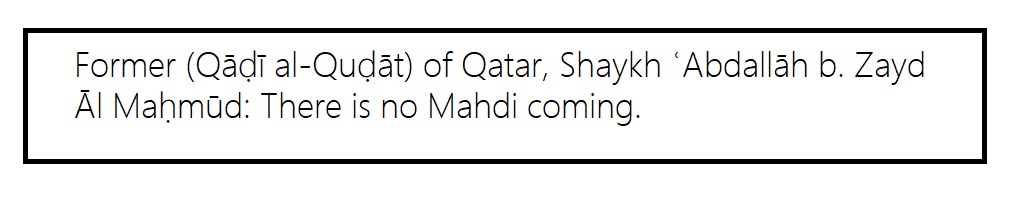

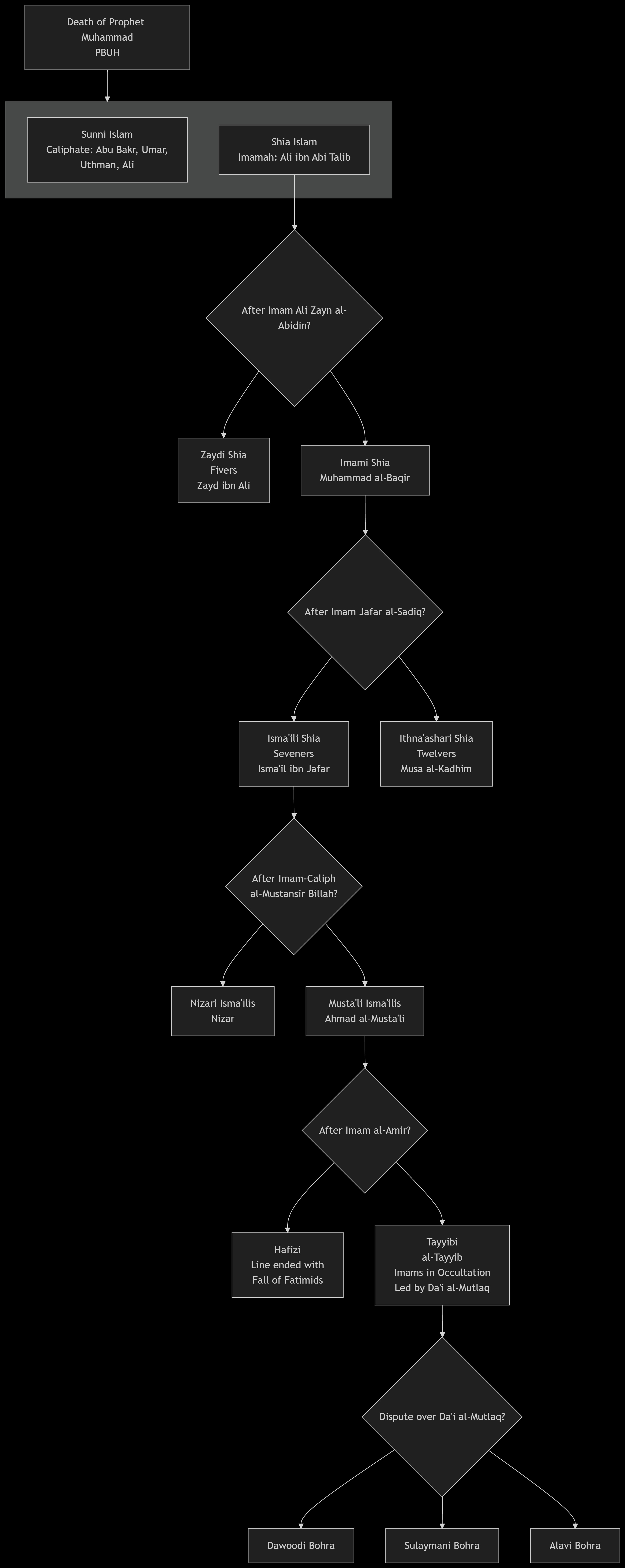





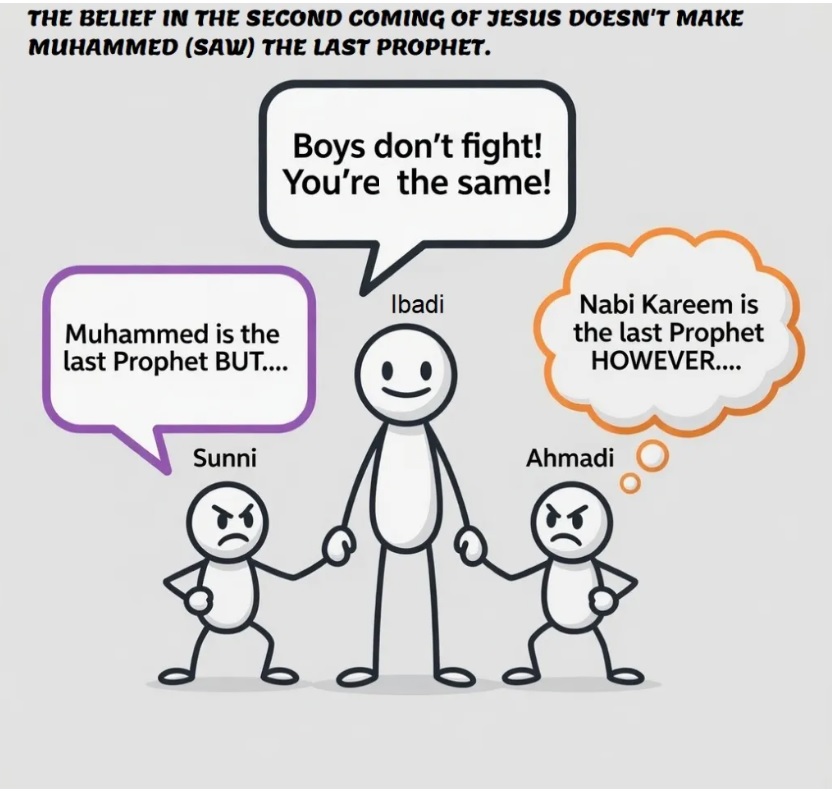
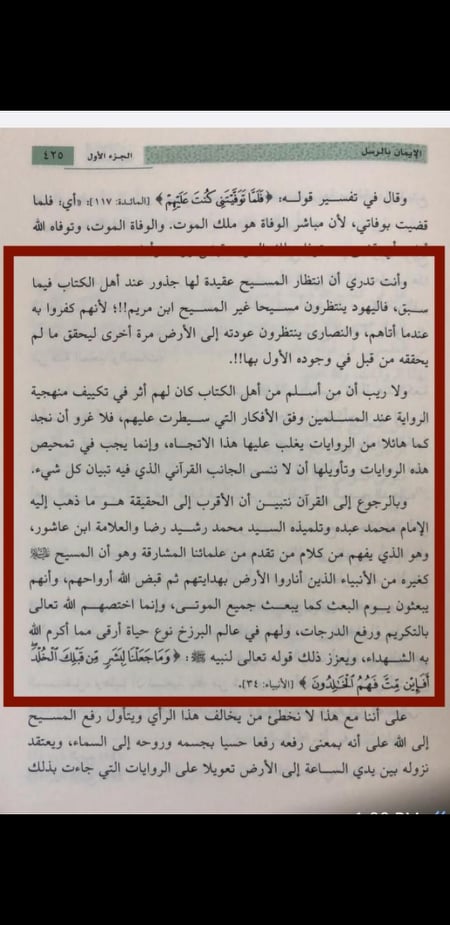
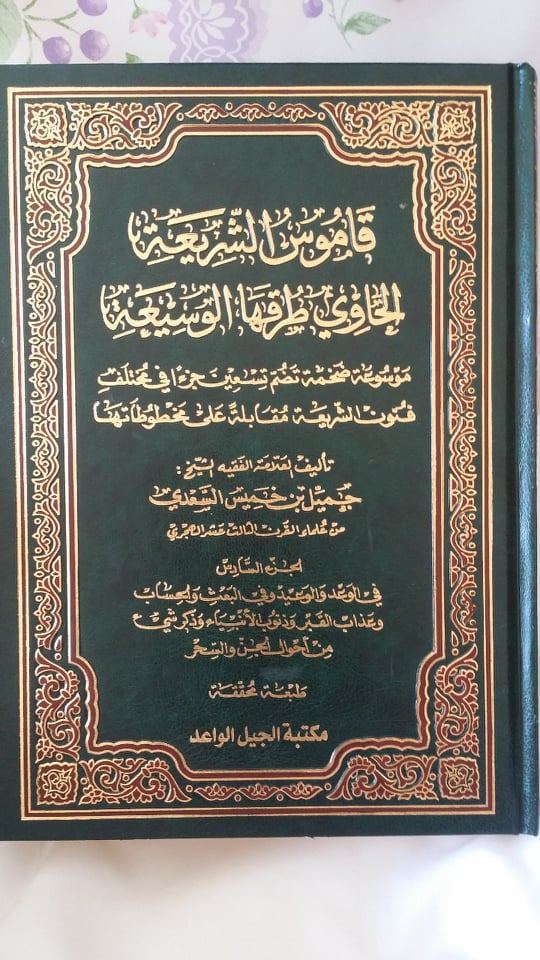
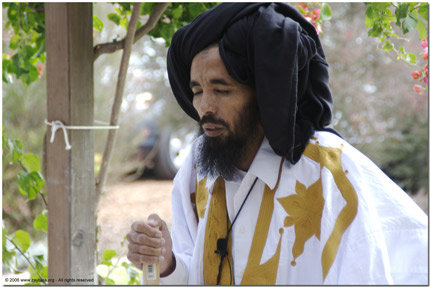


 Prima Quran