Surely those who say, “Our Lord is Allah,” and then remain steadfast, the angels descend upon them, “Do not fear, nor grieve. Rather, rejoice in the good news of Paradise, which you have been promised.” (Qur’an 41:30)
﷽
The Prophet (saw) said to Ali: Lā yadkhulu al-jannah illā nafs muʾminah” (لَا يَدْخُلُ الْجَنَّةَ إِلَّا نَفْسٌ مُؤْمِنَةٌ)
Zaid bin Yathi’ said: We asked Sayyiduna Ali: With what message did the Messenger of Allah (saw) send you? He replied: I was sent with four things. First, that only a believing soul will enter Paradise.
Belief in Islam is composed of three major elements.
To proclaim with the tongue there is no God except Allah and Muhammed (saw) is his Messenger.
Sincerity with Allah.
Actions. To do righteous deeds and to avoid evil deeds.
Surely those who say, “Our Lord is Allah,” and then remain steadfast, the angels descend upon them, “Do not fear, nor grieve. Rather, rejoice in the good news of Paradise, which you have been promised.” (Qur’an 41:30)
Does anyone understand from the above verse that a person can enter paradise simply by believing in Allah and Muhammed is his Messenger without the need to perform any actions?
Have you ever pondered on the message delivered in one of the shortest chapters in the Qur’an?
Surah Al-‘Asr.
By the time! Surely humanity is in loss, except those who have faith, do good, and enjoin on each other the truth, and enjoin on each other patience. (Qur’an 103:1-3)
Can you imagine, based upon your own understanding of this previously quoted chapter, that people are entitled to receive that great reward of paradise, of Al Jannah, without doing good deeds?
This chapter of the Qur’an delivers a clear message. The salvation of mankind is linked to both faith and actions. Good deeds are inseparable from true faith. True faith is necessarily linked to good deeds. The two are interlocked.
If we want to know the correct Islamic creed, the correct Islamic aqidah as taught by the Blessed Prophet (saw), make sure first and foremost you base your creed on the verses of the Qur’an that are clear with clear meanings. If you do so, you will be able to differentiate between the authentic traditons of the Blessed Prophet (saw) from the fabricated ones.
Muslims the world over, in all their denominations, believe that on the day of judgement no one will enter paradise without the intercession of the Blessed Prophet (saw).
The debate comes down to the following:
Is this intercession for all those who testify that there is no god except Allah and Muhammed (saw) is his Messenger ?
A special honour and privilege for the Muslims who fear Allah.
“He knows what is before them, and what is behind them, and they cannot intercede except for him, with whom He is pleased. And they stand in awe for fear of Him.” (Qur’an 21:28)
Imagine an individual who, their whole life they miss the prayers, they commit fornication and adultery, and they die unrepentant.
Is Allah content or pleased with this person? The answer is no!
The above verse provides clear-cut evidence that whatever Shafa’at that there will be, it will be for those with whom Allah (swt) is pleased.
In Christianity, they have a theological position that Christ Jesus is their intercessor on the day of judgement.
“My dear children, I write this to you so that you will not sin. But if anybody does sin, we have an advocate with the Father—Jesus Christ, the Righteous One.” (1 John 2:1)
“Who then is the one who condemns? No one. Christ Jesus who died—more than that, who was raised to life—is at the right hand of God and is also interceding for us.” (Romans 8:34)
“For, There is one God and one Mediator who can reconcile God and humanity—the man Christ Jesus.” (1 Timothy 2:5)
In Christianity, Faith in Jesus is enough. It is sufficient to enter into paradise.
In Islam, true faith is accompanied by righteous living, righteous action, and righteous deeds.
“He knows what is before them, and what is behind them, and they cannot intercede except for him, with whom He is pleased. And they stand in awe for fear of Him.” (Qur’an 21:28)
“Those who carry the Throne and those around it glorify the praises of their Lord, have faith in Him, and seek forgiveness for the believers, Our Lord! You encompass everything in mercy and knowledge. So forgive those who repent and follow Your Way, and protect them from the torment of Hellfire.” (Qur’an 40:7)
From this verse we can understand that there are three major pre-conditions for Allah (swt) to forgive your sins.
To believe in Islam.
TTo actually want to be forgiven—via repentance.
Follow the way Allah (swt) has set out for us.
One of the most important methods of interpreting the Qur’an is to apply to it the rules and the principles of the Arabic language. As the Qur’an itself was sent down in Arabic.
Consider, for example, the following verse:
“And warn them, [O Muhammed], of the Approaching Day, when hearts are at the throats, filled [with distress]. For the wrongdoers there will be no devoted friend and no intercessor [who is] obeyed.” (Qur’an 40:18)
When you look at this verse you will see the مَا (mā) which is used in the Arabic language to negate. And then come two nouns. The first is ḥamīmin and the other is shafīʿin. Both are indefinite nouns. This means that this verse implies a general sense. Meaning that all intercessors and all friends will not be acceptable on the day of judgement to intercede for the wrong doers.
So there is a principle in the Arabic language and fundamentals of Islamic jurisprudence known as uṣūl al-fiqh saying that if an indefinite noun is found in a negative context or prohibitive context or conditional context, it will produce a general sense.
So what we get from this is that no one will intercede for a person who did not repent in this temporal world.
We have seen that one of the most damnable articles of faith held by some Muslims is the belief that the sinners who died unrepentant will be admitted into paradise on the day of judgement.
Now contrast this belief with the following authentic tradition of the Blessed Prophet (saw).
Narrated Abu Huraira:
When Allah revealed the verse: “Warn your nearest kinsmen,” Allah’s Messenger (saw) got up and said, “O people of Quraish (or said similar words)! Buy (i.e. save) yourselves (from the Hellfire) as I cannot save you from Allah’s Punishment; O Bani `Abd Manaf! I cannot save you from Allah’s Punishment, O Safiya, the Aunt of Allah’s Messenger (saw)! I cannot save you from Allah’s Punishment; O Fatima bint Muhammed! Ask me anything from my wealth, but I cannot save you from Allah’s Punishment.”
Now what do we understand from this tradition? Will there be intercession for the unrepentant sinners? Will there be intercession for the wrongdoers and wicked who died unrepentant?
“I said not to them except what You commanded me – to worship Allah , my Lord and your Lord. And I was a witness over them as long as I was among them; but when You caused me to die., You were the Observer over them, and You are, over all things, Witness.” (Qur’an 5:117)
“When Allah said, “O Jesus, indeedI will cause you to die and raise you to Myself and purify you from those who disbelieve and make those who follow you [in submission to Allah alone] superior to those who disbelieve until the Day of Resurrection. Then to Me is your return, and I will judge between you concerning that in which you used to differ.” (Qur’an 3:55)
﷽
The verb tawaffā (verbal noun: tawaffī) seems to cause a great deal of needless distress among Muslim exegetes. Why is this so?
We are going to present our case that if it was not for these oral traditions, Muslim exegetes would not argue the way they do at all.
So keep in mind that the interpretation of the verses that clearly say that Jesus died is influenced by ‘the tradition’.
Yet, the Qur’an itself offers no cause for confusion. Tawaffā appears in twenty-five verses in the Qur’an, and twice in relation to Christ Jesus (Qur’an 5:117 and Qur’an 3.55).
For twenty-three of those verses, the Muslim commentators generally follow the standard definition of this term, that is that Allah (swt) separates the soul from the body or makes someone die.
Think about this. For those verses in the Qur’an that are not tied into ahadith about Jesus(as) coming back, they are translated and understood as per usual.
Interestingly enough, we have the following du’a:
“And you do not resent us except because we believed in the signs of our Lord when they came to us. Our Lord, pour upon us patience and let us die as Muslims [in submission to You].” (Qur’an 7:126)
How often do we say this du’a after congregational prayers?
So let us use the ol Google machine — aka—the much feared and dreaded ‘Shaykh Google’ and put two and two together, shall we?
So what we are going to do as an experiment so that you, the reader, can follow along as we are going to call upon the good people at https://www.islamawakened.com-Whoever they are, may Allah (swt) bless them.
They put all the translations out for everyone to see.
So what we are going to do is show you all the disparate translations into the English language. We will then put those that don’t immediately convey the idea of death—at least to us.
Tawaffā appears in twenty-five verses: Let us examine them all.
We will go in order of the chapter and verse they appear in.
Example: 1 (Qur’an 2:234)
“And those who are taken in death among you and leave wives behind – they, [the wives, shall] wait four months and ten [days]. And when they have fulfilled their term, then there is no blame upon you for what they do with themselves in an acceptable manner. And Allah is [fully] acquainted with what you do.” (Qur’an 2:234)
Ya Allah people 51 disparate translations from people coming from different approaches to Islam have translated the passage as DEATH.
The two odd ones out: Ahmed Hulusi, a translation still in progress… and Muhammed Mahmoud Ghali and even then it finally puts “And the ones of you who are taken up, (i.e., those who die).”
You want to talk about consensus? The consensus here is that yutawaffawna means death, to die.
Example: 2(Qur’an 2:24)
“And those who are taken in death among you and leave wives behind – for their wives is a bequest: maintenance for one year without turning [them] out. But if they leave [of their own accord], then there is no blame upon you for what they do with themselves in an acceptable way. And Allah is Exalted in Might and Wise.” (Qur’an 2:24)
Once again, look at the 52 disparate translations and the verdict is that yutawaffawna means death, to die.
Example: 3 (Qur’an 3:193)
“Our Lord, indeed we have heard a caller calling to faith, [saying], ‘Believe in your Lord,’ and we have believed. Our Lord, so forgive us our sins and remove from us our misdeeds and cause us to die with the righteous.” (Qur’an 3:193)
“Gather us to Thee with the pious” — Dr. Laleh Bakhtiar
“And take us with the obedient ones”—The Monotheist Group 2011 edition.
“Take us back to You”—Aisha Bewley
“And take us to You with the ever benign (ones)”—Muhmmed Mahmoud Ghali
“Include us among the righteous people”-Bijan Moeinian
“And take us to Thee with the pious.” -Arthur John Arberry
“And claim us back with the righteous” — N J Dawood (2014)
“You never fail to fulfill your oath” — Ahmed Halusi
44 Translators are in consensus that the term watawaffanā -is to cause to die.
In fact, we would say that N J Dawood, Arberry, Bewley, Bakhtiar or the Monotheist Group, none of them believe that watawaffana here means to be bodily raised up to heaven.
Example: 4 (Qur’an 4:15)
“Those who commit unlawful sexual intercourse of your women – bring against them four [witnesses] from among you. And if they testify, confine the guilty women to houses until death takes them or Allah ordains for them [another] way.” (Qur’an 4:15)
“The angels will ask those whom they claim back while steeped in sin”- N J Dawood 2014
“And those the angels take, while still they are wronging themselves”-Arthur John Arberry
“And the angels who take those who wronged themselves will say”-Hasan Al-Fatih Qaribullah
“When the angles take the should of those who [had compromised and in consequence] were unjust to their own souls”-,Bijan Moeinian
“Surely the ones whom the Angels take up, (while) they are unjust to themselves”-Muhammed Mahmoud Ghali
“Indeed, those whom the angels take away while they are wronging themselves” -Ali Quli Qara’i
“The angels ask those they take while they are wronging themselves” -Aisha Bewley,-
“Those whom the Angels take, while they had wronged their souls.”-The Monotheist Group (2011 Edition)
“While the angels are gathering the souls of those who wronged themselves.”-Safi Kaskas
“Those whom the angels will gather up”- T. B Irving
“Truly, those whom the angels gathered to themselves.”-Dr. Laleh Bakhtiar
The overwhelming consensus of 42 translations is that tawaffāhumu is to die by taking the souls.
Example: 6 (Qur’an 5:117) –text that is about Jesus.
“I said not to them except what You commanded me – to worship Allah , my Lord and your Lord. And I was a witness over them as long as I was among them; but when You caused me to die., You were the Observer over them, and You are, over all things, Witness.” (Qur’an 5:117)
We know the drill on this crucial passage. So let us see the disparate translations here:
“Thou hast caused me to die”-Muhammad Asad
“But when Thou didst cause me to die”-Shakir
“You did cause me to die”-Wahiduddin Khan
“You did cause me to die”- Safi Kaskas
“Ever since You took my soul”-Abdel Haleem
“And after my life had been done”- Ahmed Ali
“After You caused me to die”-Shabbir Ahmed
“but when you gave me Wafat”-Dr. Kamal Omar (NON COMMITTAL)
“You terminated my life”-Monotheist group-2013
“but when You caused me to die” -Muhammed Shafi
“Thou didst cause me to die”-Maulana Muhammad Ali
“so when You made me die”- Muhammad Ahmed-Samira
“Thou didst cause me to die”-Sher Ali
“When You terminated my life on earth”-Rashad Khalifa
“You caused me to die”- Amatul Rahman Omar
“Thou didst cause me to die” -George Sale
39 Translations overwhelming support the view that tawaffaytanī -is to be raised up, gathered up, recalled. We assume the majority believe bodily and alive.
So in the curious case of Jesus (as) the majority view is not to understand tawaffaytanī as death. That was predictable; as it will be when we get to (Qur’an 3:55).
WHAT ABOUT THE TWO VERSES THAT ARE THAN USED TO SUGGEST THAT JESUS HAS BEEN PUT TO SLEEP FOR THESE LAST 2000 YEARS? (Qur’an 6:60) & (Qur’an 39:42)
That is to say they want to argue that Jesus (as) has been put to sleep and will one day wake up at some unspecified time. Presumably as per various hadith traditions etc.
Example: 7(Qur’an 6:60)
“And it is He who takes your souls by night and knows what you have committed by day. Then He revives you therein that a specified term may be fulfilled. Then to Him will be your return; then He will inform you about what you used to do.” (Qur’an 6:60)
“Allah takes the souls at the time of their death, and those that do not die [He takes] during their (manāmihā)sleep. Then He keeps those for which He has decreed death and releases the others for a specified term. Indeed in that are signs for a people who give thought.” (Qur’an 39:42)
This is why we have the well known du’a for going to sleep and rising from sleep:
Narrated Hudhaifa:
Whenever the Prophet (saw) intended to go to bed, he would recite: “Bismika Allahumma amutu wa ahya (With Your name, O Allah, I die and I live).” And when he woke up from his sleep, he would say: “Al-hamdu lil-lahil-ladhi ahyana ba’da ma amatana; wa ilaihi an-nushur (All the Praises are for Allah Who has made us alive after He made us die (sleep) and unto Him is the Resurrection). “
Question: Has anyone observed a person sleeping that their body suddenly disappeared or went some where else?
I think we all know the answer is No.
“And He has made me blessed wherever I am and has enjoined up me prayer and zakah as long as I remain alive.” (Qur’an 19:31)
What kind of embellished claims are you going to make about Jesus (as) giving zakat in the heavens while asleep?!!
Here is the interesting point about these verses. If as some of the exegetes want to understand it as ‘you put me to sleep‘ and ‘than raised me up‘ than what about those who say, “No he raises him up first and than will put him to sleep in the future!”
DO TELL US WHICH VERSION IS CORRECT?
They would be taking into account:
“but Allah raised him to Himself. Allah is All-Mighty, All-Wise.” (Qur’an 4:158)
Does that really make any sense? They can’t both be correct.
Also know that Qur’an 5:117 or Qur’an 3:55 can’t be understood as falling asleep. It is actually negated by Qur’an 6:60 and Qur’an 39:42
Why? Allah (swt) either:
Takes souls at the time of their death. If the souls are taken the person(body) dies.
Other souls are taken during sleep-during an unspecified period of time-if they are not returned than they die in their sleep leaving behind a body.
Other souls are taken during sleep-during an unspecified period of time –If they are returned to their body the person lives the course of their natural life until they die in the future.
In all three examples thebody is left behind. There are no examples where tawaffā means to taking the soul and the body.
So since our interlocutors in this discussion will absolutely rule out points 1 & 2 with regards to Christ Jesus (as) let us look at point 3.
Let us put up the two verses in consideration and juxtapose them. We will put up two translations that are very user friendly to the ‘he didn’t die and was bodily raised up‘ crowd.
“Behold! Allah said: “O Jesus! I will take thee AND raise thee to Myself and clear thee (of the falsehoods) of those who blaspheme; I will make those who follow thee superior to those who reject faith, to the Day of Resurrection: Then shall ye all return unto me, and I will judge between you of the matters wherein you dispute.” (Qur’an 3:55 Yusuf Ali translation)
“Never said I to them aught except what You did command me to say, ‘worship Allah, my Lord and your Lord’; and I was a witness over them while I dwelt among them; when You did take me up You were the Watcher over them, and You are a witness to all things.” (Qur’an 5:117 Yusuf Ali translation)
Now if we only had Qur’an 5:117 and we were feeling really charitable (despite the fact the word is translated as death every where else)- we could say, “O.K. maybe you have a point“.
However, Qur’an 5:117 has to also be in harmony with Qur’an 3:55 doesn’t it?
This is where our interlocutors are in a most difficult situation. Why are they in a most difficult situation? Qur’an 3:55 says, “mutawaffīka WA rāfiʿuka.”
Thus, their arguments make the Qur’an a redundant revelation.
It would be akin to saying: “I am going to take your soul from your body (just like when we sleep) and than I am going to raise up (presumably) your physical body. It would have been sufficient to just say that Allah (swt) ‘took him up’.
However, we have this slight problem. We have this very troublesome conjunction called ‘WA‘ -AND.
Why does Allah (swt) want you to know that he did something to Jesus (as) before “taking him up”? Couldn’t Allah (swt) just say that he “took him up”?
Why would Allah (swt) say, “I made Jesus fall asleep and than I took him up.” What point is being made there?
“Gabriel replied, ‘Muhammed.’ It was asked, ‘Has he been called?’ Gabriel answered in the affirmative. Then it was said, ‘He is welcomed. What an excellent visit his is!’ The gate was opened. When I went over the second heaven, there I saw Yahya (i.e. John) and `Isa (i.e. Jesus) who were cousins of each other. Gabriel said (to me), ‘These are John and Jesus; pay them your greetings.’ So I greeted them and both of them returned my greetings to me and said, ‘You are welcomed, O pious brother and pious Prophet.’ ”
What should we expect concerning the state of those Prophets (May Allah’s peace and blessings be upon them all)?
“The Messiah, son of Mary, is no more than a messenger, certainly the messengers before him have passed away. And his mother was a saintly woman. And they both used to eat (earthly) food. See how We make the revelations clear for them, and see how they are turned away!” (Qur’an 5:75)
So in light of Qur’an 6:60 and Q ur’an 39:42
Are there any indications in Qur’an 5:117 or Qur’an 3:55 that Allah (swt) took a soul out of Jesus -during a sleep phase -only to put it back in, and afterwards raise a body up?
“And has blessed me wherever I might be and has enjoined upon me Prayer and Zakah (purifying alms) as long as I live.” (Qur’an 19: 31)
Is Jesus(as) asleep (hence why he’s not doing zakat-for as long he lives?) being ‘disembodied‘ -meaning his soul is some where and his body is some where else? Yet , he has time for a quick meet and greet with the Blessed Prophet (saw) according to the above hadith?
In fact one of the Mauritanian Shaykhs -Shaykh Salek bin Siddina āl-Māliki whom was called upon to correct Mufti Abu Layth doesn’t buy into the argument of redundancy either.
This Shaykh knows full well what the text says and so he uses a different strategy -to save the hadith traditions-of course!
(We have also downloaded this video-you know-in case it mysteriously vanishes)
Here are some notes we took of the video in the post linked to above.
We thought it was interesting. The translator said: @ 0:55 “Isa alayi salam has died a complete death.”
Prima Qur’an comments: “What other kind of death is there?”
@ 3:30 minutes, the translator addresses what the Shaykh says: “Mutawafikka is a word that can be translated to ‘I will cause you to die.’ It is mentioned in a way that it does not indicate any particular order.”
“Allah says I will cause you to die, and I will raise you to me, it doesn’t it is used…”
@5:11 minutes, the translator addresses what the Shaykh says:
“So this ‘And’ is the type of WA that is being used. Those are both things that are being done, not necessarily in a particular order.” “In the statement that Zayd and Umar came, it doesn’t mean that Zayd came first. Not in any way does it indicate an order of those things.”
Prima Qur’an comments:
Firstly. May Allah (swt) have patience with the translator. The shaykh often would not allow the translator to finish. If the idea is to convey in Arabic let it be conveyed in Arabic, but if there is an agreement that this knowledge is to be transmitted by translation into English, than give the translator time.
Second the respected shaykh knows full well the obvious that ‘mutawafikka‘ means ‘I will cause you to die‘.
Third he definitely is not on board with the interpretation: “No he raises him up first and than will put him to sleep in the future!“
Fourth the shaykh being influenced by the traditions has to make the Qur’an confirm to his presuppositions. As we stated before if it were not for the traditions (which the shaykh brought up quite often) you would wonder if he would have felt the need to use this literary device. In English we call this hysteron proteron.
For example you could say I put on my shoes and socks. No one understands that you put the shoes on and then the socks.
So what is important that we take away from this is that.
The Shaykh understands the word in Qur’an 3:55 means death
A cursory reading of the text would be ‘I will cause you to to die and than elevate you.’
The obvious understanding of the text is made to conform to a literary device. This is obviously based upon the presupposition the shaykh holds to the ahadith.
Another point about Qur’an 5:117
Narrated Ibn `Abbas:
Allah’s Messenger (saw) delivered a sermon and said, “O people! You will be gathered before Allah barefooted, naked and not circumcised.” Then (quoting Qur’an) he said:– “As We began the first creation, We shall repeat it. A promise We have undertaken: Truly we shall do it..” The Prophet (saw) then said, “The first of the human beings to be dressed on the Day of Resurrection, will be Abraham. Lo! Some men from my followers will be brought and then (the angels) will drive them to the left side (Hell-Fire). I will say. ‘O my Lord! (They are) my companions!’ Then a reply will come (from Almighty), ‘You do not know what they did after you.’I will say as the pious slave (the Prophet (as) Jesus) said: And I was a witness over them while I dwelt amongst them. When You took me up. You were the Watcher over them and You are a Witness to all things.’ (Qur’an 5:117) Then it will be said, “These people have continued to be apostates since you left them.”
Now what is the condition of the Blessed Prophet (saw) at this point when he used that phrase “When you took me up?” It is clear that Allah (swt) took his soul and his body is in Madinah. In other words the Prophet Muhammed (saw) died.
Was he taken body and soul into the heavens?
Example: 8 (Qur’an 6:61)
“And He is the subjugator over His servants, and He sends over you guardian-angels until,when death comes to one of you, Our messengers take him, and they do not fail [in their duties].” (Qur’an 6:61)
The unanimous decision of 54 translations is that tawaffathu is death.
Example: 9 (Qur’an 7:37)
“And who is more unjust than one who invents about Allah a lie or denies His verses? Those will attain their portion of the decree until when Our messengers come to them to take them in death, they will say, “Where are those you used to invoke besides Allah ?” They will say, “They have departed from us,” and will bear witness against themselves that they were disbelievers.” (Qur’an 7:37)
“When Our messengers come to gather them”- M.M Pickthall
“Our Messengers drew near to gather them to themselves” -Dr. Laleh Bakhtiar
“Our messengers come to carry them off”-T.B Irving
“So that when Our messengers come to take them”-The Monotheist Group (2011) -changed position in 2013.
“When Our angels arrive to take them back”-Abdel Haleem
“When Our messengers come to take them away”- “Ali Quli Qara’i
“When Our Messengers come to them to take them up”-Muhammed Mahmoud Ghali
“Our Messengers come to take them away.”- Hasan Al-Fatih Qaribullah
“Our messengers come to them, to take them away”- Arthur John Arberry
“Until when Our messengers come to them to take them away”- Sayyed Abbas Sadr-Ameli
44 disparate translations are unanimous in their decision that yatawaffawnahum means to take the souls and or to die.
Worth mentioning is that ‘The Monotheist Group‘ translation changed in 2013.
Example: 10 (Qur’an 7:126)
“And you do not resent us except because we believed in the signs of our Lord when they came to us. Our Lord, pour upon us patience and let us die as Muslims [in submission to You].” (Qur’an 7:126)
“Lift us (from the world)”-Dr. Mohammed Tahir Qadri.
“And gather us unto Thee”- Arthur John Arberry.
“And take us to Thyself resigned”-Edward Henry Palmer
47 disparate translations believe that watawaffana is to die.
Even those that don’t translate it as such take for example Dr. Mohmmed Tahir Qadri, do you really think his belief when making this du’a is that Muslims will be taken bodily into the sky? Does anyone really think Aisha Bewley believes this?
Example: 11 (Qur’an 8:50)
“And if you could but see when the angels take the souls of those who disbelieved… They are striking their faces and their backs and [saying], “Taste the punishment of the Burning Fire.” (Qur’an 8:50)
“Are called to themselves by the angels”-Dr. Laleh Bakhtiar
“See as the Angels take those who have rejected”-The Monotheist Group 2011 -changed in 2013 edition
“When the angels take away the faithless”-Ali Quli Qara’i
“As they take up the ones who disbelieved”, -Muhmmed Mahmoud Ghali
“As the angels take away those who disbelieve”-Talal A. Itani (new translation)
When the angels take the unbelievers”-Arthur John Arberry
47 disparate translations are in agreement that yatawaffameans to separate the soul from the body, to cause to die.
Example: 12 (Qur’an 10:46)
“And whether We show you some of what We promise them, [O Muhammed], or We take you in death, to Us is their return; then, [either way], Allah is a witness concerning what they are doing.” (Qur’an 10:46)
“Or whether We will take you to Ourself”-Hamid S. Aziz
“We definitely take you up to Us” -Muhammed Mahmoud Ghali
“Or We take you back to Us”-Muhammed Taqi Usmani
“Or take you”-Talal A. Itani
“Or We call you unto Us”-Maududi
“We call you towards Us”- Faridul Haque
“Or We call you to Us”- Hasan Al-Fatih Qaribullah
“Or We call you unto Us”- Ahmed Raza Khan (Barelvi)
“We call thee unto Us”-Arthur John Arberry
“Or we will take thee to ourself”-Edward Henry Palmer
“Or whether we first take thee to Ourself”-John Medows Rodwell
“Or claim you back to Us”-N J Dawood (2014)
37 disparate translations are of the view that natawaffayannaka means to cause to die, to separate the soul from the body.
Now there are a few points that need to be mentioned here. Understand that many people who don’t believe that the Prophet (saw) is dead. They believe that the Prophet (saw) was poisoned by a Jewish woman and that made him (saw) a martyr. Therefore, he is alive ‘though we do not perceive it’. However, if you ask them if they believe a body is in the Prophets Mosque in Medina, they will answer ‘of course’.
In fact, every one of those translators who translate as they do asks them point-blank, “Do you believe there is a body in the Mosque in Medina with the Green Dome?”
Remember the point we mentioned earlier about these people making the Qur’an redundant?
Let’s take the translation of Muhammed Mahmoud Ghali
Let us look at he translates the above text:
“And whether We definitely show you something (i.e., some form of punishment) of what We promise them, or We definitely take you up to Us, then to Us will be their return; thereafter Allah is Ever-Witnessing over whatever they perform.” (Qur’an 10:46)
“We definitely take you up to Us” -Muhammed Mahmoud Ghali
Now let us look at he translates Qur’an 3:55
“As Allah said, “O Isa, (Jesus) surely, I am taking you up to Me, and I am raising you up to Me, and I am purifying you of the ones who have disbelieved. And I am making the ones who have closely followed you above the ones who have disbelieved until the Day of the Resurrection. Thereafter to Me will be your return; so I will judge between you as to whatever you used to differ in.” (Qur’an 3:55)
“I am taking you up to Me, and I am raising you up to Me.” – Muhammed Mahmoud Ghali.
Notice the redundancy in the language used? He could have just translated as “I am taking you up to Me” OR “I am raising you up to Me” -because in his mind they both mean the same thing.
This is the exact kind of problems that they run into when they approach the Qur’an with a mind of making it to conform to the oral traditions.
Example: 13(Qur’an 10:104)
“Say, [O Muhammed], “O people, if you are in doubt as to my religion – then I do not worship those which you worship besides Allah ; but I worship Allah , who causes your death. And I have been commanded to be of the believers.” (Qur’an 10:104)
“Who will eventually retrieve you back to Him”- Safi Kaskas
“Who takes me”-The Monotheist Group 2011 edition -changed in the 2013 edition.
“Who will take you back to Him”-Aisha Bewley
“Who takes you to Himself”-Hamid S. Aziz
“Who takes you up to Him”-Muhammed Mahmoud Ghali
“I only serve Allah Who will cause (all of) you to”-Maududi
“Who will gather you to Him”-Arthur John Arberry
“Who takes you to Himself”_Edward Henry Palmer
“Who will claim you back”-N J Dawood (2014)
43 disparate translations understand yatawaffākum to mean to terminate the life of, to take the souls, to cause to die.
Example: 14(Qur’an 12:101)
“My Lord, You have given me [something] of sovereignty and taught me of the interpretation of dreams. Creator of the heavens and earth, You are my protector in this world and in the Hereafter. Cause me to die a Muslim and join me with the righteous.” (Qur’an 12:101)
“Call me to Thyself as one who submits.”-Dr. Laleh Bakthiar
“Gather me in as a Muslim.”-T.B Irving
“Take me as one who has surrendered.”-The Monotheist Group 2011 Edition -changed in the 2013 edition
“O receive me to Thee in true submission.”-Arthur John Arberry
“Take me to Thyself resigned,” -Edward Henry Palmer
49 different disparate translations understand tawaffani as to die , to separate the soul from the body.
Example: 15(Qur’an 13:40)
“And whether We show you part of what We promise them or take you in death, upon you is only the [duty of] notification, and upon Us is the account.” (Qur’an 13:40)
“Or We call you to Us before”- Ahmed Raza Khan (Barelvi)
“Or We lift you.”-Dr. Mohammad Tahir-ul-Qadri
“We call thee to Us”-Arthur John Arberry
“Or we will take thee to Ourself”-Edward Henry Palmer
“Or whether we take thee hence”-John Medows Rodwell
“Or claim you back to Us”-N J Dawood (2014)
37 Disparate translations understandnatawaffayannaka to mean to die , to separate the soul from the body.
Example: 16(Qur’an 16:28)
“The ones whom the angels take in death [while] wronging themselves, and [who] then offer submission, [saying], “We were not doing any evil.” But, yes! Indeed, Allah is Knowing of what you used to do.” (Qur’an 16:28)
“Those whom the angels call to themselves”-Dr. Laleh Bakhtiar
“Whom the angels will carry away”-T.B. Irving
“Those whom the Angels take while they had wronged their souls”-The Monotheist Group 2011 Edition -changed in the 2013 edition.
“Those whom the angels take away while they are wronging themselves”- Ali Quli Qara’i
“Those whom the angels take away while they are wronging their own souls.”-Hamid S. Aziz
“Whom the Angels take up while they are unjust to themselves.”-Muhammed Mahmoud Ghali
“The unjust, who will be seized by the angels, will submit themselves”-Muhammed Sarwar
“Whom the angels take while they were still harming themselves.”-Hasan Al-Fatih Qaribullah
“Whom the angels take while still they are wronging themselves”-Arthur John Arberry
“Those whom the angels took away were wronging themselves;”-Edward Henry Palmer
“Those whom the angels will claim back”- N J Dawood (2014)
43 different and disparate translations have tatawaffāhumu understood to be taken in death.
Example: 17(Qur’an 16:32)
“The ones whom the angels take in death,[being] good and pure; [the angels] will say, “Peace be upon you. Enter Paradise for what you used to do.” (Qur’an 16:32)
“Those whom the angels call to themselves”-Dr. Laleh Bakhtiar
“Whom the angels carry off”-T.B. Irving
“Those whom the Angels take”-The Monotheist Group 2011 Edition-changed in 2013 edition
“Those the angels take in a virtuous state.”-Aisha Bewley
“Those whom the angels take away while they are pure”.-Ali Quli Qara’i
“To those whom the angels take away in a goodly state”-Hamid S. Aziz
“Whom the Angels take up while they are goodly”-Muhammed Mahmoud Ghali
“They will be received by the angels of mercy”-Muhammed Sarwar
“Those who are in a wholesome state when the angels take them”-Talal A. Itani
“Whom the angels take while they are goodly”- Hasan Al-Fatih Qaribullah
“Whom the angels take while they are goodly”-Arthur John Arberry
“To those whom the angels take off in a goodly state:-Edward Henry Palmer
“Whom the angels will claim”-N J Dawood (2014)
41 different and disparate translations understandtatawaffāhumu as to take in death, to take the soul.
Example: 18(Qur’an 16:70)
“And Allah created you; then He will take you in death. And among you is he who is reversed to the most decrepit [old] age so that he will not know, after [having had] knowledge, a thing. Indeed, Allah is Knowing and Competent.” (Qur’an 16:70)
“He will take you”-The Monotheist Group 2011 Edition -2013 edition they changed their position.
“Will take you back again”-Aisha Bewley
“Then He takes you away”-Ali Quli Qara’i
“Then He will take you to Himself”-Hamid S. Aziz
“Thereafter He takes you (to Him)”-Muhammed Mahmoud Ghali
“Then He takes you back”-Muhammed Taqi Usmani
“Then He takes you away”-Talal A. Itani
“Then He will gather you to Him”-Arthur John Arberry
“Then He will take you to Himself”-Edward Henry Palmer
“By and bye will he take you to himself”-John Medows Rodwell
“And He will then reclaim you”-N J Dawood (2014)
41 disparate translations understand yatawaffākum- as to cause to die, to separate the soul from the body.
Example 19: (Qur’an 22:5)
“O People, if you should be in doubt about the Resurrection, then [consider that] indeed, We created you from dust, then from a sperm-drop, then from a clinging clot, and then from a lump of flesh, formed and unformed – that We may show you. And We settle in the wombs whom We will for a specified term, then We bring you out as a child, and then [We develop you] that you may reach your [time of] maturity. And among you is he who is taken in [early] death, and among you is he who is returned to the most decrepit [old] age so that he knows, after [once having] knowledge, nothing. And you see the earth barren, but when We send down upon it rain, it quivers and swells and grows [something] of every beautiful kind.” (Qur’an 22:5)
Prima Qur’an Comments: One thing is certain you cannot escape death. Look at all thes above translators of Qur’an 22:5 who were very reluctant to use the word death or dying. They resisted and resisted and finally they yield.
“And among you there is he whom death will call to itself”-Dr. Laleh Bakhtiar
“[Then] there are some of you who are taken away”-Ali Quli Qara’i –this guy still resist 😉
“And among you there is he who is taken up, (i.e., dies)“-Muhammed Mahmoud Ghali. So now Muhammed Mahmoud Ghali sheds light on what he means by ‘is taken up‘ i.e -death.
“Then We (rear you) that you may attain your (age of) full strength. And among you then is he who is allowed to complete (the normal life-span)”- Dr. Kamal Omar -odd translation
“And some of you die“-Arthur John Arberry
“And of you are some who die“-Edward Henry Palmer
“Some among you die young”-N J Dawood (2014)
Example 20: (Qur’an 32:11)THE MOST POWERFUL VERSE FOR LOOKING AT ALL THESE ODD TRANSLATIONS
Say, “The angel of death will take your soul who has been entrusted with you. Then to your Lord you will be returned.” (Qur’an 32:11)
“Will take you”-The Monotheist Group 2011-the 2013 edition modified their translation
“Will take you up”-Muhammed Mahmoud Ghali
“Will collect you”-Shabbir Ahmed
“Will take you”-Umm Muhmmad Sahih Internationl
“Will reclaim you”-Talal A. Itani
Will gather you”- Hasan Al-Fatih Qaribullah
“Shall gather you”-Arthur John Arberry
“Shall take you away”-Edward Henry Palmer
“Will claim you back.”-N J Dawood (2014)
“Will gather you”-Sayyid Qutb
The reason why this is the most powerful verse yet discussed is because it deals with the angel of death. What does the angel of death do? It is very obvious. The fact that translators who we have seen use that same ambiguity here makes it now both known and clear what they mean.
So for example when we see them use ambiguous terms like:
“gather you”
“call you to itself”
“retrieve you”
“take you up”
“collect you”
“claim you”
“reclaim you”
“summoned”
We now know with certainty that all of these authors meant ‘to die’, ‘to separate the soul from the body’ ‘to take the soul’. What else does the Angel of Death do? Notice you kept seeing practically the same group of people that will over and over use ambiguous terms. Instead of making their case plain in the most obvious situation—”the angel of death” — they still choose to use ambiguous language — which sheds light on their ambiguity in all other places! This actually means that the verb tawaffā (verbal noun: tawaffī) is being translated nearly 100% of the time as to die, to cause to die, to separate the soul from the body!
Thank you! Al hamdulillah!
Example: 21 (Qur’an 39:42)
“Allah takes the souls at the time of their death, and those that do not die [He takes] during their sleep. Then He keeps those for which He has decreed death and releases the others for a specified term. Indeed in that are signs for a people who give thought.” (Qur’an 39:42)
This is another very powerful verse. Not a single translator can play with the text here. It is as Allah (swt) says,
“We have brought them a Scripture – We have explained it on the basis of knowledge – as guidance and mercy for those who believe.” (Qur’an 7:52)
The beautiful thing about this verse is that death is clearly contrasted with sleep (as explained in a similar verse above).
Here there is 100% unanimous approval from the translators that yatawaffā is death, final death, physical death, taking the soul from the body.
Translators (any of us) can try and play fast & loose with the words of Allah (swt) but sooner or latter we will get caught out.
Example :22 (Qur’an 39:42)
“It is He who created you from dust, then from a sperm-drop, then from a clinging clot; then He brings you out as a child; then [He develops you] that you reach your [time of] maturity, then [further] that you become elders. And among you is he who is taken in death before [that], so that you reach a specified term; and perhaps you will use reason.” (Qur’an 39:42)
“And some are summoned before completing the whole cycle”-Bijan Moeinian
“Are taken away before”-Edward Henry Palmer
Once again, there is unanimous understanding that ‘yatawaffa’ means to die, to be taken in death, to take the soul, to separate the soul from the body.
Remember as well that these ambiguous terms: ‘summoned’, ‘taken away’, ‘recalled’, ‘gone with the wind’, ‘spirited away’ etc. None of that is ambiguous to us now. It all means having died.
Example: 23(Qur’an 40:77)
“So be patient, [O Muhammed]; indeed, the promise of Allah is truth. And whether We show you some of what We have promised them orWe take you in death, it is to Us they will be returned.” (Qur’an 40:77)
“We definitely take you up (to Us)”-Muhammed Mahmoud Ghali
“We recall you”-Farook Malik
“Or take you to Us”-Talal A. Itani
“Or We recall you (from this world)”-Maududi
“Call you to Us”- Hasan Al-Fatih Qaribullah
“Or make you depart from the visible life”-Dr. Mohammed Tahir-ul-Qadri (from the visible life-what’s he mean here make you become invisible?) (walk around cloaked from vision)
“We call thee unto Us”-Arthur John Arberry
“Take thee to ourself”-Edward Henry Palmer
“Or claim you back”-N J Dawood 2014
The unanimous decision is that natawaffayannaka means to cause to die, to take the life of, to separate the soul from the body. The only exception seems to be Dr. Mohammad Tahir Ul Qadri who seems to be offering everyone the power of invisibility; however we are sure that you dear reader will see this is not the case.
Exampe: 24 (Qur’an 47:27)
“Then how [will it be] when the angels take them in death, striking their faces and their backs?” (Qur’an 47:27)
“Angels will call them to themselves”-Dr. Laleh Bakhtiar
“Gather them up”-T. B. Irving
“Then the angels take them away”-Ali Quli Qara’i
“Angels take them up”-Muhammed Mahmoud Ghali
“The angels take them”-Arthur John Arberry
Again the unanimous consensus is that tawaffathumu means to die, to cause to die, to take the soul at death, to separate the soul from the body.
Example: 25(Qur’an 3:55)text that is about Jesus.
“When Allah said, “O Jesus, indeedI will cause you to die and raise you to Myself and purify you from those who disbelieve and make those who follow you [in submission to Allah alone] superior to those who disbelieve until the Day of Resurrection. Then to Me is your return, and I will judge between you concerning that in which you used to differ.” (Qur’an 3:55)
We all know the drill of how the masses understand these ayats and how both the bulk of majority scholarship want the masses to understand them.
Tawaffā appears in twenty-five passages in the Qur’an, and twice in relation to Christ Jesus (Qur’an 5:117 & Qur’an 3.55).
Conclusion and Summary
The Qur’anic usage of tawaffā is remarkably consistent
The linguistic facts:
Tawaffā / tawaffī appears ~25 times in the Qur’an.
In every uncontroversial context, it means:
Allah takes the soul
i.e. death (final death or death-like separation, as in sleep, where the body remains)
Even in verses where translators use softer English (“take”, “gather”, “recall”, “claim”), the underlying meaning is still death, as we convincingly demonstrated by:
Context (Angel of Death, punishment, resurrection)
Cross-comparison with Qur’an 39:42 and 6:60
The translators’ own theology (none believe people are bodily lifted into heaven at death)
In other words:
Lexically, contextually, and theologically, tawaffā in the Qur’an means “to take the soul,” resulting in death.
No neutral reader disputes this.
The problem only appears with Jesus (Q 3:55 and Q 5:117)
We correctly identified the anomaly:
23 verses → tawaffā = death
2 verses about Jesus → suddenly reinterpreted
This inconsistency is not driven by Arabic, grammar, or Qur’anic context.
It is driven by extra-Qur’anic commitments.
The real pressure comes from hadith-based eschatology
Classical Sunni theology developed a very detailed end-times narrative in which:
Jesus is alive
He was raised bodily
He will return physically before the Hour
Once that framework is assumed, the Qur’an must be made to fit it.
So when exegetes reach:
Qur’an 3:55 (mutawaffīka wa rāfiʿuka)
Qur’an 5:117 (falammā tawaffaytanī)
They face a dilemma:
Either:
Read tawaffā consistently → Jesus died
Or preserve the tradition → reinterpret the word
They overwhelmingly choose option 2.
How exegetes resolve the tension (as we have documented)
To preserve the tradition, they resort to:
a) Redefinition
Claiming tawaffā here means:
“taking without death”
“taking the soul temporarily”
“taking body and soul”
➡️ None of these meanings exist elsewhere in the Qur’an
b) Literary devices (e.g., hysteron proteron)
Arguing that:
“wa (and) does not imply order”
So:
“I will cause you to die and raise you” does not mean death precedes raising
This move is theologically motivated, not text-driven.
As we have noted:
A plain reading already makes sense
The literary device is introduced only because death is unacceptable
c) Strategic ambiguity in translation
Using phrases like:
“take you to Myself”
“recall”
“gather”
“claim back”
Yet the same translators use these exact phrases for ordinary death elsewhere, including:
The Angel of Death (Qur’an 32:11)
Disbelievers being punished
The Prophet Muhammed (saw) himself
This exposes the inconsistency.
The Qur’an 39:42 destroys the “sleep” theory
We highlighted the decisive verse:
Allah takes the souls at the time of their death, and those that do not die during their sleep…
This verse establishes three categories only:
Soul taken → death
Soul taken during sleep → body remains
Soul returned → life continues
There is no category where the body is taken.
So:
“Jesus was asleep for 2000 years”
“Jesus’ soul was taken but his body raised”
“Jesus is alive somewhere bodily”
➡️ None of these fit Qur’anic anthropology
Qur’an 3:55 and the problem of redundancy
The observation here is crucial:
mutawaffīka WA rāfiʿuka
If tawaffā already means “raise bodily,” then:
rāfiʿuka becomes redundant
The verse collapses into tautology
But if tawaffā means death, the verse is elegant and non-redundant:
Death (completion of earthly mission)
Elevation in rank/status with Allah
Purification from accusations
Vindication of followers
This reading:
Fits Qur’anic style
Fits Qur’anic anthropology
Fits Qur’an 5:75 (“messengers before him passed away”)
Why the distress persists?
So we return to our original question.
Why does tawaffā cause so much distress?
Because:
Accepting its Qur’anic meaning forces a revision of inherited eschatology
That revision feels, to many, like undermining tradition
So the text is bent to protect the framework rather than the reverse
In short:
The distress is not linguistic. It is theological. And it is inherited, not Qur’anic.
Final takeaway
Our documentation shows that:
The Qur’an is internally consistent
The word tawaffā is not ambiguous in usage
The ambiguity appears only when external narratives are imposed
Once those narratives are removed, the verses about Jesus read plainly
As we concluded:
“If it were not for the traditions, Muslim exegetes would not argue this way at all.”
Jesus (alayi salam) he is dead. He is not coming back!
Open your eyes brothers and sisters, dear truth seekers.
“O believers! Stand firm for justice as witnesses for Allah even if it is against yourselves, your parents, or close relatives. Be they rich or poor, Allah is best to ensure their interests. So do not let your desires cause you to deviate. If you distort the testimony or refuse to give it, then Allah is certainly All-Aware of what you do.” (Qur’an 4:135)
﷽
The position of the Ibadi school concerning the Wali of Allah. Whoever has attained the rank of wilāyat al-ḥaqīqah (true spiritual guardianship), his guardianship is never nullified under any circumstance. Therefore, there is no room for enmity against him, even if he were to commit grave sins.
However, falsehood is never accepted from him, and if he falls into one of the prescribed punishments of Allah, the punishment of Allah is carried out upon him — yet his guardianship is not revoked.
Indeed, the Messenger of Allah (saw) carried out the punishment of stoning on Māʿiz (may Allah be pleased with him), and instructed his companions to seek forgiveness for him. The same was the case with the Ghamīdī woman. Thus, wilāyat al-ḥaqīqah neither nullifies rights nor abolishes punishments.
The Ghamīdī woman & Ma’iz b. Malik al-Aslami -may Allah be pleased with them both.
‘Abdullah b. Buraida reported on the authority of his father that Ma’iz b. Malik al-Aslami came to Allah’s Messenger (saw) and said:
Allah’s Messenger, I have wronged myself; I have committed adultery and I earnestly desire that you should purify me. He turned him away. On the following day, he (Ma’iz) again came to him and said: Allah’s Messenger, I have committed adultery. Allah’s Messenger (saw) turned him away for the second time, and sent him to his people saying: Do you know if there is anything wrong with his mind. They denied of any such thing in him and said: We do not know him but as a wise good man among us, so far as we can judge. He (Ma’iz) came for the third time, and he (The Blessed Prophet) sent him as he had done before. He asked about him and they informed him that there was nothing wrong with him or with his mind. When it was the fourth time, a ditch was dug for him and he (The Blessed Prophet) pronounced judgment about him and he wis stoned.
أُرِيدُ أَنْ تُطَهِّرَنِي -I want you to purify me.
He (the narrator) said: There came to him (The Blessed Prophet) a woman from Ghamid and said: Allah’s Messenger, I have committed adultery, so purify me. He (The Blessed Prophet) turned her away. On the following day she said: Allah’s Messenger, Why do you turn me away? Perhaps, you turn me away as you turned away Ma’iz. By Allah, I have become pregnant. He said: Well, if you insist upon it, then go away until you give birth to (the child). When she was delivered she came with the child (wrapped) in a rag and said: Here is the child whom I have given birth to. He said: Go away and suckle him until you wean him. When she had weaned him, she came to him (The Blessed Prophet) with the child who was holding a piece of bread in his hand. She said: Allah’s Apostle, here is he as I have weaned him and he eats food. He (The Blessed Prophet) entrusted the child to one of the Muslims and then pronounced punishment. And she was put in a ditch up to her chest and he commanded people and they stoned her. Khalid b Walid came forward with a stone which he flung at her head and there spurted blood on the face of Khalid and so he abused her. Allah’s Messenger (saw)heard his (Khalid’s) curse that he had huried upon her. Thereupon he (The Blessed Prophet) said: Khalid, be gentle. By Him in Whose Hand is my life, she has made such a repentance that even if a wrongful tax-collector were to repent, he would have been forgiven. Then giving command regarding her, he prayed over her and she was buried.
Buraida told that Ma’iz b. Malik came to the Prophet and said, “Purify me, Messenger of Allah.” He replied, “Out upon you! Go back, ask Allah’s forgiveness and turn to Him in repentance.” He said that he went back not very far, then came and said, “Purify me, Messenger of Allah,” and the Prophet said the same as he had said before. When this went on till a fourth time he asked, “For what am I to purify you?” and he replied that it was because of fornication. Allah’s Messenger then asked if the man was mad, and when he was told that he was not, he asked if he had drunk wine. A man got up and smelt his breath but noticed no smell of wine, so the Prophet asked him if he had committed fornication, and when he replied that he had, he gave orders regarding him and he was stoned to death. Two or three days later Allah’s Messenger came and said, “Ask forgiveness for Ma’iz b. Malik. He has repented to such an extent that if it were divided among a people it would be enough for them all.”
The Key Point: After the execution of the punishment, the Blessed Prophet (saw) did not declare them to be enemies of Allah or eternal denizens of Hellfire. Instead, he spoke well of their repentance and even instructed the companions to pray for them. This prayer (ṣalāt al-janāzah) itself is an act that is only performed for Muslims.
This proves that while their sinful action demanded earthly punishment, their essential faith and status as believers (awlīyāʾ in the true sense) were not completely obliterated. Their sincere repentance preserved their wilāyat al-ḥaqīqah
The 10 sons of Yaʿqūb/Jacob -peace be upon him.
We also believe in the wilāyat al-ḥaqīqah of the ten sons of Prophet Yaʿqūb (peace be upon him) who wronged their brother, fabricated false stories to cover their crimes — their falsehood is not accepted, yet their guardianship is not revoked. It remains upon them, their father, their brother, and our Messenger (peace and blessings be upon them all).
“But My Promise is not within the reach of (zalimin) evil-doers.”(Qur’an 2:124)
What did these descendants of Prophet Ibrahim (as) get up to?
They cried, “Our father! We went racing and left Joseph with our belongings, and a wolf devoured him! But you will not believe us, no matter how truthful we are.” (Qur’an 12:17)
These Muwahid, The Ahl Bayt of Jacob (as), Sons of a Prophet lied to their father! Imagine telling your own father that his son (your own brother) was eaten by a wolf! Can you imagine the grief it would bring him?!
Allah (swt) tells us in very vivid language how severe the grief and trauma of Jacob (as). The trauma that Prophet Jacob (as) went through on account of his progeny, the progeny of the Household.
“He turned away from them, lamenting, “Alas, poor Joseph!” And his eyes turned white out of the grief he suppressed.” (Qur’an 12:84)
He replied, “O my dear son! Do not relate your vision to your brothers, or they will devise a plot against you. Surely Satan is a sworn enemy to humankind.” (Qur’an 12:5)
Jacob (as) knew among his ahl bayt were schemers!
“˹Remember˺ when they said ˹to one another˺, “Surely Joseph and his brother ˹Benjamin˺ are more beloved to our father than we, even though we are a group of so many. Indeed, our father is clearly mistaken.” (Qur’an 12:8)
Can you imagine talking about your father (a Prophet) like that?
“Kill Joseph or cast him out to some ˹distant˺ land so that our father’s attention will be only ours, then after that you may ˹repent and˺ become righteous people!” (Qur’an 12:9)
They said, “O our father! Why do you not trust us with Joseph, although we truly wish him well? (Qur’an 12:11)
The Ahl Bayt of Jacob (as) Lie #1 to their father.
“Send him out with us tomorrow so that he may enjoy himself and play. And we will really watch over him.” (Qur’an 12:12)
So he can enjoy himself, Lie #2, and they will watch over him Lie #3.
“Then they returned to their father in the evening, weeping. They cried, “Our father! We went racing and left Joseph with our belongings, and a wolf devoured him! But you will not believe us, no matter how truthful we are.” (Qur’an 12:16-17)
“And they brought his shirt, stained with false blood. He responded, “No! Your souls must have tempted you to do something ˹evil˺. So ˹I can only endure with˺ beautiful patience! It is Allah’s help that I seek to bear your claims.” (Qur’an 12:18)
Look at the extent of their manipulation! Fake tears like actors crying on que! A prop piece—his shirt stained with false blood. Gaslighting their father.
Joseph was eaten by a wolf. Lie #4 Brought a shirt with false blood Lie #5
“Return to your father and say, ‘O our father! Your son (Benjamin)committed theft. We testify only to what we know. We could not guard against the unforeseen.” (Qur’an 12:81)
They claimed their other brother, Benjamin, was a thief and lied to their father, yet again. Lie #6
The Ahl Bayt of Jacob, the guilty among them, finally return in repentance to Allah (swt)
“They admitted, “By Allah! Allah has truly preferred you over us, and we have surely been sinful.” (Qur’an 12:91)
“They begged, “O our father! Pray for the forgiveness of our sins. We have certainly been sinful.” (Qur’an 12:97)
Satan ignited rivalry between the Ahl Bayt of Jacob (as)
“Then he raised his parents to the throne, and they all fell down in prostration to Joseph,1 who then said, “O my dear father! This is the interpretation of my old dream. My Lord has made it come true. He was truly kind to me when He freed me from prison, and brought you all from the desert after Satan had ignited rivalry between me and my siblings. Indeed my Lord is subtle in fulfilling what He wills. Surely He ˹alone˺ is the All-Knowing, All-Wise.” (Qur’an 12:100)
What to make of the sons of Jacob (as) Al Muwahid who lied to their father (a Prophet) because they were jealous of their brother? The sons of a prophet can conspire against their brother.
Their falsehood is not accepted, yet their guardianship is not revoked.
Analysis of the Examples Provided
The Sons of Prophet Yaʿqūb (AS):
This example is even more striking and is particularly emphasized in Ibāḍī theology to drive the point home.
Their crime was immense: they attempted murder on their brother Yūsuf (AS), threw him in a well, lied to their father, and caused him immense grief. This constitutes major sins involving injustice, deception, and breaking familial ties.
Ibāḍī Interpretation: Despite this, the Qur’an never refers to them as disbelievers (kuffār). They are still considered among the prophets’ descendants. Prophet Yaʿqūb (AS) and Prophet Yūsuf (AS) eventually forgave them. Their story ends with forgiveness and family reconciliation.
This demonstrates that even such heinous sins did not irrevocably sever their essential connection to the legacy of prophethood and faith (wilāyat al-ḥaqīqah), though they were certainly held accountable for their actions in this world and were rebuked in the Qur’an.
The established principle regarding spiritual guardianship (wilayah) is that one who possesses true guardianship never loses it, regardless of sins committed — we are certain they will die repentant. Thus, we reject their wrong actions while maintaining a connection to their essential spiritual station. The converse is equally true.
An example of the converse being true: Bara’ah al-Haqiqa
The example of Abu Lahab.
May the hands of Abu Lahab perish, and he perish! Neither his wealth nor gains will benefit him. He will burn in a flaming Fire, and his wife, the carrier of kindling,around her neck will be a rope of palm-fibre. (Qur’an 111:1-5)
Some Muslims use a flawed argument about Abu Lahab to prove the truth of the Qur’an, saying: “If Abu Lahab had taken the shahādah, it would have made the Qur’an false.”
This is incorrect. The words of Allah (swt) are absolute truth, whereas Abu Lahab’s actions (if he had ever claimed faith) would have been deception. Allah (swt) has already decreed his fate. He is the very definition of one being in barā’ah ḥaqīqah (the true dissociation), being truly cut off.
If Allah (swt) did not reveal this about Abu Lahab, and he took the testification of faith, he would be in Walayah al-Dhahir – The apparent friendship. This is a matter of jurisprudence.
However, since Allah (swt) revealed his state Bara’ah al-Haqiqah – The real dissociation. This is a matter of theology.
The example of Adam -upon him be peace.
We believe in the true spiritual guardianship of our father Adam (as), while Allah explicitly states in Scripture that he disobeyed and erred, then sought forgiveness and repented. We affirm his true guardianship while disassociating from his wrong actions. Similarly:
“They said: ‘Our Lord we have wronged ourselves souls. If You forgive us not and bestow not upon us Your Mercy, we shall certainly be of the losers’ ” (Quran 7:23)
“So Adam disobeyed his Lord, and lost his way. Then his Lord chose him, accepted his repentance, and guided him.” (Qur’an 20:121-122)
Thus, Adam-upon him be peace, is in true spiritual guardianship.
The Ahl Bayt of Adam (as). The household of the Prophet Adam (as)
The first murderer in human history was a descendant of a Prophet.
Cain killed his brother Abel. Both were descendants of the Prophet Adam (as). Yet, one was righteous and the other became the ‘first’ murderer. Such that Allah (swt) made an example of this particular incident throughout time.
“So his soul permitted to him the murder of his brother, so he killed him and became among the losers.” (Qur’an 5:30)
“And recite to them the story of Adam’s two sons, in truth, when they both offered a sacrifice, and it was accepted from one of them but was not accepted from the other. Said [the latter], “I will surely kill you.” Said [the former], “Indeed, Allah only accepts from the righteous [who fear Him]”. (Qur’an 5:27)
Humanity is not even in its infancy and here we have two descendants of the Prophet Adam (as). One of them has the hallmark of being remembered for all time as being the first murderer. Allah (swt) said that one of them was (mutaqi) righteous, meaning the other was not.
Does the son of Adam (as) get a pass for murdering his brother simply because he is the son of a Prophet?
“Then Allah sent a crow digging in the ground, in order to show him how to bury the corpse of his brother. He cried, “Alas! Have I failed to be like this crow and bury the corpse of my brother?” So he became regretful.” (Qur’an 5:31)
The regret here is not from his action but because he was not able to cover up his action. This son of Adam is in Barā’ah. This son of a Prophet is in Barā’ah
It is from the Sunnah of the Prophet to disavow any Muslim (including a companion) when they commit a sin.
First and foremost, to disavow any Muslim when they commit a sin is from the Sunnah of the Blessed Prophet (saw). This includes the companions.
Narrated Salim’s father:
The Prophet (saw) sent Khalid bin Al-Walid to the tribe of Jadhima and Khalid invited them to Islam but they could not express themselves by saying, “Aslamna (i.e. we have embraced Islam),” but they started saying “Saba’na! Saba’na (i.e. we have come out of one religion to another).” Khalid kept on killing (some of) them and taking (some of) them as captives and gave every one of us his Captive. When there came the day then Khalid ordered that each man (i.e. Muslim soldier) should kill his captive, I said, “By Allah, I will not kill my captive, and none of my companions will kill his captive.” When we reached the Prophet, we mentioned to him the whole story. On that, the Prophet (saw) raised both his hands and said twice, “O Allah, I disavow before You what Khalid has done.” اللَّهُمَّ إِنِّي أَبْرَأُ إِلَيْكَ مِمَّا صَنَعَ خَالِدٌ
Core Principles of the Ibāḍī Position on Wilāyat al-Ḥaqīqah
The Separation of Status from Action: A person’s fundamental spiritual state (ḥāl)—their belief, inner conviction, and love for Allah—is distinct from their outward actions. A major sin is a catastrophic failure in action, but it does not automatically annihilate the foundation of faith (īmān) in the heart.
Two Types of Wilāyah: Our scholars often delineate between:
Wilāyat al-Ḥaqīqah (True/Essential Guardianship): This is the inner, spiritual reality of being a friend of Allah. It is based on sincere belief, knowledge of Allah (maʿrifah), and righteous intention. This state, once truly attained, is considered by us Ibāḍīs to be a permanent reality that is not nullified by subsequent sin. It is a matter of the heart’s condition, which is known only to Allah.
Wilāyat al-Dīn (Religious/Legal Guardianship): This is the outward, legal expression of that friendship. It governs how the community interacts with the individual. This can be nullified by public, major sin because the community must judge based on what is apparent (ẓāhir). Loss of wilāyat al-dīn means the person is no longer considered part of the community of believers in a socio-legal sense; they may be ostracized or subject to legal penalties.
If they sincerely repent, they are put back into Wilāyat al-Dīn. If they have committed an offense that comes under qisas, hadd, or ta’zir, they are dealt with accordingly.
Our examples perfectly explain the consequence of this distinction: the inner wilāyah remains, but the outer consequences of sin are not waived.
To find out more on this please see our article here:
This position places classical Ibāḍīsm in a unique middle ground between other schools:
Vs. Khawārij: The Khawārij held that any major sin makes a person a disbeliever (kāfir), nullifying any form of wilāyah and making them eternally damned. The Ibāḍīs vehemently reject this, as shown by our text.
Vs. Murjiʾah: The Murjiʾah held that sin does not harm faith at all; a person’s faith remains complete regardless of their actions. We, the Ibāḍīs reject this, insisting that sins have real consequences and that outward wilāyah is lost.
A person’s essential spiritual identity as a friend of Allah (wilāyat al-ḥaqīqah), once truly established through sincere faith, is a resilient reality that is not erased by sin. However, this inner state does not provide immunity from divine law or its consequences in the world. The community must uphold justice (execute punishments, reject falsehood) while maintaining a principled optimism about the depth of Allah’s mercy and the potential for a sinner’s heart to still be oriented toward Him.
Understanding Qur’an 49:9
First, regarding the noble verse: ‘If two groups of believers fight each other…’(Quran 49:9) – Note here that before identifying which party is the aggressor, Allah says “from the believers” and not “two believing groups”, commanding reconciliation because mistakes may occur. As stated: ‘It is not for a believer to kill another believer except by mistake.’ (Qur’an 4:92)
Through reconciliation, the aggressor party becomes known and must repent to remain within the circle of faith. If they persist in their aggression, then fighting them becomes obligatory – this being one of Allah’s prescribed limits (hudud), like the punishments for theft, slander, adultery, brigandage, and alcohol consumption. Whoever violates these divine limits must face the prescribed punishment, even if they possess true spiritual guardianship (wilayat al-haqiqah).
This is why Ammar (ra) fought against the Mother of the Believers, Aisha (ra), in the Battle of the Camel while still affirming her status.
The example of Aisha-may Allah be pleased with her.
The amr of Allah belonged with Ali. Ayesha (ra) opposed him and later repented. We also know this because she (Ayesha) — may Allah be pleased with her is in real spiritual guardianship (wilayat al-haqiqah).
Narrated Abu Maryam `Abdullah bin Ziyad Al-Aasadi:
“When Talha, AzZubair and `Aisha moved to Basra, `Ali sent `Ammar bin Yasir and Hasan bin `Ali who came to us at Kufa and ascended the pulpit. Al-Hasan bin `Ali was at the top of the pulpit and `Ammar was below Al-Hasan. We all gathered before him. I heard `Ammar saying, “`Aisha has moved to Al-Busra. By Allah! She is the wife of your Prophet in this world and in the Hereafter. But Allah has put you to test whether you obey Him (Allah) or her (`Aisha).”
So even though Aisha (ra) is acknowledged by Ammar bin Yasir (ra) to be the ‘wife of the Prophet in this world and in the Hereafter‘, he was not about to leave the commands of Allah (swt).
Whoever violates these divine limits must face the prescribed punishment, even if they possess true spiritual guardianship (wilayat al-haqiqah).
Allah makes known the status of the wives of the Blessed Prophet (saw) when he states:
“The Prophet has a stronger affinity to the believers than they do themselves. And his wives are their mothers.” (Qur’an 33:6)
Yet, Allah (swt) also informs us:
“O wives of the Prophet! If any of you were to commit a blatant misconduct, the punishment would be doubled for her. And that is easy for Allah.” (Qur’an 33:30)
We affirm the true guardianship of Aisha (ra) while disassociating from her wrong action in fighting against the Imam of the Muslims.
Summary of the battle of the camel and the actions of Aisha -May Allah be pleased with her.
Quranic Mandate:Qur’an 49:9 provides a clear command: if two groups of believers fight, Muslims must seek reconciliation. If one group is clearly the aggressor (baghat), the community must fight that oppressive group until it returns to the “command of Allah” (amr Allah).
Historical Application: In the conflict between Imam ʿAlī and the group led by ʿĀ’ishah (ra), Talḥah, and Al-Zubayr, we posit that the amr Allah (the legitimate command and authority) was with ʿAlī. Therefore, the group that took up arms against him was, in that specific instance, the oppressing party (al-bāghiyah).
Theological Principle: This is where we link it to the previous concept. Even though ʿĀ’ishah (ra) holds the rank of wilāyat al-ḥaqīqah (“the wife of your Prophet in this world and in the Hereafter”), this spiritual status does not grant immunity from the consequences of worldly actions that violate divine law and order.
Consequence: Therefore, it became obligatory to oppose her military action and fight to bring that group back to obedience, exactly as ʿAmmār ibn Yāsir (ra) stated. The punishment for this political transgression was the worldly consequence of battle.
Status Preserved: Following the event, ʿĀ’ishah (ra) repented and was deeply remorseful, which is a key point. Her repentance and her esteemed status indicate that her wilāyat al-ḥaqīqah was not nullified by this error in political judgment and action.
Analysis and Further Context:
The ḥadīth we cited is crucial. ʿAmmār (ra) perfectly encapsulates the dilemma and its solution:
Acknowledgment of Status: He begins by unequivocally affirming ʿĀ’ishah’s (ra) unparalleled status and virtue. This establishes the principle of wilāyat al-ḥaqīqah.
Primacy of Obedience to Allah: He immediately follows by stating that this status is not the ultimate factor in deciding political allegiance. The test from Allah is whether Muslims will obey Allah by obeying the legitimate authority He has placed, or obey a person, no matter how esteemed, in opposition to that authority.
This is a death blow to Shi’i aqidah. Because the guardianship of Allah (swt) does not change, and, likewise, Allah’s enmity does not change. That is because He is the All-Knowing, nothing is hidden from Him. Therefore, whoever is a friend of Allah is His Friend. Even if sins and grave offenses appear from the person, that person will not die except after repenting from them. And whoever is an enemy of Allah is his enemy, even if piety and acts of righteousness appear from them, that one will certainly die persisting in sinning against Allah the Almighty.
Thus, since Allah (swt) called Aisha (ra) the mother of the believers, she cannot, as Shi’i claim, be a person of the hellfire. This would indicate a change in guardianship and thus a change within Allah (swt).
The example of Fatima-May Allah be pleased with her.
Narrated `Aisha: Usama approached the Prophet (saw) on behalf of a woman (who had committed theft). The Prophet (saw) said, “The people before you were destroyed because they used to inflict legal punishments on the poor and forgive the rich. By Him in Whose Hand my soul is! If Fatima (the daughter of the Prophet (saw) did that (i.e. stole), I would cut off her hand.”
Now, does one need to hate Fatima (ra) in order to administer the justice of Allah? How do people reason? Does anyone think that Adam (as) did not love both his sons? Even though one is a murderer?
The core question is about reconciling love/respect for individuals with the obligation to uphold Allah’s laws.
Does one need to hate Fatima (ra) to administer the justice of Allah?
Absolutely not. In fact, the opposite is true. One must love and respect her so much that they will uphold the command of Allah and the Sunnah of His Prophet (saw) even upon her.
The hadith we cited is one of the most powerful illustrations of the principle of blind justice in Islam. The Blessed Prophet’s (saw) statement is the ultimate expression of his commitment to divine justice.
Love for Allah and His Law Supersedes Personal Love: The Prophet’s (saw) love for his daughter was immense. But his love for Allah and His commandments was greater. By declaring he would punish her, he was teaching that no personal relationship, no matter how cherished, can stand between a Muslim and the fulfillment of Allah’s law.
Administering Justice is an Act of Worship: The judge who would carry out the ruling is not doing it out of personal hatred for the criminal. He is doing it as an act of obedience to Allah, fulfilling a trust (amanah) placed upon him. Carrying out a hadd punishment on a beloved individual would be one of the most difficult tests of faith, precisely because it requires separating personal feelings from divine obligation.
True Love is to Want What is Right for Someone: From a spiritual perspective, allowing a beloved person to escape punishment for a crime corrupts their soul and increases their burden of sin in the Hereafter. Enforcing the law, as difficult as it is, serves as a purification for the offender and a deterrent for society. In this sense, administering justice is a form of tough love that seeks the ultimate good of the individual and the community.
Therefore, the reasoning is: We love and honor Fatima (ra) because, first and foremost, she is a righteous believer and second, because she is the daughter of the Prophet (saw). And because we love and honor him, we would uphold his command and his Sunnah without exception, even if it were to apply to her.
People who struggle with this concept often conflate two separate domains:
The Legal Domain (Justice – Haqq Allah/ Haqq al-‘Ibad): This is the realm of objective, applied law. Here, relationships, status, and personal feelings are irrelevant. The law must be applied equally to the prince and the pauper.
The Emotional/Spiritual Domain (Love/Hate): This is the realm of personal feeling and spiritual assessment (wilayah).
The error is to believe that these two domains must be connected—that administering a punishment requires personal hatred, or that loving someone requires being lenient with them regarding Allah’s laws.
The Islamic reasoning, as demonstrated by the prophets, is that these domains are separate and must be kept separate. A judge can deeply love his own son while convicting him of a crime. A parent can love a child while disciplining them. The action is condemned, but the person is still loved.
The example of Ibrahim (as) and his son (as). A Wali of Allah proceeds to kill another Wali of Allah.
If we are to ask is Ibrahim (as) a wali of Allah? The answer would be yes.
If we are to ask the son of Ibrahim (as) a wali of Allah? The answer would be yes.
Yet this did not stop Ibrahim (as) to kill another wali of Allah (his son) because it was an ‘amr (command) of Allah.
“Then when the boy reached the age to work with him, Abraham said, “O my dear son! I have seen in a dream that I sacrifice you. So tell me what you think.” He replied, “O my dear father! Do as you are commanded. Allah willing, you will find me steadfast.” (Qur’an 37:102)
If someone were to say that Ibrahim (as) knew that his son would be spared, then this would hardly be a test of faith or obedience. The point here is that one wali of Allah was asked to kill another wali of Allah in order to show his obedience.
This is when the son of Ibrahim (as) is not known to us to have done any violations that would require the forfeiture of his life.
How much more for those who commit violations that require such a forfeiture?
And can it be said that Ibrahim (as) in carrying out such an act had hatred for his son?
We seek protection in Allah from that! Of course not! His obedience to Allah (swt) was foremost.
We judge by the apparent-the dhahir.
‘Abdullah bin ‘Utbah bin Mas’ud reported:
I heard ‘Umar bin Al- Khattab (ra) reported saying: “In the lifetime of Messenger of Allah (saw) some people were called to account through Revelation. Now Revelation has discontinued and we shall judge you by your apparent acts. Whoever displays to us good, we shall grant him peace and security, and treat him as a near one. We have nothing to do with his insight. Allah will call him to account for that. But whosoever shows evil to us, we shall not grant him security nor shall we believe him, even if he professed that his intention is good.”
This brings us full circle to the initial principle of wilayat al-haqiqah:
A person’s spiritual status (wilayat al-haqiqah) does not invalidate their worldly responsibilities or protect them from the consequences of their actions. Likewise, our love and respect for an individual (their spiritual status) does not invalidate the need for justice.
Fatima (ra) is revered and loved, but had she stolen, the law would apply.
The Sons of Ya’qub (as) were among the chosen family of prophets, but their crime against Yusuf (as) had consequences and they were rebuked in the Qur’an.
Cain was the son of a prophet, but he was punished for murder.
In conclusion: Islamic justice is not built on the emotion of hatred but on the principle of objective, divine command. True faith is demonstrated when one can uphold the law of Allah without being swayed by personal love or personal hatred. The greatest examples of this are the Prophets themselves, who administered justice and taught truth, all while maintaining love and compassion in their hearts for their people, even for those who wronged them.
This is why Imam Abu Sa’id al-Kudmi (May Allah have mercy on him) said: ‘We accept no falsehood from the blessed, nor reject any truth from the wretched.’
If you want to learn more about this all too important concept in Islam we recommend the following articles:
Say, “My Lord has only forbidden immoralities – what is apparent of them and what is concealed – and sin, and oppression without right, and that you associate with Allah that for which He has not sent down authority,and that you say about Allah that which you do not know.” (Qur’an 7:33)
“Say (O Muhammed): What thing is of most weight in testimony? Say: Allah is Witness between me and you.” (Qur’an 6:19)
Ibn Abbas reported: The Messenger of Allah (saw) said, “Reflect deeply upon the creation, but do not reflect upon the essence of the Creator. Verily, His essence cannot be known other than to believe in it.”
Source: (Musnad al-Rabī’ 742 عَنِ ابْنِ عَبَّاسٍ قَالَ قَالَ رَسُولُ اللَّهِ صَلَّى اللَّهُ عَلَيْهِ وَسَلَّمَ تَفَكَّرُوا فِي الْخَلْقِ وَلا تَتَفَكَّرُوا فِي الْخَالِقِ فَإِنَّهُ لا يُدْرَكُ إِلا بِتَصْدِيقِهِ 742 مسند الربيع بن حبيب 2976 المحدث الألباني خلاصة حكم المحدث حسن في صحيح الجامع)
﷽
This is a (PrimaQur’an) critique of it. So, rather than this being any robust response or engagement from our school, this is an endeavor from a team of non-specialists in philosophy.
The arguments contained here are by no means original from us either. However, this article is sprinkled with our thoughts and conclusions when looking at this particular approach to theology.
For those not formally trained traditionally or academically in theology or philosophy, it is also by no means a deep dive. These are very elementary critiques that we think would appear before any seasoned mind.
Apophatic theology is another name for theology by way of negation. From the Greek ἀπόφημι (apóphemi) ‘to say no’. This is to say that God is known by negating concepts that might apply to him using the insufficiency of human language and rational concepts to describe God.
Ultimately, it is the theology of making no affirmative or positive attributes or assertions of any kind about God. That God is so completely unknowable that we can only engage in conversation about the divine by means of negation. What God is not.
Hopefully, one might appreciate the irony in such an approach, in that both negative and positive statements about God are both equal propositions about divine nature. One is put forward in the positive and the other in the negative. For apophatic theologians, ultimately they must take on the mantle of mysterions and appreciate the complete mystery, otherness and unknowability of God rather than say what could lead to misleading theological concepts about God.
One of our colleagues has said before in this article about an encounter they had while giving a guided tour of a Masjid where a man from California just out of nowhere blurted out the statement: “There is no truth, nothing is true!”
So they turned to the man and said: “Is that true?”
It entails a logical contradiction. It is a logical contradiction because we can be certain that we do not know anything for certain. Which in turn renders our uncertainty very uncertain itself!
Rather, one states that a triangle has three sides or one states that it does not have three sides. Both statements, rather positive or negative, are still both propositions.
” That you say about Allah that which you do not know.” (Qur’an 7:33)
So you could approach this statement: “and that you say about Allah that which you do not know,” from two angles.
Both angles do not support apophatic theology at all.
The first approach may seem clever. That would be to question: “What is it that we actually know about Allah?” They would affirm: “We do not know anything about Allah.” The proponents of apophatic theology would begin with negations.
What is it that we actually know about Allah? Which entails the opposite of an Apophatic theological approach.
What we say about Allah that which we do not know itself entails there are things that we do know about Allah.
You would have to know what something is in order to negate what it is not.
How can we say in any consistent and meaningful way what God is not like unless we have a model or conception of what God is like?
What is a hamburger not like?
How could one provide an answer to this question unless he/she has some idea of what a hamburger is like?
“Creator of the heavens and the earth. He has made for you from yourselves, mates, and among the cattle, mates; He multiplies you thereby. There is nothing like unto Him, and He is the Hearing, the Seeing” (Qur’an 42:11)
This verse poses a number of problems for proponents of apophatic theology.
The verse does not negate Allah (swt) being a ‘shay’. It simply states that there is no shay like unto him.
The verse in context then affirms that Allah (swt) is the Hearing the Seeing. Thus, it immediately supplies us with two affirmations about Him.
So even if we give ta’wil interpretations to Hearing, Seeing and Him, they would be interpretations that would tell us something about Allah (swt).
This immediately shows that apophatic theology is inherently contradictory. In saying that God is unknowable or inexpressible, we have already described God’s nature that it is unknowable and inexpressible, thus asserting propositions about God.
Just as they would when trying to exegete the above text of the Qur’an.
In fact, apophatic theology is not something that can be derived from revelation as one of the purposes of revelation is to tell us the will of God.
Apophatic theology cannot affirm a will for God. Therefore, apophatic theology is an exercise in philosophy(not a belief in revealed revelation).
It relies upon using the very limitations of 3D carbon-based lifeforms, existing in the space/time continuum equipped only with their very limited abilities of perception and reason — via a 3D carbon-based lifeform -via from the vantage point of existing in the space/time continuum.
In apophatic or negative theology, we cannot know or affirm that Allah is Love. We do not know or cannot affirm that Allah is Loving.
We cannot know or affirm that Allah loves Muhammed (saw).
We cannot know or affirm that Allah loves Ali ibn Abu Talib.
We cannot know or affirm that Allah loves the Ahl Bayt.
At best, we could still advance propositions: Allah is not hateful. Allah does not hate.
Allah does not hate Muhammed (saw).
Allah does not hate Ali.
Allah does not hate the Ahl Bayt.
Because just as Allah (swt) does not love Muhammed (saw) or love Ali or love the Ahl Bayt, he does not hate any of them either.
The greatest mysterions are those who can give no definite propositional answers about God at all!
In fact, in negative theology, God may not be simple at all. Because to state that God is simple is a positive statement.
God is possibly more complex and more complicated than anything we could imagine. Hence, the very premise of apophatic theology could, in a very real sense, be self-defeating.
Ultimately, it is a belief in an unknown ‘other’ that one cannot explicate. Rendering itself more complicated than the Trinitarian Athanasian creed by far!
Because this concept (which is what it is at this point) is completely unknowable, it gets to the point of asking rather or not if it is even God we are talking about.
We could, for all intents and purposes, talk about God-1.
In other words, the philosophers could have beguiled themselves into believing in an entity that is God in every aspect except the most important, ‘the unknowability’. Surely this itself presents a conundrum.
We simply would not have a basis for knowing at all.
We could simply be talking about a being or entity that is beyond our capacity to fathom but would still not necessitate that entity being God/Allah.
That is because, ultimately, in negative theology, God cannot be perceived and is not perceivable.
We cannot say anything in relation to God and space/time. We cannot really say anything in relation to God and God’s relation to any creation. Because we would not have the slightest clue what a relationship would be like.
Allah is nothing? Allah is something? Allah is everything? Which is correct?
Which of the statements has textual support from the Qur’an?
“Say (O Muhammed): What thing is of most weight in testimony? Say: Allah is Witness between me and you.” (Qur’an 6:19)
The above text clearly states in response to the question of what thing has most weight in testimony that Allah (swt) is that thing which has most weight in testimony.
There is no text in the Qur’an that states that Allah is no-thing.
There is no text in the Qur’an that states that Allah is everything. This too would be defeated by logic as there would not be a creator-created distinction.
Apophatic theology leads to bizarre, contradictory conclusions about the attributes of God.
We cannot say that God Creates Perfection.
We cannot say that God Creates Perfection because we cannot say that God Creates at all.
There are also problems with affirmation of negatives to Allah/God.
So when we don’t say that Allah is Hate or Allah is Love. We can only say that Allah does not Hate and Allah does not Love.
But can we affirm the negatives for the following?
Does God have power and control over himself? Is this something to affirm or negate?
Does God have autonomy?
Does God have sovereignty?
Because the moment we assert negative prepositions for these questions, we are now introducing another force besides God.
If you say that the Divine Essence is not autonomous or not sovereign, then this necessitates another actor.
So, logic dictates that we must assert that the Divine Essence has the positive attributes of Autonomy and Sovereignty at the very least; or we are now redirecting our conversation and our interest away from this supposed ‘God’ to that force that God submits to.
Another conundrum of this philosophical discourse is that if this God has the qualities of essence, the very fact there is conversation concerning it makes it among the categories of things that conversation is being held concerning. Even if the conversation is philosophical or speculative in nature.
In other words, another defeat for apophatic theology is that God is being discussed, even if it is only in the sense of negation. Thus, we are affirming a positive about God. That positive being that God’s very nature can be discussed and mused over like any other subject known or unknown.
We can only discuss subjects that have come to our consciousness. Even if those subjects are abstract concepts like time, infinity and nothingness.
We are using language to describe, negate or affirm the concept just as we would use language to negative or affirm any other thing.
So apophatic theology is helpless to deny that God is beyond the realm of pontification, reflection or discussion, or it would render its own position vain. This is because apophatic theologians themselves discuss, pontificate and muse over what is not God.
Apophatic Theology and Proving Negatives.
Apophatic theologians think they can make negative assertions about God without having to prove those negative assertions.
This gets into the debate we have with atheists, where (the uneducated among them) state one cannot prove a negative.
For one thing, a real actual law of logic is a negative, namely the law of non-contradiction. This law states that a proposition cannot be both true and not true. Nothing is both true and false. Furthermore, you can prove this law.
For example: the very statement: “you cannot prove a negative” is itself a negative claim that would not be true if it could be proven true!
Here is another negative we can prove via mathematics.
So, when making negative statements about God. God is not like this and God is not like that. What is the contrast?
Remember the earlier question:
What is a hamburger not like?
You would have to know what something is in order to negate what it is not.
This would lead us to some intrusive and counter-intuitive conclusions. Such as the bizarre perspective that perhaps the one who has never ever thought about God is the closest to the truth concerning God.
Here we are not talking about the Atheist who has made a propositional stance against God. Here we are talking about such a hypothetical person that has never considered God at all.
Recall that even apophatic theologians are among those who believe that God’s very nature can be discussed and mused over like any other subject known or unknown.
Apophatic Theology Is Hostile Towards Certain aspects of Mysticism and Sufism in particular.
Those aspects of mysticism and Sufism that Apophatic Theology is a virulent enemy of the idea of Fan’a (annihilation of the self in the divine) or having a direct experience with the Divine. This is not possible and the aspirant, according to apophatic theology, is in a state of grand disillusionment. How would they objectively know that they have arrived? That arrival could be a veil itself and, in the face of apophatic theology, it most certainly is.
The argument from the Qur’an is that God must be something.
“Or were they created by no-thing (ghayri shayin), or are they ˹their own˺ creators?” (Qur’an 52:35)
A no-thing would be a non-shay. Non-existence. Unless one wants to argue that the Qur’an is utilizing a spacious argument. May Allah protect us from the Shaitan!
Why would the argument be used that they were created from nothing if the first creation was created from nothing?
Thus, logically, a true negative theology would entail that we cannot say anything about God, which ultimately you will see is the conclusion that many of them end up reaching, by stating that God does not exist (has existence).
Maybe their perspective is similar to the Ein-Sof of Kabbalist philosophy. Maybe they reduce the perceivably complex to the least complex. A name which is still a composite consisting of letters; such that to escape even that multiplicity in the naming of the nothing they chose ע
Even then, that is problematic.
The Christian tradition has the following:
“See to it that no one takes you captive through hollow and deceptive philosophy, which depends on human tradition and the elemental spiritual forces of this world rather than on Christ.” (Colossians 2:8)
“For as I walked around and looked carefully at your objects of worship, I even found an altar with this inscription: to an unknown god. So you are ignorant of the very thing you worship—and this is what I am going to proclaim to you.” (Acts 17:23)
If God is unlike anything that we can understand or relate to at all, then how could one justify any response to God? Prayer, worship, obeying his commands and shunning that which is prohibited?
“Thus We have appointed you a middle nation, that you may be witnesses against mankind, and that the messenger may be a witness against you.” (Qur’an 2:143)
Again, these are some of our initial thoughts on the subject.
The Claim: Apophaticism states that no positive predicate can be applied to God. God is beyond all human categories and language.
The Contradiction: To claim that “God is beyond all predicates” is itself a predicate. To say “God is unknowable” is to claim a piece of knowledge about God (namely, that He possesses the property of being unknowable). The statement “No statement about God is true” must, if true, apply to itself, rendering it false.
In essence, the apophatic approach attempts to use language to assert the failure of all language, which is a logical paradox. It tries to climb a ladder of negation and then kick it away, but the act of kicking it away is still a use of the ladder.
God, beyond being, must have the quality of being able to give or ground being.
As the philosopher Anthony Kenny quipped, “The God of the apophatic theologian and the God of the atheist seem to share a remarkable similarity.”
Meaningful negation logically depends on some prior understanding of what is being negated.
This leads to an infinite regress of negation: to negate a concept, you must use another concept, which you must then also negate, ad infinitum. This process can never logically conclude, as every step requires a conceptual framework that the theory itself claims is invalid.
The Unjustified Starting Assumption The entire apophatic edifice is built on one key premise: that the human mind is utterly incapable of forming any true concepts about a transcendent God.
This is an epistemological claim presented as an absolute truth. However, it is not logically proven within the system; it is merely asserted.
A critic can ask: How do you know that human concepts are entirely inadequate? To know this would require having access to God’s nature to compare it to our concepts, which is precisely what the apophatic theologian claims is impossible.
Therefore, the foundational premise of apophaticism is both unproven and, by its own standards, unknowable.
Self-Referential Problem
If we say “God is ineffable” or “God cannot be described,” we are still making a positive assertion about God.
This seems self-contradictory: the claim “God cannot be spoken of” is itself a way of speaking about God.
Epistemic Vacuity
If all positive descriptions are denied, what content remains to distinguish God from nothingness?
A purely negative theology risks collapsing into nihilism: saying “God is not this, not that” could equally describe a void or absence.
This makes it hard to explain how believers know they are actually speaking of God rather than simply of “not-X”.
Dependence on Positive Knowledge
Negation requires a prior positive reference. To say “God is not finite,” one must know what “finite” means and apply it meaningfully.
Thus, negation parasitically depends on the very affirmations it claims to reject.
Pure apophaticism may be logically impossible without at least some cataphatic (positive) foundation.
Oh Allah, if anything that was penned by us was in error, we turn ourselves over to your Mercy. You, the knower of intentions.
The Jews and Christians each say, “Follow our faith to be guided.” Say, “No! We follow the faith of Abraham, the upright—who was not a polytheist.” (Qur’an 2:135)
“Therefore be patient; surely the promise of Allah is true and let not those who have no certainty hold you in light estimation. (Qur’an 30:60)
﷽
Perhaps the point at which most Christians feel a sense of superiority over other faith traditions is that many of them have a sense of certainty in regard to their afterlife.
Also, to be fair to them, often it does not come from a sense of superiority but a sense of joy and relief that their sins are covered and paid for and that by accepting what they believe Christ Jesus did for them, they are safe from eternal damnation. Awaiting they are in the glorious kingdom of heaven.
Are you certain about what will happen to you in your afterlife? This is what they very often ask people of other faith traditions. The question is asked if the questioner themselves is certain.
There are several texts that a Christian can point to that give them this assurance. Now this is very important to keep in mind. This is not something intrinsic that a Christian knows; rather, it is the text that confirms their salvation!
So let us take a look at some of these texts.
“I give them eternal life, and they will never perish, and no one will snatch them out of my hand. My Father, who has given them to me, is greater than all, and no one is able to snatch them out of the Father ‘s hand.” (John 10:28-29)
“I write these things to you who believe in the name of the Son of God, that you may know that you have eternal life.” (1 John 5:13)
“For my Father’s will is that everyone who looks to the Son and believes in him shall have eternal life, and I will raise them up at the last day.” (John 6:40)
“For God so loved the world, that he gave his only Son, that whoever believes in him should not perish but have eternal life.” (John 3:16)
“And they said, “Believe in the Lord Jesus, and you will be saved, you and your household.” (Acts 16:31)
Anyone who has a cursory understanding of Christianity and its many competing sects and denominations will be able to spot the flaws with the above text immediately.
That is to say, all Christians believe that Jesus is the son of God. Yet Christians themselves tell us that there are caveats to what seems to be a clear text. “That whoever believes in him.” Whoever is whoever right? Wrong!
The Church of Jesus Christ of the Latter Day Saints, The United Pentecostal Church. The Holy Roman Church. The Greek Orthodox Church, The Jehovah’s Witness, The Southern Baptist. Reformed Baptist, The Trinitarian Pentecostal Church, Anglican/Episcopalian, Methodist, Lutheran, Presbyterian and on and on it goes.
Many of these denominations and sects of Christianity quite often declare the others infidels or outside the body of Christ. Thus, this point alone underscores that the efficacy of “whoever believes in him” in and of itself is insufficient! There must be something more!
Let us also go back and look at this text:
“I give them eternal life, and they will never perish, and no one will snatch them out of my hand. My Father, who has given them to me, is greater than all, and no one is able to snatch them out of the Father’s hand.” (John 10:28-29)
The problem with the above text is that they and them are not defined. Do you not think that every one of those sects and denominations think that they themselves are the ones in the hand of the Father?
Not only that, but each one of those sects above has had apostates and reprobates. Some of them left one denomination for the other. . Some have left said denomination for a faith tradition outside of Christianity altogether. Some have left a belief in God altogether.
So the text quoted by Christians in isolation proves absolutely nothing. If that was the case, Muslims would be saved according to the New Testament.
“Very truly I tell you, whoever hears my word and believes him who sent me has eternal life and will not be judged but has crossed over from death to life.” (John 5:24)
“Now this is eternal life: that they know you, the only true God, and Jesus Christ, whom you have sent.” (John 17:3)
Muslims believe these things. So would that mean we are saved? The Christian would say no as they would go to a) either understanding of these passages in context and/or point to other passages that we do not believe in.
So coming back to the Christians.
“Anyone who runs ahead and does not continue in the teaching of Christ does not have God; whoever continues in the teaching has both the Father and the Son.” (2 John 9)
“Continue in a certain set of teaching” — This means the Christian just cannot have a simple head knowledge about supposed salvation. They must also have correct doctrines.
There are even massive disputes among them about whether one is to be immersed in water for a baptism to be acceptable. Is it enough to sprinkle water to be Christened? At what age should one be baptized? Is infant baptism correct or not? Pedobaptism vs Credobaptism. What is the formula to baptize in? Does one even need to be baptized at all?
“Peter replied, “Repent and be baptized, every one of you, in the name of Jesus Christ, for the forgiveness of your sins. And you will receive the gift of the Holy Spirit.” (Acts 2:38)
“Therefore go and make disciples of all nations, baptizing them in the name of the Father and of the Son and of the Holy Spirit.” (Matthew 28:19)
Some reconcile the above by stating that ‘the name of the Father, Son and Holy Spirit’=Jesus Christ.
“And he said to him, “Truly, I say to you, today you will be with me in paradise.” (Luke 23:43)
These men were not baptized and apparently Jesus assured them of salvation.
What about people who want to convert to Christianity in the desert and there is no water? What about those who believe in water immersion, and they are in a prison where no such service is provided?
Outward signs that would tell us who a true believer of Christ Jesus is?
Are there any outward acts or signs that are not subjective that one could recognize a true believer by?
“And these signs shall follow them that believe. In my name shall they cast out devils; they shall speak with new tongues; They shall take up serpents; and if they drink any deadly thing, it shall not hurt them; they shall lay hands on the sick, and they shall recover.” (Matthew 16:17-18)
The problems with this understanding are manifold.
There is the Pentecostal or Charismatic movement. Among them are Oneness Pentecostals and among them are Trinitarian Pentecostals.
Each side focuses on Tongues as the initial evidence of being saved or “Filled with the Holy Ghost” after baptism.
Oneness Pentecostals reject the trinity view of Godhead and follow closely to what is called by their opponents as Modalism or Sabellianism. That is to say that sometimes God is the Father, sometimes the Son, sometimes the Holy ghost, but never all 3 simultaneously or at the same time.
Oneness Pentecostals believe in baptizing in the name of Jesus ONLY and must be baptized by a Oneness Pentecostal ordained pastor.
Regular Pentecostal people believe in the Trinity : 1 God, 3 persons living together, separately and simultaneously. They baptize” In the name of the Father, the Son, and Holy Ghost.
How is it that both sides speak in tongues if only 1 way is correct? (If the Oneness Formula is the correct one, why do trinitarian Pentecostals also speak in tongues?)
Each side will quote proof text against the other!
Are all apostles? Are all prophets? Are all teachers? Are all workers of miracles? Do all have gifts of healing? Do all speak in tongues? Do all interpret? But earnestly desire the best gifts. And yet I show you a more excellent way. (1 Corinthians 12:29-31)
And no wonder, for Satan himself masquerades as an angel of light. It is not surprising, then, if his servants also masquerade as servants of righteousness. Their end will be what their actions deserve. (1 Corinthians 11:15-16)
In the above text we as Muslims would say that there are those who are apparently righteous (dhahir) and their righteousness is not haqiqah (real or true).
Here are some more texts that Pentecostals and Charismatics and those also known as Holy Rollers would use against each other.
“For false messiahs and false prophets will appear and perform great signs and wonders to deceive, if possible, even the elect.” (Matthew 24:24)
The above text is compounded by the problem that no Christian really knows if any of them are of the elect or not! They only presuppose this by thinking their interpretation of scripture, understanding of scripture or outward manifestation (prophecies, driving out demons and performing miracles) makes them of the elect.
“Not everyone who says to me, ‘Lord, Lord,’ will enter the kingdom of heaven, but only the one who does the will of my Father who is in heaven. Many will say to me on that day, ‘Lord, Lord, did we not prophesy in your name and in your name drive out demons and in your name perform many miracles?’ Then I will tell them plainly, ‘I never knew you. Away from me, you evildoers!’ (Matthew 7:21-23)
The above text has to relate to Christians! Or at the very least, those who in all earnest believe themselves to be Christians. There are no Buddhists, Hindus, Sikhs, Jains, Taoists, Shinto, Jews or Muslims that go around and do such things.
On a personal note, one of our team members has personally known people who were Charismatic Pentecostals that spoke in tongues, and were, for the most part, trying their utmost to be godly people.
Yet, they beat their spouses, remarried after divorce, and the big one—fornication, fornication, fornication! How is one who is filled with the Holy Spirit drawn to sin?
What about the gifts of the Holy Spirit?
“The fruit of the Spirit is love, joy, peace, patience, kindness, goodness, faith, gentleness, and self-control. Against such things there is no law.” (Galatians 5:22-23)
This is also subjective. As you will find Christians and even non-Christians who exhibit all these traits and qualities.
The most hated verses of the entire New Testament to Christians. Separating the wheat from the chafe.
Now, we are going to quote to you some text of the New Testament that deeply troubles Christians. By Christians we mean all of them. Every shade, stripe, sect or denomination.
That is because this text is the real dividing line. This text does not mince words. This text gets as close as one can get to knowing if they have the spirit of God within them.
Now, let us think about this. Let us, for the sake of argument, agree with all the various Christian understandings of who or what the Holy Spirit is.
The Holy Spirit is God himself, as the third person of the Trinity.
The Holy Spirit is God’s active force (Jehovah’s Witness)
The Holy Spirit is God (as Jesus), as Oneness Pentecostals believe.
Let’s just take all that on board.
“For there are certain men crept in unawares, who were before of old ordained to this condemnation, ungodly men, turning the grace of our God into lasciviousness, and denying the only Lord God, and our Lord Jesus Christ.” (1 Jude 1: 4-5)
Now ponder that. A Christian can now walk in righteousness and live a holy life (not by their own account so that they may boast). The reason that they can walk in righteousness and live a holy life is so that they are born of God! They have the Holy Spirit (God himself, Jesus himself, or God’s active force) indwelling in them!
Example:
“No one can serve two masters. Either you will hate the one and love the other, or you will be devoted to the one and despise the other. You cannot serve both God and money.” (Matthew 6:24)
That is the benchmark! Now let us come to that nightmare text we were talking about.
“Dear children, do not let anyone lead you astray. The one who does what is right is righteous, just as he is righteous. The one who does what is sinful is of the devil, because the devil has been sinning from the beginning. The reason the Son of God appeared was to destroy the devil’s work. No one who is born of God will continue to sin, because God’s seed remains in them; they cannot go on sinning, because they have been born of God. This is how we know who the children of God are and who the children of the devil are: Anyone who does not do what is right is not God’s child, nor is anyone who does not love their brother and sister. (1 John 3:7-10)
POWERFUL!!!
As Muslims reading this we only have to say Allahu Akbar! Because there are among Muslims those who think that they can continue to engage in sins and even major sins and die without repenting to Allah, and they will be among the people of paradise!
So read those words, dear Christian! When you molest your child, defraud your frock, embellish funds from the Church, look upon a woman (or man) with lust, marry again after being divorced, are a racist, cheat people, lie, are gluttonous, are greedy, lazy, envious, prideful, hypocrite, vain, unforgiving, seeking obscenities, slander, involved in sedition, bribery, embezzle funds, evade taxes, palm reading, psychic networks, astrologers, and those who believe in astrology, watcher of pornography, adulterer, fornicator, gambler, neglect prayer, or are bitter you are involved in sin and the Holy Spirit does not dwell with in you PERIOD!
“But as He who called you is holy, you also be holy in all your conduct, because it is written, “Be holy, for I am holy.” (1 Peter 1:15-16)
All those above sins mentioned if any Christian commits a single one of them, they cannot be considered holy.
In fact, Paul wrote to Christian Churches with the following strong warning.
“The acts of the flesh are obvious: sexual immorality, impurity and debauchery; idolatry and witchcraft; hatred, discord, jealousy, fits of rage, selfish ambition, dissensions, factions and envy; drunkenness, orgies, and the like. I warn you, as I did before, that those who live like this will not inherit the kingdom of God.” (Galatians 5:19-21)
The above letter is written to a Church filled with Christians!
“If we deliberately keep on sinning after we have received the knowledge of the truth, no sacrifice for sins is left, but only a fearful expectation of judgment and of raging fire that will consume the enemies of God.” (Hebrews 10:26-27)
Oh, Christians! Know that your theology is built upon a mountain of sand!
You are only righteous in accordance with your ego! Fear God! Fear the fire Christians! Flee to God! Turn in repentance! Accept the truth!
Not to be haughty (May Allah protect us), but this also applies to us as Muslims.
“So that you neither grieve over what you have missed nor boast over what He has granted you. For Allah does not like whoever is arrogant, boastful.”(Qur’an 57:23)
We have said it before, and we will say it again. Genesis chapter 3 is the only thing that stands between Christianity and Islam.
Let us examine the concept of salvation and the assurances of it in light of a debate between two Protestant Christians and in light of a debate between a Christian and a Muslim.
The Predestination Debate: James White vs Michael Brown
@ 10:40 “When some determinately refuses him, then God will righteously judge that person and even give them over to unbelief and delusion. And even in that sense, harden them in their sin by giving them over to it.”—Michael Brown
Prima Qur’an comments:
If you look at what Michael is saying. it can be supported by (1 John 3:7-10)
That is, those people who claim they have the Holy Spirit and commit any type of sin at all. Those people can be described by Michael Brown as those who are given over to unbelief and delusion.
“And for this cause, God shall send them a strong delusion, that they should believe a lie.” (2 Thessalonians 2:11)
The Christian believes in a type of God that will send delusion upon people to cause them to believe in lies.
One has to wonder, given that most Christian denominations and sects do believe that Jesus is the son of God, and their redeemer and means to salvation, what did those other Christian sects and denominations (deemed to be heretical and hell-bound) do or not do to put in a state of delusion to the point of believing in lies?
@55:20 “The universe that Dr. White holds to and please correct me if I’m wrong on understanding what you believe or overstating it or misstating it. Instead of God grieving over the rape and torture, slow torture death of a little child whose than buried alive and no one ever going to know about it until the judgement seat of Christ. Instead of God grieving over it and saying I never intended for that. That is absolutely contrary to my will, Dr. White said God ordained it. When he created the universe, he ordained in his decree that someone would do that, and he takes glory in that one way or another.” -Michael Brown
@1:02:15 “Ah my brother, you’re so close to the kingdom.” -James White
James White is making this statement towards Michael Brown. Then James was interrupted by God, who decreed that there be some sound distortion the moment after he said it.
James unveils the dark truth of Calvinist interpretations of the Bible. In fact, this view was refuted by the Ibadi long ago. Calvinism in Christianity is Jabriyya among Muslims.
It is a view that turns the Creator into an unjust, capacious deity that does a sort of Eeny, meeny, miny, moe with his creations.
@1:05:07 “When he said in his opening statement if he calls us to repent, he enables us to repent. He calls everyone to repent. Acts chapter 17. God commands man everywhere to repent. The times of this ignorance God overlooked, but now He commands all men everywhere to repent.” (Acts 17:30)Does that mean he enables? What does enablement mean? What’s the nature of this enabling? Is it a partial regeneration? Romans chapter 8 says those according to the Spirit cannot do what is pleasing before God. “Because the carnal mind is enmity against God: for it is not subject to the law of God, neither indeed can be. So then they that are in the flesh cannot please God. But you are not in the flesh, but in the Spirit. If so, be that the Spirit of God dwell in you. Now if any man have not the Spirit of Christ, he is none of his.” (Romans 8:7-9) Is repentance pleasing towards God? You better believe it is. So you cannot be according to the flesh and do what is pleasing to God. Regeneration has to come first. So is everyone regenerated? Of course not! So if he commands man everywhere to repent. Then he must regenerate everyone to fulfill the statement. ‘If he calls us to repent, he enables us to repent.’ That’s some kind of general prevenient grace, I guess, but that concept simply isn’t Biblical, and it simply does not work.” -James White
Prima Qur’an comments.
What does it say about the justice of God: “but now He commands all men everywhere to repent,” but then He does not enable all men to do so?
“So is everyone regenerated? Of course not! So if he commands man everywhere to repent. Then he must regenerate everyone to fulfill the statement.”
The bizarre ‘logic’, if we want to call it, is as follows.
God has predetermined before the foundation of the world that he will send his Holy Spirit to regenerate human beings so that they may recognize that Christ is the Lord.
“Therefore I make known to you that no one speaking by the Spirit of God calls Jesus accursed, and no one can say that Jesus is Lord except by the Holy Spirit.” (1 Corinthians 12:3)
2. Only those who are regenerated by the Holy Spirit can call Jesus Lord.
3. Because God calls all men to repent but does not enable them to do means that God does indeed want some people to burn in eternal hellfire without even giving them the equal “opportunity” he gives others. We use “opportunity” because none of the Calvinists can tell us on what basis God chooses one over the other. The reason why we used the word “opportunity” in brackets is because a well-known theologian and scholar of their tradition himself quoted a senior teacher as calling this act: “holy rape of the soul!”
In this view of God, it truly is unconditional love because there are no conditions placed upon man and nothing reciprocal either. Rape is a form of unconditional love because it is not based upon mutual consent.
So there are two very massive differences when it comes to the concept of divine love and divine justice in this understanding of Christianity and the true understanding of Islam.
Allah does not force us to love him. Allah has enabled humanity to love him.
We human beings have the ability (given to us by God, each one of us with the mental capacity and faculty) to love God. We can reach out to God. In fact, we bet there is someone reading this article right now because you have something beautiful inside of you. That is right! We said it, something beautiful and amazing and something that needs to be harnessed, trained, and nurtured so it becomes even more beautiful. Right now, out of the thousands of websites you could be looking at, the million and one things you could be doing, you are here.
Why? Because you have a longing for God!
In Islam, you have the ability to reach out to God, and God will reach out to you.
Narrated Abu Huraira:
The Prophet (saw) said, “Allah says: ‘I am just as My slave thinks I am, (i.e. I am able to do for him what he thinks I can do for him) and I am with him if He remembers Me. If he remembers Me in himself, I too, remember him in Myself; and if he remembers Me in a group of people, I remember him in a group that is better than they; and if he comes one span nearer to Me, I go one cubit nearer to him; and if he comes one cubit nearer to Me, I go a distance of two outstretched arms nearer to him; and if he comes to Me walking, I go to him running.’ “
In Christianity, you are on the road to hell unless the capricious deity of Calvin randomly chooses to love you, and then he will make you love him!
Huge difference!
“Say (O Muhammed): “If you do love Allah, follow me: Allah will love you and forgive you your sins: For Allah is Oft-Forgiving Most Merciful.” (Qur’an 3:31)
In Islam, humanity has love instilled in them! In Islam, Love is a dynamic relationship between Allah and humanity. We have love instilled in us, we are not born without love. We human beings develop very deep bonds with our siblings and our children and parents.
“But ask forgiveness of your Lord, and turn unto Him (in repentance): For my Lord is indeed full of mercy and loving-tender kindness.” (Qur’an 11:90)
When confronted with the cruel Calvinist deity, we are dealing with a sadomasochistic entity that is capricious and whimsical when dealing with his creation.
The only critique (and a shallow one at that) the Calvinist can hurl at Islam is the following:
“Allah has enabled humanity to have a synergist relationship with him. In such a system, Muslims can boast of their good deeds!
That is right! Allah has created human beings with the innate power and ability to resist evil and to submit to Allah.
It is true that there are Muslims who boast of their good deeds, their achievements, their awards, their spouses, their children, but this is also true of Christians as well.
The question is, does Allah encourage us to be boastful?
“And the servants of the Merciful are those who walk on the earth in humility….” (Qur’an 25:63)
“Allah does not love the arrogant and the boastful.” (Qur’an 4:36)
For Allah does not like whoever is arrogant, boastful.” (Qur’an 57:23)
2. The second major point of difference between Islam and Christianity.
Do Christians even believe in a God who is fair and just?
“This is what your hands sent ahead, and God is never unjust to the servants.” (Qur’an 22:10)
“Whoever does good, it is for his own soul, and whoever does evil, it is against it; and your Lord is not in the least unjust to the servants.” (Qur’an 41:46)
However, in Christianity we are all God’s enemies! Every human baby born is an enemy of God! What a twisted doctrine! It is only when God forces you (reprograms you from an enemy to a friend) that you become this automaton that loves him.
If any Christian (Assembly of God, Church of Christ, Methodist) comes up to a Calvinist Christian basking and glowing and talking about how they love Jesus Christ and are filled with the love of Jesus, the Calvinist will give them a very cold look and a very stern stare. “Who are these pathetic human beings who think that they are capable of love?”
The Calvinist shivers and withers at the thought of it!
“For if, when we were God’s enemies, we were reconciled to him through the death of his Son, how much more, having been reconciled, shall we be saved through his life!” (Romans 5:10)
Basically, you’re an enemy of God, and you’re on a collision course with death (if you think we are overexaggerating this example, all you have to do is click on the following link:
“Now, Mark Driscoll had a good point on this argument. He likened irresistible grace to a time his daughter was running towards the road about to get hit by a truck. He snatched her out of the way. He did not respect her will. That’s a better analogy.”
Basically, right now you have free will. Your will in this worldview is to always choose evil and rebellion. That’s right! No matter how many times you donate to charity, or you have given your blood or kidney to save someone. No matter how many times you are disgusted with the violence and agony and suffering of the world, you are just rotten to the very core! You’re fundamentally evil in nature! If you don’t like it that’s just tough! The reason you don’t like it is because of your rebellion against a sovereign God!
So what does this sovereign, cruel, capricious deity of Calvinism do? He “does not respect your will,” as the Christian above so eloquently puts it.
God forces you to love him, he changes you, generates you, smashes your will, spiritually rapes you, reconciles you.
However, in Christianity (Calvin’s version), God is very unjust and unfair. God does not give everyone an equal chance. Oh, no!
The favorite proof text of the Calvinist?
So here is the crux upon which their devious and vile doctrine rests, Romans 9:10-21 You would do well to know this text when dealing with Calvinists!
“Not only that, but Rebekah’s children had one and the same father, our father Isaac. Yet, before the twins were born or had done anything good or bad—in order that God’s purpose in election might stand: not by works but by him who calls—she was told, “The older will serve the younger.” Just as it is written: “Jacob I loved, but Esau I hated.” What then shall we say? Is God unjust? Not at all! For he says to Moses, “I will have mercy on whom I have mercy, and I will have compassion on whom I have compassion.” It does not, therefore, depend on man’s desire or effort, but on God’s mercy. For the Scripture says to Pharaoh: “I raised you up for this very purpose, that I might display my power in you and that my name might be proclaimed in all the earth.” Therefore God has mercy on whom he wants to have mercy, and he hardens whom he wants to harden. One of you will say to me: “Then why does God still blame us? For who resists his will?” But who are you, O man, to talk back to God? “Shall what is formed say to him who formed it, ‘Why did you make me like this?’ ”Does not the potter have the right to make out of the same lump of clay some pottery for noble purposes and some for common use?”(Romans 9:10-21)
Notice something about the above text highlighted in red. God had a purpose for the children before they had done anything good or bad, the text says.
Notice that the author of the text also recognizes that there are arguments against the position. Why does God blame us for people who resist his will?
Basically, it comes down to a problem of JUSTICE!!! Where is God’s justice when God, in his “positive will”, actively regenerates some and in his “negative will” he passes over the non-elect?
Christians go on and on about where the justice of God lives in Islam! That’s rich! That is very rich coming from people who believe in doctrines like this!
Where is the justice of God in not giving everyone the same chance and ability to be saved?
Only a person who has a very dark heart, or holds the divine in low esteem could even fathom that such a doctrine is even remotely a modicum of God’s justice!
So what do the Calvinists do?
What do the Reformed Baptists do when they are confronted by this monstrosity of a doctrine?
Write books, of course! Coin phrases and theological terminology. That they feel will help “explain” (read: dress up) the utter ugliness and darkness that this doctrine really is.
In fact, if truth be told in this system, Jesus’ blood is absolutely meaningless. It is a veiled gnostic attack upon the very heart of Christian teachings of atonement.
It is not the blood of Jesus who saves, it is the Holy Spirit that regenerates. The blood of Jesus was not for anyone except for God. It was his own stage show, his own circus act for himself! To satisfy his own wrath, he was already determined to save!
Talk about beyond weird and sadomasochistic does not even come close to the type of perversity that this doctrine is.
Subhan’Allah! Praise be to Allah who has given humanity Islam! Praise be to Allah, who, by the tongues of Christ Jesus the son of Mary, Moses, Aaron, David, Abraham and Muhammed have come to teach us that this is not the way!
“R.C. Sproul, in his book Chosen by God pg. 142-43 gives tells us what Equal Ultimacy is and how it does not fit into the Reformed view of Double Predestination:”
“There are different views of double predestination. One of these is so frightening that many shun the term altogether, lest their view of the doctrine be confused with the scary one. This is called the equal ultimacy view. Equal ultimacy is based on a concept of symmetry. It seeks a complete balance between election and reprobation. The key idea is this: Just as God intervenes in the lives of the elect to create faith in their hearts, so God equally intervenes in the lives of the reprobate to create or work unbelief in their hearts. The idea of God’s actively working unbelief in the hearts of the reprobate is drawn from biblical statements about God hardening people’s hearts. Equal ultimacy is not the Reformed or Calvinist view of predestination. Some have called it ‘hyper-Calvinism.’ I prefer to call it ‘sub-Calvinism’ or, better yet, ‘anti-Calvinism.’ Though Calvinism certainly has a view of double predestination, the double predestination it embraces is not one of equal ultimacy. To understand the Reformed view of the matter, we must pay close attention to the crucial distinction between positive and negative decrees of God. Positive has to do with God’s active intervention in the hearts of the elect. Negative has to do with God’s passing over the non-elect. The Reformed view teaches that God positively or actively intervenes in the lives of the elect to insure their salvation. The rest of mankind God leaves to themselves. He does not create unbelief in their hearts. That unbelief is already there. He does not coerce them to sin. They sin by their own choices. In the Calvinist view, the decree of election is positive; the decree of reprobation is negative. Hyper-Calvinism’s view of double predestination may be called positive-positive predestination. Orthodox Calvinism’s view may be called positive-negative predestination.
Prima Qur’an comments:
Now R.C Sproul is supposed to be a person who understands theology.
So God has decreed that he will act to save some. God has also decreed that he will not act to save the rest. Notice that R.C Sproul says, “The idea of God’s actively working unbelief in the hearts of the reprobate is drawn from biblical statements about God hardening people’s hearts.”
Well, would you imagine that! The whole idea of God actively working unbelief in the hearts of the reprobate is drawn from biblical statements! Who would have guessed! However, what R.C Sproul also conveniently leaves out is the fact that Calvinists believe that God creates all souls! If all souls, by their very nature, sin, then God creates souls that sin. The amount of sin that they do and all that will germinate from it is from God! In fact, rather than saying that God is actively working to create unbelief in people’s hearts, the truth of the matter is that, in Christian theology, God has created human beings who, from the outset, from the very beginning of their creation are unbelievers!
It is only by his capricious, tyrannical whim that he smashes their will and makes them friends rather than keeping them as enemies whom he created to be enemies.
Some Calvinist Christians will read this and scoff and say! Rubbish! Nonsense! Blasphemy!
And we simply raise an eyebrow at them, put our hands over our mouths, give a slight cough and say….”Ever heard of the doctrine of original sin?”
Anyone?
So what kind of nature is man born with? What kind of nature did we inherit from Adam? What kind of flesh, by default mode is supposedly a loving God going to send a soul into?
A soul that, by default mode is on a trajectory to hell!
Remember the above text in Romans 9 says, Does not the potter have the right to make out of the same lump of clay some pottery for noble purposes and some for common use?
There you have it!
Or let us use the more flowery language of the New Living Translation.
So we know that it is his will that one will be made for decoration and one for garbage!
Notice that R.C Sproul says the following:
“Though Calvinism certainly has a view of double predestination….”
So what part of pre-destination needs to be explained here? If it is double predestination and God has a positive decree and a negative decree, then there you have it!
There is no justice in such a doctrine! None! It makes God out to be a tyrannical overlord who only makes people love him. Love does not come from human beings. The human being does not respond to God. The human being is made into an automaton.
Those who are unfortunate enough to become automatons are destined to an eternal life in hellfire for ever-lasting Glory to God the Father! Amen!
All this from a creator who willfully places human souls into a machine that is on a trajectory for hell!
In Calvinism, God is not just. God is the Most Unjust. God’s justice is arbitrary. Contrary to those theologians today who know you will be troubled by this idea, why don’t they do what the Apostle Paul did?
It is not sufficient for R.C Sproul, John Piper and others to allow God’s Holy Spirit to speak when he supposedly inspired Paul to respond by saying, “But who are you, O man, to talk back to God? “Shall what is formed say to him who formed it, ‘Why did you make me like this?’”
Instead, they prefer to write whole books that try and explain away what obviously was not very clear to the masses!
“For God so loved the world…” Wrong! As one Christian speaker who is on the opposite side of this doctrine noted:
“Modern Calvinist circles seem to be filled with guys who insist that Christ’s death had no benefit whatsoever for anyone other than the elect and God’s only desire with regard to the reprobate is to damn them period. Too many Calvinists embrace the doctrine of limited atonement. They finally see the truth of it, but then they think, “Oh, that’s that.” Christ died for the elect and, in no sense are there any universal benefits in the atonement, so the atonement is limited to the elect in every sense, and it has no relevance whatsoever to the non-elect.” -Leighton Flowers
This is the real dilemma for Christians. A capricious deity that randomly chooses without reason or rhyme (only known to himself) who will be the object of his salvation and who will be the object of his wrath).
Or the admission by the Christian that humanity in some capacity can call out to God. That God gives people choice. A type of synergism. That there are people who are awed by Creation and thus the Creator and seek the face of God.
Either way, Islam comes in as a crushing wave that overwhelms them both!
When we peel back the thin veneer of assurance, what we find are spacious doctrines and a people who often lead vacuous lives.
Let us continue on with the debate: The Predestination Debate – James White vs Michael Brown
@1:14:45 Listen to the cross-examination between James White and Michael Brown.
@1:14:49 “Alright and because we are respectful gentleman I will not give a 4 minute, 59 second question. Nor will he give a 4 minute, 59 second answer. So let’s just start out a practical level in terms of election, predestination, Um. I’m 100% sure that I am a child of God, my sins are forgiven. If I was to die right now I’d be in his presence. I assume you feel the same. Therefore, since you know that you are an elected predestined. Can you say that you know that it is absolutely(im) possible for you to ever fall away?” -Michael Brown.
“Well, you’re confusing I think creaturely categories of knowledge and divine categories of knowledge. I would take infallibility and infallible knowledge as a divine category. So, in the sense that the Holy Spirit testifies to me of my sonship as certain as a person can be at that point, given our uh human limitation Yes. But I differentiate between any kind of making my certainty the same kind of level of certainty that we have in scripture.” -James White
Michael Brown: So than I have as a non Calvinist the greater assurance than you do.” James White: “I don’t believe so.” Michael Brown: “Ah, But it says we can know. John says I write these things so that you can know. So you know you have eternal life?”
James White: “Well again.” Michael Brown: “But you could be deceived possibly.”
“Remember what 1 John chapter 5 says Well I (catches himself) The fact is Mike you and I are both old enough now to know many people who used to stand with us in the church, and who made those statements to us…. “-James White
Michael Brown: “And they fell away.“
James White: “And we believed them.”
James White: “And they fell away.”
Michael Brown: “Yes”
James White: “And so the question…(cut off)
Michael Brown: “My theology allows for that.”
James White: “So does mine. They went out from us so that it might be shown they were not truly of us.”-
Michael Brown: “Some that’s the case.”
James White: “Exactly.”
“Those are the ones that are being described. “And That’s why there’s warning after warning. Don’t harden your heart.”-Michael Brown. “Exactly.”-James White. “And we are partakers if we continue to the end.”-Michael Brown
“So we agree on perseverance.” -Michael Brown
“Exactly.”-James White.
“So your saying your sure but not God 100% sure?“-Michael Brown.
“I’m not divine! So I have to recognizes that that that as far as the Holy Spirit testifies to my heart yes! And that in 1 John 5 by the way says that you may know. What. I’ve wrote these things to you. What were those things? That you love the brethren, that you walk in light etc. etc.” -James White
“Right right So we have the fruit of it. So we have the fruit of it. Therefore the warnings the warnings are real to you?” -Michael Brown.
“Yes they are.”-James White.
“Ok, fine fine that’s important alright.”-Michael Brown
Prima Qur’an comments.
First, we found interesting Michael Brown’s not so subtle dig at James White’s debate tactics.
Brown stated:
“Alright and because we are respectful gentleman I will not give a 4 minute, 59 second question. Nor will he give a 4 minute, 59 second answer“-Michel Brown.
What Brown is speaking about is, during what is called ‘cross -fire’, James can often milk the clock of his opponent by giving a lengthy response that takes time away from the questioner to press him.
“I would take infallibility and infallible knowledge as a divine category. So in the sense that the Holy Spirit testifies to me of my sonship as certain as a person can be at that point given our uh human limitation Yes. But I differentiate between any kind of making my certainty the same kind of level of certainty that we have in scripture.”-James White.
Prima Qur’an comments:
Doesn’t a Christian deserve 100% certainty over ‘as certain as a person can be’ ? Does that very response completely blow the lid off the idea of assurance of salvation? You have to wonder why wouldn’t God give that infallible knowledge to a Christian?
Recall what we stated at the entry of this blog post.
There are several textd that a Christian can point to that give them this assurance. Now this is very important to keep in mind. This is not something intrinsic that a Christian knows; rather, it is the text that confirms their salvation!
“The fact is Mike you and I are both old enough now to know many people who used to stand with us in the church, and who made those statements to us.” -James White
Prima Qur’an comments: What James says is quite true. There are indeed those who call themselves Christians. Perhaps even those who are calling Muslims to Christianity right now who actually may not even be real Christians (according to James & Michael). They could be out there in Hyde Park, online and in other places saying and confessing the exact same things that James White and Michael Brown say and confess. Then behold! One day, those same people have left a particular Christian denomination for one deemed to be heretical. Or that person left Christianity for a non-Christian tradition. Or that Christian renounced faith altogether!
“So your saying your sure but not God 100% sure?“-Michael Brown.
“I’m not divine! So I have to recognizes that that that as far as the Holy Spirit testifies to my heart yes! And that in 1 John 5 by the way says that you may know. What. I’ve wrote these things to you. What were those things? That you love the brethren, that you walk in light etc. etc.” -James White
“Right right So we have the fruit of it. So we have the fruit of it. Therefore the warnings the warnings are real to you?:-Michael Brown.
Prima Qur’an comments:
So Brown presses James about whether he can be 100% certain that he is saved, or elected and will never fall away from faith. It is odd that Christians who claim to be regenerated from the Holy Spirit (presumably God the third person) cannot give a more convincing response.
James again quotes scripture (which hundreds of other denominations that he feels are heretical also quote).
James then appeals to ‘fruits of the spirit’ which, as mentioned above, are also found in hundreds of other denominations that both James and Michael would feel are heretical. Those same fruits are also found in non-Christian people.
So there is really nothing apparent that would set James and his sect apart from any other type of Christian denomination that would rely upon the same evidence.
@1:19:25 There is an exchange between James and Michael about whether a Christian should praise God over a child of theirs that would be damned to hell. Michael got the better of this exchange, of which James tacitly agreed. That is because, as Michael noted, if everything is predestined by God, and God is good, then nothing he does is other than good and is praiseworthy. Including allowing a believing Christian’s son or daughter to burn in hell for all eternity.
Prima Qur’an comments:
This may be seen as underhanded by Michael Brown, especially if he is aware of the friction between James White (pictured right) and his estranged sister Patricia Bonds. Patricia had converted to the Roman Catholic Church. She also writes about the claim that her father molested her. Source: (https://catholicconvert.com/patty-bonds-her-father-her-mother-and-her-brother-james-white/)
So what Michael is pressing James on here is that if God decrees all things and predetermines them, and God is good, and we must rejoice in all things God does…. then well…..you, the reader, follow the logic.
@1:50:51 There was a very good question from the audience.
“If the atonement is particular rather than conditional, is it the case that the elect have their penalty paid for them before they were born? If so, in virtue of what are they ever under the wrath?“
“Whoever believes in the Son has eternal life, but whoever rejects the Son will not see life, for God’s wrath remains on them.” (John 3:36)
You can listen to James response.
@1:51:07 “Yeah, that’s a very good question. But uh, its uh Biblically answered uhh we experience what God has provided for us in eternity in time. We are time-bound creatures. And so, yes uh in our union with Christ we die with him. That’s the great confession of all every believer. I’ve been crucified with Christ nevertheless I live. Well, when was I crucified with Christ? At the time of my conversion? Or was I not united with him in his death? Uh, the idea that we somehow unite ourselves to him. I think is doesn’t’ make much sense. But we experience all this in time. So, while God has decreed, according to Ephesians chapter 1, that salvation that is ours there is a point in time, early in life for those who are really blessed, maybe later in life uh for others for God’s purposes that they may go through those things so that they can be ministers unto others. But at God’s intent, intended time the Spirit of God brings spiritual life we are uh given the gifts of faith and repentance and we than experience that which God intended from eternity past and procured for us Not just in the sacrifice of Christ but even in all his redemptive works that he did with the people of Israel before that, which brings about the sacrifice of Christ. So, uh it is it’s a category error to say that If we are all united with Christ in his death, therefore that means that we’ve never been children of wrath, or that we umm until or generation or somehow uhh free from uhh the penalty of sin or any of those types of things. That is ignoring the fact that God can be eternal and we are in time and therefore he decrees when in time we are going to experience that which he has decreed for us.” -James White.
Prima Qur’an comments:
We have watched enough of James White to know that when he isn’t certain how to respond, he in respond with one of two ways or a combo. 1) Fill the response with incoherent ramblings. 2) State the person is making a ‘category error’ or a combination of both.
We found his response wanting. If God had already pre-ordained before the beginning of time whom he would regenerate, in what real sense would such individuals ever be under the wrath of God?
We believe the questioner also wanted to take aim at the “ordo salutis” position of what is known as primitive Baptist or “hard-shell” Baptist. Namely, the idea that one could be in Christ as an unrepentant individual. In other words, an unbeliever united with Christ. That regeneration preceded repentance.
NNow there are textsthat could assist the idea of one being regenerated by the Holy Spirit and not having faith. But then to call this person an unbeliever (as they have not professed anything) would be a stretch.
“For he will be great in the sight of the Lord; and he will drink no wine or liquor, and he will be filled with the Holy Spirit while yet in his mother’s womb.” (Luke 1:15)
In what real sense can the wrath of God be upon John? The following text cannot be true in any real sense unless the Christian states that this is the case in general.
“For all have sinned, and come short of the glory of God.” (Romans 3:23)
“No one who is born of God will continue to sin, because God’s seed remains in them; they cannot go on sinning, because they have been born of God. (1 John 3:9)
John was born of God, so in what sense is a sinner and/or in what sense is the wrath of God upon him?
“Before I formed you in the womb I knew you, before you were born I sanctified you; I appointed you as a prophet to the nations. Alas, Sovereign Lord,” I said, “I do not know how to speak; I am too young.” But the Lord said to me, “Do not say, ‘I am too young.’ You must go to everyone I send you to and say whatever I command you. Do not be afraid of them, for I am with you and will rescue you,” declares the Lord. Then the Lord reached out his hand and touched my mouth and said to me, “I have put my words in your mouth.” (Jeremiah 1:5-9)
God says he sanctified Jeremiah even in his mothers womb. Is someone going to come along and say that Jeremiah is the object of God’s wrath? Or that Jeremiah sinned?
As regards using the idea that either Jeremiah or John the Baptist were regenerated without the ability to declare faith from the point of view of a Muslim is an argument from silence.
Thus, Jeremiah, John the Baptist could have all had prescience at birth.
Evanescent Grace -Christian James White debates Muslim Abdullah Kunde.
Title of the debate: The Assurance of Salvation In Islam And Christianity
When we knew that Abdullah Kunde was going to debate James White and knowing that Pastor White is a Calvinist we pointed out to Abdullah the position of Evanescent Grace.
What was shocking to usis that James White was ignorant of the terminology. We do not know if the showcasing of his ignorance also contributes to the fact that his website does not link to the debate. Or it maybe that those who hosted the debate did not feel James did so well.
Allah knows best.
WHAT IS EVANESCENT GRACE?
Evanescent-something that gradually vanishes.
1. I am aware it seems unaccountable to some how faith is attributed to the reprobate, seeing that it is declared by Paul to be one of the fruits of election; and yet the difficulty is easily solved: for though none are enlightened into faith, and truly feel the efficacy of the Gospel, with the exception of those who are fore-ordained to salvation, yet experience shows that the reprobate are sometimes affected in a way so similar to the elect, that even in their own judgment there is no difference between them. Hence it is not strange, that by the Apostle a taste of heavenly gifts, and by Christ himself a temporary faith, is ascribed to them. Not that they truly perceive the power of spiritual grace and the sure light of faith; but the Lord, the better to convict them, and leave them without excuse, instills into their minds such a sense of his goodness as can be felt without the Spirit of adoption. Should it be objected, that believers have no stronger testimony to assure them of their adoption, I answer, that though there is a great resemblance and affinity between the elect of God and those who are impressed for a time with a fading faith, yet the elect alone have that full assurance which is extolled by Paul, and by which they are enabled to cry, Abba, Father. Therefore, as God regenerates the elect only for ever by incorruptible seed, as the seed of life once sown in their hearts never perishes, so he effectually seals in them the grace of his adoption, that it may be sure and steadfast. But in this there is nothing to prevent an inferior operation of the Spirit from taking its course in the reprobate. Meanwhile, believers are taught to examine themselves carefully and humbly, lest carnal security creep in and take the place of assurance of faith. We may add, that the reprobate never have any other than a confused sense of grace, laying hold of the shadow rather than the substance, because the Spirit properly seals the forgiveness of sins in the elect only, applying it by special faith to their use. Still it is correctly said, that the reprobate believe God to be propitious to them, inasmuch as they accept the gift of reconciliation, though confusedly and without due discernment; not that they are partakers of the same faith or regeneration with the children of God; but because, under a covering of hypocrisy, they seem to have a principle of faith in common with them. Nor do I even deny that God illumines their minds to this extent, that they recognize his grace; but that conviction he distinguishes from the peculiar testimony which he gives to his elect in this respect, that the reprobate never attain to the full result or to fruition. When he shows himself propitious to them, it is not as if he had truly rescued them from death, and taken them under his protection. He only gives them a manifestation of his present mercy. In the elect alone he implants the living root of faith, so that they persevere even to the end. Thus we dispose of the objection, that if God truly displays his grace, it must endure for ever. There is nothing inconsistent in this with the fact of his enlightening some with a present sense of grace, which afterwards proves evanescent.
This is extremely unnerving and terrifying. How do Christians ‘know’ for sure that they are saved and are not just under some false sense of security that God has put into them as mentioned by John Calvin? Why would God do that any way?
Would people who have sincerely repented, turned to God and searched for truth and endured hardships their whole life be given a false sense of security by God?
In fact, Abdullah Kunde brought up this excellent point about Simon the Magi you can see in the video below (quality not so great).
“Now for some time a man named Simon had practiced sorcery in the city and amazed all the people of Samaria. He boasted that he was someone great, and all the people, both high and low, gave him their attention and exclaimed, “This man is rightly called the Great Power of God.” They followed him because he had amazed them for a long time with his sorcery. But when they believed Philip as he proclaimed the good news of the kingdom of God and the name of Jesus Christ, they were baptized, both men and women. Simon himself believed and was baptized. And he followed Philip everywhere, astonished by the great signs and miracles he saw. When the apostles in Jerusalem heard that Samaria had accepted the word of God, they sent Peter and John to Samaria. When they arrived, they prayed for the new believers there that they might receive the Holy Spirit, because the Holy Spirit had not yet come on any of them; they had simply been baptized in the name of the Lord Jesus.Then Peter and John placed their hands on them, and they received the Holy Spirit. When Simon saw that the Spirit was given at the laying on of the apostles’ hands, he offered them money and said, “Give me also this ability so that everyone on whom I lay my hands may receive the Holy Spirit.” Peter answered: “May your money perish with you, because you thought you could buy the gift of God with money! You have no part or share in this ministry, because your heart is not right before God. Repent of this wickedness and pray to the Lord in the hope that he may forgive you for having such a thought in your heart. For I see that you are full of bitterness and captive to sin.”Then Simon answered, “Pray to the Lord for me so that nothing you have said may happen to me.” After they had further proclaimed the word of the Lord and testified about Jesus, Peter and John returned to Jerusalem, preaching the gospel in many Samaritan villages. (Acts 8:9-25)
Now this above text is all kinds of interesting. We know that Simon was one of the elect of God because no one can believe unless, they are regenerated by the Holy Spirit. This is not a case of simple head knowledge or knowledge of the apparent. We know this because the one instructing Luke to write Acts is none other than the Holy Spirit, according to Christians! Surely the Holy Spirit would know if Simon believed or was not correct? So Simon was one of the elect. He believed and was baptized.
However, this text is full of problems such as:
“because the Holy Spirit had not yet come on any of them; they had simply been baptized in the name of the Lord Jesus” Yet, the previous text says: “But when they believed Philip” & “they were baptized, both men and women.”
Peter, who is one of the elect, according to Christians says to his fellow elected Christian: “Repent of this wickedness and pray to the Lord in the hope that he may forgive you .”
The very fact that the Elect Peter, who is disturbing the Holy Spirit like there is no tomorrow, says to the fellow Elect Simon, “That he may forgive you” is proof clear as day that the possibility was there for Simon to lose his election.
The Elect Peter also says to the Elect Simon: “For I see that you are full of bitterness and captive to sin.”
That was the end that we heard of Simon.
They couldn’t have believed unless the Holy Spirit had already came to them.
@2:27 Abdullah Kunde brought up evanescent grace.
@1:23 Abdullah points out that James has yet to interact with his question on evanescent faith.
@5:45 Again brother Abdullah Kunde presses James to answer his questions on evanescent faith.
@6:06 Brother Abdullah Kunde ask: “Does faith come before or after salvation”?
“Are mentally retarded individuals are they granted salvation because are they granted the ability to come to faith; or are they granted salvation at the very beginning and then faith after that?”
“What about children?” “Children that do not reach the age of reason if they die are they granted salvation?”
These are very excellent questions given by brother Abdullah Kunde.
@7:52 Again Abdullah ask about Evanescent faith to James White.
@10:07 “ok thank you very much, uh the reason I didn’t respond to uh what Abdullah said is I’m not sure what evanescent faith is. He just defined it as pretend faith. Uh I I’m sorry it’s not terminology I’ve ever heard of before. Uh there are certainly are people who have false Faith. There are people who have faith in a false Jesus, a false gospel.”-James White
@13:42 Abdullah Kunde is enlightening James White about the position of evanescent faith by quoting Calvin’s Institutes.
Prima Qur’an comments:
“I’m not sure what evanescent faith is. He just defined it as pretend faith. Uh I I’m sorry it’s not terminology I’ve ever heard of before. “-James White
We are very, very surprised that James White expressed ignorance over the terminology of what Brother Abdullah Kunde gave.
“@1:47 “Ah well very briefly I said I didn’t address uh mentally retarded individuals, children these are huge subjects. The scripture does not address these issues. It simply tells us that God will be just. and that the judge of all the Earth will do right.”-James White.
Yet Islam does address these points. Islam has very clear nass (text) that answer these questions.
“Allah does not burden a soul beyond that it can bear.” (Qur’an 2:286)
The above text is actually in regard to the sacred law.
It was narrated from ‘Ali bin Abu Talib that:
the Messenger of Allah (saw) said: “The Pen is lifted from the minor, the insane person and the sleeper.”
So, when we dream, we may do certain acts in our dreams that would be impermissible in sacred law. We are not held accountable for it. Islam addresses this. Does Christianity?
The case of children.
Minor children, until they become mukhalif (responsible) exhibited signs such as distinction between right and wrong, abstract thinking etc. Until then, they have not been held accountable. Even if they are raised by non-Muslims. They die, they enter into the Mercy of Allah. Islam addresses this. Christianity is not cohesive on the issue.
This also circles around further disputes about what one must do/believe in order to obtain salvation. For example, the differences between credobaptism and pedobaptism. Credobaptis (those who say a person must confess a faith in Christ) vs Pedobaptist (not necessary to confess a faith in Christ). The Credobaptists have not demonstrated that the Bible teaches that professing believers, and no one else, are to be baptized. Personally, in this debate, the Pedobaptist (Orthodox, Catholic, Presbyterian, Anglican and others that practice baby baptism are more consistent with the doctrine of original sin. Babies die—they fell in Adam. Whereas the only consistent Protestants that can reject Pedobaptism are the Churches of Christ (not Mormons) — these Churches of Christ are also called ‘Campbelites’.
Here is the syllogism:Campbellites agree with Augustine that baptism literally washes away sin;Campbellites disagree with Augustine that baptism is for infants;Therefore, Campbellites conclude that infants are not affected by original sin, but are rather born innocent.
Thus, on who is baptized, they are the most biblically consistent Protestants.
The case of those not in full use of mental faculties (the insane, the mentally challenged).
Islam addresses this. Does Christianity?
The concept of eternal security, preservation or perseverance of saints has been unsettling for many Christians. This is because many of them witnessed people who believed as they believed, said as they said, witnessed as they witnessed, and bore fruit as they bore fruit and yet these very people left Christianity.
Calvin does distinguish between the graces experienced by the saved versus the evanescent grace experienced by the confused damned. The saved get the real thing, while the damned lay hold “of the shadow rather than the substance.” In other words, if the saved are drinking Coke, the damned are drinking Diet Coke. But since neither the saved nor the damned have ever had the other kind, and all the external characteristics are the same, there’s no way of knowing which you’re drinking.
One extremely distraught Christian wrote: “So here is where I’m hung up. There have been Christians who surpass myself by any measure or rubric that I could use for comparison. And yet some of these have since fallen away. Any comfort I have in regard to not falling away, these former(?) Christians would also have had. But since they have fallen away, the comfort they felt should not have been comforting. The assurance that they felt should not have been assuring.”
“I was wondering how the doctrine of assurance is assuring to Calvinists, knowing that others have seemingly fallen away. I’m not sure how else to word it.”
“My sheep listen to my voice; I know them, and they follow me. I give them eternal life, and they shall never perish; no one will snatch them out of my hand. My Father, who has given them to me, is greater than all; no one can snatch them out of my Father’s hand.” (John 10:27-29)
Thus, the Christian tells us that the Shephard choose the sheep. The sheep do not choose the Shephard. Though this is not a good analogy because of the following text:
“He answered, “I was sent only to the lost sheep of the house of Israel.” (Matthew 15:24)
Did the shepherd do a poor job as to lose the sheep or did the sheep simply not obey?
The problem, and in actuality, the very real and very sad irony of someone quoting the above text as some proof for a doctrine of the assurance of salvation, is as follows.
Of course, the Shephard knows the sheep, and the sheep recognizes the Shephard. However, the sheep cannot even affirm if they are the Shephard’s sheep to begin with. Therefore, they cannot know if the Shephard will keep them. It does not get more uncertain than this.
JESUS WAS ONLY SENT TO THE LOST SHEEP OF THE HOUSE OF ISRAEL.
Jesus when speaking about his people , those saved, those
“Know that the Lord, he is God! It is he who made us, and we are his ;we are his people, and the sheep of his pasture.” (Psalm 100:3)
“He answered, “I was sent only to the lost sheep of the house of Israel.” (Matthew 15:24)
“Jesus said to him, “Today salvation has come to this house, because this man, too, is a son of Abraham. For the Son of Man came to seek and to save the lost.” (Luke 19:9-10)
“You worship what you do not know; we know what we worship, for salvation is of the Jews.” (John 4:22)
“My sheep listen to my voice; I know them, and they follow me. I give them eternal life, and they shall never perish; no one will snatch them out of my hand. My Father, who has given them to me, is greater than all; no one can snatch them out of my Father’s hand.” (John 10:27-29)
“While I was with them, I protected them and kept them safe by that name you gave me. None has been lost except the one doomed to destruction so that Scripture would be fulfilled.” (John 17:12)
“Then Jesus replied, “Have I not chosen you, the Twelve? Yet one of you is a devil!” (John 6:70)
Prima-Qur’an comments:
Everyone is in agreement that the terminology ‘them’, ‘they’ and ‘those’ are not a reference to the whole of humanity but to a specific group of people. They are numbered. What is the evidence to suggest that John 10: 27-29 is not simply a reference to the 12 disciples themselves?
Where is the evidence that when Jesus used the terminology ‘them’, ‘they’ are a reference to a Motley Crue of Christians from every tribe and people?
“They went out from us, but they did not really belong to us. For if they had belonged to us, they would have remained with us; but their going showed that none of them belonged to us.” (1 John 2:19)
So often some Christians say about those who left Christianity, well, “they were never really Christian to begin with.” But the problem with that type of thinking is that no one can truly know if they are that type of Christian (i.e. true) until they die!
What has terrified the Christian is that they said the whole reason for a redeemer is that God demands 100% perfection. So let’s get this right. God calls all men to repent. However, this God has given the ability to some to repent and not others. But even those he has regenerated and given the ability to repent have to now also be 100% perfect.
“Dear children, do not let anyone lead you astray. The one who does what is right is righteous, just as he is righteous. The one who does what is sinful is of the devil, because the devil has been sinning from the beginning. The reason the Son of God appeared was to destroy the devil’s work. No one who is born of God will continue to sin, because God’s seed remains in them; they cannot go on sinning, because they have been born of God. This is how we know who the children of God are and who the children of the devil are: Anyone who does not do what is right is not God’s child, nor is anyone who does not love their brother and sister. (1 John 3:7-10)
You will never commit a single sin. The moment you do. Voilà! You can know that you are not one of the saints.
One of the preachers of this above doctrine is a man named R. C Sproul. Here he is showing utter disdain for another Christian for stating that as a Christian she does not drink. This Holy Spirit that dwells inside him was about to tempt him to drink some Double Scotch on the Rocks. “That’ll show her.” I guess he was thinking as such.
This preacher, R.C Sproul has a son, R.C Sproul Jr. who is known in his community as a big-time alcoholic. His infamous quote, “We are Presbyterians, so we smoke and drink!” as if this is something to brag about, seems to have invoked the wrath of God upon him.
You can read all about this here. The fruits of regeneration and being in the body of Christ:
“Hi Dee and Deb, just a couple of things you might want to correct in this part of your post:”
>> Heart breaking tragedy is not an excuse for substance abuse. Sproul Jr. needs serous help. I learned an important lesson while working in an alcoholic hospital when I was young. Tragedy does not cause alcoholism. Alcoholism is an excuse to drink and every alcoholic in the world usually tries to find an excuse to drink.<<
“Serous help? Haha. Sounds like needs a blood transfusion! …. which is not that far off base: he needs to be born again as this persistent pattern of behaviour shows he is NOT regenerate and is NOT in Christ at all. I wonder whether RC Sproul Senior has accepted that fact yet? I doubt it.”
“And I’m sure you didn’t mean ‘Alcoholism is an excuse to drink’ — I’m pretty sure you meant something like “Alcoholics use tragedy as an excuse to drink…. “
“R C Sproul Junior needs to be put out of the church and that needs to be very publicly done because he has been so significant at Ligonier. 1 Corinthians 5:11-13.”
“But now I am writing to you that you must not associate with anyone who claims to be a brother or sister but is sexually immoral or greedy, an idolater or slanderer, a drunkard or swindler. Do not even eat with such people. What business is it of mine to judge those outside the church? Are you not to judge those inside? God will judge those outside. “Expel the wicked person from among you.” (1 Corinthians 5:11-13)
YOU CAN NEVER LOSE YOUR SALVATION IN CHRIST EVEN IF YOU BECAME AN ATHEIST!?
So, on the other side of this discussion came the logical conclusion that ‘If you played no part in your salvation, then you play no part in your damnation’. ‘If Christ keeps you he will never lose you, no matter what you do!‘
You didn’t save yourself, you won’t lose yourself!
Thus, a Christian could commit adultery, lie, cheat, have homosexual relationships, lie about Islam if it gets them the upper hand in a debate. Because simply put: “Once you are Saved you are Always Saved! A Christian simply put cannot lose their salvation!
“These Christians among them people like Charles Stanely, have positions among them like the following: True Christians will not necessarily persevere in the faith. In fact, a true Christian may receive Jesus as Savior, later become intellectually unconvinced of the gospel, denounce Christ and become an atheist; however, because of that one human decision made at one point in time, he is still considered to be saved. For instance, Joseph Dillow, in The Reign of the Sevant Kings, says, “It is possible for a truly born-again person to fall away from the faith and cease believing.” (p.199). True Christians may fall away completely from the faith and still be saved. God in no way grants them perseverance, or sustains them in their faith.”
There are two books among Baptist Christians that have ignited another battleground, another massive theological divide among Christians.
Version 1.0.0
The two books in question are:
Absolutely Free: A Biblical Reply to Lordship Salvation. -Zane C. Hodges.
Eternal Security-by Charles Stanley.
Here are some blog links with reviews of these books:
People, Charles Stanly & Zane C. Hodges were heavy hitters among Baptist Christians.
Charles Stanly He also served two one-year terms as president of the Southern Baptist Convention from 1984 to 1986. Zane C Hodges received a master of theology degree from Dallas Theological Seminary in 1958. He then taught New Testament Greek and Exegesis (1959–1986) at Dallas Seminary and was chairman of the New Testament Department for some time.
Can you imagine these people and the views they held and this was all seeded in the 80s? Now it is 2025. Is it any wonder that the former United States is in such a condition?
One of many reasons why we do not even take seriously those Christians engaged in calling Muslims to their religion is just how cheaply they treat the suffering and blood of Christ Jesus. The key figures among them associated with people who any discerning Christian should be able to see are in spiritual bondage. If we can see this as a Muslim, why can’t they see that?
This is in accordance with their own standards!
Totally ignored is the following text:
“But now I am writing to you that you must not associate with anyone who claims to be a brother or sister but is sexually immoral or greedy, an idolater or slanderer, a drunkard or swindler. Do not even eat with such people. What business is it of mine to judge those outside the church? Are you not to judge those inside? God will judge those outside. “Expel the wicked person from among you.” (1 Corinthians 5:11-13)
“But I discipline my body and keep it under control, lest after preaching to others I myself should be disqualified.” (1 Corinthians 9:27)
There is something very spiritually eye-opening about Christians teaming up with atheists to take down Muslims. It’s as if the salvation of the atheists can take a back seat to tearing down Islam.
It is as if there is something that agitates their inner being about seeing women dressing modestly, people praying together, worshiping the one God.
We often wonder what led Christians who debated Muslims to say and do some of the dark things. Among them:
Minister Phil Arms — who used to write books attacking Islam, became addicted to drugs.
Reverend Jimmy Swaggart. The man attacked Islam and Islam’s position on polygamy. Cheated on his wife with prostitutes, potentially introducing an infectious disease to his wife. His ministry never really recovered.
Ted Haggard, former megachurch pastor and head of the 30 million-strong National Association of Evangelicals, struggled with gay sex and methamphetamine. Recently, another Christian minister has come out with claims that Ted also did inappropriate things to him. Ted appeared in Pat Robertson’s the 700 club attacking Islam.
“Dr” Robert Morey, Christian evangelist from the Reformed tradition. Would write booklets against Islam, was famous for his ‘moon god theory’. Lied to the world about his mill degrees, was thrown out by his own denomination for ‘gross habitual financial impropriety’.
Anis Shorrosh, an evangelist, Baptist pastor, debated and wrote against Islam & Muslims. Claimed the Qur’an had grammatical errors and mistakes. Was badly exposed in a debate with an Arab Muslim in which Shorrosh was shown to be not able to read simple passages from the Qur’an. Arrested for burning tax records and in the process almost setting his building on fire. After that, the disgraced pastor left the scene.
Ergun Caner, former dean of the Liberty Baptist Theological Seminary, lied about being an ex-former devout Muslim. Lied about debating Muslim personalities like Dr. Shabir Ally, was removed from his position on the Liberty University Board. His 15-year-old son, involved in a Twitter war with another pastor, committed suicide.
Time and time again, Christians who attacked Islam & Muslims were handed over to sin and rebellion. Many of them defrauding and fleecing their flock of money. They did more damage to Christianity than Islam, that is for sure.
However, the more we learn about their own understandings of God, the less we become surprised about the things they would get up to.
Even united, they would not fight against you except within fortified strongholds or from behind walls. Their malice for each other is intense: you think they are united, yet their hearts are divided. That is because they are a people with no understanding. (Qur’an 59:14)
“Whoever calls on the name of the Lord shall be saved” (Romans 10:13)
So it is simply not true that whoever calls upon the name of the Lord will be saved.
This text has to be interpreted in light of the fact that Christians do leave Christianity. That Christians have other sects that ‘call upon the name of the Lord’ and those sects are deemed as deviant, lost and damned.
OSAS (Once Saved Always Saved)
This is another doctrine that many Christians believe in, in which there are countless texts in the New Testament itself that refute this. However, Christians who push back against this teaching have many proof texts.
They say the following:
Grace does permit immoral living. Does grace permit immorality?
OSAS, or Once Saved Always Saved, they claim, is an emotional doctrine not based on revelation. You have no real basis to call people to true repentance and holiness in life.
We show our love of God by obeying his commands. It is not possible to claim to love God and ignore his commands and prohibitions.
“It teaches us to say “No” to ungodliness and worldly passions, and to live self-controlled, upright and godly lives in this present age..” (Titus 2:12)
“But as He who called you is holy, you also be holy in all your conduct, because it is written, “Be holy, for I am holy.” (1 Peter 1:15-16)
Did Jesus teach Christians a redundant prayer?
“And forgive us our trespasses, as we forgive them that trespass against us. And lead us not into temptation, but deliver us from evil. For yours is the kingdom and the power and the glory forever. Amen. For if you forgive others their trespasses, your heavenly Father will also forgive you.” (Matthew 6:12-14)
“Father, forgive us our trespasses” would seem like a redundant prayer in light of the fact that the claim is that the elect do not trespass.
“But the one who endures to the end will be saved.” (Matthew 24:13)
What does ‘the end’ mean? It means death. A Christian must endure to the end. They are not saved now. They are only saved at the end (that is if they are true believers even to begin with).
“If we endure, we will also reign with him; if we deny him, he also will deny us.” (2 Timothy 2:12)
“He cuts off every branch in me that bears no fruit, while every branch that does bear fruit he prunes so that it will be even more fruitful. You are already clean because of the word I have spoken to you. Remain in me, as I also remain in you. No branch can bear fruit by itself; it must remain in the vine. Neither can you bear fruit unless you remain in me.“I am the vine; you are the branches. If you remain in me and I in you, you will bear much fruit; apart from me you can do nothing. If you do not remain in me, you are like a branch that is thrown away and withers; such branches are picked up, thrown into the fire and burned.” (John 15:2-6)
“Consider therefore the kindness and sternness of God: sternness to those who fell, but kindness to you, provided that you continue in his kindness. Otherwise, you also will be cut off.” (Romans 11:22)
“You will be hated by everyone because of me, but the one who stands firm to the end will be saved.”(Matthew 10:22)
“Those on the rocky ground are the ones who receive the word with joy when they hear it, but they have no root. They believe for a while, but in the time of testing they fall away.” (Romans 8:13)
“Or do you not know that wrongdoers will not inherit the kingdom of God? Do not be deceived: Neither the sexually immoral nor idolaters nor adulterers nor men who have sex with mennor thieves nor the greedy nor drunkards nor slanderers nor swindlers will inherit the kingdom of God.” (1 Corinthians 6:9-10)
“But the cowardly, the unbelieving, the vile, the murderers, the sexually immoral, those who practice magic arts, the idolaters and all liars—they will be consigned to the fiery lake of burning sulfur. This is the second death.” (Revelation 21:18)
“If we deliberately keep on sinning after we have received the knowledge of the truth, no sacrifice for sins is left, but only a fearful expectation of judgment and of raging fire that will consume the enemies of God.” (Hebrews 10:26-27)
“And if any man shall take away from the words of the book of this prophecy, God shall take away his part out of the book of life, and out of the holy city, and from the things which are written in this book.” (Revelation 22:19)
Now you cannot have your part removed from the book of life or the tree of life unless it was there to begin with.
“As for you, see that what you have heard from the beginning remains in you. If it does, you also will remain in the Son and in the Father. And this is what he promised us—eternal life.” (1 John 2:24-25)
If is a conditional. You will also remain. Which means they are already in the Son and in the Father.
“Jerusalem, Jerusalem, you who kill the prophets and stone those sent to you, how often I have longed to gather your children together, as a hen gathers her chicks under her wings, and you were not willing.” (Matthew 23:37)
“Therefore, my dear friends, as you have always obeyed—not only in my presence, but now much more in my absence—continue to work out your salvation with fear and trembling.” (Philippians 2:12)
Here the New Testament talks about Jesus returning and killing children and rewarding everyone according to their work.
“And I will kill her children with death; and all the churches shall know that I am he which searches the reins and hearts: and I will give unto every one of you according to your works.” (Revelation 2:23)
“For the Son of man shall come in the glory of his Father with his angels; and then he shall reward every man according to his works.” (Matthew 16:27)
Christian widows that have abandoned their former faith in Christ and some have strayed after Satan!
The one who does not provide for his relatives, has denied the faith and is worse than an unbeliever!
“Honor widows who are truly widows. But if a widow has children or grandchildren, let them first learn to show godliness to their own household and to make some return to their parents, for this is pleasing in the sight of God. She who is truly a widow, left all alone, has set her hope on God and continues in supplications and prayers night and day, but she who is self-indulgent is dead even while she lives. Command these things as well, so that they may be without reproach. But if anyone does not provide for his relatives, and especially for members of his household, he has denied the faith and is worse than an unbeliever. Let a widow be enrolled if she is not less than sixty years of age, having been the wife of one husband,and having a reputation for good works: if she has brought up children, has shown hospitality, has washed the feet of the saints, has cared for the afflicted, and has devoted herself to every good work. But refuse to enroll younger widows, for when their passions draw them away from Christ, they desire to marry and so incur condemnation for having abandoned their former faith. Besides that, they learn to be idlers, going about from house to house, and not only idlers, but also gossips and busybodies, saying what they should not. So I would have younger widows marry, bear children, manage their households, and give the adversary no occasion for slander. For some have already strayed after Satan. (I Timothy 5:3-15)
Conclusion
It cannot be said that Christians have assurance of salvation. Many Christians question many things about the fundamentals of their faith. There are just too many unanswered questions about the nature of God, the role of evil, death and sin.
When very learned Christians like the following have deep foundational questions, how much more the layperson?
“How God freely hardens and yet preserves human accountability we are not explicitly told. It is the same mystery as how the first sin entered the universe. How does a sinful disposition arise in a good heart? The Bible does not tell us.” -John Piper
“But Adam and Eve were not created fallen. They had no sin nature. They were good creatures with a free will. Yet they chose to sin. Why? I don’t know. Nor have I found anyone yet who does know.” RC Sproul
Source: Chosen By God, p.31
These are restless minds and restless hearts.
This has led us to believe that the bulk of Christians have not read the Qur’an. They do not read it and ponder it carefully.
We do believe that many Christians have a hunger in their heart and a yearning in their soul for the truth.
Do compare/contrast the Qur’an and it’s account of Genesis chapter 3 with that of the Qur’an.
“Had We sent down this Quran upon a mountain, you would have certainly seen it humbled and torn apart in awe of Allah. We set forth such comparisons for people, perhaps they may reflect.” (Qur’an 59:21)
﷽
The first thing you should understand dear reader is that this issue on rather or not the Qur’an is created or uncreated was not discussed by the Blessed Prophet (saw) himself.
This issue was also not addressed by the noble companions of the Blessed Prophet (saw).
This issue came about later. The Umayyads did not restrain the tongue of John of Damascus and it is via his machinations that this debate and intrigue came to the Muslims.
Each side took a position and gave their proofs and justifications.
As regarding making takfir of other Muslims on this issue.
As our teacher, Shaykh Juma Muhammed al-Mazrui, (Hafidhullah) taught us we do not make takfir of other Muslims on this issue.
His Eminence Shaykh Dr Kahlan B. Nabhan al Kharusi, The Assistant Mufti of Oman, (Hafidhullah) has made our position clear:
What is not in dispute between us and the Sunni Muslims.
The things we both affirm about the Qur’an.
1) That Allah (swt) has never been unable to produce speech from all eternity.
2) That the Qur’an does not originate from any other than Allah (swt).
3) It is his Word, His Revelation and that which He sent down.
4) It was revealed in letters and words.
5) It was revealed to the heart of the Blessed Messenger (saw).
6) It is inimitable in its combinations and meanings. No human being can produce the like thereof.
7) It has been narrated from the Blessed Messenger (saw) through firm tawatur
The Truth about the Qur’an: Created or Uncreated? (This article shows some of the proofs and evidences that each side uses to justify their position.)
This discussion relates to some possible theological conundrums and challenges they can face when holdling the view that the Qur’an is eternal and uncreated.
The position of Sunni/Atheist/Materialist. Allah is worthy of worship based upon auditory perception i.e the ability to be heard.
The Created Qur’an: Yasir Qadhi, Salafis and Atheist.
The position of the Sunni/Neo Platonist. The Monad & the Logos
An uncreated ‘Kun’ by which everything else is created. The ‘kun’ acts as the intermediary between Allah, the transcendant and the material world.
However, the Sunni believe that this uncreated ‘kun’ is not identical to the essence of Allah nor other than Allah’s essence. In our view this is a step away from monotheism and a bridge towards Christology and logos theology.
“In the beginning was the Word, and the Word was with God, and the Word was God.” (John 1:1)
“Through him all things were made; without him nothing was made that has been made.” (John 1:3)
Thus for the Ibadi school. The Qur’an is created because Jesus is Not God.
You can see this student of Bin Baz asking Bin Baz that he had the chance to refute Al Khalili(h) and show that he was upon batil (falsehood) so why did he not take it? Bin Baz replied but what if Khalili (h) has strong evidence then what?
The way the following video is framed it paints a picture as if Bin Baz was the wise one in the situation. As if he was saying: “If I debate him he might have a stronger argument and this will cause the misguidance of many people.”
How can the Qur’an be eternal if the first thing created was the Pen, The Throne, Water, Spatiality, the Light of Muhammed. If any of these are in order then one comes before or one comes after.
Noble Shaykh Khalid Al Abdali (h)has an excellent 10-part series in Arabic on the Qur’an being created.
Conclusion:
As a Muslim, regardless of whether it is created or not, your duty is to adhere to every single verse in it and believe in it all. We are to continue to ponder upon the Qur’an. To be transformed by it and healed by it.
The Ummah has bigger challenges. Many Muslims today are being led astray. There are many expressions of Islam today, pseudo-groups who follow as Caliphs and Imams, people who do not even know how to recite the Qur’an. It is not even proven that these people know how to recite the Qur’an properly. Yet, people are being duped into following them.
“Indeed, We have made it an Arabic Qur’an that you might understand.”(Qur’an 43:3)
﷽
For many, the last 10 days of Ramadan will be spent doing extra prayers, late night vigils, reading of the Qur’an, finding charitable causes, time with family and iktikaaf (overnight) stay in the masjid.
Yet, for others, the last 10 days of Ramadan presents a sort of moral dilemma.
So here we are. Attacking Shaykh Mufti Menk for breaking Iftar with a Jewish Rabbi. Let’s attack Dr. Jonathan Brown for writing the book “Islam & Blackness” because human beings shouldn’t be writing books about corals in the coral reef! You aren’t a coral!
And now attacking Shaykh Hamza Yusuf for the same beliefs that the attackers in reality themselves hold! Namely, their baseless assertion that the Qur’an is eternal and uncreated!
“and not subsisting in Allah” Notice how he says that like it’s a good thing!
ٱللَّهُ لَآ إِلَهَ إِلَّا هُوَ ٱلْحَىُّ ٱلْقَيُّومُ (Qur’an 3:2) This one verse in the Qur’an absolutely demolishes the theology of Ibrahim Ibn Mahmud and anyone else who comes along and tries to tell you that Allah (swt) is a compound unity of attributes subsisting and not identical to the essence of Allah (swt).
Al Hayyu and Al Qayyum is what Allah (swt) is. He tells you in clear language in the plain text (dhahir) apparent text that He (ALLAH) Is the Ever Living Self Existing!
You cannot have a self-existing “attribute” called “al qayyum” subsisting! Authubillah min dhalik! (May Allah protect us from that)
We don’t need the real proponents of innovation and speculative theology like Ibrahim Ibn Mahmud, the Athari, to come along later and say other than what the clear text of the Qur’an says.
If the Qur’an is not from the time of the Salaaf Us Salih (then nothing is)!
Why would a well-informed Christian who believes in the Athanasian creed leave their faith for Islam? What are you people really calling to?
This is what these people are calling to. It is this reason why they will not admit what Allah (swt) has clearly stated in the Qur’an:
“Indeed, We have made it an Arabic Qur’an that you might understand.” (Qur’an 43:3)
Give us a single text in the Qur’an where it says it is not made!
Allah (swt) clearly told you that it is!
The reason is that to say that the Qur’an is uncreated is to say that Allah (swt) has an attribute called speech, and his attributes are eternal, and yet they are not identical to his essence, nor other than it. Yet subsisting. So that you end up sounding exactly like this…..
Read it and beware!
Point 5.
“There is little in Berkhof’s explanation of the Trinity that should surprise anyone familiar with the Reformed tradition. He affirms that there is in the Divine Being but one indivisible essence, and that in this Being there are three Divine Persons or individual subsistences (87). On this latter point, Berkhof helpfully reminds us that there are not three individuals in the Godhead, alongside of and separate from each other, but rather “personal self-distinctions within the Divine essence” (87). Perhaps this is why theologians in the Reformed tradition tend to talk of order and operations instead of roles and relationships. The first pair of terms suggests self-distinctions, while the second pair suggests separate individuals.”
Taking a look at the video attack upon Shaykh Hamza Yusuf.
Notice the very first thing this video does. Does it go to the Qur’an? No! Does it appeal to the Sunnah? No!
@0:43 minutes they appeal to an Imam. Can you imagine? These people castigate the Shi’a for appealing to the Imams and they do the exact same thing.
After the appeal to their Imam, then the revelation of Allah (swt) states comes next.
“Rather it is an honoured Qur’an in the preserved tablet.”(Qur’an 85:21-22)
Point 1). The Qur’an is in a preserved tablet. Preserved tablet =NOT ALLAH.
Yes, the very preserved tablet that is the revelation of Allah (swt) states:
“Ha-Mim By the Book that makes things clear,-We have made it a Qur’an in Arabic, that you may be able to understand and learn wisdom. And verily, it is in the Mother of the Book, in Our Presence, high in dignity, full of wisdom. Shall We then take away the Message from you and repel (you), for that you are a people transgressing beyond bounds? (Qur’an 43:1-5)
Point 2). The Qur’an has been made in Arabic. ALLAH =NOT MADE.
Point 3). It is in the presence of Allah. It is distinct from Allah (swt). ALLAH = NOT COMPOUND UNITY
Point 4). The Qur’an is in the mother(origin) of the book. ALLAH=HAS NO MOTHER(ORIGIN)
Point 5) The attributes of Allah (swt) are not contained IN a mother book.
“Allah eliminates what He wills or confirms, and with Him is the Mother of the Book.” (Qur’an 13:39)
This Qur’an is in a preserved (maḥfūẓin) tablet.
Point 6) Allah (swt) nor his attributes are in need of preservation, sustenance, upkeep, maintenance, conservation. ALLAH=ETERNAL.
Point 7) The Qur’an is contained in ‘the mother of the book’ (43:4) which is WITH Allah (13:39)
With shows a clear distinction from Allah (swt).
@1:20 we get another verse from the Qur’an.
“And if any one of the ungrateful disbelievers seeks your protection, then grant him protection so that he may hear the words of Allah . Then deliver him to his place of safety. That is because they are a people who do not know.” (Qur’an 9:6)
Let us first deal with some flawed mantiq (logic).
First, it is sufficient to attribute to Allah (swt) the attribute of power without the attribution of speech. Speech is not the opposite of dumbness, such that dumbness is negated by affirming it. The opposite of speech is silence. It does not mean that a non-speaking person is dumb; rather, he is not non-silent.
There also seems to be some confusion from those who call themselves ‘Salafi’, among others, with regard to Allah’s knowledge of it, whereas there is an attempt to equate the attributes of Speaking and Knowledge as being both eternal. Eternal knowledge of a thing does not mean the thing itself is eternal. Otherwise, all of us would be eternal.
We affirm the attribute of “speech” for Allah (swt) as Imam Diya al-Din ‘Abd al-Aziza Thamini (raheemullah), says in his Mu’alim:
“Know that speech is sometimes referred to Allah in the meaning of negating dumbness of Him, and it then is to be understood as an essential attribute in the way of such attributes. And sometimes it is referred to Him in the sense of its being one of His actions, and it is then to be understood as such. So the meaning of His being Speaking, according to the first interpretation, is that He is not dumb; and according to the second that He is a Creator of Speech.”
The Qur’an has never called the speech of Allah (swt) ‘eternal‘. This is pure kalaam!
“The reason why I don’t follow the Ashari creed is because it goes against the clear text of the Qur’an and human nature. People only follow it because they think it makes them look like intellectuals with all those fancy words.” -Abu Humayd
“Indeed, We have made it an Arabic Qur’an that you might understand.”(Qur’an 43:3)
This text is quite clear.
IMAM AHMED AN INNOVATOR ACCORDING TO IBN TAYMIYYAH?
Think about it, dear respected Muslim sisters and brothers. The fact that our great scholars actually mused over this is really sad.
“Then, among them are those who say that the ink is apparent in the mushaf but not incarnating, and some say that it is incarnating. In the sayings of some of them is what implies that for the form—the form of the letter and figure – but not for its material substance, which is its ink. This opinion is also invalid. Just as the saying, that anything from the voices of human beings is eternal, is an invalid opinion. It is an opinion put forward by a group from among the followers of Malik, Shafi’i, and Ahmad, the majority of whom reject it. The saying of Ahmad and the majority of his followers rejecting his opinion is well-known. There is no doubt that whoever says that the voices of servants are eternal, he is an innovator and inventor. In the same way as whoever says that this Qur’an is not the word of Allah, he is an innovator and an inventor”
Source: (Fatawa Ibn Taymiyyah (Matabi al-Riyad, 1st edition, 12:83-873,83-85)
THE REAL REASON FOR THIS DEBATE/DISCSSION: IS THE QUR’AN ETERNAL or CREATED?
The real reason for this debate is that there are those in the Muslim Ummah that believe Allah (swt) has attributes that are not identical to his essence nor other than it.
TAWHID vs TRINITY.
Tawhid: The belief that Allah is one being that has an undefined/undisclosed number of self-distinctions subsisting with in the divine essence.
Trinity: The Belief that God is one being that has three personal self-distinctions within the Divine essence.
In reality, there is no such debate: Tawhid vs Trinity. The real debate is: In what sense is God a Unity?
In the way that the Athari/Ashari/Maturdi proclaim? Or in the way that Athanasian Christians proclaim?
The real debate between the vast majority of Christians and the vast majority of Muslims (Salafi-Athari/Ashari/Maturdi) should be: In what sense is God a Unity?
May Allah (swt) guide us all to what is beloved to him.
May Allah (swt) guide Shaykh Hamza Yusuf and Ibrahim ibn Mahmud.
If you would like to read more articles concerning Shaykh Hamza Yusuf you maybe interested in:
“Indeed, We have made it an Arabic Qur’an that you might understand.” (Qur’an 43:3)
﷽
We never met this beautiful soul, Joshua. May Allah guide him! He is a very intelligent man. This makes sense. We have a feeling that he is keen on Islam. However, just as he is aware that Judaism has various debates on various issues, he is also smart enough to know that the house of Islam, unfortunately, is not one big happy family.
Probing positions and views before deciding to commit to something IS an intelligent thing to do!
This man, Joshua, had Ali Dawah on the ropes when they were discussing the issue of whether Allah (swt) rested. Because, using a consistent approach, Ali Dawah began to realize he had no scope to argue with the forceful position of this young man. To Ali Dawah’s credit, he didn’t force the issue.
Now to this topic: Discussion with Josh (Jewish) | Is the Quran Being Uncreated Against Tawheed?
Abbas: “I don’t think it was its attribute. We, we’ve, I think we’ve answered the question many times that, with the knowledge of Allah, the Qur’an would have existed eternally. See. The actual physical book the mushaaf that was sent down and this is obviously an English translation, but the actual Arabic text when it was written down it is something that once it gets old it’s even burnt or it’s buried or whatever. To dispose of it in a respectful way.”
Abbas: “Burning it is actually not disrespectful in Islam. It’s a valid way of getting rid of an old manuscript that’s damaged and can’t be read, so you would have to have a new copy or whatever and the old one would be respectfully ah sort of ah, you know, gone away with in that way. But the knowledge of Allah, as a Jew, umm I think that you would accept that whatever knowledge Allah has, for example, the Torah itself. Would you say that the Torah itself is something that came into existence or did God have that in his knowledge but bring it into existence when he chose to?”
Josh: “So I believe that the Torah was in fact created. Only God himself is uncreated. But everything within the so-called “knowledge” of God is created at some point.”
Abbas: “Right, so then are you saying that there was a time when God did not know of the Torah?”
Joshua: “No, there was not a “time” before it, because God is above time. So God created time. Rather or not God created the Torah before he created time is not something I know.“
Abbas: “So, basically what were saying is that was there ever a moment when God did not know of the Torah?”
Joshua.” In a sense, yes. Prior to the creation of the Torah, there could be no knowledge of the Torah.”
Abbas: “So there was a moment when God had no knowledge of the Torah. (Now there is a moment there where the video does a flash sequence. I do not know if that means the video was edited or that is just a video effect.)”
Joshua: “Yes.”
Hamza: “So you don’t believe God has all full knowledge.”
Joshua, “No because, because knowledge we believe is an attribute of God. God’s omniscience is an attribute of him. Therefore, he created his own omniscience.”
Abbas: “Josh, is that a mainstream Jewish belief? In terms of actual rabbinical grounding. That the Torah, at one point God did not actually know what he was going to say. What God was going to give to Moses.”
Hamza (interrupts): “Josh, do you believe that God knows the future?”
Josh: “Yes, because there is no future when it comes to God. Cause for God all time, past, present and future” (could make out due to Hamza speaking over).
Hamza: “So then God knows what the Torah isn’t it always?”
(The team got Josh to admit they had a point that there could be no ‘before’ as he (Joshua) just admitted that past/present/future….)
Imran: (The best listener out of the bunch, in our opinion) He pivots back to the original question: “Your question was really an interesting one because you, you raised this as a question about Tawhid. And you said that this is uh, it requires an explanation having the Qur’an as an uncreated statement that the Qur’an is uncreated, and then you have Allah, who is eternal. Does it affect Tawhid in any way? That was really underlying thing that I think you were trying to get to. So I am going to give you an analogy. Now, obviously, all analogies are imperfect, and we can’t perfect analogies, particularly when it comes to the Creator. But I am gonna try and give an analogy to drawn on and explain. So you’re speaking, right Josh?”
Josh: “Yes.”
Imran: “Can your speech exist without you?” (Can you exist without speaking)
Josh: “I don’t know. Can my speech. Theoretically there could be my speech without me. I suppose. I’m not sure though.”
Imran: “I would say that that’s clearly, that clearly the answer to that question is No. Um, I don’t know how your thinking…if you did not exist, could your speech exist?”
Josh: “Depends. If my speech has to, if there’s prerequisite to the existence of my speech is the existence of myself.”
Imran: “Sorry, sorry to interrupt you. Your thinking. I don’t understand your thinking process. What you’re doing is your taking this speech and your giving it attributes. Now we agreed that speech is an attribute of the Creator. We’ve agreed this. Like just as speech manifests from you. Now the question is do the attributes exist on their own or not?”
Joshua: “With regard to attributes of myself or attributes of God?”
Imran: “So the analogy is to get you to think about the Creator. I am trying to use yourself as an example just to try and give that. So, for example is: Can your speech exist without you?”
Joshua: “So if we (God forbid) leave God out of this picture for this particular analogy. Um, otherwise it’s going to get far too complicated. Then for sure, then you would be right that my speech could not exist without me.”
Imran: “So now I’m going to say now let’s talk about the Creator. Now I’m going to say the attributes of the Creator can’t exist without the Creator.”
Joshua: “Yes, that’s true.”
Imran: “Yup, so now we don’t have a conflation between were not comparing two different things. The Qur’an is the speech of Allah. It’s an attribute you understand? So now the question comes. When we’re talking about (holds up the Qur’an) the text, do we/are we referring to that attribute or not? So there’s two things and now we have to differentiate this. The attribute we’ve agreed is eternal. Why? Because the Creator is eternal, the attribute is eternal. Therefore, the Qur’an is uncreated and eternal. So now that’s a dealt with thing. This is a (holding up the Qur’an) a creation, like somebody has put these pages together, written the pages and the ink down. This (holding up the Qur’an) is not that attribute.”
Joshua: “I understand the difference between the written Qur’an and the spoken Qur’an that..” (unintelligible as Imran talked over him.)
Imran: “So that means coming to the concept of Tawhid. It doesn’t impact that at all. Another example would be: Creation. One of the attributes of God is that he is the Creator. Now, (we agree with this yeah?) “
Joshua: “Yes.”
Imran: “So the creative command is not separate from the creator in any sense, right?”
Joshua: “I would disagree with that because, prior to because prior to having created anything, how can God be considered to be a Creator? In order to be a Creator you need to have a creation.”
Imran: “So o.k that’s interesting, so I think that you sorry Hamza, you wanna…”
Hamza: “You don’t need to create to have the attribute of a creator you just need to create to demonstrate the attribute.“
Joshua: “But that depends on how we understand what the attribute is. Um so, let me just think about how to explain.”
Hamza: (getting visibly impatient) “Oh o.k before Allah, before God created the universe, you believe God created the universe?”
Joshua: “Yes.”
Hamza: “Did he have the attribute of Creator?”
Joshua: “Before he created anything he did not….”
Hamza: “Did he have the attribute of Creator?”
Joshua: “No.”
Hamza: (Surprised) “No!? How did he create than?”
Imran: “O.K. Let’s change the word for a moment, Josh. Let’s make the word ability.”
Joshua: “Ability? o.k. Did God have the ability to create? Yes.”
Imran: “O.K so that’s the attribute.”
Hamza: “That’s the attribute.”
Joshua: “Oh that’s what you mean when you say attributes.”
Hamza: “The Creation is the manifestation of the attribute. Evidence of the attribute if you like.”
Joshua: “It’s the manifestation of ‘Ah’..” (light bulb moment).
Comments:
Over all, that was a very good exchange. In reality, the question Joshua poses is two-fold in nature.
Is the Qur’an created or eternal?
If it is created or eternal, does this pose a problem for the doctrine of Tawhid?
The first argument brought by Abbas is not a good argument.
The eternity of knowledge does not imply the eternity of the known. Otherwise, all things that have come into being would be eternal! Imagine saying, because Allah (swt) has eternal knowledge about Christ Jesus, that Christ Jesus would be eternal! Christians would just love that!
Imran seemed the more learned of the three, at least in terms of Sunni theology. He got straight to the point. However, Imran did a very clever cart before the horse when he asked:
Can your speech exist without you? Actually, we could ask: (Can you exist without speaking?)
The answer to that is yes. You can exist without speaking.
We affirm the attribute of “speech” for Allah (swt) as Imam Diya al-Din ‘Abd al-Aziza Thamini (raheemullah), says in his Mu’alim:
“Know that speech is sometimes referred to Allah in the meaning of negating dumbness of Him, and it then is to be understood as an essential attribute in the way of such attributes. And sometimes it is referred to Him in the sense of its being one of His actions, and it is then to be understood as such. So the meaning of His being Speaking, according to the first interpretation, is that He is not dumb; and according to the second that He is a Creator of Speech.”
Now this is where it gets a bit tricky for Sunni theology.
Imran: “So the creative command is not separate from the creator in any sense, right?”
Response: What do you actually mean by the creator and his attributes? Because the Sunni theological position is that the attributes of Allah (swt) are not equal to Allah (swt) nor other than his essence!
This is a very, very BIG problem for Sunni theology.
Questions for the Athari/Salafi school.
So, if the attributes are not identical to the essence or other than the essence, what are they?
Can you prove your claims that the attributes are not identical to the essence using kitab wa sunnah?
Using the Qur’an and the Sunnah?
Will you need to rely upon kalam?
Actually, a VERY GOOD QUESTION FOR ANY SUNNI MUSLIM IS:
‘What do you mean when you say God is one?’
This may come as a surprise to the readers. They may say the being is one, but can they really, since they also have these attributes that have a quasi/pseudo-being status, in that they are not equal to the being nor other than it?
The second point from Imran
Imran: “So the creative command is not separate from the creator in any sense, right?”
“And the angels called to him as he stood praying in the sanctuary: Allah gives you glad tidings of (a son whose name is) John, (who comes) to confirm A WORD (bikalimatin) from Allah lordly, chaste, a prophet of the righteous. (Qur’an 3:39)
Are we sure that we want to say that Jesus (A WORD) from Allah is not separate from the Creator?
On what consistent basis is Jesus Allah’s word and his spirit and yet be created when the Qur’an is Allah’s word and is eternal and uncreated? On what consistent basis is the claim made?
We are quite certain that Christians are going to be asking themselves why should I leave Christianity, which holds (even in the lesser Arian Christology) that Christ Jesus is a word emanating from the divine nature but sharing the divine nature only to embrace a faith that tells me that Christ Jesus is a word emanating from the divine being but not separate from the divine being?
“His are the creation and the command.” (Qur’an 7:54)
This is answered by the context itself:
Indeed, your Lord is Allah, who created the heavens and earth in six days and then established Himself above the Throne. He covers the night with the day, [another night] chasing it rapidly; and [He created] the sun, the moon, and the stars, subjected by His command. Unquestionably, His is the creation and the command; blessed is Allah, Lord of the worlds. (Qur’an 7:54)
The most that this verse tells us is that, just as Allah (swt) is alone in bringing the universe out of non-being (into being), in the same way, He is alone in the management of it. He has no partner in its creation and in its management. None other than Him has anything of the creation and management. Rather, to HIM alone belong the creation and the command. The meaning here, clearly, is management. And there is nothing in that which even remotely points either to the eternity of the Qur’an or to its contingency.
Examples:
“Maintain with care the [obligatory] prayers and [in particular] the middle prayer and stand before Allah, devoutly obedient.” (Qur’an 2:238)
The middle prayer is not (separated) out of the genus of prayers, the guarding of which has been commanded.
“Whoever is an enemy to Allah and His angels and His messengers and Gabriel and Michael – then indeed, Allah is an enemy to the disbelievers. (Qur’an 2:98)
No one says that Gabriel and Michael are separated out of the genus of angels. The difference between them is relative.
“Indeed, Allah orders justice and good conduct and giving to relatives and forbids immorality and bad conduct and oppression. He admonishes you that perhaps you will be reminded.” (Qur’an 16:90)
No intelligent person will argue about justice being the doing of good, and the doing of good being justice.
The command (amr) of Allah (swt) has been mentioned jointly with what denotes its creation in many places.
“And [remember, O Muhammed], when you said to the one on whom Allah bestowed favor and you bestowed favor, “Keep your wife and fear Allah,” while you concealed within yourself that which Allah is to disclose. And you feared the people, while Allah has more right that you fear Him. So when Zayd had no longer any need for her, We married her to you in order that there not be upon the believers any discomfort concerning the wives of their adopted sons when they no longer have need of them. And ever is the command of Allah accomplished.” (Qur’an 33:37)
“[Remember] when you were on the near side of the valley, and they were on the farther side, and the caravan was lower [in position] than you. If you had made an appointment [to meet], you would have missed the appointment. But [it was] so that Allah might accomplish a matter already destined – that those who perished [through disbelief] would perish upon evidence and those who lived [in faith] would live upon evidence; and indeed, Allah is Hearing and Knowing.” (Qur’an 8:42)
“There is not to be upon the Prophet any discomfort concerning that which Allah has imposed upon him. [This is] the established way of Allah with those [prophets] who have passed on before. And ever is the command of Allah a destiny decreed.” (Qur’an 33:38)
“He arranges [each] matter from the heaven to the earth; then it will ascend to Him in a Day, the extent of which is a thousand years of those which you count.” (Qur’an 32:5)
“Indeed, all things We created with predestination And Our command is but one, like a glance of the eye.” (Qur’an 54:49-50)
“Do the disbelievers await [anything] except that the angels should come to them or there comes the command of your Lord? Thus did those do before them. And Allah wronged them not, but they had been wronging themselves.” (Qur’an 16:33)
All of those examples should be more than sufficient to show our response!
May Allah (swt) open the eyes of the Muslim ummah. May Allah (swt) open the heart of Joshua and bring him to the right way.
If you would like to see more articles on the discussion of the Qur’an, is it created or uncreated? You may wish to see the following:
“Indeed, We have made it (ja’alnahu) an Arabic Qur’an that you might understand.” (Qur’an 43:3)
﷽
This video was brought to our attention. Here we have our Muslim sister asking Mohamed Hijab about the age-old question about whether Allah’s words (speech) is created.
So what we are going to do is to let you listen to the exchange. We have also transcribed the exchange between Mohamed Hijab and the questioner (referenced as ‘Muslim sister’.) We will then provide our commentary and thoughts on the exchange.
Muslim sister:
“About like the Qur’an being like there, you know the issue about it being created and not created, about how there was a big debate in the past, so I don’t exactly understand like those two sides, like what do people mean when they say it’s created and what do they mean when they say it’s not created because I don’t think either side actually meant that created in terms of written by people so like how yeah so what do they even mean like how do you make sense of it.”
Mohamed Hijab:
“The Muʿtazilah believed that it was was created, it was makhluq. That Allah created the Qur’an. The words were created. They were not…whereas the Ahl Sunnah position is that the words are not created and that the words are exactly are uh, they are a subset of an attribute of Allah (swt) which is speech. So like I’m speaking to you right now, I have the ability to speak, and my speech is a subset of my ability to speak in my capacity to speak. Likewise, Allah (swt) speech is not created, it’s not manufactured. It’s a subset of one of his attributes. So the Muʿtazilah believed that it was created in the same way as human beings are created, or the universe was created. And Ahl Sunnah believed that’s not the case.”
The sister was asked: “Does that make sense?”
Muslim sister:
“Um, I mean, like it just don’t sound like I guess I cannot fully comprehend in (??) not in terms of how it’s possible but rather like, um, are the words kind of emitted at some point and does that omission all…” (interrupted by Mohamed Hijab)
Mohamed Hijab: “Yeah, omission …all right, look, so does Allah (swt) does he umm create?”
Muslim sister: “Yup”
Mohamed Hijab: “Yup.” So he creates. Allah (swt) does he hear all things?
Muslim sister: “Yeah.”
Mohamed Hijab: “Does he see all things?”
Muslim sister: “Yeah.”
Mohamed Hijab: “Yeah? Right, now all of those things are they created? Like did Allah create-Did Allah create an ability for himself to hear?”
Muslim sister: “Oh I see. So, when you say the words are not created like the Qur’an is not created you mean the ability to speak was not created, yeah?”
Mohamed Hijab:
“That Allah’s ability to speak is not created and that the words themselves are not created. They are uh omitted as you mentioned from Allah (swt) in a way that suits his majesty. Which is nothing like the khalq (the creation). But they are not created it’s like-just like Allah (swt) does not create his ability to hear, and he does not create his ability to see and thus, intrinsically, it’s a part its its its an aspect of what he is, not a part. An aspect of what he is. Then, in that case, the same can be said about kalam about speech. That he is not created.”
Muslim sister:
“But what if, like a single verse or like um like um, you know the message itself it’s dependent is it like of um depending on the rule of Allah? Or is it kind it’s not like part of the essence, right? It’s not like unnessary-it was I don’t know how..”
Mohamed Hijab:
“Yeah, I got you, I got you. So the sifat of Allah (swt) are broken down into two. There’s the attributes which are intrinsic and necessary. Actually all of Allah’s attributes are necessary, yeah? But there’s those which are intrinsic. They’re called Al-Sifāt Dhātiyyah. They’re the intrinsic attributes. So, for example that Allah is pre-eternal that he is post-eternal. That he is All-Powerful, that he has all knowledge all of that is meant Sifat Allah (swt) Dhātiyyah, or the intrinsic attributes of Allah. And then you have the will of Allah (swt) Okay? The Will of Allah. And the Will is Allah’s ability to make decisions okay?”
Muslim sister: “okay”.
Mohamed Hijab:
“And then then you have another set of sifat or attributes of Allah called Sifat Al Ikhtiyariyah or Sifāt Fi’liyyah -which are the verbal attributes -now verbal attributes refer to that which Allah does and that which Allah does it is linked to Allah’s will. So, when Allah decides something -the verbal attributes are then activated. Okay? As a result of whatever he wills. So some of the uh some of the examples of those is like speech. Allah wills to speak. He shall speak. If he wills not to he will not. If Allah wills to create he will create. If he wills not to he will not. So, the sifat, the attributes which are Sifat al filiyyaha they are connected to the will of Allah (swt)
Prima Qur’an commentary:
The first point to keep in mind is that the Qur’an and Sunnah are not quoted to the respected Muslim sister. The issue over whether the Qur’an was created or not created did not come up during the time of the companions. They contended themselves with Allah (swt) is uncreated and everything other than Allah (swt) is created. If only the Muslims were contented with this.
In Mohamed Hijab’s initial response he says:
“So like I’m speaking to you right now I have the ability to speak and my speech is a subset of my ability to speak in my capacity to speak. Likewise Allah (swt) speech is not created it’s not manufactured.”
Allah (swt) says:
There is nothing whatsoever like unto Him, and He is the All-Hearing, the All-Seeing” [Qur’an 42:11].
So, whenever you get involved in tashbih (comparing Allah to his creation) like Mohamed Hijab does, you run into problems. His comparison breaks down because he (Mohamed Hijab) is a created being. His speech is created. He has the ability to speak, but he had not been speaking before he spoke. He produced a speech on the occasion of it. Allah (swt) could destroy Mohamed Hijab and the entirety of his existence, including his speech.
In the second reply to the Muslim sister Mohamed Hijab says:
“But they are not created it’s like-just like Allah (swt) does not create his ability to hear and he does not create his ability to see and thus intrinsically it’s a part its its its an aspect of what he is, not a part.“
People like Mohamed Hijab and the bulk of Sunni Muslims who come across as confused about the issue. Often times they also set up traps that are meant less to have meaningful discussion and more often to win.
Remember Mohamed Hijab said: “Allah wills to speak. He shall speak. If he wills not to he will not.“
He doesn’t create his ability to hear. We would agree.
He doesn’t create his ability to see. We would agree.
He doesn’t create his ability to speak. We would agree.
—————————————————————————————————
He doesn’t create his ability to hear. Agreed.
He doesn’t create his ability to see. Agreed.
He doesn’t create his ability to create. Agreed.
He doesn’t create his ability to speak. Agreed.
Now we ask:
Is that which he sees created? They say, “Yes”.
Is that which he hears created? They say, “Yes”.
Is that which he speaks created? They are silent.
You see they don’t like the way the question is framed. It is meant as a trap. A possible response to this could very well be: Is that which he speaks to created? They would say yes.
But that wasn’t the question. So you can see they evaded the question. Or they will reply to Is that which he speaks created? They can simply reply: “No.”
Or they could pretend to lay a trap for us:
Is his hearing created? We say, “No.”
Is his seeing created? We say, “No.”
Is his speaking created? We say, “Yes!”
So this is the problem with approaching the Creator using tashbih. Rather, it has to be decided by the decisive text of the Qur’an and the Sunnah.
Now the last two paragraphs even had us puzzled because we began to say among ourselves. How is it that Sunni Muslims like Mohamed Hijab differ with us about this? Because he says:
“There’s the attributes which are intrinsic and necessary, actually all of Allah’s attributes are necessary yeah? But there’s those which are intrinsic they’re called Al-Sifāt Dhātiyyah. They’re the intrinsic attributes.“
Actually, we are glad Mohamed Hijab caught himself because we were wondering what attributes of Allah (swt) he thought were redundant or unnecessary because that creates a whole host of problems. Anyway, he says there are attributes which are intrinsic and necessary. We (Ibadi) agree.
Mohamed Hijab says:
“And than then you have another set of sifat or attributes of Allah called Sifat Al Ikhtiyariyah or Sifāt Fi’liyyah -which are the verbal attributes.”
“So some of the uh some of the examples of those is like speech Allah wills to speak he shall speak if he wills not to he will not. If Allah wills to create he will create. If he wills not to he will not.”
Excellent! So, if Allah (swt) wants to speak, he will speak. If he wants to create, he will create. Just as what he creates is not eternal, neither is that which he speaks. He has the ability to do both. This is exactly the position of The Ibadi School. (The People of Truth and Straightness.)
However, you will find that, unfortunately, some of Mohamed Hijab’s cohorts have put the attribute of speech into two categories: both Sifat Dhatiyyah & Sifat Fi’liyyah and that is what our article spoke about as well.
May Allah (swt) bless Mohamed Hijab in his efforts for the daw’ah and attempting his level best to explain an issue to our sister that has unfortunately and unnecessarily split the Ummah.
Rather, it has to be decided by the decisive text of the Qur’an and the Sunnah. In the article provided you will see that the textual evidence of our position is in the Qur’an and the Sunnah, starting off with a sahih (sound) hadith in which a well-known companion mentioned verses of the Qur’an is created. This is followed by the clear verse of the Qur’an and other textual proofs.
Both Sifat Dhatiyyah & Sifat Fi’liyyah and that is what our article spoke about as well. This issue was neither discussed by the Blessed Messenger (saw) discussed this issue nor his noble companions.
Unfortunately, some people form theological concepts and impose this upon the Qur’an and the Sunnah. Whereas our methodology is to be guided by the explicit text when available.
May Allah (swt) guide us to what is beloved to Allah (swt). May Allah (swt) guide the Ummah!
“Have the unbelievers not ever considered that the heavens and the earth were one piece and that We tore them apart from one another. From water, We have MADE/CREATED all living things. Will they then have no faith?” (Qur’an 21:30)
﷽
The Arabic text above says, “waja’alna” (We have created)
When a person makes something, he/she does it out of other materials made by Allah. For example, a carpenter who makes a table does not create it but he/she merely assembles and joins pieces of wood with nails and glue together.
In other words, he/she has made a table out of materials created by Allah. But when Allah (swt) makes something he makes it out of nothing or out of other materials he has created out of nothing.
“And it is He who has created man from water” (Qur’an 25:54)
The Arabic text above says, “khalaqa” (created). Allah (swt) has used in Qur’an 25:54 and Qur’an 21:30 two different Arabic terms, yet both of these words are synonymous in what they convey.
“It is He who created you from one soul and created from it its mate so that he might dwell in security with her.” (Qur’an 7:189)
In the above text, the first term used is “khalaqakum” (created) and the second term “ja’ala” (created). Again, this shows the interchangeable nature of these two terms.
“Oh, mankind! Fear your Lord, who created you from a single person and created, out of him, his wife.” (Qur’an 4:1)
The above Arabic text is “khalaqakum” (created) and wa “khalaqa”(created). Allah (swt) used the same word twice. Allah (swt) did not use the word “ja’ala” (created) as he did in Qur’an 7:189. This once more shows that the two words convey the same meaning.
“Indeed, We have made it an Arabic Qur’an that you might understand.” (Qur’an 43:3)
The Arabic term that is used here is “ja’alnahu” (made/created)
“Truly I am going to create man from clay” (Qur’an 38:71)
The Arabic term here is “khaliqun” (create)
Now let us look at Qur’an 38:72
The underlying words in verse 72 have, however, been given contradictory interpretations.
Professor Abdullah Yusuf Ali has translated them as: “And I breathed unto him of my spirit.”
So when I have fashioned him and breathed into him (his) soul created by Me, then you fall down prostrate to him.”
The implication of the first translation is that Allah (swt) has given part of His spirit, so man is the essence of Allah.
This sounds very much like those who say the Qur’an is the essence of Allah.
In the second translation by Dr. Al Hilali and Dr. Khan, it means that Allah created man’s soul and then breathed it into him. This interpretation agrees with those who say that the Qur’an is created.
This is also the way the Sahih International translates it this way: “So when I have proportioned him and breathed into him of My [created] soul, then fall down to him in prostration.” (Qur’an 38:72)
The three translations (Abdullah Yusuf Ali & Dr. Al Hilali /Dr. Khan and Sahih International are all three contradictory and have both been endorsed by the religious institutions in Saudi Arabia.
Fortunately for us, neither of the translators were Ibadi or the so-called, “Khariji” and thus, no sectarian uproar in the Islamic World!!
Unfortunately, this particular issue is complicated by the fact that there is quite a bit of obfuscation on behalf of our brothers from ‘Ahl Sunnah’ and that is because they do not want to tell us if they regard the attributes of Allah (swt) as being identical with the essence of Allah (swt) or being outside the essence of Allah (swt).
If you would like to learn more about the Qur’an being a creation of Allah (swt), you may wish to read the following:





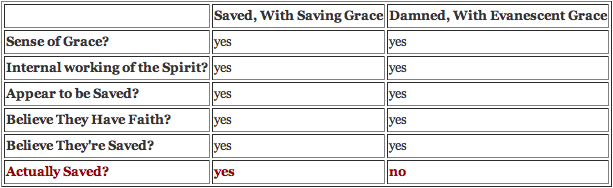





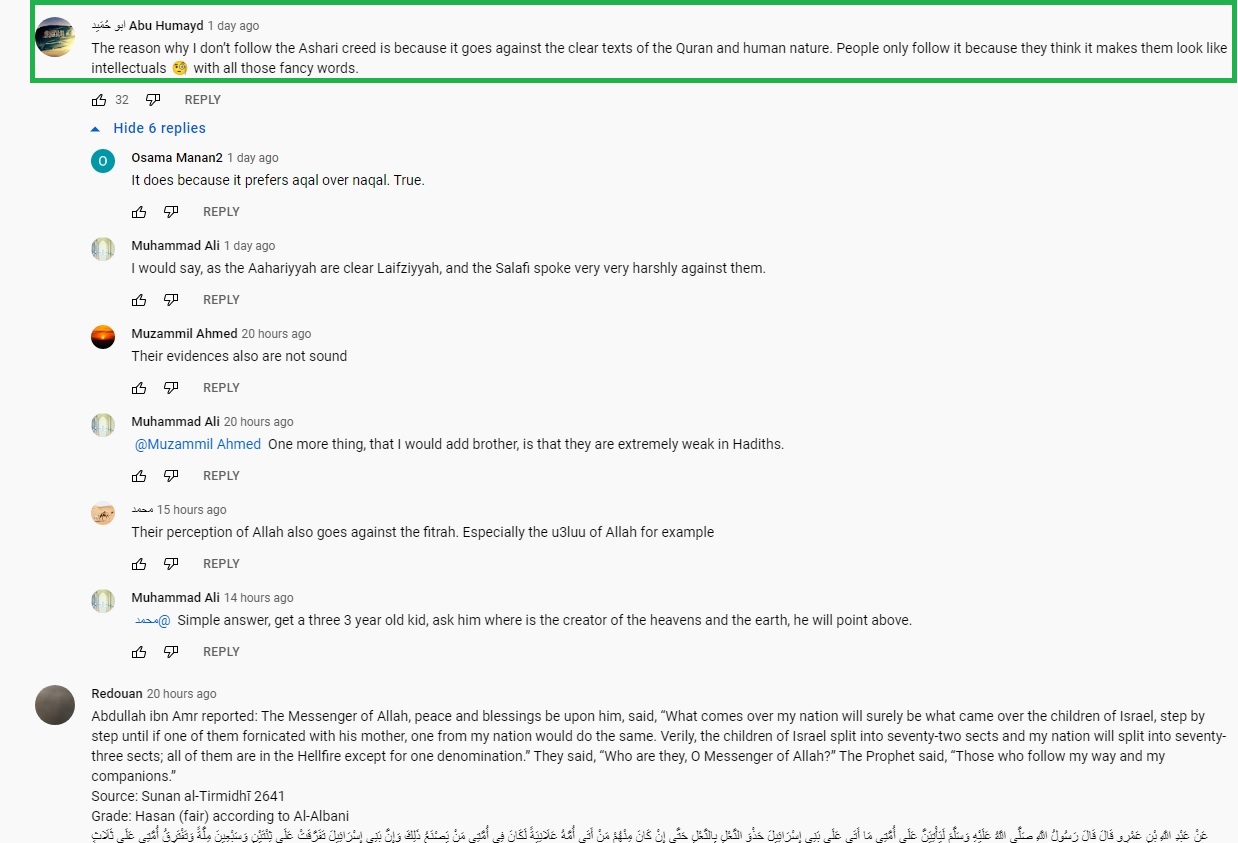


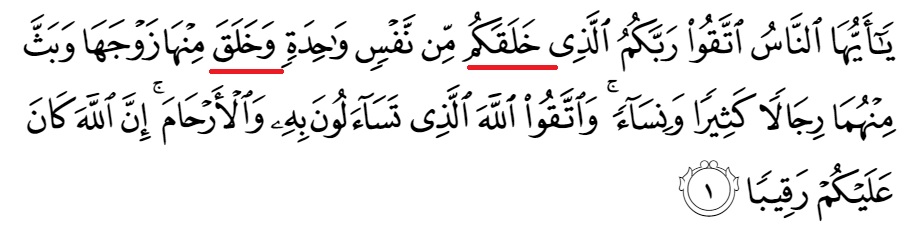



 Prima Quran