Author Archives: primaquran

primaquran's avatar

About primaquran

Researcher of Hadith compilation and transmission, Islamic jurisprudence with emphasis on early developmental period. Muslim. Ahl al-Haqq wa-l istiqama. Follower of the Qur'an and Sunnah as understood by the earliest school in Islam. “We take the truth even from a man of hatred and we reject falsehood even from a chosen friend. We have no respect for a man, however exalted, If from the truth he has deflected.”-Shaykh Abdullah bin Humeid Al Salmy

Response to Ali Hur Kamoonpuri attempt to refute Ibadi’s on Siffin.

“Moreover, if two factions among the believers should fight, then make settlement between the two. But if one of them oppresses the other, then fight against the one that oppresses until it returns to the ordinance of Allah. And if it returns, then make settlement between them in justice and act justly. Indeed, Allah loves those who act justly.” (Qur’an 49:9)

“Moreover, it is not for a believing man and it is not for a believing woman when Allah has decided and His Messenger a matter that (there) should be for them (any) choice about their affair. And whoever disobeys Allah and His Messenger certainly, he (has) strayed (into) error clear.” (Qur’an 33:36)
﷽ 

Our colleague narrates an encounter between a former student of Dr. Syed Ali Hur Kamoonpuri and the claims made by her teacher.

This post is in regard to some messages that a woman named Roxanna sent to me via our conversations/exchanges through WhatsApp. I believe it all started when she shared a post of mine from Prima-Quran. That post was the following:

https://primaquran.com/2022/10/17/ismaili-shia-and-circular-reasoning/

My sincere feedback to Roxanna was that any time when we are in any chat group that has its own agenda or focus, it would not be prudent for us to go into that group with any attempt to derail it.

So for those from the Ibadi school reading this. If there are Facebook groups, WhatsApp, Telegram, or Discord servers created specifically for Sufism, or Shi’i or the Sunni, please do not go into those groups and try and derail the focus of those groups. Let them be.

Thus, as she tells us, this got this Syed Ali Hur Kamoonpuri quite worked up. Which is understandable. Reformist or not, he is still a Shi’i and Ali is central to their identity. Apparently she was threatened with going to hellfire for even entertaining the thought that Ali could be on the wrong side of history when it comes to the decisions at Siffin.

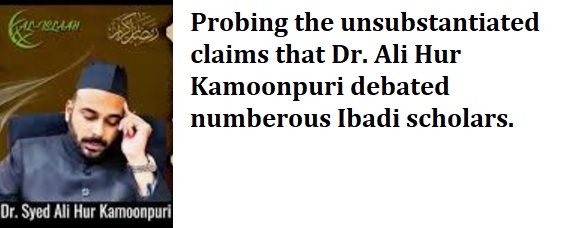
So, apparently, this Syed Ali Hur Kampoonpuri was going to do a YouTube series refuting the Ibadi (nothing better to do). Yet, all the while claiming he wanted an Ibadi to appear as a “guest”. So you have to wonder how sincere that is. In fact, she herself mentioned that she was to play some part in the refutation of the school.

Then, this Syed Ali Hur Kampoonpuri claimed that he “debated Ibadi scholars”. This naturally caused a raised eyebrow from myself So I asked her to ask him who are these “Ibadi scholars” he “debated with.”

The question was deflected, which seemed quite predictable. Wanting to invite a scholar onto your program with the pretense of having a dialogue when you actually want a debate is rather insincere. You don’t have the intention of inviting an “Ibadi guest” on a program while having the intention of doing a refutation series. That doesn’t come across as sincere as all.

So she replies:

“This was the response I got when I asked which Ibadi scholars he had discussions with” — Roxanna

“Walaykum Salaam. They were mostly from Dar es Salaam, Tanzania and Zanzibar when I used to live there. And some who visited India. But I don’t know if they would be pleased at my sharing their names, given how secretive and low-key they prefer to remain.” -Syed Ali Hur Kamoonpuri

They were mostly from Dar es Salaam (would indicate 1 scholar), Tanzania and Zanzibar (would indicate at least 1 scholar) and “some who visited India” that some would indicate more than one.

So, that is a total of 4 Ibadi scholars, at the very least he has claimed to have debated.

In our eyes, this causes Mr. Syed Ali Hur Kampoonpuri’s credibility to be questioned. It is very challenging to take someone seriously when they make claims like this and when asked to substantiate such claims, they are not forthcoming. It is most unfortunate.

The sister, who was welcomed by the group, acknowledged how kind and welcoming everyone was. It was not long until she asked for others to be invited to the WhatsApp group. Now, keep in mind that the group is created for people convinced of the Ibadi school and asking questions with regard to guidance for their life.

So, she invited about 4 others to the group. It was not long until the questions turned to Siffin and that pretty much dominated the conversation as far as her own interest.

All I know is that I connected her with many people in the Ibadi community. She left the WhatsApp group one day, dropped contact. The last I heard was a person in the group messaged me one day saying: “Your sister dropped her scarf.” Such an odd message to receive with no context. That person then sent me a link of her in some YouTube program she does without the headscarf.

That is really not my business. She is on her own journey, as are we all. May Allah guide her and guide us.
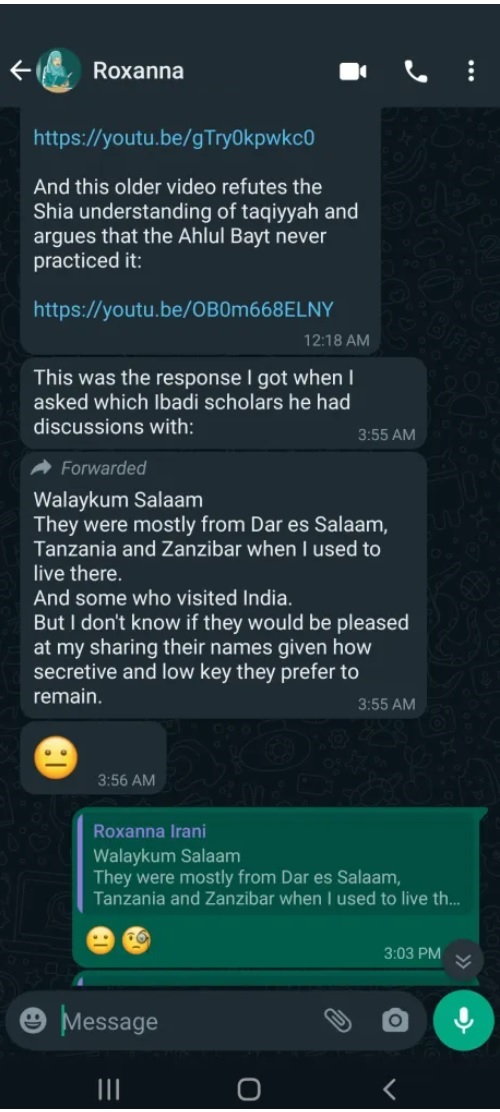
Do note that Roxanna has changed the information from him (Syed Ali), claiming he had ‘debated’ with such people, him (Syed Ali) simply having ‘discussions’ with such people. This also raised an eyebrow. 

Yet you can see by her emoji, it is one that conveys mild irritation. We had asked Shaykh Juma Al Mazruii if he had ever heard of this Shaykh, and he said no. Shaykh Hilal al Wardi and Shaykh Hafidh Hamed Al Sawafi had not heard of him either. No one had heard of this guy.

You see, the Ibadi community is quite small. It would not be very hard at all to ascertain the truth of his statements. For example, his statement, “When I used to live there,” We could get from him the years he says he lived there and from there simply ask in our very tight-knit and very small community, have you ever heard of this guy?

This is a huge stumbling block for our side to have anything to do with him. Also, to be transparent it also caused doubt in us towards those who would associate with such a duplicitous individual. I am certain he has not debated Ibadi scholars because the arguments that he brings up are so ignorant, and devoid of any basic knowledge of our fiqh in regard to matters of arbitration.

We let the reader make their own informed decisions. 


So, if there is an attempt from his circle or him to engage one of our teachers in the future, he would need to first clear this up. 

So who is Syed Ali Hur Kamoonpuri? To be fair, we had not heard of him until she brought up his name. A Google search revealed that his father was one Dr. Syed Mujtaba Hasan Kampoonpuri, who served as the Dean Faculty of 12er Shia Theology at Aligarh Muslim University.

Also, to send some traffic his way, this is his YouTube channel for those interested: https://www.youtube.com/@Al-Islaah

He has some worthwhile content that those who are searching these matters may find useful.

We understand he is trying to reform 12er Shi’ism. In this regard, may Allah (swt) grant him success. Any attempts to build bridges among the Muslim community may Allah (swt) grant him success. However, when it comes to his “knowledge” of the Ibadi school, it is a naked display of ignorance, mischaracterizations and straw man “arguments.”

These are his two voice clips sent to sister Roxanna. You listen and be the judge. We have our own response to these. Apparently sister Roxanna was harangued by them over it. May Allah help us.

This is quite literally a transcription of the above voice notes. One may feel free to give it a listen and follow along. Below is a response to his (Syed Ali) claims. 

“Ali had already answered these doubts. He said, “Who told you we made human beings arbitrators? We made the Qur’an the arbitrator. The job of the human beings is simply to deliver the verdict of the Qur’an. You understand? The arbitrator is the Qur’an. And that no one in the Ummah can deny. Even the Qur’an itself says that Allah is supposed to be the hakam right? Allah is supposed to be the arbitrator. But how does Allah be…how does Allah act as the arbitrator? He’s not gonna, he’s not an old man in the sky as the as some of those who believe in Israliyaat (narrations from the children of Israel) would perceive him. Or as the Anthropomorphist would perceive him. That he will that he’s an old man in the sky authbillah (seek refuge with Allah) and that he will descend, you know he will send down on a ladder and he will descend and he will come and issue the verdict. When the Qur’an promotes takheem (arbitration) of Allah. When ever you have a dispute or iktilaaf (difference) the hukm (judgment) will come from Allah. Hukm will not come from Allah in the sense that you look towards the sky and Allah will write the verdict on the sky. He has already, he has already revealed the book. The book contains the judgement. But the book does not have a mouth, with which it can pronounce the judgement. So the mouth Allah has given to the human being. Human agents. O.K? They will bring out the judgement of the Qur’an. And and obviously the judgement of why do you have a qadi in courts then? You know tell tell the government of Oman to fire all the qadis. Who are they? Why are they bringing human agents? You know they should just put a Qur’an on the seat of the qadi; and let the Qur’an give the judgement. So this is Imam Ali’s problem with the Khawarij. He is telling them you are foolish. This is not how it works. You can’t ahh directly ask the Qur’an to issue the judgement. You need to appoint human beings the hakam (judge)O.K.? And those hakam (judges) will extract the verdict from the Qur’an. And than they will say, Why did you appoint Abu Musa Al Ashari say by the way he’s he was not my choice. Why do you allow them to appoint Amr Ibn Al ‘As say Baba this is not my choice. They have their own ah army, they have their own separate government. Uh we cannot impose, we cannot dictate who they will choose. You understand? We cannot impose our choice on them. If we could impose our choice on them at this stage than why are we having the battle between them? The, the reason why we are having the we were having the battle with them is because our authority on them had not yet been established. They have not accepted our authorities. So how can we start appointing people on their side when they don’t even accept they have not even submitted to our authority? But yes they are prepared to submit to the authority of the Qur’an. And they are saying that they are ready and willing to appoint someone from their side who will uh at least as far as they are alleging will sincerely try to extract the verdict, verdict of the Qur’an. So yeah we have to go with that! We can’t determine. We can’t impose our choice Imam Ali was not allowed by the Khawarij in his army to choose his own arbitrator also. He wanted to choose Ibn Abbas or Malik al Ashtar or someone of that sort. But no they imposed Abu Musa Al Ashari because they wanted someone who is anti-war, not pro-war. And let us not forget that it was the Khawarij who applied all the pressure, or the major part of the pressure in getting Imam Ali to uhh to enforcing him to accept takhim (arbitration). And uhh they they at that it seems they were completely you know enamored with this they were they were hypot-they were sorry they were hypnotized by this um by this um by this call to come to the judgement of the Qur’an. They were like how can we fight when people are inviting us towards the Qur’an? Now as far as the verse of surah Al Hujrat (chapter 49) is concerned uhhh Imam Ali did not violate it. Allah says, The obligation to fight the rebellious party only is binding okay soo far as the party is not willing to submit to the Amr (command) of Allah. But as long as as soon as the rebellious party says, even if they don’t accept your authority, and your caliphate, and the ij, bayah (oath) and mashura (collective decision) of the muhajirin (those who migrated) and ansar (those who helped) all of that no problem. As soon as the rebellious party says look we are ready to surrender to the Qur’an. Ah what is the Qur’an. The Qur’an is the amr (command) of Allah is it not? Ahhh so at that point if you want you can invoke this part of the verse and say that look Allah say, until it returns to the Amr (command) of Allah. By raising the Mushahif (Qur’an on parchments) on the spears they are at least zahiran (outwardly apparent) even if if they are batinan (hidden) and munafiq (hypocrites) there you know not serious they are not sincere whatever you say about their batin (what is hidden). But Zahiran (outwardly apparent) so long as the rebellious party is offering to submit to the judgement of the Qur’an. Then you cannot say that Quranically we are still obligated to continue fighting them. No. At that point the Qur’anic obligation is lifted and now it becomes a matter of the what is the requirement of the political and military wisdom. So now poli, the rules of politics and military wisdom dictate that you should try to ascertain are these people really sincere or not. Now, We have already, Imam Ali had already seen these people are not sincere because the beginning of the battle we did call them towards the Qur’an. They didn’t accept it than. Now that they are losing the battle all of a sudden they now want the Qur’an to be the judge? So on that basis politically Imam Ali even after the arbitration continued to maintain he said yes politically what you people forced me to do was not the best. Uhmm it was not the best approach you should have listened to me I was telling you even though the Qur’anic obligation at that point now starts to rest on on a, you see the the critical point the Khawarij did not understand. o.k Which is that Allah’s commands in the Qur’an are absolute, they have to be followed under all circumstances right? But, sometimes they are predicated upon uh worldly, politically and military ijtihad (striving to derive rulings from the sources). So, For example, Allah (swt) says in the Qur’an that we have to fast. O.K we have to fast. And the Sunnah has already made it clear that as soon as you see the moon start fasting shahru Ramadan (month of Ramadan) right? But seeing the moon on shahrul Ramadan this is a human worldly astronomical matter. It is not an absolute uhh divine yani(you know) Allah does not inform us when the moon has been sighted. This is something we human beings have to apply our ijtihad to find out ehh uh has the moon been sighted or not. Here there can be mistakes. So if lets say a human being by mistake has a hallucination or some illusion and he ends up seeing the moon or lets say because of some defect in his eyes he is not able to see the moon and no one is able to see the moon and they don’t fast the next day when in reality the moon had appeared in the ilm (knowledge) of Allah the moon had appeared, Allah doesn’t have a case against such people. You can’t say but I sa my command was to start fasting as soon as you see the moon. The problem is we didn’t see the moon even if it may have been there so yes the requirement of worldly wisdom should have been that we should have put enough arrangements in place to ensure that you know that the moon is sighted. But we failed in that. So similarly Imam Ali is saying that look Allah’s obligation to fight against the forces of Sham (Syria) was only binding so long as they were completely stubborn and they were not re, Muaviya this is how he came to Siffin. He said I don’t have anything for you except the sword. Imam Ali tried to negotiate with him. He wrote letters to him. All of that! Everything failed. That’s why the battle happened as a last resort. When his side attacked the side of Imam Ali and committed aggression against him. So he fought them in defense. So this is what the fight was about. Now when Allah says, You keep on fighting them until they return to the Amr of Allah. Now this until they return to the Amr of Allah this is going to be determined by how do you determine when a party has returned to the Amr of Allah? This will be determined by worldly factors. Which are not God is not going to send you wahy telling o.k now they have returned or ok no no no they have not actually they are not sincere keep fighting. No these are human ijtihadi matters. Now the army of Imam Ali not Imam Ali himself Imam Ali’s ijtihad was correct wal hamdulillah (praise be to Allah)from the beginning he, Ibn Abbas, Malik Al Ashtar they all saw through this and they said yeah but look the correct worldly and military ijtihad requires us to continue this fight. Because we have enough against these people to prove to Allah that they are not sincere. We can see that. But the rest of the army uhhmm and especially these um foolish khawarij were not able to see through that. They were deceived. And in some of the reports indicate that its not just that they were deceived its it’s that the
battle had really broken them. They just wanted an end by any means. Some of them were like that. Their were people in the army of Imam Ali that were completely the battle had been so fierce and it was so much bloodshed they were psychologically effected by it, and they were just looking for any excuse to stop the battle. And these are the first people to have jumped on this thing that no no no let’s stop the fighting. Let’s stop the fight. They were desperate. So this desperation caused them to make this faulty ijtihad and Imam Ali said o.k if they had gone against the Qur’an with this ijtihad Imam Ali would have said you know what let us die. It is better to die than to go against the Qur’an. But because their faulty worldly ijtihad was only a worldly political mistake and military mistake that they were making Imam Ali tried to warn them against it but he did not stick to his gun. He did not impose it on them very ferociously. In the end you see him saying that o.k I can clearly see you people have lost the will to fight and it does not befit me as your leader to force you in a direction that you are not pleased with. You people don’t’ wanna fight o.k What you are proposing because it does not go against the Qur’an and established sunnah accepting arbitration a call to make the Qur’an the judge between two parties is never against the Qur’an and Sunnah. In fact it is 100% in line with the Qur’an and Sunnah. The only issue is that the worldly aspect of it. The worldly aspect is you have to you have to determine rather the other party is really sincere or not. You people are just taking their word for it. Which is not uuh a good thing to do from a worldly political military perspective. But it’s uh ah yani if this is what you have determined. Than yeah it’s fine. Doesn’t go against the Qur’an or Sunnah. Da da they are outwardly calling us towards the Qur’an yeah? So fine uh the Allah (swt) in the Qur’an promotes this idea that the Qur’an and his his
revelations should be made the judge in all disputes. and the appointment of two human beings from both sides this mirror’s uuuhh Qur’anic uh prescription such as in the case of husband and wife Allah says, “send an arbitrator from his people and an arbitrator from her people” and the husband does not get to decide who the wife will choose as her hakam. The woman should have the right to bring her arbitrator, whoever she chooses from her family and whoever her family is agreed upon and happy with and the husband uuhh should have the right to bring whoever he is pleased with from his side. Right?
Th zz You can’t impose you know this foolish argument that Imam, why did Imam Ali let them choose a wicked man like Amr ibn Al As yeah you can’t dictate terms to the the other army. If the Khawarij were really interested in not having Amr Ibn Al As as the hakam they should have continued fighting
as Imam Ali instructed them to do at first. But they disobeyed him. And their disobedience of him there was uhh it was worldly foolishness. Ummm and that is why Imam Ali maintained until the end
he said you people did something foolish and now your trying to pin the blame for your foolishness on me because you’ve now seen with your own eyes the results of your foolishness so in any case Imam Ali appointed these two arbit he he agreed he acquiesced in the appointment of these two arbitrators
he put strict conditions that they will make the Qur’an and the Qur’an alone the hakam and in areas where the Qur’an is silent the Sunnah of the Messenger (saw) and then latter on as you see what happened in takhim u-ma? Imam Ali says, they went astray these two arbitrators. They broke the terms and agreements the the the terms of the agreement. They followed their whim desires and so it was very clearly mentioned in the contract and in the pact that if you know if they go against the requirements of the Qur’an aaa and the Sunnah then their decree is not binding. And therefore when they deposed Imam Ali it was an illegal verdict and when the verdict is illegal you go back to the default which is as mentioned in the contract the original state of war and the original state of war was based on what status quo on the status quo that the Muhajirun and Ansar. The vast majority of them ah have given bayah to Imam Ali he is the rightful legitimate caliph and Muawiyah has to submit to that bayah if he doesn’t he’s a baghy (rebel) and a rebel against the Muslims and the Muslims have the right to impose their authority on him and this is exactly what Imam Ali went back to to doing. Preparing the next campaign against Muaviyah.” — Syed Ali Hur

Prima Qur’an response:

Syed Ali Hur often seems incoherent.


    Part of pur frustration with Syed Ali is that there are so many cut-off sentences and his thoughts seem to be jumbled on this. He will begin a sentence and just when you think he is about to make a point or an assertion, he quickly changes course to something else. Then he becomes very polemical and this is a far cry from academic discourse. He seems to like the word ‘foolish’ quite a bit.

    Syed Ali Hur does not understand Ibadi jurisprudence.

    It is clear to us that Syed Ali Hur neither understands the Ibadi school nor our jurisprudence. This is clear when he makes this gargantuan error concerning our school. To be fair, this tired polemic does not originate with him. It has been said by those before him. It not only insults our school, it insults Ali ibn Abu Talib as well as the reader’s intelligence.

    “Whenever you have a dispute or iktilaaf (difference), the hukm (judgment) will come from Allah. Hukm will not come from Allah in the sense that you look towards the sky and Allah will write the verdict on the sky. He has already, he has already revealed the book. The book contains the judgement. But the book does not have a mouth with which it can pronounce the judgement. ” — Syed Ali Hur

    ” And and obviously the judgement of why do you have a qadi in courts then? You know tell tell the government of Oman to fire all the qadis. Who are they? Why are they bringing human agents? You know they should just put a Qur’an on the seat of the qadi; and let the Qur’an give the judgement. ” — Syed Ali Hur

    Listening to Syed Alli make these types of statements was just wild. Are we really to believe that Ali ibn Abu Talib used these types of bizarre arguments?  


    In fact, it is very reminiscent of the straw man “arguments” and bizarre statements and actions that Sunnis attribute to their imams when attempting to refute the points of others.

    Please see:

    “You see the the critical point the Khawarij did not understand. o.k Which is that Allah’s commands in the Qur’an are absolute, they have to be followed under all circumstances right? But, sometimes they are predicated upon uh worldly, politically and military ijtihad.” –Syed Ali Hur

    Notice the word sometimes. That is exactly the point! Allah (swt) says,

    “Moreover, it is not for a believing man, and it is not for a believing woman when Allah has decided and His Messenger a matter that (there) should be for them (any) choice about their affair. And whoever disobeys Allah and His Messenger certainly, he (has) strayed (into) clear error.” (Qur’an 33:36)

    When Allah (swt) has decided upon a matter, it is not for human beings to have any choice on something decided upon by Allah (swt). This text is nass—it is clear: a known, clear legal injunction, or a divine decree.

    However, in matters of ijtihad, he needs to bring evidence to show the Ibadi school has disagreed with this, which he has not. 

    Syed Ali Hur contradicts himself.

    “This is not how it works. You can’t ahh directly ask the Qur’an to issue the judgement.” Syed Ali Hur

    Prima Qur’an response:

    Syed Ali Hur contradicted himself. He says: ‘sometimes‘.

    However, this new statement that you cannot go directly to the Qur’an is falsehood.

    Allah creates circumstances favorable to Muaviya and against Ali?

    “They were deceived. And in some of the reports indicate that its not just that they were deceived its it’s that the battle had really broken them. They just wanted an end by any means. Some of them were like that. Their were people in the army of Imam Ali that were completely the battle had been so fierce and it was so much bloodshed they were psychologically effected by it, and they were just looking for any excuse to stop the battle. And these are the first people to have jumped on this thing that no no no let’s stop the fighting. Let’s stop the fight. They were desperate.-Syed Ali Hur

    Prima Qur’an comments: Is it not interesting that, if we are to believe what Syed Ali tells us, that this just so happens to coincide with Muaviyah’s army putting the Mushaf of the Qur’an on spears and swords just when the battle was not going well for Muaviyah’s side?

    You can deduce from this the following:

    a) Allah (swt) himself wanted both parties to talk by creating this fatigue and exasperation. Thus, Ali’s alleged decision to “keep fighting” was wrong. Muslims do not believe in coincidence.

    The people who were for arbitration wanted a good thing and Ali did not want the good thing!

    “If they had gone against the Qur’an with this ijtihad Imam Ali would have said you know what let us die. It is better to die than to go against the Qur’an. But because their faulty worldly ijtihad was only a worldly political mistake and military mistake that they were making Imam Ali tried to warn them against it but he did not stick to his gun. He did not impose it on them very ferociously. In the end you see him saying that o.k I can clearly see you people have lost the will to fight and it does not befit me as your leader to force you in a direction that you are not pleased with. You people don’t’ wanna fight o.k What you are proposing because it does not go against the Qur’an and established sunnah accepting arbitration a call to make the Qur’an the judge between two parties is never against the Qur’an and Sunnah. In fact it is 100% in line with the Qur’an and Sunnah. ” -Syed Ali Hur

    As soon as the rebellious party says look we are ready to surrender to the Qur’an. Ah what is the Qur’an. The Qur’an is the amr (command) of Allah is it not? Ahhh so at that point if you want you can invoke this part of the verse and say that look Allah say, until it returns to the Amr (command) of Allah. By raising the Mushahif (Qur’an on parchments) on the spears they are at least zahiran (outwardly apparent) even if if they are batinan (hidden) and munafiq (hypocrites) there you know not serious they are not sincere whatever you say about their batin (what is hidden). But Zahiran (outwardly apparent) so long as the rebellious party is offering to submit to the judgement of the Qur’an. Then you cannot say that Quranically we are still obligated to continue fighting them. No. At that point the Qur’anic obligation is lifted and now it becomes a matter of the what is the requirement of the political and military wisdom.” -Syed Ali Hur

    Prima Qur’an comments:

    a) So supposedly, these people are “making faulty ijtihad”

    b) Then he (Syed Ali) turns around and says, “Accepting arbitration a call to make the Qur’an the judge between two parties is never against the Qur’an and Sunnah. In fact, it is 100% in line with the Qur’an and Sunnah.

    c) This is because “ But Zahiran (outwardly apparent) so long as the rebellious party is offering to submit to the judgement of the Qur’an.”

    Ali is portrayed as half hearted reed blown by the winds and not the Imam and resolute believer who trust and reliance is solely upon Allah (swt). He shirks from personal responsibility for his actions.

    “Now, We have already, Imam Ali had already seen these people are not sincere because the beginning of the battle we did call them towards the Qur’an. They didn’t accept it than. Now that they are losing the battle all of a sudden they now want the Qur’an to be the judge? So on that basis politically Imam Ali even after the arbitration continued to maintain he said yes politically what you people forced me to do was not the best.”-Syed Ali Hur

    “If they had gone against the Qur’an with this ijtihad Imam Ali would have said you know what let us die. It is better to die than to go against the Qur’an.”-Syed Ali Hur

    “So in any case Imam Ali appointed these two arbit he he agreed he acquiesced in the appointment of these two arbitrators he put strict conditions that they will make the Qur’an and the Qur’an alone the hakam and in areas where the Qur’an is silent the Sunnah of the Messenger.” -Syed Ali Hur

    Prima Qur’an comments:

    a) So, on the one hand: “You people forced me to do

    b) On the other hand: “You know what let us die. It is better to die than to go against the Qur’an.”

    c) And on the other hand: “he agreed he acquiesced in the appointment of these two arbitrators.”

    How come Ali wasn’t aware of these verses of the Qur’an?

    “How often has a small host overcome a great host by Allah’s leave! For Allah is with those who are patient in adversity.” (Qur’an 2:249)

    “When people said to them: ‘Behold, a host has gathered around you and you should fear them’, it only increased their faith and they answered: ‘Allah is Sufficient for us; and what an excellent Guardian He is!”(Qur’an 3:173)

    Now again, we are only going by the narrative that Syed Ali Hur has given us. We do not know if these are his surmising’s based upon an oral narrative or actual historical data.

    Syed Ali Hur claims without evidence that the so called “Khawarij” selected Abu Musa Al-Ashari? What is the reference for this?

    “But no they imposed Abu Musa Al Ashari because they wanted someone who is anti-war, not pro-war. And let us not forget that it was the Khawarij who applied all the pressure, or the major part of the pressure in getting Imam Ali to uhh to enforcing him to accept takhim (arbitration).” -Syed Ali Hur

    Prima Qur’an comments:

    Is Ali so weak that not only is he supposedly forced into arbitration, and now he cannot even accept his own arbitrator? Which brings us to his example of the separation of man and wife which falls back on him in a bad way.

    This also blows open wide any false notion of Ali or his army believing he had any type ofʿIṣmah or that he was Maʿṣūm. The actions of his army be the admission of Syed Ali Hur is proof in the pudding.

    Syed Ali Hur’s lack of understanding of the Arabic language and verse 4:35 of the Qur’an.

    “The appointment of two human beings from both sides this mirror’s uuuhh Qur’anic uh prescription such as in the case of husband and wife Allah says, “send an arbitrator from his people and an arbitrator from her people” and the husband does not get to decide who the wife will choose as her hakam. The woman should have the right to bring her arbitrator, whoever she chooses from her family and whoever her family is agreed upon and happy with and the husband uuhh should have the right to bring whoever he is pleased with from his side. Right?”-Syed Ali Hur

    Prima Qur’an comments:

    a) Wrong! This actually shows poor grammar in the understanding of this ayat. The Arabic text is fa-ib’ʿathū (they choose), meaning the family of the respective party choose the arbiter. Not the wife chooses or the husband chooses. Their families choose. So, even if the allegation of the so-called ‘Khawarij’ chose Abu Musa Al Ashari by the understanding of the verse, it would be correct. Which, by the way, Syed Ali Hur did not give evidence that they chose him!

    b) For the example of the husband and wife, Allah (swt) says, fa-ib’athu (appoint arbiters).

    “If two parties among the believers start to fight against each other, restore peace among them. If one party rebels against the other, fight against the rebellious one until he surrenders to the command of Allah. When he does so, restore peace among them with justice and equality; Allah loves those who maintain justice. ” (Qur’an 49:9)

    It is in the imperative form faqatilu! That is the AMR, the command of Allah (swt). There should be no talk of a document. There should be talk of bayah!

    Ali was the one in his letters who told Muaviyah that they could investigate the murder of Uthman, yet Muaviyah would need to recognize the legitimate government of the Muslims. Now Ali is laying all this aside for discussion?  Give the bayah or perish!


    “Th zz You can’t impose you know this foolish argument that Imam, why did Imam Ali let them choose a wicked man like Amr ibn Al As yeah you can’t dictate terms to the the other army. “-Syed Ali Hur

    Prima Qur’an comments:

    Thankfully, Syed Ali Hur went to verse Qur’an 4:35 of a dispute between a man and a woman. He did not go to the verse of Qur’an 5:95. Because the argument that the sahabah of the Blessed Messenger (saw) who were at Narhawan had against Ibn Abbas was the following:

    “O you who believe! Kill not game while in the sacred precincts or in pilgrim garb. If any of you do so intentionally, the compensation is an offering, brought to the Ka’ba, of a domestic animal equivalent to the one he killed, AS ADJUDGED BY TWO JUST MEN AMONG YOU; or by way of atonement, the feeding of the indigent; or its equivalent in fasts: that he may taste of the penalty of his deed. Allah forgives what is past: for repetition, Allah will exact from him the penalty. For Allah is Exalted, and Lord of Retribution.” (Qur’an 5:95)

    As adjudged by two just men among you’.  Keep this in mind as well. This is a key part of the text.

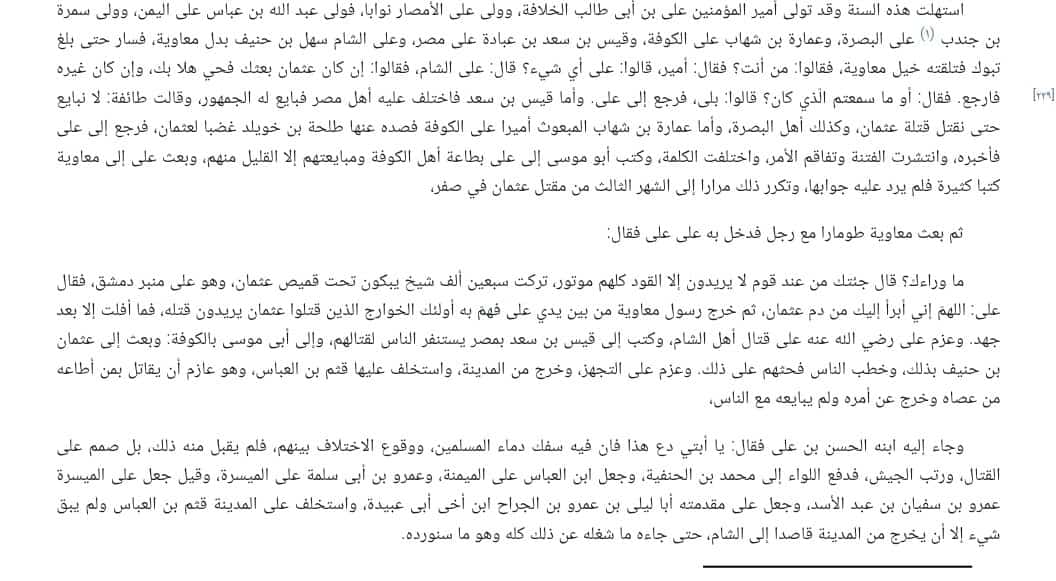
    The sahabah of Nahrawaan replied to Ibn Abbas :

    “Are you comparing the law relating to the killing of game animals on the sacred land or the law that is intended to resolve the misunderstandings that occur between a man and his wife, with the law that is intended to govern matters of greater magnitude, such as the act of shedding of Muslims’ blood?”

    Source: (Al-Tabari, Al-Taarikh Vol. 6, p. 13.)

    Also, another point concerning the text that Ibn Abbas brought forth.

    Naturally, people would ask, “Are you saying Amru bin Al-As is a man of justice when it was he who spilled our blood yesterday? If you believe that he is just, then we (including you — Ibn Abbas and Ali) are not just because we all fought the war against Mu’awiya and Amru bin Al-As!”

    So the unfilled questions were.

    1. A)Were there two arbitrators or one?
    2. B) Were they just or unjust?

    Now could a person think they are just and sincere in what they are doing?

    Syed Ali Hur does not have a cohesive narrative concerning the so called kharijites and rather or not they are pro/anti-arbitration.

    So, on the one hand: “You people forced me to do” — Syed Ali Hur

    “And let us not forget that it was the Khawarij who applied all the pressure, or the major part of the pressure in getting Imam Ali to uhh to enforcing him to accept takhim (arbitration).”-Syed Ali Hur

    However, he (Syed Ali) then turns around and says:

    “The, the reason why we are having the we were having the battle with them is because our authority on them had not yet been established. They have not accepted our authorities. So how can we start appointing people on their side when they don’t even accept they have not even submitted to our authority? But yes they are prepared to submit to the authority of the Qur’an. “Syed Ali Hur

    His contradiction is obvious for all to see. If the so-called Kharijites were forcing Ali into arbitration, then why does he have to explain to them that these people do not accept our authority we cannot impose it on them? Seems like you are preaching to the choir. Especially if they were for it!

    “Imam Ali maintained until the end. He said you people did something foolish and now your trying to pin the blame for your foolishness on me because you’ve now seen with your own eyes the results of your foolishness.”-Syed Ali Hur

    Also, if these people forced Ali into arbitration and they “with their own eyes the results“, then why go their separate ways after? This is not adding up at all.

    Especially, in light of the following:

    “Now we have already, Imam Ali had already seen these people are not sincere because the beginning of the battle we did call them towards the Qur’an. They didn’t accept it then. Now that they are losing the battle all of a sudden, they now want the Qur’an to be the judge? So, on that basis, politically Imam Ali, even after the arbitration, continued to maintain he said yes, politically, what you people forced me to do was not the best.”—Syed Ali Hur

    Why are people who are fighting, spilling blood, fighting for you at the battle of the Camel? Why are they now leaving? They could have said, yes Ali, in hindsight was correct and we were wrong.

    It is quite clear that the people who left Ali’s camp wanted to do so because Ali went for arbitration. The companions of the Blessed Messenger (saw) who left Siffin for Narhawan are famous for their cry:

    “La Hukma Illa Lillah” (There is no rule but that of Allah)

    In the end, with regard to arbitration, what is the result of it? What is the fruit? Did it return to the AMR of Allah (swt) ? No! It did not!

    What is that the Shi’i believe was so insufficient about his letters to Muaviyah that he needed to give in to this arbitration? What is it that is not so clear in the Qur’an about what this “amr of Allah” is that we need to make a document, and have court recess and go our own ways?

    And the key thing that Shi’i keep running from again and again and again is this one simple, straightforward question. “If the Qur’an is the arbiter, what is the verse or verses that make Ali in the right in his dispute with Muaviyah?”

    The command of Allah (swt) is not clear?

    Yes indeed it is!

    In the example of the husband and wife, Allah (swt) says, fa-ib’athu (appoint arbiters)

    “If two parties among the believers start to fight against each other, restore peace among them. If one party rebels against the other, fight against the rebellious one until he surrenders to the command of Allah. When he does so, restore peace among them with justice and equality; Allah loves those who maintain justice. ” (Qur’an 49:9)

    It is in the imperative form faqatilu! That is the AMR, the command of Allah (swt)

    Unless the Shi’i now want to say that Ali did not know what the amr of Allah (swt) was then let that stand on the record.

    Unless the Shi’i want to say that Ali has no Qur’an-based text to support him, then let that also stand on the record.

    How does what return to the Amr of Allah (swt)?

    Very simple and easy to answer.

    Avoid what Allah (swt) asked you to avoid and by doing what Allah (swt) has ordered you to do. Example: You are not making your prayer, then start praying. This is not rocket science.

    Whenever the Shi’i are cornered in an argument and have nothing more to offer. They will always return to the incident of Ghadir Khum. It is what they believe is their instant win card!

    We have explained the incident of Ghadir Khum here:

    Also, do correct your Shi’i friends. There is no such thing as ‘THE’ hadith of Ghadir Khum. However, there is THE incident of Ghadir Khum and various versions of that incident, which means hadiths (plural). Some of these variants have accretions and variations.

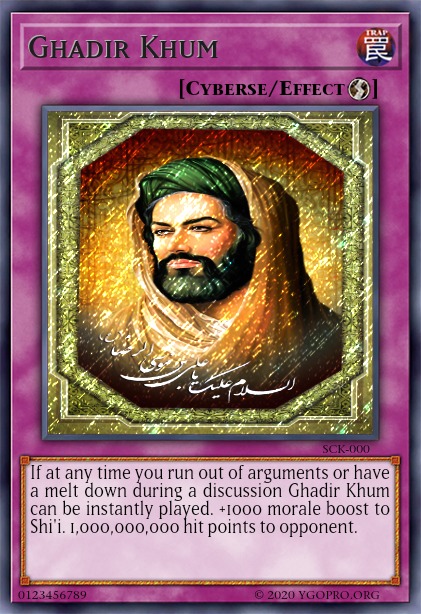
    Remember that our position is Prima-Quran.

    Some groups try to elevate the hadith over the Qur’an. Whereas for us, we do not elevate the hadith above the Qur’an. Nor can hadith clash with the Qur’an.

    The verse in question describes the two opposing groups as believers.
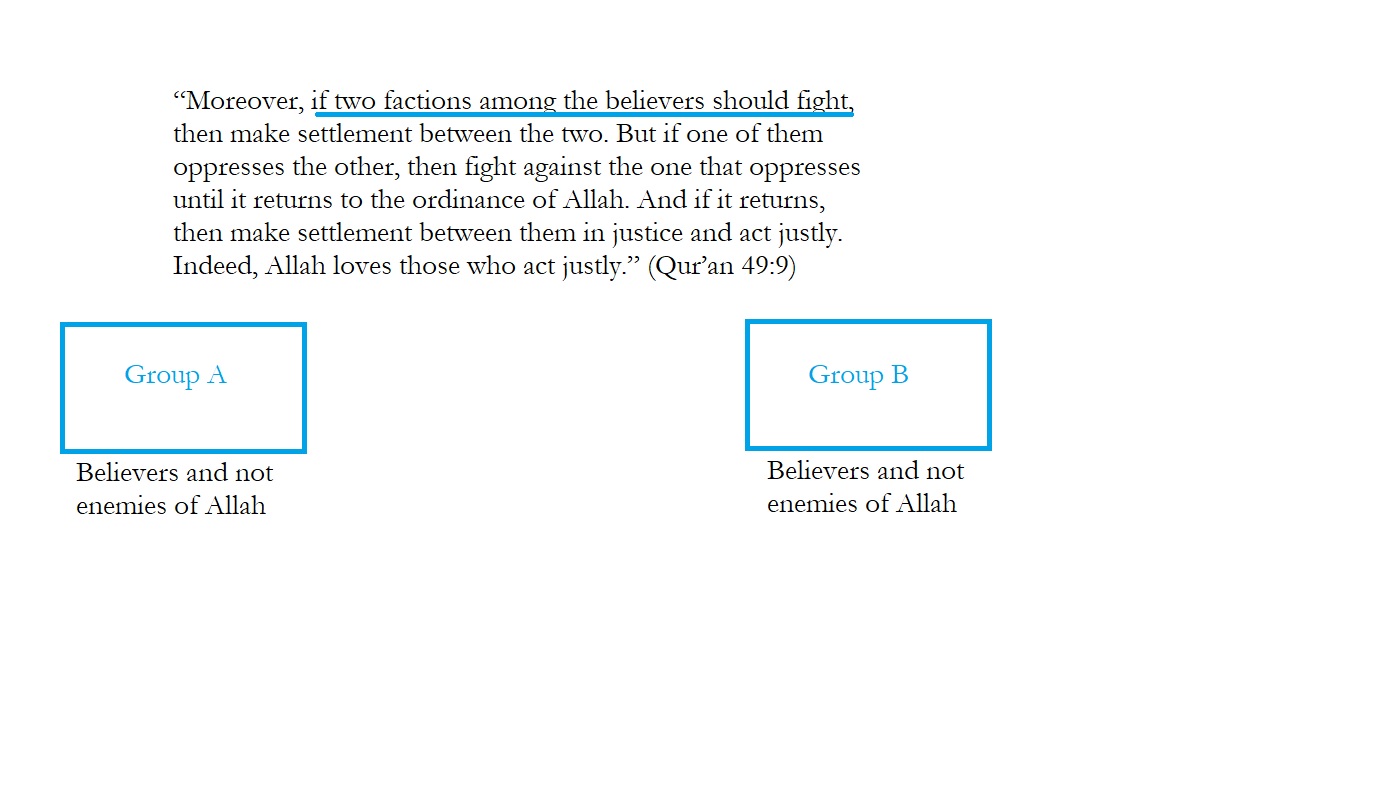
    Logic dictates that Ali could be in either group A or group B.

    Let us say that Ali is in group B, the group that is being oppressed.
    How can it be reasoned that the people in group A are being labeled as enemies of Allah, yet still be called believers by Allah (swt) himself?

    “Allah is the Friend (Waliyy)of those who believe He brings them out of darkness into light. And those who disbelieve their friends are the devils who take them out of light into darkness. They are the companions of the Fire; therein they abide.” (Qur’an 2:257)

    Surely Allah (swt) the All-Knowing is aware that Ali could be in category A or B.

    You must hate those whom you apply the judgement of Allah (swt) to? No, not necessarily.

    Based upon mantiq (logic) and the fact that this particular statement of the narration would clash with the qati’i (decisive) nature of Qur’an, such that a particular understanding of being infallible or not accountable becomes null and void.

    Secondly. There is a story which you can read here full of grandiose verbiage that many are familiar with. Ali fights a man and the man spits in Ali’s face. Ali is said to have sheathed his sword. You can read that here: https://www.dar-al-masnavi.org/n-I-3721.html

    The point is that just because you oppose someone does not necessarily entail hatred.

    An example is this:

    Narrated `Aisha:

    Usama approached the Prophet (saw) on behalf of a woman (who had committed theft).
    The Prophet (saw) said, “The people before you were destroyed because they used to inflict the legal punishments on the poor and forgive the rich. By Him in Whose Hand my soul is! If Fatima (the daughter of the Prophet (saw) did that (i.e. stole), I would cut off her hand.”

    Source: (https://sunnah.com/bukhari:6787)

    So let us imagine a scenario where Fatima did steal, and she did get caught. Would one necessarily have to have hatred in his/her heart towards Fatima when executing the punishment?


    That means that every judge or Qadi would need to hate the person they pass sentence on?


    Would that mean that Ali, as an Amir, any time he inflicted a punishment upon anyone who transgressed, meant he would need hatred in his heart as a prerequisite?

    If this is how people reason, reason is in a state of decline.Allah (swt) says,

    “Never will your family bloodlines/ties or your children be of any use to you on the day of Resurrection. He will separate you and judge between you. For Allah is All-Seeing what you do.” (Qur’an 60:3)

    Adam made a mistake.

    “Thus did Adam disobey his Lord, so he went Astray. Then his Lord chose him, and turned to him with forgiveness, and gave him guidance.” (Quran 20:121-122)

    David made a mistake.

    “And David perceived that we had tried him by this parable, and he asked pardon of his Lord: and he fell down and bowed himself, and repented.” (Qur’an 38:25).

    Saying that Ali is infallible in his decisions puts him above the Prophets. It also makes the following verse not applicable to him.

    “Then did they feel secure from the plan of Allah ? But no one feels secure from the plan of Allah except the losing people.” (Qur’an 7:99)

    Are we to say that Ali was from the losing people because he felt secure from the plan of Allah (swt)? Certainly not!

    Ibadis are not the people known for hating and hatred, contrary to what you have heard.

    Read, for example, the poem concerning Ali Ibn Abu Talib by the esteemed scholar, poet, and Sufi, Abu Muslim Al Bahlani (May Allah grant him paradise.)

    A group of six great Ibadi scholars, J’afer bin A’Simak, Abu AlHur Ali bin AlHusain Al’Anbri, AlHattat bin Kateb, AlHabab bin Kulaib, Abu Suyan Qanber AlBasri, and Salim bin Thakwan among other unnamed scholars, they went to Umar bin Abdul Aziz and exhorted him to stop this cursing from the pulpits, this includes Ali.

    If they hate Ali will they really exhort people to stop cursing him from the pulpits? The pulpit is the place where the tongue should be moist with the remembrance of Allah (swt) and exhortation to those in attendance to obey the commands of Allah (swt) and the Blessed Messenger, the Beloved Prophet Muhammed (saw)

    If the Ibadi had personal hatred towards Ali, would we have the opinion in our tradition that he was remorseful and repented to Allah?

    “Such is Allah, your true Lord. And, beyond truth, what is there except falsehood? So where else can you turn?” (Qur’an 10:32)

    Would hope that one day Mr. Ali Hur finds the courage to repent and make tauba for the lies that he told. It is best to say that he was caught up in the moment, that he made a mistake. That would make him an honourable individual.

    Based on the voice notes provided of Mr.Ali Hur and our arguments and quotes and response to the Shi’i reformist Kamoonpuri, the Ibadi side presents the more coherent, scripture-grounded, and logically consistent argument.

    1. Fidelity to the Clear Text of the Qur’an (Nass)
    The Ibadi argument adheres strictly to the apparent and imperative command in Qur’an 49:9: “…then fight against the one that oppresses until it returns to the ordinance of Allah.”

    • The Ibadis argue that the command is clear and absolute. Since Muawiyah was the rebel (baghi), the fighting should have continued until he submitted. The arbitration was a deviation from this clear divine command.
    • Kamoonpuri’s argument relies on a complex layer of “worldly ijtihad,” “political wisdom,” and assessing the “sincerity” of the opponent to override the apparent meaning of the verse. He essentially argues that a human judgment about the opponent’s intentions can suspend a direct divine imperative. The Ibadi invocation of Qur’an 33:36 (“it is not for a believing man… when Allah has decided a matter that there should be for them any choice”) is a powerful counter to this.

    2. The Practical Failure of the Arbitration
    The Ibadi point is devastatingly simple and empirical: What was the result? The arbitration did not return the situation to the amr (command) of Allah. It led to confusion, division, and strengthened Muawiyah’s position. If a course of action was supposedly “100% in line with the Qur’an and Sunnah,” as Kamoonpuri claims, one would expect it to produce a just outcome. It did not. This suggests the premise was flawed.

    3. Exposing Internal Contradictions
    The Ibadi response effectively highlights the incoherence in Kamoonpuri’s narrative:

    • Who were the “Khawarij”? Kamoonpuri says they were the ones who forced Ali into arbitration. But then they are the ones who left Ali because of the arbitration. The Ibadi asks: if they forced him into it, why would they then leave him for it? This exposes a fundamental flaw in the historical narrative being presented.
    • Ali’s Agency: Kamoonpuri portrays Ali as both “forced” by his army and as someone who “agreed” and “acquiesced” and set conditions. The Ibadi response questions this portrayal of the Imam as a half-hearted leader blown by the wind, contrasting it with the Quranic ideal of a resolute believer who trusts in Allah.

    4. Stronger Use of Quranic Analogy and Companion Reasoning
    The Ibadi response brings a powerful historical and Quranic argument by referencing the exchange between Ibn Abbas and the companions at Nahrawan using Qur’an 5:95. The companions rejected the analogy of arbitration in a marital dispute (4:35) or a hunting penalty (5:95) for a matter of massive bloodshed and the leadership of the Ummah. This shows that the earliest Muslims involved in the event understood the flaw in using those verses to justify the Siffin arbitration. Kamoonpuri’s use of the marital arbitration verse (4:35) is shown to be a weak analogy that even the contemporaries of the event dismissed.

    5. The Central Unanswered Question
    The Ibadi request is the most direct and logical challenge: “If the Qur’an is the arbiter, what is the verse or verses that make Ali in the right in his dispute with Muaviyah?”
    This question cuts through all the talk of documents, arbitrators, and political wisdom. It demands a scriptural basis for the arbitration itself. Kamoonpuri’s entire defense is based on the process (they called to the Qur’an) and not the substance (what does the Qur’an actually say about this dispute?). The Ibadis correctly point out that the Qur’an’s command on how to deal with rebels is already clear, so there was nothing to arbitrate.

    Conclusion of the Arguments Presented

    While Kamoonpuri attempts a sophisticated defense based on the distinction between divine commands and their worldly application, his argument is convoluted, self-contradictory, and detached from the clear imperative of the Qur’anic text.

    The Ibadi argument is superior because it is:

    • Textually faithful: It holds fast to the clear command of Qur’an 49:9.
    • Logically consistent: It points out the flaws and contradictions in the opposing narrative.
    • Pragmatic: It judges the action by its fruit, which was division and failure.
    • Historically grounded: It uses the reasoning of the companions who were actually there (the Nahrawan group’s argument to Ibn Abbas) to support its position.

    The Shi’i reformist argument, as presented here, relies on a narrative that makes Ali appear weak, his opponents hypocritical, and the clear text of the Qur’an subject to the flawed “ijtihad” of a war-weary army. The Ibadi position, by contrast, maintains the sovereignty of the divine command over human political maneuvering.

    May Allah Guide the Ummah.

    May Allah Forgive the Ummah.

    5 Comments

    Filed under Uncategorized

    Examining the hadith: Ali is with the truth and the truth is with Ali.

    “Oh you who believe!  if a deviator brings you a report, scrutinize it carefully in case you attack people in ignorance and so come to greatly regret what you have done.” (Quran 49:6).

    ﷽ 

    This is an examination of the hadith that Shīa uses as a justification for Ali either being infallible or without error in judgement.

    Namely, the hadith that comes to us with conflicting statements: One being that Ali is with the truth and the truth is with Ali. There other is that Ali is with the Qur’an and the Qur’an is with Ali.

    The idea that the Shīa have in quoting this is that Ali could possibly never err. For the Shi’i, either version of this hadith is proof that Ali is infallible in his ijtihad.

    In Islam, as is commonly known, no one is above the law; no one has an absolute authority by being free from the limitations of the law: anyone whose idea goes contrary to what Allah (swt) or what the Blessed Prophet (saw) says, has his idea disregarded and discarded irrespective of the class or caste to which one belongs.

    The hadith contradict the Qur’an.

    If the idea is that these hadith prove that Ali is infallible and beyond reproach that itself is contradicted by Allah (swt) in the Qur’an.

    It would also mean that Ali or anyone who is guaranteed to be infallible or beyond reproach, would mean that he is secure from the Plan of Allah (swt) and that he would be under the power and the threat of the following verse:

    “Were they secure from the Plan of Allah? None deems himself secure from the Plan of Allah except a people that are doomed to perish.” (Qur’an 7:99)

    These hadiths are used in a polemical sense.

    For example, they are intended to be used in the following polemical way:

    Whoever opposed Ali on any matter was simply on the wrong side of history. Not only did they oppose Ali, but they opposed the haqq, the truth. Not only did they oppose Ali and the haqq, but they opposed the Qur’an. So this would include, but not limited to: Muaviyah and those companions (muhakima) who broke camp with Ali over the issue of tahkim-arbitration. It would include Aisha (ra), Talha and Zubayr etc.

    Muslims are not born yesterday. Naturally, the thinking Muslim will ask the following questions.

    Questions like:

    Why not quote the hadith of the 10 promised paradise during all these skirmishes?

    Why not quote ghadir khum hadith?

    Why not quote the hadith of thaqalayn?

    Why not quote all these things to avoid unnecessary bloodshed?

    We will approach these narrations in three ways.

    1. Does it contradict what we know from history or how other companions understood the data? Information that is accessible to you the reader.

    2. We will look at the ‘matn’, which is the text itself. We are looking for anomalous statements or inconsistencies. This information is also accessible to you the reader.

    3. We will be looking at the chain of narrators. This is a specialized field in which the majority of the readers do not have access to. 

    Does it contradict what we know from history or how other companions understood the data?

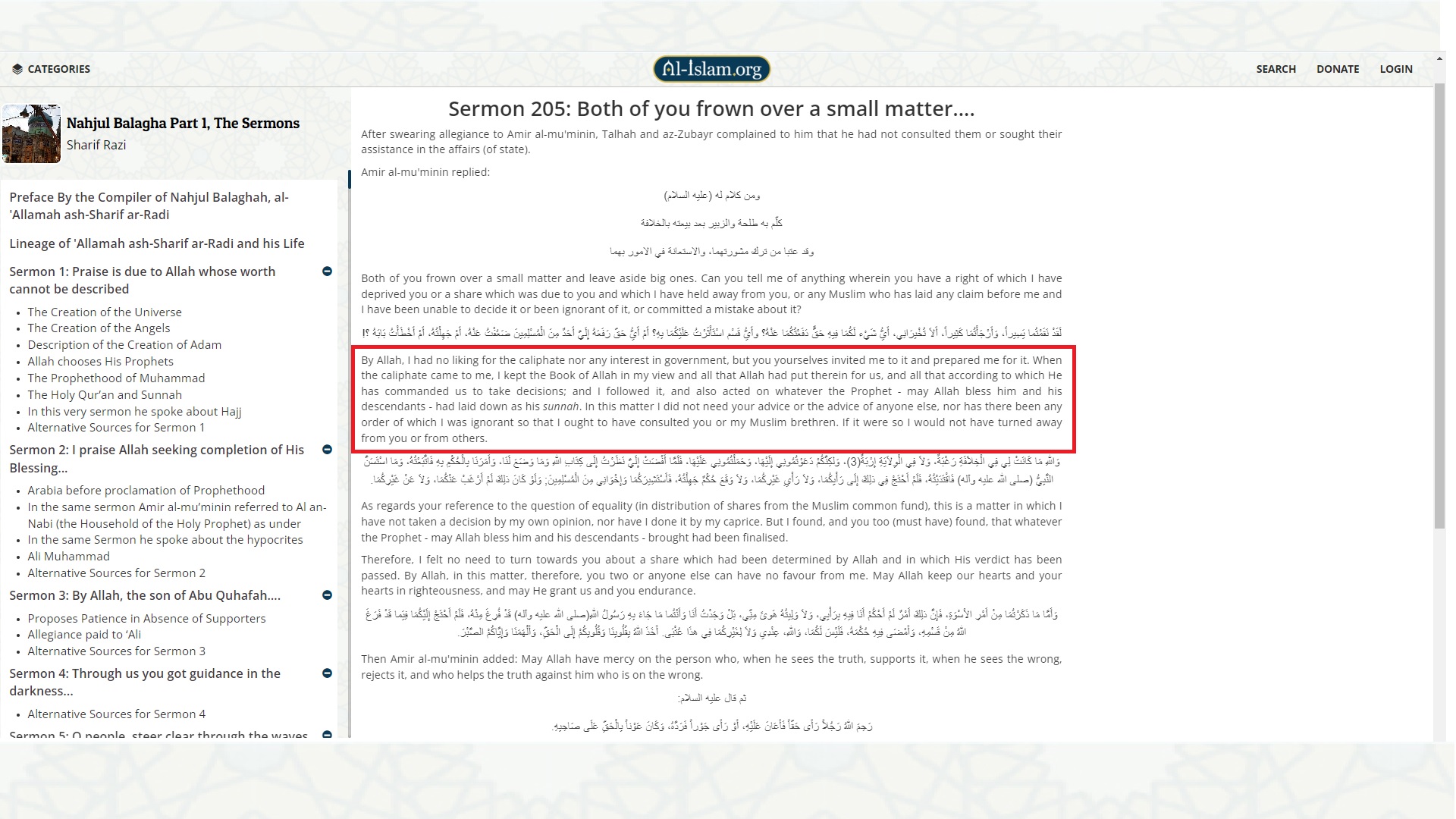
    One thing which can be taken to absolutely prove the fact that many of these traditions are fabricated is that when Ali himself went to Nahrawan to debate with the people there, after Ibn ‘Abbas (ra) was defeated, Ali did not use any of those traditions as his arguments against them.

    In fact, we challenge anyone to bring forth the claims that he did. And if he didn’t, and assuredly he did not, you have to ask yourself: Why is that?

    Indeed, no man took those traditions as his proofs and arguments during the whole period of the Ali-Mu’awiya crisis: all of them had the Qur’an as the basis for their source of evidence for the ideas they held.

    In other words, no one argued that: “Ali is with the truth and the truth is with ‘Ali: it goes with him wherever he goes.”

    Take for example:

    Where are all these quotes from the Blessed Prophet (saw) about Ali?

    Why are all these hadith that the (Shi’i) feel are effective for the Muslims of the 14th century but not seemingly not helpful at all to Ali and his contemporaries?

    This in and of itself should give the sincere researcher a cause for pause.

    If Ali is with the haqq and the haqq is with Ali, why would a good portion of the companions of the Blessed Prophet (saw) oppose Ali to begin with?!

    We could simply end all this discussion at that. Case closed.

    Then let us approach this from the angle of logic and real life scenarios.

    Al Abbas (ra) said the following about Ali.

    فَقَالَ عَبَّاسٌ: يَا أَمِيرَ الْمُؤْمِنِينَ اقْضِ بَيْنِي وَبَيْنَ هَذَا – الْكَاذِبِ الآثِمِ الْغَادِرِ الْخَائِنِ.

    So Al Abbas said: “O Commander of the Faithful, judge between me and this one – the liar, the sinful, the treacherous, the deceitful.”

    Source: (https://sunnah.com/muslim:1757c)

    The hadith above makes it seem as if Ali is always in the right no matter what. So in the scenario above where Al Abbas (ra) says to Umar (ra) about Ali, “judge between me and this one, liar, sinful, treacherous and deceitful.” How could it ever be fair? How could Umar (ra) judge at all? He could look and say, “Oh it’s Ali and the truth is with him, and he is with the truth out of my sight, Abbas!” In fact, Ali could win any court case by default with such a hadith! 

    This has all the trappings of abuse and manipulation. Especially when these types of weak hadith come to be used later in sufi tariqas and syed culture.  When real abuse and mischief happens, people are shamed and silenced. Made to think evil will befall them if they report such people. A real type of psychological terrorism.

    This is a far cry from the Blessed Prophet (saw) whom even Allah (swt) overturned a decision of his on the account of the woman who pleaded!

    The hadith above makes it seem as if Ali is always in the right no matter what. So in the scenario above where Al Abbas (ra) says to Umar (ra) says about Ali, “judge between me and this one, liar, sinful, treacherous and deceitful.” How could it ever be fair? How could Umar (ra) judge at all? He could look and say, “Oh it’s Ali and the truth is with him and he is with the truth out of my sight Abbas!” In fact, Ali could win any court case by default with such a hadith!

    Another crystal clear example of a person who did not accept that understanding is none other than Ibn Abbas (ra).

    Narrated Ibn `Abbas:

    Once the Prophet (saw) embraced me and said, “O Allah! Bestow on him the knowledge of the Book (Qur’an).”

    Source: (https://sunnah.com/bukhari:75)

    Ikrima (ra) informs us that Ali had errors in his ijtihad that would go against the Qur’an & Sunnah. That he would get corrected by a senior member of the Ahl Bayt.

    Narrated `Ikrima:

    “Some Zanadiqa (atheists) were brought to `Ali, and he burnt them. The news of this event reached Ibn Abbas, who said, “If I had been in his place, I would not have burnt them, as Allah’s Apostle forbade it, saying, ‘Do not punish anybody with Allah’s punishment (fire).’ I would have killed them according to the statement of Allah’s Apostle, ‘Whoever changed his Islamic religion, then kill him.’”

    Source: (https://sunnah.com/bukhari:6922)

    It was narrated by Anas that :

    ‘Ali came to some people of Az-Zutt, who worshiped idols and burned them. Ibn ‘Abbas said: “But the Messenger of Allah [SAW] said: ‘Whoever changes his religion, kill him.‘”

    Source: (https://sunnah.com/nasai:4065)

    Clearly Ibn Abbas (ra) did not see that the haqq nor the Qur’an was with Ali on that matter.

    Narrated from Abū ʿAbdillāh (Imām Jaʿfar al-Ṣādiq), who said: Amīr al-Muʾminīn (ʿAlī), said:
    “If it were possible for me, and if I found someone to help me, I would kill all the adherents of these sects (aṣnāf), and I would burn them with fire
    . And this is [in accordance with] the saying of Allah, Mighty and Exalted:

    ‘Say, I am only a man like you to whom it has been revealed that your God is but one God. So, whoever would hope for the meeting with his Lord – let him do righteous work and not associate anyone in the worship of his Lord’ (Qur’an 18:110).”

    Source: (Bihār al-Anwār al-Jāmiʿah li-Durar Akhbār al-Aʾimmat al-Aṭhār Volume and Page: Vol. 25, p. 265, Hadith #30)

    Prima Qur’an comments: If that is Ali’s understanding of that verse of the Qur’an, it is certainly not from any apparent reading of the text. It is a very strange take. How anyone reads the Qur’an 18:110 and takes away from it that we should burn people is shocking.

    Another point to consider is that even if those traditions are really authentic, they still do not mean that Ali does not make mistakes, especially in matters like these, which depend almost entirely on human intellectual efforts.

    For if “Ali is with the truth and the truth is with ‘Ali: it goes with him wherever he goes,” then the inevitable, logical implication is: “The Prophet is with the truth and the truth is with the Prophet (saw): it goes with him wherever he goes.”

    This is only logical. Yet, Allah (swt) has blamed the Blessed Prophet (saw) him for leaving a better way in some of his military and civil actions.

    For example, the verse states: “May Allah forgive you (O Muhammed). Why did you grant permission to them (to stay behind), until those who told the truth become clear to you, and you had known the liars? (Qur’an 9:43)” , was revealed in order to blame the Blessed Prophet (saw) for his act to allow some people who brought him false excuses so that they might be exempted from taking part in the war of Jihad.

    Typically, the verse: “O Prophet! Why do you prohibit ˹yourself˺ from what Allah has made lawful to you, seeking to please your wives? And Allah is All-Forgiving, Most Merciful.”(Qur’an 66:1) was sent down to blame the Prophet (saw) for outlawing a certain thing which Islam makes lawful to him.

    How can a person of understanding mind, therefore, claim that ‘Ali was infallible simply because the Prophet (saw) is alleged to say: “Ali is with the truth and the truth is with ‘Ali: it goes with him wherever he goes?!”

    “The Prophet (saw) is with the truth and the truth is with the Prophet (saw): it goes with him wherever he goes.”

    The logical question we ought to ask ourselves is: Was the Prophet (saw) not with the truth and the truth not with him? Of course!

    Every Muslim’s answer will be “The Prophet (saw) was with the truth every time.” Thus, if the Prophet (saw) was the most truthful, and so was with the truth ,and the truth was with him, let us ask ourselves again: was he not blamed by Allah for leaving a better way in some of his actions?

    Take for example:

    Musa b. Talha reported:

    “I and Allah’s Messenger (saw) happened to pass by people near the date-palm trees. He (the Holy Prophet) said: What are these people doing? They said: They are grafting, i. e. they combine the male with the female (tree) and thus they yield more fruit. Thereupon Allah’s Messenger (saw) said: I do not find it to be of any use. The people were informed about it and they abandoned this practice. Allah’s Messenger (saw) (was later) on informed (that the yield had dwindled), whereupon he said: If there is any use of it, then they should do it, for it was just a personal opinion of mine, and do not go after my personal opinion; but when I say to you anything on behalf of Allah, then do accept it, for I do not attribute lie to Allah, the Exalted and Glorious.”

    Source: (https://sunnah.com/muslim:2361)

    Look at what is said here:

    Worldly Affairs versus the Sacred Law

    “Imam Nawawi comments: “Scholars mention that his opinion (peace and blessings be upon him) in worldly/livelihood affairs is like the opinion of others, so the like of this [incident] is not impossible, and there is no deficiency entailed in this. The reason is the fact that their [the Companions’] central concern was the afterlife and its affairs.” [Nawawi, Sharh Sahih Muslim]”

    “Mufti Taqi Usmani mentions that the Prophet’s statement, “I don’t think that will provide any benefit,” was only based on his personal opinion and estimation, as before that, he had never himself engaged in farming and agriculture (peace and blessings be upon him). Mufti Taqi also mentions that matters such as this incident can only occur with respect to worldly affairs that are permissible (mubah), yet not with anything entailing a legal ruling of the Sacred Law, like commands, prohibitions, adjudication or legal verdicts. [Usmani, Takmila Fath al-Mulhim]”

    Source: (https://seekersguidance.org/answers/general-counsel/the-prophets-judgement-on-worldly-matters-a-commentary-on-the-hadith-on-pollination-and-affairs-of-this-world/)

    “Allah has indeed heard (and accepted) the statement of the woman who argues with you concerning her husband and carries her complaint (in prayer) to Allah and Allah (always) hears the arguments between both sides among you: for Allah hears and sees (all things). If any men among you divorce their wives by Zihar (calling them mothers), they cannot be their mothers: None can be their mothers except those who gave them birth. And in fact, they use words (both) iniquitous and false: but truly Allah is one that blots out (sins), and forgives (again and again). But those who divorce their wives by Zihar, then wish to go back on the words they uttered,- (It is ordained that such a one) should free a slave before they touch each other: You are admonished to perform: and Allah is well-acquainted with (all) that you do. And if any has not (the wherewithal), he should fast for two months consecutively before they touch each other. But if any is unable to do so, he should feed sixty indigent ones, this, that you may show your faith in Allah and His Messenger. Those are limits (set by) Allah. For those who reject (Him), there is a grievous Penalty.” (Qur’an 58: 1-4)

    As many of you may know regarding what is considered the historical context of these verses, Khawlah bint Tha‘labah (ra) went to the Blessed Messenger (saw) to complain about her husband. Many times it is reported that the Blessed Messenger (saw) gave his verdict on the matter.

    Now, this should give us pause.

    Here we have the case of this woman who, even after hearing the decision of the Blessed Messenger (saw), continued to argue with him!  In other words, the Sunnah of the Prophet (saw) wasn’t good enough for her!  That’s right.  She didn’t simply say, “Yes, Oh Messenger of Allah, thank you!”  No!  This woman went to the highest authority of justice and wisdom that there is. She took her pain directly to Allah (swt)!

    So Allah (swt) took the side of the woman over the side of the Blessed Messenger (saw)!

    Ali is nowhere near the Prophet (saw) when it comes to knowledge. So if the Blessed Prophet (saw) can make errors in worldy ijtihad, then so can Ali.

    It is clear, therefore, that the idea of “Ali being infallible on the grounds that Ali is with the truth”…is the result of the politics of lies aimed at indoctrinating people with the creed of Alism during the time when the waves of the politics of division swept the Islamic nation.

    Another example: it has also been narrated concerning Ammar bin Yasir (ra)

    “Ammar (bin Yasir) is with the truth and the truth is with Ammar (bin Yasir): it goes with him wherever he goes.”

    Source: (Ibn A’atham Al-Futuh Vol. 3, p. 269.)


    Indeed, Ali himself has been quoted as saying: “Ammar (bin Yasir) is with the truth and the truth is with ‘Ammar: it goes with him wherever he goes.”
    Source: (Ibn A’atham Al-Futuh Vol. 3, p. 129, p. 269. Similar to it has been narrated by Al-Hakim – from Hudhaifa – in his Al-Mustadrak Vol. 2, p. 162, hadith no. 2652. )

    Yet no one has ever claimed that ‘Ammar bin Yasir has been infallible, for in case the account is authentic, the meaning intended thereby is that ‘Amaar is truthful: he does not intend to do wrong – no sense of infallibility at all is produced by the account.

    Likewise with Ali. That he intends the truth, not that he is in any sense infallible.

    The hadith in question: Ali is with the Qur’an and the Qur’an is with Ali.

    Al Hakim and al Tabarani narrate — from ‘Ali ibn Hashim ibn al Barid — from his father who said — Abu Sa’id al Taymi narrated to me — from Abu Thabit, the mawla (client) of Abu Dharr

    “I was with Ali on the Day of the Battle of the Camel. When I saw ‘Aisha standing. Some of that (doubt) which entered other people (also) entered me. Allah disclosed that for me (i.e. removed from me the reservations I had to fight) at the time of Salat al Zuhr and so I fought alongside Amir al Muʾminin. When he finished, I proceeded to Madinah. I came to Umm Salamah and said, ‘I have come, by Allah, not asking for food or drink; rather, I am the mawla (client) of Abu Dharr.’ She said, ‘Welcome.’ I told her my story and so she said, ‘Where were you when the hearts flew their course (i.e. when the fighting broke out)?’ I said, ‘I was such that Allah disclosed it for me (i.e. removed the reservations I had) at noon (and then I went to fight alongside Amir al Muʾminin).’ She said, ‘Excellent! I heard the Messenger of Allah(saw) say: ‘‘Ali is with the Qur’an and the Qur’an is with Ali. They will never separate UNTIL they meet me at the Hawd (Cistern).’”

    Sources: (Mustadrak al Hakim 4628 / al Tabarani: al Mujam al Awsat, Volume 5/4880 / & al Mujam al Saghir, volume 2 /720.)

    Interestingly, these statements are not found in either Bukhari or Muslim. Neither in the Muwatta of Imam Malik nor the Musnad Al-Imam Ar-Rabi’ (Al-Jami’ Al-Sahih).

    Chain analysis: a look at the sanad (chain of narrators)

    Al Hakim says, “This hadith has a sahih (authentic) chain of transmission. Abu Sa’id al Taymi is (Abu Sa’id al Taymi) al ‘Aqisaʾ. He is a thiqah (reliable) and maʾmun (trustworthy). Imam al Bukhari and Imam Muslim did not include it in their respective collections.”

    Dinar Abu Sa’id ‘Aqisa al Tamimi (or al Taymi) is not as al Hakim supposed.

    Imam al Nasaʾi says he is not a thiqah (reliable).

    Al Daraqutni says he is matruk al Hadith (suspected of forgery).

    Al Sa’di says he is not a thiqah (reliable).

    Additionally, Abu Thabit could not be traced. The identity of  Abu Thabit is a bit of a mystery, he is not mentioned in the books of Hadith narrators. So, Thabit is Majhul (unknown)

    Therefore, this hadith is etiolated, totally weak.

    Some time on Al Hakim Al Naysaburi

    Al-Hakim, Muhammed ibn Abd Allah ibn Muhammed ibn Hamduyah, Abu Abd Allah al-Dabbi al-Tamhani al-Naysaburi al-Shafi’i, also known as Ibn al-Bayyi.

    Al-Hakim is known among the people of Hadith to be mutasahil (lenient hadith critic).

    Al-Hakim’s Mustadrak was criticized by Hadith scholars due to the number of mistakes and inaccuracies found in it. Al-Sakhawiin alilan wal-Tawbikh and others mention that he declares many forged reports to be rigorously authentic; up to 100, according to some authorities. This is not to mention extremely weak ones. Instead of clinging to his own expressed precondition, he only reports with the chains of the rank of the status of Bukhari and Muslim. For example, he narrates in the Musadrak from Ibn Abbas that Allah revealed to the Blessed Messenger (saw), the following:

    “I have killed seventy thousand [in punishment] for [the murder of] Yahya ibn Zakariyya and I will kill seventy thousand times seventy thousand [in punishment] for [the murder of] your daughter’s son al-Husayn.”

    Al-Hakim said this report has a sound chain, while Al-Dhahabi added: “By the criterion of Muslim” but Ibn Hibban said this hadith is untraceable (la asla lahu), Al-Dhahabi himself rejected its matn as munkar in the Siyar while Ibn Kathir similarly declared it “highly anomalous” (gharib jiddan) in al-Bidaya. [1]

    Sources: Ibn Hibban, al-Majruhin (2:215), al-Khatib, Tarikh Baghdad (1:142), al-Hakim(1990 ed 2:319, 2:648, and 3:195), Fayd al-Qaiîr (1:205), Tadhkirat al-Huffaz (1:77 gharib), Mizan (sv. Qâsim ibn Ibrahim al-Hashimi), and Siyar (Risala ed 4:342-343).

    Some say Al-Dhahabi went to excess in regretting that al-Hakim had compiled the Mustadrak in the first place.

    “It would have been better if al-Hakim had never compiled it!” as mentioned by Dr. Bashshar Awward Maruf in his doctoral thesis.”

    Source: (al-Dhahabi wa Manhajuhu fi Kitabihi Tarikh al-Islam.)

    His classing al-Hakim “among those who are lenient, like al-Tirmidhi” does not apply to al-Hakim in absolute terms but only to his grading of narrations in the Mustadrak, which the Scholars pointed out he compiled in his old age, intending to revise it, a task left unfinished beyond the first volume.


    Sources: Dhikr Man Yutamadu Qawluhu fil-Jarh wal-Tadil (p.172) & (Cf. Al-Sakhawi, Fath al-Mughith (1:36) and Mamduh, Raf` al-Minara (p. 153 n. 1).

    This is proven by the fact that al-Hâkim’s mistakes are fewer in the first volume of the Mustadrak, as shown by al-Dhahab’s own minimal corrections there. “Outside the Mustadrak,” Shaykh Mahmud Mamduh said, “his positions are as strict as those of the meticulous Imams of hadith”

    Source: (al-Sakhawi, Fath al-Mughith (1:36) and Mamduh, Raf` al-Minara p. 153 n.)

    Prima Qur’an comments:

    A look at the matn.

    Abu Thabit had to identify himself to Umm Salamah.

    He twice claims that Allah (swt) had removed his reservations to fight alongside Ali. He actually says this twice. It was at the time of the afternoon prayer. He doesn’t disclose how.

    The hadith contradicts another hadith (below) where he is also the transmitter in which the text (matn) is changed.

    Ali is with the qur’an and the qur’an is with Ali. They will never separate until they meet me at the Hawd (Cistern)

    Ali is with the truth and the truth is with ‘Ali. They will never separate UNTIL they both arrive at the Hawd (Cistern) on the Day of Judgment

    This stand-out line would not be difficult for someone to recall. The fact that the narrator redacts words in the mouth of Umm Salamah and cannot get the facts straight shows that they are confused.

    The Qur’an is all truth but not all truth is the Qur’an.

    In the second version of the hadith of Abu Thabit, there is no mention of his own doubts with regard to standing with Ali or his change of heart at the afternoon prayer.

    Also, in the second version, it is simply that he came upon Umm Salamah. In the second version he does not need to identify himself to her.


    The Hadith of Umm Salamah

    This hadith comes to us via two ways:

    The first is as follows:

    Al Khatib narrates from ‘Abdul Salam ibn Salih — ‘Ali ibn Hashim ibn al Barid — narrated to us — from his father — from Abu Sa’id al Tamimi — from Abu Thabit, the mawla (freed slave) of Abu Dharr who said, “I entered the presence of Umm Salamah and saw her crying. She was mentioning the name of ‘Ali and said, ‘I heard the Messenger of Allah (saw),’” saying Ali is with the truth and the truth is with ‘Ali. They will never separate until they both arrive at the Hawd (Cistern) on the Day of Judgment.

    Source: (Al Khatib: Tarikh Baghdad, 14/321.)

    Chain analysis: a look at the sanad (chain of narrators)

    ‘Abdul Salam Ibn Salih is al Harawi. It has been mentioned previously that he is suspected of lying.

    Al Haythimi said he is weak. Source: (Majma’ al Zawa’id vol. 9 pg. 114)

    Dhahabi said he is censured: Source: (Siyar vol. 11 pg. 447)

    He is accused of being a forger of hadith and one who steals chains to invent things.

    Sources: (Al Kamil fi al Du’afa’ vol. 5 pg. 177) & (Lisan al Mizan vol. 4 pg. 144)

    He is accused of lying and hadith forgery. Source: Mizan al I’tidal vol. 5 pg. 220.

    Abu Sa’id Dinar is not a thiqah (reliable). He is matruk al hadith (suspected of forgery).

    Abu Thabit could not be traced. He is mahjul (unknown)

    Ibn Taymiyyah did not find a chain of transmission for this hadith; consequently, he denied it.

    Source: (Ibn Taymiyyah: Minhaj al Sunnah al Nabawiyyah, 4/238)

     However, there is a chain via Abu Ya’la here:

    The Hadith of Abu Sa’id

    Abu Ya’la narrates — Muhammed ibn ‘Abbad al Makki narrated to us — Abu Sa’id narrated to us — from Sadaqah ibn al Rabi’ — from ‘Umarah ibn Ghaziyyah — from ‘Abdul Rahman ibn Abi Sa’id — from his father that ‘I heard the Messenger of Allah (saw) ,’” saying Ali is with the truth and the truth is with ‘Ali. They will never separate UNTIL they both arrive at the Hawd (Cistern) on the Day of Judgment.

    Source: (Abu Ya’la: Musnad Abi Ya’la, hadith no. 1052.)

    Chain analysis: a look at the sanad (chain of narrators)

    Sadaqah ibn al Rabi’ is regarded as a thiqah (reliable) by Ibn Hibban.

    Source: (Ibn Hibban: Kitab al Thiqat, 8/319)

    Ibn Hibban is known for deeming majhul (unknown) narrators as reliable.

    Ibn Abi Hatim mentions a biography about Sadaqah ibn al Rabi’. However, he did not make mention of any jarh (impugning statement) or ta’dil (statement of approval). Thus, his status is unknown. Neither favourable nor unfavourable.

    Source: (Ibn Abi Hatim: Kitab al Jarh wa al Ta’dil, 4/433.)

    Abu Sa’id is the mawla (freed slave) of Banu Hashim. There is a difference of opinion regarding his status. The better opinion is that he is Hassan al hadith (fair in hadith). However, this type of hadith from him is unacceptable.

    In short, the hadith is da’if (weak); the first chain of transmission is saqit (wholly unreliable) and the second chain of transmission is da’if (weak).

    Lastly, Allah (swt) has made it clear that we are a broken humanity. Yet, he showers abundant grace and mercy upon us all.

    “If Allah were to punish people ˹immediately˺ for their wrongdoing, He would not have left a single living being on earth. But He delays them for an appointed term. And when their time arrives, they cannot delay it for a moment, nor could they advance it.” (Qur’an 16:61)

    In other words if Allah (swt) wanted to exact due measure and justice for the failings of humanity this whole planet would be turned to ash. Everyone. No one is exempted.

    I leave you with this final verse to reflect upon.

    “These are the verses of Allah which We recite to you in truth. Then in what statement after Allah and His verses will they believe?” (Qur’an 45:6)

    You maybe interested in reading the following:

    May Allah (swt) guide the Ummah!

    May Allah forgive the Ummah!

    1 Comment

    Filed under Uncategorized

    Salafiyyah using mantiq (logic) and aql (reasoning) to deny attributes of Allah?

    “Creator of the heavens and the earth. He has made for you from yourselves, mates, and among the cattle, mates; He multiplies you thereby. There is nothing like unto Him, and He is the Hearing, the Seeing.” (Qur’an 42:11)

    ﷽ 

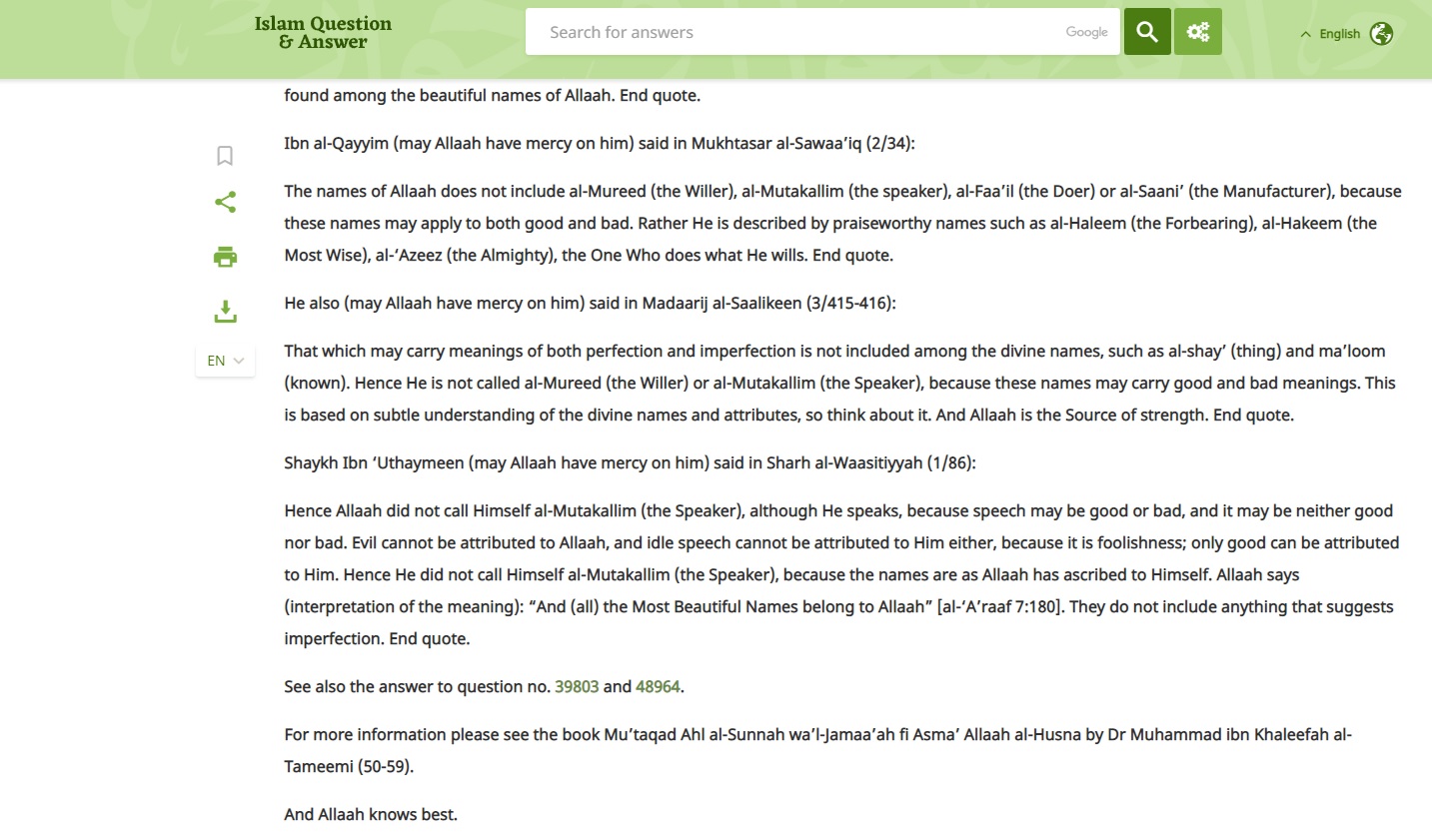
    Why does Allah not call Himself al-Mutakallim (the Speaker)?

    This was a question that was sent to a Salafi Q & A and the response was quite shocking. Not only do the Salafi use logic and reasoning to reject attributes of Allah (swt) they use flawed logic and reasoning to do so.

    You may find this article very eye opening: https://islamqa.info/en/answers/99624/why-does-allaah-not-call-himself-al-mutakallim-the-speaker

    Praise be to Allah.

    In order to make it clearer, we could word the question differently and say: 

    Is it permissible to derive from the attributes and actions of Allaah that He has confirmed for Himself names for Him by which He may be called and by which His slaves may call upon Him, and which may be added to the list of His names so as to attain the reward mentioned in the hadeeth of the Prophet (peace and blessings of Allaah be upon him) “Allaah has ninety-nine names. Whoever memorizes them will enter Paradise” Narrated by al-Bukhaari (2736) and Muslim (2677), or are there guidelines concerning the derivation of His names from His attributes and actions? 

    It is essential first of all to ascribe wisdom to Allaah, may He be exalted, for He is absolutely perfect, and He is to be named and described in a manner that is befitting to Him. People should be guided by that which He has told them in His Book of His perfection, majesty and might; to Him all things return and He has great wisdom. 

    But we shall try to understand His names and attributes based on what is mentioned in the Qur’aan and Sunnah, and ponder that so that we might derive some guidelines for defining His most beautiful names. 

    The scholars differed concerning that which the brother asked about, which let them to differ concerning the number of the beautiful names of Allaah and definition of guidelines concerning them. Some of them regarded it as the matter of worship only, in which there is no room for ijtihaad and qiyaas (analogy), as was the view of Ibn Hazm. Some of them were very lenient about this matter and allowed calling Allaah by names such as al-Mutakallim (the Speaker), al-Mureed (the Willer) and every other word by which Allaah is described in the Qur’aan and Sunnah. This was the view of Ibn al-‘Arabi al-Maaliki and others. 

    Some scholars took a middle approach; they studied the reports of the divine names and found that if an attribute implied a sense of praise only and could not be taken as implying imperfection or fault in any way, such as hearing and sight, then in the texts names were derived from it, so Allaah called Himself al-Samee’ (the All-Hearing) and al-Baseer (the All-Seeing). 

    But if an attribute could be taken as implying imperfection in some way, such as speaking, for example, as speaking may include lying, wrongdoing and other bad meanings, in which case it is a shortcoming and silence is preferable to it, so we do not find a divine name that is derived from this attribute, so we do not find that one of the names of Allaah is al-Mutakallim (the Speaker). 

    This was the view of the great scholar Ibn Taymiyah and his student Ibn al-Qayyim, and it is the view of most of our contemporary scholars. 

    Ibn Taymiyah (may Allaah have mercy on him) said in Sharh al-‘Aqeedah al-Isfahaaniyyah (1/19-20): 

    As for calling Allaah, may He be exalted, Mureed (Willer) and Mutakallim (Speaker),  

    These two names are not mentioned in the Qur’aan, or among the well known divine names. Their meanings are true, but the well known divine names are those by which Allaah may be called upon, and are mentioned in the Qur’aan and Sunnah, and which imply perfection and praise in and of themselves. 

    Knowledge, power, mercy and so on are in and of themselves praiseworthy attributes, and the names which point to them are praiseworthy names.  

    As for speech and will, they may be divided into praiseworthy types such as truthfulness and justice, and blameworthy types such as wrongdoing and lying. Allaah can only be described in praiseworthy terms, not blameworthy ones, hence His names do not include al-Mutakallim (the Speaker) or al-Mureed (the Willer). End quote. 

    He also (may Allaah have mercy on him) said in Bayaan Talbees al-Jahamiyyah (2/10-11): 

    Allaah has the most beautiful names, by which He has called Himself, and has revealed them in His Book and taught to whomever He willed among His creation, such as al-Haqq (the Truth), al-‘Aleem (the All-Knowing), al-Raheem (the Most Merciful), al-Hakeem (the Most Wise), al-Awwaal (the First), al-Aakhir (the last), al-‘Aliy (the Most High), al-‘Azeem (the Almighty), al-Kabeer (the Most Great) and so on. 

    All of these names are names of praise which indicate praiseworthy meaning, and have no blameworthy meaning. To Allaah belong the most beautiful names, and He is perfect in all ways. Names which are more general in meaning and may be applied to both good and bad things are not found among the beautiful names of Allaah. End quote. 


    Ibn al-Qayyim (may Allaah have mercy on him) said in Mukhtasar al-Sawaa’iq (2/34):

    The names of Allaah does not include al-Mureed (the Willer), al-Mutakallim (the speaker), al-Faa’il (the Doer) or al-Saani’ (the Manufacturer), because these names may apply to both good and bad. Rather He is described by praiseworthy names such as al-Haleem (the Forbearing), al-Hakeem (the Most Wise), al-‘Azeez (the Almighty), the One Who does what He wills. End quote. 

    He also (may Allaah have mercy on him) said in Madaarij al-Saalikeen (3/415-416): 

    That which may carry meanings of both perfection and imperfection is not included among the divine names, such as al-shay’ (thing) and ma’loom (known). Hence He is not called al-Mureed (the Willer) or al-Mutakallim (the Speaker), because these names may carry good and bad meanings. This is based on subtle understanding of the divine names and attributes, so think about it. And Allaah is the Source of strength. End quote. 

    Shaykh Ibn ‘Uthaymeen (may Allaah have mercy on him) said in Sharh al-Waasitiyyah (1/86): 

    Hence Allaah did not call Himself al-Mutakallim (the Speaker), although He speaks, because speech may be good or bad, and it may be neither good nor bad. Evil cannot be attributed to Allaah, and idle speech cannot be attributed to Him either, because it is foolishness; only good can be attributed to Him. Hence He did not call Himself al-Mutakallim (the Speaker), because the names are as Allaah has ascribed to Himself. Allaah says (interpretation of the meaning): “And (all) the Most Beautiful Names belong to Allaah” [al-‘A’raaf 7:180]. They do not include anything that suggests imperfection. End quote.  

    See also the answer to question no. 39803 and 48964. 

    For more information please see the book Mu’taqad Ahl al-Sunnah wa’l-Jamaa’ah fi Asma’ Allaah al-Husna by Dr Muhammad ibn Khaleefah al-Tameemi (50-59). 

    And Allaah knows best.

    PRIMA QUR’AN COMMENTS:

    Well, can you imagine the Athari/ Salafiyyah making a big fuss about the Qur’an being the speech of Allah (swt) and than claiming that speech is an attribute of Allah (swt) and than turning around and admitting that Allah (swt) never called Himself “Al-Mutakallim”.

    Then, saying that this is not appropriate to call Allah (swt) as Al-Mutakallim because speech may be good or bad! Yet they claim evil cannot be attributed to Allah (swt).

    Pardon me for being more Athari than the Athari, but if your basic principle is that Allah (swt) cannot lie and that Allah (swt) does no evil than attributing the name of Al Mutakallim to Allah (swt) based upon that alone is not problematic.

    Likewise simple logic. If the basic principle is that Allah (swt) cannot lie and that Allah (swt) does no evil and wills no evil than there is no harm in attributing the name of Al-Mureed. How can it be imagined that Allah (swt) wills evil?

    In fact by the logic and the reasoning that the Athari/Salafi use in the above article you could reject the names of All Seeing and All Hearing.

    Why? Because it is possible to hear gossip, and vile things. It is possible to witness and see vile and evil things.

    Certainly Allah (swt) hears (perceives) and sees (knows) that which we as believers are forbidden to listen to and see. Allah (swt) has full grasp of all knowledge.

    So the reasoning and logic given by the Athari/Salafi for rejecting the names of Al-Mureed or Al Mutakallim are not sound nor consistent.

    That which may carry meanings of both perfection and imperfection is not included among the divine names, such as al-shay’ (thing) and ma’loom (known)

    Notice that they do not believe it is appropriate to call Allah (swt) al-shay (The Thing). Not a thing (one among many) but The Thing.

    Things brings them directly in conformity with Mu’tazilite/Ashari/Māturīdī theology.

    Why?

    Qur’an 42:11 the verse quoted in the beginning of the article the Arabic text states:

    “laysa kamith’lihi shayon” (There is not like Him anything).

    So, there is even a textual evidence that someone could come along and say, “We say Allah (swt) is a thing unlike other things.” Yet, this is not a good descriptor of The Divine.

    There are no two things alike. Even things we deem identical have different properties and/or attributes.

    Look what they quote from Ibn Al Qayyim above:

    “That which may carry meanings of both perfection and imperfection is not included among the divine names, such as al-shay’ (thing) and ma’loom (known). Hence He is not called al-Mureed (the Willer) or al-Mutakallim (the Speaker), because these names may carry good and bad meanings. This is based on subtle understanding of the divine names and attributes, so think about it.”

    This is based on subtle understanding of the divine names and attributes, so think about it“-Ibn Al Qayyim

    Mash’Allah now only if our Athari/Salafi friends would think about it!

    May Allah (swt) guide the to the haqq!

    May Allah (swt) Forgive the Ummah! May Allah (swt) Guide the Ummah!

    Leave a comment

    Filed under Uncategorized

    Response to Shi’i “You are to me as Aaron is to Moses”

    (After rebuking his people) Moses turned to Aaron and said: “Aaron! What prevented you, when you saw them going astray, from following my way? Have you disobeyed my command? Aaron answered: “Son of my mother! Do not seize me with my beard, nor by (the hair of) my head. I feared that on returning you might say: ‘You sowed discord among the Children of Israel, and did not pay heed to my words.” (Qur’an 20:91-93)

    ﷽ 

    This is in response to other hadith that the Shi’i often use. They try to justify their claims of Ali being the correct or rightful Imam of the Muslims after the Blessed Messenger (saw).

    It is another example (of many) of them making a mountain out of a molehill.

    The following hadith comes to mind:

    Narrated Sa`d:

    Allah’s Messenger (saw) set out for Tabuk, appointing Ali as his deputy (in Medina). Ali said, “Do you want to leave me with the children and women?” The Prophet (saw) said, “Will you not be pleased that you will be to me like Aaron to Moses? But there will be no prophet after me.”

    Source: https://sunnah.com/bukhari:4416

    This hadith is about the honour of present trust and not future succession.

    Alas, we also have the following:

    Narrated ‘Uqbah bin ‘Amir:

    That the Messenger of Allah (saw) said: “If there was to have a Prophet after me, it would have been ‘Umar bin Al-Khattab.”

    Source: https://sunnah.com/tirmidhi:3686

    The hadith about Umar (ra) neutralizes any attempt to single out Ali for a uniquely elevated status.

    This hadith (https://sunnah.com/bukhari:4416) shows clear as daylight that Ali was not pleased being left to take charge of the affairs of the people of Medina. So how much more the whole Ummah?!

    Rather than seeing this as an honor bestowed upon him as one being the most trustworthy to take care of the most vulnerable, Ali saw it as a slight.

    So not being content with trusting his station to his Imam, which is none other than the Blessed Messenger (see), Ali quipped, “Do you want to leave me with the children and women?”

    Was Ali not aware of this verse of the Qur’an?

    Whoever obeys the Messenger has truly obeyed Allah. But whoever turns away, then ˹know that˺ We have not sent you ˹O Prophet˺ as a keeper over them.” (Qur’an 4:80)

    Because the Shi’i cannot prove their case for the concept of the Imamate of Ahl Bayt from the Qur’an, they must quickly pivot the conversation to Hadith, which they feel justifies their position.

    The Blessed Prophet (saw) is said to have replied to the recalcitrant Ali,

    Will you not be pleased that you will be unto me like Aaron to Moses? But there will be no prophet after me.”

    Somehow, the Shi’i seemed to close their eyes over the fact that the Blessed Messenger (saw) was trying to console his otherwise temperamental cousin.

    Perhaps Ali sought glory or standing on the battlefield? Allah (swt) knows best. Yet, the Blessed Messenger (saw) gave Ali a more noble task than what Ali could have longed for.

    The Shi’i run wild.

    So, the Shi’i became laser focused on the part: “You will be unto me like Aaron to Moses? But there will be no prophet after me.”

    They start to surmise that this must be a strong indication that Ali, without a doubt, is the one who will lead the Muslims after the Blessed Messenger (saw) is gone.

    So they start to imagine that the Blessed Messenger (saw) said things that he did not say. For example, the Hadith says, ‘no prophet after me’ but it does not say ‘no messenger after me’.

    So perhaps Ali could be a Messenger after the Prophet Muhammed (saw) ?

    The Shi’i who are known to be lovers of Qiyas (analogy) so well …maybe just this once.. 😉 🤫

    So, with the above hadith in tow, we can quickly turn to the Qur’an and find:

    “We made an appointment of thirty nights with Moses (On Mount Sinai), to which We added ten more; so the term set by the Lord was completed in forty nights. Moses said to Aaron, his brother: “Deputize for me ((ukh’luf’nī) among my people. Dispose rightly, and do not follow the way of the authors of evil.” (Qur’an 7:142)-Ahmed Ali

    “And We treated with Musa thirty nights, and We completed them with ten; so the appointment of his Lord was completed by forty nights. And Musa said unto his brother Harun: act thou (ukh’luf’nī) in my place among my people, and rectify, and follow not the way of the corrupters.” (Qur’an 7:142)=Abdul Majid Daryabadi

    As archaic and jumbled as Abdul Majid Daryabadi’s translation sounds to us, it best represents both the Arabic and the context. Although Ahmed Ali’s translation is good as well.

    As always, because we are not here to tell you how to think or what to think, but for you to research and come to your own conclusions, please proceed to:

    https://www.islamawakened.com/quran/7/142/

    Even some of the more modern translations do a very horrible job of translating the verse:

    For example, Sahih International has:

    “And We made an appointment with Moses for thirty nights and perfected them by [the addition of] ten; so the term of his Lord was completed as forty nights. And Moses said to his brother Aaron, “Take my place among my people, do right [by them], and do not follow the way of the corrupters.” (Qur’an 7:142)


    Take my place.” No. Moses was not going anywhere permanently. Moses went somewhere briefly.

    The following translators translate (ukh’luf’nī) in a Shi’i friendly manner.


    Dr. Laleh Bakhtiar-Iranian Christian translator
    Muhammed Mahmoud Ghali -Al Ahzar
    Ali Quli Qara’i -Shi’i translator
    Ali Bakhtiari Nejad -Shi’ia translator
    The Monotheist Group [2013 Edition]-Quranist

    The following translates the verse that we feel best expresses the meaning of ukh’luf’nī given the context.

    Abdul Majid Daryabadi
    Ahmed Ali
    Hamid S Aziz
    A.L Bilal Muhammed et al
    Mushraff Hussain
    Mohammed Shafi

    So we know that it cannot mean to “take my place” permanently because Moses came back. We also know that it cannot mean taking my place in succession. How do we know this?

    The historical data does not support this.

    “Now Joshua son of Nun was filled with the spirit of wisdom because Moses had laid his hands on him. So the Israelites listened to him and did what the Lord had commanded Moses.” (Deuteronomy 34:9)

    The following, which is quite literally, is titled: Joshua to Succeed Moses.

    Then Moses went out and spoke these words to all of Israel: “I am now a hundred and twenty years old, and I am no longer able to lead you. The Lord has said to me, ‘You shall not cross the Jordan.’ The Lord your God himself will cross over ahead of you. He will destroy these nations before you, and you will take possession of their land. Joshua also will cross over ahead of you, as the Lord said. And the Lord will do to them what he did to Sihon and Og, the kings of the Amorites, whom he destroyed along with their land. The Lord will deliver them to you, and you must do to them all that I have commanded you. Be strong and courageous. Do not be afraid or terrified because of them, for the Lord your God goes with you; he will never leave you nor forsake you.”

     Then Moses summoned Joshua and said to him in the presence of all Israel, “Be strong and courageous, for you must go with this people into the land that the Lord swore to their ancestors to give them, and you must divide it among them as their inheritance.  The Lord himself goes before you and will be with you; he will never leave you nor forsake you. Do not be afraid; do not be discouraged.”

    Source: (https://www.biblegateway.com/passage/?search=Deuteronomy%2031%3A1-8&version=NIV)

    SHI’I HAVE NO TIME FOR CONTEXT ??

    Next time your overly excited Shi’a friend starts to tell you about the above Hadith and quotes the above verse of the (Qur’an 7:142), inform them what it says just 8 verses later.

    “And when Moses returned to his people, angry and grieved, he said, “How wretched is that by which you have replaced me after [my departure]. Were you impatient over the matter of your Lord?” And he threw down the tablets and seized his brother by his head, pulling him toward him. [Aaron] said, “O son of my mother, indeed the people oppressed me and were about to kill me, so let not the enemies rejoice over me and do not place me among the wrongdoing people.” (Qur’an 7:150)

    “And recall when We summoned Moses for a term of forty nights, and then you set up the calf as your god in his absence. You indeed committed a grave wrong.” (Qur’an 2:51)

    Moses scolded, “O Aaron! What prevented you, when you saw them going astray, from following after me? How could you disobey my orders? Aaron pleaded, “O son of my mother! Do not seize me by my beard or my head. I really feared that you would say, ‘You have caused division among the Children of Israel, and did not observe my word.’” (Qur’an 20:92-94)

    So, if the Shi’i want to make Ali analogous to Harun (as) in a very literal way, we have some real problems.

    Let us replace the words Moses (as) with the Prophet Muhammed (saw) and wewill replace Aaron (as) with Ali and let us see how this works.

    “And when Muhammed returned to his people, angry and grieved, he said, “How wretched is that by which you have replaced me after [my departure]. Were you impatient over the matter of your Lord?” And he threw down the tablets and seized Ali by his head, pulling him toward him. [Ali] said, “O son of my mother, indeed the people oppressed me and were about to kill me, so let not the enemies rejoice over me and do not place me among the wrongdoing people.” (Qur’an 7:150)

    Muhammed scolded, “O Ali! What prevented you, when you saw them going astray, from following after me? How could you disobey my orders? Ali pleaded, “O son of my mother! Do not seize me by my beard or my head. I really feared that you would say, ‘You have caused division among the Children of Israel, and did not observe my word.’” (Qur’an 20:92-94)

    Are we to believe that it only takes the Prophet Muhammed (saw) to be gone for 40 days as Ali, fearing for his life, allows the people to fall into blatant shirk?

    Are we to believe there could be a scenario where the Blessed Prophet Muhammed (saw) is so furious with Ali that he snatches him up by his beard?!

    Are we to believe there is a scenario where the Blessed Prophet (saw) scolded Ali for disobeying his orders? Even to the point where Ali feared that the Blessed Prophet (saw) would say that he (Ali) caused division among the Muslims?


    Keep in mind that Moses (as), like the Blessed Prophet Muhammed (saw) would have been given knowledge by Allah (swt) that Aaron (as) was not, in any way shape or form, in dereliction of his duties. Yet Musa (as) snatched Aaron (as) up!

    We do not believe these are things the Shi’i are willing to entertain regarding Ali.

    The Moses Aaron comparison is also devastating to Shi’i claims.

    Why? Because they do not have equal authority.

    “When there comes to them some matter touching (public) safety or fear, they divulge it. If they had only referred it to the Messenger, or to those charged with (ulī l-amri) authority among them, the proper investigators would have tested it for them (direct). Were it not for the Grace and Mercy of Allah unto you, all but a few of you would have fallen into the clutches of Satan.” (Qur’an 4:83)

    Aaron did not have the knowledge of the divine will that Moses had.

    I really feared that you would say, ‘You have caused division among the Children of Israel, and did not observe my word.’

    “And [recall] when Moses said to his people, “O my people, indeed you have wronged yourselves by your taking of the calf [for worship]. So repent to your Creator and kill yourselves [i.e., the guilty among you]. That is best for [all of] you in the sight of your Creator.” Then He accepted your repentance; indeed, He is the Accepting of Repentance, the Merciful.” (Qur’an 2:54)

    This line: “I really feared that you would say, ‘You have caused division among the Children of Israel, and did not observe my word.” This absolutely does not refer to Ali ibn Abi Talib at all! This was a man who, instead of pursuing the killers of Uthman, wasted no time in collecting his army to go fight the people of Sham!


    Translation of the above:

    “This year of his caliphate, the Commander of the Faithful, Ali ibn Abi Talib, assumed leadership and appointed governors over the regions. He appointed Abdullah ibn Abbas over Yemen, Samurah ibn Jundab over Basra, Imarah ibn Shihab over Kufa, Qays ibn Sa’d ibn Ubadah over Egypt, and over Syria, Sahl ibn Hunayf in place of Muawiyah. Sahl marched until he reached Tabuk, when the close associates of Muawiyah met him and said, “We want to say…” It was said, “He knows.” They said, “We want to say…” It was said, “He knows.” They then said, “If Uthman sent you in his capacity [as the rightful caliph, then proceed], but if it was someone else, then go back.” They said, “Have you not heard what happened?” They replied, “Yes.” So he returned to Ali.”

    “As for Qays ibn Sa’d, the people of Egypt differed concerning him. The majority pledged allegiance to him, but a group said, “We will not pledge allegiance until the killers of Uthman are brought to us.” The situation was similar in Basra. As for Imarah ibn Shihab, who was sent as governor to Kufa, Talhah ibn Khuwaylid prevented him from entering out of anger for Uthman. He returned to Ali and informed him. The strife intensified, the matter became grave, and opinions differed. Abu Musa wrote to Ali informing him of the obedience and pledge of allegiance of the people of Kufa, except for a few. Ali sent many letters to Muawiyah, but he did not receive any reply. This continued repeatedly until the third month after the murder of Uthman, in Safar.”

    Then Muawiyah sent a scroll with a man who came to Ali. Ali asked, “What news do you bring?” The man replied, “I come to you from people who desire nothing but revenge, deeply aggrieved. I left seventy thousand elderly men gathered under the shirt of Uthman, which is displayed on the pulpit of Damascus.” Ali said, “O Allah, I declare myself innocent before You of the blood of Uthman.” Then the messenger of Muawiyah left Ali’s presence, and those Kharijites who had killed Uthman intended to kill him, but he barely escaped after much effort.”

    Ali, may Allah be pleased with him, resolved to fight the people of Syria. He wrote to Qays ibn Sa’d in Egypt, urging the people to mobilize for fighting them, and to Abu Musa in Kufa. He also sent word to Uthman ibn Hunayf about this. He addressed the people, inciting them for that purpose. He was determined to prepare and depart from Medina, appointing Qutham ibn Abbas as his deputy over it. He was resolved to fight, with those who obeyed him, against those who disobeyed him, rebelled against his command, and did not pledge allegiance to him along with the people.”

    His son, Al-Hasan ibn Ali, came to him and said, “O my father, abandon this, for it involves the shedding of Muslim blood and the occurrence of division among them.” But he did not accept that from him; rather, he insisted on fighting and organized the army. He gave the standard to Muhammed ibn al-Hanafiyyah, appointed Ibn Abbas to be in charge of important matters, and Umar ibn Abi Salama over the vanguard. It is also said he appointed Umar ibn Sufyan ibn Abd al-Assad over the vanguard. He appointed as the commander of his advance guard Abu Layla ibn Amr ibn al-Jarrah, the nephew of Abu Ubaydah. He appointed Qutham ibn Abbas as his deputy over Medina. Nothing remained except for him to depart from Medina heading towards Syria, until there came to him what diverted him from all of that, which we will mention.”

    Source: Al-Bidāyah wa al-Nihāyah (البداية والنهاية) by Ibn Kathir Volume: around Vol. 7 or 8 (depending on the edition)

    Prima Qur’an comments:

    1. Ali claimed that he is in Bara’ah with those who killed Uthman.
    2. He did not spend his time looking for these killers. Ali did not seem concerned at all about finding the killers of Uthman.
    3. Trying to find the killers of Uthman could have easily disuaded the tension or at the very least exposed Muawiyah as a hypocrite.
    4. Rather, Ali wasted no time in raising an army for the continued fighting, and killing and slaughter among the Muslims.
    5. Al Hasan ibn Ali was much wiser than his father (Ali), who was spoiling for a fight.

    Look at the words of Al Hasan ibn Ali.

    “O my father, abandon this, for it involves the shedding of Muslim blood and the occurrence of division among them.” But he (Ali) did not accept that from him.”

    So try to apply the following statement of Aaron (as) to Ali : “I really feared that you would say, ‘You have caused division among the Children of Israel, and did not observe my word.” This absolutely does not apply to Ali.

    In addition to that, we have the following:

    Narrated by ‘Abdullah bin Abbas

    “Ali bin Abu Talib came out of the house of Allah’s Apostle during his fatal illness. The people asked, “O Abu Hasan (i.e. Ali)! How is the health of Allah’s Apostle this morning?” ‘Ali replied, “He has recovered with the Grace of Allah.” ‘Abbas bin ‘Abdul Muttalib held him by the hand and said to him, “In three days you, by Allah, will be ruled (by somebody else), And by Allah, I feel that Allah’s Apostle will die from this ailment of his, for I know how the faces of the offspring of ‘Abdul Muttalib look at the time of their death. So let us go to Allah’s Apostle and ask him who will take over the Caliphate. If it is given to us we will know as to it, and if it is given to somebody else, we will inform him so that he may tell the new ruler to take care of us.” ‘Ali said, “By Allah, if we asked Allah’s Apostle for it (i.e. the Caliphate) and he denied it us, the people will never give it to us after that. And by Allah, I will not ask Allah’s Apostle for it.”

    Source: https://sunnah.com/bukhari:4447

    1. It is quite clear that Ibn Abbas was not aware of any Shi’i interpretations that Ali should be the one to lead the Muslims after the death of the Blessed Prophet (saw).
    2. Ali himself was not of the understanding that it was something that was his to take simply by being related to the Blessed Prophet (saw).
    3. This is another reason why it is best to make the Qur’an the pillar of our theology and faith, as the hadith themselves have narrations that the Shi’i themselves wince at.

    Then there is this straight from Nahjul balagha itself. Straight from a Shi’i website:

    “By Allah, I had no liking for the caliphate nor any interest in government, but you yourselves invited me to it and prepared me for it. When the caliphate came to me, I kept the Book of Allah in my view and all that Allah had put therein for us, and all that according to which He has commanded us to take decisions; and I followed it, and also acted on whatever the Prophet – may Allah bless him and his descendants – had laid down as his sunnah. In this matter I did not need your advice or the advice of anyone else, nor has there been any order of which I was ignorant so that I ought to have consulted you or my Muslim brethren. If it were so I would not have turned away from you or from others.”

    Source: https://www.al-islam.org/nahjul-balagha-part-1-sermons/sermon-205-both-you-frown-over-small-matter

    This sermon is said to have happened long after the Blessed Prophet Muhammed (saw) died. This sermon itself proves that Ali never considered that he was already the appointed Khilafa of the Muslims.

    He said, “When the Caliphate came to me.” This means he was not the Caliph at the time, he recognized it as such and nor did he want it. Someone who is divinely appointed by Allah (swt) to the Khilafa of the Muslims takes pride in it, claims it and upholds that as a great trust.

    It shows Ali himself viewed the caliphate as something that came to him by people’s invitation after Uthman’s death, not as a pre-appointed right he was claiming.

    Someone who recognizes they are not divinely appointed but that people have chosen who will lead them and then gets pushed into a position of leadership makes the kind of statements that Ali made above.

    May Allah (swt) guide us to what is beloved to Allah (swt).

    May Allah Forgive the Ummah.

    May Allah Guide the Ummah.

    Leave a comment

    Filed under Uncategorized

    Shaykh Yusuf Estes in Oman for Ramadan.

    “And brought together their hearts. If you had spent all that is in the earth, you could not have brought their hearts together; but Allah brought them together. Indeed, He is Exalted in Might and Wise. ” (Qur’an 8:63)

    ﷽ 

    Part of the visit of the Islamic preacher Yusuf Estes to the headquarters of Al-Istiqama satellite channel this morning In it, the guest was introduced to the various sections of the channel and its facilities

    Shaykh Yusuf Estes has spoke in Oman before:

    https://timesofoman.com/article/95088/Oman/Education/American-Islamic-lecturer-Yusuf-Estes-captivates-audience-in-Oman

    This was a very interesting discussion between Shaykh Yusuf Estes and brother Hatim AbdisSalam

    May Allah (swt) bless you Shaykh Yusuf Estes and all your efforts for calling people to Al-Islam.

    May Allah (swt) Guide the Ummah.

    May Allah (swt) Forgive the Ummah.

    1 Comment

    Filed under Uncategorized

    The Ibadi school and the Niqab

    “My Lord, increase me in knowledge.” (Qur’an 20:114)

    ﷽ 

    Recently one of our respected sisters had commented with a question on this blog:

    “Asalamu Alaikum, I read somewhere (Reddit) that Ibadis consider the Niqab/ Burqa to be a Zoroastrian innovation, therefore, making it haraam for Muslim women to wear the niqab. Is this true? what are the Ibadi opinions on the niqab? As in Tanzania Ibadi sisters tend to wear the niqab.”

    So this is the response from our Shaykh Jumaa Mazruii (May Allah continue to benefit us by him).

    Several points to be taken.

    1. None of the Ibadi scholars have ever said that Niqab is a bid’ah or that it came into Islam by way of the Zoroastrians.
    2. One of our biggest living scholars, and Mufti of Oman, Shaykh Ahmed Al Khalili (hafidullah) says, that it is something preferable for women to wear. Men like to look at the face of the woman and it can become part of fitnah.
    3. Our school does not say it is wajib (obligatory) rather, it is something highly stressed.

    Prima Qur’an comments: (To be taken with a pinch of salt).

    Our thoughts on the Niqab as a Muslim convert from the West and given the fact that our school has little presence where Muslims are the minority, some things need to be taken on board.

    1. There are people in life that make bad decisions and bad choices. We all make bad choices /decisions from time to time. So imagine a situation where a woman went into a certain entertainment industry and there are, unfortunately, pictures of her all over the internet. That Niqab maybe an extra level of protection and/or anonymity for her.

    Might we also add that current cultural dynamics in Western society offer absolutely no dignified approach for a woman who may have regretted such a course of action and wishes to move on with her life in a way that is dignified and anonymous. There is the possibility of changing one’s name. However, hiding the appearance is not part of the cultural norms of the west or most other societies at all.

    The Niqab offers her both that dignity and anonymity.

    2. We are now in the month of Ramadan. Once the Ramadan festivities have ended, many in  Malaysia, Indonesia will practice what we call ‘Jalan Raya’, the walking celebration, albeit taxi, train and driving these days.

    We visit our parents, grandparents, aunties, uncles, asking for forgiveness and to reestablish and rekindle familiar ties. What happens now is that many take the opportunity to take pictures at this gathering (very often without even having the courtesy to ask others if they want their pictures to be taken).

    In such a situation, a man may feel more comfortable with others taking pictures of his wife, daughter etc. while wearing the niqaab. There is a certain gheerah (protective jealousy) in not having other men sharing and circulating pictures of one’s wife/daughter etc.

    Albeit in today’s culture and society, we have shed gheerah like a deciduous forest sheds its leaves during the winter.

    3. Often times, Muslims who have proclaimed they have a very “progressive” or “liberal” view of Islam will rail against the Niqab. This is strange because a progressive philosophy should be inclusive, which would include the niqab as part of a woman’s right.

    4. Women may be able to get around with more ease in a mixed-sex setting that we find ourselves in very often in places like Singapore, Malaysia, Indonesia. Often, men and women can mistake facial ques for something that is not intended. A slight grin, a bright-eyed smile can many times be interpreted by men in ways that a woman never intended for it to mean at all. In this case, the Niqab is a protection for both.

    Now, although we find the argument for the Niqaab to be compelling on those grounds, it may not be ideal for Muslims living in the West or places where such customs and understandings of Islam are prevalent.

    An example:

    Women who teach in kindergarten or schools should have their face visible to children. Children need to be able to form bonds with their teachers and the face conveys many words and feelings that are often conveyed stronger than words. So, whereas as in point 4 above, the Niqab can help facilitate appropriate interaction, in the case of small children it may serve the opposite effect. Again, this is in the context of children who are not used to the niqaab, or it is something alien to them. It may be a source of discomfort for children and Allah (swt) knows best.

    May Allah (swt) guide us to what is beloved to Allah (swt).

    You may also be interested in reading the following:

    May Allah Guide the Ummah.

    May Allah Forgive the Ummah.
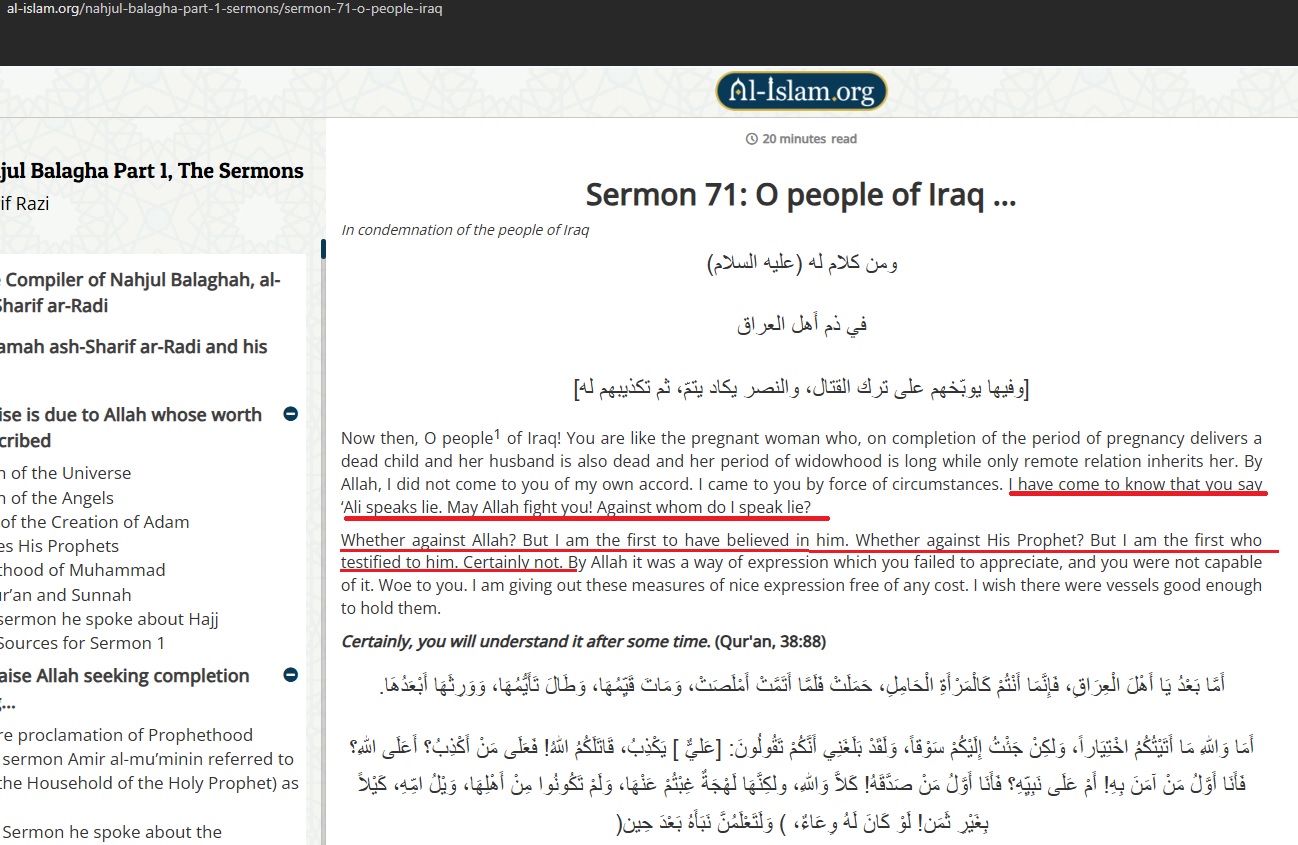
    2 Comments

    Filed under Uncategorized

    Harakat of the Qur’an & Al-Khalili ibn Ahmad al-Farahidi al-Ibadi

    “And among those We created is a community which guides by truth and thereby establishes justice.” (Qur’an 7:181)

    ﷽ 

    The next time someone says that we Ibadi are Khawarij and that we do not take our deen from them perhaps gently remind those people to stop using harakat when teaching your children how to read the Qur’an properly!

    That system—you use to teach their children, which enables tajwīd, which facilitates tarāwīḥ prayers, and which is the very means of correctly reciting the Qur’an—was systematized by an Ibadi scholar.

    There is scarcely a grammar book that talks about the essence of ilmu al-nahw except that the name: Al-Khalili ibn Ahmad al-Farahidi is mentioned.

    The “Shining Star” of the Basran school of Arabic grammar, a polymath and scholar, he was a man of genuinely original thought. Al-Farahidi was the first scholar to subject the prosody of Classical Arabic poetry to a detailed phonological analysis.

    He was born in Oman circa 718 and died in Basra, Iraq circa 791. He was an Arab philologist and the first to compile an Arabic dictionary. He was the teacher of Sībawayh, whom latter compiled al-Kitāb fī an-naḥw (“The Book on Grammar”).

    The lie that Al-Khalili ibn Ahmad al-Farahidi al-Ibadi left the school of Ahl Haqq Wal Istiqamah to join Ahl Sunnah Wal Jammah is a whopper of a lie!

    “This is where history records the role of Khalil bin Ahmad al-Farahidy al-Ibadi. He then determined the form of fathah with the lowercase alif letter lying on top of the letter, kasrah with a small ya’ letter below it and dhammah with a small waw letter above it. Meanwhile, tanwin is formed by duplicating the writing of each of these signs, in addition there are several other signs.”

    Source: https://www.muslimcreed.com/2022/03/the-history-of-giving-dots-and-harakat.html

    “In Khalili’s time, the Qur’anic manuscripts were equipped with various points with various functions and purposes. In the disciplines of the Qur’an, it is known as naqthi’rab, or simply the point of harakat, and naqthi’jam which are nothing but dots on each other. The two types of dots are written differently by using red for vowel points and black for letter points.”


    “The number of dots scattered on each page of the Qur’anic manuscripts which then gave birth to problems, both for readers and writers. For readers, reading errors are not impossible to avoid because sometimes they cannot distinguish one from another. As for writers, it is considered a hassle because they always have to change colours at one time in the writing process.”

    Source: (https://www.muslimcreed.com/2022/03/history-of-harakat-in-mushaf-quran.html

    Every time your children use the system of harakat to read the Qur’an, rather it is in reciting the Qur’an in Ramadan during tarweeh prayers, or in one’s private reading of the Qur’an during prayers, or in any type of gathering all of that hasanat, all that blessing is being accredited to Al-Khalili ibn Ahmad al-Farahidi al-Ibadi!! May Allah (swt) cover him in mercy!

    May Allah Guide the Ummah.

    May Allah Forgive the Ummah.

    2 Comments

    Filed under Uncategorized

    Dr. Zakir Naik in Oman

    Invite to the way of your Lord with wisdom and good instruction, and argue with them in a way that is best. Indeed, your Lord is most knowing of who has strayed from His way, and He is most knowing of who is [rightly] guided.” (Qur’an 16:125)

    ﷽ 

    Al hamdulliah, our brother and esteemed orator Dr. Zakir Naik will be spending his opening days of Ramadan in the Sultanate of Oman.

    He will be doing a series of two public talks.

    Dr. Zakir Naik has had the good fortunate to have met the Mufti of Oman, Shaykh Ahmed Al Khalili (hafidullah).

    May Allah (swt) bless Dr. Zakir Naik and his tour in Oman. It is hoped that people will benefit by his talks and that Allah (swt) will open the hearts for many to come into Islam.

    Probably one of the key differences between Ibadi and Sunni is that we truly do believe that Muhammed (saw) is the last and final prophet and the last and final messenger.

    The Sunni say this but they have a belief in non sequential messengers. There is a sort of glib or tongue in cheek statement about the Prophet Muhammed (saw) being the last of the Prophets and Messengers and than there is the belief that his body is in Madinah and Jesus (as) is alive in heaven.

    For the Ibadi school Jesus (as) is dead. He is not coming back. The Blessed Messenger (saw) is: The mercy to the worlds. It is not quite clear what Sunni’s believe that Jesus 2.0 is going to clear up that the Qur’an hasn’t already made clear.

    The diagram above the first two circles represents the view of the Ibadi school. Jesus (as) has come and died. Muhammed (saw) is the last of the prophets, and he is the last of the messengers.

    The diagram above the second set of three circles represents the Sunni view. (Though there are a few dissenting voices). So this is what we call non-sequential prophets. But even then, we are not quite sure how that works. How the Blessed Messenger (saw), the Prophet Muhammed (saw), is the last and final prophet and messenger (who has a body in Madinah) and Jesus (as) is alive in heaven, and he is coming back.(saw),

    https://primaquran.com/2022/10/04/what-happened-to-jesus-and-how-did-he-die/

    https://primaquran.com/2022/10/04/the-problems-with-believing-in-the-2nd-coming-of-jesus-and-mahdi/

    Crucifixion or Impaled? How do we understand Qur’an 4:157?

    https://primaquran.com/2022/10/04/examination-of-the-word-tawaffa-in-the-quran-as-it-relates-to-the-death-of-jesus/

    https://primaquran.com/2022/10/04/sunni-misunderstanding-of-quran-4159-concerning-jesus/

    https://primaquran.com/2023/07/19/the-definitive-proof-from-the-ibadi-school-that-jesus-is-dead-and-will-not-return/

    https://primaquran.com/2024/03/30/the-question-of-the-historical-crucifixion-and-the-martyrdom-of-jesus/

    May Allah Guide the Ummah.

    May Allah Forgive the Ummah.
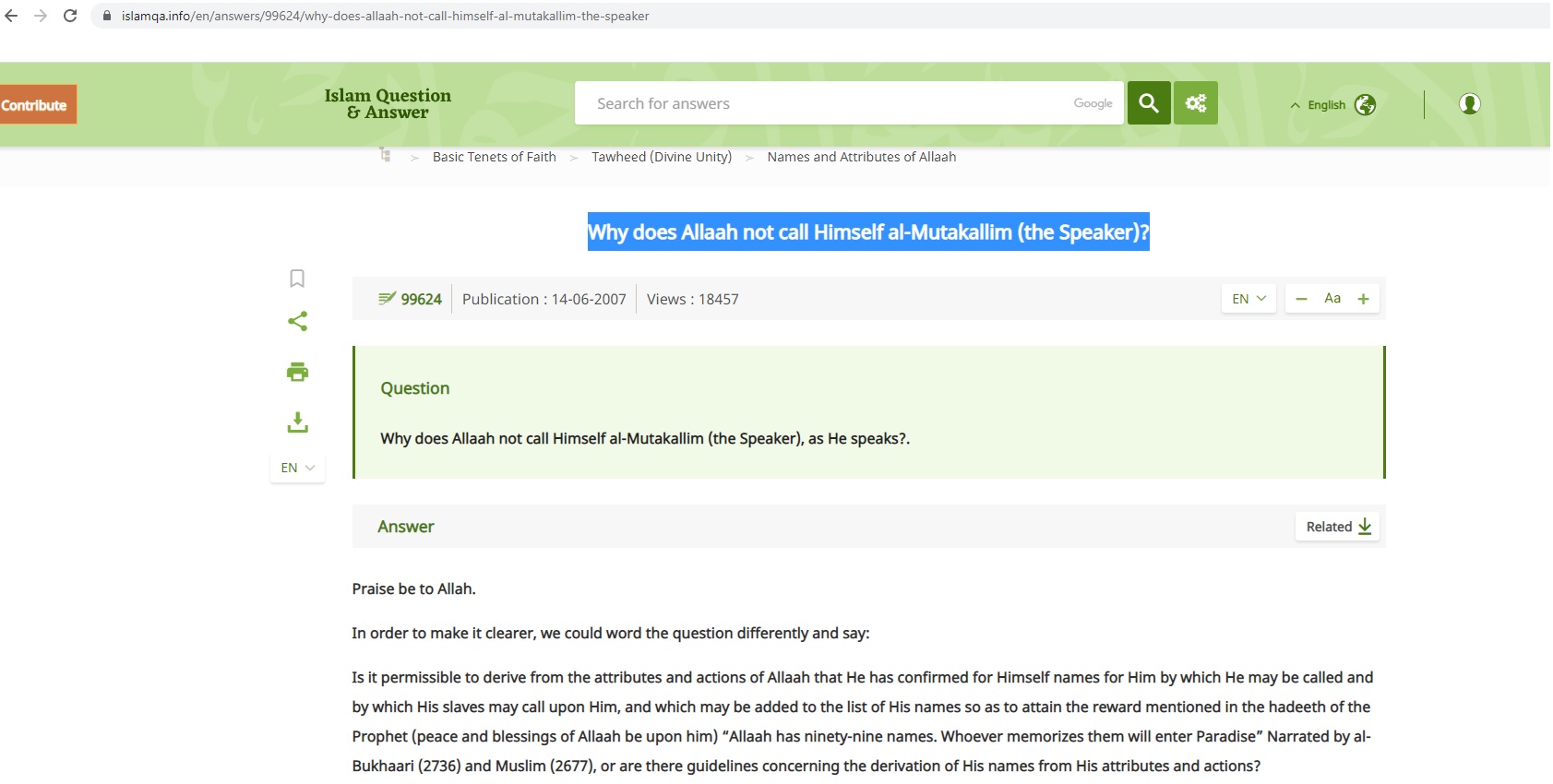
    2 Comments

    Filed under Uncategorized

    Hadith: Do not revile/curse my companions

    “That was a nation which has passed on. It will have what it earned, and you will have what you have earned. And you will not be asked about what they used to do.” (Qur’an 2:133-134)

    Or do you say that Abraham and Ishmael and Isaac and Jacob and the Descendants were Jews or Christians? Say, “Are you more knowing or is Allah ?” And who is more unjust than one who conceals a testimony he has from Allah? And Allah is not unaware of what you do That is a nation that has passed on. It will have what it earned, and you will have what you have earned. And you will not be asked about what they used to do. Those are people who have passed away; theirs is that which they earned and yours that which ye earn. And ye will not be asked of what they used to do(Qur’an 2:140-141)

    ﷽ 

    It has been said about the Ibadi school, that we revile, abuse and curse the companions!

    It has been said that we are Khawarij who curse, revile and abuse the companions.

    Nothing can be further from the truth! 

    When you hear people say such things about us, ask them to bring their evidence! 

    Please listen to what our teacher and Shaykh Dr. Khalid bin Mohammed Al Abdali (Hafidullah) shares with us what should be the stance of the Muslims in regard to the companions and those who have gone before us.

    One group says about some of the companions of the Blessed Messenger (saw) that they “Are the dogs of hellfire!

    Another group says, “These are sinners and have disobeyed the order of Allah.”

    Who is doing the cursing? Who is doing the reviling?

    In our books, the Ibadi, we haven’t named someone a dog from the dogs of Jahannam. Al hamdulllah! That Allah (swt) has purified our tongues from it.  That being said, we do not say the Sahabah/companions were all angels and saints. We tell the history.

    This should be very clear. If our books say that such and such a companion is a sinner or sinned, that is not reviling anyone. It is simply reporting the news. If our books say such and such a companion went against the amr, the command of Allah (swt), that is not reviling anyone. That is simply reporting the news.

    You are welcome to dispute with us about whether such and such a companion sinned on this or that occasion, but stop saying that the Ibadi revile, curse or abuse the companions. Even worse one recent individual who claimed to be a teacher of the Ashari school claimed the Ibadi say that Uthman and Ali committed Shirk! Authubillah min dhalik! When pressed for a proof he deleted his post and made amends for it. This is the sign of sincerity.

    It is the Ahl Khilaf (The People of the opposition). It is their books that are filled with statements companions reviling each other. 

    It was our teachers (Ibadi scholars) who approached Umar Ibn Abdul Aziz (ra), who was a righteous Caliph and a just Imam. It was they who went to him and urged him to stop the cursing and reviling of the companions at the minbar. It is not the place for it.

    In fact, if you want to see who really reviled who see this entry. Read it and weep!

    Abu Huraira reported Allah’s Messenger (saw) as saying:

    Do not revile my Companions, do not revile my Companions. By Him in Whose Hand is my life, if one amongst you would have spent as much gold as Uhud it would not amount to as much as one much on behalf of one of them or half of it.”

    Source: (https://sunnah.com/muslim:2540)

    Narrated Anas:

    The Prophet (saw) said, “Some of my companions will come to me at my Lake Fount, and after I recognize them, they will then be taken away from me, whereupon I will say, ‘My companions!’ Then it will be said, ‘You do not know what they innovated (new things) in the religion after you.”

    Source: (https://sunnah.com/bukhari:6582)

    It was narrated from Abu Hurairah that the Prophet (saw) came to a graveyard and greeted (its occupants) with Salam, then he said:

    “Peace be upon you, abode of believing people. We will join you soon, if Allah wills.” Then he said: “Would that we could see our brothers.” They said: “O Messenger of Allah, are we not your brothers?” He said: “You are my Companions. My brothers are those who will come after me. I will reach the Cistern ahead of you.” They said: “O Messenger of Allah, how will you recognize those of your nation who have not yet come?” He said: “If a man has a horse with a blaze on its forehead and white feet, don’t you think that he will recognize it among horses that are deep black in color?” They said: “Of course.” He said: “On the Day of Resurrection they will come with radiant faces, hands, and feet, because of the traces of ablution.” He said: “I will reach the Cistern ahead of you.” Then he said: “Men will be driven away from my Cistern just as stray camels are driven away. And I will call to them: ‘Come here!’ But it will be said: ‘They changed after you were gone, and they kept turning on their heels.’ So I will say: “Be off with you!

    Source: (https://sunnah.com/ibnmajah:4306)

    Narrated Jabir bin `Abdullah:

    We were in a Ghazwa and a man from the emigrants kicked an Ansari (on the buttocks with his foot). The Ansari man said, “O the Ansari! (Help!)” The emigrant said, “O the emigrants! (Help).” When Allah’s Messenger (saw) heard that, he said, “What is that?” They said, “A man from the emigrants kicked a man from the Ansar (on the buttocks his foot). On that the Ansar said, ‘O the Ansar!’ and the emigrant said, ‘O the emigrants!” The Prophet (saw) said’ “Leave it (that call) for it Is a detestable thing.” The number of Ansar was larger (than that of the emigrants) at the time when the Prophet (saw) came to Medina, but later the number of emigrants increased. `Abdullah bin Ubai said, “Have they, (the emigrants) done so? By Allah, if we return to Medina, surely, the more honorable will expel therefrom the meaner,” `Umar bin Al-Khattab said, “O Allah’s Messenger (saw)! Let me chop off the head of this hypocrite!” The Prophet said, “Leave him, lest the people say Muhammad kills his companions:”

    Source: (https://sunnah.com/bukhari:4907)

    Narrated Ibn `Umar:

    The Prophet (saw) sent (an army unit under the command of) Khalid bin Al-Walid to fight against the tribe of Bani Jadhima and those people could not express themselves by saying, “Aslamna,” but they said, “Saba’na! Saba’na! ” Khalid kept on killing some of them and taking some others as captives, and he gave a captive to everyone of us and ordered everyone of us to kill his captive. I said, “By Allah, I shall not kill my captive and none of my companions shall kill his captive!” Then we mentioned that to the Prophet (saw) and he said, “O Allah! I am free from what Khalid bin Al-Walid has done,” and repeated it twice.

    Source: (https://sunnah.com/bukhari:7189)

    Sunni and Shi’i narrators state that Ali ibn Abu Talib led the prayers either while intoxicated or in a major state of ritual impurity.

    So are they reviling, rebuking and cursing Ali for simply reporting the facts?

    Or what about the reviling and rebuking Ahl Sunnah has done of the noble companion Hurqus Ibn Zuhair (ra) ?

    Or what about the tremendous and horrible statement put into the mouth of the Blessed Messenger (saw), calling some of his companions “the dogs of hellfire?” Many are those from among the Shi’i and Ah Sunnah quotes this with absolutely no shame.

    What about the Salafi preacher who really did curse one of the companions, Amr b. al-Hamiq al-Khuza’i for stabbing Uthman in the chest 9 times!

    What about Ibn Taymiyyah’s damning admission that the majority of the companions hated Ali?

    So we would implore those in dawah, and we would implore teachers and learned people from among the Sunni and Shi’i to be educated on this matter. You may not agree with us, and you are free to differ with us, but you do not have a license to lie about us or misrepresent us.

    In fact, on matters of lying and not being truthful, one should have awareness and fear of Allah (swt) who sees and knows all that we do.

    May Allah (swt) guide us all to what is beloved to him.

    May Allah Guide the Ummah.

    May Allah Forgive the Ummah.
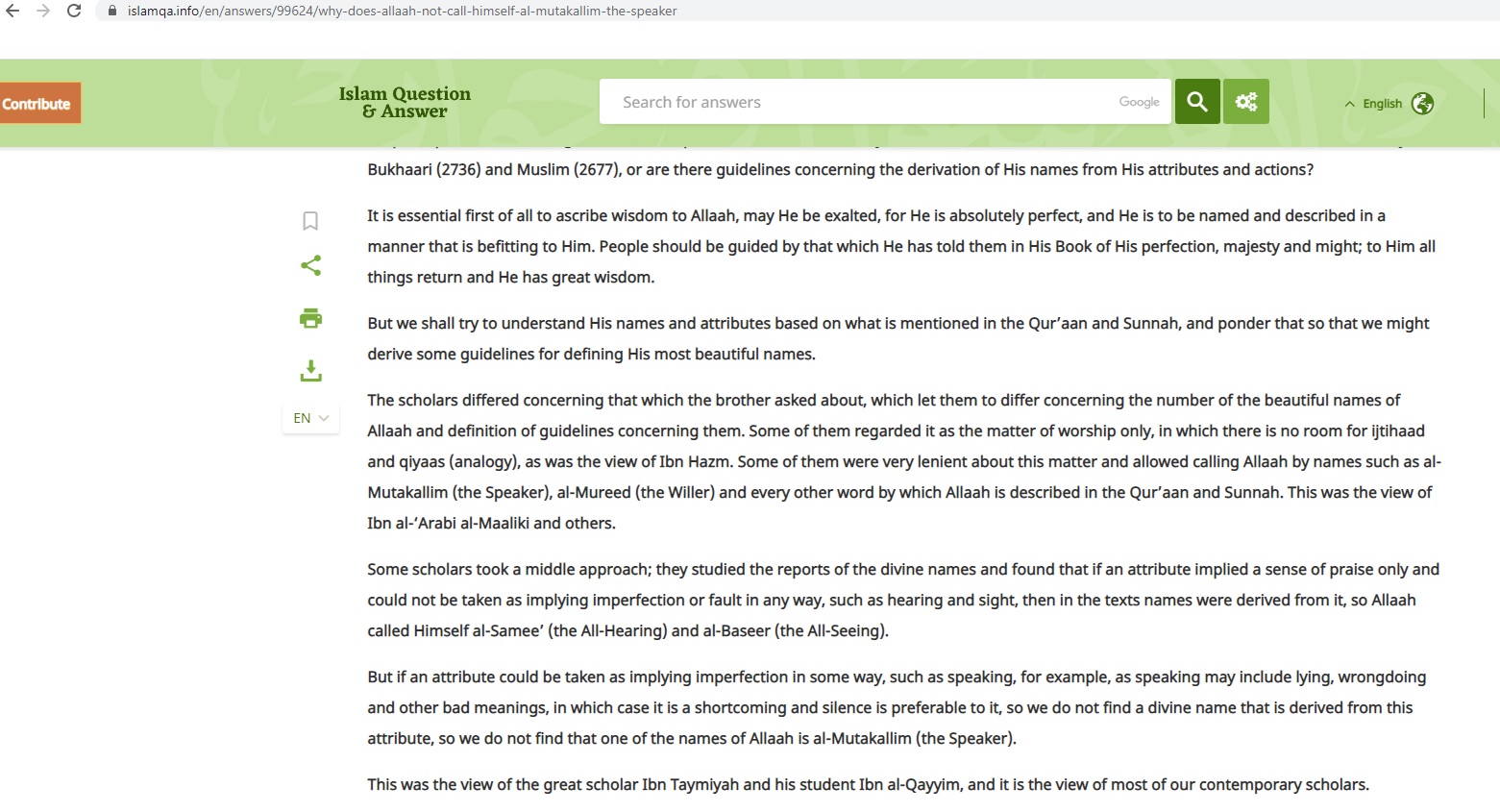
    2 Comments

    Filed under Uncategorized

    Do Sunni Muslims believe animals can go to hell?

    “When they see it, the criminal will wish he can ransom himself from the chastisement of that day by sacrificing his children.” (Qur’an 70:11)

    “Indeed, Allah does not do injustice, [even] as much as an atom’s weight; while if there is a good deed, He multiplies it and gives from Himself a great reward.” (Qur’an 4:40)

    ﷽ 

    “And the request of forgiveness of Ibrahim for his father was only because of a promise he had made to him. But when it became apparent to Ibrahim that his father was an enemy to Allah, he disassociated himself from him. Indeed was Ibrahim compassionate and patient.” (Qur’an 9:114)

    In this short entry we will be discussing a very curious hadith found in Bukhari.

    We like to call this: The TO BE CONTINUED….hadith.

    We call the above hadith: The TO BE CONTINUED hadith.

    You know, sometimes you get wrapped up in watching a series on television, and suddenly they cancel season three just when it was getting really interesting!

    That’s the case with the following hadith:

    “Ibrahim will meet his father on the Day of Resurrection, and Azar’s face will be dark and covered with dust. Ibrahim will say to him, “Did I not tell you not to disobey me?’ His father will say, ‘Today I will not disobey you.” Ibrahim will say, ‘O Lord! You promised me not to disgrace me on the Day of Resurrection; and what will be more disgraceful to me than cursing and dishonoring my father?” Then Allah will say, ‘I have forbidden Paradise to the disbelievers.’ Then he will be addressed, ‘O Ibrahim, what is beneath your feet?’ He will look and there will be a sacrificial animal (Dhahb) WHICH WILL BE CAUGHT BY THE LEGS AND THROWN INTO THE FIRE!”

    In ya go ya little booger!

    “He will look and there will be a sacrificial animal (Dhahb) which will be caught by the legs and thrown into the fire!”

    When you look at this text, it is sensible that it stops at this part: “Then Allah will say, ‘I have forbidden Paradise to the disbelievers.” This concludes the matter.

    Now the messy part.

    The following part is all too easily an accretion by a redactor:

    “Then he will be addressed, ‘O Ibrahim, what is beneath your feet?’ He will look and there will be a sacrificial animal (Dhahb) which will be caught by the legs and thrown into the fire!”

    So we saw that this particular Hadith had a sensible conclusion. Yet theology won’t have it that way….we need it to continue…. “THEN….”

    From this part on, the redactor just lets the imagination run wild…..

    This becomes more interesting when you consider that, in Islamic history, both the Shi’i Muslims and the Ash’ari Sunni Muslims have had a real problem with the idea of the parents of the Prophet (saw) being in hellfire or even the father of Ibrahim being in the hellfire.

    The Shi’i have made some very wild attempts to assert that Azar is not the father of Ibrahim but his uncle instead. Not to be outdone by none no other than Jalal Al-Din Al-Suyuti, threw his weight behind the idea as well.

    (insh’Allah, perhaps these are subjects for future articles) ..

    So there are two things to be immediately said about the Hadith above.

    First point.

    If Prophet Ibrahim (as) gets to ask for privileges on behalf of his father, then this means that all the Prophets will get to ask privileges for their wives, sons, daughters, uncles. Noah (as) gets to ask for his sons. Lut (as) gets to ask for his wife.

    Second point.


    This will indicate double standards. The Prophets get special treatment from Allah (swt) — Astaghfirullah and the rest of us. If we go to the Jannah, can we ask the same for our family members:” Will Allah (swt) be just and give this same treatment to everyone or only to the Prophets?

    “And certainly We know best those who are most worthy of being burned therein.” (Qur’an 19:70)

    So what did the sacrificial animal do to be burned by the fire?

    Was this (let’s say a goat) was he:

    Among the Mujrimun-criminals?

    Among the Fasiq-defiantly disobedient?

    Among the Munafiq-hypocrites?

    Among the Mushrik-those who associate partners with Allah (swt) ?

    May Allah (swt) forgive us. May Allah (swt) deal justly with those who forge narrations and put words in the mouth of the Blessed Messenger (saw).

    Our understanding in the Ibadi school is that the animals are the creations of Allah (swt). They are created according to their fitra, and they do not rebel against Allah (swt). They are not subject to any punishment, certainly not hellfire.

    To believe that the Blessed Messenger (saw) would not overburden camels or that he would cut his robe so as not to disturb a sleeping cat and then turn around and think that he narrated something like this is certainly wanting.

    All praise be to Allah. Al hamdulillah.

    “And the request of forgiveness of Ibrahim for his father was only because of a promise he had made to him. But when it became apparent to Ibrahim that his father was an enemy to Allah, he disassociated himself from him. Indeed was Ibrahim compassionate and patient.” (Qur’an 9:114)

    The idea of not accepting that the father of Prophet Ibrahim (as) goes to hell is the same train of thought that leads some Sunni Muslims to launch attacks upon the very Sahih hadith themselves!

    You may read about that here:

    You may also be interested in reading the following:

    https://primaquran.com/2022/10/04/the-muslims-the-ibadi-school-are-attacked-for-saying-its-haram-to-eat-a-goat-penis/

    May Allah (swt) Forgive the Ummah.
    May Allah (swt) Guide the Ummah.

    10 Comments

    Filed under Uncategorized