Tag Archives: muslims

Claims of apocryphal sources in the Qur’an?

“That is from the news of the unseen which We reveal to you. And you were not with them when they cast their pens as to which of them should be responsible for Mary. Nor were you with them when they disputed.”(Qur’an 3:44)
﷽ 

“This is the Book in which there is no doubt, a guide for the righteous. Those who believe in the unseen, and perform the prayers, and give from what We have provided for them. And those who believe in what was revealed to you, and in what was revealed before you, and are certain of the Hereafter.” (Qur’an 2:3-4)

The Qur’an is a book of which there is no doubt. It is for those who believe in the unseen. It is for those who are certain in the life to come. It is for those who believe in what was revealed before the Blessed Prophet (saw).

Those who are skeptical of those points will quite naturally arrive at different conclusions. So that is of no consequence for the believer.

“As for those who persist in disbelief, it is the same whether you warn them or not—they will never believe. Allah has sealed their hearts and their hearing, and their sight is covered. They will suffer a tremendous punishment.” (Qur’an 2:6-7)

Now, historians and orientalists cannot speak of the supra natural as these are matters of belief. They are beyond their point of historical investigation. However, we are always thrilled when we find historians and Orientalists corroborating the testimony of narratives in the Qur’an by finding manuscripts or parchments of information that, though not ad verbatim, closely mimic what Allah (swt) has revealed before. This is the understanding of the believer.

Do we find some information from various cultures that preceded the coming of the Blessed Prophet (saw) that seems to corroborate the beliefs of Islam? Yes! That is not scary! That is exciting! 

Recall what Allah (swt) himself informed us of:

We surely sent a messenger to every community, saying, “Worship Allah and shun false gods.” But some of them were guided by Allah, while others were destined to stray. So travel throughout the land and see the fate of the deniers!” (Qur’an 16:36)

Remember we are not responsible for the conclusions or perceptions of others.
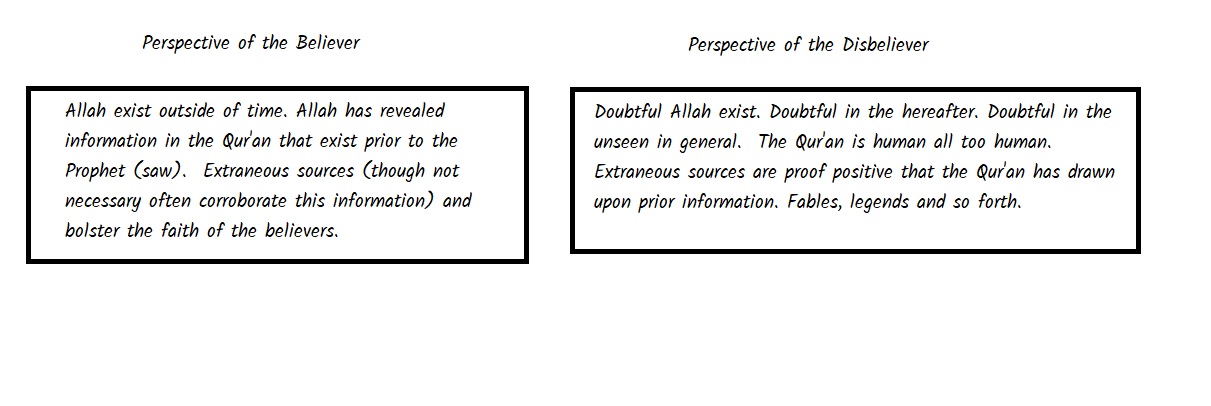
If we look at the above graph. We can see that in block B the apparent (the dhahir) is that there are parchments, manuscripts, scrolls, oral traditions, inscriptions etc. that come before the Qur’an. However, when we look at block B, the haqiqah (the reality) is that Allah’s knowledge of what really happened precedes the information in B. Because of that reality, what is in C (The Qur’an) actually precedes the information in B. This is precisely why this hobbyhorse of orientalist and those who use the historical critical method is of absolutely no consequence for the believing Muslim.

We Muslims have been the first critics of our own sources. The clash of historical narratives between the Ibadi, Sunni and Shi’a is proof positive of this. The grading of the ahadith and the mention of variants in the transmission of the Qur’an have not come from people who lost faith, agnostics or atheists. They came from us, as believers. Subhan’Allah!

These other Johnny Come Lately types, HCM, etc., welcome to the party! 

History and Miracles.

We don’t believe that miracles are historical. This does not mean that we do not believe that miracles did not happen. We just don’t believe that history can capture them. 

Case in point. An Indian king, Cheraman Perumal, was reported to have seen the moon split. History can report such data, but it does not necessarily confirm nor interpret the data. 

This particular entry is directed towards Christians. It is rather shameful that they have taken the approach that they have in these matters. Given that they too claim to believe in the unseen. They claim to believe in a Creator that can narrate past events that present people were not privy to.

“Then she brought him to her people, carrying him. They said, “O Mary, you have certainly done a thing unprecedented. O sister of Aaron, your father was not a man of evil, nor was your mother unchaste.”But she pointed to the babe. They said: “How can we talk to one who is a child in the cradle?” He said: I am indeed a servant of Allah: He has given me revelation and made me a prophet; And He hath made me blessed wheresoever I will be and has enjoined on me Prayer and Charity as long as I live; (He) has made me kind to my mother, and not overbearing or miserable; So peace is on me the day I was born, the day that I die, and the day that I shall be raised up to life (again)”! Such (was) Jesus the son of Mary: (it is) a statement of truth, about which they (vainly) dispute.(Qur’an 19:27-34)

“When Allah will say, “O Jesus, Son of Mary, remember My favor upon you and upon your mother when I supported you with the Pure Spirit and you spoke to the people in the cradle and in maturity; and [remember] when I taught you writing and wisdom and the Torah and the Gospel; and when you designed from clay like the form of a bird with My permission, then you breathed into it, and it became a bird with My permission, and you healed the blind and the leper with My permission; and when you brought forth the dead with My permission; and when I restrained the Children of Israel from [killing] you when you came to them with clear proofs and those who disbelieved among them said, “This is not but obvious magic.” (Qur’an 5:110)

“And a messenger to the Children of Israel, who will say, Indeed I have come to you with a sign from your Lord in that I design for you from clay like the form of a bird, then I breathe into it and it becomes a bird by permission of Allah. And I cure the blind and the leper, and I give life to the dead – by permission of Allah. And I inform you of what you eat and what you store in your houses. Indeed in that is a sign for you, if you are believers.” (Qur’an 3:49)

Prima Qur’an comments:

In this article, we will give a response to those Christians who use as a polemic against Muslims the claim that the Qur’an contains apocryphal material in it and therefore cannot be a revelation from Allah (swt).

Now, of course, they will claim that there are more than the three verses of the Qur’an we quoted above as being from apocryphal material. However, we have chosen to focus on these three, as they are most often used by Christian polemicists in debates with Muslims.

Now, personally, we find this particular line of Christian attack against Islam amusing. However, they have to eventually come up with something, right?

Now let’s look at and listen carefully to what these Christians are actually disputing with us about.

*Note*

  1. They are not raising the issue of “healing the blind.“
  2. They are not raising issues against “curing people affected by leprosy.”
  3. They are not raising issues against “give life to the dead.”

They are not disputing these points because they are miracles attributed to Christ Jesus that they find in their accepted canonical text. We will come to the term canonical in a moment.

What they are disputing is:

  1. Jesus speaking as an infant
  2. Jesus creating birds out of clay

Why do they dispute about these miracles?

Because they are not in what they accept to be their canonical text.

So what do the terms apocryphal and canonical mean?

Canonical in relation to Christian scriptures means:

A biblical canon or canon of scripture is a set of texts (or “books”) which a particular religious community regards as authoritative scripture. … Believers consider canonical books as inspired by God or as expressive of the authoritative history of the relationship between God and his people.”

Apocryphal in relation to Christian scriptures means:

“Biblical or related writings not forming part of the accepted canon of Scripture; or writings or reports not considered genuine.”

So, if a Christian were to come to us and say that these statements in the Qur’an are found in apocryphal sources, the first thing you have to keep in mind that what they are actually saying is that it is apocryphal according to their particular sect of Christianity!

The reason that is important is as follows: As we write this to you on 11/4/2024, Christendom has still not settled the issue of what is and is not apocryphal for the whole of Christianity.

Glaring examples are the following:

Depending on how you want to word it, you could say that the Protestants have 7 fewer books in their version of the Old Testament. Or you could say that the Roman Catholics have 7 extra books in their Old Testament that they accept to be inspired and not apocryphal.

You can read a short write-up about that here:

https://www.catholic.com/magazine/print-edition/how-to-defend-the-deuterocanonicals

The same can be said for the Orthodox Church.

https://www.oca.org/questions/scripture/canon-of-scripture

Yet the Orthodox Church has additional Old Testament texts (or if you want to be neutral, the Protestants and Catholics have less). The same can be said for the Ethiopian Orthodox Church.

The same goes for the New Testament.

What is canonical is an issue that is still not settled among them.

The Chaldean Syrian Church does not accept the following as canon:

2 Peter, 2 John, 3 John, Jude, & Revelation of John.

In fact, many Protestant Christians have declared Mark 16:8-20, & John 7:53–8:11 to not be canonical.

You have to wonder about the Protestant Christian theologians like John Calvin, Martin Luther, and others who most likely held such passages to be canonical. Yet there are Christians who do not agree with the idea that such passages are non-canonical. These Christians very much believe that Mark 16:8-20, & John 7:53–8:11 are inspired scripture.

So what is the point that is being made?

The point is that when a Christian says to us that those verses in the Qur’an are allegedly taken from apocryphal sources, it is important to understand that:

  1. That though it may be apocryphal for that particular Christian, we can’t say for certain that it was apocryphal for the other Christians.
  2. To keep in mind that what is and is not apocryphal has been and continues to be an internal dispute among Christians.

If the Christian is to counter by saying, “Can you name for me any Christian denomination today that accepts such and such text as canonical?”

The answer to that is: “No we can’t.” Many Christian sects and denominations over time have long perished. Most often the information we do have about them comes from their opponents.

What is also interesting, and we hope Muslims reading this bear in mind, is that no Christian committed to a consistent world view in which the supra-natural happens can tell us that:

  1. Jesus did not speak as an infant.
  2. Jesus did not create birds out of clay.

This assertion is also supported by the text they accept as canon. Namely, the following:

And Jesus did many other miracles in the presence of his disciples which are not written in this book: But these are written that you might believe that Jesus is the Christ, the Son of God; and that believing you might have life through his name” (John 20:30-31).

Prima Qur’an comments:

Now this writer, apparently inspired by Allah, felt that it was necessary to inform his readers that Jesus did many other miracles that are not contained within this book.

There are many more things that Jesus did. If all of them were written down, I suppose that not even the world itself would have space for the books that would be written.” (John 21:25)

Prima Qur’an comments: Though we can all agree this statement is hyperbole, yet it is obvious that the writer knew that there was much more information about Jesus that could be shared.

Now, a possible Christian objection to our understanding of John 20:30-31 is that ‘the many other miracles that are not present in this book‘ could only be a reference to the miracles listed in Matthew, Mark, Luke that are not in the Gospel according to John.

The response to this is that it is simply an assumption.

It could be that:

  1. It could be a reference only to the miracles present in Matthew, Mark, Luke that are not in the Gospel, according to John.
  2. It could be a reference to miracles that are not present in any of those Gospel accounts.
  3. It could be a reference to miracles present in Matthew, Mark, Luke as well as those not present in any Gospel accounts.

Christians could well ask: “Why wouldn’t these accounts of Jesus speaking as an infant or making birds out of clay make it into any of the Four Gospels commonly accepted among all of Christendom?”

Well, we have a clue about that from a text we have already mentioned.

“And Jesus did many other miracles in the presence of his disciples, which are not written in this book: But these are written, that you might believe that Jesus is the Christ, the Son of God; and that believing you might have life through his name” (John 20:30-31).

Prima Qura’n comments: This Gospel writer is telling us that he is informed about other miracles, but the seven particular miracles that he has selected is so that we may believe that Jesus is:

  1. The Christ
  2. The Son of God
  3. Having eternal life through his name.

So, in the example of this Gospel writer, we have the reasons plainly stated why some miracles were chosen over others. Whereas for the other Gospels it’s hard to discern why they may have left out certain miracles.

For example, John’s Gospel includes the story of Lazarus rising from the dead. I’m puzzled why such an awesome event is not recorded by the other Gospels. Or Jesus turning water into wine is only included in the Gospel, according to John.

Equally puzzling is the following awesome account, which is not recorded by any ancient documents outside of Matthew itself.

“And behold, the curtain of the temple was torn in two, from top to bottom. And the earth shook, and the rocks were split. The tombs also were opened. And many bodies of the saints who had fallen asleep were raised, and coming out of the tombs after his resurrection they went into the holy city and appeared to many. When the centurion and those who were with him, keeping watch over Jesus, saw the earthquake and what took place, they were filled with awe and said, ‘Truly this was the Son of God’” (Matthew. 27:51-54).

There are no extra-biblical sources that mention this awesome event. Surely witnessing such an event would have been worthy of mention somewhere. In fact, this particular text created controversy even among conservative Christians when New Testament scholar and associate professor of theology Michael Licona raised questions about this text.

You can read about where Christians have done some damage control concerning this at the following:

http://www.evidenceunseen.com/theology/scripture/is-matthew-2751-53-historical/

So, again, going back to the Christian inquiry into why some awesome and miraculous events are recorded by some sources and not others, we can only surmise as to the motives behind this.

  1. Why is it Jesus speaking as an infant is recorded in some sources and not others?
  2. Why is Jesus making birds out of clay recorded in some sources and not others?
  3. Why is it that the Gospel of Mark is now considered not to have a resurrection narrative, but other sources have it?
  4. Why is it that Jesus raised Lazarus from the dead from some sources and not others?
  5. Why is it that Jesus turned water into wine from some sources and not others?
  6. Why is that only the Gospel of Matthew has this narrative about the mass resurrections of people appearing to many in the city?

Another interesting point to note is that, in the case of the Christian tradition that many of us will encounter today, Roman Catholics, Orthodox, and Protestants of many types, we have 30 years of the life of Christ Jesus that is completely missing altogether!

“Now Jesus himself was about thirty years old when he began his ministry. He was the son, so it was thought, of Joseph, the son of Heli.” (Luke 3:23)

So imagine all the people who needed to be healed, those who needed salvation, and what does the current Christian canon tell us about the early life of Jesus? Its silence about the early life of Jesus is awkward, to say the least.

It is honestly both shocking and disappointing that Christians would use these types of arguments against the Qur’an. It absolutely reeks of atheism, smacks of radical skepticism, and is stepped in a worldview bereft of the supra-natural.

For us, as Muslims, we are informed about what happened concerning Jesus through divine revelation. As Allah (swt) says to the Blessed Messenger (saw):

“That is from the news of the unseen which We reveal to you. And you were not with them when they cast their pens as to which of them should be responsible for Mary. Nor were you with them when they disputed.” (Qur’an 3:44)

Also, notice that when the Christians make their particular claim about the Qur’an, they more often than not do put up the sources which they claim the Qur’an takes the following from:

  1. Speaking as an infant.
  2. Creating birds out of clay.

We also find it interesting that Muslims don’t ask them for their sources.

The Christian polemicist usually has two sources in mind for this:

Those sources are: The Infancy Gospel of Thomas & The Proevangelian of James

“This little child Jesus when he was five years old was playing at the ford of a brook: and he gathered together the waters that flowed there into pools, and made them straightway clean, and commanded them by his word alone. 2 And having made soft clay, he fashioned thereof twelve sparrows. And it was the Sabbath when he did these things (or made them). And there were also many other little children playing with him.

“And a certain Jew when he saw what Jesus did, playing upon the Sabbath day, departed straightway and told his father Joseph: Lo, your child is at the brook, and he has taken clay and fashioned twelve little birds and has polluted the Sabbath day. 4 And Joseph came to the place and saw: and cried out to him, saying: Why are you doing these things on the Sabbath, which it is not lawful to do? But Jesus clapped his hands together and cried out to the sparrows and said to them: Go! and the sparrows took their flight and went away chirping. 5 And when the Jews saw it they were amazed, and departed and told their chief men that which they had seen Jesus do.”

Source: (Infancy Gospel of Thomas Chapter 2:1-5)

Prima Qur’an Comments:

This narrative speaks about Jesus creating 12 birds. The emphasis on the number 12 is there twice. This must relate to the 12 disciples. Whereas in the Qur’an we find no mention of this.

Indeed I have come to you with a sign from your Lord in that I design for you from clay like the form of a bird, then I breathe into it and it becomes a bird by permission of Allah.” (Qur’an 3:49)

There is no mention of Jesus doing this act on the Sabbath Day. There is no mention of Jesus creating 12 birds. It is interesting to note that the Qur’an does not name the number of Jesus’ disciples. Christians have not addressed this.

It would be interesting to know where the writer(s) of the Infancy Gospel of Thomas’ got their information from. The earliest possible date of authorship is 80 A. D to 250 A. D. This is also roughly the time that the date of authorship is ascribed to ‘The Epistle to Titus‘, which is considered canonical by Christians today. These scholars date the epistle from the 80 A. D up to the end of the 250 A. D.

Source: (Raymond E Brown An Introduction to the New Testament. New York: Anchor Bible, p. 662)

“And when Jesus was five years old, there fell a great rain upon the earth, and the boy Jesus walked up and down through it. And there was a terrible rain, and He collected it into a fish-pond, and ordered it by His word to become clear. And immediately it became so. Again He took of the clay which was of that fish-pond, and made of it to the number of twelve sparrows. And it was the Sabbath when Jesus did this among the boys of the Jews. And the boys of the Jews went away and said to Joseph His father: Behold, thy son was playing along with us, and he took clay and made sparrows, which it was not lawful to do on the Sabbath; and he has broken it. And Joseph went away to the boy Jesus, and said to Him: Why have you done this, which is not lawful to do on the Sabbath? And Jesus opened His hands, and ordered the sparrows, saying: Go up into the air and fly; nobody shall kill you. And they flew, and began to cry out, and praise God Almighty. And the Jews seeing what had happened, wondered, and went away and told the miracles which Jesus had done.”

Source: (Infancy Gospel of James Chapter 4)

Prima Qur’an Comments:

This story is very similar to the one in the Infancy Gospel of Thomas’. What becomes apparent is that both of these sources are relying upon some oral tradition–one in which does not have a chain of transmission.

Now here is what is interesting about the Protoevangelion Jacobi or Infancy Gospel of James. One of the Christian polemicists that used this type of attack upon the Qur’an was himself put in a difficult position in relation to this text.

Observe:

https://ehrmanblog.org/video-bart-ehrman-vs-james-white-debate

@19:20 Erhman asks: “What other documents are found in P72 as this is a document that resonates with you?”


James responds, “There are some non-canonical documents in P72 …


Erhman replies, “Right, so I am just wondering about you resonating with this document”. Do you think that the scribe thought what he was copying was scripture?


James, “Well, I don’t think you can simply jump to the conclusion that, because scribes included books in a single codex that they believed that everything within that codex was necessarily scripture.” There are sorts of works that were considered to be beneficial to people that were included in codices that were not necessarily canonical.”


Erhman, “Yeah, I just think that it was odd that that particular manuscript was one that you resonated with because it’s the earliest attestation that we have of the protoevangelium jacobi.” (The Infancy Gospel of James) ..

Prima Qur’an Comments:

In other words, you can’t know for certain if the scribe who was copying this text (obviously from an even earlier source) was transcribing what he thought was divine writing! Especially in light of the fact that it is in the same genre of manuscripts that are generally described as “the most significant” papyrus of the New Testament to be discovered so far.

“Now, when the Lord Jesus had completed seven years from His birth, on a certain day He was occupied with boys of His own age. For they were playing among clay, from which they were making images of asses, oxen, birds, and other animals; and each one boasting of his skill, was praising his own work. Then the Lord Jesus said to the boys: The images that I have made I will order to walk. The boys asked Him whether then he was the son of the Creator, and the Lord Jesus made them walk. And they immediately began to leap; and then, when He had given them leave, they again stood still. And He had made figures of birds and sparrows, which flew when He told them to fly, and stood still when He told them to stand, and ate and drank when He handed them food and drink. After the boys had gone away and told this to their parents, their fathers said to them: My sons, take care not to keep company with him again, for he is a wizard: flee from him, therefore, and avoid him, and do not play with him again after this.”

Source: (The Arabic Infancy Gospel of Jesus)

Prima Qur’an Comments:

This text has Jesus not only making birds but apparently donkeys, oxen, and other (undisclosed) animals out of clay. There is an inquiry about him being the son of the Creator. There is no mention of the sabbath or any mention of the animals being of any number.

It’s thought that this Gospel has its origins in Syriac sources in the 5th or 6th century.

“We find what follows in the book of Joseph the high priest, who lived in the time of Christ. Some say that he is Caiaphas. He has said that Jesus spoke, and, indeed, when he was lying in His cradle, said to Mary His mother: “I am Jesus, the Son of God, the Logos, whom you have brought forth, as the Angel Gabriel announced to you; and my Father has sent me for the salvation of the world.”

Source: (The Arabic Infancy Gospel of Jesus).

Prima Qur’an Comments:

There is no mention of Mary carrying Jesus as a baby. There is no mention of the people asking Mary where this baby came from. This text has Jesus addressing his mother, the Qur’an has him addressing the people. The text above is filled with Christian doctrine: Jesus is the Son of God, he has a ‘Father’ and he was sent for the salvation of the world.

None of this is found in the account of the Qur’an.

Conclusion:

The attacks that Christian polemicists have leveled towards the Qur’an are the kind one would expect from radical skepticism, and a worldview bereft of the supra-natural.

We can see that these sources the Christians point to have important details and radically different theological statements that we do not find at all within the Qur’an.

More telling is that Christians do not even quote these sources, or give the details of the accounts. Many of the people they speak to will not go and double-check the sources for themselves.

The fact that some Christians find these sources apocryphal is of no concern to us as Muslims. We as Muslims do not rely upon them or accept them as revelation either. Our acceptance of what is stated in the Qur’an comes from our faith in it as divine revelation and in what Allah (swt) himself has stated:

“That is from the news of the unseen which We reveal to you. And you were not with them when they cast their pens as to which of them should be responsible for Mary. Nor were you with them when they disputed.” (Qur’an 3:44)

Just as our faith in Jesus as the Messiah, the Word of Allah, and the Son of Mary are not dependent upon any book of the New Testament (even if the whole of Christendom) accepts it as canonical.

Christians themselves cannot totally rule out the possibility of Jesus having spoken as an infant or having given life to the clay birds based upon the following evidence:

“And Jesus did many other miracles in the presence of his disciples, which are not written in this book: But these are written, that you might believe that Jesus is the Christ, the Son of God; and that believing you might have life through his name” (John 20:30-31).

As well as the fact that the Gospel writers themselves have admitted to leaving out particular miracles that did not suit their desired goals.

“The truth is from your Lord, so never be among the doubters.”(Qur’an 2:147)

“And when they hear what has been revealed to the Messenger, you see their eyes overflowing with tears because of what they have recognized of the truth. They say, “Our Lord, we have believed, so register us among the witnesses.” (Qur’an 5:83)

May Allah (swt) guide the truth seekers!

If you enjoyed this article you may enjoy the following:

May Allah Guide the Ummah.

May Allah Forgive the Ummah.
1 Comment

Filed under Uncategorized

The Sunni Misunderstanding of Qur’an 4:159 concerning Jesus second coming.

“And there is none of the People of the Book but must believe in him before his death; and on the Day of Judgment he will be a witness against them.” (Qur’an 4:159)

﷽ 

The misunderstanding of the verse is used as evidence for them to believe in some ‘Second Coming’ of Jesus (as).

You may look at all the various ways the verse has been translated into English here:

https://www.islamawakened.com/quran/4/159/

In this article we will focus on the justifications and proofs as they are given by the respected Mufti Zameel Ur Rahman. That is because what he states is the majority view on the matter.

Here is what Mufti Zameel Ur Rahman has laid out:

https://www.themadinanway.com/single-post/2018/03/13/The-Second-Coming-of-%E2%80%98%C4%AAs%C4%81-A-Fundamental-Islamic-Belief

MUFTI ZAMEEL UR RAHMANS UNDERSTANDING OF QUR’AN 4:159

Let us examine what Mufti Zameel Ur Rahman has put forward:

These verses then state that the Jews will believe in him before he dies. That is, before ‘Īsā (‘alayhissalām) dies (after he defeats the Dajjāl), the Jews that are remaining on the earth will all believe in him as the Messiah/Masīḥ about whom they were foretold. This is the dominant interpretation of the concluding verse that reads: “There will be none from the people of the scripture [i.e. Jews] but will believe in him before his death.” This has been recorded authentically from Abū Hurayrah (raḍiyallāhu ‘anhu) (see below).”

Al-Ṭabarī transmits through two chains from Sufyān al-Thawrī from Abū Ḥaṣīn from Sa‘īd ibn Jubayr from Ibn ‘Abbās that he said “before his death” means “before the death of ‘Īsā ibn Maryam”. (Tafsīr al-Ṭabarī, Maktabah Hajr, 7:664) This is an authentic chain.”

“He also narrates with an authentic chain to the Tābi‘ī, Abū Mālik Ghazwān al-Ghifārī (ca. 25 – 100 H), that he said of this verse: “That is, upon the descent of ‘Īsā ibn Maryam – none from the people of the scripture will remain but will believe in him.” (ibid. 7:665) He also transmits with an authentic chain to the eminent Tābi‘ī, al-Ḥasan al-Baṣrī (21 – 110 H), that he said: “Before the death of ‘Īsā. By Allāh! He is now alive in the presence of Allāh; but when he comes down, they will all believe in him.” (ibid.)”

“This is also transmitted from the mufassir of the Tābi‘īn, Qatādah ibn Di‘āmah. Al-Ṭabarī also transmits authentically from ‘Abd al-Raḥmān ibn Zayd ibn Aslam (d. 182), a mufassir from the Tab‘ Tābi‘īn, that he said of this verse: “When ‘Īsā ibn Maryam descends and then kills the Dajjāl, no Jew will remain on the earth but will believe in him.” (ibid. 7:666)”

Ibn Jarīr al-Ṭabarī explains that this is the most correct explanation. (ibid. 7:672) He explains that thus the meaning of the verse is: “[There is none from the people of the book] but will believe in ‘Īsā before the death of ‘Īsā – and that is about a specific [group] of the people of the book; those intended are the people of one particular time from them, not people of all times, who came after ‘Īsā; and that this will occur after his descent.” (ibid. 7:674)”

“Similarly, Ibn Kathīr says after mentioning this interpretation: “This opinion is the truth,” (Tafsīr Ibn Kathīr, Maktabah Awlād al-Shaykh, 4:342), and further states: “There is no doubt that what Ibn Jarīr said [giving preference to this interpretation] is what is correct, as that is what was intended from the context of the verses.” (ibid. 4:344) As Ibn Kathīr mentions, it is clear from the context that this is what is meant. The verses are talking about the Jews’ claim to have executed ‘Īsā (‘alayhissalām). Allāh says they did not kill or execute him but Allāh raised him up to Himself. Furthermore, not one of them will remain but will believe in ‘Īsā before his actual death. Hence, these verses clearly demonstrate that ‘Īsā (‘alayhissalām) was not killed, but was taken up alive into the sky, and further indicate that he will return and the Jews who remain (after he kills the Dajjāl) will believe in him.”

Notice that Mufti says,

These verses then state that the Jews will believe in him before he dies. That is, before ‘Īsā (‘alayhissalām) dies (after he defeats the Dajjāl).”

However, that is not what the verse says, and he knows this! If he was simply reading the traditions into the commentary, that is one thing, but forcing them into the text is altogether dishonest!

“This is the dominant interpretation.” Well, Mufti, on what basis do you say this is the ‘dominant interpretation’ ? Can you tell us the total amount of tafsir literature you studied on this matter to conclude this? Also, if this is the ‘dominant interpretation’, it is by your own admission not necessarily the only one!

Truth vs. Popularity: The truth is not a matter of democratic opinion but of sound evidence from the Quran itself.

Next, Mufti seems to quote from a disparate number of tafsir commentaries (albeit selectively). So let’s keep count, shall we?

Tafsir #1, Ibn Kathir

Tafsir #2, Ibn Jarir Al-Tabari

Tafsir #3, Qatada ibn Di’amah

Looking at the Tafsir of Qatada Ibn Di’amah.

Qatada Ibn Dia’ama has two traditions — disconnected from unknown sources about (Qur’an 4:157-158)

  • “And it was related to us that the prophet of God, Jesus son of Mary, said to his disciples: ‘Who of you will have my likeness [shibh/shabah] cast upon him and thereby be killed? One of the disciples said, ‘I, Oh prophet of God!’ ‘Thus that man was killed and God protected [mana’a] His prophet as HE RAISED HIM TO HIMSELF.
  • Concerning his statement: “AND THEY DID NOT KILL HIM AND THEY DID NOT CRUCIFY HIM, BUT IT APPEARED SO TO THEM. Qatada said: ‘The likeness of Jesus was cast upon one of his disciples, and he was killed. Jesus had appeared before them and said: “Whoever of you will have my likeness cast upon him will have paradise.” And one said: “Upon me!”

Prima Qur’an comments:

  1. Qatada Ibn Dia’ama has two traditions from disconnected unknown sources.
  2. This information is from Israʼiliyyat material.
  3. There is a 700 year gap in the chain of transmission!
  4. Also notice how there is no attempt to identify or name the substitute.

Looking at the Tafsir of Ibn Jarir Al-Tabari

Al-Tabari cites eleven traditions all going back to Wahb ibn Munabbih concerning (Qur’an 4:157-158)

Here is the verdict of Al-Tabari:

“Or the affair was according to what ‘Abd al-Samad related (that is the second tradition) from Wahb ibn Munabbih, that is, that the people who were with ‘Isa in the house scattered from the house before the Jews came upon him. ‘Isa remained, and his LIKENESS was cast upon one of his companions, who still remained with him in the house. And ‘Isa was RAISED UP, and one who was changed in the LIKENESS of ‘Isa was killed. And his companions through that the one CRUCIFIED was ‘Isa, because of what they saw happens to the one who was made to look like him. And the truth of the matter was hidden from them, because his being RAISED UP and the changing of the one who was killed into his LIKENESS happened after the SCATTERING of his friends. and [because] they [had] heard ‘Isa that night announce his death, and mourn because he thought that death was approaching him. And they related what happened as true, but the affair with God was really quite different from what they related. And those disciples who related this do not deserve to be called liars.”

Source: (Al-Tabari, vol 9, p 374)

Remember that Al-Tabari is getting his information from Wahb ibn Munabbih, so maybe we spend just a little bit of time on him.

Remember that Mufti Zameel ur Rahman had the following to say about Mufti Abu Layth on the matter:

Recently, an individual has been promoting the misguided belief that the Prophet ‘Īsā (‘alayhissalām) will not return, claiming that this is an idea that has mistakenly been imported into Islām and the teachings of the Prophet (ṣallallāhu ‘alayhi wasallam) from Christianity.”

Well, let us see if Mufti Zameer ur Rahman would be humble enough to apologize to Mufti Abu Layth concerning Wahb ibn Munabbih:

“It is not known clearly if he converted to Islam from Judaism or that his father is a convert from Judaism. There are various reports.” “He was known for reporting Isra’ilyyat material. -well known.” “He required a reputation from trustworthy to audacious liar.”

Source: (Aḥmad ibn Muḥammad ibn Khallikān (d. 1282 CE) and his work Wafayāt al-aʿyān wa-anbāʾ abnāʾ al-zamān (وفيات الأعيان وأنباء أبناء الزمان,) The Obituaries of Eminent Men and the History of the Contemporaries p. 673)

Ibn Khallikān was a renowned Shafi’i jurist, judge (qāḍī), and historian of the 13th century. He is celebrated for his scholarly rigor and intellectual integrity.

Ibn Ishaq used his work for the beginnings of Christianity but did not take from him as a source for the Prophet (saw) biography!

Ibn Khaldun didn’t have a high opinion, mentioning that he frequently told flat lies.

Source: (“Notices et Extraits des Manuscrits,” xx.part 1, p. 461; De Slane, Ibn Ḥallikan, iii. 673, note 2 | Notices et Extraits des Manuscrits de la Bibliothèque du Roi et autres bibliothèques.

For the English readers:  (Notices and Extracts from the Manuscripts of the King’s Library and Other Libraries. The Citation (xx.part 1, p. 461): This refers to Volume 20, Part 1, page 461. The article claims that on this page, there is a discussion about Wahb ibn Munabbih that references Ibn Khaldun’s low opinion of him.

Companions and scholars like Abdullah ibn Mas’ud warned people not to learn Tafsir from the ‘Ahl Kittab’ and his argument was that they may use it to interpolate their own biblical beliefs, teachings and history replacing the Islamic belief and preaching.

Source: (Dr. Muhammed Husayn al-Dhahabi and his monumental work Al-Tafsīr wa al-Mufassirūn (التفسير والمفسرون, Quranic Exegesis and Its Exegetes Volume 1) 

Why Dr. Dhahabi’s scholarship is important.

al-Dhahabi provides a powerful, mainstream Sunni scholarly critique of the very sources that underpin the traditional narrative about Jesus’ death. The reference serves several key argumentative purposes:

  1. Historical Validation of the Problem: Al-Dhahabi meticulously documents how these foreign narratives entered Islamic scholarship. This was primarily through early converts from Judaism and Christianity (like Ka’b al-AḥbārWahb ibn Munabbih, and Abdullah ibn Salam) who, while well-intentioned, began to fill in the gaps in Quranic stories with details from their own traditions. This gives historical credence to the warning from the Companion Abdullah ibn Mas’ud that the article also references.
  2. al-Dhahabi, argues that the classical commentaries on verses like 4:157-159 are contaminated with unreliable material. Al-Dhahabi’s work is essentially a scholarly condemnation of the uncritical acceptance of Isrā’īliyyāt.

So let us take a look again at what Al-Tabari believed:

“Or the affair was according to what ‘Abd al-Samad related (that is the second tradition) from Wahb ibn Munabbih, that is, that the people who were with ‘Isa in the house scattered from the house before the Jews came upon him. ‘Isa remained, and his LIKENESS was cast upon one of his companions, who still remained with him in the house. And ‘Isa was RAISED UP,  and one who was changed in the LIKENESS of ‘Isa was killed. And his companions through that the one CRUCIFIED was ‘Isa, because of what they saw happens to the one who was made to look like him. And the truth of the matter was hidden from them, because his being RAISED UP and the changing of the one who was killed into his LIKENESS happened after the SCATTERING of his friends. and [because] they [had] heard ‘Isa that night announce his death, and mourn because he thought that death was approaching him. And they related what happened as true, but the affair with God was really quite different from what they related. And those disciples who related this do not deserve to be called liars.”

Source: (Al-Tabari, vol 9, p 374)

Prima Qur’an comments:

So, basically, in this narrative, Allah (swt) didn’t fool the non-believers, but he actually fooled the believing disciples of Jesus into believing that He (Jesus) was killed—when he wasn’t?!? Also, the 12 disciples couldn’t use logic, deduction and simple basic math and say, (Well, you know Jesus is gone and so is ….such and such disciple) Hey, maybe Jesus didn’t die?! Maybe so-and-so took his place! Notice the obfuscation especially with the quote from Qatada Ibn Dia’ama? We don’t get to know who this legendary disciple is? Who is this masked man? Oh well, you can hear them saying, ‘it doesn’t matter his reward is with his Lord’.

Looking at the Tafsir of Ibn Kathir

So what is the view of Ibn Kathir concerning Qur’an 4:157-158?

“They disobeyed Jesus and tried to harm him in every possible way, until God led His prophet away from them-Jesus and Mary traveled extensively to avoid such persecution. Ultimately, the Jews notified the King of Syria that there was a man in the holy house was was charming and subverting the people. The king wrote to his deputy in Jerusalem to be on guard against this. Moreover, the deputy was instructed to crucify the culprit (Jesus) and place thorns on his head to stop him from harming the flock. The deputy obeyed the order and led a group of Jews to where Jesus was staying with his twelve or thirteen followers. When Jesus was aware that they were after him, he asked for a volunteer to take his place. One stepped forward and was taken by the Jews and crucified, while Jesus was himself raised through the roof of the house. The Jews then announced that they had crucified Jesus and boasted about it. In their ignorance and lack of intellect ,a number of Christians accepted this claim. The fact that the other disciples had seen Jesus raised was ignored. Everyone else though that the Jews had crucified Jesus.”

Source: (Ibn Kathir, ‘Umdat al-tafsir, ed Ahmad Muhammed Shakir, 5 vols located in: vol 4 pp.28-34)

Prima Qur’an comments :

So notice how Ibn Kathir’s commentary is totally different from Al-Tabari on very key points. Again, obfuscation is a common theme. We don’t know if Jesus had 12 or 13 disciples. The brave unsung hero disciple who just jumped at the chance to be killed (we have no idea who he is). However, unlike Al-Tabari, who was ready to accept on face value the claim of Jesus’ disciples — although they were apparently fooled by Allah (swt), Ibn Kathir isn’t ready to pen that on the disciples. Instead, he simply offers that the Christians were ignorant and lacked intellect, so they accepted that Jesus died. The fact that ‘other disciples’ saw what went down was just simply ignored.

Summary of the Tafsir Sources:

The three tafsir sources that Mufti Zameer ur Rahman are all ultimately reliant upon anonymous, disconnected chains and sources that are traceable to the very sources (Ahl Kitab) that Ibn Masud warned us about!

How can Mufti Zameer ur Rahman (and anyone else who holds his position) claim with confidence that they know what (Qur’an 4:157-159) is talking about?  This so-called ‘unified tradition’ holds disparate and conflicting perspectives that are frankly all over the place.

The testimony of Ibn Masud (ra)

Al-Barqānī informed me, saying: Abū Bakr al-Ismāʿīlī narrated to us, saying: I heard Abū ʿAbd Allāh al-Ḥāfiẓ, and he was asked about tafsīr (Qur’an exegesis): From where should a person begin it? He replied: From the Book of Allah, the Exalted. If that is difficult for him, then he should rely upon the transmitted reports (al-athar). If that is difficult for him, then he should resort to reasoning (al-naẓar). Then he said: It is necessary that above all of this he gives precedence to the Book of Allah. Then he said: I heard Abū al-ʿAbbās Muḥammad ibn Isḥāq al-Thaqafī say: I heard ʿAbdān ibn Aḥmad say: I heard ʿAbd Allāh ibn al-Mubārak say: ʿAbd Allāh ibn Masʿūd used to say: ‘Transmit the Qur’an (faithfully), and do not follow the People of the Book, for indeed they relate to you the most false of narrations, and they burden you with their falsehoods.”

Source: ( Imam Al-Khatib al-Baghdadi Work: Al-Jāmi‘ li-Akhlāq al-Rāwī wa Ādāb al-Sāmi‘ (الجامع لأخلاق الراوي وآداب السامع) – A Compendium of the Ethics of the Narrator and the Etiquette of the Listener.  Volume 1, Page 289 )

Chapter: The Qurra from among the Companions of the Prophet (saws)

Narrated Masriq:

`Abdullah bin `Amr mentioned `Abdullah bin Masud and said, “I shall ever love that man, for I heard the Prophet (saw) saying, ‘Take (learn) the Qur’an from four: `Abdullah bin Masud, Salim, Mu`adh and Ubai bin Ka`b.’ “

Source: (https://sunnah.com/bukhari:4999)

“Waki’ narrated to us, from Sufyan, from Abu Hasin, from Abu Wa’il, from Abdullah (ibn Mas’ud), who said:

‘When the People of the Book narrate to you, do not believe them nor disbelieve them. Rather, say: “We believe in what has been revealed to us and what has been revealed to you.”‘”

Source: (Al-Musannaf by Ibn Abi Shaybah, Dar al-Taj, Riyadh (1st ed., 1409 AH), Volume 6, Page 101, Hadith Number 29990.)

The testimony of the Blessed Prophet (saw).

Narrated Abu Huraira:

The people of the Book used to read the Torah in Hebrew and then explain it in Arabic to the Muslims. Allah’s Messenger (saw) said (to the Muslims). “Do not believe the people of the Book, nor disbelieve them, but say, ‘We believe in Allah and whatever is revealed to us, and whatever is revealed to you.’ “

Source: (https://sunnah.com/bukhari:7362)

Conclusion: In the Ibadi school we will take the firm testimony of the Blessed Prophet (saw). We will take the advice of one of the best people to learn the Qur’an from, Ibn Masud (ra). What we will not do is take the testimony of a person who is narrating Israʼiliyyat with a 700-year gap in the chain of transmission. What we will do is disobey the Blessed Prophet (saw) by taking this material from the people of the book as if they inform us about our religion!

You find that the Sunni and the Shi’i get themselves into a huge exegetical mess over this.  They somehow imagine that Qur’an4:157 is speaking about something the Romans are claimed to have done to Jesus!  

We discussed this here:

Ahl al-Haqq wa-l istiqama (The People of Truth and Straightness) The Ibadi school and Quran 4:159

How does the Ibadi school understand Qur’an 4:159?

“And there is none of the People of the Book but must believe in him before his death; and on the Day of Judgment he will be a witness against them.” (Qur’an 4:159)

The death mentioned here could refer either to the death of Jesus (as) or to the death of each and every Jew. The text lends itself to both meanings.

  1. It is important to note that from the (Qur’an 4:153-to 4:159) the entire theme is directed towards Jews.
  2. None among the Jews that Jesus preached to but that it is a prerequisite for them to believe in him before their death.
  3. Jesus is a witness against those who witnessed his preaching and rejected him.
  4. If the people died believing in Jesus, then he would be a witness for them, not against them.
  5. This is confirmed by: “I said not to them except what You commanded me – to worship Allah , my Lord and your Lord. And I was a witness over them as long as I was among them; but when you caused me to die, You were the Observer over them, and You are, over all things, Witness. (Qur’an 5:117)
  6. Who else would he be a witness against?
  7. What is so special about those particular Jews who are alive when Jesus (as) supposedly returns is that they get to witness and see Jesus (as) whereas the Jews who have lived for the last 2000 years simply died upon batil (falsehood)?

If we believe in the interpretation that Mufti Zameer ur Rahman gives (and those like him) they need to answer the following questions:

  1. Why would Jesus be a witness against them if they all died believing in him?
  2. Wouldn’t Jesus be a witness against those who did not believe in him?
  3. If you interpret it, none must believe in him, but before their death, surely thousands of Jews and Christians died without believing Jesus was a prophet.
  4. How can this apply to Christians if they already believe in him?
  5. How do you answer that if it meant to believe in him as a prophet before his alleged return, then he wouldn’t need to be a witness against them anyway.
  6. Prove grammatically that Qur’an 4:159 is a break in theme from 4:153 onwards and refers to some future eschatological event.
  7. Prove grammatically and thematically that the verse in question includes Christians.

Further Proofs:

“And when Allah will say: O Jesus son of Mary! did you say to men, Take me and my mother for two gods besides Allah, he will say: Glory be to You, it did not befit me that I should say what I had no right to (say); if I had said it, You would indeed have known it; You know what is in my mind, and I do not know what is in your mind, surely you are the great Knower of the unseen things. I did not say anything to them except what you commanded me with: That worship Allah, my Lord and your Lord, and I was a witness over them as long as I was among them, but when you caused me to die (Arabic: Tawafaytani), you were the watcher over them, and you are witness of all things.(Qur’an 5:116-117)

There are several things to take from the above passage:


1) This dialogue takes place on the Day of Judgment, where Prophet Jesus suggests that he has no knowledge of what has happened since his demise on Earth and after his ministry ended. “I was a witness over them as long as I was among them.”

2) From the discussion, it is clear that Prophet Jesus only came to Earth once, acting as a witness over his people. If indeed there was a ‘second coming‘ before the Day of Judgment, he would have full knowledge of what had happened since his first departure. After all, he abolished the Jizya and forced the Christians to convert to Islam. This conversation with Allah (swt) would make little to no sense.

3) Imagine if the ahadiths that are put in the mouth of the Blessed Prophet (saw) were true for a moment. So now Jesus (as) comes back and everyone becomes a Muslim. The Dajjal is defeated. Jesus (as) gets married. Then Allah (swt) causes Jesus (as) to die.

Then we have Jesus (as) saying after he dies to Allah (swt):  “I was a witness over them as long as I was among them, but when you caused me to die, you were the watcher over them, and you are witness of all things.”

A rather bizarre understanding, it seems.

Especially if we take the following text into consideration: “And there is none from the People of the Scripture but that he will surely believe in Jesus before his death.” (Qur’an 4:159)

It is clear to all whom Allah has lifted the veils that Qur’an 5:116-117 is talking about Jesus (as) earthly life and ministry.

The very presence of Jesus creates a bizarre redundant time paradox if we are to believe the Sunni position.

Think about it.

Look at the verse again: Imagine that Allah is saying this to Jesus, who came down from the skies, fought the Dajjal, got married and died.

“Allah said, O Jesus, I shall cause you to die and will raise you up to Me and shall purify you of the ungrateful disbelieving people, and shall place those who follow you above those who deny the truth, until the Day of Judgement; then to Me shall all return and I will judge between you regarding your disputes.” (Qur’an 3:55)

If Jesus is alive in the heavens, why is he not aware of this already?

Why is he not aware that Allah has already cleared him of falsehood by the Qur’an?

Even if he wasn’t aware after 2000 plus years, then surely he would have access to the Qur’an when he came back to Earth? Would he not be aware of the text that had already cleared him? Can you imagine Jesus (as) attending the tarweeh prayers in Ramadan and hearing Qur’an 5:116-117 being recited? 

Whereas if we understand the text (Qur’an 3:55) as a revelation from Allah [swt] to his Prophet Jesus (as) it at the time of his death, it comes across as very comforting and reassuring. That Allah [swt] is the cause of your death, and you will return to your lord as the statement: “Indeed, to Allah we belong and to Allah we shall return.” That he [Jesus] will be cleared of false accusations. That his followers will be superior over the detractors on the day of judgment.

Sunni Muslims begin to take a new approach to Qur’an 4:159

Jesus bin Maryam will come down to them. Their leader will step backwards so that Jesus can come forward and lead the people in prayer, but Jesus will place his hand between his shoulders and say to him: “Go forward and pray, for the Iqamah was given for you.” Then their leader will lead them in prayer. When he has finished, Jesus (as), will say: “Open the gate.” So they will open it and behind it will be Dajjal with seventy thousand Jews, each of them carrying an adorned sword and wearing a greenish cloak. When Dajjal looks at him, he will start to melt as salt melts in water. He will run away, and Jesus (as), will say: “I have only one blow for you, which you will not be able to escape!” He will catch up with him at the eastern gate of Ludd, and will kill him. Then Allah will defeat the Jews, and there will be nothing left that Allah has created which the Jews will be able to hide behind, except that Allah will cause it to speak – no stone, no tree, no wall, no animal – except for Al-Gharqad (the box-thorn), for it is one of their trees, and will not speak – except that it will say: “O Muslim slave of Allah, here is a Jews, come and kill him!

Source: https://sunnah.com/ibnmajah:4077

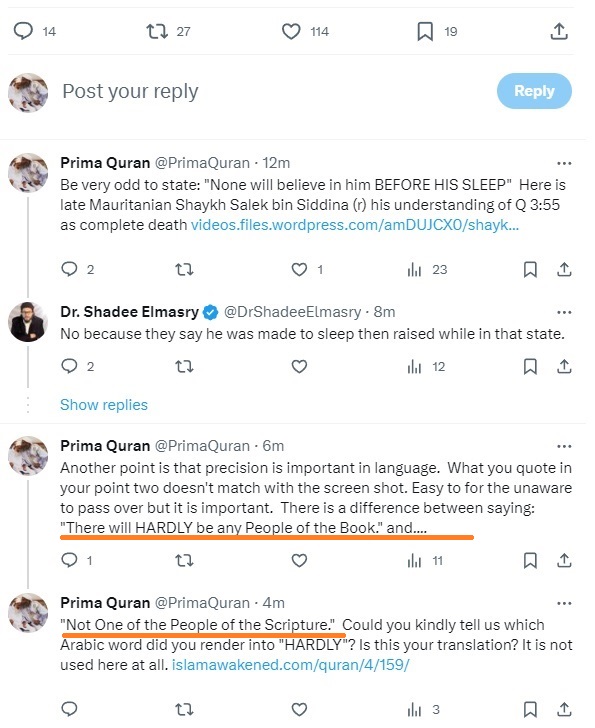
In our discussion with respected Dr. Shaykh Shadee El Masry (and a recent clash he had with the Ahmadi religion) We were curious as to the way Dr. Shadee translated Qur’an 4:159

We never did get an answer to which Arabic word(s) he used to translate the text into ‘Hardly’. Do you, the reader, the truth seeker, see what is happening here? We Love Dr. Shaykh Shadee Elmasry and if you are in his community, Allah-willing, you are in good hands. However, sometimes people will be tenacious in defending the indefensible.

The Jews and Christians will be at each other’s throat until the day of judgement

“Every one of the People of the Book will definitely believe in him before his death.” (Qur’an 4:159) If you were to take the standard Sunni misunderstanding this would flatly contradict the following:

“And the Jews say, “The hand of Allah is chained.” Chained are their hands, and cursed are they for what they say. Rather, both His hands are extended; He spends however He wills. And that which has been revealed to you from your Lord will surely increase many of them in transgression and disbelief. And We have cast among them animosity and hatred until the Day of Resurrection. ” (Qur’an 5:64)

“And from those who say, “We are Christians” We took their covenant; but they forgot a portion of that of which they were reminded. So We caused among them animosity and hatred until the Day of Resurrection. And Allah is going to inform them about what they used to do.” (Qur’an 5:14)

So the above verses do not give one the impression that Jesus (as) is going to come back and sing kumbaya with the Jews and the Christians. 

We would not be surprised if some really desperate (clutching at straws) interpretation came that argued. Yes, Jesus (as) will bring the Jews and & Christians together, but they will still have animosity and hatred among them!!  

Which begs the question: Why is he coming back?

Those of the Jews and Christians who see the truth and embrace insh’Allah are upon the path of safety. Those of the Jews and Christians who see the truth and reject it will be in hellfire.

“Indeed, that is My Path—perfectly straight. So follow it and do not follow other ways, for they will lead you away from His Way. This is what He has commanded you, so perhaps you will be conscious ˹of Allah˺” Qur’an 6:153)

“O mankind! Surely has come to you a convincing proof from your Lord, and We (have) sent down to you a clear light.” (Qur’an 4:174)

Our final point. We finish where we began.

“This is the dominant interpretation.” Well, Mufti, on what basis do you say this is the ‘dominant interpretation’ ? Can you tell us the total amount of tafsir literature you studied on this matter to conclude this? Also, if this is the ‘dominant interpretation’, it is by your own admission not necessarily the only one!

Truth vs. Popularity: The truth is not a matter of democratic opinion but of sound evidence from the Quran itself.

So dear respected readers which understanding of Qur’an 4:159 do you accept as being more cogent?

The Sunni position.

The position of Mufti Zameer ur Rahman, Ahl Sunnah Wal Jammah and the mufassirun — whom rely upon hearsay and disconnected chains coming often from anonymous sources.

A position that allows for whispering, speculation, doubt and uncertainty?

A position that ignores the advice of one of the four we are to learn the Qur’an from—none other than Ibn Masud (ra)? 

A position that structures a belief that goes against the Sunnah? “Do not believe the people of the Book, nor disbelieve them.”

The Ibadi position.

A position that takes the sincere council of one of the four we are to learn the Qur’an from—none other than Ibn Masud (ra)? 

A position that does not go against the clear Sunnah. A position where we do not disbelieve them but we certainly do not build a belief based upon their reports.

A position that ask if it is reasonable to accept a 700 year gap in the chain of transmission as admissible evidence.

A position that is primarily reliant upon  Tafsir al-Quran bi-l-Quran. (Interpreting the Qur’an by the Qur’an).

A position that allows the Qur’an to be interpreted by the use of other passages in the Qur’an, the use of grammar, context and theme?

A position that provides certainty and conviction?

May Allah Guide the Ummah.

May Allah Forgive the Ummah.
6 Comments

Filed under Uncategorized

Jesus will be a sign for the coming of the hour? Abuse of Qur’an 43:61

“And indeed, it surely is a knowledge of the Hour. So do not be in doubt about it, and follow Me. This is the Path Straight.” (Qur’an 43:61)

﷽ 

This text also has to be one of the most used and abused texts of the whole of the Qur’an. It is used to assert the so-called “2nd coming” of Christ Jesus. The fact that this is the ‘go to’ verse when anyone is trying to assert that the Qur’an affirms the “2nd coming” of Christ Jesus shows you just how weak their argument is.

Such people are better off using the ahadith to argue their position.

Let us start off with a major problem and contradiction with this understanding.

Narrated Abu Hurairah:

That the Prophet (saw) said: “There are three, for which, when they appear, a soul will not benefit by its faith, if it did not believe before the Signs: Ad-Dajjal, the Beast, and the rising of the sun from its setting place” – or “from the west.”

Source: https://sunnah.com/tirmidhi:3072

The majority of Sunni Muslims believe that Jesus (as) is coming a second time. Those who believe  that he is coming after the Dajjal. Remember, according to the above hadith and many like it faith does not benefit a person anymore!

“Do they wait for anything except that the angels should come to them or your Lord should come or that there come some of the signs of your Lord? The Day that some of the signs of your Lord will come no soul will benefit from its faith as long as it had not believed before or had earned through its faith some good. Say, “Wait. Indeed, we [also] are waiting.” (Qur’an 6:158)

It is very clear that when these signs happen, the faith and belief of those who came before will be rejected. Part of being a believer is to believe in the unseen.

Who believe in the unseen, establish prayer, and donate from what We have provided for them.” (Qur’an 2:3)

Those signs spoken of in Qur’an 6:158 will be so clear that after their appearance will neither avail the unbeliever to repent of his unbelief nor the disobedient to forsake his disobedience. So what would the point of Jesus (as) coming back and converting people to Islam (either by sword or by choice) when their belief counts for nothing any way?

Note how the text is being translated from the Qur’an corpus.

http://corpus.quran.com/wordbyword.jsp?chapter=43&verse=61#(43:61:1)

Also, when you go to the following link: https://quran.com/43/61

Look how they translate it into English.

This is how they translate it into English for the unsuspecting reader:

“And indeed, Jesus will be [a sign for] knowledge of the Hour, so be not in doubt of it, and follow Me. This is a straight path.”

Yet when you click on the vocalization of the Arabic and how it is rendered, something eye-opening occurs.

Their own exact translation is “And indeed it“, yet the English they wedge in there “Jesus”.

So let’s take a look at some other disparate translations.We will use the following as a tool:

https://www.islamawakened.com/quran/43/61/default.htm

Muhammed Asad, Abdl Haleem & Mohamed Shafi translations have the “it” as the passage referring to the Qur’an.

Shabir Ahmed has ‘it’ as a reference to the Qur’an, but unlike Muhammed Asad and Abdul Haleem and Mohamed Shafi, he has the Qur’an talking about an “oncoming Revolution” rather than “the hour”.

Yusuf Ali’s Saudi version just goes all in!

“And (Jesus) shall be a Sign (for the coming of).”

Prima Qur’an comments: So, according to that translation, not only is it Jesus, but he is a Sign as well!

Safi Kasas has Jesus in brackets but, unlike Yusuf Ali, he puts the [a sign] in brackets as well.

Abdul Hye goes all in with the second coming. “And he (Jesus) is a KNOWN SIGN.”

Dr. Munir Munshey gets carried away with: “In fact he, (and his fatherless birth) is a sign”

Then we have the Mustafa Khattab translation, really overselling it with their translation,

“And his ˹second˺ coming is truly a sign for the Hour. So have no doubt about it, and follow me. This is the Straight Path.”

Muhsin Khan & Muhammad al-Hilah (another Saudi translation) have it as: “And he (Iesa (Jesus), son of Maryam (Mary) shall be a known sign.”

Dr. Mohammed Tahir ul Qadri takes a que from his Salafi opponents and follows their lead with: “And surely (when) he, (Isa[Jesus], descends from heaven), he will be a sign…”

Ali Unai just goes on a tangent: “Surely he (Jesus) (brought into the world without a father, and granted such miracles as reviving the dead) is a means to knowledge of the Last Hour.”

Hamid S. Aziz is more neutral, non-committal in translation:

“And most surely it is (the above events or the Quran or he, Jesus) is a sign of the knowledge of coming of the Hour (of Resurrection and Judgment). Therefore have no doubt about it and follow Me: this is the Straight Way.”

Muhammad Taqi Usmani has it as: (‘Isa)

Syed Vickar Ahamed has it as: “And (Isa)

Farook Malik has it as: He (Jesus)

Maududi has it as: “Verily he [i.e, Jesus)

Rashad Khalifa has a bizarre translation: “He is to serve as a marker for knowing the end of the world, so you can no longer harbor any doubt about it.”

The Monotheist group — taking a que from their former mentor and master, Rashad Khalifa, has it as “He” and this becomes “a lesson for the Hour”

Are those who think the verse is a reference to Jesus justified?

Well, if you look at the surrounding context of the verse, the immediate context is about Jesus.

The verses before:

Jesus was not but a servant upon whom We bestowed favor, and We made him an example for the Children of Israel.And if We willed, We could have made [instead] of you angels succeeding [one another] on the earth.” (Qur’an 43:59-60)

As well as the text after.

“And when Jesus brought clear proofs, he said, “I have come to you with wisdom and to make clear to you some of that over which you differ, so fear Allah and obey me.” (Qur’an 43:63)

So this could be a reason why some have considered 43:61 to be about Jesus.

However, as you will see when we see the over-arching theme of Qur’an 43 as well as whom the immediate audience is, that justification will quickly disappear.

What about Arabic grammar?

A closer look at the Arabic text. “wa-innahu”, this is the 3rd person masculine singular object pronoun. We have third-person pronouns in English as well. We have object pronouns—me, you, him, her, it.

Secondly, the word “biha” is a 3rd person feminine singular personal pronoun. So this further clarifies how “wa-innahu” should be understood.

“And indeed, it surely is a knowledge of the Hour. So do not be in doubt about it, and follow Me. This is the Path Straight.” (Qur’an 43:61)

So, to support their claim, they would have to go against Arabic grammar!

What is the overarching theme of Qur’an 43?

Do not just look at the verses immediately before or after. Read all the verses before and after.

Verses 43:2-5 are references concerning the Qur’an.

43:14 is a reference concerning the resurrection.

43:21 is a reference to the Qur’an.

43:31 is a reference to the Qur’an.

43:35 is a reference to the hereafter.

43:43-44 are both references to the Qur’an.

Yes, Allah spoke about Jesus (as) in the past tense. Just as Allah spoke about Moses (as) in the past tense. Allah spoke about Abraham (as) in the past tense.

Not only this but think about this. Who is the immediate audience of the Qur’an 43:61?

The immediate audience is the pagan Quresh. How is some “2nd coming” of Jesus supposed to be an argument for the oneness of Allah (swt), or the truth of the resurrection to that immediate audience?

What is more sensible?

Understanding A)

“And indeed, he (Jesus) surely is a knowledge of the Hour. So do not be in doubt about it(second coming of Jesus), and follow Me. This is the Path Straight.” (Qur’an 43:61)

How are you asking a group of pagan idolater Quresh to not be in doubt concerning it to believe in some second coming of Jesus (as) that they will never witness?

In what universe does this make sense?

Understanding B)

“And indeed, it surely is a knowledge of the Hour. So do not be in doubt about it, and follow Me. This is the Path Straight.” (Qur’an 43:61)

Or, are a group of pagan idolater Quresh being asked to believe in the Qur’an (it) with arguments about the hereafter and resurrection that they can ponder and believe in during their own lifetime?

Which of the two understandings of the verse above is more sensible?

Not only this, we still have to contend with the fact that, as per our other articles, Jesus(as) has died. That Muhammed (saw) is the last and final Prophet. The text of the Qur’an should be in harmony with one another. The supposition that the Qur’an supports the idea that Jesus (as)is not based upon solid evidence.

May Allah (swt) open the eyes of the people.

You may also wish to read:

https://primaquran.com/2022/10/04/sunni-misunderstanding-of-quran-4159-concerning-jesus/

https://primaquran.com/2022/10/04/examination-of-the-word-tawaffa-in-the-quran-as-it-relates-to-the-death-of-jesus/

https://primaquran.com/2022/10/04/what-happened-to-jesus-and-how-did-he-die/

https://primaquran.com/2023/07/19/the-definitive-proof-from-the-ibadi-school-that-jesus-is-dead-and-will-not-return/

May Allah Guide the Ummah.

May Allah Forgive the Ummah.
Leave a comment

Filed under Uncategorized

Advise for new Muslim converts/reverts

Sadaqah are for the poor and the needy, and those employed to administer the (funds); for those whose hearts have been (recently) reconciled (to Truth); for those in bondage and in debt; in the cause of Allah; and for the wayfarer: (thus is it) ordained by Allah, and Allah is full of knowledge and wisdom.” (Qur’an 9:60)

﷽ 

This post is for you, the Muallafatul Quloob. What a beautiful description. Those whose hearts have been reconciled to Allah.

Some people who have recently reconciled their hearts to Allah prefer to be called converts and some prefer to be called reverts. There is no need to have a huge ordeal about this.

Convert has its etymology in Latin, which can mean: To turn around, to transform, to alter direction. All of these are apt descriptions of the Muallafatul Quloob.

Revert is to turn to a previous state. So those who choose this word mean that they are returning to the fitra.

First advice: On declaring your testification of faith. As has been transmitted as the mass practice from the time of the Blessed Messenger (saw), you need to say the testimony of faith in front of two sane adult individuals. The moment you believe in Islam in your heart, you are already a Muslim and insh’Allah. If you die before your testimony, you die upon Islam! However, the testimony of faith is because you are entering a community of 1.7 billion people worldwide. You have rights upon them, and they have rights upon you. You have obligations to them, and they have obligations to you.

Introverted personalities. Please do not be dissuaded from becoming a Muslim because you have seen countless YouTube videos of people declaring their faith publicly in front of huge crowds or throngs at the Masjid (Mosque). It is your right to disclose this to the local Imam of the Masjid (Mosque). You are an introverted personality type, perhaps have anxiety issues. Therefore, you do not need to take your shahada in such a public setting. As long as you do so in front of the two required witnesses. This includes speaking engagements or public talks. If it is outside your comfort zone, you are simply not obliged.

You do not need to wear your Islam on your sleeve. That means you don’t have to feel obligated to go out and buy the “I Love Islam” T-Shirt or “Islam is my way of life” bumper sticker and put that on your car. For those who do that, Al hamdulillah, that is good! But it is not necessary.

Take things slowly. Do not be overwhelmed by all the information that well-intentioned brothers/sisters will send to you. So, at this point, the most important aspects of Islam from a ritualistic aspect are the following:

The most important sacred connection rites. In English the bland word ritual is used.

However, we are talking about sacred technology.

  1. Learning how to take a proper bath (junuub/ghusl). Sounds silly, but we are not talking about popping in for a hot shower and a quick scrub.
  2. Learning how to make wudhu (ritual ablution before prayer)
  3. Learning the prayer. We would highly recommend for the prayer for you to have a note pad or something visual in which you can read along during the prayer. You keep doing this until you no longer need that note pad or visual guide. May Allah suffice you!

There are selected invocations also called du’a that Muslims incorporate throughout the day.

We would highly recommend the following:

Selected Prayers : A Collection of Du’a (Supplications) from the Qur’an and Sunnah by Dr. Jamal Badawi -a fantastic book.

Fasting during Ramadan.

If it is Ramadan, then you are advised to learn what is required of you for the month of fasting. If you have health conditions, or are prescribed medication, you must consult with your trusted Muslim advisor on this. The best would be an Imam who is trained in Islamic jurisprudence.

Other aspects of Islamic jurisprudence you as a convert/revert may wish to take note of.

  1. Your inheritance. What happens to your assets and belongings when you die? Who does it go to? Do you inherit from your non-Muslim family? Do they inherit from you?
  2. Funeral arrangements. Any of us could die at any time. Islam has its own prescribed method of washing and burying the dead.
  3. For married women/men, converts/reverts. If you are married and your husband/wife is not a Muslim. What are you advised to do?
  4. Dietary requirements. Most people think that Muslims do not eat pork and that is all. There is more to it than this.

Not everything Muslims say is Islam actually is Islam.

(Beware false information and cultural Islam)

What we mean by this is the following: Islam is a faith based upon proof and evidence. Anyone can advance any claim in this faith as long as they have proof or evidence to back this up. That being said, even if they produce proof or evidence the way they understand it may not be the proper way to understand it. It could have nuance or context that is even missed out by the one relaying the information.

If someone says, for example, you must wear socks when you pray in the mosque, or not wear pink in the mosque, or whatever, our advice do not argue with them. Many of them are mean well. Thank them for their advice. “I will take that on board.” “May Allah bless you”. “I will look into this.” If you have any questions, please consult the Imam or the one learned in Islamic jurisprudence.well-intentioned

Know that by entering into Islam all past sins are forgiven…..HOWEVER.

Once you have entered into Islam, all of your past sins are forgiven without doubt. Be it the most heinous or unspeakable. Allah (swt) calls you, “Muallafatul Quloob” That means your conflict with Allah, with God, is now over. You are a Muslim. This means you humbly surrender, you gladly and willfully submit to the will of Allah.

Your conflict with yourself is ongoing until you master yourself. Your conflict with Satan is on going until he gives up hope of inciting you to go astray.

That being said, in the world and the realm of humans, if you break a law or infraction, anything from a traffic violation, to tax evasion, to murder, you will still be held accountable by their legal code.

Likewise, in Islam, if you owe anyone any legal debt, you need to settle with them.

If you have hurt anyone in your life or wronged anyone, you need to at the very least reach out to that person and ask forgiveness or make amends. If they do not welcome reconciliation, that is upon them. You tried.

Maintain your ties to your family and friends. As long as those ties are not toxic or unhealthy for your new walk with Allah, you are recommended to keep those ties.

Do not disclose every personal detail about yourself, your past etc. Not everyone (including Muslims) has the best intentions.

We have seen this time and time again. Many converts, especially westerners, want to tell the world about their unislamic past. You did this with that many women or men, you did drugs, you drank alcohol, you were abused, you were in gangs. That is not only absolutely unnecessary but totally unadvisable. Not only are you broadcasting sins that Allah (swt) has now forgiven by your conversion, but you are opening yourself up to being judged by the community. Muslims are not perfect; Muslims use Islam as a guide to strive towards perfection.

We cannot underscore this point enough. Less is more. You need to learn to deflect conversation and be assertive at times.

We know as converts many times we want to tell about our ordeal in life, it’s almost therapeutic. You want to unload all the trauma and ordeal. Unload that now upon Allah (swt).

We know it sucks, however, we are going to tell you here and now. That community that is happy that you embraced Islam and sees you as someone elevated in their eyes, as soon as you talk about your past bf’s, gang life, failed marriages etc. many of them begin to write you off as a potential candidate for their son or daughter to marry. We are being honest with you. You take our advice or you leave it.

Sure, talk about your passions, your goals in life, hobbies and interests. Leave the personal stuff to the trusted people in your life. (Who may or may not be Muslim).

Remind them and remind yourself, “Every time Satan reminds you of your past, you remind Satan of his future.” Your past has now been changed by becoming “Muallafatul Quloob” whereas Iblis, Satan, is consigned to the flames and what an evil destination that is!

Go where love is.

What do we mean by this? Different people and different communities have different atmospheres and vibes. So, if one particular Mosque (Masjid) or community does not feel welcoming insh’Allah, find one that is. You may also wish to check out reviews of local mosque or islamic centres online.

Do not be a KPI convert & do ask for help!

What do we mean by KPI convert? You have people working for organizations trying to bring the message of Islam to the not-yet Muslims. These organizations will often put soft pressure on their representatives to convert people to Islam. So, they have a KPI (Key Performance Index) of how many people converted to Islam this week or this month. Your shahada (testification of faith) is recorded and maybe uploaded on social media (often without your consent). You are given some books and literature and off you go!

This is so wrong on so many levels!

When a man or woman converts to Islam, you should have two people assigned or attached to you to check up on you on a day-to-day basis. They should try and direct you to the scholars and learned people. They should inquire (if you are open to it) about if you have any pressing problems, financial, emotional, psychological. Again, access if you want to share as some of these pressing challenges can be deeply personal.

In other words, there should not be a situation where you convert to Islam and people just wash their hands of you. Beyond injustice is this approach.

Likewise, you have to have realistic expectations of the Muslim community. Not everyone is going to be able to assist with paying your debts, medical expenses, etc.(should you have them). Often, individual Muslims themselves struggle with and juggle many things. May Allah (swt) suffice us all.

Conversion to Islam is solely about connection to Allah (swt) and benefiting from the teachings of Islam to navigate one’s way through life, come what may.

Special warning or advice to women converts to Islam.

We would strongly advise you sisters to be extra careful about sudden marriage proposals and request; especially from those who are not citizens of your respective country.We are not saying such requests are not sincere. However, there are too many cases where a good-hearted and naïve Muslim convert woman rushes to marry someone from overseas, only to find out later that she was being used as a springboard for visa sponsorship, permanent residency and citizenship and later divorced. May Allah suffice us. Do reach out to your circle of Muslim sisters and have their spouses, brothers, and fathers assist you in vetting the background and intention of those seeking your hand in marriage. Do have your interests safeguarded as well.

If they do not teach you recitation of the Qur’an or do not emphasize learning Arabic. RUN!

This is usually a sure sign that you have stumbled upon a deviant expression of Islam that is far from the path. There should not be any reason why anyone would want to keep you from learning Arabic.

Of course, you go at your own pace and at your own target. Yet any community you join spends too much time talking about esoteric matters, conflicts that happened among Muslims in the past, politics and such, and they do not encourage you to learn how to read and recite the Qur’an, they do not encourage you to learn classical Arabic. RUN!

There is no good reason that if you show an interest or an aptitude to want to learn how to read the Qur’an or learn Arabic that you should not be assisted in this matter. Any community or group who belies the importance of this is a community that does not want to empower you. A community that does not want you to be connected to the sources is a community that does not want you to reflect and research.

When asked challenging questions about Islam from the sincere, the insincere, the scoffers, or the antagonistic,

Remember there may be more than one response to a particular question. The best and brightest scholars do not have all the answers. Sometimes what Allah (swt) has given in insight to one scholar has not been given to another scholar. Always seek out various responses to thorny issues or difficult subjects. Look at what is honest and consistent and what corresponds to the Qur’an and the teachings of the Blessed Prophet (saw). 

We do hope this is helpful and honest for you as the Muslim convert/revert.

May Allah forgive our short comings and to all of you welcome to Islam. Welcome home!

We can recommend this basic book for learning Islam:

You may find this visual guide of learning the prayers helpful as well:

May Allah Guide the Ummah.

May Allah Forgive the Ummah.
2 Comments

Filed under Uncategorized

The Created Qur’an: Yasir Qadhi, Salafis and Atheist.

Ha-Mim By the Book that makes things clear,-We have made it a Qur’an in Arabic, that you may be able to understand and learn wisdom. And verily, it is in the Mother of the Book, in Our Presence, high in dignity, full of wisdom. Shall We then take away the Message from you and repel (you), for that you are a people transgressing beyond bounds? (Qur’an 43:15)

“Nay! it is a Glorious Qur’an, In a guarded tablet”  (Qur’an 85:21-22)

 ﷽ 

This is an entry that discusses the problematic theological position held by those who call themselves ‘Salafi’ or ‘Athari. That is the belief that the Qur’an is the eternal uncreated word of Allah.

Now this is a belief of those who ascribe to Ahl Sunnah in general. However, there is an aberrant and bizarre perspective held by those who call themselves as ‘Salafi’ or ‘Athari’.

That is what this article will focus on.

I want to say from the outset that the Ibadi school does not make takfir of any Muslim who believes the Qur’an is created. This issue was not addressed by the Blessed Prophet (saw) nor by his companions. Takfir of other Muslims is not something that our school is known for.

This is a matter of dispute between the scholars. Each side will bring thier proofs and justifications for the position that they hold.

It is truly unfortunate that some of the Muslim intelligentsia and academics would feel so threatened by any discussion on this subject that it would incur a death penalty.

For example in one of the great works that are praised by the Sufi Muslims, Qadi Iyad we find

He said about someone who said that the Qur’an is created, “He is an unbeliever, so kill him.” He said in the version of Ibn Nafi’, “He should be flogged and painfully beaten and imprisoned until he repents.” In the version of Bishr ibn Bakr at-Tinnisi we find, “He is killed and his repentance is not accepted.”

Source: (Qadi ‘Iyad Musa al-Yahsubi, Muhammed Messenger of Allah (Ash-Shifa of Qadi ‘Iyad), translated by Aisha Abdarrahman Bewley [Madinah Press, Inverness, Scotland, U.K. 1991; third reprint, paperback], p. 419)

You can also purchase it from amazon. http://www.amazon.com/Ash-Shifa-Qadi-Iyad-Aisha-Bewley

In fact, Muhammed ibn Isma’il Al-Bukhari (of Sahih Bukhari oral collection fame) was persecuted by a group of those from the Hanbali school of jurisprudence for a remark he made.

“Al-Dhuhli was fierce (shadîd) in his adhesion to the Sunna. He confronted Muhammed ibn Isma‘il [al-Bukhari] because the latter had alluded, in his Khalq Af‘al al-‘Ibad, to the fact that the reader’s utterance of the Qur’an was created. Bukhari made it understood without explicitly saying it, but he certainly made it clear. On the other hand, Ahmad ibn Hanbal flatly refused to explore the question, as well as Abu Zur‘a and al-Dhuhli, or indulge in the terminology of dialectic theologians (al-mutakallimûn), and they did well – may Allah reward them excellently. Ibn Isma‘il had to travel from Naysabur undercover, and he was pained by what Muhammed ibn Yahya [al-Dhuhli] had done to him.”

Source: (Al-Dhahabi, Siyar (10:207)

Also:

Al-Hakim [narrated with his chains]: Muhammed ibn Yahya [al-Dhuhli] said: “This Bukhari has openly subscribed to the doctrine of ‘pronunciationists’ (al-lafziyya), and for me those are worse than the Jahmiyya.” . . . Ahmad ibn Salama visited Bukhari and told him: “O Abu ‘Abd Allah, this is a respected man [i.e. al-Dhuhli] in Khurasan, especially in this town [Naysabur], and he has thundered with this speech until none of us can say anything to him about it, so what do you think we should do?” Bukhari grasped his beard then he said: (I confide my cause unto Allah. Lo! Allah is Seer of His slaves.) (40:44) He continued: “O Allah! You know that I did not want for one moment to settle in Naysabur out of arrogance, nor in quest of leadership, but only because my soul would not let me return to my own country [Bukhara] because of my opponents; and now this man intends harm for me out of jealousy, only because of what Allah gave me and for no other reason.” Then he said to me: “O Ahmad, tomorrow I shall leave and you will be rid of his talk which I caused.” . . . Muhammed ibn Ya‘qub the hadith master said: “When al-Bukhari settled in Naysabur Muslim ibn al-Hajjaj took to visiting him frequently. When the affair of the pronunciation of Qur’an took place between al-Bukhari and [al-Dhuhli] and the latter roused people against him and forbade them to visit him, most people stopped visiting him, but not Muslim. Then al-Dhuhli said: ‘Anyone that subscribes to the pronunciation [being created], it is not permitted for them to attend our gathering.’ Whereupon Muslim placed a cloak on top of his turban, stood up in front of everyone, and sent back to al-Dhuhli what he had written from him carried by a camel-driver, for Muslim openly subscribed to the pronunciation and made no attempt to conceal it.” . . . Ahmad ibn Mansur al-Shirazi also narrated it from Muhammed ibn Ya‘qub, adding: “And Ahmad ibn Salama stood up and followed him.” (See Al-Dhahabi, Siyar (10:314-315). Cf. Bayhaqi’s al-Asma’ wa al-Sifat (al-Hashidi ed. 2:20-21 #591).

As Hamza Yusuf correctly remarked. if you follow this line of reasoning you eventually end up with

@ 1:32 Listen carefully people. Shaykh Hamza Yusus if a public orator and a supremely articulate man. Listen very carefully to the doctrine you are being asked to subscribe to.

@ 3:00 “It definitely doesn’t mean though the mushaf you have in your house. Because that would then…I mean some of the Christians argue that well the Qur’an is imbibliation. Like we believe in incarnation of the logos the Muslims believe in imbibliation of the logos. That God became book and so we don’t we don’t see that as valid. That view of it so.” -Hamza Yusuf.

Salafi Da’wah hooks you with the transcendence of Allah (swt). Most people who are introduced to Islam through the street preachers who hold Salafi doctrine are intrigued by concepts such as: Allah being one. What seems to look like a simplistic creed. That Allah has no parents or no children or no partners. Allah is neither black nor white. Allah is not male or female.

However, once you have taken your Shahadah or delcaration of faith how much longer until you are taught ‘Kitab Al Tawhid’ and here come the bizarre concepts. Allah has two right hands, and one of those right hands is a left hand, Allah occupies space, has a shin, a foot, chuckles at people’s despair, comes down the third part of the night, appears to the disbelievers in forms and shapes that they knew and then appears to the disbelievers in forms and shapes they do not know.

Said NO ONE EVER!

Yasir Qadhi, Salafis and Atheist.

Unfortunately Yasir Qadhi has come under fire from people who seemingly do not understand what he has been saying as of late.

Atheist and Agnostics have a different epistemology and world view when evaluating history then do believers. This also should not come as a shock or a surprise to anyone.

Agnostic/Skeptic: “We have not found any evidence of X.”

Believer: “They have yet to find any evidence of X.” The believer takes note that the Agnostic/Skeptic did not claim “We will never find.”

However, in one of his books he has given a very powerful argument to the atheist and agnostics to dismantle Salafi theology.

In reality I should not fault Yasir Qadhi for this as if it was some novel idea that he came up with. Rather, he is parroting the learned polemic that he would have picked up from his teachers.

Yasir Qadhi says:

These Attributes are understood literally (in the case of the Attributes of kalam, that Allah, Speaks, whenever He wishes, with a sound, in different languages, and this Speech is composed of words and letters and is not created), but the actuality and ‘how-ness’ of these Attributes are not delved into, and any negative similarity be-tween these Attributes and the attributes of the creation are negated (in the case of this Attribute, that the speech of the creation is created, but the Speech of Allah is not.)  Understanding these Attributes ‘literally’ does not mean understanding them in the manner that they are found in the creation, or comparing them with the attributes of the creation; rather, it means affirming the linguistic meaning of that Attribute in a manner that befits the Creator, and will never completely be understood by mankind.”    

Source: (An Introduction to the Sciences of the Qur’an pg 52)

 We are told that the ‘how-ness‘ is not delved into and yet this whole paragraph does exactly that!  When you negate comparison you are comparing and contrasting ‘how‘ something is unlike something else.

When speaking of prophet Ibrahim (a.s) and the story of the idols Shaykh Yasir Qadhi says:

“In these verses, Ibrahim showed his people that their idols were not worthy of worship, primarily because they could not speak. After they themselves acknowledged this, Ibrahim rebuked them, and asked them, “Have you no sense?!” meaning, “How can an object that cannot even speak be worthy of worship?”  Notice that Ibrahim was referring to a speech that could be heard, for Ibrahim’s people did not answer Ibrahim with the belief of the Ash’arees, “Our god speaks, but a speech that is not heard-an internal speech of the mind!”  for they understood what Ibrahim meant!! This is why they turned to themselves, and realized the foolishness of their actions, and could only reply with the feeble response that everyone knew that their idols could not speak!”  

Source: (An Introduction to the Sciences of the Qur’an pg 46)

Yasir Qadhi thinks that he has the goods on the Ash’ari Sunnis latter making a quote that in effect turns the Ash’ari Sunnis into idol worshipers.

 Yet, look at the quotation above where he says:

‘literally’ does not mean understanding them in the manner that they are found in the creation.”

Rather than help Islam, Yasir Qadhi and his Salafist-Athari creed and those who think like him have handed over to skeptics of their position a devastating argument.


So like Ibrahim (as) demands above the atheist has the right to demand from him speech from his Creator.

They have the right to demand a speech that could be heard”

A typical discussion between an Atheist-Agnostic/Skeptic and one who follows Salafist theology could go something like this:

Atheist/Agnostic/Skeptic: “Does your god, Allah speak? Let’s hear it then!”

Salafi: “Of course and here is the proof!” (pulls out Qur’an).

Atheist/Agnostic/Skeptic: “Ibrahim didn’t ask the idols for a book; he asked if they can speak!”

Salafi:

Yet Yasir Qadhi is not done with the Ash’ari.

Yasir Qadhi thinks he has the goods on the Ash’ari when he says,

“1) If the kalam of Allah is without sound, then what did Musa hear when Allah spoke to Him? If they respond that Allah created a sound, and caused Musa to hear that created sound, then this means that this created object stated,
“O Musa, verily, I am your Lord…Verily, I am Allah, there is no God save Me, so worship Me… [ Qur’an 20:12-14]


Therefore, if they state this, it implies that this created object claimed to be Allah, and asked Musa to worship it! However, if they stated that it was the actual kalam of Allah, then it must be asked, “How then did Musa hear it if you claim that Allah’s kalam is without sound? ” The scholars of the Ash’arees have not been able to provide a satisfactory response for this.”  

Source: (An introduction to the Sciences of the Qur’an pg 44)

Prima Qur’an Comments:

So Yasir Qadhi thinks that it was the object cried out ‘I am Allah, there is no God save Me, so worship Me’.   Yet, obviously, we know that Moses (as) did not perform any act of worship towards the direction of the voice. Or at least no act of worship is recorded.

Yasir Qadhi and those who agree with his position have to wonder the following:

What did Rasul Allah (saw) think when Angel Gabriel (as)
said. ” Indeed this, your religion, is one religion, and I am your Lord, so worship Me.” (Qur’an 21:92)

Did the Blessed Messenger (saw) fall down and worship Gabriel? Obviously not!

Gabriel(as) was used as a medium in the same way the burning bush was.

As regards if Musa (as) heard audible sounds from the burning bush you ask yourself, did the companions hear audible sounds as the Qur’an was being revealed to the Blessed Messenger (saw)?

“And [We sent] messengers about whom We have related [their stories] to you before and messengers about whom We have not related to you. And Allah spoke to Moses with [direct] speech.”  (Qur’an 4:164)

“When he saw a fire and said to his family, “Stay here; indeed, I have perceived a fire; perhaps I can bring you a torch or find at the fire some guidance.” And when he came to it, he was called, “O Moses, Indeed, I am your Lord, so remove your sandals. Indeed, you are in the sacred valley of Tuwa. And I have chosen you, so listen to what is revealed [to you] Indeed, I am Allah. There is no deity except Me, so worship Me and establish prayer for My remembrance.”  (Quran 20:10-14)

“And when Moses had completed the term and was traveling with his family, he perceived from the direction of the mount a fire. He said to his family, “Stay here; indeed, I have perceived a fire. Perhaps I will bring you from there [some] information or burning wood from the fire that you may warm yourselves.” But when he came to it, he was called from the right side of the valley in a blessed spot – from the tree, “O Moses, indeed I am Allah, Lord of the worlds.” (Qur’an 28:29-30)

“Has there reached you the story of Moses? When his Lord called to him in the sacred valley of Tuwa” (Qur’an 79:15-16)

Likewise, since the Qur’an acts as a guardian of the previous scriptures let us see what is claimed to be the Torah has to say as well.

“There the angel of the LORD appeared to him in flames of fire from within a bush. Moses saw that though the bush was on fire it did not burn up. So Moses thought, “I will go over and see this strange sight–why the bush does not burn up.”When the LORD saw that he had gone over to look, God called to him from within the bush, “Moses! Moses!” And Moses said, “Here I am.””Do not come any closer,” God said. “Take off your sandals, for the place where you are standing is holy ground.” (Exodus 3:2-5)

Allah (swt) created a sound and caused Moses (as) to hear that created sound. In fact, if you go on further the whole context shows how Allah (swt) is the creator of perception.  Moses (as) was made to perceive a burning fire, it did not indicate if anyone saw it or not.  He (as) was made to perceive his hand becoming white. He (as) was made to perceive a voice from a tree. He (as) was made to perceive his staff move like a snake.

“And it is not for any human being that Allah should speak to him except by revelation or from behind a partition or that He sends a messenger to reveal, by His permission, what He wills. Indeed, He is Most High and Wise.” (Qur’an 42:51)

Unless our respected Yasir Qadhi wants to say that the  Qur’an contains a flat contradiction he will need to understand ‘Allah spoke to Moses with direct speech‘ in light of the above verses.

Coming back to Ibrahim:

First of all notice that there are different approaches that the Prophets of Allah take when dealing with different groups.

“Say: “Do you see what it is you invoke besides Allah? Show me what it is they have created on earth, or have they a share in the heavens bring me a book (bikitabin) before this, or any remnant (atharatin) of knowledge (you may have), if you are telling the truth!” (Qur’an 46:4)

Why do people worship at all?

What is the motivation for worship?

A) Either derive from benefit. These deities bring fortune, or blessings.

B) Either to avoid some harm. These deities will bring misfotune, or wrath.

Now comes the question: What is the authority for this worship!

Notice that in the Qur’an 46:4 The Blessed Prophet (saw) is asking if these people have some authority for doing what they do. Do they have a revelation or an athar (report, hadith from a previous athority).

Ibrahim (as) and his approach is very logical and methodical.

  1. There is no prophet or oracle from these people he needs to consult or contend with.
  2. There is no claim of sacred revelation that he needs to consult or contend with.

It is obvious that Ibrahim (as) is trying to trigger these people. He is getting them to reflect on the basis for dong what they do.

They said, “Have you done this to our gods, O Ibrahim?” He said, “Rather, this – the largest of them – did it, so ask them, if they should speak.” (Qur’an 21:62-63)

“Ibrahim asked, “Can they hear you when you call upon them? Or can they benefit or harm you?(Qur’an 26:72-73)

There is nothing in these text that even remotely suggest that it is the personal belief of Ibrahim (as) that in order for Allah to exist and be real, then He must communicate via audible sounds that can be perceived by the ear.

It would be great if we had the response of these idol worshippers.

Wait..we do!

In reply to Qur’an 26:72-73 we have:

“They replied, “No! But we found our forefathers doing the same.”
Ibrahim responded, “Have you considered what you have been worshipping, you
and your ancestors?” (Qur’an 26:74-76)

Now we get to the justification. They are simply following what the people who came before them did. At least here they are forthcoming.

In reply to (Qur’an 26:72-73) we have:

So they came back to their senses, saying, “You yourselves are truly the wrongdoers.
Then they regressed to their mind -set. “You already know that they cannot speak.” He said “Do you then worship besides Allah, what can neither benefit nor harm you? (Qur’an 21:64-66)

What can neither benefit nor harm you. This is proven by the previous episode of the idols being smashed to pieces. If they cannot benefit or protect themselves then what guarantee do you have that they can benefit or protect you.

People should really think carefully before they set up a whole generation of young people to be demolished in an age of Atheist, Agnostics and Skeptics.

“Behold, you received it on your tongues, and said out of your mouths things of which you had no knowledge; and you thought it to be a light matter, while it was most serious in the sight of Allah.” (Qur’an 24:15)

For those interested the book: “An Introduction to the Sciences of the Qur’an” by Yasir Qadhi is still the best book in the English language on the topic. Nothing else comes close.

May Allah Guide the Ummah.

May Allah Forgive the Ummah.

Leave a comment

Filed under Uncategorized

Ramadan Day 25

“Tell believing men to lower their gaze and guard their private parts. That is purer for them. God is acquainted with what they do.” (Qur’an 24:30)

“And do not spy, nor backbite one another. Would any of you like to eat the flesh of their dead brother? You would despise that! And fear Allah. Surely Allah is ˹the˺ Accepter of Repentance, Most Merciful.” (Qur’an 49:12)

﷽ 

Ramadan Day 25: The two that lead to hellfire: The private parts and the tongue.

25th of Ramadan*
——————————–
*Heart Illness: Hypocrisy*
Allah and his messenger have described hypocrites for us so that we can avoid being like them, here are some attributes extracted from the Qur’an and the Sunnah:

Disloyalty: and it’s the opposite of trustworthiness, it can be in covenants, wealth, responsibilities and others.
Lying: starting from light lies until lying becomes a habit for the hypocrite.
Betrayal: the hypocrite will try to find anyway to betray.
Immorality: making no difference between a Haram and a Halal due to the lack of faith.
Laziness in worship: Allah says about them: (“And when they stand for prayer, they stand lazily, showing [themselves to] the people and not remembering Allah except a little.” (Qur’an 4:142))
Over-caring about looks: Allah said:

“When you see them, their appearance impresses you. And when they speak, you listen to their ˹impressive˺ speech. But they are ˹just˺ like ˹worthless˺ planks of wood leaned ˹against a wall’ (Qur’an 63:4)
Deception: Allah said:

“They seek to deceive Allah and the believers, yet they only deceive themselves, but they fail to perceive it.” (Qur’an 2:9)
Corruption: Allah says:

“And when it is said to them, Do not cause corruption on the earth, they say, We are but reformers.” (Qur’an 2:11)

*Walayah and Bara’ah of Jumlah and Haqiqah*
We spoke about Walayah and Bara’ah previously, now we will know some types of walayah and bara’ah.

Firstly, “Jumlah” meaning “as a whole” and it’s an obligation for every Muslim, it’s to (ally all the allies of Allah from the past and the present until the day of judgment, and to dissociate from all the enemies of Allah in the past, present and until the day of judgment)

The other type we will mention today is Haqiqah, and it’s to ally and dissociate based on certain texts, like to ally the wife of Fir’aun, Maryam the mother of Isa (as), the messengers etc,
and dissociate from people like Abu Lahab, the wife of Nuh and Lut
because these people are mentioned in the Qur’an for their righteousness or misery

To read more you may wish to read:

*Things allowed in prayer*
from the things that are allowed in the prayer are:
To open the next verse for the Imam if he forgets
To say SubhanAllah for the Imam if he made a mistake in the prayer
To cry for the matters of the hereafter
Light movement to fix the prayer
To stop people from walking In front of you
Killing the snake and the scorpion and other harmful things
To save souls or wealth from destruction
To carry a child and to quite him
To swallow the saliva or spit the saliva.

May Allah Guide the Ummah.

May Allah Forgive the Ummah.

Leave a comment

Filed under Uncategorized

Request from the readers on the term ‘Ahl Sunnah Wal Jammah’

“And strive in His cause as ye ought to strive, (with sincerity and under discipline). He has chosen you, and has imposed no difficulties on you in religion; it is the cult of your father Abraham. It is He Who has named you Muslims, both before and in this (Revelation); that the Messenger may be a witness for you, and ye be witnesses for mankind! So establish regular Prayer, give regular Charity, and hold fast to Allah! He is your Protector – the Best to protect and the Best to help!” (Qur’an 22:78)

﷽ 

Did you know that the vast majority of Muslim layman and even some learned people believe that the Blessed Prophet (saw) said something along the following:

“My Ummah will be split into 73 groups and all of them will be in the hellfire except one, and that is ‘Ahl Sunnah Wal Jammah‘.

  1. This is absolutely not true. In fact, it is imputing a lie to the Blessed Prophet (saw).

There is absolutely no such statement of the Blessed Prophet (saw).

Does anyone know any verse in the Qur’an any sound Hadith that says that we as Muslims are to call ourselves: ourselves ‘Ahl Sunnah Wal Jammah‘?

I have been searching high n low, and coming up empty. I am not infallible or above reproach. So I think its best I consult with others.

Have you the readers found any clear statement from the Qur’an that we are to call ourselves: ‘Ahl Sunnah Wal Jammah‘?

Have you the readers found any clear statement from the Qur’an that the saved people on the day of judgement are: ‘Ahl Sunnah Wal Jammah‘?

Have you the readers found any sound hadith, (whose chain of narration was so spotless it was not disputed by any of the scholars) where the blessed Prophet Muhammed (saw) told us to call ourselves: ‘Ahl Sunnah Wal Jammah‘?

Have you the readers found any sound hadith, (whose chain of narration was so spotless it was not disputed by any of the scholars) where the blessed Prophet Muhammed (saw) said that the saved group are the: ‘Ahl Sunnah Wal Jammah‘?

Here is what I found.

I found that there has been some deception and sleight of hand to fool people into thinking words have meaning that they do not have.

jama’a literally denotes a group, a collective, a congregation.

jama’a does NOT mean largest group, largest collective, largest congregation.

If one searches through the history books, he will find the origin story of the ‘Jama’ah is the year in which Muawiyah seized the power. It was known as the “The Year of al- Jama’ah”.

It was called so, because the Ummah of the Blessed Prophet (saw) had already become divided into two factions after the death of Uthman: The Shia of Ali and the followers of Muawiyah. When Imam Ali was killed and Muawiyah took over the power, the year was called “al- Jama’ah”. Out of the many Jama’ah. The majority was being lead by Muawiyah, who usurped power and any other parties were considered as a dangerous rivals. Therefore the name of “Ahl al-Sunnah and al-Jama’ah” indicates a forged terminology between the Blessed Sunnah of the Prophet (saw) merged with the innovations by Muawiyah, and the agreement upon his leadership.

Source: (History of al-Tabari, English version, v10, p97) https://www.kalamullah.com/Books/The%20History%20Of%20Tabari/Tabari_Volume_10.pdf

Correction: The Muslim community did not come together in recognizing Mu’awiyah. There remained Muslims that up until today do not recognize Mu’awiyah usurping the Imamate of the Muslims.

MORE DECEPTION IN REGARD TO THE TERM JAMA’A

You may have heard a hadith along the lines of: “Allah’s hand is with the Jammah.”

However, as we have already noted jama’a literally denotes a group, a collective, a congregation.

So now watch some manipulation at work.

If we go to the following website islamqa we find the following: (https://islamqa.info/en/answers/147341/can-large-numbers-be-quoted-as-evidence-of-truth-and-the-meaning-of-the-hadith-my-ummah-will-not-agree-on-misguidance)

“Praise be to Allah.

At-Tirmidhi (2167) narrated from Ibn ‘Umar (may Allah be pleased with him) that the Messenger of Allah (blessings and peace of Allah be upon him) said: “Allah will not cause my ummah to agree on falsehood; the hand of Allah is with the jamaa‘ah (the main body of the Muslims).” Classed as hasan by al-Albaani.”

(the main body of the Muslims) is a bracketed insertion. It is not the meaning of the word jama’a.

Manipulation at work once again. Observe:

” ‘Arfajah ibn Shurayh reported: I saw the Prophet, peace and blessings be upon him, delivering a sermon to the people, saying, “Verily, the Hand of Allah is over the united community, for Satan is with one who secedes from the community, running after him.

Source: Sunan al-Nasā’ī 4020

Grade: Sahih (authentic) according to Al-Albani.”

However, the Arabic text says no such thing. Observe how it (along with the fuller text) is translated here:

It was narrated that ‘Arfajah bin Shuraih Al-Ashja’I said:

“I saw the Prophet [SAW] on the Minbar addressing the people. He said: ‘After me there will be many calamities and much evil behavior. Whoever you see splitting away from the Jama’ah or trying to create division among the Ummah of Muhammed [SAW], then kill him, for the Hand of Allah is with the Jama’ah, and the Shaitan is with the one who splits away from the Ummah, running with him.'”

Source: (https://sunnah.com/nasai:4020)

Again, nothing about ‘united community’. Which would be problematic even if that were to be accepted. All the different group of Muslims are united with in themselves. When they become disunited on a matter they split and become another Jama’ah.

This is why the people over at islamqa inserted: the main body of the Muslims

WHAT I AND MY COMPANIONS ARE UPON.

Then we have the following:

Narrated ‘Abdullah bin ‘Amr:

that the Messenger of Allah (saw) said: “What befell the children of Isra’il will befall my Ummah, step by step, such that if there was one who had intercourse with his mother in the open, then there would be someone from my Ummah who would do that. Indeed the children of Isra’il split into seventy-two sects, and my Ummah will split into seventy-three sects. All of them are in the Fire Except one sect.” He said: “And which is it O Messenger of Allah?” He said: “What I am upon and my Companions.”

Source: (https://sunnah.com/tirmidhi:2641)

This hadith has been classified as weak. Not everyone is in agreement upon it’s authenticity.

Notice there is no mention of the theologically and politically loaded terminology jama’a

Certainly this hadith which has been classified as weak has to be tempered in light of the hadith that has been graded sound which states:

Narrated Anas:

The Prophet (saw) said, “Some of my companions will come to me at my Lake Fount, and after I recognize them, they will then be taken away from me, whereupon I will say, ‘My companions!’ Then it will be said, ‘You do not know what they innovated (new things) in the religion after you.

Source: (https://sunnah.com/bukhari:6582)

or the following hadith:

Qais reported:

I said to ‘Ammar: What is your opinion about that which you have done in case (of your siding with Hadrat ‘Ali)? Is it your personal opinion or something you got from Allah’s Messenger (saw)? ‘Ammar said: We have got nothing from Allah’s Messenger (saw) which people at large did not get, but Hudhaifa told me that Allah’s Apostle (saw) had especially told him amongst his Companion, that there would be twelve hypocrites out of whom eight would not get into Paradise, until a camel would be able to pass through the needle hole. The ulcer would be itself sufficient (to kill) eight. So far as four are concerned, I do not remember what Shu’ba said about them

Source: (https://sunnah.com/muslim:2779a)

FOLLOW MY SUNNAH AND THE RIGHTLY GUIDED CALIPHS

Narrated Irbad ibn Sariyah:

AbdurRahman ibn Amr as-Sulami and Hujr ibn Hujr said: We came to Irbad ibn Sariyah who was among those about whom the following verse was revealed: “Nor (is there blame) on those who come to thee to be provided with mounts, and when thou saidst: “I can find no mounts for you.”

We greeted him and said: We have come to see you to give healing and obtain benefit from you.

Al-Irbad said: One day the Messenger of Allah (saw) led us in prayer, then faced us and gave us a lengthy exhortation at which the eyes shed tears and the hearts were afraid.

A man said: Messenger of Allah! It seems as if it were a farewell exhortation, so what injunction do you give us?

He then said: I enjoin you to fear Allah, and to hear and obey even if it be an Abyssinian slave, for those of you who live after me will see great disagreement. You must then follow my sunnah and that of the rightly-guided caliphs. Hold to it and stick fast to it. Avoid novelties, for every novelty is an innovation, and every innovation is an error.

Source: (https://sunnah.com/abudawud/42/12)

Even though this particular hadith is classified as sound I believe that it has been subject to mudraj (interpolated). In particular the phrase: “and that of my rightly -guided caliphs.”

The Arabic term: الْمَهْدِيِّينَ or almahdiiyn also could be translated as ‘The Mahdis’ is certainly problematic.

This hadith does not leave really any good options either for the Umayyad Sunni(s) or the Abbasid Sunni (s).

Why?

  1. There are just too many companions that fought against Imam Ali to have thought him to be (rightly guided) in all his actions.
  2. This means they heard this hadith and ignored it. Not good!
  3. It means that they never heard this hadith because it is mudraj (interpolated) i.e forged.

This extra addition: “and that of my rightly -guided caliphs.” seems cooked up after the fact. Most likely to counter opposition to a particular historical narrative.

If some groups are going to have rightly guided Imams why not rightly guided Caliphs?! Allah (swt) knows best!

THE POSSIBILITY OF NO JAMA’A OR NO IMAM? THEN WHAT?

Narrated Hudhaifa bin Al-Yaman:

The people used to ask Allah’s Messenger (saw) about the good but I used to ask him about the evil lest I should be overtaken by them. So I said, “O Allah’s Messenger (saw)! We were living in ignorance and in an (extremely) worst atmosphere, then Allah brought to us this good (i.e., Islam); will there be any evil after this good?” He said, “Yes.” I said, ‘Will there be any good after that evil?” He replied, “Yes, but it will be tainted (not pure.)” I asked, “What will be its taint?” He replied, “(There will be) some people who will guide others not according to my tradition? You will approve of some of their deeds and disapprove of some others.” I asked, “Will there be any evil after that good?” He replied, “Yes, (there will be) some people calling at the gates of the (Hell) Fire, and whoever will respond to their call, will be thrown by them into the (Hell) Fire.” I said, “O Allah s Apostle! Will you describe them to us?” He said, “They will be from our own people and will speak our language.” I said, “What do you order me to do if such a state should take place in my life?” He said, “Stick to the group of Muslims and their Imam (ruler).” I said, “If there is neither a group of Muslims nor an Imam (ruler)?” He said, “Then turn away from all those sects (al-firqa) even if you were to bite (eat) the roots of a tree till death overtakes you while you are in that state.”

Source: (https://sunnah.com/bukhari:7084)

Here this text addresses the possible scenario of there being no jama’a at all! In particular, no group of Muslims (jamaat al muslimin)

Also, it is hard to imagine that the Blessed Prophet (saw) is advocating for a ‘do it yourself’ Islam in the statement: Then turn away from all those sects (al-firqa)

So let us look at what has been clearly established. We have nothing from the Qur’an or the Sunna of the Blessed Prophet (saw) telling us to follow: Ahl al-Sunnah and al-Jama’ah

CLAIMS THAT THE COMPANIONS USED THE TERM: ‘AHL SUNNAH WAL JAMMAH’ ?

‘Amr ibn Maymun reported: Abdullah ibn Mas’ud, may Allah be pleased with him, said, “Verily, the majority of groups have left the united community. The united community is only the one that conforms to the obedience of Allah, even if you are by yourself.”

Source: Sharḥ Uṣūl I’tiqād Ahl al-Sunnah wal-Jamā’ah 160

From:

Now note somethings from the above site:

The title is: Ibn Mas’ud on Jama’ah: You are Ahl al-Sunnah even if you are alone

But Ibn Mas’ud (ra) did not say: “You Are Ahl al-Sunnah even if you are alone!”

What he is reported to have said is: “The jamaat is only the one that conforms to the obedience of Allah, even if you are by yourself

Remember this translator likes to translate jamaat as ‘united community’ and we already went over this.

The above transmission that is reported to have come from Ibn Mas’ud (ra) is quite eye opening because the truth has nothing to do with a group and especially not an overwhelming majority group. Rather, the truth is that which conforms to the obedience of Allah (swt).

Unfortunately some people will dismiss the above website: https://www.abuaminaelias.com/ because of it’s association with the Salafi sect or Ahl Hadith sect.

Well, if you are an acclaimed Sunni Muslim whom has an aversion for the Salafi you can chew on the following bit of information:

Imam an-Nablusi stated in his book al-Hadiqat an-Nadiyya (vol. 2, pg. 103)

“Jama’ah is rahma, that is, the union of Muslims on truth brings Allahu ta’ala’s Compassion. Tafriqa is adhab, that is, separation from the Community of Muslims brings about punishment from Allahu ta’ala. Hence, it is necessary for every Muslim to unite with those who are on the right path. He must join and believe like them even if they are only a small group. The right path is the path of as-Sahaba al-Kiram. Those who follow this path are called Ahl as-Sunnah Wa’l Jama’ah. It should not confuse us that many heretical groups appeared after the time of as-Sahaba al-Kiram. Al-Imam al-Bayhaqi (d. 458/1066; Rahimahullah) said, ‘When Muslims go astray, you should follow the right path of those who came before them! You should not give up that path even if you are left alone on the path!

Source: (https://masud.co.uk/who-are-the-ahl-as-sunnah-wal-jamaah/)

It is said that Ibn Mas’ud (ra) had a commentary on the following verse of the Qur’an:

“And hold fast, all of you together, to the Rope of Allah, and be not divided among yourselves.” (Qur’an 3:103). Where apparently he explains that the rope mentioned in the verse was the Jama’ah (group).

Insh’Allah when I get the source for this attributed statement I will share it. However, even if it checks out the term again is Jama’ah or simply ‘group’.

The closest you will get to any companion of the Blessed Prophet (saw) coining the phrase: “Ahl al-Sunnah and al-Jama’ah” is that which has been attributed to Abdullah Ibn Abbas (ra).

Commenting on the verse:

“On the Day when some faces will be (lit up with) white, and some faces will be (in the gloom of) black: To those whose faces will be black, (will be said): “Did you reject Faith after accepting it? Taste then the penalty for rejecting Faith.” (Qur’an 3:106)

Ibn Kathir in his commentary on the above verses attributes the following to Ibn Abbas (ra)

“This is when the faces of followers of the Sunnah and the Jama`ah will radiate with whiteness, and the faces of followers of Bid`ah (innovation) and division will be darkened, as has been reported from Ibn `Abbas.”

Source: (https://quranx.com/Tafsirs/3.106)

However, even this statement cannot be authentically attributed to Ibn Abbas (ra).

What I DO find interesting about this particular grouping of words being attributed to Ibn Abbas (ra) is that the Abbasids (from his name sake) are the real intellectual progenitors of what is now commonly known as: Ahl al-Sunnah and al-Jama’ah

Christopher Melchert, Professor of Arabic and Islamic studies at the University of Oxford’s Oriental Institute and fellow in Arabic at Pembroke College, Oxford had the following to say:

“The 9th-century hadith folk’s own preferred term for themselves was “Ahl al-sunna.” It is not convenient for us to call the hadith folk “Sunnis” because that term now calls to mind the great tripartite division of Sunnis, Shi’is, and Kharijis. At least for the 9th century and earlier, a mere tripartite division is simplistic and practically impossible to document. To begin with, 9th-century definitions of Shi’ism were considerably different from those of later times; for example, traditionalist rijal critics regularly distinguished between ‘tashayyu’, special regard for ‘Ali and his house that the hadith folk was willing to overlook, and rafid, the rejection of Abu Bakr and ‘Umar that they thought put one outside the Muslim community. With equal emphasis, the 9th-century hadith folk distinguished themselves from Qadariyya, Murji’a, Mu’tazila, and other theological parties not accounted for by a simple, anachronistic dichotomy between Sunnis and Shi’is. The polarity of Sunni and Shi’i was not strong until the mid-10th century, and full Sunni mutual recognition and self-awareness appeared only in the mid 10th century. Finally, modern scholars should avoid endorsing the hadith folk’s own estimate that they were the overwhelming majority, as calling them “Sunnis” might do.”

” The significance of their calling themselves ‘Ahl al-sunna’ is not that their views were identical to those of the later, great Sunni community, which they were not, but that the later community deliberately identified them as its forebears. We need to understand their piety. Their adversaries preferred not to call them ‘Ahl al-sunna’ and proposed various other terms.’ Al-Jahiz disparaged the nabita, those who sprouted up like weeds to extol the enemies of ‘Ali and to promulgate such crass ideas as assigning God an imaginable body (tajsim, taswfr). Other writers attributed similar errors to the hash- wiyya (vulgar). The hadith folk complained that the Murji’a called them shukkak (doubters) for saying, “I am a believer, God willing,” while the Qadariyya called them mujbira or jabriyya for upholding divine predestination. To use any of these terms for the hadith folk would mean taking sides as much as it would mean calling them ‘Ahl al-sunna’, which is needless for modern scholars.”

“The hadith folk emerged as a distinct group at about the end of the 8th century. They lost importance in the 10th century. Chroniclers usually refer to their 10th-century successors in Baghdad as the Hanabila or simply al-‘amma (the general), periodically rioting against the Shias. Meanwhile, their own name for themselves, ‘Ahl al-sunna’, was claimed by virtually all parties except the Shi’is. Even Mu’tazila called themselves Ahl al-sunna wa-al-jama’a, on the plea that if they were not actually the great majority, they ought to have been. (I have not compared the piety of the hadith folk with that of 9th-century Shi’is, rewarding though such a comparison would be. At least a wing of the Shi’ movement probably had something very close, which ought to show up in Shi’i hadith.)

Source: (The Piety of the Hadith Folk by Christopher Melchert)

Ahl al-Sunnah and al-Jama’ah is the biggest game in town and so they are upon the truth!

I have always found claims that the majority =truth to be quite dubious.

1st and foremost is that the Qur’an never indicates that the majority are upon the truth, quite the opposite.

Then when you actually look at those who claim: Ahl al-Sunnah and al-Jama’ah you begin to realize the difference between those who claim that title, and all the one’s that think the others have misappropriated the title.

As long as one goes to the Masjid and performs their prayers there seems to be a great deal of unity among those who call themselves: Ahl Al-Sunnah And Al-Jama’ah‘. This actually happens any where in Muslim majority countries. It happens in Mecca where the Sunni, Shi’i and Ibadi all pray together, behind one Imam.

However, the secret to maintaining this outward unity is simply this: Be very very careful what you talk about. Because depending upon the topic, jurisprudence, theology, history, science, politics things could turn quite volatile.

The above image no where does justice to the very real divisions that exist among those who claim the title: Ahl Al-Sunnah And Al-Jama’ah‘.

It seems this ahadith about the ‘jamaat’ or the ‘group’ can easily be interpreted by any group of any given sect of Muslims at any point in history as a reference to themselves.

If Sunni Muslims believe that the majority is correct then the whole lot of them should follow the Hanafi school of jurisprudence. That is because around 60% of Sunni Muslims follow this particular school.

The Abbasids, Mughal and Ottoman empires adopted it and promulgated it. The followers of other schools of Sunni jurisprudence would have to be considered shameful to hold on to to the Hanbali, Maliki and Shafi’i schools of jurisprudence in light of what looks like the apparent favour of Allah (swt) given to the Hanafi school.

Conclusion:

The term or phrase: “Ahl Al-Sunnah Wal-Jama’ah” cannot be authentically attributed to the Blessed Messenger (saw).  This term is not in the Qur’an. This term is not from the Blessed Messenger (saw).

May Allah (swt) Guide the Ummah.

May Allah (swt) Forgive the Ummah.

Leave a comment

Filed under Uncategorized

The Muslim is one who does not cheat others.

“And give full measure whenever you measure, and weigh with a balance that is true” (Qur’an 17:35)

﷽ 

It was narrated that ‘Uqbah bin ‘Amir said:

“I heard the Messenger of Allah (saw) say: ‘The Muslim is the brother of another Muslim, and it is not permissible for a Muslim to sell his brother goods in which there is a defect, without pointing that out to him.”‘

Source: (https://sunnah.com/ibnmajah:2246)

Narrated Abu Hurairah:

That the Messenger of Allah (saw) passed by a pile of food. He put his fingers in it and felt wetness. He said: ‘O owner of the food! What is this ?’ He replied: ‘It was rained upon O Messenger of Allah.’ He said: ‘Why not put it on top of the food so the people can see it?’ Then he said: ‘Whoever cheats, he is not one of us.'”

He said: There are narrations on this topic from Ibn ‘Umar, Abu Al-Hamra’, Ibn ‘Abbas, Buraidah, Abu Burdah bin Niyar, and Hudhaifah bin Al-Yaman.

[Abu ‘Eisa said:] The Hadith of Abu Hurairah is Hasan Sahih Hadith. This is acted upon according to the people of knowledge. They dislike cheating and they say that cheating is unlawful.

Source: (https://sunnah.com/tirmidhi:1315)

A Muslim is one who does not cheat others. We do not cheat our employers by looking for short cuts or by not giving them the best of our efforts. We do not cheat our employees by not giving them what is due to them. Or by trying to extract more from them then what is fair.

We do not cheat others by being inconsistent. We have one measure for one group and another measure for another group. We do no cheat others by being dishonest about what we sell to them in terms of products or services.

One of our dear brothers from Turkey mentioned to us about a person in Germany who approached a man selling trinkets. (Neither the seller nor the buyer are Muslim).

The buyer says to the one selling, “I do not have this amount can you lower the cost of the item as it is for my mother?” The seller agreed to this and lowered the amount substantially. He is under no obligation to do so.

However, the buyer was someone who was looking out for people who would be generous. Thus, the buyer wanted to give the seller 1000 Euros for his act of generosity. Even then the seller said, “If you have the amount I am selling the item for simply give me that amount!”

Subhan’Allah. This is from the non-Muslims. May Allah (swt) guide them both.

Yet, our dear brother from Turkey informed us that if you are a foreigner in Istanbul and the driver knows you are a foreigner they will extract from you an exorbitant amount.

This is unfortunately true in many countries where Muslims are the majority. This is bad because not only are you committing a big sin, you are giving Islam a bad name and by extension due to your greed and not looking at the bigger picture you can ruin the economic opportunity of your respective country.

Stealing is certainly a sin.

But this all becomes problematic when there are certain schools of jurisprudence that have problematic rulings when it comes to Non-Muslims. Thus, many Muslims may feel encouraged to do the things that they do by these rulings.

May Allah (swt) straighten our affairs.

Again, the problematic thinking of certain Muslims who think if they proclaim the testimony of faith or they simply proclaim themselves to be Muslims that they can go on living and doing as they please.

For example:

May Allah (swt) straighten our affairs.

May Allah (swt) Guide the Ummah.

May Allah (swt) Forgive the Ummah.

Leave a comment

Filed under Uncategorized

Those who do good will have the finest reward and more.

“Those who do good will have the finest reward and more. Neither gloom nor disgrace will cover their faces. It is they who will be the residents of Paradise. They will be there forever.” (Qur’an 10:26)

﷽ 

Those who believe that we will see Allah (swt) in the afterlife believe that the above verse is a proof of it.

“Those who do good will have the finest reward and (waziyādatun) more. Neither gloom nor disgrace will cover their faces. It is they who will be the residents of Paradise. They will be there forever.” (Qur’an 10:26)

We can see this  زَادَ – yazīdu which basically means to ‘increase in something’. It is used throughout the Qur’an.

“That Allah may reward them the best of what they did and increase them (wayazīdahum) from His bounty. And Allah gives provision to whom He wills without account.” (Qur’an 24:38)

“And as for those who believed and did righteous deeds, He will give them in full their rewards and grant them extra (wayazīduhum) from His bounty.” (Qur’an 4:173)

“That He may give them in full their rewards and increase for them (wayazīdahum) of His bounty. Indeed, He is Forgiving and Appreciative.” (Qur’an 35:30)

” And He answers those who have believed and done righteous deeds and increases them (wayazīduhum)from His bounty.” (Qur’an 42:26)

“And those who are guided – He increases them (zādahum) in guidance and gives them their righteousness.” (Qur’an 47:17)

  1. Their understanding is simply based on an exotic interpretation and not one based upon the meaning in the Arabic language.
  2. We can see that every time they are increased from the genus or genre of what they are already being given. They are guided and guidance is increased. The finest reward and more of it. For example, in Arabic grammar it is fine to say I will give you 10,000 Euros and I will give you an additional 500 Euros, like this. Some people may scratch their heads wondering why there is a picture of an ice cream cone getting an additional scoop. The picture is to indicate what I mean in this point 2.
  3. The following verse makes it abundantly clear that we will not see him:

“The faculties of seeing (tudriku) cannot grasp Him, and He grasp all–seeing (yudriku), He is the All-Subtle and All-Aware.” (Qur’an 6:103)

This indicates the description of the divine changes. What was once not true of Allah (swt) is now true of Allah (swt).

” Neither drowsiness nor sleep overtakes Him. To Him belongs whatever is in the heavens and whatever is on the earth.” (Qur’an 2:255)

So now it is possible that what is not currently true of Allah (swt) not being drowsy nor overtaken by sleep becomes possible.

If one can be gone then another attribute can be gone as well.

4. Not in the scope of this article but often those who believe that we will see Allah (swt) in the next life bring a number of hadith. This is an evidence for them. For us, as well as the majority of the Muslim Ummah, lone narrator reports (ahad) are not an evidence for us.

Zanni Hadith (الحديث الظني) refers to a narration that provides probable knowledge (ظن – Zann) rather than absolute certainty (يقين – Yaqeen)

  • Linguistically: Derived from “ظن” (Zann), meaning “assumption,” “probability,” or “conjecture.”
  • Technically: A Hadith that does not reach the level of definitive proof (Qat’i) but is still considered reliable enough for practical rulings.

For the Ibadi we do not build our belief upon the ahad. This is so even if we find the hadith to be sahih. That is because creedal matters are not based upon what is probable but what is certain.

Shaykh Massoud bin Mohammed Al Miqbali (h) explains this to us concerning a debate he had with one of the Salafi in Egypt. (A debate that they pulled offline).

The Shaykh also went on to explain that even in the case of an ayat of the Qur’an that is certain we may not build creedal matters upon it. That is because it could be from the mutashabih; and Allah (swt) has warned us:

“While other verses may have several possibilities. Those whose hearts are perverse, follow the unclear statements in pursuit of their own mischievous goals by interpreting them in a way that will suit their own purpose.” (Qur’an 3:7)

Thus the Qur’an itself can be certain and yet present verses that are multifaceted. How much more for the hadith?

Not to mention if they bring hadith we too can bring hadith.

Hadith like the following:

Narrated Abu Sa`id Al-Khudri:

The Prophet (saw) said, “Allah will say to the people of Paradise, “O the people of Paradise!” They will say, ‘Labbaik, O our Lord, and Sa`daik, and all the good is in Your Hands!’ Allah will say, “Are you satisfied?’ They will say, ‘Why shouldn’t we be satisfied, O our Lord as You have given us what You have not given to any of Your created beings?’ He will say, ‘Shall I not give you something better than that?’ They will say, ‘O our Lord! What else could be better than that?‘ He will say, ‘I bestow My Pleasure on you and will never be angry with you after that.’

Source: ( https://sunnah.com/bukhari:7518)

Narrated Abu Sa`id Al-Khudri:

Allah’s Messenger (saw) said, “Allah will say to the people of Paradise, ‘O the people of Paradise!’ They will say, ‘Labbaik, O our Lord, and Sa`daik!’ Allah will say, ‘Are you pleased?” They will say, ‘Why should we not be pleased since You have given us what You have not given to anyone of Your creation?’ Allah will say, ‘I will give you something better than that.’ They will reply, ‘O our Lord! And what is better than that?’ Allah will say, ‘I will bestow My pleasure and contentment upon you so that I will never be angry with you after for-ever.’ “

Source: (https://sunnah.com/bukhari:6549)

“Those who do good will have the finest reward and (waziyādatun) more. Neither gloom nor disgrace will cover their faces. It is they who will be the residents of Paradise. They will be there forever.” (Qur’an 10:26)

Recall what is stated above in point 2 above. That is to say that the more’ can be from the same genre or genus. This is what we have from Ali Ibn Abi Talib:

17634- حدثنا به يحيى بن طلحة قال ، حدثنا فضيل بن عياض، عن منصور، عن الحكم، عن علي رضي الله عنه: (للذين أحسنوا الحسنى وزيادة) ، قال: ” الزيادة “، غرفة من لؤلؤة واحدةٍ لها أربعة أبواب.

“Narrated to us by Yahya ibn Talha, who said: Narrated to us Fudayl ibn ‘Iyad, from Mansur, from Al-Hakam, from Ali regarding the verse: ‘For those who do good is the best reward and an increase.’ He said: ‘The “increase” is a chamber made of a single pearl with four doors.'”

Sources that cite the above narration include: Tafsir al-Tabari, Tafsir Ibn Abi Hatim, Tafsir al-Baghawi, Tafsir Ibn Kathir.

For those who are interested you may wish to see the following articles:

May Allah Guide the Ummah.

May Allah Forgive the Ummah.


Leave a comment

Filed under Uncategorized

The four conditions of the Muslim community according to the Ibadi school.

“It is He who has sent His Messenger with guidance and the religion of truth to manifest it over all religion, although they who associate others with Allah dislike it.” (Qur’an 9:33)

﷽ 

This entry is based upon the work Studies in Ibadism by Dr. Amr K. al-Nami (May Allah continue to benefit us by him) which you may read here: https://primaquran.com/wp-content/uploads/2022/01/studies_in_ibadhism.pdf

The four conditions (Masalik al-din) according to Ahl al-Haqq wa-l istiqama (The People of Truth and Straightness) are as follows:

  1. Kitman: The State of Secrecy.
  2. Shira’: The state of trading one’s life for the cause of Allah.
  3. Dhuhur: The state of being Manifest.
  4. Difa’: State of Defense.

The arrival of the Umayyad Imperium completed the cycle of four stages that the Muslim community underwent. From the Blessed Prophet (saw) teaching Islam in secret (Kitman), to the command in Qur’an 15:94 to teach Islam openly and to fight in the cause of Allah (Shira’), to when Madinah was under the rule of Islam and the rule was total (Dhuhur), until the fighting among the companions and the appointment of the 5th Imam, Imam Ar Rasibi (May Allah be pleased with him) (Difa’).

This is the Prophecy of the Blessed Prophet (saw)

It was narrated that Anas bin Malik said:

“It was said: ‘O Messenger of Allah, when should we stop enjoining what is good and forbidding what is evil?’ He said: ‘When there appears among you that which appeared among those who came before you.’ We said: ‘O Messenger of Allah, what appeared among those that came before us?’ He said: ‘Kingship given to your youth, immorality even among the old, and knowledge among the base and vile.’”

Source: (https://sunnah.com/ibnmajah:4015)

IMPORTANT! The rulings of the sharīʿah tighten or loosen depending upon the condition of the Muslims and the context that they find themselves in.

You could ask an audience a trick question: Can Muslims eat pork yes or no? The deception is in the false dichotomy. The correct answer is: It depends on context.

KITMAN: The State of Secrecy

Kitman means hiding one’s beliefs. In reality, the word kitman comes from the verb katama, which means to hide, to conceal. In this state the believers keep their beliefs in secret to avoid suppression by their enemies who will not allow the Ibadis to profess their beliefs if they discovered them. In this sense, hiding one’s beliefs is the best way to preserve them. So ‘secrecy’ becomes an obligation in such a case. Ibadis started their movement in secrecy to avoid suppression by the Umayyad rulers. Both Ibadi leaders Jabir b. Zaid (ra) and his successor Abu Ubaidah Muslim b. Abi Karimah (ra) acted in the stage of secrecy (kitman). All their activities were carried out in secret. During this time, secrecy was recommended almost in everything.

“He said, “O my son, do not relate your vision to your brothers or they will contrive against you a plan. Indeed Satan, to man, is a manifest enemy.” (Qur’an 12:5)

Kitman is of much greater importance when we realize that it is a type of trust. When one discloses some of his secrets to you and asks you to keep them secret from others, then it is your duty to keep them secret as required by that person. Even between the two spouses, they have to practice kitman, i.e. they are in no way allowed to talk to others about the details or generalities of their conjugal life or intimate relations. Kitman may extend to cover the secrets of the whole state at the time of war and peace where a person who is loyal to his people cannot divulge to anyone or tell the enemy about his country’s affairs.

Also, we know that not everyone needs to know about all of our day to day affairs. There are some real busy bodies in this world.

Mu’adh ibn Jabal reported: The Messenger of Allah, peace and blessings be upon him, said, “Seek help in the fulfillment of your needs by being discrete, for everyone who is given a blessing will be envied.”

Source: (al-Mu’jam al-Kabīr 16644) not found at sunnah.com / found here: https://www.abuaminaelias.com/dailyhadithonline/2019/08/21/kull-dhi-nimah-mahsud/

Ibadi scholars claim that the stage of secrecy (kitman) in their doctrine is derived from the life of the Blessed Prophet (saw) ; but they differ in fixing the exact period of secrecy in the life of the Prophet. According to Shaikh Muhammad Yusuf Atfaiyish (r), it is the period between the beginning of the revelation up to the time when the number of the Muslims reached forty by Umar b. al-Khattab (ra) declaring his acceptance of Islam. Abu Sulaiman Dawud b. Ibrahim al-Talati (r) regards all the period before the Prophet’s immigration to Madina as a stage of secrecy, while Abu Ammar Abd al-Kafi (r) says, “The Prophet stayed in Mecca for some time after the revelation, in secrecy.” It seems that he meant the period of three years of the prophethood before the revelation of this verse: “Proclaim what you have been ordered and turn aside from the polytheists.” (Qur’an 15:94) However, this was the basis on which Ibadi scholars furnished the proof for the obligation of secrecy (kitman) as a religious duty ordered in the Qur’an.

Special rules that apply when in kitman and/or living under the rule of tyrants and/or any situation where one fears for their life.

The most important aspect is the suspension of the hadd punishment during kitman.

During kitman Ibadis have to live under the rule of tyrants. Special rules were laid down for Ibais regarding their relationship with ‘tyrants’ in the time of kitman. The main principle is that the Ibadis must not be of any help to tyrants in their rule, so they must not hold any posts for them. The exception to this rule is that those members of the Ibadi community who are known for their opposition to the ‘tyrants’ and were capable of commanding them to good and forbidding them from evil, such members can hold posts in the rule of ‘tyrants’; they can lead their troops in jihad, be in charge of the spoils (ghanaim), Qadiship, or futya (delivering legal opinions on religious questions). Ibadis, in this attitude, follow the example of Ibn Abbas, Jabir b. Zaid, al-Hasan al-Basri and Shuraih al-Qadi. All these great scholars were known for their opposition to the rule of ‘tyrants’ and held posts under them. The condition for such an attitude is to run the posts according to the shari’ah and not fear anybody in practising justice.

The teachings of Islam still continue as per the following verses:

It was narrated that Abu Hurairah said:

“The Messenger of Allah (saw) said: ‘Whoever is asked about knowledge that he has and he conceals it, will be bridled on the Day of Resurrection with reins of fire.'”

Source: (https://sunnah.com/ibnmajah:266)

“Verily those who conceal that which We have revealed of clear signs and guidance, after We have made it clear for people in the Book – on them shall be Allah’s curse, and the curse of those who curse. Except those who repent, make amends, and make manifest [the truth]; to them I relent, for I am Oft-returning, Most Merciful.” (Qur’an 2:159-160)

There are certain occasions on which the ‘tyrants’ force Ibadis to act or speak contrary to their beliefs. In such circumstances, Ibadi school allows its followers to use a special dispensation (rukhsah) under the principle of religious dissimulation (taqiyah) to avoid the punishment of death. They can, for example, say that there is more than one God, or claim walayah for the enemies of Allah, and baraah from the true believers, or give false testimony, or tell lies, all these with the tongue only without believing it. They also can eat during the day in Ramadhan, or eat carrion, blood, or pork, all this to avoid the punishment of death.

Some of the proofs for the above views are as follows:

“Whoever disbelieves in Allah after their belief—not those who are forced while their hearts are firm in faith, but those who embrace disbelief wholeheartedly—they will be condemned by Allah and suffer a tremendous punishment.” (Qur’an 16: 106)

“He has only forbidden to you dead animals, blood, the flesh of swine, and that which has been dedicated to other than Allah . But whoever is forced [by necessity], neither desiring [it] nor transgressing [its limit], there is no sin upon him. Indeed, Allah is Forgiving and Merciful.” (Qur’an 2:173)

“The believers must not take the disbelievers as friends instead of the believers. And whoever does that has no relation with Allah whatsoever, unless you (do so) as a protective measure (in order to) save yourself from them. Allah warns you of Himself, for unto Allah is the return.” (Qur’an 3:28)

Exceptions to Kitman: When you must risk your life being forfeit.

As the whole point of Kitman is the preservation of human life you may not do the following:

There are certain actions that must not be done even if that should cause the one using kitman the loss of their lives. Such as slaying the innocent. If you are asked to kill someone unjustly you must drop your cloak of kitman as the point of kitman was preservation of your life. In this case you trade your life for the innocent. May Allah (swt) reward the one who does it. Other instances where the cloak of kitman must be dropped: One cannot seize people’s property or lay waste to it. One must not give up their weapons to their enemies. One must not drink wine, commit adultery or eat and drink unclean (najas) things like urine or excrement.

One may not fail to note that khamr (alcohol) is given stricter treatment than that of pork. Both are haram, yes, but the former opens up more doors to greater sins while the later just stops there. The drinking of khamr (alcohol) also affects judgement, which in turn can affect the point of kitman.

“Whoever disbelieves in Allah after their belief—not those who are forced while their hearts are firm in faith, but those who embrace disbelief wholeheartedly—they will be condemned by Allah and suffer a tremendous punishment.” (Qur’an 16: 106)

If we revisit the above verse for a moment there is an interesting asbab-an-nuzul or occasion for this revelation being revealed.

In the Asbab Al-Nuzul by Al-Wahidi we find:

Said Ibn ‘Abbas: “This verse was revealed about ‘Ammar ibn Yasir. The idolaters had taken him away along with his father Yasir, his mother Sumayyah, Suhayb [al-Rumi], Bilal [ibn Rabah], Khabbab [ibn al-Aratt] and Salim [the client of Hudhayfah] and tortured them. As for Sumayyah, she was tied up between two camels and stabbed with a spear in her female organ. She was told: ‘You embraced Islam for the men’, and was then killed. Her husband Yasir was also killed. They were the first two persons who were killed in Islam. As for ‘Ammar, he was coerced to let them hear what they wanted to hear. The Messenger of Allah (saw), was told that ‘Ammar has renounced faith, but he said: ‘Never, ‘Ammar is filled with faith from his head to his toes; faith is admixed with his flesh and blood!’ ‘Ammar then went to see the Messenger of Allah (saw), crying. The Messenger of Allah (saw) wiped his tears with his own hand and said: ‘if they return to you, let them hear again what you told them’. Then, Allah, exalted is He, revealed this verse”. Mujahid said: “This verse was revealed about some Meccans who accepted faith. The Muslims of Medina wrote to them urging them to migrate and told them that they did not consider them part of them unless they migrated. And so they left Mecca intending to migrate to Medina. The Quraysh caught up with them on the way and coerced them to renounce their faith. It is about them that this verse was revealed

Source: (https://quranx.com/tafsirs/16.106)

Besides, Ibadis, although living under the rule of ‘tyrants’, must have their own organisation to look after their affairs, and to plan for the safety of their community and to preserve the teachings of their schools; in other words, to prevent the Ibadis from melting into the large body of their opponents, and to ultimately prepare for ‘manifestation

Saving yourself is from one of the major rules in Islam. Self preservation is a very basic rule in Islam.

In Islam we have what is known as : Ad-Darooriyyaat Al-Khams-The Five Basic Necessities that are protected and recognized by the Islamic law (shari’ah).

Protection and sanctity of ones:
Life
Religion
Wealth
Lineage
Mind (intellect)

A modern example of this in action is where those who have have adopted the Ibadi school from other schools (be they Hanafi, Shafi’i, Hanbali, Maliki, Imam Shi’i, etc.) fear that if they pray the way the Blessed Prophet (saw) prayed they maybe violently attacked. So they are allowed to join the congregation and pray according tot he ijtihad of the prevailing school.

See here for example:

Another example: A woman in some remote part of the former United States or Canada embraces Islam. If her family knows she could be expelled from her home. She could be violently attacked even by members of her own family. If she outwardly adorns the khimar she could become violently attacked. So, in a place where the people wear winter attire (examples: Toboggan, Tuque, Toque, Touque, and neck scarfs) that woman can adorn winter wear and dress as modestly as she can. She can and must blend in to protect the sanctity of her life. However, the moment she moves to an area where the believers are both strong and able to defend her she must adorn the appropriate attire or be in a state of rebellion to Allah (swt) and his commands.

SHIRA’: The Sacrifice of one’s life for the cause of Allah

The Arabic word shira’ means buying and selling. This term is used in Ibadi writings for the action of sacrificing one’s life in the cause of Allah to attain Paradise.

Shira’ as an individual obligation; it is understood as a voluntary duty only.

Shurat (pl.) are: Those who have sold their souls for the cause of Allah .

The term al-shira’ is derived from the following verses of the Qur’an:

“Allah has bought from the believers their selves and their possessions against the gift of Paradise; they fight in the way of Allah; they kill, and are killed; that is a promise binding upon Allah in the Torah, and the Gospel, and the Qur’an; and who fulfil his covenant truer than Allah? So rejoice in the bargain you have made Him.”(Qur’an 9:111)

*Note* the above verse of the Qur’an teaches us clearly that Jesus (as) taught martyrdom against oppressors.

“So let them fight in the way of Allah who sell the present life for the world to come, and whosoever fights in the way of Allah and is slain, or conquers, We shall bring him a mighty wage.” (Qur’an 4:74)

“But other men there are that sell themselves desiring Allah’s pleasure.” (Qur’an 2:207)

The first to practice shira’ was none other than the Blessed Prophet (saw) and his noble companions who fought in the cause of Allah (swt) against those who wanted to physically stop the teaching and call to Islam.

Latter, after the arrival of the Umayyad Imperium it was practised by Abu Bilal Mirdas b. Hudair (ra). The idea of shira’ or Khuruj (coming out) occurred to him when he saw the harm caused by The Umayyad Imperium under Ubaidullah b. Ziyad against his fellow-Muslims. His comment on the situation was, “Surely, being content with tyranny is an offence, and drawing the sword and frightening the people is grave, but we come out and fight no one but those who do us wrong.”

They, i.e. the Shurat, agree that they sell themselves desiring Allah’s pleasure, and show no claim for ruling, but to end tyranny and revive righteousness. They must not revolt with less than forty men; they can complete the number with a woman. If their intention was not to return before ending falsity, batil), they, therefore, must not return to their homes unless they ended falsehood or died. If they went out with the intention to return if they wanted, they can return at any time. Their homes are their swords, so if they return to their original homes for any purpose, they must pray short prayers qasr and pray complete prayers during their revolt even though they were far away from their original homes

The following are the main principles of Shira’:

  1. Shira’ is a voluntary duty for Ibadis in general, and an obligation for those who imposed it on themselves.
  2. The minimum number of forty persons must carry it out.
  3. .They must elect their leader among themselves. Imam of Shira‘. The authority of their leader is binding on his followers only.
  4. Religious dissimulation, Taqiyah, does not behoove the Shurat, they have to fight till they bring tyranny to an end or are killed. Some scholars say that they can return if only three of them were left
  5. They have no home except the places where they gather to fight their enemies; if they return to their original homes to get supplies, or information, or for any other purpose, they must consider themselves travelers and pray short prayers (qasr) while in their original homes.
  6. They must not fight anyone except those who fight them, must not follow the defeated or kill the injured, must not kill old men, women, or children, and must not take any spoils or property unless they have a right to it

Regarding the stage of Shira’, it has already been mentioned that it is a voluntary duty for more than forty persons, and that they must pray full prayer during their revolt though they are far from their original homes. In case the Shurat wanted to take over during the Imamate of defence, they have all the right to do so, for the Imam of the Shurat, for his intention of sacrificing his life for the cause of the Ibadi community, is more entitled to the right of leadership than the Imam of defence.

Some scholars suggest that the state of Shira’ was practised first during the Meccan period of the Prophet’s life. They point out that the Prophet declared Islam openly when the number of his followers reached forty, this was about the time that Umar ibn al-Khattab (ra) had embraced Islam. It was thus, directed by the Qur’an to leave the house of al-Arqam b. Abi al-Arqam which was “the centre of his preaching activities.” When he had passed the stage of secrecy, Allah revealed to him, “O Prophet, Allah suffices you, and the believers who follow you.” (Qur’an 8:64)

DHUHUR: The State of Manifestation

The Blessed Prophet (saw) died leaving the Muslims in the stage of manifestation (Dhuhur). It is when Islam is established and it is dominant. It is not in a state of fracture or subjugation by enemies.

It is obligatory for Muslims to maintain this state in order to execute the commands of Allah (swt). Hadd punishments, the Friday prayers, the collection of zakat and protection tax (jizyah), fighting such enemies as Polytheists and rebels (al-bughat) the proper division of spoils and zakat, none of these obligations can be carried out without the authority of the Imam.

Note about Zakat. Yes Zakat is being paid by the Muslims today. However, it is being done by will alone. In reality the Zakat is a forced taxed collection by the Amir (Imam) to make sure that those who can do contribute to the betterment of the society. Abu Bakr (ra) fought people who refused to pay Zakat.

Ibadi scholars cite the Caliphates of Abu Bakr and Umar (May Allah be pleased with them both) as examples of the stage of manifestation in early Islam. Whenever Muslims attain satisfactory conditions of proper, wealth, and knowledge of religion, so that they can execute the commands of Allah, and when they number about half of the enemy around them, they must move from the condition of kitman via shira’ to the condition of Dhuhur by electing their own Imam from among their outstanding men.

The Imazighen or Free-Men of North Africa were the last to try to establish the Imam Adh- Dhuhur or the Manifest Imam.  Manifestation (Dhuhur)

After the collapse of the Rustamid Imamate in Tahert in 909 A.D. Ibadis of North Africa tried to revive their Imamate under the leadership of Abu Khazr Yaghla b. Zaltaf, but they lost the battle of Baghy which they fought against the Fatimids on the year 358 A.H. After this the Ibadis entered the stage of secrecy up to our times. No attempt was made afterwards by the Ibadis of North Africa to establish the Imam Adh Dhuhur.

So a question arises: Are the Ibadis today without an Imam?

The answer to that is no. The Ibadis today are not without an Imam. The Imam today is the Imam Kitman. That is to say, the Imam in a state of secrecy. This Imam is known to his inner circle and it kept as such until the condition changes.

DIFA’: The state of Defence

Defence becomes the obligatory duty in the absence of manifestation (Dhuhur).

When under attack, or suspecting a sudden attack, the Muslims must elect a leader to lead them in fighting their enemy. Such a leader is called Imam al difa’, Imam of defence. He must be a learned man of high military capability. He has the same full authority as the Imam of Dhuhur until the end of the war. At the end of the war his Imamate dissolves automatically, so the Muslims would have no difficulty in removing him from his office. The Muslims must then elect their new Imam as required by the resultant state, either of ‘manifestation’ or ‘secrecy’. The first Imam of defence given in Ibadi sources is Abdullah b. Wahb al-Rasibi (ra) who was elected before the battle of al-Nahrawan. The other Imams of defence of North Africa included Abu Hatim al-Malzuzi (r) who tried to revive the Imamate of ‘manifestation’ which was established by Abu al-Khattab Abd al-Ala b. al-Samh al-Ma’afiri (r) and Abu Khazr Yaghla b. Zaltaf (r) who tried to revive the Rustamid Imamate and fought the Fatimids for this purpose.

For those who wish to learn more about Abdullah b. Wahb al-Rasibi our sister bintibadh has an excellent write up here: https://bintibadh.blogspot.com/2015/09/the-fifth-caliph-abdullah-ibn-wahb-al.html

Concerning the stage of difa’, it is already mentioned that the Imamate of defence (Imamat al-difa’) dissolves automatically after the end of the war, but some scholars hold that the Imamate of defence can remain after the end of the war as well. In the case of Imam Ali Ibn Abu Talib if he would have repented for the arbitration the Muslims would have rejoined him and the Imam of defense (Abdullah b. Wahb al-Rasibi –might have pledged allegiance to him (Ali) and rejoined him again, and Imam Ali would have been the Imam Adh-Dhuhur. However, this is only a possibility as Ali also removed himself from the authority; so the people were free to choose their Imam. People think that the Ibadi position is that if a leader makes one mistake than we do khurooj against him or make tafkir. This is not correct. It depends on the type and nature of the mistake. IF he has committed a sin for which there is a required punishment such as adultery, or the act of the people of Lut, or theft, or drinking alcohol, unlawful killing and the arguments and proofs are established against him are proven by the Shari’ah judiciary, then there must be another Imam to carry out the Sharia punishment against him. He must retire or be isolated by the people of the contract and someone else is to be chosen. If he refuses, he will be judged as a transgressor and a revolt against him will be legislated.

May Allah (swt) guide the Ummah!

May Allah (swt) forgive the Ummah!

May Allah (swt) grant us the strength to return to the commands of Allah (swt).

1 Comment

Filed under Uncategorized