
“And for their saying, “Indeed, we have killed the Messiah, Jesus, the son of Mary, the Messenger of Allah.” And they did not kill him nor did they impale (ṣalabūhu) him; (وَمَا قَتَلُوهُ وَمَا صَلَبُوهُ وَلَٰكِنْ شُبِّهَ لَهُمْ)but it was made to appear to them so. Those who differ therein are full of doubts. They have no certain knowledge of it, but only follow conjecture. For certainly, they did not kill him.” (Qur’an 4:157)
﷽
In today’s entry on Prima-Qur’an we will be going through this paper by Dr. Louay Fatoohi and sharing some thoughts on what he has written.
Those who are not aware the following is a biography of Dr. Louay Fatoohi.
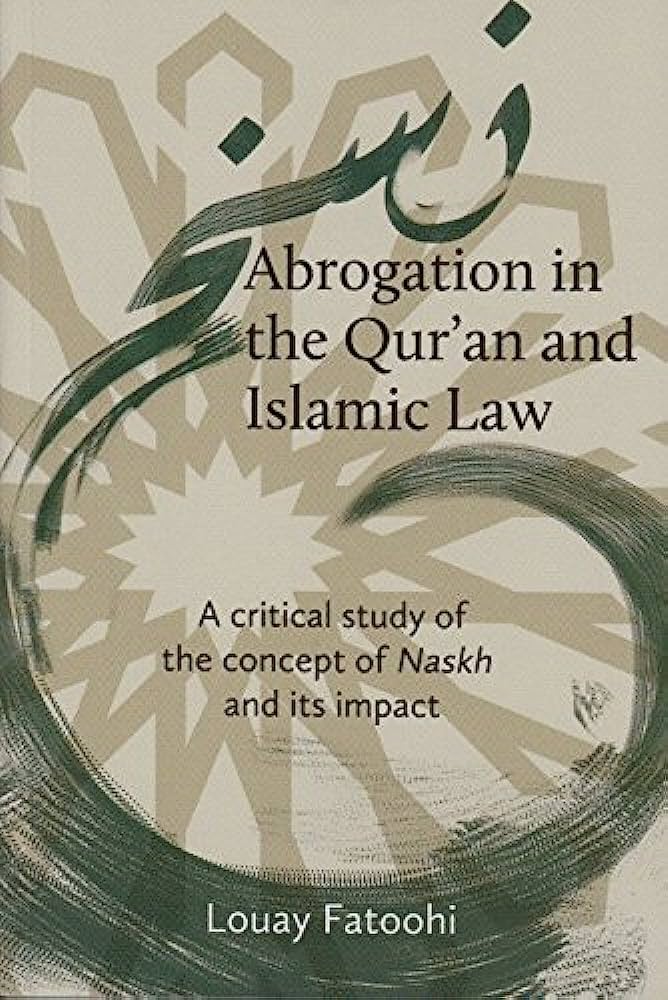
We gave our review of the book here: https://www.amazon.com/gp/customer-reviews/R1FCI7QXBCG2SJ/ref=cm_cr_dp_d_rvw_ttl?ie=UTF8&ASIN=9670526027
So now to the topic at hand: The Non-Crucifixion Verse: A Historical, Contextual, and Linguistic Analysis by Louay Fatoohi.
We read from his article:
“In the Qur’an, though, there is little interest in how and when false beliefs appeared, what their historical development was, or whether they were traceable to oral or written tradition. When certain beliefs are rejected in the Qur’an, this comes in the form of asserting that these were not communicated by God through prophets but distortions of the revelations and/or total fabrications by people.” -Louay Fatoohi.
Prima-Qur’an: We would agree that the Qur’an is not “speaking to the wall.” It is certainly addressing claims. In this case, we would both agree with claims made by Jews.
“It sounds unrealistic and farfetched to think that if an average Jew at the time was asked why they thought that the Christian Messiah was false, they would have pointed to one of those few passages in a polemical book that they probably had never read any part of!” -Louay Fatoohi.
Prima-Qur’an: Again we agree. Though it seems rather obvious that the Qur’an 4:157 at least addresses some claims made by some Jews as to a possibility of why they would reject Jesus as the Messiah.
“Also, if 4:157 is to be linked to the known claim that the Jews killed Jesus, then the logical source of choice should be the Gospel narratives, not a passing and vague reference in the Talmud.”-Dr. Louay Fatoohi.
Prima Qur’an: Yeah, so at this point we are glad that Dr. Fatoohi has made his statement conditional. “If 4:157 is to be linked.” Because it begs the question: Why would the Gospel be a logical source of evidence for Jews? Dr. Fatoohi doesn’t quite flesh that out for us.
“Had the Qur’an engaged with the Talmud, it would have probably attacked it and accused the Jews of creating a book that was not revealed by God.” -Louay Fatoohi
Prima Qur’an: Much like the hadith, it is considered a second source of revelation for Muslims. Perhaps Dr. Fatoohi had not considered that the Talmud acts in much the same way. The Rabbis believe their teachings go back in direct transmission to an oral Torah received by Moses (as).
There is also this verse where Allah (swt) could have plainly stated the word Torah. The Torah is never used in a disparaging way in the Qur’an.
“How terrible it is to those who write the Book with their hands and then say, “This is from Allah,” to sell it for a little money. How terrible it is for them for what their hands have written, and how terrible for them what they have earned.” And they say, “The fire will most certainly not touch us for more than a limited number of days.” Say [unto them]: “Have you received a promise from Allah- for Allah never breaks His promise – or do you attribute to Allah something which you cannot know?” (Qur’an 2:79-80)
The mishna states:
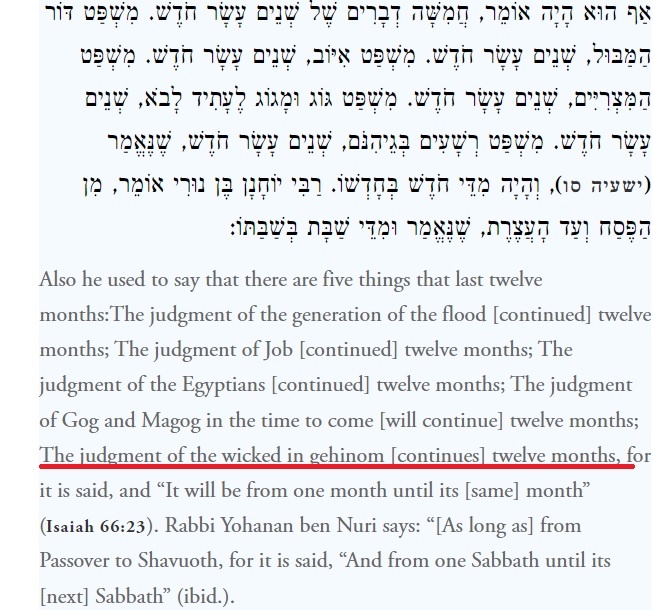
Source: (https://www.sefaria.org/Mishnah_Eduyot.2.10?lang=bi)
Prima Qur’an:We want to re-emphasize that we are in complete agreement with Dr. Fatoohi’s statement here:
“In the Qur’an, though, there is little interest in how and when false beliefs appeared, what their historical development was, or whether they were traceable to oral or written tradition. When certain beliefs are rejected in the Qur’an, this comes in the form of asserting that these were not communicated by God through prophets but distortions of the revelations and/or total fabrications by people.” -Louay Fatoohi.
Prima Qur’an: So coming to the verse in question under the section titled: The Non-Crucifixion Verse in Focus, Dr. Louay Fatoohi states:
“In this section, I aim to show that both the language and context of 4:157 repeatedly and unambiguously indicate that this verse can only be a denial of both the killing and the crucifixion of Jesus. This is what underpins the consensus of Muslim exegetes in their understanding of this verse. Conversely, rejecting this ubiquitous interpretation is driven by a priori views and convictions, which I have already quickly reviewed, that are extraneous to the Qur’anic text.” – Louay Fatoohi
Prima-Qur’an:We are going to strongly suggest that this is what Dr. Louay Fatoohi and early Muslim exegetes did. In fact, quoting Dr. Louay Fatoohi:
“In his historical tome Tārīkh al-umam wal-mulūk, al-Ṭabarī quotes Wahb Ibn Munabbih (d. 114/732) on the crucifixion. The latter is known for introducing Jewish and Christian narratives into Islamic tradition.” – Louay Fatoohi
Prima-Qur’an: Dr. Louay Fatoohi then beautifully demonstrates that the Qur’an 4:157 when taken into context is addressed to Jews.
“More specifically, we will focus on the four verses leading to 4:157 and the verse that follows it, as they provide immediate contextual information that is useful for avoiding any misunderstanding of 4:157. We will start with verse 4:153 as it commences a new context in which the Jews, and later Jesus, are the main subject.”-Louay Fatoohi.
Prima-Qur’an: So this is where our frustration with Dr. Fatoohi and the popular view on these verses comes in. Again, no blame on Dr Fatoohi because he seems to be following those early Muslim commentators who tried to fill in the void by relying upon extraneous material.
Point 1. When reading the verses in context. Where is there any mention of Romans?
Allah (swt) is not unfamiliar with the Romans.
“The Romans (l-rūmu) have been defeated.” (Qur’an 30:2)
There is no text in the Qur’an that connects Romans (l-rumu) with an act known as salabu.
Point 2. There is no text in the Qur’an that connects Christians (nasara) with an act known as (ṣalabū)
Point 3. Because Allah (swt) is addressing Jews, salabu cannot be a reference to a cross or a crucifixion! Why? Because Jews simply do not crucify people. Dr. Louay Fatoohi, or anyone under the sun, has given us a shred of evidence that they do!
How could we explain this away if we were a Muslim apologist? Aha! This particular group of Jews were already rebellious, so they crucified him in violation of their laws! Then we thought about it some more and said that doesn’t make any sense.
Think about it. Allah (swt) is addressing claims made by Jews against Jesus (as). Among their boast is a claim tantamount to saying: “We did something to Jesus that is not prescribed by Jewish law!”
It is among the most bizarre claims we have ever come across.
In fact, as Dr. Fatoohi quoted John of Damascus, who rightly critiques this view.
“A much more detailed early Christian account of the Muslim belief about the crucifixion comes from the monk John of Damascus, around a century after Muḥammed’s time. Having accused the Prophet of authoring the Qur’an by plagiarizing the Old and New Testaments with help from an unnamed Arian monk, he goes on to say the following: And he says that the Jews wanted to crucify Him in violation of the Law, and that they seized His shadow and crucified this. But the Christ Himself was not crucified, he says, nor did He die, for God out of His love for Him took Him to Himself into heaven.” -Louay Fatoohi
Dear readers, this error is so serious that this one issue would be enough to make anyone reconsider their Islam! How could Allah (swt) not be aware of Jewish methods of execution?!
We have two options.
1. Imputing ignorance to Allah (swt) concerning Jewish methods of execution.
2. Muslim exegets being mistaken by relying upon extraneous material and imposing meaning upon the plain text of the Qur’an.
It is clear that the first option is not an option for the believing Muslim. Besides, is there any proof that these early Muslim exegetes were well versed in the laws of the Jews?
Ironically, the verse that Dr. Fatoohi calls ‘The Non-Crucifixion Verse’ actually is a crucifixion verse, not just the crucifixion of Jesus.
Point 4. Dr. Fatoohi seems comfortable to translate (ṣalabū) as crucifixion!
Though Dr. Fatoohi has stated:
“Finally, I should add a note about the Arabic word root ṣ-l-b, which is ubiquitously translated as “crucify.” This word appears in the Qur’an in a verbal form six times (al-Nisāʾ 4:157; al-Maʾida 5:33; al-Aʿrāf 7:124; Yūsuf 12:41; Ṭāhā 20:71; al-Shuʿarāʾ 26:49). In one instance, Pharaoh makes this threat to the magicians who accepted Moses’ claim to being God’s messenger.” -Louay Fatoohi.
Prima-Qur’an: This is frustrating because usually wefind Dr. Fatoohi to be circumspect but he did the exact same thing that Todd Lawson did. Which is to ignore an analysis of the use of the word with the text of the Qur’an. Dr. Fatoohi also left out that this root word s-l-b is used twice as a noun form. Something Lawson at least did not leave out. Such a crucial word is treated by Professor Todd Lawson and Dr. Fatoohi as nothing more than an afterthought.
““It occurs in the Qur’an eight times (4:157; 12:41; 7:124; 20:71; 26:49; 5:33; 86:7;4:23). Six of these are as a verb with the accepted meaning of ‘to crucify’. The others are as a noun meaning ‘back’ or ‘loins’ (86:7; 4:23). ”
Source: (pg 31 The Crucifixion and the Qur’an: A Study in the History of Muslim Thought)
“This use may indicate that ṣ-l-b means some kind of execution by suspension.“-Louay Fatoohi.
Prima-Qur’an: Dr. Fatoohi goes into a discussion about some debate over the form of Jesus’ crucifixion.
“There is some debate about how Jesus was crucified, whether he was nailed to a cross, and what shape it had, or was suspended until he died.”-Louay Fatoohi.
Prima-Qur’an: Actually, this need not be a mystery for us at all. As Dr. Fatoohi has pointed out in the text of Qur’an 4:153-157 the whole focus is on the Jews. So why the curious fixation with the Romans?
Let us see what Jewish sources of punishment there are:
https://www.jewishvirtuallibrary.org/capital-punishment (no mention of crucifixion at all)
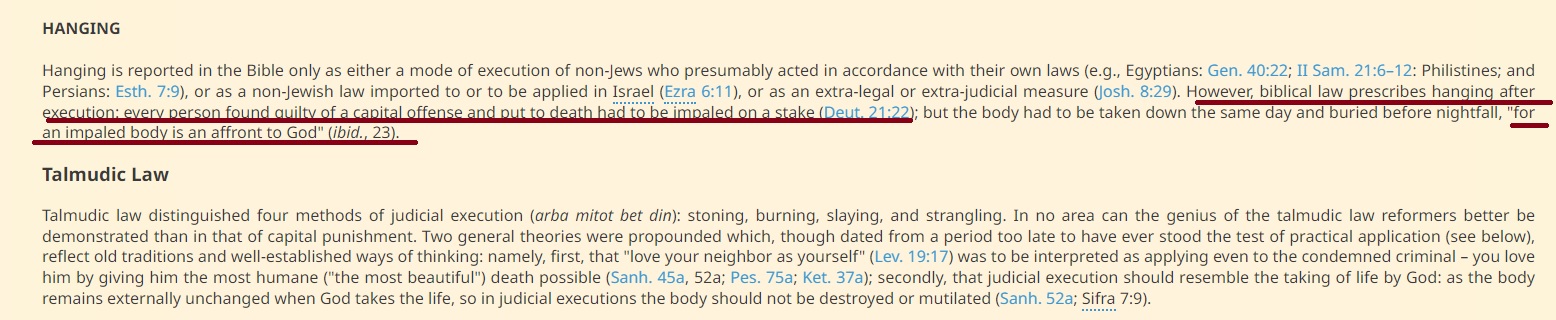
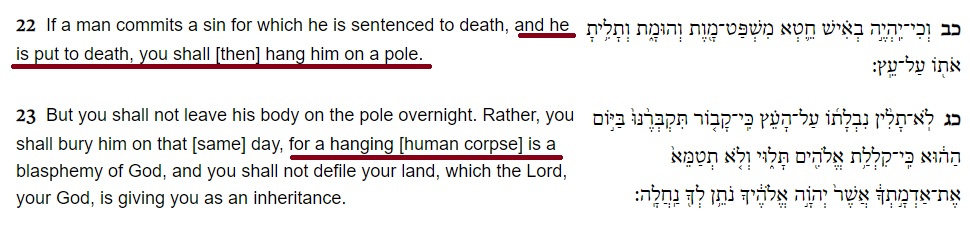
Source: https://www.chabad.org/library/bible_cdo/aid/9985
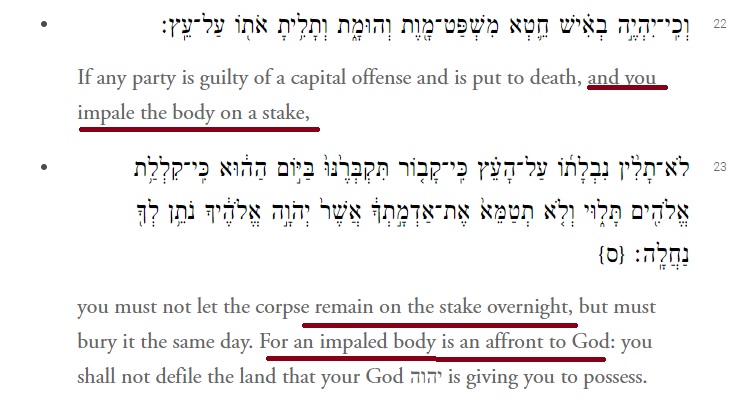
Source: https://www.sefaria.org/Deuteronomy.21.22?lang=bi&aliyot=0
Notice that in the above text the culprit is killed first, and then they are impaled on a stake.
Notice that when Dr. Fatoohi dismisses the swoon theory, he states:
“Any claim that Jesus suffered a non-fatal crucifixion is also dismissed. The verse unambiguously states that Jesus was not killed or even non-fatally crucified.” -Louay Fatoohi
Prima-Qur’an: There is a double denial. They did not kill him nor did they (ṣalabūhu) him. Which means he was not even impaled. (If we are being consistent). They didn’t kill him (which covers every type of death under the sun) nor did they impale him—which would be a post-mortem suspension. Seems quite consistent with what we are seeing from Jewish law.
Or as Dr. Fatoohi states: “not crucified” if we have some strange fixation on the Romans.
So, since Dr. Fatoohi believes the Qur’an is denying that Jesus was even on the cross, then it would be worth asking Dr. Fatoohi. The following: “Do you believe whoever was “crucified” was this crucifixion post-mortem (occurring after death) or an ante mortem (occurring before death)?
After all, Dr. Fatoohi does not seem certain when he says:
“This use may indicate that ṣ-l-b means some kind of execution by suspension.”-Louay Fatoohi.
Prima-Qur’an: This would seem to argue that he is on board with the idea of ante mortem crucifixion. However, I am in agreement with Dr. Fatoohi when he states:
“I would argue that such disregard for the basics of Arabic would make the Qur’an unintelligible.” -Louay Fatoohi.
Prima Qur’an: However, such obfuscation is wholly unnecessary, if we allow the context of the Qur’an to speak, and it is clear that Jews practice post-mortem suspension.
“By the time of the Qur’an, the classical interpretation of the crucifixion of Jesus using a T-shaped cross or a variation of it was already long-established. So, the crucifixion that is rejected in 4:157 seems to be the commonly accepted image of the execution of Jesus.”-Louay Fatoohi
Prima-Qur’an: commonly accepted image according to whom? Since Jews are being addressed, why not reference what (salabu) would look like to them? Again, why the fixation with the Romans and the Christians when there has already been an admission that the immediate text and the context is a response to Jews?
Remember the fixation with Christian beliefs in the Qur’an, according to Dr. Fatoohi, is:
“The human nature of Jesus is repeatedly stressed in the Qur’an and his divinity is rejected in unambiguous terms.”-Louay Fatoohi
Prima-Qur’an: Agreed! Obviously, there is a different agenda when dealing with Christian objections to Islam. If becoming a Muslim meant that a Jew had to accept Jesus as Messiah, then Allah (swt) would have a different agenda when dealing with their objections.
“But we preach Christ crucified, a stumbling block to Jews and folly to Gentiles.” (1 Corinthians 1:23)
“These scholars suggest that the majority consensus is based on a misunderstanding of the Qur’an, which Muslims have failed to correct for fourteen centuries.” -Louay Fatoohi
Prima-Qur’an: Well, actually, these 1400 years of scholarship is really based upon copy and paste now, isn’t it? To pretend that every Muslim exegete independently researched every single verse of the Qur’an is just simply presumptuous. What we have is a majoritarian belief based upon individuals incorporating extraneous material from oral traditions without connected chains of narrations going back to the source that contain conflicting accounts.
We are also surprised by Dr. Louay’s appeal to the consensus of scholars when he himself does not believe in the return of Christ Jesus. This is certainly the position of the consensus of scholars. So we can take Dr. Louay’s appeal to consensus as not being serious.
We mean on what consistent basis does Dr. Louay Fatoohi dismiss the second coming of Jesus (as) which is mentioned in quite a number of hadith that do have connected chains and yet expect that we should not dismiss outright beliefs based upon individuals incorporating extraneous material from oral traditions without connected chains of narrations going back to the source that contain conflicting accounts?
None of what has been shared is from the canonical gospels. Would have been great if Dr. Fatoohi would have shared with us an exact quote from the tafsir literature of the tale of substitution. Because it sure the heck would have been very interesting reading a word-for-word detailed account of how the Jews (not the Romans) crucified stealth Jesus. Or about how the Jews killed and then crucified stealth Jesus.
Perhaps in a future article Dr. Fatoohi may give us a detailed quote of these narratives.
However, one central theme stands out. Someone was made to appear to look like Jesus.
This seems to be the understanding of: was made to appear to them so/walākin shubbiha lahum
Note the following:
“Third, the denial of the crucifixion in 4:157 is followed in 4:158 by a second action that is explicitly attributed to God, which is raising Jesus.”-Louay Fatoohi
Prima-Qur’an: Yet, this was made to appear to them so/walākin shubbiha lahum is not an action attributed to Allah.
Another example is the following:
“And the answer of Ibrahim’s people was not but that they said, “Kill him or burn him,” but Allah saved him (fa-anjaynāhu) from the fire. Indeed in that are signs for a people who believe.” (Qur’an 29: 24)
Why don’t we see that language, ‘Allah saved him (fa-anjaynāhu) from ‘salabu’ ?
This much is clear when The Ashari in aqidah and Shafi’i in Fiqh, Fakhr al-Din al-Razi, who was not satisfied with the substitution theory, was absolutely merciless in his take-down of this concept when he pins:
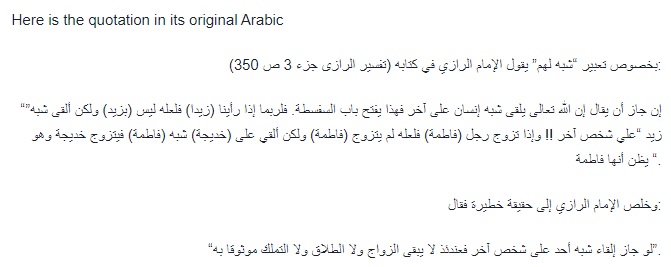
“This opens the door of sophistry, So that if we saw Zayd it would be possible that it was not really Zayd but that the likeness of Zayd had been cast upon another. This would imply the nullification of social contracts such as marriage and ownership. Also it would lead to the impugning of the principle of tawatur, bringing into serious doubt all transmitted historical knowledge. This principle should be upheld as long as it is based on perceived phenomena (al-mahsusat). Such confusion about perceived phenomena would threaten the foundations of all religious laws (shar-iya). Neither is it permissible to argue for such transference of identity by appealing to the tradition that allows for miracles during the time of prophecy. Such a provision would bring into question the identity of the prophets themselves, which in turn would call into question the probity of the sources of religious knowledge.”
Source: Fakhr al-Din al-Razi (Mafatih, al-ghayb al-mushtahar bi-al-tafsir al-kabir.)
So it is obvious that ‘made to appear to them’ is not something one can attribute to Allah.
Allah (swt) tells us about his sublime revelation:
“It is a blessed Book which We have revealed for you so that you will reflect upon its verses and so the people of understanding will take heed.” (Qur’an 38:29)
“Surely We know well that they say about you: “It is only a human being who teaches him,” (notwithstanding) that he whom they maliciously hint at is of foreign tongue, while this (Qur’an) is plain Arabic clear.” (Qur’an 16:103)
There really is no need for so much confusion and obfuscation over this verse. We do not need to appeal to extraneous material that is not divine in authority, has no connected chain back to the original sources, is confused in its reports and proclaims some supra natural event that Allah (swt) himself did not claim.
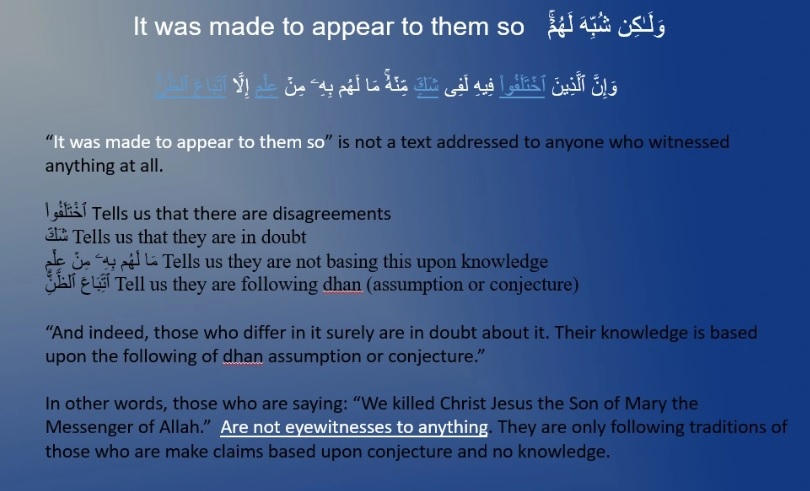
وَإِنَّ ٱلَّذِینَ ٱخۡتَلَفُوا۟ فِیهِ لَفِی شَكࣲّ مِّنۡهُۚ مَا لَهُم بِهِۦ مِنۡ عِلۡمٍ إِلَّا ٱتِّبَاعَ ٱلظَّنِّۚ
“It was made to appear to them so” is not a text addressed to anyone who witnessed anything at all!
ٱخْتَلَفُوا۟ Tells us that there are disagreements
شَكّ Tells us that they are in doubt
مَا لَهُم بِهِۦ مِنۡ عِلۡمٍ Tells us they are not basing this upon knowledge
ٱتِّبَاعَ ٱلظَّنِّۚ Tell us they are following dhan (assumption or conjecture)
“And indeed, those who differ in it surely are in doubt about it. Their knowledge is based upon the following of dhan assumption or conjecture.”
In other words, those who are saying: “We killed Christ Jesus the Son of Mary the Messenger of Allah.” Are not eyewitnesses to anything. They are only following the traditions of those who make claims based upon conjecture and no knowledge.
ٱتِّبَاعَ ٱلظَّنِّۚ it is this same following of dhan (assumption and conjecture) taken from the very same people whom Allah (swt) tells us are in disagreements, are in doubt, not based upon knowledge that we get ultra bizarre translations of the Qur’an an like the following:
And because of their saying (in boast), “We killed Messiah Iesa (Jesus), son of Maryam (Mary), the Messenger of Allah,” – but they killed him not, nor crucified him, but the resemblance of Iesa (Jesus) was put over another man (and they killed that man), and those who differ therein are full of doubts. They have no (certain) knowledge, they follow nothing but conjecture. For surely; they killed him not (i.e. Iesa (Jesus), son of Maryam (Mary) ) (Qur’an 4:157) –Muhsin Khan & Muhammed al-Hilali
Does that make a lick of sense to anyone?
So let’s get this right. Wahb Ibn Munabbih takes his knowledge from people whom Allah (swt) tells us are in disagreements, are in doubt, not basing information upon knowledge, only following conjecture, and they get to inform us about what Allah’s revelation says?
“So if you are in doubt, [O Muhammed], about that which We have revealed to you, then ask those (ahla l-dhik’ri) who have been reading the Scripture before you. The truth has certainly come to you from your Lord, so never be among the doubters.” (Qur’an 10:94)
Notice the phrase: ahla l-dhik’ri and not ahla l-kitābi
The above verse is only applicable in those matters where they themselves do not have doubts about the matter and has to be taken into context with what Allah (swt) has description of those in (Qur’an 4:157)
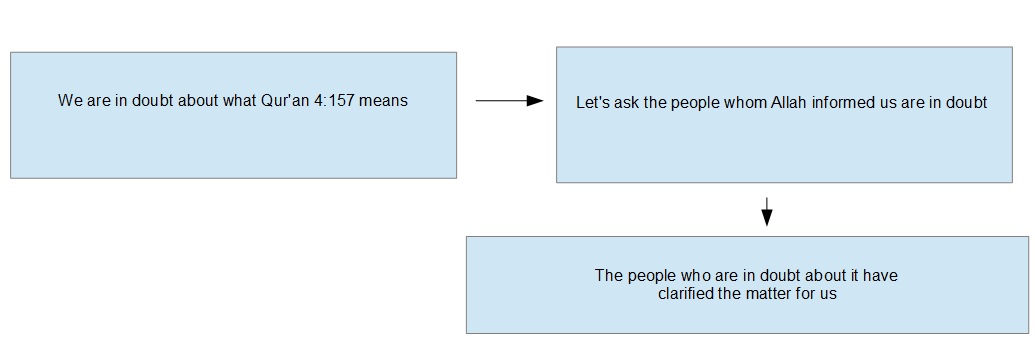

May Allah (swt) bless Dr. Louay Fatoohi for his sincere and noble efforts. For the most part, he is only defending the indefensible. 1200 plus years of fuzzy logic and copy-and-paste scholarship. Statements by converts to Islam which are based upon conjecture and have no connected chain of transmission going back to the companions of Jesus.
Please do see our article:
May Allah Guide the Christians so that they do not burn in the hellfire.
May Allah (swt)bless the ummah.
May Allah (swt) forgive the ummah.
May Allah (swt) guide the ummah.




 Prima Quran