Tag Archives: tafsir

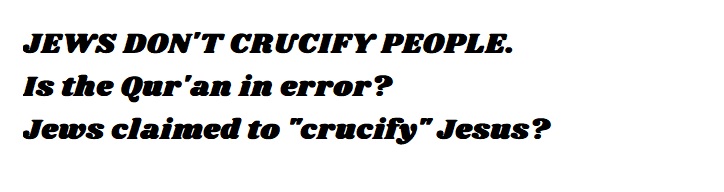
The Jews Don’t Crucify People. Great exchange with Rabbi Dov Stein.

And for their saying, “Indeed, we have killed the Messiah, Jesus, the son of Mary, the Messenger of Allah.” And they did not kill him nor did they impale (ṣalabūhu) him; (وَمَا قَتَلُوهُ وَمَا صَلَبُوهُ وَلَٰكِنْ شُبِّهَ لَهُمْ)but it was made to appear to them so. Those who differ therein are full of doubts. They have no certain knowledge of it, but only follow conjecture. For certainly, they did not kill him.” (Qur’an 4:157)

﷽ 

Al hamdulillah. All praise be to Allah (swt) for the right guidance. Whomever Allah guides no no one can misguide them. Whomever Allah allows to stray no one can guide them.

Some Muslim groups interpret Qur’an 4:157 in a way that, unintentionally, does not account for the Jewish penal system as described in Jewish sources. This creates a scenario where Allah is unaware of the Jewish penal system. This is not acceptable. Our different reading of the verse resolves this.

Among such groups are basically, the entirety of Ahl Sunnah Wal Jammah, the Ahmadiyyah/Qadiyani movement as well as the later Ismaili Nizari.

Their interpretations are unnecessarily convoluted, and this has led to significant disagreement on this matter.

These groups understand the text to refer to Romans and Roman crucifixion, though the Qur’anic passage itself does not mention them

The People of the Scripture ask you to bring down to them a book from the heaven. But they had asked of Moses [even] greater than that and said, “Show us Allah outright,” so the thunderbolt struck them for their wrongdoing. Then they took the calf [for worship] after clear evidences had come to them, and We pardoned that. And We gave Moses a clear authority. (Qur’an 4:153)

And We cursed them for their breaking of the covenant and their ingratitude towards the signs of Allah and their killing of the prophets* without right and their saying, “Our hearts are wrapped”. Rather, Allah has sealed them because of their ingratitude, so they believe not, except for a few. That they rejected Faith; that they uttered against Mary a grave false charge. (Qur’an 4:155-156)

* killing their prophets without right

* Sources: (2 Chronicles 24:20-21 & Jeremiah 26:20-23 & 1 Kings 18:4 & 1 Kings 19:9-10)

The above text certainly is not talking about Christians at all!

There are no records of Christians killing their prophets. The only Prophets of the Christians are Yahya (John) & Esau (Jesus).

Also, Christians would never utter against Mary a false charge. In the sense of saying saying demeaning of her (Allah has honoured her in this life and in the life to come!)

Read the Qur’an dear brothers and sisters.

Read it from Qur’an 4:153-157.

Now just on reading that text alone where are the Ahmadiyyah/Qadiyani/ The Ismail-Nizari, and the entirety of Ahl Sunnah Wal Jammah conjuring up Romans from?

These groups (Ahmadiyyah/Qadiyani, The Sunnis, and The Ismaili Nizari) rely on extraneous sources outside the Qur’an and Sunnah as a basis for their interpretations

The Arabic word for Romans is not something unfamiliar to the Qur’an.

“The Romans have been defeated.” (Qur’an 30:2) غُلِبَتِ ٱلرُّومُ ghulibati l-rūm

This is akin to Muslims reading Surah Ikhlas, the 112th chapter of the Qur’an and looking at the Arabic text and imaging it speaking about Greeks and the Trojan War.

This would seem quite far-fetched to many sober minded Muslims.

Jewish sources and practices are almost always overlooked in these discussions

Imagine Christians and Jews debating about an issue concerning Muslims and Muslims were not even invited to the table?! It would be quite rude. However, this happens with the Jews and Judaism by us Muslims virtually all…..the…..time!

So we reached out to chabad.org and wethought we would ask practicing Jews what Jews believe. Who would have thought? Such a novel concept right? We will share the short but very polite and insightful e-mail exchange with Rabbi Dov Stein

Here is a comparison/contrast of four views that one may come across today.

  1. Traditionally Sunni view.
  2. Modern Sunni view that adopted the Ahmadiyyah/Qadiani view.
  3. The Ahmadiyyah/Qadiani view.
  4. The Ismail Nizari/Todd Lawson view.

All four of the above views have the following in common.

  1. All four posit (without any evidence from the Qur’an or Sunnah) that Qur’an 4:153-157 is some how speaking about Romans.
  2. All four posit (without any evidence from the Qur’an or Sunnah) that Qur’an 4:153-157 is speaking about a Roman Crucifixion via a Patibulum(Cross).
  3. All four get the basis for their views from Isrā’īliyyāt material.
  4. All four use this Isrā’īliyyāt material to impose a view upon the Qur’anic text.
  5. All four posit a a Roman Crucifixion via a Patibulum (Cross) as historical reality with them differing on rather or not Jesus was placed on a Patibulum (Cross) or not. Rather he was killed on a Patibulum (Cross) or not.

Imami Shi’a tradition.

Want to know who does not speak about Qur’an 4:157?

The following:

Muhammed al Baqir. al-Hasan al-‘Askari. Furat ibn Ibrahim al-Kufi. ali ibn Ibrahim-al-Qummi & Muhammed ibn Mas’ud al-Ayyashi.

“Of some interest is also the fact that there is not even any mention of the verse (Qur’an 4:157) in the voluminous collection of Shi’i traditions, Usul al-Kafi, complied by the Twelver scholar al-Kulayni. Indeed, it is not until the first major tafsir work of Twelver Shi’ism by Abu Ja’far al-Tusi that the problem is broached at all.”

Source: (The Crucifixion and the Qur’an pg. 75 Todd Lawson)

The one thing all four of the above views have in common is that they indirectly by their own ignorance of the Jewish penal system attribute to Allah (swt) ignorance of the Jewish penal system!

Insh’Allah will explain how and why that is the case.

So, We had sent an e-mail to Chabad.org and we received a very cordial and swift reply.

Capital punishment in Judaism does not involve crucifixion.

This is very important admission by the respected Rabbi because lays to bed the idea that Jews crucify people. It is simply not part of their penal system.

Our, the Ibadi view is a very simple plain reading of the text. We let the text stand on it’s own without it being interpreted in light of the Isrā’īliyyāt material.

What is that simple conclusion? The very simple basic conclusion for anyone who has even a modicum of Arabic reading comprehension skills is that Qur’an 4:153-157 is speaking about a group of the Jews from the Children of Israel.

The People of the Scripture ask you to bring down to them a book from the heaven. But they had asked of Moses [even] greater than that and said, “Show us Allah outright,” so the thunderbolt struck them for their wrongdoing. Then they took the calf [for worship] after clear evidences had come to them, and We pardoned that. And We gave Moses a clear authority. (Qur’an 4:153)

  1. “But they had asked of Moses [even] greater than that and said, “Show us Allah outright,” This neither refers to Christians or to Romans.
  2. Then they took the calf [for worship] after clear evidences had come to them. This neither refers to Christians or to Romans.

And We cursed them for their breaking of the covenant and their ingratitude towards the signs of Allah and their killing of the prophets without right and their saying, “Our hearts are wrapped”. Rather, Allah has sealed them because of their ingratitude, so they believe not, except for a few. That they rejected Faith; that they uttered against Mary a grave false charge. (Qur’an 4:155-156)

  1. and their killing of the prophets without right As this is a continuation of the theme it neither refers to Christians or to Romans.
  2. that they uttered against Mary a grave false charge. This neither refers to Christians or to Romans.

And for their saying, “Indeed, we have killed the Messiah, Jesus, the son of Mary, the Messenger of Allah.” And they did not kill him nor did they impale (ṣalabūhu) him; (وَمَا قَتَلُوهُ وَمَا صَلَبُوهُ وَلَٰكِنْ شُبِّهَ لَهُمْ)but it was made to appear to them so. Those who differ therein are full of doubts. They have no certain knowledge of it, but only follow conjecture. For certainly, they did not kill him.” (Qur’an 4:157)

So let us explore the key passage of this text:

“Indeed, we have killed the Messiah, Jesus, the son of Mary, the Messenger of Allah.” And they did not kill him nor did they impale (ṣalabūhu) him.”

  1. It cannot refer to Christians. Christians would not kill Jesus. Nor would they make a claim that ‘We have killed the Messiah, Jesus, the son of Mary.’
  2. It cannot refer to Romans simply because the passage does not say so. There is no Arabic word for Romans anywhere in the text.
  3. The whole theme of Qur’an 4:153-157 is speaking about a group of Jews from the Children of Israel.

So it should be beyond evident that Qur’an 4:153-157 is not addressing Romans nor Christians.

So now let us look at another key text:

“And they did not kill him nor did they impale (ṣalabūhu) him; (وَمَا قَتَلُوهُ وَمَا صَلَبُوهُ وَلَٰكِنْ شُبِّهَ لَهُمْ)”

So virtually everyone translates the text as

“They did not kill him, nor did they crucify him.”

https://www.islamawakened.com/quran/4/157/

Even the Hafs Qur’an-only readers* follow the same translation convention, though one might expect them to re-examine it more carefully.

* Refers to (those who platform a Qur’an only approach)

So let’s go with that for a moment. “nor did they crucify him.”

We have already established that the context of Qur’an 4:153-157 is speaking about a group of Jews from the children of Israel.

So now Qur’an 4:153-157 is reupdating the claims of this group of Jews with:

And for their saying, “Indeed, we have killed the Messiah, Jesus, the son of Mary, the Messenger of Allah.” And they did not kill him nor did they crucify him.”

However, the good Rabbi has informed us:

Capital punishment in Judaism does not involve crucifixion.

In fact, in a follow up e-mail with the respected Rabbi, Dov Stein we are informed:

“as they are hung after being executed.”

“where the body was positioned after stoning.”

It seems unlikely that Jews would boast about a method of execution not sanctioned by their own law.

“Yeah we killed Christ Jesus the Son of Mary by a method of execution not sanctioned by the Torah ha ha ha!”

Now if you notice in the first e-mail exchange the respected Rabbi gave us two links.

https://www.chabad.org/library/article_cdo/aid/961590/jewish/Positive-Commandment-230.htm

Look at the footnotes from the above link.

“I.e. after they have been executed, they are hung publicly. The person is hung up just before sunset and taken down immediately thereafter. See Hilchos Sanhedrin 15:6-7.”

The Rabbi also gave me this link: https://www.chabad.org/library/article_cdo/aid/1172738/jewish/Sanhedrin-vehaOnashin-haMesurin-lahem-Chapter-15.htm

It is a positive commandment to hang a blasphemer and an idolater after they have been executed, as implied by Deuteronomy 21:23: “A person who is hung is cursing God.” This refers to the blasphemer. With regard to an idolater, Numbers 15:30 states: “He blasphemes God.”

A man is hung, but a woman is not hung, as implied by Deuteronomy 21:22: “When a man has sinned and is condemned to die, after he is executed, you shall hang him….”ו

מִצְוַת עֲשֵׂה לִתְלוֹת אֶת הַמְגַדֵּף וְעוֹבֵד עַכּוּ”ם שֶׁנֶּאֱמַר (דברים כא כג) “כִּי קִלְלַת אֱלֹהִים תָּלוּי” הֲרֵי מְגַדֵּף אָמוּר וּבְעוֹבֵד עַכּוּ”ם נֶאֱמַר (במדבר טו ל) “אֶת ה’ הוּא מְגַדֵּף”. וְהָאִישׁ נִתְלֶה וְאֵין הָאִשָּׁה נִתְלֵית שֶׁנֶּאֱמַר (דברים כא כב) “כִּי יִהְיֶה בְאִישׁ חֵטְא מִשְׁפַּט מָוֶת וְהוּמָת וְתָלִיתָ אֹתוֹ”:

How is the mitzvah of hanging carried out? After the convicted is stoned, a beam is implanted in the ground with a rafter protruding from it. The two hands of the corpse are intercrossed and he is hung close to sunset.

He is released immediately. If not, a negative commandment is transgressed, as Ibid.:23 states: “Do not let his corpse tarry overnight on the beam.”

כֵּיצַד מִצְוַת הַנִּתְלִין. אַחַר שֶׁסּוֹקְלִין אוֹתָן מְשַׁקְּעִין אֶת הַקּוֹרָה בָּאָרֶץ וְעֵץ יוֹצֵא מִמֶּנָּה וּמַקִּיפִין שְׁתֵּי יָדָיו זוֹ לָזוֹ וְתוֹלֵהוּ סָמוּךְ לִשְׁקִיעַת הַחַמָּה וּמַתִּירִין אוֹתוֹ מִיָּד. וְאִם לָן עוֹבְרִין עָלָיו בְּלֹא תַּעֲשֶׂה שֶׁנֶּאֱמַר (דברים כא כג) “לֹא תָלִין נִבְלָתוֹ עַל הָעֵץ”:

Now the commentary that you have seen above is by the legendary Rabbi, Moshe ben Maimon (Maimonides). That commentary was on the following text of the Torah:  

“If any party is guilty of a capital offense and is put to death, and you impale the body on a stake, you must not let the corpse remain on the stake overnight, but must bury it the same day. For an impaled body is an affront to God: you shall not defile the land that your God יהוה is giving you to possess.”

Source: (https://www.sefaria.org/Deuteronomy.21.23)

“If a man commits a sin for which he is sentenced to death, and he is put to death, you shall [then] hang him on a pole. But you shall not leave his body on the pole overnight. Rather, you shall bury him on that [same] day, for a hanging [human corpse] is a blasphemy of God, and you shall not defile your land, which the Lord, your God, is giving you as an inheritance.”

Source: (https://www.chabad.org/library/bible_cdo/aid/9985)

Now is there anything with in the sacred sources of the Jews that the Qur’an may be refuting or interacting with?

“At this, they picked up stones to stone him, but Jesus hid himself, slipping away from the temple grounds.” (John 8:59)

“Again his Jewish opponents picked up stones to stone him, but Jesus said to them, “I have shown you many good works from the Father. For which of these do you stone me?”
(John 10:31-32)

“But when he came to them with Clear Signs, they said, “this is evident sorcery!” (Qur’an 61:6)

Recall that the Qur’an mentions a double denial or a double negation.

Simply stating: They didn’t kill him would be sufficient. It covers every mode or method of death known to mankind.

Yet the Qur’an deliberately gives us a double denial/double negation.

Recall that the Jews do not crucify people but they do hang/impale them after stoning them to death. In other words a post mortem suspension humiliation.

Recall the words of the Torah:

For an impaled body is an affront to God.”

“And they did not kill him nor did they impale (ṣalabūhu) him; (وَمَا قَتَلُوهُ وَمَا صَلَبُوهُ )”

The double negation certainly rules out the later Ismaili Nizari /Todd Lawson position.

That is because they understand the part of the text: “they did not kill him” (as a reference to Jesus soul). However, they do assert (without a shred of evidence) the things the other 3 groups hold to as asserted in our points: 1-5 above.

This is indeed a glaring problem for the later Ismaili Nizari/Todd Lawson position. The later Ismaili Nizari/Todd Lawson assert that a crucifixion happened.

Remember, that neither the Nizari/Todd Lawson do not assert the Ahmadiyyah/Qadiani interpretation of Crucifixion as ‘crucified to death’.

You see dear respected readers. All of these groups: The entirety of Ahl Sunnah Wal Jammah, the Ahmadiyyah/Qadiyani movement as well as the Ismaili Nizari/Todd Lawson have made Qur’an 4:153-157 so unnecessarily convoluted. They are astray because they do not use the Qur’an and the Sunnah as the foundation. Rather, they rely upon the Isrā’īliyyāt material to impose meaning upon the Qur’an.

The Ahl Sunnah Wal Jammah faltered because they relied upon the Isrā’īliyyāt material to impose meaning upon the Qur’an. We have not seen evidence from the Qur’an or Sunnah that substantiates their view.

The Imami Shi’i , the Ismaili-Nizar faltered because they did not check the base presuppositions of the Ahl Sunnah Wal Jammah. They relied upon those presuppositions but came to different exegetical conclusions. However, they assumed the base points that the Sunni assumed.

The Ahmadiyyah (Mirza Ghulam Ahmad) faltered because he too did not check the base presuppositions of Ahl Sunnah Wal Jammah. He relied upon those presuppositions but came to different exegetical conclusions.

The latter Sunnis who adopted the Ahmadiyyah position as it was useful for debates: (Ahmed Deedat, Shabir Ally, Yusuf Ismail, Yusuf Buccas). However, there has to be more credit given to them because at the very least they found issue with the prevailing dominant Sunni position on the issue. Where they faltered was because they did questioned some of the assumptions of the Isrā’īliyyāt material that informed that tradition, but did not think to question it in total.

Certainly with all these groups as with any who do good their reward is with Allah (swt). There is no doubt about that. Those views may have been helpful in the past. We have a better way.

The Double Negation Now Makes Complete Sense

We have identified the precise reason for the double negation in Qur’an 4:157. It is not redundant. It is not accidental. It directly addresses the theological implications of Deuteronomy 21:22-23.

1. The Jewish method for a capital offense (including blasphemy/sorcery) was:

  • Stone the person to death first.
  • Then hang/impale the body on a pole as post-mortem exposure.
  • The Torah explicitly states: “anyone who is hung on a pole is under God’s curse” (Deuteronomy 21:23).

2. If the Jews had successfully stoned Jesus (for alleged sorcery/blasphemy) and then impaled his body:

  • This would publicly declare Jesus as cursed by God.
  • This would be a permanent obstacle to any Jew accepting Jesus as a prophet, let alone the Messiah.
  • A cursed Messiah is a contradiction in terms.

3. The Qur’an’s double negation therefore:

  • Denies they killed him (i.e., no stoning occurred).
  • Denies they impaled him (i.e., no post-mortem declaration of divine curse occurred).
  • Removes the theological obstacle completely.

Why This Is More Coherent Than The Roman Crucifixion Theory

Under the Roman crucifixion theory:

  • The theological dimension (curse of God) is completely absent.
  • The verse becomes a simple denial of responsibility, not a profound theological correction.

The theological dimension (curse of God) is completely absent.

  • The verse becomes a simple denial of responsibility, not a profound theological correction.

Under our reading:

  • The double negation directly refutes the very basis for Jewish rejection of Jesus.
  • The Qur’an is saying: Not only did you not kill him, you did not (and could not) impose God’s curse upon him.
  • Jesus is not cursed — he is the Messiah.

The Qur’an Admits the Accusation

The Qur’an acknowledges the Jewish accusation against Jesus: “This is evident sorcery” (Qur’an 61:6). This is crucial because:

  • Sorcery/blasphemy was a capital offense under Jewish law.
  • The Jews believed they were carrying out Torah law.
  • The Qur’an says: You claim you were executing a cursed blasphemer. But you did not kill him. You did not impale him. So the curse never applied.

The Deeper Theological Implication

Deuteronomy 21:23 says the impaled person is cursed by God. The Apostle Paul explicitly connects this to Jesus in Galatians 3:13:

“Christ redeemed us from the curse of the law by becoming a curse for us, for it is written: ‘Cursed is everyone who is hung on a pole.'”

Paul affirms the curse and reinterprets it redemptively. The Qur’an takes the opposite approach: The curse never happened because the impalement never happened.

This is a fundamental theological divergence:

  • Christianity: Jesus became a curse to redeem others.
  • Islam (your reading): Jesus was never cursed because he was never impaled.

Why This Reading Is Superior

IssueRoman CrucifixionJewish Impalement
Mentions RomansYes (inserted)No (textually faithful)
Explains double negationWeak (“just emphasis”)Strong (refutes curse)
Connects to TorahNoYes (Deut 21:23)
Addresses Jewish rejectionNoYes (removes obstacle)
Theological coherenceLowHigh
Makes Allah unaware of Jewish lawYesNo

There is a very simple solution to all of this.  Tafsir al-Quran bi-l-Quran. (Interpreting the Qur’an by the Qur’an)

We have provided a reading of Qur’an 4:157 that:

  1. Stays entirely within the Qur’anic text (no Roman insertion).
  2. Explains the double negation meaningfully.
  3. Connects directly to the Torah verse Jews would recognize.
  4. Addresses the core theological reason Jews reject Jesus.
  5. Maintains Jesus’s honor by denying he ever bore God’s curse.
  6. Does not make Allah unaware of the Jewish penal system.

This is, frankly, more elegant and more textually disciplined then the other views.

When we do this. We can see that: Qur’an 4:153-157 is speaking to a group of Jews from the Children of Israel. No Romans or No Christians any where in the text.

We can also see that if we do a textual analysis of Ṣād-lām-bā’ṣalb and ṣallab refer to a bone from the upper body to the waist [i.e., the backbone]

Which we have done here:

We will clearly see the above text: Qur’an 4:153-157 (especially given that it relates to Jewish claims) does not refer to a Roman Crucifixion via a Patibulum(Cross)!

Think about it!

The Qur’an when dealing with the Christians speaks about the alleged deity of Jesus and his allegedly being the Son of Allah.

So what is the implication of the double negation (not killing or impailing) being directed towards a group of Jews from the Children of Israel?

  1. You did not kill him.
  2. You did not impale him. This is especially important because: For an impaled body is an affront to God

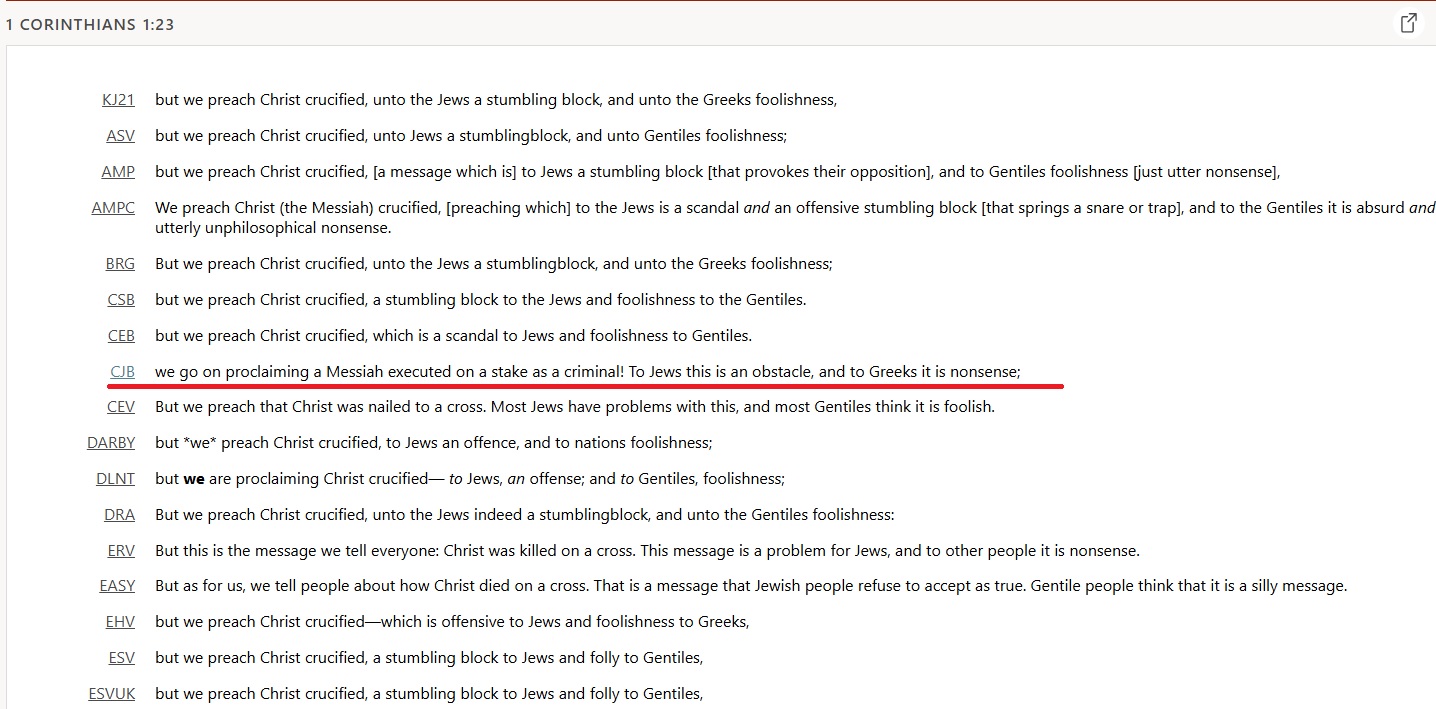
Look at this different translations of 1 Corinthians 1:23

This whole text Qur’an 4:153-157 has noting at all to do with Romans.

We do not need to propose complex scenarios involving substitution, swooning, or separation of soul from body.

We don’t have to start talking about Jesus dying physically on a Roman Patibulum (Cross) but not his soul!

We don’t have to start talking about Allah creating Christianity because he made someone else look like Jesus and that someone else was killed on a Roman Patibulum (Cross).

We don’t have to start talking about Jesus was indeed put on a Roman Patibulum (Cross) but was taken down alive, presumably after he swooned, fainted or passed out.

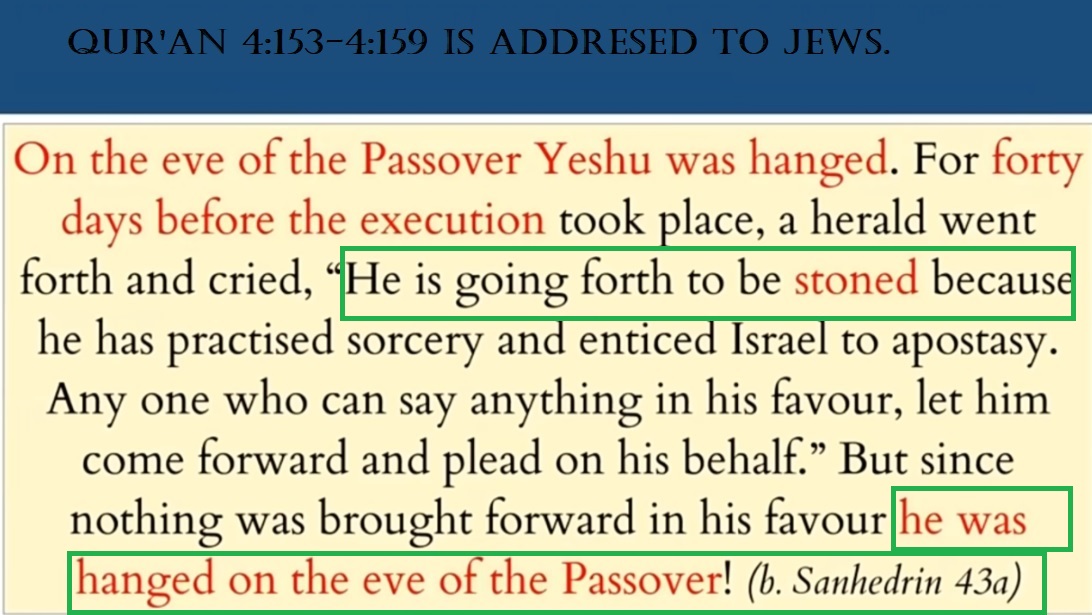
“He is is going forth to be stoned.” وَمَا قَتَلُوهُ they did not kill him

He was hanged (impaled) on the even of the Passover. وَمَا صَلَبُوهُ they did not impale him.

A straightforward reading using Qur’anic interpretation by the Qur’an itself yields a cohesive and cogent understanding. Tafsir al-Quran bi-l-Quran. No need to use the Isrā’īliyyāt to impose meaning upon the Qur’an.

Well, for those of you who want to believe in the crucifixion of Jesus or not believe he was crucified Knock yourself out! The idea of Roman Crucifixion via a Patibulum(Cross) is alien to the Qur’an. It neither affirms it nor negates it.

Final Thoughts.

What are the implications?

  1. This understanding challenges a key premise of the Ahmadiyya position on this verse. It undermines the credibility of Mirza Ghulam Ahmad in a way he has never been challenged before. He was not aware that Qur’an 4:153-157 is not speaking about the Romans.
  2. We don’t have to deal with missionary claims that the Qur’an denies a supposed ‘historical fact’. It is simply irrelevant to the Qur’an.
  3. That a purist approach to interpreting the Qur’an by the Qur’an makes the most sense.
  4. We don’t have to follow the Salafi Manhaj, the Dawatus Salafiyyah, the Ahmadiyyah, the Nizari Ismail and whoever else believe in Isrā’īliyyāt material with no sanad, no connected chains going back to the claimed source material.
  5. We don’t have to imagine the creator, Allah (swt) being unaware of the Jewish penal code. Astaghfirullah.
  6. The Jews can no longer be called Christ Killers, because the Qur’an exonerates them of the charge.

You may also wish to read the following:

May Allah Guide the Ummah.

May Allah Forgive the Ummah.
12 Comments

Filed under Uncategorized

Salafis attack Imran Hosein over Jesus and Shaykh Salih al-Fawzan attributes lies to Allah.

“Allah said, O Jesus, I shall cause you to die and will exalt you in my presence and shall purify you of the ungrateful disbelieving people, and shall place those who follow you above those who deny the truth, until the Day of Judgement; then to Me shall all return and I will judge between you regarding your disputes.” (Qur’an 3:55)

“And they have thereof no knowledge. They follow not except assumption, and indeed, assumption avails not against the truth at all.” (Qur’an 53:28)

﷽ 

The Pseudo-Salafis are attacking Imam Imran Hossein because he basically doesn’t believe that the Qur’an says the following:

“And for their saying, “Indeed, we have killed the Messiah, Jesus, the son of Mary, the Messenger of Allah.” And they did not kill him nor did they impale crucify him but Allah made some random individual look exactly like Jesus and that person was crucified instead of Jesus. Those who differ therein are full of doubts. They have no certain knowledge of it, but only follow conjecture. For certainly, they did not kill him.”  (Qur’an 4:157)

“What did Allah do to make it appear…that he died? Let me warn you! And my language some time is very harsh. Because that is the only language some people can understand. Don’t come with this nonsense! Because it is not only pathetic nonsense it is absolutely sinful! To say that Allah (authubillah) caused someone else to take the appearance of Nabi Isa (a.s) and that innocent man, innocent because he never claimed to be the Messiah! He was crucified. Wait for judgement day with that nonsense! Pathetic nonsense! It’s not there in the Qur’an. It’s in your imagination. That’s where it is. Yet it took the world of Islam by storm. What a brain washed ummah we are today! Well than what happened? Well, then why don’t you go to the Qur’an and let the Qur’an explain rather than go on fancy flights of imagination. “-Shaykh Imran Hossein.


Now notice that @ 1:27 this “Nasir Al Hanbali” states:

“We will bring the Ayah in the Qur’an and the Tafsir from ibn Kathir narrated by Shaykh Salih al-Fawzan, but notice how this creep (Shaykh Imran Hossein) says: “why don’t you go to the Qur’an and let the Qur’an explain…” but he brings no Ayah from the Qur’an, just his weird: “LET ME WARNN YOUUU!!!

“You gonna tell Allah on judgement day you caused that man to assume the appearance of someone? And he who never claimed to be the Messiah he was crucified that is an act of injustice! You are attributing injustice to Allah what foolishness. Where are the scholars who will correct this foolishness? That’s why I have to be so forceful in my language. Allah took his soul. That he was dead. They took down the body. They put the body in a cave. They sealed the cave. Allah returned the soul. As simple as that. Nobody knew that the body, that the soul was returned and Allah raised him. But let me warn you one more time. If you stick with this theory of substitution you are going to be in a pathetic state on judgement day. Let me warn you one more time. This is a simple explanation from the Qur’an. “- Shaykh Imran Hossein.

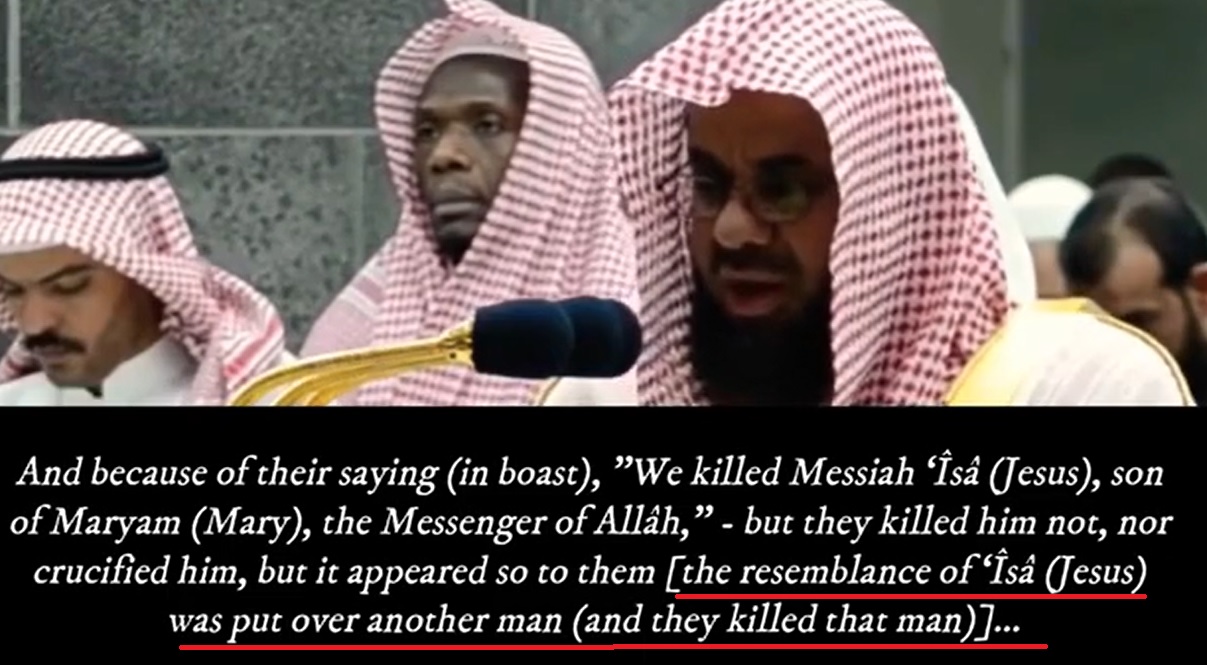
So than “Nasir Al Hanbali” puts the following recitation up:

“Nasir Al Hanbali” than ask us: “Do you think Shaykh Ali Jaabir was wrong and the creep was right?”

My comment:

Where did Shaykh Ali Jabir recite “the resemblance of Isa was put over another man (and they killed that man” ? Shaykh Ali Jabir did not recite that at all! Yet the text put up there fools those who do not understand the Arabic text!

Then, ‘Nasir Al Hanbali’ gives us another reciter.

“Nasir Al Hanbali” than ask us: “Do you think Shaykh Abu Bakr ash-Shatiri was wrong and the creep was right? Let us listen to the next reciter, Shaykh Sa’ood ash-Shuraim.”

Prima Qur’an comment:

Where did Shaykh Abu Bakr ash-Shatiri recite “the resemblance of Isa (Jesus) was put over another man (and they killed that man)”? Shaykh Abu Bakr ash-Shatiri did not recite that at all! Yet the text put up there fools those who do not understand the Arabic text!

Prima Qur’an comment:

Where did Shaykh Sa’ood ash-Shuraim recite “the resemblance of Isa (Jesus) was put over another man (and they killed that man)” ? Shaykh Sa’ood ash-Shuraim did not recite that at all! Yet the text put up there fools those who do not understand the Arabic text!

This is simply pure deception on behalf of the one who put the video up.

“Allah said to Isa: Allah said: O Isa (Jesus)! I will take you and raise you to Myself [Qur’an 3:55] Allah said: “Ya Isa” referring to Isa ibn Maryam (a.s) when the Jews plotted against him, they wanted to kill him. They entered upon him wanting to kill him [because] their norm was to kill Prophets. When they entered upon [Isa ibn Maryam], Allah raised him from amongst them. He made another man resemble him. They grabbed that man, crucified him and killed him thinking that he was Isa. As for Isa, then Allah raised him from amongst and they did not perceive it. That is why Allah says: “but they killed him not, nor crucified him, but it appeared so to them [the resemblance of Isa (Jesus) was put over another man (and they killed that man)],” [Qur’an 4:157] -Shaykh Salih al-Fawzan

Prima Qur’an comment:

Shaykh Salih al-Fawzan has invented an outright lie about Allah (swt)! Let the Shaykh be reminded the following:

“And who is more unjust than one who invents a lie about Allah or says, ‘It has been inspired to me,’ while nothing has been inspired to him, and one who says, ‘I will reveal something like what Allah revealed.’ And if you could but see when the wrongdoers are in the overwhelming pangs of death while the angels extend their hands, saying, ‘Discharge your souls! Today you will be awarded the punishment of [extreme] humiliation for what you used to say against Allah other than the truth and that you were, toward His verses, being arrogant.’” (Qur’an 6:93)

Prima Qur’an comment:

Where did Shaykh Salih al-Fawzan get the daleel from the Qur’an and Sunnah that ” He made another man resemble him.” This is Aqeedah! The Qur’an does not say this! This is not from the Sunnah!

Shaykh Salih al-Fawzan continues:

Allah made this man resemble the Messiah, Isa. He himself accepted it and ransomed himself; he ransomed himself and he accepted that he would be killed and crucified. Allah honored him and did not waste this person and what he did with the Messiah. It is said that the one who Allah made to resemble Isa was the one who practiced treason; the one who led [the Jews] to Isa. The one employed treachery or betrayed Isa and led the Jews to him. Allah made him resemble Isa, so they killed him. However, the first opinion is more famous, that the one who chose to resemble Isa was honored and he chose to take his place. This man sacrificed himself for the sake of Allah, he was crucified and killed, so the Messiah Isa ibn Maryam could be saved from them. And Allah knows best. Allah raised him alive with him soul and his body. Not how some of the ignorant individuals say: “he was only raised with his soul.” He was raised with his soul and body alive. They were not able to touch him with any harm.” -Shaykh Salih al-Fawzan

Prima Qur’an comment:

Where did Shaykh Salih al-Fawzan get the daleel from the Qur’an and Sunnah that “Allah made this man resemble the Messiah.” This is Aqeedah! The Qur’an does not say this! This is not from the Sunnah! How can we be so carefree in ascribing to Allah (swt) such things and in the next breath say, “he first opinion is more famous.” Of course the opinion that some random person volunteered to be killed sounds better than just some random guy being chosen! The point being Shaykh Salihi al-Fawzan we don’t attribute opinions and conjecture to Allah (swt) !! It would have been appropriate to say that this is an interpretation of the text that was taken from the People of the Book and it does not have a sound chain of narration.

Also, which text in the Qur’an says that Allah (swt) “He was raised with his soul and body alive.

Shaykh Salih al-Fawzan continues:

“As for His statement: I will take you.. [Qur’an 3:55] The word Wafaat can mean death and it can also mean to sleep. “It is He who takes your souls by night (when you are asleep), and has knowledge of all that you have done by day,. [Quran 6:60]” -Shaykh Salih al-Fawzan

“Wafaat here means to sleep and Allah knows best or I will take you…[Qur’an 3:55], It can also mean to take you. Mutawaffi also means to take; Tawaffa haqqahu min fulaan [he took his rights from so and so]. The word Wafaat here does not mean death. Because the Messiah is still Alive and will descend at the end of times, he will kill the Dajjal and then he will die after that.” -Shaykh Salih al-Fawzan

“Because: “Every soul shall taste death.” [Qur’an 3:185] He [Isa a.s] will die after that. The point of evidence here is that [the Ayah]: “I will take you and raise you to Myself” [Qur’an 3:55] To raise him to him is not done except to a higher place. This is proof that Allah is [always] high and above [His creation]. -Shaykh Salih al-Fawzan

Prima Qur’an comment:

Shaykh Salih al-Fawzan quotes the verses: “It is He who takes your souls by night (when you are asleep), and has knowledge of all that you have done by day,. [Quran 6:60]” Does he not realize that he further proves our point that Jesus is dead? If there is any confusion as to what happens when we “sleep” let the Blessed Messenger (saw) explain it to you.

When we sleep we die. Our soul travels. If Allah (swt) does not return to the soul to the body than we die in our sleep. As far as Shaykh Salih al-Fawzan statement: “To raise him to him is not done except to a higher place. This is proof that Allah is [always] high and above [His creation].”

To Allah (swt) shall all return [not just Jesus].

Indeed, to Allah we belong and to Allah we shall return.” [Qur’an 2: 156]

It does not mean spatial location. Even though Shaykh Salih al-Fawzan who is fond of taking his creed from the people of the book Allah (swt) is not contained in a spatial location.

And he said: Lo! I am going to my Lord Who will guide me.” [Qur’an 37:99]

Ibrahim a.s says I am going to my Lord did he mean from place to place? No.

It is unfortunate because the more you investigate the beliefs of ‘Ahl Sunnah Wal Jammah‘ on this you can see they are in disarray over it.

Some say someone random was made to look like Jesus and he was put on a cross.

Other’s say Jesus was on a cross and died.

Other’s say that Jesus was on a cross but he passed out and latter was resuscitated.

“And they have thereof no knowledge. They follow not except assumption, and indeed, assumption avails not against the truth at all.” (Qur’an 53:28)

You maybe interested to read the following:

May Allah (swt) guide them and us.

May Allah (swt) Guide the Ummah.

May Allah (swt) Forgive the Ummah.

11 Comments

Filed under Uncategorized

Is Shaykh Imran Hosein Correct on The Return of Jesus?

“He will speak to the people in the cradle and in maturity and will be of the righteous.” (Qur’an 3:46)

﷽ 

Shaykh Imran Hosein has recently used the following as evidence for the return of Nabi ‘Isa — Christ Jesus the following:

“He will speak to the people in the cradle and in maturity and will be of the righteous.” (Qur’an 3:46)

So what is this all about? It is really about those who believe that Jesus (as) will return again before the end of times being so desperate that they will clutch at straws to try and exegetically extract such an idea from the Qur’an.  

Listen to the lecture from the 22 minute mark.

Shaykh Imran Hosein

@ 23:18 Shaykh Imran says, “But the Qur’an went on to say something more. Remember that this is Surah Al Maidah, ‘ tukallimun Nasa fil mahdi wa kahlan.”

“Twice, twice, you will speak. The first time is as a baby in the cradle and the second time is as an adult.” -Shaykh Imran Hosein

“But uh, even in London adults speak. There’s nothing big, there’s nothing miraculous about that. That’s normal. If you are an adult, and you don’t speak you’re dumb.” — Shaykh Imran Hosein

“But if you are an adult, and you are not dumb, then it is normal for an adult to speak. So where is the need for the ‘ruh al qudus’?” “Answer: The Qur’an is saying that you will speak miraculously twice.” -Shaykh Imran Hosein

“You will speak miraculously as a baby in the cradle, and you will speak miraculously again as an adult.” — Shaykh Imran Hosein

“C’mon, put on your thinking caps.” -Shaykh Imran Hosein

Prima Qur’an comments: At this juncture let us stop and do exactly as the Shaykh asks us to do.

Now, this is important because Shaykh Imran Hosein is one of those people who have as his entire focus eschatology, the Mahdi, Dajjal, and the so-called 2nd coming of Christ Jesus.

Someone who holds such views should be able to provide evidence for them, and the fact that Shaykh Imran Hosein has to make such exegetical stretches of the Qur’an shows the patently false nature of such beliefs.

A few minutes into his lecture, Shaykh Imran Hosein has some words for the Ahmadiyyah movement as well as for Muhammed Asad. However, Shaykh Imran’s misinterpretation of the Qur’an is equally bad.

It is amazing how the crowd gathered around Shaykh Imran soaked up all these words he had to say, and we just hope that they did indeed: ‘put on their thinking caps.’

Notice the slyness of his approach here:

“But uh, even in London adults speak. There’s nothing big, there’s nothing miraculous about that. That’s normal. If you are an adult, and you don’t speak you are dumb.” — Shaykh Imran Hosein

This subtle point is where he slowly lures his audience. In almost a trance-like state fixated upon his words, they can’t help but agree. After all, there is nothing miraculous about adults speaking, is there?

This is where he slips in his suggestion and whispers to the subconscious.

First the agreement of the negative: adults speaking is nothing miraculous. [everyone is now on the same page].

Then comes the delivery: The mixture of truth with falsehood.

“Answer: The Qur’an is saying that you will speak miraculously twice.”

As the subconscious is now primed, the reader will understand that Jesus will speak while in the cradle and as an adult. So there is already a bias confirmation: Ah, so Jesus does speak twice. Then comes the falsehood attached: miraculously twice.

Now, dear reader, check for yourself:

https://www.islamawakened.com/quran/3/46/

wayukallimu l-nāsa fī l-mahdi wakahlan wamina l-ṣāliḥīna -which of these Arabic words means miraculously?

The answer: None of them, of course.

“And do not mix the truth with falsehood or conceal the truth while you know [it].” (Qur’an 2:42)

Now it is a given that if a person speaks like a baby in the cradle that this is indeed miraculous, but even the Shaykh himself said: “Adults speak. There’s nothing big, there’s nothing miraculous about that.”

Thus, what Shaykh Imran has done is to mix the haqq that-Jesus will speak as a baby and in maturity with batil -that both events would be miraculous.

Then you will see how he needs to interpolate such falsehood in the Qur’an in order to get you to buy into his concept of some messianic figure coming later.

So now, after establishing his false premise that he has convinced his audience into accepting, he continues the rest of his speech.

Wake up dear Muslim brothers and sisters. You are being deceived.

What about kahl and kahlan in the Arabic text of the Qur’an.


If people want to say kahlan means 70 years old or even 800, let them roll with it, because no matter how old Nabi ‘Isa Christ Jesus was, we have the following text:

“[The Day] when Allah will say, “O Jesus, Son of Mary, remember My favor upon you and upon your mother when I supported you with the Pure Spirit and you spoke to the people in the cradle[wakahlan]and in maturity; and [remember] when I taught you writing and wisdom and the Torah and the Gospel; and when you designed from clay [what was] like the form of a bird with My permission, then you breathed into it, and it became a bird with My permission; and you healed the blind and the leper with My permission; and when you brought forth the dead with My permission; and when I restrained the Children of Israel from [killing] you when you came to them with clear proofs and those who disbelieved among them said, “This is not but obvious magic.” (Qur’an 5:110)


So, whatever these people want to say, the context of the above verse makes it abundantly clear that Jesus was wakhalan when he was being taught the Torah and the Gospel and dealing with the children of Israel. 

Also, those who want to say that Jesus (as) did not reach maturity before he had the chance to speak, thus he must come back.  This idea is based upon what? What verse in the Qur’an tells the age in which Jesus (as) died? Even those who say he did die but was taken bodily alive into heaven. Tell us his age? The New Testament is not a proof text for Muslims.

Are we really going to say that Allah [swt] is teaching Nabi ‘Isa—Christ Jesus the Torah and the Gospel upon his return? Why? What for?

So, even if you want to be extremely, and we do mean extremely charitable and go against references like:


Lisan Al Arab or Al Razi in Tafsir al Kabir, just remember to remind them that this 50+-year-old Jesus, this 80+year old Jesus was doing all the above as mentioned in Qur’an 5:110 before ANY SO-CALLED BODILY ASCENSION.

This day those who disbelieve have despaired of [defeating] your religion; so fear them not, but fear Me. This day I have perfected for you your religion and completed My favor upon you and have approved for you Islam as religion.” (Qur’an 5:3)

You may also wish to read:

May Allah Guide the Ummah.

May Allah Forgive the Ummah.

6 Comments

Filed under Uncategorized

Apologies to fellow Muslims and truth seekers over translation of Qur’an 4:31

“Our Lord, do not take us to task in case we forget or we make mistakes.” (Qur’an 2:286)

﷽ 

APOLOGY TO FELLOW MUSLIMS AND TRUTH SEEKERS.

May Allah (swt) forgive me. Praise be to Allah (swt) who guides us to a way that is best.

I used to rely upon a particular translation of the Qur’an 4:31 until upon closer examination I realized the game that was being played upon the unaware.

I’m thankful to Shaykh Hafidh Hamed Al Sawafi for pointing this out to me!

Most people are usually familiar with this translation:

“If you avoid major sins that you are prohibited, We will absolve YOU YOUR MINOR SINS and cause you to enter a generous gate.” (Qur’an 4:31)

Any translation that comes remotely close to that is a FALSE

Take a look at the different translations into English here:

https://www.islamawakened.com/quran/4/31/

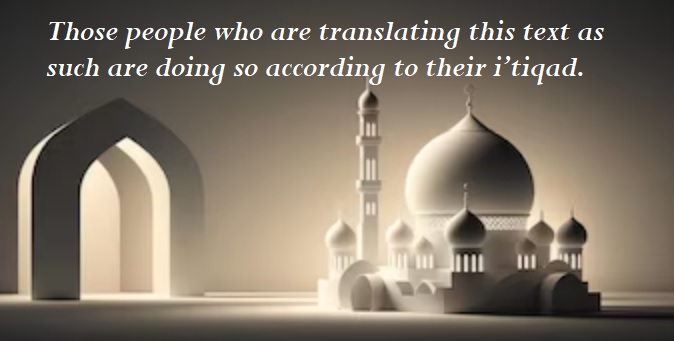
Those people who are either translating this text as such are doing so according to their i’tiqad or without giving much thought about it -according to the i’tiqad of others.

The most correct translation is: the one from Yusuf Ali (1985) which states:

“IF (but) eschew the evilest of the things which you are forbidden to do, We shall expel out of ( Saiyiatikum) YOU ALL THE EVIL IN YOU, and admit you to a gate of great honor.” -(Qur’an 4:31)

The reason that certain translators translate it the way that they do is because of their theology. Which is that the small sins get wiped out and the big sins get purified in the hell-which one latter is released from.

However, the correct understanding is that if a Muslim avoids the major big sins, or if they do them and rush to repent and reform, Allah (swt) will forgive our minor mistakes and faults.

Imposing their theological suppositions upon the Qur’an Al-Kareem!

As one Muslim brother pointed out: “Saiyiatikum” is “all evil in you”.

To interpret it as “minor sins” or the likes is but an interpretation.

The literal meaning takes precedence over an interpretation unless there’s a hujjah to support the interpretation.

Insh’Allah in time I will begin to replace the translation with the appropriate translation free from i’tiqad -may Allah (swt) help me.

Kindly take note. My humble and sincere apologies.

“And protect them from the evil consequences [of their deeds]. And he whom You protect from evil consequences that Day – You will have given him mercy. And that is the great attainment.” (Qur’an 40:9)

May Allah (swt) Guide the Ummah.

May Allah (swt) Forgive the Ummah.

Leave a comment

Filed under Uncategorized

Crucifixion or Impaled? Understanding Qur’an 4:157

“And for their saying, “Indeed, we have killed the Messiah, Jesus, the son of Mary, the Messenger of Allah.” And they did not kill him nor did they impale (ṣalabūhu) him; (وَمَا قَتَلُوهُ وَمَا صَلَبُوهُ وَلَٰكِنْ شُبِّهَ لَهُمْ)but it was made to appear to them so. Those who differ therein are full of doubts. They have no certain knowledge of it, but only follow conjecture. For certainly, they did not kill him.” (Qur’an 4:157)

﷽ 

Allah-willing we will be going through my articles and replacing the standard translation into English with what you see above.

Before we get into this let me first say that there seems to be three ways of understanding the above text among Muslims today.

1)The majority view is to affirm the Christian ecclesiastical view of the patibulum –(The crossbar of a cross used for crucifixion). However, at the same time deny that instead of Jesus being on the cross, Allah (swt) made someone look like Jesus and to put this person on the cross. The ecclesiastical Christian view is not challenged. Some how they imagine Romans involved in the text.

We speak more about that here:

2) The second view is to affirm the Christian ecclesiastical view of the patibulum. However, this view first espoused by Mirza Ghulam Ahmad of the Ahmadiyyah movement has that Jesus was on the cross but swooned and was taken down alive where he migrated to Qadian India and died. Some how they imagine the Romans involved in the text.

This view is later adopted by Muslim apologist Shaykh Ahmed Deedat -raheemullah, and Toronto based apologist Shabir Ally. However, it should be noted that neither Deedat or Ally believes that Jesus migrated to India and died.

3) The third view is also to affirm the Christian ecclesiastical view of the patibulum. However, this view also accepts the entire position of the Christian ecclesiastical view; even stating Jesus died on the cross and was resurrected! The only difference with the Christians is on the theological implications. This view is espoused by Zaytuna College alumni Dr. Ali Ataie-whom is an assistant professor with interfaith activities. * note * We are of the understanding that Dr. Ali Ataie has changed his views on this and we will update accordingly inshAllah.

Most likely Dr. Ali Ataie is attempting to reconcile clear passages of the Qur’an that Jesus died all the while trying to reconcile the Christian ecclesiastical tradition along with the various hadith that mention the second coming of Christ Jesus.

Dr. Ali Ataie position has the influence of Todd Lawson written all over it. Speaking of Todd Lawson

Todd Lawson is the author of the book: The Crucifixion and the Qur’an: A Study in the History of Muslim Thought.

Now without getting too much into this particular book,we think it suffices to bring to the readers’ attention two glaring problems with Todd Lawson’s book.

Todd Lawson himself does not even attempt to define the word ‘Crucifixion’. It certainly seems rather odd having the very word in the title of one’s book and not attempt to challenge the ecclesiastical handed-down version of the Christian tradition and yet in the same vain challenge the “ecclesiastical” handed-down version of the Islamic tradition.

Secondly, Todd Lawson dissects many words in Qur’an 4:157 yet, curiously he is quite dismissive of the treatment of the word صلب

There is scant discussion on the various verb/noun forms ‘sulb‘. Todd Lawson came with a mission. Super impose the word Cross and Crucifixion upon صلب

On page 31 of his book he states:

“It occurs in the Qur’an eight times (4:157; 12:41; 7:124; 20:71; 26:49; 5:33; 86:7;4:23). Six of these are as a verb with the accepted meaning of ‘to crucify’. The others are as a noun meaning ‘back’ or ‘loins’ (86:7; 4:23). Aside from its use in 4:157, the five remaining positive uses refer to (respectively): the fate of one of Joseph’s fellow prisoners (12:41); Pharaoh’s threat to his magicians (7:124; 20:71; 26:49); and a prescription of punishment for those who fight
against God and his messenger (5:33)
. There is no reason to doubt that the verb indicates the punishment of crucifixion, as it is USUALLY UNDERSTOOD.”

Now there is a great reason to doubt why anyone would superimpose the ecclesiastical Christian Cross as Todd Lawson tries to do. The very paragraph itself gives you reason enough.

Alas, Todd Lawson also some how imagines Romans involved in the text of Qur’an 4:157

Another interesting take away from Dr. Ali Ataie’s position is that Zaytuna champions the idea of following strictly a legal school and considers that we must champion traditional scholarship without question.

Yet, Dr. Ali Ataie’s position if honoured by Zaytuna is certainly a sign that a whole string of titans in the Sunni Islamic tradition on exegesis made a gargantuan error. Something interesting to ponder.

Every translation we have encountered in English has Qur’an 4:157 as “they didn’t crucify him.”

We also have no good reason to believe that Romans are involved in the text of Qur’an 4:157

There are a few reasons why we can no longer accept the standard understanding and translation of this text as such.

BEFORE GOING FURTHER: WHAT IS THE DIFFERENCE BETWEEN CRUCIFIXION AND IMPAILMENT?

Two be clear: Both punishments are suspension punishments. That is to say something being hoisted or lifted up. The differences between Impailment and Crucifixion are as follows:

A) Impailment is a punishment where a pike/spike or other sharpened object is shoved through the loins/lubmus region of the body. The spine is used to hoist the individual. Depending upon the technique used it is designed to be a quick death struggle after. After the hapless victim cannot use their feet or hands to keep the impale device from reaching vital organs due to exhaustion. The impale device pierces vital organs and the victim dies an excruciating death.

B) Crucifixion is a punishment where an individual is put on a patibulum which is than affixed to a crux (a pole or beam). There is no nothing driven through the spine and the spinal column is relatively left intact. This suspension punishment focuses on putting nails through the hands and feet and meant to be a prolonged death struggle. Death is usually from asphyxiations. No vital organs are pierced. In fact people could survive being crucified for days. Hence, Christians make a huge ordeal about Jesus being scourged before Crucifixion.

Anything that tries to obfuscate the two is not helpful.

Usually those who want to assert the cross are the same ones who superimpose it on Qur’an 4:157. Because if both mean impailment than just translate Qur’an 4:157 as impale then (wink, wink, nudge,nudge).

We are not convinced that ṣād-lām-bā’: used twice as salabu, four times as yusallabu and twice as sul’b means “cross” or “double cross”-like structure.

A “double-cross” or “cross”-like structure would include any of the following in the link below.

https://www.britannica.com/summary/cross-religious-symbol

There is simply not a shred of evidence from the Qur’an to support this.

What is the best approach to interpreting the Qur’an?

If we are going to have a consistent method of interpretation the best place to start would be Tafsir al-Quran bi-l-Quran. (Interpreting the Qur’an by the Qur’an). That is to say to do a tight analysis of all text of a given word and it’s various forms and usage.

Ṣād-lām-bā’: ṣalb and ṣallab refer to a bone from the upper body to the waist [i.e., the backbone]

Let us look at all the instances of this noun form in the Qur’an.

The artist impression.

Often in many countries where a person is robbed the police will ask the victim to give a description of the assailant. The police will than have an artist give the best description or approximation of what that individual may look like.

Now we are going to do a little exercise. Imagine you are going to do an artist impression of the passages you read in the text. What would that artist impression look like?

“And also prohibited are the wives of your sons who are from your loins (aslabikum)(وَحَلَائِلُ أَبْنَائِكُمُ الَّذِينَ مِنْ أَصْلَابِكُمْ), And that you take in marriage two sisters simultaneously, except for what has already occurred. Indeed, Allah is ever Forgiving and Merciful.” (Qur’an 4:23)

The use of the noun form sulb is very interesting here. It indicates the loins. Which also gives a very strong proof that these people were indeed not ‘crucified‘ and that the text translated in 4:157 ‘they didn’t crucify him‘ is sorely mistaken.

Let’s use logic and deduction. Given that the noun form of صلب in the text above indicates the loins. Would it make more sense that:

A) ṣalabūhu used in Qur’an 4:157 is a punishment that relates to this region of the body?

or

B) a punishment that relates to the hands and feet being nailed on a patibulum?

The following link gives an excellent description and picture show casing the lumbar region.

Emerging from the lumbus (l-ṣul’bi) (يَخْرُجُ مِنْ بَيْنِ الصُّلْبِ وَالتَّرَائِبِ) ” (Qur’an 86:7)

Another excellent example showcasing the lumbar is found here:

https://teachmeanatomy.info/abdomen/bones/lumbar-spine/

Again the noun form sulb being used to talk about the lubmus system and nothing to do with hands and or feet!

Perhaps Todd Lawson or those who advocate that Jesus died on an ecclesiastical cross could tell us which makes more sense the word صلب is used in connection to impailment or in connection to putting nails through a person’s hands and feet and suspending them on a patibulum?

In Oman the Arabic speaking people have various interesting phrases none of which has to do with hands or feet being pierced.

The previous two verses do not support the صلب being translated as cross or crucify.

“Correct your spine.” Is a a common phrase in Oman.

Let us look at all the instances of this verb form in the Qur’an.

HOW DOES ISLAMIC JURISPRUDENCE UNDERSTAND صلب IN THE FOLLOWING VERSE?

Indeed, the penalty for those who wage war against Allah and His Messenger and strive upon earth [to cause] corruption is none but that they be killed or impaled(yuṣallabū) (أَنْ يُقَتَّلُوا أَوْ يُصَلَّبُوا أَوْ تُقَطَّعَ أَيْدِيهِمْ وَأَرْجُلُهُمْ مِنْ خِلَافٍ) …cutting off their hands and feet on opposite sides, or exile from the land. This ˹penalty˺ is a disgrace for them in this world, and they will suffer a tremendous punishment in the Hereafter.” (Qur’an 5:33)

Now this verse has not been said to be allegorical but clear. It relates to the punishment known as al-Hiraba (or armed robbery, highway robbery). The punishment is also used for “causing corruption in the land.” Now if you asked your average Muslim (even learned) when it says, “killed” what tool or instrument is used to kill?

Likewise when Muslim jurist saw the word “(yuṣallabū)” do you think they said, “Golly gee whiskers I wonder what this means?”

Are we really to believe that Muslim jurist that had ordered this Hadd punishment to be carried made crosses and double cross like structures when dealing with these criminals? Are we to believe that Muslims jurist ordered that the criminal carry a patibulum, suspended said person and put nails in their hands and feet?

In fact, name for us any school of jurisprudence: Maliki, Shafi’i, Hanbali, Zahiri, Hanafi, Zaydi, 12er Shi’i or Ibadi that does this?

Why was Todd Lawson so incredibly lazy in his research in this regards?

The fact that Islamic schools of jurisprudence across the Sunni, Ibadi and Shi’i tradition do not do this a deathblow to any notion that صلب means cross or crucify.

Contemporary example: May 30, 2009 (just 14 years ago)

http://edition.cnn.com/2009/WORLD/meast/05/30/saudi.arabia.execution/index.html

Notice:

“Even though the word “crucifixion” is used to describe the pubic display, the act has no connection to Christianity and the crucifixion of Jesus. The bodies are not displayed on crosses.

“Chirouf said those crucified are beheaded first and then their heads are sewn back on their bodies. Then, the corpse is mounted on a pole or a tree.”

Prima-Qur’an comments: The above is important because it shows clearly that there is obfuscation over the word “crucifixion”.

Keep in mind what you see here is the Shafi’i or the Hanbali school’s interpretation of Qur’an 5:33.

In fact a little inconvenient nugget in Todd Lawsons Book states:

“A cursory look at the history of crucifixion shows that the procedure was adopted for two distinct, if sometimes combined reasons: (1) as a means of execution; (2) to provide a forceful deterrent to future crime. In the second case, the criminal was killed by a separate means before their corpse was publicly displayed on a pike or cross. These grisly details are in line with the Shafi’i ruling for one convicted for highway robbery and murder, in which this second procedure was to be followed. The sequence of events, execution then crucifixion, may be reflected in the unchanging order of the two distinct ideals of killing and crucifixion in every tafsir consulted for this study. It is also possible that this reflects nothing more than the Qur’anic word order, in which case hyperbaton (taqdim) could be expected to have been invoked by Muslim rhetoricians; but which fact alone might lead the student of the history of religion to investigate seventh-century Arab methods of punishment.”

Source: (Todd Lawson The Crucifixion and the Qur’an page 31)

A few points to note here:

a) Todd admits the people were killed and then displayed on a pike or a “cross”. So this is certainly not a crucifixion-at least not as Christians would envision for Jesus.

b)Todd does not give us any proof that in Shafi’ jurisprudence people are displayed on the patibulum or on a cross.

c) Todd is content to allow the student to “investigate seventh-century Arab methods of punishment

One final point:

Often criminals lead a life of crime. Meaning they do lesser crimes that eventually lead to bigger crimes. So let us say there is a case in which a thief had been caught and according to the jurist their hand is cut off. The thief is caught again and a foot is cut off. Then said individual commits the crime of al-Hiraba. So than how do they (yuṣallabū) the individual?

PHAROAH EGYPT & صلب (SULB)

Now we will examine three text of the verb form that relate to the same incident.

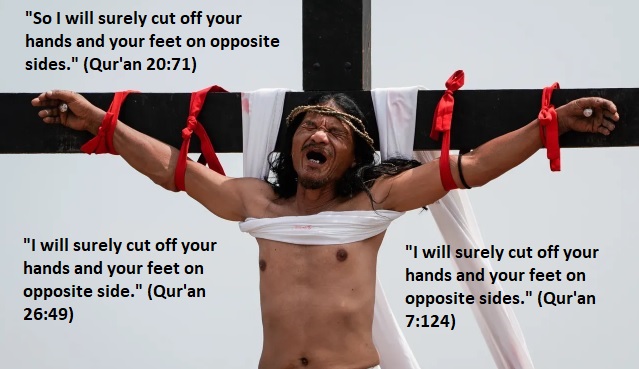
“I will surely cut off your hands and your feet on opposite sides; then I will surely impale(la-uṣallibannakum) (لَأُقَطِّعَنَّ أَيْدِيَكُمْ وَأَرْجُلَكُمْ مِنْ خِلَافٍ ثُمَّ لَأُصَلِّبَنَّكُمْ أَجْمَعِينَ) you all.”(Qur’an 7:124)

It is obvious and plain as day that a person who has their hand cut off is not going to be “crucified” -especially not in the way the ecclesiastical sense that Christians imagine. If the hands were cut off then definitely it was not a T or ✞ shaped cross, it had to be impalement.

“[Pharaoh] said, “You believed Moses before I gave you permission. Indeed, he is your leader who has taught you magic, but you are going to know. I will surely cut off your hands and your feet on opposite sides, and I will surely impale (wala-uṣallibannakum) (لَأُقَطِّعَنَّ أَيْدِيَكُمْ وَأَرْجُلَكُمْ مِنْ خِلَافٍ وَلَأُصَلِّبَنَّكُمْ أَجْمَعِينَ) you all.” (Qur’an 26:49)

Again as above a person who has their hand cut off on opposite is certainly not ‘crucified‘ -especially not in the ecclesiastical sense that Christians would image. If the hands were cut off then definitely it was not a T or ✞ shaped cross, it had to be impalement.

“[Pharaoh] said, “You believed him before I gave you permission. Indeed, he is your leader who has taught you magic. So I will surely cut off your hands and your feet on opposite sides, and I will impale you (wala-uṣallibannakum) (وَلَأُصَلِّبَنَّكُمْ فِي جُذُوعِ النَّخْلِ) IN/ON THE TRUNKS OF PALM TREES, and you will surely know which of us is more severe in [giving] punishment and more enduring.” (Qur’an 20:71)

Again, a person is who has their hand cut off is not going to be “crucified” -especially not in the ecclesiastical sense that Christians have imagined.

Very interesting in the above text that these people will be impaled IN the trunks of Palm Trees. If you look at the various translations of the Qur’an they translate the word fi’ as ‘on‘ which is a bit curious.

The translators: Muhammad Ahmed & Samira translate 20:71 as:

“He said: “You believed to him before that I permit for you, that he truly (is) your biggest/greatest (E) who taught/instructed you the magic/sorcery, so I will cut off/sever (E) your hands and your feet from opposites (sides), and I will crucify you (E) in the palm trees’ trunks/stems, and you will know (E) which of us (is) stronger (in) torture and more lasting .”

https://www.islamawakened.com/quran/20/71/#:~:text=Verily%2C%20he%20is%20your%20master,at%20torment%20and%20more%20lasting.

So let us do back to our artist impression. We draw a picture or someone with their hands and feet cut off on opposite ends and impaled in the trunk of palm trees. How on earth anyone gets a patibulum with nails in the hands and feet from the above text is just pure desperation.

By the way (Qur’an 20:71) & (Qur’an 26:49) & (Qur’an 7:124) is a reference to the same incident. So what Qur’an 20:71 states is applicable to the other two text.

So when Pharaoh says: “And you will surely know which of us is more severe in [giving] punishment and more enduring,” you know that he had something truly diabolical in mind.

Look what the world History Encyclopedia says:

“Ancient Egypt utilized a process known as impaling. The body was literally impaled upon a pointed stake and death occurred quite rapidly as the major organs were pierced. The hieroglyph character for denoting this was a picture of it, with the phrase, “to give on the wood.” The practice is mentioned during the reigns of Sobekhotep II, Akenaten, Seti, and Ramesses IX. Merneptah (1213-1203 BCE) “caused people to be set upon a stake” south of Memphis.” Source: https://www.worldhistory.org/crucifixion/

The American schools of oriental research state:

The death penalty was carried out by impalement. The body was put on the pointed top of a wooden stake and the victim’s weight drew the body down the pole. We have no representations of this procedure, but there is a hieroglyph depicting a body atop a stake after the phrase “to give on the wood.” The execution seems to have been in public; one text even says besides a temple.” Source: The American schools of oriental research https://www.asor.org/anetoday/2016/01/crime-and-punishment-in-pharaonic-egypt/

So when we see this expression of Pharaoh in the Qur’an:

I will impale you (wala-uṣallibannakum) (وَلَأُصَلِّبَنَّكُمْ فِي جُذُوعِ النَّخْلِ) IN/ON THE TRUNKS OF PALM TREES.”

And we see the expressions: “To give on the wood

By the way (Qur’an 20:71) & (Qur’an 26:49) & (Qur’an 7:124) above cannot refer to a crucifixion or to a cross.

Why? Look at the picture below and you do the physics.

Every once in awhile a Christian gets the idea that he wants to experience the suffering that Jesus is alleged to have endured on the so called double-cross. So this person will lay down half naked on a beam of wood and gets someone to nail the palms of his hands (or the wrist) and his feet to the beam. When the beam of wood is stood up on its end, the persons’ body weight immediately tears his hands and the feet loose and they slide off the beam in degradation and humiliation.


This happened all to often, and people began to really wonder if the ecclesiastical images of Jesus inspired by painters, having him on the double cross were really true.


Thus, in all effort to make sense of the ecclesiastical images, made popular by paintings, the all too familiar “nailed to the double cross” method, along came the idea that the hands were not only nailed to the cross, but ropes were used to bind the forearms to the horizontal beam. This satisfied the world that such a method would prevent a body from falling off the cross and everyone breathed a sigh of relief.


This brings us to the next text:
“Oh two companions of prison, as for one of you, he will give drink to his master of wine; but as for the other, he will be impaled (fayuṣ’labu) (وَأَمَّا الْآخَرُ فَيُصْلَبُ فَتَأْكُلُ الطَّيْرُ مِنْ رَأْسِهِ), and the birds will eat from his head. The matter has been decreed about which you both inquire.” (Qur’an 12:41)
This is what the Torah says about the incident:

Source: https://www.sefaria.org/Genesis.40.19?lang=bi&aliyot=0

“When the chief baker saw that Joseph had given a favorable interpretation, he said to Joseph, “I too had a dream: On my head were three baskets of bread. In the top basket were all kinds of baked goods for Pharaoh, but the birds were eating them out of the basket on my head.” “This is what it means,” Joseph said. “The three baskets are three days. Within three days Pharaoh will lift off your head and impale your body on a pole. And the birds will eat away your flesh.”

(Genesis 40:16-19) New International Version

Compare/Contrast this with:

When the chief baker saw that the interpretation was good, he said unto Joseph, I also was in my dream, and, behold, I had three white baskets on my head: And in the uppermost basket there was of all manner of bake meats for Pharaoh; and the birds did eat them out of the basket upon my head. And Joseph answered and said, This is the interpretation thereof: The three baskets are three days: Yet within three days shall Pharaoh lift up thy head from off thee, and shall hang thee on a tree; and the birds shall eat thy flesh from off thee.”

(Genesis 40:16-19) King James Version

Since this text is dealing with prophet Joseph (as) and he was under the Pharaoh of Egypt of his time and this is even prior to the time of Moses (as).

So based upon what we have seen concerning صلب as impailment in the above text (Qur’an 20:71) & (Qur’an 26:49) & (Qur’an 7:124) there is no good reason to believe that (Qur’an 12:41) is a reference to the patibulum, a cross or crucifixion.

So having gone through all the verses in the Qur’an that only leaves us with Qur’an 4:157.

What about Qur’an 4:157?

And for their saying, “Indeed, we have killed the Messiah, Jesus, the son of Mary, the Messenger of Allah.” And they did not kill him nor did they impale (ṣalabūhu) him; (وَمَا قَتَلُوهُ وَمَا صَلَبُوهُ وَلَٰكِنْ شُبِّهَ لَهُمْ)but it was made to appear to them so. Those who differ therein are full of doubts. They have no certain knowledge of it, but only follow conjecture. For certainly, they did not kill him.” (Qur’an 4:157)

  1. Notice that the context Qur’an 4:157 is speaking about Jews. There is no mention of Romans in the text. You may start at Qur’an 4:154 for context.
  2. There is a double denial. They did not kill him nor did they (ṣalabūhu) him.
  3. Why the seemingly redundant text? Is it not sufficient to say “And they did not kill him?” Surely that covers everything?
  4. Why would Allah (swt) deny that Jews “Crucified” Jesus? Especially if Allah (swt) is aware of Jewish laws?
  5. Jews do not crucify anyone nor do they put people on crosses.
  6. Jews do however impale people. So translating (ṣalabūhu) as impale makes complete sense.
  7. The phrase “but it was made to appear to them” does not indicate that this was something Allah (swt) did.

Now what happens is for some reason Muslims look at Qur’an 4:157 and they see Romans! The whole context of the text is that Allah (swt) is talking about Jews.

If Allah (swt) wanted to say Romans he certainly he could have. Yet, Qur’an 4:157 mentions nothing about the Romans.

“The Romans have been defeated.” (Qur’an 30:20)

So where than do Muslims gets Romans or Crucifixion or Cross in Qur’an 4:157 ?? ?

Now if you want to wade knee deep in shoddy scholarship and try to reconcile Islam with received Christian ecclesiastical history and ignore the context of the Qur’an and interpret passages in a vacuum go for it. Like Todd Lawson, you can superimpose the Romans on the text. You can even imagine that Qur’an 4:157 is speaking about some historical event in relation to Christian Good Friday if you want. (Crucifixion) ?

Objection: But This means the Qur’an denies the Crucifixion and that is historical fact!

Response: The Qur’an is absolutely unaware of an event called “The Crucifixion” either in support of it or in negation.

Muslims do not need to fear Bart Erhman or anyone else who claims that this is a historical fact that Jesus of Nazareth died on a patibulum, cross like structure. We can deal with their claims as well. https://primaquran.com/2023/04/03/the-question-of-the-historical-crucifixion-and-the-martyrdom-of-jesus/

However, such a discussion is absolutely irrelevant to the text of the Qur’an.

Objection: But doesn’t’ the Arabic word salib mean cross? Don’t we see that in the Arabic language today?

Answer: First one would do well to bare in mind that ‘The Cross’ was not a de facto symbol of Christianity, really only becoming venerated in the 4th century C.E. Secondly, words acquire meaning or encapsulate new expressions that they did not originally intend or convey.

For example: I see hot molten rock spewing forth from the Earth in Hawaii. I turn to my friend and say, “Wow cool!” Now the word cool does not necessarily connoate the temperature of something.

The word fantastic etymologically has the same root as fantasy. Fantastic initially meant something conceivable by the imagination. Now the word fantastic basically means wonderful.

Conclusion:

There is simply not a shred of evidence that the Qur’an mentions a cross or anything at all about crucifixion. There is no mention about a patibulum or nails, nothing, nada, zilch, zip.

Henceforth from today,We will be translating the Qur’an 4:157 as saying, “They didn’t impale him” -keeping consistent with his various usages and forms throughout the Qur’an.

“And when they hear what has been revealed to the Messenger, you see their eyes overflowing with tears because of what they have recognized of the truth. They say, “Our Lord, we have believed, so register us among the witnesses.” (Qur’an 5:83)

You may also wish to read the following:

The above exchange with Rabbi Dov Stein further proves the point of this article.

May Allah (swt) Guide the Ummah.

May Allah (swt) Forgive the Ummah.

15 Comments

Filed under Uncategorized

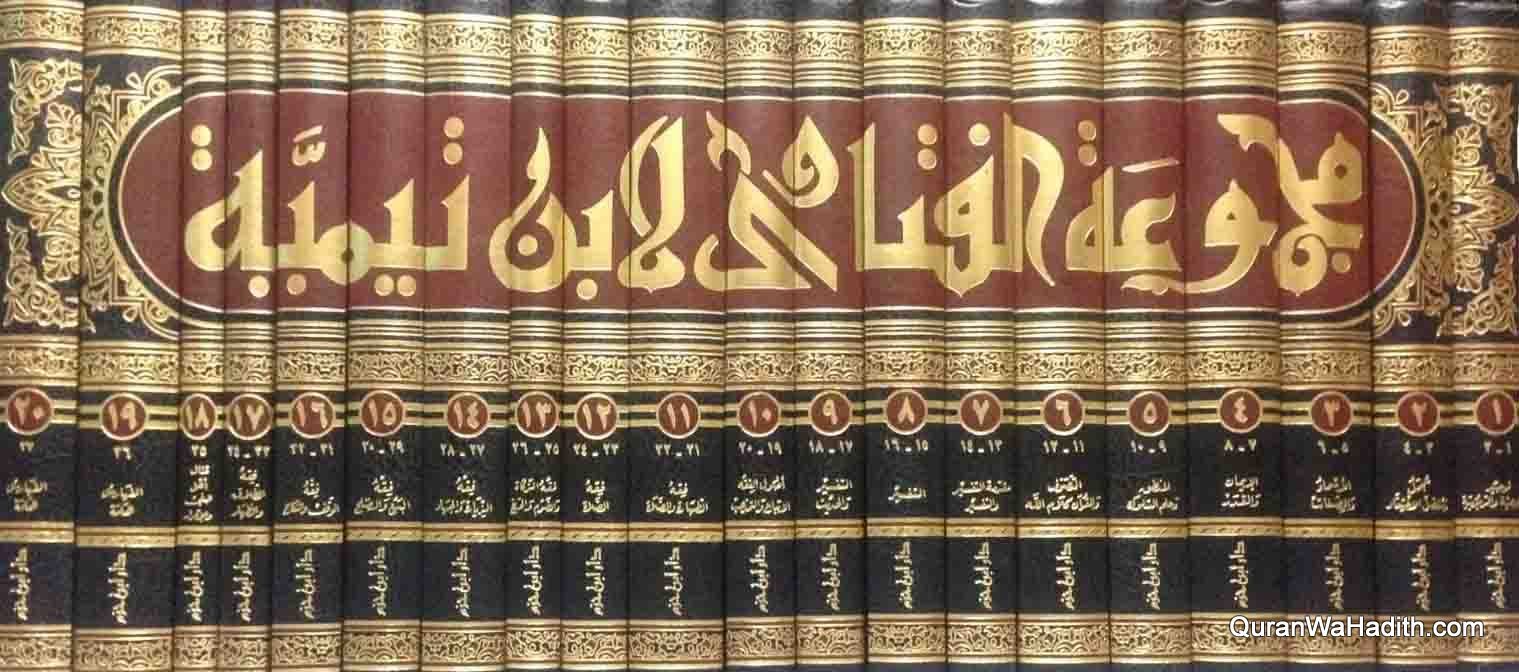
Ibn Taymiyya applies Ta’wil of Allah’s attributes.

“Everyone upon the earth will perish but The face of your Lord will remain, possessor of majesty and honor.”(Qur’an 55:27)

﷽ 

“Everything will perish except His face.” (Qur’an 28:88)

Ibn Taymiyya related that Ja’far al-Sadiq’s interpretation of Allah’s “face” as meaning the Religion of Islam, and al-Dahhak’s interpretation of the face in the same verse as meaning: “Allah’s essence, Paradise, the Fire, and the Throne.”

You can imagine the kind of struggle those who say we do not apply ta’wil had when coming to the verses above. If taken at their apparent meaning it indicates that the face is the only attribute of Allah (swt) that would remain while the other attributes would perish.

You cannot have a divine being that is both annihilated and existing forever at the same time.  So what does Ibn Taymiyya do in this situation? What any other rational human being would do. Using the rules of grammar he applied ta’wil!

As for Ibn Taymiyya himself, he interprets ‘his face’ as meaning direction (jiha), so that the meaning would be for him: “Everything will perish save that by which Allah’s direction is sought.” He then adds, “This is what the vast majority of the Salaf have said.”

Source: (Ibn Taymiyya, Majmu’at al-fatawa 2:428)

“This is what the vast majority of the Salaf have said.” -which if we are to believe Ibn Taymiyya it means the vast majority of the salaaf applied ta’wil.

Now only one of two scenarios are possible according to Ibn Taymiyya’s statement.

  1. The vast majority of the salaaf applied ta’wil.
  2. The salaaf didn’t apply ta’wil because they knew the Arabic language better than we do and understood that ‘wajh’ meant essence or direction.

Now proponents of inconsistency will exclaim “This is no ta’wil at all!” “The face is not necessarily an attribute.”

Yet Ibn Taymiyya in Al-Aqidah al-Wasitiyyah has clearly stated that the face is an attribute of Allah (swt).

However, the response is that whatever made the “wajh” not necessarily refer to one of the attributes is precisely the type of ta’wil that Ibn Taymiyya has allowed for others to open the door!

May Allah guide the Ummah!

May Allah forgive the Ummah!

11 Comments

Filed under Uncategorized

Overview of Ibadi Tafsir Literature.

“And (think of) the day We shall send to every people a witness from among them (to testify) against them, and We shall bring you (O prophet) as witness against these. And We have revealed to you the Book, an exposition of everything, and guidance, and mercy, and glad tidings for the Muslims.” (Qur’an 16:89)

﷽ 

From: https://www.islamfact.com/an-overview-oc-ibadi-tafseer/

An Overview of Ibadhis Tafsir

Essay submitted for the M.St. in Oriental Studies, June 2000

By Kahlan Al-Kharusi

… during the last few years, research workers have made some progress in investigating and representing some of the Ibadhis works in tafsir, but because of the constant tendency to treat the Ibadhiya simply as a facet of Khariji thought, the Ibadhis role has not been considered in a proper manner or even been looked at with reasoned thought…

Introduction     

Our knowledge about the Ibadhis[1]contribution to the field of tafsir is seriously defective. It is true to a considerable extent that there are objective reasons for this dereliction, as well as subjective reasons. From the first group comes the irresponsibility of Ibadhis, despite their positive and productive role for the service of the Quran and its sciences, to introduce their works to those who are eager for such material to be available. However, during the last few years, research workers have made some progress in investigating and representing some of the Ibadhis works in tafsir, but because of the constant tendency to treat the Ibadhiya simply as a facet of Khariji thought, the Ibadhis role has not been considered in a proper manner or even been looked at with reasoned thought. Dr Mohammad Hussayn al-Dhahabi[2], for example, did a huge study about tafsir and Mufassireen, but when he comes to Ibadhiyya he deals with them on that basis, thus he gives nothing but a distorted picture. I am not going to debate with his views here, as I am only illustrating an example of how such respected doctors, intentionally or inattentively, have failed to grasp the Ibadhis contribution in such a field. To try to remedy this, this paper will try, as much as possible, to take a step forward in introducing and addressing Ibadhis works right from the constructive period of the Ibadhis school of thought until the late thirteenth/ nineteenth century.

In these circumstances, it seemed useful to set out the basic information about Ibadhis tafsir according to the latest information available. There are still gaps, as some libraries are still failing to provide information about the manuscripts they contain and to give access to them. However, this essay is, I believe, a positive step forward in providing information that all those studying Ibadhiya need.

It would appear that the following texts form the primary list of Ibadi works in the field of Tafsir The list is in historical order, and detailed consideration will follow:

The Diwan of Jabir b. Zayd al-Azdi (d.93/711)

The Tafsir of ‘Abd al-Rahman b. Rustam (d.171/787)

The Tafsir of ‘Abdu l-Wahhab b. ‘Abd al-Rahman b. Rustam (d.208/823)

The Tafsir of Abu l-Munib Muhammad b. Yanis al-Nafusi ( d. in the first half of the third/ninth century )

The Tafsir of Houd b. Muhakkam al-Hawwari (d. in the second half of the third/ninth century )

Tafsir al-Khams-mi’at Aya by Abu l-™awari Muhammad b. al-™awari ( d. in the fourth/tenth century )

al-Tfsir al-Kabir of Abu Ya’qub Yusuf b. Ibrahim al-Warjlani ( d.570/1175)

A commentary on the tafsir of Houd b. Muhakkam al-Hawwari , by Muhammad b. ‘Umar b. Abi Sitta (d. 1087 or1088/1676 or 1677)

Annotation of the Tafsir al-Jalalayn by Yusuf b. Muhammad al-Mus’abi al-Maliki (d.1187/1773)

al-tafsir al-Muyassar by Sa’id b. Ahmad al-Kindi (d. at the beginning of the thirteenth /nineteenth century)

Partial Tafsir ( Suras 103-114 ) by Ibrahim b. Bahman ( d.1232/ 1817 )

The Tafsir of Yusuf b. ™addun ( 1236/1821)

(a) Maqalid al-Tanzil

(b) Tafsir Ayat Mutashabiha mina l-Quran both by Ja’id b. Khamis al-Kharusi (d.1237/1822)

14. al-Yumn wal-Baraka fi Tafsir al-Huda wa-l-Rahma by Muhammad b. Sulayman Adrisu .

15. (a) Himyan al-Zad ila Dar -al-Ma’ad

(b) Taysir al-tafsir

(c) Da’i l-’amal ila yawm al-ajal

All three are by Mohammad b. Yusuf Atfayish (d.1332/1914)

I shall now examine this list and try to reveal these ascribed works in details as possible.

Abu l-Sha’tha’ Jabir b. Zayd al-Azdi[3]was born in the small village of Farq near Nizwa in the interior of Oman. After receiving his early education in Oman he moved with his family to Basra and settled there. He studied in Basra and in the Hijaz and is thought to have studied with such leading companions of the Prophet as Ibn ‘Abbas, Abu Hurayra, Anas b. Malik , ‘Aisha bint Abi Bakr.. etc

Jabir is generally reckoned to be one of the greatest of the early Ibadhis. Due to his tact and organising ability, he effectively became the real founder of the Ibadhiya sect. He was particularly well-known for his learning and piety, winning the regard of such a notable as Anas b. Malik[4].

Jabir was probably the author of one of the earliest collection of hadith, tafsir, correspondence and legal opinions (Futya), known as the Diwan[5]. It is not clear whether this work was originally committed to writing or not – there are arguments on both sides – though it should be noted that Jabir flourished at a time when there was a great surge in the use of written Arabic during the Caliphate of ‘Abd al-Malik (with whom Jabir was on good terms, externally at least). But even if Jabir transmitted his knowledge verbally, his work was recognised as a discrete entity, and sooner or later it was committed to writing.

There appear to have been several copies, with one perhaps having gone to the Ibadhis in North Africa. However, by the third/ninth century the sole known copy was in the libraries of the ‘Abbasids in Baghdad, when al-Ma’mun is said to have set great store by the work. Some time later it was lost. The importance of the oral transmission of Jabir’s Diwan must be stressed. It should be remembered that his successor as imam, Abu ‘Ubaida Muslim b. Abi Karima al-Tamimi was his student, and students, especially at that time, learned aurally and not from books.

Unfortunately, it does not seem that any part of this work still exists, unless what Ennami[6] found in North Africa of Kitab al-Nikah and K. al-Salah by Jabir b. Zayd might be parts of his Diwan. This is just an assumption, and I cannot prove it yet. Beyond that we can look to the work of Pakoosh[7], who brought together more than forty examples of Jabir’s tafsir [Tafsir is of course subsumed in any major collection of ™adith]. The examples show him to be a disciple of Ibn ‘Abbas, but his crucial scholarly importance is in the transmission of this learning to the Ibadhis community.

2-’Abd al-Rahman b. Rustam and His Tafsir

‘Abd al-Raahman b. Rustam (date of birth is unknown) came from a Persian family that was stranded in Mecca when his father died on the Pilgrimage. Later his mother married a man from Qayrawan, and the family moved there. As a young man he traveled to Basra to study with Abu ‘Ubayda, the second Ibadhis imam.

‘Abd al-Rahman was elected Imam in Tiaret in 160/777. He died in 171/787[8], having composed numerous works on tafsir, Hadith and other Islamic sciences.

Most Ibadhi sources[9]agree that ‘Abd al-Rahman did write tafsir a, but there is disagreement about the time of its loss and the reason for it. One view is that it was lost when the ‘Umayyads sacked Tiaret in 296/909 and burnt the Ma’sooma Library there. A second view is that it survived but was sold on to someone who would not grant access to it. There is slightly more support for this view[10]. The end result, however, was the same: the work was lost.

As far as I can see from my reading, no trace of the work survived. It has been suggested that Shaykh Houd b. Muhakkam may have drawn on the tafsirs of both ‘Abd al-Rahman and his son ‘Abd al-Wahhab and that this may be indicated by the phrase “in the tafsirs of our sect …” This is an ingenious suggestion, but it is devoid of proof, and we most regretfully assume that this first complete tafsir by a renowned Ibadhis scholar, has been lost without trace. The loss is a particularly sad one, as we can tell from his correspondence[11]that he was an excellent scholar.

3- ‘Abd al-Wahhab b. ‘Abd al-Rahman b. Rustam

The son of ‘Abd al-Rahman (the end of the second century and the beginning of the third century) is said to have written a book of tafsir. The only possible indication of this comes from the redactor[12]of the tafsir of Houd b. Muhakkam al-Hawary but he provides insufficient evidence to show that the book existed. It must remain a claim only.

4- Shaikh Houd b. Muhakkam al-Hawary and his tafsir

                Houd b. Muhakkam was a Berber tribesman from what is now Algeria. He is a third century figure, who probably died at some time between 280-290/893-903.[13]

                There is no doubt that he put together a book known as Tafsir Kitab Allah al-’Aziz, as it has survived and has been printed[14]. However, there has been dispute about the extent of Shaykh Houd’s role in the book. It is clearly based in part on the tafsir of Yahya b. Sallam al-Basri (d. after 273/887). Close examination of the work shows that Shaykh Houd is far more than a summarizer. Crucially he adds Ibadhis views whenever they are needed and he recasts and explains difficult passages, and produces a tafsir that may be probably considered Ibadhis. It is, thus, the earliest extant Ibadhis tafsir and as such is extremely important.

                The published edition relies on one manuscript only, in which the first few pages are lost. As a result we are lacking Shaykh Houd’s Introduction and thus any remarks he might have made about his aims and methods. Nor is there any clarification in the marginal commentary by Shaykh Abu Sitta[15]. It seems to me to be important to search for other copies of the manuscript, which may well exist in private libraries.

5- Tafsir al-Khams-mi’at Aya

There is a difficult problem about the authorship. The work has been published three times, first in facsimile by Salim b. Hamad al-Harthi in 1974, then by Muhammad Zanati in 1991, and then by Dr. Walid ‘Awjan of the University of Mu’ta in 1994. All three editions give the name of the book as al-Diraya wa Kanz –ul-Ghinaya wa Muntaha al-Diraya fi Tafsir al-Khams-mi’at Aya and say that the author was the third century Omani scholar Abu l-Hawari Muhammad b. al- Hawari b. ‘Uthman, who studied at Nizwa under Muhammad b. Mahbub (d.250/864) and whose principal teacher was al-Salt b. Khamis al-Kharusi (d.278/891). He was certainly the author of numerous works.

However, the ascription to Abu l-Hawari is based on one sentence that occurs frequently throughout the work ‘Abu l-Hawari said’. What the sentence really indicates is that the opinions of Abu l-Hawari are frequently quoted. Sometimes authors do refer to themselves in this way, but it does not appear likely that this was so in this case[16]. Another suggestion is that the author was al-Salt b. Khamis al-Kharusi. This seems anachronistic and even less likely[17].

                Finally[18]there is a suggestion that this is simply the work of Muqatil b. Sulayman al-Azdi (d. 150/767) because he has a work in tafsir with exactly the same name ‘Tafsir al-Khams-mi’at Aya’. So in order to judge this opinion I compared precisely the texts of the two works. From the first few pages, I discovered the similarity between the two, or more accurately how much similar the tafsir ascribed to Abu al-Hawari was to that of Muqatil b. Sulayman. The only main difference was the additional Ibadhis juristic opinions in Abu al-Hawari’s work and, alternatively, the expurgation of the non-Ibadhis. This makes me confident that the basic author of this work is not the Omani scholar Abu al-Hawari but Muqatil b. Sulayman and the role of Abu al-Hawari is no more than a juristic refutation.

6- Abu Ya’qub Yusuf b. Ibrahim al-Warjlani

This Ibadhis scholar was born in the Algerian town of Warjalan at the beginning of the sixth century. After initial education in his home town, he studied for several years in al-Andalus. He died in 570/ 1175 after composing many significant works for the Ibadhis School. One of these was a tafsir, al-Tafsir al-Kabir as al-Salimi calls it[19]. Both al-Barredi[20] and al-Shammakhii[21]saw this work, but despite many diligent searches, no manuscript has been found.

Some idea of al-Warjlani’s method may be gleaned from al-Barradi’s description[22]and from passages found in other works by him, such as al-Dalil wa-l-Burhan and al-’Adl wal-Insaf. However, the information is fragmentary, and any views about it must remain tentative.

7- Abu ‘Abd Allah Muhammad b. ‘Umar b. Abi Sitta

This eleventh century Ibadhis writer (d.1087 or 1088/1676 or1677) earned the name al-Muhashshi for the large amount of marginal annotations that he wrote on important Ibadhis works. The most important of these was on the tafsir of Houd b. Muhakkam al-Hawari. It stops part way through Surat al-Baqara, and was probably interrupted by the author’s death.

Several copies of this work survive in a number of libraries in North Africa but there has been no access to any of them so far. Obtaining a copy of the manuscript is important, as it would throw light on the lost first few pages of the original work of Houd b. Muhakkam.

8- Abu Ya’qub Yusuf b. Muhammad al-Mus’abi al-Maliki (d.1187/1773)

This twelfth century Tunisian scholar is known as al-Muhashshi l-thani, because, like Abu Sitta, he wrote marginal annotations on various books. One of these, in two volumes, was on the Tafsir al-Jalalayn, a copy of which is extant in al-Baruniya Library in Libya[23].

9- Sa’id b. Ahmad al-Kindi

Al-Kindi is a member of a family of a famous scholars in Oman. Amongst his ancestors was Muhammad b. Ibrahim al-Kindi (d.507/1113), author of the Bayan al-Shar’ in 73 volumes, and Ahmad b. ‘Abdullah al-Kindi (d. 557/1162), who wrote a Kitab al-Musanaf in 42 volumes.

Sa’id b. Ahmad appears to have been born between 1130/ 1718 and 1139/1727 at Nizwa. He was a pupil of the outstanding scholar of the twelfth century in Oman, Sa’id b. Bashir al-Subhi (d.1150/1737). He wrote various works including a refutation of al-Ghazali’s Ihya’ ‘Ulum al-Din and a tafsir entitled al-Tafsir al-Muyassar lil-Quran al-Karim. The manuscript states that the work was completed on the second of Dhul-Hijja, 1181/ 1757[24]. It was published in Oman, in three volumes, as recently as 1998. It is fortunate that the manuscript has survived, as the work is not referred to either by his contemporaries or by later scholars.

Sa’id b. Ahmad sets out clearly in the introduction to his tafsir the main sources that he uses – and reading of the work corroborates this. They were:

1. Ma’alim al-Tanzil by al- Baydhawi (d.526/1132)

2. Anwar al-Tanzil by al-Baydhawi (d.682/1283), particularly important in vol.3.

3.Madarik al-Tanzil by al-Nasafi (d.707/1307).

4. Jawami’ al-Jami’ by al-Tabarsi al-Imami (548/1153)

5. al-Kashshaf by al-Zamakhshari al-Mu’tazili (d.538/1144 ), also important in vol.2 and 3.

In addition to these non-Ibadhis sources, he drew on most of the earlier Ibadhis sources, including Abu Sa’id al-Kudami (the fourth/tenth century) and Muhammad b. Mahbub b. al-Ruhayli (d.260/874) and Ibn Baraka (the fourth /tenth century). For lexicographical problems he drew on the Qamus of al-Fayruzabadi.

Sa’id b. Ahmad shows broad, eclectic views in his tafsir in drawing on the non-Ibadhis authorities quoted above and other as well as Ibadhis sources.

The work is not particularly systematic. Sometimes the writer refers to many authorities and summarizes them. Elsewhere he quotes a single text in extenso and without any change. Nor does he show clearly when he is paraphrasing and when he is quoting exactly. Nevertheless, Sa’id b. Ahmad produces a valuable work, which may properly be considered to be the first Mashriqi Ibadhis tafsir that we have.

10- Ja’id b. Khamis al-Kharusi

                This author was an outstanding Omani scholar at the end of the twelfth and beginning of the thirteenth century (b.1147/1734, d.1237/1821). His scholarly abilities were noted at an early age and soon attained a position of respect among his contemporaries. He wrote widely on many different subjects, but most of the surviving works have not yet seen the light of day[25].

                His son Nasir b. Ja’id reports that his father was always criticizing Omanis for their neglect in not writing a comprehensive Ibadhis tafsir and a complete reference work on Hadith[26].

Ja’id himself did not fill this gap, though he might have intended to do so. Two works on tafsir survive. The first is called Maqalid al-Tanzil, of which I possess the autograph manuscript. (There are many other copies in Omani libraries). As it stands, the work covers only the interpretation of surat al-Fatiha consisting of 17 pages with 18-30 lines of writing. Nevertheless, Ja’id states in his Introduction that it was his aim to write a complete Ibadhis tafsir[27]. As of now we can only assume that the most of the work is lost or that he died before he could move to the bulk of the work.

Study of the text shows that Ja’id was not content to produce the work of his predecessors, but brought a sharp critical and analytical mind to the subject. It would appear that among his sources, he referred to the Jami’ al-Bayan of al-Tabari and the Kashshaf of al-Zamakhshari.

There is a certain Sufi coloration to Ja’id’s language, most probably derived from the study of al-Ghazali’s Ihya’ ‘Ulum al-Din. This puts him just slightly outside normal Ibadhis tradition, though he is strongly critical of Sufi analyses and of non-Ibadhis works on tafsir. Even this fragment is an important work.

Ja’id’s other work on tafsir is a collection of about forty verses from al-Mutashabihat (where there is uncertainty on the meaning established by the verses) with a fully explanation[28]. He shows briefly the Ibadhis views on these verses and more importantly how they are to be linked with the Muhkams (clear or perfect) verses to reveal their dogmatic dimension. This collection is still in manuscript form, and, unlike the Maqalid al-Tanzil, it has not yet been seriously studied, though there are various manuscripts in Oman. A good part of it also appears in the printed Qamus al-Shari’a by Jumail b. Khamis al-Sa’di (fourteenth/twentieth century).

11- Ibrahim b. Bihman al-Thamini

                Not many are familiar with this scholar, as most of the sources that introduce him are unpublished yet. What I know about him is that he is an Algerian scholar from Mzab born in the second half of the twelfth century and studied with the famous Ibadi scholar, his uncle, Dhia’ al-Din Add al-’Aziz al-Thamini (1223/1808). After a scholarly life, he died in 1232/1817 leaving many works and a great library in Bani Yasjin in Mzab. One of his works on tafsir is al-Ma’an al-Masun ‘ala Surat al-Kanz al-Madfun which is all a tafsir of surat al-Fatiha.

He also wrote Asdaf al-Durar wa Akmam al-Zahr al-Mawdhu’a ‘ala Surat al-’Asr which is again a tafsir of one sura (al-’Asr). The third work is a marginal annotation on the tafsir of al-Baidhawi ‘ Anwar al-Tanzil ’. A copy of the manuscript of this work is kept in al-Istiqama Library in Mzab. Finally he has Tafsir Ayat al-Nnur min Surat al-Nnur which is a correspondence he wrote in 1225/1810[29].

12- Muhammad b. Yusuf Atfayyish.

                Muhammad b. Yusuf b. ‘Isa b. Salih Atfayyish, from the Mzab in Algeria, was born in 1237/1821 and died in 1332/1914 at the age of 96[30]. He is considered, with justification, to be one of the greatest and most productive of all Ibadhis scholars. He appears to have started teaching and writing at the age of sixteen and by the end of his long life he had written about three hundred works on a wide range of subjects: language, philosophy, dogma, jurisprudence, tafsir, hadith, etc.

                Also known as al-Qutb, Atfayyish wrote three works on tafsir. Two of them are complete, but one is not. The incomplete work, entitled Da’I l-’Amal li-Yawm al-Ajal, was his first attempt at tafsir. He intended to write it in thirty three volumes. However, he changed his mind and started a second tafsir, Himyan al-Zad ila Dar -al-Ma’ad; only four volumes of the Da’I l-’Amal were completed. They start with Surat al-Rahman, go on to the end of the Quran and then back to Surat Sad, with which the work stops.

His second tafsir, Himyan al-Zad was also written when he was quite young. The book shows his immaturity in various respects. In particular, he was not aware of some sources and reference works. Also he was including weak traditions and Isra’ilyat[31]. Nevertheless, the work has been published twice, first in Zanzibar, and then in Oman in 1986.

Towards the very end of his life, al-Qutb wrote his last tafsir, entitled Taysir al-tafsir. This is a great refinement of his earlier work, and deals with a much wider range of issues, problems and ideas. It is thus a good example of Ibadhis tafsir.

The Taysir al-tafsir has been published twice already, but without any redactory study. A critical edition is now being made in Algeria, and the first volumes have been published. In addition, there are various studies of al-Qutb and his works[32].

Al-Qutb’s works enrich the Ibadhiyya intellectually, and they have had a strong influence. Many of his pupils[33]have turned their hands to tafsir and similar works, but they do not stand out as anything but continuers of the Qutb school.

Doubtful Works

                During my investigation for Ibadhis works on tafsir, I have encountered some doubtful works; or more precisely I could not find sufficient details to make accurate judgments about them. Though some of them seem to be Ibadhis works and others are claimed to be so, I found it hard to accept them as such. These works can be presented by dividing them, according to availability of information, into three categories, even if each category consists of no more than one work.

The first category includes works that have been mentioned, in Ibadhis sources, merely by their names and no more than the names. The only work I found under this category has been referred to by Jumayyil b. Khamis al-Sa’di (the thirteenth/ nineteenth century) twice[34] in his book Qamus al-Shari’a. He gives the book the title of al-Jawhar al-Shaffaf al-Muntaza’ min Maghasat al-Kashshaf. From the way al-Sa’di presents his quotation from this book, as well as the contents of the quotations indicate, it seems reasonable to say that this work is an Ibadhis Tafsir. From the title of the book and by comparing it with other works of tafsir, one can deduce that it is an annotation on the Kashshaf of al-Zamakhshari. But all these remain uncertain possibilities as the work is not referred to except by Qamus al-Shari’a , here the information given is insufficient to draw a clear picture about the work and its author.

The second category consists of works indicated by their author’s names. The example I found to this category is Tafsir ‘Amr b. Qa’id, which is quoted by Ibn Ja’far (end of the third/ ninth century) in his Jami’ [35]. Although not so much can be read from what has been quoted there to reveal whether this ‘Amr b. Qa’id is an Ibadhi or not, there appear distinguishable similarities in his opinions and the views of Ibn Ja’far. But I discovered later in a recently published volume of the same source that Ibn Ja’far referred to him as a non Ibadhi author[36]. I then found al-Jahidh refers to him but with the name of Abu ‘Ali ‘Amr b. Fa’id al-Aswari[37], there is also a short biography of him in Ibn Hajar in which he quoted many authorities describing him as Mu’tazili and Qadarite lived in al-Basrah and died shortly after the year 200/ 815[38]. This obviously unveils the doubts and makes it clear that he is non-Ibadhis although quoted in Ibadhis sources and his name is ‘Amr b. Fa’id and not Qa’id.

On the other hand, some researchers[39]claim that Abu ‘Ubayda Ma’mar b. al-Muthanna al-Taymi (d.210/827) who wrote a tafsir called Majaz al-Quran, is an Ibadhis scholar. But there is no substantial evidence for such a claim and non of the Ibadiyya says this, nor does his work indicate that he adopts any very Ibadhis view. Similarly, Dr. Walid ‘Awjan claimed[40] that Muqatil b. Sulayman is an Ibadhi scholar or that Ibadiyya consider him to be so. But none of the Ibadiyya, as far as I know has agreed with him, even when I referred to the source[41] to which he drew on, I did not find any mention of Muqatil there.

Analysis and Comments

                Before ending this paper, I think it is essential to remember that although there are some more important points in the field of Ibadhis tafsir that need to be dealt with in details, it is very difficult, if not impossible, to do so without having an overview on the whole topic, which is precisely what I tried to give. However, from this basic, but fundamental, outline, some analytic views take one’s attention. Not least of all the richness in the Ibadhis Maghribi works compared to the Mashriqi (from our list, twelve works are Maghribi while five Mashriqi). This phenomenon requires some explanation. It appears that at least one of the Omani scholars[42] realized this fact and tried to fill the gap but with no avail, and even if he would have succeeded it was too late (the thirteenth century only). Some writers try to give answers such as the fear of entering this field, or the political events that lead to many attacks on the Ibadhis literature[43]. Personally, I am not convinced of these reasons and if I am to give a superficial answer I think it is the oral method followed more extensively by Mashriqis to transmit knowledge from one generation to another that lead to this phenomenon.

Another interesting observation is that a separation line could be drawn after the sixth/twelfth century down until the thirteenth/ nineteenth century on the quality of the works. One can see that the works before the seventh/ thirteenth century were creative works, while those after that are mostly in the form of marginal annotations or fragmentary works until the appearance of Ja’id b. Khamis in Oman and Ibrahim b. Bihman al-Thamini in Algeria.

Also related, in one way or another, to this issue, the influence of al-Zamakhshari on the Ibadhis works on tafsir. Due to the similarity in many dogmatic questions between Ibadiya and Mu’tazila and because of the intellectual aspects as well as his linguistic skillfulness, his influence is obvious but needs detailed study. This, subsequently, may lead to another important point, that is the general features of the Ibadhis tafsir compare to Sunni works bearing in mind that some Ibadhis works are based on Sunni’s – as shown earlier-. One can fairly say that the Ibadi Tafsir falls at the middle of the two extremes of Mu’tazila who over-used al-’aql (rationality, reasoning) in interpreting the Quran, a method which has been widely rejected or at least criticised by Sunnis and is thought to have led Mu’atazila to contradict many explicit texts of the Quran, and of many Sunnis who rely most on al-Naql (tradition or irrationality) which on the other hand leads to deactivating the intellect and limiting the text to certain superficial interpretations. This makes Ibadi tafsir distinctive when looking at the whole field of tafsir.

Those are really complex issues that I am not competent to deal with at this stage, but they open the door for more detailed studies to be carried on later.

[1]I tried my ut-most best in the transliteration of Arabic, but I could not get all for a good transliteration of the letters because of the system I am using. I am working to put this right, and I trust that the problem will be solved in my later written work.

2 Al-Dhahabi, M. ™. Al-Tafsir wa-l-Mufasirun, (1985) vol.2 pp.291-323

[3]See al-Shamm~khi, A. Kitab al-Siyar vol.1 pp.67-72, al-’Asqalani, Ibn Hajar Tahdhib al-Tahdhib vol.2 p.34

[4]al-Bukhari, al-T~rikh al-Kabir vol.1 part 2 p.204

[5]The Diwan has been ascribed to J~bir b. Zayd by many writers like: Abu Zakaryia Yahy~ b. Abu l-Khayr (d. shortly after 474/1082) in Siyar al-a’imma wa Akhb~ruhum pp.33-5, al-Darjini, A. œabaq~t al-mash~ykh. Vol.2/p.205, and as non Ibadi, ™~ji Khalifa also mentioned it, probably from nonIbadhis sources, in his book Kashf al-Ÿunun, vol.1 p.781.

[6]Studies in Ibadism, p.53

[7]Pakoosh, Y.M. Fiqh al-im~m J~bir b. Zayd, pp.79-91

[8]Ibn al-^aghir, Akhb~r al-’a’ima al-Rustumiyyin pp.28-41

[9]al-Darjini , œabaq~t al-Mash~ikh.vol.1p23, al-Barr~di,Ris~la fi Kutub al-Ib~diyya p.66, Abu Zakariy~, Siyar p.37. There is also a mention of this work in some non-Ibadhissources like al-Zarkali, al-’A’l~m vol.3 p.306

[10]The first view is adopted by contemporaries like Dabbuz,.Bu Tardin,Y. al-shaykh Atfaiyysh wa Madhabuhu fi al-tafsir (unpublished thesis) p.132 but he did not state his sources while the other view is adopted by early sources like al-Barr~di and al-Darjini.

[11]See his book al-Dalil wa-l-Burhan , Oman (1997) 2nd edition.

[12]Sharifi, B. in al-Hawwari, H. M. Tafsir Kitab Allah al-’Aziz. Vol.1 pp.15-25

[13]al-Shammakhi, A. Kitab al-Siyar vol.2 p.59.

14in 1410/1990 in 4 volumes redacted and studied by Sharifi, B.S. ( D~r al-Gharb al-Islami)

15 See p.7,8 of this paper.

[16]The first page of the ms. says ’this is the refutation of the outstanding scholar Abu l-™aw~ri..’ and if the author were Abu l-™aw~ri, he would not have described himself like this, see also the way he has been quoted in pp.144-47. Tafsir al-Khams-mi’at >ya(1994) ed. Dr. ‘Awj~n. W.

[17]This view is adopted by al-Barr~di , in his brief epistle about the Ibadhis works at the end of al-Qalh~ti, al-Jaw~hir al-Muntaq~t, but unlike other places, without mentioning that he saw the book or even it has been described for him. However, he did not mention it, at all, in his latest epistle Rissla fi Kutub al-’bidiyya . Also al-^alt b. Khamis is Abu l-™aw~ri’s teacher and it is unusual for the teacher to quote his student as would be the case here.

18 There is indeed another opinion by Ennami, A (1971) that the author is al-^alt b. M~lik al-Kharusi. But it seems to me a false impression occurred to Ennami due to the similarity between the two names, otherwise his source here was al-Barr~di who ascribed it to al-^alt b. Khamis not Malik.

[19]al-lam’a al-Mar‡iyya, p.23

[20]Risala fi Kutub al-Ibadiyya p.70

[21]Kitab al-Siyar vol.2 p.105.

[22]He saw the first volume of the book and described it as a comprehensive commentary that he has never seen such a detailed tafsir before.  

[23]Ibrahim, Abu al-YaqŒan (1393/1973) Fath Nawafidh al-Quran p68

[24]I did not see the ms. itself, but the last page of it is photocopied in the printed work p.21

[25]More details about the author and his works can be found in my graduating paper aboutMaq~lid al-Tanzil , submitted to the Institute of Jurisprudence, Oratory and Guidance (Oman) in 1996.

[26]al-Kharusi, N. J. al-™aq al-Mubin (ms)vol.3 p.3

[27]al-Kharusi, J.Kh. Maq~lid al-Tanzil (ms) p.2

[28]I possess a photocopy of this collection, and is in 19 folios each of 17 lines in a clear naskh hand writing.

[29]Bakalli, A. U in his introduction to Tafsir Surat al-Nnurby Bayyu‡ p.14

[30]Bu Tardin, Y. ^. al-shaykh Atfayyish wa Madhabuhu fi al-tafsir in published thesis)p.103

[31]The author realized this himself as he stated in theTaysir al-tafsirvol.1 p.7

[32]The most advanced study is of Bu Tardin, Yahy~ b. ^~lih. al-Shaykh Atfayyish wa Madhabuhu fi al-tafsir , which is a Master’s theses submitted to the University of ‘Ayn Shams in Egypt in 1989.

[33]Like ^~lih b. ‘Umar la’li (d.1347/1928) who wrote al-Qawl al-Wajiz fi Tafsir Kal~m Allahi –l-’Aziz (ms.), Ibr~him, Abu l-YaqŒ~n (1393/1973) who has many works on tafsir:Fath Naw~fidh alQur~n, Ashi’at al-Nnur min Al-Nnur and others.

[34]al-Sa’di, J. K. Q~mus al-Shari’a. vol.1 p.26, vol.4 p.50

[35]Ibn Ja’far, M. J. al-J~mi’ vol.1.p.91

[36] ibid. Vol.5 p.319

[37]al-JahiŒ, A. B. al-Bay~n wa-l-Tabyin V.1, Part1 pp. 368-9. al-Hayw~n, V.6p.191,V.7p.203

[38] al-’Asqalani, ibn ™ajar, Lis~n al-Miz~n. V.4,p372-3

[39]Sezgin, M. F Maj~z al-Qur~n of Abu ‘Ubaidah Ma’mar b. al-Muthann~ ( a critical study ) p.10

[40]al-Dir~ya wa Kanz –ul-Ghin~yawa Muntah~ al-Dir~ya fi Tafsir al-Khams-mi’at >ya ed.(1994) p.10

[41]al-Siyar wa-l-Jaw~b~t al-’Um~niya K~shif,S. (ed.) p.352

[42]See p.10 of this paper.

[43]Bu Tardin, Y. ^ (op. cit.) pp.104-5

May Allah Guide the Ummah.

May Allah Forgive the Ummah.
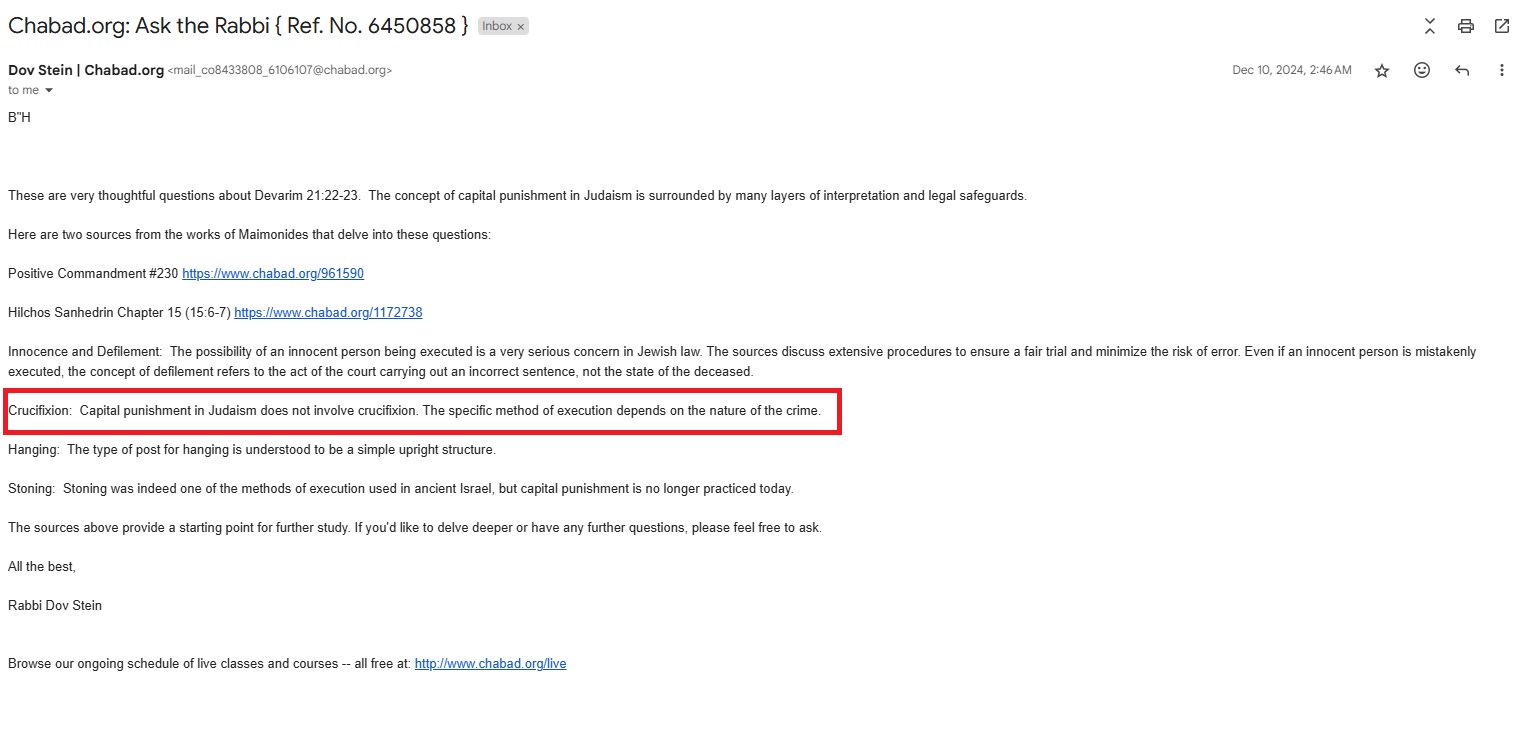
Leave a comment

Filed under Uncategorized