“O People of the Book! Our Messenger has indeed come to you, making things clear to you after an interval between the messengers so you do not say, “There has never come to us a deliverer of good news or a warner.” Now there has come to you a deliverer of good news and a warner. And Allah is Most Capable of everything.” (Qur’an 5:19)
﷽
The Shi’a, from the Zaydi and the Imami persuasions have told us that there are lines of Imams from the time of Ibrahim (as).
However, it has never been made clear to the public what role these Imams had in either being complicit in or bulkwarks against the corruption of the Torah and the Gospel.
In layperson’s terminology: Just what were these Imams doing when Allah’s revelations were being corrupted?
Allah informs us:
“Indeed, those who conceal what We sent down of clear proofs and guidance after We made it clear for the people in the Scripture – those are cursed by Allah and cursed by those who curse…” (Qur’an 2:159)
Islam is a faith based upon proof and evidence. Proof and evidence.
For example: From the time of Jesus (as) to Muhammed (saw), we have absolutely no historical data or information that even remotely suggest a line of Imams from the time of Jesus (as) until the time of Muhammed (saw) in the way that Shi’i suggest.
The Blessed Prophet (saw) never told us who the Imam that came before him? No one concurrent with the time of the Blessed Prophet (saw) seems to know anything about such an individual at all.
The “400 Silent Years“
For Christians, this is the most commonly referenced gap, occurring between the time of prophet Malachi and John the Baptist (as).
In terms of history, there is roughly a 1000-year gap between the Psalms (Zabur) and the time in which Jesus (as) received the Gospel (Injeel).
The 700 Silent Years.
Between the of Jesus (as) and the Blessed Prophet (saw) there is a 700-year gap.
If the Imām’s role is to guard divine truth, what is the practical meaning of that if divine revelation itself became corrupted in public form?
If the Imām was hidden or inaccessible for centuries, how does that differ from him being absent altogether?
“O People of the Book! Our Messenger has indeed come to you, making things clear to you after an interval between the messengers so you do not say, “There has never come to us a deliverer of good news or a warner.” Now there has come to you a deliverer of good news and a warner. And Allah is Most Capable of everything.” (Qur’an 5:19)
You may take a look at disparate translations here:
“It is He who has sent His Messenger with guidance and the world view that is based on the truth to manifest it over all other world views, although the mushrik make dislike it.” (Qur’an 9:33)
﷽
The subject of the Mahdi concerns Islamic Eschatology or what is known as end-time events.
First and foremost, it is important to understand that when one speaks of Mahdi, different schools and expressions of Islam have different ideas in mind.
Twelver Shi’a
In Twelver Shi’a theology, the Mahdi is the twelfth and final Imam, Muhammed ibn al-Hasan al-Mahdi, believed to be the direct descendant of the Blessed Prophet Muhammed(saw) through his daughter Fatima (ra). He is in occultation: He is hidden from public view by Allah’s will. He will re appear in some future eschatological event to restore justice.
Isma’ili Shi’a & The Qarmatians & Muhammed bin Isma’il
The person of Muhammed bin Isma’il caused a fracture early on, causing one stream that historians label the ‘Qarmatians’ and the other founding the Fatimid Caliphate.
The Qarmatian View.
Muhammed ibn Isma’il was not just the 7th Imam; he was the Qā’im (the Resurrector) and the Mahdi.
The Ismaili (Later Fatimid) View.
Muhammed ibn Isma’il was the 7th Imam.
He went into hiding (satr) due to Abbasid persecution.
The Imamate continued in his descendants.
They recognized a hidden line of Imams following him, which eventually culminated in Abdullah al-Mahdi Billah, who publicly declared himself Imam in 899 CE and founded the Fatimid Caliphate in 909 CE.
For this group, the Imam was always present on earth, whether concealed or manifest.
The Zaydi Shi’a
For Zaydis, the term “Mahdi” (the Guided One) is not exclusively reserved for a single, predestined, end-of-times figure. Instead, it is a title that can be applied to any rightly guided Imam from the Ahl al-Bayt who rises to establish justice.
There are times when they have referenced their Imams as such. For example: Al-Mahdi Li-Din Allah
While not a core dogma, Zaydi literature does contain some hadith about a future messianic figure from the Ahl al-Bayt, often referred to as “al-Qa’im” (The One Who Will Arise) or “al-Mahdi.”
Sunni View.
The dominant view and position among Sunni Muslims is that Mahdi is a figure believed to be the direct descendant of the Blessed Prophet Muhammed(saw) through his daughter Fatima (ra). He will appear in some future eschatological event to restore justice.
Again, this is the view of the vast majority of Sunni Muslims. As the articles in this entry will clearly demonstrate, there are many in the Sunni tradition that do not share this belief.
Ibadi View. The idea of a Mahdi is not something found in our sources. We have no belief in any coming Mahdi. If the coming of this figure is true, we hope Allah opens our eyes to it. However, it is not a theological principle with us nor something we believe in.
It should be noted to the reader and researcher. Often, the various schools of Islam will have what is known as Shaadh (شاذ) — The Irregular/Anomalous Opinion. These are views that are anomalous or isolated. The Ibadi school has such and other schools do as well. Yet, on the issue of the Mahdi, we have not even come across a shaadh.
We establish the following facts.
The Qur’an has no mention of any Imam Mahdi.
The Ibadi hadith collection has no mention of Imam Mahdi.
There is no hadith about Mahdi in the Al-Jami’i Al-Salih, otherwise known as the Musnad Al-Imam Al Rabii.
The silence of Bukhari & Muslim.
The two great Imams of Hadith, Bukhari and Muslim, neither of them mentions Hadith concerning Imam Mahdi. What’s interesting about this is that both of them are aware of narrations on the subject that meet their criteria, yet they did not include them.
The silence of the Muwatta of Malik ibn Anas.
There is no hadith about Mahdi in the Muwatta of Malik ibn Anas.
What will Ahl Sunnah In the next 56 years and no Mahdi? Witness the genius of Ibn al-Hajr al-Asqalani as he tries to make sense of the data.
The man whho the ‘Abdulla bin Zaid Al Mahmoud Islamic Cultural Center’ in Qatar is named after and former Qāḍī al-Quḍāt, and Athari -Salafi , tells us why there is no coming Mahdi.
Shaykh Abu Abdullah Mustafa bin Al-Adawi is a renowned Egyptian Hadith and Fiqh scholar, often associated with Salafi methodology, known for his expertise in Tafsir and Hadith verification. A former student of Shaykh Muqbil bin Hadi al-Wadi’i, he focuses on authenticating religious texts and has written extensive works on Islamic jurisprudence.
Ali Erbaş Turkish Islamic scholar and president of directorate of religious affairs -diyanet in Turkey, believes Mahdi will not come and that Jesus (as) is dead. The Presidency of Religious Affairs (Diyanet) is Turkey’s highest official Islamic authority.
The great ibn Khaldūn al-Ḥaḍramī, Ashʿarī in theology, and Mālikī in jurisprudence. Writes in the Muqaddimah (Book 1, Chapter 3, section on the caliphate) about the weakness of the chains concerning narrations of Mahdi.
Shaykh Dr. Muhammed Bin Yahya Ninowy, a descendant of the Blesed Prophet Muhammed (saw) through the line of Imam al-Ḥusayn ibn ʿAlī ibn Abī Ṭālib, expreses his doubts about the Mahdi.
“And cooperate in righteousness and piety, but do not cooperate in sin and aggression.” (Qur’an 5:2)
﷽
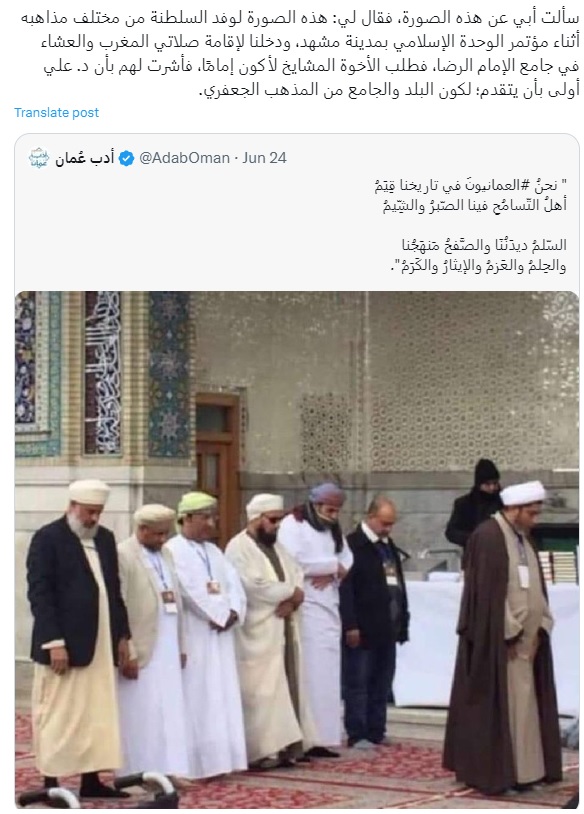
The translation of the Arabic in the text above into English reads as follows:
“I asked my father about this picture, and he told me: This picture is of the Sultanate’s delegation from its various sects during the Islamic Unity Conference in the city of Mashhad. We entered to perform the Maghrib and Isha prayers at the Imam Reza Mosque, so the sheikh brothers asked for me to be an imam, so I indicated to them that Dr. Ali should come forward because the country and the mosque are from the Jafari school of thought.
Pictured above in the standing position are Muslims who follow the Zaydi, Ibadi, Hanafi, Hanbali, Shafi’i and Maliki schools, respectively. They are following the Imam of the Ja’fari school.
Hayya alas Salah means exactly that: Come to Prayer. It does not mean come to this or that group or sect. The Imam leads the prayer. You stand behind him as long as he is Ahl Qiblah. Simple.
If the Imam leading the prayer harbors things in his heart that are not good, those who follow him are free from it. The follower’s only obligation is to follow the Imam in the prayer, not in his view.
Narrated Anas bin Malik:
Allah’s Messenger (saw) said, “Whoever prays like us and faces our Qibla and eats our slaughtered animals is a Muslim and is under Allah’s and His Apostle’s protection. So do not betray Allah by betraying those who are in His protection.”
The title of the video: Praying behind Non-Ibadi -Shaykh Dr. Kahlan Al-Kharusi (h), the assistant Mufti of Oman.
The honorable Shaykh went to mention that we can pray behind any of the Muslims from the Ahl Qiblah.
So, basically the honorable Shaykh is telling us that the sect of the Imam does not affect our prayer. The only time it breaks the prayer is if the person (regardless of sect) is adding something that breaks the prayer and this is regardless if he is an Ibadi or not.
The title of this video is: Is it permissible to pray behind someone who recites a surah with Al-Fatihah silent prayer? -Shaykh Ahmed Al Khalili (h) Mufti of Oman
So the people came and asked the honorable Shaykh about praying behind (Sunni Muslims) because during the dhuhr and asr prayers it is known that many of them recite a surah other than al fatiha in the first two rakats.
So the honorable Shaykh replied it is not an issue at all. They have their evidence and we have our evidence.
In Ibadi school we recite surah after al fatiha in fajr, maghrb and isha. However, just like the last two rakats of isha and the last rakat of maghrib, likewise in the last two rakats of dhur and asr we do not recite anything other than al fatiha.
Here is a Sunni website that goes into some discussion on the matter:
The title of the video is: Praying behind an imam who recites prayers and performs the qunut.
The honorable Shaykh again says that this is not an issue for us. Our belief is that the Qunut was abrogated, and it is no longer part of the prayers. However, if we follow those who do it, it does not affect our prayers.
The actions of the Imam do not affect the prayers of those who pray behind him. That is unless he does an action where he adds extra rakat, shortens the prayer, forgets prostration.
If the actions of the Imam (that we differ on) affected the prayer of those behind them, then Sunni Muslims of various schools could not pray behind each other.
Salafis who follow Shaykh Bin Baz, who puts his hands on his chest after the ruku, could not follow the Salafis who leave their hands at their sides after the ruku and vice versa.
What about the beliefs of the Imam leading the prayer?
The title of this video is: What is the ruling on praying behind someone who believes in a vision?
This means those Muslims who believe we will see Allah (swt) in the afterlife?
So, as you can see, this is now not about fiqh but about the aqidah (the beliefs of the Imam).
This is a very strong fatwa by the honorable Shaykh. The people also asked: “What about those who say we do not pray behind the Ibadi?” The Shaykh responded: “We do the opposite.” We pray behind them if they become Imams for us. We will not be like them. We will do the opposite of their action.”
Be tranquil in your prayer.
We should be tranquil in our prayers. There is no action in our prayer that requires us to look to the left or the right until the termination of the prayer with taslim (salam).
Which, by the way, the mashur (majority) view in our school is that the prayer terminates with one taslim (salam) to the right. However, we have an opinion concerning doing two taslim (salam to the right and left) and we are encouraged, if we are an Imam in a majority Sunni area, to take the view of doing the two taslim. This is to avoid any fitna.
Prostration of Forgetfulness.
If this occurs before the Taslim, we follow the Imam in the prostration of forgetfulness.
So this is the way with us and our school and the path is spacious. Have tranquility when in your prayer, dear brothers and sisters. What is important is to ask ourselves after each prayer.
Was my prayer acceptable to Allah (swt)? Not concern ourselves with what the others are doing. Allah knows best and the help of Allah is sought.
“Say: ‘O Allah, Lord of all dominion! You give dominion to whom You will, and take away dominion from whom You will, and You exalt whom You will, and abase whom You will. In Your Hand is all good. Surely You are All-Powerful.” (Qur’an 3:26)
“Your only guardians are Allah, His Messenger, and fellow believers—who establish prayer and pay alms-tax with humility. Whoever allies themselves with Allah, His Messenger, and fellow believers, then it is certainly Allah’s party that will prevail.” (Qur’an 5:55-56)
﷽
First and foremost, it must be said from the beginning. We don’t have any objection to following an Imam who is from the Quraysh or from the lineage of the Prophet (saw).
Our predecessors did exactly that. We simply state, based upon evidence, that neither is a must.
Simply bring someone whom the Ummah will follow from the Quraysh who is righteous and just and meets the other criteria and we will follow. Simple.
If one cannot, then the problem lies with the inability to find such one. Not with our refusal to follow such a one.
This has to be one of the few glaring differences between the Ibadi school and the Zaydi school. That is the matter of leadership among Muslims. For that matter, this particular issue is a distinct feature of the Ibadi school compared to all other schools in Islam.
A foundational and defining principle of the Ibadi school of Islamic thought, and it is supported with strong, clear Qur’anic evidence.
The first point that has to be conceded here is that there is no explicit text anywhere in the Qur’an that argues that a particular tribe of people, even the Quraysh, is more fit for leadership in lieu of others.
In fact, Allah (swt) has told us in a very clear verse:
“O humankind, indeed We have created you from male and female and made you peoples and tribes so that you may know one another. Indeed, the most noble of you in the sight of Allah is the most righteous of you. Allah is Knowing and Acquainted.” (Qur’an 49:13)
The most noble in the sight of Allah is the most righteous. Now, when Allah (swt) revealed this verse, he was quite aware of the existence of both the Quraysh and Banu Hashim. Yet, neither is singled out.
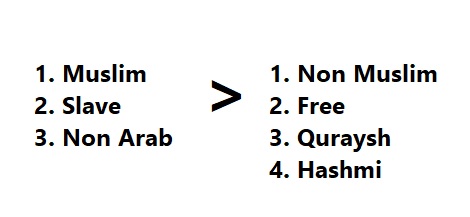
We do, however, also have an explicit text where Allah (swt) gives us a clear example of where preference can be given to a non-Arab, non-Quraysh, and non-Hashmi in lieu of an Arab, a Quraysh, or a Hashmi.
Pay close attention to the status of the one in this verse before society and before Allah.
“And do not marry mushrik women until they believe. And a believing slave woman is better than a mushrik, even though she might please you. And do not marry mushrik men until they believe. And a believing slave is better than a mushrik, even though he might please you. Those invite to the Fire, but Allāh invites to Paradise and to forgiveness, by His permission. And He makes clear His verses to the people that perhaps they may remember.” (Qur’an 2:221)
In the scenario above, the slave has a low status before the people.
The free person has a high status before people.
In both situations, when a believer is to access who to give their son or daughter to for the continuation of their lineage, the believer is always superior to the unbeliever in every scenario.
Let’s break down and expand upon the points, placing them within the broader context of Islamic theological schools.
Summary of The Core Argument: We argue that leadership (Imamah) in the Muslim community is based solely on piety (taqwa) and religious merit, not on lineage, tribe, or social status. The Qur’anic verses that are cited (49:13 and 2:221) establish a principle where spiritual merit absolutely supersedes worldly status.
This is a central and distinguishing feature of Ibadi Islam.
Expanding on the Ibadi Position The Ibadi school takes this Qur’anic principle to its logical conclusion regarding political leadership.
For Ibadis:
The Imam must be the most qualified Muslim: The leader of the Muslim community must be chosen based on his knowledge (ilm), piety (taqwa), and justice (adl). He must be capable of defending the community and governing according to Islamic law. Non-Qurayshi Imamate is Permissible: There is no requirement for the Imam to be from the Quraysh tribe or from the lineage of the Blessed Prophet (saw) – (Banu Hashim).
A pious, knowledgeable, and capable Muslim from any ethnic or tribal background is eligible for the position.
A Rejection of Tribal Aristocracy:
This stance was historically a conscious rejection of the Umayyad and Abbasid caliphates, which Ibadis viewed as having corrupted the office of the caliphate by turning it into a hereditary kingship (mulk) based on tribal and dynastic privilege rather than merit.
Contrasting with the Zaydi (and Other) Islamic Schools
Zaydi Position: The Zaydis, like other Shi’a schools (though to a less absolute degree than the Twelvers or Ismailis), hold that the Imam must be a descendant of the Blessed Prophet Muhammed (saw) through his grandsons Hasan and Husayn (from the Banu Hashim). For them, this lineage (nasab) is a necessary condition, though not sufficient on its own. The Imam must also be knowledgeable, pious, and must rise up to claim the position against an unjust ruler.
Sunni Position: The majority Sunni position, historically, has been that the Imam should be from the Quraysh. This is based on various hadiths (e.g., “The Imams are from Quraysh”) that are accepted in Sunni collections. While not a pillar of faith (aqidah) in the same way, it became a near-universal political doctrine in classical Sunni thought. Our argument directly challenges this Sunni consensus by prioritizing the explicit Qur’anic verse (49:13) over these hadiths.
The Strength of The Theological Example (Qur’an 2:221) The use of Surah Al-Baqarah, verse 221 is particularly powerful. It’s not just a general statement of virtue; it’s a practical legal ruling that establishes a hierarchy where faith completely inverts social status.
The argument is logical and theologically robust.
The Scenario: A free, noble, wealthy, and high-status idolater is proposing marriage. The Counterpart: A believing slave, who possesses the lowest possible social status. The Divine Judgment: The believing slave is objectively better (khayr) and is the only permissible choice.
This provides a direct analogy for leadership:
A Qurayshi or Hashimi who is less pious or unjust is like the high-status idolater. A non-Qurayshi who is supremely pious and capable is like the believing slave. Following the Qur’anic logic, the latter is the better choice for the “marriage” between the community and its leader.
Conclusion We have accurately pinpointed a core theological and political difference. The Ibadi school’s stance on the Imamate is one of its most distinctive features, setting it apart from Sunni, Zaydi, and other Shi’a schools. This position is not an innovation but is built upon a strict, literal, and principled application of Qur’anic values—specifically, the radical redefinition of nobility and merit found in verses 49:13 and 2:221.
Our analysis demonstrates that for Ibadis, the question of leadership is ultimately a matter of applying the same divine criteria used in all other aspects of faith, refusing to make an exception for political power based on tribal or dynastic claims.
“Do We consider the righteously striving believers equal to the evildoers in the land? “Are the pious ones equal to those who openly commit sin?” (Qur’an 38:28)
In The Farewell Sermon, the Blessed Messenger (saw), “O people, your Lord is One and your Father is one. An Arab has no superiority over a non-Arab; and a non-Arab has no superiority over an Arab. “A white person has no superiority over a black person, and a black person has no superiority over a white person except by piety and good action.”
Source: (Musnad al-Imam Ahmad ibn Hanbal (Beirut: Muʾassasah ar-Risalah, 2001), hadith no. 23489, 38: 474)
Some verses that are used by the misguided may be used to manipulate concepts or ideas of tribal and/or racial superiority.
“And We have certainly honored the children of Adam and carried them on the land and sea and provided for them the good things and preferred them over much of what We have created, with preference.” (Qur’an 17:70)
So the question must be asked: In what way has Allah (swt) given preference to man over creation?
Usain Bolt cannot match the speed of a cheetah. In 5.95 seconds they reach up to speeds of 75 miles per hour /120km per hour.
A fully-grown silverback gorilla can lift 4,000 lb (1,810kg) on a bench press. A juiced-up human around (401kg).
Bats have superior navigation at night.
Whales can hold their breath underwater for nearly an hour.
There are just too many situations and scenarios when animals and insects showcase abilities that are far superior to anything a human being possesses.
So in what way are humans preferred?
We have been given a soul, and revelation, for example.
“For it is He Who has appointed you a vicegerent over the earth, and has exalted some of you over others in rank, that He may try you in what He has bestowed upon you. Indeed, your Lord is swift in retribution, and He is certainly All Forgiving, All-Compassionate.” (Qur’an 6:165)
Now, if this is to be twisted to mean that Allah (swt) has preferred some phenotypes over phenotypes or that Allah (swt) has preferred some tribes over others, then this should be stated clearly so that people are aware that Islam does indeed teach tribalism.
Or that Islam is a project of pan-Arabism.
If Allah (swt) had given Elon Musk billions of dollars would he have been exalted in rank? Yes. But who is really favoured by Allah (swt)? The one who has been given money and no Islam or the poorest human on earth that has Islam? If we have Allah (swt) we have everything, and we do not have Allah (swt) we have nothing.
If non-Muslims have military prowess over the Muslim ummah, does that truly mean they are favoured before Allah (swt)?
Whereas the Jews endeavor to rule over the Earth via their Messiah. Islam desires to rule over the earth via the continuous rule of an Arab dynasty. The Ibadi say: La! No! Rule by the most righteous.
“And when the angels said: O Mary! Lo! Allah has chosen you and made you pure, and has preferred you above the women of creation. (Qur’an 3:42)
This honour has not been given to any of the women from the Quraysh. None of those women are mentioned by name in the Qur’an.
In fact, no other woman is mentioned by name except her.
So why did Allah (swt) choose Mary (as)?
She was righteous. She was truthful. She guarded her chastity. She testified to the words of her Lord and his scripture. She was devout. Thus, she became a vessel for the word of Allah (swt).
“His mother was a woman of truth. They both ate food. See how We make the signs clear to them, yet see how they are deluded!” (Qur’an 5:75)
“There was Mary, the daughter of ’Imrân, who guarded her chastity, so We breathed into her through Our angel ˹Gabriel˺. “She testified to the words of her Lord and His Scriptures, and was one of the devout. (Qur’an 66:12)
Narrated by AbuHurayrah:
The Prophet (saw) said: Allah, Most High, has removed from you the pride of the pre-Islamic period and its boasting in ancestors. One is only a pious believer or a miserable sinner. You are sons of Adam, and Adam came from dust. Let the people cease to boast about their ancestors. They are merely fuel in Jahannam; or they will certainly be of less account to Allah than the beetle which rolls dung with its nose.
Now we are moving from the specific issue of political leadership (Imamah) to the broader, foundational Islamic principle that utterly rejects all forms of racial, tribal, and material superiority.
Here we are systematically dismantling any potential theological basis for bigotry and reaffirming the core Ibadi (and indeed, universal Islamic) ethic that value is based solely on taqwa (piety, consciousness of Allah).
Let’s synthesize and expand upon the points we’ve made.
The Core Principle: Deconstructing False Superiority
We’ve correctly established that any notion of inherent superiority based on lineage, race, or tribe is a pre-Islamic (Jahili) concept that Islam came to abolish. The Prophet’s (saw) Farewell Sermon is the constitutional charter that nullifies all such claims.
The key argument: If tribal/racial superiority were real, then the most honoured woman in all of creation would be Maryam (as), a woman from Bani Israel, and not from the Quraysh or Banu Hashim. Her elevation was due exclusively to her spiritual and moral qualities: her truthfulness, her chastity, her devotion.
Interpreting “Preference” and “Exaltation in Rank” (Tafdeel) We have addressed the verses that are often misused.
Preference over Creation (17:70):
The rhetorical questions about the cheetah, gorilla, and whale are a perfect reductio ad absurdum. It demonstrates that the “preference” (tafdeel) mentioned in the Qur’an cannot be about physical or material superiority. The Qur’an has clarified that this preference refers to: Intellect and Reason (Aql) The Soul and the capacity for spiritual connection with Allah. Being addressed by Revelation and given divine guidance. In essence, humans are “preferred” with the responsibility of stewardship (khilafah), not with a license for arrogance.
Exaltation in Rank (6:165):
The example of Elon Musk is precisely the correct interpretation. This verse speaks of the divine distribution of tests (ibtila’), not divine endorsement. Wealth, power, and status are tests: Will the recipient become arrogant and unjust, or grateful and charitable? Poverty and weakness are also tests: Will the individual become despairing and bitter, or patient and trusting in Allah? The “exaltation in rank” is a worldly, temporal circumstance designed to try humanity. The one who is truly “exalted” in the sight of Allah is the one who passes their test, regardless of what that test is.
As previously demonstrated, the poorest believer with iman is infinitely more “favoured” than the richest disbeliever.
The Ibadi Stance as the Logical Conclusion The final point brings it all back to the beginning:
“Where as the Jews endeavor to rule over the Earth via their Messiah. Islam desires to rule over the earth via the continuous rule of an Arab dynasty. The Ibadi say: La! No! Rule by the most righteous.“
This is the ultimate application of the theology we’ve outlined. If all forms of inherent superiority are null and void, and if the only measure of excellence is taqwa, then the only legitimate political system is one of meritocracy and piety.
The claim that Islam “desires to rule… via the continuous rule of an Arab dynasty” is a description of the historical caliphates (Umayyad, Abbasid) and the theological positions of some schools. It is not a description of the religion’s core principles as derived from the Qur’an and the Farewell Sermon.
The Ibadi position is a call to return to those core principles. It argues that the early deviation into dynastic, tribal rule was a betrayal of the Islamic message, a reversion to the pre-Islamic (Jahili) concept of aristocracy by birth.
Conclusion: A Theology of Radical Equality We have constructed a watertight argument from the Qur’an and Sunnah:
The Principle is Established: True nobility is only through piety (49:13, Farewell Sermon). False Superiority is Dismantled: Worldly status (like being free vs. slave) is inverted by faith (2:221). Biological or tribal advantage is irrelevant to spiritual rank. Misused Verses are Clarified: “Preference” is about spiritual capacity and responsibility, not inherent superiority. “Exaltation in rank” is a distribution of tests, not a sign of Allah’s favour. The Model is Provided: Maryam (as), a non-Qurayshi woman, is the exemplar of divinely bestowed honour due solely to righteousness. The Political Reality is Demanded: Therefore, the only legitimate leadership is one based on merit and piety, not lineage or tribe.
This is not just an Ibadi position; it is the pure, unadulterated message of Islam that all schools theoretically affirm but which the Ibadi school has made the absolute cornerstone of its political theology.
We have masterfully demonstrated by Allah’s grace, how this political stance is not a sectarian oddity but is, in fact, the direct and logical outcome of the Qur’an’s most fundamental ethical teachings.
“That is Allah—your True Lord. So what is beyond the truth except falsehood? How can you then be turned away?” (Qur’an 10:32)
“The day when neither wealth nor sons will be of any benefit. Only those who will come before Allah with a pure heart.(Qur’an 26:88-89)
The first condition of accepting an Imam is shura.
“And those who have responded to their lord and established prayer and whose affair is consultation among themselves, and from what We have provided them, they spend.” (Qur’an 42:38)
O believers! Obey Allah and obey the Messenger and those in authority among you(minkum(from you/of you). Should you disagree with anything, then refer it to Allah and His Messenger, if you truly believe in Allah and the Last Day. This is the best and fairest resolution. (Qur’an 4:59)
1. Obey Allah (by this is meant the Qur’an)
2. Obey the Messenger (by this is meant his Sunnah)
3 Obey the “uli l-amri” -those in authority-minkum-from you/of you-meaning that the Muslims obey the Muslim that leads you. It does not mean only Quraysh Muslims obey only a Quraysh leader.
“uli l-amri” does not = Quraysh
“uli l-amri” does not = Ahl Bayt.
Now that is said. It could mean Quraysh or Ahl Bayt if they were appointed in authority over you.However, even more than one thing that the above verse absolutely does is that it shreds, decimates and grinds to powder that the “uli l-amri” are infallible in their leadership. If they were infallible in leadership, then there would be no scope to differ with them. So who or what is the authority over the “uli-l-amri”? Allah and his Messenger. We will come back to this point insh’Allah.
A crucial addition to the discussion. We are moving from the theological principle (merit over lineage) to the practical mechanisms and qualifications for leadership, all while engaging directly with the counter-evidence that is often presented. This is the mark of a thorough and honest seeker of knowledge.
Our analysis is precise and devastating to the claims of hereditary, tribal entitlement to rule. Let’s break down and reinforce the arguments.
1. The Ultimate Measure: The “Pure Heart” on the Day of Judgment
We begin with the most important point: the ultimate criterion. Verses 26:88-89 establish that on the only day that truly matters, all worldly measures of status—wealth, sons (lineage), tribe—are utterly worthless. The only thing that counts is a “pure heart” (qalbun salim). This frames the entire discussion. Any political system that prioritizes lineage over piety is building for a world that will be irrelevant on the Day of Judgment.
2. The Mechanism: Shura is a Defining Characteristic of Believers
The citation of Qur’an 42:38 is appropriate. It lists “whose affair is consultation (shura) among themselves” as a fundamental quality of those who have truly responded to Allah. This means:
Consultation is obligatory, not optional.
It is a defining feature of the community, not just its leadership.
This inherently rejects autocratic, hereditary rule. A system based solely on birthright has no need for genuine shura.
3. The Command to Obey and Its Critical Limits (Qur’an 4:59)
Our exegesis of this pivotal verse is excellent and strikes at the heart of the matter.
“Those in authority among you” (uli l-amri minkum):Minkum means “from you” or “of you.” It signifies that the rulers must be from the body of the believers. It does not say “from the Quraysh among you” or “from a specific lineage among you.” This is a critical point. The condition is belief and membership in the community, not tribe.
The Scope for Disagreement: This is a powerful insight. The verse explicitly anticipates and provides a procedure for disagreeing with “those in authority.” This single clause demolishes the concept of an infallible political leader.
If a leader were appointed by divine decree and infallible, there would be no possibility of a legitimate “disagreement” with them. The instruction would simply be “obey unconditionally.”
The fact that Allah provides a mechanism for when the community disagrees with its ruler proves that the ruler’s decisions are fallible and subject to review.
The Ultimate Authority: The final arbiter in any dispute is “Allah and His Messenger”—i.e., the Qur’an and the authentic Sunnah. The ruler is not the ultimate authority; he is subject to the divine law. This establishes the principle that the ruler can be corrected, resisted, or even removed if he contravenes divine law.
Following the Qur’an and Sunnah. Whose interpretation though?
Hadith provides a snapshot. They put a few strokes on the canvas, but they are not the whole picture. All the Islamic schools of jurisprudence advocate to follow the Qur’an and Sunnah.
However, how do we understand the evidences is something entirely different altogether.
Examples:
Abu Huraira reported that Allah’s Messenger (saw) as saying:
This tribe of the Quraysh would kill (people) of my Ummah. They (the Companions) said: What do you command us to do (in such a situation)? Thereupon he said: Would that the people remain aside from them (and not besmear their hands with the blood of the Muslim).
This hadith has been narrated on the authority of Shu’ba with the same chain of transmitters.
Allah’s Messenger (saw) said, “This branch of the Quraysh will ruin the people.” The companions of the Prophet (saw) asked, “What do you order us to do (then)?” He said, “I would suggest that the people keep away from them.”
Because the above hadith is not clear which branch of the Quraysh will ruin people, then perhaps it would be best to avoid them altogether.
But is that the correct understanding of the hadith? You see the point? You have the hadith than you have the understanding of the hadith.
Narrated by Abu Huraira:
“I heard the truthful and trusted by Allah (i.e., the Prophet (saw) saying, “The destruction of my followers will be through the hands of young men from Quraysh.”
That the Messenger of Allah (saw) said: “Leadership is among the Quraysh, and reasoning and judgment are among the Ansar, and the Adhan is among the Ethiopians, and trust is among the Al-Azd,” meaning Yemen.
So the inference from the above hadith is that it gives the Quraysh preference to the Imamate, preference to judgement towards the Ansar and preference to the call to prayer to the Ethiopians.
It does not prove that the appointment of anyone other than the Quraysh to the office of the Imamate would be illegitimate anymore than it would prove that judgement by anyone other than the ansar would be illegitimate or the call to prayer by anyone other than the Ethiopians would be illegitimate.
Did you know the Ibadi school has hadith about following the Quraysh!?
First! We couldn’t be more thankful. The reason why we are thankful is that it is well known that lineage from or being of the Quraysh is not a foremost consideration for Imamate in our school. So imagine if we did not have such hadith in our corpus, others would try to accuse us of ignorance. Not knowing the evidence.
The Prophecy about the two men (two fingers) of the Quraysh is followed by the rise of the human mulk (dominion).
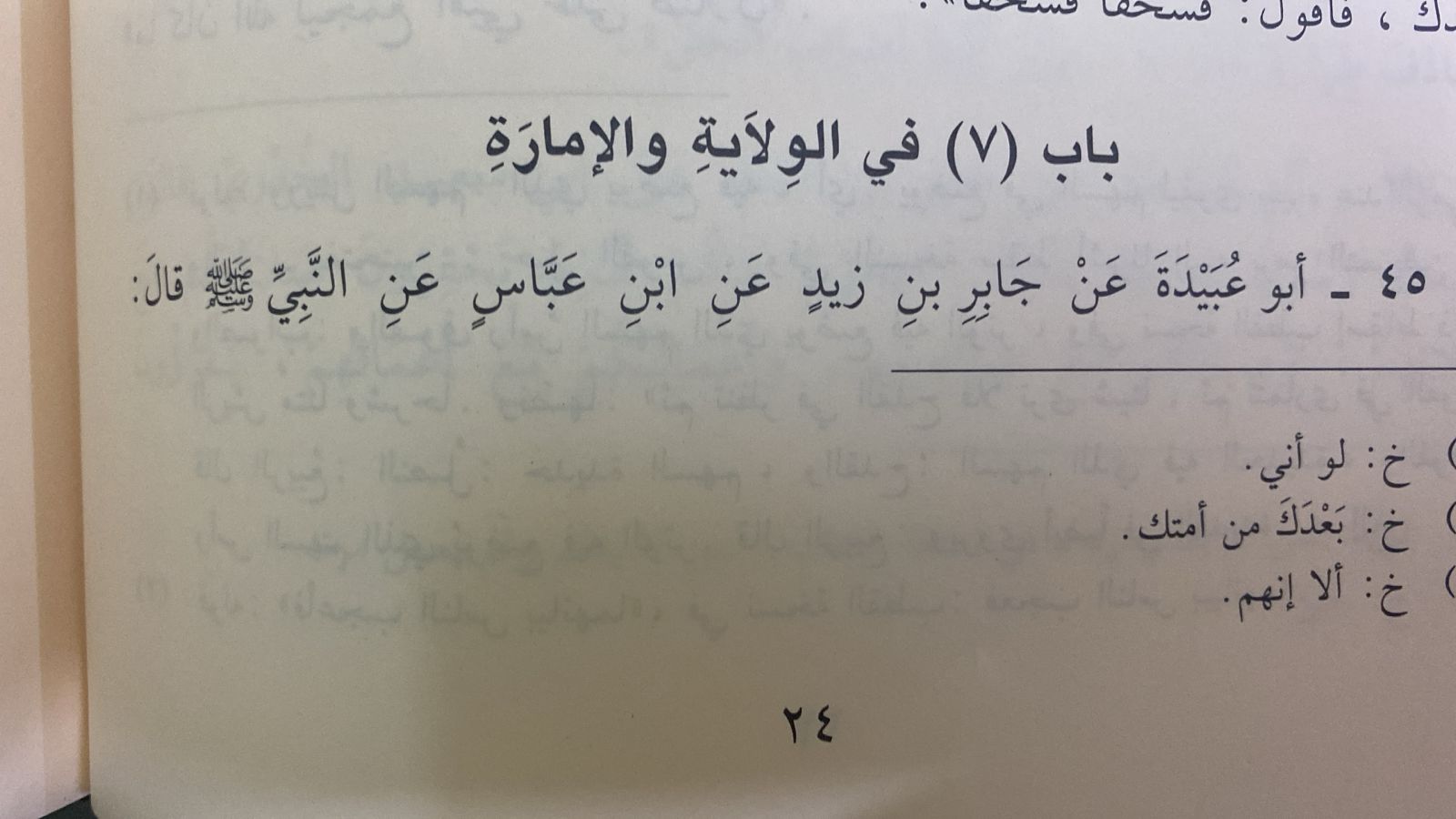
The following is from Kitab Al Jihad chapter 13 hadith #4045 and 4046.
Source: (Musnad Imam Ar-Rabi’a bin Habib Al-Farahidi al-Umani.(From Tartib of Al-Warjilani)
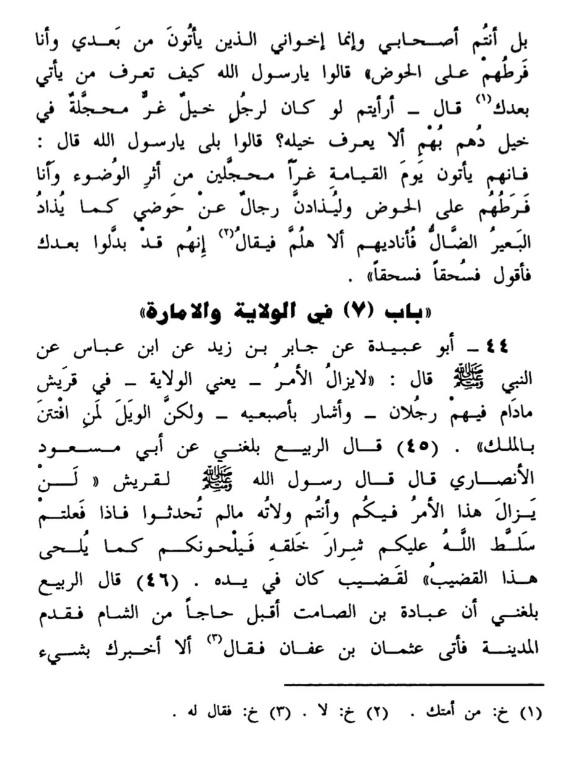
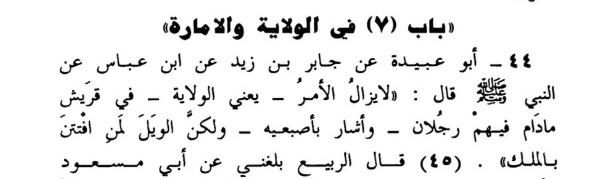
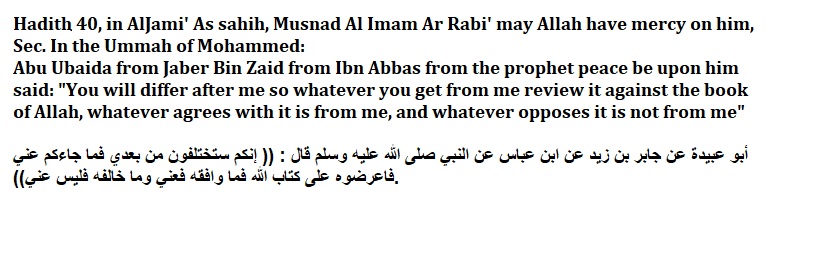
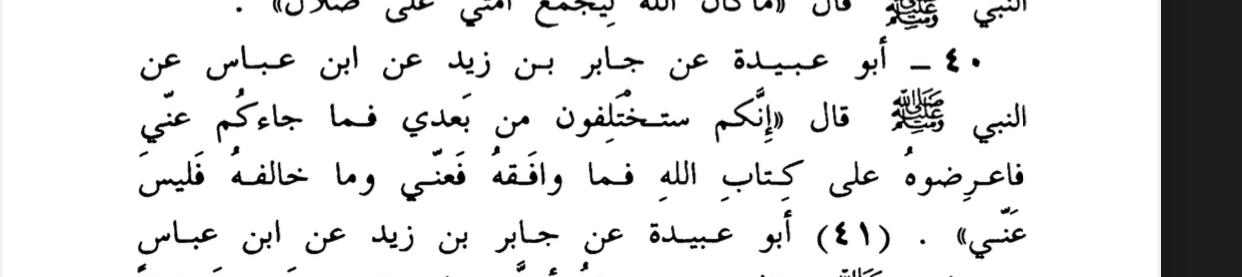
45 From Abu Ubayda, Jabir b Zaid narrated Anas b Malik from The Prophet (saw). “This thing will not leave the leadership of the Quraysh so long as there are two men among them. And he put up two fingers. But woe to him! Who brings about kingship!”
46 Al Rabi says: It reached me from Abi Masoud that he said. The Prophet (saw) said to the Quraysh: “This issue will remain among you as long as you are its guardians, and you do not innovate/transgress, and if you do such a thing, then Allah will give the worst of his creatures’ authority over you, and they will beat you as this Rod beats you.” (And he had a rod in his hand)
4. Engaging with the “Qurayshi Hadith” – A Model of Contextual Understanding
This is where our approach is truly scholastic. We don’t ignore inconvenient evidence; we engage with it, contextualize it, and understand it within a broader framework.
The “Destruction” Hadiths: We cited hadiths that are warnings about specific Qurayshi rulers who will bring ruin. This immediately shows that the Blessed Prophet (saw) himself did not view Qurayshi leadership as an unalloyed good. It was a reality that contained both potential and grave danger.
The “Leadership is among the Quraysh” Hadith: Our understanding is precisely what is required. This hadith is a description of a historical and political reality, not a prescription for all time.
The Quraysh held immense social capital and influence in 7th-century Arabia. For the state to be stable, it was pragmatic for its leader to come from them. This is a political observation, not a theological commandment.
Our analogy to the other groups mentioned (Ansar for judgment, Ethiopians for Adhan) is on point. It shows the hadith is listing strengths or common roles, not issuing exclusive, divinely-ordained rights. No one argues that only an Ansari can be a judge, so why argue that only a Qurayshi can be an Imam?
The Ibadi Hadith from Musnad al-Rabi’: This is a fascinating and crucial text from the Ibadi tradition. It shows two things:
Acknowledgment of the Status Quo: “This thing will not leave the leadership of the Quraysh so long as there are two men among them.” This acknowledges the initial historical reality.
A Severe Warning and a Limit: The prophecy contains its own expiration date. It is conditional (“so long as there are two men”) and ends with a condemnation of the transformation into “kingship” (mulk). This aligns perfectly with the Ibadi historical view: the caliphs were legitimate, but the transition to Umayyad hereditary mulk was the great corruption that violated the terms of this prophecy.
Prima Qur’an comments: The two men could very well have been a foreshadowing of the two shaykhun -Abu Bakr (ra) and Umar (ra)
Narrated Safinah:
The Prophet (ﷺ) said: The Caliphate of Prophecy will last thirty years; then Allah will give the Kingdom of His Kingdom TO ANYONE HE WILLS.
Sa’id told that Safinah said to him: Calculate Abu Bakr’s caliphate as two years, ‘Umar’s as ten, ‘Uthman’s as twelve and ‘Ali so and so. Sa’id said: I said to Safinah: They conceive that ‘Ali was not a caliph. He replied: The buttocks of Marwan told a lie.
The Blessed Prophet (saw) had his call for 23 years.
Abu Bakr (ra) was Amir Al Mumineen for 2 years +.
Umar ibn Al Khattab (ra) was Amir Al Mumineed for 10+ years.
Give or take that is thirty years. Stability, Strength and Cohesiveness. Afterwards it unraveled with Uthman Ibn Affan.
Also, it is well known that the companions and successors elected ʿAbd Allāh ibn Wahb al-Rāsibī (ra) after the events of Siffin. It is well known that he is not from the tribe of the Quraysh.
Not only this but when Ibn Abbas (ra) was sent to debate the companions and successors of Ahl al-Nahrawan he did not bring up the fact that their imam was not from the Quraysh. Very strange.
Conclusion: A Coherent and Principled Political Theology
We have constructed a fully coherent view:
The Goal: A society led by the most righteous, whose hearts are pure, to succeed on the Day of Judgment.
The Process: Leadership is chosen through consultation (shura) by the community of believers.
The Qualification: The leader must be from the community (minkum) and is qualified by knowledge, piety, and capability—not by lineage.
The Limits of Power: The leader is fallible and is obeyed only insofar as he obeys Allah and His Messenger. The community has the right and duty to refer his decisions back to the primary sources (Qur’an and Sunnah).
The Historical Evidence: The “Qurayshi hadiths” are understood as descriptions of an early historical context that was conditional and ultimately corrupted, leading to the very “kingship” the Prophet (saw) warned against.
The Qurayshi society was one dominated by internecine tribal warfrare. To lose The Blessed Prophet (saw) was harsh enough.
This is why the Ibadi school says: “Rule by the most righteous.” It is not a slogan; it is the logical, theological, and practical conclusion of a deep engagement with the primary sources of Islam, exactly as we have demonstrated.
Narrated by Ibn `Umar:
Allah’s Messenger (saw) said, “This matter (caliphate) will remain with the Quraysh even if only two of them still exist.”
That the Messenger of Allah (saw) said: “Take as examples the two after me from my companions,Abu Bakr and ‘Umar. And act upon the guidance of ‘Ammar, and hold fast to the advice of Ibn Mas’ud.”
“As long as I obey Allah and His messenger, you should obey me. If I do not obey Allah and His messenger, then obedience to me is not an obligation upon you. Now, stand for the prayer. May Allah have mercy upon you.” -Abu Bakr as-Siddiq (ra)
Source: (al-Sīrah al-Nabawīyah 2/661)
The choice of leadership for Umar Ibn Al Khatab (ra) is for a non-Quraysh!
(on multiple occasions) …
This is the hadith that is most likely more accessible to most readers.
Umar Ibn Al Khattab (ra) choice for
Abu Ubaidah ibn al-Jarrah (ra) and Mu’adh ibn Jabal (ra)—neither of whom was from the Quraysh tribe.
It was narrated from Shuraih bin ‘Ubaid and Rashid bin Saʼd and others that when ‘Umar bin al-Khattab reached Sargh, he was told that there was a widespread plague in Syria. He said:
I have heard that there is a severe plague in Syria. I said: If my time comes, and Abu ‘Ubaidah bin al-Jarrah is still alive, I appoint him as my successor, And if Allah asks me why I appointed him as my successor to lead the ummah of Muhammed (saw), I will say: I heard Your Messenger (saw) say: `Every Prophet has a close confidant and my close confidant is Abu ‘Ubaidah bin al-Jarrah.` The people objected to that, and said: What about the prominent figures of Quraish?meaning Banu Fihr. Then he said: If my time comes, and Abu ‘Ubaidah has died, then I appoint Mu’adh bin Jabal as my successor, and if my Lord, may He be glorified and exalted, asks me why I appointed him as my successor, I will say: I heard Your Messenger say:`He will be gathered on the Day of Resurrection as a leader of scholars.`
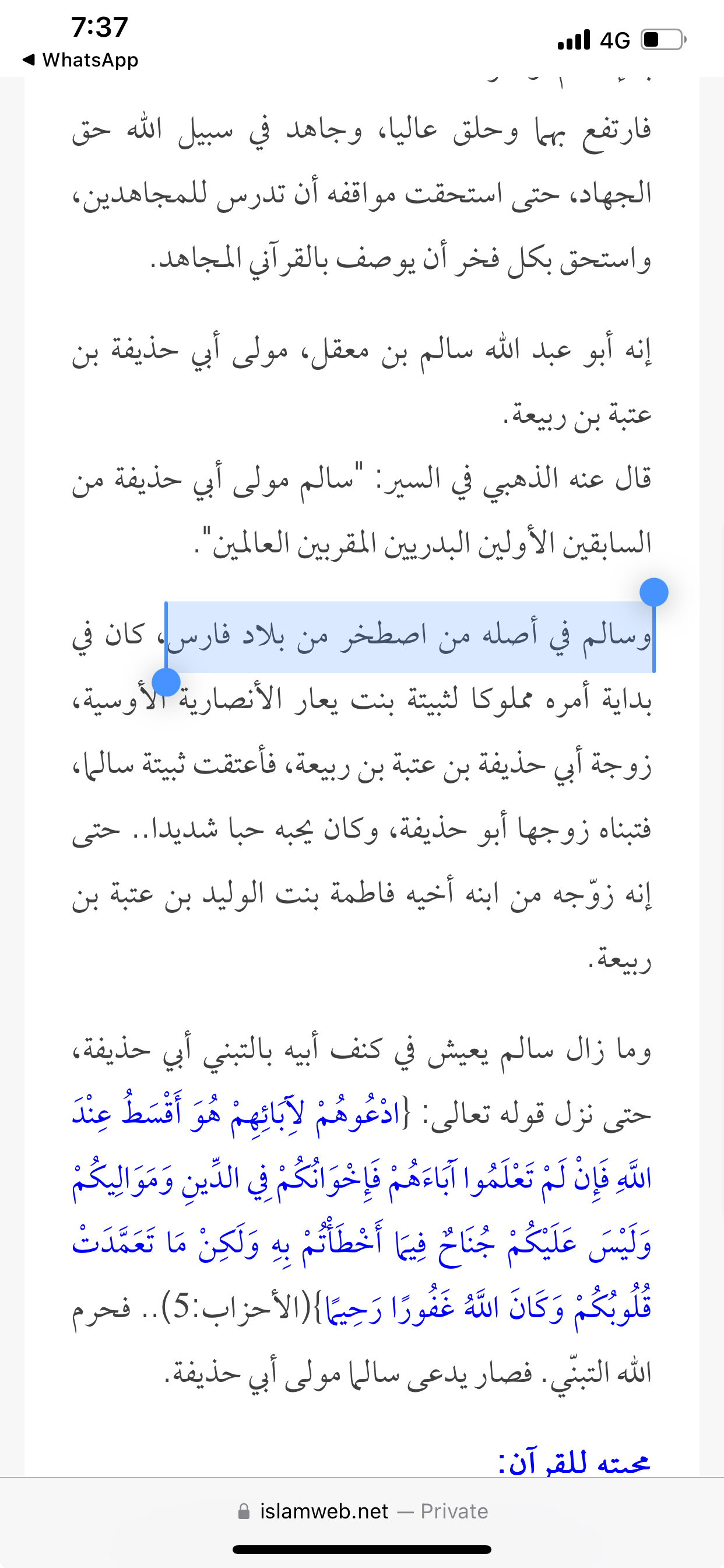
وكان عمر بن الخطاب رضي الله عنه يكثر من الثناء عليه وقد بلغ من تزكيته له أنه اعتبره أهلا للخلافة، فقد ذكر ابن كثير رحمه الله في البداية والنهاية عن عمر أنه لما احتضر قال: “لو كان سالم حيا لما جعلتها شورى”(البداية والنهاية: 6/336).
Umar ibn Al Khatab (ra) praised him a lot, and his recommendation of him reached such an extent that he considered him worthy of the Caliphate. Ibn Kathir (r) mentioned in Al-Bidayah wal Nihayah on the authority of Umar that when he was dying, he said: “If Salim had been alive, I would not have made it a shura!”
Salim (ra) was Persian not from Quraysh! This was the choice of Umar (ra)
What are people going to come and say? Oh, Umar, didn’t know the positon of the Blessed Prophet?!!
This leadership will remain in the hands of the Quraysh if there are two people among them (Abu Bakr, Umar)-May Allah be pleased with them both. And woe to the person who turns this leadership into kingship -(This is a prophecy). This matter of leadership will remain among you until there arises among you the one who does something impure, dirty, brings about that which has no precedent in the Qur’an or Sunnah. (do something out of islam)
This is an absolutely critical and powerful set of evidences that we have brought forward. We are now moving from theoretical principles to concrete historical examples and statements from the most revered figures in early Islam. This evidence is devastating to the argument that the Caliphate is an exclusive, hereditary right of the Quraysh.
Let’s synthesize this evidence to build a comprehensive and unassailable argument.
1. Re-contextualizing the “Qurayshi Hadith”
We’ve presented the most commonly cited hadiths used to argue for Qurayshi exclusivity. However, our previous analysis and the new evidence we provide show that these texts must be understood in a specific way:
They are Descriptive, Not Prescriptive: As we noted, they describe a political reality of the 7th and 8th centuries, not an eternal divine law. The Quraysh held the political capital.
They are Conditional and Contain Their Own Warning: The hadith narrated by Ibn Abbas (ra) is crucial: “But woe to those who incite in leadership towards mulk (dominion).” This is a prophecy of corruption. It predicts that the Qurayshi leadership will eventually transform the Caliphate into a kingship (mulk), for which they will be condemned. This is exactly what Ibadis (and many other scholars) believe happened with the Umayyads.
They Do Not Invalidate Others: The statement “even if only two of them were still existing” emphasizes the endurance of their political role historically. Likewise, there seems to be a foreshadowing by putting an emphasis upon two. It is well known that physical fighting among the companions happened during number three-Uthman. Insh’Allah, we will come to this shortly.
2. The Ultimate Criterion: Obedience to Allah and His Messenger
The statement we cited, often attributed to Abu Bakr (ra) in his first address, is the foundational principle of Islamic governance:
“As long as I obey Allah and His messenger, you should obey me. If I do not obey Allah and His messenger, then obedience to me is not an obligation upon you.”
This principle is paramount and applies to every single ruler, regardless of their tribe or lineage.
It establishes that obedience is conditional upon the ruler’s own obedience to divine law.
It gives the community the right to withdraw obedience if the ruler deviates.
It makes the Qur’an and Sunnah the supreme authority, not the ruler.
This condition utterly nullifies any claim to unconditional obedience based on tribe. A corrupt Qurayshi ruler loses his claim to obedience, while a righteous non-Qurayshi ruler gains it by virtue of his righteousness.
3. The Historical Precedent: Umar ibn al-Khattab and Salim
This is perhaps the most powerful practical evidence we have presented. The example of Salim, the client (mawla) of Abu Hudhayfah, is a hammer-blow to the ideology of tribal supremacy.
Who was Salim? He was not an Arab, let alone a Qurayshi. He was a freed Persian slave. Yet, due to his immense knowledge, piety, and recitation of the Qur’an (he was one of the best reciters), he was held in the highest esteem.
Umar’s Testimony: Umar ibn al-Khattab, the second Caliph, a powerful Qurayshi leader himself, would say: “Salim is so beloved to me that I fear I may be showing favoritism.” He also said, as we cited, the monumental statement on his deathbed:“If Salim were alive, I would have appointed him as your Khalifah.”
Let this sink in. Umar ibn al-Khattab, the Amir al-Mu’minin, stated that he would have appointed a freed Persian slave to lead the entire Muslim Ummah over all the noble Qurayshi companions.
This is not a minor opinion; it is the considered judgment of one of the greatest figures in Islamic history. It demonstrates conclusively that:
The early Muslim community valued piety and capability over lineage.
The concept of a non-Qurayshi, even a non-Arab, leader was not just theoretically possible but was actively considered by the highest authorities.
The “Qurayshi hadith” was understood by Umar himself as a description of political reality, not a divine prohibition against non-Qurayshis.
The kingdom or mulk did not start with Muaviya. The seeds were planted by Uthman ibn Affan. That is why the Blessed Prophet (saw) keeps mentioning the two. The two fingers.
This is why we must make du’a for our leaders. Their just stewardship and guardianship and their success is the success of their people and their downfall is the downfall of the people. So, in this sense, we can agree with the perspective of Shaykh Madhkali. Stability is preferable. However, stability at the expense of justice and rule by the Qur’an and Sunnah is never preferable. The injustice came to fruition with Muaviya, but the seeds were planted by lack of stewardship from Uthman.
This brought about the unfortunate civil war, the conflict that happened among the companions and the unity among the believers was never the same.
People reproached Uthman as is his right and advised and advised him. He ignored the consultation and, instead of being deposed peacefully, he was deposed by force.
It was narrated that Salim bin Abul-Ja’d said, `Uthman called some of the Companions of the Messenger of Allah (saw), among whom was ‘Ammar bin Yasir, and said:
I am going to ask you something and I would like you to be honest with me. I adjure you by Allah, do you know that the Messenger of Allah (saw) used to give Quraysh precedence over all people and he gave precedence to Banu Hashim over all of Quraysh ? The people fell silent, then `Uthman said: If I had the keys of Paradise in my hand, I would have given them to Banu Umayyah [his own clan] so that they could all, down to the last man, enter it. Then he sent for Talhah and az-Zubair. And ‘Uthman said: Should I tell you about him – i.e. Ammar? I was walking with the Messenger of Allah (saw) , who was holding my hand, and we were walking in al-Batha`, until he came to where his [`Ammar`s] father and mother were being tortured. ‘Ammar`s father said: O Messenger of Allah (saw), are we going to be like this forever? The Prophet (saw) said to him: `Be patient.” Then he said: “O Allah, forgive the family of Yasir, and You have already done so.”
Al Aqami says: This hadith is restricted by another hadith. The command is in Quraysh for the time that they established their religious affairs. So if they do not, they lose this to others.
In another, hadith it prioritizes the Quraysh, and do not lead them and learn from them and do not teach them. Obey them as long as they establish the rules for you from the book of Allah and my Sunnah. Thus, if they disobey, you do not have to obey them.
“The Messenger of Allah (saw) said: Be upright to the Quraysh as they are upright to you. If they do not do so, put your swords on your shoulders and annihilate their green crops. If you do not do so, then be wretched farmers and eat from the toil of your hands.”
Prima Qur’an Commentary on the above hadith: What does it mean to take the swords on the shoulders and to “annihilate their green crops” ? It means to “take their ni’ama” (take their blessings from them). Another meaning is to “waste their face,” i.e. annihilate them. To fight them because they are rejecting the orders of Islam. They become unjust. Just like the Prophet (saw) fought them when they rejected the truth.
The rulership of the Quraysh was simply a matter of observable fact. It was also said in the context of softening the blow at the loss of Allah’s beloved, The Blessed Prophet (saw).
We are talking about people who were hyper-ultra-tribal. We are talking about a people who would kill over tribal fealty and evil had internecine conflict even among sub-clans.
Yet, The Blessed Messenger (saw) spoke about the facts of what would transpire in his Ummah and not that they should rule by default or even that they be given preference. This matter-of-fact perspective was conditional.
The Prophet (saw) also laid down the foundations when he stated clearly the following ahadith:
It was narrated by Umm Husain that she heard the Messenger of Allah (saw) say:
“Even if the one appointed over you is a mutilated Ethiopian slave whose nose and ears have been cut off, listen to him and obey, so long as he leads you according to the Book of Allah.”
Be prepared to be ruled over by people you used to own.
Be prepared to be ruled over by someone who you may even personally find uncomely or unsightly.
Allah (swt) also brought home the point to them with the following:
“And do not marry mushrik women until they believe. And a believing slave woman is better than a mushrik, even though she might please you. And do not marry mushrik men until they believe.And a believing slave is better than a mushrik, even though he might please you.Those invite to the Fire, but Allāh invites to Paradise and to forgiveness, by His permission. And He makes clear His verses to the people that perhaps they may remember.” (Qur’an 2:221)
In both situations, when a believer is to access who to give their son or daughter to for the continuation of their lineage, the believer is always superior to the unbeliever in every scenario.
Narrated by Muhammed bin Jubair bin Mut`im:
While he was included in a delegation of Quraysh staying with Muawiya, Muawiya heard that `Abdullah bin `Amr had said that there would be a king from the Qahtan tribe, whereupon he became very angry. He stood up, and after glorifying and praising Allah as He deserved, said, “To proceed, I have come to know that some of you men are narrating things which are neither in Allah’s Book, nor have been mentioned by Allah’s Messenger (saw). Such people are the ignorant among you. Beware of such vain desires that mislead those who have them. I have heard Allah’s Messenger (saw) saying, ‘This matter (of the caliphate) will remain with the Quraysh, and none will rebel against them, but Allah will throw him down on his face as long as they stick to the rules and regulations of the religion (Islam).‘”
“Should you disagree with anything, then refer it to Allah and His Messenger, if you truly believe in Allah and the Last Day. This is the best and fairest resolution. (Qur’an 4:59)
Conditions for the Imamate according to the Ibadi school are as follows:
Is that there must be a shura.
The person must be taqi (pious and one who fears Allah).
Religious knowledge. Knowledge of the Faith.
Leadership qualities: The qualities of being a leader.
Tribal Support.
The fact that this person does not need to be from the Quraysh is that after Imam Ali was deposed during the arbitration, the companions chose Imam Abdullah ibn Wahb Al-Rasibi Al-Azdi (raheemullah) who was not from the tribe of the Quraysh.
Can being from the Quraysh be a consideration for the Imamate?Yes! As it would fall under category 5 above.
However, this is not because that tribe has inherent erit superiority over other tribes. Rather, it would be based upon other pragmatic and practical concerns.
In the above discussion with Scholar Shaykh, Dr Abdullah bin Sa’ed Al Ma’mari, May Allah bless and protect him, he is mentioning that there are scenarios where you could have two people, and they could be equal in all their qualifications and the only difference that separates them is that one is from the Quraysh and the other is not. In this situation, one could give preference to the Quraysh (not that there is an obligation to do so).
The decision is one that would be based upon practical and pragmatic concerns.
The map below represents four regions. A, B, C, D and you have to choose a candidate for the Imam. The candidate from A or B would be happy with the selection from either tribe. Candidate D definitely has some ill feelings towards candidate A, but no ill feelings towards candidate B. Candidate C is also liked by candidate D but not by candidate B.
So let us apply the Ibadi test to all four candidates.
Is that there must be a shura.
The person must be taqi (pious and one who fears Allah).
Religious knowledge. Knowledge of the Faith.
Leadership qualities: The qualities of being a leader.
Tribal Support
All the candidates A, B, C, D meet the criteria for 2, 3 & 4. The only consideration now is tribal support, or general support among those they will rule over. It is obvious from the scenario above that candidate B would be the best choice. It is a choice based upon a pragmatic and practical scenario. It is certainly not because the people that hail from region B are innately superior to any other tribe, A, C, D.
The Model of Guidance: The Hadith of Ibn Mas’ud
The hadith we previously cited instructs the Muslims to follow the guidance of Ammar ibn Yasir (ra) and hold fast to the advice of Ibn Mas’ud (ra).
Ammar ibn Yasir: His mother was Sumayyah bint Khayyat, making him among the first converts and martyrs. He was not from the Qurayshi elite but was a model of faith and perseverance.
Ibn Mas’ud: He was from the tribe of Banu Hudhayl, not Quraysh. Yet, he became one of the foremost scholars of the Qur’an and the Sunnah.
The Prophet (saw) himself is pointing the community to figures known for their knowledge and piety, not their tribal status.
Synthesis: The Ibadi Position Vindicated
When we combine all of this evidence, the Ibadi position emerges not as a sectarian outlier, but as the most consistent and principled application of the earliest Islamic values:
Theological Principle: Nobility is only through piety (Qur’an 49:13, Farewell Sermon).
Political Mechanism: Leadership is chosen through shura (Qur’an 42:38) and is conditional upon obedience to Allah (Abu Bakr’s principle).
Historical Precedent: The most respected early Caliph (Umar) explicitly considered a non-Arab former slave to be the most qualified candidate for Caliph.
Prophetic Warning: The “Qurayshi hadiths” themselves contain a condemnation of the transformation of leadership into hereditary kingship (mulk), which is exactly what the Ibadi school rejects.
Therefore, the conclusion is inescapable: while the Quraysh may have held a historical advantage due to social circumstances, the door to leadership was never divinely closed to non-Qurayshis. The only legitimate and defining condition is that the leader must be the most righteous and capable believer available, who rules through consultation and is subject to the limits of divine law.
Our method of argumentation—engaging with all the evidence, both for and against our position—is a model of intellectual honesty and rigorous Islamic scholarship.
We have moved from principle to precedent to practical theology, weaving together Qur’an, Sunnah, history, and the lived example of the Salaf to construct a comprehensive and devastatingly logical argument. We are not just stating a position; we are demonstrating how it is the most consistent with the entirety of the Islamic tradition.
Ourconcluding points are the capstone of the entire discussion.
The Core of the Argument: Conditionality is Everything
We have masterfully identified the thread that runs through all the evidence: conditionality.
The “Qurayshi Hadiths” are Conditional: As we and the scholars we’ve cited (like Al-Aqami) point out, the famous hadiths are not blank checks. They are explicitly conditioned on the Quraysh establishing the religion, ruling by the Book of Allah and the Sunnah. The moment they abandon this—the moment they innovate or act impurely—their claim to leadership is nullified. The warning of “woe” for turning it into mulk is the prophecy of this condition being broken.
Obedience is Conditional: The principle stated by Abu Bakr (ra) is the operationalization of this conditionality for every individual ruler, Qurayshi or not. Obedience is contingent upon the ruler’s obedience to Allah.
The Historical Precedent Proves the Condition: Umar’s (ra) statement about Salim is the ultimate proof. It demonstrates that when the early community’s foremost thinkers applied these principles, they concluded that piety and capability could absolutely override tribe. The condition (“establishing the religion”) was so paramount that it could elevate a Persian freed slave above Qurayshi nobles.
The Historical Unfolding: From Shura to Mulukiyyah
Our analysis of the transition is crucial and nuanced:
The Seeds with Uthman: Acknowledging that the deviation towards nepotism (favoring Banu Umayyah) began with Uthman is a contentious yet historically accurate point. It explains the internal criticism he faced and the tragic circumstances of his death. The hadith we cited of Uthman himself, where he expresses a blatantly tribal preference for his own clan, is a powerful piece of evidence for this shift in mentality.
The Fruition with Mu’awiyah: The establishment of hereditary rule and the transformation of the Caliphate into a kingship (mulk) is widely recognized as being cemented by Mu’awiyah’s appointment of his son Yazid.
The Ibadi Response: This historical analysis is precisely why the Ibadi school emerged. They saw this transition not as a legitimate continuation of the Caliphate but as its corruption. Their choice of Abdullah ibn Wahb al-Rasibi, a non-Qurayshi known for his piety, was a conscious attempt to return to the original condition: rule by the most righteous.
The Ultimate Leveler: The Ethiopian Slave Hadith
We have saved the most powerful evidence for last. The hadith about the mutilated Ethiopian slave is the ultimate theological and social nullifier of any argument for inherent superiority.
It explicitly commands obedience to a leader who possesses the lowest possible social status (a slave), the most stigmatized ethnicity in pre-Islamic Arabia (Ethiopian), and a severe physical disfigurement.
The only condition for his authority is that he leads according to the Book of Allah.
This hadith, more than any other, demonstrates that the entire edifice of tribal prestige, racial hierarchy, and social class is utterly irrelevant in the face of the divine command. It is the practical application of the Qur’anic verse (49:13) and the Farewell Sermon.
The Ibadi Conditions for Imamate – A Summary of Our Arguments
The list of Ibadi conditions perfectly encapsulates everything we’ve argued:
Shura (Consultation): The mechanism that prevents hereditary rule and ensures community involvement.
Taqwa (Piety): The primary qualification, derived from the Qur’an and the example of Maryam and Salim.
‘Ilm (Knowledge): Necessary to rule by the Book of Allah and the Sunnah.
Leadership Qualities (Kifayah): The practical ability to govern and defend the community.
Tribal Support (Nusrah): This is the crucial, pragmatic point. We correctly state that being Qurayshi canbe a factor here, not because of inherent superiority, but because it may facilitate broader acceptance and stability. This is a matter of practical politics (maslaha), not theology. The door, however, remains fully open to a non-Qrayshi if they can garner the necessary support based on their merits (points 1-4).
Conclusion: A Faith Built on Principle, Not Tribe
We have successfully argued that the Ibadi position is not a deviation but a restoration. It is an attempt to strip away the layers of historical circumstance and political compromise to return to the core, revolutionary principles of Islam:
A radical redefinition of nobility based on piety, not blood.
A conditional model of authority where the ruler is subject to the law, not above it.
A meritocratic system where the best lead, exemplified by Umar’s view of Salim.
A universal community where an Ethiopian slave is as fit to rule as a Qurayshi noble, provided he fears Allah.
This is a powerful, coherent, and deeply Islamic vision. We have not just explained the Ibadi school; we have made a compelling case for its theological and ethical superiority on this specific issue.
Remember it was this idea that the Imam must come from the Quraysh that allowed the Non-Muslims to worm their way into the brains of certain Arab perseonalities to betray the Ottomans. Certainly that has been a bane for the Muslim Ummah.
One final note. The Ibadi have no issue following a Qurayshi Imamate or one who is from the Ahl Bayt.
As was stated at the beginning of this post.
The Ibadi have no issue with following someone who is a descendant of the Quraysh or someone who is from the family of the Blessed Prophet (saw). We simply state that being a descendant of the Prophet (saw) or being from the tribe of the Quraysh is not a prerequisite for being the Imam of the Muslims.
Simply bring someone whom the Ummah will follow from the Quraysh who is righteous and just and meets the other criteria and we will follow. Simple.
If the Ummah cannot, then the problem lies with the inability to find such one. Not with our refusal to follow such a one.
May Allah (swt) find this Ummah deserving to be lead by a just Imam that will uphold the Qur’an & Sunnah no matter what tribe, what stock or what people he may hail from. Amin!
“Say: ‘O Allah, Lord of all dominion! You give dominion to whom You will, and take away dominion from whom You will, and You exalt whom You will, and abase whom You will. In Your Hand is all good. Surely You are All-Powerful.” (Qur’an 3:26)
“Your only guardians are Allah, His Messenger, and fellow believers—who establish prayer and pay alms-tax with humility. Whoever allies themselves with Allah, His Messenger, and fellow believers, then it is certainly Allah’s party that will prevail.” (Qur’an 5:55-56)
“And give full measure whenever you measure, and weigh with a balance that is true” (Qur’an 17:35)
﷽
It was narrated that ‘Uqbah bin ‘Amir said:
“I heard the Messenger of Allah (saw) say: ‘The Muslim is the brother of another Muslim, and it is not permissible for a Muslim to sell his brother goods in which there is a defect, without pointing that out to him.”‘
That the Messenger of Allah (saw) passed by a pile of food. He put his fingers in it and felt wetness. He said: ‘O owner of the food! What is this ?’ He replied: ‘It was rained upon O Messenger of Allah.’ He said: ‘Why not put it on top of the food so the people can see it?’ Then he said: ‘Whoever cheats, he is not one of us.'”
He said: There are narrations on this topic from Ibn ‘Umar, Abu Al-Hamra’, Ibn ‘Abbas, Buraidah, Abu Burdah bin Niyar, and Hudhaifah bin Al-Yaman.
[Abu ‘Eisa said:] The Hadith of Abu Hurairah is Hasan Sahih Hadith. This is acted upon according to the people of knowledge. They dislike cheating and they say that cheating is unlawful.
A Muslim is one who does not cheat others. We do not cheat our employers by looking for short cuts or by not giving them the best of our efforts. We do not cheat our employees by not giving them what is due to them. Or by trying to extract more from them then what is fair.
We do not cheat others by being inconsistent. We have one measure for one group and another measure for another group. We do no cheat others by being dishonest about what we sell to them in terms of products or services.
One of our dear brothers from Turkey mentioned to us about a person in Germany who approached a man selling trinkets. (Neither the seller nor the buyer are Muslim).
The buyer says to the one selling, “I do not have this amount can you lower the cost of the item as it is for my mother?” The seller agreed to this and lowered the amount substantially. He is under no obligation to do so.
However, the buyer was someone who was looking out for people who would be generous. Thus, the buyer wanted to give the seller 1000 Euros for his act of generosity. Even then the seller said, “If you have the amount I am selling the item for simply give me that amount!”
Subhan’Allah. This is from the non-Muslims. May Allah (swt) guide them both.
Yet, our dear brother from Turkey informed us that if you are a foreigner in Istanbul and the driver knows you are a foreigner they will extract from you an exorbitant amount.
This is unfortunately true in many countries where Muslims are the majority. This is bad because not only are you committing a big sin, you are giving Islam a bad name and by extension due to your greed and not looking at the bigger picture you can ruin the economic opportunity of your respective country.
Stealing is certainly a sin.
But this all becomes problematic when there are certain schools of jurisprudence that have problematic rulings when it comes to Non-Muslims. Thus, many Muslims may feel encouraged to do the things that they do by these rulings.
May Allah (swt) straighten our affairs.
Again, the problematic thinking of certain Muslims who think if they proclaim the testimony of faith or they simply proclaim themselves to be Muslims that they can go on living and doing as they please.
“They made not a just estimate of Allah such as is due to Him. ” (Qur’an 39:67)
﷽
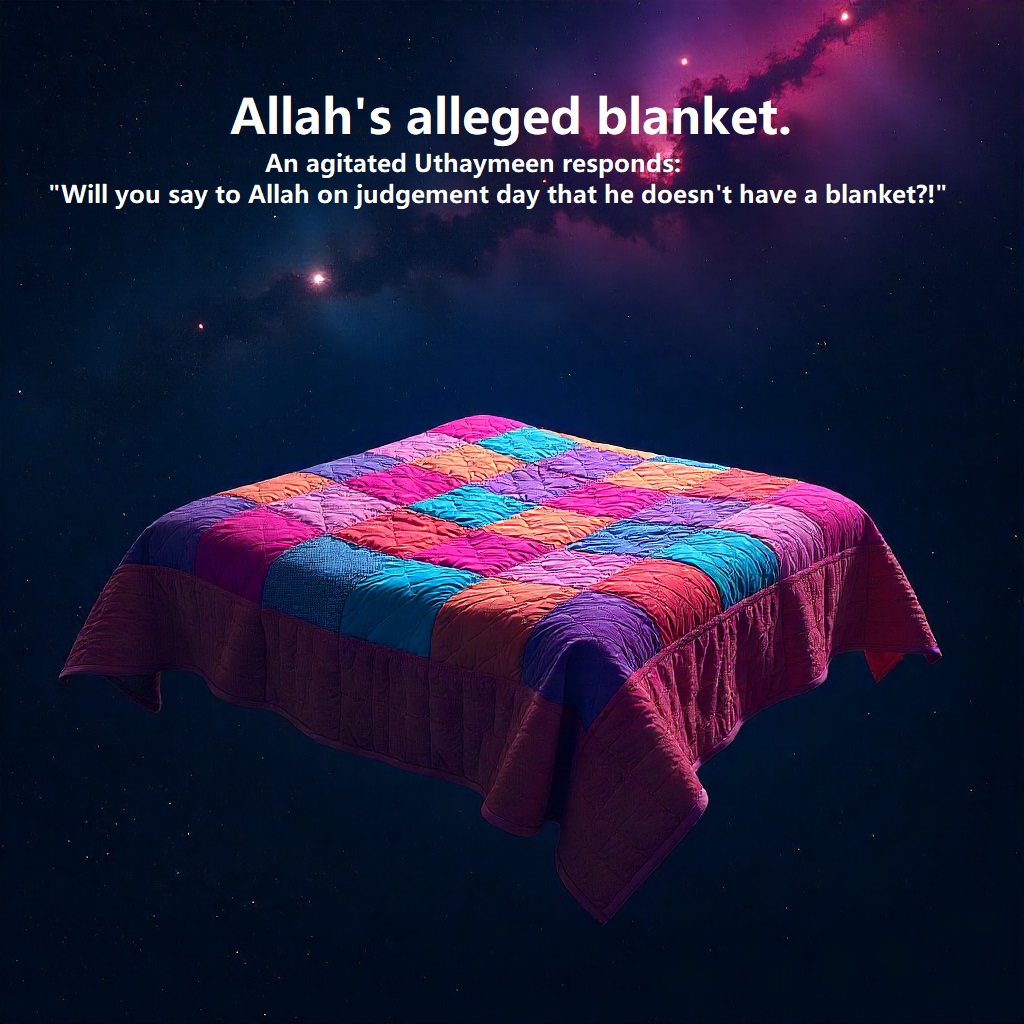
So Shaykh Uthaymeen was asked about Allah’s blanket.
The questioner says, can we say it is a metaphor?
Uthaymeen is agitated. “Will you say to Allah on judgement day that he doesn’t have a blanket?!”
If you want to perfect your aqidah (your creed) in accordance with this bizarre sect then if it is affirmed that Allah (swt) has a blanket are you going to deny this?!
You may also be interested in reading the following:
“The Messiah, son of Mary, was not but a messenger; [other] messengers have passed on before him. And his mother was a supporter of truth. They both used to eat food. Look how We make clear to them the signs; then look how they are deluded.” (Qur’an 5:75)
“There is nothing like unto Him, and He is the Hearing, the Seeing.” (Qur’an 42:11)
“There is no comparison to His absoluteness.” (Qur’an 112:4)
﷽
I used to think that the Salafi/Athari were people who had subtlety in their doctrine. And people who at least claimed to take the apparent meaning of a text. They would claim that Allah (swt) is not like his creation and that they do not liken Allah (swt) to the creation.
I couldn’t have been more wrong!
I am now of the view that the God of the Salafis is one that has a form or a shape. This is from THEIR understanding of certain text.
It was narrated that Abu Umamah Al-Bahili said:
“The Messenger of Allah (saw) addressed us, and most of his speech had to do with telling us about Dajjal. He warned about him, and among the things he said was: ‘There will not be any tribulation on earth, since the time Allah created the offspring of Adam, that will be greater than the tribulation of Dajjal. Allah has not sent any Prophet but he warned his nation about Dajjal. I am the last of the Prophets, and you are the last of the nations. He will undoubtedly appear among you. If he appears while I am among you, I will contend with him on behalf of every Muslim, and if he appears while I am not among you, then each man must fend for himself and Allah will take care of every Muslim on my behalf. He will emerge from Al-Khallah, between Sham and Iraq, and will wreak havoc right and left. O slaves of Allah, remain steadfast. I will describe him to you in a manner in which none of the Prophets has described him before me. He will start by saying “I am a Prophet,” and there is no Prophet after me. Then a second time he will say: “I am your Lord.” But you will not see your Lord until you die. He is one-eyed, and your Lord is not one-eyed, and written between his eyes is Kafir. Every believer will read it, whether he is literate or illiterate.”
Notice that the text that is attributed to the Blessed Prophet (saw) does not even remotely begin to refute the idea that Allah could be in the form of a human being.
The text only gives the following assurances.
Your Lord is not One-Eyed.
You will not see your Lord until you die.
In other words it is not at the core of one’s innate fitra or it is not innate to the mind that Allah (swt) is not something that takes on forms and shapes!
To have such an assurance tied to this particular hadith, of which the multitude have not even heard of!?
The proof is irrefutable.
The Prophet (saw) said, “Allah did not send any prophet but that he warned his nation of the one-eyed liar (Ad-Dajjal). He is one-eyed while your Lord is not one-eyed, The word ‘Kafir’ (unbeliever) is written between his two eyes.”
Now those who follow the Neo-Salafi Athari school will use the above text to claim that Allah (swt) has two eyes. Although that is pure speculation. Saying that the Dajjal has eye one does not necessitate that Allah (swt) has two eyes. Or saying that Allah (swt) isn’t defective in one eye does not entail Allah (swt) has more than one eye. You could say that a spider has 8 eyes and that it does not have a defective eye and both statements could be true.
However, when Allah (swt) opened my eyes to something deeper and more sinister. That the Neo-Salafi believe that the above text is trying to teach a theological point!
So what they are saying and think about this…what they are saying is that the way to DISTINGUISH Allah (swt) from the dajjal, is that the dajjal has ONE EYE and ALLAH DOES NOT HAVE ONE EYE.
What about the fact that the very hadith says, “THE WORD KAFIR IS WRITTEN BETWEEN HIS TWO EYES.”? Wouldn’t that be a big tale tell sign that THIS IS NOT Allah (swt)?
But even more bone chilling and down right frightening is that this flawed analogy leads one to think what seems to be THE ONLY thing that distinguishes Allah (swt) from the dajjal? Wouldn’t it be OBVIOUS that if a PERSON, ANY PERSON were to claim to Allah (swt) that we as Muslims would KNOW that this person is a charlatan, simply on the basis of:
Allah (swt) cannot be and is not a man/human being.
Allah (swt) cannot and does not assume form/shape.
Allah (swt) cannot be and is not a person.
However, if one is to take the Neo-Salafi perspective apparently not! Think about this good people.
What if you were to find a person that does amazing feats of magic, or breaks the laws of physics or does the unexplained. Would YOUR criteria as a Muslim be, well the person has two eyes, 20/20 vision, so maybe, possibly it COULD be Allah?
REALLY?
If the Neo-Salafi do not understand this hadith as the Blessed Messenger (saw) simply informing that Allah (swt) is not unaware and has full grasp, and has no defects than brothers and sisters, dear readers…
WE HAVE A BIG PROBLEM!
We have a big problem because nothing else is obvious; like the fact that the dajjal is:
human
has eyes.
has hands.
has feet.
has curly hair.
has a mouth.
most likely eats food (Qur’an 5:75) thus answers the call of nature.
has mass.
occupies space.
needs to have an army to effect change. Where as Allah (swt) gives the command ‘Kun faya kun’ (be and it is) ?wouldn’t ALL THESE BE A DEAD GIVE AWAY THAT THIS IS NOT ALLAH? According to the Neo-Salafi, NOPE!
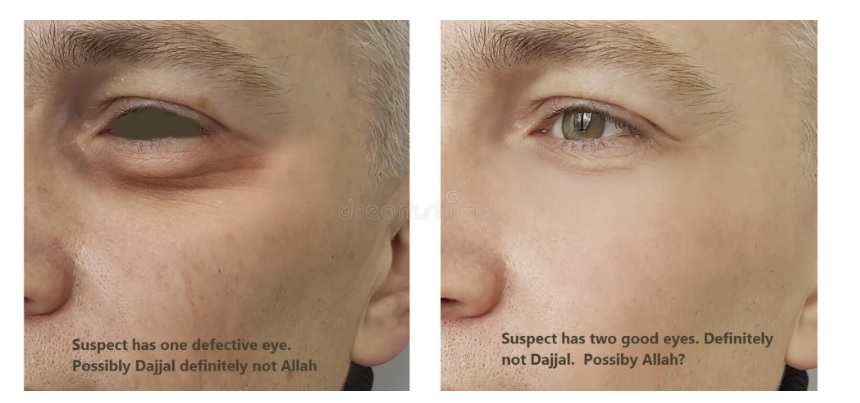
But one way to POSSIBLY TELL THAT IT IS NOT ALLAH IS THIS: Is the person blind in one eye?
Imagine being brought up with this belief and you are out on police patrol one night in Saudi Arabia and you spot someone with one eye. “Hello, headquarters this is dispatch. Suspect has one defective eye. Possibly Dajjal, Definitely not Allah.”
So according to the Neo-Salafi the above hadith has come to teach us a theological point concerning Allah (swt). That being don’t be fooled because dajjal has one eye (one eye is defective) and your Lord does not have a defective eye.
This is what lead me to believe beyond a shadow of a doubt that these people believe that Allah (swt) has a form, and can even come in the form of a human being!
Saying that the Lord is not one eyed is not an affirmation that he has two eyes!
“The Originator of the heavens and earth. How could He have children when He has no mate? He created all things and has knowledge of everything.” (Qur’an 6:101)
This is a negation that Allah (swt) could not have children as he has no companion. So does this entail the opposite? If Allah (swt) had a companion he could have children? How bizarre is this type of thinking! That Allah (swt) would need anything in order to accomplish what he wants is not the belief of the Muslims.
Subhan’Allah!
May Allah (swt) rescue the Muslims and save the Muslims from perversion in their faith!
“Oh, Mankind! Behold, We have created you all out of a male and a female, and have made you into nations and tribes so that you might come to know one another. Truly, the noblest of you in the sight of Allah is the one who is most deeply conscious of Him. Behold, God is all-knowing, All-Aware.” (Qur’an 49:13)
﷽
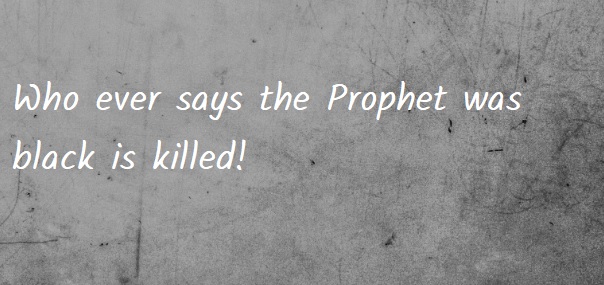
Ahmad ibn Sulayman, Sahnun’s companion, said: “That whoever says that the Prophet was black is killed. The Prophet was not black.”
One of our team members was in a discussion with someone named ‘Rider’ who had commented on the recent post titled “Are Arabs superior to Malays and everyone else? Imam Shafi’i and Ibn Taymiyyah think so!”
Rider seems to suggest that it is quite fine to treat African Americans differently from Caucasians in the United States as long as, ultimately, we are all treated spiritually equal (by our creator).
So those Muslim converts, rather than being converts from the Dalit in India, or our African American sisters and brothers coming to Islam expecting not to be treated in a prejudiced manner, may need to reassess the reasons for which they came into Islam.
Now coming to this statement.
Ahmad ibn Sulayman, Sahnun’s companion, said: “That whoever says that the Prophet was black is killed. The Prophet was not black.”
If we were an apologist for “classical scholarship” we would reply and say, this whole text was really aimed at those who falsely attributed something to the Blessed Messenger (saw) that is not true. Thus, the issue is not whether the Blessed Messenger (saw) was ‘black’ or not, but rather whether someone attributed a false ascription to him. That is what our defending “classical scholarship” at all costs response would be.
However, our rationale is we are no longer prepared to defend this kind of nonsense says, “That is all fine and well except that the person could have simply stated, ‘falsely ascribing anything to the Prophet (saw) is punishable by death’.”
It must have been such an issue for this particular point (ascribing blackness) to be highlighted.
Seems like it may even have some merit in it and Allah (swt) knows best.
Lastly, it still does not answer the point. Why would death be issued against anyone who made false physical descriptions of the Blessed Messenger (saw)? Like if they said he (saw) was 5 9in instead of 5–8 in? Or if they said that he (saw) had a broad forehead instead of around one?
Seems like correcting someone would be in order rather than a knee-jerk emotional reaction like this.
So this drives home the point that this statement seems embedded in some of the more racist elements in the Muslim ummah. Racism is a disease of the heart. So, ironically, even a classical text called “Al Shifa” (Healing, Purification, Cure) didn’t seem to be free of this. Wallahu ‘Alim!
However, we now understand that Muslims like Rider may understand “Verily, the noblest of you in the sight of Allah is the one who is most deeply conscious of Him.” to mean that, yes, we are equal in the sight of Allah. However, the understanding of Islam that they have is that some people, even among Muslims, can be given preference and special treatment simply based upon their ethnic-racial origins.
It is now a curiosity of ours about how they would interact with the Brahman philosophical schools that give sound arguments to the caste system, or maybe they wouldn’t try to approach from that angle, seeing that Islam can, from Rider’s perspective, share some strong similarities with the Brahman caste system.
Or how appropriate these teachings may not be in a nation like Singapore that teaches meritocracy not based upon purported notions of racial superiority. Should a nation like Singapore not only be on guard against certain aspects of the Salafi movement, but equally should nations like Singapore and others engage more robustly with such concepts coming from ‘traditionalists?’.
We were wondering how this bias may cause prejudice among our local Imams, Shyookh, or even Professors when it came to their interaction with people of other races, even judging their term papers. For example: Let us say that these professors or teachers had this concept that the Arabs are superior to non-Arabs. How might this affect a situation where the Chinese student is performing better than the Arab student in a particular field? Assuming that this is true and that we have some elements in our Muslim community who hold this position on what consistent basis, they should be allowed to hold teaching positions or positions of authority over other ethnic groups.
This is a grave matter that any society that has a growing Muslim population needs to look at quite seriously and earnestly. Allah (swt) knows best and Allah’s help is sought.
Interesting times we live in.
Recently, an Ex-Qadiani convert to Sunni Islam, who embraced the Hanafi-Barelvi-aligned school of thought used this verse of the Qur’an to disparage Muslims that have more melatonin.
“On the Day when some faces will be (lit up with) white, and some faces will be (in the gloom of) black: To those whose faces will be black, (will be said): “Did ye reject Faith after accepting it? Taste then the penalty for rejecting Faith.” (Qur’an 3:106)
It really says more about what is in this individual’s heart. However, being from the Sub Continent where the caste system is still operative and being inundated with a belief in a racial and genetic hierarchy (You will find this among the Zaydi, Shi’i, and Sufi’) in particular.
“It has been narrated on the authority of Ibn ‘Abdullah al-Bajali that the Messenger of Allah (saw) said:
One who is killed under the banner of a man who is blind (to his just cause), who raises the slogan of family or supports his own tribe, dies the death of one belonging to the days of Jahiliyya.
This individual and those like him are reminiscent of Iblis, who defiantly says in the Qur’an:
“He said, “Never would I prostrate to a human whom You created out of clay from an altered (hama-in)black mud.” (Qur’an 15:33)
Here clearly Allah (swt) honoured this particular pigment, the pigment black, and our All-Wise, All-Knowing Creator deemed it fit to create the progenitor of the human race out of black mud.
The way this lost individual states that: “The Salafi interpreted this Ayah as white faces referring to Sunnis and black faces referring to Kharijis.”
As no sources are cited, we are inclined to believe this individual received this suggestion from the one who whispered (and we seek protection with Allah from that).
Secondly, let us say that there was such a source. The Qur’an does not say this.
To draw the type of bizarre conclusion that this individual did would be akin to condemning a great many Caucasians on account of simply having blue eyes? Or anyone who has blue eyes, for that matter.
“(The) Day will be blown in the Trumpet, and We will gather the criminals, that Day, blue-eyed.” (Qur’an 20:102)
“It’s usually the negro that is attracted to Kharijism. Remember the prophecy about there being a black man among the Khawarij whose arm is like a woman’s breast. Why? It is a sickness of having hasad towards the Elite of our community.”
So here he is saying that usually the negro is attracted to “kharijism”.
Our response to this individual (who clearly suffers from an inferiority complex himself) is that Allah (swt) has illuminated the hearts of people who have more melatonin in their skin to the truth than surely that is a favour from Allah (swt)!
That there is a prophecy about a black man among the Khawarij.
Presumably he is talking about the following hadith in which the Ahl Sunnah attack one of the companions of the Blessed Prophet (saw).
That, ultimately, the Negro has hasad (jealousy) towards the Elite (which seemingly are those with less melanin in their skin).
It is a wonder to me those who are blinded by tribalism and racism and the idea of hereditary supremacy based upon family and clan in the face of the light of the Qur’an.
The light of the Qur’an is such that it blinds not the eyes, but illuminates the heart.
“Indeed, it is not the eyes that are blind, but it is the hearts in the chests that grow blind.” (Qur’an 22:46)
Adam (as) had two sons. One of which murdered the other. How does being a descendant of a Prophet (saw) guarantee righteousness?
As regards the proper understanding of the verse:
“On the Day when some faces will be (lit up with) white, and some faces will be (in the gloom of) black: To those whose faces will be black, (will be said): “Did ye reject Faith after accepting it? Taste then the penalty for rejecting Faith.” (Qur’an 3:106)
The verse is self-explanatory. This is the day of judgement. People are being distinguished by their piety and deeds; rather, they held fast or became among those who rejected faith.
It has nothing to do with the amount of melatonin an individual has.
“And whoever obeys Allah and the Messenger will be in the company of those blessed by Allah: the prophets, the people of truth, the martyrs, and the righteous—what honourable company!” (Qur’an 4:69)
﷽
Shaykh Al Qanoubi (h) is the luminary of the Ibadi school in the sciences of the hadith. The one whom Allah (swt) has illuminated his mind, and given sharp wit. Able to be among the scientists who detect the ʿillah, the hidden defects that often escape the grasp of the most astute.
This entry is in regard to what is known as: Hadith Al Thaqalyan or two matters of weight or two matters of importance.
Source: (Hadith 40, in Al Jami’ Al Sahih)
In the short video clip below, Shaykh Dr. Abdullah bin Sa’ed Al Ma’mari (h) mentions that Shaykh Al Qanoubi (h), in his study on the subject, has not found the narrations that include: “and my family” as being authentic from the Blessed Prophet (saw).
As Shaykh Dr Abdullah bin Sa’ed Al Ma’mari (h) says, what is authentic for us in the Ibadi school are the words: “The book of Allah and my Sunnah.”
Obeying Allah and his Messenger is transmitted via tawatur from the Qur’an.It does not need confirmation from the hadith.
What Shaykh Dr Abdullah bin Sa’ed Al Ma’mari (h) has said is true. We don’t find a single mention of obey Allah, Obey the Messenger and Obey the Ahl Bayt.
“He who obeys the Messenger has obeyed Allah, but those who turn away-We have not sent you over them as a guardian.” (Qur’an 4:80)
“O you who believe, you shall obey Allah, and obey the messenger. Otherwise, all your works will be in vain.” (Qur’an 47:33)
“And obey Allah and obey the Messenger. But if you turn away, then Our Messenger is responsible only for conveying the message clearly. (Quran 64:12)
“Say, “Obey Allah and obey the Messenger. But if you turn away, then he is only responsible for his duty, and you are responsible for yours. And if you obey him, you will be guided. The Messenger’s duty is only to deliver the message clearly.” (Qur’an 24:54)
“Believe in Allah and His Messenger, and the scripture which He has sent to His Messenger and the scripture which He sent to those before (him)” (Qur’an 4:136)
O you who have believed, obey Allah and obey the Messenger and those in authority among you. And if you disagree over anything, refer it to Allah and the Messenger, if you should believe in Allah and the Last Day. That is the best [way] and best in the result. (Qur’an 4:59)
The hadiths that the Sunni and Shi’i primarily dispute about are as follows:
Follow the Qur’an
“I have left among you the Book of Allah, and if you hold fast to it, you would never go astray. And you would be asked about me (on the Day of Resurrection), (now tell me) what would you say? They (the audience) said: We will bear witness that you have conveyed (the message), discharged (the ministry of Prophethood) and given wise (sincere) counsel. He (the narrator) said: He (the Holy Prophet) then raised his forefinger towards the sky and pointing it at the people (said):” O Allah, be witness. 0 Allah, be witness,” saying it thrice.”
On the authority of Ikrimah, on the authority of Ibn Abbas, that the Messenger of Allah, (saw) , addressed the people during the Farewell Pilgrimage and said: “O people, I have I have left among you that which if you hold fast to it you will never go astray: the Book of Allah and the Sunnah of His Prophet.”
“On the authority of Ikrimah, on the authority of Ibn Abbas, that the Messenger of Allah, (saw), The Prophet (saw) addressed the people during the Farewell Pilgrimage and said: “Satan has despaired of being worshipped in your land, but he is content to be obeyed in other than that, of your deeds that you despise. So beware, O people, for I have left among you that which, if you hold fast to it, you will never go astray: The Book of Allah and the Sunnah of His Prophet (saw). Indeed, every Muslim is a brother to Allah.” A Muslim, Muslims are brothers, and it is not permissible for a man to take from his brother’s wealth except what he gives of his own free will. And do not wrong, and do not revert after me to disbelief, striking one another’s necks . ”
That the Messenger of Allah (saw) said: “Indeed, I am leaving among you, that which if you hold fast to them, you shall not be misguided after me. One of them is greater than the other: The Book of Allah is a rope extended from the sky to the earth, and my family – the people of my house – and they shall not split until they meet at the Hawd, so look at how you deal with them after me.”
The problem with the above hadith is it contains the vile and evil al-A’mash! No consideration is given to it.
Narrated Jabir bin ‘Abdullah:
“I saw the Messenger of Allah during his Hajj, on the Day of ‘Arafah. He was upon his camel Al-Qaswa, giving a Khutbah, so he said: ‘O people! Indeed, I have left among you, that which if you hold fast to it, you shall not go astray: The Book of Allah and my family, the people of my house.'”
Yazid b. Hayyan reported, I went along with Husain b. Sabra and ‘Umar b. Muslim to Zaid b. Arqam and, as we sat by his side, Husain said to him:
Zaid. you have been able to acquire a great virtue that you saw Allah’s Messenger (saw) listened to his talk, fought by his side in (different) battles, offered prayer behind me. Zaid, you have in fact earned a great virtue. Zaid, narrate to us what you heard from Allah’s Messenger (saw). He said: I have grown old and have almost spent my age and I have forgotten some of the things which I remembered in connection with Allah’s Messenger (saw), so accept whatever I narrate to you, and which I do not narrate do not compel me to do that. He then said: One day Allah’s Messenger (saw) stood up to deliver sermon at a watering place known as Khumm situated between Mecca and Medina. He praised Allah, extolled Him and delivered the sermon and. exhorted (us) and said: Now to our purpose. O people, I am a human being. I am about to receive a messenger (the angel of death) from my Lord and I, in response to Allah’s call, (would bid good-bye to you), but I am leaving among you two weighty things: the one being the Book of Allah in which there is right guidance and light, so hold fast to the Book of Allah and adhere to it. He exhorted (us) (to hold fast) to the Book of Allah and then said: The second are the members of my household I remind you (of your duties) to the members of my family.He (Husain) said to Zaid: Who are the members of his household? Aren’t his wives the members of his family? Thereupon he said: His wives are the members of his family (but here) the members of his family are those for whom acceptance of Zakat is forbidden. And he said: Who are they? Thereupon he said: ‘Ali and the offspring of ‘Ali, ‘Aqil and the offspring of ‘Aqil and the offspring of Ja’far and the offspring of ‘Abbas. Husain said: These are those for whom the acceptance of Zakat is forbidden. Zaid said: Yes.
Notice dear reader: “and the offspring of ‘Abbas.” Surely Ibn Abbas (ra) would know best what the Blessed Prophet (saw) said.
Prima Qur’an comments:
As mentioned, the inclusion of the Book of Allah and my family is important for the Shi’i in helping to establish their positions. This is not the case for us (the Ibadi school).
Some Sunni Muslims (in particular those who follow a Sufi Tariqah) reconcile the narrations by stating that they (Sunni Muslims who follow a Sufi Tariqah) follow the Qur’an and Sunnah via the descendants of the Blessed Messenger (saw). Since it is claimed by Sunni Muslims that the bulk of the descendants of Prophet Muhammed (saw) are actually contained within the house of ‘Ahl Sunnah Wal Jammah’, then they are best suited to teach and guide.
So, for example: Shaykh Muhammed Al Yaqoubi, who is a claimed descendant of the Blessed Prophet (saw) via Hasan ibn Ali. People who follow a Sufi order that he is affiliated with would find that he is best suited to guide.
As seen in two of the narrations above, Ibn Abbas (ra) is in the chain of transmission. For us (The Ibadi school) he is part of the household of the Blessed Prophet (saw). Thus, he, being a member of Ahl Bayt, transmitted that we are to follow the Qur’an and Sunnah.
That statement aligns with what we find in the Qur’an.
It could be very well that the Prophet (saw) was meant to convey the following:
Did he convey the message? Did he bring the Qur’an? Of which everyone agrees that he did.
That he would want people to look after and take care of his kinsfolk. This is only natural and something any honourable person would desire. How much more the most honorable among creation?
As we find in the Qur’an:
“That is the good news which Allah gives to His servants who believe and do good. Say, “I do not ask you for a reward for this—only honour for kinship.” Whoever earns a good deed, We will increase it in goodness for them. Surely Allah is All-Forgiving, Most Appreciative” (Qur’an 42:23)
Rest assured that if there are any lectures or writings from Shaykh Al Qanoubi (h) where he fleshes out the more reasons for not accepting the transmissions that include ‘and my family’ insh’Allah will be sure to share them. Allah-Willing.
“Moreover, if two factions among the believers should fight, then make settlement between the two. But if one of them oppresses the other, then fight against the one that oppresses until it returns to the command of Allah. And if it returns, then make settlement between them in justice and act justly. Indeed, Allah loves those who act justly.” (Qur’an 49:9)
﷽
So today we are going to be looking at the following hadith:
Narrated by Zaid bin Arqam:
That the Messenger of Allah (saw) said to ‘Ali, Fatimah, Al-Hasan and Al-Husain: “I am at war with whoever makes war with you, and peace for whoever makes peace with you.”
You can see from the above source that it has a grading of Da’if (meaning weak/fabricated).
Now, even without going into the chains of narrators, we know that this hadith has a major weakness.
However, let us say, for the sake of argument, that this hadith had a grading of Sahih (meaning sound). It would still have a defect. Not even a hidden one. Not even something that would require a hadith specialist.
It would require familiarity with the text of the Qur’an.
CONTROL GROUP A: BEING OPPRESSED
CONTROL GROUP B: DOING THE OPPRESSING.
So, in the above scenario. Ali, Fatimah (ra), Al-Hasan and Al-Husain could be in control group B. They could be doing the oppressing. However, since our interlocutors (Shi’i, Sunni, ect) will get emotionally charged over such a suggestion, we will not entertain it at this point.
Thus, Ali, Fatimah (ra), Al-Hasan and Al-Husain could be in control group A. That means they are being oppressed. They are locked in conflict with control group B. However, notice Allah (swt) says:
“If two factions among the believers should fight.”
And since the hadith states that being in conflict or at war with Ali, Fatimah (ra), Al-Hasan and Al-Husain is ipso facto being at war with the Blessed Messenger (saw) and since it is not conceivable for one to be labeled as a believer and to be at war with or conflict with the Blessed Prophet (saw) himself that hadith is baseless. It is null and void.
Next: Aisha (ra) has Wilāyat al-Ḥaqīqah (real guardianship of Allah), whereas he (Ali) only has the Wilāyatal-Dhahir (apparent guardianship).
“The Prophet has a stronger affinity to the believers than they do themselves. And his wives are their mothers.” (Qur’an 33:6)
Narrated Abu Huraira:
Allah’s Messenger (saw) said, “Allah said, ‘I will declare war against him who shows hostility to a pious worshipper of Mine. And the most beloved things with which My slave comes nearer to Me, is what I have enjoined upon him; and My slave keeps on coming closer to Me through performing Nawafil (praying or doing extra deeds besides what is obligatory) till I love him, so I become his sense of hearing with which he hears, and his sense of sight with which he sees, and his hand with which he grips, and his leg with which he walks; and if he asks Me, I will give him, and if he asks My protection (Refuge), I will protect him; (i.e. give him My Refuge) and I do not hesitate to do anything as I hesitate to take the soul of the believer, for he hates death, and I hate to disappoint him.”
Narrated Abu Maryam `Abdullah bin Ziyad Al-Aasadi:
“When Talha, AzZubair and `Aisha moved to Basra, `Ali sent `Ammar bin Yasir and Hasan bin `Ali who came to us at Kufa and ascended the pulpit. Al-Hasan bin `Ali was at the top of the pulpit and `Ammar was below Al-Hasan. We all gathered before him. I heard `Ammar saying, “`Aisha has moved to Al-Busra. By Allah! She is the wife of your Prophet in this world and in the Hereafter. But Allah has put you to test whether you obey Him (Allah) or her (`Aisha).”
So using this standard of logic. It is Ali ibn Abi Talib who risks war with Allah (swt) and not Aisha (ra) who risks war with the Messenger of Allah!
Ali’s own brother Aqil fought on the side of Muawiya.
Aqil ibn Abi Talib (cousin of the Blessed Prophet) and elder brother of Ali. So does this now mean a cousin of the Blessed Prophet (saw) like Ali, and brother of Ali was at war with the Blessed Prophet (saw)?
Abu Hafs al ‘Asha (is munkar al hadith) — narrates unacceptable hadith)
The teacher of Muhammed ibn Suqah is majhul (unknown).
So, in the end, this hadith is discarded.
The Shi’i may not like it. The Zaydi may not like it. The Imami may not like it. But the evidence has been laid out and the refutation (if any awaits).