“It is He to whom belongs the dominion over the heavens and the earth, and who has not taken a son and has no associate in His dominion, for He has created all things according to precise measures.” (Qur’an 25:2)
﷽
Those people who claim the Qur’an is eternal. They say this precisely because they do not know what the Qur’an is.
We know the number of surahs/chapters is 114. We know each chapter of the Qur’an as well as the number of verses. In each word we know the number of letters. And for each letter we know the harakat.
We know these letters do not operate independently. They combine with other letters that make words and these words combine with other words to make sentences. These sentences combine to make the various chapters of the Qur’an. All of this is clear evidence that the Qur’an is created by Allah (swt).
All scholars, all Muslims believe that all languages are created by Allah (swt).
By this we know that the Arabic language is created by Allah (swt). The Qur’an is informed in the Arabic language. The Arabic language is created by Allah (swt) and by that the Qur’an is created by Allah (swt).
“And of His signs is the creation of the heavens and the earth and the diversity of your languages and your colours. Indeed, in that are signs for those of knowledge.” (Qur’an 30:22)
“And We did not send any messenger except [speaking] in the language of his people to state clearly for them, and Allah sends astray [thereby] whom He wills and guides whom He wills. And He is the Exalted in Might, the Wise.” (Qur’an 14:4)
“Look how We explain signs to them, then see how far they are turned away.” (Qur’an 5:75)
You may be interested in reading the debate among Muslim scholars regarding the foreign words that the Arabic language adopted here:
“Some proponents of this camp quoted the ‘father’ of Arabic grammar,Sībawayh (d. 180/796) himself, who wrote in his al-Kitāb that non-Arabic words could become Arabic if one substituted Arabic letters for the foreign ones, and then appended it to a known morphological form (wazn).”
Source: (Sībawayh, al-Kitāb, v. 4, p. 304.)
Sibawayh’s teacher was the famous Ibadi scholar, Al-Khalili ibn Ahmad al-Farahidi (The one who is credited for teaching your children (no matter what expression of Islam they follow) the harakat of the Qur’an.
A brief entry concerning the famous Ibadi scholar, Al Khalili Ibn Ahmad Al-Farahidi al-Ibadi here:
We do not have any reports from a companion(sahabah) to the contrary. So, our interlocutors will either have to weaken the hadith or employ interpretive principles to dismiss it as sound evidence.
Alas, Saudi, Salafi translations cannot hide the fact that the Qur’an is created.
The making the Qur’an Arabic is natural making, because it is a meaning abiding with the Qur’an, namely its being Arabic. This means that it will either be transforming from one quality to another.
1) It was first not-Arabic then Allah invented in it this quality (of being Arabic).
2) Or (it will be) creating it with this quality from the beginning
As Allah created, the sun joined with the quality of being a lamp; and as Allah created the night with the quality of being a covering, and created the day with the quality of being a space for seeking livelihood. That is definitely the sense that it is used here. In the case of making an Arabic Qur’an. This is also because of the non-existence of anything to indicate that it was not non-Arabic before, and then Allah transformed it into Arabic. As for its being Arabic since forever, relating the verb ‘making’ to it in this way is impermissible in reason and in the dictionary, because ‘making’ is an action and action precedes what is enacted, so ‘making’ definitely precedes the made.
The same will be said about His saying, Glorified is He: ‘But We made it a light, We guide by it whoever We will from among Our servants’ (Qur’an 42:52)
This will appear as self-evident to whoever reflects on the meaning of ‘making’, and thinks about the Eternal Necessary attributes of Allah, Exalted is He, and the impossibility of relating ‘making’ to these attributes. For it is impossible in law that one should say that Allah has made His Knowledge All-Encompassing, or His Power All-Containing, or that Allah has made His Existence Pre-Eternal and Sempiternal, or that He has made His Hearing catch all sounds, or made His Seeing encompass all that is visible-because these phrases imply Allah’s production of these attributes.
Even if the interlocutors want to state that Allah (swt) could have made his revelation in Hebrew or Aramaic or Hindi or Greek, they have no escape from the two categories above.
A) First, there is no textual proof that the Qur’an was non-Arabic before being Arabic. Even if it was the case, that would be a clear admission of defeat. That is because of the admission of contradiction-an eternal abiding quality going through a change. From one state to another.
B) Because there is no proof for A we are left with the clear meaning of the Qur’an. One in which we do not superimpose our theology upon it. The Qur’an has been made in Arabic.
The knock-out blow has already been delivered. However, some are tenacious in clinging to false beliefs. They will often use every day Arabic vernacular that they think are great examples that the layperson will understand. However, those examples actually work against them!
“He made us dance.” ”He made his son the King.”
So, even in both of these examples, we need to ask:
Is being the King an eternal quality abiding in the individual or was this something that came about before it did not exist?
Can it be said that dancing is an eternal action abiding in the individual or is it merely a transitional state from non-dancing to dancing?
Made — is that which is transferred from one state to the other, which cannot be except in that which is created. The second is the reasoning of its being made in the Arabic language with the intention that the one being addressed may understand it.
Like that verse are all the verses which make it clear that it is made. For example, His saying, Exalted is He: “But We have made it a light, We guide by it whomever We will from among our servants.” (Qur’an 42:52).
Imam Muhammad b. Aflah, (Ra) has commented on the evidence of ‘making’ as affirmation of its being created; he says:
“The ummah is in consensus that every doer is before his doing, and the maker is before the making, and the artist is before the art, and that the maker is other than the made. When the difference and precedence between them has been affirmed, then it is true that they are two things, and that the first and precedent is the Eternal Maker, and the second, the made, is the originated, being after it had not been.” Source: (The Overwhelming Truth)
He has argued from ‘making’ when referred to Allah, in many verses which denote it-such as His saying, Exalted is He: “He made the darkness and the light”. (Qur’an 6:1)
His saying: “Me made from it, its pair.” (Qur’an 7:189)
His saying: “He it is that has made for you the night that you may rest therein, and the day to make things visible to you.” (Qur’an 10:67)
His saying: “Or who has made the earth firm to live in; made rivers in its midst; set thereon mountains immovable; and set a separating barrier between the two seas.” (Qur’an 27:61)
His saying: “Of the hills He made some for your shelter.” (Qur’an 16:81)
His saying: “And has made for you ships and cattle on which you ride.” (Qur’an 43:2)
His saying: “And made the sun as a lamp.”(Qur’an 71:16)
His saying: “And We made the night and the day signs.” (Qur’an 17:12). Similar to those (verses is the meaning of ‘making’) in His saying:
“Have WE not made the earth as a place to draw together.” (Qur’an 77:25)
His saying: ‘Have We not made the earth as a wide expanse; and the mountains as pegs; and created you in pairs; and made your sleep for rest; and made the night as a covering; and made the day as a means of subsistence’. (Qur’an 78:6-11) and other verses.
Imam Abu l-Yaqazan Muhammed b.Aflah (May Allah have mercy on him), says:
“The meaning of ‘made’ in these places that we have cited is ‘created’. And so it is for the one who opposes [our argument], but not, he claims, in the context of the Qur’an, because ‘making’ in the Qur’an is other than creation. If that is allowed for him, then it must be allowed [also] for another to oppose that and say some similar thing about [something] other than the Qur’an-that the ‘making’, about which we [Ibadis and Hanbalis] agree, has the meaning ‘creation’, has [for him] another meaning than ‘creation’. But what is the difference between the two ‘makings’? For [if there is a difference] it means that Allah has addressed the Arabs with what they do not understand of their speech, and what they do not know of their language, and with what there in it is allowed for them to be in doubt and uncertainty about. In one place, ‘making’ is in the meaning of ‘creation’, ‘origination’ and ‘management’. And in another place [it has] another meaning that we do not understand, and we do not know. The All-Wise is not described as such!”
When we and they agree that ‘making’ in His saying ”And He made the sun a lamp.” (Qur’an 71:16)
His saying: “Indeed, We have made what is on the earth an adornment for it.” (Qur’an 18:7) His saying: “He made for you from yourselves pairs.” (Qur’an 42:11)
His saying: “And He made darkness and light.” (Qur’an 6:1) -is in the meaning of ‘creation’, then all ‘making’ when it is by Allah is in the meaning of creation. In that will be included the Qur’an and other than the Qur’an. Otherwise, debating will become pointless and any evidence [for the argument] will not be valid.
“If they oppose -relying on the saying of Allah: “It was not Allah who made slit eared she-camels or she-camels let loose in pasture.” (Qur’an 5:103) It will be said-Yes Allah did not create a slit-eared she-camel as a slit-eared she-camel, as you claim, nor a she-camel let loose in pasture as a she-camel let loose in pasture, as you claim. Rather, He negated from Himself what He did not do as the polytheist claimed [that He did]. So he criticized them because of their innovation. Its meaning is that We did not create you as you have described, rather, We created against that which you have described. The negation here is of the particular qualifier, not of the particular creation.”
“Like that is His saying: “Surely I will make you a leader for mankind.” (Qur’an 2:124) i.e. I will create in you the quality that was not in you, and the meaning that was not found in you, and I had not done so in you before that. The meaning of ‘made’ wherever it is found is ‘created’, ‘managed’, and all that is the same meaning, though the words are different.”
Prima-Qur’an comment: Another example is the following:
“Allāh has not made (ja’ala) for a man two hearts in his interior. And He has not made (ja’ala) your wives whom you declare unlawful your mothers. And He has not made (ja’ala) your claimed [i.e., adopted] sons your [true] sons. That is [merely] your saying by your mouths, but Allāh says the truth, and He guides to the [right] way.” (Qur’an 33:4)
One of them actually made the comment to us: “Can we say that Allah didn’t create sons or hearts or wives?” Of course not! Such a bizarre conclusion. Again, the negation is of a particular type or qualifier, not of the creation itself. Another thing we wish they had pondered is that if Allah (swt) had made (ja’ala) for man two hearts, or made (ja’ala) our wives our mothers, or made (ja’ala) our adopted sons our real sons the same word (ja’ala) would still be applicable.
That is Muhammad b. Aflah’s statement about ‘making’. (May Allah’s abundant mercy be upon him).
We add to that, we investigated occurrences of ‘making’ in the Qur’an referred to Allah, and we found it fell in either of two classes.
The ‘making’ is either natural or legal. In both there is creation of what did not exist (before).
In natural making, for example, there are the following:
In His saying: “He made from it its pair.” (Qur’an 7:189)
His saying: “And has made for you ships and cattle on which you ride.” (Qur’an 32:12)
His saying: “He made the sun a lamp.” (Qur’an 71:16) –The meaning of origination and contingency is clear.
The legal ‘making’ is as in His saying in the following:
“Surely I will make you a leader for mankind.” (Qur’an 2:124)
Another example of the same is the negated making in His saying, Exalted is He: “It was not Allah Who made a slit-ear she-camel or a she-camel let loose in pasture.” (Qur’an 5:103) i.e. He did not legalize the slitting of its ear. An(other) example of the legal ‘making’ is His saying, Exalted is He: “And He made the qiblah to which you were used only to test those who followed the Messenger from those who would turn on their heels.” (Qur’an 2:143)
The differences between the two ‘makings’ are as follows:
The first of them is bringing into existence the essence of the made thing or an abiding quality of it which did not exist before. That implies bringing the made from one state to another state, or from one quality to another quality. That (turning from one to another state) is accomplished when ‘making’ is referred to mankind, and it is in the meaning of turning from one state to another, as (when) I made the dough bread, the flour dough. In both cases, there is a turning of the made from one state to another state in which it was not before. The flour being made dough was not dough, and the dough before being made bread was not bread. It is not understood from this other than that the thing made is moving with the making from what it was before (to the changed state).
The second is inventing a law that turns (the object of the action) from one verdict to another one, like the Ka’bah being made the qiblah of the Muslims after Bayt al-Maqdis had been their qiblah.
Dealing with objections: May Allah (swt) guide the sincere.
An objection has been offered to the argument for the creation of the Qur’an from its being made Arabic-that ‘making’ is sometimes other than creation, as in the following examples:
“They make for Allah daughters, Glorified Is He.” (Qur’an 16:57)
“Still, the pagans have made some of His creation out to be a part of Him. Indeed, humankind is clearly ungrateful.” (Qur’an 43:15)
“They made angels who are servants of the Most Gracious females.” (Qur’an 43:19)
His saying: “You make it your provision that you lie.” (Qur’an 56:82).
The answer to this is that the distance between the two ‘makings’ and makers is immense. The making, in the context of what we are here discussing,is an affirmed action referring to Allah, Exalted is He. Whoever rejects it or rejects its effect (namely, the Qur’an), has unbelieved. That which is made—namely, the Qur’an in Arabic, its giving light and its guidance is an established reality. Whoever rejects it, he has certainly unbelieved.
The ‘making’ in what they have objected to is a falsehood referring to the unbelievers. They made—namely, the angels being feminine — is nothing. Whoever affirms that will be regarded as an unbeliever. Who affirms that the made some of his creation to be a part of him is an unbeliever.
There is no problem with the sameness of the letters of the verb (ja’ala)in both references—namely,jim, ‘ayn, lam—because the verb in reference to Allah has one meaning, and in reference to someone else has another meaning regardless of there being no difference in the word. Examples:
“He is who created you and those before you.” (Qur’an 2:21)
“And Allah created you and whatever you do.” (Qur’an 37:96)
“Indeed We have created man from a quintessence of clay.” (Qur’an 23:12)
“We have indeed created man in the best of molds.” (Qur’an 95:4)-and other similar verses where the creation is referred to Allah.
It is in all cases with the meaning of bringing from non-being into being. You will find this same verb, the same word and the same letters, referred to the unbelievers. It has (in those references) a sense that is not proper to the righteous servants of Allah, let alone its being permissible in respect of Allah, the Lord of the Worlds, Exalted is He. That (meaning) is (explicit) in His saying: “And you created falsehood.”(Qur’an 29:17).
So the meaning of the word is the same.
Is there any way to interpret that in one place according to the meaning of the other?
Or is the comparison between the two verbs as impossible as the impossibility of the comparison between the two doers?
“For that is Allah, your Lord, the Truth. And what can be beyond truth except error? How then are you turned away?”(Qur’an 10: 32)
For more information you may wish to read our article here:
“Truly, the likeness of Jesus, in God’s sight, is as Adam’s likeness; He created (khalaqahu) him of dust, then said He unto him, ‘Be,’ and he was.” (Qur’an 3:59)
﷽
The Qur’an is Created because Jesus is Not God.
That is to say, because Jesus (as) is not the uncreated word of Allah, neither is the Qur’an the uncreated word of Allah.
The Qur’an is Uncreated = Jesus is the eternal attribute of Allah.
This would mean, according to Sunni theology (Athari, Ash’ari, Maturidi), that Jesus is not identical to Allah’s essence, but he is not other than Allah’s essence either.
Christian theology states that Jesus (as) existed as the Word of Allah before being placed inside of Mary (as).
فِي البَدْءِ كَانَ الكَلِمَةُ مَوْجُودًا -In the beginning the Word (AlKalimat) Existed.
وَكَانَ الكَلِمَةُ مَعَ اللهِ، -And the Word (AlKalimat) was with Allah.
وَكَانَ الكَلِمَةُ هُوَ اللهَ. –And the Word (AlKalimat) was Allah.
كَانَ الكَلِمَةُ مَعَ اللهِ فِي البَدْءِ – The Word (AlKaimat) was with Allah in the beginning.
بِهِ خُلِقَ كُلُّ شيءٍ، -By Him all things were created.
وَبِدُونِهِ لَمْ يُخلَقْ شَيءٌ مِمَّا خُلِقَ. -And without Him nothing would have been created.
Is Jesus the created word of Allah or the uncreated word of Allah?
“When the angels said, “O Mary, indeed Allah gives you good tidings of a word (bikalimatin)from Him, whose name will be the Messiah, Jesus, the son of Mary – distinguished in this world and the Hereafter and among those brought near [to Allah]. (Qur’an 3:45)
Jesus (as) is a word from Him.
“And [the example of] Mary, the daughter of ‘Imran, who guarded her chastity, so We blew into [her garment] through Our angel, and she believed in the words (bikalimati) of her Lord and His scriptures and was of the devoutly obedient.” (Qur’an 66:12)
Mary (as) is believing in the Lord and his words. Meaning they are not identical.
“O People of the Scripture do not commit excess in your religion or say about Allah except the truth. The Messiah, Jesus, the son of Mary, was but a messenger of Allah and a word (kalimatuhu) from Him which He directed to Mary and a soul from Him. So, believe in Allah and His messengers. And do not say, “Three”; desist – it is better for you. Indeed, Allah is but one God. Exalted is He above having a son. To Him belongs whatever is in the heavens and whatever is on the earth. And sufficient is Allah as Disposer of affairs.” (Qur’an 4:171)
Jesus (as) is a word from Him.
“And if anyone of the polytheists seeks your protection, then grant him protection so that he may hear the (kalam al-lahi) Words of Allah.” (Quran 9:6)
“Those who remained behind will say when you set out toward the war booty to take it, “Let us follow you.” They wish to change the (kalama l-lahi) Words of Allah.” (Quran 48:15)
All these words come from the same Arabic trilateral root.
ك ل م (kaf) (lam) (mim) Jesus is the created word of Allah (swt) just as the Qur’an is the created word of Allah (swt). If someone was to believe that Jesus (as) is the uncreated word of Allah (swt), then that would be Christianity. If someone was to believe that Jesus (as) is the created word of Allah (swt), that would be Islam and the path of safety.
One of our teachers has known of people who have left Islam for Christianity. You also encounter them online and some of them have said a study of the Qur’an helped in making that decision. We would submit that it was not the Qur’an that lead them to this decision but a certain theological perspective about the Qur’an and Jesus being Allah’s creation and command not being able to distinguish between the two.
We have never heard of a Muslim who believes that Allah (swt) alone is the Creator and everything else (including the Qur’an as being created) becomes a Christian.
So what we are looking for is consistency.
On what consistent basis is Jesus ‘the word of Allah’ (kalimatuhu) created but the Qur’an (kalam al-lahi) ‘the words of Allah’ uncreated? Listen to what Mohamed Hijab says above.
“The word is actually defined as Kun.” -Mohamed Hijab
If the word is defined as ‘Kun’, then according to the following Sunni Muslims, then Jesus (as) is the uncreated Word of Allah.
We have actually had one Sunni Muslim brother from India (no doubt equipped with his Shaykhs and Alims) come and assert the following thinking it would be some powerful argument and not realizing they had erred in the following:come
1) The lack of depth in understanding the Qur’an and Arabic.
2) The bizarre theological implications of their view.
So they advanced the following:
“He is the One Who has originated the heavens and the earth, and when He wills to (originate) a thing, He only says to (lahu) it: ‘Be’, and it becomes.” (Qur’an 2:117)
“All it takes, when He wills something ˹to be˺, is simply to say to (lahu) it: “Be!” And it is!” (Qur’an 36:82)
So their argument was that if the ‘kun’ was created, then you would need another ‘kun’ to create that ‘kun’, leading to an infinite number of ‘kun’ regressing back through time.
If this saying (of ‘Be’) had (itself) been created, then it would not be correct to (say that) the creations were created by it, because the creation is not created by a creature.
Going back to the opening verse of this article:
“Truly, the likeness of Jesus, in God’s sight, is as Adam’s likeness; He created (khalaqahu) him of dust, then said He unto him, ‘Be,’ and he was.” (Qur’an 3:59)
A transliteration would be:
inna mathala ʿīsā ʿinda l-lahi kamathali ādama khalaqahu min turābin thumma qāla lahu kun fayakūn
The audio of it is here:
A) It is not really explained by our interlocutors how the word ‘kun’in which the sound‘n’ is eternal when that sound itself is preceded by the sound‘k’, which presumably is eternal.
B) One will not fail to note that in all the verses above (Q 3:59, 2:117, 36:82) that grammatically the structure of the sentence is that Allah (swt) is saying to the ‘lahu’ translated above as ‘he’ or ‘it. “Be!”
Thus, they want us to believe that Allah (swt) is saying to his knowledge of all things (which exist for all eternity) to ‘be’ and it becomes!
The meaning of ‘Be’ in the like of His saying, exalted, is He, “For to anything which We have willed, We but say “Be” then it is.” (Qur’an 16:40)
This relates to the execution of His Will. Exalted is He, in respect of anything of the mumkinat (what is possible) in the context of giving it existence or completing it. It is explained by his Saing, “When We have willed’ i.e. When Our Will has conjoined with it in a way of execution (of the command). Because ‘when’ is for time in the future, and this is emphasized in His saying: “an naqula la-hu.” (that We say to it), (Qur’an 16:40) which is in the imperfect tense which, when it is with ‘an’, means the future.
It is known with certainty that whatever is since forever-like His Knowledge, His Power and His Life-the Will cannot be conjoined with it, because nothing can precede (what is eternal).
And this is emphasized by His saying ‘fa-yakun’ (then it is), the connecting particle ‘fa’ meaning order and sequence. From this you know that His saying, exalted is He, ‘kun fa-yakun’, is, wherever it occurs, nothing but an indirect expression of the speedy response of things to Him, glorified is He, in accordance with the conjunction of His Will with these things. Otherwise, there is no utterance of kaf nun (kun) in the concrete sense (of utterance). If we accept that, then we will say that our discussion is about the Word revealed, such as the Qur’an, not the Word unrevealed.
It is also a metaphor for the expediency of Allah’s creative command.
“Allah created the heavens and the earth, and all that is between them, in six days” (Qur’an 7:54).
“So woe to those who pray yet are unmindful of their prayers.” (Qur’an 107: 104-105)
﷽
Malik ibn Al-Huwayrith reported:
We came to the Prophet (saw) while we were young men, and we stayed with him twenty nights. Then the Prophet considered that we were anxious to see our families, so he asked us who we had left behind to take care of them, and we told him. The Prophet was kindhearted and merciful, and he said, “Return to your families, teach them, and enjoin good upon them.” Pray as you have seen me praying. When the time of prayer arrives, then one of you should announce the call to prayer and the eldest of you should lead the prayer.
Shaykh Uthman REFUTES Shi’i lies on Folding Hands in Prayer [MUST WATCH]
It is refreshing to see that those who claim to be following the early generations are starting to relax their position on this matter. Al hamdulillah.
For example, Salafi preacher, Assim Al Hakeem mentions that one can pray with their arms to the side with no problem.
If you pray with your hands down, your salah is still acceptable -Shaykh Uthman Ibn Farooq.
Shaykh Uthman says @0:46 “If you feel that you want to pray with your hands to your side ,and you feel that’s the correct opinion based on the evidence that you have seen, it’s up to you. No problem. That’s between you and Allah. I believe with the evidences from the Qur’an itself and from the authentic hadith of the Prophet (saw) and the sahabam, ahl bayt and others that the sunnah is to fold the hands.”
Shaykh Uthman says @1:09 “But I’m not pushing that opinion. I don’t believe in dividing the ummah based on this. I believe even if you pray with your hands down, your salah is still acceptable.”
Shaykh Uthman says @3:24 “Now when, whether you fold your hands or don’t fold your hands, personally I’m not going to argue with you on this issue. If you feel this is the way of the Prophet (saw), then that’s between you and Allah.”
Shaykh Uthman Ibn Farooq: Misquotes the Shi’i man.
@7:14 “This man is saying there’s not a single narration that shows among the Ahl Sunnah to fold the hands. That’s hwat he’s saying. Listen to him again.”
Actually, that is not what the man said.
The Shi’i man: “Within Ahl Sunnah there is no single proventradition from the holy prophet (peace be upon him and his family in regard to folding of the hands in prayer.”
Proven (adjective) = established beyond doubt.
Something to be mindful of. The idea that something is more established than it truly is. In fact, throughout the video, Shaykh Uthman makes this claim about the Sh’ia man several times.
If one person narrates something to 50 students and those 50 students copy this narration into their books and a person quotes those 50 students, the one listening may get the false impression that the evidence is overwhelming. They may reason to themselves. “Look how many people narrate this.” However, in reality they all quote the one channel.
This is not necessarily dishonest, however, it can give the false impression that something is stronger than what it actually is.
@12:06 “But he mentioned that Ibn Mundhir has mentioned from Ibn Zubayr, from Hassan Al Basri from Nakha’i, about leaving the hands on the side. That not folding the right on the left and this was reported by an-Nawawi, upon the authority of Layth ibn Sa’ad.” (Shaykh Uthman stops reading..)
@12:26 “Now, the honesty that we believe in we quote this. We’re not going to hide anything from you.” (NOTICE THE VIDEO EDIT).
Notice, dear reader, and in this case, dear viewer, that at the point where Shaykh Uthman says, ‘We’re not going to hide anything from you.” The video skips. Which shows that part was cut. Does this mean that nothing was hidden or revealed? Allah knows best. However, it is worth taking note of.
@12:31 “Now what does he say? He says Ibn Al Qassim has mentioned this from Imam Malik one of the great a’immah of Medina that is also reported from him Ibn Al Qassim, but he says he was opposed (@12:47 the video is cut) by Ibn Al Hikim who said that Imam Malik believed in folding the hands as well.
Prima Qur’an:Why can’t Shaykh Uthman simply quote the narration that Imam Malik regarded praying with the hands at side? The way the video is sliced and spliced is done in such a way that it skips over it.
Where did these knowledgeablesalaaf get their view from about placing the hands at the side in prayer?
Abdullah ibn al-Zubayr Al Hassan al-Basri Ibrahim al-Nakha’i Imam Malik
Shaykh Uthman says: @13:49 “20 authentic narrations leading back to 18 different sahaba from the Prophet (saw).”
You have to wonder if that is what Shaykh Uthman believes himself? Are all those narrations authentic? Because it is important to note what Shaykh Uthman is doing is talking about narrations concerning folding the hands in prayer.
Shayky Uthman Ibn Farooq is caught lying.
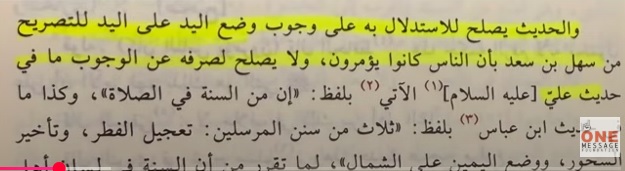
Shaykh Uthman, while reading from a text, says: @15:04 “We were ordered in the time of the Prophet (saw), as Abu Hazim has clarified, to fold the hands, right on left in the prayer.”
Which Arabic in the text below is he rendering as: ‘In the time of the Prophet’ ?
Often Shaykh Uthman makes mistakes in his Arabic.
@16:03 “Ali radianhu” ???
Insh’Allah we will come back to this hadith. This hadith they feel is their ultimate trump card. Suffice it to say that the text does not say: “were orderedin the time of the Prophet.”
They wish it said that!
We remind Shaykh Uthman the seriousness about lying on the Blessed Prophet (saw).
Narrated `Ali:
The Prophet (saw) said, “Do not tell a lie against me for whoever tells a lie against me (intentionally) then he will surely enter the Hell-fire.”
Does this really need any comment? Does one really see anything in this text about the placement of hands in the prayer?
Shaykhk Uthman says: @17:12 “Imam Malik himself and I’m going to put a link to the Muwatta Imam Malik in the description. He has an entire chapter in his Muwatta about folding the hands in prayer; from the people of Medina. Not a single hadith in the Muwatta, not a single chapter that says, ‘dangle the hands in prayer’. And Imam Malik style of writing if he saw the people of Madina doing something opposite to that which was narrated, then in the Muwatta he would write, ‘This is what is narrated, but the people of Madina did opposite. But he did not say that about folding the hands.”
There are a few points to take note of.
The Muwatta is not the only work attributed to Imam Malik. The following are also attributed to him.
al-Mudawwanah al-Kubrā
Risālat Mālik ilā al-Layth ibn Saʿd
al-ʿUtibiyyah
2. @12:31 Shaykh Uthman didn’t actually give us the quote that is from Malik on his stance.
3. As we mentioned in our other article. Just because someone narrated something doesn’t mean they acted upon what was narrated. Narrating a hadith shows awareness of its existence.
4. Fiqh is stronger than hadith. Hadith is a narration and fiqh is understanding of the narration.
We mentioned that we would come back to this: “were orderedin the time of the Prophet.”
Narrated Sahl bin Sa`d:
The people were ordered to place the right hand on the left forearm in the prayer. Abu Hazim said, “I knew that the order was from the Prophet (saw) .”
Abdullah ibn Maslamah narrated to us, from Malik, from Abu Hazim, from Sahl ibn Sa’d, who said: “People were commanded that a man should place his right hand on his left forearm during prayer.” Abu Hazim said: “I know of it only as being attributed to the Prophet (peace be upon him).” Isma’il (a narrator in the chain) said: “It is attributed” — and he did not say “he attributes it.”
Effectively, the hadith they think is a trump card actually is an athar. It doesn’t describe something that the Blessed Prophet (saw) did. It describes actions that people did that were attributed to the Prophet (saw).
A note about Sahl ibn Sa’d: He lived to see the Umayyad imperium.
Al-Bukhari’s hadith comes through two chains: one from ‘Abdullah ibn Maslama and the other from Isma‘il ibn Abi Uways, both narrating from Imam Malik ibn Anas, from Abu Hazim, from Sahl ibn Sa‘d, who said: “The people used to be commanded…”
• In the narration of ‘Abdullah ibn Maslama, Abu Hazim said: “I do not know it except that he attributes it (yanmī dhālika) to the Blessed Prophet (saw).”
• In the narration of Isma‘il ibn Abi Uways, it says: “I do not know it except that it is attributed (yunmā dhālika) to him.”
Based on this, the hadith is defective (ma‘lūl), weak, and cannot be used as evidence, because it is merely Abu Hazim’s supposition, and it is also inconsistent (muḍṭarib).
20 different chains from 18 different sahabah?
A Sunni, Maliki scholar Shaykh Abdullah bin Hamid Ali translated a work that showed the problems in these chains.
So when the Shi’i man says: “Within Ahl Sunnah there is no single proventradition from the holy prophet (peace be upon him and his family in regard to folding of the hands in prayer.”
Proven (adjective) = established beyond doubt.
This is correct.
As the article by Shaykh Abdullah states:
“True or not, there exists sufficient doubt about every single report that exists to this effect that weakens the “popular” claim and understanding that it is well established that the Prophet prayed while placing one hand over the other.”
You may also be interested in reading the following:
Shaykh Uthman Ibn Farooq, his first point, lands hard. That was quite embarrassing for the Shi’i to quote that as a reference. Also, something Shi’i has to contend with is the idea of women praying with their hands folded.
However, Shaykh Uthman Ibn Farooq himself blatantly lied and misled his audience concerning what the Arabic text said.
“And if you fear that you will not deal justly with the orphans,then marry other women those that please you, two or three or four. But if you fear that you will not be just, then marry only one or those your right hand possesses. That is more suitable that you may not incline to injustice.“(Qur’an 4:3)
﷽
The above-mentioned verses have been used by self-proclaimed spokespersons for Islam past and present, albeit unwittingly, to regulate these verses to redundancy.
So it is disheartening to see Muslims with a ‘modernist‘ bent turn certain verses of the Qur’an to redundancy.
Also, we all need to be very careful not to prohibit that which Allah (swt) has made permissible.
“O you who have believed, do not prohibit the good things which Allah has made lawful to you and do not transgress. Indeed, Allah does not like transgressors.”(Qur’an 5:87)
Redundant Revelation: The Question of Polygyny.
The example we will discuss today is the following verse:
“And if you fear that you will not deal justly with the orphans, then marry other women, those that please you, two or three or four. But if you fear that you will not be just, then marry only one of those whom your right hand possesses. That is more suitable that you may not incline to injustice.” (Qur’an 4:3)
We would also have to rank this particular verse of the Qur’an as the one most used and abused.
We would have to say those who ‘use and abuse’ it the most are those who follow under three broad categories.
Category A)
‘Modernists’ or ‘reformers’.
Category B)
The next group most likely to abuse these verses are those Muslims who consider themselves ‘traditionalists’. Often they are trying to find favour with post-modern liberalism.
Category C)
The last group that we would say that are most likely to abuse these verses are those who follow the ‘Hafs Qur’an only’ Religion.
What do we mean by abuse of the text?
Flat lies concerning the Asbab Al-Nuzul?
By this we mean those who are usually not favorable towards traditionalist interpretation will tell you how this verse was ‘revealed during the context of a war’. They will mention how there was a ‘surplus of all these widows’ and ‘men just rushed out to marry them all.’ This is to elicit the ‘Oh, so very noble‘ response from you.
The reality of this verse is that it does no such thing. It doesn’t tell me to marry widows. In fact, the next time someone tells you that this verse was revealed in the context of war, ask them:
“Can you kindly show me the source for this information?”
This is not in the Asbab Al-Nuzul by Al Wahidi.
“(And if you fear that you will not deal fairly by the orphans…) [4:3]. Abu Bakr al-Tamimi informed us> ‘Abd Allah ibn Muhammad> Abu Yahya> Sahl ibn ‘Uthman> Yahya ibn Za’idah> Hisham ibn ‘Urwah> his father> ‘A’ishah who said, regarding the words of Allah (And if you fear that you will not deal fairly by the orphans): “This was revealed about any custodian under whose care is a female orphan who possesses some wealth and does not have anyone to defend her rights. The custodian refuses to give this orphan in marriage out of greed for her money, harms her, and treats her badly. And so Allah, exalted is He, says (And if you fear that you will not deal fairly by the orphans marry of the women, who seem good to you…) as long as they are lawful to you and leave this one”. This was narrated by Muslim> Abu Kurayb> Abu Usamah> Hisham. Sa‘id ibn Jubayr, Qatadah, al-Rabi‘, al-Dahhak and al-Suddi said: “People used to be wary of the wealth of orphans but took liberty with women and married whoever they liked. And sometimes they were fair to them and sometimes they were not. So when they asked about the orphans and the verse (Give unto orphans their wealth), regarding the orphans, was revealed, Allah, exalted is He, also revealed (And if you fear that you will not deal fairly by the orphans). He says here: ‘Just as you fear that you will not deal fairly by the orphan, so should you fear that you do not deal fairly by women. Therefore, marry only as many as you can fulfill their rights, for women, are like orphans as far as weakness and incapacity are concerned’. This is the opinion of Ibn ‘Abbas according to the narration of al-Walibi”.
This idea that these verses were revealed during the context of war is not in the Tanwir al-Miqbas of Tafsir Ibn Abbas.
This idea that these verses were revealed during the context of war is not in the Tafsir of Al Jalalayn.
This idea that these verses were revealed during the context of war is not in the Tafsir of Al Qushairi.
This idea that these verses were revealed during the context of war is not in the Tafsir of Ibn Kathir.
Not limited to asbab al-nuzul.
Now, even if we were to imagine that the order to marry only orphans or up to four women came during the context of war (which we still await evidence of), even then it would not be limited to that context. Asbab al-nuzul is the timing that Allah (swt) feels is appropriate to deliver a specific revelation.
It would be very strange if the Blessed Prophet (saw) and his companions were having a meal together and suddenly a revelation came saying, “Marry women of your choosing, 2, 3 or 4...” It makes sense that certain rulings are revealed in a certain context. However, it does not mean they are limited only to that context. If that was the case, we would have real problems in the implementation of the Qur’an 2:256.
Masruq said: “A man from the Helpers, from among the Banu Salim Banu ‘Awf, had two sons who had converted to Christianity before the advent of the Prophet, (saw). After the migration of the Prophet,(saw), these two sons came to Medina along a group of Christians to trade in food. Their father went to them and refused to leave them, saying: ‘By Allah! I will not leave you until you become Muslim’. They refused to become Muslim and they all went to the Messenger of Allah, (saw), to settle their dispute. The father said: ‘O Messenger of Allah! How can I leave a part of me to enter hell fire while I just sit and look?’ Allah, glorious and majestic is He, then revealed (There is no compulsion in religion…) after which he let them go”.
If we are to follow the logic of modernists, who say that the Qur’an 4:3 only applies to the context of orphans and/or to women after the war, it would mean that the Qur’an 2:256 only applies to sons. Or it only applies to those who convert to Christianity. So, this means if they were daughters they could be compelled. This means if they converted to a religion other than Christianity, they could be compelled to. Would anyone reason like this?
What is the context of the Qur’an 4:3?
The whole context of the Qur’an 4:1-12 is the distribution of wealth and property.
Quite a number of conflicts in tribal society would erupt over this. It happens until this very day. We find people fighting over the distribution of property and wealth even in our times.
So let us look at the verse in question again.
“And if you fear that you will not deal justly with the orphans, THEN marry other women those that please you, TWO or three or four. But if you fear that you will not be just, then marry only one or those your right hand possesses. That is more suitable that you may not incline to injustice.“(Qur’an 4:3)
Note three interesting points.
POINT 1)
The verse starts off with ‘And if you fear that you will not deal justly with orphans, then.….”
So let us look at the verse before this one.
“And give to the orphans their properties and do not substitute the defective [of your own] for the good [of theirs]. And do not consume their properties into your own. Indeed, that is ever a great sin. (Qur’an 4:2)
This is in context with a verse that comes later:
“Indeed, those who devour the property of orphans unjustly are only consuming into their bellies fire. And they will be burned in a Blaze.” (Qur’an 4:10)
POINT 2)
After orphans, it addresses marrying women who are neither orphans nor slaves.
Notice that it starts off by saying, “Marry 2, or 3 or 4. It is interesting that it does not start off by saying, ” marry 1.”
Now if one wanted to manipulate the Qur’an in the way that Muslims who pander to post-modern liberalism do, you could make the argument that marrying 2 was imperative!
You could also make the argument that 2 is actually optimal followed by more; as 1 was simply offered up as a ‘better than nothing’ solution.
So the fact that it starts off by saying “marry 2” is interesting and flat out neglected (ignored?) by post-modern liberal interpretations.
However, we have also noted that those given to post-modern- liberal interpretations will say, “2 or 3 or 4 but if you cannot deal justly with them, then only one.“
Yet the text does not stop there. There is a conjunctive.
The Arabic word ‘aw’ which means ‘or’
There is a flow that I feel is ignored by the three categories (mentioned above).
So then the verses pick back up by saying, “but if you fear that you will not deal justly, then marry those whom your right hand possesses.”
This is addressed here:
“And whoever among you cannot [find] the means to marry free, believing women, then [he may marry] from those whom your right hands possess of believing slaves. And Allah is most knowing about your faith. You [believers] are of one another. So marry them with the permission of their people and give them their due compensation according to what is acceptable. [They should be] chaste, neither [of] those who commit unlawful intercourse randomly nor those who take [secret] lovers. But once they are sheltered in marriage, if they should commit adultery, then for them is half the punishment for free women. This is for him among you who fears sin, but to be patient is better for you. And Allah is Forgiving and Merciful.” (Qur’an 4:25)
So, if we are to follow the approach that some people take, and we are to be consistent, we should understand Qur’an 4:2-3 as this.
1) You should marry orphans first and foremost.
2) Failing to do justice to them, you should marry free-believing women.
3) Failing to deal with them justly, you should marry those whom your right hand possesses.’
However, notice it stops here. Why does it not continue and say, failing to do justly with them…. etc.?
1) How the translators have used the conjunction ‘aw‘.
2) How they have translated ‘Thus it is more likely that you will not do injustice.’
The whole thrust of Qur’an 4:3 if one looks at it in light of the overall context of the distribution of wealth and property is what is a man looking at getting married for?
What may he find beneficial for him? In fact, the verse itself is obviously directed towards men.
It tells us that men may find the idea of marrying an orphan appealing, as some may want to usurp their property, wealth, and/or belongings, as we are told in the Qur’an 4:10.
“Indeed, those who devour the property of orphans unjustly are only consuming into their bellies fire. And they will be burned in a blaze.” (Qur’an 4:10)
It then goes into the idea of marrying free-believing women. Nowhere does the verse say that we are to marry one woman. Interestingly enough, it starts off with the number two.
However, a man may find that he still has financial constraints in trying to marry free-believing women.
Thus, it is simultaneously brought to his attention to marry his slave women.
This is dealt with in more detail in Qur’an 4:25.
“And whoever among you cannot [find] the means to marry free, believing women, then [he may marry] from those whom your right hands possess of believing slave girls. And Allah is most knowing about your faith. You [believers] are of one another. So marry them with the permission of their people and give them their due compensation according to what is acceptable. [They should be] chaste, neither [of] those who commit unlawful intercourse randomly nor those who take [secret] lovers. But once they are sheltered in marriage, if they should commit adultery, then for them is half the punishment for free women. This is for him among you who fears sin, but to be patient is better for you. And Allah is Forgiving and Merciful.” (Qur’an 4:25)
So let us look at the other verse that is brought in to say that Muslim men can only marry one woman.
“And you will never be able to be equal between wives, even if you should strive [to do so]. So do not incline completely [toward one] and leave another hanging. And if you amend [your affairs] and fear Allah – then indeed, Allah is ever Forgiving and Merciful. (Qur’an 4:129)
This verse is nowhere telling men that, because they cannot deal justly with more than one wife that they should marry only one. The context itself tells us this. The following sentence reminds the man not to incline towards one wife, letting the other feel neglected.
What we feel many of us neglect when reading the Qur’an 4:129 is that not only do men read this verse, but women do too! Thus, women are reminded that men won’t be able to be totally equal in all respects. Some women may have more needs than others. You may have a wife who has a mental or physical handicap. So this verse is also a reminder to women to keep the larger picture in mind.
Hafs Only Qur’an Religion begin their manipulation of the translation.
In fact, you will see that the post-modern ‘free minds translation’ of the Qur’an is being manipulated right here:
“And you will not be able to be fair regarding the women even if you make every effort; so do not sway too greatly and leave her as one hanging in a void. And if you reconcile and do right, then God is Forgiver, Merciful.”.
Wouldn’t be surprised if they ‘clean up’ this translation later. Notice the verse is obviously addressing women (plural) and then suddenly the theme is switched to one woman (the wife)?
Manipulation of the text at its best!
There is no text in the Qur’an that tells men they are restricted to marrying only one wife.
If Allah (swt) wanted Muslim men to marry only one woman, he would have told us this in very clear terms.
If we are to believe the view of modernists, this means that when the Qur’an mentions 2 or 3 or 4 and then says, well, in reality it only means one is to say the Qur’an is not only couched in obfuscation but that it contains redundant language.
Surely, as Allah (swt) says, if the oceans were ink to write his words, the oceans would deplete before Allah (swt) would run out of things to say.
Say: “If the ocean were ink to write the words of my Lord, sooner would the ocean be exhausted than would the words of my Lord, even if we added another ocean like it for its aid.” (Qur’an 18:109)
Surely, Allah (swt) would say simply marry only one. Simple.
Now one thing I want to clear up is that the Qur’an is not saying that it is mandatory for a man to marry more than one woman.
However, to say that the Qur’an does not allow men to marry more than one wife is simply pandering to a post-modern liberal world view.
Mind you, there are also those who say, well, if a man marries another woman, she should be absolutely destitute, having been divorced and so forth.
The Qur’an also does not say those marrying women who are destitute or divorced are a priority. Again, these are people who seek to impose their own criteria on whom a man may or may not marry. Did these very people go and seek to marry the handicapped, the most destitute, those considered ‘undesirable’ by society?
To marry such people is a choice. The irony is that many men and women who claim that the verse in Qur’an 4:3 is only in regard to women who are destitute and down and out not only ignore the verse itself but gives the impression that women are weak and powerless.
Note the following part of the verse again,
THEN marry other women those that please you, TWO or three or four.
These “other women” are not slaves nor orphans. There are women in a society that are socially upwardly mobile. Women in society that are wealthy or have careers. These women want husbands because they have any number of needs.
They might want children. They could simply want affection and male companionship. They could want sexual gratification. They might feel more secure being in a relationship with a man that has already proven he can be a good Imam for his children and household than to risk a marriage with someone who is unproven.
The point is that if a woman or any woman who marries a man of their own free will and volition are in agreement with such an arrangement, then who are we to impose post-modern liberal values upon them?
It is also interesting to note that verse 4:129 does not say “You will not be able to love them equally.” The theme is justice.
Allah (swt) is admonishing the husband by taking the perspective of one of the wives. Allah (swt) is also reassuring a husband who may be having doubts about his ability to be a good husband that He (Allah) is forgiving and merciful.
In the end, perfect justice is the purview of the divine; and complete and perfect justice belongs only to Allah (swt).
“Have you not turned your vision to those who claim sanctity for themselves? Nay-but Allah Does sanctify whom He pleases. But never will they fail to receive justice in the least little thing.” (Qur’an 4:49)
Muslim men can marry an unrestricted number of women according to modernist, liberal interpretations!
You read that correctly! If we are to believe, even for a moment, the modernist interpretations of the Qur’an, then it means that Muslim men can not only marry 4 wives but possibly 5,6, 7 unlimited! Why? Because, according to them, Qur’an 4:3 is an example of takhsees—the specification of a general ruling.
1) The Qur’an nowhere tells us to marry only one woman. It obviously has no such verse if it does indeed tell men they can marry more than one orphan (as modernists agree it says).
2) If Qur’an 4:3 is only restricted to orphans, and it does not mean women in general, then this means it is laying down no rules concerning women other than orphans. So the marry-up to 4 rule is only applicable to orphans. This means that for modernists, the Qur’an gave no principle in regard to women who are not orphans, therefore allowing a man to marry an unrestricted number of women!
Conclusion:
The Qur’an nowhere restricts men from marrying only one wife. Even those people who say that marrying more than one wife is only concerning orphans are the same people who would say that polygyny is not applicable today! Even though there are certainly orphans in Yemen, Syria, Palestine. Anyone who leaves their ivory tower in Indonesia, Bangladesh, India, Malaysia, the Philippines knows there are plenty of orphan women.
The people who restrict polygyny to only orphans have actually unwittingly given license for men to marry an unlimited number of women! Those who are dead set against polygyny claim that the Qur’an 4:3 was revealed in the context of war, and yet they do not furnish proof of this. It is clear there is no verse in the Qur’an that tells men not to marry more than one woman.
If there was such a verse, the opponents of polygyny would produce it. Obviously, no verse can exist as it would contradict even by their own standards concerning Qur’an 4:3. As regards saying that no man can deal justly with more than one woman, therefore, they are to marry one, Allah (swt) himself said that a man would not be able to deal justly but admonished a man not to incline towards one wife and neglect the other.
You may be interested in reading the following entries:
“Moreover, no burdened soul can bear another’s burden. And if one weighed down by a burden calls another to carry his load, zero of it will be carried, even though he is near to kin. You warn only those who fear their Lord in secret and keep up prayer. And whoever purifies himself purifies himself only for his own good. And to Allah is the eventual coming.”(Qur’an 35:18)
﷽
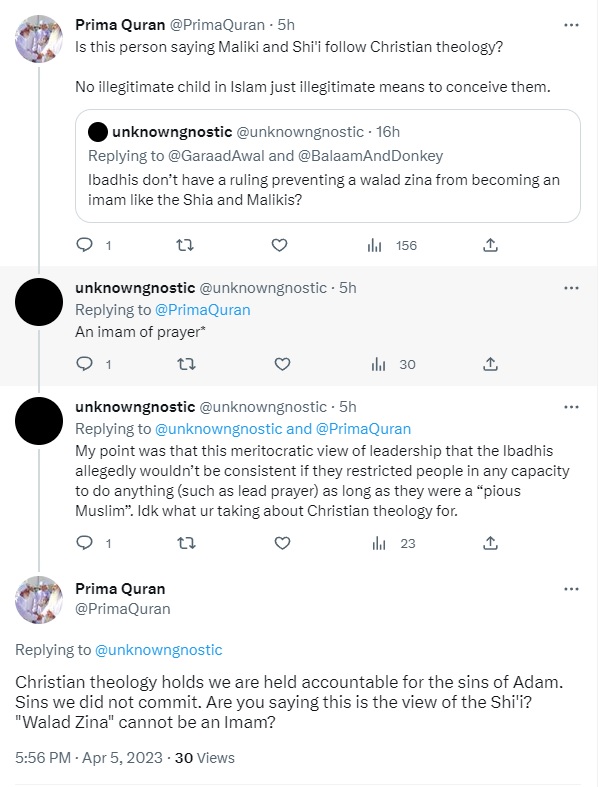
Recently, there were some questions asked by an Ismaili Shi’i about the Ibadi school and whether we allow for the “Walad Zina” to be the Amir of the Muslims, as opposed to the Shi’i or the Maliki.
It was over all a passionate and cordial exchange, and it is hoped that you the reader will benefit.
From the view of the Ibadi school, we need to get something absolutely clear. There is no such thing as an illegitimate child in Islam. There is such a thing as an illegitimate means to conceive a child. A child by right should be brought into the world through wedlock, via marriage.
However, a child in any situation is through the decree of Allah (swt), a blessing from Allah (swt) and an amana (a trust) from Allah (swt).
This idea that some children are tainted by the actions of their parents is alien to the Qur’an. It is a Christian theological concept. To be fair to Christians, the (Disciples of Christ -Campbell Movement) do not believe in inherited sin.
It is overall all a Christian theological concept that we are culpable for what Adam did. We did not tell Adam to eat that apple, did you?
So there is this idea that is very prevalent in Asian society and culture. That idea is that if the son is a hooligan or the daughter did something shameful, it brings shame to the family. No! There is no shame in that family that shame belongs to the individual alone!
“And recite to them the story of Adam’s two sons, in truth, when they both offered a sacrifice [to Allah], and it was accepted from one of them but was not accepted from the other. Said [the latter], “I will surely kill you.” Said [the former], “Indeed, Allah only accepts from the righteous [who fear Him].” (Qur’an 5:27)
So we know among the Ahl Bayt (Household/Tribe/Tent/Lineage) of Adam, that he had two sons. One of his sons was a murderer and the other was murdered. Does this shame cover Adam, Huwa and the son who was murdered? No it does not.
The shame and the guilt belong to the culprit alone.
Let us present a scenario to you: from the dhahir — (the apparent) — what is known—and the ghaib (the unseen).
Now imagine a scenario where a young man (14 years of age), a hafiz of the Qur’an, has beautiful memory retention and recitation. He would like to lead the congregation for the tarweeh prayers in Ramadan.
He is interviewed by the local Mosque Imam (an elder) and the chairperson. They ask the boy, “Can you tell us about the sins of your father?”
What?! May Allah (swt) guide us! May Allah (swt) forgive us! May Allah (swt) open our hearts and eyes.
Imagine you go to an interview and you prepared your resume and your references.
So the hiring department manager says to you, “Can I take a look at your father’s resume and his work history?”
What?! For what? You are the one being hired, not your father.
Another Ismaili Shi’i had messaged one of our team members to ask about women leading the prayer. However, these are not the same categories. As Ismaili Shi’i also have never had a female Imam nor would they allow it. So the question put forward to this Ismaili Shi’a was: “How is claiming that your school is more discriminatory than the Ibadi school a point in your favour?” At that point the individual offered no more interaction.
We do not have a single ruling in our school where a female child would be excluded from anything based upon sins that her parents committed.
The questions still remain. Is it the position of the Shi’i (Ismaili, 12er, Zaydi) that a person is judged based upon what his/her father/mother has done?
In fact, this question should be a cause of pensive reflection. (For the 12er and Ismaili in particular).
Why?
Because if they have a ruling in their books that ‘Walad Zina’ cannot be an Imam, it means that the possibility is there for this to occur, otherwise it wouldn’t be in your books of jurisprudence to begin with. Let them spend time in reflection on what this entails for them and their view of Imams.
How is a child brought in this world? Remember, we don’t believe children bring themselves into being. They are brought into being through conception (which they have no power over). How does such a child be held culpable for the actions of their parents?
Furthermore, it is a matter of Islamic Aqidah that any and all babies and children who die before they reach their age of accountability enter into Jannah without accountability!
This means the worst possible people in history you can imagine. Even if these people were the oppressors and butchers of Muslims themselves, if their young ones died they would enter into Jannah.
That being the case, why will we use such a disgusting appellation ‘Walad Zina’?
Granted, in jurisprudence, if you are talking about the issues surrounding inheritance, it is another matter. Is this child adopted or were they conceived via wedlock or not?
However, to give such a title as if it were some permanent nomenclature ‘Walad Zina’ is akin to calling all the Messengers and Prophets of Allah (swt), ‘The great-great-grandsons of a sinner.’
We don’t use that as some type of permanent nomenclature for the honorable Messengers and Prophets of Allah (swt).
Adam (as) is not remembered as the sinner but as the repentant and one whom Allah (swt) himself taught words of reconciliation, wrapping him up swiftly in a rapture of divine mercy and comfort!
As a Muslim ummah, we need to turn away from this imported Christian theological concept.
This view has no basis in the Qur’an. As unfortunate as the child’s means of coming into the world is, that child’s very being, essence and existence and every breath is a chance to extol the praise and glory of Allah (swt). To render service to his/her parents, community, nation and to all people and even creatures of this Earth.
In the case of the man in particular, will he not get married? Then he will be an IMAM of his family.
Will he not lead the prayers? Then he will be the IMAM of the prayer.
Such a person is righteous and if Allah (swt) has chosen to lead the Muslims, we would give our hands and take the oath of allegiance.
Such a person can be the Amir of the Muslims and Allah (swt) knows best. We want to thank my Shi’i interlocutor for a passionate and respectful discussion.
If there are any Shi’i reading this that have additional resources, books of jurisprudence and/or remarks that they feel add to the dialogue, feel free to do so in the comment section.
If you are interested, you may wish to read the following articles:
“And do not marry polytheistic (l-mush’rikati) women until they believe. And a believing slave woman is better than a polytheist, even though she might please you. And do not marry polytheistic men [to your women] until they believe. And a believing slave is better than a polytheist, even though he might please you. Those invite [you] to the Fire, but Allah invites to Paradise and to forgiveness, by His permission. And He makes clear His verses to the people that perhaps they may remember.” (Qur’an 2:221)
﷽
“And do not marry polytheistic (l-mush’rikati) women until they believe. And a believing slave woman is better than a polytheist, even though she might please you. And do not marry polytheistic men until they believe. And a believing slave is better than a polytheist, even though he might please you. Those invite [you] to the Fire, but Allah invites to Paradise and to forgiveness, by His permission. And He makes clear His verses to the people that perhaps they may remember.” (Qur’an 2:221)
This verse is known as ‘Aam. It is general. The ruling applies in all situations unless there is an exception made.
The exception to this ruling is the following verse:
“This day [all] good foods have been made lawful, and the food of those who were given the Scripture is lawful for you and your food is lawful for them. And [lawful in marriage are] chaste women from among the believers and chaste women from among those who were given the Scripture before you, when you have given them their due compensation, desiring chastity, not unlawful sexual intercourse or taking [secret] lovers. And whoever denies the faith – his work has become worthless, and he, in the Hereafter, will be among the losers.” (Qur’an 5:5)
This above verse is khaas — It is specific. Notice the words: “This day” meaning before that it was not the case. This often happens in the Qur’an. There is a general ruling and there is either further restriction on a certain aspect or an allowance to the general ruling.
This specific verse also has a further specification in that this allowance is only given to Muslim men to marry the mushrik women from among the People of the Book. Whereas a Muslim woman is not allowed to marry the mushrik men from among the People of the Book.
Why this specific allowance? The Qur’an mentions the Torah and the Injeel. There are shared histories, prophets and beliefs about angels and so forth. The thinking is that the mushrik women from among the People of the Book will be moved by the compassion, love, protection, warmth and guidance given by the Muslim husband. Also, considering that in the situation where such a marriage would be allowed, the children would be Muslim by default, there should be little barrier for these mushrik from the Ahl Kitab to embrace Islam.
For example: Mariyah al-Qibtiyyah (May Allah be pleased with her) was a Christian whom, after marrying the Blessed Prophet (saw), converted to Islam, and she died upon the haqq!
However, note the warning by Allah (swt).
“And whoever denies the faith — his work has become worthless, and he, in the Hereafter, will be among the losers.” An understanding that this could go the other way. The mushrik woman may convince the man to leave his faith.
This is why it becomes all the more clear under which situations and circumstances the Ibadi school allows such marriages to take place.
Fight those who do not believe in Allah or in the Last Day and who do not consider unlawful what Allah and His Messenger have made unlawful and who do not adopt the religion of truth from those who were given the Scripture – [fight] until they give the jizyah willingly while they are humbled. The Jews say, “Ezra is the son of Allah “; and the Christians say, “The Messiah is the son of Allah .” That is their statement from their mouths; they imitate the saying of those who were kafara (ungrateful disbelievers [before them]. May Allah destroy them; how are they deluded? They have taken their scholars and monks as lords besides Allah , and [also] the Messiah, the son of Mary. And they were not commanded except to worship one God; there is no deity except Him. Exalted is He above whatever they associate (yush’rikuna) with Him. They want to extinguish the light of Allah with their mouths, but Allah refuses except to perfect His light, although the (ungrateful disbelievers) dislike it. It is He who has sent His Messenger with guidance and the religion of truth to manifest it over all religions, although those who associate others (l-mush’rikuna) with Allah dislike it. (Qur’an 9:29-33)
“Those who say, “Allah is the Messiah, son of Mary,” have certainly become ungrateful disbelievers. The Messiah ˹himself˺ said, “O Children of Israel! Worship Allah—my Lord and your Lord.” Whoever associates (yush’rik) others with Allah ˹in worship˺ will surely be forbidden Paradise by Allah. Their home will be the Fire. And the wrongdoers will have no helpers. Those who say, “Allah is one in a Trinity,” have certainly become ungrateful disbelievers.There is only One God. If they do not stop saying this, those who disbelieve among them will be afflicted with a painful punishment.” (Qur’an 5:72-73)
Those slippery followers of Perennialism and Qur’an 5:5
“This day [all] good food have been made lawful, and the food of those who were given the Scripture is lawful for you and your food is lawful for them. And [lawful in marriage are] chaste women from among the believers and chaste women from among those who were given the Scripture before you, when you have given them their due compensation, desiring chastity, not unlawful sexual intercourse or taking [secret] lovers. And whoever denies the faith – his work has become worthless, and he, in the Hereafter, will be among the losers.” (Qur’an 5:5)
Now, the slippery among those who follow perennialism have three choices here.
Tell us the sect/denomination of Christians today that would meet the acceptable criteria of “believers” and those upon true understanding of Allah, that would be acceptable in accordance with declarations made by the Qur’an. Those that would not meet with damnation because of their theological positions? Would they be Orthodox Christians? Catholic Christians? Protestant Christians? Perhaps Jehovah’s’ Witness and/or Unitarian Christians?
Admit that such Christians from Ahl Kitab are no longer existent and thus, this verse, as much as it applies to such Christians, is no longer operational.
Concede the point to the correct understanding that the Ibadi school has of the verses.
“And to warn those who claim, Allah has taken to Himself a son, a thing about which they have no knowledge, neither they nor their ancestors. Dreadful is the word that comes out of their mouths. What they utter is merely a lie.” (Qur’an 18:4-5)
Why warn those who claim this?
Because anyone who makes false claims about Allah (swt) will be brought for punishment.
“Allah has children. They are simply liars. Has He chosen daughters over sons? What is the matter with you? How do you judge? Will you not then be mindful? Or do you have any compelling proof? Then bring us your scripture, if what you say is true! They have also established a relationship between Him and the jinn. Yet, the jinn themselves know well that such people will certainly be brought for punishment. Glorified is Allah far above what they claim!” (Qur’an 37: 152-159)
Furthermore, as we explained in our article about the correct understanding if Allah (swt) forgives shirk or not we have shown the text that is relied upon is a reference to the Ahl Kitab.
“Surely Allah does not forgive associating (yush’raka)˹others˺ with Him ˹in worship˺, but forgives anything else of whoever He wills. Indeed, whoever (yush’rik) associates ˹others˺ with Allah has clearly gone far astray.” (Qur’an 4:116)
“Indeed, Allah does not forgive associating (yush’raka) others with Him ˹in worship˺, but forgives anything else of whoever He wills. And whoever (yush’rik) associates others with Allah has indeed committed a grave sin.” (Qur’an 4:48)
“O you who were given the Scripture, believe in what We have sent down, confirming that which is with you, before We obliterate faces and turn them toward their backs or curse them as We cursed the sabbath-breakers. And ever is the decree of Allah accomplished. Indeed, Allah does not forgive association with Him, but He forgives what is less than that for whom He wills. And he who associates others with Allah has certainly fabricated a tremendous sin. Have you not seen those who claim themselves to be pure? Rather, Allah purifies whom He wills, and injustice is not done to them, [even] as much as a thread [inside a date seed]. Look how they invent about Allah untruth, and sufficient is that as a manifest sin. Have you not seen those who were given a portion of the Scripture,who believe in superstition and false objects of worship and say about the disbelievers, “These are better guided than the believers as to the way”? (Qur’an 4:47-4:51)
This particular issue is one in which an orientalist and western academic made a mistake in regard to the jurisprudence of the Ibadi school. You can see our comment on that error here:
“But why do they come to you for judgment when they have the Torah containing Allah’s judgment, then they turn away after all? They are not believers.” (Qur’an 5:43)
“Indeed, We revealed the Torah, containing guidance and light, by which the prophets, who submitted themselves to Allah, made judgments for Jews. So too did the rabbis and scholars judge according to Allah’s Book, with which they were entrusted and of which they were made keepers. So do not fear the people; fear Me! Nor trade my revelations for a fleeting gain. And those who do not judge by what Allah has revealed are the disbelievers.” (Qur’an 5:44)
﷽
There is a very, very easy way to avoid the legal punishments for adultery in Islam. In fact, a person could live in a political entity in which punishments for committing adultery are enacted and never even have to worry about them at all.
It is very similar to living in a nation in which there are strict punishments for killing someone. The very easy way to avoid the repercussions and legal punishments is simply not to do the acts.
Can you imagine our opponents? “No, a man should have the right to cheat on his wife!” “No, a woman should have the right to cheat on her husband!”
Rather than discuss the sternness of the punishment, the discussion should really centre around questions of intelligence and decision-making.
Is cheating on your husband or wife a good decision or a bad decision?
Is cheating on your husband or wife an intelligent decision in a society where you could be stoned to death for such actions?
Is cheating on your husband or wife an intelligent decision when one has recourse to more wives (in the case of a man) or recourse to divorce (man and woman)?
Notwithstanding the Islamic legal punishment for adultery we read numerous reports across numerous countries, and cultures about the rash acts that husbands and or wives commit when they find that their partner has cheated on them.
Any search engine can pull up the latest murders, murder-cum-suicides and rage-fueled actions taken by those who felt betrayed by the man or woman most dear to them. Someone they never felt would betray them in such a manner.
So, before we even get to the punishment for adultery, an ideal Islamic society would have several measures and safeguards in check before an individual were to make unintelligent decisions.
One would be taught: Ad-Darooriyyat Al-Khams—The Five Basic Necessities that are protected and recognized by Islamic law-shari’ah.
This would fall under the category of: preservation of lineage.
Growing up in a strong family household with emphasis upon respect for oneself. Emphasis upon reverence to Allah (swt).
A strong emphasis upon proper interaction between the genders.
A strong emphasis upon the respect that is due to marriage and a strong desire not to cause discord between a wife and husband.
Understanding that sexuality is something sacred and intimacy can create strong bonds between two people.
Marriage is the completion of half of one’s Islam.
Marriage is the backbone upon which healthy communities and healthy socities are brought about.
That your spouse will be your partner through joy and hardships.
That such a relationship should be built upon trust and not lust.
The understanding that if one commits a major sin and does not repent from that sin and dies while in that state that one will be in an eternal agony far worse than any prescriptive punishment meted out by human beings on Earth.
The understanding that if one’s marriage is not working out that one has the recourse to divorce. Divorce can be a solution to a marriage which lacks love, intimacy, passion, friendship, companionship, mercy, trust, cooperation and depth.
That divorce is not a source of shame nor does one need to be stigmatized because of it.
Before we continue, let it be known to the reader that, under previous administration of this site, our brother was of the incorrect view that rajm (stoning) for adultery was not part of the Islamic penal code. He has publicly recanted and publicly repented from that position. May Allah (swt) forgive him and guide any who has been misled about this.
He held the position not because he had liberal or modernist leanings or tendencies. He held that position that rajm (stoning) for adultery was not part of the Islamic penal code because he believed that it was the strongest position based on the evidence from the Qur’an and Sunnah.
Thus the importance of taking knowledge from the learned.
He did not hold the position due to liberal or modernist leanings for three reasons.
He believes in the eternality of the hellfire for all who enter it. This is not a liberal or modernist position.
He believes in a penal punishment that we imagine could be more painful and excruciating than rajm (stoning) and that is to be ‘lifted up’ or impailed according to the Qur’an 5:33. He has informed us this was always his view.
He believed that, due to what he saw as the ambiguity of ‘rajm’ as a punishment, that he was following Qur’an 5:32 “Whoever saves a life it’s as if he saved the whole of mankind.”
Insh’Allah we link to his original article so people can see the evolution in his thought process.
So consider this article a self-refutation. A more learned primaquran refuting a less learned primaquran.
It is also our sincere hope that, at any point, we are mistaken in a position, or misrepresent the views of others that Allah (swt) guides us to the right action and the correct course.
Let us start with this insightful hadith concerning the Mother of the believers.
Narrated Yusuf bin Mahk:
While I was with Aisha, the mother of the Believers, a person from Iraq came and asked, “What type of shroud is the best?” `Aisha said, “May Allah be merciful to you! What does it matter?” He said, “O mother of the Believers! Show me (the copy of) your Qur’an,” She said, “Why?” He said, “In order to compile and arrange the Qur’an according to it, for people recite it with its Suras not in proper order.” `Aisha said, “What does it matter which part of it you read first? (Be informed) that the first thing that was revealed thereof was a Sura from Al-Mufassal, and in it was mentioned Paradise and the Fire. When the people embraced Islam, the Verses regarding legal and illegal things were revealed. If the first thing to be revealed was: ‘Do not drink alcoholic drinks.’ people would have said, ‘We will never leave alcoholic drinks,’ and if there had been revealed, ‘Do not commit illegal sexual intercourse, ‘they would have said, ‘We will never give up illegal sexual intercourse.’ While I was a young girl of playing age, the following Verse was revealed in Mecca to Muhammed: ‘Nay! But the Hour is their appointed time (for their full recompense), and the Hour will be more grievous and more bitter.’ (54.46) Sura Al-Baqara (The Cow) and Surat An-Nisa (The Women) were revealed while I was with him.” Then `Aisha took out the copy of the Qur’an for the man and dictated to him the Verses of the Suras (in their proper order)
This insightful hadith teaches us that the priority of teaching Muslims was not given to the penal aspect of Islamic law. Rather, when one looks at which verses are said to have first to the Blessed Prophet (saw), priority is given to establishing faith in Allah, believing in the life to come. The promise of heaven and the promise of hellfire.
The punishment for sexual impropriety in the early days of Islam was a temporary light punishment because people were from the days of ignorance and were new to following a moral code that called them to a higher standard of behavior. This is indicated by the hadith where Aisha (ra) spoke about the matter.
The way of Allah (swt) with the early Muslim community in legislation was to guide the nation gradually, by which is more successful in treatment, wiser in application, and easier for the souls to accept with satisfaction and reassurance, as we saw in the prohibition of alcohol and usury, and other Shariah rulings.
Faahish in Islam is an immoral act, either done by mouth, meaning to say something immoral, or it is done by action of the body to do something immoral. It means something that exceeds the limit. Something excessive.
The punishment for an unspecified type of Faahishah: (Anything short of fornication or adultery)
The punishment in the early days of Islam was as given by Allah (swt) in the following:
“As for those of your women who are accused of committing a (fāḥishata) immoral deed, call four witnesses from among you, and if they testify to their guilt, keep the women at home until death comes to them or until Allah shows them another way. Punish both of the guilty parties, but if they both repent and mend their ways, leave them alone. Allah is always ready to accept repentance. He’s the Mercy Giver.” (Qur’an 4:15)
So, the punishment for an unspecified type of immorality (fahishata) for a woman was confinement in the house and not allowing her to go out. The punishment for an unspecified type of immorality (fahishata) for the man was reproach and scolding with harsh words. In the early days of Islam, Muslims did not have jails or prison complexes. The home was an efficient holding facility.
However, from the above text (Qur’an 4:15) this is where the practice and basis of establishing such acts via four witnesses comes from.
The punishment for a specific type of Faahishah: Fornication.
The following verse of the Qur’an came by way of takhsees(specification) for a particular type of sexual impropriety, namely fornication.
“(As for) the fornicatress and the fornicator, flog each of them, (giving them) a hundred stripes, and let not pity for them detain you in the matter of obedience to Allah, if you believe in Allah and the last day, and let a party of believers witness their chastisement. The fornicator shall not marry any but a fornicatress or idolatress, and (as for) the fornicatress, none shall marry her but a fornicator or an idolater; and it is forbidden to the believers.” (Qur’an 24:2-3)
It is very clear that the above verses are not talking about married couples. This can be seen from the text: “The fornicator shall not marry any but a fornicatress or idolatress.” Meaning the default is they are unmarried.
We do want to comment that we personally feel that all translations and translators of the Qur’an have failed to convey what Qur’an 24:3 means and we have yet to see a translation that translates the meaning accurately. We put this right up there with Qur’an 4:157 as the worst translated text that translations and translators have failed to convey.
One may see for themselves the disparate translations of Qur’an 24:3 here:
The major reason why we loath all translations of Qur’an 24:3 is that when you look at it:
“The fornicator shall not marry any but a fornicatress or idolatress.” It gives the impression that a Muslim male or female or committed fornication has two options for his/her future.
a) marry a believer who has done a similar offense.
b) marry a mushrik who has done a similar offense.
We would translate it as: “The fornicator marries none but the fornicator and the idolater marries none but the idolatress.” The reason that the mushirk is put in this context is to show the level of disdain that Allah (swt) has for people who commit fornication.
The punishment for a specific type of Faahishah: Adultery.
Islamic law differentiates between the hadd for a non-married person by flogging for 100 hundred lashes and intensifying the punishment for the married person by making it stoning to death. This is because the crime of adultery after marriage is more severe and graver in Islam’s view.
The rest of the explanation deals with the rationale behind these punishments, their legitimacy, and how they are derived from Islamic law.
As regards flogging (lashing), it has been firmly established by the explicit Quranictext:
“(As for) the fornicatress and the fornicator, flog each of them, (giving) a hundred stripes.”
That verse refers to the punishment for someone who is (non-muhsan) not married.
As regards rajm (stoning), it has been established by the implicit Quranic text as well as the explicit Sunnah of the Blessed Prophet (saw)
The implicit textual evidence of the Qur’an is as follows:
“But why do they come to you for judgment when they have the Torah containing Allah’s judgment, then they turn away after all? They are not believers.” (Qur’an 5:43)
The only reason why this group of Jews would go to the Blessed Prophet (saw) is because they were hoping for a lighter judgement than what was already established among them.
They were familiar with the penal code on general Faahishah and specific Faahishah: fornication they were hoping that the Blessed Prophet (saw) had something light for them in regard to those who committed adultery.
All the commentators in regard to the asbab an nuzul of this verse point to a group of Jews who went to see if they would get a judgement other than what was in the Torah.
We also have numerous hadith to this effect.
“When they have the Torah containing Allah’s judgment.”
“We have revealed to you this Book with the truth, as a confirmation of previous Scriptures and a supreme authority on them. So judge between them by what Allah has revealed, and do not follow their desires over the truth that has come to you. ” (Qur’an 5:48)
Those who maintain that the punishment for adultery is the same as those who are unmarried—namely, 100 lashes would have to come to terms with the following powerful contention:
There is no manuscript evidence from any Torah from the time of the Blessed Prophet (saw), or before him that the punishment for adultery was anything other than rajm (stoning).
The other powerful point that the detractors would have to deal with is the fact that the statement in the Qur’an: “But why do they come to you for judgment?” has been related on account of nothing other than the Jews coming to the Blessed Prophet (saw) over an incident of adultery.
Abū ‘Ubayda narrated from Jābir that ‘Ibn ‘Umar said: “The Jews went to the Prophet (saw), to tell him that a man and a woman of their community had committed adultery. The Prophet,(saw), said: “What does the torah say about stoning?” They said: “They must be branded and inflicted with the punishment of the whip.” ‘Abd Allah ‘Ibn Salām said to them: “You lie, it says that they should be stoned. Bring the torah and let’s check.” We brought the torah. One of the Jews got his hands on the stoning passage and read what preceded that passage and what followed it. ‘Abd Allah ‘Ibn Salām said to him: “Take away your hand.” Once the hand was raised, we found the passage relating to stoning. At this time, the Jews said: “It is true, O Muḥammed, there is a passage on stoning.” The two culprits were then stoned by order of the Prophet, (saw). ‘Ibn ‘Umar said: “I then saw the man leaning over the woman to protect her from the stones being thrown at them.”
“The Messenger of Allah (saw) passed by a Jew with a blackened face who had been flogged. He called them and said: ‘Is this the punishment for the adulterer that you find in your Book?’ They said: ‘Yes.’ Then he called one of their scholars and said: ‘I adjure you by Allah (SWT) Who sent down the Tawrah (Torah) to Musa! ‘Is this the punishment for the adulterer that you find in your Book?’ He said: ‘No; if you had not adjured me by Allah (SWT), I would not have told you. The punishment for the adulterer that we find in our Book is stoning, but many of our nobles were being stoned (because of the prevalence of adultery among them), so if we caught one of our nobles (committing adultery), we would let him go; but if we caught one of the weak among us, we would carry out the punishment on him. We said: “Come, let us agree upon something that we may impose on both noble and weak alike.” So we agreed to blacken the face and whip them, instead of stoning.’ The Prophet (saw) ‘O Allah (SWT), I am the first of those who revive your command which they had killed off,’ and he issued orders that (the man) be stoned.”
Notice what the man said about passing over the punishment among the nobles and imposing it upon the weak.
Recall the following hadith:
Narrated `Aisha:
Usama approached the Prophet (saw) on behalf of a woman (who had committed theft). The Prophet (saw) said, “The people before you were destroyed because they used to inflict legal punishments on the poor and forgive the rich. By Him in Whose Hand my soul is! If Fatima (the daughter of the Prophet (saw) did that (i.e. stole), I would cut off her hand.”
Now this becomes very interesting when we later turn our attention to Qur’an 4:25 where in Islam, the weak and the poor are given lesser punishments than the rich and the powerful.
The mission of the blessed Prophet (saw) is to clarify, as Allah says:
“So that you may explain to the people what was revealed to them.” (Qur’an 16:44).
The explanation and clarification provided by the Blessed Prophet (saw) suffice to detail and elucidate the general meaning of the Quran!
As for stoning, it has been established by the actions, sayings of the Blessed Prophet (saw), as well as by the consensus of the Companions and their followers.
Authentic narrations that leave no room for doubt have confirmed this, and it has been transmitted through reliable sources that the Blessed Prophet (saw) implemented the punishment of stoning on some Companions, such as Ma’iz and the woman from the tribe of Ghamid. The Caliphs/Imams after him continued to enforce this punishment during their rule, repeatedly announcing that stoning is the prescribed punishment for adultery after marriage.
Islamic scholars in every era and region have unanimously agreed that this ruling is a well-established, followed Sunnah and a definitive divine law, supported by abundant evidence that leaves no room for doubt or skepticism. This ruling has remained in place until our time, with no one dissenting except for what has been claimed concerning certain groups from among the Kharijites, who claimed that stoning is not prescribed. The fallacy of their argument will be clarified below:
The truth is that this is found in the books of their opponents, and there are no known books of theirs now. So we cannot be certain whether they made this statement or not.
In this link, you will find a book by the respected scholar, Shaykh (Abu Is’haq) Ibrahim Attfayish (hafidhullah),who explained that the Kharijites do not deny stoning, but they have an interpretation which you will find in the book. Here is the link:
“This matter, according to me, is not as many think it is; some non-Ibadi Muslims’ claim that Khawarij reject stoning is an insinuation. This claim backfires on them because they narrated a verse that states “if an old man and old woman commit adultery, stone them as a punishment from Allah and Allah is Almighty All-Wise” was recited in the Holy Quran in Al-Ahzab but was eaten by a goat. Based on this false narration, an imperfection has occurred in the Qur’an. This terrible error will always accompany them despite their claims that its recitation is being abrogated while its ruling remains in effect! However, our Ibadi scholars say that stoning is not prescribed in the Holy Qur’an but in the hadith. Imam Al-Hafidh Al-Hujjah Ar-Rabi bin Habeeb narrated in his Sahih that Imam Jabir bin Zaid said, “Istinja, circumcision, witr and stoning are obligatory Sunnah.” -Shaykh Attfayish (h).
The opponents of stoning or rajm have four basic arguments.
Argument 1: They said stoning or rajm is the severest of punishments; if it were legitimate, it would have been mentioned in the Quran. Since it is not mentioned, this indicates that it is not legitimate.
Argument 2: The punishment for a female slave is half that of a free woman as we find here:
“They should receive half the punishment of free [unmarried] women.” (Qur’an 4:25) Since stoning cannot be halved, it cannot be the prescribed punishment for a free woman.
Argument 3: The ruling in the verse is general for all adulterers, and specifying the (married adulterer) is contrary to the Quran.
Response to these arguments:
Response to argument 1: As mentioned, the absence of stoning in the Qur’an is only by way of explicit evidence and not by implicit evidence as has already shown. Plus the historical, archeological and manuscript evidence of what the prescribed punishment in the Torah was/is.
The absence of stoning in the Quran does not indicate its illegitimacy. Many legal rulings are not mentioned in the Quran but are explained by the Sunnah. Allah has commanded us to follow the Blessed Prophet (saw) and adhere to his orders:
“And whatever the Messenger has given you — take; and what he has forbidden you — refrain from.” (Qur’an 59:7)
The Blessed Prophet (saw) conveys on behalf of Allah Almighty, and everything he brought is by divine revelation:
“Nor does he speak from [his own] inclination. It is but a revelation revealed.” (Qur’an 53:3-4)
How can stoning be considered illegitimate when the Blessed Prophet (saw) implemented it, and his Companions did so as well, as he clarified this through his words and actions?
Furthermore, the Quran explains the mission of the Blessed Prophet (saw) in the verse:
“And We revealed to you the message that you may make clear to the people what was sent down to them and that they might give thought.” (Qur’an 16:44)
The punishment for a specific type of Faahishah: Adultery of Malakat Aymanukum
“So marry them, with their people’s leave, and give them their wages honourably as women in wedlock, not as in licentious or taking lovers. But when they are in wedlock, if they commit indecency (bifahishatin), they shall be liable to half the chastisement of freewomen. That provision is for those of you who fear fornication; yet it is better for you to be patient. God is All-forgiving, All-compassionate.”(Qur’an 4:25)
This indicates that the intended punishment here is flogging, not stoning, as indicated by the halving of the punishment. Allah knows that stoning cannot be halved, as it is impossible for people to half-kill a person. Therefore, reason and sound understanding suggest that the punishment mentioned here is flogging, not stoning.
A married female slave is flogged fifty lashes, while a free, unmarried woman is flogged one hundred lashes. The reason for this leniency towards the female slave compared to the free woman is that the crime committed by the free woman is more heinous and detestable, as she is less likely to be tempted and is further removed from the cause of immorality, whereas the female slave is weaker in resisting it. Therefore, Allah, in His mercy, reduced her punishment.
Regarding the evidence that stoning cannot be halved, you will find more on this in the book “Tafsir Ayat Al-Ahkam” (2/19) by Shaykh Muhammed bin Ali Al-Sabuni.
Notice that in Islam the punishment for the weak and the poor, in this example, is less than for the powerful and wealthy. Recall the hadith narrated by Aisha (ra):
“The people before you were destroyed because they used to inflict legal punishments on the poor and forgive the rich.”
Also, recall the exchange the Jews had with the Blessed Prophet (saw):
“The punishment for the adulterer that we find in our Book is stoning, but many of our nobles were being stoned (because of the prevalence of adultery among them), so if we caught one of our nobles (committing adultery), we would let him go; but if we caught one of the weak among us, we would carry out the punishment on him.”
That is why, in our school, the punishments for adultery and pre-marital sex are meted out like so:
Free Woman/Man that are married =Rajm.
Free Woman/Man that are unmarried =100 lashes.
Slave Woman/Man that are married =50 lashes.
Slave Woman/Man that is unmarried = Taazir.
A tazir punishment is when there is nothing explicit from the Qur’an or Sunnah. It is discretionary. It could be corporeal in nature, it could be harsh words of admonishment.
Recall the meaning of Faahish.
Faahish in Islam is an immoral act, either done by mouth, meaning to say something immoral, or it is done by action of the body to do something immoral. It means something that exceeds the limit. Something excessive.
Thus, they differ in degree and severity.
Response to argument 3:
The claim that the ruling is general and specifying it is contrary to the Quran is complete ignorance. Don’t we see that many rulings came in general terms and were specified by the Sunnah?
For example, the verse:
“As for the thief, the male and the female, amputate their hands.” (Qur’an 5:38)
This statement is general and includes all thieves, even if the theft is of something insignificant (trivial). According to their claim, we would have to cut off the hand of someone who steals a penny or a needle, even though the Sunnah specified and limited this ruling to a quarter dinar or its equivalent value of ten dirhams.
Similarly, the verse:
“And your mothers who nursed you, and your sisters through nursing.” (Qur’an 4:23)
This only mentions the prohibition of the mother and sister through nursing, while the Prophet (peace be upon him) explained that nursing forbids all the relationships that blood does. Hence, according to their argument, the prohibition of (a daughter through nursing) would contradict the Qur’an. The Qur’an prohibits marrying two sisters simultaneously, so anyone who says it is forbidden to marry a woman and her maternal or paternal aunt should be judged as contradicting the Qur’an
Unfortunately, some of the jurists and some of the schools have obfuscated this matter for the people so that they remain in a state of confusion about these matters.
All four types of punishments in regard to the different types of Faahish remain valid should the need arise. None of them are abrogated!
The punishment for an unspecified type of Faahishah: Confinement in homes. (Qur’an 4:15)
The punishment for a specific type of Faahishah: Fornication. 100 lashes. (Qur’an 24:2-3)
The punishment for a specific type of Faahishah: Adultery. Stoning for free married persons. (Qur’an 5:43)
The punishment for a specific type of Faahishah: Adultery of Malakat Aymanukum 50 lashes for the malakat aymanukum and discretionary “punishment” for the Malakat Aymankum who is unmarried. (Qur’an 4:25)
When we look at the four above. We can see that none of these can be enacted where Islam is in a state of Kitman. Where Islam is in a state of Zuhur (Manifestation), may Allah (swt) grant guidance and justice to the people of those lands.
MISUNDESTANDINGS REGARDING UMAR IBN AL KHATTAB (RA) AND FLAT LIES ATTRIBUTED TO HIM IN REGARD TO RAJM (STONING)
The following is correctly attributed to Umar bin Al Khattab (ra)
Umar bin Al-Khattab said:
“Verily Allah sent Muhammed (saw) with the truth, and he revealed the Book to him. Among what was revealed to him was the Ayah of stoning (Qur’an 5:43). So the Messenger of Allah (saw) stoned, and we stoned after him. I fear that time will pass over the people such that someone will say ‘We do not see stoning in the Book of Allah.‘ They will be misguided by leaving an obligation which Allah revealed. Indeed, stoning is the retribution for the adulterer if he was married and the evidence has been established, or due to pregnancy, or confession.”
What Umar Ibn Al Khattab (ra) means is similar to the following hadith:
It was narrated that ‘Abdulleh said:
“The Messenger of Allah cursed the woman who does tattoos and the one who has them done, and those who pluck their eyebrows and file their teeth for the purpose of beautification, and those who change the creation of Allah.” News of that reached a woman of Banu Asad who was called Umm Ya’qub. She went to him and said: “I have heard that you said such and such.” He said: ‘Why should I not curse those whom the Messenger of Allah cursed ? And it is in the Book of Allah.” She said: “I read what is between its two covers ‘and I have not found that.” He said: “If you read it properly you would have found it. Have you not read the words: ‘And whatsoever the Messenger (Muhammed) gives you, take it; and whatsoever he forbids you, abstain (from it).’?” She said: “Of course.” He said: ‘The Messenger of Allah forbade that.” She said: ‘I think that your wife does it.’ He said: “Go and look.” So she went and looked, and she did not see what she wantedShe said: “I have not seen anything!’ ‘Abdullah said: “If she was as you say, I would not have kept her with me. “
This is what Umar Ibn Al Khattab (ra) was referencing when he said that it (stoning) was mentioned in the Qur’an in the way the companion mentioned (plucking the eyebrows) was mentioned in the Qur’an.
The following is incorrectly attributed to Umar bin Al Khattab (ra)
‘Umar bin Al-Khattab (ra) said:
“The Messenger of Allah (saw) stoned, Abu Bakr stoned, and I stoned. If I didn’t dislike that I add to the Book of Allah. I would have written it in the Mushaf, for I fear that there will come a people and they will not find it in the Book of Allah, so they will disbelieve in it.”
Now this is either incorrectly attributed to Umar Ibn Al Khattab (ra) or it is very possible that when we read this we are missing the point!
It cannot be that Umar Ibn Al Khattab (ra) meant to write down something as if it was the Qur’an! This is clear from the following verse:
“So woe to those who distort the Scripture with their own hands then say, “This is from Allah”—seeking a fleeting gain! So woe to them for what their hands have written, and woe to them for what they have earned.” (Qur’an 2:79)
Thus, the statement:
“If I didn’t dislike that I add to the Book of Allah. I would have written it in the Mushaf.”
It is a reference to Umar Ibn Al Khattab (ra) writing his own personal commentary or notes to (Qur’an 5:43) or that Umar Ibn Al Khattab (ra) was speaking in hyperbole. That is possible as well, because we all know he ended up not writing it down.
a note about the four witnesses need four stoning.
They all four must have witnessed the actual act of penetration. Simply catching a man and woman naked would not suffice.
The four witnesses must be mentally sound. They cannot be small children, for example; or those who have not reached the age of puberty.
There are discussions about people who wear too much kohl, if it causes blurry vision.
Lastly: the very easy way to avoid the repercussions and legal punishments is simply not to do the acts! Don’t cheat on your wife! Don’t cheat on your husband! If the marriage is so lacking in passion and intimacy that you feel the urge to cheat, then seek a dissolution of the marriage. Otherwise, you are playing with fire, both literally and metaphorically speaking.
“The Khawarij [Kharijites] were groups of people who appeared at the time of Al-Tabieen and those who came after them. Their leaders were Nafi’a bin Al Azraq, Najdah bin Aamir, Abdul-Allah bin Al-Asfer and their followers. They were given this name because of their radical approach of accusing others of unbelief, which set them apart from the truth and the Muslim community. For Khawarij, a sinner was a heretic whom it was permissible to kill and whose properties could be despoiled. This false accusation was all based on their misinterpretation of the A1mighty’s words: “If you were to obey them, you would indeed be heretics”, (Qur’an 6:121).“
“They claimed that this verse meant if you obey heretics in eating carrion, you will be deemed one of them. However, the correct understanding of this verse is that those who make carrion lawful are heretics.”
“When the news reached Imam Al-Rabi bin Habeeb bin Amr Al-Basri Al-Farahidi Al-Ibadhi, the author of Al-Musnad As-Sahih, (r), he said: “Leave them until they apply what they say. If they do so, we will apply Allah’s ruling on them”. Thus, when their wrong innovations [bid’ah] became apparent, and they applied their incorrect and dangerous doctrines, and started killing Muslims, the Ibadis declared their dissociation from them, expelled them from their meetings and fought them in different places. Ibadis announced, based on clear and assertive verses from the Qur’an, that Khawarij were Kufaar [unbelievers] for they permitted what Allah forbade.“
“Omanis, for example, stood with Al-Muhalab to confront the Khawarij armies. (For more information see Al-Kamil written by Al-Mubarad). The famous Umayyad Azdi Omani warrior, Al-Muhallab bin Abi Sufrah, took the responsibility of suppressing this group and motivating people to fight them. However, to give a stronger motive for fighting the Khawarij, Al-Muhallab started creating fabricated hadith against the Khawarij. This doubled the crisis of the Khawarij as not only many Muslims were killed, but also, fabricated hadiths were made up. Because these groups of Khawarij were against arbitration, Ibadis who were against it as well were falsely and unjustly attached to them.”
However, this unjust attachment can be refuted as follows:
“Ibadis do not approve of the ruling of tyrant kings. For them, it is a must that the Caliph should follow the steps of the rightly guided Caliphs, among them Abu Bakr and Umar. This was clearly stated by the Prophet (saw) as he said in an authentic hadith, “Follow the examples of those who came after me, Abu Baker and Umar.” When the hadith was narrated concerning Ammar bin Yasir, (r), “you’ll be killed by the transgressing party”, it was used by the opponents of arbitration as well as the other party. Although its authenticity was confirmed by both parties, Mu’awiyah’s group interpreted it in a way that twists the reality in their favor.”
“Second, driven by their desires, many people claim that the people of Al-Nahrwan rebelled against Ali. This is an unsound claim, for Ibadis had insisted that Ali should stay as the Caliph of the Muslims.”
“However, when he accepted arbitration, they freed themselves from the allegiance because they didn’t see any point in negotiating his right as an elected Caliph by Muslims. His concession to the arbitration with Mu’awiyah’s group means that his election was questioned; therefore, they elected their own Caliph.“
“The Caliph they chose was among the most pious companions of the Prophet (saw). This person was none other than Abdul-Allah bin Wahab Ar-Rasbi Al-Azdi. When Wahab was elected, Ibadis asked their brothers, including Imam Ali, to give allegiance to the newly chosen Imam. However, Ali bin Abi Talib saw that allegiance was given to Azdi, a non-Qurashi, so he fought them before they could get any stronger and thus, the Quraish would lose the Imamate. This was the only reason for the Battle of Al-Nahrawan. Ali’s attack upon the people of Nahrawan was politically motivated.”
“In Dawmat Al-Jandel, Mu’awiyah took the Caliphate after the negotiation of the two arbitrators, Amr bin Alas and Abu Musa Al’Ash’ari. Consequently, Ali debated with and asked Wahab’s group to fight Mu’awiyah and his followers once more, but by this time it was too late as they were free from their allegiance to him. Ibadis didn’t elect a new Caliph, until the result of arbitration appeared. What they warned against happened, for arbitration was hatched by Al’Ash’ath bin Qais, who was put into Ali’s group by Mu’awiyah.”
Prima Qur’an comments: For those who do not know, Abu Bakr (ra) made the following statement:
But the three things I did not do and wish I had: the first is that when Al-Ash’ath bin Qais was brought to me in captivity, I wish I had struck his neck, because I suspect he will enforce evil wherever he finds it; and the other one is that I wish when I sent Khalid Bin Waleed to the battle of the apostates I had remained at Zil Qissah so that I could help the army if they were defeated; and the third one, I wish that when I delegated Khalid to Sham I had sent Omar to Iraq so that I had opened my two hands in the cause of Allah.
Then he opened his hands and added:
I wish I had asked the Messenger of Allah (saw)that to whom the caliphate belonged, so that nobody would go to war on it; and I wish I had asked him did Ansar have any right in this matter; and I wish I had asked him if the the brother’s daughter and the father’s sister would inherit anything [from the deceased], because I’m not sure about it.
Source: (Târîkh Tabarî, v 3 p 429 ; Târîkh Ya’qûbî, v 2 p 137)
Shaykh Attfayish continues…
“Thus, it is not as claimed by falsifiers of history and extreme sectarians that the Battle of Al-Nahrawan happened because of a rebellion against Ali. On the contrary, they did not leave his group when his allegiance was valid. Therefore, people looking for the truth should be aware of making a mistake in this regard, as it is apparent that desires are pervasive among such people.”
“Third, the name Khawarij didn’t appear until the spread of Azariqah’s movement. Thus, the people of Al-Nahrwan were not described as Khawarij. We challenge such claimants to bring forth their evidence.”
“The first use of this name was by Mu’awiyah, using it against one of his visitors from the people of Mu’awiyah, Al-Ahnaf bin Qais. He said to him, “Why do people admire you when they know that you are from Khawarij?” Al-Ahnaf replied, “If people had found water bad, they wouldn’t have drunk it.” Mu’awiyah meant here those who refused to accept him as Caliph (see Al-Amali by Abdu Ali Al-Qali).”
“Was Mu’awiyah’s accusation of Al-Ahnaf as being Khariji because Al-Ahnaf was with the people fought by Ali in the Battle of Al-Nahrwan? Or was it because he did not pledge allegiance to Mu’awiyah? If it were because of the former reason, Mu’awiyah’s party would have been more eligible for this description as he was the one who fought against Ali on the Day of Siffin and freed himself of Ali’s allegiance, knowing that he was given allegiance by prominent companions and his allegiance must be followed by all Muslims.”
“Fourth, Ibadis have never fought against any monotheists [Muslims], even when AI-Hajjaj and Ziyad bin Abeeh got tough on Muslims based on their own doubts. However, they were rebelled against by a group called At-Tawwabun (The Penitents) headed by great scholars like Saeed bin Jubair and Ibrahim A’Nakh’i. Later, Al-Hajjaj killed Saeed bin Jubair, who was a scholar in the interpretation of the Qur’an. What was surprising was that this big group of scholars who took up the sword against the horrible injustice done by Al-Hajjaj were not called Khawarij, but they were called At-Tawaboon [the people of repentance]. They were all carriers of knowledge who died in the fighting. Certainly, a mind is stunned because of such a tragedy, yet many readers overlook it.”
“However, those who scrutinize history objectively will find out that the word Khawarij was unjustly given to Ibadis because they only believed that the Imamate [Caliphate] should not be restricted to the tribe of Quraish.”
“This position is the right of whoever is elected by Muslims to lead them, because it is clearly unwise to accept that Allah places the leadership of all humankind in the hands of only one tribe irrespective of whether it does right or wrong. Common sense supports what Ibadis believe on this issue, and how they have used this belief to interpret the hadith that “the Imams are from Quraish.” It is a kind of arrogance and avoidance of the truth to claim that leadership is restricted to the Quraish.”
“Even the supporters [Ansar] of the Blessed Prophet (saw), who understood his teachings, said to Abu Bakr, “A leader from us and a leader from you.” With the same token, the reply of Abu Bakr was as follows: “Leaders are from us, and ministers are from you as Arabs are subservient to this tribe” does not support the restriction of the Caliphate Quraish. He justified it with Arabs being subservient to the Quraish but not for any other reason as claimed by people of political and sectarian desires. Would nations of different races accept being driven by a man from Quraish only because of his tribe?! It is unlikely.”
“Fifth: Ibadis desire justice to disseminate the application of the Quran and Sunna, and to follow the political paradigm of rightly guided Caliphs whether the person in charge is Qurashi, Habashi [Ethiopian], Arab, or non-Arab, as it was narrated in sound hadiths.“
Prima Qur’an comments: For more on this please see our article:
“This is why they accepted the leadership of Umar bin Abdul-Aziz, and they sent a group of six great Ibadi scholars, J’afer bin A’Simak, Abu AlHur Ali bin AlHusain Al’Anbri, AlHattat bin Kateb, AlHabab bin Kulaib, Abu Suyan Qanber AlBasri, and Salim bin Thakwan among other unnamed scholars, but these were the names I came across, may Allah have his mercy upon them all. “
“Non-Ibadi historians mentioned these delegates to Umar bin Abdul-Aziz, though they said with their usual insinuation: “The Khawarij sent him a delegation.” However, they did not mention what happened between them and the Caliph Umar and his acceptance of all their suggestions about spreading justice and purging the country of the Umayyad tradition of cursing Ali from the pulpit. The Ibadi delegation said to Umar, “Muslims are cursing from pulpits in mosques, so this evil tradition must be changed.” Thus, Umar replaced it with the words of Allah: “Indeed, Allah orders justice and good conduct and giving to relatives and forbids immorality and bad conduct and oppression. He admonishes you that you remember.” (Qur’an 16: 90)“
Prima Qur’an comments: For more on this please see our article here:
Often we hear this in our Friday Prayers during the Khutbah. At the council of these Ibadi luminaries in place of cursing Ali at the pulpit we get the following:
“Indeed, Allah orders justice and good conduct and giving to relatives and forbids immorality and bad conduct and oppression. He admonishes you that you remember.” (Qur’an 16: 90)“
What it Orders:
Al-‘Adl (Justice): This is the foundation of all social interactions, governance, and even personal conduct. It means giving everyone their due rights and being fair.
Al-Ihsan (Goodness/Excellence): This goes beyond mere justice. It is to do good, to be kind, generous, and to perform acts of excellence in worship and dealings with others, as if you are seeing Allah.
Ita’i Dhi al-Qurba (Giving to Relatives): This emphasizes maintaining family ties, fulfilling the rights of kin, and treating them with extra kindness and financial support if needed.
What it Forbids:
Al-Fahsha’ (Immorality/Shameful Deeds): This includes all major sins and lewd behavior.
Al-Munkar (Bad Conduct/Evil): All that is recognized by sound human nature and scripture as wrong and objectionable.
Al-Baghy (Oppression/Transgression): Wronging others, tyranny, and exceeding the limits set by Allah.
Shaykh Attfayish continues…
“Despite this, many historians still do not admit the good that Ibadis have done to this Ummah [Muslim nation]. Blindly, they overlook many incidents that prove how Ibadis were always there defending justice and truth and fighting injustice with words not swords, as was done by Abdul-Allah bin Ibadh, with Abdul-Malik bin Marwan and Abu Bilal Mirdas bin Hudair as well as Ziyad bin Abeeh.”
“They have never accepted that it is permissible to shed blood among Muslims or lawful to despoil their properties. Ibadis have always believed in freedom of choice and opinions, as everyone is accountable for what he/ she has. They were unlike others who used the sword to establish their states or to force people to follow their sects. Ibadis gave people the freedom of expression and the freedom to choose their sects, for there is no compulsion in religion. For Ibadis, truth is acceptable from whoever brings it, and falsehood is returned to whoever brings it.”
“Thus, Ibadism is the only sect that grants a slave freedom once he/ she agrees with his/her lord, even if s/he does not pay the full price of his/her freedom. The remaining amount is a debt the slave must pay later. This shows how Ibadis were ahead of others in understanding the essence of Shari’ah [Islamic Law].”
Prima Qur’an comments: Let us elaborate more on this point.
The Ibadi Position vs. Other Schools
The Ibadi View: The Ibadi school holds that the mere agreement between the master and the slave on the terms of the kitabah is sufficient to enact the contract and grant the slave a new legal status as a mukatab. The payment of the money is not a precondition for the contract’s validity but becomes a debt to be paid afterwards. This means freedom begins with the agreement, not with the final payment.
The Majority Sunni View (Hanafi, Maliki, Shafi’i, Hanbali): The prevailing view in the four major Sunni schools is that the contract is not binding until the first installment is paid. They argue that the kitabah is a contract of sale (of one’s freedom) and, like any sale, requires an exchange of value at the time of agreement to be valid. Therefore, if the slave has no money to make an initial payment, the master is under no obligation to grant the contract.
Why This Difference Matters: “Ahead in Understanding the Essence of Shari’ah”
Ibadis were ahead in understanding the essence of Shari’ah is astute. Here’s why this legal opinion is considered so progressive and aligned with the spirit of Islamic law:
Primacy of Freedom: The Ibadi position places the ultimate objective—freeing a human being—above the commercial formalities of the contract. It prioritizes a person’s liberty immediately upon mutual agreement.
Practicality and Empowerment: It provides a practical path to freedom for those who have no means to make a down payment. By allowing the debt to be incurred after the fact, it empowers the enslaved person to go out, work, and earn the money as a free person, which is psychologically and economically much more feasible than trying to save while still enslaved.
Reducing Barriers: The majority view creates a significant barrier for the poorest slaves. The Ibadi interpretation removes this barrier, making the Islamic directive of facilitating freedom more accessible to all, regardless of their current financial state.
Emphasis on Goodwill and Trust: The ruling is built on the principle of trust and goodwill (husn al-dhann) between the master and the slave, encouraging a merciful and cooperative relationship rather than a purely transactional one.
Shaykh Attfayish continues…
“By mentioning Khawarij’s hideous actions, it has become clear that Ibadis do not have any connection with Khawarij. These differences between Ibadis and Khawarij have become clear for just those non-Ibadi intellectuals who realized the truth and admitted it, for returning to the truth is an obligation and a great virtue.”
“Sixth, Ibadis allow intermarriages between them and all other monotheists, while Khawarij do not because the Khawarij see others as polytheists [heretics] — as explained before. Based on this, they also do not allow inheritance between them and those who disagree with them because heresy that prevents intermarriage prevents inheritance as well. So, did the falsifiers of history turn a blind eye to these differences?”
“That is what a person sees when turning the pages of history in the records and books of other Muslims [non-Ibadis] who have not learned from what Allah says in the Holy Quran: “And those who annoy believing men and women undeservedly, bear on themselves the crime of slander and plain sin” (Qur’an 33: 58).“
“Allah says: “O you who believe! Stand out firmly for Allah, as witnesses to fair dealing, and let not the hatred of others to you make you swerve to wrong and depart from justice. Be just: that is next to piety and fear Allah. For Allah is well-acquainted with all that you do”, (Qur’an 5:8).“
“Indeed, a Muslim gets bewildered by those calumniators on the People of Truth and Straightness, (The lbadis). How dare they say those things for no other reason than for their hidden desires. We seek refuge with Allah from following desires and denying the truth. Do they not know that they would meet Allah with this slander? Or is it their belief that leaving Hell Fire has eased everything for the sake of following desires?”
“Seventh, Ibadis have turned their efforts to serve Islam through knowledge and practice since the Fitnah started. They were the first to write down the hadith of the Prophet; our Imam, Jabir bin Zaid (ra), was the first to write down the hadith and the Blessed Prophet (saw) of the companions’ sayings in his Diwan [volumes of books] which was described to be as large as a load of a camel. Then after him, his students, carriers of knowledge to the east and the west, followed his steps.”
“The Khawarij practiced bloodshed, terrified the people and abolished the rulings of Islam. None of the Khawarij were known to have written a book and those who are attributing books to Khawarij mean Ibadis. Undoubtedly, they want to distort the Ibadis’ repute through this obfuscation.”
“The same thing is said about the Sufriya, Azariqah, and Najdiyah; they did not care about the narrations of the Blessed Prophet (saw) or writing down hadith except a narration by Najdah bin Amer who narrated one hadith and Nafe bin Al-Azraq who had questions addressed to Ibn Abbas, yet this is not the place to mention them. Rather, the Khawarij were concerned about warring rather than the compilation and narration of knowledge. All those who were mentioned as scholars of Khawarij by other non-Ibadi Muslims were in fact Ibadi scholars!”
“Our ancestors [Ibadis] came with wonders in recording knowledge, and they were well known for their piety, trustworthiness, and honesty to a status none but them attained. Therefore, some non-Ibadi Muslim writers resorted to distorting the facts with false and promiscuous propaganda when they were shocked by those bright lights. They did not mix Ibadis with Khawarij except to blur the lines of truth in envy.”
“How would a person who has taken distortions as his principles and whose insight has gone blind admit to the truth?! You find that those false writers would never mention our companions [Ibadis] with any good virtue even when they were to be mentioned. Rather, they would ignore their greatness in knowledge and religious perfection. Indeed, I have come across some books on history and literature in which there must have been a mention of our companions [Ibadis] as to what they have contributed. Yet, with no piety, those authors ignored them as if they did not exist. This is a transgression and indulgence in blurring the truth that you never find with our companions [Ibadis]. Praise be to Allah, the Most High, the Most Great.”
“Eighth, when our Muslim brothers [non-Ibadis] recorded history, and they mentioned our companions [Ibadis], they failed to tell the truth. Instead, they mixed Ibadis with Khawarij. Sometimes, they attribute Ibadis to Khawarij, while other times they attribute Khawarij to Ibadis, as done by many authors in Usul [the Fundamentals of Islamic Law] attribute the sayings of Mutazilah to Ibadis and vice versa. This resulted in mixing things up and distortion, because those authors who depended on copying from these sources fell in the same mistake. To me, they do not have any excuse, for the one who spreads the truth should request it from its source and not forge it as he wants.”
“We find those who claim that Abu Bilal bin Mirdas bin Hudair was among the Khawarij and Qatri bin Al-fuja’a was among the Ibadis! Yet, the reality is the opposite. Another confuses that Imam Talib Al-Haq Abdu-Allah bin Yahya Al-Kindi was Imam Abdu-Allah bin Ibadh, but that was not right. Imam Abdul-Allah bin Ibadh died in the last days of Abdul-Malik bin Marwan, while Talib Al-Haq Abdul-Allah bin Yahya appeared during the time of Marwan Al-Himar [Marwan the donkey] in l30H. This is how those authors mix facts up to distort the Ibadis’ reputation. Looking at the history of Andalusia, you will not see a mention of Ibadis. The truth is that lbadis have attained in Andalusia a great status in knowledge and wealth. Ibiza island in Andalusia was fully inhabited by Ibadis until the sixth century, Hijri, or even further until the fall of Andalusia.”
“When reading Tabakat Ibn S’ad, there is no mention of Ibadis except for Imam Jabir bin Zaid, who had to be mentioned as he was too famous to be ignored.”
“The indisputable truth is that important figures are closer to [well known by] their people and history is better known by its people than others. Allah says the truth, and He guides us to the right path.”
“The innovations of the Khawarij necessitated Islamic guidelines against them. Muslims said that there must be a distinction between major sins, so Muslims do not fall into the crimes of Khawarij. Major sins are of two types: sins of heresy [shirk], and sins of hypocrisy [nifaq].”
“Major sins of heresy [shirk] include every sin that violates Islamic creed, like allowing what Allah forbids, forbidding what Allah allows, rejecting what must be known about religion, or rejecting Islamic rulings such as stoning. The sins of hypocrisy are sins of ingratitude to Allah’s bounties. This is what scholars of hadith call a deviation without unbelief [kufr duna kufr]; they are the major sins of corruption [fisq] to non-lbadis. These sins include committing adultery, anal intercourse, eating unlawful food, perjury, disobedience of parents, and other similar acts and deeds. More examples include ceasing the performance of obligatory orders of Allah without believing that they are non-obligatory.”
Prima Qur’an comments: Kufa duna kufr is an understanding that is attributed to Ibn Abbas (ra)
“Ibadis call all these sins major sins of hypocrisy [nifaq] and ingratitude to Allah’s bounties [kufr ne’mah]. When Ibadis call a sin ‘kufr’, this would lead to the next question: does it affect the major belief [creed] or is it part of doing acts of worship or not? Accordingly, the type of disbelief [kufr] can be recognized whether it is kufr of hypocrisy or kufr of shirk. Our Ibadi companions do not call others kuffar [unbelievers] without a legitimate reason, and they do not call the people of Qibla [Muslims] kuffar [disbelievers] if they are under the word of sincerity [ikhlas].“
“The truth is that they are distinguished by this method even if it is claimed by other Islamic schools of thought. If you realize this, you will know that there is a marked distinction between Ibadis and Khawarij and nothing links them together except rejecting the arbitration, which is the truth that is supported by the Qur’an, Sunnah, the path of Omarein and the consensus of Muslims. So, hold firmly to the truth as anyone who depends on Allah will be guided to the straight path.”
“Some of our scholars and other non-Ibadi scholars said that Khawarij deny stoning. In my opinion, this is not true unless we consider their ruling that a person who commits a major sin is an unbeliever whose blood is lawful. In this case, the one who commits adultery is killed because he is considered a non-believer, not killed as a punishment for adultery; therefore, there is no need to deny stoning.”
“This matter, according to me, is not as many think it is; some non-Ibadi Muslims’ claim that Khawarij reject stoning is an insinuation. This claim backfires on them because they narrated a verse that states “if an old man and old woman commit adultery, stone them as a punishment from Allah and Allah is Almighty All-Wise” was recited in the Holy Quran in Al-Ahzab but was eaten by a goat. Based on this false narration, an imperfection has occurred in the Qur’an. This terrible error will always accompany them despite their claims that its recitation is being abrogated while its ruling remains in effect! However, our Ibadi scholars say that stoning is not prescribed in the Holy Qur’an but in the hadith. Imam Al-Hafidh Al-Hujjah Ar-Rabi bin Habeeb narrated in his Sahih that Imam Jabir bin Zaid said, “Istinja, circumcision, witr and stoning are obligatory Sunnah.”
Praise be to Allah Who has protected our companions from error and may Allah bless our Prophet Muhammed, his righteous family, followers and his companions.
Abu Is’haq Ibrahim Attfayish
________________________________________________
1 This book hopes to clear out some misconceptions that many people hold about Ibadis based on other inaccurate or biased sources written long time ago.
2 Two ways of spelling the same word.
3 Those who met the companions of the Prophet but did not see him.
4 Carrion means here a dead animal meat that is not slaughtered in the lawful way.
5 Once, while Allah’s Messenger, peace be upon him, was reciting the above verse, ‘Adi bin Hatim said, “O Allah’s Prophet! They do not worship them (rabbis and monks).’ Allah’s Messenger said, “They certainly do. They (i.e., rabbis and monks) made legal things illegal, and illegal things legal, and they (i.e., Jews and Christians) followed them; and by doing so they really worshiped them”. Narrated by Ahmed, At-Tirmidhi, and Ibn Jarir. (Tafsai AT-Tabari, Vol. 10, p.114)
6 Died in 175H.
7 A book that has very authentic Prophet’s tradition because the narrators are described as golden chain.
8 This is the author’s note within the original text.
9 Hadiths: The Prophet’s traditions, his sayings and practices and sometimes called ‘the Sunnah of the Prophet’.
10 Arbitration was a trick used by Amr bin Alas, who was in Mu’awiyah’s side, to take the Caliphate from Ali during the Battle of Siffin in 37H/ 657G.
11 They were the first two successors after the Prophet peace be upon him.
12 An authentic hadith narrated by Al-Hakim, and At-Tirmidhi.
13 He was one of the loyal companions who accepted Islam early and was killed in Siffin in 37H.
14 Mu’awiyah claimed that Ali killed Ammar because he brought him and threw him at Mu’awiyah’s lances (or swords)
15 A Place in Iraq, in the southeast of Baghdad
16 The fourth Caliph elected by Muslims and the cousin and son-in-law of the Prophet.
17 He was a companion of the Prophet described as a knowledgeable brave person and one of the reciters of the Qur’an. He supported Imam Ali in his battles, and he participated in the conquest of Iraq with S’ad bin Abi Waqas. He died in 38AH.
18 Azdi is an attribution to a person who belongs a famous Arabic tribe called Azd.
l9 Qurashi is an attribution to a person who belongs a famous Arabic tribe called Quraish from Meccah.
20 Some Ibadi scholars question the validity of this claim.
21 A place 1n the far north of current Saudi Arabia.
22 Falsifiers of history.
23 Died in 67H.
24 A note by the author.
25 Khariji: a singular form of the plural form of Khawarij.
26 An Umayyad Caliph who followed the way of the rightly guided Caliphs. He died in l0lH/ 720CE.
27 He was the political spokesman of a group of Muslims who were attributed to his name, Ibn Ibadh. He lived during the time of Umayyad.
28 He was with Imam Ali’s group then after the arbitration, he was one of the main leaders in Al-Nahrawan and among the few who survived the Battle of Al-Nahrawan. Later, he became the closet companion of Jabir bin Zaid and was killed in 61H.
29 Fitnah, an Arabic word, refers to the time when Muslims split into political groups and fought each other in 37H/ 657CE.
30 of Khawarij.
31 He was the founder of An-Najdat’s group, a group of Khawarij, and took over Bahrain during Umayyad’s era and he was killed in 73H.
32 He was the founder of Azariqah’s group.
33 A metaphor means great scholars.
34 A school of Islamic theology based on rational thought. It emerged in the Umayyad Era, and flourished in the Abbasid period.
35 There are many explanations why he was called the donkey.
36 Al-Andalus was the old Arabic name for the land conquered by Arabs including Spain and Portugal.
37 Hijri refers to the Islamic calendar starting from the emigration of the Prophet from Mecca to Madinah in 622CE.
38 Ibn S’ad was born in 168 AH / 784CE and died in 230 AH/ 845CE. This book is an eight-volume work that included the biographies of outstanding Islamic personalities.
39 This is one level of disbelief. It means a person is insisting on committing sins, but he is still a Muslim.
40 Unbeliever or non-believer is outside the faith, either by choice or because they haven’t been told. Disbeliever implies a deliberate and definite rejection of the belief, ideas, concepts in a religion.
41 The word of sincerity means that people witness that there is no God but Allah and Muhammed is His messenger.
42 The first two rightly guided Caliphs after the Prophet peace be upon him.
43 Chapter 33 in the Holy Qur’an.
44 These names are titles given to Ar-Rabi and many other great scholars as they are distinguished in their field of knowledge.
45 Cleaning private parts by water.
46 An Islamic prayer performed at night after Isha’a (night-time prayer (or before Fajr (dawn prayer)
47 The sayings and practices prescribed by the Prophet Muhammed; (peace be upon him).
48 Ibadi scholars.
Reference:
The Differences between Ibadis and Khawarij, written by: Shaykh Ibrahim Attfayish, translation and commentary by: Muneer Al-Hadhrami and Abdullah Al-Rawahi. May Allah bless them both.
“O you who have believed, do not take the disbelievers as allies instead of the believers. Do you wish to give Allāh against yourselves a clear case?” (Qur’an 4:144)
﷽
Who is Wilferd Madelung?
For those not familiar with Wilferd Madelung. He has had a deep engagement with Islamic scholarship, in particular the Shia tradition. He was a highly respected scholar of Islamic and Iranian studies. He dedicated his career to studying Islamic history and theology, including the nuances of different Islamic sects like Twelver, Ismaili, and Zaydi Islam. He was honoured as an Iranian dignitary and received praise for his works supporting the Shia view on the succession to the Prophet Muhammed (saw).
Curriculum Vitae-
Wilferd was educated in Stuttgart (Eberhard Ludwig Gymnasium), Washington DC (Woodrow Wilson High school, Georgetown University), Cairo (Fuad I University), Göttingen, and Hamburg, where he obtained his PhD in 1957. Between 1958 and 1960, he served as cultural attaché at the West-German Embassy in Baghdad, followed by a visiting professorship at the University of Austin, Texas (1963). Following his Habilitation in Hamburg, he taught as Privatdozent in Hamburg during the academic year 1963-64. Since 1964, Madelung has taught at Chicago University as Assistant professor (Associate Prof., 1966; Professor of Islamic History, 1969). Between 1978 and 1998, Madelung taught as Laudian Professor of Arabic at Oxford University. Between 1999 and 2021, Wilferd Madelung was affiliated with The Institute of Ismaili Studies as a Senior Research Fellow. Wilferd Madelung passed away on 9 May 2023 in Oxford.
Rumors of conversion to Imami Ismaili Nizari Shi’ism.
What fuled the rumors and speculation?
His relationship with the Aga Khan, Madelung’s rigorous and sympathetic work, earned him immense respect within the Ismaili community. He was appointed as the Head of the Department of Academic Research and Publications at The Institute of Ismaili Studies (IIS) in London, an institution established by His Highness the Aga Khan IV (the current Imam of the Nizari Ismailis). This close association with the spiritual leader of the Ismailis fueled speculation.
To outsiders, the combination of deep, sympathetic understanding and a high-ranking position within an Ismaili institution seemed to suggest something more than academic interest. The conclusion some jumped to was that he must have converted.
The counter to the rumor.
No public declaration or evidence: There has never been a public statement from Madelung, his family, the IIS, or the Ismaili community claiming he converted. In the absence of any evidence, the claim remains a baseless rumor.
Paragraph 1
“Among the prominent Companions of the Prophet Muhammed, ‘Abd Alla b. Al-Abbas (d. 68/687), paternal cousin of Muhammed and of ‘Ali b. Abi Talib, became the primary religious teacher of the muhakkima who after the slaying of the caliph Uthman had been vigorous supporters of Ali, but then deserted him in protest against his arbitration agreement with Mu’awiya. Ibn al-‘Abbas evidently had been well known to them, and highly regarded by them, long before their revolt against ‘Ali. Born three years before the hijra and still a minor at the time of the death of the Prophet, he had first been drawn into a political role by the caliph ‘Umar, who took him into his intimate confidence as a representative of the Banu Hashim, the kin of Muhammed. The caliph Uthman, while besieged by rebels from Egypt in his place in Medina, appointed him a leader of the pilgrimage to Mecca and entrusted him with reading a lengthy message to the assembled pilgrims in which ‘Uthman defended his conduct in office and appealed for their help. Ibn al-Abbas read the message to the Mecca pilgrims on 7 Dhu-l-Hijja 35/6 June 656, just eleven day before the caliph was killed. He then became a close adviser of ‘Ali and was appointed by him governor of Basra after the Battle of the Camel. Like ‘Ali, he did not view the rebels against ‘Uthman as culpable in his death.”-Wilferd Madelung
Paragraph 2
“When after ‘Ali’s arbitration agreement with Mu’awiya some 12,000 muhakkima seceded in protest from his army and camped at Harura outside Kufa in Rabi’ I 37/Aug-Sept, 657. ‘Ali first sent Ibn al-‘Abbas to them as a mediator. The majority of the seceders, however, rejected his unsound argument that arbitration was generally allowed by the Qur’an and only a few of them returned to Kufa. ‘Ali then was able to persuade all of them to return by promising them to resume the war against Mu’awiya in six months. He evidently expected the arbitration attempts to have failed by then. Quarrelling between the muhakkima and the supporters of arbitration in Kufa delayed ‘Ali’s expedition of his arbitrator, Abu Musa l-Ash’ari, beyond the six months, and when Abu Musa left for the site of arbitration in Dumat al-Jandal accompanied by Ibn al-‘Abbas and an escort of 400 Kufan warriors, the muhakkima decided to leave Kufa secretly and to assemble in al-Nahrawan near al-Mada’in. This time they chose ‘Abd Allah b’ Wahb al-Rasibi as their chief and asked their muhakkima brethren in Basra to join them. Some 2,000 men thus gathered in al-Nahrawan while the meeting of the two arbitrators took place in Dumat al-Jundal in Shawwal-Dhu l-Qa’da 37/March-April 658.“--Wilferd Madelung
Paragraph 3
“After the breakup of the arbitration meetings in failure to resolve the conflict, ‘Ali immediately denounced the arbitrators and ordered his army to mobilize for a new campaign against Mu’awiya. He wrote to the muhakkima in al-Nahrawan inviting them to join. Their position, however, had now hardened and they demanded that ‘Ali publicly repents of his earlier agreement to arbitration. As ‘Ali led the Kufan army northward toward al-Anbar, some of the muhakkima vented their frustration in wanton murder of Muslims, including ‘Abd Allah, the son of the Companion Khabib b al-Aratt, his pregnant wife and an envoy sent by ‘Ali to them. ‘Ali saw himself forced to abandon his campaign against Mu’awiya and to deal with the muhakkima rebels. In the battle of al-Nahrawan in Dhu l-Hijja 37/ May 658u more than 1,000 of them were killed.”--Wilferd Madelung
Paragraph 4
“‘Abd Allah b al-‘Abbas, it should be noted, was not present at the Battle of al-Nahrawan, as ‘Ali had deputed him to lead the pilgrimage to Mecca for the year. Ibn al-‘Abbas evidently regretted the assault on the rebels collectively and the resulting massacre. Had he been present, he would no doubt have counseled to restrict any punishment to the actual perpetrators of criminal violence and to leave the others alone, whatever their incendiary rhetoric. As it were, he soon advised ‘Ali, when the latter bitterly complained about the lack of support he had from his men for his campaign against Mu’awiya, to treat them kindly in patience, since they might change their mind in the future. His different attitude toward the seceders soon turned Basra into a safe haven for the muhakkima. While they were unable to establish themselves as a dissident community in the extremely hostile environment of Kufa under the rule of ‘Ali, they found refuge as a tolerated opposition party in Basra under the governorship of Ibn al-‘Abbas, who would not interfere with their activity as long as they abstained from acts of violence and breach of the peace in the city. The muhakkima in Basra fully appreciated the policy of Ibn al-Abbas and looked to him as their trustworthy religious teacher, even though he had defended the legitimacy of ‘Ali’s agreement to arbitration. The bulk of them were tribesmen of Tamim, and they kept the peace with the majority of Tamim and the other tribes in the arbitration.”--Wilferd Madelung
Paragraph 5
“When Mu’awiya, after the surrender of al-Hasan b ‘Ali in the year 41/661, claimed the rule of Basra, the muhakkima, who had declared him an infidel (kafir), refused to pledge allegiance to him. Mu’awiya then appointed Ziyad b Abih, his bastard paternal brother, who had been Ibn al-‘Abbas trusted assistant in the government of Basra, governor of the town. Although personally less sympathetic to the muhakkma, Ziyad prudently treated them as Ibn al-Abbas had done. They were now led by the Tamimi Abu Bilal Mirdas b Udayya, the brother of ‘Urwa b Udayya who was reputed to have been the first in the army of Ali to proclaim the takhaim: “la hukma illa li-illlah-No rule but God’s”. Abu Bilal continued to keep the peace in the town for two decades during the Caliphate of Mu’awiya. In his later years of leadership he befriended Abu l-Sha’tha Jabir b. Zayd, a pupil of Ibn al-‘Abbas ,and accepted him as his adviser in matters of religion.”--Wilferd Madelung
Paragraph 6
“Mu’awiya’s professed policy of seeking revenge for the slaying of the caliph ‘Uthman on all of his opponents and even on neutrals who had failed to rally to his defense, as well as his affirmation of the exclusive right of the Qurash to the caliphate in Islam drove many Muslims in Iraq and the eastern provinces, who had not objected to the arbitration or had even supported it, to join the ranks of the seceders. During Mu’awiya’s divisive caliphate, the muhakkima became a widespread, nonviolent opposition movement in the eastern Islamic world. Especially the eastern Arabian tribes of Rabi’a were now attracted to the ideology of the muhakkima. The seceders basic dogma that Islam implied the sovereign rule of God rather than any human being, be he of Quraysh or not, and the recognition that the rule of God meant to obey the Qur’an to the letter, appealed to them. Rabi’a, especially Bakr b Wa’il, had made up the backbone of ‘Ali’s army at Siffin and he thwarted Mu’awiya’s hope for outright victory in the battle. After the surrender of al-Hasan b ‘Ali, Mu’awiya sought to humiliate them by seizing from them the sword of the caliph ‘Umar, called Dhu-l-Wishah, which they had acquired as war booty after killing Umar’s son, Ubayd Allah at Siffin. The bulk of Rabi’a would not pledge allegiance to Mu’awiya and remained in opposition to his caliphate.”-Wilferd Madelung
Paragraph 7
“Special was the case of the Banu Hanifa, a sub-tribe of Bakr b. Wa’il mostly sedentary in al-Yamama. Their grievance against the pretention of the Quraysh was long standing. Their king Hawdha had offered Muhammed to accept the religion of Islam if the Prophet allowed him to share in the political rule of his people. His negotiations with Muhammed, however, failed and when he died, his successor Musaylima claimed to be a prophet to his people, presumably as a rival to Muhammed, not a denier of his prophethood. Only a small group of Hanifa at the time opposed Musaylima and accepted Muhammed as their prophet.”--Wilferd Madelung
Paragraph 8
“After the death of Muhammed and the establishment of the caliphate of Quraysh, the Muslims viewed Hanifa as apostates and followers of a false prophet. In the Battle of al-‘Aqraba, they subdued them breaking fierce resistance. While many companions of the Prophet fell, the Banu Hanifa were decimated and some of their women and children enslaved. They were excluded form the wars of conquest under ‘Umar, stayed neutral in the revolt against ‘Uthman, and unlike the bulk of Rabi’a, did not join the army of ‘Ali. There were no tribesmen of Hanifa among the original muhakkima. Busr b Abi Artah, Mu’awiya’s general sent to subdue Arabian towns and countryside, and to punish former supporters of ‘Ali and neutrals alike, carried off the son of the former chief of Hanifa, Mujja’a b Murara, as a captive to Mu’awiya and recommended that the caliph kill him as a punishment. Mu’awiya, however, accepted the pledge of allegiance of the captive and confirmed him as chief of his people. He then claimed the agricultural land of Hanifa in al-Yamama as crown property and had it cultivated by his slaves. The majority of the Banu Hanifa joined the muhakkima movement evidently early during the caliphate of Mu’awiya.”--Wilferd Madelung
Paragraph 9
“Two of the leaders of the Hanifa muhakkima, Nafi b al-Azraq and Najda b ‘Amir, are known to have had ‘Abd Allah b al-‘Abbas as their authoritative teacher in religion. They are described as rivals for the leadership in their community and as seeking to bolster their own authority by relying on religious verdicts of the cousin of the Prophet. Nafi’ b. Al-Azraq al-Hanifa-Hanzali, who later became the chief of the most radical sect of the Kharijis, was the son of a freedman of Greek origin. He put questions to Ibn al-‘Abbas, presumably in Mecca during the pilgrimage season, about the meaning of Qur’anic terms and then asked him for confirmation of that meaning by their use by Arab pre-Islamic poets. Numerous such masa’il were later transmitted and collected by Sunni scholars. While western scholars following J. Wansbrough have viewed all reports of Masa’il Nafi’ b. Al-Azraq as entirely fictitious, the authenticity of at least a core of them has been defended by A. Neuwirth with strong arguments. Given the paramount importance of the correct understanding of the meaning of the Qur’an for the muhakkima, it is evidently quite reasonable that a non-Arab mawla should have put such questions to Ibn al-‘Abbas and have asked for proof-text form Islamic poetry. Neuwirth suggested that the meeting of Nafi’ and Najda with Ibn al-‘Abbas most likely took place in the year 60/680. It seems more likely, however, that the two interrogated Ibn al-‘Abbas earlier during the caliphate of Mu’awiya, when Ibn al-‘Abbas is known to have regularly taught and responded to questions during the pilgrimage season.”-–Wilferd Madelung
Paragraph 10
“Najda b ‘Amir, a native Arab tribesman of Hanifa who evidently had a much larger following among them than Nafi’ b. Al-Azraq, put question on theology to Ibn al-‘Abbas. ‘Abd Allah b. Yazid al-Fazari, the 2nd/8th century Kufan Ibadi kalam theologian, quotes a report according to which Najda asked Ibn al-‘Abbas about how he recognized his Lord remarking that there was disagreement among the people in that regard. Ibn al-‘Abbas answered with a lengthy statement that he recognized his Lord as He described Himself in His Book. Ibn al-‘Abbas then denied that God could be seen or perceived by the senses and rejected any anthropomorphic concept of God (tashbih). He affirmed God’s justice in all His decisions and judgement, but emphasized His determination of all acts of His creatures by His decisive will and foreknowledge.”-–Wilferd Madelung
Paragraph 11
“The great expansion of muhakkima ideology in the eastern Muslim world came into the open during the second inter-Muslim War (fitna) that raged for over a decade from 61/681 to 73/692. The war was provoked by Mu’awiya’s appointment of his son Yazid as his successor and his demand for an immediate pledge of allegiance to him. The refusal of several prominent Companions, especially ‘Abd Allah b. Al-Zubayr, al-Husayn b ‘Ali and ‘Abd Allah b. Al’Abbas, to pledge allegiance encouraged tribal chiefs to withhold their pledge. Mu’awiya’s poisoned murders of potential rivals and opponents of his son then inflamed the latent enmity against him. Mu’awiya first poisoned al-Hasan b. Ali whom he had contractually promised an election of his successor by consultation (shura), thus inciting Shi’i revolt. When the tribal leaders in Syria expressed their preference for ‘Abd al-Rahman, the son of the ‘Sword of Islam’ Khalid b. Al-Walid, for the succession, he had him poisoned. This drove the Banu Makhzum, Khalid’s kinsmen in Mecca to solid support of the counter-caliphate of ‘Abd Allah b. Al-Zubayr. In Basra the Rabi’a resisted Mu’awiya’s demand that they pledge allegiance to Yazid, and many of them left the town. Mu’awia then put pressure on Khaild b al-Mu’ammar, the chief of Bakr b. Wa’il, who promised him to secure the loyal support of Rabi’a to him. Mu’awiya now appointed him governor of Armenia, but still distrusting him as a former supporter of ‘Ali, he had him poisoned when he reached Nasibin.”--Wilferd Madelung
Paragraph 12
“After the death of Mu’awiya in 60/680, the muhakkima came in large number to Mecca, where ‘Abd Allah b. Al-Zubayr was then seeking asylum, preparing to defend the Holy City against any Syrian assault and to recognize Ibn al-Zubayr as their imam. When they questioned about his views concerning the caliphate of ‘Uthman and he insisted that ‘Uthman had been wrongfully killed, they turned away from him. They continued, however, to protect Mecca against any Syrian encroachment. In 64/683-4 they aided Ibn al-Zubayr’s supporters in holding off the Syrian attack on Mecca before the death of caliph Yazid. Ibn al-Zubayr now claimed the caliphate and gained wide recognition throughout the central and eastern regions of Islam. The muhakkima and the Shi’a, however, would not recognize him, and in Syria the Umayyad Marwan b. Al-Hakam soon found recognition as caliph. By 67/687 Najda b. ‘Amir, the leader of the Hanifa muhakkima, gained control over all of Arabia except Mecca and Medina. Ibn al-Zubayr now expelled Muhammed b. Al-Hanafiyya, whom the Shi’a in Kufa recognized against his will as the imam and mahdi from Mecca. When Ibn al-‘Abbas publicly protested the expulsion, Ibn al-Zubayr furiously expelled him, too, from his home town. The two and their families sought refuge in al-Ta’if which was under Najda’s rule. Najda again consulted Ibn al ‘Abbas on questions of religion. When he considered blocking the food supply to the two holy cities, ‘Abd Allah b. Al-‘Abbas remonstrated with him, and he desisted. Internal conflict among the Hanifa about the leadership weakened his position gradually and eventually he was killed by his rival Abu Fudayks in 72/691. Abu Fudayk in turn was killed in al-Bahrayn a year later by the Caliph ‘Abd al-Malik’s commander ‘Umar b ‘Ubayd Allah b. Ma’mar, and Ummayad rule was finally restored over all of Arabia.”-–Wilferd Madelung
Paragraph 13
“After the death of Ibn al-‘Abbas in 68’687 in exile in al-Ta’if, his Berber freedman ‘Ikrima d. ca. 105/723) became an active propagandist for the muhakkima, ‘Ikrma had been given a slave boy to Ibn al-‘Abbas when he came to Basra as governor. Ibn al-‘Abbas educated him in Qur’an exegesis and the sunna and then employed him to teach and give legal counsel in his master’s place. ‘Ikrima took part in the burial of Ibn al-‘Abbas in al-Ta’if. Shortly afterward he is mentioned during the pilgrimage to Mecca serving Najda b ‘amir as his doorman. Since he is called in the report the slave (ghulam) of Ibn al-‘Abbas, it seems not unlikely that the latter had before his death attached ‘Ikrima to Najda to counsel him in religious law He was then manumitted by Ibn al-‘Abbas son and heir ‘Ali b. ‘Abd Allah. In any case, ‘Ikrima became widely recognized as the foremost and best informed transmitter of the Qur’an exegesis of Ibn Al-‘Abbas, but was also accused of falsifying his master’s teaching in promoting muhakkima doctrine. He is described as traveling throughout the Muslim world spreading Khariji ideology. His teaching now became radically anti-Shi’i. Thus he proclaimed that the ahl al-bayt whom according to the Qur’an 33:33 God wanted to purify meant specially the wives of the Prophet, excluding his kin, daughter and grandsons. This was entirely contrary to the view of Ibn al-‘Abbas, who ever upheld the divinely privileged religious rank of the Prophet’s kin and progeny, and ‘Ikrima could not have asserted it during his life-time. ‘Ikrima is further described as coming jointly with an Ibadi missionary sent by Abu ‘Ubayda to the Maghrib in the early 2nd/8th century where he summoned to the Sufriyya. It was at this time that the muhakkima expanded widely in the Maghrib as they had expanded a generation earlier throughout the eastern Muslim world and Arabia. The Sufriyya are known to have constituted a substantial community in the far western Maghrib for some time, but later the Ibadiyya prevailed.”--Wilferd Madelung
Paragraph 14
“The long term impact of Ibn al-‘Abbas’s teaching on the muhakimma and the Ibadiyya in particular has been significant. In theology they have consistently repudiated the tendencies to anthropomorphism apparent in the Sunni traditionalist doctrine including the dogma of the visio beatifica of God in the hereafter. Against Murj’i tendencies they have vigorously upheld the eternal punishment of Muslim wrongdoers by God. Against Mu’tazili rationalist doctrine divine justice entailing free will, they have mostly affirmed the determining effectiveness of God’s eternal will and foreknowledge. There were, however, significant groups in the 1st/7th and 2nd/8th centuries who inclined the Mu’tazili position on divine justice.”-–Wilferd Madelung
Paragraph 15
“In religious law and ritual, the muhakkima were in general less influenced by the teaching of Ibn al-‘Abbas than the Shi’a. Fully supporting the caliphate of ‘Umar, they, unlike the Shi’a, did not question the legitimacy of ‘Umar’s religious reforms, such as the change of the wording of the call to prayer and the prohibition of the mut’ah temporary marriage. However, in the question of the permissibility of al-mash ‘ala l-khuffayn, the rubbing of the footwear instead of washing the feet for ritual purification, they sided with the Shi’a denying it against the Sunni consensus. While there was apparently no ruling of the caliph ‘Umar concerning al-mash ‘ala l-khuffayn, it was definitely declared impermissible by Ibn al-‘Abbas.”=–Wilferd Madelung
Source: (‘Abd Allah b. al-‘Abbas and the Muhakkima by Wildred Madelung pgs 69-73)
Our thoughts on what Professor Wilferd Madelung has stated.
You will notice there are basically two source materials thath Madelung draws upon.
Al Baladhuri – 9th century Sunni historian
Al-Tabari 9th – 10 century Sunni historian
Reading this we did not feel that there were any new discoveries or any particular breakthroughs. There did not seem to be any original thoughts, ideas or contributions. Perhaps the readers could glean something from the material that we could not.
For example, you could read the above information and make the horrible mistake that Madelung is sharing his own personal thoughts. In reality, in today’s world we call this copypasta.
Interacting with the material in Paragraph 2
Madelung states: “The majority of the seceders, however, rejected his unsound argument that arbitration was generally allowed by the Qur’an and only a few of them returned to Kufa.”
Prima-Qur’an comments: Where does Madelung get this information from? Is this truly their position? Who is reporting that this is their position? Where do they get this information from or base this information on?
Madelung states: “Ali then was able to persuade all of them to return by promising them to resume the war against Mu’awiya in six months.”
Prima-Qur’an comments: Source for this?
Interacting with the material in Paragraph 3
Madelung also curiously states: “As ‘Ali led the Kufan army northward toward al-Anbar, some of the muhakkima vented their frustration in wanton murder of Muslims, including ‘Abd Allah, the son of the Companion Khabib b al-Aratt, his pregnant wife and an envoy sent by ‘Ali to them.”
Prima-Qur’an comments: Wanton killing of Muslims (plural) who?
Which of the muhakkima vented these frustrations?
We thought the point of academics and historians was not to embellish accounts.
Madelung: “Hey guys, I am feeling very frustrated about what happened.”
Bob: “Me too, Wilferd.”
Madelung: “Not only am I very frustrated, I am also quite bored.”
Bob: “Yeah, what can we do with all this pent-up frustration?”
Madelung: “Well, we could always go ambush someone, and if we happen upon a pregnant woman we could just gut her and take her child out.”
Bob: “Wil my man sounds like a plan!”
Nevermind this very interesting piece of information from At Tabari.
Ali heard that the men were saying among themselves, “If only he would go with us against these Haruriyyah (Ahl Nahrawan) , and we dealt with them first and then, having finished with them, we turned our attention to the profaners of Allah’s law (al-mu1 illin-Syrians)!” So Ali addressed them, and after praising Allah and extolling Him, said, “I have heard what you have been saying : ‘If only the Commander of the Faithful would go with us against this group of Kharijites that has rebelled against him, and we dealt with them first and then, having finished with them, we turned to the profaners of Allah law.’ But others are more important for us than these Kharijites. Stop talking about them and march instead against a people who are fighting you so that they may be tyrants and kings and take the servants of Allah as chattel .” And the men shouted from every side, “Commander of the Faithful, lead us wherever you wish!”
So these sources which are not Kharijite sources admit to the fact that there were people (agitators) who wanted to go and fight the Haruriyyah (Ahl Nahrawn) first!
Interacting with the material in Paragraph 4
Madelung states: “‘Abd Allah b al-‘Abbas, it should be noted, was not present at the Battle of al-Nahrawan, as ‘Ali had deputed him to lead the pilgrimage to Mecca for the year. Ibn al-‘Abbas evidently regretted the assault on the rebels collectively and the resulting massacre. Had he been present, he would no doubt have counseled to restrict any punishment to the actual perpetrators of criminal violence and to leave the others alone, whatever their incendiary rhetoric.”
Prima-Qur’an comments: The implication here by Madelung is that Ibn ‘Abbas would have participated in the battle of al-Nahrawan.
Interacting with the material in Paragraph 6
Madelung states: “as well as his affirmation of the exclusive right of the Qurash to the caliphate in Islam drove many Muslims in Iraq and the eastern provinces, who had not objected to the arbitration or had even supported it, to join the ranks of the seceders.“
Prima Qur’an comments: Seems like the idea that the Qurash or a particular family of the Qurash was certainly not embedded among the Muslim masses.
Note that Madelung states: “During Mu’awiya’s divisive caliphate, the muhakkima became a widespread, nonviolent opposition movement in the eastern Islamic world.”
Prima-Qur’an comments: That certainly really does not sound like the crazed, sword-wielding Kharijites declaring all who differ with them infidels that we hear all too often from the Sunni and Shi’i.
Interacting with the material in Paragraph 12
Madelung states: “When they questioned about his views concerning the caliphate of ‘Uthman and he insisted that ‘Uthman had been wrongfully killed, they turned away from him.”
He also states: “When he considered blocking the food supply to the two holy cities, ‘Abd Allah b. Al-‘Abbas remonstrated with him, and he desisted.”
Prima Qur’an comments: So, Ibn al-Zubayr would not denouce Uthman they kill him? They cut him into tiny pieces? They stuffed him in a donkey and burned him? No! “They turned away from him.” When they considered blocking the food supply to the two holy cities they considered ‘Abd Allah b. A’-‘Abbas advise and headed it. Seems these people are capable of reason.
Interacting with the material in Paragraph 13
Madelung states: “but was also accused of falsifying his master’s teaching in promoting muhakkima doctrine. He is described as traveling throughout the Muslim world spreading Khariji ideology.”
Prima-Qur’an comments: In what way did Ikrima (ra) falsify his master’s teaching in promoting the muhakkima doctrine? Do tell us.
Madelung states: “His teaching now became radically anti-Shi’i. Thus he proclaimed that the ahl al-bayt whom according to the Qur’an 33:33 God wanted to purify meant specially the wives of the Prophet, excluding his kin, daughter and grandsons. This was entirely contrary to the view of Ibn al-‘Abbas, who ever upheld the divinely privileged religious rank of the Prophet’s kin and progeny, and ‘Ikrima could not have asserted it during his life-time.“
Prima-Qur’an comments: This is due to the poor reading or gross misunderstanding that Madelung has. Madelung, nor any other historian or orientalist will bring any evidence of ‘Ikrima stating it “excludes his kin, daughter and grandsons.” This is lazy. What Ikrima (ra) is saying is that concerning the Asbab an-Nuzool (the occasion for the revelation) it was due soley to the wives of the Prophet (saw).
Ikrima (ra) simply taught what the Qur’an teaches. Alas, it is what Ibn Abbas (ra) taught as well.
Ibn Abi Hatim recorded that Ibn `Abbas said concerning the Ayah: ( Allah wishes only to remove Ar-Rijs from you, O members of the family, ) “It was revealed solely concerning the wives of the Prophet .”
You also have to wonder why Ikrima (ra) transmits instances where Ibn Abbas (ra) admonishes him (Ikrima).
Narrated `Ikrima:
I prayed behind a Sheikh at Mecca and he said twenty two Takbirs (during the prayer). I told Ibn `Abbas that he (i.e. that Sheikh) was foolish. Ibn `Abbas admonished me and said, “This is the tradition of Abul-Qasim.”
Madelung states: “Against Mu’tazili rationalist doctrine divine justice entailing free will, they have mostly affirmed the determining effectiveness of God’s eternal will and foreknowledge.”
Prima-Qur’an comments:
We believe the reason why Madelung makes such claims is that in his mind he sees the Muhakkima as people who leave all matters up to Allah (swt) in the sense that no human element is involved in anything related to the laws of Allah (swt).
We can see this where he states above:
“The majority of the seceders, however, rejected his unsound argument that arbitration was generally allowed by the Qur’an and only a few of them returned to Kufa.”
At the very least Magdelung states in the very next sentence:
“There were, however, significant groups in the 1st/7th and 2nd/8th centuries who inclined the Mu’tazili position on divine justice.”
Again, just to reiterate a small irritation we have with people who use Orientalist is this. An example. So someone writing a paper wanting to discredit Ikrima as a narrator may have a section that states: “He is described as traveling throughout the Muslim world spreading Khariji ideology. His teaching became radically anti-Shi’i. ” They will quote Magdelung.
O.K. so now what are we supposed to do with that information? It must be true because Magdelung said so! No, based upon what? Give us some examples. Let us explore this further.
We say this not only about Orientalists, but the same standard applies to Muslim historians. It is obvious that we question historical narratives, or we would be following the majoritarian narrative concerning Siffin.
Many on our team are people who are converts who had to go through a process of inquiry to arrive at the conclusions they did.
We leave it to you the respected reader to do the research and come to your conclusions.
May Allah (swt) guide us to what is beloved to Allah (swt).