Tag Archives: Ibadi

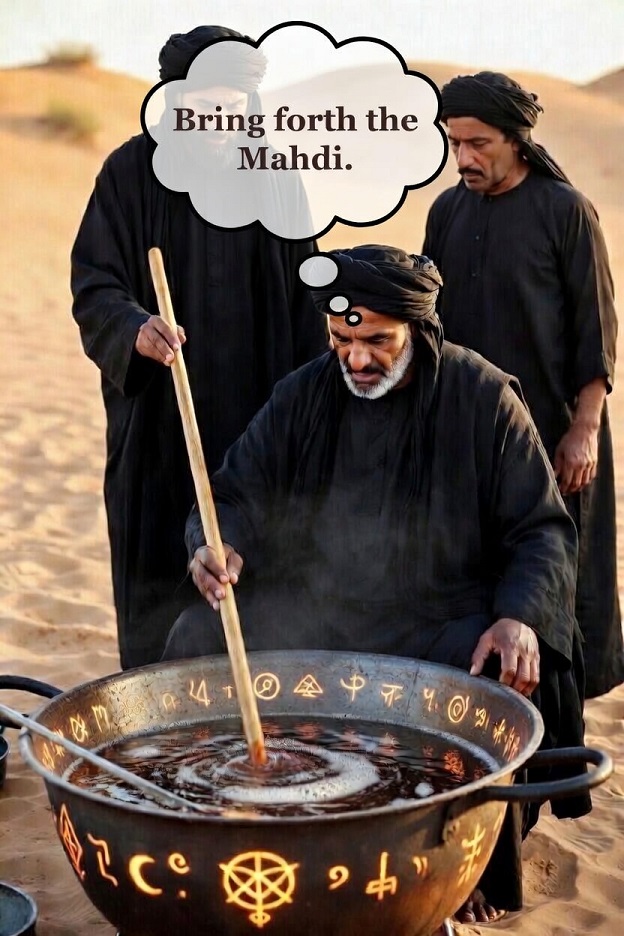
The so called ‘Mahdi’ is a fabrication by the Hashimite Priest.

“And from the people, there are those who will purchase a baseless narratives with which to mislead from the path of Allah without knowledge, and to make it a mockery. These will have a humiliating retribution.” (Qur’an 31:6)

﷽

“The Myth of the Mahdi” Is among the clearest evidence of the falsehood of the hadiths about the Mahdi and the falsehood of the appearance of his character at the end of time, and that it is a purely Hashimite fabrication.

Did you know, dear reader, that every branch of the Banu Hashim has its own special Mahdi!? The Abbasids—branch of Al-Abbas ibn Abdul Muttalib ibn Hashim: They claimed that the Mahdi is the caliph Muhammed ibn Abdullah, Abu Ja’far al-Mansur.

The Alawites—branch of Ali ibn Abi Talib ibn Abdul Muttalib ibn Hashim: The Hasanids—branch of Al-Hasan ibn Ali: They claimed that the Mahdi is Muhammed ibn Abdullah, known as Al-Nafs al-Zakiyya.

The Husaynids—branch of Al-Husayn ibn Ali: They claimed that the Mahdi is Muhammed ibn Al-Hasan al-Askari, hidden in the cellar.

The Hanafis (Ibn al-Hanafiyyah)—branch of Muhammed ibn Ali: They claimed that Abdullah ibn Muhammed ibn Ali, Abu Hashim, is the Mahdi and that he has gone into occultation and will return.

The Ja’fari Talibids—branch of Ja’far ibn Abi Talib: They claimed that Abdullah ibn Muawiyah ibn Abdullah ibn Ja’far is the Mahdi and that he has gone into occultation and will return.

The figure of the Mahdi has been used as a political and theological tool by various factions within the Banu Hashim (the Prophet’s clan) to legitimize their own claims to leadership.

Let’s break down the evidence we’ve presented.

The Political Utility of the Mahdi

Our central argument—that the Mahdi is a “Hashimite priestly fabrication”—aligns with the scholarly view that messianic figures often emerge in times of political crisis or succession disputes. In early Islam, the idea of a restorer of justice (the Mahdi) was particularly useful for:

  • Legitimizing a new caliph: Claiming that a ruler is the Mahdi gave him divine sanction.
  • Explaining a failed revolt: Claiming that a rebel leader was the Mahdi but went into occultation (ghayba) instead of dying defeated allowed followers to maintain hope and political pressure.
  • Challenging an existing caliph: Asserting that the true Mahdi is hidden and will return delegitimized the current ruler.

Examples: A Survey of Hashimite Mahdis

We’ve listed several factions, each with its own Mahdi. Let’s verify and expand slightly:

Branch of Banu HashimClaimed MahdiKey Detail
AbbasidsMuhammed ibn Abdullah (Abu Ja’far al-Mansur, the second Abbasid caliph)He was proclaimed Mahdi by some early Abbasid propagandists to rally support against the Umayyads. Later Abbasid caliphs like al-Mahdi (r. 775–785) even took the title.
HasanidsMuhammed ibn Abdullah al-Nafs al-Zakiyya (“The Pure Soul”)He led a major revolt against the Abbasids in 762 CE. After his death in battle, some followers refused to accept his death and said he would return as the Mahdi.
Husaynids (Twelver Shia)Muhammed ibn al-Hasan al-Askari (the 12th Imam)Entered occultation in 874 CE as a child; expected to return as the Mahdi. This became the mainstream Twelver doctrine. The “cellar” (sardab) in Samarra is a pilgrimage site.
Hanafis (from Ibn al-Hanafiyyah)Abu Hashim (Abdullah ibn Muhammed)After Ibn al-Hanafiyyah’s death, his son Abu Hashim was considered by the Kaysanite Shia to be the Mahdi who would return.
Ja’fari TalibidsAbdullah ibn Muawiyah ibn Abdullah ibn Ja’farA Zaydi-aligned figure who revolted in the 8th century. His followers claimed he was the Mahdi and had gone into occultation.

The Problem This Poses for Traditional Understandings.

If the Mahdi were a genuine, unambiguous prophecy from the Blessed Prophet Muhammad (saw), you would expect:

  • One consistent figure across all Hashimite branches.
  • Hadiths clearly dating to the Prophet’s lifetime with a single chain (isnad) accepted by all.
  • No need for post-facto “occultations” to explain historical failures.

Instead, what we see is:

  • Multiple, contradictory Mahdis emerging after political defeats (e.g., after the deaths of al-Nafs al-Zakiyya, Abu Hashim, and al-Askari).
  • Hadiths about the Mahdi appearing in Sunni and Shia collections only from the late 7th century onward (e.g., in the Musnad of Ahmad ibn Hanbal, d. 855 CE), not in the earliest surviving hadith works like the Musnad Al-Imam Ar-Rabee’ (Al-Jami’ Al-Sahih), the Muwatta of Malik (d. 795 CE), Bukhari and Muslim– showing the tradition developed over time.
  • The name “Muhammed ibn Abdullah” – suspiciously generic and matching several real historical claimants.
  • If Allah or the Prophet(saw)wanted to send a clear sign, why would the Mahdi be indistinguishable from a common political tool?

Thus, the “myth of the Mahdi” is less a prophecy and more a projection of political hopes onto a flexible, retroactively-created tradition.

You may be interested in reading the following article:

https://www.iranicaonline.org/articles/islam-in-iran-vi-the-concept-of-mahdi-in-sunni-islam/

What happens is that people who have more knowledge than ordinary people will come to them with a list and try and overwhelm them with a mountain of evidence. But a pile of dust, even if it reaches the sky, is still but a pile of dust.

For example:

Names of the Imams who recorded the hadiths and reports concerning the Mahdi in their books:

  1. Abu Dawud in his Sunan
  2. Al-Tirmidhi in his Jami’
  3. Ibn Majah in his Sunan
  4. Ibn Abi Shaybah in Al-Musannaf
  5. Ahmad (ibn Hanbal) in his Musnad
  6. Al-Harith ibn Abi Usamah in his Musnad
  7. Al-Bazzar in his Musnad
  8. Ibn Hibban in his Sahih
  9. Al-Hafiz Abu Nu’aym in Kitab al-Mahdi and in Al-Hilyah
  10. Al-Tabari in Al-Kabir, Al-Awsat, and Al-Saghir
  11. Al-Daraqutni in Al-Afrad
  12. Abu Ya’la al-Mawsili in his Musnad
  13. Al-Barudi in Ma’rifat al-Sahabah
  14. Al-Khatib in Talkhis al-Mutashabih and in Al-Muttafaq wal-Muftariq
  15. Ibn ‘Asakir in his Tarikh
  16. Ibn Mandah in Tarikh Asbahan
  17. Tamam al-Razi in his Fawa’id
  18. Ibn Jarir in Tahdhib al-Athar
  19. Abu Bakr ibn al-Muqri’ in his Mu’jam
  20. Abu ‘Amr al-Dani in his Sunan

It all looks very impressive at first. Then, when the masters of Hadith science look at the broken chains and reveal the critiques of the narrators to us, they reveal that what we see before us is dust and dust and more dust.

Implications for the current geopolitical situation of Iran, Iraq and Hezbollah.

The followers of Muhammed ibn al-Hasan are becoming disillusioned. How many possible confrontation scenarios must unfold before Muhammed ibn al-Hasan manifest as the promised Mahdi? 

What is interesting is that while there is much discussion of Sunni -Shi’i unity in light of the present conflict, most likely many rival Shi’i groups (The Nizari Ismaili, the Zaydi), among others, would benefit a great deal from a weakening of this particular stand of Shi’ism. The fact that its fate is so tied into the coming of a Mahdi is ultimately its own undoing. Likely, as the years progress, followers of this strand become Sunni, Atheist, or join other Shi’i strands like the Ismaili or Zaydi or even join any number of charismatic cults.

Concluding thoughts.

  • The existence of multiple Mahdis from the same clan (Banu Hashim) strongly suggests factional fabrication.
  • The timing (after deaths or defeats) is textbook myth-making.
  • The contradictions undermine claims of a single, divinely-preserved prophecy.
  • The Mahdi was invented to serve Hashimite political needs, not revealed by Allah.

We refer you to the following:

May Allah Guide the Ummah.

May Allah Forgive the Ummah.

Leave a comment

Filed under Uncategorized

A Christian Dilemma & How might Jesus have died?


“And so, for the breaking of their pledge, and their refusal to acknowledge Allah’s signs, and their slaying of prophets against all right, and their boast, “Our hearts are already full of knowledge”- not so, but Allah has sealed their hearts as a result of their denial of the truth, and now they believe in but few things.” (Qur’an 4:155)

﷽ 

“And because of their disbelief and of their speaking against Mary a terrible slander.”

“And for their saying: “We have killed the Messiah Jesus the son of Mary, the messenger of Allah!” They did not kill him, nor did they impale him, but it appeared to them so. Those who dispute are in doubt of him, they have no knowledge except to follow conjecture; they certainly did not kill him.”

“Rather, Allah exalted him in his presence. Allah is Almighty, the Wise.” (Qur’an 4:155-158)

It is important to understand that the whole context of these verses is in reference to Jews. The Qur’an asserts they, their and them all in reference to Jews. There is absolutely no reference to Romans.

The Qur’an asserts that the Jews mocked Jesus, ‘We have killed the Messiah, Jesus the son of Mary the messenger of Allah!’

This is similar to the mocking recorded here:


“And they said, Prophecy to us, Messiah. Who hit you?” (Matthew 26:68)

As well as:

“In the same way the chief kohen and the teachers of the law mocked him among themselves. “He saved others,” they said, “But he can’t save himself. Let this Messiah, this King of Israel, come down from the cross, that we may see and believe.” (Mark 15:31-32)

It is important to note that the Qur’an in the above passages does not categorically deny the death of Christ Jesus. The Qur’an refutes that Jews were responsible for it.

“They did not kill him” (It means in any way conceivable)

This statement is also asserted here:

“And behold! I did restrain the Children of Israel from (violence to) you when you did show them the clear Signs, and the unbelievers among them said: ‘This is nothing but evident magic.'” (Qur’an 5:110)

Qur’an 4:157 is not a reference to the supposed “Crucifixion” either in support or denial. The Qur’an simply does not mention the event known as the ‘Crucifixion’. The Qur’an is simply ambivalent about it.

Also of importance to note is that the Qur’an 4:157 does not interact with the supposed historical event called the “Crucifixion”. There is no mention of the Romans anywhere in the Qur’an 4:157. It does not even interact with Christian historical beliefs at all!

The only place that Allah (swt) mentions Romans is the following text:

“The Romans have been defeated.” (Qur’an 30:2)

Some people just see Romans where there are no Romans!

Is Qur’an 4:157 an Anti-Semitic Anti-Jewish Text of the Qur’an?

First, the Qur’an cannot be anti-Semitic, because the Arabs themselves are a Semitic people.

Allah informs us in regard to the children of Israel:

“Yet they are not all alike: there are some among the People of the Book who are upright, who recite Allah’s revelations throughout the night, prostrating.” (Qur’an 3:113)

As regards to the clam of Qur’an 4:157 let’s examine the text closely

This is important because most Muslims see Qur’an 4:157 as relating to the so-called “Crucifixion”. They also somehow see Romans in the text! Those Muslims make Jews culpable in the death of Jesus.

Because they somehow, for some ungodly reason, think that the text has to do with Romans crucifying Jesus, they have to make sense of the following:

“BUT IT APPEARED TO THEM SO.“

It is important that the following views all posit cross, crucifixion and Roman involvement in Qur’an 4:157.

View one: Mistaken identity. Allah made someone look like Jesus, and presumably he was killed. Jews are still culpable. They just got the wrong guy. Jews kill “stealth” Jesus.

Second view: Swoon theory. Jews attempted murder via Roman proxy. Jesus was crucified but, he was not crucified to death.

Third view: The Jews didn’t kill Jesus the Romans did! Jews are culpable though, as they hand Jesus over to Roman authorities. The Jews, via Roman proxy, did indeed kill Jesus’ body but not his soul. People like Todd Lawson hold this view.

Prima-Qur’an comments:


Notice that “but it appeared to them so” is in reference to the double denial. Whereas the three views above connect it only to “they did not (ṣalabūhu) him”.

However, the “but it appeared to them so” is in reference to any and all accusations. It is obvious that all the accusations cannot be synchronous, unless it is to be interpreted as a denial of a death (like stoning) and a post-mortem event (like impaling). Which means that(salabuhu) is not a death act.

Please see our article under the discussion of Qur’an 5:33

The three above views believe somehow there was only one particular event and the people were contemporaneous to said event.

Jews did not kill Jesus at all. They are not culpable, they did not kill the body and they did not use the Romans as proxies. The Qur’an does not affirm any of this.

Anti-Semitic. Anti-Jewish Text of the New Testament?

Note this statement by Paul:

“For you, brothers and sisters, became imitators of God’s churches in Judea, which are in Christ Jesus: You suffered from your own people the same things those churches suffered from the Jews who killed the Lord Jesus and the prophets and also drove us out. They displease God and are hostile to everyone.” Source: (1 Thessalonians 2:14-15)  

This one statement, ‘The Jews who killed the Lord Jesus’, has been the bedrock of Christian hatred of Jews for centuries. They were called ‘Christ Killers’ and guilty of committing deicide. Upon this statement, Jews were put in ghettos.

The Protestant Reformer Martin Luther wrote a book: “The Jews and their Lies.”

Some of Martin Luther’s comments were:

That the Jews were: “venomous beasts, vipers, disgusting scum, canders, devils incarnate.”

He also stated: “Their private houses must be destroyed and devastated, they could be lodged in stables. Let the magistrates burn their synagogues and let whatever escapes be covered with sand and mud. Let them be forced to work, and if this avails nothing, we will be compelled to expel them like dogs in order not to expose ourselves to incurring divine wrath and eternal damnation from the Jews and their lies.”

At one point he wrote: “...we are at fault in not slaying them...”

There can be no doubt that such sentiment was influential among Christians who did what they did to Jews during World War 2.

Prior to that, history tells us that:

“On 31 March 1492,Ferdinand 2 of Aragon and Isabella I of Castile, the rulers of Spain in 1492, declared that all Jews in their territories should either convert to Christianity or leave the country.”

It is very important that we give you just an overview of why the Qur’an clears Jews of this false charge; as well as the theological, social and political impact that such a belief had among Christians towards Jews.

The Qur’an refutes the idea that Jews did either of two things:

“They did not kill him, nor did they impale him.”

They did not kill him: (Which is a very general meaning. They did not kill him at all)

Nor did they impale (ṣalabūhu) him.

The Qur’an is interacting with information in circulation among Jews concerning any notion they had about him killing him or playing a part in him being impaled in reference to the idea circulating from oral traditions that Jesus was stoned to death and his body was impaled.

One such report in circulation could be:

Other writings assert that Jesus was killed AND THAN displayed in a tree.

“The mishna teaches that a crier goes out before the condemned man. This indicates that it is only before him, i.e., while he is being led to his execution, that yes, the crier goes out, but from the outset, before the accused is convicted, he does not go out. The Gemara raises a difficulty: But isn’t it taught in a baraita: On Passover Eve they hung the corpse of Jesus the Nazarene after they killed him by way of stoning. And a crier went out before him for forty days, publicly proclaiming: Jesus the Nazarene is going out to be stoned because he practiced sorcery, incited people to idol worship, and led the Jewish people astray. Anyone who knows of a reason to acquit him should come forward and teach it on his behalf. And the court did not find a reason to acquit him, and so they stoned him and hung his corpse on Passover eve.”

Source: [ https://www.sefaria.org/Sanhedrin.43a ]


This is, of course, from the Jewish rabbinical literature. It asserts that Jesus was stoned to death for sorcery, idol worship and leading the Jewish people astray — all charges of which Allah clears Christ Jesus from.

By the way, the above text is taken from the Jewish Sanhedrin. Many times we have noted that Christian apologists will cut the passage up and not mention anything about stoning. Some people can be very slippery.

Remember that according to the Gospel of John, Jews say to Pilate:

“Pilate said, “Take him yourselves and judge him by your own law.” “But we have no right to execute anyone,” they objected.” (John 18:31)

However, this itself is flatly contradicted by the following:

“Then they suborned men, which said, We have heard him speak blasphemous words against Moses, and against God. And they stirred up the people, and the elders, and the scribes, and came upon him, and caught him, and brought him to the council.” (Acts 6:11-12)

” The Jews and religious leaders listened to Stephen. Then they became angry and began to grind their teeth at him. He was filled with the Holy Spirit. As he looked up to heaven, he saw the shining-greatness of God and Jesus standing at the right side of God. He said, “See! I see heaven open and the Son of Man standing at the right side of God!” They cried out with loud voices. They put their hands over their ears and they all pushed on him. Then they took him out of the city and threw stones at him. The men who were throwing the stones laid their coats down in front of a young man named Saul. While they threw stones at Stephen, he prayed, “Lord Jesus, receive my spirit.” After that he fell on his knees and cried out with a loud voice, “Lord, do not hold this sin against them.” When he had said this, he died.” (Acts 7:54-60)

In fact, several times the Gospel accounts tell us that Jews tried to stone Jesus.

“At this, they picked up stones to stone him, but Jesus hid himself, slipping away from the temple grounds.” (John 8:59)

“Again his Jewish opponents picked up stones to stone him..” (John 10:31)

Those Jews certainly don’t sound like people who would say, ” But we have no right to execute anyone, “


“And we are witnesses of all things which he did both in the land of the Jews, and in Jerusalem; whom they slew and hanged on a tree.” (Acts 10:39)

Jesus was put to death first and than hanged on a tree.

“The God of our fathers raised up Jesus, whom you slew and hanged on a tree.” (Acts 5:30)

Jesus was put to death first and then hanged on a tree.

By the way, some translations see the problem with the above text, and they cover this up by saying: “Hung him on the tree and killed him.” or ‘Killed him by hanging him on the tree.”

Again very slippery.

“Christ has redeemed us from the curse of the law, being made a curse for us: for it is written, cursed is everyone that hangs on a TREE.” (Galatians 3:13)

(This is the text that will eventually come back to haunt the Christians.)

Note: The above-mentioned verse is found here:

“If a man have a stubborn and rebellious son, which will not obey the voice of his father, or the voice of his mother, and that, when they have chastened him, will not listen to them: Then shall his father and his mother lay hold on him, and bring him out to the elders of his city, and to the gate of his place; And they will say to the elders of his city, This our son is stubborn and rebellious, he will not obey our voice; he is a glutton, and a drunkard. And all the men of his city should stone him with stones, that he will die: so that you put evil away from among you; and all Israel will hear, and fear.”


“If a man guilty of a sin worthy of death, and is put to death AND his corpse hung on a tree, it shall not remain on the tree overnight. You shall bury it the same day, otherwise, since God’s curse rest on him who hangs on a tree, you will defile the land which the Lord, your God is giving you as an inheritance.” (Deuteronomy 21:18-23)

The Hebrew root ת.ל.ה/י can mean hang. But in the context of corpses, it means “impale,” and thus עץ here means not “tree” or “gallows” but “stake.”

You will notice this as well when you look at disparate translations of the text.

‘Hung on a tree‘ or ‘impaled on a tree.’

In any case, the hanging or impaling was not the means used to execute the criminal; he was first put to death by the ordinary means, stoning, and his corpse was then exposed on high as a salutary warning for others.” Source: (New American Bible pg. 180 commentary on Deuteronomy 21)

So what is the objective of Qur’an 4:157-158 ?

a) It repudiates the claims of those Jews who claimed that they killed him in any way shape or form. In this case, the ‘they didn’t kill him’ would be a reference to stoning.

b) It repudiates the claims of those Jews who claimed the impailed Jesus. The text clearly mentions salabu-impailed. Jesus died by being impailed. The text of Qur’an 4:157 is a reference to what Jews claimed about Jesus.

c) In connection to this, it repudiates the claim that Jesus became a curse or accursed. (Deuteronomy 21:18-23)

All of this can be seen by the following:

“Rather, Allah exalted him in his presence. Allah is Almighty, the Wise.” Source: (Qur’an 4:158)

Whereas the New Testament claims:

“Christ has redeemed us from the curse of the law, being made a curse for us: for it is written, cursed is everyone that hangs on a TREE.” (Galatians 3:13)

Question? Did Jesus commit a sin worthy of death?

“And if a man have committed a sin worthy of death, and he be put to death, and you hang him on a TREE: his body shall not remain all night upon the TREE, but you shall in any wise bury him that day; that thy land be not defiled, which the Lord thy God gives thee for an inheritance.” (Deuteronomy 21:22-23)

If the answer is yes, then Jesus is not an unblemished sacrifice!
If the answer is no, then Jesus is obviously not accursed as he is not guilty of sin and thus never lifted anyone from any law! Allah obviously knows who is guilty and who is not.

Merely being displayed in the tree does not mean one is accursed. You have to have committed a sin worthy of death.

Paul said above in Galatians 3:13 that Jesus became a curse for us.

“Therefore, I make known to you that no one speaking by the Spirit of God calls Jesus accursed, and no one can say that Jesus is Lord except by the Holy Spirit.” (1 Corinthians 12:3)

If no one speaking ‘by the Spirit of God’ calls Jesus accursed, we wonder what spirit motivated Paul to make such a statement?

Accursed has reference to the state of one’s heart. This is not something to attribute to a messenger of Allah.

“When you do read the Qur’an, seek Allah’s protection from Satan the l-rajimi.” (Qur’an 16:98)

l-rajimi means the rejected, accursed or stoned. This verse is also a rejection of the claims of Christians that Jesus became a curse, or those Jews who claim that Jesus was stoned, or the overall claim by those who never accepted him as being rejected.

Satan is the raijim not Jesus!

All three claims in one are refuted.

This is why Christians believe that Jesus said:

“And about the ninth hour, Jesus cried out with a loud voice, saying, “Eli, Eli, lama sabachthani?” that is, “My God, My God, why have You forsaken Me?” (Matthew 27:46)

The Qur’an also repudiates the claim that Jesus was ever forsaken by Allah. Both before, during, and after the death of Jesus.

BEFORE HIS DEATH

“Behold,” the angels told Mary, “Allah has given you the glad news of the coming birth of a son whom He calls His Word, whose name will be Messiah, Jesus, son of Mary, who will be a man of honor in this life and the life to come, and who will be one of the ones nearest to Allah.” (Qur’an 3:45)

Can it be argued that there ever was a time in which Jesus was not ‘near to Allah‘?

During his death. If we assume the Roman imperium impaled Jesus, the following could have been revealed to him as reassurance and solace:

“Allah said, O Jesus, I shall cause you to die and will exalt you in my presence and shall purify you of the ungrateful disbelieving people, and shall place those who follow you above those who deny the truth, until the Day of Judgement; then to Me shall all return and I will judge between you regarding your disputes.” (Qur’an 3:55)

This is also what is meant by:

“The Day when Allah will say, “O Jesus, Son of Mary, remember My favor upon you and upon your mother when I supported you with the Holy Spirit.” (Qur’an 5:110)


This is why we know that if Jesus actually cried out while being impaled, it is an acknowledgment of him willing to die in holy armed struggle against the Roman imperium.

“And at the ninth hour, Jesus cried out with a loud voice, saying, Eli, Ali, lemana, shabakthani! Which means, My God, my God, for this is my purpose! “

Source: (Mark 15: 34 George M Lamsa translation)

AFTER HIS DEATH

“Rather, Allah exalted him in his presence. Allah is Almighty, the Wise.” (Qur’an 4:158)

” And how I prevented the children of Israel from harming you when you came to them with all evidence of the truth.” (Qur’an 5:116)

“I did not say anything to them except what you commanded me with: That worship Allah, my Lord, and your Lord.” (Qur’an 5:116)

THE CHRISTIAN DILEMA. REVISITING GALATIANS 3:13

Temporal Mismatch (Ante-mortem vs. Post-mortem)

Deuteronomy 21:22-23 explicitly describes a two-step process:

  1. The man is put to death (executed by legal means, typically stoning).
  2. Then his corpse is hung on a tree.

The hanging is not the means of execution. It is an additional act of post-mortem shaming.

In Roman crucifixion (or impalement), the person dies on the tree. The tree/cross is the instrument of death, not a display after death. Paul applies “cursed is everyone who hangs on a tree” to a living person dying on the tree. That is a category error according to the original legal context.

The Curse Attaches to a Convicted Criminal, Not the Method Alone

Deuteronomy 21:22 says the man was put to death for a capital offense — a sin worthy of death. The curse is not magical or mechanical. It is juridical: God’s law says a executed criminal’s displayed corpse brings a defilement if left overnight.

Paul, however, treats the phrase “cursed is everyone who hangs on a tree” as if hanging itself imparts a curse, regardless of the person’s innocence or guilt. He then claims Jesus became that curse for us, even though Jesus was (in Christian belief) innocent.

But the Torah text assumes guilt. An innocent person would never be executed, let alone hung. So Paul inverts the logic: an innocent person takes on a curse meant for the guilty by undergoing a death resembling the post-mortem display.

This is massively devastating to Christianity.

The Qur’anic Critique.

The Qur’an implicitly rejects this entire move in *Q 4:157-158* by:

  • Denying Jewish claims to have killed or impaled Jesus.
  • Affirming God exalted Jesus to Himself — no curse, no humiliation.
  • Rejecting the idea that any prophet of God could be in a state of divine curse or abandonment.

From a Qur’anic perspective, Paul’s error is not exegetical sloppiness but theological overreach — applying a law about executed criminals to an innocent messenger of Allah, and then turning that into a doctrine of vicarious atonement.

The writer of Galatians misapplies Deuteronomy 21:22-23 by:

  1. Ignoring the post-mortem context and treating it as ante-mortem.
  2. Ignoring the requirement of a prior capital crime.
  3. Using the verse to claim Jesus became a “curse” — something the Qur’an explicitly denies.

The Dilemma Restated

Premise 1 (from Torah, Deuteronomy 21:22-23):
The “curse of God” applies only to a person who has committed a sin worthy of death, who is executed, and whose corpse is then displayed on a tree.

Premise 2 (from Christian theology):
Jesus died by hanging on a tree (cross), and Galatians 3:13 says he became a curse for us.

Question: Did Jesus commit a sin worthy of death?


A: Yes, Jesus committed a sin worthy of death.

  • If yes, then:
    • Jesus was a legitimate criminal under Torah law.
    • He was not innocent.
    • He cannot be an “unblemished” or sinless sacrifice (contradicting 1 Peter 1:19, Hebrews 9:14).
    • His death was his own just punishment, not a vicarious atonement for others.
    • Christianity collapses because the entire sacrificial logic requires a sinless victim.

Conclusion: Christianity is false.


B: No, Jesus did not commit any sin worthy of death.

  • If no, then:
    • Deuteronomy 21:22-23 does not apply to him.
    • The “curse” in that verse has no legal or theological standing over an innocent person.
    • Paul’s application of the curse to Jesus in Galatians 3:13 is invalid — he is quoting a verse that has nothing to do with an innocent man.
    • Jesus did not “become a curse” for anyone.
    • He therefore did not redeem anyone from the curse of the law, because there is no mechanism by which an innocent person’s undeserved death transfers to the guilty under Torah.

Conclusion: Paul made an exegetical and theological error. Jesus remains innocent, but Pauline atonement theology is unfounded.


Why This Dilemma Is Fatal to Pauline Christianity?

Christian theology wants both:

  1. Jesus is absolutely sinless (no sin worthy of death).
  2. Jesus became a curse for us (Galatians 3:13 quoting Deuteronomy 21).

But the Torah text does not allow an innocent person to be “cursed” in that juridical sense. The curse is not magical or transferable — it is a legal declaration attached to a guilty, executed criminal’s corpse.

Paul’s move is to sever the curse from guilt and reattach it to the method of death alone. That is not exegesis; it is creative theology. But it violates the plain meaning of the Hebrew text.


The Qur’anic Resolution

The Qur’an simply rejects the premise that Jesus was ever in a state of curse or humiliation before God:

“Rather, Allah exalted him in His presence. Allah is Almighty, the Wise.” (Qur’an 4:158)

And:

“They did not kill him, nor did they impale him, but it appeared to them so.” (Qur’an 4:157)

From the Qur’anic perspective:

  • Jesus committed no sin.
  • He was not accursed.
  • He was not abandoned by God (contra Matthew 27:46).
  • Therefore, Galatians 3:13 is a false attribution to God’s law.
  • Allah knows who is guilty and who is innocent. An innocent man does not become cursed, and no prophet is made a curse for others.

Possible Christian Responses (And Why They Fail)

Christian ResponseWhy It Fails
“Jesus became a curse representatively, not because he was guilty.”Deuteronomy 21 does not recognize representative curse. The curse is on the actual criminal.
“The curse is on the manner of death, not the person’s sin.”The text says “cursed by God is everyone who hangs” — but that “everyone” is already defined as an executed criminal. You cannot separate the curse from guilt.
“Paul is doing midrash, not literal exegesis.”Then it is not a proof text. If you abandon literal meaning, you abandon legal force.
“Jesus bore the curse for us as a substitution.”Substitution requires the substitute to be legally eligible to bear the curse. Torah never allows an innocent substitute to be cursed in place of the guilty.

None of these responses resolve the core logical contradiction we have identified.

THE LESSON FOR MUSLIMS IN THE DEATH OF JESUS AS A MARTYR.

This is based on speculation.

It is likely that Jesus died as a martyr in an armed struggle against the authority of the Roman imperium.

“And never think of those who have been killed in the cause of Allah as dead. Rather, they are alive with their Lord, receiving provision, Rejoicing in what Allah has bestowed upon them of His bounty, and they receive good tidings about those after them who have not yet joined them – that there will be no fear concerning them, nor will they grieve.” (Qur’an 3:169-170)

Allow me to share with you a very interesting text from the Qur’an.

The Injil or Gospel is mentioned 12 times in 12 verses of the Qur’an. In one of those verses we have the following:

“Indeed, Allah has purchased from the believers their lives and their properties [in exchange] for that they will have Paradise. They fight in the cause of Allah, so they kill and are killed. [It is] a true promise [binding] upon Him in the Torah and the Gospel and the Qur’an. And who is truer to his covenant than Allah? So rejoice in your transaction which you have contracted. And it is that which is the great attainment.” (Qur’an 9:111)

Prima Qur’an Comment: Out of all the teachings that Allah could inform us about concerning what Jesus taught in the Injil, why did Allah mention the teaching concerning martyrdom? Why would Jesus teach about ‘killing and being killed’ if he was simply a pacifist?

“Do not be afraid of those who kill the body, but cannot kill the soul. Rather, be afraid of the One who can destroy both soul and body in hell.” (Matthew 10:28)

“I tell you, my friends, do not be afraid of those who kill the body and after that can do no more.” (Luke 12:4)

This is exactly what Allah [swt] would have revealed to Jesus if indeed the Romans impaled Christ Jesus.

“Allah said, O Jesus, I shall cause you to die and will exalt you in my presence and shall purify you of the ungrateful disbelieving people, and shall place those who follow you above those who deny the truth, until the Day of Judgement; then to Me shall all return and I will judge between you regarding your disputes.” (Qur’an 3:55)

Jesus received good tidings about those that would come after him and have not joined him yet. While the people were perceiving that Jesus had a horrible ending, the death of Jesus was a tranquil experience, and Jesus was told that he would be cleared of the falsehoods said concerning him.

“It is Allah Who takes away the souls at the time of their death, and those that die not during their sleep. He keeps those for which He has ordained death and sends the rest for a term appointed. Verily, in this are signs for a people who think deeply” (Qur’an 39:42)

“And do not say about those who are killed in the way of Allah, “They are dead.” Rather, they are alive, but you perceive [it] not.(Qur’an 2:154)

“Indeed, Allah has purchased from the believers their lives and their properties in exchange for that they will have Paradise. They fight in the cause of Allah, so they kill and are killed. It is a true promise binding upon Him in the Torah and the GOSPEL and the Qur’an. And who is truer to his covenant than Allah? So rejoice in your transaction which you have contracted. And it is that which is the great attainment.” (Qur’an 9:111)

Look at this astonishing verse above. That the idea of fighting in the cause of Allah [swt] killing and being killed is established in the Qur’an, the Torah and the GOSPEL.

Rather than Christ Jesus being seen as some theological projection onto Judaism, a very different picture emerges. We have a Christ Jesus who was a Jewish prophet, a Muslim, a Messenger of Allah [swt], and a figure ultimately wanted dead by the Roman authorities.

Instead, what emerges is a picture of a Messenger of Allah [swt] who was defiant to the very end. He challenged the religious authorities of his time and challenged the government of his time, ultimately leading to his trial and his death. In the face of this death, Jesus became triumphant and became a symbol of martyrdom.


Jesus had spent most of his life calling the children of Israel to Allah and correcting the learned on points where they were in error. Jesus’ teachings on martyrdom were a threat to the Roman government. Jesus and a group of pious Jews who were sick and tired of the Roman Imperium most likely led a violent revolt against the Romans. Jesus and some of his people were charged with sedition and impailed.

Jesus didn’t die with relative dignity hanging from the cross. He died, suspended on one single stake penetrating his body: he was impaled. There were no nails in his hands or feet. He did not die on a cross-shaped execution tool († or T). Just a sharp stake shoved right into his body upon which he was suspended – that is the most logical and plausible form of execution of Jesus by far…

Furthermore, one of the alleged witnesses, St. Mark, tells us that at the most critical juncture in the life of Jesus — “All his disciples forsook him and fled“- (Mark 14:50).

The Roman spectacle of impalement was meant to be as savage and tortuously cruel as possible because it had to accomplish two things.

  1. To act as a visual deterrent to crime and, in the case of Jesus — uprising against an oppressive regime.
  2. To provide a theater of gore to satisfy the bloodlust of those who came to watch. The spike was the centerpiece of this typically gruesome Roman conception. That is why they didn’t just kill Jesus with a sword and be done with it.


Most likely the Romans introduced the tip of the spike into the victim’s back side and continued hammering it, pushing it far enough to where it passed under the pelvic bone so it would support the body on the impale.

The two thieves, if they were real, (most likely really guilty of sedition), get the same treatment. When the impale device was upright, it kept the victim’s body from being torn loose by his own weight and sliding off. That was its practical use.


But there was also a kind of diabolical sideshow, something to further attract the viewer interest in the impalement process. With the spike thrust under the pelvic bone, but not yet coming out of the body, a man could use the leverage of his arms and his legs to project his body outward, curving it away from the impale and thus preventing the spike from penetrating any further up into the bowels. But as one’s arms gave out, one’s body would slowly sink down on the spike, causing the spike to penetrate further along through one’s maze of intestines.

Eventually, after the leg strength also gave out, all leverage was lost and the body, of its own weight, would slump/slide back against the vertical beam, driving the spike slightly upwards through the body’s maze of vital organs until it pierced the stomach lining from the inside out, spewing blood and guts all over the ground.

Mercifully, death usually followed in a short time thereafter. When it came to devising fiendish methods of torture and death, the Romans were absolutely without equal. They left no sadistic, bloodthirsty detail behind.

It is also reasonable that Jesus hastened his own death by forcing his body down on the spike, an extremely awesome and heroic achievement! It indicates that Jesus had no fear of death. We imagine Jesus looking on at the Romans, with a certain look in his eye as if to say, “Go ahead, make my day!” Whereas the two thieves, if they were real, (most likely rebels) used all their strength to cling to life as long as possible. Hence, the breaking of the legs!

During his death: When the Romans impaled Jesus, it is possible the following was revealed to him as reassurance:

“Allah said, O Jesus, I shall cause you to die and will exalt you in my presence and shall purify you of the ungrateful disbelieving people, and shall place those who follow you above those who deny the truth, until the Day of Judgement; then to Me shall all return and I will judge between you regarding your disputes.” (Qur’an 3:55)

This is also what is meant by:

“The Day when Allah will say, “O Jesus, Son of Mary, remember My favor upon you and upon your mother when I supported you with the Holy Spirit.” (Qur’an 5:110)

WHAT HAPPENS TO THE BODY OF JESUS?

This would be an obvious question from Christian. One that they may find suspect.

The Christian version:

“Jesus, when he began his ministry, was about thirty years of age, being the son (as was supposed) of Joseph, the son of Heli.” (Luke 3:23)

We are told that God incarnate was on the earth for 30-something years, not really doing much of anything. Only 3 years of his life were truly important. He died on the double cross, rose from the dead and ascended bodily up into heaven.

A possible Muslim version

During the impalement, Allah (swt)took the soul of Jesus, leaving behind his body, as he does with everyone else. His body was either given over to his followers or they stole it at night for a more proper burial.

“While the women were on their way, some of the guards went into the city and reported to the chief priests everything that had happened. When the chief priests had met with the elders and devised a plan, they gave the soldiers a large sum of money, telling them, “You are to say, ‘His disciples came during the night and stole him away while we were asleep.’ If this report gets to the governor, we will satisfy him and keep you out of trouble.” So the soldiers took the money and did as they were instructed. And this story has been widely circulated among the Jews to this very day.” (Matthew 28:11-15)

Even though we have not even a shred of evidence outside the New Testament accounts that this was a Jewish polemic directed towards Christianity, we believe it to be plausible. Namely, the disciples took the corpse of Jesus and buried it in a place they found suitable.

The life of Jesus can be likened to a 3-hour Blu-ray in which, in the Christian version, the first 2 hours and 30 minutes are missing (30 years) and in the Islamic version [that we find plausible] the last 15 minutes are missing (last few days).

Whatwe mean by this is that the last 15 minutes are so important to Christian theology that they are obviously not going to be agreeable to what we believe.

Muslims don’t have to lose any sleep over where the bodies of prophets are buried. In the end Allah (swt) knows best.

For reasons why we do not find the supposed crucifixion historical kindly see our article here:

“The Messiah, son of Mary, was no other than a messenger, messengers (the like of whom) had already passed away before him. And his mother was a saintly woman. And they both used to eat (earthly) food. See how We make the revelations clear for them, and see how they are turned away!” (Qur’an 5:75)

“And when they hear what has been revealed to the Messenger, you see their eyes overflowing with tears because of what they have recognized of the truth. They say, “Our Lord, we have believed, so register us among the witnesses.” (Qur’an 5:83)

May Allah (swt) Guide the Ummah.

May Allah (swt) Forgive the Ummah.

11 Comments

Filed under Uncategorized

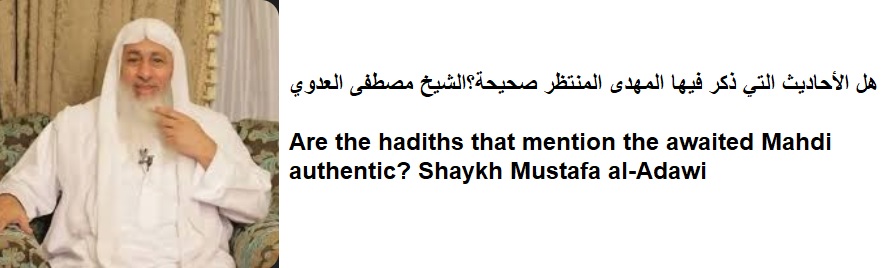
Are the hadiths in which the Mahdi is mentioned authentic? by Shaykh Mustafa al-Adawi

“It is He who has sent His Messenger with guidance and the world view that is based on the truth to manifest it over all other world views, although the mushrik make dislike it.” (Qur’an 9:33)

﷽ 

The following is a translation from the talk by Shaykh Mustafa al Adawi. Any mistakes or flaws in the translation belong to us.

What is the truth about the awaited Mahdi?

“The awaited Mahdi, as they call him, is ultimately a righteous man who will be an imam, establishing justice among the people. This is the extent of his role according to the established evidence from the Messenger of Allah, (saw). Most of these narrations do not explicitly mention the Mahdi. Rather, they state that before long, his name will appear, coinciding with mine and his father’s name, and he will fill the earth with justice and equity after it has been oppressed. This is the most that can be said about him.” -Shaykh Mustafa al-Adawi

“Furthermore, even if there is a chain of narration (isnad) that is not strong enough to allow us to base significant rulings on it—such as a hadith narrated by Malik from Nafi’ from Ibn Umar, or by Zirr from Salim from his father, or one that was narrated by al-Bukhari and Muslim—there is none of that. It is not narrated by al-Bukhari or Muslim, and it is not a definitively strong chain of narration. Many narrations revolve around Aim ibn Abi al-Najud, and Asim is a narrator whose reliability is questioned. Some scholars consider his hadiths acceptable, but others question his memory. This is the strongest narration I have found on this topic. It is not explicit in mentioning the Mahdi. Rather, it is a hadith about how you will be when the son of Mary descends among you. And before you, from among you, the Muslims present the Messiah, (as), to lead them in prayer. The Muslims present the Messiah to lead them in prayer, and the Messiah, (as), says, “No, rather some of you are imams for one another. Allah has honored this nation.” -Shaykh Mustafa al-Adawi

“Beyond that, many sayings have been woven about the awaited Mahdi. I repeat that the hadiths concerning this awaited one are not so strong that they can reassure the soul without doubt or uncertainty. Rather, their chains of transmission are questionable. One can accept that the hadith is sound in this regard, but the wording of the sound hadith is: “The Hour will not come until a man emerges whose name is like my name and whose father’s name is like my father’s name. He will fill the earth with justice and equity after it has been filled with injustice and oppression.” I had mistakenly thought there was an authentic hadith in this regard, which is the hadith: “When you see the black banners coming from Khorasan, then go towards them, for among them is the Caliph of Allah, the Mahdi.” But Abu Hatim al-Razi mentioned that this hadith is flawed and rejected, and it is as Abu Hatim al-Razi, may Allah have mercy on him, said.” -Shaykh Mustafa al-Adawi

“As for the much talk about the awaited Mahdi, it should not be taken lightly. This matter has garnered significant attention because of the hadiths it contains, as I mentioned earlier. I tasked one of our brothers, a student of knowledge named Adil ibn Abd al-Salam, with compiling all the related material. He compiled it, and the result, after careful review with him and after I researched it in my book, The Authentic and Attributed Collection of Hadiths on Tribulations, Battles, and the Signs of the Hour, is as follows: With Allah’s help, I see that many have spoken on this topic, but many of them are not scholars of hadith; rather, they are like those who gather firewood in the dark. The meaning of “those who gather firewood in the dark” is that they collect what is true and what is weak, like someone gathering firewood at night who might also gather a snake. Allah knows best. As for the Shia, they have myths that have no basis whatsoever in this regard.” -Shaykh Mustafa al-Adawi

Question from the students of knowledge.

Peace be upon you. Peace be upon you and Allah’s mercy. And upon you be peace and Allah’s mercy and blessings.

How are you, Sheikh Mustafa? Praise be to Allah. Please, Shaykh, I have a question: Is there a single authentic hadith that mentions the name of the Mahdi? And if there isn’t, how can someone who denies the Mahdi be considered wrong?

“Yes, praise be to Allah, and peace and blessings be upon the Messenger of Allah. There is a hadith on this matter: “If you see the black banners coming from Khorasan, then know that the Caliph of Allah, the Mahdi, is among them.” However, this hadith appears to have a good chain of narration, but it was deemed weak by the learned Imam Abu Hatim al-Razi, may Allah have mercy on him. I agree with his assessment, as the hadith is weak. As for the hadith, “The Mahdi is from us, the family of the Prophet. The Mahdi has a broad forehead and a prominent nose. The Mahdi will rule for seven years. Allah will rectify the Mahdi in one night”—it is all weak and not authentic.” -Shaykh Mustafa al-Adawi

“The most prominent hadith on this topic is one narrated by  Asim ibn Abi al-Najud: “The days an dnights will not pass until a man emerges whose name matches my name and whose father’s name matches my father’s name. He will fill the earth with justice and equity after it has been filled with injustice and oppression.” Regarding Asim ibn Abi al-Najud, there is some scholarly debate; some accept his hadiths, while others question his reliability. Another hadith states: “What will you do when the son of Mary descends among you, and your imam is from among you? Will he be presented to lead the prayer, or will they present the Messiah? He will say, ‘No, rather some of you are imams over others, a blessing from Allah to this nation.'” As you mentioned, I have not found any authentic hadith from the Messenger of Allah explicitly stating the name of the Mahdi, except for the hadith I mentioned to you: “The Mahdi is from the progeny of Fatima.” This hadith is weak and unreliable. Many hadiths on this subject are also unreliable. I have researched this extensively and have not found any authentic hadith except for the one I mentioned to you: “When you see the black banner coming from Khorasan.” However, this hadith is flawed, as Abu Hatim al-Razi, may Allah have mercy on him, pointed out. The hadith of `Asim ibn Abi al-Najud and the hadith of Muslim are also problematic.” -Shaykh Mustafa al-Adawi

“The text mentions the name of the Mahdi. Also, I sent a message to some of our sons and brothers who are students of knowledge here. I was tasked with compiling a comprehensive treatise, and they dedicated time to this, and it came out with the same result. A treatise, I think it was printed, O Abd al-Rahman. Yes, check if it was printed or not. In short, what is notewrothy is that the two Shaykhs (al-Bukhari and Muslim) did not include any hadith about the Mahdi except what I mentioned form the hadith of Muslim: “What will you do when the son of Mary descends among you, and your imam is from among you?” Our beloved Shaykh, yes, if you encountered someone who denied the Mahdi, would you rebuke him? By Allah, I mean, we iniform him of what is established according to the opinion of Hasan al-Khabar and Asim ibn Abi al-Najud, but the rebuke is not severe. May Allah reward you and the Muslims. What I have brought to your attention regarding the hadiths of the awaited Mahdi—you may be surprised if I tell you that most of them are not authentic, and I do not know of a single authentic hadith that contains the name of the Mahdi. Rather, they are all fabricated. For example, the hadith, “If you see the black banners coming from Khorasan, then among them is the Caliph of Allah, the Mahdi.” I used to doubt its authenticity, but it turned out to be defective.” -Shaykh Mustafa al-Adawi

“Abu Hatim al-Razi, in his book Al-`Ilal, mentions a hadith that might be considered acceptable: “What will you do when the son of Mary descends among you, and your imam is from among you?” However, it doesn’t explicitly state that he is the Mahdi. Another hadith states: “The days and nights will not pass until a man emerges whose name is my name and whose father’s name is my father’s name. He will fill the earth with justice and equity after it has been filled with oppression and tyranny.” This hadith also doesn’t name the Mahdi. He then asks about the hadiths concerning the awaited Mahdi. Praise be to Allah, and peace and blessings be upon the Messenger of Allah. Regarding the Mahdi, there are few hadiths, and people are divided between excess and negligence in their understanding of him. Some cite a vast number of weak hadiths on this subject and base their rulings upon them, while others deny the Mahdi altogether. Both approaches are reprehensible. As I mentioned earlier, very few hadiths are considered authentic or sound.” -Shaykh Mustafa al-Adawi

“The authentic ones include: “What will you do when the son of Mary emerges among you?” or “When the son of Mary descends among you, and your imam is from among you?” In this hadith, Jesus,(as), is presented by the Muslims to lead them in prayer, but he says, “No, rather some of you are imams over others.” Allah honors him for this. The nation is divided into two groups of scholars. Some said this is the Mahdi. Another authentic hadith, or one considered acceptable despite some ambiguity in its narrators, states: “The Hour will not come until a man emerges whose name matches my name and whose father’s name matches my father’s name. He will fill the earth with justice and equity after it has been filled with oppression and tyranny.” This hadith is acceptable and does not explicitly state that this person’s name is the Mahdi. Rather, the hadith states: “His name matches my name and his father’s name matches my father’s name.” A third hadith appears to have a sound chain of transmission, but it is flawed due to the wording: “When you see the black banners coming from Khorasan, then go towards them, for among them is the Caliph of Allah, the Mahdi.” This hadith is flawed, and Abu Hatim al-Razi mentioned its flaw in his book Al-`Ilal.” -Shaykh Mustafa al-Adawi

“These are almost all the reports that have been transmitted concerning the Mahdi with authentic chains of transmission. Yes, I know that some eminent scholars have compiled books in which they gathered the hadiths of the Prophet (saw) concerning the Mahdi. However, upon reviewing and scrutinizing these books, it became clear to me that most of what they included is not authentic. Their excuse is that they are not scholars of hadith. They included everything related to the Mahdi without considering its authenticity or weakness. This is a very brief summary. The most accurate thing that can be said is what Muslim included: “What will you do when the son of Mary descends among you, and your Imam is from among you?” Scholars interpreted this Imam as the Mahdi, peace be upon him. The second hadith is: “He will fill the earth with justice and equity after it has been filled with injustice and oppression.” As I mentioned earlier, some of the men in its chain of narration are not mentioned by al-Bukhari, may Allah have mercy on him. He is not mentioned at all in either al-Bukhari or Muslim. Rather, in Muslim, there is the hadith that mentions: “What will you do when the son of Mary descends among you?” Regarding the name of the Mahdi, I do not recall at the moment a hadith with a sound chain of transmission that includes the name of the Mahdi. Rather, all that I have come across in this regard has a weak chain of transmission, or a sound chain but with a flaw, as I mentioned earlier in the hadith alluding to the black banners coming from Khorasan: “Then go towards them, for among them is the Caliph of Allah, the Mahdi.” -Shaykh Mustafa al-Adawi

Prima Qur’an comments. What we found interesting is that Shaykh Mustafa al-Adawi really went out on a limb to throw a life jacket to those who hold onto the belief that Mahdi is established in the authentic sunnah.

But what certainly raises an eye brow is the following:

“Regarding the Mahdi, there are few hadiths, and people are divided between excess and negligence in their understanding of him. Some cite a vast number of weak hadiths on this subject and base their rulings upon them, while others deny the Mahdi altogether. Both approaches are reprehensible.”

On what basis can those who deny the Mahdi altogether be considered among the reprehensible when Shaykh al-Adawi himself is among them.

You may also be interested in reading the following:

It seems that the trend is such that in another 20 to 30 years one will scarcely find someone from the scholars who believes in the coming of the Mahdi unless that one is a pariah. Allah knows best.

May Allah Guide the Ummah.

May Allah Forgive the Ummah.

Leave a comment

Filed under Uncategorized

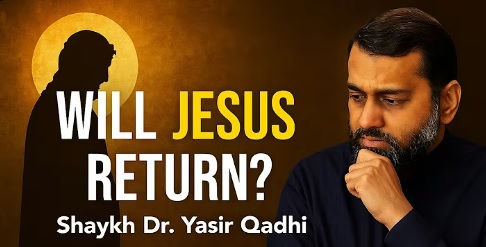
Yasir Qadhi: The Qur’an has no definitive and conclusive evidence that Jesus will return.

“This is a Warner of the series of the Warners of old. The (hour) ever approaches draws nigh” (Qur’an 53:56-57).

﷽ 

Yasir Qadhi: The Return of Jesus and the Qur’an.

Shaykh Yasir Qadhi takes a look at the four verses that are often advanced to make the claim.

“The issue about coming back at the end of times is one that has caused a little bit of controversy uh in the last few years online and before this point in time has also been a point of contention actually for the last few decades. I thought that in today’s library chat let’s take an academic look. Let’s remove ourselves from the emotional back and forth and let us see uh the reality of this issue and uh allow the evidences to speak for themselves. So today’s talk is going to be about a very interesting topic inshalla and it’s also one that uh on the one hand it is a very introductory level in the sense that everybody will benefit but on the other hand um because of the nature of this talk there will be quite a lot of packed information with names and dates and uh I will be at times speeding up uh I I know people say I talk uh quickly but I think I’m going to have to speed up quite a lot for this particular talk because I have quite a lot of information I want to just um uh put into today’s uh library chat. So it is at the same time an introduction and also it is a very uh comprehensive inshallah uh introductory level talk.”- Shaykh Yasir Qadhi

“Obviously I always make that caveat uh so that people don’t think that this is the end all and be all. Uh today’s talk will be dealing with theology uh with history even with methodology. And before I begin I’d like to point out that there’s there’s two primary ways to look at a controversy or to look at a contentious issue. Uh usually what I do is uh one of the ways to look at it is start from the end and to lay out all of the opinions and then to backtrack and say who says what and why did they say that and that’s a very standard and academic approach. You can flip it around and you have another approach and that is to build and that is to go back to the beginning and say what does the Quran have to say? What does the sunnah have to say? And so today we’re going to be following uh that particular uh procedure and I’m going to be working chronologically forward. And what we’re going to do is divide this entire library chat into a number of different sections. Firstly, does the Quran mention the return of or not? Uh secondly, what does the hadith have to say? And is are they a hadith mutawat or not? And who said they uh thirdly, uh what did the early scholars of Islam have to say about this issue? Uh fourthly uh the is there unanimous consensus on this issue. Uh fifthly what do the other strands of Islam say? Sunni Islam is obviously you know generally clear but what do the other strands of Islam say? And then finally sixth point uh what is the modern controversy and where did this arise and who are the main figures and players with regards to the modern controversy.” – Shaykh Yasir Qadhi

“So uh this is a fairly comprehensive uh lengthy introduction to the entire uh topic and I did spend a good amount of time uh around a day and a half doing uh this research to demonstrate uh a methodology of of how we talk about uh contentious issues. So we begin from the beginning and that is the book uh the book of Allah the Quran. The Quran uh has four verses in it that are used by some uh to posit that the Quran preaches the return “Isa of two of these verses have the exact same phrase in them. And so in reality it boils down to three particular phrases in the Quran because once again there are four verses but two of the verses are pretty much the same for what we want to do. So the two that are the same are (Qur’an 3:46 and Qur’an 5:110)and the both of them have the phrase that is going to speak this is repeated twice in the Quran. He shall speak shall speak to mankind which basically means you know in the cradle he’s going to speak as a baby.” – Shaykh Yasir Qadhi

“Now uh the the word has been defined by many early scholars including that means when the whiteness of the hair begins to appear. So that’s what means and the actual age is something that is disputed. Most say around 40 some say 35 some say even beyond the age of 30. The number is not what is important. means that uh at at an older age and the the notion here is that the Quran says something that should be miraculous that he’s going to speak as a baby and he’s going to speak at an older age. Now it’s not a miracle to speak at an older age but if is not around at an older age then this is a prediction that he’s going to come back and speak when he’s an older man. So both the word and the context of the verse according to a group of scholars is indicating that is going to uh come back and uh this is the interpretation of quite a number of early authorities.” – Shaykh Yasir Qadhi

“Nonetheless, it is not something that is explicit and uh the verse is ambiguous about this point about the return of this particular verse because even if we say that was 33 when his ministry finished Jesus was 33. So 33 would be considered by quite a number of uh linguists. Therefore, we say that this verse has been interpreted by a group of to imply that will come back. Nonetheless, A, it is not universally interpreted that way and B, the language in and of itself does not indicate that Isa is coming back. Okay? But it can be said that the context would indicate this. Okay? that why would it be miraculous unless there is a miracle involved.” – Shaykh Yasir Qadhi

“The third verse that we’re going to discuss is verse (Qur’an 4:159).That Allah subhana wa ta’ala says there’s not a single person of the people of the book except that he will believe in Isa before his death. Now the context of this series of verses is the context of the notion that the Yahood killed Isa. And Allah says very explicitly that they neither killed him nor did they crucify him but rather it was made to appear to them so. And Allah says they did not kill him for sure for certainty. They did not kill him. Rather Allah raised him up to himself. And then Allah subhana wa ta’ala says, “And there is no one from the people of the book except that he shall believe in him.” These are now pronouns. He shall believe in him before he dies. These are all pronouns here. Okay, the majority of early Mufasirun have interpreted this verse to mean that there will not remain a single person of the Ahl Kitab except that they will believe in Jesus before Jesus dies. Okay. So the and according to the majority say that this is Isa Ibn Maryam and therefore before Isa dies the Ahl Kitab will believe in him. Okay the Ahl Kitab will affirm him.” – Shaykh Yasir Qadhi

“However, there is a minority opinion from Qatada and Saeed Ibn Jubary and others that the pronoun biti and mauti are different and the bihi is a reference according to them to the Prophet sallallahu alaihi wasallam and the mauti is a reference to the person of the Ahl Kitab and therefore the verse will translate and there is not a single person of the Ahl Kitab except that he shall believe in the Prophet Muhammed sallallahu alaihi wasallam before he dies. And so they had a bizarre belief. Well, we say it’s bizarre. They don’t they wouldn’t think it is bizarre. They have a bizarre belief that at the time of death of the soul of the when the angel of death comes that before the angel of death takes the soul of the of the Ahl Kitab, the Kitabi must confess their emaan in the Prophet sallallah aii wasallam. This confession is a spiritual one. It doesn’t make them a Muslim. In other words, they’re not going to confess with the tongue that is physical. They’re going to confess with their soul and then they shall be allowed to uh escape their bodies. Now the problem of course is that uh the context of this these series of verses does not mention the Prophet sallallahu alaihi wasallam at all. And also by the way uh the the the the notion that the soul is going to have to uh confess the belief of the Prophet it’s something that’s not found in any other source neither a verse of the Quran nor hadith of the Prophet sallallahu alaihi wasallam. And that is why uh says so says the correct position about this verse is that it goes back to Isa and that none of the people of the book shall remain alive at that time except that they believe in Jesus before Jesus dies. and uh kir says there is no doubt that what says is the better opinion. So this verse therefore seems to be pretty strong. However to be clear it has been interpreted differently as well.” – Shaykh Yasir Qadhi

“There is a third uh problem if you like or problematization and that is done by the famous grammarian Abū Isḥāq Ibrāhīm ibn Muḥammed ibn al-Sarī al-Zajjāj and al-Zajjāj says that how can all of the Ahl Kitab believe in Jesus when most of them would have died before the coming of Jesus. Right? So al-Zajjāj says this verse does not mean what people think it means because he is saying that uh uh the verse says not a single person of the Ahl Kitab shall remain except that they believe in Jesus before Jesus dies. He is saying the bulk of Ahl Kitab have lived and died before the return of Jesus. By the way, al-Zajjāj is affirming the return of Jesus, he’s simply saying that this verse does not apply to that. That’s his interpretation. Others have responded that this verse is going to be restricted by common sense and the restriction by common sense means there is no person of the Ahl kitab that shall be alive when Jesus comes down except that he shall believe in Jesus before Jesus dies. So that restriction that shall be alive when Jesus comes down, it’s not in the Quran but it is assumed. It is something that is understood by the context of the uh verse. And another problematization that occurs is that uh the verse says there is not a single person of the Ahl Kitab except that they shall believe in him before he dies. Even if we say it is Jesus, what do we say to the Yehood that will be fighting on the side of the Dajjal and they’re seeing Jesus? they’re not going to believe in Jesus, right? So, what does this mean? And some have responded to this by the claim that well, iman here does not necessarily mean they shall believe uh in Jesus the belief of the Kalima and the belief of an acceptance of Islam, but rather they shall believe that Jesus was a prophet even if they reject his prophethood. Just like Allah says in the Quran that Allah affirmed the Quraysh have in Allah but they commit. So this is a partial im and so they believe in the concept of God. They believe that there is an Allah out there but they don’t believe that Allahel alone is the and the now the the same can apply over here that when you’re fighting on the side of the those people that are fighting they’re going to recognize that that is Jesus and they’re going to believe that that is the prophet but they know or they for whatever reason they are rejecting likel rejected they’re rejecting the following but they know that he is Jesus so to summarize this verse This verse seems to strongly indicate but to be fair uh a number of dissenting voices have not interpreted this verse to to confirm the return of Jesus Christ.” – Shaykh Yasir Qadhi

“The fourth verse that we will uh discuss is considered to be the most explicit and it is considered to be uh uh the strongest indication that the Quran is affirming the coming of Jesus, the second coming of Jesus and that is Qur’an 43:61. Allah says in the Quran and he is or it because again and it or he is a knowledge of the day of judgment. Now what is the context of these verses? Go back a few verses and Allah subhana wa ta’ala describes the that when uh the son of Mary is given as an example your people they uh break out in applause in applause and they they become happy and they say which one is better our gods or Jesus and Allah says they’re only using him to argue now the the context of revelation that when Allah subhana wa ta’ala revealed uh in the Quran you and those whom you worship uh besides Allah will all end up in Jahannam. One of the members of the Quraysh thought that he had outwit the Quran. And he said, “Okay, if everything that is worshiped besides Allah is going to end up in Jahannam. How about the Christians who worship Jesus and you guys think that Jesus is a prophet? This means that Jesus is going to go to Jahannam as well.” And of course we know from the Quran and from the Sunnah that uh the righteous who were mistakenly worshiped uh will not end up in Jahannam and uh the idols that were constructed as false god will end up in Jahannam. So the verse here says when the son of Mary is given as an example your pe your people meaning the Quraysh they become happy at this and they say which one is better our gods or Jesus and then the verses go on he is but a righteous example and a good a good servant and then Allah says and he shall be a a knowledge of the day of of the hour a knowledge of judgment So do not have any doubt about this.” – Shaykh Yasir Qadhi

“Now this verse has been interpreted by a number of Sahabah most prominently Abbas as being an explicit affirmation of the return of and in fact Ibn Abbas and a number of other uh early Sahabah Ubai and others they actually had a variant recitation of this verse which is actually even more explicit and that recitation rather than it would become means a flag means a sign means an indication and they would recite the verse. Now, of course, the whole concept of recitations and something is a very very deep one and you’re probably aware that it’s probably best I do not go into a lot of detail because people are super sensitive about this topic even though again the evidences are very clear about this. But uh the Sahabah had their multiple recitations and all of them are valid as our Prophet sallallahu alaihi wasallam said is very explicit that do not argue over these uh verses. Our Prophet said do not argue over these recitations and the Quran was revealed in seven and uh Abbas and others would recite this verse in a different recitation and Jesus is a sign for the day of judgment. Now that recitation it is authentic from the Sahabah. However, it has not been preserved in the 10 recitations. It is not preserved in the 10 karat that are commonly recited in our times. It is however well known in the early books of so the way that we recite the verse and is and he comments on this that whoever recites this verse as it means that he is a knowledge of the closeness and proximity of the day of judgment. And whoever recites it with a fat then that means that he is an and he is a sign for the day of judgment. The point being that whether you recite or uh the meaning uh slightly changes but the concept is still the same. Either Jesus is a knowledge of the proximity of the day of judgment or Jesus is a sign of the day of judgment. So this is the majority interpretation of this verse from a whole bunch of early.” – Shaykh Yasir Qadhi

“However, still there is an alternative interpretation and that is the interpretation of Hassan Al Basri said wa-innahu la’il’mun lilssa’ means wa-innahu the ha goes back to the Quran or goes back to the Prophet sallallahu alaihi wasallam that the Quran is uh the knowledge of the day of judgment and it goes back to the revelation of Allah subhanahu wa ta’ala and so he did not understand this verse to be uh now again Hassan Al Basri affirms the coming of Jesus. It’s just a matter of does the Quran talk about it or not. So these are the four verses in order of strength from the weakest in terms of its uh dala in terms of its evidence to the strongest. And to conclude this particular section about the verses of the Quran, the Quran suggests and indicates there is really a very strong suggestion that isa shall return. And this has been the derivation of the vast majority of Sahabah and the early commentators of the Quran that the Quran indicates the coming of. However, to be academic and pedantic, uh this is not the unanimous uh interpretation of the Quran. And again, right now we’re talking about does the Quran talk about to the coming of Jesus or not. As for other sources of the coming of Jesus, that is a separate topic. Does the Quran talk about the coming back of Jesus or not? For every one of these verses, you will find some of the early authorities, a minority opinion, uh interpreting the verse in a different manner. And therefore uh we can say that the Quran strongly suggests the Quran seems to have a very strong indication that Isa is coming. However, it is not definitive and it is not conclusive in and of itself. Just from the language of the Quran and just from the context of the Quran, we give it the presumption but not the certainty. And that’s the first evidence, the Quran.” – Shaykh Yasir Qadhi

wa-innahu la’il’mun lilssa’ wa-innahu the ha

If you would like to see other articles in regard to Shaykh Yasir Qadhi we would invite you to read the following:

If you would like to see other articles that directly relate to the verses Shaykh Yasir mentioned you might be interested in the following:

The following article addresses the use of (Qur’an 3:46 and Qur’an 5:110)

This article addresses the use of Qur’an 4:159

The following article addresses the use of Qur’an 43:61

May Allah Guide the Ummah.

May Allah Forgive the Ummah.

Leave a comment

Filed under Uncategorized

Dr. Shabir Ally: The Text of the Qur’an cannot be used to substantiate the return of Jesus.

 “Do they then only wait for the hour that it should come on them all of a sudden? But already come some tokens thereof, and when it comes to them, how shall they have their reminder?” (Qur’an 47:18).

﷽ 

Dr. Shabir Ally has a channel called: “Let the Qur’an Speak.” In one particular episode he went over the verses that are often used to justify the return of Jesus -alayi salam. Dr. Shabir Ally has concluded that these verses cannot be used to justify the return of Christ Jesus.

The episode is titled: The Coming Messiah | The Quran in Dialogue with Other Faiths, ep. 29 | Dr. Shabir Ally

Below is the transcript:

“Peace be with you. Thanks for joining me for this continuing chat in which we talk about the Quran in conversation with other scriptures and religions. Today I want to look at the widespread belief that there is going to be a future savior or messiah or some personality who is going to bring about all that we expect to be right with the world and do away with injustice and so on. So why do we have such a pervasive feeling among the world’s religions? Let’s look at them one at a time and see what exactly is expected, and then we will analyze why.” -Dr. Shabir Ally.

“First of all, the Quran. In the Quran, we have some mention of apparently something that is going to happen in the future, and then people have taken this to mean that Jesus, on whom be peace, is coming back. Take Surah 4, verse 159, for example, speaking about Jesus having been raised into heaven. Now it says in verse number 159 (Shabir speaks Arabic). In the English translation: “Every one of the people of the book will definitely believe in him before his death. And on the day of judgment, Jesus will be a witness against them.” Now it is interesting that this verse is being used to justify the belief that Jesus, on whom be peace, will come again. But at the same time, there are very ancient commentators on the Quran who said that this does not mean that at all. You see, there is a question: when it says that there is none of the people of the book except that will believe in him before his death, what does the word “his” refer to? Does it refer to “his” meaning Jesus’ death, or does it refer to “his” meaning the person of the book? So if it refers to the person of the book, it means that before the person of the book dies, all of reality will be open to him or her as it is open to every one of us when we reach that moment of death. That is when the person of the book will understand correctly and believe correctly about Jesus. So those who previously rejected him, such as his Jewish opponents, will come to understand him and believe in him correctly. And the Christians, on the other hand, who had so over-glorified him will come to recognize him truly as he is, as a prophet and as a messenger of God. So on that view, it is not really talking about Jesus coming back. But if it is taken to mean that “his” is a reference to Jesus, before his death, that would mean that Jesus has not died yet, and when he comes back, before he dies, at that time every one of the persons of the book will believe in him. So you cannot take an ambiguous verse like this and make it mean something of such major import as a major figure coming back into the future and doing all of these great things. Of course, that belief is in Hadith, and one who takes the Hadith as very authentic will naturally be constrained to that belief. But we should not read that belief back into the Quranic verses without proper warrant.” -Dr. Shabir Ally.

“Another verse that is cited to refer to the second coming of Jesus is Surah 43, verse number 61. So what does it say in the Arabic? (Shabir speaks Arabic). And the English translation – here, I will read first, then we will try to analyze it: “And his second coming is truly a sign for the hour. So have no doubt about it, and follow me. This is the straight path.” Now when it says “second coming” here in the English translation, the translator has used a half square bracket to insert the word “second” and mark it off as an insertion. But even without marking that word as an insertion, even the word “coming” is not there in the Arabic. There is nothing like (Shabir speaks Arabic) in the Arabic – “his coming” – it just says (Shabir speaks Arabic), which literally means “and he is” or “it is.” Now if it is understood to mean “it is,” then that is a reference to the Quran, which has been mentioned previously within the same context. So it (the Quran) will be a sign of the hour, or as it is also read alternatively, it will contain knowledge of the hour – that the Quran itself is knowledge of the hour, or knowledge personified, something like this. Only if it refers to “he” as a human person can it possibly refer to Jesus. But does it refer to his second coming? It may be just that it is referring to him as a fact because of some miracles pertaining to him or associated with him that he will become a sign, or he is a sign of the hour. By his performing these miracles, people can take heed from that and realize that God, who made it possible for Jesus to do all of these things, is able to bring about what is called the hour. So in short, we can say that there is no verse of the Quran that clearly indicates that Jesus, on whom be peace, is coming again. And apart from that, there is no future messianic figure that is mentioned in the Quran. The closest you have to a figure is Dabbat al Ard (a creature from the earth who will speak to people) or Ya’juj and Ma’juj. They are mentioned in the 18th chapter of the Quran and also in the 21st chapter of the Quran. But there is no future messianic figure in the Quran. Why? We will try to come back and analyze that. But I want to go forward to look at scriptures of the other Abrahamic faiths.” Dr. Shabir Ally.

Prima Qur’an: Dr. Shabir Ally is someone who has been involved in interfaith dialogues, discussions and debates for 35 years. If he felt there was some solid proof for the second coming of Christ Jesus in the Qur’an he would have advanced it.

May Allah Guide the Ummah.

May Allah Forgive the Ummah.

Leave a comment

Filed under Uncategorized

Qadiri Sufi Dr. Louay Fatoohi: Jesus has died and will not return.

“Allah said, O Jesus, I shall cause you to die and will raise you up to Me and shall purify you of the ungrateful disbelieving people, and shall place those who follow you above those who deny the truth, until the Day of Judgement; then to Me shall all return and I will judge between you regarding your disputes.” (Qur’an 3:55)

﷽ 

Before we begin for those who do not know that Dr. Louay Fatoohi is a caliph (or representative) of Shaykh Muhammed al Muhammed alal-Kasnazan al-Husayni-https://www.amazon.in/Shaikh-Muhammad-al-Muhammad-al-Kasnazan-al-Husayni/dp/1906342253

He has been a guest at the behest of Paul Williams of Blogging Theology numerous times to discuss topics of interest in regard to Islam and Christianity.

That aside, what has intrigued us about Dr. Louay Fatoohi is that he believes that Jesus (as) has died and that he will not return. This brings him in line with the Ibadi school of Islam, as virtually no other school of Muslims shares this view.

Here is the PDF: The end of Jesus’ Life on Earth in the Qur’an. The title is interesting because it is a bit of bait. Because English can convey a meaning that seems in line with the majority position of Ahl Sunnah. As the majority of Sunni Muslims believe that Jesus (as) Earthly life came to an end (just not that his life itself) came to an end.

The readers are encouraged to show their gratitude for his academic work by subscribing to Dr. Louay’s YouTube channel, visiting his website and purchasing his many, many insightful books!

Now we are going to be very forward in saying we don’t think this particular article is one of Dr. Louay Fatoohi’s best. There is a great deal to be desired.

In some ways, if you are a traditional Sunni who holds the majority traditional views of Jesus (as) being taken up into heaven and returning again towards the end of time, you will enjoy this read….up to a point.

We say, “Up to a point,” because you are in the Jaguar with Dr. Fatoohi doing 160km on the freeway when suddenly he hits the breaks, giving you the biggest whiplash you ever had.


You read this article, and you see the footnotes, you see the scholarly quotations, you see the references from the Qur’an and the arguments that he builds. Then suddenly we get the following bold assertion from the good Doctor:

“In this paper, I have argued in favour of a combination of the majority opinion that Jesus was raised alive in heaven and the minority view that he died naturally. That Jesus died after, not before, he was raised means he died in the abode in heaven to which he was taken.”

“and the minority view that he died naturally.” No, no you didn’t, Dr. Fatoohi. Because you did not quote anyone who says: means he died in the abode in heaven to which he was taken.

No one who argues that Jesus (as) died naturally states he was whisked up to heaven alive in a body and then died in heaven. That is a far cry from any natural death. That is a bit of sleight of hand there. We must call it out for what it is.

Not only that, but indeed you did not give us a single quote from the Qur’an or the Sunnah to substantiate that Jesus died in heaven! Heaven being a place of death is news for us. We have to be quite honest in saying this.

Then there is this bit here:

“This phenomenological perspective seems to lend support to the minority view of al-Suddī (d. 127), which is favoured by al-Ṭabarī, 80 that the dialogue in 5:117 between God and Jesus happened after he was raised to heaven, rather than it will happen on the Day of Judgement.”

That makes little sense as Allah (swt) is already aware of this. It makes the knowledge of Allah (swt) redundant, and we seek refuge in Allah from this.

Yet, to make this happen on the day of judgement where it can be witnessed is more sensible. It is not for Allah (swt) to know redundant information but for those who party to the questioning.

Then we need to come back to the following verse of the Qur’an:

“Peace be upon me the day I was born, the day I die, and the day I will be raised back to life!” (Qur’an 19:33)

What is the point of being raised back to life if you have already been made to die (in heaven) and are presumably there now?

Unless the claim is that Jesus is dead in heaven and will be brought back to life (at a point in the future), what is the purpose of this?

Again, heaven being an abode of death, rather than life, is truly news to us as Muslims. It must also be news to Christians and Jews as well.

There are just too many loose ends that Dr. Fatoohi has in the article.

Dr. Fatoohi offers really no engagement at all with the hadith tradition. That now becomes someone else’s task.

“The support for the traditional view comes mainly from aḥadīth. Such narratives are found in all major ḥadīth sources, including al-Bukhārī and Muslim. This has led to the treatment of Jesus’ return as a fundamental Muslim belief and even conflating it with Islam’s articles of faith,82 accusing those who deny it of kufr. 83 The conclusion of this article implies that those aḥadīth are inauthentic. Indeed, scholars who argue that Jesus died naturally on earth claim the aḥadīth on Jesus’ return are aḥād, rather than mutawātir, so their credal status is at best doubtful.84 Consequently, Jesus’ return is not a tenet of Islam. Books of creeds also distinguish it and other beliefs from the six articles of faith.”

“The conclusion of this article implies that those aḥadīth are inauthentic.”


A conclusion that we must admit, with all candor, is based upon the filmiest ground possible i.e. he (Jesus) died in heaven!

“scholars who argue that Jesus died naturally on earth claim the aḥadīth on Jesus’ return are aḥād, rather than mutawātir.”

Those scholars which have laid charge to the ahadith, none of which have argued that Jesus (as) was brought alive bodily to heaven and then died in heaven.

This became all the more curious in light of Dr. Fatoohi’s recent article:

In that article he states:

“Among the Prophet’s (PBUH) sayings regarding Imām ʿAlī is his address to the Muslims at Ghadir Khumm, when he asked, “Do you not know that I have more authority over every believer than they have over themselves?” They replied, “Yes, we bear witness that you have more authority over every believer than they have over themselves.” He then declared, “Then for whomever I am a guardian, this is his guardian,” and he took ʿAlī’s hand.”

“This ḥadīth has been recorded by many scholars, including Aḥmad ibn Ḥanbal,[29] al-Bazzār (d. 292),[30] al-Nasāʾī (d. 303),[31] Abū Yaʿlā (d. 307),[32] and al-Ṭabarānī (d. 360).[33] Ibn Abī ʿĀṣim (d. 287) reported it via eleven companions, and he also documented a ḥadīth in which thirteen unnamed collectively testified to having heard the Prophet (PBUH) utter those specific words regarding ʿAlī.[34] In other words, this ḥadīth is mutawātir.”

So we asked Dr. Fatoohi in his X post the following:

“Another question I have. Would you regard it as Mutawātir Lafẓī or Mutawātir Maʿnawī? Given that we have thirteen unnamed individuals that are claimed to have heard this particular wording?”

Why is this important? It is important because in our article here:

Dr. Fatoohi appeals to the consensus.

“These scholars suggest that the majority consensus is based on a misunderstanding of the Qur’an, which Muslims have failed to correct for fourteen centuries.” -Louay Fatoohi.

The consensus is that Jesus (as) is coming back. Dr. Fatoohi goes against this consensus.

But as regards the distinction between Mutawātir Lafẓī or Mutawātir Maʿnawī, this is important for the following reasons.

The Sunni consensus is that the hadith on the return of Jesus are Mutawātir Maʿnawī. There are many hadith from many Companions. Some say Jesus will “descend,” others say he will “come,” others focus on him “praying behind the Mahdi.” The exact words differ, but the core meaning (Jesus will physically return at the end of time) is from the Sunni persepective, mass-transmitted and undeniable.

The Sunni consensus is that over 100 Companions narrated the event of Ghadir Khum. Few report the phrase “Whoever’s master I am, Ali is his master.” Others report different wordings or focus on different parts of the sermon. However, the core meaning (the Prophet stopped the caravan at Ghadir Khum and declared Ali had the right to the spoils) is transmitted by so many chains that it is historically certain. It is not considered Lafẓī because the wordings vary, and major collections like Bukhari and Muslim did not include it in its most famous verbatim form.

Concerning Ghadir Khum Shi’i will often try to catch people unaware of this very important point.

However, back to Dr. Fatoohi’s article and his views.

“Ibn ʿĀshūr also accepts that Jesus is dead but he argues he will still return, as stated in ḥadīth. He mentions the possibility that Jesus will have a special early resurrection, rather than the later universal resurrection of all other people and will descend to earth”

Source: (Ibn ʿĀshūr, Al-Taḥrīr wal-tanwīr, vol. 3, 258-259)

He is a well-known Sunni Muslim of the Maliki school of jurisprudence and Ash’ari school of theology.

“Being faithful to aḥadīth about Jesus’ return to earth is also given as a reason for the Muslim misunderstanding of wfy contrary to its more frequently used meaning.”

“I have critiqued these claims in detail elsewhere.”

“It concludes that Jesus was raised to heaven where he continued to live, which is the majority view, but he later died naturally there and will not return to earth, in agreement with the minority view.”

Again we are not sure which scholars hold the view that Jesus (as) ascended to heaven alive and died in heaven. That cannot be described as a natural death at all.

Dr. Fatoohi suggests: “When analysing Qur’ānic terminology, the hermeneutical principle that the Qur’ān interprets itself remains the best option when the Qur’ān provides enough relevant information.”

Prima Qur’an comments: Yet Dr. Fatoohi also states: “Twenty-one occurrences of the verbal root wfy in the Qur’ān are unambiguously associated with death, but the term is also used twice in connection with sleep. This fact suggests the term has a broader meaning than just the end of a person’s life.”

So why Dr. Fatoohi wants to interpret the word in light of it’s less common usage instead of the broader usage merits pensive reflection. He is correct, and it establishes that it has a broader meaning. However, the admission is that the overwhelming majority of the time it is used, it unambiguously means death.

“In the two remaining instances, the Qur’ān uses wfy in the context of describing God’s intervention to protect Jesus from the attempt on his life, so most Muslim scholars have taken this word to mean something other than death in the case of Jesus.”

Prima Qur’an comments: What Dr. Fatoohi does not mention is that this too is influenced by the hadith and the idea that Jesus (as) is coming back. If no such aprior belief was held, then it is more than reasonable for the text to translate as death. Since Dr. Fatoohi is not holding to those traditions, it puzzles one anymore why he takes the position that he does. For the sake of having a novel view? Only Allah (swt) knows what is in one’s heart.

Dr. Fatoohi informs us: “This conclusion is informed by other arguments as well, such as the denial of the crucifixion in 4:157 and the belief in Jesus’ return.”

Dr. Fatoohi states: “The fact that most appearances of wfy are in connection with death or separation of the soul from the body is usually used to conclude there is no justification for claiming the two instances of this verb in Jesus’ story have a different meaning.51 This claim ignores the fact that wfy is also used to mean something other than death.”

Prima Qur’an comments: This is a non-argument. None of the people he quoted are ignoring anything. They are astutely aware of the range of meanings.


Dr. Louay Fatoohi is trying to build an argument off of an objection that no one raised. What he did do correctly was to identify the reasons they felt it was translated as such.

He tries to make it look as if he has an argument based upon the trilateral verb of wfy, stating that almost 2/3 of its appearances in the Qur’an are not related to death. Only to follow that with the very revealing “The only form that is connected with death is the V of the verb, which appears 24 times as tawaffa, including once with reference to Jesus, as mutawaffi, which is the second time it is used in relation to him.”

https://www.islamawakened.com/quran/4/15/translations/

Dr. Fatoohi says: “Allah yatawaffā the anfus (souls) at the time of their mawt and those that do not die during their sleep. Then He keeps those for which He has decreed mawt and releases the others
for a specified term. (39:42) Unlike in death, where wfy donates the permanent taking of the nafs (soul), in the case of sleep, it identifies the temporary taking of the soul. In death, the soul is taken for good, whereas in sleep, the soul is sent back, with wfy used in both cases. This is why Muslim exegetes have
identified and distinguished between these two different types of wafat, one of death and the other of sleep.”

Dr. Fatoohi says: “In summary, tawaffī appears in the Qur’ān in the sense of claiming the soul permanently, which denotes death, or claiming it temporarily, which refers to sleep.”

Prima Qur’an comments: But what is very curious is he does not follow through on the conclusion.

If a person’s soul is claimed during sleep and returned, where does the body go? It does not go anywhere. If a person’s soul is claimed during sleep and is not returned to the body, where does the body go? It does not go anywhere.

Keep this very important point in mind when moving forward.

Qur’an 39:42 -manāmihā we have the word for their sleep.

Note Dr. Fatoohi’s translation of Qur’an 6:61 above.

” He sends over you guardians until when mawt comes to one of you, Our messengers
tawaffathu, and they do not fail [in their duties].”

The question has to be asked. If they (the messengers, presumably angels) take the soul, what happens to the body? Does it go some place?

On what basis does Dr. Fatoohi make the following claim:

“These multiple Qur’ānic assertations are mainly behind the view of most Muslim scholars that wfy does not mean “cause to die” in the case of Jesus, although aḥadīth about his return are also cited.”

Prima Qur’an comments: How does he know that is the reason why most Muslim scholars believe that wfy does not mean to die? Did we get a list or a chart or even a citation? We did not see any.

The sleepers of the cave.

In the Qur’an 18:9-26 we have the revelation concerning the sleepers of the cave. There is nothing there that indicates that the bodies went any place.

Uzair and the doneky.

Or the one who passed by a city which was in ruins. He wondered, “How could Allah bring this back to life after its destruction?” So Allah caused him to die for a hundred years then brought him back to life. Allah asked, “How long have you remained?” He replied, “Perhaps a day or part of a day.” Allah said, “No! You have remained here for a hundred years! Just look at your food and drink—they have not spoiled. look at your donkey! And ˹so˺ We have made you into a sign for humanity. And look at the bones, how We bring them together then clothe them with flesh!”1 When this was made clear to him, he declared, I know that Allah is Most Capable of everything.” (Qur’an 2:259)

This can not be understood as an ascension. The bodies decomposed and were resurrected.

Dr. Louay Fatoohi then turns his attention to the ascension of Christ Jesus.

“First, all seven verses that use rfʿ in the sense of raising a person in status, not spatially, include a word that makes this meaning abundantly clear. Six (2:253, 6:83, 6:165, 12:76, 43:32 and 58:11) of these verses use the plural word darajāt (ranks). The other verse (7:176) uses āyāt (signs) as the way God would have raised someone in status.”

Prima Qur’an comments: So Dr. Fatoohi informs us that Jesus is a special case and that raising is only used of a person in terms of rank, darajāt (degrees) or the other word that is used is āyāt (signs).

However, this assertion falls apart rather quickly upon further investigation.

“and elevated (wa rafaʿnā)your renown for you?” (Qur’an 94:4) There is no mention of either āyāt or darajāt.

Secondly, the most glaring example is the case of Idris (as) Dr. Fatoohi was too dismissive of the case of Idris.

“And mention in the Book, Idris. Indeed, he was a man of truth and a prophet. And We (warafa’nahu) raised him to a high station. ” (Qur’an 19:56-57)

makānan ‘aliyyan (a high station/place). Not even Jesus (as) has been given this honour. It is the only place in the Qura’n where this is mentioned.

Dr.Fatoohi states: “Also, the makān (place) to which Idrīs was taken is described as ʿaliyyā (high). Each of the three other occurrences of the word makān in the same Qur’ānic chapter of the Idrīs verse also
denotes a physical location.”

While that may be true, this is the one place in the Qur’an where makanan ‘aliyyan is used.

Dr. Fatoohi bodly states:

“Expectedly, no attempt has been made by proponents of the metaphorical interpretation to explain what that supposed exaltation of Jesus by God means, as there is no mention of it in the Qur’ān.”

Well, actually there is. In the very first example that he gave to prove his analysis actually goes against him.

Dr. Fatoohi says:

“First, all seven verses that use rfʿ in the sense of raising a person in status, not spatially,
include a word that makes this meaning abundantly clear. Six (2:253….)

So what does 2:253 state?

“Those messengers – some of them We caused to exceed others. Among them were those to whom Allah spoke, and He raised some of them in degree. And We gave Jesus, the Son of Mary, clear proofs, and We supported him with the Pure Spirit. If Allah had willed, those [generations] succeeding them would not have fought each other after the clear proofs had come to them. But they differed, and some of them believed and some of them disbelieved. And if Allah had willed, they would not have fought each other, but Allah does what He intends.” (Qur’an 2:253)

So in the very text that Dr. Fatoohi uses to prove that rf’ does not mean spatially but in status none other than Jesus (as) is the first prophet mentioned by name that follows the text!

Recall Dr. Fatoohi’s own words: “When analysing Qur’ānic terminology, the hermeneutical principle that the Qur’ān interprets itself remains the best option when the Qur’ān provides enough relevant information.”

Thus,

Qur’an 4:159 makes perfect sense of raising Jesus (as) in honour, given that an impailed person is, in the eyes of Rabbinical law, cursed.

Also, Allah has already declared that Jesus (as) would be an ayat unto men.

“He said, “Thus [it will be]; your Lord says, ‘It is easy for Me, and We will make him a sign āyāt to the people and a mercy from Us. And it is a matter [already] decreed.’ “

Dr. Fatoohi’s conclusion was thus:

“The traditional, majority view is that Jesus was raised to heaven alive, continues to live there
and will descend to earth close to the end-time. A minority view that developed in the last one
and a half centuries argues that Jesus died naturally on earth, so he was not raised alive to
heaven and will not come back. In this paper, I have argued in favour of a combination of the
majority opinion that Jesus was raised alive to heaven and the minority view that he died
naturally
.”

Now we admire Dr. Fatoohi. We take him to be a serious researcher. However, we were not amused with the line:

“I have argued in favour of a combination of the majority opinion that Jesus was raised alive to heaven and the minority view that he died naturally.”

First. There is no natural scenario where a person is put to sleep, raised bodily to heaven and then dies. Not one! That is supranatural and not natural.
Second. There is no minority view that states that Jesus (as) was put to sleep ,raised bodily to heaven and then died.

Dr. Fatoohi states:

“The traditional, majority view is that Jesus was raised to heaven alive, continues to live there
and will descend to earth close to the end-time.”

Prima Qur’an what is the traditional view?

  1. Jesus was raised alive in heaven.
  2. Continues to live there.
  3. Will descend at the end of times.

Dr. Fatoohi believes in which of these three? He believes in point 1.

What else can Dr. Fatoohi tell us about points 1–3 above? 

“The support for the traditional view comes mainly from aḥadīth.”

Conclusion and Summary.

Fatoohi does not cite any scholar—classical or modern—who explicitly argues that Jesus died in heaven after being raised alive. The minority view he references (e.g., Sayyid Ahmad Khan, Muhammed Abduh, Rashid Rida) holds that Jesus died a natural death on earth, not in heaven. By combining the majority’s “raised alive to heaven” with the minority’s “died naturally,” Dr. Fatoohi creates a hybrid position that lacks clear precedent. This does not make it wrong, but it does mean he is not simply synthesizing existing views—he is proposing something new. His failure to acknowledge this novelty weakens his claim.

Heaven is not described in the Qur’an or Sunnah as a place where death occurs. If Jesus died in heaven, that would imply death exists in the afterlife realm, which contradicts the understanding of Jannah as dār al-ḥayawān (abode of life). Dr.Fatoohi does not address this tension. His reliance on Qur’an 39:42 (sleep vs. death) does not resolve it, because that verse concerns earth, not heaven.

The Hermeneutical Principle – Qur’ān Interprets Itself. Dr. Fatoohi appeals to the principle that the Qur’ān interprets itself. We counter that he then prioritizes the less common meaning of tawaffā (sleep/temporary taking) over the overwhelmingly common meaning (death).

Dr. Fatoohi admits that 20 of 23 occurrences of tawaffā in form V refer to death. Only two refer to sleep, and one refers to Jesus. To then argue that Jesus’ case follows the rare meaning requires external justification (e.g., the denial of crucifixion, the belief in his return). But Dr. Fatoohi claims to be setting aside ḥadīth. Without ḥadīth, why prefer the rare meaning? His argument becomes circular: he assumes Jesus was raised alive (from 4:158) and then reads tawaffā accordingly. That is not the Qur’ān interpreting itself; it is interpretation driven by a prior conclusion.

The Case of Idrīs and Qur’an 94:4. We point out that Dr. Fatoohi’s claim about raf‘ always requiring darajāt or āyāt for non-spatial raising is false, citing Qur’an 94:4 (“We raised your renown”) and the case of Idrīs.

Qur’an 94:4 uses rafa‘nā without any qualifier, and it clearly means elevation in status, not physical ascent. Dr. Fatoohi overstates his case when he says “no attempt has been made by proponents of is claimed to be the ‘metaphorical‘ interpretation” – we have now made that attempt, citing Qur’an 2:253 and Qur’an 94:4.

Qur’an 19:33 – “The day I will be raised back to life” We ask: If Jesus died in heaven, what is the point of a future resurrection? This is a serious problem for Dr. Fatoohi’s view. Qur’an 19:33 lists three events: birth, death, and resurrection. If Jesus already died and is in heaven, then his “death” refers to that heavenly death. But then “raised back to life” would refer to a second resurrection after that death. That would mean Jesus dies twice (once on earth? no – he didn’t die on earth in Dr. Fatoohi’s view; once in heaven) and is resurrected twice. The Qur’ān nowhere suggests such a sequence. The natural reading of Qur’an 19:33 is that death occurs on earth, followed by resurrection on Judgement Day. Dr.Fatoohi does not address this.

Nonetheless we are happy that another independent researcher, and a representative of the ʿAliyya Qādiriyya Kasnazāniyya tariqa no less, has confirmed that Jesus (as) is dead and he will not return to Earth.

May Allah Guide the Ummah.

May Allah Forgive the Ummah.

Leave a comment

Filed under Uncategorized

The Ibadi Stance on Uthman ibn Affan and his assasination.

“Wherever you are, turn your face towards the Sacred Mosque. And wherever you are, face towards it, so that people will have no argument against you, except the wrongdoers among them. Do not fear them; fear Me, so that I may perfect My favour upon you and so you may be guided.” (Qur’an 2:150)

﷽ 

Introduction: The Qur’anic Framework and the Principle of Non-Accountability

“That was a community that had already gone before. For them is what they earned and for you is what you have earned. And you will not be accountable for what they have done.” (Qur’an 2:141)

“And those who came after them say: “Our Lord! Forgive us, and our brethren who came before us into the Faith, and leave not, in our hearts, rancor (or sense of injury) against those who have believed. Our Lord! You are indeed Full of Kindness, Most Merciful.” (Quran 59:10)

These verses from the Qur’an should be very important for us. Sometimes, when reading these reports about what happened among the companions, people’s faith can be shaken. It shouldn’t. What can be shaken are false doctrines likeʿadālah aṣ-ṣaḥābah’. What we can say is that the companions of the Blessed Messenger (saw) did their job and Islam is here. None of them worshiped a golden calf. None of them declared Muhammed (saw) the son of Allah or even worshiped the Blessed Prophet (saw).


In general, the issue of the Caliphate of Uthman is historical, though a controversial one, but should not be the cause of discord in the Muslim community today. It is irrelevant because none of the existing sects took part in it. But enemies of Islamic unity keep recalling it repeatedly and putting the blame on the Ibadis as if they were the ones who killed him. The Ibadis recognizes the Caliphate of Uthman and have no dispute with him in the matter of religion. In fact, in the collection of hadiths by Imam Rabi’ which Ibadis rely on has recorded several traditions narrated by Uthman.

Sometimes some Muslims seem so certain of a particular companion’s status. Wasn’t he known as the one who opened Khaybar? Wasn’t he the one who married the daughter of the Prophet (saw)? In fact, did he not marry two of the Prophet’s (saw) daughters!!?

And so forth. These same people tend to forget the following hadith:

Narrated Anas:

The Prophet (saw) said, “Some of my companions will come to me at my Lake Fount, and after I recognize them, they will then be taken away from me, whereupon I will say, ‘My companions!’ Then it will be said, ‘You do not know what they innovated in the religion after you.”

Source: (https://sunnah.com/bukhari:6582)

This indicates that after the death of the Blessed Prophet (saw), he was unaware of the affairs and conditions of the companions.

Being married to righteous people does not indicate righteousness for oneself.

“Allah sets forth an example for the disbelievers: the wife of Noah and the wife of Lot. Each was married to one of Our righteous servants, yet betrayed them. So their husbands were of no benefit to them against Allah whatsoever. Both were told, “Enter the Fire, along with the others!” And Allah sets forth an example for the believers: the wife of Pharaoh, who prayed, “My Lord! Build me a house in Paradise near You, deliver me from Pharaoh and what he does, and save me from the wrongdoing people.” (Qur’an 66:10-11)

Another point to note is that the manifest declaration of disavowal regarding specific individuals and entities is reserved solely for scholars and jurists who are well-versed in the detailed rulings pertaining to it.

As for us laypeople, the innocence of the general statement suffices. Without singling out specific individuals. Except for those whom the Qur’an has identified as disbelievers or destined for the Fire.

Wuqoof is a well known and safe positioin within the Ibadi school.

“Do not judge or decide except based on what you know. If you are uncertain about a matter, wait until you understand it fully, or write to me concerning it.”

Source: (https://sunnah.com/ibnmajah:55)

The Ibadi Methodological Distinction: Politics vs. Theology

Uthman, like Ali and Muawiyah, are narrators of hadith in the Al-Jami’i Al-Sahih (Musnad Al- Imam Al-Rabii).

Despite these political dissociations (which are a matter of barā’ah, or disassociation), we do not equate a political error with being a liar in religious matters. This allows us to accept a hadith from Ali or Uthman if its chain of transmission is sound by our own standards .


In short, the Sunnis find it strange because their ilm al-rijal (science of narrators) methodology is more intertwined with a narrator’s political and theological affiliations, whereas the Ibadi approach is to judge a hadith’s authenticity based on a separate set of criteria that can accept narrations from figures we politically disagree with.

As Shaykh Soud H. Al Ma’awaly (May Allah continue to benefit us by him) mentioned above that Uthman, Ali and Muawaiyah are dissociated on political grounds, not theological grounds. So you will find transmissions from them.

The above are taken from Shaykh’s book: Ibadhism: The Cinderella Story of Islam. 

https://primaquran.com/wp-content/uploads/2020/06/ibadhism-the-cinderella-of-islam.pdf

The Two Ibadi Positions: Wuqoof vs. Barā’ah al-Dhāhir

So, in regard to Uthman, there are two positions held among the Ibadi.

  1. Wuqoof. Suspend judgement. That is not to put Uthman in wilayah or bara’ah. To leave his matter to Allah.
  2. Bara’ah al-Dhahir – The apparent dissociation. This is a matter of jurisprudence. Uthman committed kufr ni’ma and there is no indication that he repented of his sins.

The Ibadi position on Uthman is that during the first part of his reign he was upon guidance, and it was good.  However, gradually Uthman gave way to nepotism and corruption.  Uthman was counseled many times by the believers.

The believers felt that he, as commander of the faithful, was duty-bound to be in service. From the perspective of those who revolted, so tone-deaf was Uthman to the cries of those who were suffering, those who were calling out inconsistencies in his administration that everything came to a head.

What started off as a protest became a full-blown insurrection. Once seen as a commander and servant of the faithful, Uthman, now a despot in the eyes of some of his companions, was violently deposed.

Ibadi authorities based upon their research have reported divergent attitudes held by companions concerning Uthman.

  1. Those who held that Uthman deserved to be killed by Muslims for his innovations. The Muslims tried for six years to make him change and keep the path of his predecessors or resign. When he refused to agree with them they kliled him. Among this group were the companions: Abdullah bin Masud, Ammar bin Yasir, Abu Dharr, Al-Ghifari, Abdul Rahman bin Awf, Amr bin Muhammed bin Maslamah, and Zaid bin Thabit as well as most of the Ansaris. (Bara’ah al-Dhahir)
  2. Those who held that the question of civil war (fitna) was a matter of personal judgement (ijtihad) some even say that both sides were correct. (Wuqoof)
  3. Those who say that Uthman had repented for his innovations, and that he was killed after he repented, therefore his opponets were wrong. This was the opinion of the companions Talha, Al-Zubair and A’isha. (Walayah al-Dhahir)
  4. Those who reserved their opinion on the civil war and refused to take part in it. Among those were Sa’ad bin Abi Waqqas, Abdullah bin Umar, Muhammed bin Maslamah and others. (Wuqoof)
  5. Finally, the attitude of Mu’awiya and Amr bin Al’As who held that Uthman was right all the way and claimed revenge for his death. In fact, one thing you are not told is that those who went to fight Ali felt that he (Ali) had a hand in the death of Uthman. (Walayah al-Dhahir)

It is important to note there are no so called ‘Khawarij’ at this time. The Ibadi school did not come about until much later.

A person has to be truly lacking in intelligence to think anyone alive today took part in that revolution. That was 1400 years ago. Which person alive today is that age? Secondly, what of the people who convert to Islam and adopt the school? What possible part did their non-Muslim ancestors play?

In the case of the Caliph Uthman, there were no sects when he was killed; but there had been general complaints from all the spectrum of society in the Islamic state. The Ibadi historians reiterated what those complaints were, which happened to be shared by many of the companions.

The above chart shows the chains of transmission in regard to those who put Uthman in (Bara’ah al-Dhahir). That is those companions who removed Uthman by force. As those people joined the ranks of Ali Ibn Abu Talib. That was the position of the Shi’i Ali or the supporters of Ali. At Siffin, some of the companions differed over Ali’s decision. These are the Muhakkima. From the Muhakkima later came the Ibadi school. The position of Bara’ah al-Dhahir for Uthman is not something new or novel to the Ibadi school. Rather they are following a pattern. Rather, these were the views held by those deemed righteous and the views before them by those deemed righteous and so on. Ultimately we are with the companion Ammar bin Yasir (ra). Our position is his position.

The Sunni Shaf’i scholar Al-Dhahabī relates concerning the above.

In his book on trustworthy narrators, al-Dhahabī says on page 23:

“If we opened this door for ourselves, many Companions, Followers, and imams would enter into it. Some Companions declared others disbelievers based on interpretation.”

Al-Dhahabī affirms takfīr occurring among the Companions themselves. Based on interpretive ijtihād, not because the target of takfīr had actually left Islam.

Source: (https://shamela.ws/book/5817/1#p1)

If anyone from among the Sunni Muslims suggests that you kill those whom you are in walayah with, you need to tell them to take matters of the religion more seriously. 

One of the secrets of the history of the people of truth and integrity is that if they appointed an imam after the advice of the people of the solution and the contract, the imam was their servant, and if he erred, they replaced him with another imam, and they never sanctified him and did not put him before the command of Allah.

This certainly seems to be the attitude of the sahabah, the first generation of Muslims.

The Imamate as a Servant-Leader.

First and foremost, it should be understood that the office of the Imamate or Caliphate has never been proven to be a position or post (for life).

For us, the office of the Imamate or Caliphate is like being the CEO of a company. If the CEO does well and manages the company well, it is good for everyone. If the CEO mismanages the company, it is unfortunate for everyone.

Part of our faith is an-naseehah (sincere advice). It is to be given to all Muslims, including the leadership. Thus, in the case of the CEO, he is advised by his board members, senior members and if he changes course, that is a good thing. It has khayer (goodness) and baraka (blessings) in it.

If he, the CEO, does not change course, he is asked to step down (peacefully) and if he does, no harm comes to him nor his family. Why should it?

Lastly, if the CEO does not change course after advice and after being asked to step down, then he is forcefully removed from office. We should add here that Ibadi scholars have stated this also depends upon the will of the people and their initiative to remove such a one. Otherwise a stale mate with civil war is not considered practical or pragmatic.

Two points of consideration and refutation of the lies said against this school.

Ibadis do not encourage revolts against the Imams. This is in order to avoid the obvious bloodshed that could result from such an undertaking.

The proof of the above is that the Ibadis had the third-longest running continuity of leadership in the history of the Muslims.

Which are the top 3 longest lasting Muslim empires/dynasties in terms of longevity & stability?

1. 1299-1922 Ottoman/Sunni/Hanafi = 623 years

2. 750-1258 Abbasid/Sunni/Hanafi = 508 years

3. 1154-1624 Nabhani/Ibadi = 470 years

The massive lie that Uthman was not removed by the companions of the Blessed Prophet (saw).

Do not be fooled by those who would lead you to think that Uthman was killed by some secret clan of ninjas, or delta force etc. It was the very companions of the Prophet (saw) that removed him.

In fact, one famous Salafi—Athari Shaykh had choice words for a companion that stabbed Uthman in the chest 9 times. When that same Salafi-Athari Shaykh was informed that it was a companion who stabbed Uthman, he walked back his words!

(May Allah be pleased with them all) is the doctrine. At least of the Abbasid Sunnis, not so the Umayyad Sunnis.

This Sunni website says the following:

“‘Abdur-Rahmaan bin ‘Udays, the ringleader of the rioters rejected it saying: “If you are a liar, you are not fit to remain as a Caliph. In case you are true in your claim, then such a weak Caliph should not be left to rule if he is not able to keep control over his administration and lets anybody write anything on his behalf.” At last, ‘Abdur-Rahmaan bin ‘Udays asked ‘Uthmaan bin ‘Affaan to quit the Caliphate. However, he said: “I can’t put off the garment that Allah has caused me to put on.” That is, he refused to give up the post of the Caliph.”


“When the intensity of the siege increased and even the supply of water was stopped, ‘Uthmaan bin ‘Affaan went to the roof of his house and reminded them of his sacrifices for Islam and the position he held after embracing Islam. A section of the rioters seemed to forgive him but Maalik bin Al-Ashtar intervened to keep them firm in their plan. Moreover, when the rioters were convinced of the arrival of rescue forces from the provinces, they determined to do away with the Caliph.”

“The rioters scaled the walls, entered the house of ‘Uthmaan bin ‘Affaan, and made an assault on him. First of all Muhammed bin Abu Bakr came near ‘Uthmaan bin ‘Affaan, may Allah be pleased with him, and said catching hold of his beard: “O long-bearded one, may Allah put you to disgrace.” ‘Uthmaan, may Allah be pleased with him, replied: “I am not a long-bearded man, but ‘Uthmaan, the Chief of the Believers.” Thereupon Muhammed bin Abu Bakr angrily said: “You covet the Caliphate even in your old age.” ‘Uthmaan, may Allah be pleased with him, said: “Had your father been alive, he would have valued my old age.” At this Muhammed bin Abu Bakr got ashamed and left. Followed by his retreat a group of criminals came down scaling the wall. The group included ‘Abdur-Rahmaan bin ‘Udays, ‘Amr bin Hamiq, ‘Umayr bin Jannabi, Sudan bin Humraan, Al-Ghaafiqi and Kinaanah bin Bishr, who first struck ‘Uthmaan, may Allah be pleased with him, with a sword. His wife Naa’ilah came forward and stretched her hand to stop the stroke, with the result that her fingers were cut off and thrown away. However, he struck ‘Uthmaan, may Allah be pleased with him, a second time, which led to his martyrdom. It so happened when ‘Uthmaan, may Allah be pleased with him, was reciting the Quran, his blood dropped on the verse (which means): “…. and Allah  will be sufficient for you against them. And He is the Hearing, the Knowing.” [Quran 2:137]”

“‘Amr bin Hamiq gave him nine wounds with his spear. ‘Umayr bin Jannabi moved forward and kicked him violently more than once, so that his ribs were broken. At every kick he would say: “It was you who had imprisoned my father and the poor man died in captivity.” Naa’ilah called out to those upstairs who were unaware of what was happening in the house. The rioters had completed their evil act before those upstairs arrived. The criminals fled and the slaves of ‘Uthmaan killed a few of them.”

“Nobody was needed now to guard the door. The rioters then made a forced entry into the house and plundered all the articles that they found. The news of this tragedy spread like lightning. This soul-shattering incident came to pass on Friday, Thul-Hijjah 18, 35 AH. The dead body of ‘Uthmaan laid unshrouded and unburied for three days.”

Source: (https://islamweb.net/en/ramadan/article/135192)

What information do we get from this? The following is claimed.

  • Abdur-Rahmaan bin ‘Udays, calls Uthman a liar. Demands he is removed from office.
  • Malik bin Al-Ashtar encourages people to continue to deny Uthman water.
    Muhammed bin Abu Bakr says to Uthman: “May Allah disgrace you!” 
  • Amr bin Hamiq stabbed Uthman with a spear nine times. 
  • Uthman’s body remained unburried for three days. 

It is reported from the companion Hashim ibn Utbah bin Abi Waqqas that he, in introducing Uthman’s killers, said:

“He rushed to the attack and did not turn away until he had struck with his sword. He then made free with abuse and curses, and Hashim b. ‘Utbah said to him: “Servant of God, after such talk there is conflict and after such fighting there is the reckoning. Fear God, for you are returning to Him, and He will question ou about this encounter and what you sought by it.” He replied,”I am fighting you because your master does not perform the prayer ritual, as I have been told, and neither do you; I am fighting you because your master killed our caliph, and you urged him to it.” Hashim said to him: “What have you got to do with Ibn ‘Affan? It was the companions of Muhammed and the sons of his companions and the qurra’ of the people who killed him when he introduced innovations (ahdath) and opposed the authority (hukum)of the Book. They were people of religion (din) and more worthy of handling the affairs of the people than you and your companions. I do not think the affairs of this community and of this religion have been neglected even for an instant.”

Source: (The battle of Siffin by ibn Muzahim, p. 354. The history of al-Tabari, Vol. 4, p. https://www.kalamullah.com/Books/The%20History%20Of%20Tabari/Tabari_Volume_17.pdf)

“It was said that this man was ‘Abd al-Rahman ibn ‘Udays al-Balawi, who is the one who brought the people of Egypt to rebel against ‘Uthman (may Allah be pleased with him); he died in 36 AH. And it was said that Kinanah ibn Bishr, one of the leaders of the Kharijites, also led the people in prayer. When these people attacked Madinah, ‘Uthman (may Allah be pleased with him) used to go out and lead the people in prayer, and he continued to do this for a month, then he went out one day and they threw stones at him, which caused him to fall from the minbar, and he was not able to lead the prayer on that day, so Abu Umamah ibn Sahl ibn Hunayf led them in prayer. Then they stopped him from doing that, so they were led in prayer sometimes by ‘Abd al-Rahman ibn ‘Udays and sometimes by Kinanah ibn Bishr, and continued to do this for ten days. They were the ones of whom it was said that they were the imams of fitnah.”

Source: (https://dorar.net/en/ahadith/386)

Prima Qur’an comments: You will notice that they put Kinanah ibn Bishr as “one of the leaders of the kharijites” but when it comes to ‘Abd al-Rahman ibn ‘Udays al-Balawi, they do not add such a description! They patch up the case in the commentary.

Ibadis are the first group among the Muslims to accept the following as the first four caliphs: Abu Bakr-Umar-Uthman-Ali.

For the proto-Sunni -Umayyads, the first four caliphs are Abu Bakr-Umar-Uthman-Muaviya. None of the Umayyads put anyone after Uthman other than Muaviya. The proto-Sunnis kept the original Tashahhud, which did not be used to support an interpretation that included sending blessings upon the household of Ali.

The Abbasid Sunnis (those who are the majority today) the caliphs are: Abu Bakr-Umar-Uthman-Ali (in line with the Ibadis). These latter Sunnis accepted a modified Tashahhud which can be interpreted as including the sending of blessings upon the household of Ali.

Narrated by Ibn Mas`ud:

Allah’s Messenger (saw) taught me the Tashah-hud as he taught me a Sura from the Qur’an, while my hand was between his hands. (Tashah-hud was) all the best compliments and the prayers and the good things are for Allah. Peace and Allah’s Mercy and Blessings be on you, O Prophet! Peace be on us and on the pious slaves of Allah. I testify that none has the right to be worshipped but Allah, and I also testify that Muhammed is Allah’s slave and His Apostle. (We used to recite this in the prayer) during the lifetime of the Prophet (saw) , but when he had died, we used to say, “Peace be on the Prophet.”

Source: (https://sunnah.com/bukhari:6265)

The same happened over the meaning of the Āl Muḥammed 

InterpretationMeaning
Broad / GeneralĀl Muḥammed refers to all believers, the ummah (community) of the Prophet. This interpretation is sometimes supported by the idea that the “family” of a prophet includes his followers in a spiritual sense. Thus, they are covered.
Specific / NarrowĀl Muḥammed refers specifically to the Prophet’s blood relatives: ʿAlī, Fāṭimah, and their descendants (Ali’s children), often excluding those who were not part of the household, such as the Umayyad branch. This usually intends to exclude the Prophet’s descendants through his other daughters.

You can imagine which version the Abbasis favoured.

The Historical Grievances: A Categorized List of Complaints

Uthman was besieged by his companions.

Abu ‘Abdur-Rahman narrated:

When ‘Uthman (ra) was circled (by the rebels), he looked upon them from above and said, “Ias you by Allah, I ask nobody but the Companions of the Prophet (saw), dont you know that Allah’s Messenger (saw) said, ‘Whoever will (buy and) dig the well of Ruma will be granted Paradise,’ and I (bought and) dug it? Don’t you know that he said. ‘Whoever equips the army of ‘Usra (i.e., Tabuk’s Ghazwa) will be granted Paradise,’ and I equipped it ?” They attested whatever he said. When ‘Umar founded his endowment, he said, “Its administrator can eat from it.” The management of the endowment can be taken over by the founder himself or any other person, for both cases are permissible.

Source: (https://sunnah.com/bukhari:2778)

Dear readers. These words that you see in red: (by the rebels) are not in the Arabic text at all! The people who translate this are trying to deflect the fact that those who are besieging Uthman were the companions of the Prophet (saw). Think about it. He (Uthman) was alive. He is speaking to his companions.

It was narrated by Nafi` from Ibn `Umar, that Uthman (رضي الله عنه) looked out at his companions when he was under siege and said:

Why do you want to kill me? I heard the Messenger of Allah (saw) say: `It is not permissible to shed the blood of a Muslim man except in one of three cases; a man who commits zina after being married, so he is to be stoned, or a man who killed deliberately (committed murder), so he is to be killed in retaliation, or a man who apostatised after having become Muslim, so he is to be executed.” By Allah, I never committed zina either during the Jahiliyyah or in Islam, I never killed anyone such that my life should be taken in retaliation; and I never apostatised since [became Muslim bear witness that there is no god but Allah and that Muhammed is His slave and His Messenger,

Source: (https://sunnah.com/ahmad:452)

It is a wonder that Uthman did not shout from his house: “Oh, people who here remembered the Hadith of the ten promised paradise?”

The fact that Uthman appealed to his actions (digging the well, equipping the army) rather than a prophetic pronouncement about his status is itself revealing about what the community recognized as authoritative.

The besieging Companions many of whom were themselves among the ten (Talha, Zubayr, Sa’d, Abd al-Rahman ibn Awf, Ali) did not reference it either in their criticism of him or in his defense

This failure to do so raises legitimate historical questions about the provenance and circulation of this tradition at the time of the siege.

Talha and Zubayr, both among the ten promised Paradise according to Sunni tradition. They were part of the opposition to Uthman. Sa’d ibn Abi Waqqas and Abd al-Rahman ibn Awf, also among the ten, adopted a position of wuqoof (suspension) rather than actively defending Uthman. The behavior of these figures toward a fellow member of the ten is itself a historical problem for those who insist upon this tradition.

As our article shows: “Ali did not wash Uthman for burial nor did he pray the funeral prayer over him.”

If Ali believed Uthman was among the ten promised Paradise, his refusal to perform the funeral prayer is significant.

While Sunnis hold that Uthman was among the ten promised Paradise, Ibadi historians note that Uthman himself did not invoke this promise during the siege, suggesting this tradition may have been a later Umayyad-era attribution.

Ali ibn Abi Talib also did not invoke the “ten promised Paradise” tradition during his conflict with Mu’awiya. There are many questionable hadiths that inflate the status of Ali as well.

See our article here:

Some of the historical collections have been very careful in how they try to narrate events. Observe the following:

Source: Jalal al-Din al-Suyuti’s Tarikh al-Khulafa’ (تاريخ الخلفاء) History of the Caliphs.

Aisha (ra) the wife of the Messenger of Allah (saw) and mother of the believers incites others to kill Uthman?!

The Sunni, Shafi’i, Ash’ari, Shaykh Izz ad-Dīn Abū al-Hasan Ibn al-Athīr and others narrate that Aisha (ra) claim she issued a fatwa in which she says: “Kill Na’thal (meaning Uthman) becuase he has become a disbeliever.”

Sources: (See: Al-Futuh by ibn A’tham, Vol. 2, p. 437. The history of al-Tabari, Vol. 3, p. 477. Tajarib al-Umam by ibn Miskawayh, Vol. 1, p. 469. The complete history by ibn al–Athīr, Vol. 3, p. 206. al-Imāmah wal-Siyāsas by ibn Qutaybah, Vol. 1, p. 51.)

Nepotism and the Appointment of Relatives

The Case of the Governor of Egypt: Abdullah bin Abi Al Sarh

Let’s talk about this Abdullah bin Abi Al Sarh for a moment. Uthman in his prudent wisdom, gave control of the governorship to Abdullah bin Abi Al Sarh.

Abdullah bin Abi Al Sarh. This companion embraced Islam than left Islam and claimed that he was actually a Prophet! So not only was this a matter of leaving Islam, the man was clearly involved in the sedition of the highest magnitude for the fledgling community.

Source: (Abd al-Ghani al-Ghanimi al-Maydani, Sharh al-‘Aqida al-Tahawiya. Damascus: Dar al-Fikr, 1988, p. 124)

Narrated Sa’d:

“On the day when Mecca was conquered, the Messenger of Allah (saw) gave protection to the People except for four men and two women, and he named them. Ibn Abi Sarh was one of them. He then narrated the tradition. He said: Ibn Abi Sarh hid himself with Uthman ibn Affan. When the Messenger of Allah (saw) called the people to take the oath of allegiance, he brought him and made him stand before the Messenger of Allah (saw). He said: Messenger of Allah, receive the oath of allegiance from him. He raised his head and looked at him three times, denying him every time. After the third time he received his oath. He then turned to his Companions and said: Is not there any intelligent man among you who would stand to this (man) when he saw me desisting from receiving the oath of allegiance, and kill him? They replied: We do not know, Messenger of Allah, what lies in your heart; did you not give us a hint with your eye? He said: It is not proper for a Prophet to have a treacherous eye.”

Source: (https://sunnah.com/abudawud:2683)

So out of all the people that Uthman ibn Affan could have appointed governor of Egypt he appointed his own brother (Abdullah bin Abi Al Sarh) (through breast feeding), and one whom the Blessed Messenger (saw) would not have minded at all if he was killed for his treachery.  

The Case of Al-Walid ibn Uqba.

He is also Uthman’s maternal half-brother.  Al-Walid ibn Uqba converted to Islam only after the Blessed Messenger (saw) conquered Mecca. When it was obvious that Islam was the victor over the polytheist.   

Uthman appointed al-Walid bin Uqba b bi Mua’ayt over Kufa Al-Walid led the people in the morning prayer while drunk, making four prostrations; then he vomited in the mihrab and turned to those praying behind him and said, Shall I give you more?”


“When al-Walid arrived (in Medina) , Uthman said, “Who will flog him?” The people held back due to al-Walid’s kinship. He was Uthman’s half-brother on his mother’s side. ‘Ali then rose up and flogged him. Later Uthman sent al-Walid to be in charge of collecting the alms payments (sadaqat) from the tribes of Kalb and Balqayn.”

Source: (The works of Ibn Wadih Al-Yaqubi An English Translation  volume 3 pg. 800-801)

Source: (https://sunnah.com/muslim:1707a) Source: (https://sunnah.com/bukhari:404)

Prima Qur’an Comments:

What is interesting is the report from Al-Yaqubi, a Shi’i historian, as well as the hadith in Bukhari (a Sunni hadith collection).  

Now, of course, a big difference is the chains of transmission.  


Woefully absent from Yaqubi’s telling. In Yaqubi’s telling, Ali is decisive and doesn’t hesitate to whip Uthman’s brother.  Whereas in the Hadith, Ali refuses a direct order from the commander of the faithful. Ali passes the order to his eldest son Hasan, who refuses the order of his father (this annoys Ali), until finally Ali instructs Abd Allah ibn Ja’far (Ali’s nephew) to flog him.

In Yaqubi’s telling, Al-Walid ibn Uqba increases the rakats to 4, whereas in the hadith transmission the number is not disclosed, if any. Also, the way Al Walid presents himself is as if he is mocking the well-known occasion where the Blessed Messenger (saw) accidently performed an extra rakat in prayer.

The Shi’i don’t narrate this because it comes back to damage to their doctrines.

The case of Al Hakam (Uthman’s paternal uncle)

“Uthman wrote to al-Hakam b [Abi]l-As that he should come to him. Al-Hakam had been a man expelled by Allah’s messenger. When Abu Bakr came to power, Uthman and a group of the Banu Umayya came to Abu Bakr and petitioned him concerned al-Hakam, but Abu Bakr would not grant permission for him to return. When Umar came to power, they did the same thing, but Umar would not grant him permission. Therefore the people disapproved of Uthman’s permission to al-Hakam. One of them said: I saw al-Hakam b. Abi -‘As the day he arrived in Medina; he was wearing a tattered old garment and driving a Billy goat. He entered Uthman’s residence while people gazed at his evil state and that of his companions; he came out wearing a silk tunic (jubba) and a shawl (taylasan)

The reason for the Blessed Messenger (saw) expelling al-Hakam to al-Ta’if is given variously as his eavesdropping on the Blessed Messenger (saw), and relaying to his Qurayshi opponents his sayings about them or his mocking imitation of the Prophet’s gait. He would mock the way the Blessed Messenger (saw) would walk. Al Hakam had accepted Islam after the conquest of Mecca on 8/30. He was Uthman’s paternal uncle.

Sources: (Al Baladhuri, Ansab, 5:27; Ibn al–Athīr, al-Usd al-ghābah fi ma‘rifat al-sahabah, 2:35)

Uthman and his treatment of Companions

The case of Abdullah Ibn Mas’ud

Of the tribe of Hudhayl.  This is the companion whom the Blessed Messenger (saw) spoke about when he said:

Narrated Masriq:

`Abdullah bin `Amr mentioned `Abdullah bin Masud and said, “I shall ever love that man, for I heard the Prophet (saw) saying, ‘Take (learn) the Qur’an from four: `Abdullah bin Mas’ud, Salim, Mu`adh and Ubai bin Ka`b.’ “

Source: (Sahih al-Bukhari 4999)

Uthman Ibn Affan withheld the pension and salary of Abdullah Ibn Mas’ud for two years.

Source: (History of Ibn Kathir 7/163 and  al- Mustadrak 3/13)

“Abdullah Ibn Mas’ud entered the mosque while Uthman was giving the sermon. Uthman said, “Truly an evil beast has come to you!” When Ibn Mas’ud spoke harshly to Uthman, Uthman gave orders, and he was dragged away by his foot, so that two of his ribs were broken. When A’isha spoke up and said many things, Uthman sent her to the Ansar.”

Source: (al-Baladhuri, Ansab, IV/1, 524-526, and The Works of Ibn Wadih Al Ya’qubi volume 3, pages 810-811)

Source:(https://sunnah.com/muslim:2462)

The case of Abi Thar/Abu Dharr

From the tribe of Ghifar

Narrated ‘Abdullah bin ‘Amr:

That the Messenger of Allah (saw) said: “There is no one more truthful, that the sky has shaded, and the earth has carried, than Abu Dharr.”

Source: (https://sunnah.com/tirmidhi:3801)

Abu Dharr had begun his agitation in Medina after Uthman had given 500,000 dirhams to Marwan I, 300,000 to al-Harith ibn al-Hakam, and 100,000 to the Medinan Zayd ibn Thabit from the khums of the booty seized in Africa in 27/647. He then quoted relevant Qur’anic passages threatening the hoarders of riches with hell-fire. Marwan complained to Uthman, who sent his servant Natil to warn Abu Dharr, but to no avail. Uthman displayed patience for some time until, in the presence of the caliph, Abu Dharr launched an angry verbal attack on Ka’ab al-Ahbar, who had backed Uthman’s free use of public money. Uthman now chided Abu Dharr and sent him to Damascus.  

Historians have recorded Uthman’s letter to Mu’awiya. When Mu’awiya sent a report against Abu Dharr from Syria, Uthman wrote to him, “Send Jundub (Abu Dharr) to me on an unsaddled camel, alone, with a harsh man driving it day and night.” When he reached Medina, Abu Dharr’s legs were bruised and bleeding.

Sources: (Ibn Sa’d, in his Tabaqat, Volume IV, page 168 & Ibn -Athīr’s al-Nihayah fi Garib al-Hadith wa al-Athar)

“Words were exchanged between Ali and Uthman on account of this, so much so that Uthman said, As far as I am concerned, you are no better than he!” -and they spoke coarse words to each other. People criticized what Uthman had said and intervened between the two until they made peace.”
Source: (Al-Baladhuri, Ansab, IV/1, 544)

“When Uthman learned of Abu Dharr’s death, he said: “May Allah have mercy on Abu Dharr.”
Ammar b Yasir replied: “Yes, may Allah have mercy on Abu Dharr more than us!” This annoyed Uthman.
Source: (Al-Baladhuri Ansab, IV/1,545)

Was Abu Dharr subtly accused of being a deviant by Mu’awiya?

Notice Abu Dharr’s ingenious way he deals with it. So Mu’awiya asked Abu Dharr to list down the deviants in Damascus. Abu Dharr knows that the only people who know them are those who associate with them. Hence, his reply: “What do I have to do with the deviants of Damascus and how would I know them?”

Source: (https://sunnah.com/adab/55/9)

Hadith reports where Abu Dharr chided Uthman and those who hoard wealth.

Narrated Zaid bin Wahab:

I passed by a place called Ar-Rabadha and by chance I met Abu Dharr and asked him, “What has brought you to this place?” He said, “I was in Sham and differed with Mu’awiya on the meaning of (the following verses of the Qur’an): ‘They who hoard up gold and silver and spend them not in the way of Allah.’ (9.34). Mu’awiya said, ‘This verse is revealed regarding the people of the scriptures.” I said, It was revealed regarding us and also the people of the scriptures.” So we had a quarrel and Mu’awiya sent a complaint against me to `Uthman. `Uthman wrote to me to come to Medina, and I came to Medina. Many people came to me as if they had not seen me before. So I told this to `Uthman who said to me, “You may depart and live nearby if you wish.” That was the reason for my being here because even if an Ethiopian had been nominated as my ruler, I would have obeyed him.

Source: (https://sunnah.com/bukhari:1406)

Narrated Al-Ahnaf bin Qais:

While I was sitting with some people from Quraish, a man with very rough hair, clothes, and appearance came and stood in front of us, greeted us and said, “Inform those who hoard wealth, that a stone will be heated in the Hell-fire and will be put on the nipples of their breasts till it comes out from the bones of their shoulders and then put on the bones of their shoulders till it comes through the nipples of their breasts the stone will be moving and hitting.” After saying that, the person retreated and sat by the side of the pillar, I followed him and sat beside him, and I did not know who he was. I said to him, “I think the people disliked what you had said.” He said, “These people do not understand anything, although my friend told me.” I asked, “Who is your friend?” He said, “The Prophet (saw) said (to me), ‘O Abu Dharr! Do you see the mountain of Uhud?’ And on that I (Abu Dharr) started looking towards the sun to judge how much remained of the day as I thought that Allah’s Messenger (saw) wanted to send me to do something for him and I said, ‘Yes!’ He said, ‘I do not love to have gold equal to the mountain of Uhud unless I spend it all (in Allah’s cause) except three Dinars (pounds). These people do not understand and collect worldly wealth. No, by Allah, Neither I ask them for worldly benefits nor am I in need of their religious advice till I meet Allah, The Honorable, The Majestic.”

Source: (https://sunnah.com/bukhari:1407)

Abu Dharr said that he came with his stick in his hand and asked ‘Uthman for permission to enter and this was granted. ‘Uthman then told Ka‘b that ‘Abd ar-Rahman had died leaving some property and asked what he thought about it. When he replied that if he had given what was due to God on it there was no harm in it, Abu Dharr raised his stick and struck Ka’b and said he had heard God’s messenger say, “If I had a quantity of gold equivalent to this mountain which I could spend and have accepted from me, I would not like to leave six uqiyas behind me.” He then adjured ‘Uthman three times to tell him if he had not heard him, and he replied that he had. Ahmad transmitted it.

Source: (Mishkat al-Masabih 1882)

The case of Ammar bin Yasir.

He was of the the tribe of Makhzum.

As for Ammar’s case, Al-Khatib al-Baghdadi mentions a report related by Al-Tabari which suggests that there was some friction between Ammar and Abbas ibn Utbah. Uthman felt that the two needed to be disciplined by physical punishment. Al-Khatib al-Baghdadi states that this is within the right and jurisdiction of the Caliph. Umar used to do that with many people, several of whom were of a higher standing than Ammar.

Source: (Al-Khatib in Tarikh Baghdad)

When Miqdad b ‘Amr died he appointed Ammar as his executor and Ammar prayed over hm without notifying Uthman. Uthman became furious at Ammar and said: “Woe to me from that son of a black woman! Yes, I know of his hidden antagonism towards me.”


Sources: (Ibn ‘Abd al-Barr, al-Isti’ab, 4:1863; a& Khalil ibn Aybak al-Safadi, Kitab al-Wafi bi’l-Wafayat, 15:457)

Fiscal Policy and Distribution of Public Funds

The case of Al Hurmazan and Ubayd Allah ibn Umar

“The people talked much about the blood of al-Hurmuzan and Uthman’s withholding of Ubaydallah b Umar. Uthman therefore ascended the pulpit and addressed the people. He said: I am indeed the guardian (wali) of al-Hurmuzan’s blood: I have granted it to Allah and to ‘Umar, and have relinquished it for ‘Umar’s blood.”

Al-Miqdad Bin Amr rose up and said: “Al-Hurmuzan was a client (mawla) of Allah and His Messenger. it is not up to you to grant that which belongs to Allah and His Messenger.” Uthman said, “We see things our way and you see things your way.” Uthman then sent Ubayd Allah ibn Umar out of Medina to Kufa and settled him in a residence; the place came to be called: “Kuwayfat Ibn Umar” after him.

This became a huge grievance against Uthman Ibn Affan. Al-Hurmuzan was killed without judicial process and he was a Muslim!

By withholding of Ubayd Allah ibn Umar from punishment for having killed al-Hurmuzan, the Persian general who been granted protection as a Muslim. Ubayd Allah ibn Umar killed al-Hurmuzan because he suspected him of involvement with his father’s assassin. Because al-Hurmuzan’s involvement was not proved, and because he had no heirs to take vengeance on his behalf, the onus fell on Uthman as head of the community. Uthman’s decision not to exact blood vengeance by killing Umar’s soon, and to accept blood money (which he paid himself) caused controversy.

It is also little wonder that Ubayd Allah ibn Umar fought on the side of Muaviyah at Siffin, against Ali. Rather or not, that was loyalty/treachery for Uthman, sparing him depends on whose side you were on and how you look at it.

Sources: (al-Tabari, Tarikh,1:2795-2797 & Al-Baladhuri Ansab, IV/1, 510 (where Ali is mentioned as explicitly demanding the death of Ubayd Allah ibn Umar via qisas.).

Apparently it’s O.K. for Al Miqdad Bin Amr to say to Caliph Uthman: “Al-Hurmuzan was a client (mawla) of Allah and His Messenger. It is not up to you to grant that which belongs to Allah and His Messenger.“

However, for some reason, it’s not O.K. for the Sahaba to say to Caliph Ali: “It is not up to you to grant which belongs to Allah,” at the battle of Siffin.  Double standards much?

Al-Miqdad bin Amr also had a famous Qira’at of the Qur’an that is attributed to him. The Qira’at of Miqdad!  He married Duba’ah Bint Al-Zubayr, the relative of the Blessed Messenger (saw), the daughter of his (saw) paternal uncle.

Analysis of the Assassination: Deconstructing the “Mysterious Letter” Narrative and the Role of Key Figures

The Most Shocking Account of Historical Events.

The following account from al-Suyuti is presented not as an objective fact, but as a narrative preserved in Sunni historiography. It contains literary motifs—such as the ‘mysterious letter’ and the forensic identification of handwriting—that warrant critical examination.

“Ibn Asakir narrated by another route that az-Zuhri said: I said to Sacid ibn al-Musayyab, ‘Can you tell me how was the killing of Uthman? What were people up to and what was he up to? And why did the Companions of Muhammed (saw), fail to help him? Ibn al-Musayyab said, ‘Uthman was killed unjustly, whoever killed him was wrongdoing, and whoever failed to help him is free of blame.’ I said, ‘How was that?’ He said, ‘When Uthman was appointed, a group of the Companions disliked his appointment, because Uthman used to love his people. He ruled people for twelve years. He used to appoint people from Bani Umayyah who had not kept company with the Prophet (saw). His amirs used to produce matters which the Companions of Muhammed (saw) would repudiate. Uthman used to ask people to have good will for them and he would not remove them.”

“In the year 35 AH. During the six last years he chose in preference the tribe of his paternal uncle. He appointed them and did not let anyone share with them. He ordered them to fear Allah, he appointed Abdullah ibn Abi Sarh in charge of Egypt and he remained in control there for years. The people of Egypt came to complain of him and to complain of his wrongdoing. There had been slights before from Uthman to Abdullah ibn Masud, Abu Dharr and Ammar ibn Yasir. Banu Hudhayl and Banu Zuhrah had what they had in their hearts because of the state of Ibn Masud. Banu Ghifar, their allies and whoever was angry because of Abu Dharr, had in their hearts what they had in them. Banu Makhzum were furious at Uthman because of the condition of Ammar ibn Yasir. ‘The people of Egypt came to complain of Ibn Abi Sarh, so he wrote a letter to him in which he threatened him, but Ibn Abi Sarh refused to accept what Uthman forbade him, he struck one of those of the people of Egypt who came to him from Uthman, one of those who had gone to Uthman, and he killed him. Seven hundred men left Egypt and dwelt in the mosque (of Madinah). They complained to the Companions at the times of the prayers about what Ibn Abi Sarh had done. Talhah ibn Ubaydullah stood and addressed Uthman very severely. A’ishah (ra) sent a message to him saying, “The Companions of Muhammed (saw) came to you and they asked you to remove this man and you refused? This one has killed a man from among them so treat them with justice (in their complaint) against your governor.”

“Ali ibn Abi Talib came to him and said, “They are only asking you for a man in place of (in retaliation for) a man and they have claimed from him (retaliation for the spilling of) blood. Remove him from over them and give a (just) decision between them. If there is anything due against him, be just to them.” He (Uthman) said to them (the Egyptians), “Choose from amongst yourselves a man whom I shall appoint over you in his (Ibn Abi Sarh’s) place.” The people indicated to him Muhammed ibn Abi Bakr. They said, “Appoint Muhammed ibn Abi Bakr over us.” He wrote his covenant and appointed him. A number of the Muhajirun and Ansar went with them to look into that (dispute) which was between the people of Egypt and Ibn Abi Sarh. Muhammed went and those with him. When they were about three days’ journey from Madinah they came upon a black slave on a camel beating the camel so much that it was as if he was pursuing or being pursued. The Companions of Muhammed (saw), said to him, “What is your story? What is your business? It is as if you were fleeing or pursuing someone.” He said to them, “I am the slave of the Amir al-Mu’minin and he has directed me to the governor of Egypt.” A man said to him, “This (Muhammed ibn Abi Bakr) is the governor of Egypt.” He said, “It is not this one I want.” Muhammed ibn Abi Bakr was told of his affair and so he sent a man in search of him who took him and brought him to him. He said, “Slave, who are you?” He began to say, one time, “I am the slave of the Amir al- Mu’minin,” and another time, “I am the slave of Marwan,” until one man recognised that he was the slave of Uthman.”

“Muhammed said to him, “To whom are you sent?” He said, “To the governor of Egypt.” He said, “With what?” He said, “With a message.” He said, “Do you have a letter with you?” He said, “No.” They searched him and didn’t find a letter with him. He had with him an ewer which was dry, in which was something which moved about, so they moved it about to bring it out but it didn’t come out. They broke the ewer and there was a letter in it from Uthman to Ibn Abi Sarh. Muhammed gathered those with them of the Muhajirun, the Ansar and others, then he opened the letter in their presence. There was in it, “When Muhammed, so-and-so, and so-and-so come to you, then find a way to kill them, and declare this letter to be false. Uthman ibn Afan ( Consider yourself confirmed in your governorship until my advice on it comes to you, and imprison whoever tries to come to me to accuse you of wrongdoing. My advice on that will certainly come to you, if Allah wills.” ‘When they read the letter they were terrified. Then they became resolved and returned to Madinah. Muhammed sealed the letter with the signet rings of the group who were with him, and then entrusted the letter to a man who was with them.”

“Then they went to Madinah. There they gathered together Talhah, az-Zubayr, Ali, Sa’d, and whoever there was of the Companions of Muhammed (saw). He broke (the seals of) the letter in their presence, and told them of the story of the slave. They read out the letter to them, and none of the people of Madinah was left who was not enraged at Uthman. It only increased those who were angry because of Ibn Masud, Abu Dharr and Ammar ibn Yasir in fury and rage. The Companions of Muhammed rose and kept to their houses. There was no-one among them who was not incoherent when he read the letter. The people besieged Uthman in the year 35 AH, and Muhammed ibn Abi Bakr raised Bani Taym and others against him.”

“When Ali saw that, he sent for Talhah, az-Zubayr, Sa’d, Ammar and a group of the Companions, all of whom were at Badr. Then he went in to Uthman, with him the letter, the slave and the camel. Ali said to him, “This slave is your slave?” He said, “Yes.” He said, “And the camel is your camel?” He said, “Yes.” He said, “Then you wrote this letter?” He said, “No,” and he swore an oath, “By Allah I did not write this letter, I did not order it, and I had no knowledge of it.” Ali said, “The seal is your seal?” He said, “Yes.” He said, “How does your slave go out on your camel, with a letter upon which is your seal, and you know nothing about it?” He swore again, “By Allah, I did not write this letter, I didn’t order it, and I never directed this slave to go to Egypt.” As for the handwriting, they recognised that it was that of Marwan, and they came to doubt as to Uthman. They demanded that he should give them Marwan and he refused, while Marwan was with him in the house. The Companions of Muhammed (saw) left him in anger, and in doubt about his affair. They knew that Uthman would not swear an oath that was false, but people said, “Uthman will never be free of guilt in our hearts unless he hands Marwan over to us for questioning, so that we know the situation of the letter, and how he could order the killing of a man of the Companions of Muhammed (saw) without right. If ‘Uthman wrote it, we will remove him from office. If Marwan wrote it as if it had been written by Uthman, then we will have to look seriously at what we shall do in the case of Marwan.”

“They stuck to their houses, and Uthman refused to send Marwan out to them, for he feared that he would be killed. People continued laying siege to Uthman, and they prevented water (from reaching him). He looked over the people (from an upper floor) and said, “Is Ali among you?” They said, “No.” He said, “Is Sa’d among you?” They said, “No.” He was silent and then he said, “Will no-one reach Ali and ask him to get us water to drink?” That reached Ali, so he sent him three water-skins full of water, but they almost didn’t reach him. Because of them a number of the freed slaves of Banu Hashim and Banu Umayyah were wounded in the course of the water getting to him. ‘It reached Ali that it was intended to kill Uthman, and he said, “We only want Marwan from him. As for the killing of Uthman, no!” He said to al-Hasan and al-Hussein, “Go with your two swords and stand at the door of Uthman and allow no-one to reach him.” | Then az-Zubayr sent his son, Talhah sent his son and a number of the Companions of the Prophet (saw) sent their sons to prevent people getting to Uthman, and to demand the surrender of Marwan.”

“When people saw that, they shot arrows against the door of Uthman until al-Hasan ibn ‘ Ali was reddened with blood at his door, an arrow struck Marwan while he was in the house. Muhammed ibn Talhah was smeared with blood and also Qanbar, the freed slave of Ali, was wounded in the head. ‘Muhammed ibn Abi Bakr was afraid that Banu Hashim would become angry because of the state of al-Hasan and al-Hussein and provoke a tumult. He took the hands of two men and said to them, “If Banu Hashim come and see blood on the face of al-Hasan they will remove these people from around Uthman and what we wanted will be rendered useless. Let us go and scale the wall of the house and kill him, without anyone knowing about it.” Muhammed and his two men got over the wall from the house of a man of the Ansar and entered Uthman’s house, without any of those who were with him (Uthman) knowing, because everyone with him was up above the houses (on the roofs). There was no-one with him but his wife. Muhammed said to the two of them, “Stay where you are, because his wife is with him, until I first enter. When I have taken hold of him, then you come in and strike him until you have killed him.” Muhammed went in and took hold of his beard, and Uthman said to him, “By Allah, if your father could see you, your behaviour to me would cause him great distress,” and so his hand slackened (and he held back), and then the two men entered and struck him until they had killed him. ‘They went out in flight by the same way that they had come in, and his wife cried out, but her cry was not heard in the house because of the commotion in the house. His wife went up to the people and said, “The Amir al-Mu’minin has been killed!” The people entered and they found him slaughtered. The news reached Ali, Talhah, az- Zubayr, Sa’d and whoever was in Madinah and they went out – and their intellects had gone, because of the news which had come to them — until they came in to Uthman and found him killed. They repeated again and again, “Truly we belong to Allah and truly we are returning to Him.” Ali said to his two sons, “How was the Amir al-Muminin killed while you two were at the door?” He raised his hand and slapped al-Hasan, struck the chest of al-Hussein, abused Muhammad ibn Talhah and Abdullah ibn az-Zubayr, and went out – enraged – until he came to his house.”

Source: (The History of the Khalifahs who took the right way by Jalal ad-Din as-Suyuti translated by Abdassamad Clarke pgs 167 to 173)

Prima Qur’an comments: First take a deep breath. Take time to process what you just read. It certainly is a very creative piece of narrative writing. Especially given that this is done in retrospect. Keep in mind we have to protect the doctrine of ʿadālah aṣ-ṣaḥābah‘. Marwan ibn al-Hakam becomes the fall guy, and of course, he gets removed from the list of companions.This narrative structure serves to exonerate Uthman by shifting culpability entirely to Marwan ibn al-Hakam, a figure whose reputation was already compromised in later Islamic historiography. It fits very nicely and dovetails into ʿadālah aṣ-ṣaḥābah‘. With the Umayyads out of the picture, using Marwan ibn al-Hakam as a plot device makes perfect sense.

However, we would like to draw the reader’s attention to some all too revealing points in the above account.

The first plot device.

The mysterious letter.

“When Muhammed, so-and-so, and so-and-so come to you, then find a way to kill them, and declare this letter to be false. Uthman ibn Afan (Consider yourself confirmed in your governorship until my advice on it comes to you, and imprison whoever tries to come to me to accuse you of wrongdoing.“

Notice: and declare this letter to be false? That doesn’t seem like thinking ahead. It’s as if the person knows the letter will be discovered. Notice that the letter is to the governor, Ibn Abi Sarh. So the letter instructs Ibn Abi Sarh to deny the letter after he receives it, which would be pointless. Simply destroy the letter duh! Also, if Ibn Abi Sarh is the type of person to just kill those under his rule, why the hell would he need to explain a letter to anyone?
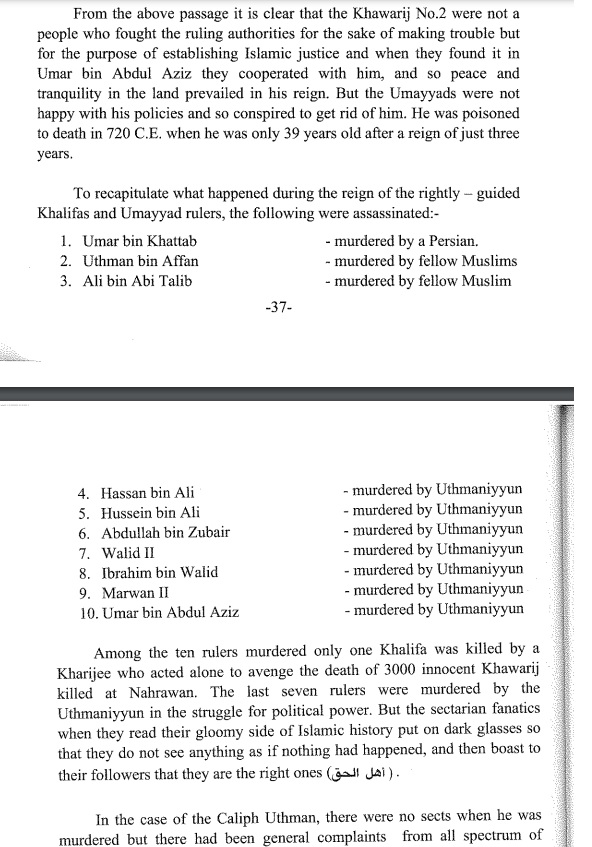
Second plot device.

Forensic science.

“As for the handwriting, they recognised that it was that of Marwan, and they came to doubt as to Uthman.” As if they are forensic scientist!
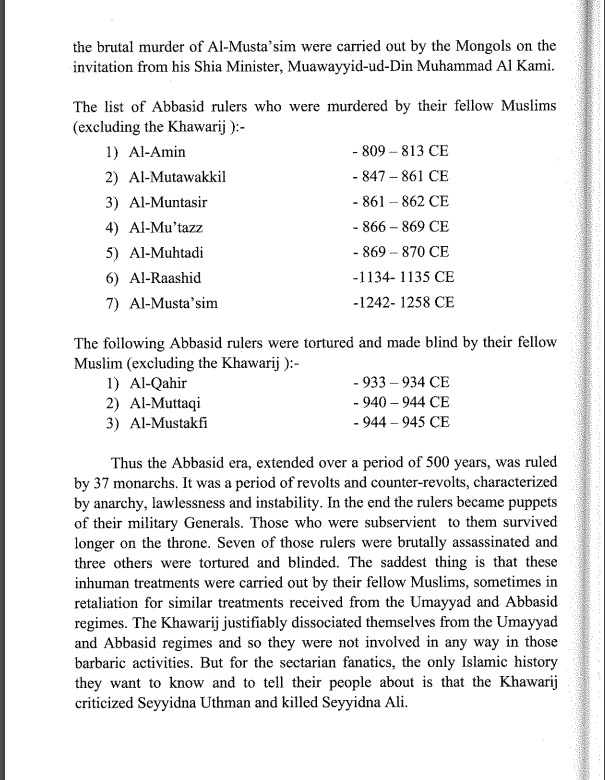
Then just a little further down.

“If ‘Uthman wrote it, we will remove him from office. If Marwan wrote it as if it had been written by Uthman, then we will have to look seriously at what we shall do in the case of Marwan.”

So which is it? Did these forensic scientist recognize that the handwriting was that of Marwan or are they still wrangling over the possibility that Uthman really did write the letter and was lying. Really shows you what some of them thought of Uthman!

Third plot device.

Who are the two that killed Uthman?

“He said to al-Hasan and al-Hussein, “Go with your two swords and stand at the door of Uthman and allow no-one to reach him.”

“Muhammed ibn Abi Bakr was afraid that Banu Hashim would become angry because of the state of al-Hasan and al-Hussein and provoke a tumult. He took the hands of two men.“

“Muhammed and his two men got over the wall from the house of a man of the Ansar and entered Uthman’s house.“

“Muhammed said to the two of them.”

“Then the two men entered and struck him until they had killed him.“

“Ali said to his two sons, “How was the Amir al-Muminin killed while you two were at the door?” He raised his hand and slapped al-Hasan, struck the chest of al-Hussein.”

The Identity of the Assailants

Who were the two men who entered with Muhammed ibn Abi Bakr and struck Uthman? The account in al-Suyuti’s Tarikh al-Khulafa’ does not name them directly. Yet the narrative structure is striking.

Consider the sequence: Ali orders al-Hasan and al-Husayn to stand guard at the door with their swords, instructing them to allow no one to reach Uthman. Later, Muhammed ibn Abi Bakr enters the house from another direction—scaling the wall—accompanied by “two men.” These two deliver the fatal blows. When Ali discovers the assassination, his immediate reaction is not to pursue the intruders but to turn to his two sons, strike them, and demand: “How was the Amir al-Muminin killed while you two were at the door?”

The text does not explicitly name al-Hasan and al-Husayn as the killers. But it places them at the door, positions the actual assailants as anonymous figures who enter from elsewhere, and then shows Ali holding his sons accountable. The narrative, as preserved in al-Suyuti’s work, seems to invite the reader to connect these details—whether the implication is that they failed to prevent the killing or that they were more directly involved, the text leaves the reader to discern the connection.

It couldbe argued that the narrative subtly implicates al-Hasan and al-Husayn in the assassination itself. Others contend that it merely shows them failing in their protective duty, not participating in the killing, and that Ali’s anger was directed at their negligence. Still others point out that the historical sources are contradictory on this point, with different traditions assigning responsibility to different individuals—some naming Muhammed ibn Abi Bakr alone, others implicating figures whose identities have been obscured by later apologetic revision.

What is clear is that the ambiguity is itself revealing. Whether the sources intend to implicate them or simply place them at the scene in a protective role, the narrative’s structure speaks to the contested nature of these events. The convenient anonymity of the actual assailants, combined with the pointed direction of Ali’s fury, suggests a literary hand at work—one that must navigate between preserving the reputations of Ali’s household and recording the historical reality that those same household members were deeply entangled in the conflict.

This ambiguity is characteristic of historical writing from this period. Later historiographical traditions—whether Sunni, Shi’i, or Ibadi—reflect the deep divisions that emerged from these events, and each tradition has shaped its sources accordingly. For the contemporary reader, the most responsible approach is to acknowledge the uncertainty, resist the temptation to assign blame with certainty, and recognize that these are matters about which even the early sources do not speak with one voice.

Reflection.

Dear readers, consider the convert who comes to Islam seeking peace, clarity, and connection with Allah. What possible benefit could it bring them to be drawn into the conflicts of Ali’s family and the Umayyad clan? These were political struggles of a particular era. They are not the substance of faith. The substance of faith is the Qur’an, the Prophetic example, and the sincere worship of Allah alone.

The Prophet (saw) said: ‘Leave that which causes you doubt for that which does not cause you doubt.’ The disputes between Banu Hashim and Banu Umayya are a source of doubt, division, and confusion. Leave them. Turn instead to what is certain: the Qur’an, the authentic Sunnah, and the worship of Allah. In that is your spiritual fulfillment.

For the contemporary Muslim—whether a new convert or one born into the faith—the question of whether Banu Hashim or Banu Umayya held the upper hand in the seventh century is spiritually irrelevant. Islam came to address the heart’s longing for its Creator, not to enlist believers as partisans in dynastic disputes over which tribe or bloodline is meant to rule over the Muslims.  

Enough! The Muslim who turns to Allah in prayer, who weeps over the Qur’an, who seeks to purify their soul—what have they to do with the quarrels of Banu Hashim and Banu Umayya? Those were political conflicts born of their time and place. To make them the centerpiece of Islamic identity is to miss the entire point of the revelation.

Conclusion: The Case for Wuqoof

The following is based upon the information provided to us by the Sunni, Shafi’i, Ash’ari, Shaykh Izz ad-Dīn Abū al-Hasan Ibn al-Athīr.

We are thankful to our teacher, Shaykh Masoud bin Muhammed Al Miqbali (hafidullah) for explaining the truth to the people!


TRANSCRIPT FROM THE SHAYKH.

“Moreover, before this there was manifest evil from Uthman towards Abdullah bin Masoud, Abi Thar, and Ammar bin Yasir.” “The people of Uthail and the people of Zuhra had in their hearts grieved concerning the condition of Ibn Masoud.” “And the tribe of Ghifar and it’s allies and all of them had rage in their hearts for what happened to Abu Thar.” “And the tribe of Makhzum were enraged against Uthman for the condition of Ammar bin Yasir.” –Shaykh Masoud bin Muhammed Al Miqbali (h)

“It says, “Uthman remained for three days not buried and then Hakim ibn Hizam Al Qurashi and Jubayr ibn Muṭʽim talked to Ali to allow his burial and he allowed it.” So the final decision was with Ali. And Hakim ibn Hizam and Jubayr ibn Mut’im talked to Ali to allow his burial. “And Hakim ibn Huzam and Jubayr ibn Mu’tim went and talked to allow, “allow”, his burial. What does this phrase mean? “Allow?!”-Shaykh Masoud bin Muhammed Al Miqbali (h)

What do you understand from their act of talking to Ali to allow his burial so he allowed? What do you understand from that?

Food for thought.

Ali did not wash Uthman for burial nor did he pray the funeral prayer over him.


“When those seeking him (Uthman) heard that, they stood along the way with rocks [to throw at his janaza] and few family members of Uthman accompanied his body. The people of Medina didn’t leave for his janaza, the people of Medina, the armies of which flattened the Persians and the Romans in the life of the Prophet (saw) and the life of the two Caliphs before, they were completely unconcerned with the burial of Uthman!” –Shaykh Masoud bin Muhammed Al Miqbali (h)


“This is what is documented in classical Sunni sources Oh Dr., this is not an Ibadi book. This is a book from the books which you trust and depend on. ” –Shaykh Masoud bin Muhammed Al Miqbali (h)


“And from those who did not bother with the burial is Al Zubayr, and Al Hassan and Abu Jahm and Hudaifa and Marwan, between Maghrib and Isha, and they brought him to a wall from the walls of Madina called, ‘Hash Kawkab’ and it’s outside of Baqee’ and Jubayr bin Mut’im prayed over him.” –Shaykh Masoud bin Muhammed Al Miqbali (h)

Ali bin Abi Talib did not wash the dead body of Uthman nor did he pray over him.


Ali bin Abi Talib didn’t pray over him, Ali didn’t pray the janaza over Uthman, even though he exists.


“And it was said Hakim ibn Hizam and it was said that Marwan, and the people from the Ansar, Al Andar which the Prophet (saw) advised us concerning: “And people from the Ansar approached to stop them from praying the janaza, then they let them be for fear of fitnah.” –Shaykh Masoud bin Muhammed Al Miqbali (h)


“There were people from the Ansar who wanted to stop them from praying on him.
And Ali went to those sitting on the way wanting to throw stones at Uthman’s body and he stopped them. “And he was buried in Hash Kawkab’ “Meaning that he wasn’t buried in Al Baqee’. They were stopped from burying him in Al Baqee’.” “And when Muawiyah bin Abi Sufyan was in charge he ordered that the wall be crushed and so it was. And he was entered into Al Baqee.” “And he ordered the people, so they buried the dead near his grave till the grave eventually connected to the graves of Muslims.” –Shaykh Masoud bin Muhammed Al Miqbali (h)


“And it was said that he was buried in Al Baqee’ near Hash Kawkab and it was said that his Janaza was attended by Ali and Talha and Zaid bin Thaib and Ka’b bin Malik, the general population and then from his companions. “And it was said that they didn’t perform ghusl on him and he as shrouded in his clothes.” “These are documented in classical Sunni sources which testify to and speak about that.” -Shaykh Masoud bin Muhammed Al Miqbali (h)

“These are the stances of the sahaba.  And in the book: “Tarikh Al-Khulafa” for Al Sayuti: “and narrated from Abi Al Tufayl Amr bin Wa’ila the companion that he entered on Muawiya, so Muawiya asked him: “Are you not from the killers of Uthman? He said: No, but I’m from those who were present but didn’t support him.” He said: “And what stopped you from helping him? He said: “The Muhajiroon and the Ansar didn’t support him.” -Shaykh Masoud bin Muhammed Al Miqbali (h)


“So the list is long. “If I wanted to narrate to you all those who stopped on Uthman. From them is Ammar bin Yasir. Ammar bin Yasir, the one who’s stomach was stomped on by Uthman’s leg, causing him severe pain. And a whole bunch of sahabah, I can narrate you a list with those that are documented in classical Sunni sources. For example: al-Isaba from Ibn Hajar and al-Usd al-ghābah from Ibn al–Athīr, and at-Tabaqat from Ibn Sa’d and many other books which you trust and depend upon. They mentioned who did Khuruj on Uthman and who faced him and declared his deviance and so on.” -Shaykh Masoud bin Muhammed Al Miqbali (h)

Final Reflections

In the end, the history seems rather murky. It seems the chief complaint against Uthman was nepotism. This is followed by accusations of what looks like Uthmans inability or unwillingness to punish his relatives when they did acts of injustice. The third accusation seems to be the distribution of public funds to members of his own family.In the end, it is probable although not certain that the sons of Ali Ibn Abi Talib, along with Muhammed ibn Abi Bakr, assassinated Uthman. This, of course, led to a permanent division among Muslims that has not healed until this day. It seems in hindsight and in retrospect, after the development of the doctrine of ʿadālah aṣ-ṣaḥābah’ and a few strokes of the pen, people are most likely companions and suddenly not companions and there are anonymous individuals where convenient.

It is very curious that you don’t see the Abbasid Sunnis (the majority of Sunnis today) remember the killing of Uthman like you see them remember the killing of Ali ibn Abu Talib. It is also noteworthy that you do not see the Abbasid Sunnis ask Allah (swt) to curse the killers of Uthman. Maybe they know something they don’t want to tell you.

The accusations against Uthman were used to justify his killing and later to delegitimize the Umayyads (who were his clan). The first Abbasid caliph, al-Saffah (“the Blood-Shedder”), ordered the hunting down of all Umayyad members, effectively destroying the dynasty in the east.

Ultimately those who championed the cause of Uthman came to be known as the Umayyads. They brought Islam to places it had not been before. At it’s height during the years 661 to 750 the caliphate was 11.1 million square km making it one of the largest contiguous empires in world history. It was an empire where the praise of Ali and his household was not central at all.

When it comes to Uthman Ibn Affan, the best position is to practice Wuqoof.

Wuqoof is to pause if there is khilaf on the person. Wuqoof is to stop at everyone you don’t know. You do not make a judgement on him/her to be in Walayah or Bara’ah. This is a very safe path to take.

“That was a community that had already gone before. For them is what they earned and for you is what you have earned. And you will not be accountable for what they have done.” (Qur’an 2:141)

“And those who came after them say: “Our Lord! Forgive us, and our brethren who came before us into the Faith, and leave not, in our hearts, rancor (or sense of injury) against those who have believed. Our Lord! You are indeed Full of Kindness, Most Merciful.” (Quran 59:10)

And, of course, for our Arabic readers: This is prepared by the noble and respected, Shaykh Abu Tayyib Khalfan Altywani. May Allah (swt) bless him for this enlightening work!

May Allah (swt) guide this Ummah to a course that is just!

You may also wish to read the following:

May Allah (swt) Forgive the Ummah.

May Allah (swt) Guide the Ummah.

5 Comments

Filed under Uncategorized

The Ibadis do not encourage revolts against their Imams in order to avoid bloodshed.

 “And do not obey the order of the transgressors, Who cause corruption in the land and do not amend.” (Qur’an 26:151-152)

﷽ 

The Ibadis do not encourage revolts against their Imams to avoid bloodshed. It is justifiable only as a last resort and in extreme circumstances. It is the right of every Muslim to be given consultation. The history of the Ibadi Imamate in Oman speaks for itself.

Which are the top 3 longest lasting Muslim empires/dynasties in terms of longevity & stability?

1. 1299-1922 Ottoman/Sunni/Hanafi = 623 years

2. 750-1258 Abbasid/Sunni/Hanafi = 508 years

3. 1154-1624 Nabhani/Ibadi = 470 years

Let us see who really presided over chaos and death and who were beacons of stability.

These excerpts are taken from the book: Ibadhism The Cinderella of Islam.

First let us take a look at house Uthmaniyyun

Prima Qur’an comments:

*notes* The above text says:

Uthman ibn Affan—murdered by fellow Muslims — This is because he was not killed by the Uthmaniyyun. He was killed by fellow Muslims as he would not be deposed peacefully.
Ali bin Abi Talib—murdered by a fellow Muslim. He was killed by Ibn Muljam in retaliation for the slaughter at Nahawan.

We would personally have switched out the negative word ‘murdered’ with a more neutral word ‘killed’.

Because Muslims can kill if it is with in the limits set by Allah. But murder would imply that a person had no right.

Also, the use of the term Kharijee and Khawarij here by Shaykh Soud H. Al-Ma’awaly (May Allah continue to benefit us by him) is to grant the term to the sectarian reader.

Becasue on page 8 he clearly states:

“Ibadhism is one of the most misunderstood Islamic sects, and is wrongly considered as one of the Khawarij group of sects that are regarded as heretic or even apostate that has deviated from the mainstream of Islam.”

Now, let us take a look at house Abbasids

Now let us take a look at House Ibadi

Btw, when it says above: * deposed * this is like when the president of the former United States gets impeached, or removed from office, for example. Or like the CEO of a company being asked to step down due to negligence and/or other reasons.

The one who is deposed is not sought out and not killed. They are simply deposed for either being incompetent and/or not fit to lead. No favoritisms based upon tribal, clan, ethnic group or family loyalty.

Deposed is the graceful exit from public office.

However, if that individual does not go quietly, revolution is on the table. The Amir of the Muslims is in service to the Muslims and is not above the commands of Allah nor above public critique for lacking in issues of statecraft.

What happens is that the temperment of the general public is taken into an account. If the will of the people is strong the ruler is deposed by force.

However, if it is seen that the ruler has strong backing then one abides with it in patience. A stalemate in which an endless cylce of bloodshed takes place is never a good thing.

Allah (swt) knows best!

If you wish to read more, you are invited to read:

Ibadhism: The Cinderella Story of Islam.  This is an excellent book by the noble  Shaykh Soud H. Al-Ma’awaly (May Allah continue to benefit us by him)

Or you can try to obtain the book at the following link:

https://alsaidia.com/node/892

May Allah (swt) Forgive the Ummah.

May Allah (swt) Guide the Ummah.

Leave a comment

Filed under Uncategorized

There is no single verse in the Qur’an that gives praise to the daughters over the wives of the Blessed Prophet (saw)

“O wives of the Prophet! You are not like any other women: if you are mindful, then do not be overly effeminate in speech or those with sickness in their hearts may be tempted, but speak in a moderate tone.” (Qur’an 33:32)

﷽ 

In Islam, the preference of the Mothers of the Believers over all other women of this Ummah is by the text of the Qur’an.

So, they are not like any of the other women.

“And whoever of you devoutly obeys Allah and His Messenger and does good, We will grant her double the reward, and We have prepared for her an honourable provision.” (Qur’an 33:31)

Thus, their reward is doubled, and this is a distinction that Allah has made only for the Prophets and the Mothers of the Believers.

Narrated `Abdullah:

I visited Allah’s Messenger (saw) while he was suffering from a high fever. I said, “O Allah’s Messenger (saw)! You have a high fever.” He said, “Yes, I have as much fever as two men of you.” I said, “Is it because you will have a double reward?” He said, “Yes, it is so. No Muslim is afflicted with any harm, even if it were the prick of a thorn, but that Allah expiates his sins because of that, as a tree sheds its leaves.”

https://sunnah.com/bukhari:5648

In Islamic theology, the doubling of reward (mudā‘afah) for trials and obedience is typically a characteristic reserved for prophets and those with the highest stations, further solidifying their unique status

“It is not lawful for you to marry more women after this, nor can you replace any of your present wives with another, even if her beauty may attract you—except those whom your right hand posses. And Allah is ever Watchful over all things.” (Qur’an 33:52)

It is not lawful for the Messenger of Allah (saw) to exchange them, because they are virtuous and Allah-fearing.

“O Prophet! Ask your wives, daughters, and believing women to draw their cloaks over their bodies. In this way it is more likely that they will be recognized and not be harassed. And Allah is All-Forgiving, Most Merciful.” (Qur’an 33:59)

Allah has given precedence to the wives of the Messenger of Allah (saw) over his daughters in the mention, because they are superior.

“And it is not right for you to annoy the Messenger of Allah, nor ever marry his wives after him. This would certainly be a major offence in the sight of Allah.” (Qur’an 33:53)

The understanding of this is obvious. Do not marry the wives of the Blessed Prophet (saw) after his death. Allah (swt) considers an offence.

However, there was no problem for any of his daughters to be married multiple times.

Ruqayyah (ra) married Utbah ibn Abu Lahab (divorced), then married Uthman Ibn Affan.

Umm Kulthum (ra) married Utaybah ibn Abu Lahab (divorced), then married Uthman Ibn Affan after Ruqayyah’s death.

Zaynab (ra) the favourite daughter of the Prophet (saw) married Abu al-As ibn al-Rabi, then later married Abdullah ibn Jahsh.

Fatima (ra) married only Ali ibn Abi Talib.

And the Qur’an is full of praise for the Mothers of the Believers, and there is not even a single verse that praises the daughters of the Messenger of Allah in terms of their being daughters.

Although you will find praise of the daughters in the hadith literature. Even then the hadith literature is coloured by the hatred that the Umayyads, Abbasids and pro Alids had for each other.

So, for example, when Urwah ibn al-Zubayr narrated that Zaynab bint Muhammed (ra) was mentioned by the Blessed Prophet (saw) to be the best of his daughters, he (Zubayr) was accosted by Zayn al-Abidin who approached Urwah ibn Al-Zubayr in a very hostile manner demanding why he would put anyone anywhere near the rank of Fatima (ra).

A kind of terrorism and suppression by the Abbasids and the Alids towards anyone who would put someone else other then Fatima and Ali first. Here we narrate to you how Ali ibn al-Husayn went after Urwah ibn al-Zubayr (ra) like a raving madman.

Ahmad Abu Bakr ibn Muhammed ibn Hamdan al-Sayrafi in Marw told me, Abu Ismail Muhammed ibn Ismail told us, Saeed ibn Abi Maryam told us, Yahya ibn Ayyub informed us, Ibn al-Had told me, Amr ibn Abdullah ibn Urwah ibn al-Zubayr told me, on the authority of Urwah ibn al-Zubayr, on the authority of Aisha, the wife of the Prophet, (saw) When the Messenger of Allah, (saw), arrived in Medina, his daughter Zaynab left Mecca with Kinanah—or the son of Kinanah—and they went after her. Habbar ibn al-Aswad caught up with her and kept stabbing her camel with his spear until it felled her, and she miscarried and bled. The Banu Hashim and the Banu Umayyah then quarreled over her. She said… The Banu Umayya said: We are more entitled to her, and she was married to their cousin Abu al-As, and she was with Hind bint Utbah ibn Rabi’ah, and Hind used to say to her: This is because of your father. So the Messenger of Allah, (saw), said to Zayd ibn Harithah: “Won’t you go and bring me Zaynab?” He said: Yes, O Messenger of Allah. He said: “Then take my ring.” So he gave it to him. Then Zayd set off and made his camel kneel. He kept being polite until he met a shepherd and said: Whose sheep do you tend? He said: For Abu al-Aas. He said: And whose sheep are these? He said: To Zainab bint Muhammed, so he walked with him for a while, then he said to him: Would you like me to give you something to give to her, and not mention it to anyone? He said: Yes, so he gave him the ring, so the shepherd went and brought his sheep in, and gave them the ring, and they recognized it, so she said: Who gave you this? He said: A man, she said: Where did you leave it? He said: In such and such a place. He said: So she remained silent until night came, then she went out to him. When she came to him, he said to her: Ride in front of me on his camel. She said: No, but you ride in front of me. So he rode and she rode behind him until she came. The Messenger of Allah, (saw), used to say: “She is the best of my daughters, and she was afflicted because of me.” This reached Ali ibn al-Husayn, so he went to Urwah and said: What is this hadith that I heard you narrate in which you diminish Fatimah’s right? He said, “By Allah, I would not wish to possess everything between the East and the West if it meant depriving Fatima of a right that belongs to her. And after that, you have the right to never speak of it again.” Urwah said, “This was before the revelation of the verse: {Call them by their fathers’ names; that is more just in the sight of God} [Al-Ahzab: 5]. This is an authentic hadith according to the criteria of the two Sheikhs (Al-Bukhari and Muslim), but they did not include it in their collections.”

Source: (https://al-hadees.com/mustadrak/2812 Mustadrak Al Hakim 2812)

There is a fascinating article by Professor Deborah G Tor: “The Parting of Ways between ʿAlid Shiʿism and Abbasid Shiʿism: An Analysis of the Missives between the Caliph al-Manṣūr and Muḥammed al-Nafs al-Zakiyya.” That gives some background in regard to the landscape.

Wouldn’t be suprised to see Professor Deborah G Tor on podcast in the future. You’re welcome.

However, we have digressed.

The Mothers of the Believers hold a textual precedence over all other women of the Ummah—including the Prophet’s own daughters in terms of legislated distinction—is consistent with the principles of usul al-fiqh (legal theory) and the explicit wording of Surah Al-Ahzab. Their status is derived from a direct divine address that establishes a unique category, whereas the virtue of other women (including the daughters) is derived from specific narrations regarding personal piety rather than a categorical divine address.

May Allah Guide the Ummah.

May Allah Forgive the Ummah.

Leave a comment

Filed under Uncategorized

Two AI bots have a conversation about the Ibadi school.

“My Lord! Increase me in knowledge.” (Qur’an 20:114)

﷽ 

This fascinating video came to our attention. It appears to be two AI bots having a conversation about the Ibadi school. As regards the YouTube channel, CIISR is not affiliated or registered with any known university or college in the world. Dr. M A Mufazzal seems to be an individual not known to be attached to any reputable college or university in the world. In fact, leave the reputable aside, he is simply not known at all.

This is the video. We give our comments below.

@4:37 minutes, we were curious where the idea came from that we upheld divine predestination (qadar) in the sense of fatalism. Which was curious given that the AI bots speak about the Ibadi, avoiding binaries. We do not uphold the view of the Mutazil’i nor the Jabariyyah. We hold to the doctrine of kasb (acquisition). This is something the Ash’ari followed us on.

@6:16 this is also incorrect. We do not believe that Ali was a divinely appointed leader. A good portion of the community made shura and among them were the ansar and the muhjirin, who agreed upon him. Once that is done, it is obligatory for the others to pledge allegiance. No such thing as being divinely appointed.

This becomes abundantly clear in our article here:

In fact in that article we stated the following:

The battle of Siffin and practical implications of the above verse.

O you who have believed, obey Allah and obey the Messenger and those in authority among you. And if you disagree over anything, refer it to Allah and the Messenger, if you should believe in Allah and the Last Day. That is the best [way] and best in the result. (Qur’an 4:59)

The battle of Siffin gives us a demonstration of how some of the companions understood the above verse. If we are to believe the historical narrative as told by Shi’i and Sunni sources.

If we are to believe the Shi’i narrative.

 Ali agreed to arbitration with Muaviya on the basis that they would judge by the Qur’an. If Ali understood that he was of the same authority as the Qur’an and the Messenger (saw) he would not have submitted to arbitration. He would have been on the same page as those in his army who wanted to continue the fight.  However, if he did think he was of the same authority as the Qur’an and the Messenger (saw), then he would be a hypocrite for going against what he himself believed. Or he was not sincere in submitting to the authority of the Qur’an. 

If we are to believe the Sunni narrative. 

If those in Muaviya’s camp believed that the Shi’i held any of the views about Ali that Imami Shi’i held, namely that he (Ali) was maʿṣūm (معصوم) and he (Ali) held ʿiṣmah (عصمة) they themselves would have never asked for arbitration as it too would have simply been a ruse. This becomes very clear that these concepts were not among the followers of Ali because Muaviya’s camp would have known this and would have never cooked up the idea of raising the Mushafs as it would have easily backfired.

@9:03 “They also believe that Ali was wrong to arbitrate.” So this is a contradiction with the AI chatbots. You cannot have a belief in a divinely appointed Imamate and then believe that same Imam is wrong in a decision he makes!

@6:34 is also a tired trope that we hear time and again. Fiqh and Itjihad are a part of Islam. It is something that has been with us in the beginning. The companions who opposed Ali were not claiming you cannot arbitrate God’s law with mortal men. That is a flawed misunderstanding. It is that you cannot make a ruling in place of where the rule is already established and clear.

None of our scholars say that human beings cannot arbitrate. The Qur’an specifically says they can in several places. It is just that humans cannot arbitrate on a matter on which Allah judged. If Allah (swt) gave his ruling on a matter, a human being cannot come along and do otherwise. This is a huge miss by this AI-generated dialogue.

This was established by the companions in their debate with Ibn Abbas (ra). And Ibn Abbas (ra) eventually understood that the people of the river were correct.

And by repeating these same tired tropes, the Sunnis have actually mocked their own Imams. With stories that make Imam Abu Hanifa look ignorant of other people’s positions.

The same ignorant trope that was used by Shi’i reformist Syed Ali Hur Kamoonpuri here:

@12:02 to miss out on the robust populations of the Ibadi in Tunisia, Zanzibar, Tanzania, Ghana is unfortunate. To skip the presence in East Africa altogether is unfortunate.

@13:09 We didn’t quite get the point the AI bots were making: “But again, like with the kharijites question, they take it to its most extreme logical conclusion.” We don’t see the connection they were trying to draw?

@13:40 we were curious as to which verse mentions Allah “sitting” on a throne?

There were other things we could have picked apart, but we did not want to be overly pedantic.

Other than that, for an AI-generated dialogue over all it is o.k. It is what you would expect from agnostic secular academics or historians discussing the matter. Although they would probably refrain from throwing in the occasional ‘eww’ as we saw from the female AI bot. The lasting thoughts were very profound, especially from an AI algorithm.

May Allah Guide the Ummah.

May Allah Forgive the Ummah.

Leave a comment

Filed under Uncategorized