“That is from the news of the unseen which We reveal to you. And you were not with them when they cast their pens as to which of them should be responsible for Mary. Nor were you with them when they disputed.”(Qur’an 3:44)
﷽
“This is the Book in which there is no doubt, a guide for the righteous. Those who believe in the unseen, and perform the prayers, and give from what We have provided for them. And those who believe in what was revealed to you, and in what was revealed before you, and are certain of the Hereafter.” (Qur’an 2:3-4)
The Qur’an is a book of which there is no doubt. It is for those who believe in the unseen. It is for those who are certain in the life to come. It is for those who believe in what was revealed before the Blessed Prophet (saw).
Those who are skeptical of those points will quite naturally arrive at different conclusions. So that is of no consequence for the believer.
“As for those who persist in disbelief, it is the same whether you warn them or not—they will never believe. Allah has sealed their hearts and their hearing, and their sight is covered. They will suffer a tremendous punishment.” (Qur’an 2:6-7)
Now, historians and orientalists cannot speak of the supra natural as these are matters of belief. They are beyond their point of historical investigation. However, we are always thrilled when we find historians and Orientalists corroborating the testimony of narratives in the Qur’an by finding manuscripts or parchments of information that, though not ad verbatim, closely mimic what Allah (swt) has revealed before. This is the understanding of the believer.
Do we find some information from various cultures that preceded the coming of the Blessed Prophet (saw) that seems to corroborate the beliefs of Islam? Yes! That is not scary! That is exciting!
Recall what Allah (swt) himself informed us of:
“We surely sent a messenger to every community, saying, “Worship Allah and shun false gods.” But some of them were guided by Allah, while others were destined to stray. So travel throughout the land and see the fate of the deniers!” (Qur’an 16:36)
Remember we are not responsible for the conclusions or perceptions of others.
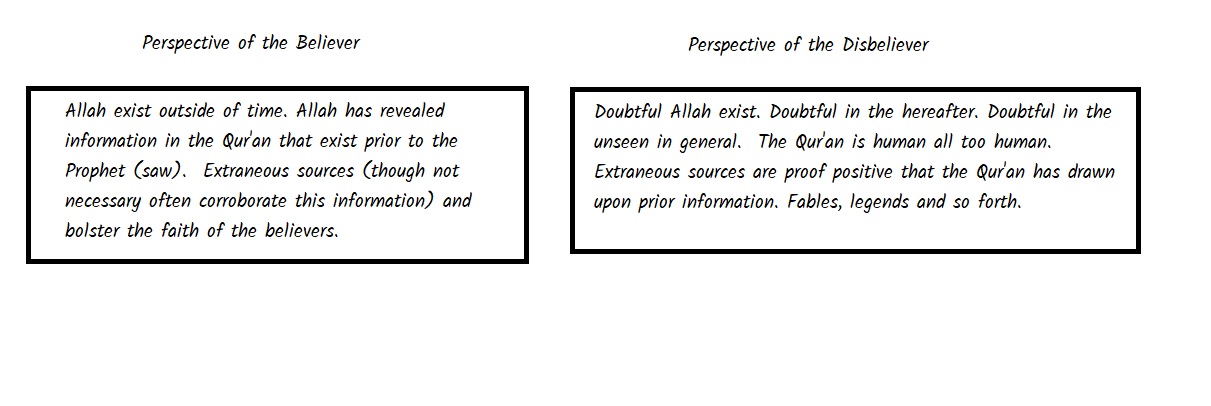
If we look at the above graph. We can see that in block B the apparent (the dhahir) is that there are parchments, manuscripts, scrolls, oral traditions, inscriptions etc. that come before the Qur’an. However, when we look at block B, the haqiqah (the reality) is that Allah’s knowledge of what really happened precedes the information in B.Because of that reality, what is in C (The Qur’an) actually precedes the information in B. This is precisely why this hobbyhorse of orientalist and those who use the historical critical method is of absolutely no consequence for the believing Muslim.
We Muslims have been the first critics of our own sources. The clash of historical narratives between the Ibadi, Sunni and Shi’a is proof positive of this. The grading of the ahadith and the mention of variants in the transmission of the Qur’an have not come from people who lost faith, agnostics or atheists. They came from us, as believers. Subhan’Allah!
These other Johnny Come Lately types, HCM, etc., welcome to the party!
History and Miracles.
We don’t believe that miracles are historical. This does not mean that we do not believe that miracles did not happen. We just don’t believe that history can capture them.
Case in point. An Indian king, Cheraman Perumal, was reported to have seen the moon split. History can report such data, but it does not necessarily confirm nor interpret the data.
This particular entry is directed towards Christians. It is rather shameful that they have taken the approach that they have in these matters. Given that they too claim to believe in the unseen. They claim to believe in a Creator that can narrate past events that present people were not privy to.
“Then she brought him to her people, carrying him. They said, “O Mary, you have certainly done a thing unprecedented. O sister of Aaron, your father was not a man of evil, nor was your mother unchaste.”But she pointed to the babe. They said: “How can we talk to one who is a child in the cradle?” He said: “I am indeed a servant of Allah: He has given me revelation and made me a prophet; And He hath made me blessed wheresoever I will be and has enjoined on me Prayer and Charity as long as I live; (He) has made me kind to my mother, and not overbearing or miserable; So peace is on me the day I was born, the day that I die, and the day that I shall be raised up to life (again)”! Such (was) Jesus the son of Mary: (it is) a statement of truth, about which they (vainly) dispute.”(Qur’an 19:27-34)
“When Allah will say, “O Jesus, Son of Mary, remember My favor upon you and upon your mother when I supported you with the Pure Spirit and you spoke to the people in the cradle and in maturity; and [remember] when I taught you writing and wisdom and the Torah and the Gospel; and when you designed from clay like the form of a bird with My permission, then you breathed into it, and it became a bird with My permission, and you healed the blind and the leper with My permission; and when you brought forth the dead with My permission; and when I restrained the Children of Israel from [killing] you when you came to them with clear proofs and those who disbelieved among them said, “This is not but obvious magic.”(Qur’an 5:110)
“And a messenger to the Children of Israel, who will say, ‘Indeed I have come to you with a sign from your Lord in that I design for you from clay like the form of a bird, then I breathe into it and it becomes a bird by permission of Allah. And I cure the blind and the leper, and I give life to the dead – by permission of Allah. And I inform you of what you eat and what you store in your houses. Indeed in that is a sign for you, if you are believers.” (Qur’an 3:49)
Prima Qur’an comments:
In this article, we will give a response to those Christians who use as a polemic against Muslims the claim that the Qur’an contains apocryphal material in it and therefore cannot be a revelation from Allah (swt).
Now, of course, they will claim that there are more than the three verses of the Qur’an we quoted above as being from apocryphal material. However, we have chosen to focus on these three, as they are most often used by Christian polemicists in debates with Muslims.
Now, personally, we find this particular line of Christian attack against Islam amusing. However, they have to eventually come up with something, right?
Now let’s look at and listen carefully to what these Christians are actually disputing with us about.
*Note*
They are not raising the issue of “healing the blind.“
They are not raising issues against “curing people affected by leprosy.”
They are not raising issues against “give life to the dead.”
They are not disputing these points because they are miracles attributed to Christ Jesus that they find in their accepted canonical text. We will come to the term canonical in a moment.
What they are disputing is:
Jesus speaking as an infant
Jesus creating birds out of clay
Why do they dispute about these miracles?
Because they are not in what they accept to be their canonical text.
So what do the terms apocryphal and canonical mean?
Canonical in relation to Christian scriptures means:
“A biblical canon or canon of scripture is a set of texts (or “books”) which a particular religious community regards as authoritative scripture. … Believers consider canonical books as inspired by God or as expressive of the authoritative history of the relationship between God and his people.”
Apocryphal in relation to Christian scriptures means:
“Biblical or related writings not forming part of the accepted canon of Scripture; or writings or reports not considered genuine.”
So, if a Christian were to come to us and say that these statements in the Qur’an are found in apocryphal sources, the first thing you have to keep in mind that what they are actually saying isthat it is apocryphal according to their particular sect of Christianity!
The reason that is important is as follows: As we write this to you on 11/4/2024, Christendom has still not settled the issue of what is and is not apocryphal for the whole of Christianity.
Glaring examples are the following:
Depending on how you want to word it, you could say that the Protestants have 7 fewer books in their version of the Old Testament. Or you could say that the Roman Catholics have 7 extra books in their Old Testament that they accept to be inspired and not apocryphal.
Yet the Orthodox Church has additional Old Testament texts (or if you want to be neutral, the Protestants and Catholics have less). The same can be said for the Ethiopian Orthodox Church.
The same goes for the New Testament.
What is canonical is an issue that is still not settled among them.
The Chaldean Syrian Church does not accept the following as canon:
In fact, many Protestant Christians have declared Mark 16:8-20, & John 7:53–8:11 to not be canonical.
You have to wonder about the Protestant Christian theologians like John Calvin, Martin Luther, and others who most likely held such passages to be canonical. Yet there are Christians who do not agree with the idea that such passages are non-canonical. These Christians very much believe that Mark 16:8-20, &John 7:53–8:11 are inspired scripture.
So what is the point that is being made?
The point is that when a Christian says to us that those verses in the Qur’an are allegedly taken from apocryphal sources, it is important to understand that:
That though it may be apocryphal for that particular Christian, we can’t say for certain that it was apocryphal for the other Christians.
To keep in mind that what is and is not apocryphal has been and continues to be an internal dispute among Christians.
If the Christian is to counter by saying, “Can you name for me any Christian denomination today that accepts such and such text as canonical?”
The answer to that is: “No we can’t.” Many Christian sects and denominations over time have long perished. Most often the information we do have about them comes from their opponents.
What is also interesting, and we hope Muslims reading this bear in mind, is that no Christian committed to a consistent world view in which the supra-natural happens can tell us that:
Jesus did not speak as an infant.
Jesus did not create birds out of clay.
This assertion is also supported by the text they accept as canon. Namely, the following:
“And Jesus did many other miracles in the presence of his disciples which are not written in this book: But these are written that you might believe that Jesus is the Christ, the Son of God; and that believing you might have life through his name” (John 20:30-31).
Prima Qur’an comments:
Now this writer, apparently inspired by Allah, felt that it was necessary to inform his readers that Jesus did many other miracles that are not contained within this book.
“There are many more things that Jesus did. If all of them were written down, I suppose that not even the world itself would have space for the books that would be written.” (John 21:25)
Prima Qur’an comments: Though we can all agree this statement is hyperbole, yet it is obvious that the writer knew that there was much more information about Jesus that could be shared.
Now, a possible Christian objection to our understanding of John 20:30-31 is that ‘the many other miracles that are not present in this book‘ could only be a reference to the miracles listed in Matthew, Mark, Luke that are not in the Gospel according to John.
The response to this is that it is simply an assumption.
It could be that:
It could be a reference only to the miracles present in Matthew, Mark, Luke that are not in the Gospel, according to John.
It could be a reference to miracles that are not present in any of those Gospel accounts.
It could be a reference to miracles present in Matthew, Mark, Luke as well as those not present in any Gospel accounts.
Christians could well ask: “Why wouldn’t these accounts of Jesus speaking as an infant or making birds out of clay make it into any of the Four Gospels commonly accepted among all of Christendom?”
Well, we have a clue about that from a text we have already mentioned.
“And Jesus did many other miracles in the presence of his disciples, which are not written in this book: But these are written, that you might believe that Jesus is the Christ, the Son of God; and that believing you might have life through his name” (John 20:30-31).
Prima Qura’n comments: This Gospel writer is telling us that he is informed about other miracles, but the seven particular miracles that he has selected is so that we may believe that Jesus is:
The Christ
The Son of God
Having eternal life through his name.
So, in the example of this Gospel writer, we have the reasons plainly stated why some miracles were chosen over others. Whereas for the other Gospels it’s hard to discern why they may have left out certain miracles.
For example, John’s Gospel includes the story of Lazarus rising from the dead. I’m puzzled why such an awesome event is not recorded by the other Gospels. Or Jesus turning water into wine is only included in the Gospel, according to John.
Equally puzzling is the following awesome account, which is not recorded by any ancient documents outside of Matthew itself.
“And behold, the curtain of the temple was torn in two, from top to bottom. And the earth shook, and the rocks were split. The tombs also were opened. And many bodies of the saints who had fallen asleep were raised, and coming out of the tombs after his resurrection they went into the holy city and appeared to many. When the centurion and those who were with him, keeping watch over Jesus, saw the earthquake and what took place, they were filled with awe and said, ‘Truly this was the Son of God’” (Matthew. 27:51-54).
There are no extra-biblical sources that mention this awesome event. Surely witnessing such an event would have been worthy of mention somewhere. In fact, this particular text created controversy even among conservative Christians when New Testament scholar and associate professor of theology Michael Licona raised questions about this text.
You can read about where Christians have done some damage control concerning this at the following:
So, again, going back to the Christian inquiry into why some awesome and miraculous events are recorded by some sources and not others, we can only surmise as to the motives behind this.
Why is it Jesus speaking as an infant is recorded in some sources and not others?
Why is Jesus making birds out of clay recorded in some sources and not others?
Why is it that the Gospel of Mark is now considered not to have a resurrection narrative, but other sources have it?
Why is it that Jesus raised Lazarus from the dead from some sources and not others?
Why is it that Jesus turned water into wine from some sources and not others?
Why is that only the Gospel of Matthew has this narrative about the mass resurrections of people appearing to many in the city?
Another interesting point to note is that, in the case of the Christian tradition that many of us will encounter today, Roman Catholics, Orthodox, and Protestants of many types, we have 30 years of the life of Christ Jesus that is completely missing altogether!
“Now Jesus himself was about thirty years old when he began his ministry. He was the son, so it was thought, of Joseph, the son of Heli.” (Luke 3:23)
So imagine all the people who needed to be healed, those who needed salvation, and what does the current Christian canon tell us about the early life of Jesus? Its silence about the early life of Jesus is awkward, to say the least.
It is honestly both shocking and disappointing that Christians would use these types of arguments against the Qur’an. It absolutely reeks of atheism, smacks of radical skepticism, and is stepped in a worldview bereft of the supra-natural.
For us, as Muslims, we are informed about what happened concerning Jesus through divine revelation. As Allah (swt) says to the Blessed Messenger (saw):
“That is from the news of the unseen which We reveal to you. And you were not with them when they cast their pens as to which of them should be responsible for Mary. Nor were you with them when they disputed.” (Qur’an 3:44)
Also, notice that when the Christians make their particular claim about the Qur’an, they more often than not do put up the sources which they claim the Qur’an takes the following from:
Speaking as an infant.
Creating birds out of clay.
We also find it interesting that Muslims don’t ask them for their sources.
The Christian polemicist usually has two sources in mind for this:
Those sources are: The Infancy Gospel of Thomas & The Proevangelian of James
“This little child Jesus when he was five years old was playing at the ford of a brook: and he gathered together the waters that flowed there into pools, and made them straightway clean, and commanded them by his word alone. 2 And having made soft clay, he fashioned thereof twelve sparrows. And it was the Sabbath when he did these things (or made them). And there were also many other little children playing with him.
“And a certain Jew when he saw what Jesus did, playing upon the Sabbath day, departed straightway and told his father Joseph: Lo, your child is at the brook, and he has taken clay and fashioned twelve little birds and has polluted the Sabbath day. 4 And Joseph came to the place and saw: and cried out to him, saying: Why are you doing these things on the Sabbath, which it is not lawful to do? But Jesus clapped his hands together and cried out to the sparrows and said to them: Go! and the sparrows took their flight and went away chirping. 5 And when the Jews saw it they were amazed, and departed and told their chief men that which they had seen Jesus do.”
Source: (Infancy Gospel of Thomas Chapter 2:1-5)
Prima Qur’an Comments:
This narrative speaks about Jesus creating 12 birds. The emphasis on the number 12 is there twice. This must relate to the 12 disciples. Whereas in the Qur’an we find no mention of this.
“Indeed I have come to you with a sign from your Lord in that I design for you from clay like the form of a bird, then I breathe into it and it becomes a bird by permission of Allah.” (Qur’an 3:49)
There is no mention of Jesus doing this act on the Sabbath Day. There is no mention of Jesus creating 12 birds. It is interesting to note that the Qur’andoes not name the number of Jesus’ disciples. Christians have not addressed this.
It would be interesting to know where the writer(s) of the ‘Infancy Gospel of Thomas’ got their information from. The earliest possible date of authorship is 80 A. D to 250 A. D. This is also roughly the time that the date of authorship is ascribed to ‘The Epistle to Titus‘, which is considered canonical by Christians today. These scholars date the epistle from the 80 A. D up to the end of the 250 A. D.
Source: (Raymond E Brown An Introduction to the New Testament. New York: Anchor Bible, p. 662)
“And when Jesus was five years old, there fell a great rain upon the earth, and the boy Jesus walked up and down through it. And there was a terrible rain, and He collected it into a fish-pond, and ordered it by His word to become clear. And immediately it became so. Again He took of the clay which was of that fish-pond, and made of it to the number of twelve sparrows. And it was the Sabbath when Jesus did this among the boys of the Jews. And the boys of the Jews went away and said to Joseph His father: Behold, thy son was playing along with us, and he took clay and made sparrows, which it was not lawful to do on the Sabbath; and he has broken it. And Joseph went away to the boy Jesus, and said to Him: Why have you done this, which is not lawful to do on the Sabbath? And Jesus opened His hands, and ordered the sparrows, saying: Go up into the air and fly; nobody shall kill you. And they flew, and began to cry out, and praise God Almighty. And the Jews seeing what had happened, wondered, and went away and told the miracles which Jesus had done.”
Source: (Infancy Gospel of James Chapter 4)
Prima Qur’an Comments:
This story is very similar to the one in the ‘Infancy Gospel of Thomas’. What becomes apparent is that both of these sources are relying upon some oral tradition–one in which does not have a chain of transmission.
Now here is what is interesting about the Protoevangelion Jacobi or Infancy Gospel of James. One of the Christian polemicists that used this type of attack upon the Qur’anwas himself put in a difficult position in relation to this text.
@19:20 Erhman asks: “What other documents are found in P72 as this is a document that resonates with you?”
James responds, “There are some non-canonical documents in P72 …
Erhman replies, “Right, so I am just wondering about you resonating with this document”. Do you think that the scribe thought what he was copying was scripture?“
James, “Well, I don’t think you can simply jump to the conclusion that, because scribes included books in a single codex that they believed that everything within that codex was necessarily scripture.” There are sorts of works that were considered to be beneficial to people that were included in codices that were not necessarily canonical.”
Erhman, “Yeah, I just think that it was odd that that particular manuscript was one that you resonated with because it’s the earliest attestation that we have of the protoevangelium jacobi.” (The Infancy Gospel of James) ..
Prima Qur’an Comments:
In other words, you can’t know for certain if the scribe who was copying this text (obviously from an even earlier source) was transcribing what he thought was divine writing! Especially in light of the fact that it is in the same genre of manuscripts that are generally described as “the most significant” papyrus of the New Testament to be discovered so far.
“Now, when the Lord Jesus had completed seven years from His birth, on a certain day He was occupied with boys of His own age. For they were playing among clay, from which they were making images of asses, oxen, birds, and other animals; and each one boasting of his skill, was praising his own work. Then the Lord Jesus said to the boys: The images that I have made I will order to walk. The boys asked Him whether then he was the son of the Creator, and the Lord Jesus made them walk. And they immediately began to leap; and then, when He had given them leave, they again stood still. And He had made figures of birds and sparrows, which flew when He told them to fly, and stood still when He told them to stand, and ate and drank when He handed them food and drink. After the boys had gone away and told this to their parents, their fathers said to them: My sons, take care not to keep company with him again, for he is a wizard: flee from him, therefore, and avoid him, and do not play with him again after this.”
Source: (The Arabic Infancy Gospel of Jesus)
Prima Qur’an Comments:
This text has Jesus not only making birdsbut apparently donkeys, oxen, and other (undisclosed) animals out of clay. There is an inquiry about him being the son of the Creator. There is no mention of the sabbath or any mention of the animals being of any number.
It’s thought that this Gospel has its origins in Syriac sources in the 5th or 6th century.
“We find what follows in the book of Joseph the high priest, who lived in the time of Christ. Some say that he is Caiaphas. He has said that Jesus spoke, and, indeed, when he was lying in His cradle, said to Mary His mother: “I am Jesus, the Son of God, the Logos, whom you have brought forth, as the Angel Gabriel announced to you; and my Father has sent me for the salvation of the world.”
Source: (The Arabic Infancy Gospel of Jesus).
Prima Qur’an Comments:
There is no mention of Mary carrying Jesus as a baby. There is no mention of the people asking Mary where this baby came from. This text has Jesus addressing his mother, the Qur’an has him addressing the people. The text above is filled with Christian doctrine: Jesus is the Son of God, he has a ‘Father’ and he was sent for the salvation of the world.
None of this is found in the account of the Qur’an.
Conclusion:
The attacks that Christian polemicists have leveled towards the Qur’anare the kind one would expect from radical skepticism, and a worldview bereft of the supra-natural.
We can see that these sources the Christians point to have important details and radically different theological statements that we do not find at all within the Qur’an.
More telling is that Christians do not even quote these sources, or give the details of the accounts. Many of the people they speak to will not go and double-check the sources for themselves.
The fact that some Christians find these sources apocryphal is of no concern to us as Muslims. We as Muslims do not rely upon them or accept them as revelation either. Our acceptance of what is stated in the Qur’an comes from our faith in it as divine revelation and in what Allah (swt) himself has stated:
“That is from the news of the unseen which We reveal to you. And you were not with them when they cast their pens as to which of them should be responsible for Mary. Nor were you with them when they disputed.” (Qur’an 3:44)
Just as our faith in Jesus as the Messiah, the Word of Allah, and the Son of Mary are not dependent upon any book of the New Testament (even if the whole of Christendom) accepts it as canonical.
Christians themselves cannot totally rule out the possibility of Jesus having spoken as an infant or having given life to the clay birds based upon the following evidence:
“And Jesus did many other miracles in the presence of his disciples, which are not written in this book: But these are written, that you might believe that Jesus is the Christ, the Son of God; and that believing you might have life through his name” (John 20:30-31).
As well as the fact that the Gospel writers themselves have admitted to leaving out particular miracles that did not suit their desired goals.
“The truth is from your Lord, so never be among the doubters.”(Qur’an 2:147)
“And when they hear what has been revealed to the Messenger, you see their eyes overflowing with tears because of what they have recognized of the truth. They say, “Our Lord, we have believed, so register us among the witnesses.” (Qur’an 5:83)
May Allah (swt) guide the truth seekers!
If you enjoyed this article you may enjoy the following:
“And for their saying, “Indeed, we have killed the Messiah, Jesus, the son of Mary, the Messenger of Allah.” And they did not kill him nor did they impale (ṣalabūhu) him; (وَمَا قَتَلُوهُ وَمَا صَلَبُوهُ وَلَٰكِنْ شُبِّهَ لَهُمْ)but it was made to appear to them so. Those who differ therein are full of doubts. They have no certain knowledge of it, but only follow conjecture. For certainly, they did not kill him.” (Qur’an 4:157)
﷽
This is a recent e-mail sent to Todd Lawson an Emeritus Professor of Islamic thought at the University of Toronto.
I sent this inquiry as I am genuinely curious as to why he or anyone for that matter think that the Qur’an 4:157 seem to be interacting with anything that the Romans have done, or that the text is talking about a historical event known as the “Crucifixion” or that the Qur’an is denying/or affirming anything about a Cross at all.
Greetings Professor Lawson
I hope this email finds you in the best of health.
I had read your book “The Crucifixion and the Qur’an: A Study in the HIstory of Muslim Thought.”
It was certainly an interesting read.
You have noted how extraneous material has influenced the Sunni Tafsir tradition and popular interpretation of Qur’an 4:157.
So to this point I am curious as to why you think the Qur’an engaged with an historical event popularly known as “The Crucifixion” at all?
The reason I ask this is because when one looks at the immediate text of the Qur’an 4:157 there does not seem to be any mention of Romans or Roman involvement at all.
I am deeply interested why your good self or anyone would feel that the Qur’an 4:157 engages with an historical event popularly known as “The Crucifixion” at all. I believe that a reading of the text without extraneous material tells us that the text is interacting with certain Jews who were making certain claims about Jesus.
When we read Qur’an 4:155 for example:
“They have incurred Allah’s wrath for their breaking the covenant, and their rejection of the signs of Allah and for slaying Prophets without right, and for saying: ‘Our hearts are wrapped up in covers-even though in fact Allah has sealed their hearts because of their unbelief, so that they scarcely believe.”
I believe we both concur that it would seem out of place for that text to address the Romans of the time of Jesus.
Furthermore the Qur’an 4:157 has a double denial in the text. They did not kill him nor did they (salabu). The initial denial is general and it can easily accommodate any understanding of a possible demise of Jesus.
It is immensely curious to follow up a general denial that can accommodate any particular understanding of any possible demise of Jesus with a particular denial immediately after.
Is it not more sensible in keeping with the immediate text and surrounding text to see this as the Qur’an interacting with particular claims made by Jews about Jesus? Rather these claims are based upon any historical event, document or even oral transmissions in certain circles that the Qur’an would be familiar with?
Given that this seems to be the very obvious case, how do you propose somehow Romans, and a “Crucifixion” is posited upon the text of Qur’an 4:157?
It is peculiar because Jews do not crucify people in their law. It is not a part of the Torah nor of the Talmud of which I am sure you are aware.
They do have laws about killing people and then impailing them. They do have assertions about those impaled being cursed by God.
Equally curious is the idea that (salabu) would translate to a Latin Cross, or the Tau Cross.
Given that the Qur’an in (7:124); 20:71; & 26:49) all describe cutting off the hands and the feet and given what we know about supporting the body weight on an ecclesiastical “Cross” it is it not presumptuous of us to assume Latin Cross, Tau etc?
The two noun forms in Qur’an 86:7 & Qur’an 4:23 which relate to the loins and the lumbus region seem to forcefully argue with a type of punishment that would involve impalement rather than anything to do with being tied to a patibulum and affixed to a crux or stake and than having nails driven in ones hands and feet.
When we look at the text of Qur’an 5:33 on page 31 of your book you state:
“the criminal was killed by a separate means before their corpse was publicly displayed on a pike or cross.”
This does not seem to correlate to what Christians have in mind when they invoke the “Crucifixion” of Jesus. They seem to think this is a death on a cross and not a death prior to a cross.
I also felt that pike was more appropriate than cross given what we know about the Islamic legal schools. None of the legal schools, Ibadi, Zaydi, Zahiri, Shafi’i, Imami, Maliki, Hanafi or Hanbali make it a requirement to put someone on a patibulum and affix that patibulum to a crux or stake and than proceed to drive nails in the hands and feet.
Much more can be said. Again I believe my initial inquiry is that if we do a plain reading of Qur’an 4:157 or even invoke the immediate context where are we drawing upon the idea that this is interacting with something the Romans are said to have done to Jesus?
Thank you for your time.
Have a blessed weekend ahead.
If you would like to read more on this subject I invite you to read the following:
“There is nothing like unto Him, and He is the Hearing, the Seeing.” (Qur’an 42:11)
﷽
You shall not make for yourself an idol in the form of anything in heaven above or on the earth beneath or in the waters below.” (Exodus 20:4)
So rather than making an image of God, the command goes far beyond that. Christians should not make idols of anything.
“You shall not make for yourself an idol in the form of anything in heaven above or on the earth beneath or in the waters below.” (Deuteronomy 5:8)
The irony is that this text has been a source of controversy among Christians as if God did not provide clarity for them. So they say, well God says do not make an idol. So their argument goes like this: “We can make the likeness of living created beings, but we just cannot worship them, and thus they are not idols.”
From left to right: Credit to Mart Production and Varan Nm. All photos taken from pexels.com
When it comes to the Bible, both the TNCH and the New Testament are replete with Anthropomorphic descriptions of God.
This is by no means an exhaustive list.
God rides upon a cherubim (usually depicted in art as a naked baby angel)
“He mounted the cherubim and flew; he soared on the wings of the wind.” (Psalm 18:10)
God’s thigh and his self promotional tattoo?!
“On his robe and on his thigh he has this name written: king of kings and lord of lords.” (Revelation 19:16)
How anyone writes created words on the uncreated God merits pensive reflection.
Not only this but usually human females get tattoos in provocative places to draw attention to their assets.
Who has time to focus on a thigh tattoo when there are flashing dazzling lights shooting out from the groin area!
The God of the Bible has loins.
“”And I saw as the colour of amber, as the appearance of fire round about within it, from the appearance of his loins even upward, and from the appearance of his loins even downward, I saw as it were the appearance of fire, and it had brightness round about.” (Ezekiel 1:27)
God’s feet?
“And saw the God of Israel. Under his feet was something like a pavement made of lapis lazuli, as bright blue as the sky.” (Exodus 24:10)
The nostrils of God?
“Smoke went up from his nostrils..” (Psalms 18:8)
God has one ear (not more).
“Give EAR, our God, and hear; open your eyes and see the desolation of the city that bears your Name.” (Daniel 9:18) An Ear, not ears..
Or God has ears (plural)
“In my distress I called to the LORD; I called out to my God. From his temple he heard my voice; my cry came to his ears.” (2 Samuel 22:7)
The God of the Bible has a shadow.
“He who dwells in the shelter of the Most High Will abide in the shadow of the Almighty.” (Psalm 91:1)
How a God that is supposed to be light has a shadow is certainly a mystery!
The God of the Bible whistles?
“At that time the Lord will whistle for the Egyptians.” (Isaiah 7:18)
The God of the Bible gets jealous?
“For I the Lord your God am a jealous God.” (Daniel 5:9)
The God of the Bible smears poo poo (dung) on people’s faces.
“Because of you I will rebuke your descendants; I will smear on your faces the dung from your festival sacrifices, and you will be carried off with it.” (Malachi 2:3)
The God of the Bible emits a sound and walks.
“Then the man and his wife heard the sound of the Lord God as he was walking in the garden in the cool of the day, and they hid from the Lord God among the trees of the garden.” (Genesis 3:8)
The God of the Bible breaths.
“And the Lord God formed man of the dust of the ground, and breathed into his nostrils the breath of life; and man became a living soul.” (Genesis 2:7)
God has thoughts and people have thoughts.
“For my thoughts are not your thoughts.” (Isaiah 55:8)
So do we deny that God has thoughts because people have thoughts or are his thoughts not like our thoughts?
Do we affirm without asking how or is the how known?
The backside of God?!!
“And I will take away mine hand, and you shall see my backside: but my face shall not be seen.” (Exodus 33:23)
God only needs one digit (a single finger to write)
“And when He (God) had made an end of speaking with him on Mount Sinai, He gave Moses two tablets of the Testimony, tablets of stone, written with the finger of God.” (Exodus 31:18)
God has an unknowable number of fingers.
“When I consider you heavens, the work of your fingers, The moon and the stars, which you have ordained.” (Psalm 8:3)
The God of the Bible has hands (plural).
“The sea is his, for he made it, and his hands formed the dry land.” (Psalm 95:5)
“So I reflected on all this and concluded that the righteous and the wise and what they do are in God’s hands, but no one knows whether love or hate awaits them.” (Ecclesiastes 9:1 )
The God of the Bible has a right hand and Jesus is sitting next to it.
“He sat down at the right hand of the Majesty in heaven.” (Hebrews 1:3)
The God of the Bible has a right hand and Jesus is standing next to it.
“But Stephen, full of the Holy Spirit, looked up to heaven and saw the glory of God, and Jesus standing at the right hand of God. “Look,” he said, “I see heaven open and the Son of Man standing at the right hand of God.” (Acts 7:55-56)
*NOTE* NO WHERE DOES THE BIBLE SAY GOD HAS A LEFT HAND!
Now obviously, I do not follow Salafiyya/Athari creed. However, those Christians who think they have landed some points against them have erred tremendously.
All that Daniel Haqiqatjou, Mohamed Hijab, Uthman Ibn Faruq, The Muslim Lantern (Chainless Slave) Muhammed Ali, Jake The Muslim Metaphysician, Farid Al Bahraini, or Bassam Zawadi-all that they have to do is ask the following to the Christians.
Does the Bible assert hands for God? Answer: Yes.
Does the Bible assert a right hand for God? Answer: Yes.
Does the Bible assert a left hand for God? Answer: No.
If the Bible does not assert a left hand for God how can you NOT assert that both his hands are right?
Game over! Those Christians would be cooked.
For the Bible says:
“Trust in the LORD with all your heart and lean not on your own understanding.” (Proverbs 3:5)
God of the Bible finds the aroma of charred dead animal flesh soothing and sweet.
The God of the Bible smells (Not what the Rock is cooking but still…)
“Then Noah built an altar to the Lord and took of every clean animal, and of every clean bird, and offered burnt offerings on the altar. And the Lord smelled a soothing aroma.” (Genesis 8:20-21)
Other translations say: ‘a sweet savour’. “And the Lord smelled a sweet savour”.
God of the Bible repents from his own evil.
“And the LORD repented of the evil which he thought to do unto his people.” (Exodus 32:14)
Like this God was thinking of doing something so nasty and cruel to humans and than thought , “Naah that’s a bit too much!”
God of the Bible regrets that he creates his own creation.
“The LORD regretted that he had made human beings on the earth, and his heart was deeply troubled.” (Genesis 6:6)
God of the Bible can cancel out his own knowledge.
“For I will be merciful to their iniquities, And I will remember their sins no more.” (Hebrews 8:12)
The God of the Bible has wings and feathers.
“He shall cover you with Hisfeathers, and under His wings you will trust” (Psalm 91:4).
The God of the Bible mounts, swoops and spreads out his wings.
“Behold, He will mount up and swoop like an eagle and spread out His wings against Bozrah; and the hearts of the mighty men of Edom in that day will be like the heart of a woman in labor.” (Jeremiah 49:22)
God of the Bible sends delusions on people so they believe what is false.
“For this reason God will send upon them a deluding influence so that they will believe what is false.” (2 Thessalonians 2:11)
The God of the Bible shaves people’s head, legs, and removes the beard.
“In that day the Lord will shave with a razor, hired from regions beyond the Euphrates (that is, with the king of Assyria), the head and the hair of the legs; and it will also remove the beard.” (Isaiah 7:20)
Some Christian commentators make matters worse by saying this is a full hair removal; for total purity as mentioned in the following text:
“The one to be cleansed shall then wash his clothes and shave off all his hair and bathe in water and be clean. Now afterward, he may enter the camp, but he shall stay outside his tent for seven days.” (Leviticus 14:8)
Thus, and we seek refuge in Allah, the Bible is claiming that God will shave all the hair off (pubic hair, you name it!)
The Bible says God is a man of war.
“The Lord is a man of war: the Lord is his name.” (Exodus 15:3)
The God of the Bible sends an evil spirit upon Saul.
“And it came to pass on the morrow, that the evil spirit from God came upon Saul, and he prophesied in the midst of the house: and David played with his hand, as at other times: and there was a javelin in Saul’s hand. ” (1 Samuel 18:10)
The biggest incident of Saul disobeying God in the Bible is because he did not completely genocide everything and he spared some animals.
Which according to the Bible, God inspires Samuel to inform Saul is just as bad as worshipping idols! So this evil spirit that comes from God comes upon Saul and Saul is agitated knowing that God is going to supplant him with David.
Christians claim that God does not want people to be gay. However; this evil spirit inspires Saul to tell David to collect 100 penis skins for him! Does it get more gay?!
By the way think about this narrative. Do you really think that David went around and methodically cut a perfect circle around every man’s Penis and collected a bunch of foreskins in a bag? No! It means he cut off 200 penises put them in some bags and threw them down in the kings court like ‘Yo! Here’s the Penis skins you wanted!’ -which by the way the evil spirit the Bible God sent to Saul inspired him to tell David to do! Does it get more gay than this?!
Speaking of Gay. Unicorns and Rainbows Oh my!
The God of the Bible has strength comparable to a unicorn.
“God brought them out of Egypt; he has as it were the strength of an unicorn.” (Numbers 23:22)
The God of the Bible relies upon a rainbow in order to remember.
“Whenever I bring clouds over the earth and the rainbow appears in the clouds, I will remember my covenant between me and you and all living creatures of every kind. Never again will the waters become a flood to destroy all life.” (Genesis 9:14-15)
God of the Bible feels sorry that the man he appointed to kill babies saved some animals.
Read the following from (1 Samuel 15:3-26)
One day, Samuel told Saul:
The Lord told me to choose you to be king of his people, Israel. Now listen to this message from the Lord: “When the Israelites were on their way out of Egypt, the nation of Amalek attacked them. I am the Lord All-Powerful, and now I am going to make Amalek pay! “Go and attack the Amalekites! Destroy them and all their possessions. Don’t have any pity. Kill their men, women, children, and even their babies. Slaughter their cattle, sheep, camels, and donkeys.” Saul sent messengers who told every town and village to send men to join the army at Telaim. There were 210,000 troops in all, and 10,000 of these were from Judah. Saul organized them,then led them to a valley near one of the towns in Amalek, where they got ready to make a surprise attack. Some Kenites lived nearby, and Saul told them, “Your people were kind to our nation when we left Egypt, and I don’t want you to get killed when I wipe out the Amalekites. So stay away from them.” The Kenites left,and Saul attacked the Amalekites from Havilah to Shur, which is just east of Egypt. Every Amalekite was killed except King Agag.Saul and his army let Agag live, and they also spared the best sheep and cattle. They didn’t want to destroy anything of value, so they only killed the animals that were worthless or weak. The Lord told Samuel, “Saul has stopped obeying me, and I’m sorry that I made him king.” Samuel was angry, and he cried out in prayer to the Lord all night. Early the next morning he went to talk with Saul. Someone told him, “Saul went to Carmel, where he had a monument built so everyone would remember his victory. Then he left for Gilgal.” Samuel finally caught up with Saul, and Saul told him, “I hope the Lord will bless you! I have done what the Lord told me.” “Then why,” Samuel asked, “do I hear sheep and cattle?”“The army took them from the Amalekites,” Saul explained. “They kept the best sheep and cattle, so they could sacrifice them to the Lord your God. But we destroyed everything else.” “Stop!” Samuel said. “Let me tell you what the Lord told me last night.” “All right,” Saul answered. Samuel continued, “You may not think you’re very important, but the Lord chose you to be king, and you are in charge of the tribes of Israel. When the Lord sent you on this mission, he told you to wipe out those worthless Amalekites. Why didn’t you listen to the Lord? Why did you keep the animals and make him angry?” “But I did listen to the Lord!” Saul answered. “He sent me on a mission, and I went. I captured King Agag and destroyed his nation. All the animals were going to be destroyed anyway. That’s why the army brought the best sheep and cattle to Gilgal as sacrifices to the Lord your God.” “Tell me,” Samuel said. “Does the Lord really want sacrifices and offerings? No! He doesn’t want your sacrifices. He wants you to obey him. Rebelling against God or disobeying him because you are proud is just as bad as worshiping idols or asking them for advice. You refused to do what God told you, so God has decided that you can no longer be king.”“I have sinned,” Saul admitted. “I disobeyed both you and the Lord. I was afraid of the army, and I listened to them instead. Please forgive me and come back with me so I can worship the Lord.” “No!” Samuel replied, “You disobeyed the Lord, and I won’t go back with you. Now the Lord has said that you can’t be king of Israel any longer.”
God of the Bible is the creator of evil.
“I form the light, and create darkness: I make peace, and create evil: I the Lord do all these things.” (Isaiah 45:7)
The God of the Bible hates.
“”I have loved you,” says the Lord. But you say, “How have you loved us?” “Is not Esau Jacob ‘s brother?” declares the Lord. “Yet I have loved Jacob but Esau I have hated. I have laid waste his hill country and left his heritage to jackals of the desert.” (Malachi 1:2-3)
(So the God of the Bible is a God of Love and Hate)
(A God of Love, that Hates or A God of Hate that Loves)
The God of the Bible jeers and pokes fun at his creation.
“He who sits in the heavens laughs; the Lord holds them in derision.” (Psalm 2:4)
The God of the Bible laughs.
“but the Lord laughs at the wicked, for he knows their day is coming.” (Psalm 37:13)
The God of the Bible rages. (Maybe not Rage Against The Machine, but …..)
“The LORD is a jealous and vengeful God; the LORD is vengeful and strong in wrath. The LORD is vengeful against his foes; he rages against his enemies.” (Nahum 1:2)
The God of the Bible has a mouth.
“Jesus answered, “It is written: ‘Man shall not live on bread alone, but on every word that comes from the mouth of God.” (Matthew 4:4)
The God of the Bible is meticulous in how his food should be prepared.
“Command the sons of Israel and say to them, ‘You shall be careful to present My offering, My food for My offerings by fire, of a soothing aroma to Me, at their appointed time.” (Numbers 28:2)
The God of the Bible has knowledge which is impeded by distance.
“But the LORD came down to see the city and the tower the people were building.” (Genesis 11:5)
The God of the Bible is affected by a certain type of wine which cheers him up.
“And the vine said unto them, Should I leave my wine, which cheers up God and man, and go to be promoted over the trees?” (Judges 9:13)
The God of the Bible did not stop Jephthah from burning his small daughter if God gave him victory over his enemies.
“Then the Spirit of the Lord came on Jephthah. He crossed Gilead and Manasseh, passed through Mizpah of Gilead, and from there he advanced against the Ammonites. And Jephthah made a vow to the Lord: “If you give the Ammonites into my hands, whatever comes out of the door of my house to meet me when I return in triumph from the Ammonites will be the Lord’s, and I will sacrifice it as a burnt offering.” Then Jephthah went over to fight the Ammonites, and the Lord gave them into his hands. He devastated twenty towns from Aroer to the vicinity of Minnith, as far as Abel Keramim. Thus Israel subdued Ammon. When Jephthah returned to his home in Mizpah, who should come out to meet him but his daughter, dancing to the sound of timbrels! She was an only child. Except for her he had neither son nor daughter. When he saw her, he tore his clothes and cried, “Oh no, my daughter! You have brought me down and I am devastated. I have made a vow to the Lord that I cannot break.” “My father,” she replied, “you have given your word to the Lord. Do to me just as you promised, now that the Lord has avenged you of your enemies, the Ammonites. But grant me this one request,” she said. “Give me two months to roam the hills and weep with my friends, because I will never marry.” “You may go,” He said. And he let her go for two months. She and her friends went into the hills and wept because she would never marry. After the two months, she returned to her father, and he did to her as he had vowed. And she was a virgin. (Judges 11:29-39)
Prima Qur’an Comments: Now there is major major copium from Christians and Jews regarding this.
Copium # 1. They try and put a spin that the sacrifice is to dedicate his daughter to the Lord as a virgin (meaning temple service) and Jephthah bemoaned that due this he would never have any descendants.
Response: and I will sacrifice it as a burnt offering & After the two months, she returned to her father, and he did to her as he had vowed The emphasis on her being a virgin is so she would be an unblemished sacrificed.
2. Copium #2. God commands against sacrificing Children in the Bible.
Response. No, no he doesn’t!
“You shall not give any of your offspring to offer them to Molech, nor shall you profane the name of your God; I am the Lord.” (Leviticus 18:21)
“I will also set My face against that man and will cut him off from among his people, because he has given some of his offspring to Molech, so as to defile My sanctuary and to profane My holy name.” (Leviticus 20:3)
“You shall not behave thus toward the Lord your God, for every abominable act which the Lord hates they have done for their gods; for they even burn their sons and daughters in the fire to their gods.” (Deuteronomy 12:31)
As well as the related practice of passing the children through the fire and not consuming them by the fire:
“There shall not be found among you anyone who makes his son or his daughter pass through the fire, one who uses divination, one who practices witchcraft, or one who interprets omens, or a sorcerer.” (Deuteronomy 18:10)
“You shall also say to the sons of Israel: ‘Any man from the sons of Israel or from the aliens sojourning in Israel who gives any of his offspring to Molech, shall surely be put to death; the people of the land shall stone him with stones.” (Leviticus 20:2)
Offering your children up as a burnt offering is not against the Torah teachings of the Jews. Nor was it something unacceptable to God. The offence in question was offering them up to Molech and NOT THE GOD OF ISRAEL!
“For I the Lord your God am a jealous God.” (Daniel 5:9)
There is no issue with offering up children as a holocaust (burnt offering) to God. The issue is doing it to false Gods. Because the God of the Bible is jealous.
Did we forget?
“After these things God tested Abraham and said to him, “Abraham!” And he said, “Here I am.” He said, “Take your son, your only son Isaac, whom you love, and go to the land of Moriah, and offer him there as a burnt offering on one of the mountains of which I shall tell you.” (Genesis 22:1-2)
The Bible likens God to a groomer that watches a baby grow up develop breast, “body hair” waiting until she was mature enough for “love” and marry her.
“And I helped you to thrive like a plant in the field. You grew up and became a beautiful jewel. Your breasts became full, and your body hair grew, but you were still naked. And when I passed by again, I saw that you were old enough for love. So I wrapped my cloak around you to cover your nakedness and declared my marriage vows. I made a covenant with you, says the Sovereign LORD, and you became mine.” (Ezekiel 16:7-8)
This passage is basically stating that God married “Israel” and it likens God to a man marrying a very young girl. Notice that no one officiates God’s marriage of course. It is just that God wraps his cloak around her and….”Surprise! You’re my wife!”
However, latter we find out that God gets cheated on. That the ‘wife’ of God became like a prostitute.
“‘But you trusted in your beauty and capitalized on your fame by becoming a prostitute. You offered your sexual favors to every man who passed by so that your beauty became his. You took some of your clothing and made for yourself decorated high places; you engaged in prostitution on them.” (Ezekiel 16:15-16)
Prima Qur’an: I always wondered why many Christian and Jewish men had a very unhealthy relationship and attitude towards women. When The Creator of Heaven and Earth gets cheated on then who is the average man compared to God?
Even some Christian polemist who got cheated on may feel a kindred spirit with God.
Many Christians who were sexually violated as youth have read the above passages with a great deal of discomfort. May Allah (swt) guide them and console them.
Granted we as Muslims are understanding concerning metaphor, allegories and rhetorical devices in literature. The Qur’an itself deploys metaphor, allegory and an array of rhetorical and literary devices.
Yet, some of these passages and text in the Bible are quite concerning.
May Allah (swt) guide the Jews and Christians to the truth.
“And We have also sent down unto you (Muhammed) the Reminder and the Advice (the Qur’an), that you may explain clearly to men what is sent down to them.” (Qur’an 16:44)
﷽
This article if anything is going to show the importance of understanding the Arabic language. Not only understanding the Arabic language but understanding the breadth, depth and richness of this language.
I have seen Christian polemist try to twist the Arabic meaning of the Qur’an to suit an agenda that they have. I have seen a “Muslim” from Harvard chime in to the same effect, to suggest that Christianity and Islam are basically the same. That same reformist surprise surprise, not grounded in the Arabic language.
I have seen a known follower of the ‘Hafs Only Quranic Transmission’ Religion opine on the matter. Relying upon his Lisan Al Arabi and Hans WEHR Dictionary of Modern Arabic.
All of them suffer from the same issue. They do not have even foundational knowledge of the Arabic language, let alone advanced knowledge.
For those interested you may want to revisit our article in which our noble teacher Shaykh Juma Mazrui (May Allah bless him) instructed us on the usage of Majaz in the Qur’an and Sunnah.
I’ll pull up something from the article there and re-post it here as it is relevant.
“Be patient over what they say, and remember Our servant, David, the possessor of many hands(l-aydi); he was one who repeatedly turned back [to Us].” (Qur’an 38:17)
Plural in Arabic begins with three and not two! So, at the very least David had three hands. However, notice something from the following site:
It is unanimous that they all translate ‘many hands’ as strength! Even the Salafi/Saudi translations do! Even the translation that gives us the most literal word for word meaning possible was too shy to translate David having many hands.
Be patient over what they say and remember Our servant, David, the possessor of strength; indeed, he was one who repeatedly turned back [to Allah ] (Sahih International)
Be patient (O Muhammad SAW) of what they say, and remember Our slave Dawood (David), endued with power. Verily, he was ever oft-returning in all matters and in repentance (toward Allah) (Muhsin Khan & Muhammed Al Hilal)
So we can say to those who believe in literal translations: Why don’t you take these verses on the apparent meaning? If Allah (swt) says that David has many hands then say that David had many hands!
You are shy to ascribe many hands to David but not to Allah (swt)?!
This is also the case any place any where we see ‘hands’ attributed to Allah (swt).
You can see all such instances relating to having power over, authority over, under the provision of etc…
“And that which We have revealed to you, of the Book is the truth, (ma bayna yadayhi) that is between its hands. Indeed, Allah , of His servants, is Acquainted and Seeing.” (Qur’an 35:31)
“They said, “O our people, indeed we have heard a Book revealed after Moses and (ma bayna yadayhi) what is between its hands. which guides to the truth and to a straight path.” (Qur’an 46:30)
“He has sent down upon you, the Book in truth, (ma bayna yadayhi) what is between its hands. And He revealed the Torah and the Gospel.” (Qur’an 3:3)
All of those verses when taken literally clearly states that the Qur’an has something ‘in between its hands’.
In the case of our Harvard graduate (mentioned above) he is among those who rail against the Salafist and their literal interpretations; but he himself is bereft of a consistent hermeneutic.
Even in the case of the one who follows the ‘Hafs Only Quranic Transmission’ Religion there was a clear acknowledgement that the text is an idiomatic expression and yet still decided on a literal translation! He even used Qur’an 3:3 as an example!
“Indeed, it is not the eyes that are blind, but it is the hearts in the chests that grow blind.” (Qur’an 22:46)
The very definition of idiomatic expression is:
an expression whose meanings cannot be inferred from the meanings of the words that comprise it.
THE DECEPTION OF CHRISITAN POLEMICIST
So how do these Christian apologist and polemicist use these idiomatic expressions in the Qur’an to deceive the layman Muslim?
“And We sent, following in their footsteps, Jesus , the son of Mary, (ma bayna yadayhi) having authority over the Torah; and We gave him the Gospel, in which was guidance and light and having authority over that which preceded it of the Torah as guidance and instruction for the righteous.” (Qur’an 5:46)
“And when Jesus, the son of Mary, said, “O children of Israel, indeed I am the messenger of Allah to you(ma bayna yadayhi) having authority over that which came before me of the Torah and bringing good tidings of a messenger to come after me, whose name is Ahmad.” But when he came to them with clear evidences, they said, “This is obvious magic.” (Qur’an 61:6)
“He has sent down upon you, the Book in truth, (ma bayna yadayhi) have total authority. And He revealed the Torah and the Gospel.” (Qur’an 3:3)
How do these Christian polemist and apologist twist Qur’an 5:46 and Qur’an 61:6?
They want it to read something like this:
“And We sent, following in their footsteps, Jesus , the son of Mary, confirming the Torah that is between his hands; and We gave him the Gospel, in which was guidance and light and having authority over that which preceded it of the Torah as guidance and instruction for the righteous.” (Qur’an 5:46)
“And when Jesus, the son of Mary, said, “O children of Israel, indeed I am the messenger of Allah to you confirming the Torah that is between my hands and bringing good tidings of a messenger to come after me, whose name is Ahmad.” But when he came to them with clear evidences, they said, “This is obvious magic.” (Qur’an 61:6)
Is it now obvious what they are up to?
They are trying by way of deception to make it look as if Jesus (as) had some physical copy of the Torah in his hands that he is reading from. Since the Torah of the time of Christ Jesus can reasonably be argued to be the one that Jews are using today -ipso facto it is preserved, untampered and uncorrupted.
This very idea has been destroyed by the Qur’an itself. It charges something much deeper than textual corruption. We are talking about corruption of in the oral process before it even becomes written text.
“Then woe to those who write the Book with their own hands, and then say:” This is from Allah,” to traffic with it for miserable price!- Woe to them for what their hands do write, and for the gain they make thereby.” (Qur’an 2:79)
Note the text above is not talking about people editing a book. It is stating that the very things they are writing themselves are a fabrication! Not that they had something in hand and started editing and omitting. It is deeper than that!
The Qur’an has no qualms about the fact that what Christians and Jews call sacred scriptures can have some truth in them. However, it has never endorsed their sacred text wholesale.
It is not possible to do so because Jews and Christians have internal disputes about what their sacred canon consist of. The Qur’an never settles these disputes between them.
“But why do they come to you for judgment when they have the Torah containing Allah’s judgment, then they turn away after all? They are not believers.” (Qur’an 5:43)
“And let the People of the Gospel(ahlu l’injili) judge by what Allah has revealed therein. And whoever does not judge by what Allah has revealed – then it is those who are the defiantly disobedient.” (Qur’an 5:47)
“They want to extinguish the light of Allah with their mouths, but Allah will perfect His light, although the disbelievers dislike it.”(Qur’an 61:8)
﷽
When it comes to Christians and Islam there are a few scenarios that take place.
a) Either they begin a serious study of Islam and end up seeing that Islam is a more cogent faith and world view than Christianity ever could be. They convert to Islam as I have.
b) They remain convinced of their own faith but develop a deep admiration and appreciation for Islam and Muslims (rather they admit it publicly or not)
c) Their hearts become diseased and their spiritual ailments are amplified and this becomes obvious in time. Greed, avarice, lust, anger, hate, racism begins to drip from their writings and public statements. Without fail repeatedly these people end up being humiliated publicly in this life. The hereafter is a painful and everlasting torment for them.
This article will focus on group C. Where better to start than with Zionist Evangelist Phil Arms and Phil Arms ministries? These are just some of the books that are Anti Islam and filled with pro-Israel Platitudes.
Is Fanatic Islam a Global Threat? by Phil Arms
Light in the Shadow of Jihad by Phil Arms
Unholy War-America, Israel and Radical Islam by Phil Arms
However, what we do not know is this, just like Robert Morey who was removed from his Church and asked to leave F.I.R.E (an Evangelical Christian Outreach) Phil Arms too was removed from his church! The full story follows. I am sure that sooner or later sincere Christians are going to get real tired of these Evangelist, and Pastors and Apologist who claim to be fighting ‘the good fight’ against Islam but instead are busy embezzling funds, and robbing the congregation of their hard-earned money, and molesting members of the body of Christ both physically and spiritually!
“Phil Arms grew up in West Texas. His dynamic Christian mother raised her six children in the local church. However, Phil did not commit his life to Christ during his younger years and chose to join himself with the sub-culture of the sixties and seventies in Houston, Texas. After experiencing one dead end after another, running from the love and voice of God, he began to search for reality and gave his life to Christ on a street corner in 1972. Immediately after his conversion, he began a ministry on the streets of Houston, Texas, witnessing to those in need of Jesus. Within a short time, God began to open wide the doors for Phil to minister in churches, schools, and evangelistic rallies.” Source: http://www.lifereachministries.com/aboutus.aspx
The interesting part above is that it says that Pastor Phil “chose to join himself with the sub-culture of the sixties and seventies in Houston, Texas.” Anyone who knows about the 60s and 70s knows that the sub-culture referred to at that time was one of drugs, drugs and you guessed it more drugs…
No amount of lawyering could have placated Jim Miller, who rose from his seat in the crowd and said, “I will not stand for more lies.” Taken aback, Arms threatened to have the dissenter removed. In a passively resistant protest, Miller threw himself on the green-carpeted steps below the pastor and prayed for him to repent. When Arms had finished his speech, he crawled down onto the steps with Miller and spoke to him harshly under his breath, like a parent scolding a child in public. “Now, God’s told me to wash your feet,” Arms said. “I want you to get up here right now.”
But the forced foot-washing did little to bring Miller back into the fold. From the altar, he pointed out that Arm’s repayment of the money didn’t negate the fact that he stole it, and this sparked shouts for truth and repentance throughout the congregation. Finally, Suzanne Arms took the stage to try to help her husband defend himself, but she ended up just giving the crowd more of the blood they wanted. “Yes, he took too many drugs, he’s confessed that,” she said. “Yes, he took the money, and he shouldn’t have — it was drug-driven.”
Apparently, he has been wrestling with the drug hydrocodone. The following picture is taken from one of his publications, “The Man Who Would Be God.”
If you take a hard look at the picture it makes you wonder what goes through the minds of people who conjure up such images. In fact, the image looks like one person who is two different beings, a split personality, or someone who maybe wrestling with something (drugs) or someone (Jinn or evil spirits). Personally looking at it gives me the creeps, and I do not know why Christians are not spiritually guided as not to have books with such images in reach of their children. The book itself, though a polemic against the Anti-Christ, does an excellent job of subliminally projecting satanic imagery. Also, it says “PHIL ARMS” underneath. For those with a discerning spirit if you get chills I think its time you pick up the Qur’an and stop listening to the lies spread by Satan’s minions. If I wrote a book I would put ‘By Phil Arms’. Why would you have such a controversial image and then just put your name at the bottom? Is Allah trying to tell us something?
In Conclusion: We as Muslims should make du’a and pray that Allah guides Phil Arms, his ministries, and those duped by his drug charades and lies so that they can understand the truth and simplicity of Islam. I invite everyone who ever listened to Phil Arms ministries to take the time to rethink some of the statements he may have made about Islam while under the influence of narcotics. Repeatedly we see those who direct their energies against Islam are exposed for their nefarious agendas and inwardly shallow spirits groping in darkness and being used as pawns of Satan. May Allah guide him and his family to Islam and may Allah give him a job that provides him with sustenance and makes things easy upon him. Next up is Assemblies of God’s very own Jimmy Swaggart.
Reverend Jimmy Swaggart (Assemblies of God) World famous televangelist and firebrand preacher will always be remembered by the world for his fiasco with the prostitute(s) in Louisiana. Jimmy Swaggart preached what he thought to be the Gospel of Christ Jesus to over 132 countries around the world! This all changed one fateful evening when his fall from grace came.
The interesting thing surrounding this event from the Muslim perspective is his well-known debate with Shaykh Ahmed Deedat.
In the debate “Is the Bible God’s Word” the two titans of Christianity and Islam, the Reverend Jimmy Swaggart and Shaykh Ahmed Deedat had finally met.
The background of the debate seems to have ignited after Jimmy Swaggart appeared on television claiming the Qur’an to be “incantations of frail men”. The Muslims of course did not take too kindly to the statement and thought that a debate between Reverend Jimmy Swaggart and Shaykh Ahmed Deedat should be arranged.
During the opening of the debate Reverend Jimmy Swaggart made an interesting remark on polygyny to the effect that he said:
“I was just talking to Mr. Deedat this afternoon I should say this evening really, and he’s one of the gentlemen whom you meet and you like him instantly. He was teasing my wife and I and said Islam allows four wives. He just corrected me he said, ‘up to four’ and I said, “Well Christianity only allows one so I had to get the best on the first shot”.
The link to the debate: “Is the Bible God’s Word” is as follows…
My review of the debate: I thought that Reverend Jimmy Swaggart was able to maintain his composure in the debate which was quite important. The most glowing comment as a true follower of Christ Jesus was his statement, “I want to say that every true Christian loves the Muslim people and I mean that with all of my heart.” His reference to a person crying out in the name of Muhammed for a demon to come out of a possessed individual Is a questionable assertion. I thought Shaykh Ahmed Deedat did an excellent job of dealing with the issue of miracles and just how important they are.
What happened subsequently after the debate will soon not be forgotten. Reverend Jimmy Swaggart was caught being defiled with prostitutes.
The link to Reverend Jimmy Swaggart’s confession of being with prostitutes is as follows…
Now, this is very interesting because of his attack on Islam’s position of polygyny. Now it would be very awkward for me as a man to say that a man should marry another woman simply to gratify his sexual desires; however why a man chooses to take a second wife is not my concern. Muslims simply point out that time and again we get attacked for polygyny while many people practice polygamy and polyandry in the form of sexual freedom with no strings attached.
Islam is simply saying to the Christians and Jews nowhere does the Bible stipulate not to have more than one wife. It is simply a modern norm that has been adopted by most Christians. Jesus, John, and Paul were never married so they cannot be examples of monogamy.
Reverend Jimmy Swaggart’s plea to ‘ship the Muslims back home’.
The Reverend Jimmy Swaggart made the recent outburst that every single Muslim in the United States college campuses should be shipped back to where they came from. Source: (https://abcnews.go.com/WNT/Beliefs/story?id=130008&page=1)
This outburst is very disheartening on two accounts.
1) If every Muslim is shipped back to where they came from, what would happen to the Muslims who are born right here in America? So I am not sure his statement was inspired by the Holy Spirit.
2) Why would we want to ship Muslims back to countries that deny the Gospel of Christ Jesus? Why not keep them right here in America where they can still be reached through the Campus Crusade for Christ? This also makes me hesitant to believe the statement was inspired by the Holy Spirit.
In Conclusion: I think Muslims and people of all faith persuasions should take a step back and examine this debate and what happened before the debate and subsequently. We pray that the Reverend Jimmy Swaggart, whom otherwise a cordial man, may reconsider his comments that all Muslim students should be made to leave the United States. We also pray that Allah opens his heart to the truths and beauty of Islam.
Next up is Ted Haggard. He was the head of the 30 million-strong National Association of Evangelicals. In the end, he was a man who struggled with his Gay Sex and Methamphetamines.
Somehow, this doesn’t surprise me coming from Ted Haggard who was the former head of the 30 million-strong National Association of Evangelicals. The following article taking from a website that also supports Pat Robertson (the peaceful Christian who says we should kill Hector Chavez, president of Venezuela, is a shareholder of Coors Beer, and has shady ties to blood diamond mines in Africa). This man Ted Haggard was also a spiritual adviser to George Bush Jr. if that says anything! He was in the popular DVD the Jesus Camp video and in this video, he was bashing homosexuals.
However, as one will see after this short article of his attacking Islam, Ted Haggard had to step down from the National Association of Evangelicals for being caught doing Homosexual acts with another man and for his abuse of Methamphetamine.
I appreciate that he did some research on the issue of abrogation but it’s still skewed. In the end
Any way a sample of his anti-Islamic diatribe is as follow
The first picture is very telling. Imagine Muslims engrossed in prayer and some Christian says this to his son, “They’re praying to their moon god son.” He obviously must be saying that so loud as in the cartoon the one Muslim hears him and abruptly stops his prayer. So what Robert Morey is doing here is saying that Christians should come across as people who have no class. I can’t imagine a Muslim witnessing a Christian in prayer and saying to his son, “They are worshiping their FALSE GOD CHRIST.” So loud as to hope the worshipers would hear him. That would be absolutely tactless.
The Rise and Fall of Robert Morey: It’s O.K To Tell Lies!
Probably one of the best places to start with Dr. Robert Morey would be his view on truth.
Five Point Calvinist and “Saint of God” Robert Morey (who was on the run from legal prosecution in California) and was rumored to be trying to mount some kind of come-back in the Pennsylvania area made a living off the good people of America by peddling lies to the unwary masses about Islam.
Robert Morey (One of God’s Elect in Reformed Theology) made a claim to fame with his bizarre and now-debunked claim ‘Allah is the Moon-God’ theory.
Listen to what God’s Elect has to say…
“Well that’s the whole point is that the word, ‘Lie’ needs to be defined. Uh sometimes not telling the truth, all of the truth is your Moral Obligation. And you have a moral obligation to tell the whole truth and nothing but the truth at all times to anyone who asks you. You would say, ‘That’s not in the Bible’. The moral thing to do is for me not to tell you. You ain’t getting nothing out of me. Those issues relating to rather you have a moral obligation to tell the whole truth at all times to everyone. That needs to be answered by pointing out you don’t. You do not owe them the truth. See that’s another fallacy. People run around thinking ‘life is just’ and they run around thinking you owe the truth to everyone. You don’t! That’s what the Bible teaches.”-Robert Morey.
Think about that! Oh and did Robert Morey not only stretch the truth he outright lied again, and again and again.
Reformed Christians believe that God is a deceiver and that God in his sovereignty can lie to you. They believe you can be given an evanescent grace (in which you may think you are saved but in actuality, you are not). More on that in future post-Allah-willing.
In this debate with Dr. Khalid Abdullah Tariq Al Mansour, Morey makes the outlandish claim that Muslims killed 100 million Armenians! Then he changes the number and says it has been going on ‘since the 1st century’! The Muslims of the Prophet Muhammed (saw) was not even around during the 1st century! Then he made some claim about variant readings and Dr. Abdullah challenged him to produce a single one, his best one. Dr. Morey was so embarrassed by this debate he didn’t want it to be published or circulated at all!
Dr. Khalid Abdullah Tariq Al Mansour.
Dr. Khalid Abdullah Tariq Al-Mansour is an internationally esteemed attorney, author, and lecturer whose views have garnered worldwide attention; and serves as a special advisor to HRH Prince Alwaleed Bin Abdulaziz Al-Saud of Saudi Arabia.
Dr. Al-Mansour is an International Attorney and Businessman. His college education was obtained at Howard University, where he majored in Philosophy and Logic, and at the University of California School of Law at Berkeley where he received his Doctor of Jurisprudence degree. His web site is at the following address: http://www.world-hi.com/AAPressHome.html
Dr. Robert Morey also declined to debate Muslim apologist Hamza Abdul Malik on the issue: “Is Allah the true God?”. Morey and his camp declined that offer. Dr. Morey claimed to have a doctorate in “Islamic Studies” but neither he nor anyone else could find out where it came from.
Robert Morey also claims a Ph.D. in Islamic Studies from Louisiana Baptist University (LBU). This is an unaccredited institution that is not recognized by the U.S. Department of Education or by the Council on Higher Education Accreditation (CHEA). LBU is a “distance learning program” (teaching via the internet), with one alumnus boasting that “the LBU program may be completed 100% via distance learning” while noting that “I did spend one week on campus”. In other words, the Ph.D. is “earned” over the internet, not the classroom.
LBU is listed in Steve Levicoff’s Name It and Frame It?: New Opportunities in Adult Education and How to Avoid Being Ripped Off by “Christian” Degree Mills as a “degree mill”, a term used to refer to groups that issue bogus degrees for a fee. Outside his book, Levicoff put it bluntly: “LBU is a joke.” Perhaps LBU’s website words it best: “LBU has both the experience and reliability to provide an efficient quality degree program tailored to your needs.” Indeed! This is a case of “PhD-for-a-fee or your money back.”
In 1998, the Louisiana Board of Regents (a government agency responsible for overseeing higher education) issued a unanimous ruling to deny LBU an operating license for its business education programs and ordered the school to cease admitting students and cease advertising. LBU was later exempted based on the religious institution exemption and was allowed to operate as a religious institution.
Once again, things go from bad to worse for Morey when the matter is investigated further. Morey claims on his bio that he has obtained a Ph.D. degree in “Islamic Studies”. The only problem? LBU does not offer any such degree. As the OC Weekly noted:
Morey also claims to have received a doctorate from Louisiana Baptist University. Two problems: LBU is unaccredited by the United States government, which means no serious academy would recognize it. Then there’s this: LBU doesn’t offer a Ph.D. in Islamic studies.
He says this “research” was done at the Library of Congress where he read every book they had available on Islam written in English. He fails to tell anyone how many books are available at the Library of Congress on Islam at the time of his “research” (documentation reveals there were close to 2000 books available yet Morey’s small book only lists 130 references in the bibliography, with many of these coming from standard reference works – including nonstandard reference works like the American Tract Society). Robert Morey also made the outrageous claim that he could read 20 to 25 books an hour!
Another Christian evangelist had to call out Dr. Robert Morey for not double-checking his reference and worse still not admitting to error when shown he was wrong. You can watch that here: Robert Morey
Robert Morey was thrown out by his own denomination.
Robert Morey, instead of spending time teaching and sharing the Gospel of Christ Jesus, was getting himself rich off his own congregation. It is regrettable that Christians continue to trust such men who claim to be protecting them from their so-called “enemies”. As the old saying goes: “Who will police the police?”
To give people a typical example of something that Morey’s people would be doing is the following:
“The Research and Education Foundation has done more groundbreaking research, written more materials, produced more tapes, and debated more Muslims than any other organization of its kind… …and now they’re asking for YOUR help in the FIGHT AGAINST RADICAL ISLAM! Dr. Morey needs to raise $1,212,000 to mount a NATIONAL CRUSADE to educate the public about radical Islam and its JIHAD against the American people. The REF needs to supply education books and audio & videotapes to be used on university campuses and in the Federal and State prison system, to launch a massive challenge to the elements of radical Islam in America:….”
Robert Morey is also the same person who advised the U.S government to ‘bomb Mecca and Madinah’. So much for Christian love!
So here good Christian people across America were paying good money to make sure that ‘America was safe from radical Islam’. But then came the questions…
Where are all these videos of him debating Shabir Ally, Jamal Badawi, and Khalid Abdullah Tariq Al Mansour? Where can we find the complete list? Why have the so-called honest Calvinist Christians hid the videos of him ‘exposing the Qur’an and Islam for the lies that they are?’
How come Morey’s own church was being neglected financially?
Where did Morey actually get his self-proclaimed academic credentials in Islam?
The above people link has people asking where did some of this money raised to fight ‘radical Islam’ go to anyway?
Ironically Larry Wessels wasn’t getting his cut of the “bash Islam get paid” type of money. So there was a falling out between Larry Wessels of www.muslimhope.com and Robert Morey. The man in the videos above exposing Robert Morey is either Larry Wessels or closely associated with Larry Wessels. It is ironic because these people are also closely associated with individuals that have dubious knowledge about Islam as well as fake “Ex-Muslim” converts. Will come to that shortly insh’Allah.
That is proof that Reformed Christian theology beliefs include that the elect can backslide into grievous sins, and can for a time continue in that respect, have hardened hearts and scandalize others. Again, that is their version of a real Christian.
Conclusions: We Muslims should pray for the Christians of Robert Morey’s former church. My sincere advice to them is this. If Robert Morey has been dishonest to you and to others about your finances and Anti-Christ like in his mannerisms and treatment towards you then you should also realize that it is highly likely that he was misleading you about Islam as well. Robert Morey has to be the most dishonest Christian to come from camp “TULIP”.
T= Totally depraved U=Utterly helpless in the face of real scholarship L=Limited knowledge of the facts I=Irresistible temptation to lie P=Poorly trained academia
Robert Morey has since died. Now he will stand before a Sovereign and Just God, May Allah have mercy on your soul Robert Morey! Next is Dr. Anis Shorrosh
Dr. Anis Shorrosh was perhaps the one the Christian evangelist had been waiting for. He was Arab (or so he claims) and he was born and raised as a Christian in Palestine (or so he claims).
There are some anomalies about Shorrosh. First, of all, his name is not an Arab name. It appears to be Persian actually. Possibly he is a descendant of Armenians or Persians who settled in Palestine. Secondly, for someone born in Nazareth (as he claims), as an Arab by birth (yet in his debate with Dr. Jamal Badawi) he struggled to recite the Qur’an properly and the manner of his speaking Arabic is not as a native-born person but someone who had learned the language much latter. Especially if he was born in 1933 and served as a Pastor and an Evangelist from 1959-1966 that would put him at age 33 before he left the Middle East. Certainly, he should have a strong command of the Arabic language.
For example, you can see Anis Shorrosh struggle to read a few simple lines of the Qur’an in Arabic here:
The brother made an excellent point. In this debate between Anis Shorrosh and Jamal Badawi, Shorrosh claimed that there were mistakes in the Arabic grammar of the Qur’an. He claimed that certain words should have been other words instead. So this is quite a tall order. Yet Shorrosh claims he is not a scholar of the Arabic language! So the speaker asked Shorrosh to read a few lines of the Qur’an in Arabic of which Jamal Badawi noted were no less than 4 big mistakes let alone his struggle to even read the text!
Shorrosh also uses bait and switch tactics during debates. Observe his trickery here.
That ended up costing him the debate with Shabir Ally, which Dr. Shabir exposed him for it. Shorrosh is part of a deceptive evangelical missionary project that is called “The True Furqan” or also known as “The 21st Century Qur’an”. It has been distributed in places like Kuwait in private English schools. It contains 77 surahs which include Al Fatiha, “Al Jana” and “Al Injeel” Instead of the standard Bismillah it is replaced with a longer version that incorporates the Christian belief of three spirits. (Shabir Ally exposes this and also teaches Dr. Shorrosh that he actually ends up promoting Sabellianism! (https://www.youtube.com/watch?v=19a30uFvghI)
The 21st Century Quran opposes Islamic teachings by stating that having more than one wife is fornication (A teaching not even found in the Bible!), that divorce is not being permissible (poor Christians stuck in abusive marriages). This book is being targeted to children in English schools were often many upper-middle-class Muslim families send their children. Lastly, after all the deceit and bluster from Anis Shorrosh what sticks out most in our minds is his arrest for burning tax records and in the process almost setting his building on fire.
Now Christians were embarrassed by this and tried to say Shorrosh acted erratically after having a stroke and a heart attack and put a medication known as statins. Yet, this apologetic response meant to save face for one of their own doesn’t account for why Shorrosh tampered with security cameras and why of all the things he burned, he burned 20 years of tax returns. Sounds like his cognitive skills were working just fine to me.
Shorrosh has since died. May Allah (swt) have mercy on your soul!
One thing that Shorrosh certainly did was to tickle the minds and the dark hearts of many Evangelical Christians involved in polemics against Islam and Muslims. This can be seen in their repeated attempts to re-create Shorrosh or Shorrosh like characters. There was something appealing in an Arab Christian debating Muslims.
So these Christian think-tanks got together and their dark hearts and imaginations began to whisper. What if we could get an ex Muslim convert to Christianity who could expose Islam? Or even better than that, not just any ex Muslim, how about an Arab ex Muslim!!! Or even better how about an Arab ex Muslim from Saudi Arabia (gasp, the heartland of Islam!). It started to sound better and better. The case of “Ex Muslims” Ergun Caner and Emir Caner”.
Look at the darkness in this man’s eyes. This particular controversy really became heated in the Evangelical Christian world, bringing in such notable Christian apologists such as Norman Geisler. Battle lines were drawn up between Calvinist and Arminians and it was the beginning of the rift between James White and former protege Sam Shamoun. Listen to this Evangelist, this man who has been “saved by the blood of Jesus” tell bald-faced lies about Islam and Muslims.
Listen to him poor out lie after lie after lie…
Look at his claims that he knows the Arabic language here…
Ergun Caner was defended by Norman Geisler here:
Some more lies of Ergun Caner…If you want a complete catalog of videos exposing this mans lies and deceit I would highly suggest this YouTube channel https://www.youtube.com/user/mokhan247/videos
Calling the saum (fasting) pronounced as Psalm as Swan (a species of bird) is also awful.
One of the most awful lies is his claim in the following video: ‘One of our leaders Shabir Ally ….the debater is often famous for saying before he died….’ …https://www.youtube.com/watch?v=3uZvMX68QPg alhamdulillah!
By the way that the brother was able to recover the YouTube videos. Because initially, these dishonest and hateful Christians tried to censor the truth!
Now watch this ‘expert’ on Islam give the Shahadah the testification of faith… He says it is “Bismillah ir rahman ir raheem Muhamdulillahir rahman ir raheem… WHAT!?!
Now if you of you people doubt that this is not the Shahadah here is a simple straight forward challenge to you. You can verify it in one of two ways. 1) You can go down to your local Masjid (Mosque) and simply ask one are the words a person has to say to become a Muslim.) You can go to youtube and type up people converting to Islam. You will see them say the following words:
“Ash Hadu An La Ilaha il law lah WA Ash Hadu Anna Muhammed ar Rasulullah”. (I bear witness that there is no God except God and I bear witness that Muhammed is the Messenger of God)
By the way, a “devout X Muslim” like Ergun Caner should have known the Shahadah. It is only said 9 times during the five obligatory prayers. Once in the morning prayer. Twice in the afternoon, mid-afternoon, sunset, and night prayers. That’s only for the obligatory prayers let alone the optional devotional prayers.
This mix up on his part is a huge blunder! Mohammed Khan makes a good point that Ergun Caner throws in the hard KH sound so you get KHaadeth, rather than hadeeth.
Also in Islam, the question ‘Who is Jesus’ is not a difficult question at all. Jesus is the word of God, Jesus is the Messiah, Jesus is the Messenger of Allah. Jesus was born of the virgin Mary.
Again Ergun Caner’s blatant ignorance of the teachings of Islam is manifest. He mentions that he has the courage to go in front of a Masjid (Mosque) and tell us all day long that Jesus is the Messiah. We would simply reply Ameen (Amin).
When the angels said: “O Mary! Allah gives you the good news of a Word from Him, whose name is the Messiah, Jesus (Esau) son of Mary (Mariam) who is illustrious in this world and the hereafter, and who is one of those brought near (to Allah).” (Qur’an 3:45)
What is so hard to answer?
Notice when he mentions about the Church that doesn’t exist anymore? He crosses his arms please also pay close attention to his eyes. Why do they look away after the soft chuckle?
If this is not devilish and arrogant I don’t know what is.
There are also ways to find out if that Church existed remember he said it was not far from a Mosque (Masjid).
What mosque is it that he said he attended? Umm Google map and yellow pages anyone???As you know already as well, the clever and crafty John Ankerberg has also moved to have the videos removed from YouTube?
Why? Why would John Ankerberg a man who has held open debates between various views and religions on his television program do this? Why? Simple $$$$
Which Christian was it that said everybody who bought the books above should come together sign a petition and demand a complete 100% refund for the garbage books they bought thinking that it was done by scholars and people who had great insight into the religion of Islam!
Where was Ergun Caner born? In Stockholm Sweden or in Istanbul Turkey?
Note that he mentions he was a ‘sand monkey’ How much sand is there in Turkey? Again google map anyone? Or simply ask Christian missionaries who have been in Turkey.
Again the pejorative term ‘sand monkey’ makes you wonder what his true feelings are about Black people in America? I mean the term ‘sand monkey’ is a derogatory term used to disparage Arabs.
So even if he is of Turkish ancestry it was a racist remark to make about Arabs.
Then watch the end of the clip where he comes and speaks Arabic to his Turkish father in excitement he says ‘Isa bin Allah’ (Jesus son of God) why would you speak Arabic to your Turkish father? But even more revealing and the part where is where he follows that up with his gibberish. He is making you people out to play the fool.
Christians wake up! You have missionaries that go to Turkey and Arab countries and speak Farsi, Turkish, and Arabic. How about you do the following: You get one of these people who speak Turkish, or Arabic to play this video in front of Ergun and ask him what he was saying.
Then it’s game over! Unless he was going to claim that he was speaking in tongues out of ecstasy which would not surprise me. However, I would have to say that Christian credibility seems to wear thin as the days go by why this man is running the show at Liberty University. I have sent e-mails to Muslims asking that we stop engaging in any inter-faith dialogues of debates with any representative of the SBC until Ergun Caner is brought to justice.
I also have friends in high places and I think that it’s possible you could see the SBC missionary activities cease completely in all areas of operation in every Muslim country across the globe. You can laugh if you want to but once it is shown that Christians will stoop to any level to bring “the truth” this will alarm Muslims who do allow Christians to preach in their countries openly and will show that the Christians are not people who play by the rules.
Would the SBC like the news of waking up one morning and finding there was a joint decision by 57 member states of the OIC (Organization of the Islamic Conference) to halt all missionary activity? Not just the SBC because Christian indecision in the United States would reflect poorly upon Christians in general. I am sorry if you think it’s not fair. Welcome to my world where actions are done and taken by a few people in the name of Islam reflect poorly upon Muslims as a whole!
Did Ergun Caner Covert to Christianity in 1982? Did the brothers both convert in 1982 or did one of them convert a year prior?
Also the view that the Shi’a and the Sunni believe that the “Khalif” actually word should be Imam disappeared into ‘the caves’ is not factual. The belief in the Mahdi still alive and waiting to reappear is a belief held among the Shi’a but not among Sunni Muslims. Look at this book and look at the names on there. This book was quite a little cash cow for Ergun “FETHI” Caner and his brother Emir.
Only Allah (swt) knows what that young man was facing while growing up with someone as repulsive and vulgar as Ergun. Very heartbreaking indeed. Before he died Ergun’s son Braxton was posting pictures of him making out with girls and vulgar words.
We as Muslims should pray for Ergun Caner and his family. We pray that Allah (swt) removes the darkness from his heart and brings him into the light of a loving relationship with our Merciful Creator. May Allah (swt) make it easy on him and his family during this time of distress.
Next Is Hassamo Shamoun, Sam Shamoun.
He was a big part of the premier Christian apologetic website interacting with Islam and Muslims. answering-islam.org Shamoun’s stomping grounds was a social media platform called, “Paltalk”.
Paltalk would be used by Hassamo as a place where he could ‘field test’ his arguments. However, when he would come across knowledgeable Muslims, Sam would revert to screaming, yelling, and hurling all kinds of vulgar obscenities. It was clear that this was not a man who found peace but someone who was disturbed mentally.
These are just some of the small samples of Sam Shamoun interacting with other Christians (let alone Muslims) Hassamo loves to attack the character of the Blessed Prophet (saw).
Ironically this distasteful attack on the Blessed Messenger (saw) marriage backfired on Hassamo “Sam” Shamoun when his wife divorced him. Not following the principles of God’s guidance Hassamo thought it was morally acceptable for his wife to be alone with a strange man in the house and so forth.
sam_shamoun_divorce_papers_due_to_long_abuse_to_his_wife Usually, most sensible people will do their level best to hide their character flaws. Not Hassamo he was an open book. He would crush, humiliate, destroy, vex, accost, assail, brutalize, assault, hurl abuse, and vitriolic all for the glory of Christ. His whole apologetics career was ended when the U.S court system stated:
Michelle requested that a two-year order of protection prohibited Sam from harassing, stalking, or physically abusing Michelle. Granting Michelle sole possession of the parties’ marital residence, and prohibiting Sam from entering the residence of Michelle’s place of employment.
Now what I find sad is that many Christians even after being aware of Hassamo’s vile behavior will come to his defense. Yet you have to keep in mind that Hassamo’s ex-wife Michelle is also a Christian.
So why take the testimony of a Sam Shamoun (who is clearly under the bondage of demons) over the testimony of his Christian wife? Not only that but it is a small world and there is much more than Michelle could have disclosed in regards to the very sick and disgusting behavior of Hassamo. What’s also interesting is that Sam Shamoun has burned so many bridges in the Christian community in the United States. As a person who believed in Reformed Theology, it certainly did not make him many friends across the aisle. Whereas James White has exposed Sam Shamoun’s courtship of Rome and Sam’s continuing march toward Roman Catholicism. That move makes sense for Sam Shamoun because his $$$ is drying up and Rome has plenty of $$$. Hassamo “Sam” Shamoun is attacking Protestants more and more particularly Calvinist and Reformed Theology. Sam recently admitted that for years he was worshiping a false god and inviting Muslims to believe in a false god, the ‘god of Calvinism’. Sam currently is gearing up for a conflict with Orthodox Christians (who cannot offer the same amount of cash infusion) that Roman Catholic Church can.
James White goes discusses this in the above video. Shamoun’s march towards Rome. The interesting thing is once Sam makes it official you have to wonder about all those evangelicals who cheered Sam on with his filthy language and vulgar methodology, will they support him when he crosses the Tiber river?
Conclusion: Muslims should pray for Hassamo Shamoun and his family. Pray that they can pick up the pieces of their lives and move forward. That Hassamo will find it in his heart to be a loving father to his two daughters and support them financially. That he will consider his vulgar speech that is all over the internet and hope that Allah will guide him not to speak like that anymore.
It is my hope that Sam Shamoun will one day find fulfillment and peace in loving willful submission to Allah (swt). However, and I say this not as an adversary but as someone genuinely concerned. I believe that he is in need of Ruqya. I can’t believe that any discerning Christian has not seen that the man is clearly in spiritual bondage. He constantly talks about others ‘manifesting’ which is the biggest projection ever. He often has weird body movements and jerks, which coupled with his vulgar language (towards Christians) let alone Muslims one can only imagine what ever entity resides him it certainly is not aligned to the light.
Next, we have David Wood.
David Wood is best known for being 1/2 of team ‘Atheist-Christ’. That is he teams up with an Atheist to attack Islam. This dynamic team of ‘Atheist -Christ’ has left many Christians puzzled. If Jesus is good enough for the Muslims why is he not good enough for his Atheist partner? David has his blog, ‘Answering Muslims’, and ‘Acts 17 apologetics’.
In the picture below he is wearing his wife’s gown (showing disrespect to his wife and not guarding her own privacy) while he was mocking Islam & Muslims.
Also, while doing this he blatantly ignored what God said stating the matter:
“A woman must not wear men’s clothing, nor a man wear women’s clothing, for the Lord your God detests anyone who does this.” (Deuteronomy 22:5)
I have often noticed when watching David Wood speak you can hear even until today the dry monotone in his speech. There is a lack of voice inflection. There is the twitching of the left eyebrow when he talks about uncomfortable subjects. So what has David Wood been up to lately?
David Wood has recently made a video with two ex Muslims. Can you imagine a Christian who hopes that Muslims hear the gospel of Christ shares a platform with two ex Muslims (Atheist) and does not spend anytime on the program sharing the gospel of Christ Jesus with them?! The only platform that brought those three together was HATRED for Islam. David Wood switched off evangelization mode and went into a complete debauched and depraved meltdown. See for yourself:
So this is what Christian apologetics has come to. David Wood in the video above suggests that he will create a domain name “pissonthequran.com”. Is this what Christianity is all about? You people keep telling the world that Islam is this and that and yet you go and make statements like this. No Muslim would ever even dare to make a website ‘pissonthebible.com”, only a perverse person who is in spiritual bondage would suggest things. That is the huge disadvantage that we Muslims have in debates with Christians. They can hurl all kinds of insults at the Blessed Prophet (saw), and yet we cannot say in kind about Christ Jesus (upon whom be peace) because he is a Prophet of Allah, he is the Messiah, and we believe in him. To lambaste Jesus or insult Jesus would take one out of Islam.
Another person doing the rounds is an individual by the name pseudonym of “Christian Prince”. I have listened to some of his “debates” with “Muslims” and they seem staged to me. Sure enough, my suspicion was confirmed. This “Christian Prince” was recently busted in a huge way when he lied about having a debate with a Muslim teacher, our beloved and kind brother Sabeel Ahmed. Mash’Allah Sabeel Ahmed has a beautiful disposition and a great deal of patience when outing this charlatan.
Mash’Allah Sabeel Ahmed has a beautiful disposition and a great deal of patience when outing this charlatan. This Anonymous “Christian Prince” has been called out to have a public moderated debate. Yet, he does not believe that God can protect him like he did here: “Then Nebuchadnezzar came near to the mouth of the burning fiery furnace, and spoke, and said, Shadrach, Meshach, and Abednego, ye servants of the most high God, come forth, and come hither. Then Shadrach, Meshach, and Abednego, came forth of the midst of the fire.” (Daniel 3:26)
Next is “Al Fadi”
This is the “Al Fadi” that you see pictured above going around the speaking circuit (much like Ergun Caner did). Now I am going to post his presentation of his testimony. (and if it gets deleted or removed) no worries because I have downloaded it.
So I have listened to the whole presentation. I have heard him say the word “MOZLUM” no less than 5 times in his presentation. Now there is absolutely no way on Earth that this guy is from Saudi Arabia and pronouncing ‘Muslim’ as ‘Mozlum’. He says @5:45 “Most my life in Saudi I memorized a book called the Qur’an.” “Half by age 12,” He says he went to an “Islamic University in Mecca” (doesn’t tell us the name of it). He went to study shariah to become a shariah scholar and judge later. He claims to have studied at the Local University pursuing an Engineering Degree at the U of A. Then he latter changed his major and went to ASU. He claims in the video that he was training to be a ‘jihadist’ (remember Ergun Caner gave the same story), and he (Al Fadi) was going to go to Afghanistan. Suddenly was abruptly stopped by his mother. What is interesting is that by his own modus oprendi has admitted that Allah (swt) is worth dying for and Jesus is not. Why do I say this? The fact that he uses a ‘pseudonym’. He uses a false name. T
o his credit and unlike (Christian Prince) at least he has given us a face. He hasn’t remained anonymous like “Abdul Saleeb” However, his name “Al Fadi” means the Redeemer. So that is obviously not his Muslim name.
This name is prevalent among Jordanian Christians in particular. Now, this is the new-look for “Al Fadi” So here we have “Al Fadi” going for the traditional Arab look (pictured left) and why not? The last person to try that was Dr. Anis Shorrosh pictured on the right. A live conversation with “Al Fadi” with someone talking to him a bit about his background would certainly yield some eye-opening inconsistencies.
Look at the end of the day both Muslims and Christians are convinced that one of us is upon the truth and the other is upon error. Yet, the number of Christians involved in Muslim and Islamic apologetics has been outed again and again for lies, deceit, deception, and a complete lack of concern for truth and transparency.
As I have said at the beginning of the article and I will say here again any Christian that encounters Islam one of three things happens:
a) Either they begin a serious study of Islam and end up seeing that Islam is a more cogent faith and world view than Christianity ever could be. They convert to Islam as I have.
b) They remain convinced of their own faith but develop a deep admiration and appreciation for Islam and Muslims (rather they admit it publicly or not)
c) Their hearts become diseased and their spiritual ailments are amplified and this becomes obvious in time. Greed, avarice, lust, anger, hate, racism begins to drip from their writings and public statements. Without fail repeatedly these people end up being humiliated publicly in this life. The hereafter is a painful and everlasting torment for them.
The truth is that many Christians are in spiritual bondage. Many of them have real trouble with marital fidelity, trouble erasing racism from their hearts, trouble with loving money, gambling, a predilection for the same sex, wrestling with drug addiction, and more. Many of them also find many Christian teachings problematic. chief of the more practical ones is the issue surrounding divorce. Many of them find are uncertain of their salvation and many of them who take time to seriously study Christian concepts of the Creator realize that it is not cogent at all.
What else explains the reason they feel they have to cheat and lie about Islam and Muslims? Why do they have to lie to their own congregations and people of their own denomination? Why do they need to use these types of tactics if they are certain of their beliefs?
It is my hope that this article will reach those people who have been lied to and duped by Christian missionary deceit. That you will take time to go to a Mosque yourself. That you will read the Qur’an yourself. That you will sit with learned Muslims and ask them about the questions that you have in your heart and mind.
“They want to extinguish the light of Allah with their mouths, but Allah will perfect His light, although the disbelievers dislike it.” (Qur’an 61:8)
“And when they hear what has been revealed to the Messenger, you see their eyes overflowing with tears because of what they have recognized as the truth. They say, “Our Lord, we have believed, so register us among the witnesses.” (Qur’an 5:83)
And for their saying, “Indeed, we have killed the Messiah, Jesus, the son of Mary, the Messenger of Allah.” And they did not kill him nor did they impale (ṣalabūhu) him; (وَمَا قَتَلُوهُ وَمَا صَلَبُوهُ وَلَٰكِنْ شُبِّهَ لَهُمْ)but it was made to appear to them so. Those who differ therein are full of doubts. They have no certain knowledge of it, but only follow conjecture. For certainly, they did not kill him.” (Qur’an 4:157)
﷽
Al hamdulillah. All praise be to Allah (swt) for the right guidance. Whomever Allah guides no no one can misguide them. Whomever Allah allows to stray no one can guide them.
Now, there are Muslim sects as well as Pseudo-Islamic sects that are willing to assert that our creator Allah (swt) is ignorant of the Jewish penal system. May Allah (swt) guide them and us!
Among such groups are basically, the entirety of Ahl Sunnah Wal Jammah, the Ahmadiyyah/Qadiyani movement as well as the Ismaili Nizari.
Their views are unnecessarily convoluted and have caused unnecessary confusion on this matter.
These same groups without even a shred of evidence will look at the following text of the Qur’an and some how imagine and insert Romans and Roman Crucifixion via a Patibulum(Cross)!
The People of the Scripture ask you to bring down to them a book from the heaven. But they had asked of Moses [even] greater than that and said, “Show us Allah outright,” so the thunderbolt struck them for their wrongdoing. Then they took the calf [for worship] after clear evidences had come to them, and We pardoned that. And We gave Moses a clear authority. (Qur’an 4:153)
And We cursed them for their breaking of the covenant and their ingratitude towards the signs of Allah and their killing of the prophets* without right and their saying, “Our hearts are wrapped”. Rather, Allah has sealed them because of their ingratitude, so they believe not, except for a few. That they rejected Faith; that they uttered against Mary a grave false charge. (Qur’an 4:155-156)
The above text certainly is not talking about Christians at all!
There are no records of Christians killing their prophets. The only Prophets of the Christians are Yahya (John) & Esau (Jesus).
Also, Christians would never utter against Mary a false charge. In the sense of saying saying demeaning of her (Allah has honoured her in this life and in the life to come!)
Read the Qur’an dear brothers and sisters.
Read it from Qur’an 4:153-157.
Now just on reading that text alone where are the Ahmadiyyah/Qadiyani/ The Ismail-Nizari, and the entirety of Ahl Sunnah Wal Jammah conjuring up Romans from?
The fact, is all of these groups, the Ahmadiyyah/Qadiyani, the Ahl Sunnah Wal Jammah, and the Ismaili Nizari have to depend upon extraneous material and information outside of the Qur’an and the Sunnah to assert their rather baseless claims that some how when we read this text we must imagine it speaking about Romans!
The Arabic word for Romans is not something unfamiliar to the Qur’an.
“The Romans have been defeated.” (Qur’an 30:2) غُلِبَتِ ٱلرُّومُ ghulibati l-rūm
This is akin to Muslims reading Surah Ikhlas, the 112th chapter of the Qur’an and looking at the Arabic text and imaging it speaking about Greeks and the Trojan War.
This would come across to any sane Muslims as something very wacky! It is very left field.
Jews and Judaism unnecessarily get left out in the cold.
Imagine Christians and Jews debating about an issue concerning Muslims and Muslims were not even invited to the table?! It would be quite rude. However, this happens with the Jews and Judaism by us Muslims virtually all…..the…..time!
So I reached out to chabad.org and I thought I would ask practicing Jews what Jews believe. Who would have thought? Such a novel concept right? I will share the short but very polite and insightful e-mail exchange with Rabbi Dov Stein
Here is a comparison/contrast of four views that one may come across today.
Traditionally Sunni view.
Modern Sunni view that adopted the Ahmadiyyah/Qadiani view.
The Ahmadiyyah/Qadiani view.
The Ismail Nizari/Todd Lawson view.
All four of the above views have the following in common.
All four posit (without any evidence from the Qur’an or Sunnah) that Qur’an 4:153-157 is some how speaking about Romans.
All four posit (without any evidence from the Qur’an or Sunnah) that Qur’an 4:153-157 is speaking about a Roman Crucifixion via a Patibulum(Cross).
All four get the basis for their views from Isrā’īliyyāt material.
All four use this Isrā’īliyyāt material to impose a view upon the Qur’anic text.
All four posit a a Roman Crucifixion via a Patibulum (Cross) as historical reality with them differing on rather or not Jesus was placed on a Patibulum (Cross) or not. Rather he was killed on a Patibulum (Cross) or not.
Imami Shi’a tradition.
Want to know who does not speak about Qur’an 4:157?
The following:
Muhammed al Baqir. al-Hasan al-‘Askari. Furat ibn Ibrahim al-Kufi. ali ibn Ibrahim-al-Qummi & Muhammed ibn Mas’ud al-Ayyashi.
“Of some interest is also the fact that there is not even any mention of the verse (Qur’an 4:157) in the voluminous collection of Shi’i traditions, Usul al-Kafi, complied by the Twelver scholar al-Kulayni. Indeed, it is not until the first major tafsir work of Twelver Shi’ism by Abu Ja’far al-Tusi that the problem is broached at all.”
Source: (The Crucifixion and the Qur’an pg. 75 Todd Lawson)
The one thing all four views have in common is that they indirectly by their own ignorance of the Jewish penal system attribute to Allah (swt) ignorance of the Jewish penal system!
Insh’Allah will explain how and why that is the case.
So, I had sent an e-mail to Chabad.org and I received a very cordial and swift reply.
“Capital punishment in Judaism does not involve crucifixion.“
This is very important admission by the respected Rabbi because lays to bed the idea that Jews crucify people. It is simply not part of their penal system.
Our, the Ibadi view is a very simple plain reading of the text. We let the text stand on it’s own without it being interpreted in light of the Isrā’īliyyāt material.
What is that simple conclusion? The very simple basic conclusion for anyone who has even a modicum of Arabic reading comprehension skills is that Qur’an 4:153-157 is speaking about a group of the Jews from the Children of Israel.
The People of the Scripture ask you to bring down to them a book from the heaven. But they had asked of Moses [even] greater than that and said, “Show us Allah outright,” so the thunderbolt struck them for their wrongdoing. Then they took the calf [for worship] after clear evidences had come to them, and We pardoned that. And We gave Moses a clear authority. (Qur’an 4:153)
“But they had asked of Moses [even] greater than that and said, “Show us Allah outright,” This neither refers to Christians or to Romans.
Then they took the calf [for worship] after clear evidences had come to them. This neither refers to Christians or to Romans.
And We cursed them for their breaking of the covenant and their ingratitude towards the signs of Allah and their killing of the prophetswithout right and their saying, “Our hearts are wrapped”. Rather, Allah has sealed them because of their ingratitude, so they believe not, except for a few. That they rejected Faith; that they uttered against Mary a grave false charge. (Qur’an 4:155-156)
and their killing of the prophets without right As this is a continuation of the theme it neither refers to Christians or to Romans.
that they uttered against Mary a grave false charge. This neither refers to Christians or to Romans.
And for their saying, “Indeed, we have killed the Messiah, Jesus, the son of Mary, the Messenger of Allah.” And they did not kill him nor did they impale (ṣalabūhu) him; (وَمَا قَتَلُوهُ وَمَا صَلَبُوهُ وَلَٰكِنْ شُبِّهَ لَهُمْ)but it was made to appear to them so. Those who differ therein are full of doubts. They have no certain knowledge of it, but only follow conjecture. For certainly, they did not kill him.” (Qur’an 4:157)
So let us explore the key passage of this text:
“Indeed, we have killed the Messiah, Jesus, the son of Mary, the Messenger of Allah.” And they did not kill him nor did they impale (ṣalabūhu) him.”
It cannot refer to Christians. Christians would not kill Jesus. Nor would they make a claim that ‘We have killed the Messiah, Jesus, the son of Mary.’
It cannot refer to Romans simply because the passage does not say so. There is no Arabic word for Romans any where in the text.
The whole theme of Qur’an 4:153-157 is speaking about a group of Jews from the Children of Israel.
So it should be beyond evident that Qur’an 4:153-157 is not addressing Romans nor Christians.
So now let us look at another key text:
“And they did not kill him nor did they impale (ṣalabūhu) him; (وَمَا قَتَلُوهُ وَمَا صَلَبُوهُ وَلَٰكِنْ شُبِّهَ لَهُمْ)”
So virtually everyone translates the text as
“They did not kill him, nor did they crucify him.”
Even the Hafs Qur’an Only religion* disappointed me. Here I was hoping they might show a little initiative but no. They had to go and follow the others.
* Refers to (those who platform a Qur’an only approach)
So let’s go with that for a moment. “nor did they crucify him.”
We have already established that the context of Qur’an 4:153-157 is speaking about a group of Jews from the children of Israel.
So now Qur’an 4:153-157 is reupdating the claims of this group of Jews with:
And for their saying, “Indeed, we have killed the Messiah, Jesus, the son of Mary, the Messenger of Allah.” And they did not kill him nor did they crucify him.”
However, the good Rabbi has informed us:
“Capital punishment in Judaism does not involve crucifixion.“
In fact, in a follow up e-mail with the respected Rabbi, Dov Stein we are informed:
“as they are hung after being executed.”
“where the body was positioned after stoning.”
You have to be a very gullible person to imagine Jews boasting: “Yeah we killed Christ Jesus the Son of Mary by a method of execution not sanctioned by the Torah ha ha ha!”
Now if you notice in the first e-mail exchange the respected Rabbi gave me two links.
“I.e. after they have been executed, they are hung publicly. The person is hung up just before sunset and taken down immediately thereafter. See Hilchos Sanhedrin 15:6-7.”
It is a positive commandment to hang a blasphemer and an idolater after they have been executed, as implied by Deuteronomy 21:23: “A person who is hung is cursing God.” This refers to the blasphemer. With regard to an idolater, Numbers 15:30 states: “He blasphemes God.”
A man is hung, but a woman is not hung, as implied by Deuteronomy 21:22: “When a man has sinned and is condemned to die, after he is executed, you shall hang him….”ו
How is the mitzvah of hanging carried out? After the convicted is stoned, a beam is implanted in the ground with a rafter protruding from it. The two hands of the corpse are intercrossed and he is hung close to sunset.
He is released immediately. If not, a negative commandment is transgressed, as Ibid.:23 states: “Do not let his corpse tarry overnight on the beam.”
Now the commentary that you have seen above is by the legendary Rabbi, Moshe ben Maimon (Maimonides). That commentary was on the following text of the Torah:
“If any party is guilty of a capital offense and is put to death, and you impale the body on a stake, you must not let the corpse remain on the stake overnight, but must bury it the same day. For an impaled body is an affront to God: you shall not defile the land that your God יהוה is giving you to possess.”
“If a man commits a sin for which he is sentenced to death, and he is put to death, you shall [then] hang him on a pole. But you shall not leave his body on the pole overnight. Rather, you shall bury him on that [same] day, for a hanging [human corpse] is a blasphemy of God, and you shall not defile your land, which the Lord, your God, is giving you as an inheritance.”
Now is there anything with in the sacred sources of the Jews that the Qur’an may be refuting or interacting with?
“At this, they picked up stones to stone him, but Jesus hid himself, slipping away from the temple grounds.” (John 8:59)
“Again his Jewish opponents picked up stones to stone him, but Jesus said to them, “I have shown you many good works from the Father. For which of these do you stone me?” (John 10:31-32)
“But when he came to them with Clear Signs, they said, “this is evident sorcery!” (Qur’an 61:6)
Recall that the Qur’an mentions a double denial or a double negation.
Simply stating: They didn’t kill him would be sufficient. It covers every mode or method of death known to mankind.
Yet the Qur’an deliberately gives us a double denial/double negation.
Recall that the Jews do not crucify people but they do hang/impale them after stoning them to death. In other words a post mortem suspension humiliation.
Recall the words of the Torah:
“For an impaled body is an affront to God.”
“And they did not kill himnor did they impale (ṣalabūhu) him; (وَمَا قَتَلُوهُ وَمَا صَلَبُوهُ )”
The double negation certainly rules out the Ismaili Nizari /Todd Lawson position.
That is because they understand the part of the text: “they did not kill him” (as a reference to Jesus soul). However, they do assert (without a shred of evidence) the things the other 3 groups hold to as asserted in my points: 1-5 above.
This is indeed a glaring problem for the Ismaili Nizari/Todd Lawson position. The Ismaili Nizari/Todd Lawson assert that a crucifixion happened.
Remember, that neither the Nizari/Todd Lawson do not assert the Ahmadiyyah/Qadiani interpretation of Crucifixion as ‘crucified to death’.
You see dear respected readers. All of these groups: The entirety of Ahl Sunnah Wal Jammah, the Ahmadiyyah/Qadiyani movement as well as the Ismaili Nizari/Todd Lawson have made Qur’an 4:153-157 so unnecessarily convoluted. They are astray because they do not use the Qur’an and the Sunnah as the foundation. Rather, they rely upon the Isrā’īliyyāt material to impose meaning upon the Qur’an.
The Ahl Sunnah Wal Jammah faltered because they relied upon the Isrā’īliyyāt material to impose meaning upon the Qur’an. They have never been able to substantiate their view from the Qur’an or the Sunnah of the Blessed Prophet (saw).
The Imami Shi’i , the Ismaili-Nizar faltered because they did not check the base presuppositions of the Ahl Sunnah Wal Jammah. They relied upon those presuppositions but came to different exegetical conclusions. However, they assumed the base points that the Sunni assumed.
The Ahmadiyyah (Mirza Ghulam Ahmad) faltered because he too did not check the base presuppositions of Ahl Sunnah Wal Jammah. He relied upon those presuppositions but came to different exegetical conclusions.
The latter Sunnis who adopted the Ahmadiyyah position as it was useful for debates: (Ahmed Deedat, Shabir Ally, Yusuf Ismail, Yusuf Buccas). However, there has to be more credit given to them because at the very least they found issue with the prevailing dominant Sunni position on the issue. Where they faltered was because they did questioned some of the assumptions of the Isrā’īliyyāt material that informed that tradition, but did not think to question it in total.
Certainly with all these groups as with any who do good their reward is with Allah (swt). There is no doubt about that. Those views may have been helpful in the past. We have a better way.
There is a very simple solution to all of this. Tafsir al-Quran bi-l-Quran. (Interpreting the Qur’an by the Qur’an)
When we do this. We can see that: Qur’an 4:153-157 is speaking to a group of Jews from the Children of Israel. No Romans or No Christians any where in the text.
We can also see that if we do a textual analysis of Ṣād-lām-bā’: ṣalb and ṣallab refer to a bone from the upper body to the waist [i.e., the backbone]
We will clearly see the above text: Qur’an 4:153-157 (especially given that it relates to Jewish claims) does not refer to a Roman Crucifixion via a Patibulum(Cross)!
Think about it!
The Qur’an when dealing with the Christians speaks about the alleged deity of Jesus and his allegedly being the Son of Allah.
So what is the implication of the double negation (not killing or impailing) being directed towards a group of Jews from the Children of Israel?
You did not kill him.
You did not impale him. This is especially important because: For an impaled body is an affront to God
Look at this different translations of 1 Corinthians 1:23
This whole text Qur’an 4:153-157 has noting at all to do with Romans.
We don’t have to get all fancy schmancy and start talking about Jesus dying physically on a Roman Patibulum (Cross) but not his soul!
We don’t have to get fancy schmancy and start talking about Allah creating Christianity because he made someone else look like Jesus and that someone else was killed on a Roman Patibulum (Cross).
We don’t have to get all fancy schmancy and start talking about Jesus was indeed put on a Roman Patibulum (Cross) but was taken down alive, presumably after he swooned, fainted or passed out.
“He is is going forth to be stoned.” وَمَا قَتَلُوهُ they did not kill him
He was hanged (impaled) on the even of the Passover. وَمَا صَلَبُوهُ they did not impale him.
Very simple very easy to understand. Tafsir al-Quran bi-l-Quran. No need to use the Isrā’īliyyāt to impose meaning upon the Qur’an.
Well, for those of you who want to believe in the crucifixion of Jesus or not believe he was crucified Knock yourself out! The idea of Roman Crucifixion via a Patibulum(Cross) is alien to the Qur’an. It neither affirms it nor negates it.
Final Thoughts.
What are the implications?
This deals a final nail in the coffin of the Ahmadiyyah/Qadiani movement. The information contained in this article is a death blow to their movement. Mirza Ghulam is evidently a false Prophet. He was not aware that Qur’an 4:153-157 is not speaking about the Romans.
We don’t have to deal with missionary claims that the Qur’an denies a supposed ‘historical fact’. It is simply irrelevant to the Qur’an.
That a purist approach to interpreting the Qur’an by the Qur’an makes the most sense.
We don’t have to follow the Salafi Manhaj, the Dawatus Salafiyyah, the Ahmadiyyah, the Nizari Ismail and whoever else believe in Isrā’īliyyāt material with no sanad, no connected chains going back to the claimed source material.
We don’t have to imagine the creator, Allah (swt) being unaware of the Jewish penal code. Astaghfirullah.
The Jews can no longer be called Christ Killers, because the Qur’an exonerates them of the charge.
“While Allah created you and that which you do?” (Qur’an 37:96)
“That is Allah—your Lord! There is no god except Him. The Creator of all things, so worship Him . And He is the Maintainer of everything.” (Qur’an 6:102)
“Say, “Who is Lord of the heavens and earth?” Say, ” Allah.” Say, “Have you then taken besides Him allies not possessing even for themselves any benefit or any harm?” Say, “Is the blind equivalent to the seeing? Or is darkness equivalent to light? Or have they attributed to Allah partners who created like His creation so that the creation of each seemed similar to them?” Say, ” Allah is the Creator of all things, and He is the One, the Prevailing.” (Qur’an 13:16)
“It was not you who killed them, but it was Allah Who did so. Nor was it you who threw , but it was Allah Who did so, rendering the believers a great favour. Surely Allah is All-Hearing, All-Knowing.” (Qur’an 8:17)
﷽
This view of the Ibadi school is believed to be borrowed by the Ash’ari; meaning they have adopted the view after it was firmly rooted among the Ahl al-Haqq wa-l istiqama (The People of Truth and Straightness).
Or have they attributed to Allah partners who created like His creation so that the creation of each seemed similar to them?” Say, ” Allah is the Creator of all things, and He is the One, the Prevailing.” (Qur’an 13:16)
The above verse shows that the Mu’tazila have a belief in a multitude of beings that are creators. They also open themselves and their adherents why these low level and ultimately silly Christian polemic catch them flat footed.
But those grounded in strong theology are amused at these feeble attempts by Christian polemics.
In fact, our theology solves real dilemma that are faced by the Christian tradition that have given them the unfortunate choices of Calvinism that God creates the evil and wills the person to do the evil and God chooses the evil for the person to act upon. Calvinism removes the free will of human beings.
Than there is the choice of Molinism which is that the truth values of subjective conditionals of human freedom is Not under God’s control. It is something imposed upon God, but from who or where? Not only this but it is absolutely unnecessary for an all-knowing Creator to have ‘middle knowledge’. Lastly, it gives human beings the ability to resist the decree of God.
These are the messy theological conundrums that the Christians find themselves in.
Allah (swt) creates all things.
Human beings acquire the actions and are responsible for their choice and consequence of the acquisition.
“Allah does not charge a soul except with that within its capacity. It will have the consequence of what good it has earned, and it will bear the consequence of what evil it has earned. “Our Lord, do not impose blame upon us if we have forgotten or erred. Our Lord, and lay not upon us a burden like that which You laid upon those before us. Our Lord, and burden us not with that which we have no ability to bear. And pardon us; and forgive us; and have mercy upon us. You are our protector, so give us victory over the disbelieving people.” (Qur’an 2:286)
(kasabat wa’alaya ma ik’tasabat)
Man Wills -Allah creates his actions. Man freely chooses and acquires the actions that Allah (swt) creates.
The following is from Shaykh Abd al-‘Aziz al-Thamini al-Mus‘abi on God’s Power and Human Acts, from Kitab Ma‘alim al-Din translated into English via Professor Valerie Hoffman.
Kitab Ma’alim al-Din is a basic book on Aqida that would be taught as an introduction to the subject matter.
Demonstrating That God Creates Human Acts
If you understand the preceding concerning the necessity of the absolute oneness of God Most High, you will know that one may use the proof of mutual prevention (dalil al-tamanu‘) to demonstrate that the Most High is the one who brings human acts (af‘al al-‘ibad) into existence, without any effect from human power on them. Rather, [human power] comes into existence only at the moment of [the act for which it is created]. This is in opposition to the Mu‘tazila, in their claim that human power is what produces (hiya ’l-mu’aththira fi ) the acts according to their choice, and that the eternal power (al-qudra ’l-qadima) has no effect at all on those voluntary acts, and neither does it flow according to the will of God Most High.
The way to prove [that God creates human acts] is the proof that a multiplicity of gods necessarily implies the affirmation of God’s impotence when His will is not implemented—which is exactly what the teaching of the Mu‘tazila entails, for they have said that the attachment of human power and will to the act prevents the attachment of the power and will of God Most High to that act, although that act is one of the possible things that have been conclusively proven to be necessarily attached to the power and will of God Most High, through a general attribution of [His power and will] to all [possible things]. This act, therefore, is subject to both human power and will and the power and will of our Lord, because of what you know of the generality of the attachment of God’s power and will.
The Qadariyya claimed that what produced and influenced human acts and inhered in them is the weaker of the two powers and more feeble of the two wills, human power and will. This despicable doctrine is nothing other than an affirmation that the Most High has a partner in [the act] and that the Most High should, on the contrary, be described as impotent and overpowered by another. For this reason, the Messenger of God, may God bless him and grant him peace, called them the Magians of this umma (al-Rabi‘ b. Habib n.d., 3:10; Abu Dawud 2000, Kitab al-sunna [41], bab 17, no. 4693), for what their teaching requires is not considered a [genuine Islamic] doctrine. Since it is a defamation of His divinity and an affirmation of His deficiency and of the nonexistence of His essence to assert that God is made impotent through the effective power of the will of another god, how could the effective power and will of a human being make Him impotent? They are not helped by their response, which is that it is not necessary that the Most High have no power over an act produced by a human being, because the Most High is capable of bringing it into existence by stripping the person of power over it and of will for it, and by making it an act of coercion, like the act a person who is shivering, because we say that it is absolutely impossible for God to be overpowered or unable to bring any possible thing into existence. This answer of theirs requires that the Most High be unable to bring the act of the person into existence, unless the person is stripped of power and will. So, according to them, that possible act is beyond His power and He is unable to bring it into existence, and He is overpowered by the power and will of the person, although their aforementioned answer does not accord with their corrupt principle that God must do what is good and best, because it is impossible for Him to strip the person of the power He created for him after making him accountable; indeed, He must help him by making [good] acts easy for him.
If you understand this, you know that the correct teaching is that of the majority (al-jumhur), and is indicated by the obvious meaning of the Book and Sunna, and was agreed upon by the early Muslims (al-salaf) before the appearance of heresies: that God is the Creator and all else is created, that the Most High has no partner in His dominion, and that having an effect on things and the power to bring things into existence are His characteristics and cannot be affirmed of anything else. It is reported that al-Juwayni said that originated [human] power does affect acts, but not independently [of divine power], as the Mu‘tazila said; rather, human power affects acts according to the measure determined by God Most High and in the manner He intended.
Al-Baqillani and al-Isfarayini also said that human power affects the particular quality of the act, but does not bring it into existence, although al-Baqillani said that it is a particular quality, whereas al-Isfarayini, who denied the modes (al-ahwal), said that the particular quality is only an aspect and expression. Some of the Ash‘arites chose the teaching of al-Baqillani and distinguished between the aspects of production (ikhtira‘) and acquisition (kasb), in that the movement, as a movement, is attributed to the act of God Most High in terms of its production and being brought into existence. This requires that He know it in all its aspects, and that the movement not act upon the essence of the Most High, nor is He described by it in the sense that it subsists in Him; nor can one say that He moves by it because He brought it into existence and produced it.
The act is attributed to the human being in terms of its particular qualities, such as prayer, for example, or illegal seizure or theft or adultery, and human power has no effect except in that aspect; there is no stipulation that the person know all aspects of the act. His body is the locus of the act and of his acquisition of it, and the act is attributed to him, so it is said that he is moving or at rest or praying or illegally seizing or stealing or committing adultery, and so forth. If a command is attached to it and the act accords with it, it is called an act of obedience and of worship. If a prohibition attaches to it and the act opposes it, it is called an act of disobedience and a crime. That is the aspect concerning which the person is commanded through words that are addressed to him, ordering him to pray and fast and not to commit illegal seizure or theft , and it [is this aspect] that makes an act worthy of reward, punishment, praise, or blame. However, concerning its coming into existence, there is no difference between voluntary and involuntary acts.
Nonexistence, as has been explained; existence, according to them, is added to the essence, which is shared by each mode and is an intermediary between existence and nonexistence. So the one who does an act does nothing concerning things except bring it into existence, which is a mode concerning which there is no intelligible distinction according to the difference of realities. Command and prohibition do not attach to a specific mode, but to particular characteristics and expressions. Acts are either good or bad according to these characteristics, and these entail praise or blame.
According to them, acts that are commanded or prohibited are not determined for a person; what is determined for a person are things for which there is no human accountability. In this way they differ from the teaching of al-Baqillani, whose opinion meets the demands of both reason and revelation, as indeed do the opinions of all three of them, although what al- Juwayni reports concerning the teaching of al-Baqillani and al-Isfarayini drift s into the teaching of the Mu‘tazila, but without going so far as their heinous belief or [on the other extreme] so far as requiring people to do what is impossible for them, with the assessment that human power has no effect on anything at all, as the majority say, whereas the Mu‘tazila say to us that the outcome of obligation according to this estimation is “Act, you who have no act: do what I am doing,” although that is weak.
What al-Baqillani and his companions rely on in attributing all possible things to God Most High is their possibility; the particular characteristic of one is no better than another [in this regard]. This is an extension of what they attributed to the human being, for this aspect is either possible or not. If it is possible, it must be linked to His power. If it is not possible, its attribution to any power is impossible. The compulsion from which they fled is forced upon them, because in that case one cannot imagine an intention to bring it into existence in view of its impossibility (‘ala hiyaliha), so the act is not produced from the person as long as God Most High has not done the act in that body (dhat). On the other hand, when He does the act in that body, one cannot imagine the person abandoning it, as they claim. So compulsion is forced upon them. Al-Isfarayini is forced into this even more, because he says that this aspect is just an expression in the mind, so how can one intend to do something that has no objective existence (wujud fi ’l-kharij)?
In sum, there are five opinions on this question: (1) that of the majority, which is that human power has no effect at all, and comes into existence only at the time of the act; (2) that of al-Juwayni; (3) that of al-Baqillani and his followers; (4) that of the Compulsionists (al-Mujbira or al-Jabriyya), who deny that the human being has any choice concerning his acts; and (5) that of the Mu‘tazila.
Note: Our companions say that a [voluntary act] does not issue from a person unless these five conditions are met: (1) God wills it and creates it for him; (2) human power to act occurs at the time of the act, not before it or after it; (3) the person wills it and acquires it; (4) God helps (i‘ana) him to do it if it is an act of obedience; (5) God abandons him to it if it is an act of disobedience. More investigation of this follows.
on what is possible concerning the most high
[By “possible,”] I mean what is neither necessary nor impossible, but is possible for Him. This chapter is divided into sections.
The Doctrine of Acquisition
A person who is subject to the law must believe that God the Glorious created human beings (al-‘ibad) and created their acts and created reward and punishment for these acts, and that they acquire (iktasabu) their acts and do them, and are not compelled or forced to do them. There is disagreement concerning the definition of an act, insofar as it is [their] act. The best definition of it, according to the principle of our companions and those who agree with them on this, is that it is an accident 1(see note) brought into being at the same time as the capacity (istita‘a) to do it. This matter is referred to as “acquisition” (kasb), which is one of the obscure topics of study in theology (min ghawamid mabahith ‘ilm al-kalam). The truth is that a person does not create his [or her] own acts, but merely acquires them by the necessity of the attachment of accountability to them (darurat ta‘alluq al-taklif bi-ha). We know by demonstration (bi-’l-burhan) that there is no creator but God Most High, and we know of necessity that power that is originated for a person (al-qudra ’l-haditha li-’l-‘abd) attaches to some of his deeds, such as getting up, but not others, such as falling. The effect of the originated power is called “acquisition.”
In the philosophical sense of something that is nonessential, transitory, and changeable
Although we cannot completely understand it, it is said that a person’s acquisition of an act occurs at the same time as his power and will, without his affecting anything or bringing anything into existence; he is merely the locus (mahall) for the act.
Acquisition does not make necessary the existence of the act for which a person is given power, although it does necessitate the ascription of the act to the person doing it. Because of this ascription, the person is variably described according to the deed: good if it is an act of obedience and bad if it is an act of disobedience, because a bad deed done intentionally and willfully is bad, unlike the creation of evil, which does not negate a praiseworthy benefit; indeed it may be both, because it is established that the Creator is wise and that He does not create things without a praiseworthy outcome, although we may not understand it. So anyone who imagines that the Most High does evil must understand that there may be wisdom and good in His creating them, just as there is in the creation of ugly, harmful or painful bodies—unlike the acquirer, who may do good or evil. Therefore we say that the acquisition of evil after its prohibition is evil, foolish, and deserving of blame and punishment.
One cannot say, “The Most High’s independence in creating acts is proven, and a single object of power cannot come under two different powers, as is necessary by your assertion that the act is both created by God and acquired by the person who does it,” because we say that since it has been demonstrated that the creator of the act is God, and it is necessary that the power and will of the person enter into some acts, such as the movement of anger, but not others, such as shivering, we need to avoid this difficulty by saying that God Most High creates the act and the person acquires it. It has been established that the application of a person’s power and will to an act is limited to acquisition and that God, as the one who brings the act into being, is its creator. Therefore, a single object of power (almaqdur al-wahid) is subject to two different powers from two diferent aspects; it is subject to human power from the aspect of acquisition. This determination of meaning is necessary, although we cannot say more than to summarize by saying that human acts are created and brought into being by God at the same time as human power and choice. We may distinguish between acquisition and creation by saying that acquisition occurs with an instrument, and creation occurs without an instrument.
Those who say humans are compelled to act say that humans have absolutely no choice concerning what they do; rather, they are compelled to do them and are an instrument for them, just as a knife is an instrument for cutting and a tree is an instrument for wind—rather, like a string attached to the air, twisted by the wind to the right and then to the left , powerless to oppose or resist it. According to them, animals are like inanimate things in relation to their acts and have no power over them, either to produce them or to acquire them. The fallacy of this argument is obvious, for we necessarily judge that we choose some of our acts, such as extending our hand to take something, and are compelled toward others, such as shivering. They are compelled to hold that human beings are not accountable for anything they do, and that it is literally and legally inappropriate to ask them to do something or to prohibit it or praise or blame or reproach them for doing it, and that there should be no surprise over their disbelief, as expressed by “How can you disbelieve in God?” (Qur’an 2:28). All this is false, by the consensus of the monotheists.
One cannot say, “You must believe in compulsion, since you do not assign to human beings any effect in their acts,” because we say that the compulsion of which one should beware is what we can sense (hissi). The compulsion that we understand with our intellect, on the other hand, is the removal of [the attribution of] creation from human beings, for all [Muslim] sects agree on this—indeed, that is faith itself. Just as whatever God Most High wills to occur from a person necessarily occurs through his choice, the necessity of its occurrence through choice is inevitably actualized because of that choice, a truth that no one denies.
Note: Some say that the meaning of choice is that when it occurs to a person to do something and he hesitates to do it and abandons it, there arises from his hesitation an inclination toward preferring one alternative over the other. This inclination is called “will,” and the preference is called “choice.” If he suddenly tries to do something and prefers it, the One who brings it from nonexistence into existence is God, who is glorified and exalted.
Human Power Comes into Being with Its Act
Know that we only speak of a power belonging to a human being at the time of the act that is its object because of the necessary distinction you find between the movements of coercion (idtirar) and of acquisition. Th is characteristic (hukm), which is conjunction, is not permanent insofar as it is a power, but rather insofar as it is an accident (‘arad). One of the characteristics of accidents is that they pass into nonexistence after the time of their existence, and it is usually (fi ’l-akthar) impossible for them to remain beyond that time in order to exist in another, as has been explained earlier. If the impossibility of their remaining is established, it is clear that originated power cannot exist before [the act for which it is created], because if it existed before the act, it would have to pass into nonexistence at the time that the act that is its object comes into existence, in which case it would come into existence through a nonexistent power, which is impossible. To affirm that means that if the power is nonexistent, the existence of its opposite, impotence, is possible, in which case the act would be subject to a person’s power at a moment when he is impotent, which would mean that he is unable to do it. So something would happen that at the time of its occurrence is the result of an impotent power, which is impossible.
One of their scholars who has reflected on the impossibility of the existence of power to act before the act said that if this is taken only with respect to the impossibility of the endurance of accidents, then the power is not really a cause of the act’s coming into existence, nor does it affect it. If it does not bring the empowered act into existence, it is possible for it to exist before the act that it is empowered to do, then pass into nonexistence, and then a similar power could come into existence. In that case, the power that comes into existence at that time is attached to the act, and the power that existed before the act is [also] attached, so one could say that this power was attached to the act before it passed into nonexistence and ceased to exist, and its attachment to it ceased to exist, and a similar power came into existence.
It is as if someone knew by true information that Zayd would come into existence tomorrow at sunrise, for example. Then we could renew his knowledge that this would happen at the known time, until its occurrence at the time he was told it would occur. So the [knowledge] that comes into existence at that point, attaching to the previous existence [of knowledge], attaches to Zayd’s coming into existence at the specified time. So the object of knowledge is attached to both of them, one earlier and one later. If it were possible for something that is the opposite of knowledge to occur at the time that an object of knowledge comes into existence, such as bewilderment, neglect, ignorance or doubt, then, at the time that the object of knowledge came into existence, it would be unknown by knowledge that occurs at the same time, although it attaches to the knowledge that existed before the object of knowledge came into existence. So a consideration of its lack of attachment to the one who knew of it beforehand at the time it comes into existence enables us to understand that an empowered act is not attached to a preexistent power at the time that it comes into existence.
This does not prevent its preexistence, especially since we have said that [the power] does not affect [the empowered act], but merely attaches to the empowered act, without producing an effect on it. Since we say that knowledge can attach to an object of knowledge before it comes into existence, what is to prevent power from attaching to an empowered act before the act? A person can sense in himself, before he does something, the difference between his act of shivering and something he does when he is healthy. That is simply because he finds an essential attribute attached to the act before it occurs, and then similar powers are renewed until the time the empowered act comes into existence.
Proof for the assertion (ithbat) of originated power is that we can imagine two movements going (mutajarradatayn) in the same direction (jiha) and having similar force (jabr), but one of them is coerced (idtirariyya) and the other is acquired (iktisabiyya). There is no doubt that we find a necessary distinction between the two movements, but this distinction cannot be due to a difference in the movements themselves, because they resemble each other and belong to the same person who is doing these movements; what can be discerned concerning both is the same. So the distinction must be due to an additional attribute in the mover. It cannot be due to a mode (hal), because a mode cannot be examined by itself in a substance, as modes cannot be discerned by themselves, but would have to be distinguished by another mode subsisting in it, and that by another mode, and so on, which would result in an infinite series. The distinction [between the two movements] cannot be due to the soundness of the construction [of the body of the mover] because that is not [necessarily] lost in a coerced movement, for example, if someone else is moving the person’s hand, despite the distinction, in which case the attribute would be an accident. Furthermore, this attribute must be something that either requires life or does not. The second [alternative] is wrong, because it would have no attachment to movement, and because it is shared between two things, so it is not the basis of the distinction between the two movements. So it must be the first, something that carries this stipulation.
This [attribute] cannot be knowledge or life or speech, because all of these exist with both movements in the case of bewilderment. So it must be an accident with a relation and attachment to the movement. This is what we call “power.” Although we and the Mu‘tazila disagree concerning whether it is one of the attributes that exist from the start, we agree that it is one of the attributes that have attachments (annaha min al-sifat al-muta‘allaqa).
Accountability Attaches to Acquisition
What is meant by “acquisition” is nothing but the attachment of this originated power in the locus of the empowered act, at the same time as the act, without producing any effect. Acquisition is the attachment of legal accountability and entails the attainment of reward and punishment. So the teaching of the Compulsionists (al-Jabriyya), is wrong, because compulsion implies necessity and the nullification of the locus of accountability and the aforementioned entailment [of reward and punishment]. For this reason, it is a heresy (bid‘a) that impacts the contract (‘aqd) of faith.
The teaching of the Mu‘tazila is also wrong, which is that a person produces (yakhtari‘u) his own acts according to his will by the power that God Most High created (khalaqa) for him by the enabling He has given him (bi-wasitat iqdarihi la-hu). They agree with us that it is created by the Most High, because if it were created [by the person] that would entail an infinite series [of creators], and the falsity of that has already been explained in the proof of God’s oneness and the impossibility of His having a partner.
Note: The later Mu‘tazila, however, did say that humans create their own acts
The doctrine of acquisition occupies a position between those two corrupt teachings. The attachment of accountability, meaning that the empowered act comes into existence with the originated power, is required by the law in the matters for which the human being is held accountable, because in the case of an empowered act without human power, like the movement of shivering, for example, our glorified Lord graciously removes accountability from us, whether negatively by prohibiting it or positively by commanding it. A person who falls from a high place cannot be prohibited from falling at the time that this occurs, though someone may wish this of him by telling him, “Don’t fall on it.” Nor can he be commanded to fall by telling him, “Fall on it.” Likewise, the person who shivers can neither be commanded to do that movement nor prohibited from it, although if the Glorious One reversed accountability or made everyone accountable, that would [still] be good, because the power of the accountable person has no effect on anything, but the Most High in His wisdom deemed what is fixed by the law to be most appropriate, as has been explained.
Note: According to this theological perspective, anything God does is good, because goodness is defined by what God does, not by human judgment of what is good. So even if God commanded what we perceive to be evil and prohibited what we perceive to be good, or if He made people accountable regardless of their ability to obey His commands, that would still be good. God is therefore gracious when He removes accountability for things over which we have no power.
In sum, these acts that are created by God Most High have legal implications (nasabaha ’l-shar‘) when they come close (‘inda iqtirabiha) to originated accidents like power and will, entailing the attainment of reward and punishment or something else, meaning whatever reward has been set for it, according to whether, with the intention of obedience, one has done something obligatory or recommended, or not done something that is prohibited or reprehensible, and punishment for doing something that is prohibited or failing to do what is obligatory, or the absence of reward and punishment for doing something that is permitted or reprehensible or for failing to do something that is recommended or for failing to do something that is reprehensible, without the intention of obedience. What we asserted earlier does not negate this, because it is an example that need not be restricted, and because the abandonment of obligatory duties is categorized as prohibited and the abandonment of recommended acts is categorized as reprehensible.
Judgment concerning individual felicity and misery [in the afterlife] exists from all eternity without any cause for it except that God Most High does what He likes and judges as He wills. The outcome of the teaching of the Compulsionists (al-Mujbira), which results in stupidity and weakness of intellect, goes against the Shari‘a, because it removes accountability for acts for which there is usually no possible alternative (didd), whether through existence or nonexistence. Accountability usually exists for what is easy for a person to do or not to do. What a person does has no definable effect on anything, contrary to the claim of the Mu‘tazila.
There is no distinction between acts for which the law makes people accountable and those for which it does not make people accountable, except the presence or absence of acquisition. If all acts were equal, as the Compulsionists say, the legal distinction between them would be nullified, and accountability for doing them would also be nullified—that is, for an act that is within the capacity of the accountable person, not any other act. In that case, no acts would ordinarily be within human capacity, so there would be no accountability for anything, because of the words of the Most High, “God does not place an obligation on a soul that is beyond its capacity” (Qur’an 2:286). Their teaching nullifies the Book of God, the Sunna of the Prophet, and the consensus [of the umma].
Human Power Cannot Nullify God’s Power
There are two other pitfalls in the doctrine of the Mu‘tazila, in addition to the previously mentioned proof of the impossibility of the impotence of the eternal power. One of these is that it requires that a possible thing be impossible. The second is that it gives more weight to that which has less (tarjih al-marjuh),(see note) which is obvious from their aforementioned arguments. Concerning the first, it is said that a human act is possible before the power is created for it, and every possible thing is subject to the power of God Most High. The result is obvious: if He creates a power for a person, the Mu‘tazila say that at that point the possibility that the act could come into existence by the power of God Most High ceases by what He has established for the person, and it becomes impossible for it to come into existence by [God’s power]. So what was possible with respect to the power of the Most High has become impossible with respect to it. One cannot say that [the empowerment of] an accident is impossible for Him due to a cause, namely the attachment of originated power to it, or that it is impossible for a single act to be brought into existence through two different powers.
Note: This is because the Mu‘tazila say that human power (which has less weight) over an act means that God’s power (which has more weight) does not affect the act, so what has less weight predominates over what has more.
The impossibility of something with regard to an accident does not affect its possibility with regard to the essence, because we say that there is no good reason for it to be impossible. Their allegation requires that the impossibility apply to the essence, because the originated power that they see as impeding the attachment of the eternal power to the act cannot impede it; rather, what is correct, according to both reason and revelation (‘aqlan wa-naqlan), is the reverse. They say: It remains possible concerning the act of a person that he could be stripped of the power to do it. We say: In that case, the act cannot be due to human power. Furthermore, according to your principle of [God’s] obligation to do what is best, stripping a person [of power to do an act] would not be possible after a person has been ordered to do it.
They say: If a person’s power has no effect on his act, he cannot be rewarded or punished for doing it. It is known that the latter is false, so therefore so is the former. Their interdependence is proven by the fact that if the act is not an effect of his power, there would be no difference between him and his body and all other bodies in the world, (see note) and if his accidents were joined together, their union would have no effect on him. Just as there would be no reward or punishment for this act, because he has no effect on any aspect of it, likewise there would necessarily be no reward or punishment for any of his acts, because he has no effect on any aspect of them.
Note: That is, a person’s relationship to his own acts would be no different from the relationship of any other person or thing to his acts.
We say: Their interdependence is prevented by acquisition, which is sufficient for a person to attain reward and punishment for his act, and what you say does not make acquisition of the act impossible.
They say: How can a person be praised or blamed for what he does not do? In that case, people could have a basis for making a plea in the afterlife, and God Most High has said, “So the people may have no plea against God [for punishing them] after the Messengers [had warned them]” (Qur’an 4:165). We say: This concerns the first type [of act], and that results from his acquisition of it. They are also obligated by what we already said of their teaching, namely that they say that originated power has an effect on voluntary acts, although they agree with us that the Most High is the creator of that power and is the one who calls it into being by creating desire in the person and the power to decide to do it, and other such causes of the act.
If the causes of its existence are from the Most High, and with these causes the act becomes necessary and unavoidable, then the person is forced to do the act; God has forced him and made him do it by creating for him all the causes and things on which it depends, so that, given the existence of these causes, the person has no way to avoid doing the act. In addition, the Glorified One knows what act of obedience or disobedience the person is doing, so the disobedient person would also have a plea [before God] according to their principle [that God must do what is best for His creatures], by saying, “Lord, why did You create desire in me? Indeed, why did You create me, since You knew that I am not one of those who are able to obey You? And since You did create me, why didn’t You cause me to die when I was little, before I reached the age of accountability? And since you did cause me to reach it, why didn’t you make me insane, not a commander of the earth from heaven, for that would be easier for me than enduring torture [in hellfire]. And since You made me rational, why did You make me accountable, when You knew that accountability would not benefit me in any way? Indeed, it is more disastrous for me than anything else!”
Fakhr [al-Din al-Razi] said, “One of the most clever of the Mu‘tazila said, ‘These two questions are the enemies of our school. Were it not for them, we would hold the place of honor [among theologians] comparable to the rank of chess among games.’” What he means is that the answers to these two questions would solve all the problems introduced by the Mu‘tazila. The answers come from two directions: first, that God Most High knows that whatever He brings into existence must occur, and that whatever He will not bring into existence cannot occur; second, no preponderance of impetus exists that prevents an act (lam yujad rujhan al-da‘i imtana‘ al-fi ‘l); if that were necessary, a problem would arise against them on these two issues.
Th is is what Imam Suhar al-‘Abdi meant when he said, “They should be asked about [God’s] knowledge [of what people will do], for if they affirm it, they also affirm [His] creation [of their acts],”(see note) referring to His words “God knows all things” (Qur’an 2:282) and “God is the creator of all things” (Qur’an 13:16), “for they are two general questions concerning their attachment to human acts.
Note: At least one of the earliest Muslim groups identified by the heresiographers as upholding human power over their own acts, the Shabibiyya, allegedly felt that God’s knowledge of what people will do would remove their free will, so they felt compelled to say that God does not know what people will do. Most of the Qadariyya and Mu‘tazila, however, denied this linkage between God’s knowledge and His power.
Neither of them has anything to distinguish it from the other in this regard, for if you say this, and that whatever God knows He will not bring into existence cannot occur, that goes against your teaching, and your companions will disagree that God has knowledge of a possible thing that will not occur, so what about something that is innately impossible (fa-ma zannuka bi-’l-mumtani‘ al-wuqu‘)?” We have already answered this question concerning the attachment of [God’s] knowledge [to human acts]. By what is innately impossible, he is speaking comprehensively (ma huwa shamil) concerning that possible thing.
Note: Know that when the Glorified and Exalted One habitually gives a person the desire [to do something], followed by the power [to do it], so that he does not feel that he is forced to do the act that comes to him, no matter how determined (mahma sammama ‘azmahu) the person may be to do the act, God the Glorified helps him by creating it and creating the power to do it, whether it be an act of obedience or disobedience, as the Most High said: “Whoever desires this fleeting life shall soon receive in it whatever We will; We bestow Our gifts on whomever We please. But then We have prepared hell for him, where he will burn, disgraced and rejected” (Qur’an 17:18). He also said, “We bestow the bounty of your Lord on all—on these and those” (Qur’an 17:20). Th is bestowal (imdad) is arranged according to their desire, if He wills, and that bestowal is called help (‘awn) and abandonment (khidhlan). So if you say that you interpret abandonment as a failure to help, in what sense is this a bestowal?
I say it means that when the Glorified One does not help a person, but lets him have what is ruinous to his soul while creating that in him, He has bestowed on him [the state implied by the Prophet’s prayer,] “God of majesty and generosity, do not leave us to ourselves (la takilna ‘ala anfusina) for an instant (tarfat ‘ayn)” (cf. Abu Dawud 2000, Kitab al-adab [42], bab 110, no. 5092) and by that bestowal the person appears to bring his act into existence, so fantasy and imagination have no doubt about that. Many have entered into that [fantasy and imagination], and were it not for the fact that God, by His grace and generosity, has supported the minds of the believers and torn away the veils of fantasies that darken the mind and exposed them to the suns of knowledge by which they understood the truth of the matter, they would be like others. Therefore, some of them have interpreted the meaning of acquisition as the attachment of reward and punishment to a deed, in esteem, law, custom and intellect, and for this reason it is appropriate for a person be praised or blamed for his acts. But if we look to the inner meaning, as has been stated, and to the truth of the matter, it is not correct to make his act a rational cause of something. The Qur’an and the Sunna sometimes refer to human acts in the manner of “Enter the Garden because of what you have done” (Qur’an 16:32), and sometimes in the manner of “None of you will enter the Garden because of what he does.”
Because one can find texts coming down on both sides of the issue, and in consideration of the obscurity of what is meant by acquisition, it is said that the scope of human volition (al-jaza’ al-ikhtiyari) is narrower (adaqq) than a hair in the thought of al-Ash‘ari. Our shaykh (may God love him greatly!) said, “What is affirmed for us in this matter is that we attribute to God Most High what He has attributed to Himself, namely creation, and to the human being what He attributed to him, namely acquisition. We refrain from describing that acquisition in such a way that would lead to a doctrine of compulsion, because of the words [of the Prophet], peace and blessings be upon him, from our glorified and exalted Lord: ‘Determination (qadar) is my secret. No one may know my secret.’ Therefore, some of them say, “The human being is compelled (majbur) in the form of choice (fi qalib mukhtar),” which links the Qur’anic verse and the hadith in a number of ways:
First, it expresses the aspect of human acts found in the Qur’anic verse, which makes them the cause of reward, because of the appearance of choice a person has, which is not expressed in the hadith, which shows the hidden aspect of compulsion in human acts, which makes them like necessary acts, like the movement of the person who shivers, or colors and foods, and other such things that are not the cause of reward or punishment.
Second, it expresses human agency, because he appears to choose the act, although the reason the verse affirms this is because, legally speaking, human acts are the cause of reward, whereas the reason the hadith denies that works are the cause of reward is that, rationally speaking, human acts are not the cause of reward. So the denial and the affirmation are not of the same thing; rather, the denial is of a rational cause, and the affirmation is of a legal cause.
Third, the meaning of the Qur’anic verse, “Enter it because of what you did” is [that it is] a mercy from God, and the meaning of the hadith is that no one enters Paradise because he deserves it because of what he did.
Fourth, the meaning of the verse is “Enter it because of what you did,” although guidance and acceptance are only due to God’s favor, so in fact no one enters it because of deeds alone.
Fifth, the hadith can be taken to mean only entering Paradise, whereas the verse can be taken to mean the attainment of ranks within it.
Sixth, “because of” in the verse means “in exchange for,” whereas in the hadith it implies a causal relationship.
Seventh, the meaning of the hadith is that good deeds, insofar as they are human acts, do not allow the doer to enter Paradise unless they are accepted, and since that is so, and the matter of acceptance belongs to God Most High, only those whose deeds are accepted by Him receive His mercy. T e meaning of the verse is “Enter it because of what you did,” namely an act that is accepted. In this case there is no contradiction between the verse and the hadith. Ibn al-Banna’11 al-Marrakushi said, concerning acquisition, “Everyone finds in himself the ability to advance toward something (al-iqdam) or refrain from it (al-ihjam). A person does not advance or refrain because he knows what God wants concerning this; rather, he advances or refrains because of what his own soul wills and desires, and because he is able to do so. After the fact, he knows that he was compelled to make that particular choice (majbur fi ‘ayn ikhtiyarihi), but not beforehand. Th e direction from which he advanced or refrained (according to his understanding) is acquisition, and the direction from which the act actually occurred is compulsion.
Both are correct (haqq): acquisition from the mode of being God’s viceroy (khalifa), and compulsion with respect to reality (min wajh al-haqiqa). Accountability, reward and punishment are all placed by God Most High on acquisition with respect to the human being (min wajh alkhalq), not on compulsion with respect to reality.”
That is what he said. This is enough to guide a person to the path of guidance. It is best to avoid delving into obscure questions and their answers and argumentation with opponents, for although it was once a theological battle in need of defense, today it is a struggle (jihad) without enemies, and it tarnishes the purity of the hearts of God’s friends, because much investigation into futile matters disturbs the purity of the light of truth in the darkness of the hearts, and that is one of the greatest defects.
Human Power Has No Effect on Anything
You know that originated power has no effect on any possible thing; it attaches [to them] without effect; its relationship to them is like the relationship of knowledge to its object. [Human power] merely attaches to its object in the locus for which it is created (bi-mahalliha) and does not go beyond its locus; there is no relationship between [the empowered act] and [human power], whether of effect or of anything else.
You know that the Mu‘tazila say that a person produces (yakhtari‘u) his own acts, although they agree with us that the originated power does not attach directly to anything except the empowered act, which is in the locus of the originated power, although they think that in the locus there is a cause that brings into existence something outside the locus of human power. They claim that the cause and the thing that is caused are both objects of human power at the same time, one directly and the other through the mediation of the cause. They do not speak of the generation of secondary effects (tawallud) in the locus of the originated power, except abstract knowledge (al-‘ilm al-nazari), which they say is produced as a secondary effect by reflection (al-nazar) in the locus of the power over it. According to their teaching, the generation of a secondary effect means that an originated thing is brought into existence by means of something produced by originated power. This does not contradict what we said earlier about the acknowledgment of secondary causes. They took this teaching from the philosophers concerning natural causes, according to what was said earlier, that nature (al-tabi‘a) has an effect on its object, (see note) as long as no impediment exists to prevent it.
Note: That is, that causes necessarily produce certain effects.
According to them, necessary intelligence (al-‘aqliyya ’l-wajiba) is not like knowledge, because of characteristics belonging to its essences (li-ahkam li-dhawatiha), (see note) because nothing can prevent it, as was already explained. So the Mu‘tazila took this teaching and called it generation [of secondary effects] (tawallud). They did not place secondary causes (al-sabab al-muwallad) on the same plane as rational causes (al-‘illa ’l-‘aqliyya), because an impediment may prevent a secondary eff ect.14 They also changed the expression, so the source of their teaching would not be obvious; they said it is the act of the one who has produced the secondary cause.
Note: A primary cause necessarily produces its effect, but this is not the case with secondary causes.
If this were true, it could not produce a result, because a single effect cannot result from two causes (mu’aththirayn); of necessity, the effect of the cause on it prevents the effect of the power [that produced the cause] on it. To say that the person affects it by means of a secondary cause deflects the result of what is said, as has already been demonstrated, to mean that it is the act of its cause. Likewise, according to them, the exalted Creator [does not produce] human acts; rather, people produce their own acts, and their acts are not acts of God Most High, because they do not allow the attribution of human acts that are evil to Him. Their assertion of secondary causation compels them toward the very thing from which they were fleeing, namely that, according to their teaching, a secondary effect is the act of the one who produced its cause.
One cannot say that the Mu‘tazila were all in agreement concerning secondary causes, since al-Nazzam, who was one of them, attributed secondary effects to the glorified Creator, not in the sense that He did them, but in the sense that He created bodies according to natures and characteristics that require the origination of temporally produced effects arising from those natures and characteristics. He did not say that they are the act of the person who produced their cause. Hafs al-Fard said that [a secondary effect] occurs as a construct of the locus of [human] power and is determined by the choice of the person who produced the cause, so it is the act of the of one who produced the cause, like cutting, bloodletting and slaughter, but not if it does not involve the choice of the person who produced the cause, like the rush of air caused by rapid propulsion (alindifa‘) or something similar; the rush of air is not his act.
They also disagree concerning the time that human power no longer attaches to a secondary effect. Some said that it remains determined (maqdur) by the original act as long as the occurrence of something that is produced by the act is a cause that necessitates the occurrence of the effect; after this point, the effect of [human] power ceases. Others said that it only ceases to be determined [by the original act] when the secondary effect occurs and comes into existence, not when only the cause [of the secondary effect] occurs. They also disagree concerning whether human color and foods can be secondary effects of human acts. Thumama b. Ashras said that these secondary effects are acts without an actor, but that would nullify proof for the affirmation of the Maker. (see note)
Note: The cosmological argument for the existence of God is based on the idea that all things are produced by a cause. The idea that an act can exist without an actor undermines this classic linchpin of theology.
Mu‘ammar, the author of Al-Ma‘ani, said that all accidents occur in the natures of bodies, except will. According to them, there are four types of secondary effects: force (i‘timad), proximity (mujawara), reflection (nazar) that generates knowledge, and fragmentation (waha’), which is the separation of generated parts due to pain (ift iraq alajza’ al-mutawallida li-’l-alam). Al-Jubba’i and his son [Abu Hashim] disagreed on whether the secondary effect is the force or the movement [produced by the act]; al-Jubba’i favored the latter, and his son [280] the former. According to the Mu‘tazila, forces are due to the pull of muscles and the strength of the connection of nerves to limbs. All this is from the teaching of the naturalists (al-tabayi‘in). The result of the foregoing is that they disagree on the cause of pain. Some say it results from a force of one thing on another through a blow or cutting. Abu Hashim leaned toward this but then turned against this idea and settled on the answer that force produces the separation of parts, and he called this separation fragmentation; he said 19 that force generates fragmentation, and fragmentation generates pain. So if God creates pain in a body without the separation of parts or force, scholars agree that it is necessary (daruri). (see note)
Note: That is, not the result of a human act
The difference in their opinions concerning colors and foods has to do with what happens when color is caused by the act of a dyer or washer, possibly from washing after boiling with bleach or other such things: is this an effect generated from a human act or did God simply create this without any human effect or act?
The same question arises concerning foods that are prepared by cooking, or drinks and pastes (ma‘ajin) that are prepared from several ingredients, or other such things that are described in medical books. One of the things that makes them say that colors are secondary effects from human acts is that if the juice produced from fresh, ripe dates is stirred in a natiq, which is the vessel [used for this], as is done for all juices, its color changes only when it is stirred. Most do not accept this as a secondary effect of human action. A small group of the Mu‘tazila of Baghdad and Basra said that it is a secondary effect by extension, through analogy (li-qiyasihim). The Mu‘tazila also disagreed about whether or not it is possible for the acts of the glorified and exalted Creator to generate secondary effects. One group said no, because the power of the Most High is effective over the generality of all things. Another group said it is possible, because one cannot exclude the possibility that something that can occur from God Most High will produce a secondary cause that in turn produces an effect, unless there is an impediment; the issuance of a secondary cause is not an impediment, unless that is evident, so it must produce a secondary effect. That is a summary of what they say about secondary causation.
Against the Generation of Secondary Effects
You know from the foregoing, by decisive proof (al-burhan al-qat‘i), that all originated things depend on the Creator, and that there is no effect from anything but Him on anything, whether in whole or in part. That is a refutation of what they teach about secondary causation. There is no harm in our indicating some of the corollaries that necessarily derive from their insistence on the existence of an effect from two things, namely originated power and the act empowered by it, which is the secondary cause, because they claim that the secondary effect is produced of necessity once the secondary cause exists, and that the secondary effect is the act of the person who did the original act through originated power.
This teaching leads to the absurd conclusion that there can be an act without a doer who willed it or feels that he has done it. If a person shoots an arrow and he falls down dead before it reaches its target, but then it reaches it and hits a living person, who is wounded by it, who continues to experience pain until he finally dies, for example, this bleeding (sariyat) and the pains [according to the Mu‘tazila] are the deeds of the one who shot the arrow, whose bones had [perhaps] already disintegrated (cf. al-Juwayni 1950, 233; al-Juwayni 2000, 127).
There is no absurdity greater than attributing a killing to a dead man, given the elimination of what is required for the dead person to act; otherwise, there would be no proof for the existence of an act when the doer is alive. The existence of an act when there is no one to do it makes it impossible to formulate a proof for the existence of a Maker from the existence of originated things. Even if they say that the act does indicate an actor, their teaching does not require the existence of an actor at the time that the act takes place. The correct response is that an act must be attributed to an actor, and its issuance (suduruhu) cannot be attributed to a person at a time that he cannot act, since its issuance from him requires that his condition be [sufficiently] sound [to perform the act], and prevention (al-imtina‘) eliminates soundness.
This also requires that the death which follows the pains be a secondary effect from the one who caused the pain. To attribute to the shooter what happens to the victim after the pains that occur as a consequence of his act is tantamount to attributing the subsequent death to him. As has already been stated, they have no way to avoid this. Al-Jubba’i had no way to avoid this and had the audacity to rend the consensus of the umma by attributing the victim’s death to the shooter who caused the pain, whereas the umma agrees that the glorified Creator is the One Who gives life and death. Al-Jubba’i said the giver of death is someone else. If a person can give death, then he must also be able to give life, as that is the opposite of giving death, and according to the Mu‘tazila power is over a thing and its opposite. They argue that secondary effects must be attributed to the person who did the original act, if these effects accord with the person’s intention and motive, just like the act that is directly caused by originated power.
The response to them is that events follow others according to [God’s] habit (bi-hasab majra ’l-‘ada); their habitual sequence does not prove that one of these events has an effect on the other.(see note) If this is rejected, then the root, to which one makes an analogy, and the branch, which is the thing being compared [to the root], are of equal value, falling upon the lack of proof for secondary effects, according to most scholars.
Note: For example, God is in the habit of creating wetness of ground after creating the falling of raindrops. Our School, The Ibadis school, like the Ash‘ari, do not see this habitual sequence as proof that the wetness of the ground was caused by the falling of rain.
Another thing that contradicts their doctrine is their argument that we find that things happen according to motives and intentions. [Through this argument] they have helped us to prove that there is no secondary causation. Some examples [the Mu‘tazila give to prove that secondary effects occur according to human motives and intentions] are satiation and quenching of thirst when we eat or drink; illness, health and death, according to most of the Mu‘tazila; the heat produced from rubbing one body forcefully against another; the sparks flying from a fire steel when it is struck; the understanding of speech; the feeling of embarrassment or fear when speech is understood; and causing someone to feel embarrassed or afraid [when one speaks] (cf. al-Juwayni 1950, 234; al-Juwayni 2000, 128).
Some of them say that satiation, quenching of thirst and heat are secondary effects produced [of necessity] by their causes, though most of them do not say this, and they are those who are right (wa-’l-muhassilin min-hum). Th is first group alleges that bodies can be produced by secondary causes, although they are not, according to consensus, the type of thing that can be produced by human power. This is because if the flying of sparks from a fire steel when it is struck is a secondary effect, because it occurs according to human intention, then all other bodies should be able to generate such effects, because they are comparable. If they claim that the fire was hidden within the body, which then moved, and that the cause of the secondary effect was the movement of the body, not the existence of a body, no rational person could accept this, for there is nothing in flint or a fire steel before they are struck.
Likewise, if one cuts open a piece of wood like markh, for example, with a saw, there is no fire in it, but when it is rubbed it appears. If they reply that in these cases there are no secondary effects in these matters for which they have made them necessary, they say this only because they cannot deny that one may intend a certain amount of food to produce satiation, yet it may not, or for a certain amount of water to quench one’s thirst, yet it may not, or to injure someone by striking him, and yet he may not be injured. Likewise, a physician may treat a sick person so he might recover, and he may [not] recover. Likewise, one may strike something with the aim of producing a spark, but it is possible that no spark will be produced. The same applies with trying to make someone understand or feel embarrassed or afraid, and with the heat produced from rubbing. So the effect is not caused by these things.
One should say to them: It has thus been established that there can be no extending (itrad) the effects of human power in the examples you have given, like shooting, wounding, lifting and carrying a heavy body, and other things that are in dispute. Concerning shooting, a person shoots and sometimes hits his mark, and sometimes does not; the wound may bleed, or it may heal without bleeding. A person who wishes to lift and carry something may succeed in doing so sometimes, and not succeed other times.
The teaching of the Mu‘tazila concerning the movement of heavy things is that a heavy thing is moved to the right and to the left , not by pushing against it and lifting it, or, if someone wishes, lifting it and carrying it. They disagreed concerning this: the earlier Mu‘tazila said that the pushing that moves it to the right and to the left then lift s it upward, but [Abu] Hashim and his followers said that is incorrect; rather, more movements are needed besides those that move it to the right and left , because what we depend on to produce a secondary effect is what we feel from the process, according to our motives and intentions, and there is no doubt that we fi nd that a person who has the power to move something to the right and to the left may not be able to lift it, so such a movement must not be sufficient for lifting.
They also disagreed concerning a group that lift s a heavy object, and what each individual in the group independently carries. Al-Ka‘bi and ‘Abbad al-Daymari and their followers said that each one carries parts not carried by the others, and that no two people share in carrying a single part. Other Mu‘tazila said that each one of them affects each part, resulting in sharing. This is the teaching of most of them, but what they all say on both issues is false. If we hold to the true teaching, which is to nullify the principle of secondary causation and to say that all contingent things depend a priori on God Most High, then there is no problem. If we accept it for the sake of argument, the teaching of the earlier scholars on the first issue is false by what Abu Hashim said, though what he says is also wrong, because it entails the conjoining of two comparable things (ijtima‘ al-mithlayn), because he said that there must be more movements, which is impossible.
For the sake of argument, we may accept the possibility that two comparable things may be conjoined, but one should say to him: If the lifter produces one movement in this heavy object, it cannot be lifted except by moving it, for the person must undertake a movement in a body while it remains at rest (sakin) in its location (bi-hayyizihi). That would nullify the reality of the movement, because movement requires expulsion (tafrij), which is impossible. So the stipulation of more movements in an upward direction, in such a manner that it is moving in all directions, is a stipulation of something that will happen without stipulating it, which negates the reality of the stipulation.
As for their disagreement on the second problem concerning a group carrying a heavy object, if each one of them carries it independently, someone who held the first opinion, according to which no part is carried by any particular one of the carriers, or it is unclear [which of them is carrying it], said to ‘Abbad: “If it is unclear [which of them is carrying it], then it would be impossible to lift the part concerning which there is no clarity, because the meaning of its lack of clarity is that it is taken up as a whole, or rather that the effect is on any one of its parts, not this particular part. This is impossible, because the whole does not exist except in one of its members; it has no separate existence. So if one of its individual parts is taken, that is an effect on a particular part, and that is the second section, which is what follows. If it is taken in only one of its individual parts, then the thing is nonexistent and is not a thing, in which case it could not be lifted. If the effect on it is particular to that part, it is also impossible to lift a particular part of it; it is no better than specifying any other part, because if the outcome is that it is receptive by itself, the carrying is of all the parts, so in what sense can one part be taken by itself without any other?
That is because if the carrying of none of the bearers is independent of that of the whole group, the aspect of specifying the part that is carried becomes clear, for example, if it is something that follows its head, because one cannot carry more than it. It would be similar for another part. The other, unlike what can be carried independently, has no way of being specified in that case.” When he said this to ‘Abbad, [the latter] said, “I don’t know how one can specify the part you mentioned.”
One should say to those who hold the second opinion: Is the secondary effect of the act of one of the bearers the same as the secondary effect of the act of another of them, or not? If so, a single effect would be caused by two things, which is impossible. If not, then the lifting of the body is accomplished by one of them, in which case the addition of the others is pointless. So those who say this are delivering a purely fantastical judgment.
One should say to those who say that the effect of each one of them is on each part: Concerning the secondary effect on this part from the act of Zayd, for example, is it the same as the secondary effect from the act of ‘Amr? In other words, is the lifting caused by Zayd the same as the lifting caused by ‘Amr, or is there an effect on this piece from one person’s lifting of it, and another effect from another person’s lifting of it? In the first case, a single effect would result from two causes, and in the second case the lifting of the body is by only one of the two effects. If you look in the books of jurisprudence written by our companions, you will find that they speak of secondary effects in some matters of jurisprudence, but not in matters of doctrine, because to believe in that is pure fantasy, leading to bewilderment and corruption, because the outcome is the necessity of positing a single effect existing between two causes, and the existence of an act without an actor, or an actor who has no will or sense of what he has done, or other such impossibilities discussed here at length.
God’s Knowledge of What People Will Do Does Not Compel Them to Do These Things
Once you know that all acts depend on (mustanida ila) God Most High from the outset, without intermediary, and that no one else has any effect on any aspect of them, you will know that all acts are equal with respect to God; none of them may be called good with respect to His essence or His attribute, nor can any of them be called bad. Th ere is, therefore, no room for the mind to understand any of God’s laws, for they have no cause (sabab), as you know. So what is good according to the Shari‘a pertains only to what they are commanded to do (illa ma qila fi -hi if‘aluhu). Likewise, nothing is bad except what is prohibited (illa ma qila la taf‘aluhu), as has already been explained.
The Mu‘tazila say that voluntary acts are rationally good or bad, and that some of them are necessarily understood by the mind, like the goodness of beneficial truthfulness and faith, and the evil of harmful lying and unbelief, and that others are not rationally comprehensible through reflection, like the goodness of telling the truth when it brings harm, and the evil of telling a beneficial lie, and others that cannot be understood without the teaching of the law, like the goodness of fasting on the last day of Ramadan, and the evil of fasting on the first day of Shawwal. They say concerning this type of law that the lawgiver [the Prophet] brings information from the mode of the locus, not that he establishes a law, like a wise man who informs people that a particular land is hot or cold, for example. They also disagree among themselves.
The earlier Mu‘tazila said that deeds are inherently good or bad, and some of them said this is because of a characteristic that attaches to the deed. For example, fasting breaks lust, which leads to a lack of corruption, whereas adultery includes the mixing of lineages, which leads to the birth of illegitimate children. Another group of them distinguished between evil and good by saying that evil is bad because of its attribute (lisifatihi), whereas good is good because of its essence (li-dhatiha). Their proof is that all essences are equal, and the distinction between them is only because of their attributes, so if a deed were bad because of its essence, its evil would attach to the Most High. Al-Jubba’i and his followers said that the mind approves and disapproves [of an act] because of an aspect (wajh) and consideration (i‘tibar), so the beating of an orphan is approved if it is for purposes of discipline, and disapproved if it is for some other reason.
The refutation of all this is in what was said earlier: that human beings have no effect on any aspect of their acts, so their obligation or prohibition are not good because of human reason. Th e laws of the Shari‘a are all based on the fact that these deeds are commanded because they entail reward or punishment, or do not entail reward or punishment, as has already been explained. If deeds were described as good or bad because of their essences or because of a necessary attribute, God would not have ordered the unbelievers to believe, and this last is false by consensus.
Th e clarification of the dependence (al-mulazama) [of judgment concerning acts on God’s will alone] is that the Most High knew that the unbeliever would not believe, so to order him to believe is to order him to do the impossible, which is bad [from the perspective of human reason]. Furthermore, if a deed is good or bad because of its essence or because of a necessary attribute, it would never vary, sometimes being good and sometimes being bad, or else opposites would be conjoined, as if somebody says, “Tomorrow I will tell a lie,” which could be either true or false. In other words, if his saying this is good, because he told the truth, but it is [also] bad, because it necessarily entails the occurrence of its corollary, telling a lie, which is bad. There is no doubt that it would be good for him to go against his word and avoid what is bad. To say that a good deed is always good and a bad deed is always bad necessitates in daily speech the conjunction of the characteristics of inherent good and evil, which are necessarily contradictory—the good cannot be bad, because of the inherent contradiction in their meaning, according to usage and understanding, as Sa‘d [al-Taft azani] said, that good and bad are equal because they are opposites. It can also be explained another way, that the person [who said he would lie the next day] must either lie the next day or tell the truth: in the first case, evil attaches to him because he lied, and good attaches to him because he told the truth in what he said in the first place, and goodness must attach to what is good.
So in what he said the second day what is good and what is not good (al-hasan wa-’l-la hasan) are conjoined, and that is the conjoining of opposites. In the second case [if he tells the truth on the second day], the goodness of what he said on the second day attaches to him, because he told the truth, and its evil attaches to him because he told a lie on the first day, so two opposites are conjoined. This conjoining of opposites occurs in the first three [Mu‘tazilite] opinions, but not in the fourth, [that of al-Jubba’i and his followers,] because in this case a deed is not simultaneously being described as good and bad, but through different considerations, for example, the conjoining of paternity and prophethood in a single person through two distinct attributions.
On the issue of the Ahl Al Fatrah the Mu’tazila & Ibadi agree. The Ibadi and Ash’ari disagree.
On the issue of the knowledge of the Moral Code. The Ibadi and the Ash’ari agree. The Mu’tazila and the Ibadi disagree.
On the issue of acquisition (kasb) the Ibadi and Ash’ari agree. The Ibadi and the Mu’tazila disagree.
May Allah (swt) guide the Ummah to sound doctrine.
“There is no god except Him. He gives life and causes death. Your Lord, and the Lord of your forefathers.” (Qur’an 44:8)
“That is because Allah is the Truth, He gives life to the dead, and He is Most Capable of everything.” (Qur’an 22:6)
“Allah said, “Jesus, I will cause you to die and raise you up to me, and purify you from those who denied the truth, and I will exalt your followers over those who deny you until the Resurrection Day. Then you all will return to me, and I will judge between you in matters about which you disagree.” (Qur’an 3:55)
﷽
So it was brought to my attention that a Christian thought this was a good argument to prove that Jesus (as) is God. Really these people insult their own followers and readers.
“O people, a parable is set forth: pay heed to it. Those who call upon aught other than Allah shall never be able to create even a fly, even if all of them were to come together to do that. And if the fly were to snatch away anything from them, they would not be able to recover that from it. How powerless are those who invoke and those invoked!“ (Qur’an 22:73)
“And a messenger to the Children of Israel, ‘I have come to you with a sign from your Lord: I will create for you a bird from clay, breathe into it, and it will become a bird—by Allah’s Will. I will heal the blind and the leper and raise the dead to life—by Allah’s Will. And I will prophesize what you eat and store in your houses. Surely in this is a sign for you if you ˹truly˺ believe.” (Qur’an 3:49)
O people, a parable is set forth
A parable is: A short moral story that illustrates a universal truth.
“Those who call upon aught other than Allah shall never be able to create even a fly.”
The statement is directed at that those deities that worshippers petition in their prayers. This is drawling attention to the fact that Allah (swt) alone is the originator of the heavens and the earth.
“Originator of the heavens and the earth. When He decrees a matter, He only says to it, “Be,” and it is.” (Qur’an 2:117)
A fly is something that most common people would consider to be a nuisance. We swat it away as it comes near our food or our face. Allah (swt) is saying that those whom people call upon other than Allah they are not even able to create a fly.
The other interesting point and implication of this verse is that today scientist are in their labs trying to create life. However, what is simply goes over our heads in such experiments is that:
a) The scientist are intelligent beings attempting to create life. The scientist themselves are part of the variables in the experiment.
If they do indeed create anything it is the result of intelligent design, a creation directed by an intelligence.
“And if the fly were to snatch away anything from themthey would not be able to recover that from it.”
First there is something very deep about this verse upon tafakkur- notice that the verse says: “They would not be able to recover that from it.” If one person was to steal a watch from another individual as long as that watch has not been altered or destroyed it is possible to recover that watch.
However, what the fly does is vomit on the food and liquify it now uses a proboscis to slurp the liquified food. So even if you caught the fly you would not be able to recuperate that which was taken from it.
Now when it comes to the verse that the Christian thinks proves the deity of Christ let us look at it:
“I will create for you a bird from clay, breathe into it, and it will become a bird—by Allah’s Will.“
This is where the real insult to the readers intelligence begins. They quote half the verse thinking that the reader will not read the whole of the verse. When we do, we quickly find that these actions are by Allah’s Will. They are not by the will of Jesus (as).
“I will heal the blind and the leper and raise the dead to life—by Allah’s Will.“
Notice something else interesting. When Jesus (as) continues he says: ” And I will prophesize what you eat and store in your houses.” Yet the statement does not end with the statement “by Allah’s Will”. This is because it is already established that Jesus (as) is a Prophet of Allah (swt) and he is authoritative. Yet, when Jesus (as) performs acts that look as if they break some supposed “laws of causality” he clearly needs to mention that this is by Allah’s Power and not his power. By Allah’s Will and not his will.
We shouldn’t be surprised by this because even in the text considered sacred by Christians we find:
“You men of Israel, hear these words; Jesus of Nazareth, a man approved of God among you by miracles and wonders and signs, which God did by him in the midst of you, as you yourselves also know.” (Acts 2:22)
Also what is a bit amusing about this supposed argument from the Christian is that it shows just how stepped in ignorance they are over some of the basics of Islamic theology and doctrine-this is across the board. I have personally never heard or seen any of them being grounded in Islamic theology.
What is amusing is the following: The statement in Arabic that you see above: “There is no Might or Power except with Allah.” The transliteration from Arabic would be: La hawla wa la quwwata illa Billah.
So Jesus (as) does not need to create a bird out of clay. He doesn’t even have to do anything fancy really.
Jesus (as) could simply say: “I eat this banana independently from the Might and Power of Allah”, and that in ad of itself would be a claim to deity.
If a Muslim says: “I obtained this PhD independently from the Might and Power of Allah.” That person would have existed the religion of Islam and would need to reaffirm their testification of faith.
There is no action done in existence that is not dependent upon the Might and Power of Allah. Allah is the Sovereign King of our entire existence!
There is no Kingdom of Satan and Kingdom of Allah (swt). All of existence is the Kingdom of Allah (swt).
Even when we steal an apple, our limbs, various systems in our bodies down to the molecular and atomic levels are all acting in accordance with the Might and Power of Allah What is not acting in accord with it is our Will. *Note* Not independent of Allah’s Power or Might but not in accord with it. Allah has willed that we have will that can act not in accordance with Allah (swt). However, it is impossible for anything in existence to act independently of the Might and Power of Allah (swt).
“And when they hear what has been revealed to the Messenger, you see their eyes overflowing with tears because of what they have recognized of the truth. They say, “Our Lord, we have believed, so register us among the witnesses.” (Qur’an 5:83)
To learn and understand more about the doctrine of kasb (acquisition) you may be interested in reading the following:
Allah (swt) has power over the life and death of Jesus
“Allah said, “Jesus, I will cause you to die and raise you up to me, and purify you from those who denied the truth, and I will exalt your followers over those who deny you until the Resurrection Day. Then you all will return to me, and I will judge between you in matters about which you disagree.” (Qur’an 3:55)
Allah (swt) can destroy Jesus.
Even if Allah (swt) endowed Jesus with power over life and death, Allah (swt) has power over the life and death of Jesus himself!
“Say: “And who could have prevailed with Allah in any way had it been His will to destroy the Christ, son of Mary, and his mother, and everyone who is on earth-all of them? For, Allah’s is the dominion over the heavens and the earth and all that is between them; He creates what He wills: and Allah has the power to will anything!” (Qur’an 5:17)
In this situation Jesus has about as much chance as a moth in a candle stick factory.
According to the sacred text of the Christians the miracles of Jesus in the Qur’an are a big whoopty doo (a nothing burger)
In fact, if we are to believe the New Testament, Christians should be able to outshine and outclass the miracles of Jesus.
“Very truly I tell you, whoever believes in me will do the works I have been doing, and they will do even greater things than these, because I am going to the Father.” (John 14:12)
Which follower of Jesus ever turned water into wine?
Which follower of Jesus walked on water?
Elisha’s dead bones could bring people to life.
“Once while some Israelites were burying a man, suddenly they saw a band of raiders; so they threw the man’s body into Elisha’s tomb. When the body touched Elisha’s bones, the man came to life and stood up on his feet.” (2 Kings 13:21)
“Have you not considered the one who argued with Abraham about his Lord [merely] because Allah had given him kingship? When Abraham said, “My Lord is the one who gives life and causes death,” he said, “I give life and cause death.” Abraham said, “Indeed, Allah brings up the sun from the east, so bring it up from the west.” Then the unbeliever was confounded. God guides not the people of the evildoers.” (Qur’an 2:258)
Notice that when the man replied to Abraham saying: “My Lord is the one who gives life and causes death,” he said in reply: “I give life and cause death.” Abraham did not dispute this.
Why? Because on an observable empirical data the man has a point. He can get a woman pregnant. He can take his sword and end a life. This man is not seeing from the vantage point of a believer that knows that Allah (swt) ultimately is the one behind life and death. Thus, Abraham had another argument which left the man confounded.
When Allah (swt) says:
“That is because Allah is the Truth, He gives life to the dead, and He is Most Capable of everything.” (Qur’an 22:6)
This is true because ultimately it is Allah that has power over life and death. We see people who should not be able to have children, have children. We see people beat cancer. That is why Jesus (as) is saying: “by Allah’s Will” it is by his qudra, his will, his power.
May Allah (swt) guide the Christians to the truth before they taste the eternal hellfire.
“And for their saying, “Indeed, we have killed the Messiah, Jesus, the son of Mary, the Messenger of Allah.” And they did not kill him nor did they impale (ṣalabūhu) him; (وَمَا قَتَلُوهُ وَمَا صَلَبُوهُ وَلَٰكِنْ شُبِّهَ لَهُمْ)but it was made to appear to them so. Those who differ therein are full of doubts. They have no certain knowledge of it, but only follow conjecture. For certainly, they did not kill him.” (Qur’an 4:157)
﷽
Allah-willing I will be going through my articles and replacing the standard translation into English with what you see above.
Before I get into this let me first say that there seems to be three ways of understanding the above text among Muslims today.
1)The majority view is to affirm the Christian ecclesiastical view of the patibulum –(The crossbar of a cross used for crucifixion). However, at the same time deny that instead of Jesus being on the cross, Allah (swt) made someone look like Jesus and to put this person on the cross. The ecclesiastical Christian view is not challenged. Some how they imagine Romans involved in the text.
2) The second view is to affirm the Christian ecclesiastical view of the patibulum. However, this view first espoused by Mirza Ghulam Ahmad of the Ahmadiyyah movement has that Jesus was on the cross but swooned and was taken down alive where he migrated to Qadian India and died. Some how they imagine the Romans involved in the text.
This view is later adopted by Muslim apologist Shaykh Ahmed Deedat -raheemullah, and Toronto based apologist Shabir Ally. However, it should be noted that neither Deedat or Ally believes that Jesus migrated to India and died.
3) The third view is also to affirm the Christian ecclesiastical view of the patibulum. However, this view also accepts the entire position of the Christian ecclesiastical view; even stating Jesus died on the cross and was resurrected! The only difference with the Christians is on the theological implications. This view is espoused by Zaytuna College alumni Dr. Ali Ataie-whom is an assistant professor with interfaith activities. * note * I am of the understanding that Dr. Ali Ataie has changed his views on this and I will update accordingly inshAllah.
Most likely Dr. Ali Ataie is attempting to reconcile clear passages of the Qur’an that Jesus died all the while trying to reconcile the Christian ecclesiastical tradition along with the various hadith that mention the second coming of Christ Jesus.
Dr. Ali Ataie position has the influence of Todd Lawson written all over it. Speaking of Todd Lawson
Todd Lawson is the author of the book: The Crucifixion and the Qur’an: A Study in the History of Muslim Thought.
Now without getting too much into this particular book, I think it suffices to bring to the readers’ attention two glaring problems with Todd Lawson’s book.
Todd Lawson himself does not even attempt to define the word ‘Crucifixion’. It certainly seems rather odd having the very word in the title of one’s book and not attempt to challenge the ecclesiastical handed-down version of the Christian tradition and yet in the same vain challenge the “ecclesiastical” handed-down version of the Islamic tradition.
Secondly, Todd Lawson dissects many words in Qur’an 4:157 yet, curiously he is quite dismissive of the treatment of the word صلب
There is scant discussion on the various verb/noun forms ‘sulb‘. Todd Lawson came with a mission. Super impose the word Cross and Crucifixion upon صلب
On page 31 of his book he states:
“It occurs in the Qur’an eight times (4:157; 12:41; 7:124; 20:71; 26:49; 5:33; 86:7;4:23). Six of these are as a verb with the accepted meaning of ‘to crucify’. The others are as a noun meaning ‘back’ or ‘loins’ (86:7; 4:23). Aside from its use in 4:157, the five remaining positive uses refer to (respectively): the fate of one of Joseph’s fellow prisoners (12:41); Pharaoh’s threat to his magicians (7:124; 20:71; 26:49); and a prescription of punishment for those who fight against God and his messenger (5:33). There is no reason to doubt that the verb indicates the punishment of crucifixion, as it is USUALLY UNDERSTOOD.”
Now there is a great reason to doubt why anyone would superimpose the ecclesiastical Christian Cross as Todd Lawson tries to do. The very paragraph itself gives you reason enough.
Alas, Todd Lawson also some how imagines Romans involved in the text of Qur’an 4:157
Another interesting take away from Dr. Ali Ataie’s position is that Zaytuna champions the idea of following strictly a legal school and considers that we must champion traditional scholarship without question.
Yet, Dr. Ali Ataie’s position if honoured by Zaytuna is certainly a sign that a whole string of titans in the Sunni Islamic tradition on exegesis made a gargantuan error. Something interesting to ponder.
Every translation I have encountered in English has Qur’an 4:157 as “they didn’t crucify him.”
I also have no good reason to believe that Romans are involved in the text of Qur’an 4:157
There are a few reasons why I can no longer accept the standard understanding and translation of this text as such.
BEFORE GOING FURTHER: WHAT IS THE DIFFERENCE BETWEEN CRUCIFIXION AND IMPAILMENT?
Two be clear: Both punishments are suspension punishments. That is to say something being hoisted or lifted up. The differences between Impailment and Crucifixion are as follows:
A) Impailment is a punishment where a pike/spike or other sharpened object is shoved through the loins/lubmus region of the body. The spine is used to hoist the individual. Depending upon the technique used it is designed to be a quick death struggle after. After the hapless victim cannot use their feet or hands to keep the impale device from reaching vital organs due to exhaustion. The impale device pierces vital organs and the victim dies an excruciating death.
B) Crucifixion is a punishment where an individual is put on a patibulum which is than affixed to a crux (a pole or beam). There is no nothing driven through the spine and the spinal column is relatively left intact. This suspension punishment focuses on putting nails through the hands and feet and meant to be a prolonged death struggle. Death is usually from asphyxiations. No vital organs are pierced. In fact people could survive being crucified for days. Hence, Christians make a huge ordeal about Jesus being scourged before Crucifixion.
Anything that tries to obfuscate the two is not helpful.
Usually those who want to assert the cross are the same ones who superimpose it on Qur’an 4:157. Because if both mean impailment than just translate Qur’an 4:157 as impale then (wink, wink, nudge,nudge).
I am not convinced that ṣād-lām-bā’: used twice as salabu, four times as yusallabu and twice as sul’b means “cross” or “double cross”-like structure.
A “double-cross” or “cross”-like structure would include any of the following in the link below.
There is simply not a shred of evidence from the Qur’an to support this.
What is the best approach to interpreting the Qur’an?
If we are going to have a consistent method of interpretation the best place to start would be Tafsir al-Quran bi-l-Quran. (Interpreting the Qur’an by the Qur’an). That is to say to do a tight analysis of all text of a given word and it’s various forms and usage.
Ṣād-lām-bā’: ṣalb and ṣallab refer to a bone from the upper body to the waist [i.e., the backbone]
Let us look at all the instances of this noun form in the Qur’an.
The artist impression.
Often in many countries where a person is robbed the police will ask the victim to give a description of the assailant. The police will than have an artist give the best description or approximation of what that individual may look like.
Now we are going to do a little exercise. Imagine you are going to do an artist impression of the passages you read in the text. What would that artist impression look like?
“And also prohibited are the wives of your sons who are from your loins (aslabikum)(وَحَلَائِلُ أَبْنَائِكُمُ الَّذِينَ مِنْ أَصْلَابِكُمْ), And that you take in marriage two sisters simultaneously, except for what has already occurred. Indeed, Allah is ever Forgiving and Merciful.” (Qur’an 4:23)
The use of the noun form sulb is very interesting here. It indicates the loins. Which also gives a very strong proof that these people were indeed not ‘crucified‘ and that the text translated in 4:157 ‘they didn’t crucify him‘ is sorely mistaken.
Let’s use logic and deduction. Given that the noun form of صلب in the text above indicates the loins. Would it make more sense that:
A) ṣalabūhu used in Qur’an 4:157 is a punishment that relates to this region of the body?
or
B) a punishment that relates to the hands and feet being nailed on a patibulum?
The following link gives an excellent description and picture show casing the lumbar region.
Again the noun form sulb being used to talk about the lubmus system and nothing to do with hands and or feet!
Perhaps Todd Lawson or those who advocate that Jesus died on an ecclesiastical cross could tell us which makes more sense the word صلب is used in connection to impailment or in connection to putting nails through a person’s hands and feet and suspending them on a patibulum?
In Oman the Arabic speaking people have various interesting phrases none of which has to do with hands or feet being pierced.
The previous two verses do not support the صلب being translated as cross or crucify.
“Correct your spine.” Is a a common phrase in Oman.
Let us look at all the instances of this verb form in the Qur’an.
HOW DOES ISLAMIC JURISPRUDENCE UNDERSTAND صلب IN THE FOLLOWING VERSE?
“Indeed, the penalty for those who wage war against Allah and His Messenger and strive upon earth [to cause] corruption is none but that they be killed or impaled(yuṣallabū) (أَنْ يُقَتَّلُوا أَوْ يُصَلَّبُوا أَوْ تُقَطَّعَ أَيْدِيهِمْ وَأَرْجُلُهُمْ مِنْ خِلَافٍ) …cutting off their hands and feet on opposite sides, or exile from the land. This ˹penalty˺ is a disgrace for them in this world, and they will suffer a tremendous punishment in the Hereafter.” (Qur’an 5:33)
Now this verse has not been said to be allegorical but clear. It relates to the punishment known as al-Hiraba (or armed robbery, highway robbery). The punishment is also used for “causing corruption in the land.” Now if you asked your average Muslim (even learned) when it says, “killed” what tool or instrument is used to kill?
Likewise when Muslim jurist saw the word “(yuṣallabū)” do you think they said, “Golly gee whiskers I wonder what this means?”
Are we really to believe that Muslim jurist that had ordered this Hadd punishment to be carried made crosses and double cross like structures when dealing with these criminals? Are we to believe that Muslims jurist ordered that the criminal carry a patibulum, suspended said person and put nails in their hands and feet?
In fact, name for us any school of jurisprudence: Maliki, Shafi’i, Hanbali, Zahiri, Hanafi, Zaydi, 12er Shi’i or Ibadi that does this?
Why was Todd Lawson so incredibly lazy in his research in this regards?
The fact that Islamic schools of jurisprudence across the Sunni, Ibadi and Shi’i tradition do not do this a deathblow to any notion that صلب means cross or crucify.
Contemporary example: May 30, 2009 (just 14 years ago)
“Even though the word “crucifixion” is used to describe the pubic display, the act has no connection to Christianity and the crucifixion of Jesus.The bodies are not displayed on crosses.
“Chirouf said those crucified are beheaded first and then their heads are sewn back on their bodies. Then, the corpse is mounted on a pole or a tree.”
Prima-Qur’an comments: The above is important because it shows clearly that there is obfuscation over the word “crucifixion”.
Keep in mind what you see here is the Shafi’i or the Hanbali school’s interpretation of Qur’an 5:33.
In fact a little inconvenient nugget in Todd Lawsons Book states:
“A cursory look at the history of crucifixion shows that the procedure was adopted for two distinct, if sometimes combined reasons: (1) as a means of execution; (2) to provide a forceful deterrent to future crime. In the second case, the criminal was killed by a separate means before their corpse was publicly displayed on a pike or cross.These grisly details are in line with the Shafi’i ruling for one convicted for highway robbery and murder, in which this second procedure was to be followed. The sequence of events, execution then crucifixion, may be reflected in the unchanging order of the two distinct ideals of killing and crucifixion in every tafsir consulted for this study. It is also possible that this reflects nothing more than the Qur’anic word order, in which case hyperbaton (taqdim) could be expected to have been invoked by Muslim rhetoricians; but which fact alone might lead the student of the history of religion to investigate seventh-century Arab methods of punishment.”
Source: (Todd Lawson The Crucifixion and the Qur’an page 31)
A few points to note here:
a) Todd admits the people were killed and then displayed on a pike or a “cross”. So this is certainly not a crucifixion-at least not as Christians would envision for Jesus.
b)Todd does not give us any proof that in Shafi’ jurisprudence people are displayed on the patibulum or on a cross.
c) Todd is content to allow the student to “investigate seventh-century Arab methods of punishment“
One final point:
Often criminals lead a life of crime. Meaning they do lesser crimes that eventually lead to bigger crimes. So let us say there is a case in which a thief had been caught and according to the jurist their hand is cut off. The thief is caught again and a foot is cut off. Then said individual commits the crime of al-Hiraba. So than how do they (yuṣallabū) the individual?
PHAROAH EGYPT & صلب (SULB)
Now we will examine three text of the verb form that relate to the same incident.
“I will surely cut off your hands and your feet on opposite sides; then I will surely impale(la-uṣallibannakum) (لَأُقَطِّعَنَّ أَيْدِيَكُمْ وَأَرْجُلَكُمْ مِنْ خِلَافٍ ثُمَّ لَأُصَلِّبَنَّكُمْ أَجْمَعِينَ) you all.”(Qur’an 7:124)
It is obvious and plain as day that a person who has their hand cut off is not going to be “crucified” -especially not in the way the ecclesiastical sense that Christians imagine. If the hands were cut off then definitely it was not a T or ✞ shaped cross, it had to be impalement.
“[Pharaoh] said, “You believed Moses before I gave you permission. Indeed, he is your leader who has taught you magic, but you are going to know. I will surely cut off your hands and your feet on opposite sides, and I will surely impale (wala-uṣallibannakum) (لَأُقَطِّعَنَّ أَيْدِيَكُمْ وَأَرْجُلَكُمْ مِنْ خِلَافٍ وَلَأُصَلِّبَنَّكُمْ أَجْمَعِينَ) you all.” (Qur’an 26:49)
Again as above a person who has their hand cut off on opposite is certainly not ‘crucified‘ -especially not in the ecclesiastical sense that Christians would image. If the hands were cut off then definitely it was not a T or ✞ shaped cross, it had to be impalement.
“[Pharaoh] said, “You believed him before I gave you permission. Indeed, he is your leader who has taught you magic. So I will surely cut off your hands and your feet on opposite sides, and I will impale you (wala-uṣallibannakum) (وَلَأُصَلِّبَنَّكُمْ فِي جُذُوعِ النَّخْلِ) IN/ON THE TRUNKS OF PALM TREES, and you will surely know which of us is more severe in [giving] punishment and more enduring.” (Qur’an 20:71)
Again, a person is who has their hand cut off is not going to be “crucified” -especially not in the ecclesiastical sense that Christians have imagined.
Very interesting in the above text that these people will be impaled IN the trunks of Palm Trees. If you look at the various translations of the Qur’an they translate the word fi’ as ‘on‘ which is a bit curious.
The translators: Muhammad Ahmed & Samira translate 20:71 as:
“He said: “You believed to him before that I permit for you, that he truly (is) your biggest/greatest (E) who taught/instructed you the magic/sorcery, so I will cut off/sever (E) your hands and your feet from opposites (sides), and I will crucify you (E) in the palm trees’ trunks/stems, and you will know (E) which of us (is) stronger (in) torture and more lasting .”
So let us do back to our artist impression. We draw a picture or someone with their hands and feet cut off on opposite ends and impaled in the trunk of palm trees. How on earth anyone gets a patibulum with nails in the hands and feet from the above text is just pure desperation.
By the way (Qur’an 20:71) & (Qur’an 26:49) & (Qur’an 7:124) is a reference to the same incident. So what Qur’an 20:71 states is applicable to the other two text.
So when Pharaoh says: “And you will surely know which of us is more severe in [giving] punishment and more enduring,” you know that he had something truly diabolical in mind.
Look what the world History Encyclopedia says:
“Ancient Egypt utilized a process known as impaling. The body was literally impaled upon a pointed stake and death occurred quite rapidly as the major organs were pierced. The hieroglyph character for denoting this was a picture of it, with the phrase, “to give on the wood.” The practice is mentioned during the reigns of Sobekhotep II, Akenaten, Seti, and Ramesses IX. Merneptah (1213-1203 BCE) “caused people to be set upon a stake” south of Memphis.” Source:https://www.worldhistory.org/crucifixion/
The American schools of oriental research state:
“The death penalty was carried out by impalement. The body was put on the pointed top of a wooden stake and the victim’s weight drew the body down the pole. We have no representations of this procedure, but there is a hieroglyph depicting a body atop a stake after the phrase “to give on the wood.” The execution seems to have been in public; one text even says besides a temple.” Source: The American schools of oriental research https://www.asor.org/anetoday/2016/01/crime-and-punishment-in-pharaonic-egypt/
So when we see this expression of Pharaoh in the Qur’an:
“I will impale you (wala-uṣallibannakum) (وَلَأُصَلِّبَنَّكُمْ فِي جُذُوعِ النَّخْلِ) IN/ON THE TRUNKS OF PALM TREES.”
And we see the expressions: “To give on the wood“
By the way (Qur’an 20:71) & (Qur’an 26:49) & (Qur’an 7:124) above cannot refer to a crucifixion or to a cross.
Why? Look at the picture below and you do the physics.
Every once in awhile a Christian gets the idea that he wants to experience the suffering that Jesus is alleged to have endured on the so called double-cross. So this person will lay down half naked on a beam of wood and gets someone to nail the palms of his hands (or the wrist) and his feet to the beam. When the beam of wood is stood up on its end, the persons’ body weight immediately tears his hands and the feet loose and they slide off the beam in degradation and humiliation.
This happened all to often, and people began to really wonder if the ecclesiastical images of Jesus inspired by painters, having him on the double cross were really true.
Thus, in all effort to make sense of the ecclesiastical images, made popular by paintings, the all too familiar “nailed to the double cross” method, along came the idea that the hands were not only nailed to the cross, but ropes were used to bind the forearms to the horizontal beam. This satisfied the world that such a method would prevent a body from falling off the cross and everyone breathed a sigh of relief.
This brings us to the next text: “Oh two companions of prison, as for one of you, he will give drink to his master of wine; but as for the other, he will be impaled (fayuṣ’labu) (وَأَمَّا الْآخَرُ فَيُصْلَبُ فَتَأْكُلُ الطَّيْرُ مِنْ رَأْسِهِ), and the birds will eat from his head. The matter has been decreed about which you both inquire.” (Qur’an 12:41) This is what the Torah says about the incident:
“When the chief baker saw that Joseph had given a favorable interpretation, he said to Joseph, “I too had a dream: On my head were three baskets of bread. In the top basket were all kinds of baked goods for Pharaoh, but the birds were eating them out of the basket on my head.” “This is what it means,” Joseph said. “The three baskets are three days. Within three days Pharaoh will lift off your head and impale your body on a pole. And the birds will eat away your flesh.”
(Genesis 40:16-19) New International Version
Compare/Contrast this with:
When the chief baker saw that the interpretation was good, he said unto Joseph, I also was in my dream, and, behold, I had three white baskets on my head: And in the uppermost basket there was of all manner of bake meats for Pharaoh; and the birds did eat them out of the basket upon my head. And Joseph answered and said, This is the interpretation thereof: The three baskets are three days: Yet within three days shall Pharaoh lift up thy head from off thee, and shall hang thee on a tree; and the birds shall eat thy flesh from off thee.”
(Genesis 40:16-19) King James Version
Since this text is dealing with prophet Joseph (as) and he was under the Pharaoh of Egypt of his time and this is even prior to the time of Moses (as).
So based upon what we have seen concerning صلب as impailment in the above text (Qur’an 20:71) & (Qur’an 26:49) & (Qur’an 7:124) there is no good reason to believe that (Qur’an 12:41) is a reference to the patibulum, a cross or crucifixion.
So having gone through all the verses in the Qur’an that only leaves us with Qur’an 4:157.
What about Qur’an 4:157?
And for their saying, “Indeed, we have killed the Messiah, Jesus, the son of Mary, the Messenger of Allah.” And they did not kill him nor did they impale (ṣalabūhu) him; (وَمَا قَتَلُوهُ وَمَا صَلَبُوهُ وَلَٰكِنْ شُبِّهَ لَهُمْ)but it was made to appear to them so. Those who differ therein are full of doubts. They have no certain knowledge of it, but only follow conjecture. For certainly, they did not kill him.” (Qur’an 4:157)
Notice that the context Qur’an 4:157 is speaking about Jews. There is no mention of Romans in the text. You may start at Qur’an 4:154 for context.
There is a double denial. They did not kill him nor did they (ṣalabūhu) him.
Why the seemingly redundant text? Is it not sufficient to say “And they did not kill him?” Surely that covers everything?
Why would Allah (swt) deny that Jews “Crucified” Jesus? Especially if Allah (swt) is aware of Jewish laws?
Jews do not crucify anyone nor do they put people on crosses.
Jews do however impale people. So translating (ṣalabūhu) as impale makes complete sense.
The phrase “but it was made to appear to them” does not indicate that this was something Allah (swt) did.
Now what happens is for some reason Muslims look at Qur’an 4:157 and they see Romans! The whole context of the text is that Allah (swt) is talking about Jews.
If Allah (swt) wanted to say Romans he certainly he could have. Yet, Qur’an 4:157 mentions nothing about the Romans.
“The Romans have been defeated.” (Qur’an 30:20)
So where than do Muslims gets Romans or Crucifixion or Cross in Qur’an 4:157 ?? ?
Now if you want to wade knee deep in shoddy scholarship and try to reconcile Islam with received Christian ecclesiastical history and ignore the context of the Qur’an and interpret passages in a vacuum go for it. Like Todd Lawson, you can superimpose the Romans on the text. You can even imagine that Qur’an 4:157 is speaking about some historical event in relation to Christian Good Friday if you want. (Crucifixion) ?
Objection: But This means the Qur’an denies the Crucifixion and that is historical fact!
Response: The Qur’an is absolutely unaware of an event called “The Crucifixion” either in support of it or in negation.
However, such a discussion is absolutely irrelevant to the text of the Qur’an.
Objection: But doesn’t’ the Arabic word salib mean cross? Don’t we see that in the Arabic language today?
Answer: First one would do well to bare in mind that ‘The Cross’ was not a de facto symbol of Christianity, really only becoming venerated in the 4th century C.E. Secondly, words acquire meaning or encapsulate new expressions that they did not originally intend or convey.
For example: I see hot molten rock spewing forth from the Earth in Hawaii. I turn to my friend and say, “Wow cool!” Now the word cool does not necessarily connoate the temperature of something.
The word fantastic etymologically has the same root as fantasy. Fantastic initially meant something conceivable by the imagination. Now the word fantastic basically means wonderful.
Conclusion:
There is simply not a shred of evidence that the Qur’an mentions a cross or anything at all about crucifixion. There is no mention about a patibulum or nails, nothing, nada, zilch, zip.
Henceforth from today, I will be translating the Qur’an 4:157 as saying, “They didn’t impale him” -keeping consistent with his various usages and forms throughout the Qur’an.
“And when they hear what has been revealed to the Messenger, you see their eyes overflowing with tears because of what they have recognized of the truth. They say, “Our Lord, we have believed, so register us among the witnesses.” (Qur’an 5:83)
“The servants of the RaHmān (the All-Merciful, Allah) are those who walk on the earth humbly, and when the ignorant people speak to them, they reply peacefully.” (Qur’an 25:63)
﷽
So it was just after Farj on Jumaa morning here in Singapore when I checked my WhatsApp and there from that gentle and noble soul, brother Nazzam were the latest links of interest. Bless him! I would get updates from time to time on articles, blog posts and vlogs and debates that have taken place. So this particular morning was a debate between two people I had not really known before.
So I head over to twitter and what do I see, already that one side has censored comments. So, I go and click on the link to the debate posted on YouTube. The comment section was clearly pro Dr. Khalil. I saw many people in vigorous exchanges with followers of the Athari creed; and they were getting pressed. I then recalled that the first time I heard of this Jake guy. I believe he was introduced by Mufti Abu Layth (Naheim Ajmal) in one of his episodes. I believe it was pointed out that he used arguments he pinched from Professor Emad Hamdeh’s against the Quraniyoon, to use as reasons why (he), Jake, was no longer intrigued with that movement. From there on this Jake threw in his lot with the Athari/Salafist crowd. In this day and age if you want to gain followers and notoriety quickly through social media that is the most strategic decision one could make.
Not knowing of Dr. Khalil Andani, however, was clearly a loss for me. It is clear to me that Professor Andani is quite formidable. There is no doubt in mind that anyone who ever had the blessing of attending his class got their hard-earned money’s worth. Beyond that, they learned at the hands of an adept.
As for those people who are sitting comfortably in their homes drinking high grade coffee shrugging their shoulders and saying ‘who cares’ about such a debate. Welcome to the world of privilege and security! Professor Andani is doing you and everyone else a huge service! He is debating a person who is representative of a certain strain of thought that on the regular participates in the anathematization of other Muslims.
It is no stretch of the imagination to say that by putting a dent in such creedal positions he could be saving lives! Imagine an impressionable young Muslim who believes that Professor Andani and all like him hold such abhorrent aberrant and dangerous views that they must be dealt with. Imagine a gathering of high profile Muslim philosophers conducting a symposium, Professor Andani is in attendance, suddenly an attacker unleashes a few rounds killing many people in the process.
Imagine that same impressionable young Muslim saw the disasters performance on behalf of Jake, and although he may not be inclined to agree with everything Professor Andani says, he witnessed enough to make him question the absolute certainty that he once placed in the Athari creedal position. Instead of wanting to pop off a few rounds into a crowd of people who have been anathematized; this youth leaves Salafism altogether, or he becomes convinced of his own position, while holding space for other views.
I will be fair to say that Al Qaeda, Al Nusrat, ISIS and others do not necessary represent Salafism per say. However, it is not even a point of debate to say that Al Qaeda, Al Nusrat, ISIS have more in common with Salafi/Athari thought than they do Ashari/Maturidi/Mutazali theological positions.
Make no mistake about it, this debate is a watershed moment. The Athari creed has never been laid bare, deconstructed and destroyed in such a public formatted debate as it was in this debate.
Jake went in so cocksure of himself thinking Dr. Andani would be easy prey.
It was like watching a Discovery Channel documentary where you see the Mongoose carefree through the forest, and you spot a cobra skulking and slithering its way through the foliage, poised to strike. Yet, this Mongoose will be no prey! On the contrary, once the Mongoose caught on to the scent, and pressed the attack, the poor cobra takes such a thrashing that you almost feel sorry for the elapid.
Let us look at the opening statements of each of the debaters. The big surprise for me not really knowing anything about these two debaters is who actually used more naql or text? My presumption would be that Professor Andani would come in using more philosophy, and logic and less textual proofs. My presumption is that the Athari would come to a debate loaded with textual proofs and evidence.
This was simply a no contest!
Professor Andani used 7 positive arguments from the Qur’an. Jake used 4. Andani gave us some commentary on how these text support his position. Jake simply quoted them without explaining how they support the Athari school. Jake used two other text from the Qur’an from Khusraw and Al Tusi in a polemical fashion against Andani. When it came to the Sunnah or ahadith, Professor Andani gave 5 a hadith. Firstly to show us that the guardians of proper understanding of the primary and secondary sources come from the Ahl Bayt. Secondly he gave two ahadith for his argument concerning the pen. Professor Andani quoted no less than 20 different source showing questionable ahadith that are an affront to the idea of a transcendent divine being. When it came to giving positive ahadith for the Athari position Jake gave us nothing. When it came to ahadith bringing into question Islamic philosophy Jake gave us nothing. Since Jake lacks the trade mark beard of the bulk of Salafi/Athari Muslims one could easily mistake Andani for being the Athari in the debate.
Since Athar means remnant or report, clearly not only is Professor Andani an adept in Islamic science, he is actually the true Athari between the two! Jake on the other hand, a nothing burger.
Not necessarily an argument against either Ismaili doctrine or Islamic Philosophy in general Jake repeated several times the Professor Andani asserts that anyone who claims that who ever states that Allah (swt) has names and attributes is tantamount to shirk and anthropomorphism. Please see @22:06 minute mark:
“Khalil does not believe that Allah is the direct creator of the heavens and the earth. He does not believe that Allah is All Knowing, All Powerful and Perfect, in fact HIS BOOK states: that to ascribe such names and attributes to God is shirk and anthropomorphism.”
A similar claim is made at the 23:37 minute mark.
Why didn’t Jake show us the extract from Professor Andani’s book? He claims that these are the beliefs of Professor Andani yet he doesn’t give us the quotes for this. This would certainly help Jake, as Jake has made takfir of Andani, he can now turn around and claim that Andani did the same thing.
Professor Khalil gives 5 arguments for refuting the Hanbali creed. He gives 5 arguments for the Absolute Oneness of Allah & His Creation of First Intellect. Although, I feel Professor Khalil more than proved his case in regards to the Absolute Oneness of Allah (swt), he possibly needed more time to flesh out his argument of the creation of the First Intellect.
Professor Khalil showed quite forcefully the issue with Tafwid.
Affirming the apparent meaning, or do ta’wil for metaphorical meaning. Jake must affirm the apparent meaning and reject ta’wil. This leads us to Tafwid al-Ma’na where you deny the apparent meaning and deny the opposite of the apparent meaning. This position is logically incoherent. If you say you do not know the meaning, then there is no meaning that is accessible to humans. This is a devastating argument because it shows that Athari are actually the one with some esoteric belief in the divine. The Qur’an and Sunnah conveys that which is not intelligible to humanity. Another devastating point given by Professor Khalil @39:27 minute mark that if you want to argue for Tafwid al-Ma’na and Tafwid al-Kayf and say ‘Bi Li Kayf’ than you should stop debating with Christians. The argument here is that Athari are in reality believers of Mysterianism.
All of the points given in Professor Andani’s slides are effectively devastating for the Athari position.
“No Qur’anic verse and NO Prophetic Report teaches that God possesses real attributes (sifat) that are additional to and distinct from His Essence.” Where did they get the idea from? They got it from speculative theology.
During his first 10 minute rebuttal.
Surprisingly for someone who has done many debates Jake seemed to forget how the rebuttal part of a debate goes. Instead of showing why Dr. Andani’s five points against Athari creed were wrong, Jake continued his opening presentation of attacking Andani’s views. The only thing he really interacted with was that which was easy pickings. He scanned the list of the slide Professor Andani put up and picked out Shaykh Abdul Qadir Al Jilani. (An Athari). Even, I am not sure why Professor Khalil had him on that list.
When quoting Shaykh Abdul Qadir Al Jilani
“We believe that Allah CONSTRICTS, EXPANDS, rejoices, loves, dislikes, becomes pleased, becomes angry, and abhors, he has two hands and both of his hands are right. The hearts of his servants are between two of his fingers and he is in the direction of uluh…..” Jakes says @ 50:35 “This sounds like Athari creed to me.”
What did Jake mean when he says Allah (swt) constricts and expands? Does he mean that it is an action that Allah (swt) does to the creation? As in constricting the breast or expanding the breast? Or does he mean that Shaykh Abdul Qadir Al Jilani is asserting that Allah (swt) himself, his essence, expands/constricts? This sort of irresponsible reading of the text in English without proper explanation is no Bueno. Jake did not deal with the issues of divine simplicity or the problem of the ontological collapse of his position.
Professor Andani’s first 10 minute rebuttal.
@1:03:27 They were not putting up Professor Adnani slides. It is hard to know if that was intentional or not.
@1:11:36 Professor Adnani claims that Jake was intellectually dishonest by admitting a fact from Nasir al-Din Tusi’s work by not admitting the fact of what he had actually written. @1:12:07 Professor Adnani bemoans the fact that Jake cannot read Arabic and therefore cannot go to the primary sources. He is overly reliant upon Orientalism and Orientalist.
Jake’s second 5 minute rebuttal.
@1:18:34 Jake puts up the claim that he has a document ‘with all these references if anyone is interested I’ll make them publicly available and you can read them yourself.” This statement is followed up with a dig @ Professor Khalil doing Taqiyyah, practicing obfuscation or lying.
@1:19:44 “No it does not mean there are multiple necessary beings, we don’t say there are multiple humans, that Jake is multiple humans just because I have multiplicity within me. I’m still one being. We don’t say that there are multiple uh beings within Jake. This is not the language that we use”
Did he just use himself to compare with Allah (swt)? This is very problematic. It is a violation of “There is nothing like unto Him, and He is the Hearing, the Seeing.” (Qur’an 42:11)
@1:20:07 “My argument is quite simple, just read the Qur’an, for the most part.” WHAT??
@1:21:23 Jake says that he trusts someone else over going directly to the text himself! Especially doesn’t trust Professor Andani. “You keep talking about Arabic but you cannot even pronounce basic words, which I find to be quite shocking.” You can tell that Jake felt the sting of Professor Andani’s comment about Jake not being able to go to the primary sources because Jake lacks the requisite command of Arabic to do so.
Professor Khalil second 5 minute rebuttal.
@ 1:24:06 Professor Adnani wanted to know whom Jake will rely upon for creedal positions. Prior to the debate Jake gave Professor Andani the creed of Ibn Qudama. Ibn Qudama says: “We do not go beyond the traditions from the Prophet and his companions; nor do we know the how these, save by the acknowledgement of the Messenger and the confirmation of the Qur’an.”-Ibn Qudama (Tahrim)
“Debate is for people who can use logic and reason which you are not allowed to do!”
Ouch! That was yet another stinging point from Professor Andani.
@1:26:00 Professor Adnani makes another great point. Jake did not specify what he meant by necessary attributes.
1:26:34 I almost fell out of my chair, Captain Planet? It is good to see that Dr. Khalil is forceful in his presentation and can keep a serious topic light-hearted.
@1:26:45 Professor Adnani bemoans the fact that Jake is severely handicapped in this debate by not being able to read the primary sources.
@1:26:58 Professor Adnani puts forth a very blunt question to Jake. “How do you define wujud, existence?
15 minute cross examinations. Jake cross-examines Professor Andani
During his 15 minute cross-examination, Jake spent less time asking questions and more time giving a sermon. As regards demeanor, Jake was like this angry child, who ran away from home only to find a wise and comforting father in Dr. Khalil Andani. Khalil was warm and had presence, Jake was bitter and needed consoled.
@ 1:30:19 Jake ask Professor Andani about true knowledge of Allah (swt) only coming through the Imams. Through the intellect or the imams (qualified scholarship). Jake himself admits its from qualified scholarship when he even queerly offered, “just read the Qur’an, for the most part.”
1:30:57 Jake could frame his question another way. ‘During the time of the Blessed Messenger (saw) was true Tawhid known only through the Prophet (saw), whom would be the ‘rightly guided Imam’ or through other means? If we can understand this, it will help us to understand the position of not only Ismaili Shi’a but our Shi’a brothers in general. Even if we disagree with them.
When Professor Adnani gives his reply that there are two types of ‘ilm and one is supra discursive, also known as marifa. This is something that adherents of Sufi paths would appreciate. Where as those who have no familiarity with the Seeker-Shaykh relationship would have no appreciation of this.
@1:33:41, Jake moves on to the next point because he saw no way in. Usually if you strongly argue, you will overwhelm your opponent and press the attack until you get them to capitulate through the sheer strength of your argument.@1:34:12 Jake started to bite his fingernails which is usually a sign of stress or anxiety. I don’t know if it is me but it looks like he proceeds to chew for a moment on a piece of fingernail.
@1:37:40 Professor Andani makes the point that there is no way Kirmani is refuting Ibn Sina because Ibn Sina has not even written his works yet!!! “Remember Ibn Sina died in 1037 and Kirmani died in 1020. There is no way Kirmani is refuting Ibn Sina because Ibn Sina hasn’t even written his major works when Kirmani is writing. Kirmani is likely referring to a pre Ibn Sina falsifa tradition.”
@1:38:40 Professor Andani enlightens Jake who confuses the Ashari position of the divine will that is entirely self determined, with that of the Ismail’i position.
1@:40:00 Jake when pressed on whether he knows what type of shirk Al Sharistani is referencing, Jake replies, ‘You can’t respond with a question.” Professor Khalil is not familiar with debates or debate territory. So, he could have used the most common trick there is in this situation, which would be to ask a statement of clarity, ‘I’m not sure the type of shirk you are referring to?’ Interestingly, as a point of order Jake ignored the ‘you are not supposed to respond with a question’ when he was being questioned. He (Jake) did this multiple times.
Anyway, Jake gets educated on the two different types of shirk, shirk kafi and shirk jalil. This itself shows further lack of preparation on his behalf.
@1:40:40 You really have to love Professor Andani at this point, he is totally, relaxed and having a great time. That slight smile on the face is transporting him straight to the class room where he is tenured Professor teaching a subject he has full grasp of to a first year student, thirsty for knowledge and information.
More Than an interlocutor or debate opponent, Professor Andani at this point takes on the role of a willing teacher, trying to help Jake in writing a thesis paper. It’s delightful to watch the good Professor work and it has made me keen to read his published works and follow up with more of his material.
@1:42:11 Jake asks Professor Andani the question: “If creation did not exist would God exist? Khalil asks a question, but Jake doesn’t’ pause him. At this point Jake is clearly forsaken any crusade he may have thought he was upon. Jake actually looks tired.
@1:42:31 Jake asserts about Professor Andani “You said he couldn’t exist without creation” -Always not a good sign in a debate when the opponent wants to put words in the other’s mouth.
@1:43:54 Professor Andani again asserts that Jake is unfortunately relying upon secondary sources. Jake responds that’s not true. “Well it is!” Quick to the rejoinder Professor Andani is!
15 minute cross examinations. Professor Andani cross-examines Jake.
@1:45:24 “Do the attributes depend on God’s essence or are they ā sē necessary in themselves?
@1:45:27 Jake ask a question: “What do you mean by depend?” As you can see as a point of order Jake violates the stipulations of the debate.
Professor Andani presses the question again: “Does the existence of an attribute of Allah depend on the essence?”
Jake responds: @1:45:34 “In the SAME WAY that for you the existence of creation or God’s existence depends on the existence of creation.”
This is what happens when you are in attack mode and you do not think your arguments through.
Here Jake is involved in pure speculative theology upon which he has provided no clear proof text from the Qur’an or the Sunnah. He is comparing the creation of Allah (swt) with his attributes. He is also arguing against Athari creed; because, if he is saying he believes THE SAME WAY (that he assumes Adnani believes) this is a problem.
Again Professor Andani presses: “Do the attributes depend on God’s essence, either they do or they don’t?”
@1:45:44 Jake responds: “Yes, in the SAME WAY you would say that God’s existence depends upon creation.”
Trust me people there are Muslims who are Athari/Salafi in Aqidah listening to these statements of Jake and their jaws are gaping open and they are stroking beards repeated ‘astaghfirullah’ over and over upon hearing these things.
@1:46:15 Professor Andani ask: “Are the attributes of Allah are they ā sē or not ā sē?
1:46:22 Jake breaks the rules again and asks a question: “Why are you changing the question?”
The reason he is changing the question is you are so elusive and Professor Andani is trying to get you to clarify your position. @1:46:30 Professor Andani has to bring in the moderator because Jake is evading the questions.
@1:47:24 Professor Andani is having none of it. He presses Jake ‘You define dependence and tell us whether the attributes depend upon the essence or not.”
@1:47:42 Professor Khalil “Let’s make some breakthrough here. Creation depends on God I said that? Are you saying the attributes depend on the essence the same way creation depends on God?”
@1:47:50 Jake responds: “I am saying there is a counterfactual dependence.”
May Allah (swt) guide us and protect us from being among the lost! At this point I began to wonder if Jake really is a Muslim. Because, if he is now stating there is a counterfactual dependence, which is to state that the attributes and the essence are mutually dependent or inter-dependent. Not necessarily problematic in and of itself; However, either one in Islam is major shirk, especially if you juxtapose that statement to Jake’s earlier admission:
Thus, Allah (swt) and his creation are counterfactual? They are mutually dependant or inter-dependant? That is not the belief of the Muslims, and for us, Jakes’ statements take him out of Islam. That is unless Jake claims he misspoke or he was confused during the debate. Hopefully he will clarify in the future. Those statements juxtaposed together take one out of Islam.
Listen @1:48:48 “In a sense, one cannot exist without the other. We don’t say it’s a casual dependence.” @1:49:12 Professor Andani says, “The attributes depend upon the essence.”
Moreover, Jake responds: “Only in the sense that they cannot exist without each other.”
I was surprised by Professor Andani’s continued line of questioning considering Jake’s admission that he believes the essence and attributes are counterfactual and that the attributes depend on the essence in the same way that God depends on the existence of creation.
Nonetheless @1:49:45 “If something is not ā sē (aseity) can it be God?”
Jake responds: “Sorry” I do not believe that Jake is familiar with the Latin terminology for aseity.
Professor Andani continues: “If something is not ā sē is it contingent?”
Jake is uncertain about what he is being asked. He is not supposed to ask questions but answer them. Nonetheless: “Anything that is not God is a contingent is that the question?”
Jake responds: “Yeah sure.”
@1:51:00 Jake is buckling under the pressure, disengaging the rules of the debate, speaking out of turn. Jake established that he believes that God is the essence and the attributes.
@1:52:08 Professor Andani “So God contains and essence and real distinct attributes?”
1:52:22 Professor Andani presses the point: “The attributes are not identical to the essence and not identical to one another.”
“Jake responds: “Correct.”
@1:52:25 Professor Andani states: “O.K Therefore your God is a conglomerate of different entities. Thank you for confirming that. Next, I’m gonna move on now.”
@1:52:47 A very classic moment in this debate. Professor Andani set this up nicely. “My view is this, O.K.? The will of God is necessary. Every decision, choice that God has made could not have been any other way O.K.? Its the best possible choice. And any choice God has made it is impossible to conceive it could have been other way. This is my position.” “Is that position compatible with Islam according to you or not?
@1:53:24 Professor Andani “Does it go against Tawhid?” To which Jake responds: Yes it does!”
“It goes against Tawhid in the sense that your saying God does not have free will, that creation is just a necessitated by his essence. Yes that goes against Islam because the Qur’an and the authentic Sunnah say otherwise.”
An odd statement from Jake considering he just stated earlier:
Jake responds: @1:45:34 “In the SAME WAY that for you the existence of creation or God’s existence depends on the existence of creation.”
This Jake does not have a sound aqeedah position. Nonetheless, go back and read Professor Andani’s statement above @1:52:47 you will see that he is reading from either a piece of paper or screen. He is reading verbatim a statement from Mohamed Hijab!
That was very cunning of Professor Khalil. Remind me never to debate that guy!
If Professor Andani made any “bad” move during the debate it was @1:54:26. It is not an error per say. It’s just that he should have saved that explosive bit of information for his closing remarks! Because, the way that Professor Andani puts the bait on the hook, Jake caught on real fast, and knew what was up.
@1:55:05 Jake is sensible enough to know the trap that Dr. Khalil is laying out before him. However, he is reluctant to make that commitment. This shows the shifting nature of his own doctrinal position. Haqq is Haqq. How can you be firm on a position literally just 3 minutes ago and now you are hesitant!
@1:55:43 Professor Andani drops the bomb on Jakes “I read to you the words of Mohamed Hijab during his Londoniyyah video published 6 months ago! You can go see it! He literally says, what I just said!”
Professor Andani doesn’t stop there: “
“So Mohamed Hijab is teaching a view of Tawhid that you think is not Tawhid yet you go and work for the Sapiens Institute!” If there was a debate equivalent of Khabib Nurmagomedov making Conor McGregor submit during their UFC bout that was it! @1:55:57 “Can you read it?”
Jake at this point is desperate to find any contentious point to avoid the devastating blow just dealt to him. “Your claiming he is my Ustadh.” “How is he my Ustadh?”
Asking Professor Andani to read a text is a strategic move. It also gives Jake a breather, so that Professor Andani will just stop asking more devastating questions and the timer can run out.
You wanna know something telling. Is the heavy weights in the Athari/Salafi community. Those most visible out there in the Daw’ah. If anyone thinks for an iota of a second that Jake won this debate surely the silence of the Athari/Salafi dai’ee is deafening.@ 2:00:42 Professor Andani asks: “Where is Allah? Can you point with your finger?”
Jake pointing towards the direction of Allah (swt). The Earth spins on its axis on a 24 hour rotation. Now imagine if we placed someone on the polar opposite side of the Earth and asked the same question at the same time. Allah’s throne would have to be somewhere in the middle of the Earth. Then next we put Jake in a space suit in zero gravity and ask him the same question.
@2:00:50 Professor Andani asks: “Is the Throne below Allah?” Jake responds: “Yes”
Professor Andani ask: “Is the lowest heaven below the throne?” Jake responds: “Yes”
@2:01:26 Professor Andani ask: “Do you affirm Allah as per the hadith descends every night to the lowest heaven?” Jake responds: “Yes I affirm Nuzul.”
@2:01:41 Professor Andani ask: “Do you affirm that Allah descends from above the throne to below the throne?” Jake responds: “He never leaves the throne.”
22:01:51 Professor Andani asks: “What is the meaning of a descent here? Because descent means to go from above to below. So what does Nuzul mean?” Jake responds: “Yes we understand it in the plain meaning which is mentioned in a hadith….it’s very clear I think everybody knows what descent means.”
2:2:02:11 Professor Andani asks: “So you affirm that Allah descends from above the throne to the lowest heaven below the throne.” Jake: “Without entering his creation. Yes”
Jake just posited pure speculative theology. Where is there a text from the Qur’an or Sunnah that says that Allah (swt) does not enter his creation? Where did he get that idea from?!
2:02:08 Jake claims: “It’s very clear I think everyone knows what descent means.”
@2:02:25 Professor Andani asks: “What is the meaning of descent that everybody knows? Jake responds: “I just explained it to you.”
As one person on Twitter described this segment: “Descending means descending but not descending as descending can be descending when we say descending but you know and I know you know what descending is.”
Another point of contention. From what text of the Qur’an and Sunnah do the Athari get the idea that Allah (swt) is above the throne as some ‘default position‘?
Jakes closing remarks:
@2:06:36 Jake claims he will have a talk with Mohamed Hijab. So it will be interesting in the future, if Jake retracts his claim or claims Mohamed Hijab’s views on Tawhid are mistaken.
@2:08:30 Jake is clearly upset that he couldn’t turn this into an Athari Sunni vs a Shi’a Ismaili debate. This is also why either he or his team changed the name of the YouTube Video.The misleading and dishonest title vs the agreed upon debate topic and correct title.
@2:08:50 An admission from Jake that he did not address many of Khalil’s points.
Professor Adnani closing remarks:
In his closing remarks Dr. Khalil Andani had made comments about Jake that was not insulting. He said that Jake is certainly a smart individual; however, Jake needs practice in defending his creed (which he does).
In my humble opinion, Professor Andani messed up with giving good will points. Professor Andani means well but unfortunately in Jake’s mind saying that he (Jake) is intelligent but utterly demolishing his (Jakes) ability to defend the Athari creed was worse than if Andani had not said anything in good will at all.
@2:18:25 Professor Andani brings up a point that should have been brought up during his rebuttal period. I am not a fan of either party introducing pertinent points of a debate during closing statements. However, it would be interesting to see if Jake has any rejoinders to that statement in the future concerning Kashf Al Asrar-‘Abd al-Qadir al-Jilani
@2:19:35 Professor Andani comments on how Jake calls his presentation a machine gun approach, because he (Jake) was utterly unprepared. Which is true.
@2:21: Professor Andani likened Athari creed to mysterianism which was a very tight intellectual slap. It certainly hurts the Daw’ah and prepared Christians WILL use these counter arguments, as well they should.
Conclusion: Final Thoughts.
Professor Andani put on a clinic in that debate! If someone mentions his name to me I will reply, ‘Oh you mean the excellence of execution?’ Because Jake was excellently executed by the excellence of execution, Professor Andani. The man is not even a seasoned debater, but he was methodical, lucid and on point!
In fact as stated before, this is a watershed moment. Never that I can think of has Athari creed been laid bare in public in such a way. Professor Andani reached deep and took a piece of Jake’s soul. Not that this was the good Professor’s intention; however, you can tell by Jake’s Kamkazi approach after the debate that he realized he got destroyed.
Observe: Jake: The Kamkazi: I got destroyed in this debate but I am going to do my best in my little Mitsubishi A5M to take you down with me!
Who won this debate?
When I was first told about the debate in the early morning hours of 17/6/2002 I went to see the video and I observed in the comment section the Athari’s were getting pressed. The majority of comments were in favour of the Professor. So they deleted comments in favour of the Professor. They deleted comments of exchanges where athari were not doing too well. They changed the title of the debate. Finally, they stopped comments altogether.
You want to know something telling? It is this. The heavy weights in the Athari/Salafi community, those most visible out there in the Daw’ah, if they think one of their people did well in a debate it will be broadcasted all over social media. It will go viral. The after math of this debate is radio silence. If anyone thinks for an iota of a second that Jake won this debate surely the silence of the Athari/Salafi community is deafening. May Jake repent of the blasphemy he uttered during the debate and renew his Shahadah. May Allah (swt) bless Professor Andani, illuminate the way for him, forgive him and us, guide him and us.
Oh I see we are already playing games of censorship and control my Salafi friends?
Good thing I came prepared. For those of you who do not want to watch the debate (on a channel that blocks comments) I have uploaded the debate here: