“Also mention in the Book (the story of) Isma’il: He was (strictly) true to what he promised ( l-waʿdi), and he was a messenger (and) a prophet.” (Qur’an 19:54)
“Then do they not reflect (yatadabbarūna) upon the Qur’an, or are there locks upon [their] hearts?” (Qur’an 47:24)
﷽
Allah describes Isma’il as one who was true to what he promised.
We want to give credit first and foremost to Muhammed b. Yusuf b. ‘Isa b. Salih Atfayyish, the luminary of Islam and Shaykh in the Ibadi school. May Allah have mercy on him.
The following is taken from Taysir al-tafsir volume 12, pages 131 to 142 and volume 6 pages 447 to 449.
Every time the Qur’an mentions prophets in a sequence and Ishaq (Isaac) and Isma’il (Ishmael)are mentioned, Isma’il always comes before ishaq.
” Or were you witnesses when death approached Jacob, when he said to his sons, “What will you worship after me?” They said, “We will worship your God and the God of your fathers, Abraham and Ishmael and Isaac one God. And we are Muslims to Him.” (Qur’an 2:133)
“Say, “We have believed in Allah and what has been revealed to us and what has been revealed to Abraham and Ishmael and Isaac and Jacob and the Descendants and what was given to Moses and Jesus and what was given to the prophets from their Lord. We make no distinction between any of them, and we are Muslims to Him.” (Qur’an 2:136)
“Or do you say that Abraham and Ishmael and Isaac and Jacob and the Descendants were Jews or Christians? Say, “Are you more knowing or is Allah ?” And who is more unjust than one who conceals a testimony he has from Allah ? And Allah is not unaware of what you do.” (Qur’an 2:140)
“Say, “We have believed in Allah and in what was revealed to us and what was revealed to Abraham, Ishmael, Isaac, Jacob, and the Descendants, and in what was given to Moses and Jesus and to the prophets from their Lord. We make no distinction between any of them, and we are Muslims to Him.” (Qur’an 3:84)
“Indeed, We have revealed to you, as We revealed to Noah and the prophets after him. And we revealed to Abraham, Ishmael, Isaac, Jacob, the Descendants, Jesus, Job, Jonah, Aaron, and Solomon, and to David We gave the Zabur.” (Qur’an 4:163)
“Praise to Allah, who has granted to me in old age Ishmael and Isaac. Indeed, my Lord is the Hearer of supplication.” (Qur’an 14:39)
“So We gave him good news of a forbearing son. And when he reached the age to work with him, he said, ‘O my dear son, I have seen in a dream that I must sacrifice you. So tell me what you think.’ He said, ‘O my father, do as you are commanded. You will find me, if Allah wills, among the patient.’ So when they had both submitted themselves, and he laid him on his forehead, We called out to him, ‘O Abraham, you have already fulfilled the vision.’ Indeed, this is how We reward the good-doers. That was truly a revealing test. And We ransomed him with a great sacrifice. And We left for him among later generations [the salutation], ‘Peace be upon Abraham.’ This is how We reward the good-doers. He was truly one of Our faithful servants. We gave him good news of Isaac—a prophet, and one of the righteous.” (Qur’an 37:101-112)
“And surely Our messenger-angels came to Abraham with good news. They greeted him with ‘Peace!’ And he replied, ‘Peace be upon you!’ Then it was not long before he brought them a roasted calf. But when he saw their hands not reaching for it, he found them strange and felt fear of them. They said, ‘Fear not. We have been sent to the people of Lot.’ And his wife was standing by, and she laughed. Then We gave her good news of Isaac, and after Isaac, Jacob. She said, ‘Woe to me! Shall I give birth while I am an old woman and this, my husband, is an old man? Indeed, this is an astonishing thing!’ They said, ‘Are you astonished at the command of Allah? May the mercy of Allah and His blessings be upon you, people of the house. Indeed, He is Praiseworthy, Glorious.'” (Qur’an 11:69-73)
“And [mention] when Abraham said, ‘My Lord, make this city [Mecca] secure and keep me and my sons away from worshipping idols. My Lord, indeed they have led astray many among the people. So whoever follows me, then he is of me; and whoever disobeys me – indeed, You are Forgiving and Merciful. Our Lord, I have settled some of my descendants in an uncultivated valley near Your sacred House, our Lord, that they may establish prayer. So make hearts among the people incline toward them and provide for them from the fruits that they might be grateful.'” (Qur’an 14:35-37)
“And [mention] when We made the House a place of return for the people and a place of security. And take, [O believers], from the standing place of Abraham a place of prayer. And We charged Abraham and Ishmael, [saying], ‘Purify My House for those who perform Tawaf and those who are staying [there] for worship and those who bow and prostrate [in prayer].’ And [mention] when Abraham said, ‘My Lord, make this a secure city and provide its people with fruits – whoever among them believes in Allah and the Last Day.’ [Allah] said, ‘And whoever disbelieves – I will grant him enjoyment for a little then I will force him to the punishment of the Fire, and wretched is the destination.’ And [mention] when Abraham was raising the foundations of the House and [with him] Ishmael, [saying], ‘Our Lord, accept [this] from us. Indeed You are the All-Hearing, the All-Knowing. Our Lord! Make us both submissive to You and [raise] from our descendants a nation submissive to You. Teach us our ways of worship and turn to us mercifully. Indeed, You are the Most-Relenting, the All-Merciful.'” (Qur’an 2:125-128)
“Has the story reached you of the honored guests of Abraham? When they entered upon him and said, ‘Peace.’ He answered, ‘Peace, [you are] a people unknown.’ Then he turned to his family and came with a fat [roasted] calf. And he placed it near them; he said, ‘Will you not eat?’ Then he felt from them a sense of fear. They said, ‘Fear not,’ and gave him good news of a knowledgeable boy. Then his wife approached with a loud cry, and she struck her face and said, ‘A barren old woman!’ They said, ‘Thus has said your Lord. Indeed, He is the Wise, the Knowing.'” (Qur’an 51:24-30)
Prima Qur’an comments: Based upon the above data, the following points can be made.
The narrative of the Qur’an.
The son is a child, but old enough to walk, talk, and reason with his father (“O my dear son, I have seen in a dream that I must sacrifice you. So tell me what you think.’ He said, ‘O my father, do as you are commanded. You will find me, if Allah wills, among the patient).
Isaac’s birth announcement (Qur’an 11:69-73) comes after the sacrifice narrative in the textual order, implying the sacrifice occurred before Isaac was even conceived or was born.
Every time the Qur’an mentions prophets in a sequence and Isaac and Isma’il are mentioned Isma’il always comes before Isaac.
The Messengers who came to Abraham did not eat the food offered to them.
Sarah laughs in astonishment that the messengers will not eat the food offered to them.
There are no contradictory accounts about who laughs.
There are no conflicting narratives about Ishmael being a teenager or a toddler.
Abraham settles some of his descendants in Mecca. He accompanies those descendants. There is no story of Abraham abandoning his wife and son to the desert due to rivalry and jealousy.
There is a maze of contradictions in the biblical narrative.
The Eviction of Ishmael: A Teenager or a Baby?
The most prominent contradiction occurs in Genesis 21, when Sarah demands that Abraham evict Hagar and Ishmael. If we follow the ages explicitly stated in the text up to this point, the math creates a bizarre visual picture.
The Explicit Timeline Math
Genesis 16:16 – Abraham is 86 years old when Ishmael is born.
Genesis 21:5 – Abraham is 100 years old when Isaac is born. (Ishmael is now 14 years old).
Genesis 21:8 – Isaac grows and is weaned. In the ancient Near East, infants were typically weaned between the ages of 2 and 4.
Therefore, by the explicit chronology of the text, Ishmael must be between 16 and 18 years old when he and his mother are cast out into the wilderness of Beersheba.
The Narrative Contradiction
Despite Ishmael mathematically being a grown teenager, the vocabulary and imagery used by the author in Genesis 21 paint him as a tiny, helpless infant or toddler:
Genesis 21:14: Abraham takes bread and a skin of water, gives them to Hagar, “putting them on her shoulder, along with the child” (yeled in Hebrew).” A mother does not carry a 17-year-old young man on her shoulder alongside supplies.
Genesis 21:15: When the water runs out, Hagar “cast the child under one of the bushes.” The Hebrew verb tashlekh implies throwing, dropping, or gently placing down a helpless child, not a teenager who is physically larger than his mother.
Genesis 21:16: She walks away because she cannot bear to watch the child die.
Genesis 21:19-20: God opens her eyes to a well, and she goes to “fill the skin with water and give the boy a drink.” God then promises to protect the lad, and he “grew up.”
The Discrepancy: The theological timeline demands Ishmael be an adult/teenager so Isaac can be the younger miraculous child. But the narrative imagery in Genesis 21 completely breaks down unless Ishmael is a small child or infant. Scholars argue that Genesis 21 originally belonged to a source where Ishmael was born much later, or where Isaac’s birth happened much sooner.
Who is the “Only Son”?
Another major narrative contradiction appears during the binding of Isaac (the Akedah) in Genesis 22.
God commands Abraham:
“Take your son, your only son Isaac, whom you love, and go to the land of Moriah…” (Genesis 22:2)
Later in the New Testament we have:
“By faith Abraham, when he was tested, offered up Isaac, and he who had received the promises was in the act of offering up his only son, of whom it was said, ‘Through Isaac shall your offspring be named.'” (Hebrews 11:17-18)
Critical scholars do not believe that Paul wrote Hebrews.
“For it is written that Abraham had two sons, one by the slave woman and the other by the free woman.” (Galatians 4:22)
The Contradiction
By this point in the text, Ishmael is alive and well. Even though he was sent away into the desert, he is still Abraham’s biological firstborn son.
Later in Genesis 25:9, Ishmael returns to join Isaac in burying their father Abraham, proving they remained in contact and Ishmael was recognized as a son.
“His sons Isaac and Ishmael buried him in the cave of Machpelah near Mamre, in the field of Ephron son of Zohar the Hittite,” (Genesis 25:9)
The “Laughing” accounts
This is a thematic contradiction regarding who laughs at the promise of Isaac’s birth, which alters the character dynamics. The name Isaac (Yitzhak) literally means “he laughs” or “laughter.”
Genesis 17:17 (Abraham Laughs): When God tells Abraham that 90-year-old Sarah will bear a son, Abraham falls on his face and laughs to himself in disbelief. God tells him, “No, Sarah your wife shall bear you a son, and you shall call his name Isaac.”
Genesis 18:12 (Sarah Laughs): Soon after, three visitors reiterate the promise. This time, Sarah laughs to herself in disbelief. God asks, “Why did Sarah laugh?” Sarah denies it out of fear. But God says, “Yes you did laugh!”
Genesis 21:6 (Joyful Laughter): After Isaac is born, Sarah shifts the meaning of the laugh entirely: “God has brought me laughter, and everyone who hears about this will laugh with me.”
God also said to Abraham, “As for Sarai your wife, you are no longer to call her Sarai; her name will be Sarah. I will bless her and will surely give you a son by her. I will bless her so that she will be the mother of nations; kings of peoples will come from her.”Abraham fell facedown; he laughed and said to himself, “Will a son be born to a man a hundred years old? Will Sarah bear a child at the age of ninety?” (Genesis 17:15-17)
“Then one of them said, “I will surely return to you about this time next year, and Sarah your wife will have a son.” Now Sarah was listening at the entrance to the tent, which was behind him. Abraham and Sarah were already very old, and Sarah was past the age of childbearing. So Sarah laughed to herself as she thought, “After I am worn out and my lord is old, will I now have this pleasure?” Then the Lord said to Abraham, “Why did Sarah laugh and say, ‘Will I really have a child, now that I am old?’ Is anything too hard for the Lord? I will return to you at the appointed time next year, and Sarah will have a son.” Sarah was afraid, so she lied and said, “I did not laugh.” But he( God) said, “Yes, you did laugh.” (Genesis 18: 10-15)
“Sarah said, “God has brought me laughter, and everyone who hears about this will laugh with me.” And she added, “Who would have said to Abraham that Sarah would nurse children? Yet I have borne him a son in his old age.” (Genesis 21:6-7)
Proving from the Qur’an that Ishmael was to be sacrificed and not Isaac.
It all comes down to the placement of (Qur’an 11:69-73).
We will place (Qur’an 11:69-73) before narrative of the sacrifice. Then we will place (Qur’an 11:69-73) after the narrative of the sacrifice.
In the standard arrangement of the Qur’anic surahs (not chronological revelation but canonical order), Surah 37 (the sacrifice narrative) appears before Surah 11 (the announcement of Isaac). However, even in the chronological order of revelation, the narrative logic demands that the sacrifice comes first.
So let us place (Qur’an 11:69-73) before sacrifice narrative.
We have a couple of choices.
There was ishmael and isaac. This is the Jewish, and Christian narrative.
There was only ishmael. This is the Islamic narrative.
There was only isaac. No one holds this position.
The Premise (granted for argument)
Isaac is the only son. There is no Ishmael.
The Problem
In Surah 11:69–73, the angels announce to Abraham:
You will have a son named Isaac.
After Isaac, you will have Jacob (Isaac’s descendant).
The Test in Surah 37
God commands Abraham to sacrifice his son.
The Logical Consequence
If the announcement of Isaac and Jacob comes before the sacrifice.
Then this entails.
Abraham knows that Isaac will have a son named Jacob.
Abraham also knows that if he sacrifices Isaac now, Isaac will die childless.
Therefore, Jacob will never be born.
The promise of Jacob becomes impossible if Isaac dies before fathering him.
The two promises contradict each other:
(a) “You will have Isaac and his descendant Jacob” vs. (b) “Sacrifice Isaac”
The Only Resolution
The announcement of Isaac and Jacob in Surah 11:69–73 MUST come AFTER the sacrifice event in Surah 37.
Because:
If the announcement comes after, then Abraham passed the test without knowing that his lineage would continue.
The test was maximal: he was willing to lose his only son and with him, any future lineage.
After the test is passed, God then announces Isaac and Jacob as a reward and confirmation of the promise.
Therefore
The son sacrificed in Surah 37 cannot be Isaac, because Isaac is not yet announced at the time of the sacrifice. If the son were Isaac, the announcement of Isaac and Jacob would have to come before the sacrifice—which creates a logical contradiction (a son cannot both be promised to have a descendant and be commanded to be sacrificed before that descendant can be born).
The sacrificed son is Ishmael.
“Then do they not reflect (yatadabbarūna) upon the Qur’an, or are there locks upon [their] hearts?” (Qur’an 47:24)
The second major proof.
“We gave him good news of Isaac—a prophet, and one of the righteous.” (Qur’an 37:112)
This clearly indicates that Isaac is not the mentioned son intended to be sacrificed (Al-Dhabih). Rather, it is Ishmael. For if Isaac were [the intended one], or if the intention was a general, non-specific statement, He would have said: “And We gave him the glad tidings that he would be a prophet from among the righteous.” But since He explicitly distinguished Isaac by his name, it is fitting that he is a different son than the one previously mentioned [the one to be sacrificed].
The words “a prophet” and “from among the righteous” function as circumstantial qualifiers (Hāl) that are predetermined/destined (Muqaddarah) regarding Isaac. This means that he would exist externally as a prophet firmly rooted in righteousness, though that state was not yet present at the exact moment the glad tidings were given.
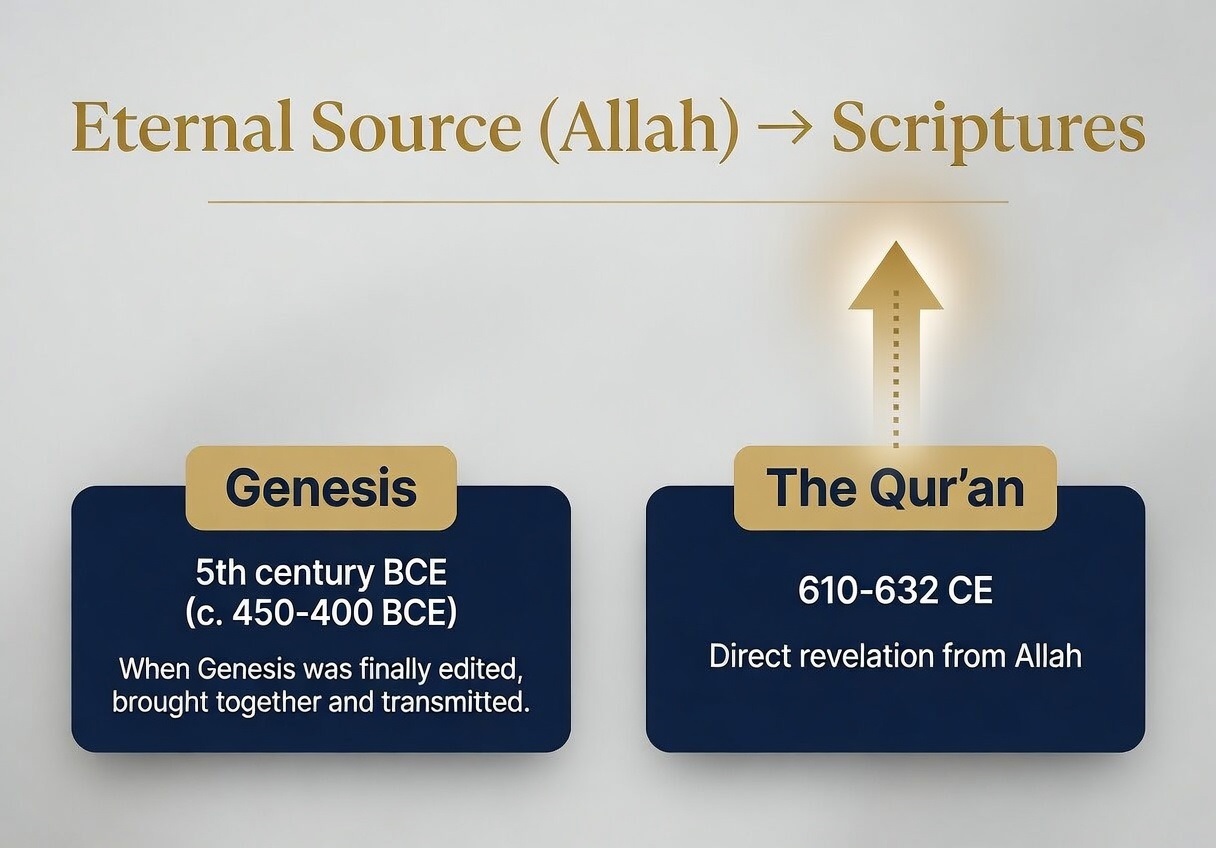
Muslims are not dependent upon the Bible for anything at all!
The Qur’an’s source is Almighty Allah
We simply point out the errors and the conflict contained in that upon which the Jews and Christians rely upon.
From the theological perspective of the Muslim, the Qur’an is not changing or altering anything. The Qur’an, as a revelation of Almighty God, comes to restore not alter the narrative.
Some important points for Jews and Christians to reflect upon.
God’s continued interest in Ishmael even after he was removed from Sarah’s camp.
“God was with the boy as he grew up. He lived in the desert and became an archer.While he was living in the Desert of Paran, his mother got a wife for him from Egypt.” (Genesis 21:20-21)
That which is claimed as the ‘Torah’ among the Jews and Christians never portrays Ishmael as a polytheist. In fact, after he and his mother were asked to leave God was still involved in the life of Ishmael. It stands to reason that Ishmael taught his people what he (Ishmael) was taught by his father (Abraham) about God.
Christians and Jews never really bothered to explore when and if that relationship became severed. Nor have they explored if or when God was no longer interested with the descendants and affairs of Ishmael.
The Christian claim that Muhammed (saw) is not a descendant of Isma’il.
Wathila b. al-Asqa’ reported:
I heard Allah’s Messenger (ﷺ) as saying: Verily Allah granted eminence to Kinana from amongst the descendants of Isma’il, and he granted eminence to the Quraish amongst Kinana, and he granted eminence to Banu Hashim amonsgst the Quraish, and he granted me eminence from the tribe of Banu Hashim.
Those who claim descent from Qahţān were called al-‘Arab al-Āribah (The Arabizing Arabs) while the descendants of Ismā’īl were called Al-‘Arab al-Musta’ribah (The Arabized Arabs). The Quraysh, the tribe of the Blessed Prophet Muhammed (saw) belonged to the class of Arabized Arabs and they were the Northern Arabs.
The Blessed Prophet (saw) comes from Ismail (as) whom is the progenitor of the musta’rab. This means they became Arab via adoption of the language and customs.
One thing that Christians cannot do is to say with 100% certainty that Muhammed (saw) is not a descendant of Isma’il.
What is certain is that Isma’il is of the seed of Abraham. This is something that Jews nor Christians deny. We are not dependent upon their genealogical records. In the case of Christianity this is especially so because until today they cannot get right the genealogical records of Christ Jesus.
Mecca seems so far for Abraham to have traveled to?
Based on the biblical itinerary, the total journey from Ur to Canaan by way of Haran would have been approximately 1,050 miles (1,690 km). So why is it that Abraham can travel this far but not to Mecca?
Keep in mind the Muslim tradition about Abraham, Ismā’īl and the Kabba is not dependent upon the Jewish or Christian tradition.
The Pentateuch tself is not relied upon by historians as an accurate telling of events.
The Pentateuch (first five books of the Bible) itself does not explicitly claim that Moses wrote the entire five-book collection. These are claims made by tradition. So if Moses did not write it who did? It would also have to be aware of the debates surrounding whether or not the Pentateuch is considered a verbal or written inspiration.
1. Centuries removed from the source. 2. Compiled by multiple sources. 3. Lack of external corroboration. For example, the scale of the exodus has no external corroboration. Nothing from Egyptian, Canaanite, or Mesopotamian historical archeological records. 4. Post Mosaic additions. Passages such as the account of Moses’ death.
Based upon the Bible who has the superior genetic line? Abraham’s child with Hagar or Abraham’s child with Sarah?
“So after Abram had been living in Canaan ten years, Sarai his wife took her Egyptian slave Hagar and gave her to her husband to be his wife.” (Genesis 16:3)
Abraham is said to reveal that his wife Sarah is his sister. They share the same father but not the same mother.
Abraham says:
“Besides, she really is my sister, the daughter of my father though not of my mother; and she became my wife.” (Genesis 20:12)
Accordingly the god of the Bible found no other partner suitable for Abraham. Even though later this god revealed the following:
“‘If a man marries his sister, the daughter of either his father or his mother, and they have sexual relations, it is a disgrace. They are to be publicly removed from their people. He has dishonored his sister and will be held responsible.” (Leviticus 20:17)
“Cursed is anyone who sleeps with his sister, whether the daughter of his father or the daughter of his mother.” (Deuteronomy 27:22)
“I will bless those who bless you, and whoever curses you I will curse; and all peoples on earth will be blessed through you.” (Genesis 12:3)
So now will this god curse himself? Will the god of the Bible curse himself since he says cursed is anyone who sleeps with his sister and the Bible claims Sarah is Abrahams sister?
All this talk about nothing.
Here we go. Here is the secret sauce that Christians scholars would prefer their people not to think about.
The prophecy of being blessed through Abraham’s offspring has not yet been fulfilled during Christ time on Earth!
“Repent, then, and turn to God, so that your sins may be wiped out, that times of refreshing may come from the Lord, and that he may send the Messiah, who has been appointed for you—even Jesus. Heaven must receive him until the time comes for God to restore everything, as he promised long ago through his holy prophets. For Moses said, ‘The Lord your God will raise up for you a prophet like me from among your own people; you must listen to everything he tells you. Anyone who does not listen to him will be completely cut off from their people.’ Indeed, beginning with Samuel, all the prophets who have spoken have foretold these days. And you are heirs of the prophets and of the covenant God made with your fathers. He said to Abraham, ‘Through your offspring all peoples on earth will be blessed.’”(Acts 3:19-25)
We would encourage you to see how the various Christian sects interpret the above text. Especially the phrase: ‘times of refreshing‘. What you will find out is that accordingly, the prophecy was partially fulfiled in Jesus and is only completely fulfilled when he returns and starts to kill everyone who does not believe in him!
Also, notice the word ‘offspring’ and not specifically the line of Issac.
“But those enemies of mine who did not want me to be king over them—bring them here and kill them in front of me.’ (Luke 19:27)
How are all the people of the earth to be blessed when Jesus comes back and starts slaughtering a good number of those who will not accept him as king?
Textual corruption of Genesis 16:12. Defaming of Ishmael.
“And he will be a fruitful man, his hand in all, and the hand of all in him“
The Preposition Pivot: “Against” vs. “With”
Notice that for the second half of the phrase (yado vakol veyad kol bo), the Hebrew words are identical in both texts.
The entire difference in English translations comes down to the Hebrew preposition בּ (Bēth / “ba-” or “bo”). This preposition is highly fluid and can mean “in,” “with,” “against,” or “by” depending on the context:
The “Against” Interpretation: When a text pairs a “hand” coming into or upon someone (yado ba…), it is standard Hebrew idiom for opposition or striking (similar to the English phrase “to lay a hand on someone”). Because the Masoretic text starts with “wild ass” (a creature of conflict), translators render the preposition as “against.”
The “With” Interpretation: If you read the Samaritan variant where the verse starts with “fruitful man,” rendering the preposition as “against” creates a jarring contradiction. A “fruitful, blessed man” wouldn’t logically be in constant warfare. Therefore, translators smoothing out the Samaritan text interpret the exact same preposition as “with” or “engaged with” to maintain internal consistency.
However, look how the Christians have tampered with the text in their translations here:
“He will be a wild donkey of a man; his hand will be against everyone and everyone’s hand against him, and he will live in hostility toward all his brothers.” (New International Version).
However, even in the above link there is an admission of a textual variant that changes the meaning.
“And he will be a wild man; his hand will be against every man, and every man’s hand against him; and he shall dwell in the presence of all his brethren.” (KIng James Bible and New King James Version)
““He will be a wild donkey of a man, His hand will be against everyone, And everyone’s hand will be against him; And he will live to the east of all his brothers.” (NASB 1995 NASB 1997. )
The New International version quoted above also has: Or live to the east / of
“He will be fertile of man. His hand will be with everyone. And everyone’s hand will be with him. And he will live among all his brothers.” (Genesis 16:12)
Source: (The Israelite Samaritan Version of the Torah: First English Translation Compared with the Masoretic Version (Edited and Translated by Benyamim Tsedaka and Sharon Sullivan, Eerdmans Publishing, 2013) page 34)
You may also be interested in reading the following:
“And when Ibrahim was tried by his Lord with certain words, which he fulfilled.” (Qur’an 2:124)
“Then when he reached with him the (age of) working he said, “Oh my son! Indeed, I have seen in the dream that I am sacrificing you, so look what you see.” He said, “Oh my father! Do what you are commanded. You will find me, if wills Allah, of the patient ones.” (Qur’an 37:102)
“Then when they submitted and Ibrahim laid him on the side of his forehead for sacrifice. We called out to him: “Oh Ibrahim! You have already fulfilled the vision.” Indeed this is how We reward the good-doers. For this was obviously a clear trial.” (Qur’an 37:103-106)
“And we ransomed him with a tremendous sacrifice. And we left for him the hereafter. Peace be on Ibrahim. Thus we reward the good doers. Indeed he was of Our believing slaves. And we gave him glad tidings of Isaac, a Prophet among the righteous.” (Qur’an 37:107-112)
﷽
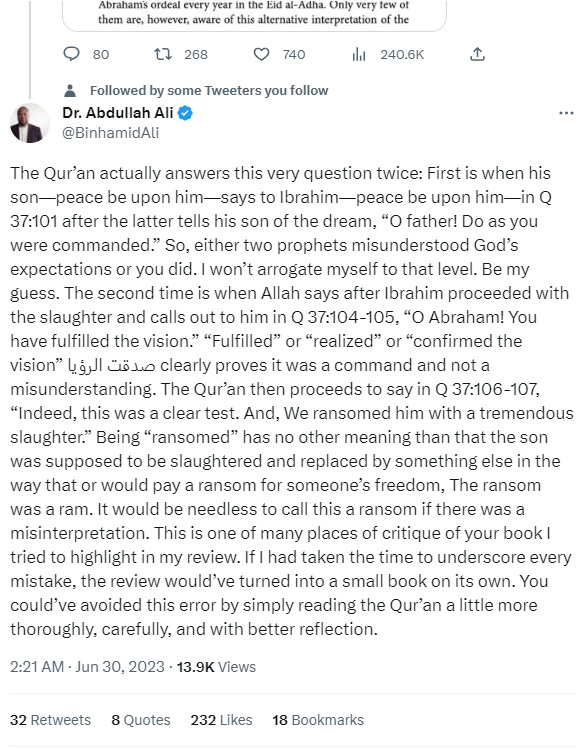
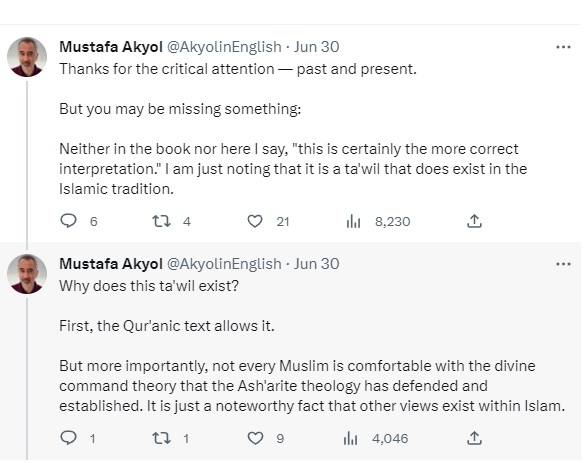
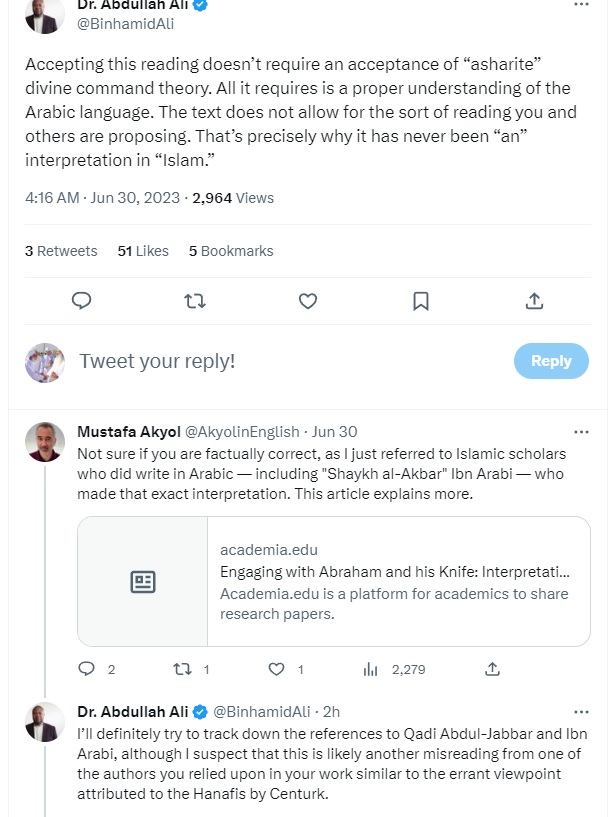
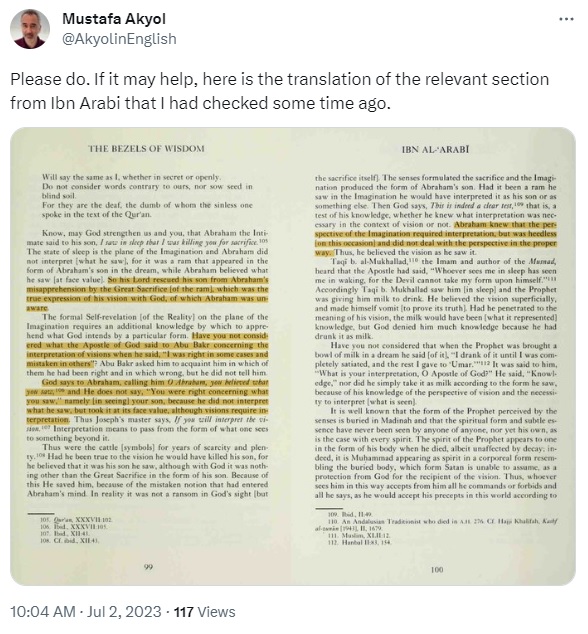
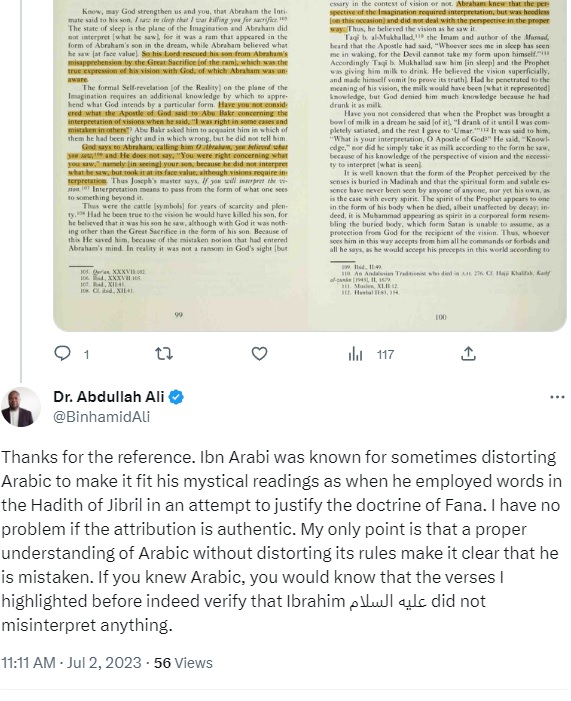
There was some really interesting, and engaging back and forth between Mustafa Akyol & Dr. Abdullah bin Hamid Ali on these text. Mustafa Akyol appealed to the mystic Ibn al-Arabi in the exchange.
Abdullah bin Hamid Ali: He is the Founding Director of the Lamppost Education Initiative. He serves as an associate professor of Islamic law and Prophetic Tradition at Zaytuna College in Berkeley, California (2007-present). He holds a Ph.D. in Cultural and Historical Studies in Religion (2016) and an M.A. in Ethics and Social Theory (2012) from the Graduate Theological Union. He obtained his B.A. (ijaza ‘ulya) in Islamic Law (Shariah) from the prestigious Al-Qarawiyin University of Fes, Morocco in 2001. He is an Ashari in theology and a Maliki in matters of jurisprudence.
Mustafa Akyol: Mustafa Akyol: He is a journalist and columnist. Notable for his post-modernist and liberal reform views. Since 2018, Akyol has been a senior fellow at the Cato Institute, a libertarian think tank founded and financially supported by the Koch brothers, right wing politicians.
This blog entry is in regard to an exchange that happened between Abdullah bin Hamid Ali and Mustafa Aykol. We provide our comments when necessary.
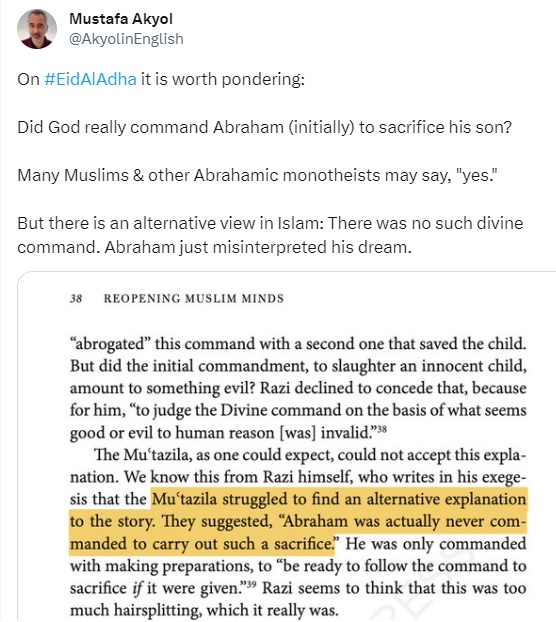
Now Mustafa Akyol had made the following post:
Mustafa Akyol stated:
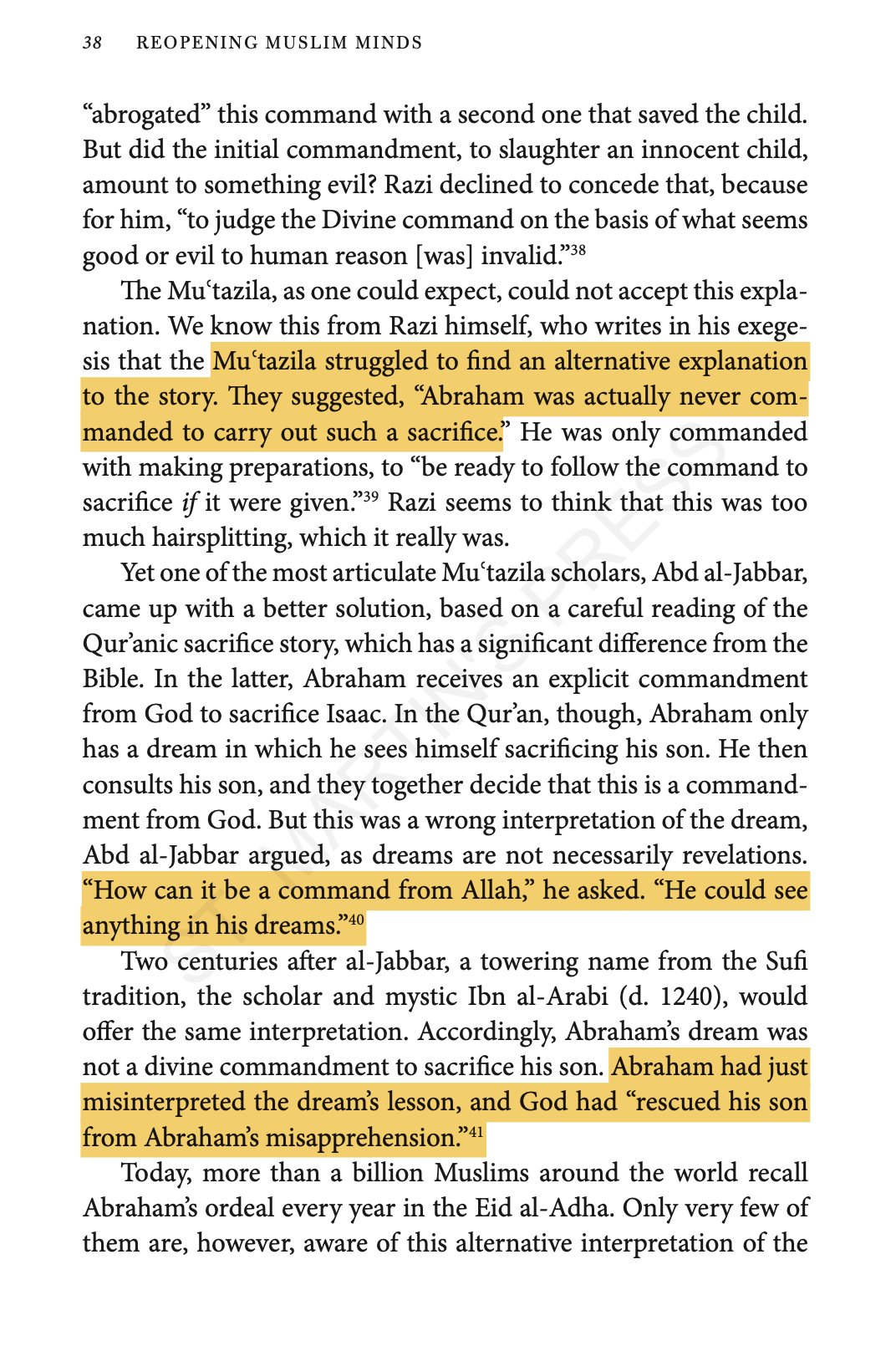
“It is worth pondering: Did God really command Abraham (initially) to sacrifice his son? Many Muslims & other Abrahamic monotheists may say, “yes.” But there is an alternative view in Islam: There was no such divine command. Abraham just misinterpreted his dream.”-Mustafa Akyol
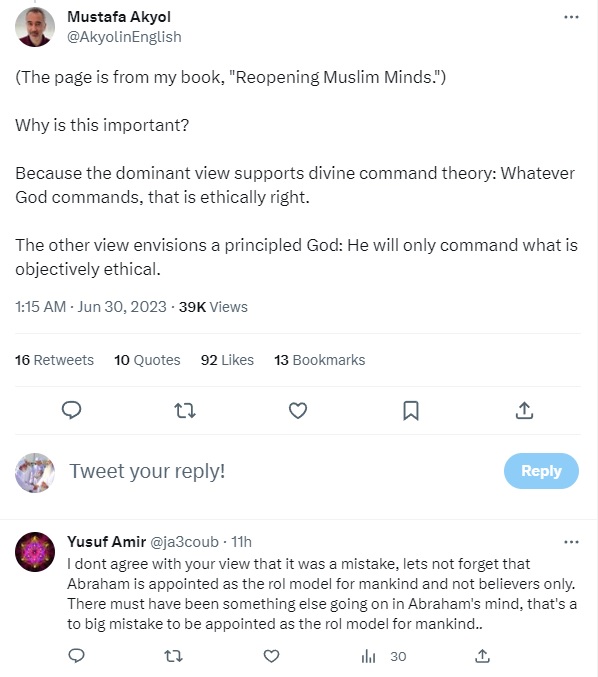
(The page is from my book, “Reopening Muslim Minds.”)
“Why is this important? Because the dominant view supports divine command theory: Whatever God commands, that is ethically right. The other view envisions a principled God: He will only command what is objectively ethical.” -Mustafa Akyol
Prima-Qur’an comments: The obvious problem with Mustafa’s assertion is who or what decides what a principled God would entail? Who also decides what is objectively ethical?
Abdullah bin Hamid Ali responds.
This post was responded to by Dr. Abdullah Bin Hamid Ali with:
To which Mustafa Aykol responded with:
To which Dr. Abdullah bin Hamid Ali responds with:
Prima-Qur’an comments: At this point in the exchange, Dr. Abdullah Bin Hamid Ali noted that Mustafa Akyol had transmitted errors made by others in the past. In particular to viewpoints attributed to the Hanafi school that they did not hold.
Rejoinder from Mustafa
Prima-Qur’an comments: There are a number of problems with the mystic Ibn Al Arabi’s view. He seems that Allah (swt) had veiled him from the truth of the matter.
From the text posted above:
“The state of sleep is the plane of the Imagination and Abraham did not interpret [what he saw], for it was a ram that appeared in the form of Abraham’s son in the dream, while Abraham believed what he saw [at face value] So his Lord rescued his son from Abraham’s misapprehension by the Great Sacrifice [of the ram], which was the true expression of his vision with God, of which Abraham was unaware.”
“Have you not considered what the Apostle of God said to Abu Bakr concerning the interpretation of visions when he said, “I was right in some cases and mistaken in others?” Abu Bakr asked him to acquaint him in which of them he had been right and in which wrong, but he did not tell him.”
“Thus were the cattle [symbols for years of scarcity and plenty. Had he been true to the vision he would have killed his son, for he believed that it was his son he saw, although with God it was nothing other than the Great Sacrifice in the form of his son.”
“Thus Joseph’s master says, If you will interpret the vision. Interpretation means to pass from the form of what one sees to something beyond it. Thus were the cattle [symbols] for years of scarcity and plenty. Had he (Ibrahim) been true to the vision he would have killed his son, for he believed that it was his son he saw, although with God it was nothing other than the Great Sacrifice in the form of his son.”
Prima-Qur’an comments: Ibn Al Arabi as someone making egregious blunders one after the other.
Ibn Al Arabi the one who did not have the dream knows better than Ibrahim himself what the dream entailed?
Ibn Al Arabi doesn’t help his case by stating that Yusuf (as) can interpret his dream correctly but Ibrahim (as) cannot! That is indeed very weak.
Why relate the supposed conversation between Abu Bakr (ra) and the Blessed Messenger (saw) if we are to be let down with…” but he did not tell him”
So now Ibn Al Arabi does what the Prophet (saw) himself did not do?
“he (Ibrahim) been true to the vision he would have killed his son,” Did Ibn Al Arabi not read the Qur’an when Allah (swt) states: We called out to him: “Oh Ibrahim! You have already fulfilled the vision.” What does Ibn Al Arabi think would have happened had that voice not called out?
Rejoinder Dr. Abdullah Bin Hamid Ali
Prima-Qur’an comments: Apparently this is what Dr. Shehzad Saleem conveys what Javed Ahmed Ghamidi says as well. You can see that here: https://www.youtube.com/watch?v=KPR-hzoROaw
So Javed Ahmed Ghamidi & Mustafa Akyol are of the same view here.
Prima-Qur’an comments: To be quite honest, Dr. Abdullah Bin Hamid Ali has already shown us the clear response in his initial reply.
Questions:
What were those words that Ibrahim was tried with?
“And when Ibrahim was tried by his Lord with certain words, which he fulfilled.” (Qur’an 2:124)
“Then when they submitted and Ibrahim laid him on the side of his forehead for sacrifice. We called out to him: “Oh Ibrahim! You have already fulfilled the vision.” Indeed this is how We reward the good-doers. For this was obviously a clear trial.” (Qur’an 37:103-106)
“Then when they submitted” Can it be said that Ibrahim and his son submitted to Satan?
Can it be said that they both submitted to something false (faulty interpretation of a dream)?
“We reward the good-doers” Can it be said that Satan rewards the doers of good?
For this was obviously a clear trial. What is there a clear trial in sacrificing a sheep or lamb? That is something people were accustomed to.
Prima Qur’an summary: What did we learn from this exchange?
This text is a reference to Ibrahim (as) being tried by Allah (swt) by certain words which he fulfilled.
The son (undisclosed) at this point. Was patient with what his father saw in his dream. His father Ibrahim (as) saw that he was to sacrifice his son.
When they had submitted (the son by submitting to the father’s authority and by this the vision given by Allah) and the father by submitting to the vision from Allah (swt). The submission itself was the fulfillment of the vision. Not the sacrificing of anything. The vision was already fulfilled.
“The answer of the Believers, when summoned to Allah and His Messenger, in order that He may judge between them, is no other than this: they say, “We hear and we obey“: it is such as these that will attain felicity.” (Qur’an 24:51)
Lastly, we see that immediately after this were the glad tidings of the second son of Ibrahim (as). That is the Prophet Isaac (as). Think about it. The willingness to sacrifice a son and not only is he sparred, but an announcement of a second son!
You were willing to sacrifice your son to Allah (swt) due to this tremendous test via submission you were awarded two sons! Subhan’Allah!
But as for those who defiantly disobeyed, their refuge is the Fire. Every time they wish to emerge from it, they will be returned to it while it is said to them, “Taste the punishment of the Fire which you used to deny.” (Qur’an 32:20)
“Indeed, the righteous will be in pleasure, And indeed, the wicked will be in Hellfire. They will [enter to] burn therein on the Day of Recompense, And will not be removed from it.” (Qur’an 82:13-16)
﷽
There seems to be some bizarre hadith that are accepted among Sunni Muslims that indicate that Muslims who are destined for hellfire would be ransomed by the hellfire by a Christian or a Jew. Thus, the Christian or the Jew would go to hellfire in place of the Muslims!
We will give the hadith that the Sunni Muslims rely upon for this as well as some of the justifications put forward by their scholars. Then we will give the Ibadi critique of these hadith and why they do not meet our standards.
The hadith that are brought forward to support this are as follows:
Abu Musa’ reported that Allah’s Messenger (saw) said:
When it will be the Day of Resurrection Allah would deliver to every Muslim a Jew or a Christian and say: That is your rescue from Hell-Fire.
Abu Burda reported on the authority of his father that Allah’s Messenger (saw) said:
No Muslim would die but Allah would admit in his stead a Jew or a Christian in Hell-Fire. ‘Umar b. Abd al-‘Aziz took an oath: By One besides Whom there is no god but He, thrice that his father had narrated that to him from Allah’s Messenger (saw).
Abu Burda reported Allah’s Messenger (saw) as saying:
There would come people amongst the Muslims on the Day of Resurrection with as heavy sins as a mountain, and Allah would forgive them and He would place in their stead the Jews and the Christians. (As far as I think), Abu Raub said: I do not know as to who is in doubt. Abu Burda said: I narrated it to ‘Umar b. ‘Abd al-‘Aziz, whereupon he said: Was it your father who narrated it to you from Allah’s Apostle (saw)? I said: Yes.
It seems that there is also a belief held among Sunni Muslims that every person has a place for them in hell and in heaven. This is coupled with the belief that there is a pre-destined and pre-scribed number of people destined for both hell and heaven.
Allah (swt) has never described the hellfire as a place in which it becomes full.
“The Day We will ask Hell, “Are you full?” And it will respond, “Are there any more?” (Qur’an 50:30)
Prima Qur’an comments: In trying to answer why the Jews and Christians in particular are singled out , the Ash’ari, Maliki, Sufi, Al-Qadi ‘Iyad said:
“Because every accountable person has a place in Paradise and a place in Hell, whoever believes truly, his place in Hell will be replaced with a place in Paradise, but for the one who does not believe it will be the opposite, and it will be as if the disbelievers took the places of the believers in Hell. Moreover, because Allah has sworn to fill Hell, it will be filled with the disbelievers so as to save the believers from the Fire. So in that regard they are like a ransom for the believers. Perhaps the reason why the Jews and Christians are singled out for mention is because they are well known for their opposition to the Muslims and for being their opposites with regard to believing in the Messenger, which dictates that they should be saved.” End quote from Mirqaat al-Mafaateeh (8/3525).
Prima Qur’an comments: For us we do not accept the reasoning of Qadi ‘Iyad.
Furthermore the site says:
“On the Day of Resurrection there will be a Jew or a Christian for every Muslim, who will be his ransom from the Fire. That does not contradict the fact that some Muslims sinners will enter the Fire for their sins, so that Allah may purify them thereof, because they will enter it, then they will be brought out of it by Allah’s mercy, then they will enter Paradise, where they will inherit what would have been the disbelievers’ places in it, because Allah has forbidden it to the disbelievers.”
Prima Qur’an comments: The above comment is to be dismissed for the following reasons:
There is absolutely not a single statement or example anywhere in the Qur’an of the believer entering the hellfire. Not one.
There is absolutely not a single statement or example anywhere in the Qur’an of the disbelievers leaving the hellfire. Not one.
On the basis of Aqidah (Creed) the above statement makes no sense. Because if there is a place reserved in hell and heaven for every person created are we truly to believe that the Blessed Prophet (saw), The Prophets in general, small children and so forth have an abode in hellfire? May Allah forgive us and guide us to the truth.
On the basis of Mantiq (Logic) the above statement makes no sense. It’s as if the belief is there is an abode in heaven and hell for all creation but one takes the place of the other, which means there would be empty or reserved spots in both heaven and hell if this was a one to one to every person who has ever lived.
“The words of the Prophet (blessings and peace of Allah be upon him), “Allah (swt) will give every Muslim a Jew or a Christian, and He will say: This is your ransom from the Fire.” Indicate that this bounty will include all the Muslims, with no exceptions, because ransom is salvation, as mentioned above, and salvation will be for every Muslim. That is not contradicted by the fact that he may enter the Fire, because his entering it will be for the purpose of purification.”
Prima Qur’an comments: The above comment is dismissed for the following reasons:
“Allah (swt) will give every Muslim” is contradicted by text that state: “There would come people amongst the Muslims.” So which did the Blessed Prophet (saw) say?
On the basis of Aqidah (Creed) the above statement makes no sense. Because if there is a place reserved in hell and heaven for every person created are we truly to believe that the Blessed Prophet (saw), The Prophets in general, small children and so forth have an abode in hellfire? We seek refuge in Allah from such beliefs!
There is absolutely not a single statement or example anywhere in the Qur’an of the believer entering the hellfire. Not one.
There is absolutely not a single statement or example anywhere in the Qur’an of the disbelievers leaving the hellfire. Not one.
The Ibadi objection.
Our core argument is that these ahadith contradict the clear, unambiguous muhkamat of the Qur’an.
The wicked will not be removed from Hell (82:13-16). This directly contradicts the idea that anyone leaves Hellfire after entering.
Disbelievers will be told “Taste the punishment… you used to deny” (32:20). There is no escape clause.
Therefore, any hadith that suggests:
A Jew or Christian can be a “ransom” for a Muslim, or
Any believer will enter Hellfire (even temporarily), or
Any disbeliever will leave Hellfire
must be shadh (anomalous) or munkar (rejected), regardless of its chain. A sahih chain does not override a sahih text (the Qur’an).
For the Ibadi, this is sufficient to reject these hadith.
The Ibadi Mustalah al-Hadith. We focus on illah (pl. ‘ilal) which refers to a subtle, hidden defect that undermines the authenticity of a hadith, despite its chain of narrators appearing perfectly sound on the surface.
First thing we can notice is that in the matn (the actual text) of the hadith there are some quite notably strange peculiarities.
Defect #1
“Umar b. Abd al-‘Aziz took an oath: By One besides Whom there is no god but He, thrice that his father had narrated that to him from Allah’s Messenger.”
This shows that Umar b. Abd al-‘Aziz took issue with the transmission and demanded that the narrator swear an oath regarding it.
Defect #2
If he was satisfied with the oath he would not need to have included that in the transmission. However, the one who transmits includes the doubt and includes the oath.
The defects as discussed above indicates the narration was mawquf (stopping at a Companion) or mudtarib (shaky). Swearing an oath is not a method of authentication in hadith sciences—it reveals doubt.
Defect #3.
Why the mention of Jews and Christians being a ransom and not mention the Sabians or Zoroastrians or others? What makes the Jews and Christians particularly targeted?
This suggests takhsis (specification) without a Qur’anic basis. If Hell must be filled, any disbeliever would suffice. Mentioning Jews/Christians alone hints at polemical or historical insertion (e.g., early Muslim-Jewish-Christian disputes).
Defect #4. Some what related to defect #3 is that Seeing that the Jews and Christians are Mushrik, why not just simply say that the Mushrik are a ransom?
Defect #5. The conflicting nature of the text:
a) There would come people amongst the Muslims
b) No Muslim would die but Allah would admit
c) Allah would deliver to every Muslim
So is it every Muslim or a group from among the Muslims? That is a huge difference.
A clear idtarab (confusion) in the matn. A prophetic statement would not vacillate between universal and partial inclusion.
Defect #6. Abu Raub said: I do not know as to who is in doubt. Meaning he has doubts about who has doubts about this transmission: Did Umar b. Abd al-‘Aziz express doubt about the transmission, or was doubt expressed about Umar b. Abd al-‘Aziz’s transmission?
This is a sanad collapse. When transmitters themselves cannot identify the source of doubt, the hadith becomes majhul (unknown) and is discarded.
The Ibadi school, Ahl al-Haqq wa-l istiqama (The People of Truth and Straightness) have more than sufficient reasons to dismiss the above hadith. The attempts to explain them by Sunni scholars are not convincing.
We also want to share with you (the respected readers) an easy identifier to show that a hadith which has been classified as ‘sahih’ (sound) itself has doubtful things within it.
Many of you have possibly read our article in which we ripped apart a hadith classified as ‘sahih’ that was attributed to the Blessed Prophet (saw).
“Abu Umamah saw heads (of the Khawarij) hanging on the streets of Damascus. He said: ‘The dogs of the Fire and the worst dead people under the canopy of the heavens. The best dead men are those whom these have killed.’ He then recited: On the Day when some faces will become white and some faces will become black… (3:106) until the end of the Ayah. I said to Abu Umamah: ‘Did you hear IT from the Messenger of Allah (saw)?’ He said: ‘If I had not heard IT but one time, or two times, or three times, or four times – until he reached seven – I would not have narrated it to you.”
Now, we also want to share with you two more hadith and then we want to discuss something about the matn or text. It is absolutely relevant to this blog entry.
Narrated Abu Huraira:
The Prophet (saw) said, “A group of Israelites were lost. Nobody knows what they did. But I do not see them except that they were cursed and changed into rats, for if you put the milk of a she-camel in front of a rat, it will not drink it, but if the milk of a sheep is put in front of it, it will drink it.” I told this to Ka`b who asked me, “Did you hear it from the Prophet (saw) ?” I said, “Yes.” Ka`b asked me the same question several times. I said to Ka`b. “Do I read the Torah? (i.e. I tell you this from the Prophet.)“
Now what is very eye opening is that in the hadith above about a group of the Children of Israel turned into rats, or the hadith about the khawarij being the dogs of hellfire, or about Jews and Christians being ransom for Muslims from hellfire.
There are three things that the keen eye will notice about all of these hadith transmissions.
There is doubt expressed in the transmission.
One of the transmitters is having big doubts about what is being transmitted to him.
The inclusion of the doubt is included in the transmission rather than omitting it altogether.
We have extremely rigid methods for accepting narrations attributed to the Blessed Messenger (saw).
There are theological views among the Sunni Muslims that teach things that have no basis in the Qur’an.
Among them are:
That a believer can enter into hellfire.
That a person may exit the hellfire.
Because the reality of these beliefs is established among the theological schools of Sunni Muslims, it has led them to have some subpar standards for grading and accepting narrationsattributed to the Blessed Messenger (saw).
If you have found the above entry beneficial we invite you to read the following:
“Complete the pilgrimage and minor pilgrimage for Allah.” (Qur’an 2:196)
﷽
May Allah (swt) bless and accept the noble Shaykh for teaching us how to perform the Hajj in accordance with the Qur’an and Sunnah. May all who follow this guide remember the blessed Shaykh in their du’a and may this teaching be a witness for the Shaykh on the day of reckoning. Amin.
Hajj Step by Step | From the Prohibitions of Ihram to the Exit of Umrah | Shaykh Abdul-Munim bin Rashid Al-Saidi
Allah is the Greatest, Allah is the Greatest, Allah is the Greatest. There is no god but Allah.
In the name of Allah, the Most Gracious, the Most Merciful. All praise is due to Allah, Lord of all worlds, and may peace and blessings be upon our Master Muhammad, his family, and all his companions.
To proceed: I greet you, my brothers and sisters watching, with the beautiful, blessed greeting of Islam: Assalamu Alaikum Wa Rahmatullahi Wa Barakatuh (May peace, mercy, and blessings of Allah be upon you all).
We are pleased to meet again for the second part of the jurisprudence course on the rulings of the rituals of Hajj and Umrah. We ask Allah, Glorified and Exalted, to make it full of goodness, benefit, and utility, and to grant us and you reward and blessing.
In our last meeting, we stopped after the person in a state of ritual consecration (Ihram) had entered Ihram and assumed the state of a Muhrim (one in Ihram). As long as he is a Muhrim, there are a number of things he is prohibited from doing, called the prohibitions of Ihram. These are matters he is forbidden from, and he cannot do any of them. If he does any of them, specific legal rulings apply.
What are these prohibitions, and what are these things that the pilgrim must avoid?
First, I note that abstinence is required only during the period of Ihram. Before his Ihram, he is not forbidden from these things, and after exiting his Ihram (Tahalul), they become permissible for him. So this prohibition is during the state of Ihram, from the start of the Talbiyah (chanting) until the Tahalul from the ritual he has entered.
Some of these prohibitions are specific to men, some specific to women, and some common to both. What are these prohibitions?
Let us all watch the following clip on the rulings of Hajj.
Question: What are the prohibitions of Ihram for Hajj and Umrah for men and women in general?
Answer: The prohibitions of Ihram for men and women are three categories:
What is prohibited for both males and females.
What is prohibited only for males.
What is prohibited only for females.
As for what is prohibited for both males and females:
Removing head hair by shaving or other means, due to the saying of Allah: “And do not shave your heads until the sacrificial animal has reached its place of slaughter.” The majority of scholars include the hair of the rest of the body by analogy with head hair.
Trimming or cutting fingernails or toenails, by analogy with shaving hair, according to the well-known view of scholars.
Using perfume after entering Ihram, on one’s clothes, body, or anything else, due to the Prophet’s (saw) statement about the Muhrim: “He should not wear a garment touched by saffron or wars (a yellow dye).”
Concluding a marriage contract, due to the Prophet’s (saw) saying: “The Muhrim should not marry, nor arrange a marriage for himself or others, nor propose marriage.”
Sexual touching with desire, such as kissing, caressing, hugging, etc.
Sexual intercourse, due to Allah’s saying: “The Hajj is during well-known months. So whoever has made Hajj obligatory upon themselves therein [by entering Ihram], there should be no sexual relations, no wicked conduct, and no arguing during Hajj.”
Killing game animals, due to Allah’s saying: “…and hunting of the land is forbidden to you as long as you are in Ihram.” So the Muhrim is not permitted to hunt or kill game, whether directly, indirectly, or by assisting in its killing through guiding, pointing, handing over a weapon, etc.
As for what is prohibited only for men (and permissible for women):
Covering the head with something that adheres to it, like a turban, cap, or head cover, due to the Prophet’s (saw) statement about the Muhrim who was thrown by his mount at Arafat: “Do not cover his head.”
Wearing sewn garments – meaning wearing what is tailored to fit the body parts, whether covering the whole body like a hooded cloak (Burnus) or shirt, or part of it like pants, leather socks, socks, or gloves. This is based on the hadith of the Prophet (saw) when asked what the Muhrim should wear; he said: “He should not wear a shirt, nor a turban, nor a Burnus, nor pants, nor leather socks.”
As for women: She may cover her head and wear whatever clothes she wishes while in Ihram, provided she does not display her adornment (Tabarruj), she should not wear gloves (for hands), nor a face-veil (Niqab), and she should not cover her face unless non-mahram men are passing close by, in which case she may cover her face. And Allah knows best.
So, when the pilgrim enters Ihram and performs the Talbiyah, he becomes a Muhrim and is prohibited from these forbidden things.
What does he do from the moment of Ihram until he reaches Makkah to perform this ritual (Umrah)?
He must recite the Talbiyah frequently throughout the journey, from the moment of Ihram at the Miqat (designated point) until he sees the Sacred House of Allah. He should say it often. It is narrated from the Prophet (saw) that on the Day of Resurrection, those who recited the Talbiyah will have witnessed for them everything to their right and left. The man should raise his voice with the Talbiyah – this was the practice of the companions of the Messenger of Allah (saw). As for the woman, she should not raise her voice but recite it in a low voice audible only to those next to her.
So the Muhrim, whether man or woman, continues reciting the Talbiyah frequently until he reaches Makkah and sees the Sacred House. There, he stops the Talbiyah and begins performing the rituals of Umrah.
The rituals of Umrah include: Tawaf (circumambulation), praying two Rak’ahs behind Maqam Ibrahim (Station of Abraham), Sa’yi (walking) between Safa and Marwah, and then Tahalul (exiting Ihram).
The first is Tawaf. Tawaf has conditions that the pilgrim performing Umrah must adhere to. The Umrah is not valid, nor is the Tawaf, unless these three conditions are met:
Purity (Taharah) from ablution (Wudu): The Messenger of Allah (saw) said: “Tawaf is a prayer, except that Allah has permitted speaking during it. So whoever speaks, should speak only good.” Therefore, the one performing Tawaf must maintain his Wudu throughout the entire Tawaf and until he completes the two Rak’ahs behind Maqam Ibrahim.
The Tawaf must encompass the entire Kaaba: Meaning that no part of his body enters inside the Kaaba; rather, he must go around the entire Kaaba. (Some may ask if the pilgrim can enter any part of his body into the Kaaba – we will clarify this shortly).
He must complete seven circuits (Ashwat) around the Kaaba – no less, and no more than seven. Acts of worship are Tawqifiyyah (based on divine prescription, not personal opinion). It is not valid for the pilgrim to add or subtract anything from the practice of the Messenger of Allah (saw), who said: “Take your rituals from me.”
Just as Tawaf has conditions, it also has recommended practices (Sunnan). The pilgrim should strive to adhere to them:
First Sunnah: Al-Idtiba’ – Exposing the right shoulder. Before starting Tawaf, he takes his upper garment (Rida’) from his right shoulder, passes it under his armpit, and places it over his left shoulder. This is a Sunnah. When does he do it? For all seven circuits. After completing the seventh circuit, he returns his garment to its normal state.
Second Sunnah: Ar-Raml – Walking with quick, short steps (not running). This is specific to men. He does this during the first three circuits only, from the Black Stone to the Yemeni Corner. When he reaches the Yemeni Corner, he walks normally. If he cannot due to severe crowding, there is no sin if he leaves Ar-Raml.
Third Sunnah: Kissing the Black Stone if he can reach it without causing crowding or harm to others. If he cannot (the usual case during Hajj due to crowding), the sensible person should not approach that place to avoid harming or being harmed. He then has another option: to face it, raise his hands, and say “Allahu Akbar” without kissing.
Fourth Sunnah: Touching (Istilam) the Yemeni Corner – touching it with his hand without kissing it or kissing his hand. If he cannot, he does not gesture or say Takbir.
Fifth Sunnah: Supplication (Dhikr) – The one performing Tawaf should frequently remember Allah with all types of Dhikr. The minimum is to say Al-Baqiyat As-Salihat (the enduring good deeds). Each of us has needs when going to this pure place; he should ask Allah in any language, as Allah understands all languages. Is there a specific Dhikr? No specific Dhikr is required during Tawaf except in one place: between the Yemeni Corner and the Black Stone. The Prophet (saw) would say there: “Rabbana atina fid-dunya hasanah, wa fil-akhirati hasanah, wa qina ‘adhab an-nar” (Our Lord, give us in this world good, and in the Hereafter good, and protect us from the punishment of the Fire). For the rest of Tawaf, there is no required specific Dhikr.
My advice to my brothers and sisters is to occupy themselves with venerating the ritual, not paying attention to the actions of others, and seeking Allah’s pleasure. You will find people busy with useless talk, taking pictures with phones, or even having audio/video calls with others in other countries. All of this contradicts the veneration of this blessed ritual. Venerating the rituals of Allah stems from the piety of hearts.
Earlier, we mentioned that the pilgrim must avoid letting any part of his body enter inside the Kaaba during Tawaf. (Visual description of the Kaaba, the Black Stone, the Yemeni Corner, the door, Maqam Ibrahim, and the curved wall called Al-Hijr or Hateem). The common mistake is entering the area between Al-Hijr and the Kaaba. This space is actually part of the Kaaba, as is that wall, based on the foundations laid by Ibrahim and Isma’il (peace be upon them). Whoever performs Tawaf must avoid entering this space or placing his hand on top of the wall. A hand placed on that wall has not circumambulated the Kaaba as Allah commanded: “Let them circumambulate the Ancient House” (22:29).
(Clip showing how to perform Tawaf, from entering the Sacred Mosque until after praying the two Rak’ahs).
After finishing Tawaf at the Sacred House, the pilgrim moves to the second ritual: Sa’yi between Safa and Marwah.
Upon entering the path leading to the Mas’a (place of Sa’yi), he enters through Bab as-Safa. It is Sunnah, when approaching Safa, to recite the verse: “Indeed, As-Safa and Al-Marwah are among the symbols of Allah. So whoever makes Hajj to the House or performs ‘Umrah, there is no blame upon him for walking between them. And whoever volunteers good – indeed, Allah is Appreciating and Knowing.” (2:158).
He recites this, then when he reaches Safa, he faces the Qibla, raises his hands, and makes the supplication narrated from the Prophet (saw), repeating it three times and supplicating between them. Then he descends towards Marwah, remembering Allah, and it is Sunnah for the man only to walk quickly (Ramal) between the two green markers. When he reaches Marwah, he supplicates as he did at Safa (without reciting the verse), completing one circuit. He returns to Safa the same way. Each time he goes from Safa to Marwah or Marwah to Safa counts as one circuit. He continues until he ascends Marwah on the seventh circuit.
The two green markers are the lights found in the Mas’a. The man runs quickly in this area. The woman does not run. A common question: What should a man do if he is with women he might lose during Sa’yi? The solution is to take a specific path – either the far right edge or the far left edge of the Mas’a, not the middle. When he reaches the start of the green markers, he runs. At the end of the running area, he stops at the corresponding pillar and waits for the women, who walk normally, to catch up.
After completing Sa’yi, nothing remains of the Umrah rituals except Tahallul (exiting Ihram). For the man, this is done by taking some hair from all over the head, not just one part. Some take only from one side – this contradicts the Sunnah. The legal principle is to cover the entire head. Since the Mutamatti’ pilgrim will need to shave on the 10th of Dhul-Hijjah, he should shorten (Taqseer) his hair after finishing Umrah, using scissors or a machine, covering the whole head.
As for the woman, she shortens or cuts from the end of her hair by about a fingertip’s length. She gathers all her hair at the back and cuts the end by the length of a fingertip. I remind believing sisters heading to the Sacred House that shortening hair to exit Umrah (or Hajj on the 10th) must be done in a covered place away from men’s eyes, as a woman’s hair is ‘Awrah (must be covered). Secondly, she should do this immediately upon returning to her lodging, before getting busy with something else, so she doesn’t forget and then do something prohibited in Ihram. Can she cut her own hair? Yes, there is no sin in that, Allah willing.
After this Tahallul – either by shortening for the man or cutting a fingertip’s length for the woman – the person performing Umrah has exited his Ihram. For the Mutamatti’ pilgrim, he puts on his normal clothes, and everything prohibited during Ihram becomes permissible. As for the Qarin (performing Hajj and Umrah together) and Mufrid (performing Hajj alone), they remain in their Ihram until the 10th day of Dhul-Hijjah, after completing the actions of that day.
With this, we conclude this blessed episode at the end of the actions of the Umrah rituals. We ask Allah, Glorified and Exalted, to accept righteous deeds from us and you. In the next episode, we will talk about the rituals of Hajj, by the permission of Allah.
We will meet you in the next meeting.
Assalamu Alaikum Wa Rahmatullahi Wa Barakatuh.
Allah is the Greatest, Allah is the Greatest, Allah is the Greatest. There is no god but Allah.
“And they say, “Never will the Fire touch us, except for a few days.” Say, “Have you taken a covenant with Allah? For Allah will never break His covenant. Or do you say about Allah that which you do not know?” Yes, whoever earns evil and his sin has encompassed him – those are the companions of the Fire; they will abide therein eternally.” (Qur’an 2:80-81)
“Allah effaces whatever He wills and retains whatever He wills. With Him is the Mother of the Book.” (Qur’an 13:39)
﷽
Some questions/objections that are raised by some on this particular subject.
For us the matter is clear, crystal clear.
The hellfire is eternal for who ever enters it.
Our creed is taken from clear verses and not verses subject to multiple interpretations.
Objections are based upon interpretations or emotive in nature.
There is not a single verse anywhere in the Qur’an that believers (mumin) enter the hellfire.
There is not a single verse anywhere in the Qur’an that the ungrateful (kafir) enter heaven.
The Qur’an has to be in harmony with all its verses.
Allah has prescribed mercy for himself.
You often see this quoted in discussions about the eternal suffering of the kafir. However, you usually do not see the verse quoted in its fullness.
“When the believers in Our revelations come to you, say, “Peace be upon you! Your Lord has taken upon Himself to be Merciful. Whoever among you commits evil ignorantly then repents afterwards and mends their ways, then Allah is truly All-Forgiving, Most Merciful.” (Qur’an 6:54)
“Say, “Unto whom belongs whatsoever is in the heavens and on the earth?” Say, “Unto Allah. He has prescribed Mercy for Himself. He will surely gather you on the Day of Resurrection, in which there is no doubt. Those who have lost their souls, they do not believe.” (Qur’an 6:12)
They will also quote the following hadith:
“Narrated Abu Huraira:
The Prophet (ﷺ) said, “When Allah had finished His creation, He wrote over his Throne: ‘My Mercy preceded سَبَقَتْ (sabaqat) = preceded My Anger.’
When Allah created the creation as He was upon the Throne, He put down in His Book: Verily, My mercy predominates تَغْلِبُ (taghlibu) = prevails over / overcomesMy wrath.
First, it should be noted that none of those texts promise an eventual exit or release from hell at all. Neither do any of those texts promise anything about the punishment of hellfire being diminished.
This is completely subjective. There is no measurable scale. One could just as easily argue that Allah sparing no one from eternal hell is still an act of mercy relative to what sinners deserve.
You can see a distinction in the two hadith that are usually quoted.
تَغْلِبُ (taghlibu) = prevails over / overcomes
سَبَقَتْ (sabaqat) = preceded / has gone before
This is exactly why the lone narrator’s reports are not used to produce certainty in matters of creed. However, if we were to offer an interpretation and one interpretation is as good as any other, it would be this. That mercy preceded wrath in the form of sending prophets, scriptures, and warnings. Whoever rejects that mercy after it has come deserves the wrath.
“If Allah were to punish people for their wrongdoing, He would not have left a single living being on earth. But He delays them for an appointed term. And when their time arrives, they cannot delay it for a moment, nor could they advance it.” (Qur’an 16:61)
In a single act of defiance of our Sovereign Majestic Lord deserves utter destruction right then and there. Allah’s forbearance is mercy. His restraint is mercy.
Much of what is addressed here are old discussions that were discussed back and forth at a forum here:
“And they say, “Never will the Fire touch us, except for a few days.” Say, “Have you taken a covenant with Allah? For Allah will never break His covenant. Or do you say about Allah that which you do not know?” Yes, whoever earns evil and his sin has encompassed him – those are the companions of the Fire; they will abide therein eternally.” (Qur’an 2:80-81)
And this alone should be sufficient.
Why would this be true only for Jews and not for every believer? On what consistent basis is this claim made?
“While the wicked will be in Hell. They will roast on the Day of Judgment. And they will never be absent from it.” (Qur’an 82: 14-16)
This verse above is also clear. It says that theywill never be absent from it. Not that they will be there forever and one day maybe not. Never. It is as clear as it may get.
“And when the appointed Day comes, no one shall even dare to speak except by the leave of Allah. Then some will be declared wretched, others blessed. As for the wretched, they shall be in the Fire, and in it they shall sigh and groan. They shall abide in it as long as the heavens and the earth endure, unless your Lord may will otherwise. Surely your Lord does whatsoever He wills. And as for those who are blessed, they shall abide in the Garden as long as the heavens and the earth endure, unless your Lord may will otherwise. They shall enjoy an unceasing gift.” (Qur’an 11:105-109)
So the main point of one of the commenters is as follows:
Notice God says “…your Lord carries out whatever He wills…” after the description of potential release from Hell, as if to support this possibility. Yet, after the same statement made in reference to Heaven, God says “…an unceasing gift”. He doesn’t say “…whatever He wills”, which would support the statement that Heaven will end, but rather “unceasing gift” supports the continuation of Heaven.
Point 1.
Nothing happens except by the will of Allah who has full and total control over all things.
“As for the Righteous, they will be in bliss; And the Wicked – they will be in the Fire, Which they will enter on the Day of Judgment, And they will not be able to keep away therefrom. And what will explain to you what the Day of Judgment is? Again, what will explain to you what the Day of Judgment is? (It will be) the Day when no soul shall have power (to do) aught for another: For the command, that Day, will be (wholly) with Allah.” (Qur’an 82:13-19)
They shall abide in (hellfire) it as long as the heavens and the earth endure, unless your Lord may will otherwise.
they shall abide in the Garden as long as the heavens and the earth endure, unless your Lord may will otherwise.
These people are clearly overlooking the eternality of the garden and hell based upon the eternality of the new heaven and earth itself.
“On the day when the earth is changed into another earth, as well as the heavens, and they emerged before Allah, the One, the Subduer.” (Qur’an 14:48)
Now let us do a thought experiment. What would be the reason or purpose for someone to leave paradise? Is there any text suggesting that a person would be expelled from or leave paradise after entering it?
“Then We said, “O Adam, you and your wife, both dwell in the Garden and eat to your hearts’ content where from you will, but do not go near this tree otherwise you shall become transgressors” After a time Satan tempted them with that tree to disobey Our Command and brought them out of the state they were in, and We decreed, “Now, go down all of you from here; you are enemies of one another. Henceforth you shall dwell and provide for yourselves on the Earth for a specified period.” At that time Adam learnt appropriate words from his Lord and repented, and his Lord accepted his repentance, for He is very Relenting and very Merciful.” (Quran 2:35-37)
Point 3.
The proponents of the idea that people will leave hell seem fixated on the the following endings:
After mentioning hellfire : Surely your Lord does whatsoever He wills.
After mentioning paradise, they shall enjoy an unceasing gift.
Yet, they seem to forget that both statements are preceded by: unless your Lord May will otherwise.
They wish to only focus on ‘They shall enjoy an unceasing gift’ and ignore that the text is preceded by ‘unless your Lord May will otherwise’ as well as ‘as long as the heavens and earth pass’.
For example, in the English language one may say:
Except as I will, you children may have all the chocolates on the table.
Or
You children may have all the chocolates on the table, except as I will.
Both sentence structures indicate that the children may enjoy as long as I will.
Point 4.
Inconsistent methodology.
So, using their logic, and if one was to be consistent, we would need to understand under what circumstances would those believers who go to heaven not enjoy heaven any longer? In the same vein, those who are sent to hellfire under what circumstances would they leave?
Allah (swt) could have removed the “unless your Lord may will otherwise” statement. That would have given the proponents the same weight as that verse. Yet, they would still need to contend with the numerous verses in the Qur’an in which Allah (swt) clearly indicated his will regarding those in hellfire.
“While the wicked will be in Hell. They will roast on the Day of Judgment. And they will never be absent from it.” (Qur’an 82: 14-16)
Point 5.
Lastly, on that text above. It would not indicate who would leave the hell fire.
Remember, there is a belief among Sunni Muslims that believers can enter the hellfire and then be taken out.
They cannot bring a single verse of the Qur’an to substantiate this. So if we are to use the logic of those who believe that hellfire is not eternal for its inhabitants (contrary to what Allah clearly says), it would mean that the polytheist, mushrik, anyone will eventually leave hell.
For us the matter is clear, crystal clear.
The hellfire is eternal for who ever enters it.
Our creed is taken from clear verses and not verses subject to multiple interpretations.
Objections are based upon interpretations or emotive in nature.
There is not a single verse anywhere in the Qur’an that believers (mumin) enter the hellfire.
There is not a single verse anywhere in the Qur’an that the ungrateful (kafir) enter heaven.
The Qur’an has to be in harmony with all its verses.
The next text that was discussed in that forum actually works against them.
“To those who reject Our Signs and treat them with arrogance, no opening will there be of the gates of Heaven, nor will they enter the Garden, until the camel can pass through the eye of the needle: such is Our reward for those in sin.” (Qur’an 7:40)
In the Tafsir attributed to Ibn Abbas (ra) Tanwîr al-Miqbâs min Tafsîr Ibn ‘Abbâs it says:
(Lo! they who deny Our revelations) Muhammed (pbuh) and the Qur’an (and scorn them) scorn believing in them, (for them the gates of Heaven will not be opened) to receive their works or souls (nor will they enter the Garden until the camel goes through the needle’s eye) they will not enter Paradise just as a camel cannot pass through the eye of a needle; it is also said that this means: they will not enter Paradise until a rope goes through a needle’s eye. (Thus do We requite the guilty) the idolaters.”
Even our teacher, Shaykh Hilal Al Wardi (hafidulah), favours the understanding of rope instead of camel.
Even then, as the Shaykh says, it means a big rope and not the thin thread that easily passes through the eye of the needle. The big rope is impossible.
Let us follow through logically.
ALL SUNNI Muslims believe that, at the very least, the unbelievers will go to hellfire. So, if the above verse is to be understood as something possible, a rope that can go through the eye of a needle, then no one will go to hellfire at all!
Now we know that this verse is clear. Allah (swt) has made it clear when he states: “Surely your Lord does whatsoever He wills.” That Allah (swt) has not willed for these people anything other than for them to remain in hellfire.
We know that Allah’s (swt) promise and statements are true.
“But the ones who believe and do righteous deeds – We will admit them to gardens beneath which rivers flow, wherein they will abide forever. It is the promise of Allah , which is truth, and who is more truthful than Allah in statement.” (Qur’an 4:122)
The only other possible straw for these people to clutch is the evil and heinous position that Allah (swt) can lie. So then when Allah (swt) says:
“While the wicked will be in Hell. They will roast on the Day of Judgment. And they will never be absent from it.” (Qur’an 82: 14-16)
or
“To those who reject Our Signs and treat them with arrogance, no opening will there be of the gates of Heaven, nor will they enter the Garden, until the camel can pass through the eye of the needle: such is Our reward for those in sin.” (Qur’an 7:40)
We have refuted that vile and godless position here:
“And of no effect is the repentance of those who continue to do evil deeds until death faces one of them and he says: “Now I repent;” nor of those who die while they are ungrateful (kuffarun). For them, We have prepared a painful torment.” (Qur’an 4:18)
“IF (but) eschew the evilest of the things which you are forbidden to do, We shall expel out of (Saiyiatikum) YOU ALL THE EVIL IN YOU, and admit you to a gate of great honor.” –(Qur’an 4:31)
﷽
We can establish two quick points from the very beginning.
1. There is not a verse in the entirety of the Qur’an that gives a single example of a believer (mumin) entering hellfire.
2. There is not a verse in the entirety of the Qur’an that gives a single example of a kafir (ingrate) entering paradise.
“O you who believe! be careful of (your duty to) Allah with the care which is due to Him, and do not die unless you are Muslims.” (Qur’an 3:102)
“And return in repentance to your Lord and submit to Him before the punishment comes upon you; then you will not be helped.” (Qur’an 39:54)
What should be important for us it is not important if our school is right or wrong on the matter.
What is important for us is that we are following the clear evidence as given by the Qur’an and the agreed-upon traditions of the Blessed Messenger (saw)- Al-Sunnah.
The only reason the title is put as such is to make a distinction between what we believe to be the truth of the matter. Other schools have their reasons and justifications.
It is important to understand how we understand the word ‘Muslim’ and the word ‘kufr’ and what they mean based on the agreed-upon sources.
There are states or conditions that we are born into that we can lose and those states or conditions that we cannot lose. For example, if you are born a man or a woman for the rest of your life you will be a man or a woman. (though in this day and age some may even scoff at this reasoning!)
There is one’s ethnic group to which you belong that you are born with. If one is born an Arab they will die as an Arab.
So your gender, your ethnicity you are born as such and die as such.
Now a status can change. You could go from being single to married. You could go from being married to single. You could begin a career as a lawyer and die as a farmer.
So this is why it is important to understand the word ‘Muslim’ as-a state of being.
You can be Muslim and you can lose your faith in Islam. One of the most obvious examples of this without resorting to proof text is that if a Muslim chooses to leave Islam for another religion or no religion at all. This person has gone out of the Milla of Islam.
“Say, My Lord has guided me to a straight path, and to an upright religion, the religion (millata) of Abraham the upright, who was not of those who associate partners with Allah. Say. Surely my prayer and my sacrifice and my life and my death are (all) for Allah, the Lord of the worlds; No associate has He, and this am I commanded, and I am the first of those who submit (l-muslimina)” (Qur’an 6:161-163)
“And those who disbelieved said to their messengers: We will most certainly drive you forth from our land, or else you shall come back into our religion (millatina). So their Lord revealed to them: Most certainly We will destroy the unjust.” (Qur’an 14:13)
“Lo! those who believe, then disbelieve and then (again) believe, then disbelieve, and then increase in disbelief, Allah will never forgive them, nor will He guide them on the way. Give tidings to the hypocrites that for them there is a painful punishment.” (Qur’an 4:137-138)
These verses are very clear that one can leave the Milla of Islam and that one can be upon faith and than kufr and than return to faith and then return back to kufr and than continue on in their kufr.
You want to make sure that when you die you die upon the cycle of iman (belief). Allah (swt) has mentioned several times that we are not to die except in a state of Islam. We should die while upon belief and in a state of surrender, submission, to die as Muslims. Amin for all of us!
“And you do not take revenge on us except because we have believed in the communications of our Lord when they came to us! Our Lord: Pour out upon us patience and cause us to die insubmission (muslimina) ” (Qur’an 7:126)
“And the same did Ibrahim enjoin on his sons and (so did) Yaqoub. O, my sons! surely Allah has chosen for you (this) faith, therefore die not unless you are Muslims (muslimuna). (Qur’an 2:132)
“O you who believe! be careful of (your duty to) Allah with the care which is due to Him, and do not die unless you are Muslims.” (Qur’an 3:102)
So there are two points to be taken from the above text
We want to die in a state of surrender in a state of submission. For these commands to be there means it is possible for one not to die in a state of surrender and submission. We seek protection with Allah (swt) from that-for all of us!
We want to die while having belief/ faith in our hearts. We make supplication that this happens for all of us!
Notice that one of the three verses quoted above admonishes the following:
“Pour out upon us patience.” – In other words, grant us patience in doing what we need to do. & “be careful of (your duty to) Allah with the care which is due to Him.”
So please understand that the word Muslim means action. It is more an adjective that describes a state of being rather than a noun -regardless of anything one says or does.
Muslims are not like our gender or ethnicity. Being in a state of Islam is not something that stays with us no matter what we do. So it is something we must be careful to guard.
Based upon the Qur’an and Sunnah have two types of kafir.
All mushriks (those who associate partners with Allah) are kafir.
However, not all kafir are mushriks.
An example of the first point. Mushrik are kafirs.
“Certainly they are ungrateful (KAFARA)who say: Surely, Allah– He is the Messiah, son of Mary. Say: Who then could control anything as against Allah when He wished to destroy the Messiah son of Mary and his mother and all those on the earth? And Allah’s is the kingdom of the heavens and the earth and what is between them; He creates what He pleases; and Allah has power over all things,” (Qur’an 5:17)
An example of the second point. Not all kafirs are Mushriks.
” And whoever does not judge by what Allah has revealed – then it is those who are the disbelievers (l-kāfirūna).” (Qur’an 5:44)
While the immediate context is a reference to the Jews, it would be a strange thing to say that Jews who do not judge by what Allah has revealed are kafir while Muslims get a free pass.
“Now, surely, sincere obedience is due to Allah (alone) and as for those who take awliyaa besides Him, saying, We do not serve them save that they may make us nearer to Allah, surely Allah will judge between them in that in which they differ; surely Allah does not guide him aright who is a liar, ungrateful(kaffarun) (Qur’an 39:3)
So what or how do we understand the word kufr?
Some want to make the word kufr as that which brings one out of Islam. Often you may see in their books and translations of the Qur’an that the various iterations of the word kufr or kafir will be translated into English as: ‘infidel’ or ‘disbeliever’ or ‘nonbeliever’ or ‘unbeliever’.
However, we want to look at how Allah (swt) the lord of all the worlds uses the word and its different forms throughout the revelation that He (swt) has given to us.
“Know that this world’s life is a sport and play and gaiety and boasting among yourselves, and a vying in the multiplication of wealth and children, like the rain, whose causing the vegetation to grow, pleases the tillers (al-kuffara), then it withers away so that you will see it become yellow, then it becomes dried up and broken down, and in the hereafter is a severe chastisement and (also) forgiveness from Allah and (His) pleasure, and this world’s life is naught but means of deception.” (Qur’an 57:20)
Maa sha Allah! This verse is very powerful. It also has a double meaning on the word kuffar. You can see that people in this life are all about hedonism and narcissism, boasting, and competition. Yet these people are ungrateful. They are compared to tillers who cover the earth. They are happy with their efforts.
Yet, as Allah (swt) mentions that the produce itself becomes nothing. That the life of this world is but means of deception. The produce becomes nothing, we see our youth give way to the challenges of old age. Even the wealth and children disperse. How many families fight over wealth and inheritance? How many children, in turn, are ungrateful to their parents for the sacrifices they made to give them a better lifestyle?
So much can be said about this amazing verse! Subhan’Allah.
“And when your Lord made it known: If you are grateful (shakartum), I would certainly give to you more, and if you are ungrateful (kafartum) , then My torment will be severe.“ (Qur’an 14:7)
So here Allah (swt) contrasted gratefulness with kafar (ungrateful). He also again warned us that His ‘torment will be severe‘ for those who are ungrateful. Note in the above verse one is either grateful or ungrateful. There is no in between. It is akin to a light switch what is the position between on/off?
“How is it you are ungrateful (takfurūna) to Allah? You had been lifeless, then, He gave you life. again, He will cause you to die. Again, He will give you life. And, again, you are returned to Him.” (Qur’an 2:28)
“So when they ride in the ships they call upon Allah, being sincerely obedient to Him, but when He brings them safely to the land, lo! they associate others (yush’rikūna) with Him; being ungrateful (liyakfuru) for what We gave them. So let them take joy for soon they will know!” (Qur’an 29:65-66)
So with all these verses in mind, it should be known that in the Ibadi school we understand Kufr as a denial of truth and ingratitude-either by one’s actions or inaction.
So the second type as mentioned above is kufr ni’mah. So this kufr-ni’mah is when any of us as Muslims commit major sins -persist in those sins and do not repent.
So those Muslims are kafir ni’mah. Ungrateful to Allah (swt) for the overwhelming and manifest blessings that He (swt) has given to them. They show this by their actions or inaction.
Our view is that any Muslim who does this and does not repent before death reaches/him or her will be in eternal hellfire.
So to be clear this is our position. In this life, there are three groups.
There are the Mushrik -those who are outside of Islam. Kufr Ash-Shirk
There are the Mumin (those are the believers) -They are part of the millat of Islam.
There are those who are kafir ni’mah (nifaq).- They are part of the millat of Islam. They share the beliefs of the Muslims. The share with those outside of Islam in kufr.
The one in kafir ni’mah he/she shares with the Mushrik in kufr -not of associating partners with Allah(swt) but in covering up the truth and/or being ungrateful to Allah(swt).
The one in kafir ni’mah he/she shares with the Muslims, thee beliefs of Islam. They are part of the Millat of Islam. Yet, they are Muslim by their tongues and the affirmation of the people. But if they are truly people of wara, and taqwa and emaan they will rush to ask forgiveness from their Lord.
Some people may be familiar with the term:
“The difference between us and the Kharijis is that they oppose us only in that they judge of every punishable act of kufr entailing expulsion from the millah.”-Shaykh Ahmed b. Hamad al-Khalili
As regards the afterlife we believe there are two types of categories and two abodes and the inhabitants of one do not enter the abode of the other.
The two categories are:
One is a destination for the kufar
One is a destination for the mumin.
The two destinations are:
The paradise and the believers do not come out from it. There is no verse in the Qur’an that paradise is for the kafir.
The hellfire and no one comes out from it. There is no verse in the Qur’an that hellfire is for the mumin.
The following three ahadith are something to ponder.
Jabir ibn ‘Abd-Allah reported: The Prophet, (saw) said, “Verily between a man and shirk and kufr there stands his neglect of the prayer.”
“I heard the Messenger of Allah ( saw) ‘The covenant that distinguishes between us and them is the prayer, and whoever neglects it has disbelieved (become a kafir).’”
Abdullah bin Buraidah narrated that his father said: “The Messenger of Allah (saw) said: The covenant that distinguishes between us and them is the prayer; so whoever neglects it, has become a kafir (committed kufr).”
When a person willfully, abandons the prayer he/she/ become a kafir.
They are in a state of Kufr.
The type of kufr is called: “kufr ni’mah” ungratefulness to Allah (swt), for his many blessings by covering or hiding the reality of what Allah (swt) has commanded and prohibited and enjoined upon us.
Muslims who do major sins and persist in this without tauba are in a state of “kufr ni’mah” -they are still part of the Milla of Islam, their children inherit from them. However, if these people die in such a state, without making repentance the position of the Qur’an is clear. That person will go to hell fire-where they will neither reprieve nor escape.
“And of no effect is the repentance of those who continue to do evil deeds until death faces one of them and he says: “Now I repent;” nor of those who die while they are ungrateful (kuffarun). For them, We have prepared a painful torment.” (Qur’an 4:18)
This verse is very clear.
Repentance is no use who continue to do evil deeds upon until death faces them (which could be at any moment) mind you. So it is risky to delay repentance and also shows a type of satisfaction with the sin.
Those who die while they are in a state of ungratefulness (kuffarun).
A painful punishment is prepared for such.
May Allah (swt) protect you and me and all of us!
“Surely as for those whom the angels cause to die while they are unjust to their souls, they shall say: In what state were you? They shall say: We were weak in the earth. They shall say: Was not Allah’s earth spacious so that you should have migrated therein? So those it is whose abode is hell, and it is an evil destination.” (Qur’an 4:99)
“The repentance accepted by Allah is only for those who do wrong in ignorance or carelessness and then repent soon after. It is those to whom Allah will turn in forgiveness, and Allah is ever Knowing and Wise..” (Qur’an 4:17)
So notice that it says even for people who do sins out of ignorance or carelessness that they should repent “soon after” How much more for those who do the major evil sins?
Now, this doesn’t mean if you did something out of ignorance or carelessness that you will be punished. Allah (swt) is merciful and does not want to punish someone for carelessness or slight acts of negligence.
What this verse is stating is that when it now becomes clear to you that what you were doing out of ignorance or carelessness is now made clear that you should repent from it immediately.
“IF (but) eschew the evilest of the things which you are forbidden to do, We shall expel out of (Saiyiatikum) YOU ALL THE EVIL IN YOU, and admit you to a gate of great honor.” -(Qur’an 4:31)
This verse is conditional. If we do our level best to avoid the major sins than Allah (swt) will remove from us the lesser sins. Allah (swt) forgives sins because He is al-ʿAfūw & al-Ghafūr
For more on the above verse please read our article here:
“It is right to hope that Allah will pardon them. For Allah is The one who Effaces, The Ever Forgiving..” (Qur’an 4:99)
Even with this in mind, we should do our level best to avoid small sins. We should never despair of the Mercy of Allah (swt) nor should we take for granted the Mercy of Allah (swt). That is the point is that by taking for granted the Mercy of Allah (swt) is in and of itself ingratitude.
As regards the majority of Muslims supposedly not praying or keeping their duty to Allah (swt) that is not your problem nor mine. We love them and hope they quickly amend their ways. Our duty is to save ourselves and our family from the fire whose fuel is men and jinn, whose fuel is men and stones.
So what does taubah mean?
It means to return or to turn.
Return or turn to whom?
Why would you need to return or turn if you are already in a state of surrender?
The matter of whether or not hell is eternal.
This is another reason why I feel the Muslim community is in the state that it is in. Think about it. The majority Muslim position is telling everyone that:
“Don’t worry Allah will put you in hell for a while, and then you will come out of it.” “Don’t worry you will only be in hell for 257 million years and then you can come out of it!“
May Allah (swt) protect us from perverse doctrines!
As if hell were a light matter! Not only that but they teach that hellfire is not eternal for the Muslim who commits major sins and does not repent!
Now let me ask you, dear readers. What actually is a Muslim?
What do you think should be the case for the Muslim who says:
“I know killing people is wrong but I’ll do it anyway.” “I know drinking alcohol is forbidden, and extramarital affairs are wrong but I’ll do them anyway”
“O you who have believed, fear Allah and give up what remains of interest if you should be believers. And if you do not, then be informed of war against you from Allah and His Messenger. But if you repent, you may have your principal – thus you do no wrong, nor are you wronged.” (Qur’an 2:278-279)
Can you imagine the condition of such a person? A person who says:
“I know that usury is forbidden, and I am in a state of war with Allah and His Messenger and I know that it is wrong, but I will do it anyway.” ?!?
So is simple lip service and acknowledging that it’s a sin and yet continuing to revel in it the hallmark of a Muslim? What is this based on?
Then you have to wonder about the moral decay in the Muslim community. Even though we could die at any moment, the personal reasons, “I can do this and Allah (swt) will just forgive me. Worst-case scenario I’ll go to hell for a while be purified and then released into heaven.” Authubillah min dhalik!
But a Muslim who neglect the prayers from simple laziness or no desire, you have to ask yourself what actually is a Muslim?
What is so hard about doing taubah?
Look at all the places it is mentioned in the Qur’an.
If you think about the major sins they are not things that are altogether to difficult to avoid.
Like do you personally find it difficult not to kill people?
Do you have some overwhelming desire to worship idols and associate partners with Allah (swt)?
Do you feel it’s absolutely necessary to cheat on your husband/wife when divorce is open to you?
The prayer takes discipline, but at the end of the day, it’s roughly 5 minutes (25 minutes) out of a 24 hour period.
You can perform it sitting down, lying on your side, you can combine prayers when traveling, shorten it during the conflict, and so forth.
Look at this hadith.
On the authority of Anas (ra), who said: I heard the Messenger of Allah (saw) say: Allah the Almighty said: O son of Adam, so long as you call upon Me and ask Me, I shall forgive you for what you have done, and I shall not mind. O son of Adam, were your sins to reach the clouds of the sky and were you then to ask forgiveness of Me, I would forgive you, O Son of Adam were you to come to Me with sins nearly as great as the Earth and were you then to face Me, ascribing no partner to Me, I would bring you forgiveness nearly as great as it.”
“He said: “O my people! why do you seek to hasten on the evil before the good? Why do you not ask forgiveness of Allah so that you may be dealt with mercifully? (Qur’an 27:46)
You really have to be a person actively fleeing from the mercy of Allah, an individual actively fleeing from Allah’s forgiveness and mercy to end up in hell. You actively have to want to participate in that end. You do so by continuing to disobey Allah (swt) and not seeking forgiveness, and not wanting transformation in your life. May Allah suffice us!
“The day when neither wealth nor sons shall profit except for him who comes to Allah with a pure heart.” (Qur’an 26:88-89)
“Nay! But on their hearts is the Ran (covering of sins and evil deeds) which they used to earn.’” (Qur’an 83:14)
Can a heart that is filled with ingratitude and hypocrisy be said to be a pure heart?
Look at what the great Shaykh and teacher of spirituality, Imam Al Ghazali has quoted:
“The Messenger of Allah “Allah’s blessings and peace be upon him,” said: “There are four kinds of hearts: a heart which is stripped clean in which a lamp shines and this is the believer’s heart; a heart which is black and upside down, and it is the unbeliever’s heart; a hardened heart bound n its sheath of evil, and it is the heart of the hypocrite; and a broad heart in which there is both belief and hypocrisy. Its belief is like green herbage which pure water causes to abound, and its hypocrisy is like an ulcer which purulent matter and pus cause to spread. This heart is judged to belong to whichever of the two prevails over the other.” This heart is judged to belong to whichever of the two prevails over the other.”
Indeed, the hypocrites will be in the lowest depths of the Fire – and never will you find for them a helper – Except for those who repent, correct themselves, hold fast to Allah, and are sincere in their religion for Allah, for those will be with the believers. And Allah is going to give the believers a great reward. Why should Allah punish you if you are grateful and believe? And ever is Allah Appreciative and Knowing.” (Qur’an 4:145-147)
“Allah does not charge a soul except with that within its capacity. It will have the consequence of what good it has gained, and it will bear the consequence of what evil it has earned. “Our Lord, do not impose blame upon us if we have forgotten or erred. Our Lord, and lay not upon us a burden like that which You laid upon those before us. Our Lord, and burden us not with that which we have no ability to bear. And pardon us, and forgive us, and have mercy upon us. You are our protector, so give us victory over the ungrateful (l-kafirina) people.” (Qur’an 2:286)
“O you who believe! be careful of (your duty to) Allah with the care which is due to Him, and do not die unless you are Muslims.” (Qur’an 3:102)
“And return [in repentance] to your Lord and submit to Him before the punishment comes upon you; then you will not be helped.” (Qur’an 39:54)
Oh Muslims die in a state of surrender to Allah (swt) and not in a state of rebellion to Allah (swt)
There is not a verse in the entirety of the Qur’an that gives a single example of a kafir (ingrate) entering paradise.
One final note. Anyone who in a state of kufr will go to hell. Hell is not for the mumin.
So how to avoid this fate?
Avoid major sins. If you find that you fall short, repent immediately! Return to Allah (swt).
Allah is our success!
You may also be interested in the following articles:
“As for those who struggle in Our cause, We will surely guide them along Our Ways. And Allah is certainly with the good-doers.” (Qur’an 29:69)
﷽
One of the searchers for truth among the Shi’i has had some questions to the Ibadi in regard to the matters of Siffin and Nahrawan.
Question: Why did the people who differed with Ali over the arbitration not continue fighting if Ali had stopped fighting?
Answer: It is not permissible to continue the fighting while they are without an imam, for fear that they will die a death of ignorance. They must be under the banner of an Imam. So, a new imam should have been appointed. It is not reasonable to appoint an imam while they are at war. They must rest a little and agree on a specific person away from the battle front.
The people were angry with him because the consensus of the nation is that he (Ali) is the legitimate caliph and those who rebelled against him are rebels according to the text of the Qur’an and must be fought. But his pledge of allegiance was broken, so how could Imam Ali be a caliph when he submitted to the rule and accepted the two arbitrations, and how could they pledge allegiance to him as caliph when he was not of their opinion and did not join them?
Question: Why didn’t the people of Nahrawan after electing Abdullah ibn Wahb Al-Rasibi press the attack against Mu’awiya and his forces?
Answer: How do we know if the people of Nahrawan wanted to fight Mu’awiya?
Did Ali give them a chance to do as such? He surprised them with his army and caused their deaths through the treachery of al-Ash’ath himself, whom had forced (Ali) into arbitration. Likewise, the people of Nahrawan are innocent because they were never followers of Mu’awiya, otherwise they would not have refused to pledge allegiance to Mu’awiya and they were fought against the Umayyad state. This is well known from history.
You may also be interested in reading the following:
“Certainly will the believers have succeeded “ (Qur’an 23:1)
﷽
Faith is not based on inheritance. We don’t inherit it from a family. You get it through conviction. Through understanding. Through contemplation. You can get rituals from your parents, from your family. However, faith is not an inheritance.
What are the signs that you have faith?
We do not have a device that can measure the faith of others. We do not have the right to measure the faith of others. We do not have a device where we can measure the faith of others. You are a level 10 and your faith is at level 2. No! Faith is in the chest (concealed).
“So whoever Allah wants to guide – He expands his breast to [contain] Islam; and whoever He wants to misguide – He makes his breast tight and constricted as though he were climbing into the sky. Thus does Allah place defilement upon those who do not believe.”(Qur’an 6:125)
However, what are some of the manifest signs that are the signs of faith?
Allah (swt) himself has given each of us a way to check ourselves. Allah (swt) himself has given a unit of measure.
Allah (swt) gave us Qur’an 23:1-9 as a means of self assessment.
Qur’an (23:1-9) The self measurement test.
Certainly will the believers have succeeded:
“They who are during their prayer humbly submissive.”
Question: Are we humbly submissive during our prayers or is it a ritual you seek to get done and over with?
“And they who turn away from ill speech.”
Question: Do we turn away from ill speech? Or do we tolerate it, and indulge in it ourselves?
“And they who are observant of zakah.”
Question: Have we payed our Zakat Fitri and our Zakat Harta? Have we given what is due to others?
“And they who guard their private parts Except from their wives or those their right hands possess, for indeed, they will not be blamed.”
Question: Do we guard our private parts? Do we act modestly with our speech our eyes and our tongues? Are we involved in looking at what we should not be looking at?
“But whoever seeks beyond that, then those are the transgressors.”
Question: If we do beyond what Allah (swt) has enjoined will we not be among the transgressors?
“And those who are to their trusts and their promises attentive.”
Question: Are we keeping our promises? Are we keeping to our commitments?
“And they who carefully maintain their prayers.”
Question: Are we being vigilant about our prayers? Are we constantly missing prayers or not even praying at all? Are we aware of what we need to do to perform our prayers correctly?
This check list is not for us to measure others. This is a self-check list that Allah (swt) has given to each of us to measure ourselves.
“Indeed, Allah only accepts from the righteous [who fear Him].” (Quran 5:27)
﷽
His Eminence, Shaykh Masoud Al Miqbali (h) informs us about a most dangerous matter. It is a false understanding that it is widespread and pervasive among the Muslims today!
We have translated his warning to us below.
“Among the misconceptions that have come to us is that someone tells you, “Do good deeds and bad deeds, and Allah will hold you accountable for this and for that.” But what is more common is the idea that “Allah willing, if your good deeds are many, the bad deeds will not harm you.” This concept is completely incorrect, absolutely false.”
“Take, for example, the narration in Sahih al-Bukhari about one of the Companions, nicknamed the “drunken donkey,” who used to drink wine. They flogged him once, twice, and three times. One of the Companions became very angry with him and said something bad about him. The Prophet (peace be upon him) replied to that person, saying: “Do not say that. For indeed, this drunkard, this addict to wine, loves Allah and His Messenger.”
“If an alcoholic hears this hadith, what would he say? Once, an alcoholic heard people speaking on a ‘Mawlid’ occasion—they were using symbolisms, like Sufi poets. He said: “Only a hero drinks wine.” And this is a person who is immersed in wine 24 hours a day, getting drunk. He said into the microphone: “Only a hero drinks wine.”
“He hears the religious preacher say, “Wine is forbidden, wine is forbidden.” Then he hears what the ‘Mawlid’ speaker says: “Only a hero drinks wine.” They might mean spiritual wine—the wine of remembrance and love of Allah. But he… they raise their banners, and I raise the banner of Najd. Every eye weeps over what grieves it.”
“This is the essence of “La ilaha illa Allah” (There is no god but Allah). It does not permit any person, no matter how high-ranking, even if he were Adam (peace be upon him), to deviate from its requirements. The presence of a sin that a person persists in blocks the acceptance of all his good deeds, even if he says “La ilaha illa Allah.“
“Take the son of Adam (Cain and Abel). The one whose offering was not accepted from him was not a disbeliever, nor was he a monotheist? He was a monotheist, not a disbeliever. Evidence for this is that he offered a sacrifice to Allah. If he had been a polytheist, he would not have drawn near to Allah. If he had been an atheist, he would not have drawn near to Allah. His drawing near to Allah indicates that he believed and affirmed Allah’s existence. So, an offering was presented. One was accepted from one and not accepted from the other. So, the one from whom it was not accepted—he has a problem. Monotheism alone is not sufficient for his deeds to be accepted. It is not enough. He affirms “La ilaha illa Allah.” Where is the flaw? What is the problem? What prevented and barred the acceptance of his deed?
Allah says: “Indeed, Allah only accepts from the righteous [who fear Him].”(Quran 5:27)
“Acceptance is for those who remain within the framework of “La ilaha illa Allah” and do not step outside it. It is for those who make “La ilaha illa Allah” a way of life, not just a phrase muttered on the lips or believed in the heart, then sometimes they act according to its requirements and sometimes they step outside it. “La ilaha illa Allah” entails commitment, belief, application, adherence, and steadfastness upon it.”
“Allah says to His Prophet (peace be upon him): “So be steadfast as you are commanded.” (Quran 11:112)
He says: “So be steadfast towards Him and seek His forgiveness…
“Say, ‘I am just a human being like you. It has been revealed to me that your Allah is the One God. So be steadfast toward Him and plead to Him for forgiveness.’ And woe to the polytheist.” (Qur’an 41:6)
“Indeed, those who have said, ‘Our Lord is Allah,’ and then remained steadfast – no fear will be upon them, nor will they grieve.” (Quran 46:13)
“One cannot take part of the religion and leave part of it.”
“So do you believe in part of the Scripture and disbelieve in part? Then what is the recompense for those who do that among you except disgrace in worldly life; and on the Day of Resurrection they will be sent back to the severest of punishment.” (Quran 2:85)
Allah did not say, “We will reward you for your faith in what you believed in and punish you for your disbelief in what you disbelieved in.” He made that faith as if it were nothing.”
“So, a person must not dare to transgress any of Allah’s boundaries under the pretext that “the statement ‘La ilaha illa Allah’ will intercede for me.”
Do you know about whom the following verse was revealed?
The verse: “O you who have believed, do not raise your voices above the voice of the Prophet or be loud to him in speech like the loudness of some of you to others, lest your deeds become worthless while you perceive not.” (Quran 49:2)
About whom was this verse revealed? It was revealed about Abu Bakr and Umar, as narrated by Al-Bukhari.”
Narrated Ibn Abi Mulaika:
The two righteous persons were about to be ruined. They were Abu Bakr and `Umar who raised their voices in the presence of the Prophet (ﷺ) when a mission from Bani Tamim came to him. One of the two recommended Al-Aqra’ bin Habeas, the brother of Bani Mujashi (to be their governor) while the other recommended somebody else. (Nafi`, the sub-narrator said, I do not remember his name). Abu Bakr said to `Umar, “You wanted nothing but to oppose me!” `Umar said, “I did not intend to oppose you.” Their voices grew loud in that argument, so Allah revealed: ‘O you who believe! Raise not your voices above the voice of the Prophet.’ (49.2) Ibn Az-Zubair said, “Since the revelation of this Verse, `Umar used to speak in such a low tone that the Prophet (ﷺ) had to ask him to repeat his statements.” But Ibn Az-Zubair did not mention the same about his (maternal) grandfather (i.e. Abu Bakr).
(O you who believe! Raise not your voices above the voice of the Prophet,) This contains another kind of favorable behavior. Allah the Exalted is teaching the believers that they should not raise their voices above the voice of the Prophet. It was stated that this Ayah was revealed about Abu Bakr and `Umar. Al-Bukhari recorded that Ibn Abi Mulaykah said, “The two righteous ones, Abu Bakr and `Umar, almost earned destruction when they raised their voices before the Prophet who was receiving the delegation of Bani Tamim. One of them recommended Al-Aqra` bin Habis the member of the Banu Mujashi` while the other recommended another man. Nafi` (a subnarrator) said: “I don’t remember his name.” Abu Bakr said to `Umar, `You only wanted to contradict me,’ while `Umar said, `I did not intend to contradict you.’ Their voices then became loud, thereupon Allah the Exalted sent down this Ayah,يأَيُّهَا الَّذِينَ ءَامَنُواْ لاَ تَرْفَعُواْ أَصْوَتَكُمْ فَوْقَ صَوْتِ النَّبِىِّ وَلاَ تَجْهَرُواْ لَهُ بِالْقَوْلِ كَجَهْرِ بَعْضِكُمْ لِبَعْضٍ أَن تَحْبَطَ أَعْمَـلُكُمْ وَأَنتُمْ لاَ تَشْعُرُونَ(O you who believe! Raise not your voices above the voice of the Prophet, nor speak aloud to him in talk as you speak aloud to one another, lest your deeds should be thwarted while you perceive not.)’‘ `Abdullah bin Az-Zubayr said, “After that, `Umar’s voice was so low that the Messenger of Allah had to ask him to repeat what he said so that he could understand what he was saying to him.” `Abdullah bin Az-Zubayr did not mention the same regarding his father, Abu Bakr, may Allah be pleased with him. Muslim did not collect this Hadith. In another narration collected by Al-Bukhari, he said that a delegation from the tribe of Banu Tamim came to the Prophet and that Abu Bakr recommended Al-Qa`qa` bin Ma`bad to be appointed as their leader, while `Umar recommended Al-Aqra` bin Habis. Muslim did not collect this narration.
“How will you comprehend what the steep ascent is? It is freeing a slave (raqabatin -a neck) or giving of food at the time of famine to an orphan or near of kin or some needy person in distress.” (Qur’an 90:12-16)
“It is not righteousness that you turn your faces Towards east or West; but it is righteousness- to believe in Allah and the Last Day, and the Angels, and the Book, and the Messengers; to spend of your substance, out of love for Him, for your kin, for orphans, for the needy, for the wayfarer, for those who ask, and for the ransom of slaves (l-riqābi) freeing the necks -slaves); to be steadfast in prayer, and practice regular charity; to fulfil the contracts which ye have made; and to be firm and patient, in pain (or suffering) and adversity, and throughout all periods of panic. Such are the people of truth, the Allah-fearing.” (Qur’an 2:177)
“When it is said to them, “Follow what Allah has revealed,” they reply, “No! We follow what we found our forefathers practicing.” (Qur’an 2:170)
﷽
This topic is not a difficult one to address. Especially when we realize some very basic things about human beings and human nature.
Humans have engaged in wars, slavery, marriage, divorce, and trade before the coming of the final revelation, the Qur’an.
The Qur’an comes to address the reality of what was happening in society. It addresses the situation on the ground. The Qur’an did not come to bring slavery but rather to address it. When Allah addresses slavery, He is giving rules to manage an existing situation, not expressing His endorsement of it.
The issue of Raqab (Slave) & Milk Al Yamin (Those whom your right hand possess) is through one means and one means only. That is via the context of war.
Outside the context of war, there is not a single verse in the Qur’an that calls for holding anyone as captive.
The other point that one will not fail to notice is that Raqab (slave) in the Qur’an is never in the context of the Muslims having them. Rather, it is in the context of the disbelievers having them and Muslims are encouraged to free them from the disbelievers.
Raqaba (Those whose necks are bound =under non Muslims) We should clarify that this also does mean Muslims who had slaves prior to embracing Islam. Ma-Malakat Aymanukum (Those whom your right-hand posses /those whom you are your oath of protection/You are a custodian over them)
The decision on what to do after victory over one’s opponent.
This decision affects men, women and children. This decision would be delegated to the commander who is able to best access the situation.
The commander can to decide to:
Kill them all (except women and children), as in the case of Bani Qurayzah, because the Blessed Prophet (saw) explicitly forbade the killing of women and children.*
They could ransom them, as in the case of the battle of Badr, or exchange them for Muslim prisoners.
Or they can take them as Ma-Malakat Aymanukum.
It really depends on the context and the assessment of the commander.
*It is narrated by Ibn ‘Umar that a woman was found killed in one of these battles; so the Messenger of Allah (saw) forbade the killing of women and children.
The first call is not to bring these people in as Ma-Malakat Aymanukum. The following verse demonstrates this:
“So, when you encounter those who disbelieve, then (aim at) smiting the necks, until when you have broken their strength thoroughly, then establish the covenant (or terms). Then choose (to release them) either (as) a favour (shown to them,), or (after receiving) ransom, until the war is over. That (is Our command.) If Allah willed, He would have (Himself) subjected them to retribution, but (Allah ordered you to fight,) so that He may test some of you through some others. And those who are killed in Allah’s way, He will never let their deeds go to waste.” (Qur’an 47:4)
The Muslim commander assesses the situation. If the enemy forces are decimated thoroughly, it is most likely in such a situation that bringing the people in like Ma-Malakat Aymanukum is at that point a mercy to them.
Rather than leave women and children to wonder and roam hoping others would take them in.
“It is not fit for a Prophet that he should take prisoners of war until he has thoroughly subdued the land. You settled with the fleeting gains of this world, while Allah’s aim is the Hereafter. Allah is Almighty, All-Wise.” (Qur’an 8:67)
This verse was sent down as a rebuke to the companions of the Blessed Messenger (saw). The reason is given in the verse itself: “until he has thoroughly subdued the land,” and “You settled with the fleeting gains of this world.” During the battle of Badr, when the enemy was fleeing, many of the companions started to immediately turn their attention to the war booty. However, they should have subdued their enemy completely. Enemies that you let get away are people who regroup, and you have to face another field of battle.
Not everyone would necessarily want to have extra mouths to feed.
Ma’rur b. Suwaid reported:
I saw Abu Dharr wearing clothes, and the slave wearing similar ones. I asked him about it, and he narrated that he had abused a person during the lifetime of Allah’s Messenger (saw) and he reproached him for his mother. That person came to Allah’s Messenger (saw) and made mention of that to him. Thereupon Allah’s Messenger (saw) said: You are a person who has (remnants of) ignorance in him. Your slaves are brothers of yours. Allah has placed them in your hand, and he who has his brother under him, he should feed him with what he eats, and dress him with what he dresses himself, and do not burden them beyond their capacities, and if you burden them, (beyond their capacities), then help them.
Let us think of today’s example of a domestic helper. Not everyone can afford to have a domestic helper even if they want one. Also think of accommodation. We are surprised at all the discussion on this topic. It is not approached from a practical and pragmatic aspect of whether everyone would put their hands up to volunteer to have a slave. Keep in mind, the vast majority of the companions were people who were already under a great deal of duress and many of them were not people of means. It is likely those who took such people were those who handed livestock or fields to tend to. In other words, they saw a practical and pragmatic benefit in taking in and taking care of such people.
The objective of the Muslim man in war.
We also need to bear in mind that the objective of the Muslim man in war is to seek shahada. Why would any Muslim man in their right mind and right state of emaan settle for the paltry gains of this worldly life when the hereafter and all its blessings awaits!
“O believers! Do not be like the unfaithful who say about their brothers who travel throughout the land or engage in battle, “If they had stayed with us, they would not have died or been killed.” Allah makes such thinking a cause of agony in their hearts. It is Allah who gives life and causes death. And Allah is All-Seeing of what you do. Should you be martyred or die in the cause of Allah, then His forgiveness and mercy are far better than whatever ˹wealth˺ those ˹who stay behind˺ accumulate. Whether you die or are martyred—all of you will be gathered before Allah.” (Qur’an 3:156-158)
“Never think of those martyred in the cause of Allah as dead. In fact, they are alive with their Lord, well provided for rejoicing in Allah’s bounties and being delighted for those yet to join them. There will be no fear for them, nor will they grieve.” (Qur’an 3:169-170)
What is ultimately the objective in Islam of having Ma-Malakat Aymanukumfrom wars?
Firstly, Islam and the Muslims would prefer not to have wars to begin with. Let’s establish this.
Secondly, the ultimate objective is the re-integration of such people into society. That is what we need to keep in mind when going forward. Does the Qur’an encourage, allow, or find avenues for this? Does Islam really set about to do this or does it just talk? Let us see.
The Qur’an and the New Testament & TNCH
There is not a single verse in the New Testament encouraging anyone ever to free a slave. Not one.
Jesus, as recorded in the New Testament, had two interactions with slaves. Both of whom he healed. But not once was there a command to set the slave free — which shows, morally speaking, he was quite fine with it as a reality of society.
In fact, Christians have had to turn this Messianic Prophecy into some Christological view about Christ Jesus (as) saving people from sins!
“The spirit of the Lord God was upon me, since the Lord anointed me to bring tidings to the humble, He sent me to bind up the broken-hearted, to declare freedom for the captives, and for the prisoners to free from captivity.” (Isaiah 61:1)
Jesus (as) during his ministry (according to the NT) did nothing of the kind. So the captives here must be interpreted as captives to sins.
Christians will often quote the following verse to claim this abolishes slavery.
“There is neither Jew nor Gentile, neither slave nor free, nor is there male and female, for you are all one in Christ Jesus.” (Galatians 3:28)
This verse says nothing about abolishing slavery. It simply speaks of all being equal in Christ. The proof of that is that this verse has been read down through the ages and Christians had no issues with keeping slaves.
“Slaves, in reverent fear of God, submit yourselves to your masters, not only to those who are good and considerate, but also to those who are harsh.” (1 Peter 2:18)
In fact, in the entire TNCH of Judaism (what Christians call the Old Testament) there were no examples of encouraging the freeing of slaves! What you will find is that if your slave is a Hebrew, he cannot be a slave beyond 6 years, and you must set him free. There is no such law for non-Hebrew people!
“Now these are the rules that you shall set before them. When you buy a Hebrew slave, he shall serve six years, and in the seventh he shall go out free, for nothing. If he comes in single, he shall go out single; if he comes in married, then his wife shall go out with him. If his master gives him a wife and she bears him sons or daughters, the wife and her children shall be her master’s, and he shall go out alone. But if the slave plainly says, ‘I love my master, my wife, and my children; I will not go out free.” (Exodus 21:1-6)
Freeing of slaves was only in relation to their own people.
Then the Holy Trinity (Father, Jesus and The Holy Spirit) commanded:
“When you march up to attack a city, make its people an offer of peace. If they accept and open their gates, all the people in it shall be subject to forced labor and shall work for you. If they refuse to make peace and they engage you in battle, lay siege to that city. When the Lord your God delivers it into your hand, put to the sword all the men in it. As for the women, the children, the livestock and everything else in the city, you may take these as plunder for yourselves. And you may use the plunder the Lord your God gives you from your enemies. This is how you are to treat all the cities that are at a distance from you and do not belong to the nations nearby. However, in the cities of the nations the Lord your God is giving you as an inheritance, do not leave alive anything that breathes. Completely destroy them—the Hittites, Amorites, Canaanites, Perizzites, Hivites and Jebusites—as the Lord your God has commanded you. Otherwise, they will teach you to follow all the detestable things they do in worshiping their gods, and you will sin against the Lord your God.” (Deuteronomy 20:10-18)
The Holy Trinity (Father Jesus and The Holy Spirit) did not chide or stop Moses when he stated:
“And Moses said to them, Have you saved all the women alive? Behold, these caused the children of Israel, through the counsel of Balaam, to commit trespass against the Lord in the matter of Peor, and there was a plague among the congregation of the Lord.Now therefore kill every male among the little ones, and kill every woman that have known man by lying with him. But all the women children, that have not known a man by lying with him, keep alive for yourselves.” (Numbers 31:15-18)
Then the Holy Trinity (Father, Jesus and The Holy Spirit) commanded:
“When you go out to war against your enemies, and the Lord your God gives them into your hand and you take them captive, and you see among the captives a beautiful woman, and you desire to take her to be your wife, and you bring her home to your house, she shall shave her head and pare her nails. And she shall take off the clothes in which she was captured and shall remain in your house and lament her father and her mother a full month. After that you may go in to her and be her husband, and she shall be your wife. But if you no longer delight in her, you shall let her go where she wants. But you shall not sell her for money, nor shall you treat her as a slave, since you have humiliated her.” (Deuteronomy 21:10-14)
Then the Holy Trinity (Father, Jesus and The Holy Spirit) commanded:
“Your male and female slaves are to come from the nations around you; from them you may buy slaves. You may also buy some of the temporary residents living among you and members of their clans born in your country, and they will become your property.You can bequeath them to your children as inherited property and can make them slaves for life, but you must not rule over your fellow Israelites ruthlessly.” (Leviticus 25: 44-46)
Then the Holy Trinity (Father, Jesus and The Holy Spirit) commanded:
If a man happens to meet a virgin who is not pledged to be married and rapes her and they are discovered, he shall pay her father fifty shekels of silver. He must marry the young woman, for he has violated her. He can never divorce her as long as he lives.” (Deuteronomy 22:28-29)
Partus sequitur ventrem or descent-based slavery in Islam, Judaism and Christianity.
What does this mean? In other world views, if a person is born to a slave woman, they too would be born into slavery. This is not the case in Islam. The person born to a slave is a free person. We do not have baby slaves. The first documented recorded example in the history of getting rid of descent-based slavery is in Islam!
Now, what does the Bible (New Testament/TNCH) say in regard to this? Nothing.
ATONE FOR SINS BY FREEING A (RAQAB/NECK) SLAVE.
The first point is what we have already covered in regard to (Qur’an 47:4) above. That is immediate emancipation. Either by a good will gesture, ransom or via prisoner exchange.
Now what we are going to share with you, dear readers, leaves no good options for the haters of Islam.
They will have to admit the (raqab) were not something in abundance among Muslims. Or.
That the Qur’an is a divine revelation as it’s author (Allah), being the All-Knowing, laid out a plan for Muslims to get atonement when no (raqab) would be available: -for example, in the future.
Thie following verses demonstrate that the institution of slavery need not endure.
“Allah will not impose blame upon you for what is meaningless in your oaths, but He will impose blame upon you for [breaking] what you intended of oaths. So its expiation is the feeding of ten poor people from the average of that which you feed your families or clothing them or the liberation of (raqabatin) a slave.” “But if none of this is affordable, then you must fast three days. This is the penalty for breaking your oaths. So be mindful of your oaths. This is how Allah makes things clear to you, so perhaps you will be grateful.”(Qur’an 5:89)
“It is not lawful for a believer to kill another except by mistake. And whoever kills a believer unintentionally must free a believing slave and pay blood-money to the victim’s family—unless they waive it charitably. But if the victim is a believer from a hostile people, then a believing (raqabatin) slave must be freed. And if the victim is from a people bound with you in a treaty, then blood-money must be paid to the family along with freeing a believing slave (raqabatin). Those who are unable, let them fast two consecutive months—as a means of repentance to Allah. And Allah is All-Knowing, All-Wise.” (Qur’an 4:92)
“And those who pronounce thihar from their wives and then [wish to] go back on what they said – then [there must be] the freeing of a slave (raqabatin) before they touch one another. That is what you are admonished thereby; and Allah is Acquainted with what you do.” “But if the husband cannot afford this, let him then fast two consecutive months before the couple touch each other. But if he is unable, then let him feed sixty poor people. This is to re-affirm your faith in Allah and His Messenger. These are the limits set by Allah. And the disbelievers will suffer a painful punishment.” (Qur’an 58:3-4)
Prima Qur’an comments: If you look at the expiation for sin, it is clear from this that Allah (swt) offers several solutions if one is unable to free the neck (of a slave).
Freeing slaves
Freeing slaves along with blood money.
Feeding 60 poor people.
Fasting, depending on the nature of the sin; 3 days or up to 120 days consecutively.
Fasting can only be an option if the person does not have the means to free a neck (slave) or there are simply no slaves (necks) to be freed!
That is to say that freeing a neck (slave) is given priority in terms of expiation of sins!
Zakat — one of the five pillars of Islam and forced tax collection on the Muslim faithful by the Amir is used to set slaves free!
“Zakah expenditures are only for the poor and for the needy and for those employed to collect [zakah] and for bringing hearts together [for Islam] and for freeing captives (l-riqabi) and for those in debt and for the cause of Allah and for the [stranded] traveler – an obligation [imposed] by Allah. And Allah is Knowing and Wise.” (Qur’an 9:60)
Zakah, which comes from an Arabic root word meaning to purify, is one of the five pillars of Islam. In the context of Zakah distribution, it is the purification of one’s wealth. This means that the money that is generated by this forced tax collection is used to free slaves!
There are 8 ahsnaf (beneficiaries of Zakah).
Fakir -One who has no means of livelihood or material possession.
Miskin -One who has insufficient means to sustain their livelihood.
Amil -The person who collects the Zakah, to reward the dutiful.
Muallaf-Assistance for those who recently embraced Islam.
Riqab-Freeing of slaves.
Gharimin-One who is in debt needs assistance to pay off a debt.
Fisabillah-Those who fights in the cause of Allah-or to sustain those who lost bread winners in the war.
Ibnussabil-Those who are travelers or on a journey
At this point, a Muslim should lift his/her head up with pride and say: “Al hamdulillah, I am a Muslim! What other system is there like this in any other faith tradition?”
Islam encourages the freeing of slaves and especially tells us that it is a quick path to righteousness & spiritual elevation.
How will you comprehend what the steep ascent is? It is freeing a slave (raqabatin -a neck) or giving of food at the time of famine to an orphan or near of kin or some needy person in distress.” (Qur’an 90:12-16)
“It is not righteousness that you turn your faces Towards east or West; but it is righteousness- to believe in Allah and the Last Day, and the Angels, and the Book, and the Messengers; to spend of your substance, out of love for Him, for your kin, for orphans, for the needy, for the wayfarer, for those who ask, and for the ransom of slaves (l-riqābi) freeing the necks -slaves); to be steadfast in prayer, and practice regular charity; to fulfil the contracts which you have made; and to be firm and patient, in pain (or suffering) and adversity, and throughout all periods of panic. Such are the people of truth, the Allah-fearing.” (Qur’an 2:177)
The Qur’an informs us that when it comes to choosing a life partner and whom to continue our lineage with that a believing slave is better than a disbelieving free person.
“And do not marry mushrik women until they believe. And a believing wala-amatun (bondwoman) is better than a mushrik, even though she might please you. And do not marry mushrik men until they believe. And a believing wala-abdun (bondman) is better than a mushrik, even though he might please you. Those invite to the Fire, but Allah invites to Paradise and to forgiveness, by His permission. And He makes clear His verses to the people that perhaps they may remember.” (Qur’an 2:221)
In the scenario above, the slave has a low status before the people.
The free person has a high status before the people.
In both situations, when a believer is to access who to give their son or daughter to for the continuation of their lineage, the believer is always superior to the unbeliever in every scenario. The believing slave is leagues above the unbelieving free person.
The above verse is used by our school, the Ibadi school, as a proof against anyone who states that someone who is Quraysh is, by default, superior to a non-Qurashi. Or, that an Arab is superior to a non-Arab. This verse is definite proof against that position.
Various hadith about slaves
Narrated Al-Miswar bin Makhrama and Marwan:
When the delegates of the tribe of Hawazin came to the Prophet (saw) he stood up amongst the people, Glorified and Praised Allah as He deserved, and said, “Then after: Your brethren have come to you with repentance and I see it logical to return to them their captives; so whoever amongst you likes to do that as a favor, then he can do it, and whoever of you like to stick to his share till we give him his right from the very first Fai (war booty) (1) which Allah will bestow on us, then (he can do so).” The people replied, “We do that (to return the captives) willingly as a favor for your sake.”
Allah’s Messenger (saw) said, “He who has a slave-girl and educates and treats her nicely and then manumits and marries her, will get a double reward.”
I came to Ibn ‘Umar when he set his slave free. He took a stick or something else from the earth and said; for me there is no reward even equivalent to this. I heard the Messenger of Allah (saw) say: If anyone slaps or beats his slave the atonement due from him is to set him free.
The Prophet (saw) said, “Allah says, ‘I will be against three persons on the Day of Resurrection: -1. One who makes a covenant in My Name, but he proves treacherous. -2. One who sells a free person (as a slave) and eats the price, -3. And one who employs a laborer and gets the full work done by him but does not pay him his wages.’ “
Abu Huraira reported Allah’s Messenger (saw) as saying:
None of you should say: My bondman, for all of you are the bondmen of Allah, but say: My young man, and the servant should not say: My Lord, but should say: My chief.
It is also clear from the above hadith that someone who had the status of slave can rise to the ranks of being the commander of the faithful. That is the Amir al-Mu’minin (Commander of the Faithful) of the entirety of all Muslims!
In fact, the above hadith is used by our school; The Ibadi school against the Shi’i and Sunni schools, which state the ruler of the Muslims must only be from the Quraysh (Sunni from any member of Quraysh) and (Shi”i from the Prophet’s lineage which is Quraysh).
Addressing the issue ofMa-Malakat Aymanukum
First, who are the Ma-Malakat Aymanukum?
Recall the definition.
Ma-Malakat Aymanukum (Those whom your right-hand posses /those who you are your oath of protection/You are a custodian over them)
The expression: right-hand posses is an idiom or expression which means those under your authority, custody, care, provision. The right hand is always used as an expression of something noble and good.
“So as for he who is given his record in his right hand, he will say, “Here, read my record!” (Qur’an 69:19)
The Ma-Malakat Aymanukum are never titled as those whom your left-hand posses. As if they were something disposable and ignoble.
They are those who have been taken under the protection of Muslim households (who have the means and capacity to care for them). Not all Muslim households would volunteer for this. So this offered Muslims from different social economic backgrounds an opportunity to receive reward in different ways.
To simply let such people go.
To earn rewards by bringing in these people under the care and provision of a Muslim household.
Also, bear in mind that option 2 was most likely, in many cases, the preferred choice even from the vantage point of those captured. Once your men, husbands, protectors, army have been decimated, where will you go? To whom will you turn to? Also, do keep in mind that Ma-Malakat Aymanukum is not simply women and children as it also includes men.
So let us tackle the first supposed topic of controversy head on.
Can Muslim women /Muslim men rape, molest or sexually exploit their Ma-Malakat Aymanukum against their will?
“Why should you not fight in the cause of Allah when weak men, women, and children are imploring: “Our Lord, deliver us from this community whose people are oppressive, and be You our Lord and Master.” (Qur’an 4:75)
How would this du’a to Allah to send people who deliver them from oppression make sense if Muslims turned around and did the same thing?
“And of His signs is that He created for you from yourselves mates that you may find tranquility in them; and He placed between you affection and mercy. Indeed in that are signs for a people who give though.” (Qur’an 30:21)
One of the means by which a Muslim woman may find her future husband or by which a Muslim man may find his future wife is by means of milk al yamin. Is it really to be believed that this Muslim woman or man can now rape or molest his/her milk al yamin without his/her consent and he/she (the victim) will be among those who are filled with affection and mercy for his wife or her husband?
Remember that Allah (swt) has mentioned that this category of people, as believers, are better for our sons and daughters as future partners than disbelievers, who are free people.
“And do not marry mushrik women until they believe. And a believing wala-amatun (bondwoman) is better than a mushrik, even though she might please you. And do not marry mushrik men until they believe. And a believing wala-abdun (bondman) is better than a mushrik, even though he might please you. Those invite to the Fire, but Allāh invites to Paradise and to forgiveness, by His permission. And He makes clear His verses to the people that perhaps they may remember.” (Qur’an 2:221)
What kind of healthy or wholesome relationship does one think will come out of those who suffered abuse?
Even this day, those of us who have married men and women who have been raped or molested by their mothers, fathers, aunts, uncles, guardians know the trauma and immense challenge it takes building trust with our partners.
Next point:
Zadhan said:
I came to Ibn ‘Umar when he set his slave free. He took a stick or something else from the earth and said; for me there is no reward even equivalent to this. I heard the Messenger of Allah (saw) say: If anyone slaps or beats his slave (mamluka) the atonement due from him is to set him free.
If you are not to slap or beat your slave, how is that you can force them against their will?
The Qur’an commands Chastity.
“You shall maintain chastity, not committing adultery, nor taking secret lovers.” (Qur’an 5:5)
“Tell the believing men to lower their gaze and guard their chastity. That is purer for them. Surely Allah is All-Aware of what they do.” (Qur’an 24:30)
“As for the one who reverenced the majesty of his Lord, and enjoined the self from sinful lusts. Paradise will be the abode.” (Qur’an 79:40-41)
“Worship Allah and associate nothing with Him, and to parents do good, and to relatives, orphans, the needy, the near neighbor, the neighbor farther away, the companion at your side, the traveler, and those whom (malakat aymanukum) your right hands possess. Indeed, Allah does not like those who are stingy and boastful.” (Qur’an 4:36)
Allah (swt) has put the malakat aymankum on the same level, and they should be treated with good as their parents, relatives, orphans, needy, neighbor, traveler, companion and even neighbor not adjacent to you.
Can it be said that if these people are molested against their consent, that they are being treated with good?
“Marry off the singles among you, as well as the righteous of your bondmen and bondwomen(Ibadikum wa-imaikum). If they are poor, Allah will enrich them out of His bounty. For Allah is All-Bountiful, All-Knowing. And let those who do not have the means to marry should (walyyasta’fifi)-show restraint and/or keep themselves chaste until Allah enriches them out of His bounty. And if any of those who your right hand posses (malakat aymanukum) desires a contract, make it possible for them, if you find goodness in them. And give them some of Allah’s wealth which He has granted you. Do not force your girls into prostitution (l-bighai)for your own worldly gains while they wish to remain chaste. And if someone coerces them, then after such a coercion Allah is certainly All-Forgiving, Most Merciful . Indeed, We have sent down to you clear revelations, along with examples of those who had gone before you, and a lesson to the Allah-fearing. (Qur’an 24:32-34)
Prima Qur’ancomments:
1) Allah tells us to marry those who are single among us. As well as marry the bondmen and bondwomen.
2) Those who do not have the means to marry should remain chaste/show restraint. — Not that a Muslim woman can go and rape or molest a man, or that a Muslim man can go and rape and molest a woman. In fact, if they were allowed to do so, there would be no injunction for them to show restraint.
3)If any malakat aymanukum wants to get into a contract to buy their freedom, make it possible for them, in fact give them some of the wealth Allah gave you! (Allah swt is reminding us that, after all, he is the source of all wealth).
4) Do not force your girls into prostitution. If this is done, then Allah forgives this coercion (of the girl), not the one who forces them as some twisted Anti Muslims claim. In fact, if it was fine for them to force them into prostitution, the warning to tell them not to do so when be redundant to begin with.
5) (l-bighai) means more than prostitution it means any type of lewdness. Certainly, having inappropriate relations with someone to whom you are not married constitutes exactly this.
6) You will also see this is why no punishment is meted out to unmarried women from Malakat Aymanukum when we discuss Qur’an 4:25. Because of her social and economic condition, it could be quite challenging to tell if she is being forced to do something because she is doing it of her own volition. This ambiguity in the law is also proof enough that they cannot be coerced into intimacy. As stated, if they were forced the fault is with the one who coerces and not the coerced.
“And whoever among you cannot [find] the means to marry free, believing women, then from those (malakat aymanukum min fatayatikumu l-mu’minati) what your right hands possess that are believers. And Allah is most knowing about your faith. You [believers] are of one another. So marry them with the permission of their people ahlihinna (of their people/family)and give them their due compensation according to what is acceptable. They should be (muh’sanatin ghayra musafihatin) chaste not those who commit immorality) nor those who take [secret] lovers (akhdanin). But once they are in the sacred bond of marriage, if they should commit adultery, then for them is half the punishment for free [unmarried] women. This [allowance] is for him among you who fears sin, but to be patient is better for you. And Allah is Forgiving and Merciful.” (Qur’an 4:25)
Prima Qur’an comments:
1) If you cannot afford to marry free believing women, then you marry those whom your right hand possesses. Due to the social and economic status of free women, it is possible that they may demand a higher dowry, among other things.
2) If they have family or tribe that you, or they know of, then you seek permission from their family or tribe.
3) They should be chaste. One cannot be chaste if it is allowable to be unchaste.
4) They should not have secret lovers.
It should be very clear that these women are not being fondled, molested or raped. Also, the inverse is true; that it should be clear that when Muslim women marry such men that they are not being fondled, molested or raped. Because then they would not be from the category of the chaste; nor are they from those who do not have secret lovers.
By the way, in many cases, in the above scenario, the mahr (the bridal dowry) was to grant her freedom. In other cases, this was not so.
5) But once they are sheltered in marriage, if they should commit adultery, then for them there is half the punishment for free [unmarried] women. This point is something that is quite phenomenal that many people do not ponder over. Usually, in a society, a person of lower socioeconomic status would be treated as a lesser person than those with higher social economic status. Quran 4:25 goes against that norm.
That is why, in our school, the punishments for adultery and pre-marital sex are meted out like so:
Free Woman/Man that are married =Rajm.
Free Woman/Man that are unmarried =100 lashes.
Slave Woman/Man that are married =50 lashes.
Slave Woman/Man that is unmarried = Taazir.
A tazir punishment is when there is nothing explicit from the Qur’an or Sunnah. It is discretionary. It could be corporeal in nature, it could be harsh words of admonishment.
“Do not force your girls into prostitution (l-bighai)for your own worldly gains while they wish to remain chaste.”
Due to the social and economic condition of this person, it would be very difficult to pin anything on them. Especially in light of the fact that they very well could be forced.
We have not found any cases in the Ibadi school of said individuals (category 4) being punished.
“And if you fear that you will not deal justly with the orphan girls, then marry those that please you of [other] women, two or three or four. But if you fear that you will not be just, then one or those your right hand possesses (malakat aymanukum). That is more suitable that you may not incline (ta’ulu)-injustice, oppression. And give the women [upon marriage] their [bridal] gifts graciously. But if they give up willingly to you anything of it, then take it in satisfaction and ease.” (Qur’an 4:3-4)
Prima Qur’ancomments:
1) If you fear that you will not do justice when marrying many orphan women, then marry one from among them (malakat aymanukum). In other words, these women from the malakat aymanukum are there for your consideration.
2) Orphan girls here are still free women. They are simply free women that do not have any known family or guardians.
3) Give them (malakat aymanukum)their bridal gift.
And [also prohibited to you are all] married women except those your right hands possess. (malakat aymanukum)[This is] the decree of Allah upon you. And lawful to you are [all others] beyond these, [provided] that you seek them [in marriage] with [gifts from] your property, desiring chastity, not unlawful sexual intercourse (muh’sinina ghayra musafihina So for whatever you enjoy [of marriage] from them, give them their due compensation as an obligation. And there is no blame upon you for what you mutually agree to beyond the obligation. Indeed, Allah is ever Knowing and Wise. (Qur’an 4:24)
If we Muslims were such immoral people, why would we need to be consoled that it is fine to marry women from those whom our right-hand posses that were already married?
In other words, this verse says that those women who are already married to those whom Islam would not recognize the validity of their marriage contract, you can marry them.
Notice that, again, the malakat aymanukum are spoken of in the context of marriage. That beyond them are other women who are lawful to you provided you desire chastity and not unlawful intercourse.
Let us put it like this. We will use the example of the law of the former United States. The former United States has a law that says if a person is married, and then they seek to get married to another individual, this is called bigamy.
So here is the scenario. A married woman in the former United States converts to Islam and seeks a divorce from her husband. The divorce proceedings are taking a long time. In the meantime, this woman does not live with her husband, nor does she receive sustenance or care from him. Over the course of time, she has been made known of an interest in her by a Muslim man. After meeting up with the suitor in the appropriate settings, they decide to marry. The Imam of the Masjid performs the nikah. Technically, this woman is married to her husband (by U.S. law). However, in Islam, the moment she became a Muslim and her husband did not follow suit, that marriage dissolved. They are married in the sight of Allah (swt) and that is what matters. As long as they do not go and try and register their marriage, the wife would be free from the charge of bigamy in U.S. law.*
*Note as Muslims we have to respect the laws of the nations that we reside in.
If we were an Imam in the former United States, we would officiate such a nikah.
“O you who have believed, when the believing women come to you as emigrants, examine them. Allah is most knowing as to their faith. And if you know them to be believers, then do not return them to the disbelievers; they are not lawful [wives] for them, nor are they lawful [husbands] for them. But give the disbelievers what they have spent. And there is no blame upon you if you marry them when you have given them their due compensation. And hold not to marriage bonds with disbelieving women, but ask for what you have spent and let them ask for what they have spent. That is the judgement of Allah ; He judges between you. And Allah is Knowing and Wise.” (Qur’an 60:10)
So it can be asked is it not inherently morally wrong to marry a woman who is already “lawfully” married to another man according to their custom, beliefs or creed?
Notice we said “lawfully” in quotes. That is because who determines what is or is not lawful marriage? Thus, in the above text, a believing woman is indeed married to a disbelieving man according to the laws, customs and beliefs of his society and his people. Thus, she is in adultery in accordance with them. However, Allah (swt) has made that marriage null and void!
In fact, Allah (swt) is being rather magnanimous by ordering: But give the disbelievers what they have spent. When Allah (swt) could have ordered that they receive nothing!
Now we could turn around and ask the Jews and Christians the following: What do you say on these matters? It is easy to talk the talk, but do you walk the walk? So let us give them a scenario.
Let us say a Muslim woman has now converted to Christianity. She wanted to leave a horrible marriage she was in. Her husband would in no way divorce her. This woman left Islam and became a Christian. She flees to the former United States. What is the position of Judaism and Christianity on her matter?
Does she remain single for the rest of her life or does not the law of the land have the power to nullify or make null her marriage? Technically, she is still married to that man and will be until he divorces her (according to the laws of his land).
“O Prophet, indeed We have made lawful to you your wives to whom you have given their due compensation and those (malakat yaminuka) whom your right hand possesses from what Allah has returned to you [of captives] and the daughters of your paternal uncles and the daughters of your paternal aunts and the daughters of your maternal uncles and the daughters of your maternal aunts who emigrated with you and a believing woman if she gives herself to the Prophet [and] if the Prophet wishes to marry her, [this is] only for you, excluding the [other] believers. We certainly know what We have made obligatory upon them concerning their wives and those their right hands possess,(malakat aymanuhum) in order that there will be upon you no discomfort. And ever is Allah Forgiving and Merciful.” (Qur’an 33:50)
Daughters of paternal uncles.
Daughters of paternal aunts.
Daughters of maternal uncles
Daughters of maternal aunts.
Any believing woman who gives herself to you. If the Prophet wishes to marry her.
Does anyone believe for a moment that the above verse is saying that if the Blessed Prophet (saw) so wished that he could be intimate with his cousins without being married to them?
In fact, category 5 (any believing woman) is explicitly followed up by the desire to marry her.
Thus, those whom your right hand possesses (malakat yaminuka) are also under these categories. That they are among the women the Blessed Prophet (saw) can marry if he so chooses. As he did so with Safiyah (ra).
“You, [O Muḥammed], may put aside whom you will of them or take to yourself whom you will. And any that you desire of those [wives] from whom you had [temporarily] separated – there is no blame upon you [in returning her]. That is more suitable that they should be content and not grieve and that they should be satisfied with what you have given them – all of them. And Allah knows what is in your hearts. And ever is Allah Knowing and Forbearing.” (Qur’an 33:51)
THE MALAKAT YAMIN BECAME THE ONLY OPTION FOR THE BLESSED PROPHET (SAW).
“Not lawful to you, [O Muḥammed], are [any additional] women after [this], nor [is it] for you to exchange them for [other] wives, even if their beauty were to please you, except what your right hand possesses (malakat yaminuka). And ever is Allah, over all things, an Observer.” (Qur’an 33:52)
“Not lawful to you, [O Muḥammed], are [any additional] women after [this], nor [is it] for you to exchange them for [other] wives, even if their beauty were to please you.”
This directly refutes two major accusations that have been leveled against the Blessed Prophet (saw).
The accusation that he made up the revelation to suit himself.
Him having unrestrained and unchecked desires.
Allah (swt) prohibits the Prophet to: a) Marry more free women. Even if he feels a magnetic pull towards them. b) Divorce any of his current wives.
By means of this verse, they were secured from divorce. Allah (swt) decreed that they would be his wives in this world and in the world to come. The very definition of soul mates!
The only exception or clause is: “(malakat yaminuka).” Those captives seized in war. They are permissible for you to marry.
Verses concerning relaxed dress code around malakat aymanukum
“And say to the believing women that they should lower their gaze and guard (wayaḥfaẓna) their modesty(furūjahunna); that they should not display their beauty and ornaments except what must ordinarily appear thereof; that they should draw their veils over their bosoms and not display their beauty except to their husbands, their fathers, their husband’s fathers, their sons, their husbands’ sons, their brothers or their brothers’ sons, or their sisters’ sons, or their women, or (malakat aymanuhuna (their right hands possess), or male servants free of physical needs, or small children who have no sense of the shame; and that they should not strike their feet in order to draw attention to their hidden ornaments. And O you Believers! turn you all together towards Allah, that you may attain Bliss.”(Qur’an 24:31)
Except for: their husbands. Their fathers. Their Father-In-Law. Their Sons. Their husbands sons (other marriages). Their brothers, their brother’s sons. Their Sister’s Sons. Other women. Malakat Aymanukum. The male attendants who have no desire: examples: eunuchs or the very old. Children who are unaware or naive.
Prima Qur’an comments: It should be clear that the malakat aymanukum are treated in a sense as family. They are not locked outside the home in some cold barn. They are part and parcel of the family unit, hence why a relaxation in the dress code. It is almost unavoidable at times.
“O you who have believed, let those whom your right hands possess (malakat aymanukum) and those who have not [yet] reached puberty among (yablughu l-huluma (reached puberty) you ask permission of you [before entering] at three times: before the dawn prayer and when you put aside your clothing [for rest] at noon and after the night prayer. [These are] three times of privacy for you. There is no blame upon you nor upon them beyond these [periods], for they continually circulate among you – some of you, among others. Thus does Allah make clear to you the verses; and Allah is Knowing and Wise.” (Qur’an 24:58)
“No blame will be attached to the blind, the lame, the sick. Whether you eat in your own houses, or those of your fathers, your mothers, your brothers, your sisters, your paternal uncles, your paternal aunts, your maternal uncles, your maternal aunts, houses malakat mafatihahu (those of whom you been granted victory), or any of your friends’ houses, you will not be blamed: you will not be blamed whether you eat in company or separately. When you enter any house, greet one another with a greeting of blessing and goodness as enjoined by Allah. This is how Allah makes His messages clear to you so that you may understand.” (Qur’an 24:61)
“Whether you reveal anything, or whether you conceal it, surely Allah has knowledge of everything. There is no blame on the Prophet’s wives if they should appear before their fathers, their sons, their brothers, their brothers’ sons, their sisters’ sons, their fellow women, and those (malakat aymanuhunna) whom their right hands posses. And be mindful of Allah ˹O wives of the Prophet!˺ Surely Allah is a Witness over all things.” (Qur’an 33:54-55)
“And when the inviolable months have passed, then kill the polytheists wherever you find them and capture them and besiege them and sit in wait for them at every place of ambush. But if they should repent, establish prayer, and give zakah, let them [go] on their way. Indeed, Allah is Forgiving and Merciful.” (Qur’an 9:5)
The hands in the cookie jar verses?
These are the two verses which are often misquoted and misunderstood as allowing violation of the malakat aymanukum.
“And those who guard (hafizuna)) their modesty (lifurujihim) except with their wives or those (malakat aymanuhum (they possess rightfully) for then they are free from blame, but whoever seeks beyond that are the transgressors.” (Qur’an 70:29-31)
“And who guard (hafizuna) their modesty (lifurujihim) – Save from their wives or those their right hands possess (malakat aymanuhum), for then they are not blameworthy.” (Qur’an 23:5-6)
Recall the verse:
“And say to the believing women that they should lower their gaze and guard (wayaḥfaẓna) their modesty(furūjahunna).” (Qur’an 24:31)
hafizuna/wayahfazna & lifurujihim/furjuahunna
These two verses, Qur’an 70:29-31 & Qur’an 23:5-6 likewise speak in the same manner. These verses are not about sex.
They are about guarding modesty. The phrase “except with their wives or those their right hands possess” simply defines the boundaries of what is modest — not permission for sexual activity outside of marriage.
In other words, those verses tell a man what is permissible to look at or be uncovered around, not what he may do sexually. To read them as blanket permission for intercourse without marriage is to confuse the category of modesty with the category of sexual relations.
This becomes reinforced with the following verse:
“Tell the believing men to reduce [some] of their vision and guard (wayaḥfaẓū) their private parts (furūjahum). That is purer for them. Indeed, Allah is Acquainted with what they do.” (Qur’an 24:30)
Now have you ever heard anyone argue that in Qur’an 24:31 that women can molest and rape their male servants?
Read again the above verse:
“And say to the believing women that they should lower their gaze and guard (wayaḥfaẓna) their modesty(furūjahunna); that they should not display their beauty and ornaments except what must ordinarily appear thereof; that they should draw their veils over their bosoms and not display their beauty except to their husbands, their fathers, their husband’s fathers, their sons, their husbands’ sons, their brothers or their brothers’ sons, or their sisters’ sons, or their women, or (malakat aymanuhuna (their right hands possess), or male servants free of physical needs, or small children who have no sense of the shame; and that they should not strike their feet in order to draw attention to their hidden ornaments. And O you Believers! turn you all together towards Allah, that you may attain Bliss.”(Qur’an 24:31)
However, if one wants to have sexual access to their malakat aymanukum, the following verses tell us how this is done:
We get here through marriage to the (malakat aymanuhum)
And whoever among you cannot [find] the means to marry free, believing women, then from those (malakat aymanukum min fatayatikumu l-mu’minati) what your right hands possess that are believers. And Allah is most knowing about your faith. You [believers] are of one another. So marry them with the permission of their people ahlihinna (of their people/family)and give them their due compensation according to what is acceptable. They should be (muh’sanatin ghayra musafihatin) chaste not those who commit immorality) nor those who take [secret] lovers (akhdanin).” (Qur’an 4:25)
“But if you fear that you will not be just, then one or those your right hand possesses (malakat aymanukum). That is more suitable that you may not incline (ta’ulu)-injustice, oppression. And give the women [upon marriage] their [bridal] gifts graciously.” (Qur’an 4:3-4)
We think most people have no idea how simple a nikah really truly is in Islam. Why would any Muslim, much less the Blessed Prophet (saw) rush to the questionable when the established and good is so easy to do and accessible?
What is the status of humanity before Allah?
“O humanity! Indeed, We created you from a male and a female, and made you into peoples and tribes so that you may know one another. Surely the most noble of you in the sight of Allah is the most righteous among you. Allah is truly All-Knowing, All-Aware.” (Qur’an 49:13)
Narrated AbuHurayrah:
“The Prophet (saw) said: Allah, Most High, has removed from you the pride of the pre-Islamic period and its boasting in ancestors. One is only a pious believer or a miserable sinner. You are sons of Adam, and Adam came from dust. Let the people cease to boast about their ancestors. They are merely fuel in Jahannam; or they will certainly be of less account with Allah than the beetle which rolls dung with its nose.”
There were three classes of people when Islam was seeking to be established:
In regard to freedom of movement, there were three social classes of people when Islam was seeking to be established. Free Person Milk Al Yamin -from wars. Raqib (slave) -from the non Muslims. We should clarify that this also does mean Muslims who had slaves prior to embracing Islam.
In regard to freedom of movement, there were two classes of people when Islam was established.
Free Person Milk Al Yamin-from wars against Muslims. (If no wars =no Milk Al Yamin)
Muslims can marry the following:
1) Can marry a free Muslim- (open to men and women) 2) Can marry a Jew or a Christian (under Islamic governance) — open only to men. 3) Can marry the believer from the milk-al-yamin -open to men and women.
Will this system ever come back?
Some people think certain injunctions and guidelines in the Islamic legal code are outdated. We say there is absolutely nothing in the Islamic legal code that is outdated or redundant. It is there when needed.
Some people have this idea that Earth will become a utopia in the near future. We have eliminated racism, tribalism, bigotry, hate, poverty, illiteracy, disease. We colonize Mars, Ceres and one day meet a galaxy spanning alien civilization. MAYBE.
Maybe not.
If you look at what holds a society together, it is basically these five things: access to food, access to drinking water, access to medical treatment, a stable government, A military/police force to enforce laws.
Now if you just take away two of these five things — you can pick any two, and you will see the most so-called civilized country become Mad Max in very little time. People take stable, cohesive government for granted. The reality is what we call ‘civilization’ hangs on a very delicate thread.
We have already shown in Qur’an 5:89 and Qur’an 4:92 and Qur’an 58:3-4 where Allah (swt) anticipates a society or periods of time in human civilization in which there will be no slavery.
However, in case the current order breaks down we would rather have laws on the books that can be utilized when needed than not have that guidance at all.
Five times a day throughout the world there is a beautiful call that goes out. Hayya Al Salah -Come To the Prayer. Hayya Al Falah -Come to Success. This beautiful call was first delivered by a freed slave of Ethiopia. He is one of the most blessed and treasured companions of the Blessed Prophet (saw). His name was Bilal ibn Rabah (ra). The first muezzin.