“And they say, “Never will the Fire touch us, except for a few days.” Say, “Have you taken a covenant with Allah? For Allah will never break His covenant. Or do you say about Allah that which you do not know?” Yes, whoever earns evil and his sin has encompassed him – those are the companions of the Fire; they will abide therein eternally.” (Qur’an 2:80-81)
“But whoever disobeys Allah and His Messenger and exceeds their limits will be cast into Hell, to stay there forever. And they will suffer a humiliating punishment.” (Qur’an 4:14)
Do you not consider, [O Muhammed], those who were given a portion of the Scripture? They are invited to the Scripture of Allah that it should arbitrate between them; then a party of them turns away, and they are refusing. “This because they say: “The Fire shall not touch us but for a few numbered days.” What will happen to their belief when We bring them together on the Inevitable Day when every soul will be justly recompensed for its deeds?” For their forgeries deceive them as to their own religion.” (Qur’an 3:23-24)
“Indeed, your Lord’s torment is fearsome.” (Qur’an 17:57)
﷽
As mentioned in a previous post, we would like to clarify that, for those of us who follow the Ibadi school of Islam, for us, it is not important if our school is right or wrong on the matter.
What is important for us is that we are following the clear evidence as given by the Qur’an and the agreed-upon traditions of the Blessed Messenger (saw) Al Sunnah.
What is also important to note is that on this very important issue it is absolutely impossible for us to lose on this issue. As we mentioned to a brother before. We believe that the Ash`aris & Maturidis & Athari are upon batil (falsehood) and we are upon haqq (truth) in this matter.
So why is it impossible for us to lose? Because if the Ashari and Maturidi and Athari are correct, then we will all eventually be in paradise. However, if we are correct, and they are mistaken, your eternal salvation is the price of being upon misguidance.
The first point of clarification. Difference between infinite and everlasting (going backward and forward in time).
The difference between infinite and everlasting. Infinite is something beyond counting, beyond a real measurement. In this regard, only Allah (swt) is truly eternal. The knowledge of the created things is eternal.
Knowledge of the eternal does not equate to the eternality of the thing known.
Whereas everlasting is enduring forever; existing or continuing without end.
“That is Allah, your Lord; there is no deity except Him, the Creator of all things, so worship Him. And He is Disposer of all things.” (Qur’an 6:102)
Only Allah (swt) has no beginning.
Prevalent Muslim attitudes towards the afterlife have precipitated a moral and ethical decline.
Some may wonder if such an article is necessary? What benefit does this have for the Muslim community? Such an article is necessary, and it has an immense benefit for those who are willing to take heed. Every one of us has come short of the Glory of Allah (swt). Every one of us has fallen short in some aspect of our relationship with Allah (swt). Some of us more than others.
Do you ever wonder about moral erosion even in the Muslim communities? Do you think that this possibly has some root in the theology that Muslims have concerning the afterlife?
Do you not think that an attitude that says:
I’ll only be in the hellfire for a little while.
The Blessed Messenger (saw) will make intercession for me, so I have nothing to worry about.
Do you not think that such attitudes are flippant? To already treat hellfire as such a light matter has certainly led many of us not to fear Allah (swt).
An over-emphasis on the Love of Allah (swt). Of course, Allah (swt) is known as Al-Wadud (The Loving) twice in the Qur’an. After that, people have to read Rumi and other forms of poetry and books of saints to get their fix.
However, the Al-Nar (The Fire) is mentioned some 120+ times.
Jahnnam (The Abode of Hell) is mentioned some 70+ times.
Jaheem (Blazing Flames) is mentioned 20+ times.
It is a theme that is threaded all throughout the Qur’an.
We have often wondered at the success of Christian evangelism throughout certain parts of the world. Certainly, they bring food, build wells, hospitals, and schools. All of this is good and Muslims are doing this and should increase our efforts in doing this. Yet, for the Evangelicals, there is one central message that comes packaged with this help. That message is one that says, ‘I care about your eternal hereafter‘. It is a frightening warning, that without faith in Christ Jesus we will burn for all eternity. Unless one is in the habit of scoffing outright at such a proclamation, it is certainly something many take very seriously.
“And thus We have revealed to you an Arabic Qur’an that you may warn the Mother of Cities [Makkah] and those around it and warn of the Day of Assembly, about which there is no doubt. A party will be in Paradise and a party in the Blaze.” (Qur’an 42:7)
Allah (swt) revealed the Qur’an in Arabic. He wanted the Blessed Messenger (saw), to convey the message about the day of resurrection, that people would be in paradise and that people would be in hellfire.
Now, with calling people to Allah (swt), there should be a methodology and wisdom in how we call people. Yet, it cannot be denied that the Blessed Messenger (saw) was sent to warn people against the hellfire.
Keep in mind as well, those very few but loud voices that say that hellfire is an allegory, are now saying the same thing about paradise and the resurrection. They came as a packaged message.
“This is the fire which you used to deny. Is this an illusion (afasih’run) or is it you who are still unable to see?” (Qur’an 52:14-15)
We would like to begin as well with a quotation that is a very heartfelt response taken by the majority of our brothers from Ahl Sunnah today. That those who commit the major sins will still enter paradise. As well as the view as taken by the majority of Sunni Muslims that sinful Muslims will eventually enter paradise.
“This objection is rejected in that, on the basis of this opinion of theirs, they must then say that the committers of fornication, those who do the deed of the people of Lut, the consumers of usury, the killers of souls without right, those who prevent the payment of zakah, and the rest of the people who commit major sins other than shirk, will be counted among the righteous who have been promised Bliss, and greater contentment from Allah. By Allah, there is no more effective means to demolish the foundations of the religion, to abase the rituals, to diffuse evil, than this opinion. It demolishes all the commands and prohibitions of Allah and blows up everything that has come in His Book and the Sunnah of His Messenger, of the warning for people who commit major sins. It is sufficient that fornication, homosexuality, drinking wine, indifference to being cuckolded, and all the prohibited things will be among acts of righteousness because those who commit them are in the ranks of the righteous.” — Shaykh Ahmad b. Hamad al-Khalili (Grand Mufti of the Sultanate of Oman)
“The belief of us Ibadis is that whoever enters the Fire from among the muwahhid disobedient and the associators (mushriks) will remain there permanently, not for a finite period.”-Shaykh Ahmed b. Hamad al-Khalili
“The difference between us and the Kharijis is that they oppose us only in that they judge every punishable act of shirk entailing expulsion from the millah.”-Shaykh Ahmed b. Hamad al-Khalili.
What is the methodology that is used to establish the truth in this matter?
The established rule is that any major belief of the Muslims should come from the agreed- upon text. We see, for example, that those who believe in the second coming of Christ Jesus (as) will try and appeal to various texts of the Qur’an, among them are the following: Qur’an 4:159 Qur’an 43:61 Qur’an 3:46
Yet, when it comes to the belief that a believer will enter hellfire, we do not see that our opponents can establish any evidence from the Qur’an at all for this.
We can turn to the hadith, and we can find hadith promising because of this or that such and such a person will enter paradise. We can also find hadith promising that such and such a person for doing this or that will enter the hellfire. That they will never see paradise or even smell the slightest scent of paradise.
Thus, we turn to the Qur’an.
Methodological principles.
When we analyze the text of the Qur’an. We take the verses that are firm and decisive in their meaning, whereas the Ahl Khilaf (the People of Opposition) base their evidence upon verses that are subject to various interpretations.
“It is He who caused the Book to descend to you. In it are verses, that are (muḥkamāt) definitive. They are the essence of the Book and others, ones that are (mutashābihāt) unspecific. Then, those whose hearts are swerving, they follow what was unspecific in it, looking for dissent and looking for an interpretation.” (Qur’an 3:7)
That is to say we build our belief upon clear-cut evidence from the Qur’an. Ahl Khilaf (the People of Opposition) take an isolated verse that is subject to more than one interpretation and make the clear-cut verses bend to an interpretation.
Looking at the evidence from theQur’an.
“And they say, “Never will the Fire touch us, except for a few days.” Say, “Have you taken a covenant with Allah? Allah will never break His covenant. Or do you say about Allah that which you do not know?” Yes, whoever earns evil and his sin has encompassed him – those are the companions of the Fire; they will abide therein eternally(khaliduna).”(Qur’an 2:80-81)
Among the people who believe that hellfire is not permanent are the Jews. This assertion of theirs is rebuked and made public to emphasize how very wrong they were in their assertion.
Verily, what has reached us from the Qur’an is that Allah (swt) not once informed us about this doctrine of exit from the hellfire, neither from the Jews nor from others. Rather, what Allah (swt) has informed us is the doctrine of uninterrupted torment, and it includes the invalidation of the doctrine of the exit from hellfire. It also nullifies the doctrine of cessation of torment and its absolute end.
The idea of being in the hellfire ‘except for a few days‘ or ‘awhile’ is juxtaposed next to the phrase ‘companions of the Fire; they will abide therein eternally‘.
There are those who will object to the word khaliduna. Two things must be kept in mind:
The term khaliduna is being contrasted with the bold lie of being in hell for a little while.
” And We granted not to any human being immortality before you (O Muhammed), then if you die, would they live forever (khaliduna)?” (Qur’an 21:34) -This verse contrasts living a long time with living forever.
Whom Allah (swt) addresses in verses: 81–82.It is very clear that this distinguishes a few days, a little while, from non-permanence with everlasting permanence.
This is another text that should make this very clear.
“But I have for you only notification from Allah and His messages.” And whoever disobeys Allah and His Messenger – then indeed, for him is the fire of Hell; they will abide therein(khalidina) forever(abadan).” (Qur’an 72:23)
Those who do not understand the obvious text and wording of khalidina to be forever will also have to come to terms with the idea that heaven is not abiding forever, the paradise will not abide forever, neither will the Blessed messenger (saw) or his family.
They will one day come out of paradise. Do you believe it?
The idea of hellfire being some temporary stay is certainly Jewish penetration into Islamic thought.
Do you not consider, [O Muhammed], those who were given a portion of the Scripture? They are invited to the Scripture of Allah that it should arbitrate between them; then a party of them turns away, and they are refusing. “This is because they say: “The Fire shall not touch us but for a few numbered days.” What will happen to their belief when We bring them together on the Inevitable Day when every soul will be justly recompensed for its deeds?” For their forgeries deceive them as to their own religion.” (Qur’an 3:23-24)
There are a few things to take note of for those who fear Allah (swt) in the above verse:
This text would in no way be sensible to those it addressed if the Qur’an itself contained such a doctrine! (limited time in the hellfire)
These people will say hell is only a number of days, they are going to be in for a really terrible surprise when they approach the inevitable day. ‘What will happen to their belief?‘
These lies have deceived them about their own religion—that there could be laxity in obeying the commands of Allah (swt).
“But whoever kills a believer intentionally – his recompense is Hell, wherein he will abide eternally, and Allah has become angry with him and has cursed him and has prepared for him a great punishment.” (Qur’an 4:93)
Killing is a major sin (less than shirk) but still deserving of everlasting hellfire.
“Those who consume interest cannot stand on the Day of Resurrection except as one stand who is being beaten by Satan into insanity. That is because they say, “Trade is just like interest.” But Allah has permitted trade and has forbidden interest. So whoever has received an admonition from his Lord and desists may have what is past, and his affair rests with Allah. But whoever returns to dealing in interest or usury- those are the companions of the Fire; they will abide eternally therein.” (Qur’an 2:275)
“For them who have done good is the best reward and extra. No darkness will cover their faces, nor humiliation. Those are companions of Paradise; they will abide therein eternally. But they who have earned blame for evil doings – the recompense of an evil deed is its equivalent, and humiliation will cover them. They will have from Allah no protector. It will be as if their faces are covered with pieces of the night – so dark, are they! Those are the companions of the Fire; they will abide therein eternally.” (Qur’an 10:26-27)
Prima Qur’an Comments:
People who were in hell for a while and then admitted to heaven can hardly be described as having, “no darkness covering their faces nor humiliation.”
Those who do not understand the obvious text and wording of khalidina to be forever will also have to come to terms with the idea that heaven is not abiding forever, the paradise will not abide forever, neither will the Blessed messenger (saw) or his family.
They will one day come out of paradise. Do you believe it?
“And those who say, “Our Lord, avert from us the punishment of Hell. Indeed, its punishment is (gharanama) everlasting debt…” (Qur’an 25:65)
“Our Lord! bring us out of this: if ever we return to Evil, then shall we be wrong-doers indeed!” He will say: “Be driven into it with ignominy! And do not speak to Me!” (Qur’an 107- 108)
“But as for those who defiantly disobeyed, their refuge is the Fire. Every time they wish to emerge from it, they will be returned to it while it is said to them, “Taste the punishment of the Fire which you used to deny.” (Qur’an 32:20)
“And for those who disbelieve will be the fire of Hell. Death is not decreed for them so they may die, nor will its torment be lightened for them. Thus do we recompense every ungrateful one. And they will cry out therein, “Our Lord, remove us; we will do righteousness – other than what we were doing!” But did We not grant you life enough for whoever would remember therein to remember, and the warner had come to you? So taste the punishment, for there is not for the wrongdoers any helper.” (Qur’an 35:36-37)
“And those who do not invoke with Allah another deity or kill the soul which Allah has forbidden to be killed, except by right, and do not commit unlawful sexual intercourse. And whoever should do that will meet a penalty. Their punishment will be multiplied on the Day of Judgment, and they will remain in it forever (wayakhlud), in disgrace .” (Qur’an 25:68-69)
“So taste the penalty, and never will We increase you except in torment.” (Qur’an 78:30)
“Indeed, the righteous will be in pleasure, And indeed, the wicked will be in Hellfire. They will [enter to] burn therein on the Day of Recompense, And will not be removed from it.” (Qur’an 82:13-16)
“Indeed, Allah has cursed the ungrateful and prepared for them a Blaze Abiding therein forever (khalidina fiha abadan), they will not find a protector or a helper., they will not find a protector or a helper.” (Qur’an 33:64-65)
Prima Qur’an Comments:
These people are not going to be let out during Ramadan (no helper, no protector).
Allah (swt) is not going to release them after a period of time. (no helper, no protector).
They find no reprieve in the annihilation of hellfire and/or their own existence (no helper, no protector).
“Indeed, those who disbelieve and commit wrong or injustice – never will Allah forgive them, nor will He guide them to a path. Except for the (tariqah)path of Hell; they will abide therein forever(khalidina fiha abadan). And that, for Allah, is always easy.” (Qur’an 4:168-169)
“But the ones who disbelieved and denied Our verses – those are the companions of the Fire, abiding eternally (khalidina) therein; and wretched is the destination.” (Qur’an 64:10)
“Indeed, the criminals will be in the punishment of Hell, abiding eternally (khaliduna). It will not be allowed to subside for them, and they, therein, are in despair. And We did not wrong them, but it was they who were the wrongdoers. And they will call, “O Malik, let your Lord put an end to us!” He will say, “Indeed, you will remain.” (Qur’an 43:74-77)
Prima Qur’an Comments:
Once again, if anyone has any doubts about khaliduna being eternal, forever, everlasting, the guardian of Hellfire himself, the noble angel Malik, told the inhabitants that they will remain there.
The proof of the enduring, eternal, everlasting nature of the punishment of hellfire is overwhelming. In fact, based upon the evidence that has been given every place in the Qur’an that talks about hellfire (is talking about eternal agony)
This is absolutely terrifying. In fact, We would encourage anyone reading this to go and listen to their favorite Qur’an reciter, reciting the verses of Hellfire and you will feel as if a hand has reached deep within your soul and shook you to the core of your being! Except possibly those whose hearts are dead or bereft of faith. May Allah (swt) protect us from that!
POSSIBLE OBJECTIONS TO THIS FIRMLY ESTABLISHED BELIEF.
First, it is important to understand that there are two groups here:
There is Jahm bin Safwan and Ibn Al Qayyim. Keep in mind that most of what is known about Jahm is through polemical works directed at him, so how fair the assessment is can be debated. Their understanding is that there is an end to punishment for both the associators and the disobedient muwahhid .
The Ash’ari holds permanence is for both places. However, they hold that the non-muwahhid will abide in hell forever, whereas the muwahhid disobedient will be in hell for a short while (undefined).
As regards the term ‘khalidina‘, both groups try to dismiss this by interpreting it metaphorically. We have already shown above the problem with doing this, especially when we look at the context.
The argument of the first and the last.
As regards evidence that Jahm bin Safwan advanced to show that heaven and hell are not eternal is the following:
“He is the First and the Last, the Ascendant and the Intimate, and He is, of all things, Knowing.” (Qur’an 57:3)
The argument is that, if we understand this, is that, as Allah (swt) is The Last, it means heaven and hell cannot be enduring.
We understand ‘The First and The Last‘ as the first meaning taking precedence and The Last as remaining after every existent. Nothing brought into being can cancel out anything about him. Presidency over -remaining after every existent. Nothing is before Him and nothing is after Him.
We also understand that Allah (swt) is one. However, we do not understand this as numerically ‘one‘ as zero precedes one.
The argument that ages comes to an end.
Another proof that is used is:
“They will abide therein for ages.” (Qur’an 78:23)
The argument is that ages come to an end.
It is simply an expression of time. One age passes, another follows. Note it does not say ‘until the ages come to an end’.
Even one has to agree that the evidence here is implicit. Whereas the explicit is what is mentioned here:
“They would desire to go forth from the fire, and they shall not go forth from it, and they shall have a lasting punishment.” (Qur’an 5:37)
“Everything(kullu)will perish save His Face.” (Qur’an 28:88)
Texts taken at their apparent meaning in and of themselves are foundational.
If this text is understood without understanding Arabic grammar, it can present a challenge.
This text is a challenge that takes the attributes of Allah (swt) based upon their apparent meaning.
We take into account other places where this is mentioned:
“Everyone upon the earth will perish. And there will remain the Face of your Lord, Owner of Majesty and Honor.” (Qur’an 55:26-27)
We understand this to be that every single being will perish, and their lives will be short. Whereas Allah (swt) is Ever-Living.
This text cited above brings us to the next point.
This above text (Qur’an 28:88) is also used by believers who ascribe to Neoplantonism, and those among the Muslims who believe in the eternality of the universe.
They will argue everything comes to an end (hell, heaven, all of it). That is a huge logical fallacy.
There is a huge logical flaw in this. You cannot have an infinitude that goes one way and not the other. That is why you will see them often come up with other arguments that are nothing more than the machinations of their own imaginations.
In the next section, we will bring forth proof text that can be used by Jahm bin Safwan and Ibn Al Qayyim as well as the Ash’ari/Maturidi
The proof texts
The following will always be the ‘go to’ verse for those who wish to go against the clear verses. They will take a verse that is not definite in meaning and use it to bend the verses which are definitive in meaning.
“As for those who were destined to be wretched, they will be in the Fire. For them therein is violent exhaling and inhaling. They will be abiding therein as long as the heavens and the earth endure, except what your Lord should will. Indeed, your Lord is an effecter of what He intends. And as for those who were destined to be prosperous, they will be in Paradise, abiding therein as long as the heavens and the earth endure, except what your Lord should will – a bestowal uninterrupted.” (Qur’an 11:106-108)
A look at the two clauses.
The first clause: “Except what Allah wills.”
This will deal primarily with the Ash’ari/Maturidi objection.
Those who also cite the above text (Qu’ran 11:106-108) in conjunction with the following verse:
“And the Day when He will gather them together and say, “O company of jinn, you have misled many of mankind.” And their allies among mankind will say, “Our Lord, some of us made use of others, and we have now reached our term, which you appointed for us.” He will say, “The Fire is your residence, wherein you will abide eternally, except for what Allah wills. Indeed, your Lord is Wise and Knowing.” (Qur’an 6:128)
So at 11:108 above and at 6:128, they focus on the phrase: “Except for what Allah wills.“
First, it is important to understand that Allah’s will is not like a human will. If a human being wills something today, that person may change their mind tomorrow, and when tomorrow comes they may again adopt a completely different idea.
“There is no changing in the words of Allah.” (Qur’an 10:64)
“We would have invented against Allah a lie if we returned to your religion after Allah had saved us from it. And it is not for us to return to it except what Allah wills. Our Lord has encompassed all things in knowledge. Upon Allah, we have relied. Our Lord, decide between us and our people in truth, and You are the best of those who give a decision.” (Qur’an 7:89)
We can see the phrase: ‘Except what Allah wills’ above.
Does anyone think for a moment that the will of Allah (swt) is that people leave Islam for their previous religion? Does anyone think, ‘Well you know there may be exceptions where Allah wants people to leave Islam and practice Shirk again!’. It is an absolutely ridiculous idea.
“The response to this is that exception does not denote the ending (of the punishment). Because exception by the Will of Allah comes in the Word of Allah to emphasize that what is reported happens by His Will (not otherwise). If he wills the opposite of that, it will be so. When Allah (swt) says that something happens if He wills it, it is intended to show His power and majesty because He has control over all things.
That is like in His saying, Exalted is He:
“By degrees shall We teach you, so you will not forget, except what Allah wills” (Qur’an 87:6-7)
With the assurance that the Prophet does not forget anything of what Allah (swt) revealed or taught him.”-Shaykh Ahmed Al Khalili
“By degrees shall We teach you, so you shall not forget except as Allah wills” (Quran 87:6-7)
The meaning is that the exception here is to emphasize the negation.
If Allah (swt) wants the Prophet (saw) to recite the Qur’an without forgetting it, the exceptional clause cannot be construed to mean that, if He wishes, Ee will make him forget it. That would be a contradiction and defeat the whole purpose of the passage.
Another example:
Certainly, has Allah showed to His Messenger the vision in truth. You will certainly enter al-Masjid al-Haram, if Allah wills, in safety, with your heads shaved and hair shortened, not fearing anyone. He knew what you did not know and has arranged before that a conquest near at hand.” (Qur’an 48:27)
This verse cannot be construed so that Allah (swt) will ‘change his mind‘ as Allah (swt) has already given his decision on this matter: “You will CERTAINLY enter.”
So, as we have seen,’Except what Allah wills‘ can be seen as a rhetorical device.
“In any case, they have not argued from any text which means what they claim. They have only presented some interpretations which can be opposed by what invalidates them. And matters of the faith-as I said above-must rely upon the firm text.” -Shaykh Ahmed Al Khalili.
If anyone was ever to be taken out ofthe hellfire it would be a clear contradiction of the following verses:
“And those who followed shall say: Had there been for us a return, then we would renounce them as they have renounced us. Thus will Allah show them their deeds to be intense regret to them, and they shall not come forth from the fire.” (Qur’an 2:167)
“And as for those who disbelieve, for them is the fire of hell; it shall not be finished with them entirely so that they should die, nor shall the chastisement thereof be lightened to them: even thus do We retribute every ungrateful one.” (Qur’an 35:36)
“And as for those who transgress, their abode is the fire; whenever they desire to go forth from it they shall be brought back into it, and it will be said to them: Taste the chastisement of the fire which you called a lie.” (Qur’an 32:20)
“They would desire to go forth from the fire, and they shall not go forth from it, and they shall have a lasting punishment.” (Qur’an 5:37)
“Surely as for those who reject Our communications and turn away from them haughtily, the doors of heaven shall not be opened for them, nor shall they enter the garden until the camel pass through the eye of the needle; and thus do We reward the guilty.” (Qur’an 7:40)
These texts are sufficient to prove that ‘Except As Allah wills‘ -that Allah (swt) has not willed for them anything except enduring punishment.
The ‘will of Allah’ in the verses above is undefined and not defined.
The verses that declare the permanence of punishment are clear, there is no uncertainty as to what they denote.
Matters of Aqidah have to be derived from the explicit text and not ambiguous evidence.
As for the Ash’ari, we say to them there is nothing in those verses that indicates differentiation between the muwahhid disobedient and the others. Rather, those verses are about the warning of ALL the people of the fire.
The second clause: “They will be abiding therein as long as the heavens and the earth endure.”
“As for those who were destined to be wretched, they will be in the Fire. For them therein is violent exhaling and inhaling. They will be abiding therein as long as the heavens and the earth endure, except what your Lord should will. Indeed, your Lord is an effecter of what He intends. And as for those who were destined to be prosperous, they will be in Paradise, abiding therein as long as the heavens and the earth endure, except what your Lord should will – a bestowal uninterrupted.” (Qur’an 11:106-108)
For Jahm bin Safwan and Ibn Al Qayyim. They are focused on the part that says, “They will be abiding therein as long as the heavens and the earth endure.” This means the enjoyment of heaven and the punishment of hellfire are conditional upon the existence of heaven and earth.
However, that very verse can be used to demolish their view. It says, “a bestowal uninterrupted.” Certainly, it would be interrupted if it was contingent upon the endurance of heaven and earth. Unless we are not talking about heaven and the earth that you and I know!
“On the Day when the earth shall be changed into another earth, as shall be the heavens, they will all appear before God, the One, the Most Supreme.” (Qur’an 14:48)
This is an important point. It is important because it is proof that demolishes any claims against the abiding punishment of hellfire. So the clause ‘except as your Lord wills‘ is also understood by the clause ‘abiding therein as long as the heavens and the earth endure‘. This in turn is ‘a bestowal without interruption‘.
Summary:
The bestowal will be uninterrupted
This means the new heavens and the new earth will have no end.
This in turn means no end to paradise and no end to the suffering of hellfire.
So this deals a crushing blow to Jahm bin Safwan and Ibn Al Qayyim.
The Ash’ari will also use the following as an argument:
“Perhaps will wish those who disbelieved, if they had been those-who-submit/Muslims.” (Qur’an 15:2)
Their argument is that those people will so wish to be Muslims when they see the disobedient Muslims getting out of the fire, whereas they still remain in it. That is an interpretation not supported by the wording of the verse, and there is no evidence for it from anywhere else.
There is no scope to argue from what is unclear.
“Indeed, Hell has been lying in wait For the transgressors, a place of return, In which they will remain for ages. They will not taste therein any coolness or drink. Except for scalding water and foul purulence -An appropriate recompense. Indeed, they were not expecting an account. And denied Our verses with emphatic denial. But all the things We have enumerated in writing. “So taste [the penalty], and never will We increase you except in torment.” (Qur’an 78:21-30)
Prima Qur’an Comment:
Also, if the Ash’ari were to apply consistent hermeneutic principles, their understanding invalidates the understanding of surah 78 because it necessarily entails saying the same about the mushrikin, that they will come out of hell, and saying that there is a term (an end) to the blessings of Paradise.
That is in regard to the Qur’an. If the Qur’an is not sufficient for anyone to draw their theological conclusions from, then let that be known.
Arguments from the Sunnah.
They (the Ash’ari)rely on narrations that speak of release from the fire, yet there are narrations that speak of dwelling permanently in the fire. We can give those upon request. We take the text of that which conforms to the strongest evidence, the Qur’an,and not what opposes it.
“Abrogation is never permitted in the reports of the Law-Maker because His Knowledge is not refreshed and He is not ignorant of anything that happens, and He does not reveal but the truth.”-Shaykh Ahmed Al Khalili
Ash’ari rational arguments:
As for their rational argument: that is that, if the muwahhid disobedient are equal to the muhsrikin in dwelling permanently, then there will be no effect of the word of tawhid, and no advantage from pious actions.
The answer to this is that they, though equal in permanence, are not equal in punishment in the same way as the righteous will not be equal in reward. Rather, they will differ in their actions. The fire has stages as the garden has grades.
Philosophical objections:
Allah’s actions are not bound by systems and world views decided by human reason, nor are they to be related to norms derived from human imagination.
“He cannot be questioned concerning what He does and they shall be questioned.” (Qu’ran 21:23)
We must believe that our limited intellects are too disabled, wearied, feeble, and powerless to encompass His wise purpose in His actions, or to penetrate His secrets in His creation:
“You are not given of the knowledge but little.” (Quran 17:85)
Our duty is only to surrender to what Allah (swt) informs us about. Our certainty that Allah, Exalted is He, does not speak but the truth, just as He does not command but to the truth:
“Who is truer in speaking than Allah?” (Quran 4:122)
As the Sufi poet Rabia Basri is recorded to have said: “O my Lord, if I worship you from fear of hell, burn me in hell. If I worship you for the hope of Paradise, bar me from its gates. But if I worship you for yourself alone, grant me then the beauty of your Face.”
Source: (Women in Praise of the Sacred (HarperCollins Publishers Inc, 1994)
One can admire such longing and desire, but it must be realized that such a statement was uttered by a person who never tasted the flames of hellfire. As is the case, paradise should be sufficient for her, you and me.
May Allah (swt) grant you the reader, all Muslims who truly repent and all truth seekers everlasting paradise. Amin!
“This because they say: “The Fire shall not touch us but for a few numbered days.” What will happen to their belief when We bring them together on the Inevitable Day when every soul will be justly recompensed for its deeds?” For their forgeries deceive them as to their own religion.” (Qur’an 3:24)
“O you who believe! If a wicked person comes to you with any news, verify it, lest you harm people in ignorance and afterwards regret what you have done.” (Qur’an 49:6)
﷽
A recently started YouTube Channel called: Make Hijrah (which otherwise seemingly had good objectives) looks to promote sectarian strife in Muslim countries.
Now, in fairness and because Allah (swt) calls us to be just and to do justice there was an excellent interview here:
Also, to all Omani brothers reading this please note that the brother above, (brother Mustafa) has absolutely nothing to do with the sectarianism that the Make Hijrah channel promotes.
Also, I do want to bring attention to a Sunni Muslim brother that has an excellent website about moving to Muscat.
He is absolutely worth it to follow on X (Elon’s echo-chamber)
His X account is: https://x.com/movetomuscat and he has a website here: https://movetomuscat.com/ His name is Anwar. He has shown nothing but respect and love to Oman and the Omani people and I have only ever seen him speak respectfully about Shaykh Ahmed Al Khalili (h).
Please follow the brother below. Anwar@Move to Muscat. He is a respectful person and respects Oman’s diversity.
Dear readers by Allah (swt) in whose power is my life, there was an Omani brother that was going to do an interview with Make Hijrah YouTube channel about coming to Oman and living in Oman. However, this Make Hijrah channel flat out asked the brother, ‘Are you Ibadi’ to which he replied ‘yes’ and that was an issue for them!
What does being an Ibadi have to do with an interview about people coming to live in Oman?
So, instead the Make Hijra channel decided to make this blunder of a video:
So the title has: “Is There a DARK SIDE to Moving to Oman.” And most likely Jr. (the one on the left) chose the thumbnail of someone in prayer standing with their arms at the side. Once again the Salafis showcase their deficiency in fiqh and over all ignorance of the Sunnah of the Blessed Messenger (saw).
These are not the 90s. These must be the only Salafis I have encountered that didn’t the memo that they were so thoroughly refuted on the issue of hand placement in prayer that one must have been living in an isolated village in Papua New Guinea that didn’t get the memo.
Listen to Shaykh Assim Al Hakeem explain here:
@ 1:51 “These are fiqhi differences, whether you put your hand here (on the chest) you put your hand here (below the navel)you don’t put your hands at all in salat.“
You would expect with a title like: “Is There a DARK SIDE to Moving to Oman.” that these individuals might speak about hidden cost of living, or maybe there is bribery in the country, or perhaps there is a red light district that people do not know about. Maybe there is human trafficking going on.
Or maybe they had something controversial like Avicii’s death in Oman was not truly a suicide. They could have brought anything, but noooo, they had to focus on sectarianism.
Here it is:
“Is There a DARK SIDE to Moving to Oman.”
Jr speaks @3:15 “It then spread in Oman following the remnants of the Khawarijduring the Umayyad period.”
Senior speaks @3:20 “If you really want to know if the Ibadi are from the Khawarijor not it would require examining their statements from their original sources approved books and the words of their contemporary scholars. This is not for the average person. For common people and beginner students it’d be better to consult a person of knowledge you trust on this issue.”
Senior @4:24 “If you decided you want to move to Oman you can completely avoid that issueby just going to the south of the country and living among the Sunnis and in the Sunni cities.”
Jr speaks up @14:02 “Not one dude on the corner of the road praying like with his (out/down?)” This solicits laughter from Senior.
Jr. chimes in again @14:11 “It just wasn’t there like regular joint.”
So really the question for Jr. and Senior is as follows:
What is the issue in praying with the Ibadi or even behind an Ibadi Imam?
Let us say for the sake of argument that Ibadi are Khawarij or their descendants. Are Jr. and Senior more knowledgeable then the companions of the Blessed Prophet (saw)?
They can feel free to consult the sources:
However, from the video it does not seem that Jr. and Senior are fluent in reading and writing Arabic. This means they make Taqlid to the Salafi school and make Taqlid to it’s scholars as they have neither the tools or the means to go to the sources directly.
The translation of the above Arabic text states:
“And what indicates that the Companions did not consider the Khawarij to be disbelievers is that they used to pray behind them. Abdullah ibn Umar -RA- and others[companions] used to pray behind Najda al-Haruri. They also used to engage in debates with them, as the Muslim would debate with a Muslim, as Abdullah ibn Abbas debated with Najda al-Haruri when he was sent to him to ask about certain issues, and his hadith is in Al-Bukhari. Likewise, Nafi’ ibn Al-Azraq debated on famous issues. Nafi’ used to debate on matters in the Quran, as any two Muslims would debate among themselves”
Source: (The Path of the Prophetic Sunnah-In Refutation of the Shiite Qadariyyah Doctrine By Ibn Taymiyya Abu Al Abbas Taqi al Din Ahmad ibn Abd al-Halim.-Edited by Dr. Muhammed Rashad Salim Volume 5)
2. They (Jr & Senior mentioned that after eating camel meat the topic switched to jurisprudence (fiqh). So that is fiqh what about aqidah which to Salafis is the number one issue.
So my question for Jr & Senior is on what consistent basis can one pray behind an Ash’ari Shafi’i (whom they believe are deviant in aqidah but not pray behind an Ibadi) ???
Unless of course when they (Jr & Senior) say Sunni what they really mean is: “Their Salafi sect.”
So this should certainly alarm the Sunni Muslims in Oman (and indeed it has from the comments) because that means that ultimately these people would not just separate from the Ibadi but from the dominant Sunni Muslims as well!
Unfortunately all the Make Hijrah did was get the attention of the Omani government and immigration to look closer at their channel and scrutinized their intentions.
I would encourage the readers to listen to the interview between two Omanis, Sunni & Ibadi who speak about the video. Oman FM is listened all across Oman.
Listen to Religious Tolerance & Islamic Values – Shaykh Hatim Al Abdissalaam by Oman FM (English) on #SoundCloud
The only part where I would personally disagree with brother Shaykh Hatim on is where he said that in Oman they do not speak of these things or discuss them. Everyone’s upbringing is different in Oman. What Shaykh Hatim experiences is not the experience of another Omani.
What Shaykh Hatim may be speaking to is his own experience growing up and/or his own household and their particular priorities, and outlook.
There are Omani youth, 14 years of age that are very well acquainted with the conflicts that arose among the companions, and the history of the Ibadi school. This is widely discussed -because it is a right of a people to not be ignorant nor blur about their history.
That being said, they are also taught by the Mufti, May Allah (swt) continue to bless us by him, that we as Muslims need to live together in tolerance and respect for each other. This is certainly instilled in them as well.
In Oman all Muslims live together and they do not want the ghettoization of their country! So for those who want to come and live in Oman, you have something to contribute and you can live there in peace and coexistence Oman will welcome you with open arms.
However, anyone who wants to go to Oman and spread fitna or sectarianism and has that mindset, Oman does not want you, Oman certainly does not need you and the people of Oman are free from you nor are you welcomed!
“The Messiah, son of Mary, was not but a messenger; [other] messengers have passed on before him. And his mother was a supporter of truth. They both used to eat food. Look how We make clear to them the signs; then look how they are deluded.” (Qur’an 5:75)
“There is nothing like unto Him, and He is the Hearing, the Seeing.” (Qur’an 42:11)
“There is no comparison to His absoluteness.” (Qur’an 112:4)
﷽
I used to think that the Salafi/Athari were people who had subtlety in their doctrine. And people who at least claimed to take the apparent meaning of a text. They would claim that Allah (swt) is not like his creation and that they do not liken Allah (swt) to the creation.
I couldn’t have been more wrong!
I am now of the view that the God of the Salafis is one that has a form or a shape. This is from THEIR understanding of certain text.
It was narrated that Abu Umamah Al-Bahili said:
“The Messenger of Allah (saw) addressed us, and most of his speech had to do with telling us about Dajjal. He warned about him, and among the things he said was: ‘There will not be any tribulation on earth, since the time Allah created the offspring of Adam, that will be greater than the tribulation of Dajjal. Allah has not sent any Prophet but he warned his nation about Dajjal. I am the last of the Prophets, and you are the last of the nations. He will undoubtedly appear among you. If he appears while I am among you, I will contend with him on behalf of every Muslim, and if he appears while I am not among you, then each man must fend for himself and Allah will take care of every Muslim on my behalf. He will emerge from Al-Khallah, between Sham and Iraq, and will wreak havoc right and left. O slaves of Allah, remain steadfast. I will describe him to you in a manner in which none of the Prophets has described him before me. He will start by saying “I am a Prophet,” and there is no Prophet after me. Then a second time he will say: “I am your Lord.” But you will not see your Lord until you die. He is one-eyed, and your Lord is not one-eyed, and written between his eyes is Kafir. Every believer will read it, whether he is literate or illiterate.”
Notice that the text that is attributed to the Blessed Prophet (saw) does not even remotely begin to refute the idea that Allah could be in the form of a human being.
The text only gives the following assurances.
Your Lord is not One-Eyed.
You will not see your Lord until you die.
In other words it is not at the core of one’s innate fitra or it is not innate to the mind that Allah (swt) is not something that takes on forms and shapes!
To have such an assurance tied to this particular hadith, of which the multitude have not even heard of!?
The proof is irrefutable.
The Prophet (saw) said, “Allah did not send any prophet but that he warned his nation of the one-eyed liar (Ad-Dajjal). He is one-eyed while your Lord is not one-eyed, The word ‘Kafir’ (unbeliever) is written between his two eyes.”
Now those who follow the Neo-Salafi Athari school will use the above text to claim that Allah (swt) has two eyes. Although that is pure speculation. Saying that the Dajjal has eye one does not necessitate that Allah (swt) has two eyes. Or saying that Allah (swt) isn’t defective in one eye does not entail Allah (swt) has more than one eye. You could say that a spider has 8 eyes and that it does not have a defective eye and both statements could be true.
However, when Allah (swt) opened my eyes to something deeper and more sinister. That the Neo-Salafi believe that the above text is trying to teach a theological point!
So what they are saying and think about this…what they are saying is that the way to DISTINGUISH Allah (swt) from the dajjal, is that the dajjal has ONE EYE and ALLAH DOES NOT HAVE ONE EYE.
What about the fact that the very hadith says, “THE WORD KAFIR IS WRITTEN BETWEEN HIS TWO EYES.”? Wouldn’t that be a big tale tell sign that THIS IS NOT Allah (swt)?
But even more bone chilling and down right frightening is that this flawed analogy leads one to think what seems to be THE ONLY thing that distinguishes Allah (swt) from the dajjal? Wouldn’t it be OBVIOUS that if a PERSON, ANY PERSON were to claim to Allah (swt) that we as Muslims would KNOW that this person is a charlatan, simply on the basis of:
Allah (swt) cannot be and is not a man/human being.
Allah (swt) cannot and does not assume form/shape.
Allah (swt) cannot be and is not a person.
However, if one is to take the Neo-Salafi perspective apparently not! Think about this good people.
What if you were to find a person that does amazing feats of magic, or breaks the laws of physics or does the unexplained. Would YOUR criteria as a Muslim be, well the person has two eyes, 20/20 vision, so maybe, possibly it COULD be Allah?
REALLY?
If the Neo-Salafi do not understand this hadith as the Blessed Messenger (saw) simply informing that Allah (swt) is not unaware and has full grasp, and has no defects than brothers and sisters, dear readers…
WE HAVE A BIG PROBLEM!
We have a big problem because nothing else is obvious; like the fact that the dajjal is:
human
has eyes.
has hands.
has feet.
has curly hair.
has a mouth.
most likely eats food (Qur’an 5:75) thus answers the call of nature.
has mass.
occupies space.
needs to have an army to effect change. Where as Allah (swt) gives the command ‘Kun faya kun’ (be and it is) ?wouldn’t ALL THESE BE A DEAD GIVE AWAY THAT THIS IS NOT ALLAH? According to the Neo-Salafi, NOPE!
But one way to POSSIBLY TELL THAT IT IS NOT ALLAH IS THIS: Is the person blind in one eye?
Imagine being brought up with this belief and you are out on police patrol one night in Saudi Arabia and you spot someone with one eye. “Hello, headquarters this is dispatch. Suspect has one defective eye. Possibly Dajjal, Definitely not Allah.”
So according to the Neo-Salafi the above hadith has come to teach us a theological point concerning Allah (swt). That being don’t be fooled because dajjal has one eye (one eye is defective) and your Lord does not have a defective eye.
This is what lead me to believe beyond a shadow of a doubt that these people believe that Allah (swt) has a form, and can even come in the form of a human being!
Saying that the Lord is not one eyed is not an affirmation that he has two eyes!
“The Originator of the heavens and earth. How could He have children when He has no mate? He created all things and has knowledge of everything.” (Qur’an 6:101)
This is a negation that Allah (swt) could not have children as he has no companion. So does this entail the opposite? If Allah (swt) had a companion he could have children? How bizarre is this type of thinking! That Allah (swt) would need anything in order to accomplish what he wants is not the belief of the Muslims.
Subhan’Allah!
May Allah (swt) rescue the Muslims and save the Muslims from perversion in their faith!
“And one of His signs is the creation of the heavens and the earth, and the diversity of your languages and colors. Surely in this are signs for those of ˹sound˺ knowledge.”(Qur’an 30:22)
﷽
This will be a page dedicated to information about the Ibadi school in other languages.
اباضی کون ہیں؟ مکتبہ اباضیہ کے بارے میں مزید معلومات کے لیے
And for their saying, “Indeed, we have killed the Messiah, Jesus, the son of Mary, the Messenger of Allah.” And they did not kill him nor did they impale (ṣalabūhu) him; (وَمَا قَتَلُوهُ وَمَا صَلَبُوهُ وَلَٰكِنْ شُبِّهَ لَهُمْ)but it was made to appear to them so. Those who differ therein are full of doubts. They have no certain knowledge of it, but only follow conjecture. For certainly, they did not kill him.” (Qur’an 4:157)
﷽
Al hamdulillah. All praise be to Allah (swt) for the right guidance. Whomever Allah guides no no one can misguide them. Whomever Allah allows to stray no one can guide them.
Now, there are Muslim sects as well as Pseudo-Islamic sects that are willing to assert that our creator Allah (swt) is ignorant of the Jewish penal system. May Allah (swt) guide them and us!
Among such groups are basically, the entirety of Ahl Sunnah Wal Jammah, the Ahmadiyyah/Qadiyani movement as well as the Ismaili Nizari.
Their views are unnecessarily convoluted and have caused unnecessary confusion on this matter.
These same groups without even a shred of evidence will look at the following text of the Qur’an and some how imagine and insert Romans and Roman Crucifixion via a Patibulum(Cross)!
The People of the Scripture ask you to bring down to them a book from the heaven. But they had asked of Moses [even] greater than that and said, “Show us Allah outright,” so the thunderbolt struck them for their wrongdoing. Then they took the calf [for worship] after clear evidences had come to them, and We pardoned that. And We gave Moses a clear authority. (Qur’an 4:153)
And We cursed them for their breaking of the covenant and their ingratitude towards the signs of Allah and their killing of the prophets* without right and their saying, “Our hearts are wrapped”. Rather, Allah has sealed them because of their ingratitude, so they believe not, except for a few. That they rejected Faith; that they uttered against Mary a grave false charge. (Qur’an 4:155-156)
The above text certainly is not talking about Christians at all!
There are no records of Christians killing their prophets. The only Prophets of the Christians are Yahya (John) & Esau (Jesus).
Also, Christians would never utter against Mary a false charge. In the sense of saying saying demeaning of her (Allah has honoured her in this life and in the life to come!)
Read the Qur’an dear brothers and sisters.
Read it from Qur’an 4:153-157.
Now just on reading that text alone where are the Ahmadiyyah/Qadiyani/ The Ismail-Nizari, and the entirety of Ahl Sunnah Wal Jammah conjuring up Romans from?
The fact, is all of these groups, the Ahmadiyyah/Qadiyani, the Ahl Sunnah Wal Jammah, and the Ismaili Nizari have to depend upon extraneous material and information outside of the Qur’an and the Sunnah to assert their rather baseless claims that some how when we read this text we must imagine it speaking about Romans!
The Arabic word for Romans is not something unfamiliar to the Qur’an.
“The Romans have been defeated.” (Qur’an 30:2) غُلِبَتِ ٱلرُّومُ ghulibati l-rūm
This is akin to Muslims reading Surah Ikhlas, the 112th chapter of the Qur’an and looking at the Arabic text and imaging it speaking about Greeks and the Trojan War.
This would come across to any sane Muslims as something very wacky! It is very left field.
Jews and Judaism unnecessarily get left out in the cold.
Imagine Christians and Jews debating about an issue concerning Muslims and Muslims were not even invited to the table?! It would be quite rude. However, this happens with the Jews and Judaism by us Muslims virtually all…..the…..time!
So I reached out to chabad.org and I thought I would ask practicing Jews what Jews believe. Who would have thought? Such a novel concept right? I will share the short but very polite and insightful e-mail exchange with Rabbi Dov Stein
Here is a comparison/contrast of four views that one may come across today.
Traditionally Sunni view.
Modern Sunni view that adopted the Ahmadiyyah/Qadiani view.
The Ahmadiyyah/Qadiani view.
The Ismail Nizari/Todd Lawson view.
All four of the above views have the following in common.
All four posit (without any evidence from the Qur’an or Sunnah) that Qur’an 4:153-157 is some how speaking about Romans.
All four posit (without any evidence from the Qur’an or Sunnah) that Qur’an 4:153-157 is speaking about a Roman Crucifixion via a Patibulum(Cross).
All four get the basis for their views from Isrā’īliyyāt material.
All four use this Isrā’īliyyāt material to impose a view upon the Qur’anic text.
All four posit a a Roman Crucifixion via a Patibulum (Cross) as historical reality with them differing on rather or not Jesus was placed on a Patibulum (Cross) or not. Rather he was killed on a Patibulum (Cross) or not.
Imami Shi’a tradition.
Want to know who does not speak about Qur’an 4:157?
The following:
Muhammed al Baqir. al-Hasan al-‘Askari. Furat ibn Ibrahim al-Kufi. ali ibn Ibrahim-al-Qummi & Muhammed ibn Mas’ud al-Ayyashi.
“Of some interest is also the fact that there is not even any mention of the verse (Qur’an 4:157) in the voluminous collection of Shi’i traditions, Usul al-Kafi, complied by the Twelver scholar al-Kulayni. Indeed, it is not until the first major tafsir work of Twelver Shi’ism by Abu Ja’far al-Tusi that the problem is broached at all.”
Source: (The Crucifixion and the Qur’an pg. 75 Todd Lawson)
The one thing all four views have in common is that they indirectly by their own ignorance of the Jewish penal system attribute to Allah (swt) ignorance of the Jewish penal system!
Insh’Allah will explain how and why that is the case.
So, I had sent an e-mail to Chabad.org and I received a very cordial and swift reply.
“Capital punishment in Judaism does not involve crucifixion.“
This is very important admission by the respected Rabbi because lays to bed the idea that Jews crucify people. It is simply not part of their penal system.
Our, the Ibadi view is a very simple plain reading of the text. We let the text stand on it’s own without it being interpreted in light of the Isrā’īliyyāt material.
What is that simple conclusion? The very simple basic conclusion for anyone who has even a modicum of Arabic reading comprehension skills is that Qur’an 4:153-157 is speaking about a group of the Jews from the Children of Israel.
The People of the Scripture ask you to bring down to them a book from the heaven. But they had asked of Moses [even] greater than that and said, “Show us Allah outright,” so the thunderbolt struck them for their wrongdoing. Then they took the calf [for worship] after clear evidences had come to them, and We pardoned that. And We gave Moses a clear authority. (Qur’an 4:153)
“But they had asked of Moses [even] greater than that and said, “Show us Allah outright,” This neither refers to Christians or to Romans.
Then they took the calf [for worship] after clear evidences had come to them. This neither refers to Christians or to Romans.
And We cursed them for their breaking of the covenant and their ingratitude towards the signs of Allah and their killing of the prophetswithout right and their saying, “Our hearts are wrapped”. Rather, Allah has sealed them because of their ingratitude, so they believe not, except for a few. That they rejected Faith; that they uttered against Mary a grave false charge. (Qur’an 4:155-156)
and their killing of the prophets without right As this is a continuation of the theme it neither refers to Christians or to Romans.
that they uttered against Mary a grave false charge. This neither refers to Christians or to Romans.
And for their saying, “Indeed, we have killed the Messiah, Jesus, the son of Mary, the Messenger of Allah.” And they did not kill him nor did they impale (ṣalabūhu) him; (وَمَا قَتَلُوهُ وَمَا صَلَبُوهُ وَلَٰكِنْ شُبِّهَ لَهُمْ)but it was made to appear to them so. Those who differ therein are full of doubts. They have no certain knowledge of it, but only follow conjecture. For certainly, they did not kill him.” (Qur’an 4:157)
So let us explore the key passage of this text:
“Indeed, we have killed the Messiah, Jesus, the son of Mary, the Messenger of Allah.” And they did not kill him nor did they impale (ṣalabūhu) him.”
It cannot refer to Christians. Christians would not kill Jesus. Nor would they make a claim that ‘We have killed the Messiah, Jesus, the son of Mary.’
It cannot refer to Romans simply because the passage does not say so. There is no Arabic word for Romans any where in the text.
The whole theme of Qur’an 4:153-157 is speaking about a group of Jews from the Children of Israel.
So it should be beyond evident that Qur’an 4:153-157 is not addressing Romans nor Christians.
So now let us look at another key text:
“And they did not kill him nor did they impale (ṣalabūhu) him; (وَمَا قَتَلُوهُ وَمَا صَلَبُوهُ وَلَٰكِنْ شُبِّهَ لَهُمْ)”
So virtually everyone translates the text as
“They did not kill him, nor did they crucify him.”
Even the Hafs Qur’an Only religion* disappointed me. Here I was hoping they might show a little initiative but no. They had to go and follow the others.
* Refers to (those who platform a Qur’an only approach)
So let’s go with that for a moment. “nor did they crucify him.”
We have already established that the context of Qur’an 4:153-157 is speaking about a group of Jews from the children of Israel.
So now Qur’an 4:153-157 is reupdating the claims of this group of Jews with:
And for their saying, “Indeed, we have killed the Messiah, Jesus, the son of Mary, the Messenger of Allah.” And they did not kill him nor did they crucify him.”
However, the good Rabbi has informed us:
“Capital punishment in Judaism does not involve crucifixion.“
In fact, in a follow up e-mail with the respected Rabbi, Dov Stein we are informed:
“as they are hung after being executed.”
“where the body was positioned after stoning.”
You have to be a very gullible person to imagine Jews boasting: “Yeah we killed Christ Jesus the Son of Mary by a method of execution not sanctioned by the Torah ha ha ha!”
Now if you notice in the first e-mail exchange the respected Rabbi gave me two links.
“I.e. after they have been executed, they are hung publicly. The person is hung up just before sunset and taken down immediately thereafter. See Hilchos Sanhedrin 15:6-7.”
It is a positive commandment to hang a blasphemer and an idolater after they have been executed, as implied by Deuteronomy 21:23: “A person who is hung is cursing God.” This refers to the blasphemer. With regard to an idolater, Numbers 15:30 states: “He blasphemes God.”
A man is hung, but a woman is not hung, as implied by Deuteronomy 21:22: “When a man has sinned and is condemned to die, after he is executed, you shall hang him….”ו
How is the mitzvah of hanging carried out? After the convicted is stoned, a beam is implanted in the ground with a rafter protruding from it. The two hands of the corpse are intercrossed and he is hung close to sunset.
He is released immediately. If not, a negative commandment is transgressed, as Ibid.:23 states: “Do not let his corpse tarry overnight on the beam.”
Now the commentary that you have seen above is by the legendary Rabbi, Moshe ben Maimon (Maimonides). That commentary was on the following text of the Torah:
“If any party is guilty of a capital offense and is put to death, and you impale the body on a stake, you must not let the corpse remain on the stake overnight, but must bury it the same day. For an impaled body is an affront to God: you shall not defile the land that your God יהוה is giving you to possess.”
“If a man commits a sin for which he is sentenced to death, and he is put to death, you shall [then] hang him on a pole. But you shall not leave his body on the pole overnight. Rather, you shall bury him on that [same] day, for a hanging [human corpse] is a blasphemy of God, and you shall not defile your land, which the Lord, your God, is giving you as an inheritance.”
Now is there anything with in the sacred sources of the Jews that the Qur’an may be refuting or interacting with?
“At this, they picked up stones to stone him, but Jesus hid himself, slipping away from the temple grounds.” (John 8:59)
“Again his Jewish opponents picked up stones to stone him, but Jesus said to them, “I have shown you many good works from the Father. For which of these do you stone me?” (John 10:31-32)
“But when he came to them with Clear Signs, they said, “this is evident sorcery!” (Qur’an 61:6)
Recall that the Qur’an mentions a double denial or a double negation.
Simply stating: They didn’t kill him would be sufficient. It covers every mode or method of death known to mankind.
Yet the Qur’an deliberately gives us a double denial/double negation.
Recall that the Jews do not crucify people but they do hang/impale them after stoning them to death. In other words a post mortem suspension humiliation.
Recall the words of the Torah:
“For an impaled body is an affront to God.”
“And they did not kill himnor did they impale (ṣalabūhu) him; (وَمَا قَتَلُوهُ وَمَا صَلَبُوهُ )”
The double negation certainly rules out the Ismaili Nizari /Todd Lawson position.
That is because they understand the part of the text: “they did not kill him” (as a reference to Jesus soul). However, they do assert (without a shred of evidence) the things the other 3 groups hold to as asserted in my points: 1-5 above.
This is indeed a glaring problem for the Ismaili Nizari/Todd Lawson position. The Ismaili Nizari/Todd Lawson assert that a crucifixion happened.
Remember, that neither the Nizari/Todd Lawson do not assert the Ahmadiyyah/Qadiani interpretation of Crucifixion as ‘crucified to death’.
You see dear respected readers. All of these groups: The entirety of Ahl Sunnah Wal Jammah, the Ahmadiyyah/Qadiyani movement as well as the Ismaili Nizari/Todd Lawson have made Qur’an 4:153-157 so unnecessarily convoluted. They are astray because they do not use the Qur’an and the Sunnah as the foundation. Rather, they rely upon the Isrā’īliyyāt material to impose meaning upon the Qur’an.
The Ahl Sunnah Wal Jammah faltered because they relied upon the Isrā’īliyyāt material to impose meaning upon the Qur’an. They have never been able to substantiate their view from the Qur’an or the Sunnah of the Blessed Prophet (saw).
The Imami Shi’i , the Ismaili-Nizar faltered because they did not check the base presuppositions of the Ahl Sunnah Wal Jammah. They relied upon those presuppositions but came to different exegetical conclusions. However, they assumed the base points that the Sunni assumed.
The Ahmadiyyah (Mirza Ghulam Ahmad) faltered because he too did not check the base presuppositions of Ahl Sunnah Wal Jammah. He relied upon those presuppositions but came to different exegetical conclusions.
The latter Sunnis who adopted the Ahmadiyyah position as it was useful for debates: (Ahmed Deedat, Shabir Ally, Yusuf Ismail, Yusuf Buccas). However, there has to be more credit given to them because at the very least they found issue with the prevailing dominant Sunni position on the issue. Where they faltered was because they did questioned some of the assumptions of the Isrā’īliyyāt material that informed that tradition, but did not think to question it in total.
Certainly with all these groups as with any who do good their reward is with Allah (swt). There is no doubt about that. Those views may have been helpful in the past. We have a better way.
There is a very simple solution to all of this. Tafsir al-Quran bi-l-Quran. (Interpreting the Qur’an by the Qur’an)
When we do this. We can see that: Qur’an 4:153-157 is speaking to a group of Jews from the Children of Israel. No Romans or No Christians any where in the text.
We can also see that if we do a textual analysis of Ṣād-lām-bā’: ṣalb and ṣallab refer to a bone from the upper body to the waist [i.e., the backbone]
We will clearly see the above text: Qur’an 4:153-157 (especially given that it relates to Jewish claims) does not refer to a Roman Crucifixion via a Patibulum(Cross)!
Think about it!
The Qur’an when dealing with the Christians speaks about the alleged deity of Jesus and his allegedly being the Son of Allah.
So what is the implication of the double negation (not killing or impailing) being directed towards a group of Jews from the Children of Israel?
You did not kill him.
You did not impale him. This is especially important because: For an impaled body is an affront to God
Look at this different translations of 1 Corinthians 1:23
This whole text Qur’an 4:153-157 has noting at all to do with Romans.
We don’t have to get all fancy schmancy and start talking about Jesus dying physically on a Roman Patibulum (Cross) but not his soul!
We don’t have to get fancy schmancy and start talking about Allah creating Christianity because he made someone else look like Jesus and that someone else was killed on a Roman Patibulum (Cross).
We don’t have to get all fancy schmancy and start talking about Jesus was indeed put on a Roman Patibulum (Cross) but was taken down alive, presumably after he swooned, fainted or passed out.
“He is is going forth to be stoned.” وَمَا قَتَلُوهُ they did not kill him
He was hanged (impaled) on the even of the Passover. وَمَا صَلَبُوهُ they did not impale him.
Very simple very easy to understand. Tafsir al-Quran bi-l-Quran. No need to use the Isrā’īliyyāt to impose meaning upon the Qur’an.
Well, for those of you who want to believe in the crucifixion of Jesus or not believe he was crucified Knock yourself out! The idea of Roman Crucifixion via a Patibulum(Cross) is alien to the Qur’an. It neither affirms it nor negates it.
Final Thoughts.
What are the implications?
This deals a final nail in the coffin of the Ahmadiyyah/Qadiani movement. The information contained in this article is a death blow to their movement. Mirza Ghulam is evidently a false Prophet. He was not aware that Qur’an 4:153-157 is not speaking about the Romans.
We don’t have to deal with missionary claims that the Qur’an denies a supposed ‘historical fact’. It is simply irrelevant to the Qur’an.
That a purist approach to interpreting the Qur’an by the Qur’an makes the most sense.
We don’t have to follow the Salafi Manhaj, the Dawatus Salafiyyah, the Ahmadiyyah, the Nizari Ismail and whoever else believe in Isrā’īliyyāt material with no sanad, no connected chains going back to the claimed source material.
We don’t have to imagine the creator, Allah (swt) being unaware of the Jewish penal code. Astaghfirullah.
The Jews can no longer be called Christ Killers, because the Qur’an exonerates them of the charge.
“And he is with you wherever you are.” (Qur’an 57:4)
﷽
First and foremost let us be clear.
There is no such hadith of the Slave Girl.
As if it is an ahad narration with only one type of matn (textual tradition).
What is true however, is that there is the incident of the slave girl and then we have many narrations of that incident with many textual variations.
We can see that those who call themselves the Sunni Muslims will dispute over the question: Where is Allah?
They get into conflict among themselves in regard to the following ahadith:
Narrated Mu’awiyah b. al-Hakam al-Sulami:
I said: Messenger of Allah, I have a slave girl whom I slapped. This grieved the Messenger of Allah (saw). I said to him: Should I not emancipate her? He said: Bring her to me. He said: Then I brought her. He asked: Where is Allah ? She replied: In the heaven. He said: Who am I ? She replied: You are the Messenger of Allah. He said: Emancipate her, she is a believer.
A man brought the Prophet (saw) a black slave girl. He said: Messenger of Allah, emancipation of believing slave is due to me. He asked her: Where is Allah ? She pointed to the heaven with her finger. He then asked her: Who am I ? She pointed to the Prophet (saw) and to the heaven, that is to say: You are the Messenger of Allah. He then said: Set her free, she is a believer.
So what happens is that the Sunni Muslims that are Ash’ari or Maturidi will usually quote the hadith about the woman using an action by “pointing to heaven“.
This gives opportunity for a quick counter rebuttal (to those who believe Allah is in a defalt location) because we know that Earth is spinning on its axis. Thus, if the Blessed Prophet (saw) were to ask the woman the same question a few hours from that point or eleven hours later the same response would hold true.
The Sunni Muslims that are Athari/Salafi/Wahabbi they tend to prefer the first hadith where the woman is reported to have verbally replied: “In the heaven”.
Not withstanding that some of their scholars have graded the hadith on pointing with the finger as being weak.
I have always found their appeal to this particular narration about the woman replying: “In the heaven” to be quite fascinating and perplexing. Why I find it as such is because I was always of the impression that Athari/Salafi/Wahhabi have always found the concept of Hulul (divine indwelling) in the creation to be blasphemous.
Yet, not so fast….Prima Qur’an!
Do the Athari/Salafi/Wahabbi REALLY BELIEVE ALLAH IS IN THE HEAVEN as the woman affirmed?
No, no they don’t.
“The text which describe Allah as being in heaven mean that He is high above his creation: they do not mean that the heavens surrounds and encompasses Him. That is because heaven [sama’] here means high, and it is not referring to the created heaven. Or it may be said that the proportion in [fi] in this case means above [‘ala], i.e, above the heaven.”
In other words these people practice Ta’wil figurative interpretation of text that state that Allah (swt) is IN and replace it with ABOVE. Even thought the text have an explicit meaning.
Narrated `Abdullah:
A (Jewish) Rabbi came to Allah’s Messenger (saw) and he said, “O Muhammed! We learn that Allah will put all the heavens on one finger, and the earths on one finger, and the trees on one finger, and the water and the dust on one finger, and all the other created beings on one finger. Then He will say, ‘I am the King.’ Thereupon the Prophet (saw) smiled so that his pre-molar teeth became visible, and that was the confirmation of the Rabbi. Then Allah’s Messenger (saw) recited: ‘They made not a just estimate of Allah such as is due to Him. And on the Day of Resurrection the whole of the earth will be grasped by His Hand and the heavens will be rolled up in His Right Hand.Glorified is He, and High is He above all that they associate as partners with Him.‘ (39.67)
“They did not recognise the true worth of Allah.(Such is Allah’s power that) on the Day of Resurrection the whole earth will be in His grasp, and the heavens (wal-samāwātu) shall be folded up in His Right Hand. Glory be to Him! Exalted be He from all that they associate with Him.” (Qur’an 39:67)
“Have you taken security from Him Who is in the heaven(fi samwati) that He will not cause the earth to swallow you when lo! it is convulsed?” (Qur’an 67:16)
So this is how we know that there is majaz figurative language in the Qur’an and the Sunnah. There is a section of Muslims who endanger the creed of themselves and the Ummah because they take the apparent meaning of text (well they do when they can’t except for when they are trapped like we demonstrated above).
The above verse of the (Qur’an 39:67) states that the heavens will be rolled up.
Narrated Imran bin Husain:
I went to the Prophet (saw) and tied my she-camel at the gate. The people of Bani Tamim came to the Prophet (saw) who said “O Bani Tamim! Accept the good tidings.” They said twice, ‘You have given us the good tidings, now give us something” Then some Yemenites came to him and he said, “Accept the good tidings, O people of Yemem, for Bani Tamim refused them.” They said, “We accept it, O Allah’s Messenger (saw)! We have come to ask you about this matter (i.e. the start of creations).” He said, “First of all, there was nothing but Allah, and (then He created His Throne). His throne was over the water, and He wrote everything in the Book (in the Heaven) and created the Heavens and the Earth.” Then a man shouted, “O Ibn Husain! Your she-camel has gone away!” So, I went away and could not see the she-camel because of the mirage. By Allah, I wished I had left that she-camel (but not that gathering).
Is is quite obvious from even the apparent reading of the above text that Allah (swt) is not above the heavens and the earth at the point of which they are not even have been created.
Waki’ bin Hudus narrated that his paternal uncle Abu Razin said:
“I said: ‘O Messenger of Allah (saw), where was our Lord before He created His creation?’ He said: He was above the clouds, below which was air, and above which was air and water. Then He created His Throne above the water.'”
This hadith has a grading of Hassan (it is fair) and before the establishment of various categories of hadith it would have received the grading of sahih (sound). Yet, the problem with it is very clear from the matn (text) itself.
Clouds, air, water are all creations. The wording of the text indicates that these things existed along with Allah (swt) and that his relation with them is simply in being above them but not being the creator of them. This can be solved by harmonizing it with other text that Allah (swt) clearly mention Allah (swt) is the creator of all things and by that it would mean the clouds, air and water.
There are other obvious problems with just taking the hadith of the slave girl at face value: Even if she replied that Allah is in the heaven how would that be taken to mean that she is a believer?
The belief that “Allah is in the heaven” neither establishes monotheism nor negates polytheism — because some polytheists acknowledged the existence of Allah, as do Christians, yet they associate others with Him in divinity.
The Christians believe that as well:
“He sat down at the right hand of the Majesty in heaven.” (Hebrews 1:3)
“But Stephen, full of the Holy Spirit, looked up to heaven and saw the glory of God, and Jesus standing at the right hand of God. “Look,” he said, “I see heaven open and the Son of Man standing at the right hand of God.” (Acts 7:55-56)
The very fact of something being in heaven does not indicate that it is God.
The very concept or idea of God being in heaven does not indicate that someone believes that this God is one being that is not comprised of persons.
Recall what the Ahl Khilaf (people of the opposition) of the truth: Salafi/Athari/Wahhabis have said above:
“The texts which describe Allah as being in heaven mean that He is high above His creation: they do not mean that the heaven surrounds and encompasses Him. That is because heaven [sama’] here means high, and it is not referring to the created heaven. Or it may be said that the proposition in [fi] in this case means above [‘ala], i.e., above the heaven.”
DOES THE IBADI HADITH COLLECTION HAVE ANYTHING INTERESTING TO SAY ON THIS MATTER?
We find in the Al Jami al Sahih, musnad al rabi’
47) – “Freeing of a Slave”
681- ‘Abū Ubayda narrated from Jābir ‘Ibn Zayd that a man went to the Prophet (saw), and said to him: “O Prophet, I have a slave girl who tends my flock of sheeps. But, I just found out that I lost a sheep. When I questioned her about this, she replied that the wolf had devoured her. I became irritated so much that I slapped her. Now, I have to free a slave. Should I free her?” The Prophet (saw) said: “If she can come, bring her to me!”. The man went to get her and brought her with him. The Prophet, (saw) said to her: “Who is your lord?“. She said: “Allah is my lord”. The Prophet, (saw) said: “Who then is your Prophet?”. She replied: “You are Muḥammad, the Prophet of Allah”. So, the Prophet, (saw) said at that time: “free her because she is a believer”.
Source:al-Imām al-Rabī‘ — His Status and His Musnad, by Shaykh Sa‘īd al-Qanūbī.
(“Who is your lord”) Source: https://sunnah.com/nasai:3653 this matches with the hadith in the ibadi hadith collection.
There are many other issues with the particular version of the hadith
First: It contradicts what has been mutawātir (mass-transmitted) from the Prophet (saw) — that when someone came to him wanting to accept Islam, he would command them to utter the two testimonies (shahādah), without asking them this question or anything similar.
Second: It contradicts what has been authentically established from the Prophet (saw)— that when he sent some of his Companions to call people to Islam, he instructed them to order the people to testify “that there is no god but Allah and that Muhammad is the Messenger of Allah”, without commanding them to explain or ask about this alleged belief.
Third: The Prophet (saw) explained the pillars of Islam and faith in the Hadith of Jibrīl (Gabriel) — peace be upon him — and did not mention the belief that “Allah is in the heaven”, which is the belief of the anthropomorphist (mujassimah). Exalted is Allah far above that.
Fourth: It contradicts the Hadith: “I have been commanded to fight the people until they testify that there is no god but Allah and that Muhammed is the Messenger of Allah. If they do so, they have protected from me their blood and their wealth, except by the right of Islam, and their reckoning is with Allah.” Many have stated that this Hadith is mutawātir.
Fifth: It contradicts the consensus of the ummah — that whoever utters the two testimonies and believes in what the Messenger (saw) brought has entered Islam.
Sixth: As mentioned from the beginning there is no such thing as ‘the hadith of the slave girl’. Rather we have many narrations of that incident with many textual variations
Among them: it has also been reported as: “Do you testify that there is no god but Allah?” She replied: “Yes…” etc. Reported by Mālik, Ahmad (vol. 3 p. 452), ‘Abd al-Razzāq in al-Muṣannaf (vol. 9 p. 175), ‘Abd ibn Ḥumayd, al-Bazzār, al-Dārimī (vol. 2 p. 187), al-Ṭabarānī (vol. 12 p. 27), Ibn Abī Shaybah, Ibn al-Jārūd (no. 931), and al-Bayhaqī (vol. 10 p. 57). Al-Haythamī said in Majma‘ al-Zawā’id (vol. 4 p. 244): “The men of Ahmad’s chain are those of the authentic collections”, and similarly in vol. 1 p. 23. Ibn Kathīr said in his Tafsīr (1/547): “Its chain is authentic, and the anonymity of the Companion does not harm it.” It was also authenticated by Ibn ‘Abd al-Barr in al-Tamhīd (vol. 9 p. 114)
The second wording is correct, as it conforms to the mutawātir practice of the Prophet (saw), as explained above.
If it is said: The first wording is correct because Imām Muslim narrated it — we reply: Preferring the narration of the two Shaykhs (al-Bukhārī and Muslim) or one of them over others merely for that reason is very weak, rather baseless, for there is no evidence for it. In fact, the evidences — by Allah’s grace — are abundant against it. This is the view of the majority of the ummah.
Among those who adopted this view from later scholars are: the great scholar Qāsim, al-Kamāl ibn al-Humām in Fatḥ al-Qadīr and al-Taḥrīr, his commentators Ibn Amīr al-Ḥajj Muḥammad al-Amīn (known as Amīr Bād Shāh), Ibn Kathīr, al-Qasṭallānī, ‘Alī al-Qārī, al-Ṣan‘ānī, Akram al-Sindī, Aḥmad Shākir, al-Kawtharī, and others — and it is the truth
Seventh: Even if we hypothetically accepted that Muslim’s wording is equal to the other two, it would still not be permissible to use it as proof, because in that case the Hadith would be open to multiple interpretations. And when there is such uncertainty, the proof is invalidated, as is established among the people of knowledge and virtue.
Eighth: Yaḥyā ibn Abī Kathīr — one of the narrators of this Hadith — was a mudallis (one who conceals the source of his narration). Although he did explicitly state hearing in some reports, some scholars still do not accept the narration of a mudallis even if he states hearing. There is no doubt that what is agreed upon takes precedence over what is disputed.
Ninth: This Hadith contradicts definitive rational and textual proofs indicating that the Exalted Lord is not confined to the direction above. A solitary (āḥād) Hadith is not used as proof in matters of creed — as we have clarified in the treatise Akhbār al-Āḥād — especially when it contradicts definitive proofs.
Be careful of those who are not sound in their theology.
“And hold firmly to the rope of Allah all together and do not become divided. And remember the favor of Allah upon you – when you were enemies and He brought your hearts together and you became, by His favor, brothers. And you were on the edge of a pit of the Fire, and He saved you from it. Thus does Allah make clear to you His verses that you may be guided.” (Qur’an 3:103)
﷽
Al hamdulillah! Just three years ago (2022) no one was talking about the Ibadi school. Through the efforts of Primaquran we have put the school on the map.
I even sparked an individual to start up his own YouTube channel of which he is a co-host with a former ex 12er lady. They do their own thing. Never underestimate the impact you will have on others.
Recently Shaykh Yasir Qadhi was on a podcast with brothers Dr Salman Butt and Umer Suleman. They have an excellent podcast which is one of my favourites on YouTube as well.
During this podcast Shaykh Yasir Qadhi made some comments about the Ibadi school.
@20:50
“The Ibadis’ of Oman are Mu’tazilah in creed. Their worship of Allah is no less. Frankly it is better than most Sunni lands. Frankly. If you’ve ever visited Oman. Their akhlaq, their tahhajud, their Qur’an, their strong Emaan. I know the critics are going to go absolutely crazy with this. I’m not saying Mutazalism is correct but I’m saying; the way you guys made it out to be the brother of Shaitan. No it’s not.
“So let me finish this one point so the accusation that if you say X this will imply Y; that syllogism is a figment of the imagination of the critic. If you deny Allah’s istiwa then it’s going to happen. Well, this then is from you. Not from the people themselves.”
“The people who actually hold it don’t go there. And this is what I’m saying when I say we have the hindsight of history. 13 centuries we look back The Zaydis of Yemen are Mu’tazilah. Their praying tahhajud and doing everything as well. You know what I’m saying?”
“They clearly the itiz’ah they believe, the Ibadi’s believe the Qur’an is makhluq. The Ibadis believe the Qur’an is makhluq. Their grand mufti is on YouTube literally defending and then saying but Sunnis, he literally said: ‘but Sunnis you guys made this a bigger issue than it needed to be.’ We still recite the Qur’an take the sha, that’ s his view. I am not saying I agree with it right? And look at their laws and look at the people.”
If anyone has the contact of Shaykh Yasir Qadhi do let him know to that the ministry of awqaf in Oman would (insh’Allah) be interested in inviting him as a guest to Oman. Perhaps he (Shaykh Yasir Qadhi) can give talks there. Shaykh Yasir Qadhi speaks, reads and writes Arabic so there should be no barriers.
I believe Shaykh Salman Al Ouda was a teacher of Shaykh Yasir Qadhi. He came to Oman. Insh’Allah let us invite Shaykh Yasir Qadhi to Oman. He has access to Arabic and thus it will be beneficial insh’Allah. He wants to build bridges across sectarian lines which is a blessing.
Oman has invited many people from across various schools. Shaykh Yasir Qadhi has only to reach out to Nouman Ali Khan about the time he spent at the Qur’an school there.
As Shaykh Yasir Qadhi believes in nuance it is important to note that we are not actually we are not Mu’tazilah.
The Ash’ari agree with us on the doctrine of kasb.
The Ash’ari agree with us morality comes from revelation not human aql.
However, it is possible that Shaykh Yasir Qadhi mentioned Mu’tazilah in the broader definition than in the prevailing sectarian definitions. With Shaykh Yasir Qadhi having what some may consider more liberal leaning inclinations perhaps when he meets with the learned people in Oman he will see that the school is very strong and a very good choice for the Muslim Ummah.
He will see and observe and experience that what he may perceive to be Mu’tazilah leanings there is no doubt that the people cling to the Sunnah!
In fact in our brush ups with certain heretical strains of Salafism they never once (that I can recall)try and fault us about observance of the Sunnah. How can they? They always bring up issues of creed and history.
In regard to the talk that the Mufti of Oman (Shaykh Ahmed Al Khalii-hafidhullah) gave: Shaykh Yasir Qadhi maybe referencing the following:
Shaykh Bin Baz invited Shaykh Ahmed Khalili to his office and Shaykh Khalili accepted the invitation. Shaykh Ahmed Khalili and a small delegation went into what was described as a small room. There was no courtesy and no decorum showed on behalf of Shaykh Bin Baz. As soon Shaykh Bin Baz got everyone in the room he started shouting, “You Ibadi are Kafirs! You don’t believe in seeing Allah in the afterlife”. “You believe in the creation of the Qur’an and you must make tawba!” “You must testify that you are mistaken!”
Shaykh Ahmed Khalili remained very calm. He replied, “These issues are very old issues and many of the ulemah have been talking about it.” “Our expectation was to come and discuss on how to unite the Ummah, and keep the differences aside, and we should agree on certain terms.”
“Then We will give them a full account with sure knowledge—for We were never absent. “And the weighing that Day will be the truth. So those whose scales are heavy – it is they who will be the successful.”But those whose scale is light, they have doomed themselves for wrongfully denying Our signs.” (Qur’an 7: 7-9)
“We set up the scales of justice for the Day of Judgment, so no soul will be wronged in the least. And if a deed is the weight of a mustard seed, We will bring it forth. And sufficient are We as a Reckoner.” (Qur’an 21:47)
﷽
The vast majority of Muslims believe that they will be weighed on some scales on the day of judgement in which Allah (swt) will weigh their deeds. They imagine their good deeds being placed on some balance to the right and their bad deeds being placed on some balance on the left.
This has also led to the idea that we merit paradise through our deeds. If we do x amount of this or that than Allah (swt) is bound to grant us paradise.
This belief arises out of the corruption of the belief sent by the earlier messengers to the people of Egypt. After the truth was mixed with falsehood they came to believe that the heart recorded all the good and bad deeds of a person’s life. When the person died their heart was weighted against the feather of the Goddess Ma’at.
Ma’at was the personification of truth and justice. (Themes you will come to see soon enough).
The scales were watched by the results of the weighing were recorded by Anubis, The jackal headed deity of embalming. Known as ‘He who is Upon His Mountain’ meaning Necropolis (The City of the Dead).
The results were recorded by Thoth -the God associated with writing and judgement of the dead. If the person was said to have led a descent life they would live forever with Osiris.
Do Muslims have any justification for believing in scales that weigh good and bad deeds?
The following verses are usually appealed to.
“Then, when the Trumpet will be blown, there will be no kinship between them on that Day, nor will they ask about one another. As for those whose scale is heavy, it is they who will be successful. But those whose scale is light, they will have doomed themselves, staying in Hell forever.” (Qur’an 23:101-103)
“The Striking Disaster! What is the Striking Disaster? And what will make you realize what the Striking Disaster is? The Day people will be like scattered moths, and the mountains will be like carded wool. So as for those whose scale is heavy, they will be in a life of bliss. And as for those whose scale is light, their home will be the abyss. And what will make you realize what that is? A scorching Fire.” (Qur’an 101:1-11)
“Then We will give them a full account with sure knowledge—for We were never absent. “And the weighing that Day will be the truth. So those whose scales are heavy – it is they who will be the successful.”But those whose scale is light, they have doomed themselves for wrongfully denying Our signs.” (Qur’an 7: 7-9)
“We set up the scales of justice for the Day of Judgment, so no soul will be wronged in the least. And if a deed is the weight of a mustard seed, We will bring it forth. And sufficient are We as a Reckoner.” (Qur’an 21:47)
wal-waznu yawma-idhin l-haqu = The weighing that day is the Truth.
wanada’u l-mawazina l-qis’ta = And we set the weighing as justice.
Notice that in the Egyptian theology Ma’at is the personification of Truth and Justice.
So we can see that the Qur’an has used as a metaphor for the Truth and Justice being done that day. The Truth is Justice and Justice is nothing but the Truth.
Allah (swt) is not need of any scale to weigh people’s deeds. He already knows what we have done. He knows even before we have done it!
A BOOK NOT TWO BOOKS
Remember the Qur’an always mentions we are given a book. We are not given two books, so that one may each be weighted.
In fact every minutia of our life is recorded in THE book of eternal life.
“This, Our record, speaks about you in truth. Indeed, We were having transcribed whatever you used to do.” (Qur’an 45:29)
This will be shown to us and as Allah (swt) says:
“And the record will be placed, and you will see the criminals fearful of that within it, and they will say, “Oh, woe to us! What is this book that leaves nothing small or great except that it has enumerated it?” And they will find what they did present. And your Lord does injustice to no one.” (Qur’an 18:49)
Notice the verse says: “Your Lord does injustice to no one.” This is what is given a book. We are not put on some scale physical or metaphysical and weighed. This is incorrect.
These ideas about being weighed in a balance are Egyptian ideas that are important to Christianity and influenced some Muslim understanding of our sacred text.
“Tekel: You have been weighed on the scales and found wanting.” (Daniel 5:7)
It is ultimately Christian belief that one cannot merit salvation and thus Christ Jesus alleged death by being nailed to a patibulum acts as a shield against this judgement or weighing.
As was discussed in a previous article, Christians are absolutely unassured of their salvation.
We know our fate at the moment of death based upon how the angels take our souls.
“The ones whom the angels take in death [while] wronging themselves, and [who] then offer submission, [saying], “We were not doing any evil.” But, yes! Indeed, Allah is Knowing of what you used to do.” (Qur’an 16:28)
“The ones whom the angels take in death, [being] good and pure; [the angels] will say, “Peace be upon you. Enter Paradise for what you used to do.” (Qur’an 16:32)
“And We took the Children of Israel across the sea, and Pharaoh and his soldiers pursued them in tyranny and enmity until, when drowning overtook him, he said, “I believe that there is no deity except that in whom the Children of Israel believe, and I am of the Muslims. Now? And you had disobeyed before and were of the corrupters? So today We will save you that you may be to those who succeed you a sign. And indeed, many among the people, of Our signs, are heedless.” (Qur’an 10:90-92)
“Pharaoh declared, “O chiefs! I know of no other god for you but myself. So bake bricks out of clay for me, O Hamân, and build a high tower so I may look at the God of Moses, although I am sure he is a liar.” And so he and his soldiers behaved arrogantly in the land with no right, thinking they would never be returned to Us. So We seized him and his soldiers, Casting them into the sea. See then what was the end of the wrongdoers! We made them leaders inviting to the Fire. And on the Day of Judgment they will not be helped. We caused a curse to follow them in this world. And on the Day of Judgment they will be among the outcasts.” (Qur’an 28:38-42)
“When the angels seize the souls of those who have wronged themselves—scolding them, “What was wrong with you?” they will reply, “We were oppressed in the land.” The angels will respond, “Was Allah’s earth not spacious enough for you to emigrate?” It is they who will have Hell as their home—what an evil destination!“ (Qur’an 4:97)
Prima Qur’an comments: In fact, if you are reading this above verse and may Allah (swt) protect you and I from being among these people. However, the very fact that there will be people aware of this verse and have this reaction by the angels is sobering indeed!
“Indeed, those who relapse ˹into disbelief˺ after ˹true˺ guidance has become clear to them, ˹it is˺ Satan ˹that˺ has tempted them, luring them with false hopes. That is because they said ˹privately˺ to those who ˹also˺ detest what Allah has revealed, “We will obey you in some matters.” But Allah ˹fully˺ knows what they are hiding. Then how ˹horrible˺ will it be when the angels take their souls, beating their faces and backs! This is because they follow whatever displeases Allah and hate whatever pleases Him, so He has rendered their deeds void. Or do those with sickness in their hearts think that Allah will not ˹be able to˺ expose their malice?” (Qur’an 47:25-29)
Prima Qur’an comments:
It can be readily seen that those whom the angel takes their souls leave this world in one of two conditions. They are either righteous or in a dreadful condition. Their state is not mixed.
There is no such thing as people being raised up in the hereafter with two types of qualities both sinful and righteous; and thus, need to be weighed to see what out weighs what. If the angels take their souls at death saying to them:
“Peace be upon you. Enter Paradise for what you used to do.” Where is the sin to put in another scale against this?!
What is the truth and justice is what is recorded in THE BOOK OF LIFE. (The entire 100,000 volume Blue-Ray edition of every iota of your life)
Every circumstance, every context and every intention.
The quality of the person is known before Allah (swt) not the quantity of his/her deeds. Quality is a measure of excellence and quantity is a measure of items.
“And abase me not on the day when they are raised, “The Day whereon neither wealth nor sons will avail, “But only he (will prosper) that brings to Allah a sound heart.” (Qur’an 26:88-90)
“Narrated An-Nu’man bin Bashir:
I heard Allah’s Messenger (saw) saying, ‘ Beware! There is a piece of flesh in the body if it becomes good (reformed) the whole body becomes good but if it gets spoilt the whole body gets spoilt and that is the heart.”
“That is Paradise, which We give as inheritance to those of Our servants who were fearing of Allah.” (Qur’an 19:63)
“Indeed, Allah only accepts from the righteous [who fear Him]” (Qur’an 5:27)
“Those who believe and do righteous deeds and perform their prayers and give the purifying alms have their reward from their Lord, and they will not fear or grieve.” (Qur’an 2:277)
“As for those who repent, believe, and do good deeds, they are the ones whose evil deeds Allah will change into good deeds. For Allah is All-Forgiving, Most Merciful.” (Qur’an 25:70)
Prima Qur’an comments:
If the person is fasiq, does not repent, is unjust than Allah refuse his all his deeds and that one will be in hell.
“Those who disbelieved, and prevented (others) from Allah’s way, He (Allah) has rendered their deeds vain.” (Qur’an 47:1)
“As for the unbelievers, how miserable will they be? Allah brought their deeds to nothing.“ (Qur’an 47:8)
“That is because they followed what angered Allah and disliked [what earns] His pleasure, so He rendered worthless their deeds.” (Qur’an 47:28)
Where is the good to put in another scale to benefit them?!
“And those who do not invoke with Allah another deity or kill the soul which Allah has forbidden [to be killed], except by right, and do not commit unlawful sexual intercourse. And whoever should do that will meet a penalty. Multiplied for him is the punishment on the Day of Resurrection, and he will abide therein humiliated –Except for those who repent, believe and do righteous work. For them Allah will replace their evil deeds with good. And ever is Allah Forgiving and Merciful.” (Qur’an 25:70)
Shirk, adultery, fornication none of them will be in paradise. Except those who repent, amend and do righteous. Allah (swt) will replace their evil deeds with good deeds.
So where is the sin to put in another scale against them?!
The book of life that is given in the right hand or the left hand
“As for those given their records in their right hand, they will cry ˹happily˺, “Here ˹everyone˺! Read my record! I surely knew I would face my reckoning.” They will be in a life of bliss, in an elevated Garden, whose fruit will hang within reach. ˹They will be told,˺ “Eat and drink joyfully for what you did in the days gone by.” And as for those given their record in their left hand, they will cry ˹bitterly˺, “I wish I had not been given my record, nor known anything of my reckoning! I wish death was the end! My wealth has not benefited me! My authority has been stripped from me.” ˹It will be said,˺ “Seize and shackle them, then burn them in Hell, then tie them up with chains seventy arms long. For they never had faith in Allah, the Greatest.” (Qur’an 69:19-33)
“As for those who are given their record in their right hand, they will have an easy reckoning, and will return to their people joyfully. And as for those who are given their record ˹in their left hand˺ from behind their backs, they will cry for ˹instant˺ destruction, and will burn in the blazing Fire. For they used to be prideful among their people, thinking they would never return ˹to Allah˺.” (Qur’an 7-14)
Prima Qur’an comments:
So it is very clear to these people when they are given their book of life in which hand they are given it what will be their fate. There is no need to put people on scales and weigh them.
Also do take note that you have been lead to believe that the all Muslims take their book by their right hand. The verse does not say that at all!
“As for those given their records in their right hand.”
This can only mean the believers who were righteous and died in a good condition. Some will try and counter and say but the verses are references to the kafir: “For they never had faith in Allah, the Greatest.” & “For they used to be prideful among their people, thinking they would never return ˹to Allah˺”
Notice. They did not really believe in Allah. Nor did they really believe in the last day.
“And there are some who say, “We believe in Allah and the Last Day,” yet they are not believers.” (Qur’an 2:8)
We human beings can only judge by the dhahir (the apparent) and Allah (swt) judges by the dhahir and the batin (the apparent and the hidden) and he knows who are the truly righteous.
It is not simply a proclamation with the tongue! Also, note that the Murji’ah (Ahl Sunnah) are divided on rather or not the disobedient sinful believer takes their book with their left hand. Some interpolate statements saying by the left hand in the front (not behind their back).
The Qur’an has left no ambiguity as Shaykh Masoud Al Miqbali (r) says:
“While Allah created you and that which you do?” (Qur’an 37:96)
“That is Allah—your Lord! There is no god except Him. The Creator of all things, so worship Him . And He is the Maintainer of everything.” (Qur’an 6:102)
“Say, “Who is Lord of the heavens and earth?” Say, ” Allah.” Say, “Have you then taken besides Him allies not possessing even for themselves any benefit or any harm?” Say, “Is the blind equivalent to the seeing? Or is darkness equivalent to light? Or have they attributed to Allah partners who created like His creation so that the creation of each seemed similar to them?” Say, ” Allah is the Creator of all things, and He is the One, the Prevailing.” (Qur’an 13:16)
“It was not you who killed them, but it was Allah Who did so. Nor was it you who threw , but it was Allah Who did so, rendering the believers a great favour. Surely Allah is All-Hearing, All-Knowing.” (Qur’an 8:17)
﷽
This view of the Ibadi school is believed to be borrowed by the Ash’ari; meaning they have adopted the view after it was firmly rooted among the Ahl al-Haqq wa-l istiqama (The People of Truth and Straightness).
Or have they attributed to Allah partners who created like His creation so that the creation of each seemed similar to them?” Say, ” Allah is the Creator of all things, and He is the One, the Prevailing.” (Qur’an 13:16)
The above verse shows that the Mu’tazila have a belief in a multitude of beings that are creators. They also open themselves and their adherents why these low level and ultimately silly Christian polemic catch them flat footed.
But those grounded in strong theology are amused at these feeble attempts by Christian polemics.
In fact, our theology solves real dilemma that are faced by the Christian tradition that have given them the unfortunate choices of Calvinism that God creates the evil and wills the person to do the evil and God chooses the evil for the person to act upon. Calvinism removes the free will of human beings.
Than there is the choice of Molinism which is that the truth values of subjective conditionals of human freedom is Not under God’s control. It is something imposed upon God, but from who or where? Not only this but it is absolutely unnecessary for an all-knowing Creator to have ‘middle knowledge’. Lastly, it gives human beings the ability to resist the decree of God.
These are the messy theological conundrums that the Christians find themselves in.
Allah (swt) creates all things.
Human beings acquire the actions and are responsible for their choice and consequence of the acquisition.
“Allah does not charge a soul except with that within its capacity. It will have the consequence of what good it has earned, and it will bear the consequence of what evil it has earned. “Our Lord, do not impose blame upon us if we have forgotten or erred. Our Lord, and lay not upon us a burden like that which You laid upon those before us. Our Lord, and burden us not with that which we have no ability to bear. And pardon us; and forgive us; and have mercy upon us. You are our protector, so give us victory over the disbelieving people.” (Qur’an 2:286)
(kasabat wa’alaya ma ik’tasabat)
Man Wills -Allah creates his actions. Man freely chooses and acquires the actions that Allah (swt) creates.
The following is from Shaykh Abd al-‘Aziz al-Thamini al-Mus‘abi on God’s Power and Human Acts, from Kitab Ma‘alim al-Din translated into English via Professor Valerie Hoffman.
Kitab Ma’alim al-Din is a basic book on Aqida that would be taught as an introduction to the subject matter.
Demonstrating That God Creates Human Acts
If you understand the preceding concerning the necessity of the absolute oneness of God Most High, you will know that one may use the proof of mutual prevention (dalil al-tamanu‘) to demonstrate that the Most High is the one who brings human acts (af‘al al-‘ibad) into existence, without any effect from human power on them. Rather, [human power] comes into existence only at the moment of [the act for which it is created]. This is in opposition to the Mu‘tazila, in their claim that human power is what produces (hiya ’l-mu’aththira fi ) the acts according to their choice, and that the eternal power (al-qudra ’l-qadima) has no effect at all on those voluntary acts, and neither does it flow according to the will of God Most High.
The way to prove [that God creates human acts] is the proof that a multiplicity of gods necessarily implies the affirmation of God’s impotence when His will is not implemented—which is exactly what the teaching of the Mu‘tazila entails, for they have said that the attachment of human power and will to the act prevents the attachment of the power and will of God Most High to that act, although that act is one of the possible things that have been conclusively proven to be necessarily attached to the power and will of God Most High, through a general attribution of [His power and will] to all [possible things]. This act, therefore, is subject to both human power and will and the power and will of our Lord, because of what you know of the generality of the attachment of God’s power and will.
The Qadariyya claimed that what produced and influenced human acts and inhered in them is the weaker of the two powers and more feeble of the two wills, human power and will. This despicable doctrine is nothing other than an affirmation that the Most High has a partner in [the act] and that the Most High should, on the contrary, be described as impotent and overpowered by another. For this reason, the Messenger of God, may God bless him and grant him peace, called them the Magians of this umma (al-Rabi‘ b. Habib n.d., 3:10; Abu Dawud 2000, Kitab al-sunna [41], bab 17, no. 4693), for what their teaching requires is not considered a [genuine Islamic] doctrine. Since it is a defamation of His divinity and an affirmation of His deficiency and of the nonexistence of His essence to assert that God is made impotent through the effective power of the will of another god, how could the effective power and will of a human being make Him impotent? They are not helped by their response, which is that it is not necessary that the Most High have no power over an act produced by a human being, because the Most High is capable of bringing it into existence by stripping the person of power over it and of will for it, and by making it an act of coercion, like the act a person who is shivering, because we say that it is absolutely impossible for God to be overpowered or unable to bring any possible thing into existence. This answer of theirs requires that the Most High be unable to bring the act of the person into existence, unless the person is stripped of power and will. So, according to them, that possible act is beyond His power and He is unable to bring it into existence, and He is overpowered by the power and will of the person, although their aforementioned answer does not accord with their corrupt principle that God must do what is good and best, because it is impossible for Him to strip the person of the power He created for him after making him accountable; indeed, He must help him by making [good] acts easy for him.
If you understand this, you know that the correct teaching is that of the majority (al-jumhur), and is indicated by the obvious meaning of the Book and Sunna, and was agreed upon by the early Muslims (al-salaf) before the appearance of heresies: that God is the Creator and all else is created, that the Most High has no partner in His dominion, and that having an effect on things and the power to bring things into existence are His characteristics and cannot be affirmed of anything else. It is reported that al-Juwayni said that originated [human] power does affect acts, but not independently [of divine power], as the Mu‘tazila said; rather, human power affects acts according to the measure determined by God Most High and in the manner He intended.
Al-Baqillani and al-Isfarayini also said that human power affects the particular quality of the act, but does not bring it into existence, although al-Baqillani said that it is a particular quality, whereas al-Isfarayini, who denied the modes (al-ahwal), said that the particular quality is only an aspect and expression. Some of the Ash‘arites chose the teaching of al-Baqillani and distinguished between the aspects of production (ikhtira‘) and acquisition (kasb), in that the movement, as a movement, is attributed to the act of God Most High in terms of its production and being brought into existence. This requires that He know it in all its aspects, and that the movement not act upon the essence of the Most High, nor is He described by it in the sense that it subsists in Him; nor can one say that He moves by it because He brought it into existence and produced it.
The act is attributed to the human being in terms of its particular qualities, such as prayer, for example, or illegal seizure or theft or adultery, and human power has no effect except in that aspect; there is no stipulation that the person know all aspects of the act. His body is the locus of the act and of his acquisition of it, and the act is attributed to him, so it is said that he is moving or at rest or praying or illegally seizing or stealing or committing adultery, and so forth. If a command is attached to it and the act accords with it, it is called an act of obedience and of worship. If a prohibition attaches to it and the act opposes it, it is called an act of disobedience and a crime. That is the aspect concerning which the person is commanded through words that are addressed to him, ordering him to pray and fast and not to commit illegal seizure or theft , and it [is this aspect] that makes an act worthy of reward, punishment, praise, or blame. However, concerning its coming into existence, there is no difference between voluntary and involuntary acts.
Nonexistence, as has been explained; existence, according to them, is added to the essence, which is shared by each mode and is an intermediary between existence and nonexistence. So the one who does an act does nothing concerning things except bring it into existence, which is a mode concerning which there is no intelligible distinction according to the difference of realities. Command and prohibition do not attach to a specific mode, but to particular characteristics and expressions. Acts are either good or bad according to these characteristics, and these entail praise or blame.
According to them, acts that are commanded or prohibited are not determined for a person; what is determined for a person are things for which there is no human accountability. In this way they differ from the teaching of al-Baqillani, whose opinion meets the demands of both reason and revelation, as indeed do the opinions of all three of them, although what al- Juwayni reports concerning the teaching of al-Baqillani and al-Isfarayini drift s into the teaching of the Mu‘tazila, but without going so far as their heinous belief or [on the other extreme] so far as requiring people to do what is impossible for them, with the assessment that human power has no effect on anything at all, as the majority say, whereas the Mu‘tazila say to us that the outcome of obligation according to this estimation is “Act, you who have no act: do what I am doing,” although that is weak.
What al-Baqillani and his companions rely on in attributing all possible things to God Most High is their possibility; the particular characteristic of one is no better than another [in this regard]. This is an extension of what they attributed to the human being, for this aspect is either possible or not. If it is possible, it must be linked to His power. If it is not possible, its attribution to any power is impossible. The compulsion from which they fled is forced upon them, because in that case one cannot imagine an intention to bring it into existence in view of its impossibility (‘ala hiyaliha), so the act is not produced from the person as long as God Most High has not done the act in that body (dhat). On the other hand, when He does the act in that body, one cannot imagine the person abandoning it, as they claim. So compulsion is forced upon them. Al-Isfarayini is forced into this even more, because he says that this aspect is just an expression in the mind, so how can one intend to do something that has no objective existence (wujud fi ’l-kharij)?
In sum, there are five opinions on this question: (1) that of the majority, which is that human power has no effect at all, and comes into existence only at the time of the act; (2) that of al-Juwayni; (3) that of al-Baqillani and his followers; (4) that of the Compulsionists (al-Mujbira or al-Jabriyya), who deny that the human being has any choice concerning his acts; and (5) that of the Mu‘tazila.
Note: Our companions say that a [voluntary act] does not issue from a person unless these five conditions are met: (1) God wills it and creates it for him; (2) human power to act occurs at the time of the act, not before it or after it; (3) the person wills it and acquires it; (4) God helps (i‘ana) him to do it if it is an act of obedience; (5) God abandons him to it if it is an act of disobedience. More investigation of this follows.
on what is possible concerning the most high
[By “possible,”] I mean what is neither necessary nor impossible, but is possible for Him. This chapter is divided into sections.
The Doctrine of Acquisition
A person who is subject to the law must believe that God the Glorious created human beings (al-‘ibad) and created their acts and created reward and punishment for these acts, and that they acquire (iktasabu) their acts and do them, and are not compelled or forced to do them. There is disagreement concerning the definition of an act, insofar as it is [their] act. The best definition of it, according to the principle of our companions and those who agree with them on this, is that it is an accident 1(see note) brought into being at the same time as the capacity (istita‘a) to do it. This matter is referred to as “acquisition” (kasb), which is one of the obscure topics of study in theology (min ghawamid mabahith ‘ilm al-kalam). The truth is that a person does not create his [or her] own acts, but merely acquires them by the necessity of the attachment of accountability to them (darurat ta‘alluq al-taklif bi-ha). We know by demonstration (bi-’l-burhan) that there is no creator but God Most High, and we know of necessity that power that is originated for a person (al-qudra ’l-haditha li-’l-‘abd) attaches to some of his deeds, such as getting up, but not others, such as falling. The effect of the originated power is called “acquisition.”
In the philosophical sense of something that is nonessential, transitory, and changeable
Although we cannot completely understand it, it is said that a person’s acquisition of an act occurs at the same time as his power and will, without his affecting anything or bringing anything into existence; he is merely the locus (mahall) for the act.
Acquisition does not make necessary the existence of the act for which a person is given power, although it does necessitate the ascription of the act to the person doing it. Because of this ascription, the person is variably described according to the deed: good if it is an act of obedience and bad if it is an act of disobedience, because a bad deed done intentionally and willfully is bad, unlike the creation of evil, which does not negate a praiseworthy benefit; indeed it may be both, because it is established that the Creator is wise and that He does not create things without a praiseworthy outcome, although we may not understand it. So anyone who imagines that the Most High does evil must understand that there may be wisdom and good in His creating them, just as there is in the creation of ugly, harmful or painful bodies—unlike the acquirer, who may do good or evil. Therefore we say that the acquisition of evil after its prohibition is evil, foolish, and deserving of blame and punishment.
One cannot say, “The Most High’s independence in creating acts is proven, and a single object of power cannot come under two different powers, as is necessary by your assertion that the act is both created by God and acquired by the person who does it,” because we say that since it has been demonstrated that the creator of the act is God, and it is necessary that the power and will of the person enter into some acts, such as the movement of anger, but not others, such as shivering, we need to avoid this difficulty by saying that God Most High creates the act and the person acquires it. It has been established that the application of a person’s power and will to an act is limited to acquisition and that God, as the one who brings the act into being, is its creator. Therefore, a single object of power (almaqdur al-wahid) is subject to two different powers from two diferent aspects; it is subject to human power from the aspect of acquisition. This determination of meaning is necessary, although we cannot say more than to summarize by saying that human acts are created and brought into being by God at the same time as human power and choice. We may distinguish between acquisition and creation by saying that acquisition occurs with an instrument, and creation occurs without an instrument.
Those who say humans are compelled to act say that humans have absolutely no choice concerning what they do; rather, they are compelled to do them and are an instrument for them, just as a knife is an instrument for cutting and a tree is an instrument for wind—rather, like a string attached to the air, twisted by the wind to the right and then to the left , powerless to oppose or resist it. According to them, animals are like inanimate things in relation to their acts and have no power over them, either to produce them or to acquire them. The fallacy of this argument is obvious, for we necessarily judge that we choose some of our acts, such as extending our hand to take something, and are compelled toward others, such as shivering. They are compelled to hold that human beings are not accountable for anything they do, and that it is literally and legally inappropriate to ask them to do something or to prohibit it or praise or blame or reproach them for doing it, and that there should be no surprise over their disbelief, as expressed by “How can you disbelieve in God?” (Qur’an 2:28). All this is false, by the consensus of the monotheists.
One cannot say, “You must believe in compulsion, since you do not assign to human beings any effect in their acts,” because we say that the compulsion of which one should beware is what we can sense (hissi). The compulsion that we understand with our intellect, on the other hand, is the removal of [the attribution of] creation from human beings, for all [Muslim] sects agree on this—indeed, that is faith itself. Just as whatever God Most High wills to occur from a person necessarily occurs through his choice, the necessity of its occurrence through choice is inevitably actualized because of that choice, a truth that no one denies.
Note: Some say that the meaning of choice is that when it occurs to a person to do something and he hesitates to do it and abandons it, there arises from his hesitation an inclination toward preferring one alternative over the other. This inclination is called “will,” and the preference is called “choice.” If he suddenly tries to do something and prefers it, the One who brings it from nonexistence into existence is God, who is glorified and exalted.
Human Power Comes into Being with Its Act
Know that we only speak of a power belonging to a human being at the time of the act that is its object because of the necessary distinction you find between the movements of coercion (idtirar) and of acquisition. Th is characteristic (hukm), which is conjunction, is not permanent insofar as it is a power, but rather insofar as it is an accident (‘arad). One of the characteristics of accidents is that they pass into nonexistence after the time of their existence, and it is usually (fi ’l-akthar) impossible for them to remain beyond that time in order to exist in another, as has been explained earlier. If the impossibility of their remaining is established, it is clear that originated power cannot exist before [the act for which it is created], because if it existed before the act, it would have to pass into nonexistence at the time that the act that is its object comes into existence, in which case it would come into existence through a nonexistent power, which is impossible. To affirm that means that if the power is nonexistent, the existence of its opposite, impotence, is possible, in which case the act would be subject to a person’s power at a moment when he is impotent, which would mean that he is unable to do it. So something would happen that at the time of its occurrence is the result of an impotent power, which is impossible.
One of their scholars who has reflected on the impossibility of the existence of power to act before the act said that if this is taken only with respect to the impossibility of the endurance of accidents, then the power is not really a cause of the act’s coming into existence, nor does it affect it. If it does not bring the empowered act into existence, it is possible for it to exist before the act that it is empowered to do, then pass into nonexistence, and then a similar power could come into existence. In that case, the power that comes into existence at that time is attached to the act, and the power that existed before the act is [also] attached, so one could say that this power was attached to the act before it passed into nonexistence and ceased to exist, and its attachment to it ceased to exist, and a similar power came into existence.
It is as if someone knew by true information that Zayd would come into existence tomorrow at sunrise, for example. Then we could renew his knowledge that this would happen at the known time, until its occurrence at the time he was told it would occur. So the [knowledge] that comes into existence at that point, attaching to the previous existence [of knowledge], attaches to Zayd’s coming into existence at the specified time. So the object of knowledge is attached to both of them, one earlier and one later. If it were possible for something that is the opposite of knowledge to occur at the time that an object of knowledge comes into existence, such as bewilderment, neglect, ignorance or doubt, then, at the time that the object of knowledge came into existence, it would be unknown by knowledge that occurs at the same time, although it attaches to the knowledge that existed before the object of knowledge came into existence. So a consideration of its lack of attachment to the one who knew of it beforehand at the time it comes into existence enables us to understand that an empowered act is not attached to a preexistent power at the time that it comes into existence.
This does not prevent its preexistence, especially since we have said that [the power] does not affect [the empowered act], but merely attaches to the empowered act, without producing an effect on it. Since we say that knowledge can attach to an object of knowledge before it comes into existence, what is to prevent power from attaching to an empowered act before the act? A person can sense in himself, before he does something, the difference between his act of shivering and something he does when he is healthy. That is simply because he finds an essential attribute attached to the act before it occurs, and then similar powers are renewed until the time the empowered act comes into existence.
Proof for the assertion (ithbat) of originated power is that we can imagine two movements going (mutajarradatayn) in the same direction (jiha) and having similar force (jabr), but one of them is coerced (idtirariyya) and the other is acquired (iktisabiyya). There is no doubt that we find a necessary distinction between the two movements, but this distinction cannot be due to a difference in the movements themselves, because they resemble each other and belong to the same person who is doing these movements; what can be discerned concerning both is the same. So the distinction must be due to an additional attribute in the mover. It cannot be due to a mode (hal), because a mode cannot be examined by itself in a substance, as modes cannot be discerned by themselves, but would have to be distinguished by another mode subsisting in it, and that by another mode, and so on, which would result in an infinite series. The distinction [between the two movements] cannot be due to the soundness of the construction [of the body of the mover] because that is not [necessarily] lost in a coerced movement, for example, if someone else is moving the person’s hand, despite the distinction, in which case the attribute would be an accident. Furthermore, this attribute must be something that either requires life or does not. The second [alternative] is wrong, because it would have no attachment to movement, and because it is shared between two things, so it is not the basis of the distinction between the two movements. So it must be the first, something that carries this stipulation.
This [attribute] cannot be knowledge or life or speech, because all of these exist with both movements in the case of bewilderment. So it must be an accident with a relation and attachment to the movement. This is what we call “power.” Although we and the Mu‘tazila disagree concerning whether it is one of the attributes that exist from the start, we agree that it is one of the attributes that have attachments (annaha min al-sifat al-muta‘allaqa).
Accountability Attaches to Acquisition
What is meant by “acquisition” is nothing but the attachment of this originated power in the locus of the empowered act, at the same time as the act, without producing any effect. Acquisition is the attachment of legal accountability and entails the attainment of reward and punishment. So the teaching of the Compulsionists (al-Jabriyya), is wrong, because compulsion implies necessity and the nullification of the locus of accountability and the aforementioned entailment [of reward and punishment]. For this reason, it is a heresy (bid‘a) that impacts the contract (‘aqd) of faith.
The teaching of the Mu‘tazila is also wrong, which is that a person produces (yakhtari‘u) his own acts according to his will by the power that God Most High created (khalaqa) for him by the enabling He has given him (bi-wasitat iqdarihi la-hu). They agree with us that it is created by the Most High, because if it were created [by the person] that would entail an infinite series [of creators], and the falsity of that has already been explained in the proof of God’s oneness and the impossibility of His having a partner.
Note: The later Mu‘tazila, however, did say that humans create their own acts
The doctrine of acquisition occupies a position between those two corrupt teachings. The attachment of accountability, meaning that the empowered act comes into existence with the originated power, is required by the law in the matters for which the human being is held accountable, because in the case of an empowered act without human power, like the movement of shivering, for example, our glorified Lord graciously removes accountability from us, whether negatively by prohibiting it or positively by commanding it. A person who falls from a high place cannot be prohibited from falling at the time that this occurs, though someone may wish this of him by telling him, “Don’t fall on it.” Nor can he be commanded to fall by telling him, “Fall on it.” Likewise, the person who shivers can neither be commanded to do that movement nor prohibited from it, although if the Glorious One reversed accountability or made everyone accountable, that would [still] be good, because the power of the accountable person has no effect on anything, but the Most High in His wisdom deemed what is fixed by the law to be most appropriate, as has been explained.
Note: According to this theological perspective, anything God does is good, because goodness is defined by what God does, not by human judgment of what is good. So even if God commanded what we perceive to be evil and prohibited what we perceive to be good, or if He made people accountable regardless of their ability to obey His commands, that would still be good. God is therefore gracious when He removes accountability for things over which we have no power.
In sum, these acts that are created by God Most High have legal implications (nasabaha ’l-shar‘) when they come close (‘inda iqtirabiha) to originated accidents like power and will, entailing the attainment of reward and punishment or something else, meaning whatever reward has been set for it, according to whether, with the intention of obedience, one has done something obligatory or recommended, or not done something that is prohibited or reprehensible, and punishment for doing something that is prohibited or failing to do what is obligatory, or the absence of reward and punishment for doing something that is permitted or reprehensible or for failing to do something that is recommended or for failing to do something that is reprehensible, without the intention of obedience. What we asserted earlier does not negate this, because it is an example that need not be restricted, and because the abandonment of obligatory duties is categorized as prohibited and the abandonment of recommended acts is categorized as reprehensible.
Judgment concerning individual felicity and misery [in the afterlife] exists from all eternity without any cause for it except that God Most High does what He likes and judges as He wills. The outcome of the teaching of the Compulsionists (al-Mujbira), which results in stupidity and weakness of intellect, goes against the Shari‘a, because it removes accountability for acts for which there is usually no possible alternative (didd), whether through existence or nonexistence. Accountability usually exists for what is easy for a person to do or not to do. What a person does has no definable effect on anything, contrary to the claim of the Mu‘tazila.
There is no distinction between acts for which the law makes people accountable and those for which it does not make people accountable, except the presence or absence of acquisition. If all acts were equal, as the Compulsionists say, the legal distinction between them would be nullified, and accountability for doing them would also be nullified—that is, for an act that is within the capacity of the accountable person, not any other act. In that case, no acts would ordinarily be within human capacity, so there would be no accountability for anything, because of the words of the Most High, “God does not place an obligation on a soul that is beyond its capacity” (Qur’an 2:286). Their teaching nullifies the Book of God, the Sunna of the Prophet, and the consensus [of the umma].
Human Power Cannot Nullify God’s Power
There are two other pitfalls in the doctrine of the Mu‘tazila, in addition to the previously mentioned proof of the impossibility of the impotence of the eternal power. One of these is that it requires that a possible thing be impossible. The second is that it gives more weight to that which has less (tarjih al-marjuh),(see note) which is obvious from their aforementioned arguments. Concerning the first, it is said that a human act is possible before the power is created for it, and every possible thing is subject to the power of God Most High. The result is obvious: if He creates a power for a person, the Mu‘tazila say that at that point the possibility that the act could come into existence by the power of God Most High ceases by what He has established for the person, and it becomes impossible for it to come into existence by [God’s power]. So what was possible with respect to the power of the Most High has become impossible with respect to it. One cannot say that [the empowerment of] an accident is impossible for Him due to a cause, namely the attachment of originated power to it, or that it is impossible for a single act to be brought into existence through two different powers.
Note: This is because the Mu‘tazila say that human power (which has less weight) over an act means that God’s power (which has more weight) does not affect the act, so what has less weight predominates over what has more.
The impossibility of something with regard to an accident does not affect its possibility with regard to the essence, because we say that there is no good reason for it to be impossible. Their allegation requires that the impossibility apply to the essence, because the originated power that they see as impeding the attachment of the eternal power to the act cannot impede it; rather, what is correct, according to both reason and revelation (‘aqlan wa-naqlan), is the reverse. They say: It remains possible concerning the act of a person that he could be stripped of the power to do it. We say: In that case, the act cannot be due to human power. Furthermore, according to your principle of [God’s] obligation to do what is best, stripping a person [of power to do an act] would not be possible after a person has been ordered to do it.
They say: If a person’s power has no effect on his act, he cannot be rewarded or punished for doing it. It is known that the latter is false, so therefore so is the former. Their interdependence is proven by the fact that if the act is not an effect of his power, there would be no difference between him and his body and all other bodies in the world, (see note) and if his accidents were joined together, their union would have no effect on him. Just as there would be no reward or punishment for this act, because he has no effect on any aspect of it, likewise there would necessarily be no reward or punishment for any of his acts, because he has no effect on any aspect of them.
Note: That is, a person’s relationship to his own acts would be no different from the relationship of any other person or thing to his acts.
We say: Their interdependence is prevented by acquisition, which is sufficient for a person to attain reward and punishment for his act, and what you say does not make acquisition of the act impossible.
They say: How can a person be praised or blamed for what he does not do? In that case, people could have a basis for making a plea in the afterlife, and God Most High has said, “So the people may have no plea against God [for punishing them] after the Messengers [had warned them]” (Qur’an 4:165). We say: This concerns the first type [of act], and that results from his acquisition of it. They are also obligated by what we already said of their teaching, namely that they say that originated power has an effect on voluntary acts, although they agree with us that the Most High is the creator of that power and is the one who calls it into being by creating desire in the person and the power to decide to do it, and other such causes of the act.
If the causes of its existence are from the Most High, and with these causes the act becomes necessary and unavoidable, then the person is forced to do the act; God has forced him and made him do it by creating for him all the causes and things on which it depends, so that, given the existence of these causes, the person has no way to avoid doing the act. In addition, the Glorified One knows what act of obedience or disobedience the person is doing, so the disobedient person would also have a plea [before God] according to their principle [that God must do what is best for His creatures], by saying, “Lord, why did You create desire in me? Indeed, why did You create me, since You knew that I am not one of those who are able to obey You? And since You did create me, why didn’t You cause me to die when I was little, before I reached the age of accountability? And since you did cause me to reach it, why didn’t you make me insane, not a commander of the earth from heaven, for that would be easier for me than enduring torture [in hellfire]. And since You made me rational, why did You make me accountable, when You knew that accountability would not benefit me in any way? Indeed, it is more disastrous for me than anything else!”
Fakhr [al-Din al-Razi] said, “One of the most clever of the Mu‘tazila said, ‘These two questions are the enemies of our school. Were it not for them, we would hold the place of honor [among theologians] comparable to the rank of chess among games.’” What he means is that the answers to these two questions would solve all the problems introduced by the Mu‘tazila. The answers come from two directions: first, that God Most High knows that whatever He brings into existence must occur, and that whatever He will not bring into existence cannot occur; second, no preponderance of impetus exists that prevents an act (lam yujad rujhan al-da‘i imtana‘ al-fi ‘l); if that were necessary, a problem would arise against them on these two issues.
Th is is what Imam Suhar al-‘Abdi meant when he said, “They should be asked about [God’s] knowledge [of what people will do], for if they affirm it, they also affirm [His] creation [of their acts],”(see note) referring to His words “God knows all things” (Qur’an 2:282) and “God is the creator of all things” (Qur’an 13:16), “for they are two general questions concerning their attachment to human acts.
Note: At least one of the earliest Muslim groups identified by the heresiographers as upholding human power over their own acts, the Shabibiyya, allegedly felt that God’s knowledge of what people will do would remove their free will, so they felt compelled to say that God does not know what people will do. Most of the Qadariyya and Mu‘tazila, however, denied this linkage between God’s knowledge and His power.
Neither of them has anything to distinguish it from the other in this regard, for if you say this, and that whatever God knows He will not bring into existence cannot occur, that goes against your teaching, and your companions will disagree that God has knowledge of a possible thing that will not occur, so what about something that is innately impossible (fa-ma zannuka bi-’l-mumtani‘ al-wuqu‘)?” We have already answered this question concerning the attachment of [God’s] knowledge [to human acts]. By what is innately impossible, he is speaking comprehensively (ma huwa shamil) concerning that possible thing.
Note: Know that when the Glorified and Exalted One habitually gives a person the desire [to do something], followed by the power [to do it], so that he does not feel that he is forced to do the act that comes to him, no matter how determined (mahma sammama ‘azmahu) the person may be to do the act, God the Glorified helps him by creating it and creating the power to do it, whether it be an act of obedience or disobedience, as the Most High said: “Whoever desires this fleeting life shall soon receive in it whatever We will; We bestow Our gifts on whomever We please. But then We have prepared hell for him, where he will burn, disgraced and rejected” (Qur’an 17:18). He also said, “We bestow the bounty of your Lord on all—on these and those” (Qur’an 17:20). Th is bestowal (imdad) is arranged according to their desire, if He wills, and that bestowal is called help (‘awn) and abandonment (khidhlan). So if you say that you interpret abandonment as a failure to help, in what sense is this a bestowal?
I say it means that when the Glorified One does not help a person, but lets him have what is ruinous to his soul while creating that in him, He has bestowed on him [the state implied by the Prophet’s prayer,] “God of majesty and generosity, do not leave us to ourselves (la takilna ‘ala anfusina) for an instant (tarfat ‘ayn)” (cf. Abu Dawud 2000, Kitab al-adab [42], bab 110, no. 5092) and by that bestowal the person appears to bring his act into existence, so fantasy and imagination have no doubt about that. Many have entered into that [fantasy and imagination], and were it not for the fact that God, by His grace and generosity, has supported the minds of the believers and torn away the veils of fantasies that darken the mind and exposed them to the suns of knowledge by which they understood the truth of the matter, they would be like others. Therefore, some of them have interpreted the meaning of acquisition as the attachment of reward and punishment to a deed, in esteem, law, custom and intellect, and for this reason it is appropriate for a person be praised or blamed for his acts. But if we look to the inner meaning, as has been stated, and to the truth of the matter, it is not correct to make his act a rational cause of something. The Qur’an and the Sunna sometimes refer to human acts in the manner of “Enter the Garden because of what you have done” (Qur’an 16:32), and sometimes in the manner of “None of you will enter the Garden because of what he does.”
Because one can find texts coming down on both sides of the issue, and in consideration of the obscurity of what is meant by acquisition, it is said that the scope of human volition (al-jaza’ al-ikhtiyari) is narrower (adaqq) than a hair in the thought of al-Ash‘ari. Our shaykh (may God love him greatly!) said, “What is affirmed for us in this matter is that we attribute to God Most High what He has attributed to Himself, namely creation, and to the human being what He attributed to him, namely acquisition. We refrain from describing that acquisition in such a way that would lead to a doctrine of compulsion, because of the words [of the Prophet], peace and blessings be upon him, from our glorified and exalted Lord: ‘Determination (qadar) is my secret. No one may know my secret.’ Therefore, some of them say, “The human being is compelled (majbur) in the form of choice (fi qalib mukhtar),” which links the Qur’anic verse and the hadith in a number of ways:
First, it expresses the aspect of human acts found in the Qur’anic verse, which makes them the cause of reward, because of the appearance of choice a person has, which is not expressed in the hadith, which shows the hidden aspect of compulsion in human acts, which makes them like necessary acts, like the movement of the person who shivers, or colors and foods, and other such things that are not the cause of reward or punishment.
Second, it expresses human agency, because he appears to choose the act, although the reason the verse affirms this is because, legally speaking, human acts are the cause of reward, whereas the reason the hadith denies that works are the cause of reward is that, rationally speaking, human acts are not the cause of reward. So the denial and the affirmation are not of the same thing; rather, the denial is of a rational cause, and the affirmation is of a legal cause.
Third, the meaning of the Qur’anic verse, “Enter it because of what you did” is [that it is] a mercy from God, and the meaning of the hadith is that no one enters Paradise because he deserves it because of what he did.
Fourth, the meaning of the verse is “Enter it because of what you did,” although guidance and acceptance are only due to God’s favor, so in fact no one enters it because of deeds alone.
Fifth, the hadith can be taken to mean only entering Paradise, whereas the verse can be taken to mean the attainment of ranks within it.
Sixth, “because of” in the verse means “in exchange for,” whereas in the hadith it implies a causal relationship.
Seventh, the meaning of the hadith is that good deeds, insofar as they are human acts, do not allow the doer to enter Paradise unless they are accepted, and since that is so, and the matter of acceptance belongs to God Most High, only those whose deeds are accepted by Him receive His mercy. T e meaning of the verse is “Enter it because of what you did,” namely an act that is accepted. In this case there is no contradiction between the verse and the hadith. Ibn al-Banna’11 al-Marrakushi said, concerning acquisition, “Everyone finds in himself the ability to advance toward something (al-iqdam) or refrain from it (al-ihjam). A person does not advance or refrain because he knows what God wants concerning this; rather, he advances or refrains because of what his own soul wills and desires, and because he is able to do so. After the fact, he knows that he was compelled to make that particular choice (majbur fi ‘ayn ikhtiyarihi), but not beforehand. Th e direction from which he advanced or refrained (according to his understanding) is acquisition, and the direction from which the act actually occurred is compulsion.
Both are correct (haqq): acquisition from the mode of being God’s viceroy (khalifa), and compulsion with respect to reality (min wajh al-haqiqa). Accountability, reward and punishment are all placed by God Most High on acquisition with respect to the human being (min wajh alkhalq), not on compulsion with respect to reality.”
That is what he said. This is enough to guide a person to the path of guidance. It is best to avoid delving into obscure questions and their answers and argumentation with opponents, for although it was once a theological battle in need of defense, today it is a struggle (jihad) without enemies, and it tarnishes the purity of the hearts of God’s friends, because much investigation into futile matters disturbs the purity of the light of truth in the darkness of the hearts, and that is one of the greatest defects.
Human Power Has No Effect on Anything
You know that originated power has no effect on any possible thing; it attaches [to them] without effect; its relationship to them is like the relationship of knowledge to its object. [Human power] merely attaches to its object in the locus for which it is created (bi-mahalliha) and does not go beyond its locus; there is no relationship between [the empowered act] and [human power], whether of effect or of anything else.
You know that the Mu‘tazila say that a person produces (yakhtari‘u) his own acts, although they agree with us that the originated power does not attach directly to anything except the empowered act, which is in the locus of the originated power, although they think that in the locus there is a cause that brings into existence something outside the locus of human power. They claim that the cause and the thing that is caused are both objects of human power at the same time, one directly and the other through the mediation of the cause. They do not speak of the generation of secondary effects (tawallud) in the locus of the originated power, except abstract knowledge (al-‘ilm al-nazari), which they say is produced as a secondary effect by reflection (al-nazar) in the locus of the power over it. According to their teaching, the generation of a secondary effect means that an originated thing is brought into existence by means of something produced by originated power. This does not contradict what we said earlier about the acknowledgment of secondary causes. They took this teaching from the philosophers concerning natural causes, according to what was said earlier, that nature (al-tabi‘a) has an effect on its object, (see note) as long as no impediment exists to prevent it.
Note: That is, that causes necessarily produce certain effects.
According to them, necessary intelligence (al-‘aqliyya ’l-wajiba) is not like knowledge, because of characteristics belonging to its essences (li-ahkam li-dhawatiha), (see note) because nothing can prevent it, as was already explained. So the Mu‘tazila took this teaching and called it generation [of secondary effects] (tawallud). They did not place secondary causes (al-sabab al-muwallad) on the same plane as rational causes (al-‘illa ’l-‘aqliyya), because an impediment may prevent a secondary eff ect.14 They also changed the expression, so the source of their teaching would not be obvious; they said it is the act of the one who has produced the secondary cause.
Note: A primary cause necessarily produces its effect, but this is not the case with secondary causes.
If this were true, it could not produce a result, because a single effect cannot result from two causes (mu’aththirayn); of necessity, the effect of the cause on it prevents the effect of the power [that produced the cause] on it. To say that the person affects it by means of a secondary cause deflects the result of what is said, as has already been demonstrated, to mean that it is the act of its cause. Likewise, according to them, the exalted Creator [does not produce] human acts; rather, people produce their own acts, and their acts are not acts of God Most High, because they do not allow the attribution of human acts that are evil to Him. Their assertion of secondary causation compels them toward the very thing from which they were fleeing, namely that, according to their teaching, a secondary effect is the act of the one who produced its cause.
One cannot say that the Mu‘tazila were all in agreement concerning secondary causes, since al-Nazzam, who was one of them, attributed secondary effects to the glorified Creator, not in the sense that He did them, but in the sense that He created bodies according to natures and characteristics that require the origination of temporally produced effects arising from those natures and characteristics. He did not say that they are the act of the person who produced their cause. Hafs al-Fard said that [a secondary effect] occurs as a construct of the locus of [human] power and is determined by the choice of the person who produced the cause, so it is the act of the of one who produced the cause, like cutting, bloodletting and slaughter, but not if it does not involve the choice of the person who produced the cause, like the rush of air caused by rapid propulsion (alindifa‘) or something similar; the rush of air is not his act.
They also disagree concerning the time that human power no longer attaches to a secondary effect. Some said that it remains determined (maqdur) by the original act as long as the occurrence of something that is produced by the act is a cause that necessitates the occurrence of the effect; after this point, the effect of [human] power ceases. Others said that it only ceases to be determined [by the original act] when the secondary effect occurs and comes into existence, not when only the cause [of the secondary effect] occurs. They also disagree concerning whether human color and foods can be secondary effects of human acts. Thumama b. Ashras said that these secondary effects are acts without an actor, but that would nullify proof for the affirmation of the Maker. (see note)
Note: The cosmological argument for the existence of God is based on the idea that all things are produced by a cause. The idea that an act can exist without an actor undermines this classic linchpin of theology.
Mu‘ammar, the author of Al-Ma‘ani, said that all accidents occur in the natures of bodies, except will. According to them, there are four types of secondary effects: force (i‘timad), proximity (mujawara), reflection (nazar) that generates knowledge, and fragmentation (waha’), which is the separation of generated parts due to pain (ift iraq alajza’ al-mutawallida li-’l-alam). Al-Jubba’i and his son [Abu Hashim] disagreed on whether the secondary effect is the force or the movement [produced by the act]; al-Jubba’i favored the latter, and his son [280] the former. According to the Mu‘tazila, forces are due to the pull of muscles and the strength of the connection of nerves to limbs. All this is from the teaching of the naturalists (al-tabayi‘in). The result of the foregoing is that they disagree on the cause of pain. Some say it results from a force of one thing on another through a blow or cutting. Abu Hashim leaned toward this but then turned against this idea and settled on the answer that force produces the separation of parts, and he called this separation fragmentation; he said 19 that force generates fragmentation, and fragmentation generates pain. So if God creates pain in a body without the separation of parts or force, scholars agree that it is necessary (daruri). (see note)
Note: That is, not the result of a human act
The difference in their opinions concerning colors and foods has to do with what happens when color is caused by the act of a dyer or washer, possibly from washing after boiling with bleach or other such things: is this an effect generated from a human act or did God simply create this without any human effect or act?
The same question arises concerning foods that are prepared by cooking, or drinks and pastes (ma‘ajin) that are prepared from several ingredients, or other such things that are described in medical books. One of the things that makes them say that colors are secondary effects from human acts is that if the juice produced from fresh, ripe dates is stirred in a natiq, which is the vessel [used for this], as is done for all juices, its color changes only when it is stirred. Most do not accept this as a secondary effect of human action. A small group of the Mu‘tazila of Baghdad and Basra said that it is a secondary effect by extension, through analogy (li-qiyasihim). The Mu‘tazila also disagreed about whether or not it is possible for the acts of the glorified and exalted Creator to generate secondary effects. One group said no, because the power of the Most High is effective over the generality of all things. Another group said it is possible, because one cannot exclude the possibility that something that can occur from God Most High will produce a secondary cause that in turn produces an effect, unless there is an impediment; the issuance of a secondary cause is not an impediment, unless that is evident, so it must produce a secondary effect. That is a summary of what they say about secondary causation.
Against the Generation of Secondary Effects
You know from the foregoing, by decisive proof (al-burhan al-qat‘i), that all originated things depend on the Creator, and that there is no effect from anything but Him on anything, whether in whole or in part. That is a refutation of what they teach about secondary causation. There is no harm in our indicating some of the corollaries that necessarily derive from their insistence on the existence of an effect from two things, namely originated power and the act empowered by it, which is the secondary cause, because they claim that the secondary effect is produced of necessity once the secondary cause exists, and that the secondary effect is the act of the person who did the original act through originated power.
This teaching leads to the absurd conclusion that there can be an act without a doer who willed it or feels that he has done it. If a person shoots an arrow and he falls down dead before it reaches its target, but then it reaches it and hits a living person, who is wounded by it, who continues to experience pain until he finally dies, for example, this bleeding (sariyat) and the pains [according to the Mu‘tazila] are the deeds of the one who shot the arrow, whose bones had [perhaps] already disintegrated (cf. al-Juwayni 1950, 233; al-Juwayni 2000, 127).
There is no absurdity greater than attributing a killing to a dead man, given the elimination of what is required for the dead person to act; otherwise, there would be no proof for the existence of an act when the doer is alive. The existence of an act when there is no one to do it makes it impossible to formulate a proof for the existence of a Maker from the existence of originated things. Even if they say that the act does indicate an actor, their teaching does not require the existence of an actor at the time that the act takes place. The correct response is that an act must be attributed to an actor, and its issuance (suduruhu) cannot be attributed to a person at a time that he cannot act, since its issuance from him requires that his condition be [sufficiently] sound [to perform the act], and prevention (al-imtina‘) eliminates soundness.
This also requires that the death which follows the pains be a secondary effect from the one who caused the pain. To attribute to the shooter what happens to the victim after the pains that occur as a consequence of his act is tantamount to attributing the subsequent death to him. As has already been stated, they have no way to avoid this. Al-Jubba’i had no way to avoid this and had the audacity to rend the consensus of the umma by attributing the victim’s death to the shooter who caused the pain, whereas the umma agrees that the glorified Creator is the One Who gives life and death. Al-Jubba’i said the giver of death is someone else. If a person can give death, then he must also be able to give life, as that is the opposite of giving death, and according to the Mu‘tazila power is over a thing and its opposite. They argue that secondary effects must be attributed to the person who did the original act, if these effects accord with the person’s intention and motive, just like the act that is directly caused by originated power.
The response to them is that events follow others according to [God’s] habit (bi-hasab majra ’l-‘ada); their habitual sequence does not prove that one of these events has an effect on the other.(see note) If this is rejected, then the root, to which one makes an analogy, and the branch, which is the thing being compared [to the root], are of equal value, falling upon the lack of proof for secondary effects, according to most scholars.
Note: For example, God is in the habit of creating wetness of ground after creating the falling of raindrops. Our School, The Ibadis school, like the Ash‘ari, do not see this habitual sequence as proof that the wetness of the ground was caused by the falling of rain.
Another thing that contradicts their doctrine is their argument that we find that things happen according to motives and intentions. [Through this argument] they have helped us to prove that there is no secondary causation. Some examples [the Mu‘tazila give to prove that secondary effects occur according to human motives and intentions] are satiation and quenching of thirst when we eat or drink; illness, health and death, according to most of the Mu‘tazila; the heat produced from rubbing one body forcefully against another; the sparks flying from a fire steel when it is struck; the understanding of speech; the feeling of embarrassment or fear when speech is understood; and causing someone to feel embarrassed or afraid [when one speaks] (cf. al-Juwayni 1950, 234; al-Juwayni 2000, 128).
Some of them say that satiation, quenching of thirst and heat are secondary effects produced [of necessity] by their causes, though most of them do not say this, and they are those who are right (wa-’l-muhassilin min-hum). Th is first group alleges that bodies can be produced by secondary causes, although they are not, according to consensus, the type of thing that can be produced by human power. This is because if the flying of sparks from a fire steel when it is struck is a secondary effect, because it occurs according to human intention, then all other bodies should be able to generate such effects, because they are comparable. If they claim that the fire was hidden within the body, which then moved, and that the cause of the secondary effect was the movement of the body, not the existence of a body, no rational person could accept this, for there is nothing in flint or a fire steel before they are struck.
Likewise, if one cuts open a piece of wood like markh, for example, with a saw, there is no fire in it, but when it is rubbed it appears. If they reply that in these cases there are no secondary effects in these matters for which they have made them necessary, they say this only because they cannot deny that one may intend a certain amount of food to produce satiation, yet it may not, or for a certain amount of water to quench one’s thirst, yet it may not, or to injure someone by striking him, and yet he may not be injured. Likewise, a physician may treat a sick person so he might recover, and he may [not] recover. Likewise, one may strike something with the aim of producing a spark, but it is possible that no spark will be produced. The same applies with trying to make someone understand or feel embarrassed or afraid, and with the heat produced from rubbing. So the effect is not caused by these things.
One should say to them: It has thus been established that there can be no extending (itrad) the effects of human power in the examples you have given, like shooting, wounding, lifting and carrying a heavy body, and other things that are in dispute. Concerning shooting, a person shoots and sometimes hits his mark, and sometimes does not; the wound may bleed, or it may heal without bleeding. A person who wishes to lift and carry something may succeed in doing so sometimes, and not succeed other times.
The teaching of the Mu‘tazila concerning the movement of heavy things is that a heavy thing is moved to the right and to the left , not by pushing against it and lifting it, or, if someone wishes, lifting it and carrying it. They disagreed concerning this: the earlier Mu‘tazila said that the pushing that moves it to the right and to the left then lift s it upward, but [Abu] Hashim and his followers said that is incorrect; rather, more movements are needed besides those that move it to the right and left , because what we depend on to produce a secondary effect is what we feel from the process, according to our motives and intentions, and there is no doubt that we fi nd that a person who has the power to move something to the right and to the left may not be able to lift it, so such a movement must not be sufficient for lifting.
They also disagreed concerning a group that lift s a heavy object, and what each individual in the group independently carries. Al-Ka‘bi and ‘Abbad al-Daymari and their followers said that each one carries parts not carried by the others, and that no two people share in carrying a single part. Other Mu‘tazila said that each one of them affects each part, resulting in sharing. This is the teaching of most of them, but what they all say on both issues is false. If we hold to the true teaching, which is to nullify the principle of secondary causation and to say that all contingent things depend a priori on God Most High, then there is no problem. If we accept it for the sake of argument, the teaching of the earlier scholars on the first issue is false by what Abu Hashim said, though what he says is also wrong, because it entails the conjoining of two comparable things (ijtima‘ al-mithlayn), because he said that there must be more movements, which is impossible.
For the sake of argument, we may accept the possibility that two comparable things may be conjoined, but one should say to him: If the lifter produces one movement in this heavy object, it cannot be lifted except by moving it, for the person must undertake a movement in a body while it remains at rest (sakin) in its location (bi-hayyizihi). That would nullify the reality of the movement, because movement requires expulsion (tafrij), which is impossible. So the stipulation of more movements in an upward direction, in such a manner that it is moving in all directions, is a stipulation of something that will happen without stipulating it, which negates the reality of the stipulation.
As for their disagreement on the second problem concerning a group carrying a heavy object, if each one of them carries it independently, someone who held the first opinion, according to which no part is carried by any particular one of the carriers, or it is unclear [which of them is carrying it], said to ‘Abbad: “If it is unclear [which of them is carrying it], then it would be impossible to lift the part concerning which there is no clarity, because the meaning of its lack of clarity is that it is taken up as a whole, or rather that the effect is on any one of its parts, not this particular part. This is impossible, because the whole does not exist except in one of its members; it has no separate existence. So if one of its individual parts is taken, that is an effect on a particular part, and that is the second section, which is what follows. If it is taken in only one of its individual parts, then the thing is nonexistent and is not a thing, in which case it could not be lifted. If the effect on it is particular to that part, it is also impossible to lift a particular part of it; it is no better than specifying any other part, because if the outcome is that it is receptive by itself, the carrying is of all the parts, so in what sense can one part be taken by itself without any other?
That is because if the carrying of none of the bearers is independent of that of the whole group, the aspect of specifying the part that is carried becomes clear, for example, if it is something that follows its head, because one cannot carry more than it. It would be similar for another part. The other, unlike what can be carried independently, has no way of being specified in that case.” When he said this to ‘Abbad, [the latter] said, “I don’t know how one can specify the part you mentioned.”
One should say to those who hold the second opinion: Is the secondary effect of the act of one of the bearers the same as the secondary effect of the act of another of them, or not? If so, a single effect would be caused by two things, which is impossible. If not, then the lifting of the body is accomplished by one of them, in which case the addition of the others is pointless. So those who say this are delivering a purely fantastical judgment.
One should say to those who say that the effect of each one of them is on each part: Concerning the secondary effect on this part from the act of Zayd, for example, is it the same as the secondary effect from the act of ‘Amr? In other words, is the lifting caused by Zayd the same as the lifting caused by ‘Amr, or is there an effect on this piece from one person’s lifting of it, and another effect from another person’s lifting of it? In the first case, a single effect would result from two causes, and in the second case the lifting of the body is by only one of the two effects. If you look in the books of jurisprudence written by our companions, you will find that they speak of secondary effects in some matters of jurisprudence, but not in matters of doctrine, because to believe in that is pure fantasy, leading to bewilderment and corruption, because the outcome is the necessity of positing a single effect existing between two causes, and the existence of an act without an actor, or an actor who has no will or sense of what he has done, or other such impossibilities discussed here at length.
God’s Knowledge of What People Will Do Does Not Compel Them to Do These Things
Once you know that all acts depend on (mustanida ila) God Most High from the outset, without intermediary, and that no one else has any effect on any aspect of them, you will know that all acts are equal with respect to God; none of them may be called good with respect to His essence or His attribute, nor can any of them be called bad. Th ere is, therefore, no room for the mind to understand any of God’s laws, for they have no cause (sabab), as you know. So what is good according to the Shari‘a pertains only to what they are commanded to do (illa ma qila fi -hi if‘aluhu). Likewise, nothing is bad except what is prohibited (illa ma qila la taf‘aluhu), as has already been explained.
The Mu‘tazila say that voluntary acts are rationally good or bad, and that some of them are necessarily understood by the mind, like the goodness of beneficial truthfulness and faith, and the evil of harmful lying and unbelief, and that others are not rationally comprehensible through reflection, like the goodness of telling the truth when it brings harm, and the evil of telling a beneficial lie, and others that cannot be understood without the teaching of the law, like the goodness of fasting on the last day of Ramadan, and the evil of fasting on the first day of Shawwal. They say concerning this type of law that the lawgiver [the Prophet] brings information from the mode of the locus, not that he establishes a law, like a wise man who informs people that a particular land is hot or cold, for example. They also disagree among themselves.
The earlier Mu‘tazila said that deeds are inherently good or bad, and some of them said this is because of a characteristic that attaches to the deed. For example, fasting breaks lust, which leads to a lack of corruption, whereas adultery includes the mixing of lineages, which leads to the birth of illegitimate children. Another group of them distinguished between evil and good by saying that evil is bad because of its attribute (lisifatihi), whereas good is good because of its essence (li-dhatiha). Their proof is that all essences are equal, and the distinction between them is only because of their attributes, so if a deed were bad because of its essence, its evil would attach to the Most High. Al-Jubba’i and his followers said that the mind approves and disapproves [of an act] because of an aspect (wajh) and consideration (i‘tibar), so the beating of an orphan is approved if it is for purposes of discipline, and disapproved if it is for some other reason.
The refutation of all this is in what was said earlier: that human beings have no effect on any aspect of their acts, so their obligation or prohibition are not good because of human reason. Th e laws of the Shari‘a are all based on the fact that these deeds are commanded because they entail reward or punishment, or do not entail reward or punishment, as has already been explained. If deeds were described as good or bad because of their essences or because of a necessary attribute, God would not have ordered the unbelievers to believe, and this last is false by consensus.
Th e clarification of the dependence (al-mulazama) [of judgment concerning acts on God’s will alone] is that the Most High knew that the unbeliever would not believe, so to order him to believe is to order him to do the impossible, which is bad [from the perspective of human reason]. Furthermore, if a deed is good or bad because of its essence or because of a necessary attribute, it would never vary, sometimes being good and sometimes being bad, or else opposites would be conjoined, as if somebody says, “Tomorrow I will tell a lie,” which could be either true or false. In other words, if his saying this is good, because he told the truth, but it is [also] bad, because it necessarily entails the occurrence of its corollary, telling a lie, which is bad. There is no doubt that it would be good for him to go against his word and avoid what is bad. To say that a good deed is always good and a bad deed is always bad necessitates in daily speech the conjunction of the characteristics of inherent good and evil, which are necessarily contradictory—the good cannot be bad, because of the inherent contradiction in their meaning, according to usage and understanding, as Sa‘d [al-Taft azani] said, that good and bad are equal because they are opposites. It can also be explained another way, that the person [who said he would lie the next day] must either lie the next day or tell the truth: in the first case, evil attaches to him because he lied, and good attaches to him because he told the truth in what he said in the first place, and goodness must attach to what is good.
So in what he said the second day what is good and what is not good (al-hasan wa-’l-la hasan) are conjoined, and that is the conjoining of opposites. In the second case [if he tells the truth on the second day], the goodness of what he said on the second day attaches to him, because he told the truth, and its evil attaches to him because he told a lie on the first day, so two opposites are conjoined. This conjoining of opposites occurs in the first three [Mu‘tazilite] opinions, but not in the fourth, [that of al-Jubba’i and his followers,] because in this case a deed is not simultaneously being described as good and bad, but through different considerations, for example, the conjoining of paternity and prophethood in a single person through two distinct attributions.
On the issue of the Ahl Al Fatrah the Mu’tazila & Ibadi agree. The Ibadi and Ash’ari disagree.
On the issue of the knowledge of the Moral Code. The Ibadi and the Ash’ari agree. The Mu’tazila and the Ibadi disagree.
On the issue of acquisition (kasb) the Ibadi and Ash’ari agree. The Ibadi and the Mu’tazila disagree.
May Allah (swt) guide the Ummah to sound doctrine.
“Allah! There is no god except Him, the Ever-Living, All-Sustaining. Neither drowsiness nor sleep overtakes Him.” (Qur’an 2:55)
﷽
This article is written to explode one of the huge myths that is propagated by the Wahhabi sect. This Wahhabi sect also goes by the name of Salafiyah, or the Athari creed.
One of the most absurd theological positions to hold is the idea that Allah (swt) chose to communicate with mankind via a revelation that he himself said would need to be explained and he himself says it contains verses which are apparent in meaning and subject to layers of understanding, containing words that could have multiple meanings that one would walk a way with only one particular meaning on any given verse!
In our school, the Ibadi school we take the Qur’an as the primary source of evidence. We interpret the Qur’an by the Qur’an as the primary tafsir. Anything that conflicts with the Qur’an is heavily scrutinized. If on the apparent it looks as if it conflicts with the Qur’an a forensics analysis is done of the hadith on a few accounts.
The sanad-the chain of narrators.
The matn (the text itself).
The eloquence of the language of the Prophet (saw).
In other words does this match the linguistic style of the Blessed Messenger (saw).
“DO not stir your tongue hastily (to commit the Revelation to memory). Surely it is for Us to have you commit it to memory and to recite it. And so when We recite it ,follow its recitation attentively; then it will be for Us to explain it.” (Qur’an 75:16-19)
“Allah! There is no god except Him, the Ever-Living, All-Sustaining. Neither drowsiness nor sleep overtakes Him.” (Qur’an 2:55)
The apparent meaning of the above verses is that Allah (swt) does not get tired, bored or fatigued.
However, this does not stop the Wahhabi/Athari from asserting that Allah (swt) gets bored-in a way that befits his majesty! May Allah (swt) protect us from the perverts!
Basing their information on the apparent meaning of the text of the following hadith:
“It was narrated that ‘Aishah said:
“The Messenger of Allah (saw) had a mat which he would spread in the day and make into a small booth at night to pray in it. The people found out about that and they prayed when he prayed, with the mat in between him and them. He said: ‘Do as much of good deeds as you can, for Allah does not get tired (of giving reward) until you get tired. And the most beloved of deeds to Allah are those that are continuous, even if they are few.’ Then he stopped that prayer and did not return to it until Allah took him (in death), and if he started to do something he would persist in it.”
“However, the boredom/tiredness/weariness of Allah is not like the boredom/tiredness/weariness of the creatures.
Welcome to Salafiyah disarming Muslims of arguments against the deity of Jesus since….forever.
“Jesus was inside the boat, sleeping with his head on a pillow.” (Mark 4:38)
Salafi: “God doesn’t sleep!”
Christian: “Sure he does in a way that befits his majesty!”
So here the explanation goes some common sense, taw’il (interpretation) and some inconsistency. The link given above we read:
“As for the hadeeth that reads, ‘Allaah never gets tired until you get tired,’ some scholars held that this hadeeth serves as proof that the attribute of tiredness (or boredom) is affirmed for Allaah. However, the tiredness (or boredom) of Allaah is not like that of the creature. The tiredness of the creature is an imperfection, while that of Allaah is free of any imperfection. This is similar to all other attributes that we affirm for Allaah as an aspect of perfection although, when attributed to creatures, they are aspects of imperfection. Some scholars held that the statement, ‘Allaah never gets tired until you get tired,’ is meant to indicate that no matter how many good deeds you do, Allaah rewards you for them; so do whatever you wish for Allaah never gets tired of giving you rewards until you get tired of doing good deeds. Thus, what is meant by tiredness here is what such tiredness entails, which is stopping (to give rewards).Other scholars held that the hadeeth does not imply attributing tiredness to Allaah at all because when one says, ‘I shall not get up until you get up,’ this does not necessitate that the latter will get up. Similarly, ‘Allaah never gets tired until you get tired,’ does not necessitate affirming the attribute of tiredness for Allaah.In any case, it is incumbent on the Muslim to believe that Allaah is Exalted above any aspect of imperfection, be it tiredness, boredom, weariness or anything else. If it is established that this hadeeth is evidence to affirm the attribute of tiredness for Allaah, then we must believe that the tiredness of Allaah is nothing like that of the creatures. ” [Majmoo’ Al-Fataawa]
Prima Qur’an response: So we can see the answer is already given.
This absolutely has to be the case since the Qur’an categorically rejects, tiredness, sleepiness, boredom to Allah (swt)!
“Allah! There is no god except Him, the Ever-Living, All-Sustaining. Neither drowsiness nor sleep overtakes Him.” (Qur’an 2:55)
So for those of their scholars who affirm boredom of Allah (swt) maybe they could …I dunno…..perhaps pick up the Qur’an and read it?
Ibn Taymiyya throws the idea of holding to the apparent meaning out the window.
He states in the link above:
““It is known that the principle held by Ahlus-Sunnah Wal-Jamaaʻah (mainstream Muslims) is that we describe Allaah only with what He describes Himself (in the Quran or the authentic Sunnah), without tamtheel (likening Allaah to His creation) or takyeef (trying to describe ‘how’ an attribute is by attempting to determine the manner in which attributes of Allaah take form). If this hadeeth indicates that Allaah is described with tiredness, then it should be noted that the tiredness of Allaah is not like our tiredness; rather, it is tiredness that is free from any aspect of imperfection or deficiency. As for the tiredness of human beings, it involves imperfection because it implies psychological and physical weariness because of a burden beyond one’s ability to endure. As for the tiredness of Allaah, if this hadeeth indicates it, then it is tiredness that befits Him. It is totally devoid of any aspect of imperfection. ” [Majmoo’ Al-Fataawa]”
But the very apparent meaning of one who gets tired or bored itself indicates need! The very apparent meaning of one who gets bored or tired is one who is deficient!
But for the Salafi/Athari the apparent meaning here will not suffice because of it’s obvious implication is that Allah (swt) -authubillah, gets tired and bored.
So the theology of the Salafi/Athari is superimposed upon the text. Than added to it is the Bid’ah addition which the Blessed Prophet (saw) nor any of his companions ever used….ever!
That bid’ah addition is “I a way that befits him” or “In a way that suits his majesty” etc…
Ibn Taymiyya flatly contradicts his own advise in the same discussion with a questioner!
“You know that the Prophet, sallallaahu ʻalayhi wa sallam, addressed his companions with this hadeeth and that they were keener than all of us on knowing the attributes of Allaah; did they ask the Messenger whether Allaah gets tired or not? Or did they rather say, ‘We hear and we believe that Allaah never gets tired (of giving rewards) until we get tired (of doing good deeds)?! The imperfection that tiredness implies is for us human beings, for Allaah is perfect in His Attributes. Hence, we must stop discussing and investigating this matter any further.”
Prima Qur’an: Very good Ibn Taymiyya well done!
Oops!
On second thought let us continue to discuss and investigate it as he does….
“As long as we do good deeds, then Allaah, The Exalted, rewards us, and He never gets tired of giving rewards until we get tired of doing good deeds.’ If you believe that getting tired in this sense is an imperfection in you, then do not attribute an imperfection to Allaah. Verily, it is tiredness befitting of Him. We know that if the attribute of tiredness is affirmed for Allaah, then this entails that it is free of all aspects of imperfection. I warn you, and I warn all listeners of going to extremes and delving deeper into such a serious issue. Instead, you should preoccupy yourselves with carrying out the religious obligations and duties instead of indulging in investigating the matters that you are not obliged to investigate.”
BEWARE THE SALAFI (WAHHABI) SMOKE AND MIRRORS!!!
“Oh the common people just take it at only one meaning, which happens to be what we affirm.”
Notice that the article in the link above continue to say:
At-Tahaawi wrote:
“Someone may ask, ‘How could you accept to attribute this hadeeth to the Messenger of Allaah, sallallaahu ʻalayhi wa sallam, although it indicates describing Allaah with getting tired in a certain case, and this can never be an attribute of Allaah?’ Our answer is: Tiredness can never be an attribute of Allaah as mentioned, and it is not as he understood. Arabic linguists advised that the hadeeth that reads, ‘Allaah never gets tired until you get tired,’ means that tiredness is expected from you but not expected from Allaah. This is similar to what people commonly say when they describe someone as being a good speaker endowed with eloquence and great debate skills, that ‘he does not stop and give up his argument until his opponent does,’ referring to a merit of his in this regard because if they had intended that he does stop, then they would not be affirming a merit for him since he stops when his opponent stops just like his opponent. Rather, what they really mean is that he does not stop after his opponent stops and that he remains as powerful and capable as he was before his opponent stopped. Similar to that – and Allaah knows best – is the hadeeth that reads, ‘Allaah never gets tired until you get tired.’ It means that you may get tired (of performing good deeds), and stop; while Allaah, after you have gotten tired and stopped, is as He was before, never tiring and never stopping.” Source: [Sharh Mushkil Al-Aathaar]
Ah I see! So now we are appealing to Arabic linguist. It’s as if the Arabic language has depth and nuance, idiom and poetic expressions? Who would have thought?
Ibn ʻAbd Al-Barr wrote:
“With regard to the hadeeth that reads, ‘Allaah never gets tired until you get tired,’ the adjective ‘tired’ in this context is used to oppose the weariness on their part. It is well-known that Allaah, The Exalted, does not get tired regardless of whether people got tired or not, and nothing or nobody causes Him to get tired; Exalted is He above such imperfection. The hadeeth used a common style in the Arabic language, called mujaanasah, which means that if they (the Arabs) use a word as an answer and reward for another, it is the same as the original word though different in meaning. Examples on this style are clear in the verses that read (what means):
– {And the retribution for an evil act is an evil one like it…} [Quran 42:40]
– {So, whoever has assaulted you, then assault him in the same way that he has assaulted you.} [Quran 2:194]
In the first example, the second word ‘evil’ is merely for mujaanasah i.e. it does not convey its original meaning; it is only the same as the first. Of course, the reward of evil is not a similar evil, and retribution is not an assault because it is a due right.
The same applies to the following verses:
– {And the disbelievers plotted, but Allaah plotted. And Allaah is the best of plotters.} [Quran 3:54]
– {…they say, “Indeed, we are with you; we were only mockers.” (But) Allaah mocks them and prolongs them in their transgression (while) they wander blindly.} [Quran 2:14-15]
– {…Indeed, they are planning an evil plan, but I am planning an evil plan.} [Quran 86:15-16]
“The Arabic words for plotting, mocking, and evil planning used in the verses as the actions of Allaah are merely used for the sake of mujaanasah. Verily, Allaah, The Exalted, is above mocking, plotting, and planning evil; rather, the terms are used to indicate that Allaah shall punish them for their mockery, plotting, and evil planning. The same applies to the hadeeth that reads, ‘Allaah never gets tired until you get tired;’ the adjective ‘tired’ used for Allaah is merely used for the sake of mujaanasah…” Source: [At-Tamheed]
Imagine that! The Arabic language uses a grammatical device known as mujaanasah!
So be careful of those who pose simplistic scenarios that are dishonest to begin with.
The manner and context of the question is just as important as the question itself.
For example are we to believe that the majority of Muslims believe the literal Arabic of the following verse (easily missed in the English translation) but in the Arabic you have the wall “wanting” to collapse. So are we going to attribute a will to this wall?!
“So they moved on until they came to the people of a town. They asked them for food, but the people refused to give them hospitality. There they found a wall ready to collapse, so the man set it right. Moses protested, “If you wanted, you could have demanded a fee for this.”(Qur’an 18:77)
To read more on this topic I would encourage you to read the following:


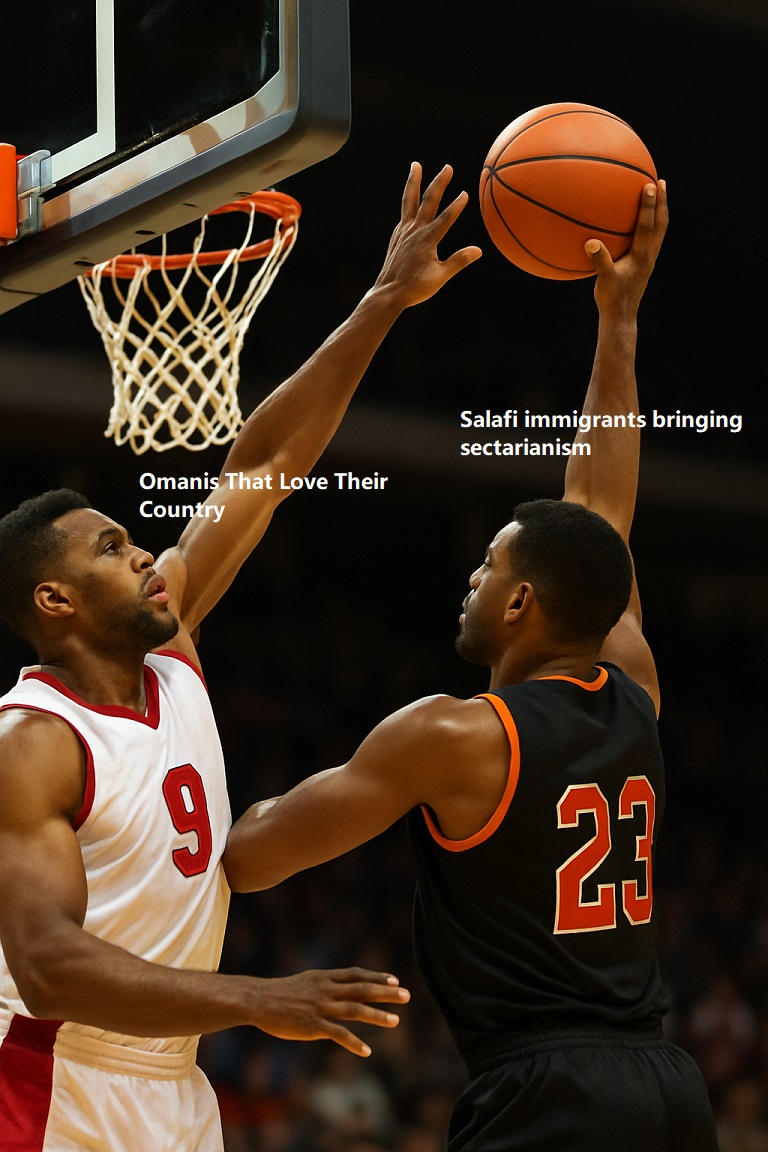

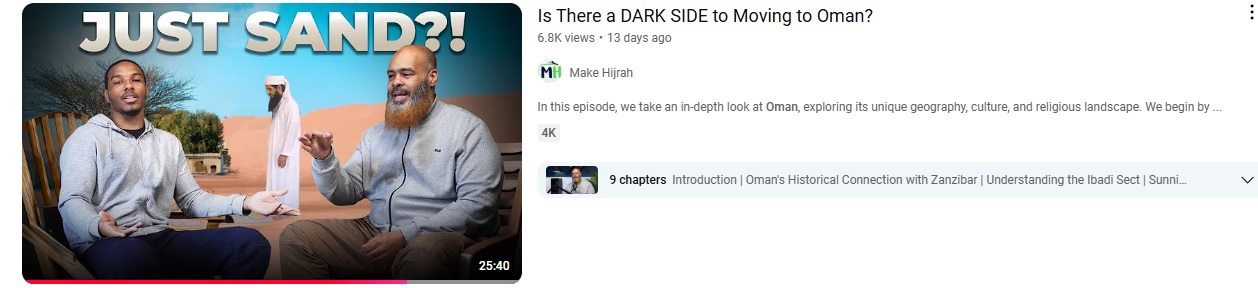
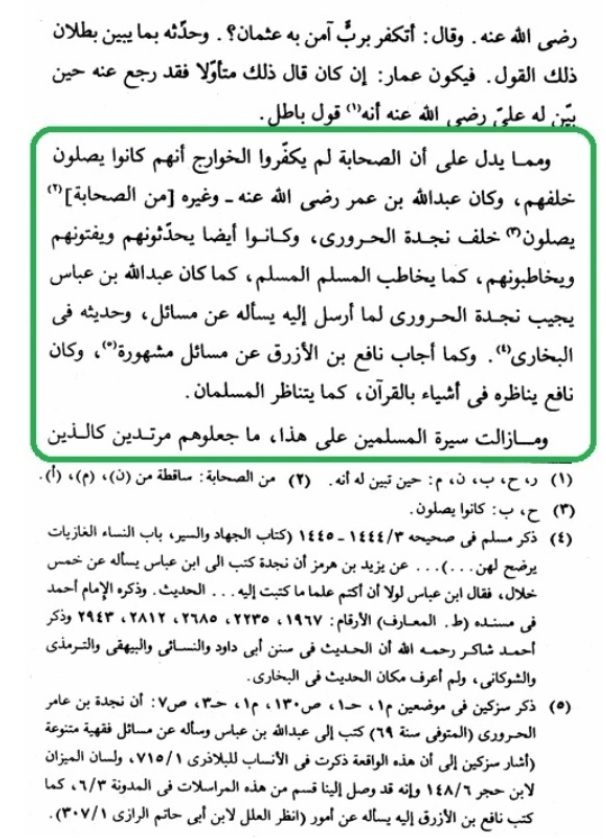


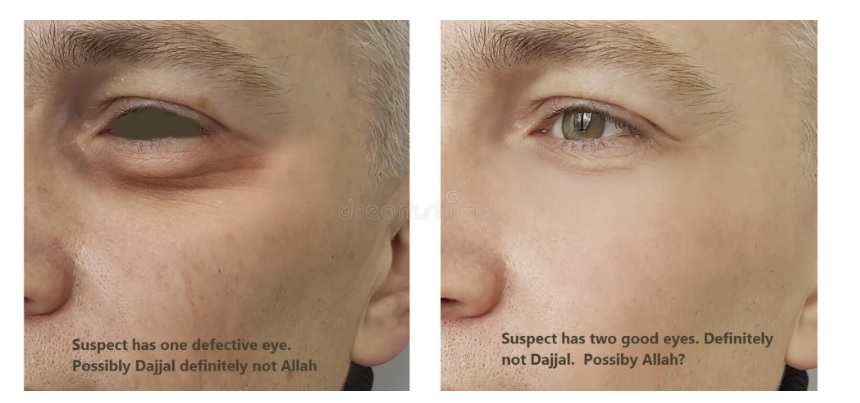


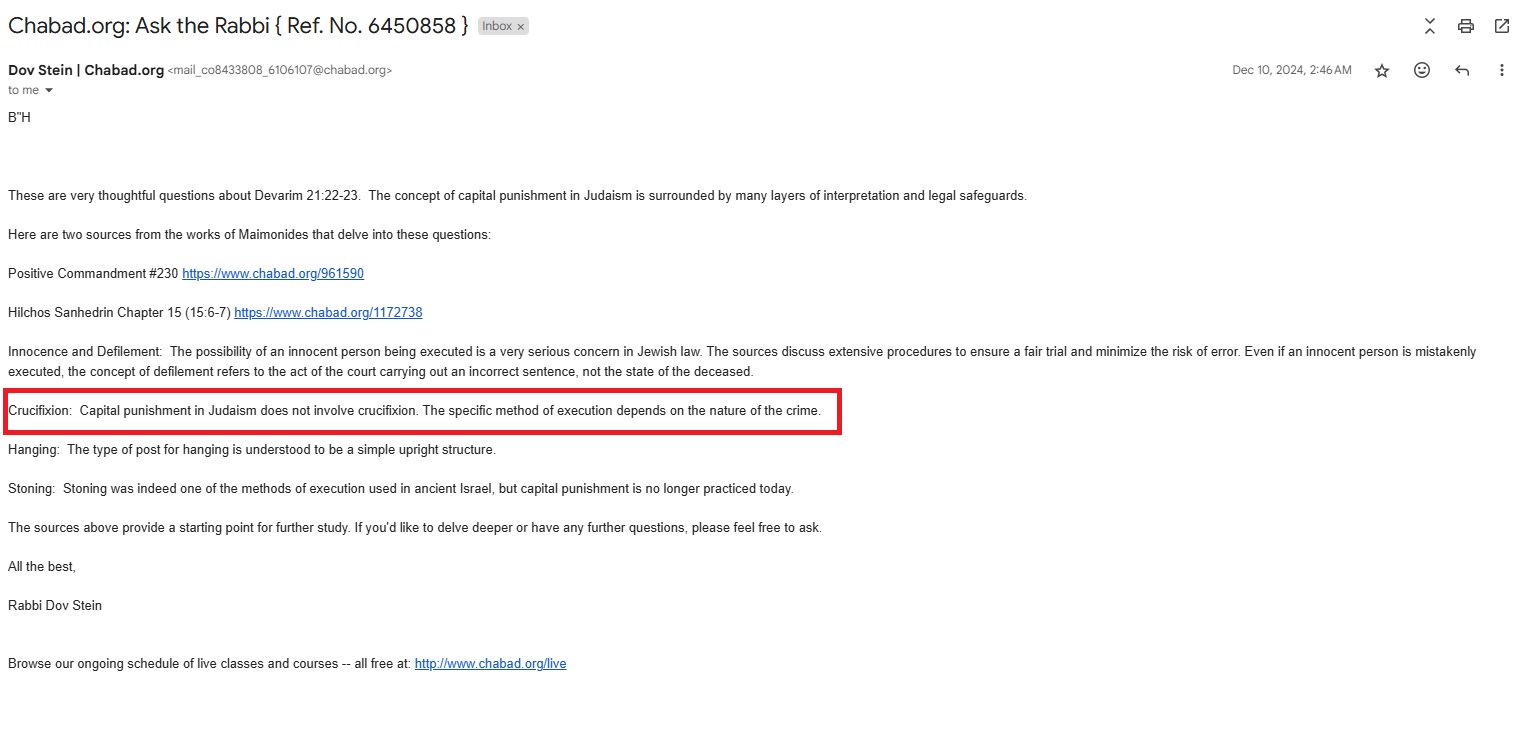


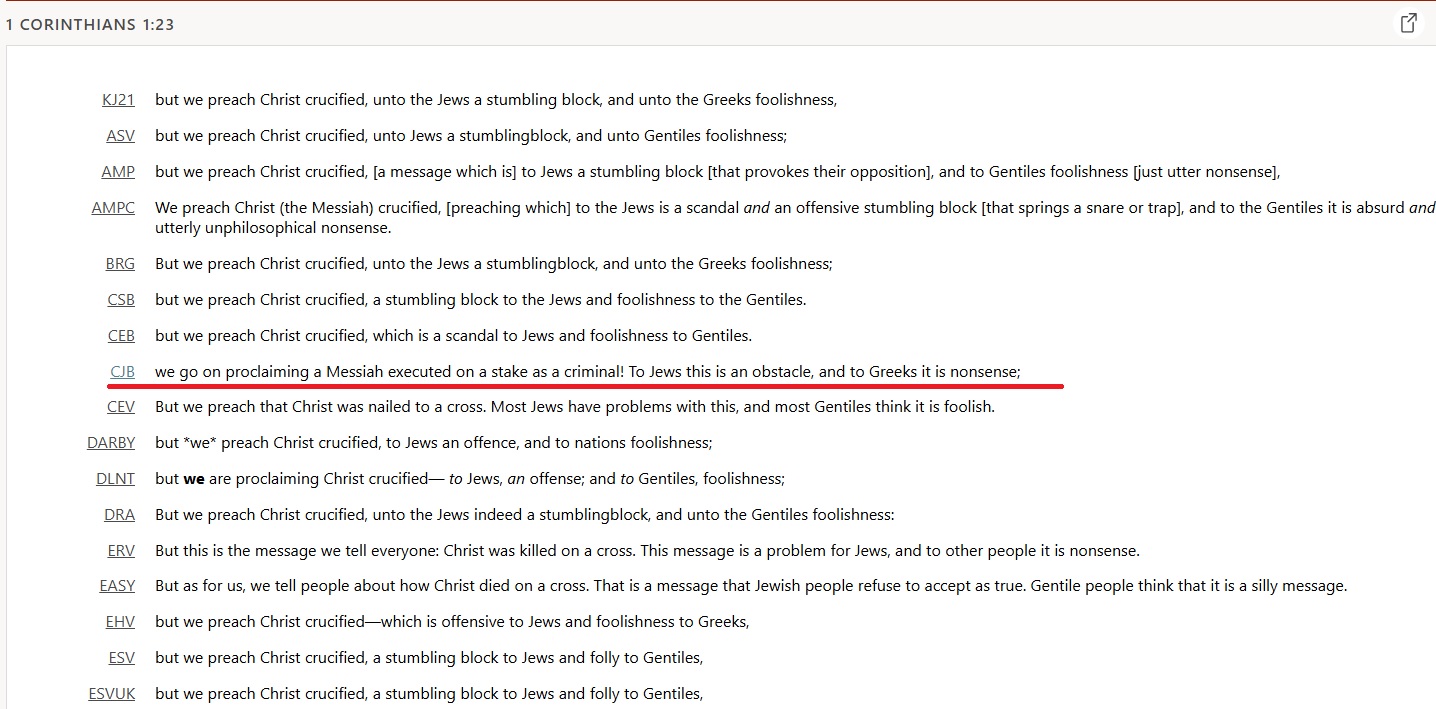
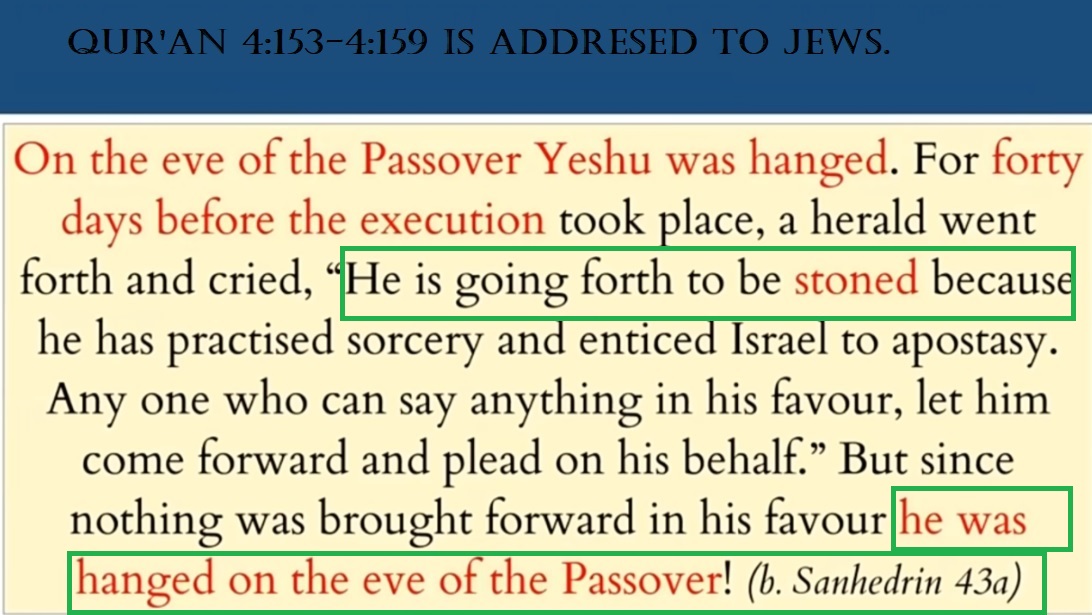
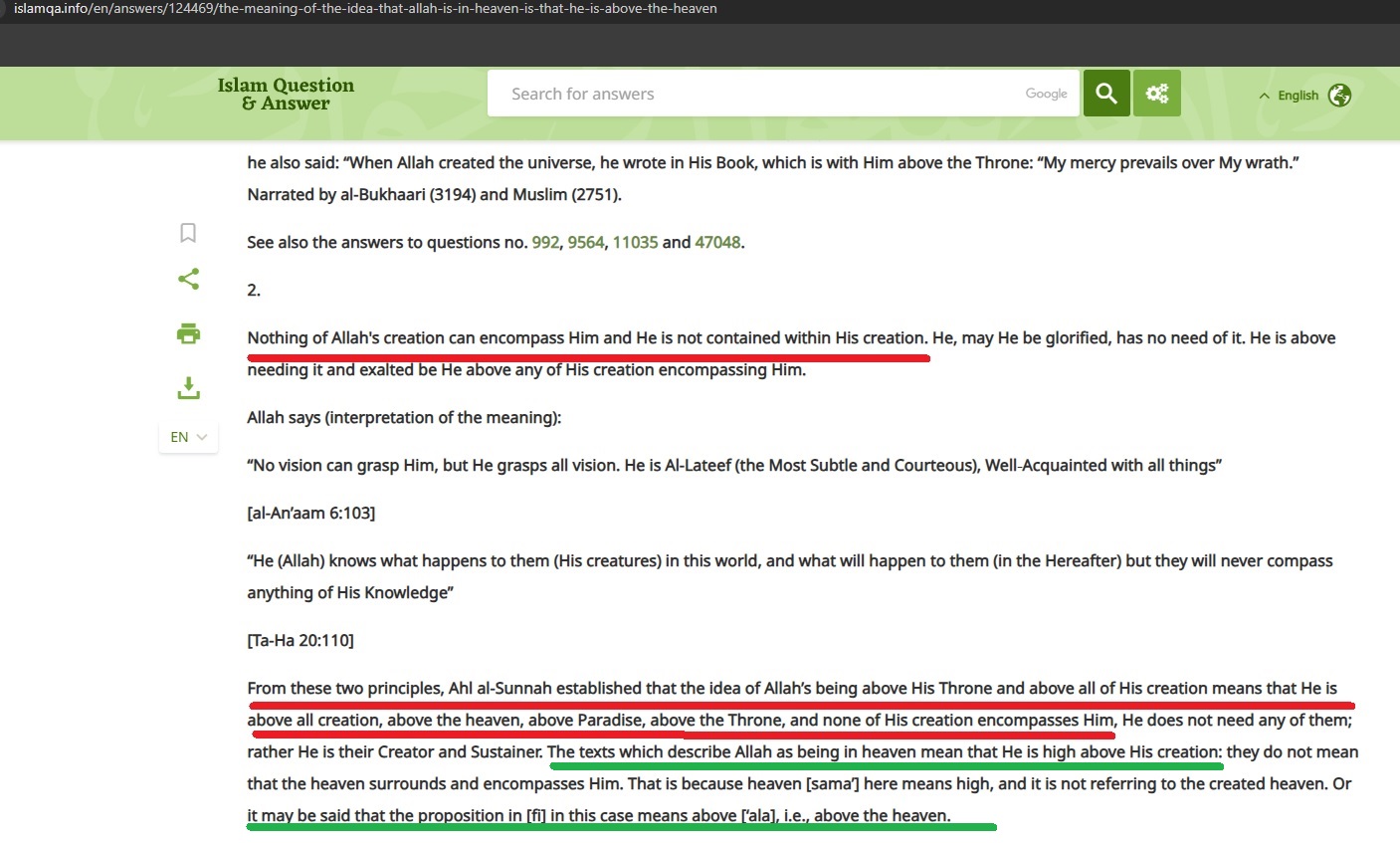


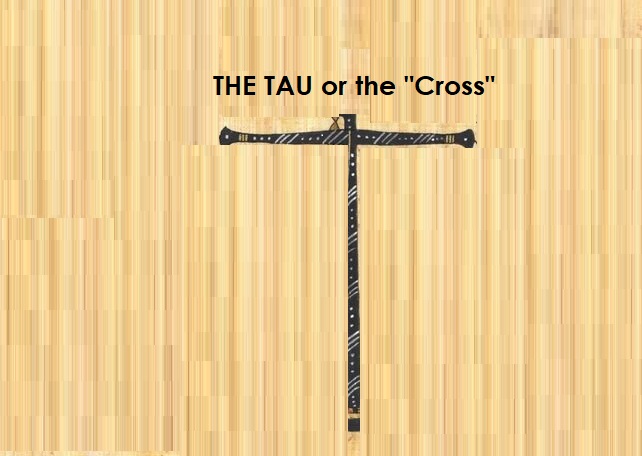


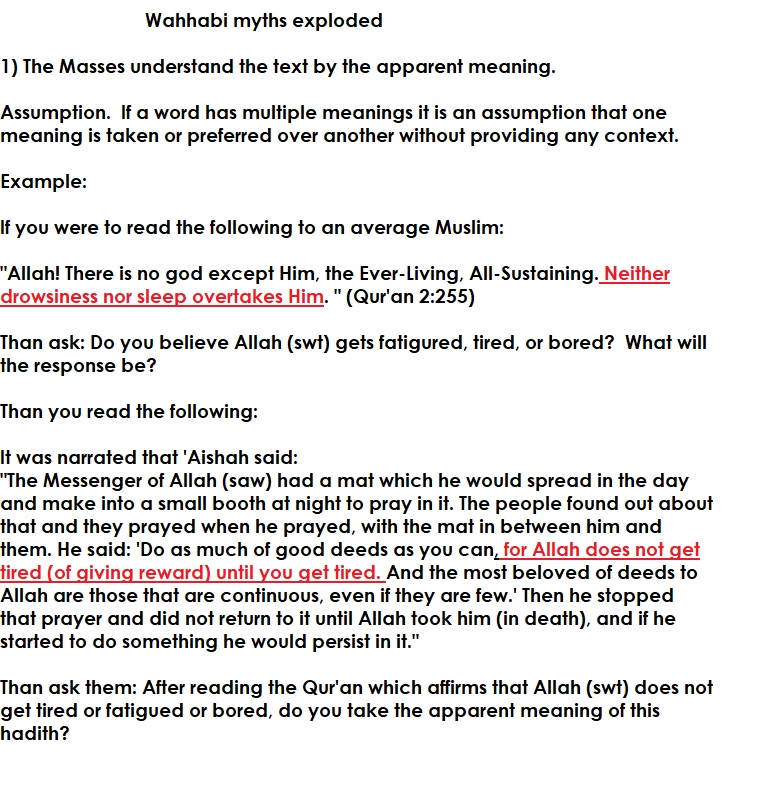
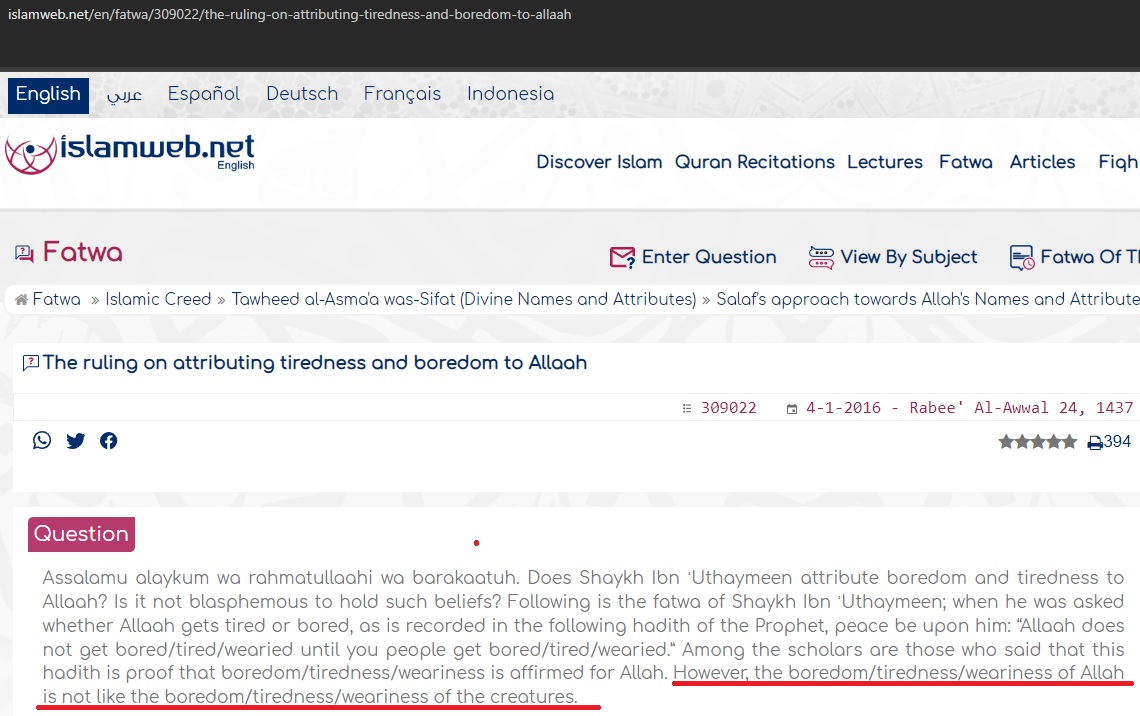
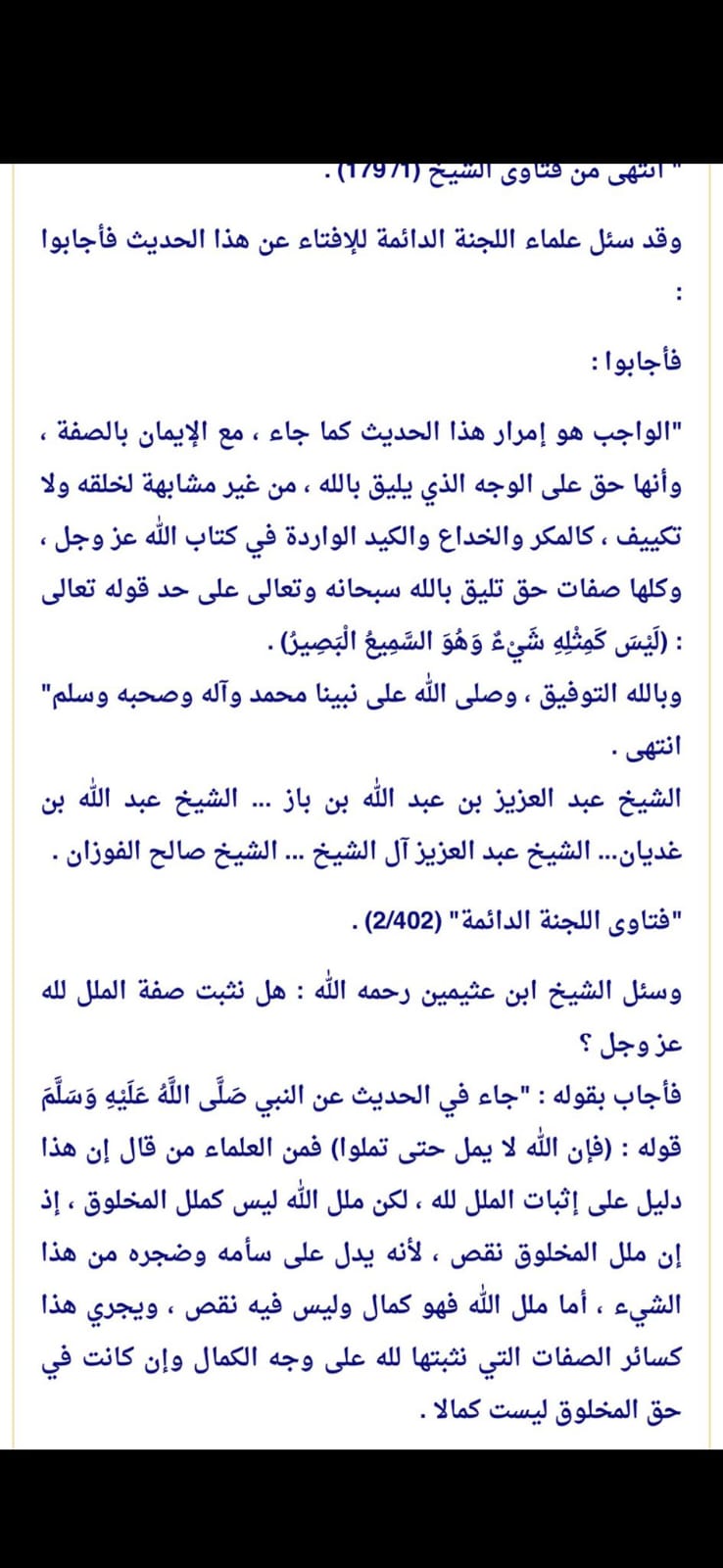
 wrote:

 Prima Quran